




rl March
0 0 1
No. 86
EDITORS David C. Watts
27 Raydean Rd,
Barnet, Herts. EN5 IAN.
F. Peter Lole
5 Clayton Ave.
Didsbury, Manchester, M20 6BL.
NOTICES Henry Fox
20 Ockford Road,
Codalming, Surrey, GU7 1QY
Web site, www.glasscircle.org
E-mail, dcw@glasscircle.org
GLASS CIRCLE NEWS
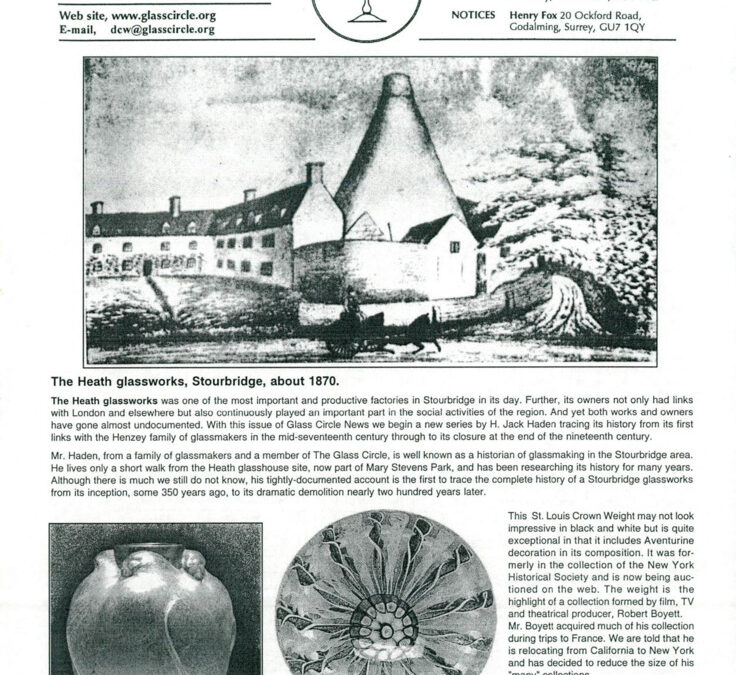
The Heath glassworks, Stourbridge, about 1870.
The Heath glassworks was
one of the most important and productive factories in Stourbridge in its day. Further, its owners not only had links
with London and elsewhere but also continuously played an important part in the social activities of the region. And yet both works and owners
have gone almost undocumented. With this issue of Glass Circle News we begin a new series by H. Jack Haden tracing its history from its first
links with the Henzey family of glassmakers in the mid-seventeenth century through to its closure at the end of the nineteenth century.
Mr. Haden, from a family of glassmakers and a member of The Glass Circle, is well known as a historian of glassmaking in the Stourbridge area.
He lives only a short walk from the Heath glasshouse site, now part of Mary Stevens Park, and has been researching its history for many years.
Although there is much we still do not know, his tightly-documented account is the first to trace the complete history of a Stourbridge glassworks
from its inception, some 350 years ago, to its dramatic demolition nearly two hundred years later.
This St. Louis Crown Weight may not look
impressive in black and white but is quite
exceptional in that it includes Aventurine
decoration in its composition. It was for-
merly in the collection of the New York
Historical Society and is now being auc-
tioned on the web. The weight is the
highlight of a collection formed by film, TV
and theatrical producer, Robert Boyett.
Mr. Boyett acquired much of his collection
during trips to France. We are told that he
is relocating from California to New York
and has decided to reduce the size of his
“many” collections.
The sale was conducted on the web by
Sothebys. com and the closing bid was
US$20,000 (estimate US$20/25,000).
Picture courtesy of Sothebys.com
Quatre Pigeons
(Ht. 25 cm). A rather handsome but nevertheless fairly ordinary piece of 1923
frosted Lalique, you might think. Wrong again! It fetched a staggering £95,000 (£106,000
including premium) at Bonhams and Brooks’
Decorative Arts
auction on the 29th November,
2000. The reason is that this piece is truly unique, made by the
cire perdu
(lost wax) process
and was bought by the vendor’s family directly from Lalique. Unusually, the artist has impressed
Picture courtesy of Bonhams and Brooks
his thumbprint with date of manufacture on the underside of one of the pigeons’ tails.
GLASS CIRCLE NEWS No. 86
2001
•
Editorial
What is Depleted Uranium?
The ongoing furore in the media about DU is only marginally
relevant to glass but the subject is so little generally understood
that a few words of explanation may prove of interest.
You may recall that an atom consists of a nucleus, made up of
positively charged protons and uncharged neutrons densely
packed together, around which whiz negatively charged
electrons. Atoms, normally electrically neutral, contain equal
numbers of protons and electrons, their number defining the
element from Hydrogen with one of each to Uranium with 92 .
However, small variations can occur in the number of neutrons
present and this gives rise to the so-called isotopes. Uranium has
three main isotopes called U238, U235 and U234.
Naturally mined Uranium contains about 99.3% of U238, 0.7%
of U235 and a trace of U234. All of these are radioactive and
spontaneously give off particles leading ultimately to a change
in the element to a new one. U235 is the most radioactive and
is the only form suitable for use in power stations and atomic
weapons. To this end the Uranium is processed (mostly in
America but also in the UK and elsewhere) to remove and
concentrate the U235 while the U238 (which still retains a little
U235) is discarded as the waste product we call Depleted
Uranium.
Bearing in mind the stockpiles of atomic weapons and substan-
tial number of atomic power stations, somewhere, there must be
huge piles of DU posing serious disposal problems. The minute
amount used in glass making by firms such as Fenton does not
even begin to address the problem. The (presumably) American
idea that it could be used to harden a shell case and then shot
into somebody else’s back yard with (hopefully) no questions
asked seems a solution worthy of a Congress medal.
So, is DU a biological hazard, a question about which both
governments and the media seem seriously confused (or wish to
leave us seriously confused!)? The short answer is much the
same as for the natural Uranium used in glass making and
ceramics up to the Second World War when it was (mostly)
called-in for making luminous dials for instruments etc. At the
levels normally encountered, only inhaled dust is likely to be a
serious danger unless you sleep with the piece permanently
under your pillow or wear it next to your skin. The carcinogenic
effect of dust inhalation can be exacerbated considerably by
other lung irritants such as smoking or finely powdered sand
and may, like some smoking-related lung diseases, have a
genetic (inherited) component. The situation, then, is not simple.
The full answer as to why some radioactive elements, such as
Uranium isotopes, are more a danger to health in some situations
rather than others is more complex. All Uranium gives off
particles known as alpha radiation. These travel only a short
distance (about 0.5mm), do not penetrate unbroken skin and so
are relatively harmless unless ingested. However, the first
breakdown product of each isotope (see below) then decays
further giving off a higher energy radiation, called beta radiation,
which can travel about 10cm and hence is also an external
hazard. Beta radiation passes through ordinary soda glass but as
it is mostly blocked by lead (and to a lesser extent barium, often
used in press-moulded glass) poses considerably less danger in
heavy lead and barium glasses than might be expected from the
amount present — usually ranging between about 0.1% and 3%
by weight, but may go up to 6% or 7% by weight.
Because U235, is 6 to 7 times more radioactive than U238 it is
correspondingly a greater danger, but because it is less than 1%
of natural uranium its removal does not reduce the radiation
from DU by more than 40% or, as some argue, by more than
20%, still a very significant threat. Even more significant is the
fact that the time period over which the radiation continues is
essentially
for ever
as indicated by the table below. Hence any
form of Uranium randomly sprayed around, particularly in fine
particle form, will continue to affect all biological life around it
and not just us humans. The major problem for us is that if a
radioactive particle becomes lodged in the lungs the alpha rays
can irradiate and damage (cancerise) the lung cells. And one
particle is all that may be needed. Hence any radioactive dust
produced under battle conditions (or any conditions, for that
matter) is not just an everlasting health threat but the specific
relationship between cause and effect is almost impossible to
prove beyond reasonable doubt. In a windy situation dust may
be carried anywhere so local monitoring of a suspected
site
of
contamination may prove only minimally informative.
To understand the military point of view, what we need know
is the decay rate of a shell fragment in various situations and
how much Uranium goes into one shell. What, one asks, will
happen when an enemy can fire them back at us? *
Radioactive Decay Patterns of U238 and U235
The rate at which radioactive material decays is measured in
half lives, that
is
the time taken for half the material to change into a new
substance.
The remaining half will then take as long again to be reduced to a quarter of the original and so on. At the same time, for
Uranium, the changed isotope will be undergoing further decay. The decay patterns of the two main Uranium isotopes are as follows.
U238 Series
Particle
emitted
Half Life
U235 Series
Particle
emitted
Half Life
Uranium 238
alpha
4510 million years
Uranium 235
alpha
713 million years
gives rise to
Thorium 234
beta
24.1 days
I
‘Thorium 231
beta
24.6 hours
gives rise to
Palladium 234
beta
1.17 minutes
I
I Palladium 231
alpha
34.3 thousand years
gives rise
to
Uranium 234
alpha
252 thousand years
I
I Actinium 227
alpha & beta
21.6 years
eventually gives rise
to the stable isotopes
Lead 206
1
I Lead 207
ITIIITIIIIITITITIIIIITITIT1T1TITIT
TITITITITITITIIIIIIIIITITI
Corrections from GC News 85
Ardingly showground is near Haywards Heath, Sussex
(not
South London). Also, Editorial apologies to John Brooks’
whose name was omitted from his first “Reminiscences”.
Half-price Antique Fair entry
Look out for up-market Cooper Antique Fairs in your vicinity
as they have a special half price entry charge for Glass Circle
members. April, South Cotswolds; June, Cheshire, July, South
and North Cotswolds. More info, Tel. 01249 661111.
Publications – late information
Thomas Heneage Art Book Survey, Spring 2001, For a
free
copy Tel. 020 7930 0319, mentioning The Glass Circle.
Verre A
French across-the-board high quality magazine on
historical, archaeological, contemporary and technical aspects
of glass, mostly in French, some English.
Subscription is FF1085 for 1 year (6 copies). For a sample copy
Tel. 01 56 58 63 79, or Email revue-verre@institutdu verre.fr
mentioning The Glass Circle.
Page 2
•
2001
GLASS CIRCLE NEWS No. 86
471/t&PTD RE7.46671611
,
S
ev
9. Petez
Zote
rr he Millennium prompted many a scheme of tangible
1 celebration, and there must be hardly a Society in the whole
land that did not come up with some proposal for marking this
auspicious anniversary. Ranging from the overblown fantasy of
The Dome,
through the
Glass Circle’s
Goblet and Stick Pin, to
new notepaper for
The Society;
all had the objective of leaving
some recognisable memorial of the occasion. Wearing my
Jacobite hat, quite fortuitously I got involved in two such
schemes, both heraldic in concept. One, inspired by the Presi-
dent of
The 1745 Association,
who happens to be a Scottish
Herald, was to establish and then portray as a poster, the sixteen
ancestral arms of Bonnie Prince Charlie and his brother, Cardi-
nal Henry. The other scheme successfully sought a grant by the
Lyon King of Arms of an Armorial Achievement to the
Association
itself. So, when the National Trust published a book
on the Heraldry in its houses it was natural that I should acquire
a copy, especially since one of the co-authors is the highly
respected Architectural Historian, John Martin Robinson.
(Heraldry in National Trust Houses
by Thomas Woodcock &
John Martin Robinson; 2000. ISBN 0 7078 02776. £30)
A great deal is said in the book about heraldic representation in
Stained Window Glass, but it mentions only two Engraved
heraldic representations on Glass, neither known to me
previously, although the authors have overlooked others in
National Trust houses. The first instance, at Knole, is what is
claimed as a unique engraved Glass Panel, with the arms of the
6
th
Earl of Dorset as redrawn to celebrate his appointment by
William and Mary as a Knight of the Garter, in 1692. It is very
probable that the engraving was Dutch, and it recalls the small
engraved panel of Princess Mary of Orange (about 10″ x 7″) in
The Royal Collections, and presently displayed in the Stuart
room at the Palace of Holyrood house; this panel, too, must be
Dutch engraved and earlier than 1688, when Mary and her
husband chased King James II, her father and his uncle, from
the throne, thus elevating Mary’s status from Princess to Queen.
These engraved plaques are of much the same period and similar
in ethos to the cast plaques by Bernard Perrot, several of these
portraying Louis XIV. The only drinking Glass considered in
the book is one at Erdigg, in North Wales; a beaker, engraved
with the impaled arms of Yorke and Hutton, thought to com-
memorate the marriage of Simon Yorke of Erdigg to Dorothy
Hutton, in about 1740. A pair of similar beakers at Lyme Park,
Cheshire, is not mentioned; bearing the Ram’s Head crest of the
Leghs of Lyme, together with the arms of Legh and Bennet, they
are suggested as dating from the marriage of Peter Legh and
Martha Bennet in 1737. A few miles away, Tatton Park, home
of the Egertons, has a pair of marvellous Perrin & Geddes Ice
Cream Cellars, circa 1810, and each with a finely engraved crest
of
‘a Lion Rampant supporting a broad arrow’;
by standing on
a cap of maintenance rather than a torse, these crests aggrandise
the Egerton status, and thus anticipate their Barony by half a
century. Of almost exactly one hundred years later than the
Cellars, is the enormous 968 piece Baccarat Table service made
in
1911,
every piece with the raised gilt
`E of T’
(for
Egerton
of Tatton)
surmounted by a barons coronet. This use of a cypher,
with coronet where appropriate, seems to have become popular
during Queen Victoria’s reign, often replacing the armorial crest.
However, that one should have to look so hard to find Armorial
Drinking Glass in the extensive collections of the National Trust
is revealing, as also is the fact that each one is celebratory, of
marriage, the award of The Garter, or in the case of both the
Tatton groups, the succession of an heir.
One might reflect on why the use of Engraved Armorials to
embellish C.18
th
drinking Glasses is so unusual; indeed, there
are almost as many enamelled examples, from the Beilby studio
and their later Edinburgh successors, as there are engraved
specimens. This scarcity is odd, for only the very simplest of
C.18
th
silver is without armorial engraving, and armorial ceram-
ics are legion, as are Dutch and German Engraved Armorial
Glasses. Does it, perhaps, illustrate the fact that Glass was not
a major fashion component of grand entertainment in C.18
th
Britain? Drinking Glasses only came into their own once the
main dinner was over, and the Ladies had retired, whilst Dessert
Glass was utilitarian, although elegant, until the beginning of
the C.19
th
. Then, changes in the mode of serving dinner, coupled
with the introduction of deep cutting and massive vessels, lead
the way to large and sumptuous
en suite
armorial services. The
Enamelled Armorial Glasses of the C.18
th
may well have been
regarded as
‘Verres de Parade’
and thus a fashion item, and
indeed, when one ponders that apparently, relative to the
numbers surviving, armorials on Jacobite Glass are almost more
common than on other Glass of that period, is it perhaps a
reflection of how fashionable Jacobite Glass was in True Blue
circles? Three Jacobite finger bowls or Water Glasses and
stands, survive with a Griffin crest, together with the same
number of Glasses with the Lion Rampant crest attributed to
Lord Fairfax. Broadfield House has a Jacobite tumbler with the
Vaughan crest of
‘a boy’s head couped at the shoulder with
snakes entwined round the neck’;
this relates to the same crest
on the Beilby
‘Plymouth Dock’
goblet at the Cecil Higgins
museum. Our founder, John M. Bacon, also ascribes other
Glasses with the Vaughan crest as Jacobite, a little questionably
in my view
(Circle of Glass Collectors’
Paper No: 52) whilst
the Fitzwilliam, too, has a Vaughan crested Glass
“of possible
Jacobite significance”.
The Spread Eagle crest of the arch-
Jacobite, Sir Watkin Williams Wynn is engraved, together with
his name, on a Glass at the Cecil Higgins Museum.
The Royal Collection has a considerable group of C.18
th
Glass
engraved with Royal Armorials, but most are Continental. Also
extant are some full Armorial Shields which relate to Corporate
bodies, such as The Merchant Taylors, and The Turners
Companies, the Norwich Woolcombers and Oxford Colleges.
There are, as well, fictitious Arms of such things as the Farmers’
Arms, the Anti-Gallican Society and the Society of Bucks. There
are doubtless many others that I have not noticed, and the
compilation of a check-list might be useful. But the fact remains,
when compared to other types of Table Wares in Britain, it is
notable how rare is the representation of Personal Armorials on
C.18
th
Engraved Glass. *
Reminiscences of an Antique Dealer
A DREAM COME TRUE!
Who says dreams do not come true? Some years ago I was
setting up at an Antiques Fair in the north of England when I
saw a decanter on another dealer’s stand that had all the
hallmarks of Irish glass. An examination of the base revealed no
name but I remained confident of its origin.
That night I dreamed I went to an Antiques Fair, saw a decanter
and, on looking at its base, clearly saw the welcome words
CORK GLASS Co. The dream was so vivid that on waking, and
bearing in mind the events of the previous day, I was no longer
certain which was dream and which was reality. Arriving back
at the fair I again examined the decanter I had seen yesterday
but, still no inscription. However, the asking price was so modest
that I bought it, hid it away, and, at the end of the fair, took it
home.
At that time I kept my stock in a cabinet with internal Lights.
Unpacking the decanter I thought I would look again for a mark
and this time, due to the angle of the base against the Light, the
words CORK GLASS Co. suddenly appeared. Thereafter, for as
long as I owned it, the name was obvious and I could never
understand why it had been so difficult to see in the first place.
John Brooks
The first of these reminiscences in the last issue of GC News
was also by John Brooks.
Page 3
GLASS CIRCLE NEWS No. 86
2001
4/ass a/M*1’gs
by Hwy fox
Lalique Car Mascots set hot pace.
Last Autumn saw the sale in America by a Car Auction
Specialist, of a complete collection of Lalique Car Mascots. It
is understood that the 30 plus items sold, including the buyers
premium etc, for just under US$1,000,000.
Irish (Auctioneers) Eyes are Smiling
The demand for all things Irish from fine art to
antique furniture and silver has increased the
prices paid for Irish antique glass, too. This
applies particularly to pieces with provenance
and preferably with indisputable evidence to
identify the maker or retailer. At a sale in
Dublin last June Messrs Hamilton, Osborne,
King offered a good range of glassware that fell
into to this catagory, and which formed the John
Bailey Collection. A record price of 1R£14,950
Y V7
Y
RINSE AID: Another look at rinsers
l
n response to Martin Mortimer’s comments on Water Glasses
and Rinsers in our last issue, Robert Hardy writes to say that
in the recent Chardin Exhibition at the Royal Academy, exhibit
No: 77 which is signed and dated 1759, shewed a Glass upended
in a Rinser which certainly had no lip. This was described in
the catalogue as a wine cooler and in the text as an ice bucket.
Indeed, it would seem that the French generally used Glass
Coolers or Rinsers without lips, and that they also used Rinsers
far earlier than we did in this country. There is in the Musee
Cond8 at Chantilly a well known painting of 1735 by Jean-
Francois de Troy, entitled
‘Le dejeuner d’huitres’;
it is renowned
for shewing a champagne cork being blown some 10ft into the
air, confirming that at that time Champagne was a sparkling
wine. But, in addition, there are depicted on the table several
round ceramic bowls, without lips, and with Wine Glasses
inverted in them. Jacqueline Bellanger, in her book
Terre
d’usage et de Prestige’,
when considering
Rafraichissoir’
(or
`Seaux de table a rafraichir’)
illustrates three Glass Rinsers
attributed as being from the late C.17″
1
to the earlyC.19″‘. The
earlier two are cylindrical with lug handles, whilst the latest of
the trio is slightly waisted, with loop handles, and carries an
inverted Wine Glass; none have lips. She goes on to say that
they are more commonly made of ceramics or metal, rather than
Glass. The Bowes Museum has a pair of cylindrical French
Wine Glass Coolers with lug handles ascribed to c.1775.
However, the position in Britain is less clear. In support of the
view that Rinsers invariably had lips there is the famous report
in the ‘Staffordshire Advertiser’ of 1837 (cited in the ‘Daven-
port’ book) reporting on the very large Glass service provided
(Stg£12550) secured this rare decanter c.1800, possibly made
by the Cork Glass Company, which had “Mary Carter & Co.
Grafton Street (Dublin)” moulded on the base. Mary Carter was
a Dublin retailer. Another decanter, possibly by Edwards of
Belfast, engraved with sailing ships, went for 1R£7,200
(Stg£6050).
Table Fountains at Corning
–
Not a Mating Pair
Our member, Jane Spillman, has written to say that The Corning
Museum of Glass has now acquired two Victorian period glass
table fountains, one of which is from the famous Benacre House
Sale held by Sotheby’s last year. I am pleased to report that the
Circle, through Clippings, assisted in a small way by alerting
The Corning Museum to the posible acquisition of both these
interesting items. For type see GC News No. 78, page 10.
Glass Rules
–
O.K.
Under the heading “The Future is Glass” London Evening
Standard’s House & Property Section (14th. Feb.01) had this to
say:
“Glass is the material of the moment….what is new is that
glass is being used in the design of everything from work-tops
to washbasins, to curtain finials and door handles. Soon, it
seems, even glass baths will be commonplace.” The article goes
on to mention the development of glass sheets which go cloudy
at the flick of a switch for instant privacy; and “radiator” glass
that contains heating elements. Reference is also made to the
development of non-laminated glass flooring made of an alu-
minium honeycomb sandwiched between two sheets of glass.
Further, members familiar with modern design will not be
surprised by this quote in the article from a Director of
Interdesign of Chelsea Harbour in London: “… glass furniture
has caught the imagination of the British public.” St-Gobain
Glass is a major producer of all types of glass and you can catch
up on recent glass technology with their Glass Guide, Edition
2000 (9 x 19 cm. 617 pages, numerous ills.), available free on
www.saintgobain-glass.com – you heard it first on “Clippings”.
Collectors beware of Stolen Paperweights
A display of valuable modern paperweights were part of the haul
from The Crystal Glass Center, Audnam, near Stourbridge,
which has now been broken into three times in a row. *
IEV
Y3EICV1V V3E.7€
by F. Peter Lole
by Davenport for the Accession Banquet for Queen Victoria at
the Guildhall, London, which makes an absolutely clear distinc-
tion between Rinsers and Finger Bowls: “The supply for her
Majesty’s
table consists of ….. eighteen wine glass coolers, …..
one dozen topaz coloured finger glasses, …..” Then, there is an
intriguing bill of 1 791 from
William Storer (“Earthenware &
Glassman”) to the Earl of Egremont, which includes “23 Finger
Cups with Handles”, – what is one to make of that description?
Could Storer’s “handles” in fact be lips? Equally uncertain is a
print by Henry Alken, issued in a variety of states between 1817
& 1833, variously entitled ‘The Toast’, ‘The Hunt Breakfast’,
‘The
Melton Hunt’ & The Tarporley Hunt Club’. There are
variations, but all
shew Wine Glasses inverted in bowls; the
reproductions which I have are not clear, but they seem not to
have lips. This is not only the earliest British illustration of
coolers in use, it is almost the only one which I know of. Again,
Parson Woodford’s diary in 1793 records: “Everything in a very
tasty manner, blue water glasses with wine glasses in them after
dinner.” — since he calls them ‘Water Glasses’ are they lipped,
or not?
Thus, in France I think it is beyond doubt that, from far earlier
than in this country, bowls without lips were the norm for Glass
Rinsers. However, in this country whilst lipped Rinsers were
common enough from around 1800 onwards, I suggest that one
should use the old Scots’ verdict of non-proven as to whether
lipped Rinsers were the invariable pattern. Mortimer’s descrip-
tion of the situation as “a labyrinth at present without outlet”
seems an elegant conclusion. *
0000000000000
V&A gets a “Royal”
This very fine cut goblet of
circa
1820, formerly in the
Royal Brierley Collection,
was acquired by the new
firm of C. & L. Burman
(formerly Namara Fine Art)
on behalf of the V&A
Museum.
The bowl has a deep gold
band round the rim and is
polychrome enamelled with
the arms of the Duke of
Sussex, a son of George III,
probably by William Collins
who was enameller, by
appointment, to the Duke.
Page 4
Your dates for the 2001 –
2002
Season of
Glass Circle Meetings.
All meetings have been arranged to be held at the
Artworkers Guild, 6.30pm for 7.15pm.
Thursday
Thursday
Thursday
Tuesday
Tuesday
Tuesday
Tuesday
Tuesday
11
th
October
2001
15t
h
November
2001
13t
h
December 2001
14
th
February 2002
12
th
March 2002
16t
h
April 2002
7
th
May 2002
11t
h
June 2002
2001
GLASS
CIRCLE NEWS No. 86
Glass Circle Matters
Meet the Committee
Graham Vivian
Graham, who is a Chartered Sur-
veyor by profession, is the new-
est member of the Committee,
he joined last year following the
death of Dr Kersley. He first
became attracted to studio glass
in the 1970’s, items of which
quickly started to fill all avail-
able shelf space. In 1995 he
moved into the more classical
area of collecting, mainly Eng-
lish 18th Century glass, which
he has found quite absorbing.
Compared with the erudition of
many of the other members of
the Committee, Graham considers himself still very much of a
novice. What he lacks in knowledge he makes up with his
enthusiasm for the subject. In addition to his addiction to glass,
Graham is passionately fond of the English countryside and very
interested in 17th Century and 18th Century oak furniture. His
greatest regrets are that having worked for 20 years in the same
building in Kensington as Delomosne, he did not visit their
premises until after they moved to the West Country, and having
lived for many years in the same street as Michael Parkington
he never met the famous collector or saw his collection.
The Glass Circle Annual General Meeting and
Specimens Evening
This year the AGM was held at the Artworkers Guild and we
thank our hosts, Barbara Morris and Raymond Notley, for their
generous support.
The officer’s reports revealed another successful year with a
stable membership of over 400 and a favourable financial report
(available on request from the Hon. Treasurer). A major concern
is the storage of our publications (see below) and help in this
respect is urgently needed.
Eighteen specimens of glass were brought along for discussion.
Of these, only six were from the C18th, and none earlier,
suggesting that collectors are taking more interest in later
periods. Historically most interesting was a glass inscribed
“Success to the Rochdale Canal”. A rummer (5″ high) inscribed
“Success to Rochdale Canal” is in The Harris Museum, Preston;
The canal opened in 1804. A facet stem wine, a dry mustard
and a hollow knop tazza were other pieces from the early period.
The later glass was a mixed assembly ranging from an engraved
armorial facet with star-shaped foot (after 1806) and a Sowerby
Roman style ‘blanc de chine’ vase,
c.
1882, to gilded Islamic-
style and enamelled Bohemian glass and a Dresden goblet in
amber glass. There is much still to learn about the later glass
which provided, overall, for an interesting evening. 4
Welcome to New Members:
Prof. and Mrs. C.J. Bulpitt
Mr. N.R. Lyne
Mrs. C. MacDonald-Haig
The Hon. Ms. A. Shaw
Diary Dates
–
correction of Email address
14th-16th July, 2001, International Congress of the History
of Glass, in Edinburgh.
Information – reduced rate tickets –
from David..Martlew@btinternet.com
or phone 01695 54668 at Pilkington plc.
Glass Circle Silver Clip Delay
–
Apologies
The artist informs us that the first set of pressings have had to
be repeated due to poor quality. He greatly regrets the delay.
Glass Circle News; copy deadlines.
No.
87 Mid-May for publication in June/July
No. 88 Mid-August for publication in September
No. 89 Sept./Nov. for publication in December/January
Thanks to Rosemary Watts for proof-reading this issue.
Henry Fox
Henry has been a member of the
Circle for thirty years. Although
he was aware of Jacobite glass
from reading about antiques in
his teens, he did not seriously
acquire any real “old” glass of
his own until he was in his early
thirties. As a member he has been
deeply involved with the Circle’s
Golden and Diamond Jubilee
Exhibitions, and is currently
working on the proposed 2003
Exhibition. He first exhibited
publicly part of his own collec-
tion of Cl8th English drinking
glasses at Haslemere Museum in 1978 to coincide with a Circle
Summer Outing and has since organised a number of differing
displays at various venues, including two in 1997, at the Buxton
Antiques Fair and at Guildford House (Surrey), to promote The
Circle. He was co-opted to the Committee in 1993 and joined
the GC News team in 1994. Over the years his interest in glass
has widened from mainly English drinking glasses to encom-
pass ancient glass through to contemporary studio glass. Henry
says of the GC News team that David provides the technical,
Peter the historical, and he mainly the comical!
Death of Sir Laurence Whistler CBE, D. Lit (1912 – 2000)
It is with great sadness that members are advised of the death
on 19th December 2000, age 88, of our former distinguished
member Laurence Whistler. He was not only father of the
renaissance in the art of stipple engraving on glass and a founder
member and President of
The Guild of Glass Engravers,
but also
a noted poet (his first book of poems was published when he
was 17) and wit. His pioneering skill and artistry with the
diamond point inspired many during his life- time, and will
continue to do so in the future. One of his best-known and most
innovative works are the windows of St. Nicholas, Morton,
church, the only one in the world with entirely engraved
windows. He published five books on his glass.
A Memorial Service will be held on 11th May at 2.30 pm, in
Salisbury Cathedral where Whistler married his first wife and
where may be seen his memorial to his artist brother Rex, a tall
pyramid of Stuben glass with inter-relating views of the
Cathedral.
We also report with considerable regret the death of our long-
standing member, Mr.Derek G.U. de B. Wilmot.
BOOK
STORAGE URGENTLY NEEDED
The
Glass Circle is in urgent need of dry storage,
preferably in the London area, for its publications.
One person need not store all the material and any
offers of help would be gratefully appreciated.
Apart from existing material, The Glass Circle
Journal, No. 9, is due out shortly and plans are also
afoot to publish a catalogue to accompany our pro-
posed 2003 exhibition.
Page 5
A 491
To Wolverhampton
A4101 To Dudley
at
KINGSWINFORD
Broadfield House
Glass Museum
WORDSLEY
A 458
To Bridgenorth
A458 To Lye,
Halesowen,
and
Birmingham
1*I Road
gtierley
bi
903-
1
C2tA”
To
Brierley
Hill
Red House Cone
Stuart Crystal
AUDN
To Wordsley
and
Brierley Hill
COALBOURNB
RO
Q)4nI
ib
O
roo
K
k
A1413
1
E
HOLLOWAY
END
Stourbridge
Canal
0
Pu
ana
Worcester
Street
Church
Street
OLD SWINFORD
To
Kinver
A 451
To Kidderminster
Freair,
Glassworks
,
Mary Stevens
Love
•
Park
/Lane
al:01
‘ –
A491
M5, Hagley and
Bromsgrove
MAP TO SHOW THE LOCATION OF THE
HEATH GLASSWORKS AND SOME OTHER
GLASSMAKING AREAS OF STOURBRIDGE.
Note:- The names of local areas are shown in capitals,
Ecclesiastical parishes are italicised.
est)
(2;
do
GLASS CIRCLE NEWS No. 86
2001
A History of the Heath Glassworks, Stourbridge by H. Jack Haden
Part 1. Introduction – the Glasshouse Site
W
ith a roar and a deafening crash the cone of the old
glassworks at The Heath, Stourbridge, collapsed. It was
the 23′
d
March, 1892 and this momentous event was duly
recorded in the local weekly newspaper’:
“The glasshouse cone at the Heath — a well-known landmark
towering above the trees and houses near — is a thing of the past;
but though lost to sight it will not be dear to the memory of
those who saw its alarming and unexpected disappearance on
Wednesday afternoon between 5 and 6 o’clock. For some weeks
past workmen have been removing the adjacent buildings and
had weakened the sides of the cone which, without warning,
suddenly fell down with a fearful crash, alarming the whole
neighbourhood. At first it was thought the men were buried
under the immense heap of fallen bricks, and in a few minutes
a number of persons came running at full speed to the spot. The
cloud of dust was too great at first to see where the workmen
were, but, with the exception of one man, it was found none had
sustained any injury. It was by a mere chance the men were not
within the cone at the time of its fall”
Although not stated in this report, it appears that the demolition
of the glasshouse was intended, though its collapse was a little
premature, for not only was the structure possibly 150 years old
and redundant but it was regarded as an embarrassing eyesore
by the new owner of Heath House within the curtilage of which
ithe cone stood. William Jonabab Turney owned the property
and he had acquired it on the 29th September, 1887 from the
trustees of the ironmaster, the late Alexander Brodie Cochrane.
Turney was not a glassmaker and, so far as we know, neither
he nor Cochrane made glass at the Heath although Turney’s
brother, Henry, who had moved into Heath House, had allowed
the local glassmakers and cutters to hold their picnic in its
conveniently placed grounds on the 4′
11
August, 1890.
Turney only brought to an end a long and varied history of
glassmaking that typifies the manufacturing problems of the
glass we love to admire and collect. The destiny of the Heath
glasshouse had run its course; it is to this history that we now
turn.
The Heath glassworks was situated a few yards south of the
junction of the road leading south from the town of Stourbridge
(now Worcester Street) and an old turnpike road running
towards Kidderminster and Bewdley (now Norton Road). A
hundred yards from the T-junction there entered another ancient
road (Now Heath Lane) which led to the village of Old Swinford
through which runs the main road from Stourbridge High Street
to Hagley and Bromsgrove.
Early Beginnings
In the last quarter of the C.17
th
Paul Tyzack had been driven
from the Weald by the proclamation touching coal, along with
other emigrant Lorraine gentilshommes verriers, to settle in
Stourbridge. They were surely attracted there by the abundant
deposits of coal and fireclay of high refractory quality suitable
for making the crucibles in which they melted their glass. Robert
Plot states:-
“the goodness of which clay and cheapness of coal hereabouts
no doubt has drawn the glass-houses, both for vassells and
broad-glass, into these parts, there being divers set up in
different forms here at Amblecot, old-Swynford, Holloways-end
and Cobourn brook,”
and he adds
(Chapt. IV, p 154) “sands
for the glass-houses, whereof I was told of one that excelled the
rest, dug somewhere near West Bromwich.”
2
Vague statements, such as this, are, alas, more common than
specific facts. Although the red sandstone of the Stourbridge
area would be unsuitable for making clear glass, it is possible
that it was used for producing the black and dark green bottles
which were made in large numbers in the vicinity, and there
may be significance in the fact that most of the old glasshouses
in Amblecote and Wordsley were located on elevated sandstone
sites near to brooks.
Page 6
2001
GLASS CIRCLE NEWS No. 86
Paul Tyzack was partnered by John Pagett in a glasshouse near
the main road in the centre of Hagley village. East of the
crossroads, where Heath Lane joins the Hagley Road, is Glass-
house Hill, some 300 yards of road cut through a ridge of
sandstone. This road leads in the direction of Hungary Hill
where, according to local tradition, the Huguenot glassmakers
established their first glassworks. Documents have survived to
indicate the presence in Old Swinford and the adjacent Stafford-
shire parish of Kingswinford of glassmakers and their glass-
houses from early in the C.17
th
but insufficient detail is shown
on surviving maps and plans to identify positively the sites.
Investigation of the history of the glass industry in the Stour-
bridge area has been complicated by the fact that whereas the
River Stour formed the boundary of the counties of Stafford and
Worcester, the scattered hamlet of Amblecote lying on the
Staffordshire side of the river was in the ancient ecclesiastical
parish of Old Swinford until it became a separate parish within
the diocess of Worcester in the 1840s. The boundary of the
manor of Amblecote (owned by the Grey family) and the manor
of Kingswinford (owned by the Ward family, the lords Dudley)
follows no significant natural feature and for part of its length
is in the middle of Brettel Lane, an ancient road on a ridge with
slopes north to the Audnam brook at Wordsley, and south to the
Coalboum Brook in Amblecote. Thus the glassworks at Hollo-
way end, Coalbournbrook and the Platts were in Old Swinford,
and these, together with the works at Audnam, Wordsley,
Brettell Lane and Brierley Hill in Staffordshire, and those
actually situated in Worcestershire became known as the “Stour-
bridge” glassworks even though no glassworks in the township
of Stourbridge itself has been identified. The early works were
usually set up in isolated situations, partly because the glassmak-
ers were anxious to protect the secrets of their craft from prying
eyes and partly because there was some fear that fire might
spread from the glassworks to houses in the local community.
As well as being half a mile from Stourbridge, the Heath
glassworks was half a mile from Glasshouse Hill. There has been
speculation as to why this steep road was so named. Could it
have been one of the sites of the early glassworks? The earliest
map of the area, Josiah Bach’s survey of 1699, mentions Mr.
Wheeler’s Glasshouse Piece at Hungary Hill and Grove’s
Glashos Close at Lye, but on the map only Mr.Gray’s fulling
mill, Lye forge and a few large houses are depicted. However,
on the north side of Glasshouse Hill is a plot of land belonging
to a Mrs. Hunt, a name associated with numerous plots scattered
about Old Swinford parish. For example, an assessment of
property, dated 28th July, 1701, includes that of Mrs Hunt for
glasshouse and part of ye Heath Land £1.1s.9d. and Mrs Mary
Hunt or tenant £10.6s.3d.
3
In this connection Brierley Hill
glassmaker, Joseph Silvers (later Williams-Thomas) was re-
ported to have said in a speech that William Westwood,’ whose
house occupied the site owned by Mrs. Hunt in 1699, had told
him that the foundation of an old glasshouse and some small
glasshouse pots had been found there, but no other “evidence”
has been found of a glasshouse being at Glasshouse Hill.
The cone of the Heath glassworks is shown on Isaac Taylor’s
1772 map of Worcestershire. It has not been established pre-
cisely when these lofty cones, that became such a prominent
feature of glassmaking in the Stourbridge area, were first
errected. It has been claimed that the round glasshouse was
“invented”
by William Tristram of Old Swinford
“an ingenious
gentleman”
who, to quote a manuscript of a relative, Dr
Tristram,
“greatly improved the art of making flint glass and of
purifying iron for making steel”.
Clearly, this type of furnace
could be used for both purposes. Further documentary evidence
of this is a survey, made in 1882 by William Fowler, that refers
to the Wordsley glassworks premises, then owned by Miss Holt
and occupied by the glassmakers Bradley, Ensell and Holt, as
“steelhouse, pot rooms, stables and four houses.”
Also, an
indenture dated 4
th
October 1864 refers to an
“old glasshouse
subsequently called a steelhouse and adjoining cottages.”
5
So far as glassmaking is concerned the cones began making their
appearance towards the end of the 17
th
century.’ The Civil War
had ended, British industry and concomitant overseas trade were
expanding, living standards were improving along with a grow-
ing demand for window glass and bottles, particularly by the
upper and middle classes. The tall cone combined glasshouse
and chimney, drawing a strong draught through the furnace via
underground tunnels, producing greater heat and a more efficient
use of fuel. John Houghton, in May 1696, records the number
of glasshouses in England, including, in the Stourbridge area, 5
making bottles, 5 making flint, green and ordinary, and 7 making
window glass. Unfortunately, he makes no mention of glass
cones. The introduction of the 1695 glass tax, to help pay for
wars with France, was a severe blow to the developing industry
and Stourbridge and London glassmakers combined to complain
of its ill effects. One of these was John Jeston. A ‘moiety’ was
taken off the tax in 1698 and it was repealed in 1699.
A 1699 map clearly shows that that the land on which the Heath
Glassworks eventually stood was .in possesion of a man called
Jeston
7
It is to the Jeston family of glassmakers and their
association with the Henzeys that our attention must first turn
for the glassmaking history of this site.
1.
County Express, St. 26th March
1892.
2.
Natural History of Staffordshire, 1686, chapter III, p.122.
3.
County Express, March 10th, 1900.
4.
Presumably William Henry Westwood, of Field Cottage,
Oldswinford, who died September 13th, 1906, age 85.
5.
Bradley, Ensell and Holt on 17
th
August 1776 had obtained a
60-year lease of this Wordsley (later called London) cone-shaped
glasshouse from John Hill who, in 1783 gave practical assistance
to George and William Penrose in setting up their glassworks at
Waterford, Ireland as will be discussed later.
6.
R.W.
Douglas and S. Franks, A History of Glassmaking, 1972,
chapter 5. See also, R. Bendry,
Glass Circle Journal No. 8, p.
55.
7.
Unfortunately other markings on the plot, which on two of its
sides had land belonging to an innkeeper called Norton who
enclosed land thereabouts and gave his name to the
area, are
indecipherable.
Part 2.
The Jeston Family and Thomas Dalton (16?? — 1752)
The land on which the Heath
Glassworks eventually stood is
marked on the 1699 map as
being in possession of Jeston.
The Jestons were a well-to-do
family established in Old
Swinford parish and the sur-
rounding area. During the 17th
and the first half of the 18th
centuries they formed alli-
ances with other local profes-
sional and industrial families
such as Hickman, Baker,
Henzey, Parnell and Cardale
that, in turn, were linked in an
amazing social network with
Brettell, Bradley, Tyzack,
The Jestons were probably bottle mak-
Bague, Rachet, Hornblower,
ers at
first. This one, with seal,
a.
1670.
Russell and Witton.
As an indication of the long standing of the Jestons, in 1622
Roger Jeston, a London haberdasher, left £6 to the poor of his
native parish of Kinver (adjoining Old Swinford), together with
£5 a year, to be distributed in Kinver, and bequests to his cousins
in Hagley and Stourbridge. An Edward Jeston was appointed
churchwarden in 1658 and John Jeston, glassmaker, an overseer
in 1685. John, who also became a governor of King Edward VI
Grammar School, in Stourbridge, was the grandson of a Hum-
phrey Jeston and, in June 1644, it was probably he, who with
John Leech (who had married Constance Jeston 12th August,
1639), petitioned for the return of three horses taken by the
Roundheads when they were stationed in Stourbridge. It is
Humphrey who provides the first link with glassmaking at the
Heath when, he obtained a feoffment of land at the Heath on
3rd June 1631, and a lease of land at the Heath from Robert
Wildsmith on the 26th February 1640.
Page 7
Drinking glasses of the type probably
made by John Jeston. These
c.
1720.
GLASS CIRCLE NEWS No. 86
2001
Among the first entries of glassmaking families in the Old
Swinford parish register are Paul Henzie, baptised, on 7th
December, 1615; John Brettell, married Mary Henzie, 15th
September, 1617; and Jeremy Bago, married Suzanna Henzie,
8th April, 1619. The Jestons almost certainly entered the glass
industry as a consequence of marriages with the Henzie family
of broad glass makers. Marriage allegation documents record the
¢ranting of licences:-
Date
Husband
Wife
3rd April,
1680
Ananias Henzey of Old Swinford
Elizabeth Geston of
Hagley
4th Dec.,
1681
John Jeston of Old Swinford,
glassmaker, age 22 and upwards
Mary Henzey of Old
Swinford
10th Dec.,
1681
Edward Henzey of Old Swinford,
age 30
Rosa Jeston of Old
Swinford, age 18
The number of Jestons with the same first name, and variation
in the records, prevent positive identification of the owners of
the Heath glassworks, and those who operated it, at this time.
However, notes have survived of the mortgaging of the glass-
house in April, 1691 by Humphrey Jeston to Thomas Dalton, an
apothecary of London’ The name, Dalton, was well known in
Stourbridge, dating back to 1605 when James, son of Thomas
Dalton was baptised in Old Swinford church on 25th September.
James became usher at King Edward VI school at a salary of
£12 a year (according to the school accounts for 1626 and 1627),
a position he held for some 40 years. The school accounts also
record in 1658 that Dalton “Pay’d my brother Jeston for a
dictionary 17s.”
The structure of the Heath glasshouse, erected about 1690, has
not been discovered. Perhaps Dalton helped finance a cone
although it is more probable that it was built just before 1730
or even later as subsequent events suggest. Nevertheless, the
Jeston family was not without both financial resources
2
and, as
already indicated, influential connections with other experienced
glass manufacturers.
It would appear from a schedule of deeds relating to the Heath
glassworks that on 19th March, 1700, the works was again
leased to Humphrey Jeston who, on 10th April 1705, leased his
share in the works to Thomas Jeston. A few days later, the
apothecary, Thomas Dalton, conveyed his share in the glass-
works to Edward Hallen of Stourbridge , a writing master with
family connections with the Tyzacks of Amblecote. It is not
known how substantial these shares were. However, Dalton
must have subsequently taken the firm over as on 1st October
1709 he leased the glasshouse, which was said to be producing
drinking glasses and white ware, to John Jeston (see table).
3
As
well as white glass John was a bottle maker according to an
apprenticeship indenture for Samuel Athersich.
4
Along with
John Bague it was John Jeston who, in 1696, pleaded that the
Excise Duty, introduced in 1695 “hath put a stop to the
Petitioners’ trade of making bottles, so that they have not
wrought one Day since the Duty commenced.” The fight
continued and, along with a workman, Edward Houghton, Jeston
was involved in another appeal in 1698 on behalf of the bottle,
white glass, and broad glass manufacturers.’ Further appeals
took place in 1699 and the Duty was lifted the same year.
Thomas Dalton made his will on 9th November 1714 and it is
probable that he died soon afterwards. John Jeston of the Heath,
glassmaker, died in 1727 and was buried on the 30th September.
He left a widow, Mary (buried at Old Swinford 8th April 1729),
a son, Humphrey (Bapt, Old Swinford 5th October, 1692) and
two daughters, Sarah
6
and Mary’.
Following John Jeston’s death it appears that Humphrey ob-
tained a mortgage on the Heath glass works from William Penn,
a member of another local family. About the same time, 23rd
August, 1729, he married Elizabeth Ward of Stourbridge,
daughter of Anthony Ward, maltster of Gloucester and his wife
Ann. Their son, Thomas, was baptised at Old Swinford on 20th
June 1730, but he was not destined to become a glassmaker.
Humphrey’s financial prob-
lems increased and on the 19th
November, 1734, the London
Gazette annonced “Bankrupt,
Humphrey Jeston, of the
Heath, near Stourbridge,
glassmaker”, and on the 31st
August 1736, the London
Evening Post announced “To
be lett by the year, or any term
of years, Heath’s New Glass
House near Stourbridge, with
all conveniences, late in pos-
session of Mr Humphrey
Jesson.” The term “New”
could indicate that it had been rebuilt, an appropriate time for the
building of a cone and a possible explanation of the need for a
mortgage. It is not known whether the glasshouse remained
vacant after Humphrey Jeston’s failure or whether the Commis-
sioners of Bankruptcy installed someone to work it; for its fate
is obscure for the next eighteen years.
The departure of the Jestons from the Heath glassworks was
mainly the result of an unpaid mortgage on the property — a
house, barns and stables occupied by Mary Jeston, and the
glassworks, called Bottle house, with warehouses, dwelling
houses and land adjoining the glassworks — to William Penn for
£200 plus £5. By the time of Humphrey’s failure the debt had
risen to £287. William Penn had died and his widow remarried
becoming Jane Wells. Her eldest son, a maltster, and Humphrey
Jeston’s only son Thomas, a toymaker, agreed to convey the
property to Edward Russell the younget
s
, glassmaker, and Henry
Cloudsley on payment of £287 to Jane Wells and £73 to Thomas
Jeston on 22nd September 1752. If the going was tough before
it was even tougher now with the introduction of the Glass Excise
Act in 1745
9
. What fate lay in store for the Heath glassworks and
its new owners?
1.
Dalton and Co, of London, whose green bottles, made near
Rosemary Lane in 1688 were being bought by
John Greene of the
Worshipful Company of Glass Sellers which had been incorporated
in 1664 to regulate the manufacture and sale of glass.
2.
Edward Jeston, of Stourbridge, buried at Old Swinford on 29th
April 1689,
left goods of a total value of £430.9s.9d., administration
of his estate being granted in the following June to his widowed
mother, Rose Jeston; on 18th January 1689/90, Thomas Jeston
died intestate, administration being granted to his father.
3.
John Jeston’s standing in the community is indicated by the fact
that he became warden of Old Swinford church in 1703 and 1704
and an overseer for Stourbridge in 1708. Upon his death he was
given the title “Mr.” In the Old Swinford register.
4.
Athersich was apprenticed for 7
years at a wage of
2s.6d. a week
in his first year, with a 6d. advance in each successive year.
5.
H.J.Haden,
Notes on the Stourbridge Glass Trade, County
Borough
of Dudley Libraries and Museum, 1949, pages 15-16. This
booklet also contains further information on the early development
of the Stourbridge area.
6.
This may have been the Sarah Jeston who married John Moore
at Old Swinford on 15th June 1729.
7.
Mary, bapt. 6th December, 1689, married, on 2nd December
1717, Francis Homfray, a local ironmaster (whose first wife, Sarah
Baker, had died in July 1715. John and Mary Jeston had had other
children including Anne, who became the first wife of Benjamin
Cardale, apothecary-surgeon of Stourbridge. Anne died in Septem-
ber 1728 a few days after the birth of her second daughter. Cardale
subsequently married at Old Swinford, on 7th September 1728,
Sarah Parnell, a grand-daughter of Paul Henzey.
8.
The problem of distinguishing first names continues with this
family. Edward Russell the younger died in 1778. Edward
Russell, his presumed father, was buried at Old Swinford on 2″
d
March 1764 and is probably the same Edward who became an
overseer in 1743 and church warden in 1753 and 1754.
9.
The 1745 duty was imposed to help pay for the wars with France
and the cost of countering the impending Jacobite rebellion. Unlike
the 1695 tax, which only lasted five years, this, with increases, was
to last until 1845, much to the detriment of the industry. *
to be continued
Page 8
2001
GLASS CIRCLE NEWS No. 86
AROUND
rilE FAIRS
wapv ileAtuty
Fax,
I first went to the Kensington Antiques Fair more than forty
years ago, but that was not for glass. It was from general interest,
and the fact that I was working a few doors away at the time
for an American company. In those far off days this fair was
held in a first floor chamber in part of the old town hall premises.
Since then, a new town hall and library complex together with
a large hall suitable for meetings, varied entertainment, and
exhibitions has been erected on a separate site behind the north
side of Kensington High Street. Over the years the fairs here
have grown in size and stature. I now go to look for glass but
this time round I found only
Brian Watson
as a specialist
dealer. He had mainly a range of mid to late C18th drinking
glasses along with some Cl9th glassware. Among the latter
group I liked a cranberry glass claret jug with bird-shaped body
and bronze mounts. On another stand I was shown what I took
to be Cl9th Venetian opaque glass in mixed up greenish, muddy,
blue colours. This dealer had several cup and saucers and a
couple of bowls, one covered. On other stands I spotted a few
mid to late Cl8th drinking glasses, some items of pressed glass
and a late Cl9th glass fly or wasp trap. A slightly macabre
offering was a box of 50 glass eyes! Several stands had
affordable attractive examples of Art Nouveau glass. The fair
did not extend to the upper floor on this occasion, and there was
certainly less furniture on show. Whilst in the area, I popped
into
Jeanette Hayhurst’s
shop in Church Street. Up till now,
Jeanette had been an exhibitor at this fair for many years. She
very kindly put the Glass Circle web site on screen for me to
look at. I am told it will shortly be updated in connection with
the publication of Vol.9 of The Glass Circle Journal.
The range of items shown at the February
Petersfield Fair
made for an enjoyable visit. The crowd waiting to get in, quickly
followed by a steady stream of visitors, showed how popular
this fair has become since it changed management awhile back,
and I could easily see why. Collectors interested in the general
range of Cl8th and 19th glass would not be disappointed.
Indeed, Cl9th glass seemed to be spread over several stands
other than those of glass specialists present. Jennie Griffiths
had several good examples of mid to late Cl8th glass, but her
shelves were mainly filled with the more useable C19
glassware, including scent bottles and decanters as well as
variety of drinking glasses, especially late wrythen dwarf ales.
Sorrel & Son
were also showing Victorian glassware; I admired
a pair of sliced facet-cut stem glasses very finely engraved
overall, including feet. An attractive engraved and crested
bedside water set, as well as a blue edged and frosted patterned
tazza, caught my attention, too. Among a variety of early C19th
“Bristol” green wines I particularly liked a bucket bowled
specimen that turned out to be one of six, all sold singly.
Brian
Watson
had the largest number of Cl8th drinking glasses
among which were two with Lynn-ringed bowls. He was also
showing an interesting early small basal gadrooned sweetmeat,
as well as two Cl8th bud vases (which often adorned tiered
tazzas among the jelly glasses and sweetmeat glasses). C19th
glassware seemed to me to be more in evidence on other general
stands this time round. I also noted seeing more “Aubergine”
coloured glass – wines, finger bowls and the like.
Amherst
Antiques
had a good selection of cranberry coloured
glass.
On
one stand I coveted a very small French enamelled plaque of a
wooded scene. Pressed glass was notable by its virtual absence,
and what I did chance to see was very run of the mill, except
for two decorative flint bowls which intrigued me. One I
thought was either Continental or American, the other, on which
I found a Reg. No., was, from its style, possibly an Art Deco
period piece. *
Book Reviews
by F. Peter Lole
A Wine Lover’s Glasses: The A.C. Hubbard Collection
By Ward Lloyd
Published by Richard Dennis ,2000, Size 23.2 x 31.1 cm, 128 page, 200
plates and 39 Figures in full colour. Hard covers and sleeve,
ISBN 0 903685 81 7, Price f45.
An oenophile of some distinction who takes his vinous studies
seriously, A.C. Hubbard Jr. discovered eighteenth century Eng-
lish Glass surprisingly late in life. However, in the past dozen
years he has more than made up for his earlier deprivation,
forming a sumptuous Collection of over five hundred items of
Glass, all chosen with their relationship to wine being borne in
mind. The book has been conceived as a celebration of this
relationship between Glass and Wine, as exemplified by Hub-
bard’s own epicurean standards. Thus, a purely scholarly
catalogue, such as that of which the Klesse-Mayr Catalogue of
the Ernesto Wolf Collection is such an outstanding exemplar,
would have been inappropriate. The text comes from five
contributors, of whom Ward Lloyd acted as chief contributor
and editor.
The book, too, is sumptuous, being illustrated with 240 plates
of superlative photographs. In addition to the main group of
drinking Glasses there are thirty-five plates illustrating over 80
sealed bottles, which form a magnificent and representative
group. Not the least of its pictorial glories is a large group of
Trade Cards and Bill-heads, beautifully reproduced in large
format and quite surpassing other reproductions of them which
I have seen. All the well known cards considered in Hilary
Young’s 1998 Apollo article (GC No: 75) are given, except for
Colebron Hancock’s which has little in the way of Drinking
Glasses; but much more importantly there are another four
which I have not before seen reproduced. In addition to these
nine Trade Cards there are fourteen Bill-heads, all interesting.
Unfortunately, the captioning of the illustrations is capricious,
with much information being given in the text; but, for instance,
for some engraved Glasses with important inscriptions these are
not quoted, nor are they fully readable on the illustrations
themselves. Inexplicably, the group of colour twists illustrated
omit the heights, which are given for all the other Glasses.
The selection of Glass from the Collection given in the book is
very distinguished, and comprehends a considerable group of
engraved Glass, including Dutch engraved ‘Newcastle’ stems,
together with substantial groups of colour-twists and enamelled
Glasses. Inevitably the Collection invites comparison with the
distinctly smaller Durrington Collection on loan to Broadfield
House
(GC Nos: 80 & 82)
which was formed over much the
same period; in terms of the strength of its Jacobite group and
important individual items, the Durrington is undoubtedly
superior, but Hubbard’s has a much greater breadth to it.
Unfortunately, the text is very uneven in its quality. As one
would expect, the short sections contributed by Simon Cottle
(on Beilby) and Dwight Lanmon (on balusters) are impeccable,
whilst Neil Willcox’s captioning of the bottle illustrations is a
joy to read. But the main text is less satisfying, and sometimes
contradicts points made by the specialist contributors. The nadir
is reached in the treatment of the Jacobite, Williamite and
Hanoverian Glass, where the historical solecisms are truly
dreadful. James II is alleged to have sheltered in the Boscobel
Oak; Henry, Cardinal Duke of York is cited as being Prince
Charles’ elder brother, although actually born five years after
Charles. The AMEN Glasses are dated to:
“after the 1715
uprising”
despite both the five dated specimens and the internal
evidence of some of the inscriptions pointing clearly to the
decade of the 1740s. The description of the Latin mottoes as
“of
vague or ambiguous meaning”
has validity only to the extent
that the meanings are partly allusive, but the author entirely
ignores Professor Lelievre’s scholarly work on the meanings and
derivations of the mottoes given in GC Journal No: 5; the
Concluded on page 13
Page 9
GLASS CIRCLE NEWS No. 86
2001
More Book Reviews
by F. Peter Lole
The English Glass Chandelier
by Martin Mortimer
2000, Size,11″ x 8.5″; 199 Pages. ISBN 1 85149 328 Price:
£49.50
At long last the Antique Collectors’ Club has issued this book
to their usual high standard, and mouth-watering it is too, with
some 150 illustrations, 35 of them being in colour. In his
foreword, Martin Mortimer reports that Delomosne, the firm
which he joined in 1948, first acquired a pair of Chandeliers in
1920, ‘restoring’ them in a way which made them quite unlike
their original form, and describing them as
“genuine Old
Watetford”.
By 1938, when they overhauled the Bath Assembly
room Chandeliers, the approach had become both more schol-
arly and more scientific, and this book is the ultimate fruit of
that learning process. Despite the admission of this faltering
start, at the very time when Mrs. Graydon Stannus was doing
much the same thing (only more so,) whilst also laying down
the law about Lighting Glass, she does not get even the hint of
a mention. Mortimer, whilst confirming that Chandeliers were
always somewhat less than mainstream in Irish Glassmaking,
adduces evidence for Waterford, soon after its inception in 1783,
producing a few Chandeliers. But London remained the true
source of the Glass Chandelier, at least until Osler’s advent in
Birmingham just before the battle of Waterloo.
An enormous strength of this book is the profusion of pictures;
most of the significant known C.18t
h
Chandeliers are illustrated,
and although there are works illustrating other C.18t
h
Chande-
liers which are not included here, they are very few with several
of questionable ascription. The endpapers illustrate Blades
showroom in 1823, looking for all the world just like Baccarat’s
Paris showroom in the 1990s. The book is organised into short,
easily digested chapters, which is a great advantage in holding
one’s concentration; it does, however, have the disadvantage that
different facets of the same subject may be quite widely
dispersed.
Surprisingly, the book reveals how scarce C.18
th
Chandeliers
were in domestic use and comments on the paucity of contem-
porary illustrations. This sent me back to those works which
illustrate C.18t
h
interiors, principally Charles Saumarez Smith’s
“Eighteenth Century Decoration”
(1993), but Mario Praz and
John Cornforth were also put to the test. Saumarez Smith, in
about four hundred reproductions of contemporary pictures of
British C.18t
h
interiors, which are inevitably mostly aristocratic,
shews only a single Glass Chandelier, and those of metal or
gilded wood only just extend beyond the fingers of one hand.
Apart from that in public buildings, and especially Assembly
Rooms, overhead lighting was seldom used in the 18t
h
century
and Mortimer’s forty or so illustrations of Glass Chandeliers
from this time must represent quite a significant survival rate.
Around 1800 the situation changed with dramatic rapidity, and
19t
h
century interior illustrations hardly shew a reception room
of any pretension which does not have a Chandelier; from the
middle of the century, many of these were constructed with an
C.18
th
feel to them. This probably lead to the popular perception
in the twentieth century, that the English C.18t
h
Chandelier was
an essential element of any period restoration; the photographs
in John Comforth’s books,
“The inspiration of the Past”
(1985)
and
“The Search for Style”
(1988) shew scarcely any “C.18t
h
”
room redecoration without its Chandelier.
Chandeliers were always exceedingly expensive; in the mid
C.18t
h
they ranged in price from the ten guineas (four months
wages for a labourer, or the price of nearly five hundred Wine
Glasses) paid in 1752 by the Duke of Atholl for a simple six
arm lustre, to the £100 or more for each of those in the Bath
Assembly Rooms, a similar price being paid in 1763 by the
Countess of Egremont for a chandelier with twelve arms. But
around the end of the century, the Prince Regent much upped
the ante, paying in 1802 one thousand guineas for a 56 light
Chandelier for Carlton House. Prinny’s extensive and extrava-
Page 10
gant use of Chandeliers surely helped to popularise their use,
but Mario Praz’s pioneering
“Illustrated History of Interior
Decoration”
(1964/1987), which largely treats of Continental
European interiors, makes it clear that a more widespread
domestic use of Chandeliers for overhead lighting had started
distinctly earlier on the Continent than here. Paradoxically, the
greatly increased cost of Chandeliers after 1800, due to much
more extensive use of drops as ornaments, made them far more
widely purchased than ever before; perhaps not so paradoxical,
really, for Chandeliers have always been as much about keeping
up with the Jones’s, or the Dukes’s, as about shedding light.
Throughout the 18t
h
and 19t
h
centuries, the Chandelier was the
cutting edge of fashion as far as Glass was concerned.
A very useful section considers the mechanical construction of
Chandeliers and how this varied through time. Although the
feats of lapidary cutting and polishing of the finest ornaments
are well discussed and illustrated, along with the C.19t
h
practise
of using cheaper Continental Soda-Glass ornaments with poor
refractive properties, one could have wished for more on this
important aspect of manufacture. Were shapes usually carefully
hot formed before cutting and polishing? Were moulded orna-
ments much used without any cutting or polishing? The Bir-
mingham Directory for 1798 lists two Glass Pinchers, another
six Glass Button & Toymakers, together with five Glass Cutters;
were Chandelier ornaments an important part of their repertoire?
Mrs. Graydon Stannus illustrates long handled ladles, shaped to
ornament outlines; were these used in the Classic Period, or
merely in her own crib workshop? But these are minor
criticisms, for the overall balance of artistic, commercial, manu-
facturing and social aspects, is good. Martin sticks fairly strictly
to his last, straying into the field of Sconces and Girandoles only
briefly, when they bear on Chandeliers. For all of you for whom
an interest in Glass as a social and stylistic phenomenon is as
important as its collectability, this book is essential. Long in
gestation it may have been, but it is a most beautiful baby. *
Medieval glass vessels found in England
c
AD 1200-1500
by Rachel Tyson
Council for British Archaeoloav Report 121. 2000, Paperback 220 paces.
ISBN 1 902771 12 5. Price £28
This is a book intended for the archaeological specialist, devel-
oped from the author’s Ph.D. Thesis submitted in 1996. It is not
an easy read, and its development from a doctoral thesis has not
been as extensive as it might have been; there is an irritating
amount of repetition between chapters, but perhaps this may be
justified by a wish that, as it is a textbook, sections should be
able to stand alone. But despite these cavils it is an essential
work for anyone wishing to understand the use of Glass in
England (Scotland and Wales are not considered) during the late
medieval period leading up to Verzelini and the emergence of
the British Table Glass dominance.
Three quarters of the work comprises a catalogue of one
thousand two hundred and sixty one Glass vessels which may
be distinctly recognised from fragments which have been re-
corded from excavated sites. London, for a variety of obvious
reasons, dominates the finds, but there is a fairly extensive
coverage for all the other regions of England except for the North
West; the counties of Staffordshire, Shropshire, Cheshire, Lan-
cashire and Cumbria can apparently boast only one archaeologi-
cal Glass find (window Glass and Bottles are excluded) in this
period of three hundred years, but by way of recompense they
can claim the Luck of Edenhall, which is treated to a colour
illustration as defining a Beaker type. Rachel Tyson speculates
briefly as to why there should be such an absence of finds in
this single quadrant of England, but really has no convincing
answer. There are four chapters which consider facets of the
subject, before the catalogue itself, and that on:
‘Glass Vessels
and medieval society’
will surely be of most interest, and >
2001
GLASS CIRCLE NEWS No. 86
AUCTION ACTION
and
PRICE
–
CHECK
1.
by
Henry Fox
*Sotherby’s South – 5th December 2000
This “Arcade Auction” began with a glass section, the bulk of
which comprised the
Green Collection of Pressed Glass.
The
general glass had got off to a bad start with the first four lots
being unsold with more to follow
before coming to the pressed glass.
However several lots partly redeemed
the situation, e.g. a Lynn water jug
(picture left) realised £700; an en-
graved airtwist stem Jacobite wine
glass with minor damage and said to
be “possibly later engraved” went for
£360; a Clichy scattered millefiori
paperweight mid C.19
th
made £1,250;
and a pair of late C.19
th
Bohemian
white overlay green glass vases went
for £650. Now to the pressed glass, I was unable to find out any
information relating to the owner or history of this collection
other than that it had been put together over a period of 30 years
from various sources. About 500 pieces were on offer, com-
pressed into 91 lots. I heard several complaints about the
size and mixture of the lots, and these probably contrib-
uted to the lack of enthusiasm of private bidders. Quite
a number of pieces had minor damage or typical fractures,
but the variety on offer, including scarce Sowerby nursery
rhyme pieces after Walter Crane designs, was impressive.
A major disappointment for the saleroom was the late
discovery that a pair of Sowerby “Ivory Queen’s Ware”
Queen Anne style candlesticks (23cm) with moulded
mark underneath “Queen Ann Candle stick/J Mortlock &
Co. Oxford St. & Orchard St. London” had been sprayed
at sometime. Despite this, someone paid £140 for them.
To my reckoning 33 lots did not sell, and most of those
that did were either under or close to the lower estimate.
A single item lot which did well was a Sowerby opaque
‘Hammer Prices unless otherwise stated
Book Review – Medieval Glass Vessels, concluded
importance, to members of
The Glass Circle.
The finds fall into
two major groups, Drinking Vessels and other tablewares, for
which there is no evidence of local manufacture, although Tyson
notes that one group of blue trailed goblets found in London
does not have exact counterparts in other parts of Europe, which
may indicate local manufacture despite lack of explicit evidence.
The other group is what she styles ‘utilitarian’ Glasswares,
Lamps, Urinal Flasks and distilling apparatus; for this group
there is ample evidence of manufacture in England.
It is interesting that all the finds recorded are from ‘High Status’
sites, which indicates that the use of even ‘Forest Glass’ vessels
did not extend below the upper middle classes in this period.
From the viewpoint of
Glass Circle
members it is a great pity
that the survey did not extend to cover the C.16
th
, for Tyson
makes casual comment on a document from Verzelini’s time,
which records the use of cheap Forest Glass by the
‘poorest
classes’.
One quite unexpected trend which the survey reveals
is a marked decline in the occurrence of Glass Drinking vessels
in the C.15th, accompanied by a quite dramatic increase in
‘utilitarian vessels’, especially those for distilling and urology
(There is no suggestion that the two are related!) These data are
so significant that it seems worth making a much abridged
tabulation of the findings:
In discussing the reason for this apparent decline in the use of
Glass Drinking Vessels, the most cogent suggestion advanced
C.13
1
‘
2
C.14*
C.15
1
Goblets & Beakers
72
80
38
Lamps,Urinals & Alembics
76
185
508
is the economic turmoil which followed the Black Death in
1348, exactly the middle of the period considered; the land
owning classes had to adjust to a notable re-distribution of
wealth after up to half the population of England died of the
plague. Tyson comments, too, that great care was taken of the
expensive Venetian Glass:
“The large number of Renaissance
white posy vase of drum shape moulded with
a design known to collectors as the “apple
pickers”. This was the larger version (14cm)
and despite haircrack to base finally went for
£360.
*Christie’s King St – 10
th
December 2000 –
Ceramics & Glass. Here 75 lots consisting of
almost entirely English C.18
th
drinking glasses
came from a private collection and nearly
every lot was keenly contested before the
hammer fell. The range on offer was from heavy baluster
through to facetted stem styles, plus several light balusters of
Dutch engraved “Newcastle” type. Highlights from this collec-
tion were: large baluster c.1710 (21cm) with deep straight sided
funnel bowl on a good teared inverted baluster stem above
folded foot £2,200; the next lot was also a baluster period glass,
this time with a thistle bowl on a mushroom and basal-knopped
stem above a folded foot £3,000; a later baluster glass with bell
bowl on stem with a seven ringed graduated annulated knop
over basal knop £4,800 (picture top); a baluster period solid four
bobbin-knopped stemmed mead glass with basal
gradrooned cup-shaped bowl finally went for £4,000;
an ale glass with hops and barley engraved bell bowl
over inverted baluster shaped multi-spiral airtwist stem
set on domed foot made £800; a rare incised shoulder
knopped stem ale flute with basal moulding to bowl
was taken to £2,000; a standard unengraved drawn
stem cordial glass with double mercurial airtwist stem
and plain foot made £1,100; despite chips to foot rim
an opaque twist stem Privateer glass, the bucket bowl
engraved with “Constantine Privateer” and with the
name Robert Mills was vigorously persued to £9,500
(picture left); the same final bid secured a Beilby
enamelled wine glass with a peacock and pea hen on
an ogee bowl (similar design to that on the bucket bowl
concluded overpage
Venetian Glass vessels in museums and private collections
testify to the fact that many have been treasured through the
centuries and never reached archaeological record.”
This was
dramatically endorsed at Sotheby’s Glass sale of 15
th
December
1998, when the two Venetian blue Goblets of the late C.15
th
,
from the Stepney Gulston collection at Derwydd, fetched £134K
and £145K respectively.
The catalogue categorises and quantifies all the finds, giving line
drawings of all the types considered. A few intact vessels in
museums are considered, when these typify classes where there
are significant finds. The sections on stemmed goblets and
beakers are especially valuable when considering the evolution
of tableware designs, and I repeat, it is unfortunate that the
survey did not extend for a further century, to bring us down to
the time when Drinking Glass forms begin to be well recorded.
Nonetheless, this is a work which will remain invaluable for
some considerable time to come, and Rachel Tyson is to be
congratulated on bringing all this material together into a
coherent picture.*
Dim and Bri
Oh! Bri, you’re looking very
gloomy today!
You’re right, I was invited to a
candle-lit dinner and now a cocky chandelier has
told me I am too bright to be allowed to go.
Well then, why don’t you suggest a fancy dress candle-lit dinner,
then you can go as a photographic dark room safety lamp and
see how the party develops – Hal Ha.
Your flashes of brilliance will get you fixed one day!
Page 11
Right: the
‘Leaf and Arc’
base was the
prized element
of this Tiffany
Greek key
pattern lamp –
$180,000
(E126,760) at
Fontaine
Auction
Gallery.
GLASS CIRCLE NEWS No. 86
2001
AUCTION ACTION & PRICE-CHECK concluded
goblet seen at the Autumn
Olympia fair and illustrated
in G.C. News No.85); another
Beilby enamelled wine glass,
this time a round funnel bowl
decorated with a statue under
a pagoda, made £8,500; a
green wine glass with
moulded ribbed bowl and
double series airtwist stem
went for £2,500; and finally a
Dutch engraved light balus-
ter glass, the round funnel
bowl with the English Royal
Arms, was bid to £2,400.
Among the other glassware
on offer a Venetian large footed bowl
c.
1500 made £3,000; a
c.1740 Zechlin engraved goblet and cover enriched with gilt
bands (37cm) went for £5,000; despite a reduced rim a Victorian
Webb “Rainbow Cased” cameo vase (18cm) fetched £2,500; a
mid C.19
th
Baccarat Snake paperweight with crack and bruise to
base made £2,600; whilst another mid C.19′ Baccarat paper-
weight of close millefiori mushroom pattern within an unsual
torsade with a solid yellow core entwined by deep pink threads
between mercy bands, and having minor bruising to sides, was
bid to £6,000.
*Christie’s King St –
14t
h
December
Part Collection of the late Baroness Batsheva de Rothchild. This
Collection with its C.19
th
Renaissance style jewellery, objets
d’art, and fine Continental porcelain, included the largest number
of glass mosque lamps seen at one sale for a long time. There
were seven. Three were dated to the
le
century. The other four
to the late 19
th
century, during which
period lamps of this style were in
demand and fake, imitation or im-
proved examples created to satisfy the
market. Despite this last comment,
here, at this sale the demand for the
later pieces was much in evidence with
final bids reaching £16,000; £28,000;
£36,000; and – wait for it – £60,000!
So what of the genuine medieval
examples. I can only say exciting and
amazing. Two made £580,000 and
£900,00 respectively, whilst the third
described as an enamelled clear glass
Mamluk lamp Egypt or Syria (27cm)
1347 – 1361 AD went for, what was to
me, the unbelievable final bid of
£1.6m! (picture top).
Other glass items in the Collection
were 16 pieces of Venetian style glass, almost all of it dated to
C.19′; all were eagerly contested and found buyers. An attrac-
tive C.16′ Venetian latticino ewer made £20,000 (picture left).
Members may like to know also that 12 Old Masters belonging
to the late Baroness were sold by Christie’s on the same day,
and that a record-breaking £18m was the eventual bid that
carried off her Rembrandt “Portrait of a Lady”!
*Fountaine Auction Gallery, Pittsfield, Mass., USA –
C.20
th
Lighting & Antiques – This
included a notable range of
lamps and fittings and
stained glass panels. Despite
their simple shades, two Tif-
fany Studio lamps were vig-
orously contested and finally
went to the same private col-
lector for
US$180,000
and
for US$120,000 respectively.
The more expensive lamp
had a “Leaf and Arc” design
base and Greek key pattern
shade (picture left); the other
lamp with 60cm diameter
shade decorated with swirl-
ing lemon leaves and brickwork pattern was
set on a very rare latticework base. It would
appear that the unusual metal base designs
were the real cause of all the excitement.
*Law Fine Art, Hungerford, Berks
30′ January 2001 – Ceramics & Glass. This
sale included 143 glass lots of which 77
formed the Maynard Collection “assembled
by the current owner’s father as her 21st
birthday present in 1945 …”. On the day,
glass sold well with brisk bidding from the
room as well as from telephone bidders.
Among the earlier lots (before commencing
the Maynard Sale) were a “Williamite” wine
glass (picture right) bid to £720, and a pair
of silver mounted Daum diamond shaped straight sided vases
H.19cm, each cut and etched with growing thistles picked out
in gilt on an opalescent ground, which made £1,250. The
Maynard Collection consisted very much of
mid to late C.18″ drinking glasses. I was
pleased to see that Silesian (pedestal) stem
wines proved to be of interest as these of late
have tended to be ignored except for the
known rarities with their special mouldings,
such as “God Save King George” or crowned
shoulders. Here a simple four sided stemmed
glass with conical bowl and set on folded
foot went for £1,000, whilst a goblet size
glass with six sided diamond moulded shoul-
dered stem made £1,550 (picture right). The
only heavy baluster wine glass with familiar
round funnel bowl over inverted baluster
(possibly ball knop) set on folded foot went
for £1,700 (picture right). A shoulder and
centre knopped multi-spiral airtwist stem
with trumpet bowl engraved with fruiting
vine was bid to £780, whilst a straight multi-
spiral airtwist stem wine with pan topped
bucket shaped bowl engraved with flowers
and foliage made £700. A double series
opaque white twist ale glass, the bowl with
basal fluting and the rim engraved with what
could be cut ovals made £280. The only
colour twist stem wine (bell bowl and stem
with white, red and green spirals) was con-
tested to £2,900. There were five Lynn ring specimens, one
small tumbler (£240) and four wines (£520, £720, £980 and
£1,250 with folded foot). Equally doing well were glasses
decorated in the Beilby workshop, both with fruiting vine,
making respectively £2,000 and £720 (foot chip). At this stage
I should mention that this Collection was to have been auctioned
by Vost, an East Anglian firm, which has now closed, but no
one can deny that the catalogue and auction at Hungerford did
the vendor and the buyers proud. The illustrations were indi-
vidual and of reasonable size, and with minor exceptions each
glass was auctioned separately, and the estimates designed not
to discourage the small buyer. (Note: Ceramics and Glass will
continue to be auctioned at Hungerford, with furniture and
pictures at Donnington Grove, Newbury.)
*Sotheby’s Bond Street –
6th March – Ceramics, Glass, Silver
& Vertu. The glass was the smallest section and contained only
a few pieces of English glass. A deceptive baluster dram glass
(and I’ve reported on several of these lately) went, suprisingly,
for £2,400; an attractive small C.18″ Stourbridge white opaque
glass baluster shaped vase with coloured floral decoration to one
side made £950; an unexciting colour twist stem drinking glass
with bell bowl reached £2,300; a spouted and two-handled posset
glass did not attract a buyer and was bought-in at £580. Among
the C.19′ glass was an unusual Victorian engraved rock crystal
glass squat shaped handled decanter with stopper, possibly
Stevens & Williams, which went for £1,400.
*Phillips Bond Street –
7th March – Ceramics & Glass. Here
there was a small showing of glass, particularly C.18′. A late
C.18′ green glass Hookah of typical bell shape went for £500.
-.12.L.M.A.e;M:=M;;MZMMMMOGI@MMM=M;
Page 12
l
t
f
MI
Er
f/Mr
e#,
ItI
rksW
Heat exchangers
2001
GLASS CIRCLE NEWS No. 86
Portrait of a Nineteenth Century Furnace
by Dr. David Martlew
Report of a meeting held at The Artworkers Guild on 6th February 2001.
The hosts were Miss A. Towse, Mr. J. Towse, Mr. T. Udall and Mr. J. Scott.
D
r. Martlew began by explaining how, on a cold wintry day
he found himself looking at the uninspiring pile of bricks
that constituted all that was left of the C.19th century continuous
regenerative tank furnace for making glass, located at the
quaintly named “Hotties” site at St. Helens in Lancashire. His
talk traced the story of that furnace from the time when the St.
Helens Crown Glass Company was established nearby in 1826.
The town has its origins in the industrial revolution, stimulated
by the presence of local coalfields, suitable clay and sand, and
rock salt not far away in Cheshire. Initial transport problems
were overcome by building the Sankey canal, opened in 1757,
and, 70 years later, Rocket’s success at the Rainhill Locomotive
Trials which ushered in the age of the Railway.
The St. Helens Crown Glass Company was the inspiration of
John Bell, a flint glass maker, financially supported by three
locally influential local families, the Bromilows (bankers and
coal mine owners), Greenalls (brewers) and Pilkingtons
(merchants). Crown glass was first made at their single cone
glasshouse in February, 1827. However, Bell fell into trouble
over deception regarding the Excise Duty and was forced to sell
his share in the business to William Pilkington (a wine merchant)
and his elder brother, Richard. William, who became the active
member in the firm, found that James Bromilow, acting as book-
keeper, had serious errors in the accounts. The latter departed
leaving the firm in the hands of Peter Greenall and the Pilkington
brothers. Fortune took a hand when they acquired the trade of
their strongest local competitor, the Eccleston Crown
Glassworks, which had also fallen foul of the Excise men. But
by the middle of the century strong competition was coming
from Belgium and from Chance Brothers in Birmingham – the
leading British window glass producer.
The major technical development at this time to benefit Pilking-
ton Brothers was the Regenerative Gas Furnace developed by
the Siemens brothers in the early 1860s. In essence, the fuel
(coal) was heated to form ‘producer gas’ which was then used to
fire the furnace. Outgoing ‘waste’ heat from the furnace gases
was used to pre-heat both the incoming producer gas and the air
required to burn it. Two pairs of heat exchangers, the under-
ground network of bricks first seen by Dr. Martlew, were used
to achieve this. An arrangement of flues and valves allowed gas
and air flows traversing the furnace to be reversed in direction
every twenty minutes or so. The brick checkerwork of one pair,
heated to incandescence by the outgoing waste gases, would be
used as a storage heater to preheat the incoming gas and air
during the next part of the cycle. Not only did this result in an
exceptionally hot, soot-free flame (1800°C or hotter) but also
allowed the use of cheaper fuel with up to 50% cost saving.
This kind of furnace could be built within existing buildings, but
the glass was still melted batch-wise in pots. Continuous glass
manufacture remained a dream.
About this time William Windle Pilkington (b.1839), son of
Vertical and horizontal views of a typical Siemans tank furnace. The
chequered blocks, left are the two sets of heat exchangers. Similar sets
are on the right. The tank is accessed via the round apertures b,b, top.
Richard, became influential in the firm’s progress. He was quick
to appreciate the significance of the continuous regenerative
tank
furnace (above), patented by Siemens in the late 1860s. Novel
features were a barrier to exclude “glassmakers’ gall” (floating
residuum of sodium sulphate, foam and partially melted raw
materials) between founding and gathering regions, and cooling
channels in the tank wall and base – hence the name “Hotties”
from the discharged cooling water in the canal nearby. Although
the influential Sir Henry Chance firmly believed that the furnace
would never deliver glass of sufficiently high quality to make
windows, William Windle strongly advocated its adoption. The
first St Helens tank was started up in February 1873 but failed
after only a week or so of production. Windle Pilkington was
convinced that the principle was correct and he persuaded his
partners to fund a rebuild; he overcame the initial weaknesses
and the new tank lasted nine months. More were built and by
the beginning of the 1880s there were a dozen or so in full
production for making window glass by the cylinder process.
Chance Brothers, who were not above industrial espionage, were
kept informed of these developments but, certain they would not
work, failed to capitalise on the new technology.
Around 1887, a secret and previously unrecorded giant tank
furnace was built by Windle Pilkington. Its significance only
emerged with recent proposals to redevelop the area. The
furnace, dedicated to the demanding quality requirements of flat
glass, was fully 80ft long, twice that of any which preceded it.
Such a large furnace could not be accommodated within the
existing factory, but the acquisition of the adjacent defunct
Bridgewater Chemical Works provided a site with the opportu-
nity to build unfettered by existing buildings. This, the first tank
furnace specifically for making windows, is now incorporated
into the new St. Helens Glass Museum. *
Book Review:-
A Wine Lover’s Glasses
concluded from
author’s contention that
`Audentior Ibo,
despite being drawn
from Virgil’s
Aeneid,
should read
` Audentior Bibo’,
is best
countered by Lelievre’s comment that “attempts to associate
ibo
with
bibo —
`I drink’ — seem grotesque.” But perhaps the most
serious gaffe of all is the retarding of the marriage of Princess
Mary Stuart to William III of Orange by eleven years, to 1688,
the year when the couple usurped the British throne; a probably
Dutch
“full lead”
armorial goblet celebrating their marriage is
thus dated in the book to 1688, rather than to the true year of
marriage in 1677, which year makes a lead Glass far more
significant both in the context of Ravenscroft’s activities, and
also in the light of the recent publication of lead Glass develop-
ments in Holland at that time. A similar retardation by thirteen
years of the marriage of George II’s daughter, Anne, to William
IV of Orange has a less dramatic effect when used to misdate
marriage Glasses. The term `unique’ is abused on at least two
occasions and some of the attributions to Beilby look uncertain;
the positive assertion that, despite the acknowledged controversy
over Williamite Glasses, the three examples illustrated are
page 9.
“very good examples of the Eighteenth Century versions”
may
also need some revision.
At one point the author refers to Barrington-Haynes as
“the
Duveen* of antique glass dealers” —
a rather back-handed
compliment. Pertinent to this book is a piece from Barington-
Haynes 1956 review of “English, Scottish and Irish Table
Glass” which excoriated that winsome but controversial book
by Bernard Hughes. Barrington-Haynes wrote:
“This reviewer,
however, can neither commend nor recommend it to anybody
except a person whose business it is not only to be acquainted
with what people know of antique glass, but also with what they
do not know.”
(Churchill’s
Glass Notes No: 16.)
Despite that
and much more, my own copy of Bernard Hughes, bought new
forty-five years ago, is through use the most battered Glass Book
on my shelves. I suspect that “A
Wine
Lover’s Glasses” will
similarly be often consulted by many people, – but, as with
Hughes’ work, do remember to use a fairly long spoon when
supping from it! *
*A highly respected but questionably honest dealer.
Page 13
GLASS CIRCLE NEWS No. 86
2001
WHAT FUTURE FOR THE BRITISH DOMESTIC GLASS INDUSTRY?
In my article on Trade Marks in the last G.C. News I com-
mented on the growing incorporation of foreign glass into the
products of British companies and the problems this could pose
for future generations of collectors. Since then, this problem has
attracted attention from several directions. Henry Fox beats his
breast perhaps too hard – over the general failure of the crystal
industry. The Blackcountryman magazine has published an
article by an ex-Stuart’s worker contrasting the change in the
blown glass industry of today with his glassrnaking life in the
past, and Peter Lole has drawn my attention to the closure of
The Ravenhead Company, which I have researched further
through the web.
What is happening to British Domestic Glass?
It is well established in these pages that architects and environ-
ment engineers are turning more and more to the use of glass in
their designs, and that more and more art students are discover-
ing the excitement of making and using glass to create “studio”
pieces. In contrast, however, the British domestic glass industry,
whose products and designs over recent centuries have provided
us with our collectibles, as well as glassware for general table
use, is in decline and, at the moment, it seems to Henry that the
expression “free fall” might be an appropriate description. He
wonders if it is really due not only to market forces,
globalisation, and big is best, but also to a failure to modernise
and invest. Following the loss from Stourbridge of Thomas
Webb and Webb Corbett (now shed by Royal Doulton who use
only its Tutbury factory), his reflection was prompted by
learning that, following the collapse of Sunderland Glass Works,
Royal Brierley Crystal (under the same ownership) had receivers
called in. However, Royal Brierley was sold last December and
the new owners “are looking to continue the high standard of
production and innovative design so long associated with this
household name”. So, the news is encouraging on that front.
Henry also found an advertisement in the
Financial Times
(19.01.01), for the sale of the business and assets of
Art Glass
Ltd
(in Administration), stated to be the “UK’s leading manu-
facturer of glass components for the furniture industry” (Does
anyone have any information about this little-known firm?).
The Crystal Industry
A 1999 “Executive Summary” reports that “overall, the hand-
gathered sector has suffered as a result of the improved quality
of machine-made crystal and soda lime products”, making them
more attractive to consumers. “With the increasing threat of
cheap imports from European countries, and more recently the
Far East, the leading glassware manufacturers have adopted new
strategies and begun to include imported crystal in their branded
ranges”. This development is taken up by Ron Price, recently
“retired” from Stuart Crystal. In an interesting article in
The
Blackcountryman*.
Ron states that ” where profit is paramount,
new hand made articles are becoming rare. ‘Made in England’
used to mean exactly that but now often means partly made
overseas by a cheap labour source and only finished in Britain”.
Ron details how he was part of the glass industry for 46 years
until machines finally replaced most of his colleagues and
himself in the “glasshouse”.
Kinver Crystal,
near Stourbridge, is one of a diminishing group
of truly traditional hand-made glass factories in Britain and The
Glass Circle, through its members, is delighted to support this
declining industry with its commemorative souvenirs.
* The Blackcountryman,
vol. 34, no.2, (Tel. 0384 295 606)
also
contains an interesting article on
The Redhouse Glassworks and
the Portland Vase.
Ravenhead Company up for sale
Latest in the string of closures of British glass manufacturers is
The Ravenhead Company Ltd. in St. Helens. The firm was
founded in 1872 to manufacture glass containers and installed
the country’s first automatic bottle-blowing machinery in 1907.
Thin-blown tumblers and pressed heavy tumblers and dishes
were being made by 1932 and in 1948 Ravenhead began the
mechanical production of stemware. In spite of optimistic
predictions about the future of the industry in Britain – soda lime
glassware taking a 48% share of sales as compared with 35%
for lead crystal and 17% for heat-resisting glassware – the firm’s
market share declined due to heavy competition from abroad. It
was taken over in 1993 by the Belgian firm, Durobor, with an
87.5% share holding Durobor claimed, at the time, to thereby
offer the largest range of drinking glasses in the world. In 1999,
Ravenhead Ltd, glass tableware manufacturers, was listed as the
11th fastest growing Company in Gt. Britain for 1997/8 with a
turnover of just under £10 million and a turnover growth of
344%, but, sadly, no growth in profit. Last year, stories emerged
about the proposed loss of 69 jobs from the 330 work-force to
make the firm economically viable. In fact, 130 jobs were shed
in November and the firm has now gone into receivership,
ceasing production on March 24″. Needless to say, the employ-
ees are slating Durobor for their lack of concern for their
workers, some of whom have been with Ravenhead for many
years. A BBC news snippet blamed the closure on a changing
public preference for Continental beer being drunk from large
(easy to wash) tumblers rather than the traditional English
dimpled beer mug. This facile explanation reflects more an
imposed “Hobson’s choice”, linked to encouraging woman
drinkers, and Durobor policy, rather than fact. Ravenhead made
a wide range of drinking vessels as well as beer mugs. The high
price of fuel in Britain and a “carbon emission” tax, which
becomes effective in April this year, are also blamed.
In an attempt to rescue the firm, Ravenhead was offered for sale
in December, 2000, as a long-established manufacturer of glass
tableware with a leading brand name and a turnover of £20
million – UK and export (double that of the earlier report). There
is a 19 acres freehold manufacturing site at St. Helens,
Merseyside, and a 14 acre leasehold warehouse and distribution
depot in St. Helens itself. The skilled work-force, various patents
and trade mark registrations, and its extensive customer base
were also noted.
Durobor was founded in 1928 at Soignes (Hainaut, Belgium),
near where the battle of Waterloo was fought, and has associa-
tions with the Glass Museum at Charleroi in Belgium’s former
“Black Country”. The firm claims to have made the first
machine-blown tumbler in Europe and produced the first mecha-
nised stemware on the European continent in 1957.
How Many Float Glass Plants in the World?
In the last issue I suggested that there must be forty, or more,
float lines in the world today. A search of the web for more
accurate information revealed this to be a
slight
underestimate.
The best offering was 200, or more. We could be seeing the
world warming up by the “greenhouse effect” operating through
float glass!
D.C.W.
Guild of Glass 8ngravers annual Spring £cture
(2.30 pm, 19th May 2001, The Artworkers Guild, Queen’s Square)
Fifty Years’ Love Affair with
Glass
by Peter Dreiser
Tickets, price £7.50 and further details are obtainable from:-
The Secretary, The Guild of Glass Engravers, 32 Ossulton Way,
London, N2 ON.
Tel. 020 8731 9352 Email. admin.gge@talk21.com
Members are reminded that the Guild’s AGM and Conference is
open to Circle members. Speakers this year include Simon
Whistler and another noted glass engraver, Jiri Harcuba. This
years’ meeting will be held
Broadfield House Glass Museum
–
Exhibitions 2001
For an attractive brochure about their stimulating range of
forthcoming glass exhibitions Tel. 01384 812 745.
Finally:
–
A Glass Collector’s Puzzle: Solution
Cyder
glass
£2,400; Mead Glass £2,000; Air-twist Cordial £800;
Colour-twist Glass £2,800.
H.F.
Page 14