




THE GLASS MAKERS &
G lit
a.
rou
1
Monday. JULY *O. IS**.
HEATH PARK.
DENEF11 OITHE SUPERANNUATED & WIDOWS & ORPHANS
GLASS CIRCLE NEWS
(-
1 December
.41 0 0 1
Web site, www.glasscircle.org
E-mail, dcw@glasscircle.org
EDITORS David C. Watts
27 Raydean Rd,
Barnet, Herts. EN5 IAN.
F. Peter Lole
5 Clayton Ave.
Didsbury, Manchester, M20 6BL.
NOTICES Henry Fox
20 Ockford Road,
Godalming, Surrey, GU7 1QY
No. 89
AMEN
GLASSES:
Two New Discoveries
W
henever aficionados of Jacobite Glass gather and gossip, the
conversation sooner or later is likely to turn to the question of
whether there are more
AMEN
glasses ‘out there’ awaiting
discovery. Certain savants have been known to mutter that “Yes”, they know
of an unpublished glass, but that their lips are sealed. Thus the discovery
and publication of two hitherto unrecorded
AMEN
glasses is an exciting
event, and brings the total of accepted glasses to 37. Understandably, neither
of the owners wishes to be identified, nor for the location of their glass to
be revealed, but each has generously allowed a photograph to be published.
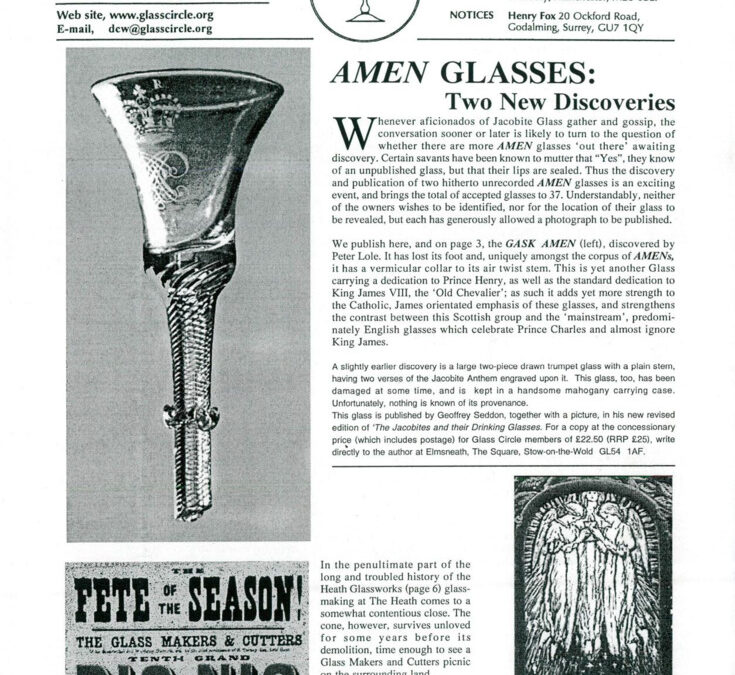
We publish here, and on page 3, the
GASK AMEN
(left), discovered by
Peter Lole. It has lost its foot and, uniquely amongst the corpus of
AMENs,
it has a vermicular collar to its air twist stem. This is yet another Glass
carrying a dedication to Prince Henry, as well as the standard dedication to
King James VIII, the ‘Old Chevalier’; as such it adds yet more strength to
the Catholic, James orientated emphasis of these glasses, and strengthens
the contrast between this Scottish group and the ‘mainstream’, predomi-
nately English glasses which celebrate Prince Charles and almost ignore
King James.
A slightly earlier discovery is a large two-piece drawn trumpet glass with a plain stem,
having two verses of the Jacobite Anthem engraved upon it. This glass, too, has been
damaged at some time, and is kept in a handsome mahogany carrying case.
Unfortunately, nothing is known of its provenance.
This glass is published by Geoffrey Seddon, together with a picture, in his new revised
edition of
The Jacobites and their Drinking Glasses.
For a copy at the concessionary
price (which includes postage) for Glass Circle members of £22.50 (RRP £25), write
directly to the author at Elmsneath, The Square, Stow-on-the-Wold GL54 1AF.
In the penultimate part of the
long and troubled history of the
Heath Glassworks (page 6) glass-
making at The Heath comes to a
somewhat contentious close. The
cone, however, survives unloved
for some years before its
demolition, time enough to
see
a
Glass Makers and Cutters picnic
on the surrounding land.
Picture courtesy of Robert M. Wilkes
Peace on Earth window (detail)
sold at Mallams, Cheltenham.
See Auction Action and Price
Check,
page
12.
Seated on his stool the Hebron glassmaker, single
handed, skilfully trails his vase with a thread of
glass (shown insert). Note the foot-operated stone
slab that closes the mouth of the furnace.
lirlosIMIN1111111
ARU A-liVb FACTORY FOR
GLASS WO R lc
QC0-)
,d(
,19,46jracaAw
GLASS CIRCLE NEWS No. 89
Editorial
Unhappy Glassmakers
G
lassmaking flourishes in times of stability and prosperity.
Sadly, this description applies neither to Afghanistan nor to
Israel at the present time where it is hardly appropriate to invest
in such fragile assets. The current war apart, where Herat* has
not escaped the conflict, Afghanistan has had a hard time of it,
not only from previous wars (it was invaded by the Russians)
but also from a four-year drought. This may have led to an
increase in dead wood and in the plant ash required for
traditional glassmaking but the shortage of food and resultant
poverty resulted in a lack of customers to buy their products. It
is almost 25 years since Bob Brill and photographer, Elliott
Erwitt, made their historic documentary on glassmaking there
and one wonders if there are any artisans left with the skills this
film so dramatically depicts. The child seen stoking the furnace
fire would be well into glassmaking age by now if he hasn’t been
dragged away to an undesirable military end. In a family
business such as this, such misfortune could easily result in no-
one left to continue the tradition. This film (available in video
from The Corning Museum of Glass for $145) might easily
become an epitaph.
Glassmaking in Hebron, where fighting and rioting has also been
reported, was previously well-supported by tourism. It is a
hardier industry altogether involving small groups of workers.
By comparison it is relatively modern, using soda glass cullet
from broken bottles and ingeniously exploited crude oil for firing
the furnaces. Here, only the manipulative skills of the glass-
maker seated at the furnace, his tools and the product designs
he knows by heart reflect a long and ancient tradition.
Much the same applies at the School of Traditional Glassmaking
in Damascus where only details in the layout and firing (also
with crude oil) of the furnace reflect personal influence. Much
of the glass made here in traditional shapes is exported to the
West. The basics of glassmaking, it seems, transcend rivalry and
conflict. Would that our current world problems could be so
readily resolved.
*The country’s third-largest city (pop. 165,000), Herat was once
occupied by Alexander the Great. Enormous defensive walls and
earthworks remain from ancient times. Destroyed in the early
13th century by Genghis Khan, it was later rebuilt. Although
much of the old town is now in ruins, remaining sites include
the 10th century Friday Mosque, a synagogue, minarets, monu-
ments and the impressive 444-column Masjid-i-Jame. In a shop
by the Friday Mosque artisans create delicate hand-made blue
glassware.
2001
Shop sign of the Holy Land Glass Factory in Hebron.
A
t home, our traditional hand-made glass industry is in dire
trouble. The famous Stourbridge glass square mile may
soon be no more than a set of out-of-date signposts. Thomas
Webb and Royal Doulton (ex Webb Corbett) have already gone.
The furnaces are out at Royal Brierley and may never be relit.
Waterford Crystal has announced that Stuart’s, already at a
standstill, is about to be closed. Also failed is the new co-
operative, Dennis Hall Crystal, risen from the ashes of Thomas
Webb. It has been bravely rescued by Plowden and Thompson,
manufacturers of coloured glass, and resurrected under the old
name of Tudor Crystal, a firm that Dennis Hall Crystal earlier
bought out to gain access to the American market. Kinver
Crystal, currently closed, is said to be relocating nearby but no
further information has emerged so far. The numerous local
small cutting and decorating shops are finding it hard to survive
due to a lack of blanks on which to work. For them, foreign
imports are the only solution.
Indeed, it does seem that for drinking glasses, machine-made
products will soon rule supreme. Our studio glassmakers, such
as those who have taken over the old Webb Corbett factory, can
compete in quality with hand-made glass but not for price. It
Sign of the School of Traditional Glassmaking in
Damascus.
was
significant in the Czech Republic that all the glassmakers
we saw were producing decorative tableware (or chandelier
parts). At the Crystalex factory I found a goblet making machine
churning out mundane stemmed wine glasses at a rate of about
one a second. It was hidden by a tarpaulin and not on general
view. Modern English hand-made glasses may soon become as
rare and avidly collected as their 18
th
century forebears.
A Damascus glassmaker
marvers
at his furnace. His left foot operates
the slab covering the mouth of the furnace. Sample glassware rest on top
and a pontil sits in the bucket. (This and the above pictures by DCW)
Page 2
2001
GLASS CIRCLE NEWS No. 89
The Gask
AMEN
Glass
by
F. Peter Lole
The Glass.
The two-piece Glass has a Bell Bowl with a stem
having a single series air twist extending into the
base of the bowl, and a central vermicular collar.
The stem has been broken IA” to 1/2″ above the foot
and the broken Glass is 5
7
/
8
” high, implying an
original unbroken height of 6 3/4″ to 7″. Two other
AMEN
Glasses with bell bowls are recorded, and
approximately one quarter of the recorded glasses
have air twist stems’; this glass is, however, unique
amongst the
AMEN
Glasses in having a vermicular
collar.
The Engraving.
There are two verses of the Jacobite Anthem, to-
gether with an additional dedication to Prince Henry
in a vertical panel at 90° to the left of the crown
(surprisingly on the dexter side); the inscription,
which has only one word in each line, reads:
“Prince
— Henry — Duke — of — Albany — and — York”
(picture top). This
dedication to Henry brings the total of such dedications to
twelve, approximately one third of the recorded Glasses. The
first two lines of the first verse of the Anthem
are reversed, a wording that also occurs in
The
Erskine of Cardross II
Glass. In the second verse
“family” is
spelled with a ‘y’, whilst this verse
usually has
familie’,
but the use of ‘y’ is normal
when there is a secondary dedication, as for
instance
in ‘Prosperity to the family of Traquair’.
The crown has a solid shaded base, and is
uniquely surmounted by ‘I [J] R’ for
Jacobus
Rex
(picture centre).
The Calligraphy.
Both Geoffrey Seddon and I regard the calligra-
phy as being consistent with theAMENengraver,
despite there being a couple of unique
idiosyncrasies. However, there are none of the
hall-marks of the ‘Ferguson’ fakes of the 1930s
2
.
The two unusual aspects are firstly the tail of the `g’ in ‘King’,
where in one instance the tail is so flamboyant that it virtually
encircles the whole word although the same word in the line
above has a perfectly `standard’ g'(figure
bottom and insert figure centre). The other
unusual feature is that on the capital ‘T’ the
cross is almost wholly a left hand projection
(figures, centre and bottom), whereas more
usually it projects some little way to the
right of the upright, even though the empha-
sis is always towards the left.
The Provenance.
This Glass almost certainly came from
‘the
Jacobite Lairds of Gask’;
Gask House is
in Strathearn, Perthshire, and was the property of the Oliphant
family, who were all ardent Stuart supporters. Strathearn in
particular, and Perthshire and Stirlingshire in general, were
strongholds of Jacobitism, and a group of eleven
AMEN
Glasses
all originate within a thirty mile radius of Gask:
Airth Castle,
Breadalbane I, & II, Bruce of Cowden, Drummond Castle,
Erskine of Cardross I, & II, Mesham, Gask, Murray-Threipland,
& Ogilvy of Inshewan.
Laurence Oliphant of Gask (c1692-1767) was ‘out’ in both the
Rising of 1715 and again in 1745; his son, Laurence Younger
of Gask, (1724-1792) was also ‘out’ in the ’45, becoming ADC
to Prince Charles Edward Stuart’. After the defeat of Culloden
both father and son escaped to Sweden and thence to France,
where they remained in exile until 1763. The younger Laurence
married in France, Margaret daughter of Sir Duncan Robertson
of Struan, another Jacobite exile from Perthshire. Gask House
was partially ransacked by Hanoverian troops in February 1746
and the estate subsequently forfeited. However, a consortium,
headed by Oliphant of Condie who had already leased the estate
from the Commissioners for Forfeit Estates, pur-
chased it from the Commissioners in 1753, and it was
then held by trustees for the benefit of the original
owner
4
. Ebenezer Oliphant, the younger brother of
Laurence Snr., was the Edinburgh silversmith whose
maker’s mark is on the outer case and two of the
beakers of the magnificent silver travelling canteen
of c.1740, captured from Prince Charles’ baggage
train by the Earl of Albermarle on the field of
Culloden; it remained with the Albermarle family
until 1963, being acquired by the National Museums
of Scotland in 1984, and it now forms one of the
prime exhibits in the Museum’s Jacobite display in
Edinburgh’. Prince Charles breakfasted at Gask on
the eleventh of September 1745
6
, and it is a nice
thought that perhaps whilst there he used the canteen
made, at least in part, by a younger son of the house.
Caroline (1766-1845), the third daughter of the
younger Laurence, married Lord Nairne, descendant of another
exiled Jacobite family’; as Lady Nairne she composed and
published some of the best known of the Jacobite songs,
including
‘Will ye no come back again’
and
‘One
hundred Pipers’.
Her nephew, Laurence the
younger’s grandson, was Thomas Kington-
Oliphant, the last descendant, through the female
line, to live at Gask. He published, in 1870,
“The
Jacobite Lairds of Gask”,
which detailed some
of the Jacobite items then at Gask:
“Gask
[Laurence the younger]
made it his business to
gather together relics … of the Stuarts. The
neighbouring gentry used to send contributions
to the chest of relics, which still remains at Gask;
… Prince Charlie’s bonnet is there … The Royal
brogues, … Ribbon of the Garter …and the
drawing of a child’s head drawn by [Charles]
as a boy ….”
When Kington-Oliphant died, in
the 1890s, his will directed that Gask was to be
sold and that the Jacobite relics were to be dispersed’. The
forbears of the present owner acquired from that dispersal both
the
AMEN
Glass and some of the other relics recorded in 1870.
How and when the
AMEN
Glass arrived at Gask remains a
mystery. It probably dates from between
1740 and 1750, or possibly a year or two
later. If it had been acquired before the ’45,
it might have escaped the pillaging and have
been preserved by neighbours, until the
return of the men folk in 1763; their ladies
had been visiting Gask throughout most of
the period of exile, and there is a family
tradition that some of the contents of the
house survived in the care of neighbours.
Possibly the Glass was commissioned by a
Strathearn neighbour and is one of the relics
noted by Kington-Oliphant as being given by neighbouring
gentry after the return of the family. Another intriguing
possibility, although unlikely, is that the Glass was actually
engraved in France, reviving Hartshorne’s suggestion of a
French origin for some of the
AMENS
9
,
for the senior
representatives of at least six of the families credited with
AMENS
were in France in exile after the ’45. I regard this as
unlikely, for the Glasses themselves all appear to be English
Glass (Scotland was not producing good quality lead drinking
Glasses at this time) and although a sojourn in France by the
AMEN
engraver is not impossible, for there was a great deal of
travel between Scotland and France in the second half of the
1740s, he would have had to carry the Glasses themselves with
him, for engraving on the continent. All except the
Valliant
would later have had to be brought back to this country.
It is noteworthy that mid C.19
th
writers on Jacobite relics seem
uninterested in recording Jacobite Glass, although this may
simply be that such Glass was unnoticed at the back of a
concluded on page 10
Page 3
English leech jar and a small port-
able jar, both with leeches.
2001
GLASS CIRCLE
NEWS No. 89
Leech
Jars
Bell Jar leech
container.
Photo. Wilf Bruce
Woman with leech
and leech jar.
Is this cut of 1639
the earliest known
depiction of a glass
leech jar?
Novel Leech Containers
A throw-away remark in the
Limpid Reflections
of
GC News
87,
about Fish Bowls and Leech Jars, prompted Wilf and
Audrey Bruce to send me details of three Leech Containers in
their Collection. All three are shaped as large inverted bells, 12-
13 inches high by 101/2 inches diameter at the wide flared mouth,
which has a broadly folded rim. The one illustrated (above) has
a loop handle, whilst each of the other two has a silver plated
brass knob mounted at the top.
Crellin and Scott, in the
Wellcome Institute
booklet (1971) on
“Glass and British Pharmacy 1600
—
1900”
are strangely
reticent about Leech containers and consider only
Shilicock
Patent Leech Jar’
of 1863; this is a cylindrical Glass vessel
some ten inches high and looking rather like a
cafetiere.
It has
a metal base and cover, the cover having a wire mesh top from
which the central knob suspends a rod with two horizontal
perforated ceramic discs which neatly fit the interior of the
cylinder, mounted respectively about one third and two thirds
down the Jar, and on which presumably the Leeches roosted.
The Bruces know that their Leech Covers were in use by a
relation, a Yorkshire physician, within living memory. The
Covers were kept on a marble slab, and provided both a cage
and probably a micro-climate for these creatures. Our Editor
speculates that the medical use of Leeches was advantageous
over bleeding owing to the introduction of an anti-coagulant,
hirudin
(whose name derives from the Leeches’ taxonomic
name of
Hirudo)
into the blood stream, achieving an effect that
is somewhat akin to that produced by
Warfarin,
the clinical
nature of which was not always appreciated. Indeed, consulta-
tion with a retired Fellow of the Royal College of Physicians
elicited information that whilst the use of Leeches continued
into the 1940s, he believes that the clinical objective was to
withdraw blood slowly, rather than to utilise the Leech’s
anticoagulant compound.
One suspects that often doctors may have utilised whatever
came to hand for housing their Leeches, rather than specially
designated vessels. The Glass Circle has always had a large
group of members from the medical profession and perhaps one
of you can throw more light on Leeches and more particularly
the Glassware used for harbouring them? F.P.L.
Lowdown on
Leeches
Use of the medicinal leech goes back to around 1500 BC as
revealed by a tomb painting. However, the earliest illustration
of a glass leech jar I have been able to find (above) goes back
only to this cut of 1639. The vessel does not seem particularly
well designed for getting the animals in and out. Another cut of
similar date (1649) depicting a study of slug locomotion suggests
that, nevertheless, the shape is fairly typical for the time.
In England, the heyday of leech
(Hirudo medicinalis)
usage is
said to be around 1830 when several hundred thousand leeches
were used annually in London alone. Many were exported to
America as they were found to be more efficient at blood
removal than the American variety. Leeches were applied local
to the injury and probably the most famous victim of their
misuse was George Washington who died while being bled for
a throat infection. The leech itself removes only a small amount
of blood, 5-15 ml, but due to the injection of the anticoagulant,
hirudin the wound subsequently leaks a further 50-150 ml of
blood.
Recent American research,
where the leech is staging a
comeback, reveals that as well as
an anticoagulant a vasodilator
and a local anesthetic are re-
leased into the blood as the quite
substantial triangular leech bite is
painless (so I am told!).
Their use here continued until after World War II and our
eminent late member, Dr. Harwood Stevenson once told me on
a Circle outing of the many lives he had saved by “judicious
application of the leech”. Unfortunately, I did not think at the
time to ask him how they were stored. Most leech jars were of
coloured pottery with a lid, sometimes perforated. Recognised
glass versions are like small fish bowls with no lid but a
characteristic out-turned rim over which muslin was tied to keep
the beasts from wandering. Most jars seem to be C.19th. Three,
recently offered for sale on the web are shown below. These
would be used in the pharmacy and the doctor would collect a
day’s supply in a small glass version with no foot, as pictured
above, or in a perforated metal box.
Bearing in mind the huge number of leeches used it is surprising
that there are not more glass leech jars around. They were
undoubtedly prone to breakage and the use of a smoke bell is,
possibly an ingenious impromptu solution to stop the leeches
crawling all round the surgery. However, they do need to be
kept in or available to water and the leech would probably have
been put in a glass of water under the bell. Peter’s source
provided three such bells and these could have been used as
“solitary” for a repleted leech to recover after its “meal”.
D.C.W.
Three flared-lip leech jars for sale on the Web recently.
A.
Probably American, 4th quarter 19th century. Blown bowl,
moulded foot. Height 101/2 in., Bowl 8
1
/4 in. diam. Price $750.
B.
Probably American, 3rd quarter 19th century. Blown with
turnover flared foot. Height 9 in. Bowl 8 in. diam. Price
$750.
C.
Probably English, 2nd quarter 19th century. Thick blown glass
with turnover rim. Height. 5
3
/8, Bowl diam. 6
5
/8. Price $650.
(Information source www. gemmany.com)
Page 4
many steps in the
castles
of the
Czech Republic!) sent a mes-
sage of appreciation while re-
gretting that her husband,
George, was no longer alive to
share her honour. A similar
approval was given to the
appointment, as an Honorary
Vice President, of Dr. David
Watts who thanked the mem-
bership for their support.
Following the AGM various
specimens brought by mem-
bers were examined by a panel
of Hugh Tait, Simon Cottle, Jo
Marshall and David Watts
Our
oldest member, Mrs
G. Miller
checks the menu in Novy Bor.
with Anne Towse acting as
porter. Of particular interest was
what appeared to be the top
sec-
tion
of a C.19 humpen, enamel
decorated with the names of two
French political leaders, set in a
pewter base (picture left). It pos-
sibly acted as a stand for a bottle
of wine.
3
Page 5
2001
GLASS CIRCLE NEWS No. 89
A leech jar or fish bowl
with a blown bulbous hollow
stem and spreading turnover
foot.
In the reference collection at
The Corning Museum of
Glass.
American or English, C.19th.
Ht. Approx. 11 in.
Leech
Jars
A leech jar,
described as “Continental”
on display in the Wellcome Museum of
Medicine within the Science Museum,
London. The jar has three circuits of four
pushed in lingers” on which the leeches
might repose.
Ht. approx. 8 in. undated but functionally
compares with Shilicock’s patent Leech
Jar of 1863 mentioned by Peter Lole.
The Tempest Prognosticator
A Dr. George Merryweather from Whitby, noting
that leeches became more active in stormy
weather invented this device consisting of a circuit
of twelve jars, each linked by a chain to a clapper
in the central bell. An increase in leech activity
resulted in an increase in bell ringing and fore-
warned of the onset of bad weather.
This remarkable device was first exhibited at the
1851 Great Exhibition and then a reproduction of
it made for the Dome of Discovery at the 1951
Festival of Britain exhibition. This copy is now
displayed in Whitby Museum, North Yorkshire.
It was thought that the use of glass jars enabled
the leeches to see each other and thereby relieve
the tedium of solitary confinement. Perhaps the
smoke domes reported by Peter Lole served the
same purpose.
Source,
A Tonic to the Nation,
Thames & Hudson,
1976.
Leeches for your jar
These cost, in America,
around $7.50 each, but
for the lucky lady leech
jar owner with D.1.Y
tendencies, simply
stand barefoot in the
stream of your choice
and wait for the blighters
to latch on. Your dress a
la mode, and the all im-
portant storage box, is
shown in this detail from
a picture entitled
The
Leech Gatherer
in
The
Garments of Yorkshire,
by Richard Walker,
1820.
Source. The Wellcome
Museum of Medicine.
Glass Circle Matters
Glass Circle Silver Broach
The Committee has been very sorry to learn that some
members have had difficulties in obtaining their orders
for the Glass Circle brooch. The Hon. Secretary, Mrs.
Marshall, has been striving to get these orders completed.
She requests that if there are still members with outstand-
ing orders will they please contact her with the details on
020 7833 0221.
Your Glass Circle meeting dates for 2002.
Note day correction for February
All at the Artworkers Guild, 6.30pm for 7.15pm.
Thursday
14
th
February 2002
Tuesday
12th March 2002
Tuesday
16th April 2002
AGM. 15th November, 2001
The Hon.
Sec.
reported that due to an oversight no minutes were
taken of the last AGM. However, it was agreed by those present
that these would have proved acceptable. The Chairman re-
ported another successful year with a diversity of topics in the
lectures and the particular highlights of the trip to Novy Bor and
the publication of volume 9 the Glass Circle Journal. He
individually thanked the Committee and all those who had been
involved. The Hon. Treasurer reported a satisfactory financial
year and said that considerable financial support would be
required for the proposed exhibition in 2003. He referred to the
problem of storage for our publications whereupon a member at
the meeting kindly offered to help in this regard. Mr T. Udall
was thanked for acting as Auditor and was re-elected to perform
this duty in the forthcoming year. Thanks were given to the hosts
for this meeting: Mrs. K. Mawhinney, Mrs. E.Newgas, Mr.
Trickey and Mr. D. Woolston.
The Chairman then invited and received unanimous confirmation
of Mrs. G. Miller as a Life Member in respect of her age (91)
and continuing active support of the Circle. Mrs Miller, at that
time in hospital with a bad leg (possibly due to climbing too
Glass Circle News; copy deadlines.
No. 90
Mid-February for publication in March.
No. 91
Mid-May for publication in June
Thanks to Rosemary Watts for proof-reading this issue.
PETE
T/4E
z –
SEASON!
‘THE GLASS blAIC
oraCTIIICS
agrus
.
11
Duda,
. S
‘11.1
”
SO. Iwo*.
ATH PARK
.
KIVU OF TWE S;4P1 RAWATiO 1
mom
t 0RINA118
PROCESSION’:
iA
BANDS,
EXHIBITION
ZAZAR,
VOLL.INO
irstampier,
THE BROS, MARTIN,
1)1(k S
1r,-7
–
WE AIX ‘Me.
BOATING on the LAKE;
BALLOON ASCENTS deriog,the day:
TUAM Hut ES’
ADVIIISVON:-To
GROUNDS, SIXPENCE.,
Picture courtesy of Ro
bert M. Wilkes
GLASS CIRCLE NEWS No. 89
2001
A History of the Heath Glassworks, Stourbridge
by H. Jack Haden
Part VI. William Walker and Son (1852 – 1868 – 1882)
A
lthough the Heath glassworks had been sold to ironmaster,
..Alexander Brodie Cochrane in 1852 it is clear that glass-
making continued there under William Walker who had already
been working with Rufford from 1841 and took over manage-
ment on the 25′ March, 1846. In 1852 the works went under
the name of William Walker and Son – the son being James.
Also, William had leased the eight glassmakers’ cottages for 14
years and then renewed the lease for 10 years in 1851, perhaps
in anticipation of the impending financial crash of Rufford and
Wragge’s Bank. A new lease for 21 years, from May I.S` 1868,
was simply consequent upon the ironmaster’s death the year
before. The firm clearly prospered and the 1861 census reveals
that it was employing 74 men and 24 boys. Both William and
James were held in high standing in the flint glass industry.
William was then 59 and died on 7′
December, 1868, age 67. But momentous
events in which he played an important role
were to shake and reshape the flint glass
industry before then.
The glassmakers were a close knit community.
As well as all living locally, shift-work kept
r
the furnaces going 24 hours a day. A natural
desire to control their everyday life emerged
with the formation of the relatively rich Flint
Glass Makers Friendly Society which imposed
on the industry rules governing control of the
labour force. Consequently, employers found
that control of their own works was being
usurped by militant Union leaders. Disputes
over working conditions began to increase,
interfering with the smooth running of the
factories. In 1858 the longest Union dispute in
the flint glass industry was provoked at the
Stevens and Williams, Brierley Hill,
glassworks’ over their decision to promote an
apprentice to footman, but to pay him less than
the footman’s normal rate of 14s. a week.
Twenty-two of the firm’s employees walked
out, so the management issued an appeal to
other glass manufacturers for support in resist-
ing “the tyrannical proceedings of the union”.
About the same time, another occurred at
Grazebrook’s Audnam glassworks. This was
over the proportion of apprentices to journey-
men to be employed, and Grazebrook’s sued
five of its workmen for deserting its service.
Meetings of manufacturers were held on the
16
th
and 28′ of October’ that may have in-
volved the strikers’ representatives but their
nature or outcome is not known. However, at
a meeting on the 24
th
October, some of the
manufacturers who had formed themselves
into a committee decided to ask all manufac-
turers to support the action of Grazebrook and Stevens and
Williams in resisting the Union’s demands; also to sign a
resolution not to assist the strikers. Birmingham manufacturers
replied that they would not sign the resolution but they under-
took not to take advantage of the situation and would support
the Stourbridge manufacturers to the extent of not supplying
their customers.
William Walker comes into the picture when, on the 1
3
`
November, 1858, he presided over a meeting at the Talbot Hotel
to discuss means of combating the strike by the workforce. It
was agreed to form The Flint Glass Manufacturers Defence
Association, that each member should contribute £100 to a fund
with an annual subscription of £10; William Walker was
appointed Treasurer pro
tem.
3
A further meeting was held on the
8′ November to ratify these proposals. It seemed that more
manufacturers had realised the significance of the strike and
were determined to take up the challenge as to who should run
the glassworks. At a meeting in the Queen’s Hotel, Birmingham
on the 10′ November, with Dr. George Summerfield of Lloyd and
Summerfield presiding, the organisation’s name was changed to
the Midland Association of Glass Manufacturers; Walker was
appointed treasurer.’ A general meeting of manufacturers agreed
to this on the 15′ November and an Executive Committee
appointed. Thus the battle lines were drawn.
The dispute dragged on, spreading to other glassworks and, at a
Manufacturers’ Association meeting in Birmingham on the 18′
January 1959, it was reported that of the 26 manufacturers who
had joined the Association, 24 had responded to the demands of
Glassmakers’ Society by closing their glasshouse “at considerable
sacrifice”. Both Grazebrook and Stevens and Williams each
received £50 from the fund as compensation and
by the time the dispute was settled claims
amounting to £948.8s. had been paid to 14
contributing members. The strike continued until
April 1859 when The Flint Glass Makers’ Soci-
ety submitted to the employers an amended set
of rules and these were approved. One of the
consequences of the strike was the closure of the
business at the Audnam Glass Works of Richard
and Michael Grazebrook who thereafter concen-
trated their attention on their ironworks near
Dudley. The works, and presumably the
business, was taken over by a new firm, Boulton
and Mills, connections of families already active
in glass manufacture.
We know a little of the Walker family of this
period. The 1861 census records that the 59 year
old William Walker was living at Norton House
at
the Heath. Living with him was his 23 year
old son, Philip, whose occupation is given as
`Accountant’, while his other son, James lived
with his family a short distance away. James
described himself as ‘glass manufacturer’ and
‘ensign in the Rifle Volunteers’. Ten years later,
Philip, still occupying Norton House, was de-
scribing himself as a glass manufacturer and, in
1881
5
, he is recorded as employing 98 people,
while his nephew, James Harry Walker (i.e. his
brother, James’s son), who was lodging in Old
Swinford, described himself as an ‘artistic de-
signer in glass’.
By 1882, the ancient glassworks was deteriorat-
ing and the Walkers were no longer able to
operate it profitably in competition with other
local glassworks. It has been stated by Cyril
Manley that dealers regarded the products of the
Heath glassworks as “Continental rubbish” so it
is possible that the general quality of its glass-
ware had declined.’ This could be because James Walker’ had
handed over the running of the works to his brother, Philip who,
for reasons stated
8
, had decided to give it up. Consequently, in
1882, although the Walkers’ lease on the Heath glassworks still
had some seven years to run the works was closed down.
Nevertheless, as described in The Advertiser, (22′ July 1882)
Walker & Son, of Stourbridge, departed with a flourish by
mounting a display of flint and coloured glass, flower vases and
duplex lamps at the Worcestershire Art and Industrial Exhibition
in July of that year. In the same year (1882) the leasehold and
goodwill of the works was bought by George Mills but it is not
known why this rich and ambitious glass manufacturer, new
owner of the Albert glassworks in Bridge Street, Wordsley,
became involved’. Perhaps it was the means to an end’
°
for, if
this was the conclusion of a long history for the Heath glassworks,
the name, Walker was yet to feature in a dramatic finale, for Mills
took James Harry as his partner at the Albert glassworks and in
this lies another story (appendix in part VII).
Page 6
2001
GLASS CIRCLE NEWS No. 89
In spite of the Walker family’s fame in Stourbridge over two
generations, little is known about the products of the Heath
glassworks and much of that is controversial.” A little might be
inferred from the inventory lists of 1835 when the Ruffords were
in control. More recently, two of over a thousand lots of glass,
numbers 80 and 81, from the Manley collection”, are specifi-
cally described as coming from the Heath glassworks. Number
80 is described as a stained ruby, over frosted crystal, glass
liqueur set comprising a shaped footed decanter with crystal
stopper (22cm) and five matching glasses with knopped stem
and circular foot (8cm),
c.
1895. Lot 81 comprised a pair of
stained ruby, over frosted crystal, liqueur glasses having
knopped stem and circular foot (9cm by 5 cm diameter). The
use of ruby staining is unusual and might indicate the origin of
a similarly stained over clear crystal (?experimental) candlestick
of heavy construction also from the Manley collection and now
in your editor’s collection. Frosting the glass prior to staining
was probably an attempt to stabilise the stain on the glass
surface. It would certainly explain Manley’s reported attribution
of “Continental rubbish” as red staining was invented by
Freidrich Egermann (1777-1864) of south Bohemia. Taking a
cue from the Worcestershire Art and Industrial Exhibition, two
un-attributed oil lamps from the same sale, lots 299 and 300,
both with a lemon opalescent diamond pattern of cylinder shape
and shades with a flared wavy top, one ruby (25cm), c.1880,
might merit a Heath glassworks attribution.
In spite of Manley’s strictures there is no doubt that they were
capable of good work at the Heath. Otherwise how could Walker
have survived and achieved his reputation. The American consul
in Birmingham, Elihu Burritt, made a practice of touring the
Midlands in order to report the state of the industry to his
government. In 1886 he published an account of his impressions
under the title
Walks in the Black Country and its Green
Borderland.
After commenting that there were
about a dozen glassworks in the Stourbridge
area, he continues:-
“As proof of the excellence to which they have
raised the art, one of these firms, Messrs.
Walker and Son, received and executed an
order from the Sultan for a chandelier which
cost nearly £1600. The oriental potentate . . .
was so pleased with this great work of art and
industry as to order a spiral stairway of glass
from the same firm, to ascend from the hall floor of his palace
to its dome. But Messrs. Walker declined to undertake a job of
such dimensions, difficulty and expense, especially as no incon-
siderable part of the work would have been in fitting the stairway
to the palace after the glass part had been all cast and cut to
pattern. The cost would not have been less than £100,000, a sum
which the holders of Ottoman bonds would have preferred to
have seen put to more productive use.”
13
Besides Joshua Hodgetts”, the authenticity of which has been
doubted, the names of a few of the skilled men engaged at the
works have survived. Two glassmakers of whom a little is
known are William Henry Packwood” and Joseph Worton
Woolley. Both were prominent members of The Flint Glass
Makers’ Friendly Society (FGMFS). Packwood joined the FG-
MFS in March 1856 and served as Stourbridge District Secre-
tary during the 1858-9 strike and lock-out. He held this office
for six years and in 1869 appreciative members of the Society
presented him with a Spanish mahogany chiffonier, a bookcase
and an address inscribed on vellum. He was a member of the
provisional committee of glassmakers and cutters who, in 1887,
floated the Midlands Counties’ Glass Workers’ Association Ltd.
Packwood also started-up a small co-operative glassworks
within a few yards of the Dennis glassworks of Thomas Webb
& Sons at Amblecote, but within a short while this venture
failed. For many years he was licensee of the Garibaldi Inn,
Longlands, Stourbridge, and died age 82.
15
Another noteworthy employee, J.W. Woolley (born 2″`
I
February,
1831) began work at the Heath glassworks in the 1840s, joined
the FGMFS on the r April, 1852, became Stourbridge District
Secretary in 1853-4 and General Secretary of the Society in
The Heath Today
Top.
Mary Stevens Park from the south-east. The site
of the glassworks, now occupied by Dudley Borough
offices, lies behind the group of trees on the left.
Above. The tranquil area of Heath pool still survives.
Left.
How has the mighty fallen! The Heath offices
today looks after the borough’s environment and trans-
port matters including the collection of parking fines.
Pictures by DCW, November 2001.
1857. In 1860, in recognition of his work for the Society,
members subscribed £48.5s.7d. for a presentation gold watch
with appendages and a purse (which cost 3s.) of cash. Woolley
was the designer of specimens of glass exhibited by Walker &
Son at the Birmingham Industrial Exhibition in 1865
14
, It would
seem that Walker and Son, rarely showed their products under
their own name at exhibitions, but their glass was represented
on dealers’ stands. For example, this occurred at the Paris
Exhibition of 1878, when only two Stourbridge firms (Thomas
Webb & Sons and Hodgetts & Richardson) had their own
displays.’ Woolley retired from glassmaking in 1873 when he
was presented with an address by his fellow employees at the
glassworks – Thomas Wood, Richard Dukes, Richard Walton,
Philip Lewis (Financial Secretary) and Edward Seagar (District
Secretary). The address was headed by a picture of the Heath
glassworks and the text read:- “Although your retirement from
among us will be felt a loss, yet we cannot but congratulate that
you have by your industry elevated yourself to a position which
enables you at so early a period of life to relax your labour
among us, only to continue in another sphere where we hope
you may be ultimately as successful as you leave us this day”
— 11
th
August 1873. Woolley opened a shop at 170 High Street,
Stourbridge, dealing in glass and china and died on the 26
th
July,
1901.’
7
Richard Dukes, one of those who signed the tribute, had been
admitted to the FGMFS on the 10th April 1852, and he, too, was
mentioned by the
Stourbridge Observer
as contributing to
Walkers’ glass display in Birmingham.
After the Walkers had ceased making glass at the Heath it would
seem that the glassworks fell into disuse, eventually being
PARKING FINES
OTHER
W514;1-
,
Page 7
•
0%,pkutter
vot
Dim anb
GLASS CIRCLE NEWS No. 89
2001
bought by William Jonadab Turney, the principal of a firm of
tanners, parchment and glue manufacturers. Glass cones seem
to have been tolerated but not loved by those who lived under
their shadows and their original revolutionary function in pro-
moting and controlling the air supply to the coal-fired glass
furnace was now being superseded by the new Siemans regen-
erative furnace. Turney took residence in Park Hill whose
grounds adjoin the Heath estate and it may be that his intention
was to build a new house there after the demolition. However,
fate took a hand and his health declined after he was struck by
a horse and trap in Stourbridge High Street. He then moved away
and died in 1895, aged only 53. His widow moved from the
Heath estate to the nearby smaller Clifton House before settling
in London and Turney’s trustees put the estate up for sale. It was
bought by Edward Webb who had retired from the White House
glassworks which he and his brother, William George Webb”
had taken over, in 1872, on the death of their father, Edward
Webb. But this Edward Webb – son of another Edward Webb
of Mills, Webb & Stuart of the Albert glassworks, Wordsley –
had forsaken glass manufacture to concentrate on the family’s
flourishing business as seed merchants and farmers. He renamed
Heath House “Studley Court” and was responsible for subse-
quent redevelopment of the site.
Eventually the site was taken over by Stourbridge Council,
adjacent to Mary Stevens Park which now has fine iron gates
modelled on those at Buckingham Palace. The building was
extended and became Stourbridge Council House and Offices.
For a while it housed the borough’s glass collection before it was
transferred to Broadfield House Glass Museum. It is now the
province of Dudley Metropolitan Borough Council’s Highways
Department. The site of the cone, although with trees growing
on it, has not been built over and may yet yield more of the
secrets of what this hitherto neglected glasshouse produced.
1.
Repeal of the glass Excise Act resulted in a period of relative
prosperity after the depressed state of the 1840s. The 1851 Great
Exhibition stimulated manufacturers to venture into new lines of
production, especially in coloured glass that appealed to the
Victorians. The improvement in trade prompted the Flint Glass Mak-
ers’ Friendly Society to demand higher wages and greater security of
employment. The Society drew up a list of rules that, if strictly
observed, would to a large extent have transferred management of
the glassworks to the trade union.
2.
Information for this and subsequent related information comes from
old Minute Books of the Glass Manufacturers’ Association and the
cash book of the Defence Fund operated in tandem with it, both in
possession of the author. The first entry in the account book of the
Defence Fund is dated 4’h November, 1858 when 13 of the
Stourbridge, Dudley and Birmingham businesses each contributed a
quarter’s call of £25. On the 13
th
December 13 paid another £25 and
Thomas Webb of Dennis Glassworks joined and paid £50. The third
call was on the 29th April, 1859, when 14 paid £25 and the fund’s total
stood at a £1000. The annual subscription of £10 was also paid
quarterly.
3.
William Walker continued as treasurer of the Manufacturers’ Associa-
tion until his death in 1869 and then his son, James took over the
position until 1874 when he succeeded Dr. George Lloyd of Lloyd &
Summerfield, Birmingham, as chairman, where he was paid a salary
of £100 a year.
4.
Although at the outset only firms in the West Midlands had been
affected by the dispute, manufacturers in other parts of the country
realised that they, too, were under pressure from the aggressive Flint
Glass Makers’ Friendly Society and Manufacturers Associations were
formed for Lancashire, Yorkshire and Scotland.
5.
According to Kelly’s Directory, 1884, Philip was then living in Kidder-
minster Street in the town centre.
6.
C. Manley,
Decorative Victorian Glass,
Ward Lock Ltd., London, 1981,
page 26 and illustration no. 167. A similar glass in the Editor’s
collection, also ruby-stained, is a non-lead glass readily identifiable as
a poor quality Bohemian import. As the Heath glassworks was noted
for lead crystal, as indicated by the inventory of materials in the factory
listed in chapter V, it is not impossible that they were imported and
passed off as Heath products, much in the manner practised recently
by several of the Stourbridge glass firms when in financial difficulties.
7.
Like his father, James Walker was not only an outstanding personality
in the glass industry but also he had taken an active part in local affairs
in Stourbridge. He was elected chairman of the town’s Board of
Commissioners in 1870, and had interested himself, as did other glass
manufactures, in Stourbridge School of Design where some of the
outstanding artist-craftsmen in the glass industry (including his son,
James Harry) were encouraged to develop their talents. His chief
interest, however, was in the local Rifle Volunteers from which he
retired in 1879 with the rank of Major. He moved from Stourbridge to
Ashfield House, Wordsley.
8.
Philip Walker, according to Benjamin Richardson, writing in 1886, took
employment with Thomas Webb & Sons, of the Dennis glassworks,
Amblecote, who were probably the most enterprising manufacturers
of fine glassware in the country at the time.
9.
About 1855 the Albert Glassworks was built next to the Red House
Glassworks at Wordsley and was operated by Mills, Webb and Stuart.
Some years later, Frederick Stuart moved into the Red House and
Edward Webb took over the White House on the opposite side of the
Stourbridge to Wolverhampton Road. Richard Mills, who kept the Vine
Inn a few yards from the White House and had two glass cutting shops
in Wordsley village, died. His wife handed over the major interest in
the business to her son, George who had some experience in the
glass trade and bought the Heath Glassworks in 1882.
10.
Although it was another ten years before the cone was pulled down it
is not known if glass was ever made there again.
11.
In C. Hajdamach’s definitive text,
British Glass,
on the Stourbridge
industry the Walkers do not even rate a mention and the Heath
glassworks gets only a glancing one (page 440) by Joshua Hodgetts
who, at the age of 8, was apprenticed there as a taker in.
12.
Auctioned by Giles Haywood on the
7th
July 1986. Lots 80 and 81
fetched £100 and £30 respectively.
13.
Doubts have been cast on the validity of this story, partly because of
the high cost of the chandelier. However, It is improbable that the story
was invented by Elihu Burritt. Also, in 1847, lbrahum Pascha commis-
sioned a pair of chandeliers for the tomb of the prophet, Mohammed
from S. & C. Osier of Birmingham (J. Bourne and V. Brett,
Lighting in
the Domestic Interior,
Sotheby’s, 1991, p.199) thereby creating a
fashion among Eastern potentates. The Prince Consort bought an-
other pair for Queen Victoria in 1848.
14.
He was probably related to Mr. Nehemiah Packwood who C.
Hajdamach’s
British Glass
(page 361) tells us was an expert Stour-
bridge glass cutter who emigrated to the United States
in
1868,
established his own firm there in 1888, and was probably prominent
in the development of American brilliant cut glass.
15.
Stourbridge Observer,
9
th
September 1865.
16.
Flint Glass Manufacturers’ Friendly Society magazine, Vol.2., No.4,
February 1878, page 370.
17.
County Express, 27′
h
July, 1901.
18.
W.G. Webb later became M.P. for the Kingswinford Division.
To be concluded
to&
41001
,
Bri, are you feeling neglected?
Not particularly, why?
Well! last year we had to put up with being decorated with
prickly holly at Christmas, but at least it showed that
someone cared for us. This year – nothing!
True, Dim, but I was thinking of all those chandeliers we
saw at Novy Bor. With all those dangling bits they look
like Christmas all the year round and I have never heard
of anyone putting holly on a chandelier, particularly like
the one on page 14.
Yes, it must be very sad not having anything to look
forward to. We all need that Christmas extra.
So, as a New Year’s resolution why don’t we start a
‘Cheer Up Depressed Glass Chandelier Society’.
A great idea, Bri; I have stopped feeling neglected already.
But, by the way, how, exactly, do you cheer up a depressed
glass chandelier?
illii*011IthAtik40%
1
WIN.
1
4
1
11
1
k
11
MIliiillakillita‘
11
100%
I
I I
I
I
I
I
I
I
I
I
S
S
S
Page 8
Photo by Torn Jenkins, Observer Nov. tit
2001. Owners copyright acknowledged
finest detail, aiming to evoke the wonder of child-
hood we all remember. Just in case there is truth in
that tale that the carriage turns into a pumpkin on
the stroke of twelve, Michael claimed that he never
worked past midnight while on this project! But
then, Waterford is in Ireland!
Page 9
2001
GLASS CIRCLE NEWS No. 89
4711CPTD RS945679612.5
4 Pete%
_dote
I
n our last issue I reflected upon the continuity of Glass
ownership and use in some of our Great Houses, but examples
of this continuity are by no means confined to the nobility, or
even to gentry. Most of us can instance family Glass that we
can trace back for over a century. A pleasing example came my
way recently in the house of a brother-in-law whose family has
farmed the same land in Scotland for over a hundred years. He
and his wife have just moved from the farmhouse into a cottage
on the farm, to give his son and growing family more space;
during a recent visit I noticed in a display cabinet a new
arrangement, which included a set of three heavily gadrooned
whisky measures (picture right), whilst a fourth was in use as a
posy vase. I first thought that they were a graduated set such as
Brian Brooks describes in his little booklet
‘Whisky Dispensers
and Measures’,
but they were in fact all slightly different from
each other in both construction and metal. What is more,
although two of them had a graduation line engraved round the
neck, none of their capacities conformed with either the Scottish
or Imperial ‘Gill’ volumes which Brooks cites; the graduated
versions held 50m1 and 115m1 respectively, whilst the others
held about 43ml and 75m1. The present family had no idea of
their function, and believe that “they have always been in the
house”. On a rather grander scale, another house I know has a
set of signed Galle finger bowls, with green, purple or orange
floral cameo decorations on a white frosted ground. These were
a wedding present in 1905 to the Godmother of the present
owner, who on her fiftieth birthday was presented with eleven
of the original dozen. She in turn sold one of them to a friend
who is an avid collector of Galle and thereby financed a very
handsome bespoke display cabinet for the remaining ten. A
much older Glass is in another Scottish house known to me,
amongst a small group of rather nondescript late eighteenth
century Glass all believed to be in its original home; it is a
handsome drawn trumpet Glass, 61/2″ high and with a widely
folded foot, and which has a most intriguing diamond engraved
scene. A punt shaped boat laden with four ladies and an angler
is being drawn by a horse with a mounted postillion, whilst on
the bank are two more ladies and a man; under this vignette,
which encircles the bowl, is the date
‘Sep 4
th
1744’.
Presumably
it is the product of a talented amateur intended to commemorate
some family event, but the present owner unfortunately does not
know the significance of the date. All these examples, in their
own way, illustrate continuity and reverence for the use by the
family of Glass they have owned since it was created.
A much less happy story is emerging with some Collections of
important Classic British Glass that have been on view for a
long while but which are no longer displayed. The Cecil
Higgins, Fitzwilliam and the Liverpool Museums are undergo-
ing widespread refurbishment, funded in part by the Lottery, and
their Glass is inevitably in store; but much more worryingly, all
have said that the substantial Glass displays of yesteryear will
not be reinstalled. Other museums, most notably Glasgow,
possess large Glass Collections which have been unavailable for
many years. The Harvey Wine Museum, which has a very
important group of Glass, is no longer open to casual or
individual visitors, whilst the Drambuie Jacobite Glass, much
the most comprehensive and important group in the world, is
boxed up in store. Some of the Drambuie Glass is to be sent on
tour to the USA during 2003 — 2005, but no one in this country
can
see
it before 2005, at the earliest. Company Collections are
always an uncertain quantity, for not only do they reflect the
individual enthusiasm of a single transient director, but the first
obligation of the owners is to their shareholders, rather than
making the treasures that they own available to the public at
large, or indeed even to those especially interested. The situation
does however lend poignancy to the criticisms that have
been
made about aggressive commercial purchasing power engross-
ing material that is of wide interest and historical importance.
The situation really calls into question the whole criteria by
which Lottery and Millennium Money has been allocated to
Museums. In the sphere of Glass, both Sunderland and St Helens
have received substantial sums for new undertakings specifically
trumpeted as ‘Glass Developments’; Sunderland has no Glass
Collection to be displayed, and although St. Helens does have
a very good Collection, it is less well displayed, both qualita-
tively and quantitatively, than when it was in the Pilkington
Museum. On the other hand, discussions by Broadfield House
Glass Museum for Lottery funding specifically to extend its
display of Glass were rebutted. One feels that decisions on
funding have been made on the basis of `slick’ presentations by
expensive professional consultants (whose fees, ultimately, we
pay) and in the light of an arbitrary geographical spread coupled
with a demand for a populist and ‘accessible’ approach which
often negates the scholarship which Museums have traditionally
displayed. The question of ongoing funding for running costs
has also been scrutinised with less than the rigour one might
have expected, as is all too unhappily emerging at Sunderland.
One would have expected the advice of a knowledgeable referee
to be sought where there are such conflicting needs, but this
seems not to be the
case.
In the past, those interested in Glass
have been very well served by both Museums and by commer-
cial Companies, but the signs are distressingly widespread that
the situation is deteriorating badly.
0
Glass Trophies
S
porting trophies of cut and en-
graved glass are not uncommon
nowadays. On the left is the Cook Cup
in the hands of Neil Back, England’s
flanker and captain for the day, after
securing victory over World
champions, Australia at Twickenham
on the 10th November.
But how about Cinderella’s coach
pulled by six stately horses (right)
commissioned from Waterford
Crystal. The finely detailed carriage is
decorated with a rich array of tradi-
tional hobnail diamond cutting. It
took over 12 weeks to complete. The
design has been interpreted by Water-
ford artist, Michael Murphy in the
GLASS CIRCLE NEWS No. 89
2001
Glass Circle Outing to
Nov
‘
S
Bor:
An Outline of the Trip
by
Graham Vivian
M
embers of the Glass Circle and the Glass Association
enjoyed a six day trip to Bohemia in the Czech Republic
at the end of September which was organized for us by Glass
Circle Committee member John Smith and his charming, Eng-
lish speaking Czech contact, Katerina Ditterova. John had
previously visited the area to attend the first meeting of the Light
and Glass European Society of which he was elected Vice
President. The idea for the trip sprang from the wonderful glass
he had seen earlier in the year. John had hoped to fill a coach
but the response was overwhelming and nearly 90 of us met up
at Prague Airport, flown in from Heathrow and Manchester. It
was the start of what proved to be a memorable tour – two coach-
loads of members including many of the glitterati of our glass
world – engravers, museum curators, collectors and dealers.
Because of the size of the party we were divided into four groups
with separate itineraries so that we could all visit the same places
but at different times to avoid overwhelming our guides. Our
coach took the orange and green groups.
We were based at Nov’ Bor, an important glass making town
with a population of around 4000 persons about two hours drive
from Prague and still unspoilt by westernisation. Far from being
the Czech’s answer to our Black Country, we were pleased to
find this a very picturesque area with undulating countryside,
winding roads, wooded hills and distant mountains. The com-
mitment to glass appeared almost total with virtually every
village having at least one tall slender brick chimney rising
above the surrounding houses. The price of glass and food is
extremely reasonable. The architecture in parts is stunning with
many fine stucco-fronted period villas painted in their traditional
yellow and buttermilk colours.
DAY 1
We arrived somewhat delayed at Nov’ Bor on the evening of
.4444+#.4-$4
,
40.044444.4
,
44444.64
The Gask Amen Glass.
concluded from page 3.
cupboard, as with the Oxburgh hoard. Thus, for instance, when
Robert Chambers penned his note on the relics of the Threiplands
of Fingask in 1853 (which was not published until 1880 “) whilst
he made several references to the Jacobite portraits and other
relics later sold at the 1993 dispersal”, he makes no mention of
the Murray-Threipland
AMEN
recorded as at Fingask in 1822
by Clark and then again after the time that Chambers book was
published. Similarly, Kington-Oliphant makes no mention of the
Gask
AMEN,
although there is a strong presumption that it was
in his house at the time he wrote.
The Broken Stem.
Almost one fifth of the
AMEN
Glasses have sustained serious
damage, and in some cases repair, to a degree that in the case
of less important Glass would have led to the Glass being thrown
away. But the damage to the Gask Glass is unusual, in that it is
the stem itself that is broken (cover picture); in all other cases
it is the bowl or foot that has suffered. The stems of C.18
th
Glasses are so robust in comparison to the bowl or foot that is
difficult to see how such damage could have happened acciden-
tally without some damage to the bowl; yet we have a small
group of Jacobite Glasses where the stem has been broken, and
subsequently repaired”. All three of the
Confederate Hunt
Goblets have repaired stems (with a silver collar, an iron collar
and a wooden replacement stem respectively) The two Fingask
Portrait Glasses have broken stems, one having a replacement
wooden foot and the other a silver collar joining the broken
stem”; in this case there is a family tradition that the stems were
broken deliberately following a Loyal Toast. Richard Clarke in
1822 gave a similar story for the plain drawn trumpet Glass with
a replacement silver foot inscribed
`God Bliss James the Eight’
and carrying the maker’s mark ‘PM’. Clark asserts that Prince
Charles drank his father’s health at the top of Clackmannan
Castle, throwing the Glass from the top of the tower after the
toast, and since only the foot was broken it was subsequently
rescued and repaired as a relic”. To return to the damage to the
Gask
AMEN,
it is not easy to see how such a break, within half
20th September and had our first meal together at the Park Hotel,
occupied by most of the party. Despite the late hour, the Mayor
delivered a warm welcoming speech, stressing the pride the local
inhabitants have in their town and their glassmaking traditions,
a feature that was be repeated almost everywhere we went. We
were given bags of glass-related booklets and John Smith was
presented with a symbolic glass key to Nov’ Bor.
DAY 2
Because the Czech working day tends to be from 8.00am to
4.00pm we set off early to our first point of call – the Crystalex
works on the outskirts of Nov’ Bor. Crystalex is the most
significant manufacturer of utility and decorative glassware in
the Republic, employing 1700 people in all facets of its
extensive business. We were not shown the industrial processes
but were taken round the glass blowing section where someone
remarked that there were more glassblowers than in the whole
of Stourbridge. The blowers, all men, stood on a raised platform
and their assistants worked at a lower level so that the blowpipe
could be held almost vertical when blowing into the mould
which the assistant held. There are extensive sections devoted
to hand painting and engraving. Crystalex exports about two
thirds of its production all over the World.
Our next stop was to the School for Applied Arts at Nov’ Bor.
This was established in 1876 . It has a complement of 155
students and occupies a very attractive main building where
glass engraving, cutting and painting are taught. There is a small
exhibition of Student works.
We continued on to Sloup, some 3.5km from Nov’ Bor, where
we climbed up to the top of an interesting castle carved almost
entirely out of rock. At one time we were told the castle had
been occupied by hermits. As a large number of hermits
gathered together rather defeated the idea of a hermitic
existence, we formed the view that the ‘hermits’ may have been
, 0.44.444+4444444.W
an inch of the foot, would occur so cleanly by accident. Was it
deliberately broken against some hard edge, to prevent any
lesser Toast ever being drunk from it, but retaining the inscribed
part as an important relic?
References:
1.
Geoffrey B.Seddon The Jacobites and their Drinking Glasses’ (1995)
[Hereafter: Seddon 1995]
Glass Circle Journal No:5 (1986) R.J.Charleston & Geoffrey Seddon
The
AMEN
Glasses’
The comparative data for other
AMEN
Glasses are drawn from
these two works.
2.
Seddon 1995: Pp 238-246
3.
Marquis of Ruvigny & Raineval
‘The Jacobite Peerage’
(1904) Pp
138 — 142
4.
Annette M.Smith
‘Jacobite Estates of the Forty-Five’
(1982) p 12
5.
George Dalgleish & Dallas Mechan
am come home’
(National
Museums of Scotland 1985) Pp 4 — 7
6.
Walter Biggar Blaikie
‘Itinerary of Prince Charles Edward Stuart’
(SHS 1897) p 12
7.
Ruvigny:
op cit.
8.
W.Drummond Norie
‘The Life and Adventures of Prince Charles
Edward Stuart
(nd — c.1900) Vol:li p 14n.
Also reproduces a sketch of
‘The Auld Noose of Gask
9.
Albert Hartshorne
‘Old English Glasses’
(1897 11967) p 349
10.
Jill Turnbull
‘The Scottish Glass Industry 1610 — 1750’
(2001) p
287 & etc.,
11.
Robert Chalmers
‘The Threiplands of Fingask’
(1880) Pp 40, 48,
54, 76 — 79
12.
Christies Sale Catalogue: Fingask Castle 26 — 28 April 1993
13.
Glass Circle News No: 57 (1993) Peter Lole
‘The Broken Glass’
Pp 8 — 9
14.
‘The Royal House of Stuart’
Illustrations to Catalogue (1890) Plate
XXXII
15.
Richard Clark
‘An Account of the National Anthem entitled God Save
The King’
(1822) p 38&: Seddon 1995: p 227 & Plate 162.
Page 10
2001
GLASS CIRCLE NEWS No. 89
monks and the nature of the occupation, lost in the translation.
As the afternoon progressed we visited Zakupy castle, the
construction of which was begun in 1541. It was at one time
the private home of Emperor Ferdinand V and was furnished in
period style. No glass of any consequence here, but two rather
unhappy looking bears in a bear pit at the entrance drew adverse
comment. But they had been saved from being killed.
Our evening destination was KamenickS
,
Senov which is best
known for its chandelier factory and Glass School and where
chandelier manufacturing started in 1724. We were welcomed
by the Mayor with wine and food. The local school then
entertained us with song, dance and humour. Although only a
stone’s throw from Novy Bor, we again witnessed the pride that
the locals have in their town and their tradition of glassmaking.
DAY 3
In the morning we visited Lemberk (Lowenberg) Castle which
is located on a magical site high up on a hill overlooking woods
and a lake. Although dating from the 13th century, much of the
castle is of later construction. On ascending to the top floors we
found a superb exhibition of modern glass from international
glass artists including our own Peter Layton. This Symposium
of Glass is organized every three years by Crystalex. The castle
provided an exceptional backcloth for displaying the modern
glass and it was with some difficulty that the group was
persuaded to leave.
With castles now very much in our blood, we arrived at Frydlant
Castle in the late morning. This is an architectural masterpiece
which towers from granite rocks above the Smeda River. While
having its origins in the 13th century, the castle was extended
and replanned in the 18th and 19th century and the collections
housed within its walls have been open to the public for over
200 years. There is no specific glass collection to be seen but
the room settings and furniture, paintings and artifacts are
captivating. This is undoubtedly one of the most popular
historical destinations in this part of Bohemia.
Later that day we moved closer to the Polish border to visit the
North Bohemian Museum of Liberec which is housed in a fine
building with architectural overtones of the London Natural
History Museum. It is the largest museum of Applied Art in
Bohemia and was established in 1883. We were welcomed by
the Museum’s Director who even extended the visiting hours so
that we could all have our fill of the wide variety of glass on
display. Not only was there a superb collection of engraved and
enamelled Bohemian glass but also Venetian and more modern
studio glass along with porcelain.
After a late dinner that evening, we were given a talk on the
history of Bohemian glass.
DAY 4
Our first stop was at the Novy Bor Museum which is just round
the corner from the Park Hotel. This is a small glass Museum
with a range of carefully chosen and beautifully displayed
Bohemian and other glass from the 18th century to the 20th
century. It also included very realistic replicas of earlier glass
painting and engraving processes. It is a delightful Museum to
visit and like other museums it sold some fairly convincing
copies of early engraved and painted Bohemian glass to which
a number of our members took a fancy. So beware when you
next visit the London auction houses!
From the Museum we moved across the road to the shop of
Karel Wunsch where the inspection and buying of expensive
modern glass continued apace.
Lunch was at the Park hotel and in the afternoon we visited the
Kamenicky Senov Glass Museum, another gem of a collection
not to be missed, where we saw further Bohemian glass. The
display is of similar quality to that of Novjr Bor. Particularly
interesting were two intricately engraved 18th century Bohe-
mian glasses with modern copies by their side. This proved that
the contemporary Bohemian engravers had lost none of their
skill and that if an old glass were engraved today, it would be
virtually impossible to date the engraving. A few yards up the
road the GLASSiCENTER had a more technical display promot-
ing local manufactures and details of their whereabouts.
That evening we were treated to a special organ and French horn
concert, with baritone accompaniment, in our honour at the
Novy Bor Church with its rococo interior and fine chandeliers.
DAY 5
Breaking from our Museum
routine of the day before, we
passed through Kamenicky
Senov, taking a scenic route
to arrive early at the small
town of Chribska. The glass
works here has been in op-
eration since 1414 and is
reputed to have one of the
oldest glassmaking traditions in Europe. The glass is all hand
blown and the glassblowers work around the furnaces at ground
level with their assistants who help with the moulds. An
interesting fact concerning the basic designs produced in this
factory is that these have not changed since the 1950-60s.
Despite this, the numerous purchases made by our members and
the reasonable prices, underscored the demand for the colourful
handmade pieces of this small but prolific manufacturer.
We then drove back to the outskirts of KamenickS
,
Senov to see
the chandelier factory of Preciosa Lustry. The grim exterior of
the enormous early post war complex did nothing to prepare us
for the brilliance and sparkle of the cut glass within. The former
Communist regime incorporated all the chandelier factories in
the area under one roof which has resulted in the largest
chandelier factory in the world employing 1100 workers. It has
some 10,000 designs of chandelier of which 1200 are in current
production and are mainly exported to the Middle East, USA,
Russia and Europe. The factory handles the design, glass
blowing and casting of metal parts to chandeliers on site,
whereas all the trimmings such as the polished lustres are bought
in. We visited the hot shop where the twisted glass arms and
finials to the chandeliers were being blown. As at Crystalex, the
glass blowers stood on a raised platform with their assistants
working the moulds below them at ground floor level. We toured
the brass casting section and the vast areas where chandeliers
are wired and assembled before being flat packed for
transportation.
Our afternoon was taken up with a visit to the Glass School at
KamenickS
,
Senov, the oldest glass school in the Czech Republic.
The school is housed in a large modern building and teaches
glass painting, engraving, enamelling, designing and lighting.
There is a very good exhibition of modern glass here.
This being our last day in Novk Bor, the purchasing of all kinds
of glass turned into an absolute frenzy both in the town and at
a Fair in the Park Hotel prior to the Gala Dinner. Following the
Gala Dinner, Peter Wrath of Lobmeyr made a speech on the
importance of setting up a Society for the conservation and study
of chandeliers and the glass used in lighting. John Smith was
congratulated for the enormous amount of work he had put into
organizing the tour which had been such a success. On behalf
of us all, John was presented with a (secretly obtained) fine
modern glass vase he had been seen to admire earlier. Thanks
were also expressed to the staff at the GLASSiCENTER who had
provided the guides and interpreters as well as making the tourist
arrangements for us to view the factories, and so on, and to the
Hotel staff who had looked after us beyond expectations. All
participants were given a tall souvenir goblet bearing the Circle
and Nov’ Bor logos. Chris Stossel gave a moving account of
how, with the help of the Priests from the local church,. he had
found the house where his father had lived in Kamenicky Senov.
DAY 6
There was one more real treat in store for us before we left for
the Airport. This was to see the glass in the Decorative Art
Museum in Prague. While the Museum has a fine representative
collection of antique glass and a special exhibition of modern
glass on display, it was the access which we were given to the
reserve collection on the upper floor of the building which
undoubtedly proved to be the most fascinating. Cabinet upon
cabinet full of wonderful glass from the Venetian period to 20th
century was on view. After a Hotel-packed lunch we were free
to visit the City Square, Charles Bridge and other sights.
As we flew back to England overwhelmed by the warmth of the
hospitality we had received and completely crizzled with the vast
range and quality of the glass we had seen, we could be forgiven
if we had come to the conclusion that only three things mattered
in life – glass, glass and glass. +
Page 11
“• PEACE ON
EARTH COD)
VITIL TOW:Ant
1`17.1s2
GLASS CIRCLE NEWS No. 89
2001
AUCTION ACTION and PRICE
–
CHECK’
.
by Henry Fox
*Dreweatt Neste, Newbury,
31″ October – Ceramics, Glass,
Silver etc. The star lot in the
glass section was the gourd-
shaped vase which I illustrated
in the last GC News. It made
£36,000. Other glass highlights
were five various Stourbridge
blue overlay, clear and amber-
tint hock glasses and one blue
overlay and clear example
which made £2,300; a large
German covered goblet, en-
graved with British Royal
Arms, the knopped stem in two
sections joined by screw thread
section (picture right), went for
£1,700. A Stourbridge cut pale
pink and white cameo slender
tapered scent bottle probably by
Stuart & Sons made £1,100.
*T.G. Lawrence,
Crewkerne
Rooms – October – General
Antiques Sale. This included a
small private collection of
drinking glasses which had
been assembled before World
War II and was now being sold by the family. Of particular
interest was an early dwarf ale with basal wrythen moulded bowl
and pincered propeller knopped stem over a folded foot. It made
£800.
(Note: T.G. Lawrence has recently announced that as from
December 21” its Taunton Rooms will be closed; all future
auctions will take place at Crewkerne, near Yeovil.)
*Mallams
Cheltenham 20`
h
September. A Pre Raphaelite stained
glass window of octagonal form inscribed “Peace on Earth
Goodwill towards Men” 15ins x 14ins (picture above and cover)
was sold at for £880. It was among a selection of nine lots of
British and Continental stained glass, some dating from the early
17th century.
.”/
ZU:c nround the Fairs
October began with the Sunday Glass Fair at Woking in Surrey.
This fair has now settled down into a regular pattern of events
during the year and is well supported by dealers and visitors
alike. This time was no exception. I arrived early but was
allowed in while dealers were still unravelling their “bargains”.
There was something for everyone; C.18th items were more
evident – mainly opaque twists with some air twists plus a few
plain stems and balustroid. A wide range of Victorian glassware,
included the sort-after Sowerby press-moulded nursery rhymne
*Sotheby’s
Olympia
18′ September. A Victorian cut
glass
gasolier c. 1855 (picture above), probably by FC Osier of
Birmingham, came from 41 Ladbroke Square, London, home
of the late Ian Grant, an interior designer and founder of the
Victorian Society. It was sold as part of the Ian Grant Collection
at Sotheby’s first sale at their new Olympia Auction Rooms and
fetched £19,000 plus premium.
*Phillips’
Newport. A rare bottle of Welsh whisky (picture
above) was sold for £1,350 plus premium. This is one of three
surviving bottles from the Frongoch Distillery, which opened in
1889 and closed in 1890 due primarily to the Temperance
movement which held sway over Welsh morals and Welsh
drinking habits in Victorian times. Interestingly, the disused
distillery was an internment camp during the first World War;
Michael Collins, the Irish freedom fighter, was held there during
that time. Welsh Whisky may yet make a re-appearance as a
new distillery was established in June last year at Penderyn,
using fresh peaty water from the Brecon Hills. Place your orders
for 2003 as that is when the first maturing will be available.
t Hammer price unless otherwise stated
pieces plus good examples of Art Nouveau by Daum Freres etc.
Glass from the C.20th, such as Whitefriars (Baxter period),
Monart, Davidson’s “Cloud” glass, and Graystan, was all well
represented. I came away with a Moore Molyneaux tazza with
typical Greek pattern engraving as well as a ruby coloured vase
decorated with white trailing somewhat in the Nailsea style.
My next visit was to a new fair organised in the Pavilion at
Bath by Penman Fairs (well known to most members as the
organisers of the Chelsea Fairs). This was a general quality fair,
but glass was not featured except by a local dealer who was
Page 12
2001
GLASS CIRCLE NEWS No. 89
showing principally early to later C.19th sets or groups of glasses
and a variety of that period decanters. However, I did like two
examples of early cut tumblers of around 1770. On a general
stand I found an interesting small pier mirror with a verre
eglomise decorated panel, while another had a vaseline glass jug
of unusual shape but which was sold and awaiting collection.
This is a nice fair, but of little interest at the moment to a serious
glass collector, but then this is the first one organised in Bath
by Penman.
I was unable to get to the November Fair at the Birmingham
Motor Cycle Museum. However I am sure that everyone who
went would have been treated to a feast of glassware and spoilt
for choice. I have heard that C.18th drinking glasses were in
demand and a number of interesting specimens snapped up.
For numerous quality glass dealers it would be hard to beat the
London Olympia Fair. I went twice to view; the ground floor on
the opening evening and the upper level on the following
Saturday. This arrangement meant that I could see more and be
more leisurely in my examination of the wonderful array of
antiques and period items on display. Delomosne had a rare
glass plate decorated in the manner of Isaac Jacobs. The
importance of this piece lay in the fact it was gilt decorated
purple glass, a colour for Jacobs which this dealer had not come
across before. A reference to an order in this colour is known
but not the whereabouts of any privately owned examples (Witt,
Weedon and Scwind, Bristol Glass, page 47, illustrate an
example probably from the Bristol Museum). The plate had
traces of gilt signature on the back but too rubbed to be certain
that it was Jacobs. An attractive early taper stick was also spotted
on this stand, as were examples of heavy balusters, fine engraved
“Newcastles”, and several items decorated by James Giles.
Among the cut glass on display was a beautiful pair of facet cut
candlesticks together with separate near matching drip trays.
C. & L. Burman had a fine display of cut glass, too. I
particularly liked a fine helmet shaped jug c. 1770. Mark West
had a variety of C.18th drinking glasses, as well as a large
selection of late C.19th glassware and on into the C.20th Art
Deco period. Christine Bridge had several examples of C.18th
colour twist stem drinking glasses, as well as some air and
opaque twist examples. I saw a good four-sided Silesian stem
glass, and colourful Victorian glassware and epergnes were also
admired. Next, on to Carol Ketley where a wide range of
Victorian clear glass was displayed, and then,by contrast, to
Andrew Lineham with his enchanting variety of British and
Continental coloured glass. Of interest to commemorative
collectors would be a rare and unusual Edward VII coronation
covered stand with a gilt coin in the finial of the lid. Here, too,
were examples of Webb cameo work and glass by Stevens &
Williams. Wandering round I discovered several attractive scent
bottles with sulphide inclusions, both British and continental.
Also a selection of C.19th newel post heads in glass, although
I rather thought that they might have been ends of curtain poles!
My favourite item this time round had to be a large light blue
coloured mid C.19th goblet by Varnish & Co. which I found on
a furniture and decorative items stand.
Mid-November found me at the Birmingham NEC fair
“Antiques for Everyone”.
Again, I organised myself beforehand
and quickly found the principal glass dealers, particularly those
showing C.18th drinking glasses. Brian
Watson ,
alongside a variety of good English C.18th drinking glasses,
had an interesting Continental glass engraved with a crown
above the initials F L for Frederick Louis (Prince of Wales,
father of George III). Also an engraved large early English
goblet bearing two dated inscriptions. Here, too, was a set of
four floral decorated C.19th decanters with unusual, if not to say
unique, stoppers, that were shaped like flattened Japanese
parasoles with slim stems composed of two opposed balusters
separated by a knop.
Ged Selby
had a showing of C.18th
glasses, as well as an early two-spouted oil lamp gadrooned at
the base. It’s a pity that virtually all these lamps have lost their
metal fittings. I was interested to learn from him that a few years
ago three examples of the extremely rare six-spouted lamps had
come up at a provincial sale, although one was apparently
damaged. I have only ever seen pictures of two: one in the
Fitzwilliam Museum, a fairly recent acquisition (see GC
publication
“Glass Collectors and their Collections in British
Museums”),
the other in a private collection, and that acquired
from Mallet several years ago and illustrated in one of their
publications featuring 17
th
and 18
th
century fine glass. Also,
Keith Kelsall in
The Open Flame Lamp
considers and illustrates
two specimens, one of which is the Mallet example, and which
weighs five pounds! But has any member come across any
others? On this stand was a very rare example of an C.18th blue
plain stemmed wine glass. As always
William MacAdam,
the
Scottish dealer, had much to offer the C.18th glass collector – a
nice airtwist stemmed glass with vermicular collar caught my
eye. He also had a blue tall slender taper stick. Moving more
into C.19th,
Lyn Holroyd
had an attractive variety of cranberry
coloured glassware, also decanters, wines etc. I must say that
the second part of the fair which features largely C.19th and
early 20
th
century specialists had the most exciting things to see
and handle.
Nigel Benson,
for example, had a good selection
of C.20th Graystan, Monart, and some Stuart enamelled
specimens, along with other British glassware from between the
Wars. R. & C.
Scattergood had
a small but discerning display
of C.19th glassware, including a fine set of white overlay
Bohemian dishes (the like of which I had seen once before and
with associated bowls, said to be for caviar) with cut rims and
floral decorated in coloured enamels. A tall finely engraved
signed Webb vase attracted my attention, as did an early
Richardson opaline vase with gilding and a painted scene, signed
in a corner by a yet to be identified artist. The scene was named
on the underside of base “Ruins of Christchurch Abbey” along
with the “Richardson Vitrified” mark. Highlights from other
stands in this section included art nouveau glass, pate
de
verre,
Tiffany, Loetz, and Lobmeyer (an enamelled jug with Egyptian
motifs caught my eye). Just as I left the fair a wavy-edged
large drum shaped vaseline glass bowl on top of a piece of
furniture caught my eye. Upon enquiry, it turned out to have no
bottom — and was actually a lamp shade. Thus illuminated, and
with this happy correction in mind, I sought out the train home.
BOOK REVIEW
The Encyclopaedia of Glass by Mark Pickvet
Pub. by Schiffer Books*, 2001, Size 21.4 x28cm, 232 pages, numerous
b/w pictures, softback, ISBN 0 7643 1199 9. Price £16.95 (Foyles)
This book might be described as the American equivalent of
Newman’s
Dictionary of Glass.
The articles are not encyclopae-
dic but, like Newman, more in the form of extended dictionary
entries, many supported by illustrations. The paper is of only
average quality and the illustrations, although helpful, are rather
grey – a volume to use rather than admire.
The coverage emphasis is on the American industry, all the
dozens of little firms, designs and trade marks that make it such
a daunting area for the beginner. The coverage this side of the
Atlantic is distinctly uneven. Thus Edinburgh Crystal is included
but not Apsley Pellatt or Royal Brierley as distinct from Stevens
and Williams. Likewise, the technical entries lack a firm grip of
the subject. Smalt is said to be created by “fusing together zaffer,
potassium carbonate and silica. The ingredients are mixed
together and then added to a batch of glass.” The latter part of
the statement is incorrect, being how smalt, itself a form of
glass, is used. One might expect to find “zaffer” explained but
unfortunately not. While I am not over the moon about this
publication it does fill a gap on the bookshelf and will prove
helpful to those who wish to stray west beyond the limits of
Europe for which Newman remains the preferred text. D.C.W.
* Schiffer website listing glass books at www.schifferbooks.com .
More book reviews overpage
Exhibition –
European Glass
at the Kunsthistorisches Museum, Vienna.
This exhibition of outstanding examples of European glass –
some of the finest in private hands – from the collection of our
Viennese member, Prof. Rudi von Strasser, will be on display
from the 12th March. Don’t miss it if you are in the area.
Page 13
GLASS CIRCLE NEWS No. 89
2001
Book
Reviews
The Scottish Glass Industry 1610-1750
by Dr. Jill Turnbull
The Society of Antiquaries of Scotland;
Monograph No: 18; (2001).
Size 25 x 19 cm, 313pages, 14 colour & 56 B/W illustrations.
ISBN 0 903903 18 0, Price: £42
This important, scholarly volume, will remain the standard work
for a very long time to come. It is not an easy read, for it is
crammed with contemporary references, and as is so often the
case, many of them are imprecise or seemingly contradictory
and require much interpretation, all of which tends to obscure
the story; one could have wished for a slightly less cluttered
summary to help with an overall appreciation. Some of the
subject is encompassed in the report, given in
GC No: 8Z
of
Jill Turnbull’s lecture to
The Circle
in April 2001. The work is,
however, one that will be much consulted, even if not always
read from cover to cover for instant enjoyment.
The title is restrictive and there is virtually no identification of
specifically Scottish Vessel Glass of the sort that interests most
members. This is because the Scottish Industry before the 1770s
was far more successful with Bottles and Window Glass than
with Drinking Glass which had a surprisingly restricted local
market, and also that it is quite impossible to identify anything
other than bottles as explicitly Scots. Turnbull illustrates a
couple of bottles and a dozen bottle seals for which there is a
reasonable presumption of Scottish manufacture. The only other
work on the subject is Arnold Fleming’s
“Scottish and Jacobite
Glass”
of 1938, a work so flawed and vexatious that my own
copy is but very seldom consulted. Tumbull gives an amusing
instance of how Fleming embellished a reference, presumably
because he thought that the original was too prosaic; all too often
Fleming did not have a reference at all, but nonetheless wrote
with blithe conviction. It is significant that whilst the word
`Jacobite’
gets equal prominence with
‘Glass’
in Fleming’s
offering, the name
‘Jacobite’
does not even appear in Turnbull’s
work, for high quality Lead Glass Drinking Vessels did not
consistently feature in Scottish output until the 1770s, a quarter
century after the end of the period treated and beyond the
mainstream Jacobite period. Embellishment of Glass outside the
Glassworks is not considered, and indeed it is unlikely that any
wheel engraver worked in Scotland before the 1770s (although
there were four Glass Grinders in the 1752 Edinburgh
Directory.) Despite falling within Tumbull’s period the diamond
engraved
AMEN
Glasses receive no mention; it is however
probably true that these form the only group of Glasses which
can be recognised as being decorated in Scotland at this time,
although almost certainly on imported Glass.
The Glasshouses were concentrated in the coalfields. On the east
side of Scotland, along the Firth of Forth, Turnbull identifies six
on the south bank, strung out along the ten miles from Leith to
Port Seton, with two more on the northern, Fife, shore, whilst
Glasgow had a Bottle-House from 1700 onwards. Some of these
works had long periods of inactivity before they resumed
production, and Turnbull suggests that prior to 1750 there were
never more than three operating simultaneously. There may, too,
have briefly been an early wood-fired furnace at Loch Maree in
the western Highlands, but the evidence is sketchy. That
Glasgow had a successful Bottle-House as early as 1700 has
only recently been appreciated, highlighting the paradox noted
by Turnbull, that the volume of archival record is in inverse ratio
to efficiency; in particular, lawsuits spawn paperwork, which
means that we know far more about the messy demise of failing
undertakings than we do about the successful enterprises.
The 1750 cut off date for this study is somewhat arbitrary, and
the ensuing century is full of activity in the Scottish Glass
industry, which is not only much better recorded, but further-
more some of the output can be positively recognised. One
hopes that Jill Turnbull will continue her work on this later
period and that we can look forward with keen anticipation to
a work that not only charts the Glasshouses themselves, but is
also able to portray with some conviction what they produced.
F.P.L.
Lettering on Glass
by Charmian Mocatta
A & C Black Glass Handbooks, 2001.
Size 15.6×23.4 cm, paperback, 112 pages, numerous colour and B/W
illustrations. ISBN 0-7136-5031-1, Price £12.99.
Charmian Mocatta is a highly respected and talented Fellow of
The Guild of Glass Engravers who specialises in lettering on
glass. Her little book describes with great clarity all that the artist
needs to know in order to engrave competently on glass using
the various techniques available. This alone is difficult enough
for the beginner. But even more of a challenge is the calligraphic
design to be employed. It requires knowledge, flair and devotion.
Eleven of the seventeen listed references are devoted to the
calligraphy. There is no easy way in but study and hard practice.
The multitude of illustrations both reveal the artistic diversity
and high standards achieved by this difficult technique. For the
glass collector this book can only increase understanding and
respect for this facet of modern art. It is highly recommended.
D.C.W.
Fitzwilliam Museum, Cambridge,
Future of its Glass Display?
he President and Chairman of The Glass Circle can
I now confirm that, in the words of the Museum’s
Director, “the glass will not return to its former location”
when the current building works are completed and all
the galleries are re-opened in the Spring of 2004.
The Director’s written response emphasises that: “at this
stage I am unwilling to commit to precise locations or
allocations of space, but I can promise that significant
items from the glass collection will be better displayed in
several different parts of the Museum. Modern glass, for
example, will be shown in the new twentieth century
gallery.”
The key word in this statement is “significant”. It remains
to be revealed if it will constitute a truly acceptable
proportion of the 800 odd items of English and Irish glass
collected and donated by former distinguished members
of The Glass Circle, in particular Mrs. W.D. Dickson,
Ivan Napier, Miss E.C. Bolitho and, most importantly,
Donald Beves.
0
For those members with access to the web and who are
interested in chandeliers a visit to the Preciosa-Lustry site
www.worldsfinest lighting.com is highly recommended. The
above chandelier is taken from their Carolina range.
Page 14