




GLASS CIRCLE NEWS
EDITORS David C. Watts
27 Raydean Rd,
Barnet, Herts. EN5 IAN.
F.
Peter Lole
5 Clayton Ave.
Didsbury, Manchester, M20
6BL.
NOTICES Henry Fox
20 Ockford Road,
Godalming, Surrey, GU7 1QY
No. 90
April
0
0 2
Web site, www.glasscircle.org
E-mail, dcw@glasscircle.org
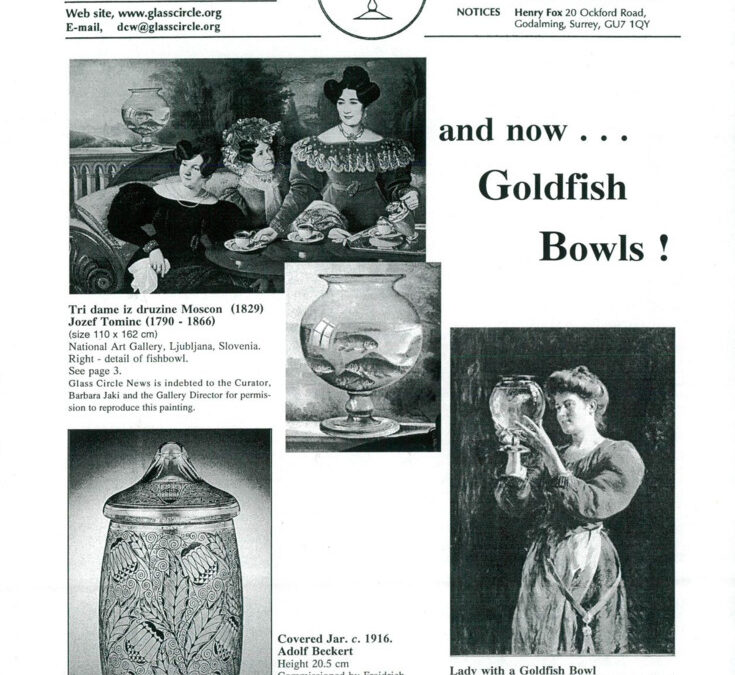
and now . . .
Goldfish
Bowls
Tri dame iz druzine Moscon (1829)
Jozef Tominc (1790 – 1866)
(size 110 x 162 cm)
National Art Gallery, Ljubljana, Slovenia.
Right – detail of fishbowl.
See page 3.
Glass Circle News is indebted to the Curator,
Barbara Jaki and the Gallery Director for permis-
sion to reproduce this painting.
Covered Jar.
c.
1916.
Adolf Beckert
Height 20.5 cm
Commissioned by Freidrich
Pietsch, Kamenicky Senov.
Produced by K. u. K.
Fachschule Steinschrinau,
Kamenicky Senov,
Czech Republic.
See Book Review.
Glass of the
Avant-Garde.
page 8.
Lady with a Goldfish Bowl
Julian Story (American, born in England)
1857 – 1919.
Oil on Canvas 50
1
/4 x 34
1
/2 in.
Telfair Museum of Art, Savannah, GA, USA
See page 3.
Our thanks to Beth Moore, Assistant Museum Curator, for
facilitating the use of this picture.
GLASS CIRCLE NEWS No. 90
2002
Editorial
The Cautionary Tale of Thomas Charnock
W
ho, you may be thinking, was Thomas Charnock? Well!
you will certainly know the following:-
As for Glassemakers they be scant in this land,
Yet one there is as I doe understand:
And in Sussex is his habitacion,
At Chiddenfold he works of his Occupation:
first cited by Hartshorne, and continuing:-
To
go to him it is necessary and meete,
Or send a servant that is discreete:
And disire him in a most humble wise
to blow thee a Glasse after thy devise;
If were worth many an Arme or a Legge,
He could shape it like to an egge;
To open and to close as close as a haire,
If thou have such a one thou needest not feare.
Yet if though hadst a number in to store,
It is the better, for Store is no fore.
So,
who was Charnock, why did he write this piece, did he write
any more about glass, and what else was indicated by his opening
“As for . . .”?
Thomas Charnock’s (born
c.
1529) origin is not known. He could
be connected with the Charnock family (1577-1653) of Astley
Hall, Chorley*, Lancashire, who took their name from the local
township of Charnock Richard (dating back to the 12th century,
where they had their original home. Astley Hall was rebuilt by
a Robert Charnock (d. 1616). Thomas became a committed
Alchemist, his life’s ambition bent on discovering the secret of
transmutation. He describes himself as an “unlettered Scholar”
and “Student in the most worthy Scyence of Astronomy and
Philosophy”. In the
Breviary
he states that he was trained by an
(un-named) master familiar with all the great alchemists’ writings
and who lived in, or about, Salisbury, Dorset. At the age of about
28, on January
4st
1557, he began writing his
Breviary of
Alchemy,
as this Rupert Bear style doggerel (a popular style of
writing of the period) is called. It consists of an opening,
introduction and six chapters and was not completed until July
20
th
of that year. This is significant because while his opening
stanzas are full of noble ambition:-
Declaring
all Vessells and Instruments,
Which in this Science serve our intents….
For satisfying the mindes of the Students in this Arte,
the text rapidly degenerates into an account of his lost hoped-for
claim to fame. Only the first chapter makes any attempt to
describe alchemical vessels beginning with the potter and the
creation of what might be distillation apparatus. Moving on to
woodwork:-
Then with a Joyner … To make a Tabenacle the Vessel) to
fitt,
and then an indication of the disaster to come:-
And thus with a Joyner thou hast made an end,
Without thou set
it on fire as I did mine.
This is immediately followed by the above section on
“Glassemakers” to conclude the chapter. There is no further
account of glass making.
Chapter 2 is concerned with spiritual matters, modesty and
respect for the Almighty:-
Wherefore in all things that we doe begin,
Let us with a prayer call for the helpe of him:
And beware of Pride and let it
passe,
And never be looking too much in thy Glasse;
With Chapter 3 and 4
we come to the centre of his troubles and
the reason behind the
Breviary:-
With
the Chapter on Fire I will proceede:
Which if thou knowest not how to governe and keepe,
Thou wert as good go to bed and sleepe,
The great expense of keeping the furnaces going “of above 3
pounde a weeke” and £100 in 9 months – a not unusual
period of time for an alchemical experiment – is usefully
mentioned as is the need continuously to check that it is under
control and carefully regulated. In this respect he finds his
assistant sorely wanting. Consequently:-
1
thrust him out of dores, and took my self the paine,
Although it is troublesome it is more certaine, For servants
do not passe how our works doe frame,
But have more delight to play and to game.
Ultimately the inevitable happens; he forgets to check the
condition of his valuable “Tabernacle” and allows it to catch
fire, bringing all his work and the hoped-for imminent discovery
of the secret of transmutation to an abrupt end.
But now the ultimate catastrophe follows:-
And
when I was within a Monthes reckoning,
Warrs were proclaimed against the French King.
Then a gentleman that ought me greate mallice,
Caused me to be prest to goe to Callys:
When
1 saw
there was noone other boote,
But that I must goe spight of my heart toote;
In my fury I tooke a Hatchet in my hand,
And brake all my Worke whereas it did stand;
And as for my Potts I knocked them together,
And also my Glasses into many a shiver.
Following
this act of savage devastation so graphically
described, perhaps to salvage his pride, the 5t
h
and final chapters,
invoke a “Monk of Bath” who, in a verbal interchange, recalls
at length the wide reputation of Charnock and his high alchemi-
cal standing, after which:-
All the Rubish to the dunghill 1 carried in a Sack,
And the next day I tooke my Coates with the Crosse at the
back;
And forth I went to serve a Soldiers rome
And surely quoth I, there shall come the day of Dome;
Before I practice againe to be a Philosopher.
Charnock
did survive his ‘National Service’ to write the brief
“AEnigma ad Akhimiae”,
dated 1572. But whether he ever again
took up practical alchemy we do not know.
It is a salutary thought that this proud and ambitious alchemist,
probably from the burgening
nouveau riche
of the period, but
with no real prospect of scientific achievement and convinced
that he was doomed to the ignominious fate of an ordinary foot
soldier, should, nevertheless, find a small place in history
because he recorded a single comment on the glass industry of
the day about which he clearly knew very little.
According to Kenyon and to Godfrey** glassmakers really were
“scant in this land” at the time of Charnock’s writing and up to
the expansion of 1567. But there were at least two yeoman
families in operation in Chiddingfold. These were the Peytoes
(from 1536), who probably operated more than one furnace to
make both window and vessel glass, and the Strudwicks. Henry
Strudwick bequeathed his glasshouse and tools to his two sons
in 1557. Again both window (some coloured) and vessel glass
were found at two of their furnace sites. Charnock might well
have known either or both of these families and their glassmak-
ing activities. It is sad for us that he did not see fit to record
more about glassmaking in England at that time. But we should
be grateful that had he not thrown out his wayward assistant and
allowed his Tabernacle to catch fire even that small gem of
information might have been lost to us.
*Charley also boasts a flea market, held on Mondays, and a Good Old Days”
theme on Thursdays with traders selling a whole range of second hand
goods, collectors items and bric-a-brac. Every Tuesday Charley’s Flat Iron
Market boasts over 100 stalls offering practically everything at this (self-
acclaimed) North West’s best outdoor market. Do we have any members
who can report on their experiences here?
**G.H. Kenyon,
The Glassmakers of the Weald;
E. Godfrey,
The Development of English Glassmaking 1560-1640.
Page 2
Globe *b
poissons sur pied dau-
phin a cdter vCnitIennes, uni
1
608
(1 litre V. a
6
litres 1/2)
Globe 2 poissons
sur pied rustique
1607
(3
lit. 1/2, 4 ,51. 1/2. 5 lit. 1/2
et 6 ht. 1/2)
2002
GLASS CIRCLE NEWS No. 90
And Now
Fish Bowls
by
David Watts
Cartoon by Gillray in 1795
depicting Lord Grenville,
1st Lord of the Treasury,
who succeeded William
Pitt the Younger as Prime
Minister.
T
he survey of leech jars in the last GC News, which aroused
a surprising amount of interest (see page 11 for another
example), has drawn my attention to the related vessel, the fish
bowl or globe. Although undoubtedly produced in some quantity
towards the end of the 18th and during the 19th centuries, they
are not particularly common and good examples command a fair
price. A fine specimen of modest size (top, centre) illustrated in
our
Strange and Rare
catalogue (no. 333) has arguably been said
to be a leech jar. It would seem that this type of vessel might
be used for either purpose with the smaller ones being preferred
for leeches and the larger (top right) for goldfish. I have yet to
come across a commercial 18th or 19th century advertisement
for either use in England.
There is no shortage of illustrations of the
latter even though documentation of manu-
facture is elusive. However, in America, in
a letter of February 12th, 1829, from Deming
Jarves to his brother at the glasshouse he
refers to “1 gallon and 2 gallon globes on
feet with covers” being the same as “fish globes on feet. He
mentions their shape as being with “the mouth wide enough to
admit the hand.” A sketch (above) is included by way of
confirmation and, significantly, appears not to show a rolled lip.
The Corning Museum of Glass has a possible example (below,
left) but without a cover.
The idea seems to have become prevalent that the fishbowl
without the foot is of English manufacture while the footed
forms were made elsewhere – in Ireland, the Continent or
America. This is certainly in accord with the charming political
cartoon by Gillray (top) of Lord Grenville warming his ample
posterior before a roaring fire. One feels that the deliberate
inclusion here of the prominently placed fishbowl is politically
significant although its message is now lost to us. The real life
bowl (above, centre) is described as English, c.1870, by Chris-
tine Bridge on her web site www, antiqueglass.co.uk. Similar
bowls for leeches illustrated
in GC News 89 are also de-
scribed as English. The
mainly decorative, probably
mid – 19th century, bowl also
exhibited in the
Strange &
Rare
exhibition, with painted
on fish and weed (left), has
three rolled feet suggestive
of a Stourbridge origin. The
enamelled design is probably
inspired by Felix Summerly’s
Art Manufactures created by
Richardsons for Henry Cole.
Two footed fish bowls or globes, left, exhibited in our
Strange and Rare
exhibition. right, exhibited at our
Diamond Jubilee
exhibition. That on the left
might have found service as a leech jar.
Three paintings I have come across all support the view that the
footed bowl was preferred overseas although it is hard to believe
that at least some of these, particularly those with a wide folded
foot, could not have been made here. Perhaps it is more likely
that the footed fishbowl has greater artistic appeal. The lady in
the painting by Julian Story (cover picture, right) seems to be
holding a bowl with a moulded stem and foot. Another example
(picture, left column, right of the three globes) described as press-
moulded has a foot typical of that found on many English
rummers and beer glasses throughout the 19th century.
More unusual, if not unique, are the Dolphin stemmed Fish
Globes advertised by the French firm of Portieux in 1933. They
came in sizes from 1.5 to 6.5 litres and that on the right has
Catalog illustration of the
Dolphin Fish Globe, 1933.
“Venetian ribs”. The stem and base were of opaline, possibly
pink! They are described in detail
(Glass Collector’s Digest,
Oct./Nov. pages 34-38, 1995) by our member, Frank Chiarenza,
a past President of the National Milk Glass Collectors Society.
The blown spreading foot with
turnover rim is undoubtedly
elegant as captured in “Girl at
a Window” (left). Perhaps the
symbolism here indicates that
the girl is as trapped in her
environment as the fish in the
bowl (My thanks go to Peter
Lole for discovering this one.).
The same theme may well
have inspired the Slovenian
artist, Josef Tominc (see cover
picture) in which he depicts
A Girl at a Window – detail
three elegantly
coiffeured ladies
by Louis-Leopold Boilly 1761-1845
who, rigorously
Oil on canvas 55.2 x 45.7 cm.
conforming to the
© The National Gallery, London
latest fashion of
the day, are set against the strategically
placed bowl of goldfish. The fishbowl
effectively gave way to the fish tank in
the 1930s but a few Art Deco pieces like
this (probably American) “Boy with
Dog and Frog” (right) will surely attract
collectors of this later period. *
Page
3
Portrait finial to a covered goblet. The knop has
a maunday 4d. coin of 1709. The stem knop has
a Queen Anne coin of 1714.
Ht. of goblet with cover 121/4 ins.
From Buckley’s
Old English Glass, 1925.
(see
text, below)
concluded overpage
GLASS CIRCLE NEWS No. 90
2002
Atemperp Rswse796-its
4
7.
Pete%
Zrie
Two exhibitions, and especially their catalogues, give rise to
some reflections on the back waters of the Glass world. The first
is in this country,
The Cutting Edge’,
and is an exhibition
organised by Fairfax House in York of the superb collection of
cutlery formed by Bill Brown. Shown at Fairfax House in the
autumn, Sheffield in the first two months of this year, and finally
to be at the Geffrye Museum in London from 26t
h
March until
2′ of June. Its relevance to
The Glass Circle
lies in a small
group of knives with Glass handles; not those barbarous Victo-
rian carving knives with cut Glass handles so prickly that you
need to wear gloves to carve with them, but C.18
th
types of which
I had no prior knowledge.
There is a small group of knives and forks, by British cutlers
but having Venetian Glass handles. The larger section has
millefiore handles, made up in Murano and exported throughout
Europe. I visited the display both in York and in Sheffield, the
latter town providing a bonus because there is a good local
collection of cutlery, and also a further display in the Sheffield
Cutlers’ Hall, both of which have examples of millefiore
handles. There are three in the Exhibition, a knife and fork
together with a single knife. The handles are thought to have
been fully fabricated in Murano, and supplied to cutlers who
fitted them with blades; they all have a ‘through tang’ which
means that the end of the handle requires some sort of cap to
close off neatly the end of the tang, a form which had long been
superseded with normal British knives. These handles seem to
have very little repetition of individual canes, requiring a large
variety of canes to form the complete handle; the paired knife
and fork prominently display a Maltese and a St George’s cross
adjacent to each other, one wonders whether with some icono-
graphical intent? The three specimens in the Brown collection
have blades by London cutlers, whilst another three in the two
local collections have blades by Sheffield cutlers; all are attrib-
uted to between 1700 and 1750. The Brown collection also has
three handles of Aventurine Glass, and one of
‘scrambled Glass’
(which resembles the Aventurine without the glinting metallic
inclusions; presumably the later
‘Slag Glass’
is rather similar.)
The catalogue avers, and this is also stated in Ruth Hurst Vose’s
‘Glass; a Connoisseur Guide’
that this type of Glass was
exported from Venice as blocks or ingots and hot worked by
local craftsmen into handles, buttons or whatever; certainly these
handles apparently did not have through tangs, suggesting that
they were made to the specific requirement of the British cutlers.
The last pair of Glass handles were a little later, a plain but very
slightly opalescent, Glass handle cut with straight facets to form
a bevel to the edges of the rectangular section handles, and
similarly bevelled at the end of the handle. These were fitted to
a silver gilt fruit knife and fork, by Eley and Fearns, and
hallmarked for London 1806. The tangs were not visible beyond
the ferrule between the blade and handle, so that perhaps the
attachment of the handles was not as robust as it should have
been; but they are a very smart looking pair.
The second exhibition,
‘The Glass of the Sultans’,
again had
three venues, although unfortunately none in this country.
Starting at the Corning, it went on to the Metropolitan Museum,
and in 2002 it is at Athens, until 15
th
May. In
GC News 87
our
editor described his visit to the Corning venue and reviewed the
eponymous catalogue. What a stupendous exhibition it is, and
the catalogue is indeed an artistic
tour de force.
But an
unexpected feature inspired some reflections; the decorative use
of the human form, well into the Islamic period. A considerable
group of enamel painted vessels portrays both animals and
humans, whilst a number of zoomorphic forms, although princi-
pally of animals, includes one human. Then there are impressed
medallions that portray humans; although akin to bottle seals
these medallions were not attached to any vessel. This wide-
spread depiction of the human form sent me back to the
antecedents of Islamic Glass, that of the Romans. Here, that
sumptuous catalogue of
‘The Glass of the Caesars’
displays a
wonderful range of the best of Roman Glass, and we find the
realistic human form appearing in a bewildering range of
representations: portrait busts, impressed or cast medallions and
plaques, engraved, painted and gold sandwich decorated, mille-
fiore canes, and mould blown. It almost seems that there is a
wider range of depictions than in any other period of Glass
making. But, I reflected, what of our own British Glass? Could
the National Portrait Gallery mount a portrait exhibition ex-
pressed only in decorated Glass? The answer must surely be
‘Yes’.
A series of British Monarchs, both
de facto
and
de jure,
starts
with Charles II, who appears, diamond engraved on contempo-
rary Glass both as a straightforward bust and also in the
Boscobel oak; this latter image appears again nearly a century
later, wheel engraved as part of the Jacobite imagery. Charles’s
brother and successor, James II, seems not to have inspired any
engraved record on Glass, but his daughter Mary, along with
her usurping husband, William
III,
appear on both Dutch and
British Glass; William alone of course features widely on C.19
th
Orange Club Glass. Their successor, Anne, seems to survive
only in commemorative inscriptions, and the same is true of her
half brother, James the Old Chevalier, or the
Old
Pretender,
depending on one’s outlook. A very few Jacobite portrait
Glasses have been claimed as portraying James, but I confess I
do not find them convincing; he is, however, well represented
in inscription by the whole corpus of
AMEN
Glasses. James’
son Charles provides one of the most numerous of portrait
representations on British Glass, but his brother, the last of the
direct Stuart line, and
de jure
King Henry IX, must be content
with subsidiary mention in the inscriptions on a dozen of the
AMEN
Glasses. The early Hanoverian line appears to have
inspired no portraits, although George I can claim the Silesian
stems with moulded inscriptions on their shoulders. George II
was a nonentity in Glacial terms, but William Duke of
Cumberland, his favourite son and the first Hanoverian Prince
to be born in this country, inspired a number of portrait Glasses
during his brief period of popularity following Culloden. George
III
and his Queen, Caroline, inspired a little inscribed Glass, but
not portraits; although Jokelson illustrates a sulphide alleged to
be of George III, it looks far more like his son, George IV;
certainly Prinny, as George IV, appears in engraving and cameo
incrustations, as does his daughter Charlotte. His brother and
successor, the sailor
King, William IV,
seems to have been
passed by. Victoria
and Albert, thanks to
many engraved and
enamelled portraits,
sulphides and press
moulded busts, prob-
ably can claim a
wider variety of por-
traits than any other
British Monarch.
Frederick the Great
achieved a brief
popularity in this
country, in 1757 at
the beginning of the
seven years war,
when he pulled the
mistakes of Cumber-
land out of the fire;
this inspired a
number of portrait
Glasses, but none of
them very like him,
nor resembling his
more accurate por-
traits engraved on
Page 4
Your dates for the 2002 – 2003
Season of
Glass Circle Meetings.
All meetings will be held at the Artworkers Guild,
6 Queen’s Square, WC1. 6.30pm for 7.15pm.
Tuesday
Thursday
Tuesday
Tuesday
Thursday
Tuesday
Tuesday
Tuesday
8t
h
October
14t
h
November
17t
h
December
4t
h
February
13
th
March
8t
h
April
6t
h
May
10′
h
June
2002
2002
2002
2003
2003
2003
2003
2003
Venetian glass furnace, 1540
2002
GLASS CIRCLE NEWS No. 90
Glass Circle Matters
Important Library Additions:-
Simon
Cottle reports
W
e are both excited
and delighted to
announce a generous gift
to The Circle by Dr.
Audrey Baker of a small
collection of important
reference works. They
are presented in memory
of her grand-father, Harry
J. Powell of Whitefriars
Glass, from whom they
were inherited. The collection comprises the following:
Antonio Neri,
L’Arte Vetraria (in Latin)
(1612);
Haudicquer de Blancourt,
The Art of Glass
(1699);
Alexander Nesbit,
Glass
(1878);
A.Sausay,
La Verrerie,
(1884);
Francis Buckley,
Old London Glasshouses, (1915);
Edwin Atlee Barber,
Spanish Glass
(1917);
Harry J. Powell,
Some Incidental Notes of a Flint Glass
Manager from 1875-1916
(1918)
These books, which, for the historian, cover essential aspects of
glassmaking, are not easily accessible and are, therefore, a
particularly welcome donation. Most are signed by Powell and
contain interesting annotations by him. Due to their condition
and rarity, The Circle has arranged for some of them to be
rebound. They will then be housed, for security, not with our
main library collection but by the Chairman of the Committee.
For the present, they will be stored by me at Sotheby’s Olympia
where they will be available for study by appointment.
We are most
grateful to Dr. Baker for her generous gift and to
Tony Wigg
for helping in the arrangements.
Death of Philip Hawkins
We have just learned, with regret, of the death, in 2000, of Philip
Hawkins, peacefully at home, at the great age of 91
3
/4. Philip
joined The Circle in the 1970s and was a regular and enthusiastic
supporter of the Circle until
anno domini
supervened and he
moved with his wife, Pamela, to Wellington, Somerset, in 1996,
to live next door to their daughter. For our
Strange and Rare
exhibition in 1987, Philip loaned his exquisite, rare and delicate
set of Toasting Glasses which he normally kept in a purpose-
built case. We are
told that his collec-
tion is “still about”
but no longer with
the family. His life,
collection and en-
thusiasm truly en-
riched those about
him and we extend
belated sympathies
to his family.
Secretarial changeover
Jo Marshall, who has been Hon Sec.
since 1993, has finally decided that the
time has come for her to relinquish this
post which she has carried out with
characteristic charm, efficiency and
enthusiasm. Jo anticipates spending
more time out of London at her place
in the country but will continue on the
Committee and has also undertaken to
act as distributer for Glass Circle
News, a task for which we are no less grateful. And, as a final
offering, Jo has already booked the dates for next season’s
meetings. These are given below, so jot them down in your diary
now.
We are pleased to announce that Mrs. Marianne Scheer (picture
above), a well-known attender at our regular meetings, has
agreed to take on the Hon. Secretary’s job for a trial period of
6 months. We wish her all future success.
Welcome to New Members:
Mrs. B.J. Abrahams
Mr. M.J. Arnold
Ms. M. Greenwood
Ms. A. Kavanagh (Ireland)
Ms. A. Moran (Ireland)
Mrs. M. Nairn
Mr. K. Wolfe
Glass Circle News; copy deadlines.
No.
91 Mid-May for publication in June/July
No. 92 Mid-August for publication in September
No. 93 Sept./Nov. for publication in December/January
Thanks to Rosemary Watts for proof-reading this issue.
See pages 13 and 14 for important information
about the forthcoming exhibition of C.19th glass
being mounted by The Glass Circle.
Limpid Reflections, concluded
contemporary Bohemian Glass. Indeed one or two of those of
him in armour might almost have been drawn from some of the
French engravings of Bonnie Prince Charlie, echoing the situa-
tion on printed pottery portrait commemoratives, where any
image, however unlike, sufficed for a quick commemorative
issue; some images appeared over again with different names
attached to them.
Turning to commoners portrayed in the C.18
th
, admiral Byng
appears on engraved Glass at the same time as Frederick the
Great, although hardly qualifying as a portrait, for it is as a
caricature of both his appearance and his mode of execution,
“pour encourager les autres”,
that he is always shewn. Admi-
rals Boscawen and Nelson both appear at the end of the century.
The portraits of C.18
th
actors, like Mrs Siddons, are somewhat
questionable as contemporary productions, but at the turn of the
C.18
th
into the C.19t
h
, a number of sporting portraits appear which
seem perfectly sound. However, perhaps the most off-beat of all
portrait representations is that illustrated by Francis Buckley as
plate VII of his
‘Old English Glass’
(see picture); it forms the
finial on a covered goblet which has two hollow knops contain-
ing coins of Queen Anne, and has been suggested as being either
the Duke of Marlborough or Prince Eugene. To me, when it is
magnified to a size that one can consider easily, it looks like
nothing so much as a pre-Raphaelite portrait of a troubador.
Page 5
GLASS CIRCLE NEWS No. 90
2002
A History of the Heath Glassworks, Stourbridge
by H. Jack Haden
Part VII. Postscript —
The Red House, James Harry Walker and the Albert glassworks.
T
he Albert glassworks, Bridge street, Wordsley, close by the
Red House glassworks’, was a going concern by 1856 at
which time Frederick Stuart, an experienced worker with col-
oured glass, was employed there by Richard Mills. In 1881,
Stuart left to take over the Red House works
2
. George Mills then
took James Harry Walker as his partner following the closure
of the Heath glassworks; his brother, Arthur Philip was also
employed in the business, now called Mills, Walker and Co. On
the 11
th
November 1885, however, George Mills committed
suicide and this brought about a financial crisis for the company,
whose products seem to have been deteriorating.’
A change of partnership would appear to have already been in
prospect for an approximate statement of affairs of the company
had been drawn up on the 3′
d
September 1885. This revealed
that “J. Walker” had claimed £600, that the bankers were owed
£4,837.5s.1d. and other creditors £1,182.9s.8d. Nevertheless,
James Harry Walker managed to continue in charge of Mills,
Walker and Co. But in 1891 the Stourbridge glass industry, and
the Walker family in particular, suffered another blow when
Major James Walker (James Harry’s father), still chairman of
the Manufacturers’ Association, shot himself at his Wordsley
home on March at the age of 69. The company now found
itself in an untenable state financially and, in April, several local
glass manufactures decided to form Mills, Walker and Co. into
a limited company. The new firm would carry on the business
of glass manufacturers, chandelier manufacturers’ and electrical
appliance manufacturers at the Albert Glassworks, and also from
19 Charterhouse Street, London, the original capital of the
company to be £15,000. The first directors were to be Philip
Pargeter’ who, having retired from the Red House Glassworks,
was now living in Heathfield.
5
He was to be chairman of the
company with Harry Mills, a Stourbridge solicitor, as vice-
chairman. The other directors were to be John Bolton Junior,
who had been associated with the Dial Glassworks, Audnam,
and Benjamin Robinson, associated with an Amblecote
glassworks.
This arrangement was short lived. Within a few weeks of the
company being established, John Bolton, a joint managing
director, withdrew from the business having become bankrupt.
Also, Arthur Philip Walker, who had been with the old company
since its formation nine years earlier, departed to go into
partnership with Samuel Elcock, who had been in business as a
glass factor at Wordsley.’ Consequently, the new company
survived only five years before going into voluntary liquidation.
As a result of a High Court (Chancery Division) decision, the
Albert Glassworks, with its 12—pot furnace, the fixed and loose
plant and stock in trade of patterns, cut and engraved flint,
coloured, table and fancy glass, and a great variety of
chandeliers, was offered for sale by auction at the Talbot Hotel,
Stourbridge, on the 21″ August 1896. It was bought by the
Amblecote glass decorating business of Levi and Silas Hingley’
The Albert Glassworks seems to have become stable under its
new owners and continued at least until the mid-1920s produc-
ing modernised versions of 19
th
century styles of glass.’
Notes
1.
The Red House Glassworks dates from 1788 when Richard Bradley
Ensell built the Redhouse cone (the terms “Red House” and Redhouse” are
used interchangeably in various accounts). Bradley employed the 11 year
old, Frederick Stuart, there in 1827. But, in 1834, the firm got into financial
difficulties and was bought by Philip Rufford from the Heath glassworks. He
leased the works to Davies and Hodgetts, one of the Dixons Green, Dudley,
glassworkers, for 21 years. Later, following Rufford and Wragge’s Bank’s
bancruptcy, the Red House was operated by Hodgetts, Benjamin Richard-
son and Philip Pargeter (Benjamin’s nephew), the latter two supplying the
glassmaking know-how. It was here that Pargeter developed the famous
white on cobalt blue cameo blank for John Northwood’s famous copy of the
Portland Vase, now in The Corning Museum of Glass. Pargeter sold the
works in 1882.
Next to the Red House was an iron foundry, owned, in 1840, by Philip
Rufford. It was operated by Thomas Webb who had been a partner of the
Richardsons in Webb & Richardson at what was known as the Wordsley,
Page 6
or London, Glassworks. Thomas Webb was the son of John Webb and John,
with John Shepherd as partner, operated the White House glassworks.
Thomas Webb was clearly well-off as, about 1850, he bought the Platts
estate at Amblecote (see map in Part I) and built there a large glass works
which may also have operated as an iron works.
Meanwhile, Frederick Stuart had left the Red House to work as a traveller
for John Parrish and Co., glass decorators and flour millers, thereby
complementing his training in glass making with experience of the design
and decorating trade and its requirements. Hence, Richard Mills (maltster
and keeper of The Vine inn, Wordsley), who, along with a Webb (or Webbs)
had built the Albert glassworks on Philip Rufford’s iron foundry site next to
the Red House, in 1856 took Frederick Stuart, now age 40 and recognised
as an astute businessman, into partnership. In time, Stuart effectively ran
the business that became known as Stuart & Mills. But when George Mills
inherited his father, Richard’s, share of the business, Stuart, in the early
1880s, moved to the Red House, making way for employment at the Albert
Glassworks of James Harry Walker from the Heath. The Stuart family
retained control of the Red House works until its effective closure in 2001.
2.
C. Manley,
Decorative Victorian Glass,
Ward Lock, London, 1981, page
25. A white on ruby cameo blank was developed by the Red House
Glassworks about this time that may reflect Frederick Stuart’s involvement.
3.
On the 23rd June 1885, Davis Collamore of a firm of pottery and glass
importers on Broadway, New York, wrote to “My dear friend” George Mills,
complaining that “great carelessness was shown in the execution of orders,
both as to quality and shapes etc. . . . do be more careful in future for we
much prefer to pay your invoices in full if correct.”
4.
The manufacture of chandeliers is of interest as this had been a speciality
of the Heath Glassworks and may be one reason why James Harry Walker
was taken into the firm.
5.
An old house at the Heath that over a century earlier had been owned
by Edward Russell and, in 1788, had been bought by John Witton Junior,
who operated the nearby malthouse.
6.
The partnership traded as Elcock and Walker from a small warehouse
in Brierley Hill Road, Wordsley.
7.
An amethyst wine glass identified as being by L. and S. Hingley is
illustrated in C. Hajdamach,
British Glass,
page 393 and discussed on page
407.
8.
A butter dish and stand, cut in an 1895 Dublin pattern on a uranium
glass blank, bought in by L. and S. Hingley, is illustrated by C. Manley
(Decorative Victorian Glass,
ref. 1. No. 429) and dated 1925.
Red House cone from the south in 1910 (top) and in Feb. 2002, when only
the inn, left foreground, is also still standing. Also visible in the 1910 picture,
is the White House cone (A) and the Albert Glassworks chimney
(B).
Red House Cone opened to the public on March 29th, 2002.
SO*
2002
GLASS CIRCLE NEWS No. 90
Book
Reviews
The Jacobites and their Drinking Glasses
(2″ Edition)
by Geoffrey B. Seddon
(2001) Size 28cm x 21cm. 280 pages; 45 colour plates & 534
B/W illustrations. ISBN 1 85149 404 9 Price £25.
In
May, 1994 Peter J. Francis published his critique of political
commemorative glasses that started the concern over the validity
of Jacobite Glass, and this concern was much heightened by
media comment when he re-presented the information at the
June, 1995 Ceramics Fair. The Sunday Times ran a headline:
“Fakes Shatter Glass Collections”
whilst the Daily Telegraph
caption claimed:
“Jacobite glass 80 pc fake says expert”.
The
situation prompted The Circle to organise its
conference Judging
Jacobite Glass
at the V & A in November, 1996. It is worth
looking at what this questioning and media exaggeration did to
the market for Jacobite Glass, as reflected in auctioneers’ sales
(principally, but not wholly, Christie and Sotheby) for three
periods: 3 years 1992-1994; the year 1995; 3 years 1996-1998.
Only explicitly Jacobite Glass is considered, and late Glass as
exemplified by facet stems is also excluded.
Number of Jacobite Glasses
Annually:
1992-4
1995
1996-8
Offered for sale
23
15
12
Proportion unsold:
12%
47%
nil
Total annual value realised:
£60K
£6K
£35K
Quite clearly, 1995 was catastrophically affected by the concern
aroused, and the ensuing three years saw both the volume of
glass offered and the average prices of all categories down
compared with the 1992-4 period; portrait glasses almost held
their own at 98%, but the three groups, Rose & emblems, Rose
and
FIAT,
and ‘fancy’ Glasses only achieved 84-88% of their
previous prices.
The first edition of Geoffrey Seddon’s book appeared in Febru-
ary 1995, and the long lead time taken by modern publishers
meant that the book took no account of the work of Peter Francis,
much less the responses which his criticisms evoked. It was
against this background, coupled with the original edition going
out of print, that a revised edition of Seddon’s work was
embarked upon. However, in the interests of economy, the
publisher,
The Antique Collectors Club,
insisted that no signifi-
cant change in pagination could be accepted until towards the
end of the book, so that most of the new information is given
in a thirteen page epilogue. The advantage of this is that the new
expanded edition has an RRP of £25, compared with a price of
£45 for the first edition. The disadvantage is that some changes,
which should properly have been incorporated into the main text,
have had to be confined to the epilogue, possibly causing
confusion. Seddon has included new information and photo-
graphs for the Ker and the Ogilvy of Inshewan
AMEN
Glasses,
together with the new
AMEN
noted in our last issue. (The
discovery of the Gask
AMEN
came too late for inclusion.)
It seems unfortunate that Seddon has simply removed from page
160 the photograph of a
sans-serif FIAT
on a Glass by engraver
F; this apparently was done because he now believes that the
word
FIAT is
a later addition to the original engraving. Surely
it would have been better to leave the awkward illustration and
have dealt with the matter in the text. This would have allowed
more emphasis on the need to consider the design composition
as a whole, not just as an assembly of separate elements, and it
would not smack of suppression of evidence, which is how some
may view simply removing the illustration without comment.
All the other changes are beneficial and bring together a number
of important pieces of evidence whose publication has often
been stimulated, one way and another, by Francis’s criticisms,
but which have been widely dispersed and not readily available
to the non specialist.
The epilogue cites three contemporary references to the use of
Jacobite Portrait and
FIAT
Glasses, and notes Maydwell &
Windle’s 1752 bill for Glasses “engraved with Rose and Star”
(although this bill is not as straightforward as it might seem)
together with other details. All this incontrovertibly disposes of
the suggested concept that Jacobite Glass was not an eighteenth
century phenomenon, but leaves the question of faked Glass
unresolved. The book is produced to the usual high visual
standards of the
Antique Collectors Club,
although one regrets
editing which leaves the title page with no indication that this
is the second edition and which has an imprint six years
outdated, together with the original ISBN number which is at
variance with the revised number on the dust jacket. A great
strength of the book is the magnificent detailed photography that
gives us details of the engraving in an invaluable form, and of
a standard seldom achieved elsewhere. Geoffrey Seddon may
not have given us a blueprint for the instant recognition of
counterfeit engraving, but he has given us a datum line that
allows us to use our own judgement in a more informed way,
and will also, as more information emerges, provide us with
crucial comparisons.
F.P. Lole
Members Special Offer
The new edition may be purchased
at a concessionary price for members of £22.50 (including
postage,) directly from the author: Dr. G.B.Seddon, Elmsneath,
The Square, Stow-on-the-Wold, Gloucestershire GL54 1AF.
The Beggar’s Benison;
sex clubs of Enlightenment Scotland and their rituals.
by David Stevenson.
(2001) Size 24cm x 16cm.
265 pages; 17 B/W illustrations.
ISBN 1 86232 134 5 Price £18.99
That prurience often com-
mands a high price is borne
out by the £16,450 (including
premium,) achieved by
Sotheby for a Beggar’s Beni-
son Glass just before
Christmas. Thinking back to
my youth, the knowledge that
a local bookseller had a back
room of
‘rare and curious
books’
was never put to the
Beggars Benison glass, University of
test, for the prices were said
St. Andrews collection.
to be out
of this world. It is
Picture by F.P.L.
this
BB
glass, that Sotheby’s sold so recently, which is used as
an illustration in the book under review.
David Stevenson considers three clubs; the
BB
reflected in his
title, the more aristocratic and quite separate Wig Club of
Edinburgh, and also in Edinburgh a mythical club for Ladies of
the Town, the Jezebel Club, a burlesque invention of the
contemporary Edinburgh press. I will not trespass on your
goodwill with a voyeuristic summary of the antics of the first
two clubs; nonetheless, Stevenson has produced an interesting
and well-documented account of two Scottish clubs of the C.18th,
and their political and social context.
However, the justification for considering this work in GC News
is the specific catalogue of
arcana
belonging to the two clubs,
much of it now preserved in the University Collections of St.
Andrews, which is given as appendix 3 of Stevenson’s work;
unhappily, from the viewpoint of the Glass historian this needs
several corrections. The two glasses of the Wig Club were
considered and illustrated in GC News No. 83, and call for no
more comment, except to say that the catalogue in this book
erroneously states that on the smaller glass, (Item 16.2) “both
testicles are broken”, whilst, as is clear from the illustration in
GC News No. 83, one remains intact; also, the larger
glass
(16.1)
is 25cm long, not 21cm as the book records. For the Beggar’s
Benison, Stevenson lists four Glasses: (7.2) the Sotheby one
Page 7
Goose Beak Trio (1997)
Yellow opal with orange opal and
clear glass trimmings.
Dante Marioni
Ht. of jug 18.5 inches
“potash-lime lead crystal”
(there’s no lime involved) but,
in spite of this, I liked the
approach.
Chambers then tackles the
tricky task of explaining the
conceptual origins of glass by
the artists chosen. The works of Gudenrath, Daily, Stankard and
Sautner reflecting decorative early reproductions (in terms of
technique), pate de verre, paperweights and cameo/cage cups
respectively are self-evident (and the same might be said of
Etsuko Nishi’s cage cup) but beyond this the inspiration be-
comes less obvious. Dante Marioni creates attractive Venetian
style glassware (above), conventionally blown, using colours
and shapes that Carder would have admired, and Toots Zynski
creeps in with her ribbon bowls of Roman inspiration. But when
one comes to the creations of Robert Carlson where glass is only
one of the materials involved, and that hardly matters since the
whole is painted in minute detail, I feel you are on your own.
Chambers likes to see this in terms of medieval Islamic decora-
tion but the author states that his ideas come from folk art or
“art simply as an expression of the whole mystery of human
life”. For me the saving grace is that the decoration is accom-
plished with great technical skill and the pieces are interesting
and fun, even if mystifying.
Axis Mundi (1996) Robert Carlson
Ht. 32 inches
Inspired by Islamic art?
Need one go on; I think not. Whether you agree or disagree with
the theories presented the experience is formative and the wealth
of excellent colour plates juxtaposing the old and the new is a
surprisingly pleasurable experience. As well as short pieces by
the artists giving their motivations, gratifyingly free from
artspeak, the book concludes with biographical information
about the artists, a glossary and references. If you are into glass-
art appreciation this is a book for you.
D.C.W.
Glass of the Avant-Garde:
From Vienna Secession to Bauhaus
By Torsten Briihan and Martin Eidelberg
2001, Prestel Verlag, Munich. Text in English and Spanish.
Size 24.5×30.8 cm, 192 pages, 222 colour plates plus some b/w.
ISBN 3 7913 2511 6. Hardback, price £39.95 (Foyles)
This book illustrates and explains the history of an extraordinary
collection of decorative glass and tableware collected by Torsten
Brohan and now exhibited in the Museo Nacional des Artes
Decorativas, Madrid. It is composed entirely of pieces from the
German-speaking areas of Central Europe (Germany, Austria,
Czech Republic, Slovakia and Poland) and over the period 1900
— 1940, hence the book’s subtitle. After a short history of the
area, with maps, we are taken into the complexity of personali-
ties and workgroups that dominated the development of new
ideas and styles in glass shape and decoration that characterise
the period. In part, the early stimulus came from Britain,
particularly from C.R. Ashbee and Charles Rennie Mackintosh,
and while the innovative creations were originally the subject
of criticism and controversy the outstanding quality and >
GLASS CIRCLE NEWS No. 90
2002
Book Reviews (continued)
noted above (for which the book unfortunately gives a wrong
provenance), (7.3) the Durrington Collection Glass presently at
Broadfield House, which was considered and illustrated by
Simon Cottle in
The Other Beilbys (Apollo
magazine, October
1986,) and (7.1) the Glass in the St Andrews’ collection, which
is pictured above, but ,regrettably is not illustrated by Stevenson
(although Alan Bold’s 1982 reprint of
The records of the
Beggar’s Benison of Anstruther has
two poor quality black and
white photographs of this glass.) In commenting on this group
Stevenson remarks that “minor differences suggest that they
may not all be from a single set of glasses” but sadly the quality
of the available illustrations does not reveal this; however, all
three glasses have an ogee bowl on similar opaque twist stems,
are 5
1
/4″ high, and all have an unusual and distinctive horizon-
tally elongated loop to the lower part of the two “g”s in the
word: “Beggar’s”. The fourth
BB
Glass adumbrated by
Stevenson, is: “7.4 Red wine glass ‘with the insignia of the
Order on one side’ ” for which he cites a 1942 reference; I
strongly suspect that this is a duplication, probably of the St
Andrews University specimen. In addition to the glasses noted,
Stevenson lists five Chinese porcelain punchbowls that are
embellished with
BB
insignia.
F.P. Lole
Clearly Inspired
By Karen S. Chambers and Tina Oldknow
1999, Tampa Museum of Art, USA.. 134 pages, 70 full-page colour
illustrations plus others in colour and b/w. Size 21.8 x 27.9 cm,
ISBN 0-7649-0932-0. Price $30 but remaindered in some shops.
he idea that art of any period draws on the experience and
1 achievement of the past is well known. That it should apply
to modern studio glass art is not surprising but distinctly less
obvious. Today’s glass artists are not the products of a traditional
apprenticeship system but are Art-school trained, steeped in the
history and theory of both the fine and decorative arts. That so
much of their output, at least that offered up in exhibitions and
museums, should appear to have no relevance to the past, or
often, one might think, to anything at all, is therefore all the more
surprising. The merit of this book is that the authors, both
experienced art historians, endeavour to unravel the underlying
historical background to the work of a series of modern glass
artists. It is true that most of the artists selected (18 Americans,
one Japanese and one German/Australian), such as Dan Dailey,
Paul Stankard, Barry Sautner and William Gudenrath, all have
exemplary track records that are readily amenable to analysis.
But the approach of relating the main stylistic developments in
glass history by means of thumbnail reviews and selected
illustrations of early pieces — itself a useful contribution — to
identify and analyse the components of modern creations pro-
vides a helpful exercise in how to approach, understand and
perhaps even appreciate modern glass art.
The text opens with a short essay by Chambers on the nature of
conceptual art and how it deviates from the traditional continuum
of the past. Simply put, she says, “The idea is paramount and
the physical manifestation of it is secondary.” This may at once
explain why adherents of traditional collectable glass find it
difficult to come to terms with much studio glass and, if they
do, they tend to favour that which most closely follows tradi-
tional norms of glassmaking. It is perhaps a defect of this book
that it does rather chicken out of tackling the more extreme
artistic forms.
Oldknow then presents a selection of the main stylistic develop-
ments through glass history with interesting references to key
events. But like so many glass historians her technical knowl-
edge tends to let her down being over-enthusiastic about the
clarity of
cristallo
and giving “strength, elasticity and transpar-
ency” as its “most remarkable qualities”. Like Ravenscroft’s first
lead glass
cristallo
tended to crizzle (although for a different
reason) and the properties described relate more to the skill of
the craftsmen that the qualities of the material. Roman soda glass
was blown as thinly and, by the 19
th
century, so was full lead
crystal. She also slips up on Ravenscroft’s lead glass calling it
Page 8
Vase, 1932, by Nora Ortlieb, Kunstgew-
berbeschule Stuttgart, a brilliant student
of William von Eiff, the foremost German
glass engraver of the 1920s/30s period.
2002
GLASS CIRCLE NEWS No. 90
C7/ass 6/0,Dings by Hewn/ fox
New Guildford Glass Discoveries
A
few years ago it was the Tunsgate finds (which included a
Ravenscroft sealed stem fragment from a wine glass and a
hitherto unrecorded bear seal fragment along with early nesting
beakers) which were the talking point of the day. Now it’s the
North Street finds which are a major topic. These finds include
a collection of early wine bottles, many of them bearing seals
and and some both sealed and dated. This exciting assortment
of C.18th glass was discovered as a result of work carried out
after a fire last year in premises which run between the historic
High Street and North Street at the rear. It is hoped to bring
readers further information once the archeologists have com-
pleted their assessment of these exciting finds. One begins to
wonder what else may be lurking in and around the old High
Street area of Guildford!
Stained Glass Commemorates Thomas Crapper
In a celebration of the Millenium, the church of St. Lawrence,
in Hatfield, near Doncaster, South Yorkshire, recently installed
a new 10ft x 20ft, £40,000 window celebrating past achieve-
ments of the village. Depicted alongside a coalmine, an airfield
and a school is the dark silhouette of a flush toilet to commemo-
rate a name known worldwide. In fact, Crapper, born nearby in
1836, did not actually invent the “Silent Valveless Water Waste
Preventer” which achievement is attributed to a Mr. Albert
Giblin. He was possibly an employee of Crapper, who does have
several plumbing patents to his name, and may have bought the
patent from him. There are even those who maintain that the
famous four-letter euphemism did not even derive from his name
but may have a Middle-English, Dutch or Germanic origin. The
subject, however, is no joke and on the 24th July 1997 there was
a Commons debate devoted to “Water regulations for WC
flushing mechanisms”. The British syphonic flush was strongly
defended against the French less-reliable valve system. The
reason behind the debate was that the relevant bylaw was about
to expire. The law was extended to 1998 but as to what happened
after that your intrepid reporter has still to get to the bottom of
the matter. In spite of government protestations a new pressu-
rised valve “Euro-loo”, that should save 20% water, was legally
introduced from January 2001.
Sir John Harrington invented Britain’s first valve closet, the
“Necessary”, in 1596. But the world’s oldest loo is probably that
in the palace of King Minos in Crete. Built in about 1700 BC,
and flanked by two cisterns to hold rainwater, it is held to be
the world’s first “flushing” lavatory, although the Chinese are
said to claim strong competition. So is that why all those natty
glass unguentariums were so popular?
The BBC technology pundit, Adam Hart-Davis has just pub-
lished a detailed book , called
Thunder, Flush and Thomas
Crapper
examining the whole subject.
See-through Glass Toaster
French ingenuity can, however, claim a first towards solving the
all-important problem of making perfect toast. Their newly
invented all-glass toaster works by radiating infra red from
transparent coated glass plates rather than by the traditional use
of a metal element. It allows the gourmet to eyeball his slice to
individual crisp perfection and should prove a boon in Britain.
The French, who prefer croissants and baguettes for breakfast,
may not find it so useful.
John Newgas to become Chief Executive of LAPADA
We are delighted to congratulate our Webmaster, John Newgas
in being appointed Chief Executive of LAPADA, the
London
and Provincial Art Dealers’ Association.
From June 1st this
year, however, the association will to be known as the more
embracing
Art and Antique Dealers Association.
We look
forward to this development within the Circle in promoting new
opportunities for collectable glass in all its aspects for the benefit
of our members. The Circle’s principles in respect of dealer
involvement in Circle activities remain unchanged, however.
Glass of the Avant
–
Garde, concluded
formative merits of the work are now highly
acclaimed.
The initial aim was for hand-made glass reflect-
ing form and function, beginning with the work
of Josef Hoffman and Koloman Moser executed
in Loetz’s new irridescent glass, followed by
others such as those from the Wiener
Werkstatte. Of particular interest in the light of
our recent trip to the Czech Republic is the
central productive role of Novy Bor and Ka-
menicky Senov (at that time under German
control), illustrated by a stunning selection of
objects (see cover picture). The influence of the
German trend towards a simplicity of line fit
for commercial production, available to the
general population and improving its life-style,
is also examined. This led to the manufacture
of stream-lined kitchenware and functional
glassware.
Theory is all very well in its place but the importance of this
book for me lies in the clear presentation of type examples in
the catalogue section. Adopting a time and location presentation
the sequence of distinctive styles their artist innovators produced
is easy to follow. Each section begins with a summary of the
changes and new developments involved, thus:- Style 1900,
Viennese Secession, The later work of the Weiner Werkstatte,
and Avant-Garde Ornament. Extended captions expand on the
style, history and merits of each piece.
The authors then focus on the question of “Redefining the
Engraver’s Art” – the stylistic changes and technical develop-
ments that followed the first World War – extolled by Gustav
Pazaurek, perspicacious German critic of the
glass of this era, as the highest achievement in
the medium. Modern cutting and engraving,
with its clean and economical use of line, is not
always easy to appreciate but this section will
surely soften the critic wedded to the more
traditional forms of the art.
Finally, we come to “Designing for industry” –
the search to redefine “taste” (a necessary pre-
requisite for imposing a marked change of
fashion) with clean, simple, and often
geometric, shapes and the subtle use of colour
– characteristics that have endured to the present
day. But also with the artistic technology built
into the quality and colour of the glass itself in
the manner we would associate with some 19
th
century Stourbridge glass, Monart and now
often expressed in Studio glass.
After a short section of ‘leftover’ pieces, three pages of makers’
marks and an index complete the text. Overall, with few
exceptions, glass of the Avant-Garde is strikingly different from
Roger Dodsworth’s
British Glass Between the Wars,
both in
design and decoration. Very little of Avant-Garde artistry
crossed the channel and, sadly, there is nowhere in Britain (or,
probably, America) where one can begin to study a collection
of this quality, if the subject at all – I could identify only one
piece on the shelves of the V&A! This makes the book all the
more important as a student text. It is gratifying that it can be
recommended as an exemplary introduction to a rarely discussed
and little appreciated but nevertheless important area of
glassmaking.
D.C.W.
Page 9
“Bubble” vessels
Louis Thompson
GLASS CIRCLE NEWS No. 90
2002
Books at the V&A
Chihuly at the V&A,
Edited by Jennifer Opie
(2001) Hardback – 144pp – 60 specially photographed col ills.
Size 310x235mm , ISBN1 85177 363 0, Price £30. Detailed
info on the V&A website. Definitely for Chihuly fans.
Scandinavia: Ceramics and Glass in the 20th
Century,
Also by Jennifer Opie,
(2001) Comprehensive paperback catalogue of the V&A
collection. Lavishly illustrated with pieces by all major
designers, this book reaffirms the V&A as the primary source
of information on this topic outside Scandinavia. 176pp, 32 col.
ills. 420 b/w. ills. ISBN1 85177 071 2 . Price £16.95.
Stefano Carboni’s
Glass From Islamic Lands,
Paperback edition illustrating some 700 items, all illustrated in
colour, from the Sheik Al-Sabah collection in the Kuwait
National Museum, is now available at £24.95 (ISBN 0 500
97607 4). In five chronologically arranged chapters, each with
an introduction, it covers glass from the late 6th to the early 19th
centuries, including some English glass exports. Along with
Glass Of The Sultans
this work makes available to the glass
enthusiast a wealth of information previously hard to come by.
Glass,
Edited by Reino Liefkes
A paperback reprint quietly slipped out in 2000 and, from a
quick thumb through, the opportunity has been taken to tidy up
the few textual indiscretions. At £14.95 this must now rank
among the top introductory texts on the market today.
The V&A Guide to period Styles,
by Anna Jackson
(2002) Hardback, size 247x220mm , With 180pp – presented
mainly as 350 coloured illustrations with extended captions. Not
much about glass,
per se,
but if you wish to understand your
glass in the context of the wider world this excellently produced
small volume is a handy guide to have, not just on the commonly
recognised period styles but also on the diversity of influences
worldwide. ISBN 1 85177 342 8. Price £25.
All books available from the V&A. on-line shop at
www.vandashop.co.uk, or Tel. 020 7942 2696.
When 9 iy9 equals 18
An Exhibition at The Glass Art Gallery
7 The Leathermarket, Weston Street, London SE1 3ER
24th May – 21st June 2002
L
ast year, our member, Peter Layton celebrated his silver
anniversary of successful glassmaking, begun in Rother-
hythe in 1976 and flourished at The Leathermarket since 1995.
His entrepreneurial flair continues by bringing together this year
nine of Britain’s most successful glassmakers:- Bob Crooks, Ray
Flavell, Diana Hobson, Alison Kinnaird, Keiko Mukaide, Steven
Newell, Neil Wilkin, Rachael Woodman and, of course, Peter
himself. Each will bring along a companion glassmaker or artist
of their choice – hence 9 by 9. Together they will display some
of the best and most innovative of British-based contemporary
Studio Glass in the most congenial
surroundings.
Entrance, we understand, is free and
there is the further opportunity to watch
glassmakers at work at the furnace.
Studio glass, generally, does not photo-
graph well in black and white but these
thumb nails may give you some idea of
their work. Definitely an Exhibition not
to be missed.
Around the Fairs
by Henry Fox
The first fair of the year I visited was at Kensington Town Hall
in January. This turned out this time round to
be
a disappoint-
ment as the fair was much smaller than usual (the top floor was
closed) and, more importantly, there was only our trade member
Brian Watson showing collectable glass such as C.18th century
drinking glasses. However, I did see several attractive C.19th
glass scent bottles. I liked one in particular, which was almost
heart shaped in red glass which was decorated with opaque trails
that met at the base, and between which were gold speckles. On
another stand I found a shallow oval Sowerby press-moulded,
handled bowl in Queen’s Ivory colour.
In February I went to the fair at Petersfield in Sussex. Here I
found several dealers showing a wide variety of glassware, but
still mainly 19′ century. Coloured glass, particularly wine
glasses in “Bristol green”, was much in evidence. I found a late
jug with rope handle and an ice pocket, as well as an attractive
epergne the like of which nowadays command a significant
price.
Lastly, in March I made a dash up to London to view the Fine
Art & Antiques Fair at Olympia. Friday afternoon would seem
to be a good time to do this, as fewer visitors were about, and
one could see stands easily and examine items in comfort. My
great disappointment was that I found only Carol Ketley (on the
gallery level) with a stand devoted solely to glass, principally
C.19th. Going round, however, I noticed that many of the silver
dealers had decanters and silver mounted claret jugs. At least
one stand was devoted entirely to mirrors. Another stand,
specialising in late decorative items, had a long graduated group
of wine funnels which were being sold as a single lot; on this
stand, too, I saw a pair of matching electric side lamps made up
from laboratory glassware for the stems and with upturned wine
funnels used for shades. This was certainly a different and an
imaginative use of the items mentioned but does indicate that
laboratory glassware has yet to become attractive as a collectors’
item. Sadly, collectable C.18th glassware was nowhere to be
seen; neither, in any quantity, was fine continental glassware
such as Galle, Daum Freres, Moser or Lalique.
The New York Ceramics Fair was supported by a strong
contingent of British Dealers. Among these were C & L Burman
of London who displayed a variety of Regency period glassware,
which included the important pair of royal armorial decanters
and the pair of wine glasses from the famous Prince of Wales
Service made by Perrin Geddes and illustrated previously in
these pages.
Licht und Farbe
(Light and Colour)
An Exhibition of Decorated Glass from the
Renaissance, Baroque and Biedermeier Periods
The Rudolf von
Strasser Collection
Kunsthistorisches Museum , Vienna
Until 30th June 2002
A 624 page catalogue (German only available), size 21.5 x 28.8 cm. with
385 col. and 250 b/w ills., price 100 Euros. Web orders at www.khm.au
The Museum itself also has a fine glass collection, particularly
Tyrolean Glass made in Hall /Tyrol (Antonio Montano) or at
the Court Glassworks in Innsbruck, whose workers came from
Murano. The Court glassworks was founded by Erzherzog
Ferdinand II. of Tyrol who was interested in glass production
himself (see: Erich EGG, Die Glashiitten in Hall und Innsbruck
(Tiroler Wirtschaftsstudien, 15), Innsbruck 1962).
The Museum also has fine Lattimo and Venetian Glass ca. 1500,
and, of particular note, three unique commedia dell’arte figures,
Venice, ca. 1600. A large part of glass was bequeathed to the
Museum fiir Angewandte Kunst in Vienna in 1940.
Unfortunately, we are told, this collection is in store until 2004
due to rebuilding work, but a few pieces might be put on show
after Easter among the Collection of Antiques.
“Ballast” 2001
Eva Engstrom
Page 10
2002
GLASS CIRCLE NEWS No. 90
and PRICE-CHECK’ by Henry Fox
AUCTION ACTION
*Bonhams, Edinburgh –
30t
h
Novem-
ber 2001- Ceramics & Glass – included
in this sale were a pair of near matching
Beilby decorated drinking glasses, de-
scribed as cordials! (picture right)
These made left to right £3300 (tiny
chip to foot) and £1900 (bruised foot).
These were featured on the BBC An-
tiques Road Show in Shetland with an
estimate of £7K – £10K for the pair.
*Bonhams – New Bond Street
(formerly Phillips now merged with
Bonhams) – 12
th
December 2001 – Cera
mics & Glass – included in the glass
section of this sale was the fine early
sealed (dated 1713) serving bottle
which fetched £13,000. (picture right).
*Cheffins, Cambridge –
13
th
February
– Antiques & Collectables – this sale
included several lots of interest-
ing glassware such as an early
small mallet shaped wine bottle
with high kick-in base and a
C.17th Rhenish pale green roemer
which made £310 and £190
respectively. (picture right).
*Sotherby’s Olympia –
18
th
De-
cember 2001 – Fine European
Glass. This sale was the first all glass
sale to be held at these new auction
rooms in West London. (All future
glass sales are scheduled to be held
at
this modern venue). This inaugural sale
included paperweights and the
Rinceaux Collection, an important
group of engraved British and Conti-
nental (19
th
and early 20
th
) specimens.
Among the English C.18th glassware
were a rare moulded pedestal stem
champagne or sweetmeat glass £1,300
(picture right); an unusual airtwist stem
composite style glass with engraved
flared bucket bowl £1,100 (picture, below left);
a
shoulder
knopped airtwist stem glass with bell bowl engraved with formal
leaf cartouches enclosing an apple (cider glass)
c.
1760, £1,900
(below centre);a knopped baluster stem wine glass on domed
Peter Lole’s article
page 7), whilst a
Beilby crested and
monogrammed
wine glass from
the Horsley serv-
ice
c.
1765, was
contested
to
£19,975. A very
rare North German
“Schwarzlot” gob-
let and cover,
Ht.27.4cm,103/4
ins.
c.
1675, deco-
rated and signed,
by Johann Anton
Carli, Andemach
an Rhein. This im-
posing glass had
been on loan to the
V&A Museum
since 1962. It
fetched the highest
price of the day at
£50,000. (picture
and detail, far right) Lastly, my favourite
piece from the Rinceaux Collection: a
Hodgetts, Richardson & Co. (see note 1,
page 6) opaque white over blue “Paris Exposition” cameo vase
c.1878 by Joseph Locke, carved with a cupid between formal
borders, went for £7,000. (picture and detail right).
*Law Fine Art, Hungerford (Berks) –
29
th
January – Ceramics
Glass – here were 60 lots of varied glassware. Illustrated below,
left to right, we show:- A wine flute with white opaque multi-
spiral twist stem c.1770 went for £620; a plain stem wine glass
c.1750 with folded foot made £140; a wine glass with white
opaque multi-spiral twist stem c.1770 reached £200; whilst in
complete contrast a wine glass in C.18th style, the trumpet
shaped bowl engraved with a rose and moth on white opaque
multi-spiral stem went for £50. These and the above pictures are
not to the same scale.
These and the above pictures are not to the same scale.
and folded foot c. 1735, £800 (above right); a baluster deceptive
wine glass
c.
1720, £850; and a “Jacobite” shoulder and centre-
knopped multi-spiral airtwist stemmed wine glass, the bowl
engraved with rose, two birds, a thistle and star c. 1755, £1,400.
A rare coloured enamelled “Beggars’s Benison” opaque twist
stem wine glass
c.
1770, painted with a phallus between the
castle and anchor crest of Edinburgh was made to £14,000 (see
t
Hammer Prices unless otherwise stated.
Leech Jar,
possibly C. 18th.
Grey-tinted glass full of striations.
Folded foot but no lip
Ht. 30.5 cm (12 ins.)
From the collection of Andy McConnell
who claims that
he
is not suffering under
the delusion that it’s a weird decanter.
Mrs. McConnell, an ecology expert, tells
us that the 18th and 19th century medici-
nal uses of leeches was so widespread
that France, for example, alone imported
over
44
million in 1829, rising to 57
million in 1832. Such was the demand
that by the 1920s, the medicinal leech
was practically extinct in Norway, Britain,
Germany, Holland and France.
The medicinal leech is now protected in
Britain under the Wildlife & Countryside Act and small populations carefully
monitored. Remember, you learnt it first in Glass Circle News.
Page 11
GLASS CIRCLE NEWS No. 90
2002
Some information, past and present, on the town of Kamenicky Senov
by Jaroslav Kopic (chronicler of the town, Kamenicky gems)
This is the text of a lecture as written by the author and given at the reception
for glass specialists from Great Britain in Kamenicky Senov on September
21′, 2001.
Kamencky Senov is a small town in the north of our country.
Its population is only about four thousand but it has been very
important in the development of Czech glass-making.
The ending -ov of the name Senov shows that the origin of this
village is Slavonic, but the recorded names of inhabitants since
the 17
th
century are all German, and the German population was
in the majority until the end of the Second World War. The
German name of this town was Steinschonau.
It is known that since the 17
th
century inhabitants of Kamenicky
Senov have been engaged in glass decorating. In a document
from the beginning of the 18
th
century 14 glass engravers, 3 glass
painters and one glass cutter are named. The first blown glass
to be decorated here was brought from Falknov near Chribska.
The glassworks in this village was founded in 1530 and it was
one of the first glassworks in our country. The glass handicraft
was supported by the owner of the manor that Kamenicky Senov
belonged to. The count Kinsky of Eeska Kamenice (that’s why
Kamenicky Senov) permitted the glass decorators to join to-
gether as a guild and set up statutes for their education in 1694.
As the glass decorated in Kamenicky Senov had to be sold, other
inhabitants of Kamenicky Senov engaged in its transportation to
distant marketplaces. At the beginning, glass was transported in
back-baskets and wheelbarrows, later in wagons pulled by
horses. Some rudimentary records by Georg Franz Kreybich
exist. This son of a farmer of Kamenicky Senov described his
30 business trips over 38 years at the end of the 17
th
and at the
beginning of the 18
th
century. He made the first one with a
wheelbarrow through Bavaria to Vienna and then to the north
through Brandenburg and Prussia to the Baltic Sea. Next, trips
with a wagon were taken to London, Stockholm, Moscow, Rome
and Constantinople.
At the beginning of the 18
th
century the names of 34 such
travellers were known. Later, special glass companies were
founded on the European coast and inland, decorated glass was
transported to them from Kamenicky Senov and sold by them
to all European countries and even to overseas. This explains
why in the 18
th
century Kamenicky Senov became a rich village
with many well-built patrician houses (such as the house of the
present glass museum) and a church built in 1718 in the Baroque
style. In a description of towns and villages of our country
published in 1787 the following statement can be found: “The
inhabitants of Kamenicky Senov can be divided into three
classes: The first are merchants, who take manufactured glass
and sell it abroad, consequently they can speak nearly all
European languages. The second are workers, who engrave,
paint and cut glass. Some of them are masters of this craft. The
third are wagoneers, who transport locally produced goods to
distant countries.”
In addition to glass decoration, production of chandeliers com-
menced here. The first chandelier factory was founded by Josef
Palme in Pricheo near Kamenicky Senov in 1724. The Palme
family built later other factories in Kamenicky Senov. The
largest one was founded by Elias Palme in 1849.
In the 19
th
century there were more glass decorating centres in
our country and intense competition ruled among them. The only
way to prevail over the competition was to raise the quality of
decorated glass. So the glass entrepreneurs of Kamenicky Senov
(former “merchants”) decided to look for an artist to teach glass
decorators drawing and modelling. They found a painter gradu-
ated from the Prague Academy of Art, the Czech, Jan Dvooaek,
Page 12
and entrusted to him this task. In 1956, the first lessons started
in the building of the elementary school next to the church, in
the afternoon and on Sunday. (This building has been preserved.)
The regular education controlled by the Ministry of Trade in
Vienna (later by the Ministry of Education) could begin only
after the municipal board had bought a new building in 1875. It
is the oldest of the present three school buildings.
At the end of the 19
th
century intensive industrial development
went on in the north of our country. A railway line was built
from Ceska Kamenice through Kamenicky Senov to Ceski Lipa
and a power station was built in Kamenicky Senov. Near the
railway station the first glassworks was built, so glass blanks no
longer needed to be transported here from elsewhere. The
owners of the glassworks invited Czech glass workers from the
south of our country, so the Czech population began to increase
here. Later, three other glassworks were founded in Kamenicky
Senov and Pracheoii. The Palme family built a new factory
building in Art Nouveau style and other chandelier companies
were founded. Glass and chandeliers from Kamenicky Senov
were awarded prizes at world exhibitions (See book review of
Glass of the Avant
–
Garde.
Ed.). The industrial importance of
Kamenicky Senov, followed by the increase of its population,
lead to its being designated as a town in 1900.
In 1918 the First World War ended; our country was then no
longer a part of Austrian-Hungarian monarchy, it was joined
with Slovakia in the east and a new independent state,
Czechoslovakia, was formed. This region was one of the most
industrial regions of the state and its importance increased
further. At the beginning of thirties the population of the town
was over seven thousands and about 10% of them were Czechs.
In 1927 this cinema (in which the reception was held) was built.
This situation changed considerably after the Second World
War. Before the war our country became a part of Hitler’s “Third
Empire of German Nations” and the Czech population of all our
country was persecuted. That’s why after the war, in 1945, all
the German population was forced to leave our country and new
Czech and Slovak population moved to the region. Factories
began to be controlled by Czech leaders, Czech glass decorators
began to work here and Czech teachers began to teach at the
glass school. The former German teachers of Kamenicky Senov
took part in the foundation of a glass school in Rheinbach, a
town near Bonn in Germany.
Further changes occurred when the communist government
began to control the state. The glass industry was declared not
to be important and the glass school was closed. All glass firms
were merged and one national glass company (Borske sklo, later
Crystalex) and one national chandelier company (Lustry) were
established. Later the beautiful art nouveau factory was aban-
doned and a new large chandelier factory was built at the lower
end of the town. The railway line through the town was axed as
uneconomical.
The glass school was opened again in 1962 after some of our
old boys, distinguished Czech glass artists, requested its
reopening. It was opened as a secondary school with a school
leavers’ examination, which entitled the school leavers to study
at colleges and universities, especially at the University of
Applied Arts in Prague.
A new age began in our town when the communist government
fell in 1989. Later, in 1993, the country separated from Slovakia
and the Czech Republic was formed. All industry was privatised
and in this town glass is again decorated in small private
workshops and companies as was usual before the Second World
War. Some smaller chandelier firms opened in addition to the
large company Preciosa-Lustry. Now there are about forty such
smaller firms here. There is one glasshouse here — Jilek >
Dear Member,
`From Palace to Parlour
The Evolution of British 19
th
Century British Glass
(21″ August to 26
th
October 2003)
I
am delighted to announce that the Glass Circle is about to embark on one of its most
ambitious projects of recent years. To coincide with the 16
th
International Glass Congress – to
be held in 2003 in London at Imperial College between 8
th
and 13
th
September – we are
organising a major exhibition to celebrate the development of British glass in the 19
th
century.
Whether engraved, cut, enamelled, colour-tinted or just purely stylish, the glass of this
century presents enormous variety.
This important exhibition is to be held at the Wallace Collection, in Central London, one of
the capital’s most significant and prestigious Decorative Arts museums. It will run from
August to October 2003. The museum has an average attendance of 20,000 visitors a month,
which will give the exhibition and the Glass Circle enormous exposure. Furthermore, a study
day devoted to 19
th
century glass will be held at the museum on Saturday 11
th
October.
The exhibition sub-committee — Henry Fox, Martine Newby, Graham Vivian, John Smith and
myself — are looking to all members of the Circle to provide many of the exhibits. These will
be augmented by loans from several major museums. We already have agreement from the
V&A and Broadfield House Glass Museum.
Therefore, if you have any examples of 19
th
century glass which you would like to put
forward for consideration please get in touch with Henry Fox in the first instance, by the end
of June. Henry can be contacted on 01483 861314. All loans will be fully covered by
insurance and will be illustrated and described in a special catalogue to accompany the
exhibition.
I do hope that you will give the Circle its fullest support in this exciting venture which
presents a great opportunity for us to showcase some of the best examples of 19
th
century
glass not only to our international visitors but also to the public at large. For further details
about the exhibition, please-see-the-piece in the current edition of
Glass Circle News.
Yours faithfully
Simon Cottle
Hon. Chairman
2002
GLASS CIRCLE NEWS No. 90
Some information, past and present, on the town of KamenickS7 Senov, concluded.
1
Brothers and a factory that produces flat protective glass —
Severosklo. Historical glass and exhibitions of contemporary
glass artists can be seen in the glass museum. Another important
establishment — Glass Information Centre
(Glasslcentre)
was
founded in 1999 in a building near the glass museum. Infor-
mation is available about the glassmakers and decorators of this
region here and the centre also has an exhibition area devoted
to showing examples of work, both traditional and modern, both
commercial and artistic.
The glass school has contacts with the glass school in Rheinbach
and every year a group of students study for three weeks in
Rheinbach and a group of German students study in Kamenicky
Senov. New schoolrooms have been built on the other side of
the road and connected by a tunnel under the street. A new
experimental microwave glass furnace (A Czech first. Ed.) is in
operation here.
The glass school, the glass museum and the
Glasslcentre
together organise an International Symposium of Engraved
Glass every three years. The last one was in 1999 and 142 glass
artists and glass specialists from eleven countries of the world
participated in it. In the year 2000, LIGHT and GLASS, an
European Society for chandeliers, light and lighting was
founded in our town. The main initiator of its foundation was
Mr. Peter Rath from Lobmeyr in Vienna, whose ancestors
owned a significant company for engraving glass here before
the Second World War. Now the Society has members from 12
countries of the world. Mr. John Smith is the vice-president of
the Society. This society organised the first chandelier meeting
in April 2001, there were about 60 participants from 8 countries.
This is the background to our town. I hope you will enjoy your
stay in our region and learn about our glass making and
decorating, the traditional industry of the area.
Thanks to Katerina Ditterova for help in the production of this article.
Page 13
GLASS CIRCLE NEWS No. 90
2002
Can you help in our next exhibition:-
FROM PALACE TO PARLOJR
The Evolution of 19′ Century British
Glass
to be held next year at the
Wallace Collection, London
21s
t
August to 26
th
October, 2003
The primary objectives of this exhibition are to educate and impress the visitor (and possibly
the expert) by showing the diversity of British glass as it developed during the course of the 19th
century. Members of The Glass Circle will be fully aware that, during this period, table and
decorative glass moved away from being primarily the domain of the aristocracy and professional
classes to become commonplace in every household – this change was accelerated, in particular, by
the expansion of production of press-moulded glass in the second half of the century.
Coinciding with this, especially at the luxury end of the market, British glassmakers pioneered
new colours and new techniques such as the pull-up machine for feathering bands of colour and
rediscovered the making and cutting cameo glass.
We are looking to cover as much of the story of 19th-century glass as possible starting with
Regency cut glass by such factories as Perrin Geddes & Co. and the Wear Flint Glass Co. We also
hope to include a wide range of forms and techniques from other factories including Richardsons,
George Bacchus & Sons, Thomas Webb & Sons, Stevens & Williams, F. & C. Osler, Apsley Pellatt,
E. Varnish and Co., Whitefriars and Walsh Walsh. The work of designers like Christopher Dresser,
Powell, Pugin and William Morris should also be represented. Finally, we would like pieces of
press-moulded glass by, for example, Percival Vickers in Manchester, Sowerby’s Ellison glassworks
and George Davidson & Co. both in Gateshead, W.H. Heppell in Newcastle upon Tyne, and
Robinson & Boulton in Warrington. Decanters, place settings, epergnes, toilet items, lighting,
friggers and novelties would also add height and interest to this exhibition. Glass-making pictures
and prints, trade cards and pattern books, and other interesting emphera are also welcomed. These
lists by no means exhaust our ambition to make this exhibition truly comprehensive.
Many of the forms and styles of decoration mentioned in the above list will
be new to the general public, so please don’t be shy about coming forward with
suggestions from your collections. If you are willing to consider lending piece/s
– and we are hoping that many of you will do so – then please get in touch as
soon as possible by telephone, mail or email either with:-
Henry Fox:
Ockwey Cottage, 20 Ockford Road, Godalming, Surrey. GU7 1DY.
Tel. 01483 861 314
or
Martine Newby:
17 Steele’s Road, London. NW3 4SH.
Tel. 020 7586 6702 or email martine.newby@virgin.net
Exhibition Catalogue
A detailed illustrated catalogue of our Exhibition is being produced. We wish to
emphasize that support from our professional members in terms of advertising
would be gratefully appreciated. For further details please contact Graham
Vivian on 020 7334 2661 or email graham.vivian@allsop.co.uk.
Current Exhibition News
until June 30th, 2002
Leopold and Rudolf Blaschka: “The Glass A
q
uarium”
at the Desi
g
n Museum
Shad Thames, London, SE1 2YD (on the South Bank by Tower Bridge.)
The Blaschkas, from their workshop in Dresden, produced in lamp-worked glass some
of the finest and most anatomically accurate models of living forms ever seen.
Particularly noted is the plant collection in the University Museum in Cambridge, Mass.
But the Blaschkas initially became famous for the creation of marine animals;
Sunderland Museum and Dublin Natural History Museum both hold examples. Now, a
full exhibition of Blaschka glass model marine animals is on display at the Design
Museum, and, from July 2nd to 29th September, will be displayed at the National Glass
Centre, Sunderland. Entrance fee (Please Te1.0207 7940 8790 for more information).
A complementary
exhibition of some Blaschka models
alongside examples of work
by contemporary artists, involving marine life of biomedical interest, runs until the 28th
June, 2002 at the Wellcome Trust TwoTen Gallery, 210 Euston Road, London.
(Tel. 0207 7611 8888 for more information).
The Copeland Vase, named after the
firm of manufacture. It was purchased
by Sir Richard Wallace who endowed
the Wallace collection where The Glass
Circle Exhibition will be held and the
vase displayed for the first time.
Designed by J. Jones it took 243 days
to be engraved by Franz Oppitz.
At the Vienna exhibition of 1873 it was
awarded a bronze medal. More details
of
this remarkable piece are given in
Barbara Morris’ excellent
“Victorian
Table Glass and Ornaments”.
This vase, loaned by its current owners,
the Victoria and Albert Museum, will
form one of the central attractions of
The Glass Circle’s 2003 exhibition.
Page 14