




GLASS CIRCLE NEWS
2
June
003
Web site, www.glasscircle.org
E-mail, dcw@glasscircle.org
EDITORS David C. Watts
27 Raydean Rd,
Barnet, Herts. EN5 1AN.
F. Peter Lole
5 Clayton Ave.
Didsbury, Manchester, M20 6BL.
NOTICES Henry Fox
20 Ockford Road,
Godalming, Surrey, GU7 1QY
These illustrations reproduced by permission of the National
Archives of Scotland.
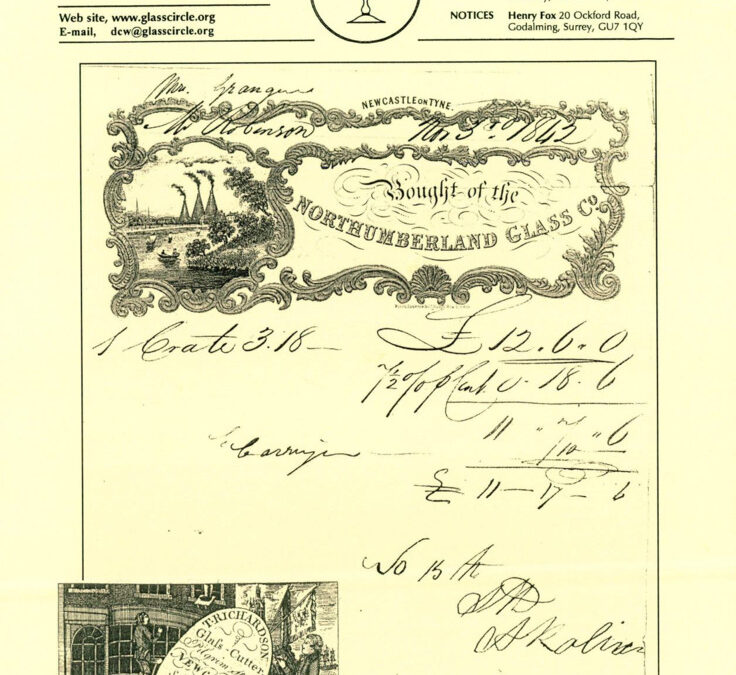
Above, Bill-head and bill of the Northumberland Glass Co.,
Newcastle on Tyne, Nov. 3rd 1842;
Left, Trade card of T. Richardson also of Newcastle.
See,
A Medley of Material about Newcastle Glasshouses,
by Jill Turnbull on page 7.
No. 95
On more familiar territory, shown below is an 1886-1890
matt Peachblow footed vase shaded rose to pale blue, the
latter reflecting the use of
copper rather than uranium
as the body colour. This
was made by the Mount
Washington Glass Co. of
GLASS CIRCLE NEWS No. 95
2003
Editorial
Annual Report – The Corning Museum of Glass
The welcome thump of the CMOG annual report on the
doormat portends another year of achievement for this most
famous of glass museums. Indeed, apart from the lack of a
student body it reads more like a University report and,
certainly, its staff, 99 in number, are of top University
standard as reflected by the prolific nature of their
publications and achievements. However, here the similarity
ends for, while a University throws its old equipment in the
skip to make room for the new, the CMOG, and its
incorporated partner, The Rakow Library, amass more and
more individual items over a breathtaking range of glass
interest. In spite of its size the problem of how to respond to
the generosity of its numerous donors in terms of maximising
the display and accessibility of the gifts showered upon it
must be an ongoing problem. This year is no exception and
ranges from a collection of ancient beads, through 21 stained
glass windows (including some made by Hardman & Co.,
Heaton Butler & Bayne, and Powell & Sons, all originally
sent from England for an American church) to a collection of
20th century glassmaking machinery for a proposed new
technological gallery.
To these may be added pictures reverse painted behind glass,
an extraordinary 94cm long table decoration of lampworked
flower beds and a central fountain, made in Murano and
dating to
c.
1760, and an extraordinary “mechanical theatre
depicting the Wedding of Cana” with numerous figures
feasting round a long table within a sumptuously ornate
palace littered with all sorts of ornament, tableware and
domestic animals. The whole display is a composite of glass,
wood, rock crystal, shells and fabric. This extraordinary
achievement is 68cm wide. However, the reason for calling it
mechanical is not given.
Of the other objects illustrated in the report I loved a set of
four Indian bottles (two shown above with accompanying
funnel). These are elaborately decorated in gold and
polychrome painting. Said to have been made in Gujerat they
date from the second quarter of the 18
th
century.
New Bedford MA. and its particular
interest for me is the mode of
decoration, created with numerous
small dots in the Bohemian manner.
One would not mistake this for
superficially similar Stourbridge
products. Finally, the scent spray
(right) is also of interest. With a
feathered decoration of irridised pink
and white it might easily be thought
to be French. In fact, this is another
US creation from the Vineland Flint
Glass Works of Victor Durand
(1924-1931).
Corning has an ongoing programme of
collecting studio glass so acquisitions in this area are no surprise.
A further 2000 items, including paintings, drawings and a works
recipe book poured into the Rakow Library to further increase
its already impressive holdings. The service the staff there
provide is second to none and you will be hearing more about
this in the future. (When I was there two years ago I was
impressed by how the gallery staff liked to come and talk and
learn about the objects on display — quite a contrast to the British
approach where they so often just sit quietly in a corner.)
Even this summary does not conclude the report which also
covers four exhibitions, educational and research work. This
really has been another year of inspirational achievement. *
Trip to Venice & Murano
T
he Glass Circle and Glass Association have combined to
achieve some notable successes in organising joint trips to
areas of glass interest abroad. This year, on top of the AIHV
Conference and our
Palace to Parlour
Exhibiton a joint trip
has been arranged to Venice and Murano through the kind
help of Gaby Marcon.
The Venetian Lagoon has contributed greatly to the history of
glass and its evolution. A visit to the Glass Museum in
Murano and the prestigious Salviati glass factory is sufficient
to impress with both the importance of this rich, historical
and artistic heritage and its influence on contemporary glass.
The earliest information about glassmaking in Venice dates to
982; over the centuries the industry developed until its
consolidation in the 15th century. It achieved its peak in the
16th century, the ‘Golden Age’. A stasis period, followed by
decline, then ensued as a result of the development and
competition of German chalk glass and English lead crystal.
But the industry was only dormant. Born again in the 19th
century it has reached new peaks in the 20th century thanks,
in part, to the Italian obsession with the minor decorative arts.
This 4-day/3-night trip will explore some of this history.
Visits to museums, private collections, furnaces and studios
will impart an understanding of how Murano glassmaking is
not only a tradition but an authoritative, international voice
today. In fact, the combination of tradition and modernism is
a hallmark of the Murano aesthetic. Its influence on the
American Studio movement and on European artists, such as
the two innovative sculptural architects Stanislav Libensky
and Jaroslava Brychtova, are only one example.
Gaby Marcon has arranged an exciting and imaginative
programme reflecting her intimate knowledge of the area.
This, and travel information, are outlined on page 13. Book
soon if you wish to come as the Glass Associaton members
have a head start. *
Page 2
2003
GLASS CIRCLE NEWS No. 95
,d99/0)
1
1f,
RE7-4567/6145
get 7
Pam ,eade
ir Roy Strong, sometime Director of the
National Portrait
1.3 Gallery
and subsequently of the
V&A,
has become one of
the most prolific writers of populist but nonetheless authoritative
books on historic and cultural matters; indeed, so prolific has
his writing become that one is reminded of George III’s remark
to Edward Gibbon:
“Scribble, scribble, scribble, Mr. Gibbon?”
His latest copiously illustrated work’, on
‘Feasts’,
considers the
subject from Classical times down to the 21st century, and
finishes on such a pessimistic note about formal eating that he
might too have adopted Gibbon’s title of
“The Decline and
Fall”.
Despite there being only a single index entry for ‘Glass’,
I added another seven for future reference, and for those of you
interested in table usage the book is a well worthwhile read.
As is so often the case, on the subject of how table glass was
used in C. 18′
h
Britain the book poses as many questions as it
answers. Most discussions on dining at this period concentrate
on the courtly
‘service
a
la francaise’,
where drinking glasses
were rigorously kept from being placed on the table until the
dessert course, or even until after it.
Strong illustrates plenty of pictures of
British princely and aristocratic feasting
for both the earlier and later periods, and
for Continental feasts during the C.18′
h
,
although neither he, nor any of the other
writers on the subject, can illustrate
princely feasting in Britain during the
C.18
th
. This absence of pictorial expres-
sion parallels the contemporary denigra-
tion of the parochialism of the first two
Hanoverian Georges as
‘Wee, wee, Ger-
man Lairdies
and of George III as
`Farmer George’,
and all three Kings
refused to eat in public, in the fashion that
their Stuart predecessors had and to some extent the Prince
Regent did later, in the C.18
th
. Another factor contributing to
this decline in the theatre of royal eating is the relatively small
proportion of the Gross National Product that our sovereigns
controlled, in contrast to their Continental counterparts, where
some of the German courts spent over forty per cent of the whole
national income. However, the reputation for the frugality and
lack of ostentation of George III, who reigned for sixty years,
is somewhat belied by the luxurious Continental silver table-
wares commissioned by him, now at Waddesdon but until
recently displayed in the Gilbert Rooms at Somerset House.
There is also quite elaborate English table silver made for
George III and still in the Royal Collections. Furthermore, it is
noteworthy that despite there being little or no royal influence
on glass fashions, the C.18
th
represents the golden age of British
drinking glasses.
There is plenty of evidence, particularly in the table layouts
portrayed in the many C.18th household and cookery books, that
‘service
a
la francaise’
was indeed normal practice for the
British upper classes throughout the C.18′
h
and well into the
C.19`
11
; but did this in fact always inhibit drinking with the main
part of the meal, and was it the universal mode of service when
dining
en famille?
Where, too, did the informal supper, or
`souper intime’
feature in the British scheme of things? The
‘souper intime’
is well established in France, both pictorially
and in literature, with wine glasses and bottles featured on the
table together with the food. The only equivalent English
representation that I know of is the picture of
‘Taste’
(c. 1745)
by Philip Mercier, in which two couples are informally seated
at a dessert table, with food, glasses and bottles in abundance.
There are at least three autograph versions of this picture, and
although they look rather ‘French’, Mercier had been living in
England for nearly thirty years when he painted them, so they
almost certainly portray British practice. I think that we may
probably conclude that on formal occasions throughout the
C.18
th
wine glasses did not appear on any British dining tables,
but that in informal circumstances they did, – which must have
prompted the move to placing glasses on the table throughout
the meal, a practice that clearly pertained early in the
Indeed, there is an C.18
th
French provincial example, recorded
in a picture of 1770, that depicts a large family dinner at the
Chateau of Schoppenwihr; the hostess is dispensing slices of pie
from a central platter, whilst there are bottles and small tumblers
actually on the table.’
Another question prompted is to what extent did decanters
appear on the table? They are frequently depicted in C.19
th
dining scenes, but the ubiquitous black bottle is the only
dispenser shewn in most British C.18”’ depictions of eating or
drinking, although as already noted, these portrayals are pre-
dominately of informal occasions. The earliest bill for decanters
known to me is that to the Earl of Traquair in 1737, although
there are references to and records of serving bottles and
decanters for some fifty years before this.
However, soon after 1750 sales became
commonplace, and throughout the second
half of the century the surviving bills give
a fairly constant ratio of one decanter or
carafe to every fourteen wine glasses
sold, meaning that there was a consider-
able quantity of decanters in circulation.
But despite this, even late in the C.18`
h
,
the black bottle is the normal dispenser
depicted. Doubtless, Andy McConnell’s
impending work will sort this out for us.
Just after these reflections had been
concluded, Sothebys offered for sale a
fascinating Germanic decanter that bears on the matters consid-
ered here. It carries engraving by a German hand, but is
explicitly dedicated to the Kitcat Club of London and to its
secretary, Jacob Tonson. The engraving includes two vignettes
of the Club in session, each illustrating baluster glasses, some
on the tables and some being held by the stem, and also shewing
both decanters and food on the table. This portrayal, from the
1700-1720 period, clearly does not conform to
‘service a la
francaise’,
but is perhaps the earliest illustration of
a `souper
intime’,
albeit for men only rather than having mixed genders.
(Sothebys sale of
14.5.03;
Lot: 101. See page 10)
The last reflection induced concerns our old friend, the ‘Wine
& Water Glass’. Sir Roy records that the Sun King, Louis XIV
of France, who reigned from 1643 until 1715, always drank his
wine diluted with water, being offered both in carafes, for him
to mix himself. The jacket illustration of Strong’s book shews
the Prince of Salms in about 1770, feasting with a group of
sixteen others round a circular table; two servants are each
proffering a salver with a small tumbler two-thirds full of red
wine and accompanied by a clear carafe, presumably of water.
A guest is drinking from a similar tumbler, which is much the
same as those noted above as in use at the Chateau
Schoppenwihr. In Britain, my first record of the sale of a Wine
& Water Glass is in 1744. After 1750, sales settled down for
the rest of the century to a level of about 3% of all wine glasses
sold, which hardly constitutes it as a fashion leader. Nor is there
much reference in contemporary accounts of wine being diluted.
Doubtless, the French view of the British as hard drinkers was
in part fostered by our failure to dilute the wine that we drank.
1.
Sir Roy Strong “FEAST; a history of grand eating” (2002)
2.
Mark Girouard “Life in the French Country House” (2000)
The Buffet
By the early 18th century the best houses had
buffets installed as impressive marble fitments.
Often they had running water in the manner of
elaborate wash basins.
Celia Fiennes* describes in about 1705 how, at
Mr Rooths house in Epsom she found a neat
‘boofet” in the parlour “furnished with glasses
and china for the table, a cistern below into
which the water turned from a cock, and a hole
at the bottom to let it out at pleasure.”
*The Illustrated Journeys of Celia Fiennes,
1685 – c.1712. Ed. Christopher Morris.
Page 3
GLASS CIRCLE NEWS No. 95
2003
Glass Circle Lectures
Collecting Antique Glass: The Pitfalls and
The Pleasures. An Illustrated Talk
By Graham Vivian
Report of a Meeting held at the Artworkers Guild on Tuesday 11th March
2003. The hosts on this occasion were Mrs. M. Boydell, Mr. F.L. Ffoukes,
and Mr. and Mrs. J. Whittle
From time to time members ask why the Circle does not have
more talks about the activities and problems of ordinary
collectors. The answer is, or course, that it is difficult to
persuade members to do the talking, usually claiming that
they do not know enough about the subject. This, naturally is
why other members want them to give the talks in the first
place, because it enables them to openly discuss the sort of
problems that the ordinary collector faces. So it was with
anticipation that we awaited this talk by Graham who,
although a new member and a relatively new collector, has
already made his mark as a member of the committee.
His original collecting interest was studio glass but he found
the size of the pieces was soon taking too much space in the
house. Another Circle member pointed him toward 18
th
century glass and here he found his new interest. Knowing
nothing of the subject, his first aim was to gather a collection
of books, which he read avidly. A fortunate acquisition of a
collection of old sales catalogues also proved to be a fund of
information. They gave a good indication of the sort of
English glass to be found, its value and, no less important,
some idea of how it held its value and appreciated with time.
Analysis of a number of pieces revealed that while some did
increase in price, if you resold a very expensive piece too
soon a massive loss was equally possible. So glass was not
necessarily a good short-term investment. A revealing aside
was that in the older catalogues the names of the purchasers
were listed alongside the lots bought; so the interests of
several Circle members could be identified in this way.
An interesting question arose over how to advance one’s
collection, the choice between placing all one’s faith in a
dealer or taking pot-luck at an auction. Here there was a
conflict between experience and opportunity. A good dealer
could be a valuable advisor in helping build a collection but
if you also attended the same auctions that the dealer
patronised to get his stock in the first place then you could
meet obstruction because it was threatening his livlihood if he
told you which pieces to go for and which to avoid. After all,
it is partly his experience that you pay for when you buy
from him. The dealer has to make a profit but so does the
auction house and Graham noted how auction premiums had
now increased to around 20%. If the dealer bought his stock
at auction and then added his markup it meant that the
ultimate buyer would have to wait for a considerable time for
his purchase to increase enough for him to get his money
back. This was the price of enjoying one’s collection. He
thought 20 years was the approximate time scale involved.
Premiums were slightly less outside London but still not
insignificant and there was the added need for greater care in
avoiding false offerings. Watching the dealers in action was
also instructive. (In the old days in Sotheby’s they used to sit round a separate table at the front of the auction room which
made this easy, but, sadly, not any more). Mention was made
of the web but this was an area he had not so far explored.
What to look out for when assessing a potential purchase was
another sticky area and Graham touched on the use of a UV
lamp to check for lead glass and using a lens to look for
damage or reconstruction. Engraving was another problem and
here he felt that taking expert advice was the only solution.
However, as with the so-called fake Jacobites, unless they
have been demonstrably shown to be forgeries nobody seems
to care very much. Purchasing glasses from a known and
accepted collection might prove more expensive but it could
be a safe way of investing one’s money.
Photographing the collection was another challenge, particu-
larly if you wished to make slides to give talks like this one.
Obviously a decent camera was a prerequisite. But in his
hands, trying various approaches, particularly that of taking
shots against the light with the glass placed on a window-
sill, had had mixed results. Over and under exposure, camera
shake and correct focussing all had to be mastered. A major
problem with film was the number of pictures that had to be
taken on a reel and the delay in getting the film developed.
The alternative of capturing digital images required the
considerable investment needed to make this a practical
solution but it was probably the best way forward for the
future as the result of each shot could be checked at once.
Having fought his way through all the troubles of a new
collector Graham then impressed with the achievements of his
own endeavours — the slides with warts and all. Clearly, the
quality of a collection depends on what you can afford; his
was both traditional and very impressive. Overall the talk was
received with approbation, stimulating a long and wide-
ranging discussion. Afterwards many members were asking
“Why don’t we have more talks like this?” The answer is as
I wrote at the beginning. It is said that everybody can tell one
good story. Likewise I am sure everybody can give one
interesting talk, particularly if it is on their own collection,
not just on what has been achieved so far but also what to go
for in the future. So follow Graham’s lead and let us hear
from you. And if you are unable to talk write it down for
Glass Circle News.
D.C.W.
22222224 2 4232 4 4 SZ 4 4 22222 71 4
18th Century Trade Cards and Bill Heads
by F.Peter Lole
Report of a Meeting held at the Artworkers Guild on Tuesday 6th May 2003.
The hosts for this meeting were Mr. & Mrs. G.M. Baker, Mr. G. Neilson, Mr.
A.W.P. Ross & Mr. V. Cowdy.
Peter Lole began by saying that most of
the “visual romp” he was about to show
was drawn from a variety of published
sources, representing other people’s re-
search efforts; slides of some sixty glass
related Trade Cards and bill-heads were
shown, together with supporting material.
The earliest representations were from the
Continent of Europe, depicting Glass Sell-
ers in a generic form. A typical example,
depicting a French glass seller, was a wood-
} block engraving of c.1515,
Marchand du verres de
Paris.
Later, this type evolved into burlesque forms,
such
as The Glass Seller
and
The Glass Seller’s Wife
issued in Augsburg in the 1730s. A series of four are
illustrated in the end papers of Ada Polak’s book
Glass, its
Makers and its Public.
In England similar generic representa-
tions appeared in
‘The Cries of London’
series, for which
a
woodcut illustration that included a female Glass Seller was first
registered at the Stationers’ Hall in 1580. Variants of the cries
continued to be published for over two hundred years.
The first real Trade Cards, advertising a particular trader,
appeared in the late 17th century; usually copper plate engraved
and printed on paper (the use of card was a C.19th development).
An unusual example was that of James Morley (1696) for
Nottingham stoneware but including a decanter in the illustration
Another early example was by John Burroughs; London, 1703.
Such ‘cards’ initially served a three-fold purpose: as labels stuck
onto goods such as mirrors or bottle-cases, bills might be written
on the reverse, or they were simply used as advertising material.
(The precise purpose of the advertising function was the subject
of some discussion after the conclusion of the paper.) Until the
mid 18th century the decorative item on the Card was almost
invariably the hanging sign by which the trader’s shop was
identified. Several such examples were shown. But in the early
1750s there was a dramatic change in form. Cards started to
portray a wide range of the trader’s stock in trade, and also in
some cases to illustrate manufacturing processes. The earliest
Page 4
Your Dates for the 2003 –
2004 Season
of Glass Circle Meetings.
All meetings to be held at the Artworkers Guild, 6.30pm
for 7.15pm. Lecture titles to follow.
Thursday
Tuesday
Tuesday
Tuesday
Tuesday
Tuesday
Tuesday
Tuesday
1
6`
h
October 2003
18
th
November 2003
9
th
December 2003
10
Th
February 2004
9
th
March 2004
13
th
April 2004
11
th
May 2004
8
th
June 2004
2003
GLASS CIRCLE NEWS No. 95
known specimen of this type in the Glass Trade, and by far the
most important in terms of the detailed information it provides,
is the well-known card of Maydwell and Windle which is
ascribed to 1750-1755.
There was clearly a considerable amount of copying of items
illustrated from one Trade Card to another. Perhaps this reflected
the economic reuse of costly engraved illustrations by the
printer. However, the contention, proposed elsewhere, that some
of the objects illustrated were imaginary was not accepted by
Lole, who illustrated a couple of items of unusual glassware that
appeared on both the Maydwell and Windle card, and also on
those of other tradesmen. In the same way the depiction of the
glass furnace on some cards can be accepted as representative
of the period but not necessarily specific to that particular
glasshouse.
In 1762, following a number of fatal accidents caused by signs
falling from their mountings, the City of London banned
hanging Trade Signs, and instituted compulsory street
numbering; similar regulations were made by the City of
Westminster in 1763. There was no compulsion for street
numbers to be given on Trade Cards or other advertising
material, but the more enterprising tradesmen rapidly appreci-
ated the benefits. In some cases the Street number had obviously
been added to an existing printing plate, or an entirely new card
was produced that incorporated the street number. William
Parker, for example, produced a 1762 card which gave his
address as:
‘at his Glass Warehouse in Fleet Street’;
following
this he quite quickly and awkwardly added the street number
`69′, and by the end of the decade had issued an entirely new
card including the street number. Other, more conservative
traders, were more tardy; one such was Jonathon Collet, who
succeeded in 1765 to Thomas Betts’ business and was still not
giving a street number on a changed bill-head freshly issued in
1781, nearly twenty years after the new regulations became
effective.
By the mid C. 18th many of the London traders were using a
bill-head which allowed for the entry of goods sold beneath the
printing; often traders had both a Trade-Card and a bill-head.
Initially most of these printed bill-heads were simply
calligraphic, but towards the end of the century many had
become pictorial. The use of Trade-Cards in the provinces was
adopted much later than in London, probably because London
was so much bigger in size than the provincial towns, with a
mid century population almost twenty-fold greater than its
largest rivals. The earliest provincial Trade-Card found by the
speaker was that of Francis Brodie, in Edinburgh, first issued in
the 1740s; in the second half of the century a number of
provincial cards and bill-heads for glass traders are known, with
a late C.l8th group from Bristol illustrating a variety of different
glass cones. Unlike the earlier cards the engravings are probably
reasonable representations of the glasshouse site. *
N.B. For a good selection of Trade Cards, beautifully illustrated, see A.C.
Hubbard’s
A Wine Lover’s Glasses,
Ward Lloyd, 2000.
Glass Circle Matters
Welcome to New Members:
Mr. R. Heap
Mr. R. Jackman
Katherine Coleman
We are delighted to report that our member, Katherine Coleman
who has been an active member and Fellow of
The Guild of
Glass Engravers
for many years, has now been elected
Chairman. One outcome has been a new Newsletter that packs
as much into two pages as GC News does in three. Good
eyesight is a prerequisite for an engraver.
Mr. Peter Wright
We also report with sadness the death of Mr. Peter Wright,
former consultant eye surgeon at Morefields Eye Hospital in
London, at his retirement home in Bovey Tracey, Cornwall. Our
condolences go to his next of kin.
q/ass 6//pplifp fiewry
roX
Oink, Oink! A
BIG
Thank You
First, I must thank all those members who sent cards and good
wishes to me during my recent hospitalisation. They were much
appreciated.
From Palace to Parlour
Second, I would ask all members to help promote our forthcom-
ing exhibition at the Wallace Collection. A wide variety of
domestic British 19t
h
century glass borrowed from Royalty, our
members and museums will be on show. This will include
Regency cut glass, superb coloured and decorated glass,
impressive cameo pieces, Nailsea glass loved by all and, not
forgetting, pressed moulded glass, the bread and butter of the
working classes. Please alert your local NADFAS branch,
Women’s Institute, and NACF regional secretary; propose group
visits, but above all bring yourself, relatives and friends.
The Mystery “K”
I came across the following interesting item under
Questions &
Answers
in a recent copy of
Country Life
magazine. I quote:-
“Do any readers know the significance of the incised mark like
the letter ‘k’ which is often found on the base of old drinking
glasses?” I can barely wait to be enlightened so please send your
answer to me in a plain brown envelope!
Art Treasures of Kelvingrove
A Scottish member has written to me enthusiastically recom-
mending this exhibition which is at the McLellan Galleries, 270
Sauchiehall Street, Glasgow until late 2005. Of particular inter-
est to members will be the two cases containing Clutha glass
with a stunning large vase designed by George Walton (from a
private collection) and two examples designed by Christopher
Dresser, one of which is a rainbow vase in swirling colours of
blue, pink, yellow and orange and sits on its original fret-work
stand (also from private collection). Other Clutha pieces shown
are simply attributed to James Clutha & Sons. Note: the
Kelvingrove itself is currently closed for substantial
refurbishment.
Ahead with
glass!
Here is a fashion tip for lady members, but I am not sure whether
it might prove to be unisex. “Louis Mariette, London’s latest
and irrepressible milliner, is causing a sensation …. To visit his
Chelsea studio (strictly by appointment) is a unique experience
…. constantly brimming with new ideas… Watch this space for
his new top hat, made with barbed wire and melted woven
glass.” (taken from
Country Life
magazine 24.4.03. Note: his
`wow’ factor creations are made only to order.)
The Earliest Known English Glass?
Ken Cannell tells me that a July 1939
Apollo
advert for an Art
and Antique Exhibition lists Cecil Davis (14a Stratton Street,
WI) as exhibiting the “Earliest known English wine glass”. Does
anyone know what this glass was and, if so, is it still the earliest?
Without some sort of provenance it seems a bold claim. But
Davis was a reputable dealer so he must have been sure of it.
Glass Circle
News; copy deadlines.
No. 96 Early August for publication in September
No. 97 Mid-November for publication in December
Page 5
Sophia Dorothea
GLASS CIRCLE NEWS No. 95
2003
Glass Circle Visit to View the Queen’s Glass
in Buckingham Palace.
We were initially not allowed to handle the glasses, set in a row
down the middle of the table while we sat on either side; lighting
was adequate but not exceptional. Our keeper (Jonathan
Marsden), who had joined us for lunch, and three charming lady
assistants, wearing cotton gloves, picked them up and turned
them round at our request so that essential features could be
presented for study. However, as the session wore on a limited
amount of handling became inevitable without any reprimand.
Our helpers were keen to learn as we avidly discussed the
glasses before us.
The reason for this initial restriction was soon apparent. The
first group, a series of goblets and covers, the rounded and
slightly flared bucket bowls with heavily gilded rims, engraved
with a royal cypher and feathers, above either a plain or a MSAT
stem, were all heavily crizzled (although Hugh Tait tells me that
because of the rough glass surface it is better not to handle such
glasses in cotton gloves.). My impression was that these were
not lead glasses and regretted not having brought my UV lamp.
They are illustrated by Hughes (Figs 98 and 99) who presum-
ably thought them to be English but is otherwise unhelpful in
his descriptions. The lids and beneath the feet were unusually
decorated with a circuit of ovals which added to their, to my
eye, continental appearance. They were also gilded round the
rims, a rare English feature for this form. By contrast, two other
glasses with cyphers, one with round funnel bowl on a moulded
pedestal stem, and the other a drawn trumpet with tear were of
manifestly English form and material The engraved coats of
arms revealed perhaps one reason why glasses from the Royal
Coats of the House of Hanover characterised by the inclusion of the white
horse. Its use by the English crown ceased with Queen Victoria.
collection are not more prominently displayed.
The strong family link with the House of Hano-
ver would be far too obvious for current taste.
This might change in the fullness of time,
particularly if we adopt the Euro.
The second group was a mixed bag of nine
glasses with variously engraved decoration.
Most impressive was a Potsdam covered goblet
engraved with the medallion of St Vitus (Hughes
Fig.100). There was also a Newcastle glass and
a wine engraved “Success to the Eagle Frigate.
Also in this course, two Williamite wine glasses,
one with the characteristic columnar stem be-
tween multiple mereses and on a domed foot,
f 1730 engraved
inevitably came in for some heavy criticism with
angels (course 1).
reference to Frans Tieze, particularly an engrav-
i
ng of the King as a country squire. It may well
be the critics are right but at least the glass seemed OK to me.
The main part of course three was a very welcome group from
the famous Perrin & Geddes suite of cut wine glasses and
decanters. I have long wished to study these at close quarters
and it was about here that the restriction on handling began to
fade. The intricacy of the cutting is truly remarkable, particularly
on the collar round the base of the bowl of the wine glasses. The
wheels used must have been minute to access the difficult angles
involved. I had not realised before that there were minor
differences in cutting that distinguished the later from the
original glasses. Those members into porcelain were particularly
gratified to study a Chelsea mounted cruet. This contained two
diamond-facetted glass shakers and I rather suspected these were
replacements. Nevertheless, it was an imposing piece.
Of the fourth group I
have to admit I can re-
member very little. This
is probably because my
attention focused on the
two presentation pieces
mentioned above and
time was beginning to
run out. First was the
Stuben
Merry go Round
covered bowl presented
by President and Mrs.
Truman to Princess
Elizabeth and Prince
Philip on the occasion of
their marriage in 1947.
One reads much about
these high quality Stuben
pieces and such eulogies
are fully justified. The
metal,
construction and engraving are remarkable work. But a
massive covered vase, some 12 inches tall, presented by Fraz
Jona, Federal President of the Republic of Austria,
to Queen Elizabeth II, in 1966, was no less
impressive. The shape was novel with particular
attention to the designs of the cut finial and foot. My
lightning thumbnail sketch may convey a slight
impression. The countries concerned will be grati-
fied to know that these pieces are always on display.
We strolled back across the gravel of the Palace yards into the
real world ruminating on our experience. Views were mixed
about the quality of some of the glass but all agreed it was a
most enjoyable and gratifying occasion. Our grateful thanks go
to Jonathan Marsden and his staff for the considerable task of
setting out all the glass and to Peter Lole who organised it all
for us lucky Circle members.
D.C.W.
At 12.30 pm, Thursday 24th April 2003, follow-
ing precise instructions from Peter Lole, twenty
Circle members met at Overseas House, just off
Piccadilly and backing onto Green Park. Here,
drinks followed by a splendid private lunch
round one large table was the prelude to an
afternoon’s study of a representative selection
from the Queen’s glass collection in Bucking-
ham Palace, a short walk across the Park. Signed
in by a watchful and well-armed policeman we
crossed the front yard, through an arch and
across the inner courtyard to the inner covered
entrance, so often the scene on TV of more
formal matters (most recently, President Putin),
and into the lavishly red-carpeted and gilt splen-
dour of the main reception. Our coats and
luggage taken care of by smartly dressed serv-
German tumbler o
ants we
were ushered into a modest (by Palace
with Tobias and the
standards) side room where a long table was already laid with
out first ‘course’ of glass study. Three further ‘courses’ were
set out on a side table while another carried copies of pictures
that included glasses, an original copy of the first (1822) Apsley
Pellatt book and Royal bedtime reading in the form of a
handsomely bound copy of Bernard Hughes
English, Scottish
and Irish Table Glass.
A huge cabinet of porcelain occupied
one wall while on two other smaller cabinets were displayed
two modern presentation pieces of which more shortly.
Page 6
mo•
/ rete/j/WeJlowe
hP4 6
tree..
1-4
– 4-
67. o
4
–
/
a
/.6
,
-/
•
Reproduced by
permission of the
National Archives
of Scotland.
(W4 I;I:.1”
jt.6t1,7,V11/) Fvrc
2003
GLASS CIRCLE NEWS No. 95
A Medley of Material about Newcastle Glasshouses.
Jill Turnbull
Recent articles about Newcastle glass have prompted me to
survey the material about the glasshouses of north-east England
gathered during my research into the Scottish glass industry. The
Newcastle glasshouses were of considerable significance to
glassmakers in eastern Scotland from the 17th through to the
19th centuries, being at the same time rivals for their markets
and the source of many of their workmen. Newcastle glass set
the benchmark for quality and price and during the hiatus in the
manufacture of flint glass in Scotland merchants there obtained
their supplies from north east England. In view of this close
association, it may be useful to summarize some of the informa-
tion obtained, although it is fragmentary, having been collected
solely in relation to the Scottish industry.
It would seem appropriate to begin with the Dagnias, who were
making glass in Scotland well before they established their
glasshouses in Newcastle.
The earliest evidence of Edward Dagnia’s presence in Scotland
is his signature as witness to a document, signed in July 1662,
by a glassmaker of Italian descent, Jacob Visitella, who operated
a small glasshouse at Westpans, on the south-east coast of the
Forth estuary, about eight miles from Edinburgh. It is not known
when Dagnia arrived in Westpans, but Visitella was the then
holder of the patent of monopoly to make glass in Scotland,
which belonged to the descendants of Sir George Hay, the first
patentee. Visitella probably started his glasshouse in about 1647,
and it is likely that Edward Dagnia was working at Westpans
with him’.
In 1663 Jacob Visitella gave up his patent rights in favour of
Robert Pape, who was setting up a glassworks in the Citadel at
Leith, and with whom Edward Dagma signed a contract on 12
October that year. Pape, who came from a family of lawyers,
was to supply all the raw materials, while Dagnia agreed to make
vials of various sizes, wine glasses, bottles and other items of
green glass, as well as beer bells, wine glasses, ‘and all other
sorts of wytt glasses’. He also agreed to make the pots, prepare
the white or green metal according to the wishes of Pape, and
perform the duty of conciator
2
.
The Scottish market was small and problems were exacerbated
by the considerable political and economic upheavals of the
1660s, so it is not surprising that the bulk of glass production
was purely utilitarian. Vials in particular would have been in
relatively steady demand throughout the 17th century, since they
were in regular use by apothecaries. Glassmakers obviously had
to produce whatever would sell, but they were able to switch
from bottles to wine and beer glasses if required. Dagnia was to
be paid five shillings sterling for 100 beer bells and ten shillings
a hundred for small wine glasses in white metal. Chopin vials
(a chopin contained one and a half imperial pints) in green glass
would cost Pape six shillings sterling a hundred, while 100 of
the the smallest vials were to be made for one shilling. Dagnia
was also to take care of the tools and to supervise the workforce.
With Edward Dagnia in Leith were his wife Joanna Coo and
their sons John and Edward, each of whom witnessed signatures
in 1664 and 1665. There is no mention of Onesiphorus, but it
seems likely that he was with the rest of the family. Edward
senior died sometime between 3 December 1664 and 18 October
1665, on which date his widow borrowed some money from a
local merchant.
Robert Pape had sold the glassworks before Edward Dagnia
senior’s death but no information about its fate under the new
owner, James Bell an Edinburgh merchant, has come to light. If
it continued to operate the younger Dagnias would probably
have continued to work there, but it may well have not lasted
long.
Notepaper and detail of John Douglas (Late agent to Isaac Cookson & Co.)
Plate Glass, Crown Window, German Sheet Glass and Alkali Merchant, 59
Close and 40 Westgate Street, Newcastle upon Tyne, 24th Sept. 1846.
Where the Dagnia family went next remains to be discovered,
but they were certainly making glass in Newcastle, on the Close
Gate site, at least three years before 1684, mentioned by
Catherine Ross as the date when John and Onesiphorus and
others leased land on which to build a glasshouse there. The
evidence for this earlier glasshouse is contained in a letter dated
11 June 1681, which was addressed by Onesiphorus Dagnia at
the `Glassehouse of Newcastle’ to Sir James Standsfield, partner
in a new glassworks at Leith’.
The spelling in the letter is rather more idiosyncratic than usual,
but it would seem appropriate to quote part of it in full with
modern spelling. Dagnia began by referring to John Tyzack, who
had told him that Standsfield had ‘a mind to set forward your
work again if you could get workmen’. He then commiserated
with him about the bad behaviour of Moses Henzell and other
men from Newcastle whom Standsfield had employed to make
window glass. He went on to offer to go to Leith with other
glassmakers to operate the works:
“Sir, if you are intended to put it forward again I will bring
others with myself that shall carry on your work with courage
and to profit (if we can agree). I think about 15 or 16 weeks
work will serve the country, which I can do and follow my
employ here, you will have no men relying upon you as for
playing wages, (which otherwise if you have a set of workmen
of your own and have not employment for them they will expect
playing wages). If your worship please to bear the charges I will
Page 7
GLASS CIRCLE NEWS No. 95
2003
come over and give you the nearest account of what stock may
serve for a 15 weeks fire in all particulars, and likewise will do
you business in buying your ashes, for there is great matter in
your ashes for there is ashes that one bushel will go as far as
one and a half of other sum (which I have good reason to know).
Sir I desire you to consider on it and return me an answer with
the first post, for I am intended for London speedily. If I can do
you any favours I shall be willing to do it. I once writ before
concerning your white work but rec:d no answer, John Tizack
told me you rec:d my letter, Sir when you write direct your letter
to the Close Yett [Scots word meaning gate] glasshouse…”
5
.
A number of points in this letter are of interest. Dagnia was
clearly well aware of the limited Scottish market and the
consequent problems involved in keeping a glasshouse running
throughout the year. He appears to have felt favourably towards
the Scottish enterprise, perhaps because of his time in Scotland.
(Much of his spelling is more Scottish than English, which may
also be indicative of formative years spent in Scotland). Much
more importantly, it is clear that he had been making glass, and
employing others to do so, at a glassworks in Closegate, for
some time
before
1681. There is no further correspondence, so
the outcome of his letter is unknown.
Another man who provided a 17th-century link between Scot-
land and Newcastle was John Leaman, who appears to have
acted as go-between and recruiting agent. A letter to Sir James
Standsfield, dated 31 December 1678, from `Mr. John Leaman
and the Glass-men of Newcastle’ enclosed an agreement from
Moses and Joseph Henzell to go to work in Scotland. Leaman
explained that he had obtained it with some difficulty, that
neither of the Henzells was interested in becoming a partner in
the Leith glassworks and that, despite being unemployed, they
were ‘very haughty spirited men’ who insisted on Standsfield
meeting their terms.
John Leaman was described as ‘your friend’ in a letter from the
Henzells to Sir James Standsfield, when they asked that he
should pay them
f5
on Standsfield’s behalf. They added that:
“We desire you to write to John Leaman to agree with the smith
for making the tools”, which they insisted were provided for
them in Newcastle before their departure. They also demanded
a minor change to the Scottish furnace design before they would
agree to work at Leith. Leaman was clearly vital in the
negotiations between the entrepreneurs who owned the glass-
works and the skilled men they required to make the glass’.
Sir James Standsfield was murdered by his son in 1687 shortly
after two Irish glassmakers had contracted to make flint and
other glass for him, and Scottish glass production reverted to
bottles, vials and window glass until the short-lived Port Seton
glassworks (1728-34) produced some flint glass. Between the
demise of Port Seton in 1734 and the establishment of the
Verreville glassworks in Glasgow in 1777 there is no evidence
of any flint glass being made in Scotland, and between 1738 and
1746 there was a total hiatus in glass production of any sort in
eastern Scotland. The coast was, therefore, clear for the glass-
makers of north-east England to fill the gap.
The archives of wealthy families often contain invoices from
London, where it was fashionable to spend part of the year and
to purchase glass, china and other luxuries. For a Scottish
merchant wanting goods to sell, however, Newcastle was a much
closer and cheaper source. James Elder, a merchant initially in
Perth and then in Aberdeen was such a man, and papers dating
from 1750 to 1767 bear witness to his purchases from
Newcastle.
The first, from Airey Cookson & Co, dated 15 March 1750, was
written in response to an order from James Elder, who had been
recommended to go to them by Mr. Trotter, a well-known
merchant in Edinburgh. His order included champagne decanters
and stoppers, round quart decanters, plain ‘Spanish & Britta
Wines’, plain Spanish flutes, plain diamond salts and plain
upright half pint beakers. He also wanted ‘tale’ goods: drams,
costing 16 pence a dozen; Spanish and Britta wines, diamond
salts, and gill cans moulded at bottom, all at 30 pence a dozen;
`worm’d Spanish and Britta wines, worm’d half pint beers,
screwd eggend wines with 1 rib, and with 2 ribs, Spanish wines
twisted, and twisted eggend mould’d half pints. His total order
came to £6 1 Os 91/2d.
A further order from Airey Cookson & Co, dispatched on 8
October 1751 by William Potts, contained ‘3 in a pint beakers’
at 9d a lb; common cruets no handles at 2/6 a dozen; twisted
sugar end wines at 4d; ‘eggend moulded bowls and twisted’ at
4d each; common diamond salts and plain diamond salts,
common drams at 1/4 a dozen; round pint decanters and
stoppers, 21b, @ 9d each and, strangely, 2 ‘twisted wines broak’
for 2d’.
In 1752 James Elder began a series of purchases from John
Williams & Co. in Newcastle, the last bill being dated 25 March
1766. The most common objects he bought were green vials of
various sizes, often in considerable quantity. In July 1754, for
example, he bought 1 gross at 9d a dozen, while in October 1756
he bought 3 gross at 7d a dozen. Occasionally Williams supplied
bottles, described as chopins and mutchkins, so complying with
Scottish capacities.
Most of the glass consisted of fairly ordinary domestic wares,
including wine, ale and brandy glasses by the gross, gill beakers,
gill cans, bird fountains, oil lamps, worm’d flutes, worm’d
Spanish wines, ‘barrel lamps’, ‘confectioners’ and covers, ‘bul-
bus root glasses’ and ‘green thumbs’. In 1766 he bought 2 dozen
`corn fountains’ costing a total of six shillings. Most of the
invoices were signed by Paul Taile.
In July 1766 and June 1767, the bills are headed ‘Bought of the
Owners of the Close Gate Bottle & Flint Glass Houses’. They
supplied items previously listed, plus two gross white vials, a
dozen ‘ground bird boxes’, a dozen flint funnels, half pint
beakers, mustard vials and a mustard pint bottle, salts, wide
mouthed three pint bottles and tale cruets.
Illustrated bill-heads and trade cards are often of interest and
occasionally appear among Scottish papers. One, dating from
c.
1800 for T. Richardson, glass-cutter of Pilgrim Street, Newcastle
(see cover picture), shows a handsome shop-front and advertises
`all sorts’ of window glass’. Two later bills in the Lothian papers
are illustrated with views of glass cones. The Northumberland
Glass Company’s invoice for £11 17s 6d, dated 3rd November
1842 (see cover picture), gives no details of the goods provided
for Mr. Grainger, but features a splendid view of the glassworks
with three cones and the river in the foreground’. A second
invoice for Mr. Grainger, dated 24 September 1846, and sent by
John Douglas, 59 Close and 40 Westgate Street, Newcastle upon
Tyne, ‘late agent to Isaac Cookson & Co.’ (picture page 7), is
slightly more informative but does not name the glassworks
illustrated. Douglas sold plate glass, crown window glass,
German Sheet (i.e. muff) glass and alkali. The window glass he
supplied was to travel to Scotland by rail. His billhead also
illustrates three glass cones, belching smoke in the distance’.
Research into the post-1750 period of Scottish glassmaking is
continuing and it is hoped that more material relating to English
glass production will also come to light, and will eventually be
published.
J. Turnbull
The Scottish Glass Industry, 1610-1750,
Society
of Antiquaries of Scotland, 2001.
2
NAS RD4/11/430
3
C. Ross ‘The flint glass houses on the rivers Tyne and Wear
during the eighteenth century’
Glass Circle Journal 5,
75-82.
NAS RHI5/102/6/3/14
NAS RH15/102/6/3/14
8
NAS RH15/102/6/3/1A
6
NAS RH15/102/6/1,2,3
NAS GD40/8/294/130
NAS RH15/27/7
19
NAS GD40/8/299/194
Page 8
2003
GLASS CIRCLE NEWS No. 95
GA
AC1
Birmingham (Motor Cycle), May 2003
Reported by Henry Fox
Newark, 2nd June 2003
Reported by John Clarke
As ever, there is an “air of expectancy” surrounding a trip up
to the Newark Antiques Fair. Though famed for being an
inexhaustible source of antiques and collectables, not always
the bargain hunting and exploring is worth the long haul up
from London! With up to 4,000 stalls in seven permanent
buildings, marquees and outdoor pitches, Newark is Britain’s
largest and most popular antique fair and also the largest
event of its kind in Europe. The showgrounds are located just
10 minutes from the historical market town of Newark and 40
minutes’ drive from Nottingham.
Whilst most antique fairs take place on weekends, the
Newark Fair is always held on a Mondays and Tuesdays.
This though does not seem to discourage crowds in any way,
as thousands of people come from all over the world! This
time round it was reassuring to hear again the voices of the
American trade doing business.
Newark offers a huge variety of goods, ranging from
furniture, garden ephemera, porcelain, pottery, silverware,
jewellery, paintings, kitchenalia, books, maps, prints and
smaller collectable items, all varying in quality from boot
fair style collectables through to major items of high value.
Basically, if you are an antique collector the chances are that
someone at Newark will have something for you!
Glass, both blown and pressed, is aplenty though mostly from
the mid to late Victorian period right up to the 1950’s and
1960’s. A fair amount of contemporary studio glass and
European glass is to be found too, with Bohemian glass to
the fore, followed by Scandinavian glass from the 1920’s
through to the 1960’s.
Our June hunt, though not very successful, was very
enjoyable and the weather held up for us! Our mission was to
hunt for good quality glassware from the 1950’s/1960’s and
Orrefors dishes. We found some small collectable items such
as knife and fork rests, ranging in price from £6/pair up to
£50/pair for heavily cut items together with glass cutlery,
which is very collectable these days! A set of salad servers
can range from £8 to £20. We purchased a cut glass match
striker (£35) and match holder (£14) to create a set with a
bowl and lamp – all in cut glass, found in a previous visit.
We did not find any Orrefors pieces, particularly the ones
designed by Simon Gate, though on previous occasions we
found some lovely clear glass dishes with black feet designed
by him. What we did find was a lemonade set of jug and
glasses. They can be found both in enamelled and clear glass
ranging in price from £24 to £50.
A few Whitefriars items were on display, ranging from £12
to £60 depending on size, and other small bowls. The rest of
our purchases were silver items and Susie Coopers’ cups and
saucers and a few Shelley ceramic moulds. All in all it was a
good day out!
Whenever you go to Newark you never know what you may
find or how you will be inspired by what you see. If you are
thinking of going, please don’t forget a good pair of shoes
and take a large shopping bag! •
I was only able to get to one fair during the last three months,
and even visiting that one caused me to have to take to my bed
for the whole of the following day. I wanted to visit the Glass
Fair held in May at the Birmingham Motorcycle Museum to
meet up with members and dealers alike. However despite being
kindly transported door to door, I found on arrival at the fair
that I had to find a seat and indeed once the fair was open I
found myself in need of a chair every twenty yards or so. The
fair was reasonably busy with the early visitors hurrying from
dealer to dealer, examining stock and buying.
As usual the fair had something for everyone, and again this
time I noticed that C.18th drinking glasses were to be seen on
quite a number of stands — airtwist and opaque white enamel
twist stemmed glasses in particular. I do not recall seeing any
heavy balusters, but I did see two blue glass wines and an
unusual blue taper stick with up-turned saucer shaped foot.
A wide variety of Victorian glassware was available, and
certainly some scarce Sowerby nursery rhyme pieces, such as
Bo Peep, in flint and Ye Frog and Ye Crow in opaque white
were spotted. Good engraved decanters and jugs were noted,
particularly a jug acid etched with octopus and seaweed motifs.
I was told it had been re-purchased recently from an Australian
client.
An excellent range of paperweights was to be found on one
stand. Attractive French Art Nouveau pieces were seen next to
a stand specialising in Powell and later Whitefriar designs,
including the now highly collectable Baxter period (post 1960)
with its bark textured pieces and use of vibrant orange and blue
colours. Several stands were showing contemporary glass or
new individual studio pieces. I saw little of carnival glass and
certainly no examples of early Richardson or Varnish/Hale &
Thomson. The highlight of my visit was when I was shown by
a visitor a bronze medal awarded to Apsley Pellatt, glassmaker,
in original case. *
Roger helps create a castle!
R
omping round old castle battlements
s a peculiarly British pastime simply
because our land is littered with them. If
you have been following the Channel 4
TV series on ‘Castles’ by Marc Morris
you may have been surprised suddenly to be confronted by
demonstrations of making muff and spun window glass, the
intricacies of these processes being ably explained by Roger
Dodsworth of Broadfield House Glass Museum. This (19.6.03),
the final programme in the series, was about Raglan castle in
South Wales, the last to be completed. Castles were going out
of fashion by the end of the C.16
th
and Raglan’s particular glass
interest was its modernisation with huge un-castle-like mullioned
windows alongside traditional arrow slits and cannon holes.
Most of these faced inwards, although not made very clear in
the programme,
to let light into
the great hall and
other rooms sur-
rounding the
main courtyard.
Some opened to
the exterior but
even so the castle
withstood an
eight week siege and cannon bombardment by the Roundheads
who later reduced it to the attractive ruin it is today. The
windows, which must stand alongside England’s earliest, were
almost certainly filled with glass made by the muff rather than
the spun process. Because of their considerable value, they were
probably removed and reused rather than smashed as tradition
would have it. The Royalist owner, incidentally, was ‘retired’ to
a small flat with old fashioned windows in the Tower of London.
Page 9
GLASS CIRCLE NEWS No. 95
2003
AUCTION ACTION and PRICE
–
CHECK
‘
by
Henry Fox
*BBR, Elssecar, Nr. Barnsley, S. Yorkshire – 2n
d
March —
Collectables, including bottles etc. The glass highlight at this
sale was a cut glass eye bath c.1820 which fetched £1,400.
*Woolley & Wallis, Salisbury —
2n
d
April — Decorative Arts –
This sale included a pair of Lalique car mascots in the shape of
horses’ heads. Sold for £4,000.
*Mellors & Krik, Nottingham — 10″
April — Antiques & Works
of Art — two glasses caught my attention at this sale. A good
early English wine with thistle
shaped bowl with solid base over
central plain ball knopped stem on
domed foot, it made £420 (picture
right); in contrast a German colour
enamelled Reichsadlerhumpen dated
1700, decorated below the rim band
with a two headed eagle, a milled
edge base and a high kick-in (picture
far right) sold for £1,600.
*Christie’s, King St. James’s —
14
th
May — “Fifty Years of
Collecting: The Decorative Arts of Georgian England — This
was an important single owner sale which despite a few items
withdrawn and over twenty unsold still went on to make a total
in excess of £6m (including buyer’s premium etc). This sale had
several small lots of C.18th wine glasses which sold reasonably
well despite foot chips and minor damage, and had probably
been purchased originally for everyday use like some good late
C.19
th
and C.20th cut glass found illustrated in the impressive
sale catalogue. There was a fabulous group of C.18th Stafford-
shire opaque white enamel decorated glassware all acquired over
the years through Delomosne & Sons, as well as important early
chandeliers. Further, there were several fine period mirrors,
along with rare ceramics and superb C.18th furniture. A pair of
Geo. III cut glass and gilt-metal two branch wall lights attributed
to William Parker fetched
£38,000, whilst a Geo. III or-
molu and cut-glass eight light
chandelier attributed to Parker
and Perry finally went for
£90,000. Of the decorated
Staffordshire opaque white
glass I particularly liked the
pair of tea bottles (picture left)
with contemporary gilt-metal-
mounted enamel covers, one
labelled `130HEA’, the other
`GREEN’, both above a goldfinch perched on
a tree. These were contested to £12,000. A
silver-mounted lignum vitae cruet stand con-
taining five silver-mounted opaque white glass
bottles, labelled ‘OIL’, ‘PEPPER’,
`MUSTARD’, ‘SUGAR’ and another ‘OIL’
respectively, above floral decoration; this lot
made £8,500, despite minor damage noted in
the catalogue. An opaque white glass guglet
(H 27cm, picture right), finely enamelled with
two long tailed
birds perched on
flowering prunus was bid to
£18,000. (Note: this lot with esti-
mate of £8/10,000 was purchased
as recently as June 2002). Two
opaque white glass floral painted
candlesticks with contemporary
enamel drip pans and incised twist
stems set over domed feet, were bid
to £14,500. (picture left).
*Thomson Roddick & Medcalf,
Edinburgh — 17
th
May — Paintings, Watercolours & Prints –
Included in this sale was an attractive reverse painting on
glass of a spaniel and game, said to be ‘After Landseer’. 19
th
?Hammer Prices unless otherwise stated. All pictures courtesy of the
auctioners.
century school. The auctioneer told me
that it was on slightly convex glass and
measured about 44cm x 34cm; it was
however ‘foxed’ an expression I que-
ried as I usually think of this in relation
to prints, watercolours and old books.
However, its subject matter must have
exceeded its faults, because it sold for
£1,300′ (picture right)
*Sotheby’s, Olympia, London —
14′
May – British & European Glass (All realised prices quoted
for this auction are buyer premium inclusive). This sale
included a fine and varied selection of continental glass,
particularly a good selection of Lobmeyr gilt and enamelled
`Persian Style’ glassware
c.
1878-1880, including a late 19
th
century large Mosque Lamp which sold
for £26,400. A large and rare
Louis fuchsia one which fetched
*fro
£900 and an English one, possibly
Islington Glass Co., second half of the
19′ century, which sold for £3,360. This weight (picture
above left) had a central profile portrait bust, possibly
depicting Queen Victoria, surrounded by various coloured
canes.
Two other English items attracted
me, a rare mushroom knopped
wine glass with thistle bowl
c.
1715 sold for £4,800 and an
important Kit-Cat Club engraved
and crizzling decanter bottle circa
1700, which was bid to £12,000
(pictures right and detail below).
The catalogue indicates that this
piece, made of soda glass, is
probably German or could possibly
be of Bohemian origin but deco-
rated in London. It also makes
reference to the wicker cased bot-
tles of this flattened general shape,
made originally in colourless glass
on the continent. John Evelyn
mentions seeing them in Florence his diary but that was
earlier, in 1664. However, such bottles for casing in wicker
were never made with a separately applied foot and later
bottles had a marked kick-in and, following English practice,
were generally coloured. Whatever the answer, it is exciting
to see such an item.
*Law Fine Art, Hungerford, Berks —
20
th
May — Ceramics
and Glass — there were 166 varied glass lots in this sale,
about half of which consisted of mid-C18th to early Cl9th
4111 -..-, ”””.
Al tr
,
(:::
1
41/„.
Russian engraved blue-cased gob-
*
C)
let and cover the bowl finely
$
4
,
t. engraved with winged figures
*„.„1”
of Cupid and Psyche sur-
A 0,1).
mounted on a matt-finish clear
20
glass carved imperial eagle
Al
t
n
IID,
was bid to £72,000. Of the
—,
st
paperweights I liked a small St
.,…,.
Page 10
& yr
1
1
,
from canes pat-
terned
,
with fine
‘, 1
white threads.
These were first
f
fused together and
then blown to
give the final
shape. Gilded ap-
c’
it pled prunts com-
pleted the decoration of this
complex piece which made
£7,000 (see picture and detail
left).
In contrast a fine Paul Ysart
magnum bouquet paperweight
made £850. Of the French paper-
weights I liked a Clichy sulphide
example (profile of Queen
Victoria) sold for £850 (picture
below left) and a rare Cli-
chy pedestal paperweight
which reminded me of a
door handle, sold for £1,100
(picture right).
2003
GLASS CIRCLE NEWS No. 95
drinking glasses. Of interest were a wine glass with waisted
ogee dimple moulded bowl set on opaque white twist stem
hat sold for £320; a wine flute or toasting glass on opaque
white twist stem made £400; a typical dram glass on short
opaque twist stem and terraced firing foot went for £350; a
wine with pan topped bowl on opaque stem fetched £500; a
similar bowled wine but on centre knopped multi-spiral
airtwist stem went for £350; a
wine with bell bowl and drawn
multi-spiral airtwist stem with
centred vermicular collar was bid
to £260; a ‘Lynne’ glass with
round funnel bowl and three
horizontal bands set on an
opaque white enamel twist stem
sold for £780. Dated to the
1730’s the three glasses illus-
trated above went for (left to
right) £1,550, £820 and £380
respectively. This sale also in-
cluded a Lalique glass car mascot
`Faucon’ bid to £2,100, as well
as an attractive floral cut cameo
vase with orange background
catalogued as probably Webb
which fetched £720 (picture left).
*Bonhams, New Bond Street, London —
21
5t
May — Fine
Continental Ceramics and Glass — Highlights from this sale
are a fine rare Facon de Venise drinking glass in the form of
a boot c.1600, but with minor loss to ankle strap. It is formed
*Woolley & Wallis, Salisbury —
21″ May — Glass and
Ceramics — small varied selection of glass, including C.18th
English drinking glasses and a number of lamps. Of interest
were a sealed and dated bottle `J
Pitfield 1784′ which fetched £800
and an oval opaque white glass
paste portrait medallion of F J
Haydn in profile by Tassie,
inscribed `I Haydn Mus. D. 1792
Tassie F’ framed and glazed, which
made £940. (picture right).
(Note: this would be Franz Joseph Haydn
(1732 — 1809) the Austrian composer of
Croatian descent. He made two visits to
London after 1790, and was made a
Doctor of Music of Oxford in 1791).
*S.J. Hales, Hovey Tracey, Devon —
28
th
May — Antiques
and Collectables.
Glass fire extinguishers (grenades) dating from the late C.19th
have always fascinated me and in this sale were two lots.
First, a set of three `Harden Star’ (an American firm, which
may have licensed a British firm to make them in UK?) blue
glass oviform grenades in metal carrying case which made
£200 (picture below), and second, a pair of ‘British Minimax’
narrow cylindrical grenades, one blue, the other amber,
(BritiahPatent approved 1926) made £230. Any further
information about these fire grenades would be appreciated.
Perhaps a member has one or more by other makers.
44,4**044
,
~.1.0+8440-
,.
/4-4404.44444-444.1
,
04v4
,
444
,
44
,
44
–
0444.W4444 4+,4*
Glass Monteiths
A member has written to query the
use of the term ‘Monteith’ for the
double-lipped wine glass cooler
when it is commonly used to de-
scribe a much larger container for
holding a ring of glasses. It is
certainly probable that the Mon-
teith first arose in this way as illustrated by the above fine
version in Sheffield plate engraved with the Royal Crest, Garter
collar and crown. Its date, 1790, compares with the illustration
of another by Jean Michel Moreau le Jeune (1741-1814) in his
Le Souper fin
(detail below). It is interesting that here the
Monteith is placed on a side table, not the dining table. This
was apparently the arrange-
ment for a private meal
where servants were
excluded.
I have never seen a glass
version of these large Mon-
teiths but I do have a flat-cut
wine-glass cooler with two
lips which I have always
dated to the earlier part of
the last quarter of the C.18th.
I assumed this represented
the time when individual
Monteiths were first in-
cluded as part of the table
layout. So I suggest that this
is a functionally accurate use
of the term but it is a matter of individual preference.
Page 11
GLASS CIRCLE NEWS No. 95
2003
Forthcoming Exhibition
NAZEING GLASS
AND ITS ORIGINS
This exhibition about Nazeing Glass Ltd., the last known family
run glass factory in Britain today, is to be held at Lowewood
Museum, Hoddesdon, Hertsfordshire, from 19 July to 25 Octo-
ber 2003. It is being staged by two Glass Circle members, Nigel
Benson of
’20th Century Glass’
in conjunction with Geoff
Timberlake who has written a book on the subject that will be
available from the first day of the show. Quite remarkably, the
history of the factory can be traced back to the Bowles factory
in Vauxhall in the 17th century. The core of the exhibition is
drawn mainly from the 1930’s, from a collection built up by
Nigel Benson over the last 20 years and will be supplemented
by loans from other private collections and Nazeing Glass itself.
,
66:6066(..1 WorLs 13631.6. 11.16tior 6466 .661. tiro6M1o6rot, n.rb.
,
11N 10 6.
T61606,666 01112 1644111 rot; 01992 450466
,gofs Ft ‘Wm% 661,4661
1
n
66666:66.16166,666066 213511
Nazeing sample sheet showing modern candle holders and ashtrays in
a range of colours and a selection of selenium ruby signal lenses.
This is the first occasion on which the wares and antecedents of
this little known factory have been brought to the fore. The
progress will be traced of its production from Victorian roots,
through the 20
th
century and into the 21
51
, covering the whole
gamut of work over the last 130 years. Until now, Nazeing Glass
Ltd. has been largely overlooked by collectors, or its work
attributed to the London firm of James Powell & Sons. or,
occasionally, to the better quality Stourbridge factories.
Much of the production during the late 19t
h
and early 20t
h
centuries centred round lighting fitments as well as what is now
regarded as Victorian “fancy glass”. In particular, a series of
Lily vases that range from small “solifleur” vases through to
huge floor-standing two-piece items with metal connectors are
now known to be by Charles Kempton, a predecessor of
Nazeing, working in Vauxhall, London.
Though the Nazeing site was bought in 1928 by Richard
Kempton, it was not until 1930/31 that production began in the
“Goat Shed”, the only building then on the site. Known as
“Nazeing Glass” the company produced a range of art glass
items that included vases, bowls, lighting, desk accessories and
paperweights. During WWII the firm went over to production
GLA,ss
O
v-
hritv ’04,
‘TV
Nazeing Glass Works Limited, Nauing New Road, Broxbourne, Herts., ENIO 6SU
Telephone: 01992 464489 Fax: 01992 00966
Email:
5alesq,nazein-class.co
Uk
Web:
www.nazeing-glass.co.d;
for the war effort and in 1942 was bought by Malcolm Pollock-
Hill, father of Graham, the present owner.
After the war the company started making drinking glasses and
ashtrays for commercial businesses such as hotels and airlines.
This culminated in the firm finding work in niche markets,
including pub glass, badged advertising wares and even a range
of Bristol Blue glass retailed through the museum at Bristol. For
a brief period in 1999 the firm experimented with producing Art
Glass again and marketed a range of items, but the project was
found to be uncommercial, and so ceased
Much of the current production includes press-moulded glass
ranging from traffic light lenses to architectural street lenses (for
basements). Only twenty percent of the current output is
domestic in nature, being mainly tableware for hotels and
caterers. Nowadays the company has close links with glass
artists who can produce more intricate wares that require
different skills from those available in-house.
This year is the 75t
h
anniversary of glassmaking on the Nazeing
site, a suitable occasion on which to reflect on the production
of the only remaining family run glass manufacturer in this
country. The diversity of work produced from Victorian times
to present will cover something of interest to glass historians
and collectors alike.
Nigel Benson started collecting glass in the mid-1970’s and began dealing
in British, Scandinavian, and Continental glass in 1986. He runs a shop,
“Twentieth Century Glass”, in Kensington Church Street, London. He is the
author of Miller’s “Glass of the ’50’s &’60’s — A Collector’s Guide”, was
glass consultant for “Millers Collecting Modern Design”, and has written
articles on glass for the
Antiques Magazine.
Geoff Timberlake originally collected 18th century drinking glasses before
moving into 20th century items. His interest in British glass of the last century
has centred on the Nazeing Glassworks, culminating in the writing and
publication of a book on the subject. He is Hon. Treasurer of the Glass
Association.
Autre Temps, Autre Moeurs
On the occasion of the Golden Jubilee of the Queen’s
Coronation, the magazine,
Country Life
produced a facsimile
copy of its ‘CORONATION NUMBER’ of fifty years ago, in
June 1953. Amongst the classified advertisements under the
heading “RESTOPATIONS’ was an advertisement whose text
we reproduce in full:
“CHINA RESTORATION & RIVETING. Wine
glass stems fused. – VALENTINE PIRIE, 144a
Brompton Road, London, S.W.E. KEN 5828″
It now seems strange that a time which some of us remember
quite well should practice restoration techniques which are today
either frowned upon or simply not used.
Forthcoming Conference organised by The Glass Society
of Ireland/Contemporary Makers
INSPIRATIONAL AWAKENING
Historical and Contemporary Glass
19th – 21st September 2003
Waterford Institute of Technology, Waterford, Ireland.
In addition to the 2-day conference (150 euros for non-members)
there are two 3-day workshops (300 euros) and one 2-day
workshop (200 euros) running concurrently.
For further information write to:- Inspirational Awakening
Administration, City Enterprise Centre, Waterford Business
Park, Cork Road, Waterford, Ireland.
Page 12
2:03
GLASS CIRCLE NEWS No. 95
TRIP TO VENICE AND MURANO
9th-12th OCTOBER, 2003
This year’s overseas event will take members of the
Glass Circle and Glass Association to Venice and
Murano, one of the most important glass making
centres in the world. The programme (see below) is
packed with interesting visits to museums, studios,
workshops and private collections, with some free
time to enjoy the city!
There are still places available and if you haven’t
booked yet, please contact Gaby to ask for a booking
form and any further details.
PROVISIONAL PROGRAMME
Thursday 09th October
PM
Departure from London or regional airport to
Venice
Arrival at Venice and transfer to the Hotel Riviera del Lido
Dinner in Hotel and overnight
Friday 10th October
AM
After breakfast, transfer to the Glass Museum in
Murano for a lecture on ‘Venetian glass from the 13th to
the 16th centuries’ followed by a guided visit of the
museum and its store rooms.
Lunch at leisure
PM
Visit the `Barovier e Toso’ and Trcole Moretti’
collections.
Transfer to Venice to see the exhibition `Aperto Vetro’
EVENING
Dinner in hotel and overnight.
Saturday 11th October
AM
Visit of the Cassa di Risparmio di Venezia’s
private collection and the Carraro’s collection.
Lunch at leisure
PM
Transfer to the Glass Museum in Murano for a
lecture on ‘Venetian glass from 17th to 20th centuries’
followed by a visit to a number of studios/factories that
reproduce the ricello’ technique and `Facon de Venise’.
EVENING
Private view of an exhibition of Centro
Studi Vetro’s artists working in Murano followed by dinner.
Return to the hotel and overnight.
Sunday 12th October
AM
Breakfast in Hotel
Choice of optional excursions (to be finalised).
Lunch at leisure
Free time.
PM
Transfer from the hotel to the airport.
The cost of the trip is £315 excluding flight but including
3 nights accommodation in the Hotel Riviera del Lido on
B&B basis, 3 dinners, all transfers (including vaporetto),
entrance fees and lecturers. Single Supplement £60.
For further information contact Gaby Marcon by
Tel. 020 8371 8357
Email. gabymarcon@btintemet.cOrri
or Snail-mail to:- 7 The Avenue,’ London N3 2LB
r
ttsaaAx
•
y?;
,
r
.11.2
– -00I4e /0
Practical details on the Venice /
Murano trip!
1)
LOCAL CURRENCY
This is now the Euro, of course – a chance to try it out befor
the British referendum!
2)
HOTEL ACCOMMODATION
Finding hotel accommodation for groups in Venice is consid-
ered to be ‘Mission Impossible”! however, with the help of
Centro Studi Vetro we have found a hotel which is in the Lido,
literally one minute from the
vaporetto
that takes you both to
Murano and San Marco and therefore very convenient for our
programme. The hotel is called Hotel Riviera del Lido di
Venezia. Please visit the website for further information
www.rivieravenezi a. it
3)
INSURANCE
A few of you have asked whether travel insurance is included.
The answer is NO, so please arrange your own travel insurance.
Should you need help or a contact please let me know. Also,
please note that you can purchase travel insurance from EasyJet!
4)
FLIGHTS
I checked with the scheduled airlines flying to Venice. British
Airways, British Midlands and Alitalia provide flight for an
average cost of £200 to £220 whereas Easyjet/Go have a much
keener price. Please find below flight timings plus cost taken
from their website today 10th of February 2003.
FROM LONDON STANSTED
09/10 Stansted / Venice 17.55 / 21.05
12/10 Venice / Stansted 21.45 / 22.55
Cost £91.53 inclusive of 18.50 tax
FROM BRISTOL
09/10 Bristol / Venice 17.40 / 20.55
12/10 Venice / Bristol 17.10 / 18.35
Cost
£91.53 inclusive of tax £19.00
FROM EAST MIDLANDS
09/10 East Midlands / Venice 18.30 / 21.40
12/10 Venice / East Midlands 21.55 / 23.15
Cost £136.33 inclusive of tax £18.00
Having spoken to a tour operator and considering cost and
convenience I would suggest you book your own flight directly
with EasAet either
via
the web www.eastet.com or by calling
their reservation on 0870 6 000 000. Should you want me to
book it on your behalf please let me have your credit card
details. The reason why it’s better to proceed in this manner is:
-To avoid paying a high price for flying scheduled
-To avoid paying a booking fee of £15 if we were to ask an
agent to book with Easyjet
-To be in control of your travel arrangements in case you decide
to arrive a day earlier (several members are already doing this)
or depart a day later.
Please book AS SOON AS POSSIBLE or send me your credit
card details STRAIGHT AWAY so that I can book it for you.
Any delay would result in an increase in the cost of flight since
that’s the way the low cost airlines operate.
I remain at your disposal for any further information you may
Gaby Marcon
-I I .. ‘
‘;i!
Ill
,……………………771
ty
,
.W.V.6.
–
Mt 4 WOWYNNWN•Ae**4
3:
i
i
i
i
i
1
! A
. t.,,,,,+1,
,
,
04 -0., .0 0.
lal. • :
J. -I
. 4.
n
li, AL ..x.
‘,al P 1
..
•
-.
I
ih i 6114biliktl
i
At . %ir,77
‘
, -.,.:-
.463
Page 13
A. CHURCHILL
A
beginner’s assortment of
Air-twist Glasses: the
tallest
measures 9 inches
high.
PRICE
‘ £
20
the lot.
Also in stock, others recently
purchased and equally as rare.
10,DOVER STREET,W.1
(FIRST FLOOR)
TELEPHONE – REGENT 2297
THE
DATE IS
1923
GLASS CIRCLE NEWS No. 95
2003
Forthcoming Exhibition
ART DECO TO POST MODERNISM CUT GLASS:
A LEGACY OF BRITISH ART DECO
10 20th
Septerobev
2003
Florx
-1
Pt
1\le Olard Dei-Nr
n
%5 Gbevy,
111 \(ensogton CA-ovc\-
n
Wee
Nigel Benson and Jeanette Hayhurst are
pleased to announce their long awaited
exhibition of British Cut Glass from
1930-1970.
The makers illustrated here include Thomas Webb, Stuart and Edinburgh & Leith.
•
This will be a groundbreaking exhibition shining a light on a
hitherto unrecognised area of British cut glass. It will explore the
work of the unsung designers from the 1920’s and 1930’s,
together with the artists of the post war era.
Eight years ago during one of their periodic chats, Jeanette and
Nigel realised that whilst Keith Murray, Clyne Farquarson and
W.J. Wilson (featured in the ‘Glass between the Wars’ exhibition
held at Broadfield House Glass Museum in 1987) had become
synonymous with good cut glass design, they recognised that
many designers had fallen into relative obscurity. They decided
to put together a representative collection to redress this
imbalance.
The common concept of cut glass is that of the multi-cut vessels
emanating from the Victorian era (know as ‘death by a thousand
cuts”). This could not be further from the truth, The cut glass
work of the 1920’s and 1930’s owes its design routes to the ethos
of Art Deco, a legacy that continued after World War 11 into
the work of a new breed of designers who were empowered by
the hope of a new dawn.
The new styles were featured through a series of arts-meets-
industry exhibitions, beginning at Dorland Hall, Regent Street in
1933, followed by ‘Modem Art for the Table’ at Harrods in 1934,
the ‘British Art in Industry’ in 1935 at the Royal Academy and
`Everyday Things’ at the Royal Institute of British Architects in
1936. Unfortunately, they were not a. commercial success due
to the lack of confidence of the store buyers who preferred the
old fashioned ‘safe’ cut lines However, all was not lost, as the
designs shown using sparse cutting found critical acclaim and
were featured in design magazines. Deep, swirling and mitre
cutting appear to he simple but to the cutters they are an
immense challenge, especially with the weight of some of the
items.
The collection of the Art Deco era includes designs by Ludwig
Kny, A.E. Pearce and Geoffrey Stuart of Stuart and Sons, H.
Whiteworth and Reginald Williams-Thomas for Stevens &
Williams (Royal Brierley from 1930’s) J. Pickford of Thomas
Webb and Freda F. Coleburn for Webb & Corbett.
The 1940’s through to 1970’s will be comprehensively covered
with works by Irene Stevens. Len Green and David Queensbury
of Webb Corbett, John Luxion for Stuarts, David Hammond and
Doreen Norgrove of Thomas Webb, Deanne Meanley of Royal
Brierley, Geofrey Baxter for Whitefrairs and Helen Munroe-
Turner for Edinburgh and Leith. These designers exhibited a
strong knowledge of their pre-war counterpart’s work combined
with a feeling for the material, owing a great deal to the British
Act Deco tradition whilst utilising post-war imagery.
It will be accompanied by an illustrated monograph and all
exhibits will be for sale. For further information and photo-
graphs please contact Jeanette Hayhurst on 020 7938 1539 &
07831 209 814 or Nigel Benson on 07971 859 848.
AND FINALLY
DON’T
ALL RUSH
AT ONCE!
Page 14