




r”)
Sept.
Z
1
0 0 3
Web site, www.glasscircle.org
E-mail, dcw@glasscircle.org
EDITORS David C. Watts
27 Raydean Rd,
Barnet, Herts. EN5 1AN.
F.
Peter Lole
5 Clayton Ave.
Didsbury, Manchester, M20
6BL.
NOTICES Henry Fox
20 Ockford Road,
Godalming, Surrey, GU7 1QY
No. 96
P/
David Peace
and the
Society
of Antiquaries’ Ballot Bowl.
by Hugh Tait F.S.A.
SOCIETIV LONDINIJiET AYFICWARHITVDIOSA
11/11.- A
‘
? nt) CC XVTII .
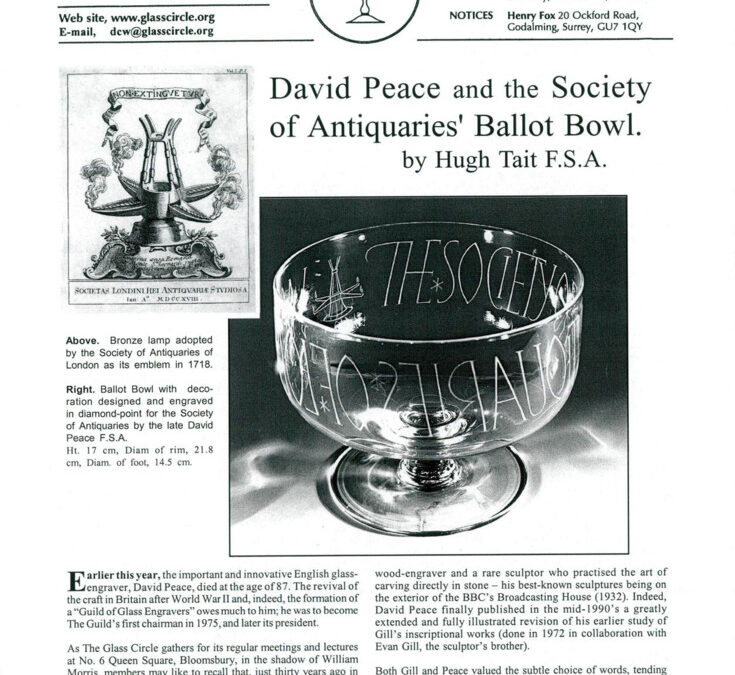
Above.
Bronze lamp adopted
by the Society of Antiquaries of
London as its emblem in 1718.
Right.
Ballot Bowl with deco-
ration designed and engraved
in diamond-point for the Society
of Antiquaries by the late David
Peace F.S.A.
Ht. 17 cm, Diam of rim, 21.8
cm, Diam. of foot, 14.5 cm.
GLASS CIRCLE NEWS
arlier this year,
the important and innovative English glass-
.’ engraver, David Peace, died at the age of 87. The revival of
the craft in Britain after World War II and, indeed, the formation of
a “Guild of Glass Engravers” owes much to him; he was to become
The Guild’s first chairman in 1975, and later its president.
As The Glass Circle gathers for its regular meetings and lectures
at No. 6 Queen Square, Bloomsbury, in the shadow of William
Morris, members may like to recall that, just thirty years ago in
that same historic hall, David Peace was chosen to be Master of
the Art Workers’ Guild. Four years later, in 1977, his paper on
`The Glass Engraver as Calligrapher’ was delivered to The Glass
Circle and, subsequently, his authoritative textbook
Glass
Engraving: Lettering and Design
(1985) was welcomed in Glass
Circle News, (no. 36, p. 6).
David Peace’s fascination with lettering grew out of his life-long
admiration of the work of Eric Gill (1882 — 1940), the last
survivor of the Arts and Crafts group started by William Morris.
Gill was not only a fine designer of type, but also a talented
wood-engraver and a rare sculptor who practised the art of
carving directly in stone — his best-known sculptures being on
the exterior of the BBC’s Broadcasting House (1932). Indeed,
David Peace finally published in the mid-1990’s a greatly
extended and fully illustrated revision of his earlier study of
Gill’s inscriptional works (done in 1972 in collaboration with
Evan Gill, the sculptor’s brother).
Both Gill and Peace valued the subtle choice of words, tending
to regard that skill as inseparable from both the art of designing
the inscription and the craft of cutting it. Over the years, David
Peace accumulated quite an impressive collection of phrases,
some poetic whilst others, for example, derived from mottoes;
these, together with many notes, tracings, sketches, drawings and
photographs of his own work — more than a thousand! — form a
valuable archive, now appropriately deposited at the V&A
Museum. Early evidence of his interest in heraldic devices and
armorial bearings lies alongside his love of lettering, at which
he excelled; indeed, one of his first publications was entitled
Engraved Glass: Lettering and Heraldry
(1968).
continued on page 4
Press moulded clear glass bowl.
(Design 46)
Stuart & Sons Ltd., 1946
Press moulded clear glass bowl.
(Design 46)
United Glass Bottle Manufacturers Ltd., 1946
GLASS CIRCLE NEWS No. 96
2003
Editorial
What the 19th Century Brought for Us?
rrhe new millennium brought antique respectability to every-
1 thing 19t
h
century and a year later to everything Victorian.
In a sense this mattered little for glass enthusiasts as the
achievements of this period were already well recognised. Now,
for the first time it brought into focus the parallel achievements
on both sides of the Atlantic. That many of the American
glassmakers had family origins in Europe did not stop them from
developing their own characteristic styles to meet the needs and
aspirations of the local populations. And, for the first time,
progress in America fed back to influence Europe. Most endur-
ing was the exploitation of press moulding for mass production,
irrespective of whether or not the idea first developed in
England. It produced cheap and cheerful tableware in quantity
and, no less important, it solved the labour problem arising from
the lack of skilled glassmakers. This combination of quantity
and diversity makes it an ideal area for today’s collector.
Nor should one neglect design and quality; by comparison with
the industry in England; with a few notable exceptions, the
superior flair and finish of many American designs have much
to be admired. The explanation reflects the question of attitude.
Press moulding in England was never much more than a second
rank industry aimed at the working class, even in the hands of
such North-Eastern giants as Sowerby, Davidson or Greener.
The matter was not helped by an endless flood of even lower
grade glassware from Czechoslovakia from towards the end of
the century and between the wars.
In 1945, at the end of World War II, the British glass industry,
restructuring its production to traditional glassware, discovered
there was an open market to exploit but a lack of skilled
craftsmen to do the work. For the first time in its history English
glassmakers found it necessary to send committees of top
management to Sweden and to America under the auspices of
the then Board of Trade to source out how best the industry
might be restored. Their report, published in 1947, revealed that
the Swedish glass industry, not surprisingly, was in a worse state
than in England, particularly from a lack or raw materials.
However, the delegation there noted how good financial savings
could be made by following their production methods although
it seemed doubtful if they could be introduced here. Nothing
helpful seemed to emerge in the way of products or product
design suitable for English manufacture.
The American delegation, on the other hand, reported great
insight into the care taken over press moulding in America:-
“All presses were hand-operated by a side lever, with hot moulds
oil-swabbed. For ordinary pressed ware a 4-man chair was used
— gatherer, presser, taker-out, taker-in. Where hand finishing was
used, the chair consisted of six persons — gatherer, presser,
transferrer, wanner-in, finisher or manipulator and taker-in.
Footed ware was being pressed with a capped foot which was
then opened out. For a pressed goblet a 7-man chair was
employed — gatherer, presser, fire-polisher for foot, foot finisher,
firepolisher for bowl, bowl-finisher, taker-in. Careful attention
is paid to the design of a mould for a pressed article which is
subsequently to be altered by manipulation. A cast iron “post”
or pontil is used for holding the article in the glory hole whilst
reheating after pressing, and during the subsequent
manipulation. A very important feature of the production of
pressed ware was the high finish and surface obtained, with
elimination of mould, etc., marks, by the hand and fire-finisher
employed. The shaping is carried out by the manipulator or
finisher on the same principle as for hand-made ware, except
that a broader tool is used.”
The committee felt that this more sophisticated process might
well be taken-up as the training time for the operatives would
be much shorter than for traditional glassmakers. In the event, I
think only Stuart of the crystal factories gave it serious
consideration; a Stuart press-moulded bowl (rare nowadays,
picture upper right) featured in the 1946
Design
46
catalogue of
the ‘Britain Can Make It’ exhibition held at the V&A. At the
same time United Glass Bottle Manufacture Ltd. launched two
press-moulded bowls, the scalloped version (picture below)
becoming an instant success.
An important consequence of press moulding was carnival glass.
Other than for collectors it has now passed into history.
However, it did introduce, or at least popularise, the idea of
iridised glass in Britain. As a treatment it has been vigorously
adopted for both commercial and studio glass decoration.
The other great 19th century American export that has to
be
mentioned was, of course, shaded ruby glass. What would
Victorian glass collectors do without it? First produced by
Thomas Webb under licence from the Mt. Washington Glass
Co., Stevens & Williams soon found a way round the patent.
Sadly, its life was cut short by the first world war and it never
recovered in the stylistically constrained days of Art Deco. In
America, shaded selenium ruby was developed but English
glassmakers seemed never to have progressed beyond a plain
selenium ruby, excellent as it is in its own rather limited way.
Bohemian coloured glass tableware and ornaments may have
become imports because that area could not compete with
British steam-powered deep-cut crystal. In spite of all that is
written about the ability of the continental glassmakers to make
glass facon d’Angleterre the fact remains that if they did so they
rarely achieved (or perhaps even desired) parity of quality with
the English product. With the repeal of the duty on glass in 1845,
Bohemian coloured glass certainly helped stimulate a competi-
tive response from Britain. We never took to making Egermann’s
stained ruby glass, and lithyalin was no more than a passing
fashion. His most enduring contribution was, without doubt,
copper ruby flashed window glass, the manufacture of which
was taken up by Chance in Birmingham; acres must have been
incorporated into our houses, a sprinkling of which remains to
this day. One should, no doubt, add to this his development of
uranium as colours, Annagrun and Annagelb. English “Canary”
benefited from the combination with lead glass and uranium was
soon found an addi-
tional role in the crea-
tion of sophisticated,
particularly opaque,
shades developed
from traditional
colours. In the hands
of John Northwood
and his devices such
as the pull-up ma-
chine the results were
truly magnificent. By
contrast, Walsh
Walsh adopted a
simple, very uncom-
plicated palate of
colours. Sadly, none
of this was of much
help to our struggling
factories immediately
after World War II.
Nevertheless, nine-
teenth century glass-
making, more than
any other, represents
a period about which
to ponder on the inter-
play of technologies
with those from foreign shores. In the 18th century England had
its own metal and was content to do its own thing. By 1851 The
Great Exhibition had changed this cosy world for ever. On pages
9 through 11 I have drawn up time-lines to highlight the more
important of these changes. We hope that when you come to see
our Exhibition at the Wallace Collection they will help you
appreciate the treasures selected for your enjoyment. 0
Page 2
Cut Monteith (Ht. 8.8cm) and goblet.
P
ic
tu
re
by
D.
C.
Wa
tts
2003
GLASS CIRCLE NEWS No. 96
The Fantastical Scot, Monsieur Monteigh.
by
F. Peter Lole
I
n two successive issues our editor has commented on the term
.Monteith’,
quoted in my note on the descriptive terms used
in C.18
111
Glass-sellers’ bills that was published in
GC News 94.
It
is perhaps worth re-emphasizing that
Monteiths’
was not a
term that I selected, but simply records its use by two different
Glass-sellers, between 1803 and 1807, to specify items on their
bills. Indeed, I was as surprised as David seems to be in his note
in
GC News 95,
to encounter the term used for what I would
have called
a ‘Rinser’.
David’s initial comment, following on from my piece, neatly
coupled his eulogy for the new Oxford English Dictionary CD
Rom with the oft quoted 1683 description by Antony a Wood,
of the silver vessel with a notched brim named after “a
fantastical Scot, Monsieur Monteigh,” whose cloak edge was
similarly notched. These silver vessels, of which the second note
illustrated a late Sheffield plate version, are indeed what one
normally thinks of
as Monteiths;
there are quite a number of
porcelain or creamware versions from the second half of the
C.18
th
, and I know of one Glass specimen, of oval section with
eight notches, displayed in the
Scottish National Trust
house of
Leith Hall, in Aberdeenshire. (I am convinced that I also have
a note of another example, but I cannot run it to earth.) The
earliest European porcelain versions seem to have been made at
Sevres, for Madame de Pompadour in 1753, for whom a dessert
service noted in the factory record book for that year contained
amongst many other items
“12 Seaux a verres”‘.
However, the
rather earlier painting of
The Oyster Feast’
of 1735, by Jean-
Francois de Troy (picture below, with computer enhance detail),
illustrates Glasses inverted in blue decorated china bowls. It
would have been nice to be able to record that in the Sevres
ambassadorial service presented to Lord Eden in 1787 one might
also have encountered individual wine coolers, but no; however
that service did contain
“2 Seaux Crenneles”,
a term that seems
to correspond well with
Monteiths
as usually understood today’.
Whilst the majority of French individual wine Glass coolers
were of porcelain or metal, there are Glass versions; unlike their
British equivalents they do not have spouts and normally have
a pair of handles, being variously known
as ‘RafraichIssoir’,
`Seaux
a
verres’, ‘Solitaires’
or
‘Verriere’
3
.
A pair of delightful
Derby porcelain eight notched
Monteiths,
with factory marks for
1784/5, are illustrated and described in the recently published
‘2002 Review’
of the
National Art-Collections Fund.
It is perhaps worth quoting in full the two Glass sellers’ entries
that set this hare running, to illustrate that they are indeed for
individual coolers:
1803: John Blades, London; to The Duke of Atholl.
14 Monteiths Cut @
36d. each.
1807: Davenport, Stoke; to The Prince of Wales.
48 Monteiths; Grecian Border (41 54d. each.
In each case the prices of some of the wine Glasses on the same
bill are quite close to those of the
Monteiths,
suggesting that the
latter cannot be large vessels, and incidentally high-
lighting how expensive ‘best’ wine Glasses had
suddenly become.
Terms used to describe a particular Glass type in the
C.18
th
, both in Britain and France, varied quite
widely and were seldom those that Collectors use
today; indeed, it is almost axiomatic that different
terms for the same thing were in use simultaneously.
Thus, the now universally used term
‘Finger Bowl’
does not occur until the second half of the C.19
th
, and
previously these vessels had been called
‘Water
Glasses’, ‘Water Cups’, ‘Water Bowls’, ‘Glasses for
washing hands at table’, ‘Wash Hand Glasses’,
`Wash Hand Basins’, ‘Finger Cups’
and
‘Finger
Glasses”’.
The earliest British reference to Rinsers
that I know of is in 1793 (long after the French were
using them,) when Parson Woodford’s diary records,
as a new fashion: “…
blue water glasses with wine
glasses in them …”.
Other British references during
the Regency period call them:
‘Coolers’, ‘Verriers’,
and of course,
‘Monteiths’,
although the term
‘Rin-
ser’
was not actually used in that period. The problem
with the term cooler, which was contemporary, is that
it can be used for so many different vessels that it
always needs qualifying.
Sources:
1. S. Eriksen & G.de Bellaigue “Sevres Porcelain”
(1987) pp. 72-75.
2 A. Dawson “The Eden Service; another diplomatic
gift”
Apollo Magazine,
April 1980.
3.
J.Bellanger “Verre d’usage et de prestige” (1988)
pp. 436-438, 492-493.
4.
F.P.Lole “The Royal Finger Bowls and Coolers
Mystery’ GC News 56; “Further Ablutions” GC News
58.
Page 3
“07at,If
ty
r
–
a.t Ln
j
i
f
.
0(1.4ty iet
co
–
w(
(
z3.1
Vs
Voting at
the Ballot
Boxes
GLASS CIRCLE NEWS No. 96
2003
David Peace and the Society of
Antiquaries’ Ballot Bowl by Hugh Tait F.S.A.
continued from cover.
Sketch by David Peace of his proposed lettering for The Society of Antiquaries Ballot Bowl. Signed and dated 1980. Size of original 40cm x 13
7cm
Whether designing on a grand scale (as with screens and doors
in churches) or on a much smaller scale (as with goblets and
decanters), David Peace always sought to ensure that his final
solution had , in effect, been dictated by the object — by its shape
and size, by its function and setting. This highly sensitive
approach, which won acclaim for many of his well-known
public commissions, is equally traceable in obscure works, like
the Ballot Bowl of the Society of Antiquaries of London, which
is published here for the first time (cover picture).
This fine colourless glass was a replacement, purchased by the
Society in January, 1977, from Thomas Goode & Co. of South
Audley Street; as it was neither engraved nor decorated in any
way, its cost was a modest £8.65. The large circular bowl has
vertical sides and is supported on a spreading foot. Both its form
and its transparency make it an ideal Ballot Bowl for regular
use on the three occasions each year when ballots for the
election of new Fellows are held at the Society’s Rooms in
Burlington House, Piccadilly.
In an election an internally divided ballot box is provided for
each of the named candidates — just as depicted by J. Walter
Wilson, R.A. in his drawing of a ballot at The Athenaeum
(Illustrated London News,
March 11, 1893). Into each ballot
box, one cork ball (no bigger than a ping-pong ball) is dropped
by each voter; whether the ball is dropped into the left (YES)
half or into the right (NO) half of the ballot box cannot be
observed by any onlooker because the voter’s hand is com-
pletely hidden within the tubular opening (near the top). Then,
after the ballot has closed, the contents of both halves of each
ballot box are separately counted in full view of the Fellows
who, as they watch each counted ball fall into the transparent
glass Ballot Bowl, can challenge any mistake in the counting
process.
If a glass Ballot Bowl had, indeed, been introduced during the
early days of the Society (founded in 1707) no evidence of its
existence has yet been found. However, such practical details
would probably not have been entered into the Minutes of the
Society (unbroken since 1717), especially if it was common
practice among similar societies and clubs in London during the
18
1h
and 19
th
centuries. For this reason it would be most interest-
ing to learn of any early references to the making or selling of
these large glass “ballot bowls” — or, indeed, of their docu-
mented use in other institutions, such as the City Livery
Companies, one of which (the Saddlers’ Company) has pre-
served the ornately decorated ballot box made for the Court of
the East India Company in 1619.
The earliest relevant record in the Minutes of the Society of
Antiquaries dates from 1906, but the brief wording of this entry
fails to shed any light on the reason for this gift: was it a
replacement or was it a new solution (because of a disputed
ballot result)?
A member of The Athenaeum casts his
vote in one
of the
row of ballot boxes.
Above each is written the candidates curriculum vitae and, perhaps more
importantly, the names of the sponsors. A porter, left, holds a basket of cork
balls for voting and the whole process is carefully watched by a scrutineer.
” Ordinary Meeting, Thursday, 29 Nov; 1906:
The Director presented for use at this and future ballots a large
old glass goblet, on which he had caused to be engraved the
Society’s name.
Thanks were accorded to the Director for his useful gift.”
[Published in Joan Evans,
A history of the Society of Antiquaries
(O.U.P,. 1956), p. 361; the Society’s Director in 1906 was F.G.
Hilton Price Esq,. F.S.A.].
Whichever interpretation is correct, there can be no doubt that,
in 1906, the Society itself had not considered commissioning a
“Ballot Bowl” nor purchasing a capacious glass that might serve
the purpose — so, perhaps the practice was already well-
established. No further description of the “large old glass goblet”
has been found and, by 1961, its loss (unrecorded) led to the
acquisition of another glass, the “Ballot Goblet”, as it was
termed in the Minutes of 7′
h
Nov’, 1961.
Nothing is recorded about its age or appearance, nor its method
of acquisition. However, correspondence from David Peace
establishes that he submitted to the Society a design (dated 30
October, 1961). It was for an engraved inscription but, a week
later, it was decided to defer the matter on grounds of expense.
However, the question seems not to have been raised again, even
>>
Page 4
2003
GLASS CIRCLE NEWS No. 96
after 1″ May, 1975, when David Peace was elected a Fellow.
This was perhaps because his election had more to do with his
professional achievements as an architect and town planner,
particularly after 1961 when he did so much to save Cambridge
from all kinds of monstrous development.
In the event, it was truly fortunate that the 1961 “Ballot Goblet”
was never engraved because it, too, was lost and a replacement
had to be bought in January, 1977. This new “Ballot Bowl”
(cover picture) was to remain in its undecorated state until 1980.
In the letter (dated 19 FebY., 1980) addressed to the President,
A.R. Dufty C.B.E., which accompanied “the sketch for the
Antiquaries Bowl” (picture page 4, top), David Peace explains
that he is no longer intending “to do a flourished pseudo-17
th
/18
th
century treatment” but favours a “less obvious treatment . . .
Italics? Yes, in contrast to the square sides. It gives a nice
directional movement, too . . .”
He concludes by offering, as an alternative, “a bit of scholarly
copperplate”. Needless to say, his first proposal was warmly
welcomed and, in July, he collected the Ballot Bowl from the
Society. He decided to engrave the inscription on the exterior of
the bowl, but chose to do it in reverse. Consequently, it has to
be read from the inside of the bowl — precisely the way it would
be most frequently viewed.
Except for a few minor details, like the length of the tail of the
letter “Q”, the finished engraving corresponds closely with the
drawing (Height of lettering, 6 cm). True to his modest nature,
he has added to the underside of the base (close to the pontil
area) a minuscule signature and date, beneath a fleur-de-lys; all
this has been lightly done with a diamond-point and could easily
be missed (picture right).
In keeping with his love of heraldic devices, David Peace has
incorporated into the inscription “The Society’s Lamp”, de-
signed as the Symbol of the Society in 1718 by John Talman
F.S.A., who was Director from 1717 —1726 (cover picture). The
bronze lamp had been found during the previous year (1717) on
Signature by David Peace scratched in diamond point on the underside of
the Society of Antiquaries Ballot Bowl.
St. Leonard’s Hill, Windsor, and was thought to be of Roman
origin and of great rarity. It entered the collection of Sir Hans
Sloane but, in 1736, was given by him to the Society and,
therefore, did not enter the British Museum along with the rest
of Sloane’s collections in 1753. Ironically, this much-cherished
Symbol of the Society is now identified as a medieval Jewish
sabbath lamp — a nuance that would have appealed to David
Peace’s gentle sense of humour.
Acknowledgements:
I wish to thank Bernard Nurse F.S.A., Librarian of the Society, and David
Morgan Evans F.S.A., its General Secretary, for their generous help in
archival and photographic matters. All illustrations are courtesy of the
Society of Antiquaries of London except the drawing of the ballot boxes
which is courtesy of The Athenaeum.
This article, with its gracious appreciation of David Peace, is a sequal to
the original enquiry in G.C. News 93, page 14, from Mr. Raymond Slack
about the 1768 order from Williamsburg for a “sett of balloting glasses” and
about the modem use of cheap fish bowls for ballots at Guildhall in the City
of London. Ed.
Glass Circle Matters
Speakers and provisional titles for the 2003 – 2004 season of Glass Circle lectures.
All meetings to be held, as usual, at the Art Workers’ Guild, 6.30pm for 7.15pm. (Volunteer hosts required please)
Date
Speaker
Provisional Title
Thur.
October 16
th
Dr. Brian Clarke
British Royal Commemoratives, makers and users.
Tue. November 18
th
–
AGM and Specimens Meeting.
Tue. December 9th
Peter Layton
25 years of Studio Glassmaking.
Tue. February 10th
Roger Dodsworth
Designer cut glass from Stourbridge: 1920 – 1970.
Tue. March 9
th
Martin Mortimer
Factory-marked Irish decanters: the problems of attribution.
Tue. April 13
th
Dr. Peter Kaellgren
Glass and Rock Crystal in the collection of Lord Lee of Sareham.
(Charleston Memorial Lecture)
Tue. May 11th
Dr. David Watts
Cut glass and its development in the 18
th
century.
Tue. June 8th
Ian Wolfenden
British cut glass, the early19
th
century.
Welcome to New Members:
Mr. and Mrs. L. Bridges, Mr. J.W. Jones
and Mr. R. Tilson
Glass Circle News; copy deadlines.
No. 97 Sept./Nov. for publication in December/January
No. 98 Early March for publication in April 2003
LATE NEWS:
Ron Thomas M.B.E., Somervale Antiques, Retires.
Our member, Ron Thomas, is finally retiring from business after
many successful years as a dealer in top quality C.18th glasses
and glassware. His stock is coming up for sale on October 15th at
Drewitt Neate, Donnington Priory, Newbury, Berks.
Tel: 01635 553 553 for details.
Page 5
GLASS CIRCLE NEWS No. 96
2003
Another Scottish Inventory
by Jill Turnbull
T
he ‘Inventory of the Furniture in Newbattle House’, home
of the Marquess of Lothian, dated 29 May 1797, includes
lists of glass in the housekeeper’s room and the butler’s pantry’
While some of them are drinking glasses, most were for the table
and some of the descriptions may be of interest. The list contains
the following:
7 glass sewers(sic) of different sizes
2 large glass ice cream bowls
13 plain small glass plates for sweet meats
3 blistered ditto for ditto
12 sweetmeat and pickle dishes with one foot
7 pickle dishes of different sizes
33 jellies different patterns & sizes
3 large with a foot and stalk for sweetmeats
8 sweetmeat baskets different sizes
2 small glass cups
I butter dish and cover
3 butter dish covers
2 ground and cut crystal milkpots
2 small cylindrical glasses
a ground and cut pepper box tin plate top
a cut and ground sugar box tin top
a lemon pickle cruet
** * ** * * *** **
13 wash hand glasses
2 doz and 3 plates for ditto
16 small caraffes
4 large ditto
6 labell’d wine decanters
8 pint ditto
16 large wine glasses
9 sweet wine glasses – small
4 small cruets for ketchup &
7 glasses for silver salts
6 wine and water glasses
2 champaigne glasses
4 cyder glasses
11 flower’d strong beer glasses
a constable glass
4 tumbler glasses
3 castors mounted with silver and three spoons – silver
4 glass salts
5 flower glasses
12 large cooling glasses
Most of the list speaks for itself and reflects the status of the
Lothian household. The family home, Newbattle Abbey, had
been a wealthy monastery until 1587 when it was erected into
a temporal lordship in favour of Mark Kerr, who was created
first Earl of Lothian in 1606. It is no surprise, then, that his
descendant’s household should own a wide variety of glasses,
including salvers for jellies and sweetmeats, even if the compiler
of the inventory did not know the proper name for them. If, as
it seems reasonable to assume, the ‘large cooling glasses’ were
monteiths, the list would place them at an earlier date than any
in Peter Lole’s list of drinking vessels in glass-sellers bills
printed in GC News 94. One type of drinking vessel which
appears here but not in Peter’s list is the cider glass.
A ‘constable glass’ is described by Newman as ‘a very large
English goblet-shaped glass with a funnel-shaped bowl… used
as a loving cup on ceremonial occasions or for serving spirits to
be transferred into small… wine glasses.’ In a Scottish context
the former explanation seems more likely because of the custom
of after dinner toasts. A French geologist, Faujus de Saint Fond,
travelling in Scotland in 1784, described the Scottish way of
proposing toasts when he took four o’clock dinner at the house
of a minor laird, Mclean of Torloisk, on Mull. After a generous
meal, served by the hostess, St. Fond wrote:
There is no delay in drinking the first toast; it is again the
mistress who is charged with this ceremony. A large glass filled
with port-wine is presented to her; she drinks the first to the
health of all the company, and passes the glass to one of the
persons who sit next to her; and thus from one to another the
glass makes the round of the table. The side-board is furnished
with three large glasses, one for beer, another for wine, and the
third for water, when any one asks for it unmixed, which is not
often. These glasses are common to all at table; they are never
rinsed, but merely wiped with a fine linen cloth.
He went on to say that:
The cloth is removed after the dessert, and a table of well
polished mahogany appears in all its lustre. It is soon covered
with fine decanters of English glass, filled with port, sherry, or
Maderia, and with large bowls of punch. Small glasses are then
distributed in profusion to every one.’
Altogether a very congenial occasion and an excellent opportu-
nity to show off an array of glasses.
One change in the range of glasses used, indicated by the
absence of beer glasses and the emergence of ale glasses in the
last quarter of the 18th century, is commented on by Peter Lole.
However, the Lothian household appeared to be still drinking
beer in 1795 – and from ‘flowered’ glasses – presumably
referring to an engraved decoration. Shifts in fashion usually
took longer to filter through in Scotland, so this may not be too
surprising.
And one final puzzle – what was meant by ‘blistered’ glass plates
for sweetmeats. Any suggestions?
‘National Archives of Scotland, GD4O/8/447
‘Harold Newman
An Illustrated Dictionary of Glass,
Thames &
Hudson, (1987) 77.
3
Faujus de Saint Fond,
A Journey through England and Scotland
to the Hebrides in 1784,Glasgow
(1907) 71-2.
Could a Venetian reticello plate with air bubbles trapped between crossed
white filigree threads be what is meant by “blistered”? Such pieces would
certainly be expensive and explain why only three were ordered compared
with 13 plain plates. If the intention was to impress an honoured guest, such
opulence would certainly succeed. This particular plate, 10.5 ins. diameter,
from the Smith collection, sold for a bargain £20 in 1968. Ed.
Page 6
2003
GLASS CIRCLE NEWS No. 96
Notes from a Provincial Glass Collector:
The Glass Circle talk by Graham
Vivian, summarised in our last
Glass Circle News, has caused
considerable interest because it is
what collecting glass is all about
and brings what members would
like to know about glass to the fore.
This has stimulated Raymond
Chatfield to tell us here how he first
fell for glass. So please write and
tell us – professionals included –
about your own experiences and
how you first got hooked.
by Raymond Chatfield
T
he
g
lass which first stimulated my interest was an Edwardian
tumbler en
g
raved with fruitin
g
vine
;
a simple enou
g
h piece
but one which seemed to capture the essence of that period. I
have come to realise that
g
lass can do that in a way few other
objects can. It was a
g
ift from a friend to my wife for the
imbibin
g
of cider. A casual
g
lance, (at the
g
lass), became a
lin
g
erin
g g
aze, which lit a spark, which started a fire which is
still burnin
g
, encompasses a couple of centuries and is smoul-
derin
g
at the rest.
My initial foray was into the world of decanters. These were
mostly Victorian but, with my wife be
g
innin
g
to mutter about
the increase of “chimney pots” in our dinin
g
room, I turned my
attention to drinkin
g g
lasses. At first I went for the early
nineteenth century but later fell under the spell of the century
previous where I finally felt at home. (By now a prime candidate
for Glassaholics anonymous. There are no meetin
g
s in my home
town but was introduced to one in London called The Glass
Circle).
The first serious book I read on the subject was Thorpe-
English
Glass
and it remains my favourite chiefly because he writes as
an historian rather than as a collector. This is not surprisin
g
really when one has the V&A’s assets to play with. In his chapter
Notes for Private Collectors
he states “Clearances, demolitions,
excavations are well worth watchin
g
since fra
g
ments can inform
any fin
g
ers”. That phrase was uppermost in my mind a couple
of years a
g
o on The Glass Circle outin
g
to the depths of the
Museum of London. Alon
g
side the impressive Garton Collection
we were treated to tray upon tray of fra
g
ments excavated from
beneath London’s soil. It seemed to me that those morsels were
devoured with as much relish as the ban
q
uet in the cabinets
nearby. If a “do
gg
y ba
g
” had been offered I think that not a
member present would have declined a piece of colour twist
stem,
q
uatrefoil knop or God Save Kin
g
Geor
g
e! To me, the
most important reason for havin
g
a collection, fra
g
mentary or
otherwise lies in the permanent opportunity to handle
;
to use
Thorpe’s words a
g
ain, “allowin
g
the metal to soak into the eyes
and fin
g
ers…”. This nurtures an instinct, invaluable when
huntin
g
in places such as flea markets, junk shops, car boot sales,
charity shops and the like, especially in the absence of definin
g
labels. Occasionally, an early piece will turn up, seldom a
g
entry
g
lass but, maybe once in a lifetime a real treasure. This happened
to me a few years a
g
o at a local car boot sale where for fifty
pence I purchased a piece by a Frenchman of the Art Nouveau
period. Thanks to the expertise of Sotheby’s and two persons
keen to ac
q
uire said item I was furnished with the where-withall
to purchase a few
g
lasses normally out of reach.
Generally I follow no
ri
g
id pattern to my col-
lectin
g
and it very much
depends on what “turns
up”. My main interest lies
more with the place
g
lass
occupies alon
g
side the
other applied arts of the
period. Granted, a well-
fashioned piece of
g
lass is
undoubtedly an object of
beauty in its own ri
g
ht, bu it ri
g
htly belon
g
s in a lar
g
er picture.
After all
g
lass (tableware) is a product of its time, not the
reverse. Each piece ac
q
uired speaks a few more words about
that picture and so, with the invaluable aid of books, catalo
g
ues,
museums and fellow enthusiasts knowled
g
e inevitably
g
rows.
As to condition of the item, I personally would rather see a
g
lass
with a badly chipped foot than half the foot
g
round away.
Recently I was able to buy a double-knopped En
g
lish colour
twist. The bell bowl and stem were perfect but the foot – well!
let’s just say that it showed the si
g
ns of a hard life. I didn’t,
however, buy the
g
lass for its foot. I have several
g
lasses with
perfectly
g
ood feet so I know what one looks like. It was an
opportunity to add a relatively rare
g
lass that, in perfect state
would have been beyond my purse. Furthermore its historical
value remains totally unaffected.
Near my home there is a museum which houses, in a display
cabinet, a modest collection be
q
ueathed some years a
g
o by a
local
g
entleman. It represents his life’s
g
lass ac
q
uisitions. When
pointed out to me that
q
uite a number bore some de
g
ree of
dama
g
e my instinctive reply was “Yes and I’ll bet he loved
every one of them”. There to me was a person who, had he the
means, would probably have chosen to buy his
g
lasses in perfect
condition – who wouldn’t – but primarily he was driven by a
passion for his subject and that sufficed.
In conclusion, I would say that whatever branch of this multi-
limbed subject you follow, be curious and ask yourself
q
uestions. Most developments in
g
lass manufacture and style
are the result of, or reaction to, technolo
g
ical improvements, the
winds of fashion and other external factors. There are also
countless
q
uestions unanswered or waitin
g
to be asked. The
relatively youn
g
study of
g
lass is not always an exact science
and the approach to it is, thankfully, becomin
g
less ri
g
id. Finally,
beware of friends offerin
g
en
g
raved Edwardian tumblers for use
as cider
g
lasses. You don’t know where it will lead! 0
q/ass arnirgs by Henry fox
ANCIENT GLASS
An interestin
g
slim catalo
g
ue was recently received from
Charles Ede Ltd London,established in 1971. He is the leadin
g
London-based dealer in Classical and pre-Classical anti
q
uities
from Greece, E
g
ypt, Cyprus and the Near East. All items are
fully researched and are sold with an unconditional
g
uarantee of
authenticity. The pictures below (copyri
g
ht of Charles Ede) are
examples from his stock, 1st-5th century AD. Prices of those
shown ran
g
e from £875 to £12.500 for the cobalt blue bottle
with white spiral trailin
g
(far left). For further information Tel.
+44 (0) 20 7493 4944 or look him up on www.charlesede.com
NOT DEJA VU
Members may recall that I wrote a few
years a
g
o about an item stolen from the
stand of Leo Kaplan at the International
Ceramics & Glass Fair at Park Lane
Hotel, London. Ima
g
ine my surprise to
spot a similar unusual-shaped piece of
Thomas Webb cameo
g
lass advertised
for sale by Warner Auctions of Leicester
earlier this year (picture ri
g
ht). This lot
had a blue back
g
round and was contested to £3,300 (hammer
price). The stolen piece had a pale
g
reen back
g
round.
CAMBRIDGE GLASS FAIR
To be held on Sunday 14′ September 2003 at the Guildhall,
1 1 am to 4pm. The or
g
anisers promise to have stands displayin
g
g
lass from the 18th century to modern times. Admission is £2.50.
Page 7
GLASS CIRCLE NEWS No. 96
2003
State Drinking Glasses
by
Roy Bendrey
T
en years ago I uncovered a piece of glass history. I thought
it important but felt unable to make any case for it that would
not attract uncomplimentary criticism or, even worse, that it
would be ignored. Courage returned after receiving the April
2003 Glass Circle News, where Henry Fox commented on the
ascription given to the lead crystal covered goblet 45.5cm tall,
lot. 0052, in Sotheby s Bond Street sale of 19th December 2002.
My opinion is that the Sotheby goblet and many others gracing
museums and collections were made at the Falcon glasshouse at
Christchurch, Southwark. This Falcon glasshouse should not be
confused with Apsley Pellatt’s Falcon glasshouse and predates
it by more than a century.
The Jackson family had a very well known and established
London glassmaking business in the last decade of the 17th
century, when they made money hand over fist and began to pile
in the lead oxide.. . They had the only cone glasshouse in London
and possibly the first in the the country, that also towered above
the jumbled Southwark rooftops – clearly visible from
Westminster. They invented and supplied the huge globe lamps
for the best street-lighting company then in London, the Convex
Lights, in which they had a major shareholding. They advertised
all sorts of the best and finest drinking-glasses and curious
glasses for ornament, and parish records prove that they gathered
a team of glass artists that was the best that money could buy’.
Francis Jackson, the leading figure in the family firm, died in
April 1700, a young man, before being properly recognised as
one of England’s great glassmakers.
Jackson would have been known to King William III, not only
through the products of the Falcon Glasshouse, but also on
account of his vociferous lobbying, along with other glass
notaries of the day, for the removal of the Duty imposed on glass
in 1695; it was removed in August of 1699. The family business
continued and a few months later Edward, a brother, was
accorded the grant of arms bearing the charge
‘three State
Drinking Glasses covered’.
Following my enquiries, a letter of
6th July 1994 from Mrs. B. Pendley, Assistant to York Herald
at the College of Arms, in London, revealed that “On 16th
October 1700 the following arms and crest were granted to
Edward Jackson of Christchurch, Surrey, to be borne by him and
his descendants:-
Arms
Azure on a chevron between three State Drinking Glasses
covered Argent as many cinquefoils Gules.
Crest
A horse passant Argent spotted with cinquefoils Gules.”
Mrs. Pendley continued :- “It is interesting that Burke’s General
Armory got the blazon wrong and that, instead of cups, the main
charges are in fact glasses. The gross error of Sir Bernard Burke
in 1884 has led to a belief that glass
had no heraldic term.”
The Glass Sellers Company has no
registered arms.
Public consultation of College of
Arms records are not permitted, but,
following a personal visit and an im-
passioned plea, I was led to a grand
room where the opened vellum vol-
ume revealed the painted illustration
of the arms. I was allowed to make a
pencil sketch, from which I drew the arms shown above.
The running of the College of Arms is under the control of the
Garter Principal King of Arms, whose grants are given under a
power delegated to him by the Sovereign in whose name he acts.
The Sovereign then was King William III, more Dutch than
English. He was a King who spent much of each year in Holland,
so it is not surprising that many ceremonial English goblets
should have been imported and decorated there. The type of
State Drinking Glasses referred to in the grant of arms might
well have been produced at the Falcon glasshouse for the
Sovereign State, to be used as royal or ambassadorial gifts, for
important members of the aristocracy and officers of State.
Hence each vessel was important and uniquely different. W.A.
Thorpe wrote in 1934 of the 25.5 inches tall Garton Goblet (now
in the Museum of London):-
“Such vessels are the Greenwich Palaces and Castle Howards of
glass. Men of mean spirit will raise a functional whine, [but] no
one else will ask what they are for.”
The covered goblet sold at Sotheby’s, referred to above, ascribed
as Norwegian, was English with Venetian features’. The Brook- lyn Museum has a knop-stemmed covered goblet with the same
crown finial above a flattened knop, ascribed to Ravenscroft. I
wonder what is the attribution given to the Fitzwilliam goblet
referred to in Henry’s auction news?
1.
The Falcon glasshouses employed men with names such as Vizatilli,
Racket, Rego, Bazen, Sherry, Holland and Brittney, all sons and grandsons
of a highly skilled group of foreigners enticed to London in the 17th century,
whose influences are obvious on most of the grand English goblets of the
period.
2.
It has been pointed out by several members that although crown finials
were produced in Norway (illustrated in the end-papers of
Kongelige Glas,
1995) they can be found on Bohemian as well as English covered glasses
and probably have a Venetian origin or reflect Venetian influence. The
Nostetangen glasshouse is said to have had predominantly German
glassblowers. (Ed.)
From Palace to Parlour, Study Day,
Sat. 18th Oct. 2003
This study
day, Aspects of 19th-Century British Glass, aims
to complement our
From Palace to Parlour
exhibition.
Subjects covered
will include the glass collected by Sir Richard
Wallace; Regency glass services, the glass of William Collins;
engraved glass designs in the Holyrood pattern books; the role
of Stourbridge in the 19th-century glass industry; luxury glass
for rich Victorians and pressed glass for the people.
Speakers
Lucy Burniston,
C&L Burman;
Roger Dodsworth,
Broadfield House Glass Museum;
Nick Dolan,
National Trust;
Suzanne Higgott,
Wallace Collection;
Susan Newell,
Bonhams;
John P. Smith,
Malletts;
and Dr. Jill Turnbull,
Edinburgh.
Fees etc. as for a normal study day at the Wallace: £24.00. Students,
senior citizens and unemployed: £20.00.
N.B.
The Exhibition runs from 21st August to 26th October.
Page 8
New Glass Books
from Thomas
Heneage
42
Duke Street, St. James, London, SW1Y 6DJ.
Tel. +44 (0)20 7930 9223.
or email
artbooks@heneage.com
Catalogue of Greek and Roman Glass in the British Museum:
Non Blown and Early Blown Glass vol. 2.
by
William Gudenrath and Veronica Tatton-Brown.
2003, pp. 272, 27 x 22 cm, 321 b/w and 249 line ills. cased. £90.00.
Iron Age to 1st century with 320 examples of non-blown glass. Includes
Portland vase and Canosa sandwich gold glass bowl.
Art Glass: Reflections of the Centuries
by
Helmut Ricke
2002, pp. 384, size 27.5 x 22 cm. 363 col.,89 b/w ills. £70.00
Catalogues the Glasmuseum Hentrich Collection in Dusseldorfs Museum
Kunst Palast. Pre-Roman to 1990s, In English.
Legras Verrier
by
Marie
–
Francoise Michel et al.
2002, pp. 256 with c. 1000 colour ills. cloth. £46.00 (no details)
Conservation and Restoration of Glass
by
Sandra Davidson
2003, pp.382, 25.2 x 19 cm, 19 col. and 232 b/w ills. £80.00.
Revised version of the original publication with Roy Newton but the
contribution of the latter on window glass now largely omitted.
Don’t forget:-
10% discount for Glass Circle Members Only.
2003
GLASS CIRCLE NEWS No. 96
TIMELINES FOR BRITISH GLASS OF THE 19
TH
CENTURY D.C. Watts
Glass making in the 19th century followed three main streams:-
1.
Cut and Engraved glass following on from the 18`
h
century with the introduction of carving and etching.
2.
Moulded glass from the last quarter of the le century and the new invention of press-moulded glass.
3.
Fancy glass continuing at first from the 18
t
h century but with explosions of innovation in
c.
1845 and mid-1870s.
Facilitating these changes were a sequence of inventions, some British (particularly by John Northwood), some rediscovered in
Britain and some imported from abroad. The following tables indicate the main developments during this period and list John
Northwood’s main achievements.
1.
Cut, Carved, Engraved and Etched glass
Aprox.
Date
Technique
Comment
up to
c.
1800
Flat cutting traditional to bowl, stem and foot.
Traditional copper wheel engraving.
1815 or
earlier
Deep steam cutting replaces flat cutting, Regency
styles; step and pillar cutting, star base on thick glass.
Commemorative engraving on rummers.
Expansion of Irish cut glass – jugs, bowls etc.
1830s
Coloured overlay cut through.
1850s
Flamboyant cutting, departing from old geometric
styles.
Pattern combined with matted glass
Greek Revival. Greek key pattern etc.
1853
Ruskin’s Stones of Venice — decreased popularity of
heavy cut glass.
Arts and Crafts movement, lighter blown vessels with
thin swirling cutting and engraved lines restricted to the
lower half of the vessel.
Move to floral and naturalistic decoration.
Introduction of Acid Etching
1860
Template and geometric etching machines.
Greek (Key, Acanthus etc), Classical and Renaissance
designs.
Renewed use of all available space on the vessel.
1870
Emergence of highly polished Rock Crystal — O’Fallon,
Kny, Fritche, Keller as exponents. Decoration initially
shallow compared with later Rock Crystal involving
intaglio work.
Introduction of Sand Blasting for badging.
Glassware in sets.
Fern pattern — Alexander Millar etc. Scottish glass
houses.
1873
Acid etching, use of white acid.
Adam influence;
Copeland Jug
Elgin Vase in clear glass (first carved vase)
1876
Cameo carved glass with small chisels on coloured
overlays.
1880
Rock Crystal with more three-dimensional shaping to
the vessel, incorporating bowl, stem and foot, achieved
on thick blanks using small stone wheels.
Partly acid etched and wheel engraved “commercial”
Cameo replaces slow carving with chisels.
1889
Intaglio — undercutting with small stone wheels
Replacing cameo and decreased market for cut glass.
1890
Acid treatment on a range of art glass for matting,
selective removal of overlays etc.
2.
Moulded and Press-moulded (Pm) Glass
Approx.
Date
Procedure / Event
Examples and Comments
1775-1830
Cast and moulded lemon squeezer feet in lead glass
Rummers, bowls etc. Irish canoe bowls with moulded fluted
feet.
1830 —
Press-moulding in lead glass — pieces characteristi-
1-piece moulds, Simple shapes, tumblers, plates — simulated
cally thick.
cut patterns. Heavy salts in 2-part and 3-part moulds.
Early pieces in Stourbridge?
Hand finishing:-
Pontil an indication of flame polishing.
Separately applied handles and other hand manipulation.
Large pieces from joined sections — Tazzas.
1842
–
Design Registration marks
Heavy cut patterns — Thomas Gammon, Rice Harris,
Bacchus, Birmingham and Richardson, Stourbridge.
Departure from “cut” decoration – floral motifs. Victoria
commemoratives. Cup plate styles with scolloped rims.
1850/60 –
Manchester, Press moulded glass in demi crystal.
New styles and increased diversity of tableware, footed
1870
Pieces still fairly thick and heavy. Mostly clear but
sugars, celery glasses etc. Greek key motif, characteristic
some coloured; introduction of uranium.
bands of brush-matting. Cast or pressed figures.
Molineaux Webb, Percival Vickers, John Derbyshire,
Thomas Kidd etc.
continued
Page 9
GLASS CIRCLE NEWS No. 96
2003
1870/80
–
Press moulding in the North East using low-lead or
Complex patterns and painterly decoration but standing less
lead-free glass. Thinner lighter pieces. Wide use of
proud from the glass. Sowerby. Vitrolite colours, nursery
colours, singly and slags. Shaded glass.
rhyme patterns. Patent Queen’s ware.
Davidson. Copper blue and uranium Pearline. Pillar
moulding.
Heppel. quaint designs — squid tableware.
Greener. dot patterns commems.
Edward Moore. latish use of lead glass, novelty glass.
1880/90 –
Birmingham
Walsh Walsh
Chance Bros. slimmer lightweight styles.
3. Coloured and Fancy Glass (difficult to date first occurrence with any precision)
Approx. Date
Procedures and Events
Examples and Comments
Up
to 1830
(Gold ruby and uranium glass)
Cobalt blue, some Manganese purple
(Imported from the Continent)
Decanters, condiment sets, some tableware .
1817
Sulphide inclusions
Apsley Pellatt
John Ford Edinburgh from c. 1880
Tassie, and, from 1801, John Henning medalions.
1830s
Enamelling and Gilding
Thomas Hawkes, Dudley
W.H., B. & J. Richardson prominent from 1840.
Later, Etruscan designs by many mfrs.
1837
First Uranium glass
Amber staining
Gold Ruby
V.R. fingerbowl (possibly Pellatt)
Thomas Webb
?Richardsons
From the mid
1830s
Blue, Green, White, Gold Ruby in pot metal
and casing over clear and cut or engraved.
brownish-red (Copper) staining
Stevens and Williams catalogue, Richardsons, Stourbridge
Rice Harris and Bacchus, B/ham.
?Richardsons
From 1845
Wide expansion of the use of colour with many
different shades.
Opaline glass
Davis, Greathead & Green
From 1845
Friggers and rolling pins etc., paperweights?
Sunderland and Alloa mementoes, painted and chipped.
1847
—
c.1850
Felix Summerly’s Art Manufactures
Richard Redgrave’s Well Spring design
1850/51
Emergence of the epergne.
Silvered glass.
Mirrors underside engraved before silvering.
Millefiori inclusions and paperweights.
Popular from 1860s on. Many in ruby glass.
E. Varnish and Co.
William Kidd, Poland St. Manchester, called “embroidered
glass”
Inkwells etc. Richardsons, Walsh Walsh, Bacchus, Rice
Harris, Whitefriars.
1870s
Whitefriars Venetian style glass
Opalescent, extensive use of uranium to vary colours.
1879
Richardson applied snakes revived
First used by them in the 50s.
1880s –
Thick gilding
Jules Barbe
1883
“Amberina” J. Locke (USA)
Licence to Sowerby (pressed Amberina) in 1884
1884
Stevens & Williams Matsu-No-Kee, satin glass
Applied floral decoration, copied by other Stourbridge
firms.
1885
Air—trap glass
Webb’s Peach Glass
Shaded red overlay on a cream base. Similar to “Crushed
Strawberry” introduced by Walsh Walsh in 1883
1886
Webb’s Queen’s Burmese Ware
New patent Fairy Lights
Later, Burtles & Tate “Sunrise” copy
1887
Webb’s Ivory Cameo
Stevens & Williams Alexandrite
Form of Amberina shading yellow/red/blue
1888
Stevens & Williams Moss Agate
Japenese influence on design
Invented by Carder, introduced by Northwood.
1894
First Richardson Amberina
1898
Richardson mould-blown Opaline
Figured bowls for lamp shades etc
continued
Page 10
Activities of, and Inventions by John Northwood (1836-1901) according to John Northwood II
Date
Activity or Invention
Comment
1859
Established own Decorating Works
With J. Northwood, H.G. Richardson and T. Guest
1860
Works renamed J. and J. Northwood
Etching and engraving
1860
Introduced acid etching
Hand decoration
1861
Template etching machine
Use of acid resist transfers as well
1865
Geometric etching machine
Circle and key patterns etc.
1867
White acid
Matt surface on the glass; eliminated use of the wheel;
prerequisite for cameo carving
1864-73
Carved the Elgin vase (Birmingham Museum)
Successful accomplishment led to carving cased cameo.
Achievement greatly underated; some consider it technically
more important than the copy of the Portland vase.
1873-80
Cameo glass from overlays made by Pargeter at
the Red House
Portland vase; Milton Vase, three tazzas. The Dennis vase for
Webbs — first carving of applied solid handles.
1880
Etched and engraved Wedgwood Rockingham
ware (like cameo)
1880s
Cameo vases with solid carved handles
Various animal heads
1881/2
Appointed Art Director and Works Manager of
Stevens and Williams
Worked with Mr. J.S. Williams-Thomas to make factory pre-
eminent.
1883
Acanthus decoration
First applied decoration beyond simple prunts, trailing etc.
1884
Crimping machine
1885
Pull-up machine
1885 on
Commercial cameo at J. & J. Northwoods
Extensive use of the wheel rather than carving
1885/6
Mat-Su-No-Ke decoration
Applied flower sprays over threading and cased
glass
Patented device for pinching flower shapes
1886
Acidised blacks to reuse glass from end of
blowing iron
Boiled glass in hydrochloric acid overnight plus brief
treatment with hydrofluoric acid — Patented.
1887
Glass Expansion testing Machine
To overcome breakage due to incompatible expansion of
cased glasses (cf Portland vase)
Undated
Introduction of the separate Glory Hole
First Furnace Heat Register
Patented
1880s
With Fred Carder, introduction of mould-blown
drinking glasses to compete with continental
products. (probably not the first but the first in
Stourbridge).
Up to this point all blown glasses made totally freehand. Cut
length of stem between mould-blown bowl and applied foot.
Development of the Cracking-off machine.
1889
Intaglio developed at J. & J. Northwoods in
conjunction with its manager W. 0. Bowen.
Development of Rock Crystal
Cutting with small stone wheels in the manner of copper
wheel engraving. Introduced to retain engravers during a
slump in commercial cameo and ordinary
engraved glass.
Nazeing Glass Exhibition gets off to a Warm Reception
L
owewood Museum, in Hoddeston in the Borough of
Broxbourne, is a typical small town jewel set up to cherish
local heritage. The Nazeing Glassworks moved there in 1928
and this exhibition, organised by Geoffrey Timberlake and Nigel
Benson, is a just celebration of its 75 years in Nazeing.
Expecting to arrive early to the launch in the afternoon heat
wave, I was lucky to get there in time to snatch a cooling glass
of wine; the motorist trap of the town centre is to be avoided at
all costs! The Mayor, nobly sweating it out in full regalia, made
his welcoming speech, was presented with a history book of the
glassworks (see below), and then declared the Exhibition open.
The exhibition, itself, displays about 200 items in a smallish
upstairs windowless room. Fortunately, the locals had arrived
early and were content to leave us outsiders ample space to move
around. Although I have some pieces of Nazeing glass and knew
a little of its history I was not prepared for the diversity of
glassware on show. The early glass from the Albert Glassworks,
Estb. 1874, in Lambeth, showed strong Venetian/Bohemian
influences and a couple of pieces might well have come from
Whitefriars. With the move to Southwark and then Nazeing the
styles changed to parallel the Monart factory, with some uncom-
plimentary thoughts about Mrs. Graydon Stannus! Indeed, some
pieces are almost impossible to distinguish in terms of colour
and the bubbly style of decoration within the glass.
The Pollock-Hill family took over the factory in 1928 and its
subsequent output reflects the opportunistic marketing necessary
for the survival of a modest but ambitious glasshouse. As well
as their own lines of, particularly cut, tableware (not very well
represented here) we find an intriguing hotch-potch of the glass
often seen in boot sales or antique shops and one wonders where
it all came from. There are items made for Babycham, Avon
and Nestle, as well as door stops, hall lanterns, paperweights,
laser-etched mementoes, commercial badged ashtrays and signal
lenses, the last two becoming important Nazeing specialities.
The firm’s handling of colour, notably selenium ruby, is without
reproach. The Bristol Blue range of glassware created for Bristol
Museum and Art Gallery is also particularly fine.
Mr. Timberlake has produced an 118-page, A4 spiral-bound
book outlining the firm’s history illustrated with 88 b/w figures.
An additional 18-page colour section depicts a good range of
the pieces on show. At £22 it must be essential study material
for those interested in later British glass (a copy has been
presented to the Glass Circle library). This exhibition will surely
ensure Nazeing gets its true place in glass history. In spite of its
modest size it is well worth a visit.
The Museum is open Wed. through Sat., 10am to 4pm.
D.C.W.
Tel. 01992 445596 for more information or to buy the book.
Page 11
GLASS CIRCLE NEWS No. 96
2003
449WCPI8 RS9456
4
79611-S
4 7.
Peas
O
nce one gets well past one’s allotted span of three score
years and ten, some activities become less attractive, or
even impossible. These include fixing gutters and pruning
wisteria at eaves height; furthermore, one’s inclination to attend
to awkward and demanding tasks diminishes. My sons, reflect-
ing on their aged P’s lack of attention to some of these matters,
recently very kindly gave up a weekend to remedy some of their
father’s omissions. One of the tasks that had slipped was the
provision of an adequate supply of book-shelves; I have to
confess that even I was becoming uncomfortably aware that the
piles of books on the floor of my study both inhibited movement,
made access to the existing shelves difficult and gave problems
in recovering a desired volume, even when one knew in
approximately which pile it resided. Thus it was, that accompa-
nying a son in his large estate car, we went off and purchased
three ‘flat-packs’ of quite good looking solid wood bookcases;
what is more, I did not have to assemble them, merely indicating
what should be moved, and where they should be affixed to the
wall, resulting in over fifty feet of new shelving. One result of
this kindness is that the long needed rearrangement of my Glass
Library has now taken place, and for the first time for many
years, all the books are together, occupying some twenty feet of
shelves. Some of the ephemera and catalogues continue to
reproach me, but control of the situation is dramatically
improved, although several of the other subjects are still in a
state of flux.
Inevitably, knowledge of what is where has been temporarily
impaired, and
I
continue to march into the study to find myself
facing the wrong wall, but time will overcome this. Equally
inevitably, the act of rearrangement, enjoyable as it is, leads one
to reflect both on the best arrangement within the general
category of ‘Glass’, and also on the worth of what is there. Even
if one confines one’s assessment to British Glass, there is plenty
to reflect upon. Perhaps one should consider the best and the
worst, for there is a mass in the middle that is more difficult to
categorise
As to the indispensables, Hartshorne must be well up amongst
them; one never fails to be amazed at the breadth of material he
considered and how comprehensive are the sources he noted. As
a pioneering book well over a century old, it is remarkable how
many of his conclusions remain valid. Charleston is perhaps the
first book one turns to for guidance, for his knowledge, judge-
ment and source references can hardly be equalled; but his rather
dry style and inadequate illustrations are well complemented by
Bernard Hughes, despite Hughes lack of source information and
occasional howlers. Bickerton’s book of illustrations is often in
demand and is particularly useful when discussing Glass over
the telephone. Newman’s dictionary is sometimes a fallback, and
Barrington Haynes I ought to use more, but my decrepit
paperback Penguin edition is so poorly produced compared with
other works that he does not get the use he deserves. Francis
Buckley, too, is valuable as by far the best repository of C.18′
h
Newspaper advertisements for decorated Glass. Then there are
the monographs; as you would expect from my True Blue
leanings, Seddon heads the list, but Barker, Hajdamach, Kelsall,
Mortimer, Turnbull and Westropp do not accumulate too much
dust.
“The Glass of the Caesars”,
too,
earns its
shelf space,
whilst Rush’s two books on the Beilbys are valued more for their
illustrations than the text. Perhaps the best exemplar of a
monograph is Willy van den Bossche’s book on Bottles, which
is comprehensive, authoritative and beautifully and thoughtfully
illustrated, although I have to admit to only an indirect interest
in the subject. We do indeed have much for which to thank the
Antique Collectors Club in the way of Glass monographs.
I confess that I cannot resist a nostalgic look over my shoulder
at Thorpe’s
‘English Glass’
of 1949, for this was my first Glass
book, and one that I have now owned for exactly fifty years.
The selection is emotional rather than rational, and it is to Thorpe
that
I
owe some of my prejudices about the ‘good’ and ‘bad’
periods for British Glass. Since so much of British Glass history
Page 12
and development has been driven by foreign influences and
craftsmen, one ought also to include one of the many books that
gives an overview of Glass throughout history and across the
continents; my choice would be Hugh Tait’s
‘5,000 Years of
Glass’,
a choice largely made because of the inclusion of the
section of marvellous photographs by Gudenrath, illustrating
how glassmakers may have achieved different effects.
Concerning the worst books, two feature on my British list;
Arnold Fleming’s
“Scottish and Jacobite Glass”
and Mrs.
Graydon Stannus’
“Old Irish Glass”.
Cheating slightly, for it
hardly concerns British Glass, David Heller’s
“In search of VoC
Glass”
must be one of the most misleading Glass books to have
been published. Paradoxically all three of them command quite
high prices from the second-hand Booksellers, presumably
because of short print runs. As for the large number of books on
British Glass that I have not mentioned, there are very few of
them I would willingly be without, despite the fact that they are
but seldom consulted; but all have been read before being placed
on the shelves. The only serious gap in my collection of British
Glass books is Joseph Bles’
Rare English Glasses of the 17th
and 18th Centuries (1925),
valuable not for his text (of which I
have a photocopy, anyhow) but for his photographs and partial
provenancing of a number of important Glasses. In addition,
there are, of course, a couple of shelves on Foreign Glass, and
some of these, especially the Rijksmuseum Catalogues, have
considerable bearing on British Glass.
Book Reviews.
Glassmakers of Stourbridge and
Dudley 1612-2002
By Jason Ellis
Published by the author, 2002. Soft covers, Size 216 x 140 mm. 601 pages.
ISBN 1-4010-6798-0 Price £18
This interesting and valuable book is by far the most compre-
hensive and systematic book on the Stourbridge Glass industry
yet to have appeared, and will surely remain the standard work
for many years to come. It is composed of seven introductory
chapters, followed by 48 chapters that consider individual
Glasshouses in chronological order, together with the rather
quirky addition of Waterford on the grounds that there was much
involvement there of Stourbridge people. The sub-title is
“A
Biographical History of a Once Great Industry”,
and whilst
organised by Glassworks, a few of which had long periods of
inactivity, the main theme is of the families involved. This can
be somewhat confusing and mind numbing, given the complex
relationships of the Henzeys, Titterys and Tyzacks in the C.17
th
,
and the Corbetts, Richardsons, Stuarts, Webbs and Williams in
the C.19
th
and C.20′
h
.
Inevitably, precise dates are often not available, but the first
glasshouse in the district was Colemans of around 1610. The
story clearly reflects Guttery’s title of nearly fifty years ago:
“From Broad Glass to Cut Crystal”.
Throughout the C.17
th
,
when 14 glasshouses are listed, the overwhelming emphasis was
on broad (window) glass produced by the Lorraine families. But
the accession of George I in 1714 coincided with a marked
decline in broad glass demand, with Crown glass, bottles and
table-wares becoming the mainstay, although it was not until the
19
th
century that table-wares and fancy glass achieved
prominence. Judged by the excise tax returns of 1833, Stour-
bridge was then producing 15% of English glass. The C.18′
h
and
C.19
th
each saw sixteen new glasshouses created, but there were
only two additions in the 20
th
century. The glasshouses were
remarkably long lived; three quarters of them survived for more
than fifty years, with seven, out of a total of forty-eight, lasting
for over two hundred years, and two of these, Coalbournhill and
Holloway End, quite amazingly running for 309 and 317 years
respectively. But, by 2002, Ellis noted only a single one of the
>>
More on page 14
.
Page 13
2003
GLASS CIRCLE NEWS No. 96
Book Reviews continued.
old houses, the Dial Glasshouse cone at Audnam, still in use,
by Plowden and Thompson, and that has now had the top sliced
off.
As implied by the sub-title, discussion of the products is
secondary to the biographical and organisational structure of the
industry. Nonetheless, there is valuable information on this
aspect, and several illuminating sidelights are given. Some glass
was still being sold by weight as late as the 1790s, whilst in
1802 an open and shut mould for glass bottles was in use, well
before the Ricketts patent of 1821, and in 1880 Joseph Webb
was producing glass furniture for the India trade. Perhaps the
most off-beat piece of information is that in 1907, Thomas Webb
and Sons Ltd., supplied the Admiralty with lead glass table-ware
in place the normal issue of soda glass-ware, for use of the
battleship
HMS Dreadnought;
this was because the standard
issue glasses all shattered whenever a broadside was fired, whilst
the lead glass-wares survived. The first mention of engraving
is in the late 1760s, but as early as 1790 steam power was being
used for cutting.
Jason Ellis must be congratulated on the book, clearly a labour
of love and representing nineteen years of research. One can
offer minor criticism about the standard of the book production;
the card covers curl abominably, and page headings of the
glasswork under discussion would have been of much more use
than repeating the Author and Title names at every spread. As
the book is published by the author, distribution is probably not
universal; I got my copy at Broadfield House Glass Museum,
and the author/publisher gives his address as: 3 Green Way,
Harrogate HG2 9LR.
F.P.L.
Victorian Decorative Glass: British Designs,
1850-1914
Mervyn Gulliver
Schiffer Books, 2002, pp. 288, 22 x 28 cm, Full colour, Hardback $79.95.
This is a book of illustrations of Victorian glass with extended
captions. Apart from a few short introductory sections there is
no separate text. Colour photos are of the usual high standard
expected of Schiffer Books and give a real feeling for the
glassware. The interesting aim of this book is to bring some sort
of order into the bewildering diversity of mostly coloured
Victorian glass that flowered, almost literally, over about 60
years up to the First World War. After the almost colourless
glass of the previous centuries this development must have been
a revelation akin to the emergence of coloured plastics after the
austerity of World War II. Only the hardened purist will worry
about the time scale although this may help in connection with
the identification of some of the applied decoration. Chapter one
deals in detail with this aspect, sub-divided into the different
types of technique involved. Chapters 2 through 4 then focus
on designs for flower holders, food containers and drinking
vessels including jugs, carafes and decanters. Where possible,
attention is focussed on particular features such as vessel rims,
foot design and decorative characteristics. Most of the pieces
illustrated are unmarked but this aspect is covered for eleven of
the top English firms in chapter five. A selection of Registered
Designs is depicted and forms a useful complement to other
specialist texts on this subject. Victorian glass, despised not so
long ago, is now a firm focus for the collector of mostly modest
means and this book fruitfully triggers the grey cells as to how
you might best develop your collection. There is no argument
that this short period must have been one of great excitement
and liberation allowing the freehand glassmaker to revel in his
skills.
D.C.W.
.+4,475,45.04544.0*.e:444-,i444-0-444-0-4
,
444-0
–
04
,
44
–
a
s
*W4
,,,
.+.4
–
0
4
4+$4
,4,4.,
:
–
$%.
0
W
0
A
440
..**
01,
.
44,0444
.
<3444,
Wc
.<:
A
4411
+ff
-
a
,
..*
444-04.40
APZOLJNID
THE FAIR
AMID
AUCTION) ACTIONI
I.
WITH
HE J2'
FOX
This
time round I have only to report on the prestigious
Grosvenor House Antiques Fair,
held annually in June. It was
a pleasure to welcome back Delomosne — a founder exhibitor at
this fair in the 1930's - after an absence of many years. Their
stand had its usual quality range of English antique ceramics and
glass for which they are rightly renowned. As my visit was on
the last day but one of this fair many of the best pieces had been
sold, but a good selection of mid to late 18
th
century drinking
glasses remained. Mark West also had some good C.18th century
English drinking glasses and, as usual, he had a fine range of
examples of glassware from later periods, including Art Deco.
According to Mark the English lag far behind their European
neighbours in the appreciation of glassware from this period. For
me, however, the highlight of the fair was the huge range of
early enamelled glassware displayed on the stand of Gertrud
Rudigier of Munich which had come from the Hoskellerei: the
Court Cellar of the Electors of Saxony. The size and variety of
the pieces were to me amazing. Numerous examples had the coat
of arms and monogram of Augustus the Strong, King of Poland
and Elector of Saxony. I wonder how many members who visited
the fair discovered this stand discreetly placed at a corner of the
central area of the main floor? The few pieces of Roman glass
I saw were disappointing — small and very much run of the mill
although such examples are plentiful and still readily affordable.
It is the finer, larger, rarer pieces in good condition that are more
difficult to track down; and the best Roman work is nigh
impossible to find today outside a museum. When such pieces
do turn up you need a very deep pocket !
When visiting this type of quality fair I always look for glasses
incorporated into the paintings of 'the old Masters'. Prunted
roemers abound. This year was no different; I saw several
excellent examples although pictures with other glasses are more
difficult to find. 0
*Anderson & Garland, Newcastle
1
"
,
th
/
20t
h
June - General Furniture
and Fine Art etc. This sale included
an item of interest to all collectors
who are interested in the work of the
Beilby Family. Here was an enamel ring
attributed to the Beilby workshop. It depicts
Liberty unfurling a banner with the words: "Town Moor Sav'?d
August le 1773". It commemorates the preservation of Town
Moor, an area in the region of 1,000 acres, near to Newcastle, as
common land in 1773. It is still there to be enjoyed by visitors and
the citizens of Newcastle alike. This ring - the only one of the six
extant - was last seen about twenty years ago when it was sold
previously by these auctioneers, This time it fetched £2,900.
*Brightwells, Leominster —
January 29th — 30
th
- General Furni-
ture & Fine Art etc. This sale included an attractive Victorian
Grecian pendant of gold granular and ropework set
with red and white stones and a micromosaic of
the head of Bacchus (picture left). It made ten
times the estimate at £1,200.
*Christie's, New York—
12t
h
-13t
h
June -
Decorative Arts. Tiffany lamps featured
among the important items of glass, A
Flowering Bouquet leaded glass
"chandelier" (picture below) by the
"Tiffany Studios" c.1910 was hotly contested
to $320,000
(£191,600) - a
world auction record for this
model. A Tiffany Favrile glass
floriform vase dated
c.
1895
(picture overpage) went over the
estimate to $80,000 ((£48,000).
tHammer prices; all pictures courtesy
of the auctioneers.
The Russell Amen
glass and, left, part of
the collection of fine
baluster glasses on
display in the Wine
Museum.
GLASS CIRCLE NEWS No. 96
2003
•
NNoRE AuCTioNJ ACTION!
*Sotheby's, Olympia London — Sporting
Memorabilia — 8
th
July. The highlight of this
sale was four stained glass panels depicting
Polo, Cricket, Tennis and Rugby which sold
for £5,500, £6,000, £10,000 and £6,000 re-
spectively (pictures right). These panels,
c.1910, were commissioned by Indian Prince
Kumar Shri Ranjitsinhji for his Middlesex
riverside home. Prince Kumar was a Cam-
bridge Blue in 1893 and voted Wisden "Crick-
eter of the Year" in 1897. These panels were
acquired by the vendor in 1933 after they were
removed from Prince Kumar's residence.
*Christie's, South Kensington — 24
th
June -
Sporting Memorabilia. At this sale a silver
cigarette case, hallmarked 1912, with an
enamelled portrait of Prince Kumar was sold
for £4,000.
*Sotheby's, New
York —
6
th
June -
Decorative Arts. A
Tiffany Wisteria lamp-
shade with a typical
bronze base c. 1898/
1918 (picture immedi-
ate right) fetched a
high price, $410,000
(£245,500).
Far right. Tiffany Favrile glass floriform vase dated
c. 1895. See page 13, Christies New York.
WITH 1-1Er4I2Y FOX
a.a...0.4.0.0.a.a.a.a.a.a.a.a.a.0.a.a.0.a.a.a.a.a.a.a.a.a.a.a
o
INVITATION TO A PRIVATE VIEWING #
a
Christie's, South Kensington, extend to all mem- 4
,
bers of The Glass Circle an invitation to view the
single owner sale of the Ian Turner Collection of a
Monart Glass on Saturday 20'
11
September 2003 #
between 10.30 am and 12 noon.
a
Space is limited and members wishing to take a
advantage of this private viewing must either
telephone 020 7752 3237 (attn. of: Joy McCall.) or a
e-mail Christie's, South Kensington .
O
Mr. Turner will be present and is intending to a
address visitors about his extensive collection of
Monart Glass, which is to be sold on Wednesday
24
th
September 2003.
•
•
0•0•0•0•0.0•0.0•0.4•0•0-0•a-0•0•4•0•0•*•*•*•0•4•*•*•0•4•0•4•0
a
a
a
a
a
O
a
a
O
a
a
a
a
O
a
a
a
a
a
O
Harveys Wine Museum coming under the hammer at Bonhams
M
any members will recall with pleasure the Glass
Circle outing to Bristol and our visit to Harveys for
lunch and inspection of its superb collection of early wine
glasses, corkscrews, cellar equipment, silverware and and
other memorabilia.
The Wine Museum was first opened to the public in 1965,
and exploited partly as a travelling exhibition. The 1796
cellars underneath 12 Denmark Street, Bristol,originally
used for wine storage, subsequently provided an appropri-
ate ambience in which to house the collection and display
it to the best advantage. It is, in many respects, therefore,
sad to learn that Bonhams will be selling the entire
contents of the Museum from 30th September to 2nd
October, 2003, at their premises in New Bond Street.
On the positive side, there is now the opportunity to
inspect, handle and even purchase some of these fine
glasses, bottles (of which there is a considerable number)
and decanters for your own collection.
The glass collection itself will be sold on Wednesday 1st
October. On offer will be many remarkable items, a good
number of them formerly in the famous Walter F. Smith
collection sold at Sotheby's in 1967/8, including the
'Russell' Amen glass. The range of decanters, bottles and
wine glasses cover their development from the seven-
teenth - nineteenth centuries. An important group of items
with Bristol connections will also be sold, including a
privateer glass and 'Bristol Blue' signed by Isaac Jacobs.
And Finally,
Don't forget the Guild of Glass Engravers Fellows
Exhibition,
IMAGES IN GLASS
at The Fine Art Society, 148
New Bond St., London. lst-11th September, 2003. Open
Mon. - Fri. 9.30 - 5.30. Also on Sat. 10 -1.00. Admission Free.
Page 14