




GLASS CIRCLE NEWS
2
0
113 e.
003
Web site, www.glasscircle.org
E-mail, dcw@glasscircle.org
EDITORS David C. Watts 27 Raydean Rd,
Barnet, Herts. ENS IAN.
F. Peter
Lole
5 Clayton Ave.
Didsbury, Manchester, M20
6BL.
NOTICES Henry Fox
20 Ockford Road,
Godalming, Surrey, GU7 1QY
No. 97
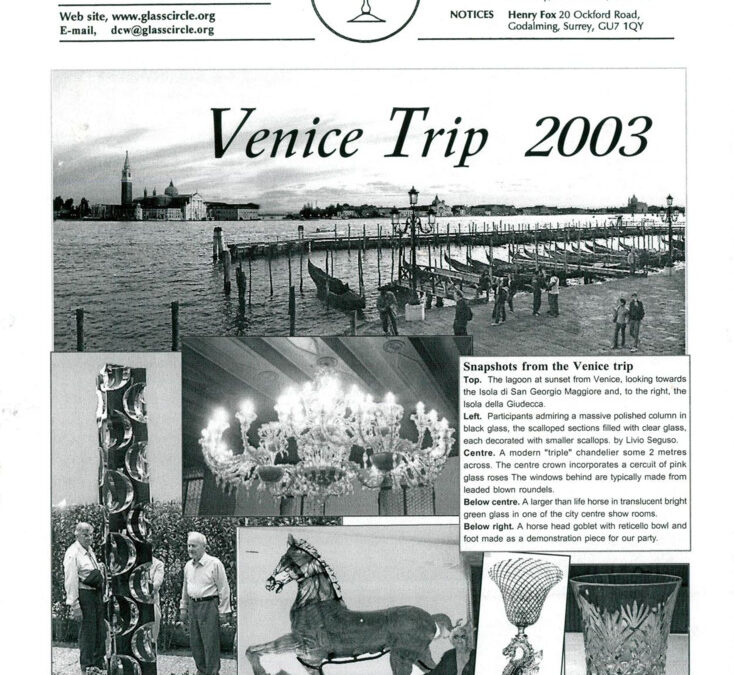
Venice Trip
2003
Snapshots from the Venice trip
Top.
The lagoon at sunset from Venice, looking towards
the Isola di San Georgio Maggiore and, to the right, the
Isola della Giudecca.
Left.
Participants admiring a massive polished column in
black glass, the scalloped sections filled with clear glass,
each decorated with smaller scallops, by Livio Seguso.
Centre. A modern “triple” chandelier some 2 metres
across. The centre crown incorporates a cercuit of pink
glass roses The windows behind are typically made from
leaded blown roundels.
Below centre.
A larger than life horse in translucent bright
green glass in one of the city centre show rooms.
Below right.
A horse head goblet with reticello bowl and
foot made as a demonstration piece for our party.
-;=
.. and what is significant about
this modern cut tumbler?
see page 11
See page 3 for more pictures and
an account of the Venice trip.
Pictures
D.C. Watts and
Nice onnell
GLASS CIRCLE NEWS No. 97
Editorial
S
o much has happened, both
within and outside the Circle
since our last Glass Circle News that
it is difficult to know where to start.
It all began with the build-up to our
Palace to Parlour
Exhibition during
the hot, stifling weather of early
August when the glass exhibits, mas-
terminded by Martine Newby, began
to pile up in Mallett’s premises cre-
ating an embarrassing pile of empty
boxes. John Smith, deep in the
shop’s Roman levels, was frantically
capturing images on a new digital
camera to convert into a magnificent
catalogue further enhanced by other
contributions including generous
support from our dealers all negoti-
ated by Graham Vivian. Henry Fox,
who initiated all this activity, was
meanwhile languishing in hospital
surrounded by mountains of well-
wisher’s grapes, recovering from a
successful operation to strengthen his aorta. Jo Marshall stepped
in to help with the packing for transportation to The Wallace
Collection where, curator, Suzanne Higgott, was busily organis-
ing the display space and the impressive descriptive and promo-
tional material. Martine who, in the meantime, had finalised the
catalogue text and layout, reappeared to install the objects in
their cases and affix the descriptive labels. Finally, all was ready
for the grand opening on August 21st, the first exhibition of its
kind ever to be held at the Wallace, the first to include glass
from the Royal Collection and undoubtedly the finest on this
theme ever to have been held in London. Attendance has since
been excellent, helped by the earlier promotional mailing from
Sotheby’s organised by Simon Cottle. The Circle lunch at the
Wallace is best passed over as being a successful social occasion
but a gastronomic disappointment.
Your editor, having judiciously avoided all this chaos, had, in
the meantime, printed and packed GC News 96 which was
transported by Jo to Mallett’s for addition of the catalogue and
final dispatch. All members should now have a copy and our
Chairman reminded me to mention that any contributions to the
Circle’s funds in this respect would be greatly appreciated (the
retail price is £15 so something around a tenner would be
appropriate).
Martine, in the meantime (what meantime? I hear you say), had
also been acting, like the sorcerer’s apprentice in the Walt
Disney film, as local Secretary for the International Association
for the History of Glass (AIHV) conference at Imperial College
London, beginning on the 8
th
September. The Circle’s involve-
ment here devolved on your editor to provide 250 extra copies
of GC News 96 for participants “goody bags” and a similar
number of our new membership form that I had just designed
with the guidance of our Committee, plus a new concise
publications price list.
On one day, devoted to
visits in London, I found
myself exposed to suc-
cessive 21/4 — hour lecture
tours of the Vintner’s
Hall and then the Royal
Institution interspersed
by a dash over to the Tate
Modern for lunch.
Finally, emerging men-
tally and physically
exhausted, about 6.30
pm, some-one remem-
Above.
A general view of the Palace to
bered that we still had to
. Parlour Exhibition main room.
visit the Art Deco Exhi-
bition of Jeanette Hay-
Below.
Two members examine a cabinet of
hurst and Nigel Benson –
enaraved and press-moulded glass.
in Kensington, Church Street. It meant a dash across London
but was well worth the effort. I finally found myself consuming
coffee and sandwiches at a late hour with Jessie McNab, an
Americanised Brit and curator of the Metropolitan Museum of
Art in New York. Jessie had published one of the earliest articles
on Monteiths and I hope to reproduce this in a future GC News.
There were receptions every evening. One that greatly impressed
our overseas visitors was a rare opportunity to visit the Houses
of Parliament — the “seat of power” – with champagne on the
terrace on a delightfully warm evening. Another was to view the
exhibition of The Guild of Glass Engravers with its work of the
usual high standard. Katherine Coleman, the Guild’s new
Chairman and Jerwood Prize finalist (see p. 13), later gave a
conference presentation and I was disappointed that she chose
to concentrate on the decline of wheel engraving, serious as this
matter is. It was, I felt, a missed opportunity to extoll further
the outstanding achievements of the Guild and of British artists.
•
2003
The Conference itself, with Martine buzz-
ing around trouble-shooting peoples’
problems, supported by luminaries from
English Heritage and the English History
of Glass group, was a great but exhausting
success although duplicate lecture ses-
sions always cause some frustration over
which lecture not to attend. Not all the
material presented was new, however, and
the abstracts helpfully filled the gaps as
will its subsequent full publication. Two
bookstalls produced some bargains among
books on glass and I was finally able to
treat myself to Jaqueline Bellanger’s
Verre d’Usage et de Prestige
which I had
been seeking for some time.
Page 2
I am not sure one should identify a
highlight in such a successful conference
but, for me, it was undoubtedly the
evening reception at The Wallace
Collection, hosted by Christie’s. This
was a top-drawer event with champagne
and exquisite quality canapes flowing
freely throughout the evening to the ac-
companiment of a live string trio. It gave
our overseas visitors the opportunity to
study British 19
th
century glass at its best
in delightful surroundings; the impres-
sion all-round was highly favourable. It
Jane
Shadel Spillman pays close attention to a vibrant
made the Circle’s effort in mounting the
Andy McConnel on the subject of James Giles.
exhibition all the more worth while and
universally recognised. >>
October 2003 ,
by David Watts
2003
GLASS CIRCLE NEWS No. 97
F
or the inveterate traveller abroad Venice will be familiar
territory. It was my first visit other than one brief afternoon.
Comfortably located out at Venice Lido, one of Venice’s
subsidiary islands, one soon got to grips with the vaporetto’s
(which actually means “steam-boat”) speedy but noisy and
bumpy diesel-driven public transport around the islands. Unlike
our Underground, few passengers read on the way. The pigeons
among the throngs of tourists in St Mark’s Square would give
Ken Livingstone apoplexy but they do seem better house-trained
than our English equivalents – something to do with the diet
perhaps. For humans, pizza and glass shops almost alternate with
only the occasional concession to the other necessities of life.
At least, unlike potatoes, they know how to prepare pasta. I only
asked in one shop what they thought of the Euro and they wept
over their lost Lira. An Irish Euro turned up in one lot of change
making me realise that this really is an international currency.
Few shops had double pricing.
The tourist glass is based on a combination of colour, millefiori
and a generous sprinkling of gold dust. We were told that
aventurine, also much in evidence, is no longer made in Murano
but bought in. Glass prices started at around 6 Euros, for items
mostly not worth a second glance, and rapidly disappeared into
the clouds. A nicely wrought tumbler costs around 60 Euros and
delightful frilled goblets, like those below, exploiting all the
glassmaker’s skills, around 125-150 Euros. Prices may have
been slightly lower in Murano but there was little in it. About
90% of the shops there had glass and although there was an
inevitable amount of repetition at the bottom end of the market;
many shops displayed unique or variant items that revealed the
diversity imposed by innovation and competition. A wide range
of both naturalistic and abstract forms was on offer. One
favourite was colourful fish and weed (or even realistic
cuttlefish) entrapped in a solid clear glass block of considerable
weight – priced at around
700+ euros according to
size and complexity. I
could see them as an
area for paperweight
collectors in the future.
Really large glass items,
such as a five-foot tree
bedecked with realistic
parrots, were not priced
and, so far as I know,
no-one dared ask! At
least the parrots were
better behaved than the
pigeons that will join
your meal in the sun
without waiting to be
asked.
None of this mass of
decorative glass, includ-
ing a vase of classical
St. Mark’s Square in the late afternoon sun, from the Comer Museum.
form I found sufficiently at-
tractive to buy, is classified as
serious art glass, the real ob-
jective of our visit outside our
trip to Murano museum. The
serious
Vetro Artistico Mu-
rano
(a Trade Mark introduced
in September 2002) is either
hidden away on the upper
floors of the showrooms or
confined to select galleries.
With this, size, originality and
technical complexity is signifi-
cantly greater and the price at
least two orders of magnitude
higher. Pieces are created in
both monochrome and
polychrome, the latter usually
exploiting coloured sections
or cane, and sometimes
Clear and black glass. lit. c. 60cm
chalcedony, in intricate confections. When, later, we watched
four expert glassblowers struggle for 45 minutes over a rela-
tively simple but substantial piece that ended in abject failure,
and added to that the high cost of running a furnace, the
production costs of essentially unique pieces became more
understandable. Creations by the well-known grand master, Lino
Tagliapietra, (picture overpage) were priced in the middle five
figures, rather more than a relatively rare C. le reticello bowl.
continued overpage
Editorial concluded.
The final Saturday, bright
and sunny, was devoted to
trips out of London. I chose
to go to Colchester to visit
the old Roman castle and
museum, together with an
introductory lecture, a
guided tour of the (few)
Roman remains still visible
in the city and an ongoing
dig. The museum is su-
perbly modern within the
castle’s ancient walls but
the glass, other than
Roman, was a slight
disappointment, notably the
total absence of Anglo-
Saxon glass. The town has
altered greatly since my time there doing National Service but
it was an enjoyable visit, none the less for being able to chat on
the coach. Getting back, we were whizzed over to The Antiquar-
ies Society in Burlington House for a final farewell get-together.
Here, refreshments were provided by the organisers’ home
cooking. Unfortunately, many participants had departed by then
and the mountain of food so generously supplied is probably still
being consumed by the providers as I write. A presentation was
made to Martine for her work beyond the call of duty and, with
or without doggy bags, we all went our separate ways happy,
having made new friends and contacts and much better informed
about the delights and mysteries of glass, world-wide.
Hardly had the dust settled and it was time to think about the
sale of Harvey’s Museum by Bonham’s and then prepare for the
trip to Venice to be followed ,only four days after we got back,
by the Circle’s opening meeting of the new season, events that
we hope to cover elsewhere in this or in the next GC News. *
Page 3
Aileen Dawson (left) enjoying a poster
presentation on Spanish glass.
Creation by Lino Tagliapietra.
involving the “incalmo”, process,
hot fusion of several different
preformed multi-coloured glass
layers, the front face with cut
decoration. Ht. c. 50cm
Sandwiching a reticello disc
between two blown cups.
GLASS CIRCLE NEWS No. 97
2003
To maximise my visit I got up at
the crack of dawn on the Wednes-
day and joined the trip organisers,
Gaby Marcon, whose family lives
just outside Venice, and Brian
Clarke. By 9.00 am we were climb-
ing into a water taxi and heading
through the Grand Canal towards
our hotel on Venice Lido. Then on
to Murano where Gaby and Brian
went into conference with the mu-
seum organisers and I took my first
stroll round the glass quarter in the
warm sunshine. I found the large
showrooms down the side streets,
away from the canals, most reward-
ing and here I found the piece that
took my fancy.
I
didn’t buy it on
the spot and, later, Gaby negotiated
a 20% discount on my behalf. Ap-
parently you should always haggle
over the price, even if difficult in a
language you cannot speak!
Thursday was spent on a general tour of Venice weaving among
the canals and churches. Eventually, crossing a bridge too far, I
collapsed in a café to rest and soak up the ambience while the
café soaked up my Euros.
By suppertime all participants had arrived
and by 8.15 am on Friday we were
climbing aboard our private vaporetto
en
route
for Murano. Here, at the elegant
Pal
177o
da Mula, we met Silvia, our local
interpreter, and Professor Giovanni Sar-
pellon who gave an introductory lecture
on the island’s glass history. Silvia read
the lecture in English with frequent inter-
jections from the Professor to expand on
certain aspects (he speaks some English)
and answer questions from our group. It
made for a lively session and, all too soon
we were heading along the canal to the
Glass Museum nearby. Here we met
Dott.ssa Attilia Dorigato, former curator
of the museum who gave us a conducted
lecture tour of the main galleries. As well
as the expected Venetian glass and a related technology gallery
it also has a fine display of early and Roman glass. The high
rooms and elaborately painted ceilings create ideal surroundings.
I had seen several copies of the famous Angelo Barovier bowl
in the city (all unpriced) but here was the real thing, simple and
confident in form and enamel decoration. My own confidence
was shaken, however, to learn that it was actually made over a
century after the (mid-C.15`
h
) time of that famous glassmaker.
Our late lunch turned into a gastronomic experience of their
famous fish cooking when the chef stood over us to make sure
that we eat every bit of his (very tasty) specially prepared
shrimps – head, shells and all! Then another private vaporetto
on to Venice where, divided into groups, we visited a commer-
cial gallery with modern glass by Canadian and German artists
and a private collection belonging to the Cassa di Risparmio
bank. The latter consisted of pieces purchased at each of the
Venice Biennials since 1930 with each piece displayed in its
own case. It may have been the shrimps or the afternoon heat
but I was by now finding it difficult to keep awake and was glad
to escape to a café nearby. The rest of the day was our own and,
joined by Jo Marshall, we took in a church and the odd grand
master at leisure before returning to Venice Lido for dinner.
Saturday, 8.30 am saw us back in our vaporetto, again in groups
in order to tour four galleries with a diverse range of glass
ranging from C.16
th
to contemporary pieces by Tagliopietra
(picture above). Here I discovered that Salviati created magnifi-
cent pieces of Lithyalin. It made me wonder whether some of
the examples in shades of green and yellow that are commonly
attributed to Freidrich Egermann, were not actually his work.
A quick lunch and it was back to Murano. Our group went first
to the gallery/workshop of Livio Seguso where truly massive art
works in cast glass were shaped and pol-
ished (Cover picture and right). Livio had
spent his entire life on this type of work
requiring huge grinding and polishing
equipment. He demonstrated a series that
showed how a piece representing a human
foetus contained in an egg had been pro-
gressively developed into an abstract form
retaining only the essence of the original.
We then changed with the other group to
watch real glassmaking involving the reti-
cello technique. The factory did not nor-
Male bust in a dark
mally work on Saturday so this perform-
amber glass by L.
ance was a special privilege. The first
Seguso. Ht. c, 100cm
group had watched the making of a fine dragon stem goblet
(cover picture). For us, a more modest piece was attempted but
still required the active involvement of four workers. As men-
tioned above, it started to go wrong when one side of the double
vessel shown below developed a thin patch requiring as much
heated discussion in Italian as the piece got in the furnace.
Several pulls and twists were tried before it was finally aban-
doned to its fate in the leer. At least we were shown a range of
techniques, (particularly that of joining at the furnace sections
made by different techniques — a process known as “incalmo”).
This made our technical understanding of
some of the work we had seen earlier,
much more comprehensible.
The evening was spent viewing an exhibi-
tion of young artists of the Centro Studi
Vetro (Italian equivalent of The Contem-
porary Glass Society) in Murano’s Ai
Vetrai restaurant. Each artist was intro-
duced to us in relation to his work.
Dinner, with stuffed micro-octopuses,
then followed and presentations made.
Your Vice-President joined with the Glass
Association in awarding one-year honor-
ary memberships to The Circle to Prof.
Sarpellon, Dr. Attilia Dorigato and to
Cesare Toffolo, a glassmaker representa-
tive of the Centro Studi Vetro.
Sunday; a welcome extra hour in bed before returning to Venice
to the Palazzo Rota located above a bead shop tucked in among
the Venice shopping area. Here, Prof. Sarpellon gave us an
explanatory tour of a compact but detailed museum devoted to
the development of micromosaics and beads. His 127-page, full-
colour English version companion book was made available to
us at half price (10 Euros). A hardback version on this subject
is available in English bookshops at £50. Finally, a tour of many
bridges took us to the SS Giovanni e Paolo church to see a highly
regarded stained glass window. The church proved to be a huge
open space held up by a network of steel girders with the usual
array of gloomy massive memorials. The colourful single
window was impressive but, I felt, had nothing new to teach us.
A service was in progress supported by a youth group with
guitars. The other churches I visited generally had plain
windows, often made with an assembly of spun glass roundels.
Back outside it was lunch in the sunshine and, for me, a trip
with Jo Marshall to the Correr Museum in St Mark’s Square.
The only glass was a cabinet of scientific items but there was
plenty else of interest to do with Venetian history, particularly
early illuminated manuscripts, and one obtained excellent views
of the Square from the Museum windows (title picture).
Returning to Venice Lido we collected our belongings and said
our farewells ready to depart from this extraordinary world of
water and glass. The complex arrangements had gone with
hardly a hitch and our grateful thanks go to Gaby and Brian for
a most enjoyable and instructive weekend. *
Page 4
New One-Year Honorary Members for services
rendered in connection with the trip to Venice.
Dr. Attillia Dorigato, Curator of the Civic
Museums, San Marco, Venice.
Professor Giovanni Sarpellon, Author and
historian, Venice.
Senor C. Toffolo, Glassmaker and co-founder of
Centro Studio Vetro.
Professor Ronald Gordon Newton OBE. 1912-2003
Roy was never a member of the Circle but did lecture to it and was well
recognised an an authority in his field. We are grateful to our member,
Sandra Davison for this obituary.
Roy Newton, a biologist and glass technologist, had three
outstanding careers: first researching and characterizing syn-
thetic rubbers for The British Rubber Manufacturers Research
Association; second as a glass technologist in The Department
of Glass Technology at Sheffield University; and third as an
authority on the conservation of stained glass. Roy was awarded
the OBE in 1969.
As Director of the British Glass Industry Research Association
(BGIRA) he began to develop an interest in the deterioration of
ecclesiastical stained glass windows and this lead him to
investigate their conservation. After retirement from BGIRA in
1974 Roy continued his work on stained glass conservation,
becoming an authority on the chemical durability of glass. His
work led to his appointment as honorary professor at York
University and later to a similar post at Sheffield University.
He was the founder and author of the newsletter
Corpus
Vitrearum Medii Aevi
(the society for church glass conservators)
and
was a prolific lecturer and author. Roy was confident of his
own judgment and was not afraid of provoking controversy. His
publications included
Conservation of Glass
which we wrote
and published in 1989. He took a keen interest in the production
of a second edition, published earlier this year.
Roy pursued many other interests, being especially attracted to
projects that required the collection and analysis of data, such
as archaeology, ornithology and genealogy. Everything he did
was scrupulously recorded, indexed, filed away, and readily
recovered. The detailed manner and punctuality with which he
replied to enquiries was amazing. He was still sending notes and
interesting articles on glass matters from his hospital bed!
Twice widowed, Roy is survived by his third wife Joy, and two
sons from his second marriage.
Sandra Davison FIIC ACR
Welcome to New
Mr. J.B. Cruxton
Mrs. C. Cutts
Miss E. Field
Mr. A.P. Hayes
Mr. A. Hider
Ms. M. Jo
Mrs R.S. Kamlish
Members:
Dr J.E. Kuipers
Mr. and Mrs. L. Maxfield
Ms. V. d’E Miller
Mr. and Mrs. A. Milne
Ms. T. Seear
Mrs. V. Williams
New Institutional Member
The Fitzwilliam Museum
2003
GLASS CIRCLE NEWS No. 97
Glass Circle Matters
President, Hugh Tait, Vice-Presidents, Dwight Lanmon, Paul N. Perrot, David
Watts.
Officers and Committee 2003-2004
John Smith (Chairman)
Marianne Scheer (Secretary)
Derek Woolston (Treasurer/Membership Secretary)
Kenneth Cannell
Simon Cottle
Henry Fox
Jo Marshall
Martine Newby
Veronica Tatton-Brown
Anne Towse
Graham Vivian
David Watts
Speakers and titles for the 2003-2004 season of Glass Circle lectures.
Note
that the March and April meetings are reversed from that previously shown
All meetings to be held, as usual, at the Art Workers’ Guild, 6.30pm for 7.15pm. (Volunteer hosts required please)
Date
Speaker
Title
October 16
th
Dr. John Clarke
What drives me as a glass collector.
November 18
th
–
AGM and Specimens Meeting.
December 9th
Peter Layton
25 years of Studio glassmaking.
February 10th
Roger Dodsworth
Glass designers between the Wars.
March 9′
Dr.Peter Kaelgren
Glass and Rock Crystal in the collection of Lord Lee of Fareham..
(Charleston Memorial Lecture, President in the Chair)
April 13
th
Martin Mortimer MBE
C.18
th
Irish marked decanters and the question of their origin.
May llth
Dr. David Watts
Cut glass and its development in the 18″ century.
June 8th
Ian Wolfenden
British cut glass, the early 19t
h
century.
Glass Circle News;
No. 98
Mid-February
No. 99
Mid-April for
No. 100
Mid-August.
copy deadlines.
for publication in March
publication in July
for publication in September
STOP PRESS
Hearty congratulations to our member and internationally renowned
glass artist, Peter Layton who is being awarded an Honorary Doctorate
of Letters by the University of Bradford (the City where he was
educated) in recognition of his major contribution in the Arts and Crafts.
Page 5
GLASS CIRCLE NEWS No. 97
2003
•
drlICPID g5745671411•S 4 7.
Perez .ddie
One of the intriguing backwaters of Glass is the
‘Tassie’.
One
are cameo or intaglio medallions in Glass, frequently
white but sometimes coloured, that were produced over a
seventy-five year span, between 1766 and 1840. Two members
of the Tassie family were involved in this production, James
(1735-1799) and his nephew and successor, William (1766-
1860.) Their output has attracted a number of studies, including
a substantial booklet of 1995 by our member John P.Smith. The
latest offering, given in the current
Walpole Society
volume
(Vol: LXV,) is the full text of a group of one hundred and twenty
letters, covering a forty-eight year period, from 1778 to 1826.
These are now in the Glasgow City Archives and were studied
by John Smith, who included many of the ‘juicy bits’ relating
to Glass in his 1995 work. However, the full text is worthy of
comment and excites some interesting reflections. The letters
have been edited by Duncan Thompson, sometime Director of
The Scottish National Portrait Gallery
in Edinburgh, where a
large group of
‘Tassies’
now resides, having been bequeathed
by William, the younger of the two producers.
The correspondence consists of letters from the two Tassies to
the firm of Wilson in Glasgow, whose proprietor was an avid
collector of
‘Tassies’
as well as distributing them in Scotland.
Because both Tassies were born in Scotland, and since the
largest surviving group of their medallions in Britain is in
Edinburgh and includes portraits of many prominent Scots, one
tends to think of
‘Tassies’ as
a Scottish phenomenon, but the
whole series was produced in London, and much of the Glass
used by the Tassies came from London Glasshouses. However,
by far the largest commission, for over ten thousand items, came
from Catherine the Great, Empress of Russia, a commission that
engrossed James Tassie’s attention for several years. By a happy
coincidence, two of the specially commissioned and elaborate
cabinets made to contain these medallions were displayed in the
Hermitage Rooms of Somerset House in London during last
winter, in association with the loan Exhibition of the pictures of
Sir Robert Walpole. In 1779, Catherine II, Empress of Russia,
purchased from Walpole’s impoverished grandson the picture
collection from Houghton Hall that Sir Robert had amassed;
thirty-four of the two hundred and four paintings thus acquired
were the principal subject of this loan Exhibition from the
Hermitage Museum. During the period of Catherine’s
commission, Tassie’s letters are full of excuses for the delays
imposed on his more plebeian customers.
The Tassie medallions were produced predominately in Glass,
portraying two main types of image. To me, the more interesting
are the portrait medallions of contemporary subjects, although
both contemporary and historic figures were portrayed; Roman
emperors and mythological figures, the Kings and Queens of
England and of Scotland, including Bonnie Prince Charlie,
whilst amongst the myriad contemporary portraits were Robert
Adam, Joseph Black, Mathew Boulton, Admiral Duncan of
Camperdown, Frederick the Great, Sir William Hamilton
(illustrated above), Adam Smith, James Tassie himself and
Josiah Wedgwood. These portraits were modelled in wax,
principally by James Tassie who was a consummate artist. The
other images were taken directly as casts from antique and
modern gem cameos and medals, and were frequently moulded
in sulphur, which gave a crisp and permanent image; sulphur
could not however be used on silver or bronze medals, for it
tarnished and corroded the medal itself, as explained in two of
the letters. From these master moulds plaster moulds were then
created for casting in Glass. The Glass was referred to by the
Tassies either as
paste,
which was transparent or translucent
colourless or coloured Glass, or as
enamel,
which was opaque
white Glass; the Glass Sellers used the term
‘enamel’
to describe
opaque twist stems in the period leading up to the start of James
Tassie’s output, and he doubtless took the term from the Glass
Sellers, confusing as it may be to us today. Some items were
sold moulded in sulphur or plaster, rather than cast in Glass.
The letters are largely commercial in nature, although the long
James Tassie’s 1784 Glass medallion of Sir William Hamilton
(1730 – 1803), Scottish diplomat and antiquarian who married
Emma Hamilton (later Nelson’s mistress) in Naples.
Picture courtesy of the Scottish National Portrait Gallery.
relationship with the Wilsons means that there are gossipy bits.
They also include invoices, and those written as a postscript on
the letter itself are now printed. These published invoices for
James’s period (1778-1799,) account for over one thousand
impressions and demonstrate that the Glass versions outnum-
bered the plaster or sulphur types by almost seven to one; they
were also distinctly more expensive. Both plaster and sulphur
impressions were overwhelming priced at 3d. apiece, whilst the
most common Glass impression was one shilling and threepence,
with many being several times this price, and in the extreme
case of large size and a white image on a coloured background,
the price reached one guinea (twenty one shillings.) These prices
may be compared with a standard C.18
th
wine glass at 6d., or
when engraved up to three times this sum; many paper portrait
prints were priced at 6d. each, although large, high quality
impressions might reach five shillings.
A number of the letters comment on the difficulties of procuring
the right type of glass, and the variability and unpredictability
of what was obtained. These problems are emphasised by
information from another
Walpole Society
publication (Vol:
LIV), which records that James Tassie bought glass from as far
afield as William Peckitt, Glass Painter of York. In four separate
transactions between 1775 and 1788 Tassie purchased about 260
Lbs weight of Glass, predominately of ‘White’ or `Opaick
White’; the price of White Glass rose steadily throughout this
period, from 2sh. 6d. per Lb in 1775 to 4sh. 6d. per Lb in 1788.
He also bought Yellow (13d. per Lb) Purple (3sh. 4d. per Lb)
and Brown Glass, at only 6d. per Lb. The connection with York
probably came about because Peckitt’s brother was a neighbour
of Tassie, in Compton Street, Soho, during the 1770s. In his
letters, William Tassie was more explicit than his uncle about
the nature of the difficulties, writing in 1801 “…
we had a great
quantity of enamel made which has turned out very bad, being
much too transparent. … we have been obliged to melt the
enamel twice over, before we could get a tolerable colour.”
Eleven years later he returns to the problem, venturing that it
may arise from: ” …
the high duties and the vexatious attend-
ance of the Custom House Officers.”
He goes on to say that he
is shortly to visit Birmingham to seek supplies. All this is
another instance of what one understands is called ‘Dalrymple’s
Law’ and which states that:
“Both legislation and regulation
always produce adverse effects that were neither foreseen nor
desired.”
The letters from James also comment on the use of
“German or Dutch plate”
Glass for glazing prints, being more
Page 6
2003
GLASS CIRCLE NEWS No. 97
NEW LANARK, JOHN HENNING AND THE ELGIN MARBLES
by Rosemary Watts
Glass is everywhere – plenty in the windows of the restored New
Lanark World Heritage Centre, attractive modern wine glasses
in the New Lanark Hotel. But the point of this note comes from
a glass object not seen during our visit there in 1999 but read
about in the book
“Historic New Lanark”
(1993) by Ian
Donnachie and George Hewitt, bought in the Heritage Centre
shop. Unlike so many glass objects, which rarely have any
personal attachments in their history (if they have any history!),
this is a portrait medallion, offering rich personal links.
The portrait is of William Kelly, important in the history of this
mill village as its manager on behalf of David Dale, Glasgow
entrepreneur and banker who saw the potential of water power
in the upper Clyde valley. Here he created the mill village, for
long the largest cotton-spinning enterprise in Britain. Kelly had
been a clockmaker in the nearby burgh of Lanark and was
recruited for his engineering skills and inventiveness, in this
leading-edge of technology, complementary inputs to the vision
and funds from Dale. He lived in the Manager’s house in the
village, now known to all as the house of Robert Owen, who
took it over when he bought the enterprise in 1800.
Robert Owen had new plans and extra philanthropic intentions
for New Lanark (and showed how profitable it could be to treat
your work-people better than the norm for those times) so the
old management had to go. William Kelly thereafter prospered
in the cotton industry, moving to Glasgow and retiring a rich
man in 1826. The medallion, described beneath its illustration
on page 47 of the book as “enamel on glass’ depicts the head
and shoulders in profile of a middle-aged Kelly. It will have
been produced something like two years after his departure from
New Lanark, in the up-and-coming part of his new career.
The personal attachment to this glass now moves to its maker,
John Henning (1771-1851) with information from John P.
Smith’s book
James Tassie 1735 – 1799 Modeller in Glass
published by Mallett, 1995. John Henning, born in Paisley,
developed plan-drawing skills in his father’s building workshop.
In 1801, he moved to Glasgow, set up as a portrait modeller in
wax, and attracted the patronage of the Duke of Hamilton . This
was plainly good for his artistic career – most such portraits seem
to be of the noble and the beautiful! However, for our story, the
important point would seem to be that Henning was also a
protégé of David Dale and Robert Scott Moncrieff, manager of
the Royal Bank of Scotland who helped introduce a steady
patronage of affluent sitters.
Smith’s book includes quotations from Henning’s description in
a letter of how he developed the technique to produce portraits
in glass rather than wax, which he calls “casting my medallions
in enamel”, and mastered in
November 1800. William
Kelly was therefore an early
subject for this new
technique. Problems in per-
fecting the finish remained,
however, and Henning
never achieved the same
quality as Tassie.
(Examples of their medal-
lions may be compared in
Mallett’s shop in Bond
Street. Ed.)
Kelly left at New Lanark
one product of his skills that
visitors still can see. He
came from the Lanark com-
munity of clock-makers,
John Henning’s medallion (1802) of
and in the Reception build-
William Kelly, Dale’s manager at New
Lanark before Robert Owen took over.
ing is his remarkable clock,
with four supplementary dials to record days, weeks, years and
ten years. When you go there and see this (mostly still working)
remember that William Kelly also has a glassy connection.
Henning, to further his career, moved to Edinburgh in 1803 and
to London in 1811 where he was fortunate enough to meet Lord
Elgin and be granted the extreme privilege of drawing his newly
acquired “Elgin Marbles” — a privilege that made him enemies
from jealous London artists. In 1822 it occurred to him that this
frieze would form an excellent decorative addition to the
Monument, based on the Parthenon, being built on Carlton Hill
in Edinburgh. The proposal was rejected and the monument
remains unadorned to this day. However, the New Athenaeum
Club being built on the site of Carlton House, St. James, London
accepted the offer enthusiastically and the frieze forms an
attractive feature of this building (Our President tells me that
they still have the original plaster casts for the frieze stored in
the cellars). The same motif also adorns the Marble Arch at
Hyde Park Corner and, in 1838 was used around the top of the
stair well in the Royal College of Surgeons. In making these he
was aided by his son, John Henning Jr. (he had 8 children). He
also created memorials to a John Heaton at Havering at the
Bower in Essex, and to a John Ellis, 1836, at Wyddial in
Hertfordshire (it would be interesting to know if others exist) as
well as a frieze over what is now Manchester City Art Gallery.
In later years financial troubles are said to have made him return
to making glass portrait medallions; but although we glass
collectors appreciate his medallions it is for his copies of the
Elgin Marbles that he is probably best remembered. *
Limpid Reflections, concluded
expensive than crown, but not so dear as plate for mirrors. A
development on which he worked unsuccessfully was the use of
plate glass for printing plates, to alleviate the wear that quite
quickly affected copper printing plates. Light is also thrown on
the expensive nature of cutting and lapidary grinding and
polishing, by a 1778 apology for the rough grinding of the
reverse of a group of
`Tassies’,
but James goes on to say:
“they
would cost a shilling each of additional expenses to have them
polished back and edges.”
Presumably Mr. Wilson decided to
accept the higher cost, as three months later Tassie comments
on a further consignment;
“the Pastes I have cut and polished
by Lapidery …”
In his introduction to the letters recently printed, Duncan
Thomson records the bequest to the
National Gallery of Scot-
land
by the younger Tassie of the collection of
`Tassies’
held
by the firm. However, William’s will records that he had
removed and destroyed, from his uncle’s part of the collection,
the
`Priapic subjects’,
which the editor notes
as: “a disappoint-
ment to succeeding generations of curators!”
We do not know
whether these derived from Classical gem carvings, or were
modelled freehand by James Tassie, but the second half of the
C.18
th
was an era when Priapic subjects were abundant, with
other instances in Glassware. The Beggars Benison Glasses and
the Wig Club Glasses
(G.0
No:
83) are both avowedly Priapic,
and Sir William Hamilton, whose
‘Tassie’
likeness is shown
above, gave to the British Museum five wax models of phalluses
from Naples, euphemistically referred to ‘Big Toes’. For the
1996
BM
Exhibition
`Vases and Volcanoes’
the Museum crafts-
men re-created these ‘Big Toes’ in wax, as the originals had
disintegrated! The craftsmen worked from illustrations in a 1786
publication by Richard Payne Knight, issued by The Society of
Dilettanti and devoted entirely to:
“Discourses on the Worship
of Priapus”.
These ‘Priapic’ items are however fairly innocuous,
being more likely to raise a smile than to induce base thoughts.
Some of the early C.19
th
prints of erotica are far more risque;
but many of the ‘Houses of Pleasure’ depicted therein are
liberally provided with Glasses and Decanters, and one that I
have seen depicts no less than ten Decanters, with variously
coloured contents, catering no doubt to different palates. *
Page 7
GLASS CIRCLE NEWS No. 97
2003
Beads, Glass and the Slave Trade in the C.18
th
.
]A
frican
booklet by Melinda Elder,
‘Lancaster and the
Slave Trade’,
published by Lancaster City Muse-
ums in 1994, tells us that Glass was sometimes involved as trade
goods for the payment to African Slave purveyors. Partly this
was in the form of beads, perhaps emanating from Murano and
supplied via British wholesalers. The booklet cites and illustrates
in facsimile, the sale in 1770 of 564 Lbs weight of beads, with
a wholesale value of £61, from William Davenport of Liverpool
to a Lancaster Slave merchant. The parcel was made up of:
Pipe Rocky Coral
@ 4sh. 6d. per Lb.
Burbon Yellow
@ 3sh. 6d. per Lb.
Simro(?) ; White, Dove, or Black
9d. per Lb.
Seed; Green, Dove or White
8d. per Lb.
Red Garnets No: 3
7d. per Lb.
Presumably the price per Lb. depended on both the colour and
the form of bead made; thus both Dove and White occur as
different bead types, at 8d. or 9d. per Lb. By comparison, when
Flint Wine Glasses were sold by weight in the mid C.18
th
, they
usually retailed at 12 — 14d. per Lb. One is tempted to associate
the very expensive Rocky Coral with either Aventurine or
Scrambled Glass, which almost certainly originated from
Murano, and was also used for knife handles (see
G.C. News
No: 90.)
The booklet gives details, too, of the payment made in widely
assorted goods for two Slaves bought from a West African Slave
purveyor; the date is not given but was probably either a little
earlier, or of a similar time. This payment comprised:
Two different guns, three cutlasses, various textiles including
a laced hat, and
“a string of pipe coral, …. 3 jugs of rum, twelve Brittanicas
and 12 pint mugs”.
The author suggested that for
Brittanicas
one should probably
read
Tritannias ‘, a
name given to a type of fine linen from
Scotland or Ireland. However, in the tabulation of Wine Glass
types given in
C.C. News No: 94,
there was noted an export
entry of 1746 from John Cookson of South Shields, consigned
to Norway, which included:
156 Brittanick Wines,
of which 84
were plain and 72 were wormed; they were priced at much the
same as
Plain
or
Wormed Wines
in the same consignment. Since
the 12
Brittanicas
used as payment in West Africa were listed
in the middle of the group comprising both Rum and Pint Mugs,
it would seem more likely that this is another use of the term
for a type of Wine Glass, first noted in Cookson’s export
consignment, although the precise type is presently a mystery.
Another Glass link with the Slave Traders of the North West
English ports is the polychrome Beilby signed, Royal Armorial
Goblet inscribed:
‘Success to the African trade of WHITE-
HAVEN’.
From a later period, the first quarter of the C.19
th
, the
growing strength of the abolition movement is reflected by the
blue Glass sugar basin with the gilt inscription:
‘East India
Sugar, not made by Slaves’,
possibly decorated by Absolon of
Yarmouth, and illustrated and discussed in
G.C. News No: 92.
F.P.L.
A 1751 Recipe for Retafia
by Graham Clark
This interesting letter from a country housekeeper to her master
in London not only illustrates some of the problems of celebrat-
ing Christmas or the new year in the mid 18th century but also
includes an unusual recipe for Ratafia. The purpose of the milk
(mentioned below) was possibly to help clarify the mixture by
binding the small fibrous material from the apricot stones. Here,
Graham has left the spelling as in the letter but has added some
punctuation for clarity. The letter seems to have been sent from
Hockwold-cum-Wilton near Thetford.
To
Cyrill Wycks Esq
att Mrs Stiffkins in
Paradise Row in Chelsea
Middlesex
Jan 18
1751
2
A Ratafia glass and
an air twist cordial,
lots 181 and 182 at
the Harveys Bristol
sale sold for £1,200
and £720 repec-
tively (hammer
prices).
See page 12 for fur-
ther details of the
sale.
Hone’ Sr
Hookam Brought 12 Chal of coals & Tember but I tould him
that you orderd but 6. He said Mr Mixson sent them by him for
he had not seen Wilkes. I tould him I whould not have them:
then he said they ware in 2 Lighters 6 chal in each & if I would
take 6 he would carry ye other to Mee Derds at Thetford for he
& Mr Mixson are very great Friends so he carryed them away.
James hath bin out all Friday Looking for a Hare but hath had
no luck & this day ye frost is very hard or he would seen if he
could have got one to sent by Lynn coach: but wee shall get one
as sown as we can & I will send ye apricot stones with it. I am
sorry I could get no Turkeys I sent to Weeten & Fengate but
could get non. All ye family joyn in Duty with me your Dutyfull
Sarvent
Try Gunn
To make
Ratafia
Take 60 apricot stones crack them & put ye kernels into a bottel
Page 8
1/411
ateen
tk
;_
–
L:040
,
.
41141
ftvamigsgs
that will hold 3 pints & put a Quart of Brandy to them. Let it
stand 3 or 4 days: then take half a pint of water half a p
d
of
Doubel refined sugar set ye water on ye fire & put in the sugar
to Dissolve. Then pour it in to ye Brandy & put 6 Spoon fulls
of milk in to ye saucepan set it on ye fire. Let it boil & put it in
to ythottel & shake it together. Let it stand a hour then put some
filtern paper in to a furnel & pour ye Brandy a lettel at once. The
Bottels must be very dry that it drops into
Notation on back of letter:
Hockwold } Tryphena Gunn
Housekeeper
Jan 18 1751-2
recd 20th (4
d
)
(Self Chelsea) (Ratafia)
Back. Two line THET/FORD (location of post office where the
letter was posted)
Bishopmark 20/IA (20
th
January – date of receipt in London) *
2003
GLASS CIRCLE NEWS No. 97
Book and software Reviews
by D.C.W
The Big Book of Vaseline Glass
Barrie Skelcher
2002, Schiffer publishers, English agent Tel. 020 8392 8585, E-mail
Bushwdeaol.com ISBN 0-7643-1474-2 Hard back. Size 28.5 x 22 cm, 208
pages with 420 full colour pictures, Price from Broadfield House £34.95.
L
ove it or hate it you just cannot get away from Vaseline
glass, the common name for glass containing uranium. If
you collect Victorian (or later) glass you are most likely to have
pieces with uranium in them whether you know it or not.
Further, uranium was just one colouring agent added to many
pieces made in plain glass or occurring in other colours. So the
interest in this book is much broader than the title implies.
Barrie (and Mrs Skelcher) seems to have gone round the world like a filter-feeding whale scooping up everything that came in
their path irrespective of its significance so long as it contains
the desired element. This book illustrates rather more than half
of their 900-strong collection. Even so, it reflects a prodigious
amount of work, not just in the radioactive measurements but
also in the determinations of density for each piece. Further, he
has researched, so far as possible, the diverse origins of this
heterogeneous assembly, revealing not just new attributions but
also the names of some firms that I had never heard of. In this
respect alone the book adds useful knowledge on its own
account and I was enabled to identify two unmarked pieces in
my collection that had puzzled me for some years.
Attributions and dating are frequently a contentious issue and
Barrie attempts to quantify his estimates in this direction. My
own approach is that since there can be only one correct answer
the probability of being wrong is directly related to the number
of alternatives. Try for yourselves the simple experiment of
placing three coloured or numbered counters, dominoes or
whatever in a box. Make sure they are thoroughly mixed, take
one out and record the result. Repeat
ad nauseam.
You will find
that you may have runs of one number or another but overall
the chance averages out at one in three although this may take
many tries to achieve. Now try it with ten, representing perhaps
the most probable glassmakers in Stourbridge of a particular
piece but choosing one number as the actual maker. The result,
theoretically one in ten, may yield a discouragingly low success
rate. Increase the number to fifty, representing the whole of
Britain, and your chance is almost negligible (it may put you
off doing the lottery). In practice the number of choices can be
reduced by the presence of what you consider to be characteristic
features and, to these, Barrie adds his density measurement. On
the other hand, through insufficient evidence, you may eliminate
the actual maker entirely! This does not denigrate Barrie’s
approach; rather it gives one food for thought about the ongoing
problem of attribution for the collector.
The bulk of the book, 155 pages, deals with the actual objects.
The pictures are of variable quality and in a few instances too
poor for accurate identification; I am surprised Schiffer allowed
them to go in. The price guide (in dollars), at Schiffer’s
insistence, is laughable, some pieces being easily obtainable
from boot sales and junk stalls. But that is not the author’s fault.
Captions are as informative as one might hope and the uranium
content of most pieces falls well under 2-3% (by weight). He
mentions that pieces with over 7 wt% are known but he has not
encountered any. I can confirm this as I happen to have two!
The first 48 pages are devoted to the history of uranium as an
element and its use in glass making. The nature of radioactivity
and the possibility of it being a health hazard are discussed.
The latter at low levels is still a matter of opinion. Skelcher
points out that we are continuously being bombarded with low
levels of radiation from outer space, granite and other natural
sources. But he forgets that radiation from uranium glass is on
top of the natural stuff. Further, for those who might be
concerned he should have pointed out the benefit of the Inverse
Square Law, namely, that the amount of radiation falls off as
the square of the distance between you and the object. Thus at
3 feet the radiation falls to (3×3) one ninth and at 6 feet to
(6×6) one thirty-sixth. The body has a natural defence and
repair mechanism but, like smoking, its efficacy varies with
the individual and I prefer to be better safe than sorry and keep
my uranium glass well removed from where I normally sit.
The more technical section leaves much to be desired and Barrie
tends to dwell on what he understands least — the glass making
process, explaining a pontil in some detail and that a glasshouse
is where glass is made! Nor was I entirely at one with his
lengthy exposition on distinguishing and dating glass feet. On
the other hand the technicalities of electrons, orbitals, valencies
and such matters are taken for granted. How a geiger counter
works is explained and while he shows a picture of his device
he does not tell you its name, where to get one or what they
cost (expensive!). He points out that radiation is a random
process, i.e. occurring in indeterminate spurts, so it is necessary
to make measurements over an adequate period of time. He does
not explain how this is done nor mention the need to subtract
the background radiation from that from a glass object. A
further problem is that while lead glass absorbs radiation to a
considerable extent, the amount absorbed in ordinary non-lead
glass must surely be less. This problem is not discussed at all
although it is amenable to simple experiment. Much of the glass
considered is of the non-lead variety as judged by his density
measurements and one useful chapter is devoted to the values
found with glasses from a number of well-known English
makers. Again, it is a pity that he does not describe the
equipment he used as this would not only help others who might
wish to have a go themselves but is also important for us to
judge the accuracy of his measurements. The minimum require-
ment is for a balance that will weight with an accuracy of about
0.1% of the weight of the object and this is apparently what was
used. In my hands a balance with a similar accuracy yields some
variation in the second decimal place of the measured density.
Yet in this book rather more dependence is placed on the
reliability of the second decimal place for distinguishing some
glasses than I would care to place. A few explanatory diagrams
in these sections would have been a great help for the reader.
With a few exceptions, uranium glass came in with Queen
Victoria and some nice examples were shown in our Palace to
Parlour exhibition. It is a great area for collectors of all pockets
and, in spite of its technical limitations, this book should prove
of considerable utility for many years to come. *
Books from the Murano Glass Museum
The Colours of Murano in the XIX Century
A. Dorigato, R. Liefkes, C. Moretti and G. Sarpellon.
1999 Arsenale e Junck ISBN, 88-7743-264-0, size 22×24 cm, 215 pages,
many plates in full colour, soft covers. Price c. E.35.00
This volume begins with essays printed in parallel in Italian and
English. In the above author order these cover C.19th Murano
Glass, Salviati and the South Kensington Museum, Raw Mate-
rials cited in 19th century Manuscripts (mainly a tabulation with
references), and Glass and Glass Beads. This is followed by 161
colour plates of excellent quality with the bilingual captions
extended in detail in a further 24 pages of Italian only. A further
15 pages of drawings and plates from catalogues is followed by
a 3-page bibliography. Overall, this volume provides excellent
coverage of the diversity of Venetian C.19th decorative glass.
It should be of considerable value to the collector of this period.
Murano.
A History
of Glass
Gianfranco
Toso
2002 (reprint) Arsenale e editrice. ISBN 88-7743-215-2, size 10.5×15.5
cm,192 pages, many full colour pictures, soft covers, Price E.10.00
This remarkable pocket-sized volume traces the history of
Italian glassmaking and Murano glass in extraordinary detail
from its earliest times to the present day. It is well-written in
English and only the small size of the text (about like this) makes
it a challenge for those with poor eyesight. Many of the pictures
come from glasses in the V&A which is a bonus for those living
in England. Unbeatable as a cheap introduction to the subject
this volume is highly recommended.
>>
Page 9
GLASS CIRCLE NEWS No. 97
2003
Books and Software Reviews
by D.C.W continued
Vetri da Farmacia
Anna Laghi
1998, Octavo, ISBN 88-8030-124-1, size 23×24.7cm, 151 pages with
numerous plates mostly in colour. Hard covers, Italian only. Price E.33.57
If you are captivated by pharmacy and chemical glassware and
much glass that you might not have thought of in this context,
(drinking glasses, bottles, covered bowls etc.) you will find this
book as fascinating as I do. It covers from earliest times, with
copies of prints of pharmacies and the glassware in use, to the
mid C.19th. As I have only just acquired it I can only so far
admire the prolific pictures, that almost tell the story in
themselves, and report that the captions are relatively easily
understood. For me, the text will require help from the transla-
tion software described below.
Ricette vetrarie del Rinascimento
(Glass recipes of the Renaissance)
Cesare Moretti and Tullio Toninato
2001, Marsilio, Venezia. ISBN , size 17x24cm, 125pages, b/w
ills from Diderot, Soft covers, Italian only,
Price E.15
I felt I had to buy this book as I had met Prof. Moretti at the
AIHV and we have an ongoing discussion on the role of lead in
early glass recipes and that of Ravenscroft. There seems to be
no doubt that the early Venetians had lead in mind as a possible
additive to the batch but were unable to exploit it in the English
manner. This slim volume details a newly discovered early
C.16th collection of glass recipes by an unknown Muranese
author. The recipes, being mostly of chemical names, are not in
themselves difficult to understand. Their significance, however,
requires greater consideration and it is too early for me to say
yet anything about them. However, such an early compilation is
of extreme importance for the further evaluation of the contribu-
tions by Biringuccio (1540) and Neri (1612), in particular, and
I hope to be able to report more on this topic at a later date.
Glossario del Vetro Veneziano
(Glossary of Venetian Glass C.13th – C.19th)
Cesare Moretti
2001, Marsilio, Venezia. ISBN 88-317-8030-1, size 17x24cm,
125 pages, 3b/w ills. from Diderot. Soft covers, Italian only,
Price E.15
Many books on glass include a glossary of technical terms found
in the text. I produced a short one for our Palace to Parlour
catalogue. Prof. Moretti has gone one further by producing this
book devoted to explaining all the terms used throughout the
entire history of Venetian glass making. It is divided into two
sections. The first deals with terms relating to the furnace,
organisation of the workers, their equipment and hot and cold
decoration. Part II deals with terms relating to the primary and
secondary glassmaking materials up to the mid-20th century.
References relating to many of the terms are given, particularly
where lengthy descriptions are involved. Some terms have
similar equivalents in French and as these are not uncommonly
quoted without translation by the authors, this text should greatly
help our understanding of glassmaking processes.
Vetro (Magazine 21×29.6cm.)
This is the 3-times a year magazine of the Centro Studio Vetro,
roughly the equivalent of our Contemporary Glass Society, that
organises conferences and courses in glass working. The
magazine is written in Italian and English and its 62 pages are
full of colourful illustrations and advertisements with the lay-out
a work of art in its own right! It has a wide range of articles
including, in our sample copy, one on Prince Charles attempting
to puff down a blowing iron in Lybster (Scotland) at the opening
of the new Alistair Pilkington Studio there. As a quality
publication it is not particularly cheap; for an Associate the price
is E.56.81 in Europe and $50 overseas (including postage). I am
unclear as to which category the UK falls. There are other
membership categories at higher prices, presumably for active
glassworkers. Dan Klein is listed among the consultants. If you
are interested you can find further information on the web via
your search engine or E-mail them at csvetro@gpnet.it *
Globalink’s “Power Translator”.
Software for computer-aided language translation.
Many books written originally in Italian or French, have English
translation versions. But many others exist where this conces-
sion to our linguistic ignorance is not available. On the Venice
trip I fell for three books, outlined in the previous column. For
some time, too, I have been receiving free an Italian trade Art
Magazine called
Arteregallo.
The Italian text always seems
fairly obvious when you have a translation alongside but can be
quite baffling otherwise. I certainly felt I would need support in
translating the volumes bought in Murano and hoped I hadn’t
simply let my enthusiasm get the better of me!
Some time back I had bought a cheap French/German computer
translation package. It had a small dictionary and proved
virtually useless for anything other than common tourist phrases.
Beware, too, if the software works with, say, 5 languages and
claims to have a dictionary of, say, 5000 words. It probably
means that the dictionary for each language is only 1000 words.
To tackle serious text you require software with the largest
dictionary you can find, at least above 30,000 words. These are
likely to cost new around £100, or more. I was then given a
copy of Globalink’s
Power Translator
which translates in
either direction from Spanish, French, German or Italian to
English. Installation was easy. (Second hand copies are available
on Ebay but you
must
have the Guide Book which is not only
essential reading but also contains the code number without
which the software will not work.). Compared with normal
reading, translation can be slow and somewhat tedious. This is
not the translation process itself which is very fast, but the
overall sequence of operations. First you must either type in, or
OCR in, the text complete with all inflections over certain
letters. I used OCR (Optical Character Recognition) fed into
Word. This text is then cut and pasted into the
Power Transla-
tor
main screen. It appears twice, once in black and once in red.
The text may then be translated either in total or sentence by
sentence (useful for making corrections after the first run
through) with the red version turning into English in black.
Untranslatable words remain in red in the original language.
This may either be because they are not in the dictionary or
because of a spelling mistake during entry.
For a test not overloaded with technical terms I tried the Preface
of Moretti’s “Glossary del Vetro Veneziano”. As English the
result was far from perfect but the meaning of the text was
reasonably clear. The untranslated words can then be looked up
in a dictionary and entered into a software supplementary
dictionary, and the text retranslated with improved results.
However, entering a new word and its translation into the
dictionary is a complex business involving considerable button
pushing as you are required to know the part of speech and other
grammatical details to aid in the translation. Since both English
and foreign words can be used with different meanings, sample
phrases to indicate a particular word meaning may also be
required. The Guide Book is very helpful (crucial!) in this
respect and you will probably end up understanding more about
the English language than you ever imagined! Over time and
with perseverance it is possible to create a very adequate
translation machine. It depends on whether you simply want the
sense of the text or the best possible translation. For example,
“nitrato sodico” is clearly identifiable as sodium nitrate, or
“carbonati alcalini” as alkaline carbonate. But putting more
general, non-technical words into the dictionaries that will help
future translations is clearly a good investment of time.
Power Translator
does its job adequately and proved of great
help to me in translating some of the tricky text sampled from
Moretti’s Glossary. And it is certainly quicker (and more fun)
than sitting down with a dictionary and pen and paper. But it is
only one of a range of such software on the market so I am not
recommending this as a best buy, only that it does work – at
least in Italian – I have not tried the other languages. If any
member has experience of other translator packages, good or
bad, I should be pleased to hear from you. *
Page 10
a
2003
GLASS CIRCLE NEWS No. 97
Auction Actions and Mound the Fairs
rr he main auction of interest this time round was the sale by
1 Bonhams of the Harvey Museum Collection of Bottles,
C.18th wine glasses and related trade objects. This sale is
reviewed on page 12 by our member, Susan Newell. Note that
the hammer prices given have to be increased by around 40%
because of added VAT as well as the buyer’s premium.
*Dreweatt Neate, Newbury, Berks
15 October — Ceramics,
Glass etc — this sale included part of the stock in trade of our
member Ron Thomas (Somervale Antiques). Highlights were
a large green wine glass with well-made double series air-twist
stem bid to £2,200 Top left); a Dutch engraved light baluster
goblet or large wine with rare bobbin knop stem, which had
appeared previously in these rooms a couple of years or so ago,
made £2,400. A Beilby enamelled wine glass (fruiting vine) set
on white opaque twist stem went for £1,650.. An interesting
baluster wine glass c.1720 with bell bowl set over a annulated
knop above an inverted baluster section and a basal knop,
conical folded foot. This found a buyer at £950. (picture top
centre). Again a baluster wine of Kit-Kat form was bid to £820
(picture top right).
*Law Fine Art, Hungerford, Berks Ilt
h
November — Antique
Furniture, Pictures, Silver etc. I spotted among the silver lots a
rare early cruet set hall marked 1762 with ten cut glass bottles
each with titled silver cover. It is not often that good early
cutting can be dated from silver mounts. This interesting lot
from a collector’s view point was bid to £2,400 (picture right).
*Hammer Prices only, no VAT required on these pieces. Our pictures are
courtesy of the auctioneers.
by Henry Fox
AROUND THE FAIRS
On a sunny August day I found myself at Earls Court “Antiques
for Everyone”. The fair had been on for a few days, and was
not particularly crowded which suited me. To my surprise there
were numerous stands showing good examples of C.18th drink-
ing glasses. Indeed anyone in a hurry to build up a collection
would have been spoilt for choice. Many of the dealers seemed
new to me, The well known dealers such as Jeanette Hayhurst,
Brian Watson, Jenny Griffiths, and Nigel Benson were present,
although the last three were at the back of the hall within a short
walk of each other. All were showing a good range of their
respective specialities. Jeanette who was close to the main
entrance showed a fine group of English engraved glass, largely
1930’s.
It is now 9
th
November and its off to the Glass Fair in the
Midlands. Sadly the old venue at the Motor Cycle Museum has
had to be changed due to a fire at the museum a few months
back. Quite a number of its historic motorcycles were destroyed
by the blaze, and it looks as though the site will not be
refurbished for a long time. One has to congratulate the
organisers of the Glass Fair in that they were able to find a
suitable location at short notice. Sadly from my point of view
the Heritage Motor Centre, Gaydon, Warwickshire, is not
convenient to anyone who requires public transport. The circular
building is certainly interesting. On the day most of the people
I met were going around like pupils starting a new school.
However armed with a plan and a list of stand numbers with
the names of the dealers, most people soon orientated
themselves. Yet again I can report that many stands were
showing C.18th English drinking glasses, including several early
baluster period examples. The doyens of the trade such as
William MacAsam and Jeanette Hayhurst had a good selection
on show. Victorian and later glass was well represented. John
Stallebrasse had a very good overall engraved vase marked
Walsh; Country Seat from near Henley on Thames were
showing exclusively Whitefriars glassware, particularly from
the Baxter Period, which so many of us remember from the late
60’s onwards. Nigel Benson was showing mainly glass of
“between the Wars” period, an area in which he specialises. I
missed spotting the two cheroot holders, but I did see an
attractive piece by Bimini from the 1930’s; also two large
glasses with hollow ball stems inside which were lamp-worked
models of a hound and a huntsman respectively. The dealer was
somewhat dismissive of these, but I was able to confirm my
suspicion that these were by Stevens & Williams (Royal Brierley
Crystal). The same design of glass but with a different inclusion
is illustrated in “The Crystal Years” and was sold at Sotheby’s
some years ago when the glassworks changed hands and the
contents of its museum sold off (I bought back myself an unusual
air-twist wine glass which I had sold in the previous decade!)
All in all this was again a fair which had something for everyone,
including a variety of modern studio glass and paperweights.
This time the booksellers were all huddled together which I
thought was odd. I saw quite a number of members among old
friends from the glass world, not to mention a number of the top
end of the trade trawling through the stands. 0
That Tumbler?
Who would have believed ten years
ago that, today, Tudor Crystal would
be the only firm still making tradi-
tional cut glass in Stourbridge’s
famous Crystal Square Mile. Early this
year Tudor Crystal, now owned by
Plowden & Thompson, produced this
hand-cut tumbler to be sold in aid of
a Breast Cancer charity event. The
charity emblem is a pink ribbon. So it
was desirable that the tumbler should
also be this colour. However, Plowden & Thompson are long-
established colour specialists. So it was appropriate that a special
colour should be used for a special occasion. For this, a rare
earth, Erbium was used. It imparts by daylight a slightly blued
pink to the glass, but, under artificial light, gives a true pink that
makes the cutting sparkle in a very impressive manner.
The rare earths as glass colorants were first introduced by Moser
back in the 1920s. But until recently Erbium was simply too
expensive to be used in this way. However, it found a special
application in electronics, particularly for laser surgery, which
stimulated demand and brought the price within reason. The first
use of Erbium seems to have been by Fenton, in America, but
in an opaque glass that did not really exploit its natural colour.
Tudor Crystal now operates in the cut-down Dial glasshouse
cone with the shop alongside. If you can get there stick your
head inside and admire what is still a truly impressive space in
spite of the cone’s cut-down condition. *
Page 11
GLASS CIRCLE NEWS No.
97
2003
a
AUCTION ACTION & PRICE-CHECK – Special
The Contents of Harveys Wine Museum.
This report is kindly provided by our member Susan Newell.
T
he contents of Harveys Wine Museum
was offered by Bonhams over three
days in the autumn, totalling £781,861.
The Fine Glass and Delftware came up on
the 1$t October and it was typical that out
of 262 lots, 100% were sold, with a large
proportion going to private buyers. The
estimates were deliberately kept on the
low side because of the VAT status of the
sale, (VAT was payable on the hammer
total as well as the buyer’s premium),
however the best items routinely exceeded
the top estimate.
Half the sale comprised wine glasses of
the 18
th
century, the heyday of the art of
funnel bowl with six
horizontal ridges made
£1100 (Pictures right),.
A group of eleven col-
our twist wine glasses
mostly made over
£2000. Lot 219, with a
central white corkscrew enclosed by a pair of blue corkscrew
tapes, edged in white, was fiercely bid to £5000. Theses were
all plain stems but Lot 220, had an unusual stem comprising
top, central and base knops as well as a gauze entwined with a
spiral tape, its inner rim edged in red, the outer in green; this
sold for £3600. A colourful tartan twist, lot 226, with a central
gauze enclosed by spiralling white, red, blue and green threads,
sold for £4600.
wine glass production in England. Much
of its entire history and development
could be traced through the glasses on
offer, and it is unlikely such a com-
prehensive collection could be assem-
bled again. Many of the rarest wine
glasses in the sale had been bought by
Harvey’s at the famous Walter Smith
sales in 1967-8. The provenance
proved an added incentive for buyers,
with many Smith glasses making the
highest prices in the sale. Lot 114, a
heavy baluster cylinder knop wine
glass, c. 1710, made £7,200, and
another, lot 127 (picture above), with
a bell bowl and six-collar knop,
c.
1720, made £3,800. Lot 144 (picture
right), a glass from the Hignett and
Smith collections, engraved with a –
portrait of the Duke of Cumberland (born 1721, the glass not
engraved until after 1745) sold for £5000. A mead glass, lot
132,
c.
1710, with a cup-shaped bowl, moulded with gadroons
at the base on a knopped stem and
folded foot (picture left) made £2400,
while a later version with an opaque
twist stem of
c.
1755, made £3000. Lot
133, a cordial with a domed foot,
c.
1730-40, engraved with ‘Trade and
Navigation’ above fruiting vines, made
£1900.
An air twist glass, lot 170, with a slender
bell bowl on a stem with four knops and
a domed foot, c. 1750 made £2300. The
cider glass (lot 185,picture below left)
made £1,000 in spite of a chip to the
foot. On the other hand, lot 186 (picture
below right), an elegant and rare com-
bined perry and cider
glass from the Sir
Hugh Dawson and
Smith collections, en-
graved with apples
and pears around the
pan-topped rim, was
bid up to £3200.
The bidding for two
opaque twist Lynn
glasses reflected the
effect of rarity and
personal taste. Lot
194, with the ogee
bowl made £400 while
lot 195 with round
The cover lot of the sale, lot 162, the Russell ‘Amen’ glass, c.
1750, did not sell in the room, but was sold privately afterwards
to an English collector. Extensively decorated with fine diamond
point engraving, the glass was typical of this rare group of
Jacobite glasses, having the cipher of King James, the Jacobite
anthem and toasts to ‘Bonnie Prince Charlie’ and the ‘Royal
Familie’. A good example of a more commonly found Jacobite
glass, lot 187, engraved with the rose and bud spray, oak leaf
and ‘Fiat’, made £1900.
The sale also included a wide selection of wine-related items,
including decanters, wine bottles and delftware bottles, attract-
ing buyers across a range of interests. Lot 110, a rare late 18th
century ‘Shaftesbury’ or barrel-shaped glass table wine
fountain, engraved with the arms of Sir Henry Vane-Tempest,
with mounts hallmarked in Newcastle-upon-Tyne, sold for
£8,500 against an estimate of £5,000-7,000.
Condition of the earliest examples in the group of 62 bottles on
offer was important for collectors. Both Lot 37 and Lot 38 were
good examples of
the shaft and globe
type of about 1660.
Lot 37 (left) sold
for £4,600 while
the other, with a
more distressed
surface, fetched
£2400. Among a
group of interesting
seal bottles was lot
44, a squat cylin-
drical bottle with
Tucker Street 1788′, which sold at £1350.
Another, lot 59, with ‘All Souls College 1764’, sold for £1300.
In the early decanter section, a Beilby enamelled ‘Port’ decanter
lot 11 made £5,800 despite a small bruise. Three opaque twist
wine glasses enamelled by the Beilbys, lots 196, 197 and 198
(pictures below L>R) made £1400, £1700 and £880
•
Page 12
•
2003
GLASS CIRCLE NEWS No. 97
respectively, despite minor damage to the two lower priced
glasses. Lot 234, a rare blue glass wine rinser, with a gilt Greek
key design signed by Isaac Jacobs, circa
1805, sold for £1600. As members will
know, Jacobs was the proprietor of the Non-
such glassworks in Bristol where it is thought
the glass was both made and decorated. It
was bought by James Adlington, a glass-
blower at the Bristol Blue Glass Company
Ltd where the management is acquiring ob-
jects of local interest for a proposed museum
of their own. Mr Adlington approached a
number of his company’s customers to do-
nate money to buy the rinser, and in return,
the company intends to make copies for each
subscriber, signed by Mr Adlington.
Another item of particular interest to Bristol collectors of
antique drinking glasses was the ‘Defiance’ privateer wine
glass, (circa 1757-60), which sold for £7,800. The Defiance, a
ship of 200 tons with 20 guns and a crew of 140, was first
registered in Bristol on 10th March 1757. On the nautical theme
a fine cordial on domed foot engraved TRADE AND NAVIGA-
TION SOLD (picture top) sold for £1,900.
The following day’s sale, entitled ‘The Art, Craft and Science
of Wine’ included an eclectic group of objects, including
furniture, prints, bin labels, bottle tickets and winemaking
paraphenalia. Perhaps the most bizarre Lot was 766, a lifesize
model of a monk in 17′ century costume offering a bowl of
wine, which sold for £160. He attracted the attention of a
number of well-known Glass Circle members, and it is interest-
ing to speculate that this character could now be gracing a niche
in one of their homes! *
C7/ass apprgs
by
Henn/ fox
Saved!
Where can you presently see the fabulous Lycurgus Cup. the
beautifully enamelled “Luck of Eden Hall”, and some pieces
of fantastic Chinese glass? Well look no further than the
Hayward Gallery (Southbank near Waterloo Station and the
London Eye). Here you will not only find the aforementioned
along with a few more good examples of glass saved for the
national with grants from the National Art Collections Fund
(founded 1903), but an amazing variety of works of art,
including contemporary items. Go onto the roof terrace to view
the restored copy of Rodin’s huge sculptural piece — the
Burghers of Callais (normally seen in Victoria Tower Gardens
adjacent to the Palace of Westminster.) The exhibition ends le
January 2004. Admission is by timed ticket.
Look up www.thebritishmuseum.ac.uk/science/images/cupa.gif
to see an animated gif showing the Lycergus cup continuously
changing colour from red to green – very impressive.
Timely Reminder
I was recently reminded about the importance of taking photo-
graphs of one’s principal rooms as well as groups or singles of
important items to you in your home. Sadly we now live in an
age when ordinary household appliances, garden statuary etc ,
along with glassware have joined the unwelcome attention of
intruders. Photographs are a great help when dealing with
insurers, restorers, and police.
Jerwood Applied Arts Prize 2003
This year the Jerwood Prize was for glass. The winner
announced in September was Helen Maurer, and the work of
the prize winner and runners up were displayed at the Craft
Council’s gallery in London. The winning entry was to me a
totally new concept of representing glass in art. Indeed the glass
in a sense was incidental — a means to an end. By arranging
pieces of coloured glass, and then projecting their image on
a wall, the artist created a picture. In this case a simple country
scene could be viewed. Frankly I am old fashioned and found
the work of our own runner-up member Katharine Coleman,
who is currently Chairman of the Guild of Glass Engravers,
easier to relate to. However, I have to admit I did find the
imagination and new uses for glass stimulating not to say
challenging to my traditional mind.
Finally, mention
should be made
of three good air
twists – a wine, a
cordial and a
toasting glass –
that would grace
any collection.
Lots 163/164/
165 (pictures left)
sold for £880,
£1,050 and £650 .
NAN’S GLASS FROM BOHEMIA
by Janet Sergison
T
have my maternal grandmother to thank for my interest in
I
On Saturday mornings, when I was a child, we would
take the bus to Royal Tunbridge Wells to visit one of her friend’s
who owned a junk shop — clearance dealer in modern-day
parlance. They would chat for what seemed like hours and leave
me to wander around the shop looking at all the many interesting
things piled high around us. Nan would usually come away
having made a purchase of glass or porcelain and occasionally
furniture.
Years later I rented a flat in Nan’s house and on one occasion
asked if I could borrow a vase for some roses. She then
produced a pair of vases, which she said I could keep, from a
sideboard in the dining room crammed full of all types of glass,
as were the kitchen cupboards, and had been for as long as I
can remember.
Following the Glass Circle’s visit to North Bohemia in 2001 and
having received the Annual Report of the Light & Glass Society
from Katerina Ditterova, I wrote to one of their member’s,
Christian Clausen, a collector of Art Nouveau glass. Christian
looked upon my request for assistance as a good excuse to go
into archive work again and identified these as Loetz vases
which were produced circa 1900-1905. He also told me that
there was a piece of identical shape and almost the same size
in the Passau Museum in Germany.
On a previous trip to Prague, whilst descending the road from
the Castle, I noticed some “antiques” for sale among the many
souvenir stalls. I was looking for a genuine memento of my
visit and was delighted to find a clear glass handled mug with
a coloured picture of a building and the words
“Prumyslovypalac. Vychodoceska vystava v Pardubicidich
1903”.
Once again Katerina came to my aid and contacted Vera
Dolezalova, the Curator of the history of the 19″ & 20
th
Centuries, at the East Bohemian Museum in Pardubice, a town
in the East of the Czech Republic, about 120 km from Prague.
It would appear that my mug was produced for the East
Bohemian Exhibition which was the first and also the last
exhibition of its type. The building was a wooden industrial
palace built only for the exhibition held in 1903 when the
Austro-Hungarian monarchy were trying to revive their national
identity. To-day there is only a park on this site.
When I mentioned this discovery to one of my fellow “Czech
glass tourists” he commented that it just goes to prove that one
should always buy interesting pieces of glass even if one has no
idea what they are or where they came from. I now have a
number of “interesting” items and thanks to a rather large
collection of glass books and through my membership of The
Glass Circle I have also been able to identify them! *
Page 13
GLASS CIRCLE NEWS No. 97
2003
fate stock
–
furs
-filrers for
Christmas The Art Fund supports Glass.
ART DECO TO POST MODERNISM CUT GLASS
This 40-page A5 booklet was produced to support the exhibition
mentioned in GC News 95. With text by Nigel Benson and
numerous illustrations by Jeanette Hayhurst it extends the area
for collectors over the mainly uncharted period for English glass
from 1920 to 1970. Attention is focussed on the designers of
this period, but does not take in Walsh Walsh, already well
covered by Eric Reynolds new book. That vase abandoned in
the back of a cupboard may prove more valuable than you think.
A useful reference work at £12. Tel. 0207938 1539 for a copy.
LONDON 1753
This British Museum
publication (soft covers)
with 272 pages, 30 col-
our and 350 illustrations
taken from the mid-18
th
century, represents a
99.9% coverage of the
exhibition of the same
name by the Museum’s
Prints and Drawings
Detail from a picture by Paul Sandby (1731-
department. It confirms
1809) showing the Southwark glasshouse
Ben Jonson’s aphorism
cone left of centre on the horizon. To its left
that “when you are tired can
be seen the tower of St. Mary Overy
of London you are tired
church (now Southwark Cathedral).
of life”. Edited and explained by print expert Shiela O’Connell
this lively series illustrates all aspects of London life from the
seamy to the select. Glass gets it due; I just made the exhibition
before it closed and was delighted to admire the truly tatty copy
of Maydwell and Windle’s Trade Card (actually on thin paper)
alongside a real cut jug depicted on the Card (both are illustrated
in the book). The illustrations, skilfully related in sequence, are
excellent and their details repay study with a magnifying glass,
while Shiela explains the innermost jibes of those mysterious
satirical prints and points out (sometimes naughty) details in the
crowded scenes that might otherwise be overlooked. One paint-
ing even includes London’s only glasshouse cone (illustrated
above). I particularly liked part of Swift’s poem quoted in the
accompanying text to
“A Bawdy-House Battery”;
Corinna, pride of Drury Lane
For whom no shepherd sighed in vain:
. . . Takes off her artificial hair;
Now picking out a crystal eye,
She wipes it clean and lays it by.
In truth, there is not much on glass but the book is an irresistible
delight and excellent value at £25.
BOSC D’ANTIC ON GLASS MAKING
This is a translation (256 pages, A5) of the writings (1758-1780)
by French Protestant physician turned glass maker, Bosc
D’Antic. It includes his much-cited important and influential
essay
Means of improving glass making in France
as well as a
string of other writings on a wide range of technical aspects of
this subject. This text forms a complement to Neri and is also
by Professor Michael Cable. It may not be for you but if you
want to get to grips with the nitty-gritty of 18
th
century glassmak-
ing it is useful reading. Order from the Society of Glass
Technology, Tel. 0114 263 4455, Price £25 + £3 P+P.
GLASS: THE STRANGE HISTORY OF THE LYNE
STEPHENS FORTUNE
This is a truly extraordinary and previously unknown story
recounted by Jenifer Roberts. It tells of how, in the second half
of the 18
th
century an Englishman, William Stephens made a
colossal fortune from Portuguese glass by taking over and
running the factory in Marinha Grande under the patronage and
direct order of King Jose I. It is a good glassy read and will be
reviewed more fully in the next issue of GC News. Published
by Templeton Press. ISBN 0-9545589-0-1. Price £19.95.
The
‘2002 Review’
of
The National Art-Collections Fund
was
issued in June, and records contributions of £145K for Glass
acquisitions by museums last year. This sum represents 3% of
The Fund’s total support of £4.3M in 2002, a higher proportion
for Glass than for some years. In addition to this, The Fund was
the vehicle for the gift of six assorted Orrefors
‘Astrid’
drinking
Glasses of the 1920s to the V&A; some of this Orrefors group
are remarkably close in feel to early C.20
th
Whitefriars Glass,
both in the form of the Glasses and the tone of the metal.
Many members will consider the support to the tune of £47K,
for the acquisition by the British Museum of the Felix Foster
Goblet, to be the most interesting of these transactions. This
goblet was reported on at some length last year, in
GC 92;
the
note in
The Art Fund ‘Review’
is by Aileen Dawson, and
includes a good photograph, – indeed, all the items recorded in
the
‘Review’
are well illustrated. Another item that received
substantial support was a very attractive 1923 Stained Glass
window by Harry Clarke; this was made for a Glasgow convent,
and has been acquired by Glasgow Museums for £132K, with
support from The Fund of £33K.
The Soho House Museum in Birmingham acquired for £103K
an important and impressive pair of ormolu candelabra vases by
Mathew Boulton, with the help of an
Art Fund
grant of £60K.
The role of Glass in these artefacts by Boulton is esoteric and
easily overlooked, but contributes much to their appearance. The
pearly white bodies of these 15 inch high vases are of opaque
white Glass, documented as being supplied to Boulton in 1772,
by James Keir of the Holloway End Glasshouse in Stourbridge.
Mathew Boulton also used plate glass, back painted to simulate
decorative semi-precious stone plaques, in the elaborate bases
of some of his other decorative ware; at first sight it is far from
obvious that the material is Glass. The three remaining items are
of Studio Glass, supported by grants totalling just over £7K, two
of which went to the Turner Glass Museum in Sheffield and the
other to the Shipley Gallery at Gateshead.
The
‘2002 Review’
is issued free to all members of
The Art
Fund,
and is a fascinating record of the many acquisitions
supported by The Fund last year. For membership enquiries
telephone: 0870 848 2003.
F.P.L.
Portland Vase in the News Again.
The latest issue of the magazine, Minerva, Vol. 14, issue 5,
contains a lengthy reassessment of the Portland Vase by its
Editor, Dr. Eisenberg. Rather than C.1st it is now claimed to be
C.15th – C.16th as judged mainly by the inconclusive nature of
the scene depicted on it. Your President, Hugh Tait, has been
invited to respond to this challenge. We aim to bring you his
conclusions in the next issue of GC News – don’t miss it!
Forthcoming Auctions
Bonhams,
New Bond St., Dec.10th 2003, and Mar. 3rd 2004,
British Ceramics and Glass.
Sotheby’s,
Olympia, Dec. 17th 2003. C.18th British and C.16th-
C.20th European Glass, and French Paperweights belonging to
the late Joseph Batiste.
Dreweatt Neate,
Donnington Priory, Jan 28th 2004, British,
European and Oriental Ceramics and Glass.
And Finally
Weewt ektatetteut. and
Pncie
l
&eitaud.
glean
Oast vow&
9e
Iteeto. teas*
and Ptaat
Deta
and
Ste
coca
a &mete/ *eateadez
“Never drink from your finger bowl — it
contains only water”.
Addison Mizner (1872-1933), U.S. architect
Page 14