




JOINT PUBLICATION OF THE GLASS ASSOCIATION AND THE GLASS CIRCLE
Volume 1 Issue 1 No. 1 January 2018 ISSN 2516-1555
Chairmen’s message
Brian Clarke retires
John P Smith retires &
Glass Circle AGM
Book Review: The Stained
Glass Museum
Chihuli Glass Design
Tibbenham Collection
Glass Association AGM
Ely Glass Museum, Scottish glass
& Stained glass
Eila Grahame
Early Carnival glass
French stained glass
Obituary
Glass carving
Biennale and Events
The Glass Association Registered as a Charily No.326602
Website: www.glassassociation.org.uk
Charles Hajdamach
David Willars
Judith Gower
Maurice Wimpory,
150 Braemar Road,
Sutton Coldfield, West
Midlands, B73 6LZ
Nigel Benson
Paul Bishop
Brian Clarke
Christina Glover
Alan Gower
Bob Wilcock
Life President:
charleshajdamach@btinternet.
corn
Chairman
chair@glassassociation.org.uk
Hon. Secretary
Membership Secretary &
Treasurer
membership@glassassociation.
org.uk
Vice-Chairman
Publications Editor
editor@glassassociation.org.uk
CONTENTS
EDITORIAL
Contents Editorial
AN IVRODUCTIO TO
amMattea
Glass Matters
ISSN
251 6-1 555
Vol. 1 Issue 1 No1 January 2018 Jointly
published by The Glass Circle and
The Glass Association.
© Contributors, The Glass Association and
The Glass Circle
Editor
Brian J Clarke
brianjclarke@btinternet.com
Design & layout
Athelny Townshend
athelnygraphics@aol.com
Printed by
Micropress Printers Ltd
www.micropress.co.uk
Next copy date 30 March 2018
E
–
mail news & events to
news@glassassociation.org.uk
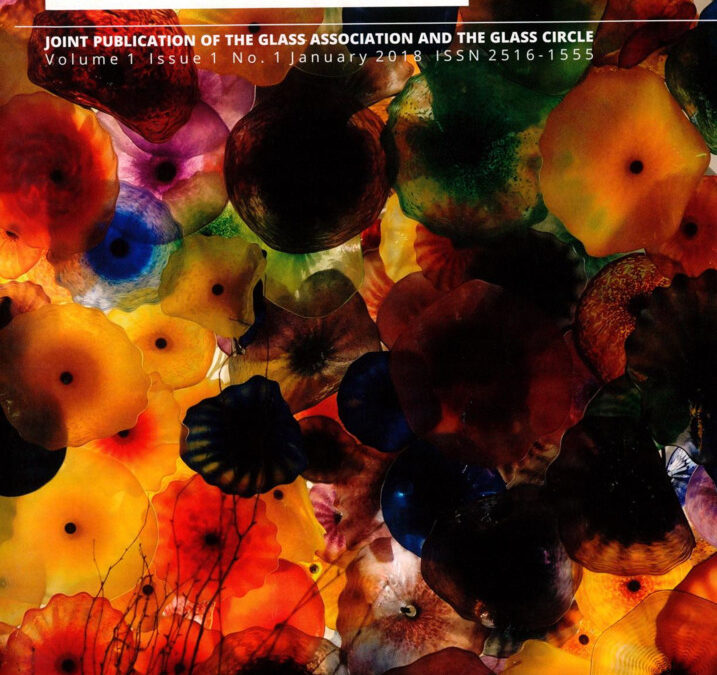
Front cover:
Las qgas 2016. Exhibition at
Bellagio Hotel,
Persian
glass at high level. A
Ceiling
composition
by Dale Chihuly
Back cover:
A
composite stem wine glass
from the Frank Tibbenham collection at
Christchurch Mansion Museum, Ipswich.
Described by WA. Thorpe in his catalogue of
the collection in 1948: `223. WINE-GLASS.
Straight-sided bowl, top-knop air-twist stem
with air-twist knop and collars at the base,
conical foot. About 1740-50. Height
6%
in”.
W
elcome to
Glass Matters,
the
first joint publication of the
Glass Association
(GA) and
the
Glass Circle
(GC). Endeavouring
to interest all of our membership,
articles have been commissioned
and gathered to represent a diverse
range of glass interests: from the
final 19th century re-print of the cut-
glass, engraving and carving series
of James O’Fallon, through to the
contributor’s personal reflections
on one of the greatest 20th century
contemporary glass artists – Dale
Chihuly. We’ve covered the AGMs
of both organisations, with both
John Smith and Brian Clarke retiring
from their chairman’s position of
many years. The GA’s study day
at Ely covered Scottish glass from
1750, the historic collection of the
museum’s stained-glass panels
and the contemporary panels
of Alf Fisher MBE, while the new
chairman of the GC, Susan Newell,
has presented her paper on the
V&A’s early acquisition of a stained-
glass panel, which came from France
in the 19th century. The joint GA/
GC day at Christchurch Mansion
museum was a highlight for the
members of both groups, exploring
the creation of the Frank Tibbenham
collection of 18th century glass,
its cataloguing by W.A.Thorpe and
display at Worthing by Len Bickerton
and used in his book. Then Trudy
Auty, chairman of the
Carnival Glass
Society,
has introduced a historical
discussion on Carnival Glass of the
late 19th and early 20th century, a
very different, colourful and for many
of us, new collecting area. We cannot
complete this introduction, without
mentioning the summary outline by
Bill Millar and a group including the
GA Chairman David Willars, of the
important and exciting Eila Grahame
collection – just a taster of more to
come.
This first issue of the joint
magazine has been designed with a
‘fresh look’, by way of different type
faces, font sizes and page designs,
created to give a young and modern
impression. Our goal has been to
make it interesting and enjoyable;
we welcome your comments on
all of the features in this new joint
magazine – positive or otherwise.
Congratulations to David Willars
of the GA and Susan Newell of the
GC on accepting the positions of
chairman of the respective groups;
we welcome their joint aim of
working together for the benefit of
all the members.
Brian Clarke
THE Gr.Wakttrebm
r
ivIITEE MEMBERS
Website: www.glasscircle.org.uk
Simon Cottle
Honorary President
Susan Newell
Chairman
chairman@glasscircle.org
Laurence Maxfield
Honorary Treasurer
treasurer@glasscircle.org
Shaun Kiddell
Honorary Secretary
secretary@glasscircle.org
Vernon Cowdy
Website Manager
web@glasscircle.org
Geoffrey Laventhall
Anne Lutyens-Stobbs
Meetings Organiser
James! Peake
John P Smith
publications@glasscircle.org
Athelny Townshend
Graphic Design
designer@glasscircle.org
Anne Towse
Graham Vivian
2
Glass Matters Issue 1 Vol. 1 No. 1
Susan Newell Chairman ofThe
Glass Circle
David Willars, Chairman of The
Glass Association
CHAIRMEN’S LETTER
JOINT
Chairmen’s
MESSAGE
by Susan NeNell and David Willars
I
a ppy New Year
from both of us,
the
incoming
Chairmen of The Glass
Circle, Susan Newell, and
The Glass Association,
David Willars and wel-
come to
Glass Matters,’
the first joint magazine
of both societies.
While it is the moment
to look forward, we first
want to express our
gratitude to our predecessors, John Smith and Bri-
an Clarke. Both seem to have been the chairmen
of our respective organisations for ever, and their
unique expertise, energy and skill combined to lend
authority to the activities of both societies. Howev-
er, ‘one constant in life is change’ and so we are
both looking forward with enthusiasm to collabora-
tion and new challenges ahead.
The two main points of contact for members of
both organisations are the meetings and magazines.
Meetings have for some time been accessible to
members of both societies on an equal basis; given
the self-evident overlap in our interests this makes
perfect sense. This magazine marks the first joint
publishing venture of The Glass Circle and The
Glass Association (GA), a move forced upon us by
the laws of economics. We do, however, retain a
genuine belief that by pooling our resources we can
create something better than the sum of its parts.
This magazine is also the first tangible sign that we
are working together, and are committed to doing
so in future’. We hope you will see this reflected in
the wide range of articles featured within its pages.
Following the GA meeting in Ely, stained glass again
figures prominently, and we are particularly pleased
to offer an article on carnival glass. Several pieces
follow on from the recent 2017 Biennale, including
profiles of Colin Reid and Nancy Sutcliffe, winners
of GA awards. There is also an introductory article
on the Eila Grahame bequest, a genuinely world
class collection of early English glassware about
which you will discover
more in forthcoming
issues. Reports of the
presentations of glass
made to John and Brian at
our respective AGMs this
autumn are also included.
In September, our two
organisations came to-
gether for an enjoyable
meeting at Christchurch
Mansion in Ipswich where
the curator opened the
cabinets and gave us privileged access to their store
rooms of mainly eighteenth-century glass. From
there we moved on to the Suffolk coast to view a
member’s diverse collection before rounding the
day off with a meal. In many ways, this establishes a
template for future meetings and we should reflect
that one of the main benefits of all our events and
meetings is the opportunity to learn and share our
passion for glass with other members.
Finally, an appeal for help. We accept that any
group is only as good as its members and in our
case, the extent of your knowledge and the variety
of your collections are second to none: you are the
experts. We have members working in the decorative
arts, some with responsibility for public collections
of glass, and others researching glassmaking and
decorating, as well as many avid and knowledgeable
collectors. We need your contributions for the
magazine and want to learn about collections
around which we can build a meeting or a study day.
Glass is the most extraordinary material which has
made a unique contribution to world history and
culture. If you feel you have something to share on
some aspect of it, please be in touch as we would be
delighted to hear from you.
Notes
1.Glass
Matters
is a working title and other suggestions will
be considered.
2. In order to avoid any duplication in the distribution of the
magazine, the two associations have undertaken to share
the membership subscription lists.
Glass Matters Issue 1 Vol. 1 No. 1
3
ooyswater
dentel clinic
I Cervantes court
4
RETIREMENT
Brian Clarke
RETIRING CHAIRMAN OF THE GLASS ASSOCIATION
by Brian Clarke
hen I accepted
the position of
chairman of the
Glass Association (GA) in
2007, little did I know it was
going to be such a long love
affair. As with many charitable
organisations promoting the
knowledge and understanding
of art, crafts, collecting and
connoisseurship, the GA has
been driven forward by its
committee and members.
Dealing with divergent views
has often been a challenge,
but with discussions leading
to positive results, it has made
these last ten years a learning
and fun journey.
I entered the world of glass
when as a junior dentist I lived
for a while at my principal’s
Below:
Brian
outside his dental
clinic
home. Every evening we’d
I’d started four years ago.
enjoy fine wine, having chosen
I would like to pay tribute to
a glass from his 18th century
all the committee members
English glass collection. Those
who, with their knowledge
agreeable moments never left
and dedication, thoughtful
my memory. Not long after,
ideas and suggestions, have
having just been married and
supported me during these
visiting the Grosvenor House
years and together with
Antiques Fair, I bought myself their sense of humour have
a present from Delomosne, an
contributed to making our
18th century drawn trumpet
meetings and events really
air twist wine glass with folded
pleasurable. Together with
foot. I’d caught the ‘bug’ and
me they’ve worked to arrange
have never looked back.
and organise the national
As the years passed by, I
and international events for
met the most passionate and the membership and helped
unassuming glass collectors, to produce
The Glass Cone
talented glass makers and and
The Journal of the Glass
blowers,
distinguished
Association.
For a while, I’ll be
academics
and
curators
staying on the committee and
and the most dedicated of
looking after our publications.
members. The right moment
Thank you all for having
came in 2016 to hand over my enriched my life and marking
dental clinic to a new principal,
it at our Ely AGM, when
although I still practise part
Charles Hajdamach made the
time, and in October last year
presentation to me from the
I encouraged David Willars to
committee of the Trinket Box
accept the position of chairman
by Nancy Sutcliffe – a piece that
of the GA, knowing that he
was shown at the Biennale – I
would continue linking the GA gave myself away by admiring
with the GC, the process that
it again and again!
Glass Matters Issue 1 Vol. 1 No. 1
Ten
Years
in
the
chair
Right:
Trinket
box scent bottle
presented to
Brian Clarke on
his retrirement
made by
Ingrid Hunter
0
R
.
32
2uop
ng
Sal
ad
0
Ja
i
luoi
sna
lal
ad
0
GLASS CIRCLE AGM
THE RETIREMB T OF
John P Smith,
CHAIRMAN 2
by Susan Newell
0
ro
t
t our AGM this year
we had to finally say
oodbye to John Smith
our Chairman, after fourteen
years in post. Fortunately, John
has been persuaded to remain
on the committee where
his experience, knowledge
and bonhomie will be much
appreciated, not least by me,
as I am honoured to have
been appointed to take over
as Chair. (I am delighted that
Shaun Kiddell will in turn take
over as Honorary Secretary).
The AGM was followed
by a short tribute to John
accompanied by a slide show
of highlights from the many
memorable tours he organised
for us, and finally an interesting
‘Show and Tell’ session when
we discussed items brought
in for the occasion. While the
AGM minutes will be available
in due purse in the usual way,
I wanted to focus here on the
glass items we presented to
John when he stepped down
from the chairmanship as they
constitute a modern take on
the tradition of combining the
beauty of glass with the beauty
of the written word, for the
purpose of commemoration.
Following the email appeal
for ‘crowd funding’ a gift
for John as a token of our
appreciation, I was delighted
by the generous response of
Glass Circle members. This
allowed me to go ahead and
commission a goblet with a
suitable inscription. As in this
case, the medium and message
were equally important and I
was duty bound to do justice
to both, I took advice from a
Right:
Fig.1
John P. Smith,
giving a toast
to all in his
presentation
goblet
Left top to
bottom:
Stages in the
production
of the goblet
engraved
by Peter
Furlonger
Fig. 2
Goblet
covered with
PVC tape
Fig. 3
The
design is
drawn onto
the PVC and
cut out prior to
sandblasting
Fig. 4
Chan-
delier design
can be seen
on reverse
h. 18 cm
Above right
and right:
Goblet
engraved by
Lesley Pyke
Figs. 5 and
6
The finished
goblet recto
and verso
designed
by Athelny
Townshend
and engraved
by Lesley
Pyke. Goblet
c. 1760,
h.25.3 cms.
0
S
1OHN P SMITH
CHAIRMAN OF THE GLASS CIRCLE 2003-2417
“r”
—
Glass
Matters Issue 1 Vol. 1 No. 1
p
uati
sumo/
Xul
ati
ly
03
,
GLASS CIRCLE AGM
member of the Circle, glass
engraver, Katharine Coleman,
on whom to approach for this
work. Katharine recommended
Peter Furlonger as ‘the
best letterer on glass at the
moment’, which pleased me
as I already knew Peter’s
work – many years ago, when
I worked in the North-East as
a curator, I commissioned a
commemorative piece from
him for Sunderland Museum
and Art Gallery.
Peter often collaborates with
studio glassmakers to obtain
suitable blanks on which to
work. In his own practice, he
takes inspiration from poetry
or other texts to design original
calligraphy, at the same time
ensuring the quotation will
‘work’ on the selected piece
of glass. Commissions, such
as ours, are Peter’s ‘bread
and butter’, but no less care is
taken with the calligraphy and
design. He starts by selecting
a vessel, and as we thought it
would be appropriate to have
a goblet so John could enjoy
a glass of wine, Peter used
one made as an exercise in
traditional glassmaking by a
respected studio glassmaker.
He then planned the spacing
of the text we required and
produced a sketch for our
approval. His chosen technique
for engraving the glass is
sandblasting, so after covering
the glass with PVC tape, the
design was drawn on the
goblet and then cut out with
a blade (figs.1 and 2, overleaf).
When placed in a sand-blasting
cabinet, the exposed areas are
removed and different textures
can be achieved depending on
the time the piece is left in the
cabinet and the type of effect
required. The elegance of
the calligraphic design is thus
faithfully reproduced on the
glass and transformed by the
medium. The full inscription
reads ‘John P. Smith, Chairman,
The Glass Circle 2003-2017’
with the ‘JPS’ monogram picked
out in gold, and on the foot,
‘From Friends in the Glass
Circle’.
Additionally,
Peter
included a chandelier in the
design to commemorate John’s
special interest in this area of
glass history (fig. 3).
I was thrilled that in the
end there were enough funds
to commission a second gift
for John, and we are grateful
to our Honorary Designer,
committee member Athelny
Townshend for designing
this. Inspired by the joint visit
of the Glass Circle and the
Glass Association to John’s
Suffolk home in September,
Athelny worked up a photo of
John’s quirky converted water
tower to create a design for
local engraver Lesley Pyke to
engrave, this time using a large
antique goblet (figs. 4 and 5).
Lesley has been a member
of the Guild of Glass Engravers
since 1983 and exhibited
with the Guild at the Red
House Glass Cone during
Stourbridge’s Festival of Glass
in 2015. She has worked on
many prestigious commissions
for public and private
clients, including royalty. For
our goblet, Lesley used a
completely different method
from Peter: the surface of the
glass was roughed up with
diamond burs of different sizes
powered by a hand drill, (fig. 6)
while engraving to different
depths created texture and
shadow (fig. 7). The finished
goblet, 25.3 cm high, was
another marvellous tribute to
John and places him in that
select company of individuals
who have the distinction of
seeing their homes engraved
on glass (fig. 6).
Special thanks to all those
members of the Circle who
helped make John’s last official
meeting as our Chairman so
memorable by contributing to
funding these commissions,
and sending in dedications
for John’s card. I am happy
to report that he seemed
delighted with both his
presentations and quaffed
some rather good wine out of
Peter Furlonger’s goblet. If we
had filled up the larger goblet
engraved by Lesley Pyke – its
capacity is at least a bottle,
John may have had problems
getting home (fig. 7).
Thanks are also due to
Vernon Cowdy for putting
together the slide show and to
those who took the trouble to
bring in items for discussion.
This meeting was kindly co-
hosted by Laurence Maxfield,
Michael Frolich and John
Newgas.
Further information about
Peter Furlonger is on:-
https://www.peterfurlonger.
com/about/?doing_wp_cron=1
511367404.70650696754455
56640625
and Lesley Pyke:-
On Wednesday 29th November
John was admitted to the
Chelsea and Westminster
hospital for an emergency
operation, where he stayed for
19 days. He is now home and
has asked me to thank all those
who so generously contributed
to the purchase of these two
wonderful glasses. When he is
stronger he will write a longer
note for the next
Glass Matters.
Fig. 6:
Lesley
Pyke at work
using a
diamond
drill
Fig. 7:
A detail of the
engraving by
Lesley Pyke
of West Bar,
Thorpeness
6
Glass Matters Issue 1 Vol. 1 No. 1
THE
STAINED
GLASS
MUSEU
HIGHLIGHTS FROM THE COLLECTION
REVIEW
THE
Stained Glass
MUSEUM
A review byjudith Gower
By
Dr Jasmine Allen ISBN: 9781785510595
0
ne of the highlights of the Glass Association’s
AGM in October was a talk by Dr Jasmine Allen,
Curator of the Stained Glass Museum, the only
museum in the UK solely dedicated to the ancient art and
craft of stained glass. The museum has given new life to
hundreds of windows removed from redundant build-
ings across the British Isles since its foundation in 1972.
The museum is located in the magnificent south tri-
forium of Ely Cathedral and the stairs leading to it are
rather steep, so for those unable to climb the stairs this
magnificent book takes the reader on a virtual tour of the
highlights of the collection and much more.
The guide lists
the highlights of the
museum’s grow-
ing collection of
over 1,000 stained
glass panels and
windows
dating
from 1200 to the
present day, taken
from both religious
and secular build-
ings, and includes
associated designs,
sketches, cartoons
and tools. It begins
with an introduction
to the art of stained
glass, its origins and
techniques, as well
as the history of the
museum.
The
chapters
following are thor-
ough and detailed
explanations
of
the changes to the
making and style
of stained glass
through the cen-
turies: those made
by the traditional
method such as the
Geometric Grisaille
of c1200-1250
on page 10, through to the glass-painting common in the
16th century, such as the scene from
The Legend of St
James.
There follows the ‘Age of Enamels’ which came af-
ter the Reformation and was particularly suited to smaller
domestic panels. A revitalization of church architecture
in the early 18th century, brought back the “true princi-
ples” of stained glass in the manner of the Middle Ages.
By the 19th century many works were designed by one
artist/designer and made by established manufacturing
companies. Scottish stained glass, particularly of the 19th
century, is also described and illustrated.
A most interesting chapter is dedicated to the influ-
ence of William Mor-
ris and his circle. I
particularly like the
window on page 47,
The Dawning of the
Last Day,
designed
and made by Fred-
erick Ashwin. The
book then moves on
through the Arts and
Crafts movement
to the 20th century,
the post-war period
and finally, to con-
temporary works.
The colour illus-
trations are rich and
unexpected in a pa-
perback book cost-
ing a mere £6.50
and Dr Jasmine
Allen has a wealth
of knowledge con-
veyed in such an
easy-to-read style
that this book is one
for the library of
everyone who has
an interest in glass,
stained or other-
wise.
Glass Matters Issue 1 Vol. 1 No. 1
7
GLASS DESIGN
Dale
Cfirhuly.•
AN EXCEPTIONAL
GLASS DESIGNER
by Janet Cummings
Below: Fig.1
Dale Chihuly placing fire-orange baskets
inside each other
You’re looking
at light itself,
says Dale Chihuly, about
the properties of glass.
I
f you have been to the V&A in the last few years
you’ll have seen the huge, 30 foot high ornate
chandelier hanging under the dome of the main
entrance, designed and created by Dale Chihuly
in 2001, a glassblower who deeply divides opinion
amongst art critics and the public.
He made the
Torchlight Chandelier,
a glass flame
which stood opposite the Dorchester Hotel in
Park Lane, London in 2012 during the Olympics,
installed extraordinary glass shapes throughout
Kew Gardens in 2005 and has had exhibitions all
over the world including many outdoor installations
which draw vast crowds. His work definitely has the
‘wow’ factor and is colourful and accessible.
Chihulywas born in 1941 near Seattle, Washington,
U.S. in a tough neighbourhood. When he was
15 he lost his brother and a year later his father
died, aged 51. Rather directionless, he eventually
studied interior design and wove tapestries which
incorporated glass, intended to hang in windows.
He played around with the properties of glass and
one day blew through an ordinary pipe from a
hardware store and blew a bubble of glass. From
then on he wanted to be a glassblower. He worked
as a fisherman to pay for his course at the University
of Wisconsin, the only place in the US that taught
glassblowing in the 1960s, then spent time at Rhode
Island School of Design before going to Venice as a
Fulbright scholar to study glassblowing methods.
On his return he set up and ran a glass course
in the Rhode Island School of Design. In 1971 he
helped to establish the Pilchuck Glass School near
Seattle. He assumed that teaching was the only way
he would make a living from glass, but gradually his
8
Glass Matters Issue 1 Vol. 1 No. 1
GLASS DESIGN
Above:
Fig.2
Glass following nature to create a fantastical garden in glass
work became noticed. The Metropolitan Museum
of Art in New York bought some of his
Cylinders
series in the late 1970s. These were based on the
colours and patterns of Navajo blankets. He sold
more work and could devote more time to making
glass and teaching less.
In 1976 on a research trip to Britain, he had a bad
car accident in which his face was so badly cut it
needed 256 stitches and he lost his left eye. As a
result he found it hard to physically blow the glass
himself and has used assistants ever since. He
initiates the process, directs the work and allows
his teams of collaborators freedom to experiment.
This is unusual in the studio glass world, but he
saw teamwork in action when he went to Murano.
Now he has a team of around 100 people, including
more than ten glassblowers.
As his reputation grew, so did that of the Pilchuck
school which now teaches around 500 students at
its summer school, many of whom stay in the area
afterwards, so now the region has hundreds of
artists and craftspeople who work with glass. He has
his ‘headquarters’ in The Boathouse on the lakeside
and a Museum of Glass was opened in Tacoma in
2002 which has a walkway lined with Chihuly’s work.
In 2012 a large permanent exhibition was created
called Chihuly Garden and Glass.
His team organises and arranges installations
and exhibitions worldwide, publishes coffee table
books, and produces documentaries looking at
his work. His larger pieces can sell upwards from
hundreds of thousands of dollars.
The shapes he creates remind many people of
organic forms, but he has always maintained that
he is not copying nature and that ‘glass wants to
make forms like that, if you let it.”
It could be argued that Chihuly is doing what
Tiffany did earlier, in that he is able to straddle the
worlds of high culture, with work in museums, as
well as popular culture. Installing work in gardens
alters how people see the plants and the entire
garden and has begun to make venues such as
the New York Botanical Garden or Kew Gardens
be seen as exhibition venues. In the 1970s he put
blown-glass panels in a rocky landscape in ways
that are reminiscent of the Land Art movement of
that period (fig. 2).
He usually makes things in series, such as
Glass Matters Issue 1 Vol. 1 No. 1
9
GLASS DESIGN
Above
Fig.3
Nested Persian shapes
Chandeliers, Baskets, Seaforms
and
Persians,
which
are often arranged together and over time have
become bigger in scale, so that the work becomes
an installation.
He started the first series,
Cylinders,
in 1974. These
are characterised by delicate pieces of glass threads
that are picked up by the molten form being rolled
over them. They are straight sided, but a few years
later, inspired by Native American baskets sagging
under their own weight, he deliberately made
asymmetrical shapes in the series known as
Baskets.
He also began to stack them one inside another.
The history of glass has been mainly concerned with
creating symmetrical forms, but Chihuly realised
that the tendency in the material to go off-centre
is something he could exploit. He sees beauty in
letting the molten glass move and makes organic
shapes by using heat, gravity and centrifugal force,
so the inherent properties of glass help to develop
the shapes. This is an important breakthrough in
the history of the medium, enabling him to make
some of the most influential glass from the mid-20th
century to the present day.
The 1980s
Seaforms
have thinner walls than
the “Baskets and use translucency and horizontal
patterning to suggest a marine environment. These
brought Chihuly some of his earliest international
fame and his first permanent installation,
Puget
Sound Forms
at the Seattle Aquarium in 1987. Also
starting in the 1980s, the
Macchia
series developed
from his experimentation in using all the 300
colours available to glassblowers in the form of pre-
manufactured Kugler glass rods. The Latin word
mac/JO,
meaning spot, is the basis of the work as
both the inner and outer surfaces of the vessels
have spots of colour placed on them. The colours
complement each other and work in different
ways when seen through the translucent walls.
The spliced bits of glass that become the spots are
laid out on the marver and are then rolled over by
the hot glass on the end of the blowpipe. Some of
these vessels can be up to 30 inches in diameter.
In the late 1980s he re-visited the idea of the
cylinders and incorporated the technique of
10
Glass Matters Issue 1 Vol. 1 No. 1
GLASS DESIGN
asymmetrical, collapsed shapes, so making what
are usually known as
Soft Cylinders.
These are a
good example of how his work stretches the limits
of typical Venetian glass blowing: their upright walls
(as opposed to curves) and their use of “pick-up”
drawings (as opposed to enamelling applied and
fired later) are different from traditional Italian
models and their irregular profiles show the weight
of the glass while it is on the blowpipe. Again, some
of these are large, for instance 17 inches or more.
The first series to suggest
historical models is
Persians
(fig.3), dating from the mid to
late 1980s. He made works
that have an iridescent surface,
almost as though they have
been excavated. They are dif-
ferent from Tiffany’s patented
oxidising process in that they
are darker and larger. A famous
example of
Persians
is the vast
ceiling at the Bellagio Hotel in
Las Vegas (fig. 4,
see front cover).
A second series which echoes
a historical period is
Venetians,
from the late 1980s, which was
inspired by seeing a private col-
lection of Art Deco glass in Ven-
ice. Chihuly has always worked
with collaborators and in this
series he worked with Tagliapie-
tra, considered by Chihuly to be
the greatest glassblower in the world. They have
opulent colours, large size and showy technical ef-
fects such as glass roping, and are not intended at
all to be historical tributes to early 20th century Ital-
ian glass, more a kind of fantasy. In the 1990s the
Piccolo Venetians,
also made with Tagliapietra, have
thinner walls and more delicate colours.
The
lkebana
series of the mid 1990s makes
reference to Japanese flower arranging, but
with Chihuly’s bulging, twining and colourful
interpretation of it. Again from the 1990s and also
influenced by a trip to Japan is the series known as
which are giant glass floating spheres, like fishing
floats, but which are large and heavy: a remarkable
achievement in glassblowing.
In his extraordinary
Chandeliers
series, which he
began in 1992, Chihuly has created huge cone-
shaped or circular chandeliers, made with strong
coloured ribbed tendrils and spikes which are lit by
external spotlights or daylight, but have no internal
lights (fig.5). They are works of art and so do not
need to function in a traditional way. It is one of
these which is in the V&A and is one of their most
photographed exhibits. This installation presents
an interesting cleaning problem. The Chandelier is
fixed in position so it is necessary for a heroic
member of the Museum>s technical staff to brave
the heights on a
Powerscope –
a
type of raising platform.
Starting in 2003 the
Fiori
have a wide range of shapes,
such as long stems and various
vaguely botanical shapes which
come together in installations
which Chihuly has designed for
public conservatories and open
spaces all over the world and
memorably in Kew Gardens in
2005. Some of the twists and
clumps are as long as 12 feet.
Some of the art world’s
bemusement about the
attention paid to Chihuly’s
work stems from the value
judgements critics make
about craft as opposed to art.
Glassblowing is often seen
as the former. Furthermore,
Note
1. Quote from: article by Ted Loos April 26th 2017
in The New Times
Are There Glass Snakes in Dale
Chihuly’s Fragile Eden?
Above: Fig.5
A
chandelier style sculpture,
growing up to create a sh b
ru
his working process, using a team of makers, is
regarded as more that of a foreman than a creator.
So the issue becomes that of a perceived lack of
ideas: art “experts” often want to find a meaning in
a piece, whereas the public is happy to be awed or
intrigued by what they see.
I think these colourful sculptures in glass are
wonderful. The work is startlingly contemporary
and the overall joyousness and sense of optimism,
rooted in a long craft tradition, for me makes
philosophising about its ‘meaning’ a pointless
activity. Seeing his work is pure pleasure.
Glass Matters Issue 1 Vol. 1 No. 1
11
THE FRANK TIBBENHAM COLLECTION
CHRISTCHURCH
MANSION MUSEUM
the Frank Tibbenharn Collection
by Brian Clarke
I
n September 2017, The
Glass Association
(GA)
linked with the
Glass Circle
(GC) to host a collector’s day
meeting at the wonderful
Christchurch
Mansion
Museum
in
Ipswich,
followed by an afternoon
visit to the collection of John
Smith, then chairman of the
GC. The absorbing day was
rounded off with supper at
a local hostelry.
Christchurch
Mansion,
a fine looking, substantial
Tudor brick mansion house,
was built in 1548 and is home
to a collection of paintings
by the famous Suffolk
Above:
Fig.1
The frontage of
Christchurch
Mansion
Right:
Fig. 2
Frank
Tibbenham
Below:
Christchurch
Mansion and
its gardens
artists John Constable and
Thomas
Gainsborough,
alongside many other
fine art treasures. It is set
in extensive landscaped
grounds, with a lake and
tended gardens of over 70
acres. In 1895, the owners,
a property syndicate led by
Felix Cobbold, sold the land
and gifted the mansion to
the Ipswich Corporation to
be used as a museum. The
grounds were then named
Christchurch Park. I suggest
that this philanthropic
action
emulated
the
philosophy of many of the
moneyed classes of the
time to benefit society.
The focus of our visit was
to view the Tibbenham glass
collection. I’ll be referring to
three great names in the
world of glass, to portray
the collection of the glass,
its donation to the museum
and composing the original
catalogue.
Frank Tibbenham
(1874
-1946), living at 24 Gip-
peswyk Avenue, Ipswich,
wrote the following note in
November 1945.
My brother Percy having died
Nov 16/45 (to whom I had left
my collection of glass in the front
and back room), it is my inten-
tion now to bequeath it to the
Ipswich Corporation Museum
and Art Gallery Committee to
be suitably exhibited and known
as the ‘Frank Tibbenham Collec-
tion’. P.S. I have shown it to Mr
12
Glass Matters Issue 1 Vol. 1 No. 1
THE FRANK TIBBENHAM COLLECTION
Maynard and he is very pleased
to accept it on their behalf.
Frank had a collection of
near 800 glasses, 478 of
these were in the bequest
to Christchurch Mansion.
William Arnold Thorpe
(1901-1965), Curator of
Glass at the Victoria & Al-
bert Museum, was Presi-
dent of The Circle of Glass
Collectors – later known as
The Glass Circle – from its
inception in 1937. He is well
known for two books.
A His-
tory of English and Irish Glass
(1929), then
English Glass
(1949). In 1948, he viewed
the Tibbenham glass collec-
tion and organised the Cat-
alogue (fig.4). –
Thorpe also wrote the fol-
lowing synopsis:-
THE
‘FRANK TIBBENHAM’ COL-
LECTION OF OLD ENGLISH
DRINKING GLASSES 1690 – 1800
FRANK TIBBENHAM was born in
Ipswich April 16, 1874, the fourth
son of John Tibbenham and was
educated at the Ipswich Middle
School. On leaving school he
joined his father who was car-
rying on the business of Carver,
Gilder and Art Dealer in Carr St,
Ipswich; in 1917 ‘Antiques’ were
added.
After their father died in 1918,
the business was carried on by
the three sons, William, Frank
and Percy. Frank, being attract-
ed by ‘Glass’, resolved to try and
form a Collection. The town and
neighbourhood proved a happy
hunting ground, quite a number
of specimens being acquired
and the bulk of the Collection
has been obtained within about
40 miles of Ipswich. In 1933
Frank Tibbenham retired for
health reasons but ‘GLASS’ (and
other hobbies) kept him fully
interested and this collection is
the outcome.
Thorpe’s introduction to
this catalogue is dated 17th
May 1948, at Christchurch
Mansion and contains the
following assessment:-
The
collection has been grouped
in twenty classes. It is deficient
in the large or impressive glass-
es especially those made in the
baroque taste at the end of the
17th century and now great-
ly regarded. In common with
collections formed by the late
J.G.Trapnell, Rees Price, John
M.Bacon, Arthur Kay, Percy Bate
and others, it well represents
English glass-collecting between
the appearance of Hartshorne’s
Old English Glasses
in the year
of the Diamond Jubilee and the
outbreak of war with Germany in
1914. Its talent may be said to lie
in an eye for a pretty glass; pret-
ty as against esteemed types
of glasses are more numerous
than in some collections.
The strength of the collection
is evident most numerously
in the series of balusters, of
which there are more than a
hundred pieces. These diverse
and elegant stems admirably
illustrate the qualities of flint
and the fineness of glass turning
early in the 18th century. They
include many pieces conforming
to the kinds illustrated by
Above: Flg.4
Front page of
WA. Thorpe’s
catalogue of the
Frank Tibbenham
Collection
Below:
A large
heavy baluster
goblet with bell
bowl above a me-
dial knopped stem.
10 ins. Cat. # 49′
Hartshorne, Francis Buckley,
Thorpe (sic!) and other writers.
But perhaps the category which
comes best out of this collection
is the air twists. In more than
seventy of these glasses are
several in the beautiful form
of the flute, perhaps the best
instance of a continental
idiom done into English, this
decoration of flint by air appears
to singular advantage. Two-knop
forms especially in the flute
and many top-knop glasses
and drawn pieces and some
mercurials are remarkable for
their light and lovely effects, and
some others have no parallel in
the continental crystals which
followed flint.
Among the other glasses, special
mention may be made of several
Silesian, including the beautiful
early cut sweetmeats, several
elegant drawn stems and the
thin flutes of high thin elegance.
Though sweetmeat glasses are
not always the most beautiful,
special mention may be made to
the effective use of high pedes-
tal and short baluster stems and
the admirable combination of
moulded ribs and cut scallops.
The tall-stem glasses, another of
OP
AT
cen.wav,
Ye, SION
MUS.6014
I
PSWICH
1 9
Glass Matters Issue 1 Vol. 1 No. 1
13
p
uoy
su
moi,
AT
IT
ag
iv
d71
[
1
131D
IIEUg()
THE FRANK TIBBENHAM COLLECTION
the north European tastes done
into flint are well represented,
with several thin elegant piec-
es. The wealth of firing glasses
admirably illustrate the squat
happy little shapes sometimes
found in flint, baluster types
conspicuous among them and
conform to the familiar taste of
the old fashioned flint collectors.
W.A.Thorpe listed the dif-
ferent styles of glass in the
collection and noted there
were approximately 470
pieces, particularly men-
tioning engraved Jacobites
including two ‘Fiat’; en-
graved tall ales with hops
and barley; combined air
and opaque twists; col-
Clockwise
from top left:
Jacobite
engraved dou-
ble knopped
air twist, cat. #
30
2
The major
display of the
Frank
Tibbenham
Collection
`Silesian’ or
pedestal stem
sweetmeat,
cat.# 3
3
Two deceptive
dram glasses,
cat.# 414′ and
402
5
our twists including two
four-colour twists; many
sweetmeats, including the
rarest sweetmeat in the col-
lection with a ball stem and
ovoid bowl; champagnes;
two engraved Nelson gob-
lets and candle sticks, taper
sticks and lamps. Disap-
pointingly, other than one
large faceted candlestick in
the back of a cupboard in
the store room, there were
no other candlesticks or any
tapersticks to be seen. The
curator informed us that
the Nelson goblets were in
the Ipswich museum and
maybe they also had taper-
sticks, but if so, they were
unknown to her.
Leonard M Bickerton,
the
director of the Library, Mu-
seum and Art Gallery ser-
vices in Worthing, 1949-74,
wrote the following review
of the collection in the
East
Anglian Magazine
of March
1971:
For glass of the 17th to 19th
centuries, a visit must be paid to
Christchurch Mansion. Glass is
restricted to three or four cases,
but in sufficient variety and con-
taining enough important pieces
to reward any glass collector.
The strength of the collection
arises from a remarkably fine
bequest made in 1946 by Frank
Tibbenham (1874-1946), one of
the six sons of John Tibbenham
who conducted the family busi-
ness of picture framing, restor-
ing and selling at 34 Carr Street
in Ipswich (fig.5).
Frank Tibbenham specialised in
picture cleaning, one of three
brothers to remain in the busi-
ness. He is remembered as a
quiet, modest man, a keen golf-
er and for some unknown rea-
son an assiduous collector of
porcelain and glass during the
period 1900-1920 when 18th
Glass Matters Issue 1 Vol. 1 No. 1
0
THE FRANK TIBBENHAM COLLECTION
century drinking glasses were, if
not 10 a penny, at least easy to
acquire at a few shillings a piece.
He eventually acquired a collec-
tion of some 800 specimens, the
majority purchased from Shuck-
forth Downing (grandfather of
the present proprietor) whose
antique shop in Felixstowe he
visited almost every Saturday
afternoon.
Most of the glasses came from
houses in Suffolk; perhaps the
strengths and weaknesses of
the collection relate to the types
of glass which were made in the
south-east, on the other hand
they may illustrate only the pre-
dilections of this collector. What-
ever the explanation it may be
worth recording that apart from
a few Jacobites there are no en-
graved glasses of the kind asso-
ciated with Newcastle and en-
graved in Holland, nor are there
more than one or two incised
twists; there are no ‘Facon de
Venise’ glasses at all but the col-
lection contains scores of heavy
or ordinary balusters and more
than 60 air-twists.
It was Frank Tibbenham’s wish
that the best of his collection
should be presented to the Bor-
ough of Ipswich. Having been as-
sured before his death that the
collection would be welcomed,
the bequest provided Ipswich
Museum with no less than 478
specimens, strongest in the cut
and faceted drinking glasses,
bowls and sweetmeats of the
late 18th and 19th centuries
but illustrating the wares of the
whole of the 18th century from
the heavy baluster onwards.
Space was found to display a
general selection in one wall
case, but more than 300 glass-
es had to remain in store until
1970. Forced to move the stored material because of roof repairs,
the curator, Miss Patricia But-
ler, welcomed the suggestion
that the glass might be placed
on view in the Worthing Muse-
um for at least two years from
mid July 1970. It is already at-
tracting considerable attention
and, who knows, giving some
satisfaction to the shade of
Frank Tibbenham.
Prior to 1970, Len Bickerton
already had an interest in
18th century glass and fol-
lowed up the acceptance of
the suggestion to take and
display Frank Tibbenham’s
glass at his museum in Wor-
thing during the period of
restoration at Christchurch
Mansion. Bickerton’s book,
18th Century English Drink-
ing Glasses, An Illustrated
Above: Fig.5
The Tibbenham
family shop at
34 Carr Street, g
Ipswich
Right top to
bottom:
A selection
of Lynn
glassware,
described by
Thorpe as
`East Anglian
type’:
Small
ribbed bottle
cat. # 463
6
;
Wine glass
with
MSOT
twist and
folded foot
cat.# 373
7
;
Tumbler
cat. # 462
8
Glass Matters Issue 1 Vol. 1 No. 1
15
THE FRANK TIBBENHAM COLLECTION
Guide
was first published in
1971 and near 10% of the
glasses pictured in his well
known, revised edition of
1986, are of the Tibbenham
Collection.
2
Many thanks must go to
Carrie Willis (fig.6), Con-
servation Technician at
Christchurch Mansion Mu-
seum and curator in charge
of the glass collection. She
gave our glass group all the
time we needed to examine
the 122 glasses in the main
cabinet on the ground floor,
opening the cabinet doors
for us and allowing John
Smith and Brian Clarke to
handle glasses as they gave
an informal talk on glasses
of interest. We were then
led into the Mansion’s attic
where nearly 100 glasses
from the Tibbenham Col-
lection were kept in the
storage area. You’ll note
that the number of glasses
attributable to the collec-
tion adds up to 222. Even
if a few glasses are held on
display at Ipswich Museum,
this still leaves around 240
glasses from the Tibben-
ham bequest – originally
478 – that are currently
missing. The accumulated
glass knowledge of our vis-
iting group has now filled
Carrie with enthusiasm for
this bequest. She’s acquired
a copy of Len Bickerton’s
book for Christchurch Man-
sion and having updated
the contents and captions
in the main glass cabinet –
which had not been opened
for a number of years – she
will be searching for infor-
mation on the whereabouts
of the missing glasses.
W.A.Thorpe’s original cat-
alogue of the Tibbenham
Collection is still securely
held in the museum, but
Carrie was unable to ob-
tain access for viewing; the
printed copies we were ex-
amining are held online by
the Mansion museum and
are also held at the Rakow
library in Corning.
A fine morning followed
by lunch and then a short
journey to be entertained
at John Smith’s extraordi-
nary home, an architectural
landmark (fig.7) with a view-
ing and discussion of his
wide-ranging collection of
English and European glass.
Many thanks to John for the
invitation (fig.8).
Notes
1. The passages in indented small-
er type are edited pieces that
were written by the three glass
collectors discussed – I’ve kept
most of their phrases, though
there has been minor editing in
regard to syntax and punctu-
ation. But it is not perfect 21st
century English.
2. Information from research by
Athelny Townshend
W.A.Thorpe’s glass comments
1.
49. WINE-GLASS. Bell bowl with
solid base, straight stem with
medial knop, plain conical foot.
About 1725. Height 9 in.
2.
30. WINE-GLASS. Bell bowl
engraved with rose and one
bud, double knop air-twist stem
and plain conical foot. Mid 18th
century. Height 65/8 in.
3.
3. SWEETMEAT GLASS. Open
double ogee bowl, scalloped rim
above relief diamonds, bobbin
knop above Silesian stem,
conical foot with rim moulded.
About 1725. Height 6 in.
4.
402. FIRING-GLASS. ‘Deceptive’
funnel shaped bowl, straight
baluster stem, conical foot with
broadly folded rim. Early 18th
century. Height 4Y2 in.
5.
414. ‘DECEPTIVE’ GLASS.
‘Deceptive’ funnel-shaped bowl
baluster stem, conical foot with
folded rim. About 1720. Height
5 in.
6.
463.HOUSEHOLD BOTTLE.
Shouldered form wrought
in seven horizontal zones,
tapering neck, high domed kick.
Height 7
3
4 in. This bottle and
preceding tumbler No. 462
belong to zone types associated
with East Anglia.
7.
373. WINE-GLASS. Straight-sid-
ed bowl with two horizontal
zones, straight stem containing
plain twist, plain conical foot
with broadly folded rim. Height
51/2 in. Mid 18th century.
8.
462.TUMBLER. Cylindrical form
wrought in seven horizontal
zones. Mid 18th century. Height
41/2 in.
9.
223. WINE-GLASS. Straight-sid-
ed bowl, top-knop air-twist stem
with air-twist knop and collars
at the base, conical foot. .About
1740-50. Height 61/2 in. (See
back cover)
Above:
Fig. 7
John Smith
at home with
Anne Lu-
tyens-Stobbs
and a cabinet
of glass.
Top right:
Fig.8
John
Smith’s land-
mark tower
home
Below:
Fig.6
Carrie Willis.
Conservation
technician
and curator at
Christchurch
Mansion, in
front of the
main glass
cabinet
16
Glass Matters Issue 1 Vol. 1 No. 1
GLASS ASSOCIATION AGM
THE HISTORICAL
SIGNIFICANCE OF
Scottish Class
&
British Stained Class
BROUGHT TO LIFE AT ELY
by Roger Ersser
The 35th Annual General Meeting of The Glass Association was
held on the 14th of October 2017 at the Conference Centre of Ely
Cathedral. It was combined with a study day on various aspects
of the history of glassmaking in Scotland and the techniques used
in the creation of stained glass masterpieces through the ages. It
culminated in a guided visit to the Stained Glass Museum, which
is housed in the ancient, and magnificent, Ely Cathedral.
A Smooth Change at the Top.
The somewhat reflective mood of the day was set
during the election of Council Officers. Brian Clarke
stepped down as chairman and David Willars was
nominated and accepted as the new chairman.
Brian took the opportunity to review some of the
many successful and happy events which happened
during his 10 years as chairman. He highlighted the
international trips, often together with members of
the Glass Circle, where so many friendships were
formed, then the diversity of subjects covered by
national and local meetings and in the Association’s
publications. His thanks for the help he received
from his fellow officers was overshadowed by
the loud and heartfelt appreciation shown by all
present for his total devotion to promoting the aims
and objectives of the Association. To his surprise
and delight, Life President Charles Hajdamach
presented him with a piece of glass made by Ingrid
Hunter, purchased by members, in recognition
of his efforts on our behalf. He will still oversee
publications and offer his wealth of experience to
the committee.
Incoming chairman David Willars was warmly
welcomed. He was happy to expand his already
active involvement in the Association and
described his evolutionary vision for its future,
including building on the closer links with The Glass
Circle, forged by Brian, starting with some joint
publications (this magazine is the first). He outlined
some potential future meetings and trips including
a joint visit to Italy in 2018. He chaired the Study
Glass Matters Issue 1 Vol. 1 No. 1
17
GLASS ASSOCIATION AGM
Above: Fig.1:
Designs in the archive of the Holyrood Flint Glass Works. Green hock glasses were exported to Germany
Day with his usual good humour, assuring us that
the Association is in safe hands.
Life in the Scottish Glass Industry 1750-2006
The first talk of the day was given by Dr. Jill T urnbull,
a familiar and genial travelling companion on many
of the overseas visits described by Brian Clarke,
during which she has kept us updated on the pro-
gress of her recently published book
From Goblets
to Gaslights, The Scottish Glass Industry 1750-2006.
She has presented numerous scholarly articles
and lectures since the publication of her doctorate
studies –
The Scottish Glass Industry, 1610-1750,
in
2001 – but still prefers to be known as an amateur
historian who hates to get things wrong. An equally
apt description of many of the movers and shakers
of the Scottish Enlightenment who also resided in
her adopted retirement city of Edinburgh!
Jill gave us a beautifully illustrated overview of the
rise and fall of glass manufacture in Scotland during
the 250 years comprehensively covered by the
book, which took 15 years of research into archives,
company records, family documents and included
visits to factory sites etc. to complete. The history
of the glass houses in Edinburgh, Leith, Glasgow,
Alloa, Greenock, Bathgate, Perth and Wick are all
documented. The production of table glass and
decorative items, as well as bottles, jars, mirrors
and assorted more functional items, parallels
the experiences of rival British and continental
manufacturers during this period.
She described and discussed the most significant
times when the glass had a distinctive Scottish
accent and identity and how the industry was quick
to adapt to what was saleable in both domestic
and, particularly, export markets. The objects were
brought vividly into focus by her descriptions of the
characters who facilitated their production. These
ranged from the complex relationships of the
families which during the 18th and 19th centuries
established and developed the world-famous crystal
glass houses of Leith and Edinburgh, the bottle
18
Glass Matters Issue 1 Vol. 1 No. 1
Above:
Fig.2a
Part of a
fine intaglio engraved dish
marked E&L’
Left:
Fig. 2b
Detail showing
makers mark
Below right:
Fig.3
Two claret jugs
identifiedfrorn the Holyrood
catalogue
GLASS ASSOCIATION AGM
makers of Alloa, the international contacts which
led to Scottish Venetian’ glass and 20th century
coloured glass, the Monart/ Ysart /Strathearn story
and the establishment of Caithness glass in the
remote northern town of Wick to address local
unemployment concerns. Her research discovered
many descriptions of working practices which
illustrated both financial astuteness and ineptitude,
virtual press ganging of staff from rival factories in
the north of England, the international composition
of the workforce, the harsh life of glass workers and
both management and workers’ pride in making
beautiful and functional objects.
In common with many Western countries,
Scotland did not escape the decline, takeover, and
closure of most of its glass industry by the early 21st
century. Fortunately, its history is being preserved
by enthusiastic historians such as Jill. The success
of her objective to include many illustrations,
including pattern books (the book includes a DVD
of the Holyrood pattern book held by the Corning
Museum of Glass) to aid identification of pieces,
was apparent when our chairman revealed it had
helped him realise some of his pieces were Scottish
not English. A member of the audience stated that
one of the illustrated catalogue pages she had just
shown revealed that three of the ‘Whitefriars’ pieces
in his collection were obviously Scottish! I suspect
many collectors will find this book prompts a similar
reappraisal of their glass.
Revealed by Transmitted Light; Creating
Stained Glass Masterpieces
After a pleasant stroll through the Cathedral
gardens in the autumn sunshine, to the 13th
century undercroft of the Almonry Restaurant
for a fine lunch, and inevitable tardy return, the
afternoon session was devoted to the creation of
many different types of stained glass window.
A Life in Stained Glass
The first presentation was given by internationally
renowned Alfred Fisher MBE, who has spent over
66 years making, designing, and restoring stained
glass windows. He has also lectured on all aspects
of his craft, and advised national and international
preservation societies on the upkeep of their treas-
ures. He was awarded the MBE in 2012 for services
to architectural stained glass.
As a young art student, Alf was introduced to
Glass Matters Issue 1 Vol. 1 No. 1
19
GLASS ASSOCIATION AGM
Hg.1
Blue Pebbles was an experimental fused-glass panel circa 1968.
the colourful world of stained glass when he met
the multitalented Ervin Bossanyi, and in 1951 aged
17 he joined Whitefriars as a ‘boy apprentice. This
was a time when repairing WW2 damage was a
significant activity. During a scholarship in 1957 he
was enthused by progressive European glass panel
design and within 15 years, he became Whitefriars’
Chief Designer and Manager of t he Stained Glass
Department. In 1973, together with Peter Archer,
he left to form Chapel Studio Stained Glass Ltd in
Kings Langley, Herts, where in 1975 they were joined
by another Whitefriars man, Robert Holloway. The
company is still trading, though has gone through
several changes over the years, Alf having retired
in 1999. Since then he has continued his interest in
the subject, including glass engraving, which he was
encouraged to pursue, and was obviously influenced
in, by both Laurence Whistler and John Hutton.
Taken during his training years, Alfs rare pictorial
archive showed how he was taught assembly,
cementing, glazing, plating (one coloured piece
on top of a piece of a different colour for subtle
Fig.2
Wild Horses was an exhibition panel, made when there
was a campaign to have glass put on a par with paintings and
to be exhibited on walls. The sheer bulk of the lighting required
at that time made it a bit impractical but all is possible now
with LED lighting.
shades), painting, enamelling, firing, design, repair
and conservation. Then during his time as Designer/
Manager, these practices were modernised and
streamlined, with different techniques such as one-
inch thick concrete and glass combinations being
tried. Whitefriars employed Keith Cummings to
give advice on fusing and casting techniques and
these were continued by Alf after Keith left. Any
experimental glass which was deemed unsuitable
to be used for blown objects was handed on to the
window maker to expand the textures and colour
palette available for stained glass panels.
Other than an infrequent exhibition piece to
illustrate one’s skill and, in contrast to other
types of glass artist, window makers waited for a
commission, rather than create speculative pieces
for sale. The remainder of Alfs lecture was an
incredible pictorial journeythrough his monumental
and diverse portfolio of international commissions.
These ranged from single panels in private houses
to whole religious and public buildings, often with
panels made by different techniques on the same
site. The Awdry family window in Rodborough
Church, Stroud incorporates a panel depicting the
Reverend Wilbert Awdry and his Thomas the Tank
Engine. This illustrates another of Alfs passions – a
love of railways. In addition to original work, other
passions included the restoration, conservation,
modification and sometimes installation in a new
site of many historically important or much-loved
panels. Buckingham Palace, Westminster Abbey
and one of the King of Thailand’s palaces are
amongst the numerous prestigious buildings which
house examples of Alfs work.
His reminiscences ranged from his endeavours in
extending the types and colours of glass in a panel
to explaining often humorous heraldic iconography,
then to his encounters with other artists, nuns,
religious leaders, heads of state, politicians, educators
and those who preserve the nation’s treasures.
He expressed frustration with clients constantly
changing the specification of projects, then having to
interpret the final brief to both the client’s and the
designer’s satisfaction. He also had concerns that
most private pieces were not available to be viewed
by a wider audience and that stained glass panels
often outlived the useful life of a building, resulting
in their destruction or storage – though some were
found new homes. A small, illustrated selection of Alf
Fisher’s favourite work can be found on his website:-
https://alfredfisherglass.com
20
Glass Matters Issue 1 Vol. 1 No. 1
IINO .1 RN
PRPAI: NIST112.
M01979 MM MBLE.
110
GLASS ASSOCIATION AGM
111
Fig.3
Three Coats of Arms for Prime Ministers at Chequers — Callaghan, Thatcher and Major. There are interesting details to portray the
interests of each of the individuals; John Major’s panel includes a portcullis as a wicket, cricket balls and of course ‘crickets’. Callaghan’s
panel reflected his naval career and Thatcher the Falklands, hence the Vice Admiral on the left.
The Glass Museum at Ely
The final two-part presentation was given by Dr.
Jasmine Allen, Curator of the Stained Glass Museum.
An enthusiastic and scholarly introductory talk on
the history and aims of the museum, including an
illustrated description of some of the highlights
of the collection, was followed by a guided tour of
the exhibits located in the south triforium of the
cathedral.
The only museum in the United Kingdom
dedicated to the art of stained glass, it was founded
in 1972, with the aim of rescuing stained glass
windows under threat of destruction and putting
them on public display to raise awareness of this
art form. Since it opened to the public in 1979 it has
undergone several refits and expansions and with
a combination of imaginative purchases, generous
donations and significant loans from Britain and
Europe, now tells the story of 800 years of stained
glass panels and the methods used in their creation.
Using examples from medieval times up to
the end of the 20thC, Jasmine described the
increasing variety and combination of techniques
used through the centuries to make the windows,
Fig.4
Family Group, an exhibition panel, portraying a sombre mood
with the family huddling together in moonlight.
Glass Matters Issue 1 Vol. 1 No. 1
21
GLASS ASSOCIATION AGM
the growing diversity of subjects and their
widespread installation as architectural features in
contemporary buildings.
Starting with medieval ecclesiastical clear glass
windows coloured using the yellow/brown silver
stain method – giving the art form its generic
title – and often combined with small pieces of
coloured glass secured within a lead matrix,
Jasmine presented examples of the styles that
Top:
Fig.1
19th century stained glass window by William Wailes
titled The Crowning of Esther. 1849
Above:
Fig. 2
A hand painted Victorian Gothic Revival style
panel by Augustus Pugin, architect, designer, artist and critic,
1812 — 1852.
were fashionable through the centuries. Times of
expansive creative and technical advance were
often punctuated by events such as wars and
financial hardship, which lead to their destruction,
neglect, or replacement. Medieval buildings suffered
during the protestant Reformation, Puritanism and
the Civil War, but examples of superb 16thC glass
painting and post-Restoration enamelling have
survived. A proliferation of new religious buildings
and the construction of lavish establishments on
an industrial scale, made possible by Victorian
affluence, led to a huge revival in the making of
stained glass windows. A return to Gothic and other
medieval themes was followed by subsequent art
movements such as Arts and Crafts, Art Nouveau
and Art Deco, up to modern glass studio design, all
leaving their fingerprints on stained glass panels.
Innovative building construction during the second
half of the 20thC has allowed artists to create
coloured and engraved windows to illuminate
unique spaces. The museum has some provocative
examples of the work of these modern masters’
departure from traditional themes and techniques.
The Day’s Review
Following the new chairman’s thanks to the speak-
ers for their informative talks, the study day con-
cluded with our guided tour of the museum.
A unifying theme of the day was ‘how do we
preserve our heritage’? In Jill’s case, collecting every
scrap of information and rare surviving examples is
vital. The stained glass enthusiasts face a different
dilemma which is common to architectural
preservationists. With so many bulky and often
fragile examples being available, storage and
conservation costs high and display space limited,
which pieces should be kept and which reluctantly
discarded? It makes the glass collector’s need to
find a space for just one more piece seem trivial.
References
From Goblets to Gaslights: The Scottish Glass Industry
1750-2006
(2017). Jill Turnbull
www.soscantscot.org
Alfred Fisher https://alfredfisherglass.com
The Stained Glass Museum: Highlights From the
Collection
(2017). Jasmine Allen
www.stainedglassmuseum.com
22
Glass Matters Issue 1 Vol. 1 No. 1
Fig. 1:
Ravenscroft decanter
EILA GRAHAME COLLECTION
THE
Ma Grahame
GLASS
COLLECTIG :
Afirst report
by Bill Millar
F
4
ila
Grahame was a renowned antiques deal-
er who had her shop in Kensington Church
Street. Her window stock always looked very
expensive so I never dared to enter the shop and
consequently never met her. By all reports she
could be described as being both somewhat eccen-
tric and secretive about her collection of antiques.
What cannot be doubted was her ability to identify
and acquire the absolute best quality items. When
she died in November 2009 her glass collection
was bequeathed to public ownership rather than
dispersed for the benefit of her estate.
Eila’s glass collection has now been acquired,
through the Arts Council, for the Dudley Council
Collection by the curator Chloe Winter-Taylor. A few
weeks ago a small team of volunteers (Barry Mid-
dleton, Stan Parry, David Willars and myself) led by
Chloe unpacked the collection, checked it against
the inventory and photographed each item. Sub-
sequently, we produced an interim list, at this stage
for accession and insurance purposes, with photo-
graphs and captions using the inventory descrip-
tions which had clearly been produced by Eila. The
photographs were taken in less than ideal condi-
tions and many of the items had a patina of antique
dust.
Most of us start a collection with attractive, avail-
able and affordable items, gradually progressing
through to rarer and more valuable pieces as we
become more knowledgeable and confident. Col-
lectors tend to amass and hoard rather than refine
their collections as, when purchasing better items,
they omit to discard or sell lesser examples.
We might conclude that owning an antique glass
shop gave Eila the means to sell examples of glass
no longer required. Over several decades, using
the network provided by the shop and being slight-
ly ahead of current trends, Eila was able to acquire
an ever-improving personal collection. The quality
of the items forming this wonderful collection just
don’t come onto the market in volumes overnight:
they take time to acquire.
The end result is approximately 150 items of the
highest order, comprising: –
13 bottles, 8 bowls, 2 candlesticks, 59 carafes/
Glass Matters Issue 1 Vol. 1 No. 1
23
Fig. 2:
lames Giles gilded decant
Fig. 3:
Shaft and globe bottle
EILA GRAHAME COLLECTION
decanters, 4 cruets, 51 drinking vessels, 1 flask, 10
jugs, 1 scent, 1 tea caddy and 3 vases from the 16th
to 19th century; of itself this is insufficient to justify
the statement that the collection is of national
importance. Though in this consistently superb
collection, with highlights difficult to define, to say it
contains 7 Ravenscroft, 7 Giles and 3 Beilby (albeit
non-armorial) items and some very interesting early
bottles, helps to make a better appreciation of its
merit. Many people’s favourite item, is an important
Ravenscroft crizzled decanter jug (fig.1), the oviform
body with
nipt diamond wales
and further decorated
with eight vertical, pincered and winged ribs. The
contemporary heart-shaped hinged silver cover is
centred by a roundel engraved with sets of initials.
Probably by Bonifacus Weber (active 1675-79).
Among the James Giles items is a highly important
pair of Bristol blue glass decanters with original
stoppers, dated c1769 (fig.2). The decanters are
of shouldered form with vine leaves and grapes in
gilt entwining the necks in a downward movement,
and on each decanter are two advancing birds in
different poses. The bottles include three from
the 1650’s, all in excellent condition; the shaft and
globe bottle illustrated (fig.3), with an impressed
seal of a dog below the name Paine is believed to
date to 1655. Then there is a huge sealed bottle,
with a circumference in excess of 1150mm and
dated 1719.
The collection had been given a relatively modest
valuation. However, as we unpacked over 150
items, it became obvious that there were individual
items which on their own might match the valuation
given for the whole collection. Will Farmer of
Fieldings Auctioneers helped to produce an initial
valuation for the whole collection which amounted
to a considerable sum, many times the original
estimate.
Valuation apart, given the significance and
range of the 16th to 19t# century items which it
contains, the collection is undoubtedly of national
importance. The objective of this report is to make
members aware of the bequest and the work that
must be carried out to complete the accession and
cataloguing process.
Accessioning the collection is expected to be
completed by the end of March 2018. For the
future, a number of tasks are outstanding. The
collection merits a well-researched and written
catalogue and thought is being given to how this
might be produced and financed. In due course
items from the collection will be on display in White
House Cone museum of glass. If you feel you can
help with any of the tasks please contact Chloe at
Chloe.Winter-Taylor@dudley.gov.uk. Updates on
progress will be forthcoming and an article on the
bottles in the collection is envisaged for
The Journal
of the Glass Association,
due in autumn 2018.
24
Glass Matters Issue 1 Vol. 1 No. 1
CARNIVAL GLASS
by Trudy Auty
THE CARNIVAL GLASS SOCIETY
Introduction –
What is Carnival Glass?
The first question to answer
is, what is Carnival Glass? In
its broadest sense, Carnival
Glass is press- moulded glass
that was often hand finished
to create different shapes,
then iridised with metal salts
to give an ‘oil on water’ effect,
so that whatever the colour of
the base glass, the surface re-
flected back myriads of tones
and hues.
However, behind this simple
definition lies over a hundred
years of glass production,
spanning a range of design
influences – from the Aesthetic
Movement and Art Nouveau
through Art Deco to the current
day, encompassing different
styles as its manufacture
spread worldwide.
This article will show that the
large variety of colours, from
delicate ‘ice’ pastels to vibrant
purples, greens and blues and
the range of shapes and the
thousands of different, often
intricate
patterns,
inspires
admiration for those who pio-
neered this glassmaking tech-
nique, resulting in Carnival
Glass to suit all tastes.
Though
Carnival
was not the
name given to this glass when
it was introduced in the early
1900’s, it is the name by which
moulded iridised glass is now
universally known, so I have
used the name
Carnival Glass
throughout this article.
The First Carnival Glass
– When, Where and
Why?
Towards the end of the 19th
century, the chemistry and
technology had been devel-
oped for fixing a thin film of
metal salt, usually ferrous chlo-
ride, stannous chloride or both
together, onto heated glass.
This led to a trend amongst
the wealthy for the new style
of iridescent, hand-produced
art glass. According to Mark
Hill, the process of iridising
glass was first perfected by
Leo Valentina Pantoc-
sek around 1856
and in 1877 it
started to be
produced
by Thomas
Webb in the
UK’.
During
the
1880s
and
1890s, the
desire for ex-
otic, iridised
glass items
reached new
heights in Amer-
ica as the flamboyant
Louis Comfort Tiffany and then
Frederic Carder at Steuben en-
tered the market, followed by
Bohemian manufacturers such
as Loetz.
This expensive art glass was
still fashionable in the ear-
ly 1900’s for those wealthy
enough to afford it, providing
an incentive for glass manufac-
turers to find a way of reducing
manufacturing costs so that it
could be made affordable for
the working and middle-class
families of the day. It is perhaps
ironic, that the very thing which
made this glass so special – the
metallic salt which gives the ir-
idescent finish – was relatively
cheap to buy. The process of
Below: Fig 1.
Harry North-
wood’s Blue
Carnival Glass
`Sunflower’
bowl
Glass Matters Issue 1 Vol. 1 No. 1
25
CARNIVAL GLASS
applying the metallic salts had
become so commonplace that
even Tiffany could not patent it
– other than for a very specific
variant – which meant that all
an entrepreneurial glass man-
ufacturer had to do was find a
less expensive way of produc-
ing the glass item itself.
Of course, pressed glass
was an obvious candidate for
reducing the base cost of the
product and by 1907 the Fen-
ton Glass Company, of William-
stown, West Virginia – which
had been founded two years
earlier – recognised the poten-
tial to bring Tiffany-like glass
into the homes of the everyday
man and woman.
In the autumn of 1907 Fen-
ton introduced a range of
pressed, iridised glass items
which went by the generic
name of Iridill, known today as
the first
Carnival Glass.
It
was
well received and by the fol-
lowing year Fenton was in full
production, making this new
type of glass in various pat-
terns, some of the earliest be-
ing
Waterlily and Cattails
(fig.2)
and
Vintage and Diamond Point
Columns
2
.
Prime Carnival Glass
1 The Pioneer
Manufacturers
Fenton’s
Iridill
range started
what is commonly known as
the Prime or Classic period of
Carnival Glass,
the glass being
made in and around the Ohio
Valley from 1907 to the late
1920’s and shipped, not only
across America, but around
the world.
Hot on the heels of Frank
L
Fenton’s launch was Harry
Northwood, who more than
twenty years earlier, in 1885,
had written in reply to an ar-
ticle about his father John
Northwood’s Portland Vase:
‘But there must come a time
when the taste of the multitude
will be cultivated and the desire
for rich, artistic and beautiful
goods will predominate’
3
.
It seems he realised that vi-
sion when, in 1908, applying
the knowledge he had gained
from working in Stourbridge
before he moved to the USA,
he introduced a range of
pressed and iridised glass
items which enabled the less
wealthy to bring a touch of
luxury into their homes. North-
wood named his exotic new
glass Golden Iris and it took the
market by storm.
The launch of Fenton’s Iridill
and Northwood’s Golden Iris
started a boom in the sale of
Carnival Glass in an ever-in-
creasing range of shapes, col-
ours and patterns (fig.3), which
led to the relative demise of
expensive, hand-crafted irid-
ised items made by Tiffany and
Steuben. As Carder noted:
‘When the maid could possess
iridescent glass as well as her
mistress, the latter promptly lost
interest in it’
4
.
Other glass manufacturers in
the region were quick to jump
onto the bandwagon and in
1910 the Dugan Company,
headed up by Harry North-
wood’s cousin Thomas Dugan,
produced
Carnival Glass
for the
first time (fig 4). When Thom-
as left in 1913, the company
changed its name to the Dia-
mond Company and contin-
Left:m
Fig
2.
Fenton’s
Waterlily and
Cattails’ design
on a tumbler
Below:
Fig 3.
Harry North-
wood’s Three
Fruits Stippled
Plate in Blue
Below right:
Fig 4.
Two Dugan
Amethyst
`Pulled Loop’
Vases
26
Glass Matters Issue 1 Vol. 1 No. 1
CARNIVAL
GLASS
ued making Carnival Glass up
to the factory’s closure in 1931.
John Fenton left the family
firm to start his own compa-
ny with his brother Robert in
Millersburg, Ohio. The Millers-
burg Factory did not last long,
producing
Carnival Glass
dur-
ing the two years of 1910 -11.
The last major producer of
Prime Carnival Glass
was the
Imperial Glass Company of Bel-
laire, Ohio, where its produc-
tion started in 1910 and lasted
until 1930.
The only other
Carnival Glass
manufacturers of note at that
time were Westmoreland and
the United Glass Company.
2 Production and
Hand-Finished Shapes
As with any moulded glass,
Carnival Glass started with the
creation of a mould which was
cut to produce intricate exteri-
or and interior patterns on the
finished item.
Different shapes could be
produced from a single mould,
the simplest to achieve being a
shallow bowl. Once it had been
pressed, the item
could be further
worked to pro-
duce a flat
plate or a
deep bowl.
Vases
were gen-
erally
pressed
in
their
o
w n
mould but
could
be
‘swung’ us-
ing centrifugal
force to produce
a
number of height
variants which stretched
the patterns with pleasing ef-
fect.
Each item could be further
individualised by the glass mak-
er who could reheat the glass
and create different edge ef-
fects – such as ruffled, crimped
or piecrust (fig.5). The edges of
the glass could be pulled up
on one side and down on the
other to produce a ‘jack in the
pulpit’ effect (fig.6), which had
been popularised by Tiffany
and others at that time.
Carnival Glass
was made
in most of the shapes that
are feasible in press-mould-
ed glass, for example: bowls,
plates, water sets, punch sets,
bon-bon dishes, comports,
vases, breakfast sets, dressing
table sets and ‘whimsies’ which
added novelty to the com-
pany’s offering. Some items,
such as bulbous pitchers, were
blow-moulded to achieve the
desired shape.
Looking at this list, you might
imagine that the Carnival Glass
produced was purely function-
al but that is far from the case.
In fact, it is a characteristic of
the prime period of Carnival
Glass that many items were
produced solely for their dec-
orative purpose. Clearly, plates
and bowls which had magnifi-
cent, raised patterns of fruits,
flowers or birds on the inside
were intended to be admired
by friends sitting in the parlour
– not eaten from or used.
3 Iridising, Acid Etching
and Other Finishes
Once the glass had been
shaped it was reheated and
sprayed with a solution of
metallic salts to produce the
iridescent effect, after which
it was annealed. The chemical
composition of the metallic
solution, the temperature of
the glass and the number of
times the process was repeat-
ed were all factors that deter-
mined the final appearance
which could range from a ‘sat-
in’ finish, which is more matt;
to an ‘electric’ finish, which re-
Above left:
Fig. 5
Northwood’s
Strawberry
Bowl in Purple
with Pie Crust
Edge
Above right:
Fig 6.
Westmoreland
Corinth Vase
in Teal Green
with ‘lack in
the Pulpit’
Shape
Glass Matters Issue 1 Vol. 1 No. 1
27
CARNIVAL GLASS
Right: Fig 7
Dugan
`Nautilus’
Dish in Peach
Opal. Mould
Possibly Came
From His
Cousin, Harry
Northwood
Below: Fig.8
Fenton ‘Pond
Lily’Two
Handled
Bonbon Dish
in White
Below right:
Fig 9.
Harry
Northwood’s
peacock and urn
ice cream bowl
and matching
sauce bowl in
amethyst
flects a vibrant array of colours;
or a ‘radium’ finish, which has a
glossy sheen.
Other effects could be
achieved.
For
example,
re-heating glass containing
certain chemicals produced an
opalescence in the base glass
(fig.7). In 1912 Harry North-
wood introduced a range of
pastel colours by applying an
acid etch to the surface of the
glass which resulted in beauti-
fully frosted Ice Blue, Ice Green
or White shades (fig.8) – col-
ours
5
which particularly benefit
from being displayed against a
dark background.
4. A Full Palette of
Colours and Iridescent
Finishes
Anyone who is a collector of
Carnival Glass
will know that it is
often dismissed as ‘that orange
stuff which you sometimes see
around the fairs’. It is true that
the earliest pieces, such as the
Waterlily
and
Cattails
tumbler
shown in fig.1, were produced
by applying a thin film of me-
tallic salts, including selenium,
to flint glass which gave it the
vibrant colour of marigolds.
This was highly desirable at
the time since it brightened
up homes that were dimly lit
at the start of the 20th centu-
ry. However, that was just the
start and from there around
50 to 60 different base colours
of
Prime Carnival Glass
evolved,
although it is suspected some
resulted more from accidental
changes or impurities in the
glass mix rather than an in-
tended colour variant.
The colour of the item is
determined by the mix of ele-
ments in the glass batch and
is best seen by holding it up
to a strong light and looking
through the base. It is this
which generally categorises
Carnival Glass
colour although
there are exceptions, nota-
bly ‘marigold’, where the base
glass is clear.
The most frequently seen
base colours are purple, green,
blue, amethyst and marigold.
Colours such as red, teal and
aqua opal are rarer which
means they generally com-
mand a higher price, although
value also depends on the rar-
ity of the shape and pattern as
well as the quality of the irides-
cence.
5. Patterns and Design
Inspirations
The design inspirations for this
early phase of
Carnival Glass
manufacture came from a
number of earlier movements
including Art Nouveau, still in
vogue in 1908, the Aesthetic
Movement, the Arts and Crafts
Movement and Orientalism.
Emblems of these design in-
fluences abound in the form
of Sunflowers (fig.1), Peacocks
(fig.9) and oriental-styled drag-
ons, lotuses and chrysanthe-
mums.
In some cases the glass man-
ufacturers were using this new
iridescent finish to revitalise
objects made from existing
moulds, whether as a means
of hastening the product to
market to catch the new craze
or as a way of increasing the
28
Glass Matters Issue 1 Vol. 1 No. 1
CARNIVAL GLASS
Above:Fig.1 O.
Harry North-
wood’s ‘Greek
Keys’ Design
return on investment of this
expensive tool. In other cases
it may have been driven by the
background of those pioneers
who introduced
Carnival Glass.
For example, many of Harry
Northwood’s patterns were
based on nature and the bo-
tanical themes of fruits, flowers
and foliage that were prevalent
in the South Kensington Cur-
riculum which he had studied
as a young man at the Stour-
bridge School of Art, together
with more classical themes
from his student days, such as
the
Greek Keys
pattern
6
(fig.10).
Whatever the driving forces,
many
Carnival Glass
patterns
were floral with a number
featuring animals or birds.
Others emulated the vogue
for cut glass, with the various
lines and facets created by the
mould being accentuated by
the iridescent finish. This is a
theme that continued into the
Secondary Period of
Carnival
Glass
manufacture and which
will be covered in a second ar-
ticle.
Collecting Carnival
Glass
It can be seen that while
Car-
nival Glass
was on one level
being mass produced, the fact
that each item was individually
hand-shaped, combined with
the variations in colour and fin-
ish of the iridescence, means it
is difficult to find two items that
are identical. This wide variety
of shapes colours and patterns
appeals to the collector and,
while much has been docu-
mented, ongoing research is
uncovering new information all
the time. Moreover, items are
accessible to all collectors, as
while some of the rarer items
might sell for thousands, or
even tens of thousands of
pounds, many good quality
Carnival Glass
articles are rea-
sonably priced, from just a few
tens up to a few hundreds of
pounds, from which can be
made a stunning display.
Information
For more information on
Carni-
val Glass
and the
Carnival Glass
Society,
the website is at www.
thecgs.co.uk.
Copyright Carnival Glass
Society UK © 2018
Notes
1.
Antique Stourbridge Glass.
(www.antiquestourbridgeglass.
co.uk).
2.
Photos of these patterns can be
found in the photograph gallery
on www.thecgs.co.uk.
3.
Quote taken from ‘ Harry North-
wood. A Stourbridge School
of Art Success Story by James
Measell, The Glass Cone, issue
100, Autumn 2012.
4.
Raymond Notley’s ‘Carnival
Glass’, Shire Publications. Album
104. ISBN 0 85263 637 7.
5.
Dave Doty Field Guide to Carni-
val Glass (American publication).
6.
Harry Northwood. A Stour-
bridge School of Art Success
Story by James Measell, The
Glass Cone, issue 100, Autumn
2012.
What’s in a Name?
For Carnival Glass this was
not the name given when
it was launched in the ear-
ly 1900s. It is important to
recognise that companies
such as Fenton and North-
wood were bringing what
we would nowadays call a
‘lifestyle’ dimension into the
decision to purchase the
glass.
Here you could, for the
equivalent of a few hours’
work, bring into your home
a luxury item that had pre-
viously only been in the
reaches of your employer.
So, it was important, from
a marketing perspective, to
have names that were evoc-
ative of the exotic nature of
this glass and which trans-
ported the buyer to faraway
places that he or she could
only dream of. Consequent-
ly, Carnival Glass during this
early period was promoted
under a plethora of entic-
ing names such as
Golden Iris, Rubigold, Etrus-
can, Pompeian, Aurora and
Venetian Art.
The name Carnival was
only coined in the 1950s
when some of the later pro-
duced items, either because
they were excess stock or of
inferior quality, were given
as prizes at funfairs; though
this was only a very small
proportion of
Carnival Glass
manufacture and is not rep-
resentative of the glorious
legacy handed down to us
from the early years. That
said, it is a name which re-
flects the carnival of colours,
shapes, patterns and sur-
face finishes of iridescent
glass, which caused such
excitement when pioneers
of the day, such as Fenton
and Northwood, pushed the
boundaries of this pressed
glass manufacture. Since
moulded iridised glass is
now universally known as
Carnival Glass this is the
name used throughout the
article.
Glass Matters Issue 1 Vol. 1 No. 1
29
CVi
ct
ori
a
and
Alb
ert M
us
eum
, L
ond
on
FRENCH STAINED GLASS
A FRE CH STAINED GLASS
PANEL THE
Victoria anc Albert Museum
by Susan Newell
Fig.1
The Virgin and Child, Antoine &ranger stained-glass
panel, V&A 58-1844, h. 103.5 cm (40.75inches) x w. 67.3
cm (26.5 inches).
T
he Glass Circle, like the Glass Association,
has over the years delighted in pursuing its
interests in the field of stained glass. In 2014,
we were fortunate to have Professor Ian Freestone
share new research on the production of medieval
stained glass found in England, combining archival
sources with exciting discoveries made through
new scientific techniques) Later in the same year,
Terry Bloxham, Assistant Curator at the Victoria
and Albert Museum (V&A), spoke to the Circle, pre-
senting a fascinating overview of the development
of stained glass, drawing on the collections of that
great museum. This short piece will examine a less-
er known stained-glass panel in the V&A,
Virgin and
Child,
made at Sevres by Antoine Beranger (1785-
1867), (fig.1). It was bought in 1844 for the teach-
ing collection of the School of Design at Somerset
House. As such it was part of the early group of
items that formed the core of the national collection
of decorative art, later housed at the South Kens-
ington Museum, renamed the V&A in 1899.
New research in the Archives of the Sevres por-
celain factory has revealed details about the pan-
el’s manufacture and purchase. However, as one of
the first recorded acquisitions of the V&A, the panel
has its own documented history and was Included
in a seminal article on the formation of the muse-
um’s collection by the curator, Clive Wainwright.
2
The panel was bought, along with other objects, to
demonstrate the superiority of French decorative
arts to artisans and students of design, in line with
the prevailing opinion of the day. The aim was to
invigorate production in Britain through the pres-
entation of exemplary pieces of contemporary for-
eign manufacturing.
30
Glass Matters Issue 1 Vol. 1 No. 1
FRENCH STAINED GLASS
The Stained-Glass Workshop at the
Manufacture Royale de Sevres
It is rarely remembered now that the French nation-
al porcelain manufactory at Sevres had a stained-
glass department during the first half of the nine-
teenth century. This was due to the special interest
of its Director, Alexandre Brongniart (1770-1847)
in developing research into the use of vitrified
enamels on both porcelain and glass. Brongniart’s
technical interest in the revival of the art of stained
glass coincided with the revival of Catholic religious
sentiment in France during the ‘July Monarchy, the
regime of King Louis Philippe (1830-1848) and the
growth of the European Romantic movement, char-
acterised by a rediscovery of the heritage of the
Middle Ages and its techniques.
Archivist Karole Bezut has given a detailed ac-
count of the short-lived activities of the stained-
glass workshop at Sevres, operational from 1827 to
1854.
3
Following tradition, production entailed the
cutting of large pieces of coloured glass used for the
main elements of compositions such as draperies
and backgrounds, while clear glass was hand-paint-
ed in enamel colours for the folds, shadows and
faces, although repetitive borders were often trans-
fer-printed. By 1843 the manufactory had perfect-
ed at least thirty enamel colours that fused with the
glass when fired. These were manufactured on site
from raw minerals and could be skilfully adapted
to provide more translucent or opaque shades as
required. Following the enamel painting, glass piec-
es were slid into a muffle kiln where the heat was
slowly increased to 700 to 800° C over about six
hours. After examining test pieces to ensure sat-
isfactory vitrification had taken place, a further ten
hours were required before the sheets could be
removed when the kiln returned to room tempera-
ture. The works were then assembled, although it is
noticeable that Sevres stained-glass panels employ
a minimal amount of leading as Brongniart believed
the earlier practice of using a dense network of lead
detracted from the clarity of the design.
For various reasons, stained glass production was
never profitable at Sevres, which led to the closure
of the workshop in 1854. For example, the man-
ufactory commissioned artists such as Jean-Au-
guste-Dominique Ingres and Eugene Delacroix,
each being able to command high prices, to provide
the designs for major projects. Costs also increased
because the glass sheets had to be bought in from
nearby glassworks and mirror manufacturers such
as George Bontemps at Choisy-le-Roi, Saint-Gobain,
Cirey or Saint-Quirin, and there was often wastage
due to careless handling within the factory, as well
as firing problems and quality control issues.
Who was Beranger?
Antoine Beranger is recorded as a porcelain painter
at Sevres from 1808 to 1848. He was transferred to
stained-glass projects when commissions required
additional painters and is known to have worked
on the allegorical figures of Church and Faith in a
window designed by Jules Ziegler for the chapel of
the Chateau de Compiegne, as well as other major
commissions from Louis Philippe.
4
When the work-
shop was quiet, panels were made on a speculative
basis for sale to the public, and the museum’s pan-
el by Beranger, together with a companion panel,
Jesus among the doctors,
also made by Beranger,
would seem to be examples of this type of work.
The Sevres workmen’s records document their
manufacture in 1837.
5
These records also confirm
the high cost of production, most of which was not
recouped from the sale price; for example, Berang-
er was paid the considerable sum of 2146.95 francs
for the
Virgin and Child
panel, while the sale price
was 2500 francs.
6
The domestic scale of the panels
suggests they may originally have been intended
to appeal to wealthy individuals for installation in a
private chapel, however they clearly remained un-
sold and so were available to be exhibited in Paris
in 1844.
1844 and the Paris exhibitions
The Director of the School of Design, Charles
Heath Wilson (1809-1892), bought the
Virgin and
Child
panel during a visit to Paris in 1844. Wilson
had been sent there by the Council for the Gov-
ernment Schools to buy fine examples of contem-
porary design from the
‘Exposition des produits de
l’industrie,
the French national exhibition of manu-
factures held in a specially constructed venue on
the Champs Elysees (fig2).
7
Exhibitions of industrial
products had been staged regularly in Paris since
the late eighteenth century and were influential
throughout Europe. They are now recognised
as the precursors of the international exhibition
Glass Matters Issue 1 Vol. 1 No. 1
31
Yilinittfitatire
,
3 titipdtt5..
-•-
II.
VITRAUA fa
SEYRES.
Of TAPISSIAIIIS FT Ot IAP.S BES
GOBELINS,
OE WWI
OE BEAUVAIS.
Pont tro6 prrsonnes.
FRENCH STAINED GLASS
movement, including the Great Exhibition of 1851.
By 1844 the royal manufactories did not participate
directly in these exhibitions but organised a sepa-
rate display of their works close by in the Louvre,
some of which were for sale.
The Sevres archives hold a rare surviving copy of
the 1844 Louvre catalogue of these works.
8
It re-
veals that most of the stained-glass panels exhibit-
ed by the royal manufactory on that occasion were
special commissions from King Louis Philippe for
royal establishments. The V&A’s panel is listed with
its companion as No.35 in the catalogue under the
heading,
Two small stained-glass panels not destined
for any particular project but intended to be seen from
close proximity. Designed and made by M. Beranger.
9
This allows us to confirm that the museum’s
Virgin
and Child
panel was bought directly from the exhibi-
tion in the Louvre and that Beranger was personally
responsible for its design as well as its painting.
Why this panel?
The
Virgin and Child
panel was one of fifty items
that were unpacked from the crates that arrived
at Somerset House in November 1844.
10
As Wain-
wright has pointed out, it was the most expensive
of all the items acquired by Wilson during his visit
to Paris. The panel’s Raphaelesque
high art
style
and composition may have influenced Wilson’s se-
lection given that Raphael’s designs had been sin-
gled out as desirable inspiration for decorative art
in the early years of the School of Design. In the
previous year, the government allowed the School
to purchase copies of Raphael’s designs for the
Loggia in the Vatican. Wilson’s conviction that the
panel was a worthy purchase for the School might
have been strengthened by the reviews published
in the days leading up to its purchase. One praised
the efforts made at Sevres to recover the art of the
craftsmen-artists of the Middle Ages, and singled
out the
Virgin and Child
panel for its pleasing quali-
ties.” A few days later, Beranger’s panels again re-
ceived public endorsement in a review by the influ-
ential art critic and author, Theophile Gautier, who
praised them for their colours and style.
12
Fig.2
Proof copy of complimentary invitation to the Exhibition of
Products made by the Royal Manufactories, held at the Louvre,
Paris, 1844
V&A which has filled in some of the missing details
concerning its manufacture and purchase by the
School of Design, the fore-runner of the V&A. At
this time, Beranger’s
Virgin and Child
was not the
only stained-glass panel purchased for the School’s
collection, as German panels following medieval
prototypes were also bought.
13
Prior to Wilson’s
appointment, the School had focussed on acquir-
ing plaster casts and two-dimensional works for
students to copy, however he stressed the need for
real three-dimensional objects rather than repro-
ductions.
14
Today, Beranger’s panel is not ranked
highly among the museum’s outstanding collec-
tion of nineteenth-century decorative art and while
opinion may have changed since the time it was
acquired, it nevertheless tells us something of the
efforts to revive stained glass production in France
and of the School of Design’s mission to promul-
gate art education. The panel also stands at the
Conclusion
beginning of the V&A’s tradition of collecting glass
Archival research has prompted a fresh look at and stained glass, from the earliest period to the
this stained-glass panel in the collection of the
work of contemporary artists today.
32
Glass Matters Issue 1 Vol. 1 No. 1
THE GLASS OF
JOHN WALSH WALSH
1850.1951
FRENCH STAINED GLASS
ERIC REYNOLDS
Footnotes
1.
Ian Freestone, ‘New light on medieval stained glass through
scientific analysis’, 135 (July 2014),
Glass Circle News,
17-19.
2.
Clive Wainwright, The making of the South Kensington
Museum I: the Government Schools of Design and the
founding collection 1837-51′ ed. by Charlotte
Gere,Journal
of the History of Collections,
14, 1 (2002), 3-23.
3.
Karole Bezut, The Stained-Glass and Painting-on-Glass
Workshop at Sevres, 1827-1854′, Derek E. Ostergard, ed.,
The Sevres Porcelain Manufactory: Alexandre Brongniart and
the Triumph of Art and Industry, 1800-1847
(New Haven &
London: Yale University Press, 1997), pp. 96-111.
4.
See note 3 above, Bezut, p.99 and p. 101.
5.
Cite de la Ceramique, Sevres & Limoges [SCC], Archives de
la Manufacture, Arch. NMS: Registre Vv3
‘Pieces entrées en
Magasin de vente, Pieces decorees, sculptures et vitraux, Annes
1836-1842′.
26 Septembre 1837, Tableau en Peinture sur
Verre hauteur 1m.104, largeur 068, La Vierge et l’enfant
Jesus adores par les Anges compose et execute par M.
Beranger.
6.
SCC (see note 5), V26
Registre des Ventes 1839-1847,
p.165r.29 June, 1844’M. Wilson, Petit vitrail La Vierge et
L’Enfant Jesus, 2500 francs’. An inventory of 1828 in the
Archives nationales
gives the annual salary of a domestic
servant as 500 francs. The panel was therefore worth five
times this salary. ‘Evolution du pouvoir d’achat des monnaies
francaises’, French Wikipedia website consulted 2 January
2018.
7.
See note 2, Wainwright, pp. 8-9, and Daniel Alcouffe, Anne
Dion-Tenenbaum and Pierre Ennes,
Un age d’or des arts
decoratifs 1814-1848,
catalogue of Grand Palais exhibition
1991 (Paris: Reunion des Musees Nationaux, 1991),
‘Exposition de 1844′, pp. 422-423.
8.
The
Exposition
of 1844 ran from 1 May to 30 June.
See SCC, Exposition 1844 dossier, for catalogue of the royal
manufactories’ 1844 Louvre exhibition (opened 3 June),
‘Exposition des produits des Manufactures royales de Porcelaine
et Vitraux de Sevres, de Tapisseries et de Tapis des Gobelins, de
Tapisseries de Beauvais au Palais du Louvre’.
9.
SCC, see note 8, p. 24, ‘DEUX PETITS VITRAUX SANS
DESTINATION SPECIALE, MAIS FAIT POUR ETRE VUS A PEU
DE DISTANCE, no. 35 La Vierge et (‘Enfant Jesus, no. 36
Jesus au milieu des docteurs, Composes et executes par M.
Beranger’.
10.See note 2, Wainwright, p. 14.
11.SCC, Exposition 1844 dossier, newspaper cutting, ‘Ch.T.’,
‘Exposition des produits des Manufactures royales’iourna/
des Beaux Arts et de la Litterature,
16 June 1844, no. 24, pp.
377-380, p. 378 ‘Deux petits chassis, composes et executes
par M. Beranger, sont tres remarquables ; le premier, dont
le dessin est tres gracieux, represente la Vierge et (‘Enfant
Jesus ; le second, dont le dessin est severe, etudie, et meme
empreinte d’une sorte de style, represente Jesus au milieu
des Docteurs ; les tons de ces deux peintures sont peu
varies, mais, pourtant, assez beaux.’
12.SCC, see note 11, Theophile Gautier, ‘Exposition des
manufactures royales de Sevres, des Gobelins et de
Beauvais’,
La Presse,
Friday 21 June 1844, ‘M. Beranger a
compose et peint deux petits tableaux sur glace d’un style,
d’une couleur et d’un effet delicieux’.
13.See note 2 Wainwright, pp. 17-18. V&A 2635-1845 and
2634-1845, panels of flashed and painted glass by Johan
Stephen Kellner (1812-1867), Nuremberg, c. 1840, depicting
the Virgin and Child and St Catherine of Alexandria after
a fifteenth-century window in St. Lawrence’s Church,
Nuremberg, and V&A 59-1844, panel by the Royal Glass
Painting Establishment, Munich, c. 1842, after an altarpiece
by the Master of the St. Bartholomew Altar, Alte Pinacothek,
Munich.
14.Charles Wilson, Third Report of the Council of the School
of Design’, 1844, in Anthony Burton,
Vision and Accident:
The Story of the Victoria and Albert Museum,
(London: V&A
Publications, 1999), p. 21.
REMEMBERING
Eric Reynolds
ric Reynolds, a glass collector, researcher
and author of
The Glass of John Walsh Walsh,
s
printed in 1999, passed away in August 2017.
We apologise to his son Peter and all his family for
omitting to publish this and offer our condolences
in the last issue of
The Glass Cone.
The book is an
important source of information on Walsh Walsh,
with design images from the Factory Pattern Books,
colour and black & white photos, including a photo
of the Walsh Walsh communion vessels for Coven-
try Cathedral, designed by Clyne Farquharson. Eric
was well known at the glass fairs and will be missed.
Glass Matters Issue 1 Vol. 1 No. 1
33
GLASS CARVING
GLASS E GRAM G AS
AN ART:
Part 3
by JA4 0/Fallon
0
f glass engraving as an art we treated last;
it is now our task to throw some light on
the equally interesting subject of glass
carving. At one time glass surpassed gold not only
in value as a material, but in forms of vases and
drinking-vessels wrought into various patterns by
means of wheels and points. An article of the kind
was considered a worthy present for a king. Glass
carving is a branch of the art of carving precious
stones begun by the lapidary savage, and improved
with more or less ability by workers in archaic times
and earliest civilisations. In the Greek and Roman
periods, when the glyptic art was encouraged as a
whole, carving on glass may be said
to have reached its zenith. Perhaps
it is to the later Greeks and Romans
that we are indebted for the finest work
of the kind. Coloured glasses were gener-
ally preferred to glass of only one colour
for carving; and at the present time
cameo work, or relievo in one colour,
or more than one, upon ground of
a different colour, is growing in fa-
vour of the educated and wealthy
at home and abroad. To England
is due the honour of reviving the
art of carving glass. The process
of carving a vase into cameo
will best be described after
a few words about how it is
made. The method of work-
ing two layers of colour one
over the other is the same
as is followed for more than
two. Suppose, then, that two
glasses of different colour are
each already mixed of such
specific gravity as will insure
their equal expansion and
Trained as a designer,
decorator and carver of
glass, ]M 0/Fallon lived
in the Stourbridge area
and was part of George
Woodall’s team at
Thomas Webb & Sons.
contraction. One of them is A, the
other B. A is gathered in the form of a
solid egg on the end of an iron tube, and
blown hollow to about the size and thick-
ness of the casing wanted. It is then cut
off rigid, hot, and in form like half an
eggshell, or a claret-glass bowl, and,
according to the common method,
steadied on the mouth of an iron
mould or hollow stand. B, now
ready as a lump of glass some-
what of like shape, slightly blown,
and hot and soft, is inserted in A;
they at once adhere. If this op-
eration be carefully and quick-
ly done no air is left between
the casings, and consequent-
ly no hidden bubbles to after-
wards plague the soul of the
carver. The two glasses now
closely united are warmed in
the pot-hole, and when blown
a little more and measured for
correct size, the maker takes in
Fig. 1
`Indian Cress’Vase
Messrs. Stevens and Williams
34
Glass Matters Issue 1 Vol. 1 No. 1
GLASS CARVING
his right hand the procello (an instrument resem-
bling sugar-tongs,) and gives form to the body of
the vase, his left hand being meanwhile employed
rolling the blowpipe on the iron-edged arms of his
chair. By this movement the body is saved from
drooping, and as it stiffens is found ‘true’. An iron
rod called punt or pontil tipped with a small piece
of molten glass is then attached to the bottom of
it; at the same moment on the chair arm the blow-
pipe is slightly jerked which separates it and leaves
the vase body on the pontil; warmed in the pot-
hole once more, and the lip opened, sheared, and
shaped, it is freed by a tap or two on the rod, and
is then carried either on a wooden shovel or be-
twixt the prongs of a wooden fork to the annealing
oven or kiln. This vase is one of the simplest make,
being only in two colours, and without foot
or handle. Fig. 1 was made in this way. The
vase is now in the carver’s hands. A figure
subject is generally modelled in wax be-
fore being touched by the acid, wheel,
or point; in this instance the pattern,
carved by the writer, was merely
sketched on with lead pencil, for
which purpose, and so as to take
the marks easily, the vase sur-
face was roughed a little by
a dip in hydrofluoric acid.
After sketching, the out-
lines were filled in with ‘re-
sist’, a varnish commonly
and mainly composed
of beeswax. The mouth
of the vase was then cov-
ered and protected, and
all of it submerged for some
considerable time in the acid
bath. The outer white
layer being thicker in toil”
some parts than in
gvetvi,t,
others, had to be sever-
al times subjected to the aciding
operation before the puce lining
was reached all over. The ground of an article sel-
dom comes out clean and free from traces of the
superposing colour, and in this the white had to
be cleared away during the carving. The leaves and
flowers were gradually wrought into shape at the
lathe, and something of their ultimate appearance
given them; this may take days, weeks, or months,
even for so simple a pattern. In the last article on
engraving the lathe was fully described, so we need
now do little more than state that it is construct-
ed on the same principle as the gem engraver’s
lathe. That of the glass engraver is, however, larger,
as also the wheels, which are of copper, and while
in motion supplied with oil and emery of different
degrees of fineness. They revolve by means of the
ordinary treadle and foot-wheel, and a band which
communicates with a pulley attached to the man-
drel, in which are inserted the spindles that bear
the wheels. The carving points are steel, similar to
the tools of the shell cameo engraver, who besides,
when capable of properly working on precious
stones, makes use of the lathe and diamond and
ruby, and other extra hard points. The steel
wires employed in carving are carefully tem-
pered; the stoutest of them is about an
eighth of an inch in diameter. They are
let into handles and ground to different
angles, which meet and diminish until
the sharp points are formed. During
the carving of an article they have to
be frequently sharpened on an
oilstone. With such tools, and
occasional touching at the
wheels, the simple pattern
of this case was carved.
Unless the points and
angles of the wires be
kept uniformly sharp
they are apt to chip a de-
sign in unexpected plac-
es. This at times occurs,
no matter how careful the
carver may be. He now and
then gets over the difficulty by
adroitly working into a design the
spaces so caused. After finishing
with the wheel and point a vase is
sometimes dipped in acid, which gives
something of an even tone to the sur-
face; but this operation often saddens the pattern
too much, and at best tends to efface the artist’s
touch.
A few words now about the other illustrations.
Fig. 2. – An example of the Persian style of orna-
mentation – bluish white on dark brown ground.
Fig. 2
Vase, Persian Ornamentation
Messrs. Thos. Webb and Sons
Glass Matters Issue 1 Vol. 1 No. 1
35
GLASS CARVING
The Persian style affords many fine suggestions for
the carver who knows how to use it to best advan-
tage and without mere copying. Flat-sided vases
are well adapted for the display of engraving and
carving, but in this instance the vase has too much
of the Christian pilgrim-bottle shape for the charac-
ter of ornament on it. The stems of the larger flow-
ers are too weak, and could never in nature – and
all proper conventionalism follows laws of growth
as observed in nature – have supported them, and
retained their present positions. The work is, how-
ever, well carved throughout Fig. 3. – The pattern
on this vase is suited to its shape. It is carved white
on poppy-red ground. The main flower is here also
much too heavy for the curve of the stem, and the
base of the vase too narrow for its safe standing. Fig.
4. – Vase represent-
ing in white on
blue
ground
Adam and Eve,
was carved by Mr
John Northwood for
Mr Philip Pargeter.
The subject is
one that is dif-
ficult to man-
age with any
marked orig-
inality; it has
been similarly
treated by art-
ists good and
bad from the
earliest
times.
The somwhat
classical shape of
the vase is ill-suit-
ed for a design hav-
ing reference to the
book of Genesis. The
faces of both Adam and
Eve wear an untroubled
expression, in keep-
ing with the placid,
if nerveless, pose of
their forms, and may
be taken to indicate
some phase of their
lives before the Fall. The
large leaves by Adam’s
right leg are not arranged
with such care as
would best carry
out the idea of
repose aimed
at in both fig-
ures. The tree
of knowledge,
the serpent and
the apple, and
other symbols
of the kind made
use of by Albert
DOrer in his rep-
resentation of
Adam and Eve
would have lent
interest to the
subject had
they in some
unimitative
and
artis-
tic manner
been intro-
duced. The
capacity for
endowing,
as it were, the
nude with uncon-
scious freedom,
and making
figures look
if their naked–==_
—
_—=
—
.
ness was naturat
—’
—
Fig. 4
them,
`Milton Vase’
is not insured by
Messrs.Stevens and Williams
any amount of
mere working from the model. As in Michael An-
gelo, the true poet must be in the craftsman who
would bid the sculptured human figure tell the tale
of the world. Fig. 5. (opposite) – Vase with white
semi-opaque subjects on blue ground. The largest
specimen of carved glass done in modern times.
The vase, together with its cover, stands 22 inch-
es high. On the reverse side is Aurora and other
figures, and on the obverse, as illustrated, Amphi-
Fig. 3
Vase after the Italian Style.
Messrs. Stevens and Williams
4;2:
i
t;
36
Glass Matters Issue 1 Vol. 1 No.
1
trite, the wife of Poseidon, or Neptune. This subject
has also been done many times, and on different
materials. The same kind of principal figure, and
the same kind of attributes, might be named the
Triumph of Galatea’, or of Aphrodite. The horse-
head handles, if not the Pegasus, on the lid, over-
power the composition, but as feats of carving out
of the solid glass are most praiseworthy. The vase
as a whole reflects great credit on Mr Northwood,
not only as evidence of his artistic ability but of his
industry. It is but fair to say that the handles and
lid were done by Mr. Grice. The vase took over
three years to complete, and was purchased from
Messrs. Thomas Webb and Sons by Messrs. Tiffany,
of New York.
The ordinary course of Art training is
shown by the designs on these two vases,
no doubt also to some extent influenced
by the Barbarini-Portland.vase, and,
perhaps, by the Naples Amphora and the
Auldjo vase, each carved out of white
on dark blue ground, and sup-
posed to belong to
the Grieco-Roman
period of Art. The
process of carving
glass with wheels
and points requires
not only great care but
considerable patience. Si-
gnor de Giovanni was seven
years over his crystal glass
tankard, the subject of which
is the Training of Bacchus’,
probably the best piece of
carving of modern times. Some
fine specimens of cameo carv-
ing in glass, by Lechevrel, mainly
copies of classical subjects, are in the
possession of Messrs. Richardson, glass
manufacturers of Stourbridge. North-
wood, Grice, the brothers Woodall, and
two or three others, are the
only Englishmen yet em-
ployed in carving. The
artist who undertakes
a work in glass that has
to be in hand so long, is
seldom or never able to
devote all his time to it. As a matter of personal
experience bearing on this, so far back as 1869 the
writer of this article commenced a vase, since oc-
casionally left aside for sake of pressing calls on his
time, yet, to satisfactorily finish carving it, about two
years more of consecutive labour, reckoning seven
hours daily, would be necessary.
It is certain that at present really good carving
is produced under less favourable conditions
than it was before and during the Greco-Roman
period. The reckless and grasping commercial
spirit has recently tended to vulgarise some of
the cameo-glass; just as shell-cameo work, and
even the pietra dura cameo, were, and we may say
are yet, often vulgarised, and consequently lost
to Art. The like haste to pile up profits and
want of real appreciation of Art also leave the
glass mixers far behind the ancients in the
production of cased glass of harmonious
and complementary colours suitable for
carving. They too frequently ignore
lesson s of chemistry and content
themselves in full faith
with such inherited
and simple rites
as they celebrate in
the mixing-room in the
moments they can spare
from the counting-house.
The Spaniards and Venetians,
so well known for their
achievements in glass making,
as they were never adepts at
engraving and carving, must
be left out of account when we
say that the Greeks and Romans
excelled us not only in Murrhine,
different Chalcedony effects, but
in the variety of their coloured and
glass grounds for ordinary carving. Out
of gold, copper, iron, manganese, oxides
of tin and arsenic the Roman vitrarius
produced rose, violet, orange,
white, and blends of these, and
almost every conceivable
colour. But iron of itself,
as we know from our own
experiments,
may
be made to yield all
.
_
Fig. 5
Amphitrite’Vase’
Messrs. Thos. Webb and Sons
GLASS CARVING
Glass Matters Issue 1 Vol. 1 No. 1
37
GLASS CARVING
the prismatic colours. They imitated onyx vases
which were wrought to exhibit under white reliefs;
the glass imitations, principally scyphi, done with
subjects in white on ground resembling brown
agate, were in point of Art finish superior to the
originals in onyx stone. They were classed with the
impudent ware, or ‘calices a udaces’. Glass vessels of
only one colour carved in relief, and of one colour
formed on another like the Barbarini-Portland Vase,
probably came under what Pliny meant by ‘aliud
argenti modo clatur’ (Hist. Nat., lib. xxxvi. cap. 26),
and Martial’s torcumata vitri, which have sometimes
been mistaken for a certain kind of moulded figure
work in glass – also noted by Pliny in the chapter
just quoted from. But it is worth mentioning that
what delighted most the wealthy and luxurious
in Martial’s time were the diatreta. Tacitus and
Nero were great enthusiasts in this kind of glass.
There is one in the possession of Baron Lionel de
Rothschild. Its body is curiously opalescent, and at
the same time of a pale ruby and a pale opaque
green, as seen in different lights. Its semi-oviform
shape is relieved with figures, vines, and emblems,
some of them all but detached from the glass and
hollowed out from the inside, like some other parts
of its decoration which are applied.
Notwithstanding that the diatreta were in such
high favour – perhaps mainly on account of their
curious technical qualities – genuine cameo of the
Barbarini-Portland Vase type are superior to them
as works of Art. The degree of perfection attained
by the ancients in their glass carving was inspired to
a great extent by their religion and habits of life. For
this reason, and also because they had greater fa-
cilities for studying the human figure than now ex-
ist, the modern carver is never likely to treat classi-
cal and mythological subjects with the genuine and
native feeling necessary to the production of valu-
able works of Art. The predominating retrospective
tendencies of carvers and engravers of glass, as of
workers in other branches of Art, are likely to hin-
der their real advance in fresh and original compo-
sition. While students are obliged to study debased
and modern sham antique without taking lessons
direct from nature, they will more or less become
the slaves of blinding mannerism and imitative pret-
tiness. The continual study of Greek models may
have caused Sirletti, Pistrucci and Girometti, almost
within our own time and Giovanni who is still living,
to produce works in relief that would do honour to
the great masters of antiquity, yet it seems to us
that the true mission of artists as of poets is, whilst
duly respecting the past, and having lively and full
faith in the future, to give elevating and suggestive
representation to what is best and most character-
istic of the times in which they live.
The natural qualities of glass, its transparency,
brilliancy, and degrees of both in varieties of col-
our, have ever attracted the savage as well as the
civilised man; but to the person of taste, and the
artist outside of the glass crafts as within them, it
has interest quite other than common, because be-
yond any other material for carving it is susceptible
of taking exquisitely delicate finish.
Word Definitions
The meaning of the following words, used in the text,
may help the reader, they are listed in order of appear-
ance in the article:
Glyptic:
the art of carving or engraving, especially
on gems
Relievo:
Relief
Procello:
small ‘elastic’ tongs for modelling
Murrhine:
a type of eastern glassware made from
fluorspar and decorated with pieces of coloured
metal
Vitrarius:
Glassblower
Scyphi:
an ancient Greek drinking cup with 2 han-
dles and a footed base
Barbarini:
the name should be Barberini
Editor’s Notes
This essay, titled
Glass Carving as an Art
is the third
and last article in the series by JM O’Fallon on glass
cutting, engraving and cawing. All three were originally
published in the
Artiourna I
in 1885, this one published
in December 1885 starting on page 378. Written with
such a detailed explanation and understanding of
the processes, their re-printing has been considered
to be of interest and value. The previous two articles
were printed in
The Glass Cone,
issues 110 and 111.
The words, spelling, punctuation and grammar are a
faithful copy of the original article.
James O’Fallon lived from 1839 to 1912. He Trained
as a designer, decorator and carver of glass, he lived in
the Stourbridge area and was part of George Woodall’s
team at Thomas Webb & Sons.
We thank Clive Manison for introducing us to these
articles.
38
Glass Matters Issue 1 Vol. 1 No. 1
COMM
dates
FOR 2018
Saxon Glass
Thursday 24th May
James Peake
EVENTS
The Fitzwilliam Museum,
Cambridge.
Wednesday 25th April
A personally guided visit of
the Beves and Batchelor
bequests and a current
private loan.
Queries to Susan Newell,
susan_newell@btinternet.
corn
North West Tour.
Planned for 17 to 19th May.
TBA
Bury St Edmunds
Planned for late June. TBA
Trip to Italy
6 to 10th September. In
the planning stage, to view
two glass collections: the
Cinzano Collection at Alba
and also the Villa Monastero
Collection on the northern
shores of Lake Como. Save
the date!
GA AGM
This year it will be
in London on Saturday 13th
October. Details to follow
Notice of other events will
be posted in due course
A Private Sale
A GA member, is selling
off a large part of her glass
collection in two parts, the
first of near 100 pieces will
be on offer on Saturday
10th February in Warrington.
The second of about 500
pieces, located in Somerset,
will be offered for sale in
the Spring. The collection is
made up of early to mid-
20th century glass, featuring:
Powell, Whitefriars, Jobling,
Harris, Daum, Lalique and
Moser as well as jewellery by
the Ysart family. Every item
sold will generate a donation
for BGF funds.
Queries to:
Maurice Wimpory
at crystal-edge@hotmail.
co.uk
GLASS FAIRS
Knebworth Glass Fair
Sunday 27th February
Birmingham Motor Cycle
Museum
Sunday 6th May
Birmingham Motor Cycle
Museum
Sunday 4th November
MEETINGS
All meetings are open
to the members of both
associations. The full details
of all the coming meetings
are shown on the
Glass
Association
website: www.
glassassociation.org.uk
The London meetings of
the
Glass Circle
are held in
the Gradidge Room on the
first floor of
The Art Workers’
Guild,
6 Queen Square,
London WC1 N 3AT
Coffee and light refresh-
ments are provided from
18.30. Lectures start
promptly at 19.15. The
meeting will finish by 21.00.
NB There is a charge of f10
each per meeting
Stevens and Williams from
Huguenots to Globalisation
Thursday 15th March
David Williams-Thomas.
Note: Unfortunately David
will be unable to give his
talk at this time. However,
a replacement speaker is
planned
Manchester’s Decorative
Glass Industry Reappraised
Tuesday 17th April
David Willars
The decorative glass
industry of Manchester grew
from the 1820’s, though
by the end of the century
the glass trade was in rapid
decline. It is now time to
step back and reappraise
the contribution made by
the Manchester companies
to the Victorian decorative
glass industry.
DATES
THE
thternationalfestival
OF GLASS
&
BIENNALE
2017
by Bob Wilcock
Ag
s always, this was a feast for glass lovers,
enriched by the involvement of the new
lass museum at the White House Cone,
though this gave rise to problems that will need
to be addressed.
The Biennale was so much better this year.
Fewer pieces were selected, the display was so
much improved over 2015 and with high quality
throughout they exceeded the entry criteria. The
entrance was dramatic, with a stunning student
wall display by Jade Tapson: ever larger, perfectly
symmetrical discs of screen-printed glass leading
us into the exhibition and, in front of us, an illu-
minated glass bear. The spacious arrangement
then enabled us to appreciate pieces individually,
rather than crowded together as before. Though
while last time the winning piece clearly stood
out, this year it was not so clear cut and person-
ally I struggled to understand the significance of
the overall winning piece that so appealed to the
judges. That is the beauty of a competition – you
learn something; congratulations to Joseph Har-
rington, and all the other prize winners.From our
point of view, conditions were ideal at the Fes-
tival: the weather was good and it was not too
crowded. Parking was not a problem and you
could comfortably see the displays and demon-
strations. However, attendance was a disappoint-
ment; while the fine bank holiday weather will
have enticed some to the coast and countryside,
there were more than enough free activities and
displays at the White House Cone and Red House
Cone to satisfy the general public. While the de-
lights at Ruskin were well worth the entrance fee,
it was expensive for families and it no doubt kept
many away. This is a challenge for future Festival
organisers. Such events are essential to enhance
and maintain the viability of the new
White House
Cone Museum of Glass
as well as for the long term
future of the
Ruskin Centre
and the valuable work
that they do. The Festival and Biennale organisers
have done a superb job over the years, and I’m
sure a solution will be found so that we glass lov-
ers can enjoy another great weekend together in
the not-too-distant future.
Editors Note
The next issue of this magazine will report on some
of the winning entries in the 2017 Biennale
Glass Matters Issue 1 Vol. 1 No. 1
39
cuss
M A ‘T
‘T in R S
The joint magazine of
THE GLASS CIRCLE
and
THE GLASS ASSOCIATION
Promoti,vus the i.twolerstalA41-1AAS at/kid appreciati,o14, of glass