




January 2021
Issue No. 10
ISSN2516-1555
CLASS
GLASS
SOCIETY
THE MAGAZINE OF THE GLASS SOCIETY
GLASS
SOCIETY
Contents
3
4
9
Simon Wain-Hobson
Kit Maxwell
Karen Browning
John Hearne
I 2
I 3
Nigel
Benson
I 8
Dwight Lanmon
I9
James
Measell
26
Editor
28
Patricia Ferguson
29
Jim Peake
34
Ian Turner
38
Tim Carty
39
Sturrock &Anderson
40
Sally Haden
4 I
Peter Adamson
46
47
Editorial
020 has been quite a challenging year. My best wishes for
2
a safe, healthy and better 2021 go to all the contributors,
proof-readers, designer and, of course you, the readers.
We are fortunate to have so many passionate collectors,
scholars and museum curators in our midst, who, through
their informed articles, have enriched our knowledge and
understanding of the glass world throughout the centuries.
Recently, we have had requests to dedicate more pages of
our magazine to 20th century glass, a period particularly rich
and interesting in the history of glass, adapting to the changes
in society through a century like no other. Please offer your
ideas on the manufacturers, makers and designers of 20th
century glass and its countless uses, so that we can celebrate
the richness and diversity of glass.
ISSN 2516-1555
Issue 10, October 2020
Published by the Glass Society,
©Contributors and The Glass Society
Editor:
Brian J Clarke
editor@glassassociation.org.uk
Design & layout:
Emma Nelly Morgan
emmanellymorgan@gmail.com
Printed by:
Warners Midlands plc
wv,’Nv.warners.co.uk
Next copy date:
Last week March 2021
E-mail news & events to news@glassassociation.org.uk
“Neither the Glass Circle’s nor the Glass Association’s committee
members bear any responsibility for the views expressed in this
publication, which are those of the contributor in each case.
Copyright is acknowledged for the photographs illustrating articles,
though neither the Editor nor the committees are responsible for
inadvertent infringements. All photographs are copyright the author
unless otherwise credited”
GLASS SOCIETY COMMITTEE MEMBERS:
The Glass Association is registered as
Charity No.326602
The Glass Society is registered as
Charity No.1185397
Website:
www.glassassociation.org.uk
This is currently the website of The Glass Society
Honorary Presidents:
Charles Hajdamach;
charleshajdamach@btinternet.com
Simon Cottle;
shcottle@sky.com
Honorary Life President:
Dwight Lanmon;
dwightlanmon@aol.com
Joint Chairmen:
David Willars;
chair@glassassociation.org.uk
Susan Newell;
chairman@glasscircle.org
Vice-Chairman:
Paul Bishop:
oxbridgefairs@aol.com
Membership Secretary & Treasurer:
Maurice Wimpory;
membership@glassassociation.org.uk
Meetings Organiser:
Anne Lutyens-Stobbs;
annelh60@hotmail.com
Publications Editor:
Brian Clarke;
editor@glassassociation.org.uk
Committee Members:
Nigel Benson; Ian Goldsborough; Laurence Maxfield
Jim Peake; Ann Towse; Bob Wilcock
GLASS MATTERS EDITORIAL SUB-COMMITEE:
Nigel Benson; Susan Newell;
Simon Wain-Hobson; Bob Wilcock
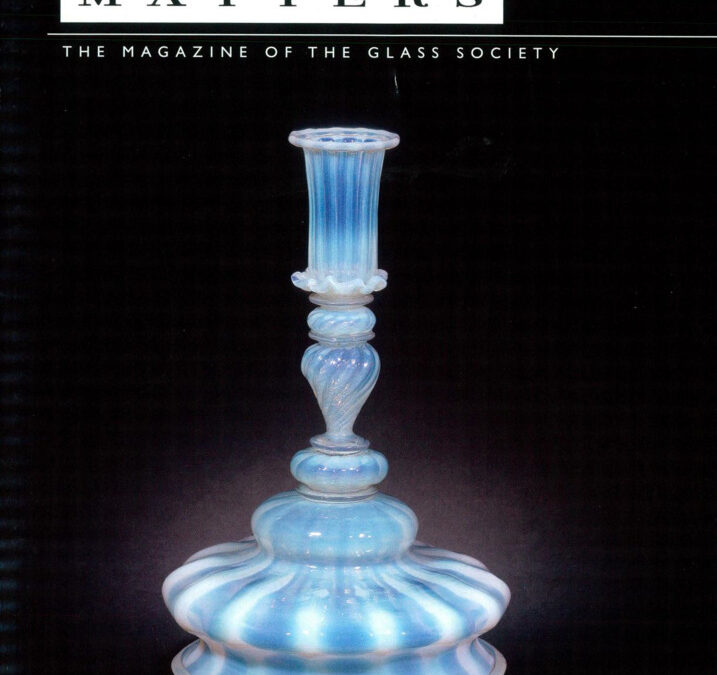
FRONT COVER:
A rare Venetian opalescent candlestick,
circa 1700, from the Cartwright Collection, formerly at
Aynhoe Park (see p.36 &
37)
BACK COVER:
Glass sculpture from contemporary glass
artist Luke Jerram,
Coronavirus — COVID-19,
23
cm in diameter (see p.28)
Chairmens’ message
Kant Engraved Glass
Glass and Society
Gunshot Glass
Lisbon Crystal Collection
Patrick Hogan Memoriam
Liberty 1776
Nature on Glass
Microbes in Glass
Glass Painting
Lili’s Venetian Glass
Pianon after Vistosi Pulcini
Glass in stamps
Letters (T & Y marks)
Manchester, Glass & Nelson
Cordial glasses
Letters
Glass Matters Issue no.I 0 January 2021
2
CHAIRMEN’S MESSAGE
Chairmen’s
Message
Time to Reflect and Lookk Forward
Sue Newell, Joint Chairman
of The Glass Society
1
t seems incredible that this is the
tenth issue of
Glass Matters,
and
coinciding with the start of a new
year, it seemed a good moment to
take stock and look forward. As we all
know, Covid-19 has changed the way
we live and while we may yearn for
a return to ‘normality’, many agree
that certain things have changed for
the better over the course of 2020.
Even with excellent speakers, the
decline in the numbers of members
attending GS meetings in person has
been a growing concern over recent
years. In response to the pandemic
and as with many societies, we aimed
to make the best of the situation by
connecting with members online.
So, since last summer, we’ve held
seven meetings on the Zoom plat-
form – six invited speakers and one
annual business meeting followed by
a ‘Show and Tell’ session – with over
100 and in some cases nearer 200
households attending online, rep-
resenting an increase of over 200%
on our normal attendance figures.
Holding meetings in this way
has driven home the fact that mem-
bers are dispersed all over the globe
and it has been great to
see
familiar
names popping up on the screen
from all parts of the U.K., as well
as from the Netherlands, America
and New Zealand. Following our
final talk of the year by the BBC
Antiques Roadshow glass special-
ist Andy McConnell, one member,
Peter Henderson, sent a note that
seems to sum up the sentiments of
many following our online meetings:
‘I just wanted to thank you for
the Andy McConnell talk. It was a
delight and wonderful for people like
me on the other side of the globe in
Australia. Listening in via Zoom does
make for a greater sense of inclusion!’
Just as with our attendees, the
geographical range of our speakers
has also broadened: Kit Maxwell
and James Measell delivered excel-
lent talks from the U.S.A. in a totally
seamless manner. Thank you to all
our speakers who made the meet-
ings so memorable and interest-
ing, and to all those who attended.
Regular talks are set to continue
into 2021 and we are always inter-
ested to hear from members about
new topics or even speakers who
have inspired them into wanting to
share the experience. Several mem-
bers let us know that to attend the
GS meetings Zoom was used for the
first time – and they’ve then gone on
to have regular family get-togethers
online. If you have not yet tried join-
ing GS meetings via Zoom and need
support on how to do this, please
get in touch: provided you have an
internet connection it is straight-
forward. The more members that
attend, the better we are able to
forge our society into a body with ‘a
greater sense of inclusion’. We don’t
expect all members to show the
same dedication as Peter in Australia
who joined Andy’s talk at 6am (his
time); if you are unable to attend on
the night, there is no need to miss
out: send an email telling us which
talks you would like to see, and we
David Willars, Joint Chairman
of The Glass Society
will give you access to the recordings.
In the current issue of
Glass
Matters
we are delighted, as usu-
al, to see an eclectic mix of articles,
including a second instalment about
a relatively unknown glass manu-
facturer from Manchester – a story
that developed from the depiction
of a glassworks on a marmalade jar.
Jim Peake reports on a sale held by
Bonhams of an important collec-
tion of Venetian glass, while Patricia
Ferguson and Kit Maxwell present
aspects of their respective talks on
Zoom from earlier in 2020. There
is also an article by John Hearne
on English and Irish ‘step-cut’ glass
that is now displayed at an important
museum in Lisbon. In another move
towards greater inclusion, if you
would like to receive the magazine
as a pdf document (in addition to the
printed version), please let us know.
Lastly, our continued thanks to
Brian Clarke for collating and edit-
ing this magazine, maintaining as
he does a consistently high standard.
We wish all our members,
whatever your particular inter-
ests, a very Happy New Year.
Susan Newell and David Willars
Joint Chairmen, The Glass Society
Glass Matters Issue no. I 0 January 2021
3
EMANUEL KANT PLUS SIX. WHY?
The
KONIGSBERG KANT GLASS
Simon Wain-Hobson
D
ecoration of the bowl can
transform an ordinary
drinking glass into some-
thing unique. Jacobite Amen glass-
es c1745 are the ultimate examples
of diamond point engraving. While
these plain stemmed and air twist
glasses don’t say much per se,
their inscriptions transport us to
another time and place, notably the
1745 uprising led by Bonnie Prince
Charlie, that has kept many a collec-
tor and researcher busy for years.’ In
1937 Arthur Churchill Ltd devoted
a catalogue to decorated Georgian
glass, mainly those with engraving.
Its title,
History in Glass,
says it all.
2
While researching an engraved
baluster glass c1730, recently
acquired from Peter Adamson, I
crossed email paths with David
Neave, the noted historian, partic-
ularly to do with anything linked to
Yorkshire. He asked me if I knew the
Kant glass, an opaque twist glass
with diamond point engraving,
(Fig.1).
I did not. It seems to have
gone little noticed, perhaps because
it has been in private hands in
Germany since 1763,
3
while its his-
tory takes place in Konigsberg – way
to the east of England; for all this,
it has strong connections with Hull.
The Konigsberg Kant glass is typ-
ical for a tall opaque twist stemmed
ale glass c1760, although it could
have been used for champagne or
wine. It is 21.6 cm high with a long
ogee bowl over a triple series opaque
twist stem: that is to say, an inner
opaque white core surrounded by
an opaque gauze with two outer
opaque threads, set on a conical
foot. The stem was broken and
repaired using a soldered tin collar.
About the stem is a gold plaid ribbon,
knotted, the significance of which
has been lost. It is the diamond
point inscription
(Fig.2)
that brings
ABOVE Fig.
I.
The Kant glass, a tall triple series opaque twist
glass with diamond point engraving. 21.6 cm.
© Ralf Kranert
BELOW Fig. 2
Inscription on the glass. The quality of the
engraving is varied, suggesting several hands. The
C of Chappoll is particularly badly executed
Secrecy in tam and sincerity
in friendship
it alive and, like the Tardis, teleports
us to Konigsberg, 30th August, 1763.
There are three parts to the engrav-
ing: the names, the text and the date.
THE NAMES
Of the seven, the first, the renowned
philosopher
Emanuel Kant MA
(1724-1804), stands out among all
the others – he was born and died in
Konigsberg at the easterly reaches of
eighteenth-century Prussia. It is now
Kaliningrad and home to a naval air
base in the Russian exclave between
Poland and Lithuania. Kant changed
his first name to Immanuel in 1746
believing that this spelling was closer
to its original meaning in Hebrew
4
.
Although Kant started his life lec-
turing on mathematics, physics,
logic and metaphysics, by 1763 he
had turned to philosophical issues.
Anthony Schorn
is probably Anton
Schorn, the son of a wine mer-
chant who lived in the nearby
town of Braunsberg, just south-
west of Konigsberg, now Braniewo
in today’s Poland. The father,
Michael Schorn, was an extremely
wealthy art collector and merchant
who had a wine company with
reaches to Bordeaux, Burgundy,
Champagne and the Rhineland.
Emanuel
–
‘Kant M. A.
Anthony ,Schorn
Joseph green
Robert !Motherby.
Joseph T… [?1
John Chappoff
rks
Staniforth
aff 31
–
appy together notwithstanding -what happenct in the World
August of 30th
1763
4
Glass Matters Issue no.I 0 January 2021
His ships carried
‘salt, limes, sugar,
coffee, window glass, exported, in
particular, Warmian yarn, flax, can-
vas and grain’
S
.
Kant once visited
the Schorn family in Braunsbergs.
Joseph Green (1727-86) and
Robert
Motherby (1736-1801) were mer-
chant partners who hailed from Hull.
The parents of Robert Motherby
and Joseph Green were close asso-
ciates from the 1720s. Green was
looking for an enterprising young
man to help with running his affairs
abroad. As Robert was only 12 when
his father died in 1748, it is proba-
ble that the Greens took Robert on
to help the family. Robert probably
set up shop in Konigsberg between
1751-55. As his older brother George
(1731-93) had come to Konigsberg
before him, it was not the end of the
world. George became a leading phy-
sician there at the ‘court of Prussia’
and has an entry in the
Oxford
Dictionary of National Biography.
He
is buried at Beverley Minster’. The
younger Robert
‘had the good sense
to marry into one of the prominent
commercial families of Konigsberg’
8
.
Green and the younger Motherby
got on so well that Robert eventual-
ly took over Green, Motherby & Co.
A successful Hull merchant meant
an owner of ships. Drawings of the
day depict the port of Hull with
scores of masts running as far as
the eye can see
(Fig.3).
Boats from
Hull, Newcastle and London plied
the North Sea, passed through the
Skagerrak and Kattegat to the Baltic,
and onwards to Stockholm and St.
Petersburg. Some 15-20 boats alone
did the Hull to Konigsberg route’.
A range of goods, including West
Riding cloth and Derbyshire lead, was
carried to the Baltic and Scandinavia,
while timber, iron ore, tar and linseed
were imported. Spruce linen yarn
and linseed were the most import-
ant goods imported into Hull from
Konigsberg. Initially the English
linen industry depended on Dutch
yarn, but by the mid-18th century
the import of Spruce linen yarn from
Prussia had overtaken that from the
Dutch. By the end of the century over
90% of the linen yarn imported into
England from Prussia landed in Hull,
on its way to the mills in Lancashire
and West Riding
7
‘
9
.
The ships that
crowded the harbour at Konigsberg
loaded with yarn worth — ship-ton
for ship-ton – five times as much as
tobacco, four times as much as sugar
and three times as much as pepper’ 10
The fifth name on the glass is
Fig. 3
The south east prospect of Kingston upon Hull by
Samuel and Nathan Buck 1745.
© David and Susan Heave
Joseph P-1, which doesn’t enlighten
us, while the sixth is
John
Chappoll
(1739-1776), no doubt
Chappell,
who
was about
24
years old at the time.
His father, Benjamin, was master of a
ship that plied the Hull to Konigsberg
route. Later, John became known
as
‘the Gentleman Captain. …John
Chappelle so loved books and poetry
that he never put out to sea without his
much-read copy of
Paradise Lost
or the
pensive wanderings of
Edward Young’s
Night-Thoughts on Life, Death &
Immortality.
From these he drew
solace on the long evenings in his cabin
away from his wife and only child’
11
.
John’s grandfather was a Huguenot
ship-owner who fled France for Hull
following the revocation in 1685 of
the Edict of Nantes by Louis XIV
7
.
At the helm we have
Charles
Staniforth
(1731-97), an influen-
tial merchant from Hull and later,
London. Charles Staniforth’s niece
Mary married Joseph Beckett who
is credited with setting up the lin-
en industry in Barnsley. Green and
Staniforth were brothers-in-law by
EMANUEL KANT PLUS SIX. WHY?
Glass Matters Issue no.I 0 January 2021
5
EMANUEL KANT PLUS SIX. WHY?
August 1763. Both were older and
better established than Motherby
who was not from a wealthy fam-
ily. Joseph Green and Robert
Motherby were known to have
been close friends of Kant for many
years up to the end of the eigh-
teenth century.
‘Green’s effect upon
Kant cannot be overestimated’
4.12;
indeed, he became Kant’s
‘best
friend’
8
.
Kant was a regular Sunday
guest at Motherby’s house. This
glass shows that they were at least
acquaintances by 1763, something
that has so far escaped Kant schol-
ars
8
.
Incidentally, it was Robert
Motherby who accompanied Kant
on his visit to the Schorn family
6
.
THE TEXT
Secrecy in love and sincerity in
Friendship and all Happy together
notwithstanding what happend in the
World (Fig.2).
Christine Battersby,
Emeritus Professor at the University
of Warwick, speculated
“that
‘secre-
cy in love’
is probably taken from
Samuel Butler’s
‘Hudibras’,
a seven-
teenth-century satirical text which
had been translated into German and
which Kant refers to”
13
.
Who can
quibble with
‘sincerity in Friendship’?
THE DATE
August of 30th
1763. While this
is a decidedly un-English way of
writing the date, the latter part of
the inscription,
all Happy…
is best
understood in conjunction with
the date. The Seven Years War
(1756-63) had seen a long series
of conflicts between the European
powers around the globe. Winston
Churchill described it as the first
world war. It pitted Great Britain,
Hanover, Portugal and emerging
Prussia under Frederick the Great
against France – unusually aligned
with Austria-Hungary – along with
Spain, Sweden and Russia. Russia
invaded East Prussia in early
1758 and then evacuated it after
the accession to the throne of the
pro-Prussian Peter III in 1762.
At the outset of the war the
French attacked Menorca in 1756.
Admiral John Byng (1704-57), a
Royal Naval officer and MP, was
sent to relieve the besieged garri-
son at Minorca. He failed and the
island was captured. On his return
to Britain, he was court-martialled
for failing to
‘do his utmost’.
He was
executed by firing squad on 14th
March 1757 despite appeals to
King George II for clemency. Byng
was seen by many as a scapegoat
for the Admiralty’s inefficiency and
the execution in this way of such a
high-ranking officer divided the
country. His descendants today con-
tinue to campaign for a posthumous
pardon. Macabre Byng glasses have
become collectable items
(Fig.4).
The Duke of Newcastle (1693-
1768), of Kneller Kit-Cat portrait
Fig. 4
An Admiral Byng air twist wine glass, engraved with him hanging from a
gibbet flanked by the initials A B, the reverse inscribed JUSTICE, 15.3 cm. ©
Woolley and Wallis Salisbury Salerooms
Fig. 5
A King of Prussia goblet with a portrait of Frederick the Great on horseback,
after an engraving by Daniel-Nicolas Chodowiecki, the reverse side with
a shield cartouche of the Prussian Eagle, flanked by TREDERIC.REK
AGED.47:1757′ & ‘GOD.BLESS.THE.KING.ORPRUSSIA: 20.6 cm (18,19).
Bonhams
Glass Matters Issue no. 10 January 2021
EMANUEL KANT PLUS SIX. WHY?
fame
14
, was Prime Minister for
the best part of the Seven Years
War. The British alignment with
Prussia, the attraction of Frederick
the Great (1712-86) and his suc-
cesses saw numerous Georgian
drinking glasses of the day engraved
with
Success to the King of Prussia.
A superbly engraved King of
Prussia glass dated 1757 is shown
in Fig.5. By contrast, Frederick’s
defeats – and there were several:
he fled the field at the Battle of
Lobositz in 1756 – were passed over.
The Treaty of Paris, signed 10
February 1763, ended the hostili-
ties between a strengthened Great
Britain and a weakened France,
which ceded Canada. The treaty
of Hubertusburg, signed five days
later, concluded the peace between
Austria, Prussia and Saxony. At the
opening of Parliament on 23 April
1763, King George III spoke in
favour of the Treaty of Paris. John
Wilkes MP (1725-97), member of
the Royal Society, violently attacked
the King’s speech in issue number
45 of
The North Briton.
This led
to attempts to silence him, which
ultimately failed. It saw
Liberty
and Wilkes
or
Success to Liberty and
Wilkes,
engraved on more than one
opaque twist drinking glass
(Fig.6).
With strong public support, Wilkes
was cleared by the Lord Chief
Justice; he was remembered as
the father of the British free press,
defender of civil and political liber-
ties and hero to American colonists,
who closely followed his outspoken
endorsements of liberty
20
. It
is
accepted that the outcome of the
Seven Years War set the stage for
the American War of Independence
that started a mere 12 years
after the Konigsberg gathering.
As always, wars took their toll
on state coffers. Currency depreci-
ation across northern Europe led to
inflation and all its attendant evils.
Currency, commodity and land
speculation were the main causes of
the commercial crisis that struck in
the summer of 1763. It started with
the de Neufville bank in Amsterdam
— almost half as large as the Bank of
Amsterdam – which suspended pay-
ments on 27th July. The crisis quick-
ly spread to Hamburg, Berlin and
Stockholm. There were 30 failures
in Amsterdam, 95 in Hamburg
15
.
Berlin was anything but spared;
crucially, Johann Ernst Gotzkowsky
(1710-75), one of the most import-
ant financial figures of the day in
Berlin, was in great difficulty. He
had neglected his factories to make
quick profits by financial specula-
tion. Throughout August, Frederick
II was trying to save the situation
and even offered to buy his factories.
It was not to be, for Gotzkowsky
had made many enemies, and his
difficulties rumbled on into the
next year
15
.
Green and Motherby
would have had debts as well as
being creditors. Everything would
have been called in. By 30th August
Fig. 6
Wilkes and Liberty double series opaque twist ale
glass, 18 cm. 0 Woolley and Wallis
Salisbury Salmmom
the text,
all Happy together notwith-
standing…,
suggests that Kant’s
friends knew that they had been
spared financial ruin. Furthermore,
Konigsberg was recovering from the
Russian retreat of 1762. That said,
Kant prospered through the pres-
ence of the Russians who attended
his lectures and paid him as a tutor..
THE GATHERING
The Kant glass could have been
made anywhere in England,
for merchants like Green and
Staniforth not only had the
financial clout to buy the glasses,
but they also had the means of
shipping them from anywhere to
Glass Matters Issue no. I 0 January 2021
7
EMANUEL KANT PLUS SIX. WHY?
Konigsberg. Staniforth and Green
had London connections and would
have known the fashions of the day.
As both were established merchants
by 1763, one of the two was the
most probable buyer and shipper.
Where was the glass inscribed
and by whom? The quality of the
diamond point engraving is varied,
from so-so to poor. There are spell-
ing mistakes, for example
Chappoll,
although such errors do occur with
top quality engravers as evidenced
by
Succefs to the ENTERPPIZE
on a Privateer glass
16,17.
Anthony suggests an English
corruption of Anton. As men-
tioned, the inscription refers to
Emanuel Kant as opposed to the
later Immanuel. As Kant claimed
that he had Scottish ancestors,
something that has never been
clearly established, it is possible
he used Emanuel with his English
friends. Likewise, Anton. Yet given
the wealth of these merchants, if
the engraving had been commis-
sioned, they would have found
someone good – after all, Dutch and
Bohemian engravers were capable
of magnificent feats circa 1763.
Possibly these seven men found
themselves at dinner in one of
their Konigsberg houses
all Happy
together
where they exchanged hor-
ror stories of close shaves, bank-
ruptcy and ruin. No doubt they
toasted their lucky escape. Maybe
a member of the party took one of
the glasses and started to inscribe
it. Others, added their lines and
names, with more or less success,
perhaps depending on blood alco-
hol levels. Maybe the glass was
broken that evening, which for
some was a lucky omen: remember
the eighteenth-century custom of
breaking slender stemmed toast-
ing glasses. As the Kant glass was
handed down directly within the
Motherby family from 1763 to
2008, Robert Motherby was prob-
ably the main culprit! The present
owner is a relative through mar-
riage seven generations down.
It would have been good
if the narrative ended here.
Unfortunately, all Happy togeth-
er… was not to last long for one.
The economic and financial con-
sequences of the Seven Years War
rumbled on.
“On July 10, 1765 the
councilor Schorn announced ‘against
all suspicions’ in front of the mayor”
the collapse of his company —
The
great house he ran, furniture, sil-
verware, servants and lackeys, his
hunting passion, gave the impression
of immense wealth, and yet sudden-
ly everything collapsed like a house
of cards. …The Schorn bankruptcy
also led to that of his son Anton’
S
.
`To see a World in a Grain of
Sand’
is the opening line of
William Blake’s poem
Auguries
to Innocence
first published in
1863. A tall opaque twist glass,
engraved exactly a century earli-
er, has allowed us to do just this.
The author is greatly indebted
to David Neave for bringing the
Kant glass to his attention and
much subtending research. He is
grateful to Christine Battersby,
Marianne Motherby – six genera-
tions down from Robert Motherby
– and the owner of the glass for
photos, historical research and
references, and Ralf Kranert,
Bonhams and Woolley & Wallis for
permission to reproduce photos.
REFERENCES
1.
Seddon GB,
The Jacobites and
their drinking glasses
(1995)
Antique Collectors Club,
Woodbridge
2.
Arthur Churchill Ltd.
History in
Glass
(1937) London
3.
Motherby M, Kant and die
Familie Motherby (2015).
https://www.freunde-kants.
com/motherby-kant-und-fami-
lie-motherby
4.
Kuehn M, Kant: A biography
(2001) Cambridge University
Press, Cambridge
5.
Buchholz F, Commemorative
publication for the 650th
anniversary of the city on June
23 and 24, 1934. https://www.
braunsberg-ostpreussen.de/
buchholz-ges.htm
6.
von Baczko L,
Geschichte meines
Lebens
(1824) vol. 2, p13
7.
David Neave, personal
communication
8.
Zammito JH, Kant, Herder, and the
Birth of Anthropology
(2002) The
University of Chicago Press. p103
9.
Oddy
JJ, European Commerce
shewing new and secure chan-
nels of trade with the Continent
of Europe
(1807) James
Humphrey’s, Philadelphia Vo11,
p235
10.
Jackson G,
Hull in the Eighteenth
Century
(1972), p130
11.
Retter C & Sinclair S,
Letters to
Ann: The love story ofMatthew
Flinders and Ann Chappelle,
(1999) Angus & Robertson,
Sydney, pp1-2
12.
Kuehn M,
Meet Mr. Green
(2001)
The Economist May 3.
13.
Battersby C, Cavarero, Kant
and the Arcs of Friendship
(2021) in
Toward an Ethics of
Sex, Nonviolence and the Body,
eds. Timothy J. Huzar and Clare
Woodford, Fordham University
Press, (in press)
14.
Wain-Hobson S,
The serious mis-
nomer ofKit-Cat glasses
(2019)
Glass Matters no. 6, p9
15.
Henderson OW,
The Berlin
Commercial Crisis of1763
(1962)
The Economic History Review,
New Series Vol 15 pp89-102
16.
Buckley F,
A History of Old English
Glass
(1925) Ernest Benn Ltd.,
London, pl.XXXIII(c) and p61
17.
https://www.bonhams.com/
auctions/20950/lot/47/
18.
Bless
J, Rare English Glasses of
the Seventeenth and Eighteenth
Centuries
(1925) Boston:
Houghton Mifflin Co., p195
19.
Cottle S, (1987)
The Glass Cone
no.14 p8
20.
Cash AH,
John Wilkes: The scan-
dalous father of civil liberty
(2008)
Yale University Press
8
Glass Matters Issue no.I 0 January 2021
quest, as a comparatively new
arrival to the glass world, to find
an entry point to understanding
the collection now in my care.
Typical of most decorative art
historians and curators, I had lit-
tle previous experience of glass
and, as I stood in the galleries,
looking at the serried ranks of
English lead glass drinking vessels,
I confess I struggled to summon
excitement. It seemed these ves-
sels were intended, by their very
clarity and understated design, to
be inconspicuous. Glass is notably
absent from broader discussions
of the decorative arts of this peri-
od; yet I understood, thanks to
the published works of Robert
Charleston, Dwight Lanmon and
Fig. 1
The Exhibition Catalogue cover.
Portrait of
John, Lord Mountstuart, later 4th Earl and
1st Marquess of Bute,
(detail), by Jean-Etienne
Liotarc4 Pastel on vellum, 1763, The J. Paul Getty
Museum.
GLASS AND SOCIETY
In
Sparkling
Company:
Class and the Costs of Social Life in Britain during the 1700s
Christopher Maxwell
0
n
21 July 2020 I had the
great honour of deliver-
ing the annual Robert
Charleston Memorial Lecture. In
times of crisis it is sometimes con-
soling to seek out the silver linings,
no matter how thin they might be.
For me, one of the greatest sources
of encouragement and enrichment
during the lockdown has been the
flowering of online lectures and
programming offered by museums
and specialist societies around the
world. The generosity with which
these organizations have cross-pro-
moted one another’s broadcasts
has opened up specialised subjects
to broader audiences. The opportu-
nity to enjoy these offerings from
the comfort of a sofa, in a pair of
slippers and perhaps with a glass
of wine (or cup of coffee, depend-
ing on the time zone) has also
doubtlessly encouraged people to
drop in and try something new. It
was wonderful to count over 190
log-ins to the Robert Charleston
Memorial Lecture from sever-
al time zones, and I was thrilled
to present my maiden lecture on
The Corning Museum of Glass’s
forthcoming exhibition to such a
robust and august audience. The
lecture was also recorded for pos-
terity (!) so, if you missed it, there
is an opportunity to catch up.
The exhibition at The Corning
Museum of Glass,
In Sparkling
Company: Glass and the Costs of
Social Life in Britain during the
1700s,
which opens in May 2021,
will be a critical and trenchant
survey of the functions, signif-
icance and meanings of glass
during this period. In many ways,
it reflects (pun intended) my own
Glass Matters Issue no.10 January 2021
9
many others, that this was a gold-
en age for British glassmaking, so
there was clearly more to uncover.
As a museum curator, I also believe
that describing an object as simply
important’, ‘rare’ or ‘innovative’ is
meaningless unless you can explain
why, especially in a museum with
over 40,000 objects all made of the
same material! I had work to do.
My first goal was to understand
for whom these objects were made
and marketed. Certainly, the con-
tents many of these vessels were
intended to hold would not have
been consumed across society. In
fact they would have been present
in only the wealthiest of house-
holds, probably no more than 3%
of the entire population. These
were the scions of society, the
landowners, the law makers, the
commercial plutocracy, and the
empire builders. Understanding
more about these people and the
values, tensions and preoccu-
pations of their milieu felt like a
useful step towards situating glass
within the rich material culture of
the British elite during this period.
The ensuing research lead me on
a
‘glassy path’
through scientific
and technical innovations, ideals
of politeness, colonial expansion
and contraction, the exploita-
tion of enslaved Africans and the
commercial dealings of the British
East India Company. Gradually,
these objects began to yield highly
compelling stories — far more, in
fact, than could be accommodated
in a single exhibition! I also began
to appreciate that glass was not just
present as tableware, looking glass-
es and lighting but also in scientif-
ic and navigational instruments,
architecture and costume. In fact, it
was almost everywhere. Eventually,
During the late 18th century, Hugh Percy, 1st Duke of
Northumberland, hired celebrated British architect Robert
Adam to design a lavish glass drawing room for his London
home. This unique room, measuring 36 by 22 feet, was panelled
between dado rail and architrave with red glass panels sprin-
kled on the reverse with flakes of metal foil, like large-scale
glitter. Today, this interior has become the central component
of the Corning Museum of Glass’s upcoming exhibition,
‘In
Sparkling Company: Glass and Social Life in Britain During the
1700s’,
which opens in May 2021. The drawing room
(Figs.2 &
3), whose glass panels were acquired by the Victoria and Albert
Museum during the 1950s, will be on view in its entirety for
the first time in 200 years, thanks to virtual reality technology.
In order to capture the room and its objects in 3D, Christopher
Maxwell, with Mandy Kritzeck – the Corning Museum’s digital
media producer, and the Noho team (a Dublin-based production
company), travelled to the V&A to measure and photograph –
from every possible angle – each of the room’s elements. They
also visited Syon House in London, another of Adam’s architec-
tural masterpieces, to examine the original chimneypiece, rein-
stalled at Syon after the demolition of Northumberland House.
Fig. 2
The 1st Duke of Northumberland’s glass drawing
room’s recently restored glass panels will be
displayed alongside Robert Adam’s original colour
design drawings, on loan from Sir John Soane’s
Museum. One of the pen, pencil, and colour wash
drawings is seen here. Photo: Ardon Bar Hama/
Courtesy of SirJohn Soane’s Museum, London
it became time to define the exhi-
bition’s interpretive goal – what
exactly did we want to achieve? Our
hope is, through a lens of glass, this
GLASS AND SOCIETY
10
Glass Matters Issue no.I 0 January 2021
GLASS AND SOCIETY
exhibition will show visitors what
it meant to be
‘modern’
in 18th-cen-
tury Britain, and what it cost.
I’ve discussed how the British
glass industry exploded during the
1700s, as part of the re-creation of
society following the restoration
of the monarchy in 1660 and the
Great Fire of London in 1666. The
1700s were a time of reconstructing
the luxury and society of times past
as well as setting the tone for the
future. Glass sellers continued to
import from the established areas
including Venice and Bohemia, but
the introduction of lead glass “crys-
tal” in the latter half of the 1600s
helped to establish the success of
English glassmakers in the 1700s.
By the start of the 18th century,
almost half of the glassmakers in
England were producing leaded
glass. The absence of lead glass
manufacture in much of continen-
tal Europe gave the British prime
position in the export market, bol-
stered by the demand from their
colonies. By 1694, one-third of the
annual English production was
exported. In the first half of 1714,
23,000 pieces of glass were export-
ed to France, which did not develop
its own lead glass until the 1780s.
The Museum’s own collec-
tion will be supplemented with
important loans from many insti-
tutions and collections on both
sides of the Atlantic, including the
V&A; the Sir John Soane’s Museum;
the Fashion Museum, Bath; the
Royal Museums, Greenwich; the
Beacon Museum at Whitehaven
in Cumbria; the Metropolitan
Museum of Art, New York City
(the ‘Mee); the Museum of Fine
Arts (MFA) Boston; the Los Angeles
County Museum of Art (LACMA);
the Cleveland Museum of Art, and
the Yale Center for British Art.
Ahead of the exhibition open-
ing, the Museum has released the
publication
In Sparkling Company:
Reflections on Glass in the Eighteenth-
Century British World (Fig.1).
It
contains eight essays contributed
by specialists in a variety of fields of
18th-century studies, each of whom
considers their area of expertise
from a glassy perspective. These
original and insightful offerings
cover ‘politeness’, architecture,
slavery, science, portraiture, cos-
tume, dining and even furniture.
They demonstrate that there are
many important contexts in which
to consider glass of this period. I
sincerely hope the conversation
will continue and that more people
will
see
the possibilities of glass.
From its design and technical
Fig. 3
Another one of the drawings, hinting at the
viewing of the VR experience once the exhibition
opens in May 2021. Robert Adam’s design for the
end wall of the drawing room at Northumberland
House, 1770-1773. Pen, pencil, and coloured
washes, including pink verdigris, and Indian
yellow on laid paper. Photo: Ardon Bar Hama /
Courtesy of Sir John Soane’s Museum, London
accomplishment to broader social,
political and cultural narratives,
18th-century glass is a truly fasci-
nating field and rich in opportunity!
In Sparkling Company: Reflections
of Glass in the Eighteenth-Century
British World
is available from
The Corning Museum of Glass
Shops at: https://shops.cmog.
org/sparkling-company-reflec-
tions-glass-18th-century-brit-
ish-world . Free international
shipping with code: ISC. The vol-
ume has been edited by Christopher
L.
Maxwell, with the specialist
contributions from Marvin Bolt,
Kimberly Chrisman- Campb ell,
Jennifer Y. Chuong, Melanie
Doderer-Winkler, Anna Moran,
Marcia Pointon, and Kerry Sinanan.
AUTHOR
Christopher (Kit) Maxwell’s full pre-
sentation of this topic was given as
the Glass Society’s second Zoom meet-
ing — motivated by restrictions result-
ing from Covid-19. A curator and
scholar, Kit was appointed Curator
of European Glass at The Corning
Museum of Glass in 2016. Kit had
worked at the Royal Collection at
Windsor Castle and in 2005 became
an assistant curator in the ceram-
ics and glass section at the Victoria
& Albert Museum. He left the V&A
to pursue his PhD at the University
of Glasgow, which he completed in
2014. Kit then re-joined the Royal
Collection as a project curator, over-
seeing the BBC Radio 4 series, The
Art of Monarchy’, broadcast in com-
memoration of The Queen’s Diamond
Jubilee. He currently holds the posi-
tion of Curator of Early Modern Glass
at The Corning Museum of Glass.
Glass Matters Issue no.10 January 2021
Fig. 2
Wax models, exploded with a gunshot
Fig. 3
Investment removed from the glass
sculptures, ready for finishing
Fig. 4
Sandblasted before sealing and gilding
GUNSHOT GLASS
Karen Browning:
Gunshot Class
T
hese sculptures, made
from shot wax mod-
els, were first made in
2008 in Bristol blue glass, but
concerned that people would
be offended by believing they
were glamourising guns and
violence, Karen didn’t develop
the idea. A few years ago, with
encouragement from Colin
Reid, she began again and called
them
Miss Spent Youth (Fig.1).
Karen says: “they are about
childhood, family, history, and
me: very personal pieces; the
violence and glamour of gun
crimes is farthest away from
their meaning. When growing
up, I saw guns not only as a
tool, to be used with respect,
but also as a sport, a business
and many of them as fine-look-
ing objects with an interesting
history. In this work, I see them as
fireworks are to explosives – busi-
ness in demolition, violence in war,
yet beauty in a fireworks display.”
Karen grew up on a farm with a
shooting ground and spent her child-
hood shooting targets, cans and other
random pieces. Her father, grandfa-
ther and great-uncles all shot on the
British team for clay pigeon shooting
from the 1950s to 1990 — inspiring
this body of work. Not attracted to
shooting clays, she was drawn to
the precision, concentration and
Fig. 1
Miss Spent Youth,
completed sculpture in
black and 24k gold (private collection)
local churches. Onwards again,
she joined the CGS and applied
to work with Colin Reid, where
she’s been since September
2004, learning all about casting,
polishing and mould-making.
Karen’s work is currently show-
ing with Colin Reid and a group
of kiln-cast glass artists in the
Thread of Light exhibition at
Liuli Museum Shanghai
(ref
pages 23 -25, Glass Matters 8).
KAREN’S MAKING METHOD
Make a Gelflex mould of the piece
to be cast, then pour wax into the
mould. Remove the wax model,
checking the temperature to give
external solidity yet a soft organic
interior. Then a final cooling down
(in their fish pond!) before shooting
it from 15 to 20m with a large calibre
(7.62mm), low-velocity round to cre-
ate a more dramatic entry and exit of
the wax, without disintegrating the
block
(Fig.2).
The wax block is then
invested in a refractory mould before
steaming out the wax. The required
volume of glass is measured before
loading it into the reservoir above
the mould, which is then put into the
kiln for casting; firing takes 8 to10
days. Lastly, de-mould
(Fig.3)
and
tidy up the glass with
diamond tools, sawing
off excess and grind-
ing off flashing. Once
tidy, lightly sandblast
to clean the surface
of trace bits of mould
mix
(Fig.4).
The grey,
unpolished surface of
the glass is then sealed,
to give back its black
colour and sized 20
minutes before gild-
ing by brushing on the
24k gold leaf
(Fig.1).
calmness required for long-range
rifle and pistol target shooting and
even learned to make her own ammu-
nition! Leaving school at 18, Karen
wanted to train as a gunsmith: not for
the violence & power of shooting but
for the beauty of the engineering and
the desire to engrave the stocks and
make Damascus barrels for shotguns.
She went to Swansea University, to
take an M.A. in Flat-Glass, yet learned
some casting in the basement; she
then assisted on the restoration of
a window from Clifton Cathedral,
Bristol, and the windows of other
I2
Glass Matters Issue no.I 0 January 2021
Fig. 1
The Museum of the Medeiros eAlmeida
Foundation, Lisbon, at night
he opened his car retail business and
became the exclusive Portuguese rep-
resentative of the Morris car compa-
ny (later British Leyland).
1
Between
then and the outbreak of WW2,
Medeiros e Almeida established
himself as a successful and respected
businessman in Portugal, and by the
1940s had become an important and
influential entrepreneur, establishing
Aeroportuguesa,
the first Portuguese
commercial airline. He also became
a significant political consultant.
2
From the early 1940s, he had
become a partner and key driving
force of
Casa Bensazide,
a major
business consortium with interests
mainly in the Azores. Then, during
WW2, the Azores became strategi-
cally important to the allied forces,
and attempts to gain access to the
islands’ resources and Portugal’s
territorial waters and port facilities
led to increased tensions between
Winston Churchill and Prime
Minister Antonio Salazar.’ Acting
as mediator, Antonio de Medeiros
e Almeida facilitated a compromise
agreement between the two men.
The services rendered by him during
the war were honoured by the British
government with an OBE in 1946,
and he was also invited by Salazar
to become Portuguese ambassador
to Britain, a position he declined.’
It was in the years immediate-
ly after the ending of hostilities
Fig. 2
Antonio de Medeiros eAlmeida aged 22
CRYSTAL COLLECTION
The
C stal Collection:
in the Museum of the Medeiros eAlmeida Foundation, Lisbon
John Hearne
S
ituated off a side street at the
northern end of Avenida da
Liberdade on Rua Rosa Araujo
41, Lisbon, stands the Museum of
the Medeiros e Almeida Foundation
(Fig.1).
This museum, housing the
eclectic art collections of its found-
er, Antonio de Medeiros e Almeida
and his wife Margarida Pinto Basto,
opened its doors to the public after
major renovation in July 2001.
Some years ago, I was contacted by
the museum, asking if I would be
willing to review and assess their
collection. I was delighted to agree,
and over three years visited the
museum on a number of occasions,
during which time I was in frequent
contact with the late John Smith,
working out provenance, origin
and period of the glass pieces. This
resulted in finding that around
eighty percent of the 188 pieces in
the collection are English crystal and
the rest Irish. The background to the
amassing of the collection follows.
BIOGRAPHY
Antonio de Medeiros e Almeida
(Fig.2)
was born in 1895 into a
wealthy family of Azorean parents
in Lisbon. His father, a respected
medical doctor in the city, was a pas-
sionate collector of
object d’art
and
this would have a major influence
on his son. In 1916, Antonio went to
Coimbra to study medicine. However,
realising that medicine was not for
him, he curtailed his studies and with
the financial support of his father he
travelled instead to Berlin to study
business management. After return-
ing to Lisbon, he married Margarida
Pinto Basto whose family owned
the famous Vista Alegre Porcelain
Manufactory. In the same year, 1924,
Glass Matters Issue no.I0 January 2021
13
LISBON CRYSTAL COLLECTION
that he began his acquisitions,
becoming a familiar figure in the
international auction rooms as
he became a more discerning art
collector. Antonio de Medeiros e
Almeida died in 1986 at the age
of 90. This museum is his legacy.
GLASS COLLECTION
In December 2016, the Director of
the Waterford Museum of Treasures
was contacted by the curators of the
Casa-Museu Medeiros e Almeida,
Lisbon, concerning a collection of
crystal that was now being collat-
ed and authenticated for the first
time. The reason behind this initial
contact was that it was perceived in
Lisbon that this collection of 188
separate pieces consisted predom-
inantly of Waterford crystal. I was
asked if it would be possible for me
to visit the museum and to appraise
the collection. My initial visit was
in February 2017, and many sub-
sequent visits followed until the
entire collection was examined. Of
major assistance in this task was
the meticulous documentation
pertaining to each purchase held
by the museum, from Medeiros e
Almeida’s earliest on 08 July, 1946,
to his final purchase on 27 June,
1973. The majority of his crystal
collection was acquired during the
1950s, bought from antique dealer
W.G.T. Burne
(Fig.3),
then working
from Berkeley Square, London Wl.
Burne was Medeiros e Almeida’s
advisor in relation to his crystal pur-
chases and provided provenance,
sketches and authentication – when-
ever possible – prior to purchase.
5
BELOW Fig. 3
W.G.T.Burne’s visiting card
VALUATIONS
.1,
n
41.0
.
.R OF tnIt BRITISH
WN
,
OVE 0.0.1…S
.
ASSOCIA
,
ON
,
OLD GLASS
a
\<1 CHINA. Burne would also recommend and send sketches of unusual or rare pieces that he had acquired; many pieces seem to have been from stately homes whose owners needed to dispose of them, having fallen on hard times during and in the aftermath of WW2. 6 Antonio de Medeiros e Almeida preferred one type of design, the `step-cut' (as described in the records), known nowadays as pris- matic cutting. Indeed, the majority of this unique collection have this design. The initial purchase of crystal was made on 08 July, 1946, and comprised: A dual bowl (two-piece) c.1810 £22.10s. A set of boat-shaped salts c.1810 £20. 2 oval dishes £22.10s. A pair of oblong butter dishes with covers and stands c.1810 £36 A pair of decanters with stoppers c.1810 and a tray c.1810 £14 TOTAL £115 There follows a selection of objects with this design. Fig.4 shows a footed vase, with a saw-cut rim with vertical flat-cut pillars, step cutting on the shoulder and star-cut on the foot. It was purchased on 14 February, 1952, presumably for £17.10s, though the item is on two invoices, one priced at £20. Fig.5 is displaying the following seven pieces: left to right, back row: BELOW Fig. 4 Footed vase, purchased 14 February, 1952, £17. lOs i. Small cream jug; ii. Helmet-shaped jug (c/f drawing Fig.6); iii. Round pre- serve jar with cover; iv. Ship's decanter and stopper; front row: v. Oblong dish/ tray (set of six), step-cut, with cut scal- loped rim c.1820; vi. Hexagonal dish with hexagonal stand, vertical and horizontal step-cutting, c.1800-20, set of four; vii. Round dish /piggin (set of six) step-cut with one fan ear. BELOW Fig. 5 Back Row Front Row 1.04 Jul.1954, £8. lOs v. 18 Dec.1956, £58 ii. 04111.1954, £27.10s vi. 03 Nov.1955, £47.10s iii. 04 Jul1954, £15.10s vii. Feb.1956, £95 iv. 11 Jun.1953, £19 14 Glass Matters Issue no.I 0 January 2021 xe o LISBON CRYSTAL COLLECTION Interestingly, whenever possible, Burne would provide information on the country of origin, a drawing, approximate date of production and the price and rarity or otherwise of the crystal purchases. These facts clearly show that the majority of the collection is English, as in Figs.7, 7a and 8, 8a. He also recorded the small- est piece of information: in Fig.8a the cost of this jar as per invoice is given as £12/10s; however, Burne men- tioned that he had included the cost of two lemon pear drops at £2/10s, as they were acquired later than the initial acquisitions, so the jar really cost £10. There are some pieces which were not identified by Burne, and in my opinion are dearly Irish. In 2017, dis- cussing this matter with John Smith, Fig. 6 Burne's pencil drawing of a jug top section similar to item ii. In Fig.5. The written text says: Very good condition, only one chip which is small and four tiny chips on the sharp edges. Price £18/10/ 2 . the chips are indicated by the drawn lines he concurred that the trays in partic- ular are more than likely Waterford along with a few salts and mustard pots (Fig.9). The trays in particular are identical to similar trays that were auc- tioned in Exeter in 2015 as part of the Penrose Waterford collection.' This would give a date c.1790s. The salts are also similar and some are identical to those currently held in Waterford Museum of Treasures' extensive glass collection, having a similar date. Other than these pieces and a few French and Italian pieces, which number no more than 20 out of the 188 in total, all are English. In 1958, an exhibition of English Decorative Art was held in Lisbon (Fig.10). Part of this crystal collection was dis- played at that exhibition (Fig.11). ABOVE LEFT Fig. 7 Drawing of a piggin shown in Fig.7a ABOVE RIGHT Fig.7a Two of what Bume described as erare set of six round dishes (piggins) one fan ear on each. First time in thirty years I have seen a set like this'. February 1956, £95 FAR LEFT Fig.8 Drawing of preserve jar in Fig.8a LEFT Fig.8a Circular glass preserve with cover, step-cut with circular foot c.1810. 14 February, 1952, £10. Glass Matters Issue no.I 0 January 2021 15 Fig. 9 Left: Mustard pot with round foot (Waterford) c.1800-20. Purchased 03 November, 1955 Right: An unusually very heavy salt cellar with square foot and tiered step-cut stem. One of a pair. (Waterford) 1790-1799 8 4 1 \18 (1 1 EXPO SIcA0 de C ARTE DECORATIVA INGLESA BELOW Fig. 11 Left: One of a 'pair of oblong salt cellars. Step-cut with saw rimMaterford) 1800-1810. 17 November, 1954, £5.10s. Right: One of a 'pair of English boat-shaped salt cellars, step-cut on oval base, 09 June, 1948, £10. b. 0 "640 , 0104K, 411111411. 1 ., ..11.111111*A :0 10 7.40 LISBON CRYSTAL COLLECTION The last purchase of crystal made by Antonio de Medeiros e Almeida was on 27 June, 1973, when he pur- chased 'a pair of early Victorian cut glass ships' decanters c.1840' from the antique dealer Julian Guest of Stamford in Lincolnshire. He paid £125 for the pair - but the crystal was not collected for another two years. 8 Other matters now concentrated his mind; 1973 proved to be an import- ant year in the development of the museum. In that year a new wing con- sisting of two floors was added to the original building and it was also the year in which the Medeiros e Almeida Foundation was created. Antonio, now 78, (Fig.12) donated all of his art collection and property to the founda- tion to give it financial independence. This involved a nearby plot of land where, in 1992, an office building — Edificio Fundacao — was constructed. This consolidated the Foundation's financial autonomy. The Foundation also inherited Ant6nio de Medeiros e Almeida's majority stake-holdings in the Azorean sugar and alcohol refineries. The museum was finally opened to the public in June 2001. 9 If there is one cultural event that you want to experience while in Lisbon, a visit to the Museum of the Medeiros e Almeida will provide that unique experience. Not only has this museum been recently described as `Lisbon's hidden gem', it is also per- haps one of Europe's hidden gems. Two rooms of the museum are shown in Figs.13 & 14. For safety, all of the glass trays, plates and smaller items are stored in closed drawers, which visitors can't open, while the larger pieces are in cabinets. To view all of the glass, it's best to arrange a visit in advance and the curators will set the crystal out on a table. Even when visiting the museum at short notice you will find the staff very welcoming and accommodating - the museum is privately funded and the staff are trying to publicise it to a wider audience. There is normal- ly a small entry fee of €6, but with notice of a visit, this may be waived FLINDA00 RICARDO DO ESPIRITO SANTO SILVA LEFT Fig. 10 Poster advertising the 1958 English Decorative Art exhibition; ARTE DECORATIVA INGLESA 16 Glass Matters Issue no.10 January 2021 LISBON CRYSTAL COLLECTION Fig.13 The Dining Room, with the table laid, and glass & ceramics also on show in the cabinet Fig. 12 Antonio de Medeims e Almeida, 1974 for GS members. Currently, due to Covid-19, the museum is closed. I extend a special thanks to the curators at Casa-Museu Medeiros e Almeida, Cristina Carvalho and Maria Mayer for their courtesy, hospitality and support during my visits in 2017 and 2018 and their prompt and eru- dite responses to subsequent inquiries. Obrigado p o r toda sua ajuda e gentileza. AUTHOR John Hearne worked with Waterford Crystal as a master cutter for twenty years before going to university and then on to teaching and lecturing in Ireland and in the USA. In 2010 he wrote a chapter for and edited `Glassmaking in Ireland' and, in 2018, published `Waterford Crystal, The Creation of a Global Brand 1700-2009'. He was finalising his book on this crystal glass collection when John Smith died, prompting him to put the book's comple- tion to one side. This article is the first publication of the story of the Museum of the Medeiros e Almeida Foundation in Lisbon, and its glass collection. REFERENCES 1. Fundacao Medeiros e Almeida, A Treasure in the City (Lisbon, 2002), pp.9-10. 2. Ibid, p.13. 3. AntOnio de Oliveira Salazar was born in 1889. An economist by profession, in 1928 he was offered the post of Minister of Finance and in 1932 was named Prime Minister of Portugal, a position he held until disabled by a stroke in 1968. Replaced without his knowledge by Marcelo Caetano, he died two years later on 27 July, 1970, aged 81. 4. Fundacao Medeiros e Almeida, A Treasure in the City, p.14. He was also awarded the Ordre du Merite Commercial by France, and Commander of the Ordem de Cristo was among many honours bestowed on him by Portugal. 5. Casa-Museu Medeiros e Almeida Archive/Glass Section. 6. In conversations pertaining to this collection with the late John Smith on 21 and 22 February, 2017, intimated that many of the items - as there were many identical sets - were probably from stately homes.He also mentioned that he thought the rectangular trays were Irish and more than likely Waterford, as were some salt-cellars, especially the heavy ones, and the mustard pot with round foot. John also asked me to write a report/ article on the collection. 7. The auction of the Penrose Waterford crystal was held in January 2015 at the Bearnes, Hampton & Littlewood auction rooms in Exeter, Devon. 8. Eventually, in a letter of 28 October, 1974, Medeiros e Almeida informed Guest that a friend, Mr. Lopo 9. Fundacao Medeiros e Almeida, A Treasure in the City, p.19. IMAGE ACKNOWLEDGMENTS Pictures courtesy of Casa-Museu Medeiros e Almeida photographic archive. All dates are the collec- tion purchase dates of the pieces, with prices when known. BELOW Fig.14 The Living Room Glass Matters Issue no. I 0 January 2021 17 IN MEMORIAM Remembering Patrick Hogan (1940 - 2020) NigelBenson I n May, we sadly lost a good friend, Patrick Hogan. A fellow glass enthusiast who had deep knowl- edge of Whitefriars and was a link to our glass past. He was a fount of knowledge to the Whitefriars frater- nity and knew many ex-Whitefriars workers who he'd also tap for infor- mation that was often then shared. Both his father, Edmond (1910- 1945), and his grandfather, James Hogan (1883-1948), worked and designed for Whitefriars Glassworks. James was the Managing Director and Chief Designer and Edmund ran the Stained Glass Department; they'd worked with Capt. H.J. Dunne-Cooke who owned and ran Elfverson & Co. and designed the elusive cut and polished 'Jazz Stick' figures. Patrick's mother, Kathleen, attended the Royal College of Art with Edmond, where she specialised in wood engraving and dress design. Kathleen had a few Whitefriars pieces in her possession, including a beautiful flint fruit bowl that was believed to have been made for one of the royal coronations — as with so many family memories, details escape over time. There was an amber glass ashtray and a flint glass lamp-shade holder containing coloured glass cul- let. Patrick had told his son James that he visited the Whitefriars factory as a boy and one of the glass blowers made him a swan which he took home. It wasn't until later, when visiting his aunt, Kathleen Blunt — Edmond's sister - who had recently moved from Hammersmith to a place near Oxford, that 'Aunt Kate' showed him a new glossy Whitefriars book - probably the Museum of London book. Kate mentioned to him she had helped the authors with information on her father and showed Patrick some of the Whitefriars pieces they had collected. Since the book was published in 1995, this could have been the event that peaked Patrick's interest and result- ed in him collecting glass. The family remembers that he would get up early for car boot sales and could seldom pass a charity or antiques shop with- out going in and searching for glass. Many of us have fond memories of Patrick. A keen collector of early Powell/Whitefriars, his interests then extended beyond that company to the work of the Boffo Brothers. Along with Steve Rayner (Wolf), Patrick researched the work of Vincente Boffo with particular interest in the figures and friggers that he made — the Boffo Brothers moved from Whitefriars to Malta, making glass with Michael Harris at Mdina Glass, then at Malta Decorative Glass. I first met Patrick in the mid-1990s when one of his aims in collecting glass was to find pieces that his grandfather James had designed for the firm - a wonderful ambition. I know it gave him much joy when he found an unusual item that could then be added to his collection. I occasionally managed to sell him pieces - he was a canny buyer! Patrick's son James remembers: Wy father has always had an eye for design and working with his hands. For many years he designed kitchens and fit- ted them and was much sought after due to his brilliant design ideas and he would often create bespoke solutions for his cli- ents. In another interesting project, my father created a wooden Canadian canoe from scratch using an antique canoe as the template for the one he built, and it was successfully used on the river Wye! While living at Brockweir, near Tintern, he put his hand to dry stone walling - teach- ing himself from books - and enclosed part of his garden with a new wall." Very keen on boats and the water, he owned and lived on a narrow boat, travelling the canals around the coun- try. Once, I was lucky enough to visit him on his boat, where he turned the tables on me and managed to sell me something! It was a lovely home and I was envious of the freedom it gave him. It is said that he used the heaviest pieces of Hogan glass as ballast for the narrow boat - mainly because he had acquired so many. It certainly reflect- ed the carefree side of the man who also revelled in the odd practical joke. Patrick did try his hand at glass making and recreated a Geoffrey Baxter slim 'Nuts and Bolts' design that can be seen on a page of pen- cil line drawings in the Museum of London book on Whitefriars, p.334; he made a mould for the glass maker, reversing the pattern and finishing it with a signature and date so that it could not be mistaken for a rare piece of Whitefriars. There are over twenty examples in different colours and vary- ing heights, all since dispersed to col- lectors or cherished within the family. Unfortunately, in his later years, Patrick suffered from CBD, a degen- erative brain disease. Having moved into a care home and not suffering the worst effects of CBD, he caught Covid-19, which caused his death. Not only I, but many in the glass world will miss him and regret his passing. Our condolences to his loving family who have lost a brother, father and grand- father. We wish him peace and that his God may go with him. In writing this piece, I am indebted to Patrick's son James for adding some family details and remembrances of his father. 18 Glass Matters Issue no. 10 January 2021 LIBERTY - CONTEMPORARY INSCRIPTION? An English flute glass, dated 1 776 Dwight P. Lanmon D rinking glasses were some- times engraved to commem- orate significant events and people in the 18th century. Upon seeing the English ale or champagne flute glass shown here (Fig. 1), many Americans would probably con- clude that the engraved inscription, "LIBERTY / 1776," is a celebration of the signing of the Declaration of Independence on July 4, 1776. Its relationship to the Declaration is the date and the prominent use of the word "LIBERTY," which occurs in the resounding statement of human rights in the preamble to the Declaration: "We hold these truths to be self-evident, that all men are created equal, that they are endowed by their Creator with certain unalienable Rights, that among these are Life, Liberty and the pursuit of Happiness." "Liberty" was a rallying cry throughout the British North American Colonies even before 1776, however. Liberty poles - poles topped with soft "Phrygian" caps, symbols of freedom first used in Rome after the assassination of Julius Caesar in 44 BC — were erected as early as 1765 in many American cities following the enactment of the British Stamp Act that year. They continued to be erected until the Revolution, and some were topped with a plaque marked "Liberty." An American separatist club with secret membership, The Sons of Liberty, was founded in Boston in 1765 to fight the Stamp Act, and it quickly grew to include members through- out the Colonies. It was officially disbanded after the repeal of the Fig. 1 Flute glass engraved - LIBERTY / 1776." Colorless lead glass; blown, wheel-engraved. England, ca. 1760-1770; engraved about 1776. H.17 cm. John Bryan collection Glass Matters Issue no.I 0 January 2021 19 LIBERTY - CONTEMPORARY INSCRIPTION? Act in 1766, but its symbol, a Liberty Pole (or Tree), became a widely popu- lar symbol of the rights of colonists. To my knowledge, however, the combination of the word "Liberty" and the date "1776" appears on no other glass, ceramic, or metal object of 18th century English or American origin. That immediate- ly prompts two questions: are the inscription and date of the period of the glass, and does the inscrip- tion celebrate the Declaration of Independence or some other event? THE FORM OF THE GLASS The glass, itself, is a relatively com- mon type of English 18th century drinking glass. Many similar glasses dating from the second half of the 18th century were engraved with depictions of hops and barley, identi- fying their intended use for the con- sumption of ale. However, not all of the glasses in this form were made expressly for ale, and other exam- ples of the same form are known with depictions of grapevines, indicating their use for imbibing champagne, apples for cider, pears for perry, and beehives for mead. Tall-bowled glasses such as these were rarely engraved with toasts or other sentiments; toasts appear more frequently on the bowls of wineglasses or goblets. Among six English 18th-century flute glass- es I have found, with apparent inscribed toasts, two are engraved "WILKES and LIBERTY / No 45." 1 PRODUCING THE INSCRIPTION The bowls of many 18th centu- ry English flute glasses were left undecorated. Inscribing one with the eleven characters found on the "LIBERTY / 1776" glass would be a relatively easy task for a trained wheel engraver today, and doing so would immediately increase the value of the glass by a factor of twen- ty times or more. Thus, a bright red flag of suspicion of potential unauthenticity must be addressed. The inscription on this glass was produced by copper-wheel engraving. One of the areas that often plagued wheel engravers was the production of smooth curves, particularly rounded letters or numbers. Well-trained engravers could produce smooth curves, but less proficient engravers produced them by incising linked short dashes, which gives a chattered appearance. Others moved the glass lightly across the rotating engraving wheel, giving rounded forms a "brushed" appearance. Producing well-formed letters and numerals seems to have been particularly difficult. Indeed, it is evident that some wheel engravers in 18th century England found it more difficult to produce clear typography than elaborate decorations of ships with intricate rigging, multi-petaled flowers, foliage, vines, and other motifs. For example, on a group of mid-18th-century English drinking glasses known as "Privateer glasses," elaborate depictions of ships used by English naval privateers are accom- panied by inscriptions identifying the ship and sometimes her master. While depicting the ship required considerable skill, producing the lettering was apparently beyond the engravers' abilities, because on nearly every authentic example (perhaps every authentic example?), the inscriptions were produced by scratching with a diamond point. Fig. 2 Detail of the engraved inscription The engraver of the "LIBERTY / 1776" glass was competent (Fig. 2). The curved portions of the letters "B" and "R" and the numer- al "6" for instance, are smooth, with little chatter or separate strokes (although the lower curve of the "6" shows some chatter). WHEN WAS THE INSCRIPTION ADDED TO THE GLASS? Closely examining the engraving reveals nothing suspicious that would indicate it was done recently. The engraving has a slightly gray- ish cast, suggestive of the gradual buildup through the years of dirt and dust embedded in the minute roughness of the engraved surface. It does not have the stark white- ness of some new engraving, and it does not have a brownish tint to it which, in my experience, is an immediate giveaway of someone trying to make new engraving look old. I know of no objective analytical method for distinguishing between old and recent engraving, and I believe it is impossible to determine whether the grayish cast found on the engraving on the flute glass occurred in fifty years or through more than two hundred years. 2 Copper-wheel engraving has changed little through the centuries, beyond the substitution of electric 20 Glass Matters Issue no. I 0 January 2021 LIBERTY - CONTEMPORARY INSCRIPTION? Fig. 3 Details of the engraving motors to power the engraving wheels and the abrasives used. In the 18th century a powdered natu- ral abrasive - emery, a mineral com- posed of corundum and magnetite - was used. Typically, it would not have been very uniform and would tend to chip the edges of engrav- ing. Today, engravers mainly use a variety of abrasives, including pow- dered carborundum and aluminium oxide or diamond-coated wheels. Examining the engraved letters and numbers on the "LIBERTY / 1776" glass under magnification reveals that the abrasive used was not a uniform powder (Fig.3). There are linear scratches within the engraving, indicative of the use of a non-uniform abrasive powder; the slight chipping of the edges sug- gests the use of natural corundum or emery, which was the abrasive typi- cally used in the 18th century. But, because powdered natural emery was still being used by some engrav- ers until the mid-20th-century, means that its use is not proof that the engraving on the flute glass was done in the 18th century, but it does not preclude that possibility, either. Lacking an objective analytical method, distinguishing modern engraving from old still relies pri- marily on the art-historical method: comparing the engraving on glass- es of uncertain authenticity with examples of known (or accepted) authenticity. In cases where the engraver mistakenly uses a fea- ture that is inappropriate for the supposed period of the engraving (such as using a typography devel- oped later), drawing a negative conclusion is straightforward. THE TYPOGRAPHY OF THE INSCRIPTION The inscription "LIBERTY / 1776" is in a serif typeface. Block-letter ("Roman") serif typefaces were widely used in England in the 18th century and were available in printed penmanship copybooks for metal and glass engravers and scribes to copy. Copybooks would have been very useful in that regard, because they would show sever- al different fonts. For example, a Beilby-enameled goblet is inscribed with three different fonts (Italic, Gothic, and Roman), which were like- ly copied from such a book (Fig. 4). The name of the particular type- face used on the "LIBERTY / 1776" glass has not been identified (yet), but the forms of the letters, with ver- tical strokes considerably wider than the horizontals, are consistent with William Caslon's Roman font, first used in 1728. The primary differ- ence between Caslon's font and that used on this glass is Caslon's use of the capital letter "I" to represent the numeral "1." Arabic numerals were used in fonts for everything but the numeral "one" throughout the 18th century (except on such things as publications, where Roman numerals were seemingly consistently used to indicate the year of publication). The substitution of the Arabic numeral "1" for the Roman "I" in printed doc- uments occurred around the mid- 18th century in England. (The capital letter "J" to represent the numeral was also occasionally used in the 18th century.) The transition from Roman to Arabic numerals seems to have evolved from the use of the Arabic "1" in written documents. 3 Dated English 18th-century drinking glasses are rare, but the Arabic numeral "1" was occasion- ally used to inscribe dates on glass from the mid-18th-century, on. The Beilby family, for example, enameled a tumbler dated "1778" using a font that is very similar to that on the "LIBERTY / 1776" glass, along with a numeral "1" (Fig. 5). 4 Therefore, there is no reason to question the authenticity of the inscription on the "1776" glass simply on the basis of the use of the Arabic numeral "1." 18TH CENTURY ENGLISH DRINKING GLASSES INSCRIBED "LIBERTY" "Liberty," the concept that a per- son possesses the right to follow their own will in things that the Glass Matters Issue no. 10 January 2021 21 LIBERTY - CONTEMPORARY INSCRIPTION Fig. 4 Goblet (detail) inscribed on the bowl "LIBERTY & Clavering For Ever" in white enamel, within a yellow and red cartouche. Colorless and opaque white lead glass; blown and enameled. England, Newcastle-on-Tyne, enameled by a member of the Beilby family, ca. 1768. H.19.4 cm. The Corning Museum of Glass (79.2.63, gift of the Ruth Bryan Strauss Memorial Foundation) Fig. 5 Tumbler with enameled decoration, inscribed WBELL. Colorless lead glass; blown and enameled. England, Newcastle-on-Tyne, enameled by a member of the Belk family, dated 1778. H.9.8 cm. The Corning Museum of Glass (79.2.71, gift of The Ruth Bryan Strauss Memorial Foundation) law does not prohibit or be subject to the arbitrary wills of others, has been discussed and debated since at least the time of ancient Greece, and it was actively debated and espoused by philosophers and politicians during the period of the Enlightenment in the 18th century. It is not surprising, therefore, that an 18th century English drinking glass would be inscribed with the word, and, indeed, there are sever- al English glasses dating from the mid-18th-century that are inscribed "Liberty." None to my knowledge, however, relates to the American Declaration of Independence. One example inscribed "Liberty" is illustrated (Fig. 4), where the word was used as an electioneering cry for a British Parliamentary candidate in the 1760s. Another type that is known in several examples has an engraved depiction of a rearing horse under a banner inscribed "LIBERTY." The horse has been identified as the White Horse of Hanover or Westphalia, which was the personal badge of the Electors of Hanover. A white horse on red ground was part of the British royal coat of arms from 1714 until 1837. WILKES AND LIBERTY Some eighteenth-century English drinking glasses inscribed "Liberty" are associated with John Wilkes (1725-1798). The inscription on these glasses is usually "WILKES AND LIBERTY / NO 45." On anoth- er, the inscription is accompanied by an engraved bird cage with a bird fly- ing free. 5 That phrase also appears on numerous 18th century English creamware teapots and on punch bowls made in China for export to England and the American colonies in the 1760s and 1770s. There are also English porcelain figurines of Wilkes, depicting him holding a document inscribed "Bill of Rights" and supported by a Cupid holding a Liberty Cap. In Boston, a Liberty Tree was reportedly decorated with "No. 45 Wilkes and Liberty" in 1768. 6 John Wilkes was a popular and influential English politician who variously railed against the King, his ministers, and Parliament, and was also an outspoken supporter of the American revolutionary cause. Elected to Parliament in 1757 and again in 1761, he supported the government of Thomas Pitt the Elder and Britain's involvement in the Seven Years' War (1756-1763). That war, though expensive for England, resulted in significant territorial gains in the American Colonies and India, but many of those gains were negotiated away to France in the Treaty of Paris in 1763. The end of the war was, therefore, both hailed and criticized in Britain — especially by Wilkes. When a Scotsman, John Stuart, 3rd Earl of Bute, ousted Pitt and became Prime Minister in 1762, Wilkes launched a radical weekly news circular, The North Briton, on 22 Glass Matters Issue no.I0 January 2021 LIBERTY - CONTEMPORARY INSCRIPTION? June 5. (Wilkes was the persona of the newspaper.) He mounted attacks on many politicians with insults and rumors, but Bute's Scottish roots and policies were his favorite target. "Liberty" was a consistent theme of the circular, and from the beginning he posed a spirited defense of the civil rights of English citizens. Wilkes was particularly angered when the Seven Years' War was concluded by the Treaty of Paris in 1763, which he considered to be overly generous in conceding many of Britain's war-won gains to France. Bute resigned on April 8, 1763, but his influence did not end immediately; he drafted a speech for the King, endorsing the Treaty of Paris, which was delivered in Parliament on April 23, 1763. Wilkes ominously criticized the King's speech and Bute in issue Number 45 of The North Briton: The King of England is only the first magistrate of this country; but is invested by law with the whole execu- tive power. He is, however, responsible to his people for the due execution of the royal functions.... The people too have their prerogative, and, I hope, the fine words of Dryden will be engraven upon our hearts: Freedom is the English subject's prerogative.' The King was incensed and directed that a general warrant be issued for the arrest of 49 people - everyone involved in the publication of Number 45 of The North Briton. Wilkes was charged with seditious libel and imprisoned briefly in the Tower of London, but he chal- lenged the warrant for his arrest on the basis of its unconstitutionality because, as a member of the House of Commons, he was privileged from arrest for anything but treason and breach of the peace. He won the case, and after his release, supporters on both sides of the Atlantic chant- ed "Wilkes and Liberty!," "Wilkes, Liberty and Number 45!", and sometimes just "45!," which became popular rallying cries for resistance to power and advocating freedom of speech. 8 The slogans appeared on ceramics, glass, and in prints. The number of the issue, 45, also remind- ed many of the abortive Jacobite Rising, known as "The '45," which was decisively crushed in Scotland — and alluded to Bute's Scottish background (who Wilkes suggest- ed was actually a closet Jacobite). Emboldened by his success in court, and no doubt because of the strength of his support in the streets, Wilkes and Thomas Potter wrote and published a pornograph- ic poem attacking prominent politicians. It caused a scandal in Parliament and Wilkes was expelled, but he fled to Paris before he could be arrested. He was tried in absen- tia for obscene and seditious libel and was declared an outlaw on January 19, 1764. Nearing bank- ruptcy, he returned to England in 1768, was elected to Parliament as a Radical Member for Middlesex on an anti-government platform, but surrendered to the court and was sentenced to prison for two years for libel. He was expelled from Parliament as an outlaw, but was re-elected three more times; his elec- tion was overturned by Parliament each time, until his opponent was finally declared the winner. His supporters formed the Bill of Rights Society, which tried to overturn Parliament's rejection, and they agitated for Parliamentary reforms. Wilkes became an Alderman of London in 1769 and convinced Parliament to reverse the resolu- tion naming him an outlaw, which had prevented him from sitting. Parliament attempted to prohibit publication of its debates in February 1771 and ordered the arrest of two of Wilkes's printers. Wilkes chal- lenged the decision, and after a large crowd surrounded Parliament, they ordered the men released and aban- doned their position. Wilkes was defeated in a 1790 bid for re-election to Parliament and retired from poli- tics. He died on December 29, 1797. Wilkes was a memorable politi- cian with a far-flung following, and he had many significant achieve- ments in his support of the rights of the common man. Among those was his proposed sweeping reform of parliament in 1776 to eliminate the "rotten boroughs" that were dis- proportionately represented in the House of Commons, which thereby no longer truly represented the peo- ple. Although widely popular among the English, the bill failed, and the reform he proposed was not institut- ed until 1832. The historic signifi- cance of his bill is highlighted by the phrase "A bill for a just and equal rep- resentation of the people of England in Parliament" which is inscribed on the document dated 1776 which Wilkes holds in a memorial statue erected in London in 1988. OTHER GLASSES INSCRIBED "LIBERTY." Other glass objects inscribed "Liberty" were also produced in the 18th century, but apart from wine- glasses engraved in the Netherlands with a leaping horse and inscribed "Liberty," "Liberty and George," and "Aurea Libertas" I know of none that predates the American Revolution. Among the glass objects made to cel- ebrate American independence after the end of the Revolutionary War are some opaque white glass mugs that were produced in Bohemia for the American market around 1790-1810; they are decorated with stylized eagles with spread wings, suggesting the heraldic eagle on the American Great Seal, which was first used in 1782 (Fig. 6). An engraved tumbler inscribed "Liberty" was also made at the New Bremen (Maryland) glass factory of John Frederick Amelung (Fig. 7). The factory operated from 1784- 1795. The tumbler may have been made to celebrate the ratification of the American Constitution in 1788. Glass Matters Issue no. I 0 January 2021 23 ( I 111 ifrx LIBERTY - CONTEMPORARY INSCRIPTION? It should also be noted that virtually every coin issued by the United States Government fea- tured the word "LIBERTY" and a female head, often with a Liberty Cap, or full figure as its personi- fication on the obverse, from the first coin minted in 1793 until the last image of Liberty was removed from American coinage in 1947. COULD THE "LIBERTY / 1776" FLUTE GLASS BE OF AMERICAN MANUFACTURE? The question of whether the flute glass might have been made in America must be addressed. In my opinion, it is unquestionably English. It is made of brilliant, col- orless lead glass, which is consistent with table glass made in England in the 18th century, and the form has numerous close parallels among col- lections of English drinking glasses. If the glass predates the inscrip- tion "1776" and was made in America in the 1760s or early 1770s, there was only one American glass- house that could have produced it: the Manheim (Pennsylvania) glass- house of Henry William Stiegel. That factory produced lead glass objects in the English style, but the facto- ry closed in bankruptcy in 1774. There is only one wineglass that has been attributed to the Stiegel fac- tory (Fig. 8). The glass was engraved for William and Elizabeth Old, daughter and son-in-law of glass- house owner Henry William Stiegel, who were married in 1773. The glass itself, with its opaque white twist stem, could be of English manufac- ture, although the large cup-shaped bowl is unusual for an English-made glass. Unless the flute glass was made at the Stiegel factory before it closed in 1774 and was engraved later, there is no other known pre-Revolutionary American facto- ry where it could have been made. A factory operating in the Philadelphia (Pennsylvania) area between 1794 and 1797 was the next factory believed to have made colorless lead glass in America, which is almost certainly too late to have been the source of the flute glass. 9 In any case, there are no doc- umented glasses from that factory. ENGLISH TABLEWARE MADE IN SUPPORT OF THE AMERICAN COLONIES If the "LIBERTY / 1776" flute glass is of English manufacture and was engraved in the late 1770s to show support for the American colonies, how does one explain why such a glass would be engraved in England Fig. 6 Mug decorated with an eagle and inscribed "Liberty." Opaque white non-lead glass; blown, enameled, gilt. Bohemia, made for the American market, ca. 1790-1810. H.12.2 cm. The CorningMuseum of Glass (93.3.42, gift of Fred Hoyt) Fig. 7 Tumbler, engraved "Liberty." Colorless non-lead glass; blown, wheel- engraved. Maryland, New Bremen Glassmanufactory of John Frederick Amelung, ca. 1788-1789. H.16.2 cm. The Corning Museum of Glass (79.4.333, gift of Jerome Strauss) 24 Glass Matters Issue no. 10 January 2021 LIBERTY - CONTEMPORARY INSCRIPTION? with an outwardly pro-colonial action that was condemned by the government? There is evidence that some British openly support- ed the North American Colonial cause, and English manufacturers produced wares for the American market that voiced support for it. For example, there are numerous creamware and pearlware teapots emblazoned "No Stamp Act," which reflect the American opposition to taxes levied on the Colonies in 1765, and some examples are addi- tionally inscribed on the reverse, "American Liberty Restored." But rather than being made to support resistance to the Act, the tea pots were probably made to commem- orate its repeal in 1766. I know of no other manufactured English objects that overtly supported the American Revolutionary cause. CONCLUSIONS Is there a chance that the engraving was not added in the 18th century? Yes. But if it was done recently, the cunning engraver used an old- style abrasive. In that case, the target audience was certainly an American collector and the intent was to capitalize on the associa- tion of the inscription "LIBERTY / 1776" with the Declaration of Independence. However, I believe that the likelihood the "LIBERTY / 1776" inscription is recent is remote. I conclude therefore that: 1. The "LIBERTY / 1776" inscription is authentically of about the same period as the flute glass; it was not added some two hundred years later. 2. Which of two possible events that occurred in 1776 does the flute glass commemorate? The most obvious is the American Declaration of Independence. The second is John Wilkes's submis- sion of the Act of Reform to the House of Commons. I know of no English object or print produced either in support of Wilkes's act of reform or commemorating the Declaration of Independence. However, given the abundance of commemorative objects inscribed "Liberty" that are associated with John Wilkes, I conclude that the flute glass was most likely engraved in celebration of the act of reform that Wilkes proposed in 1776. AUTHOR At Winterthur Museum from 1966, Dwight Lanmon joined The Corning Museum of Glass in 1972 and became its Director from 1981 to 1992. Dwight returned to Winterthur Museum as the Director in 1992 where he remained until retiring in 1999. He is the Glass Society's Honorary Vice-President and now applies himself to original research. BIBLIOGRAPHY 1. Fitzwilliam Museum, Cambridge (C.640-1961). It bears the engraved inscription "WILKES and LIBERTY / N° 45" and also shows an open bird cage with a bird flying free. A second flute glass, engraved "Wilkes and Fig. 8 Wineglass made in celebration of the marriage ofElizabeth Stiegel and William Old. Colorless and opaque white lead glass; blown, wheel-engraved; double-series opaque white twist stem. Attributed to the American Flint Glass Manufactory of Henry William Stiegel, Manheim, Pennsylvania; probably engraved by Lazarus Isaacs, ca. 1773. H.17.2 cm. The Corning Museum of Glass (87.4.55, gift in part of Roland C. and Sarah Kathvyn Luther, Roland C. Luther III, Edwin C. Luther III, and Ann Luther Dexter). Liberty / N° 45" was sold by Bonhams, London, December 16, 2009, lot 49. 2. An analytical technique that has not been used (to my knowledge) to identify fraudulent wheel engraving is non-destructive X-ray fluores- cence to detect microscopic remains of abrasives that were not available in the 18th century. For example, detecting carborundum (silicon carbide), which was first commer- cially produced in 1893, would be proof of modern work. Likewise, if pure aluminum oxide were used, it might be identified by the lack of contaminants which would have been present if natural corundum were used. 3. For example, the manuscript Declaration of Independence used the Arabic numeral "1" in the date "1776," while the first official printed copy of the Declaration used the Roman numeral "I." 4. There are slight differences in the forms of the letters "B" and "E" on the Beilby glass from those on the flute glass, so the fonts are not the same. 5. Fitzwilliam Museum, Cambridge, bequest of Donald H. Beves (C.640-1961). 6. London Chronicle, 13-16 Aug. 1768. 7. North Briton, number 45, April 23, 1763, p. 268. 8. Parliament promptly passed an act removing the protection of Members of Parliament from arrest for seditious libel. 9. Arlene Palmer, "A Philadelphia Glasshouse, 1784-1797," Journal of Glass Studies, 21 (1979), pp. 102-114. Glass Matters Issue no.I 0 January 2021 25 NATURE ON GLASS The Tendril Wine Class Henry Cole, Felix Summerly and Richard Redgrave James Measell I n Glass Matters 8, May 2020, the Tendril wine glass was mentioned, accompanied by an illustration from Henry Cole's Journal of Design and Manufactures (March 1849). Cole described the Tendril wine glass as follows: 'The ornament which gives this glass its name winds round the stem and is of green pot-metal. The vine leaves are enamelled in gold on the bowl.' Students of botany know that a tendril is the threadlike stem of a climbing plant that winds around any support, and such a description certainly fits the Tendril wine glass. This article provides background on Henry Cole's Felix Summerly prod- ucts, along with additional informa- tion regarding the Tendril wine glass designed by artist Richard Redgrave. In the 1840s while using the pseud- onym Felix Summerly, Henry Cole authored handbooks to such sites as Hampton Court, Westminster Abbey and the National Gallery. He also wrote a successful Home Treasury series of children's books featuring colour illus- trations. From 1846 through to 1848, Cole was involved in the creation and marketing of various manufactured products under his fictitious name. Cole was acquainted with many well- known artists - including John Bell, Charles West Cope, Thomas Creswick, John Rogers Herbert, John Callcott Horsley, Daniel Maclise, William Mulready and Richard Redgrave - and he persuaded several of them to design utilitarian and decorative products. When Summerly's Art-Manufactures issued catalogues or advertised in The Athenaeum or Railway Chronicle, the names of the designers for spe- cific artides were usually indicated. In addition to a small number of items made in glass, the array of Felix Summerly products included precious metals as well as bronze, ivory, china, earthenware, carved wood, and ornamental iron or brass. In his Nineteenth Century British Glass, Hugh Wakefield notes some Felix Summerly products designed by Richard Redgrave but not the Tendril wine glass. Art historian Barbara Morris mentions the Tendril wine glass in both Victorian Table Glass and Ornaments and Inspiration for Design, and a black & white illustration of the Tendril wine glass appears in Isobel Armstrong's Victorian Glassworlds without comment in a discussion of the labour involved in glassmaking. Frances Collard (Burlington Magazine, May 1994) was aware of the Tendril wine glass, but her major interest is Redgrave's design work for glass decanters and a papier-mâché tray. Charles Hajdamach's British Glass 1800-1914 illustrates the Tendril wine glass in a black & white photo- graph along with other wine glasses. Henry Cole's `Summerly's Art- Manufactures' sought to develop products `Shewing the Union of Fine Art with Manufacture.' In printed announcements entitled Art-Manufactures Collected by Felix Summerly, Cole asserted that 'man- ufacturing skill is pre-eminent and abounds; but artistic skill has to be wedded with it.' In March-Apri11848, the Society of Arts sponsored the Free Exhibition of British Manufactures at its headquarters building in John Street, Adelphi, London, and Felix Summerly's Art-Manufactures had numerous items on display. A full- page advertisement in The Athenaeum (18 March 1848) listed and described more than fifty articles that could be seen at the exhibition and invit- ed merchants to obtain the printed Art-Manufactures Circular issued by the Summerly organisation. In addition to the Tendril wine glass, the advertisement in The Athenaeum listed several other articles in glass designed by Richard Redgrave - a Water Lily goblet and Well Spring vase (made by Christy & Co.) and flask decant- ers and accompanying wine glasses (made by Richardson Glassworks). The Tendril wine glass was described as 'designed and ornamented in enam- elled colours by R. Redgrave, A.R.A., made by Richardson's for Summerley's Art-Manufactures; exhibited by J. Green' [a dealer in glass and porce- lain located in 19 St. James Street]. Fig 1 Tendril wine glass drawing, watercolour rendering by Richard Redgrave, c. 1847. Courtesy ofthe Dudley Archives and Local History Centre, ref D7/Y3/43 26 Glass Matters Issue no. 10 January 2021 NATURE ON GLASS Immediately following this descrip- tion, an entry for a similar wine glass appeared: The same, coated withgreen Glass and cut, made by Richardson's and mounted by B. Smith' [a dealer in precious metals located in 12 Duke street, Lincoln's Inn Fields]. Identical full-page advertisements appeared in the Railway Chronicle (25 March and 15 April 1848), but later notices for Summerly products in this pub- lication (21 October, 25 November, 30 December, and 6 January 1849) did not mention the Tendril wine glass. In Fifty Years of Public Work of Sir Henry Cole, a posthumous account of Cole's life edited by his son and daughter, the Tendril wine glass is described as 'ornamented in enam- elled colours,' and its manufacture is credited to 'Messrs. Christie [sic].' Cole claimed that his Summerly Art-Manufactures 'will aim to produce in each article superior utility, which is not to be sacrificed to ornament; to select pure forms; to decorate each article with appropriate details relating to its use, and to obtain these details as directly as possible from Nature.' Such is in keep- ing with Redgrave's philosophy of design in which art and design prin- ciples derived from nature were para- mount. Despite the impressive group of established artists who designed various articles and Henry Cole's extraordinary ability to gain publici- ty, Summerly Art-Manufactures was short-lived. The venture was the object of satire in Punch on several occasions (July-December 1847). About the same time, The Art-Union (September 1847) heralded Cole's efforts as 'a project pregnant with immensely ben- eficial results to British manufactured art' and predicted 'a revolution in man- ufactured art,' but, only a year later, the publication termed Summerly Art-Manufactures a 'complete failure.' As indicated earlier, Cole's Journal (March 1849) listed the Tendril wine glass as 'manufactured by Richardson's and described it as a crystal wine glass that has green glass 'round the stem' and 'vine leaves ... enamelled in gold on the bowl.' Cole noted that the decorative ornamentation served to `necessarily raise the cost of the glass above the average.' Indeed, the chair making such an item at Richardson's likely required a second servitor to gather the green glass during produc- tion. Moreover, the time needed to apply a thread of transparent green glass around the stem by the gaffer would diminish the number of wine glasses that could be made by the chair during six hours of glassmak- ing. As described below, examples of the Tendril wine glass are known with crystal used to form the distinc- tive applied glass ornamentation. A Tendril wine glass, formerly dis- played at Broadfield House, enables one to understand the separate dec- orative techniques that give this item its distinctive botanical name. The bowl, stem and foot are crystal glass, and a thread of crystal glass is applied. As seen in the pho- to, the thread winds evenly around the stem, extending from the lower area of the bowl to just above the foot. The thread is hand-painted with gilt enamel, and, at the point where the thread ends on the bowl, hand-painted gilt enamel continues the appearance of a spiralling tendril. The final touch, a hand-painted leaf in gilt enamel, completes the decora- tion. This example has the c. late 1840s 'RICHARDSON VITRIFIED ENAMEL COLORS' marking under the foot. Henry Cole's separate descriptions of the Tendril wine glass in 1848 and 1849 and Felix Summerly's advertising suggest that there are two versions of this interesting glass artide, one with crystal to create the tendril around the stem and another with transpar- ent green glass forming the tendril. Perhaps a reader has an example of the latter version in his/her collection? If so, I would be delighted to hear of it! James Measell is an Honorary Research Fellow at the University of Birmingham. He can be contact- ed by email: jsmeasell@gmail.com BIBLIOGRAPHY 1. Art-Manufactures Collected by Felix Summerly, fourth edition (Chiswick: C. Wittingham 1847). 2. The Art-Union, vol. 9 (September 1847), p. 326 and vol. 10 (September 1848), p. 279. 3. Elizabeth Bonython and Anthony Burton, The Great Exhibitor: The Life and Work of Henry Cole (London: V&A Publications, 2003). 4. `Summerly's Art Manufactures,' Chapter 6 in Fifty Years of Public Work of Sir Henry Cole, ed. By Alan Summerly Cole and Henrietta Cole, vol. II (London: George Bell and Sons, 1884), pp. 178-194. FAR LEFT Fig. 2 Tendril wine glass, 13.4 an LEFT Fig. 3 Manufacturer's mark on the underside of the foot Glass Matters Issue no. 10 January 2021 27 MICROBES IN GLASS Luke Jerram: Glass artist B ritish artist Luke Jerram's latest glass sculpture, titled Coronavirus — COVID-19, is 23 cm in diameter, which makes it approximately two million times larger than the actual size of the virus (Fig.1). In a tribute to global health research teams and doctors who are working round the clock to fight the pandemic, the glass sculpture was commissioned by the Duke University School of Engineering in the USA eight weeks before the World Health Organisation (WHO) declared COVID-19 as a global pandemic crisis. The proceeds from this glass model will be given to Medecins Sans Frontieres (MSF), which is assisting developing nations combat the ris- ing COVID-19 pandemic challenge. Luke Jerram explains his approach as "Helping to commu- nicate the form of the virus to the public; the artwork has been creat- ed as an alternative representation to the artificially coloured imagery received from the media." Luke developed glass microbiology as he was interested in how we see the world and in exploring the edges of perception: "While doing my early research, and being colour blind, I discovered that viruses, since they are smaller than the wavelength of light, are colourless; the trans- parent and colourless glassworks Fig. 1 Coronavirus - COVID-19 viruses being colourful in nature: ren- dered in colourless glass, they stand as pieces of beauty, contrasting with their life-threatening repercussions. Scientists officially approve the technical drawings of the sculptures before they are put into practice. He says that this collaboration helps him achieve the ideas he has envis- aged: "With my basic understand- ing of engineering I can solve many problems, so have conversations with engineers and specialists to realise my artworks, as in Fig.2. I think many people appreciate these works including scientists and non-specialists. The artworks help the public understand and visualise that which is otherwise invisible." Fig. 2 bacteriophage Image Credit: Courtesy of Luke Jerram reverse the artificial colouring pro- duced for scientific understanding." Since the time Jerram developed glass microbiology in 2004, his artis- tic practice has been devoted to creat- ing artworks that represent diseases such as Swine Flu, Ebola, Smallpox and HIV and the severe outcomes they have on the global population. The sculptures are a careful move away from the popular representation of 28 Glass Matters Issue no.I 0 January 2021 REVERSE AND BACK-PAINTED GLASS `Glass Pictures 9 Chinese reverse painted glass and English back painted glass in the 18th century Patricia F. Ferguson I n 1751, the English artist and letter-writer Mrs Mary Delaney (1700-88) wrote of how her friend, the wealthy Irish intellectual Mrs Elizabeth Vesey (1715-1791), `had a whim to have Indian figures and flowers cut out and oiled, to be transparent and pasted in her dress- ing-room window in imitation ofpaint- ing on glass'. 1 These elite women were evidently cutting up Chinese woodblock prints with exotic and foreign ornamental images. The prints were probably from Suzhou, near Shanghai, mass-produced in the hundreds for the domestic market, which also found their way to Europe through agents of the East India Companies. Few exam- ples survive, perhaps consumed through ephemeral domestic hob- bies such as those described above. Delaney was famous for her paper-mosaicksc paper-cuts of botan- ical specimens, a skill she began at the age of 72. Craftwork has a long association with female sociability, companionship and gift giving, used to personalise and ornament the home. Creating pictures framed to hang on the wall were among these new pastimes, and here, cleverly, Vesey oiled her opaque paper cut- outs, often hand-coloured in China, to make them appear transparent, before pasting them onto the glass windowpanes of her dressing room, framed by the wooden mullions. The room was possibly in the fashion- able chinoiserie taste, a private and intimate space located in her Irish home, Lucan House, Co. Dublin. This reference, 'in imitation of painting on glass', has often been interpreted as early evidence of the appreciation in Britain of Chinese reverse painting on glass, which, in 1751, would have been mir- rored looking-glasses (Fig.1). More convincingly however, Delaney is probably comparing it to exam- ples of amateur and professional reverse painted prints stuck on the back of glass panels, with the out- lines 'transferred' on to the glass, a process sometimes known as `back painting'. This short paper considers both techniques and is hopefully of interest to scholars of the history of glass and its decora- tion, as well as its use and display. 2 Since at least 1738, Chinese painted mirrors had been import- ed into England, largely through the private trade of agents of the Honourable East India Company (HEIC). Significantly, the plate glass was European as the Chinese were not yet able to produce sufficiently fine mirrored glass and much of it was produced in Britain. By the early Fig. 1 Chinese figures in a landscape, c. 1745-1755, reverse glass painting with giltwood frame, London, c. 1757. 106 x 66 cm. Saltram House, Devon. © National Trust Images Glass Matters Issue no. I 0 January 2021 29 REVERSE AND BACK-PAINTED GLASS Fig. 2 Chinese Couple in an elite interior, Canton, mid-18th century, reverse glass painting within a japanned toilet mirror frame, London, c. 1750-70. 60x 53 on. Lazenby Collection, Marble Hill House, Twickenham, Richmond. English Heritage. © Historic England Archive 18th century, England had moved from a second-rate glass producer dependent upon imports of fine Continental sources to a level of world domination as an exporter. Much of this English glass, bev- elled or tapering at the edges, was described as looking-glass plate', `Crown glass' or 'Vauxhall plate glass'; however, Vauxhall was not the only glass house in London producing good quality glass, there were several others, includ- ing Blackfriars, near Fleet Street. As part of their private trade on the voyage to China, HEIC captains and supercargoes included plain, unframed looking glasses as early as 1709; the glass may have been directly exchanged with Canton merchants for Chinese trade goods such as porcelain, fans, lacquer ware, embroidered silk, or tea, or else given as gifts to Canton officials. London merchants sometimes sent bespoke mirrored glass pre-cut for specific purposes, such as this shaped toilet mirror from the mid-18th century, set in an English japanned frame and designed to be displayed at an acute angle with a hinged arm on the reverse (Fig.2) - at least one oth- er example of this shape is known with a similar interior scene, pos- sibly ordered at the same time, the English frame matched with various japanned toilet accessories. 3 When sat at her toilette, each time she looked into the mirror to apply her maquillage, an English lady would have been transported to China, enjoying accurate depictions of the privileged Chinese mandarins, their costumes, furnishing and architec- ture, framing her visage with the tall columns and raised curtain, in a chinoiserie-themed dressing room. 4 From 1720, skilled artisans in China, specifically Canton, had developed a new technique of painting in reverse on imported European glass mirrors by scraping away the silvered reflective coating made from an amalgam of tin and mercury (or quicksilver), follow- ing designs drawn on the surface. European oil paints were skilfully applied backwards or in reverse order, gold details were added first, followed by light colours and then darker backgrounds, though not nec- essarily layered: more outlined. The mirrored sections frequently formed the sky or a body of water. The tech- nique may have begun as a clever re-use of costly mirrored glass that had lost some of its silvering during transport to China, caused by damp leading to the corrosion of the tin. In Europe, the technique of reverse painting on glass has a long tradition, but was relatively rare on expensive looking glasses. The earliest reference to the technique in China appears in 1722, when a dignitary, possibly from Canton, sent mirrors painted with 'flowers along the edges' as tribute to the Kangxi emperor; subsequent tributes in 1731 and 1733 also mention floral motifs on painted glass, but exam- ples have yet to be identified. 5 These early designs presumably appealed to the Emperor and his courtiers, but they may also represent the taste of wealthy Canton merchants and offi- cials, the so-called 'port barons' and their families, who are depicted in many of the glass paintings (Figs.2 & 3). These objects clearly fascinated European merchants, who were con- stantly on the lookout for unusual luxury goods to bring back to Europe as stock or gifts. The technique con- tinued into the 19th century, but became increasingly commercial, employing plain glass as a cost saving. 30 Glass Matters Issue no.I 0 January 2021 REVERSE AND BACK-PAINTED GLASS The Chinese were not the only ones painting in reverse on glass, an ancient technique introduced into Europe in the 14th century. In Europe, amateurs and profession- als also produced ornamental or decorative pictures on glass using techniques similar to the Canton artisans, painting directly in reverse on glass with opaque pigments ground in shellac, varnish or linseed oil. From the 16th century, the tech- nique was very much a Continental specialty, known in Germany as Hinterglasmalerei (reverse glass painting), and by the 18th century, a number are signed and dated - many were copies of print sources. English examples are rare. 6 As Chinese paint- ed mirrors were imported in ever greater numbers into England from the 1740s, they may have inspired Fig. 3 Two Women Reading with Maid-servant by the Water's Edge, Canton, mid-18th century, reverse glass painting with papier »Oche frame, London, mid-18th century, 166.4 x 89.5 an. Courtesy Christie's, New York an interest in learning how to paint on glass `in the Chinese way': on 27 January 1764, a London painter adver- tised his services in The London Gazetteer offer- ing to teach Chinese painting on glass for pictures as well as cas- kets. Much more fash- ionable throughout the 18th-century was a novel technique involving prints, his- torically described as `glass prints', 'glass pictures', or 'back painting' (Fig.4). Glass prints were created using mez- zotints, a printing process invented in the mid-17th century, which had a wide range of tonality with deep velvety blacks capable of reproducing on paper the painterly appearance found in oil paintings. As described in various texts, mez- zotints were first soaked in water for several hours, then removed and allowed to dry, the excess water being absorbed by a cloth. A damp print was glued face down onto a sheet of crown glass of the same size applied with Venice turpen- tine, then the paper was moistened again and rubbed with fingers or a sponge to remove or roll away most of the paper. A tissue-thin layer of paper with the printer's ink out- lines, or just the ink, remained and was washed with multiple layers of mastic varnish to create a trans- parent effect, which when dry was hand-coloured employing a limited number of pigments, before being framed. The hand-painting required very little skill except neatness, as the shading in the print retained the details; the result seen from behind resembles the simplici- ty of a paint-by-number picture. Mezzotints were not inexpensive, but the continuous tone simplified the work of the painter; the tech- nique was an English specialty, and less common on the Continent. Back painting is thought to date from the late 17th century, and a 1683 unpublished manuscript by Edward Luttrell survives at the Yale Centre for British Art, New Haven, with a description of the process, which already by then was 'in great use among all persons of quality and may be improved beyond imagination'.' The process was first published in John Smith (1647/8-1727), The Art of Painting in Oyl (London, 1687) and in the fifth edition, published in 1723, the term back painting appears in Chapter XIX, The Art of Back Painting, Mezotincto Prints, with Oyl-Colours'. 8 In 1688, John Stalker, a London writer, and George Parker, an Oxford varnisher and japanner, included a chapter on how to fix mezzotints onto glass for paint- ing in their Treatise of Japanning and Varnishing (Oxford, 1688), for `Ladies that desire instructions' in that art. The technique repeating almost verbatim Stalker and Parker was added to the eighth edition of William Salmon (1644-1713), Polygraphice: or the Arts of Drawing, Engraving, Etching, Limning, Painting, Vernishing, Japaning, Gilding, etc. (London, 1701). A chapter in The Art of Painting upon Glafs, was included in The Method of Learning to Draw in Perspective (London, 1732), parts of which were based on the manu- script of Robert Boyle (1627-1691). In a treatise aimed at profession- als, Robert Dossie (1717-1777), Handmaid to the Arts (London, 1753), describes the process in his Chapter XII, 'Of the taking of mezzotinto prints on glass and painting upon them with Glass Matters Issue no. I 0 January 2021 31 REVERSE AND BACK-PAINTED GLASS oil, or varnish colours', and the term `back-painting' was mentioned in Temple Henry Croker (1729-1790), The Complete Dictionary of Arts and Sciences (London: 1764'-66). These references confirm the techniques popularity throughout the 18th century, which contin- ued into the early 19th century Now rare, this once-common art form was probably the inspiration for Mrs Delaney and Mrs Vezey's paintings on glass', indeed, they may have even practised the technique themselves or have seen it for sale in smart London print shops. A favou- rite pastime for young women, they were also professionally executed for print publishers. Around 1747, Peter Griffin, a print seller on Fleet Street, sold `Metzo-tinto heads & historys Black or Painted on Glass'. 9 While in 1748, the Boston Evening Post advertised 'Mezzotint Prints— Just imported, and to be sold by James Buch at the Spectacles in Queens Street, a choice Assortment of Maps and Prints, plaine and coloured, fine Mezzotintoes pick'd out for the Ladies to paint, with the very best of London crown Glass', and in 1757, the Boston Gazette announced a delivery from London of 'a Variety of Metzitento Pictures painted on Glass'. 1 ° From around 1750, humorous mezzotints (known as `drolls'), of poster-size (14 x 10 ins), became a favourite subject for 'transferring' onto painted glass, especially in the 1770s and 1780s, particularly adapted for country booksellers and stationers, as well as exportation to India and America. 11 These drolls were non-political satire based on amusing social sit- uations, attacking the pretensions of the fashionable 'nouveau riche'. The standard reference work on Chinese reverse painted glass mirrors by Margaret Jourdain and Soame Jenyns, Chinese Export Art of the Eighteenth Century (1950), mistakenly described the Chinese examples as `back-painting', a term which is still found in recent lit- erature. 12 European copper-plate engraved prints begin to appear as the direct source for Chinese reverse glass paintings with the rise of neo- classicism in the 1760s. European merchants provided fashionable prints for Cantonese painters to copy around the same time that Fig. 4 Henry Overton (publisher), Figures in a landscape with a woman painting (an Allegory of painting), mezzotint transferred to glass and painted on reverse, London, c. 1740s, in its original frame. 25.3 x 35.3 cm. ©The Trustees of The British Museum 32 Glass Matters Issue no. I 0 January 2021 REVERSE AND BACK-PAINTED GLASS Fig. 5 Black and white image, after 'A View from ye Island Seat of ye Lake of ye Temple of Venus & Hermitage in the Gardens, of Earl Temple at Stowe, in Buckinghamshire', Canton, after 1753, reverse glass painting with later giltwood fatale. 53 x84 cm. Lazenby Collection, Marble Hill House, Twickenham, Richmond. English Heritage. © Historic England Archive less expensive plain glass began to replace mirrored glass. A Chinese painted mirror in the Rosemary and Monty Lazenby Bequest pre- sented through the National Art Collections Fund to Marble Hill House, Richmond upon Thames, London, is after 'AView from ye Island Seat of ye Lake of ye Temple of Venus & Hermitage in the Gardens, of Earl Temple at Stowe, in Buckinghamshire', a drawing by Jean-Baptiste Chatelain (1710-1758), which was engraved by George Bickham, the Younger (c. 1706-1771) published in 1753; the mirror must date to around 1755 to 1770 (Fig.5). The walls of Mrs. Vesey's dressing room may well have been hung with a com- bination of Chinese reverse paint- ings on glass and English reverse painted prints transferred onto glass, perhaps including examples of the latter that she had painted. Glass pictures were far more common in the 18th century than surviving examples might sug- gest. Throughout the century, English consumers shared a taste for colourful decorative glass pic- tures painted by amateurs and professionals to enhance their interiors, whether imported from China, executed on English glass, or locally made employing mezzo- tints 'transferred' onto glass. Both techniques exploited the inherent features of glass: its translucency, clarity and highly polished surface. AUTHOR Patricia Ferguson is an adviser on ceramics to the National Trust and has worked as a curator at the British Museum and Victoria & Albert Museum. Her recent pub- 4. lications include 'Ceramics: 400 years of British Collecting in 100 Masterpieces (2016)', and 'Pots, Prints and Politics: Ceramics with an Agenda, 1450-1950', (2021) 5. 1. Lady Llanover (ed.), The 6. Autobiography and Correspondence of Mary Granville, Mrs. Delaney (London: 1861), 39-40. 2. For a discussion of Chinese painted mirrors, see Thierry Audric, Chinese Reverse Painted Glass, 1720-1820: An Artistic Meeting Between China and the West (Bern; New York: 2020), and Patricia F. Ferguson, 'Reflecting Asia: the reception of Chinese reverse glass 7. paintings in Britain, 1738-1770', in Francine Giese, Hans Bjarne Thomsen, Elisa Ambrosio, and Alina Martimyanova (eds), China and the West. Reconsidering Chinese 8. Reverse Glass Painting. Arts of Glass Series (Vitrocentre Romont: 2021), forthcoming. 9. 3. British Library, India Office Records, E/1/10 ff. 571-572v, Captain Daniel Small of the 10. Cambridge, sailing to Canton, 11. requested permission to bring 12. on board T100 worth of looking glasses' on 24 December 1719; and Audric 2020, 181-2, no. 97. See for the shape a silver mirror dated 1768-70, in James Rothwell and Louisa Brouwer, 'For a 'dear valuable and best friend': a looking glass by Frederick Kandler at Ickworth House, Suffolk', Burlington Magazine, vol. 162, no. 1410 (September 2020), 766-773, fig. 8. Audric 2020, 26-7. The few signed and dated examples are by Continental artists, see Frieder Ryser, Reverse painting on glass : the Ryser Collection (Corning, NY: 1992), nos. 59-61; Antony Griffiths, Tlinterglasmalerei (reverse glass painting)', Print Quarterly, vol. )00( (2013), 61-63; Wolfgang Steiner et al, `... eine andere Art von Malerey : Hinterglasgemalde and ihre Vorlagen 1550-1850 (Berlin : 2012). Ann Massing, 'From print to paint- ing: the technique of glass transfer painting', Print Quarterly. vol. VI, no. 4, December 1989, 383-393, 385, fn. 8. This is the dockmaker and not the engraver John Smith (c. 1652-c.1742). Timothy Clayton, The English Print, 1688-1802, (New Haven; London: 1997), 108. Stanley 2006, 151. Clayton 1997, 223. Margaret Jourdain and R. Soames Jenyns, Chinese Export Art in the Eighteenth Century (London: 1950), 34. BIBLIOGRAPHY Glass Matters Issue no. I 0 January 2021 33 Ititt,. lot 1' tt , .-1101100.1e-- LILI'S VENETIAN GLASS VENETIAN GLASS from the Cartwright Collection, Aynhoe Park: Auctioned at Bonhams, Knigharidge Jun Peale T his online auction, held in September, was Bonhams' postponed Spring 2020 auc- tion and included 98 lots of glass, centred around 33 lots of early Venetian and fawn de Venise glass from the Cartwright Collection. Owing to the ongoing coronavirus pandemic, most buyers embraced the internet to participate. The Cartwright collection was perhaps one of the last intact pre- war collections of early glass still in private hands and reflected the taste of a lady who appreciated early Venetian and fawn de Venise glass long before the Rothschilds and other celebrated collectors of such early glass. The unpublished pieces forming the collection are excep- tional in that they were acquired in the 19th century, some as early as the 1820s, and were passed down through the family. The consid- erable interest that early and rare pieces with unbroken provenance generate, resulted in high prices being achieved for the collection. The collector, Lady Maria Elisabeth Augusta Cartwright, née von Sandizell (1805-1902), was the eldest daughter of Count Thomas von Sandizell. She was brought up at the family home of Schloss Sandizell and educated at the Maison Royale, a boarding school for daughters of the nobility. 'Lill', as she was known, met the English diplomat Sir Thomas Cartwright (1795-1850), then Secretary to the English Legation in Munich, during the Munich Carnival in 1824. As the wife of a diplomat, Lili lived much of her early life abroad, first in Munich, later in Frankfurt and latterly in Stockholm. She visited the Cartwright ancestral home at Aynhoe Park near Banbury in Oxfordshire several times between 1828 and 1847, during which time she painted numerous waterco- lours of the house; many of these are reproduced in the 1989 book by Elizabeth Cartwright-Hignett, Lili at Aynhoe (1989). She also visited her family home at Schloss Sandizell as often as she could and spent much time in and around the Bavarian Court of King Maximillian and the Swedish Court of King Oscar. Lili had begun to collect glass and porcelain early on during her time in Munich in the 1820s, and records in her diary many of her expeditions to auctions and dealers. She was given several porcelain groups by the Queen of Bavaria who had them specially made as gifts for her favou- rites. She retired to Leamington Spa soon after her husband's death in 1850, where she remained until her own death in April 1902, aged 97. Her son, William Cornwallis Cartwright, inherited her collec- tion. A keen collector of glass him- self, he added several pieces to his mother's glass collection, a number of which were purchased from the prominent Munich dealer A S Drey. The collection remained in the family following William's death in 34 Glass Matters Issue no. I 0 January 2021 LILI'S VENETIAN GLASS November 1915. In the mid-20th century, much of it was displayed in the drawing room at Aynhoe, within two cabinets which were prone to smoulder owing to the eccentric- ities of the electric lighting inside! They remained in the cabinets until the estate was sold in 1960; this is the first time these pieces have seen the 'light of day' and been offered to the market in well over a century. The highlight of the collection was undoubtedly an exceptional fawn de Venise gilded, enamelled and engraved vase and cover dating to circa 1570-91 (Fig. 1). This piece belongs to a distinctive group of glass with a characteristic grey tint and cold-painted and diamond-point engraved decoration, with a long-ac- cepted attribution to the Court Glasshouse at Innsbruck. Archduke Ferdinand II of Tyrol founded this glasshouse in the garden of his home at Schloss Ambras, Innsbruck, in 1570, having become increasing- ly dissatisfied with the glass made at Hall, a small town just east of Innsbruck, where the first glass- house in Tyrol had operated since 1534, together with the continued reliance on Venice for luxury table- ware for use at his new residence. Through negotiations with the Venetian authorities, he secured the temporary loan of craftsmen from Murano and obtained permission to use various raw materials and tools brought from Venice. Although never commercially viable, a num- ber of Venetian master glassblow- ers were recorded at Innsbruck, all of whom returned to Murano once they had honoured their con- tracts. The Archduke also employed around 50 painters, probably from Germany and each with different artistic talents. The cold-painted decoration on these wares was usu- ally executed in red, green and gold, reflecting Germanic taste. Bought by Lili in 1889 from the collection of Reverend William Fraine Fortescue of Chesterton, Oxfordshire, this piece was sold for over four times the lower estimate of £20,000. Two comparable Court Glasshouse piec- es from the Muhleib Collection were sold by Bonhams for over £55,250 and £51,650 respectively in 2013, so this result demonstrated the pre- mium commanded by exceptional pieces with unbroken provenance. Another highlight from this col- lection was an early Venetian enam- elled armorial pilgrim flask dated circa 1500 (Fig. 2). The form of flasks such as this is probably derived from 13th century Islamic prototypes, and examples bearing both Italian and Germanic coats of arms are known. Those with Italian arms are rare and would appear to be slightly earlier than those recorded with Germanic arms. This example bore the arms of the Nerli family, a prominent family in Florence at the time, and may have been commissioned for any one of its several members liv- ing around 1500. It realised just over the top estimate of £30,000. Glass Matters Issue no. I 0 January 2021 35 LILI'S VENETIAN GLASS Along a similar vein in terms of rarity was a Venetian enamelled and gilded tazza decorated with a medal- lion of a recumbent stag to the centre (Fig. 3), which sold for £18,812 ( top estimate £15,000). Belonging to a distinctive group of vessels all paint- ed with medallions in a very similar style and palette dating to the first quarter of the 16th century, only a small number other pieces from this group are known decorated with deer or stags so this was a unique opportunity to acquire such a piece. Whimsical and somewhat imprac- tical forms are a staple feature of much fawn de Venise glass, and the more unusual forms often attract considerable interest. Amongst the array on offer in this collection, two such pieces from the 17th centu- ry performed particularly well in spite of internal fractures to both reflected in the estimates. The first was a winged tazza with an unusu- al wide shallow terraced and rib moulded bowl, on a tall stem with opposing pale yellow trailed and Fig. 4 Lot 23 ado Fig. 5 Lot 27 36 Glass Matters Issue no.I 0 January 2021 Fig. 8 Lot 20 LILI'S VENETIAN GLASS pincered 'wings' (Fig. 4). A hand- ful of examples with similar bowls are known in museum collections but the form is very rare, which no doubt contributed to the final price of £3,187 (estimate £1,500-2,500). The second was a vase moulded in the form of a scallop shell with two trailed and pincered handles in tur- quoise-blue glass (Fig. 5). Derived from Roman prototypes, this rare form is also paralleled by a handful of examples in museum collections. It sold for double the top estimate of £1,200, again demonstrating that damage is less of a concern when it comes to rare and unusual forms. It is perhaps curious that rare and unusual pieces in opalescent glass are not so desirable among collectors, perhaps owing to their strong associ- ations with late 19th century revival pieces produced by Salviati and oth- ers. The sale included two exception- ally rare opal glass pieces in excellent condition, dating to circa 1700. A rare opalescent candlestick (Fig. 6), representing a well-known form in Venetian glass with parallels in two similar candlesticks in the Civici Musei di Arte e Storia in Brescia, was the only example of its type to have come to auction in living memory. It sold just below estimate for £6,000. Similarly rare was a vase of double ogee form which would appear to be the only known example in opales- cent glass (Fig. 7). Its curled handles are an unusual feature on other Venetian prototypes, they were pop- ular productions in the Netherlands but have also been attributed to Catalonia. The consistency of the form and chain-link decoration sug- gests that they maybe products of one workshop specialising in these pieces, rather than products of several work- shops producing glass in Venetian style. Similar examples are depicted as salvers for drinks or sweetmeats in contemporary paintings and the vary- ing sizes in which tazzas with this dec- oration are found may indicate that some were intended to form tiered table centrepieces. These tazzas, with provenance to the 17th century, were not a matching set. Offered as separate lots, the largest measured nearly 35cm in diameter (Fig. 8) and sold just below estimate for £1,600. The smaller examples, at approxi- mately 30cm and 25cm in diame- ter each, performed slightly better than their lower estimates, achiev- ing £1,300 and £850 respectively. Jim Peake is a specialist in Glass & Ceramics at Bonhams and a member of The Glass Society committee. He's pre- senting a review of the glass from other properties in this sale, which will fea- ture in Glass Matters 11, Spring 2021. recorded examples of this shape in clear glass. It also sold just below estimate, achieving £4,500. Perhaps the exceptional rarity of period opalescent pieces has prevented the formation of a distinct following for glass of this type among collectors. Not all early facon de Venise glass has to be rare to be collectable. Included among the broad range of tazzas in the collection were three graduated examples from the 17th century, each decorated with trailed pale turquoise-blue glass chains. Tazzas of this type can be found in many collections and appear at auc- tion from time to time. Copied from Glass Matters Issue no. I 0 January 2021 37 PIANON AFTER VISTOSI PULCINI Alessandro Pianon's VISTOSI BIRDS: afascinating update Ian Turner I n The Journal of The Glass Society, volume 1, I wrote about Alessandro Pianon, a 25-year-old Venetian architect, who had been commissioned by the Vistosi compa- ny in 1956 to revise its glass designs. The company's new product range of lamps and art glass was launched in 1960 in a published catalogue. This catalogue did not include the iconic birds -pulcini - but they did appear in the 1962 catalogue and Pianon was identified as their designer. Both catalogues have survived. The bird designs were reviewed in Gio Ponti's highly influential design magazine Domus in April 1962. Pianon's designs were innovative and influential, and his lighting designs in particular were subse- quently widely copied by other mak- ers. Indeed, his designs for Vistosi probably influenced subsequent Italian designers in the Memphis Group who were best known for colourful abstract decoration and asymmetrical shapes. However, in 1962 Pianon was replaced as Vistosi's chief designer, and there are no further glass designs attributed to him by any of the Murano glass factories. I noted that: Indeed, after 1962 Alessandro Pianon seems to have disappeared. He is almost unknown in Italy. There is no known biography of him and, although he trained as an architect, I have not been able to identify on the Italian architectural database any buildings designed by him. and ended: If anyone knows what happened to Alessandro Pianon, please let me know. Someone has. In January 2020, I received an email with two attachments from Nancy Magrath at the Rakow Research Library in the Corning Museum of Glass. The first attachment was a copy of a document reporting the arriv- al of Alessandro and Paola Pianon on TWA flight 703 from London to New York on 27th August 1960. At immigration he was described as an Italian citizen aged 29, born 26th July 1931, and resident at 'DD 1063, Venezia, Italia'. His wife Paola was born on 3rd February 1931, resi- dent at the same address. Both visas were issued on 9th August 1960. There is no documentary evidence of their departure or, if they did return to Italy, of their subsequent re-admission to the United States. The second attachment was a copy of an article published by Conde Nast in the June 1984 edition of House & Garden magazine. On the front cover was a photograph of a corner of the living room in the New York apartment of Adnan Khashoggi, looking towards one of two enclosed atriums. Decorated by Alessandro Pianon. Photographed by Oberto Gili. The article inside, headed "An Oasis in the Sky", has the subheading 'A spectacular apartment by Alessandro Pianon epitomizes the urbane glamour of New York's new international style', and along with colour photographs, it goes on to describe individual rooms in the apartment which served as the Saudi arms dealer Khashoggi's New York home and office. `Spectacular' hardly does it justice. In 1976, Pianon had apparently been commissioned to decorate the apartment which occupied two floors of the Olympic Tower in downtown Manhattan, at the corner of 51st Street and Fifth Avenue. The Tower was a property development by Aristotle Onassis and was nearing completion when Khashoggi agreed to buy what had originally been intended to be six- teen separate apartments. Pianon's design called for the removal of the concrete slab between the tower's 45th and 46th floors to create two atriums, as the original ceilings were judged to be too low and claustro- phobic in such a huge horizontal space - the total floorspace was nearly 47,000 square feet, the size of twenty average American homes! On the ground floor was an Olympic-sized swimming pool, the bottom of which was hand- paint- ed in a leaf motif to reflect the lush tropical planting in the surrounding atrium. This allowed the Khashoggi family and their guests to swim fif- ty storeys above street level while they looked out at the New York skyline. Khashoggi had his own private elevator to the apartment. The other atrium was landscaped as a winter garden creating an oasis in the sky. The construc- tion work alone cost $10 million. The interior decor was both spec- tacular and sumptuous. Khashoggi's bedroom was panelled with polished brass, with a $200,000 Russian sable spread on the 10ft wide, 7ft long bed. Elsewhere, Pianon did not paint the walls and instead used a ground marble plaster which was then buffed with beeswax applied with a lambswool mitt by a workman flown in specially from Milan. The dining room table had a starburst lapis lazuli inlaid top and a coffee table was inlaid with pietra dura. Clocks were by Cartier. Paintings by Picasso, Kandinsky and Leger deco- rated the walls in the private rooms. When the Olympic Tower apartment was finished it was valued at $25 mil- lion, and Adnan Khashoggi took up 38 Glass Matters Issue no.I 0 January 2021 Irwiririrmrierwerw - ww - mp Lasneollisuus 1681-1981 Glasindustrin POSTAGE STAMPS ON GLASS residence in October 1978 just before he testified before the Securities and Exchange Commission investigation into tax fraud. He was not charged. How did a young Venetian archi- tect and glass designer become one of America's leading interior decora- tors? The documentary evidence is only partial. He was definitely work- ing as an interior decorator in New York in the mid-1970s. His design for the apartment was not a one-off because House and Garden reported, on p.188, that `.... he had already decorated several earlier houses for Adnan Khashoggi.' Pianon's name appears again in Ronald Kessler's biography of Adnan Khashoggi, The Richest Man in the World, published by Warner Books Inc. in 1986; the apartment's design is extensively described in chapter 9," The Homes". Kessler was an investigative reporter on the Washington Post who inter- viewed Khashoggi and visited several of his homes. He may also have inter- viewed Pianon, although that is not explicitly stated anywhere in the text. Thus, it now seems probable that the reason Alessandro Pianon disappeared in 1962 and was subse- quently almost unknown in Italy, is because he wasn't there. He emigrat- ed to the United States, and in the following decade became famous as an interior decorator to the world's super-rich, who as House and Garden reported, were then flocking to New York to maintain a foothold in a stable country. It is rumoured that Pianon was recommended to Khashoggi by Aristotle Onassis, the Olympic Tower's developer and one of his previous clients. I carefully examined all of the photographs of Khashoggi's apartment in House and Garden and could not find a single identifiable piece of Italian glass. Certainly, there were no Vistosi Birds. One can only conclude that Alessandro Pianon's career as an innovative glass designer ended when his employment by Vistosi ceased. But then another enigma presents itself. What happened to Alessandro Pianon after Khashoggi's commission ended in 1978? In sever- al Italian publications, he is reported to have died in 1984 at the age of 53, but none of my Italian contacts have been able to find a death certificate. Neither, if he died in America, can I find an American death certifi- cate, and for such a famous design- er surely there would have been a published obituary. I even wonder if perhaps he is still alive, a wealthy pensioner living in a Florida retire- ment village. He would now be 89. So, once again, if anyone knows what happened to Alessandro Pianon, Venetian glass designer and American interior decorator, would they please let me know by email at hillian.turner@gmail.com. Letters From Tim Carty I n Glass Matters 8, I saw the small article about glass appearing on postage stamps. I enclose a picture relating to 300 years of the glass industry in Finland. I am sure there are other stamps in Finland depicting some of its famous glass designers, such as Kaj Franck, Tapio Wirkkala, Timo Sarpaneva and Oiva Toikka. We'd planned to travel to Finland in the summer and I was going to hunt for the stamps. But we did not make it - Covid-19 is hav- ing a big impact on people's lives. Since the stamp subject came up I have been looking online at glass on stamps, and there seem to be quite a few. I saw good ones from Sweden, Norway and Denmark. The only oth- er one I could see from Finland com- memorates Kaj Franck in a series of four stamps, one of which depicts his Kremlin balls glass decant- er range - very nice. The only other images I have seen are on an American stamp dealers web- site, so I don't think I can repro- duce them without permission - I Editors note: Glasindustrin is Croatian and Lasiteollisuus is Finnish, both meaning Glass Industry. would have to purchase them all! and I don't wish to be sent down another avenue of glass collecting. Glass Matters Issue no.I 0 January 2021 39 RIGHT Fig. 3 Shear mark under foot of hand blown eye-bath, French, Image Courtesy G Sturrock BELOW Fig. 2 Wilkinson R. The Hallmarks of Antique Glass, 1968 LETTERS Class Matters received two responses to Peter Ling 'S query in CMS: George Sturrock s an eye bath collector, I became *nterested in how the glass ones were made. I call the T or Y- shaped marks, only found on the base of free-blown pieces, cut-off marks. Some people call them gadget marks but this is not strictly true as they are marks left by the shears used to cut off the gob of glass destined to become the foot. The gadget has preserved the cut-off marks which would otherwise have been obliter- ated had an iron pontil been used instead of a gadget. Gadgets, also called spring punties, consist of a cir- cular metal plate at the top of an iron rod with another plate, spring-load- ed and C-shaped, to clamp the foot of the piece against the circular plate while the mouth of the piece is finished. Some gadgets have two C-shaped plates, others have fingers, usually three (Fig.l& 2). If the gad- get was applied while the foot was still a bit soft you may find subtle indentations on the upper surface of the foot; I call these gadget marks. Quite when gadgets were intro- duced is uncertain, although most authors suggest it was around the mid-19th century. Apsley Pellatt doesn't mention them in his book Curiosities of Glass Making, pub- lished in 1849. They may have been derived from the baskets or cages on a metal rod used for holding bot- tles while the mouth was finished. Peter Anderson I believe I can also answer Peter Ling's question regarding T-marks (sometimes these marks also resemble a Y). These are shear marks from cutting the gob of glass which will be the foot off the gath- ering iron as it is attached to the base of the stem, the bowl at this point still being attached to the ABOVE Fig. 1 Hajdamach C, British Glass 1800 —1914, ACC 1991, Plate 17, p.36 blowing iron. The foot is fashioned and then gripped by a gadget; the glass is then separated from the blowing iron at the bowl end and finished off whilst the glass is held in the gadget. This invention came in sometime around the mid-19th century and removed the need for a punty rod to be attached to the underside of the foot while the bowl end was finished off. 40 Glass Matters Issue no.I 0 January 2021 Fig. 1 Nelson header, from price list, c.1923 )elson,-4- Ancoats Machinery Glass Works, MANCHESTER. MANCHESTER, GLASS & NELSON Manchester's glass industry and the life of William N elson (1836-1915) Part 2: Establishment, retirement and beyond Sally Haden I n 1876, having just opened a pur- pose-built glassworks in Stone Street, Ancoats (Fig.1), William Nelson submitted an advertisement to the trades section of Slater's direc- tory for Manchester. He was man- ufacturing gauge glass for steam engines and glass parts for textile machinery. This was by no means the first such glassmaking in the city, as early as 1834 Molineaux Webb Ellis & Co. was advertising glass for the cotton and silk indus- try — but it was a big public step up for William. He was forty years old and all previous directory entries for him stated he was a glass engraver. The Ancoats Machinery Glass Works as it became known, turned out to be a good move, for it remained in business for around eighty years. As described in Part 1 of this article, 1 the story that a maker of industrial glass was once an engrav- er of fine table or decorative ware seemed so curious that it deserved investigation. Here in Part 2, the two halves of William Nelson's experience will be drawn together, examining not only his glass manu- facturing, but also the various types of glassmaking that surrounded him. It is an opportunity to show a few of the ways in which Manchester's glass was influenced by the city's key industries. 2 As noted by Kidd, 3 the story of cotton is frequently allowed to overshadow the signif- icance of other aspects of the city, notably its substantial heavy engi- neering and chemical industries, both of which influenced glass- making in Manchester and affected the course of William Nelson's life. MANCHESTER GLASS ENGRAVERS Before moving forward into the second half of William's story and industrial glass, let us take a step back. He may have abandoned engrav- ing, but it should be remembered that Manchester produced much fine blown glass, often delicately engraved. Who did this work? Two much-celebrated names come easily to mind, Weinich and Poh1, 4 but do we know enough about the others? A survey of public records and ancestry family trees reveal at least fifteen engravers in Manchester in 1881, five of whom were born in Bohemia and ten born in Britain. From the Bohemian group, Valentin Weinich had arrived in the city from his native country by 1870, 5 fol- lowed by Wilhelm Florian Pohl, who came in from Warrington where he had been working for twelve years. Pohl established himself in Oldham Road, Ancoats in 1875. But preced- ing them by at least ten years were William Klein (1834-1897) and Florian Arlt (1834-1903), who both set themselves up on Bradford Road, Ancoats, and then remained locally to the end of their lives. The fifth was Emanuel Pohl, Wilhelm's neph- ew, who was born in Meistersdorf, Bohemia in 1849 and engraved in Manchester from at least 1871 to 1881, before emigrating to the USA where he settled in Steubenville, Ohio. Comparing the two groups, the British-born engravers were markedly younger. In 1881, the five Bohemians had an average age of 40 while the British glass engravers averaged only 27. Although a few of the young men may have received training from the Bohemians, from mid-century most of the city's engraving was light flo- ral and fern designs, turned out in large quantities. This was the kind of work that William Nelson would have performed, quite unlike the very labour intensive and highly artistic style brought in by the Bohemians from the 1860s. Compare, for exam- ple, the simple celery vase shown in Part 1 with Wilhelm Pohl's celebrated Manchester Town Hall goblet of 1877 Glass Matters Issue no.I 0 January 2021 41 : 30/, 0[1 n 17.1•1_ 1,1•Ersarn, ••CIASS n 07. M•ni . C.6.6701.. Messrs. WILLIAM NELSON, Limited, Ancoats Glass Works, Manchester. To Textile Machinists, Engineers & Mill Owners. WE ARE SPECIALISTS IN ALL CLASSES OF MILL MACHINERY GLASS, Grooved Glass Rods & Canes, in Flint & Blue Glass, CURLS ON GLASS (Screw or Wire), WARPING AND CREEL STEPS, STUDS & THREAD GUIDES, GAUGE GLASSES, (111 LUBRICATORS, Etc. REGROOVING RODS A SPECIALITY. Kindly write or 'phone when ordering, as we feel sure it will be to our mutual satisfaction. ADDRESS VOtnt ['MUM,. TO WILLIAM NELSON, LTD., Ancoats Class Works, Manchester. I MANCHESTER , GLASS & NELSON 6 and Pohrs earlier rummer, circa 1871 to 1874, with buildings of significant meaning to the Pohl family (Fig.2). Were these artisans employed in-house, engraving for factories, or acting independently? Census records do not help, but the answer is probably a mixture; they adapted to circumstances and according to their skill. Both Pohl and Weinich later found it worth their while to set up in Blackpool. Pohl worked temporarily on the sea front for two seasons, while Weinich actually moved to Blackpool for a few years. In 1894-95 and again in 1905, Blackpool's electoral roll shows him at 96 Buchanan Street, and Kelly's directory of 1905 says he was a `Fancy Goods Dealer and Glass Engraver', with premises at 2a Clifton Road and on the Central Pier. From there, by 1910, he'd moved to Amblecote, joining his compatriots working in the dyeing trade in that area in 1927. Pohl died in Manchester in 1893. INDUSTRIAL GLASS We'll now move on to the second part of William Nelson's life. What exactly did he make, how did he begin and who were his compet- itors? Previous research cited in Part I of this article suggests that for some seventeen years before opening Stone Street, he had a 'crib' in Mount Street, Ancoats - a back- street type of operation common throughout British glass districts. Apparently, this is where he began making what the Pottery Gazette described as `knick-knacks' for the textile industry (Fig.3). 7 These were numerous types of small glass com- ponents which smoothed or guided the fast passage of yarns through frames and other mill machinery. Whichever way he began, Nelsons in Stone Street in 1876 was where William publicly fastened his fate to Manchester's engineering world. Until the early 20th century, his advertisements showed that as well as a commitment to textile machinery engineering, gauge glass for steam engines was a core prod- uct for William. Manchester's first mill-owners at the end of the 18th century had made their own machin- ery, but soon engineers arrived in the city to manufacture it for them, along with other highly skilled, cre- ative innovators. Several of those split off to develop large foundries and iron works to make machine tools, locomotives, and other heavy engineering. Steam engines were everywhere, pow- ering mills, drain- ing mines, driving ships, hammer- ing iron... each needing gauges to regulate the steam. So until electricity and diesel eclipsed steam, there were always customers for Nelson's gauge glass tubes (Fig.4). In fact, Nelson had a range of products. The fortunes of the mills were very changeable and this would have affected things at Stone Street. But until mid-20th century the tex- tile industry as a whole, nationally and globally, was 'too big to fail', and William appears to have weathered downturns through diversification. In 1897 he advertised 'every descrip- tion of Glass required by Machinists, Steam Users, Engineers, Electricians' including lubricator glass, another of his core products. From time to time the factory produced multiple types of small flint-glass ware, for example inkstands, nipple shells, and bird fountains. Furthermore, he was connected to the important local chemical industry — glass was needed by textile processors, for bleaching, dyeing and finishing, as it was resistant to chemical corrosion. But who were William's com- petitors? And who else made up the wider glassmaking commu- nity of Manchester? Were they LEFT Fig. 2 Rummer engraved by Pohl, with view of St Mary's Church, Sankey and Woolf's House, c.1871-74. From a private collection. RIGHT Fig.3 1917 advertisement showing the kind of 7midc-knacks' Nelsons made for the textile industry 42 Glass Matters Issue no.I 0 January 2021 MANCHESTER, GLASS & NELSON Fig. 4 Long blue glass rods on a Lancashire V warping creel fir a Beamer also influenced by the nature of Manchester's wider industry? The window-glass manufacturing sector of the 19th century never came to Manchester, though other sectors - i. scientific and industrial glass, ii. container ware and iii. table- ware and fancy goods 8 - were each vibrant in Manchester and Salford. COMPETITORS AND OTHER GLASS MANUFACTURERS In the first category, scientific and industrial glass, a signifi- cant competitor of William's was Butterworths, who operated from at least 1865, until 1959. Many of their advertisements could almost be mistaken for each other, so simi- lar was their core product, although Butterworths also made bottles. In later years, after taking over flint glassmakers such as Burtles Tate, Butterworths became a jack-of-all- trades, advertising glass products from bottles to rods for cotton machinery, and from tableware to aircraft cockpit glass. Others pro- ducing gauge and machinery glass included the Perseverance glass- works in Salford, established in 1851 and surviving to 1967. Even Mrs Lydia Wood (associated at the time with the Derbyshires' British Union Flint Glass Works) is listed in Kelly's Directory of Manchester in 1895 under 'Gauge Glass Manufacturers'. As for the second glassmaking sector, container ware, many of the city's glassmakers at one time or another made containers for food or drink. In the early years, this was free or mould blown, but the combination of a large popu- lation locally that needed suste- nance, together with ready access to foundries and machine makers, encouraged companies to mecha- nise. From time to time, the Stone Street glassworks advertised con- fectionery and pickle jars, perhaps exporting them to the Continent or across the British Empire as did many companies. The export and shipping trade was, in general, very important including the trade for textile machinery; the ships on those same sea lanes needed a great deal of glassware for passengers. In the category of tableware and fancy goods, Manchester began with much fine blown and decorated glass, a fact frequently overshadowed by the city's later prodigious output of press-moulded glass. Manchester's pressed ware, made by Molineaux Webb, Percival Vickers, Derbyshires, Burtles Tate and others, competed with the best from the North East and the Midlands for quality and volume. Its peak is estimated to be 1865-1874. But press-moulding could not have happened without the very same engineering skills and circumstances which enabled textile machinists to innovate and iron founders to build locomotives and ships. The invention and man- ufacture of pressing machines and moulds required the ingenuity and ability of highly skilled artisans. Some of these were already present in the city when mechanised glass manufacturing was being considered, but more came, much sought after by the glasshouses. Who were they and why were they so valued? GLASS PRESS AND MOULD MAKERS The directories show two compa- nies in the 1870s -1880s: John Humphreys & Sons of York Street, Hulme, and Gaffey & Ball of Great Ancoats Street. In the 1877-78 directory Humphreys said they were 'glass manufacturer's press & mould makers for every description of blown and pressed glass' and one of their pressing machines is illus- trated in Raymond Slack's book `English Pressed Glass', p.16. But it was in fact operated by William Humphreys, John's son, and it is worth noting that John had an iron foundry. The Heppell family, pressed glass makers of Newcastle, started out with an iron foundry in Pipewellgate just across the riv- er. The Ball family of Gaffey & Ball came up to Manchester in 1850 from Birmingham, a centre for metal work. Edward Ball, b.1818 in Birmingham, was a glass mould maker, and it was either he or his son George who joined in partnership with Gaffey. They were listed alongside Humphreys in the 1877-78 directory. Looking for individuals, a search of the Manchester 1881 census for 'glass mould' produced sixteen names, although there maybe more. Seven of these were born locally, three in Birmingham, four in the North East, one in Italy and one in Woolwich. Apart from William Humphreys, in 1881 the eldest was Henry Mosley from Woolwich, aged 53 - he had been making glass moulds in Hulme since the 1840s, although for the 1861 census he reported himself to be a 'mechanic, engine fitter'. One of the young- est was Samuel Nicholson, age 18, the son of a blacksmith who had migrated into the city from Ireland. Perhaps it is not surprising to discover that glass mould makers usually had mechanical, iron found- ry or smithy backgrounds, but it is Glass Matters Issue no. I 0 January 2021 43 MANCHESTER, GLASS & NELSON worth looking at this in some detail, to see how dependent this aspect of glassmaking was on engineering. The mould workshop, shown in Fig.5, contained machine and hand tools which required very special- ised skills and excellent draughts- men. Whether a shop was in-house or independent, the machinery items themselves were products of the kind of high quality, precision engineering developments that were taking place in Manchester, as well as in Birmingham and the North East. There were several stages to making a mould (Fig.6). First the mould was cast at an iron foundry, then in the workshop it was roughly cut to proportion on milling machinery or lathes - visible on the left in the American mould shop. After ensuring the parts all fitted tightly together, they were passed on to the workman at the bench who delicately hand-carved the concave pattern into the inner surface of the mould, using sharp pointed chisels and similar tools. Amongst glass artisans, mould makers were at the top of the tree. British mould making may have started in the Midlands in the 1830s, but it soon spread through the migra- tion of experts such as James Stevens of Rice Harris in Birmingham, a die sinker by trade, who went to the North East. Early moulds would have been for blow-moulding, perhaps something Henry Mosley made as a young man in Hulme, but as the Manchester glasshouses realised the importance of pressing, and the glass tax was lifted in 1845, they looked for pressing machin- ery and mould-makers who could make complex patterns. Pressed glass was so successful that during the 1880s, mould-making became firmly in-house, because companies jealously guarded their designs and their artisans. Moulds themselves could be valuable commodities and last a long time: in America, Fenton Art Glass sometimes used moulds that were more than a century old. Although the Stone Street glass- works of William Nelson was not among the group of Manchester's makers of table or decorative ware, it would have needed some moulds. It was, after all, a flint glass works and, like others in the manufacture of utilitarian glass, it made whatever was profitable. For example, William's descendants recall that on one occasion the factory made some ornamental ash trays for a prestigious event. COMPANY HISTORY, RETIREMENT AND BEYOND By the 1890s William Nelson was doing well. He could advertise Nelsons as the 'oldest machinery glass manufacturers in England', and a mark of his success is that from that decade he began to move out of smoky Ancoats towards the leafy fringes. By the turn of the century he and his family were settled in a choice of four comfortable terrace houses in which he had invested on Hyde Road, Gorton, altogether own- ing about twenty houses of different types including property in Stockport. In 1878, ten years after losing his wife Annie, he married Sarah Cook - though they soon separated. Neither of his wives' backgrounds had brought money or skills to Stone Street, but in 1900 his youngest daughter Clara married a man who certainly Fig. 5 An early 20th century mould workshop in America, factory unknown. 44 Glass Matters Issue no.I 0 January 2021 MANCHESTER, GLASS & NELSON Fig. 6 This three-part press mould, made c.1896, produces a wineglass; the ring and plunger are at left and right, respectively. contributed. Percy Cooper Whittaker came to Manchester from Wakefield with at least two brothers, in 1891 working at Armstrong Whitworths, their jobs between them being steel moulder, steel founder and pattern maker. Percy bought the Nelson busi- ness from his father-in-law in 1905, running it until his death in 1923. There were no male descen- dants to continue the business but according to the 1951 directory for the British Glass Industry, Clara remained on the board of directors. At that point, the factory had two tank and three pot furnaces, its main products being insulators, textile machinery glassware, glass needle lubricators and spirit lev- el tubes. It was one of only four Manchester glassworks still open; it continued until 1959, only the Perseverance Glassworks outliving it. William Nelson died in April 1915 and was buried at Philips Park Cemetery, North Manchester. His contribution to glassmaking in Manchester was modest, but long lasting. As a young man he seems to have occupied himself with two types of glass, perhaps weighing up which would be the better path - to engrave or to make small items for industry. With his father and broth- ers in blacksmithing and finding himself surrounded increasingly by engineering as the city grew, perhaps it was natural that he would commit to the excitement of the latter. This would fit with the family's memory of him today, that he was a 'driven' man. But no doubt he would have been aware of the rise of glassmakers such as the Derbyshires and possi- bly desired similar wealth and sta- tus, which engraving certainly would never have brought him. At death, his estate was valued at the today's equivalent of nearly a million pounds. CONCLUSION Manchester sits at the centre of a basin of natural advantage. As well as coal, mineral salts, waterways and a damp climate excellent for cotton manufacturing, its aspect facing west enabled it to become the hub of British imperial trade by the late 19th century. The Industrial Revolution had turned it into the workshop of the world; Ancoats was the globe's first industrial suburb. It is no won- der that people poured into the city in vast numbers early in the 19th century - labourers hungry for work and artisans offering their skills. A massive population emerged need- ing houses, transport and clothes; large-scale retail shopping was born, as were the railways and shipping, a strong financial and commercial sec- tor and all the necessities of a boom- ing city. It was in this environment that Manchester's glass industry sat, influenced by engineering and the presence of a ready market for all kinds of glass. The Stone Street Glass Works, together with contem- poraries such as Molineaux Webb and Percival Vickers, reminds us of the importance of glassmaking in the North West, as well as the many ways in which British glass was shaped by the Industrial Revolution. Sally Haden can be contact- ed at haden.sally@gmail.com ACKNOWLEDGEMENTS With thanks to the Nelson fam- ily, James Measell, Peter Bone, members of the Glass Society's NW group and the Manchester Museum of Science and Industry. BIBLIOGRAPHY 1. Glass Matters No.9, October 2020 2. For the purposes of this article, `Manchester' includes Salford 3. Kidd, Alan, 2006 Manchester, a history. Carnegie Publishing, Lancaster, p.22 4. Hajdamach, Charles, Two Bohemian Engravers Rediscovered, The Journal of the Glass Association, Vol.2, 1987 5. Weinich married Janet Fields, Jun Qu. 1870, Chorlton, 8c. p.750Yates, Barbara: The Glasswares of Percival Vickers & Co. Ltd., The Journal of the Glass Association, Volume 2, 1987. 6. Plate 139 on page 166 of British Glass 1800-1914, Charles Hajdamach 7. Pottery Gazette and Glass Trades Review, January 1902 8. Bone, P.W. 2005 A Survey of the Glass Industry in Manchester and Salford 1800-1967, unpublished M.A. Dissertation IMAGE ACKNOWLEDGMENTS Pictures provided with thanks to: Fig.1 Edwina Percival Fig.2 Grace's Guide Fig.3 Charles Hajdamach, Honorary President of The Glass Society Fig.4 Ian Gibson, Retired Head of Lancashire County Museum Service Fig.5 James Measell Fig.6 National Greentown Glass Association, Inc., USA. Glass Matters Issue no. 1 0 January 2021 45 Fig. 5 Pig 5 a Fig. 6 LETTERS Fig.1 Fig. 2 Discussing Cordial Clams 4 Peter Adamson G lass Matters 8 was certainly another good read; however, on perusing Discussing Cordial Glasses 1 by Theo Zandbergen and Simon Wain-Hobson's response and despite Simon's earlier excellent article on the subject of cordials, I fear a cer- tain amount of confusion has set in. What are cordials, deceptive glasses and toastmaster's glasses? I felt the best way to possibly instil some clarity, was to display a group of glasses that covers all comments. Fig.1 shows an 18th century opaque twist wine glass (centre) with a standard size bowl for wine glasses of this period, flanked by two tall cordial glasses; Fig.2 shows a tall, waisted bowl wine glass, along with a glass described as a short cordial - the capacity of cordials is much reduced in comparison to standard wines. Fig.3 shows a baluster decep- tive toastmaster glass, the idea being that the toastmaster would remain semi-sensible while the assembled gathering threw back a multitude of toasts. Note - it does not have a substantial firing foot: it may be that the toastmaster was not involved with the thumping. In Fig.4, both glasses, a plain stem and an opaque twist example, have thick firing feet, which tradition says would be thumped upon the table after each toast, the resultant noise suppos- edly resembling gunshots. Almost all glasses with firing feet are short, as thumping a tall glass would have any deception would be minimal, so why 'deceptive'? Ideas welcome. In answer to Theo's question "did any one of the collectors ever try a cordial from one of their glasses? " Oh yes! they all have to be road tested to see if fit for purpose! In Discussing Cordial Glasses 2, Peter Henderson illustrated an OT cordial (Fig.1), which in my opinion is as described, though the photo is a little unclear; the glasses we'd discussed in Simon's response are totally different: they're almost always tall cordial-like glasses with or without knops, made from thick poor metal with no reso- nance at all and have very poor mixed-twist stems and folded feet. I first encountered these glasses over 30 years ago and was told by the seller, who had several, that they were new and imported from Italy. I am open to correction here, but have you ever encountered an 18th century mixed-twist glass with a folded foot ? greatly increased the possibility of the glass shattering as the shock of the thump increased while travel- ling up the stem. Short deceptive toastmaster glasses with firing feet do exist (Figs.5 & 5a) but are rath- er scarce; the deception for this glass may also be rationalized by its inscription: 'Temperance'. The glass in Fig.6 — its bowl filled with wine - is always described as a deceptive toastmaster's cordial glass. These are puzzling glasses as I don't believe they would have been used by toast- masters for thumping for the rea- son I previously mentioned and being a cordial, its capacity without 46 Glass Matters Issue no.I 0 January 2021 LETTERS July 2020 Our GS member, Peter Kaellgren, Ph.D., Curator Emeritus (European Decorative Arts) at Royal Ontario Museum in Toronto, Canada, a GC member since 1978, wrote on a GS Zoom meeting: Twant to say how much I appreciated the Robert Charleston Memorial Lecture. I knew Robert Charleston and he would have been very pleased with the lecture. I have been working in the museum field for nearly fifty years and curated and taught about glass at the Royal Ontario Museum. Dr. Maxwell's lecture is one of the best and most insightful that I have ever attended. It was well-illustrat- ed, in most cases with totally 'new' material. He included much fresh and unfamiliar research and man- aged the difficult task of relating the decorative arts of the 18th century to its society and events. I especially appreciated his manner of delivery, which was totally accessible, and that he noted the elite nature of most museum collections of decora- tive arts. We are all thankful to the Glass Society for organizing Zoom lectures during this challenging time. In Memoriam: Ian Wolfenden Charles Hajdamach an Wolfenden, one of the trio 1 of founder members of The Glass Association, alongside the late Tony Waugh and myself, sad- ly died from cancer on Tuesday 8th December at Didsbury, Manchester. In lateryears Ian gave up his interest in glass and became an accomplished photographer, but his main love was tennis. At Didsbury Lawn Tennis Club he supported many younger players by ferrying them to tourna- ments up and down the country. Ian will be best remembered for his learned catalogue on English Rock Crystal Glass 1878-1925, and the exhi- bition to accompany that at Dudley Art Gallery in August/September 1976. It was the first complete publication on the subject and continues to be quot- ed by auctioneers such as Sotheby's and Bonhams whenever they are selling pieces of rock crystal glass. Ed: A full obituary will appear in a future issue of Glass Matters. Claws Fairs With Covid-19 prevailing, the planned National Glass Fairs for 9 May and 7 November are still to be confirmed Zoom Meetings Tuesday 9th February at 7pm Dr Alan Thornton, a previ- ous editor of the Paperweight Collectors Circle Newsletter and a regular speaker, is giving an online Zoom presentation, titled: "Glass Paperweights - the three key phases of their history." E-mails will be sent out with information on how to regis- ter and then sign in on the night. The Black Country History website: Dudley Museums Service rr he Black Country is an area of 1 the English West Midlands, covering most of the Metropolitan Boroughs of Dudley, Sandwell, Wa lsall and Wolverhampton, all part- ners in this website. During the Industrial Revolution, the Black Country was built-up with coal- mines, coking, iron foundries, glass factories, brickworks and steel mills, all producing a high level of air pollution. The 'Black' name dates from the 1840s and probably originates from the soot in which the heavy industries covered the area and possibly the 30-foot-thick coal seam close to the surface. https://blackcountryhistory.org is a searchable website held by the archives and museums services within the Black Country, hold- ing thousands of items relating to the history of the Black Country including newspapers; trade direc- tories; local authority records; census returns; business records; historical objects; books; docu- ments; maps & plans; photographs ; paintings; sculptures, including glass and other art works, as well as objects and art works from all over the world. For glass, you may wish to concentrate on the Dudley Archives and Local History Service and Dudley Museums Service. How to use the Website • In your computer browser, open https://blackcountryhistory.org • If you are searching for a specif- ic item, type this in to the top Search window. • Otherwise, to narrow your search down to Dudley Museum, open the Partner window (top right) and in the drop-down window, click on Dudley Museum Service. • Then return to the Search window or click on one or more of the categories in the window down the left side of the screen. There are many ways to then narrow down your search by brows- ing through the categories. Users are able to sort by institution, place, person, time period and subjects. Not all of the items from the collections are currently avail- able online but we have begun to upload more items to the website. The team of collections volunteers has been working hard to improve cataloguing and taking new photos of items within the collections to upload to the website - enabling better access to more researchers. Glass Matters Issue no. I 0 January 2021 47 The LASS SOCIETY PROMOTING THE UNDERSTANDING AND APPRECIATION OF GLASS