




June 2021
Issue No. 11
ISSN2516-1555
Chairmens’ message
Uranium Colours in Glass
John Frith
Barcelona Stained Glass
Bubbled Glass
Nigel Benson
Sandro Pianon’s Career
Ian
Turner
Bonhams Glass
Jim
Peake
Giled Irish Lilies
Simon
Cook
Mateus Rose
Stan Parry
Kings Over the Water
Bill
Davis
Georgian Love Tokens
Neal Chaney
Factory Girls: Part I
Kate Round
Paperweights
Peter
Kaelllgren
Roman Aryballoi
Collectors
Sam Herman
Prof
Keith Cummings
Ian Wolfenden
David
Philips &
Charles Hajdamach
Derek Woolston
Simon Cottle
Heaton, Butler & Bayne’s
Ian Philips
News & Corrections
3
4
7
11
14
15
19
23
25
26
28
30
32
34
36
37
38
39
Jodi Bonet & Niiria Gil
Editorial
A
s this issue is going to print, the sun is shining, and
if that Indian variant doesn’t rise up to overwhelm
us, we’ll soon be able to meet up again without fear of a
viral disaster. To see glass collecting friends, discuss styles
and view collections curated to cater for the most unusual
idiosyncrasies is part of our life enjoyment. The benefit
of ‘lockdown’ has been the increased contact through the
WWW with our membership worldwide, whether by email,
WhatsApp or Zoom. Let’s stay together – I hope that
Glass
Matters
has helped the darker days.
GLASS
SOCIETY
Contents
ISSN 2516-1555
Issue 11, June 2021
Published by the Glass Society,
©Contributors and The Glass Society
—
— , — —
Editor: Brian J Clarke
editor@theglasssociety.org
– —
Design
&
layout:
Emma Nelly Morgan
emmanellymorgan@gmail.com
Printed by:
Warners Midlands plc
www.warners.co.
uk
Next copy date:
First
week September
2021
E-mail news
&
events to
news@theglasssociety.org
“The Glass
Society Committee do not bear any responsibility for the
views expressed in this publication, which are those of the contributor
in each case. Copyright is acknowledged for the photographs
illustrating artides, though neither the Editor nor the committees
are responsible for inadvertent infringements. All photographs are
copyright the author unless otherwise credited.”
THE GLASS SOCIETY
Charity Number 1185397
Website:
www.theglasssociety.org
Honorary Presidents:
Charles Hajdamach;
charleshajdamach@btinternet.com
Simon Cottle;
shcottle@sky.com
Honorary Life President:
Dwight Lanmon;
dwightlanmon@aol.corn
Joint Chairmen:
David Willars;
chair@theglasssociety.org
Susan Newell.
chair@theglasssociety.org
Vice-Chairman:
Paul Bishop:
pxbridgefairs@aol.com
Membership Secretary & Treasurer:
Maurice Wimpory;
membership@theglasssociety.org
Meetings Organiser:
Anne Lutyens-Stobbs;
annelh60@hotmaiLcom
Publications Editor:
Brian Clarke;
editor@theglasssociety.org
Trustees of The Glass Society:
Paul Bishop; Brian Clarke; Susan Newell; Jim Peake;
David Willars; Robert Wilcock; Maurice Wimpory
Committee Members:
The above trustees, along with; Nigel Benson;
Peter Cookson; Anne Lutyens-Stobbs
GLASS MATTERS EDITORIAL COMMITEE:
Nigel Benson; Susan Newell; Simon Wain-Hobson;
Bob (Robert) Wilcock; James Measell
FRONT COVER:
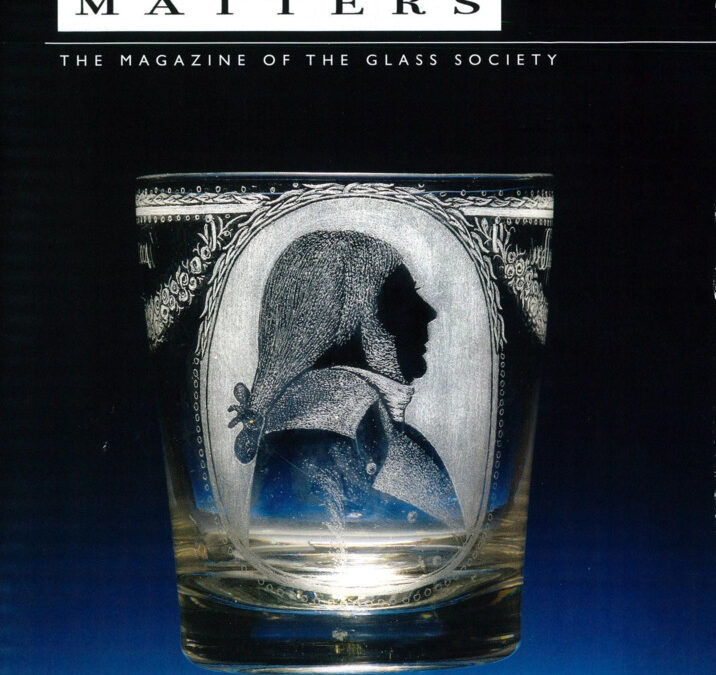
A self-portrait glass by Adrianus Hoevenaar
Snr. A late C18th Dutch diamond-point engraver. Image courtesy
of The Hoevenaar Museum facilitated by Anna Lameris. (article
on pages 26’27)
BACK COVER: A
multi coloured bowl by Zoot Zynsky, USA, circa
1994. Formed with fine glass filaments, slumped and manipulated.
Private Collection. Image Courtesy of Lyon 8z Turnbull.
Glass Matters Issue no.1 I June 2021
Sue Newell, Joint Chairman
David Willars, Joint Chairman
of The Glass Society
of The Glass Society
CHAIRMEN’S MESSAGE
Chairmen’s
Message
Time to Reflect and Look Forward
W
elcome to the latest edi-
tion of
Glass Matters.
Our
Editor, Brian Clarke, has
assembled
a great offering for us
in terms of articles, as usual. Nigel
Benson discusses the attribution of
bubbly glass, and we welcome back
Ian Turner, who this time exam-
ines the wonaderfully quirky and
colourful creations of Alessandro
Pianon. Nuria Gil, a researcher, has
joined forces with Jordi Bonet, the
Director of J. M. Bonet (stained-
glass manufacturers), to provide us
with a rare insight into the work of
Birmingham stained-glass designer,
Thomas Camm, for the Palau Giiell by
Antoni Gaudi in Barcelona. Georgian
love tokens, gilded lilies as well as an
article on uranium glass, also feature
in this rich and varied compilation.
Just when you thought that every
aspect of the pandemic had been aired,
along comes a new – glass related –
thread to pick up. Those of you who
attended Stephen Pollock-Hill’s talk in
March will remember our discussion
about the production of Covid vac-
cine bottles or vials. During the crisis,
glass manufacturers have stepped up
to supply huge volumes of high speci-
fication glass vials. Following queries
about the recycling and/or re-use of
these vials, we decided to explore the
matter further and made approaches
to several industry bodies to under-
stand better what is happening now,
and how the situation may evolve in
the future. We learned that concerns
over the deaning of vials mean that
re-melt, rather than re-use, is the
more likely path. Dedicated re-melt
channels do not exist today, partly due
to the glass types used, and so far as
we could ascertain, all vials current-
ly end up as landfill. Discussions are,
at least, underway to establish a new
UK based manufacturing plant. As a
charity dedicated to glass education,
lobbying industry and government
bodies on this matter is beyond
our remit, but your thoughts are
welcomed on this important issue.
Another topical subject we have
engaged with concerns the Victoria
and Albert Museum in London. The
Museum’s collections are appreciat-
ed globally, and the same goes for the
skills of its curators, often honed over
decades through working with collec-
tions of exceptional scope and quali-
ty. In March we learned in the press
that departmental changes were afoot
that would potentially undermine
materials-based expertise within the
Museum. We wrote to the Museum’s
Director expressing our concerns, add-
ing the Glass Society’s voice to that of
many different groups dedicated to
the appreciation and study of particu-
lar materials (ceramics, silver, textiles
etc.). The cumulative effect of these
representations may have played a
part in the modification of the original
proposals, and specific recognition of
materials, enshrined in the Museum’s
ethos since its inception almost two
hundred years ago, will be maintained.
The proposed changes were (of course)
prompted by the need to cut costs due
to the Museum’s depleted income over
the past year of compulsory dosures.
We are sympathetic to this issue which
raises questions about the value we
place on the cultural sector, and the
degree to which this has been reflect-
ed in the government’s approach to
arts funding during the pandemic.
Again, if you would like
to read more about these
discussions or wish to participate
taking them forward please contact us.
These interventions represent
a new departure for the Society in
terms of our activities, and we hope
that they meet with your approval. If
you feel strongly about these or oth-
er glass-related topics, please get in
touch and we will discuss what, or if,
it is possible to do something. We are
currently investigating establishing
Glass Society bursaries for students
engaged in historical research on glass,
as this seems particularly appropriate
against the background of financial
hardship caused by the pandemic.
In conclusion, we must ask again
for practical help in running your
Society. Interest and enthusiasm are
the only requirements, although a
working knowledge of Word (and
possibly Excel) would be helpful, as
well as prompt communication by
email. In the short term, we need
an Editor for the next issue of our
online Newsletter. We have many
snippets of interesting material
already, and the Editor’s job is sim-
ply to put their own stamp on the
issue by selecting items or investi-
gating different ones, provide a few
sentences of introduction, and liaise
with our designer, who will do the
entire layout. Assistance with proof
reading and guidance about content
would be supplied by the Committee.
If you think you would like to be
involved, please get in touch — we
look forward to hearing from you!
Susan Newell and David Willars
Joint Chairmen, The Glass Society
Glass Matters Issue no.! I June 2021
3
URANIUM COLOURS IN GLASS
Uranium Glass: Part 1
Its
origins: Riedel, Pohl or Whitefriars?
John Frith
U
ranium glass is generally a
translucent yellow or green
glass, coloured by a uranate,
uranyl or uranium oxide salt and fluo-
resces bright yellow-green under ultra-
violet light. It was probably first made
by Johann Pohl in Neuwelt, northern
Bohemia, in 1831, and later by Franz
and Joseph Riedel in Antoninov,
northern Bohemia, in about 1835, as
Annagelb
and
Annagrun.
It was made
in Britain in 1836 by Whitefriars as
Topaz
glass; in 1844 by Thomas Webb
& Sons as Canary glass and in France
in 1843 by Baccarat as
Cristal dichroide.
In Europe at the time, other common
names for this new yellow glass,
were
Verre Canari
and
Chamaleon.
From the early 1840s in America,
uranium glass was known as
Canary
flint glass and from 1864, due to the
shortage of lead, as soda-lime glass;
from 1924 it was called
Vaseline
glass.
Uranium oxide was used to make
many shades of yellow and green glass
– it is also often found in other glass
colours, such as pink, amber, brown,
blue, and turquoise. The various
colours were made by addition of dif-
ferent colourants; iron oxide and cop-
per sulphate made green; copper and
chromium oxides made green, blue and
turquoise; manganese oxides made
pink; cadmium and sulphur salts made
amber and brown. It was used in a
variety of multi-coloured shaded glass-
es such as
Burmese;
in opaque glasses
such as
Ivory, Custard
and
Jade;
in
combination with gold ruby in Rubina
Verde and Amberina; in opalescent
glasses such as
Pearline
and
Opaline
Brocade,
and to applied colour glass
decoration, used in the many styles of
coloured Victorian fancy glass.
1, 2, 3, 4
A variety of the colours of
Uranium glass are shown in Figs.1-6.
DISCOVERY OF URANIUM OXIDE
BY MARTIN HEINRICH KLAPROTH
A yellow uranium oxide salt, probably
either Na
2
0(UO
3
)
2
(sodium diuranate),
LEFT Fig. 1
Opalescent
cruet (for oil or
vinegar)
RIGHT Fig. 2
Small opalescent
bowl, with a
‘claw’ foot
or UO
2
(NO
3
)
2
, (uranyl nitrate), was dis-
covered in 1789 by Martin Heinrich
Klaproth, a German chemist, while
experimenting with pitchblende,
which was thought at the time to be
an ore of iron and zinc and which we
now know is uranium ore. Klaproth
heated the salt to obtain a black pow-
der. Thinking he’d discovered a new
element, he named it Uranium after
the planet Uranus. Elemental urani-
um was not discovered until 1841 by
a French chemist, Eugene-Melchior
Peligot, who also demonstrated
that the black powder Klaproth pro-
duced was not elemental uranium
but a uranium oxide compound. 1,
3
‘
4
Pitchblende, originally thought
to be a blended ore of iron and zinc,
is a form of uraninite, and the most
common mineral in which uranium
is found. Uranium oxides make up to
50% to 80% of that mineral, the rest
being lead and thorium oxides, radi-
um, and other rare earth elements. In
1850 the main source of pitchblende
4
Glass Matters Issue no.I I June 2021
Fig. 4
A
uranium yellow
‘sherry’ glass
(perhaps a cordial)
URANIUM COLOURS IN GLASS
Fig. 3
A pair of uranium yellow salts and a Lemon Peathne cream or sugar bowl
was from Jachymov, a town at the
foot of the Ore Mountains of north-
ern Bohemia, later it became available
from Cornwall in the UK. The process
of extracting the yellow uranium salt
from pitchblende was expensive,
and as much of Riedel’s and other
Bohemian glassmakers’ uranium
glass pieces were elaborately deco-
rated with enamelling and gilt, they
were made for royalty and aristocracy.
In 1912 Robert Theodore Gunther
of the University of Oxford was pur-
ported to have found yellow uranium
glass from a mosaic mural in an exca-
vated Roman Villa on Cape Posillipo
in the Bay of Naples, Italy, dating
from 79 AD, which when analysed
was said to contain uranium oxide.
Barrie Skelcher in his 2002 book
The
Big Book of Vaseline Glass,
stated that
Geiger counter surveys that were
conducted in the Bay of Naples after
World War II, as well as of examples
of glass in German museums, did
not find evidence of uranium in their
manufacture. Other surveys of Roman
glass have not found levels of urani-
um higher than would be expected to
be naturally occurring in sand used
by glassmakers, so it is unlikely that
the Romans really did purposefully
use uranium oxide to colour glass.
4
‘
5
FRANZ RIEDEL, JOHANN POHL, AND
THE DEVELOPMENT OF BOHEMIAN
URANIUM GLASS IN 1830S
The Riedel family is credited in many
references as being the first to use ura-
nium oxide in glass in their family glass-
works in Antoninov and Kristianov in
the Jizera Mountains (Isergebirge) of
northern Bohemia in the early 1830s,
possibly around 1835, although
Haanstra states it was 1830.
1-7
Riedel: The Wine Glass Company
History and Generations,
Lynn & Lynn
and Remos state Franz Xaver Anton
Riedel and his nephew, Josef, made
yellow and green glass beakers which
they called
Annagelb
and
Annagrun
respectively after Franz’s daughter,
Anna Maria.
8
‘
9
‘
10
Other references
state Franz named them
Annagelb
and
Eleonorengrun
after his two
daughters, Anna and Eleonore
11
‘
12
and some that it was Josef, who mar-
ried his cousin Anna, who named them
Annagelb
and
Annagrun.
The Riedel
family made uranium glass from the
1830s to late 1840s. However, the
Riedel family may not have actually
been the first to make uranium glass.
Langhamer
13
(p.71) refers to the
development of uranium glass in
the 1830s by a number of Bohemian
glassmakers including Franz Riedel,
Johann Pohl, and others, producing
yellow (Annagelb) and green glass
(Annagriin and Eleonorengrtin),
“a
beautiful gold crystal with a breath of
light green”.
13
Langhamer (p.79)
refers to a uranium glass containing
alabaster – a mineral calcium sulphate
used as an opaquing agent – called
Chrysopras,
being made by Count
Harrach’s glass factory at Neuwelt in
northern Bohemia in 1831, under the
direction of Johann Pohl who later per-
fected yellow uranium glass.
13
Donna
Strahan
14
also refers to a yellow-green
fluorescent glass being shown by
Count Harrach’s Neuwelt glass facto-
ry at an exhibition in Prague in 1831.
EARLY BRITISH DEVELOPMENT
AND WHITEFRIARS
Skelcher refers to the 1817 book by
CS Gilbert An Historical survey of the
Country of Cornwall which mentions
the use of uranium to colour glass and
Glass Matters Issue no.I I June 2021
5
URANIUM COLOURS IN GLASS
Fig. 5
Fig. 6
An
enamelled and gilt uranium green Biscuit Barrel
An uranium green Posy Basket
states
“Its oxides impart bright colours
to glass, which are, according to the pro-
portions, brown, apple green, or emerald
green”.
3
Filipa Lopes
2
in the study
Uranium Glass in Museum Collections,
also refers to Gilbert’s book, but also
cites Brenni
1
as stating that there is
no reliable literature on its use in this
period.
1, 2
In the 1830s, British and
French glassmakers also experimented
with making uranium glass. Skelcher
3
refers to William Vernon Harcourt,
a British scientist, experimenting
with uranium in glass in 1834 and
Skelcher
4
(p.13) refers to Whitefriars
Glassworks of London – then known
as James Powell & Sons – experiment-
ing with uranium glass in 1835 and
in 1836, when they made a pair of
yellow uranium
Topaz
girandoles that
were presented to Queen Adelaide.
3
‘
4
The exact origins and how the
process of adding uranium to glass
came about are not very clear and
certainly not well documented. There
is no doubt that many glassmakers
were experimenting with uranium in
glass in the early 1830s, primarily in
Bohemia and Britain. And although
it is the Riedel family of Bohemia that
is generally credited in the literature
with being the first, it is possible that
Johann Pohl at the Harrach Glassworks
in Nov3
–
7 Svet in 1831 was the first
to make and exhibit uranium glass.
John Firth, a Glass Society member
from Australia, provided the photos
for the article, but was unable to iden-
tify specific manufacturers or dates.
REFERENCES
1.
Brenni, Paulo. (2007) Uranium glass
and its scientific uses.
Bulletin ofthe
Scientific Instrument Society
92: 34-39.
2.
Lopes, F, Ruivo, Muralha, S, et al.
(2008) Uranium Glass in Museum
Collections.
Journal of Cultural
Heritage
Vol. 9, Supplement,
e64-e68. Available at https://run.
unl.pt/bitstream/10362/1954/1/
Lopes 2008.pdf
3.
Skelcher Barrie. (1998)
Uranium
Glass.
Available at https://www.glas-
sassociation.co.uk/sites/default/files/
Uranium Glass sample artide.pdf
4.
Skelcher, Barrie. (2002)
The Big
Book of Vaseline Glass.
Atglen,
Pennsylvania: Schiffer Publishing
Ltd, 2002, p. 12-16.
5.
Skelcher, Barrie. (2007)
Vaseline
Glassware.
Atglen, Pennsylvania:
Schiffer Publishing, p. 9-13.
6.
Peterson, DavidA. (2002)
Vaseline
Glass: Canary to Contemporary.
Marietta, Ohio: Glass Press Inc., p. 6-7.
7.
Haanstra, Ivo. (2001)
Glass Fact
File A-Z.
London: Millers/Octopus
Publishing, p. 147.
8.
Riedel: The Wine Glass Company.
(2020)
History and Generations.
Available at https://www.riedel.com/
en-aulriedel/history-generations .
9.
Lynn, Guy and Lynn, J-Me. (2015)
Bohemian Glassmakers — The Riedel
Family.
2 May 2015. Available at
https://www.linkedin.com/pulse/
bohemian-glassmakers-riedel-fami-
ly-guy-j-me-lynn?trk=portfolio arti-
cle-card title .
10.
Remos, Ana B. (2013)
The Riedel
Glass Dynasty: Glassworks of Austria.
22 April 2013. Available at https://
www.azureazure.com/personalities/
the-riedel-glass-dynasty/ .
11.
Geiselberger, Siegmar. (2000)
Anna-gelb and Eleonoren-gran
— Uran-gefarbtesnm Pressglas.
Pressglas-Korrespondez
Januar 2000.
[German] Available at https://press-
glas-korrespondenz.de/aktuelles/
pdf/pk-2000-2w-sg-annagelb-eleon-
orengruen-uran.pdf .
12.
Riedel, Claus Josef, Urbancova, Jana,
and others. (1994)
Riedel since 1756.
Anna yellow and Eleonoren green from
Riedel, Polaun.
[Excerpt — German,
translated from translate.google]
13.
Langhamer, Antonin. (2003)
The
Legend ofBohemian Glass.
Zlin,
Czech Republic: Tigris, p. 71, 79, 93.
14.
Strahan, Donna. (2001) Uranium
in glass, glazes and enamels: history,
identification and handling.
Studies
in Conservation
46:181-195.
6
Glass Matters Issue no.I 1 June 2021
BARCELONA STAINED GLASS
T.W.Camm and the Shakespearean
Stained Glass at
Barcelona’s Guell Palace
Jordi Bonet with Maria Gil
Fig.
1
Palau Guell facade. © MontserratBaldoma
Diputacio de Barcelona. Palau Gaell
13
arcelona’s Giiell Palace is one
of the first buildings by the
renowned architect Antoni
Gaudi (1886-1890). He received the
commission from the businessman,
entrepreneur and patron Eusebi
Guell i Bacigalupi, who wished to
have a palace in the city centre to
accommodate his large family. The
building, located within the bounds
of the dense and cramped old town,
is another outstanding piece of archi-
tecture, especially remarkable for
the use of daylight coming from the
penthouse to illuminate the main
floor located two storeys below and
also for its double use as the family
house and as representation house
for the business of Mr. Gtiell.
1
(Fig./)
Among the decorations of the elab-
orate interior, the palace holds a large
collection of stained glass in various
styles; these are considered to be one
of the most important and unique
sets preserved in a private building in
Catalonia. Unfortunately, not much
information on the construction of
the building, such as invoices from
masons, painters, furniture makers
and glaziers is readily available for
investigation, so in certain cases,
the authors of the windows remain
unclear. However, particular panels
have recently been the subject of suc-
cessful research.
2
Four of the most
unusual, concerning their style, depict
characters of William Shakespeare’s
theatre plays, which is an unusual
topic for local stained glass. Hamlet
and Macbeth’s figures decorate the
bedroom of the eldest daughter of
the family, Isabel Lopez,
(Fig.2 upper)
and King Lear and Bertram appear
at the central medallion of the win-
dows that illuminate the hall lead-
ing to the entrance of the smoking
room on the main floor,
(Fig.2 lower).
The first notions that those win-
dows could be of English origin were
made by the authors in 2013, when
the management of Guell Palace com-
missioned them with cataloguing all of
the windows and glass objects. Apart
from the depicted scenes, some oth-
er properties made the stained glass
unusual – for instance, the presence of
Venetian glass,
a pronounced texture
glass only produced in England. Also,
the design of the rich and elaborate
detailing of grisaille was not common
in Catalan stained glass of the period.
The provenance of the glass used
on the vast amount of stained glass
produced in Barcelona at the end
of the 19th century still requires a
thorough investigation. Some very
specific patterns can easily be related
to a manufacturer, but others can be
found in the catalogues of different
makers, leading to very similar end
results and therefore very difficult to
identify. The glass made by the French
manufacturer Saint Gobain can eas-
ily be found. However, it is not the
case for the more uncommon glass
produced by Chance and Co. Despite
that, some patterns can be found in
the glazing of interior windows of the
buildings in the Eixample
3
district.
English glass and some inventions
of the English glass industry never
reached the Catalan stained- glass
industry. Novelties such as Prior’s
glass/Norman Slab have never been
Glass Matters Issue no.I I June 2021
7
.
►
.
. —a.. • ….au,.
-VevAtivil4r:AN vsoi
.
¨
BARCELONA STAINED GLASS
Fig. 2
Details of the four stained glass windows preserved in the Palace describing characters
of Shakespeare’s plays: Hamlet, Macbeth, King Lear, and Bertram. ©Jordi Bonet
identified and Venetian
4
and Venetian
ripples were identified for the first
time in the windows of the Palace.
Oral memories about the use of
English glass are alive at the studios,
especially regarding difficulties in its
cutting. However, documentation
on the importation of the preserved
glass is very scarce and not descrip-
tive of the purchased items; there
are only occasional random docu-
ments, which in the best cases, are
still left to be consulted by historians.
The Giiell family had a close rela-
tionship with Britain; Eusebi as well
as his sons had received part of their
academic education in the country and
as businessmen traded there regular-
ly and were connoisseurs and enthu-
siasts of English cultural heritage.
The Shakespeare subject is unusu-
al but not rare. The Arts and Crafts
movement was a source of inspira-
tion for many Catalan artists and
craftsmen. William Shakespeare
was an admired author and his plays
were often represented in the local
theatres. Some of the craftsmen that
had a relevant role in the decoration
of the palace were deeply influenced
by English culture. The polyhedric
artist, Alexandre de Riquer, illustra-
tor, writer, poet, and painter, travelled
on some occasions to England, where
he established a relationship with the
Arts and Crafts movement. There
he met and mailed Edward Burne-
Jones and William Morris, and he
is believed to be the importer of the
British inspired
art nouveau
trend.
5
Also, the interior decorator and fur-
niture maker Francesc Vidal had a
solid commercial relationship with
the English decorative arts industry
– the most notorious would be the
Cloisonné Glass Company’s (London)
commercial relationship with Vida1.
6
Despite solid evidence, the mys-
tery of the stained-glass provenance
could not be confirmed until the
gallery,
Tomkinson’s Stained Glass
of
Clophill, Bedfordshire, published the
images of three panels for sale’ from
its collection with representations
of Sir Thomas More, Titania, Queen
of the fairies from A Midsummer
Night’s Dream, and Hamlet. This last
panel has the same measurements
(46x24cm) and paint finishes as the
one at the Guell Palace and was prob-
ably painted using the same cartoon.
The three panels came from the
T.W.Camm studio. The gallery also
kept the cartoon of a Sir Thomas More
panel purchased at auction and an
original from the same artist. This evi-
dence left no doubt about the author-
ship of the four palace panels.
(Fig.3)
The importance of this discovery
is especially relevant in Catalonia,
since it is the only panel of English
origin known so far. Imported panels
from Germany and often France, are
not rare: Maumejean, Meyer, Zetler,
windows are not frequent but, they
do occasionally occur. However, at
the peak of the excellence of English
stained glass, when panels were
exported all around the world only the
ones at Giiell’s Palace are known. The
present research also found that the
daughter of T.W Camm, Florence, was
an extraordinarily skilled painter, who
created stained glass for the Artaza
Palace in Guetxo, Basque Country.
THOMAS WILLIAM CAMM
Thomas William Camm was a rele-
vant stained-glass maker active at
the end of the 19th and the begin-
ning of the 20th century. Among the
English studios, it was a medium-size
company, far different from the huge
companies that employed up to a
hundred workers, but at the same
time much bigger than the artist
studios run by a single man
8
(Fig.4).
Camm was born in Spon Lane, West
Bromwich, in 1839. His apprenticeship
as a stained-glass maker took place at
Chance Brothers & Co, of Smethwick,
where he started work from an early
age. This company pioneered many
aspects of the production of glass, such
as the introduction of cylinder glass
and the improvement of drawn sheet
glass. Chance & Co. gained a solid,
high- quality reputation for providing
the glass used in the building of Crystal
Palace, the main building used in the
8
Glass Matters Issue no.I I June 2021
BARCELONA STAINED GLASS
Fig. 3
Two of the panels displayed at the Tomkinson’s Stained Glass Gallery, Titania, the fairy queen of
A Midsummer Night’s Dream, and a portrait of Sir Thomas More. ©Tomkinson’s Stained Glass
International Exhibition of 1851 and
also glass for the Houses of Parliament,
reconstructed 1840 to 1870.
Chance Brothers & Co. had a
department devoted to the produc-
tion of stained glass. The head of
the art department was Sebastian
Evan (1830-1909) who noticed the
skills of T.W.Camm and promoted
him. In 1865 the company closed
the stained-glass department and
focused on the production of glass.
That same year Thomas established
his own studio together with his
brothers, and set up a company
named Camm Brothers, while Chance
supported them by recommending
their services to those requesting the
already dosed stained-glass service.
The studio had commercial success
and expanded from its foundation,
working both on religious and secular
stained glass. They gained interna-
tional reputation by participating in
national and international exhibitions
where they were awarded various
medals. A gold medal was obtained in
1878 at the international exhibition of
Paris’ for the exhibited panels depict-
ing Shakespearean characters. The
panels were illustrating scenes similar
to the ones at Guell Palace, though
not the same; the ones at the exhibi-
tion were from
A Midsummer Night’s
Dream: Titania in love with Bottom
or
Oberon giving instructions to Puck.
He
also exhibited Arthuric scenes with the
Holy Grail, and other allegories from
the four seasons, art and music, all of
them designed by T.W.Camm. He was
also praised for the quality of his work
in the press of the time. In 1879 he was
awarded another medal at the Sydney
international exhibition, also a gold
medal at the
Fine arts and Industrial
Exhibition
celebrated in Bradford in
1882, and a silver one in 1884 at South
Kensington. Camm’s publicity also
claims that they produce forged iron
and design for ceramics and mosaic.
In 1882 the business was bought by
R.W.Winfield from Birmingham but
worked under the same name, and
the Camm brothers became employ-
ees until 1888 when T.W. Camm set
up his studio under his own name.
In 1862 Camm married Charlotte
Middleton and they had nine chil-
dren. Three of them followed the fam-
ily tradition: Florence (1874-1960),
Robert (1878-1950), and Walther
Herbert (1881-1967). Florence was
especially outstanding as a designer
and maker,'” was a successful artist
trained at the Birmingham School of
Arts, and earned her reputation at the
Turin 1911 International Exhibition.
Thomas Camm passed away in
1912, but the studio carried on, run
under his descendants until 1960.
THE
SHAKESPEAREAN
WINDOWS AT PALAU GUELL
In the room that once was the bed-
room of Isabel Giiell, there are two
windows showing standing figures of
Hamlet and Macbeth. Both panels are
quite large: 207x81cm with an acid-
etched blue glass background. Each of
these blue pieces has an acid-etched
crown, and some of the pieces are also
painted with silver stain. The charac-
ters appear in the central part of the
windows; the figures of each of them
also have the name written on a foot
sign. It is believed that the blue back-
ground was executed by local studios
and was built to fit the panels to the
final measurements, probably by Hijos
de Eudald R.Amigo, author of other
windows of the building. The central
panels were probably mounted in the
Fig. 4
Portrait of T.W. Camm. © Sandwell Community
History and Archive Service
Glass Matters Issue no.11 June 2021
9
BARCELONA STAINED GLASS
Fig. 5
Comparison between the stained glass window of Tomkinson’s gallery (left) and the
stained glass window of Palau Guell (right). ©Tomkinson’s Stained Glass ©Jordi Bonet
window by a Catalan studio, but pur-
chased as a finished decorative panel
that was entirely painted and leaded by
Camm Studios. The image of Hamlet
is the same as the one at Tomkinson’s
Stained Glass and the Macbeth image
follows the same technical methods
and size. The figures are surround-
ed by a wavy pattern painted with
tracing grisaille and silver stain on a
white glass, which has close similari-
ties to the pattern that decorates the
window Christ the Bread of life and
Christ the True Vine,
part of the Oak
and the Lily, from Swedenborgian
Church, Wretham Road, Handsworth,
exhibited now at the Birmingham
Museum and Art Gallery
(Fig. 5).
At the hall that gives entrance to the
smoking room on the main floor, there
are two roundels with the portraits of
King Lear and Bertram. The last one is
painted in a similar style and materials
as Macbeth and Hamlet. King Lear is
probably made by an English studio but
the use of carnation makes it slightly
different in style from the other three.
Despite knowing the author, the
origin of the panels is not fully known.
It is believed that the panels might
have been purchased by the furniture
maker Francesc Vidal i Javelli, who was
responsible for the decoration of the
palace. It is known that Vidal had com-
mercial agreements with the English
firm T.Webb & Co, which traded with
luxury glass objects. While some of the
Camm Studio drawings appeared at
the auction room, some other docu-
mentation of the studio remains pre-
served at the archive of T.W.Camm, at
Black Country, Smethwick. The library
keeps part of the documentation of
the studio – mainly drawings, letters
and accountancy books. Among the
copies of the letters, there is one send
by T.W.Camm to Webb & Co accepting
the proposal of the latter to represent
them in Spain. It is supposed that the
letter is a reply to the previous one by
Webb to Camm offering his services as
a commercial agent. This fact does not
prove that this was the way the panels
arrived at the Guell Palace, however
it might have been a possible path.
Regarding the creative method of
this outstanding architect, it is always
a source of controversy how much of
his work was his own will and how
much was owed to the skill, craft, and
initiative of his collaborators, Jujol,
Domenec Sugranes, Rubi6, Amigo
Studio, and others. This present
research is a small, new opening on a
special field of decorative arts, where
until now not much has been unveiled
regarding Gaudi’s stained glass. Being
able to prove the English provenance
of these panels at the Barcelona
Antoni Gaudi building has been a
thrill, it has also left many unan-
swered questions that hopefully will
soon be addressed by British experts.
ENDNOTES
1.
Lacuesta, R. Gonzalez, A, (2013)
El
Palau Guell. Una obra mestra d’An-
toni Gaudi.
Diputacio de Barcelona.
Barcelona.
2.
Gil, N. (2017).
L’enigma del vitrall del
Palau Guell
(Diputaci6). Barcelona.
3.
Eixample is a term that literally
means expansion , was the name of
a plan to organize the growth of the
urban network beyond the old city
center, constrained and overcrowded
by the City walls.
4.
Benyon, T. (2005). The development
of Antique and other glasses used
in 19th and 20th-century stained
glass.
Journal of Stained Glass,
XXIX,
184-198.
5.
Trenc Ballester, Eliseu,
Alexandre de
Riquer,
Barcelona, CaixaTerrassa.
Lunwerg, 2000
6.
Jordi Bonet, Nada Gil, “Cloisonné
Glass, un fenomen modernista”,
in
Coup de fouet,
num. 26, 2015,
p. 26-37.
7.
https://www.vitraux.co.uk/product/
ref-ron409-roundel-3-antique-
stained-glass-windows-arts-crafts/
Last visited on the 5th of April, 2021
8.
An archive with some of the
work by T.W. Camm is pre-
served at
Black Country History,
Smethwick (Birmingham) https://
www.cylex.uk.co.uk/reviews/
viewcompanywebsite.aspx?firma-
Name=tomkinson+stained+glass+lt-
d&companyId=16622481
9.
Allen, J. (2018). The windows for
the world. Manchester: Manchester
University Press.
10.
Cormack, P. (2015).
Arts&Crafts
stained glass. (Y.
U. Press, Ed.).p.262
1
0
Glass Matters Issue no.I I June 2021
ARCULUS OR WALSH WALSH
Bubbled Glass Anomaly
NigelBenson
Fig. 1
Image of bubbly range teardrop vase by
Arculus, from C Hajdamach, plate 192
Fig. 2
Similar bubbly range teardrop vase to Fig.1
in Amethyst. But Arculus or Walsh Walsh?
F
rom time to time in the glass
world an anomaly will turn
up that confounds exist-
ing wisdom. A little while ago I
advised someone on Facebook
who runs his own page on British
Glass, that the vase he had was by
the firm of Arculus. I used Charles
Hajdamach’s book
“20th Century
British Glass”,
page 98, plate 192 as
my reference
(Fig.1),
since there is
a memorable half-page illustration,
which was easy to bring to mind.
To be honest, I was quite taken
with the piece that is a deep amethyst
colour
(Fig.2),
so asked if it might
be for sale; unfortunately, it wasn’t
because he likes to keep anything
with teardrop decoration. Ah well!
A few months passed and I found
a different vase in auction and man-
aged to buy it. This had diagonal
teardrop decoration around the base
of the body, above the foot
(Fig.3).
It has the same type of self-co-
loured glass with random bubble
inclusions as the piece I’d admired
on Facebook, but was a different
colour, so I felt I’d managed to get a
good consolation prize. All I needed
to do was identify its manufacturer.
I knew that I’d seen my vase illus-
trated, and eventually recalled that it
was in an article by Lesley Jackson in
The Journal of The Glass Association,
Volume 5, 1997, so I
investigated.
It was, but unfortunately the pho-
tograph that included the vase was
a reproduction from a Hill Ouston
catalogue for 1934
(Fig.4).
My vase
is shown at the lower left and the
vase pattern in
Figs.1&2
is shown at
the lower right. Sadly, Hill Ouston
does not reference the glass manu-
facturers that made the products it
sold, so effectively this was a dead
end. However, it was illustrated with
four other similarly made pieces
that might help if any of those could
be identified from other sources.
Having a couple of Hill Ouston
catalogues myself, I checked them,
as that could also help, even if
obliquely. My vase turned up again,
in catalogue 10,
(Fig.5);
but
along with different pieces
shown on the page with
the vase in
Fig.4,
most not
matching the bubbly body.
Where could I continue
my search? I decided to
look in the catalogues at
the back of Eric Reynolds
book on John Walsh Walsh,
as it reminded me of their
range known as ‘Pompeian’.
Although both Reynolds
and Hajdamach illustrate
pieces of Pompeian glass
Fig. 3
Pompeian bubbly glass teardrop vase
in amber, by Walsh Walsh
as photographic plates, neither
show teardrop vases, so the line
drawings it was to be. Whilst scru-
tinising the tiny representations,
up came the vase from Hajdamach
(pattern A5440) and the Facebook
Glass Matters Issue no.I I June 2021
10 I
gir
TTY
Fig. 6
Page from Reynolds book on Walsh Walsh, Fig.299
A
oiadr,-
-1″
ti
f
•
•
,
fig.299
A5056 illustrates registered design hand bell,
see
Fig. 5
Page from Hill Ouston Catalogue 10
HAND MADE AR’
AS
ARCULUS OR WALSH WALSH
Fig. 4
Plates 32-34 in Lesley Jackson’s article, The Journal of The GA, p.57
collector at the top of page 121,
fig.299, but pattern A5047
(Fig.6)
and diagonally lower down on
the previous page, 120, fig.298,
my vase
(Fig.7),
pattern A5043.
So, here is the anomaly, two
well-respected books each giving
a different maker for the same
vase. From a conversation I had in
2006 at the NEC with members of
the Arculus family, I knew that the
items illustrated in Hajdamach came
from that source, whilst it is origi-
nal John Walsh Walsh catalogues
that are illustrated in Reynolds.
Given the origin of both sources
of information, could it be that both
companies made the same vase?
Unlikely. Perhaps only one maker
made the vase and it was sold by both?
In fact, there are other items
shown in Hajdamach that might
also be Walsh – possibly the jug
and bowl on page 100, plate 197.
I2
Glass Matters Issue no.I I June 2021
A •
A
ARCULUS OR WALSH WALSH
Fig. 7
Page from Reynolds book on Walsh Walsh, Fig.298
Were they made by Walsh as an
outsourced product for Arculus?
Or is there an unfortunate clash
of information in the two tomes?
I doubt whether there is
currently an answer to this
conundrum, but it does seem
sensible to flag up the irregulari-
ty, so that other collectors might
be aware – and perhaps someone
eagle-eyed and knowledgeable
could come up with an answer.
Thanks to Chris Parry for
the use of his photograph of the
vase that started this article.
REFERENCES
•
Hajdamach, C.H.
20th Century British
Glass
pages, 98-100
•
Jackson, L. `Whitefriars Lookalikes’
The Journal of The Glass Association
Vol.
5,1997, pages 46-60
•
Reynolds, E.
The Glass of John Walsh
Walsh 1850-1951,
pages 120 and 121
•
Catalogues, Hill Ouston 1934,1938.
ALESSANDRO PIANON’S Vistosi Birds
A confession, a correction, and a conclusion
Ian Turner
I
sometimes wish the inter-
net had not been invented.
Without it, however, historical
research in any field of collecting
would be very difficult. But you
have to ask the right questions.
I have now written two arti-
cles about the iconic glass bird
sculptures which were made by
the Vistosi glasshouse in Murano
in the 1960s. Everything that
I wrote about their manufac-
ture – the company, the designs,
the dates, and the techniques
— is correct. And everything I
wrote about Alessandro Pianon’s
work as an interior decorator in
New York in the 1970s is correct.
But the details of his life and
death remained an enigma.
In the
Journal of The Glass
Society,
volume 1, I commented
that Alessandro Pianon, who had
been appointed Vistosi’s design-
er in 1956, had been replaced
by 1962, and that
“…….after
1962 (he) seems to have disap-
peared. He is almost unknown in
Italy.”
This statement is wrong.
When I discovered that
Alessandro and his wife Paola had
passed through immigration con-
trol in New York on August 27th
1960, and that he had subsequently
become famous in America as an
interior designer, I thought I had
found the answer. There was docu-
mentary evidence that he had been
employed by Adnan Khashoggi to
convert part of the Olympic Tower
in central New York into his office
and apartment. I reported this
in an update published in
Glass
Matters
in January 2021 and con-
cluded:
“It now seems probable that
Glass Matters Issue no. I I June
2021
13
SANDRO PIANON’S CAREER
Fig. 1
Sandro Pianon presenting plans for the Porto Rotondo project
the reason Alessandro Pianon disap-
peared in 1962 and was subsequently
almost unknown in Italy is because
he wasn’t there. He emigrated to the
United States, and in the following
decade became famous as an interior
decorator to the world’s super-rich.”
Although he had been reported
as having died in 1984, I had not
been able to find a death certif-
icate or an obituary, and I spec-
ulated that ”
perhaps he is still
alive, a wealthy pensioner living in a
Florida retirement village. He would
now be 89.”
I was wrong again.
I concluded the
Glass Matters
article by asking
“if anyone knows
what happened to Alessandro
Pianon, Venetian glass designer and
American interior designer, would
they please let me know by email.”
Two readers contacted me
in response. One was Bruce
Elliott, an historian and gene-
alogist in Toronto, and through
him the other was Adam
Tihany, Alessandro’s partner
on the Olympic Tower project.
I had been searching the
internet for the wrong man.
As both an architect and an
interior designer, Alessandro
Pianon had abbreviated his name
and was known as
Sandro Pianon.
Searching under that name I
learnt that he was well known in
Italy, though not as famous as Gio
Ponti or Renzo Piano; that his wife
Paola is still alive, although they
had long been separated; and that
one of his sons, Luca Pianon, is also
an architect and continues to this
day to practise at Studio Pianon.
I have been in contact with Luca.
I can now conclude my research
into Alessandro’s (Sandro’s) career
as a Venetian glass designer,
architect and interior decorator.
In 1962, after completion of
his work for the Vistosi company,
Fig. 2
Sandro Pianon in Italy, 1981
Sandro Pianon had practised as
an architect with his own office
in Venice. In 1963 he had been
appointed designer (progettis-
ta) of the Porto Rotondo tourist
resort in Sardinia by two Venetian
developers, Luigi and Nicolo Dona
dalle Rose. Porto Rotondo was con-
ceived by them from the outset as
an exclusive resort for the super-
rich, and Sandro prepared the
master plan and designed several
public buildings and many villas.
Fig.1
is a contemporary photo-
graph of Sandro Pianon, showing
his plans for the resort to Luigi
Dona dalle Rose. He subsequently
designed villas elsewhere, and in
1974 was commissioned by Adnan
Khashoggi to renovate and deco-
rate his homes in Cannes, Monte
Carlo, Madrid, Marbella, Paris and
Kenya, and his home and office in
the Olympic Tower in New York.
Alessandro and Paola Pianon
did not emigrate – Sandro Pianon
had lived and worked in Italy.
Fig.2
is a photograph taken in
1981, when he was a successful
architect and interior designer.
But a few years later he became
seriously ill, and his family sent
him for specialist treatment
to New York where he died on
29th May 1984 at the age of 53.
There is a salutary lesson to be
learnt about relying on the inter-
net for historical research – the
internet gives the right answers
if you ask it the right questions.
My research is now complete,
and I apologise for the red herrings.
“Tomorrow to fresh woods, and pas-
tures new.”
(John Milton, LYCIDAS)
My thanks to Marzia Scalon
at the Fondazione Georgio Cini
in Venice, Bruce Elliott, Adam
Tihany, and Sandro’s son, Luca
Pianon, for their assistance.
IMAGE ACKNOWLEDGMENTS
Figs.1 & 2 of Sandro Pianon (AP),
are scanned prints, provided by
courtesy of Luca Pianon
14
Glass Matters Issue no.1 I June 2021
BONHAMS GLASS
BONHAMS
Fine Glass and British Ceramics sale:
Knightsbridge 29 September 2020
Jim Peale
T
his postponed Spring 2020
auction included 98 lots
of glass, centred around
33 lots of early Venetian and
facon de Venise glass from the
Cartwright Collection, shown
in
Glass Matters 10.
The 65 lots
following on from this were the
property of various owners.
The demand for good early piec-
es of Continental glass continued
into the latter part of the sale,
with a very rare early 17th century
Venetian or facon de Venise goblet
decorated in
vetro a fili and vetro a
retorti (Fig.1)
selling on estimate for
£5,000, in spite of its replacement
silver foot and various annealing
fractures. Belonging to a distinctive
group of latticino glass with grad-
uating constrictions to the lower
part, it was one of only two known
similar examples, with the only
other recorded goblet being part
of the collection at Veste Coburg.
Perhaps the crowning glory
of the mixed-owner section of
Continental glass was a fine Dutch
stipple-engraved wine glass by
Alius’ dating to circa 1760
(Fig.2).
Previously unrecorded, it was del-
icately engraved with a gentleman
with his arms around the waist
of his companion and set on a
faceted stem. Although he never
signed any of his engravings, `Alius’
is considered one of the most
important Dutch master engrav-
ers of the 18th century, specialis-
ing in the stipple technique and
equal to that of his better-known
contemporary David Wolff. In
spite of a lack of provenance, it
realised well over double its low
estimate when it sold for £15,000.
Fig. 1
Lot 36
Glass Matters Issue no. I I June 2021
15
BONHAMS GLASS
English glass from the first few
decades of the 18th century has
also proven to be a strong and popu-
lar investment over the years, with
heavy balusters being the quintes-
sential early English glasses. The
English glass section was repre-
sented by just one heavy baluster,
a ‘Liberty’ goblet dating to circa
1710-20 engraved with the Horse
of Hanover and inscribed `AUREA
LIBERTAS’ in diamond-point
(Fig.3).
Unsurprisingly, it sold
above estimate for £3,700.
The English glass section includ-
ed a broad offering of Jacobite
engraved glasses and glass of
Jacobite interest, for which there
was healthy competition. A small
firing glass of circa 1750 engraved
`THE FRIENDLY HUNT’ performed
particularly well
(Fig.4),
bringing
£2,500 (estimate £1,200-1,800).
The inscription refers to a Jacobite
society founded in 1747 known as
The Friendly Association, which
met annually in Worcestershire.
Together with the present lot
only a handful of other examples
are known to exist. Following on
from this, a rare set of six Jacobite
engraved air-twist wine glass-
es
(Fig.5)
sold mid-estimate for
£4,000. It is thought that a set of
twelve Jacobite engraved glass-
es, eleven of which were sold at
Bonhams in Edinburgh for £5,800
in 2013, may be the largest surviv-
ing, fully matching set of English
drinking glasses from the mid-18th
century (see
Glass Circle News,
no.119, June 2009, p.16 for a dis-
cussion). Nevertheless, Jacobite
sets of any size are rare and even a
set of six represents a remarkable
survival. Another rare Jacobite
air-twist glass, inscribed ‘Fiat’ and
with the word `Redi’ between two
oak leaves on the foot
(Fig.6),
gen-
erated much interest and realised
over estimate at £3,800; possibly
for the ‘Oak Society’, a Jacobite
club which met at the Crown &
16
Glass Matters Issue no.I I June 2021
Fig. 9
Lot 93
BONHAMS GLASS
Anchor on the corner of Arundel
Street and The Strand in London,
it is one of only a handful of surviv-
ing examples with this inscription.
The mid-late 18th century
English glass included sever-
al group-lots of air-twist and
opaque-twist wine glasses, which
have become very affordable in
recent years. Among these were
two gilded wine glasses decorat-
ed in the atelier of James Giles,
dating to circa 1765-70
(Fig.7),
one with an opaque- twist stem
and the other on a faceted stem.
The market in Giles gilded glasses
has been variable in recent years
and prices seem to have fallen
steadily. Cautiously estimated
as a result, they were fine exam-
ples of their type which brought
over three times the low estimate
when they sold for £1,900, per-
haps indicating a much-deserved
renewed interest in these pieces.
Contemporary glass is typi-
cally included in Modern Design
sales at Bonhams rather than
traditional Glass sales, but the
work of Laurence Whistler has
become a staple feature, with
several of his pieces appearing in
Fine Glass sales over the last few
years. Pieces by his son, Simon
Whistler, are considered less
desirable amongst collectors of
Whistler stipple-engraved pieces.
This sale included a goblet finely
engraved by Simon Whistler with
a view of Carreg Cennen in Wales,
executed in 1989
(Fig.8),
which
echoed the prices usually seen for
work by his father when it sold for
£3,000, doubling the upper esti-
mate. This artist’s work is clearly
becoming widely recognised as
something to rival his father’s,
so Simon Whistler is certainly a
name to look out for in the future.
The sale culminated with a
collection of rare and interest-
ing millefiori objects, followed
by paperweights. These objects
typically form a distinct field of
collecting in their own right, rel-
ative to more traditional English
and Continental glass. The earli-
est of these was a rare pair of late
17th century French knife han-
dles
(Fig.9)
attributed to Bernard
Perrot (1640-1709), a glassmaker
of Italian origin who was active
Glass Matters Issue no.I I June 2021
I7
Fig. 11
Fig. 10
Lot 89
Lot 92
Fig. 12
Lot 88
BONHAMS GLASS
in Orleans from 1662. Although
damaged and mounted with later
19th century blades, they gener-
ated considerable pre-sale inter-
est, selling well above estimate
for £2,200. The rediscovery of the
millefiori technique in the 19th
century is traditionally credit-
ed to Dr Wilhelm Eduard Fuss, a
chemist who joined the Matterne
Brothers in their glassworks in
Hoffnungsthal in 1830. Assisted
by Franz Pohl, his experiments
were successful in 1833 when he
succeeded in producing his first
millefiori canes. He set up his own
workshop in his chemical factory
in Magdeburg-Schoenebeck in
1841, where he mainly produced
jewellery amongst other mille-
fiori- decorated pieces including
small plaques and handles. His
workshop closed in 1842 as it was
not economically viable and he
gave up glassmaking. A rare, cased
Silesian close-packed millefiori
demi-parure from the Workshop
of Dr Fuss
(Fig.10)
was acquired by
The Corning Museum of Glass for
£1,900, nearly double the estimate.
The experiments of Dr Fuss
enabled Karl Pohl to develop
millefiori glass at his glassworks
in Karlsthal, and ultimately pro-
vided the foundations for the pro-
duction of millefiori paperweights
in the mid-19th century. The ear-
liest millefiori paperweights are
thought to have been produced
around 1843 and Pietro Bigaglia
was among the first Venetian
craftsmen to make them. The
earliest dated examples are from
1845, the year in which Bigaglia
exhibited paperweights for the
first time at the Exhibition of
Austrian Industry in Vienna.
Bigaglia’s glass often incorporated
canes made by Franchini. Although
cracked, a Franchini cane handle
dated 1845
(Fig.11)
sold for £1,300
(estimate £600-800). Similarly, a
small Franchini plaque dated 1846
(Fig.12)
made £2,000 (estimate
£700-900) in spite of small chips.
Again, where rarity is concerned
damage is far less of an issue.
The next sale of Fine Glass
and British Ceramics will take
place at Bonhams, Knightsbridge
on 23 June 2021 as part of The
Classics season, a series of auc-
tions dedicated to the Classic Arts.
18
Glass Matters Issue no, I I June 2021
GILDED IRISH LILIES
IRISH CONNECTIONS
and
Gilded Irish Lilies?
Simon Cook
Fig. 1
The sugar basin, showing a
golden hue in the engraving
T
he acquisition of a pet-
al-moulded, engraved, blue-
rimmed, ‘perhaps Irish, c.
1800’ sugar basin
(Fig.1)
was the
starting point of an exciting voy-
age of discovery. Equipped with
just a
few
books, a modest budget
for more glass and an enquiring
mind, I set sail. With a casual but
passionate interest in old glass,
but with few personal contacts and
limited or no access to reference
sources and other collections, I
was excited about the possibility of
finding out more. The subsequent,
years-long voyage and the many
ports of call led to many discoveries
and much knowledge being gained.
This article is about several
small and apparently otherwise
undistinguished pieces of Georgian
Irish glass, which, except for one,
appeared on the market over the
course of several years. In addition
to being engraved, quite extraor-
dinarily for Irish glass and against
expectations, they all appeared to
show signs of gilded decoration. It
is also noteworthy that none of the
vendors of the glasses made any
reference whatsoever to there being
any ‘colour’ in the engraving. The
group consists of the sugar basin,
the Macdonald rummer
(Fig.2)
held
by Glasgow Museums, the sham-
rock rummer
(Fig.3),
the ship and
anchor rummer, the star and sun-
burst wineglass and an 18th centu-
ry cordial glass, shown in
Fig.4.
The
latter, having a thick foot, a thick
stem and a thick base in the bowl,
is in the Irish tradition. It is also
one of the many ‘Volunteer’ glass-
es that were created and engraved
by Franz Tieze in Dublin, probably
early in the 20th century. Included
in the decoration, which has typ-
ical Tieze sprays of shamrocks
and a characteristic spelling
error, are the words MALLOW
INDEPENDANT (sic) VOLUNTEERS.
Early on in my voyage, photo-
graphs of the sugar basin were
sent to various specialists for their
comments. The dealer through
Fig. 2
The Macdonald rummer
(By courtesy of Glasgow Museums)
whose hands it had passed said
that the perceived wisdom in the
trade was that discolouration like
this in engraving is due to the
accumulation of cigar smoke and
that he could see no
glitter of gold.
A museum curator doubted the
Fig. 3
The very heavy shamrock
rummer
Glass Matters Issue no.I I June 2021
19
GILDED IRISH LILIES
Fig. 4
The petal-moulded ‘ship and anchor’ rummer, the slice-cut ‘star and sunburst’ wineglass and
the cordial that purports to be from
the MALLOW LNDEPENDANT
(sic)
VOLUNTEERS
authenticity of the sugar basin
and said that it was so unusual
that it may well have been pro-
duced in the early 20th century
to look like antique Irish glass. An
auction-house specialist said that
although the moulding, engrav-
ing and the blue rim put the basin
firmly into an Irish and Waterloo
Company context, he doubted
that the engraving was also gild-
ed –
This would be highly unusual for
Irish glass and very unlikely for such
a small object.
Finally, and several
years later, an Irish glass special-
ist said that he thought that the
colour in the engraving was pos-
sibly a picture-frame restoration
product called `Goldfinger’ – this
first appeared on the market in
the 1960s and spawned a fad for
decorating old, engraved glasses.
The first book to which I turned
was by Phelps Warrens. In it there
is a photograph of the Macdonald
rummer, fig.162. Presumably,
Warren never examined the glass
himself as there is no mention of
the apparent gilding. Because the
bow-knot and leaf-frond deco-
ration was similar to that on the
sugar basin, I went to Glasgow
and examined and photographed
the rummer. I then tried to find
references to Irish thin-walled,
engraved sugar basins and cream
jugs. In Warren’s chapter on Irish
luxury glass under ‘Table Use’ there
is no sub-category for sugar basins,
although there is one for cream
jugs. This is strange, as the two of
them normally went hand-in-hand.
Westropp
2
says that when the Cork
Glass Company’s factory closed in
1818 the stock included both sugar
bowls and cream ewers plus rum-
mers and wine glasses. But, like
Warren, he doesn’t either illustrate
or mention thin-walled exam-
ples; only cut pieces are included.
Warren states under ‘BOWLS’:
Barring decanters, there is no group
so large. It is notable that all the
bowls shown are decorated with
cutting; none is engraved. Engraved
bowls which can confidently be con-
sidered Irish have not come to hand.
I could find no trace at all of Irish
thin-walled, engraved sugar basins
and cream jugs in the literature.
However, a small Irish (probably
Cork) blue-rimmed cream jug from
the Kenneth Tughan collection is
now held by the National Museum
of Ireland, Dublin. It is engraved
with ribbon bows and hatched
swags and the museum believes
that it is an important piece.
English gilded glass such as that
by Isaac Jacobs of Bristol, James
Giles of London and William
Absolon of Yarmouth is familiar
and well known. However, it can-
not be said that Irish gilded glass
is also familiar and well-known, for
there is no famed Irish equivalent
of these men. In stark contrast,
all that does appear to be known
seems to refer to two obscure prac-
titioners, John Grahl and Richard
Hand, who undertook oil gilding,
a tantalising reference to gilding
becoming a speciality in Cork
3
and
18th century advertisements for
glass “gilt or plain”. The legacy, in
terms of known pieces, seems to
consist solely of just a few plates
by Grahl and a pair of cold-gild-
ed ‘Land We Live In’ decanters.
Of gilding, Westropp says that
gilt glass was often imported, and
naturally the Irish manufacturers
would have endeavoured to copy
it and probably a small quantity
was gilt.
Westropp discusses the
known output of Grahl and Hand,
which is minimal. Warren illus-
trates two glasses, figs.166 & 181,
which he says have the remains of
gilding in the letters; however, it
is now known that both of them
were engraved by Franz Tieze.
In his book on rummers, Mills’
describes cold gilding, as opposed
to gilding fired-on in a kiln:
The
process required the gold leaf or
powder to be applied over an oil or
varnish base. The decoration was
allowed to dry and was then bur-
nished to provide a bright finish.
Most gilding seen on rummers was
applied using this method. It would
have been cheaper to execute and was
thus more widely available. However,
a major disadvantage of this process
was the inability of this gilding to
withstand continued washing and
rubbing so much of what survives
today is badly worn and incomplete.
Cold gilding was also applied to some
engraved glasses but this practice
was not particularly common in
20
Glass Matters Issue no.11 June 2021
Britain. Although the slight depth of
the engraved image may have afford-
ed a little protection to the gilding,
many examples are still badly rubbed
with just the dark staining of the
fixative remaining.
Several exam-
ples are illustrated in his book.
So, could it be shown that the
golden colour in the engraving
on the sugar basin
(Fig.5)
and the
shamrock rummer
(Fig.6)
was actu-
ally gold? The Birmingham Assay
Office said that they could not test
the sugar basin so other methods
had to be employed. Careful wash-
ing with warm soapy water and a
cotton bud did remove some colour
from the basin’s engraving but it
was not brown or golden but grey,
Fig. 7
A closer view of the Macdonald
rummer,
showing
the golden hue in the engraving
indicating smoke residue or dirt.
The golden colour was left intact,
suggesting that it was bonded
to the glass. A simple gold-test-
ing kit was obtained and the
results did seem to indicate gold.
Interestingly, although the test-
ing solution contained some acid,
this still did not remove any of the
golden colour from the engraving.
The subsequent comments
about Goldfinger led me to look
once again at the colour in the
engraving of the sugar basin and
the shamrock rummer. Since it
didn’t seem to be dirt – compare
with
Fig.8,
a different rummer
– or smoke residue, I still leant
towards gilding and particularly
cold gilding, as the source of the
golden hue. I also wondered why
anyone in recent times would go
to the trouble of applying fiddly
gold paste so very carefully and
delicately to every single tiny leaf
on the leaf fronds. On the sugar
basin there are 269 leaves and,
on the shamrock rummer, there
are 250. The work has been so
finely done that I find it difficult
to imagine that the material used
was Goldfinger. And if Goldfinger
is the source, why is it so rubbed
and worn, if it was applied just
a few decades ago at the most?
However, I did follow up a sug-
gestion to further test the engrav-
ing with some paint and varnish
Fig. 8
Dirt (or
perhaps
black enamelling?) in the star
of a different but contemporary Cork
rummer
GILDED IRISH LILIES
Fig. 5
Fig. 6
A
golden star on the sugar basin
Detail from the shamrock
rummer
Glass Matters Issue no, I I June 2021
21
GILDED IRISH LILIES
stripper. First, I tested some kiln-
fired gold on an Isaac Jacobs cream
jug and it was unaffected. I then
tested one of the leaves on the
basin and rummer and the gold
colour was removed fairly easily.
I was not surprised though, giv-
en that the cold-gilding process
required the gold leaf or powder
to be applied over an oil or varnish
base. I then checked the pattern
of wear on the leaves of the sugar
basin, the shamrock rummer and
the Macdonald rummer and it was
the same – seemingly consistent
with 200 years of washing and
rubbing. Miss J.C.C. Macdonald, a
member of the Society of Scottish
Antiquaries and active in the early
20th century, had varied collec-
tions of objects and her glass was
acquired by what is now Glasgow
Museums in 1947. Crucially, the
early 20th century was long before
Goldfinger came onto the market,
so the inescapable conclusion is
that the worn gold colour on the
Macdonald rummer is what is left
of cold-gilded decoration
(Fig.7).
Consequently, because the
colour and the pattern of wear
on all three pieces is so similar,
because the colour is badly worn
and incomplete, because ‘gild-
ing became a speciality in Cork’,
because the ‘Land We Live In’
cold-gilded decanters are believed
to be from Corks, because gilt glass
was advertised and because of my
close examination and testing, I
have concluded that both the sugar
basin and the shamrock rummer
were also cold gilded when made.
It was subsequent to these findings
and conclusions that the remaining
three pieces in the study group sur-
faced and were acquired. I believe
that the rummer and wineglass
may also be attributed to Cork.
The ship and anchor rummer has
quite a lot of colour remaining in
the engraving and, like the sugar
basin, there is a comma motif in
the centre of the leaf fronds. The
design may reflect the maritime
heritage of Cork. The star and sun-
burst pattern on the small wine-
glass has very little trace of gilding
now but the pattern may also be
seen on at least one marked Cork
decanter
(Warren, fig.21,
p.79).
The gilding on the cordial is later
and brighter but now, with at least
three engraved glasses by Tieze
showing the remains of gilding in
the letters, the questions are who
did it, how, where, when and why?
After years of exciting but
unpredictable collecting and
research, it was extremely gratify-
ing to receive Peter Francis’ com-
ments about the sugar basin and
the shamrock rummer:
They are
both Cork, probably Waterloo Glass
Co. as the in-house engraving con-
forms to patterns found on marked
Waterloo decanters, so, early 19th
century. The sugar bowl in particular
is rare, especially with a blue rim – I’ve
seen small jugs like this, but never
such a fine moulded bowl. Both are
lovely pieces of period Irish glass. The
bowl in particular is a great thing,
and rare enough to be of museum
quality.
Of the dozens of engraved
Irish glasses that I have examined,
the engraving on the sugar basin
is among the best of all. With its
elegant proportions and four dif-
ferent decorative techniques, I see
it as a high-quality piece of Irish
glass, more than worthy of adorn-
ing any gracious table in the land.
From the foregoing it is evident
that very few pieces of Irish gilded
glass are known. Anna Moran said
it may be that more Irish gilded
glass was produced than we know
about, but perhaps detailed records
were either not kept or have been
lost and very few gilded examples
have survived. Additionally, in my
experience, much Irish glass on
the market is not even described
as such, being mostly attributed
to England. It does now seem that
more gilded glass was produced
in Ireland and specifically in Cork
than was previously known. The
five pieces of glass here (exclud-
ing the cordial) are thus elevated
into an entirely different and
rarefied league. The fact that
the sugar basin (which may well
be unique) and the other Cork
glasses still show traces of gold
or gilding, after all these years,
truly does make them “Gilded
Irish Lilies”. Further sampling
and research may well reveal more
examples of previously unknown
gilded Irish glass but whatever,
I wonder, happened to the sug-
ar basin’s matching cream jug?
Simon Cook has taken the text
for this article from his `work-in-
progress’ on glass with Irish connec-
tions. A member of The Glass Circle
and The Glass Association since the
1980s, now a member of The Glass
Society, he’s been an enthusiastic
collector of mainly Georgian glass.
With Barclays Bank for 19 years,
he has now lectured on small cruise
ships around the world for 25 years.
Simon works on the sea, lives by the
sea, collects sea glass and is now
principally interested in engraved
Irish drinking glasses. He can be con-
tacted via cookbirder@hotmail.com.
BIBLIOGRAPHY
1.
Warren, Phelps,
IRISH GLASS
Waterford-Cork-Belfast in the Age of
Exuberance.
Faber & Faber. London,
(2nd ed. 1981).
2.
Westropp, M.S. Dudley, M.R.I.A.
IRISH GLASS an account of glass-mak-
ing in Ireland from the XVIth century
to the present day.
Allen Figgis,
Dublin, (revised edition 1978).
3.
Hughes, G. Bernard,
English,
Scottish and Irish Table Glass.
BT
Batsford Ltd. London, (1956), p.368
4.
Mills, Timothy, Rummers,
A Social
History Told in Glass,
(2013).
5.
Mortimer, Martin M.B.E.,
Glass
Circle News No. 101,
(2004).
`Marked Irish Glass, Part 2.
Edwards, Belfast’, p. 8.
22
Glass Matters Issue no. I I June 2021
WINE TO GUITAR SLIDE
Vintage
Mateus Rose:
Bottle neck to guitar slide
Stan Parry
I
can just see you thinking,
what on earth does Mateus
Rose have to do with the
world of glass? Just bear with me
and we will get there eventually.
I am sure a number of the member-
ship will have some fond and not so
fond memories of this wine, the head-
aches it created and of course the con-
version of the bottle into a table lamp,
this being achieved by the purchase of
a push-in lamp holder inserted into
the neck of the bottle or, more dras-
tically, the drilling of a hole and then
running the cable inside the bottle to
the lamp holder. Neither method was
aesthetically pleasing as the lighting
cable was always on show, especially
when the lamp was lit. I have always
felt that the early Caithness lamps suf-
fered from this problem, despite the
design being of its time. That said, I
have seen a Walsh Walsh catalogue
from the 1930s showing the attached
light fitting in dose proximity to water,
which filled the glass bottle/vase
holder below, something that would
never be allowed in this day and age.
I digress, but the conversion of a wine
bottle into a lamp must be an early
incarnation of recycling. I am not sure
many people would put their hands up
to still having and using a Mateus Rose
wine bottle lamp – famous last words!
So, you may well ask, what
does
Mateus Rose have to do with the world
of glass? I am fairly sure we have all
seen examples of various bottles recy-
cled into items – such as the Teacher’s
whisky bottle in its slumped form to
create an ash tray, the cut-down body
to create a tumbler, and the neck and
upper shoulders of a bottle turned
into a functioning funnel. As good
as they may be, these reincarnations
are not very imaginative, that is
until we come to the world of music.
I am fortunate enough to live near
the Ruskin Glass Centre, the old Webb
Corbett factory, which is just down
the road from the Stuart Cone and the
soon to be opened Stourbridge Glass
Museum, care of the British Glass
Foundation. While on a visit to Blue
Glass Liners, the glass repair unit, I
spotted a small glass tube, obvious-
ly being a cut down part of the neck
of a wine bottle. Ever curious, I was
introduced to Ian McWee, owner of
“Diamond Bottlenecks”. Education
now commences. Ian explained this
curious use of glass tubes was an
important item in the world of acous-
tic guitar playing; they were used as
a slide across the strings to create
a unique set of sounds, one of his
main customers being the world-re-
nowned acoustic guitar player Mark
Knopfler. At this point I was suffi-
ciently intrigued to ask Ian if he could
make me a couple of slides from some
of my empty wine bottles, which he
duly agreed to undertake. See
Fig.1
for
the result. You will note the sides of
the slides are not parallel, due to the
form of the bottle’s neck. At the time I
had no idea why I asked Ian to produce
the slides as I am not a guitar player,
other than to say they fit into my
main collecting area, which I will save
for another time. It was at this point
that I began to understand just how
many different types of guitar slides
are made from recycled material and
also being made from scratch by local
glassmakers for Ian. The plan is now
to offer one of my slides and associat-
ed bottle to the new Stourbridge Glass
Museum collection to use as examples
from the recycling world of today.
So, let’s get onto the Mateus Rose
Fig. 1
Guitar slides from former Vintage Claret bottles
Glass Matters Issue no.I I June 2021
23
WINE TO GUITAR SLIDE
bottle neck and see what it brings to
the world of the acoustic guitar. It is
fair to say the science associated with
the Mateus Rose slide, which is revered
and widely sought after, is not under-
stood, other than to say it is an essen-
tial piece of equipment used by players
all over the world. Unfortunately, and
this is where ‘vintage’ comes into play,
Mateus Rose has never, as far as I am
aware, been produced as a vintage
wine, but as a refreshing daily drink.
A little-known fact is that at one stage
Mateus Rose was providing 40% of
Portugal’s wine exports. Vintage does
however apply to the acoustic guitar
world, where only this one particular
bottle shape produces such an out-
standing musical response from its
neck — that of Mateus Rose; though
the bottles concerned are only the
ones made prior to and not after 1973
(Fig.2). Fig.3
shows the neck of a bot-
tle and the bottle from which it was
removed, before being finally worked
on to produce the finished item, shown
in
Fig.4,
this style of slide retains the
top of the neck.
Fig.5
shows a plain
style of the slide — where the top of the
neck has been smoothed down. One
major advantage of the early Mateus
Rose bottle is that the neck has parallel
sides
(Fig.3),
which may explain some
of its advantages over other versions.
In terms of acoustic science, is it
the glass recipe; the colouring agent;
the parallel sides; or anything else you
can think of, which makes it so unique
and widely sought after? However,
you never know if a glass technologist,
sound engineer, chemist, physical sci-
entist or a combination of all of them,
may be able to answer the question.
Perhaps it is best on balance to accept
it for what it is, rather than trying to
come up with an explanation. The
human ear is of course the final arbiter.
Ian also explained that finding
sources of this bottle for conversion
is becoming very difficult, and as
such, acoustic guitar people all over
the world actively search them out to
send to Ian for him to work his magic.
Ian did explain that in recent times
Fig. 2
Vintage Mateus Rose bottles
he’d heard of a local publican who had
found a wooden case of twelve full pre-
1973 Mateus Rose bottles in his cellar.
The publican was a little astonished
when Ian said he would purchase the
lot – but he could keep the case and
the contents and Ian only wanted the
empty bottles. It was at this point it
became even better, as a further three
bottles were found in the cellar cor-
ner – resulting in fifteen very happy
acoustic guitar player customers.
It is fair to say that Ian would be
very happy to receive any donations
of this type of bottle to help main-
tain a supply, albeit low, into the
marketplace. So, if you have a such a
bottle send an image to Ian for him
to confirm it is the real deal, in the
knowledge that your old lamp could
go on to a third life, with the remains
going into cullet for further reuse.
Finally, and even better, if you do
intend to visit the new Stourbridge
Fig. 3
A Vintage Mateus Rose wine-bottle
separated from its neck
24
Glass Matters Issue no. I I June 2021
Fig. 4
Completed guitar slide
from a Vintage Mateus
Rose wine bottle,
showing the parallel
sides: neck top style
Fig. 5
Completed guitar
slide from a
Vintage Mateus
Rose wine bottle:
plain style
WINE TO GUITAR SLIDE
Glass Museum when it opens, Ian
would be more than happy for you
to visit him at the Redhouse Glass
Crafts glass repair shop inside the
Ruskin Glass Centre and make a
donation of any pre-1973 Mateus
Rose bottles. Remember, it must
be the version shown in
Fig.2.
The downside to all this is that the
Mateus Rose slide cannot meet the
worldwide demand for guitar slides
and that’s why it is so sought after. This
is where Diamond Bottlenecks comes
into its own, providing a wide range
of many different types including
one made in metal with a glass insert.
Space and time do not allow more
explanation in this article so do go
to www. diamondb o ttlene cks . com
for more technical and user
information on the incredible range,
all offered with some type of glass in
them – it will be well worth the effort.
Plus, you’ll see and hear examples
of various types of slides in use, also
the use of a pill bottle as a slide: fas-
cinating. I can guarantee you will
be entertained for longer than you
think and in more ways than one.
So when people say Stourbridge
glass is no longer in existence you
can now demonstrate it still has a
unique role in the world of glass. I
can also say Diamond Bottlenecks
is not the only small glass enclave
hiding away in Stourbridge. This is
one of the few examples where
craft
and art come together in perfect sym-
metry and harmony –
it is not often
you can make that as a statement.
Jacobite Glass in the : ational Gallery of Victoria
I
n 2013 the National Gallery of
Victoria (NGV) staged an exhi-
bition of Jacobite glass with
over one hundred exhibits drawn
from the NGV’s extensive Jacobite
glass collection. The exhibition was
researched and curated by Dr Matthew
Martin, former Assistant Curator,
International Decorative Arts and
Antiquities, and titled ‘Kings Over the
Water’. A summary of the exhibition is
available on the NGV website together
with an excellent essay on the Jacobites
and their glasses by Dr Martin at
https: //www. ngv.vic.gov.au/es say/
kings-over-the-water-jacobite-glass-
in-the-national-gallery-of-victoria/
As no catalogue was prepared for
the exhibition, I proceeded to prepare
my own record given the importance of
the subject. The exhibits were mounted
in thirteen display cases with a descrip-
tion of each at the side of each case.
I decided to use Power Point to
prepare the record and Dr Martin was
most helpful in providing me with the
description of each item used in the
exhibition. Unfortunately, few photo-
graphs of the glasses were available on
the NGV data base at the time but I was
aware that the Gallery was planning to
photograph all the glass in its collec-
tion over the coming years. This was
a relatively slow process and although
I was able to add some photographs
as these became available, I am afraid
I neglected to finalise the record.
When Peter Henderson’s article
introducing ‘Glass at the National
Gallery of Victoria’ appeared in
the October 2020 edition of Glass
Matters I was stirred to complete
my record of the ‘Kings over the
Water’ which I have now done.
I thought the record would be
of particular interest to members
of the Glass Society and obtained
the support of Amanda Dunsmore,
Senior Curator, International
Decorative Arts and Antiquities,
at the NGV, to make it available.
I found that the Power Point record
was over 30MB in size and as such, was
difficult to email. This was overcome
by converting the record to pdf. This
pdf, NGV KOW Jan 2021.pdf, is now
available on the Society web site for
the enjoyment of Society members.
Glass Matters Issue no.I 1 June 2021
25
LOVE TOKENS
GEORGIAN LOVE TOKEs,part2
Neil Chaney
R
egular readers of
Glass
Matters
will recall an article
that appeared in February
2020, issue No.7, titled “Georgian
Love Tokens”. The article described
two diamond-point engraved
Georgian glasses that were related
to each other in that they had both
been engraved by a Nicolaas Ludolph
Hoevenaar as tokens of affection to
his wife, Maria Elisabeth Vroome,
one before and one after marriage.
I had thought that would be the end
of the matter, although I did men-
tion at the end of the article that it
would be wonderful if such objects of
sentiment could be returned to the
Hoevenaar family in the event that
somebody knew an existing relative.
I received no immediate response
from the article, but after a delay of
several months eventually heard
from a Belgian collector based in The
Netherlands who referred me to a
Hans Hoevenaar who acts as curator
Fig.
1
A self-portrait glass by
Adrianus Hoevenaar Snr
of the Hoevenaar Art Museum, a
virtual museum that collates the
art work of generations of the
Hoevenaar family of which Nicolaas
was a part. The museum can be
viewed at hoevenaarartmuseum.nl.
It turns out that the Hoevenaars
were a family dating back to the 17th
century with a long line of talented
artists in different media. Pieter
Hoevenaar (d. 1637) was a talented
painter and a work of his still hangs in
the Rotterdam Historical Museum.
Some four generations after Pieter,
the attention of Adrianus Hoevenaar
Sr. (1732-1793) and his epony-
mous son turned to engraving on
glass, many to excellent effect.
Adrianus Snr. was a leading Dutch
patriot, a pro-democracy cam-
paigner who felt that the Orangists
had too much power, and worked
as a prosecutor and notary based
in Utrecht. There are only three
examples of his diamond-point
engraved glasses on the Hoevenaar
website but he showed no little skill,
as can be seen in the calligraphic
decoration on the bowl of the
tumbler shown below
(Figs.1&2).
Adrianus Jnr. (1764-1832) was
the equal of his father in terms of skill
and many more examples of his work
can be seen on the website. He had a
colourful career as skipper of a barge
ferrying passengers on the Utrecht
– Amsterdam route. The family had
to flee the country in 1787 when
Willem V and his wife, Wilhelmina
invited in Prussian troops to quell
the patriotic movement. Eight
years later, at the commence-
ment of the Batavian Republic, he
returned to The Netherlands where
he resumed his career on the barge.
His engravings on glass are a pic-
torial history of the times. He used
a combination of diamond-point
line engraving and stipple engrav-
ing to carry out his work. By using
a diamond pin to create dots on the
glass, he could make parts of the
glass lighter in colour as he desired.
Fig. 2
The reverse of the glass in Fig.1,
showing the initials AH
26
Glass Matters Issue nail June 2021
t
:64,
k
t
9 CY
LEFT Fig. 3
The varied
font text on a
glass engraved
by Adrianus
Hoevenaar Jnr.
RIGHT Fig. 4
The reverse of the
glass in Fig3
LOVE TOKENS
This way, he could subtly vary
between light and dark effects
and also use evenly scratched
marks to provide a matt-like fin-
ish. Perversely, his works include
a “VIVAT ORANGE” glass, which
features a dove of peace but with an
orange tree twig rather than an olive
branch. Perhaps a sign of hoped for
reconciliation between the nation-
alist and Orange movements. My
favourite is the ovoid bowl rummer
engraved in no less than seven dif-
ferent fonts and which celebrates
the 58th birthday of Lady Christina
Gesina van Hoorn in 1796. It
shows finely drawn putti and illus-
trates his skill nicely
(Figs.3&4).
Other engraved goblets include
a majestic portrait of the Dutch
King Louis Bonaparte (reigned
1806-1810), a portrait of one
of the Cossacks who liberated
The Netherlands in 1813, a por-
trait of Willem I and his wife,
and a self-portrait, an unusu-
al subject for a glass engraver.
The Nicolaas who engraved
my two glasses was the brother of
Adrianus Jnr. and engraved fewer
glasses than his relatives. He appears
to have had a colourful military
career, serving in the French Foreign
Legion and then in the Hussars. He
reached the rank of Colonel and was
decorated by Napoleon with the
Knight of the Union award and later
as a Knight of the Legion d’Hon-
neur, losing his right arm along the
way in 1811. The glass in
Fig.5
is
attributed to Nicolaas, though the
three other glasses on the website
which feature engraving attributed
Fig. 5
A glass engraved by Nicolaas Hoevenaar
to him show a style similar to those
which were featured in my previous
article. His skills as an artist were
not as great as his ancestors, but we
have to suppose that his opportu-
nities to practice his craft were not
as significant as those of his more
sedentary father. One interesting
note is that the second of the two
glasses I featured in the article was
engraved after he lost his right
arm: so, either a leftie or someone
unbowed by the mere loss of a limb.
I am pleased to say that those two
glasses are now with the Hoevenaar
family and appear on the website
alongside the three that were already
there. It is so good to see a wish play
out and we hope the Hoevenaars
of the current generation get to
enjoy them for many years to come.
We would like to thank Hans
Hoevenaar for his assistance with
this article as well as Anna Lameris,
who published an article on the same
subject in ‘Adrianus Hoevenaar, dia-
mantlijn- en stippelgraveur in roerige
tijden’, in:
Collect,
September 2009,
number 7, 14th year, p. 22-24, and
who provided much of the informa-
tion for this article. All the images are
courtesy of The Hoevenaar Museum.
Glass Matters Issue no.I I June 2021
27
WORKING WITH ACID
Factory Girls; Part 1:
Voicesfrom
the past
Kate Round
BELOW
Dulcie May Harper
S
everal years ago, glass enthu-
siasts Kate Round and James
Measell separately chatted
with former ‘factory girls’ who had
worked in some capacity in the
Stourbridge glass industry. At the
time of two of these interviews,
the women were more than 90
years old, but the recollections of
their employ in the glass industry
were quite vivid and interesting
to hear. This interview is with
Dulcie May Harper by Kate Round.
DULCIE MAY HARPER
I was researching information
about the role of women in the glass
industry for the 2012 British Glass
Biennale, and was able to speak with
Dulcie May Harper, who worked
in the glass industry when it had
been a flourishing Black Country
trade. Dulcie
(nee
Perrins) start-
ed work at Royal Brierley Crystal
(Stevens & Williams) in 1950.
Both her mother and aunt worked
at Stevens & Williams in the early
1920s, straight from leaving school,
when they were thirteen years old.
KR:
How did you get your job at
Stevens and Williams?
DMH: Mum
[Florence Perrins] and Aunty
Emma [Emma Tunley] lived in
Brockmore, and they got me the
job. It was my first job leaving
school, I was fourteen. Mum had
returned to work after having me
and our Iris, and my grandmother
and grandfather looked after me,
so I was known as Dulcie Tunley.
My dad’s name was Perrins. I lived
in the Delph and walked to work
at the Moor Lane end. I worked
in the acid-dipping shed. That
was one of the hardest jobs on the
site done by women. My mother
worked there with Aunty Emma,
Jesse Goran, and Linda Geary.
KR:
Tell me about your job.
DMH:
My job was ‘carrying off.’ After
the acid polish [a mixture of hydro-
fluoric acid and sulfuric acid], the
pieces were put on a draining board
and swilled with water, then put
on a table. I carried the pieces on
a tray around my neck, like an ice
cream tray carried by the usherette
at the cinema, and I took them to
the warehouse. I was like a gener-
al ‘dogsbody.’ You just did as you
were told. To see the pieces of glass
before the acid polish, in the raw,
you would not look at them twice,
they were dull and with no shine.
When it came out of the acid, the
pattern sparkled. The roughers
used a rough stone wheel, then the
smoother refined the cuts, then the
piece was acid polished. We could
look at a piece of finished glass,
and we knew who the rougher and
smoother was just by looking at it.
KR:
What do you recall about the
acid?
DMH: When you walked from
the intaglio room down the wooden
steps and across the yard, carrying
the ‘tagged’ [intaglio cut] pieces,
you opened the door to the acid
room and the fumes made you gasp.
If you worked in the acid, you could
not wear glasses as they would go all
frosted, the fumes spoilt the lenses.
And you had to tie your hair up in a
scarf because the acid fumes would
turn it yellow. When you came to
work, you changed your clothes.
28
Glass Matters Issue no. I I June 2021
WORKING WITH ACID
The acid polishers would tear off
long strips of brown paper from
the packing shops. They would
take all their clothes off, even their
bra, before wrapping themselves in
brown paper tied with string. Then
they put on the rubber aprons and
long gloves, with gaiters. The paper
kept them warmer and caught the
acid spots. Only ladies worked in
the acid. Occasionally one of the
men would come in and dip a piece
just to see how long it took if it
was a new pattern. If the glass was
left in the ‘bosh’ [acid mixture] for
even two seconds too long it was
ruined, it blistered it. There was
a changing room, but no washing
facilities. We had a cupboard. The
acid smell would linger on your
body and in your hair. When I
got home, you would stand in the
brew house and wash down with a
bucket of water. If the fire under
the boiler was lit after someone’s
wash day, I would often fill the
boiler and have a warm bath … that
was lovely in the warm brew house.
KR:
Were there accidents?
DMH: It
was dangerous work; we often had
acid burns and you just washed it
off and took no notice. If it splashed
in your eye, we knew exactly what
to do. We would run to the tap and
fill a glass with water and wash our
eye out, you just got on with it.
There were breakages all the time,
even the smallest chip and the piece
was broken up for ‘cullef . Sometimes
pieces were carried out in back
pockets. The gaffers must have
known as they used to visit workers
houses, so they would see the glass-
es and ornaments. It was worthless
to us, we worked with it all day, it
had no value. I gave away a lot,
other people would beg for them. I
gave away whole sets, liquors, sher-
ries, right up to the larger pieces.
KR:
What do you recall about your
wages?
DMH: We worked by piece
work [pay depending upon the
`number of pieces processed.’ If you
processed more than required in
allotted time, your pay increased].
You dare not be late because you
would hold up the line. Nobody fin-
ished working until the ‘bull’ went
[an audible sound like a bull’s bel-
low to signal the start and ends
of shifts]. Then there was always
a line at the clock, everyone had
a clocking in and out card, even
the gaffer, though I don’t know if
he used it. I never thought about
working anywhere else until I got
older and realised that it was quite
poorly paid. In the acid room car-
rying off, I earned 7/6d per week
[about £10 in today’s value]. There
were six acid workers in there, mum
and aunty Emma, Jesse and Linda,
Carrie Philpotts, and Lily Gennard.
Nobody trained you, you just got on
with it. All the time I worked there
and until I got married, I turned my
money up to my mother. When I got
married, mother gave it all back to
me and said, ‘here, you may need
this.’ I worked there for seven years
until I realised that there was more
money to be earned elsewhere. I
worked for a time at the Co-op in
Dudley. I walked [about 3 miles]
from Brierley Hill], every day. Then
I went to work in the motor trade,
where I met my husband-to-be. I
didn’t marry a man from the glass
trade, they didn’t earn enough,
and I had enough cut glass anyway!
KR: Did you
see
other places
and workers in the glass factory?
DMH: I used to watch the girls in
the marking room. They used a red
paste [toxic red lead called litharge’
mixed with linseed oil] to mark the
patterns around the glass. One girl
would sit by a wheel and set it up
and put rings around the piece, then
it was passed on to the next girl who
would put the fleur-de-lys or dia-
monds on it, whatever they were
supposed to. The gaffers were very
fair and nice, they would help you if
you were struggling with anything.
There was a lot of backbiting among
some of the girls and favouritism
with the gaffers. They knew their
workers, they seemed to like me as
my grandma had always taught me
to ‘pay attention to detail.’ They
were long, tedious days, but we
used to have a laugh and joke to
pass the time. The lads at the side of
the lehr used to whistle, they were
the ‘tekers-in’ [as apprentices, their
first job was to take pieces made
by the chair to the lehr. Hence,
`take-it-in’ became ‘teker in’].
KR:
Did you have tea breaks and
time to take your meals in a canteen?
DMH: We made our tea in a glass
jug and drank from a glass, usually
it was engraved with our name and
date of birth. I still have mine some-
where. The engravers would do
them for us. If we wanted a drink of
water, we would just pick up a glass.
Canteen? No, we would just go into
the warehouse and find somewhere
to sit. We would bring some food
from home, usually a bacon sand-
wich, not cooked! We would take
them into the furnace to cook it or
make ourselves some toast on the
fire. It was cold work in the winter,
nowhere was warmed up. I used
to go into the glasshouse some-
times, if I had to give a message to
a neighbour or something. They
took no notice [glasshouse super-
stitions held that women brought
bad luck, causing work to fail or
be substandard; age 14, Dulcie
was considered a child]. They used
to say, ‘Oh, it’s only our Dulcie.’
Kate adds: Dulcie May Harper sad-
ly passed away on January 23, 2021,
aged 94 years. The celebrant at her
funeral was sad because the lady had
no family and had lived in care for
the last years of her life. I was able to
help with information for her eulo-
gy, and went to her funeral to pay
respects, personally and on behalf
of the Stourbridge glass industry.
Kate Round is an out-
reach presenter and tour guide
for Dudley Museum Service.
Glass Matters Issue no.I I June 2021
29
DESKTOP TWISTS AND MILLEFIORI
Glass for
the
Writing Table
Peter Kael4ren, Ph.D
I
very much appreciated Dr. Alan
Thornton’s lecture on paper-
weights on 9 February 2021.
Alan provided a very insightful
perspective on the topic by dividing
paperweights into three different
phases. This overall approach to
understanding the topic is schol-
arly and appropriate in a 21st
century context. I especially
enjoyed Alan’s research into the
history and origins of cane-mak-
ing teachniques and the produc-
tion of the earliest paperweights
in Bohemia and Central Europe.
To fully understand the origin of
the glass paperweight, it is helpful
to consider the historical context in
which it appeared. Travel in Europe
was becoming easier at the time
because of the recently constructed
railroads. Spas or mineral springs,
where one took the mineral waters
for health and relaxation or soaked
in them, were becoming magnets for
the rich and famous. A good exam-
ple was Carlsbad (now Karlovy Vary
in the Czech Republic). One of the
key markets for luxury glass was the
spas where people often purchased
special glasses to take the waters or
to carry home as souvenirs. Beakers
or the so-called
Ranftbecker
(a low,
cylindrical form with a narrow,
thick base and a body that flared
wider towards the rim) were one
of the preferred glass drinking ves-
sels. This primarily ornamental
form does not appear among British
drinking glasses. It is interesting
that one of the earliest examples
of glass with canes illustrated in
Alan’s lecture was a
Ran ftbecker
with canes in its heavy foot.
The other factor in glass retail-
ing was stationer’s shops. By the
mid-1800s, reliable and reasonably
priced mail service with postage
stamps was coming into operation.
The rich and famous could usually
read and write and did so copiously,
particularly when they were travel-
ling. Literacy was spreading to the
middling classes. Stationer’s shops
featured a range of fine writing
paper, notebooks, ledgers, enve-
lopes, cards, gummed paper stick-
ers (wafers) for sealing letters, ink,
calling cards, pens, rulers, sealing
wax, and by the 1840s, interesting
novelties like glass paperweights.
The collection of paperweights
and related glass in the European
Department at the Royal Ontario
Museum is considered to be among
the top three museum collections
in the world. Three cases showing
the historical development of paper-
weights and other related glass were
installed in the Glass Study Gallery
of the Samuel European Galleries
when they opened in October of
1989. These are still on view today.
Initially when paperweights were
introduced through fine stationery
shops, they were part of a much
wider range of glass novelties. With
this in mind, Brian Musselwhite, my
fellow curator at the Royal Ontario
Museum (ROM), Toronto, Canada,
acquired a number of these early
forms between the 1980s and 2007.
All of the examples illustrated are
from the collection of the Royal
Ontario Museum, Toronto, Canada.
Rulers were useful since fine paper
could be expensive and paper with
printed lines was not yet available.
Most rulers were hexagonal wooden
rods about 10 inches (25 cm) long.
If you required only part of a larger
sheet of paper for a note or invoice,
you could neatly tear off a smaller
piece using a ruler. If you were set-
ting up a ledger for your accounts,
you could use the ruler to draw
the lines and columns on the page.
Glass rulers with enclosed canes
were made at the St. Louis Factory
in France in the period c. 1840-
1850
(Figs.1 and
2). Glass pens,
both plain and with enclosed twists
in the handle, were produced in
quantity and apparently still made
occasionally as novelties at fairs
where lamp workers did demonstra-
tions up to the early 1900s
(Fig.3).
In the early years of paperweight
Fig.
1
Ruler – filigree glass, tooled and polished. France, Lorraine, St Louis Factory, c.1840-50. D x L 1.8 x 25.1 cm. Acquisition no. 989.134.5
Fig. 2
Ruler – filigree glass, tooled and polished. France, Lorraine, St Louis Factory, c.1840-50. D x L 1.2 x 25.4 cm. Acquisition no. 989.134.6
30
Glass Matters Issue no.11 June 2021
Fig. 3
Pen – tooled glass enclosing
a spiral twist. American,
late 1800s D x L 1.2 x
15.2 cm. Acquisition
no.981.19.249
DESKTOP TWISTS AND MILLEFIORI
production, St. Louis also made
small glass dishes with a paper-
weight foot to hold the wafers
(gummed paper stickers) used to
seal letters
(Fig.4).
The pen wiper
in the ROM Collection seems to
be a rare form
(Fig.5).
I have seen
only two other examples. Steel pen
nibs could easily become clogged
with dried ink and difficult to use if
they were not wiped off from time
to time with a small cloth. Some
writers preferred to wipe their nibs
on animal bristles mounted onto
a brass base weighted with lead
Fig. 4
Pen Wiper-tooled glass dish with twisted canes
mounted in gilded brass with animal bristles at
top and lead weight inside base. France, c. 1850:
the glass Baccarat Factory,• metal mounts stamped
1-1ANSOM”,probal4 assembled in Paris. H. 4.8 cm.
Diameter (dish) 7.7 cm. Acquisition no. 987108.2
and surrounded by a glass dish.
In the 1800s, letters were often
sealed with coloured sealing wax
that was stamped with a personal
seal having a coat of arms, initials
or some other personal device.
Most seals were metal, bronze or
even iron. The finer ones were
semi-precious stones cut in inta-
glio, either as a single piece or
mounted in a metal handle. It was
easy to produce intaglio designs in
glass and glass seals could look just
as attractive as stone. The ROM
Collection includes a paperweight
seal in clear glass with a limpid
oily appearance enclosing flowers
made of rather crude striped canes
(Fig.6).
This particular type of glass
was produced in either Bohemia
or Russia in the mid-1800s. It is
often thought of as being Russian
Fig. 5
Seal with Bouquet of Flowers (Strawflowers?)
– lamp-work flowers from striped rods enclosed
in clear, non-lead glass, cut and polished with
monogram DI engraved on base. Probably Russia
or Bohemia, made for the Russian market, glass,
1850s. L. 6.6 cm. Acquisition no. 988.228.1
Fig. 4
Wafer Dish – tooled glass with paperweight base,
red and white cane to the rim, and fine wheel-
engraved decoration to the bowl exterior. France,
Lorraine, St Louis Factory, c. 1845-55. H. 10
cm. Acquisition no. 987.52.2
because paperweight examples have
turned up with Cyrillic inscriptions.
One other form from the period
that is not represented in the ROM
Collection is the letter opener. I
have seen at least one from the
mid-1800s on the London market
where the handle was mounted with
polished millefiori glass plaques
possibly of Bohemian or Central
European origin. What a diverse
range of glass novelties for the writ-
ing table was introduced around
1850! Only the paperweight stayed
in production, most likely because
its aesthetic appeal and the opti-
cal quality of its dome continue to
fascinate successive generations.
To learn more about paper-
weights at the Royal Ontario
Museum, consult Brian Musselwhite
Glass Worlds: Paperweights from the
ROM’s Collection
(Toronto: Royal
Ontario Museum, 2007). It was pub-
lished to accompany an exhibition
of the same name showing paper-
weights and glass made using paper-
weight and lamp-work techniques
at the Royal Ontario Museum,
April 28 to November 25, 2007.
Peter Kaellgren, Ph.D., is Curator
Emeritus (European Decorative Arts)
Royal Ontario Museum, Canada
ACKNOWLEDGMENTS
Figs.1, 2, 4, 6. Acquisitions made
possible with the support of
the J.A. Howson Brocklebank
Fund of the ROM Foundation.
Fig.3 Gift of Alice Baldwin Hall.
Certified by the Canadian Cultural
Property Export Review Board
under the terms of the Cultural
Property Export and Import Act
Fig.5 Collection of the
Royal Ontario Museum
Glass Matters Issue no.I I June 2021
31
ROMAN ARYBALLOI
ARYBALLOI in Dutch collections:
Part 3
Author Hans van Rossum
English translation: Theo Zandbergen
TT
his last part displays arybal-
loi in private collections that
were unable to be shown in
Parts 1 and 2 in GM7 and GM8. The
collectors were delighted to show the
variety of design, shape, size, colour
and decoration that are available.
The Aryballoi articles have been
presented by a Dutch collector’s
club,
De Oude Flesch,
who publish
a magazine called
Glashistorsich
Tijdschrift.
They do not special-
ize in aryballoi but collect Roman
glass in general, each collector
having his or her specific interest.
In 2011, Hans van Rossum and
Joop took an initiative together with
the Thermenmuseum in Heerlen to
exhibit glass that came from Roman
times and is in private collections.
So, Hans and Joop visited known
collectors, selecting examples from
their respective collections. Before
then, many of us had not known
each other. The exhibition was suc-
cessful, even though Heerlen, locat-
ed in the south of the Netherlands
was not (even now!) on ‘the map’.
Hans and Joop also authored the
book accompanying the exhibition
titled
Romeins glas uit particulier bezit
(Roman glass from private property).
The book is only available in Dutch.
Ells
The exhibited glasses came from
nine collectors. After that exhibition,
Hans proposed organizing an annual
event for the collectors and their part-
ners to get together. Each year a differ-
ent collector would have the honour
to arrange and host the event. Eight
of the collectors concentrate on glass
from Roman times, some also collect
Elisabeth & Theo Zandbergen
Merovingian glass. My wife and I also
collect Venetian glass and English
glass from the 18th century. In 2018,
and with a smaller group, we had
an exhibition in a small museum
in Dordrecht. This was mainly glass
from Roman times but also includ-
ed a collection of drinking glasses
from Roman times to circa 1920.
LEFT Fig. 26
Aryballos, Roman
Empire; 2nd century CE;
H= 7.3 cm, D= 6.4 cm;
W = 73 g
RIGHT Fig. 27
Aryballos, Eastern
Mediterranean; 2nd
century CE; H= 8.4 cm,
D = 8.4 cm; W = 118 g
LEFT Fig. 28
Aryballos, probably
Northern Italy; 2nd
century CE; H = 6.7 cm,
D=6.0 cm;W= 44g
RIGHT Fig. 29
Aryballos, probably
Syria; 1st century CE;
H= 5.5 cm, D= 4.2 cm;
W = 21 g
Annelies Bos-Pette
Windmill Collection
Fig. 30
Fig. 31
Fig. 32
Fig. 33
Aryballos, Roman Empire, probably
Aryballos, Windmill collection. Roman Aryballos, Windmill collection.
Aryballos, Windmill collection. North
Gaul; lst-2nd century CE;
Empire, probably Rhineland; 2nd
Rhineland; 1st century CE;
Italy or Asia Minor; 2nd century CE;
H= 5.0 cm, D= 4.8 cm; W = 36 g
century CE; H = 8.3 cm, D = 8.7 cm
H= 6.6 cm, D =
6.1
cm
H= 7.4 cm, D= 6.7 cm
32
Glass Matters Issue no, I I June 2021
Joop van
Joop
van der Groen
Nico Bijnsdorp
Nico Bijnsdorp
Nico Bijns
ABOVE Fig. 42
Aryballos, Roman Empire, probably Asia
Minor; 2nd century CE; H = 16.2cm,
D = 14.0cm; W = 248g
RIGHT Fig. 43
Aryballos, Rhineland; 2nd century CE;
H = 4.2cm, D = 6.0cm; W = 58g
ROMAN ARYBALLOI
Fig. 34
Fig. 35
Fig. 36
Fig. 37
Aryballos, Roman Empire; 2nd
Aryballos, Roman Empire; 1st – 2nd
Aryballos, Roman Empire; 1st
Aryballos, Roman Empire; 2nd
century CE; H = 12.9 cm,
D =
9.4 cm;
century CE; H= 6.0 cm, D = 6.2 cm;
century CE; H= 8.5 cm, D= 6.5 cm
century CE; H = 13.9 cm, D = 11.4 cm
W = 148 g
W = 45 g
Fig. 38
Fig. 39
Fig. 40
Fig. 41
Aryballos, Eastern Mediterranean or
Aryballos, Roman Empire, perhaps Asia
Aryballos, Western Roman Empire,
Aryballos, Eastern Mediterranean;
Italy; 1st century CE; H = 12.0cm, D
Minor; 2nd century CE; H = 15.2cm,
probably Rhineland; 2nd century CE;
1st century CE; H = 7.2cm,
= 10.0cm; W = 171g
D = 13.2cm; W = 71g
H = 5.8cm, D = 7.7cm; W = 54g
D 5.4cm; W = 32g
LEFT Fig. 44
Aryballos, Roman Empire, probably
Northern Italy; 2nd century CE;
H = 5.1cm, D = 7.5cm; W = 54g
BELOW Fig. 45
Aryballos, Roman Empire, probably Egypt;
2nd — 3rd century CE; H= 6.0cm,
D = 7.1cm; W = 98g
Glass Matters Issue no.I I June 2021
33
IN MEMORIAM
Samuel Jacob Herman
(1936-2020)
Prof. Keith Cummings
Fig. 1
Sam
Herman at the Royal College of Art, London, where he was head of
the Glass department, 1967-74.
Courtesy of the Frestonian Gallery.
S
am Herman, one of the major
pioneers of the British Studio
Glass movement, sadly died on
November 29th last year, peaceful-
ly at home in Gloucestershire. As a
maker, teacher and powerful apostle
of hot glass forming, his influence
on the development of the British
Studio glass movement has been
long lasting and truly revolutionary.
As one of the original students of
Harvey Littleton’s glass course at the
University of Wisconsin-Madison in
the early 1960s, he experienced at
first hand the development of the
small furnace at Wisconsin by Harvey
Littleton and Dominic Labino, which
allowed art students to actively shape
the glass themselves, and to use glass
as a genuinely creative studio materi-
al for the first time. “Once I’d tried it,
glass became my first love … every-
one helped each other — there were no
secrets.” For Herman glass was “like a
dance … it requires immense atten-
tion and foresight to handle a material
that has what amounts to a life of its
own in a molten state”. It also placed
glass in American colleges as a Fine Art
material. There were only a few cours-
es in glass design within British Art
Schools at this time, all of which saw
glass as part of a strict design process
in which students’ designs were then
realised by skilled industrially trained
craftsmen. When Sam Herman came
to Britain in 1966 – after graduating
with an MFA – together with an exhi-
bition of work by Wisconsin students,
his impact during visits to Edinburgh,
Stourbridge, and the Royal College of
Art demonstrated both a new way of
making and a new way of seeing glass
as a vehicle for creative education.
His personal example and refresh-
ingly direct way of talking about his
work set in motion the entire first
wave of British studio glass makers,
among them Pauline Solven, Karlin
Rushbrooke, and George Elliott.
He was invited to teach at the
Royal College of Art, becoming head
of the glass department from 1967
to 1974, during which time he led
the first group of students who were
able to work hot glass from the new
Wisconsin-style furnaces. In 1969 he
helped to establish the Glasshouse in
London which provided glass studios
for rent and also as an outlet for their
work. The Glasshouse became the
only place in Britain where the general
public could see hot glass being blown
and buy work by young glass artists.
His joint exhibition in 1971 with
the jeweller Gerda Flockinger, held
in the Victoria and Albert Museum,
further established his growing global
reputation and signalled that studio
glass in Britain had come of age. He
worked and exhibited across the
world in a long, rich and productive
life and career. His mature work was
characterised by powerful flowing
forms with occasional figurative ref-
erences and by vibrant colour and
iridescent effects. Herman appeared
to work in an unpremeditated fash-
ion, following his instincts, respond-
ing above all to the ductility of the
medium. He was always unmistak-
ably American in his strong, direct
approach to teaching and making;
he never stopped experimenting and
encouraged his students to do the
same. He nevertheless chose to settle
in Britain, and remained a lifelong
presence. The recent book on him
edited by Rollo Campbell, with a fore-
word by the Marquess of Queensberry,
is a fitting testament to his passing.
Rollo Campbell & Matt
Incledon of The Frestonian Gallery
in Holland Park, London, add:
We feel hugely thankful that in
2019 we were able to publish, with
Lund Humphries, Sam’s long overdue
34
Glass Matters Issue na I I June 2021
IN MEMORIAM
monograph and hold his correspond-
ing retrospective show at the gallery,
especially as it was only a few months
later, in his beloved Mallorca, that Sam
had a stroke that started a long and
difficult battle with his deteriorating
health. Through his exceptional work,
he will be remembered for evermore.
Further notes from Tanya Harrod’s
obituary, (February 2021, The Guardian):
At the height of his success, in 1974
Herman moved to Adelaide, South
Australia, where he was invited to help
create an arts centre and workshops,
building furnaces and creating a hot
glass production workshop, taking
The Glasshouse as a model. The devel-
opment of The Jam Factory — which
continues to this day — was a wonder-
ful if gruelling experience in which he
juggled training a glass-making team
with his own work and satisfying a
business model imposed from above.
His marriage to Judith
Christiansen, whom he had wed in
1963, came to an end and in 1979
he returned to London with his two
children, setting up a new hot glass
studio in Lots Road, Chelsea, where
for five years he was able to work
with great freedom and productiv-
ity, making around 1,500 pieces.
Thereafter he worked as a sculptor
and painter, with the encourage-
ment of his partner, Joanna Shellard.
A tough childhood had prepared
Sam Herman for his adventurous
career choices. His Jewish mother
and three aunts had left Poland in
the mid-30s, the rest of the extended
family perishing in Nazi concentration
camps. Sam never knew his father,
Moises Herman. After a privileged
existence in Mexico City, he and his
adoring mother, Chana Rosa Dorf,
moved on to New York when he was
eight. She worked as a seamstress
for a furrier; mother and son lived
in a small one-bedroom apartment
in Queens, later relocating to the
Fig. 2
A flared vase from Sam Herman’s series at Val St.
Lambert, France. Private Collection.
Bronx when his mother married.
With poor school grades Herman
joined the US Navy (1955-59), which
enabled him to qualify for a grant
to attend Western Washington
University, where he studied anthro-
pology and sociology. On graduating
he was encouraged to study for an
MFA in fine art, beginning a course at
Seattle, dropping out, and finally arriv-
ing at the University of Wisconsin.
He is survived by Joanna, whom
he married in 2010, his son, David,
and daughter, Sarah, from his first
marriage, and granddaughter, Alice.
Mark Hill added his own thoughts
in a memorial article, published in
The Art Newspaper in January 2021:
Editor: In correspondence with
Joanna Shellard, she wrote:
He strug-
gled over the last couple of years – not
really in pain but with just a dreadful
tiredness and no desire to work at all
which was so unlike him. He was always
creating something and so I knew when
he did not want to go into his studio
anymore that things were not right. His
death was very peaceful, at home look-
ing out over the lake we live by – no
struggle, this is all we can all hope for.
What has been said by Mark Hill, Tanya
Harrod, Rollo, Keith Cummings and
others and in the book really says it all.
Graham Cooley, with Mark Hill,
interviewed Sam Herman at Adam
Aaronson’s previous Zest studio in
2008. The stimulating, edited and
adapted text from the recording
was published in
The Journal of The
Glass Association, Volume 8.
The arti-
cle was sub-titled
‘Father of British
Studio Glass’.
In
The Glass Cone of
The Glass Association,
issue no.105,
May 2014, Sam wrote the major part
of
‘A few memories of the early days
with Harvey Littleton’.
The book on
Sam’s life, published in 2019, was
thoughtfully reviewed by Charles
Hajdamach in
Glass Matters,
issue
no.7, where he said that
‘it was well
worth the wait’.
Copies of the Journal
and the magazines are still avail-
able: contact Maurice Wimpory at
membership@theglasssociety.org
Glass Matters Issue no.I I June 2021
35
IN MEMORIAM
Ian Wolfendeu
(1942-2020)
David Philips – an ex-student and former colleague
Charles Hajdamach, Hon.President
an Wolfenden, one of the three
founder members of
The Glass
ssociation
alongside the late Tony
Waugh and Charles Hajdamach, sadly
passed away on Tuesday 8th December
2020, at Didsbury, Manchester.
In later years Ian gave up his inter-
est in glass and became an accom-
plished photographer; though his
main love was playing tennis, espe-
cially at his dub, where he was greatly
supported by friends through his last
weeks of illness. Of course, Ian will
best be remembered for his learned
catalogue on
‘English Rock Crystal
Glass 1878-1925’
and the accom-
panying exhibition at Dudley Art
Gallery in August/September 1976.
Ian Wolfenden was born in 1942
in Waterloo, Liverpool. From the
age of 11, he attended Merchant
Taylor’s School in Crosby, just a
short walk from home. He went to
Trinity College, Cambridge with an
exhibition award – slightly less grand
than a scholarship – in 1960 and read
Classics. His first museum job was
in the decorative arts department
in Liverpool Museum, where he was
active in children’s Saturday activities.
In 1971 he started to teach on the
Course in Art Gallery and Museum
Studies in Manchester University’s
History of Art Department, working
with Alan Smith. Alan left at the end
of the seventies, and Ian then ran the
course helped by David Phillips until
both took early retirement in 1997.
Ian and Alan established the course as
the principal route into art museums
for those students who did not choose
the PhD route into specialist depart-
ments, complementing the Leicester
Course for museums of science and
history. The Manchester Course typ-
ically had twenty-one or so students,
chosen from often over 300 appli-
cants. From the mid-nineties, a small
number of students each year, mostly
from overseas, studied for a more
academic MA. Government vocation-
al training support, which had been
available for these two university
courses, then tailed off, as practical-
ly based vocational diploma courses
no longer fitted easily into university
funding criteria. Museum Studies
MAs proliferated in many universities
and have flourished in Manchester.
From the start, Ian and Alan
organised the course around practical
work, with an annual exhibition in
the Whitworth Art Gallery, where the
1986 exhibition was devoted to glass,
titled
Reflections ofVenice: the influence
of Venetian Glass in Victorian England.
Each year there were also six projects
in museums over the North West, as
well as a month of ‘work experience
attachment’ arranged separately for
each student in museums all over
the country and occasionally abroad.
Away from his Museum Studies
work, Ian undertook important
research into various aspects of the
history of glass and its products.
In 1976 he completed work on his
research into
‘English Rock Crystal
Glass 1878-1925′
which in August
and September of that year, as a pre-
cursor to the opening of Broadfield
House Glass Museum, culminated
in a definitive catalogue accompa-
nying an exhibition at Dudley Art
Gallery in the West Midlands. It was
the first complete publication on a
subject which had been ignored by
most glass historians. Ian’s exhibi-
tion then inspired many collectors
to begin acquiring examples. The
catalogue continues to be quoted as
the standard work on the subject by
auctioneers such as Sotheby’s and
Bonhams whenever they are selling
pieces of rock crystal glass today.
In 1983, Ian, with two
other members of
The Glass Circle,
the London-based society for glass
collectors, museum curators and
makers, was instrumental in found-
ing a new glass collectors’ society,
The Glass Association.
The new soci-
ety established branches in all the
main geographic areas of the UK to
give members a nationwide meeting
place, instead of the London-centric
bias that
The Glass Circle
had at that
time.
The Glass Association
published
a yearly Journal to which Ian sub-
scribed two articles on subjects which
again had been ignored by previous
glass historians. In 1987 he submit-
ted
“The ‘WHR’ Drawings for Cut Glass
and the Origins of the Broad Flute Style
of Cutting”,
and in 1992, he submit-
ted
“Cut Glass in the Pattern Books of
Matthew Boulton’s Soho Manu factory” .
Both remain the definitive arti-
cles on those hitherto unexplored
areas of 19th century British glass.
Outside of his professional life,
Ian had been an enthusiastic tennis
player (as well as a dedicated Everton
football support) from childhood,
when he was taken to Wimbledon
every year by his parents. He was for
many years an enthusiastic member
of the
Didsbury Lawn Tennis Club,
near to his home, and after retire-
ment became the Chair of the club.
He devoted much of his time to the
business and facilities of the club,
then latterly, when less active as a
player, he supported many younger
players by ferrying them to tour-
naments up and down the country.
In retirement he also became a
very serious and expert photogra-
pher of flowers and landscapes. Ian
took great pleasure in being an active
member of the
Nature Photographers
Network,
a site for exchange and
informed discussion of members’
portfolios. The network posted a
i
n
•
36
Glass Matters Issue no.I I June 2021
IN MEMORIAM
Derek Wooloon
(1936-2021)
Simon Cottle, Hon. President
I
t is with great sadness that we
have to report that Derek C.
Woolston (1936-2021) passed
away from Covid on 12 January.
Derek had been a long-time mem-
ber of the Glass Circle and was an
avid collector of English 18th cen-
tury drinking glasses. For the Circle,
he took on the important role of
Treasurer and Membership secre-
tary from early 1993 until late 2007.
During his long tenure he controlled
the Circle’s finances in an extremely
professional and rigorous manner,
based on his extensive experience
in banking at a very high level. With
Tim Udall, the former treasurer,
Derek hauled the Circle out of a deep
financial pit and his stern strictures
were felt by the committee when it
was not being decisive about various
ventures and their cost-effective-
ness. Derek was a regular attendee
at Circle lecture meetings in London
and participated in the various
overseas trips organised by the late
John Smith, our former Chairman.
Born in West Wickham on 28
February 1936, where he went to
prep school before attending Dulwich
College, Derek was a keen swimmer.
He followed his father into a banking
career, joining the Midland Bank as
a tea boy at the age of 16. Following
his National Service in the RAF
where he trained as a photographer,
he returned to the Midland Bank
(now HSBC) where he became Head
of Retail Credit and Risk for the UK
Banking Sector until taking early
retirement at the age of 53. He mar-
ried his wife, Faith, in 1961, and they
went on to have a daughter, Julie,
and subsequently to his and Faith’s
great delight, two grandchildren.
Aside from his keen interest in
glass, Derek had a passion for music
and was an active member of his local
church in Meopham, near Gravesend.
It was in Meopham that he became
well known for his fundraising activ-
ities and tireless support for others
in the community, acting as a trustee
in various causes, both charitable
and for individuals. In retirement,
Derek also focussed on photography,
in which he was most accomplished.
He is remembered by his friends
in the Glass Circle for being a thor-
oughly decent and kind man. Derek
was also very brave, as he battled
with diabetes from early in his life
and later on, other illnesses about
which he never complained. He took
a very positive approach to his life
in public and never let his illnesses
prevent his joining in Glass Circle
activities. A man with high standards,
it has been recollected that during a
memorable Glass Circle visit to the
Czech Republic, organised by John
Smith, he was most unhappy with
the hotel and its accommodation — it
appeared to have been built as a hos-
pital in the early days of the Russian
occupation and reeked of cigarette
smoke, let alone retaining elements
of its original usage. He said that he
would not go on another trip with
the Circle unless the choice of hotel
was upgraded! John took note of this
and thereafter the hotels improved.
Sadly, after breaking his pelvis two
years ago he moved into a care home
where he passed away. His funeral took
place at Thames View Crematorium
on 8th February. Our sincere con-
dolences go to Faith and her family.
Ian Wo1fenden continued •
memorial page for Ian at https://
community.naturephotographers
network/t/rip-ian-wolfenden/19025
The page includes a link to
a portfolio of his photos at:
https://community.nature-
photographers.network/u/
ian wolfenden/activity/portfolio
Ian was an enchanting colleague
— genial, humorous, and utterly
reliable. He was a lucid lecturer with
a gift for drawing the best from his
students, with guidance rather than
direction. He claimed to find silence
a good way of drawing ideas from
them, triumphantly boasting at the
end of one afternoon to have sweat-
ed the way forward from a small
project group, by sitting with them
in dead silence for ten minutes. He
sometimes expressed exasperation,
but never anger, though his invari-
ably mild and mischievously humor-
ous demeanour concealed a very
tough core. He was quietly steely in
successfully defending the dedicat-
ed rooms and resources enjoyed by
the Museum’s students, faced with
the occasional challenges that are
the small change of academic life.
Glass Matters Issue no.I I June 2021
37
‘%11
11.11
e
”
-01141
11
.1*
‘1
1
r0 like- of .Patti
– offt.Wpiiristitatirrs natio
YAW
l’
HkaabL
e
…
HEATON.BUTLER AND BAYNE’S GLASS
Church of St John:
Stained-glass windows
Ian Philips
I
would like to draw attention to a
series of stained-glass windows
hidden away in the parish church
of St John in a small village, Facit,
in a township, Whitworth, some
four miles north of Rochdale. Sadly,
Pevsner seemingly knew nothing of
it and neither did the latest edition
of his volume on the architecture of
that part of Lancashire. They missed
something very special. Fortunately,
the Parish Magazine of 1870 and the
inscriptions on the windows tell it all.
In memory of their first two vicars a
trio of small windows light the tiny
baptistry
(Figs.la, lb, 1c).
The mag-
azine tells us that they are the work
of Heaton, Butler and Bayne and to
my mind they are among their best.
Interestingly, the work of the
firm was well known because of
the rather dull series of windows
portraying kings and queens of
England that they made for the
impressive town hall in Rochdale.
But that is not the whole story.
A later Parish magazine gives an
account of yet more windows in the
nave of St John’s, also the work of
Heaton, Butler and Bayne. These win-
dows are dedicated to members of the
Whitworth family, wealthy inhabi-
tants of the village. They are again of
high quality and considerable beauty.
One of them,
(Fig.2),
includes the fig-
ure of a young Victorian gentleman,
possibly John Whitworth, with a
neat moustache — and a halo – among
a group of saints around Christ.
It has to be admitted that
stained-glass enthusiasts are not
going to flock to Lancashire, but
perhaps an enlightened few will
make the effort, and I hope that
they will be included in the next
edition of the south-Lancashire
Pevsner, due in about 50 years’ time.
The
Pevsner Architectural
Guides
are a series of guide
books to the architecture of Great
Britain and Ireland. Begun in the
1940s by the art historian Sir
Nikolaus Pevsner, the 46 volumes of
the original
Buildings ofEngland
series
were published between 1951 and
1974. The series was then extended
to Scotland, Wales and Ireland in
the late 1970s. Most of the English
volumes have had second editions,
chiefly by other authors. Sir Nikolaus
Bernhard Leon Pevsner CBE FBA
was a German-British art histori-
an and architectural historian best
known for his monumental 46-vol-
ume series of county-by-county
guides,
The Buildings of England.
Fig. la
Fig. lb
Fig. lc
Fig. 2
38
Glass Matters Issue no.I I June 2021
NEWS, CORRECTIONS AND APOLOGIES
Meetings online with Zoom
ur chairmen and meetin
g
s
or
g
aniser have worked hard to
keep our membership entertained
over this year. The increased numbers
attendin
g
the meetin
g
s on Zoom
have been
g
ratifyin
g
and show the
stren
g
th of our international appeal.
Wherever possible, the online events
will be followed up with articles in
Glass Matters from the presenters.
The meetin
g
s have been with:
•
Alan Thornton on 9 February:
Glass Paperweights – the three key
phases of their history
•
Stephen Pollock-Hill on 23
March:
The Glass Valley — Luxury
perfume packaging
•
Ian Freestone on 13 April:
Origins, manufacture and decay of
the glass of the Great East Window,
York Minster
•
Ni
g
el Jeffries on 15 May:
17th to
19th-century English glass bottles
with applied seals, from archaeolog-
ical excavations in London
For your diary
Do watch your email inboxes. As
Covid unlockin
g
continues, we are
lookin
g
at the possibility of havin
g
the Zoom presentations from ‘face
to face’ meetin
g
s at The Artworkers
Guild. They will continue at 7pm
on Zoom until further notice:
•
Ni
g
el Benson on 29 June,
title to be finalised
•
Miranda Lowe on 21 October:
The Blaschka exhibits at the Natural
History Museum
•
Thomas Moser on 18 November:
Vitreous Waves – Emile Galle’s
Oceanic Glasswork Between Art
and Aquaristics
Corning Museum of Class:
Annual Seminar online
K
it Maxwell,
Curator of European
Glass at The Corning Museum of
Glass,
who
g
ave our first GS Zoom
talk in July 2020, titled
In Sparkling
Company,
writes: The exhibition will
be openin
g
in just a few weeks, which
feels like nothin
g
short of a miracle’.
We have also just announced
our
59th Annual Seminar on Glass,
which will be presented virtually,
in conjunction with the special
exhibition
In Sparkling Company:
Glass and Social Life in Britain
during the 1700s.
For the first time,
the Annual Seminar on Glass will
take place online on Friday 8 and
Saturday 9 October 2021. It will be
presented with pre-recorded and live
materials. The live events will also
be recorded and made available to
re
g
istrants. We’re tryin
g
to make
it time-zone friendly – at least
for those in time zones from the
West Coast to the U.K. & Ireland.
All are welcome to re
g
ister for the
free two-day seminar, which
will include lectures and panel
discussions and include the pre-
and post-seminar di
g
ital materials.
We hope this edition of the
seminar will be of interest to
CMoG Members, students, museum
and academic professionals,
dealers, collectors, artists,
g
lass
enthusiasts, and anyone curious
to learn more about
g
lass in the
18th century. We look forward
to welcomin
g
speakers and
attendees from around the world.
https://www.cmog.org/collection/
exhibitions/sparkling
Editor: Enter a link into Google.
This will lead you to the CMoG
website with registration details
and information on the two days.
Research Request
imon Wain-Hobson, a member
10 of our Editorial Committee
and contributor of
g
lass articles
to Glass Matters, is researchin
g
Arthur Churchill and E. Barrin
g
ton
Haynes, two eminent
g
lass dealers
of the last century. Any information,
anecdotes or photos would be
g
reatly
appreciated. He can be contacted at
simon.wain-hobson@pasteur.fr
Finnish stamp translation error
t has taken Glass Society member
011i Ahtola from Finland to
correct my translation of the stamp
from Finland, shown in GM10. “I was
hi
g
hly amused when I read ‘Editor’s
note’ under the picture on pa
g
e 39.
It reads `Glasindustrin is Croatian
and Lasiteollisuus is Finnish’. Why
would you think that a Finnish
stamp would have ‘Glass Industry’
in Croatian? – Finland and Croatia
are thousands of miles apart.
Glasindustrin is Glass Industry
in Swedish! Finland is a bilin
g
ual
country, and all official documents
are bilin
g
ual, hence posta
g
e stamps
are in Finnish and Swedish. SUOMI
is Finland in Finnish. FINLAND is
also Finland, but in Swedish.” My
apolo
g
y to 011i Ahtola and all readers
is that
Glasindustrin
is also Croatian!
and it came up first on my Google
query.
As with Ian Turner’s closin
g
words on Sandro Pianon (p.14) – the
internet
g
ives the ri
g
ht answers
if you ask it the ri
g
ht
q
uestions.
Correction and apology
Manchester’s Glass Industry and
the Life of William Nelson (1836-
1915): Part2
I
n the article by Sally Haden in
GM10, the editin
g
re
g
rettably
created a number of inconsistencies,
for which we apolo
g
ise. One major
error occurred in the first column on
pa
g
e 42: Sally was makin
g
a closin
g
statement on Weinich’s life –
From
there he moved to Amblecote by 1910 to
join his compatriots, dying in that area
in 1927. —
Re
g
rettably, this was edited
to –
From there, by 1910, he’d moved
to Amblecote, joining his compatriots
working in the dyeing trade in that
area in 1927.
Weinich was never
part of the ‘ra
g
trade’ or ‘dyein
g
‘.
Glass Matters Issue no.I I June 202 I
39