




October 2021
Issue No. 12
1SSN2516-1555
GLASS
SOCIETY
Contents
2
Glass Matters Issue no.I 2 October 2021
ISSN 2516-1555
Issue 12, October 2021
Published by the Glass Society,
©Contributors and The Glass Society
Editor:
Brian J Clarke
editor@theglasssociety.org
Design & layout:
Emma Nelly Morgan
emmanellymorgan@gmail.com
Printed by:
Warners Midlands plc
www.warners.co.uk
Next copy date:
First week December 2021
E-mail news & events to news@theglasssociety.org
“The Glass Society Committee do not bear any responsibility for the
views expressed in this publication, which are those of the contributor
in each case. Copyright is acknowledged for the photographs
illustrating articles, though neither the Editor nor the committees
are responsible for inadvertent infringements. All photographs are
copyright the author unless otherwise credited.”
THE GLASS SOCIETY
Charity Number 1185397
Website:
www.theglasssocietv.org
Honorary Presidents:
Charles Hajdamach•
charleshajdamach@btinternet.com
Simon Cottle;
shcottle@sky.com
Honorary Vice-President:
Dwight Lanmon;
dwightlanmon@aol.com
Chairman:
David Willars•
chair@theglasssociety.org
Vice-Chairman:
Paul Bishop;
oxbridgefairs@aol.com
Membership Secretary & Treasurer:
Maurice Wimpory;
membership@theglasssociety.org
Meetings Organiser:
Anne Lutyens-Stobbs;
arzne1h60@hotmail.com
Publications Editor:
Brian Clarke;
editor@theglasssociety.org
Trustees of The Glass Society:
Paul Bishop; Brian Clarke; Susan Newell; Jim Peake;
David Willars (Chairman); Robert Wilcock; Maurice Wimpory
Committee Members:
The above trustees, along with; Nigel Benson;
Peter Cookson; Anne Lutyens-Stobbs
GLASS MATTERS EDITORIAL COMMITEE:
Nigel Benson; Susan Newell; Simon Wain-Hobson;
Bob (Robert) Wilcock; James Measell
3
4
John Frith
Jim Peake
9
Kate Round
13
James Memel/
14
Dianmon/J.Frith
16
Nigel
Benson
17
Dwight Lanmon
18
James
Measell
24
Mathew Burghardt
25
Peter
Henderson
26
Jonathan Cooke
27
Ian Pearson
31
Claire Durham
35
Stephen Pohlman
38
011ie Buckley
39
F
or future issues, I’d wish to present member’s collections,
individual pieces or a period of glass, and how you started
to collect. Also a queries and advice section, just send in your
questions. We’re working on ‘Zooming’ all meetings, including
face to face presentations, though due to reluctance in
gathering while Covid is still in the community, these have been
postponed. The first currently confirmed gathering in 2022,
will be on 21st April by Thomas Moser from Vienna, on Galle,
Nancy & Glass Lamps, at The Artworkers Guild.
FRONT COVER:
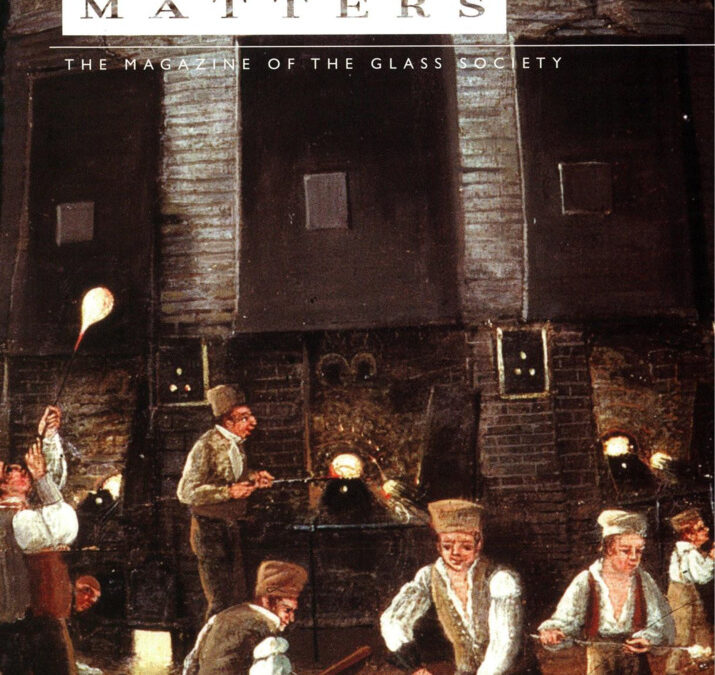
Inside a glass cone, c.1820 (possibly based on Richardson’s flint glass works at Wordsley), oil painting attributed to Emily Jane Hodgetts.
Photo courtesy of Dudley Metropolitan Borough Council Museum Collection (see article on pages 14-16)
BACK COVER:A
windmill sculpture by Ian Pearson, made in 2017. Commenting on the controversy surrounding the increasing rate of wind farms around
Caithness, on land and off the coast. Subsidies given to wind turbine companies to build, also aided donations of funds to communities, so Ian replaced the
turbine blades with monetary symbols. The glass shapes at the bottom of the sculpture represent standing stones, there are many examples in Caithness
dating back thousands of years. Photo credit Duncan McLachlan (see article on pages 31-34)
Chairman’s message
Uranium Colours in Glass
Bonhams Glass
Book Review
Emily Hodgetts – Artist
Uranium
Majella – Glass Engraver
George Washington
Factory Girls: Part 2
Blue Rims
Allport, Tasmania
Art in Conservation
Lampworking
Woolley &Wallis Glass
In Memoriam
Stourbridge and News
Editorial
CHAIRMAN’S MESSAGE
Chairman’s
Message
Time to Reflect and Look Forward
W
elcome to the lat-
est issue of Glass
Matters; our appreci-
ation must be conveyed to Brian
Clarke for bringing everything
together to our usual standard.
Thank you to those who respond-
ed to the survey we undertook in
mid-year. As over half of the mem-
bership responded, we can be con-
fident that any conclusions drawn
are representative and significant.
Overwhelmingly, in fact more than
80% of you are collectors, and it
seems that even those of you who
are dealers, auctioneers and cura-
tors also collect. Of course, a collec-
tor of Roman glass vials has little
overlap with the 20th century stu-
dio glass movement, but there are
certain common threads; the first
point I normally try to establish
is whether the collection is docu-
mented, preferably accompanied
by photographs. The largest col-
lection I’ve been involved with was
that amassed by Eva Frumin and
Jim Edgeley, numbering c.5,500
pieces of mainly Victorian pressed
glass and commemoratives. Jim was
very methodical, but as the collec-
tion was started in the 1970s, this
was just prior to the explosion in
personal computing that followed
a few years later. His handwritten
ledgers record the cost, date and
location of each purchase, together
with a brief description and, most
importantly, a sequential number
that was affixed to each item. The
ledgers are not only a valuable source
of information, but almost a social
history document in their own right
– poring through, you can see their
purchases of glass eggcups: they had
several hundred, bought from 5p up
to several hundred pounds and more
for important pressed items. You
can see where they went for their
holidays and how they spent every
weekend pursuing their interests.
They also displayed one of the oth-
er characteristics of a true collec-
tor, namely they bought rare items
that were damaged and when they
subsequently found an undamaged
version they upgraded – and no, they
didn’t throw away the original dam-
aged item! There are two further
points about this collection worthy
of mention: firstly, while there are
a huge number of common items
within the total, even if only 1% are
significant, that represents over fifty
items of special interest and many
of these are absolute treasures. For
example, they had a John Derbyshire
conservatory vase, its existence
hitherto only known in registration
documents. Secondly to Jim and
Eva, glass was not an investment
but an interest that introduced them
to a wide network of acquaintances
and lasting friendships, and they are
still fondly spoken of today. Equally
important is that after decades
of collecting they became the
acknowledged experts in their field.
Returning to the survey, it is
tempting to conclude, from the
many additional comments, that
we should have a central register of
members’ interests, so that those of
you who wish to participate could
contact each other. The society also
receives several queries each year
from the public, asking us for help
with identification, and sometimes
we struggle to respond adequately.
Within the rules of GDPR we could
maintain a database of members’
interests and contact details and
if this is something that you feel
would be of general benefit, please
feel free to contact me. Above all, I
am looking for someone to maintain
the files, and given agreement from
all sides, put people with common
David Willars, Chairman of The Glass Society
interests in touch with each other.
Several of you have mentioned
how much you enjoyed the article
on factory girls in the last issue.
Kate Round’s interview with Dulcie
May Harper brought home in graph-
ic detail the dangers of working in
harsh industrial environments.
Furthermore, this was not a descrip-
tion of life in Victorian times but was
a real account from within the life-
time of many of us. I’m pleased to
see that Part 2, this time by James
Measell, is included here. The second
part of an article on uranium glass is
also included. Uranium glass is not
without its detractors, emitting as
it does very low levels of radioac-
tivity. This is quite ironic when you
learn that the Victorian manufac-
turers made jewellery from urani-
um glass, but that’s another story.
Finally, I must take this opportu-
nity to thank Sue Newell for all she
did for The Glass Society over the last
few years and before that the Glass
Circle for many years. Sue, who is
coming to the final stages of her PhD
studies, was tireless in her support
of our group and her energy, leader-
ship and enthusiasm will be missed.
Glass Matters Issue no.I 2 October 2021
3
URANIUM COLOURS IN GLASS
Uranium Glass: Part 2
Styles of the Victorian era and early 20th century
John Frith
Wu
the full potential of
the discovery of an urani-
m oxide salt by Martin
Heinrich Klaproth in 1789 and of ele-
mental uranium by Eugene-Melchior
Peligot in 1841 was not fully real-
ised at the time, early 19thcentury
glassmakers of Bohemia and Britain
were quick to realise the value of
the yellow uranium salts in colour-
ing glass. Particularly in producing
a beautiful sparkling translucent
yellow, and a short time later a
translucent green, crystal glass.
EARLY VICTORIAN URANIUM GLASS
In 1836, Whitefriars Glassworks
(then known as James Powell &
Son) made a pair of yellow ura-
nium
Topaz
girandoles that were
presented to Queen Adelaide
by Lord Howe, and also made
Topaz
glass finger bowls and
hock glasses for a banquet giv-
en by the Lord Mayor of London
at the London Guildhall on Lord
Mayor’s Day 9th November 1837
for the new but as yet uncrowned
Queen Victoria. Val St Lambert
of Seraing, Belgium and Thomas
Webb & Sons of Stourbridge,
Britain, made uranium glass from
1837 and George Bontemps of
Choisy-le-Roi, Paris, from 1838.
The Compagnie de Cristalleries de
Baccarat in Paris released their first
uranium glass in 1843 under the
name
Cristal Dichroide,
and later
Chrysopras,
an apple-green opaque
glass named for its similarity to
the green form of chalcedony, a
microcrystalline form of quartz
and moganite. In 1844 Thomas
Webb’s glassworks at The Platts,
Stourbridge, produced yellow
Canary
glass and in 1848 opaque
apple-green
Chrysoprase
glass. In
America from the 1840s
Canary
flint
glass was made by glassmak-
ers such as Hobbs, Brockunier &
Co. of Wheeling, West Virginia
and Boston & Sandwich Glass Co.
of Sandwich, Massachusetts.
1
–
2
‘
3
.
4
Apsley Pellatt’s description
from his 1849 book
Curiosities
of Glassmaking
of the use
of uranium in glass stated:
“The introduction of toilet and
smelling-bottles has created a
demand for light-tinted Glasses, par-
ticularly for the beautiful semi-opal-
escent, yellowish-green colour;
produced chiefly by the expensive
oxide of uranium, mixed with a slight
portion of copper, and appearing yel-
low or light green, just as the rays of
light happen to fall upon the unequal
substance or thickness of the Glass.
This chameleon-like effect is also pro-
duced by uranium alone, used as the
Fig. 1
A rainbow Mother-of-Pearl Rose Bowl, with
uranium ivory base and uranium feet
colouring oxide for gold topaz; it has
been much in demand for hock glasses
and decanters, and many ornamental
articles of glass; but its fascinating
peculiarity is lost, indeed, its coloriza-
tion mostly fades, by candle-light.”
5
Victorians greatly admired the
translucency and the vibrant yellow
and green colours of uranium glass
and its production was rapidly taken
up by other glassmakers throughout
Europe, especially those in Paris and
in Stourbridge in the West Midlands
of Britain, and later by glassmak-
ers in America. Uranium glass was
made in Britain under names such
as
Canary, Lemon, Citron, Topaz,
Chrysoprase
and
Emerald Green,
in
France as
Chrysopras, Verre Canari,
and
Cristal Dichroide,
in Germany
as
Goldcristal
and
Chameleon
and
4
Glass Matters Issue no. 12 October 2021
URANIUM COLOURS IN GLASS
Fig. 2
Fig. 3
Opalescent cream jug with frilly ruby rim
Opalescent ‘Jack-in-the-Pulpit’ vase
in America as
Canaria, Canary
Yellow, Jasmine Yellow,
and
Topaz.
A variety of the colours and styles
of Uranium glass are shown in
Figs.1-8
LATER VICTORIAN URANIUM GLASS
In the 19th century a vast variety of
utilitarian and novelty glass prod-
ucts were made of translucent yel-
low or green uranium glass including
vases, decanter sets, wine glasses,
tumblers and goblets, pitcher and
glass sets, butter and sweets dishes,
biscuit jars, scent bottles, jewellery,
buttons, door and drawer knobs,
inkwells, girandoles and epergnes. It
was also popular to incorporate ura-
nium glass as part of an article in the
form of frills, rigarees, handles and
feet, and as the stems and leaves of
applied glass flower decorations. The
combination of gold ruby glass with
green uranium glass, often known
as
Rubina verde,
was also common.
Fig. 4
Pair of knife rests, a scent bottle and sugar crusher,
all in uranium yellow
From the mid-19th century to the
early 20th century uranium glass was
mainly produced in Britain, Bohemia
(Czechoslovakia from 1918) and
America. Between 1845 and 1870
much of British uranium glass was
made by Thomas Webb & Sons, and
up to 1900 they made many styles
including
Canary, Chrysoprase,
Emerald Green,
and
Rich Topaz,
and
some pieces of their
Cameo Ware
had a uranium yellow base. Other
British glassmakers that made ura-
nium glass were James Powell &
Sons, Molineaux & Webb, Edward
Moore & Co., Stevens & Williams,
WH, B & J Richardson, John Walsh
Walsh, James A. Jobling, Sowerby
& Co., and George Davidson & Co.
In 1877 James Powell & Sons of
Glass Matters Issue no.I 2 October 2021
5
URANIUM COLOURS IN GLASS
Fig. 6
Fig. 5
Uranium green cruet (for oil or vinegar)
Uranium yellow stem and opalescent ‘folded shell’ bowl vase
with handle and enamelled decoration
London made
Straw Opal
and
Blue
Opal
that were lightly coloured opal-
escent glasses with some uranium.
In 1878 Sowerby & Co. of Gateshead
made
Queens Ivory,
a new off-white
vitro-porcelain glass that emulated
ivory and was coloured with cryolite
(Na
3
A1F
6
, sodium hexafluoroalu-
minate, a mineral imported from
Greenland) and uranium. Between
1878 and 1895 James A. Jobling
& Co. made uranium glasses such
as
Chrysophis, Green Jade, Pomona,
Gold Yellow
and
Topaz.
In 1883
John Walsh Walsh made
Crushed
Strawberry
and Electric
Blue opales-
cent glass.
In 1887 Edward Moore &
Co. made
Green Celadon.
American
glassmakers included Hobbs,
Brockunier & Co., Mt. Washington
Glass Co., Libbey Glass Co., and
Boston & Sandwich Glass Co. who
made
Canaria, Canary Opalescent,
Rubina Verde
and
Amberina.i””
A recipe used by Thomas Webb
for making Lemon glass in 1876
as given by Charles Hajdamach
in
British Glass 1880-1914
was
sand 125 lb, potash 40 lb, red
lead 100 lb, bone dust 20 lb, salt-
petre 5 lb, arsenious oxide 3 lb
4 oz, and uranium oxide 7
1
/2 oz.
2
In the late 19th century uranium
was used in various types of mul-
ticoloured shaded and heat-sen-
sitive glass.
Burmese
glass was
developed by Frederick S Shirley
for the Mt Washington Glass Co.,
Massachusetts, in 1885 and was
presented to President Grover
Cleveland and later in the summer
of 1886 to Princess Beatrice and
Queen Victoria, and subsequently
made as
Queen’s Burmese Ware
by
Thomas Webb & Sons, Stourbridge,
in 1886 after they acquired the
rights from Mt Washington Glass
Co.
Burmese
glass contained fluor-
spar and feldspar to make it opaque,
uranium oxide to impart a pale yel-
low colour, and a small amount of
gold dissolved in
aqua regia
to pro-
duce the heat-sensitive ruby colour.
The initial blown glass was opaque
pale yellow and “after the first
annealing” the top of the article
was reheated at the glory hole to
turn it ruby pink from the dissolved
gold, and so the glass shaded from
pale yellow at the bottom through
salmon pink and then deeper coral
or rose pink at the top, sometimes
the rim edges were made yellow
again by a third heating.
Burmese
glass originally had a gloss finish
but later was made mostly with an
acidised satin finish.
2
‘
6
Fenton Art
Glass Co. of Martins Ferry, Ohio,
also later made
Burmese
glass.
(James Measell, the historian
at Fenton, adds: The process for
making Burmese at Fenton was as
follows:
after the item was removed
from the mould, the topmost area was
chilled briefly and was then reheated
in the glory hole. This reheating causes
the glass to ‘strike,’ creating the colour
shades described. If the top rim becomes
yellow, the glass has been reheated a
bit too long.
“First annealing” (see
above) could be a confusing term,
as annealing is understood to be
the process by which glass is cooled
to room temperature in a lehr.)
6
Glass Matters Issue no. 12 October 2021
URANIUM COLOURS IN GLASS
The formula for Burmese glass
patented by Frederick S Shirley
in 1885 is given in Albert Revi’s
Nineteenth Century Glass
as 100 lb
white sand, 36 lb refined lead oxide,
25 lb pearl ash, 7 lb nitre, 5 lb bicar-
bonate of soda, 6 lb fluor-spar, 5 lb
feldspar, 2 lb oxide of uranium, and
1
1
/2 pennyweights prepared gold.6
George Davidson & Co. of
Gateshead in 1889 made their
Pearline
range which contained
arsenic trioxide and when the rim
edges were reheated turned opales-
cent white, their
Primrose Pearline
(also called
Lemon Pearline)
was ura-
nium yellow with opalescent white
edges, later also made by Henry
Greener & Co. and by Burtles, Tate
& Co. as
Topaz Opalescent.
Uranium
green or yellow with a heat-sensi-
tive white opalescent pattern was
a common colour combination
found in American
Opaline Brocade
(now called
Spanish Lace)
glass
made by Fenton Art Glass Co. and
Northwood glass Co., British
Brocade
glass was produced in the 1880s
and 1890s, and
Canary Opalescent,
similar to
Brocade,
was made by
Fenton Art Glass Co. in about 1905.
2
Uranium oxide was also used
as a colourant in
Jade, Jadeite
and
Jadite
glass, an opaque light green
glass made to emulate jade, made
by the McKee, Jeanette and Anchor
Hocking glass companies in America;
in
Custard
glass which was a cream or
light yellowish opaque glass, made
by Dithridge & Co. of Pittsburg,
Pennsylvania, and in
Queen’s Ivory
glass, an off-white vitro-porcelain
glass made to emulate ivory, made
by Sowerby’s. Uranium is sometimes
found in other colours of Victorian
glass such as amber, brown, blue, tur-
quoise and pink.’ In the early 20th
century, some of the pieces from
Fenton Art Glass Co. and Northwood
Glass Co., iridescent
Carnival
glass,
were uranium green or uranium
yellow based, made under names
such as
Venetian Art
and
Golden
Iris!
Many pieces of 19th and 20th
century Mary Gregory-style glass
were light translucent green ura-
nium, and mid-20th century green
depression glass was coloured by
uranium and iron oxides. In the
Art Nouveau period of the early
20th century, Emile Galle, Louis
Comfort Tiffany, Rene Lalique and
Daum Freres made glass and ceram-
ic pieces coloured with uranium.
URANIUM CONTENT OF
VICTORIAN URANIUM GLASS
Most Victorian uranium glass gen-
erally contains in the order of 0.1%
to 1.5% uranium by weight with a
range of up to 2-3%; in the early
20th century some pieces of urani-
um glass contained up to 25%.8,9
The range and brightness of yel-
low and green and other colours
depended on the type and amount
of uranium oxide salt used, the oxi-
dation or ionic state of the uranium,
the type and amount of alkali used
and the alkalinity of the melt, and
the presence of other colourant salts.
FLUORESCENCE OF
URANIUM GLASS
Translucent yellow or green ura-
nium glass fluoresces a bright
yellow-green under ultra-violet
light, and in muted daylight the
edges of the glass will lightly flu-
oresce. Opaque uranium glasses
such as
Chrysoprase
and
Jade
glass
fluoresce a bright green,
Custard
glass a milky yellow-green, and
Ivory
glass a bright greenish-white.
Fluorescence as a physical phenom-
enon of certain minerals had been
known since the mid-19th centu-
ry, discovered by George Gabriel
Stokes, a British physicist, in 1852
who found fluorite, or fluorspar, a
mineral form of calcium fluoride,
CaF
2
, glowed blue under ultravio-
let light, a phenomenon he called
“fluorescence”, and Apsley Pellatt
alluded to fluorescence in sun-
light of uranium glass in his 1849
book
Curiosities of Glassmaking.
The fluorescence is due to the
outer electrons of the uranium oxide
molecule absorbing the electromag-
netic energy of ultra-violet light and
jumping into a higher but unstable
orbit, then after a fraction of a sec-
ond jumping back to their original
orbit and re-emitting energy back
as light in the yellow-green wave-
length, a longer wavelength than the
ultra-violet due to the loss of a small
portion of the energy in the process.
It is often said that an attraction
of uranium glass in Victorian times
was its response to light from the
sun as it was setting and during
twilight. As the sun sets the wave-
lengths of colour at the UV end of
the spectrum are the last to fade
Fig. 7
Cameo scent bottle
Glass Matters Issue no.I 2 October 2021
7
URANIUM COLOURS IN GLASS
and so the glass faintly glowed
for a short time before night fell,
and then the colour disappeared
with the light. Even in daylight,
and especially on a lightly over-
cast day when much of the light
except the UV is filtered out, fluo-
rescence can easily be seen around
the edges and curves of the glass.
`VASELINE GLASS’
Vaseline glass,
an American term for
a specific form of uranium glass,
came about in America in the early
20th century. David Peterson of the
Vaseline Glass Collectors Inc. found
that up to 1863, American
Canary
uranium glass was a lead-flint glass,
however the American Civil War
made lead scarce and soda-lime
glass was cheaper to make, and so
Canary
glass was made from soda-
lime, developed by William Leighton
working for Hobbs, Brockunier & Co.
of Wheeling, West Virginia.
3
‘
1
° The
soda-lime glass was a paler yellow
and slightly greenish glass compared
to the lead-flint glass. The oldest
reference that Peterson found which
used the term vaseline to describe
the newer slightly different coloured
soda-lime canary glass was N. Hudson
Moore’s 1924 book
Old Glass: European
and American.
The glass was called
Vaseline
because of its similarity in
colour to the petroleum jelly ointment
`Vaseline’ invented in 1872 by Robert
Chesebrough, an American chemist.
The Vaseline Glass Collectors Inc.
defines
Vaseline glass
as yellow-green
glass that is coloured by uranium
dioxide and fluoresces green under
UV light. It excludes glasses such as
Burmese, Ivory, Custard
and green
depression glass.
11
In Europe the
term `vaseline glass’ often refers
to the white or pastel coloured
semi-translucent opalescent glass.
Uranium glass became popular in
Europe and America by the mid-19th
century and remained so well up until
the Art Deco period. After the out-
break of World War II and due to the
developments in the nudear bomb,
supplies of uranium were seques-
tered by the British and US govern-
ments and production of uranium
glass ceased from 1943 to 1959, after
which only depleted uranium was
used and uranium glass was mostly
made in the Czech Republic, Japan
and Italy. Today the Czech Republic
still makes bright green and yellow
uranium glass, and glassmakers in
Murano occasionally incorporate
green uranium glass in their pieces.
REFERENCES
1.
Skelcher, Barrie. (2002)
The Big
Book of Vaseline Glass.
Atglen,
Pennsylvania: Schiffer Publishing
Ltd, 2002, p. 12-16.
2.
Hajdamach, Charles R. (1991)
British
Glass 1800-1914.
Woodbridge,
Suffolk: Antique Collectors’ Club, p.
401-402, 429432.
3.
Peterson, David A. (2002)
Vaseline
Glass: Canary to Contemporary.
Marietta, Ohio: Glass Press Inc., p.
6-7.
4.
Haanstra, Ivo. (2001)
Glass Fact
File A-Z .
London: Millers/Octopus
Publishing, p. 147.
Fig. 8
Opalescent
posy
basket, with yellow handle and
foot and a pink applied flower head
5.
Pellatt, Apsley. (1849)
Curiosities of
Glassmaking.
London: David Bogue.
BiblioLife Reproduction Series, 2009,
p. 73.
6.
Revi, Albert Christian. (1959)
Nineteenth Century Glass.
NewYork:
Galahad Books, p. 35-43.
7.
Glidcman, Jay L. and Fedosky, Terry.
Yellow-Green Vaseline! A Guide to the
Magic Glass.
(1998) Revised edition.
Marietta, Ohio: The Glass Press Inc.,
p. 33, 41.
8.
Brenni, Paulo. (2007) Uranium glass
and its scientific uses.
Bulletin ofthe
Scientific Instrument Society
92: 34-39.
9.
Strahan, Donna. (2001) Uranium
in glass, glazes and enamels: history,
identification and handling.
Studies
in Conservation
46:181-195.
10.
Peterson, David A. (2016)
Just What
is Vaseline Glass, Anyway?Available
at
https://www.go-star.com/antiquing/
vaseline glass.htm .
11.
Vaseline Glass Collectors Inc. (2020)
What is Vaseline Glass?Available
at
8
Glass Matters Issue no. I 2 October 2021
9
BONHAMS LEGLESS GOBLET
BO HAMS Fine Glass and British Ceramics sale:
Knightsbridge 23 June 2021
Jim Peale
T
his 283-lot auction included
56 lots of glass, 30 of which
were paperweights. The ear-
ly English glass included several
well-known pieces together with
some important new discoveries.
The inaugural lot was a previously
unrecorded engraved ceremonial
`Confederate Hunt’ goblet of circa
1759
(Fig.1).
Jacobite glass has prov-
en incredibly popular at auction in
recent years, with buoyant prices
reflecting a renewed interest in this
field of collecting. The piece refers
to Messrs Wenman and Dashwood
who, in 1754, had been the Tory
candidates for Oxfordshire. It also
lists the Lady Patronesses from
1754-58 who, in Jacobite clubs,
were usually unmarried ladies and
the only female members allowed to
attend club gatherings. The goblet
represents one of only four record-
ed, the stems of which were all pre-
sumably deliberately broken. Two of
these goblets are now in museums.
The third, the so-called `Wynnstay
Cup’ belonging to Lord Harlech,
was sold by Bonhams in 2017 for
£21,250 as part of the Contents of
Glyn Cywarch. The three previously
recorded goblets all have crude and
rudimentary repairs to the stems
which form an important part of
their history. However, with only
the bowl surviving this piece pre-
sented somewhat of a problem at
the cataloguing stage — is a goblet
without a stem still a goblet? The
broad £5,000-10,000 guide reflect-
ed this, as did the £6,375 result.
While glasses supporting the
Jacobite cause are not uncommon
at auction, those of anti-Jacobite
significance are few and far between.
An important air twist goblet of circa
1750 engraved with a titled portrait
of William, Duke of Cumberland
(Fig.2),
generated some interest
prior to the sale at a £7,000-10,000
estimate. It may have been commis-
sioned for The Cumberland Society,
a drinking club formed to celebrate
the Duke’s victory over the Jacobite
rebels at the Battle of Culloden in
1746, the last major battle fought
on British soil. With provenance
from Arthur Churchill, it had last
been sold in Scotland in 2019 and
so was not particularly fresh to the
market, though it realised £10,837.
The Leith Goblet
(Fig.3)
is
another piece which will be familiar
MEM
Glass Matters
Issue no. l2 October 2021
BONHAMS LEGLESS GOBLET
to many. This exceptional Beilby
enamelled goblet is inscribed in
opaque white with ‘Success to
the Town and Trade of Leith’ and
had been previously sold twice by
Bonhams, once for £9,000 in 2009
Fig. 5
Lot15
71=…
,
=111111
as part of the Crabtree Collection
and more recently, in 2019 for
£18,812 as part of the Peter Lole
Collection. The result this time
was £16,500, broadly on a par with
what it had previously achieved.
The highlight of the sale was
undoubtedly a
set
of four previously
unrecorded Beilby enamelled armo-
rial opaque twist wine glasses bear-
ing the arms of the Surtees family
(Fig.4),
the consignor of which had
been unaware of their value or
significance. Enamelled in white,
red, yellow and black and bearing a
Ducal coronet issuing three feathers
to the reverse, they were remarkable
in that they had descended through
the same family for whom they were
originally made. Known by the fam-
ily as ‘The Marriage Glasses’, they
were commissioned for the mar-
riage of Crosier Surtees to his cousin
Jane Surtees, daughter and heir of
Robert Surtees of Redworth Hall in
County Durham, on 12 September
1769 and could therefore be fairly
confidently dated. Offered as sepa-
rate lots, the first carried a pre-sale
estimate of £8,000-12,000 whilst
the remaining three carried respec-
tively lower estimates of £5,000-
8,000 owing to minor condition
issues. They sold for a combined
£45,211 — a testament to their rar-
ity and the enduring popularity of
Beilby glasses amongst collectors.
The £15,250 result achieved for
the undamaged example echoes the
price achieved by Bonhams in 2017
for the so-called Kitson Wineglass,
which is of related manufacture.
Concluding the early English
glass section was a blue colour
twist wine glass (Fig.5), which
exceeded expectations when it
sold for £3,187 against a £1,000-
1,500 guide. The same glass had
previously gone unsold twice in
2018 at £2,000-3,000 and £1,500-
2,000 respectively, so the result
perhaps demonstrates a sudden
uplift in the market here. This may
be borne out in part by Bonhams’
presence on auction aggrega-
tor sites since late 2019, which
has reached a new international
audience of collectors in glass.
The offering of Continental
glass was small but included a
most unusual Venetian or facon de
Venise winged latticino ‘ring’ goblet
in
vetro a reticello
(Fig.6).
The qual-
ity and construction of the piece
would have required considerable
skill and initially suggested it could
1
0
Glass Matters Issue no.12 October 2021
be late 17th or early 18th
century in date. However,
early latticino glass is seldom
found with applications in
coloured glass and the wings
are a feature more commonly
found on earlier glass. Several
features suggested that it
was out of period, although
dating was problematic. It is
just possible that there was
a brief revival in this type
of glass in the earlier part
of the 19th century, long
before the likes of Salviati.
Carrying a speculative guide
of £500-700 in light of the
unpopularity of later ‘reviv-
al’ glass amongst collectors,
it exceeded all expectations
when it sold for £2,167.
Immediately following
this was an exceptional
Vienna enamelled acrostic
Ran ftbecher
by the renowned
decorator Anton Kothgasser,
dating to circa 1820
(Fig.
7).
These are known as
Blumenborduren
beakers owing to the band of flow-
ers around the rim, the initials of
the German names of which in
this instance spell ‘Marie’. It would
appear to be the pair to a beaker sold
Fig. 7
Lot 19
by Christie’s in 2008 for £16,250
which was thought to be unique.
The present example was less fine
than that sold by Christie’s owing to
some minor condition issues. Prices
for much Biedermeier period glass
Fig. 8
Lot 25
have also fallen considerably
in recent years, yet this exam-
ple went on to take £14,000
against a £2,000-3,000 guide,
rivalling the prices being
achieved over a decade ago.
Unlike European glass,
American glass is a rare fea-
ture in our London sales,
as the collector’s market is
unsurprisingly in the United
States. An exceptionally rare
glass target ball by E
E
Sage
& Co of Chicago, circa 1877
in date took an impressive
£5,737 (plus 5% import tax
on the hammer) against a
£1,500-2,000 guide in a lot
with a more standard exam-
ple by A H Bogardus
(Fig.8).
These were a short-lived
forerunner to the modern
clay pigeon and were typical-
ly filled with feathers before
being launched and shot, thus
simulating an unfortunate
bird. Examples by Sage were
produced for a very short period
between 1877 and 1878 and as
they were made to be broken, intact
examples are exceptionally rare
with only six or so other examples
known to exist. Sometimes included
BONHAMS LEGLESS GOBLET
Glass Matters Issue no.I 2 October 2021
BONHAMS LEGLESS GOBLET
in sporting sales, the buyer bought
these on a complete whim, so they
will therefore be reappearing with a
£3,000-5,000 guide on 1 December.
The final part of the glass sale
included 30 lots of antique paper-
weights, mostly French but with
some rarities from other factories.
The first lot was a very rare mille-
fiori piedouche weight from the
workshop of Friedrich Egermann in
Haida (Novy Bor), dating to 1845-
48, with a most unusual scalloped
foot rim to the jasper-mottled base
(Fig.9).
It took £2,295 against an
£800-1,200 estimate. Following
on from this was a rare magnum
Silesian weight of circa 1850-70
produced at the neighbouring
Josephinenhutte glassworks in
Schreiberhau
(Fig.10).
Including
an assortment of silhouette
canes, weights by this factory are
sometimes unpopular with collec-
tors as they are typically cruder
than their French counterparts.
Nevertheless, they are rare in
such a large size and the result of
£2,422 (plus 5% import tax on the
hammer) was considerably above
the £500-700 guide. The most
exceptional weight was a Clichy
convolvulus or Morning Glory
from the classic period of circa
1850
(Fig.11).
Edged in yellow,
it is considered one of the rarest
of all single-flower weights, with
fewer than 30 examples by Clichy
recorded. A pink example had been
sold by Bonhams in 2010 as part of
the Baroness de Bellet Collection
for an astonishing £28,800. The
yellow example took £10,200
against a guide of £5,000-8,000.
The next sale of Fine Glass and
British Ceramics will take place at
Bonhams, Knightsbridge on 1st
December 2021 and will include
two important collections of early
Venetian and facon de Venise glass,
an array of early English glass,
and a large private collection of
antique and modern paperweights.
Fig. 9
Lot
27
Fig. 10
Lot 28
Fig. 11
Lot 47
I2
Glass Matters Issue no.I 2 October 2021
100
OBJECT
BOOK REVIEW
The Black Country
.
– A History in 100 Objects
Dr Kate Round
Editors: Malcolm Dick, DavidJ Eveleigh and JanetSullivan.
Publisher: Black Country Living Museum Publications, 1999.
T
elling the story of an area
using 100 objects is a popu-
lar theme expertly employed
here to describe the Black Country;
an area defined by its geology, peo-
ple, culture, inventions, and indus-
try, aptly expressed here by Malcolm
Dick as a
‘region of a thousand trades’.
The theme has been skilfully con-
densed and the chosen 100 objects
are arranged chronologically. A dou-
ble page is dedicated to each item
with a colour image of the object,
and the accompanying texts written
by expert authors. Texts are confined
to one page with sufficient informa-
tion to encourage further reading
and discovery. Sources used and sug-
gested further reading are alphabet-
ically arranged as appendices. One
criticism that I have is the absence
of an index in the form of a list of
the objects; conversely, this can lead
the reader on a voyage of discovery.
The Glass Industry is exemplified
by objects as diverse as the dialects
of the region. James Measell, an
eminent author with a glass man-
ufacturing background, takes us
back to 1820 with a description
of the workings of the iconic glass
cones. The skill of the glassblower
is enhanced by learning intricate
decoration methods, used to add
value to high-end products, and
showcased here by cameo and inta-
glio work. Both hot and cold tech-
niques were used to reproduce a
lost art form in the replica Portland
Vase and the expertise of designers,
glassblowers, and cutters is further
portrayed in the exquisite Stevens
and Williams intaglio cut vase.
A pint of ale’, referenced in the
oil painting ‘Inside a Glass Cone’,
quenched thirsts in the hot working
conditions of coal and
steam-based industries.
The development of the
`humble’
glass beer bot-
tle revolutionised their
product packing and
distribution for the rise
of industrial-scale brew-
ing, evolving to today’s
familiar microbreweries.
Author Andrew Homer
is a respected Black
Country historian and
has written extensive-
ly on bottles, brewer-
ies, beers and
‘spirits’.
There is no better
example of the range
of products, made
by a single enduring
Black Country busi-
ness, than those of
Chance Brothers and
Co. Glassworks. Their
diversity is illustrated by the dioptric
lenses and the mechanisms for light-
houses they produced, producing
powerful direct light that
‘revolution-
ised’
maritime safety and described
here by Toby Chance who is a direct
descendant of the Glassworks
founders. Malcolm Dick uses an oil
painting by Mervyn Peake, a talented
artist renowned for his interpreta-
tions of glassmaking, to illustrate
their production of cathode ray
tubes for radio detection and ranging
(RADAR) – a crucial contribution to
our defences. Post-wartime, Chance
Glassworks evolved to produce lucra-
tive consumer goods. David Encill is
an authority on their domestic rang-
es including their handkerchief vas-
es, made using innovative ‘slumping’
production methods combined with
traditional decorative techniques
including intaglio. This range was
produced for almost 40 years.
This History of the Black Country
is a journey beautifully illustrated
in a page-turning format to appeal
to readers of all ages. The evolu-
tion in glassmaking is typical of
the many trades and their diver-
sification of production, which
encapsulates the people of the
area, their use of resources, their
innovations, skills, and artistry;
long may the journey continue.
Dr Kate Round JP PhD MRSC CChem
BSc(Hons) is an outreach presenter
and tour guide for Dudley Museum
Service. She is currently working on
exhibits for the new Stourbridge Glass
Museum on topics as varied as Women
Glass Workers, Contemporary Glass,
and Where in the World: the impact
Stourbridge Glass has made worldwide.
Glass Matters Issue no.I 2 October 2021
13
EMILY HODGETTS – ARTIST
The Enigmatic
Emily
Jane Hodgetts
James Measell
Ac
bout four decades ago, the
Dudley Metropolitan Borough
ouncil (DMBC) acquired an
oil painting attributed to the artist
Emily Hodgetts. The painting, 30cm
by 50cm in size, depicts the interi-
or of a glassworks factory, perhaps
the Richardson firm at Wordsley,
although the clothing suggests a
time prior to the existence of the
Richardson firm, which had begun
around 1829. Illustrations of this
painting appear on the dust jacket
and frontispiece of R. Wilkinson’s
Hallmarks of Antique Glass,
which
was published in 1968. The DMBC
purchased the painting from the
Wilkinson family in 1981. Recently
chosen for inclusion in
The Black
Country: A History in 100 Objects,
the painting is currently at the
Dudley Museum in the Dudley
Archives and Local History Centre,
and it will likely find a home in the
new Stourbridge Glass Museum in
due course. Prior to its closure, the
Broadfield House Glass Museum
displayed the painting, and vis-
itors could read the brass plate
affixed to the frame: `Glassmaking
circa 1820 at Richardsons-
Wordsley by Miss Emily Hodgetts’.
Another painting attributed to
Miss Hodgetts depicts the cutting
shop at the Richardson factory.
Neither painting is signed or dated.
Who was Emily Hodgetts?
What can be known about her life,
especially her artwork and any
connections she may have had
with the glass industry? Whilst
searching for Emily Hodgetts in
resources devoted to British art,
one finds the cryptic phrase ‘work-
ing 1820-1850’ in
British and Irish
Paintings in Public Collections,
and
the website
artuk.org
says ‘active
1820-1850’. However, these state-
ments lack credibility, for Emily
Hodgetts was born in the mid-1830s.
Jason Ellis’s
Glassmakers of
Stourbridge and Dudley 1612-
2002
provides much information.
Emily Jane Hodgett’s parents were
William Rolinson Hodgetts (1784-
1845) and his wife Elizabeth. They
married on 28 February 1827 in
Birmingham, and their first child,
William James Hodgetts, was born
on 4 March 1828. At that time,
William Rolinson Hodgetts was
involved with a Dudley glassworks
that initially traded as Large &
Hodgetts and later as Davies &
Hodgetts until the latter partnership
dissolved in 1832. The glasshouse
was impacted by mining subsid-
ence, so William Edward Davies and
William Rolinson Hodgetts looked
to Wordsley in 1834 and obtained
a 21-year lease for the Red House
glassworks. Emily Jane Hodgetts
was born on 6 March 1835. William
Rolinson Hodgetts died in 1845, and
his will provided for his wife and
son to continue the glass business.
The 1851 census finds the
Hodgetts family in Townsend,
Kingswinford, as follows: widow
Elizabeth Hodgetts, 52, is listed
as ‘glass manufacturer’ as is son
William J. Hodgetts, 23. There were
five daughters in the household:
Elizabeth, 21; Sarah A., 17; Alice M.,
13; Ellen, 12; and Dorothy, 9. None
of the older daughters has an occu-
pation listed, and all are described as
`scholars at home’. The 1851 census
also has an entry for another daugh-
ter, `Hodgetts, Emily J. 16′, who was
then residing at Oakfield Academy in
Droitwich Road north of Worcester.
According to the 1851 census, the
Oakfield Academy headmistress
was Mary Marmont, and there were
nine teachers. There were 35 young
female scholars (aged 9 to 18) and
four younger female visitors. The
former Oakfield Academy build-
ing is now part of the River School
under the auspices of the Worcester
Christian Education Trust.
Emily Jane Hodgetts might have
received art instruction whilst resid-
ing at Oakfield Academy, although
the duration of her attendance is
unknown. Art education was avail-
able at the Mechanics’ Institution in
Stourbridge beginning in 1848, and
records from 1850 indicate that there
was a drawing class for ladies on
Monday afternoon. The Stourbridge
School of Art and the Worcester
School of Art were founded in 1851,
and both institutions offered art
instruction. The Stourbridge school
had an ‘afternoon female private
class’ meeting once per week as well
as an ‘afternoon female public class’
meeting once per week. These classes
enrolled daughters and some spouses
of local gentry, clergy, professionals,
and businessmen, and the art mas-
ter himself provided the instruction.
Unfortunately, there are no compre-
hensive records of those who attend-
ed the Stourbridge school in the
1850s, and local newspaper reports
of annual meetings for Stourbridge
or Worcester contain no mentions
of Emily Jane Hodgetts. In the 1861
census, widow Elizabeth Hodgetts
is listed as ‘House Proprietor’ and
head of the household. The young-
est daughter, Dorothy Hodgetts,
had died in 1859, but five unmarried
daughters resided with their moth-
er at Wordsley House: Elizabeth,
29; Sarah, 26; Emily Jane, 25; Alice
Mary, 23; and Ellen, 21. No occu-
pations are listed for any of them.
Emily Jane Hodgetts married
Reginald Rabette Dudley on 29
July 1866 at St. George’s Church
in Leicester. A surgeon educated
at University College and Charing
Cross Hospital in London, Reginald
14
Glass Matters Issue no. I 2 October 2021
EMILY HODGETTS – ARTIST
The painting depicts the interior of a typical brickwork cone of a glass factory, within which a furnace
roared constantly. The chain and pulley system raised metal covers so that servitors could access molten
glass in the pots. Glassworkers were organised in teams called chairs, so named because the skilled
gaffer sits at a wooden bench with horizontal arms. The glassworkers in the centre foreground are
making a crystal decanter, and those at the left are making stemware. Glassworkers were required to
produce a given number of pieces: the ‘move.’ The man in a frock coat and top hat within the alcove at
left examined the ledgers and determined the piecework pay. Difficult articles commanded the highest
wages. Glassmaking is physically demanding labour in hot conditions, and the measure of ale held by the
man at left would have been welcome in any glassworks factory. (photo courtesy of Dudley Metropolitan
Borough Council Museum Collection).
Dudley was admitted to the Royal
College of Surgeons in the summer
of 1862. At the time of the marriage,
Reginald Dudley was in partner-
ship with William Edward Stanton
as `Surgeons and Apothecaries’ in
Leicester. According to the
Leicester
Journal
(30 August 1867), this
partnership was dissolved, and
Reginald Dudley and Emily Jane
Hodgetts Dudley took up residence
in Kirkoswald, Cumberland. The
census records for 1871, 1881 and
1891 show Reginald Dudley (occu-
pation: ‘General Practitioner’) and
his wife living at the same location
in Kirkoswald. The couple had no
children. Various editions of
Kelly’s
Directory of Cumberland
in the 1890s
indicate that Reginald Dudley served
as `certifying factory surgeon’ for the
district. By 1891, a niece, Florence G.
Hodgetts (the daughter of William
James Hodgetts), was also residing
with them. After Reginald Dudley
died in 1900, Emily Jane Hodgetts
Dudley remained in Kirkoswald
with her niece.
The Penrith Observer
(4 April 1916) records that Emily
Jane Hodgetts Dudley died in March
1916: At Kirkoswald, on the 25th
ult., Emily Jane, widow of Reginald
Dudley, M.R.C.S., aged 82 years’.
In short, the facts detailed above
are all that is known about Emily
Jane Hodgetts Dudley’s life from
the time of her birth until her death
more than 80 years later. However,
neither the various census rolls nor
any other sources reveal informa-
tion about art education or train-
ing that she might have received.
Moreover, no record has come to
light to suggest that art was her voca-
tion. In September 2017, the con-
tents of Wordsley Manor (a recent
appellation for Wordsley House)
were sold by Fieldings Auctioneers
Ltd. in Stourbridge. Among the near-
ly 700 lots in the auction were ten
oil paintings and one watercolour,
all ‘attributed to Emily Hodgetts’.
The paintings were not dated or
signed. To view these paintings,
go to
fieldingsauctioneers.co.uk
and
search under Sale Results for ‘Emily
Hodgetts’. The auction catalogue
describes some works as ‘after’ or
‘in the style of a particular artist,
such as landscape specialist Alfred
Vickers or George Armfield, who
painted scenes featuring sporting
dogs. Other paintings are close cop-
ies of well-known artworks, such as
Glass Matters Issue no.I 2 October 2021
15
EMILY
HODGETTS – ARTIST
Sir Joshua Reynolds’
Angel’s Heads,
William Hilton’s
Una Entering the
Cottage of Corecca,
and Sir Edwin
Landseer’s
Bolton Abbey in Olden
Times
and
The Twa Dogs.
In all
likelihood, Emily Jane Hodgetts
Dudley was, like many women of
Victorian times, an erstwhile and
talented amateur artist. She did
not exhibit or sell her work, since
she painted for her own enjoyment
and presumably, the pleasure of her
family and friends. As the daugh-
ter of a successful businessman
who provided for his family finan-
cially, she had a comfortable life.
Neither she nor her sisters need-
ed to pursue a socially acceptable
occupation, such as governess
or teacher. At the age of 31, her
marriage to a surgeon assured a
measure of economic security.
Art historians have noted that
women in the nineteenth century,
ranging from Queen Victoria and
the wives and daughters of gentry
to the spouses and daughters of
middle-class businessmen, were
interested in art as connoisseurs
and frequently engaged in sketch-
ing with pen and ink or painting
in watercolour or oil. Some women
had private lessons or attended an
art school, but many others were
self-taught. Proficiency in art by a
young woman was regarded as an
`accomplishment’. Indeed, the ama-
teur female artist was endemic to
the Victorian era, and she is depict-
ed in Abraham Solomon’s 1862
painting,
The Fair Amateur,
which
shows a young woman clothed in
fulsome Victorian attire, seated
with palette and brush in hand,
gazing intently at the painting in
progress on her easel. The paint-
ings ‘attributed to Emily Hodgetts’
and described in the Fieldings
auction catalogue are consistent
with the work of an amateur artist.
Emily Jane Hodgetts Dudley’s
last Will and Testament (writ-
ten in October 1914 and proved
18 September 1917) provides a
clue regarding her paintings. The
first few lines of the will read
as follows: ‘I Emily Jane Dudley
widow of Reginald Dudley late
Surgeon of Kirkoswald Cumberland
declare this to be my last Will and
Testament … I give and bequeath
to my nephews the Revd H.
L. Firmstone and Percy John
Firmstone for their kindness in
managing my affairs for so many
years all the property that comes
to me under my fathers “Will”
also the furniture which comes to
me and
all my pictures in Wordsley
House …’
[italics added]. Whilst
there seems little doubt that
Emily Jane Hodgetts Dudley was a
gifted amateur artist and that the
paintings in Wordsley House were
her work, it remains to uncover
evidence that links her to glass-
making beyond the association of
her father and brother with the
Red House glassworks factory.
James Measell is an Honorary
Research Fellow at the University
of Birmingham. He can be contact-
ed by email: jsmeasell@gmail.com
Uranium in glass
Dwight Lanmon
H
aving read Part
1 of the article
by John Frith on
the use of uranium
in glass, I’d like to
offer some additional
information. There
are some interestingly
designed finger bowls
documented to 1837,
examples of which are
in the collections of the
V&A (C.110-1992),
Corning (88.2.8) and
the Stourbridge Glass
Museum. The finger
bowls are coloured
with uranium oxide,
while the under-
plates are colourless
lead glass. They were made for
use at the high table when Queen
Victoria attended the coronation
banquet at the Guildhall. The
V&A identifies them as a product
of Davenport of Longport.
John Frith replied
T
hanks for this. I wasn’t
aware of the finger bowl and
hadn’t come across it during my
research. However, having just
looked up Davenport uranium
glass on the Internet, I have come
across quite a few references,
including the V&A Museum piece
in an article by Rebecca Luffman,
showing the piece fluorescing
under UV light. I will certainly
use the information if I come to
revise the article in the future.
I 6
Glass Matters Issue no. I 2 October 2021
Fig. 4
enlarged view ofthe stipple engraved signature
Fig. 3
Engraved foot
MAJELLA – GLASS ENGRAVER
MAJELLA TAYLOR:
glass engraver
NigelBenson
Fig. 2
Stipple engraved goblet bowl
I
recently came across
Fig. 1
a Whitefriars com-
memorative goblet
for Queen Elizabeth
II’s Silver Jubilee; the
underside of the foot is
signed Majella, inscribed
Whitefriars and 52 with-
in a circle. The design is
stipple engraved and
on first sight was one
of the many done by
Geoffrey Baxter, but no.
Its not WJ Wilson, or
Geoffrey Baxter. To my
surprise it’s engraved by
Josephine Majella Taylor,
a well-known glass
engraver, trained at the
Hammersmith College
of Art, who lived and
worked in Chichester.
She also wrote the book
The Art and Technique of
Glass Engraving”,
Kylin
Press 1982. I can find
very little reference to
her online. However, its
my contention that she
did these for Whitefriars
rather than under her
own ‘banner’ as an
engraver. Why? Well,
glass engravers never
put the name of the glass
maker/manufacturer on
their engraved pieces – it
may well be mentioned
for an illustration in
a book, or when in an
exhibition, but not on
the piece. J M Taylor was
known by her middle
name of Majella, proba-
bly because it was distinctive, but
also possibly not to be mistaken for
someone else if she’d signed as J M
Taylor (my guess). The encircled
52 is probably an edition number
– likely out of 100, or possibly only
75. The stipple engraved design
work is indicative of her style and
it would be very interesting to
hear if anyone has seen one of
these commemoratives before and
of course any other information.
Majella engraved Whitefriars goblet
Glass Matters Issue no. 12 October 2021
17
Fig. la & lb
Front and reverse of a fragmentary bottle seal bearing the Washington coat of arms. 3.7 cm x 3.5 cm.
(1-7/16 x 1-5/16 in.)
Private collection
GEORGE WASHINGTON
IdenWing the
Original Owner
of a
Bottle
bearing the
Washington Family Coat ofArms
Dwight P. Lawton and David _Burton
I
n February 2020, a heavily
weathered, fragmentary bottle
seal bearing an unidentified
coat of arms was offered for sale
on eBay
(Fig.1).
The vendor said
that it had been found by a mud-
lark on the foreshore of the River
Thames in London. That accounts
for its weathering crust, but such a
thick brown crust is not typical of
weathered English glass bottle seals
and, unusually, the glass material is
not transparent dark green, as one
would expect, but is transparent
yellowish, pale aqua or colorless
(Fig.2).
The remaining body of the
bottle, on the back of the seal, is
curved in two directions and is of
a thickness suggesting that it was
on an onion-shaped bottle and,
therefore, likely dates from the late
17th century, circa 1685-1695. It
has not been possible to test the
seal to determine if it is lead glass.
There are a number of exam-
ples recorded of pale or light-co-
loured glass bottles dating from
the 17th century and again in the
1720s. There are no aqua glass
examples known, mainly pale green,
yellow or amber, some of which are
associated with detached seals. It
is a rare material for a sealed bot-
tle, although colourless glass was
quite common with the cruciform
decanters of about 1725-1730 and
there is a colourless glass bottle
decanter in the collection of the
Fitzwilliam Museum in Cambridge,
dated c.1740, but it is not sealed.
Although the seal is heavily
weathered, it is possible to discern
important details of the coat of arms
and thereby to identify it: it has five
bars with three mullets (stars) in
the upper bar. An important detail
is the inclusion of a martlet, a styl-
ized swift or house martin, within
the coat of arms. This is a mark of
cadency identifying a fourth son as
the bearer of the arms. (In British
heraldry, cadency is the graphic
system for distinguishing between
the coat of arms borne by the per-
son who has been granted them and
the arms borne by his sons, each
successive son adding
a different symbol –
cadency — indicating
the order of his birth.
For example, the sym-
bol for a second son is
a crescent, that for a
fourth son is a martlet,
etc.)
1
The coat of arms
on the bottle seal is sur-
mounted by a helmet
Fig. 2
Bottle seal viewed by
transmitted light, showing the
transparent yellowish colour of
the weathered glass
and a crest. The crest is not legible,
but it appears to be a bird with raised
wing. The coat of arms is flanked by
florid mantling in a style typical
of the late 17th century. A graphic
representation of the coat of arms
on the bottle seal is shown in
Fig.3.
The coat of arms on the bottle
seal is that of the Washington fami-
ly. The Washington (or Wessyngton)
family first used these arms in the
18
Glass Matters Issue no. I 2 October 2021
* * *
Fig.4
Stained-glass window bearing the conjoined
arms of Washington and Kitson, probably
made to celebrate of the marriage of John
Washington and Margaret Kitson in 1498,
but the window was probably produced
about 1592. The CorningMuseum of Glass
(57.2.10B), 47.2 x 34 cm
ABOVE Fig.3a
Graphic representation of the coat ofarms
on the bottle seal shown in Fig.1
Courtesy
Wilcipedia (edited)
RIGHT Fig.3b
Representation of
3a
with elaborate mantling,
crest and the Martlet; image close to that seen
on the bottle seal.
Figs.5a & 5b
Drawing (front of page)
of the Washington
family coat of arms,
confirmed (reverse
page text) by Robert
Cook, Clarenceaux King
of Arms, to Laurence
(sic) Washington of
Soulgrave (sic), 1592.
Library of Congress,
George Washington
Papers, Series 4, General
Correspondence:
Isaac Heard to George
Washington,
December 7,1791
Pt
t r
.
fi
a 1
0411 urt
4.1
tin
etas,
0.,fi..41
t
i
o.”4
5111
(s r>
e
” II
af At
Pie, .
/ / ee’
e.
na •
GEORGE WASHINGTON
early twelfth century when Sir
William de Hertburn was granted
the lordship of Washington Old
Hall in County Durham and adopt-
ed the name. The family spread
throughout various parts of England
over the following centuries. The
Washington family arms are:
argent
two bars gules, in chief three mullets of
the second.
Two crests are recorded
for different branches of the fam-
ily: firstly,
out of a ducal coronet, or,
a raven with wings addorsed proper,
and secondly,
on a ducal coronet, or,
an eagle with wings addorsed, sable.
The owner of the bottle whose
seal is discussed here was most
likely in the line of the family
associated with Sulgrave Manor in
Northamptonshire. The Sulgrave
line of the Washington
family descended from
Robert Washington Jr. (ca.
1435-1528), the second
son of Robert Washington
Sr. of Tewitfield (ca.
1404-1483),
(Fig.8).
As
a result, Robert Jr. bore
the arms with a crescent
cadency, as did his son John (ca.
1470-abt. 1528)
(Fig.4),
grand-
son Lawrence I (ca. 1500-1584),
great-grandson Robert (ca. 1544-
1623), and great-great-grandson
Lawrence II (1566-1616). Lawrence
Washington I, a wool merchant and
direct ancestor of the first American
President, George Washington,
built Sulgrave Manor in 1539.
2
In 1592 Robert Cook, Clarenceux
King of Arms, confirmed Lawrence
Washington II of Sulgrave as senior
in line of descent of the Washington
family and granted him the use of the
undifferenced coat of arms — that is,
without the crescent cadency
(Fig.5).
He was the first in his line to bear
the main arms without the crescent
Glass Matters Issue no. I 2 October 2021
9
GEORGE WASHINGTON
ABOVE Fig.6
Stained-glass window bearing the conjoined arms
of Washington and Butler, probably made to
celebrate the marriage of Lawrence Washington
II and Margaret Butler. Dated 1588, but probably
made after 1592. The Corning Museum of Glass
(57.2.10A), 48.6 x 31.9 cm
RIGHT Fig.7
Bookplate of George Washington.
Photo courtesy of Sotheby’s
cadency since his great-great-great
grandfather (Robert Washington
Sr. of Tewitfield), who died in 1483.
That undifferenced coat of arms
was depicted in Lawrence’s stained-
glass window celebrating his mar-
riage to Margaret Butler in 1588,
originally mounted in Sulgrave
Manor
(Fig.6),
and depicted on his
tombstone in the churchyard of St.
Mary the Virgin with Saint John in
Great Brington, Northamptonshire.
It is likely that the owner of the
armorial-sealed bottle bearing
the martlet cadency was a male
descendant of Lawrence II and his
wife, Margaret Butler. Given the
trouble Lawrence took to gain the
use of the main Washington coat
of arms, it seems probable that his
heirs would have observed strict
heraldry, each bearing the cadency
symbol associated with the order
of his birth. But, because the use of
cadency marks was declining in the
17th century, it is possible that they
each used the undifferenced coat
of arms. Nonetheless, at least one
member of the family obviously did
observe the use of a mark of caden-
cy – as proved by the bottle seal.
Lawrence II and Margaret
Washington were astonishingly
fruitful for their time: they had
seventeen children, eight of them
male
(Fig.8),
five of whom survived
beyond infancy. Their first son, Sir
William (c. 1589-1643), had one son,
who in turn had no sons. Therefore,
Sir William could not have been
the ancestor of a son bearing the
martlet cadency. Looking further
along the line of sons of Lawrence
and Margaret Washington, we find
that the fourth was Richard (ca.
1592-1642). He would have borne
a martlet cadency legitimately on
his coat of arms, but he was not
the original owner of the bottle
because he died before it could have
been made. (English sealed bottles
are thought to have originated
around 1645-1650.) His son and
grandson also would have been
entitled to use the martlet caden-
cy and one or the other was likely
the original owner of the bottle.
Lawrence Washington II and his
sons were staunch supporters of
King Charles I and enjoyed a close
relationship with him. His first
son, Sir William (c. 1589-1643),
20
Glass Matters Issue no.I
2 October 2021
Robert Washington of Warton
(c. 1440 [1455?] -1528)
Robert Washington Sr. of Tewitfield
(ca. 1404-1483)
John
(c. 1430-1501)
Fig.8
The family tree of Richard
Washington
GEORGE WASHINGTON
John of Warton
(c. 1465/75-1528)
+ six later sons
Lawrence of Sulgrave
(c. 1500-1584)
+ four later sons
Robert o Sulgrave
(1544 1623)
1
+ three later sons
Lawrence II of Sulgrave
(1567-1616)
+ five later sons
Sir William
(1589-1643)
Sir John
(c. 1589-1688)
Robert
(1589-1663)
Richard
(1592-1642)
John (1623-60)
Revd. Lawrence
(1602-1652)
Thomas
(1604-1622)
Gregory
(1606-06)
George
(1608-08)
was married to the sister of the
Duke of Buckingham, an import-
ant and influential ally of the
King. His second son, Sir John (c.
1591-1688), had a son who was
Commander of the Royal Forces
at Worcester during the Civil War.
Revd. Lawrence (1602-1652),
Lawrence’s fifth son, was expelled
from his living in Purleigh, Essex,
in 1643 for his Royalist sympa-
thies. Thomas (1604-1623), his
sixth son, served as the King’s page.
England was wracked by the Civil
War between the Parliamentarians
Richard (1660-1725)
and Royalists in the mid-17th cen-
tury, and after the execution of King
Charles in 1649, the defeat of the
Royalists in 1651, and the establish-
ment of the Commonwealth (1653-
1659), at least four of Lawrence II’s
grandsons emigrated across the
Atlantic. Sir John’s son, John (c.
1624-1661), emigrated to Barbados
where he became a merchant.
Richard’s son, John (1623-1660),
followed his first cousin to Barbados
and later moved to Surry County,
Virginia. Two of Revd. Lawrence’s
sons, Col. John (1632-1677) and
Lawrence III (1635-1677), emi-
grated to Westmoreland County,
Virginia, in 1656/1657, the for-
mer famously the great-grand-
father of the first American
President, George Washington.
President Washington was enti-
tled to bear the family coat of arms
and did so proudly. His legitimate
use of them was confirmed by Isaac
Heard, Garter King of the College
of Arms, on 7 December 1791.
The arms were used on his book-
plate, engraved in London in 1792
(Fig.7),
on personal possessions,
Glass Matters Issue no.I 2 October 2021
2I
Fig.9
The family tree of the Revd. Lawrence Washington
and descent to Capt. John Lawrence Washington
and President George Washington
Lawrence II of Sulgrave
[/ Butler] (1567-1616)
Richard
Rev. Lawrence
Thomas
Gregory
(1592-1642) (1602-1653)
(1602-1653)
(1606-06)
Edward
Wil
iam
George
Larry
(1640-1710)
( I 64I-?)
(?)
(?)
Sir William
Sir John
Robert
(1589-1643)
(c. 1589-1688)
(1589-1663)
John
Lawrence 111
(1632-77)
(1635-77)
1
I
I
I
Warner
Henry
Butler
Lawrence
Col.Augustine
George
(1722-1790)
(1728-?)
(1716-16)
(1718-1752)
(1720-1762)
(1732-1799)
(President)
I
Col. Samuel
John Augustine
Col. Charles
(1734-1787)
(1736-1787)
(1738-1799
GEORGE WASHINGTON
Lawrence
Nathaniel
Henry
Capt. John
(1660-1719)
(1660-1719)
(1661-1698)
Capt. Augustine
Nathaniel
Capt.
Henry
John 111
(1694 1743)
(1690-1745)
(1694-1748)
(?-ca. 1752)
Capt. Lawrence
(1659-1699)
Maj. ohn
(1692 1746)
on the livery of his servants, and
architecturally at his home, Mount
Vernon. Although he was not
a descendant of a first son, the
coat of arms that was confirmed
to him did not bear any cadency
mark, although he was not a pri-
mary descendant of a first son of
Lawrence II – indicative of the fact
that the system had fallen into dis-
use by the late 18th century.
3
(Fig.9)
No example of this bottle seal
has been found at Mount Vernon.
(Indeed, no other example is
known.) George Washington
was not the original owner of the
bottle seal under discussion, so
which specific Washington among
Lawrence Washington II’s heirs
could have ordered it? There are
two possibilities: either a descen-
dant of Richard Washington (1592-
1642) or of the Revd. Lawrence
Washington (1602-1653).
(1) Descendant of
Richard Washington
(Fig.8)
Richard was the fourth son of
Lawrence Washington of Sulgrave.
He was apprenticed to the London
Clothworker’s Company in 1614 and
married Frances Browne (ca. 1607-
?). They had one son, John (1632-
1663). Richard emigrated to Surry
County, Virginia, in 1637, nearly
twenty years before his nephews
(John and Lawrence III) – becom-
ing the first Washington of the
Sulgrave family line to reside in the
American colonies – but he returned
to England before his death in 1642.
Richard’s son, John (1623-1660),
who was born in England, emigrat-
ed to Barbados where he was a mer-
chant, like his cousin (also John,
son of Sir John Washington). He
moved to Surry County, Virginia,
about 1650 and married Mary Flood
(ca. 1635-1678). They had one son,
Richard (1660-1725), who was born
in Virginia and married Elizabeth
Jordan (1660-1735) in 1681; they
had twelve children. Elizabeth’s
uncle, Col. George Jordan, served
as attorney general of Colonial
Virginia. Nothing has been discov-
ered about Richard’s education,
but he was a trader and wealthy
planter. By the time of his death, he
had amassed a considerable estate
in Surry County, nine miles from
Jamestown, including thousands of
acres of land, a plantation and slaves.
We have not found any contem-
porary documents depicting the
coat of arms that either John or his
son Richard bore, but we theorize
that, being first sons of a fourth son
of a holder of the primary arms of
Washington, either would have been
entitled to bear the martlet cadency.
Because father and son, John
and Richard Washington, were very
Glass Matters Issue no. I 2 October 2021
22
GEORGE WASHINGTON
wealthy, both would have had close
contacts with merchants in England.
It would, therefore, have been easy
for either man to order bottles
personalized with his coat of arms
from an English glassmaker. Given
Richard’s birth and death dates
(1660/1725) and the likelihood that
the bottle was made in the late 17th
century, we conclude that he was the
more likely to have been the origi-
nal owner of the bottle whose frag-
mentary seal was found in London.
(2) Descendant of the
Revd.
Lawrence Washington
(Fig.9)
Another possible owner of the
armorial sealed bottle was a
descendant of the first son of the
Revd. Lawrence Washington. Col.
John Washington (1632-1677),
his first son, invested and sailed
in a merchant ship, the Sea Horse,
which was involved in the Virginia
tobacco trade. On its 1656 voyage
from London the ship foundered
in a storm and sank in the Potomac
River, close to a plantation owned
by Col. Nathaniel Pope, who invit-
ed him to stay. (The ship was
later raised successfully.) This
led to a romance with his daugh-
ter Anne, and they were married
in 1658. Colonel Pope gave the
newlyweds 700 acres of land on
Mattox Creek. John, then a young
officer who later became colo-
nel, is best known as the paternal
great-grandfather of President
George Washington (1732-1799). A
Member of the House of Burgesses,
he acquired over 10,000 acres of
land including a major part of the
Wakefield and Mt. Vernon estates.
Genealogical records show that
John and Anne had four sons and
five daughters. The four sons were
Lawrence (1659-1698/9), twins
Nathaniel (1660-1719) and Henry
(1660-1748), and John Lawrence
Washington Jr. (1661-1698). His
eldest son Lawrence was educated
in England and inherited most of
his father’s estate, and his grand-
son Augustine (1694-1743),
acquired additional lands with the
purchase of an iron furnace near
Fredericksburg and a large plan-
tation on Pope’s Creek. Captain
John Lawrence, being the fourth
son, may have used the mart-
let cadency on his coat of arms.
CONCLUSIONS
We theorize that the original
owner of the bottle bearing the
Washington coat of arms was a
male descendant of Lawrence
Washington II of Sulgrave Manor.
If that is correct, we have identi-
fied two candidates, both of whom
were born and lived in the Virginia
Colony. We have not found records
showing that either man travelled
to London, but assuredly both had
mercantile contacts there, which
would enable either to order per-
sonalized bottles – but we can-
not explain why the bottle was
broken and discarded in London.
The two likely candidates
for the original owner are:
•
Richard Washington (1660-
1725), the great-grandson
of Lawrence Washington II
of Sulgrave Manor’s fourth
son. He lived in the Virginia
Colony, was very wealthy and
would legitimately bear the
martlet cadency on his coat of
arms. His father was the earli-
est member of the Washington
family to emigrate to Virginia.
•
John Lawrence Washington
Jr, the fourth son of another
of the first members of the
Washington family to emigrate
to Virginia. He was also wealthy
and an important dignitary,
being a lawyer, soldier, planta-
tion owner and High Sheriff of
Virginia. He had the social and
political position in society to
entertain the ‘movers and shak-
ers’ of the day, serving the wine
in his own personalized sealed
bottles ordered from England.
These appear to be the most likely
possibilities. Further research may
produce a different outcome, but it
does underline just how important
it is that a small, seemingly insignif-
icant fragment of glass can unlock
so much social history. The search
will continue to find an example
of the coat of arms both men used
to seal documents and perhaps on
other household goods to determine
if either used the martlet cadency.
ENDNOTES
1.
“Cadency” arose because of the
need to distinguish between male
members of the same family on
their coats of arms. In principle no two men were permitted to bear the
same coat of arms, so a system of
adding small variations (known as
“differences”) to the main arms was
developed in the 14th century. While
the eldest son would likely eventually
inherit the “undifferenced” or main
coat of arms of his father, his younger
brothers would not, and their male
heirs would continue using the
same “difference” mark of cadency.
However, the use of cadency marks
to identify the rank of sons of the
bearer of the main arms declined in
the 16th century, and was rarely used
in the 17th century and thereafter
in England — and it is not enforced
in England today (although it is in
Scotland). In part, this arose because
of the confusion that would result
from the inclusion of several “differ-
ences” — resulting, for instance, from
the complexity of adding distinguish-
ing marks to the coat of arms of, say,
the second son of a fourth son of a
third son.
2.
After the death of Lawrence’s son,
Robert Washington, in 1623 the fam-
ily seat of Sulgrave Manor was sold to
his nephew, Lawrence Makepeace.
3.
President Washington was the fourth
son of a second son of a second son of
a first son of a fifth son of Lawrence
Washington II of Sulgrave. His cor-
rect coat of arms should, therefore,
have borne at least three distinct
marks of cadency!
Glass Matters Issue no. 12 October 202!
23
GLASS DECORATION
Factory Girls; Part 2:
Voices from the pact
James Measell
S
everal years ago, glass enthu-
siasts Kate Round and James
Measell separately chatted
with former ‘factory girls’ who had
worked in some capacity in the
Stourbridge glass industry. At the
time of two of these interviews,
the women were more than 90
years old, but the recollections of
their employ in the glass industry
were quite vivid and interesting
to hear. This interview is with
Joan Greaves by James Measell.
JOAN GREAVES
One day in 2012, I was visiting the
Ruskin Glass Centre and speaking
with my friend Ian Dury who was
the Centre’s Glass Heritage Officer.
At the time, Ian knew that I was
interested in researching the histo-
ry of the Stourbridge School of Art.
Ian mentioned that he had recently
met an elderly lady who had been a
student at the school. Naturally, I
wanted to meet her and learn about
her experiences at the school. A few
days later, Mrs Greaves drove her
automobile to the Ruskin Glass
Centre, and we had quite a nice
chat in the café area of that facility.
and Church Street come together.
The Stourbridge library was there,
too, for many years, before it moved,
but the building is still there, so
you can go and see it. I think I was
interested in studying design in a
general way, but I was most interest-
ed in designs for pottery and glass.
The school was known locally as
the Stourbridge School of Arts and
Crafts, and I started to take classes
there when I was about 14 or 15. It
was just a short walk from home.
JM:
What kinds of classes did
you take at the school?
JG: Well,
there were classes and lectures
in different styles of art from
various countries in history, but
there were also classes in drawing
and painting that taught about
colours and perspective, those
kinds of things. Mr Vidgen-Jenks
encouraged me in painting, and I
became more and more proficient
in the classroom painting exercises.
JM:
Was Mr Vidgen-Jenks your
painting teacher?
JG: No, he was
Principal of the school, rather
like a headmaster sort of post,
but he made it his business to
know what was going on in every
class and how the students,
boys and girls, were getting on.
JM:
Were you hoping to find
employment in the pottery or
glass industry?
JG: Not really, I
wasn’t sure what I would do. But
I did go to work at Webb Corbett
for a short time, and I have Mr
Vidgen-Jenks to thank for that.
JM:
How did that come about?
JG: It was in December 1936, I’m
sure, when Mr Vidgen-Jenks, took
me aside. At this time, he was much
involved with building relationships
between the school and the glass
companies. As it happened, the
Webb Corbett firm had a pressing
need for more people who could
decorate glass by hand, painting
with enamel paints. Webb Corbett
needed additional people who could
learn to paint on glass to create
new souvenirs for the coronation
of George VI. Mr Vidgen-Jenks
BELOW
Joan Greaves in discussion with James Measell
JM:
Please tell me a bit about
yourself, your background and so
on.
JG: Well, I’m 92 years old.
I was born on 30 April 1920 in
Stourbridge and I lived with my
family in number 4 Short Street
until I was married. The roads
nearby are all changed now, but
Short Street is still there. My home
is in Links Drive in Norton now.
JM:
Ian tells me that you attended
the Stourbridge School of Art. I’d like to
hear about that.
JG: The school was
in a wonderful building at the top of
the High Street where Hagley Road
24
Glass Matters Issue no. I 2 October 2021
BLUE RIMS
said I could learn to do such a job,
so off I went to Webb Corbett!
JM:
What was it like being ‘on
the job,’ as it were?
JG: Well, I had
to learn in rather a hurry! The
abdication had brought Webb
Corbett’s plans for hand-paint-
ed coronation souvenirs to an
abrupt halt. Completed and par-
tially complete souvenir pieces
for Edward VIII were just tossed
into the bins. There had to be
new souvenirs for George VI, and
there was little time to do them.
JM:
So, how did you learn to do
hand painting on glass?
JG: I really
learned on the job. The foreman
was Mr Onions, he said it was pro-
nounced ‘o-nyons’ but we called
him ‘onions.’ There were five or
six other women there doing the
painting, and they helped me
learn, although Mr Onions was
always there to check the work.
The souvenirs were cut glass with
intaglio cutting. They had bands
that were painted with gold and
then fired and burnished. The
intaglio cutting had to be filled in
with the different enamel colours.
The colours were put on one at a
time by hand with a brush, and
each colour had to be fired before
the next colour was painted on.
I did this for about six months,
and I think it was 10 shillings a
week [about £33 in today’s value].
JM:
Did you stay on as an employee
at Webb Corbett? JG:
No, I returned
to the Stourbridge School of Arts
and Crafts in 1937, about the time
of the coronation of George VI in
May of that year. Later on, I went to
the Royal College of Art in London.
Joan Greaves passed away peace-
fully in hospital after a short illness on
12th February 2020, aged 99 years.
James Measell is an
Honorary Research Fellow at
the University of Birmingham.
Researching blue rimmed glasses
Mathew _Burghardt
D
using Lockdown I have
been looking again at
some of the glass in my
collection. In particular, I have a
small number of late 18th century
to early 19th century – circa 1830
– glasses with coloured rims, rang-
ing from dark blue to turquoise.
These take the form of tumblers,
ales, rummers, bonnet glasses and
jugs. I read Simon Cook’s article in
GM11 on blue-rimmed Irish glass
with interest, then after getting
in touch with him, we had a very
informative online discussion. He
was kind enough to share a number
of glasses from his own collection.
It is noticeable that among the
glasses with some form of engrav-
ing, the engraving does appear
similar. A small number of the
glasses have names, dates and in
some cases even place names. Now
having the time to look into possi-
ble connections between them and
by using available online facilities,
including genealogy websites, I
have started to research
these glasses, including
those from two glass collec-
tor friends who have sent
me examples from their
collections. The informa-
tion that I’m gathering on
where these glasses may
have been produced and/
or engraved is beginning
to look quite interesting.
Having started the
research into these glass-
es, often described both by
glass dealers and auction
houses as from the North
of England, I really do now need to
see more examples before I can feel
confident in providing a well-in-
formed article for Glass Matters. So
far, with the assistance of friends
and glass dealers, I have been able
to gather together descriptions
and pictures which have add-
ed to the available information.
I am now asking for help from fel-
low collectors: would anyone who
owns a piece of English (or Irish)
glass with a blue or coloured rim,
which is engraved with a name, an
organisation or a place and even
maybe a date, please contact me
with a description. A picture would
be good but not essential. Any help
is welcome! The aim is to provide
an article for the magazine in the
near future. Please contact me at:
burghardtmatthew3@gmail.co.uk .
Glass Matters Issue no.I 2 October 2021
25
ALLPORT, TASMANIA
0
ne small delight during the
current Covid pandemic
was receiving Christoper
L. Maxwell’s
In Sparkling Company.
Reflections on Glass in the 18th-Cen-
tury British World;
the second was
being able to find a break in the Covid
crisis that allowed my partner and I
to travel to Tasmania, around twelve
months after we had first booked.
These may seem entirely unrelat-
ed, though the first helped inform
an appreciation of the remarkable
Allport Library and Museum of
Fine Arts (the Allport) at the State
Library of Tasmania, in Hobart.
2
In part,
In Sparkling Company
looks
at glass and the way it was used by
elites as well as the way in which glass
and technical advances reflected the
values of the 18th century British
world.
3
The Allport illustrates how
glass formed a significant part of an
Anglo-Australian aesthetic, or put sim-
ply, how it reflects the refined tastes of
a patrician member of what I like to call
the wombat aristocracy. How glass was
collected has been the focus of some
academic study.
4
In Australian terms,
it appears that for some well-heeled
collectors it was also an expression of
Australia’s role in the wider British
Empire and that collecting these
objects was an expression of fealty to
the British world. This is not to say that
the collection has no merit past a slav-
ish devotion to Britain, as it is dearly
a very significant group of objects.
Rather it is also a window into the
social history of collecting in Australia.
The Allport family emigrated in
1831 to what was then Van Diemen’s
Land and established themselves
in Hobart where the males worked
in the legal world but also held wide
interests outside their profession. Two
of the women were talented artists,
Mary (1806-1895) painted portrait
miniatures as well as nature studies,
while Curzona (1860 – 1949) or Lily,
was the first Tasmanian to have a
painting hung at the Royal Academy,
in London, in 1893.
5
The male mem-
bers were known for their interests
as naturalists, bibliophiles, histori-
ans and photographers among other
things.
6
While all the family members
are represented in the Allport’s collec-
tion it is the last of the Allports, Henry
and his wife Claudine, who arguably
did the most to shape the collection
that forms the nucleus of the muse-
um: it includes a variety of ceramics
from the 18th century, and a signif-
icant collection of silver dating back
to the Elizabethan period, while the
furniture has examples of Sheraton,
Hepplewhite and Chippendale, with
a standout bookcase. The glass has
examples from the 18th to early 20th
century
(Fig.1)
including a rare dish
with Jacobite engraving. The heavy
abrasions visible on the base of the
dish
(Fig.2)
suggest that the Allports
were not afraid to use it. Chips on the
feet of some of the wine glasses suggest
that these too were used by the family.
For those interested inl8th cen-
tury decorative arts, the Allport is
a marvellous collection of English
design, that shows how glass was an
important part of collecting in this
period. It is well worth a visit for any-
one travelling to Tasmania. My thanks
to the remarkable Warwick Oakman
of Warwick Oakman Antiques who
alerted me to the wonders of the
Allport, and Leisha Owen, curator
of the Allport, for providing the
images accompanying this article.
REFERENCES
1.
Christoper L. Maxwell, ed.,
In Sparkling
Company.
Reflections on Glass in the
18th-Century British World, Corning,
New York, 2020
2.
The State Library of Tasmania is at 91
Fig.
1
Glass cabinet
Fig. 2
Worn Pate
Murray St, Hobart. The Allport Library
and Museum of Fine Arts occupies the
ground floor and is open Monday to
Friday, 9.30 to 5 and Saturdays 9.30 to
2. Entry is free.
3.
There is, of course, a deal more to
this important book especially in its
discussion of slavery and glass.
4.
See for example, Robin Hildyard, ‘Glass
Collecting in Britain: The Taste for
the Earliest English Lead Glass’,
The
Burlington Magazine ,
May, 1994, Vol.
136, No. 1094 (May, 1994), pp. 303-307.
5.
Bronwyn Watson, ‘Public Works’,
The
Weekend Australian,
August 17, 2013.
The Allport has also been involved in
publishing a well-deserved book on
Lily, see https://stors.tas.gov.au/ILS/
SD ILS -1263665
6.
Biographies of the four most promi-
nent male members of the family can
be found at the Australian Dictionary
of Biography. Joseph, https://adb.
anu.edu.au/biography/allport-jo-
seph-1700, Henry, https://adb.anu.
edu.au/biography/allport-henry-9343,
Morton, https://adb.anu.edu.au/
biography/allport-morton-2881,
and Morton John Cecil, https://adb.
anu.edu.au/biography/allport-mor-
ton-john-cecil-9989. Sadly Curzona, or
Lily has been overlooked.
A
Tasmanian
Gem
Dr Peter Henderson
26
Glass Matters Issue no.12 October 2021
PAINTING PANELS
Time
and
Temperature:
Art in conservation
Jonathan Cooke
Editor: Jonathan Cooke has thought-
fully adapted the talk he gave to the
Glass Society in a Zoom presentation
on 19th November 2020 about work in
stained glass conservation. It explored
some of the historic glass painting tech-
niques practised by major commercial
19th century stained glass studios,
including ways of paint layering prior
to firing. This is now presented with
specific reference to glass painting,
including something of his own art.
s a conservation glass paint-
er, I have spent my working
ife studying techniques and
researching obscure historic mate-
rials, some dangerous, and how
to replicate different effects with
commercially available materials. In
2013, my manual on glass painting,
Time and Temperature,
was published
by Swansea Metropolitan University.
Glass paint – grisaille – is a
fine powder of ground glass and
iron or other metal oxide, mixed
with different mediums and fired
into the glass. The principle of
glass painting is to modify and
control the amount of light trans-
mitted through the base glass.
The paint can be applied, and then
selectively removed, using a suite of
tools: a range of brushes for applica-
tion – I have more than 1000, though
only about 60 in everyday use; var-
ious tools used to work the paint
– wet, damp and dry to produce a
huge range of effects; brushes, quills,
sticks, and in less safety conscious
times, fingers. The layers can be built
up before firing, provided the medi-
ums are compatible and each addi-
tional application doesn’t destroy
the underpainting. The paint can
then be cut back through the layers
to base glass, allowing it to sparkle,
and providing the jewel-like quali-
ty characteristic of stained glass.
THE SOANE MUSEUM:
TIVOLI
RECESS
I was delighted to be asked to work
for the Soane Museum on the recre-
ation of the lost figure of Charity by
William Collins for the Tivoli Recess
– his interpretation in stained glass
of a painting by Reynolds, is now in
a private collection. The recreation
was the result of many journeys and
much research by myself and oth-
ers: extant fragments of the base,
and images of remnants of a second
Collins Charity in Hamburg; a print
of the recess in the British Museum;
a visit to Oxford studying Jervais’s
interpretation in the New College
window from a specially erected scaf-
folding, of another Reynolds Charity;
trips to Paris to study Collins’
work in the church of St Elizabeth
of Hungary, and nearer home to
Brancepeth and Hilderstone. I had
also worked on glass by Collins
from Brancepeth Castle now in
Durham Museum, and so had some
first-hand experience of his work
before beginning the Soane project.
First, the full-size cartoon had to
be created to fit within the opening,
and this was done entirely freehand.
It was donated to the Museum on
Fig. 1
Building up the paint layers, prior to firing
la through lb to lc
Glass Matters Issue no. I 2 October 2021
27
PAINTING PANELS
completion of the window. The
painting was built up in multiple lay-
ers prior to firing, in a late Georgian
style, on 2mm float glass
(Figs.la,lb
& 1c).
Each pane of glass was fired
only once for the grisaille, and some
were fired again at the lower tem-
perature needed for enamels. The
window comprises 48 such panels,
the largest two feet high, and was
installed by Keith Barley, on whose
behalf I undertook the project
(Fig.2).
CLIFFE CASTLE GRAND
STAIRCASE 2018-19
This museum in Keighley, West
Yorkshire, has an important col-
lection of medieval and later glass,
including Van Linge and early
Morris panels and a rare window
by Arthur Kennedy. It is compara-
tively little known and well worth a
visit. I have been privileged to have
worked on much of the collection at
various times, and to have accom-
panied one of the Morris panels to
Oxford for the
Love is Enough
exhi-
bition (2014) curated by Jeremy
Deller. I redesigned and reset into
Fig. 2
Completed re-creation of
William Collins Charity
panel, (angled and
incomplete view as access
limited in the Tivoli recess)
the inner porch a set
of Season roundels
and painted quarries
of small beasts from
Eastmoor, a listed
house in Ilkley, follow-
ing its demolition. As
well as the collection it
houses, Cliffe Castle’s
grand staircase win-
dow is of interest
in its own right and
has a curious histo-
ry. During the 1870s
and 80s the building
underwent a major
transformation under
the ownership of
Henry Isaac Butterfield, who spent
a decade extending and elaborating
Cliffe Hall, and renaming it Cliffe
Castle to reflect its new grandeur.
The centrepiece of his medie-
val-inspired entrance hall was the
Grand Staircase, ornamented with
an elaborate balustrade and marble
columns, and a large stained-glass
window, an early secular commis-
sion for the Leeds firm of Powell
Brothers. This window originally
contained a number of portraits in
an ostentatious statement of Henry
Isaac’s social standing. At the cen-
tre of the window is his immediate
family group: Henry Isaac, with
his wife Mary Roosevelt, who had
died several years before the com-
mission, and their son Frederick
Louis. They appear in Elizabethan
costume with a fruiting tree
behind them, symbolising a flour-
ishing Butterfield family dynasty.
The principal tracery contains
a stained-glass interpretation of
Raphael’s
Madonna and Child
in an
acknowledgement of Mary’s Catholic
faith; panels of armorial glass in oth-
er tracery lights show her descent
from the Earls of County Mayo.
Once, the remaining panels
held portraits of Henry Isaacs’s
extended family and of the French
Imperial family with whom he was
on good terms. Correspondence in
the Butterfield archive shows that
Powell Bros. were sent photographs
to ensure accurate likenesses. The
walls and mullions were painted and
gilded, and the lead matrices of the
window were also gilded as part of
the same scheme. Although much
of the original lead net had been
lost in later repairs and releading,
analysis undertaken by Bradford
Museums’ conservation team in
2018 on original samples con-
firmed it to be gold leaf. At night,
the ensemble must have been as
spectacular in reflected light, as in
transmitted light during the day.
History was not kind to Henry
Isaac’s family and friends depicted
in the window. His nephew Freddie
was killed in a train accident in
America, his niece Jennie died in
childbirth and the Prince Imperial,
son of Napoleon III, died of assegai
wounds, fighting in the Zulu wars.
The window must have become
a sad memorial rather than the
intended celebration of a dynasty
in the making, and this may explain
what happened next to the window.
Sir Frederick’s Butterfield’s will
stated that the portrait glass should
be destroyed at the time of his death.
So, although the immediate family
group including himself as a young
man was spared, for unknown rea-
sons and following his death in 1943,
nine of the ten portrait panels in the
main lights, together with the can-
opy borders and the traceries, were
smashed and replaced with clear
glass. The window masonry then
began to suffer serious erosion and
water ingress. Mild steel pins used in
the 1870s construction began to cor-
rode and expand within the stone.
The large areas of clear glass spoilt
the aesthetic of the window and
light halation disrupted viewing of
the remaining original stained glass.
28
Glass Matters Issue no, 12 October 2021
oy,it,
• S
K
yp
P
*Aram
ab..i
,
4
14
V4
2
1lairk
it;:* ••
•
Vt?
.10
4.10Wrtr.,
Nummel
WM!
=mow
Mom
FMB%
NM
trici
MUM
(s
of
56.45
.0W4
ingot
1111111*
,
none
gnu,
rwout u‘.
F.
L
le
MUM V_
“s/1/s.
PAINTING PANELS
Fig. 3
Fig. 4
The Grand Staircase window at Cliffe
The new” Grand Staircase window at
Castle, before 2018
Cliffs Castle, conserved and restored
Both visually and structurally the
window was compromised
(Fig.3).
In 2015 fundraising began for
the conservation and restoration of
the window. This was a unique and
exciting project, comprising not only
conservation – retaining some of the
original lead matrix and conserva-
tion cleaning – but also restoration
of the tracery-stained glass, and
innovative recreation of the spirit of
the lost original figurework. Despite
painstaking and exhaustive enqui-
ries, no interior images of the orig-
inal window had ever been found.
In such circumstances, it was deter-
mined that the new window should
hint at its former splendour in terms
of colour and also suggest the pres-
ence of figures, now departed in
every sense. A bold decision was tak-
en to represent the French imperial
family by means of a vacant throne
in the original position occupied by
the group (which can be determined
from the surviving double eagle
border motifs) – immediately invit-
ing the visitor to ask questions about
the window; the other eight groups
were created as loose, semi-abstract
shadows of the surviving Butterfield
family panel. The colour palette was
chosen by the client and sample
panels were provided before work
began in earnest. The intention
was to convey an overall impres-
sion of the original, while avoiding
conjectural reconstruction
(Fig.4).
TECHNIQUES
Forty years of conservation work
has given me privileged access to
historically significant stained glass,
and close study has enabled me to
develop techniques which I also use
in my own work, which has various-
ly been described as idiosyncratic,
quirky and painterly. For restoration
painting I usually prepare a detailed
cartoon, reconstructed from all the
available evidence, from which I
create a simple line drawing which
sits under the glass as I paint, while
also “eyeballing ‘ the adjacent car-
toon and any original fragments, to
keep the paint lines moving so the
replacement has something of the
spontaneity and liveliness of the
original. For my original pieces, I
like to work small, both for practical
reasons of space and time and as a
change from the demands of archi-
tectural glass. I paint freehand onto
the glass
(Fig.5),
with any prelimi-
nary sketch
(Fig.6),
nearby for refer-
ence only. The final piece can end up
looking very different from the ini-
tial sketch as my ideas evolve
(Fig.7).
I used the painting techniques
employed for the Soane window to
create my Edward Burne-Jones pan-
el, which I designed for the
Inspired by
Burne-Jones exhibition
in 2019, build-
ing up the layers before firing. There
is more information about this panel
at: https://www.jonathancookeglas-
spainter.com/e-b-j-and-oleumaqua
Glass Matters
Issue no. 12 October 2021
29
PAINTING PANELS
Fig. 5
Fig. 6
Jonathan Cooke’s
Artist’s Journey
pane/
in progress
Preliminary sketch for the
Artist’s Journey
panel
ARTIST’S JOURNEY
One of my current projects is a collab-
oration with five other stained-glass
artists on the theme of Journeys
(Fig.7).
Originally intended in 2019 as
Fig. 7
Completed
Artist’s Journey
panel
a live exhibition in 2020, it went vir-
tual, and has since been on the road:
the Stained-Glass Museum at Ely
Cathedral earlier this year, Barnard
Castle in July and St Helen’s church
in Denton, near my home town of
Ilkley in September, with further
venues and activities planned. Some
of my exhibition pieces are painted
similarly to my Georgian restoration
work, with much use of oils and some
enamel, others use vinegar-based
mediums to achieve a crisper effect,
and for others I have employed a
combination of oil and water-based
mediums, as I would for much of
my c19 restorations. The ongoing
research into historic techniques
and experimentation, necessary
for my restoration glass painting,
has also been a liberating influence
on my own artistic expression.
Jonathan Cooke ACR served a
traditional apprenticeship at York
Minster and established his own
practice in 1987. He has researched,
explored and experimented with tradi-
tional painting techniques which now
inform his restoration glass painting
and original works alike. Most of his
conservation projects are ecclesias-
tical; he also undertakes work for a
number of museums, heritage bodies
and historic houses nationwide. He
teaches regularly at Swansea Institute
and Sunderland University and has
run courses for staff at Trondheim
Cathedral and for the American
Glass Guild in Florida and New
Jersey. His work can be seen online at:
https://www.stainedglass-journeys-te-
ithiau.co.uk/artists/jonathan-cooke
www.stainedglassconservation.co.uk
www.jonathancooke. corn
30
Glass Matters Issue no.I2 October 2021
SCIENCE + ART = LAMPWORKING
qe and my Flame
a lampworking journey through inspiration
Ian Pearson
The author:
Ian is a past
Chairman of the British Society
of Scientific Glassblowers (BSSG)
and has been the editor of their
Journal for the past thirty years.
T
he Heritage Craft Association
recognised scientific glass-
blowing as an endangered
craft in their updated “Red List”
of 2019. At the moment there are
enough scientific glassblowers to
pass on their skills to the next gener-
ation, though there are serious con-
cerns about the future. So where is it
all going wrong, if indeed it has? This
article tells my story, and highlights
the connection between artistic and
scientific lampworking, emphasis-
ing the importance of the latter.
Readers of
Glass Matters
(GM) will
be familiar with lampworking and its
place in the world of art glass, but
less well known is the profession of
the scientific glassblower. Examples
of lampwork appeared in GM Issue
4 with artist Caroline Weidman, and
Issue 5 with the story of the “Gold
State Coach”; then I was really struck
by the photograph on the back cov-
er of Issue 10 – a representation of
the Coronavirus by Luke Jerram
and its picture on the front of CGS’s
magazine,
Glass Network.
I includ-
ed Luke’s work in the January issue
of this year’s
Journal
of the BSSG.
Appreciatively, Luke acknowledged
the work played by scientific glass-
blowers in the realisation of his ideas.
WARMING UP
My unde, Ted Skey, a member of the
Society of Glass Technology (SGT) had
spent many years at A.Gallenkamp
Co.Ltd and then went on to own
Fig. 1
Ian Pearson working in his studio in Thurso, with
a bench burner flame powered from a mixture of
oxygen and propane.
2018
Scientific Glassware Specialists (SGS)
in Thornton Heath, Surrey. He called
me a ‘Scientific Glassblower Improver’,
for that’s what people were known
as when starting out in the career of
scientific glassblowing. One lamp-
worker at SGS, John Marlow, eventu-
ally worked at SmithKline Beecham,
overseeing their glass department.
Another, John Cowley, worked for
Queen Elizabeth University, whilst
a third, Gary Clayton, who’d learnt
his glass working skills at Waddon
Training Centre in South London,
ended up as my brother-in-law.
The business of SGS revolved
around the mass production of items
for Griffin and George Ltd, who
supplied many schools and other
educational establishments. At that
time, the scientific glass business was
extremely competitive and Ted would
set up screens when visitors appeared
in the workshop. Representatives from
Dixons did pop in from time to time – up
went the screens a few minutes before
they arrived and down they came
immediately after they’d left! (Fig.2)
Every Christmas, my uncle would
take his staff to the Science Museum in
London to hear a lecture by Jim Frost,
a member of SGT and the scientific
glassblower at Reading University. I
can vividly remember his demonstra-
tion: he used an unannealed glass milk
bottle to hammer a nail into a piece of
wood and then dropped a grain of sand
into the bottle – the glass shattered all
over the front row of the audience!
My awareness of lampworking was
stimulated when volunteering to help
with a demonstration at a local school.
Fig. 2
Ian on a glass workinglathe, used to turn large
diameter glass tubing whilst an operator can use
both hands to heat and shape the tube.
2012 at
Hampshire R&D in Southampton
Glass Matters Issue no. I 2 October 2021
31
SCIENCE + ART = LAMPWORKING
LEFT Fig. 3
Cultural Exchange sculpture, made
in 2000 fora themed exhibition by
the Scottish Glass Society. It consists
of symbolic shapes related to being
Scottish; thistles, a Viking helmet
acknowledging the Norse influence, an
image of the Dounreay Nuclear Power
station and the Scout sign -Ian has
been a Beaver Scout Leader since 1985.
Photo credit Duncan McLachlan
BELOW Fig. 4
A
multi necked flanged lid,
used in the chemical industry.
The glass lid is placed on top
of vessels, allowing different
types of probes to be inserted,
e.g. temperature gauges and
funnels to add solutions.
Made in 1982
at
Dounreay
I was shown how to make a glass fish,
just using coloured glass rods. The glass
had come from Plowden & Thompson
and the colour of one of the rods was
yellow, which in later years, I learnt was
radioactive as it contained uranium!
FUSING FATE
I left my uncle, intending to travel and
broaden myhorizons. In my mind, I had
given up on glass, but a visit to a local
job centre persuaded me to try my luck
in Oldham, working for Harry Stuart at
the Scientific Glassblowing Company
(SGC). This was where I discovered
my love for abstract sculpture, greatly
helped by a surplus of short lengths
of 16mm diameter borosilicate rod.
Most of my work there concerned glass
apparatus relating to Fisons products.
A character I remember at SGC was
Barry, the one-eyed drummer. Yes, he
did indeed have one eye and played the
drums in a local pub at weekends. My
interest in him centred on the fact that
he was an ex-neon bender and at the
time I had no idea what that was. He
introduced me to several techniques
of writing with neon-glass tubes and it
was my job to train Barry to make the
smooth transition from neon bend-
ing to working with borosilicate. One
technique I fondly recall was showing
Barry how to join small diameter
tubes onto larger diameter tubes at a
T section. I’ve found that to assist with
alignment, the best way is to close one
eye, which especially helps if one has
a number of tubes to fuse together.
Of course, when I told Barry to close
one eye, he was completely blind and
almost burnt himself! That story
brings to mind when many years later
in 2017, I carried out several demon-
strations on making different types of
scientific glassware at the International
Festival of Glass at Stourbridge. While
there, I saw glass eyes being lamp-
worked by ocularist, Jost Haas, the
last glass-eye maker in the UK, and
was privileged to be presented with
a glass eye that he’d made.
(Fig.3)
STRESS RELIEVING
I would have stayed with SGC forever if
it hadn’t been for my mother-in-law in
Hemel Hempstead, who needed fam-
ily support. So, I popped into Jencons
Scientific Ltd’ who were based in the
town, to see if they had any vacancies
for scientific glassblowers. They had,
and I stayed for about three years.
Several glassblowers had left Jencons
to start their own businesses. One,
Ken Tindale, set up a company called
Scorglass in Luton and asked me
to work for him on Saturdays. Lo &
behold, I found that one of his employ-
ees was none other than Gary Clayton,
my brother-in-law! It was while at
Scorglass that I learnt how to make
many novelty lampworked items.
One technique of lampworking I
was introduced to, was the art of glass
weaving or as some called it, knitting.
Glass knitted ornaments were so pop-
ular that even garden centres were sell-
ing them and demand easily outpaced
the supply. I remember seeing boxes
of glass from Taiwan that were being
imported to satisfy buyers. The tech-
nique is well explained and illustrat-
ed in the book
Creative Glassblowing.
Scientific and Ornamental.
2
I first came across the BSSG when
32
Glass Matters Issue no.I 2 October 2021
SCIENCE +
ART = LAMPWORKING
I spied a pile of magazines in the
foreman’s office at Jencons. They
were past issues of the BSSG
Journal.
Alongside was another pile of similar
publications but with the title Fusion
– this, I realised, was the publication of
the American Scientific Glassblowers
Society. A few months later, I read
in the
Journal
of a situation vacancy
in the far north of Scotland for the
post of Head Scientific Glassblower,
together with the responsibility of
managing a scientific glass depart-
ment for the United Kingdom Atomic
Energy Authority at the Dounreay
Nuclear Power Establishment. In
1979 I flew up for an interview with
Geoff Jackson, then glassblower at
Culham Labs, Oxford, which was
the centre of fusion experiments,
known as JET. I got the job and start-
ed at Dounreay in 1981.
(Figs.4 & 5)
COOLING DOWN
I was living (and still do) in Thurso,
Caithness, famous for Caithness Glass.
The job of their furnace workers is a
world apart from scientific glasswork-
ers, even though both use the same
material. There, I came to the atten-
tion of Denis Mann, a professional
and well-respected artist who had
started dabbling in slumped glass. He
was looking for a solution to removing
grit which had lodged between several
glass surfaces in his sculptures. In my
workshop at Dounreay we used an
ultrasonic bath which proved to be
perfect for removing such pollutants.
A glass product in which scientific
glassblowers appear to be proficient, is
the glass ship in a bottle. At its height,
a leading company called Mayflower
Glass employed over one hundred
lampworkers, producing not only
ships in bottles but anything else that
would satisfy the market. Alas, the
company is no more, but their ships
sail on. Dr Ayako Tani of the National
Glass Centre in Sunderland has devot-
ed much of her recent life to studying
the phenomena of why and how the
various designs of glass ships in bot-
tles developed and who made them.
The subject is nicely presented in her
book
Vessels ofMemory: Glass Ships in
Bottles.
3
I
first encountered her work at
the 2008 British Glass Biennale, where
she had been selected for the previous
sixteen years. The Biennale had always
welcomed lampworked glass, with
perhaps a subconscious acknowledge-
ment to the importance of scientific
glassblowing. The most direct exam-
ple was by Peter Layton in 2008 with
his exhibit titled,
Scrubber (Container
Ethic Series),
which was comprised of
a small laboratory glass rig complete
with coils, glass joints and separating
funnels. Credit for this con-
struction was attributed to
Dixons Glass which of course
was my uncle’s competitors
back in my early glass days!
2008 was a good year at
the Glass Biennale for sci-
entific glass influences; it
was notable for the exhibit
by Stephen Reveley, which
consisted of numerous
paster pipettes fused and
slumped — it reminded me of
a time when I had a bad day
at the annealing oven! A few
Biennales have seen neon
artists well represented and
Fig. 6
Ian at Northlands Creative studios,
holding a sculpture featuring the image
of a nuclear power plant. He used
hollow tubing to create a functional
work of art – an egg timer. Made in
2012. Photo Credit Angus Mackay
Fig. 5
A triple coil condenser used as part of a distillation
apparatus for producing pure water in laboratories.
There are three coils inside the outer tube. The
outer coil was made by winding five metres of
glass tubing around a mandrel.
Made in 2005 at
Dounreay
one, Julia Malle, had been the scien-
tific glassblower at Hull University.
I was aware of other scientific glass
societies in Europe, so it seemed nat-
ural for me to volunteer and help in
organisation of the first Euro event in
1996. On the committee were repre-
sentatives from Germany, Belgium,
Netherlands and the UK, but no one
from France, even though they have
a large school of scientific glass-
blowing in Paris known as the Lycee
Dorian. Every year several students
graduate in the subject of scientific
glassblowing and seek employment.
Scientific glassblowers’ raw mate-
rial is tubing and rod, usually borosil-
icate, but soda-lime and silica can be
commonly used. In the 2019 British
Glass Biennale Matt Durran construct-
ed what he called a
GlasShack
from lots
of borosilicate tubing glued together.
My first visit to “Flame-Off” at
Towcester racecourse was a revela-
tion. Organised by Martin Tuffnell
of Tuffnell Glass, the event saw hun-
dreds of lampworkers converge on
Glass Matters Issue no.I 2 October 2021
SCIENCE + ART = LAMPWORKING
Fig. 7
Przemyslaw Tryc, AKA Shamacic, who works at
Southampton University as a scientific glassblower,
making a glass spider to entertain delegates at a
symposium of the BSSG.
2017
the venue to try their hand with dif-
ferent burners and get free advice on
working with glass rods and tubes.
Interesting to note that Martin’s dad
Bill was a scientific glassblower who
worked at Hull University. The ever-
strong link is never too far away!
RE
–
IGNITION
I’d previously met glass artist Carrie
Fertig through the British Glass
Biennale and her famous lampworked
sheep sculptures. She was due to
teach a short lampworking course at
Northlands Creative but had to sud-
denly return home to the USA due to
a family bereavement. As I lived just
down the road from Northlands, in
Lybster, on the East coast of Caithness,
I was then the obvious choice as a
replacement. Incidentally, Carrie
references scientific glass working in
her CV, as she was taught several sci-
entific glass working techniques by
Stuart Johnstone, who is the scientific
glassblower at Edinburgh University.
I was aware of the activities of
Northlands as I’d met Paul Stankard
there when he was teaching. Knowing
his background as a scientific glass-
blower, I was fascinated with his
glass-working progress, he then
gave it up in preference for paper-
weight making as. Another ex-scien-
tific glassblower is Colin Reid, now
famous for his kiln-cast glass art and
again, I’d met him at Northlands.
Northlands was developed as an
international centre of excellence
in glass making. One of its founders
was the late Dan Klein, and I invit-
ed Dan to speak to delegates at the
2005 BSSG Symposium in Liverpool.
At the end of his presentation Dan
was asked for his views on scientific
glassblowers making creative lamp-
worked glassware. Dan then replied
that what scientific glassblowers did
with lampwork was not art! You could
hear a pin drop as the audience of over
seventy scientific glassblowers from
across the UK drew in breath and
digested this radical thought. I will
always remember what Dan said to
me when I complained about a pho-
tograph of a lampworked sculpture in
his book
Glass, a Contemporary Art
4
;
the glass object by Matteo Thun had
a crack and I could not understand
how he would allow such a substan-
dard looking piece of glass to be
included in a book full of wonderful
glass.
Ian,
Dan said,
bad craftmanship
does mean bad art!
Enough said, and
that will do nicely, I thought.
(Fig.6)
Two artists who have embraced
scientific glassware and demonstrat-
ed an eager involvement in learning
more about scientific glass working
techniques are Emma Hislop and
Siobhan Healy. Siobhan
5
, has uti-
lised borosilicate flasks more famil-
iar to chemistry scenarios for her
Apothecary
project and worked along-
side glassblowers from Glasgow and
Edinburgh Universities as well as the
Scottish Universities Environment
Research Centre in East Kilbride.
Emma’s works includes glassware
which in appearance would not look
out of place in a laboratory, such as
her installation
Ecologus
6
. (Fig.7)
A founding member of the Scottish
Glass Society was Frits Ackerboom,
who was the scientific glassblower
at St Andrews University. Although
working mainly with clear borosili-
cate glass, Frits did introduce colour,
which at the time was revolutionary
in the borosilicate world. Making
coloured borosilicate was commer-
cialised successfully in Scotland
by Tom Young MBE, whose own
company, Village Glass, has made
many artistic lampworked orna-
ments and a number of functional
pieces such as perfume bottles.
He’s based in Thurso, Caithness
where he works from his studio7.
I recommend several books to
learn more about the subject of
lampworking”, and can be contact-
ed at https://glasscreationsirp.co.uk/
REFERENCES
1.
The definitive history of Jencons can
be found in the BSSG
Journal
Volume
58, No 4, October 2020
2.
Creative Glassblowing. Scientific and
Ornamental.
James Hammesfahr &
Clair Strong. W.H.Freeman 1978
3.
Vessels of Memory: Glass Ships in Bottles
ISBN 9781906832346 . Art Editions
North, 2019
4.
Glass, a Contemporary Art
ISBN
0004122283. Collins, 1989
5.
Siobhan Healy, https://www.natty-
glass.com/
6.
Ecologus, https://emmahislop.co.uk/
Ecologus
7.
Tom Young MBE, some of his commis-
sions can be viewed on the website
8.
Contemporary LampworkingVolumes
One, Two and Three,
Bandhu Scott
Dunham ISBN 0965897214
9.
Lampworking, Glass items up to the
19th Century,
by Sandro Zecchin ISBN
9788890428548. This is Volume One
of three lampworking books which are
the most comprehensive publications
on the subject. Volumes Two and
Three have been compiled by Cesare
Toffolo. ISBN 9788890428555/62
34
Glass Matters Issue no.I 2 October 2021
GLASS AT AUCTION IN SALISBURY
WOOLLEY & WALLIS
Auction
June 162021
I
Claire Durham
F
,
very
so often a collection
comes along that ticks all
the right boxes for variety,
rarity and market freshness. Such
a collection is always greeted with
enthusiasm by other collectors
and by dealers, but add to that the
straitened circumstances of the
last 18 months and the response
is ramped up by several notches.
A winter and early spring full of
cancellations, restrictions and frus-
trated boredom meant that by the
time our June auction of glass and
ceramics came around it wasn’t just
the auctioneers that were chomp-
ing at the bit. The glass collection
of the late Terence C Woodfield
from Bristol drew interest from
around the world and interested
parties who were able so to do,
converged on our Salisbury sale-
room in the hopes of acquiring at
least one of the 105 lots on offer.
Mr Woodfield had left instruc-
tions in his will for the collection
to be sold at auction to benefit four
different charities. By the time the
hammer came down on the last
lot, those charities had benefit-
ted to the tune of nearly £90,000.
The top lot of the collection hap-
pened to be the first one to come
under the hammer — a rare late
17th century baluster glass with
an egg knop
(Fig.1).
The estimate
was teasingly low and more than
one party had been quick to point
out that the glass was likely to
more than quadruple its top guide
price. As an auctioneer, I am never
offended to be called into question
this way. Our instructions from Mr
Woodfield’s executors were to sell
the collection and so estimates are
often set to encourage competitive
bidding. If a bidder in the saleroom
tells me that I’m wrong, that’s fine
— he’s in the saleroom! As it was,
this particular glass exceeded even
optimistic expectations and sold
for £12,500 including premium:
to which end, I hope I will be for-
given for not changing my tactics.
As a Bristol man, Mr Woodfield
had been a good friend of the late
Peter Lazarus, and fourteen of the
glasses had previously been in the
Lazarus Collection, many of them
exhibited at the City of Bristol
Museum and Art Gallery during
the 1980s. These included a priva-
teer glass
(Fig.2)
engraved with a
Fig. 2
Lot 67
ship and the inscription, “Success
to the Dreadnought Privateer”. The
Dreadnought was a Bristol ship
that had been granted letters of
marque against the French in 1757.
Unusually, a journal of its proceed-
ings for that year is logged in the
Bristol Archives. There is undoubt-
edly something in the human psyche
that places additional importance
(and therefore value) on a glass
related to privateering, since identi-
cal wine glasses exhorting success to
a mere merchant ship do not attract
the same following. The use of the
word ‘Privateer’ on this glass placed
the matter beyond any doubt and
despite the fact it had been broken
Fig. 1
Lot 1
Glass Matters Issue no.I 2 October 2021
35
GLASS AT AUCTION IN SALISBURY
Fig. 3
Lot 21
featuring polychrome enamel dec-
oration with Masonic motifs, had
been illustrated in a 1986 edition
of Apollo magazine. It attract-
ed interest and sold for £8,125
against a starting price of £2,500.
The presence of glasses from
other well-known collections also
sparked interest, especially as many
had not been seen on the market
for upwards of 40 years. Alongside
those from the Lazarus collection,
names such as Trubridge, Walter
F Smith and Percy Bate brought
back memories of exhibitions and
significant auctions in the London
salerooms from the 1970s and ’80s.
Several glasses had passed through
many notable hands before coming
under the hammer in Salisbury — in
particular, an ale glass engraved
with a daffodil and ‘Mrs A Gof’ bore
labels and collector numbers for
through the stem and repaired with
a silver sheath it sold for £3,125.
Another rarity from the Lazarus
Collection was a beaker enamelled
in the Newcastle workshop of the
Beilby family, probably by William
Beilby, and inscribed for ‘The Coal
Trade’
(Fig.3).
This glass is illus-
trated in James Rush’s book on the
Beilby family and has not appeared
on the open market in upwards of
half a century. It was hotly contested
by buyers, both in the room and on
the telephone, selling for £11,875.
Other glasses from the Beilby
workshop included an ale glass
decorated with hops and barley
(Fig.4)
which had been previously
in both the Horridge Collection and
that of Sir Hugh and Lady Dawson,
before being purchased by Terence
Woodfield in 1983. It sold for
£5,625 against a pre-sale estimate
of £800-1,200. A second beaker,
this time enamelled with birds and
a balustrade, had featured on the
front cover of The Antique Dealer
and Collector’s Guide in 1983 and
sold here for £6,875. A small waist-
ed beaker, one of a known number,
Fig. 4
Lot
23
Fig. 5
Lot 72
36
Glass Matters Issue no.12 October 2021
GLASS AT AUCTION IN
SALISBURY
Trubridge, Bate and Smith
(Fig.5).
Just one month prior to the sale,
a pair of glasses from the same set
had come up at auction elsewhere in
the provinces and sold for a hammer
price of £1,500. Proving the added
value of provenance, this single
glass fetched £2,000 plus premium.
Many collectors of 18th centu-
ry drinking glasses tend to shun
sweetmeats, but this inclination
was not recognised in the Woodfield
Collection, which included many
unusual and rare examples. Prices
here were understandably more
mixed, but this was a collection
where rarity and condition had been
strong watchwords and that was
recognised in the buyers’ response.
A honeycomb-moulded sweetmeat
with an ogee bowl over a pedestal
stem fetched £560, while a small
sweetmeat with a dog’s tooth bor-
der realised £810. At the other
end of the spectrum, an early and
very finely blown sweetmeat from
the late 17th century
(Fig.6)
had
a gadrooned bowl and a wrythen
stem. Competitive bidding drove it
to a final hammer price of £3,000.
Outside of the Woodfield
Collection, a number of Dutch
engraved glasses from a private
source also drew competitive bid-
ding. Several light baluster goblets
Fig. 7
Lot 119-1
engraved with ships and messages
of success and prosperity surpassed
their estimates, while a glass that
was engraved in the manner of
Jacob Sang and had been exhibited
at Christie’s in 1973 realised £5,250.
It bore marked similarities to a
Sang goblet illustrated in ‘Engraved
Glass: Masterpieces from Holland’,
decorated with a known country
estate. Such goblets were believed
to have been commissioned by the
owners of these grand properties.
In a sale where English glass pre-
dominated, one fawn de Venise bowl
stood out, with provenance again
playing a part
(Fig.7).
Consigned
from the Plesch Collection, it had
been acquired from the Horridge
Collection in 1959 and exhibited
in Manchester during the 1980s.
It was moulded with twelve ribs
and delicately trailed in blue glass,
raised on a spreading foot with
an unusual pink trail around the
footrim. Against an estimate of
£1,500-2,000 it realised £6,000.
The next sale of 18th century
glass is scheduled in Salisbury
for 26th April 2022 and a collec-
tion of some eighty lots is already
consigned, featuring Jacobite
related and other engraving, a
rare Coal Trade jug and bowl, and
a number of Continental pieces.
Clare Durham is Associate
Director, Head of English and
European Ceramics, Head of Press
and Publicity at Woolley & Wallis
Salerooms, Salisbury, England
Glass Matters Issue no. I 2 October 2021
37
Fig. 6
Lot 43
IN MEMORIAM
Julius jay’ Kaplan
(1934-2021)
Stephen Pohlmann
`I just described a remarkable
group of gentlemen. And each had a
spouse who shared in the wonder of
collecting 18thC English and Dutch
glass. But for my interest in collecting
glass, I would likely never have met
any of them. This, I repeat is one of
the compelling benefits of collecting.’
S
o wrote Jay in his book
In Search
of Beauty,
which, with Ann at
his side, warmly described his
quest for collecting. I am not sure
what this says about one’s person-
ality, but Jay was only interested
in top quality. I suspected that his
main passion was for American
art. He was particularly proud of
his pieces by George Bellows — an
American realist painter. Then his
collection of Chinese porcelain and
other art pieces was very special –
and very expensive: which is how
he came to collecting ‘our glass’.
The story goes that he was dining
with friends and complaining about
the price of some Chinese pieces
he desired. He was introduced to
Derek Davis at Asprey, who, in turn,
introduced Jay to English drinking
glasses. After a compulsory visit to
the glass department at the V&A,
Jay was hooked – especially when he
discovered that the best examples
cost less than his Chinese pieces.
That was in 1983. The rest is histo-
ry. Jay’s glass collection only con-
tained items of quality and rarity. No
`shelf-fillers’. No ‘nice pieces’. Many
of us share Jay’s passion for 18th
century English glass, although he
also collected contemporary studio
glass, including works by Harvey
Littleton, Dale Chihuly and Jay
Musler. And then there were the
special collections of Martini glass-
es — well-used — and Embassy stem-
ware. He decided to let Bonhams
sell his, by now, famous collection in
2017 – it was particularly strong in
18th century glass from the Beilby
family workshop and the Kaplans
had been fascinated by ‘colour-
twist’ stem wine glasses – the sale
offered one of the largest collec-
tions of these glasses ever to appear
at auction. The sixty-six items for
sale were of such quality, that they
doubled their pre-sale estimate.
Many Glass Circle/Society mem-
bers will look back with fond mem-
ories to the evenings Jay and Ann
invited us out for dinner when they
were in London for meetings, auc-
tions, or business. In earlier days,
travelling was part of his life as a
private international lawyer, and
his first book,
Secrets and Suspense,
Jay – happy with his Jaguar car
covered some of his incredible expe-
riences, from handling the affairs of
Imelda Marcos, financing desalina-
tion plants in Israel, to composing the
wording of NAFTA (North American
Free Trade Association). Then during
the war in Vietnam, his law firm
actually had an office in the country.
At home, in Washington DC,
Jay was never at rest. He was a very
active member of the Cosmos Club,
whose members numbered leading
politicians, businessmen and pro-
fessionals. He battled The Trump
Organisation over the site of the Old
Post Office on 1100 Pennsylvania
Avenue in the quest to build a Jewish
Heritage Museum. This time he
lost, and the Trump International
appeared. But one learnt much about
Jay’s political views during this peri-
od. Upon retirement around 2000,
he joined the Explorers’ Club, and
proceeded to visit places which are on
most of our bucket lists, such as the
Himalayas, the Gobi Desert, and sit-
ting with the orangutangs in Borneo.
As soon as I’d met Jay, about 10
years ago, I regretted not having
met him much earlier. He was happy
to open his home to friends, and to
speak lovingly of his collections. But
he would also easily slide into con-
versations on other subjects. With
me, that included opera, tennis,
Israel and politics, and writing. After
reading and enjoying
Secrets and
Suspense,
I was given the draft of the
book on his collections. He was so
happy with my proofreading of the
antique glass section, that I ended up
checking the complete book. The last
communication I had with him was
in August and he was the first proof-
reader of a book I have written. I am
so content to have had Jay as a friend.
He is survived by his wife Arm, their
daughter Samantha and son Lael and
families, and by his sister, Jean Sulkes.
38
Glass Matters Issue no.I 2 October 2021
Stourbridge
Glass Museum
NEWS
At the heart of the community with a globally
significant collection to educate and inspire.
We are on our way!
Mtwara Director, 011ie Buckley tells us:
w
ith just 6 months to go before opening, things are
starting to hot up at Stourbridge Glass Museum,
and not just in the hotshop run by Allister Malcolm and
his dedicated team! Our exhibition displays are now
being built, designed and assembled by
The Hub,
a local
firm based in Redditch. The `devil is in the detail’ when
making an engaging space to house the finest glass
items from the globally significant Stourbridge Glass
Collection, together with all the hands-on and digital
interactives to enhance the visitor experience. Having
spent the last year designing the galleries, it’s been great
to see our contractors coming in and out of the gallery,
making progress towards the April 2022 opening. In
September we held events for Heritage Open Week,
the museum being filled with people learning about
our plans and the region’s proud heritage of 400 years
of glass history in the area. The new museum is in the
heart of the Glass Quarter, aiming to be at the heart
of the community. So watch out for events leading up
to the opening, and make a date to visit us in 2022.
Stourbridge Glass Museum is
the
‘People’s Museum’.
The driving force behind it being the British Glass
Foundation (BGF), www.britishglassfoundation.org.uk,
they are the organisation looking after this
project in Wordsley. The BGF say “You are why
we are here, and without your support, the team
at BGF couldn’t do it”. Follow progress via their
website: www.stourbridgeglassmuseum.org.uk,
and for any information contact them at:
info@stourbridgeglassmuseum.org.uk
Latest News
I
nitial funding for the internal fit-out of the museum
was secured from The National Lottery Heritage Fund,
and this work is now well under way. They’ve recently
accepted £4,846 from Dudley Council’s Community
Forums towards covering professional fees and welcomed
The Glass Society’s donation of £3000, earmarked for
the museum’s educational programme. The BGF charity
has now secured additional funding of £65,522 from
FCC Communities Foundation* towards the external
landscaping at the museum to include seating, artwork
and interpretation panels; this latest project will be the
gateway to the new museum and will transform the fully
refurbished former derelict Stuart Crystal site in Wordsley
into a world-class glass museum and a new home for
the renowned Stourbridge Glass collection. The new
museum is due to open to the public on 9th April 2022.
The project will deliver a circular landscaping and
interpretation experience that reflects the heritage of
the former White House cone and its hidden tunnels,
as well as Gabion seating, cycle racks and external
engagement activities. Inside the museum an immersive
`mini-cone’ experience will be created with a 360 degree
pan around the interior of a glass cone with animated
characters, and a sound track will evoke the noise of the
factory, helping visitors to imagine working inside the
cone. Graham Knowles, the BGF chairman, says
‘We are
thrilled to have secured this funding from FCC* Communities
Foundation and extremely grateful to them for their support.’
(*FCCCommunitiesFoundationisanot-for-profltbusinessthat
awards grants for community, conservation and heritage projects.)
Glass Matters Issue no. 12 October 2021
39
G
G LAS
SOCIETY