




CLASS
THE MAGAZINE OF THE GLASS SOCIETY
•
426*”
Id*
,
..Asm_
ausomerimme
February 2022
Issue No. 13
1SSN2516-1555
GLASS
SOCIETY
GLASS
SOCIETY
Contents
Chairman’s message
Royal Jubilees
Venetian Glass Revue
Eye Baths
Woolley &Wallis
–
Auction
Uranium Glass
Elephant Glass
Churchill & Haynes
Cyphers & Monograms
Cottier Book Revue
Bruce of Cowden
Selling your collection
News
3
Andy Middleton
4
Keith King
7
George Sturrock
11
Clare Durham
16
Simon Cook
20
DavidWillars
21
Simon
Wain-Hoson
14
Bill Millar
29
Anee Lutyens-Stobbs
32
Lyon &Turnbull
35
Jim
Peake &
Nigel
Benson
38
39
Editorial
A
thank you to all the members. There has been an
unexpected response to my request for stories on your
collections and collecting practice. What period? which
glass? why? how have you gone about it? We keep to forty
pages, so there is not always space to publish your research
and findings in the very next issue. In print this time is
Simon Cook’s story on following through a look-alike of one
of John Frith’s uranium glasses, and George Sturrock has
contributed a comprehensive article on glass eye-baths
Your contributions are always welcomed, whether in reply
to an article, for a collection piece that needs identifying, or
glasses in your collection that you would wish to share with
other likeminded collectors. We will always offer help in
writing and assist you in taking good photographic images.
As we are coming out of the covid pandemic, the time
has come to restore that one human need we have all been
missing — ‘getting together’ — and if that means starting by
talking to each other through the pages of
Glass Matters
and
discussing our collections, that can lead on to meeting up.
I look forward to hearing from you.
Glass Matters Issue no. 1 3 February 2021
2
ISSN 2516-1555
Issue 13, February 2022
Published by the Glass Society,
©Contributors and The Glass Society
Editor:
Brian J Clarke
editor@theglasssociety.org
Design & layout:
Emma Nelly Morgan
emmanellymorgan@gmail.com
Printed by:
Warners Midlands plc
www.wlrncrs.co.uk
Next copy date:
First week May 2022
E-mail news & events to
news@theglasssociety.org
The Glass Society Committee do not bear any responsibility for the
views expressed in this publication, which are those of the contributor
in each case. Copyright is acknowledged for the photographs
illustrating articles, though neither the Editor nor the committees
are responsible for inadvertent infringements. All photographs are
copyright the author unless otherwise credited.”
THE GLASS SOCIETY
Charity Number 1185397
Website:
www.theglasssociety.org
Honorary Presidents:
Charles Hajdamach;
charleshajdamach@btinternet.com
Simon Cottle;
shcottle@sky.com
Honorary Vice-President:
Dwight Lanmon;
dwightlanmon@aol.com
Chairman:
David Willars;
chair@theglasssociety.org
Vice-Chairman:
Paul Bishop;
oxbridgefairs@aol.com
Membership Secretary & Treasurer:
Maurice Wimpory;
membership@theglasssociety.org
Meetings Organiser:
Anne Lutyens-Stobbs;
annelh60@hotmail.com
Publications Editor:
Brian Clarke;
editor@theglasssociety.org
Trustees of The Glass Society:
Paul Bishop; Brian Clarke; Susan Newell; Jim Peake;
David Willars
(Chairman);
Robert Wilcock; Maurice Wimpory
Committee Members:
The above trustees, along with; Nigel Benson;
Peter Cookson; Anne Lutyens-Stobbs
GLASS MATTERS EDITORIAL COMMITEE:
Nigel Benson; Susan Newell; Simon Wain-Hobson;
Bob (Robert) Wilcock; James Measell
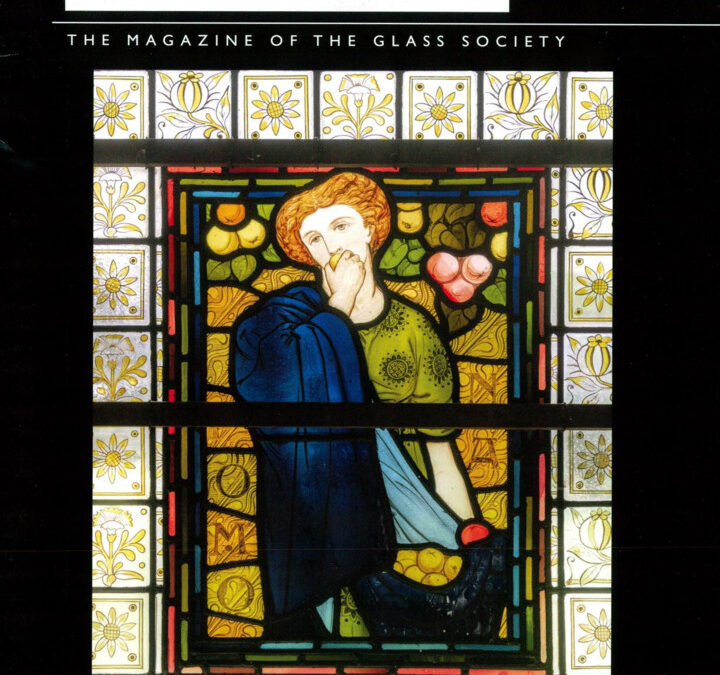
FRONT COVER:
Pomona, By Daniel Cottier, fitted in the
staircase window in Ingliston House, Midlothian, by Cottier &
Co., London, c.1870-5. Stained glass (article on pages 32-34).
Photograph © Colin McLean
BACK COVER:
The Burtles Tate elephant, registered 28
December 1886 (article on pages 21-23).
Photograph © David Willars
CHAIRMAN’S MESSAGE
Chairman’s
Message
Time to Reflect and Look Forward
0
ne of the pleasures of
being involved with the
Glass Society is the fre-
quent contact it brings with out-
siders who just want to know
more about a particular type of
glass. Quite often, enquiries can
be quickly answered by referring
to a particular book or website,
allowing the question to be set-
tled in full. However, just occa-
sionally, a little more research is
required, as was demonstrated
recently when I was asked “how
did they achieve the colours in
carnival glass?” In fact, the ques-
tion was answered quickly, but the
tangential wandering or surfing
that followed is worthy of recall.
We are all familiar with carni-
val glass. Indeed, we may marvel
at the consistently high quality
of the pressing, the cleverly con-
ceived designs, or the many and
varied colours. Over the years
these features have been report-
ed on, most recently in
Glass
Matters
1 and 4.
Glass Matters
4
also refers to the large Notley-
Lerpiniere collection of carnival
glass, currently held in storage
at Himley Hall. I am familiar
with this benchmark collection.
However, part of my own reading
on the subject led me back to a
talk given by Raymond Notley to
the Glass Circle in March 1988.
The talk, summarised by David
Watts and reported in Glass Circle
News #41, revealed new facts I
hadn’t previously come across.
Firstly, in 1910 the Imperial Glass
Company of Bellaire, Ohio, along
with two other companies, the
Dugan Company, run by Harry
Northwood’s cousin, Thomas
Dugan, and the Millersburg
Company of Ohio began to
exploit the growing lucrative
market of carnival glass. Based in
the Ohio valley, with its natural
gas production, available freely
once the wells were opened up,
made this an ideal location to
make cheap glass – free energy!
Secondly, the introduction of
carnival glass killed the art glass
market, although I suspect that
others may dispute this. Not only
that, but its introduction also
killed a more modest output of
mould-blown and press-mould-
ed glass, with the decoration
enhanced by painting or spray-
ing by hand, known as Goofus
glass. Goofus glass, a new term
to me, was cold painted, with the
inherent problem that the paint
tended to chip or flake off. It
seems that quite rapidly, Goofus
glass was replaced by the tech-
nically superior carnival glass. A
quick web search demonstrates
the difference between Goofus
glass and conventional carni-
val glass, although I’m sure that
connoisseurs would argue over
various aspects of attribution.
This long and rambling story
demonstrates two key things. One,
the Glass Society has a wealth of
latent knowledge that has been
built up over many decades. Much
of that knowledge has been doc-
umented in the various publica-
tions of The Glass Circle and The
Glass Association. Contributors to
that pool of knowledge are genu-
inely consummate experts in their
field, however large or small that
may be. Secondly, knowledge can
be acquired from books, visits to
museums, auctions, fairs or oth-
er private collections as well as
trolling the internet. In all cases,
however, there is no substitute
David Willars, Chairman of The Glass Society
for hunting down, handling and
feeling objects. Acquiring experi-
ence takes time; you don’t become
an instant expert overnight.
Continuing the collecting
theme, this edition contains a
paper by Nigel Benson and Jim
Peake on how to go about organ-
ising trading and the eventual
sale of your collection. Alongside
this we have two reports of recent
auctions; this, in fact, is partially
in response to a member request-
ing more sale reports. Two spe-
cialist collections are also being
discussed: George Sturrock has
what must be a very rare collec-
tion of eye baths – we all see them
for sale at auctions and fairs, but
making a study of them must
surely be a very niche area; then
Andrew Middleton is a hugely
knowledgeable collector, who,
along with our editor in this
Platinum Jubilee year, reveals
his knowledge of royal jubilees
and glass commemoratives.
Lastly, our usual thanks to Brian
for pulling everything together.
Glass Matters Issue no. 13 February 2022
3
LEFT Fig. la
Perfume Bottle recto.
Queen Victoria’s
Golden Jubilee.
Private collection
RIGHT Fig. lb
Perfume Bottle verso.
Queen Victoria’s
Golden Jubilee.
Private collection
GOLD, DIAMOND & PLATINUM
ROYAL
Jubilees
Andy Middleton andBrian Clarke
0
n 6 February 2022, Queen
Elizabeth II will have
remained on the throne
for 70 years, having devoted her-
self to service for this country and
the Commonwealth. This is the
first time that a British monarch
has celebrated a Platinum Jubilee.
The following list of tradi-
tional names for anniversary
years is often used for marriage
celebrations. The Royal Jubilee
Anniversary years are highlighted.
10
Tin
20
China
25
Silver
30
Pearl
35
Coral
40
Ruby
45
Sapphire
50
Golden
55
Emerald
60
Diamond
65
Blue Sapphire
70
Platinum
The first Silver Jubilee cele-
bration in history of any British
monarch was for George V.
Celebrated on 6 May 1935, it
marked 25 years of King George V as
the King of the United Kingdom and
the British Dominions, Emperor of
India. Numerous pieces of com-
memorative glass were produced
for the occasion, in production runs
as well as individual items, partic-
ularly from Stevens & Williams.
The first Ruby Jubilee was in
1992, marking the 40th anniver-
sary of Queen Elizabeth II’s acces-
sion to the thrones of the United
Kingdom and other Commonwealth
realms. Unlike other jubilees, the
event was a low-key celebration.
The first British monarch to
mark 50 years on the throne in
a significant way was George
III, his Golden Jubilee having
been celebrated in Wokingham.
It was held on 25th October
1809, the day of the beginning
of the fiftieth year of his reign.
The Golden Jubilee of Queen
Victoria was celebrated on 20 June
1887, the fiftieth anniversary of
her accession on 20 June 1837, ten
years later, her Diamond Jubilee
was celebrated on Sunday, 20 June
1897, the 60th anniversary of her
accession to the throne; this com-
memorated the first Diamond
Jubilee of any British monarch.
Celebrations to honour the grand
occasion showcased the Queen’s
role as ‘mother’ of the British
Empire and its Dominions. Stevens
& Williams had recognised the
value of commemorative glass and
produced small numbers of well-de-
signed items for both jubilees.
Queen Elizabeth II had signifi-
cant jubilee celebrations in 1977 for
her Silver Jubilee, in 2002 for her
4
Glass Matters Issue no.I 3 February 2022
GOLD, DIAMOND & PLATINUM
Fig. 2
The Coat of Arms of The Grocers’ Company,
Fig. 3
engraved on the perfume bottle
The Worshipful Company of Grocers Coat of Arms, Stamp 2
Golden Jubilee and in 2012 for her
Diamond Jubilee. Amongst other
producers, Whitefriars and Stevens
& Williams produced many com-
memoratives for these occasions.
The only Diamond Jubilee cele-
bration for any of her predecessors
had been that of Queen Victoria’s.
QUEEN VICTORIA
GOLDEN JUBILEE
PERFUME BOTTLE
(Figs.la & lb).
The height of the
perfume bottle is 100.5 mm, the
stopper adding another 55 mm;
width 100mm. The base is star cut
with 24 sections. The stopper is
not original but is of a similar style.
In plain glass cartouches, one side
displays the Armorial Crest of The
Grocers’ Company
(Fig.2),
the oth-
er is inscribed V R with crown and
JUBILEE 1887. David Williams-
Thomas, the last owner of Royal
Brierley / Stevens & Williams, has
suggested that S&W might have
supplied this bottle to the Grocers’
Company in an edition of 200,
for use as a gift for ladies at a din-
ner. The Grocers’ may have then
Fig. 4
Queen Victoria’s Golden Jubilee Sulphide Bottle,
by Stephens & Williams.
Courtesy of Dudley
Museums Collection
approached Thomas Goode & Co. or
Asprey to arrange the engraving as
it is not recognised as being by S&W.
ARMORIAL CREST OF
THE GROCERS’ COMPANY
Three stamps of The Grocers’
Company are recorded in
British
Armorial Bindings ©
University of
Toronto.
(Under the sponsorship of
The Bibliographical Society of London
in conjunction with the University
of Toronto Library).
Stamp 2 is
shown in
Fig.3.
The perfume
bottle is engraved with Stamp
2, 70mm x 94mm. Description:
A chevron gules between nine
cloves; Supporters, two grif-
fins; Crest, a camel saddled and
bridled; Helmet of an Esquire;
Motto GOD GRANT GRACE.
Glass Matters Issue no.I3 February 2022
GOLD, DIAMOND & PLATINUM
QUEEN VICTORIA
GOLDEN JUBILEE
SULPHIDE BOTTLE
Fig.4
shows a small sulphide
bottle, originally displayed at
Broadfield House, now part of
The Dudley Museum Services
collection. It was made by
Stevens & Williams and is of
a similar style to the perfume
bottle. David Williams-Thomas
informs us that the hobnail
design was not pressed, it was
cut from the start. This was
previously shown on the front
cover of Glass Cone 97,2012.
Victoria was queen of The
United Kingdom of Great Britain
and Ireland (1837-1901) and
empress of India (1876-1901).
Figs.5 &
6 show two examples
of glassware made to celebrate
her Diamond Jubilee. Her reign
was one of the longest in British
history, and the Victorian Age
was named after her. It was a
period of industrial, political,
scientific, and military change
within the United Kingdom, and
marked by a great expansion of
the British Empire. In was in
1876, that the British Parliament
voted to grant her the addition-
al title of Empress of India.
Queen Elizabeth’s reign has
also covered an immense his-
torical change. The arrival of
computers, highspeed air trans-
port with jet engines, the end of
Empire and the inauguration of
the Commonwealth, the start
of space travel, mobile phones,
cold war, climate change, elec-
tric cars, and the world wide
web and Smart phones connect-
ing people around the planet.
We join in congratulating her
on her life and wish her well.
ABOVE Fig. 5
A gilt flask by
Stephens & Williams,
to celebrate Queen
Victoria’s Diamond
Jubilee.
Private
collection
RIGHT Fig. 6
A claret jug in the
manner of Christopher
Dresser, to celebrate
Queen Victoria’s
Golden Jubilee.
Maker and engraver
unknown.
Private
collection
6
Glass Matters Issue no.I 3 February 2022
REALLY VENETIAN?
Emailler le Verre
la Renaissance
Keith King
T
he Musee national de la
Renaissance, about half an
hour’s drive west of Charles de
Gaulle airport, houses important col-
lections of Italian majolica, Limoges
enamels, Isnik ceramics, Palissy
pottery, tapestries, objets d’art and
more pertinently for readers of
Glass
Matters, it
is home to France’s finest
collection of 16th and 17th century
Venetian and
facon de Denise
glass.
The museum recently inaugurat-
ed an exhibition,
Emailler le Verre
a
la Renaissance,
showing over 100
enamelled glasses loaned from muse-
ums in Italy, France, England and the
United States, accompanied by a 250-
page illustrated catalogue raisonne.
The exhibition presents the
results of a 10-year research pro-
gramme seeking to identify authentic
Venetian Renaissance glass, primari-
ly by analysis of the composition of
the base glass and the enamel deco-
ration. The three principal research-
ers, Isabelle Biron of the Centre de
recherche et de restauration des
musees de France, Francoise Barbe
of Le Louvre and Aurelie Gerbier of
the Château d’Ecouen, freely con-
cede theirs is neither a definitive
nor a conclusive study. Rather, it
is a staging post along a long and
tortuous road of investigation.
For the better part of the 20th
century, the genuineness of pieces
described as Venetian Renaissance
glass was rarely questioned, but
there were nagging doubts and
these came to a head with the sale
of the Batsheva de Rothschild col-
lection at Christie’s, London, in
2000. The catalogue reassigned all
11 ‘Venetian Renaissance’ glass lots
to the 19th century. As no scientific
analysis was undertaken, Christie’s
relied purely upon a visual appreci-
ation of the pieces. The sale caused
some unease – an understatement!
– in museum circles and among
private collectors. The Le Louvre’s
own collection of cobalt-blue glass
bequeathed by the French branch
of the Rothschild family came
under close scrutiny, as indeed did
the ‘Venetian Renaissance’ glass
in the Musee de la Renaissance.
This then was the background
to the research project, baptized
Cristallo,
designed to detect authen-
tic pieces and hopefully separate the
wheat from the chaff. A noble ambi-
tion that soon ran into difficulties,
because the `wrong’uns’ include
innocent imitations and copies,
hybrids and forgeries, as well as
genuine original objects thought to
have been enhanced at a later date
with enamel decoration and gilding.
As we shall see, the complexities
of the subject do not end there.
While art historians, conserva-
tors and restorers contributed to
the research, it is essentially a sci-
ence-based project narrowly focused
on the analysis of recipes for
Renaissance enamelled glass.
Compatibility with Renaissance peri-
od glass and enamels was based on
objects retrieved from archaeological
sites, and upon others whose prov-
enance and/or earliest mention in
archival sources are considered reli-
able. The team had at their disposal
the technical resources of Le Louvre
which permit non-destructive and
non-invasive analysis of the compo-
sition of the base glass and decora-
tive coloured enamels. The catalogue
presents tables classifying the types
of glass under study:
cristallo
for the
glass of greatest purity and transpar-
ency and
vitrum blancum
for common
glass – inevitably, many glass recipes
do not neatly fit either of these clas-
sifications, even allowing for a degree
of qualitative and quantitative lati-
tude. The ingredients of the coloured
enamels are also extensively studied.
One may question the validity
of this approach, as it leads to the
assumption that Venetian glass com-
positions remained unchanged over
a relatively long period and these rec-
ipes were not used beyond Venice.
Between 1450 and 1530, there were
25 to 40 glasshouses operating in
Murano, of which about 10 were
engaged in producing luxury glass.
Even over a comparatively short peri-
od, it is improbable that Venetian
glasshouses all worked with the same
recipes and sourced raw materials
from the same suppliers. Murano
glasshouse owners were at pains to
keep their manufacturing practices
and recipes secret – after all, their
livelihood depended on it. How suc-
cessfully they protected their secrets
from the prying eyes of competitors
on the small island of Murano is a
matter of speculation, but edicts
prohibiting Murano glassmakers
beyond Venice were demonstratively
ineffective and probably counterpro-
ductive. The emigrant glassmakers
brought not only their glass-blow-
ing skills, but, as importantly,
knowledge of the raw materials for
the composition of the batches.
Under a 1469 rule of the
Serenissima, glass enamellers were
obliged to work as employees and
provided the proprietors had their
own enamelling workshops, exclu-
sively for the owner. As opposed to
glassmakers, the enamellers had no
technical secrets to protect and for
this reason they had no trade corpo-
ration. So long as there was a mar-
ket for luxury Venetian glass, their
employment was assured, which may
explain why glass enamelling does
not appear to have been practised
beyond Venice at a time when the
city’s glass industry was at its height.
Venice’s undisputed reputation
Glass Matters Issue no. 13 February 2022
7
BELOW Fig.
1
Musee du Louvre. Covered blue
glass The Triumph of Chastity,
compatible with Venetian
Renaissance batch mix
RIGHT Fig. 2
Musee du Louvre. Covered
blue glass not compatible,
some but not all enamels
compatible
REALLY VENETIAN?
for luxury glass in the late 14th
and early 15th century, by which it
should be understood that what is
meant is glass decorated with enam-
els and gold gilding, commanded
the patronage of European courts
and elite society. These glasses
were highly prestigious items for
decorative display rather than use,
presented on dressers alongside
other valuable artefacts. Their fra-
gility attested to the owner’s afflu-
ence: the subliminal message was
breakage would not make a hole in
his pocket. One writer has joyously
described this ostentatious display
of wealth as ‘Renaissance chic’.
The publication in 1612 of
Antonio Neri’s Arte Vitrario book
of glass recipes let the cat out
of the bag as far as Venice was
concerned. Whether this contrib-
uted to the decline of Venice in
the 17th century as a glassmak-
ing centre is debatable, but the
rapid rise in the number of glass-
houses in Europe is indisputable.
The exhibition also explores
French Renaissance enamelled glass,
following up on Suzanne Higgott’s
seminal work published in the
Corning Journal of Glass Studies
(1991). The magnificent French chal-
ice loaned by the Wallace Collection,
unquestionably the finest surviving
French Renaissance glass, is one of
the highlights of this exhibition.
It is the first time in the history of
the museum that an object has been
out. Very few intact 16th-century
French enamelled wineglasses are
known and the objects exhibited
display their remarkable quality,
variety and originality. The testing
for compatibility with Venetian
Renaissance glass recipes is of little
value here because these glasses
were made in France and generally
by glassmakers from Altare who
made their own glass recipes.
Two objects, bearing the arms
of Catherine de Medici, hitherto
regarded as authentic and ten-
tatively attributed to the Saint
Germain-en-Laye glasshouse
established by Henri II in 1551, are
quite probably forgeries, or as the
researchers would prefer, incom-
patible with Renaissance recipes.
The
Cristallo
researchers faced
a number of material and techni-
cal constraints. By whittling down
the number of objects provably
8
Glass Matters Issue no. 1 3 February 2022
Fig. 4
Muses de la Renaissance. Standing bowl with arms of Catherine of Medici,
transparent glass body compatible, all enamels 19th century
REALLY VENETIAN?
Fig. 3
Musee de la Renaissance. Standing bowl with the Arms of
Anne of Brittany, body and enamels compatible
manufactured in the Renaissance
period, they took no chances when
seeking comparable glass compo-
sitions in other objects. And there
lies the rub. There is little evidence
that the reference samples reliably
reflect the diversity of Venetian glass
compositions. Lack of ‘compatibil-
ity’, the word employed through-
out the catalogue, to reference
batch compositions clearly does
not relegate a glass to another pro-
duction centre or provide evidence
of faking or copying. The conun-
drum remains unresolved: chem-
ical analysis may determine that a
glass cannot be of the Renaissance
period by the presence, for instance,
of elements not known at the time
(chromium, uranium, etc.), but
cannot prove it is of the period.
The scientific equipment, sophis-
ticated as it is, has its own limita-
tions. It can only analyse a convex
glass surface and hence it cannot
examine enamels decorating the cen-
tre of a bowl. For the same reason, it
was not possible to compare enamels
on the outer surface of a glass bowl
with those ornamenting the foot.
The number of glass compositions
produced by the research is bewilder-
ing, not to say startling. To take one
example among many, two identical
pilgrim bottles, one from the trea-
sure of the Cathedral Sainte Anne
d’Apt in the south of France with a
history dating back to the late 17th
century and another in Le Louvre
acquired in 1856, have very different
compositions. The Apt example is
compatible with Renaissance recipes,
while Le Louvre’s contains 11.5%
lead oxide, a massive percentage not
previously recorded in Renaissance
glass, but in both cases the enam-
els tested are compatible with
Renaissance chemical compositions.
In the second half of the 19th
century a number of unscrupulous
dealers, amongst whom the infa-
mous Parisian, Frederic Spitzer, fed
the market with fakes along with
genuine pieces thus giving an air of
legitimacy to their spurious trade.
The great private collections formed
in the 19th century testify to the
rivalry among wealthy buyers for
the finest and rarest Venetian glass
and many landed up with forgeries.
The invention in the 19th century
of low-fired enamels fusing at tem-
peratures of 520-580°C is believed
to have offered the means to embel-
lish authentic Renaissance glasses,
enhancing their market value. In
conversation with the project’s scien-
tific researcher, I was informed that
provided the glass itself is stable,
i.e. not crizzled, low-fired enamels
can be applied to old glass and some
authentic Renaissance objects are
suspected to have been redecorated
in this manner. The
Cristallo
project
did not put this to the test. A con-
trary opinion is found in a paper
published in the Journal of Glass
Studies, 1964 entitled ‘The Danger of
Heating Glass Objects’, in which the
British Museum’s Senior Scientific
Officer warned against heating old
glass even to temperatures well
below those required for fusing
low-fired enamels. In experimen-
tation with glass showing no incip-
ient crystallization, glass became
completely crizzled when heated.
In the words of the author, “glass
can react in a disastrous manner”.
Glass Matters Issue no.I3 February 2022
9
REALLY VENETIAN?
Fig. 5
Fig. 6
Musee du Louvre. Goblet, base glass and blue and white enamels compatible
Musee du Louvre. Blue pilgrim flask, base glass and all
with Venetian Renaissance recipes, other enamel colours not analysed
enamels compatible with Venetian Renaissance recipes
••••
•
00000
0
s• • • • • • •
What conclusions can be drawn?
If the risks of re-enamelling genu-
ine Renaissance glass outweighed
the potential rewards, it is unlike-
ly forgers would have pursued this
line. Does this therefore suggest the
blanks, i.e. the base glass forms, were
produced in the 19th century in the
Renaissance style? Here, we are not
talking about obvious copies, but
rather of cleverly executed forger-
ies, designed to deceive right down
to faking age and wear. This opens
an entirely new field of enquiry.
No evidence has come to light
identifying the forgers. In Paris, tal-
ented restorers, such as Alfred Andre
(1839-1919), whose archives on the
restoration of Limoges enamels
only emerged in 2013, and several
years later a vast hoard of models of
Renaissance style jewellery was dis-
covered in his workshop. The Maison
Samson similarly produced copies
of Renaissance jewellery and other
works of art and perhaps glass as
well. Philippe-Joseph Brocard, who
commenced his career as a restorer
of objets d’art and antiques, later
rediscovering enamelling and gilding
techniques, made copies of 13th and
14th century Islamic glass, which
at times are difficult to distinguish
from the originals. One fine exam-
ple in the exhibition is a magnificent
Islamic 14th century enamelled
bottle standing on a replacement
foot fabricated by Brocard.
Fakes and forgeries have been
around since time immemorial.
Where, when and by whom these
dubious ‘Venetian Renaissance’ glass-
es were produced remains a mystery.
The researchers may be congrat-
ulated on the depth of the archival
research, particularly as regards
French glass, but a broader plu-
ri-disciplinary approach with spe-
cialists looking at the morphology,
iconography and patterns of orna-
mentation of these objects would
have been welcome. Confronting
expertise in the decorative arts of
the Renaissance period with sci-
entific data could perhaps have
filled in some of the gaps and cer-
tainly provided a wider narrative.
The authenticity and dating of
the exhibits are intentionally nei-
ther provided nor proposed. For the
neophyte as for the knowledgeable
visitor, this exhibition frustrat-
ingly raises more questions than
it answers. While the researchers’
prudence is arguably a legitimate
defense for caution, sitting on the
fence in matters of dating and attri-
bution left this writer perplexed.
The Venetian Maestro, Lino
Tagliapietra, once remarked about
his own work, “If someone tells you
it’s interesting, you know you’re in
trouble”, nicely summing up my
own feelings about this exhibition.
In spite of its shortcomings, it may
well be a once in a lifetime oppor-
tunity to view so many exception-
al and indeed beautiful objects.
The exhibition only ran to 14th
February 2022, though the cata-
logue may be ordered from the muse-
um, price 39 euros plus postage.
Keith King has been collect-
ing 16th to 18th-century glass for
over 50 years and looks forward
to another 50, just as enjoyable.
I0
Glass Matters Issue no. I 3 February 2022
Fig. 2
Lighter, free
–
blown 3
–
piece eye baths, perhaps early 19th century
LEFT Fig. 3
Pucerla striae inside the bowl of a
free-blown eye bath
HEIGHTS OF GLASS
EYE BATHS
As a guide here are approximate
heights for the different eye baths:
English pedestals (Figs.1 & 2) 80 mm
Baccarat
Thuringian
Lampwork tall blue
Indian lampwork with crack
Composite, middle eye bath
70 mm
60 mm
75 mm
60 mm
80 mm
EYE BATHS
GLASS EYE BATHS
George Sturrock
Fig. 1
Heavy, English eye baths, perhaps pre
–
glass tax of 1745
T
he earliest eye baths were proba-
bly made of silver, were English
and dated from the late 16th
century, followed by glass eye baths
sometime in the 17th or early 18th
century. These were blown and hence
almost impossible to date, although
a number of substantial eye baths
made of lead glass may have predated
the Glass Excise Tax of 1745
(Fig.1).
Despite the small size and simplici-
ty of glass eye baths a surprising num-
ber of different methods were used to
fashion them. In all, five groups were
identified: free-blown, mould-formed,
Thuringian, lampworked and compos-
ite. Since most eye baths are utilitari-
an the various marks and blemishes
discussed below were probably con-
sidered to be of little consequence.
FREE-BLOWN
EYE BATHS
By definition, free-blown eye baths
never have mould lines or seams
and this distinguishes them from
the majority of mould-formed eye
baths. Most free-blown eye baths
are of three-piece construction,
consisting of a bowl, stem and foot
(Fig. 2).
After blowing the bowl
a stem was added (stuck shank),
then a gob of glass was attached to
the stem to form the foot. Finally,
an iron pontil rod was fused to the
foot and the eye bath cracked off the
blowing iron in order to fashion the
bowl lip. Later, probably in the mid-
19th century, the foot was grasped
in a gadget or spring punty thus
avoiding the need to use a pontil rod.
A few free-blown pedestal eye
baths were made in two stages rather
than three. This involved drawing
out glass from the bowl base to form
a drawn stem, to which a separate
gather of glass was added for the foot.
Glass Matters Issue no. I 3 February 2022
EYE BATHS
Fig. 4
Single pucella indents inside the bowl lip at each
end of a pressed eye bath. (Woods, Barnsley)
BOWL
The bowls of many of the heavy, old-
er free-blown eye baths are marked
with horizontal striae, more obvious
inside the bowl than on the outside
(Fig.
3). These result from the use of
pucellas (sprung metal forceps) to
shape the bowl. When the straight
arms of the pucellas are applied to a
curved bowl the contact is between
the sharp tip of the inside arm and
the blunt shaft of the outside arm.
Initially, after blowing, the bowl
orifice is circular and must be formed
into an oval, usually with the aid of
pucellas. This is achieved most simply
by allowing the pucella tips to spread
inside the bowl mouth, often leaving a
short, vertical indent inside the bowl
lip at each end
(Fig.4).
Sometimes, the
pucellas were used to grip opposite
sides of the bowl lip in turn, which was
then pulled into an oval: this resulted
in twin indents, one inside and one
outside, at each end of the bowl rim
(Fig.5).
Occasionally, the bowl appears
to have been squeezed oval using
wood-tipped pucellas (woods), leav-
ing broad, shallow, vertical impres-
sions either side of the bowl
(Fig.6 ).
When the bowl rim was trimmed
to shape using shears this could
result in a small lump or nodule on
Fig. 5
Double pucella °tweak indents” at each end of
the bowls of 2 free-blown eye baths
BELOW Fig. 6
Shallow °woods” impression on the bowl
ofa Portuguese eye bath. (Only visible in
front of a light-dark border)
the rim marking the start and finish
of the cut. Despite fire polishing to
smooth the rim, this nodule often
remains palpable, even if not readi-
ly visible
(Fig.7).
Alternatively, the
bowl rim may have been shaped by
grinding and polishing. If the bowl
Fig. 8
Capillary lumen running down inside the stem of a
drawn stem eye bath
sides are vertical this results in a pol-
ished edge 2 — 3 mm broad, but if the
sides have been rolled inwards, in the
belief that the eye bath will seal bet-
ter against the lids, the polished edge
will be oblique and up to 8 mm broad.
While the bowl floor is usually
Fig. 9
Baccarat eye bath with a knop-
like baluster stem
BELOW Fig.
7
Nodule after trimming the bowl rim with shears
12
Glass Matters Issue no. I 3 February 2022
EYE BATHS
Fig.10
Cut-off marks under the foot of a
French free-blown eye bath
flat, in some cases of free-blown
three piece eye baths a low mound
may be palpable, caused by attach-
ing the stem while the bowl is
still soft enough to be indented.
Conversely, in two-piece eye baths,
a low depression can form when
glass for the stem is drawn down
from the bowl base. In one drawn-
stem eye bath, a capillary lumen 0.4
mm in diameter starts in the fun-
nel-shaped depression in the bowl
base and runs down the middle of
the stem to reach the foot
(Fig.8).
STEM
Apart from the curiosity in Fig.8,
the stems of free-blown eye baths
are less interesting than the bowls
or feet. Many stems are simple cyl-
inders. Others have knops at the
top, the bottom, or both, or less
commonly, in the middle. The tall
pedestal eye baths made at Baccarat,
mostly for Maw in London from
1870 until the 1930s, have a globu-
lar baluster stem resembling a basal
knop
(Fig.9).
This stem shape is quite
characteristic of Baccarat eye baths.
FOOT
The marks left when a pontil rod was
used to hold the workpiece are well
known. The pontil scar was left rough
on early eye baths, but later it was
ground and polished smooth, though
occasionally the scar was ground but
not polished. When a gadget was
applied instead of a pontil, the Y or
T-shaped marks, caused when the
glass gather destined to form the foot
was sheared off, are preserved
(Fig.10).
These marks, often inaccurately called
Fig.11
Spun or cast foot on a
free-blown eye bath
gadget marks, are therefore cut-off
marks. Gadget marks are in fact typ-
ically C-shaped impressions found on
the upper surface of the foot if the gad-
get was applied too soon, while the foot
was still soft. Occasionally, there is nei-
ther a pontil mark, rough or polished,
nor any cut-off marks, but instead a
slightly raised 18 — 20 mm diameter
disc of concentric or spiral lines in
the centre of the foot
(Fig.11).
This
appearance is produced when the rod
applying the gather of glass for the foot
is twirled and whisked away without
the use of shears. A foot formed this
way is known as a spun or cast foot.
MOULD-FORMED
EYE BATHS
Eye baths shaped in a mould usu-
ally have two, rarely three or even
four, vertical mould seams. Further
mould seams are usually evident
around the bowl lip and, in the case
of pedestal eye baths, around the
circumference of the foot. Squat
eye baths, without a stem, were
usually made in one — piece moulds
and thus have no vertical seams.
Eye baths can be pressed into
a mould with a plunger, or blown
into a mould, usually with com-
pressed air rather than lung power.
The plunger used to press the
glass into the mould may leave sub-
tle vertical striae down the inner
wall of the eye bath, whereas the
inner surface of a mould-blown eye
bath has a smooth mirror finish.
Clearly the diameter of the plung-
er used to make a pressed eye bath
cannot be greater than the diameter
of the eye bath orifice. Exceptions to
this are some pedestal
eye
baths such
as the ‘Woods type 51’ (Barnsley) and
the ‘John Bull’ eye baths made by the
Canton Glass Company (Marion,
Indiana)
(Fig.12).
In these eye baths the
bowl opening was manipulated into a
narrow oval immediately after press-
ing, when the glass was still malleable.
The moulds used for pressed and
mould-blown eye baths were nearly
always made of iron which tended
to leave the outer surface of the eye
baths looking somewhat rough and
pitted. This was usually smoothed by
reheating or fire polishing the eye bath.
Lastly, eye baths embossed
with any form of inscription
will have been made in a mould.
THURINGIAN
EYE BATHS
Although no figures are available, it
is believed that more glass eye baths
were made in Thuringia than in any
other region in Germany. In the first
half of the 20th century large numbers
of quite distinctive glass eye baths
were made in this heavily forested
region close to the eastern border of
Germany. These eye baths are shown
in glasshouse catalogues from the
area but exactly how they were made
is not entirely dear. Typically, these eye
baths are pedestal-shaped but formed
from a single gather of glass, i.e. with
a drawn stem and foot. A few appear
to have been made in three pieces but
with the same characteristics as the
commoner one-piece model
(Fig.13).
The bowls are thick-walled with
polished rims, a mirror finish inside
and curious, very fine lines running
horizontally around the outside
(Fig.14).
On some there are also
short, diminutive ‘lick marks’ and on
others, the lower part of the bowl is
quite pitted. Obvious mould seams
are rare, although some of these eye
baths have a broad, poorly defined
low vertical ridge at the junction
of the bowl and stem at each end.
The under surface of the foot is
characteristic with a central disc of
pitted glass 15 — 20 mm in diameter
Glass Matters Issue no.I 3 February 2022
13
Fig. 13
Three pressed eye baths with tweaked, oval bowls. (brown – Woods, Barnsley;
flint & green – Canton Glass, Marion, USA)
Fig.15
Typical Thuringian “bmw” eye bath base
EYE BATHS
Fig. 12
Fig.14
Three pressed eye baths with tweaked, oval bowls. (brown – Woods, Barnsley;
Subtle “wipe marks” running around the bowl of a
flint & green – Canton Glass, Marion, USA)
Thuringian “bmw” eye bath
surrounded by fine concentric lines
rather like a very small gramophone
record
(Fig.15).
There are no traces of
a pontil mark, rough or polished, nor
any signs that a gadget was applied.
There is little doubt that
Thuringian eye baths started life on
a blowing iron whilst ensuring that
the glass at the apex of the bubble was
thick enough to be pulled out to form a
stem and foot using pucellas. This may
explain why some of these eye baths
have disproportionately thick bases
to the bowls
(Fig.13).
The eye bath
would then have been shaped with
a mould of some description. Next,
the eye baths appear to have been
`wiped’, perhaps with wet newspaper,
to smooth over the mould seams and
any other imperfections due to the
mould. Finally the eye bath would
have been cracked off the blowing iron
and the bowl rim ground to shape and
polished. This putative technique has
been called bmw, assuming it involved
blowing, moulding and wiping.
Several `bmw’ eye baths are known
with extensive cracks, probably due
to inadequate annealing and hence
failure to alleviate stresses in the
glass
(Fig.16).
Another characteristic
of many `bmw’ eye baths is the pres-
ence of numerous minute bubbles
(seeds) in the glass
(Figs.13 &
17).
These are the result of incomplete
fining of the glass mix (metal) when
the furnace temperature is not high
enough, possibly because many
Thuringian glasshouses used wood as
a fuel rather than hotter-burning coal.
Fig.16
Widespread cracks in the foot of a poorly annealed
Thuringian ‘bmw” eye bath
The cracks and seeds suggest that
some, at least, of the `bmw’ eye baths
were made in ‘Forest glasshouses.’
Interestingly, the press-mould-
ed pedestal eye baths, which were
also produced in large numbers
in Thuringia, are generally free of
seeds
(Fig.18).
These eye baths may
have been made in larger glass-
houses where coal was used as fuel.
Fig.17
Seeds in a “bmw eye bath. See also Fig.13
14
Glass Matters Issue no. 13 February 2022
EYE BATHS
Fig.18
Pressed pedestal eye bath embossed underneath
M.P.H. for the Meyer, Petri & Holland factory.
Fig.19
(Ilmenau,
Thuringia)
Three brown lampwork eye baths from Spain and a rare blue example from France
LAMPWORK EYE BATHS
Delicate, thin-walled glass eye baths
— pedestal-shaped, reservoir or squat,
were made using the technique of
lampworking. This involves heating
and manipulating preformed glass
tubes, usually soda glass, in a gas
flame at a bench. In France large
numbers of clear glass squat and
reservoir-type eye baths were made
`at the lamp’. Spanish lampwork eye
baths were made of dark brown glass
(Fig.19).
Some pedestal-shaped eye
baths made in India have parallel
Fig.20
Indian lampwork eye bath made from tube light
glass. Cracked due to unrelieved stress
bowl sides and a diameter of 37 mm,
corresponding to the width of some
fluorescent tube lights
(Fig.20).
Apparently, glass tubes destined for
the lighting industry were divert-
ed to become eye baths instead.
COMPOSITE
EYE BATHS
A small number of pedestal-shaped
clear glass eye baths, probably French,
appear to have been made by blowing
the bowl into a mould then adding
the stem and then the foot freehand
(Fig.21).
The bowls have a mirror
finish inside but the outer surfaces
are subtly irregular and uneven due
to contact with the mould. The bowl
rims were ground and polished and
some of these eye baths have cut
and polished facets around the bowl.
At least two composite eye baths
were sourced in the Auvergne,
in France, where there are, or
were, a number of glasshouses.
THE AUTHOR
Dr George Sturrock is a retired eye
surgeon, his professional life hav-
ing guided him into collecting and
researching Eye Baths. He has never
worked hot glass so asks for forbear-
ance if some of the technical details
he describes are not totally correct.
Fig.21
Composite eye baths with mould-blown bowls and free-hand stems and feet. All French,
those left and right from the Auvergne
Glass Matters Issue no. 13 February 2022
SALISBURY AUCTION
Review of
October 202 1
Auction
at WOOLLEY & WALLIS
Clare Durham
B
eing caught scrabbling around
in the recycling bin by one’s
colleagues when looking for
an empty wine bottle is never a good
look, but at least on this occasion
I had a good excuse. Two pairs of
exceptionally large Irish decanters
needed cataloguing, but I couldn’t
tell by sight just how many bottles
of wine they might hold. There was
only one way to find out and refill-
ing one empty bottle with water
seemed a less sackable offence
than being found with four or five
open bottles of claret at 11 o’clock
in the morning – unless you work
at Downing Street, of course
The decanters, all double magnums
as it turned out, were made for
Kilshannig House in Rathcormac –
the first pair in 1761 by Abraham
Devonsher, a former banker and MP
of Rathcormac. The second pair was
commissioned some 40 years later
by another Abraham Devonsher
who had inherited Kilshannig from
his father, John Newenham, who
had himself inherited it from the
first Abraham Devonsher and had
changed his name. The earlier pair,
lacking stoppers, sold for £1,500
(Fig.1 ),
and the later pair, despite
some chipping, fetched £1,000
(Fig.2).
Size, age and rarity does seem
to be everything where the market
for decanters is concerned these
days, and the later Georgian cut glass
examples that were once a staple of
everybody’s sideboard are sadly all
but unsaleable — often along with the
sideboard on which they sit. Other
exceptions exist however, and a mag-
num beer decanter and stopper from
around 1770 sold for £2,000
(Fig.3).
The October auction was blessed
with two sizeable collections of glass,
predominantly English but with
some Continental examples. That of
the late Paul Gregory had been put
together over several decades and
totalled some 350 glasses sold in
100 lots. A Dutch colour-twist
(Fig.4)
with a stem enclosing red, green,
yellow and blue threads caught the
attention of collectors and sold for
£1,750, while a soda glass baluster
goblet of c.1700 exceeded its esti-
mate at £1,060
(Fig.5).
Otherwise
the collection largely consisted of
good but ‘ordinary’ 18th century
glasses of the type that most long-
term collectors already have in
abundance. They sold well but not
spectacularly and the collection as
a whole totalled £36,300 (with only
two lots unsold) — sadly still below
the amount that had been spent in
building the collection, proving yet
again that the sensible collector buys
for love rather than investment.
The second collection – anony-
mous, this time – was arguably more
diverse and included a number of
rarities that drew some of the auc-
tion’s top prices. A rare, enamelled
wine glass decorated with a portrait
of Bonnie Prince Charlie was hot-
ly contested
(Fig.6),
especially by
Scottish buyers, and exceeded all
expectations, selling for £17,500. It
was supported by a number of other
Jacobite glasses in both collections,
the most notable engraved with the
standard rose spray and the motto
‘Turno Tempus Erit’
(`The Time Will
Come’),
possibly borrowed from
Virgil; it sold for £3,125
(Fig.7).
A large Beilby goblet
(Fig.8)
drew
much discussion among those who
viewed the sale, as despite being
16
Glass Matters Issue no. I 3 February 2022
SALISBURY AUCTION
perfectly proportioned, the bowl had
been reattached to a contemporary
stem and foot with an extremely
clean repair. Nonetheless, the quality
of the bowl and attractiveness of the
goblet was such that it still drew com-
petitive bidding and sold for £3,500 –
resulting in the obvious unanswered
question as to what it might have
made in perfect original condition.
A number of Dutch-engraved gob-
lets from the mid-18th century per-
formed well with the strongest prices
going to those that related to the
English market or had more unusual
decoration. The top performer had a
collector’s number for the Walter F
Smith Collection and was decorated
with the royal coat of arms and the
motto of the Order of the Garter
(Fig.9);
it exceeded its modest £400
starting price to sell for £1,875.
Another goblet
(Fig.10)
relating to
maritime trade was engraved with a
ship and the inscription ‘Het Lands
wel Vaaren aan de Caap’, roughly
translating to
‘Sailing the Lands on
the Cape’.
This may well have related
to the Dutch East India Company
whose route between the Cape of
Good Hope and Batavia was one of
the most crucial. It fetched £1,375.
There is – to practical minds at least
– a strange gulf of interest between
otherwise seemingly equal glasses
that were made on the Continent,
to those made in England. This was
ably demonstrated by three 18th
century glasses of Continental ori-
gin engraved for the English mar-
itime market. One
(Fig.11),
was a
privateer glass, inscribed ‘Ye London
Rob Yong of Pool’ probably relating
to a Robert Young who was granted
letters of marque in 1756 for a ship
called
Somerset
and again in 1757
for a ship called
St Kitts Planter.
Selling for £625, it showed a marked
discrepancy with privateer glasses
produced in England, not entirely
attributable to the inferior quality
of the engraving. A similar glass
(Fig.11),
inscribed `J Barton / Success
to the Unity’ was from a known
set and probably relates to one of
Fig. 2
Fig. 3
Fig. 4
Glass Matters Issue no. 13 February 2022
17
SALISBURY AUCTION
Fig. 5
Fig. 6
Fig. 7
Fig. 8
Fig. 9
Fig. 10
18
Glass Matters Issue no.I3 February 2022
SALISBURY AUCTION
Fig. 11
Fig. 12
the ships bearing that name which
was involved in the American Wars
of Independence. It sold for £560.
Continental glass of the type seldom
or never produced in the UK continues
to catch the attention of collectors and
there were a couple of examples includ-
ed in the sale. A highly unusual facon
de Venise goblet
(Fig.12),
produced in
the Netherlands in the 17th century,
had a standard round funnel bowl over
a triple-knopped hollow stem. Some
time ago it had been given a replace-
ment metal foot, but its rarity was such
that it still fetched £1,125. Rather lat-
er in date but still desirable were two
lithyalin vases — one attributed to
the workshop of Friedrich Egermann
which sold for £930
(Fig.13),
while
another of unusual double-gourd
shape fetched £1,000
(Fig.14).
The next glass auction at
Woolley and Wallis is on 26th April
and will include a diverse range
of English and Continental glass.
Fig. 13
Fig. 14
Glass Matters Issue no.I 3 February 2022
19
Fig. 2
Pair of dear glasses
acquired by Simon
Cook. Height
16.5cm, bowl rim
diameter 11.4cm
`VtlAt
/WA’,
40
0
4
!
,
TRACKING URANIUM GLASS
Uranium Glass
Simon Cook
John Frith’s two recent artides on Uranium
Glass and a response from Dwight
Lanmon, have revealed a collector’s pas-
sion to track a lead – Simon Cook has added
a discovery and posed further questions:
0
n picking up
Glass Matters 11
of June 2021, it wasn’t long
before I read part 1 of the
artide by John Frith on the origins of
uranium glass. Although illustrated
by him, it was said that he was unable
to identify specific manufacturers or
dates. His Fig.4 illustrates
A uranium
yellow ‘sherry’ glass (perhaps a cordial).
The description suggested a rela-
tively small size for the glass
(Fig./)
A few days later when I was trawl-
ing through the internet on eBay, I
came across two identical-looking
glasses, albeit in clear glass. A price
with the vendor was agreed – he did
not know the manufacturer or date
– and they subsequently arrived.
The glasses are heavy, large, 16.5cm
high, with a bowl rim diameter of
11.4cm and are decorated with cut-
ting. The swags are reminiscent of
Irish glass from the first quarter of
the 19th century but the pair did not
have a Georgian feel to them
(Fig.2).
When I contacted John Frith he
told me that
“There are some very
slight differences between the two
glasses. The middle panel on the bowl
of mine is wider than on yours and the
knops are slightly different, it measures
13cm in height and 7.5cm diameter at
the lip of the bowl. It is deep yellow with
a slight amber tint, fluoresces bright
green under UV light as translucent
uranium glass, yellow or green, does.
Mine doesn’t look like the early 1830s to
1840s Bohemian uranium glass which
was a very bright yellow or green, so I
think it is later, and it can’t be earlier
as
the earliest record of uranium glass is by
Harrach of Bohemia in 1831. Certainly
by 1840, uranium glass was being made
in Bohemia, Germany, France, Belgium
and Britain, and by the 1840s in America.
I then sent a picture of my glasses
to several glass experts, referring to
John’s artide, in case any light could
be thrown on them. The consensus
was that they were not Georgian but
were most likely to be late 19th to early
20th century in date. One correspon-
dent thought that the pattern looked
familiar but he could not place it.
It seems almost certain that
the yellow uranium glass and my
pair are from the same source but
where that is and what the precise
date of manufacture is, currently
remains unknown. Can anyone help?
Simon Cook can be contacted at
Simon Cook cookbirder@hotmail.com
Fig.
1
Yellow Uranium glass shown by John Frith
in Glass Matters 12. Height 13cm,
bowl rim diameter 7.5cm
John Frith added more information
on the Uranium glass Finger Bowl
Looking up Davenport uranium glass
on the Internet revealed quite a few
references to the V&A Museum’s
Uranium glass Finger Bowl. In par-
ticular was an illustrated article by
Rebecca Luffinanl, saying that it was
made by Davenport & Co, with a pic-
ture showing the piece fluorescing
under UV light. I also came across two
Glass Messages blogs
2
‘
3
provided by
Angela Bowey’s
Glass Museum & Glass
Encyclopedia
which have interesting
discussions about the bowl, James
Powell & Sons and Davenport. When
writing my article, I had difficulty in
tracking down the exact year that Josef
Riedel first made uranium glass, most
references say early 1830s or about
1835, Luffman says 1834, but it is
difficult to go past Langhamer (2002)
and Strahan (2001) documenting
Johann Pohl and Harrach as being the
first to produce uranium glass in 1831.
FOOTNOTES
1.
Luffman, Rebecca. Seeing more:
glow-in-the-dark glass. 16 April
2020. Available at https://www.
vam.ac.uk/blog/museum-life/
seeing-more-glow-in-the-dark-glass
2.
Glass Message Board https://www.glass-
messages.com/index.php?topic=70066.50
3.
Glass Message Board https://www.glassmes-
sages.com/index.php?topic=70066.100
20
Glass Matters Issue no. I 3 February 2022
The Iconic
Burtles Tate
Elephant
David Willars
I
n the last issue I mentioned the
mid-year survey of members in
2021 finding that just over 80%
of you are collectors. I would now
like to return to this theme with ref-
erence to a particular collection that
I have become familiar with over the
last few years. Helen and Winston
Turner had a large collection with
a significant proportion devoted to
the pressed glass of the Manchester
companies. Helen died in September
2020, Winston having predeceased
her by a few years. A large portion
of their collection is destined for
auction in the early part of 2022.
The Manchester Art Gallery has
a good selection of Victorian glass
made by all the local companies,
however, as with all of us there are
gaps. One such gap was the absence
of a Burtles Tate elephant
(Fig.1),
and during a routine conversation
with the gallery staff a couple of
years ago this was noted with the
eventual aim of resolving the issue.
We know that the three
Manchester companies, Molineaux
Webb & Co, Percival Yates & Vickers
and Burtles Tate & Co. all had deep
roots in Warrington. In fact all
three companies were related by
marriage. In October 1811 Thomas
Webb’s sister, Maria, married a
William Burtles, who had earlier
been apprenticed to William Geddes
in Warrington. Geddes was from the
Scottish dynasty of glassmakers.
William died within a year of mar-
riage, but a few months later Maria
gave birth to a son, also William, in
1813. Subsequently, Maria remar-
ried, this time to Thomas Percival in
1816, thus creating the link between
all three companies. From the late
1820s onwards, generations of
Webbs, Percivals and Burtles moved
from Warrington, travelling twenty
miles to the east in order to establish
the nascent glass industry in the rap-
idly growing industrial conurbation
of Manchester. The movements of
the Burtles dynasty are difficult to
establish as various census returns
ICONIC PRESSED GLASS
Glass Matters Issue no. 1 3 February 2022
2I
ICONIC PRESSED GLASS
record the surname as Bartles or
Birtles. The company of Burtles
Tate was formed in the late1850s,
with family members having worked
alongside their compatriots during
the intervening years. Matthew
Tate acquired his glassmaking skills
in Newcastle, although attempts
to establish links with the major
NE companies of Sowerby and
Davidson have proved elusive. All
three companies had neighbouring
premises, built around the canal
network, just north of the city cen-
tre in the suburb of Ancoats. Given
these relationships it should come
as no surprise that there was some
sharing of recipes and techniques,
as well as a good deal of overlap
in products being manufactured.
Of the other Manchester com-
panies, the Derbyshire broth-
ers, James and especially John,
became more prominent in the
1860s and 1870s with the latter
having premises in nearby Salford.
The American, Deming Jarves,
of the Boston and Sandwich Glass
Company is often described as the
pioneer of pressed glass; although
he also pays tribute to early
attempts to develop the technique
in continental Europe. Development
of pressed glass in England began
in the 1830s, although take-up
was slow during the first two
decades as the technique became
industrialised and mould-making
skills developed. Earlier attempts
to manufacture pressed glass
focused upon the desire to mimic
cut glass and it was not until much
later, during the 1870s, that John
Derbyshire, free from the shackles
of working with his brother James,
registered his Landseer lion, one
of several significant figures to
emerge from Manchester. John
Derbyshire’s status was sealed
with the production of an Egyptian
winged sphinx, mainly found in a
black matte colour, registered in
March 1876
(Fig.2).
You can detect
here the competition between the
various companies as Molineaux
Webb produced a Greek sphinx,
of similar size and proportion to
John Derbyshire’s version, regis-
tered a few months earlier in July
1875. Likewise, Burtles Tate’s
swan appeared in January 1885,
followed by Molineaux Webb regis-
tering a very similar duck in August
of the same year
(Fig.3).
Other
animals and figures followed and
although there is some confusion
over the origin of certain pieces,
the Manchester companies were
dominant in producing this type of
figure during the 1870s and 1880s.
December 1886 saw the registra-
tion of Burtles Tate’s elephant which
has become established as their sig-
nature piece. Today the elephants
can be found in a variety of opal-
escent colours: green/yellow, blue/
white and pink being the more com-
mon. Anecdotally, there is a sugges-
tion that one reason for their rarity
is due to them being very difficult
to extract from the mould without
deforming the shape and balance of
the item. This is not an uncommon
problem: John Derbyshire produced
22
Glass Matters Issue no.I 3 February 2022
ICONIC PRESSED GLASS
Fig. 3
a seated Britannia that is often to be
found with the body lurching to one
side whilst Burtles Tate themselves
had problems with a tall, thin and
top-heavy ostrich. Quite possibly
these imperfections show that, fifty
years after the pressing technique
was first developed, glassmak-
ers were still perfecting their art.
Different thicknesses of glass with-
in the mould give rise to different
shrinkage rates leading to imperfec-
tions, most especially if the item is
extracted from the mould before the
glass has cooled down sufficiently.
Quite what was the inspira-
tion for these original and iconic
designs is open to conjecture. John
Derbyshire most probably looked
at the ceramic industry in nearby
Stoke and reasoned that whatev-
er could be modelled in clay was
worthy of at least a trial in glass.
Several subjects are common to
both glass and clay, including the
lion (available in two forms), the
sphinx, and also greyhound and
Labrador dogs. Equally it could also
be stated that these models caught
the mood of Victoria’s reign with
Landseer lions being installed at
the base of the column in Trafalgar
Square. Derbyshire’s original regis-
tration document even refers to the
lion after Landseer.
But none of this
explains the Burtles Tate elephant
which seems incongruous along-
side the other emblematic pieces.
It is possible that Queen
Victoria’s becoming Empress of
India caught the public’s imagina-
tion and most certainly the timing is
consistent with the elephant being
registered in 1886. Before I develop
this theme further I must state that
the jury is out as to whether this is
an Indian or an African elephant!
Or is it more likely a generic item?
Whichever, Queen Victoria was
granted the title ‘Empress of India’
in 1876 and this was seen at the
time as a way of cementing relation-
ships between the monarchy and the
British Empire. Victoria herself nev-
er visited India but, famously, her
son, the future Edward VII, did so
in late 1875 on a trip lasting several
months. To further demonstrate the
association between Queen Victoria
and India, Osborne House also fea-
tures several Indian connections,
including the dining room, which
is known as the Durbar Room.
Another suggestion is that the
inspiration for Burtles Tate’s ele-
phant relates to their business
roots. Prior to expanding and
eventually consolidating produc-
tion in the suburb of Ancoats,
Burtles Tate had a smaller facility,
The Albion Flint Glass Works, at
Parrott Street in nearby Bolton. To
further demonstrate the incestuous
nature of the glass industry, this
particular factory had previously
been owned by Percival Vickers &
Co. until around 1881. The Bolton
factory remained in Burtles Tate’s
control for the next decade, a time
period that encompasses early pro-
duction of the elephant. We cannot
assume the elephant was made in
Bolton, but there would most like-
ly have been some sharing of skills
between the sites during this period.
There is a longstanding link
between Bolton and elephants, the
creature featuring on the town’s coat
of arms. Although the reason for this
link is difficult to clarify, Bolton at
one point lay within the Diocese of
Mercia, linking it to Coventry which
also features an elephant on its coat
of arms. Certainly, the prevalence of
elephants in Bolton is notable, and it
would not take much imagination to
extrapolate this to a glass ornament.
The reasons for Burtles Tate
adopting the elephant as its signa-
ture piece must remain speculative.
What cannot be doubted is that the
elephant has achieved iconic status
within the orbit of pressed glass col-
lectors. We should therefore be grate-
ful that Mark, Judith and Claire,
Winston and Helen’s three children,
chose to donate their parents’ ele-
phant to the Manchester Art Gallery.
Glass Matters Issue no.I3 February 2022
23
CHURCHILL AND HAYNES
A tale
of
two
GEORGIAN
glass dealers
Simon Wain Hobson
T
here is no need to introduce
Arthur Churchill and E.
Barrington Haynes to Georgian
glass collectors. They were among the
pre-eminent Georgian glass dealers
in the first half of the 20th century
(Figs.1&2).
Drinking glasses with
Arthur Churchill Ltd. labels still
come onto the market
(Fig.3).
For
some glasses purchased from Arthur
Churchill himself see Martine Newby’s
small volume on the Captain Turnbull
Collection in Mompesson House “.
Yet, in answer to the question, who
were they? there is precious little infor-
mation readily at hand. We will find
out that they were very different men.
Arthur Charles Churchill was born
in Hastings in 1869, the second of 13
children of Arthur and Mary Churchill.
The father was a tailor. The son went
into the antique business at the age
of 14 and remained there for 52 years
until his death. He was an apprentice
with Mortlock’s china business in
Orchard Street not far from Marble
Arch, London. The 1891 census has
him in lodgings in Battersea as a
`China and Glass Salesman’. In the
1901 census he’s listed as a ‘buyer of
antique china.’ By 1908 he had set
up on his own, first working out of
Brook Street, Mayfair and then 48
Knightsbridge until July 1920
1
‘
2
.
The
British Antiques’ Dealers Association
3
was
founded just after the first world
war and in their 1919 lists Arthur
Churchill is noted for ‘Old Cut Glass,
Early Drinking Glasses, Old China
Services’
3
,
while an invoice of the day
mentions ‘OLD CHINA, GLASS, ETC.’
Perhaps branching out into antique
glass was a way of distinguishing
himself from Mortlock’s. Indeed, he
may well have been self-taught when
it came to glass. In mid-July 1920
he moved to the first floor premises
of 10 Dover Street, his ‘glass flat’
2
not far from Old Bond Street and
remained there until his death in
1936
(Fig.4).
Now his letterhead
merely read ‘Old Glass & Glasses’
1
.
He married Lilian Lawrence in 1896
and their son Lawrence Arthur was
born in 1897. Sadly, Lily died in 1906.
In the 1911 census his sister, Frances
Churchill, is down as housekeeper to
her widowed brother. Presumably she
helped bring up Lawrence. In 1912,
Churchill married Vernita Bowes-
Scott, a decorative artist and their
daughter Vernita was born in 1914.
Son Lawrence was an athlete, swim-
mer and member of the exclusive Otter
Club from 1921-36. While his 1921
home address was 28 Ashburnham
Mansions, Chelsea, interestingly
his business address was given as 10
Dover Street, that of his father
4
.
It
seems he befriended fellow swimmer
Wilfried Godfrey Thomas Burne, or
Tommy as he was known to everyone.
Tommy was born in Germany in 1903
of British parents
and became an ath-
lete and champion
diver participating
in the UK diving
team in the 1928
Summer Olympics
in Amsterdam. He
too was an Otter
Club member
and in their 1927
Members Register
he gives his busi-
ness address as
10 Dover Street
4
.
It appears that
through Churchill’s
son, Tommy Burne
ended up working
with the father.
Fig.1
A
seventeenth century
soda goblet with spiked
gadrooning
Burne effectively became the
manager and was considered to be
the dauphin. He was
‘meticulous and
made impeccable stock entries describ-
ing the bowl, stem and foot of glasses’
5
.
No doubt this was learnt from
Churchill himself as can be seen by
the descriptions of the glasses in
sales invoices — the bowl, all elements
of the twist and foot are covered.
Tommy helped Howard Phillips get
a job with Churchill giving support
and help. He might even have intro-
duced Barrington Haynes to AGC
5
.
What was Churchill like? We have
two portrayals, the first being an obit-
uary in the Antique Collector
6
dated
June 1936:
‘We much regret to announce
the death on Easter Monday, April 13,
of Mr. Arthur Churchill the expert and
dealer in early glass. He was aged 66,
and had been ill for some months pre-
vious to his death. Mr. Churchill, whose
white hair belied his youthful alertness,
24
Glass Matters Issue no.I 3 February 2022
CHURCHILL AND HAYNES
was a well-known figure and had been
a member of the antique trade for 52
years. He was apprenticed originally to
Messrs. Mortlock’s of Orchard Street,
and from that start he gradually made
himself a recognised authority on early
glass and on English porcelain and blue-
and-white. His Dover Street business
is being carried on as Messrs. Arthur
Churchill Ltd., by Mr. W.G.T. Burne,
who was with
Mr.
Churchill for a num-
ber of years, and by Miss Churchill.’
The second is a eulogy published in
1937:
‘If he had any regret, it was that
he had never recorded his knowledge
on paper. We are aware that he had the
intention of doing so: to some extent
the necessity for constant attention to
routine matters, and other much-loved
activities, left him without the leisure
to write. But he was always so strong-
ly impressed by the many gaps in and
imperfections of his knowledge that he
was perhaps never ready to begin. Any
work from his pen would have been large-
ly a dissertation on what he did not know,
rather than a record of what he did.’
7
.
Clearly, Tommy Burne and
Churchill’s daughter had set up Arthur
Churchill Ltd (ACL) by June 1936,
no doubt to capitalize on the name.
However, before the end of the year
Haynes had bought out the opera-
tion
3
and moved it to 34 Marylebone
High Street. The Directors were E.B.
Haynes, A.P. Godfrey & V. Churchill
while the secretary was R.R. Nash’.
The Arthur Churchill Ltd. that we
know so well was actually the creation
of Burne and Miss Churchill. It is
easy to overlook the “Ltd” so beget-
ting confusion. Arthur Churchill was
himself from 1908-36, while as we
will see, Arthur Churchill Ltd was run
by E. Barrington Haynes from 1936
until his death. As Burne wanted to
start out on his own, he seized the
occasion and set up shop at 27,
Davies
Street, Berkeley Square. Specialist, Old
English and Irish Glass, Chandeliers,
Candelabra, Porcelain
3
.
He did so for
the next 40 years and was succeed-
ed by his son Andrew. As Howard
Phillips stayed with ACL it could well
have been he who wrote the eulogy.
This brings us to the very different
and colourful character of Edward
Barrington Haynes, or E. Barrington
Haynes as he is best known. He was
born on 21 June 1889 in St Margaret’s
on Thames
8
‘
9
.
From 1902-07 he
went to school at Kelly College near
Taunton which was for
the sons of
naval officers and other gentlemen.
The 1911 census has Haynes living
in Wimbledon with his mother Rose
and three sisters – there were seven
children – while his business is listed
as “(Depository) Furniture”. This is a
reference to the fact that his grandfa-
ther William Haynes was a cofounder
and Director of Arthur G. Dixon Ltd,
the huge furniture depository built
on the Harrow Road near Paddington
in 1879. By 1914 his father T.
Herbert Haynes was a Director “.
Then all hell broke loose. Following
the declaration of war in August 1914
all men of less than 25 were called up.
As Haynes was just over 25 it is possible
that he volunteered. He enlisted with
the Honourable Artillery Regiment as
a private from September 1914 and
served in France and Flanders. He
was wounded in April 1915. By 1917
he was with the Royal Engineers as a
temporary lieutenant. He was awarded
the Military Cross following action as a
radio operator with the 25th Division
during the first day of the battle of
Messines (June 7-14, 1917), a small
Belgian town just south of Ypres
9
.
Following demobilization in
June 1919 he returned to the fur-
niture business and by 1936 had
become a Director of AG Dixon
Ltd. As mentioned, Haynes bought
out ACL and moved it to 34 High
Street, Marylebone
7
.
These premis-
es were those of ‘Edward Tilbury &
Company, Furniture removers and
Warehousemen. Art Packers. Second-
hand Furniture, Silver, Books and
other household effects’ that were
in the AG Dixon orbit’. The follow-
ing year saw the publication of two
well-crafted illustrated catalogues of
English glass from ACL
7
‘
11
,
yet ACL
is down in 1938 BADA documents as
selling
Glass (Old and ancient), China,
Furniture, Antiques in general
which is
broad to say the least
3
.
Despite this, in
a 1939 population census, he is living
in Paddington, sharing a house with a
solicitor and domestic servant where
he is down as a “furniture remover
and warehouseman”. Haynes mar-
ried and had at least one daughter.
Haynes and employees, like so
many in London, my parents includ-
ed, endured the London blitz of 1940-
41 followed by V1 doodlebugs from
June 1944 and then the V2 rockets.
From a remarkable study of where
the bombs exploded, neither ACL’s
34 Marylebone High Street premises
were directly hit nor were the Harrow
Road warehouses of AG Dixon Ltd.
Hardly surprisingly, bombs dropped
nearby
12
.
It would seem that very few
beautiful Georgian glasses were lost.
Fig.2
One of three
uncrizzled posset
pots with a
Ravenscroft seal
acquired by ACL
in late 1949 with
an aristocratic
provenance 23.
Glass Matters Issue no. 13 February 2022
25
CHURCHILL AND HAYNES
They were open for business through-
out the war. Indeed, Glass Notes 1-5,
the first numbers of ACL’s signature
publication, are dated June 1943
to January 1945. The first post war
issue started off
After a lapse of nearly
two years we are able to offer a further
issue of “Glass Notes” in good printers’
ink…’
13
;
this alludes to the fact that
the wartime copies of Glass Notes
1-5 were reproduced by a Gestetner
type process and difficult to read.
By 1951 the BADA register lists
only “Antique Glass” which suggests
some considerable specialization.
‘In
the autumn of 1956 the Company gave
up its premises in Marylebone, prem-
ises dictated thirty years ago by other
considerations, now non-existent. Our
new rooms at 22-32 Harrow Road,
Paddington, are part of the premises
of our parent company, and with all
the facilities for packing, transport and
storage of stock immediately at hand. …
parking… we can offer untaxed space in
our transport yard’
14
.
In fact, these were
the huge and historic premises of AG
Dixon Ltd. opened back in 1879 “.
What were ACL’s new premises
like in the Harrow Road? There are
two vignettes of interest: the first
comes from the notes of glass col-
lector Richard Emanuel published in
Delomosne’s catalogue,
A Gathering
of Glass
15
.
The timeline is rather pre-
cise, sometime between the autumn
of 1956 and Haynes’ death in June
1957:
“On the appointed day I made my
way to a warehouse in the Harrow Road,
then up rickety stairs to meet Barrington
Haynes in a room the untidiness ofwhich
defies description. He sat me down to a
large mug of over sweetened tea and talk-
ed about glass. My main memory of this
meeting was his advice to collect pedestal
stems ….I took his advice. I left our meet-
ing with three glasses — my first two ped-
estal stems and a baluster (subsequently
sold). The cost of the three glasses was
twenty-two pounds and ten shillings.”
The Harrow Road rooms and the
Marylebone premises are a far cry
from the chic antiques trade with
addresses like those of ACC himself
— Knightsbridge, then close to Old
Fig.3
Two Arthur
Churchill Ltd labels,
so Haynes era. The
composite MAST
glass (upper) is
mentioned in Glass
Notes No. 11,
December 1953,
p39. Allowing for
inflation, £8 would
be £245 in today’s
money. ©SWH
(upper),
©Exhibit
Antiques (lower).
Bond Street. Indeed, compare this
with Jay Kaplan’s encounter with
antique glass dealer Derek Davies
18
.
It would seem that they didn’t have
a shop window. By the by, adjusting
for inflation that sum would be £569
today, a good price by modern stan-
dards for three fairly early Georgian
glasses. For some reason, ACL was
not registered with BADA after 1951.
The second glimpse inside
ACL’s premises comes from Martin
Mortimer who met Barrington Haynes
when he was very young while working
for Delomosne. His recollections go far
and wide (see boxed text). As Martin
mentions, Haynes’ book resulted in a
nomenclature that stuck, even though
it was observational and uncoupled
to the way the stems were made
17
.
On the back of the 1959 re-edition
of
Glass Through The Ages
8
we learn
that Haynes
`found interest in anything
out of doors. His activities included fish-
ing, entomology, and rifle shooting. He
found a liking for ancient glass, and gave
the national collections a few objects,
ranging from marked fragments of
ancient glass to a large sea elephant.’
I
had always thought that sea elephants
were large anyway, so a large sea ele-
phant must have been quite some-
thing. He sounds like an outdoors man
doseted in a furniture removals outfit.
A photo of Barrington Haynes can be
found on the back of the 1966 reprint
of
Glass Through The Ages (Fig.5).
Haynes died suddenly at his home
26
Glass Matters Issue no. I 3 February 2022
CHURCHILL AND HAYNES
near Guilford. The probate register
for 1957 records
“HAYNES Edward
Barrington of Kings Holt, Gomshall,
Surrey and of Messrs. Arthur G. Dixon
limited Harrow-road Paddington,
London, died 14 June 1957…”.
Haynes
was first and foremost a “furniture
remover and warehouseman”. This
shows up time and again: Haynes
was the 1953 President of the the
National Association of Furniture
Warehousemen and Removers
(NAFWR). As we have seen above, the
original Directors of ACL were Haynes,
AP Godfrey and Churchill’s daughter.
It turns out that Godfrey was the 1964
President of the NAFWR, meaning
that his expertise was not in vitreous
materials. Glass, for which we remem-
ber Haynes, may very well have been
his obsession or self-inflicted disease
as some collectors refer to their pas-
sion. It was not his bread and butter.
What happened to ACL following
Haynes’ death? Sidney Crompton
worked at ACL in its last years.
Richard Dennis, who was working at
Sotheby’s from 1957-65, recalls
18
that
the Crompton’s [Sidney and his broth-
er, R.A.] kept it going but were really
acting for old clients and dealing in a
very small way. Certainly, the business
was not registered with BADA
3
. The
ACL letterhead for June
1957 shows the directors
to have been HJ Dixon
and AP Godfrey with
DA Crompton stamped
below the former two,
22/32 Harrow Road spe-
cializing in Old English
– Irish and Continental glass
19
. HJ
Dixon is no doubt a descendent of
furniture remover Arthur Dixon.
The Harrow Road premises were
demolished in 1960 following a com-
pulsory purchase order. Knowing
how long it takes to get such things
through, it is unlikely that ACL con-
tinued for long there following Haynes’
death. It seems the Crompton brothers
kept ACL functioning out of 1 Chapel
Street, London, a stone’s throw from
ACL’s former Harrow Road premises,
as revealed by correspondence between
them and the celebrated American col-
lector Jerome Strauss in 1962 & 64
28
.
Brother Sydney Crompton didn’t
make much of his connection to
Arthur Churchill Ltd and Haynes
in his 1967 book entitled English
Glass, even though Haynes’ influ-
ence is there. From the book’s dust
jacket
20
we learn that the author
“devoted a large part of his life to glass
– buying specimens from the salerooms
for museums and private collectors”.
The last dear reference to ACL con-
cerns an appeal decision and acquittal
of a previous condemnation of ACL
for illegal export of an antique glass
vase – Garrett v Arthur Churchill
(Glass) Ltd: QBD 1969
22
.
“Ratio: The
respondent agreed to sell a significant
antique glass vase to a purchaser in the
US. The export would require an export
licence. The purchaser instructed the
defendant to hand the goblet to a third
party who would export it illegally. The
defendant appealed a conviction under
the Act. Held: A conviction required a
positive answer to one question, namely
whether the defendant was knowingly
concerned in the exportation of goods
with intent to evade the prohibition. The
magistrates had failed to do this and the
case was remitted.”
Richard Dennis
noted
18
that
‘the court case was most
unfortunate – poor old Sidney just acting
in ignorance for an American customer.’
Arthur C. Churchill was in the
Georgian glass business for at least
28 years (1908-36) while Arthur
Churchill Ltd, aka EB Haynes,
was active for 21 years (1936-57).
Churchill appears to have been a
careful, meticulous and modest gent
working from his ‘glass flat’. His rep-
utation is stamped across the field.
Haynes, who
‘was not as he complained,
highly informed about glass’
2
,
under-
stood the need to get the word out
in the form of illustrated catalogues
of which there were three, sixteen
signature
Glass Notes
full of informa-
tion and critiques, and of course his
book,
Glass,
and the revised edition,
Glass Through the Ages,
even though
it was Pelican who sought him out. In
this respect he was simply modern.
ACKNOWLEDGEMENTS
These portrayals could not have been
attempted without the help and
LEFT Fig.4
Arthur Churchill worked from his
glass flat’ on the first floor of 10
Dover Street, London W1 from
1920 to 1936. Presumably he
entered by the door on the right.
©SWH
RIGHT Fig.5
A photo of E. Barrington Haynes
taken from the back of the 1966
reprinting of
Glass Through
the Ages.
Glass Matters Issue no.I 3 February 2022
27
CHURCHILL AND HAYNES
invaluable time of a large number of
people. From the glass world, the
main contributors have been Peter
Anderson, Colin Brain, Andrew
Burne, Dwight Lanmon, Martin
Mortimer and Pat Townshend
backed up by Heather Ayling of
Kelly College, Richard Dennis
in London, Catherine Flynn of
Penguin Archives, Hannah Lowery
of the University of Bristol, Susan
and David Neave of Beverley for the
genealogy of Churchill, Anja Quant-
Epps of BADA, James Stewart and
Dr. Ian Gordon of the Otter Club,
Elaine Webster of Mompesson
House and Mark Westgarth
of the University of Leeds.
The Corning Museum of Glass
has recently acquired the Churchill
archive, a large collection of corre-
spondence and thousands of pho-
tos of glasses from both Arthur
Churchill and ACL, albeit disor-
ganized. Once curated it should
provide further insights into more
than 50 years of buying and sell-
ing by these two men. The boxed
letter from Martin Mortimer to
Simon Wain-Hobson are his recol-
lections of E Barrington Haynes,
sent in 2013 at the beginning of
Simon’s research into AC and EBH.
REFERENCES
1. Invoices from Arthur Churchill
to Captain Turnbull help by the
National Trust at Mompesson House,
Salisbury, UK
2.
WA Thorpe,
The origin of the Circle of
Glass collectors,
The Glass Cirde vol. 1
pp7-9, Oriel Press, 1972
3.
British Antique Dealers’ Association
(BADA) archive
4.
Otter Swimming Club record
5.
Andrew Burne, personnel
communication
6.
Antique Collector, Ltd. London, June
1936, p137
7.
Catalogue of Old English Glass,
2nd edition March 1937, Arthur
Churchill Ltd
8.
EB Haynes,
Glass through the Ages,
Pelican books, revised edition 1959
9.
Kelly College School Register, May1902
10.
Grace’s guide to British Industrial
History https://www.gracesguide.
co.uk/1914 Who%27s Who in
Business: Company D
11
History in Glass.
A coronation exhibi-
tion. 1937, Arthur Churchill Ltd
12.
https://bombsight.
org/#15/51.5050/-0.0900
13.
Glass Notes
No.6, p3, December 1946,
Arthur Churchill Ltd
14
Glass Notes
No.16, p3, December
1956, Arthur Churchill Ltd
15.15. Delomosne & Sons Ltd. A
Gathering of Glass,
the Richard
Emanuel collection of eighteenth cen-
tury English drinking glasses, 2010
16.
J Kaplan,
In Search of Beauty,
memoir
of an art collector, New Academic
Publishing, 2019, pp60-62
17.
S Wain-Hobson and A Townsend,
A critique of E. Barrington Haynes’
`series’ terms, Part 2.
Glass Circle
News no.133,
2013, pp22-25
18.
Richard Dennis, personnel
communication
19.
Letter from ACL to Sir Hugh Chance,
28 January 1958
20.
Dwight Lanmon, personnel
communication
21.
Crompton,
English Glass,
Ward Lock
& Co, London 1967
22.
https://swarb.co.uk/garrett-v-ar-
thur-churchill-glass-ltd-qbd-1969/
23.
Glass Notes No.9, pp11-16,
December 1949, Arthur Churchill Ltd
24 Martine Newby,
The Turnbull collec-
tion ofEnglish 18th-century drinking
glasses,
Mompesson House. The
National Trust, 2006
Simon Wain Hobson
Via E mail
29th October, 2013
Dear Mr Wain Hobson,
First, many apologies for long delay. I have plumbed my meagre memories of Haynes but can provide
little concrete. I was the boy and very much under the thumb of my irascible boss. But your letter made
me look through his book for the first time in many years.
E Barrington Haynes bought the business of Arthur G Churchill, incubator for at least two who later
established celebrated businesses in the same field, W G T Borne and Howard Phillips. The latter always
insisted he managed Churchill’s for Haynes for years. As so often is the case, a pinch of salt is required.
Haynes’ publication of his book
English Glass
in 1948, later
Glass Through the Ages,
produced a degree
of mockery amongst the few extant specialists. How could one compare, as he to a degree attempts, the
rarity or otherwise of varieties of 18th century drinking glasses from a single collection, no matter how
numerous? Nevertheless, my one visit to his premises in Harrow Road opened my eyes to a degree.
Haynes was Managing Director, possibly proprietor, of Arthur G Dixon, a removals business, and,
following the closure of Churchill it was here he amassed his research glasses. A large, plain room was
filled with shelves on every wall. On them were stacked hundreds of wineglasses, mostly simple. It was
from a study of these he attempted to establish the possible numbers made of each type. The success or
otherwise of this project is really not possible to assess, and doubt was universal.
But another aspect of Haynes’ acute interest in 18th century wineglasses gained almost immediate support.
He established a nomenclature for all the various designs of English drinking glasses. Previously,
collectors and dealers alike developed their own descriptive terms. Now, most fell in with Haynes’. Thus
we find MSAT (multi-spiral air twist); DSOT (double-series opaque twist) with its flanking SSOT and
(very rare) TSOT. The terms for the stem formations of balusters and their derivatives were firmly
categorised. His system, readily accepted, has lasted some 50 years. He illustrated many of the various
forms with line drawings provided by Howard Phillips: adequate, if naive.
Although I met Haynes only a few times, he seemed to me to be austere and very much an academic. His
interest in his subject must have been with him for years, but at the time of my arrival at Delomosne in
January 1948, it was Arthur Churchill who was still firmly in the memory of the glass world, In his last
years he was assisted by Sidney Crompton – who also published a book, under his name, in 1967.
Haynes was dry, perhaps shy but he left a mark on the study of English glass. For its date, the book is a
good review and it was bolstered by his subsequently published
Glass Notes,
still worth looking through
for discussions of oddities.
With best wishes.
Martin C F Mortimer
28
Glass Matters Issue no. 1 3 February 2022
Fig.1
Tumbler with the Royal Cypher of
King George VI
MONOGRAMS OR?
Monograms, Cyphers and Initials
BSMillar
O
nce
upon a time I would
have said that any glass with
initials on it was decorated
with a monogram. More recently I
discovered that some monograms
were actually cyphers and then
discovered that some others were
neither monograms nor cyphers
-lock-down and self-imposed isola-
tion may be responsible! Whether
you have also been a reclusive her-
mit or spent your time more sensibly,
you may be interested to read the
following about glasses with initials.
The internet offered
the following definitions:
A cypher is a customised design
which is used to identify an indi-
vidual. It may be of one or more let-
ters. Where there are two or more
letters they may be placed together
or interlaced but none of the let-
ters is dependent on the others.
A monogram comprises two
or more letters where one letter
becomes part of another and can-
not be separated from the whole.
Commonly, a monogram will be
made from the owner’s initials
but may include all the letters
of their name. A reverse mono-
gram has all the letters laid out
both left to right and right to left.
CYPHERS
The tumbler,
Fig.1,
carries the
Royal Cypher of King George VI.
Post a letter and the pillar box or
wall box will have a Royal Cypher.
Boxes installed since 1952 carry a
crown and `EIIR’. Older boxes, going
back to Queen Victoria, have the
cypher of the monarch reigning at
the time. For my fellow country-
men (Scottish), Royal Mail vans in
Scotland no longer have EIIR as part
of the cypher, just the crown. Why?
Well, if you cast your mind back to
1603 when Queen Elizabeth I died,
her successor was King James VI of
Scotland, who became James I of
England. You will also recall that this
was called the Union of the Crowns.
Subsequently, in 1952 when Princess
Elizabeth ascended the throne as
Queen Elizabeth II she was known
as Queen Elizabeth I of Scotland.
The wine glass,
Fig.2,
carries
the engraved and gilded letter ‘N’
surmounted by a crown, the Royal
Cypher of Napoleon III, Emperor
of the French from 1852 to 1870.
It is made of very fine glass, pos-
sibly by Baccarat or St Louis. So
good that it might even have been
made for the Emperor himself
– though without provenance it
must just remain a very nice glass.
The mass-produced tumbler,
Fig.3,
carries the transfer-printed
LEFT Fig.2
Finely made glass with the Royal Cypher
of Napoleon III of France
BELOW Fig.3
Mass produced tumbler with the cypher
of Royal Engineers
Glass Matters Issue no. 13 February 2022
LEFT Fig.4
Wedding tumbler with a reverse G cypher
BELOW Fig.5
Bowl of a wine glass with monogram MTR’
MONOGRAMS OR?
cypher of the Royal Engineers. They
can trace their origins back to 1066.
Back to your school history days
and you may recall that one of the
first things William the Conqueror
accomplished after defeating King
Harold at the Battle of Hastings, was
to build castles – and you do need
engineers to build castles. This glass
may have been made as a souvenir
on the 900th anniversary in 1966.
You do not need to be a royal,
in the army or be a member of the
aristocracy to lay claim to a cypher.
The wedding tumbler,
Fig 4,
carries a
reverse `G’ cypher. Initially, this may
have been intended as an attractive
design, but I suspect ‘F. K’ and his
wife
, who were married in
1867, would have treated this as a
cypher and clearly treasured this
tumbler as it has survived unscathed
for over 150 years. Incidentally, the
cypher of the Duke of Devonshire
has a pair of ‘Ds’ facing each other
under a ducal coronet, not dissimi-
lar to the interlocking `Gs’ in
Fig 4.
MONOGRAMS
The bowl of a small wine c1900,
Fig.5,
is engraved with the letters
`MTR’ in gothic script. The vertical
stroke in the centre of the monogram
is shared by the letters ‘M’ and ‘T’.
If either letter were removed the
other would be incomplete – the
acid test of a true monogram.
Fig.6
shows an example of a
reverse monogram where all the let-
ters of the owner’s name can be read
from both left to right and right to
left. This section of a water goblet
c1870 is engraved with the reverse
monogram of the Earl of Craven
under an earl’s coronet. Now that
you know that it spells ‘Craven’ in
both directions, you should be
see
all the letters. The letters ‘R’, ‘N’
& `E’ share vertical strokes, again
the hallmark of a monogram.
INITIALS
The internet was excellent at pro-
viding definitions for a cypher and
a monogram but did not explain
what to call those that were neither.
For example, the tumbler,
Fig.
7, has
a cartouche with the single letter
LEFT Fig.6
Bowl of an engraved water
goblet, showing reverse
monogram of Earl of Craven
under an earl’s coronet
RIGHT Fig.7
Early 19th century tumbler
engraved with horse racing
scene and letter ‘0’ in a
cartouche
30
Glass Matters Issue no. 13 February 2022
MONOGRAMS OR?
`0′. As a single letter it cannot be
a monogram nor is it likely to be a
cypher, the owner possibly not iden-
tifying with that particular form of
the letter. In which case it must fall
into a third category, a simple ini-
tial. The Lobmeyr tumbler c1900,
Fig.8,
with gilt letters ‘FIVE’ comes
into this same category: the letter `E’
being the largest, representing the
family name and the letter ‘V’ being
the smallest, the middle name, or
possibly ‘von’ or ‘van’. The letters
overlap but are separate so this is not
a monogram. They are not simple let-
ters, but nor do they form a cypher or
a monogram, I suggest they be cate-
gorised simply as initials. The exam-
ples at
Figs.9 & 10
demonstrate just
how complex some initials can be.
The handled mug,
Fig
9, was
probably a Victorian christening
present. There is possibly a ‘W’
at the end, perhaps preceded by
an ‘H’ and a `P’ or ‘R’ but I find it
unclear. Probably not a cypher, just
possibly a monogram, but much
more likely to simply be initials.
Whatever, it is an excellent exam-
ple of just how florid lettering could
be in the 19th century. If you think
that is over the top, take a look at
the tumbler,
Fig.10,
probably ear-
ly 20th century. The wonderfully
kitsch, enamelled and gilt initials
Fig.10
Tumbler with enamelled and gilt initials
within a floral cartouche
Fig.8
Lobmeyr tumbler with enamelled letters
7–IVE’ or `HvE’
`GY’ may owe more to the Cartland
(Barbara) school of design rather
than that of Carder (Frederick)!
Thus we have three clear cat-
egories of lettering: cyphers,
monograms and simply letters or
initials. The final example,
Fig.11,
is a heavy, late 19th century wine
Fig.11
Late 19th century, heavy wine glass
with etched shield and letters
Fig.9
Christening mug from the 19th century with florid
but undear lettering
glass which is less easy to catego-
rise. The etched letters ‘T’ and `J’
are placed on a shield so it could
be called a cypher. Clearly it is not
a monogram. Perhaps they just
might be the initials of someone
with pretensions to an heraldic
device. However, the heavy glass
points to something a little more
prosaic: a pub glass? Perhaps the
Jericho Tavern or even Joshua
Tetley the Leeds brewer. In which
case it should be classified as a logo.
Cyphers, as an element of herald-
ry, have been around for hundreds
of years even if their appearance on
glass is a more recent occurrence.
Monograms became very popular
in the late 19th century and early
20th century. At that time middle
class people increasingly had the
means to buy customised glass-
ware. A few would have request-
ed a cypher, some a monogram,
but most would have been quite
happy with decorative initials.
If you have read this far, you now
know how to tell a cypher from a
monogram or simply letters, or pos-
sibly even a logo. Despite this knowl-
edge, I suspect most of us, myself
included, would still use the word
monogram as shorthand to describe
any glass decorated with letters!
Glass Matters Issue no. I 3 February 2022
31
III IIIIII U.
MI’
4
–
–
11111
t
i Sii
A III
11111 tirC
III
DANIEL
DESIGNER •DECOR UDR • DEALER
COTTIER,
,-rae
BOOK REVUE
Daniel Cottier:
Designer, Decorator, Dealer
Anne Lutyens-Stobbs
Editors: Petra Ten-Doesschate Chu and Max Donnelly with Andrew Montana and Suzanne Veldink
T
his book is the first overview
of the work of Daniel Cottier,
a stained-glass artist turned
leading decorating entrepreneur with
businesses on three continents. Born
in 1838, the year after the accession
of Queen Victoria, his life was lived
during her reign, a remarkable social
and business success story. Largely
forgotten today, in his lifetime he,
his businesses and workshops oper-
ated decorating the homes, churches
and places of business of the swelling
numbers of the affluent upper lass-
es, competing with the likes of Morris
& Company in Britain and Tiffany in
North America. Cottier died in 1891
but his “brand name” businesses con-
tinued to operate, to 1908 in London,
beyond 1907 in New York, and beyond
the first World War to 1924 in Sydney.
This book spans the range of
Cottier’s work and life from early
years in Glasgow where he began his
career, apprenticed aged thirteen
first to a coach painter then to a glass
painter. When he moved to a larger
firm in Edinburgh in the mid-1850s
he could attend art lectures, but it
was his next move, to London, in
the late 1850s, when his approach to
glass and decorative arts was formed
by the lectures of Ruskin – he later
called himself “a pupil of Ruskin’s” –
at the Working Men’s College, with
figure drawing taught by Ford Madox
Brown and Edward Burne-Jones. On
returning to Scotland as Manager of
Field & Allen, of Edinburgh and Leith,
he made work for church commissions
in a Gothic Revival style drawn from
manuscripts, called “mosaic glass”,
and an armorial window for the 1862
London International Exhibition.
Only a few years later, in 1864, he set
up as Cottier and Partners in George
St, Edinburgh, offering church dec-
oration and house decoration in
various paint media as well as stained
glass memorial windows and “mosa-
ic glass”. With him were other glass
artists and decorators who had been
fellow apprentices, or fellow employ-
ees, and in 1866 he married his for-
mer boss’s daughter Marion Field.
Cottier was rapidly successful with
commissions to decorate new churches
coming through their architects: it was
a time of church building in expand-
ing industrial cities, especially among
Presbyterian denominations. His
work was informed by colour theory
to achieve harmonious ensembles,
and his rich paint work on walls, ceil-
ings and furniture was thought bold
and magnificent but still solemn.
Decorations in1865 for a church
by Alexander “Greek” Thomson at
Queen’s Park, Glasgow, were in sym-
pathy with the wide-ranging archae-
ological inspiration of the architect to
the extent that Cottier was said to have
“assisted”, and were praised in a pub-
lic lecture by his former teacher Ford
Madox Brown on a visit to the city.
To produce stained glass Cottier set
up works in Glasgow in 1866, where he
moved with his family, though keep-
ing an Edinburgh “studio”; Glasgow
taste was more adventurous than
Edinburgh, led by the School of Art and
rising industrialists’ patronage. When
in 1867 new windows controversially
commissioned from Bavaria (rather
than a British firm) were installed in
Glasgow Cathedral, he criticized them
in a paper as ‘glaring’ in colour, and the
design lacking in feeling. That year he
showed a Renaissance-style armo-
rial window in the Paris Exposition
Universelle, where it won an award. It
heralded his expansion into domestic
interior design: stained glass, mural
decoration, and furniture, and his
church commissions spread south into
northern England. In 1869 he moved
Fig.1
Daniel Cottier, Designer, Decorator, Dealer.
Book Cover
to London although recovering from a
serious case of rheumatic fever, which
left ongoing effects on his health; his
family had also lost their second child
(of three) less than two years old.
Cottier’s home in London was
among other artists in St John’s
Wood, and his business, in the West
End, started as a partnership with
two Glasgow-trained architects,
John Brydon and William Wallace,
and a John Bennet who may have
been a decorator and cabinetmaker.
Having kilns for stained glass led to
offering painted china and tiles (using
blanks from Minton and others). Like
Morris, Cottier sourced some glass
from James Powell and Son, noting
the superior appearance of the blown
`antique’ glass which justified its
higher cost. Furniture was stained or
japanned, hand-painted, often with
gilding. This was part of a shift in
style from Gothic Revival, via ‘Queen
Anne’ to a more edectic aesthetism,
especially when he took on Frederick
Hart as a glass designer – archi-
tect-trained, Hart had studied paint-
ing with Albert Moore and had links
32
Glass Matters Issue no.I 3 February 2022
BOOK REVUE
with Pre-Raphaelite artists. Cottier
courted publicity through journalists
and writers such as Mary Haweis (later
to write
Beautiful Houses,
1888). His
company was one of several offering
a range of ‘artistic’ furnishings appre-
ciated by high status clients of the
day, who could pay for design unified
throughout a house. It was competing
with Morris & Co., and a few years later
with Liberty’s, and with Christopher
Dresser’s Art Furnishers’ Alliance
showroom on New Bond Street.
Cottier also expanded vigorously
in other directions. He had already
started to support the art collect-
ing interests of his Scottish clients,
the contemporary French Barbizon
painters (such as Corot, Daubigny
and Monticelli) and the Dutch Hague
school appreciated by his Aberdonian
patron John Forbes White. The mar-
ket was at first mainly for works on
paper, but developed as the artists
became established. Cottier started
by buying from artists already known
to White, and through established
dealers such as Goupil, but built up
his own links with the artists and
became a leading dealer in their work.
He appreciated the realistic subject
matter, lightly painted with tone
given more value than bright colour;
their work complemented rather than
competed with his intricate interi-
ors, and were promoted through the
branches of his businesses. In 1877
the Dutch painter Matthijs Mans
stayed with him in London, where
Cottier used his services to design
glass — Maris also tried painting
The
Lady of Shalott
on glass himself – as
well as making him touch up other
artists’ incomplete or damaged work
(which led to a rift between them).
In Scotland, Cottier backed
William Craibe Angus to set up shop
in Glasgow in 1874, selling paintings,
antiques and ceramics, specialising in
pictures from the following year. This
did well with the leading Scottish col-
lectors of the day until an economic
downturn in 1878, and bankruptcy
in 1881; Angus continued as Cottier’s
agent in a new shop until 1886.
In London in 1874-5, Cottier took
on Elbert van Wisselingh, a manager
from Goupil’s Paris gallery, to manage
Fine Art sales, which from January
1875 were in ‘Art Rooms’ at 8 Pall
Mall. Van Wisselingh left Cottier in
a rift in 1882 to set up his own prem-
ises in Paris until he succeeded to his
father’s art business at The Hague in
1884, later marrying Angus’ daughter.
In 1873-4 Cottier travelled to New
York with his friend James Inglis to
set up a branch of Cottier & Co. on
Fifth Avenue, which Inglis managed;
as in London, Cottier courted public-
ity through magazine writers. Glass
windows, designs and materials, and
ceramics were sent from London in
quantity as they could not initially
be supplied locally. Domestic glass
and tiles (designs were interchange-
able) followed the same themes as in
London, with the addition of some
local and ‘old Dutch’ themes. Other
Fig. 2
Detail from The Four Seasons, birds and flowers
staircase window in Links House (now Links
Hotel), Montrose, Angus, by Cottier & Co,
London, c.1870-73. Stained glass.
Photograph © Colin McLean
decorative and literary subjects were
popular in public buildings such
as libraries, colleges and railroad
stations. Memorial windows were
commissioned for university halls as
well as churches; Cottier benefitted
through Scottish connections with
Episcopalian and Presbyterian cathe-
drals and churches (often larger than
in Britain) for stained glass windows.
Local American competition for these
commissions grew from the 1880s as
John La Farge introduced and pat-
ented opalescent glass, and Tiffany
then developed his own parallel prod-
uct, but the firm continued to win
commissions until the early 1900s.
Other aspects of decoration did well
in New York. The firm was patronised
by rising industrialists, middle and
upper dasses – most notably by Henry
Clay Frick, who used Cottier’s for dec-
orations and glass in three houses,
apartments and an opera box. Fine
art sales also did well in New York,
to the extent that Cottier is credited
here, along with Knoedler and Schaus
Art Gallery, as one of the founders of
the gallery model there. The Barbizon
artists were known, but Cottier intro-
duced the Hague school and built up
demand for both. He did not usually
show British artists there (though
Parables…ofJesus Christ,
from designs
by the Dalziel Brothers after Millais,
and after Holman Hunt’s
Light of the
World,
were popular in glass) nor did he
show American artists’ work, though
he had artist friends. Cottier died on
a visit to America in 1891, in Florida;
he and his wife Marion are buried at
Woodlawn Cemetery, Bronx. The
New York firm survived him, and
Inglis’ death in 1907, until 1915.
In Australia, the Sydney branch
was set up in 1873 by his friend John
Lamb Lyon — also a Glaswegian glass
artist and talented painter, work-
ing in Melbourne as a partner in
Ferguson & Urie. Sydney was then
smaller than Melbourne, but New
South Wales and Victoria were increas-
ingly prosperous and growing Sydney
offeredless competition. Lyon, Cottier
& Co. was set up with Cottier’s backing
Glass Matters Issue no. 13 February 2022
33
BOOK REVUE
and soon had large commissions, with
kilns set up in1874 behind the prem-
ises. Cottier supplied designs from
the London studios for stained glass,
ceramics, and interiors, which Lyon
adapted for Australian tastes — Gothic
Revival rather than Aestheticism, with
Cottier’s bold colours in a sharper
palette – and motifs. For the first few
years Lyon was joined by Charles Gow,
another Glaswegian stained-glass
artist, who promoted Cottier’s house
style, but he returned to Scotland in
1876. By then Lyon, Cottier’s bro-
chure could advertise their ecclesias-
tical glass commissions, again linked
to the Scottish diaspora, including
the Anglican cathedral at Bathurst,
NSW, and other churches, as well as
for the Great Synagogue in Sydney.
For the 1879 Sydney International
Exhibition’s Garden Pavilion the com-
pany designed windows including a
large lantern skylight, thus promot-
ing their secular and domestic work.
By 1886 when Lyon was joined
by another Scots, Andrew Wells (a
former decorating assistant from
Cottier’s Edinburgh days) the firm
was considered “the most represen-
tative house in its line in Australia”.
It had 30 to 40 regular hands as it
expanded during a building boom,
with a Melbourne branch for a few
years, where the firm did interiors
for the English, Scottish & Australian
Bank. In early 1886 Cottier travelled
with his family to Sydney, when
possibly he brought materials for
the Melbourne Centennial [of the
colony] Exhibition later in the year,
where a range of work was displayed;
an “Australia” allegorical window was
shown later in Sydney and London.
By then the house syle had become
more painterly, with Quattrocento
influences, the figures more dynam-
ic and greater volume, with resem-
blances to the work of Holiday & Co.
in England. Cottier visited Australia
again in 1890 for his daughter’s mar-
riage to a Geelong doctor, when his
criticism of the shortcomings of the
National Art Gallery, Sydney, high-
lighted a need for local rich patrons
to donate the best European and
Australian work — neither the art
gallery business nor furniture
sales had prospered in Sydney.
Lyon kept the firm’s name going
after Cottier’s death the following
year, and after Wells returned with his
family to Scotland in 1895, continuing
to exhibit and export. When Lyon died
in 1916, the firm was not adapting to
Fig. 3
Detail of Miriam in Dowanhill Church (now
Cottiers Theatre), Glasgow, designed and made by
Cottier, Edinburgh and Glasgow, 1867. Stained
glass. Photograph ©Colin McLean
new materials and its style had become
old-fashioned, but the name still com-
manded prestige until it closed in 1924.
Why then is Cottier and his compa-
nies so little remembered, when they
once held such a leading position?
Unlike better-known peers there is
no archive of the business books, and
much work has been lost through the
deep unpopularity of Victorian styles
through much of the 20th century, the
hazard of war and of property develop-
ment. Cottier applied Ruskin’s theo-
ries to glass and decoration but did not
have a social theory running through
his work; he brought good workers
together in in-house teams, rather
than with individual reputations.
His art dealing taste stayed with the
artists he liked, and did not expand to
the following impressionist generation
that eclipsed them. It has taken this
collaboration of four scholars from dif-
ferent continents to research and pull
together the threads of his work, each
section told clearly and with detail.
The range of commissions in glass
and other forms of decoration is well
shown, and links of patronage teased
out to make it a wide-ranging study of
Victorian decoration, materials, and
influences. The book is illustrated
splendidly, the many photographs as
richly coloured and crisp as Cottier
could wish. As Cottier’s name may
have seemed just a footnote to Ruskin’s
influence an initial summary of his life
events would have been useful, but
this is a minor quibble. I congratulate
the authors on bringing together his
achievements in a range of arts, busi-
ness and taste, over internet commu-
nication and during the pandemic.
Publisher: Yale University Press,
London, 2021
(ISBN 978-1-913107-18-5-HB).
Special offer price for UK orders –
£28 to 01/04/22. www.yalebooks.co.uk
Enter Code Y224 at checkout.
34
Glass Matters Issue no.I3 February 2022
SILVER-FOOTED JACOBITE
The Bruce of Cowden’s glass
A unique and dateable silver footed relic of the,Iacobue movement
Theodora Burrell & Colin Fraser, Lyon & Turnbull
T
he glass’s large drawn trumpet
bowl
(Fig.1) flows
into a tapered
stem with an internal teardrop
air bubble. The stem is set in red seal-
ing wax to the stepped domed silver
foot, having six lobes and a wide flat
rim, each lobe engraved with one of
the following words: God blis King
James The Eight
(Figs.2,3,4).
On the
underside, the base is marked `PM’
in a shield cartouche
(Fig.5).
This
glass was sold for £25,000 at Lyon &
Turnbull’s Scottish Silver & Applied
Arts sale, August 2017, lot 410.
Much has been written about
Jacobite glass but, to date, such piec-
es with certainty to the key period of
the 1745 rising are almost unheard
of – the obvious exception being
Amen’ glasses which with thanks to
remarkable research, are well under-
stood within the study of glassware.
Other than these examples, a Jacobite
glass previously owned by the Bruce
of Cowden family is one of a few, if
not the only one, about which such
certain statements can be made. This
iconic glass (described and illustrated
by Geoffrey Seddon,
The Jacobites
and Their Drinking Glasses,
pp. 226-
7) not only connects the story of
Prince Charles Edward Stuart, the
Jacobites, and the art which they
left behind, but crosses into the lives
of ordinary supporters who would,
in the end, pay the ultimate price
for their belief in the Jacobite cause.
The documented history of the
Bruce of Cowden’s glass goes back to
1924 when it was offered at Sotheby’s
on behalf of Hon. Bruce Ogilvy, having
come to him through direct descent
of the Bruce of Cowden family. It was
sold alongside an Amen’ glass with the
same provenance.’ It is believed that
the glass was then housed in a select
group of collections before being sold
again by Sotheby’s as part of the Mr.
T Waugh Collection. Coming from a
private collector, it was then offered by
Lyon & Turnbull in their Scottish Silver
& Applied Arts sale in August 2017, lot
410, where it was sold for £25,000.
2
Although the Bruce of Cowden
glass is not strictly considered an
Amen’ glass (“the most highly prized
of all Jacobite glasses”
3
) its connec-
tion to the Jacobite cause should not
be understated – with its replaced sil-
ver foot being engraved with ‘God blis
King James The Eight’, a phrase similar
Fig. 1
A Silver Mounted Jacobite Wine Glass; Mounts
by Patrick Murray of Stirling, circa 1745. Height
17.5cm; Rim diameter 9.2cm; Foot diameter 8.7cm
to the Jacobite national anthem one
finds engraved on true Amen’ glasses.
4
The expression was also a regularly
recorded Jacobite toast and undoubt-
edly the toast given by this glass.
In order to understand the true sig-
nificance of this glass, first we must
consider the need for the silver foot
repair, to preserve what was other-
wise a relatively simple and plain 18th
Glass Matters Issue no. 13 February 2022
35
SILVER-FOOTED JACOBITE
Fig.2
Silver lobes engraved ‘God blis’
century wine glass. This is not a typical
Jacobite glass engraved with charac-
teristic iconography to the bowl, such
as roses, buds, oak leaves or portraits,
rather it is entirely plain. However, it is
what cannot be seen which is import-
ant here – the glass’s history. Family
lore suggests that the glass was broken
in the presence of the Bruce of Cowden
family after it had been toasted and
drunk from by Prince Charles Edward
Stuart. The Bruce of Cowden family
were based in Clackmannanshire,
and trace back to Margaret Bruce
who married the 4th Earl of Airlie.
5
Prince Charles was indeed record-
ed in the Stirlingshire (bordering
Clackmannanshire) area during the
’45 and was likely gathering support
and men to continue the uprising. It
is thought that he met with the Bruce
family, important members of the local
community, to garner such support
and dined with them, using this glass.
As known, tradition tells that it was
not uncommon to break the stem of
Jacobite glasses after receiving a toast
to the health and prosperity of the king
over the water. By breaking the stem,
it meant no lesser toast could be cele-
brated from the glass.
6
Other exam-
ples which reveal this custom indude
a fine engraved portrait glass with a
later wooden foot originally from
the Thriepland of Fingask collection
(Fig.6)
and sold by Lyon & Turnbull
in the Jacobite, Stuart & Scottish
Applied Arts auction in May 2015, lot
5 for £8,750.
7
The act of giving such
toasts within dose quarters of friends
and Jacobite supporters was consid-
ered a subtle but public way to show
support to the Stuart cause, and was
ingrained in the culture of the period.
It was, of course, also a much safer
way to support the Jacobites than
actively fighting on the battlefield.
The nature of the replaced foot to
the Bruce of Cowden glass therefore
reflects the symbolism of the piece
– as a Jacobite memento. It is a glass
unlikely to be given such a sophisti-
cated repair had it not been an item of
some significance. More importantly,
due to the nature of the conservation
Fig.3
Silver lobes engraved ‘King James’
Fig.4
Silve lobes engraved ‘The Eight’
Fig.5
Foot undersurface, ‘PM’ in cartouche
36
Glass Matters Issue no.I 3 February 2022
SILVER-FOOTED JACOBITE
Fig.6
The Fingask Wing over the water’ wine glass
– a silver foot marked with the initials
`PM’ – we know the maker of the silver,
and through knowledge of him, we can
start to date its repair. This is arguably
unique information, often not trace-
able for other stemware of this type.
So, who was Patrick Murray, the
foot’s maker? Unfortunately, not
much is known nor recorded about
him as a goldsmith, other than to say
he was working in Stirling as early
as 1732. No record of his training or
apprenticeship is known, but during
this time he appears to have been
the only working goldsmith in the
burgh. So it is surprising, considering
the wealth of the area, that not more
work by him is known. In fact, he
was a man almost totally overlooked
for his craft until relatively recently,
when a small amount of flatware was
attributed to him. Currently recorded
are two pairs of Hanoverian pattern
tablespoons from the same original
set, the foot to this glass and a pair of
sugar tongs (in Jersey Museum, previ-
ously thought of as local manufacture).
The maker’s mark (no town or other
marks are recorded with his work)
to the foot of this glass is by far the
best-preserved striking of his mark.
8
Murray was an obvious choice to
repair the Bruce of Cowden glass due
to his geographical proximity to the
Clackmannanshire Bruce family, but
he was also the pre-eminent choice
on a more important level: he was a
Jacobite.
9
Indeed, giving this work to
a goldsmith and not knowing his lean-
ings could have resulted in the owner’s
imprisonment for treason, necessitat-
ing a carefully thought-out selection.
Murray was also among a small
group of true Jacobite craftsmen who
were not only working for Jacobite
sympathisers, but took to the cause
themselves. Prince Charles’s rally in
Stirling in 1745 must have inspired
Murray, as he signed and served in
the brigade of the Jacobite nobleman,
Lord George Murray. Patrick Murray’s
career as a soldier was short-lived
however and in November 1745, he
was taken prisoner for being an active
Jacobite. This was possibly under the
Surrender Act invoked by Marshal
George Wade which offered clemency
to those who surrendered themselves
and swore loyalty to the government.
Whether or not this was the case is
unknown, but he certainly did not
receive much in the way of mercy:
Murray was incarcerated for a year,
being imprisoned in Airdrie, Perth,
Edinburgh Castle and laterally Carlisle,
where on the 14th November, 1746
he was executed for his part in the
uprising.w It was a great price to pay
for the loss of his life and he is the only
known Jacobite goldsmith who served
this fate. The recording of his death,
however, is of some use to the glass
historian, as we know his silverwork
to the Bruce of Cowden glass cannot
post-date his incarceration of 1745.
The Bruce of Cowden glass is with-
out doubt an important relic of the
Jacobite uprisings. Its plain nature
hides a wealth of history: a narrative
entwined with the uprising of the
Stuart cause. Not only does the glass
display an obvious toast to the Stuart
King on its silver foot, but its repair
alone reveals the significance its
owners placed on preserving it. The
knowledge we have of Patrick Murray
and his demise also means we can
confidently date the glass to the mid-
18th century. These aspects unite to
reveal a glass which while unassum-
ing, simple, and indeed damaged, is
arguably as important as even the
most notable of the ‘Amen’ glasses.
(Auction prices in the text
include the buyer’s premium)
ACKNOWLEDGMENT
All pictures are courtesy of
Lyon & Turnbull.
ENDNOTES
1.
Seddon, Geoffrey B. (1995)
The
Jacobites and their Drinking Glasses.
Woodbridge, Suffolk: Antique
Collectors’ Club, p. 215, 227.
2.
Lyon & Turnbull, https://www.
lyonandturnbull.com/auction/
lot/lot-410—an-important-
silver-mounted-jacobite-wine-
glass/?lot=185564&so=4&st—
patrick%20
murray&sto=0&au=&ef=&et=&ic=-
False&sd=l&pp=96&pri=l&g=1
3.
Seddon, p. 185.
4.
Seddon, p. 185.
5.
Seddon, p. 215, 227.
6.
Seddon, p. 227.
7.
Lyon & Turnbull, https://
www.lyonandturnbull.com/
auction/lot/lot-5–the-fin-
gask-king-over-the-water-wine-
glass/?lot=150332&so=4&st=fin-
gask%20
glass&sto=0&au=&ef=&et=aic-
False&sd=1&pp=96&pn=1&g=1
8.
McGill, Lyndsay. (2015) ‘Investigating
a Stirling Goldsmith’ in
The Antique
Silver Spoon Collectors’ Magazine: The
Finial,
Volume 26/02, p. 10, 11.
9.
Seddon, p. 227.
10 Seton, B. &Arnot, J. (eds.) (1929)
The
Prisoners of the ’45 vol. III.
Edinburgh:
Scottish History Society; and
The
Caledonian Mercury,
August, October,
November 1746, featured in McGill,
p. 13; Seddon, p. 227.
Glass Matters Issue no.I 3 February 2022
37
GLASS FAREWELL
Selling Your Glass Collection
Nigel Benson and Jim Peake
Most members of the Glass
Society have a collection of
—
glass. Some are at the stage
where they wish to sell and are seek-
ing guidance on how to go about this.
Whatever your stage of collecting,
whether it be at entry level or more
advanced, at some point you may
wish to refine your collection or move
it on altogether. Both of these stages
of collecting have their challenges,
but the potential avenues for disposal
are remarkably similar. In response
to several such recent queries to the
Glass Society, we feel it useful to lay
out some of the options available.
The first and overriding piece of
advice is to look at your collection
objectively and without any subjec-
tive bias. This is not always easy, as
the value many collectors attach to
their collections is often skewed by
sentiment. However, if you have
bought over several years, then over-
all you should get a reasonable return
on your investment. All markets fluc-
tuate as fashion and collecting habits
change and this will usually directly
affect a collection’s value. Remember
that you have had the enjoyment of
the pieces and of the chase in finding
them, which you could say compen-
sates for only getting your money
back, or indeed, any possible losses.
You will have bought some bar-
gains and some pieces that have
cost you dearly, some items which
have increased in value and others
which have depreciated. Whatever
path you choose to sell it is likely
that you will lose on some things
and gain on others, meaning that
the overall returns will be positive.
TRADITIONAL
For most people, opening a perma-
nent shop or a display stand in an
antiques centre is not an option;
this leaves three main possibilities:
Standing at Fairs
This can be both enjoyable and
challenging, but you will never sell
all the items on your stand even
after several fairs and it is unlike-
ly to work on any practical level.
It is also incredibly work and time
intensive, as you will have to con-
sider how best to display them and
acquire the materials needed, then
pack your pieces and get them to
the fair early in the morning. To sell
them successfully, you must do your
own market research to determine
the value of your pieces, remember-
ing to factor in the costs associated
with standing at a fair, including
fees charged by the organisers and
the time involved. You will also need
to choose your fair carefully, based
on the nature of your collection.
You may sell less well at a small
local fair advertised locally, versus
a larger fair with larger overheads.
Selling at Auction
There are a large number of auction
houses available, ranging from small-
er local or provincial auctioneers to
larger international establishments.
Look for a synergy between what you
are selling and what the auctioneer
has handled in the past. Valuations
are usually complimentary, and you
will be under no obligations to sell
based on any valuation you may
obtain. The auctioneer will be able to
advise how best to sell your collection
and this is likely to depend on the
quality of the pieces. You will need
to set a reserve to protect individ-
ual lots for selling for a price below
which you are happy, but this cannot
be higher than the auctioneer’s lower
estimate. You may instead decide to
set no reserves and have the collec-
tion sell come what may. Naturally,
there are costs involved, including
a percentage commission (usually
around 15%), photography and
cataloguing fees, plus VAT. Charges
should be agreed beforehand and are
sometimes negotiable depending on
the overall value of your collection.
The auctioneer will also charge the
buyer a percentage premium on
the hammer price, which usually
varies between 20-25%. Whilst
this is normal practice, the amount
will vary between auction houses.
One of the main advantages
of selling at auction is that they
undertake the work on your behalf,
including photography, cataloguing
and post-sale shipping. Buyers can
usually buy with more confidence as
they will receive accurate condition
reports, versus selling yourself which
is more a case of ‘buyer beware’. It is
rare that all lots sell in one go and
you may wish to re-offer unsold
items into a subsequent sale at a
reduced estimate and reserve, send
them to an alternative auctioneer,
sell them privately, or retain them.
Selling to a Dealer
Much like selling at auction, the
advantage of selling to a dealer is that
everything is gone in either one, or
in an agreed number of tranches. It
is important to find a dealer with a
good reputation and selling similar
items to those you are parting with.
You may have bought something from
a dealer in the past which could give
you an idea as to who might be best to
approach in the first instance. If not,
ask around, perhaps seeking advice
from other members of the Society.
You will be selling the whole col-
lection and the dealer will be taking
the good and the bad. Allow for this
38
Glass Matters Issue no. I 3 February 2022
NEWS, MEETINGS
and the fact that the dealer needs to
make a living from their purchases
and will have overheads. Whilst you
may be tempted to check the prices
a dealer puts on the ticket, bear in
mind that this is merely their desired
sale price and negotiations will take
place before any sale is realised.
Nowadays, discounts on tick-
et prices can be a great deal more
than a few percent, mainly because
of the unrealistically large dis-
counts seen to be given on some
antiques television programmes.
ONLINE
One well known and several
other
options
exist:
eBay
eBay began as a marketplace for
second-hand items in the 1990s and
remains one of the most familiar and
longest-standing e-commerce mar-
ketplaces. If you decide to sell using
the auction-style listings available on
eBay, you can set your own starting
prices, but these should have some
relationship to market value. Ask too
much and the item could be blight-
ed, since it will deter any potential
buyers. Sometimes setting a low
starting price can generate signifi-
cant interest, but there is no guar-
antee that the piece will be bid up to
the level that you’d want to achieve.
Like auction houses, eBay takes
a percentage fee from the final
sale price. For private sellers this
currently stands at 12.8% plus a
30p transaction fee which is also
deducted from any postage costs you
may charge. Selling on eBay is also
very work and time intensive, as it
entails photography, writing accu-
rate descriptions (including condi-
tion), packing and shipping. It can
therefore be more economic to pay
a few percent more and sell at auc-
tion, or to a reputable dealer where
the work is taken care of for you.
Be aware that eBay tends to side on
the side of the buyer in the event of
any dispute. It has been known that
they return the money to the buyer
before you have received the goods
back. Again, this is a long-wind-
ed way to sell a large collection.
Etsy, social media and
eBay alternatives
There are many other sites where you
can effectively sell in a similar way
to eBay, including Etsy, Ruby Lane,
Preloved and Facebook Marketplace,
to name but a few. Some of these
allow you to build up a shop with
fixed prices, sometimes also allowing
buyers to make offers below this. It is
possible to sell through social media
by joining groups which allow sales.
The drawbacks are like those for
eBay, since broadly speaking you
must also put in a large amount of
work and time. The fees are lower,
and sometimes free, but the data-
bases of buyers are smaller, and the
search filters are less robust, meaning
that potential buyers may struggle to
find the items you are selling. From
the buyer’s perspective, these sites
also offer less or little protection.
This is an outline of alterna-
tive ways to help guide members
considering how to condense
a collection or sell altogether.
Each alternative has drawbacks,
whether time, effort or cost – the
choice has to be that of the seller.
Apologies
Kate Round’s review of
The Black
Country A History in 100 Objects
in GM12, p.13 gives a publication
date of 1999 – this was our error:
the publication date was 2019.
Coming Events
Our Zoom meetings are continu-
ing. Following the recent AGM,
our next online events are on:
Tuesday March 8
Mathij Van der Meulen will be
talking us through 40 years of glass
collecting, leading up to his prize
possession of the Ker Amen glass.
Thursday March 17
We’ll be welcoming Colin Brain to
spend an evening online with us. A
Board member of The Association
for the History of Glass (AHG)
and respected researcher, he’ll
be leading us through the tech-
niques for dating old glass, his
title is ‘How old is this wine glass’.
Thursday
April 21
For the first time in nearly two
years, we are booked in again at The
Artworkers Guild for a face to face
meeting and presentation. Thomas
Moser is travelling over from Germany
to talk to us on Galle. For members
and visitors not able to easily reach
a meeting in London, we intend to
simultaneously present the evening
on Zoom – this will also be a first time!
The Artworkers Guild is at – 6
Queen Square, London, WC1N.
The rooms open up at 6.30pm for a
7.15pm start. Though as a new begin-
ning, the timing is to be confirmed.
Stourbridge Class Museum
The new museum, at the heart
of Stourbridge’s glass quarter,
with its world class glass collec-
tion, will be open from Saturday
9th April. The address is ‘Glass
Museum Stuart Works, High
St, Wordsley, Stourbridge DY8
4FB’. As many of you know, this
is across the road from the Red
House Glass Cone. The history
of its foundation, following the
closure of Broadfield House Glass
Museum through to its presence
today, with the involvement of the
British Glass Foundation (BGF), is
now documented on their website
www.stourbridgeglassmuseum.org.uk.
Along with other glass topics,
The Stourbridge Glass Story can
be viewed through
www.dudley.
gov.uk/museums/collections/glass.
Glass Matters Issue no.13 February 2022
39
PROMOTING THE UNDERSTANDING AND APPRECIATION OF GLASS