




GLASS
SOCIETY
June 2022
Issue No. 14
ISSN2516-1555
GLASS
SOCIETY
Contents
ISSN 2516-1555
Issue 14, June 2022
Published by the Glass Society,
©Contributors and The Glass Society
Editor:
Brian J Clarke
editor@theglasssociety.org
Design & layout:
Emma Nelly Morgan
emmanellymo an@gmail.com
Printed by:
Warners Midlands plc
www.warners.co.uk
Next copy date:
First week September 2022
E-mail news & events to news@theglasssociety.org
“The Glass Society Committee do not bear any responsibility for the
views expressed in this publication, which are those of the contributor
in each case. Copyright is acknowledged for the photographs
illustrating articles, though neither the Editor nor the committees
are responsible for inadvertent infringements. All photographs are
copyright the author unless otherwise credited.”
THE GLASS SOCIETY
Charity Number 1185397
Website:
www.theglasssociety.org
Honorary Presidents:
Charles Hajdamach;
charleshajdamach@btinternet.com
Simon Cottle;
shcottle@sky.com
Honorary Vice-President:
Dwight Lanmon;
dwightlanmon@aol.com
Chairman:
David Willars;
chair@theglasssociety.org
Vice-Chairman:
Paul Bishop;
oxbridgefairs@aoi.com
Membership Secretary & Treasurer:
Maurice Wimpory;
membershie ththe•lasssocie o
Meetings Organiser:
Anne Lutyens-Stobbs;
annelh60@hotmail.com
Publications Editor:
Brian Clarke;
editor@theglasssociety.org
Trustees of The Glass Society:
Paul Bishop; Brian Clarke; Susan Newell; Jim Peake;
David Willars (Chairman); Robert Wilcock; Maurice Wimpory
Committee Members:
The above trustees, along with; Nigel Benson;
Peter Cookson; Anne Lutyens-Stobbs
GLASS MATTERS EDITORIAL COMMITEE:
Nigel Benson; Susan Newell; Simon Wain-Hobson;
Bob (Robert) Wilcock; James Measell
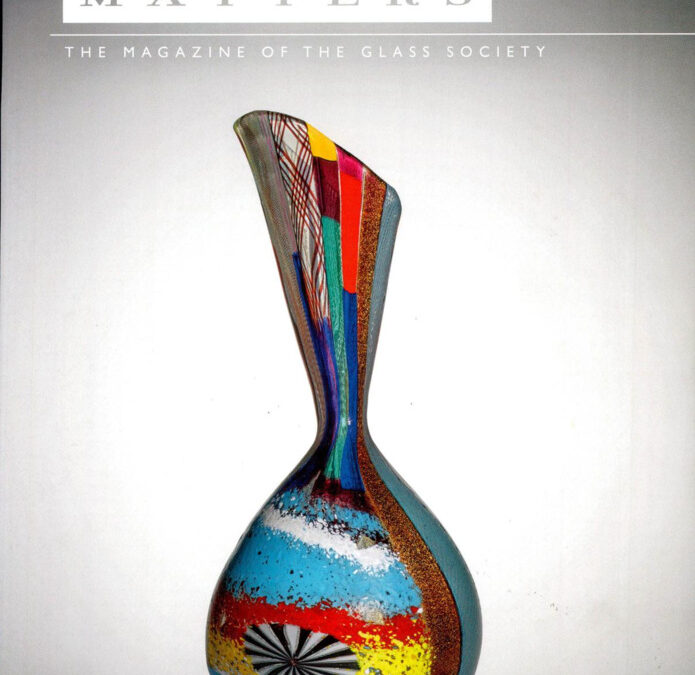
FRONT COVER:
An Unique Monumental Amphora ‘Ape’ Vase
by Dino Martens (1894-1970), made for Aureliano Toso, circa
1952. In Bonhams sale, December 2021.
Bonhams
BACK COVER:
Lot 1 in Bonhams sale, December 2021 (see
article). A rare serpent-stemmed, Facon de Venise winged wine
tazza, 12.4cm in height and provenance from the well-known
collections of Walter
F
Smith and Helfried Krug. ©
Bonhams
Guild Glasses
Glass Fairs
Glass Door Panel
Esoteric Eye-glass
International Year of Glass
Collecting Decisions
20C Engraved glass
In Memoriam
Anthony Stern
Erwin Eisch
Editorial
T
his time, we’ve followed on with further articles on members
collections. Reading about the circumstances, thoughts and
ideas that started other’s collecting, gives a comparative insight
into the how and why our own collections have developed and
the directions that they may take in the future. Mathij, from
Holland, grew up with other antiques, moving to glass as family
circumstances required a change and was fired with enthusiasm by
Frides Lameris. Stephen used to accompany his dad to Portobello
Market, but knew nothing about the glass collected, until his dad
died and valuation time came — when the chance meeting with WGT
Burne ignited his passion for fine antique glass. Michael Upjohn
knew of his parents collection of pressed glass, but was not involved,
until his father was suddenly on his own — Michael’s knowledge
grew as he accompanied him on buying trips, searching for rare and
unusual pieces. The lesson? – those with knowledge — pass it on,
enthuse others. Thank you for your many queries and comments,
they will be in the next issue; please, do keep them coming.
Chairman’s message
An Interesting Rummer
Bonhams – Auction
Bott & Stourbridge
Pressed Glass
Eclectic Collector
Robin Wilson
3
4
Jim Peake
5
James
Measell
13
Michael Upjohn
17
Stephen
Pohlman
21
Bill Millar
24
Christina
Glover &
Paul
Bishop
27
Simon
Cook
28
George Sturrock
29
Andy
McConnell
30
Math#
van
der
Meulen
31
Brian Watling
36
Anne
Rogerson
36
Katharine
Coleman
37
Glass Matters Issue No. 14 June 2022
2
CHAIRMAN’S MESSAGE
Chairman’s
Message
Time to Reflect and Look Forward
W
elcome to the latest
issue of
Glass Matters.
I am sure that many
of you were dismayed to learn that
the glass and ceramics courses at
the Wolverhampton School of Art
are to be closed. Glassmaking in
the Stourbridge area dates back
over 400 years and especially
during the nineteenth century,
established an international rep-
utation. The Stourbridge School
of Art, founded in 1851, nurtured
many truly great glassmaking
pioneers, among them George
and Thomas Woodall, genera-
tions of the Northwood and Kny
families, Frederick Carder, and
Joshua Hodgetts. Although the
days of large factory production
have long since ceased, many of
the current generation of stu-
dio glass artists learned their
skills in this part of the country.
The UK industrial landscape is
notable for its ‘industry towns’,
and so the ceramics industry had
a base in Stoke on Trent, steel
in Sheffield and on a smaller
and more specialist level, shoes
in Northampton. Likewise with
Stourbridge and glass. One of
the reasons for this clustering
of businesses was the availabil-
ity of suitable raw materials,
quite often coal; proximity to the
canal network was another early
catalyst. In turn, generations of
the same family would work in
the industry, even if not in the
same factory. Skills were passed
down from generation to gener-
ation. The only constant in life
is change, and I would not want
to be accused of harking back to
the good old days – however, with-
out the stimulus provided by the
local school of art to nurture and
encourage these inherent skills,
what message is being conveyed?
The Glass Society has written a
letter to the principal of the school
of art to register our thoughts.
Without wishing to convey any
sense of irony I must now mention
some very good news, namely the
opening of the new Stourbridge
Glass Museum. Broadfield House
closed its doors in 2015 and ever
since, through progress from the
involvement of the newly founded
British Glass Foundation, we have
been waiting for its successor to
open, which it did in early April.
The building is situated on the
site of the old Stuart glass works
adjacent to the Stourbridge Canal
and just across the road from the
Red House Cone. Set over two
floors, the galleries are light and
airy and particularly on the upper
level give ample opportunity to
view objects from all angles. The
lower level focuses upon the
local industry with obvious ref-
erence to cameo glass as well as
items from the Eila Grahame
and Pilkington bequests. Work
is now underway to consolidate
the displays, bearing in mind
that the museum store at Himley
Hall has a vast collection of inter-
esting and significant items.
Shortly after the museum
opened, The Glass Society held
a half-day meeting at the muse-
um and I would like to repeat
this exercise over the next few
months. Although we met during
the week, I am aware that this is
inconvenient to a number of you
and I will look to organise some-
thing on a weekend next time.
Please let me know if you are
interested in joining a group visit
as I will need to gauge numbers,
David Willars, Chairman of The Glass Society
with an optimum party size of 25.
I am acutely aware that the pan-
demic has wreaked havoc with our
get-togethers and that several of
you are still nervous about meet-
ing in person. However, if you
have any suggestions about pos-
sible venues or days out, please
send me a message: this is your
society and relies upon your input.
This issue features contribu-
tions from a good mix of familiar
names as well as new contributors.
Several of us met up in March to
view the vast pressed glass collec-
tion of Mike Upjohn’s father, Roy.
So large is the collection that, at
least to me, it has become a stan-
dard point of reference to resolve
queries. In turn if you have any
questions about piano feet, Mike
must be the leading authority in
the country. I’ve been informed
that articles on pressed glass will
continue to feature in these pages.
Expect the usual rigour and
authority in articles by James
Measell and Bill Millar, both of
whom have been regular con-
tributors for several years.
Glass Matters Issue No.14 June 2022
3
JAMES THOMPSON’S RUMMER
AN INTERESTING
G RUMMER
Robin Wilson
This was presented to the Glass Circle
on 09/04/2019. Lockdown prevented
prior publication.
C
ommemorative engraving on
a glass can be intriguing, and
investigating the background
gives added interest to such a glass.
A couple of years ago I acquired a
large rummer at auction. The glass
is engraved with a well-dressed gen-
tleman on a racehorse flanked by two
greyhounds. On the reverse are the
words
‘James Thompson Kirk House’
in
a rectangular cartouche which is sur-
rounded by a fruiting vine. The base of
the bucket bowl is fluted and support-
ed by a short ball knop stem. Dated
c.1830s, the glass stands 18.2cm tall.
The engraving itself is attributed
to the North East engraver Thomas
Hudson. (See Delomosne & Son Ltd’s
sale catalogue
‘Engraved Glass from
North East England 1800-1860 – Ian
Robertson collection’.
This contains an
interesting article on North East glass
engraving and glass engravers of the
period). Given the information on
the glass, I decided to investigate and
see what I could discover. The inter-
net provided a fascinating insight
into James Thompson: he was born
around 1795 and lived at Kirkhouse
near Brampton in the manor of Farlam
about 12.5 miles east of Carlisle.
The Thompson family were very
wealthy and owned many farms, as
well as the industries that had been
built up in Kirkhouse to support
the local coal mines. In 1819 James
Thompson was appointed Agent for
Lord Carlisle’s coal mines and farms,
and from then, due to his hard work
and expertise, the family fortunes
really took off. There were hundreds
of men working for them at Kirkhouse.
During this time he built cottages for
the pitmen in the Brampton area and
sunk the Blacksyke pit in about 1820. A
The Rwnmer, c.1830. Dedicated to
James Thompson at Kirk House
branch line was put in via a rope hauled
line up to the bleak fell-side colliery.
James Thompson suggested to
Lord Carlisle that it would be a good
idea to replace the horses that pulled
the coal between the collieries and the
connecting main Carlisle to Newcastle
line at Hallbankgate, with a locomo-
tive. Thus in 1836, Stevenson’s ‘Rocket’
was purchased from the Liverpool
and Manchester Railway for £300
and taken to Lord Carlisle’s Kirkhouse
works to be restored and reassembled.
It continued in use until 1840 when
traffic became too heavy for its limited
hauling power. She was then put in a
siding and left to rust. In 1851 she
went back to the Stephenson’s Works
for restoration and was returned to
Kirkhouse for the next 11 years. In
1862 however, the Thompson family
presented her to the Patents Office
Museum, now the Science Museum in
South Kensington, where she is today.
In 1837 Thompson took a lease on
Lord Carlisle’s collieries, lime works
and waggonways. This extended to
1,000 acres and induded 182 cottag-
es, many of which he had built when
he was Lord Carlisle’s agent. The lease
included a large farm, which he used
to supply the pitmen with their needs.
During his lifetime, Thompson upgrad-
ed the lines between the collieries
and Hallbankgate, and from 1839 he
built several steam engines in his own
works, the first one being ‘Belted Will’.
James Thompson was clearly a
major industrialist in the area, though
when he died in 1851, he’d never been
given the recognition he deserved as a
railway pioneer. The family home, Kirk
House, was modernised and extended
by Thompson in the 1820s and was in
the family for over 100 years. Sold in
1975, it continues to this day as The
Farlam Hall Country House Hotel.
This glass means so much more to
me than when I acquired it now that I
know more about the man it celebrates.
4
Glass Matters Issue No.I 4 June 2022
BONHAMS SALE VENICE TO WHISTLER
Bonhams Fine Glass and Paperweights sale
Knightsbridge, I December 2021
Jim Peake
e
were delighted to invite
members of the Glass
Society for an evening
handling session ahead of the sale
– 170 lots of glass and 117 lots of
paperweights from five private
collections formed the core of the
glass on offer, several of which
included published pieces which
had not been seen on the market
for many decades. Many collec-
tors commented on the quantity
and variety, particularly the early
Continental glass, which took some
of them back to when they had first
started collecting in the 1970s and
80s when an abundance of rare and
beautiful glass appeared on the
London market — the celebrated
collections of Fritz Biemann and
Helfried Krug amongst the most
memorable. The whereabouts of
much of the glass sold all those
years ago can be a subject of con-
siderable speculation; some of the
most exceptional pieces are now
in museums and a small number
may have been lost, but the major-
ity will still be in private hands.
Occasionally such a collection resur-
faces and when it does, it invariably
creates a great deal of excitement.
The inaugural collection con-
tained an exceptional group of glass
which has not been seen at auction
for many years. Formed with a dis-
cerning eye, this private British
collection centred predominantly
around serpent-stemmed glasses
of the 17th century interspersed
with several other exceptional
rarities from the period. Twelve of
the glasses on offer were so-called
vetri a serpenti,
or ‘serpent glasses’
(Fig.1),
which epitomise the glass-
making virtuosity of the Baroque
era and the fascination with the gro-
tesque. They are characterised by
elaborate stems made from twisted
rods of glass containing spiralling
threads in opaque white, sometimes
in combination with brick-red, yel-
low or blue threads, applied at the
sides with pincered ‘wings’ often in
translucent turquoise. The stems
evoke highly stylised intertwined
serpents embellished with wings
and crests, although it is not diffi-
cult to imagine other beasts includ-
ing birds, seahorses, or dragons.
The whimsical and exotic appear-
ance of these serpent-stemmed
glasses would have made them
highly desirable in the 17th century.
Contemporary documents indicate
that they were expensive luxuries
and their appearance in Dutch
and German Old Master paintings
is testament to their appeal. The
earliest examples were produced
in Venice in the late 16th century,
but during the 17th century, glass-
houses elsewhere in Europe were
producing similar vessels
a la facon
de Venise,
or ‘in Venetian style’.
Fig. 1
From left, Lots 7,11, 3, 2, 6, 17, 13, 10
Tacon de Venise’
is often used as a
catch-all term owing to the diffi-
culties in distinguishing between
glass made in Venice and that made
elsewhere and while serpent stems
have their origins in Venice, those
with flattened coiled stems formed
of ropes of glass in figure-of-eight or
`pretzel’ arrangements and applied
with pincered ornament are of a
distinctive type assumed to have
developed in the Low Countries.
Indeed, no glasses with serpent
stems of this distinctive flattened
type have been attributed to Venice,
but contemporary documentary
sources following on from archae-
ological excavations demonstrate
that they were being manufactured
throughout the Low Countries.
They are remarkable survi-
vors owing to their fragility and
it is therefore highly unusual to
see so many together. Produced
in two broad sizes, the collection
included both large, 27-31cm and
small, 18-20cm examples carry-
ing estimates between £1,800
and £6,000. The first lot, a rare
Glass Matters Issue No.14 June 2022
5
LEFT Fig. 5
Lot 14
BELOW Fig. 6
Lot 24
BONHAMS SALE VENICE TO WHISTLER
Fig. 2
Fig. 3
Fig. 4
Lot 1 and Back Cover
Lot 8
Lot 9
_
serpent-stemmed winged wine
tazza
(Fig.2),
was a little smaller at
12.4cm in height owing to the more
open form of the bowl, though the
proportions of the stem were con-
sistent with the smaller size. With
provenance from the celebrated
London sales of both Walter F Smith
and Helfried Krug, it was fiercely
contested and largely set the tone
for the sale when it realised £10,837.
A serpent-stemmed glass in the
larger size
(Fig.1, Lot 2)
then sold for
£12,112 (estimate £4,000-6,000), a
price which no doubt reflected the
rarity of the red and white thread
combination in the stem relative
to the other examples of this size.
Indeed, two very similar large glass-
es containing only white threads
(Fig.1, Lots 11 &
17) made some-
what less at £8,287 and £5,100. The
remaining three large glasses from
the collection
(two shown in Fig.1,
Lots 3 & 10)
all had some damage
but sold well, each selling within
estimate. Three wine glasses in the
smaller size
(two shown in Fig.1, Lots
6 &
7) also sold within estimate, but
an example with a noticeable pale
pinkish tint to the metal relative to
the other glasses
(Fig.3)
did consid-
erably better at £8,925 (estimate
£1,800-2,500) and an unusual small
wine flute
(Fig.1, Lot
13) sold for
£6,120, over twice the top estimate.
Without doubt, an exceptional-
ly rare Dutch wine glass dating to
circa 1760-70
(Fig.4)
was the star
lot. Finely engraved with scenes
from the 1616 edition of
Ambacht
van Cupido
(The Trade of Cupid) in
Nederduytsche Poemata
by Daniel
Heinsius, one of the first love
emblem books ever written in the
Dutch language, one side included
Amor eruditus
(Learned love) with
Cupid flying on the back of an
Eagle, and the other
Omnia vincit
Amor
(Love conquers all) with Cupid
taming the Lion. Both the style of
the glass, with two coloured prunts
on the twisted stem, and the style
of the engraving are all character-
istic of glass made and decorat-
ed in the Southern Netherlands
in the 17th century. With just
two bidders who both refused
to relent, it rapidly exceeded its
£8,000-12,000 estimate to bring
£125,250. The result was borne
out not only by the quality and rar-
ity of the glass itself, but also the
attractiveness and commerciality
of the subject matter, which includ-
ed mythical beasts and hounds
revolving around the underlying
and ever-popular theme of love.
Following on from this was a
fine 17th century Dutch fawn de
Venise wine flute
(Fig.5)
of a rela-
tively well-known type sometimes
seen in contemporary Dutch Old
Master still life paintings, which
often opens up their appeal to those
other than the traditional glass
collector. This was a particularly
attractive example which had gen-
erated pre-sale interest across the
board from museums, dealers and
private collectors. It ultimately took
£15,300 (estimate £4,500-5,500),
a result bolstered by its impressive
height, 37.5cm, condition and sym-
metry. This collection concluded
with a remarkable 17th century
serpent-stemmed glass
(Fig.6),
6
Glass Matters Issue No.14 June 2022
BONHAMS SALE VENICE TO WHISTLER
Fig.
7
Circle of Georg Hinz (German, 1630-1688), still life with a facon de Venise serpent-stemmed wine glass
likely to be of Southern Bohemian
manufacture and attributed to the
renowned Buquoy glass factory
at
the Nove Hrady estate near Dobra.
Voda (Heilbrunn). The openwork
trellis stem perhaps draws its influ-
ence from glass bowls and baskets
produced in Southern Bohemia
around the same time, which no
doubt later influenced the later
products of Flemish-French and
Bohemian glassmakers in Liege
and elsewhere. While no other
surviving goblet with comparable
openwork stem would appear to be
recorded, a strikingly similar glass
appears in a contemporary 17th
century German School still life
painting perhaps from the circle
of Georg Hinz
(Fig.7).
The German
attribution would perhaps support
a Southern Bohemian origin for
the glass. Glasses of related man-
ufacture are in several museum
collections, including the Museum
of Decorative Arts in Prague and
the Museo Galileo in Florence.
The hollow, ribbed knops would
appear to be one distinctive feature
of Southern Bohemian facon de
Venise glass. The technological skill
involved in its construction sparked
some debate — the stem was pre-
sumably made in two halves mar-
ried together before the bowl was
attached. Following considerable
international pre-sale interest, it
sold for £40,250 (estimate £10,000-
15,000) a testament to its visual
appeal and remarkable condition.
The Paul Gresswell-Wilkins col-
lection of early glass followed and
included several more exceptional
rarities, many with latticinio dec-
oration which has proven increas-
ingly popular in recent years.
Important Italian glass from the
same collection had been offered
as a single-owner 153-lot sale at
Bonhams in New York in October
2021, which grossed $1m. The
star of that sale had been a unique
monumental amphora ‘Ape’ vase
by Dino Martens for Aureliana
Toso, circa 1952, which was the
first example ever produced using
his iconic Oriente technique, in
a form which was never repeated
by Martens
(Front Cover picture).
Fierce competition culminated in a
$256,562 result (estimate $30,000-
50,000), setting a new world record
auction price for a piece by Martens.
The highlight of the Gresswell-
Wilkins collection of early glass
was an exceptionally rare fawn de
Venise latticinio kuttrolf dating to
the last third of the 16th century,
probably Low Countries in origin
(Fig.8).
A kuttrolf is a flask, the
Fig. 8
Lot 32
neck of which is typically picked or
divided in some way to form two or
more tubes, but it can also be used
to describe other unusual vessels
which do not necessarily conform
to a traditional vase, goblet or sprin-
kler. This example, decorated with
a loose-meshed network of lattimo
threads characteristic of a rare class
of glass, had a series of nine graduat-
ing constrictions and curved asym-
metrically to one side. The form was
unrecorded but paralleled by goblets
with similar constrictions some-
times known as
Verres Coquilles —
a
term coined from a vessel of related
form described as such in the now
discredited catalogue of the Colinet
glassworks at Beauwelz, which
purported to be mid-16th centu-
ry, but was exposed as a forgery
in 1999. A damaged 16th or 17th
century goblet of related form was
sold by Bonhams on 29 September
2020 for £6,312
(Glass Matters 11,
p.34).
Originally acquired by the
vendor for relatively little as an Art
Nouveau piece, it rapidly exceed-
ed the £8,000-12,000 estimate
to realise an impressive £75,250.
This result was echoed by an
exceptional Venetian latticinio gob-
let with diamond-point engraved
foliate decoration and of similar
Glass Matters Issue No.I4 June 2022
7
BONHAMS SALE VENICE TO WHISTLER
Fig. 9
Lot 36
date
(Fig.9).
Again unrecorded, it
also belonged to a rare group of
latticinio glass with `nipt diamond
waies’ decoration in opaque white,
but would appear to be the only
known example with engraved
decoration. It represents a unique
survival, not only owing to its age
but also because the owner had
acquired it online from someone
who, unaware of its significance,
had posted it from abroad in a small
cereal box without any packing
material. It justifiably exceeded the
£15,000-20,000 estimate, with com-
petitive bidding on the telephone
and online, taking it up to £69,000.
Much like the Venetian and fawn
Fig. 11
John Mamma Bacon (1866-1948) with a cabinet
of his glass, indudinglots 58-60 (top shelf)
Fig. 10
Lot 54
de Venise glass, the early English
glass was greatly anticipated and
offered something for every col-
lector. The room was largely full
as the first lots came under the
hammer, including a range of early
balusters, which have proven to be
a stable investment for many col-
lectors over the years when prices
for some other types of English
glass from the 18th century have
tended to fluctuate. A very rare
baluster flute
(Fig.10)
more than
doubled its upper estimate to take
£6,375 and provided a rare oppor-
tunity to acquire a piece with a
robust recent history, being illus-
trated by Francis Buckley and W A
Thorpe and with provenance from
the Kirby-Mason and Henry Brown
Collections, which no doubt fuelled
the final result. It is thought that
flutes such as this may have been
used for champagne instead of ale
or beer, but wine is also a possibility.
Particularly poignant for the
Glass Society was an offering of
three goblets formerly in the collec-
tion of John Maunsell Bacon, who
had founded The Glass Circle (for-
merly The Circle of Glass Collectors)
in 1937. An existing photograph
of him with a cabinet of his glass
remarkably showed all three of the
pieces offered
(Fig.11).
The high-
lights were a mammoth heavy bal-
uster goblet, then a second slightly
smaller mammoth baluster goblet
(Fig.12) —
on the top shelf, fourth
from the right — which sold for less,
as perhaps the stem formation was
less attractive to the collector and
only partially compensated for by
the impressive size of the piece.
This offering led comfortably
into glass from the collection of
Fig.
12
Fig.
13
Lot 60
Lot 79
8
Glass Matters Issue No.I4 June 2022
Fig. 14
Fig. 15
Fig. 16
Lot 78
Lot 76
Lot 68
Patrick and Mavis Walker, who
had begun collecting in the 1970s
and concentrated primarily on
English glass from the baluster
period, interspersed with a few
choice pieces from the later 18th
and early 19th centuries. They had
bought incredibly well, with a focus
on pieces in good condition, many
of which were acquired from the
selling exhibitions of Delomosne
& Son. Unsurprisingly, the rarest
and most visually appealing stem
forms generated the most interest,
as is usually the case with balus-
ters. The highlight was a very rare
multi-knopped baluster goblet, cir-
ca 1710-20 which contained an egg
knop
(Fig.13),
considered by many
collectors to be the ultimate knop
form in the baluster period. These
knops can sometimes appear awk-
ward in multi-knopped stems but
was particularly well-integrated into
the stem of this goblet, and unusu-
al in that it was solid when others
contain a tear. After considerable
pre-sale interest and with impecca-
ble provenance, most recently from
the celebrated Richard Emanuel
Collection, it sold well over esti-
mate at £12,750. Other highlights
included a small wine glass of
similar date with another rare and
desirable stem incorporating an
acorn knop
(Fig.14),
which more
than doubled the upper estimate
when it sold for £5,100. Among the
other most sought-after glasses was
an uncommon pan-topped heavy
baluster with a drop-knop stem
of circa 1710
(Fig.15)
which more
than tripled its upper estimate,
and a rare baluster wine glass with
a tapered cylinder knop
(Fig.16).
The highlight of the Walker
Collection came in the form of a rare
engraved opaque twist Privateer
wine glass for
The Lyon,
circa 1756-
60
(Fig.17).
Privateer glasses have
always commanded high prices,
and several are known commem-
orating Bristol Privateers. The
Fig. 17
Lot 92
Privateers were in effect officially
sanctioned pirate-ships. Bristol
Privateers including the
Defiance
and the
Eagle
are names well-known
from the series of Privateer wine
glasses, all presumably engraved
in Bristol. A previously unrecord-
ed mixed twist Privateer glass for
the
St. Andrew
sold at Bonhams in
May 2016 for £21,250 and was at
the time the only known example
until another, with a bruise to the
foot, surfaced later that year and
sold at Bonhams for £11,250. The
Lyon
Privateer glass would appear
to be the only known example for
this particular ship. Its size, being
slightly smaller than most Privateer
glasses perhaps added to its appeal,
as did a robust provenance. It set
a new world record auction price
for a Privateer when it sold for
£31,500 against a £10,000-15,000
estimate, making it the most expen-
sive Privateer glass ever sold at auc-
tion. A Beilby enamelled Privateer
for the
Providence
sold by Bonhams
for £30,000 in 2011 as part of the
A C Hubbard Jr. collection held the
previous record, with one for the
Eagle Frigate
dated 1757 which sold
for £21,600 in 2004 having until
then, been the most expensive
engraved example sold at auction.
Directly after this came a rare
political commemorative opaque
twist ale flute inscribed ‘WILKES &
LIBERTY’ and ‘No 45’, engraved on
BONHAMS SALE VENICE TO WHISTLER
Glass Matters Issue No.14 June 2022
9
BONHAMS SALE VENICE TO WHISTLER
the reverse with a bird flying from
an open cage symbolising liberty.
John Wilkes was a controversial MP
and journalist who played a critical
role in the development of radical
politics; he fled to Paris in 1764
after being convicted for seditious
libel for mocking the King’s speech
at the opening of Parliament in
issue 45 of the ‘North Briton’ the
previous year. Wilkes commemora-
tive glasses are traditionally dated
to circa 1763-64 as a result, but it
was not until Wilkes returned to
England and was elected as a Radical
MP for Middlesex in 1768 and sub-
sequently incarcerated, that he
became a political idol and his celeb-
rity took off. It is therefore likely
that this glass was in fact made a few
years later than is usually accepted,
circa 1768-70. Political commem-
oratives from the 18th century
have proven incredibly popular in
recent years, not just in glass, so
the £3,570 result was no surprise.
The next offering included select
glass from the collection of Graham
Vivian, who will be known to many
members of the Society. Highlights
included a selection of candlesticks
and tapersticks; rare survivors
perhaps because they were prone
to breakage or if the flame was
allowed to burn too far down the
nozzle could crack . Amongst the
earliest examples are those with
moulded stems, and the collection
included both a candlestick and a
taperstick dating to circa 1730-50.
The candlestick just sold, but the
taperstick, perhaps surprisingly,
failed to find a buyer. Moulded-
stem glasses of any type have been
quite affordable for some time and
unless exceptional in some way,
have not been particularly sought
after amongst collectors in recent
years, though the reasons for this
are not entirely clear. This is in stark
contrast to examples with elaborate
stems. An opaque twist candlestick
of circa 1760
(Fig.18)
and a charm-
ing airtwist taperstick of circa 1740
(Fig.19)
were hotly contested and
Fig. 18
Lot 133
Fig. 20
Lot 52
each realised well over estimate at
£5,355. It is interesting to compare
these results to a heavy baluster
candlestick
(Fig.20)
with prove-
nance from the Robert Frank and
the Harvey Haddon Collections
which achieved £3,825 (estimate
£800-1,200) earlier in the sale.
Much like drinking glasses, heavy
baluster examples are traditionally
thought to be more desirable than
their twist counterparts, although
Fig. 19
Lot 134
Fig. 21
Lot 132
the discrepancy here may have
been borne out by a small chip to
the footrim of the baluster example.
Beilby enamelled glasses have
become increasingly sought after
in recent years, with the prices
achieved representing a demon-
strable improvement to those being
realised five or even ten years ago.
An opaque twist ale glass of cir-
ca 1765
(Fig.21)
from the Vivian
Collection realised £5,100 (estimate
I0
Glass Matters Issue No.I4 June 2022
BONHAMS SALE VENICE TO WHISTLER
Fig. 22
Lot 130
£1,500-2,000) despite some tiny
annealing cracks to the foot from
manufacture. While this example
was particularly boldly enamelled,
Bonhams had sold a similar Beilby
ale in 2010 for £2,400 and again in
2015 for £2,000, but examples with
minor damage had been making
less. The similar result achieved for
another Beilby ale at a regional auc-
tion house earlier in 2021 suggests
that this is more than mere coin-
cidence. A Beilby glass decorated
with classical ruins
(Fig.22)
realised
£4,845, mid-estimate, which is per-
haps surprising considering that it
is arguably a more appealing subject
than hops and barley. Several glasses
decorated with ruins in a similar
style are known, so the result this
time is perhaps borne out by the
comparative rarity of Beilby ales.
The rarest and most desirable
of all Beilby glasses are of course
those bearing armorials enamelled
in polychrome. Those with royal
connections are the most cele-
brated and have been the subject
of extensive study over the years,
while those with other armorials
have proven highly sought after,
Fig. 23
Lot 142 recto
as most recently demonstrated
with the sale of an unrecorded set
of opaque twist wine glasses bear-
ing the arms of the Surtees family
which were sold as separate lots
by Bonhams in June 2021 for a
combined £45,211
(Glass Matters
12, p.10).
This time collectors were
presented with a unique opportu-
nity to acquire an exceptional light
baluster wine glass bearing the arms
of the Yeoman family of Dryburgh,
Scotland
(Fig.23 recto).
Once known
as ‘Newcastle’ balusters, glasses
of this distinctive form are now
known to have been manufactured
in Holland as well as England. It is
possible that the Beilbys imported
undecorated light baluster glasses
from Holland, as most surviving
examples of this shape with Beilby
decoration have identical stems.
Fourteen Beilby enamelled
wine glasses or goblets of similar
shape are recorded, including this
example. Other than the three for
the Tilly family of Haarlem (which
are technically crested rather than
armorial), only three other Beilby
armorial light balusters remain in
private hands, all of which are royal,
and all previously sold by Bonhams.
The arms on the Yeoman glass con-
sist of a heart pierced by two arrows.
The crest of a winged heart on the
reverse
(Fig.24 verso)
was used by
Fig. 24
Lot 142 verso
several families, but it is thought
to be that of either Constant or
Peake — sadly of no relation to the
author. The hearts, being evocative
of love, again gave this glass appeal
well beyond the traditional Beilby
collector. Indeed, the consignor
had purchased it as a wedding anni-
versary present some years earlier.
Bidding between a telephone and
Fig. 25
Lot 141
Glass Matters Issue No.I4 June 2022
BONHAMS SALE VENICE TO WHISTLER
Fig. 26
Lot 144
an online buyer rapidly exceeded
the £20,000-30,000 estimate, with
the glass ultimately selling to the
telephone for £56,500, closely echo-
ing the £63,650 result achieved by
Bonhams for a similar example bear-
ing the royal arms of Prince William
V of Orange and Nassau in 2013.
In many ways reflecting the
trends seen with Beilbys, colour
twist wine glasses of the 1760s are
also experiencing somewhat of a
renaissance. A rare engraved mixed
colour twist wine glass engraved
with a botanical specimen and with
a stem enclosing a jade green spi-
ral thread
(Fig.25)
was a particular
highlight. One of a series of close-
ly related mixed twist and mixed
colour twist glasses engraved in
a similar manner which are all
thought to have a Low Countries
origin, this example took £6,120
(estimate £3,000-4,000). The same
glass had been sold by Bonhams just
three years earlier for £4,750 and
the return perhaps demonstrates
the degree to which interest has
grown in recent years. Another rare
Fig. 27
Lot 253
colour twist wine glass with opaque
white ribbons edged in blue around
an unusual translucent green core
(Fig.26)
sold for £3,825 (upper
estimate 1,800). When compared
to a virtually identical glass sold by
Bonhams in 2011 for £2,125, part
of the A C Hubbard Jr. collection,
a time when the market in colour
twists was generally considered
to have been much stronger, the
Pig. 28
Lot 151
strength of interest in colour twist
stems can be seen to be flourishing.
A small offering of 19th centu-
ry glass included several coloured
Bohemian pieces for which interest
was patchy, reflecting a marked
change in fashion and collecting
habits in this field in recent years.
Antique paperweights from the
mid-19th century are another
collecting field which has become
more affordable in recent years. The
majority of the 117 lots offered were
consigned as part of the Livingston
Collection and cautious estimates
had been prompted by recent mar-
ket trends. While the selling rate
was encouragingly high, prices were
generally low compared to similar
examples from just a few years pre-
viously, so this is very much proving
to be a buyer’s market. That being
said, the most exceptional examples
still command high prices — a high-
light was a very rare, signed Clichy
scrambled millefiori paperweight,
containing a full signature cane
(Fig.27)
which realised £9,562 (esti-
mate £2,000-3,000). The unsigned
equivalent, virtually identical save
for the absence of a signature cane,
was offered in a lot with three other
French scrambled weights and only
realised £510 (estimate £500-700).
Rare canes are so easy to miss, so it
always pays to be vigilant. Lastly,
a highlight of the later glass was
a goblet by Simon Whistler fine-
ly stipple engraved with a view of
Llanthony Priory and dated 1977
(Fig.28).
It realised £3,187 (esti-
mate £2,000-3,000), mirroring
the £3,812 result achieved for a
similar goblet sold by Bonhams
in 2020
(Glass Matters 11, p.36),
demonstrating that this artist’s
work has recently come to be held
with a similar high regard to that
of his father, Laurence Whistler.
Following the recent sale of Fine
Glass and Paperweights at Bonhams,
Knightsbridge on 21 June, the next
sale, including some rare and fine glass,
will be held on 30 November 2022.
I2
Glass Matters Issue No.I 4 June 2022
BOTT & STOURBRIDGE
Thomas Bott:
Relatives and Friends
in the Stourbridge Glass Industry
James Measell
AT
s a decorator who did hand
painting on fine porcelain,
homas Bott (1829-1870)
achieved great fame in his lifetime.
Examples of his work are in the V&A
Museum and the Museum of Royal
Worcester, and items attributed to
him often fetch high prices at auc-
tion. This article sheds light on other
aspects of Thomas Bott’s life, from
recognition in government schools of
art and industrial exhibitions to his rel-
atives, Thomas and George Woodall,
and his friends, John Northwood
and Albert Gyngell, who were figures
in the Stourbridge glass industry.
Born at Hyde near Kinver in 1829,
Thomas Bott was the second child of
George Bott and Catherine Dugmore
Bott. In the census of 1841, the Bott
family also included older sister
Emma as well as younger siblings
Jane, Edward and John. George Bott
(occupation: ‘spade tree maker’) was
employed by spade manufacturers
Joseph Parkes and Thomas Parkes
in their works at Hyde. A lengthy
account of Thomas Bott’s life pub-
lished shortly after his death
(The
Art-Journal,
February 1871) says that
`he served some years to his father at
the trade of making handles for spades.’
However, that situation was
‘not at
all congenial to his taste’
and young
Bott
‘at every available opportuni-
ty … occupied himself with drawing.’
In 1848, Emma Bott married nail
maker Thomas Woodall. The couple
settled in Barnett Lane, Wordsley,
sharing a residence with nail maker
Joseph Phasey and his wife Mary.
According to Christopher Woodall
Perry, Thomas Bott was also part of
this household. In the late 1840s,
Thomas Bott found employ as an
apprentice glass decorator at the
Richardson Wordsley Flint Glass
Works, where he became acquaint-
ed with fellow apprentice John
Northwood. In the biography of his
father, John Northwood II describes
the daily glass decorating work of
these apprentices as
‘painting, gilding
and enameling.’
Unfortunately, Thomas
Bott’s work and achievements at the
Richardson firm remain shrouded in
mystery, and it is challenging indeed
Fig. 1
Thomas Bott
to attribute decorated glass articles to
him. In his
British Glass 1800-1914,
Charles Hajdamach mentions that
Thomas Bott liked monochrome
enameling and that he may also have
had a preference for sepia enameling.
Thomas Bott and John Northwood
had great interest in drawing, and
instruction was available at the
Stourbridge Mechanics’ Institute. In
Glass Matters Issue No.I4 June 2022
13
BOTT & STOURBRIDGE
Fig. 2
Fig. 3
Opal glass vase with hand painted decoration,
These decorated glass items were attributed to Thomas Bott in
attributed to Thomas Bott
R. Wilkinson’s
Hallmarks of Antique Glass (1968)
1848, about 40 pupils were enrolled,
and, during 1849, some 26 men and
boys were attending the male class on
Monday evenings. Instruction was
provided by teachers J. Williams and
W. 0. Williams, the latter a prize-win-
ning student at the Government
school of art in Birmingham
(Aris’s
Birmingham Gazette,
5 June 1848). By
1851, the Woodall family in Barnett
Lane had grown to indude two young
sons, Thomas and George, but Thomas
Bott no longer lived there. In the 1851
census, Thomas Bott, 21, is listed as a
‘visitor’ in the household of chain mak-
er William Moore and his wife Hannah
in Bell Lane, Stourbridge, and his
occupation is given as ‘glass painter.’
The Mechanics’ Institute was nearby,
as was the Stourbridge School of Art.
With the encouragement of their
employers at the Richardson firm,
Thomas Bott and John Northwood
attended the drawing class in the
Mechanics’ Institute until the autumn
of 1851, when art master Henry
Alexander Bowler offered the first
drawing classes at the Stourbridge
Government School of Art in Theatre
Road. According to the 1851 cen-
sus, John Northwood resided in
Wordsley with his family: parents
Frederick and Maria Northwood and
siblings William, Eliza, Mary, and
Joseph. John Northwood’s occupa-
tion is given as ‘glass painter.’ John
Northwood won medals for his work
at the Stourbridge School of Art each
year from 1854 to 1858, and he also
served as a pupil teacher. About 1859,
he and his brother Joseph partnered
with several others at Wordsley to
form a glass decorating business that
became styled as J. & J. Northwood.
To return to the Woodall family
in Barnett Lane, Wordsley: the 1851
census lists Thomas and Emma
Woodall with their sons, Thomas
(b. 25 June 1849) and George (b. 15
August 1850). Thus, Thomas Bott
was the unde of those two boys who
were destined for fame in the glass
industry, namely, cameo glass artists
Thomas Woodall and George Woodall.
Thomas Bott’s enthusiasm for art
became an important influence in the
lives of his nephews, and it was also a
likely factor in some products of the
J. & J. Northwood firm. The artide in
The Art-Journal relates that Thomas
Bott made his way to Birmingham
in 1851 and that he
‘painted por-
traits’
and
‘decorated Japan wares’
to
support himself. On 28 December
1851, Thomas Bott married Eliza
Bourne in Birmingham. Her father
John Bourne was listed as a
‘glass
cutter’
on the marriage record, and
Thomas Bott’s occupation was
‘artist.’
In 1853, Thomas Bott found
employ as a decorator at the Royal
Porcelain Works operated by William
Henry Kerr and Richard William Binns
in Worcester. In that year, the Great
Industrial Exhibition was held in
Dublin from mid-May until the end of
October. Kerr and Binns had a substan-
tial display of products at this event,
including the Shakespeare Service
ware hand painted by Thomas Bott.
Queen Victoria and Prince Albert vis-
ited the exhibition, and
The Freeman’s
Journal and Daily Commercial Advertiser
(3 September 1853) said that the Royal
couple
‘remained a considerable time
closely examiningthe various productions
of art and manufacture in the different
departments through which they passed:
The stands of ‘Messrs. Kerr and Binns
of Worcester
‘attracted a large share of
notice both from Her Majesty and Prince
Albert.’
One particular item was the
focus of attention, and the newspaper
account leaves no doubt that the arti-
de was the work of Thomas Bott:
‘His
Royal Highness was very much pleased
with a pastile
[incense]
burner of exqui-
sitely graceful design and ornamented in
gold in the most elaborate and tasteful
manner. This beautiful article is the
work of an artist who served seven years
to the trade ofspade-handle making, but
14
Glass Matters Issue No.I 4 June 2022
BOTT & STOURBRIDGE
having a taste for the fine arts, studied
in the Stourbridge School of Design, and
afterwards obtained employment in the
Royal Porcelain Works, where he now
holds a high position.’
This account
appeared in many other newspa-
pers, including these:
Dublin Evening
Post; Dublin Evening Packet and
Correspondent;
the London
Morning
Chronicle; Bell’s Weekly Messenger;
and
Lloyd’s Weekly Newspaper.
Encouraged by his employers,
Thomas Bott enrolled in classes at the
Worcester School of Art, which was
founded in 1851 with the enthusiastic
support of local manufacturing inter-
ests. Like his friend John Northwood
at Stourbridge, Thomas Bott was a
prize-winning student. Newspaper
accounts in
Berrow’s Worcester
Journal, the Worcester Herald,
or the
Worcestershire Chronicle
record these
recognitions of Thomas Bott’s talents
and skills at the Worcester school:
1853 (two prizes for porcelain paint-
ing and design); 1854 (Government
medals for enamel painting and
design, a special book prize award-
ed by Lord Ward, and a local prize);
1855 (four Government medals and
a special prize of £4 for an enameled
card tray ‘purchased by her Majesty’
at the exhibition of student works
held by the Government Department
of Science and Art in London); 1857
(national medal for the design of a
plate); and 1859 (Government medal).
In the late 1850s, a young man
named Albert Gyngell was among
Thomas Bott’s workmates at the
Royal Porcelain Works. Gyngell was
interested in art, and he attended
classes at the Worcester School of
Art along with his friend Thomas
Bott. When John Northwood and
his brother Joseph were starting a
glass decorating business in Wordsley,
Thomas Bott encouraged Albert
Gyngell to seek employment there.
Gyngell worked at the Northwood
establishment throughout the
1860s, and he also attended the
Stourbridge School of Art during
that time. In 1870, Gyngell became
the first Stourbridge student to win
a national medal (bronze) awarded
by the Government Department
of Science and Art. In 1872, Albert
Gyngell left the Northwood firm to
return to Worcester, and he enjoyed
a career as a professional artist and
art teacher until his death in 1894.
In 1855, Thomas Bott was the
recipient of a Government mon-
etary award that enabled him to
attend the Exposition Universelle,
providing him
‘an opportunity to
study the works of art and manufac-
ture … in the various Museums of that
capital.’ The Worcestershire Chronicle
(16 January 1856) reported that
he was
‘awarded a medal at the Paris
Great Exhibition for enamel painting
on china. Mr. Bott, we are informed, is
the only one practicing this branch of
art in England who has obtained such
distinction.’
Months later,
Berrow’s
Worcester Journal
(22 November
1856) also noted this singular
achievement, describing Thomas
Fig. 4
Wine glass by J. & J. Northwood, c. 1860s. The
etching of the warrior Patroclus with shield is based
upon John Flaxman’s illustration of the fight for
the body of Sarpedon in Homer’s
Iliad
Bott’s prize-winning porcelain
tray as
‘a very superior work of art.’
In 1857, the city of Manchester
hosted an Art Treasures Exhibition
(5 May to 17 October). Student
works from schools of art through-
out England, Ireland and Scotland
were among the more than 16,000
objects there. The Government
Department of Science and Art
sponsored a national competition,
and the student works on display
were awarded medals for their excel-
lence. Thomas Bott’s prize-winning
work was described as a
‘design for a
plate’ (Manchester Courier,
10 October
1857). Also in 1857, Thomas Bott’s
‘Cupid and Psyche’
(enamel painting
on copper) was exhibited at the Royal
Academy in London. In 1860, Thomas
Bott’s Limoge-style white enamel on
porcelain
‘Holy Family, after Raphael’
was exhibited at the Royal Academy.
During the 1850s, Thomas Bott
and his wife Eliza had four children.
Son John Thomas Bott was born
on 30 November 1854; he was to
follow in his father’s footsteps, win-
ning prizes at the Worcester School
of Art and having a lengthy career
designing and painting on porcelain.
Georgiana Lavinia Bott was born in
August 1856, and Edward Bourne
Bott was born in October 1858.
One week after Thomas Dugmore
Bott was born on 13 December
1860, Eliza Bott passed away due
to complications from childbirth.
As nephews Thomas Woodall
and George Woodall began to attend
school in the mid-1850s, Thomas
Bott became involved in their educa-
tion, especially when their interests
and abilities in art were apparent
as they became older. In Thomas
Woodall’s handwritten
‘Reminiscences
(Industrial),’
there is mention of
‘my
uncle Thomas Bott’
in the very first
sentence, as well as later references
to the effect that Thomas Bott had
great interest in my brother and I… and
encouraged us very much.’
Christopher
Woodall Perry recounts that Thomas
Bott
allowed the youngsters to see
his sketchbooks and that he gave
Glass Matters Issue No.14 June 2022
15
BOTT & STOURBRIDGE
Fig. 5
Oil painting’Rydal
Water, Westmoreland’
signed
‘Albert
Gyngell 1889:
Image from Worcester City museum collection
them Matthew Digby Wyatt’s
Art
of Illuminating
(1860) as well as
copies of Homer’s
Iliad
and
Odyssey
with illustrations by John Flaxman.
In the early 1860s, Thomas Woodall
and George Woodall became appren-
tices at the glass decorating firm J.
& J. Northwood in Wordsley, both
because of the friendship between
John Northwood and Thomas Bott
and the potential for success seen in
the young Woodall brothers. During
the time the Woodall brothers were
employed, the Northwood firm pro-
duced some etched glass artides that
were inspired by Flaxman illustrations.
With the encouragement of both
J. & J. Northwood proprietor John
Northwood and uncle Thomas Bott,
the young Woodalls attended dasses
at the Dudley School of Art and the
Stourbridge School of Art. Thomas
Woodall and George Woodall daimed
numerous prizes and medals, and
both were successful in Government
art examinations. Thomas Woodall
was awarded a Queen’s Prize in
1879 for a design for engraved glass.
Thomas Bott died on 12 December
1870.
The Staffordshire Advertiser
(31 December 1870) termed him
one of the principle artists of the Royal
Porcelain Works’
and noted that
‘the
Queen and the late Prince Consort were
great patrons ofhis work.’
Published in
1878, Llewellynn Jewett’s
Ceramic Art
in Great Britain
called him
an artist
of the very highest eminence,’
and such
praise is echoed in many subsequent
books devoted to British porcelain.
When longtime glassmaker Benjamin
Richardson passed away in 1887, the
County Express
(10 December 1887)
recounted his career, crediting him
with the introduction of
‘enamelling
and gilding on glass … (with] some twen-
ty or thirty hands on at this kind ofwork.’
The article also noted that
‘many who
are or have been eminent in the various
branches of the glass trade … as well
as those in other walks of art, received
some of their most lasting impressions
whilst engaged at the well known
Wordsley Flint Glass Works.’
Among
the individuals mentioned were John
Northwood and Mr.
Bott of Worcester,’
the latter being
‘remembered as a paint-
er of Limoges china of no mean repute.’
James Measell is an Honorary
Research Fellow at the University
of Birmingham. He can be contact-
ed by email: jsmeasell@gmail.com
REFERENCES
Andrew, Colin. ‘Thomas Bott (1829-
1870) Spade Handle Maker to Artist,’
Northern Ceramic Society Newsletter
No.
196 (December 2019), pp. 36-45.
Haden, H. Jack.
Artists in Cameo
Glass: Incorporating Thomas Woodall’s
Memoirs.
Kingswinford: Black Country
Society, 1993.
Measell, James. ‘Albert Gyngell:
From Glass Etcher to Fine Artist,’
The
Blackcountryman,
54 (Winter 2020), pp.
72-77.
Northwood II, John.
John Northwood:
His Contributions to the Stourbridge Flint
Glass Industry 1850-1902.
Stourbridge:
Mark and Moody, 1958.
Perry, Christopher Woodall.
The
Cameo Glass of Thomas and George
Woodall.
Somerset: Richard Dennis,
2000.
‘Thomas Bott,’
The Art-Journal,
New
Series, vol. X (February 1871), p. 42.
I6
Glass Matters Issue No.I 4 June 2022
COLLECTING PRESSED GLASS
Introducing
the Upjohn Collection of
Victorian Pressed Gla,cs
Michael Upjohn
Fig.
1
A mix of commemorative Busts and Paperweights
induding a John Derbyshire Britannia
Editor: Roy and Betty Upjohn’s
significant collection of English pressed
glass is curated by their son Michael,
who has now taken on the collecting
mantle alongside his father. Roy’s
wife, Betty, passed away in 2011.
This introduction will be followed in
future issues on specific pressed glass
subjects on the various manufacturers,
their colourways, copies and designs.
C
ollecting Victorian Pressed
Glass and novelties of the
era all started around the
1980s, when my mother would
come back from work with a little
Victorian pressed glass novelty that
she had found during her lunchtime
while rummaging around in one of
Godalming’s antiques or curiosity
shops. In the beginning it was a slow
start, but after a while my father
also started taking some interest in
antiques – actually antique oil lamps!
– but realising he’d soon need a big-
ger house, he converted to collecting
pressed glass. With their new-found
common interest, they started going
to the occasional antique fair, pick-
ing up the odd piece of glass. In the
’90s dad retired and so collecting
increased. Their travels would take
them on hunting routes around
the South of England from Kent to
Exeter. From their favourite haunts
of antique and second-hand shops
with the occasional flea market,
and then to the fairs held at Exeter,
Woking, Sandown and Birmingham.
Until recently the only person to
have seen the collection was their
friend Henry Fox who lived near-
by – they used to travel to the fairs
together. They became familiar with
the dealers, taking their advice to
buy certain books: Raymond Slack’s
English Pressed Glass –
mum had a
signed copy as they met regularly
at the fairs – and Jenny Thompson’s
Identification of English pressed glass
were their bibles and although a bit
dated these are still very useful today.
English pressed glass started being
manufactured in the early Victorian
era to provide glass for the masses
rather than as an expensive luxury
for the few. Some of the first cre-
ations were commemorative wares
and Queen Victoria’s ascension was
perfectly timed for the glass man-
ufacturers to mass produce their
new designs. My parents’ collection
mainly consists of pieces dated from
1867-1903. The more collectible
items of commemorative English
pressed glass were not only made to
celebrate Queen Victoria’s reign, but
also many other distinguished peo-
ple and events
(Fig.1).
Busts, plates
and bowls of Gladstone to Disraeli,
small plates to mark the opening of
the Manchester Ship Canal, inkwells
remembering
General Chinese Gordon,
to obelisks celebrating Cleopatra’s
Needle along the embankment of the
River Thames, then to items with spe-
cific quotes from the era, such as
Give
us our Daily Bread
or
Auld Lang Syne.
The North West companies,
including Manchester companies
Molineaux & Webb, The Derbyshire
Glass Matters Issue No.14 June 2022
17
COLLECTING PRESSED GLASS
Fig.2
A selection of Paperweight Figurines, indudingsome from John Derbyshire
and a green dog from PerrivalVickers, 1870-80s
Brothers and Percival Vickers, were at
the forefront of manufacturing good
quality imitation cut glass before their
North East competitors of Sowerby,
Moore, Davidson and Greener. Some
of the more eccentric and collectible
pieces are the paperweight figurines
from the short-lived John Derbyshire
Manchester factory
(Fig.2),
which
included Lions, Greyhounds, Punch
and Judy, Britannia and Queen
Victoria, which were all made in a nev-
er ending range of colours. I’m sure
some of their colours were just exper-
iments on the day. As time moved on,
the North East manufacturers started
to dominate, creating mass-produced,
interesting, intricate and often exper-
imental designs
(Fig.3).
As designs
and mould makers progressed, nov-
elty pieces took on a new fashion to
include faces, animals and scenic pat-
terns. Some would have animals as
handles or finials and small decorative
vases were decorated with animals,
foliage and figures. Open salts, match
and toothpick holders and posy vas-
es were made in numerous shapes
including shoes, boots, prams, wheel-
barrows and coal scuttles. If your
designs became successful, you knew
your competitors would soon be mak-
ing their own interpretation. This is
the lozenge was no longer used, just
the registration number being plain-
ly marked. I say straightforward, but
some early trademarks are difficult
and frustrating to decipher, making
it more of an achievement to give it
a correct attribution. Of course, not
all manufacturers used markings
and these pieces are always difficult
to identify – I’m sure that this com-
plication began many a discussion or
argument. My mum used to spend
hours trying to decipher lozenges on
the Henry Greener pieces. To add to
the confusion, there are several rang-
es from Henry Greener where the
lozenge sequences are incorrect. You
will never make any sense of it – per-
haps the lozenge maker was dyslexic?
My mother’s collections were of
clear and frosted glass, with individual
collections from Sowerby, Davidson,
Angus and Henry Greener, Edward
Moore, Percival Vickers, Molineaux
and Webb and more
(Figs.4 and 5).
Back in the day, clear glass was and
still is one of the cheapest ranges to
Fig.3
A
colourful mix from the 1880s and early 1890s
indudin g a Greener & Co blue Pearline pram, an
opalescent green swan from Sowerby and a dark
rose swan
from
Burtles Tate & Co
maybe why so many North East pieces
have similarities with each other. It’s
difficult to tell them apart unless you
can find the elusive maker’s mark.
One reason Victorian pressed
glass can be straightforward to iden-
tify is the use of trademarks and a
lozenge stamp — which included the
registration number – used on items
between 1842 unti11883; from then,
18
Glass Matters Issue No.I 4 June 2022
COLLECTING PRESSED GLASS
Fig.4
group of late Victorian opalescent decorative wares from Molineaux
Webb & Co; Burtles, Tate & Co and Sowerby’s Ellison Glass Works
collect, so you don’t need a
big budget, which suited my
mother at the time. One cab-
inet is full of commemorative
plates and figurines followed
by enough clear glass to fill
a further six cabinets. My
parents would concentrate
on certain registration num-
bers or ranges and built up
quite a sizeable collection of
many of the ranges; there are
collections of Davidson’s Rd
176566 1891 known as
Lady
Chippendale,
in primrose and
blue Pearline
(Fig.6)
plus a
collection in clear with over
seventy pieces, and we are still
hunting certain shapes and
colours, such as a yellow ped-
estal jug. You would think a common
shape would be easy to come across,
but that’s not necessarily the case.
My father still mainly collects
coloured ranges, induding Davidson’s
primrose Pearline — a colour range
known by many as Vaseline; Sowerby
items from the 1880 and 1882
catalogues including the Walter
Crane
Nursery Rhyme
range; pur-
ple malachite marble slag glass and
opaque white & black glass from all
the North East manufacturers. He
has a fantastic collection of John
Derbyshire figurines and some of
his favourites are Manchester opal-
escent pieces from Burtles Tate & Co
and Molineaux and Webb. One of my
favourite cabinets is the one full of
Nailsea-style pipes, gimmel flasks,
bells and rolling pins, with a few opal-
escent Stourbridge pieces for good
measure. When asking my father
“what has this got to do with pressed
glass?” the answer was “I don’t like
to return home empty handed”.
A new millennium came, and a
new way to collect glass. Around this
time a change in the way dealers and
collectors bought and sold glass was
happening. Antique fairs started to
decline, and dad would say the dealers
Fig.5
A group of opaque posy vases, from Sowerby’s
Ellison Glass Works, 1870-80
it. So, he bought a computer
and learnt very quickly how
to use eBay. Nevertheless,
a large proportion of their
collection was purchased
before the days of eBay; you
could only find rare items at
the glass fairs and had to pay
a premium for them. eBay
and the internet changed
everything and now it’s a lot
easier to build collections.
My sister and I would ner-
vously laugh at the thought
of the time when their collec-
tion, about which we knew
nothing, would become our
responsibility. So, five years
ago, I decided to take up the
mantle and take an interest in
the collection purely for the sake of
reducing it. Over the years my parents
had accumulated over 1800 pieces of
glass, and there were boxes of items
no longer displayed, or containing
duplicates which were substituted
for better pieces. My aim was to sell
these excess pieces on eBay. I’d never
done this before but enjoyed research-
ing on the internet – especially using
the Glass Message Forum and gallery
were using something called eBay
to sell their glass. My father flatly
refused to move with the times: he
wasn’t going to buy a computer, now
or ever! Twelve months passed and
the fairs declined further, so I tried
again to introduce eBay to my dad.
Items which were extremely rare
and only seen at the top glass fairs
were now making regular appear-
ances on eBay. Dad couldn’t believe
Glass Matters Issue No. 14 June 2022
19
COLLECTING PRESSED GLASS
Fig.6
A
selection of George Davidson’s Primrose Pearline range from the
late 1880s, also known as opalescent and Vaseline. The two pieces
with handles are unattributed
Fig.7
A
group of Uranium pressed glass pieces including a large rare covered sugar
bowl from James Derbyshire, a rare Percival Vickers candle stick, a George
Davidson quilted pillow butter dish, two Henry Greener baskets and some early
piano insulators; the dates range from 1859-1890
which are a great resource; I would
send links to dad saying
‘look at all this
information on your glass’.
My
mother
would have loved the site but sadly
didn’t get a chance to see it. I knew
some ranges of the glass would be
more popular than others and soon
started selling mum’s pressed glass
baskets worldwide. It would have
amazed her to have known that her
glass had travelled across the globe.
I’ve enjoyed discussing my par-
ents’ collection and sharing pictures
with collectors from all around the
world and it was soon apparent that
mum and dad’s collection was pretty
special. One of the most important
things to be aware of if you want to
transfer your knowledge of your col-
lection to your family, whether they
are ready for it or not, is to make a
record of your glass. Try to include as
much information as possible, give
the item a number and take a photo
of it with its number. I found this
most helpful when transferring my
parents’ log books onto a computer.
Being able to
see
the matching photo
was invaluable. It will be time con-
suming, but you will then start to
recognise pieces much more easily.
My quest to reduce the collection
has backfired. I am now actively hunt-
ing pieces down or pointing dad in the
direction of rare pieces to enhance
certain ranges, or even adding unusu-
al finds myself. I have my own fond-
ness for glass known as Vaseline or
opalescent and made with uranium
– it gives me a grin when I flick on the
ultraviolet light and get the glow it
gives off in the dark
(Fig.7).
Fashions
come and go and while Victorian
English opalescent pressed glass
may not achieve the same prices as
a piece of opalescent Lalique, English
manufacturers – Sowerby, Burtles
Tate and Co and Molineaux & Webb
– were producing opalescent pieces
years before Lalique. At the end of the
day, Lalique is also only press-mould-
ed glass, well that’s what dad says!
Some would say Victorian pressed
glass is out of fashion, but I’ve
found it’s still enjoyed and collected
worldwide, some pieces being very
sought after. We are still on the elu-
sive search for a John Derbyshire
Winged Sphinx or a Henry Greener
opaque white Gladstone bowl,
and don’t forget that primrose
Pearline creamer. So, if you have
one spare, please contact me at: –
michael.upjohn@btinternet.com
Here are some useful books
and websites to help start you on
your journey to collect English
pressed glass. Be aware the books
were written well before the
authors had access to the internet.
They may contain the odd error.
Books
•
The identification of English
pressed glass,
Jenny Thompson.
•
English pressed glass 1830-1900,
Raymond Slack.
•
The Peacock and the Lions,
Sheilagh Murray.
•
English 19th Century Press
Moulded Glass,
R. Lattimore.
•
British Glass 1800-1914,
Charles
R. Hadjamach.
Websites
•
Glassmessages.com and
their photo gallery https://
glassgallery.yobunny.org.uk
•
Victorianpressedglass.com
•
For Manchester glass, https://
sites.google.com/site/
molwebbhistory/Home/
registered-designs
20
Glass Matters Issue No.I 4 June 2022
ECLECTIC COLLECTOR
An eclectic collector
Stephen Pohlmann
Fig. 1
My
father, Eric Pohlmann, in
Portobello Market in the late 50s
I
inherited my passion for glass
from my father, a well-known
actor and an imposing figure of
a man. I had the pleasure of visiting
Portobello Market with him on many
occasions
(Fig.1).
I knew nothing
about glass — and actually never really
found out how much my father knew,
but I do know that he collected what he
liked, not necessarily what was ‘good’.
In 1976 my father asked me to
have his collection of glasses valued.
I checked the yellow pages, stuck a
pin in the name `W.G.T. Burne’, and
lugged the suitcase of almost 50
pieces to their shop in Chelsea. It
did not take the Burne brothers too
long to assess the collection and to
write an official valuation (which
I still have!). When I asked them
how they came to recognise and val-
ue glasses so easily and so quickly,
they shrugged their shoulders and
responded that that was their job,
their love and their passion. I have
been hooked ever since. Glass col-
lecting became my passion and my
hobby. Collecting takes time and curi-
osity as it involves delving into his-
tory, design, fashion and materials.
Thanks to a long career in the
international dental trade, I have
always been a traveller. This opened
many doors as it enabled me to meet
collectors and dealers in various cor-
ners of the world. Along the way, I ‘col-
lected’ many friends sharing the same
interests, along with their spouses
who have usually been wonderfully
understanding. These friendships
have become even more important
to me than my own collection. I
moved to Israel in 1984, seven years
after the acquisition of my first glass.
As you would expect, I have my
favourite pieces, but the reasons are
not always obvious; there is often a
story behind the predilection. For
many reasons, the
Adam and Eve
marriage goblet
is high on my list
(Fig.2).
I acquired it at Sotheby’s in
1977, the first time I ever bid at an
auction. Thought to be a marriage
glass, it is a very special and rare piece.
It is the earliest dated English ped-
estal-stemmed glass, and comparing
it with ceramic work in the Bristol
region suggests that it was very prob-
ably made and engraved there. There
are only two other such goblets in exis-
tence, thought to have been engraved
by the same hand. Illustrated beau-
tifully in Dwight Lanmon’s magnif-
icent book is one that was in John
Bryan’s collection, subsequently
donated to the Art Institute in
Chicago; the other one is exhibited at
the Ashmolean Museum in Oxford.
I visited John Bryan at his stun-
ning Crabtree Farm home a few times
(Fig.3).
A very special experience,
including playing on his 140 year-
old indoor tennis court, complete
with a painting which he claims is
the oldest known work to show a
`real tennis’ scene. Following one of
these visits I decided that the three
Adam & Eve goblets should try to
get together. I started by taking
mine to the Art Institute to meet its
`mate’, then subsequently took it to
the Ashmolean to meet its second
brother. But alas, I could not get the
Fig. 2
Adam & Eve betrothal goblet, dated 1714
Glass Matters Issue No.I 4 June 2022
21
ECLECTIC COLLECTOR
Fig. 3
John Bryan (right) and the
author (eft) admiringDwight
Lanmon’s favourite heavy baluster
three together as museum
insurance does not easily
cover such fantasies. That is
a dream still to be fulfilled.
SWEETMEATS
Collecting sweetmeats has
been a perfect example of
my mind racing over a broad
and diverse range of styles.
Late in 1978 I came across
this cute glass object, the opposite
of a heavy baluster in so many ways,
except for the relative weight. I
intended to search for a matching
piece, however each sweetmeat glass
I came across and bought was differ-
ent from the others in the collection
(Fig.4).
Latticinio in either the foot,
stem or base, or in two of them, or in
all three. Thick plain foot or folded,
almost reflecting a firing glass — with
or without an unpredictable number
of ‘sections’. Varying heights, bowl
and foot widths. Short stems or
extremely long ones, not to speak of
the ‘nips’ on the rim. My collection
includes sweetmeats designed with
7
nips up to
25,
and my quest is still
to find an actual matching pair!
THE ALIUS
Not long ago I was in Holland on a
business trip which coincided with
TEFAF, perhaps the world’s
leading art fair, with only a few
hours to spare before my flight
home. I was aiming for a par-
ticular piece engraved by Wolff,
on display at the Vecht stand.
But as it had sold, I wandered
on. I came across the Fijnaut
stand where I espied a very
attractive ‘Newcastle’ glass. It
was only when I held it close
that I noticed the ‘breathed’
engraving and recognised the
glass which had been on the
front cover of both Bonhams
and Sotheby’s catalogues. It
was an Alius'(Fig.5). The acqui-
sition negotiations took a lot of tears.
The last price was too high and I had a
flight to catch. I left my card. While
travelling to the airport, I received
a call to say that my last offer had
BELOW (LEFT) Fig. 4
Aerial view of some of the 21 sweetmeats – none of
them a match
BELOW (RIGHT) Fig. 5
A stippled Chinoiserie scene by ‘Alius’
22
Glass Matters Issue No. 14 June 2022
world in the 1970s and 80s, when I
was travelling there very frequently,
and not to have met the fathers of
the Lameris or Vecht families. I also
regret not having joined the Glass
Circle earlier, through which I would
have met collectors like Graham
Vivian years earlier. We had been
Kensington neighbours for 30-40
years and shared not only the same
passion for glass, but also many oth-
er interests. Graham started selling
his collection some years back, and
I acquired some very special pieces
from him, including the rare and
beautiful blue sweetmeat
(Fig.8).
Our friendship with the Vivians
inspired me to write the following
— quite appropriate for this article:
ECLECTIC COLLECTOR
Fig. 6a
Fig. 6b
Tilly armorial goblet by Beilby – recto
Tilly armorial goblet by Beilby – verso
been accepted. Two months later I
was back in Amsterdam to pick up
the glass and finally met Jacques
Fijnaut. My latest dream is to discov-
er an Alius glass –
with
a signature!
My Tilly Beilby also has an inter-
esting story
(Figs.6a & 6b).
Its twin
is in the Durrington collection and
is called ‘The’, but now there are two
of them. It was discovered by Kitty
Lameris during one of Holland’s
Antiques Roadshows (Tussen Kunst
en Kitsch), when current mem-
bers of the Tilly family appeared
on the show with the glass. I was
lucky to be visiting Holland just
days after the Tilly family decided
to sell, and just days before a Glass
Circle group was due to visit. I’d
realised this piece would attract
a lot of interest and so I thought
of getting there first. Another
dream – I tried so hard to have the
two Tilly’s meet, but to no avail!
I have quite an eclectic collec-
tion and a few regrets. I considered
focusing on heavy balusters as they
best encompass the introduction
of lead glass and its advantages.
When I interviewed one of the art
glass world’s greatest, Vaclav Cigler,
I gave him my favourite drop knop
to play with while conversing
(Fig.7).
I knew he would appreciate it as
he specialises in the use of optical
glass: heavier, denser, more refrac-
tion and reflection. His works are
practically all monochrome, most-
ly clear, and his interaction with
water, ice and mirrors is stunning.
Some people need to play with prayer
beads — or ball-bearings — in order
to relax and think clearly. For me,
it a heavy baluster. Cigler agreed.
I have a few regrets. One was not
getting to know the Dutch glass
Fig.
7
An eariy drop knop heavy baluster
Like good watches
We’re just looking after glass
As it passes from then
Through now
To the future
In the meantime
We admire, fondle, stroke
Display, see and sometimes use
And when we pass it on
We hope that the next collector is
of the same cut: a glass lover
Fig. 8
One of only two known examples of this blue
sweetmeat
Glass Matters Issue No.I4 June 2022
23
WORSHIPFUL COMPANIES
THE CITY
of
LONDON CRAFT
and
MERCHANT GUILDS: Cla4ses &
History
Bill Millar
I
s there a glass collector who is not
excited when they spot a “real
find”? The production period,
maker and other details can all be
checked at home, then you can revel in
the pleasure of ownership. However,
collectors of armorial glass have an
extra pleasure: researching the armo-
rial and its history. Personally, the
research often far exceeds the plea-
sure of spotting the find in the first
place. Some of the glasses illustrated
in this article maybe of no great merit
in themselves – rather, they are vehi-
cles with armorial decoration which
introduce some of the craft and mer-
chant guilds of the City of London
and a taster to their long history.
The pantomime hero Dick
Whittington is based on a real per-
son who was Lord Mayor of London
four times some 600 years ago.
The Lord Mayor has been selected
from and by the members of the
city craft and merchant guilds, also
known as livery companies, since
1189. A new Lord Mayor is elected
each year and on the day after being
sworn-in leads a procession, known
as the Lord Mayor’s Show, to swear
allegiance to the Crown. The first of
the livery companies were formed
in the 12th century and they reg-
ulated all aspects of business from
entrance standards and qualification
levels to wages, working hours, tools
and conditions. Monopolistic and
restrictive in nature, they also set
quality standards and prices. The
guilds developed their own distinc-
tive clothing and regalia which led
to them being called livery compa-
nies, each with its own armorials.
In the 19th century the importance
of the guilds declined with the mech-
anisation and rapid change of the
industrial revolution. Most changed
Fig. 1
Airtwist wine goblet showing crest of Worshipful
Company of Grocers
their role to one of supporting their
respective industries and the City
and Guilds training and qualification
scheme was founded as a direct result.
Charitable work is a considerable ele-
ment of their work and donations by
the livery companies currently exceed
£40 million per annum. Today there
are 110 companies including mod-
ern companies formed in recent years
such as The Honourable Company
of Air Pilots formed in 2014. Given
fundraising is a major part of their
work, wining and dining undoubtedly
helps and glassware, probably with
the company’s armorials, is essential.
Other items of glassware would have
been sold to raise funds which pro-
vides collectors with scope to acquire
armorial glassware from the guilds.
The Worshipful Company of
Grocers. You may recall the superbly
cut and engraved scent with the arms
of the Grocers Company illustrated
in the article
Royal Jubilees
in
Glass
Matters
13, February 2022. The
Worshipful Company of Grocers
was
reportedly the senior guild in the
middle ages. Founded as the
Guild
of Pepperers
in 1180 it subsequently
became the
Company of Grossers
in
1373 and was renamed the
Company
of Grocers of London
in 1376. The
Company now ranks second of the
Great Twelve City Livery Companies.
Their arms comprise a shield with a
red chevron and 9 cloves. Their crest
is a camel loaded with 2 sacks of
peppers, each sack is decorated with
6 cloves. Their motto is
God Grant
Grace.
The air twist goblet
(Fig.1)
is decorated with their camel crest,
superbly stipple engraved by Jenny
Hill-Norton in the late 20th century.
The Worshipful Company of
Mercers was incorporated under
a royal charter in 1394 and ranks
first of the Great Twelve City Livery
Companies. The early members con-
centrated on the export of wool and
import of luxury fabrics such as silk
and velvet – which was how the real
Dick Whittington, as a member of the
guild, made his fortune. Their arms
show the head and shoulders of The
Virgin crowned with a celestial crown,
wreathed about the temples with a
chaplet of roses, her neck encircled
with a jewelled necklace. All of this
is above a celestial cloud with clouds
bordering the arms. Their motto is
Honor
Deo (Honour God). The sher-
ry glass
(Fig.2),
from the second
half of the 20th century, has been
24
Glass Matters Issue No.I 4 June 2022
WORSHIPFUL COMPANIES
Fig. 2
20C sherry glass engraved with arms and motto of
the Honourable Company of Mercers
Fig. 3
Baccarat goblet engraved with view of London
Bridge and crest of the Worshipful Company of
Fishmongers
Fig. 4
Stuart Aerial glass, H14.7cm, engraved by Stephen
Richard in 1979 with the crest of the Worshipful
Company of Saddlers
engraved with the arms and motto.
The Worshipful Company of
Fishmongers ranks 4th in the order
precedence and was given its first
Royal charter in 1272. Unlike most
of the other guilds it retains many of
its traditional duties and is respon-
sible for overseeing the quality of
fish brought into the city, mainly
through Billingsgate Market. It is
also closely involved in monitor-
ing salmon and freshwater fishing
as well as shellfish in UK waters.
William Walworth, a member
of the guild, was Lord Mayor of
London in June 1381 during the
Peasants’ Revolt – which followed
the imposition of a poll tax.
When Watt Tyler and his follow-
ers entered London, Walworth
raised the city guard to defend
London Bridge. He met the
insurgents at Smithfield where
he killed Wat Tyler with his
short sword. The Boy King
Richard II was present and sub-
sequently knighted Walworth
and awarded him a pension.
The company’s livery hall,
Fishmongers’ Hall,
was first built
in 1310, replaced in 1434 and
again in 1671 following the Great
Fire of London. In 1799 a competition
was opened to design a replacement
for the medieval London Bridge,
but it entailed the demolition of
Fishmongers’ Hall. A replacement hall
was built adjacent to the new bridge
which was completed in 1831. In the
early 1960s it was realised that the
1831 bridge was slowly sinking into
the Thames and deemed to be beyond
repair. The latest iteration of London
Bridge opened in 1973. The Baccarat
goblet
(Fig.3),
is engraved with a view
of the new bridge with Tower Bridge
beyond. The upper surface of the foot
carries the legend ‘London Bridge
1967 – 1973′. On the reverse the foot
is engraved with a crest showing two
arms supporting an Imperial Crown.
This is the crest of the
Worshipful
Company of Fishmongers.
Their mot-
to is “All Worship be to God Alone”.
The Worshipful Company of
Saddlers was incorporated in 1395
and ranks 25th. In 1585 they were
awarded their arms of a gold chevron
with three saddles. Their crest is a sil-
ver horse, bridled, saddled with gold
trapping and with a plume of three
feathers on its head. Unusually, they
have two mottoes, Hold Fast, Sit
Sure and Our trust is in God. The
saddlers discharged their duty for
quality standards by appoint-
ing searchers empowered to
search the shops and houses of
all employed in the saddle trade
and condemn ill-made wares. The
maximum fine for each instance
was set at 2/6d (approximately
£30 today) by ordinance of Queen
Elizabeth I. The downside of this
responsibility was that the com-
pany would be fined £5 (£1,200)
for every instance of defective
Fig. 5
Ashtray with intaglio decoration and etched
arms of Worshipful Company of Glass Sellers
Glass Matters Issue No.I 4 June 2022
25
WORSHIPFUL COMPANIES
Fig. 6
Goblet designed by David Knight for the Worshipful
Company of Glass Sellers, made by Nazeing
wares which escaped their atten-
tion. the Stuart air twist wine glass
(Fig.4)
is engraved with their crest.
The Worshipful Company of Glass
Sellers received its charter in 1664
and ranks 71st among the city’s
livery companies. Initially found-
ed to regulate the glass-selling and
pot-making industries within the
City of London, its role now includes
stimulating interest in all aspects of
glass, education and charitable work.
Their arms show a jug representing
ceramics, a Venetian glass represent-
ing glass containers and the skilled art
of glass engraving and a mirror. The
crest shows flames emerging from a
furnace and the supporters are two
ravens, showing their connection to
George Ravenscroft. It is
said that the guild bought
the first year’s output
from Ravenscroft to help
him establish his business.
Their motto, DISCORDIA
FRANGIMUR, means
We
Will be Broken by Discord.
Unsurprisingly, glass-
ware with the arms of the
Glass Sellers is relatively
Fig.
7
Glass bowl decorated by
lithographic printed
scraps
with
the arms of the Worshipful
Company of Comb Makers
common. The ashtray, etched with
the arms of the company, has inta-
glio-cut decoration, polished on the
side and matt on the base. The goblet
(Fig.6),
with transfer-printed decora-
tion, is in the Dudley MBC collection.
In the 19th century, mechani-
sation and the rapid change of the
industrial revolution reduced the
importance of the guilds. Many
reappraised their role and changed
to one of supporting their respective
industries through research funds,
awards for excellence, sponsorship
and other targeted support. The City
and Guilds qualification scheme was
created as a direct result. The char-
itable element of livery companies’
work is considerable and today their
collective donations exceed £40 mil-
lion per annum. Currently there are
over 100 livery companies, including
companies which have been formed in
recent years; the most recent, in 2014,
is The Honourable Company of Air
Pilots. Not all of the companies made
the necessary changes to survive
until today, or even the 19th century.
The Worshipful Company of Comb
Makers is such an example; it was
incorporated in 1635/36 by Charles
I and was still in existence in 1862.
However at some point between then
and 1892 it was dissolved. The bowl
(Fig.
7) has the arms of the company:
a lion passant and three combs with
the words ‘COMB MAKERS’ below.
The crest, which is not shown on the
bowl, is an elephant, which is a link
to ivory for making combs. The dec-
oration on the bowl is an extremely
unusual form of decoupage (see
The Glass Cone,
Issue 111, 2017, An
Interesting Decorative Technique,
Bill
Millar). This bowl may have been pro-
duced to mark the dissolution of the
Company of Comb Makers with one
for each of the remaining members.
Collectors need not restrict them-
selves to the London guilds as there
are well over 100 guilds still in exis-
tence throughout the UK. Guilds were
important across Northern Europe
from the late 12th century; the mer-
chant guilds of major cities were
especially powerful and formed the
Hanseatic League, which had a virtual
monopoly on trade in North Europe
and the Baltic during the 14C and 15C.
The British guilds never achieved such
levels of importance but the com-
petitive trading activities of Britain,
Portugal and Russia eventually led to
the demise of the Hanseatic League.
The identification of arms or crests
on a glass is an essential prerequisite
to learning its backstory. An amazing
amount of information is available on
the web. A motto can make for a quick
search, while a search using a descrip-
tion of the arms or crest is often effec-
tive, else the vendor may provide the
answer, but do check the information.
The search for the owners of the crest
on Fig.3 was not easy. Searches had
drawn a blank. Then as I was checking
the arms and crests of the
London guilds for this arti-
cle, on one of the Wikipedia
pages I discovered it was
the crest of the Worshipful
Company of Fishmongers.
That was one of those
moments of enormous
excitement and satisfaction
at having identified a crest
– much better than making
the “find” in the first place.
A regular contribu-
tor to Glass Matters, Bill
Millar can be contacted at:
billmillar82@yahoo.co.uk
26
Glass Matters Issue No.I 4 June 2022
FAIR ENOUGH
On the Glass Fairs
Christina Clover and Paul Bishop
T
am writing to tell those of you
who don’t already know that
we have decided not to contin-
ue with organizing the glass fairs.
The pandemic helped us to make
that decision, because it was hard
to call a halt to something that had
occupied so much of our time over
the last twenty years, that we had
put a lot into and from which we
gained much enjoyment – but time
marches on and brings its limitations.
Of course, there were many dif-
ficulties to contend with along the
way but, looking back, I think we did
manage in the main to achieve what we
set out to, i.e. to hold events that took
into consideration the needs of both
exhibitors and the public, and to make
those events both interesting and fun.
To that end, where feasible, we
introduced one-day exhibitions,
collectable promotional postcards,
reusable printed carrier bags, glass-
blowing, lampworking and stained
glass-making demonstrations, talks
from various celebrities, a Whitefriars
group display area, our ‘Christmas
table’, music to entertain folk while
eating, and a dealer’s prize draw.
We kept the entrance fee at £5
throughout, and tried to keep stand
prices as low as possible – not easygiven
the ever-increasing costs of venue hire.
Preparing for our first fair, the
much loved Cambridge Glass Fair,
turned out to be a riot. At 7am the ven-
ue was in darkness, we knocked, called
out and banged at the locked outside
doors, until eventually, a worried-look-
ing face appeared. Nothing had been
set out to our floorplan! One poor
chap was struggling to erect around
100 tables. Absolutely appalled, we
had to lay out the electrics, sort out
the tables and chairs, signs, lights,
cash tins, tablecloths and all the other
paraphernalia, to be transported up in
the goods lift. The maintenance man
then told us the lift door had jammed
and wouldn’t close, so
the lift would not work.
The dealers would soon
start arriving – panic sta-
tions. Graham Cooley
was with us, he examined
the lift, asked for a ham-
mer and whacked the
offending door. It closed,
the lift ascended and we
started madly throwing
everything together. We
sorted out the parking
and kept the dealers at
bay. Never has so much
sweat been produced. A
few dealers rang to ask,
“where is the fair”, one
arrived with five minutes
to spare to loud cheers
from the others, plugged in his lights
and promptly fused everyone else’s.
All fixed, Graham took a peek out-
side and reported jubilantly: ‘We’ve
got a queue!’. Dealers and visitors
enjoyed the day. It had been a success!
We and the glass world suffered a
real blow in June 2012 when fabulous
Chilford Hall, home of the Cambridge
Glass Fair, was destroyed by fire. We
had to quickly find a new venue and
were fortunate to be able to use near-
by Linton Village College as a tempo-
rary measure while we waited to hear
whether Chilford Hall would be rebuilt.
Unfortunately, this was not to be and
so we moved the fair to Knebworth
House, which we hoped would prove
to be as successful a venue as Chilford.
We acquired the National Glass
Fair when Pat and Dil Hier retired in
2008 and we decided to take it back
to its original home at the National
Motorcycle Museum. This move
was generally well received and we
managed to build the fair up again to
something like it was in its heyday.
We were lucky to have some video
recordings of several events made by
Tony Wigg which are still available
Advertising Postcard sent out for Cambridge Glass
Fair, 16 September 2010. A White friars window,
showing glassmen (and a boy) at work
on YouTube, are great fun to view,
and can make one feel very nostalgic.
We also tried out a few other ven-
ues – Dulwich College, Kensington
Town Hall and Glaziers Hall in
London, Ickworth House in Suffolk
and the Crystal Leisure Centre in
Stourbridge during one Glass Festival.
For one reason or another these didn’t
work for us, and so we concentrated
on Knebworth and the National.
The glass fairs were social events,
hubs to get together with like-minded
people, both collectors and dealers, and
we’ve met a lot of great people over
the years, made some good friends
and also sadly lost some lovely folk.
So we’d like to say an enormous thank
you to all of you, visitors and exhibi-
tors alike, who supported us and our
fairs over the years; we miss seeing
you and know you miss attending
these events – but, rest assured,
someone will pick up the baton at
some point, and we hope to see you
again when and wherever that may be.
Glass Matters Issue No.I4 June 2022
27
–
DOORLIGHT
Poetry in motion
–
a contemporary glas,spand
Simon Cook
U
pon reading the editorial
in GM 12, a glass panel in
a door came to mind. A few
years ago, when my wife Mandy and
I decided to rebuild our terraced
cottage, our near neighbour and
friend, acclaimed architect Huw
Griffiths, agreed to draw up plans
and to manage the nine- month long
project. A minor part of the works,
which included much demolition,
was to replace UPVC windows and
doors with hardwood ones. A sta-
ble door was to be made for the
front entrance and a rectangular
glazed panel would be required.
Huw’s wife, Marilyn, is an accom-
plished glass artist and she kindly
agreed to design and fabricate it.
The inspiration for the panel was
the sea, upon which I work and which
can be seen from the back of the cot-
tage. In addition, Mandy and I, Huw
and Marilyn, and John and Helen
White (who live next to the Griffiths)
often walk down to the nearby sandy
beach to go swimming. My idea was
for three parallel bands of colour –
blue to represent the sky, turquoise
for the sea and gold for the sand.
Marilyn, however, saw other oppor-
tunities. Her design for the panel
was inspired by the coastal environ-
ment and our passion for wildlife.
She sought to incorporate a feeling
of the seashore, drawing upon the
textures of the shoreline, the move-
ment of the sea and the patterns on
it. The shape of a bird in flight was
included, with care being taken for
its presence to be subtle so as not
to overpower the overall effect.
The glass chosen for the panel
was 3 mm machine-made Artista,
manufactured by Schott in Germany.
It is eminently suitable for fusing,
with one layer placed upon another.
The rough experimentation with
clear glass and three colours – yel-
low, blue and turquoise – resulted,
when overlaid, with different hues
being formed. Thus, different
depths and tonal values could be
evaluated. Once the various colour
combinations had been decided
upon, a small representative tile
was fired in the kiln. This was to test
the overall effect of the colour com-
binations and textures and to seek
client approval for the full-size panel.
The design was enlarged to a
full-sized cartoon before the cut-
ting of the glass, and the panel was
then assembled from pieces of the
selected colours and fused in the
kiln. When annealed, the rear of
the glass was masked with a Fablon-
like material. Cut into it was the
linear part of the design, which was
then sandblasted. Further stages
involved the use of other masking
agents – wax, bitumen, different
glues and masking tape. After each
application (repeated many times)
the surface was deep-blasted and
scrupulously cleaned until the
desired textured effect was obtained.
The next stage in the complicated
process was to acid-polish the glass
in a special acid bay by washing it
with a potent blend of sulphuric and
hydrofluoric acid. This corrosive
and toxic mixture smoked heavily
so necessitated the wearing of full
protective equipment. As the pan-
el was to be inserted into a door,
for safety’s sake and to increase its
Front Door Glass-Pang 68cm x 29cm
28
Glass Matters Issue No.I4 June 2022
EXOTIC EYE BATH
structural integrity, it was bonded
to a piece of clear laminated glass. A
two-part silicone gel, which sets crys- tal clear, from Bohle of Germany was
used. This process was undertaken in
a dust-free and clean environment to
ensure that no particles settled on the
adhesive. The glass itself was thor-
oughly cleaned beforehand too. The
laminate had to be perfectly flat when
the adhesive was applied, to prevent
the fused glass from sliding out of
true during the bonding process. This
alone took around 48 hours. When
the panel was ultimately fitted to the
door the visible area was 68 x 29 cm.
In time the cottage was completed
and the panel in our front door has
been appreciated and admired by
us and others ever since. When the
sun shines on the glass, the colours
light up the wall by the door and
are also reflected into the room by
an adjacent fish-shaped mirror.
Formerly a teacher, Marilyn Griffiths
graduated in 2006 with a First-Class
Honours degree in architectural stained
glass and became a self-employed
glass artist. She subsequently attained
an M.Phil., having spent three years
reassessing and organising the com-
prehensive archive of works in the
Glass Department of the Swansea
Institute, now University of Wales,
Trinity St. David. Marilyn works on
private, public and community projects.
Eye Baths continued
Fig. 1
Fig. 2
F
ollowing his article in
Glass Matters
13, George
Sturrock wonders wheth-
er any reader can suggest where
this exotic eye bath
(Figs.1 & 2)
might have been made. The eye
bath is cut and polished to a high
standard and superficially it
resembles the Harcourt design,
introduced by Baccarat in 1841.
However, the museum curator
at Baccarat said the eye bath was
not theirs; the knop is unterraced
and the stem is stepped into the
bowl and foot The Harcourt design
knop has three small terraces and
the stem has a smooth transition
to the bowl and foot — compare
Fig.1 to Fig.3. Additionally, the eye
bath decoration was not Baccarat’s.
She suggested St Louis as a pos-
sibility as Baccarat and St Louis
were briefly linked from 1831 until
1857. The response to an email to
St Louis is pending. George feels
that this eye bath is French in
style, though coming from a house
clearance in Bournemouth there
is no help from the provenance.
George Sturrock trained as an eye
surgeon at Moorfields, then spent 5
years at the University Eye Clinic in
Basel before taking up a consultant
eye surgeon post in Exeter. Retired
since 2007 he tells us that ‘I bought
my first eye bath in the Zurich flea
market for CHF 5 in 1980 and
have written 2 books on eye baths
though these are no longer available.’
Apology
An error
occurred in a picture cap-
tion in George Sturrock’s GM13
article.
Fig.13
inadvertently carried
forward the caption from Fig.12.
The correct caption for Fig.13 is:
Fig.13.
Thuringian “bmw” eye
baths – 2 single piece with thick bowl
floors (drawn stem & foot) made of
bubbly green glass; and brown 3-piece
Fig. 3
Glass Matters Issue No.I 4 June 2022
29
IYOG
International Year of Class 2022,
inaugural conference
Andy McConnell
T
he United Nations has designat-
ed 2022 as
the International Year
of Glass
[IYOG] and the inaugu-
ral conference was held in its Palais
des Nations, Geneva, in February.
The UN conferred this honour in order
`to celebrate the essential role glass has
and will continue to have in society’.
The UN communique explained
that the year
‘will underline the tech-
nological, scientific and economic impor-
tance of this often unseen, transparent
& enabling material, which underpins so
many technologies, and which can facil-
itate the development of more just and
sustainable societies to meet the challeng-
es of globalization. It is also an import-
ant medium for art, and its history is
integral with that ofhumankind’ .
Phew!
The IYOG opening ceremony
organisers comprised 10 people,
half being scientific professors,
with Alicia Duran, Spain, as Chair.
The programme reflected the com-
mittee’s interests, focussing on the
future rather than the past. It was
dominated by biochemistry, physics,
optics and photonics, lasers, holo-
grams and furnace technology. Most
of the speakers had more letters after
their names than alphabet soup and
their presentations covered various
topics: Leonid Glebov spoke about
Photo-Thermo-Refractive Glasses for
Advanced Laser Applications’;
Kathleen
Richardson focussed on
‘Infrared Glass
Innovation’;
and Naoki Sugimoto on
`Glass in 5G Communication Technology’.
So, I was surprised, to put it mildly,
when Professor Parker invited me
to address the conference. Me? A
mouthy, former rock journalist – albeit
with a 47-year passion for glass his-
tory? – chalk and cheese! I accepted
with delight — the Gig of a Lifetime!
A later invitation to Zoom my talk
from home was instantly binned — I
wouldn’t have missed it for the world!
And I would not be alone on the
historical/arty side, being joined by
Ian Freestone, the eminent British
Museum archaeologist; Dedo von
Kerssenbrock-Krosigk, GS member
and Dusseldorf museum curator;
James Carpenter, the American light
artist / designer; and a Japanese pate
de verre artist. My brief was ‘engage-
ment’ — how to interest the wider
public in glass in all its forms. That is,
how to raise glass in the public con-
sciousness, make it more ‘fashionable’.
No problem – engagement is the
primary task of every speaker/edu-
cator. And I’ve always found the best
route to an audience is by being amus-
ing – if you can pull it off. Informing
is also right up there but it’s tricky to
`inform’ bored zombies. And the great-
est danger when addressing an audi-
ence of mega-brained glass specialists
would be to attempt to preach to the
converted — they already knew about
glass’s world-changing attributes.
Considering myself a
‘glass evange-
list’,
I composed a 20-minute retrospec-
tive of
‘my personal voyage in glass’,
from
a [naughty] infant onwards. And some
of its content was even true! So, I fash-
ioned a zappy blast. Comprising 225
images, one every 5.33 seconds, it was
intended to lighten the mood and offer
science boffins an alternative view.
The reality was slightly different
as the UN, currently undergoing a
$lbillion refit, does not own a remote
slide changer, price £5 new off eBay.
Its alternative method was for each
speaker to instruct two women operat-
ing a laptop 10m away with the words,
`Next slide, please’. They then changed
the slide. Well, that was the theory …
as they charged forward three slides,
then staggered back four! This didn’t
greatly handicap other talks whose
occasional slides remained on-screen
for several minutes. So, let’s just say
that mine lacked its intended preci-
sion, but, hey-ho, it still worked OK
and was apparently well received.
Of course, conferences are also
intended for networking. And wine
drinking. Both worked well for me. I
was particularly fascinated by the work
of Julian Jones [Imperial College] and
Andy McConnell ghosted behind the UN symbol
Steve Jung [Mo-Sci Corp. US], who
specialise in bio-glass for reconstruc-
tive orthopaedic surgery – extraor-
dinary. I also met and instantly
clicked with Lani McGregor and Dan
Schwoerer, partners in Bullseye Glass,
who employ 150 in making coloured
glass bullion and promoting artistic
studio glass in Portland, Oregon.
Corning’s presence was surprisingly
low-key, its only visible contributions
being to dispatch Mathieu Hubert
[R&D associate, Corning Corp] as
a moderator, and a Zoomed glossy
corporate video from Jeff Evenson,
its chief strategy officer and muse-
um chairman. As simultaneously
posted on YouTube: https://www.
youtube.com/watch?v=ssJiRGVNFDg
The conference featured 30
speakers, 30% Zoomed, to a Covid-
max audience of 135, and was live
streamed. The first day was viewed
by 3100 from 66 countries and the
second by 4211 from 72 countries.
All the talks are still available online:
https : //me dia .un. org/en/webtv/
A multi-authored book aimed at
intelligent 18-year-olds was pub-
lished for the opening ceremony, but
got blocked by Swiss customs. Its 13
chapters explain how glassy artefacts
are helping the UN to achieve its 2030
humanitarian goals. Download it here:
https://saco.csic.es/index.
php/s/XcPeY6mxGPGs 8 jy
IYOG’s website has news of forth-
coming events and other information:
https://www.iyog2022.org/
30
Glass Matters Issue No. 14 June 2022
I 8C COLLECTING DECISIONS
Building my collection:
the Ker Amen and other favourites
Mathij van der Medea
thirty. Then in 1982 I bought my
The Glass Society on March 8 2022.
first expensive glass, which cost me
over half my monthly salary. It is a
grew up with antiques. When I Newcastle baluster, attributed to
I”
started to make my own money Jacob Sang, which means that it is
I bought many different things. I surely made by him but lacks the sig-
concentrated on candlesticks, espe- nature. I find it a really outstanding
cially the iron and wooden ones from glass, one of my favourites
(Fig.3).
medieval and later times as they are
At that time I found dealers mainly
simple and honest, their roughness in Amsterdam, where there were three
pointing out when they were made. in the same street – de Spiegelstraat
When we came to live together, my close to the Rijksmuseum, all dedi-
girlfriend, now my wife, found these cated to glasses. And when I hap-
candlesticks a little depressing, pened to be in London there were
especially the ones made in brass. even more. By then, having already
So I started to buy some simple focused on collecting glasses, I was
19th century glasses in small shops lucky to find in Frides Lameris,
(Fig.1);
I came to this because my owner of one of the shops in de
father-in-law was particularly proud Spiegelstraat, a man who enthused
of possessing a small cabinet with me enormously and who educated
18th century glasses. I moved up to me. He was a very inspiring man
white enamel Dutch 18th century and had seen most of the import-
twist glasses
(Fig.2),
which are all ant glasses which were around and
gin (jenever) glasses. This happened knew their pedigree and history.
in the 1970s when I was still under I have never met anybody who
could get so emotionally involved
when he saw and handled a glass.
His shop is still there and is contin-
ued now by his three children. For
buying English and Venetian glasses,
I think you had to be in Amsterdam
and London. I knew about dealers
in New York, Munich, Zurich and
Vienna, but they mostly moved to
other probably more profitable spe-
cialties or had glass as a side line.
In 1990, after many years of wait-
ing, we were about to have a son. You
could find me at least once a month
in Amsterdam, when I had to be
there on business, or just on a free
Saturday, visiting the antique glass
shops; Lameris always being the
main target. By then, I knew that
the new acquisitions were not held
in the shop but in a separate place in
their private quarters. With Lameris,
everything was for sale except the
glasses he had inherited and a special
pot or albarello from the end of the
15C or early 16C – he had kept this
object aside; it became my favour-
ite, as it was ‘forbidden fruit’. With
a child on the way and thinking that
Fig. 2
Three white enamel Dutch glasses, eighteenth
century
Mathij presented this story, online, to
Fig.
1
Three Dutch Glasses; late eighteenth, nineteenth
century
Glass Matters Issue No.I4 June 2022
31
soon I may not be able to buy new
glasses, I put the impertinent ques-
tion ‘could I buy this albarello’. He
had to consult his wife, then said
yes, we could buy it
(Fig.4).
Frides
told me that there are only two of
these pots known, one in the Museo
Civico in Turin and this one. It bears
the crest of the Doge family Tiepolo,
the same one as on the famous
church-lamp in Murano
(Fig.5).
In the 1980s I moved more and
more to Venetian and Facon de
Venise glasses; these are the core
of my glass-collecting as I
see
in
them a great inherent beauty. I am
fascinated by them and they make
me really happy. A feeling which
I suppose a lot of members of this
Society share with me! Apart from
the aesthetic appreciation there is
the knowledge acquired from all
the books and articles that deal
with the subject. Glasses are most-
ly used on pleasant occasions — you
can name them – to celebrate a mar-
riage, birthday, friendship, good
business or simply love. People are
in a good mood when drinking!
So the glasses that were ordered
to be made often point to a nice
event in life and these we collect.
VENETIAN AND FAcON
DE VENISE GLASSES
I’d like to show you why I believe
these Venetian and Fawn glasses
are the best; firstly with an anec-
dote. One of the Lameris children,
who was and always is, surrounded
by glass, told her dad that when
she was grown up, she would only
sell the very best of Venetian glass.
And you would be surprised how
Fig.6
A
true classic Venetian, mid-
sixteenth century, from Masterpieces
of Glass, by Robert Charleston
Fig.7
True classics, mid-sixteenth century
Fig.8
Venetian glass, sixteenth century
18C COLLECTING DECISIONS
Fig.3
Fig.4
Fig.5
Dutch Newcastle baluster, eighteenth century,
An Albardlo, Venetian, the end of the fifteenth,
Church lamp, Venetian, the end ofthe fifteenth,
attributed to Jacob Sang
early sixteenth century with crest of Tiepolo family
early sixteenth century, © Murano, Glass Museum
32
Glass Matters Issue No.1 4 June 2022
I 8C COLLECTING DECISIONS
Fig.9
Fig.10
Caravaggio glass, sixteenth century
Bacchus, Caravaggio, Florence, Uffizi gallery
near she has come these days, with
this being her specialist area. But
for some of you, maybe the fol-
lowing is more important; Robert
Charleston, a former president of
the Glass Circle and curator of Glass
and Ceramics at the V&A, wrote
the following in a commemorative
book of the Corning Museum of
Glass about a particular Venetian
cristallo glass,
“If a true classic is con-
sidered an object that is perfect in the
harmonious balance of its constituent
parts and in the complete aptness of
its component forms to the material
from which it is made, then some of the
Venetian glasses of the middle years
of the sixteenth century may perhaps
lay a stronger claim to this status
than any made since the Romans or
be fore the heyday of glassmaking
in England at the beginning of the
eighteenth century”.
How right he
was!
(Fig.
6) shows a glass from the
book and
(Fig.7)
two glasses from
my collection with the same form.
I happened to be in the Lameris
shop when Frides returned from
London with a canvas bag which
he’d held on his lap in the plane; it
held 15 Venetian 16C glasses that
had come from the Rothschild col-
lection, London. I had first pick and
chose these two
(Figs.8 & 9).
The
taller one
(Fig.9),
is also known as a
Caravaggio glass as it was painted by
Fig.11
Fig.12
A
seventeenth century Facon de Venise glass and a sixteenth century Venetian nap
Three
late sixteenth century Venetian glasses
Glass Matters Issue No.14 June 2022
I 8C COLLECTING DECISIONS
Fig.15
Fig.13
Fig.14
Dutch goblet, representing the house of
Late sixteenth century Dutch flute
English baluster glass. Early eighteenth century
Tulpenburg signed and dated Jacob Sang
him,
(Fig.10).
In 1596, Cardinal del
Monte ordered Caravaggio to make
a painting of one of his outstanding
glasses. He gave this painting as a
present to Ferdinando de Medici,
then Pope in Rome. The Cardinal
had been born in Venice, then lived
in Florence and was a great collector
of glasses – owning over 500 of them
– this is known, as his glasses are
depicted in the famous glass-books
of Giovanni Maggi from around
1604. In her article about the sub-
ject, Kitty Lameris thinks it very
likely that the Cardinal was look-
ing for a way to have an attractive
glass from his collection portrayed
and ordered Caravaggio to make a
painting with one of his precious
glasses. The painting also shows
us how these glasses were used for
drinking, it does not seem easy.
In 1991 there was a whole
series of exhibitions held in the
two European canal cities, Venice
and Amsterdam. One was a special
exhibition, organised in ‘de Nieuwe
Kerk’ at the Dam square – the central
square in Amsterdam – of 16C and
17C Venetian and Fawn de Venise
glasses held in Dutch private hands.
I was with twelve other exhibitors.
In the preview we were asked to talk
about one of our glasses to every-
one present. I had nine glasses with
me, including the two in Figs.8 &
9. Although the Caravaggio glass
is special and the more expensive,
I chose the smaller glass, Fig.8 to
talk about, as in its simplicity I
find it is so close to perfection that
in my opinion you cannot make a
better glass. Two more examples
(Fig.11),
my first two acquisitions
of this period are included because
they are so beautiful, and then a
further three unusual Venetian
glasses
(Fig.12).
A recent acquisi-
tion is a small Dutch flute, which
is quite rare
(Fig.13).
These flutes
are normally very tall, up to
30cm or more, to accommodate
the drinkers of that time wearing
those huge elaborate lace collars as
shown in the Rembrandt paintings.
ENGLISH AND
DUTCH 18TH
CENTURY GLASSES
From the early English balusters I
present this one example
(Fig.14),
as although it is not one of the
most sought after types, it has its
own attraction. As far as I know,
I am the only one in Holland who
collects these early English balus-
ters, in which style, I and others find
and appreciate the essence of glass,
the perfect reflection of beauty.
With any glass I ask myself – ‘Is
it a nice glass?’ Does it look well?’;
if so, it’s something for me. In my
opinion decoration can easily spoil a
glass, especially when too elaborate.
And so looking back, my collection
is mainly built with undecorated or
lightly decorated glasses, the latter
often being those with diamond
point engraving. For me, the form
of the glass is the most important
feature, but of course decoration
can add, especially when it has to
do with a special event or historical
subject. That being said,
(Fig.15)
shows my wheel engraved glass
signed and dated by Jacob Sang. It
represents a manor house just south
of Amsterdam, along the Amstel riv-
er after which the city was named.
Much is known about the house and
its owners; it is called Tulpenburg,
which means ‘house of the tulips’.
But for collectors, the masterly
engraving is of importance, seen in
the columns of the gate, surmounted
34
Glass Matters Issue No.I 4 June 2022
I 8C COLLECTING DECISIONS
by pots with faces on them.
(Fig.16)
Is my Pictura glass,
engraved by Frans Greenwood. A
master diamond point engraver
from the city of Dordrecht, where
this glass was on loan for decades
in the
Museum Simon van Gijn.
It is signed and dated and the
stem also broken and restored.
Greenwood is well known for his
detailed portraits on huge goblets.
For me I prefer this more modest
but excellently done piece which
leaves more of the pure glass. I find
that a beautiful glass, with not too
extravagant, but finely done dec-
oration, is the best to search for.
Finally I come to two glasses
which were in the V&A, London.
One is a small dram glass and the
other, a big trumpet goblet, the
Ker Amen glass. When in London,
we always took the chance to visit
the glass department of the V&A.
Apart from many Venetian and
Fawn de Venise glasses, I partic-
ularly favoured two glasses. One
is a small dram glass with the
gay and cheerful text
Take a dram
Old-boy, (Fig.17) –
the text refers
to a Scottish hymn. The second is
a beautiful big goblet, which stood
in a special showcase, this con-
tained the Ker Amen glass
(Fig.18).
If you had told me that this
glass, one of the most beautiful
glasses I know, would one day
be in my collection, I would have
said ‘you’re out of your mind’. But
here we are; it was on loan, came-
up for sale and with the help of
Delomosne I was able to buy it.
The glass is in excellent condition
and contains all the characteris-
tics of the Amen glasses. I find the
engraving of good quality in con-
trast to what Mr Seddon writes in
his book about the Jacobite glass-
es. But he is also partly right, as I
definitely find that the engraving
of the lower part of the glass is of
a lesser quality. That brings me
to the conclusion that the glass
must have been engraved by two
different engravers – one being our
Amen glass engraver (see Seddon).
But the glass then missed the Amen
part and the lower scrollwork,
which seems to me quite import-
ant for an Amen glass. It could well
be that one of the descendants of
Mr. James Ker of Blackshiels, who
was according to family tradition
the first owner, saw one or more
other Amen glasses and noticed
that the glass lacked this partic-
ular part – he then had it added,
including the matching scrollwork.
And here a second engraver comes
in, the added engraving looks old
to me but it is from a different and
lesser hand. This feature does not
bother me at all and actually adds
to the charm of the glass. Having
brought this up in my Glass Society
presentation, I received feedbacks
from several collectors who seemed
to agree. Though if you have fur-
ther information, please contact
me, I would be most grateful.
Having experienced so much plea-
sure and happiness building my
collection, I hope it may inspire
or stimulate others to build one.
Mathij
is one of our Dutch
members and can be contacted by
e-mail at meulenmathij@thetnet.nl
Fig.16
Diamond s
le-engravecl glass by Frans
Greenwood, signed and dated
Fig.17
Early eighteenth century Dram glass, engraved’
Take a dram old boy, © the V&A, London
Fig.18
The Ker Amen glass. Photo courtesy of Tim
Osborne, Delosmone
Glass Matters Issue No. 14 June 2022
35
MAJELLA QUERY
IN MEMORIAM
WHITEFRIARS glass engraving:
Brian Watling
W
ith reference to the
October article by Nigel
Benson on Majella
Taylor, the attached image of an
almost identical glass produced
five years earlier for the Queen’s
silver wedding may be of interest.
The edition of this commemora-
tive was not 100, but in fact 2000.
My example, No.337, came in its
own box with the card explaining
that W.J.Wilson was the designer.
The base is engraved,free-
hand, in the ground-out pontil:
Whitefriars
No 337
W.J.Wilson
Which seems to contradict
Nigel’s point that manufacturers did
not put their names on their glasses.
RIGHT (ABOVE) Fig.
1
Queen Elizabeth Ifs Silver Wedding glass,
1947-1972. Whitefriars, designed by
W.J.Wilson, diamond point line engraved
RIGHT (BELOW) Fig. 2
Queen Elizabeth Ifs Silver Jubilee glass, 1952-
1977. Whitefriars, stipple engraved by Majella
Editor: Thank you Brian for your
interest and response to the article.
The two goblets from Whitefriars are
almost identical, though your Silver
Wedding glass by W.J.Wilson (Fig.1) is
Diamond Point engraved, while Nigel
Benson’s Silver Jubilee glass by Majella
was Stipple engraved (Fig.2). Both good
examples, though the stipple engraving
is unusual. Nigel’s note on names refers
to manufacturer’s glasses versus glass
engravers working for themselves. Can
any reader help – Nigel is still search-
ing for other stipple engraved glasses.
Anthony Stern : A Psychedelic Artist in glass
(b.1944 – d2022)
B
orn and educated in
Cambridge, Anthony
attended St John’s College
Cambridge in the 1960s and started
out life as a cameraman, becoming
a notable experimental psychedelic
filmmaker. In the 1970s he changed
his focus from film to glass; accord-
ing to Anthony, it wasn’t a huge
leap —
‘glass and film are identical,
they’re both translucent materials
through which light passes, I work
with glass in the same way I have
done with watercolour, film and pho-
tography, exploring the controlled and
accidental merging of liquid light’.
He completed an MA in glass
making at the Royal College of Art
and in the 1980s set up a Studio
in Battersea where he became an
influential and award winning
glassmaker. He experimented
with traditional techniques and
developed his own very individu-
al designs dictated by his
‘lifelong
obsession with colour and light’.
He
wrote
‘I have made glass my first
language’.
This was often interpret-
ed in his scenic paintings in glass,
for vases, panels and chandeliers.
Anthony worked with many
young aspiring glassmakers who
remember him with affection as
a mentor who inspired their lat-
er careers. The Battersea Studio
lasted for over 35 years before it
finally closed in 2017. His work
has been included in major collec-
tions in the USA, Japan and the
UK, including that of the Queen
and the V&A Museum.
Anne
Rogerson, Anthony Stern Glass Ltd
Fig. 1
Fig. 2
Fig. 3
Anthony on the Marva
Rainbow vase
Spiral design
Glass Matters Issue No. l4 June 2022
36
IN MEMORIAM
Erwin Eisch Remembered
(b. 18.04.1927 in Frauenau, Germany, d 25.01.2022 in Zwiesel, Germany)
Katharine Coleman
“I would like to lead glassoutofthe so-called
sphere of ‘good form, to liberate it once
again and to regard it as a material that can
hold an entire world ofpoetic possibilities.”
Erwin Eisch (1962, Glass of our Time
1
).
W
hile not the father of
the 1970s Studio Glass
Movement — that accolade
must surely go to American Harvey
Littleton — Erwin Eisch was its essen-
tial catalyst. Neither of them invented
contemporary, non-functional glass
art: that came from Scandinavia
and the Czech Republic in the
1950s. Erwin’s oeuvre is well docu-
mented online and therefore does
not require extensive listing here.
The oldest of glass engraver
Valentin Eisch’s six children, Erwin
was born in 1927 in Frauenau, deep in
the Bavarian Forest. Valentin worked
at the Gistl glass factory, now the site
of the Bild-Werk Summer Academy.
Unusually, between the two World
Wars, Frauenau was a thriving glass
community, extending its parish
church to accommodate its increas-
ing population. In 1944 Erwin was
18 and drafted into the Wehrmacht,
serving in Denmark until interned by
the British. Returning home in 1946,
he was sent to Zwiesel to train as a
glass engraver, which he detested and
for which he was totally unsuited.
Erwin moved quickly on to the
Munich Academy of Fine Arts in
1949, returning home from Munich
in 1952 to help his family set up their
own glassworks in Frauenau. Within
a few years the Eisch Glashutte was
employing some 200 workers. This
commercial world was of little interest
to Erwin, soon financially free enough
to return to Munich to further study
painting and sculpture in 1956.
Erwin
Fig. 1
Erwin Eisch standing outside “Himmel
and die Hae”, Bild-Werk Frauenau, 2013
Eisch: Clouds Have Been My Foothold All
Along
2
,
catalogues all his work and his
second time in Munich, his formation
of the artist groups SPUR in 1960/1
and then RADAMA, using glass as his
medium for sculpture. He exhibited
his work alongside that of his devoted
partner Gretel Stadler (later his wife)
and an invented friend, Bolus Krim.
For Erwin, there never was a bor-
derline between comedy and serious
art. The concepts of the fine line
and fine art at Munich were total
anathemas to him. He focused on
wax casting and bronze while explor-
ing the yet unknown possibilities of
sculpture in glass. Art interested him
for its content, not the material it was
created in. Much of Erwin’s deep-root-
ed anti-design attitude came from his
contempt for the decorative, function-
al glass made by his family. His heroes
were Rene RoubRek (CZ), Andries
Dirk Copier (NL), and Fulvia Branconi
in Murano. Throughout his artistic
life, Erwin also remained a serious
Glass Matters Issue No.I 4 June 2022
37
IN MEMORIAM
Fig. 2
Harvey Littleton and Erwin Eisch
© Corning Museum of Glass
painter and printmaker. He might be
remembered as much for this as for
his contribution to the world of glass.
June 1962 saw Erwin and Gretel’s
first exhibition of freeblown glass
artwork,
Glas unserer Zeit (Glass of
Our Time),
at the Tritschler gallery
in Stuttgart. The owner, Rupert
Mayer, was expecting work for
display on tables and in cabinets
and was not prepared for the mas-
sive shipment of some 200 pieces
enamelled and decorated by Gretel,
representing their latest conceptual
art installation: a complicated fairy
story featuring
‘Edward III and his
228 Theses’.
They left Munich in
1962, married and settled back in
Frauenau, where Erwin could use
the family glassworks to make their
artwork. Their first child, Katharina,
was born in 1962
3
andthat same year
Erwin met Harvey Littleton, where-
upon his life was changed forever.
There is an apocryphal story at
Bild-Werk of how Harvey Littleton,
son of a Corning Inc scientist, was
driving back home from Austria
in late summer 1962 through the
Bavarian Forest, fruitlessly search-
ing for the means of making glass in
a studio, away from the factory. They
tell how Harvey accidentally stopped
his car in Frauenau’s main street to
ask directions from a young man, who
thrilled him by being able not only to
help but also to speak a bit of English
1964 Erwin went back with Harvey
to the States, helped set up a studio
glass furnace, teaching a summer
school at the University of Wisconsin.
Returning home, Erwin set up
a small furnace of his own, melting
his own batch. Between 1965 and
1975 he blew all his own sculptures,
returning to the States in 1967 to
experiment with fuming and enam-
elling the inside of his works, also
using engraving and decoration on
them. Littleton conversely came back
to Germany to work with Erwin. In
1969, they exhibited their work
together in Munich and Cologne,
Littleton’s tubular forms contrasting
with Erwin’s more functional forms
– buckets, bottles and vases – though
Erwin was not interested in their
usefulness. That they were blown
was more significant:
“…a talent
for innovating, creating animatedly,
and the breath to blow are requisites.
Without blowing, nothing happens!”
5
By 1972, Erwin was making
mould blown heads, which were then
coloured, enamelled and engraved,
mostly by Gretel and the Eisch
factory workers to Erwin’s designs,
Fig.3.The
most famous heads are
those of Littleton, Tom Buechner
Fig. 3
Erwin’s Heads in the Bavarian State Glass
Museum Frauenau
and who, within hours, was able to
explain all that Harvey required as
well as an understanding of the pos-
sibilities of modern glass art. This
is one of the great accidents of Fate
for which we shall ever rejoice. Many
see that planetary alignment as the
moment of the birth of Studio Glass.
A more likely story, however, is
recorded in Wikipedia, which notes
that Littleton saw some of Erwin’s
work in a Zwiesel glass showroom
and tracked Erwin down to Frauenau,
Fig.2.
“Meeting Erwin,” wrote Harvey,
”
confirmed my belief that glass could
be a medium for direct expression
by an individual.”
4
The planetary
alignment was just as eventful. In
38
Glass Matters Issue No. 14 June 2022
Fig. 4
Katharine Coleman walking to the Gas Works with
Erwin Eisch, Frauenau 2013. photo: W Vernim
Erwin’s work and a generous host to
so many of us each year at their beau-
tiful house near the old Gistl factory.
The V&A has recently acquired
one of Erwin Eisch’s most sig-
nificant early blown artworks,
Narcissus,
prominently displayed in
the extension of the Glass Gallery
— a fitting monument to the great
giant of the European Studio Glass
movement. His legacy, alongside
Harvey Littleton’s, will endure as
one of the greatest contributions
to the 20th Century applied arts.
THE AUTHOR
and Picasso, almost identical heads
turned into unique pieces by the
colour of the glass, painting and
cutting. These are possibly Erwin’s
most famous works, inspiring glass
artists and makers worldwide.
Thereafter Erwin spent more of
his time and energy painting and
drawing, printmaking and vitreog-
raphy (printing from glass plates).
The latter he developed mostly at
the Littleton Studios, producing
some 64 prints over 26 years. He
drew and painted daily in his studio
at Bild-Werk Frauenau, which he
founded in 1988. His studio was on
the first floor of one of the old Gistl
factory outbuildings and known by
all as “Himmel” (Heaven). The stu-
dio on the ground floor below was
rumoured to have been the old drink-
ing den of the Gistl Factory workers
but was subsequently the engraving
studio and fittingly — for Erwin –
given the name “Die Holle” (Hell).
Famous throughout the interna-
tional world of contemporary glass,
the Bild-Werk Summer Academies
have annually attracted scores of
international glass artists and stu-
dents, musicians and fine artists.
Even in his 90s, Erwin would be
on site, encouraging, inspiring,
and amusing, a mentor and guide
to so very many glass artists from
all over the world. He often told
me how much he had hated glass
engraving, admitting that he had
begun to change his mind,
Fig.4.
This admission came sadly too late.
As with so many revolutions, there are
casualties of dogma. With the prog-
ress of the Studio Glass Movement,
this happened to glass engraving.
“There shall be no surface decoration”
was the cry of the movement’s early
proponents – though Erwin didn’t
always follow his own rules, especial-
ly since he felt that rules were there
to be broken – followed slavishly by
American, British and French glass
departments, hastily throwing out
their lathes and the teaching of all
such skills, racing to follow and copy
each other. This dogma has lasted
some fifty critical years and the blow
for glass engraving may prove fatal.
To describe him, Erwin was small,
wiry, very handsome, with a twinkling
eye, a soft voice, kindly and amusing.
Most mornings, in the many summers
I have taught at Bild-Werk, he would
stroll into the engraving studio on
his way up to ‘Heaven’ for a chat and
we would laugh before he stomped
off upstairs. In later life, he became
tolerant of a wider range of artistic
goals while gently prodding us all to
question and consider the content of
our work more seriously. Gretel has
always stepped carefully away from
the limelight, the unsung hero of
Katharine Coleman MBE, enrolled into
a Glass Engraving course at Morley
College, Lambeth, in London 1984 -7
and was tutored by Peter Dreiser –
Katharine then progressed into the
internationally well-known glass
engraver we know today. Committed
to the art of glass engraving, she
has taught and demonstrated her
skills at Bilde-Werk Frauenau over
the last 15 years — building a friend-
ship with Erwin and Gretel Eisch.
REFERENCES
1.
Helmut Ricke,
It was All There to Start
With,
essay in Katharine Eisch-Angus,
Ines Kohl, Karin Schrott:
Erwin Eisch„
2012,Hitmer Verlag ISBN 978-3-7774-
5191-6, pp.235, p.30
2.
Ibid, pp.8-69
3.
Five children were born to Gretel
and Erwin Eisch: Katharina (1962),
Valentin (1964), Veronika (1965),
Susanne (1968) and Sabine (1969).
Katharina is instrumental in keeping
BildWerk Summer Academy going into
the future.
4.
Littleton, Harvey K., “Glassblowing.
A Search for Form”, Van Nostrand
Reinhold Company, NewYork 1980,
page 10 ISBN 978-0-442-24341-
8 OCLC 9505541
5.
Grover, Ray & Lee, “Contemporary
Art Glass”, Crown Publishers, Inc. New
York, p.185
IN MEMORIAM
Glass Matters Issue No. 1 4 June 2022
39
rz
GLASS
;110
SOCIETY
PROMOTING THE UNDERSTANDING AND APPRECIATION OF GLASS