




March 2023
Issue No. 16
ISSN2516-1555
THE MAGAZINE OF THE GLASS SOCIETYTHE MAGAZINE OF THE GLASS SOCIETY
Covers GM16.indd 3Covers GM16.indd 3 20/03/2023 13:1820/03/2023 13:18
Glass Matters Issue No.16 March 2023 2
Contents
ISSN 2516 !1555 Issue 16, March 2023Published by the Glass Society, ©Contributors and The Glass Society
Editor : Brian J Clarke editor@theglasssociety.org
Design & l ayout: Emma Nelly Morgan emmanellymorgan@gmail.com
Pri nted by: Warners Midlands plc www.warners.co.uk
Nex t copy d ate: First week May 2023 E-mail news & events to news@theglasssociety.org
“The Glass Society Committee do not bear any responsibility for the views expressed in this publication, which are those of the contributor in each case. Copyright is acknowledged for the photographs illustrating articles, though neither the Editor nor the committees are responsible for inadvertent infringements. All photographs are copyright the author unless otherwise credited.”
Charity Number 1185397
Website: www.theglasssociety.org
Honorary Presidents: Charles Hajdamach; charleshajdamach@btinternet.com Simon Cottle; shcottle@sky.com
Honorar y Vice-President:Dwight Lanmon; dwightlanmon@aol.com
Chairman:David Willars; chair@theglasssociety.org
Vice-Chairman:Paul Bishop; oxbridgefairs@aol.com
Membership Secretary & Treasurer:Maurice Wimpory; membership@theglasssociety.org
Meetings Organiser:Anne Lutyens-Stobbs; annelh60@hotmail.com
Publications Editor:Brian Clarke; editor@theglasssociety.org
Trustees of The Glass Society:Paul Bishop; Brian Clarke; Susan Newell; Jim Peake; David Willars (Chairman); Robert Wilcock; Maurice Wimpory
Committee Members:The above trustees, along with; Nigel Benson; Peter Cookson; Anne Lutyens- Stobbs
GLASS MATTERS EDITORIAL COMMITEE:Nigel Benson; Susan Newell; Simon Wain-Hobson; Bob (Robert) Wilcock; James Measell
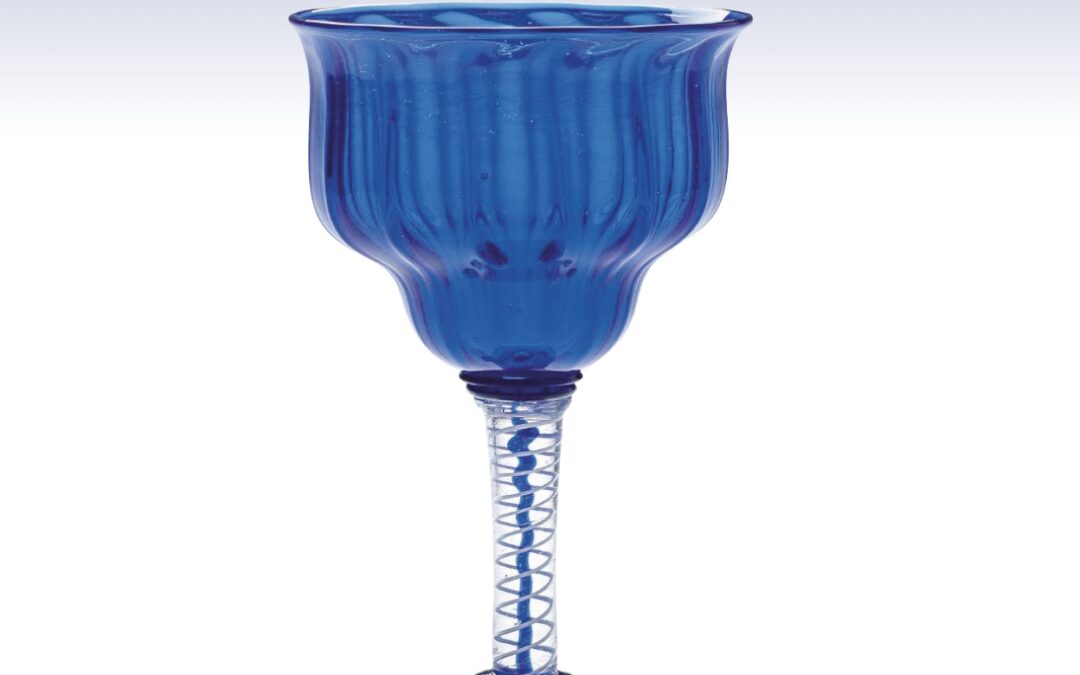
FRONT COVER: An exceptional deep cobalt-blue colour twist sweetmeat or champagne glass, circa 1765, standing 20cm high ; one of only two known examples (see page 37). The lipped, blue ogee bowl sits over a stem in clear glass, containing a blue central core within a pair of opaque white spiral threads, over a blue, moulded, high domed folded foot. Sold by Bonhams in November 2022 from the Stephen Pohlman collection, previously owned by Graham Vivian who obtained it from the late Christopher Shephard in August 2005.
BACK COVER: Jane Beebe, a well-known, internationally recognised glass artist, daughter of the late Peter Beebe (see pages 38/39), created this sinuous, purple ‘Crescent Bowl’ in 1989. Often on display, the bowl is part of the collection of the Stourbridge Glass Museum.
Editorial
Chairman’s message
Rinser or Cooler? Peter Henderson
Grand Tour To Venice Simon Cottle
Claret Jugs Clive Manison
Spa Glasses Bill Millar
Conundrum Decanter Dwight Lanmon
In Memoriam
Martin Mortimer Tim Osborne
Is it Greener? Michael Upjohn
Replies and Notes Peter Adamson,
Henry Chance,
Jonathan S Simons
Retrospective Appraisal Andy McConnell
Lars Hellsten & Signe P Mellin
Bonhams Jim Peake
In Memoriam
Pete r Beeb e David Willars
is a forum where everyone can express and
share their passion for glass. Whether it be through
collecting, researching, or simply admiring the beauty of the
medium, each one of you has unique experiences and insights
into the world of glass. We are all ready to learn from each other
and broaden our understanding of glass – so even if you consider
yourself an amateur in the field, your contributions are valuable
and can introduce new ideas. Writing and photography may not
come easily to everyone, but do not be discouraged, we are here
to support and guide you in creating articles for publication.
Your love of glass and enthusiasm to share it with others is what
counts. Every idea in this diverse world of glass, from antique
eye-baths and piano feet to Spa glass and Biennale winners is
welcomed and appreciated. Do contact us to join in and share.
3
4
10
14
19
22
24
28
32
33
37
38
Contents GM16.indd 2Contents GM16.indd 2 21/03/2023 08:2421/03/2023 08:24
CHAIRMAN’S MESSAGE
3
Chairman’s Message
David Willars
Glass Matters Issue No.16 March 2023
W
e h e l d o u r A n n u a l
General Meeting(AGM)
i n l a t e Fe b r u a r y t h i s
year and a number of you have
queried the timing of the event,
coming as it does in the middle
of winter. Loosely, we are bound
by re g ul ations of the C har ities
Commission which stipulate that
we must hold the AGM approxi-
mately twelve months after the
previous one, with the ver y first
m e e t i n g b e i n g d e t e r m i n e d b y
the d ate we were re g istere d a s
a char ity. I t is also sig nif icant
that attend ances for our Z oom
meetings by far exceed those at
‘in-person’ events and as the AGM
needs a quor um of attendees in
order to ratify any decisions, we
can reach out to more members
online. All of this sug gests that
mid-Febr uar y is an appropr iate
time and online the better medi-
um to communicate. T his do es
not mean that we have abandoned
in-person meetings and, indeed,
at the time of writing more than
thir ty of us are looking for ward
t o m e e t i n g u p i n O x f o r d f o r
accompanied tours around sev-
eral colleges and the A shmolean
M u s e u m . O t h e r m e e t i n g s a r e
p l a n n e d a t t h e A r t Wo r k e r s ’
The main topics of discus-
sion in the immediate after-
math of the AGM seemed to be
the continued absence of a glass
fair, to ge ther w i th the level o f
res er ves we are holding. Many
of us miss the glass fairs great-
ly, especially the one held at the
Motorc ycle Museum, just off the
M42, south of Birmingham. T he
location was per fect, matched by
the facilities, meaning car parking
and café. However, rising costs,
e x a c e r b a t e d b y t h e p a n d e m i c ,
together with our collective and
increased use of the internet have
effectively destroyed what was an
iconic event. I recently attended
an auction and was one of a hand-
ful of real people bidding against
a much larger international audi-
e n ce o n l i n e . A l l o f t h i s b e g i n s
to beg the question of how can
you buy a piece of glass without
actually handling it first, but we
leave that for another day. Dudley
MBC is looking at a proposal for
a n e w g l a s s fa i r, to b e h e l d i n
the Stourbr idge area dur ing the
autumn, although it is too early yet
to call this an event. Rest assured
that if this proposal becomes real-
ity you will be the first to know.
Our level of reserves is too high
for a char ity of our size. Par tly
this is a legac y issue from the two
previous groups, The Glass Circle
and The Glass Association, com-
bining, and our level of expendi-
ture remaining stable. L atterly,
the costs of holding many more
Zoom meetings through the pan-
demic are less than the equivalent
in-person events. W here we have
fallen short through the pandem-
ic is with our char itable grants,
bursaries and sponsorship. O ver
the last few months we have been
w o r k i n g u p s e v e r a l p o t e n t i a l
oppor tunities, but we need your
help to identify and promulgate
others. Any suggestions, as usu-
al, would be greatly appreciated.
Finally in respect of the AGM,
my thanks to all those who par-
t i c i p ate d i n t h e S h o w a nd Te l l
discussion after the main body
o f t he me e t i n g. We b e ga n t h i s
p a r t i c u l a r fe a t u re a c o u p l e o f
years ago and it now appears to
be gathering its own momentum.
The variety of subjects being dis-
cussed this year was really quite
astonishing: royal commemora-
tives, Etling glass, Chopin’s death
mask , pressed glass colours and
personalised eighteenth-centu-
r y g lasses. I have already been
contacted with an offer to take
p a r t i n n e x t y e a r ’s m e e t i n g !
T h i s i s s u e o f G l a s s M a t te r s
c o n t a i n s a n o t h e r a r t i c l e o n
pressed g lass by Mike U pjohn –
drawing upon his parent’s mas-
s i ve col le c t ion ; t h i s t i me M i ke
discusses the Greener glass-
works in Sunderland, one of the
more traditional and long-last-
i n g B r i t i s h c o m p a n i e s . C l i v e
Manis on w r i tes on c l are t ju gs ,
which are quite often a neglected
subject to the researcher, as glass
bodies were produced for the sil-
ver companies to complete and
marke t under their ow n name.
O u r c o n t i n u e d t h a n k s s h o u l d
be conveyed to Br ian C larke for
pulling everything together.
David Willars, Chairman of ! e Glass Society
Chairmen’s message GM16.indd 1Chairmen’s message GM16.indd 1 21/03/2023 09:5621/03/2023 09:56
Wine-glass rinser, wine-glass cooler
4 Glass Matters Issue no.16 March 2023
Peter Henderson
M
ost collectors of Br itish
a n d I r i s h g l a s s w i l l b e
familiar with bowls usually
around nine by twelve cm. that first
appeared in the mid-18th century.
They reached their zenith from the
1780s through the Regency period,
and during this time they were a part
of a visual spectacular at the most
sophisticated dining tables, where
the food, the table settings, the
lighting were all carefully arranged
to give those around the table a
grand sensor y experience. Each
setting might have included a single
or double-lipped bowl for cooling or
rinsing the sitter’s wine glass. As a
‘style’ guide for 1823 directed, the
rinser/cooler would have been filled
about two thirds with spring water,
and the wine glass turned up in it; let
those [bowls] be put about three inch –
es and a half, or four inches, from the
edge of the table to the right hand of
the person with the foot of the wine-
glass toward the edge of the table. 1
In her excellent account of glass
and dining in Ireland’s age of exu –
berance, Anna Moran describes
the care ful planning that went
into dining for Ireland’s elites:
ever y last detail would have been
carefully considered in advance. Using
the analog y of the dining room as a
stage, the position of each dish was
determined in the way a director might
plan the location of specific props. The
view from each angle was probably
considered, as were the location and
quality of each source of lighting. The
shine of the silver or plated goods, the
luminescence of the white linen table –
cloth, the polish of the mahogany side –
board, and the glitter of the glass all
worked in unison to create a framework
of splendour in which the dinner could
be performed. Rather than being an
inactive, ornamental prop, each object
went beyond function in enabling
the performance of politeness. 2
That the rinser 3 was for a time
something that was a part of ‘smart’
dining can still be seen by the readi –
ly available sets of clear glass rinsers
that can be purchased in sets of six
or even twelve. The style guide, cit –
ed above, calls the bowls glass coolers
even though the writer’s advice for
filling the bowl with spring water
sug gests that they would have
been used for rinsing the sitter’s
wine glass and indeed gives no clue
to the actual shape of the bowl.
These bowls have variously been
called a wine-glass rinser, a wine-
glass cooler, a glass finger-bowl,
a finger bowl, a water bowl and
more rarely a bol rince-bouche . It
is sometimes, rather inaccurate –
ly, called a monteith or verrière. 5
So while the period in which the
rinser first appeared is quite cer –
tain, its function is less clear.
The British antecedent to the
rinser, the monteith, first appeared
in the 17th century and was usual –
ly silver or ceramic, though there
are rare glass examples. Monteiths
were large enough to hold multiple
glasses and often doubled as punch
bowls, while when the French ver –
rière 5 first appeared in the early 18th
centur y, its applications were the
same as the monteith. Unlike the
lipped bowls that appeared toward
the end of the 18th century, mon –
teiths were used from a sideboard
as were the earlier ceramic or metal
verrières .6 W h i l e n e i t h e r t h e m o n te –
ith nor the verrière really offered a
stylistic template for the rinser, the
verrière was the stylistic anteced –
ent for much smaller glass verrières
that imitate the scalloped rim of
their ceramic forebears. The most
famous of these vessels were those
manufactured by Perrin, Geddes &
Co of Warrington as part of a table
service for George IV in 1808. These
would presumably have been used
in the same way as rinsers. 7 English
is rich in synonyms, though the use
of the term monteith for rinsers
is confusing. As late as 1840 a cat –
alogue for Apsley Pellatt’s table
glass advises that ‘Monteiths or
wine coolers add about 10 percent
to the above finger cups [prices]’. 8
In essence the nomenclature for
the rinser remains as clear as mud.
While a great deal of attention
has been given to other glass of
this period, there has been little
written about rinsers despite them
being relatively common. 9 Recent
publications like Mark Pickvet’s
The Encyclopedia of Glass (2011) and
David Battie’s and Simon Cottle’s,
Sotheby’s Concise Enc yclopedia of
Glass (2000), make no mention of
rinsers at all. The Oxford English
Dictionar y (OED) includes entries
for a water-glass, a kind of finger
bowl and wineglass-cooler, though
does not offer a description of the
vessels. T here is no entr y for a
wine-glass rinser. Further, much of
the literature on rinsers is poorly
referenced and of dubious worth. A
case in point is G. Bernard Hughes.
G. Bernard Hughes (1896-
1975) was a Fellow of the Royal
Society of Arts, editor-in-chief of
The Queen Newspaper , editor of
Antiques Review and a contributor
to Country Life , writing extensive –
ly on antiques and collecting. As
regards this subject his main book
is English, Scottish and Irish Glass
(1956). Hughes makes the dubious
claim in his preface that examina –
tion of more than 10,000 specimens
of English table glass informs his
book, 10 but despite lauding his –
torical scholarship, he offers ver y
little by way of references. Indeed
the tone of the book is shown by
RINSER OR COOLER
Rinsers and Coolers GM16.indd 4Rinsers and Coolers GM16.indd 4 20/03/2023 13:0320/03/2023 13:03
5 Glass Matters Issue no.16 March 2023
his cryptic remark at the end of his
preface that, My omission of reference
to Newcastle glasses is deliberate , a
perfectly fine statement if he told
the reader the reason why. His chap –
ter on wine-glass coolers and finger
bowls has some useful information,
but some of his assertions cannot be
validated. He claimed that rinsers
first appeared at the coronation
of George III and implies that they
preceded finger bowls, though there
appears no evidence to support this
contention and indeed rinsers at
the coronation may have been what
today we would refer to as finger
bowls, that is bowls without lips. 11
Further, the more likely explana –
tion is that rinsers first appeared
in London glass retailers to provide
new products for their customers,
being aware of similar objects in
use on the Continent. Hughes also
appears to confuse rinsers with ver –
rières , though considering that they
all apparently performed the same
functions, this is being pedantic.
The confusion that surrounds
these objects is illustrated by sto –
ries around their use at coronations.
Hughes claims that finger bowls
were embargoed after Jacobites
held their glasses over the water
dur ing the loyal toast and that
this embargo remained until 1905
when Edward VII restored them
to royal tables. 12 Considering that
Hughes makes a clear distinction
between finger bowls and rinsers,
we may well ask if this implies that
the lipped bowls remained with
their liquid intact on royal tables?
Geoffrey Seddon, who wrote ‘the
definitive book’ on Jacobite wine
glasses, notes that any water would
suffice for Jacobites to make the
toast and that until late in the nine –
teenth century, finger bowls were not
permitted on the dining tables at any
official function until after the loyal
toast .13 Sadly Seddon does not pro –
vide any evidence for this claim or
expand on what he means by finger
bowls. To her credit Sally Kevill-
Davies in an article for A ntique
Collecting refers to the George III
story as anecdotal. 14 To add more
confusion around the activities of
Jacobite supporters the OED in its
entry on over the water says that
the toast was made by passing the
glass of wine over the water decanter ,
so neither finger bowl nor rinser.
A n o t h e r s i g n i f i c a n t a u t h o r
around the same time as Hughes,
was E.M. Elville, who like Hughes
was a contributor to Country Life .
Elville’s major contribution to glass
studies is English Tableglass (1951),
though in that study Elville makes
no mention of rinsers. There is an
entry in his dictionary of glass 15
and a longer section on finger bowls
and wine-glass coolers that covers
much the same ground as Hughes’s
account and which Hughes may
have used. 16 T he eminent glass
authority, R .J. Charleston largely
confines his shor t discussion on
the matter to when rinsers first
appeared. 17 Derek Davis, offers
three lines on the matter 18 while
Douglas Ash in his dictionary has
a short entry. 19 Robin Butler and
Gillian Walkling’s book on wine
antiques has a rather disappointing
section on the subject and makes
the dubious claim that rinsers seem
to have dropped from favour altogeth –
er by about 1800 and consequently
such bowls lost their lips and became
finger bowls .20 This assertion is not
referenced and f lies in the face of
some very fine rinsers being made
well into the 1830s and 40s and
their use during the Regency period.
If sources for rinsers feels some –
what unsatisfactory, then spe –
cial mention needs to be made of
Irish glass and scholarship. Anna
Moran, cited above, has provided
an important study on the context
in which objects like the rinser can
be understood. Dudley Westropp’s
Irish Glass 21 is a very useful source
Fig. 1 Fig. 2
RINSER OR COOLER
Rinsers and Coolers GM16.indd 5Rinsers and Coolers GM16.indd 5 20/03/2023 13:0320/03/2023 13:03
6 Glass Matters Issue no.16 March 2023
while Phelps Warren’s Irish Glass ,
provide some valuable insights.
T he Ir ish h ave w is el y avoide d
precisely defining the differences
between the finger bowl, rinser
and the cooler, and instead refer
to such bowls, with or without lips,
simply as finger bowls. Fur ther,
War ren notes that those vessels
with lips could have been used for
any one of those pur poses, but
following the account of François
de la Rochefoucauld, A Frenchman
in England , 1784, he argues that
as re gards dr inking , they were
most likely primarily used to rinse
glasses between refills, especially
considering the viscous qualities of
port of that time. Further he sug –
gests that these vessels may have
also been used as mixing glasses. 22
So what can be concluded? First
th at the pr im ar y e v idence for
rinsers is slender and that the sec –
ondary literature needs to be used
with caution. Second, that bowls
with lips first appeared around the
middle of the 18th century and were
used at formal dining events, most
probably to rinse glasses between
rounds, though they were probably
also used to cool glasses when white
wines were being consumed. Bowls
without pouring lips were prob –
ably used for the same purposes,
especially on the Continent. While
their use in formal dining settings
declined after the 1840s, they were
still a feature at dining tables during
formal occasions as attested by an
example in the Corning Museum of
Glass that was used by the American
president Franklin Pierce. 23
T he large numbers of rinsers
that survive from the 1780s onward
suggests that glass makers contin –
ued to make rinsers that would
have been used for any number of
purposes that a bowl can be put to,
not necessarily as a dining table fea –
ture. While sets of up to six Bristol
blue rinsers occasionally appear
on the market, I know of no sets
of rinsers in other colours. R arer
Fig. 3
Fig. 4
RINSER OR COOLER
Rinsers and Coolers GM16.indd 6Rinsers and Coolers GM16.indd 6 20/03/2023 13:0320/03/2023 13:03
7 Glass Matters Issue no.16 March 2023
than their clear glass counterparts,
coloured rinsers most often appear
on the market singly or in pairs.
Currently I own over 60 dif –
ferent rinsers and I know of one
collector in Canada who had over
400. T here is great diversity in
rinsers, ref lecting the long period
of their production across Europe
and the United States. Most of
my collection d ates from 1780
through to 1840, although I have
examples from the 20th centur y.
My ‘holy grail’ is to acquire a rinser
that is marked Penrose Waterford,
or any of the other Irish marks.
Dating is subjective, so it is nota –
ble that many of the rinsers in the
Corning Museum of Glass collec –
tion are simply described as 19th
century, ref lecting the difficulty in
assigning dates. Dates given at auc –
tion sites and by dealers need to be
approached with caution. I have seen
one example of a rinser described as
circa 1930 and an identical exam –
ple on the web site of a prominent
antique dealer described as circa
1850. With this in mind I offer up
my opinions on the following exam –
ples from my collection though I
would be interested if members
of the Glass Society have different
views and examples of other rinsers.
The rinser in Fig.1 is mould
blown and similar to ex amples
shown in Warren and Westropp.
Considering design and manu –
facture it is wor th comparing it
to Anglo-Irish decanters in Andy
McConnell’s The Decanter. 24 In my
view the elegant and tactile rinsers
of this period are among the most
desirable; circa 1780 – 1800. This
rinser was once handled by the
prominent New York dealers D.M.
& F. Manheim who described it
as Irish, more than possible con –
sidering the large amount of Irish
glass that was exported to the US.
H 8.5cm, W 10 to 13.5cm, 447gm.
Fig.2 i s o f t h e s a m e p e r i o d
b u t w i t h t h e ra re r s i n g l e l i p ,
H 8 . 5 c m , W 1 0 . 5 c m , 4 7 0 g m .
Fig.3 s h o w s a r i n s e r, w i t h
the Liver Bird from the C ity of
Liver pool’s coat of ar ms, made
using the Davenport process. As
this process was only used for a
short period, and considering the
shape, a date c1815 seems appro –
Fig. 5
Fig. 6 Fig. 6a
RINSER OR COOLER
Rinsers and Coolers GM16.indd 7Rinsers and Coolers GM16.indd 7 20/03/2023 13:0320/03/2023 13:03
RINSER OR COOLER
8 Glass Matters Issue no.16 March 2023
priate, H 9.5cm, W 11.5cm, 438gm.
Fig.4 shows four different rinsers.
The one on the far left, H 7cm, W 8cm,
189gm, would be useless as either
a rinser or cooler, being simply too
small. Was it used as a mixing vessel
or even a sampler? Considering colour
and shape, I would date it circa 1790.
Second from left is an average-sized
rinser, with a broad band of finger
flutes below a circlet of relief ellipses
and a star- cut base, H 10cm, W 11cm,
563gm: I have seen a similar example
illustrated by Delomosne, dated circa
1800 – and another similar example
at the Corning Museum of Glass: both
are described as English or Irish. The
third rinser from the left is somewhat
problematic, H 11cm, W 13.5cm, it
weighs a substantial 1,026gm; a medi –
al band of acid etched decoration is
surrounded by diamond cut bands
and a star-cut base with short panel
fluting. An oval cartouche is engraved
MSW. Stylistically, the rinser would
seem to be from the middle to latter
part of the 19th century, though
it could be early 20th century. As it
came via a seller in the United States
I suspect it may have been manu –
factured there. Considering its size,
it would seem unlikely to have been
in a set, so may have been primarily
decorative. The final rinser is mas –
sive, H 15cm, W 15.5cm and weighs
1,185gm. Stylistically the cutting sug –
gests a late Regency or early Victorian
date. Could it have been used at the
centre of a table for several diners
to rinse their glasses or was it deco –
rative? Or as it comfortably holds a
750ml bottle was it literally a wine
cooler? A set of these for individu –
al diners would seem unlikely. So
following the Corning Museum of
Glass I would date this 1800 – 1899.
Fig.5 is of a red rinser with eight
lobes on its body. A similar, clear
rinser at Corning Museum of Glass
is dated as 19th centur y, though
a clear finger bowl from the Falcon
Glass Works of similar construction
is dated 1851, H 9cm, W 12.5cm and
an impressive 973gm. So circa 1850.
Fig.6 is a signed Isaac Jacobs
(Fig.6a) , Bristol-blue rinser with
Grecian key gilding, H 10cm, W
10.5cm, 472gm. T hese r insers
are quite highly sought after. An
almost identical example in the
V&A museum is dated 1800-10.
Fig.7 is a green rinser with a shape
that seems to have been common
during the Regency period, suggest –
ing a date of circa 1820, H 10.5cm,
Fig. 7 Fig. 8
Fig. 9
Rinsers and Coolers GM16.indd 8Rinsers and Coolers GM16.indd 8 20/03/2023 13:0320/03/2023 13:03
RINSER OR COOLER
9 Glass Matters Issue no.16 March 2023
W 12cm, 430gm. These coloured
rinsers only seem to enter the market
singly or in pairs. I have other exam –
ples in mauve, red, clear, and straw.
Fig.8 is a rose-coloured rinser with
a medial diamond-cut band over
elliptical cutting. Stylistically this
vessel would seem to be Victorian,
from the second half of the 19th
century. The quality of the cutting
suggests it was expensive when man –
ufactured, H 10cm, W 11cm, 517gm.
Fig.9 is a high quality pil –
lar-moulded rinser. The extensive,
beautifully executed diamond and
other cutting would have made this
an expensive object. A tour de force
of Regency style, circa 1820, H 9cm,
W 11.5cm, and a substantial 725gm.
Fig.10 i s a n u n u s u a l r i n s e r d i s p l ay –
ing a top-hatted gent playing bowls.
The shape of the rinser, the clothing
of the bowler, the colour of the metal
and wear on the base suggest a date,
circa 1800, H 9cm, W 10cm, 362gm.
Dr Peter Henderson can be con –
tacted at ptr.henderson@gmail.com
REFERENCES
1. Onesimus, The Footman’s Directory,
And the Butler’s Remembrancer ,
London, 1823, p. 83.
2. Anna Moran, ‘”The Eye As Well as
the Appetite Must be Car’d For”:
Glass and Dining in Ireland, About
1680 – About 1830’, in Christopher
L. Maxwell, ed., In Sparkling
Company. Reflections on Glass in
the 18th – Century British World ,
Corning, New York, p. 200.
3. For the sake of simplicity I will refer
to them henceforth as rinsers.
4. https://www.anticstore.art/99078P
and https://www.rct.uk/collection/
search#/2/collection/68278/
set-of-verrieres
5. https://www.anticstore.art/99078P
6. For monteiths and verrières see,
Jessie McNab, ‘The Legacy of a
Fantastical Scot’, The Metropolitan
Museum of Art Bulletin , Feb., 1961,
New Series, Vol. 19, No. 6 (Feb.,
1961), pp. 172-180 at https://
www.jstor.org/stable/3257873 and
Robin Butler & Gillian Walking,
The Book of Wine Antique, Antique
Collector’s Club, Woodbridge,
Suffolk, 1993, pp. 243 – 247.
7. For one of these see https://
www.rct.uk/collection/68278/
set-of-verrieres
8. See Phelps Warren, ‘Apsley Pellatt’s
Table Gl ass ’, Journal of Glass
Studies vol. 26, 1984, The Corning
Museum of Glass, Corning, New
Yo r k , p . 1 2 2 .
9. A quick search through sites like
Etsy or Ebay shows how readily
available rinsers are.
10. G. Bernard Hughes, English, Scottish
and Irish Table Glass From the Sixteenth
Century to 1820, New York , 1956.
11. F. Peter Lole, ‘RINSE AID: Another
look at rinsers’, Glass Circle News ,
no. 86, March 2001, p. 4. Lole also
notes that, ‘a well-known painting
of 1735 by Jean-Francois de Troy,
entitled ‘Le dejeuner d’huitres’,
shows ceramic bowls being used as
rinsers/coolers.
12. Hughes, Table Glass’, p. 298.
13. Geoffrey B. Seddon, The Jacobites
and their Drinking Glasses , Antique
Collectors Club, 2015. p. 46.
14. Sally Kevill-Davies, ‘Wineglass
Coolers and Finger Bowls’, Antique
Collecting , October 1993, p. 27.
15. E.M. Elville, The Collector’s
Dictionary of Glass , London, p. 187.
16. E.M. Elville, Paperweights and Other
Glass Curiosities , London, 1967,
pp. 104 – 106. The book was first
published in 1954.
17. R.J. Charleston, English Glass and the
glass used in England, c. 400 -1940 ,
London, 1984, p. 174. Charleston
relies heavily on Hughes for his
discussion.
18. Derek C. Davis, English and Irish
Antique Glass , London, 1964, p. 102.
19. Douglas Ash, Dictionary of British
Antique Glas s, London, 1975, p. 208.
20. Robin Butler & Gillian Walkling,
The Book of Wine Antiques , Antique
Collectors Club, 1993, p. 247.
21. Dudley Westropp, Irish Glass , rev.
ed., Mary Boydell, ed., Dublin, 1978.
22. Phelps Warren, Irish Glass, Waterford
– Cork – Belfast in the Age of Exuberance ,
London, 1981, pp. 244 – 247.
23. The Corning Museum of Glass
holds a rinser from the presidential
service of Franklin Pierce. See
https://www.cmog.org/artwork/
wineglass-rinser-pierce-pattern
24. Andy McConnell, The Decanter:
Ancient to Modern , ACC Art Books,
2018, p. 177.
Fig. 10
Rinsers and Coolers GM16.indd 9Rinsers and Coolers GM16.indd 9 20/03/2023 13:0320/03/2023 13:03
Venetian glass: souvenirs of the Grand Tour
10 Glass Matters Issue no.16 March 2023
GRAND TOUR TO VENICE
Fig. 1Miotti lattimo plate with view of S. Giorgio Maggiore, c.1741, Ex-Strawberry Hill, after Luca Carlevarijs No.6 from the series Le Fabriche, e Vedute di Venetia, 1703 . © !e Trustees of the British Museum
Fig. 2Horace Walpole (1717-97), by Rosalba Carriera (1675-1757), pastel
Simon Cottle
Simon Cottle kindly gave the annual
Robert Charleston lecture to The Glass
Society, online and at The Artworker’s
Guild in London, in June 2022. The
talk focussed on new discoveries and
consolidated the research initially pub –
lished by Robert Charleston in 1959.
D
uring the 18th centur y it
was the tradition of wealthy
young English gentlemen to
complete their education by travel –
ling throughout the Continent on
what became known as the Grand
To u r. I t a l y w a s t h e i r c h i e f d e s t i –
nation. Seen as both essential and
fashionable, the purpose of these
travels was to learn about the his –
toric development of European cul –
ture through art, literature, music
and archaeology. Accompanied by
tutors and art advisers, many would
return with souvenirs of their trav –
els, principally paintings, sculptures
and Roman antiquities, which would
serve as symbols of sophistication
and an appreciation for ancient cul –
ture. When in Italy, Venice, Florence,
Naples and Rome were essential cities
to visit and for some, the Venetian
Island of Murano became a key stop in
their itinerary, providing the oppor –
tunity of acquiring some glass for
their usage and collections at home.
For the first volume of Corning
Glass Museum’s Journal of Glass
Studies (1959), Robert J. Charleston,
the eminent President of the Glass
Circle and Keeper of Ceramics and
Glass at the V&A , published an
important study of a unique group
of renowned Venetian glass souve –
nirs specifically made for three of
those Grand Tourists. They were
not believed to have been in current
production, appearing to have been a
special commission. Today, his study
remains the main basis of knowl –
edge of this series of glass. (Fig.1)
From Charleston’s research and
the work of subsequent scholars, it
is now known that the Miotti fam –
ily glasshouse at the sign of al Gesù
‘lattimo’ glass plates, each consisting
of twenty-four plates, approximate –
ly 9 inches (22.5cm) in diameter
and painted in red monochrome
enamel with different Venetian
views. They were commissioned by
Joseph Smith (1682-1770, British
Consul 1744-60), a Venetian-based
English art dealer, for three promi –
nent Englishmen travelling togeth –
er on their Grand Tour in the early
1740s: Horace Walpole (1717-97),
John C hute (1701-76) and the
Earl of Lincoln (1720-94). (Fig.2)
Each series comprised fourteen
views of the Grand Canal based on
the engravings by Antonio Visentini
(1688-1782) in his P rospectu s
Venetian Glass GM16.indd 10Venetian Glass GM16.indd 10 20/03/2023 13:0220/03/2023 13:02
11 Glass Matters Issue no.16 March 2023
GRAND TOUR TO VENICE
Fig. 3Santi Giovanni e Paulo, engraved by Antonio Visentini, after Canaletto, c.1735
Fig. 4Antonio Canaletto (1697-1768), Campo Santi Giovanni e Paolo 1735-38, oil on canvas. Royal Collection Trust / © His Majesty King Charles III 2022
Fig. 5Miotti lattimo plate with view of the Rialto, c.1741, Ex-Strawberry Hill, after Canaletto and Antonio Visentini. © Victoria and Albert Museum, London
Magni Canalis Venetiani a f t e r
Antonio Canaletto (1697-1768),
first published in 1735. (Fig.3)
The remaining nine views of
Venice were after engravings by Luca
Carlavarjis (1663-1730), published
in the early 18th century. In order to
incorporate the 23 known engraved
views into the 3 sets of 24 plates,
some images were used at least twice.
The fourteen original Canaletto
paintings on which Visentini’s work
is based were purchased by Joseph
Smith for King George III and are
in the Royal Collection at Windsor
today. Amongst a variety of images,
they consist of views of the church –
es of Saints Giovanni and Paulo,
St. Giorgio Maggiore, St. Simeone
Piccolo, and St. Maria della Salute
alongside views of the Rialto Bridge,
the Grand Canal, the Riva, the
Arsenal and St. Mark’s Square. (Fig.4)
Based on documentary evidence, it
was originally thought that only one
set of these plates was created. That
set is firstly recorded in Walpole’s
China Room at his Gothic-style villa
at Strawberry Hill, near Twickenham
and subsequently on 7 May 1842 at
the auction of the villa’s contents. The
set of twenty-four plates was divided
into four lots (41-44), described as SIX
EXTREMELY RARE AND CURIOUS
OLD VENETIAN GLASS DESSERT
PLATES, the ground is white and the
Landscape painting on each is in red,
the Views in Venice and every plate has
a different subject. They were sold
for 10/- each and subsequently sold
by Christie’s in 1855 for £7 each.
However, given that of the extant
examples there are at least three dupli –
cates of some of the views, Charleston
deduced that three identical sets were
made, amounting to some seventy-two
plates in total. Examples are now to
be found in museums and private col –
lections around the world, including
the British Museum, the V&A, the
Ashmolean Museum, Corning Glass
Museum, Toledo, Prague and the
National Museum of Wales. (Fig.5)
By 1959, Charleston could only
account for four examples from the
Venetian Glass GM16.indd 11Venetian Glass GM16.indd 11 20/03/2023 13:0220/03/2023 13:02
GRAND TOUR TO VENICE
12 Glass Matters Issue no.16 March 2023
nine from the Strawberry Hill sale.
There were a further nine that had
come from the Earl of Lincoln’s collec –
tion, when the contents of his home
at Clumber had been offered for auc –
tion in 1937, prior to the demolition
of the building in 1938. At The Vyne,
near Basingstoke, now in the care of
the National Trust, sixteen from John
Chute’s set have survived and these
are in situ today. Since 1959 others
have emerged and have been offered
at auction in London, most notably
at Christie’s and in recent years at
Bonhams. Another example from
the Clumber Park sale was recently
discovered in a public collection in
Wales. Featuring Visentini’s canal
view Ex Aede Salutis , after Canaletto,
it is a duplicate of one in the collec –
tion at The Vyne (listed as no.13).
According to several assorted labels
and inscriptions on the reverse of the
plate, it was purchased by F.E Andrews,
a Cardiff-based collector, who acquired
several at the Clumber sale in 1937. In
his survey, Charleston lists those pur –
chased by Andrews which he had run
to ground in 1959 of which two were
presented to the National Museum
of Wales and can be seen there today.
The remaining five with views list –
ed by Charleston do not include the
plate uncovered recently. Andrews’
by Charleston to have retained five
examples so it is possible that this
recently discovered piece was an eighth
example presented by him to a small –
er, as yet unnamed Welsh institution,
where until today it has remained
unidentified since the late 1930s.
Drawing inspiration from Chinese
porcelain passing through Venice as
part of the East-West trade and the
production of Venetian porcelain at
the short-lived Vezzi factory (1720-
27), the opaque-white lattimo (milk)
canvas for enamel decoration. The
painting of lattimo glass may also have
been inspired by the ‘Hausmalerei’
porcelain of the late 1720s, prin –
cipally by Ignaz Preissler. (Fig.6)
Lattimo glass is both highly trans –
lucent and generally either very white
or cream in colour, the opacification
obtained from an arsenic compound.
To d i s t i n g u i s h i t f ro m p o rce l a i n , l a t t i –
mo glass can display a fire (feu)
in the body when held up to the light.
Lattimo glass was made by at least
two glasshouses in Venice of which the
most active appears to be that of the
Miotti family (see above) . Originally
established at the beginning of the
17th century, in 1717 Vincenzo Miotti
and his sons were given special permis –
sion for the manufacture of glasses,
blown crystals, calcedonio, enamels,
mosaics and other colours. There are
lattimo glass seals stamped DANIEL
M IO T TO M U R A N O FA B R IC A
around a Christian symbol. Others
Fig. 6Meissen teapot, painted by Ignaz Preissler, c.1725-30 . © Victoria and Albert Museum, London
Venetian Glass GM16.indd 12Venetian Glass GM16.indd 12 20/03/2023 13:0220/03/2023 13:02
GRAND TOUR TO VENICE
13 Glass Matters Issue no.16 March 2023
bear inscribed dates and Miotti
signatures in enamel. These assort –
ed markings range in date from
1731 to 1747. Described as a very
able painter in enamel colours on
smalti (mosaics) , Domenico Miotti
may have been one of the principal
painters of these plates. The style of
the painting however indicates the
involvement of a variety of differ –
ent hands and the quality suggests
that some of the plates were hur –
riedly completed in June and July
1741 in order to meet the demands
of the commissioners who were
returning to England at that time.
Adapting Visentini’s engravings
for the plates was not so straight –
forward. The artists had to deal with
the curvature of the surface as well
as depicting a rectangular scene on
a circular form. Thus, several of the
plates have omissions from the orig –
inal engravings and substitutions of
boats or figures in the foreground
helped to fill in empty spaces.
According to his travelling com –
panion, Sir Horace Mann, Walpole
is known to have purchased a large
amount of glass in Venice which
included imitation glass lapis lazuli
knife and fork handles. These were
a popular product with English
tourists of the time. He also pur –
chased a set of eight lattimo glass
chocolate cups and saucers, based
on Le Nove porcelain shapes, paint –
ed with landscapes in brown. (Fig.7)
A similar group of cups are to be
seen at The Vyne. Two large lattimo
slabs in the Museo Vetrario in Venice,
dating from 1731, are also painted
in red monochrome with Venetian
canal scenes taken from Visentini’s
engravings which may have been
the inspiration for the plates. Mann
described Lincoln as ‘not a man
of lively intelligence, but as lordly
traveller on the Grand Tour, he no
doubt felt it incumbent on him to
bring back evidence of his connois –
seurship’. John Chute and Horace
Walpole on the other hand possessed
a deeper interest in the arts, these
delicate lattimo plates with their
views of Venice amply demonstrat –
ing the links that the Venetian glass
artists could make between art on
canvas and decorative form. They
would be suitable display material to
record the threesome’s tour of Italy.
Fittingly, Robert Charleston, in
whose memory this lecture was giv –
en, presented one of these plates,
with a view of the Church of Saints
Giovanni and Paolo, from his own
collection to the Ashmolean Museum
in 1997. They remain amongst the
most interesting Venetian glass of
the 18th century evoking a time when
not only ancient Roman remains
were repositioned in English historic
houses but the work of contempo –
rary Italian artists and makers was
also appreciated and displayed by the
young aristocratic tourists. (Fig.8)
Simon Cottle is Hon. President of the
Glass Society, a Fellow of Corning Glass
Museum, a protégé of the late Robert J.
Charleston, curator of glass in Newcastle
and Glasgow museums and former
Head of British & European Glass at
Sotheby’s and Bonhams in London.
Fig. 7Miotti lattimo chocolate cup and cover, circa 1745. © Victoria and Albert Museum, London
Fig. 6Miotti lattimo plate with view of Santi Giovanni e Paulo, c.1741, after Canaletto and Visentini, !e Gift of Robert Charleston to the Ashmolean Museum, 1997 . © Ashmolean Museum
Venetian Glass GM16.indd 13Venetian Glass GM16.indd 13 20/03/2023 13:0220/03/2023 13:02
Glass designs of Christopher Dresser:
A Question of Attribution?
14 Glass Matters Issue no.16 March 2023
DRESSER JUGS?
LEFT Fig. 1RD364884 From the National Archives
BELOW Fig. 2
D. C. Manison
O
n M a y 9 , 1 8 8 1 , t h e
Birmingham firm of silver –
smiths Hukin & Heath reg –
istered two designs for claret jugs in
Class I, and submitted photographs
as representations of the designs.
The first of the two designs (RD
No.364884) is shown in Fig.1 . The
shape of the glass body is somewhat
unusual, but follows one of the fea –
tures Dresser admired in a piece of
Roman glass in his book Principles
of Decorative Design 1, namely that
vessels for the ser vice of wine at
table should be capable of trapping
any deposit that might have been
thrown during the period of storage.
This (together with subsequent
RD No.364885) is usually attributed
to Christopher Dresser as designer,
though as Harry Lyons (author of
Christopher Dresser – the People’s
Designer, 1834-1904 ) has remarked
of the latter, ‘
to Dresser, but never seen signed ’.
T he off ici als at the Desig n
Registry were careful to note that
the Registration applied only to the
metalwork of the handle; the photo –
graphs in the Representation Books
bear a manuscript endorsement to
that effect – ‘ ’.
Were the glass body to have been
protected, it would have to be by a
registration under Class III 2 (Glass).
The contents of the volumes record –
ing the Registrations between 1842
and 1883 (series BT 44) have been
made available for online search,
but to identify a particular regis –
tration it is necessary to know who
made the registration, or on what
date it was made. The content of
the volumes of Representations
(series BT 43, with the images) is
not at present available online. 3
This was not the only type of
metal mount that Hukin & Heath
fitted to bodies of this form. Two
very much more ornate fittings in
electroplate, on decorated bodies are
shown in Figs.2 & 3 . Unfortunately,
it is not now possible to assign a date
to these mounts; the firm’s pattern
books, which might have given an
indication of when these designs
were first produced were destroyed
when the firm ceased trading in 1953.
The handles of the two jugs appear
to be identical, as are the mask spouts;
the lids are clearly very different, as
is the ornament on the metal col –
lar. The use of bunches of grapes,
whether or not accompanied by a
satyr mask, is very frequently found
on claret jugs; decoration in the form
of engraved ferns rather less so.
The glass body shape of Fig.3 , with
both cutting and engraving, may well
be a development of a form that had
been in use for some years prior to
the registration of the metal mount
shown in the Representation for
Design Registration (RD) 364884.
The clareteen in Fig.4 has a body that
appears to be the same as that in the
RD, but the mount (with the sponsor’s
mark of Charles Boyton, and a London
hallmark date E for 1880 – the year
before the Hukin & Heath metalwork
shown above was registered) is wholly
unlike any mount hitherto attributed
to Dresser. If the body of the Charles
Boyton claret jugs 4 be compared
with that of the jug in Fig.1 , it will
be noted that all have a plain body.
The claret jug (Fig.5) appears to
have the same form of body, but bears
a London hallmark for 1866 – four
years after the publication of Dresser’s
Art of Decorative Design , but fifteen
years before the registration of the
metal mount under RD No.364884.
It is less slender than the two Hukin
& Heath, and the Charles Boyton
mounted jugs, but the base appears
to have the same form. The handle
is somewhat heavier, and seems out
of proportion to the body. The glass
Clive Manison GM16.indd 14Clive Manison GM16.indd 14 20/03/2023 13:0420/03/2023 13:04
15 Glass Matters Issue no.16 March 2023
DRESSER JUGS?
LEFT Fig. 5
BELOW Fig. 6Showing detail of hallmarks and number 7615 on Clareteen at Fig.5
body is engraved with swags of flow –
ers and foliage around the body, and
immediately above the widest part
of the base a band of f lowers and
leaves. There is a 24-point star cut
into the base. Comparison with the
bodies of the Hukin & Heath claret
jugs, and the jug with the mount
by Charles Boyton shows that the
bodies of the later jugs are more slen –
der; its hallmark, (Fig.6) shows the
sponsor’s mark of George Richards
and Edward Brown, who were in
partnership from 1857 to 1866, and
the numerals 7615, are presumably a
pattern number for the silver mount,
and have no reference to the glass.
The cast lion finials on the lids
– the lion supporting a shield, fre –
quently engraved with a coat of arms
or a monogram – are a very common
feature on Victorian claret jugs (note
the use on one of the electroplate
claret jugs by Hukin & Heath above)
and in view of their similarity with
each other, they were probably made
in quantity by a third party, and sold
to the manufacturing silversmith.
The other features of the mount,
such as the mask on the collar and
the wreaths of grapes, seem to be the
choice of the individual silversmiths.
Fig. 3 Fig. 4
Clive Manison GM16.indd 15Clive Manison GM16.indd 15 20/03/2023 13:0420/03/2023 13:04
DRESSER JUGS?
16 Glass Matters Issue no.16 March 2023
A similar body (Fig.7)
with vines and bunches of grapes, and
with a mount by the London silver –
smith Alexander Macrae, has a silver
mount assayed in 1872. The lion sup –
ports a shield engraved with a crest,
presumably that of a former owner.
The form of the handle resembles that
of the Elkington claret jug in Fig.10 .
The claret jug in Fig.8 has a body
with very similar proportions to the
Charles Boyton, and Hukin & Heath
jugs first mentioned; but whereas
those jugs have a 24-point star cut into
the base to conceal a pontil scar, this
jug has had the pontil mark polished
out, and a series of fine radial cuts
around the polished area (Fig.8a) . This
treatment of the pontil scar has been
suggested as being a characteristic of
glassware designed by Christopher
Dresser. 5 Unfortunately, there is no
mark anywhere on the metalwork of
the mount to indicate the maker. Fig.9
shows the lion finial on the claret jug
in Fig.10 , which has a mount by the
Birmingham silversmiths Elkington,
hallmarked in Birmingham in 1880.
So far as is known, none of the
glass bodies bear any mark to indicate
the maker, but this is hardly unusual
for nineteenth-century glassware.
The body of the claret jug in Fig.10 is
heavily cut in the hobnail pattern and
has not been attributed to Dresser; it
was probably made in Birmingham or
Stourbridge – the silver mount bears
the Birmingham assay mark for 1886.
Silver mounts of the form on
RD No.364884 are found on sever –
al different forms of glass body, as
shown in Figs.11 & 12 ; so far as can
be ascertained, all the silver mounts
were assayed in London, even though
Hukin and Heath, the holders of the
Design Registration, had their man –
ufacturing facilities in Birmingham.
Their London showrooms at the
time of the Registration were at
19 Charterhouse Street; Charles
Boyton had a workshop nearby in
Northampton Square, Clerkenwell,
and Richards and Brown were based
at Red Lion Street, Clerkenwell.
Hukin & Heath are unlikely to have
made mounts for their claret jugs in
Birmingham, brought them to London
for assay, and then taken them back
to the Midlands to be fitted to the
glass bodies. 6 It is much more likely
Fig. 7Courtesy of Wilkinson’d Auctioneers, Doncaster
Fig. 8 Fig. 8a
Fig. 9Finial detail on lid of clareteen shown in Fig.10
Clive Manison GM16.indd 16Clive Manison GM16.indd 16 20/03/2023 13:0420/03/2023 13:04
DRESSER JUGS?
17 Glass Matters Issue no.16 March 2023
Fig. 10 Fig. 11
Fig. 12
that the bodies for the Hukin & Heath
claret jugs were made in London, and
if so, the bodies for the mounts made
by the other silversmiths were made
in London too. The firm now trad –
ing as Nazeing glass was at that time
working in Vauxhall, but even closer
to Clerkenwell was the Whitefriars
factory. Neither factory has hith –
erto been associated with Dresser.
David Willars, Chairman of the
Glass Society, has drawn my attention
to a trade catalogue of the Manchester
glassmakers Percival Vickers which
illustrates unmounted bodies for
claret jugs; it is clear from this that
the major glass manufacturers were
at times speculative producers of
glass, without any certainty that
the glass would find a purchaser.
Ve r y l i t t l e g l a s s w a re h a s h i t h e r –
to been conclusively attributed to
Christopher Dresser as designer. The
Clutha glass of the Glasgow firm of
James Couper & Son is sometimes
found with an acid mark ‘Designed by
C.D’, but even so, much of this glass
is unmarked, and the attribution to
Dresser is often made solely on
stylistic grounds. Even the pro –
duction dates of Clutha glass are
now uncertain; Widar Halen in
his book Christopher Dresser – a
Pioneer of Modern Design , cites
Dresser’s daughter Nellie as
giving a date of 1880 for two
pieces of glass she donated to
the Victoria and Albert Museum
in 1952. 7 The later Clutha glass,
produced in the 1890s, is gen –
erally thought to have been
designed by George Walton,
though it is quite likely that some
of the Dresser designs continued
in production. Early Clutha glass
was marketed by Arthur Liberty,
who rarely acknowledged the
designers who worked for him.
Is it possible that Christopher
Dresser produced glass designs
before 1880? It has been sug –
gested that Dresser produced
designs for the Birmingham
firm Elkingtons at least as early
as 1873. 8 These may well have
included claret jugs with glass
Clive Manison GM16.indd 17Clive Manison GM16.indd 17 20/03/2023 13:0420/03/2023 13:04
DRESSER JUGS?
18 Glass Matters Issue no.16 March 2023
bodies, even though none has been
identified as such. 9 The silver mount
of the Richards and Brown claret jug
is indeed unlike anything Dresser is
known to have designed, but that
does not preclude his involvement in
the design of the glass body. Might
the claret jugs with the electro-plate
mounts illustrated above be early
Dresser designs? Any association of
Dresser with Hukin & Heath could well
have preceded his formal appointment
as their Art Adviser, as reported in the
Art Journal (that article has all the
character of a Press Release) and is like –
ly to have continued informally long
after any contract had come to an end.
Certainly his hand has been recognised
in the design of a wine bottle holder
Hukin & Heath made in 1884, RD
No.1343 10 (Fig.13) and has been iden –
tified in a candlestick and snuffer made
by them, the design of which was reg –
istered on February 27 1894 (Fig.14) .
Clive Manison, a glass collector and
researcher, is a member of The Dresser
Society and was a longstanding mem –
ber of The Glass Circle and The Glass
Association, now The Glass Society. He
writes and lectures on glass, especially
on Christopher Dresser. For thoughts
and comments on this article, he can
be contacted at: broga999@yahoo.com
REFERENCES
1. Principles of Decorative Design , p. 131.
2. See the National Archives Research
Guide ‘
designs 1839-1999 ’
3. And is unlikely to be for the foreseeable
future. However the task of searching
the Representation Books is not
impossible – there is only one volume
containing the registrations made
under Class III (BT 44/7), and only four
volumes of Representations (BT 43/60
– BT 43/63). However this presumes
that the design of the shape of the body
was registered, and there is no evidence
that this was ever done.
4. At the time of writing, a leading London
dealer has for sale a pair of jugs of this
form, with slightly different mounts,
and a hallmark for 1874.
5. See Dresser’s Decorative Designs , where
Christopher MORLEY suggests that
this treatment of the base is typical of
Dresser designs (Morley, op. cit., at p.
208). However, this treatment of the
pontil mark has been observed on a
piece of glass by Richardsons that has
not to date been attributed to Dresser.
6. At this time the sponsor would have
been required to pay a duty on plate, the
payment being marked by a stamp mark
of the Sovereign’s head. It is likely that to
reduce any problems of cash flow, items
would not be submitted for assay until
they were sold, and due to be delivered to
the purchaser. The assay date therefore
gives only a year by which it must have
been made, not the year of manufacture.
7. A search of the Museum’s website using
the terms “dresser + clutha” returns
only five pieces. Only one of these
pieces – a vase CIRC.81-1952 – is noted
as having been given by Nellie Dresser.
The other four pieces were all acquired
subsequently, and from different sourc –
es. All are noted as marked “ ”
– Designed by C.D.”
8. Tilbrook, Adrian; Christopher Dresser:
Designs for Elkington & Co. in The Journal
of The Decorative Arts Society 1850 – the
Present No. 9 ASPECTS OF BRITISH
DESIGN 1870 – 1930 (1985) pp.
23 – 28. “Dresser seems to have begun
designing for Elkington c. 1873, though
he may have been consulted in an
advisory capacity at an earlier date”. (p.
25) At the end of the article, Tilbrook
comments “The Elkington metalwork
commissions were among the earliest
undertaken by Dresser, and this prob –
ably accounts for their predominantly
restrained appearances, unlike those
later commissions (c.1879) for Hukin &
Heath and James Dixon and sons, where
the designs are positively eccentric.”
Dresser’s Decorative Designs ,
Christopher Morley illustrates a claret
jug with a conical body and an angular
handle that has some similarities with
other claret jugs that have been claimed
as Dresser designs. (Morley, p. 208)
10. There is an example in the
Metropolitan Museum in New York –
Full E xhibited Desi g n Samples,
Bibliography & Monographs, with
associated References are avail –
able on the Glass Society Website.
LEFT Fig. 13Hukin & Heath wine bottle holder
BELOW Fig. 14Hukin & Heath Candlestick and Snu !er
Clive Manison GM16.indd 18Clive Manison GM16.indd 18 20/03/2023 13:0420/03/2023 13:04
MEMENTOES
19 Glass Matters Issue no.16 March 2023
S PA G LASSES :Variations on a Theme
Fig. 1Glass from Royal Spa (a spa in central France), with measure marks up to 150 ml, along with its straw carrying basket
Bill Millar
I
n the last issue of Glass Matters,
Peter Kaellgren and Richard and
Hilary Stephenson discussed two
personal or spa glasses. They also
questioned whether highly decorated
glasses were intended for use in the
spa or even if Richard and Hilary’s
superbly decorated glass counts as
a spa glass. Their articles prompted
me to revisit some of the spa glass –
es I have handled in the past. I now
realise that strictly speaking not all
of them were spa glasses, even if cun –
ningly disguised as such. This article
looks at the variations on the theme
of spa glasses and tries to answer
some of the questions raised by Peter,
Richard and Hilar y. Conclusions
drawn from a limited population of
glasses will necessarily be specula –
tive and I am happy to be correct –
ed by readers who know better.
The mineral waters of many spas
either tasted vile or were likely to
produce potentially distressing
effects if over indulged. So it should
be no surprise that appropriately
small glasses were the order of the
day. Visitors “taking the cure” would
have been told how much mineral
water they should consume each day
depending on their personal needs.
Consequently, the glasses provided
for drinking the waters had measure
marks which were usually limited to
a maximum of 250 or 300 ml and fre –
quently somewhat less. The articles
in the last issue looked at two glasses
of an elliptical profile and explained
that they could be carried in a card –
board box or in a gentleman’s pock –
et. The glass at Fig.1 demonstrates
a suitable alternative for spas to the
cardboard box. The glass itself has
capacity marks for 50, 100 and 150
ml and is engraved “Royal”, which is
a spa in central France, and was prob –
ably made in the early 20th century.
It is shown with its straw basket
which has a leather carrying strap,
enabling both ladies and gentlemen
to carry it – which would make it a
unisex spa glass! I have seen two
other glasses with straw baskets: one
was a glass engraved “Vichy” which
is also likely to be early 20th century,
the other an elliptical-shaped glass
decorated with a transfer-printed
view of the spa building. This glass
was almost certainly post-war and
the spa somewhere behind the Iron
Curtain – I was unable to interpret
the Cyrillic script. The straw basket
is hardly a 20th century invention
so they may well have been used in
spas in the 19th century. This would
have enabled unaccompanied ladies
to carry their own glasses. Further
research is needed to establish if
straw baskets were commonly used
in spas during the 19th century.
Spas were essentially business –
es and the sale of glasses must
have provided a steady revenue
stream. Decorated glasses would
have been more appealing to some
clients and being more expensive,
would have been more profitable.
The example at Fig.2 from Bad
Mannheim has been engraved and
gilded and has engraved markings
up to 250 ml. Presumably the pur –
gative qualities of their water was
less severe than those at Royal!
Turning to glasses which do not
have measure marks. The water at
some spas may be pleasant to drink
without risk of consequences, but I
Spa Gls GM16.indd 23Spa Gls GM16.indd 23 20/03/2023 13:0920/03/2023 13:09
MEMENTOES
20 Glass Matters Issue no.16 March 2023
LEFT Fig. 2Spa glass from Bad Mannheim, engraved and gilded with marking for up to 250ml
FAR LEFT Fig. 3Souvenir glass for Bad Ems without measure marks
RIGHT Fig. 4 Souvenir glass for Baden engraved with the initial “FI” and the badge of the Inglis family
FAR RIGHT Fig. 5A stained and engraved goblet from Te pli t z
suspect that in the 19th century the
mumbo jumbo of “taking the cure”
measured quantities. This leads me
to surmise that glasses without mea –
sure marks were sold as souvenirs
rather than for taking the waters.
Good business if visitors buy a glass
for drinking and another as a dec –
orative souvenir. These souvenir
glasses were usually engraved with
scenes and landmarks of the spa.
The example at Fig.3 from Bad Ems is
engraved with a view of the
spa house on one side and a
view of the thermal spring
house on the other. The
example at Fig.4 is engraved
w i t h s ce ne s o f B ad e n ,
another popular spa. This
ex ample has also been
engraved with the arms of
a member of the Scottish
Inglis family who was pre –
sumably making the grand
tour or in need of a cure.
The use of red stain is very
common on spa glasses and amber
s t a i n i s a l s o f re q ue n t l y s e e n .
T he size of spa glasses with
measure marks would normally be
commensurate with the maximum
dosage likely to be prescribed. There
would be no need for souvenir
glasses which were not intended
for the consumption of spa water
to conform to this size. Miniature
glasses are not uncommon and large
glasses may have appealed to those
who felt size mattered. Some of the
larger glasses were very heavy and
a charitable description would be
overweight and chunky. The large
goblet at Fig.5 is heavy but avoids
the excesses that some glasses
aspired to. It is decorated with six
stained panels, (five engraved with
local scenes and one with the orig –
inal owner’s initial). The scenes are
from Teplitz, a spa town in the Czech
Republic. The scenes could have been
engraved in advance, but engraving
initials or armorials to order would
Spa Gls GM16.indd 24Spa Gls GM16.indd 24 20/03/2023 13:0920/03/2023 13:09
MEMENTOES
21 Glass Matters Issue no.16 March 2023
have been another revenue-generat –
ing opportunity for the spa. Whether
they also engraved the standard
scenes in between bespoke work is
another matter for further research.
Spas were undoubtedly a great
outlet for glassmakers, but tourist
attractions that brought in well-
heeled visitors would have been
equally important to them. If their
products sold well at spas there is no
reason why the techniques need be
changed. At first glance the glass at
Fig.6 could easily be mistaken for a
spa glass. In fact it is a souvenir glass
engraved with a view of Evreux cathe –
dral in France. I have included two
other souvenir glasses (Figs.7 & 8).
Having made a winning product
range for spas and tourist sites,
some glassmakers must have used
the formula to produce purely dec –
orative glassware. An example can
be seen at Fig. 9 which is beauti –
fully engraved with seven scenes
of animals (two horses, two stags,
a fox and two hounds). Neither a
spa glass nor a souvenir glass but
clearly made and decorated using
the same techniques. Whether this
type of glass was sold at spas, tour –
ist sites or generally available is yet
another question to be resolved.
Previously, I had thought that
all of the glasses shown above
were spa g lasses; I no longer
believe this to be correct and would
divide them into four categories:
1. Spa glasses with measure
marks – Spa measures.
2. Glasses decorated with scenes
from a spa but without a measure
mark – Spa souvenirs.
3. Glasses decorated with non-spa
scenes or landmarks – Souvenirs.
4. Glasses decorated using similar
techniques to the other three
categories using motifs which
are neither spas nor landmarks –
decorative glasses in the style of
spa glasses.
I have seen a few elliptical-shaped
spa-specific glasses similar to the
two glasses shown in the article in
the last issue of Glass Matters. That
does not mean Peter’s glass is nec –
essarily a spa glass although Richard
and Hilary’s glass would comfortably
fit the non-spa souvenir category.
However, rigidly applying these
definitions is probably unhelpful
as there will always be exceptions
and variations. Much better to
understand the similarities and dif –
ferences and enjoy them all in their
glorious variations. From now on I
will group them all together under
the expression “spa-type glasses”.
If you have any comments you
wish to put to me I can be contact –
ed at billmillar82@yahoo.co.uk
Fig. 6Engraved souvenir glass showing Evreux cathedral
RIGHT Fig 8Souvenir glass of two castles overlooking the Rhine, Burg Sterrenberg (aka.Sternberg) and Burg Liebenstein, with their ‘Quarrel wall’ built according to a romantic story of the dispute between the two ‘Hostile Brothers’. !e glass is engraved and enamelled
FAR RIGHT Fig. 9Glass in the style of spa glasses decorated with animal scenes
Fig. 7Very heavy souvenir glass with enamelled scene of Mainz cathedral based on an 1837 print by Joseph Meyer. !e sides of the glass beyond the enamelled panel have been heavily cut
Spa Gls GM16.indd 25Spa Gls GM16.indd 25 20/03/2023 13:0920/03/2023 13:09
An English cut and diamond-point
engraved Decanter: a conundrum
22 Glass Matters Issue no.16 March 2023
AT T R I B U T I O N C O N U N D R U M
Fig. 1Decanter and stopper, colorless lead glass; blown, cut, diamond-engraved. England, ca. 1810-1820. OH. 8.5 in. Private collection
Fig. 2Detail of the diamond-engraved inscriptions and vine-work on the neck and shank of the stopper of the decanter in Fig. 1
Dwight P. Lanmon
T
he tradition of diamond-point
engraving on glass in England
began in the late 16th centu –
ry, and it continues today. Trained
engravers utilized the technique, but
much more of what has survived from
the 19th century and before was the
product of amateurs who had access to
a diamond and decided to memorialize
an event or person. The efforts range
from sophisticated typography and
portraiture to loose scribbling. There
are some signed and/or dated exam –
ples of diamond-engraved English
glass vessels dating from the 18th
and 19th-centuries, but they are rare.
It is significant, therefore, when a
previously unrecorded signed work
is found (Fig.1) 1: an elaborately cut
and ornately diamond-engraved
19th-century pint decanter, that was
auctioned in March 2022. The body
of the decanter has a wide band of cut
diamonds above a band of cut flutes
at the base, the neck rings are faceted,
and the mushroom stopper is cut in an
elaborate form. The diamond-point
engraving is on the spaces between
the neck rings, on the sloping shoul –
der between the bands of diamonds
and flutes on the lower part, and even
on the shank of the stopper. The neck
is inscribed in two bands “ROBERT
AND SELINA SNELL” and “MARCH
23rd 1798” (Fig.2) . The shoulder has
the coat of arms of the Snell family,
flanked by palm fronds and two con –
tinuous intertwined vines of minute
berries and foliage (Figs.3 & 4)
space between the bands of cut dia –
monds and flutes on the lower part
of the body is also decorated with
the same interlaced foliage and berry
vines, and most excitingly, includes the
minute signature “T (or J) Carlisle /
sculp[sit],” integrated within the quar –
ter-inch tall, interlaced vines (Fig.5) .
Judging by the form of the decant –
er and the elaborately cut mushroom
Dwight Lammon_Decanter_GM16.indd 20Dwight Lammon_Decanter_GM16.indd 20 20/03/2023 13:1020/03/2023 13:10
23 Glass Matters Issue no.16 March 2023
AT T R I B U T I O N C O N U N D R U M
Fig. 5Foliage-and-berry intertwined vine above the cut ! utes at the base of the decanter, including the signature “T. (or J.) Carlisle / sculp.” ” e intertwined vine is # inch tall
LEFT Fig. 3Detail of the diamond-engraved Snell coat of arms and the berry-and-foliage intertwined vines around the shoulder of the decanter
BELOW Fig.4″ e Snell family Coat of Arms
stopper, it does not date to 1798 as the
inscription suggests, but more likely a
decade or two later. It seems possible
that the “March 23, 1798” inscription
was the date of Robert and Selina’s
wedding and that the decanter was
decorated to mark an anniversary,
perhaps their 15th, which is tradition-
ally celebrated with the gift of crystal.
There is, however, a significant
conundrum: no Robert Snell, whose
wife was identified as Selina, who were
married around 1800, has been found
in British genealogical records. There
was, however, a Robert Snell (c. 1829-
1903), the son of Abraham and Susan
Sweetland Snell of Colyton, Devon,
who married Selina Frances Griffin (c.
1837-1901) on November 15, 1855,
in Axminster, Devon. 2 They were
living in Musbury, Devon, when they
were enumerated in the 1861 census.
She was the daughter of James and
Sarah Griffin of Axmouth, Devon. 3
Could these be the Robert and
Selina Snell whose names are on the
decanter? If that is the case, how does
one explain the “1798” date? The date
bears no obvious link to an anniversa-
ry of their parents or other ancestors.
Any old piece of glass may, of course, be
engraved at any time and the decant-
er itself appears to be a legitimate
example dating from the early 19th
century. Is the engraving an attempt
to enhance its value? If so, why would
an engraver take the considerable time
to memorialize an obscure family? In
addition, the decoration is so exten-
sive that the question of an intent to
deceive seems highly unlikely: the
elaborate vines would have added
significantly to the amount of time
the work took and they add noth-
ing to the salability of the decanter
if the intention was to increase its
value. Simply adding the names and
the date would have been sufficient.
Neither has it been possible to
identify “T. (or J.) Carlisle.” The qual-
ity of the engraving suggests that he
wasn’t an amateur with a diamond
at hand, but was a professional
engraver. The name has not been
found among British printmakers
of the early to mid-19th century, so
he may have been an engraver who
specialized in personalizing and
ornamenting domestic wares for sil-
versmiths or other trade. But there
again, the name has not been found
in early 19th century British records.
I would be very interested to learn
if someone can identify the engrav-
er or knows of other works bearing
that name. The decanter stands as a
brilliant achievement in British glass-
making and diamond-point engrav-
ing – but when was it done and why?
FOOTNOTES
1. Roseberys, London, March 23, 2022, lot
152.
2. https://www.ancestry.com/fam-
ily-tree/person/tree/7664643/
person/-1055126855/facts?_phsrc=M-
Ta65&_phstar t=s uccessS ource
3. https://www.ancestry.com/fam-
ily-tree/person/tree/7664643/
person/-1055126494/facts
Dwight Lammon_Decanter_GM16.indd 21Dwight Lammon_Decanter_GM16.indd 21 20/03/2023 13:1020/03/2023 13:10
Martin C F Mortimer MBE (1928 -2022) : Memories
24 Glass Matters Issue no.16 March 2023
IN MEMORIAM
Fig. 1
Tim Osborne
O
n October 1, 2022, the world
of antique glass lost one
of its most distinguished
and respected dealers. With a for –
midable knowledge of his subject
acquired over a sixty-year career,
he was an erudite author, a kindly
mentor, a fair adjudicator and, in
my early years at Delomosne, a won –
derful guide in a strange new world.
Martin Christopher Fortescue
Mortimer was born in London on 4
July 1928. The youngest of five boys,
his mother, Dorothy, nee Money,
was a gifted violinist and attended
the Royal Academy of Music. She
tragically died when he was just
one year old. His father, George
Mortimer, was employed by the
well-known engineering company
D. Napier and Son, then developing
aircraft engines, and later took a
position with British Aluminium.
In due course George remarried and
the family settled in Devonshire, the
home of his forebears. Martin’s step –
mother was Helen Proctor, who came
from a Lincolnshire farming family.
During the war years Martin attended
Shrewsbury School and it was here
that a nascent interest in clocks and
watches manifested itself. A note –
book dated 1945, when Martin was
seventeen, is illustrated by him with
meticulous drawings of various clock
movements, all carefully described.
At the back of the book is a list of boys
and others for whom he had carried
out repairs, on both wrist and pock –
et watches. Having left school in the
summer of 1947, Martin was inter –
viewed later that year by Bernard
Perret of Delomosne and Son Ltd.
who was seeking a young assistant.
Martin was taken on early in 1948 at
a starting salary of £3 pounds a week.
Delomosne had been established in
1905 by Bernard’s mother, Mrs Kate
Perret, when a tiny shop was opened
in Lincoln’s Inn Fields. According
to legend, her husband objected to
the use of his name for the business
and suggested that his own mother’s
maiden name, Delomosne, which is of
Huguenot origin, be used. This being
adopted she was subsequently known
in the trade as Madame Delomosne.
In 1908 a move was made to
Kensington, and business was set up
at No. 7 King Street (later renamed
Derry Street), in a small period house
on the corner of Kensington Square.
A decade later, when the department
store Derry and Toms acquired the
property, a further move became
necessary. A much larger premises
at No. 4 Campden Hill Road, previ –
ously a car showroom, became avail –
able in 1919 and a twenty-one year
Martin M GM16.indd 20Martin M GM16.indd 20 20/03/2023 13:1120/03/2023 13:11
25 Glass Matters Issue no.16 March 2023
IN MEMORIAM
lease was taken. Bernard joined his
mother in 1920 following demobili –
sation after four years army service
both in Egypt and Palestine with
Allenby’s army. Delomosne contin –
ued to flourish until the stock mar –
ket crash of 1929 when all business
ceased. A gradual improvement came
to a halt yet again with the outbreak
of the Second World war, during
which the shop doors were kept
open and when for a period Bernard
and his wife slept in the basement.
With peace came prosperity and
here the firm remained until 1991.
In a manner that might almost be
described as prescient, Martin’s career
began with a remarkable discovery.
When visiting an elderly friend of the
family during a weekend visit home,
his eye was caught by a glass in a cor –
ner cupboard, one that would prove to
be the rarest of its kind. It was known
as the Sporting Trophy and was used
annually for the wild daffodils which
grew profusely in a nearby valley.
Engraved with a stag-hunting scene
and dated 1578, it was recognised by
Martin as a goblet by the celebrated
Giacomo Verzelini. On returning to
London, Martin reported his find to
Bernard, who naturally dismissed
it out of hand, but being sure of his
ground, Martin arranged for the glass
to be brought to London, and sub –
sequently, arrangements were made
for its purchase. Verzelini, 1522-
1606, a glass maker from Venice,
came to London in 1571 and soon
joined Jean Carré who had already
established a glasshouse in Crutched
Friars. The following year on the
death of Carré, Verzelini acquired the
glasshouse and in 1574 was granted
a monopoly by Queen Elizabeth for
glass-making in the Venetian style.
To put this extraordinary find into
some perspective, there were only
five or six glasses attributed to
Verzelini known at this time. A copy
of W. B. Honey’s book on glass, which
Martin had bought in 1947, might
explain how he had recognised the
glass, since a similar example in the
collection of the Victoria and Albert
Museum is illustrated in plate 33c.
Following a period in a private col –
lection the glass was acquired by the
Fitzwilliam Museum, Cambridge,
where it remains to this day.
When Martin joined Delomosne
the company was already well estab –
lished as dealers in fine English glass
lighting. This unusual specialisation
originated in 1921 when a magnifi –
cent pair of chandeliers was purchased
Fig. 2
Martin M GM16.indd 21Martin M GM16.indd 21 20/03/2023 13:1120/03/2023 13:11
IN MEMORIAM
26 Glass Matters Issue no.16 March 2023
from Stratford House in London,
now the Oriental Club, where they
had hung since the house was built
in 1798. So began a steep learning
curve in understanding the construc –
tion, safe methods of dismantling,
restoration and final reassembly
of these rare and fragile objects. In
1938, the firm undertook the resto –
ration of the ten highly important
chandeliers in the Bath Assembly
Rooms during which Bernard Perret
discovered the name William Parker
engraved in large letters on one of the
glass receiver bowls. His subsequent
research led to establishing Parker as
the leading chandelier manufacturer
of his day. Crucially, Martin was later
able to show that it was at Bath that
an urn-shaped stem piece in a chan –
delier was first used, demonstrating
the beginning of Parker’s innovative
transition from the rococo to neo –
classical design. Once settled with
Delomosne, Martin quickly adopted
this interest and with his mechan –
ical turn of mind, inherited from
his father no doubt, he refined and
improved ways in which chandeliers
could be restored (Fig.2) . Martin’s ear –
ly fascination with architecture, both
domestic and ecclesiastical, together
with all aspects of the decorative arts
had given him extensive knowledge
of the great houses of England. It was
here that chandeliers could be found,
and these were documented over the
years. During the 1960s, the idea of
a book on the subject was conceived
with Robert Charleston, then Keeper
of Ceramics at the Victoria and Albert
Museum, a good friend who had been
making his own researches into chan –
delier manufacturers in England. It
was not until the year 2000, for new
material was always appearing, that
Martin was able to publish The English
Glass Chandelier . No other work exist –
ed on this subject and his book is now
consulted and referenced by muse –
ums and sale rooms all over the world.
Martin’s reputation for meticulous
restoration resulted in an approach
from the Lord Chamberlain’s Office
following the disastrous fire at
Hampton Court Palace in 1986. The
brief was to rescue the badly damaged
17th century rock-crystal beadwork
chandelier from the King’s Audience
Chamber. After lengthy negotiations
the ruined chandelier was delivered
to Campden Hill Road. A shapeless
mass of metal frames and strings of
beads embedded in congealed ash,
the result of firemen’s hoses, await –
ed our attention. It was essential to
retain as much original material as
possible and the work was painstak –
ing and laborious. Shattered beads
were sorted into those broken in
half, those in three pieces and those
into smaller fragments. Many hours
were spent matching these up to be
bonded with adhesive in a bizarre
game of Pelmanism. It took over a
year to complete the restoration.
Glass chandeliers may have
been Martin’s speciality, but his
prodigious knowledge of English
glass in general and his freely
given advice were keenly sought
by collectors and curators alike.
Delomosne has a long history of
fostering the interest of collectors,
particularly in 18th century drink –
ing glasses. Early leather-bound
company ledgers record such famous
names as Hamilton C lements,
George F. Burney and Grant Francis
as regular customers. Then, as now,
Delomosne frequently represented
private buyers and museums at auc –
tion, having provided critical advice
beforehand. How many can tell
whether the foot of a glass has been
recut to eliminate damage? It was
to Martin that Corning Museum of
Glass turned in 1985 when it wished
to acquire the important and unique
signed Beilby Royal Armorial Goblet
commemorating the African Trade
Fig. 3
Martin M GM16.indd 22Martin M GM16.indd 22 20/03/2023 13:1120/03/2023 13:11
IN MEMORIAM
27 Glass Matters Issue no.16 March 2023
of Whitehaven. Martin was success –
ful with a record price at the time;
however, an export licence being
denied, the glass eventually went to
the Beacon Museum in Whitehaven,
the underbidders at the auction.
In addition to his book on chan –
deliers, Martin was a prolific writer,
contributing articles to numerous
publications and covering a wide
range of subjects on glass as well as
some on English porcelain. He was
a fluent and talented writer, spar –
ing in style and much in demand by
commissioning editors. He lectured
widely and was generous with his
time and knowledge especially with
young people, whether writing about
or studying glass. He served on many
committees, notably the Grosvenor
House Fair and subsequently the
Burlington House Fair, when a strike
by chambermaids caused the clo –
sure of the Grosvenor House hotel.
He sat on the Council of the British
Antique Dealers Association, was
vice-chairman twice and also editor of
the BADA Journal. He was also fully
involved with the assessments of stu –
dents’ restoration work on glass and
ceramics at West Dean College of Art
in Sussex. In 1990, he was present –
ed with a Long Service Award by the
BADA, but the pinnacle of his career
came in 2002 when he was appoint –
ed MBE in the Queen’s Birthday
Honours for services to antique glass.
Among Martin’s many talents was
one for making drawings of glass –
es. Using a soft lead pencil he was
able to capture the essence of glass
and the way light travels through
it. When writing to offer glasses to
customers he preferred this method
of illustration to a photograph and
so his drawings, often now framed,
adorn the walls of collectors far and
wide. But it was his talent for deco –
rative drawing and murals that was
particularly remarkable, especially
his work in trompe l’oeil. The din –
ing room walls of his London House
were painted in sepia with classical
scenes, pastoral landscapes, ships in
fanciful harbours with fine buildings,
framed by balustrades, scrollwork
and drapery in the manner of Rex
Whistler. No house he lived in, and
some he did not, escaped his passion
for embellishment with painted cut
stonework, carvings and marbling.
As an aesthete, a description which
sits comfortably with Martin, it may
come as a surprise to find that this
man, who loved painting in waterco –
lour and doing the finest petit point,
also had a great fondness for motor –
bikes. In his youth he had owned a
Sunbeam which he would ride out of
London to the Kent and Surrey coun –
tryside at weekends in search of fine
houses or churches, and was quite
happy to stop on a roadside to tinker
with the engine if he felt the engine
was not running true. Many years
later he bought a new BMW 1000cc
on which I often rode pillion. It was
the quietness of its powerful engine
which he really enjoyed as we went to
view sales around London weaving in
and out of the traffic in pinstripe suits.
When I started with Delomosne
early in 1973, Martin was a kindly
presence and a comforting anti –
dote to the irascible Bernard Perret
whose short fuse was to be avoided
at all costs. One day, a few months
in, Martin took me to lunch and
asked how I was getting on. He
produced from a package a balus –
ter wine glass and passing it to me
said that it was mine if I could say
what was wrong with it. My igno –
rance and the clever repair between
two knops defeated me, so Martin
handed me a much smaller package
in which was a prosthetic glass eye
and a tiny note in his hand: “you
need a good eye for this business”.
In 1959, on a scorching July day,
Martin was married to Sara Proctor.
They first lived in a small f lat in
Royal Crescent, situated just north
of Holland Park Avenue, but soon
moved to their gem of a house in St
Peter’s Square, Hammersmith. Here
they stayed until 1991, when the
somewhat radical decision was taken
to move out of London. This long-
held ambition had only been made
possible by the death of Bernard
Perret three years before. For the
business, a suitable farmhouse with
adjacent barn was found in North
Wraxall, Wiltshire and an elegant
house for Martin and Sara in the near –
by village of Nettleton. Here Martin
had room to indulge another passion,
designing a fine formal garden with
topiary, generous herbaceous borders
and a large parterre of gravel and
clipped box. All this work was under –
taken by him alone. A decade or so
later Martin and Sara made another
move, this time to Biddestone where
they made many friends and Martin
was actively engaged in the life of St
Nicholas Church. It was a great sad –
ness to them that the marriage was
childless but they had many nephews,
nieces and godchildren who were all
devoted to them. Martin, particu –
larly, had a special way with young
people who all adored him (Fig.3) .
In 2009, Martin reluctantly took
retirement in order to care for Sara,
whose health was failing and mobility
increasingly limited. To this task he
selflessly devoted himself, until her
death in 2013. Following this great
loss Martin involved himself fur –
ther in the life of the church; there
had been a number of Reverend
Mortimers in his family, and one
cannot help but think that this could
have been a different path in his life.
For some years he was able to take
holidays, often in Spain or Portugal
where he could enjoy his great love of
baroque architecture. It was a cruel
blow when his eyesight began to fail
him. Eventually the car had to go,
and painting, needlework and even
reading eventually became impossi –
ble, but he had excellent carers to look
after his needs and in typical fashion
bore his disabilities with stoicism.
M a r t i n w i l l b e g r e a t l y
missed by all who knew him.
Tim Osborne was Martin’s partner
for many years. He joined Delomosne in
1973, was appointed a director in 1980,
and has been managing director since
Martin retired in 2009. Tim now runs
Delosmone in partnership with Vicky.
Martin M GM16.indd 23Martin M GM16.indd 23 20/03/2023 13:1120/03/2023 13:11
The Victorian Pressed Glass of Henry Greener
28 Glass Matters Issue no.16 March 2023
IS IT GREENER
Fig. 1A vase from our earliest registered design range from Angus and Greener RD 209161, date lozenge for 26th June 1867. A commemorative GLADSTONE FOR THE MILLION plate, RD 231430 1869 and cream jug with a Greek key pattern RD 221689, registered 17 September 1868
Fig. 2 & 3!e “rst Lion trademark. A demi-lion, holding a star
Michael Upjohn
H
enry Greener, born in 1820,
had glass running through
his veins from day one. His
father, Robert, was a glass engraver
and his mother a daughter of a flint
glassmaker, Robert Elliot. At the age
of twelve, he became an apprentice
to the Gateshead manufacturer John
Price, and seven years later became
the company’s travelling salesman. In
1840 he moved into a similar position
with the area’s largest glass manufac –
turer, Sowerby, where he remained
until 1857. Greener set up business
at The Wear Flint Glass Works in
Southwick with James Angus – Angus
and Greener – and they created their
first registered design in 1858. Around
11 registrations followed until Angus
died in 1869. Henry Greener contin –
ued with the business and moved to
a bigger site at Millfield, on the south
bank of the River Wear in Sunderland. !
Our collection starts from 1867,
pictures of various examples are
illustrated. Many of Greener’s early
successes were for commemorative
ware like Gladstone for the Million RD
No.231430, 31st July 1869 (Fig.1) .
Gladstone was a very popular politi –
cian and the Greener design proved to
be very popular. It was mass-produced
and is one of the most commonly found
designs along with RD No.236921,
December 1869, for George Peabody,
an American philanthropist who
was awarded the Congressional Gold
Medal and made a Freeman of London
for his charitable ways. In 1875
Greener registered the trademark of a
“demi-lion” holding a star (Figs.2 & 3) .
This is usually quite faint compared
to his next and more pronounced
trademark of 1885, a similar looking
lion holding a halberd (Figs.4,5 & 6) .
Both Davidson and Greener made
very similar tableware items around
this time, many of the ranges being
unregistered and if they have trade –
marks, these are often barely identi –
fiable. My mother was very fond of
Greener clear pressed glass tableware
and commemorative items. The family
collection has many part-sets of table –
ware from this period and the lozenge
and trademarking is very hit and miss,
some pieces being marked, while oth –
ers are not. For instance, the Pottery
Gazette shows the only known article
with illustrations of pattern 2007. Our
collection has around twenty pieces
from this set but only some are marked.
To a d d to t h e co n f u s i o n o f t ra d e –
marks, there are at least five patterns
that are stamped with a non-sequential
Henry Greener Glass GM16.indd 20Henry Greener Glass GM16.indd 20 20/03/2023 13:1220/03/2023 13:12
29 Glass Matters Issue no.16 March 2023
IS IT GREENER
Fig. 7!ree jugs and a bowl of a similar theme. !e jug on the left is RD pattern 325547 of 31 August 1878, depicting the Earl of Beacons “eld (Benjamin Disraeli). !e Marquis and Marchioness of Lorne are on the centre jug & bowl and William Gladstone is on the right.
Fig. 4, 5 & 6!e second Lion trademark. A demi-lion, holding a halberd with its axe blade
date lozenge. Luckily, some have also
been found with the first lion mark to
enable identification. I’m sure many
hours have been spent trying to deci –
pher the lozenge only to realise it’s the
lozenge that is wrong and not the way
it has been read. Greener did not only
have workmen stamping items with
incorrect information but there are
also commemorative plates with incor –
rect spellings. These went into produc –
tion and were then rectified with crude
amendments. Greener is also known
for using a registered design reference
for more than one pattern. He would
manufacture a pattern and after a cer –
tain amount of time change part of the
theme, but still keep the same lozenge
information. Perhaps ranges didn’t sell
well or the commemorative theme lost
its commercial appeal. I’m unaware of
any other glass manufacturer from
this era that did the same. It’s almost
as if Greener made up his own rules
for registering his designs.
What makes Greener inter –
esting is the diverse variety of
his designs. Intricate moulded
patterns of leaves, branches
and animals along with cre –
ative designs and commemo –
rative items. These didn’t just
focus on royalty, which were
made as standard from the
North East manufacturers,
but items which commemorat –
ed politicians, notable people,
winners of sporting events,
or special occasions of the
time. Apart from one Pottery
Gazette article, showing the unreg –
istered pattern 2007 and the illus –
trations of registered designs in the
national archives, there are no known
Greener catalogues – unlike his local
competitors of Davidson, Sowerby or
Edward Moore, where some examples
have survived to help collectors iden –
tify their wares. Thus some Greener
attributions will always be speculative.
Greener followed the North East trend
with his competitors, starting with
clear and frosted wares in the 1860s
along with the colours green, blue
and canary yellow. Then in the 1870s,
opaque colours and Malachite mar –
ble colours, which included varying
mixes of purple and brown, blue and
white and green and white, and also
some unusual rusty brown with black.
Henr y Greener died in 1882,
then in 1885 the company changed
its name to Greener & Co. In 1886
James Augustus Jobling bought the
company. Around the late 1880s, com –
petitor George Davidson introduced
new colours of blue and then prim –
rose Pearline, with white edges. These
became very successful. Greener & Co
soon followed suit and manufactured
numerous similar ranges. These seem
to be far rarer than the mass-pro –
duced Davidson pieces. Some of these
ranges come with registration num –
bers which are usually very faint and
often get confused with Davidson,
with some having no markings at all.
Our collection ends in the late
1890s when pressed glass as a whole
started to decline. !In!1921 the com –
pany changed its name to James A
Jobling and Co, and continued its suc –
cess after acquiring the licence from
Corning Glass Works to manufacture
Pyrex in Great Britain. !Success contin –
ued into the 1930s with the Art Deco
Opalique range. Corning Glass Works
later went on to buy the company.
A number of the pressed
glass pieces display additional
interest. Fig.7 shows Greener’s
commemorative pattern RD
325547 of 31 August 1878, it
was the first of three similar
themes that included portraits
surrounded by decorative
shamrocks, thistles and rose.
Henry Greener Glass GM16.indd 21Henry Greener Glass GM16.indd 21 20/03/2023 13:1220/03/2023 13:12
IS IT GREENER
30 Glass Matters Issue no.16 March 2023
The first and only trademarked reg –
istration was of a recently elevated
Benjamin Disraeli who became the
1st Earl Of Beaconsfield with the
bowl inscription Earl of Beaconsfield
Hero of Congress . This was followed by
a slightly larger set, the Marquis and
Marchioness of Lorne on their landing
in Halifax, Nova Scotia 25th November
1878 , to become Governor General
of Canada from 1878 to 1883. The
same moulds from the Beaconsfield
set were then used to commemora –
tive newly elected William Gladstone
in 1880. There are no trademarks on
our Marquis and Gladstone pieces.
The Lion in Fig.9 comes with the
first Lion trademark; we have four sim –
ilar lions although this is the only one
with a trademark. The top of the head
shows that the mould was modified, as
the lion’s mane differs from other lions,
and at close range the flattish top looks
like a badly fitting toupee. It’s possible
that the original mould had a spigot for
a lamp attachment: other lions have a
more rounded top mane. !RD 35936,
is a Edward Hanlan commemorative
glass rowing tankard, c1880. Moulded
with a portrait of the rower inscribed
‘EDWARD HANL AN CHAMPION
OF THE WORLD NOV.15TH 1880
BEAT TRICKETT OF NSW’, flanked
by crossed oars. The mould was
modified several times as Hanlan
won the cup again in 1882 and 1884.
Fig.11 shows a woven-patterned
Creamer with a spurious lozenge and
a vase and a dish. There are at least
five patterns with indistinguishable
lozenges. The dish RD 91449 from 11
Januar y 1888, commemorates ‘ THE
PRINCE & PRINCESS OF WALES’S
– SILVER WEDDING – BRITON’S
HOPE & JOY’. Note the spelling on
‘WALES’S the last ‘S’ was soon omit –
ted, but remnants were still visible
on later pressings as the apostrophe
was still left on, also ‘BRITON’S’
of the plate moulds it shows two
Fig. 8Purple Malachite or marble glass, dog handled sugar bowl and creamer, an unregistered design pattern which comes with the “rst Lion trademark
Fig. 9!e Edward Hanlan mug, RD 35936 and a Lion with shield, both in clear glass
Fig. 101887 Queen Victoria’s Jubilee spooners, a rare pair in uranium green. Other known colours include Jet (black), clear and amber. Embossed ‘God bless our empress Queen – Victoria Jubilee 1887’
Fig. 11A woven-patterned Creamer, a clear glass vase, and a dish RD 91449 from 11 January 1888, commemorating the Prince & Princess of Wales’s Silver wedding (the future Edward VII & Alexandra)
Henry Greener Glass GM16.indd 22Henry Greener Glass GM16.indd 22 20/03/2023 13:1220/03/2023 13:12
IS IT GREENER
31 Glass Matters Issue no.16 March 2023
RD numbers 91449 and 115742
from 14 December 1888 – ‘PEACE &
PLENTY’ – so the same moulds were
modified for more than one design.
Lastly, Fig.15 shows three likely
candidates to be Greener’s, but they
are unmarked. First is the Gordon
inkwell embossed Chinese Gordon Born
23rd Jan 1833 Died at Khartoum 26th
Jan 1885 which comes with shields,
crossed swords and laurel leaves, all of
which can be found on other Greener
commemoratives. It comes in four
known colours like the jubilee spoon –
ers; black, uranium green, amber and
clear. !Then a glass Jockey Boot made
to commemorate the 1894 Derby
Winner ‘LADAS’. The boot has the fol –
lowing, embossed within the design:
“M DAWSON TRAINER, J WATTS
JOCKEY, ‘LOR D ROSEBER RYs
LADAS’ WINNER OF DERBY 1894”.
Found in several colours – black, clear,
amber, green and blue. This mould can
also be found without any writing, so
possibly another Greener example.
Then a white obelisk commemorating
the erection of Cleopatras needle on
the London embankment in 1878. !!It
is unmarked. Is this obelisk only
known in white? It would be inter –
esting to hear any other opinions.
Thanks to the Glass Messages
forum and galler y and some ver y
handy pamphlets from the Pressed
Glass Collectors Club. I’m always
interested to hear from other collec –
tors – michael.upjohn@btinternet.com
Fig. 12Rare pieces, a Blue boot RD 103975, 1888; Amber basket RD 121985, 1889; Butterscotch pearline basket RD 160244, 1890 and a Coal truck RD 218710, 1893
Fig. 13Blue Pearline. Jug RD 138051, 1889; Dish RD 163075, 1890; Jug RD 163075, 1890; Wheelbarrow RD 218710, 1893; Pram RD 150288, 1889; Rustic- handle vase RD 96775/6, 1888 – unmarked and a Boat salt pattern 2007, 1887
ABOVE Fig. 14Primrose Pearline. Clam card holder – unregistered; Dish RD 276977, 1896; Rustic-handle vase RD 96775/6, 1888 – unmarked; small unregistered basket; Jug RD 176239, 1891; Hobnail Basket RD 160244, 1890 and a Tazza RD 304505, 1897
RIGHT Fig. 15 !ree pieces that are possibly Greener’s, but unmarked. !e Gordon inkwell, a glass Jockey Boot and a white Cleopatra’s needle.
Henry Greener Glass GM16.indd 23Henry Greener Glass GM16.indd 23 20/03/2023 13:1220/03/2023 13:12
Replying to Glass Queries
32 Glass Matters Issue no.16 March 2023
REPLIES & NOTES
Fig. 1 PA Fig. 2 PA caption in original French
Peter Adamson
L
ooking through the latest Glass
Matters and reading Glass
Queries on page 31, I thought
my two-pence-worth was needed.
My immediate impression of the true
baluster that was shown in Fig.4 , was
that the bowl had been substantially
reduced and looked very odd, glasses
of this type are not uncommon and
normally have either a bell bowl or a
trumpet bowl, as in my photo Fig.1 PA .
Russ and Pam Philips’s glass appears to
be a bell bowl type that’s been chopped
down. Let’s see what others say.
From the description given, I
Chance Brothers & Co Ltd Selling Your Collection: a warning
C
hance Brothers & Co Ltd was at one time
the greatest glassmaker in the world, and
one of Smethwick’s foremost employers,
providing the glass for the Crystal Palace, the
Palace of Westminster and more than half the
lighthouse lenses worldwide. It was particularly
known for the way its workers were cared for, and
for the philanthropy of the firm and the directors.
Henry Chance is the grandson of Sir Hugh
Chance, the last family chairman of the firm. He is
descended from the two brothers who gave their
name to the company, and is Vice-Chairman of
the Chance Heritage Trust which aspires to regen –
erate the now-derelict former glassworks. Henry
presented a brief history of Chance Brothers,
and reviewed the work of the Chance Heritage
Trust at a meeting in Birmingham in February
this year. We have requested a series of articles on
Chance Brothers for future publication (Editor).
suspect that the glass that was shown
in Fig.1 i n GM15 , is a continental non-
lead glass, most likely French, from
the Burgundy region, see photo and
caption. !Fig.2 PA . The French caption
Following the article by Nigel
Benson & Jim Peake in Glass
Matters 13, GS member Jonathan
Simons offered this advice. Now
updated below after the recent
Budget from the chancellor.
S
elling personal posses –
sions (called “chattels”)
whether as individual
pieces or a collection, might
result in a tax liability on the
profit made, but only if the pro –
ceeds of sale are over £6,000
in a tax year. For an individual
selling occasionally, HMRC
allow a person to make £1,000
by such sales without !having to
declare that on a Tax Return.
However, it !is also quite
possible that HM Revenue &
Customs may regard anyone
selling repeatedly on eBay as
a “Trader”. ! This could mean
that the person is taxed on
their revenue, i.e. proceeds of
sale, rather than as an individu –
al!paying (Capital Gains) Tax on
the profit generated if the total
for the tax year is over £12,300.
This gets very complicated,
so it needs to be emphasised
that anyone planning to sell a
collection of significant !value
through eBay (as an indi –
vidual), or any other on-line
marketplace, should get pro –
fessional taxation advice before
starting. ! Being assessed !for
Income Tax on the proceeds,
rather than Capital Gains
Tax on the profits, is a very
significant !difference! In the
recent Budget, the Chancellor
reduced the personal annual
Capital Gains Tax allowance
from £12,300 to £6,000
from 6th April !2023, and to
£3,000 from 6th April 2024.
Jonathan Simons retired as
a Private Client Stockbroker/
Senior Investment !Manager at
the end of 2020, but remained
a personally Chartered !Fellow
of the Chartered Institute of
Securities and Investment. !
translates to: A large Burgundy glass,
blown in clear glass. A baluster stem with
an air bubble knop, blown together with
the funnel bowl which has a thick base,
the foot is f lat with a folded rim. (Editor).
Fig. 2 PA
Single Page Gm16.indd 20Single Page Gm16.indd 20 20/03/2023 13:1320/03/2023 13:13
MEMORIES
33 Glass Matters Issue no.16 March 2023
L ARS ‘L ASSE ’ H ELLSTEN (1933-2022)
A retrospective appraisal
ABOVE LEFT Fig. 1Lars ‘Lasse’ Hellsten. 1985 portrait. © Lena Koller
ABOVE Fig. 2! e Walnut / Mushroom Vase, 1967. © Skruf
Andy McConnell
L
asse Hellsten, who died in
August 2022, aged 89, was one
of my favourite Swedish glass
designers, but his work is generally dis-
respected by glass historians & ignored
by collectors. For me, Hellsten’s
quirky Brutalist designs arguably
reflected his times more accurately
than most of his contemporaries.
Like the better-known Er ik
Höglund & Bertil Vallien, Hellsten
studied ceramic sculpture at Konstfak,
Stockholm’s premier art school.
His speciality, constructions, was a
theme he maintained throughout
his 38-year career in glass. But how
good was he? For what it’s worth,
here is my opinion, based on four
criteria; and for me, Lars Hellsten
scores highly on most, if not all:
1. Originality
2. Influence
3. Sales
4. Legacy
1. Originality, 10/10.
Hellsten pieces, most in colour-
less lead crystal, are distinctive &
instantly recognisable. His defining
characteristic was a soft Brutalism
expressed in a child-like naivety
through mass, weight & texture.
His idiosyncrasies included a
unique fondness for ambiguous,
upside-down designs. These include
a typically quirky, upside-down
Brutalist cr ystal vase / sculpture,
(Fig.2) : a vase in one sense, a sculp-
ture in the other. Was it a mushroom?
A walnut? He didn’t know or care.
Another was ‘ – both a
candelabra & a vase. Both sold well.
Hellsten further developed the
theme by upending some of his vas-
es [Skruf, 1968] and gluing candle
sconces onto them, transforming
them into candelabra (Fig.4) . It was
an ingenious idea, the only snag
being that the glue did not age well,
and now often resembles congealed
custard! – happily, these can be eas-
ily restored using modern glues.
He was also fond of human faces,
often naively expressed as The King
(Fig.5) in numerous goblets, bowls,
ashtrays and stand-up sculptures.
2. Influence. 10/10.
It is hard to exaggerate the techni-
cal inf luence of Hellsten’s work in
centrifuge casting, which became
ubiquitous in modern fine glassmak-
ing. Sven Palmqvist had developed
the original idea at Orrefors from
c1947, but Hellsten’s vision took it
into another dimension. His heavy,
voluptuous designs were perfectly
suited to the then-new tank furnac-
es that generated large quantities
Lasse Hellsten.indd 33Lasse Hellsten.indd 33 20/03/2023 13:1720/03/2023 13:17
MEMORIES
34 Glass Matters Issue no.16 March 2023
LEFT Fig. 3Angel’s Vase & Candelabra, 1995. © Orrefors
BELOW Fig. 4Candelabra, based on an inverted vase, 1968. © Skruf
RIGHT Fig. 5 A King (Kungen) vase. Ariel technique, 1988. © Orrefors
ABOVE Fig. 6! ree sizes of Rocking Owls in cast crystal, 1967’69. © Skruf
RIGHT Fig. 7! e Eden series of centrifuge cast bowls, 1974. ©Orrefors
of fine, refractive crystal that had
to be used fast – and Hellsten’s
work gobbled it up perfectly!
3. Sales. 8/10.
Hellsten enjoyed several mega-sell-
ing hits. His Walnut/Mushroom
vase-sculpture (Fig.1) was almost
entirely useless, yet sold in huge
numbers. Further best-sellers for
Skruf included an extended range
[1967-69] of solid, cast ‘rocking’ ani-
mals – formed with curved bases.
The Rocking Owl (Fig.6)
larly popular. His Eden service (Fig.7)
included Corona [1978] and Amour
[1997] bowls & vases, and My Heart
& Discus [1995] candleholders.
4. Legacy. 5/10.
A low score because so far, few aca-
demics and collectors appreciate
this work. This is probably because
almost all his work was moulded
and in colourless crystal. It can be
argued that Hellsten executed his
best work for Skruf [1964-72], where
he enjoyed more artistic freedom
than later at Orrefors [1972-2005].
Lasse Hellsten.indd 34Lasse Hellsten.indd 34 20/03/2023 13:1720/03/2023 13:17
MEMORIES
35 Glass Matters Issue no.16 March 2023
Orrefors was more rigid and corpo –
rate than Skruf, and the international
market for fine glass was shrinking.
This meant that Orrefors’ manage –
ment and marketing department had
blinkered, stereotypical expectations
of what they wanted from him – vases,
drinks services & trinkets. The result
is, sadly, that his very best sculptural
pieces like Kyoto (Fig.8) , made for an
exhibition in that city, are rare. It was
a construction of a series of typical –
ly Brutalist textured crystal blocks;
it echoes a similar piece designed
by Sven Palmqvist for Swedish
Te l e v i s i o n ’s S to c k h o l m H Q i n 1 9 5 8 .
Using Kyoto as a benchmark, it
is regrettable that Hellsten never
fulfilled his obvious potential as a
sculptor in glass. Yet Lasse Hellsten
was his own man and an exceptional
designer of decorative glass. There
is little doubt in my mind that with
passing time, his work will ultimate –
ly be correctly respected as such.
Fig. 8Kyoto sculpture of crystal blocks, 1978. © Orrefors
Signe Persson Melin [1925-2022]
Andy McConnell
I
t is sad to note the passing of
another great post-war Swedish
designer: Signe Persson Melin,
w ho desi g ne d g l a ss for B o d a ,
1967-80, during the Golden Age
of Swedish glass and ceramics.
She joins the recently departed
U lr ica Hydman Vallien [B od a],
Göran Wãrff [Pukeberg & Kosta] &
Lars Hellsten [Skruf & Orrefors].
A l l h ad re ache d a ‘go o d a ge ’.
T he common thread uniting
three of the four was Eric Rosén,
the CEO of Boda, then Kosta-Boda,
between 1953-78. Rosén was a
gifted businessman whose appoint –
ments included many of the finest
designers Sweden has ever produced.
Signe Persson Melin was amongst
Rosén’s most successful recruits. A
ceramicist and industrial designer,
she lived in Malmö, a three-
hour drive east of Boda’s
Småland base. However,
her husband, John, who
w a s a n o l d f r i e n d o f
Rosén’s, had been branding
Boda since 1960. Rosén
persuaded Signe towards
glass in 1967. ‘I didn’t need
a running-in period,’
told me. ‘I simply took the
shapes from my ceramics.’
i m m e d i a t e l y w i t h h e r
Rubin goblets (Fig.2) . Her
kitchen utility range, Sil
Kvadrat [Herring Squared],
(Fig.3) , sold even better.
As she recalled: ‘I knew it
would do well when I went
into the city centre to see
Fig. 1Signe Persson Melin, in Lund 2009. ©
Lasse Hellsten.indd 35Lasse Hellsten.indd 35 20/03/2023 13:1720/03/2023 13:17
MEMORIES
36 Glass Matters Issue no.16 March 2023
it displayed for the first time at NK
(a leading department store). A s
I approached, I could see custom –
ers removing it from the windows
because it had sold out on the shelves.’
memories of Rosén. ‘He was
inspiring and powerful,’
‘It was a wonderful time. He took
responsibility and you got clear deci –
sions.’ She recalls arriving back in
Malmö on Friday evenings after
leaving Boda, ‘I hard ly got home
before he rang to ask how things
were. Great enthusiasm, all the time.’
passing through Malmö, interview –
ing her, scanning her archive and
sharing a visit to a major retrospec –
tive of her work at Lund Museum.
She was born with a silver spoon
in her mouth – her father was a
b u s i n e s s m a n w h o re d e ve l o p e d
Fig. 2Rubin goblets, 1967. © Boda
BELOW (LEFT) Fig. 3Cork stoppered utility range of kitchen jars, Sill i Kvadrat, 1968. © Boda
BELOW (RIGHT) Fig. 4Jugs and decanters for Boda, 1969. © Boda
large areas of residential Malmo.
But she was a dedicated work –
er who didn’t mind getting her
hands dirty. Indeed, throwing her
own ceramic pots was amongst
her very favourite occupations.
The British Museum describes
her as a designer and craftsperson.
She has designed products in ceram –
ics, metal, glass & concrete for com –
panies including Kosta Boda (Fig.4),
B o d a Nova , B e rg d a l a , Hö g a n ä s ,
Rörstrand, Byarums Bruk & Svenskt
Tenn. She has also undertaken public
commissions including a 145m ceramic
wall at a Stockholm metro station.
Her designs enjoyed massive
sales; she was a resident professor
at Stockholm’s Konstfak art school
and received numerous awards,
including the Lunning Prize in 1958.
Sig ne was never par t of the
Swedish glass ‘in-crowd’. But she
was an original – distinctive and
distinctly herself, a woman in what
was then still a man’s world. Her
work was extremely inf luential and
shamelessly copied, most specif –
ically by Bodum, Denmark; Frank
Thrower at Dartington & IKEA.
The Bodum family refused to dis –
cuss this when approached about
it. She remained grumpy about
Bodum’s plagiarism decades later.
M y f avo u r i te m o m e n t w i t h
her happened in 2009 in the back
of her son Per ’s car when he was
returning us to Malmö after vis –
iting her retrospective in Lund.
Smiling broadly, then aged 88,
she said, ‘It is great to be still alive!
And working! And seeing young peo –
ple appreciating my life’s work ….’
Lasse Hellsten.indd 36Lasse Hellsten.indd 36 20/03/2023 13:1720/03/2023 13:17
BONHAMS
37 Glass Matters Issue no.16 March 2023
Bonhams Fine Glass and Paperweights sale
Knightsbridge, 30 November 2022
LEFT Fig.1Lots 32, 29 and 31
RIGHT Fig.2 Lot 154
Jim Peake
T
his 162-lot sale included the
Stephen Pohlmann Collection
– spread across 65 lots, it was
unquestionably one of the finest col –
lections of early glass to have come
onto the market in recent years. The
highlight of the English glass in this
collection was undoubtedly the ‘Adam
and Eve’ marriage goblet bearing the
initials ‘A/ I*E’ and the date ‘1714’
, which
is not only a great rarity but also the
earliest dated moulded-stem glass
recorded. Naively decorated in dia –
mond-point with the ‘Fall of Man’, with
a bestiary on the reverse, the source
print would appear to be the ‘The Fall
of Adam’ by the Dutch draughtsman
Johannes Kip (1653-1722). Although
suffering from some slight clouding,
it nevertheless generated consider –
able interest and sold for £41,880,
well above the upper estimate.
Several pieces of deeply coloured
glass, mostly in emerald-green (Fig.1) ,
was a visual focal point of the collec –
tion. Prices for these rarities were
typically in line with their estimates,
around the mid-thousands. A rare
airtwist example engraved with ‘ho-ho’
(Fig.1, centre
glass, Lot 29) –
ebrated original set, one of which is
immortalised on the cover of Robert
Charleston’s English Glass (1984), fell
slightly short of estimate at £11,475.
In contrast, an exceptional blue colour-
twist sweetmeat glass of circa 1765
(Front Cover, Lot 33) , generated consid –
erable interest and doubled its lower
estimate, selling for £38,100 – a price
ref lecting its size, colour and rarity.
A particular strength within the
collection was a core of 18th century
Dutch engraved glass by master art –
ists including Jacob Sang and David
Wolff. A individual highlight was the
light baluster goblet of circa 1760-80,
stipple-engraved with a chinoiserie
scene of musicians by the elusive
‘A li u s ’ (Glass Matters 14, p.22, Fig.5)
– one of the most important Dutch
master glass engravers of the 18th
century – which realised £28,020.
A highlight of the glass from other
properties was a small Venetian cameo
glass ewer by Attilio Spaccarelli, circa
1885-90, signed with the initials ‘VM’
. Little is known of
Spaccarelli, but he trained as a gold –
smith and subsequently worked as
a glass designer and decorator for
the Compagnia di Venezia e Murano
(CVM) in Venice. Inspired by the
prolific work of John Northwood
and others in England, Spaccarelli
specialised in producing pieces
inspired by ancient Roman cameo
glass and is the only artist known to
have employed the cameo technique
at CVM. The initials ‘VM’ were used
by both the Compagnia Venezia e
Murano as well as their leading glass –
maker, Vincenzo Moretti, who made
the blank. Only three cameo pieces
signed and dated by Spaccarelli are
recorded, decorated with figures cop –
ied from surviving Greek or Roman
antiquities. Spaccarelli’s work is an
incredibly niche field of glass col –
lecting, so prices are notoriously
unpredictable. This example sold
to the maiden bidder for £10,200.
T h e n e x t s a l e o f F i n e
G l a s s a n d Pa p e r w e i g h t s w i l l
t a k e p l a c e a t B o n h a m s i n
Knightsbridge on 20 June 2023.
Bonhams Gm16.indd 37Bonhams Gm16.indd 37 20/03/2023 21:2720/03/2023 21:27
T RIBUTE TO P ETER B EEBE 1935 – 2022
38 Glass Matters Issue no.16 March 2023
MEMORIES
Fig. 1Peter Beebe
Fig. 2Percival Vickers 1893 catalogue p82, illustrating pattern E184
Fig. 3Four glasses of Percival Vickers pattern E184 in Peter ’s collection
David Willars
P
eter B eebe, who died in
November 2022 aged 87 years,
was one of the great Manchester
collectors who, during the years either
side of the millennium did much to pro –
mote our understanding of a forgotten
industry. Over the course of almost
fifty years, Peter amassed around two
and a half thousand pieces of mainly
Victorian pressed glass that latterly
served as one of the key reference col –
lections for glass manufactured in the
North West. He was also a founding
officer of the old Glass Association.
Peter grew up in Peterborough and
from an early age had an ambition to
work in the aerospace industry. Having
secured a job at the Avro factory out –
side Manchester he moved north,
closely followed by his childhood
sweetheart and soon to be wife Jean,
setting up home in Alkrington in the
mid-1950s. After Jean died in 2008,
Peter was not good at looking after
himself and missed his wife dearly.
Nevertheless, he documented and aug –
mented her collection of 4000 silver
spoons. A natural collector, an accu –
mulator of all things, and eventually
a self-taught authority on glass, who
could hold his own in conversation
with experts, Peter was equally
pleased to pass on his knowledge to
younger, less experienced upstarts.
Upon entering Peter’s house for
the first time you would be confront –
ed and mesmerised by half a dozen
wall-mounted cabinets of glass, each
containing thirty or so examples of
Victorian stemmed wine glasses.
They would be themed by colour and
factory and if you weren’t careful you
would be climbing the stairs looking
into the next cabinet, rather than
following your host into the lounge.
All the major Stourbridge names
were represented, alongside exam –
ples from the North West, often still
bearing an auction lot number or price
ticket from a fair. Sadly, he didn’t
maintain a file of his purchases and
Peter Beebe GM16.indd 20Peter Beebe GM16.indd 20 20/03/2023 13:1720/03/2023 13:17
39 Glass Matters Issue no.16 March 2023
MEMORIES
Fig. 5!ree cut napkin rings, from the Butterworth Brothers company
Fig. 4Percival Vickers claret bottle, pattern 152
it is unfortunate that an intelligent,
methodical and natural engineer was
never motivated to master comput –
ing and in particular spreadsheets.
The core of Peter’s collection, the
central theme, was glass made in
Manchester during the Victorian
era. Like all of us, however, his good
eye for a bargain led him astray and
over the years his collection spread
into several niche areas tangential to
the central theme. So, there would
be around twenty Davidson blue
pearline tumblers below the shelf
crammed with a hundred Sowerby
nursery rhyme pieces, themselves
competing with an extensive group
of Queen’s ivory ware. Pride of place
was given to a large goblet dedicated
to Daniel Adamson who was the moti –
vating force behind the Manchester
Ship Canal, opened in 1894. Most
likely this was manufactured by local
company Percival Vickers. On either
side there were other rare ship canal
commemorative plates and dishes by
Thomas Kidd, also of Manchester.
There were rows of John Derbyshire
figural items: lions large and small,
the young Victoria, Punch and Judy,
greyhounds and Britannias. Of the half
dozen cabinets of glass in the lounge,
the last one, tucked away in the corner
was dedicated to Burtles Tate, contain –
ing a treasured pink elephant, several
flower troughs and a gaggle of swans.
Pressed glass figures were an area
where Manchester could be said to lead
the way and many of these items are of
course still commonly found today, but
such was the size of Peter’s collection
that he held the coveted rare colours.
As the availability of space on the
ground floor became a constraint
he dedicated a wardrobe to storing
decanters. Later on, the larger com –
ports and tazzas found a similar
home. Self-evidently, Peter paid more
attention to his glass collection than
he ever did to his own wardrobe!
As his collection grew and devel –
oped, Peter became more focused upon
the largely unknown hand blown items
produced by Manchester’s most prom –
inent companies, Percival Vickers and
Molineaux Webb. Armed with photo –
copies of their catalogues and pattern
books, together with a battered Jenny
Thompson – The Identification of English
Pressed Glass 1842 -1908 , all held in
carrier bags, he would be spotted
trawling through auctions and at fairs
looking for rummers and stemmed
glasses, dishes and plates, decanters,
jugs and celeries. For example, there
was his pursuance and acquisition of
several pieces from the Percival Vickers
E184 suite of glasses, mainly etched.
See Figs.2 and 3 for the corresponding
page from the Percival Vickers 1893
catalogue. These are unfashionable,
inexpensive and often unwanted
items, but over the years he managed
to build a small collection. Similarly,
although in a different league of
desirability and value, the Percival
Vickers 152 pattern claret bottle,
(Fig.4) . Then we look at the almost
unknown company of Butterworth
Brothers who were manufacturing
into the mid-twentieth century: three
examples of their napkin rings that
featured in trade press advertise –
ments are in Peter’s collection (Fig.5) .
Quite often you would visit Peter
to ask him a specific question relat –
ing to the collection. His response
was rarely quick and he would
often go quiet, disappearing for ten
minutes before emerging with an
example relating to your original
question. Such was the breadth of
his collection that there were few
Manchester-related topics where he
couldn’t contribute to the conversa –
tion. Throughout all of this he would
maintain a cheery disposition, with an
old fashioned and dignified outlook.
Peter is survived by two daughters:
Susan, a ceramicist, and Jane, a studio
glass artist whose work is featured
at the Stourbridge Glass Museum.
Peter Beebe GM16.indd 21Peter Beebe GM16.indd 21 20/03/2023 13:1720/03/2023 13:17
PROMOTING THE UNDERSTANDING AND APPRECIATION OF GLASS
Covers GM16.indd 1Covers GM16.indd 1 20/03/2023 13:1820/03/2023 13:18