




July 2023
Issue No. 17
ISSN2516-1555
THE MAGAZINE OF THE GLASS SOCIETYTHE MAGAZINE OF THE GLASS SOCIETY
Covers GM17.indd 1Covers GM17.indd 1 14/07/2023 21:0914/07/2023 21:09
Glass Matters Issue No.17 July 2023 2
Contents
ISSN 2516 !1555 Issue 17, July 2023Published by the Glass Society, ©Contributors and The Glass Society
Editor : Brian J Clarke editor@theglasssociety.org
Design & l ayout: Emma Nelly Morgan emmanellymorgan@gmail.com
Pri nted by: Warners Midlands plc www.warners.co.uk
Nex t copy d ate: First week October 2023 E-mail news & events to news@theglasssociety.org
“The Glass Society Committee do not bear any responsibility for the views expressed in this publication, which are those of the contributor in each case. Copyright is acknowledged for the photographs illustrating articles, though neither the Editor nor the committees are responsible for inadvertent infringements. All photographs are copyright the author unless otherwise credited.”
Charity Number 1185397
Website: www.theglasssociety.org
Honorary Presidents: Charles Hajdamach; charleshajdamach@btinternet.com Simon Cottle; shcottle@sky.com
Honorar y Vice-President:Dwight Lanmon; dwightlanmon@aol.com
Chairman:David Willars; chair@theglasssociety.org
Vice-Chairman:Paul Bishop; oxbridgefairs@aol.com
Membership Secretary & Treasurer:Maurice Wimpory; membership@theglasssociety.org
Meetings Organiser:Anne Lutyens-Stobbs; annelh60@hotmail.com
Publications Editor:Brian Clarke; editor@theglasssociety.org
Trustees of The Glass Society:Paul Bishop; Brian Clarke; Susan Newell; Jim Peake; David Willars (Chairman); Robert Wilcock; Maurice Wimpory
Committee Members:The above trustees, along with; Nigel Benson; Peter Cookson; Anne Lutyens- Stobbs
GLASS MATTERS EDITORIAL COMMITEE:Nigel Benson; Susan Newell; Simon Wain-Hobson; Bob (Robert) Wilcock; James Measell
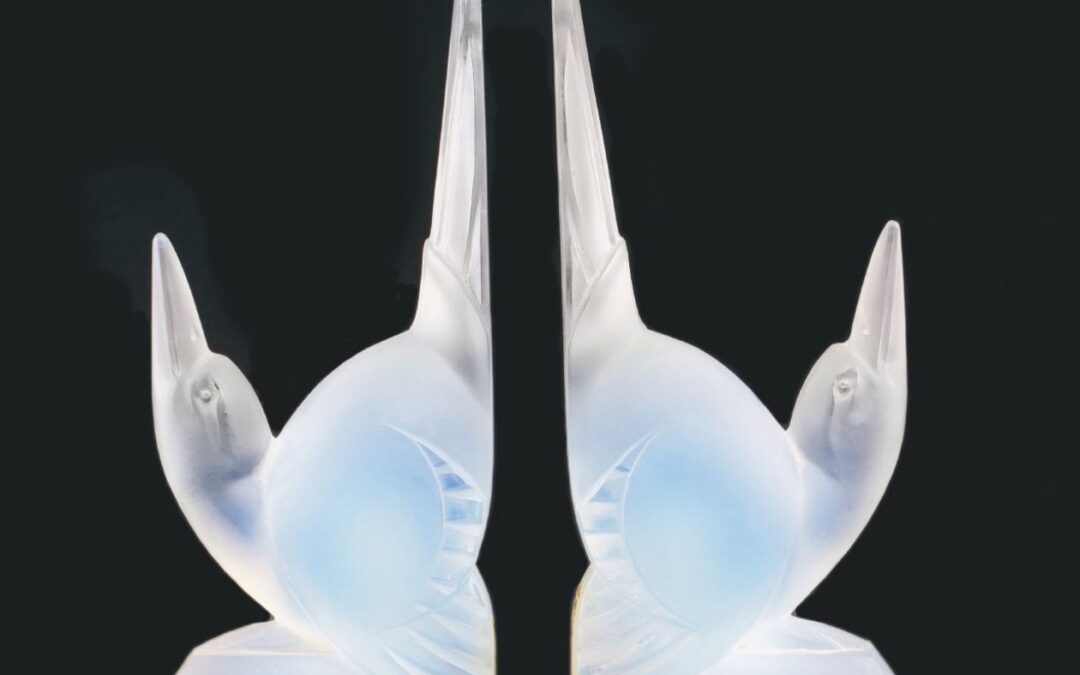
FRONT COVER: Early 20th century bookends by Edmond Etling (see the Chairman’s message on page 3)
BACK COVER: Oxford’s Christ Church Cathedral, contemporary glass font, from above. Made from white alabaster and lined with blue Swedish glass decorated with sandblasted oak leaves.
Editorial
Chairman’s message
Anthony Stern 90th glass Richard Heffer
Munnings Dwight Lanmon
Sea Glass Roger Ersser
Bonhams Jim Peake
Davidson’s pressed glass Michael Upjohn
Cut glass plates To m W i l l i a m s
Glass Comments Bill Davis
Alan Comyns Liz Smith
Fish Glue technique Arianna Comyns
Cage cups Ian Palfrey
Oxford vist Chris Smith
Phil Pickersgill
Benny Motzfeldt Christina Glover
Tr a i n R u m m e r r e s e a r c h Simon Cook
In Memoriam Graham Vivian &
Malcolm Hodkinson Judith Hodkinson
Travelling Tumbler Kaellgren & Coleman
W
ith articles ranging from Sea Glass to Cage Cups,
George Stephenson’s locomotive engraved on a
rummer to Davidson’s pressed glass and Cut glass plates,
there should be enough to interest and engage you all.
After the restrictions of Covid lockdown and with glass
fairs cancelled, our Glass Society visit to Oxford came as
a ‘breath of fresh air ’ to those attending – to be able to
‘meet and greet’ again was stimulating; the trip is covered
in two articles from page 28 to 34, by Chris Smith and
Phil Pickersgill. The visit’s success has encouraged us to
arrange a trip abroad to the glass museums of North Rhine-
Westphalia, Germany. Now in the planning stage and
organized over five days, based in Cologne and with a visit
to Dusseldorf, the dates will be 26 to 30 September 2024.
We look for ward to many of you joining us – do keep the
dates open in your diaries.
3
4
5
11
14
16
20
22
23
26
28
35
36
38
39
Contents GM17.indd 2Contents GM17.indd 2 18/07/2023 12:1118/07/2023 12:11
CHAIRMAN’S MESSAGE
3
Chairman’s Message
David Willars
Glass Matters Issue No.17 July 2023
A
t first glance the book-
e nd s o n t h e f ro n t cove r
h a v e a l l t h e p o i s e a n d
s t y l e o f R e n e L a l i q u e . I n fa c t ,
t h e y a re t h e w o r k o f E d m o n d
E t l i n g , w h o w a s a r e t a i l e r i n
Par is with a hig h-end galler y in
Rue de Paradis. T he ma jor ity of
Etling glass was produced by his
own team of glass workers based
at the Cr istaller ies et Ver rer ies
de C hoisy -le-Roi Réunies, in the
outskir ts of Par is. A s a retailer,
Etling also marketed cameo glass
p ro d u ce d e xc l u s i ve l y fo r t h e m
b y L o e t z , w h i c h w a s m a r k e d
‘Richard’. The Etling retail prem-
ises closed in 1942 during WW2
after two decades. Being Jewish,
it is believed Etling and his entire
famil y, to ge ther w i th his g l a ss
workers , were ro unde d u p and
sent to Nazi concentration camps
w h e re s o m e m e t t h e i r d e a t h s .
L itt le is k now n ab out E t ling
glass but Anton Doroszenko,
propr ie tor of the Isle of W ig ht
Glass Museum which was found-
e d i n 2 0 1 6 , i s u n d e r t a k i n g a
project to identify his work and
p r o d u c e a n o n l i n e c a t a l o g u e .
Approximately eighty of Etling ’s
works are on display at the muse-
um and these can also be viewed
on their website. To assist Anton
in his studies, T he Glass Society
has under taken to sp ons or the
s c h e m e a n d w e l o o k f o r w a r d
to receiving progress reports
over the next couple of years.
The Stourbridge Glass Museum
was also a beneficiar y of The Glass
Society a couple of months ago
when we were alerted that a patent
registration awarded to the local
co m p a ny R i c h a rd s o n’s i n J u ne
1857, was about to be offered for
sale by auction. Having garnered
several opinions and estimates
o f the likely auc t ion pr ice , the
p re s a l e a s s e s s m e n t b e i n g l e s s
t h a n £ 2 0 0 , T h e G l a s s S o c i e t y
decided to suppor t the museum
in bidding. Suffice it to say that
the patent is now in the posses-
sion of the museum, and many
of us would argue, in its right-
ful home. Benjamin Richardson,
1802-1885, was one of the lead-
ing glass manufacturers of his day
and this patent, together with wax
seal, makes a significant addi-
tion to the museum’s collection.
These two examples serve to
illustrate how T he Glass Society
can help, in this case museums,
where we see an opportunity to
suppor t a wor thy cause. However,
we are not limiting our assistance
to museums, and would equally
c o n s i d e r re q u e s t s fo r f u n d i n g
from individuals or institutions.
A s a generalisation, any form of
research, suppor t for young glass
makers or publicity can be consid-
ered as areas where we would be
par ticularly interested in helping
Please contact us if you would like
to discuss a request for funding.
The pressed glass company
G e o r g e Dav i d s o n & C o c o m e s
u n d e r M i k e U p j o h n ’s s c r u t i ny
in this magazine with an ar ticle
bas e d l argely up on his father ’s
huge collection. George Davidson
was a colourful character, spend-
ing twenty years as a local butcher
and getting involved in the local
c o m m u n i t y b e f o r e b e c o m i n g
Mayor of Gateshead. Establishing
his eponymous glass company in
the 1860s, Davidson’s grew rapid-
ly and was renowned for the reach
of its export trade. Notable fea-
tures of Davidson’s output were
the range of colours and finishes.
Dwight Lanmon contrib-
u te s a no t h e r a r t i c l e , t h i s t i m e
o n A l f re d M u n n i n g s , t h e E a s t
Anglian artist better known for his
paintings of horses. A pparently
M u n n i n g s l i k e d a d r i n k a f t e r
his d ay ’s work and wouldn’t be
the first ar tist to settle his bill
in k ind. For more infor m at ion
and to find out what this has to
do w ith g l ass , read the ar ticle!
Finally, those of you who have
visited the Art Worker’s Guild
in L ondon at any time over the
last for ty years will be saddened
to he ar th at E ls p e th Dennis on
has died. Quite simply, to many
o f us E ls p e th was sy nony mous
with the Guild and it is hard to
imagine its smooth function-
ing without her quiet , calm and
e fficient presence. A s has been
s a i d b e fo re , h e r e g g a n d c re s s
sandwiches were the stuff of leg-
end. E lspeth had worked at the
Guild for 43yrs and lived more
recently in an apar tment within
the building. We will miss her.
David Willars, Chairman of ! e Glass Society
Chairmen’s message GM17.indd 1Chairmen’s message GM17.indd 1 17/07/2023 09:2617/07/2023 09:26
Anthony Stern – life and glass
4 Glass Matters Issue no.17 July 2023
ART & GLASS 1
Richard Heffer
Editor: We published a concise In
Memoriam on Anthony Stern in
GM14. Through a chance meet –
ing with his lifelong friend, Richard
Heffer, this appealing story emerged.
I
was born in Cambridge in 1946
and moved when seven to Barton
Road; nearby was the mile-long
Grange Road, where many academics
lived. Anthony Stern’s family shared a
large house there with the Mitchells:
Peter Mitchell was a biochemist – lat –
er my father-in-law – whose discov –
eries were rather too revolutionary
for the University. Peter eventually
founded his own research laborato –
ry at Glynn House, near Bodmin in
Cornwall, winning a Nobel Prize in
1978. Anthony was born in 1944,
thus two years older than me, but we
became life-long friends, being both
interested in Art, Music, and Film.
I went to Oxford to study English,
while ‘Ant’ became part of the ‘count –
er culture’ of 60s Cambridge; he
knew Syd Barrett, and exhibited with
him, becoming part of the emerging
group around the band Pink Floyd,
later photographing, filming and
documenting their music and lives,
both in the UK and America. I was
filming too (on the other side of the
camera), in feature films and tv series
from the late sixties onwards, and we
re-met in London after I had mar –
ried Peter Mitchell’s daughter Julia.
Meanwhile, I had become interested
in glass engraving, being taught by
the wonderful Simon Whistler, whose
father Laurence had re-energised that
artform. Ant had also by then become
fascinated by glassmaking and took an
MA at the Royal College of Art, before
founding his own glass workshop. His
studio was opposite Battersea Dogs
home, and a small team was turning
out very popular highly coloured
bowls, glasses and making large light-
shades in swirling designs, very pop –
ular with restaurants and designers.
I very much enjoyed watching him
work at his furnace and bench, his
skill and imagination creating very
exciting and original pieces. I bought
some unusual tall goblets to engrave
as memento presents, and when these
became too expensive, asked wheth –
er he would blow drinking glasses to
my design: to my surprise and joy he
was very enthusiastic – so I began to
draw. I had to stipulate lead crystal,
as this gives a lovely bright white line
with a diamond – that was agreed, and
then the size. During my travels, I had
noted glasses in the Rijksmuseum,
the Fitzwilliam, V&A, and also the
museum at Murano, which became
a favourite haunt. I decided I wanted
a ‘funnel’ conical bowl, with a sin –
gle ball knop on the stem and a very
slightly coned and folded foot – rath –
er a 1700s English-based concept.
I also wanted the foot to be wide, so
as to be more stable: the idea was to
create a glass suitable for all sorts of
drinks, including sparkling wines.
So, I drew out the rough profile –
now sadly lost from the archive, and
Ant experimented. The end result was
this glass (Fig.1) , 6 inches high, with
a 3-inch diameter funnel bowl-top,
and a 3.5-inch diameter foot. (Editor:
So very similar to one of John Greene’s
glasses of the 1670s.)
kept on his workshop shelf, NEVER
to be sold by accident (!) and rescued
by me before the studio sale after
Ant’s death in 2022. It looks ‘right’
and is very stable and drink-friend –
ly! Ant blew around 100 glasses for
me over the years, all subsequently
engraved and given as presents: each
one slightly different, as can be seen
by the one simply engraved for my late
mother’s 90th birthday (Fig.2) – large
plain numbers that she could see!
So that is the story of 66 years of
shared interests and products: a love –
ly man, a great artist, and such fun to
be with. Thanks, Ant, for everything.
Fig.1
Fig.2
Anthony Stern Heffer GM17.indd 4Anthony Stern Heffer GM17.indd 4 14/07/2023 20:3014/07/2023 20:30
ART & GLASS 2
5 Glass Matters Issue no.17 July 2023
A LFRED M UNNINGS – and Glass
Fig. 1An anatomical page from an early sketch-book. Alfred Munnings, 1893. 4 x 5 inches. Reproduced from Munnings’ facing page 112. Munnings Museum. © Estate of Alfred Munnings
Fig. 2a and bObverse and reverse views of a scratch-engraved rummer showing King George V. !e glass, England, ca. 1820; lead glass, blown; scratch-engraved by Alfred Munnings about 1937-40. H. 5-3/8 in. National Sporting Library and Museum, Middleburg, VA. 1st Mar.2023, gift of Dwight and Lorri Lanmon. David Goodell photographs
by Dwight P. Lanmon
R
arely is one able to add signifi –
cantly to the body of work of
such a famous and well-studied
artist as Sir Alfred Munnings (1878-
1959). Surprisingly, the new discovery
is in the field of glass and not paintings,
for which Munnings is well known. 1
First, a bit about his life and work.
Munnings is widely considered to
have been one of England’s greatest
artists specializing in equestrian sub –
jects. He grew up in Mendham, Suffolk.
The son of a miller, he was surrounded
by horses growing up and owned 34
during his lifetime. He declared late in
life that “horses were my inspiration.”
drawing as a child and, after leaving
Framlingham College at age 14, was
apprenticed for six years to Page
Bros. & Co. a lithography company
in Norwich where he developed his
artistic skills. He produced numerous
advertising signs for Caley’s Crackers
and Chocolates and Waverly Cycles,
among many others, and received
several awards, including a gold med –
al for a poster he submitted to the
Poster Academy at the Crystal Palace in
1899. While working, he attended the
Norwich School of Art for two hours
every night where, perhaps influenced
by his everyday childhood familiari –
ty with horses, he closely studied a
plaster cast of a horse’s head from the
Parthenon and made drawings of it. He
also studied George Stubbs’s 1766 pub –
lication, Anatomy of the Horse , which he
purchased used for 50 shillings, and
produced numerous sketches of horse
musculature and skeletons through
studies at the South Kensington
Museum in his early teens (Fig. 1) .3
At the end of his apprenticeship,
he became a full-time artist, despite
accidentally losing the sight in one
eye in 1898. 4 In 1899, two of his
paintings were selected for the Royal
Academy Summer Exhibition. From
1899 to 1960, nearly 300 of Munnings’
the Royal Academy’s Summer
Exhibitions. Coincidental
to receiving the notice of the
acceptance of his paintings
by the Royal Academy, he was
invited to attend the Bungay
R aces where he attended
his first thoroughbred race-
day event, witnessing the
dramatic sounds, color and
action close up. Enchanted
by what he saw, he comment –
ed “Such colour and action as
I had never dreamt of … I saw
the thoroughbred horses and jockeys in
bright silk colours … The peaceful School
of Art, the smelly artists’ room at Page
Bros. faded away and I began to live…”
in active duty in WW1 because of
his loss of sight, he was assigned in
January 1918 to action in France as a
civilian, where he was commissioned
Munnings GM17.indd 5Munnings GM17.indd 5 14/07/2023 20:3614/07/2023 20:36
ART & GLASS 2
6 Glass Matters Issue no.17 July 2023
LEFT Fig. 3View from inside the bowl, showing King George V (image reversed). Author’s photograph
BELOW Fi g. 4 Underside of the foot on the rummer in Fig. 2. David Goodell photograph
to process thousands of Canadian
horses sent there for the Canadian
Cavalry Brigade on the Western Front.
He was also commissioned to produce
portraits of the leaders of the cam –
paign, along with dramatic scenes of
men and horses in battle. Returning
to England in August, he completed
forty-five paintings, which were dis –
played in the Canadian War Records
Exhibition in London in 1919. The
exhibition resulted in his nomination
and election as an Associate of the
Royal Academy that year. Elected to
full membership in 1925, he served as
its president from 1944 to 1949. He
was knighted in 1944 and received a
KCVO in 1947. A retrospective exhi –
bition of more than 300 of his works
was held at the Royal Academy in
Burlington House in 1956 – he was
the third artist to be so honoured.
In 1919, Munnings bought the
“house of my dreams, ” Castle House in
Dedham, Colchester, Essex, about 40
miles from where he was born. 6 It was
his home and location of one of his
studios for the remainder of his life;
it became the Munnings Art Museum
in 1962. He lived a glamorous life of
house parties, hunts, race events and
London clubs, traveling throughout
the UK, the Continent, the USA and
Canada, often painting commissioned
portraits of aristocrats astride their
horses. He complained unceasingly
about the necessity of painting such
‘portraits,’ but noted that they provid –
ed a steady income. He died at Castle
House on July 17, 1959; his ashes
were interred in St. Paul’s Cathedral.
M U N N I N G S
AND GLASS
While Munnings is renowned for his
paintings, his scratch-engraved depic –
tions – likely using a diamond-tipped
stylus – of horses and riders on drink –
ing glasses have not, to my knowl –
edge, been recognized by Munnings’
examples, all rummers – common
forms in pubs across the UK – which he
used as ‘canvases.’ It is not known why
he chose to engrave glasses with imag –
es derived from his paintings. Were
they done for friends? Commissions?
Or was he just having fun after a con –
vivial evening at a pub, house, or club?
His habit of spontaneously
drawing on unlikely surfaces con –
tinued from early childhood, at an
Inn “where no paper was handy to
sketch on,”
roller blinds in the bar parlour with
a flourish and drew on them in cray –
on. ‘This spontaneous gesture was so
well-received that he mentally filed it
away to repeat on future occasions.’
a glass a solitary effort, not done
in the company of other people, or
did he do it spontaneously as party
entertainment? Whatever the inspi –
ration, his mature understanding
of a horse’s anatomy is abundantly
evident in the depictions on these
five glasses. Unfortunately, he does
not mention engraving any glass –
es in his three-volume memoir, so
we are left to wonder when, where,
why, or for whom they were done.
The forms of the first two glasses
shown here are very common among
collections of glasses dating from
the early 19th century (Figs.2 & 5) .
Dating from about 1820, they are
known as ‘rummers.’ Despite being
around 200 years old, they survive in
the hundreds today, which bespeaks
of their fundamental strength and
serviceability. The feet on these
glasses show considerable wear,
consistent with their age and use
and they were likely used to serve
everything in a pub – not just rum.
The scratch engraving on the bowl
of one of the glasses depicts a man on
horseback wearing a hat (Figs.2a & 3) .
The script signature ‘A. J. Munnings’
inscribed ‘KING GEORGE / on Jock
Munnings GM17.indd 6Munnings GM17.indd 6 14/07/2023 20:3614/07/2023 20:36
ART & GLASS 2
7 Glass Matters Issue no.17 July 2023
/ at Sandringham / from my 40 x 30
painting’ (Fig. 2b) .8 The underside
of the foot is inscribed ‘This glass
is from the Swan Hotel Harleston
Norfolk / Alfred Munnings.’ (The
photographs in Figs.2 & 5 were taken
with black velvet inside the bowls to
capture the engraving on the front,
while obscuring that on the reverse.)
The second rummer shows a
woman riding side-saddle, wearing
a hat (Figs.5a & 6) . The signature ‘A.
J. Munnings’ is alongside. The bowl
is inscribed on the reverse ‘PRINCESS
MARY / with the Bramham Hounds
from my 36 x 36 drawing’
the foot ‘The horse was a wedding
present from the hunting women of
Ireland / Alfred Munnings’
and understanding of the physical
structure and musculature of hors –
es, the depictions of the King and
the Princess are best viewed from
inside the glasses (Figs.3 & 6) . (The
images are reversed, so the depic –
tions appear as if one were viewing
them from outside the glasses.)
As the inscriptions on the glasses
indicate, the images of the King and
Princess are derived from Munnings’
–
ing of King George V (1865–1936),
was completed in 1937 and exhib –
ited at the Royal Academy that year
(Fig. 8) .9 It is of ‘King George V on a
white Highland garron, named Jock.’
reminded Munnings, ‘Sir; this is how
His Majesty used to sit; his shoulders
a little hunched.’ –
tantly allowed a limited number
of prints of this painting to be pro –
duced, as though ‘the painting is very
good, it illustrates my husband with
his back bent, a perfectly accurate rep –
resentation, but it is not appropriate
that my people should see him thus.’
the only daughter of King George
V and Queen Mary. 11 Munnings
painted the Princess on her grey
h o r s e , Po r t u m n a , a t E g e r to n
House, the Lascelles family home in
Newmarket, in 1930; it is now in the
Harewood House collection (Fig. 9) .
It was shown in the Royal Academy
Summer Exhibition in 1931. 12
Munnings wrote of it in 1951: ‘This,
of the Princess Royal on the grey, is
my best equestrian open-air portrait.
No sitter more patient.’ When the
Dowager Countess of Harewood came
Fig. 5a and bObverse and reverse views of a scratch-engraved rummer showing Princess Mary of Teck. !e glass, England, ca. 1820; lead glass, blown; scratch-engraved by Alfred Munnings about 1937-40. H. 5 ” in. National Sporting Librar y and Museum, Middleburg, VA. 2ndMar.2023, gift of Dwight and Lorri Lanmon. David Goodell photographs
BELOW LEFT Fig. 6View from inside the bowl, showing Princess Mary (image reversed). Author’s photograph BELOW RIGHT Fig. 7 Underside of the foot on the rummer in Fig.5. David Goodell photograph
Munnings GM17.indd 7Munnings GM17.indd 7 14/07/2023 20:3614/07/2023 20:36
ART & GLASS 2
8 Glass Matters Issue no.17 July 2023
to see the picture in the studio, she
said ‘Don’t touch it again; you have got
Mary exactly. 13 However, that paint –
ing may not have been the source
for the engraving on the rummer,
where the inscription states that the
image shows her ‘with the Bramham
Hounds from my 36 x 36 drawing.’ The
size is different, and there are no
hounds in the painting. 14 A painting
showing the Princess and the Earl,
surrounded by the Bramham Moor
Hunt hounds, is now at Harewood
House, though it shows the Princess
on Portumna facing right, the reverse
of the depiction on the rummer. It
was shown in the Royal Academy
Summer Exhibition in 1930. 15
The depictions of the horses and
figures on the rummers accord well
with Munnings’ style as a draftsman.
There is an economy of line, yet the
musculature and anatomy are detailed,
accurate and recognizable. For exam –
ple, his drawing of a horse in his WW1
studies reveals the close similarity of
his work with a pencil or a diamond
point (Fig. 10) . One significant differ –
ence is the heavy scratched scribbling
used to render the horses’ muscula –
ture on the glasses compared to the
subtle shading possible with a pencil.
Regarding the source of the rum –
mers—the Swan Hotel in Harleston—
dined there and that he sometimes
gave the landlord paintings to cover
his bills. 16 The hotel, located across
the river from Mendham where he
grew up, is still in business. 17 They
no longer have any glasses matching
these rummers, and there is no record
of how Munnings obtained them.
Munnings mentioned the Swan
Hotel several times in the first vol –
ume of his memoir, ‘An Artist’s Life’.
In his 1934 Christmas drawing
(Fig. 11) 18, is inscribed ‘Castle House
Dedham / Essex / A Merry Christmas
from Mr. and Mrs. A. J. Munnings 1934.
Although the bowl of the glass held
aloft by the central figure is tiny, its
tulip shape is similar to that of the
rummers he engraved (Figs.2 & 5) .
While the discovery of these two
rummers is significant, three oth –
ers were discovered in the course
of doing research on the first two
(Fig. 12) .19 They were sold in the
Sotheby ’s, New York, auction of
Fig. 8George V Riding His Favorite Pony ‘Jock” in Sandringham Great Park. Alfred Munnings, 1937. Oil on canvas, 30 x 40 inches. Ipswich Borough Council Collection. © Estate of Alfred Munnings.
Fig. 9HRH Princess Mary on Portumna. Alfred Munnings, 1930. Oil on canvas, 33 x 34.5 in. (including frame). Harewood House. © Estate of Alfred Munnings. Paul Baker photograph.
Munnings GM17.indd 8Munnings GM17.indd 8 14/07/2023 20:3614/07/2023 20:36
ART & GLASS 2
9 Glass Matters Issue no.17 July 2023
In Fig.12 , lot 558 is in the front, lot
559 in the middle and lot 557 at the
back. They were cataloged as follows:
Lot 557. Height 5 ! in. (13.3
cm) depicting a horse and rider,
inscribed ““ANARCHIST / from my
earlier painting / 30 x 25 / Alfred
Munnings / will anyone notice??” ;”the
base inscribed ““Alfred Munnings
Castle House, Dedham / I got the glass
from the Magpie Harleston, Norfolk.”
# in. (13.3
cm) depicting a horse and lady,
inscribed ““My Wife with ‘ISA AC ’
from my painting / 50 x 40” ;”the base
inscribed ““Alfred Munnings Castle
House, Dedham”
foot inscribed “I got the glass from
the Magpie Harleston, Norfolk.” 22
Lot 559. Height 5 ! in. (13.3 cm)
depicting a horse, inscribed ““LORD
DE R B Y ‘ S / H Y PE R I O N / f ro m
my 24 x 20 painting / on board
/ A. J. MUNNINGS”
inscribed ““Alfred Munnings Castle
House, Dedham”
foot inscribed ““I got the glass from
the Magpie Harleston, Norfolk.” 23
BELOW LEFT Fig. 11!e Punch-Bowl / !e origin of the recipe used at the Swan Hotel, Harleston. Alfred Munnings, 1934. Ink and pencil drawing on paper; 11 x 10 inches. Reproduced from Munnings’ An Artist’s Life, facing page 289. Munnings Museum. © Estate of Alfred Munnings . BELOW RIGHT Fig. 12!ree rummers. Probably England, ca. 1920-1930; probably lead glass, blown, scratch-engraved by Alfred Munnings about 1937-40. P hoto courtesy Sotheby’s.
Fig. 10Full Marching Order. Alfred Munnings, 1918. Pencil drawing on paper, 9 x 11 inches. Reproduced from Munnings’ An Artist’s Life, facing page 264. Munnings Museum. © Estate of Alfred Munnings.
The glasses are of a different
shape from those at the Swan
Hotel, Figs 2 & 5 . The bowls are
large and cup-shaped, the knops
on the thick stems appear to be
waisted, and the attachments to
the thick feet are massive. They
do not appear to be early 19th
Munnings GM17.indd 9Munnings GM17.indd 9 14/07/2023 20:3614/07/2023 20:36
ART & GLASS 2
10 Glass Matters Issue no.17 July 2023
century forms and are more likely
to be of early 20th century date. 24
The manufacturer has not been
identified, but they are likely to be
English. These three rummers also
came from an inn in Harleston, the
Magpie. The inn still exists, but they
no longer have any glasses matching
these, and have no records of when
or where they were acquired. It is
recorded, however, that Munnings
also occasionally settled his bills by
giving paintings to the Magpie. 25
T he inscr iptions indicate the y
were engraved at Castle House.
D o a ny o t h e r e x a m p l e s o f
scratch-engraved glass by Alfred
Munnings exist? It seems like –
ly, and the author hop es this
article will result in their iden –
tification and publication.
ENDNOTES
1. I am grateful to Dr. Bill Teatheredge,
Honorary Curatorial Associate of
the Munnings Art Museum, for
information about Munnings’ paint –
ings and personal history. Details of
Alfred Munnings’ life are also drawn
from his three-volume memoir, An
Artist’s Life (London: Museum Press
Limited, 1950), The Second Burst
(London: Museum Press Limited,
1951), and The Finish (London:
Museum Press Limited, 1952).
Also from Jean Goodman’s What
A Go! The Life of Alfred Munnings ”
(London: Collins, 1988).
2. Munnings, The Second Burst , p. 183.
3. Goodman, p. 48.
4. The accident happened when he was
following dogs chasing a hare. “Two of
the dogs went through a thorn fence
into a field of swedes. The hound and
I got to a hurdle in a corner. I lifted the
heavy puppy over the hurdle, and as
I dropped it to the ground, a spray of
thorn, rebounding, struck my right
eye. Sharp pain followed the blow.
This was no more than a flick against
the eyeball. Soon I knew the worst.
Standing among the swedes and
shutting my left eye, I saw nothing but
grey fog…. My right eye was blinded
for life.” An Artist’s Life , p. 102.
5. Ibid ., p. 44.
6. Munnings, The Second Burst , pp. 35-39.
7. Goodman, p. 47.
8. Munnings had a habit of specifying
both the title and dimensions of
his paintings nearly every time he
mentioned one in his memoir. The
inclusion of the dimensions of the
paintings from which the designs on
the rummers were derived further
supports the conclusion that the
scratch-engraved designs were pro –
duced by Munnings, not by someone
else copying his paintings.
9. Goodman, p. 264.
10. Goodman, p. 206.
11. Princess Mary was the sister of
Kings “Edward VIII “and “George
VI, and aunt of Queen Elizabeth
II. She married “Henry Lascelles,
Viscount Lascelles, later 6th Earl of
Harewood, in 1922. Mary was given
the title of “Princess Royal “in 1932.
12. Goodman, p. 263.
13. Munnings, The Second Burst , pp.
224-225.
14. Goodman, p. 188.
15. Goodman, p. 263; for an image
of the painting, see https://www.
bridgemanimages.com/en/aristo –
cratic-tastes-of-england/10987
16. E-mail from Dr. Bill Teatheredge (5
July 2022). See also Goodman, p.
47, for payment of bills at hotels,
inns and bars with drawings and
paintings.
17. https://www.harlestonswanhotel.
co.uk/
18. The recipe for the Swan Hotel
punch was recorded in Munnings’
, pp. 107-108.
19. Courtesy of David Willars (e-mail,
25 July, 2022).
20. Sale N09247, 23 Nov. 2014,
lots 557-559. Present location
unknown. See (for lot 557) https://
www.sothebys.com/en/auctions/
ecatalogue/2014/interiors-mel –
lon-n09247/lot.557.html.
21. The engraved design was likely
taken from a painting of Munnings’
Isaac, which Munnings illustrated
in The Finish (opposite page 280).
The paintings was captioned “My
wife with the grey horse, Isaac,
painted three years after we were
married.”
–
cult to discern. The horse is facing
to the right, and the description
states that it depicts “a horse and
rider, inscribed “ANARCHIST /
from my earlier painting / 30 x 25.”
That suggests the image was taken
from the painting he illustrated
in The Finish (opposite page 72),
where he identified it as an “Earlier
painting of Anarchist (30” x 25”).”
Munnings called Anarchist “my
most beloved horse.” (
Burst , p. 21.) He noted, however,
that “that fool of a horse, Anarchist,
put me off on Wednesday … and
here I sit, bound and strapped up
with two broken ribs and a hell of
an ankle…. As I came to the last
white gate, he shook his head,
put it down, jumped up in the air,
twisted his body and came down
and up and down, and I, with only
one hand, just got chucked off on
my back, and then he stood gently
on my ankle to show his love and
thankfulness.” ( , pp.
72-73; Goodman, p. 218.)
23. Hyperion won the Derby and
four other races at Ascot in 1933.
Munnings painted Hyperion
several times when he was at Lord
Derby’s stud after 1935. The image
on the rummer was likely derived
from the painting he illustrated
in The Finish (opposite page 41).
There, he noted that the painting
was done on a “twenty-four by
twenty-inch mahogany board,”
inscription on the rummer, that
the image was “… from my 24 x 20
painting / on board.”
Charles Hajdamach (e-mail, 8
August 2022).
25. https://www.norfolkpubs.co.uk/
norfolkh/harleston/harlesmp.htm?
I am grateful to Larry Jessen for
bringing this particular website to
my attention.
Munnings GM17.indd 10Munnings GM17.indd 10 14/07/2023 20:3614/07/2023 20:36
11 Glass Matters Issue no.17 July 2023
ONCE USED
C OLLECTING S EA G LASS :
Another person’s treasure
ABOVE (LEFT) Fig. 1Various types of sea glass found on Seaham beaches. ©thisisdurham.com ABOVE (RIGHT) Fig. 2 Sea glass stack. (Seaglassart.co.uk)
Roger Ersser
O
ne person’s rubbish is anoth –
er’s treasure. Last summer,
a good friend of ours was
admiring the beachcombing treasures
from our local Hove beach that sit on
our patio wall and said she collected sea
glass. I obviously gave her the few small
pieces we had. I said that I had discov –
ered the North American Sea Glass
Association and Seaham beach on the
northeast coast where the glassworks
had dumped their waste into the sea
whilst researching my articles on recy –
cled glass (The Glass Cone 104,105)
replied that there was an enormous
international interest in sea glass
especially amongst jewellery makers,
that Seaham was in the top 5 world
sites for collecting and she wished to
go there some day. I made a mental
note that a piece of Seaham jewellery
would make a great Christmas present.
In November, when I started an
internet search for a suitable piece (a
necklace she adores), I found she was
correct and a global interest in collect –
ing sea glass had expanded fantastical –
ly since my searches a decade earlier. I
was in a parallel universe of glass col –
lecting compared to the experiences of
most Glass Society members. There are
books, magazine articles, blogs, videos,
all sorts of social media posts, beach
festivals with prizes and a market for
found pieces especially for jewellery
makers and mosaic type artwork. A
specific language has developed to
standardise the description of pieces
and their origin. I thought an insight
into this alternative world, where trea –
sured damaged objects are collected for
free, might be of interest to members.
T H E O R I G I N A N D
EVOLUTION OF SEA GLASS
After the mountains of waste left
by visitors to popular locations are
cleared, most pieces of glass found
on beaches originate from every –
day manmade glass objects (often
broken) which have been either
deliberately or accidently cast into
the sea. In contrast to the relatively
unchanged archaeological treasure
recovered from sunken wrecks, most
arrive on the shoreline modified by
the time spent in this dynamic chem –
ical and mechanical environment.
These include last week’s unchanged
drinks bottles, distressed objects
and shards, unidentifiable pebbles,
sculptural shapes, and tiny fragments
amongst the shingle and sand from
which they were originally made.
THE ATTRACTION
OF SEA GL ASS
Glass has little intrinsic value com –
pared to gemstones or precious met –
als. Factors such as the inventive use of
transparent and translucent material,
craftmanship, artistic virtuosity, per –
fect condition, rarity, and provenance
attract glass collectors. Most of these
characteristics disappear during pro –
longed contact with time and tide. The
resulting objects are therefore mere
curiosities to mainstream collectors.
On the other hand, any natural
process that over decades can turn
shards of utilitarian glass into jew –
els (Fig.1) and fascinating sculptural
forms (Fig.2) is magic to its hordes of
enthusiasts. Ocean worn, still recog –
nisable objects, such as old bottles,
bottle stoppers, Codd bottle marbles,
glass ornaments, and even battered
glass electrical insulators and fishing
net floats are significant social histo –
ry to some. One spectacular artwork
is a large memorial mural made from
sea glass collected on Spectacle Island,
Boston MA 1. Examples found on the
beaches of fresh and brackish water
tidal rivers and estuaries (beach
glass), beloved by ‘mudlarks’, have a
different appearance to those pound –
ed by powerful waves on rocky shores.
Commonly considered litter, finds can
often be removed free from the beach.
GM17 SeaGlass.indd 11GM17 SeaGlass.indd 11 18/07/2023 14:4718/07/2023 14:47
12 Glass Matters Issue no.17 July 2023
ONCE USED
Fig. 4Hartley Wood streaky coloured glass jewellery © bytheseajewelry.com
G L O B A L D I S T R I B U T I O N
OF SEA GL ASS
A smattering of sea glass is found on
almost all shorelines. Some pieces like
the black glass fragments of 18th cen-
tury bottles found close to Caribbean
colonial settlements and railway mar-
bles on the Lake Michigan beaches,
recall local history. It is most abundant
on beaches adjacent to areas of histor-
ic industrial and domestic pollution
(Fig.3) , bearing testament to past
methods of waste disposal that are
totally incompatible with present envi-
ronmental concerns. Some glass-rich
beaches (e.g., the site of the municipal
dump in Fort Bragg, California 2 and
Ussuri Bay, Siberia 3 where local facto-
ries dumped glass and pottery, have
paradoxically achieved protective heri-
tage status, forbidding removal, due to
their unique scenic and novelty value.
Most sea glass ends up far from
where it was originally made. Few
beaches are close to a manufacturing
site. Noteworthy are the industri-
al graveyard in Ussuri Bay, Russia;
Davenport, California where a f lood
swept the glass trimmings from
the Lundberg glass studio into San
Vincent Creek and onto the beach 2;
and Seaham, County Durham UK,
where the large Londonderry bottle
factory dumped its waste into the sea,
and streaky coloured glass fragments
thought to come from the Hartley
Wood factory further up the coast at
Sunderland have also been recovered6.
The multicoloured fragments (mul-
tis) found at the latter two locations
are the ultimate pieces for jewellery
(Fig.4) . Disappointingly, the glass-
makers of the most famous coastal
site, Murano, have declined to cast
their waste into the Venetian lagoon.
O R G A N I S A T I O N O F
COLLECTING COMMUNITY
The massive growth in sea glass col-
lecting, and in some cases using it to
make jewellery (Fig.4) or creating art
works (Fig.5) , is a 21st century global
phenomenon (1st sea glass festival in
USA 2004, Richard LaMotte’s semi-
nal book Pure Sea Glass first published
Fig. 3Sea glass gravel, Eleele Glass Beach, Kauai Hawaii. (Wikipedia, Eli Duke)
er of the internet. Almost all coastal
communities have some sort of sea
glass group, newsletters, and nation-
al online forums. Promoting good
beachcombing practice, catalogu-
ing the best sites and their relevant
history, organising festivals, some-
times with prizes, and online events
have all helped spread the word.
Travelogs featuring collecting oppor-
tunities, beach festivals, and artisan
glass craft are common in the adver-
tising literature for seaside holidays.
Sea glass champions are not
that dissimilar to glass collec-
tors in more traditional areas,
and include both casual and
professional beachcombers,
history and origin enthusiasts,
those with the compulsive col-
lecting gene, dealers, and craft
makers. They frequently have a
combination of these interests.
Whilst researching the origin
of their finds they have discov-
ered and embraced the world
and traditions of glass making.
A keenness to socialise with
likeminded individuals, form
information-sharing organisa-
tions and trading opportunities
are facilitated by social media
and other online platforms 1.
Contributions can sometimes be
romantic and anecdotal, lacking
the confirmation of those curat-
ed by authoritative sources.
GM17 SeaGlass.indd 12GM17 SeaGlass.indd 12 14/07/2023 20:3914/07/2023 20:39
13 Glass Matters Issue no.17 July 2023
ONCE USED
STANDARDISATION O F
LANGUAGE
By dividing the origin of the glass
into major groups, e.g. vessel; util-
itarian; art; industrial and raw and
standardising the names given to
different shapes, colours, and types
of material, a universal descriptive
language has developed. The pio-
neering, US-based, International Sea
Glass Association (formerly North
American Sea Glass Association,
founded in 2006)
‘BEACH combing’ Magazine (and
its predecessor ‘Glassy’)
Sea Glass Journal 1, books – Amazon
lists over 20 published in the last
decade – glossaries, wall charts and
beach guides devised by experienced
collectors and jeweller y makers,
such as Linda Jeleb’s comprehensive
website 5, have all made significant
contributions to this evolution.
M O D I F I C A T I O N
AND FAKES
Some collectors indulge in the
questionable practice of returning
pieces to the sea for further modifi-
cation, or ‘seeding’ with rarer objects
and colours for future discovery.
Post collection treatment is some-
times applied, especially by jewel-
ler y makers. Irregular blemished
pieces can be tumbled into more
pleasing shapes and surfaces. They
can be oiled to enhance translucency.
With high quality desirable finds
becoming rarer, beach removal restric-
tions increasing, and traders’ prices
increasing, fulfilling the demands of
jewellery makers and artists is taxing.
This has resulted in ‘fake’ and ‘modi-
fied’ material in circulation. Acid etch-
ing can be used. Virgin glass shards are
transformed by mechanical agitation
with abrasives and chemical solu-
tions, in bulk by factories in Germany
and China, on a smaller scale using
stone-tumbling mills, or even in back
gardens with a cement mixer! Chemical
leaching (hydration), mineral staining
and crizzling are difficult to reproduce
convincingly, whilst shapes are easier
to replicate. These lookalike impostors
are attractive to home hobbyists and
homeware and lifestyle companies
wishing to achieve a maritime vibe.
T he International Sea Glass
Association has a large number of
members who sell sea glass prod-
ucts. They have introduced criteria
for the origin of the material and
acceptable product processes to
which they must adhere to call them
authentic sea glass items. These
rules also apply to shards entered for
festival prizes. Similarly, well-estab-
lished sea glass artists such as Linda
Jeleb (Fig.4) and Rachel Bellman
(Fig.5) insist on untouched material
despite it becoming harder to source.
FUTURE
It is difficult to speculate if and when
this current frenzy in the sea glass
world will subside. The jewellery mar-
ket seems close to saturation and will
contract in volume and value as fash-
ion moves on. A decline in desirable
material will make dealing less prof-
itable. During the recent pandemic
Seaham traders complained that an
inf lux of staycation visitors was
affecting the volume of their finds!
(BBC Tyne& Wear). The hobbyist
beachcomber will, as before, contin-
ue to fill their jars, history and origin
will still fascinate others, sea glass will
remain in the repertoire of coastal
artisans, whilst the dilettante follow-
er will depart to blog the next trend. I
hope Glass Society members will take
a closer look at the shoreline next time
they are strolling along the beach. Who
knows you could find a car taillight
‘ruby’ or Mateus Rose teal ‘emerald’!
W i t h s p e c i a l t h a n k s t o
o u r f r i e n d , A u r i M i l l a r, fo r
her insight and inspiration.
REFERENCES
1. seaglasjournal.com
2. beachcombingmagazine.com
3. siberiantimes.com 30th Jan 2017
4. seaglassassociation.org
5. bytheseajewelry.com (Linda Jeleb)
durham.com
7. Seaglassart.co.uk (Rachel Bellman)
BIBLIOGRAPHY
1. Pure Sea Glass: Discovering Nature’s
Vanishing Gems. Richard La
Motte and Celia Pearson; Schiffer
Publishing Ltd. 1st published 2004,
latest edition 2019.
2. Wikipedia: Glass Beach, Eleele, Hawaii
3. BBC News, Tyne and Wear, 30th
March 2021
Fig. 5Girl on vespa, Rachel Bellman mosaic© Seaglassart.co.uk
GM17 SeaGlass.indd 13GM17 SeaGlass.indd 13 14/07/2023 20:3914/07/2023 20:39
Bonhams Fine Glass and Paperweights Sale:
A Beilby Spectacular
Knightsbridge, 30 November 2022
Jim Peake
14 Glass Matters Issue no.17 July 2023
BONHAMS
T
his 162-lot sale included per –
haps the largest offering of
18th century English enamelled
glass from the renowned Beilby fami –
ly workshop in Newcastle-upon-Tyne,
active at Amen Corner in the 1760s
and 70s, ever to come to auction.
Armorial pieces are among the
finest and most sought-after of all
Beilby glasses. A remarkable light
baluster wine glass offered as part
of the Stephen Pohlmann Collection
(Fig.1, Lot 40) , made for the Dutch
market and with family provenance
right back to the 18th century, is
one of only two known bearing the
arms of the Tilly family of Haarlem;
the other being in the Durrington
Collection in the US. The ‘Tilly’ glasses
were almost certainly commissioned
by Claas de Koning Tilly (1727-1814),
who by 1764 owned a firm in Haarlem
founded by his grandfather in 1696,
which specialised in the production
of a panacea known as ‘Dutch drops’.
Although the foot had been restuck,
it sold for £11,475 very much in line
with what several other Beilby armo –
rial wine glasses with less severe condi –
tion issues have made in recent years.
Another highlight of the Pohlmann
Collection was a rare blue colour twist
cordial glass (Fig.2, Lot 41) , which took
£21,675 despite a prominent bruise
to the foot. This is nearly double the
price the glass made when sold by
Bonhams in 2013, perhaps reflect –
ing the strong demand for Beilby’s
enamelled and colour twist glasses.
The majority of the Beilby enam –
elled pieces came from the Darell
Thompson-Schwab Collection, spread
across 26 lots. Much like the first part
ABOVE LEFT Fig. 1!e arms of the Tilly family of Haarlem
ABOVE RIGHT Fig. 2 Blue colour twist Cordial glass
RIGHT Fig. 3 A marriage Goblet to ‘CC ’
in June 2022 (Glass Matters 15, pp.32-
33) . The highlight was undoubted –
ly an unrecorded marriage goblet
inscribed ‘Health & Prosperity to the
happy pair. C C’ (Fig.3, Lot 130) which,
despite chipping to the foot, realised
four times the upper estimate when
it took £25,500. Whilst the identity
of ‘C C’ or indeed ‘the happy pair’ to
which this remarkable goblet refers
remains unknown, several other glass –
es were commissioned from the Beilby
workshop to celebrate marriages.
Bonhams GM17.indd 14Bonhams GM17.indd 14 14/07/2023 20:4014/07/2023 20:40
15 Glass Matters Issue no.17 July 2023
BONHAMS
ABOVE LEFT Fig. 4Pair of unrecorded mugs, with the crest of Trevelyan
ABOVE RIGHT Fig. 5 An air-twist “ring glass to TEMPERANCE
LEFT Fig. 6A sportsman aiming his gun
RIGHT Fig. 7 A pastoral scene with a shepherd resting on his sta #
They include the Thompson Wine
Glass (Glass Matters 15, p.33, Fig.5)
and the Surtees Marriage Glasses
(Glass Matters 12, p.10, Fig.4) .
The more unusual forms appealed
to several collectors, with an import –
ant and unrecorded pair of mugs
with the crest of Trevelyan (Fig.4,
Lot 136)
double their lower estimate. No oth –
er Beilby enamelled mugs would
appear to be recorded. The crests
are almost certainly for Sir John
Trevelyan, 4th Baronet (1735-1828),
of Nettlecombe Court in Somerset,
and were perhaps commissioned
to mark his inheritance of the
Nettlecombe Baronetcy in 1768. A
celebrated firing glass bearing the
inscription ‘TEMPERANCE’
Lot 137) –
est £9,562, a shade more than it had
made when last sold by Bonhams as
part of the A C Hubbard Jr Collection
in 2011. Glasses with pastoral scenes
were particularly sought after. An
example depicting a celebrated and
desirable scene of a sportsman aim –
ing his gun at a flock of game birds
(Fig.6, Lot 139)
an appreciation in value since it
was last sold by Bonhams in 2014.
Another, painted with a charming
scene of a shepherd leaning on his
staff (Fig.7, Lot 138) , doubled its
upper estimate to make £17,850 –
almost three times an example from
the same collection painted with a
virtually identical scene, but with
a chipped foot, had made in June
2022. The scene relates closely to an
ink and wash drawing dated 1774
and signed by William Beilby, now
in the Victoria & Albert Museum
(E.114-1961) , which provides an
important link to the man himself.
The Thompson-Schwab Collection
was a ‘white glove’ sale with every
lot selling; a testament to the cur –
rent buoyancy of the Beilby market.
T he nex t sale of Fine Glass
and Paper weights will take place
at B on h a m s i n K n i g ht sbr id ge
on 13 December 2023.
Bonhams GM17.indd 15Bonhams GM17.indd 15 14/07/2023 20:4014/07/2023 20:40
Victorian Pressed Glass of George Davidson
16 Glass Matters Issue no.17 July 2023
PRESSED GLASS
ABOVE (LEFT) Fig. 11880-1891 Demi-lion trademark
ABOVE (RIGHT) Fig. 2Group of purple malachite items including celery vase No.30, an unmarked cornucopia posy vase, a lion faced celery vase No.221, a knee high boot spill vase and an unmarked bugle posy vase
Michael Upjohn
A
t the a ge o f 45, Ge orge
Davidson saw an opportunity
in manufacturing glass chim-
neys for oil lamps. These were in high
demand and his business was very
successful. Despite being a butcher
by trade, he went on to build his
own glass factory in 1867 at Team
Valley Gateshead in the North East.
It was there that he started manu-
facturing pressed glass in the 1870s.
Four designs were registered in
1877/78. A fire at the factor y in
1880 ceased production for around
a year, but the factory restarted in
16
earnest in 1881. No further regis-
tered designs were made until 1888
. It is thought that during this time
Davidson was busy building back up
his stock of moulds. As companies
often went out of business, it was
common for moulds to change hands
several times over between manufac-
turers. Davidson acquired moulds
from many companies including
T homas Gray & Co, the Neville
glassworks, W.H. Heppell, the John
Derbyshire factor y, and Edward
Moore. This may provide a reason as
to why his Demi-Lion trademark was
used inconsistently between 1880
and 1890. The only way to identify
who was the actual manufacturer is
through slight variations of colours
attributed to individual producers,
an example of this being pieces from
Joseph Webb and Edward Bolton
Fig. 3A jet-black dolphin candlestick pattern No.11, originally a W.H Heppell mould. A purple malachite Newfoundland dog – the original mould likely came from the John Derbyshire factor y but the slag colours are from the North East
Fig. 4Opaque white dogs chasing cat sugar bowl No.26
Pressed Glass GM17.indd 16Pressed Glass GM17.indd 16 14/07/2023 20:4114/07/2023 20:41
17 Glass Matters Issue no.17 July 2023
PRESSED GLASS
manufactured in Davidson’s “pat –
ent rose” pink colour (Fig.15) . Soon
Davidson’s factory became one of
the most prolific in the North East.
In 1888 Davidson became the
f irst manufac turer to re g ister
the new colour of ‘Blue Pearline’
Pearline’. These were a phenomenal
success, with the colours blending
into an opalescent white around the
rims. Registration numbers were
introduced and marked the end
of the Lion trademark (Fig.1) . At
this time the popularity of pressed
glass started to decline, making
way for a resurgence in cut glass.
However, Davidson’s factor y con –
tinued to be successful – through
his family links in Australia he was
able to set up strong export links.
George Davidson died suddenly at
the age of 68 in 1891, handing over
to his son, Thomas. Thomas had
already been involved with the com –
pany, patenting the early Pearline
ranges and his success continued
throughout the 1890s when their
competitors’ success was waning.
Pearline ranges ended in the early
1900s, with RD 413701, 1903 being
the last significant pattern, found
mainly in primrose and rarely in blue.
My father’s Davidson collection
starts with pieces from the 1880s
through to the early 20th century,
although some of the earliest novelty
items, being unmarked, are difficult
to date. The 1880-90 catalogue illus –
trations show an enormous variety of
domestic glassware, including sugar
bowls and creamers, plates, vases and
Fig. 5Snake handled tankard No.218, a holly butter dish No.193 and a coral and shell creamer No.166
Fig. 6One of my favourites, an axe handled helmet shaped creamer No.191
LEFT Fig. 7 Unregistered Suite 1890 primrose tazza; blue pearline tazza RD 285342, 1896; a primrose basket RD 212684, 1893; a patent rose basket RD 176566; an unusual rare wheeled boat RD 243116, 1894, which can also be found in pearline
BELOW Fig. 8Tea caddy, RD 153858, 1890; a daisy suite biscuit barrel, 1886; a tea caddy RD 340825 1899
Pressed Glass GM17.indd 17Pressed Glass GM17.indd 17 14/07/2023 20:4114/07/2023 20:41
PRESSED GLASS
18 Glass Matters Issue no.17 July 2023
open salt bowls. Many of the items
in his collection from this era are in
the standard colours of clear flint,
purple malachite, opaque white and
jet black. These items are similar in
shape and pattern to pieces from
other north-east manufacturers, such
as Henry Greener, Sowerby, Edward
Moore and W.H. Heppell. Since
many of these makers went through
periods where they did not sign or
mark their designs, this only adds
to the confusion of trying to identi –
fy them. Unusual colours were not
collected as my father steered clear
of these, concentrating on ‘sets’ of
certain patterns in standard colours.
RIGHT (ABOVE) Fig. 9Pearline celery vases, RD 96945, 1888; RD 176566, 1891; RD 217752,1893; and RD 237038, 1894
RIGHT (BELOW) Fig. 10Unmarked commemorative Queen Victoria dish, pattern RD 254027, 1895
BELOW (LEFT) Fig. 11Pearline RD 130641, 1889 and RD 303519, 1896 – biscuit barrels; RD 320124, 1898 pedestal creamer; RD 413701, 1903 celery vase; a rare jug, RD 193365, 1892
BELOW (RIGHT) Fig. 12Top row – unmarked Davidson novelty trophy style spill vase; pattern 900 ‘quilted pillow sham’ butter dish; a rare novelty lidded sugar No.226 – all three are identi !ed by pottery gazette advertisements. Lower row – Two uncommon small epergne vases pattern RD 96945 and a shell dish found in early 20th century catalogues.
Pressed Glass GM17.indd 18Pressed Glass GM17.indd 18 14/07/2023 20:4114/07/2023 20:41
PRESSED GLASS
19 Glass Matters Issue no.17 July 2023
The pictures show pieces from
the 1880-90 period and examples of
most of the registered designs from
1888 to 1903. From 1885 Davidson
named his domestic glass ranges
“Suites”. For example, the “Hobnail”
suite followed by the “Daisy” suite,
then using year numbers like the
“suite 1890” or the “1891 suite”.
I n 1 8 8 8 Dav i d s o n re s u m e d
ABOVE (LEFT) Fig. 13One of the reasons Davidson’s primrose pearline is still popular today is the reaction as it “uoresces under an ultra-violet backlight
ABOVE (RIGHT) Fig. 1414 A uranium green bud vase No.207 and piano insulator No.408 1880.
Fig. 15 Four pressed glass pieces from the Upjohn collection. Believed to have been made by Davidson
registering his designs, includ –
ing the first registered design of
a ‘Pearline ’ patter n, RD 96945,
11/03/88. In my research I have
never found any of the Pearline
ranges made in the opaque or mala –
chite colours. Many of these suites
are captured in advertisements from
‘ The Potter y Gazette’, a magazine
which helps identify them, as not
all had maker’s marks or numbers.
From these illustrations it is pos –
sible to have an idea of the shapes
available. Several of the registra –
tions including RD 96945 and RD
176566 appear to be quite extensive
in the amount of shapes created.
Suites included sugar bowls,
creamers, lemonade jugs, tumblers,
comports, tazzas, numerous sizes
of plates, bowls and dishes, open
salts, lidded butter and cheese dish –
es, tea caddies and biscuit barrels.
Further information can be found
at Cloudglass.com and in Raymond
Slack ’s “English pressed glass ”;
Jenny Thompson’s “ The identifica –
tion of English pressed glass” and
Colin R. Lattismore’s “English 19t
Dear reader, Fig.15 shows a
group of glass items that we believe
are likely to have been made by
Davidson, but remain unattribut –
ed – perhaps you can help, do you
know more? The wall pocket posy
vase in yellow has also been found
in blue pearline, amber, clear and
opaque white. The Swans shown
in yellow and blue pearline have
also been seen in amber and clear.
The Edward Bolton “Grace Darling”
Davidson’s primrose pearline colour,
you can also find it in Davidson’s
‘patent rose’ pink. RD 23527 also
appears in the later boats next to
“Grace Darling Boat” in the base.
Michael can be contacted at
Michael.Upjohn@btinternet.com
Pressed Glass GM17.indd 19Pressed Glass GM17.indd 19 14/07/2023 20:4114/07/2023 20:41
Cut Glass Plates
20 Glass Matters Issue no.17 July 2023
TIME TO REVIEW
Fig. 1
RTP Williams
I
n the collecting of glass it is some –
times interesting to take a step
back from one’s own particular
enthusiasms in order to spot odd lit –
tle hollows or hillocks in the general
field of interest. Fortunate indeed
is the collector on whom there is no
financial limitation. Those who can
would be collecting !early Venetian
pieces, delicate Dutch diamond-en –
graved glasses, or restrained mono –
chromes – little pieces conceived
by Bewick and painted by Beilby.
All within immediate reach, and
subject only to market availabili –
ty. Though some might consider
this insufficiently challenging.
A trawl through recent articles
or a flick through the bulging pages
of illustrations taken from long-
dead antiques magazines suddenly
starts to reveal what is not being
collected, so providing an avenue
of opportunity. For some reason,
there seem to be no articles on and
few pictures of cut glass plates.
They are mostly limited to one
book, ‘Irish Glass’ by Warren Phelps
(Fig.1) , which shows that there were
few variations in patterns on the
limited number of cut glass plates,
compared to tazzas, glasses or jugs.
Perhaps glass was only used for
dessert plates, or perhaps the answer
lies in something as simple as a poor –
er standard of washing-up in the
18th and 19th centuries, resulting
in a greater loss and a lack of sparkle
on the survivors. Another restric –
tion on the production of cut glass
plates could have been the 1746
glass tax on the glass used. Cut glass
examples using the later technology
of pressed glass are more common.
The following illustrations (Figs.2
to 11) –
tributable cut glass plates, and in
Cut Glass Plates GM17.indd 20Cut Glass Plates GM17.indd 20 14/07/2023 20:4314/07/2023 20:43
21 Glass Matters Issue no.17 July 2023
TIME TO REVIEW
Fig. 2
Fig. 5
Fig. 8
Fig. 3
Fig. 6
Fig. 9
Fig. 4
Fig. 7
some examples, plates of unusual
pattern and low acquisition cost.
Does anyone know more about any of
them, or others in their collections?
Editor: RTP Williams, aka Tom, has
been a very long-time member of The
Glass Circle and now The Glass Society.
Over the years he has built up a collection
of Irish and English cut glass tableware,
and is asking the members if they have
more information on cut glass plates
and dishes. Replies to our Chairman.
Cut Glass Plates GM17.indd 21Cut Glass Plates GM17.indd 21 14/07/2023 20:4314/07/2023 20:43
Some thoughts on three glasses
shown in Glass Matters
22 Glass Matters Issue no.17 July 2023
LOOKING BACK
Fig. 1My four-colour twist wine glass, in soda glass and engraved with a fruiting vine
Fig. 2Woolley & Wallis catalogue picture of the Privateer for auction, October 2021
Bill Davis
I
have read the ar ticles in our
ma gazines over many years ,
but seldom have I felt that I
could contr ib ute any thing that
might be of interest to members.
However, in Gla ss Matters Issue
No 13 , there were thre e 18th C
glasses related to my experiences
of many years ago which may be
of interest. The first two glass –
e s a p p e a re d i n C l a re D u r h a m ’s
review of the Wo ol l e y & Wa l l i s
auction held in October 2021.
A D U T C H F O U R
C O L O U R T W I S T
W I N E G L A S S
T his is shown in GM13, Fig.4,
page 17. In 1991, I was visiting
my London dealer who had just
acquired one of two such glasses.
The glasses had been bought by a
furniture dealer at a house clear –
ance. He thought that he had made
his fortune until Sotheby’s advised
him that they were soda glass and
probably Dutch. One London deal –
er bought one glass and my dealer
bought the other. B oth dealers
exhibited their glasses at Olympia
in 1991. The one I acquired is
shown in Fig.1. I believe that the
other glass was sold by the dealer
to a Dutch client. Both glasses are
of similar height, 168 mm, have the
same order of twists and are poor –
ly engraved with a fruiting vine.
My glass looks very similar to the
one shown in Clare’s Fig.4 and could
be its partner. My dealer noted that
the glass is well made, well-propor –
tioned and lacks the misalignments
of Dutch glass. If Dutch, she thought
that the engraving would be of bet –
ter quality, so she concluded that
it was possibly English. The other
dealer expressed a similar view.
S i n c e t h e n , a n o t h e r g l a s s
expert suggested that it is pos –
sibly of Nor wegian manufacture
as the tint of the yellow twist
was favoured by the Nor wegians.
A PRIVATEER GLASS
This was discussed on page 17 of
GM13; (Fig.2) is the Woolley &
Wallis catalogue picture – (Editor:
T his wa s called Fi g.11 in GM13,
b u t u n fo r t u n a tel y o m i t te d f ro m
the article)
glass made in soda metal, finely
engraved with a ship and inscribed
‘ Ye L o n d o n R o b y o u n g o f Po o l ’
(Figs.3a & 3b) . Young is spelt cor –
rectly but with a lower case ‘ y ’.
From what I can see, as well both
glasses being of similar height, the
letter style is similar to the auction
glass, implying that the engraver
of both glasses is the same person.
I bought this glass at an auction
in Sydney in 2006. T he previous
owner had bought it at Sheppard
and Coopers Ltd in 1989 where,
Bill Davis GM17.indd 22Bill Davis GM17.indd 22 14/07/2023 20:4314/07/2023 20:43
23 Glass Matters Issue no.17 July 2023
LOOKING BACK
FAR LEFT Fig. 3aMy Privateer wine glass in soda metal with a folded foot, engraved with a ship on one side.
LEFT Fig. 3b!e Privateer wine glass showing the engraving ‘Ye London Rob young of Pool ’ on the reverse
RIGHT Fig. 4Prince Charles Edward Stuart portrait glass from the !riepland of Fingask collection © Lyon & Turnbull
FAR RIGHT Fig. 5My Portrait glass with the foot replaced in wood
I believe, it was described as an
E n g l i s h s o d a w i n e g l a s s . O ve r
the years, I have been unsuccess –
ful in searching for R ob Young of
Pool . I t was there fore pleasing
to find it descr ibed on page 17
o f C l a re D u r h a m ’s re v ie w a s a
privateer glass, with ‘R ob Young ’
probably relating to the Rober t
Young who was granted letters of
marque in 1756 for a ship called
‘Somerset’ and again in 1757 for
a ship called ‘St Kitts Planter ’.
A PORTRAIT GLASS
T he third g l ass was re ference d
in The Bruce of Cowden’s glass by
Theodora Burrell & Colin Fraser,
Lyon & Tur nbull. In this paper,
Fig.6 on page 37 refers to a por –
trait glass which had been broken
and set in a wooden foot (Fig.4) .
I have a similar glass (Fig.5) and
h ave a l way s a s s u m e d t h at t h e
broken stem was the result of an
accident. It was therefore pleas –
ing to read that ‘ tra dition tell s
that it was not uncommon to break
the stem of Jacobite glasses after
receiving a toast to the health and
prosperity of the king over the water.
By breaking the stem, it meant no
l e s s e r to a s t co u l d b e ce l e b ra te d
from the glass’. I can now assume
t h at t h i s wa s a p o s s i b l e c a u s e
of the broken stem of my glass.
E d i t o r : B i l l D a v i s , a m e m b e r
f r o m A u s t r a l i a , i s i n h i s 8 9 t h
y e a r a n d e n j o y i n g h i s c o l l e c t i o n .
H e r e m e m b e r s t h a t t h e d e a l e r s
involved with suggesting the ori –
g i n s o f th e fou r- colou r t w i s t g l a s s
w e r e t h r e e v e r y w e l l – r e g a r d e d
a u th o r i t i e s o n 1 8 th ce n t u r y g l a s s
– J e a n e t t e H a y h u r s t , C h r i s t i n e
B r i d g e a nd S imon Co ttle. Pe rha p s ,
f r o m k n o w l e d g e a c q u i r e d o v e r
time, they have further com –
ments to offer on this glass?
Bill Davis GM17.indd 23Bill Davis GM17.indd 23 14/07/2023 20:4314/07/2023 20:43
Dr Alan E Comyns:
(1928 – 2022)
Alan Comyns & the Fish Glue technique
24 Glass Matters Issue no.17 July 2023
FISH GLUE DECORATION
Carmen Comyns and Elizabeth Smith
Brian Clarke
A
l a n E d w a rd C o my n s , o f
Bexhill, Sussex, peacefully
passed away on November
27, 2022, at age 94. A lover of
antique and contemporar y glass,
Alan had been a long-time member
of The Glass Association and when
becoming the organiser for its NW
Region, also became a member of
the committee. Born and brought
up in London, he graduated at age
19 with first-class honors in chem –
istry from the University of London.
His PhD work at University College
London was followed by postdoctoral
studies at the California Institute of
Technology, and the University of
Wisconsin. Dr. Comyns had a var –
ied career in academia, government
and industrial research laborato –
ries, having worked at the Atomic
Energ y Research Establishment,
Harwell (UK); British Titan Products;
Westinghouse Electric, Pittsburgh
PA; and National Lead, Sayerville NJ.
From 1974 – 1988 he was product
research manager, and later chief
scientist, at Laporte Industries in
Widnes (UK). He became a part-
time visiting lecturer in industrial
chemistry at the University of East
Anglia, and was also a consultant
and author, specializing in market
studies for inorganic chemicals, and
an editor of scientific journals on
catalysts and fluoride glass. Later
in life, Alan spent twenty-five years
amassing and synthesizing infor –
mation to write The Encyclopedic
Dictionar y of Named Processes in
Chemical Technology . Alan thought
that this useful and impor tant
information had not been gathered,
and so he set out to provide it as
a resource. He edited 2000 Years
of Buildings for the Chester Civic
Trust, and the Chester U3A news –
letter for many years. Dr Comyns
could be considered a polymath:
fueled by his curiosity and passion
and in addition to collecting antique
glass, Alan’s hobbies and interests
were eclectic, including archaeology,
becoming chairman of the Chester
Archaeological Society; local histo –
ry; genealogy; gastronomy; botany;
fungi identification; classical music;
poetry; French culture; architecture;
foreign films; crystallography; cats
and, of course, he enjoyed reading
and keeping his interest in science –
he was a founder of the Applied Solid
State Chemistry Group of the Royal
Society of Chemistry, had been the
chairman of the Industrial Inorganic
Chemicals Group, vice president of
the Dalton Division of the Royal
Society of Chemistry and chairman
of the British Zeolite Association.
A l an mar r ie d his childho o d
sweetheart, Daphne Betty Roberts,
in 1952, and they lived togeth –
er until her death in November
2019. He was a loving father, and
is survived by their three children,
Bruce Comyns, Carmen Comyns,
and Elizabeth Smith. Alan will
be missed by family, friends and
the staff of Earlsfield Court Care
Home, where he lived for almost
three years at the end of his life.
F
ollowing email conversa –
tions with Alan’s daughters,
I was able to visit him at the
Earlsfield home in Bexhill, where, in
his room, he kept a number of glass
dishes and other pieces from his glass
collection. The pattern on a particu –
lar dish intrigued me, and noticing
my interest, Alan introduced me to a
design procedure known as ‘The Fish
Glue technique’. Subsequently, his
daughter Arianna wrote to me: “I am
writing on behalf of my father, Alan
Comyns, who is a long-time member
of the Glass Society, and a faithful
and interested reader of your Glass
Matters publication. He enjoyed
meeting you when you visited him
Obit and Fish Glue GM17.indd 24Obit and Fish Glue GM17.indd 24 14/07/2023 20:4414/07/2023 20:44
25 Glass Matters Issue no.17 July 2023
FISH GLUE DECORATION
Fig. 2 Fig. 1
at Earlsfield recently. It has occurred
to him that you may want to publish
what he has written to describe the
Fish Glue technique, which he found
to be unusual and of interest. My
father purchased a glass dish made
with this decoration in America
(Fig.1) , and he has wondered if the
dish may have been made in New York
by Steuben. My father reports that
a retired glass blower, Mr Jim Frost,
identified the design details as having
been made with a fish glue technique
as soon as he saw it.” Alan had met Jim
at University College; he can be seen
on https://youtu.be/k0XkYOO24Dg
, but just demonstrating lampwork.
H e r e i s t h e t e c h n i q u e , a s
described by Alan to his daughter.
T h e F i s h G l u e Te c h n i q u e
i s a n a t t r a c t i v e m e t h o d f o r
decorating glass surfaces.
1. Take a pressed or moulded
glass object with a smooth
surface.
2. Clean the surface very
carefully.
3. Apply an aqueous solution of
fish glue, made by boiling fish
bones in water.
4. Allow the glue to dry in the air
for several days. During this
time, a faint cracking sound is
heard as flakes are ejected.
5. Rinse the object in clean water.
6. Apply an aqueous solution of a
metal salt, e.g. copper sulphate,
and then lightly calcine in air.
(Dictionary definition:
Calcination is a chemical process
wherein a carbonate ore or an
oxide ore is strongly heated in
the absence of air, to decompose
it to remove !volatile matter and
moisture.)
7. The surface will have a rough
edge.
8. Clean up the irregular edge by
turning the object in a lathe.
9. This multi-step procedure is
very complex and will never be
commercially attractive as it is
very time-consuming.
I asked how the pattern forms.
Arianna replied, “ L ast summer,
when he was dictating the steps to
me, he was quite clear: ‘The beautiful
pattern emerges naturally as the fish
glue dries (Fig.2)
as it dries and reveals its pattern in a
spontaneous way’. !Patterns coalesce
and form spontaneously in many
ways in nature all of the time – per-
haps in a similar way to the amaz-
ing feathery patterns of ice which
might form on a window pane – is
there possibly something about the
fish bones and their cell structure?
Alan also said ‘the glue is brushed on
the glass with a paintbrush and left
to dry, then peeled off leaving the
design’ – maybe this is carried out
between steps 4 & 5 above. Elizabeth
completed the discussion: ‘ Well, we
got the fish glue technique article
together just in time; he was on the
ball to the end, having just received
three new pairs of spectacles to help
with his reading the day before!
He was a great scientist and was
always keen to share his knowledge.’
Obit and Fish Glue GM17.indd 25Obit and Fish Glue GM17.indd 25 14/07/2023 20:4414/07/2023 20:44
I
’m a glass artist, now living in
Devon. On leaving school, I joined
my father’s printing business
and eventually took over running
the company. Continuing to man –
age and work with the company for
twenty years, my interests developed
and I found time for other activities.
During those years, I attended some
evening classes in woodwork, ceram –
ics and stained glass, continuing to
attend the stained-glass classes for
four years – this was my introduction
to glass. I then made a career change
and started a handyman business.
In 2008 we moved to Devon, where
I continued with this business and
various other related work. It was in
2012 when I attended an evening class
at the Plymouth College of Art in glass
blowing, that I immediately fell in love
with it; so, after four more terms at the
evening class, I started their BA course
in Contemporary Crafts.
I first came across
Roman Cage Cups during
a talk in the opening year
of my degree course in
2014. I found them fas –
cinating and was curious
to find out how someone
could !make an object
that was both so delicate
and of such high-quality.
They are exquisite works
of art, amazingly difficult
to create and were very,
very !expensive. Cage
cups were a form of lux –
ury Roman glass goblet
produced from the 4th
century AD. ! They were
comprised of a cage-like
outer decoration, usu –
ally made of a dainty
web of glass circles that
stood completely free
of the body of the ves –
sel, only connected to it
R OMAN C AGE C UPS:
26 Glass Matters Issue no.17 July 2023
CONTEMPORARY CAGE CUPS
Fig. 1 Fig. 2
Ian Palfrey
by fragile glass stems. These glasses
represent some of the most intricate
examples of Roman craftsmanship
and are considered the pinnacle of
Roman achievements in glassmaking.
During the third year of the
course for my dissertation, I decid –
ed to try and discover how they
may have created these beautiful
objects. It is believed that they were
made by starting with a solid cup
and then using carving wheels to cut
away glass to create the outer cage.
I decided to try various meth –
ods to make them, four in all.
The first method was follow –
ing the way it was initially thought
to have been done, by engraving
away the solid cup shape; this took
a long time using the electric tool
available to me at college – mainly
an engraving tool. How long must
it have taken the Romans using
manually driven tools? I suspect that
that there was also a high failure rate.
Secondly, I built on a technique
put forward by Rosemarie Lierke,
focusing on the idea of starting with
a blank mould, pouring molten glass
into this and forcing it to the sides
of the mould with a plunger. A sec –
ond inner perforated cup made from
plaster is placed into this, and then
more glass is poured in, using another
plunger to force the glass through the
perforations to create an inner cup
that joins up with the outer section.
This would create a cup with the two
layers that would have the outer layer
cut and engraved to the cage design.
Thirdly, I attempted to use Pate de
Verre. This is a process invented in
France in the 19th century. It allows
subtle gradations of colour, possible
with no other glass-working process.
The technique is a process of using
Roman Cage Cups GM17.indd 26Roman Cage Cups GM17.indd 26 14/07/2023 20:4514/07/2023 20:45
27 Glass Matters Issue no.17 July 2023
CONTEMPORARY CAGE CUPS
Fig. 3
Fig. 4
powdered glass mixed with gum ara –
bic, forming it into a shape and then
firing it in a kiln. I made an open
mould of the cage design and filled
it with Pate de Verre; when the fir –
ing had been completed, I attempted
to blow a cup shape into it. It failed
because the casting did not work.
Fourth and finally, I explored the
modern technique of 3D printing by
creating a shape with Rhino software
to create a 3D image that can be print –
ed on a 3D printer, then encased in
moulding material that can be burnt
out and cast in glass. This parallels
the process of ‘lost wax casting’ which
has been used for thousands of years
to create glass and metal objects.
This method worked well, and I man –
aged to create a complete cage cup.
From this point on, and after com –
pleting my degree, I have continued
to use this method to make a variety
of cups, my most successful one being
a hanging cage cup based on the one
in the Corning Museum of Glass
(Fig.1) . I have made two versions of
this, one with a copper chain, similar
to the original (Fig.2)
with a silver chain. The latest design I
am working on is based on a cage cup
found in Autun, France in 2020 (Figs.3
& 4) . This is a very rare discovery and,
one day, I hope to visit the muse –
um in France and see this cage cup.
T H E 3 D P R I N T I N G
METHOD
After creating the original design
using Rhino and Grasshopper soft –
ware, it is printed on a 3D printer.
Originally, I used a filament printer
to print the piece, though this was
a lengthy process, usually taking
around two to three days! Currently
I am using a resin printer – the quali –
ty of the printing is much improved,
and it is much faster, taking just
12 to 15 hours depending on the
size of the item. My resin printer
uses a castable resin which burns
out cleanly leaving no ash or resi –
due as a PLA filament print can do.
Once the mould is made around
the printing, it goes into the kiln for a
couple of days to burn out the printed
piece – the hours, or days, of printing
is then burnt away to ash. If the mould
fails, the 3D printing process starts all
over again. After the burning-out pro –
cess, the mould is then put back into
the kiln with the glass ready for the fir –
ing process. This whole casting process
takes around 55 to 60 hours. The next
step is to demould the piece by placing
it in a mixture of water and bicarbon –
ate of soda, hopefully dissolving most
of the mould. Following this process,
the remaining investment powder is
removed carefully using a soft brush
and a tooth pick. This is a very slow
and delicate process and occasionally
a piece will break off – if it’s too much,
dismay! The glass is then checked for
minor lumps caused by air bubbles in
the mould: these are cleaned off with
an engraving tool. The piece is then
sandblasted to give it a uniform appear –
ance, and finally the chains made
for me by a colleague are attached.
More of my cage cups and
work can be seen on my web –
site at www.iwpglass.co.uk
Roman Cage Cups GM17.indd 27Roman Cage Cups GM17.indd 27 14/07/2023 20:4514/07/2023 20:45
Up at Oxford with T HE G LASS S OCIETY:
March 2023
28 Glass Matters Issue no.17 July 2023
GS IN OXFORD 1
Fig. 2!e antechapel of New College chapel
Chris Smith
Editor – The last Glass Society visit, abroad
in Italy, was back in April 2019, prior to
Covid. With life returning to normal, the
decision was taken to arrange this two
day trip to Oxford. Two of our members
were asked to write up their experiences
and impressions of the days spent togeth –
er. Both came back with such singular,
individual responses that I have taken
the decision to print both. We welcome
more members to join us on future trips.
T
hirty-two members spent a
couple of entertaining days in
Oxford at this most successful
event. It was organised, faultlessly,
by two committee members: soci –
ety ‘treasure’ Susan Newell, and
Balliol graduate Peter Cookson,
both taking time off from their cur –
rent PhD studies. For each session
our group was split into two halves,
one guided and one free to roam,
swapping over at half time. This
was an excellent arrangement with
no group being more than sixteen.
STAYING AT BALLIOL
Peter had arranged that accommo –
dation could be booked at the college
and several members took advantage
of this. It was a great experience wan –
dering round the grounds and having
breakfast in Hall. On arrival, when
my wife and I were looking for our
room, we came to the right landing
but there were no room numbers.
Noticing a door ajar and a woman
sitting at a desk, I asked her if she
could help us. She kindly showed us
to our room and was most helpful,
sorting out the keys and pointing
out the little kitchen we could use.
I asked her what she did at Balliol.
‘Well…’ she said, ‘I am the Master’.
And so she was – Dame Helen Ghosh!
T H E F I R S T D A Y A T
NEW COLLEGE
On the first morning of our adven –
ture, we assembled well on time at
the entrance to New College tucked
away behind New College
Lane, (Fig.1) . Our guide was
Bella Henman, who gave us
a lively history of the college.
It was founded by William of
Wykeham, Lord chancellor
to Edward III and Richard
II. His motto ‘Manners
Makyth Man’
have heard at teatime in
your childhood. New College
alumni have included The
Duke of Wellington, John
Galsworthy and Tony Benn,
among a host of other super –
stars. After our introduction
we moved on to the Chapel,
where we star ted our
stained glass window fest.
The antechapel (Fig.2)
had a wealth of 14th cen –
tury stained glass but was
Fig. 1!e group gathered within an entrance gate to New College
dominated by the great and colourful
west window by Thomas Gervais from
designs by Sir Joshua Reynolds (Fig.3) ,
the glass from the previous window
having been sold off for £30. This west
window, though impressive, detracts,
Chris Smith GM17.indd 28Chris Smith GM17.indd 28 14/07/2023 20:4614/07/2023 20:46
29 Glass Matters Issue no.17 July 2023
GS IN OXFORD 1
Fig. 3Lower section of the Reynolds window showing !e Virtues
in my view, from the other medie –
val glass and from the unity of the
antechapel. A powerful sculpture of
Lazarus by Jacob Epstein, however, fits
in well. The chapel itself is a magnifi –
cent building abounding in 18th centu –
ry glass by William Pickett and William
Price. The sculptural reredos (Fig.4) ,
at the end of the chapel is impressive,
with over fifty figures. It was built to
designs by Sir George Gilbert Scott
and John Loughborough Pearson.
Scott died before it was completed.
and it was finished by Nathaniel Hitch.
Later we saw the panelled hall, the
gardens with their famous viewing
mound and the fine quad where we
learnt that the graduates all lived on
the first floor. I will leave you to work
out who lived on the floor below them.
L U N C H A T T H E
TURF TAVERN
At lunchtime we were left to our own
devices, and some of us found our
way, down narrow alleys, to the Turf
Tavern. This was founded in 1379,
a whole two years later than New
College, and was then called ‘The
Spotted Cow’
shop as well as an inn, hence the cur –
rent name. The celebrated alumni were
of a different style from New College
and included David Bowie, Elizabeth
Taylor and Oscar Wilde. The pub was
cosy, beamy and rambling. It served
its own excellent brand of Greene
King bitter and tasty cheese toasties.
Fig.4!e sculptural reredos in New College Chapel
T H E A F T E R N O O N
A T C H R I S T C H U R C H
C O L L E G E A N D
CATHEDRAL
Following lunch, we moved on to
one of our main destinations, Christ
Church Cathedral. Christ Church
was founded in 1524 by Cardinal
Wolsey. The building was extensively
redesigned in the
19th century by Sir
George Gilbert Scott.
Here we found a wide
histor y of stained
g l ass all in one
building. Our guide
was Patrick Leavey,
both knowledgeable
and enter taining.
He whisked us back
and forth from one
window to another
to create a chrono –
logical succession.
Three women are the
most popular stars of
the show of Oxford
stained glass: St
Cecilia, third century
patron saint of art –
ists and musicians;
St Catherine, fourth
century patron saint
of students; and St
Frideswide, eighth
c e n t u r y p a t r o n
saint of Oxford.
There is too great a wealth of glass to
describe now, but the most dramatic
and exciting is the St Frideswide win –
dow by Edward Burne-Jones (Fig.5) .
A n o t h e r t r e a s u r e i s t h e
Jonah window of about 1630,
signed by Abraham van Ligne.
Something that struck me when
at Christ Church was how much
stained glass has been moved,
Chris Smith GM17.indd 29Chris Smith GM17.indd 29 14/07/2023 20:4614/07/2023 20:46
GS IN OXFORD 1
30 Glass Matters Issue no.17 July 2023
taken down, sold, smashed, replaced,
reused and altered over the years!
After the cathedral, we visited the
new picture gallery housing a collec –
tion of Italian old master paintings
bequeathed by General John Guise in
1756. More to some tastes was their
collection of over two hundred 18th
century drinking glasses bequeathed
by Major William Harvey in 1961.
D I N N E R A T B R O W N ’ S
RESTAURANT
Thirty members sat down to dinner.
After the hard times of Covid and the
slightly impersonal Zoom meetings,
it was good to meet up face to face in
real life. Old friendships were warm –
ly renewed, and newcomers were
made welcome, with new friendships
formed. We had a pleasant meal and
a few convivial drinks, but the main
event was the conversation, and
only some of it was actually about
glass. This was certainly one of the
most enjoyable features of the trip.
S E C O N D D A Y . S T U D Y
M O R N I N G A T T H E
ASHMOLEAN MUSEUM
One of our highlights was a handling
session at the Ashmolean. This was
much more rewarding than looking
into a cabinet. Curator Matthew
Winterbottom produced an eclectic
selection, both from display and from
storage, to pass around the table.
There was much instructive discussion
between the many experts present.
We had two Whistler bowls to play
with and one point made was how an
engraver is dependent on the angle of
light to show his work and also that
while an artist works using dark on
light, the engraver works using light
on dark. My favourite glass on view
was the Adam & Eve glass (Fig.6) .
After the handling session we
were free to explore the museum.
Unlike most other large museums,
the Ashmolean does not aim to be
comprehensive and is a ‘collection of
collections’. Rooms generally contain
exhibits of the same date but not
necessarily of the same type, so it is
a bit of a rabbit warren and the glass
on display is spread around. So, if you
are looking to see a silver mounted
claret drug by Christopher Dresser
(following Clive Manison’s article in
‘Glass Matters’ ), it could well take you
twenty minutes to find it. However,
it would be an interesting journey.
The museum has about 750 pieces of
late 17th and 18th century English
glass comprised, principally, from the
collections of Bernard Eckstein and
Monica Marshall. Unfortunately, at
present due to reorganisation, much
of the glass is in store. The good news
is that there is a possibility of the
gifts of two new large and import –
ant collections. This might involve
a significant new display of the
Ashmolean glass. Watch this space!
S E C O N D D A Y L U N C H
AT BALLIOL
After our time at The Ashmolean
we all strolled back to Balliol College
along handsome Broad Street, passing
the original premises of the ‘Oxford
Committee for Famine Relief ’ and,
for the eagle eyed, a roof top figure
by Antony Gormley. Passing through
the front Quad we came to the much
larger Garden Quad, surrounded by
fine buildings and planted with trees
including a couple of ancient horse
chestnuts, and with the famous cro –
quet lawn. We walked through the
grounds along paths (in the steps of
Adam Smith, Aldous Huxley, Harold
Macmillan…) up to the entrance
flanked by two large magnolias in
full bloom and into Hall, a magnifi –
cent, vaulted dining room with the
Fig. 5St Frideswide window in Christchurch Cathedral
Chris Smith GM17.indd 30Chris Smith GM17.indd 30 14/07/2023 20:4614/07/2023 20:46
GS IN OXFORD 1
31 Glass Matters Issue no.17 July 2023
top table looking down on the lesser
tables and benches, the whole seat-
ing about three hundred. The dark,
panelled walls were covered with oil
paintings of the great and the good.
Back to reality, the buffet lunch was
simple but tasty and you had to clear
away your crockery when finished.
T H E A F T E R N O O N
AT BALLIOL
Balliol lays claim to being the oldest col-
lege in the university, founded in 1263,
although most of the buildings were
rebuilt in the Gothic style by Alfred
Waterhouse in the 19th Century.
In the chapel we were privileged to
meet Dr John Jones, archivist, emer-
itus professor of Balliol and author
of ‘The History of Balliol College’. In
the chapel he gave us an informal talk
from his great knowledge of the col-
lege. Interesting windows in the chapel
include some 16th century glass with
Durer influence and 17th century
glass signed by Abraham van Linge.
THE WHISTLER BOWL
The last treat in our time at Oxford
was a visit to the Old Common Room
at Balliol where, in a recessed display
cabinet on a revolving plinth, we saw
the stipple engraved bowl created and
given seventy years ago to the college
by Sir Laurence Whistler, (Fig.7) . The
occasion of the gift was his election
as an honorary fellow. The bowl is
inscribed with a dedication to the
Master and Fellows of Balliol College.
The beautiful engraving shows the
Oxford skyline by moonlight and, if
we looked carefully, we could see a
light shining from a window of the
rooms he occupied in 1930. A fitting
finale to a wonderful trip (Fig.8) .
CONCLUSION
This was my first Glass Society outing
and I would certainly hope to go on
another. It was beautifully organised
and with access you could not oth-
erwise have obtained. I would also
recommend any glass lover to visit
Oxford. You can leave your car at the
‘park and ride’ for three days or go by
train. If you can manage to stay in a col-
lege, do so. Apart from the places visit-
ed on this trip, there is so much more
to do. In our three days we also fitted
in choral evensong at Merton College,
an audio tour of the Bodleian Library
buildings including the fifteenth cen-
tury Divinity School, Blackwell’s book-
shop (3.5 miles of bookshelves), the
Museum of Natural History and the
Pitt Rivers Museum, plus good meals
at ‘Quod’ and ‘Gees’ restaurants.
Fig. 6A goblet engraved with the fall of Adam and Eve in the garden of Eden, with a profusion of plants and animals. C 1715
BELOW LEFT Fig. 7! e Oxford Bowl, in the Old Common Room at Balliol College, stipple engraved and donated by Sir Laurence Whistler
BELOW RIGHT Fig. 8From the left – Clive Manison, Dr John Jones, Susan Newell, Jane Williams- ! omas, Brian Clarke and Peter Cookson. To the applause of all the members Susan and Peter, holding their blue-wrapped gifts, are thanked by Brian Clarke for arranging the trip to Oxford.
Chris Smith GM17.indd 31Chris Smith GM17.indd 31 14/07/2023 20:4614/07/2023 20:46
Glass in the Colleges and Ashmolean Museum:
The Visit to Oxford – 2023
32 Glass Matters Issue no.17 July 2023
GS IN OXFORD 2
Phil Pickersgill
Editor – Having a particular interest in
stained glass, Phil was asked to weave his
text around the glass to be viewed in the
colleges. He responded with enthusiasm.
LEFT Fig. 1 “Justice,” one of the Seven Virtues
RIGHT Fig. 2Reynolds and Jervais as shepherds
A
t the end of March, a group of
30 or so Glass Society members
met in Oxford for a two-day
visit. Some were already familiar with
the city, either from living locally or
from studying there in an earlier life.
Others had travelled from further
afield, and this was to be an excellent
glass-themed introduction to the
city. Over the two days together we
visited New College, Christ Church,
the Ashmolean Museum and Balliol,
with spare time for personal exploring.
NEW COLLEGE CHAPEL
New College was founded in 1379
by William of Wykeham, Bishop of
Winchester, so named because it post-
dates Oriel College founded in 1326.
The original 13th century city walls
enclose the college gardens, which we
were able to visit whilst waiting for our
turn to visit the Chapel. The most strik –
ing feature is the 18th century west
window of the antechapel, designed
by Sir Joshua Reynolds and painted
entirely in enamels on squares of clear
glass by Thomas Jervais. The upper
part depicts the Nativity, with the
Seven Virtues below, (Fig.1) . Reynolds
is said to have used society beauties
as models, and included himself and
Jer vais as shepherds, (Fig.2)
painting is technically very skilled, but
the leadwork holding the glass squares
together gives the subject the appear –
ance of being behind bars, and enamel
can never match pot- metal glass for
the quality and brilliance of its colour.
C H R I S T C H U R C H
CATHEDRAL
The college was founded in 1524 by
Cardinal Thomas Wolsey, incorporat –
ing the site of the Augustinian priory of
St Frideswide. In 1529 Henry VIII took
over the financing, endowing the 12th
century priory as the Cathedral church
of Oxford. Stained glass windows
are one of the key features of Christ
Church Cathedral. Amongst the fin –
est is the 1320 Becket Window in the
Lucy Chapel (Fig.3) , which is one of few
images of Thomas Becket to survive.
The splendid 1630s Jonah win –
dow by Abraham van Linge (Fig.4) ,
depicts Jonah beneath a tree of
gourds in front of the city of Ninevah.
This window successfully blends
Phil Pickersgill GM17.indd 32Phil Pickersgill GM17.indd 32 14/07/2023 20:4714/07/2023 20:47
33 Glass Matters Issue no.17 July 2023
GS IN OXFORD 2
Fig. 4Jonah and city of Ninevah by Abraham van Linge
Fig. 5Detail from the window of the life of St Frideswide by Burne-Jones
“traditional” stained glass techniques
using pot-metal glass and leaded lines
with the evolving 17th and 18th centu –
ry use of enamels on plain glass. Jonah
is depicted in vibrant coloured glass,
while the detail of Ninevah in the back –
ground is depicted with skilled use of
enamels. To my eyes this is much more
successful than the later Reynolds
and Jervais windows in New College
Chapel that relied solely on enamels.
The 1858 Edward Burne-Jones
window in the Latin Chapel tells the
story of St Frideswide across its 16
panels (Fig.5)
24 at the time, and it can be seen
that he was still developing his style
as a stained glass artist, although
some prefer this earlier, less roman –
tic work. Curiously, on close inspec –
tion, the 16th panel appears to depict
a Welsh dresser and a flush toilet.
An unexpected treat was the font,
made from white alabaster and lined
with blue Swedish glass decorated with
sandblasted oak leaves, (illustrated
on the back cover)
but excellently executed, and a joy
to see contemporary glass finding
a home in such an ancient setting.
C H R I S T C H U R C H
PICTURE GALLERY
This was another unexpected treat.
Most come to see the collection of
drawings and Italian Old Master
paintings. For our group, however,
the attraction was over 200 18th
century drinking glasses, bequeathed
by Major William Harding in 1961.
The collection shows the evolution
of glass design during the 18th
century. We could be seen peering
into the cabinets looking for choice
examples and discussing our finds.
The collection is not well catalogued.
Maybe a small group of Glass Society
members could offer their services
to re-visit and help produce a listing?
H A N D L I N G S E S S I O N
A T T H E A S H M O L E A N
MUSEUM
This session was led by Matthew
Winterbottom, Curator of Sculpture
and Decorative Arts. He chose a
dozen pieces for us that are not cur –
rently on display. These were passed
around while he gave us some of their
history, with Glass Society members
Fig. 3Becket Window in the Lucy Chapel
Phil Pickersgill GM17.indd 33Phil Pickersgill GM17.indd 33 14/07/2023 20:4714/07/2023 20:47
GS IN OXFORD 2
34 Glass Matters Issue no.17 July 2023
contributing according to their areas
of interest. My favourite was a large
early 18th century lead glass, dia –
mond stipple-engraved, baluster
goblet. The bowl is decorated with
the Fall of Adam and Eve, depicted
beneath the apple tree with the snake,
surrounded by birds and beasts.
There was also time for us to
take an individual look at glass in
the wider Ashmolean. There isn’t a
specific gallery devoted to glass,
instead it is distributed across
many of the collections, ranging
from Roman to the 19th century.
Unexpectedly, in Gallery 48, ‘Still
Life Paintings’, there are two cab –
inets of 18th century glass, which
are a “must see”, (example in Fig.6) .
B A L L I O L C O L L E G E
CHAPEL
Balliol is the oldest college of the
university, founded around 1263
by John de Balliol, a landowner
from Barnard Castle in County
Durham. John Jones gave us an
informative introduction to the col –
lege and to the chapel in particular.
Unfortunately, the stained glass at
Balliol has led a difficult life. In 1856,
William Butterfield demolished the
college’s second chapel dating from
the 1520s and built the third chapel
on its site. The new windows were of
very different sizes, and the old stained
glass was crudely modified to fit.
Butterfield then turned his attention
to the east window, replacing it with
glass to his own design. Fifty years lat –
er the college had a change of heart, and
as far as possible the original east win –
dow glass was salvaged and reinstated.
D e s p i t e t h e a t t e n t i o n s o f
Butterfield, much of the current
stained glass is from around 1530,
with the remainder from 1637. The
east window is an impressive and viv –
idly coloured Passion, Resurrection
and Ascension of Christ. There are
fine windows by van Linge, although
these have been cut and
resized to fit, making them
more difficult to read.
B A L L I O L
C O L L E G E O L D
COMMON ROOM
One of the college’s prized
possessions, proudly dis –
played in the Old Common
Room, is a bowl engraved with the
Oxford skyline by Laurence Whistler
(Fig.7) , who was a student at Balliol.
It is well lit, and presented on a turn –
table so that the engraving can be
fully appreciated, attracting much
attention from the group. More dis –
creetly, there are four windowpanes
attributed to Whistler that can be
found if you look out for them (Fig.8) .
I hope this article has inspired you
to make your own visit to Oxford, as
there are many other places in the
city where glass gems can be found.
Many of the colleges are open to the
public, especially out of term time.
Sometimes ones that don’t immedi –
ately appear to be open can be visited
by making a friendly enquiry at the
porter’s lodge. Each September the
Oxford Preservation Trust organizes
‘Oxford Open Doors’, which is an excel –
lent opportunity to visit places that
are rarely open to the public. Personal
favourites include the tiny chapel
at Nuffield College, with an interi –
or and windows designed by John
Piper, and Harris Manchester
College Chapel where all the
stained glass is by Edward Burne-
Jones at his best, including a
beautiful set of Creation windows.
https://www.oxford –
preservation.org.uk/
content/oxford-open-doors
Our sincere thanks go to
Peter Cookson and Sue Newell
for organising such an enjoyable
and successful visit. They pro –
duced excellent written notes for
us that I found valuable during
the visit and I referred to exten –
sively whilst writing this article.
Fig. 7Engraved bowl by Laurence Whistler
Fig. 8Window-pane engraved by Laurence Whistler
Fig. 6A rare purple colour-twist wine or cordial glass; Item 17 in the cabinet
Phil Pickersgill GM17.indd 34Phil Pickersgill GM17.indd 34 14/07/2023 20:4714/07/2023 20:47
BENNY IN NORWAY
35 Glass Matters Issue no.17 July 2023
Benny Motzfeldt: a pioneer in glass design
Fig. 1A Benny vase with her incised signature, BM 74
Fig. 2A Benny Motzfeldt piece designed for Rands ! ord, with label attached
Christina Glover
S
candinavia has produced a
number of the world’s leading
designers of the twentieth cen-
tury and their iconic designs have
helped to inform modernism and
post-war manufacture in many fields.
Most of us associate Scandinavian
glass with cool colours, clean
lines and elegant, simple shapes
– and this is true of the majority
of designs from the major glass-
houses of the Nordic countries.
However, in the 1970s a Norwegian
glass designer by the name of Benny
Motzfeldt turned things on their
head a little when she decided to
pursue some different ideas and go
down a more organic design route.
Born in Levanger, Nord Trondelag,
Norway in 1909, she was an aspir-
ing painter and trained as a graphic
artist at the Norwegian Academy of
Crafts and Art Industry, Oslo, gradu-
ating in 1935. The following year she
debuted with an exhibition of waterc-
olours and drawings at the Oslo State
Exhibition. She went on to work as a
graphic artist and illustrator, design-
ing covers for A-Magasinet, and in
1955 was employed as a draftsper-
son for Christiania Glass magazine,
creating drawings for engraved and
sandblasted decoration for Hadeland
Glassverk. By 1960, after a trip to
Murano in Italy, she became inter-
ested in the inherent possibilities
of working directly with glass itself.
She collaborated with the glass-
blowers whenever she visited the
factory, which was some distance
from her office thus making these
opportunities infrequent, but these
collaborations initially resulted in a
series of small ‘Iceberg’ sculptures,
and in 1965 she managed to pro-
duce a solo exhibition of a collection
of her unconventional designs.
Her ‘Benny’ series of glassware was
an example of her groundbreaking
ability to blur the lines between art
A Benny vase with her incised signature, BM 74A Benny vase with her incised signature, BM 74
glass and functional pieces (Fig.1) .
Working closely with glass was
inspirational to her and she appreci-
ated its challenging volatility, leading
her to explore her impulsive creativity.
In 1967, at the age of fifty-eight,
she le ft Hadel and and joine d
Randsfjord, a small glassworks where
she took on the role of artistic direc-
tor and became responsible for both
some of the mass production and
for unique pieces. She had a work-
shop where she could employ the
skills of three glassblowers and she
made good use of this, experiment-
ing with wooden moulds into which
the molten glass was poured, then
adding glass powders, metallic chips,
fibreglass and metal mesh inlays,
producing innovative, dramatic and
colourful designs which intrigued the
critics (Fig.2) . They referred to them
as ‘magical’ and ‘alchemical’, and she
received the Jacob Prize in 1969.
R andsfjord’s production from
the end of the 1960s proved to
be a bombshell in Norwegian art
glass design and was in line with
prevailing trends in international
glass development, including the
birth of the studio glass movement
started by Harvey K. Littleton and
Dominick Labino in Toledo, USA.
Benny Motzfeldt left Randsfjord
in 1970 to become the art direc-
tor of a small three-man glass
workshop at PLUS in Fredrikstad,
where, despite limited equipment
and no possibility of further treat-
ment of the glass, her needs were
answered and her technical virtuosi-
ty increased during the next decade.
She also made collages, and the two
disciplines helped her to obtain a com-
plete understanding and mastery of
the possibilities of designing and mak-
ing art glass. Her work became known
internationally and won favour with
both museums and the general public.
In 1971 there was an exhibition at
Det Danske Kunstindustrimuseum
in Copenhagen where she achieved
an international breakthrough and
recognition, since when her work has
been exhibited worldwide and she is
regarded as an important figure in
the field of Scandinavian glass design.
She was awarded the Certificate for
Outstanding Achievement at the 1977
Coburg exhibition of modern art glass.
Benny died on 24 November
1995 in Oslo, Norway.
Paul Bishop and I have been inter-
ested in her work for some time and
have managed to amass a small col-
lection which was included in the
2019 Nor wegian Glass exhibition
we held at the National Glass Fair.
Christina Glover GM17.indd 35Christina Glover GM17.indd 35 14/07/2023 20:4814/07/2023 20:48
An Important Locomotive Rummer
36 Glass Matters Issue no.17 July 2023
RAIL RUMMER
LEFT Fig. 1A small (5 !”/147 mm high) rummer that is engraved with sprays of “owers, a blank cartouche, a basket of fruit and a distinctive-looking steam locomotive
BELOW Fig. 2From the drawing published with the patent speci #cations, Robert Stephenson’s Long-Boiler Engine, 1841, Type 1 (narrow gauge ‘North Star’ type.) Reproduced with permission of David & Charles Ltd
Simon Cook
T
imothy Mills neatly summed
it up in his book, ‘
a Social History Told in Glass.’
of glass vessel – think of all the
Sunderland bridge rummers still
extant – rummers have been widely
used to commemorate or record many
diverse matters, incidents, objects and
events, including transport. Within
this category, glasses with engraved
trains or locomotives are relatively
rare but several are shown in both
Mills 1 and Delomosne 2. They vary
from tiny, engraved trains to sizeable
engravings of locomotives. Having a
long interest in steam railways, when
the rummer in Fig.1 was offered to
me, I snapped it up. No informa –
tion came with it, so as one does, I
set about finding out what I could.
The engraved image is large, which
suggested that it was an actual loco –
motive. With large central wheels, I
wondered if it may have been a poor
representation of a Great Western
Railway ‘Fire Fly’ locomotive. A query
was sent to STEAM, the railway muse –
um in Swindon, who said ‘no’ but sug –
gested that the loco might be from the
Liverpool and Manchester Railway.
Another query had been sent to the
railway museum in York but a short
search proved fruitless. However,
I was pointed towards Rober t
Stephenson & Co. of Newcastle. An
internet search produced books cov –
ering Robert Stephenson, George
and Robert Stephenson, early steam
locomotive development and, most
useful of all, a book about Robert
Stephenson & Co. 3 This provided a
surprisingly quick and easy answer,
for there on p. 348 was a drawing of
the locomotive on the rummer (Fig.2) .
R o b e r t S t e p h e n s o n & C o .
was founded in 1823 by George
Stephenson (Robert’s father), often
regarded as the ‘Father of Railways’.
The company’s works was the first
locomotive engineering works in the
world. Few realise that by the time
of the Stephensons’ triumph with
‘Rocket’ (a joint venture with Henry
Booth) in the 1829 Rainhill Trials for
the Liverpool and Manchester Railway,
George Stephenson had already
built several dozen steam engines
and locomotives. Early locomotives
were small and had four wheels but
as their sizes and weights increased
loads became greater, so with the
limitations of the existing permanent
way, it became necessary to adopt six
wheels as the norm. This also allowed
many technical developments and
innovations, resulting in greater
Simon Cooke GM17.indd 36Simon Cooke GM17.indd 36 14/07/2023 20:5014/07/2023 20:50
37 Glass Matters Issue no.17 July 2023
RAIL RUMMER
Fig. 3A closer view of the locomotive, showing the driver and #reman
BELOW (LEFT) Fig. 4 A close-up of the cartouche and bowl of fruit BELOW (RIGHT) Fig. 5A close-up of the spray of “owers
economy and efficiency. Advances
in design were constantly being
introduced and a much improved
6-wheeled locomotive was patent –
ed by Robert Stephenson in 1833.
Six-wheelers soon became almost
the standard type of locomotive.
Another significant development
in locomotive design was Robert
Stephenson’s patented ‘long boiler’
said Stephenson, ‘for the purpose of
obtaining an economical consumption of
fuel, which at that time was considered
of paramount importance’, and ‘when
the size of turntables was such as to
offer an inducement to keep the wheels
as close together as possible’. The long
boiler locomotive had been designed
to meet certain definite conditions
and requirements and marked a radical
departure from the previous practice of
its makers, embodying many improve –
ments. The company’s hopes for their
new locomotive, of various types, were
soon realised; many engineers testi –
fied to their more economical perfor –
mance, and their lower cost was an
advantage to both makers and buyers.
Robert Stephenson was also a
notable railway engineer, being spon –
sible, for example, for the London and
Birmingham Railway. During a sur –
vey for another system, Stephenson
founded a new mining company,
which exploited untapped seams of the
Leicestershire coalfield. This turned
out to be one of the most profitable
concerns ever undertaken by either
of the Stephensons and led to Robert
becoming the first millionaire engi –
neer. One of his last important works
was to strengthen the cast iron bridge
over the River Wear in Sunderland,
a very familiar subject on glass.
Robert Stephenson died at the early
age of 56 on the 12th October 1859,
less than a month after the death
of his great friend and professional
rival, Isambard Kingdom Brunel. Far
more than a builder of locomotives,
bridges and railways, Stephenson
was a man of culture, a connoisseur
of the arts and an MP. Awarded many
honours, both at home and abroad,
he refused a knighthood and would
not allow his foreign titles and deco –
rations to be recognised in England.
Humble and modest, thus passed one
of the greatest engineers of all time.
Being able to acquire the rummer
(Fig.3) was very exciting, but identi –
fying the locomotive and learning
about the history and achievements
of its maker was immensely reward –
ing. Besides its historical importance
it is, like many old glasses, a wonderful
vessel from which to drink. Cementing
its connection with Newcastle are
the engraved cartouche, the flank –
ing sprays of flowers and the basket
of fruit (Fig.4) . The inspiration for
the engraving was yet another local
engineering triumph but the blank
cartouche and the low quality of the
engraving point to an apprentice
piece rather than a presentation
piece. Whilst the engraved locomo –
tive is good enough to enable identi –
fication, the quality of the engraving
is decidedly second division, rather
than premier league. One can only
imagine and hope for a similar rum –
mer, decorated by a master engraver,
with the initials RS in the cartouche.
REFERENCES
1. Rummers: A Social History Told
in Glass , Timothy Mills, 2013
2. Engraved Glass from North East
England, 1800 – 1860, The Ian
Robertson Collection, Delomosne
and Son Ltd., 2013
3. A Century of Locomotive Building
by Robert Stephenson & Co. , 1823-
1923, James GH Warren, David &
Charles Reprints.
Simon Cooke GM17.indd 37Simon Cooke GM17.indd 37 14/07/2023 20:5014/07/2023 20:50
Professor Malcolm Hodkinson
(April 1931 – November 2022)
38
IN MEMORIAM
Fig. 1Malcolm at his 90th
Judith Hodkinson & Graham Vivian
Glass Matters Issue no.17 July 2023
H
e was a remarkable man who
undoubtedly had the finest
collection of English candle –
sticks, tapersticks, and sweetmeats
in the UK. Collecting English glass
was only one of his many interests
and he continued collecting almost
up to the time he passed away.
Malcolm Hodkinson, who died at
the age of 91, leaving his wife, Judith,
four daughters and nine grandchil –
dren, was born in Stalybridge in
Lancashire. He went to Manchester
Grammar School and was a scholar
at Brasenose College, Oxford, where
he read Medicine. Having qualified as
a doctor at the Middlesex Hospital,
he went on to hold consultant posts
in geriatric medicine. He became
Professor of Geriatric Medicine at
Hammersmith Hospital and then at
University College Hospital, London.
Following his retirement from the
NHS, he continued to work as an
expert medical witness, specialising
in all matters concerning older peo –
ple. This work led him to decide to
do a law degree, and subsequently to
study for the Bar. He was ‘called to the
Bar’ at the age of 70 and continued
as a barrister for a number of years.
Throughout his life he devel –
oped many interests and skills – in
botany; in judo (twice representing
Oxford against Cambridge and as
Chairman of Britain’s senior judo
club for six years); as a collector and
restorer of Staffordshire pottery,
about which he and his wife pub –
lished a book; and then in Baroque
music (he built his own harpsichord).
He first began collecting 18thC
glass in 1986, principally building on
an interest he had developed as a child
after seeing a small group of glasses
his mother had collected and which
had fascinated him in trying to work
out how they were made. Malcolm
was smitten by the magical beauty
and allure of molten glass and its
myriad plastic possibilities. He said
that the simplicity and purity of glass
was a wonderful contrast to his other
collecting passion of highly coloured
Staffordshire Pottery. The collection
quickly began to concentrate on sweet –
meats, but over the years extended
to include tazzas, patch-stands and
a large collection of mostly English
18th- century candlesticks and taper –
sticks – in all about 500 examples!
Continuing the curiosity he first had
as a child to know ‘how it’s made’,
early on he attended glassblowing
classes, both in Buckinghamshire and
with Peter Layton in London, and
then a ‘memorial’ course with Sam
Herman – whose work Malcolm col –
lected. The late, highly accomplished
Anthony Stern became his Sunday
tutor for about 15yrs, and every
member of the Hodkinson family
has numerous wobbly vases, candle –
sticks and drinking glasses which
were the product of those lessons!
Malcolm’s second wife, Judith, is
a retired Regional Nursing Officer
who latterly worked as member of
the Criminal Injuries Appeals Panel.
Together they built up their collections
and researched and recorded them.
My wife and I first met Malcolm and
Judith on one of John Smith’s won –
derful Dutch Glass trips. In addition
to glass, I found I had other interests in
common with Malcolm. These includ –
ed botany and my involvement with
the legal profession where I worked
closely with solicitors and barris –
ters as an arbitrator and an expert
witness. Additionally, our wives had
both started their careers in nursing.
We were both clients of glass dealer
Christopher Sheppard and came to
know Malcolm and Judith well after
we were all taken to lunch by him.
Later, we were invited to visit the
Hodkinsons and were fortunate to
view their amazing collection of glass.
Every cabinet, cupboard, shelf and
available space on the ground f loor
of their house was filled with candle –
sticks, tapersticks and sweetmeats.
The collection spanned the whole
sphere of antique glass, from the fin –
est and rarest to the more common –
place. Malcom knew of my collection
and that I had some good examples
of glass that interested him, though I
never attained the scope of his collec –
tion. At that time, I had been selling
some of my glasses to collectors who
approached me. After viewing my col –
lection and taking care not to duplicate
examples of his own, he purchased all
the best examples of my candlesticks
and other glass examples that he col –
lected and which he did not yet pos –
sess. We had become good friends and
Malcolm and Judith kindly allowed
me to bring other collectors round
to their home to marvel at the exten –
sive collection. We will all miss him.
Malcom Hodkinson GM17.indd 38Malcom Hodkinson GM17.indd 38 17/07/2023 09:2417/07/2023 09:24
TRAVELLING TUMBLER
39 Glass Matters Issue no.17 July 2023
Spa Glasses revisited
Fig.1Peter Kaellgren’s Travelling Tumbler or Spa Glass
Editor: Two eminent members and con –
tributors to Glass Matters, Katharine
C ol e m a n a n d Pe te r K a el l g re n ,
had more to offer on Spa Glasses.
Katherine wrote to Peter:
I
read your article “Drinking Glass
or Spa Glass “ with great inter –
est. For a few years in the 1990s
I taught some summer courses and
the glass diploma course in glass
engraving and cutting at the Escuela
de los Vidrios at La Granja de San
Ildefonso (a town and municipality in
the Province of Segovia, in the Castile
and León autonomous region of central
Spain)
just right for the early days of the old
factory there, where blue glass was
made and gilded when it was so popu –
lar. But imagine my surprise with the
name Fuentetaja! ! gilded on the front
of the glass (see picture) . Hugo de
Fuentetaja was teaching glass cutting
in the glass school at the same time as
myself, in the old factory buildings,
as well as doing special cutting for
the modern factory nearby. As with
myself in London, he was let
go as a teacher when EU rules
declared that all teachers with –
out degrees in their skills and
diplomas in education should
be let go. San Ildefonso’s school
lost Hugo who was their best
blowing teacher. Fuentetaja
is quite a well-known fami –
ly name in and around San
Ildefonso, so they may well
have come there when the
factory was built, to provide
glass, chandeliers and win –
dow glass for the new Bourbon
king’s summer palace, built
on a greenfield site up in the
cool foothills of the Sierra
de Guadarrama mountains
80km north of boiling Madrid.
Peter replied:
My guess is that this drinking glass
with its interior layer of opal glass and
exterior layer of cobalt blue may be
among the earliest examples of over –
lay glass or “cased ” glass in the devel –
opment of modern European glass.
Katharine:
I came across a recent picture of Hugo
Roldan Fuentetaja, who is teaching
coldworking techniques at the Escuela
de los Vidrios at La Granja again – on
his Facebook page it says “Profesor at
centro nacional del vidrio de la real fab –
rica de cristales June 2008 to present”
which is great news for the school.
It’s his birthday today! 13th
December 2022. I always like
linking glass with real people!
When I asked, Hugo had no infor –
mation on Martin Fuente Taja whose
name is painted in gold on Peter’s glass.
Peter:
I want my Spa glass to be an uncon –
ditional gift to The Hispanic Society,
possibly labelled as “Gift of Dr
Peter Kaellgren to honour Alice B.
Fotheringham, long-time Curator at
The Hispanic Society” . Her book on
Spanish glass was a great resource for
me when I began work as a curator in
the European Department of the Royal
Ontario Museum. !It was – and perhaps
still may be – one of the few sources
of information on Spanish glass.
Peter and fur ther comments:
I think that some of these highly
decorated glasses were used as trav –
elling tumblers, especially when they
came in protective cases. ! Recently, a
friend who was moving into a home
disposed of two of these that were in
rather nice leather cases, both dated
sometime between 1875 and 1920. !
One was engraved with the three-leg
emblem of the Isle of Man. !These were
either made as souvenirs or travelling
tumblers. ! A few of the more ornate
ones were likely ‘prestige gifts’ or
cabinet pieces. ! It is useful for Glass
Society members to have more infor –
mation on these tumblers as they
were very handy in pre-World
War I days when there were
no water fountains, and public
fountains in cities often had
just a tin cup fixed to a chain.
I have just read Bill Millar’s
article (Glass Matters 16)
think it superb. It covers every –
thing and makes readers aware
that many of these glasses
were high-quality souvenirs – I
have never seen one of the spa
glasses with its original plait –
ed straw carrying case. I now
believe that my glass probably
functioned more as a travelling
tumbler. ! Very useful to have
a clean glass with you when
you were offered a beverage
or wanted a glass of water. It
is wonderful that you received
an article of this quality with
a good range of illustrations.
Spa Glasses GM17.indd 39Spa Glasses GM17.indd 39 18/07/2023 12:1518/07/2023 12:15
PROMOTING THE UNDERSTANDING AND APPRECIATION OF GLASS
Covers GM17.indd 2Covers GM17.indd 2 14/07/2023 21:0914/07/2023 21:09