




December 2023
Issue No. 18
ISSN2516-1555
THE MAGAZINE OF THE GLASS SOCIETYTHE MAGAZINE OF THE GLASS SOCIETYTHE MAGAZINE OF THE GLASS SOCIETY
Covers GM18.indd 1Covers GM18.indd 1 11/12/2023 18:3211/12/2023 18:32
Glass Matters Issue No.18 December 2023 2
Contents
ISSN 2516 !1555 Issue 18, December 2023Published by the Glass Society, ©Contributors and The Glass Society
Editor : Brian J Clarke editor@theglasssociety.org
Design & l ayout: Emma Nelly Morgan emmanellymorgan@gmail.com
Pri nted by: Warners Midlands plc www.warners.co.uk
Nex t copy d ate: Second week March 2024 E-mail news & events to news@theglasssociety.org
“The Glass Society Committee do not bear any responsibility for the views expressed in this publication, which are those of the contributor in each case. Copyright is acknowledged for the photographs illustrating articles, though neither the Editor nor the committees are responsible for inadvertent infringements. All photographs are copyright the author unless otherwise credited.”
Charity Number 1185397
Website: www.theglasssociety.org
Honorary Presidents: Charles Hajdamach; charleshajdamach@btinternet.com Simon Cottle; shcottle@sky.com
Honorar y Vice-President:Dwight Lanmon; dwightlanmon@aol.com
Chairman:David Willars; chair@theglasssociety.org
Vice-Chairman:Paul Bishop; oxbridgefairs@aol.com
Membership Secretary & Treasurer:Maurice Wimpory; membership@theglasssociety.org
Meetings Organiser:Anne Lutyens-Stobbs; annelh60@hotmail.com
Publications Editor:Brian Clarke; editor@theglasssociety.org
Trustees of The Glass Society:Paul Bishop; Brian Clarke; Susan Newell; Jim Peake; David Willars (Chairman); Robert Wilcock; Maurice Wimpory
Committee Members:The above trustees, along with; Nigel Benson; Peter Cookson; Anne Lutyens- Stobbs
GLASS MATTERS EDITORIAL COMMITEE:Nigel Benson; Susan Newell; Simon Wain-Hobson; Bob (Robert) Wilcock; James Measell
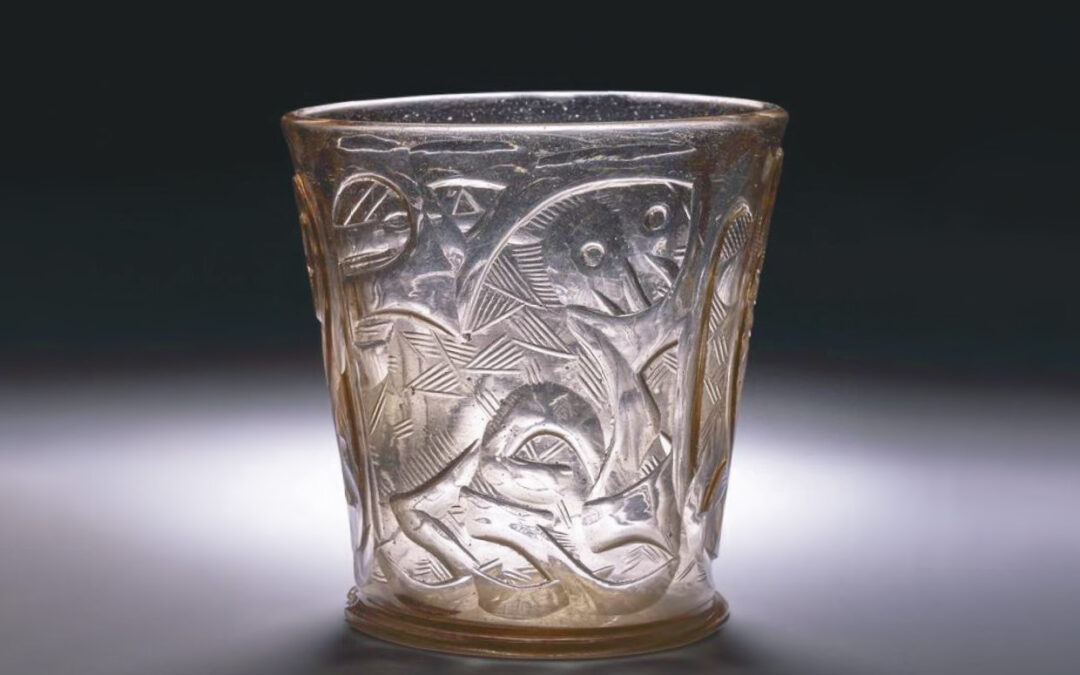
FRONT COVER: Hedwig Beaker in the collection of the British Museum (refer to article on pp.13 – 24), © Trustees of the British museum
BACK COVER: A Derbyshire pressed glass sugar bowl RD No.218988, 1868, with its lid: fluorescing under UV light. 25cm H, 15cm W. Private collection
Editorial
Chairman’s message
Ste vens & Williams Clive Manison
& Dresser
Etli ng glass Anton Doroszenko
Hedwig Glasses Katharine Coleman
Sowerby Pressed Glass Michael Upjohn
Mrs GOF Simon Wain-Hobson
Naz eing Glass Nigel Benson
GA 40th A nniversary David Willars
A
s we approach the close of a challenging year, we reflect on
the importance of keeping in touch with each other and
keeping the ‘glass-world’ connected through our publications
and meetings and stimulating our glass interests through
reading, researching and collecting.
Acknowledging the delay in this edition’s release, we are
presenting you with an array of in-depth articles, offering
a thought-provoking read to accompany you through the
winter months. Notably, Katharine Coleman’s comprehensive
exploration of Hedwig Beakers spans twelve pages, providing
readers with the fully updated text of her Robert Charleston
2023 lecture. Katharine plans to further her quest into Hedwig,
through an invitation to the Corning Museum of Glass, NY.
Clive Manison’s unwavering passion for Christopher Dresser,
particularly focusing on Claret Jugs, their metal mounts and
glass bodies, will continue in Glass Matters ,”endeavouring to offer
a deeper understanding of Dresser’s connections with glass-
makers. Michael Upjohn’s exploration of pressed glass remains
a captivating series. Involved in his father’s extensive collection,
abounding with rare and intriguing pieces, Michael has become
an authority on pressed glass. Sadly, we also present the demise of
another British glassmaking firm – Nazeing Glass is no more.
We are pleased to announce that Volume 2 of The Journal
of The Glass Society is well underway. Scheduled for release in
February 2024, this volume promises to build upon the success
of the previous edition.
As we bid farewell to 2023, let us raise our glasses to a brighter,
more hopeful year ahead.
3
4
10
13
25
31
33
39
Contents GM18.indd 2Contents GM18.indd 2 12/12/2023 11:4912/12/2023 11:49
CHAIRMAN’S MESSAGE
3
Chairman’s Message
David Willars
Glass Matters Issue No.18 December 2023
W
elcome to the latest edi –
tion of Glass Matters .
T his is your magazine
and we rely on your help in com –
i n g fo r w a rd w i t h s u g g e s t i o n s
fo r a r t i c l e s , p a r t i c u l a r l y t h o s e
with unusual glass-related anec –
dotes. Recently, for example, we
reached the fortieth anniversa –
r y of the formation of the Glass
Association. Attendees at the orig –
inal meeting included several cur –
rent members of the Glass Society,
among them Jennifer and Brian
Fir mstone – having infor med us
of this anniversar y occasion, some
memor ies have been recollected
in this issue of Glass Matters.
T h e i m p e n d i n g s a l e o f t h e
D u r r i n g t o n C o l l e c t i o n i n
November gave a small group of
us the op p or tunit y to ex amine
some of the ver y best examples
o f ra re 1 7 t h a nd 1 8 t h ce nt u r y
British drinking glasses to come
onto the market in recent years.
Many of you will be familiar with
the collection from an exhibition
at Broadfield House around the
time of the millennium. O thers
will have a copy of the excel –
lent c atalo g ue e di te d by R o ger
Dodsworth with contributions
from Martin Mortimer, Peter Lole,
S i m o n C o t t l e a n d Jo h n S m i t h
that accompanied the exhibition.
M o s t o f u s a r e c o l l e c t o r s ,
and whilst we may no t b e a ble
to aspire to the heig hts of this
p a r t i c u l a r co l l e c t i o n t h e re a re
a n u m b e r o f fe a t u re s t h a t a re
wor th p ointing out . First ly, by
the standards of many of us, the
Durrington Collection is relative –
ly small, numbering over seventy
outstanding pieces. Fur thermore,
ever y piece was of the ver y best
quality, comprising several Beilby
enamelled examples as well as two
Amen glasses and two Pr ivateer
glasses, one with an enamel twist
stem and enamelled in colour by
Beilby. It should be pointed out
that the owners were well advised
a l o n g t h e i r j o u r n e y b y J o h n
Smith, among others. The bulk of
the collection was formed over a
relatively short period, in this case
approximately thir ty years from
1985. One of the earlier sources
was the celebrated and mammoth
collection of Michael Parkington.
This collection was obvious –
l y fo r m e d at t h e h i g h e r l e ve l s
of the market where the con –
straints are more inf luenced by
ava i l a b i l i t y t h a n a ny f i n a n c i a l
consideration. Having said that
w e a l l h a d t h e o p p o r t u n i t y to
s e e i t o n d i s p l ay t we n t y ye a r s
or so ago and in that re gard we
should be grateful to the owners.
Now, however, the collection has
been dispersed and we look for –
ward to dis cover ing where and
when the pr ize pieces reappear.
At the time of writing we are in
the final stages of planning our
itinerar y for The Glass Society trip
to the beautiful city of Colo gne
i n S e p te m b e r 2 0 2 4 . K at h a r i n e
Coleman has used her ex tensive
knowledge of the area to plan a
tour taking us from Roman glass
at the Ro emisch-Ger manisches
Museum in Cologne through to the
large collection of contemporar y
glass assembled by Lilly Ernstung
and her husband Kur t at nearby
Muenster. I f you are interested
in joining the trip, please register
to enable us to assess numbers.
T h e s u b j e c t o f t h e e x c e s s
r e s e r v e s h e l d b y T h e G l a s s
S o c i e t y w i l l a g a i n c o m e i n t o
fo c u s at o u r AG M o n Tu e s d ay
20th Febr uar y 2024. A lthoug h
the level of reser ves fell slightly
over the course of the last year,
t h e y a re s t i l l h i g h i n a b s o l u te
te r m s w h e n m e a s u re d a g a i n s t
our turnover. O ver the course of
the last year we have made sev –
eral awards to the Isle of Wight
M u s e u m o f G l a s s , S to u r b r id ge
Glass Museum, The Biennale and
also Sunderland University, but
we are still looking for suitable
p ro j e c t s . Hav i n g fo r m u l a te d a
Donations Polic y, itself a lengthy
p ro ce s s , a g a i n s t w h i c h we c a n
e valu ate a p plic at ions , we ne e d
your continued help in identifying
suitable projects. T he Donations
Polic y, which may evolve fur –
ther as we are confronted with
d i f fe re n t re q u e s t s fo r f u n d i n g
is available to view on request.
David Willars, Chairman of !e Glass Society
Chairmen’s message GM18.indd 1Chairmen’s message GM18.indd 1 10/12/2023 13:5310/12/2023 13:53
Did Stevens & Williams Make Glass Bodies to
Designs by Christopher Dresser?
4 Glass Matters Issue no.18 December 2023
CLARETEEN BODIES
D. C. Manison
Fig.1An unusual opener of a Claret Jug covering lid
Continuing his interest in Clareteen
designs by Christopher Dresser, the
author’s article in Glass Matters 16 is
continued in the following text, look –
ing more closely at the glass bodies
made by Stevens & Williams, rath –
er than the silver or plate mounts.
S teven s & W illiams Des cr iption
Books 5 have proved of immense value
in Clive Manison’s ongoing research.
I
n 1981, a major exhibition devot –
ed to the work of Christopher
Dresser was held in the city
of Cologne. 1 The comprehensive
catalogue included photographs
o f almo st all o f the ex hibi t s ,
and included articles on Dresser
by Nikol aus PEVSNE R , S tuar t
DURANT, and Rüdiger JOPPIEN.
Writing of Dresser’s designs for
James Couper & Sons of Glasgow,
t h e c a t a l o g u e e d i t o r R ü d i g e r
JOPPIEN noted that this was the
only glasshouse with which Dresser
was known to have worked 2, but
went on to remark that he had pre –
pared designs for glass for everyday
use, including the claret jugs made
by Hukin and Heath, the glass for
which was possibly made by Stevens
and Williams of Stourbridge 3 (my
italics). It is possible that Nikolaus
Pevsner, who began the rehabilita –
tion of Dresser’s reputation in the
1930s, and who had met Dresser’s
daughters and photographed some
of his sur viving records, passed
on this suggestion. No authori –
ty was given for this suggestion 4,
and though it is not impossible
that the glass bodies of claret jugs
which have been widely attributed
to Dresser as designer were made
in Stourbridge, no evidence of glass
bodies in the distinctive shapes
of bodies in Design Registrations
made on 9 May 1881 (see illustra –
tions below) has been found in the
Stevens & Williams Description
Books 5, which record not only the
shapes of all the glassware produced
by that firm but also the costings.
Eight years earlier, in 1973,
as part of the celebrations of the
bicentenar y of the Birmingham
Assay Office, an exhibition of the
work of Birmingham silversmiths
was held in the Birmingham Art
Gallery. This included a number of
pieces made by Hukin & Heath. Of
particular interest is the catalogue
entr y for one particular jug , the
text of which is reproduced below.
“E 18
C L A R E T J U G
Cut Glass and silver. JTH 1892, mak –
er’s mark JHM (Heath and Middleton).
Registration mark 187357, pattern no.
8613. H. 11 ! (29.9). Lent anonymous –
ly. Plain foot and handle, the spherical
body with tall cylindrical neck elabo –
rately cut with grooves 6, upon which,
superimposed are deeply cut diagonal –
ly spiralling bands alternating with
flowers on the body and foliage on the
neck. Silver mount at the neck with
integral spout. A thin rod terminating
in a ball, hinged on to the cover, allows
the cover to be opened when pulled.
Registered in 1892. The operation
and appearance of the mount suggests
Dresser’s inf luence, but the glass jug
is ornamented in the conventional
Stourbridge manner of which he would
not have approved. The glass is like –
ly to have been supplied by Stevens
and Williams, whose records show
them to have been making the glass
duck bodies 7 for the fancy claret bot –
tles mounted by Hukin and Heath.
That design is dated 10/2/92, the
year also of this jug (Royal Brierly
Crystal 8). Dresser’s own glass for
James Couper and Sons in the 1890s
is very different in texture, colour and
shape. ‘Cutting is rarely to be rec –
ommended when so lavishly used as
to be the chief means of giving form
to the vessel; indeed, cutting should
be sparingly and judiciously used.’
Principles of Decorative Design, 2nd
CliveManison_GM19.indd 4CliveManison_GM19.indd 4 10/12/2023 21:0310/12/2023 21:03
CLARETEEN BODIES
5 Glass Matters Issue no.18 December 2023
LEFT Fig.2Probable Dresser design
RIGHT Fig.3Lid opens when the jug is tilted
FAR RIGHT Fig.4 !e hinged lever raises the lid on tilting
BELOW L EFT Fig.5 !readed bodies: assumed to be by Stevens & Williams
BELOW RIGHT Fig.6 Clareteen exhibited as a Dresser design, Cologne 1981. © Museum fur Kunst und Gewerbe
edition, p. 133. Both Elkington’s and
Hukin and Heath adapted elements of
Dresser designs for less austere effects.”
means to raise the covering lid, and
a similar lid can be found on the jug
in Fig.1 . An example of this type of
mount, marked JTH JTM and with
hallmarks for 1897-1898 was exhib –
ited in Ghent in 2007 9; the jug (Fig.2)
at 31.3cm high was catalogued as
‘Probably Dresser design’. A similar
body, though much taller, at over
50cm, is seen in Fig.3 . The brass
mount is unmarked. When the jug
is tilted, the lid remains level, so it
is possible to pour out the contents.
This type of mount, with a hinged
lever as the means of raising the
lid, is also seen on the claret jug in
Fig.4 . Threaded bodies of this kind
are both usually assumed and very
likely to be the product of Stevens
& Williams: this includes the three
unmarked pieces in Fig.5 ; the jug
on the right – marked ‘Claret’ – is
one of a series of pieces of glassware
with threaded bodies that can be
found in the Description Books, the
threading cut through to indicate
the intended contents. The mount
is silver, hallmarked for London
in the 1890s, unusually to the left
of the handle, but the sponsor’s
mark is not very legible. The elec –
troplate mounts of the large jug in
the centre and the jug on the left are
both unmarked, but similar handles
have been seen in silver with a spon –
sor’s mark for Heath & Middleton.
The clareteen in Fig.6 , in the collec –
tion of the Museum für Kunst und
Gewerbe, Hamburg, was exhibited
as a Dresser design in Cologne in
1981. Hukin & Heath continued
to use this form of handle and body
at least until 1908, as illustrated by
CliveManison_GM19.indd 5CliveManison_GM19.indd 5 10/12/2023 21:0310/12/2023 21:03
6 Glass Matters Issue no.18 December 2023
CLARETEEN BODIES
BELOW Fig.8 Body shape in Stevens & Williams Description Book, dated 1890
LEFT !TOP ” Fig.9 !e Description Book entry for Fig.8
RIGHT Fig.10 !readed claret Jug body attributed to Dresser by Christopher Morley
LEFT Fig.11 !readed Jug body for Chartreuse –
Description Book
BELOW Fig.7 Clareteens by Heath & Middleton (left) and Hukin & Heath(right), cf body and handle in Fig.6
the clareteen on the right in Fig.7 ,
which bears a Birmingham hall –
mark for that year. The clareteen
on the left (Fig.7) , with the hobnail
cut, has a sponsor’s mark for Heath
& Middleton, and was assayed in
London sometime after 1890 10.
This type of mount is to be seen
on the form of a body (Fig.8) which
has been identified in S tevens
& W illi ams Des c r ipt ion B o ok s
(Fig.9) 11, patter n 14776, d ated
to January 1890. Another inter –
esting threaded body recorded in
the Description Books is pattern
18021, with intaglio cutting to
indicate it was intended to hold
Chartreuse (Fig.10) . Christopher
Morley attributed a claret jug with a
threaded body (Fig.11) as a Dresser
design: he illustrated it on p.230
of his book, Dresser’s Decorative
Designs . It is stated to have a sil –
ver mount by Heath & Middleton.
One of the most intr ig uing ,
and hitherto unremarked entries
in the Description Books is shown
in Fig.12 . The entr y reads ‘10785
Dr Dresser shape globe clareteen
richly cut as 5623 see sketch’. It
is dated ‘10 November 1885’. The
entry for Pattern 5623 (Fig.13)
a p p e a r s to re a d ‘ S t ro n g W ide
Btm C lareteen rough & slotted
11 rows f latted & 48 pt star Btm’.
Though the form of this body
might well be considered a Dresser
shape, there is no indication in
the Description Books to link it to
Dresser. The date 28 July 1879
would appear to indicate the first
production of this form 12, but the
emendations (including reductions
in cost and selling price) would sug –
gest that it continued in production
for some twenty years. It is possi –
ble that this body was fitted with
a mount by Elkington, seen in the
clareteen in Fig.14 with a mount
assayed in Birmingham in 1886.
Elkington & Co. were silver –
smiths and electroplaters, with
workshops in Birmingham, and an
office in London. They are known
to have commissioned designs from
Dresser in the 1880s and may have
manufactured silver and silver plate
mounts to Dresser’s designs in the
1870s 13. It may be of significance
that their Birmingham workshops
were in the same street as those of
CliveManison_GM19.indd 6CliveManison_GM19.indd 6 12/12/2023 11:5112/12/2023 11:51
7 Glass Matters Issue no.18 December 2023
CLARETEEN BODIES
RIGHT Fig.12 Globe Clareteen –
in Description Book
RIGHT Fig.13 Clareteen –
in Description Book
Fig.14Pattern 5623 Clareteen body possibly with a mount by Elkington, 1886
Fig.15Same mount as the body in Fig.14, the body similar to the mount in Fig.16
Fig.16!is Claret Jug is accepted as being by Dresser Fig.17Clareteen – body pattern 5139
Hukin & Heath. Tilbrook writes
(p.25): ‘Dresser seems to have begun
designing for Elkington c. 1873,
though he may have been consulted
in an advisory capacity at an earlier
date’. At the end of the article, he
comments: ‘The Elkington met –
alwork commissions were among
the earliest undertaken by Dresser,
and this probably accounts for their
predominantly restrained appear –
ances, unlike those later commis –
sions (c.1879) for Hukin & Heath
and James Dixon and sons, where
the designs are positively eccentric.’
(Fig.12) , it is quite possible that it
indicates merely that the design
team at Stevens & Williams (John
Northwood, his son John, and
Frederick Carder) were aware of
Dresser’s designs, and were influ –
enced by them in their own work.
However, if it is, as the Description
Book sug gests, a “Dresser shape
globe clareteen”, the use of a hob –
nail cut on the body would give the
lie to the widely repeated sugges –
tion that Dresser was opposed to
the decoration of glass by cutting. 14
The claret jug in Fig.15 h a s
an identical mount to the jug in
Fig.14 , though the body is more
comparable to the b o dy of the
claret jug (Fig.16) , whose mount
was registered by Hukin & Heath
on 9 May 1881. It is general –
ly ass ume d that this l atter ju g
was designed by Dresser, but no
‘signed’ examples have ever been
CliveManison_GM19.indd 7CliveManison_GM19.indd 7 10/12/2023 21:0310/12/2023 21:03
8 Glass Matters Issue no.18 December 2023
CLARETEEN BODIES
found. A similar body (Fig.17) ,
this time with a mount by Hukin
& Heath, appears in Description
Book 4, pattern 5139 (Fig.18) , and
is dated to Januar y 1875. The text
reads: ‘Bulge Bottom C laret Jug
as 3877 cut f latted & 48 pt star
B[otto]m & eng[raved] ornamen –
tal scroll work with bead border.’
ABOVE !TOP ” Fig.18 Body shape, pattern 5139 in Stevens & Williams Description Book 4, 1875
ABOVE !BOTTOM ” Fig.19 Description Book showing body patterns 3964 and 3965
Fig.20!e Linthorpe pottery body form, with the monogram of Henry Tooth
possible to identify Pattern 3877,
i t s i l l u s t rat i o n i s a b s e n t f ro m
the page in Description Book 2.
The texts of the descriptions for
patterns 3964 and 3965 (Fig.19)
both refer to Claret Bottles. Body
shape 3964 would seem to have a
strong resemblance to the for m
of a claret jug in the collection
of the Badisches L andesmuseum
Karlsruhe (Fig.20) , referred to in
the Catalogue of the 1980 Cologne
e x h i b i t i o n , b u t n o t e x h i b i t e d
there. The form is also known in
a Linthorpe potter y body; though
this body does not bear the facsim –
ile Christopher Dresser signature,
i t do es have the mono g ram o f
Henr y Tooth, the manager of the
potter y in the period when Dresser
was closely associated with it.
A f u r t h e r l i n k t o d e s i g n s
attributed to Dresser is the treat –
ment of the widest part of the body,
as seen in the detail in Fig.21 . It can
be compared to the ornament on
the widest par t of the body of a
jug (Fig.22) manufactured by the
Watcombe Potter y Co., generally
thought to be a Dresser design.
T he major ity of the for ms of
g l a s s b o d i e s co n s i d e re d a b o v e
require some kind of mount: they
must therefore have been produced
to fulfil a contract, and probably
would not have been produced by
the company for its own purposes,
there being no references to the
mounts in the available records
(thoug h on a few occasions the
form of a handle is sketched in).
Dresser had pointed out that silver
and gold had an intrinsic value that
glass and ceramics lacked, and in
consequence, it was the decoration
applied to the glass or potter y item
that gave it a value. The original
production cost of a claret jug such
as that with the 5623 body illus –
trated above was 17/9 (£0.8875),
and it was sold for 30/- (£1.50);
subsequently the production cost
was reduced to 15/- (£0.75), the
CliveManison_GM19.indd 8CliveManison_GM19.indd 8 10/12/2023 21:0310/12/2023 21:03
9 Glass Matters Issue no.18 December 2023
CLARETEEN BODIES
RIGHT (top) Fig.21Detail of pattern 3964, showing ornament on the widest part of the body
RIGHT (BOTTOM) Fig.22!e Jug from the Watcombe Pottery Co is considered to be a Dresser design, cf the ornament on its widest part with Fig.21
jug selling for 27/6 (£1.375), and
by 5th Feb 1898 the jug was being
made for 10/- and selling for £1 16.
For thoughts and comments on
this ar ticle, C live Manison can be
reached at: broga999@yahoo.com
ENDNOTES
1. Christopher Dresser – ein viktori –
anischer Designer 1834 – 1904;
Kunstgewerbemuseum der Stadt
Köln, 13th Feb – 20th Apr 1981.
2. “Es ist die einziger Glashütte, mit der
Dresser nachweislich zusammengear –
beitet hat.” JOPPIEN in Christopher
Dresser – ein viktorianischer Designer at
p. 40. However, Dresser’s designs for
James Couper and Son were produced
a dozen years after his first known
design for Hukin & Heath.
3. “ .daß Dresser die Glasgefäße für die
Rotweinkannen von Hukin & Heath
entwarf, die vielleicht von der Firma
Stevens & Williams in Stourbridge
hergestellt werden.”
p. 40.
4. There is a suggestion in the Catalogue
of the 1973 Birmingham Exhibition
that Stevens and Williams produced
the glass for the H 13 (“askos”) claret
jugs, but so far, no trace of this body
shape has been found in the Stevens &
Williams Description Books.
5. Formerly held by the Broadfield
House Glass Museum, Kingswinford,
then in storage at Himley Hall, the
Description Books are currently being
restored ( 15, p.30) and
are due to be deposited on loan at the
Dudley Archive Office.
6. This is almost certainly threading, not
cutting.
7. Although I have access to photographs
of the Stevens & Williams Description
Books for this period, I have not been
able to confirm this.
8. Stevens and Williams changed the
company name to Royal Brierly
Crystal on receipt of the Royal
Warrant in the 1930s.
9. Catalogue no. 013.
10. The date letter is indistinct, but the
absence of the monarch’s head in the
marks indicates that the assay was
made after the abolition of the Excise
Duty on silver plate.
11. It is to be found in Description Book
14.
12. Pattern 5621 on the same page (a
three-lipped decanter) is dated 24 July
1879.
13. TILBROOK, Adrian; Christopher
Dresser: Designs for Elkington & Co.
in The Journal of The Decorative Arts
Society 1850 – the Present No. 9
ASPECTS OF BRITISH DESIGN 1870
– 1930 (1985) pp. 23 – 28.
14. “Cutting is rarely to be recommended
when so lavishly used as to be the chief
means of giving form to the vessel”
the case of pattern 10875 it does not
form the vessel so much as emphasise
its shape.
15. In Principles of Decorative Design , at
p.3: “The most fragile material often
endures for a long period of time,
while the almost incorrosible silver
and gold rarely escape the ruthless
hand of the destroyer.”
in 1890 would have the purchasing
power of £150 today.
CliveManison_GM19.indd 9CliveManison_GM19.indd 9 10/12/2023 21:0310/12/2023 21:03
Discovering E TLING G LASS
10 Glass Matters Issue no.18 December 2023
ETLING BROUGHT TO LIGHT
Anton Doroszenko
Fig.1Oval tray with octagonal central panel with !owers, 36cm x 22.5cm x 4.5cm high
A
l t h o u g h e n t h u s i a s t s o f
F re n c h A r t D e c o d e s i g n
may be aware of Edmond
L aurent Etling , the man himself
and his business activities large –
ly remain an enigma. His glass is
significantly less well known com –
pared with contemporaries, most
par ticularly L alique, despite the
impressive quality and design of
much of Etling ’s productions. The
Isle of W ig ht Museum of Glass
started acquiring Etling glass some
ten years ago and now has about
eighty different designs in its col –
lection. The more we acquired the
more we asked the question: why
is Etling glass not better known?
Although Etling has scattered
mention in various publications,
there is no dedicated book on his
glass. And there are few ar ticles
in magazines, either dur ing his
time in business from the 1900s
to 1940s or later. There is no clear
understanding of the activities of
Société Anonyme Edmond Etling or
Edmond Etling & Cie . This is per –
plexing given that Etling had pres –
tigious galleries in Paris offering
not only glass, but also fine bronze
sculpture, often embellished
w ith ivor y, as well as ceramics
and other elegant interior décor.
A BRIEF HISTORY
From what can be gleaned from
the disparate literature, the com –
pany of Etling et Cie emerged about
1906 when Edmond Laurent Etling
acquired Galerie Béranger at 158 Rue
du Temple in Paris’ 3 rd arrondisse –
ment . Sometime before the end
of the First World War Edmond
Etling died. The company was left
to his widow Marthe who, around
1919, sold the business to Etling ’s
nephew, Julien Drey fus. Under
his direction Etling et Cie would
become one of the most import –
ant and inf luential exponents of
the Art Deco movement in Paris.
Dreyfus commissioned France’s
top artists, sculptors, and industri –
al designers of the period, includ –
ing Demétre C hipar us, Georges
Béal, Lucille Sevin, Georges H.
L a u r e n t , G e n e v i è v e G r a n g e r,
Marcel Guillard, Jean-Théodore
Delabassé, and Géza Hiecz. Lucille
S e v i n a n d G e n e v i è v e G ra n g e r
designed many of the figural vas –
es and statuettes. Sevin’s women
were distinctly classical in inspi –
ration, while Granger ’s mo dels
were more inf luenced by current
fashions. Georges Béal designed
many vases and bowls with flo –
ral and foliate motifs, with some
pieces signed ‘Beal’ moulded in the
glass. G.H. Laurent and Géza Hiecz
produced many designs featuring
birds, animal figures and even fish.
T he company exhibited with
g re at s u cce s s at t h e l a n d m a r k
E x p o s i t i o n I n t e r n a t i o n a l e d e s
A r t s D é c o r a t i f s e t I n d u s t r i e l s
Modernes in Paris in 1925, further
enhancing their prominence in the
French decorative arts. Sometime
after this exposition E tl i n g e t
Cie moved to larger show rooms
at 29 Rue de Paradis in the 10 th
arrondissement in northeast Paris.
The highly commercial success
o f R e n e L a l i q u e ’s i n d u s t r i a l l y
produced moulded glass spurred
countless other glassmakers to
follow in his footsteps to produce
simil ar g l a ss , inc luding E t ling.
Etling’s glass was primarily opal –
escent or frosted; coloured pieces
are rare. Etling engaged a g lass
works at Choisy-le-Roi on the out –
skirts of Paris to realise their glass
designs. However, the signatures
‘Richard’ or ‘Richard et cie’ in better
quality pieces were used on cameo
Etling Glass_GM18.indd 10Etling Glass_GM18.indd 10 09/12/2023 23:3309/12/2023 23:33
ETLING BROUGHT TO LIGHT
11 Glass Matters Issue no.18 December 2023
ABOVE Fig.2 Hexagonal vase on a round base, with acacia (mimosa) foliage and !owers on each side panel, 17cm x 17cm at the rim, 19.5cm high, 11.4cm diameter base. Designer, George Beal
BELOW Fig. 3 Hexagonal shaped vase with a face to each side, 26cm high, 24cm at widest point and 7cm deep. Frosted (satin) glass with a polished patterned border. A brown tinted example is known. Designer, Maurice Model?
glass made by Loetz for Etling from
1921 onwards. A pparently, the
orders for the cameo glass were
handled by J. Jouve, a firm trad –
i n g i n g l a s s a n d o t h e r g o o d s ,
located a few doors down from
Etling’s shop in rue de Paradis.
Sadly, Etling et Cie ceased to
exist during the German occu –
pation o f France dur ing World
War II. It is believed that Julien
Dreyfus met the same fate as
other Jewish business owners
who were stripped of their busi –
nesses and assets. T he company
ceased to exist from around 1942.
It should be noted that some
Etling designs were reissued after
the war. T hese were unmarked,
p o o r l y f i n i s h e d , a n d p ro d uce d
in clear or frosted glass, but also
sometimes in pastel colours such
as pink, powder blue, green, yel –
low, and mauve. In the 1980s ,
Cristalleries de Sevres re i s s u e d
t w o o f S e v i n ’s n u d e f i g u r i n e s
f o r E t l i n g , f r o m t h e o r i g i n a l
m o u l d s , i n c l e a r g l a s s . T h e s e
were signed Cristal de Sevres.
FUTURE RESEARCH
T he museum has been working
quietly for the last five years to
increase the appreciation of Etling
g l a s s a n d t h e m a n b e h i n d t h e
name. We began by creating a sim –
ple catalogue of the glass on a tem –
porar y project website. Currently
just over two hundred designs are
listed. A few of these ‘sculptural’
it became clear that the museum
did no t have the res ources and
expertise to progress the project
much beyond the catalo g ue. We
needed assistance on the ground
in France to investigate fur ther.
A research grant from the Glass
Society has been a great help.
T h e re s t o f t h i s a r t i c l e w i l l
explain our plans and approach to
this challeng ing endeavour over
the next two years. Our first step,
Etling Glass_GM18.indd 11Etling Glass_GM18.indd 11 09/12/2023 23:3309/12/2023 23:33
12 Glass Matters Issue no.18 December 2023
ETLING BROUGHT TO LIGHT
and the most straightfor ward, is
to create a permanent website at
www.etling.org to for m a focus
for Etling studies. It will include
t h e c a t a l o g u e , d o c u m e n t a t i o n
and research resources, and a dis –
cussion forum — all bilingual, in
English and French, of course. We
hope to have the website fully up
and running by the end of 2023.
T he nex t steps will be much
more challenging, since funda –
mental questions remain. W ho
was Edmond Etling and what is
the history of his company? As out –
lined above, there is so little firm
information and many unsubstan –
tiated claims about Etling that it
was decided to start almost afresh.
Some things we do know for sure.
For example, the company pro –
duced product catalogues in 1926
and 1930. But there are only two
known extant copies, one in the
USA and another in Germany, and
all we have seen so far is a picture
of the front cover and one inside
page. Additionally, some ar ticles
were published in the French jour –
nal Mobilier et Décoration . Etling ’s
advertisements have proved useful
since they give business address –
es, images of their products, and
sometimes mention awards, such
as a gold me d al awarde d at an
exposition in Br ussels in 1910.
Clearly, there are a lot of gaps to
fill. Sur prisingly little is exposed
by the publicly accessible catalogue
of Bibliothèque nationale de France .
I t i s h o p e d t h at a n acc re d i te d
archivist can help us access fur –
ther materials sitting on librar y
shelves or kept in storage in Paris
as well as at Médiathèque Aragon
and Service Archives Documentation
Patrimoine both in Choisy-le-Roi.
Local knowledge is, of course,
especially valuable. L’A ssociation
L o u i s L u c p o u r l ‘ H i s t o i re e t l a
Mémoire de Choisy-le-Roi a n d
their book L’Histoire du ver re à
as well as the soci –
ety’s archives may be good sourc –
es o f infor mat ion, par t ic ul arly
of S evres and other companies
that had business dealings with
Etling. Many other sources will
be consulted, including registers
of companies, local government
offices in the Paris arrondissements ,
newspapers, product design regis –
tries, and business directories.
The glass museum invites partici –
pation by anyone interested in help –
ing us. We want to make the project
a real community effort. It should
be fun! Anton would be delight –
ed to welcome you to the muse –
um, he can be contacted at: info@
isleofwightglassmuseum.org.uk
THE AUTHOR
Anton Doroszenko, founder, own –
er and director of the Isle of Wight
M u s e um o f G la ss , wa s b or n a nd
brought up in Edinburgh, Scotland.
From a young age he became a col –
lector and organiser. He went on to
complete a PhD in ta xonomy and
s ystematics at the R oyal B otanic
Garden in Edinburgh and then work
for 38 years in life sciences publish –
ing. His passion for Isle of Wi ght
Studio Glass, under Michael Harris,
started in 2008. Appreciation of the
skill and craftsmanship of handmade
studio glass and the eventual size
of his collection was the impetus to
establish the Isle of Wight Museum
o f G la ss in 2016. A n in teres t in
French Art Deco glass, particularly
Etling, also started about that time.
ABOVE (LEFT) Fig.4 ‘Femme nue au bras tendu’, 20.5cm high. Said to represent the ballet dancer Isadora Duncan. Known with a circular metal base. Opalescent glass. Designer, !Lucille Sevin, 1933. Perhaps in the 1950s, this model was reproduced in frosted glass from the original moulds by Cristalleries de Sevres. In the 1980s, Sevres issued a limited edition of 2000 in full crystal, again from the original moulds. “ese were signed ‘Cristal de Sevres’ and numbered
ABOVE !RIGHT ” Fig. 5 A ‘Caravel’, 19cm x 19cm x 6cm. Frosted (satin) glass. Designer, !Lucille Sevin. Dated to 1930 or before. “is design is shown in the 1930 catalogue
Etling Glass_GM18.indd 12Etling Glass_GM18.indd 12 09/12/2023 23:3309/12/2023 23:33
HEDWIGS
13 Glass Matters Issue no.18 December 2023
The Hedwig Beakers: A n Engraver’s View
Katharine Coleman
LEFT Fig.1!e British Museum’s Hedwig’s Beaker © Trustees of the British Museum
RIGHT Fig.2Glass Engraving Tools in Katharine Coleman’s studio. L-R from top: Assortment of copper wheels, some already drilled for mounting on spindles; steel spindles, with copper wheels mounted at their tips; some natural and synthetic stone wheels with lead ‘bushes’ to mount on screw-headed spindles; lead polishing wheels; polishing wheels (modern synthetic material); previously would have been the same shape and varying size and pro “le but made from poplar wood or cork – the latter are always chosen as their wood has minimal grain. Each wheel is used with varying abrasives – mostly locally sourced sands and pumice and from coarse to “ne: mixed with oil – for cutting; or water – for polishing. For hardstone cutting, garnet sand would have been used where available
Katharine Coleman MBE gave the Robert
Charleston Lecture in June 2023 by Zoom
and in person at the ArtWorkers Guild,
London. She presented a well-illustrated
and extensively researched talk into the
Hedwig beakers, a task she intends to
continue. The lecture is printed in full.
INTRODUCTION
I
first met Robert Charleston in
1986 at a lunch hosted by the
Worshipful Company of Glass
Sellers of London. Charleston was
being honoured, both for his signif –
icant contribution to the knowledge
of glass as one of the 20th Century’s
most distinguished Keepers of
Ceramics and Glass at the Victoria
and Albert Museum in London, from
where he had recently retired, and
also as a highly respected academic,
inspiring mentor to curators, enthu –
siasts and collectors alike. In 1986
I was also receiving an award as a
first-time exhibitor in an exhibition
by the Guild of Glass Engravers. So,
approaching the end of my engraving
career, it was an honour and pleasure
to give the 2023 Robert Charleston
lecture on glass engraving, close to
sixty years since Robert gave his great
paper in March 1962 to the Glass
Circle, Wheel Engraving and Cutting:
Hedwig GM18.indd 13Hedwig GM18.indd 13 10/12/2023 21:0410/12/2023 21:04
HEDWIGS
14 Glass Matters Issue no.18 December 2023
LEFT Fig.3!e Portland Vase © Trustees of the British Museum
Some Early Equipment 1, in London.
Robert Charleston was a good
friend and mentor of glass engraver
Peter Dreiser, who so patiently taught
me glass engraving in the 1980s.
They both appreciated historic glass
as much as contemporar y work,
swapping information about tools,
techniques, engraving and history.
GLASS AND HARD !
STONE ENGRAVING
The tools used by engravers of hard –
stone and glass were mostly identical,
from Babylonian times right up to
the later 19th century. Charleston
illustrated his Glass Circle paper with
the first recorded image of a glass
engraving lathe as carved on the
tombstone of an eighteen-year-old
Hellenistic gem-engraver, one Dorus
of Sardis, showing the bow drive and
bearings 2. Essentially an extension
of the bow drill, such lathes were
used for cutting hardstone seals and
intaglios as well as glass items. It was
a busy craft, spreading from Babylon
and Egypt across the Middle East. The
tools I use in my studio (Fig.2) have
not changed significantly since then,
except that I enjoy an electric motor
driving my wheel, a comfortable seat
and more plentiful supplies of copper
and lead. The tools used in Babylon,
Egypt and Rome were still
being used in early Islamic
times and continued in
Europe in later centuries.
“It seems extremely
probable that a link between
hardstone and glass engrav –
ing has existed all through
history.”
film “How Was It Made?
Glass Engraver, Katharine
Coleman”, accessible from
the V&A Museum website
and YouTube). https://
www.youtube.com/
watch?v=230uCZj2RPs
What has become of
such tools since then? They are never
identified in archaeological excava –
tions or museum collections – maybe
the copper was recycled, the precious
lead melted for other use and the stone
wheels, if the engraver was long gone,
re-used as loom weights. Perhaps the
smaller wheels have been misidenti –
fied as beads, the larger ones as loom
weights or knife and tool sharpeners.
A careful search through the miscel –
laneous dull oddments boxes from
excavations in museum basement
stores might yet yield the first-ev –
er-recorded glass engraving tools.
They have no artistic or other obvious
attractions for the archaeologist and
may well be confused with other tools.
After the decline of the Roman
Empire in the 4th centur y, glass
engraving and most hardstone
cutting died out in Europe, mainly
because suitable glass was no lon –
ger produced and the sourcing of
suitable hardstone, e.g. rock crystal
and agates, became exceptionally
difficult. We forget, however, that
beautiful glass continued to be made
by the Sasanians and in later Islamic
regions; as Charleston said: “In the
9th- 10th centuries, there flour –
ished in Persia and probably also in
Mesopotamia, a school of relief-cut –
ting which was not rivalled until the
end of the 17th century in Europe.”
GLASS !E N G R A V I N G
HISTORY
The great moments in glass-engrav –
ing history coincide with the great
moments in glassblowing technol –
ogy. From the outset of the great
flowering of arts and culture under
Augustus Caesar in the century around
1 AD came the appearance of the first
opaque white overlaid coloured glass,
cameo cut by virtuoso engravers who
produced the famous Portland Vase
(Fig.3) and many other treasures. Their
reproduction, with variable success, by
master engravers in the 19th and 20th
centuries have never quite equalled the
virtuosity, delicacy and subtlety of the
Roman originals. A fragment of deep –
ly sculpted and polished ruby glass in
high relief, photographed in Tehran
Museum in the 1920s, was known
in archaeological publications as the
Pharos Beaker , after the great light –
house of Alexandria and was believed
to be 4th century AD. The shard was
lost in the sacking of the museum in
1979 but its astonishing modelling
of boats, triremes, the Pharos itself
and sea creatures, inspired Professor
Josef Welzel of Hadamar to attempt
a full-scale 30cm high reproduc –
tion (Fig.4) , only using tools that
BELOW Fig.4Reproduction of the Pharos Beaker by Josef Welzel
Hedwig GM18.indd 14Hedwig GM18.indd 14 10/12/2023 21:0410/12/2023 21:04
HEDWIGS
15 Glass Matters Issue no.18 December 2023
Fig.6!e ‘St Elizabeth’ Hedwig Beaker in Veste Coburg Museum
Fig.5Size comparison of “fteen Hedwig beakers (without the feet)
It is not known whether the orig –
inal was engraved in Egypt or Persia,
but the accomplishment shown in
the original is breathtaking. Welzel
also discovered how the Lycurgus Cup
and the famous Rhineland Diatreta
or Cage Cups were engraved, making
reproductions using only tools known
to have existed in Roman times. He
rarely recorded his work beyond
local journals, though occasionally
in the Journal of Glass Studies at
Corning. Many German museums
have examples of his astonishing
cage cups, proving that they can
stand on their cage and not just serve
as lamps. It was an honour to have
known him and translate the essays
by German museums and scholars
in tribute to him, published by the
Rheinbach Glass Museum in 2017. 5
Josef Welzel only tried once to
reproduce a Hedwigs Beaker. His copy
was too perfect, the background cut
away too smoothly, and the result –
ing lifelessness of the copy betrays
it as such. Maybe Welzel was less
interested in them technically, or
maybe he appreciated the difficulty
and stopped producing them after
the first copy. Few others have tried,
for although the Hedwig glasses look
beguilingly simple to cut, they are
actually very sophisticated and diffi –
cult to understand and imitate. Like
the masterpieces from the artists
and workshops some thousand years
before the Hedwigs that produced the
Portland Vase and Pharos Beaker, the
Hedwig Beakers may represent anoth –
er period that witnessed the short
flowering of an exceptional glass blow –
ing and cutting moment in history.
T H E K N O W N H E D W I G
BEAKERS
There are fourteen known com –
plete Hedwig beakers (or glasses), as
well as fragments of more found in
archaeological excavations in Russia,
Poland and Italy. Such vessels are
called “Becher” (beaker) in German.
The glasses are named after the
Silesian !princess (1174–1245), later
canonised in 1267 as Saint Hedwig,
to whom three of them are said to
have belonged. !They were certainly
made long before Hedwig was born.
Egypt, !Iran, Sicily, Tyre !and !Syria are
all being suggested as possible sources:
if they are not of Islamic manufacture
they may be influenced by !Islamic glass
and iconography. They may have been
made by !Muslim !craftsmen, though
some authors are convinced that some
of the !iconography !is Christian. 6 There
was a thriving export trade in Islamic
art objects carried back through Acre
Hedwig GM18.indd 15Hedwig GM18.indd 15 10/12/2023 21:0410/12/2023 21:04
HEDWIGS
16 Glass Matters Issue no.18 December 2023
Fig.7!e Hedwig Beaker in Corning Museum of Glass
and Tyre by the returning Crusaders
and a fashion in Europe for these tro –
phies. There is considerable support
by recent authors for the theory that
these beakers originate from Norman
Sicily in the 11th century, from the
Saracen workshops associated with
the Norman court in Palermo, as out –
lined in 2005 by Rosemarie Lierke.
The Hedwig glasses are all large, squat,
thick-walled and funnel-shaped, with
a foot at the base, mostly about 14cm
high and some 14cm in diameter 7
(Fig.5) 8. All but one of these glasses
are deeply relief-cut and polished.
There is no satisfactory explanation
for the variation in size. The variation
in height may suggest they were made
in batches, the blower(s) adjusting the
size following the advice of the engrav –
er or client, the quantity of molten
glass in the pot, the room in the anneal –
ing oven above or simply because the
blower gauged the size by eye rather
than calliper. Handblown and made
by eye, their rims sheared off as and
when they were blown, some varia –
tion is not surprising. The mystery
underlying their size is their intended
function. Even the smallest is large for
a drinking vessel. They may have had a
ritual function and the great range in
size might point to a purely decorative
function. There was a superstition in
Fatimid society that those who drank
from crystal vessels would never
thirst again. This superstition may
have prevailed further East as well.
The application of the slightly
raised foot is beautifully done on all
of the beakers, allowing the blower to
neatly crack the finished glass off the
pontil iron and leave it so. The bea –
kers are of smoky brownish/yellowish
metal (glass), a third having abstract
decoration, but the rest are decorated
with stylised lions, griffins, palm trees
and similar motifs. I can find no con –
vincing published study of the motifs,
although some earlier sources acknowl –
edge their debt to Zoroastrian iconog –
raphy (Lamm, CJ; Schmidt, R. et al).
T h e S t E l i z a b e t h ’s b e a k e r
(Fig.6) in the Veste Coburg collec –
tion is a splendid example of the
abstract design beakers, though
even here one can decipher hearts,
Zoroastrian palm tree shapes and
other signs among the motifs.
The decorations on the Hedwigs
Beakers are thought by some to have
been inspired by the Fatimid carved
rock crystal objects, highly prized
at the time in Europe. Many of the
beakers certainly ended up in church
treasuries, which possibly explains
their sur vival and fine condition.
There would appear to be more
whole beakers than fragments dis –
covered so far. Several glasses were
mounted in gold and silver, hence the
variable cutting of the feet at a later
date by silversmiths to fit the glasses
securely into mountings, especially
if the mounted beakers were to be
used as a chalice in the liturgy. ! Some
were originally given other metal –
work settings, but not all mount –
ings have sur vived, as is the case
with the Hedwig Glass at Corning
Museum of Glass (Fig.7) .!Seven of
the known Hedwig glasses have
13th to 15th- century metal mounts.
WHO WAS HEDWIG?
From several sources, e.g. The J Paul
Getty Museum and The Catholic
Encyclopaedia, vol 7, New York, 2007,
it can be ascertained that Saint
Hedwig of Silesia was born Hedwig
von Andechs in 1174, daughter of
the powerful Count Berthold VI von
Andechs-Meran in Bavaria. Aged
12, she was married to the consider –
ably older Duke Henry I of Schlesien
(Silesia) und Polen, “The Bearded”,
whose reign was dominated by an end –
less fight over land. Hedwig’s younger
sister Gertrude married King Andrew
II of Hungary and her older sister mar –
ried King Philip II of France. Hedwig
had seven children before her famous
miracle; according to a legend later
recorded in 1353, her husband, Duke
Henry, disliked her modest, pious,
ascetic practices, which included drink –
ing only water. Once, when dining, he
sent a servant to the far end of the
table where Hedwig sat, to determine
what she was drinking and was aston –
ished to learn that the contents of her
cup had miraculously changed into
wine. Soon after, Hedwig retired to a
convent. Following her death in 1243,
Hedwig’s three beakers were seen as
carrying other miraculous properties
on the strength of her miraculous con –
version of water into wine and became
Hedwig GM18.indd 16Hedwig GM18.indd 16 10/12/2023 21:0410/12/2023 21:04
HEDWIGS
17 Glass Matters Issue no.18 December 2023
highly sought after by religious houses.
Hedwig was canonised in 1267 and
became the patron saint of brides, but
her popularity – more German church –
es are dedicated to her than to any
other saint – may be connected with
her ability to turn water into wine.
The appearance of the strange, beau –
tiful, deeply carved glasses, unlike any
others known in Europe, must have
added greatly to their saintly mystique.
Hedwig ’s niece, Elizabeth of
Thuringia (1207 – 1231), inherited one
of Hedwig’s own beakers – the glass at
Ve s te C o b u r g (Fig.6) , which became
valued for its apparent assistance with
labour and childbirth to women who
drank from it. Elizabeth also became
canonised. Hedwig’s other two beakers
were destroyed by bombardment in
World War II, including the one with
which Hedwig’s miracle was purported
to have been made. This beaker was
last seen and recorded in Breslau,
decorated with particularly fine lions
placed either side of a Zoroastrian
chalice with crescent moon and star,
and also a stylised palm tree (Fig.8) .
Many of the Hedwig Glasses or
Beakers have lion, eagle, griffin and
palm tree motifs but there is a small
group with complex abstract designs,
including the beaker given to St
Elizabeth, which became part of the
royal Saxon treasury. St. Elizabeth’s
was listed as one of the relics in the
collection of Elector Prince Frederick
the Wise (1463-1525) and recorded
in 1507 in a drawing by Lucas Cranach
the Elder. The Wittenberg treasury
of relics comprised some 20,000
objects in 1520. When the collec –
tion was later dissolved, the beaker
was given by the Protestant Saxon
Prince to Martin Luther. In 1541
Pastor Johannes Mathesius repor t –
ed that Martin Luther even handed
him and other guests wine to drink
from in this very glass at dinner. 10
The cutting on this particular glass
in the Veste Coburg (Fig.6) appears so
sharply defined and bright, the surfac –
es absolutely unscratched; considering
the handling it must have experienced
over the centuries, it may well be
that it could have been ‘restored’ or
‘improved’ by sharpening up by a more
recent engraver with further polish –
ing, especially after the handling at
Luther’s dinner table. This might also
explain the edge cuts near the rim.
DATING THE HED !
WIGS BEAKERS
The earliest recorded reference of
any Hedwigs Glass is thought be
that of the two beakers donated to
the monastery of St Nicholas d’Oi –
gnies aux Soeurs de Notre-Dame
in Namur, Belgium by Jacques de
Vitr y, Bishop of Acre 1216-1226.
While not listed per se by Vitry, the
two early Hedwig Beakers arrived
at Oignies and were immediately
mounted in precious metal, remain –
ing there ever since, their mounts
making them d atable precisely
as 1233. At the time, Acre a saw
a busy trade in souvenir Islamic
treasures, European knights using
this port to return home from the
First Crusade. Many had developed
a taste for ‘exotic ’ Fatimid rock
cr ystal and Islamic glass, much
of which was being sold by the
desperate Shia Fatimids as they
emptied their Cairo treasur ies,
buying off threats of invasion by
Sunni Saladin and his followers
until the Fatimid downfall in 1171.
T h e t i m i n g o f t h e r e t u r n
of B ishop K arl von K rosigk to
Halberstadt from Constantinople,
Tyre and Rome in 1205 is another
useful date as there was a known
beaker at Halberstadt. Fragments
of another beaker have been found
in a building erected in 1235 and
burned down in 1275 at Brno 11, all
of which help with definitive dat –
ing and the analysis of fragments
of fur ther beakers excavated at
Hilpoltstein and Novogrudok. 12
AR G U M E N T S A B O U T C H E M I C A L A N A L Y S I S AND PROVENANCE
Karl Hans Wedepohl 13 compared the
chemical composition of the Hedwigs
with glassware found in a shipwreck
(sunk ca.1025) off Tyre and also with
a cargo of some 780 Roman soda-lime
glasses and concluded they are of sim –
ilar chemical composition. He also
finds high correlation between the
Hedwigs’ chemical composition and
some 214 Islamic soda ash glasses.
He even speculates that the Hedwigs
were blown from cullet imported
from further away in Persia. On the
other hand, Rosemarie Lierke, who
spent some forty years researching
the Hedwigs beakers, is convinced
that the Hedwigs originate from
workshops in Norman Sicily because
the iconography matches that of the
mosaics of the Norman cathedral
in Palermo. The argument against
Islamic roots for the Hedwigs is that
Islamic glass of that period was so
thin-walled and enamelling was the
main form of Islamic glass deco –
ration of this period. She does not,
however, address the Zoroastrian
iconography in some of the bea –
kers, nor the engraving in detail.
The argument for a 12th cen –
tur y source in Sicily continues to
be made by Jens Kröger (2006)
and Rosemarie Lierke (2005), con –
cluding: ‘A detailed, stylistic study
would have been able to show that
Fig.8Design drawing of Hedwig’s own glass from Breslau, by Wedepohl and Koch
Hedwig GM18.indd 17Hedwig GM18.indd 17 10/12/2023 21:0410/12/2023 21:04
18 Glass Matters Issue no.18 December 2023
the Hedwig beakers present a coher –
ent group made by craftsmen outside
the hitherto known centres of Islamic
glass with only very few connections to
works of Islamic art. The uniqueness
of their motifs makes many of the bea –
kers masterpieces of medieval glass’. 14
Richard Ettinghausen (1987)
totally abstract design, including the
Coburg glass, with Samarran Style
C, from the early 10th century, the
Asseburg and Neisse glasses possi –
bly being a little later. He debated
with Shalem (1996)
came from such an early period.
Baumgartner and Kruger assembled
several Hedwigs in an exhibition in
1988 in Munich and concluded that
they were as foreign to Islamic as
to West European art of the peri –
od. 17 At one stage Pinder-Wilson
in 1991 18 proposed the Sicilian
and South Italian workshops that
developed alongside the hardstone
cutting schools and cameo cutters
supplying the court of Frederick II –
and the debate has raged ever since,
before he later changed his mind.
David Whitehouse (2002)
a clear and informative paper as well
as an excellent Wikipedia entry on
the Hedwigs, concluding that they
were ‘
execution, but that they were also
non-Islamic in purpose’
iconography was Christian in con –
text and that the form was liturgi –
cal, not table glass. This would be
despite the 9th century Papal edict
(Pope Leo IV) forbidding the use of
glass in the liturgy unless mount –
ed in protective metal. Despite
t h i s c o n c l u s i o n , W h i t e h o u s e
maintained that Islamic influ –
ence was nonetheless significant.
Wedepohl (2005) –
ed before his paper on the fragment
of a beaker excavated at Brno, that
from compositional analysis the
glasses could have European prove –
nance, suggesting their source was
Acre, Tyre or Palestine. He agreed
with Distelberger (2004)
style of cutting is related to stone
vessels of Dcthucentury Sicilyn This
was also agreed with by Rosemary
Lierke Mc..2t who was convinced
that the glass was made in Sicily
during the reign of William II of
Hauteville MDD00uDDHEtn There is
growing opinion that several carved
rock crystals come from Sicily rath u
er than the Fatimid workshopsn It is
also suggested that the glass cutters
working in Fatimid Egypt may have
moved elsewhere for work follow u
ing the fall of the Fatimids in DD3Dn
Lierke Mc..2t describes how a
mixed Nor manoSaracen culture
blossomed under the Norman kings
of SicilyI famous for their beautiful
handworkI carvingI textilesI mosaics
and ceramicsn After KonstanzeI sis u
ter of Wilhelm III the Norman king
of SicilyI was married to the Kaiser
in DDHb I a whole caravan loaded
with treasure was sent North in
DDH2S there may have been Hedwig
glasses in this treasuren The mar u
riage was held in Milan in DDH0n cc
The rapid decline and political
instability of the region surrounding
the Sicilian Norman court in the later
Dcth century persuaded Henry VI to
send his main treasures north for safe u
keeping in the early years of the Dmth
centuryI including the beautiful cope
and probably the rest of the Hedwig
beakersI as Henry VI gave one to each
of his relatives and supporters which
included Berthold von Andechs und
MeranI father of Hedwign Whether
made in Sicily or in the Middle EastI
it is credible that most of the Hedwigs
passed through Sicily on their way to
the northern European courtsI partic u
ularly the German and Polish rulers of
the timeI either as wedding gifts or in
thanks for their earlier support during
the later troubles of the Norman Court
in Sicilyn HoweverI in no way does
this confirm that they were made in
Sicily in the Dcth or Dmth centuriesn
ICONOGRAPHY
E x amining the icono g raphy on
the beakers reveals many possibil –
ities for provenance, there being
comparisons with the Persian Tree
of Life and Samarra Style C and the
Tulunid versions of that, suggesting
their origins in the early 10th cen –
tur y if that is so. Robert Schmidt
(1912) 23 suggested in an extremely
useful paper that the crescent and
star suggest the coat of arms of the
Ayyubid period. The chalice with
crescent and star is also a known
Z oroastr i an symbol, as is the
stylised palmette tree on Hedwig’s
own beaker (Breslau). The eagle,
lion and griffin were often repro –
duced in Fatimid and Ayyubid art,
just as they appear in Christian art.
Jens Kröger 24 concluded that ‘
is for art historians of European art to
place the Hedwig beakers into context
now that it has been demonstrated
by a number of authors that they do
not belong to the corpus of Islamic
art.’ This may not be so. They may
belong to pre-Islamic art from fur –
ther East of Damascus. After close
examination of a fragment of a
Hedwig glass with a heart-shaped
palmette (Fig.9) similar to the St
Elizabeth Hedwig (Fig.6) that had
been found in the excavations of a
medieval building erected in 1235
BELOW Fig.9 Image and design sketch of shard
HEDWIGS
Hedwig GM18.indd 18Hedwig GM18.indd 18 10/12/2023 21:0410/12/2023 21:04
19 Glass Matters Issue no.18 December 2023
in Brno and that had burned down
soon afterwards in 1275, Wedepohl
concluded ‘Because the production
of soda-ash glass was restricted to
Islamic world factories between 900
and 1250, the glass of the Hedwigs
Beakers apparently comes from this
region.’
Pesek M and Sedlackova , H. 25,26
Another beaker engraved with only
abstract designs was in the hands of
the Counts of Asseburg from 1223,
almost as early as those recorded at
Namur. It is now in the Metropolitan
Museum of Art, NY (Fig.10) .
T H E C O N T I N U I N G
R E L A T I O N S H I P
B E T W E E N H A R D S T O N E
A N D G L A S S C U T T I N G
AND ENGRAVING
So what light does an examina –
tion of the cutting and engraving
shed on the highly contested prov –
enance of the Hedwig Beakers?
A few years ago I was approached
by Charlotte de Syllas, a British con –
temporary jeweller, well known for
her sculptural, car ved hardstone
work. She had been asked to engrave
some thin slips of jade for a furni –
ture restorer to mount in a cabinet.
I showed her how copper wheels can
engrave jade almost as easily as glass,
simply by increasing the hardness
of the grit in the oil mix. She was
impressed and it was only a couple
of years later that rock crystal spe –
cialist and cutter Ben Gaskell heard
about this and came to my studio
on a similar mission. He reported
his success with copper wheels to
Professor Jeremy Johns, Professor
of the Art & Archaeolog y of the
Islamic Mediterranean at the Khalili
Research Centre in Oxford, who
was doing an extensive study of the
Fatimid crystal ewers with Dr Elise
Morero. They came to my studio,
having previously believed early trav –
ellers’ tales of cutting hardstone and
rock crystal with steel wheels. Steel
wheels would be most ineffective.
Being such a hard metal, steel cannot
grip the grit and introduce it into the
glass or hardstone, the grit and oil
would simply have been cast off with –
out penetrating glass or hardstone.
As copper is a soft metal, it car –
ries abrasive grit mixed into a paste
with oil into the hard stone or glass
surface very effectively. While the
profile of the copper wheel also
deforms with the abrasive, it is
simple to reprofile the wheel with a
knife or file. The stone blocks of the
pyramids of Egypt were cut with cop –
per saws, liberally coated with grit
and oil: archaeologists have discov –
ered worn saws on many sites. The
Romans used twisted copper wires
with grit and oil to accurately cut
limestone and softer stone blocks.
Bringing some small rock crys –
tal samples to my studio, Professor
Johns and Dr Morero recorded some
experimental cutting as I worked
out which grits would work best. Dr
Morero had been photographing the
cutting of the Fatimid ewers at very
high magnification and in return
for my advising her on their inter –
pretation (as to which were the first
cuts, the overcuts, the pre-polishing
and final polishing marks, also the
difference between linear wheel and
circular bow drill marks), she kindly
passed on to me some images she
had taken of close-ups of the cut
surfaces of the Hedwig glasses in
the Corning Museum, the British
Museum, the Nuremberg exam –
ples and a series of broken shards.
This greatly increased my inter –
est in the Hedwigs. When teaching
a couple of masterclasses at the
Studio in Corning in 2016 and 2018,
Fig.10!e Asseburg Hedwig Beaker in the Metropolitan Museum of Art, NY. Photo: R Lierke, 2005
HEDWIGS
Hedwig GM18.indd 19Hedwig GM18.indd 19 10/12/2023 21:0410/12/2023 21:04
20 Glass Matters Issue no.18 December 2023
in rare spare moments I had slipped
into the R akow Librar y to star t
reading the literature about the
Hedwigs and I now hope to return
one day to continue. Even looking
at the Hedwigs in conventional pho –
tographs enables one to judge the
hand of the engraver. Recognising
other engravers’ work is as relative –
ly easy for experienced engravers
as is identifying the characteristics
of an individual’s handwr iting.
Glass cutters in Stourbridge could
similarly tell each other’s work at a
glance even from production ware.
A S S E S S I N G T H E
C U T T I N G O F T H E
HEDWIGS
Cutting glass or hardstone in relief
is probably the most laborious and
technically demanding exercise for
any engraver, much more so than
intaglio or surface engraving, not
only from the point of view of the
sculptural side of the work but also
because ever y single cut has then
to be re-cut in precisely the same
place with a pre-polishing (prepar –
ing for high polish) wheel and then
again accurately polished, several
times, just as with hardstone. The
one subject to be avoided at all
times is the raised circle. Placing
the f lat wheel sufficiently at right
angles to the glass surface while
inching round the cliff edge of the
Hedwig glasses’ (e.g. on the British
Museum or Corning beakers) lion’s
eye, to obtain a perfect circle, would
make most engravers run for the
hills and this, I am sure, is certain –
ly what has put off most forgers.
Tilt the wheel slightly too much to
pass round and you chip the lead –
ing edge of the eye, tilt the wheel a
bit too much too often and the eye
gets smaller and smaller, the sur –
rounding area losing its neat f lat –
ness and the circle its perfection.
Carefully obser ving the cuts on
the British Museum’s Hedwig , it
is also clear that the engraver had
perhaps only four wheels, that they
were definitely stone wheels and the
order of cutting (the order of cutting
background to detail or vice versa)
was in reverse of the order any other
engraver throughout history would
be likely to choose. Following Peter
Dreiser’s instructions 27 and those
of teachers in the Czech Republic,
just like the Roman and subse –
quent engravers on glass, when
relief engraving one first cuts the
main surround of the subject away
and then works inwards on ever
finer detail and embellishment.
Cutting with stone wheels rather
than copper is generally considered
by engravers to be more demand –
ing, more for the experienced and
adventurous, but a design and style
of cutting like that of the Hedwigs
b e a k e r s w o u l d n o t h av e b e e n
practicable with copper wheels.
On the Hedwigs, the exception –
al, idiosyncratic process chosen by
the engraver of the figurative sub –
jects is to cut the detail first and
then work with ever-increasing
size of wheel towards the outline.
Most of the cutting is done with a
‘sharp strap’ f lat wheel with rect –
angular profile, similar to those
used by crystal cutters in the fac –
tories of 19th-century Stourbridge
(Fig.11) . In order to cut cur ving
subjects with a f lat ‘cliff edge’ or
right-angled profile or ‘strap’
f lat wheel to achieve the cliff edge.
Fig.11!e four stone wheels most likely to have been used
HEDWIGS
Hedwig GM18.indd 20Hedwig GM18.indd 20 10/12/2023 21:0410/12/2023 21:04
21 Glass Matters Issue no.18 December 2023
In Fig.12 , one can see where the
initial decorative cuts were made
with the smallest wheel with V pro –
file, at “A”, for example, then sub –
sequent cuts, slightly overlapping
these “A” cuts, at “B”, with a more
rounded wheel, both cuts overlapped
with flat wheel or strap; wheel “C” to
cut the eyes before the final outlin –
ing with large flat/strap wheel “D”.
This is the same with the cutting
of the lions on the Corning, the
British Museum and the Nuremberg
beakers so far examined from
the museums’ own photographs.
That they were
cut with stone wheels
can be determined by
examining the cuts
in magnification.
If cut with copper
wheels, to obtain
such polish would
have required return –
ing several times
with an ever-finer
grit into each and
every cut and there
would be a sufficient
number of tell-tale mishits, even
from a master. These overcuts are so
frequently seen on the cutting of the
Fatimid cr ystal ewers under magni –
fication, but not with the Hedwigs.
The idiosyncratic surrounding
‘framing’ cuts, that have not been
smoothed away, leaving the bevel
from the surrounds of the crea –
tures and subjects – lion, eagle or
griffin – and the shields, also define
the cutting style of this particular
engraver, a style the author has nev –
er seen before or since, certainly not
until the period of Art Deco (Fig.13) .
If we observe a magnified photo –
graph made by Elise Morero of the
cutting of the Nuremberg Beaker lion’s
right eye (Fig.14) , the engraver made
nine cuts moving carefully round and
there is a tell-tale chip at “7 o’clock”
when lifting from the cut. If we observe
the Corning Hedwig Beaker lion’s right
eye (Fig.15) , there are nine cuts round
and a chip at “7 o’clock” as above.
The master who cut the eyes of the
lion on the Corning and the Nuremberg
Hedwigs took precisely nine turns
of the glass and every time leant the
Fig.12Showing the order and angle of cutting
Fig.13Order of cutting on the Corning Hedwig Beaker. Photo: E Morero
HEDWIGS
Hedwig GM18.indd 21Hedwig GM18.indd 21 10/12/2023 21:0410/12/2023 21:04
22 Glass Matters Issue no.18 December 2023
cutting wheel over just too much when
he reached the equivalent of seven
o’clock on a clock face, causing a small
splinter to flake off the top surface of
the eye. It would be useful to exam –
ine the eyes of all the other Hedwig
lions and similar circular decorations.
Returning to the cutting of the
surround of the lions, shields and oth –
er decorations on the Hedwig Beakers
with their characteristic edge cutting,
we can see that this reverse of a bevel
surround is in total contrast from the
cutting of the decorations and figures
on the Fatimid rock crystal ewers
and other pieces, where the back –
grounds were cut flat away, leaving
the subjects standing proud of the cut
surface; all circular motifs were drilled
out and polished with a bow drill in
intaglio and very many more cutting
wheels and fine decoration applied.
The latter was far more arduous on
rock crystal than it would have been
on glass. Details of the Fatimid rock
crystal ewers in the Louvre (Fig.16)
and the V&A (Fig.17) are shown.
This comparison would suggest
that the cutters of the Hedwig Beakers
were not familiar with, or their tech –
niques related to those of the cutters
of the Fatimid crystal ewers. Where in
the world has any engraver or cutter
ever considered cutting perfect circles
in relief, the nightmare of all begin –
ners and masters of glass engraving
alike? The most likely place would
be Persia and Northern Iraq, where
the old Sasanian Empire had reigned.
Sasanian glass was produced
between 300 and 700 AD within the
Sasanian Empire of Persia, most –
ly Northern Iraq, Iran and Central
Asia. The thick-walled vessels in
transparent silica-soda-lime glass,
were, like the Hedwig Beakers,
blown in one piece without elab –
orate amendments. Par ticularly
beautiful pieces were made just
before the Islamic Golden Age.
Ralph Pinder-Wilson 29 did remark,
at the time of the acquisition of the
British Museum’s Hedwig Beaker,
‘We may have to look eastward to Iran
for the origin of our Hedwig glass, for in
recent years finds have proved that Persia
had a flourishing glass industry in the
Middle Ages. They include vessels with
wheel-cut decoration of the ninth to tenth
centuries and, although none to date is
exactly similar to the Hedwig group, it
is possible that the long-awaited docu –
mented piece may one day be recovered.’
Corning Hedwigs beakers photo –
graphed in high magnification by Dr
Elise Morero reveal how the first cuts
were not only then overcut by larger
wheels (the progress described above
Fig.14Nuremberg Hedwig Beaker, lion’s right eye. Photo: E Morero Fig.15Corning Hedwig Beaker, lion’s right eye. Photo: E Morero
LEFT Fig.16Fatimid rock crystal ewer in the Louvre
RIGHT Fig.17Fatimid rock crystal ewer in the V&A
HEDWIGS
Hedwig GM18.indd 22Hedwig GM18.indd 22 10/12/2023 21:0510/12/2023 21:05
23 Glass Matters Issue no.18 December 2023
of A-D) but also how ill-fitting some
of the polishing wood wheels must
have been. Such wheels wear out fast
with fine abrasive with which they
are charged and it is exacting to be
constantly stopping to recharge the
wheel with abrasive and then also
reprofiling the wheels by eye to ensure
a perfect fit into each cut. Some of the
smaller cuts were even missed by the
polishing wheel on these beakers.
The photograph shows that the glass
was not, as I had once wondered,
fire-polished (rapidly f laming the
engraved surface to slightly melt or
polish the cuts, a tricky manoeuvre
risking cracking the glass), they were
actually painstakingly wheel-polished
and there are no brush-polishing
marks. Brush-polishing of compli –
cated cutting and engraving was
developed in the 19th century and
highly unlikely to have been discov –
ered and then lost centuries earlier.
E X A M P L E O F P O O R
P O L I S H I N G I N T H E
C U T S A N D H O W
T H I S R E V E A L S T H E
TECHNIQUE USED
Seen in Fig.18 , “X” shows how the
polishing wheel failed to fit well on
the left-hand side of this cut, being
probably a bit too worn, especially
if the engraver tended to lean too
heavily on this side. “Y” shows the
same failure to re-sharpen the rect –
angular profile of the larger, sharp
strap wheel – described in Fig.11 as
Wheel “C”, the edge wearing away and
therefore not quite fitting snugly into
the inner centre of the cut, the equiv –
alent of the bottom of a cliff edge.
“Z” shows how, just occasionally, the
engraver forgot or omitted to polish
the initial cut at all. If the glass were
heat-polished or brush-polished,
this contrasting amount of polish
in adjoining cuts would not occur.
Once the difficulty in reproduc –
ing the skills of this past master or
Fig.18Ragged cutting and poor polishing on the Corning Hedwig Beaker, revealing the technique used
Fig.19Lobmeyr 1923 reproduction of Hedwig glass designs
workshop has been understood,
it is not to be wondered that there
are so few fake Hedwig Beakers or
reproductions. In 1923, the younger
Otto Pietsch engraved a reproduc –
tion vase with the Hedwigs Beakers’
to celebrate their 150th anniversary
(Fig.19)
of high-quality glassware, outsourcing
their glass and engraving to masters in
central Europe. Otto Pietsch was then
professor of engraving at the first glass
school in the world at Steinschönau
(now Kamenicky Senov) in the Sudeten
Czech Republic/Czechoslovakia and
later taught Peter Dreiser at the newly
founded Rheinbach Glasfachschule
when Otto was deported after 1945
as a Sudeten German. The uneven
cutting and polishing of this beaker
demonstrate the superiority of the cut –
ting by the original virtuoso Hedwigs
master. All reproductions that I have
seen, and there are very few – one by
Josef Welzel and then this one – have
a flatness and lack of vitality in com –
parison with the originals. Those lion’s
eyes and other traps for the master
engraver, who nonetheless wielded
so few tools with such aplomb, ensure
that the Hedwig glasses will remain
HEDWIGS
Hedwig GM18.indd 23Hedwig GM18.indd 23 10/12/2023 21:0510/12/2023 21:05
24 Glass Matters Issue no.18 December 2023
one of the great wonders of the world.
It is now necessary to examine
every Hedwig glass more closely,
requiring high magnification to
ascertain whether they do follow the
cutting and engraving characteristics
identified above. I’ve only just begun
to cover the extensive literature
and would like to visit museums in
Tehran and Damascus, the Middle
East and nearer Europe to examine
the remains from excavations where
glass of this period has been discov –
ered, so as to identify glass-working
tools, glass fragments and any other
clues to the origins of the Hedwig
glasses, should they have survived.
ENDNOTES
1. Charleston, RJ, 1962
2. Charlston, RJ, 1964, p.85
3. Charleston, RJ, 1964, p.85
4. Charleston, RJ 1964, p.96
5. Fabritius, R , 2007
6. Whitehouse,D 2002; Wedepohl, HK,
2005; Kröger,J, 2006; MacGregor, N,
2010; Lierke, R, 2005 etc
7. Wedepohl, HK , 2005, p.9
8. Wedepohl, HK , 2005, p.9
9. The title ‘Elector Prince’ was given to
those entitled to elect the Holy Roman
Emperor, a role that was inherited from
the foundation of the Holy Roman
Empire under Charlemagne.
10. Lierke, R, 2005
11. Wedepohl, Hans Karl et al: A Hedwig
beaker fragment from Brno (Czech
Republic), Journal of Glass Studies, v.49,
2007, pp.266-268
12. Shchapova, Li, L: O reznom bokale iz
Novogrudka, Srednewvekovaya Rus,
1976, pp. 209-215
13. Wedepohl, HK , 2005, p.10
14. Kröger, J, 2006, p.27
15. Ettinghausen, R & Grabar, O, 1987,
p.112
16. Shalem, A: 1996, p.48
17. Baumgartner, E, 1988, pp 86-102
18. Pinder-Wilson, 1991, p.14
19. Whitehouse, D, 2002, p.35
20. Wedepohl, HK , 2005, p.32
21. Distelberger, R, 2005 in R Lierke, 2005,
pp 83-94
22. Lierke,R, 2005, p.66
B I B L I O G R A P H Y
1. Baumgartner, Erwin: Phönix aus Sand
und Asche: Glas des Mittelalters, Erwin
Baumgartner and Ingeborg Krüger ,
Munich, 1988
2. Charleston, R J: Wheel Engraving and
Cutting : Some Early Equipment, paper
given to the Glass Circle , London March
1962
3. Charleston, RJ: Wheel Engraving
& Cutting: some early Equipment
(with added thoughts): Journal of
Glass Studies , Vol 6, 1964, Corning,
pp.83-100
4. Charleston, R J: Masterpieces of Glass ,
New York, 1990
5. Distelberger, Rudolf: Die
Hedwigsbecher und die
Steinschneidekunst , pp. 83-94 in R
Lierke, below, 2005
6. Dreiser, P & Matcham, J: Techniques of
Glass Engraving , 2nd ed, London, 2006
7. Ettinghausen, R & Grabar, O: The Art &
Architecture of Islam 650-1250 , Pelican
History of Art, 1987
8. Fabritius, Ruth (ed): Josef Welzel –
Ve r l a g , Wuppertal, 2017
9. Kröger, Jens: The Hedwig Beakers:
Medieval Glass Vessels made in Sicily
around 1200, in The Phenomenon of
“Foreign” in Oriental Art , ed by Annette
Hagedorn, 2006, Reichert Verlag,
Wiesbaden, 2006, pp. 27-46
10. Lamm, Carl Johan: Mittelalterliche
Gläser und Steinschnittarbeiten aus
23. Schmidt, R, 1912, p.57
24. Kröger, J, 2006, p.45
25. Wedepohl, HK et al, 2007, p. 266-8
26. Wedepohl, HK et al, 2007, p.266
27. Dreiser,P & Matcham, J, 2006, pp.84-95
28. Given this name from steam engine
power transmission wheels, the flat
wheels that transmitted power from
outside the later 18th and early 19th
Century factory buildings to each
machine within by a series of wheels
and flat drive belts; the wheels were
flat and geared by size; the wheels are
known as ‘straps’ from the straps or
belts that were driven by these flat
wheels.
29. Pinder-Wilson, R, 1960, p.45
dem Nahen Osten , Berlin, 1929-30, pp.
170-175
11. Lierke, Rosemarie: Die Hedwigsbecher.
Das normannisch-sizilische Erbe der
staufischen Kaiser . Ruhpolding und
Mainz, 2005
12. MacGregor, Neil: A History of the
World in 100 Objects , London 2010,
p.366-371
13. Matcham, J & Dreiser, P: The
Te chniq ue s o f G la s s E n g rav in g , Batsford,
London, 1st ed, 1982, pp.96-100, 104,
14. Pinder-Wilson, Ralph: A Hedwig Glass
for the Museum . The British Museum
Quarterly, vol.22, 1960, pp.43-45
15. Saldern, Axel von: Glass Finds at
Gordion, Journal of Glass Studies, 1,
1959, pp.23-49
16. Shchapova, Li, L: O reznom bokale iz
Novogrudka, Srednewvekovaya Rus,
1976 , pp. 209-215, available as an
offprint: ”On the Carved Goblet of
Novgorod”
17. Schmidt, Robert: Die Hedwigsgläser
und verwandte fatimidische Glas-und
Kristallschnittarbeiten. In Jahrbuch
des Schlesischen Museums fuer
Kunstfewerbe und Altertuemer
(Schlesiens Vorzeit in Bild und
Schrift), Vol N.F.6, 1912, pp53-78
18. Schmidt, Robert: Das Glas.
Handbücher der Staatlichen Museen
zu Berlin. Berlin-Leipzig 1922, 2nd
ed, pp 44-47
19. Shalem, Avinoam: Islam Christianised:
Islamic Portable Objects in the
Medieval Church Treasuries of the
Latin West. Frankfurt am Main, Peter
Lang, 1996
20. Wedepohl, Hans Karl: Die Gruppe
der Hedwigsbecher, Nachrichten
der Akademie der Wissenschaften
zu Göttingen, II Mathematisch-
Physikalishe Klasse , Jahrgang 2005,
no.1, pp.1-33
21. Wedepohl, Hans Karl et al: A Hedwig
beaker fragment from Brno (Czech
Republic), Journal of Glass Studies , v.49,
2007, pp.266-268
22. Whitehouse, David: A Note on Hedwig
Glasses, in Ball, Warwick-Harrow,
Leonard (eds.): Cairo to Kabul, Afghan
and Islamic Studies presented to Ralph
Pinder-Wilson. London 2002, pp.
255-259
HEDWIGS
Hedwig GM18.indd 24Hedwig GM18.indd 24 10/12/2023 21:0510/12/2023 21:05
ECLECTIC SOWERBY
25 Glass Matters Issue no.18 December 2023
A Collection of Sowerby & Co.
Michael Upjohn
LEFT Fig.1 Glass tankard commemorating the Newcastle high level bridge
RIGHT !TOP ” Fig.2a Viewing the high level bridge from Pipewellgate in 1910 © Newcastle Chronicle
RIGHT !BOTTOM ” Fig.2b A similar view of the bridge in 2020. ! e Pipewellgate slums had been cleared in the 1930s © Newcastle Chronicle
R
e cord s show th at Ge or ge
Sowerby owned a glassworks
c o m p a ny a s l o n g a g o a s
1807 in Pipewellgate, Gateshead,
England. He was followed by his
son John in 1844, who in 1850
went into partnership with Samuel
N e v i l l e , n a m i n g t h e c o m p a n y
‘ S owerby and Nev ille ’. In 1850
the y leased land in E ast S treet
and in 1864 purchased it outright. ##
T here is little information on
their early wares but one of the
f i rs t k n o w n e x a m p l e s o f t h e i r
pressed glass is a tankard com-
memorating the making and open-
ing of the “Newcastle on the Tyne
high level bridge commenced 1846
The Newcastle High Level Bridge
over the river Tyne, designed by
Robert Stephenson as part of the
creation of a continuous railway
line from London to Edinburgh,
was the first in the world to com-
bine road and rail traffic when
it opened in 1849. This Grade I
listed heritage asset is undergoing
repair works – Gateshead Council
said that it would support the
“future longevity of the structure,
as well as improve public safety”.
Newcastle City Council planners
added: “Whilst there will be some
minor visible alterations to the
bridge structure as a result of
the repairs, this is outweighed
by enabling its continued use
for trains and other vehicles.”
(Figs.1, 2a & 2b) .
T he pressed g lass of this era
was good quality with a high lead
content. #I n 1 8 7 1 , J o h n ’s s o n
‘J o h n G e o r g e ’ j o i n e d t h e c o m p a –
ny as manager and colour mixer,
while Samuel Neville left to set
up his own company. The com-
pany ’s name was then changed
to Sowerby & Co. E llison Glass
works, Gateshead on Tyne.
Sowerby registered their first
nine designs in 1872 and by 1877
were registering over sixty designs
Sowerby2_GM18.indd 25Sowerby2_GM18.indd 25 10/12/2023 21:0810/12/2023 21:08
ECLECTIC SOWERBY
26 Glass Matters Issue no.18 December 2023
RIGHT Fig.3 Peacock Trade mark
FAR RIGHT Fig.4 Lozenge date mark
RIGHT Fig.5 A large blue shoe No.1921; a dark navy blue shoe No.1948; and a blue malachite shoe No.1927, all probably salts and an uncommon, small purple malachite bootee (possible match holder) – this is trademarked
BELOW !LEFT ” Fig.6 Group of purple malachite marble glass, including Gladstone’s bag no.1240, two small boats No.1874 and rare No.1921: both open salts
BELOW !RIGHT ” Fig.7 Uncommon blown moulded ‘marble glass’
1875 -1885
a y e a r. T h e y r e g i s t e r e d t h e i r
‘Peacocks Head’ trademark (Fig.3)
in 1876, which was used on its own
or alongside the lozenge date mark
(Fig.4) . T his peacock trademark
was used up until 1930, though
not all items were trademarked.
The first registered design shapes
were of domestic home glassware
but soon many small unusual nov –
elty pieces followed, #(Figs.5,6,7) .
Sowerby2_GM18.indd 26Sowerby2_GM18.indd 26 10/12/2023 21:0810/12/2023 21:08
ECLECTIC SOWERBY
27 Glass Matters Issue no.18 December 2023
J o h n G e o r g e
was an accom-
plished art-
ist and ver y
inf luenced by
the aesthetic
m o v e m e n t
and the chil-
dren’s b o ok s of
Walter Crane which
inspired his ‘nurser y
rhyme’ range of novelty
glassware. There are over
twenty pictorial designs in
the series that feature figures
a nd a n i m a l s , i nc l ud i n g L i t t l e
B o – Pe e p ; Ja c k H o r n e r ; M a r y,
Mar y, quite contrar y ; Jack and
Jill and many more. Some pieces
ABOVE Fig.8 A group of pale blue vitro porcelain “nursery rhyme”
tall ‘Mary, Mary quite contrary’‘Lavender’s blue’ No.1260; ‘Jack and Jill’ No.1282 and ‘Elizabeth, Elspeth, Betty & Bess’ No.1219
RIGHT Fig.9 Jack Horner wall pocket posy vase shaped as a bellows, No.1285
BELOW !LEFT ” Fig.10 Old King Cole in white vitro porcelain, No.1282
BELOW !RIGHT ” Fig.11 # ree Children (Skaters) in white vitro porcelain, No.1226
have different desig ns on each
of their sides, (Figs.8,9,10,11) .
These items feature in the 1880
and 1882 catalogues which can be
found online or in books, which
make them easy for collectors to
identify. $They were made in many
colours including Sowerby’s pat-
ented ‘vitro-porcelain’ white, blue,
bl ack , clear, froste d, mal achite
marble colours and later opales-
cent varieties. $ Unusual colours
occasionally appear, perhaps these
were John George ex per iments
as he was the “colour mixer ” by
trade. The vitro-porcelain colours
and novelty items soon fell out of
fashion. Looking at the 1885 cat-
alogue many of the novelty items
Sowerby2_GM18.indd 27Sowerby2_GM18.indd 27 10/12/2023 21:0810/12/2023 21:08
28 Glass Matters Issue no.18 December 2023
ECLECTIC SOWERBY
ABOVE !LEFT ” Fig.12 Purple malachite ‘swan vase’ No.1328
ABOVE !RIGHT ” Fig.13 A pair of small opalescent unmarked swans from the 1885 catalogue and an unusual pin tray in opalescent green, in the form of a font, pattern No.1193
RIGHT !TOP ” Fig.14 Large 14” green opalescent posy ‘trough boat’, pattern No.1874 RD 42947 and stand RD 52434, c1886
RIGHT !BOTTOM ” Fig.15 Small opalescent and rare ‘Picking Apples’ posy vase and swan posy vase ‘Bull Rushes and Lily Pads’catalogue
were discontinued in favour of
more traditional domestic shapes.
T he catalogue shows that many
items were not trade-marked.
In the late 1880s to 90s, fewer
designs were registered as cut glass
regained popularity and Sowerby
pressed glass declined as it strug –
gled against cheaper competitors. #
However, further success fol –
lowed with their ‘carnival glass’,
made from 1905 through to the
1960s utilising their old Victorian
moulds alongside new moulds for
the Art Deco period of 1925-39. #The
Sowerby company remained one of
the most successful glass manufac –
turers of the North East until it ran
into bankruptcy in 1956 and was
taken over by Suntex safety glass,
the factory finally closing in 1972.
Our collection of around 350
pieces features glass from 1874
until 1888 and mainly concentrates
on the 1880 and 1882 catalogues
– at this time John George was at
the peak of his creativity. T hese
items are identified by their pea –
cock trademark and sometimes a
date lozenge. These marks can be
ver y faint, the catalogues also show
them with pattern numbers which
I’ve referenced with the pictures.
The nursery rhyme pictori –
al pieces show clearer detail in
t h e v i t ro – p o rc e l a i n c o l o u r s o f
white, pale blue, and ivory; the
detail of the moulds can be lost
in the marble malachite colours,
(Figs.6,12) . My favourite colours
are the opalescent items which are
difficult to come by, (Figs.13,14) .
To my sur prise I recently found
a delightful opalescent ‘Picking
Apples’ vase (Fig.15) in a lo cal
auction house, poorly described
and which I won for a bargain – a
fine addition to the collection.
My father ’s favourite colour is
the cream seen in his impressive
Sowerby2_GM18.indd 28Sowerby2_GM18.indd 28 10/12/2023 21:0810/12/2023 21:08
ECLECTIC SOWERBY
29 Glass Matters Issue no.18 December 2023
co l l e c t i o n o f S o we r b y ’s Pate n t
Ivory Queen’s Ware (Fig.16, 17) .
This is an off-white to dark cream
colour and the recipe for it includes
a small amount of uranium used
as a colouring agent, so Queen’s
Ivor y Ware f luoresces under UV
light (Figs.18,19) .!Fur ther rare
colours include aesthetic g reen
(Fig.20) and yellow also known as
‘Giallo’ (Fig.21) , which is extreme –
ly hard to come by. Gi allo also
fluoresces under UV lighting.
My mother collected Sowerby
ABOVE Fig.16 A group of patent ivory Queensware including a rare ‘Queen Anne candlestick’ , which is not found in a catalogue but comes with a trademark, the smaller items feature in the catalogues
RIGHT Fig.17 Ivory Queensware ‘Oranges and lemons’ , No.1293
RIGHT “BOTTOM# Fig.18 UV !uorescing ‘Oranges and lemons’ , No.1293
Sowerby2_GM18.indd 29Sowerby2_GM18.indd 29 12/12/2023 14:5012/12/2023 14:50
30 Glass Matters Issue no.18 December 2023
ECLECTIC SOWERBY
ABOVE “LEFT# Fig.19 UV !uorescing Queen Anne candlestick
ABOVE “RIGHT# Fig.20 Aesthetic green ‘Diving Dolphins Bowl’ No.1544
LEFT Fig.21 Swan vases pattern No.1436 and No.1328 in aesthetic yellow, also known as ‘Giallo’
Fig.22 Rare unmarked monkey handle sweetmeat No.1125 and two vaseline ‘draw pull’ knobs No.889 from the 1885 catalogue
clear (Figs.22,9) and frosted glass
items, especially unusual novel –
ty – shaped baskets found in the
1885 catalogue, which are fairly
uncommon. Sowerby also manu –
factured commemorative items
of Q ueen Victor i a – these were
mass-produced and not hard to find.
If you collect Sowerby pressed
g l a s s , M i k e To m l i n ’s w e b s i t e
www.victor i anpressedg lass.com
recently published a comprehen –
sive list of catalo g ues; some of
these have rarely been seen before
so it ’s wor thwhile browsing the
a rc h i v e p a g e . A n o t h e r h e l p f u l
website is glass messages at www.
glassgallery.yobunny.org.uk.
I f y o u h a v e a n y q u e s t i o n s
please email me: michael.
upjohn@btinternet.com
Sowerby2_GM18.indd 30Sowerby2_GM18.indd 30 12/12/2023 14:5012/12/2023 14:50
GOF WHO?
31 Glass Matters Issue no.18 December 2023
Who was the boldly, and precisely
engraved M rs A. GOF ?
Simon Wain-Hobson
T
h i s t i t l e c o m e s f r o m
Delomosne ’s catalogue of
the Seton Veitch collection of
early English drinking glasses which
was sold in 2006. 1 Lot 37b was a
double series opaque twist ale glass
with particularly fine copper wheel
engraving on its rounded funnel
bowl (Fig.1 & 2): “it is one of several
known. The daffodil perhaps indicates
nostalgia for the Jacobite cause in Wales
but who was the boldly, and precisely
engraved Mrs A Gof ?”
touching explanation is proffered.
Actually, the engraving is MrsA.
GOF (Fig.3) . She was first mentioned
in Percy Bate’s 1913 book English Table
Glass. 2 On page 113 we read: “Some of
the most interesting glasses inscribed
with toasts are those which bear the
names of ladies, reigning beauties who
were the idols of their day and genera –
tion. Mr. Albert Hartshorne possess –
es one inscribed, ‘Mrs Walpole, June
27th1716’, which doubtless comes
into this class; No.233 is not impos –
sibly of the same character, bearing
as it does the name ‘MRS. A. GOF’.”
a somewhat ragged diamond point
inscription, perhaps done on the spur
of the moment. 3 By contrast, MrsA.
GOF is boldly and beautifully engraved
on a set of glasses which implies
planning and the commissioning of
a particularly good engraver. Bold is
the word as the letters are a full 15
mm high, or more than half an inch.
Contemporary glass engraver Lesley
Pyke looked at a number of photos of
these glasses and concluded that: “this
was a commission and therefore a good
deal of time spent to make them lovely.”
good engraving could easily double the
price of a glass. The glass illustrated
LEFT Fig.1Underside of the foot of the Seton Veitch MrsA.GOF glass with the Delomosne catalogue sticker and number. ©Simon Wain-Hobson
LEFT (BOTTOM) Fig.2!e stem is a single series opaque twist, composed of laminated opaque threads. © Simon Wain-Hobson
by Bate showed up in a 1937 cata –
logue from Arthur Churchill Ltd. 4,
and later auctioned by Sotheby’s in
1968 as part of the Walter Smith col –
lection. More recently a pair of MrsA.
GOF glasses were sold in 2021, 5 at
Woolley & Wallis, making four to d ate.
The daffodil (Fig.4) –
gest Wales and the intense Jacobite
sympathy surrounding Sir William
Watkins Wynn in his country estate
at Wynnstay in Denbighshire. That
said, when push came to shove, none
of the Welsh Jacobites committed
troops to Bonnie Prince Charlie
and the Catholic cause in 1745.
Gof is derived from the Welsh
word ‘coch’ which means ‘red’. Gof
was originally a nickname for a rud –
dy or red-complexioned person.
Gof can also mean blacksmith. The
surname Gof has occasionally been
spelt Gough, Goff, Goffe and with
other derivations. Today the name
is most frequently spelt Goff. In
another Celtic language, Breton, ‘goff ’
Simon Wain Hobson GM18.indd 31Simon Wain Hobson GM18.indd 31 10/12/2023 21:0910/12/2023 21:09
GOF WHO?
32 Glass Matters Issue no.18 December 2023
Fig.3!is photo was reversed to make the engraving, MrsA.GOF legible. ©Simon Wain-Hobson
common family name in present day
Brittany. Just to muddy the waters,
the Goff surname is found in East
Anglia, where it is of Breton origin.
If Percy Bate is right and Mrs A.
GOF was a beauty or icon, there should
be some trace. Browsing parish records
for eighteenth centur y England and
Wales, both the surnames Gof and
Goff can be found. A wealthy widow
by the name of Anna Goff died at
Mitcham, Surrey in 1768 which would
fit the period for the glass, c1760-70.
In a codicil to her will she mentions
her ‘best sett of china’ and ‘diamond
rings’ but sadly no drinking glasses.
As she and her husband, John Goff,
hailed from East Anglia the daffodil
becomes a problem. Maybe Mrs.
Anna Goff simply loved daffodils!
Ye t a p a r t f ro m t h i s w e a l t hy l a d y t h at
there is no trace of a Mrs A. GOF as
a socialite, the talk of the town or
connected to the Jacobite cause.
Nonetheless, a Welsh connection
is suggested by the pair of Mrs A.
GOF glasses that surfaced recent –
ly. On the underside of the foot are
tiny stickers with ‘Waen ’61’ –
ten by hand. This probably refers
to the pair2 having been bought in
1961 in the village of Waen in the
Vale of Clwyd, Denbighshire. They
were acquired by Mr & Mrs Neale of
Berwick House, Shropshire, which
is just a few miles over the border
following an adjective. This is ver y fre –
quent on gravestones for ‘In Memoriam.”
GOF could be an abbreviated adjective.
Now ‘annwyl’ can mean ‘’loved one’,
‘beloved’ or ‘darling’ while ‘anwylyd’
means ‘dearest’. However, as Annwyl
or Anwyl are also ladies’ given names,
this is the more likely of the two:
a first name and adjective forcing
the use of ‘gof ’ as opposed to ‘cof ’.
In short, Mrs A. GOF could simply
mean ‘Mrs A in memoriam’, or more
colloquially, ‘Mrs A remembered’.
The glasses would have been com –
missioned to toast the departure of a
beloved wife or mother. As everyone
knew Mrs A., there would be little need
to spell out her given name or sur –
name. As a graduate student in Oxford,
there was a lady who made us sand –
wiches for lunch who was affection –
ally known as ‘Mrs. T’, T for Tilbury.
My stumbling block was to have
seen GOF as a Celtic family name.
Understanding GOF as ‘In Memoriam’
toast the late Mrs A . It anchors
the daffodil and the set of opaque
twist glasses to Wales. Even if Mrs
A might not have been particularly
bold, she was dearly remembered.
I’m indebted to John Atkinson of
the Clwyd Powys Archaeological Trust
for the connection to Welsh head –
stones, David Callender for explain –
ing the intricacies of Welsh grammar,
David Neave for finding an authentic
Mrs. Anna Goff glass and Lesley
Pyke commenting on the engraving.
REFERENCES
1. Delomosne & Son Ltd, The Seton Veitch
Collection of Early English Drinking
Glasses (2006) plate 37b.
2. Perc y Bate, English Table Glass ,
Batsford, London, (1913) plate LX1,
no 233.
3. Simon Wain-Hobson, Glass Matters
(2019), no.6, p9.
4. Arthur Churchill Ltd, London, History in
Glass (1937) Fig 99.
5. Clare Durham, Woolley & Wallis Glass
Matters (2021) no.12 p36.
from Wales. This would seem to
bring the ‘daffies’ back to Wales.
And there the story remained for a
year. A chance email to the Flintshire
Historical Society provided an inter –
esting twist. The word ‘gof ’ can be
found on Welsh tombstones: ‘Er ser –
chog gof am’ translates to ‘In loving
memory of ’. But ‘Er serchog cof am’
‘in memory’ (in memoriam). David
Callender, Welsh language scholar at
the University of Cardiff notes that:
“Welsh, like other Celtic languages, has
initial mutations where the initial con –
sonant of a word can change in certain
contexts. Here ‘cof ‘ mutates to ‘gof ‘
Fig.4Detail of the engraved da “odil
Simon Wain Hobson GM18.indd 32Simon Wain Hobson GM18.indd 32 10/12/2023 21:0910/12/2023 21:09
NAZEING CLOSES
33 Glass Matters Issue no.18 December 2023
Art Glass Production at Nazeing Glass Works:
Nazeing Closed in September 2023
Nigel Benson
Fig.1My mistakes. A 1930s Nazeing Swirl vase in Mulberry and a post-war pink vase with rolled rim. I thought I’d bought Monart
LEFT Fig.22003 ‘Nazeing Glass and its Origins’ exhibition at Broxbourne Museum, with Geo ! Timberlake
T
he demise of Nazeing Glass
Works has been a sur prise
for all glass aficionados. My
first introduction to their goods
was to their early work, the 1930s
art glass, and not the later com –
mercial production. I first started
collecting Nazeing Glass by mistake
during my first year or two of buy –
ing Monar t Glass. Yes, mistakes
were made (Fig.1) , in the way that
all collectors make them, especially
early in their career. However, it led
to a fresh area of interest for me. !
There was very little infor –
mation readily available on any
twentieth- centur y glass in those
days. What there was tended to be
about the major French glass mak –
ers, with an occasional mention of
Monar t and W hitefriars. Indeed,
there is only a small mention of
Nazeing in the first main ‘bible’ for
Br itish twentieth- centur y g lass
collectors, British Glass Between the
Wars , edited by Roger Dodsworth,
1987. So little was known about
the art glass Nazeing had pro –
duced that the book suggested, in
just one line near the back of the
book , that more work needed to
be done. Therefore, it wasn’t until
an article about Nazeing by Frank
Andrews was published in the Glass
Association’s newsletter, The Glass
Cone (No. 24, Winter 1989/90), that
I was able to put any real structure
into my collecting of this interest –
ing and attractive art glass, which
I continued to collect after start –
ing to deal in glass in June 1986.
T h e f a m e d c o l l e c t o r
Michael Parking ton had a good
re p re s e n t a t i v e c o l l e c t i o n t h a t
stemmed from a piece that he saw
on, and later bought from Frank
Andrews’ stand in Portobello Road.
The first time I met Michael was
in fact while he was looking at this
piece, a salmon pink and white
barrel vase in the ‘Swirl’ pattern.
He was commenting that the fin –
ish was the same as many pieces
by Gray- Stan. L ater, he asked me
if I ever saw any Nazeing art glass,
so I admitted that I actually had
a colle c t ion o f my ow n, w hich
meant that I understood it and
would happily look out for pieces
for him. After both Michael and
his wife, Pegg y, had died, his vast
collection of Br itish Glass came
up for sale at C hr istie’s , South
Kensington in October 1997 and
March 1998. Naturally, these sales
included most of his Nazeing col –
lection, the remainder having been
donated to Broadfield House Glass
Museum. T here were seven lots
in the first sale, including twen –
ty-five pieces of pre-war Nazeing
glass, and they were shown pub –
licly in display cases for the first
t i m e t o g e n e ra l v e r y p o s i t i v e
comment, many people wonder –
ing who the glass was made by.
In 2000, there was an exhi –
b i t i o n h e l d b y C i r c a g l a s s i n
Gray’s Antique Market in Central
L ondon. It was called “Blown in
London” and featured work from
NazeingGlass2_GM18.indd 33NazeingGlass2_GM18.indd 33 09/12/2023 23:2609/12/2023 23:26
34 Glass Matters Issue no.18 December 2023
NAZEING CLOSES
RIGHT Fig 3 Kempton Trumpet (Lilly) vases, one in pink and yellow, the other, blue opalescent
RIGHT Fig.4 !ree trumpet (Lilly) vases in Nazeing’s Glass Museum; from the Kempton family
W hitefriars, Gray – Stan, Nazeing
and B er mondse y Glass , as well
as contemporary work – among
others, by A d am A aronson and
Peter Layton. The inclusion of two
of the lesser-known companies,
Bermondsey Glass, whose designer
was Guy Under wood, and Nazeing
Glass, whose roots were in London
through the original owners, the
K empton’s – was fur ther use ful
recognition of Nazeing’s place in
the pantheon of British glassware.
Twenty years ago, in September
2003, !Geoff Timberlake published
his book on the subject, and I curat –
ed an exhibition called “Nazeing
Glass and its Or ig ins” that was
h e l d a t B r o x b o u r n e M u s e u m
(Fig.2) in Broxbourne, a town next
to Nazeing and over the county
boundar y. A number of collections
were used, including Dave Turner’s,
Geoff Timberlake’s, Nazeing Glass
Works’, Circaglass’s, and my own.
Sadly, there was an issue with the
designer’s computer that meant
no catalogue could be produced.
Only one proof copy exists.
Then, in about 2007, Paul Bishop
and Christina Glover, in their role
as organisers of the Glass Fairs,
were approached by one of the
granddaughters of Major Elwell.
Elwell was an important buyer of
Nazeing art glass, through what are
now referred to as the three periods
of art glass production by the firm:
Pre-war, Post-war, and the Elwell
era . T he pre- war and p ost- war
items are known through the only
catalogue pages held by Nazeing
Glass Works and reproduced in
Geoff Timberlake’s book. !T h e
Elwell era became clearer via the
granddaughter, who owned a vast
number of items, which became
apparent after Paul, Christina and
I visited her. Major Elwell had been
a wholesaler and retailer based in
Harlow, it was in fact the remainder
of his stock – it was far too much
for any dealer to handle, so it was
sug gested that she get in touch
with S tephen Pollock-Hill, who
might be interested to add pieces
to his Museum, while being able to
sell the duplicates (and there were
many) through the Nazeing Glass
Works shop – which did transpire.
T he nex t , and last impor tant
happening brings us up to date,
with the closure of Nazeing Glass
Works, along with the sale of the
glass in the ‘Museum of Br itish
D o m e s t i c G l a s s ’ t h a t S t e p h e n
Pollock-Hill had assembled, includ –
ing a large amount of ar t g lass
made by Nazeing from each period.
THE KEMPTONS
Having outlined my interest in
Nazeing ar t glass, interspersing
it with a few sig nificant pieces
of modern history, it seems sen –
sible to discuss the three periods
of art glass produced by the com –
p a ny w i t h a s m a l l no d to wa rd
t h e p r e d e c e s s o r c o m p a n y o f
Charles Kempton & Sons. ! Charles
K e m p t o n b e g a n h i s c a re e r i n
Lambeth, running a manufactur –
ing company. He learnt how to blow
glass, possibly at James Powell &
Sons ( W hite fr iars) – its factor y
was off Fleet Street, on the north
side of the Thames – just a short
walk away over Blackfriars bridge,
and began producing glassware. !
T he b est-k now n work is the
trumpet vases, sometimes referred
to as Lily vases (Fig.3) . Not only
did the y come in siz es rang ing
from 4 ” inches (11.43cm) to six
feet (182.88cm), but there was
a go o d range o f colours; thes e
i n c l u d e d c l e a r, a m b e r, y e l l o w
opal, blue opal, and canar y yellow
with pink (Fig.4) . T he y move d
from their initial location at
T he Alber t Works to Newing ton
Butts, and then, in 1928, Richard
Kempton bought a field on low-ly –
i n g g ro u n d i n Na z e i n g o n t h e
E s s e x / He r t fo rd s h i re b o rd e r.
A par t from a far m house, there
were a number of outhouses on
the site, including a goat shed.
T his shed was the embr yo that
was to become the Nazeing Glass
Works and inspired their lo go.
THE 1930S: PRE !
WAR NAZEING
Although the Kemptons bought
the Nazeing site in 1928, it was not
until 1932 that the company was
incorporated. It is not entirely clear
when production started, although
it could only be a maximum of sev –
en years of glassmaking prior to the
outbreak of the Second World War.
During this time a lot was achieved,
NazeingGlass2_GM18.indd 34NazeingGlass2_GM18.indd 34 09/12/2023 23:2609/12/2023 23:26
35 Glass Matters Issue no.18 December 2023
NAZEING CLOSES
making glass vessels ranging from
sing le colours throu g h to ones
that included an additional colour
for decoration and, rarely, there
could be a third colour. There
were a few single-enamel items,
w h i c h i n c l u d e d w h i t e , y e l l o w,
ABOVE Fig.7 1930s ‘Swirl’ banded pattern vases in May Green, Salmon pink, and Mulberry
RIGHT Fig.8 1930s ‘Festoon’ vases –
with May Green
FAR RIGHT Fig.9 A !are-top lilac vase, an unrecorded primrose bowl and a wide ‘Tumbler Vase’ !int-top ©
orange and black (Fig.5) . None of
these used the addition of white. !
When white enamel was add –
ed to the mix , it helped create
a much larger range of colour –
ways, some of which had names:
M ay G re e n , S h e r w o o d G re e n ,
Pr imros e , L il ac , Mulb er r y, e tc .
(Fig.6) . None of these have any
form of swirling, pulling, festoon –
ing, or wave work: they are plain. !
T he first pattern to veer from
the plain look is one called ‘Swirl’,
as seen in the cat –
alogue pages. This
is, in effect, swirl
b a n d i n g w h i c h
spirals around the
vessel (Fig.7) . To
date, this pattern
comes in Mulberr y,
May Green,
S almon-pink and
Blue, all along
with white. Other
versions may well
exist, but have not
yet come to light . T hough I am
basing my knowledge on seeing
and collecting items over some
48 years, it is still only one per –
son’s search, so there are likely
to be other colours in other rang –
es that still have to be recorded. !
The next pattern is Spiral-
line, which, as implied, is a single
coloured line spiralling around a
vessel, but with a background of
white enamelling. T he white is
not a solid colour but rolled in and
blown-out frit enamels, producing
a sort of textured-looking back –
ground. This background white is
also used on other patterns, includ –
ing random festooning (Fig.8) and
pull-ups, as in the ‘Flint-top’ piec –
es (Fig.9) . ‘Cruciform’ is where the
enamels have been pulled in a cross
form. This happens with plain
white, amber (known as ‘Gold’) with
white (F i g.10) !
O ne o f the most de corative,
and often misattributed patterns
is L attice, which can be white,
ABOVE Fig 5 1930s. Two single colour pieces
ABOVE RIGHT Fig.6 1930s. A group of two-colour glass vessels, (a single colour + white)
NazeingGlass2_GM18.indd 35NazeingGlass2_GM18.indd 35 09/12/2023 23:2609/12/2023 23:26
36 Glass Matters Issue no.18 December 2023
NAZEING CLOSES
FAR LEFT Fig.10 1930s. !e inside of a black rimmed white bowl showing the ‘Cruciform’ pattern
LEFT Fig.11 1930s. A ‘Lattice’ footed vase, and a Cirrus range bowl
BELOW !LEFT ” Fig.12 1930s. Bookends showing heavy casing over a central core © Circaglass
BELOW !RIGHT) Fig.13 A pre-war Nazeing vase, possibly sold post war under the Elwell name © Circaglass
green, white and green, white and
pink (Fig.11) , and white and blue.
Note the caveat above; these have
been confused with both Monart
and Powell by collectors, mainly
because few are aware of the quali –
ty of Nazeing’s pre-war work.
Similarly, the range of Bubbled
pieces has also been confused
with Monar t , however, the
colour ap p ears different ly.
R ather than being an overall
colour with bubbles, the colour
tends to collect around the
random bubbles. All the above
come in the form of vases and
b ow l s , ye t t he re a re o t he r
items that can be grouped sep –
arately. These include lidded
trinket dishes, candle holders
and sticks, and bath salts jars,
as seen in Figs.5 & 6. L astly, for
this shor t sur vey, are the heavy,
thick-walled, and solid items, such
as bookends (Fig.12) . As is implied,
pieces from these ranges have thick
casings over coloured decoration
that appears as a central core,
sometimes with pulling-up. Often
this is random, such as with the
bookends, but some is controlled,
often having random bubbling as
part of the decoration. #Figs.13 &
14 show other examples from
the collection of Circaglass.
L A T E 1 9 4 0 S I N T O
THE 1950S: POST !
WAR NAZEING
The firm returned to making
art glass after their war-effort
production, which had included
prisms for tank sights. Most of
the post-war ranges used single
colours including, blue, green,
pink , white and yellow that
appear to have been thoroughly
mixed with white (Figs.15) . The
colours used were not as bright
as those in the pre-war glass. This
was possibly because the enamels
RIGHT Fig.14 Two Swirl pattern vases, a Cirrus blue bowl and a lamp-base in black © Circaglass
NazeingGlass2_GM18.indd 36NazeingGlass2_GM18.indd 36 09/12/2023 23:2609/12/2023 23:26
NAZEING CLOSES
37 Glass Matters Issue no.18 December 2023
were no longer available from the
same source. It is likely that this was
for the same reason that Vasart in
Scotland could not obtain the more
vibrant colours as used by Monart,
apart from those that had been ‘res –
cued’ from the predecessor compa –
ny. Monart, and therefore Vasart’s
potential supplier, was behind the
Iron Curtain in East Germany. !
There are a few exceptions to the
use of a single colour where white
was purposely pebbled with another
colour, such as blue, or pink (Fig.16) ,
or spattered with a scrambled orange.
Unlike pre-war items, the ranges
made after the war had a satin-fin –
ished circular pontil along with other
characteristics, including shapes and
the way the colour is laid in, making
this period of wares easier to identify,
Whereas some pre-war patterns
and shapes had special names, such as
‘Munster’ vases and the ‘Swirl’ range,
the post-war production mainly had
serial numbers. The Cirrus range of
bowls, an example shown in Fig.10,
being one of those exceptions.
T H E E L W E L L E R A :
FOLLOWING NAZE !
ING’S POST !W A R
PRODUCTION
Major Elwell was a wholesaler and
retailer of glass originally based in
Tower Road, Bermondsey, before
m o v i n g to Ha r l o w. He b o u g h t
both pre- war and post- war glass
from Nazeing , even buying the
remaining pre-war stock that had
been stored in the open, packed
in heavy wooden crates, protected
under tarpaulins in the grounds of
The Goats. He also sourced glass
from other British
m a n u f a c t u r e r s
and from abroad.
I t w a s t h e
E l w e l l ‘ f i n d ‘
referred to earlier
in this article that
largely confirmed
that there was a
third !p er io d o f
p ro d u c t i o n . O n
our visit to Elwell’s
g r a n d d a u g h t e r ,
apart from being
confronted with a
dining-room where
every surface was
covered with glass
i n a n t i c i p a t i o n
of any interested
p a r t y, w e w e re
then taken down
t h e g a r d e n t o
look in a large outbuilding, much
like a glazed commercial chick –
en shed, where more glass was
laid out, like the glass in Fig.17.
Whereas the glass in the house
was largely 1930s Nazeing mixed
with glass from other makers includ –
ing Stevens & Williams, as well as
Czech and Italian, the pieces here
were mainly of a different nature.
There were large clear iridised globe
vases with Czech glass labels, but
largely speaking the whole place had
glass arranged so that pieces that
were the same shape and colour were
all together in groups. There were
ABOVE “LEFT # Fig.15 Late 1940s. !ree lilac vases and a blue vase © Circaglass
ABOVE (RIGHT) Fig.16Late 1940s. !ree examples of post-war Nazeing, including a scarce spattered, or scrambled orange bowl.
RIGHT Fig.17 Elwell era. Groups of nested bowls, laid out at the Nazeing Glass Museum sale
NazeingGlass2_GM18.indd 37NazeingGlass2_GM18.indd 37 09/12/2023 23:2609/12/2023 23:26
38 Glass Matters Issue no.18 December 2023
NAZEING CLOSES
LEFT Fig.18Elwell era. A group of products, including domestic ware, showing colour and style variations
BELOW !LEFT ” Fig.19 Elwell era. A blue cased vase and a green cased bowl, showing spattering and colour collecting around the bubbles
BELOW !RIGHT) Fig.20 Elwell era posy bowl (from above) with swirled decoration. Compare with the pre-war banded swirls
baskets, some with and some without
clear handles in white, blue and even
black, such that there could be twenty
of each. Similarly, there were vases,
wall-pockets and other items set out.
To one side of the centre of the shed
was a bin full of broken items – one
of which I rescued, it being unusual.
The groups of each shape were
extremely useful, since they proved
one of the things that we know about
Major Elwell: he stipulated that he
wanted pieces to look individual,
or unique. None of the items in
each group was identical, despite
being the same item in the same
colour and ostensibly the same
size: each was a variation of the
other (Fig.18) . Secondly, each item
had a snapped-off pontil, another
thing that Elwell had required to
help g ive a hand-made, antique
look. Along with the colours used
and the way that they were laid
in, it indicated proof of a third era
of Nazeing ar t glass in line with
the information in the Elwell sec-
tion of Geoff Timberlake’s book.
T hese two characteristics and
t h e d i f fe re n c e i n t h e w ay t h e
colour was used, all go to make a
clear change from previous Nazeing
production. Generally, the enamels
are used more sparsely, often in a
spattered configuration (Fig.19) ,
or else swirled (Fig.20) . T h e re
was also use of coloured casings
of green or pale blue which, with
a couple of exceptions, were not
used in the previous two phases of
the factory’s art glass production.
Ver y often when Nazeing glass
is mentioned, people think of the
‘Elwell Era’ work and tend to dismiss
the company. It seems likely that a
huge amount of it exists, which
would explain this misconception.
As can be seen from this short
sur vey there was far more to the
work of Nazeing than the generally
small, utilitarian pieces that Major
Elwell found commercially viable
during the third era of production.
REFERENCES
1. Dodsworth, R. (ed) “
Between the Wars”
1987.
2. Hajdamach, C.R. “ British 20th
Century Glass”
3. Timberlake, G.C. “75 Years of diverse
Glass-making to the World. A celebra-
tion of Nazeing Glass Works 1928-
2003 and exploration of their Victorian
origins”
NazeingGlass2_GM18.indd 38NazeingGlass2_GM18.indd 38 09/12/2023 23:2709/12/2023 23:27
GA WAS 40
39 Glass Matters Issue no.18 December 2023
The Glass Association
Established forty years ago – November 5, 1983
David Willars
Fig.1!e front cover of !e Glass Cone , No.1.March 1984. A Glass Maker’s Union Certi “cate, designed by Benjamin Richardson and John Northwood
W
e a r e i n d e b t e d t o
J e n n i f e r a n d B r i a n
Firmstone for draw –
ing our attention to the inaugural
meeting of the Glass Association
that took place on Saturday 5th
November 1983, at the Stourbridge
College of Ar t and Technolog y.
Records show that over eighty peo –
ple attended the meeting and Tony
Waugh, as Chairman elect, welcomed
those present and proceeded to out –
line the aims and proposed activities
of the new society. Significantly, and
unsuspectingly, the original sugges –
tion was to name the new group The
British Glass Society; however, the
title of Glass Association, (GA), was
settled upon as there was less conflict
with other groups of a similar name.
The notes also record that Mr David
Watts, on behalf of the Glass Circle,
wished the Association every success
and these sentiments were repeated
by Mr John Corkill on
behalf of the Worshipful
Company of Glaziers and
Painters of Glass. The
Glass Circle was based in
London, and many had felt
that another glass group,
centred in Stourbridge,
which until the 1980s
had been a main home of
British glass making, was
needed. It would seem that
the original motivation for
the new group grew from
the supporters and man –
agement of Broadfield
House, among them its
curator, Charles Hajdamach. In
those pre-internet days a bow wave
of enthusiasm satisfied the desire for
people with like-minded interests to
stay in contact. Among the attend –
ees at this first meeting were many
prominent dealers of the day, authors
and curators as well as serious and
knowledgeable collectors. Of partic –
ular note were the original cohort of
Manchester collectors: Eva Frumin,
Jim Edgley, Tom and Edwina Percival,
Peter Helm and Ian Wolfenden, who
was appointed Editor of the Journal.
The Glass Association Committee
was agreed, with Dan Klein, Simon
Cottle and Keith Cummings among
its ‘ordinar y ’ members; Charles
Hajdamach became editor of the
association’s new magazine, The
Glass Cone , and Roger Dodsworth
the association’s secretary.
Roger Dodswor th announced
that two outings consisting of a
visit to Pilkington’s in St Helen’s
and a trip to Bristol, taking in a tour
of Harvey’s Wine Museum would
be timetabled. Along with the out –
standing Durrington Collection,
which was on display at Broadfield
House in 1999 and 2000 in an exhi –
bition named Majesty and Rebellion ,
recently auctioned through Bonhams,
Harvey’s had a leading collection of
18th centur y glass. The eventual
Glass Association visit to Harvey’s
was both fortuitous and timely, as
it too went ‘under the hammer’ at
Bonhams in 2003: 261 Lots of glass
with over sixty Lots of sealed and
other wine bottles (many Lots with
multiple bottles), and every design,
style and decoration of 18th century
drinking glasses you could wish for.
There was also a discussion of the
fee structure with the Treasurer/
Membership Secretar y proposing
the subscription rates of: Individual
£10, Student £5, Overseas £15
and Married Couple £15. These
rates were apparently agreed
but objections were raised
to the wording of Married
Couple! The notes go on to
record that several alterna –
tives were suggested such as
Household Membership or Joint
Membership, and the matter was
referred back to the Committee.
Reading through the notes
from the f irst me e ting it
becomes apparent that the new
group was a formidable force
from day one. A good number of
attendees at that original meet –
ing are still members today and
this is surely a tribute to the lon –
gevity and friendliness of your
society, now The Glass Society
– the unification of The Glass
Association and The Glass Circle.
GA forty years GM18.indd 21GA forty years GM18.indd 21 09/12/2023 23:2609/12/2023 23:26
PROMOTING THE UNDERSTANDING AND APPRECIATION OF GLASS
Covers GM18.indd 2Covers GM18.indd 2 09/12/2023 23:3509/12/2023 23:35