




June 2024
Issue No. 19
ISSN2516-1555
THE MAGAZINE OF THE GLASS SOCIETY
Covers GM19.indd 1Covers GM19.indd 1 05/06/2024 11:2205/06/2024 11:22
Glass Matters Issue No.19 June 2024 2
Contents
ISSN 2516!1555Issue 19, June 2024Published by the Glass Society, ©Contributors and The Glass Society
Editor : Brian J Clarke editor@theglasssociety.org
Design & l ayout: Emma Nelly Morgan emmanellymorgan@gmail.com
Pri nted by: Warners Midlands plc www.warners.co.uk
Nex t copy d ate: Second week September 2024 E-mail news & events to news@theglasssociety.org
“The Glass Society Committee do not bear any responsibility for the views expressed in this publication, which are those of the contributor in each case. Copyright is acknowledged for the photographs illustrating articles, though neither the Editor nor the committees are responsible for inadvertent infringements. All photographs are copyright the author unless otherwise credited.”
Charity Number 1185397
Website: www.theglasssociety.org
Honorary Presidents: Charles Hajdamach; charleshajdamach@btinternet.com Simon Cottle; shcottle@sky.com
Honorar y Vice-President:Dwight Lanmon; dwightlanmon@aol.com
Chairman:Simon Cottle; chair@theglasssociety.org
Vice-Chairman:Peter Cookson; peter_cookson@btinternet.com
Membership Secretary & Treasurer:Maurice Wimpory; membership@theglasssociety.org
Meetings Organiser:Anne Lutyens-Stobbs; annelh60@hotmail.com
Publications Editor:Brian Clarke; editor@theglasssociety.org
Trustees of The Glass Society:Nigel Benson; Brian Clarke; Simon Cottle (chair); Donald Hepburn; James Peake; Robert Wilcock; David Willars; Maurice Wimpory
Committee Members:Paul Bishop; Katharine Coleman; Peter Cookson; Aileen Dawson; Christina Glover; Alexander Goodger; Simon Wain-Hobson; Anne Lutyens-Stobbs
GLASS MATTERS EDITORIAL COMMITEE:Nigel Benson; Simon Wain-Hobson; Bob (Robert) Wilcock; James Measell
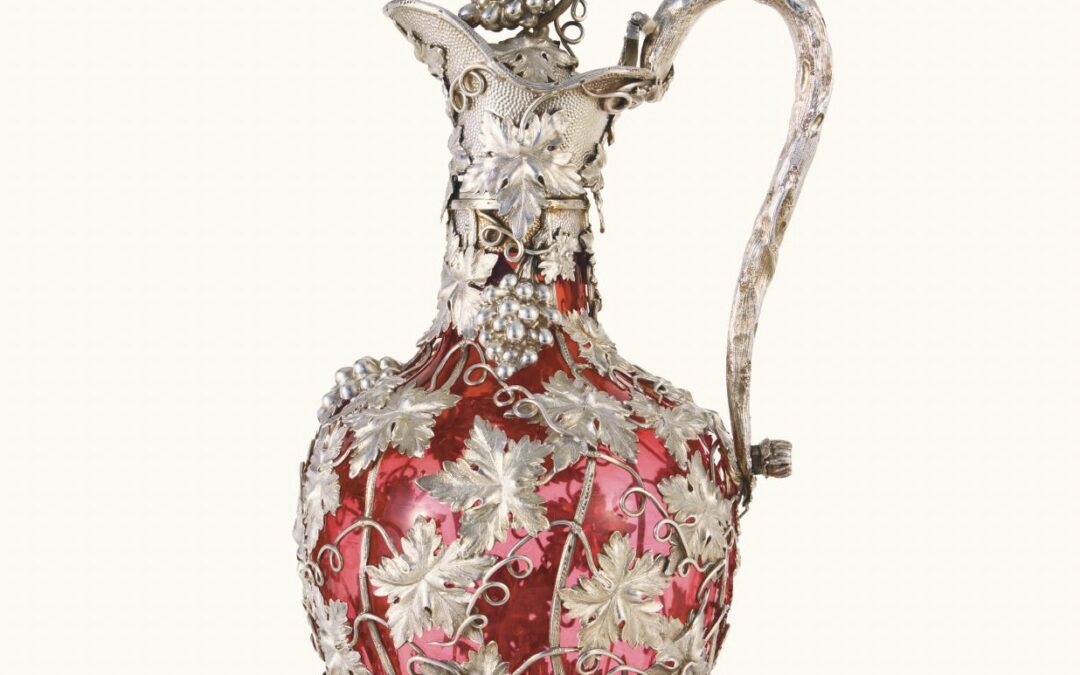
FRONT COVER: Silver mounted ruby claret jug by Reily & Storer, London, 1840 © Sotheby’s
BACK COVER: Glass sculpture ‘I am Yours’ , by David Reekie, 2004; from his robot series
Editorial
Incoming Chairman’s message
Outgoing Chairman’s message
Claret Jugs; an Introduction Mike Noble
Burtles,Tate & Co Michael Upjohn
Breaking Stems Simon Wain-Hobson
Powell: Opus sectile mosaics Lily Crowther
Rural idylls: Simon Cottle
Beilby Portrait Glasses
David Reekie exhibition Shital Pattani
Ta k e r – I n ( i n G l a s s F u r n a c e ) James Measell
Little Black Dress Ian Turner
Book Review Geoffrey Walton
Cider & Perry Glasses
Green Dresser Jug? Clive Manison &
Alex Werner
Ve n e t i a n B e a k e r Stephen Pohlman
Powell window detail David Willars
E
vents happen. Since writing in December 2023, you’ve
received Issue 2 of The Journal of The Glass Society , taking
the place of Glass Matters magazine, and your committee
has been ‘refreshed’. Wishing to spend time researching and
cataloguing his own extensive glass collection, David Willars
stood down as chairman; we congratulate him on his years
of ‘steering the ship’ through often turbulent times. The
position of chairman has been taken up by Simon Cottle, well
known in the glass world for his erudite knowledge of a wide
field of glass, his years as an astute auctioneer for Bonhams,
and his particular interest in the Beilby family – with an
article included in this issue. The committee has also been
strengthened: Katharine Coleman MBE; Aileen Dawson;
Alexander Goodger and Christina Glover are all now members,
each with their own ‘history’ in the world of glass. More about
them next time. The GS future augurs well.
3
4
5
9
14
17
23
29
33
34
35
36
37
39
Contents GM19.indd 2Contents GM19.indd 2 07/06/2024 12:5807/06/2024 12:58
INCOMING CHAIRMAN’S MESSAGE
3
Incoming Chairman’s Message
Simon Cottle: The Glass Society’s new Chairman
Glass Matters Issue No.19 June 2024
S
imon has been involved in
antique and contemporar y
glass for over 45 years, firstly
as a museum curator at the Geffrye
Museum in London in 1979 and
from 1980 until 1986 at the Laing
Art Gallery in Newcastle-upon-
Tyne. As Keeper of Decorative Art
he organised numerous glass and
ceramics exhibitions. Simon has
written widely on glass for pub –
lications and magazines and has
made numerous television appear –
ances. He organised the exhibition
‘Sowerby. Gateshead Glass’ in 1986-
87 for which he also wrote an accom –
panying book on the subject. After
four years as a Keeper of Decorative
Art at Glasgow Museums & Galleries,
Kelvingrove (1986-1990), where he
was also Secretary of the Scottish
Glass Society, he organised the exhi –
bition ‘Scottish Glass Now’ in 1989.
In 1990, Simon joined Sotheby’s
as a Senior Director, auctioneer and
valuer of British & European glass
and later, in 1997, as Head of the
department, responsible for sev –
eral milestone auctions in London,
Scotland, Germany and elsewhere
including that of the Royal Brierley
collection in Stourbridge in 1998. In
1991, with David Battie, he edited
the Sotheby’s Concise Encyclopaedia
of Glass . He was a trustee of glass
at No.10 Downing Street with the
late Michael Nathan, commission –
ing glass by several leading British
engravers. By 2007, Simon had
joined Bonhams as Head of British
& European Glass, and in 2010 was
appointed Managing Director of the
company’s European and American
regional offices which enabled him to
travel regularly and extensively over –
seas until his retirement in 2023.
Simon was a founder member
of the Glass Association and sat on
the committee for several years. He
was also Hon. Chairman of the Glass
Circle from the mid-1990s to the
early 2000s when he was succeed –
ed in that position by the late John
P. Smith, becoming Hon. President
in 2005. From 2000 Simon has
been a Fellow of the Guild of Glass
Engravers and was appointed a
Fellow of Corning Museum of Glass
in 2004. Over the past few years he
has written widely on various glass
topics, especially that of 18th centu –
ry enamelled glass of the Beilby’s. He
is currently researching the history
of the Beilby family and preparing
a comprehensive catalogue of their
work for future publication. Since
1998, he’s been a regular lectur –
er on glass and other subjects for
NADFAS (now the Arts Society),
continues to be an active member
of several glass organisations and is
currently an Hon. President of The
Glass Society and now its Chairman.
THE FUTURE
I am honoured to take on the chair –
manship of The Glass Society and
keen to ensure that it continues the
charitable work established by its
predecessors. A new grants policy
has now been developed, enabling
us to use our reserves constructively
– this will shortly be outlined on the
Society’s website, awarding grants
to eligible students, glass artists,
researchers and institutions. I’m
also eager to increase the member –
ship through a number of initiatives,
including a new website and a wider
distribution of promotional material.
The challenges facing the Society
are numerous, especially attract –
ing new members, seeking new
articles for the magazine and invit –
ing lecturers to speak on topics
related to glass. Your contributions
will be warmly welcomed if you can
help in any way in achieving these
aims. It is also recognised that our
presence on social media is limit –
ed; therefore, any assistance with
spreading news and information
about glass and The Glass Society
on the various web-based plat –
forms would be gratefully received.
The Glass Society exists to pro –
mote glass in all its forms. It is your
society and I hope that our ambitions
will be achieved. While our lectures
are held over Zoom, which attracts
a far wider audience, especially from
overseas, we still intend to hold
in-person events. The success of
Zoom has shown us how we can main –
tain the interest of members who
are unable to attend lectures in fixed
locations. However, we acknowl –
edge the value of events, whether in
London, the Midlands, the North of
England or elsewhere, where mem –
bers can get together to enjoy the
social side of the Society – we intend
to organise these for your enjoyment.
I look forward to receiving your full
support as the Society moves forward
and to meeting as many of you as pos –
sible either over Zoom or in person.
Simon Cottle, Chairman of !e Glass Society
INTRODUCTION
Chairmen’s message GM19.indd 1Chairmen’s message GM19.indd 1 05/06/2024 10:0705/06/2024 10:07
Glass Matters Issue no.19 June 2024
OUTGOING CHAIRMAN’S MESSAGE
4
Outgoing Chairman’s Message
David Willars
T
he only constant in life is change.
So, as I pass the baton to
Simon Cottle, it seems appro –
priate to lay down a couple of thoughts
that currently frame our thinking.
Evolution, not revolution. Over the
last five years we have merged the
Glass Circle with the Glass Association
to form the Glass Society. We have
also negotiated our way through the
pandemic, emerging with a member –
ship that is experienced enough in
the ways of Zoom to be able to view
an ever-increasing variety of talks.
The talks are here to stay, although
that does not mean we have aban –
doned live, in person, events. We
are also committed to maintaining
the high-quality hard copy publica –
tions, expertly collated and edited
by Brian Clarke, that so many of you
value. More recently, we have identi –
fied that an upgraded website would
be appropriate and are beginning to
gather some early thoughts on design
and scope. To assist with these pro –
posals, we have taken the opportu –
nity to augment the management
committee and bolster the experi –
ence within the ranks of Trustees.
Increasingly, we are becoming a
more international group and it is
pleasing to note that this edition sees
contributions from Simon Wain-
Hobson, living in France; from Stephen
Pohlmann in the Middle East and
also from James Measell in America.
Va r i e t y i s th e s p i ce o f l i fe . Much more
than this, the collective knowledge in
our ranks is deep, erudite and huge –
ly diverse. From eyebaths and piano
feet through to medieval stained
glass windows via Georgian finger
bowls, our members are experts.
W hether dealers, auctioneers,
curators, researchers or collectors.
Consider the current magazine. We
have an article from Lily Crowther,
following up on the talk she gave in
April: opus sectile was an opaque
glass material developed in the 1860s
by Powell and Sons. In fact, it may
have had deeper roots as the ancient
Romans developed a similar tech –
nique for producing the fragments for
mosaics. Contrast this with an arti –
cle on Burtles Tate, the little-known
Manchester company. In the absence
of a trademark, with no known cat –
alogue and a total of fifty-one regis –
trations between 1870 and 1907, plus
a handful of press cuttings from the
Pottery Gazette, there are few leads to
follow up. Nonetheless, Mike Upjohn,
assisted by his father’s mammoth col –
lection of pressed glass, plus a few
amateur sleuths and countless emails,
density tests and colour comparisons,
has built up a portfolio of characteris –
tic unregistered Burtles Tate pieces.
Lastly, I would like to record my
thanks for your support through the
last few years. Glass remains one of the
great passions in my life. Having pur –
chased my first auction lot of ‘six very
old Georgian glasses’ at a country sale
well over fifty years ago, I was hooked
by the thrill of the chase. A brilliant
exhibition of glass by Rene Lalique,
held in Manchester c1980, intro –
duced me to new, hitherto unknown,
techniques and colours. A couple of
dealers then pointed me towards
Loetz, WMF and Daum, although
sadly my finances could never stretch
to the better pieces of Émile Gallé. I
also became fascinated by the life of
Salvador Ysart and pondered why
anyone would decamp their family
from France to the North of Scotland.
(He actually moved in 1915 to escape
the ravages of WW1.) Subsequently,
children, mortgages and the need for
a career intervened. These were the
days when the nascent internet didn’t
provide the wall-to-wall opportunities
to learn and spend that it does today.
Many of you will recall the light-
bulb moment when you wake up and
suddenly realise that you are now
nearer the end of your working life
than the beginning. At this point I was
continuing to buy glass with renewed
fervour, often indiscriminately, until a
chance discussion with another dealer
suggested I might consider a master’s
degree as a way of providing a frame –
work and putting discipline into a col –
lection. Duly ennobled, retired, and
having been introduced to half a dozen
local collectors, all members of what at
the time, was the Glass Association,
my interest in Manchester’s Victorian
glass industry deepened. Together,
we discussed and debated the various
unmarked, unhailed, unspectacular,
cheap but well-made, nicely propor –
tioned and ultimately high-class
pieces. Eventually, Manchester’s
glass industry will gain more recog –
nition and status and, in time, prices
may begin to increase. But, hopeful –
ly not before I’ve finished buying!
David Willars, Chairman of !e Glass Society
Chairmen’s message GM19.indd 2Chairmen’s message GM19.indd 2 05/06/2024 10:1005/06/2024 10:10
JUGS FOR CLARET
5 Glass Matters Issue no.19 June 2024
Claret Jugs: an introduction
Mike Noble
Fig.1Silver mounted ruby claret jug by Reily & Storer, London, 1840 © Sotheby’s
‘A
sensible man avoids variety
in drinking. One French
wine during dinner, and
sherry after it, or a German wine for
the meal, and Claret for the dessert…
wine, so as not to shake or cork it. Claret
appears in a glass jug, but rare French
wines, particularly Bourgogne and the
Vins du Midi, should be brought up and
placed on the table in their baskets, as
decanting spoils them.’
taken from an 1859 publication called
‘The Habits of Good Society’, raises a
number of questions: was claret really
served with the dessert, was it actually
served in a glass jug, why were other
wines not served in a similar way,
and even the question as to where
the term ‘Claret Jug’ comes from?
Indeed, claret may not even have
been red, possibly more of a pale red
approaching that of rosé. According
to Boswell, Samuel Johnson had lit –
tle time for it and ‘…spoke with great
contempt of claret, as so weak, that a
man would be drowned by it before it
made him drunk’
the liquor for boys; port, for men; but
he who aspires to be a hero (smiling)
must drink brandy.’ In his dictio –
nary of 1755 Johnson stated ‘Cla’ret
[clairet Fr.] French wine, of a clear pale
red colour. Red and white wine are in a
trice confounded into claret – Boyle’.
Going back further in time, it may
be the case that Alienor d’Aquitaine on
her marriage to Henri de Plantagenêt,
Henr y II, promoted ‘Clairet’ in
England. The capital of Aquitaine,
after all, was Bordeaux, being tradi –
tionally known as the source of claret.
A more tangible connection between
England and Bordeaux, however,
comes in 1293 when ‘Édouard 1er
d’Angleterre’ , Edward I, asked, by way of
letters to a ‘sénéchaux [ o f f i c i a l ] d’Aquit –
aine et de Bordeaux’ –
ment made with a town south-west of
Bordeaux, Marmande, touching the
‘coutume des vins à Bordeaux’ [Archives
Nationales de France K//1164, n°
were or even what the quality of wine
was like at the time is open to specula –
tion, but what cannot be denied is the
quality of this, now red, wine today.
Such was its importance that in
1855, prompted by Emperor Napoleon
III’s idea to display these wines off to
the world at the Exposition Universelle
de Paris, the area around Bordeaux was
classified by the Brokers into five levels
of quality. The top, first growths, con –
sisted of such wines as Chateau Lafite,
Chateau Latour and others, a ranking
that still remains almost untouched
today, commanding some of the
highest prices in the world. A further
Claret Jugs GM19.indd 5Claret Jugs GM19.indd 5 05/06/2024 10:1305/06/2024 10:13
6 Glass Matters Issue no.19 June 2024
JUGS FOR CLARET
ABOVE LEFT Fig.2Claret jug from the Besitzer Collection, mount by John Figg, London, 1855 ABOVE RIGHT Fig.3Silver mounted claret jug designed by Christopher Dresser for Hukin & Heath, 1879 © the peartreecollection
impetus to wine drinking in England
came five years later, in 1860, when
an Anglo-French trade agreement,
the Cobden/Chevalier Treaty, lowered
the duty on goods; the effect of this
reduction on wine, was to double the
import of French wines into Britain.
My own interest in Claret Jugs
started very recently, after reading D.
C. Manison’s two articles in issues 16
and 18 of Glass Matters and thinking
that perhaps it would be more appro –
priate to serve my better wines from a
dispenser more fitting to their status.
Thus, I started my search to find out
what was available and what the price
tag was going to be. To my amazement
the variety of styles, quality, and price is
immense, requiring much more inves –
tigation than I had initially thought
before finally committing to a piece.
Probably the best collection of
top-quality Claret Jugs, and avail –
able to view on the internet at www.
claretjugs.com, is the Kent collection.
Although now dispersed, the web –
site is still running, and in his his –
tory, Richard Kent suggests that
silver-mounted claret jugs suddenly
appeared from about 1830 onwards.
The earliest of his is shown in Fig.1 , the
metalwork having been made by Reily
and Storer of London in 1840. His
description states that ‘The pale ruby
glass is encased in a naturalistic design of
cast and chased fruiting vines’. This style
was popular from about 1830 onwards
and was the artistic ‘antidote’ to the
more formal and rigid ‘Pompeian gran –
deur’ of the Neoclassical Revival period
that preceded it. It was also remark –
ably suited to decorating Claret Jugs.
Bearing in mind that wine can be
served in a number of ways, from a jug
or carafe to a purpose-made decant –
er, or even straight from the bottle,
it seems, to my mind at least, that a
Claret Jug as we interpret it consists
of a metal mount with both a handle
and a lid, and a glass receptacle for
holding the wine. Admittedly, a letter
of 1662 exists in the Bodleian Library
[MS. Carte 32, fol(s). 139] in which
Robert Vyner of London writes to Sir
George Lane ‘In relation to the making of
certain claret-jugs, of goldsmiths’ work,
for the Duchess of Ormond…’
conclusively that the term Claret Jug
was known at this date and that they
were made at the time from metal.
What is interesting, however, is
how the claret jug, apart from its obvi –
ous utilitarian purpose, can reflect
the style of the period in which it
was made. The jug at Fig.2 , from the
Besitzer Collection at www.karaf –
fensammler.at, shows an 1855 exam –
ple from John Figg, who was listed in
the Census records of 1851-81 as living
with his wife Elizabeth at 6 Denmark
Street, London. It is worth comparing
this jug with that of another famous
designer, Christopher Dresser, Fig.3 ,
from the Peartree Collection at www.
thepeartreecollection.com, hall –
marked for Hukin and Heath, London
1879. A similar example is on display
at the V & A Dundee where the cata –
logue states ‘This decanter epitomises
Christopher Dresser’s tendency to high –
light the abstract qualities of oriental
design. The broad base of the bottle is
loosely based on the form of an Islamic
or Chinese vase and the handle is derived
from a Japanese precedent. Besides imi –
tating handles found on Japanese objects,
the form of the handle is easily recognis –
able in the profile of traditional roofs
and temple gates in Japan.’
Claret Jugs GM19.indd 6Claret Jugs GM19.indd 6 05/06/2024 10:1305/06/2024 10:13
JUGS FOR CLARET
7 Glass Matters Issue no.19 June 2024
ABOVE Fig.4Claret jug by Charles Robert Ashbee, London 1903, © the peartreecollection RIGHT Fig.5Claret jug by Ramsden and Carr, London 1918, © the peartreecollection
a likeness was made to
Japanese and Chinese
forms, Dresser is more
commonly associated
with the Arts and
Crafts Movement
of the time, but
it is interesting to
compare the shape
of the glass in Figs.2
and 3 which shows
a marked similarity.
Another name asso –
ciated with the Arts
and Crafts Movement is
that of Charles Ashbee
whose claret jug (Fig.4) ,
is described in the Kent
Collection as ‘A Guild of
Handicraft Ltd. Silver mount –
ed decanter designed by Charles
Robert Ashbee. The Whitefriars
green glass of ovoid form with slender,
tapering neck mounted with hinged collar
and cover, with sweeping sinuous handle
and hinged brace. The cover mounted
with tripartite finial, London, 1903.
Cover incised 5070; Height 8 !inches.’
–
smith with that of the glass manu –
facturer can be somewhat tenuous.
Silversmiths’ marks are very well
defined, whereas the glass manufac –
turer rarely has a definite attribution.
In the case of the Ashbee jug, it is
quite reasonable to suppose that the
glass was made at the Whitefriars
glasshouse on the northside of the
Thames, which had been acquired by
a wine merchant, James Powell, in
1834 and in whose family it remained
until its closure in 1980. This glass –
house has also been linked to other
silversmiths such as Ramsden and
Carr, a claret jug with their mark
of 1918 being shown in Fig.5 .
One further glasshouse worth
mentioning is the Falcon Glasshouse
in Southwark, south of the Thames
and owned by Apsley Pellatt. A ref –
erence to it was made in 1860 when
The Popular Encyclopaedia stated
‘Recently, an improvement has been
made in the working furnace of Messrs
Pellatt & co. of London, who have effected
a great saving of fuel, by constructing
two furnaces each of half the diameter
of a 12 crucible furnace, and terminat –
ing in one chimney by means of two
flues.’
entry by the silversmith John Figg,
mentioned above, displaying one of
his claret jugs (Fig.6) , the catalogue
referring to the glass as being man –
ufactured in the Falcon glassworks.
In many ways the glass can be treat –
ed quite separately to the mounting,
be it sterling silver, silver gilt, or silver
plate, all of which are identified by
marks. Clive Manison, from infor –
mation supplied by David Willars,
mentions the trade catalogue of the
Manchester glassmakers Percival
Vickers which illustrates unmount –
ed bodies for claret jugs. This would
indicate that the bodies were available
from the glassmaker to be mounted
by the silversmith before being sold,
possibly by a third party. Thus, we have
up to four interested parties involved
with producing a claret jug: the
designer, the silver and glass makers,
and the sponsor who either commis –
sioned it or who pulled it all together.
A good example of this is the claret jug
shown in Fig.7 designed by Archibald
Knox, another famous Arts and Crafts
designer. It is stamped with L & Co
for the department store Liberty of
London, and CYMRIC, ‘Cymric Silver’
being published in their retail cata –
logue of 1901. It also has the hallmark
for Birmingham of 1903, with a fur –
ther small mark indicating this was
model 2065. The glass was attribut –
ed to Harry Powell of Whitefriars.
Although the claret jugs illustrat –
ed here are what might be called the
top end of the market, many silver –
smiths existed who made very good
products, as can be appreciated from
a quick survey online of what is cur –
rently available for sale. These tend to
be straightforward glass containers,
sometimes decorated and sometimes
not, and with a silver or silver-plated
fixture. Some were even patented,
Claret Jugs GM19.indd 7Claret Jugs GM19.indd 7 05/06/2024 10:1305/06/2024 10:13
8 Glass Matters Issue no.19 June 2024
JUGS FOR CLARET
the patent laws existing from 1839
under the Design Registration Act
covering decorative arts such as glass,
metalwork, ceramics, and wallpapers,
as well as textiles which had previ –
ously had some limited protection.
Although the systems changed to
conform to subsequent amendments
by Parliament of the Copyright Law,
the basic system remained the same,
that of registering a design and then
detailing it in the form of drawings,
photographs, paintings, or samples
of the design in the case of wallpapers
and textiles. They are held at Kew in
two series of books: Registration books
giving the name and address of the
copyright owner, and Representation
books which concentrate on the
details of the design, almost three
million in total. Interestingly, the
bulk of the claret jug entries lie
under the metal category, with few
under glass, indicating perhaps that
designs of the metal fixtures were
more worthy of protection than glass.
The popularity of claret jugs, start –
ing in the 1830s, seems to have come to
an end during the Great War of 1914 –
era, which embraced the developments
of the industrial revolution and its
impact on manufacturing and design,
particularly in relation to mass pro –
duction. This subsequently created
the reactionary Arts and Crafts move –
ment with the likes of Christopher
Dresser, Charles Ashbee and Archibald
Knox, not to mention its primary
exponents, William Morris and John
Ruskin. All this shows how an inter –
est specifically focused on claret jugs,
certainly for me, brings to life so many
other aspects of our design heritage.
ACKNOWLEDGEMENTS
My t hanks to D.C.Manison who
start ed my interest in claret jugs
and who has provided me with
much welcomed guidance, partic –
ularly with regard to Christopher
Dresser. To Benoît Painchart for
valuable help with the French con –
nection. To Anthony Bernbaum for
not only providing me with my claret
jug, but also for allowing me to use
his images. To Thomas Feilenreiter
for the images of his magnificent
claret jugs from The Besitzer Col –
lection and to Sotheby’s New York
for the image of the Reily and Storer
claret jug from the Kent Collection.
BELOW LEFT Fig.6Claret jug from the Besitzer Collection, mount by John Fig g, London, 1866BELOW RIGHT Fig.7Silver mounted claret jug by Archibold Knox for Liberty & Co. 1903, © the peartreecollection
Claret Jugs GM19.indd 8Claret Jugs GM19.indd 8 05/06/2024 10:1305/06/2024 10:13
RECOGNISING BURTLES TATE
9 Glass Matters Issue no.19 June 2024
Burtles, Tate and Co
Michael Upjohn
ABOVE Fig.1 and BELOW Fig. 1aGroup of Swans in 3 sizes 10,12 & 18 cm registered 8 JANUARY 1885 Design Number 20086
B
urtles, Tate and Co were found –
ed in 1858 by Thomas Burtles
(1825-1899) and Matthew
Tate, a g l ass maker from Ne wcast le.
T homas’s son, Richard Bur tles
(1851-1920), also became a pioneer
of the company. Their main factory
was located at Poland Street Glass
Works, Oldham Road, Manchester
with a second factory, the Victoria
Glassworks, in Bolton. However, the
Victoria Glassworks closed down
in 1887, when a new factory was
built in German Street, Manchester. !
Much of their early pressed glass
consisted of household and domes –
tic ware, such as sugar bowls, plates,
glasses and jugs, similar to the local
competitors. They eventually devel –
oped and then specialised in man –
ufacturing coloured ornamental,
Burtles Tate GM19.indd 9Burtles Tate GM19.indd 9 05/06/2024 10:2005/06/2024 10:20
10
RECOGNISING BURTLES TATE
ABOVE Fig. 2Flower boats and a “C ” shape Flower trough registered on 29 JUNE 1885 Design Number 29106BELOW Fig. 3 Bird bath !ower vase 26 SEPTEMBER 1885 Design Number 34196
pressed and fancy glassware. However,
there is little information avail –
able, especially of their early years. !
The first registered design of “orna –
mental glass” was made in 1870, a vase
with a design of vertical columns.
From 1884, the company started
registering designs for blow-moulded
art glass flower holders in opalescent
colours, along with unregistered vases
and epergnes, some of which can be
identified in Pottery Gazette adver –
tisements described as “fancy glass”. !!
Numerous designs of these posy
flower holders were manufactured
through to the turn of the century.
Along with fanc y glassware,
Burtles Tate started a new chapter in
1885 with their eclectic pressed glass
moulds in vibrant new colours. These
included “Topaz opalescent” similar
to Davidson’s Pearline range and lat –
er introducing their “Sunrise” colour,
which was a mix of shades of yellow,
amber and pink. The pressed glass of
this collection concentrates on designs
through a brief period from 1885 to
1890, with a handful of plain addi –
tions around the turn of the century.
Their first and most recognisable
design using opalescent colours is a
swan (Fig.1) , registered 8th January
1885 and made in at least three
sizes, 10cm, 12cm and 18cm, with
the number R d No 20086 (Fig.1a) ,
embossed on the base. The swans
were so popular that Queen Victoria
purchased one from a London Shop.
To t h i s d ay t h e y a re s t i l l v e r y co l l e c t –
able. A pair of rose/pink swans with
turned crooked necks (rather than
forward looking) recently sold in
excess of £800 plus fees in a Cornwall
auction house. Then Raymond Slack’s
book ‘English Pressed Glass 1830
-1900 ’ shows a rare small black swan
also embossed with the Rd number.
The ‘posy trough’ design, Rd
29106, is a rare pattern registered
on the 29th June 1885. Fig.2 shows
two boat-shaped posy troughs, which
were made in several sizes, along with
another item, an unusual ‘C- shaped’
!The design pattern can also
Glass Matters Issue no.19 June 2024
Burtles Tate GM19.indd 10Burtles Tate GM19.indd 10 05/06/2024 10:2005/06/2024 10:20
RECOGNISING BURTLES TATE
11
RIGHT (TOP TO BOTTOM) Fig. 4Large Wall pocket posy vase 18 DECEMBER 1885 Design Number 39807 on the right and an unregistered and uncon “rmed design on left Fig. 5 ‘Mermaids’ Flower boat 8 MARCH 1886 Design Number 44445Fig. 6‘Elephant’ ##Flower holder 28 DECEMBER 1886 Design Number 64234
be found on a small triangular posy
bowl and other flower troughs, all
decorated with oak leaves and acorns.
Design number R d 34196, regis –
tered on 26th September 1885, is a
small bird and posy vase, perhaps a
birdbath, also decorated with the pat –
tern of oak leaves and acorns (Fig.3) .
Design Number R d 39807, of 18th
December 1885, is a wall-pocket
posy vase. Fig.4 shows two designs:
the largest has the Rd number
embossed on the back and is decorat –
ed with coral and shells; the smaller
one has no number but appears to
be an unregistered design and is
decorated with flowers and leaves.
The first of two registered designs
from 1886, R d 44445, is a footed canoe
posy trough (Fig.5)
shells and mermaids at each end. These
were made in different colours such
as clear, flint opalescent and amber,
the amber colour being the rarest. !
Another very sought-after and trea –
sured item is the wonderful elephant
registered on the 28th December,
design number R d 64234 (Fig.6) , pos –
sibly a salt or small posy trough. The
elephant has a basket-style bowl on its
back, ideal as a small salt bowl. A while
ago I spotted a ceramic pair of these on
eBay. The buyer, (another glass enthu –
siast), confirmed that there is a mark
on them in the place where the Rd num –
ber is embossed on the glass version,
proving that they were from the same
mould. !The Rd number was not dis –
tinguishable on the ceramic elephant.
The number of registered pressed
glass designs using the opalescent
colours reduced significantly in 1887.
Fig.7 shows a small posy vase, or more
probably a salt, in the shape of a shoe –
it was registered on the 17th Jan 1887,
Glass Matters Issue no.19 June 2024
Burtles Tate GM19.indd 11Burtles Tate GM19.indd 11 05/06/2024 10:2005/06/2024 10:20
12
RECOGNISING BURTLES TATE
ABOVE Fig. 7 ‘Shoe’ Flower holder 17 JANUARY 1887 Design Number 65455RIGHT Fig. 8 ‘Emu’ Flower holder 4 MARCH 1889 Design Number 120808
RIGHT Fig. 9 Piano rest insulator 24 MARCH 1898 Design Number 316413. Coal Scuttle salt cellar 29 AUGUST 1907 Design Number 510504BELOW Fig. 10Advertisement illustrating “Penny lines”
Burtles Tate GM19.indd 12Burtles Tate GM19.indd 12 05/06/2024 10:2005/06/2024 10:20
RECOGNISING BURTLES TATE
13
number R d 65455. The quality seems
far superior to many of Burtles &
Tate’s Victorian competitors. It can be
found in a variety of opalescent colours
and is quite a weight for a small shoe.
The prize of the collection is that of
the Emu with a bowl incorporated into
its back between the wings ( F i g. 8 )
it is ideal as a posy vase or a salt; it was
registered on the 4th March 1889, !!Rd
120808. This was possibly made for
the export market as they are very rare
and hard to find. Its grandeur towers
above all others in the collection. !
Our last registered designs are
a piano insulator, R d 316413 24th
March 1898, and a small salt in the
shape of a coal scuttle, number R d
510504 29th August 1907 (Fig.9) .
An advertisement (Fig.10) ,
shown in the book ‘Shoes of glass II’
by Libby Yalom, displays a group of
small items including bird feeders,
salts and bowls described as “Penny
Lines”. In the book, the caption to
this picture reads “Part of a page titled
‘Penny Lines’ from a Burtles, Tate &
Company catalog”, thus confirming
Burtles Tate !were producing a cheap –
er range of glassware which possibly
dates to the beginning of the 20th
Century. Fig.11 shows a boot and a
small swan (both unmarked) from
this advertisement. Many collectors
will not be aware of the advertisement,
so an unmarked swan could easily
be dismissed as not possibly being
manufactured by Burtles, Tate and
Co. The small unmarked white swan
has a similar top rim contour to the
smallest registered design swan (Fig.1) .!
The 1880s through to the early
1900s appears to be the most produc –
tive time for their colourful glass –
ware, along with their opalescent
pressed glass. They also registered
many fancy glass vases along with
numerous unregistered vases and
epergnes. Fig.12a shows two of these
‘fancy’ vases and in Fig.12b , the
same two vases fluorescing under a
black light, which can be identified
in Pottery Gazette advertisements.
Burtles, Tate & Co were taken
over by Manchester glass manufac –
turer Butterworths in the 1920s.
We ’d love to hear from any –
one who has a spare black swan.
michael.upjohn@btinternet.com
Fig. 11Unmarked small white swan and black boot from a catalogue advertisement around 1905
BELOW (LEFT) Fig. 12aFancy glass vases from 1905BELOW (RIGHT) Fig.12b Fluorescing Fancy glass vases from 1905
Glass Matters Issue no.19 June 2024
Burtles Tate GM19.indd 13Burtles Tate GM19.indd 13 05/06/2024 10:2005/06/2024 10:20
Breaking drinking glasses
14 Glass Matters Issue no.19 June 2024
BROKEN STEMS
Simon Wain-Hobson
LEFT Fig.1 !in stemmed Toasting Glass, H 20.2 cm, Private collection ABOVE Fig.2John Maunsell Bacon before one of his large glass cabinets, © BonhamsRIGHT Fig.3Broken stemmed opaque twist glass repaired with silver sleaves. !e Königsberg Kant glass, H 21.6 cm, © Ralf Kranert
D
rinking glasses have suffered
from usage, transport 1,
earthquakes 2 and more. The
toll has been immense – less than 1
in 100 has survived. Yet, occasion –
ally, destruction was intentional.
The tradition of breaking a drinking
glass at a Jewish wedding is a prayer
and hope that your love for one
another will remain until the pieces
of the glass come together again, or
in other words, forever. Some write
that it also symbolizes the destruc –
tion of the temple in Jerusalem.
Others that the fragile nature of glass
ref lects the frailty of human relation –
ships. There are endless variants.
Many cultures share the practice
of breaking something – a plate or
a glass – as the noise is considered
to scare away evil spirits that could
otherwise mar a joyful occasion. The
shattering of the old, the beginning
of the new. Throwing a glass into the
fireplace – how considerate – after
a toast ensured it would never be
sullied by a lesser event. Like much in
life, it was a tradition of the well-off.
Shakespeare mentions the word
toast in The Merry Wives of Windsor,
published in 1602, when Falstaff
calls for a quart of wine and says,
“put a toast in it”. By the 18th cen –
tury, the term toast meant a person
honoured, rather than an actual
piece of bread in the wine or punch.
And in the all-male (drinking) clubs,
the toasts were invariably to ‘ladies’
This led to ‘the toast of the town’.
So called Georgian toasting glass –
es are tall with slender trumpet
bowls and thin stems that can be
broken easily by pressing the stem
with thumb against the index and
middle fingers (Fig.1) . That said,
without a glove of some sort the
thumb must quickly come a cropper.
Then there are the accidents we are
reluctant to speak of. Many a collector
or dealer has had an unfortunate inci –
dent with a cherished glass, including
the author! John Maunsell Bacon,
founder member and first president of
‘The Circle of Glass Collectors’ , ‘accidently
tipped over one of his large cabinets while
moving in 1939, and many prized exam –
ples were broken’
front of one of his cabinets turned up
in a recent catalogue from Bonhams,
(Fig.2) we can do the maths and real –
ize it was an unmitigated disaster.
Poorly annealed glasses break par –
ticularly easily, and the bowls and feet
suffer most. By contrast the thicker
stems tend to survive. This ties in
well with the observation that stem
shards are more frequently found
during excavations; of note, were
those found in Port Royal, Jamaica,
following an earthquake, or the sites
of old glass houses, compared to the
numbers of bowl or foot remnants? 2,4
So it is odd, indeed curious, that
a tiny number of Georgian drink –
ing glasses display perfect bowls
and feet yet have broken stems.
Furthermore, the stems have been
Breaking stem GM19.indd 14Breaking stem GM19.indd 14 05/06/2024 10:2105/06/2024 10:21
BROKEN STEMS
15 Glass Matters Issue no.19 June 2024
Fig.5.3Confederate glass in ! e National Museum of Wales, H 24.2 cm © Amgueddfa Cymru
LEFT Fig.4 Broken stemmed opaque twist glass repaired with silver sleaves. ! e Dreadnought Privateer glass, H 15.5 cm © Woolley & Wallis . An intact set mate is in the Fitzwilliam Museum (No. C.523-1961), H 15.6 cm ABOVE Fig.5.1Confederate glass in the Garton Collection, H 24.1cm © Museum of London ABOVE (RIGHT) Fig.5.2 Confederate glass, known as the Wynnstay Cup, H 21.8 cm © Bonhams
carefully repaired using silver sleeves
representing further expense.
One example is the Königsberg
Kant glass (Fig.3) , with diamond
point engraving referring to an event
on August 30th, 1763, which may well
have had a connection to the Seven
Ye a r s ’ Wa r. 5 A n o t h e r i s a g l a s s ce l e b rat-
ing ‘Success to the DREADNOUGHT
Privateer’ . This ship of 130
tons and a crew of 120 men had four
captains from 1757-62. They captured
several foreign vessels, most notably
the Marquis de Conflans in 1757. 7
It is easy to imagine the Privateer’s
Bristol owners – John Harbord; Jonah
Thomas; Samuel Thomas and William
Wasbrough – toasting its capture with
a set of custom-engraved Privateer
glasses, especially as the Marquis
was loaded with about ‘160 Hhds of
fine, and 160 of brown Sugar, about
170 Hhds of Coffee, 12 Casks of
Indigo, 4 Bags of Cotton, and a small
Quantity of Tortoiseshell’. 8 Quite a
killing! Of course, it could have been
broken to celebrate another prize.
Apropos of breaking stems, Mark
Tay lor o f Ge org i an Gl assmakers no t-
ed that a stem ‘of up to half an inch (1.3
cm) diameter can, providing they are
annealed, easily be snapped by making
a small scratch, turning the rod 180° and
putting a bending pressure using your
hands with thumbs to more accurately
guide the force in the same way as snap-
ping a twig’. It must be remembered
that in the 18th century, long rods of
plain, air, opaque or coloured twisted
glass were readily cut into short shanks
for stems – certainly not a myster y.
The next question is how were
the stems repaired? In the case of
the Dreadnought glass I have exam-
ined, there is no wobble whatsoever.
Furthermore, no light passes down
the stem as some white substance,
perhaps plaster, was used to fill the
space around the broken ends. The
strongest component of the repairs is
probably the silver sleeve. The thermal
coefficient of linear expansion of silver
(18µm/m/°C) is approximately twice
that of lead glass (7.5-9µm/m/°C).
The coefficients for other malleable
metals like tin (10µm/°m/C) or gold
(14µm/m/°C) are less, although copper
(17µm/m/°C) would be just as good.
However, silver with white glass makes
more sense aesthetically. By applying
a hot silver sleeve around a heated-up
lead glass stem, the sleeve would exert
a vice like grip on the glass once cooled.
As mentioned above, accidents hap-
pen. If the glasses were highly valued,
or appreciated Jacobite glasses like the
Keith-Douglas Amen glass 9, or a Frans
Greenwood stippled Newcastle light
baluster 10, these would understandably
be repaired. The heterogeneity among
broken glasses is nowhere clearer than
for the Confederate Hunt glasses:
a ‘wounded’ collection is shown in
Figs.5 .11 The first (5.1) , has a broken
stem that has been repaired with a
silver sleeve, similar to the Kant and
Dreadnought glasses. The second
(5.2) , has part of the stem remaining to
which has been attached an iron stem
and foot. The third (5.3) , seems to have
a runt of a stem to which an iron collar
is attached, the stem and foot being
Breaking stem GM19.indd 15Breaking stem GM19.indd 15 05/06/2024 10:2105/06/2024 10:21
16 Glass Matters Issue no.19 June 2024
BROKEN STEMS
made of wood. For the fourth (5.4)
the remnants of the stem were ground
away leaving a beaker. By juxtaposing
the first two, it is clear they do not have
similar opaque twist stems, which is a
little unusual for what appears to be
a commissioned set. Other examples
of repaired glasses with turned wood –
en feet include the Mrs Walpole glass
linked to the Kit-Cat Club 12 (Fig.6) ;
a Beilby engraved goblet 13, as well
as two AUDENTIOR IBO engraved
Jacobite air twist glasses mentioned
in Glass Matters No.17 14 (Figs.7 & 8) .
We cannot know a posteriori which
were repaired contemporaneously or
years later, perhaps at the behest of
a glass collector. However, the bro –
ken-stemmed glasses repaired with
silver sleeves are distinct as breakage
was clearly deliberate. We will never
know the events leading to their being
broken but they were in all likelihood
linked to the engraving. From a collec –
tor’s point of view, they are viewed as
damaged goods, and command lower
prices than their intact set mates. Yet in
some ways they are even more special!
There is another tradition associ –
ated with breaking drinking glasses
that dates back to the days when pubs
were made of wood and straw. ‘If a
glass broke, it was considered good
luck because it meant that the pub
was so busy that the staff couldn’t
keep up with the demand. It’s also
said to bring good luck to the person
who broke the glass, as they will be
the next to get married. Nowadays, it’s
just a fun tradition that many people
continue to participate in.’ The above
paragraph was generated by ChatGPT
in response to the question ‘Why
is it that British people cheer when
one of the bar staff breaks a glass?’
Hazel Forsyth of the Museum of
London, Kay Kays of the Museum
of Wales, Jim Peake from Bonhams
REFERENCES
1. Colin & Sue Brain, AIHV Annales du
16e Congrès , 2003, p263
2. David Dungworth & Colin Brain,
Chapter 6.5, 2013, Modern Methods for
Analysing Archaeological and Historical
Glass , (Koen Janssens Ed), John Wiley
& Sons Ltd
3. Strange and Rare, The Glass Circle ,
1988, p.vii
4. Frank Myles Chapter 5, 2010,
Glassmaking in Ireland , (John M Heane
Ed), Irish Academic Press
5. Simon Wain-Hobson, Glass Matters
2020, No.10, p26
6. Clare Durham, Glass Matters 2021,
No.12, p35
7. JW Damer Powell, Bristol Privateers
and Ships of War, 1930, pp.200
8. Berrow’s Worcester Journal, August
1757
9. Geoffrey Seddon, The Jacobites and
their Drinking Glasses, The Antique
Collectors’ Club, 1995, p196
10. Bonhams, 30 November 2022, lot 53
11. A group of Confederate glasses;
5.1 Museum of London, ID:
34.139/313
Illustrated Grant Francis, Old English
Drinking Glasses (1926), pl.LXXIX
5.2 Sold at Bonhams, 30 November
2022, Lot 63
5.3 In the National Museum of
Wales, accession no. NMW A 50713.
Described by Hartshorne, O ld English
Glasses (1897), p.313
5.4 Jim Peake, Glass Matters No.12, p.9.
Bonhams auction, 23 June 2021, Lot 1
12. Simon Wain-Hobson, Glass Matters
2019, No.6 p9
13. Bonhams, 3 Feb 2015, lot 33
14. Bill Davis, Glass Matters 2023, No.17
p22
ABOVE Fig. 5.4 Confederate glass, broken stem ground away © BonhamsRIGHT Fig. 6 Glass engraved to Mrs Walpole, with wooden foot. Private CollectionFAR RIGHT Fig. 7 !e Fingask ‘King Over the Water’ Jacobite wine glass, engraved AUDENTIOR IBO, with wooden foot © Lyon & Turnbull
Fig. 8 Jacobite wine glass, engraved AUDENTIOR IBO, with wooden foot. Courtesy of Bill Davis, Australia
Breaking stem GM19.indd 16Breaking stem GM19.indd 16 05/06/2024 10:2105/06/2024 10:21
OPAQUE GLASS
17 Glass Matters Issue no.19 June 2024
Powell & Sons’ Opus Sectile glass mosaic
Lily Crowther
Fig.1Displaying the internal decoration of St.Mark’s, North Audley Street, Mayfair; and the opus sectiles of the reredos 1
T
his article is based on a talk
given to the Glass Society on
9 April 2024, introducing a
glass mosaic material known as opus
sectile, and focusing on a handful
of very early examples which were
collected for the South Kensington
Museum (the predecessor of the
V&A and the Science Museum). The
reason for that focus is that I first
came across opus sectile through my
work on the history of the museum.
I am researching a collection called
the Museum of Construction and
Building Materials, which was one
of several relatively small collections
housed in South Kensington in the
mid-nineteenth century. The first
acquisitions were made in the 1840s,
and a large group was acquired from the
1851 Great Exhibition. The museum
was formally constituted as a separate
entity in the late 1850s, and it existed
until the end of the 1880s. After that,
most of the collections were dispersed
but a small number of objects remained
in South Kensington, and about 120
are still in the V&A today. The scope of
this museum stretched from raw mate –
rials such as stone and wood, through
components such as bricks and tiles, to
decorative objects including wallpapers
and stained glass, as well as architec –
tural drawings and models. Its curator
was Francis Fowke, the architect of
the South Kensington Museum and
other significant local buildings such
as the Albert Hall. He was a captain
in the Corps of Royal Engineers; the
Engineers took a rigorous approach
to knowledge-production based on
experimentation, and they were also
pioneers of systematic architectural
education. Under Fowke’s leadership,
the museum had a particular focus on
collecting, testing and displaying new
technologies and products for an audi –
ence of students, architects, construc –
tion professionals and their clients.
Among the many new materials dis –
played in the Museum of Construction
and Building Materials was opus sec –
tile, which was an innovative meth –
od of mosaic-making using opaque
glass tiles in various shapes to create
designs. Opus sectile was developed
by glassmakers James Powell & Sons
in the mid-1860s, during a flower –
ing of interest in mosaics amongst
British architects. The new material
quickly gained in popularity and was
used in a variety of architectural proj –
ects throughout the late nineteenth
and early twentieth centuries; its
use peaked just after the First World
War with the commissioning of large
numbers of war memorials. This image
(Fig 1) is a typical example of Victorian
opus sectile in context: the reredos
of St Mark’s, North Audley Street,
Mayfair (
church whose interior was exten –
sively remodelled in a Romanesque
style in 1878 by Arthur Blomfield.
The reredos is by Nathaniel Westlake,
Opus Sectiles GM19.indd 17Opus Sectiles GM19.indd 17 05/06/2024 19:5305/06/2024 19:53
18 Glass Matters Issue no.19 June 2024
OPAQUE GLASS
Fig.1aDetail of the reredos of St.Mark’s
The market was thus favourably
positioned for Powell & Sons to intro –
duce their new decorative technique,
using opaque glass tiles in various
shapes to create designs (Fig.2) . The
firm’s manufacturing up to this time
had been mainly focused on two
well-established areas: glass tableware,
and stained-glass windows. Until 1844,
the glass trade in Britain had been
controlled by a restrictive tax regime
which prevented manufacturers from
diversifying into different techniques.
As a flint-glass maker, Powell & Sons
had not been permitted to produce
window glass by blowing or rolling. To
circumvent this constraint, they devel –
oped a new invention: small, moulded
lozenges of glass called quarries, which
they promoted for use in church win –
dows. They continued to manufac –
ture these after the repeal of the tax
law, and ecclesiastical glass became
a key element of the firm’s business.
Powell & Sons’ new material, which
would eventually come to be known
as opus sectile, combined techniques
used in the production of glass quar –
ries with elements of traditional glass
mosaics, stained glass, and ancient
and medieval mosaic pavements.
The development of this new
material began in the early
1860s, when Powells’ employ –
ee George Rees invented a
method for producing slabs
of compacted opaque glass
from waste fragments of flint-
glass contaminated with clay.
The new material was initially
christened ‘Rees mosaic’ after its
inventor. Rees’ method involved
grinding the waste fragments
to a powder and baking them
in a mould to form a slab. The
bulk of the resulting material
was coarse and grey due to the
clay contamination; a finer
coloured coating was added to
the top surface. The resulting
slabs were about a quarter of an
inch thick, and could be cut into
shapes, painted with enamels if
required, and assembled like a
jigsaw. A unique feature of the
Fig.2 Powell’s Opus Sectile Altarpiece decoration at Church of St Mary the Virgin, Shrewsbury, Shropshire.
and is surrounded by book-matched
marble panels, polychrome brick –
work and of course, stained glass.
The popular revival of interest
in mosaics in Victorian Britain had
begun with the restoration of Hagia
Sophia in Constantinople in the late
1840s, which revealed its spectacular
Byzantine mosaics. Historians and
archaeologists writing about mosaics
in the 1850s and 1860s focused their
attention both on the time of Emperor
Constantine and his successors in the
Byzantine empire, and on the prolif –
eration of mosaics in the Byzantine
style in Italy from the eleventh
century onwards. This critical
focus on medieval rather than
classical mosaics promoted an
appreciation of features such as
strong colour, glittering surface
effects, and stylised rather than
naturalistic design. Mosaics
were considered particularly
suitable for use in churches
and other settings where nar –
rative content and inspiring
effects were required, such as
museums. Architects began to
build churches in the Byzantine
Revival style in Britain, begin –
ning with Arthur Blomfield’s
St Barnabas, Oxford, in 1868,
which was inspired by the
basilica of Torcello, Venice – although
St Barnabas was decorated in fresco
rather than mosaic. But it was the
humidity and air pollution of British
cities which acted as the most powerful
arguments in favour of mosaic rather
than fresco as a better material for
Victorian architects. Fresco had been
used in the 1840s to decorate the new
Palace of Westminster, but within a
few years the paintings had deterio –
rated substantially, demonstrating
the vulnerability of the medium. By
contrast, mosaics were resistant to
damp, durable, and easy to clean.
Opus Sectiles GM19.indd 18Opus Sectiles GM19.indd 18 05/06/2024 19:5305/06/2024 19:53
OPAQUE GLASS
19 Glass Matters Issue no.19 June 2024
Fig.3!e cloister of the Basilica of St. John Lateran, Rome. Twisted Cosmati columns inlaid with glittering mosaics
new material was its eggshell finish,
which lent itself particularly well to
the naturalistic depiction of textures
such as fabric and skin. The rough tiles
also formed an effective contrast when
combined with a gold background or
details picked out in gold tesserae.
At first, the manufacturing pro –
cess was unreliable, partly due to the
difficulty of establishing the correct
firing temperatures to successful –
ly fix the pigmented layer to the
coarser substrate. But Powell & Sons
persisted, probably because the pro –
duction process for opus sectile used
up waste which would otherwise have
been discarded. The manufacture
of fine table glass, which was a core
part of their business, involved the
waste of more than half of the pure
raw materials; opus sectile was the
only product which could be made
from the badly contaminated waste
that was scraped from the kiln floor
and filled with bits of broken pot.
As mentioned, the material began
with the name Rees mosaic and was
only later known as opus sectile. I
realised in the course of my research
that this material was older than pre –
viously thought; confusion caused by
the change of name had apparently
obscured its early history. The new
name first came from outside the
firm and was only gradually adopted
by Powell & Sons. Its first use seems to
have been in 1872, when a reviewer for
Building News d e s c r i b e d a f r i e z e o f ‘ p i c –
tures in Powell’s mosaic glass ( –
til)’. This must have been inspired by
an awareness of the similarity between
Powell’s material and its Roman and
medieval precedents. ‘Opus sectile’
literally translates from Latin as
‘sliced work’, and as that translation
suggests, in this type of traditional
mosaic, designs were formed from thin
slabs of different coloured marbles and
other materials cut into shapes which
fitted together in a geometric pattern.
This was a technique used widely in
the Roman empire and later revived by
craftsmen of the Byzantine school in
medieval Italy and elsewhere. The new
name continued to appear occasionally
in the press, but its first use in Powell
& Sons’ own internal documentation
was not until 1877, in reference to
a reredos designed for Evercreech,
Somerset. By 1878 the firm began
actively promoting their work under
this name, but by then they had been
selling opus sectile for 15 years – the
first recorded purchase of the mate –
rial was made in August 1863 by the
domestic architect William Nesfield.
The South Kensington Museum
was also among the very first purchas –
ers of opus sectile. Mosaic was a cen –
tral feature of the built environment
of South Kensington largely because
of the systematic efforts of the muse –
um’s founding director, Henry Cole.
Cole and his design team, including
Francis Fowke, used South Kensington
as a testing ground for new techniques
and a venue for the promotion of new
products. By comparing entries from
Powell & Sons’ cash-books (now in the
Archive of Art and Design at the V&A)
with the catalogue of the Museum of
Construction and Building Materials, I
established that a group of opus sectile
pieces was acquired for the museum
in 1864, less than a year after the very
first recorded purchase of the new
material. At this point, the only people
other than William Nesfield who had
bought opus sectile were the design
firm Moberly & Lyons, which was a
short-lived partnership of two former
Powell & Sons employees. The South
Kensington Museum was doing pio –
neering work in supporting this new
material which had yet to find a market.
This group of acquisitions for the
museum included a stone column
inlaid with mosaic, probably a test
piece for the twisted columns of the
arcades at the Royal Horticultural
Society garden, which was located
opposite the museum on Exhibition
Road (on the site now occupied by
the Science Museum and Imperial
College). The garden itself was
designed by William Nesfield’s father,
the landscape architect William
Andrews Nesfield, who might have
heard about the material from his
son; and the surrounding galleries
and arcades which featured the col –
umns were largely designed by Francis
Fowke. The barley-twist columns in
Fowke’s arcades were decorated using
Cosmati work, a medieval decorative
technique in which geometric shapes
were cut from a variety of coloured
stones or glass and inlaid in a bed of
mortar. The best-known British exam –
ple of Cosmati work is on the high altar
platform at Westminster Abbey, but it
was most frequently used in Rome and
Naples in the twelfth and thirteenth
centuries, both for pavements and
to decorate pulpits and other church
furnishings. Amongst the most spec –
tacular surviving examples are the
Opus Sectiles GM19.indd 19Opus Sectiles GM19.indd 19 05/06/2024 19:5305/06/2024 19:53
20 Glass Matters Issue no.19 June 2024
OPAQUE GLASS
Fig.4Pluto and Proserpina, Whitefriars opus sectile panel detail, c. 1865. © V&A Museum
extraordinary twisted columns in the
thirteenth-century Lateran cloister in
Rome (Fig.3) , which were echoed by
those in the RHS garden. Opus sectile
was compared to Cosmati work in the
press towards the end of the 1860s; the
presence of an opus sectile column in
the South Kensington collection sug –
gests that Powell & Sons may have been
deliberately drawing the same link.
Sadly, none of the early group of
opus sectile samples from the Museum
of Construction and Building Materials
are still in the V&A today. However,
the collection does still include a large
panel depicting Pluto and Proserpina
(Fig.4) . This formed part of a hugely
ambitious mural in three pieces; the
whole triptych was 3’6” high by 13’
3’6” by 2’9”. Its date is unclear as it ini –
tially came into the museum on loan,
and was not accessioned until 1923,
but it was probably made around 1865.
This would make it one of the first
examples of painted opus sectile. The
style and subject matter of this pan –
el demonstrate the suitability of the
material to tell stories of all kinds, not
just on religious themes. The classical
allusions, both in subject and style, also
set this panel apart from the Byzantine
examples which inspired so many of
Powell & Sons’ ecclesiastical mosaics.
The production of this triptych and its
display in South Kensington may have
been intended to promote the material
for use in civic and commercial spaces.
Around the time when the Pluto
and Proserpina panel was made, Powell
& Sons earned several commissions
for the South Kensington Museum.
Between 1863 and 1871 their stained-
glass windows formed part of the
schemes for the Oriental Courts, the
Ceramic Staircase, the North Staircase,
and the Gamble room. Alongside
Salviati and Jesse Rust, Powell’s pro –
duced highly detailed glass mosaic
portraits of artists and designers for
the ‘Kensington Valhalla’ in 1866-74.
At the same time, they were also con –
tracted to lay hardwearing, practical
mosaic floors in the North Courts in
1868-70, and then to lay glass mosaic
tiles on the East Staircase in 1873-5.
If the display of the Pluto and
Proserpina panel was an attempt to
create business opportunities, howev –
er, it was unsuccessful. Powell & Sons
only secured one major commission
for a secular public space: a frieze
for the offices of Sotheran, Baer &
Co, publishers and book dealers, on
Piccadilly, which showed the history
and processes of book production.
Towards the end of the nineteenth
century there were several orders
for the bathrooms of large houses,
notably one for Mr Brotherhood of
15 Hyde Park Gardens in which all
four walls were covered with mosaic
and opus sectile designs including
waves and dolphins, accompanied
by a stained-glass window showing a
bathing nymph. The material was also
used occasionally for fire surrounds,
including by the range manufacturers
Longden & Co, and in interiors for
wealthy clients such as Titus Salt and
Reginald Chandos Pole. But it never
really took off with either domestic
or commercial clients, and the over –
whelming majority of opus sectile
commissions were always for churches.
There was certainly no shortage
of church clients. Opus sectile very
quickly gained in popularity and
was being produced in considerable
quantities by the end of the 1860s.
Throughout the 1870s, 80s and 90s,
reredoses and other church furnish –
ings in opus sectile were made for both
new and old churches in a wide range
of architectural styles. Commissions
came from George Gilbert Scott, J.
P. St Aubyn and Arthur Blomfield,
as well as leading stained glass firms
Clayton & Bell and Heaton, Butler &
Bayne, who placed orders on behalf of
their church clients. From 1888 until
the First World War, Powell & Sons
showed their products at every exhibi –
tion of the Arts and Crafts Exhibition
Society, a fashionable showcase for
leading British design firms. Opus
sectile was also used in significant Arts
and Crafts interiors, such as Middleton
Cheney Church, Northamptonshire,
where it formed part of a scheme
including windows by Burne-Jones
Opus Sectiles GM19.indd 20Opus Sectiles GM19.indd 20 05/06/2024 19:5305/06/2024 19:53
OPAQUE GLASS
21 Glass Matters Issue no.19 June 2024
Fig.5Barcote chapel in the Oxfordshire church of St Mary the Virgin, Buckland. Courtesy of author
Opus Sectiles GM19.indd 21Opus Sectiles GM19.indd 21 05/06/2024 19:5405/06/2024 19:54
22 Glass Matters Issue no.19 June 2024
OPAQUE GLASS
and painted ceilings by Morris, and
Owlpen church, Gloucestershire. One
of the most striking schemes of this
period is the Barcote chapel in the
little Oxfordshire church of St Mary
the Virgin, Buckland (Fig.5) . This is
an extraordinary space which com –
bines ornate furniture, light fittings,
decorative flooring, a painted ceiling,
stained glass and ornamental glass
quarries, together with an ensem –
ble of opus sectile designs based on
the Te Deum Laudamus. Almost the
whole wall area is completely covered
in opus sectile, from the beamed
section near the ceiling right down
to the wooden panelling. It encom –
passes the geometric band at the
top, the architectural motifs, the
saints, the frieze under the windows,
and the pinkish band just above
the panelling. This epitomises the
potential of opus sectile at its peak.
A s the mater ial’s popular ity
across the country took off, its pres –
ence in South Kensington began to
wane. The Museum of Construction
and Building Materials closed in
1888 and the fate of those very early
Fig.6Glass head section of ‘opus sectile’, probably designed by James Hogan and possibly painted by !omas Cowell, produced by James Powell & Sons (Whitefriars) Ltd, England, 1920-32. !e ‘opus sectile’ (painted glass mosaic) is made of waste “int glass contaminated with clay, #nely ground and baked, then cut to shape and painted. © V&A Museum
Fig.7Stained glass panel, ‘Christ as the Good Shepherd’ , framed, lead, enamel, possibly designed by J W Brown, possibly painted by !omas Cowell at James Powell & Sons, England, c.1917. © V&A Museum
pieces of opus sectile which had been
in its collection was not recorded.
The V&A did go on to collect a few
more examples, including some
individual opus sectile tiles as well
as design drawings for church inte –
riors – but they are all much later,
mostly from the early twentieth cen –
tury (Figs.6 & 7) . Nevertheless, it is
worth remembering the pioneering
context of those first acquisitions
in the 1860s, which were collect –
ed and displayed as part of South
Kensington’s mission to encourage
British manufacturers to push the
boundaries of technology and design
– which is exactly what Powell & Sons
were doing in those early decades
of opus sectile manufacturing.
Readers wanting to know more
about the early histor y of opus
sectile may be interested in my
article, ‘Innovation and Revivalism:
Po w e l l & S o n s ’ O p u s S e c t i l e
Mosaic’
History (volume 36, issue 2, June
2023), which is freely available
at https://doi.org/10.1093/jdh/
epad001 (no subscription needed).
For those who would like to see
examples of opus sectile in situ,
the late Dennis Hadley compiled a
gazetteer which is available on the
website of the Tiles and Architectural
Ceramics Society, at https://www.
tilesoc.org.uk/pdf/opuslist.pdf.
Lily Crowther is a curator of craft
and design, formerly at the Victoria
& A lber t Museum and cur rently
working at Leamington Spa Art
Gallery & Museum. She is also read –
ing for a DPhil in History at Oxford
University and the V&A , focusing
on the Museum of Construction &
Building Materials, which was part
of the South Kensington Museum
in the 1850s – 80s. Her research
explores material knowledge and the
crafting of the built environment.
REFERENCE
1. A reredos is a large altarpiece, orna –
mental screen, or decoration covering
the wall at the back of the altar in a
church. It often includes religious
images.
Opus Sectiles GM19.indd 22Opus Sectiles GM19.indd 22 05/06/2024 19:5405/06/2024 19:54
23
SCENIC BEILBY
Glass Matters Issue no.19 June 2024
‘R URAL I DYLLS ’: the Beilby enamelled shepherd
and shepherdess portrait glasses
Simon Cottle
Fig.1A pair of opaque-twist goblets enamelled with pastoral scenes of shepherdesses, Beilby Workshop, Newcastle-upon-Tyne H.17.2cm and H.17.5cm. (private collection)
LEFT Fig.2Detail of bowl of shepherdess goblet (private collection)
Detail of bowl of reverse of Beilby shepherdess goblet (private collection)
English glass, the work of
William, Thomas, and Mary
Beilby in enamels in Newcastle upon
Tyne is the most significant and
highly prized. From over 500 or so
existing examples of their glass, of
which almost 100 are painted with
elaborate and highly decorative coats
of arms or crests, the discovery of a
rare and unique pair of Beilby enam –
elled opaque-twist goblets, painted in
colours with pastoral scenes, is a new
and important development (Fig. 1) .
Located in Northumberland, they are
significantly amongst only a handful
of examples which have been handed
down directly through a landed family
since they were produced in the 1760s.
Such provenance is like gold dust
and adds further information to our
knowledge of the work of the Beilby’s.
Simon Cottle Beilby GM19.indd 23Simon Cottle Beilby GM19.indd 23 05/06/2024 10:2805/06/2024 10:28
24 Glass Matters Issue no.19 June 2024
SCENIC BEILBY
LEFT (TOP) Fig.4A pair of opaque-twist goblets enamelled with pastoral scenes of shepherds, Beilby Workshop, Newcastle-upon-Tyne, circa 1765, H.17.8cm. (Image licensed by !e Corning Museum of Glass, NY)
An opaque-twist goblet enamelled with a pastoral scene of a shepherd, Beilby Workshop, Newcastle-upon-Tyne, circa 1765, H.17.8cm. (Courtesy of the Toledo Museum of Art, Ohio)
Each goblet is painted with a shepherd –
ess on a bucket-shaped bowl, wearing a
blue bodice and maroon skirt, holding
a crook, and watching over her flock
(Fig.2) . She is seated below a large oak
tree to her right, a river, buildings,
and a hill in the distance. Each scene
is enclosed within a rococo scrollwork
cartouche with grasses, all in opaque-
white enamel. On the reverse, a but –
terfly hovers above a leaf spray and
the rim has traces of gilding (Fig.3) . It
has been suggested that the large hill
in the distance may be that of Eildon
in the Scottish borders, a view visible
from the north of Northumberland.
Four comparable polychrome
enamel opaque-twist goblets have
been widely published, each painted
with a shepherd on a bucket-shaped
bowl with a faintly gilt rim. 1 The scene
on these goblets contains remarkably
similar landscapes to those on the
newly found pair, each positioned
within an almost identical scroll car –
touche, a painted butterfly to the
reverse. Two are in Corning Museum
of Glass in New York (Fig. 4) 2 – one of
these depicts a shepherd wearing a
red frockcoat, standing below a large
oak tree and beside a ruined archway
to his left, with sheep around his feet,
a classical ruin to be seen among the
distant hills in the background. The
other has the same image of a shep –
herd, but wearing a blue jacket and
maroon breeches, he is positioned to
the left under the large oak tree, two
houses standing beyond and further
buildings to the right, within the land –
scape in the distance. A third goblet
(Fig.5) comparable to the second one
in Corning, with buildings beside the
shepherd, is in the Toledo Museum of
Art. 3 The opaque-white enamel stems
have similar patterns of threads which
suggest that the shepherdess goblets
Simon Cottle Beilby GM19.indd 24Simon Cottle Beilby GM19.indd 24 05/06/2024 10:2805/06/2024 10:28
25
SCENIC BEILBY
Glass Matters Issue no.19 June 2024
may be pendants to at least two of the
existing shepherd glasses. The dis –
tinct differences between them and
the odd number of surviving exam –
ples, however, indicates that if they
were supplied as pairs with a single
shepherd and shepherdess on each
goblet more glasses must have been
produced. A rare sixth goblet (Fig.
6) painted with the shepherd scene,
uniquely having an air-twist stem,
is now in the Minneapolis Institute
of Art. 4 The view on this example is
akin to that on the second Corning
goblet, with buildings to the left of
the oak tree. However, unlike the
remainder, the bowl is a very square
bucket shape and the rococo scroll
cartouche also incorporates a panel of
diaper which is lacking on the others.
The reverse has a butterfly and sprig.
In addition, equivalent pairs of
smaller opaque-twist glasses, painted
in white enamel with either a standing
shepherd or a seated shepherdess, rep –
licate the figures on each of the poly –
chrome goblets (Fig.7) . The shepherd
leans on his crook, tending his flock, an
oak tree and shrubbery to one side. The
shepherdess sits within a similar pasto –
ral landscape. Of those with shepherds
of which four exist, one (Fig. 7 left) has
a round funnel bowl, H. 15.2cm and
the other an ogee H. 15.4cm. 5 Of the
three comparable glasses with shep –
herdesses, two have round funnel
bowls, H. 14.7cm and H 15.2cm (Fig.
7 right)
is different from the previous glasses
in that it has three cypress trees in
place of the large oak, H. 15cm. 7 Each
of these glasses was probably includ –
ed in larger sets of perhaps a dozen
or more wine glasses which contain
other vignettes of sporting pastimes,
classical ruins, views of buildings,
carriages, shipping , agricultural
RIGHT (TOP) Fig.6An airtwist goblet enamelled with a shepherd in a pastoral landscape, Beilby Workshop, circa 1765, H.17.3cm. (Courtesy of the Minneapolis Museum of Art, Gift of funds from the Decorative Arts Council)
A pair of opaque-twist wine glasses, enamelled in white by the Beilby Workshop, circa 1765, H.15.2cm. (Courtesy of Bonhams London)
Simon Cottle Beilby GM19.indd 25Simon Cottle Beilby GM19.indd 25 05/06/2024 10:2805/06/2024 10:28
26 Glass Matters Issue no.19 June 2024
SCENIC BEILBY
implements and small f locks of
sheep and goats, all with identical
opaque-twist stems and bowl shapes.
The decoration on the polychrome
goblets is reminiscent of painted
scenes on enamelled copper tea cad –
dies, caskets (Fig.8) , and snuff box –
es, while the opaque-white enamel
vignettes are further derivations of
aspects of these designs but in larger
scale. Two of the principal areas for
colourful enamelwork in England
from the 1750s were the Birmingham
and Wolverhampton regions of South
Staffordshire, especially in Bilston.
Between 2nd June 1755 and circa
1761, as a young man in his teenage
years, William Beilby (1740-1819)
was apprenticed to John Hazeldine,
a Birmingham enameller and drawing
master. By the early 1760s metalwork
factories in the South Staffordshire
area were producing on an industri –
al scale, enamel-painted goods of all
sorts. A quotation in the Journal of the
House of Commons of 1759 included
the information from one important
manufacturer that ‘there are two or
three Drawing Schools established in
Birmingham, for the instruction of Youth
in the Arts of Designing and Drawing, and
thirty or forty Frenchmen are constantly
employed in Drawing and Designing’
Birmingham and Bilston makers
included romantic and pastoral scenes,
architectural and classical motifs and
fine floral compositions. The style
was to keep figurative scenes pro –
portionately small, within vignettes,
surrounded by coloured borders, often
with raised rococo scrollwork and dia –
per frames. Some of the Bilston pieces
have small motifs of insects on the bas –
es. With their pastoral figures and ani –
mals standing beside or under a large
tree with buildings in the distance,
they are formulaic in style. The source
for many of these designs, including
those on Beilby enamelled glass, may
have come from the printed pages of
Robert Sayer’s ‘The Ladies Amusement’ ,
which was published in two editions
in 1758 and 1762. This was an
influential album of designs espe –
cially for decorators of English met –
alwork, lacquer-work, and ceramics.
From his early training, William
Beilby will have been familiar with
these new fashions and is presumably
responsible for some of those existing
mid-18th century boxes today yet to
be attributed to a single decorator.
Precisely dating the polychrome gob –
lets and the white enamel wine glasses
is difficult. If the inspiration for the
goblets comes from the enamel box
decorating tradition it may suggest
that they were produced soon after
his arrival in Newcastle, circa 1761,
when with his newly learned skill
he began experimenting in coloured
enamels on glass. The more widely
available opaque-white enamel wine
glasses may have emerged in the mid-
1760s, post-dating the production
of those fine goblets and decanters
painted with colourful coats of arms
and crests. What is particularly inter –
esting about the Beilby’s shepherd
glasses are that the subject appears
in the drawings of both William and
Thomas Beilby. ” An almost identical
Fig.8A South Sta !ordshire enamel tea casket, circa 1760-65 H.12.7cm x W.20.9cm x D.12.06cm. (© Victoria and Albert Museum, London)
Simon Cottle Beilby GM19.indd 26Simon Cottle Beilby GM19.indd 26 05/06/2024 10:2805/06/2024 10:28
27
SCENIC BEILBY
Glass Matters Issue no.19 June 2024
portrait of a shepherd leaning on his
crook features in a drawing (Fig. 9)
attributed to William’s younger broth-
er, Thomas Beilby, dated 1774. This
drawing also combines such elements
as classical ruins and rustic dwellings
which are present in white enamel on
Beilby wine glasses. 10 Classical ruins,
pyramids and architectural motifs
also appear in white enamel on the
reverse of some armorial goblets and
decanters but not those of figural
images such as those of shepherds and
shepherdesses. A decorative vignette
attributed to William Beilby, formerly
in the collection of Robert Charleston,
depicts a shepherd seated below an oak
tree holding a crook, his dog and sheep
to the front, a fence to one side, and
buildings nearby, all within a frame of
flowers and leaves in blue wash. The
attribution to William comes from
an inscription ‘W. Beilby’ in pencil
in a 19thcentury hand (Fig.10) .11
In his Memoir , Thomas Bewick
(1753-1828), Ralph Beilby’s appren-
tice tells us that William Beilby ‘taught
his brother [Thomas} and sister Mary
enamelling and painting… I was never
a pupil to any drawing master, and had
not even a lesson from William Beilby,
or his brother Thomas, who, along
with their other profession, were also
drawing masters.’ 12 Thomas Beilby left
Newcastle to open a drawing school
in Leeds in 1769 when it is believed
he discontinued his enamel work on
glass. Although both Thomas’s and
William’s signatures on watercolour
drawings are virtually identical, there
is sufficient evidence to attribute the
1774 sketch to Thomas. 13 Indeed,
while not previously acknowledged
by James Rush and other authors, the
quality of the painting emphasises the
fact that Thomas, like his brother, was
a highly competent artist. Having been
trained by William in both enamelling
and drawing, as Bewick has told us, it
is not unusual for Thomas’s style to
have been like that of his elder broth-
er. Additionally, the existence of this
drawing might show that Thomas,
who in the past has been generally
unrecognised in the glass enamelling
field, was responsible for a higher
proportion of the vignettes on the
wineglasses at an earlier date than has
previously been considered, perhaps
from as early as 1765. On the other
hand, it might indicate that Thomas
directly copied William’s pictorial work
on glass and then combined them in
his picture. If that is the case, and the
drawing is merely a copy by Thomas of
his brother’s work, it may indicate that
William continued to enamel glass at
least as late as 1774. I think that this
latter premise is unlikely. William was
working more regularly as a drawing
master in Newcastle from at least
1767 onwards and may have left the
regular enamelling of glass to Thomas
and Mary. 14 Whether Mary painted a
significant proportion of their enamel
glass output is questionable and there
is no evidence that she is accountable
for a particular group of themes in
white enamel as some authorities
have suggested. On the other hand,
it is my belief that before he left for
Yorkshire Thomas is likely to have
been responsible for a larger number
of the white enamel vignettes than
has previously been considered.
There is no evidence to show that he
continued this enamelling work after
his departure. That he portrayed in
this 1774 drawing some examples of
the subjects that he may have used in
his earlier work on glass, especially
that of the shepherd, is both inter-
esting and curious. The shepherd
and shepherdess glasses are espe-
cially interesting since uncommonly
the subject matter was executed both
Fig.9An Italianate landscape with classical ruins and shepherds, in pen and ink wash, signed and dated in ink ‘Beilby Delint. 1774’ and numbered ‘No.5001’, 22.3cm x 31.2cm. (© Victoria and Albert Museum, London)
Simon Cottle Beilby GM19.indd 27Simon Cottle Beilby GM19.indd 27 05/06/2024 10:2805/06/2024 10:28
28 Glass Matters Issue no.19 June 2024
SCENIC BEILBY
in polychrome and white
enamels, not replicated
amongst the other imag –
es found on Beilby glass.
My extensive research
into Beilby glass contin –
ues. W hile previously
unrecorded glasses and
new evidence of their work
emerges – which I plan to
publish in due course – they
pose further questions.
For example, the length
of time that their enam –
elled glass was produced
is still yet to be answered.
The precise and relative involve –
ment in the enamelling business of
William Beilby’s elder sister Elizabeth
(1738-1813) and brother Richard
(1736-1766) and his younger broth –
ers, R alph (1743-1817), Thomas
(1747-1826) and their youngest
sister Mary (1749-1797) is a further
question for which I hope to have
the answer in the fullness of time.
REFERENCES
1. Rush, James, The Ingenious Beilbys
(1973)
2. Corning Museum of Glass, Inv. Nos.
71.2.48A and 71.2.48B
3. Page, Jutta- Annette, The Art of Glass,
Tol e d o M u s e u m o f A r t (2006), p.122,
fig.50C; Inv. No. 1963.15
4. Minneapolis Institute of Art, Inv.
No.85.38; Sir Hugh and Lady Dawson
Collection, sold at Christie’s London,
1983, lot 116
5. The first Bonhams, 1 May 2013,
lot 67, the second Bonhams, 21
June 2022, lot 110; the ogee bowl,
Bonhams, 30 November 2022, lot
138; a fourth from the Alexander
Collection, with a round funnel bowl,
is illustrated by Davis & Middlemas,
Coloured Glass (1968), p. 59
6. The first, Nottingham Castle
Museum, Inv. No.1941-122; the
second, Bonhams, 1 May 2013, lot 68
7. Christie’s, 14 June 1983, lot 109
8. Speel, Erika, Painted Enamels:
An Illustrated Survey 1500-1920
(2008), p.88
9. Charleston, Robert J., “William and
Thomas Beilby as Drawing Masters” in
The Glass Circle , Journal vol. 6 (1989).
On 24th October 1769, the Leeds
Mercury carried the advertisement
‘DRAWING ‘T. Beilby, from Newcastle,
proposes opening a Drawing School
in a commodious Room (i.e. in
Leeds) to initiate young Ladies and
Gentlemen into a knowledge of the
several branches of the polite and
useful accomplishment. Enquire
at Mr. GRIMSHAW’s Academy.’ A
further notice on 16th October 1770,
shows that the school was prospering.
Thomas then taught ‘Landscapes and
Flowers from Nature, also views of
Gentlemen’s Seats and other [Public
Buildings… Silk painting done or
taught.’ Mackenzie in his Description
& Historical Account of Newcastle upon
Tyne (1827), p.582, writes of William
Beilby: ‘With his younger brother,
Thomas, he gave instructions in
drawing, in which art both excelled….’
Sheffield where he was living until at
least the early 1780s. Therefore, the
1774 sketch would most likely have
Fig.10A monochrome drawing, in blue wash, attributed to William Beilby, circa 1765, 22.5cm x 30.5cm. (Courtesy of Bonhams)
been drawn in Sheffield.
10. Cottle, Simon, “William Beilby & the
Art of Glass” The Glass Circle , Journal
vol. 9, (2001), p.38, pl.9
11. Bonhams, 15 November 2017, lot 41
12. Montague Weekley (ed.), A Memoir of
Thomas Bewick (1961), p.46
13. Charleston, Robert J., “William and
Thomas Beilby as Drawing Masters” in
The Glass Circle , Journal vol. 6 (1989),
p.26, pls. 2 & 3; and Yale Center for
British Art, Paul Mellon Collection, a
bound album inscribed ‘DRAWINGS
after NATURE/By/Thos Beilby
Sheffield YORKsr 1775’
Newcastle Journal , 4th February
1767, carried the advertisement:
‘DRAWING. William Beilby proposes
teaching young ladies and gentlemen
in the several branches of the art of
drawing, at his house in the Close,
Newcastle upon Tyne.’ It has been
generally assumed that the school
carried on until 1778, in which
year the Newcastle Journal for 3rd
October carried the advertisement:
‘Drawing Academy. Mr Beilby returns
thanks for favours received from
his patrons during the continuance
of his drawing school, and desires
to inform them that he proposes
an exhibition of the drawings and
paintings of his pupils at his house in
Northumberland Street, Newcastle.’
Simon Cottle Beilby GM19.indd 28Simon Cottle Beilby GM19.indd 28 05/06/2024 10:2805/06/2024 10:28
TA L K I N G S C U L P T U R E S
D AVID R EEKIE : The Abstract Figure in Glass
Corn Hall Exhibition, Diss, (23 March – 27 April 2024)
Shital Pattani
Fig.1Self-Portrait, drawing 1992
T
his ex hibi t ion was a rare
and unique oppor tunity to
see a selected body of work
by David Reekie, one of Britain’s
leading ar tists working in glass.
Reekie’s work masterfully pro –
vokes conversation and stimulates
discussion by commenting on social
and political issues both from a his –
torical perspective and the present
day. As a viewer, I had the privilege
of seeing some of the development
pro cess b ehind the s c ul ptures ,
which was really insightful. They
included sources of inspiration,
detailed comments written along –
side reference material, newspaper
cuttings, collages, photographs and
historical citations, all carefully
documented and displayed. T his
was a personal presentation, sen –
sitive and characterful of the artist.
T hrough his sketchbooks and
larger drawings, Reekie illustrated
his thought process fur ther, and
arguably, this is where the conver –
sation between the ar tist, paper
and the hand of action begins to
b e come animate d. S e eing this
detail, the viewer could step back
and re-examine the sculptures in an
informed way, and have their own
dialogue with each of the works.
The curation of the exhibition
was thoughtful. Beg inning with
a drawing, a Self-Portrait [1992]
(Fig.1) , of Reekie looking out –
ward with intent at the viewer,
an invitation for them to explore
his domain; then a select group of
sculptures covering a twenty-year
per iod, together with drawings.
Robot [2004] (Fig.2) , an iconic
figure, standing with solidity and
a reference to the 1950s, depict –
ing machine-like forms that fol –
low instr uctions obediently and
function as required, it was first
named I am Yours : h u m a n k i nd
and individuality absent and
replaced. Ironically, the concept
behind this early work ref lects the
current development of AI tech –
nolo g y, replacing humans. T he
idea for A nother Kind of Dig nit y
I & II [2016] (Figs.3 & 4) , wa s
i n s p i re d d u r i n g a re s i de nc y at
the University of South Australia
in A delaide in 2009, and based
on the outlaw Ned Kelly. Reekie
referenced the paintings of artist
Sidney Nolan from the 1940s, to
explore this legendar y figure. The
figurative sculpture represents an
andro genous for m, str iving for
David Reekie_GM19.indd 29David Reekie_GM19.indd 29 05/06/2024 11:1305/06/2024 11:13
TA L K I N G S C U L P T U R E S
ABOVE LEFT Fig.2Robot ‘I am Yours’, 2004 ABOVE RIGHT Fig.3Another kind of dignity I, Feb 2016 38h x 19w x 14d cm LEFT Fig.4Another kind of dignity II, Feb 2016 36h x 20w x 15d cm BELOW Fig.5Anonymous Figure V, Dec2012 35h x 34w x 18d cm
David Reekie_GM19.indd 30David Reekie_GM19.indd 30 05/06/2024 11:1305/06/2024 11:13
TA L K I N G S C U L P T U R E S
BELOW Fig.6Proposal drawing for Marionette I
something that has been person –
ally denied – in this case, justice.
The Anonymous Figures II, III,
V [2014] represent a dichotomy
of curious, unidentifiable forms,
(Figure V shown in Fig.5) , heavy in
stature but with two small wings
that have no real function. The
solidity of the body connects to the
ABOVE Fig.8!e Wall Between Us, preliminary drawing titled ‘Crossing Frontiers’RIGHT Fig.9!e Wall Between Us II, May 2019 30h x 40w x 25d cm
earth, grounding and anchoring
them to the space they occupy, and
consequently immobile, regardless
of the circumstances that prevail.
Marionette 1 (Fig.6)
drawing, working towards the final
sculpture of Marionette III [2013]
(Fig.7) . At first glance the gestural
and animated figurative sculpture
seems playful, but there is a
darker message, about how,
as human beings, we are
manipulated by conditions
within society, and pulled
in different directions with
societal expectations and
pressures inf luencing our
decisions. The working draw –
ing Crossing Frontiers (Fig.8) ,
where the figures are linked
together, leads us through
to another thought-pro –
voking sculpture, The Wall
Between Us II [2022] (Fig.9) .
This amplifies the reluctance
of world leaders to talk to
each other to find peaceful
solutions to modern day
issues, the two figures in the
David Reekie_GM19.indd 31David Reekie_GM19.indd 31 05/06/2024 11:1305/06/2024 11:13
TA L K I N G S C U L P T U R E S
BELOW LEFT Fig.10Preliminary drawing from Point of Detail seriesBELOW RIGHT Fig.11 Point of Detail IV, Jan. 2024 37h x 21w x 25 cm
ABOVE Fig.7Marrionette III , July 13, 55h x 44w x 18d cm detail
sculpture face in opposite directions
with hands raised, the corridor of space
now developed between the two fig –
ures is a space of silence and ignorance.
Developed from the drawing
(Fig.10) , The Point of Detail IV [2024]
(Fig11) , is an unassuming sculpture
that possesses intensity; the lens of
the artist is finely tuned, focused on
one point, to clearly see all the details
of the precariously balanced object in
front; it is as if something is revealed
as a result of the piercing concentra –
tion. As Reekie says, ‘The longer you look
the more you see….It is all in the detail’.
The exhibition continued upstairs,
where Reekie shared his expertise and
knowledge of mould making and glass
casting by exhibiting a series of photo –
graphs and models, enabling the non-
glass community to understand and
appreciate the labour of love involved
in making these incredible sculptures.
The Abstract Figure in Glass exhi –
bition was a revelation and brought
the outsider into Reekie’s realm to
witness and experience the world
from his unique perspective. There
was humour, there was playfulness
with serious undertones, and there
was conversation amongst the works
and with the viewer. The exhibition
concluded with a final drawing from
The Point of Detail [2024] series; in the
drawing a reflective androgenous fig –
ure, bold and solitary but fixed with an
intense gaze on the object of choice,
commands a powerful relationship
between two unchanging points.
Shital Pattani is a Freelance
Project Manager/Writer
David Reekie_GM19.indd 32David Reekie_GM19.indd 32 05/06/2024 11:1305/06/2024 11:13
CHILD WORKER
33 Glass Matters Issue no.19 June 2024
The Taker-In
James Measell
A small area of the painting of the interior of a factory glass-cone, showing the young Taker-in carrying a !ask to the lehr. (Photo courtesy of Dudley Metropolitan Borough Council Museum Collection. c/f GM12 page 15 )
I
n some recent correspondence
with my friend David Williams-
Thomas (who was associated
with Royal Brierley Cr ystal for
many years), he noted that the team
of glassmakers, called a ‘chair,’ con –
sisted of blower, servitor, gaffer and
‘taker-in’. Subsequently, he observed
that the taker-in was the most junior
in age, whilst his jobs were crucial
to the success of glassmaking. The
finished glass article – be it fancy
coloured art glass, a graceful drink –
ing glass, a tumbler for use in a pub,
or a common bottle – must be car –
ried promptly and swiftly to the lehr
and placed carefully within, lest it
be damaged. The taker-in then had
to hurry back to clean off blowing
irons or to close and open a mould.
David’s comments stirred my
thinking, and I recalled hearing for –
mer glassmakers mention the ‘tek –
ker-in’ in their distinctive accents.
I decided to enquire if the position
of taker-in was to be found in cen –
sus records from the nineteenth
centur y, when legions of young
men toiled in glass factories. I use
ukcensusonline.com frequently, so
here is what I found in a short time of
searching using just the phrase ‘tak –
er in’ (the results from all counties
are displayed with the oldest person
first, so my task was not onerous
once I got past the various other
occupations with the word ‘taker’).
T h e e a r l i e s t c e n s u s f r o m
1841 lists just two lads, William
McLauchlin and William Reeves,
who were employed in a bottle works
in Lanarkshire, Scotland. Both 15
years old, they lived close to one
another in Dandy Row, parish of
Barony, so I imagined them walking
to work together and returning to
their homes many hours later. The
census for 1851 listed about two doz –
en young men, including five from a
bottle works. Most of the youngest,
ages 10-12, were in such glassmaking
centres as Manchester, Newcastle-
upon-Tyne, or Sunderland, but some
were near Stourbridge, residing in
Amblecote or Kingswinford. Joseph
Worrall, 10, resided in Kingswinford,
and his sister Keturah, 18, was head
of the household that included broth –
er William, 16, whose occupation is
given as ‘glass maker.’ I wondered
if brother Thomas, 8, would soon
find his way to the glass house and
become a taker-in. In Manchester,
widow Jane Burns would see sons
John, 16, and Charles, 13, off to work
as takers-in at a glass plant, perhaps
along with daughter Mary, 18, who
was a ‘glass cleaner.’ The 1861 cen –
sus was similar, listing six working in
bottle plants among the total of near –
ly two dozen young men. The oldest
was James Warburton, 17, employed
in Manchester, probably at the same
glass factory where his father George
Warburton was a ‘glass packer.’ Also
in Manchester, William Bate, 10,
was listed as a ‘Flint Glass Maker’s
Taker in,’ so I wondered if he was a
member of the chair that included
his father Peter Bate, a ‘Flint Glass
Maker.’ Glass cutter Thomas Parrish
resided in Dennis Park, Amblecote,
and his son Thomas, 10, is record –
ed as ‘Taker in at Glass house.’
young men as taker-in at a bottle
factory, and 29 young men had the
occupation of taker-in at a glass
house or glass factor y. The 1881
census had more than 50 young
men as taker-in at a bottle factory,
and those employed similarly at a
glass house numbered more than
40. The 1891 census had more than
70 young men as taker-in at a bot –
tle factory, and those employed as
taker-in at glass houses numbered
more than 90. From 1871 onward,
the youngest age for a taker-in was
13, and many were in the 15-18 age
range, especially if they were residing
in the Stourbridge area. Those aged
13 or 14 were more often found to
be employed in the bottle factories.
When you next admire an item of
coloured art glass or take a sip from
a favourite drinking glass, perhaps
now you’ll think of the taker-in!
James Measell is an Honorar y
R esearch Fellow at the University
of Birmingham. He can be contact –
ed by email: jsmeasell@gmail.com
The Taker-in GM19.indd 33The Taker-in GM19.indd 33 05/06/2024 11:1405/06/2024 11:14
My ‘ LITTLE BLACK DRESS ’
34 Glass Matters Issue no.19 June 2024
LITTLE BLACK DRESS
Ian Turner
ABOVE (LEFT) Fig.1A Dartington ‘Little Black Dress’ vase, model VA2565, black glass with red trailed ribbon decoration. H.31cm. Author’s collectionABOVE (RIGHT) Fig.2Brochure page of ‘at Dartington Crystal, Torrington, North Devon, 2010-2013
N
o , t h i s i s n o t a re p r i n t
from ‘ Vogue’ and, so far as
I know, Coco C hanel did
not design any glass. And I am
not suffering from gender dys-
phoria. But at the NEC C lassic
Antiques Fair in December 2023
I bought a ‘little black dress’.
This calls for an explanation.
I was looking for something else.
For the past 10 years I have collect-
ed ar t glass made by the Vistosi
glasshouse in Murano. I have a set
of Vistosi birds, and have written
about them and their designer,
Alessandro Pianon. 1 In the late
1950s he had persuaded Vistosi
to specialise at the top end of the
lighting market and to employ the
best designers in Italy for all its
wares. His own ground-breaking
catalogue was published in 1962.
Later, in addition to Gino and
Luciano Vistosi’s own designs, the
company made art glass designed
by Sergio Asti and Ettore Sottsass
Jr and others. I own several Vistosi
vases, including a large fully signed
example from Sergio Asti’s ‘Sixties’
for sale in the UK . I was look-
ing for another piece, perhaps by
Sottsass, to add to my collection.
At the fair, my wife spotted a
piece that she thought could be
exactly what I was looking for – a
large black glass vase with a red
trailed r ibbon decoration. T his
looked ver y Italian, and its shape
was certainly reminiscent of some
of Vistosi’s art glass, so I picked
it up and was astonished to see
a ‘ DA R T I N G T O N ’ a c i d – e t c h e d
signature. I bought it. (Fig.1) .
What, I wondered, was
t h i s D e vo n g l a s s h o u s e d o i n g ,
making Italian-style glass?
I s e n t a p h o t o g r a p h t o
Dar ting ton Cr ystal asking them
for information, and quickly found
the answer. 2 Little Black Dress was
a range of wares made between
2010 and 2013 to a desi g n by
Hilar y Green, who star ted with
Dar ting ton in 1988 and is still
the company ’s he ad o f desi g n.
Dar ting ton adde d “ T he vase is
hand blow n and the bl ack is a
transparent grey on the inside. A
coloured belt is then hand applied;
in the case of the vase pictured,
t h e c o l o u r w ay u s e d i s o p a q u e
and called ‘imperial red ’. All our
p ro d u c t s h av i n g a Da r t i n g t o n
b a c k s t a m p a r e f i r s t q u a l i t y.”
range, and the company kindly
sent me a copy of the brochure
page (Fig.2) , and told me that
in 2013 my vase had a recom-
mended retail price of £50.
So, my NEC purchase was not old,
had nothing to do with Vistosi and
certainly wasn’t by Ettore Sottsass.
It was made in England, in Devon,
only ten years ago, to a design
by Hilar y Green. It cost me £40.
Isn’t collecting fun?
REFERENCES
1. The Journal of the Glass Society:
“Alessandro Pianon’s Vistosi Birds”,
Vo l . 1 , 2 0 1 9 , p p 2 1 – 2 8 .
Glass Matters: “Alessandro Pianon’s
Vistosi Birds: a fascinating update”,
Issue 10, January 2021, pp 38-9.
Glass Matters: “Alessandro Pianon’s
Vistosi Birds – a confession, a correc-
tion and a conclusion”, Issue 11, June
2021, pp 13-14.
2. Thanks to Karen Wilton of the
Dartington Customer Service Team
at Dartington Crystal, Torrington,
North Devon.
Little Black Dress GM19.indd 34Little Black Dress GM19.indd 34 05/06/2024 11:1505/06/2024 11:15
G L A S S F O R C I D E R
35 Glass Matters Issue no.19 June 2024
Book review: English Cider and Perry Glasses
of the 18th Century
LEFT Fig.1!e front cover of the book
LEFT Fig.2A rare Giles gilded facet stem goblet, circa 1770. Courtesy of BonhamsRIGHT Fig.3An ogee-bowled cider glass, H 147mm. No.33 in the book. Engraved with three di”erent fruit trees, with their trunks and roots on the stem and the foot. Courtesy Bonhams/Delosmone
D
r Geoffrey Walton is a
Chartered Engineer. For 20
years he was the Visiting
Professor of Mining at L eeds
University and for 10 years served on
the Board of the British Geological
Survey. This is not his first book, but
is his first on glass. His interest in 18th
century drinking glasses developed
through visiting decorative art collec –
tions at his local museum, which then
led him on to glasses for beer and ale
and lastly to an interest in cider and
perry glasses. Once his collecting
appetite had become established,
mutual friends recommended him
to visit Tim Osborne at Delosmone,
who introduced him to the Museum
of Cider in Pomona Place, Hereford; its
collection of many rare and interest –
ing cider glasses having been acquired
over time by Esmond Bulmer of the
well-known cider making family and
eventually resulted in the most exten –
sive cider glass collection in existence.
It is principally from this collection
that Dr Walton was able to study and
document so many varieties of cider
and perry glasses, resulting in the
present survey. As acknowledged in
his book, and can be seen from the
By Geoffrey Walton
extensive information he gathered in
recording as many glasses as possible,
Dr Walton received help from many
sources other than the Hereford Cider
Museum. The Bonhams and Woolley
& Wallis auction houses played a
large part, along with the decorative
arts museums and a number of indi –
vidual glass dealers. Future study
will be enormously aided through
his comprehensive inclusion of over
100 photographs of cider glasses and
their sources, making this record
a valuable piece of work that has
not previously been undertaken.
Dr Walton has successfully
addressed the complexities of differen –
tiating between glasses used or made
for cider drinking from those which
happen to feature apples in the general
decoration. Following an introductory
chapter, chapter two commences by
discussing the historical background
of beverages from other fruits, then
cider-making and its methods, pre –
senting the many varieties of apples
that were used. He follows on with the
place of cider in society – both rural and
urban – up to when the less expensive
commercial production of beer meant
it became a more fashionable drink in
the 19th century. Unexpectedly, he
evidences that ‘methode champenoise’
was likely to have come from England,
as the thick bottle glass that was made
for cider production allowed fermenta –
tion of ‘fizzy alcohol’ without bottles
exploding. In chapter three, his meth –
od of categorising the types of drink –
ing glasses for cider and perry provides
a useful tool for sorting so much mate –
rial. It is divided into nine sections:
Frequency of occurrence in publica –
tions; Description and Classification;
Bowls; Stems; Feet; Aspects of dating;
Engravings; Image classification and
a final discussion. This notes that
were almost no vessels being made
for cider and perry in pottery, brass,
copper or silver, and those made of
glass are rare, with equivalent prices
to 18C wine glasses. So, other than for
the wealthy, any vessel available would
often be used for any drink. As with
many research publications, additional
notes and records can be added when
further glasses come to light – the
very rare and unusual cider glass at
Fig.2 came to auction following this
book’s publication: gilt by James Giles,
it is decorated for use with beer and
cider, with hanging heads of corn, and
probably a rim of apples and leaves.
This book is well written and
contains much detailed infor –
mation. Recommended reading.
Book Review GM19.indd 35Book Review GM19.indd 35 05/06/2024 11:1605/06/2024 11:16
Dresser: Green Jug query
36 Glass Matters Issue no.19 June 2024
GREEN JUG QUERY
LEFT Fig.1Alex Werner’s green jug, showing Dresser characteristicsABOVE Fig.2!e base of the jug at Fig.1 with polished-out pontil
LEFT Fig.3!e sketch of the Chartreuse labelled jug (Fig.11, Glass Matters No.18, p.6)
Clive Manison’s green jug
Alex Werner contacted Clive Manison
earlier this year, following his article
on Christopher Dresser glass designs:.
I
enjoyed your article in Glass
Matters , No.18. Some years ago, I
acquired a green jug as I thought
that it had Dresser characteristics and
found the images from the Stevens
& Williams Description Books you
reproduced very interesting. I have
attached !a couple of images of the jug
(Figs.1 & 2) and would be interested
to hear your views. The jug is 11” high
(28cm) and the base diameter 7” (18
cm). ! I also wondered whether the label
of ‘Chartreuse’ on the ‘Threaded Jug
Body’ in Fig.11 in your article (Fig.3) ,
refers to the green colour rather
than for holding Chartreuse liqueur.
Clive replied:
Snap! We appear to have identical
green jugs. I bought mine (
Antiques for Everyone in the latter
part of 2021; it was sold as a possible
Dresser piece, though even then I had
my doubts. ! I wondered if it might be
Clutha glass, but as mine – and yours
– has a polished pontil and the few
pieces of Clutha I’ve handled don’t, I’m
inclined to rule that out, though if it is,
it is likely to be one of the later pieces
designed by George Walton. !!Another
thought was that with its polished
pontil, it might be Webb. Then, again,
it looks as if the piece is not British,
but may be from an early 20th century
German glasshouse, possibly from a
firm associated with Darmstadt. So,
possible Dresser influences, but in the
absence of evidence, no conclusion to
where my jug (and yours) was made.
I haven’t held or seen an example
of the ‘Chartreuse’ jug, but if they
were anything like my ‘Claret’ jug, the
word Chartreuse is ‘cut through’ the
threading on the body. ! Looking again
at the photograph of the Description
Books’ conical jug, it could have a
coloured body. ! The whole question
of Dresser-designed liqueur jugs is
something that hasn’t been explored
– there are a number of silver or sil –
ver-plate mounted glass-bodied jugs
that are too small to be claret jugs,
but with mounts by silversmiths
who may have worked with Dresser,
and which are unlike similar pieces
made at the same time. ! The prob –
lem is exacerbated by what appears
to be the reluctance of silversmiths
to put the designer’s name on goods
intended for the top end of the market.
Alex replied:
Still a bit of a mystery. I wondered
whether the jug or pitcher might have
been made by Blenko Glass Co., an
American glass company. I would be
interested if you have found out more.
T h i s q u e s t i s n o w o p e n to t h e
m e m b e r s h i p . P l e a s e r e p l y
t o t h e e d i t o r i f y o u k n o w
more about these green jugs.
Alex Werner, now chair of the Decorative
Arts Society, was the Lead Curator
(Head??) of the Museum of London at
London Wall and was closely involved with
the establishment of the new Museum
in West Smithfield. He retired from that
position in December 2022 after the
museum closed as a visitor attraction. The
new Museum of London will open in 2026.
Green Jug Query GM19.indd 36Green Jug Query GM19.indd 36 05/06/2024 11:1705/06/2024 11:17
HANDLE WITH CARE
37 Glass Matters Issue no.19 June 2024
Venetian Beaker: a glass story
Stephen Pohlman
Fig.1!e author’s Venetian “ligrana beaker purchased from Lameris
I
have one regret vis-à-vis the
Laméris family in Holland.
T h at I d i d n o t m e e t t h e m
earlier and that I did not get to
know Frides, the father, but, and
it is quite a happy ‘ but’, I have
the honour and pleasure to have
become friends with Anna, Kitty
and Willem L ameris, and Mama.
I’ll give you a good example of
their warmth. My wife and I were
in Holland on business. The visit
coincided with PAN, Amsterdam’s
wonderful art fair. We had received
invitations from the Laméris family
to attend, but our time was restrict –
ed to short visits at the end of our
two working days. On the first day,
we arrived around 5 pm and made
a beeline to the L améris stand,
wanting to say hello. W hen we
arrived, out came the wine, poured
into ‘real’ glasses, and conversation
began. It seemed only a couple of
minutes later when we were inter –
rupted by loudspeaker reminders
that the exhibition closed at 7 pm
– and that was just 5 minutes away.
T ime f lies when you’re having
fun. We did go back the next day
– also at around 5 pm. This time,
we just waved to the L amérises,
indicating that there were some
other things we wanted to see.
There is so much variety within
the boundaries of antique English
drinking glasses. As with any other
collector, I started blindly, and later,
after many years, I began to like one
style more than another. I thought
about ‘improving the look’ of the
collection. Giving it a ‘direction’.
Then, in late 2012, along came
the Laméris family, and they put on
a superb exhibition/sale of Venetian
glass, mostly antique, some mod –
ern, which was so well-presented,
how does one stay away? How does
one NOT buy? It all focused on
the beautiful ‘filigrana’ style. They
even had the wonderful glass art –
ist, Marc Barreda, showing exactly
‘how it was done’. Heating, melting,
twisting, stretching, interlocking,
re-stretching, integrating. The pro –
cess of producing the complicated
and intricate is a wonder to behold.
Admittedly, I already had some
English glass with filigrana styling,
often known as ‘L atticinio’. This
time, I was tempted by the simplest
of filigrana-style beakers. I was also
captivated by Kitty Laméris’s men –
tion of the earliest visual reference
to such a glass, placed at the base
of the cross in a 1537 picture of the
Crucifixion, as a symbol of life’s
offering (Figs.1 & 2) – no further
resistance, I purchased the beaker.
This beaker is from the period
around 1700 – the same period as
the wonderful collection of Venetian
glass to be seen at Rosenborg Castle
in Copenhagen. This was presented
to Frederik IV of Denmark during
his visit to Venice in 1714. He took
them all back to Copenhagen and
had a special room – almost a ‘walk-
in’ cabinet – constructed. To this day,
you can visit there and, for as long
as you wish, step back into Italian
histor y. My visit was during the
off-peak tourist season. Naturally,
I spoke first to Kitty Laméris, and
she gave me an introduction to
Peter Kristiansen, curator of the
castle museum. Can you imagine?
A private tour of the museum with
the curator, just myself and no tour –
ists, no one else around. Outside,
the royal guards, patrolling – inside,
just Peter and me. Wonderful.
Going back to when I bought
the beaker, I was also attending
Venetian Beaker 2 GM19.indd 37Venetian Beaker 2 GM19.indd 37 05/06/2024 11:2105/06/2024 11:21
38 Glass Matters Issue no.19 June 2024
HANDLE WITH CARE
Fig.2Painting of !e Cruci “xion, 1537. By Peter Gertner
a dental exhibition in Holland –
that is my trade – selling dental
products. It is rarely that I meet,
by chance, another glass collector
but, not too long before I bought
the beaker, I did finally meet a
German gentleman who was also
a t t e n d i n g t h e e x h i b i t i o n a n d
who collects German glass from
a similar period to mine. So, we
had ‘something else in common’.
Now to a stor y that may really
hur t you if you are a glass-lover
like me. As with so many of us, this
gentleman, let’s call him ‘Richard’,
glass cabinets. Such cabinets usu –
ally have glass shelving , resting
on metal or wooden pins, inserted
into holes/slots in the frame. There
they sit, breathing almost natural –
ly. Houses breathe – surely of that
you are aware. The breeze whistling
through cracks, the f loorboards
creaking, the paint flaking. So, one
day, the noise that Richard heard
was perhaps not such a surprise,
but it had to be one of the most
horrible, heart-rending sounds
that he’d ever experienced, before
or after. There was the initial crash
of one shelf falling off its ‘rest’ and
landing on the shelf below. Then
there was the cra-ash of the next
shelf giving way. And then the cra-
a-ash of the third shelf, and, finally,
the cra-a-a-ash of all shelves, glass –
es, shards, splinters, falling onto
the base of the cabinet. 2 seconds?
4 seconds? A glass-lover’s life –
time? This was ‘CR A SH’ in ever y
sense of the word: breakage, love
lost, time and money lost, stories
lost. This was the ultimate ‘crash’.
He did not need to embellish
the stor y as he told it, it was so
explicit. Yet he did tell it well, as he
had told it so many times, so I suf –
fered upon hearing the stor y. And
I still do, even while writing this.
Are you ahead of me?
Back to my new Venetian fili –
grana beaker and Holland. Richard
asked to see the glass, so I went
upstairs to bring the glass down
from my room. But I had forgotten
one little detail. When I bought the
glass, I’d also bought a little filigra –
na ‘handkerchief ’ glass. This was
a modern one, a small one. It was
meant as a cute gift for my wife. A
reminder that, mixed up with all
this love of glass, I still loved her.
At the L améris stand, we had
care fully wrapped the Venetian
beaker in tissue paper, and then
p l a c e d i t i n t o a s h o r t ‘ p o s t e r
tube ’, which had always proved
to be very protective of its con –
tents. That is, unless you happen
to place your wife’s present next
to it, and then, being slight –
ly senile, you forget about it.
So, there I was, happily opening
one end of the tube, knowing that
the beaker would stay nicely in its
place until I tilted the tube to the
side. I had forgotten about the lit –
tle handkerchief. Out it fell, onto
the exhibition f loor, shatter ing
into little pieces. For me, it was a
sad shock. Not cheap, but not a lot
of money. A present not yet given
Venetian Beaker 2 GM19.indd 38Venetian Beaker 2 GM19.indd 38 05/06/2024 11:2105/06/2024 11:21
BIRD PANE
39 Glass Matters Issue no.19 June 2024
An early James Powell window
David Willars
B
ack in March this year, David
Willars was in Rutland with his
family for lunch and with time
in hand decided to visit St Mary’s
Church in Clipsham. They found this
wonderful glass window by James
Powell (Fig.1), Fig.2 showing a detail
of the panes. Following the article on
‘Opus Sectiles’ in this issue, the infor –
mation on this window, displayed in
the church and copied below, adds to
the source of knowledge on James
Powell’s early work in stained glass.
St Mary’s Church,
Clipsham in Rutland
“The two-light west window in the
Vestry contains glass by James Powell,
known as Bird Glass. The glass dates
from the mid-19th century at a time
when an Act of Parliament prohibit –
ed the making of flint glass in sizes
larger than 6” x 4” and James Powell
therefore made pressed glass in imita –
tion of painted glass. The superiority
of pressed glass over glass painted by
hand consists in the roughness of its
surface, due to the contact of the sheet
with the mould, which imparted to the
glass, when seen at a little distance, a
richness and brilliancy of effect more
closely resembling fifteenth century
glass, than had been produced before
and was much desired at the time.
The colour was poured over the
mould and the surplus colour removed.
The paint from some of the earlier work
is weak and in the case of this window
it was necessary, when the window was
restored recently, to repaint and refire
some of the glass to fix the colour”.
i s no t ye t lo s t . S o, i t wo u ld b e
something to chalk up to ‘bad luck’.
B u t p o o r R i c h a rd ! T h e re h e
was, gaping mouth, eyes wide
open, knowing that he had caused
t h e d e s t r uc t i o n o f ye t a no t h e r
piece of g lass histor y. W ithin a
second, I realised that I had the
means to take Richard out of his
miser y. I tilted the tube and took
o ut the b e a ker. I unw ra p p e d i t
and showed it to him, desper –
ate l y e x p l a i n i n g t h at t h e g l a s s
he wished to see was still intact,
and that it was ‘ just a silly piece
of modern glass’ that had shat –
tered, not the historical piece.
His relief was warm to behold.
And the mess on the f loor? T he
handkerchief next to the myr –
i ad s o f t iny g l a ss sh ard s…well,
the cleaners took care of that.
Fig.3Detail of Fig.2, closing in on the beaker, next to a skull and directly below the cross
LEFT Fig.1!e two-pane James Powell window in the vestry of St Mary’s Church, ClipshamRIGHT Fig. 2Detail of a pane section, showing the bird images
Venetian Beaker 2 GM19.indd 39Venetian Beaker 2 GM19.indd 39 07/06/2024 15:1107/06/2024 15:11
PROMOTING THE UNDERSTANDING AND APPRECIATION OF GLASS
Covers GM19.indd 2Covers GM19.indd 2 05/06/2024 11:2205/06/2024 11:22