




M A T
S
AMP
–
10111IMIN
SAW
JOINT PUBLICATION OF THE GLASS ASSOCIATION AND THE GLASS CIRCLE
July 2018
Issue No. 2
1SSN2516-1555
26
34
Contents
Editorial
Chairmen’s message
Keller bottle
Silvered bowl goblet
Ends & beginings
Commemorative paperweight
The Field Cup
John Northwood
Memories of Jo Marshall
Whitefriars:
Headstone Manor & Museum
Royal Brierley Studioware
Glass capacity changes 1700-1800
A Stourbridge glass craftsman
Memories of Ulrica Vallien
Events & News
GLASS
ISSN 2516 – 1555
Issue 2 June 2018
Jointly published by
The Glass Circle and
The Glass Association.
© Contributors, The Glass Association and
The Glass Circle
Editor
Brian J Clarke
brianjdarke@btintemet.com
Design & layout
Athelny Townshend
athelnygraphics@aolcom
Printed by
Warners Midlands plc
www.warners.co.uk
Next copy date: 30 September 2018
E-mail news & events to
news@glassassociation.org.uk
‘Neither the Gals Circle’s nor the Glare Assexiarion’s committee members beer any
responsibility for the views espressedin this publication. which are those of the
contnburor in
each case. Copyright is acknowledged fn. the photographs Amman g articles, though neither
the Ediror nor the committees or e responsible for inadvertent infringements. Ail photographs
are copyright the nothni. unless otherwise credited.”
I
n Glass Matters
2,
we’ve
put together a wealth of
articles with varied inter-
est, reaching out to all of our
members. Research can lead
to the understanding of less
known glassmaking process-
es and the times and history
of the glass workers involved.
Collecting is often inspired by
this accumulation of accurate
information. We are thus for-
tunate to have two in-depth
articles from accepted author-
ities in their fields: by Dwight
Lanmon and Bill Gudenrath
on the silvered bowl goblet
and by Simon Cottle on the
Field Cup, the former attrib-
uting the goblet to a later date
and the latter as an authentic
antiquity. Sharing his years
of
experience, John Smith
invites us in to view five en-
graved glasses from his collec-
tion, along with memories of
his years as chairman of the
GC and his continuing inter-
est and activity in the glass
world, in particular with the
White House Cone museum of
glass (WHCmog). Stourbridge
provides two articles in this
issue: James Measell has con-
tinued his historical research,
filling in the gaps in written
knowledge on the early years
of John Northwood and the
story on Reg Everton links
the older days of glass crafts-
men in Stourbridge to the
techniques of cutting and en-
graving today. Other than the
well-known story of the 18th
century gentleman who was
advised to drink only one glass
of wine a day to stay healthy
and then had a massive balus-
ter goblet made for him, the
bowl easily containing a bot-
tle of wine (!) the bowl sizes
of glasses through the i800s
have been wide-ranging; Si-
mon Wain-Hobson sheds
light into their variety. An-
other member absorbs our
attention with a 19th century
bottle from his collection, ex-
ceptionally engraved, posing
whether it was made by Keller.
Richard Giles describes a com-
memorative paperweight and
Hailey Baxter at Headstone
Manor & Museum informs us
how the history of Whitefriars
is being used to excite a new
generation into the ‘wonders
of glass’. Lastly, two personali-
ties in the glass world, Jo Mar-
shall and Ulrica Vallien have
recently passed away; memo-
ries of both are included.
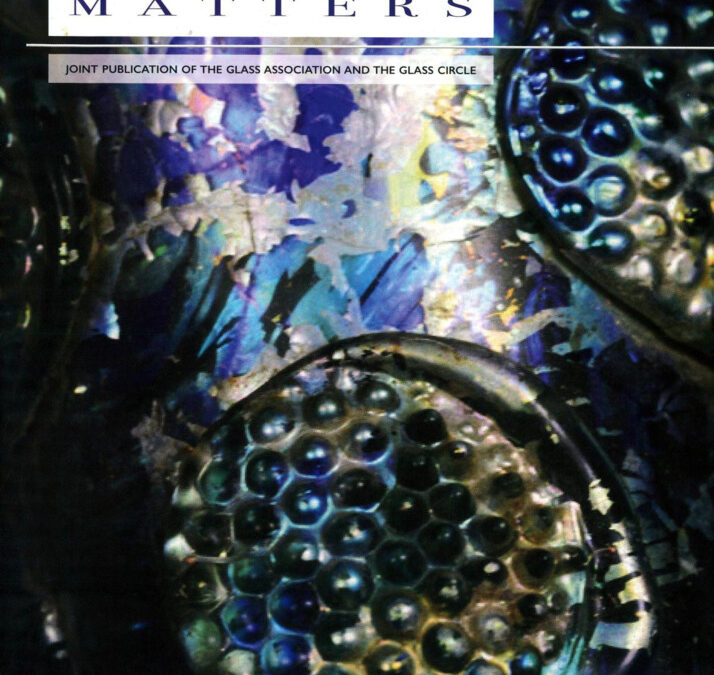
FRONT COVER:
Detail of iridescence on a broken late 16th or early
18th century Dutch or German romer recovered from
a canal during an archaelogical ‘dig. Fragment 70
x38mm suggesting an original height of approximately
160mm.
Athelny Townshend
THE GLASS ASSOCIATON COMMITEE MEMBERS:
The Glass
Association Registered as a Charity No.326602: Website: www.glassassociation.org.uk:
Charles Hajdamach:
Life President;
charleshajdamach@btinternet.com:
David Willars:
Chairman:
chair@glassassociation.org.uk:
Judith Gower:
Hon.
Secretary:
Maurice Wimpory,
Membership Secretary & Treasurer:
membership@
glassassociation.org.uk: 150 Braemar Road, Sutton Coldfield, West Midlands,
B73 6LZ:
Nigel Benson: Paul Bishop:
Vice-Chairman:
Brian Clarke:
Publications Editor:
editor@glassassociation.org.uk:
Christina Glover: Alan
Gower: Bob Wilcock
THE GLASS CIRCLE COMMITEE MEMBERS:
Website: www.
glasscircle.org.uk:
Simon Cottle:
Honorary President:
Susan Newell:
Chairman:
chairman@glasscircle.org:
Laurence Maxfield:
Honorary Treasurer:
treasurer@
glasscircle.org:
Shaun Kiddell:
Honorary Secretary:
secretary@glasscircle.org:
Vernon Cowdy:
Website Manager:
web@glasscircle.org:
Geoffrey Laventhall:
Anne Lutyens-Stobbs:
Meetings Organiser:
James Peake: John P Smith:
publications@glasscircle.org:
Athelny Townshend:
Graphic Design:
designer@
glasscircle.org:
Anne Towse: Graham Vivian
GLASS MATTERS EDITORIAL SUB-COMMITEE MEMBERS:
Nigel Benson:
GA;
Brian Clarke:
GA;
Susan Newell:
GC;
AthelnyTownshend:
GC;
Simon Wain-Hobso:
GC;
Bob Wilcock:
GA
2
Glass Matters Issue no. 2 June 2018
Susan Newell,
Chairman of The
Glass Circle
David Willars,
Chairman of The
Glass Association
CHAIRMEN’S LETTER
J
chairmedf
MESSAGE
Dear Members,
Welcome to Glass Matters
No.2
We are delighted to say the
Glass Circle and the Glass
Association, the joint bodies
responsible for Glass Matters,
are now fully engaged in the
process of becoming one
bigger and better society
dedicated to the appreciation
and study of glass.
Members know that the two
organisations have been shar-
ing activities and meetings
over the last couple of years,
and this joint publication is
the most important tangible
sign that it is beneficial for
us to work as one body. We
now need to form a single
administrative and financial
framework and choose an ap-
propriate name. Both com-
mittees support the proposed
merger, and we can now look
forward with optimism to
operating as a single society
during the coming transition-
al year and beyond. Each so-
ciety has its own governing
principles (The Glass Circle’s
Constitution and the Glass As-
sociation’s Rules) and you will
have been contacted with de-
tailed information about the
merger. We urge Glass Circle
members to attend the Ex-
traordinary General Meeting
to vote on the motion about
the merger at the Art Workers
Guild on Thursday 28th June
at 7pm, prior to Sylvie L’Her-
mite-King’s lecture.
One significant issue is
choosing the name of the
merged group. Several sugges-
tions have already been made,
although currently there is
no outstanding favourite. For
convenience in the short term,
we will be known as ‘The Glass
Society’, although this will not
necessarily be the name adopt-
ed on a permanent basis. It is
very important for the chosen
name to be internet friendly.
We welcome your suggestions
for a name for the new society,
the main contenders being:
1 ‘The Glass Guild’
2 ‘The Glass Society’
3 ‘Glass Matters
To return to Glass Matters, we
were encouraged by the posi-
tive response to our first issue
from members, and we hope
to maintain this high standard
with issue no
2,
by covering a
broad range of subjects, re-
flecting the interests of our
members. Please remember
however, that this is your mag-
azine and the content should
very largely be driven by you
and indeed, contributed by
you. The edit-orial team is
there in part to interpret your
suggestions for regular articles
or features, but they need you
to provide the content. If you
have a glass-related subject
about which you are knowl-
edgeable, maybe a particular
maker or collection, or indeed
your own collection, please get
in touch with the Editor. We
are happy to provide guidance
on writing up the material and
assist as required.
Individual collections are
a major topic of interest for
members, and we reported
last time on the Eila Grahame
collection that arrived recently
in Stourbridge via the Arts
Council. Similar work is
now being undertaken on
another important bequest,
again at Stourbridge, known
as the Pilkington collection.
Likewise, a part of the
Batchelor bequest is being
prepared for an exhibition at
the Fitzwilliam Museum in
Cambridge later this year. In
fact, a few of us were privileged
to attend a joint event at the
Fitzwilliam in April when we
had a glass-themed tour of
the galleries and were allowed
to handle glass under the
curator’s supervision. Once
again this shows how such
an event can bring mutual
benefits as not only did we
get a taste of the Fitzwilliam’s
magnificent collection but the
museum has now enlisted our
help and expertise in providing
more information about
specific items. Collecting is,
however, a very personal
pursuit that grips people in
different ways. Recently we’ve
had the pleasure of visiting
a member’s collection in
Lancashire featuring some
spectacular pressed glass,
and later this month we will
visit another collection at the
wonderful West Stow Hall in
Suffolk. Looking and learning
from other people’s collections
can lead to re-appraising the
items many of us have on our
own shelves — some may even
go on to weed out a few early
purchases or `learning pieces’
in an attempt to refine or
rationalise their collections.
Plans are in hand to focus
upon members’ collections in
forthcoming issues.
In conclusion, this is your
society and the contents of
the magazine, the number
and location of our activities
are driven very largely by you.
Running any group takes a lot
of enthusiasm, time and effort
and the work of all committee
members in this regard is very
much appreciated. In order
to maintain our national, if
not international identity, as
well as featuring glass of all
periods, we need your help.
Please, if you have anything
to contribute, get in touch via
the Editor. We look forward to
hearing from you.
Susan Newell
&
David Willars
Chairmen of The Glass Circle
and The Glass Association
Glass Matters Issue no. 2 June 2018
3
ENGRAVED FLIGHTS OF FANCY
THE
Keller
BOTTLE
by A Collector
I
bought this bottle several
years ago and it holds pride
of place in my collection.
This article is intended to
share my pleasure with you.
Arthur Churchill offered the
bottle for sale in his
1957
sell-
ing “Exhibition of Engraved
Glasses”. Lot 4o of the cata-
logue includes a photo of the
bottle, so there can be no mis-
taking its identity. The entry
reads:
`40. A Wine Bottle. 9
1
/4″, in dear
fine quality glass with the usual
kick in base: engraved all over
with an almost forest scene
showing animals, birds, flow-
ers, grapes, and cupids, scale
cut on neck. Perhaps by Keller.
Third qr. 19th century.
Superb work in fine condition.”
£20
Firstly, a price of
£20
appears
ridiculously cheap. An online
application suggests that to-
day’s equivalent is
£459.54.
Not quite so ridiculous but
still very little for a unique
piece of such high quality.
The bottle is continental
chalk glass and could be earlier
than the 3rd quarter 19th cen-
tury although the engraving
is undoubtedly of that period.
The
mixture of subjects en-
graved on the bottle is bizarre,
with wild animals, birds, flow-
ers, grape vines and cherubs
jostling each other for space.
There is barely a square centi-
metre which has not felt the
engraver’s wheel. The scale of
the various items is inconsis-
tent as you will see in the four
photographs, Figs. 1 to
4.
Starting at the bottom in
Fig.i. there is a swan swimming
on a pond, with its wings raised
like sails. The most remarkable
RIGHT: Fig.i
The angry swan
and the giant
tulip
RIGHT Fig.2
The ferocious wolf
4
Glass Matters Issue no. 2 June 2018
ENGRAVED FLIGHTS OF FANCY
LEFT:
Fig.3
The putto and
the tiger
LEFT:
Fig.4
Columbine and
the heron
detail of the swan is that it has
a pointed beak, which gives
it a very angry look. Surely
the engraver must have seen
a swan in life or had he sim-
ply copied an early engraving
which showed such a creature.
The swan is looking behind it-
self, probably in amazement at
the enormous tulip behind it.
The flower of the tulip is larger
than the swan. Above the tulip
is a cherub or a putto which is
only slightly larger than the
tulip. However, having nev-
er seen a live cherub, it is not
possible to say whether or
not there is a problem of scale
here! The putto is reaching for
a bunch of grapes on a vine
which effectively provides the
background to this side of the
bottle. Each bunch of grapes is
approximately one tenth the
size of the tulip flower. Just
beyond the reach of the put-
to is a chrysanthemum flower
on much the same scale as the
tulip. The upper section of the
bottle is smothered in the vine
and other leaves. The top
sec-
tion
of the neck has the scale
cutting described by Arthur
Churchill.
The wolf at the bottom of
Fig.2 is the most frightening
depiction imaginable. It is ex-
tremely muscular and with its
bristling mane, ears back, eye
bright and large exposed teeth
it is a thing of nightmares or
possibly an escapee from one
of Grimm’s fairy-tales. Did the
wolf inhabit the same book
of illustrations as the swan?
Immediately above the wolf
are chrysanthemum leaves
and some buds. To the right
is a narcissus flower in a scale
similar to the tulip in Fig.i and
roughly equal to the height of
the wolf. Moving upwards we
come to the chrysanthemum
flower already seen in Fig.i.
The neck of the bottle is cov-
ered with an as yet unidenti-
fied flower with fruits.
Glass Matters Issue no. 2 June 2018
5
ENGRAVED FLIGHTS OF FANCY
BELOW:
An enlargement
of fig. i to show
more detail
At the base of Fig.3 is a tiger,
possibly the least effective of
all the creatures on the bot-
tle. The front legs are stubby
and the proportions are just
wrong. The tiger is about two
thirds the size of the wolf in
Fig.z. Moving upwards there
are 3 narcissus flowers and a
briar with
2
buds and a rose
in flower. Above that another
putto, grape vines and an ‘ex-
otic’ bird. The vine, along with
the chrysanthemum flower
mentioned at Fig.2, cover the
neck of the bottle.
In Fig.4 the lowest level is
decorated with a species of
heron taking off from the
pond inhabited by the swan
at Fig.i. Above and behind the
heron are the leaves of the tu-
lip seen in Fig.i with the flow-
er just visible to the right. To
the left is the rose briar seen in
Fig.3. Immediately above the
heron’s head is a nondescript
flower. Above all of this is the
vine with grapes and the first
putto. The neck of the bottle is
covered with columbine flow-
ers and leaves on a scale sim-
ilar to the other flowers.
A capricious mix of subjects
where the animals and birds
are very loosely to one scale
and the plant life to another.
The quality of the engraving
is outstanding; only the tiger
is problematic. Arthur Chur-
chill clearly thought the qual-
ity was good enough to be by
an engraver of the standard of
Joseph Keller.
That the bottle is unique
cannot be questioned but why
was it produced? The bottle
itself is clearly of continental
origin which would point to
a continental engraver. Could
it be an apprentice piece? It
would be an exceptional ap-
prentice who could produce
work of this standard at that
stage of his career. Had it been
standard practice for appren-
tices to produce such items
surely there would be others
of its ilk. As an example of an
experienced engraver’s skill it
would have had a direct bear-
ing on his employability.
During the second half of
the i9th century, engraved
glass became very popular in
Britain. However, the British
glass industry did not have
sufficient home-grown talent
to meet the demand. So large
numbers of both glassmakers
and engravers were sought
from Bohemia. Few of these
immigrants would have been
able to speak English and even
if they could, what would be
more likely to ensure immedi-
ate employment than a practi-
cal example of their skill such
as this bottle? I like to think of
its creator, probably a young
glass engraver, making the
long journey across Europe to
find work in Britain. Would he
have carried this bottle as one
of the most precious items in
his knapsack? Perhaps he even
had to use it for drinking wa-
ter on his journey. When he
got to a British glassmaker
such as Thomas Webb, a fellow
countryman might have intro-
duced him to the engraving
shop manager and he would
have offered the bottle for ex-
amination and possibly been
offered work.
This bottle, which is basical-
ly Bohemian, tells the story
of glass engraving in Britain
during the second half of the
i9th century: how the de-
mand for engraved glass could
only be met with the help of
immigrant labour; how their
skill and expertise was essen-
tial to make and engrave the
glass and how animals, plants
and flowers became common
subjects on ‘British’ engraved
glass.
Finally, could it have been
engraved by Keller? or was it
any one of half a dozen tal-
ented immigrants? Short of
comparing the engraving on
the bottle with known work
we will never know. And quite
honestly I do not find it of
great importance. Knowing
who engraved it would not in-
crease my enjoyment one iota.
6
Glass Matters Issue no. 2 June 2018
T
he Corning Museum of
Glass recently acquired
an unusual goblet (Fig.1)
whose age and manufacturing
source have been debated for
nearly 7o years’. The goblet is
of a non-lead composition of
pale greenish tint, and it has
a remarkable feature: the bowl
is double-layered and encases
metallic silver leaf between
two fused layers of glass. The
goblet has a slightly iridescent
surface. We will refer to it as
the “Corning goblet.”
The goblet has a fitted, silk-
lined, leather-covered wooden
box, which is of late 19th or
early loth-century date and
is probably of English origin
(Fig.2). There are no marks or
inscriptions on the case iden-
tifying its maker, date, or pur-
pose.
HISTORY
The earliest known reference
to the goblet was in 1948,
when E. B. Haynes illustrat-
ed and discussed it in Glass
through the Ages, where it was
identified as a “chalice, dou-
ble-blown bowl with silver foil
inserted. Mansell period, c.
1642.” Haynes also added: “The
LEFT:
Fig.i
The Corning
goblet. H. 18.1
cm; D. (bowl,
rim)
9.0
cm,
(foot) 7.6 cm.
The Corning
Museum of Glass
(2035.3.9a), gift
of Dwight and
Lorri Lanmon.
RIGHT:
Fig.2.
The fitted
box with the
Corning goblet.
L. 23.5 cm,
W. 13.2 cm,
H. 12.0 cm.
The Coming Museum
of Glass (2o15.3.9b)
DATING GLASS
A REMARKABLE
fr idescent goblet
WITH A
double-walled, silvered bold
17TH OR 19TH CENTURY?
Dwight P. Lanmon and William Gudenrath
Glass Matters Issue no. 2 June 2018
7
DATING GLASS
metal is neither Venetian nor
Netherlandish, and it is tinged
on the foot with an iridescence
not due to burial or decompo-
sition.” The last statement is
disquieting, and it should have
been a warning flag to Haynes
and to those who catalogued
the glass later.
The goblet was acquired by
Walter F. Smith Jr. of Tren-
ton, New Jersey. Sotheby’s
dispersed the Smith Collection
in 1967 and 1968; the goblet
was catalogued as “‘Fawn-
de-Venise,’ probably Nether-
landish, late 17th century.
3
”
It brought a modest £40. The
goblet was again offered by
Christie’s (London) on July
9,
1997, where the Sotheby’s
attribution was repeated. The
glass sold for £3,680 to the late
London antique glass dealer
Christopher Sheppard, who
sold it to John H. Bryan of
Lake Bluff, Illinois. In his in-
voice, Sheppard identified the
glass as “… English from one
of the Mansell Glass Houses,
c. 1640. This glass was recov-
ered from a site in the City of
London that was destroyed
in 1642…” Most recently, the
glass was offered for sale at
Bonhams (London) on May
20,
2015.
It was catalogued as “an
exceptional early silvered gob-
let or chalice, 17th century.” The
glass was withdrawn before the
sale after doubts were raised as
to its authenticity.
Fig.3.
Underside
of the foot of the
Corning goblet,
showing allover
iridescence,
except on the
pontil mark
Fig.4.
View inside
the bowl of the
Corning goblet,
showing a tiny
pontil mark in the
bottom, overlap-
ping areas of the
sheets of silver
leaf, and a rippled
interior surface
THE IRIDESCENCE
Recent close examination
of the goblet confirms that
Haynes’s observation was cor-
rect: the iridescence was not a
product of “burial or decom-
position.” Proof that the iri-
descence is incontrovertibly of
late 19th-century date at the
earliest—not mid-17th centu-
ry—is threefold:
1. There is no iridescence on
the pontil mark on the bottom
of the foot, proving that the
iridescent coating was added
while the glass was still at-
tached to a pontil (Fig.3).
4
2.
X-ray fluorescence (XRF)
analysis of the surface of the
glass detected the presence of
tin and trace amounts of cop-
per, iron and arsenic, which
indicates that the iridescence
was probably produced using
a spray of stannous chloride in
solution.
,
3.
The process of spraying or
fuming an iridescence-produc-
ing material onto glass was de-
veloped in the mid-i800s.
THE GOBLET’S CONSTRUCTION
The construction of the gob-
let raises further doubt that
it could be of 17th-century
date. Most significantly, there
is a tiny rough pontil mark
inside the bowl (Fig.4). This is
evidence that the object was
made in two sections—the
bowl separately from the stem
and foot—using a technique
developed in Venice, which be-
8
Glass Matters Issue no. 2 June 2018
DATING GLASS
LEFT: Fig.5a
interior
& BELOW: Fig.5b
exterior
of
a ribbon glass
cup, made in
imitation of a
first-century
Roman prototype.
Italy, Venice,
Salviati and Co.,
about 1879. H.
17.3 cm, D. (rim)
9.2
OM
The Corning
Museum of Glass
(8
2
.3.54).
came common practice there
in the late i800s.
MAKING THE GOBLET’S BOWL
Close inspection of the bowl-
reveals that the silver lining
was produced using silver leaf,
not powdered silver) and that
it was not expanded signifi-
cantly in the process of form-
ing it, resulting in its metallic
appearance. To construct the
bowl, a tube of colourless glass
was covered on the interior
with silver leaf, perhaps using
water with gum arabic as an
adhesive. The tube was heated
and attached to a blowpipe.
A small, thin bubble of glass
was carefully lowered into the
tube and rapidly inflated, thus
thinly lining the tube’s interi-
or and trapping the silver leaf.
The Venetian term for this still
widely used process of thin-
ly lining one bubble of glass
with another is
sbruffo.
After
reheating, the outer end of the
tube was closed, and the sides
were tapered. Throughout this
process, care was taken only to
diminish the diameter of the
tube, thereby avoiding any ex-
pansion that would cause the
silver leaf to break up and be-
come dispersed.
IRIDESCENCE
A significant aspect of the his-
torical revivalism that dom-
inated the decorative arts in
Europe and America during
the late 1800s was an interest
in replicating many types of
ancient glass. The brilliant-
ly colored, iridescent surface
found on some excavated glass
appealed to glassmakers who
endeavored to replicate the vi-
sual effect chemically. At least
three different processes to
produce iridescent surfaces on
glass were developed, but the
one used on the Corning gob-
let was by spraying or fuming
with metallic vapours during
the final stage of production.
A Hungarian physician and
chemist, Dr. Le6 Valentin
Pantocsek (1812-1893), who
worked at the Zlatn6, Hungary
(now Slovakia) glassworks of
Janos Gjorgy Zahn, is credited
with the invention of a process
for iridising glass by fuming in
the 185os.
6
The Corning goblet
could not, therefore, date from
before the late 185os.
WHO MADE THE GOBLET?
The manufacture of glass ves-
sels incorporating metal leaf
within their walls was not
uncommon in Europe during
the late 19th century. The
earliest date that the authors
found in which the technique
Glass Matters Issue no. 2 June 2018
9
DATING GLASS
BELOW:
Fig.6
Filigrana
goblet
with silver leaf
encapsulated
within the bowl.
Italy, Venice,
Salviati and
Co. or Artisti
Barovier,
attributed
to Giuseppe
Barovier, about
1870-1890. H.
20.2
cm, D. (rim)
i.o.6 cm.
The Corning Museum
of Glass (79.3.1126,
bequest of
Jerome Strauss)
was observed was at the 1867
Exposition Universelle in Par-
is, where Salviati of Venice
showed vessels with “gold me-
tallic particles floating, so to
speak, in the glass.”
7
The pro-
cess had been disseminated
widely by 1878, when several
English and Continental glass-
makers exhibited encased-leaf
glass at the world’s fair in Par-
is.
Among them, the Aurora
Glass Company in London
produced a wide variety of
metal-encrusted
glassware
in the late 187os and patent-
ed techniques for decorating
glass with metal leaf encased
within the walls of a vessel in
1876 and 1878.
8
Those patents
describe a technique similar
to that used to produce the
bowl of the Corning goblet,
but observers of the Aurora
products consistently
noted that the
thin gold,
silver,
and
platinum leaf in
the glass…. has
the appearance
of fine metallic
dust, incorporated
throughout the en-
tire substance of it.”
Likewise, all of the de-
scriptions of metal-en-
crusted glass from other
factories mentioned the
same feature: the leaf was
burst, through blowing, to cre-
ate an uneven distribution of
the metal.
Venice is another obvious
place to search for the iden-
tity of the maker of the Corn-
ing goblet. The two most likely
suspects are the Salviati firm
and the follow-on Venice and
Murano company.
Salviati was very familiar
with the process of en-
casing metal leaf
between layers
of glass because
of his reproduc-
tions of mosaic gold-glass tes-
serae. He described the tech-
nique in 1865: “On a ground of
thick glass or enamel . . . there
is laid a leaf of gold or silver
which is attached principally
by the action of fire; then a
film of purest glass is spread
over it, and this may either be
perfectly colorless or of any
tint that may be required.”
1
°
While encasing metal foils
within the walls of a blown
glass vessel was technically the
same as producing mosaic tes-
serae, keeping the leaf intact
presented a very different and
difficult challenge. The process
was perfected in the produc-
tion of imitation ancient Ro-
man gold glass decorated with
Christian and other Roman
symbols in gilding between
two layers of glass. It was in-
troduced at the Venice and
Murano Company in
1874.
An example of
Salviati’s imitation
of a Roman gold-
band glass shown in
Figs.5a and 5b (pre-
vious page) is also sig-
nificant; its importance
to this study is the pres-
ence of a continuous lay-
er of silver foil behind the
coloured exterior bands,
which is further encased
with an inner layer of colorless
glass. The silver foil inside the
bowl has not been expanded,
and the interior of the bowl
and the foot are iridized.
The remarkable goblet
shown in Fig.6 also shares
important features with the
Corning goblet, and it has a
Salviati connection. It is close-
ly related in both decoration
and form to a goblet which is
owned by Rosa Barovier Men-
tasti, great-granddaugh-
ter of the maker; it
was made about 1890
by the maestro Gi-
useppe Barovier (1853-
1942) at Artisti Barovier. The
bowl has silver foil encased
between two layers of glass—
in this case, with a tartan-like
design (filigrana) of crisscross-
ing transparent colored glass
threads. The same goblet form
was made at the Salviati facto-
ry as early as the late 186os.”
While the molded lion-mask
knop on the goblet is different
from the simple egg-shaped
knop on the Corning goblet,
the avolio structures above
and below are similar on the
two glasses. This feature, in
addition to the use of silver
foil within the bowl, further
relates the two goblets to each
other.
In addition, the stem of an
enamelled goblet (Fig.7) made
by the Salviati company about
1868, in the collection of The
Metropolitan Museum of Art
in New York City, is essentially
identical to that on the Corn-
ing goblet, and there is also a
pontil mark inside the bow1.
12
CONCLUSIONS
1.
The Corning goblet is not
a rare survival from a mid-i7th
century London glasshouse.
2.
The Corning goblet was
made to look old by iridising
its surface. We believe that
it was made when there was
widespread interest in reviv-
ing earlier glassmaking tech-
niques and reproducing earlier
styles of glass – that is, during
the late 19th century.
3.
We believe that the goblet
was produced by the Salvia-
ti company of Venice in the
187os.
4.
By the time the glass was
published in Glass through
the Ages in 1948, it may have
acquired a fabricated “history”
of having been found in a
house destroyed in 1642 at
the outset of the English Civil
War.
5.
The goblet is an important
and possibly unique example
10
Glass Matters Issue no. 2 June 2018
DATING GLASS
of highly sophisticated glass-
making skills introduced and
perfected in Venice in the late
i800s.
AUTHORS
Dwight Lanmon is the For-
mer Director, The Corning
Museum of Glass, Director
Emeritus, Winterthur Muse-
um and Honorary Vice-Presi-
dent, The Glass Circle.
Bill Gudenrath is the Resi-
dent Advisor at the Studio of
The Corning Museum of Glass.
ENDNOTES
1. This article is a significantly re-
duced version of a paper of the
same title published in Volume 59
(2017) of the
Journal of Glass Stud-
ies.
2. E. Barrington Haynes,
Glass
through the Ages,
Harmondsworth,
Middlesex, U.K.: Penguin, [1948],
pp. 119-12o and pl. 31a.
3.
The Walter F. Smith Collection: Cat-
alogue of an Important Collection of
Glass,
London: Sotheby’s, July 8,
1968, p. 15, lot
8
94.
4. A suggestion that a genuine
17th-century glass might be gradu-
ally heated and then reattached to
a pontil, with iridescence sprayed
on, is without merit. First, there
is significant danger that the glass
would shatter in doing this; sec-
ond, there would be no purpose,
since most intact glasses dating
from the 17th century are not ir-
idescent; and third, the spraying
would have to have been done be-
fore the stem was broken, which
predated the first publication of
the goblet in 1948. There would
have been little potential financial
gain if it had been done before the
glass was broken.
5. The chemistry of this iridescence
was confirmed by XRF analysis
(personal communications, Ste-
phen P. Koob to Dwight Lanmon,
June 29 and July
2,
2015).
6. David Whitehouse,
Reflecting An-
tiquity: Modern Glass Inspired by
Ancient Rome,
Corning: The Corn-
ing Museum of Glass, 2007, p. 207;
Vera Varga,
Glass and Radiance: Ir-
idescent and Lustered Glasses from
the Second Half of the Nineteenth
Century to the 1910’s in the Collec-
tion of the Museum of Applied Arts,
Budapest,
Budapest: the museum,
2000,
pp. 53-67.
7.
The Illustrated Catalogue of the Uni-
versal Exhibition, Published with the
Art Journal, v. 2, London and New
York: Virtue, [1868],
p. 106.
8.
English Letters Patent, no. 4217,
“Glass and Pottery (Improvements
in the Manufacture and Orna-
mentation of Articles of Glass and
Pottery),” issued to Paul Raoul de
Faucheux d’Humy, October 31, 1876;
sealed December
21,
1876, Specifica-
tion, pp. 2-3. English Letters Patent,
no.
600,
“Manufacture and Orna-
mentation of Articles Formed of
Glass, Pottery, and Metals, &c. (Im-
provements in the Manufacture and
Ornamentation of Articles Formed
of Glass, Pottery, and Metals, and of
Combinations Thereof, and in Means
or Apparatus Employed Therein),”
issued to Paul Raoul de Faucheux
d’Humy, February 13, 1878; sealed
April 9,1878, Specification, p.
7.
9.
“British Glass at the Paris Exhibi-
tion,”
The Pottery & Glass Trades’
Journal, v.
1,
no. 8, August 1878,
p. 116.
Antonio Salviati, On
Mosaics (Gen-
erally) and the Superior Advantages,
Adaptability and General Use in the
Past and Present Age, in Architectur-
al and Other Decorations, of Enamel
Mosaics: Being a Paper Read before
the Leeds Philosophical and Literary
Society on February 21st,
1865, Lon-
don: Wertheimer and Co., 1865, p.
8.
A goblet of this form was acquired
by the Victoria and Albert Muse-
um in 1868. See also Salviati gob-
lets in the same form, made be-
tween 1869 and 1872, in the Museo
del Vetro, Murano (acc. nos. 03371
and 03372).
12.
A Salviati enamelled and gilded
colorless goblet of related form, ac-
quired in 1868, is also in the collec-
tion of the Victoria and Albert Mu-
seum, London (acc. no. 895-1868).
ABOVE:
Fig.7
Transparent blue
10.
glass goblet with
the enamelled
portrait and arms
of Nicole da Pon-
te (1491-1585).
Italy, Venice,
Salviati and Co.,
decorated by
Leopoldo Bear-
zotti, about 1868.
11.
H. 21.3 cm.
The Metropolitan Mu-
seum of Art (81.8.240,
g
ift of James Jackson
Jarves, 1881)
Glass Matters Issue no. 2 June 2018
LEFT:
Fig.i
Apothecary
vessel
BELOW:
Fig.2
Biggar decanter
ENDS & BEGINNINGS
FIvE
engraved glasses
AND A
lucky man
John Smith
I
ast
November I retired
from the Chairmanship
4
of The Glass Circle after
fourteen happy years. The
Circle was solvent, I was
extremely happy with my
successor and discussions
with The Glass Association
were proceeding slowly
but amicably. Also during
my tenure, the
Glass Circle
News
became a wonderful
magazine of reference under
the editorship of Jane Dorner,
the design and photography of
Athelny Townshend and the
proofreading of Anne Towse
and others.
We visited Scotland and I
also led several expeditions
abroad, widening our mem-
bers’ understanding of glass
beyond the British Isles.
Memorable moments include
the trip to the Czech Republic
with 92 travellers, members
of the Glass Circle and the
Glass Association, where, in
addition to viewing glass, we
were entertained to a show by
local school children and had
our own concert in the Novy
Bor church. We went on a trip
to Cologne during Fasching,
when it was announced two
weeks before we left that
all the museums would be
closed; we found plenty else
to do! Also, during our visit
to the USA we nearly had no
bus in Detroit, and actually
ended up in a school bus, a
very American experience.
Soon after retiring, I was
rushed off to the Chelsea and
Westminster Hospital where
I remained for 19 days. The
operation was successful and
my current chemotherapy
seems to be working.
I have since visited Maast-
richt to vet the TEFAF fair, and
also Prague, for a conference of
`The European society for Light
and Glass’. We had a day trip
to Pilzen where not only is the
beer good, but they also have a
wonderful museum. Fig.i is of
an early glass in the museum,
concerning an apothecary
subject about removing a
worm from a vein; members’
thoughts on its origin will be
most welcome. (You can reach
me at johnpsmith@globalnet.
co.uk.)
These of you who visited my
Suffolk home in September
will have seen my rather
eclectic collection. When I
was working at Mallett I was
not allowed to collect glasses
similar to those we sold –
largely neither could I afford
them; my reputation would
have been harmed if it was
thought that I was taking the
best items home. Not that that
stopped Eila Grahame, who
owned her own business, as
reported in the last edition of
this new magazine.
I have chosen a few mem-
orable engraved glasses from the
18th, i9th and 2oth centuries.
The half-pint decanter,
c176o (Fig.2), I imagine for
whisky, depicts a house in
Biggar, Scotland which is
I believe, still standing. It
would be nice if this went to
the Biggar museum. On the
reverse is engraved ‘Rev John
Low, Biggar, Ordained 1761’.
The goblet (Fig.3), is French
ci86o, probably by Baccarat,
or possibly by St. Louis, with
a colour twist stem, cased in
red glass, and engraved with
Chateau Pierrefonds, showing
12
Glass Matters Issue no. 2 June 2018
LEFT: Fig.3
Chateau Pierre-
fonds
ABOVE:
Fig.4
by Eestmir Cejnar
RIGHT: Fig.5
Vase by Peter
Dreiser
ENDS & BEGINNINGS
ABOVE:
Fig.6
A
Plaque by
Jane Webster
it in its ruined state before it
was rebuilt by Napoleon III.
The straw-coloured slab of
glass (Fig.4) is engraved on
the reverse with a very strong
image signed by Eestmir
Cejnar, who worked in The
Czech Republic during the
communist era.
The vase (Fig.5) is by our
late member Peter Dreiser,
engraved in the 197os; I
bought it at auction and when
I showed it to Peter he said
that he had wondered where it
had gone.
I commissioned the plaque
(Fig.6), engraved with a
Wagnerian subject, from Jane
Webster, another late member.
Lastly, there’s the wonderful
old goblet, engraved by Lesley
Pyke and illustrated in the last
Glass Matters, which you all
kindly gave me, together with
the smaller one which I use
regularly.
I am now very much involved
with the new White House
Cone project as a trustee of
The British Glass Foundation.
The project has at last been
awarded quite a large tranche
of money from the Heritage
Lottery Fund, and so can plan
ahead. The museum is unlikely
to be fully open before 2019 or
2020,
but is occasionally open
for special events such as the
Glass Association’s AGM back
in 2016.
Glass Matters Issue no. 2 June 2018
13
ROYAL PAPERWEIGHT
Queen Elizabeth
HPLATINUM
WEDDI G
ANNIVERSARY
Paperweights
Richard Giles
RIGHT:
A detail of the
EP and 7o
canes
BELOW:
A
general view
of the whole
paper weight
T
he list of milestones in the
Queen’s reign as monarch
continues to grow. Hot
on the heels of becoming the
longest-reigning monarch in
our history in September
2015
and reaching her 9oth birth-
day in 2016, she achieved her
loth or platinum wedding an-
niversary in November 2017.
For the first two events Mi-
chael Hunter of Twists Glass
in Selkirk, Scotland produced
a small number of paper-
weights for Goviers, the gift
shop in Sidmouth, Devon and
these were documented in my
articles in Cones 109 and
111.
For the latest milestone he
was again persuaded to make
a small number of
weights to commemorate the
event which all feature special
EP and 7o canes.
The number of weights pro-
duced this time is even smaller
than for the previous events,
with just five one-off concen-
tric millefiori weights, five
closepack millefiori weights
and five scrambled or end-
of-day weights. Two of the
concentric weights feature a
central EP cane surrounded by
differing patterns of 7o canes,
two feature central 7o canes
with differing patterns of 7o
canes, and the last one has two
EP and two 7o canes around a
central complex millefiori cane.
Both the closepack and scram-
bled weights feature a
single example of
the EP and
7o canes.
As our examples of the two
previous weights featured
concentric and closepack
millefiori we decided this time
to go for one of the scrambled
or end-of-day weights and the
attached pictures give a gen-
eral view of the whole weight
plus an enlargement of the EP
and 7o feature canes.
Goviers also commissioned
Caithness Glass to make some
weights to commemorate the
event. The first, a large mul-
tifaceted weight featuring
a white flower form and 7o
canes in a limited edition of
7o, and the second, a weight
with one large front facet en-
graved with portraits of the
Queen and Prince Philip and
the dates November
1
947
–
2017, was produced in a limit-
ed edition of
200.
Whether there are any
more milestones to be marked
in the future remains to be
seen. The royal wedding in
May this year is the latest roy-
al event to be celebrated and it
will be interesting to see if the
tradition of marking the event
with souvenir items will be
continued.
Glass Matters Issue no. 2 June 2018
14
THE FIELD CUP
The
FIELD
Cup
A Venetian glass
MASTERPIECE
of the late 15th
CENTURY
Simon Cottle
T
he sale
at auc-
tion
in
London in
2000
by Christie’s of the
fabulous collection of
early Renaissance and Is-
lamic glass belonging to Bar-
oness Batsheva Rothschild
was a momentous occasion.
Originally the bankers to the
French state, the Rothschild
family, with their enormous
wealth, built up great collec-
tions of art, particularly from
the Renaissance period. In
the 19th century, Baron Al-
phonse James de Rothschild
assembled a vast collection of
objects reflective of the Medi-
aeval Kunstkammer or trea-
suries which were purchased
directly from antique dealers,
some of whom were unscru-
pulous in their presentation
to the family of fake copies.
Although there are
magnificent existing
collections formed
by the family, such as
the Waddesdon Bequest at
Fig.i
The Field Cup
(part, close-up)
Courtesy of
Bonhams, London
Glass Matters Issue no. 2 June 2018
15
THE FIELD CUP
the British Museum from the
estate of Baron Ferdinand de
Rothschild, there is an aware-
ness today amongst connois-
seurs that they were fair game
to crooked dealers in the 19th
century and as a result a small
percentage of their collec-
tions may not be as they first
seemed. Against this back-
ground, the collection of the
Baroness, inherited from her
grandfather Baron Alphonse
James de Rothschild, was
therefore naturally treated
with some caution by the auc-
tioneers. Part of the collection
comprised fabulous Renais-
sance jeweller, some of which
at the time of cataloguing the
Christie’s specialists found to
be 19th century copies. Sadly,
this finding tarnished other
parts of the collection which
included the Venetian and Is-
lamic glass. The auctioneers
had grave concerns about the
authenticity of several of the
pieces, especially the Venetian
enamelled glass of the late
15th and early 16th centuries.
A number of the early enam-
elled Venetian pieces were
thought to be 19th century
copies, as indeed were one or
two of the 13th/14th century
Islamic glass mosque lamps.
Although there were some ex-
ceptional prices paid for three
pieces of 13th century Islamic
glass at the auction, the pric-
es for the remaining glasses
reflected the belief that they
were probably either of 19th
century manufacture or from
a later period than the Re-
naissance. However, the later
appearance of at least two of
the suspected 19th century Is-
lamic glasses at other auction
houses in London, reattribut-
ed to the earlier period, pro-
duced some surprising results
with at least one achieving a
seven-figure price.
One of the suspect Vene-
tian pieces, acquired by the
late Christopher Sheppard
as a probable 19th century
re-production, is now in the
collections of the Chicago Art
Institute and convincingly at-
tributed to the late 15th cen-
tury. Christopher strongly be-
lieved that the piece was of an
early date though his claims
were treated with initial scep-
ticism. Following new research
undertaken by Christopher
and myself, it was subsequent-
ly offered by Bonhams at auc-
tion in London on 3 June 2009
as a late 15th century example.
Despite this new research con-
cluding that it was a Renais-
sance piece, potential buyers
were still sceptical of an early
attribution and it was bought-
in by the auctioneers. Howev-
er, my research, encouraged
by Christopher’s strong belief
in its early origins, has now
been endorsed by its addition
to the collections in Chicago
and through its acquisition
and public display has hope-
fully erased any doubts to its
authenticity.
On a visit to the Art Insti-
tute in 2017 I therefore had the
pleasure of seeing the bowl in
its proper context in the newly
opened Deering Family Galler-
ies of Mediaeval and Renais-
sance Art, Arms and Armour.
Nonetheless, fuller research
on the bowl’s background has
not been made public, there-
fore I feel that now is the time
to reveal my findings.
My research into Christo-
pher Sheppard’s bowl pro-
duced some surprising in-
formation which was not
available to Christie’s in
2000.
This is published in its entirety
below.
Of 16.5cm high by 20.8cm
diameter, the bowl was de-
scribed in the catalogue as a
Venetian enamelled and gilt
blue-tinted standing bowl, late
15th century. It is of rounded
form with a folded rim, and is
painted with pairs of winged
sphinxes opposing a cherub’s
head emerging from a vase
alternating with pairs of cher-
ubs seated on gilt urns, on a
grassy sward and reserved on a
ground of gilt scrolling foliage.
A gilt band inscribed TEN-
PORE FELICI MVLTI NOMI-
NANTVR AMICI, (translated
as ‘In times of abundance one
has lots of friends’) sits below
the rim and the cup is set over
a high trumpet foot with fold-
ed rim brushed with gilding.
The provenance was set out
as follows: George Field Baron
Alphonse de Rothschild (1827-
1905), Paris Baron Edouard de
Rothschild (1868-1949), Paris
Baroness Batsheva de Roth-
schild (1914-1999), Tel Aviv
Rothschild Inv.nos.P.48 and
E.de R.261(?) Sold at Christie’s,
The Collection of The Late Bar-
oness Batsheva de Rothschild,
14 December
2000, lot 23. It
is known to have been exhib-
ited at the Art Treasures of
the United Kingdom in Man-
chester in 1857 where it was
illustrated by J.B.Waring,
Cat-
alogue of the Art Treasures of
the United Kingdom collected
at Manchester in 1857,
in the
section headed ‘The Museum
of Ornamental Art’, London
(1858), chromolithograph, p1.2.
The sphinx motif (see Fig.2
opposite right)appears on a
green beaker attributed to
Venice, circa 1500, formerly in
the Kunstgewerbe Museum,
Berlin (see R.Schmidt,
Das
Glas,
Berlin, 1912, p.93, p1.56
and F.A.Dreier,
vene-
zianischer Emailglas-Pokal,
Aus der Sammlmig Lady Ba-
got’,
Kunst & Antiquitaten,
Zeitschrift far Kunstfreunde
Sammler and Museen,
Heft III,
1986, p.56, p1.5). Although the
beaker was probably destroyed
during the Second World War
Schmidt describes it,
op rit,
as decorated with sphinxes,
cherub’s heads and putti. The
16
Glass Matters Issue no. 2 June 2018
THE FIELD CUP
putti on the present exam-
ple bear a close resemblance
to those on a blue-tinted
standing bowl in the Cleve-
land Museum of Art, Ohio
(ex. collections Charles Stein,
Paris, and Maurice de Roth-
schild, Geneva) (see R.Barovi-
er-Mentasti
et al.,
exhibition
catalogue,
Mille anni di arte
del vetro a Venezia,
1982, p.81,
nos.7 1 a-c, and R.von Strass-
er and W.Spiegl,
Dekoriertes
Glas,
1989, p.28, p1.27).
No other blue-tinted Vene-
tian standing bowl with a gilt
band etched with an inscrip-
tion is recorded in the litera-
ture. A part-coloured shallow
bowl, however, in the Museo
Ala Ponzone, Cremona, with
a partial gilt amethyst-tint-
ed trumpet-shaped foot, is
also inscribed within a gilt
border below the rim. This
example was recorded in the
museum’s collection at least
as early as 184o (see R.Barovi-
er Mentasti et al,
Les Ages du
Verre,
p.176, no.51). Similar
inscriptions also appear on five
clear glass bowls from the late
15th century. See the example
exhibited in the Musee Ari-
ana, Geneva, 1995 (illustrated
Ernesto Wolf Collection,
see
B.Klesse,
European Glass from
1500-1800,
no.8) and another
in the Louvre Museum, Paris
(Inv.0Aii19). Four of the
bowls mentioned all have their
Latin inscriptions engraved in
capital letters in the old Latin
style on a gilt band applied to
the exterior.
George W. Field was born on
13 November 1798 and lived
at Ashurst Park, a large house
set in its own grounds close to
Tunbridge Wells, Kent. When
he assembled his art collec-
tion is unrecorded but Field
appears to have been well
known to some of the leading
connoisseurs of the day as a
collector of Renaissance and
Mediaeval art. On 17 Septem-
ber 1856, he was invited to
lend items to the exhibition
of the Art Treasures of the
United Kingdom to be held in
Manchester in 1857. The crite-
ria for the choice of exhibits
were largely based on the wide
personal knowledge of Brit-
ish private collections by the
noted German art historian
Gustav Waagen. Amongst the
Erwin Baumgartner,
Verre de
Venise,
pp.31 and 91, no.172),
one in the Victoria and Al-
bert Museum
(see
W.B.Hon-
ey,
Handbook of the Collec-
tions,
1964, p1.32C), another in
the British Museum, London
(see Hugh
Tait, The Golden Age
of Venetian Glass,
1979, p.38,
no.28), a fourth in the Wiirt-
tembergisches Landesmuse-
urn, Stuttgart (formerly in the
ABOVE:
Fig.3
Field Cup detail
of putti
Courtesy of Bonhams,
London.
BELOW;
Fig.2
A copy of the
J.B.Waring litho-
graph illustrating
the bowl in the
catalogue of the
exhibition of Art
Treasures of the
United Kingdom,
Manchester, 1857
Glass Matters Issue no. 2 June 2018
17
THE FIELD CUP
numerous items inspected by
J.B. Waring, the organiser of
the Works of Art section, the
bowl was selected for display.
Further 16th century items,
including ivories, bronzes
and wood carvings were also
selected. From the extensive
list of his exhibits found in the
City of Manchester archives,
Field’s collection was both
eclectic and diverse (M6/2/21).
They included ‘Queen Eliza-
beth’s Prayer Book, silver gilt
and enamelled, very rare and
fine work’ (p.206), ‘A very fine
crystal cup formerly part of
the Crown Jewels of France,
lately the property of Lou-
is Philippe’, ‘2 carved ebony
chairs from Strawberry Hill’
(p.140) and some fine Dutch
17th century oil paintings by
several of the leading masters
(M6/2/32). Of the glass that
was returned to him after
the closure of the exhibition
`i opal cup, i Venetian bowl,
blue and finely enamelled, 3
cups of Ruby glass and 2 Ve-
netian glass vases mounted’
are recorded. In the introduc-
tion to the section of the ex-
hibition catalogue devoted to
`The Museum of Ornamental
Art’, Waring acknowledged the
contributions of Earl Cado-
gan, Lord de Tabley, Mr. Field
and the Duke of Buccleuch as
`amongst the most remarkable
examples’ (Catalogue, 1857,
p.149). Field’s glass was exhib-
ited alongside that lent by Fe-
lix Slade who subsequently do-
nated his extensive collection
to the British Museum.
Blue-tinted glasses and espe-
cially footed bowls of this type
are well known in the corpus
of Venetian production of the
15th and early 16th centuries.
Indeed, Henry VIII of England
is known to have had ‘hi stand-
ing Cuppes of blewe glasses wt
covers to theym paynted and
guilte’ (see D.Battie and S.Cot-
tle,
Sotheby’s Concise Encyclope-
dia of Glass,
p.60). In shape and
form, one of the closest related
examples to the present lot is
the famous blue glass marriage
bowl, commonly known as
`The Angelo Barovier Cup’ (in
the Museo Vetrario, Murano –
see Barovier (1982), pp.74-78,
no.70). Angelo Barovier was
until recently credited with
the fine enamel decoration. He
was widely praised as one ‘who
knew the whole of the art of
glass’ and had won the respect
of Alphonse, King of Naples,
the French court and the Duke
of Milan. The Barovier Cup is
however now thought to date
from 1470-148o, some ten
years after Angelo’s death in
1460. As Hugh Tait has com-
mented, almost nothing is
known about the Venetians
who decorated these chefs
d’oeuvres of the Renaissance
and not one single glass can
be identified as the work of a
particular artist.
In recent years the dating of
Venetian enamelled and gilt
blue-tinted glass has been as-
sisted by excavations of burial
mounds in the Russian Cau-
casus. An area originally un-
der the control of the Mongol
khans of the Golden Horde
(1226-1502), the archaeological
evidence indicates that such
glass was produced in Venice
and traded via Italian colonies
established along the Silk Road
in the 14th and 15th centuries.
They include complete exam-
ples of purple, green and blue
glass decorated with scale and
dot and lozenge and flower
ornament typical of much of
the existing material (see the
article by Mark Kramarovsky,
`The import and manufacture
of glass in the territories of
the Golden Horde’, published
by Rachel Ward (ed.),
Gild-
ed and Enamelled Glass from
the Middle East,
British
Museum, 1998, pp.96-100).
Kramarovsky, a curator at
the Hermitage Museum, St.
Petersburg, refers to sever-
al coloured Venetian glasses
from the excavations now in
the museum’s collection in-
cluding a blue glass tankard
(fig.22.5) decorated in enamels
and gilding with flowers in di-
amond-shaped frames, found
in Digoria (Northern Ossetia,
Caucasus).
This
tankard is very
similar to an example former-
ly in the Rothschild Collection
attributed to the 19th century
(Christie’s, 14 December 2000,
lot 34).
For similar figurative deco-
ration, The Weoley Cup, a late
15th century Venetian clear
glass goblet, has a provenance
as early as
1547.
Presented to
The Worshipful Company of
Founders in London by its
Master, Richard Weoley, in
1642-43, this goblet is crucial
in the early dating of such
glass. According to Weoley, the
cup had been purchased from
a family whose ancestors had
brought it back from Boulogne
at the time it surrendered to
Henry VIII in 1546. This sto-
ry is given credibility through
the London hallmarks on the
silver-gilt foot, which can be
dated to
1547
and thus provide
the glass with an exceptionally
early provenance (see the exhi-
bition catalogue,
Gothic: Art for
England
1400-1547,
Victoria &
Albert Museum, 2003, p.208).
The date of the acquisition
by the Rothschilds of the ‘Field
Cup’ for their famed collec-
tion of Venetian and Islamic
enamelled glass is unknown.
Nonetheless, it may not be en-
tirely coincidental that Baron
Alphonse de Rothschild (1827-
1905) married his English
cousin Leonora in 1857. Her
uncle, Sir Anthony Rothschild,
was a major contributor to the
Manchester Art Treasures ex-
hibition in that same year, and
may have met George Field. It
is possible that Alphonse and
18
Glass Matters Issue no. 2 June 2018
THE FIELD CUP
ABOVE:
Fig.4
The Field Cup
Courtesy of Bonhams,
London
Leonora visited the exhibition.
The above information was
the extent of the footnote to
the lot in the auction cata-
logue of 2009.
Just as with the Weoley Cup,
named after its last known
owner, Christopher’s bowl was
given the title ‘The Field Cup’
after George Field who was the
first to bring it to public atten-
tion. Sadly, neither the English
dealer who sold it recently
nor the Art Institute have ac-
knowledged this accreditation.
However, what was not
published in the Bonhams
catalogue, but which was dis-
covered just a few days before
the sale in 2009, was that a Ve-
netian enamelled and gilt blue
glass goblet, attributed to the
late 15th century, in the J. Paul
Getty Museum, bears an in-
cised gilt band inscribed with
Roman characters and scroll
identical to those on the Field
Cup. The goblet is illustrated
by Catherine Hess, ‘European
Glass in the J Paul Getty Mu-
seum’, published 1997, pp.84-
86. The form and other deco-
rative enamel features on this
goblet have been favourably
compared by the author to
other important vessels with a
15th century attribution in the
British Museum and the Kun-
stgewerbemuseum, Berlin.
An X-ray fluorescence anal-
ysis of the bowl, undertaken
in 2015 by Dr. Kelly Domoney
and Professor Andrew Short-
land, whose important project
on the chemical make-up of
enamels on porcelain and glass
has been supported by Bon-
hams since
2010,
concluded
that the results were consis-
tent with data obtained from
other Renaissance Venetian
Glass Matters Issue no. 2 June 2018
19
Cour
tesy
o
f Simon
Co
t
t
le
(3
,
Vic
tor
ia
a
n
d
A
lber
THE FIELD CUP
glass and with traditional Re-
naissance Venetian glass reci-
pes dating to the 15th and 16th
centuries. Evidence of later
pigments and opacifiers avail-
able to 19th century decora-
tors but not to their forebears,
such as chromium green, calci-
um antimonite and lead arse-
nate, were not found. Further
examination in
2009
by Wil-
liam Gudenrath at Corning
Museum of Glass established
that the techniques of manu-
facture and the peculiarities
displayed in the glass, such as
the bubble between the foot
and the bowl, were consistent
with methods employed by Ve-
netian craftsmen.
The second and perhaps
most important finding was
that of similar decoration
which appears on Italian tin-
glazed earthenware (maiolica)
tiles made for the Palazzo del
Magnifico (Palazzo Petruc-
ci) in Siena, circa 1509. The
tiles formed part of a mai-
olica pavement designed for
a room in the palace of Pan-
dolfo Petrucci, ruler or tyrant
of Siena (1452-1512).
For a
full
discussion of the origin of the
ornament and a further his-
tory of these tiles, see Eliz-
abeth Miller & Alun Graves,
`Rethinking the Petrucci Pave-
ment’, pp. 94-118,
Journal of
Renaissance Studies,
Vol.24,
issue
1
(Feb. 2010). One of
the tiles from this set is dated
1509. The designs on the tiles,
several of which are now in
the Victoria and Albert Mu-
seum, included cherub heads
on stylised pedestal goblet
forms, animals with elongated
necks and opposing sphinxes
with tails which curl into acan-
thus leaf adornment on a blue
ground. There are also scat-
tered pairs of putti and vase
forms within the decoration
just as on the Field Cup. This
discovery was not available to
me when initially cataloguing
the bowl but was released as
a saleroom notice two days
before the sale in 2009. When
the Art Institute acquired the
bowl from an English deal-
er
2
years ago, Bonhams’ full
cataloguing appeared in the
dealer’s exclusive brochure.
Since it had not been formally
published, this important in-
formation was not known to
the dealer. Quite apart from
the fact that it establishes a
previously unknown compari-
son with maiolica and a design
source of provenance, that the
pavement was made in Siena,
a city close to Florence, intro-
duces the exciting prospect of
the bowl being of Florentine
rather than of Venetian ori-
gin. It may also place the bowl
within the first decade of the
16 th century rather than that
of the late 15th. However, just
as in
2000
when the methods
of analysis offered to us today
were not available to the spe-
cialists at Christie’s, research
into the Florentine glass in-
dustry is progressing and un-
til further more precise tech-
niques of identification are
developed we may not have
answers to this question for
some time to come.
Importantly today though,
the Field Cup has taken pride
of place in the spectacular set-
ting of the new galleries of one
of the leading art museums in
the world, a lasting tribute to
the late Christopher Sheppard
who never doubted the vessel’s
authenticity and a reminder to
me of the fast and ever chang-
ing advances in scholarship.
THE AUTHOR
Simon Cottle is the Managing
Director (European and US Re-
gions) of Bonhams, Chairman
European Board and UK Di-
rector, European Ceramics and
Glass. He is also well known in
the glass world as a previous
chairman of the Glass Circle,
currently and for many years
past, its Honorary President.
ABOVE: Fig.5
Petruzzi Palace
tile
BELOW: Fig.6
Petruzzi Palace
tiles
2
20
Glass Matters Issue no. 2 June 2018
JOHN
NORTHWOOD EARLY YEARS
JohnNorthwoodiN
THE
R
R
L40S-L,50S
James Measell
ABOVE:
Fig.i
Photograph of
John Northwood
i taken by George
Woodall. Printed
from Woodall’s
original glass
plate negative.
With permission of
the Dudley Glass
Collection.
T
he extraordinary life of
John Northwood is, to
a great extent, an open
book. The pages of the North-
wood biography,
John North-
wood: His Contributions to the
Stourbridge Flint Glass Industry
1850-1902
written by his son
John Northwood II in
1958,
provide many details, and D.
R. Guttery’s
From Broad Glass
to Cut Crystal
and G. W. Beard’s
Nineteenth Century Cameo
Glass
are useful sources. Both
Charles Hajdamach’s
British
Glass
1800-1914
and Jason El-
lis’s
Glassmakers of Stourbridge
and Dudley
1612-2002
add
greatly to our understanding
of Northwood’s work. Most
recently, Hajdamach’s succinct
synopsis of John Northwood’s
career for the
Dictionary of
National Biography
and David
Williams-Thomas’s
The Dy-
nasty Builder
offer interest-
ing facts about Northwood.
There is, however, a yet to be
finished chapter in a full ac-
count of John Northwood’s
life, namely, the time from his
birth to the founding of the
J. & J. Northwood glass dec-
orating enterprise in the late
18508.
According to handwritten
notes by eldest son Harry
Northwood
(1860-1919),
John
Northwood was born in Word-
sley, Kingswinford, Stafford-
shire, on
19
October
1836.
Ellis
records that John Northwood,
son of Frederick and Maria
Northwood, was baptised in
Kingswinford on
17
November
1836.
The Public Record Office
(PRO) Census for
1841
lists the
entire Northwood family then
living in Wordsley: parents
Frederick (occupation: carpen-
ter) and Maria, both
35;
sons
William,
12,
John,
4,
and Jo-
seph,
2;
daughters Maria,
Eliza,
9,
and Mary,
6.
So, John Northwood was
growing up during the ‘Hun-
gry Forties,’ a time of great
social and political change in
Britain. The first several de-
cades of the nineteenth cen-
tury were replete with legisla-
tion that reflected economic,
political and social forces that
impacted British life for many
decades.
Industrialisation,
characterised by steam power
and new technological process-
es, increased British economic
strength. Government policies
shifted from
laissez-faire
in
economic and social matters
to a climate in which politi-
cians advocated Government
intervention (financial sup-
port or legal restrictions), and
the populace welcomed such
activity. These political actions
were paramount: Reform Act
(1832);
Factory Act
(1833);
Poor
Law reforms
(1834);
formation
of the Committee of Council
on Education
(1839);
Gram-
mar Schools Act
(1840);
pro-
posed legislation in Graham’s
Factory Bill
(1843);
Factory
Acts
(1844
and
1847);
Muse-
ums Act
(1845);
repeal of Corn
Laws
(1846);
Public Health Act
(1848);
and the Public Librar-
ies Act
(1850).
The
1851
PRO Census has
William, Eliza, Mary, John
and Joseph Northwood resid-
ing with both parents Freder-
ick and Maria Northwood in
Wordsley. Father Frederick’s
occupation is listed as ‘car-
penter,’ and son William is
a ‘joiner.’ John Northwood’s
occupation m
1851 is
given as
`glass painter’ and the North-
wood biography credits his
`great drawing ability’ as the
key reason for his employ-
ment at such a young age. A
few years earlier in
1848,
at
age
12,
John Northwood had
been apprenticed to the glass-
making firm of W. H., B. and
J. Richardson in Wordsley. El-
lis characterises the Richard-
son decorating department
as a ‘hotbed of creativity’ and
notes that the Richardson
firm had registered numerous
designs and was the recipient
of various awards for its in-
novations in glass decorating.
Young John Northwood would
have been learning about
gilding and painting on glass
for a few years until, unfor-
tunately, the Richardson firm
was bankrupted and North-
wood joined his older brother
William in the building trade.
Glass Matters Issue no. 2 June 2018
21
The Northwood biography re-
lates that John Northwood
did ‘paintings on wood panels’
during this hiatus from the
glass trade. Fortunately, the
Richardson enterprise was re-
started within a year or so, and
John Northwood returned to
its employ along with Josiah
Muckley, W. J. Muckley and
Thomas Bott, who later rose
to fame as a designer and dec-
orator of porcelain made in
Worcester by Kerr and Binns.
The Northwood biography
contains a photo of a page
from Northwood’s records of
his ‘piece work’ income from a
brief period in 1853.
Both John Northwood and
his younger brother Joseph
attended the Stourbridge
School of Art in the 1850s. A
drawing class had been offered
at the Mechanics’ Institute in
Stourbridge as early as 1848,
and John Northwood may
have attended this class with
the encouragement of his em-
ployer, the Richardson firm. In
1849, the House of Commons
empowered a Select Commit-
tee to look into the progress
of those schools teaching
drawing and design, and the
committee sent enquiries to
manufacturers of all sorts, in-
cluding Richardson and other
glassmaking establishments.
In its reply, Richardson stated
that ‘a school of design should
be established at Stourbridge
on purpose to instruct the
makers and cutters that are
employed in the Flint Glass
Works there. We have a small
school for general purposes,
and which we encourage as
much as we can.’
The Stourbridge Gov-
ernment School of Art was
founded in 1851, and glass
manufacturer Benjamin Rich-
ardson was a member of the
first governing council of the
school. Records from the De-
partment of Science and Art
and a local newspaper, the Bri-
erley Hill Advertiser, provide
details regarding John North-
wood’s time at the Stourbridge
School. After his workday,
he would have made his way
to Stourbridge to attend the
General Evening Class, which
met from 7 to 9:30
on
Mon-
days, Wednesdays and Fri-
days. The course of study was
the twenty three stage South
Kensington curriculum, which
was developed by artist Rich-
ard Redgrave. This curriculum
progressed from basic drawing
(with instruments or free-
hand) and shading with pencil
or charcoal to advanced draw-
ing of flowers and foliage from
nature or of the human fig-
ure. Exercises in painting and
modelling were preliminary to
the final stages of the curricu-
lum that dealt with design.
The art masters at the
Stourbridge School during
Northwood’s time were An-
drew MacCallum in 1852-
1854 and George Yeats, who
served from September 1854
to October 1863. Educated in
Nottingham and at the Head
School, Andrew MacCallum
(1821-1902) was assistant art
master at Manchester before
coming to Stourbridge in late
summer 1852. He remained
for about two years, until the
Department of Science and
Art awarded him a scholarship
for study in Italy. MacCallum
returned to Stourbridge as the
guest speaker at annual meet-
ings and prize-givings (Coun-
ty Express, 12 January 1884
and 15 January 1887). George
Yeats (1824-1901) came to the
Stourbridge School as classes
began in the fall of 1854. Born
in Scotland, he was a student
at the Government School of
Art in Glasgow in 1850-1852,
receiving prizes for drawing
from the antique and for draw-
ings from the life model. Yeats
was a sculptor and painter,
and the Advertiser praised his
bust of a Stourbridge benefac-
tor (the late Robert Scott) in
March 1856 and mentioned
that a class in modelling with
clay had been started.
Whilst at the Stourbridge
School of Art, John North-
wood’s achievements were
BELOW LEFT: Fig.2
This Department
of Science and Art
medal (45 mm
diameter) was
awarded during
1852-1855. The
reverse has these
embossed letters:
STUDENTS
PRIZE
BELOW:
Fig.3
This Department
of Science and
Art medal (55 mm
diameter) was
awarded during
1856-1896
BELOW RIGHT:
Fig.4
Reverse side of
the 1856-1896
medal.
Medals shown actual size
JOHN NORTHWOOD EARLY YEARS
22
Glass Matters Issue no. 2 June 2018
A portrait of John
Northwood painted
by his son, John
Northwood ii
JOHN
NORTHWOOD EARLY YEARS
recognized at the institu-
tion’s annual meetings and
prize-givings. In autumn 1854,
Northwood gained a Gov-
ernment medal from the De-
partment of Science and Art
for work at Stage 4b (Fig.2),
shading ornament from a flat
example or copy, and, a year
later, he had a medal for shad-
ing the human figure or ani-
mal form (Stage 6a). In 1856,
his medal (Fig.3 and Fig.4),
was for colour painting of or-
nament from the flat or copy
(Stage ub). In 1858, the
Ad-
vertiser
(18 December 1858) re-
corded that John Northwood
had passed ‘all the subjects of
examinations of the second
grade’ (advanced free-hand
outline drawing, practical ge-
ometry, perspective model
drawing, and drawing from
memory) and that he was
awarded a Government certif-
icate and was entitled to con-
tinue at the school as a ‘prize
student’ whose fees would
be paid by the Government.
Along with his brother Jo-
seph Northwood, John North-
wood’s classmates in the 185os
included Thomas Bott, Edwin
Grice, Richard Guest, Thomas
Guest, Josiah Muckley, W. J.
Muckley and George Woodall.
In 1858, the Department of
Science and Art organized an
exhibition of manufactured
items that were designed by
students from the Head School
or the various provincial
schools that operated under
the aegis of the Department.
Introductory remarks by Spe-
cial Superintendent George
Wallis in the catalogue indi-
cated that the purpose of ‘the
Exhibition of Works of Orna-
mental Art [is] to illustrate
the action of the Schools of
Art throughout the country in
relation to manufacturing in-
dustry.’ The
Art-Journal
(July
1858) noted that the articles
in this exhibition are ‘the re-
sult of the instruction given to
the pupils, either as designers
or artisans.’ Nearly 700 works
were organised and set forth
in twelve divisions. More than
200
items comprised Division
2,
Ceramic Manufactures, and
other areas featured works in
metal, jewellery, lace and lin-
en, or carpets and tapestry, to
name just a few. Division 1 of
the exhibition was ‘Glass’ and
some of the articles described
in the catalogue are great trib-
utes to John Northwood per-
sonally and to the Stourbridge
School of Art generally. Exam-
ples of flint glass with cuttings
by Richard Guest and Thomas
Guest were on display, as were
decorated flint glass articles
designed and executed by Jo-
siah Muckley. In the Ceramic
Manufactures division, four
articles manufactured by Kerr
and Binns of Worcester and
painted in the ‘style of the old
enamels of Limoges’ by Thom-
as Bott were on exhibit.
One section of the Glass
Division exhibit was devoted
entirely to glassware credit-
ed to the design talents and
glass decorating skills of John
Northwood. According to the
catalogue prepared by George
Wallis, the eleven flint glass
items were ‘manufactured by
B. Richardson, Wordsley, near
Stourbridge’ and ‘designed
and executed by John North-
wood, Stourbridge: These ar-
ticles are listed as contained
within the display: flower
vase, champaigne [sic] glass,
finger basin, water jug, flower
vase, globe for a moderator
lamp, toilet bottle, decanter,
decanter, champaigne [sic]
glass, and wine glass. Unfortu-
nately, the catalogue contains
no illustrations of any kind
and no further descriptions of
John Northwood’s glassware
are given. These were likely
items that were gilded and/or
painted, and it is important
to note that the articles were
`designed and
executed
[em-
phasis added]’ by Northwood,
an indication that those peo-
ple who viewed the exhibition
were seeing John Northwood’s
handiwork. One wonders if
any of the items mentioned in
the exhibition catalogue can
be located and fully described
today.
The Northwood biography
includes an illustration (Fig.5
see next page) of an elaborate-
ly decorated crystal goblet at-
tributed to John Northwood
that dates c. 1854. The intri-
cately gilded scrollwork frames
the hand-painted portraits of
a group of three women. There
may be other hand-painted el-
ements that are not visible in
this photo. The ownership of
this decorated goblet is cred-
ited to the ‘C. Squires’ family,
and the PRO Census for 1851
lists a Charles Squires, who
is a maker of clay pots then
residing in Brettle Lane, Am-
blecote, a location populated
by many who were employed
in the glass industry and quite
near John Northwood’s home
and workplace. This decorated
goblet may bear some similari-
ties to the Northwood articles
in the 1858 exhibition.
In 1859, John Northwood
and his brother Joseph North-
wood decided to have their
own glass-decorating busi-
ness, as they were interested
in recently developed process-
es for etching glass. They were
joined in this endeavour by
two other young men, Stour-
bridge School classmate Thom-
as Guest and Henry Gething
Richardson, the son of glass-
maker Benjamin Richardson.
This arrangement among the
four men lasted about a year
until Thomas Guest left to
start a glass-decorating busi-
ness with his brothers Edward
Guest and Richard Guest.
John Northwood and Joseph
Glass Matters Issue no. 2 June 2018
23
JOHN NORTHWOOD EARLY YEARS
ABOVE:
Fig.5
Photo of goblet
from Northwood
biography
Northwood continued the
business under the name J. &
J. Northwood.’
The 1861 PRO Census finds
John Northwood with wife
Elizabeth (nee Duggins) living
in Enville Street, Kingswin-
ford. The couple had married
in February 1859, and son Har-
ry Northwood was born on 3o
June 1860. John Northwood’s
occupation is listed as ‘Glass
ornamenter and Engraver.’
Brother Joseph Northwood
was still at home with both of
his parents, and his occupa-
tion is given as ‘Glass Engrav-
er.’ John Northwood and his
brother were embarking on
their business endeavor, J. &
J. Northwood, and the 184os
and 185os were behind them.
ABOUT THE AUTHOR:
James Measell is an Honor-
ary Research Fellow at the
University of Birmingham.
His article on the Stourbridge
School of Art appeared in
The
Journal of the Glass Association,
vol.
10
(2014), pp. 6-17. James
welcomes contacts via email:
jsmeasell@gmail.com
The Art-Journal
(1858), pp. 223
and 251-252.
Beard, Geoffrey W
Nineteenth
Century Cameo Glass
(New-
port: Ceramic Book Company,
1956).
Ellis, Jason.
Glassmakers of
Stourbridge and Dudley 1612-
2002
(Harrowgate: privately
published, 2002).
Guttery, D. R.
From Broad-
Glass to Cut Crystal: A His-
tory of the Stourbridge Glass
Industry
(London: Leonard
Hill, 1956).
Hajdamach, Charles.
British
Glass 1800-1914
(Suffolk: An-
tique Collectors’ Club, 1991)
Northwood, Harry. Handwrit-
ten notebook (Rakow Library,
Corning, New York, USA).
Northwood, John II.
John
Northwood: His Contributions
to the Stourbridge Flint Glass
Industry
1850
–
1902
(Stour-
bridge: Mark and Moody,
1958).
Report from the Select Com-
mittee on the School of Design
(London: HMSO, 1849).
ukcensusonline.org
Wallis, George.
Catalogue of the
Exhibition of Works of Art-Man-
ufacture designed or executed by
Students of the Schools of Art
(London: HMSO, 1858).
Williams-Thomas, David.
The
Dynasty Builder: The Hidden
Diaries of Samuel Cox Williams
(Bath: Brown Dog Books,
2016).
REFERENCES
24
Glass Matters Issue no. 2 June 2018
JO MARSHALL
In Memory
Jo (hid Joyce) Marshall
1
9
26 – 2018
i
4i
iving in retirement in the
West Country, near her
eldest daughter, Jo Mar-
shall passed away on 24th Feb-
ruary this year, she was 91.
A glass and ceramics special-
ist, Jo had been a long serving
member of The Glass Circle
committee and its Honorary
Secretary for many of those
years. Simon Cottle, who fol-
lowed Jo as head of the glass
department at Bonhams,
notes that she was a person-
ality in the auction world and
above all, a good friend to
many over the years.
Peter Kaellgren recalls: Born
of Irish and English descent,
Jo was greatly influenced by
her English grandmother. Ear-
ly in her marriage, Jo worked
with her husband, running a
successful business manufac-
turing cardboard box packag-
ing. I first met Jo Marshall in
1975, when I was a young cu-
ratorial assistant in the Euro-
pean Department of the Royal
Ontario Museum. Jo and Rob-
ert Charleston then visited the
museum in 1977 at the time
of my exhibition ‘A
Gather of
Glass’.
They were the ones who
encouraged me to become a
member of The Glass Circle;
attend its lectures and read its
publications.
Jo had a very diverse career;
her early experience in the auc-
tion world was with Sotheby’s,
London, where while learning
the trade under the revered
ceramics specialist, Jim Kid-
dell, she was secretary to Tim
Clarke. In those days, London
auction houses sold whatever
came their way and in the pro-
cess attracted a loyal clientele
and new collectors. Jo was giv-
en the responsibility and hon-
our of showing a collection of
elephants to Queen Mary, one
of the most formidable collec-
tors of the early loth century.
What we will all miss most
about Jo was her ability to be a
friend and her instinctive em-
pathy and understanding of a
situation. She brought people
together.
John Sandon and Fergus
Gambon, department heads
at Bonhams share memories:
in the early 197os, during the
time that Christopher Weston
(CJ), was chief executive of
Philips and Jo had parted
from Sotheby’s, CJ took her
on and gave her responsibili-
ty for the glass sales at Philips
in New Bond Street for more
than thirty years. John then
joined Philips, was mentored
by Jo and remembers that she
had a great relationship with
the London trade and ‘kept
the dealers in their place’. Jo
instilled within her colleagues
a special appreciation of glass
of all kinds and of drinking
glasses in particular. She un-
derstood the correct way to
classify glasses by shape, style
and stem type, the way a glass
felt in the hand, and even the
`ring’ sound when carefully
tapped.
Simon Cottle reminds us of
Jo’s auctioneering debut. In
January 1976, Sotheby’s Peter
Wilson announced that his
feminist protégé Libby (How-
ie) would be their first woman
Jo Marshall on
the auctioneer’s
stand at Philips
in January
3.976, during
her inaugural
glass auction as
the first female
auctioneer. (The
photo is a copy of
the picture used
on the front of the
`Order of Service’
celebration book-
let used at Yeovil
Crematorium)
EDITOR’S NOTE
The Glass Circle
has sent a
donation in Jo’s
memory to Great
Ormond Street
Hospital, the
London hospital
specialising in
children’s health
and wellbeing.
This article,
written in
memory of the life
of Jo Marshall,
was contributed
to by her many
colleagues, friends
and family and
was compiled by
the Editor.
auctioneer to take a New Bond
Street sale. It appeared in the
newspapers a few days earlier.
So CJ told Jo she was taking a
sale the day before Libby. Thus
Philips and Jo stole Sotheby’s
thunder, Jo becoming the first
female glass auctioneer.
The ceremony was held at
Yeovil Crematorium, where
Jo’s daughters and grandsons
spoke of her passion for travel
and adventure, having been to
Africa, India, China, the Ant-
arctic and the Americas. They
remembered the children’s
parties, heaped with food and
the Guy Fawkes celebrations
for both young and old. Jo had
a lifelong interest in learning
and working hard to encour-
age her family’s interest in
knowledge. Trips to muse-
ums with Jo filled them with
enthusiasm about the world
and they summed her up, ‘She
was one of the most generous
people I’ve ever known but if
something wasn’t right or was
unfair you’d hear about it!’
Jo’s generosity completed
the day, when we were all in-
vited to a memorable lunch at
a country home, funded by Jo.
Glass Matters Issue no. 2 June 2018
25
White fiats.’
BEHIND THE GLASS
Hailey Baxter and Alison Torbitt
WHITEFRIARS YOUNG ROOTS PROJECT
I
n July
2016
Headstone
Manor & Museum received
a grant of £49,500 from the
Heritage Lottery Fund for a
Young Roots Project, ‘White-
friars: Behind the Glass’. The
project aimed to engage lo-
cal students, aged 14 to 24,
with the history of Harrow’s
iconic glassworks. Over three
phases, young volunteers were
involved in collecting oral his-
tories and making a film and
a stained glass window while
also enhancing the museum’s
collection through research.
By integrating this project
with a major refurbishment of
Headstone Manor & Museum,
The 16th-century
Great Barn at
Headstone Manor
and Museum
BELOW:
Fig.i
Hailey Baxter
explaining stained
glass to students
at Harrow College
we were able to make it possi-
ble for our visitors – both real
and virtual – to learn about
the heritage of Harrow in new,
informative and engaging
ways: told from the perspec-
tive of local young people.
The Whitefriars Glass Fac
tory will always be at the
heart of Harrow’s industrial
heritage but was in danger of
being forgotten amongst the
modern community. It was
therefore an obvious choice
to include it as a major exhibit
in the new museum. Within a
century, Harrow has seen the
development, heyday and de-
cline of its industrial heritage.
Whitefriars was one of sever-
al factories that relocated to
Harrow because of good trans-
port links to London and the
availability of affordable land.
It opened in 1923, under the
name ‘James Powell & Sons’,
when a lit brazier was carried
from the old furnaces in Fleet
Street to ignite the new fur-
naces in the Wealdstone fac-
tory. Thus it was said that the
Whitefriars furnaces had been
continuously alight since the
foundation of the glassworks
in 1680. It brought new hous-
ing to Harrow, and a wealth of
talent and skills into the com-
munity. When Whitefriars
closed in 198o, it was an unex-
pected blow for many people.
Traditional skills that had of-
ten been passed down within
families were put at risk, as
former employees left to find
work elsewhere. Capturing
these memories and skills has
been at the forefront of this
project, to ensure we don’t
lose them forever.
Almost 4o years after the
closure, we worked with over
100 local students and our
partner, Harrow College, to
find out more about the histo-
ry of Whitefriars (Fig.1). Our
aim was for everyone involved
to take inspiration from their
own heritage, and to bring the
Whitefriars traditions to life
once again within the local
26
Glass Matters Issue no. 2 June
2018
WHITEFRIARS YOUNG ROOTS PROJECT
community. The project deep-
ened our understanding of the
museum’s collection, which
includes approximately i,000
objects relating to Whitefri-
ars. The young people’s work
throughout the project has
also furthered our knowledge
of the social history of White-
friars. These volunteers under-
took their own research, and
met former Whitefriars em-
ployees. They were also taught
some of the traditional heri-
tage skills used at the Factory.
Over two years, more than
6o students from local high
schools have taken part in this
Young Roots Project, giving
over
1,200
hours of their time.
New volunteer roles were cre-
ated to help them engage with
the history of Whitefriars and
working alongside existing
collections’ volunteers allowed
them to share knowledge be-
tween generations. Volunteers
approached the project from
different angles, depending
on their own interests. We
developed a research role so
that students could go out
to other institutions, such as
the National Archives and the
Museum of London. History
students found this role par-
ticularly attractive because it
allowed them to apply their
academic skill-set to a local
subject. These students con-
tributed to our knowledge of
the factory’s history, the peo-
ple who worked there, and
our own collection. They also
developed their own research
skills. Collecting oral histories
about life in the factory was
an integral part of the project,
and we surpassed our expec-
tation of talking to six former
workers, eventually engag-
ing with twenty seven. These
ex-employees had worked
in a range of roles including
glass-blowers, tour guides,
glass cutters and a chemist,
which meant we were able to
get a complete overview of life
behind the glass. All of the for-
mer Whitefriars workers in-
volved in the project have been
vital to its success, and their
contributions have enabled
us to better understand what
it meant to work at Whitefri-
ars. Meeting ex-employees has
been valuable to the museum
staff, as well as to the young
people involved, who have ad-
mired the loyalty of the glass
workers and seen how starting
at a young age enabled them to
become masters of their craft.
One of these meetings with
an ex-employee, Edward King,
led to an invitation to visit the
Adam Aaronson Studio where
he currently works, to watch
glass being blown and have a
hands-on experience. After
almost a year of researching
Whitefriars and glass-making
techniques, it was a fantas-
tic opportunity to finally see
some glass being made at first
hand. Young volunteers had a
go at making a paperweight of
their own and even the muse-
um staff were given the chance
to create their own pieces!
(Figs.
2 &
3).
Digitisation was also a sig-
nificant part of the project,
and it was split into three
strands. Firstly, we had to digi-
tise the oral histories and have
them transcribed. These tran-
scriptions now form a vital
part of our Whitefriars archive
at the museum. Secondly, we
wanted to increase access to
Fig.2
Adam Aaronson
in his studio,
guiding a student
working with hot
glass to make a
paperweight
Fig.3
Alison Torbitt’s
first paperweight,
made with Adam
Aaronson in his
studio
Glass Matters Issue no. 2 June 2018
27
WHITEFRIARS YOUNG ROOTS PROJECT
Fig.4
Alf Fisher
instructing young
students in mak-
ing the Whitefri-
ars stained glass
window panel for
the Headstone
Manor & Museum
Fig.5
Students making
the stained glass
panel for the
museum
our Whitefriars collection. By
digitising this collection, we
can provide access to the hid-
den parts through our online
catalogue. The final part of our
digitisation programme was to
create a website to link White-
friars stained glass across the
country. Our goal is to con-
nect the institutions that hold
Whitefriars archives, such as
production drawings and car-
toons, to the places where vis-
itors can see the glass in situ.
This is an ongoing aspect of
the project that we hope will
grow over time as we build up
our network and knowledge.
Headstone Manor & Mu-
seum worked with Special
Educational Needs (SEN)
students at Harrow College
as part of this project. Over
the course of a year project
leaders delivered sessions
based around the history and
production methods used at
Whitefriars including stained
glass, millefiori paperweights
and the iconic Whitefriars ta-
bleware. Forty SEN students
were given the chance to han-
dle Whitefriars objects and to
meet a former employee, Alf
Fisher MBE. Alf was the last
Chief Designer and Manager
of the Stained Glass Studio at
Whitefriars. Inspired by this
history, the students produced
a variety of creative respons-
es to retell the Soo-year story
of the glassworks. Their work
was digitised by students from
local high schools, and then
sent to an animator, who used
it to create a film. This film
is shown in our Whitefriars
room at Headstone Manor for
visitors to
see
and learn.
In June 2016 Alf trained
five local students in the
traditional heritage craft of
stained glass production, so
they could create an exclusive
window for the museum
(Fig.4). This unique opportuni-
ty was offered to students with
a passion for learning a new
art form. Over a two-week pe-
riod the students designed a
window based on the history
of Harrow. They had a chance
to visit Chapel Studio which
was founded by Alf Fisher and
Peter Archer after the closure
of Whitefriars Stained Glass
Studio in 1973. Here students
saw a working studio and met
people for whom working with
stained glass is a career. Chap-
el Studio is full of wonderful
glass made by Bossanyi and
Kempe as well as pieces made
by the founders of the studio.
These were a great inspiration
for the students when making
their own pieces and the final
museum window.
Alf then took the students
step by step through the
stained-glass making process
to make a panel of their own
design, which the students
took home with them. They
learnt about composition,
best shapes and colours to use
for a successful design, how to
cut and paint glass and final-
ly how to lead and glaze their
panel, all before starting on
the main window.
The students were involved
in the whole design and mak-
ing process of the
2′ x
3.5′
museum window. Under Alf’s
guidance the students worked
together on the final design,
then drew the cartoon and cut
lines (Fig.5). The students next
selected the pieces of glass for
the final window (some piec-
es being original Whitefriars
glass saved by Alf), then cut
the glass pieces before paint-
ing and firing them. The next
step was to piece the window
together and insert the lead-
ing. The final piece was un-
veiled and now resides perma-
nently in Headstone Manor’s
Visitor Centre, able to be ad-
mired by all (Fig.6 opposite).
This window is a culmina-
28
Glass Matters Issue no. 2 June 2018
Fig.6
Completed White friars stained glass window panel,
made and designed by Alf Fisher, working with Harrow
College students. On show at the Headstone Manor &
Museum visitor centre
Whitefriars label, post 1963. The
mage IS of a stylised
friar
WHITEFRIARS YOUNG ROOTS PROJECT
tion of our project and is a
meaningful and lasting con-
tribution by our young volun-
teers to the heritage of their
community.
The completed exhibition
in the museum was an ide-
al opportunity to celebrate
our `Whitefriars: Behind the
Glass’ project. We invited back
all of those who had taken
part, including students and
ex-Whitefriars employees. It
was a wonderful evening with
more memories shared and
friendships rekindled. It has
been evident that the young
people made a connection
with Whitefriars glass and
they brought friends and fami-
lies to show their involvement.
They talk confidently about
what they have learnt and how
their passions have been ig-
nited in glass art and craft, an
area in which they might never
have shown an interest. We are
confident that we’ve created a
new generation of collectors of
Whitefriars glass!
This project has been a suc-
cess in many ways for the
Headstone Manor & Muse-
um but most importantly the
friendships we have made with
the former employees and the
young people. Although this
project has now come to an
end, this connection will live
on and will be a lasting legacy
of the people behind the glass.
THE AUTHOR & NOTES
Halley Baxter is the Youth &
Families Engagement Officer
at Headstone Manor & Mu-
seum, Harrow. Alison Torbitt
is the Museum’s Curator and
Manager.
The Young Roots Project Ex-
hibition was on show until 1st
April, though the Whitefriars
room is permanent and can be
seen during museum opening
times.
Headstone Manor & Museum
can be viewed online.
www,headstonemanor.org.
THE EVOLUTION OF THE
Whitefriars
LOGO
Whitefriars logo, pre 1963
Whitefriars label, post 1963 on a glass object
The following has been contributed by Alf Fisher MBE
The logo in the ‘proper’ habit (minus surround) seems to have been introduced in the early 1920s and is on many
stained glass windows from then on. It seems to have been on all windows of the Hogan era in the 1930s and was
perpetuated through the forties and fifties. The ‘hatchet’ design appeared in 1963 and was the subject of a derisory
article in the ‘Daily Express, ridiculing the fact that it was supposed to be a friar. I thought this was very bad publici-
ty and asked William Wilson about it but he believed any publicity was good!
Glass Matters Issue no. 2 June 2018
29
ROYAL BRIERLEY
1?oyalkierley
STUDIOWARE
Keith Fenton
INTRODUCTION
In November 2016, the Na-
tional Glass Fair featured an
exhibition showcasing glass
manufactured by Royal Brier-
ley Crystal, focussing on the
Studio range they produced
towards the end of the loth
century. The exhibition was
curated by Keith Fenton — this
is his collecting story, with ad-
ditional notes on Keith and
Royal Brierley from Paul Bish-
op and Christina Glover.
The history of Royal Brier-
ley Crystal dates as far back as
1776, tracing its origins to the
Moor Lane Glassworks at ‘Bri-
ar Lea Hill’; this factory would
later go on to become the
home to the renowned glass
works of Stevens & Williams.
In the 1930s, following a visit
from King Edward VII, Ste-
vens & Williams were granted
a Royal Charter and the com-
pany then became known as
Royal Brierley Crystal.
Keith Fenton’s interest in
glass is partly inspired by fam-
ily connections in the glass
industry; both his grandfa-
ther and great uncle worked at
Chance Brothers.
KEITH CONTINUES
I’ve been collecting glass for
over 25 years and about six
years ago I was attracted to a
large unmarked vase. After a
little research I discovered it to
be a Royal Brierley Studio vase
from the ‘Shadows’ range. The
fascination with this vase led
to further discoveries of glass
made by Royal Brierley Crystal
and their brief foray into the
world of studio glass. Royal
Brierley had connections with
studio glass going back to the
196os, when they employed
George Elliott, who intro-
duced new designs for light-
ing and tableware. However,
the market was not yet ready
for this ‘new glass’. Several
conversations were held with
Richard Golding of Okra glass
but nothing was forthcoming
from these meetings.
In the early 198os David Wil-
liams-Thomas, chairman and
managing director of Stevens
& Williams, decided that the
company should produce their
own Studioware range; a team
of designers were brought in,
including Lindsay Till, Susan
Potter, Wilf Paddock, Will Cort
and a young lady straight out
of the Royal College of Art by
the name of Gwyneth New-
land. She had been approached
by David Williams-Thomas to
create initial designs for the
new ‘Studio’ range. Gwyneth
Newland’s (now Ashcroft) ear-
ly work tended to be of clean,
simple forms in clear or frost-
ed glass going by such names
as ‘Neon’, ‘Samba’ and ‘Rio’.
She also produced a coloured
range, ‘Decor’ and ‘Terrazzo’.
This new glassware was re-
ceived well and sold well.
Gwyneth spoke to me
about her time at Royal
Brierley saying “It was David
(Williams-Thomas) who com-
missioned me to design this
new range at their Tipton fac-
tory; he allowed me to have all
of my sketch designs made up
and to have time with the glass
blowers to experiment with
the techniques and finishes.
This resulted in a very mod-
ern, low-priced range for the
30
Glass Matters Issue no. 2 June 2018
ROYAL BRIERLEY
1980s. For a young designer
straight out of Art College, it
was a wonderful opportunity”.
Around 1984 Gwyneth moved
on and has her own design
company near the south coast.
In 1986, Stevens & Williams,
wanting to expand the range,
approached Michael Harris
of Isle of Wight glass, already
known in the glass world for
his work at Chance Brothers
and Mdina glass, Malta. Mi-
chael and one of his sons, Tim-
othy, produced a prototype iri-
descent vase based on an Isle of
Wight design known as ‘Ribbon
& Lace’; this vase is marked on
the base ‘M & T Harris ’86’ and
is now in the Isle of Wight glass
museum. The Harris family
had nothing further to do with
the company, but Royal Brier-
ley continued making varia-
tions on both Gwyneth’s and
Michael’s designs; as David
Williams-Thomas said to me
‘Every morning as we came
into the factory I would say
what shapes and colours shall
we do today ?
The Studio range was not
Royal Brierley’s only foray into
the world of studio glass. In
1985 David Williams-Thom-
as and Arlon Bayliss set up a
small studio in a disused fur-
nace close to the works, us-
ing equipment from the old
Stevens & Williams factory.
He hired it out to various art-
ists such as Catherine Hough,
Jane Beebe and Jill Devine,
who ran the studio until 1990.
Vases and paperweights can
still be found bearing the
marks ‘The Foundry’ and dat-
ed ’86-’87.
During the glass fair in 2016,
I spoke with Patricia Coccoris,
author of ‘The Curious History
of the Bulb Vase’. She gave me
some interesting information:
in 1989 just before Christmas,
Aspreys of London had a sale
of bulb vases, which sold out
rapidly, so they contacted Roy-
al Brierley and commissioned
them to produce a limited
range of bulb / hyacinth vas-
es in two colours, ‘Midnight
Black’ and
Dawn White’.
Only
100
of each colour were
made and then only sold
through Aspreys at £28.75. I
often wonder how many have
survived and how many oth-
er pieces are still out there.
Apart from vases and bowls,
they produced dressing table
sets, lampshades, atomizers,
paperweights, cologne bot-
tles and table lamps with such
names as ‘Tong’, ‘Ming’ and
‘Kyoto’. Starting prices for the
lamps were then £105 going up
to £165. Current prices for the
studio range vary widely and
identification can also cause
problems as many pieces are
PICTURES
FROM TOP LEFT
ANTICLOCKWISE:
Fig.1
An ‘Amphora’ vase
and a small pot
from a dressing
table set, both with
silver-plated rim
and lid.
Fig.2
Two of the largest
pieces I’ve seen, the
pink vase is 13.25
inches tall and the
pale blue ‘Terrazzo’
Amphora’ vase in
12.25 inches tall.
Fig.3
A pair of rare
Hyacinth vases in
Midnight Black’
and ‘Dawn White’
Fig.4
Rare colours this
time, an orange
Balloon’ vase, a
, a large indigo
Amphora’ with
zig-zag pattern, a
deep blue ‘Twig’
vase with white
streaks and a
‘Black on Black’
short ‘Amphora’
vase.
Fig.5
A ‘Neon’ decanter,
a lidded ‘Rio’
pot and a small
‘Samba’ bud vase,
all by Gwyneth
Ashcroft.
Fig.6
A ‘Midnight Black’
‘Shoulder’ vase
table lamp and an
Amphora’ vase
with transfer
flower design.
unmarked and some just have
paper labels.
A thank you for the help
I’ve received in putting this
history together, from the on-
line forum ‘The Glass Message
Board’, David Williams-Thom-
as, Arlon Bayliss, David Encill,
Patricia Coccoris, Nigel Ben-
son and Charles Hajdamach.
Most of my early research has
come from Gwyneth Ashcroft
who sent me old retail price
catalogues, newspaper cut-
tings and copies of her orig-
inal drawings and art work,
for which I was most grateful.
Thanks also to Tim Westbrook
for stating the final part of
Royal Brierley’s history. He
sent me the following: “The
Brierley Hill factory went into
receivership in early 1999, I
and a business partner bought
the assets and intellectual
property rights from the re-
ceiver and we moved all to
the Tipton Road site during
2000.
I ran the business until
it was sold to Dartington Crys-
tal in mid-2005, we were not
producing any ‘studio’ glass
during our period of owner-
ship”. Therefore Royal Bri-
erley’s Studioware range ran
from 1982-1999.
The pictures in this article,
from my collection of over 160
pieces, are the rare and more
unknown studioware pieces.
Glass Matters Issue no. 2 June 2018
31
Table I
Wine glass bowl capacity from 1700 to 1780.
Each dot corresponds to one of the 158 glasses.
600
1745
Excise
Act
400
4
.
”
•
.—• 300
cd
C_) 200
•
0
1690
1700 1710 1720 1730 1740 1750 1760 1770 1780 1790
Circa
•
500
•
•
•
I
100
•
•
•
•
•
•
•
IN MY MEASURED OPINION
Speaking
VOLUMES
Simon Wain-Hobson
written about Geor-
ian drinking glasses,
few authors mention the ca-
pacity of these glorious glass-
es as though the height and a
single qualifier like wine or ale
was enough to define a glass.
Barrington Haynes was the
exception and in
Glass Through
The Ages
he gave indications
as to the capacities of Geor-
gian drinking glasses. Wine
glasses contained between 2-3
fluid ounces (fl.oz.) or around
6o-90 millilitres (ml) while
the capacity of goblets was 4
fl.oz. (approximately
120
ml)
or more. Charleston picked up
on Haynes’ remarks and added
that
a little elementary experi-
mentation shows that it can go
as low as 42 ml (1.5 fl.oz.)
2
.
It
sounds as though Charleston
was referring to the small ogee
bowled opaque or colour twist
glasses that have a capacity of
between 45-6o ml. And that’s
about it.
So, it was a surprise to read
in the Christmas 2017 issue of
the British Medical Journal a
study of the capacity of wine
glasses through the ages, or
more precisely, English glasses
from the baluster period to the
present
3
. The study was from
the Behaviour and Health Re-
search Unit, Institute of Pub-
lic Health at the University of
Cambridge and picked up by
the Guardian (14 Dec 2017).
The authors study alcoholism
and anything that impinges
on that is fair game, including
drinking glasses. What was in-
teresting for those of us with
an eye on the past, is that they
measured the capacity of 43
glasses from the Ashmolean
BELOW AND
OPPOSITE:
A
brief
history of
English drinking
glasses
c.1700-1790
C.1710-20
.4
e;1
116.
C.1715-20
c.1730
–
50
Museum in Oxford covering
the period 1700-1800 — it must
have been a treat handling
them – and 24 from the Royal
Household spanning 18o8-
1947 — apparently every time
there is a new monarch, a new
set of glassware is commis-
sioned! Post-ww2 glasses were
easier to get hold of and were
more numerous.
A total of 411 glasses were
studied. They found that the
capacity increased almost lin-
early from 1700 where the
average for a wine glass was
around 47 ml, 105 ml by 1800,
147 ml by 1900 and up to
around
200
ml by 1980. From
then on there was a sharp in-
crease with the average vol-
ume coming in at 463 ml by
2016. This recent surge is no
doubt driven by US fashion for
larger glasses folded slightly
inwards at the mouth to pre-
serve the bouquet, much like
the timeless cognac glasses.
These findings led to a discus-
sion as to whether the shape
of the glass was contributing
to greater wine consumption.
No obvious conclusion was
forthcoming.
The study contained the
premise that glasses were
filled to the brim, which of
course is unheard of. We know
the Georgian penchant was to
fill the glass two-thirds full. By
contrast, if you order a glass
of wine today it may well be
125-150 ml served in a glass
2-3 times this volume. Many
an 18C picture shows bottles
on the table, so topping up,
or more likely refilling, was
something frequently done
which limits consideration of
just the glass — drinking habits
count. The study didn’t detect
any impact of the 1745 Excise
Act that taxed glass by weight.
As the average size of the
glasses dated 1700 was only
47 ml, it appears that they ex-
cluded baluster goblets. Many
authors agree that the size of
the bowl was becoming small-
er
before
imposition of the
1745 Act which was also not
caught in the study.
With these thoughts in
mind I examined the capacity
of 158 wine glasses including
goblets in my own collection.
All were of lead metal. Ales,
cordials, ratafias and deceptive
glasses were excluded for obvi-
ous reasons. Only one example
of wine glasses in a suite was
counted. The capacity was de-
32
Glass Matters Issue no.
2 t
une 2018
C.1740-50
C.1745
–
1755
C.1755-65
c.1760
–
80
C.1765-90
Table 2
Weight of the same wine glasses
Each dot corresponds to one of the 158 glasses.
700
1745
600
Excise
• •
Act
orp
500
•
400
•
S
SA
cu
300
•
•
•
•
•
1720 1730 1740 1750 1760 1770 1780 1790
Circa
200
100
0
1690 1700 1710
•
•
•
i
il
ii
•
•
IN MY MEASURED OPINION
termined using an electronic
weighing scale (see footnote).
The capacity of Georgian
wine glasses varied consid-
erably at first, due to small
glasses coexisting with heavy
baluster goblets and decreas-
ing towards the 174os (Table
1). Thereafter the capacity re-
mained within a range. Over-
all, the capacities of 93% of
the wine glasses studied were
between 40-160 ml, which
encompasses both Haynes’
remarks on wine glasses and
goblets as well as Charleston’s
observation. There are few
goblets in the period 1750+
compared to their relative
abundance in the heavy bal-
uster period, a point already
noted by Haynes
4
. Table 1 cap-
tures the decrease of bowl ca-
pacity prior to the Excise Act
of 1745 already noted by oth-
er authors. The fact that bowl
capacity didn’t change follow-
ing
1745
shows that the Act
had no effect whatsoever on
design or form. A counter ar-
gument could be that the Act
taxed glass by weight and not
by bowl capacity so any impact
might be lost. A fair point.
If the weights of the same
158 glasses are plotted as a
function of period, a very sim-
ilar pattern emerges (Table 2),
with weight declining steadi-
ly from the heavy balusters
to around mid-century plain
stemmed glasses and thereaf-
ter remaining within a range.
As Elville showed that the
specific gravity (dominated
by lead content) of Georgian
glasses differed by no more
than 1% throughout the eigh-
teenth century, the data in
Table
2
has nothing to do with
the composition of the metal
over time.
As the trend towards small-
er gatherings predates the
1745
Excise Act other forces
must have been operative.
Perhaps with an ever-increas-
ing demand for lead crystal,
glasshouses opted to make
more and smaller glasses
while maintaining the same
infrastructure — the supply
and demand issue once again.
Alternatively, there could be a
collector bias — collectors tend
to go for
collectable
glasses,
top-end glasses which were
invariably made for the gen-
try who were rarely bothered
by such taxes! Vast quantities
of alcohol were consumed
in clubs and taverns and the
glasses used were for smaller
purses and much less collect-
able. It is possible that the Ex-
cise Act did have an effect on
the form of such glasses.
The capacity of wine glasses
wasn’t enough to prevent our
gentrified forefathers from
slipping under the table at any
point in the century, for they
were great drinkers. Looking
at Table 1 it is clear that this
small selection of glasses is
not enough — some decades
are rather sparse reflecting
the nature of my collection,
while the 19C is totally absent.
It would be interesting to see
if 19C glasses were indeed
larger than 18C glasses and
when the change started. The
idea that wine glasses for the
wealthy were larger in austere
Victorian England than during
the merrier Georgian period
2
may seem a trifle odd, but
there again it could be that
social norms around drinking
habits were more important.
This is an area where fellow
collectors could join up
and generate a larger data
base which could help our
understanding of Georgian
and Victorian glasses and the
foibles of their patrons.
REFERENCES
1.
Haynes EB,
Glass Through The Ages,
Penguin Books, (2nd ed., 1959)
p197-200.
2.
Charleston RJ,
English Glass,
Allen
& Unwin, London (1984) p157.
3.
Zupan Z, et al.,
British Medical
Journal
(2017) 359:j5623.
4.
Haynes EB,
Glass Through The Ages,
Penguin Books, (2nd ed., 1959) p211.
5.
Elville EM,
English Tableglass,
Country Life Limited,
New York
(1951) p259.
ENDNOTE
A small plastic spray bottle
was used to fill the bowl to
give a flat brim. The number of
grams of water added equals
the capacity of the bowl as
gram of water is the equivalent
of 1 millilitre.
Glass Matters Issue no. 2 June 2018
33
REG EVERTON
Reg Everson: Guess
Craftsman
Brian Clarke
RIGHT: Fig.i.
Dawn Crystal
shopfront at
3, High Street,
Stourbridge
BELOW: Fig.2
Reg at his work
bench in the back
room of the shop
I
‘d passed by the shopfront
of Dawn Crystal many times
on my visits to Broadfield
House, the Ruskin Centre,
Red House Cone and the new
White House Cone. The win-
dow, filled with cut and en-
graved glass in reds and blues
and clear, sung the invitation
`come and see me’. Time had
come to enter and view what
transpired in its mysterious
interior.
Reg Everton left his work-
bench in the back room, came
forward and with a broad
smile, introduced himself.
These are his memories:-
Reg joined Stuart Crystal
in 1956 at the age of 15. He’d
commenced with a five-year
apprenticeship, the working
hours being from lam to 5pm
for a five-day week and includ-
ed the odd Saturday. The hours
were poorly paid, arranged
by a ‘piece-work’ agreement,
yet he stayed with them un-
til 1974, saying that he could
have made more money mak-
ing cardboard boxes! In older
times, before WWII, the glass
craftsmen were paid by ‘clay-
work% the worker could spend
a whole day working on one
vase for his agreed day pay.
Then, postwar, ‘piece-work’
became the pay scheme, this
persuaded the craftsmen to
speed up and to do the previ-
ous day job in a few hours!
Through time, he learnt the
craft of cutter, engraver and
maker. Following his appren-
ticed years at Stuart Crystal,
he was in a gang of three men
as a ‘rougher’. This involved
trimming the edges of the
glass pieces using a carborun-
dum wheel, before the piece
moved on to the ‘smoothers’,
using a natural stone smooth-
ing wheel. The pieces were
then polished, turning them
in an acid bath. This used a
mixture of sulphuric and hy-
drochloric acid and was dirty
and dangerous. Reg would
wear rubber gauntlets up
to his forearms, covered by
thick gloves reaching to his
shoulders. The choking acid
fumes were minimized just
using a small nose and mouth
mask. Each item needed 5
– 10
minutes’ treatment, and the
acid was replenished every 3
minutes. The ‘gang of three’
would rough and polish
120
sherry glasses or
20
fruit
bowls in the day.
From the roughers and
smoothers, the glass piec-
es moved on to a ‘cleaning
department’. Showing the
changing times, Reg told me
that this department was
`run by the ladies’. They used
a ‘brine’ solution to remove
dust, remaining debris and the
design markings before wash-
ing them in hot water. An 8″ x
6″ magnifying glass was then
used to check for imperfec-
tions and carborundum bits
and pieces left on the glass
after the roughing, smoothing
and polishing processes. Of
the Stourbridge glass houses,
it was only Stuarts that used
this system.
Reg was ambitious and
when apprenticed, also went
to night school to train on cut-
ting glass. He learnt the ‘cob-
web style’, shown on the bowl
in Fig.4. He’d visit the storage
area at Stuarts and choose a
34
Glass Matters Issue no. 2 June 2018
REG EVERTON
LEFT: Fig.6
Cut and engraved
glass stacked
inside the Dawn
Crystal shop
`blank% this would then be
weighed and he’d pay for it
by its weight. This allowed
him to keep the finished item
for himself. Once the cutting
was completed, he’d take it to
the factory for ‘acid polishing’
and then show it to his ‘gaffer’
(work boss), who’d comple-
ment or criticize the work.
Diamond cutting was often
used by other factories, using
diamond-impregnated wheels,
in a range of sizes from 6″
toio”. This was much quicker
than using carborundum, but
left edges that were rougher,
so they required much longer
for polishing in the acid bath.
Instead of 5
– 10
minutes, 15
minutes of dipping and pol-
ishing were needed to remove
all the imperfections. This
length of time in the acid bath
also had the effect of rounding
off the cut edges, so they no
longer appeared cleanly and
sharply cut. These days, Reg
also uses diamond wheels, but
doesn’t finish with acid pol-
ishing: he uses natural stone
smoothing wheels, completed
with pumice powder and `jew-
eller’s rouge’, leaving a smooth
but sharp finish.
Mike Davis, a fellow crafts=
man at Stuart Crystal, left
in 1974 to open up Bridge
Crystal. Mike asked Reg to go
with him. Taking a chance, Reg
accepted the offer and they
stayed together until 1984.
Then Mike packed up again,
sold out and started a new
factory called Kimber Crystal.
This was when Reg decided to
`go on his own’ and opened
up his present shop, ‘Dawn
Crystal’.
Fig.3 shows the last ‘blank’
that Reg still had stored away.
This is made of two layers of
glass, clear cased in ruby. The
ruby glass colour was made by
Webb Corbett in the 1940’s and
1950’s, using gold sovereigns.
Stuarts would make to bowl
blanks a day, but there was a
very high rejection rate, often
around 5o% were scrapped as
imperfect. The problems were
`blisters’ and ‘bricks’ from the
clay pots. These rejected pieces
couldn’t be used again in the
glass metal melt as they had
two colours — so they just went
to waste.
To make the fruit bowl
from a blank, Reg would
have to cut away the sections
that were not needed. At
Dawn Crystal, he uses a large
cutting machine that came
from Thomas Webb; it’s about
7o years old and came from
Poland, is well engineered
and as Reg says, it’s ‘smooth
and quiet’. He maintains it,
as well as hand-making small
instruments. The bowls’ cased
glass came 1.25cm thick, and
to cut through this depth of
glass and remove sections,
he finds it necessary to use a
diamond saw. Reg uses thin
diamond wheels of 6″, 8″ or
10″
diameter for the cutting,
removing sections of the cased
colour to show the clear glass.
When all the cutting, finishing
and polishing is completed,
the glass thickness is left at
icm, as in the blue cased fruit
bowl in Fig.4.
This was a privilege to talk
with Reg and learn from a
disappearing generation how
glass pieces were made in the
Stourbridge glass industry
and the pride that still shines
through from their achieve-
ments. He is currently in his
shop and has been joined by
his son, John.
REG EVERTON
can be contacted
at Dawn Crystal, 3 High Street,
Stourbridge, DY8 4BX
Tel: 01384 397 524
Website:
www.dawncrystali984@yahoo.co.uk
ABOVE, LEFT TO
RIGHT:
Fig.3
The ruby blank
for the fruit bowl,
with a section cut
away
Fig.4
A finished fruit
bowl, cased in
blue alongside the
ruby blank
Fig.5
Reg at the
counter in the
front of his
shop
Glass Matters Issue no. 2 June 2018
35
OBITUARY
In memory
Ulrica Hydman Vallien,
1938-2018
Andy McConnell
U
lrica Hydman Vallien
was prominent amongst
a group of post-war de-
signers who transformed pre-
viously restrained Swedish
glass styles into a vibrant force
that conquered the globe. In
doing so, they forged a new
design template that remains
internationally ubiquitous in
interior design.
At its peak, between the
195os and ‘8os, Swedish
fine glassmaking achieved
such a critical mass of de-
sign diversity and craft
excellence that
it ranks as a
Golden Age of
Glass, along-
side
those
previously wit-
nessed only in
the Middle East
under the Ro-
man Empire, in
Renaissance Ven-
ice and Victorian
Stourbridge.
The roots of this
phenomenon lay at
Konstfack, Stock-
holm’s College of
Arts, Crafts and De-
sign, which trained
an entire generation
of designers, includ-
ing Ulrica Hydman, all
united in an aesthetic
allegiance with Pablo
Picasso. Together, they
became the stylists to the
ensuing boom.
Born in Stock-
holm in 1938,
Ulrica’s style
was defined
by bold, naïve
brush strokes in
paint and enam-
els. She certainly
never played
it safe with her
in-your-face de-
signs. Her inspi-
ration lay in tradi-
tional Swedish folk
arts blended with
her idiosyncratic
brew of raw, erotic,
maternal primitiv-
ism. Snakes (Fig.2)
and wolves ranked
amongst her favoured
motifs, alongside flow-
ers and hearts.
Working across sever-
al media, Ulrica emerged
as one of Sweden’s leading
product designers and a re-
spected fine artist. Sponta-
neity lay at her core: once
she had conceived her ideas
Ulrica could knock them
out. ‘I’m an incredibly fast
worker,’ she explained. ‘I
hate finishing touches. I’m
not patient enough for
that. And I don’t want any
problems’.
Her oeuvre ranged
through glass, ceramics,
textiles and graphics. She
designed ceramics for Ror-
strand and Duka, phones
for Ericsson, fire extin-
guishers, bottles for Ab-
solut vodka, watch faces,
paper for Esselte and fa-
mously in Sweden, a chip-
board coffin. Yes, she said,
she wanted to be cremated
in one.
Ulrica hit British head-
lines in 1997 when she was
amongst leading interna-
RIGHT:
Ulrica
Hydman
Vallien,
c.2005
BELOW: Fig.2
Wosta Boda
Ulrica’
2001
36
Glass Matters Issue no. 2 June 2018
OBITUARY
tional artists invited to dec-
orate the tail fins of British
Airways jets (Fig.3). Her
personally painted [for the
cameras at least] floral in-
terpretation of the Swedish
flag was amongst those that
provoked Margaret Thatch-
er’s famous condemnation:
“We fly the British flag, not
these awful things!”
Whilst studying at Kon-
stfak under the renowned
ceramicist, Stig Lindberg,
Ulrica met fellow student
Bertil Vallien. He would
later emerge as the world’s
most influential glass de-
signer in everyday and con-
temporary art glass, and
her life-long partner of 6o
years.
Ulrica and Bertil, both
driven workaholics, main-
tained separate careers and
rarely collaborated. As a
mother of young children,
Ulrica supported Bertil’s
early career at Boda Glas-
bruk. As their sons grew
up, however, she began to
spread her artistic wings,
initially restricting herself
to home studio ceramics.
Bertil’s employer, Eric
Rosen, CEO of Boda, was
a gifted talent spotter and
inevitably caught Ulrica
in his sights. She was re-
luctant to take on glass, a
new medium to her, but his
relentless bamboozling fi-
nally succeeded. The result
was
Optikon,
1972,
a series
in soft pastels that enjoyed
encouraging sales.
When Rosen pushed
again, however, Ulrica
RIGHT:
Fig.4
Boda Unik
669
Ulrica. 25CM.
1977
BELOW:
Fig.3
Ulrica paint-
ing British
Airways jet.
1
997
demonstrated her resis-
tance with
Rat Bowl,
a range
crawling with painted black
vermin (Fig.4). Predictably,
it sank commercially. Ulrica
still giggled at the memory
decades later. Of course,
they all remained friends
and Ulrica ultimately con-
tributed loo+ ranges and
thousands of unique pieces
to Boda/Kosta Boda over
40-years. Indeed, her great-
est commercial success, the
centrifuge-formed
Mine
series,
2002,
was for Kosta
Boda, with total sales to
date of 5oomSEK [E5om].
Young, glamorous and
successful, Bertil and Ulrica
were a marketing depart-
ment’s dream. They were
beautiful Bohemians, living
in a lakeside log cabin in ru-
ral Smaland. They were also
exotic: for example, as own-
er-pilots of Scandinavia’s
Glass Matters Issue no. 2 June 2018
37
OBITUARY
Fig.5
Open Minds.
18.6cm. 1986
first hot-air balloon, they
travelled the region demon-
strating their flying skills
and, occasionally, a lack
of them. Their friends and
near-neighbours included
most of their contemporar-
ies in Swedish glass design,
including celebrities like
Erik Hoglund, Goran Warff
and Monica Backstrom.
This
Bloomsbury-style
group of glass designers
proved perfect for the
glossy press and TV. Ulrica
and Bertil not only invited
the cameras into their
homes but were also happy
to pose for them naked,
even when into middle-
age. They understood the
power of the press and,
fuelled by success, felt
they had literally nothing
to hide. They were how
young Swedes wanted to
see themselves and they
bought into their idyllic
dream.
As a group, they produced
hundreds of new designs
between the 196os and
‘9os, and they sold (Fig.5).
Swedish fine glass industry
employment more than
doubled between
1
945
–
70. Kosta Boda opened
galleries in Tokyo and Paris.
Bertil proudly boasted
that in one year during the
198os, the combined value
of exports from Sweden of
his and Ulrica’s designs was
greater than that of Volvo
and second-only to ABBA.
But all Golden Ages come
to an end. Ironically, the
seeds of the destruction of
Swedish fine glassmaking
were sown locally, in
Smaland, in 1943 when
Ingvar Kamprad, founded
IKEA in neighbouring
Almhult.
Kamprad noted the com-
mercial appeal of locally
made glass, ceramics and
furniture and commis-
sioned generic copies of it
from lesser makers. Initial-
ly, these were Swedish-made
but out-sourcing soon fol-
lowed, causing retail prices
to dive. As the trend became
established, its consequenc-
es were inevitable. In 2013,
Orrefors, Sweden’s flagship
glassmaker, followed its
former local rivals to the
grave. Only Kosta, found-
ed in 1742, now remains of
a once-proud industry. But
most of its output is now
outsourced to Estonia, Slo-
vakia and Thailand, and its
employment roll collapsed
from 90o to under i.00 in
two decades.
The members of the
`Smaland Group’ are also
passing on, but their legacy
still resonates, from Stock-
holm to Sydney, in the form
of cheap, generally Chi-
nese-made copies of their
prototypes. Their forms and
colours remain the inter-
national epitome of good
taste, as witnessed in every
IKEA catalogue.
Ulrica was a formidable
woman. She could scare
strangers on first meeting
with her direct manner and
penetrating, mascara-framed
sky-blue eyes. In reality, she
was warm-hearted, witty and
friendly.
With her unfailingly
flame-red hair & distinc-
tive beauty, Ulrica was one
of Sweden’s most recognis-
able faces. The nation also
understood her and Bertil’s
enduring grief at the loss of
a young son to an accident
at their home. They had
bought her designs, were
proud of her achievements
and came to regard her as a
National Treasure. Publicly,
she was a star, but led her
life with her boots on the
ground, unfazed by celebri-
ty and loved walking in the
woods.
She died on March
21,
three days before her 8oth
birthday. She and Bertil had
taken their daily swim in
the lake followed by a sauna
when she suddenly wilted,
fell into Bertil’s arms and
was gone.
38
Glass Matters Issue no. 2 June 2018
Fig.2
EVENTS
Events
MOON LANDING
To all our members
– a question
July 2019 marks the 5oth
anniversary of the first
moon landing; Maurice
Wimpory is preparing an
article on commemorative
glass pieces made for
that occasion. He has two
pieces in his collection,
a piece of engraved
cullet (see inside front
cover and p.412 in Charles
Hajdamach’s Book,
`20th
Century British Glass’)
and
a tankard by Stromberg.
He thinks that there are
not many moon landing
commemoratives because
they had to be made after
the event: but do any
of you collectors have a
piece? Maurice would like
to hear from you at
crystal-edge@hotmail.co.uk
GC EGM
AND MEETING
28th June 7pm
At the Artworkers’ Guild.
GC members – you will
have had an email for this
important Extraordinary
General Meeting for the
future of the GC.
Please do come along.
The EGM is followed
by a presentation on
lampwork given by Sylvie
Lhermite-King, coming
from Paris.
Lampwork,
the art of
glass flame working,
may be traced back to
antiquity. The technique,
consisting of fusing dear
and coloured glass canes
to fashion beads, jewels,
objects and figurines
with the aid of pincers
and tongs, has essentially
remained unchanged over
millennia. From 16th to
19th century, the most
important centres of
production were Venice,
Innsbruck, Nevers, Sau-
mur, Paris and Dresden. A
catalogue illustrating the
talk will be available.
GA
MEMBER’S PRIVATE SALE
4th August
Margaret Docherty is
holding a sale of her
extensive personal
collection of contem-
porary glass (Fig.1 – an
example by Ulrica Vallien)
in Frome, Somerset.
This will feature several
hundred pieces of mainly
loth Century glass,
from:- Orrefors, Kosta
Soda, Holmegaard,
Murano, WMF, Schnei-
der, Moser, Stevens and
Williams, Webb, White-
friars, Monart , Vasart,
Strathearn, Graystan, as
well as several Scottish
paperweights.
Location details to be pro-
vided on application to
crystal-edge@hotmail.co.uk
GLASS FAIR
at Ickworth House
23 September
–
This is a new autumn
home for the glass fair.
Ickworth House is a
country house near Bury
St Edmunds, Suffolk,
IP29 5QE. The Italianate
palace and gardens, the
building with an 18th
century ‘classical rotun-
da’, was the residence of
the Marquess of Bristol
before being sold to the
National Trust (NT) in
1998. (Fig.2)
For NT members, entries
to the house, garden and
fair are FREE. For non NT
members, entry to the
glass fair is FREE, though
there is an £8.10 charge
for parking and the gar-
dens. The fair will attract
up to 4o dealers over 45
stands and will be held
on the first floor, which is
serviced by lifts as well as
a staircase.
Fig.2
GA
MEETING
Friday 26 and Saturday
27
October
at Clare, Suffolk
Arranged by the GA for
GC &
GA members, arts
societies and local U3A
groups.
Andy McConnell will
present the Friday
evening fundraiser, which
he is calling
‘Beyond the
Roadshow’.
It will take
place in Clare Town Hall,
iIncluded in the price will
be a glass of wine and
light refreshments. Funds
raised will be shared be-
tween the Glass Associa-
tion and the East Anglian
Children’s Hospice.
On Saturday morning,
the husband and wife
team of Stewart Hearn,
a highly respected Cam-
bridgeshire glassmaker
(London Glassworks) and
his wife Kathryn Hearn,
a nationally renowned
potter who has recently
retired from her post as
Head of Ceramics at Cen-
tral St.Martins will each
be giving a lecture in their
own fields. After a buffet
lunch, the afternoon will
condude with a lecture
from Andy McConnell
and a glass identification
session.
TRAVELS TO ITALY
and the Diageo Glass
Collection
September 6 –
10
2018
These are the dates for
the September visit to
north Italy. The hotel
accommodation and the
cost are currently being
finalised. But travelling is
independent, so if you are
travelling by air, the soon-
er you book your flights
to Malpensa airport,
Milan and the return
from Turin, the less
expensive they will be.
The provisional itinerary
is:-
Day 1 Thursday 6th.
Afternoon arrival & own
transfer, dinner & over-
night in Milan
Day 2 Friday 7th. Visit
private collections in
Milan. Lunch + late
afternoon departure to
Varenna on Lake Como.
Overnight in Varenna
Day 3 Saturday 8th. Visit
Villa Monastero, Varenna
with a collection of Vene-
tian glass. Overnight in
same hotel in Varenna
Day 4 Sunday 9th. De-
parture to Turin – visits,
Lunch & Dinner and
overnight in Turin
Day 5 Monday loth Visit
the Diageo collection.
Lunch, then transfer to
Turin & Turin Airport
THE CINZANO
GLASS COLLECTION
reborn as
DIAGEO
In 1971 Count Alberto
Marone Cinzano, of
the famous Cinzano
Vermouth family, decided
to collect fine examples
of ancient and antique
glass. The collection of
125 pieces was catalogued
and published in 1974 and
1978 under the title The
Cinzano Glass Collection,
edited by Peter Lazarus.
Today, the collection
has additional glasses.
These were added by the
Marone family before
the sale of the Vermouth
business in 1992, which
was then acquired in 1997
by the British company
Diageo. The sale included
the glass collection, which
is now known as the
Diageo Glass Collec-
tion. The catalogue was
published again in 2005
(now available only sec-
ond-hand), edited by Rosa
Barovier Mentasti:G/ass
Collection Della Diageo
a
Santa Vittoria
d’Alba’,
and lists 144 glasses.
There are ancient glasses
of Roman, Frankish and
Islamic origin and then
Venetian, Dutch, German
and English glasses. The
collection is kept at the
Diageo meeting centre
in Villa Storica a Santa
Vittoria d’Alba
AGMs’
For the GA.
Saturday 13th October
The date is fixed – please
keep the day free. Venue
to be in London, and pro-
gramme to be announced,
but the arrangements are
presently not completed.
For the GC.
It may be held on the
same day as the GA AGM.
This will be announced
as soon as the progress
of our two organisations
coming together is taken
further forward. The GC
AGM is presently set for
22nd November.
NATIONAL GLASS FAIR
Sunday November 4th,
2018. At its well-known
venue, held over many
years at The National Mo-
torcycle Musem, Solihull,
at the junction of the A45
and the M42 Birmingham
ring road.
GC
MEETING
Thursday 6th December
Andy McConnell’s
December talk will be
Bottoms Up! The Story
of Wine, its Rituals and
Glasses:
“a light-hearted
talk that traces the story
of wine: from its humble
beginnings in rotting
grapes, before the Bronze
Age to the present, when
single bottles can change
hands for thousands,
even tens of thousands of
pounds. The talk visits the
ancient societies of Egypt,
Greece and Rome, travels
through the middle ages,
the Renaissance and
18th century Britain. It
culminates in the present
day, when more wine is
being consumed than
ever before, with its world
market now worth over
£100 billion”.
Glass Matters Issue no. 2 June 2018
39
An unique flask by Ulrica Vallien, made in 1978 at Kosta Boda. 29CM high. ‘Boda Ulrica Unik
8
34’.
GLASS
1\4 A, T
.
7′ E R S
The joint magazine of
THE GLASS CIRCLE
and
THE GLASS ASSOCIATION