




October 2024
Issue No. 20
ISSN2516-1555
THE MAGAZINE OF THE GLASS SOCIETY
Covers GM20.indd 1Covers GM20.indd 1 20/10/2024 21:0320/10/2024 21:03
Glass Matters Issue No.20 October 2024 2
Contents
ISSN 2516 -1555 Issue 20, October 2024Published by the Glass Society, ©Contributors and The Glass Society
Editor : Brian J Clarke editor@theglasssociety.org
Design & l ayout: Emma Nelly Morgan emmanellymorgan@gmail.com
Pri nted by: Warners Midlands plc www.warners.co.uk
Nex t copy d ate: 7 January 2025 E-mail news & events to news@theglasssociety.org
“The Glass Society Committee do not bear any responsibility for the views expressed in this publication, which are those of the contributor in each case. Copyright is acknowledged for the photographs illustrating articles, though neither the Editor nor the committees are responsible for inadvertent infringements. All photographs are copyright the author unless otherwise credited.”
Charity Number 1185397
Website: www.theglasssociety.org
Honorary Presidents: Charles Hajdamach; charleshajdamach@btinternet.com Simon Cottle; shcottle@sky.com
Honorar y Vice-President:Dwight Lanmon; dwightlanmon@aol.com
Chairman:Simon Cottle; chair@theglasssociety.org
Vice-Chairman:Peter Cookson; peter_cookson@btinternet.com
Membership Secretary & Treasurer:Maurice Wimpory; membership@theglasssociety.org
Meetings Organiser:Anne Lutyens-Stobbs; annelh60@hotmail.com
Publications Editor:Brian Clarke; editor@theglasssociety.org
Trustees of The Glass Society:Nigel Benson; Brian Clarke; Simon Cottle (chair); Donald Hepburn; James Peake; Robert Wilcock; David Willars; Maurice Wimpory
Committee Members:Paul Bishop; Katharine Coleman; Peter Cookson; Aileen Dawson; Christina Glover; Alexander Goodger; Simon Wain-Hobson; Anne Lutyens-Stobbs
GLASS MATTERS EDITORIAL COMMITEE:Nigel Benson; Simon Wain-Hobson; Bob (Robert) Wilcock; James Measell
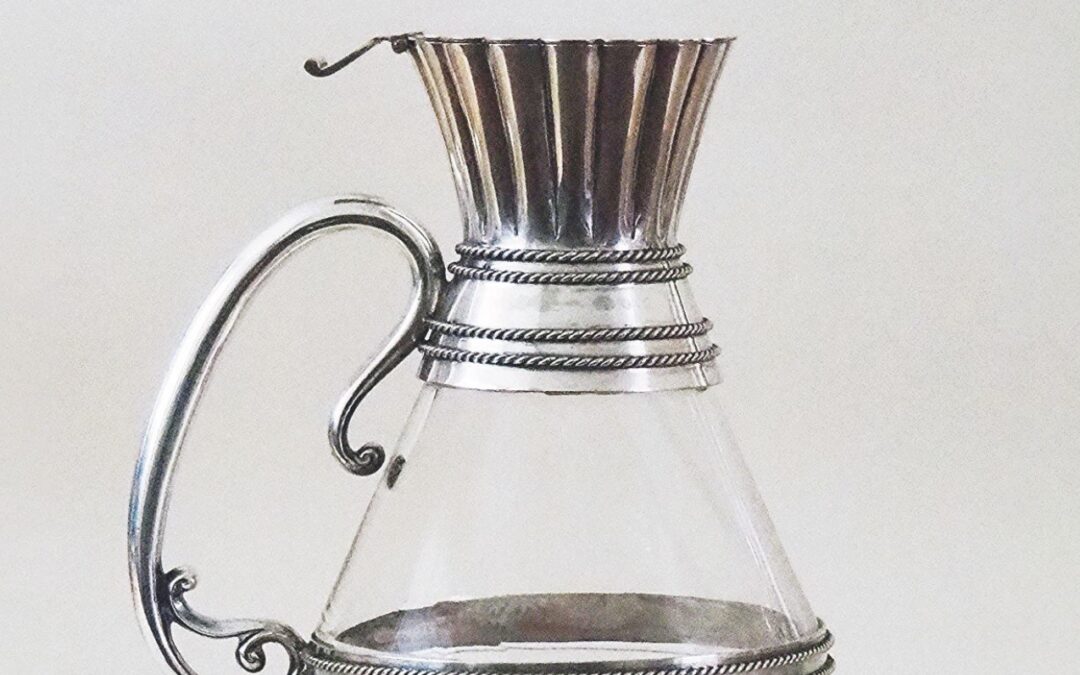
FRONT COVER: A previously unpublished clareteen designed by Christopher Dresser, the silver mount by Hukin & Heath. (see page 30) © Clive Manison.
BACK COVER: The John Derbyshire ‘Winged Sphinx’, Rd 299022, (see pages 4 & 5)
Editorial
Chairman’s message
Victorian Figurines Michael Upjohn
Love of Glass Graham Redgrave Rust
Leech Bowls Bill Millar
Trapped Tears Simon Wain-Hobson
Cumbria 24% Chris Blade
Durrington Dispersed Jim Peake
Strength Down Under Peter Henderson
Gilding Ian Philips
Dresser Clareteens Clive Manison
In Memoriam David Willars
Peter Helm
GS Biennale winners 2024 Editor &
Bob Wilcock
Biennale and IFOG 2024 Bob Wilcock
Article correction – Glass Matters No 19, ‘Little Black
Dress’ by Ian Turner
Before going to print, new information had been received
that changed the sense of the article’s last paragraph but was
regrettably omitted. It should have said that although the
vase was designed by Hilary Green in Devon, it was not made
there or anywhere else in the UK – as with so many glass and
ceramic items, it had been outsourced to Poland, where it had
been made ten years ago.
A date for your diary – The Glass Society AGM
This is to be held online on Tuesday 11 March 2025, with
the log-in details being sent out just a few days before. As
we have ‘hit a winner’ with the ‘Show & Tell’ event that has
been enjoyed over the last few years, we are going to follow
the same format. If you have a ‘glass story’ to tell, and/or
a particular glass or collection to show, please contact our
chairman, Simon Cottle.
3
4
9
12
14
15
19
25
28
29
33
34
37
Contents GM20.indd 2Contents GM20.indd 2 20/10/2024 20:5320/10/2024 20:53
CHAIRMAN’S MESSAGE
3
Chairman’s Message
Simon Cottle
Glass Matters Issue No.20 October 2024
W
ith the Society’s partic –
ipation in the biennial
International Festival
of Glass at Stourbridge held last
August, there is much to report;
Bob Wilcock and our editor, Brian
Clarke report on this event and the
awards given, along with several
interesting and scholarly articles
packed into this edition of Glass
Matters . Sadly, this year’s Festival
in its current incarnation will have
been the last to be held at the Ruskin
Centre in Stourbridge. Although it
is to be replaced by a similar exhibi –
tion and award scheme, this biennial
event will be run by the American-
based Glass Art Society (GAS). It
is GAS ’s intention to continue to
hold the event ever y two years,
including and commencing in the
United Kingdom, and then in var –
ious European locations. The next
Festival will take place from the 27th
to the 31st August 2026 at the World
of Glass in St. Helens. Time will tell
if this new development and its
itinerant nature will be as success –
ful as that which was founded in
Stourbridge and how regularly it will
be seen in the UK to the benefit of
the established and aspiring young
glass artists in this country. In fact,
this fresh focus may give them an
even greater international platform,
their work being shown alongside
artists based in those countries in
which the event will be held in the
future. Nonetheless, for me, the
transfer of the responsibility for
organising the International Festival
to GAS is a sad loss to the region.
Since taking over from David
Willars as Chairman of the Glass
Society, the Trustees, your com –
mittee and I have been build –
ing on his legac y. L ed by Gaby
Marcon and Peter Cookson, the
new website is central to this
development. I can repor t that
the web designers, Diagonal, are
making excellent pro g ress. We
hope to launch the site next year.
In this issue you will find an
unusual article on leech bowls by
Bill Millar; Graham Redgrave-Rust,
the well-known artist and design –
er, illustrates a series of favourite
pieces of glass from his own collec –
tion and Michael Upjohn continues
his coverage of Victorian figurines.
Known for his close examination
and recording of the various stems
of 18th centur y wine g lasses ,
Simon Wain-Hobson takes a whim –
sical look at those with tears of air.
In the late 1970s I came across
a company called Cumbria Crystal
where they had established a shop
in Kendal, my home town. I was
particularly taken by the fact that
one of their lines was a high-qual –
ity series of hand-blown heavy
baluster goblets with a high lead
content. Produced in various siz –
es, they closely resembled those
examples of the early 18th century.
Chris Blade’s article on Cumbria
Crystal revives many memories.
A report by Jim Peake on the
landmark sale of the Durrington
Collection and the amazing pric –
es achieved makes for fascinat –
ing reading, revealing how much
research went into the production
of Bonham’s excellent catalogue.
The recent death of Peter Helm
brought a note of sadness this
year and especially to those of us
who knew him well from his early
involvement in the founding of the
Glass Association. Peter was the first
treasurer of the Association and a
mine of information on Manchester
press-moulded glass, especially that
of Burtles Tate. Then David Willars
provides us with memor ies of
Peter’s life and times; Clive Manison
continues his research on clareteens
associated with Christopher Dresser,
and an article by our Australian
member, Peter Henderson, on bro –
ken glass and another on gilded glass
by Ian Phillips, adds further inter –
est to this edition of Glass Matters .
T h e re c e n t c h a r i t y a u c t i o n
of g lass and books donated to
Stourbridge Glass Museum and
organised by the curators Alexander
Goodger and Har r ison Davies ,
a c h i e ve d o ve r £ 1 , 7 0 0 fo r t h e
museum’s ring- fenced purchase
fund. Many of the lots were suc –
cessfully acquired by Glass Society
members in a frenzied f lurr y of
bidding. T he museum plans to
add something appropriate to the
collection with the money raised.
Nex t year ’s Annual General
Meeting will take place on the eve –
ning of 11th March. Further details
on the evening will be sent to mem –
bers towards the end of this year.
Our continued thanks and con –
gratulations to Brian Clarke for
his editorship of Glass Matters .
Alongside the for thcoming new
website, Glass Matters remains
a n i m p o r t a n t c o n t r i b u t i o n
to the success of the Society.
Simon Cottle, Chairman of !e Glass Society
Chairmen’s message GM20.indd 1Chairmen’s message GM20.indd 1 19/10/2024 21:0719/10/2024 21:07
Victorian Pressed Glass Paperweights and Figurines
4 Glass Matters Issue no.20 October 2024
NOT JUST A PAPERWEIGHT
Michael Upjohn
ABOVE Fig.1John Derbyshire Recumbent Lion Rd 283406, in an uncommon A zure Blue, registered 3 July 1874BELOW Fig.2John Derbyshire Greyhound Rd 285175, in rare Canar y Vaseline, registered 11 September 1874
F
rom the 1870s, novelty pressed
glass paperweight figurines,
notably from the Manchester
manufacturers of John Derbyshire,
Percival Vickers and Molineaux,
Webb and Co became fashionable
ornaments. They were soon followed
by the North-East competitors of
Henr y Greener and George Davidson.
These paperweights were made in a
variety of colours, some quite experi –
mental and garish in appearance, such
as opaque blues and greens. Some of
these had no makers’ marks, their
attribution unclear due to the chang –
ing ownership of their moulds and the
lack of records from that era. Over the
years, my father has acquired a com –
prehensive collection of these paper –
weights. Their diversity has proved
useful when discussing attribution
with fellow collectors and enthusi –
asts David Willars and Neil Harris.
I continue to search for rare fig –
urine colours. The trouble is, the
rarer the colour, the higher the price.
The John Derbyshire factory of
Regent Road, Manchester, were one
of the pioneers of making these nov –
elty figurines and the main contrib –
utor to registering several designs
which help give us a starting refer –
ence to their use and attribution.
The figures were usually inspired
from monuments or characters of
their time, including Queen Victoria
and Britannia (Figs.3, 15) , the
Landseer Lions of Trafalgar Square,
Dolphins from the Thames embank –
ment, and favourite animals includ –
ing Greyhounds (Figs.2,10) and
Newfoundland dogs (Figs.8,9,17) .
The John Derbyshire Winged
Sphinx Rd 299022 (Fig.4) is the holy
grail of my father’s Victorian pressed
glass collection, about which there is
a gratifying story to be told. My father
had been searching for a Winged
Sphinx for nearly thirty years. He
Victorian Figurines GM20.indd 4Victorian Figurines GM20.indd 4 19/10/2024 20:2419/10/2024 20:24
NOT JUST A PAPERWEIGHT
5 Glass Matters Issue no.20 October 2024
BELOW LEFT Fig.4″e John Derbyshire Winged Sphinx Rd 299022 registered 9 March 1876BELOW RIGHT Fig.5A Molineaux Webb & Co. Sphinx, Rd 293100, registered 26 July 1875. Found in black or frosted #int
had handled the occasional one at
the Birmingham glass fairs of old,
and in more recent years – since I’ve
been involved – we’ve been watching
them at various auction houses slip
out of reach! Almost giving up hope,
I finally came across one at Bonhams
last year. Not wanting to share my
enthusiasm for fear of losing it again,
I kept it a secret from my father. The
big day came and I placed a bid, using
the experience of my previous losses.
To my surprise there appeared to be
no other bidders, I had a sudden dis –
belief and shock that it wouldn’t even
reach the bottom estimate. Oh no! I
thought, they may even pass it, but
finally another bid came in and then
my next bid reached the minimum
estimate, so I won the lot. What a
relief! I couldn’t believe my luck as it
was well within budget. The delight –
ful ending to this, is the Sphinx’s
provenance. Amongst others, it was
previously owned by authors Cyril
Manley and Raymond Slack, who my
parents used to meet up with at the
Motorcycle Museum and Woking glass
fairs. So this is the icing on the cake of
the collection, although truth be told,
the plinth has been carefully ground
down (even Raymond Slack wasn’t
aware of this) and has a small bump
on the head. But we finally own one.
As an example, common colours
for the lion (Figs.9,12,16) include
clear, frosted and uranium green,
while some of the uncommon figu –
rine colours include canary vaseline,
azure blue (Fig.1) , amber, opaque black
and white. Even-rarer colours include
opaque blue (Fig.7) , opaque green,
RIGHT Fig.3John Derbyshire Britannia, Rd 287495, registered 26 November 1874 and an unmarked Queen Victoria in uranium green. “e Victoria plinth is the same pattern as the Britannia and is likely to have been made by the Derbyshire factory
frosted yellow and frosted uranium
green. There seem to be many varia –
tions or perhaps experimental colours.
The lions and the sideways-facing
Newfoundland dog (Figs.8, 17) seem
Victorian Figurines GM20.indd 5Victorian Figurines GM20.indd 5 19/10/2024 20:2519/10/2024 20:25
6 Glass Matters Issue no.20 October 2024
BELOW Fig.6aJohn Derbyshire Lozenge for our Winged Sphinx
BELOW Fig.7aA John Derbyshire opaque green Judy and a uranium green Mr Punch with a crossed paw lion in rare opaque blue. All come with the JD Anchor trademark but no lozenge, the opaque colours are some of their hardest to !nd
BELOW Fig.8An unmarked small dark blue Mr Punch and a sideways facing Newfoundland dog, both possibly from the Davidson Factor y 1880s
BELOW Fig.6bJohn Derbyshire Anchor Trademark for our Winged Sphinx
BELOW Fig.7b”e John Derbyshire Punch and Judy under UV light
BELOW Fig.9 Percival Vickers forward facing Newfoundland Dog found in their 1880s catalogue and a sideways facing lion both with a similar plinth but no makers mark, the Lion’s attribution is not con!rmed
NOT JUST A PAPERWEIGHT
Victorian Figurines GM20.indd 6Victorian Figurines GM20.indd 6 21/10/2024 09:3821/10/2024 09:38
7 Glass Matters Issue no.20 October 2024
BELOW (LEFT) Fig.12A group of unmarked frosted Baccarat trinket box lids including male and female lions, a cat and a peacockBELOW (RIGHT) Fig.13A very rare uranium blue/green unmarked hunting dog from around 1875, probably by Henry Greener and a more common frosted dog by Baccarat
to come in the widest range of colours.
In my father’s collection we even have
a purple malachite Newfoundland
dog, a colour which is only known
to have come from the North
East area rather than North West.
Due to their novelty or com –
memorative value, many had a short
shelf life so they may not have been
massed-produced like bowls, plates
and drinking glasses. Indeed, John
Derbyshire’s eclectic ideas didn’t
keep him in business for very long.
Although originally part of the
Derbyshire family business, he left
to form his own company in 1873
which closed in 1876. He was the
only Manchester manufacturer
to include a trademark on ‘some’
the Victorian era was inconsistent.
Their registered designs are the
benchmark for these figurines and
show a date lozenge (Fig.6a) and an
embossed anchor (Fig.6b) , other items
just include the anchor and then there
are the items which are unmarked,
causing confusion and years of debate.
Other known Manchester paper –
weights include those by Percival
Vickers and their forward-facing
Newfoundland dog (Figs.9,17)
and the Molineaux & Webb regis –
tered design for their Sphinx (Fig.5) .
In Fig.10 is a group of three
unmarked smaller figurines showing
an amber cat, a black retriever and a
blue greyhound. Their attribution
is ongoing, though they are likely to
BELOW Fig.10 An amber cat, a black retriever and a blue greyhoundRIGHT Fig.11A Seated lady “Sappho”. Maker unknown, though often confused with John Derbyshire’s Britannia
have been made in Manchester in the
1880-90s, possibly by Thomas Kidd.
What is notable about them is their
smaller size and the thinness of glass
for the cat and black dog compared
to other Manchester paperweights.
Fig.11 shows the seated lady
‘Sappho’, a Greek poet from the island
of Lesbos. Often confused with John
Derbyshire’s Britannia, its maker
is unknown. Several of the colours I
have seen include uranium green,
canary vaseline and clear frosted,
NOT JUST A PAPERWEIGHT
Victorian Figurines GM20.indd 7Victorian Figurines GM20.indd 7 19/10/2024 20:2519/10/2024 20:25
8 Glass Matters Issue no.20 October 2024
making me think that this was prob –
ably made by an English manufac –
turer. It is modelled or copied from
a French marble-based mantle clock
from the 1840s, the round pattern on
the plinth being the clock face with
Sappho sitting on top. There was a
Sappho revival in the UK in the late
Victorian era, which ties in with the
known colours you can find this figu –
rine in from around 1880. However, it
is a rare and unmarked figure, so the
quest to identify the maker continues.
In Fig.12 , the cat is signed Baccarat,
though the mould may have orig –
inated from Henry Greener. The
lioness is heavy and difficult to
pick up, thus making it easy to slip
out of your hand and make break –
age of the box below a possibility.
T he unmarked hunting do g
(Fig.13, left) in the very rare ura –
nium blue/green colour, is likely to
have originated from Henry Greener
around 1875, as another enthusi –
ast has this paperweight with the
Greener 1875 trademark. I have also
seen a photograph of a matching cat
and dog in the canary yellow vaseline
colour, which were probably made
by Henry Greener. The moulds for
this dog and cat, originally made
by Greener, seem to have travelled
around or been copied by several
European makers including the more
common frosted versions by Baccarat
– identified in their 1880s catalogue
– and Meisenthal who made splatter
glass versions around 1930. With a
heavier, mainly solid figure, sitting
on a clear plinth, the French versions
are far better quality than the light –
er, crude, Henry Greener moulds.
The collection also includes fig –
urine lids and Sphinxes from the
European continent, which are
predominantly Baccarat and St
Louis . With the occasional excep –
tion, most of these are unmarked,
and can be found in catalogue pages
from Baccarat and St Louis around
the 1880s. Fig.14 shows a group of
the European Sphinxes. Top left
is a very mythical-looking Winged
Sphinx from Val St Lambert which
is part of a desk set and shown in
their 1913 catalogue. Top right is
a heavy, poorly signed ‘St Louis
Depose’, St Louis Sphinx. The blue
medium-sized malachite Sphinx
(below right) is unmarked and found
in many colour variations but is
also likely from St Louis. Another
small, unmarked Sphinx is at the
lower left. The V&A Museum has a
brown malachite Sphinx like these
but incorrectly attribute to Sowerby.
Both the largest French St Louis
Sphinx and the English Lion with
shield (Fig.16)
Oil Lamp bases with a spigot lump of
glass on the lion’s head or on the back
of the Sphinx to attach to a lamp font.
To b e co n t i n u e d …
from our collection will follow, with
a commemorative theme around
Queen Victoria and similar glass busts.
Michael Upjohn can be contacted
on michael.upjohn@btinternet.com
BELOW Fig.14A group of European Sphinxes
BELOW Fig.15Comparing the Derbyshire Britannia (left) and Sappho (right), shown under UV light
LEFT Fig.16″e Derbyshire Lion and an unmarked ‘Lion with shield’ under UV lightBELOW Fig.17Two Newfoundland Dogs, under UV light
NOT JUST A PAPERWEIGHT
Victorian Figurines GM20.indd 8Victorian Figurines GM20.indd 8 19/10/2024 20:2519/10/2024 20:25
ART ON ART
9 Glass Matters Issue no.20 October 2024
A LOVE OF GLASS
Graham Redgrave-Rust
BELOW (LEFT) Fig.1Art Nouveau specimen vase h. 17cm BELOW (RIGHT) Fig.2Well Spr ing carafe
Graham Redgrave Rust. Kind permission of Rui Paes
I
t was on a visit to Tunisia to
see the Roman remains at
Carthage and Dougga, in my
early twenties, that I bought my
first piece of glass, one evening
in the depths of a souk in Tunis.
This small but elegant example
of Art Nouveau (Fig.1) , in the shape
of a specimen vase in iridescent
light green pate de verre shows,
on its silver rim, the London assay
marks of 1902. However, given
that it came from the former French
Protectorate that ended in 1956,
nine years earlier than my purchase,
I assume the glass itself must be
a product of French manufacture.
This piece kindled an appreci –
ation of glass that resulted in the
eclectic small collection that I have
formed, in a desultor y manner,
over many years on my travels as a
painter in Europe and the Americas
and from the frequent and enjoy –
able visits to antique shops, fairs
and auctions in the British Isles.
Although I have, on my mother’s
side, my three-times-great-grand –
father, Thomas Webster, who was
a glass blower in Bristol in the late
18th century, and on my father’s
side, my kinsman Richard Redgrave
R.A. (the painter and designer), I
have no immediate connection to
the design or production of glass.
The examples I collect range from
decanters, jugs and other vessels
from the 18th century through to
Christopher Dresser and the ear –
ly 20th centur y and also include
chandeliers, appliques, stained
and etched glass which I have
been able to incorporate into my
house and studios over the years.
As with most purchas –
es there is a tale attached to
each piece that adds interest.
One of the pieces that I have
always been curious about, which
I have no idea whether this
elongated jug (Fig.3) , with etched
bulrushes was a spin-off of the
Summerly scheme or simply the
inspiration for another 19th centu –
ry manufacturer. Although I have
looked through Richard Redgrave’s
original copperplate diaries that
now belong to my cousin Evelyn
Redgrave (his great-great-grand –
daughter) I can find no reference to
the design. Perhaps a reader might
be able to throw some light on this?
Another water jug that I am partic –
ularly fond of came from the Thurn
und Taxis Regensburg sale in 1993
which I attended while painting a
mural in Frankfurt (Figs.4a & 4b) .
This cut-glass jug, surmounted by a
silver gilt cover, was made in Vienna
in 1815 and belonged to Princess von
Mecklenburg-Strelitz 1773 – 1839,
came from my childhood home, is
a water jug reminiscent of Richard
Redgrave’s 1847 design for a carafe
known as ‘The Well Spring’
was made for and promoted by Felix
Summerly – the pseudonym adopted
by Redgrave’s colleague Henry Cole.
Love Glass GM20.indd 9Love Glass GM20.indd 9 19/10/2024 20:2819/10/2024 20:28
10 Glass Matters Issue no.20 October 2024
ART ON ART
LEFT Fig.3Bulrushes jug, etched design, h. 27cm
ABOVE Fig.4a!urn und Taxis water jug, lid closed. h. 14cm RIGHT Fig.4b!urn und Taxis water jug, lid open
whose aunt was Queen Charlotte, the
wife of King George lll. I bought it as
a souvenir of two years spent paint –
ing the mural in Sachsenhausen.
As mentioned, I have incorporat –
ed several examples of stained glass
into my home in Suffolk, a former
rector y rebuilt in 1857 and sold
off by the church commissioners
after the first world war. Twenty
years ago, I was lucky enough to
come across a small stained-glass
window of St. George slaying the
dragon by Charles Eamer Kempe,
now installed above the altar in the
small chapel. This was particularly
pleasing as Kempe produced several
memorial windows for the church
which sits across from the house.
Another 19thcentury stained-
glass panel that fitted neatly into
an existing window frame, in the
entrance hall, was a sensitive por –
trayal of Saint Felix, A.D. 647 —- the
man who introduced Christianity
to East Anglia — which seemed
most appropriate for the house.
My unwavering interest in glass
led me to attend several workshops
run by the Stained Glass Museum
at Ely Cathedral. I had planned to
produce two side panels for the porch.
Working in Ely’s environment was
very inspiring, and I did manage to
make and fire one small panel of a
sunflower (Fig.5) , using a waterco –
lour painted in my garden (Fig.6) as
the subject. Alas, the panels for the
porch did not materialize but that
’apprenticeship’ was most fulfilling.
Still, one not so good moment
came when, in the late 20th centu –
ry, a well-known German interior
designer contacted me. He had a
project that sounded most allur –
ing, which was to paint murals in
several state rooms for an elegant
newly designed yacht, being built
– no expense spared – in a German
shipyard for a ver y rich woman.
This commission also included a
dining room, all four walls of which
were to be sculpted in glass (not
moulded) above the dado rail, to my
design. The four-inch-thick panels
were to depict a jungle scene with
exotic flora and fauna etc, echoing the
look of Rene Lalique’s frosted and pol –
ished glass, to be lit from behind. The
firm chosen to execute this work was
a well-established Swedish company,
who had a brilliant elderly sculptor,
most enthusiastic to work on the proj –
ect as his swan song before retiring.
As a sample the old man pro –
duced a wonderful glass carved relief
section depicting a macaw sitting
on a bough amid foliage (Fig.7) .
This 4” thick piece of glass was 48”
Love Glass GM20.indd 10Love Glass GM20.indd 10 19/10/2024 20:2819/10/2024 20:28
ART ON ART
11 Glass Matters Issue no.20 October 2024
However, unbeknown to us a dan –
gerous development had evolved; a
disagreement between the client and
the decorator took unforeseen pro –
portions, resulting in the client flying
into such a violent rage that she took
a sledgehammer to the glass sculp –
ture and smashed it to pieces. The old
man collapsed in tears and needless
to say the whole plan was aborted.
Fortunately, my colleague Rui Paes
and I were compensated for the loss.
The fascination with glass has
never left me. Luckily, now in my
later years I am still able to indulge
that love by incor porating so
many of my, sometimes impulsive,
buys into my daily life at home.
Although the urge to acquire more
is still strong, I realise that I should
really start to thin out my collection
and perhaps keep only that which, at
the moment, I cannot be parted from.
Editor
Graham Redgrave-Rust studied drawing
and painting in London at the Regent
Street Polytechnic School of Art and then
at The Central School of Arts and Crafts,
followed by The National Academy of Art
in New York. Botanical and landscape
painter, illustrator, writer and lecturer,
he has exhibited at the Royal Academy
S ummer E xhibition since 1965.
Specialising in trompe l’oeil and inter –
nationally renowned for his murals and
ceiling paintings, his most important
work is the mural ‘The Temptation’ in
the entrance hall of Ragley Hall, Warks,
which took over a decade to complete.
Graham has written and illustrated
many books and in 1988, his collection
of mural designs was published as ‘The
Painted House’
languages. A member of The Artworkers
Guild, he lives and works in Suffolk,
a close neighbour and cousin of our
committee member, Christina Glover.
BELOW Fig.5Watercolour of sun #ower. Graham Rust BELOW Fig.6Stained glass sun #ower h. 15cm. Graham Rust
BELOW Fig.7Detail of design, with the macaw, for dining room of yacht
Love Glass GM20.indd 11Love Glass GM20.indd 11 19/10/2024 20:2819/10/2024 20:28
S MALL M EDICINAL L EECH B OWLS
�N�o�t� �B�a�b�y� �G�o�l�d�?�s�h� �B�o�w�l�s�!
12 Glass Matters Issue no.20 October 2024
NOT A GOLD FISH BOWL
Bill Millar
Fig.1Baby gold !sh bowl 5.5 cm tall with £1 coin for scale
I
n the closing years of the last
centur y, I found a miniature
goldfish bowl at a boot fair. It
cost me 50p and you can see it at
(Fig.1) . T he bowl had a polished
pontil, so I could say it was prob –
a bly 19th centur y. B e yond the
period, I could not identify its func –
tion. Clearly far too small even for
newly born goldfish, I did wonder
if it could have been filled with oil
and strung up on a line with others,
to use as outside fair y lights. That
idea was discarded as unlikely, as
the heat would have cracked the
bowl. Eventually, without under –
standing its function, I sold it, for
several times my investment, with
the des c r ipt ion ‘B a by Gold f ish
Bowl? You decide’. Since then I have
acquired some more similarly sized
bowls and eventually decided it was
time to establish their function.
As it turned out, I was right
a b o u t t h e f u n c t i o n b u t w ro n g
about the occupants. Not baby
goldfish but leeches. Bloodletting
was a traditional treatment from
days of antiquity for all manner of
ills. Thankfully, it is rarely prac –
tised in these more enlightened
times. Various instruments were
used including lancets, f leams and
scarifiers. However, the less pain –
ful method would have involved
leeches. T hey were used by the
Ancient Greeks and Romans. Their
use continued in modern times up
to the middle of the 19th centu –
r y until Pasteur’s work on germ
theor y star ted to undermine the
justification for bloodletting. An
indication of the level of use of
leeches in the early 19th centur y
can be gained from the statistic
that , by 1833, France impor ted
for ty -two million leeches a year.
The use of leeches at St Thomas’
54,000 in 1823 and the cost of over
£250 represented 8% of the hos –
pital’s total annual expenditure.
There was clearly a huge indus –
tr y involved in the collection and
d i s t r i b u t i o n o f l e e c h e s . M a ny
forms of containers, made from
different materials, were used for
transporting and holding leech –
es in bulk . For the end user in
a domestic environment , small
g l a s s c o n t a i n e r s w e re p o p u l a r
and this was the function of the
examples shown in this article.
The bowl at (Fig.2a)
have been made in the 18th cen –
tur y; it is 6.1cm tall and has the
traditional goldfish bowl shape.
T h e h o r i z o n t a l r i m e n a b l e d a
piece of muslin to be tied over the
top of the bowl enabling air to
circulate whilst thwar ting leech
e s c a p e pl a n s . T he b o dy o f t h e
bowl, including the base, is fine,
blown glass. There is a pontil scar
on the base and a pointed piece of
wood must have been applied to
the base when the glass was still
plastic – this produced a raised
conical shape in the base lifting
the pontil scar out of harm’s way.
The cone shape can be clearly seen
in ( F i g.2 a )
air bubble in the side of the bowl:
it’s the oval shape which can be
seen on the left-hand side of the
photo. The rim of the bowl is folded
in the same manner as folded-foot
glasses of the mid-18th centur y
which is why I have sug gested a
mid-18th century date. The fold –
ed rim can be seen in (Fig.2b)
(Fig.3) is 7 cm tall.
It differs from the other examples
in this article by having a rudi –
mentar y stem and being engraved
with a simple, repeating f lower
motif. The f loral decoration hints
Leech bowls GM20.indd 2Leech bowls GM20.indd 2 19/10/2024 21:3119/10/2024 21:31
NOT A GOLD FISH BOWL
13 Glass Matters Issue no.20 October 2024
ABOVE (LEFT) Fig.2aLeech bowl 6.1 cm tall, possibly mid-18th century, with raised base and air bubble on left side of photoABOVE (RIGHT) Fig.2bSame bowl as !g 2a showing folded rim
BELOW (LEFT ) Fig. 3 Leech bowl 7 cm tall with rudimentary stem and simple, “oral engraving BELOW (RIGHT) Fig. 4 Leech bowl, 5.8 cm tall with ground pontil.
at the bowl sitting on a Georgian
lady’s dressing table. The pon –
til scar has been polished out.
The last example (Fig.4)
cm tall and is similar in overall form
to the bowls at Figs.1 and 2. Like
the bowl at Fig.1 , the glass on this
bowl is thicker than that at Fig.2 .
In the same manner as the bowls
at Figs.1 and 3 , the base has been
polished to remove the pontil scar.
E xamples of small leech bowls
can be found on a number of web
sites. Of these, the only varia –
t i o n i n s t y l e t h a t I h av e s e e n ,
b e yo n d t h e e x a m p l e s s h o w n i n
t h i s a r t i c l e , i s o n e w i t h a p l a i n
b o w l a n d a h o l l o w s te m . O t h e r
glass containers, made for bulk
holding le e ches , w ill b e lo oke d
a t i n Pa r t 2 . T h e j a r s s h o w n
above may resemble ‘baby gold –
f i s h b o w l s ’, n e x t t i m e a t l e a s t
one will resemble a ‘sweet jar.’
Leech bowls GM20.indd 3Leech bowls GM20.indd 3 19/10/2024 21:3119/10/2024 21:31
Georgian tears
14 Glass Matters Issue no.20 October 2024
TRAPPED TEARS
Simon Wain-Hobson
A trove of Georgian tears. !e odd one out is in the middle. Tears were made by pricking the gather with a knife or wooden block with numerous nails and then covering it with more molten glass. L
ate the other night, sitting,
gazing at a bevy of beautiful
balusters, an emptied cyl –
inder knopped baluster in hand,
my mind crossed over to the other
side. Those tears have imprisoned
the fleeting breath of a glassblower,
long defunct, in a capsule for some
300+ years. A touch of immortality
for the gaffers we’ve come to admire.
A n d w i t h s uc h p o s t- m i d n i g h t
poetry in mind, I slipped into bed.
The next day, my chemical and
biologically trained mind kicked
in. Exhaled air is approximately
73% nitrogen, 16% oxygen, 5-6%
water, 4% carbon dioxide, and
1% other gases plus minute quan –
tities of up to 3500 wonderfully
diverse carbon-based molecules.
It doesn’t stop there. T here
a r e a l s o s o m e h u m a n c e l l s
and along with them, DNA.
Bacteria and viruses hardly need
mentioning in the post- COVID
era. Maybe the gaffer had tuber –
culosis, like so many of the day,
and/or a gastric ulcer caused by
Helicobacter pylori . For information,
there is a commercial diagnostic
test for helicobacteria in exhaled
air that is useful in some settings.
The left-lobe poet piped up ask –
ing could we extract the air inside
a tear and genotype the deceased
gaffer? Yes! The right lobe imme –
diately went into overdrive noting
that the working temperature of
lead glass is around 800°C so all the
3500 small molecules, DNA and
other macromolecules that make up
cells, bacteria and viruses would be
oxidized in flash leaving a soupçon
more CO2 and water vapour. Ugh!
Worse, a tear is devoid of oxy –
gen, which would have quickly
reacted with the manganese or
cobalt decolourizing atoms in the
batch. Water may well have been
adsorbed, so that would be gone.
The concentrations of the remain –
ing gases would be lower than in
the gaffer’s breath due to thermal
expansion of the initial bubble.
A Georgian tear is a bar –
ren place indeed. But oh, can’t
the y be worked into gorgeous
forms! The poet wins out. Phew!
Georgian Tears GM20.indd 14Georgian Tears GM20.indd 14 19/10/2024 20:3119/10/2024 20:31
15 Glass Matters Issue no.20 October 2024
CUMBRIA 24%
C UMBRIA C RYSTAL
Life and times
Chris Blade
I
’ve been fortunate to have enjoyed
a career revolving around an
interest in glass ever since discov –
ering glassblowing while studying in
Farnham in 1981. After completing a
BA in Glass in Stoke-on-Trent and an
MA at the Royal College I kick-started
a career as a self-employed designer
and maker, educator, travel photog –
rapher, senior manager at National
Glass Centre and Commissioning
Manager delivering hundreds of
bespoke glass projects. In 2015 I
was invited to join an ailing Cumbria
Crystal and try to change its fortunes.
In the 1980s the themes of sus –
tainability, energy & raw material
costs, education, marketing and
skills development were not on the
agenda as they are today. Creative
business and early career artists face
ever-amplifying pressure to survive
in an increasingly hostile commercial,
environmental and financial world.
Perhaps there is something to be
learned from Cumbria Crystal’s jour –
ney – after all, it is one of the few glass
manufacturing companies to survive
the challenges the industry has faced.
Cumbria Crystal has the dubious
reputation of being Britain’s last sur –
viving manufacturer of completely
hand-made, ‘luxury’ hand-cut and
polished, 24% lead-crystal stemware.
Our aspiration is to produce the high –
est quality bar and stemware using
traditional glass-making techniques.
A team of twenty-one highly skilled
artisans are committed to mastering
processes that have changed little in
nearly 2000 years. Craftsmanship is
embraced, and automation is limited.
Through the precision of the crafts –
manship, the hand-made aesthetic is
only just visible on close inspection. As
such, Cumbria Crystal feels noticeably
Fig.1Charging one of the two furnaces with batch and cullet, ready for the weekend melting cycle
different to many competitors’ products.
The company was established in
1976 by the historic Cavendish family
who encouraged glassmakers from
Stourbridge to relocate to the Lake
District with the goal of preserving tra –
ditional crafts. Lady Grania Cavendish
designed the now famous Grasmere
collection seen in every episode of
Downton Abbey, and the Helvellyn
collection, used by British Embassies
and Consulates worldwide. It is fit –
ting that many early collections were
named after many local mountains
and lakes. A close relationship with the
Cavendish family and estate continues.
Located in Ulverston, a small town
in the iconic English Lake District,
and a UNESCO World Heritage Site,
Cumbria crystal GM20.indd 15Cumbria crystal GM20.indd 15 19/10/2024 20:3619/10/2024 20:36
16 Glass Matters Issue no.20 October 2024
CUMBRIA 24%
Fig.3New taster/shot glasses added this September, left to right; Loop, Boogie Woogie and Grasmere collections. More are being prototyped and will be introduced soon
visitors to the factory are encouraged
to watch the alchemy of glassblowing,
browse the shop and even try blowing
themselves! All stages of production
happen under the one roof, so visitors
leave with an enriched appreciation
of the skills they witness. This greatly
enhances the visitor experience and
illustrates why every product should
genuinely be viewed as a work of art.
Cumbria Crystal melts its 24%
batch in two 500kg hand-made,
closed-pot crucibles and is worked
at a temperature of 1240C. Genuine
lead crystal is more expensive than
other glasses, slower to blow, harder
to work and demands the dedication
of a lifetime to master. The reassuring
sparkle associated with the high refrac –
tive index of lead crystal compared to
soda-lime or barium-based glass, plus
the reassuring ‘weight’ of the materi –
al top off the enjoyment. We believe
these qualities outweigh the addition –
al complexities associated with the
material and ensure a superior quality
product that exudes character, unique –
ness and has an increasing rarity value.
Every aspect of the creative process
is performed by hand. The crystal is
completely mouth-blown by a team
of five glassblowers – each requiring
a minimum of fifteen years’ train –
ing – and then cut on a lathe, requir –
ing another five years’ training. The
cutting process demands intense
concentration and skill, requiring the
artisans to hand-carve the decoration
Fig.2General view of the Cumbria Crystal factory blowing and processing area
using diamond and sandstone wheels,
before polishing in concentrated acid.
The use of sandstone wheels is often
abandoned by companies today as
it doubles the cutting time, despite
noticeably improving the finish.
A focus on quality and tradition –
al heritage skills comes at a cost.
Typically, the factory capacity is around
120 glasses per day, with around 50%
downgraded due to small bubbles and
cord. These today are perceived as
faults but reflect the authenticity of
the historic production processes used.
Compare this to the numbers achiev –
able from a tank furnace, or even the
automated, mass production of bot –
tles from bottling plants where 120
are produced in the UK every second!
Dark clouds loom on the horizon
for the future of lead crystal within
the industry –customers are increas –
ingly concerned about the use of lead
within crystal. These concerns are
fuelled by the fear of litigation, often
from California, and fanned by com –
panies that have moved to lead-free
alternatives. There are some sound
business reasons for this – yields are
often higher as the working life is
‘shorter’; the raw material is cheaper;
bubbles and cord are often less prob –
lematic; the glass is harder, so dish –
washer resistant; lead filtration of
exhaust gases is unnecessary; blood
checks for staff are no longer required.
However, a ‘short’ working life poses
challenges – the hardness of the glass
means it cannot be cut easily and it is
more problematic to acid polish. Being
lighter, it can lack the heft and sparkle
of true crystal. It sems that EU legis –
lation will come into effect quite soon
and that all crystal manufacturers
Cumbria crystal GM20.indd 16Cumbria crystal GM20.indd 16 19/10/2024 20:3619/10/2024 20:36
17 Glass Matters Issue no.20 October 2024
CUMBRIA 24%
will be forced to move away from lead
– however, details are scanty.
Even the most cursory study of
the ‘Red List of Endangered Heritage
Crafts’ reveals the perilous state of
heritage crafts in the UK. The list,
published by Heritage Crafts, makes
depressing reading and clearly high –
lights the lack of support for so
many of the creative industries that
contribute to the UK’s economy.
Britain once boasted numerous
factories exporting crystal around the
world. The demise of the industry,
with many household names vanish –
ing in the last thirty years, is incredibly
sad and a profound loss of the knowl –
edge acquired over generations. Today
there is often almost nobody left to
pass the skills to the next generation.
For example, in 2023 ‘mouth blown
flat glass’ became extinct in the UK. In
2024 the two crafts in which Cumbria
Crystal specialise, ‘Production Glass
Blowing’ & ‘Lead Crystal Cutting’, will
be added to the Red List. To illustrate
the precarious nature of the industry
it is estimated that there are now less
than ten working lead crystal cut –
ters remaining in the UK. In the last
year alone, we have lost two artisans.
Perversely, being acknowledged as
‘endangered’ can be seen as desirable.
Some customers view the situation
positively from a marketing perspec –
tive and present their relationship
with endangered crafts businesses
to customers as a heritage win-win.
Rarity and genuine British crafts –
manship are offered by Cumbria
Cr ystal. The company is car ving
out a niche in a challenging market
and building loyalty amongst fans
who cherish true, uncompromising
craftsmanship. There are increasing
numbers who want the-best-of-the-
best, understand the costs and skills
involved and are prepared to pay for it.
Considering the positive contribu –
tion the creative industries make to the
UK economy the government could do
far more. Other countries value and
support, offering more than words.
We hear of apprenticeships and the
opportunities they offer, which sound
promising, but to establish a pro –
gramme a minimum number of busi –
ness partners must participate. For
many crafts there are not enough busi –
nesses remaining to meet the criteria,
making an apprenticeship impossible.
This is true of the crystal industry.
Universities might be expected
to pick up the baton; however, glass
courses are in rapid decline and with
them access to resources such as fur –
naces also vanish. Where is a glass –
blower supposed to gain the 10,000
hours required to become an expert?
Without career opportunities in
industry many graduates carve out
careers as self-employed artists. The
creativity displayed by early-career and
established glass artists is remarkable
and encouraging. Sadly, promising
careers are often abandoned due to the
excessive cost of access to equipment
and materials. Imagine what could be
achieved if there were more opportuni –
ties to learn, partner with industry, or
access affordable resources or mentors.
As a graduate of the RCA myself I
well understand the challenges stu –
dents face. Cumbria Crystal there –
fore sponsors an annual training
and design project for MA & PhD
students from the Royal College of
Art. This goes some way towards
helping young creatives understand
the functioning of a crystal factory,
the commercial factors influencing
design decisions, and to develop port –
folios and establish careers. We are
delighted that a design by graduate
Xinlu Liu will join Cumbria Crystal’s
Fig.4!e champagne “utes of a new collection to be launched by the end of September 2024. !e public have been invited to propose the name of the collection, which will include “utes, wine glasses, highballs, tumblers and shot glasses. Designed by Xinlu Liu, who graduated from the RCA with an MA in Ceramics and Glass in 2024; during her studies, Xinlu collaborated with Cumbria Crystal to develop a contemporary crystal collection. Her concept is based on complementary pairs:” Like individuals coming together and forming harmonious bonds, this series celebrates uniqueness and togetherness in people and relationships”
Cumbria crystal GM20.indd 17Cumbria crystal GM20.indd 17 19/10/2024 20:3619/10/2024 20:36
18 Glass Matters Issue no.20 October 2024
CUMBRIA 24%
Fig.5Xinlu learning how to cut crystal at Cumbria Crystal
core collections. Royalties on sales
will help support ongoing studies.
(Her collection can be seen online) .
The evolution of contempo –
rary options such as Loop, Palm,
Boogie Woogie and Sovereign over
the past few years has helped to
diversify the brand and attract the
millennial and genZ markets who
seem to have a penchant for crystal.
Combine high production, energy
and material costs with a shortage of
skilled artisans and a perfect storm
emerges for the UK crystal industry.
The quest for ever-cheaper products
has seen production move abroad
and quality diminish. The use of auto –
mation has led to the expectation of
high volume/low prices; familiarity
with the disposable nature of prod –
ucts and a lack of understanding of
traditional skills means many people
today lack the knowledge to appreciate
different hand-made crystal products.
The journey towards net-zero
presents the EII (Energy-Intensive
Industries), which include the glass
industr y, with challenges. Glass
Futures, established in 2023 with
£72M research funding from the
government, will likely help generate
solutions for the large glass manu –
facturers to move away from natural
gas. Currently, it feels unlikely that
any solutions developed, or access to
funding to support the acquisition
of any technologies developed, will
trickle down to companies the size of
Cumbria Crystal in any meaningful
way. Some technologies are not yet
proven, but sooner or later we will have
to move away from gas. Electric furnac –
es seem to offer a solution, and many
benefits – but without transitional
support it is unlikely that the £500k+
cost of replacing our (relatively new)
furnaces is realistically attainable.
Meanwhile, we concentrate on
improving margins through a focus
on quality, efficiency, and our route
to market. The company has pivoted
away from a reliance on supplying to
retailers, to online selling direct to
the consumer. This route now gen –
erates around 65% of total revenue
and opens international markets.
Profit margins are two to four times
higher whilst the cost to the end user
remains the same. Finite resourc –
es working smarter, not harder, is
always at the forefront of our minds.
Hand-made crystal will undoubt –
edly remain reassuringly expensive.
We hope that customers will continue
to value the experience of using our
products and appreciate our artisans’
using, or gifting exquisite crystal, a
genuinely critically endangered indus –
try is being supported and endangered
skills passed to new generations.
If one considers the longevity of
crystal compared with mass-pro –
duced glass, plastic or disposable paper
cups, the financial and environmental
argument starts to wane. Many of
us relate to owning crystal that once
belonged to our parents, or grandpar –
ents, and still use, admire and value it
to this day. Add to this the intangible,
exquisite pleasure of using crystal
and the price pales by comparison.
Cumbria Crystal and the future
of Production Glass Blowing and Lead
Crystal Cutting in the UK sits on a
knife edge. William Morris said “Have
nothing in your houses that you do not
know to be useful or believe to be beau –
tiful.” With cr ystal you can have both.
Editor
Chris Blade took an MA in glass at the
Royal College of Art and went through
a number of posts in glass before taking
on Cumbria Crystal in 2015. As CEO,
he’s been putting his vision, energy and
desire for excellence into promoting and
maintaining Cumbria Crystal glass
as a centre of quality for the future.
Cumbria crystal GM20.indd 18Cumbria crystal GM20.indd 18 19/10/2024 20:3619/10/2024 20:36
19 Glass Matters Issue no.20 October 2024
DURRINGTON DISPERSED
The Durrington Collection
Bonhams, Knightsbridge, 15 November 2023
Jim Peake
Fig.1King George III Royal Armorial goblet by William Beilby
Fig.2Keith-Douglas ‘Amen’ glass Fig.3Per r y of Mambeg ‘A men’ glass
F
ew collections of early English
glass are of such scope or
quality that they become
legendar y in the glass-collecting
world, and the sale of such a collec –
tion happens once in a blue moon.
T he re f ined eclecticism and
rare standard of quality of the
Durring ton Collection places it
among the finest private collections
of early glass. With a pronounced fla –
vour of its own, several pieces occupy
a significant place in the history of
glassmaking during the 17th and
18th centuries. Many are remarkable
not only for their quality and rarity,
but also for their social or political
intrigue. Formed between 1985
and 2004, much of the Durrington
Collection was acquired from Asprey.
This began with Asprey’s celebrated
exhibition of ‘100 British Glasses’ at
Grosvenor House Antiques Fair in
1985, which showcased the very best
of the Kenneth Alexander Collection.
The core of the Jacobite engraved
glasses and three fine heavy bal –
uster glasses were acquired from
this exhibition, together with the
magnificent Royal Armorial goblet
decorated by William Beilby (Fig.1) .
T he following year, in 1986,
Asprey held an exhibition of some
of the finest English green table
glass ever assembled curated by
John P Smith, the majority of which
came from the collection of Michael
Parkington. A wonderful variety of
interesting glasses were acquired
for the Dur r ing ton Collection,
which included both rare and more
accessible examples. Over the years
the Collection was further comple –
mented by the acquisition of several
other exceptional pieces, including
two ‘Amen’ glasses (Figs.2 & 3) , the
so-called ’Buckmaster’ Beilby armo –
rial goblet (Fig.4) , and the Duke of
Cornwall Privateer wine glass (Fig.5) .
Within the Durrington Collection
four main areas of 18th centur y
British glass stood out as excep –
tional in terms of quality and vari –
ety. They included early balusters,
Jacobite engraved glass, enamelled
glass, and coloured glass. Many of
the rarest examples are unique and
several renowned museums exhibit –
ed pieces from the Collection in the
past. The Royal Armorial goblet by
Durrington Collection GM20.indd 19Durrington Collection GM20.indd 19 19/10/2024 20:4319/10/2024 20:43
20 Glass Matters Issue no.20 October 2024
DURRINGTON DISPERSED
Fig.4‘Buckmaster’ goblet by William Beilby Fig.5‘Duke of Cornwall’ Privateer glass
William Beilby (Fig.1) was loaned
to Corning Museum of Glass in
New York from 1985 and much of
the Collection was displayed at the
Burrell Collection and at Pollok
House in Glasgow in the 1990s,
before it was brought together at
Broadfield House Glass Museum in
Autumn 1999 for their celebrated
exhibition ‘Majesty & Rebellion’.
The Collection remained on loan
at Broadfield House until February
2004 and was immortalised in Roger
Dodsworth’s 2006 catalogue, ‘The
Durrington Collection of Rare 17th
and 18th Century British Drinking
Glasses’, which has become one of
the standard reference works on the
subject. The catalogue contains con –
tributions from several of the leading
authorities in early glass, including
Martin Mortimer, Simon Cottle, F
Peter Lole and John P Smith. It was
perhaps a fitting tribute to their
passion for and dedication to early
glass that the Durrington Collection
returned to public view for the
typology yield slightly disappoint –
ing results at auction for that very
reason, but this piece certainly found
its level at £6,780 against a £3,000-
5,000 estimate – a price no doubt
truncated by the heavy crizzling.
The following twelve lots were of
more certain attribution, primarily
comprising a type of glass which is
generally considered to be of quint –
essentially English manufacture –
both circa 1710-20 in date and both
carrying a £3,000-5,000 estimate,
were exceptional because their stem
formations are among the rarest and
most desirable of all heavy baluster
glasses. They included a fine acorn-
knopped wine glass (Fig.7) , which
sold for £8,320, and a particularly
unusual mushroom-knopped gob –
let (Fig.8) , which sold for £6,400.
Chunky, well-formed and symmet –
rical heavy balusters always perform
well, but the mushroom-knopped
example stood out not only for the
rare knop type, but also because it
first time in nearly twenty years.
The 60-lot sale began chrono –
logically with the five earliest lots,
dating to the late 17th century. The
attributions of four of these have
fluctuated between English and
Low Countries production over the
years depending upon the state of
current research, but in 2006 they
were nonetheless featured in the
Durrington Collection catalogue of
‘English’ glass. Of particular interest
here was a very rare early baluster
goblet of circa 1675-80 (Fig.6) , which
would appear to have no direct paral –
lel. The rib-moulding is reminiscent
of several late 17th century vessels
of different form bearing seals, sug –
gesting that they are English. All are
attributed to George Ravenscroft
and dated to circa 1676-77. Whilst
its precise origin remains unclear, it
represents an important example of
northern European glassmaking of
the late 17th century. It is often the
case that obscure pieces of glass that
do not fit into any clear collecting
Durrington Collection GM20.indd 20Durrington Collection GM20.indd 20 19/10/2024 20:4319/10/2024 20:43
21 Glass Matters Issue no.20 October 2024
DURRINGTON DISPERSED
the inclusion of two ‘Amen’ glass –
es – the co-called Perry of Mambeg
(Fig.3) (Fig.2)
Collection offering of Jacobites apart
from the usual. These ‘Amen’ glass –
es belong to a celebrated group of
just thirty-seven recorded Jacobite
‘A men’ g l a ss es , d at ing to the mid-
18th centur y. All are inscribed in
diamond-point with the monogram
‘JR’ interwoven with the number ‘8’
for James VIII, known as the ‘Old
Pretender’, who was considered by
many to be the legitimate King of
Scotland. All are inscribed with one
or more verses from the Jacobite
version of the national anthem
‘God Save the King ’, promoting
the good health and restoration of
the exiled King James VIII, ending
with the word ‘Amen’. In recent
years Ian McKenzie has provided
compelling circumstantial evidence
to suggest that the ‘Amen’ glasses
may be the work of the renowned
Scottish artist and line-engraver,
Sir Robert Strange (1721-1792),
although this can never be proven.
Engraved Jacobite wine glasses,
time of Charleston’s research. It
was understandably hotly contest –
ed on the day, realising £19,200
against a £6,000-8,000 estimate.
Of a similar vein was another
fine and rare royal commemorative
moulded-stem wine glass (Fig.10)
presumed to have been made to
commemorate the coronation of
King George I in 1714. Moulded
with the inscription ‘God Save King
George’ around the top of the stem
and with four crowns on the shoul –
der, it belongs to a celebrated group
of just twenty-two such pro-Hanove –
rian glasses, variously inscribed, all
but one of which have four-sided
panel-moulded stems. The crowns
on the shoulder may have been a
precursor to the more usual dia –
monds seen on moulded-stem
glasses of slightly later date. It sold
just below its £6,000-9,000 esti –
mate for £6,400 including premium.
Ja c o b i t e g l a s s u n d o u b t e d l y
formed one of the most compre –
hensive sections of the Durrington
Collection. While Jacobite glasses are
not uncommon and routinely form a
part of most glass sales at Bonhams,
has a round funnel bowl in place of
the thistle bowl more typically seen
on mushroom-knopped examples.
However, the highlight of this cor –
pus of early glass was undoubtedly
an engraved royal commemorative
heavy baluster wine glass of circa
1720 (Fig.9) . Of relatively simple
form with a plain inverted balus –
ter stem, but finely inscribed ‘To
the Pious memory of Queen Anne’
in diamond-point below the rim,
this remarkable glass belongs to a
distinctive group of early English
glasses with diamond-point engrav –
ing which were attributed by Robert
C harleston to ‘T he Calligraphic
Master’. Charleston attributed just
thirteen glasses to this elusive mas –
ter engraver, the majority of which
celebrate Queen Anne (1655-1714)
or the Church of England and are
dated to circa 1720. Just three oth –
er baluster glasses bear the same
inscription, but the Durrington
example was unrecorded at the
Fig.6Late 17th century baluster goblet, with rib-moulding and crizzling
Fig.7Baluster wine glass with !ne acorn knop Fig.8Baluster wine glass with !ne mushroom knop
Durrington Collection GM20.indd 21Durrington Collection GM20.indd 21 19/10/2024 20:4319/10/2024 20:43
22 Glass Matters Issue no.20 October 2024
DURRINGTON DISPERSED
most of which are decorated with
a distinctive heraldic rose, were
used to toast to the ‘King over the
Water’. However, the ‘Amen’ glass –
es are the most sought after owing
to their strong romantic links and
revolutionary associations to such a
turbulent period in Scottish history.
The strongest result was achieved
by the Perr y of Mambeg ‘Amen’
(Fig.3) , so-called because it
was owned by the Perry family near
Mambeg on the Gare Loch in the
19th century. Thought to have links
all the way back to General Stuart,
which no doubt fuelled interest
in the piece, it realised £48,640
against a £40,000-60,000 esti –
mate. Whilst rare in some respects
owing to it being one of just twelve
‘A men’ g l a ss es b e ar ing an addi t ion –
al dedication to Prince Henry, the
younger brother of Prince Charles,
the £32,000 realised by the Keith-
Douglas ‘Amen’ glass (Fig.2) against
its slightly lower £30,000-50,000
estimate was no doubt a reflection
of the significant damage to and
partial replacement of the foot.
The Durrington Collection was
celebrated in particular for its repre –
sentation of glass enamelled at the
renowned Beilby family workshop
in Newcastle-upon-Tyne, active at
Amen Corner in the 1760s and 70s.
The crowning glory of the collection
was The George III Goblet, a highly
important enamelled royal armorial
goblet by William Beilby, circa 1762-
63 (Fig.1) . Chosen as the cover image
for the sale catalogue, just as it was
for Roger Dodsworth’s catalogue
in 2006, this exceptional goblet is
among the most celebrated pieces
of glass ever produced in Britain.
It belongs to a significant group of
just ten stately armorial goblets all
decorated by William Beilby. Their
beauty and elegance places them
amongst the finest examples of
enamelled glass ever produced and
they are the most outstanding prod –
ucts of the Beilby family workshop.
It is unclear how many of these
royal glasses were originally made,
but all bear the royal arms of King
George III and most have the Prince
of Wales feathers on the reverse.
They are therefore thought to have
been commissioned to commemo –
rate the birth of The Prince of Wales
(the future King George IV) on 12
August 1762, and the pre-sale esti –
mate of £100,000-150,000 reflected
its importance. Underbid by a private
collector, it set a new record auction
price for a piece of Beilby enamelled
glass when it sold for £178,200 to
the Corning Museum of Glass in
New York, where it had originally
been on loan in the late 1980s. The
museum had successfully bid for the
last such goblet to appear at auction
in 1985 – the so-called ‘Whitehaven’
comprehensive collection of Beilby
enamelled glass. However, export
had been denied and it was ultimate –
ly purchased by The Beacon Museum
in Whitehaven. It is fitting that the
Durrington collection goblet should
return to an institution where it
was once exhibited, and which
had come so close to acquiring an
Fig.9Baluster wine glass commemorating Queen Anne Fig.10Four sided, panel-moulded baluster for the coronation of King George I
Durrington Collection GM20.indd 22Durrington Collection GM20.indd 22 19/10/2024 20:4319/10/2024 20:43
23 Glass Matters Issue no.20 October 2024
DURRINGTON DISPERSED
example nearly 30 years ago, where
it can now be enjoyed by the public.
The price achieved for the George
III Goblet was partly echoed by that
achieved by the ‘Buckmaster’ Goblet,
another highly important Beilby
enamelled armorial goblet of circa
1765 (Fig.4) . In the catalogue of the
Durrington Collection, Simon Cottle
notes that this remarkable goblet is
perhaps one of the most exceptional
examples of what might be William
Beilby’s early work. The coat of
arms is unrecorded in all standard
indexes and is therefore unlikely
to have been officially granted by
any authority, but it has been pre –
viously suggested that they may
have been the arms of Buckmaster
of Lincolnshire, Northamptonshire
and Devon. The pair to this goblet,
in the Cecil Hig gins Art Galler y
in Bedford, is widely known from
published literature on the Beilby
family. The Durrington example
significantly exceeded expectations,
smashing its pre-auction estimate of
£40,000-60,000 to take £112,160.
W hen last sold at Sotheby ’s in
1997 the price it achieved had set
a new auction record for a piece of
Beilby enamelled glass, so it is per –
haps ironic that had it not come
up for sale alongside the George III
Goblet this would have been a posi –
tion it would have held once more.
On the theme of record results,
another Beilby enamelled glass in
the collection came up trumps. An
exceptionally rare Beilby enamelled
colour twist wine glass for T he
Providence, dated 1767 (Fig.11) , is
one of only two recorded. They are
exceptional not only because the
combination of red, yellow, blue and
green twists in the stem is highly
unusual, the yellow thread being
particularly rare, but also because
they represent the only enamelled
colour twist wine glasses known. A
set of Beilby enamelled blue colour
twist cordial glasses would seem to
be the only other colour twist drink –
ing glasses decorated by the Beilby
workshop. While it has not been
possible to confidently trace the ship
or its captain, Jon Elliot, these ship
glasses are traditionally referred to as
‘Privateer’ glasses. However, it may
instead represent a trading vessel.
The pair to this glass had last been
sold by Bonhams as part of the A C
Hubbard Jr Collection in 2011 for
£30,000 including premium, and
the £20,000-40,000 estimate for
the Durrington example ref lected
this result. While there has clear –
ly been a significant boom in the
market for Beilby enamelled glass
in recent years, the £63,900 result
was perhaps unexpected, and it set a
new auction world record for a colour
twist wine glass… and perhaps also a
‘Privateer’ glass, if only the identity
of the ship can be confirmed as such.
Of far more confident ‘Privateer’
twist wine glass of circa 1760 com –
memorating the Duke of Cornwall
(Fig.5) . This glass belongs to a group
of wine glasses all presumed to have
Fig.11Ve r y ra re , e n a m e l e d b o wl a n d col o u r t w i s t s te m w i n e g l a s s fo r ‘ Green moulded stem champagne glass
Durrington Collection GM20.indd 23Durrington Collection GM20.indd 23 19/10/2024 21:3119/10/2024 21:31
24 Glass Matters Issue no.20 October 2024
DURRINGTON DISPERSED
been made for Bristol Privateers,
which were effectively officially sanc –
tioned pirate ships. Robbery under
arms was a common aspect of sea –
borne trade in the 18th century and
so most privately owned merchant
ships were armed. During wartime,
sovereigns issued commissions which
allowed the owners of these ships to
capture foreign vessels at sea by any
means necessary without being pros –
ecuted for illegal piracy. This provided
a greater income for the merchants,
but also allowed the state to raise rev –
enue for war. The Duke of Cornwall
was one such Bristol-based ship with
30 guns and 220 men, declared on
21 March 1757 and commanded by
Captain David Jenkins until 1760.
She successfully captured many
vessels during his command, often
laden with valuable cargoes includ –
ing wine, brandy and sugar. This
remarkable glass is one of an original
set, of which at least five are recorded
including the Durrington example.
They are unusual in that they have
round funnel bowls, when glasses
of this type typically have bucket
bowls. With an estimate of £10,000-
15,000, which is presently the going
rate at auction for most ‘Privateer’
–
pletely within the expected range.
T he final area in which the
Durrington Collection was particular –
ly strong was 18th century coloured
glass, mostly in emerald green. A
highlight was a moulded-stem cham –
pagne glass of circa 1740 (Fig.12) ,
which can be considered a precursor
to the modern champagne f lute.
Eighteenth century glasses of this
shape are thought to have been used
for sparkling drinks, as the tall bowl
allowed bubbles to rise to the surface
and sediment to fall to the bottom.
Green glass has been used to make
drinking vessels for many centuries
and in the days when wine could
sometimes be cloudy, the colour of
these glasses would help to disguise
it. White wine appears a brilliant
colour in an emerald-green glass such
as this, whereas red wine takes on an
altogether inky colour and charm. The
relatively modest estimate of £1,000-
1,500 reflected the fact that mould –
ed-stem glasses in general have waned
in popularity in recent years and 18th
century coloured glass is a relative –
ly niche field of collecting, perhaps
partly echoed by the £1,792 result.
This relatively modest result was
contrasted by two opaque twist wine
glasses of circa 1765, with coloured
bowls and feet in cobalt blue (Fig.13)
and emerald green (Fig.14) respec –
tively. These were paralleled by simi –
lar examples from the Julius and Ann
Kaplan Collection, which were sold
by Bonhams in 2017 for £40,000 and
£22,500 respectively. The £25,000-
35,000 and £12,000-18,000 esti –
mates reflected those results, with
the blue example having been rarer
and much more desirable at the time.
However, there was no clear favour –
ite in the Durrington Collection, with
both glasses realising £28,160 each.
With so many exceptional glasses
forming the Durrington Collection,
it has been difficult focusing on just
a few highlights. It was undoubtedly
one of those ‘once in a lifetime’ sales,
and a privilege to catalogue. The next
sale of Fine Glass at Bonhams will
take place on 26th November 2024
and will include the final part of the
Leuba Collection of 18th century
English glass. This will be followed
by an ‘online-only ’ sale of glass,
which will be open for bidding from
28th November to 11th December.
Editor
There are no print versions of Bonhams
Durrington sale catalogue remaining.
However, a PDF version is available
to download from Bonhams website
and I’m informed that it will remain
online as long as Bonhams’ website
exists. https://www.bonhams.com/
auction/29288/. In the Stourbridge
Glass Museum, a few copies remain of
the 2006 catalogue of the Durrington
C o l l e c t i o n f ro m th e B ro a d f i e l d
House exhibition, ‘Rare 17th & 18th
Century British Drinking Glasses’.
Fig.13Opaque twist wine glass with blue bowl and foot
Fig.14Opaque twist wine glass with green bowl and foot
Durrington Collection GM20.indd 24Durrington Collection GM20.indd 24 19/10/2024 20:4319/10/2024 20:43
STRENGTH DOWN UNDER
25 Glass Matters Issue no.20 October 2024
On Broken Glass
Peter Henderson
BELOW (LEFT) Fig.1Peter Henderson with his display cabinet and glassBELOW (RIGHT)Fig.2Michael Nunn at home, April 2024
Editor. Fig.1 shows Peter Henderson,
from Tasmania, Australia, as he says
“beside his new, very attractive, glass
cabinet. Note the sturdy wooden
shelves”. He’s written some reflections
on Michael Nunn’s “ remarkable life
in glass” and more on broken glass.
“Michael really is quite remarkable;
now 87 he used to cycle from his home to
Richmond, over 30kms and fairly hilly”.
I
n a career spanning over 70
years, Michael Nunn is one of
Tasmani a’s most sk ille d practi –
tioners in the world of glass (Fig.2) .
A quietly spoken native of Yorkshire,
in 1952, aged sixteen, Michael began
a five-year apprenticeship in deco –
rative-glass techniques at Tingley,
near Leeds in West Yorkshire. His
apprenticeship involved using tra –
ditional methods for working glass:
using steel, stone, wood grinding and
polishing wheels for glass bevelling
and brilliant cutting of flashed glass.
Apart from a brief interregnum with
the Royal Air Force for National
Service in the late 1950s, Michael
is still working with glass in 2024.
In the 1960s he worked in Leeds
and then Bradford. (Fig.3)
period the traditional methods for
bevelling and brilliant cutting were
becoming automated with the devel –
opment of diamond impregnated and
automatic-grinding equipment. So
Michael was one of the last appren –
tices to have the benefit of learning
those traditional techniques (Fig.4) .
Economic instability in Britain
led Michael to emigrate to Australia
in 1966, where his skills were in
demand. He initially spent five
years working for a company in
Sydney, then in 1971 he moved to
Tasmania to work for the Hobart
firm, Lansdell Glass, where he was
in charge of their cutting and pro –
cessing department. He has remained
resident in Tasmania apart from
periodic visits to the UK and Europe.
In 1989 Michael retired from
Lansdell and purchased all their tra –
ditional glass-decorating equipment
(Figs.5, 6, 7) , which he moved to his
studio in Collinsvale, a rural locality
close to Hobart, Tasmania. No longer
captive to the day to day commercial
imperatives of Lansdell, he was free
to use his considerable skills in teach –
ing and exhibiting at various shows,
including Royal Hobart, and using
these traditional skills as Tasmania’s
only glass beveller and brilliant-cut
glass practitioner, expanding to pro –
duce other high-quality surface deco –
ration and edge-work glass, including
deep acid etching and sandblasting
(Fig.8) . His work reflected a growing
interest in Tasmania for hand-made
items. His brilliant cut and flashed
glass was in high demand and keenly
sought by people restoring heritage
buildings. The complexity of brilliant
Broken Glass GM20.indd 25Broken Glass GM20.indd 25 19/10/2024 20:4719/10/2024 20:47
26 Glass Matters Issue no.20 October 2024
STRENGTH DOWN UNDER
LEFT Fig.3!e glass decorating team, Bradford c1960. Michael is at the far leftBELOW Fig 4 Michael engraving a sheet of bevelled glass, Bradford c. 1960. !e design held by a colleague
BELOW Fig.5,6,7Some of the equipment still in use at Michael’s studio
cutting and the need for specific
wheels meant Michael was, again,
the only person in Tasmania who
could reproduce that glass (Fig.9)
1992 and 1994 Michael met the
Benedictine monk Charles Norris
who had been trained in Dalle de
Verre ar t glass at James Powell
& Sons in Whitefriars. The most
famous of Nor r is’s work is at
Buckfast Abbey in the UK. (https://
lms.org.uk/massofagesarticle/
buckfast-abbey-chapel-window-
and-shroud-turin). Back in Tasmania
Michael continued this connection
with religious buildings, notably
with Dalle de Verre windows at St
John’s Catholic Church at Glenorchy,
a suburb of Hobart, as well as at
his home in Collinsvale (Fig.10)
were preceded by an awful tragedy.
On moving to Tasmania, I made the
stupid decision to acquire a large
glass and metal cabinet, of the kind
used in shops, to house some of my
glass collection. Not only was the
cabinet ugly, but it was also a time
bomb. For reasons that I do not
understand, the middle shelf shat –
tered into hundreds of pieces causing
all the glass to crash onto the shelf
below causing massive destruction.
My initial reaction was to sweep
all the glass into the bin and have a
bit of a breakdown. Instead, I rang
my friend Warwick Oakman (https://
www.warwickoakman.com/). One
of Australia’s finest antique dealers,
War wick has a profound understand –
ing of and appreciation for the objects
that he sells and collects. As a result,
he knows a network of artisans who
share his enthusiasm – what you
might call Tasmania’s answer to the
BBC television show The Repair Shop .
Aside from his commiserations,
Warwick instructed me to throw
nothing out and gave me the contact
details for Michael Nunn. So it was, a
few weeks later, carrying boxes filled
with broken glass and still feeling
dejected, that I placed the shattered
remnants before Michael’s practiced
eye. Michael was able to separate
those glasses which could be repaired
Broken Glass GM20.indd 26Broken Glass GM20.indd 26 19/10/2024 20:4719/10/2024 20:47
STRENGTH DOWN UNDER
27 Glass Matters Issue no.20 October 2024
from those that went in the bin.
In all, he was able to repair over
a dozen glasses. Two examples of
his skill will suffice. The first was a
Newcastle light baluster ‘friendship’
glass with an engraving of clasped
hands which I believe to be by Jacob
Sang. The bowl was untouched, but
the stem was snapped off and the foot
was badly broken. Michael reattached
the bowl and removed the broken foot,
replacing it with a new foot (Fig.11)
the foot broken off and the bottom
of the stem was jagged. In this case,
Michael was able to grind back the end
of the stem then reapply the original
foot (Fig.12) . Some collectors might
reject these glasses, though they have
an intrinsic sentimental value for
me which meant being able to repair
them was a very worthwhile exer-
cise. This was more so as some other
glasses, including the very first 18th
century glass I ever bought, were
not so much broken as vaporized!
As Simon Wain-Hobson’s article
Breaking Drinking Glasses (GM, June
2024 no.19) demonstrated, there are
those glasses that despite trauma we
keep and repair. Many of the glasses
that Simon wrote of had rather novel
repairs, befitting the time when they
were broken. Today, with the talents
of a master craftsman in glass com-
bining traditional methods of work-
ing glass with modern adhesives, these
wonderful examples of the decora-
tive arts are still giving me pleasure.
BELOW Fig.8Michael at work at his cutting wheel
BELOW Fig.9An original pane of glass, which is taped together for Michael to reproduce
BELOW Fig.10! e Dalle de Verre glass panel at Michael’s home
BELOW Fig.11Reattached bowl and replaced foot on Peter’s ‘friendship’ glass, possibly by Jacob Sang
BELOW Fig.12Original foot reattached on Peter ’s ale glass
Broken Glass GM20.indd 27Broken Glass GM20.indd 27 19/10/2024 20:4719/10/2024 20:47
Gilded glass in Malaga: James Giles?
Museo del Vidrio y Cristal
28 Glass Matters Issue no.20 October 2024
GILDING
Ian Phillips
LEFT Fig.1View of the bunch of grapes in the foreground and !owers on the reverse side of the “rst British glass
RIGHT Fig. 2View of one aspect of the decoration of !owers and foliage on the second British glass
FAR RIGHT Fig. 3A La Granja glass with gold inlay on bowl, and opaque twist stem. Carlos III 1760s
With two colleagues, Ian owns and runs
the Malaga Glass Museum. It is a private
collection of more than 3,000 pieces of
glass of different epochs, accompanied by
pictures, furniture, and decorative objects
in a setting that corresponds to each his –
torical period. The museum is located in
a carefully restored 18th century house, a
splendid setting to peacefully browse the
‘history of humanity’ through its glass.
R
eading the article on English
Cider and Perry Glasses in
Issue 19 of Glass Matters , which
showed a rare James Giles facet stem
cider glass, circa 1770, I was reminded
of two glasses in the collection of the
Malaga Glass Museum that have been
tentatively attributed to James Giles.
I say tentatively since this was the
word used by the well-known dealer
in decorative glass, Jeanette Hayhurst.
The few published pictures of James
Giles gilded glasses have a striking
resemblance to our pieces. I would
value the views of experts on both the
gilding technique and the attribution.
The first British piece (Fig.1) , dat –
ed about 1750 by Jeanette, is 13cm
in height, and bears an image of a
hanging bunch of grapes on one face
of the bowl and a stem of flowers on
the other. The stem of the glass is
facet cut and knopped. The gilding is
beautifully done and, on that criteri –
on alone, could readily be attributed
to James Giles. I bought the glass from
Jeanette Hayhurst in 1984 for £225,
and she suggested, some ten years
later, that it might be worth £350. To
me it is simply a very beautiful glass.
The second British glass (Fig.2)
has a bowl decorated with flowers
and foliage on both sides of the bowl,
which stands on a facet cut stem. It
was dated to around 1770 by Jeanette
when I bought it from her in the mid-
1980s and was rather more tentative –
ly attributed to James Giles, as it was
less attractively gilded. I paid her £175
and as before, some ten years later, she
suggested a value of £250 for this less
attractive, possible James Giles glass.
The only other examples of 18th
century gold patterns on glass in our
collection are Spanish and come from
the glass studios attached to the pal –
ace of La Granja de San Ildefonso in
the forest on the northern slopes of
the mountains of Madrid. Their tech –
nique features gold leaf burnished
into engraved patterns. The bowl
of the example in Fig.3 , is decorat –
ed with gilt flowers, over an opaque
twist stem with red edging. It is from
the period of Carlos III in the 1760s.
Ian Phillips look s for ward to
hearing from you and can be contact –
ed at ianphillips1936@gmail.com
Gilded Glass GM20.indd 2Gilded Glass GM20.indd 2 20/10/2024 20:5420/10/2024 20:54
29 Glass Matters Issue no.20 October 2024
WHO MADE THE BODIES?
Dresser Clareteens
Clive Manison
ABOVE (LEFT) Fig.1!e author’s Clareteen
ABOVE (RIGHT) Fig.2Facsimile Dresser signature under the lid of Clareteen at Fig.1
A
t t h e t i m e o f w r i t i n g ,
September 2024, there are
only five patterns of claret
jug that are known with certainty to
have been designed by Christopher
Dresser. Three have mounts by the
Sheffield silversmiths John Dixon &
Sons1 (Fig.1) and can be identified by
the facsimile of Dresser’s signature
under the lid 2 (Fig.2) . The other two
have mounts by the Birmingham
firm of Hukin & Heath and are
marked with a stamp, ‘DESIGNED
BY DR.C. DRESSER’. One of these
is the well-known ‘Crow’s Foot’ jug
(Fig.3)
dispersed among museums 3, but the
other (Figs.4 & 5) , has not appar –
ently been published as a Dresser
design, although a similarly shaped
body with a similar handle though
with a less elaborate mount, was
illustrated in Stuart Durant’s book
on p. 85 4. Other than this fleet –
ing reference, it seems that the jug
has not been published elsewhere.
The two claret jugs with mounts
by Hukin & Heath generally attribut –
ed to Dresser were the subject of
Design Registrations on the 9th of
May 1881 (Figs.6 & 7) ; note that in
both cases the Representation (in
this case, the photograph) accom –
panying the Design Registration
is clearly marked ‘Metal Protected
only’
as designer of the jug in Fig.7 seems
to have been made on the basis of a
similarity in the handles of the jug to
those of a soup tureen, the design of
which had been registered the previ –
ous year, and examples of which are
known to bear the words ‘DESIGNED
BY DR.C.DRESSER’
wooden rod as a handle seems to
have become a favourite of Dresser’s;
what started out as a practical means
of insulating the hand from the hot
contents of a teapot or tureen had
become something of an unofficial
trademark. As for the mount in
Fig.6 , the attribution seems to have
been made on the tenuous link of
a supposed similarity between the
form and the shape of a Japanese
torii (the gateway leading to a Shinto
shrine), and the fact that Dresser
had recently returned from Japan 7.
The Design Registrations on 9th
May 1881 seem to have been some
kind of defensive reaction. It is not
widely appreciated that both forms
of mount had been used by Hukin
& Heath at least a year prior to the
formal registration; Fig.8 shows
an example of the ebonised wood –
en handle with a clear date letter E
(1880) and Fig.9 s h o w s a s i l ve r e x a m –
ple with a London hallmark for 1881,
Dresser Clareteens GM20.indd 29Dresser Clareteens GM20.indd 29 19/10/2024 20:5819/10/2024 20:58
30 Glass Matters Issue no.20 October 2024
WHO MADE THE BODIES?
RIGHT Fig.3Crow’s Foot Jug in the collection of the V&A
FAR RIGHT Fig.4A Dresser design clareteen, previously unpublished
ABOVE Fig.5Hukin & Heath stamp under lid of Clareteen at Fig.4
RIGHT Fig.6Hukin & Heath 364884 ‘Metal protected only’
Hukin & Heath 364885 ‘Metal protected only’. With ebonized wooden handle
but it lacks the Design Registration
‘Diamond’ mark 8. While the mounts
of the type illustrated in Fig.6, Rd
364884, seem only ever to have
been made in silver, the majority
of mounts of the type illustrated
in Fig.7, Rd 364885, would appear
to have been made in electroplate,
althoug h some silver ones are
known 9 (Figs.10 & 11) . The ‘Crows
Foot’ clareteen was, apparently, only
ever made with a silver-plate mount.
If indeed this is a Dresser design,
then it would seem that he offered
variations of this mount to a number
of other silversmiths. Fig.12 shows a
body of this form with a mount by the
Birmingham silversmiths William
Hutton & Son; a similar clareteen by
the same makers was exhibited in
Köln in 1980. Fig.13 shows a body
of the same form with a mount by
James Dixon & Sons of Sheffield,
though as Fig.14 demonstrates, the
facsimile Dresser signature is miss –
ing from the underside of the lid.
Does this indicate that it was not a
Dresser design, or merely that the
policy regarding marks had changed?
To return to the ‘Crow ’s Foot’
Dresser Clareteens GM20.indd 30Dresser Clareteens GM20.indd 30 19/10/2024 20:5819/10/2024 20:58
31 Glass Matters Issue no.20 October 2024
WHO MADE THE BODIES?
LEFT Fig.10A silver mounted Clareteen by Hukin & Heath
BELOW Fig.11 Detail of the Birmingham silver assay marks on the mount at Fig.10
BELOW Fig.8Clareteen with ebonized wooden handle, date letter E (1880) Fig.9 Clareteen in silver dated, 1881
clareteens; the majority are marked
under the lid, although in the case
of the example in the Ashmolean
Museum, Oxford, the mark is to be
found on the metal strap around the
lower part of the body just below the
point at which the handle is connect –
ed, and above the Design Registration
diamond mark 10. For it to be in this
position, the mark must have been
applied before the strap was bent to
form the cradle in which the glass sits.
By comparison, other examples of this
clareteen, such as that in the Victoria
& Albert Museum, or the Metropolitan
Museum of Art, New York, have the
mark on the underside of the lid.
All the Hukin & Heath clareteens
discussed here, whether attribut –
ed to Dresser or bearing markings
indicating that he was the design –
er, have f lat lids; it is almost as if
the designer recognised that there
was no need for a thumb-piece if
the lid did not cover the spout, and
only the clareteen (Fig.4) , published
here for the first time as a Dresser
design, has no spout, and conse –
quently must have a thumb-piece.
ENDNOTES
1. One, apparently in the former
‘Birkenhead collection’, was illus –
trated in Christopher Dresser – a
Design Revolution (2004) London,
V&A Publications; a second was
exhibited in 1980 in Köln (Badisches
Landesmuseum, Karlsruhe inv.Nr.
75/14a); and an example of the third
is in the author’s collection (Fig.1) .
2. All three of the clareteens discussed
here are illustrated and described
in WHITEWAY, Michael, and
MORELLO, Augusto; Christopher
Dresser 1834 – 1904 (2001) Milan,
Skira Editore, and WHITEWAY,
Michael (ed.) Christopher Dresser – a
Design Revolution (2004) London,
V&A Publications; published in
association with the Cooper-Hewitt
National Design Museum. A
photograph of the facsimile Dresser
signature on the underside of the lid is
shown at ill. 02.
3. Examples are held by the following
museums:
Ashmolean Museum, Oxford19,
(Accession No: WA 2019.75)
Dorman Museum, Middlesbrough,
Koriyama City Museum of Art
(Collection No. FC-1995001)
Metropolitan Museum of Art, New
Yo r k , ( A cce s s i o n No : L . 2 0 1 9 . 1 8 . 3 )
No: M1998.75)
Gallery) (Accession No: 1978.925)
Dresser Clareteens GM20.indd 31Dresser Clareteens GM20.indd 31 19/10/2024 20:5819/10/2024 20:58
32 Glass Matters Issue no.20 October 2024
WHO MADE THE BODIES?
(CIRC. 186-1966)
Württembergisches Landesmuseum,
Stuttgart, (Inv.Nr 1975-2)
Christopher Dresser
(1993) London, Academy Editions;
Berlin, Ernst & Sohn.
5. The Design Registration was made in
Class I, which applied to metalwork
only. Had the form of the glass body
been registered, it would have been
done under Class IV (glass & ceram –
ics), and a separate mark would have
been applied to the body.
6. Examples were exhibited in Köln –
7. Dresser’s account of his journey to the
far east ‘
Art Manufactures’
in 1882.
8. Incidentally, if the catalogue descrip –
tions online are to be accepted, neither
of the two examples of this form of
mount on claret jugs in the Corning
Museum of Glass appears to have a
Design Registration ‘Diamond’ mark.
9. Looking at Figs.10 & 11, the ebonised
wood has been replaced by a solid sil –
ver rod. The majority of silver mounts
would seem to have been assayed in
London, though this one was assayed
in Birmingham. An example of a silver
mount, with an ivory rod rather than
the more usual ebony was exhibited
in Köln in 1980. (Catalogue K. 24; on
loan from the Hentrich Collection in
the Kunstmuseum Düsseldorf.)
10. To add insult to injury, the Design
Registration mark on the Ashmolean’s
clareteen actually refers to a flower
trough, the design of which was
registered on 9th October 1878. You
just couldn’t get the staff . . . .
FURTHER READING
Probably the best general intro –
duction to the work of Christopher
Dresser is Harry Lyons’ book
Christopher Dresser – The People’s
Designer (2006) Antiques Collectors’
Club. Michael Whiteway wrote a
catalogue (with Augusto Morello)
for an exhibition in Milan in 2001
– Christopher Dresser 1834 – 1904 ;
it was published by Skira Editore;
and als o e dite d the catalo g ue
for an exhibition in the Cooper-
He w i t t De s i g n M u s e u m , Ne w
York and subsequently in the V &
A. (
Revolution – 9 Sept – 5 Dec 2004).
References are made in the arti –
cle to the 1980 Köln exhibition
– the German language catalogue
Christopher Dresser – ein victorianische
Designer 1834 – 1904 is out of print,
but second-hand copies are available.
BELOW Fig.9 A silver mounted Clareteen by William Hutton & Son
LEFT Fig.13 A silver mounted Clareteen by James Dixon & SonsABOVE Fig.14 !e underside of the lid of Fig.13
Dresser Clareteens GM20.indd 6Dresser Clareteens GM20.indd 6 19/10/2024 20:5819/10/2024 20:58
IN MEMORIAM
33 Glass Matters Issue no.20 October 2023
Peter Helm (1922 – 2024): Memories
David Willars
P
eter Helm, bor n on 6th
November 1922, and who
died on15th July 2024 aged
101, will be remembered as the first
Treasurer of The Glass Association.
He was the last surviving member
of the group of ‘Great Manchester
Collectors’ alongside Eva Frumin
and Jim Edgley, Edwina and Tom
Percival, Helen and Winston Turner,
John Westmoreland and Peter Beebe.
During the years either side of the
millennium, this largely self-taught
cabal did much to enhance our col –
lective knowledge of glass, especially
pressed glass, from the NW and NE
of England. Each member had their
own particular area of expertise and
in Peter’s case, this was the glass of the
Manchester company, Burtles Tate.
Peter had Manchester in his veins;
however, in conversation he would
often refer in amusing tones to life in
the armed forces during the war years.
He saw active service in Ceylon (now
Sri Lanka) and also South Africa. In
more recent times he told us how he
would go and stand at the end of the
pier in Durban to listen to the well-
known opera singer Perla Gibson, who
would be singing the troops out. When
challenged, he promptly scanned his
diary entry and circulated it by email
within a few days. More recently, he
was proud to be invited to his local
junior school for a special themed
event, which was marking the start of
WWII. Peter accepted the invitation
and amused everyone by arriving in
his uniform – which still fitted him.
Poignantly, I last spoke with him a few
days after the recent D-Day celebra –
tions, when he informed me that he
was in Ceylon at the time and was thus
unaware of the events back home. The
disciplines acquired during his time in
the services never left him and we all
knew that if a meeting for lunch start –
ed at midday, he would be first there,
having driven himself halfway around
Manchester – when he was 95 yrs old!
His life’s work was in the treasury
department at Manchester Town
Hall. During the 1950s he saw the
first large-scale computers enter the
work place and could even be described
as an early computer programmer.
Unfailingly polite, he was logical and
self-sufficient, if a little intolerant
of people with less wis –
dom and experience. I can
honestly say that I am in
a small group of people
having received an original
email from a centenarian!
In retirement and armed
with the internet, Peter
increased our collective
knowledge of Burtles Tate
and another Victorian
Manchester glassmaker,
John Derbyshire – James’s
younger brother; as his
business fell into finan –
cial troubles after only
five years and consumed
with personal problems,
he emigrated to Australia,
establishing a glass trading
company. For our knowl –
edge of this chapter in John
Derbyshire’s life, we are
indebted to Peter. Likewise
for his decoding of the num –
bering system that appeared
on the smaller Derbyshire tum –
blers, bowls and goblets (R ef:
Glass Cone No.108, Winter 2015)
about the company of Burtles Tate
became his passion. Thanks to Peter
we know far more about Burtles Tate
celery vases and the raspberry prunt
on the base, with spokes spreading
out to the webbed feet. He drew our
attention to the two circular bands
of ellipses on the celery body that
framed the engraved decoration,
and the finely nibbled rim, hitherto
unrecognised as a Burtles Tate char –
acteristic. All this without a company
catalogue or pattern book. He also
forced us to look and look again at
epergnes and the startling red and blue
colours that give away their origins.
Fa s t i d i o u s to t h e e n d ye t
e x t re m e l y g e n e ro u s w i t h h i s
time and knowledge, we have
lost a truly original glass expert.
Memoriam GM20.indd 33Memoriam GM20.indd 33 19/10/2024 20:5919/10/2024 20:59
British Glass Biennale: Glass Society awards
34 Glass Matters Issue no.20 October 2024
BIENNALE AWARDS
Anthony Scala
Our award winner for 2024
A
nthony Scala’s introduction
to glass started at the age of
eight after a visit to London
Glassblowing – he was captivated but
went on to train as an architectural
model maker, eventually returning
to glass with London Glassblowing in
1999 to complete an apprenticeship
under the guidance of Peter Layton.
Over the following years, he
experimented with various glass
disciplines, as well as incorporating
many unusual materials into his
work. Anthony is fascinated by light
and the optical illusions that glass
makes possible, creating objects
where light, shadow, and reflection
combine in ways that, as he says,
“give tantalising yet transitory glimps –
es of refractive phenomena beyond
imagination, perplexing the viewer”
glass artist, specialising in cold –
working techniques; his signature
style of precision and attention to
detail being prized by collectors
around the world. He worked as a
‘hot and cold glass technician’ at the
Royal College of Art (RCA) and has
just been presented the new, pres –
tigious, annual Rausing Scholarship
for an MA in Ceramics & Glass
from the RCA. We judged his 2024
Biennale entry ‘Connections’ to be
a pinnacle of his technical ability,
and in presenting him the Glass
Society award, he remembered his
first joint award from the Glass
Sellers in 2005 and said, “with this
solo piece award, the two together
encompass the boundaries of my life”
SCHOLAR –
SHIPS IN CERAMICS & GLASS
T h e R o ya l C ol l e g e o f A r t ( R C A )
ha s ju s t announced a si g ni f icant
ne w scholarship endowment that
will award six annual scholarships,
three in ceramics and three in glass,
of £35,000 each year over the next
two decades, thanks to the remark –
ab le generosit y of Julia and Hans
R a u sin g o f a dona t ion o f £6.1m
in honour of Hans ’ mother Mär it
– motivated by a desire to support
a n d e n ha n ce th e g re a t t ra d i t ion
of British ceramics training at the
Royal College of Art. This is the larg –
est scholarship gift made to the RCA.
GS Awards GM20.indd 34GS Awards GM20.indd 34 19/10/2024 21:0019/10/2024 21:00
BIENNALE AWARDS
35 Glass Matters Issue no.20 October 2024
Beth Colledge
Winner of our newcomer’s award for 2024
W
h i l e at s c h o o l i n h e r
home town of B elper,
Derbyshire , B e th was
drawn to art, yet with wide-rang –
ing interests, she took ‘A’ levels in
Fine Art, Psychology and Computer
Science. Following her fascina –
tion with glass, she enrolled at De
Montfort University, Leicester, on
their Design Crafts mixed media
course, which covered ceramics and
metal as well as glass. Specialising
in blown glass, Beth dreamt up
and created three pieces for her
‘Equilibrium’ collection, combining
glass and metal to build geometric
forms – these were for her final
year presentation. Beth says “metal
powders add texture to the glass, cre –
ating a contrast with high gloss sur –
faces. Suspended beneath brass rods,
glass orbs are balanced using elements
that can be arranged in various ways.
W he ther it’s creatin g a tex tured
finish on the glass or balancing the
pieces precariously, this collection of
glasswork challenges conventional
notions of beaut y, demonstrating
that glass can be eye-catching with –
out conforming to stereotypical stan –
dards.”
‘Equilibrium II’, was outstanding,
and along with contacts made at
the Biennale, wish her well in the
future. Since graduating, Beth has
continued to pursue glass, working
part-time to support herself and
using days off to gain more expe –
rience and knowledge by assisting
at and attending glass events.
GS Awards GM20.indd 35GS Awards GM20.indd 35 19/10/2024 21:0019/10/2024 21:00
British Glass Biennale: Glass Society awards
36 Glass Matters Issue no.20 October 2024
BIENNALE AWARDS
Janine Christley
For Services to Glass
Fig.1David Willars presenting Janine Christley with the Glass Society Special Award for Services to Glass at the opening evening of the British Glass Biennale 2024. Smiles ‘all round’.
A
t the Awards Ceremony of
the British Glass Biennale on
22 August, the Glass Society
presented a Special Award to Janine
Christley, Director of the Festival. It
was on Janine’s initiative that the
International Festival of Glass and
British Glass Biennale were launched
in 2004, and she has nurtured and
directed the events ever since. Under
her leadership they have become the
most important events in the glass
lover’s calendar, brought glass to a
wider public and helped boost the
careers of many a glass artist, nation –
ally and internationally, as well as rais –
ing funds for the Ruskin Mill Trust.
The award is a specially com –
missioned piece made by Allister
Malcolm, resident glass artist at the
Stourbridge Glass Museum, enti –
tled “Blossom”. The piece is a new
design in his “Nurturing Growth”
he is committed to creating glass
art as sustainably as possible, his
electric hot glass studio predomi –
nantly using renewable electricity.
T he award was presented to
Janine by David Willars, who until
recently chaired the Glass Society.
Janine Christley has been work –
ing for Ruskin Mill Trust since 1992,
She was initially Personal Assistant
to the Director and became Head of
Development and Director of the
Ruskin Glass Centre. She was inspired
to initiate the International Festival
of Glass and British Glass Biennale
as a major fund-raising effort for the
Trust, which works to advance the
education of young people with learn –
ing difficulties, behavioural prob –
lems or special educational needs.
In 2011 Janine was appoint –
ed Director of Fundraising across
the Trust’s eight centres and in
2013-2015 she studied for a master’s
degree at the University of the West
of England. She resumed the role of
Festival Director for the International
Festival of Glass in 2017.
This year’s Festival and Biennale
will be Janine’s last for the Trust.
In October 2024, the event will be
taken over by the Glass Art Society
(GAS), and Janine is joining the
board to ensure a smooth and suc –
cessful handover and a continued
positive relationship with British
glass ar tists and organisations.
Janine continues as Director of
Fundraising for Ruskin Mill Trust.
Celia Dowson
Best in Show
T
he Biennale jury, under
Candice-Elena Greer, for
‘Best in Show’ and Will
Farmer of Fieldings Auctioneers
Ltd, for ‘Best Newcomer’ put
Celia Dowson’s ‘Ref lections
Platter’ into first place. “Made
through observations of water,
this grouping echoes the depths
of water and its capacity to
transform with light and reflect
colour. Within each form, areas
of solid glass and empty space
are defined, characterizing a
perception of material depth
and challenging our view of
what is empty and what is full.
The contrast of polished and
satin surfaces highlight areas,
illuminating the glass. Shifts
in colour and hue echo the
nature of water through light,
creating areas of contemplation.
GS Awards GM20.indd 36GS Awards GM20.indd 36 19/10/2024 21:0019/10/2024 21:00
BIENNALE & IFOG IN STOURBRIDGE
37 Glass Matters Issue no.20 October 2024
2024 International Festival of Glass
British Glass Biennale
Bob Wilcock – a personal view
ABOVE Fig.1‘Corruption (spectrum)’ by Layne Rowe, 2024. Hot sculpted overlayed cane pulls, cut, carved and polished, refracting light. Yellow gold daisy by Yuki KokaiBELOW Fig. 2‘On Re !ection’ by Keith Cummings. “e two juxtaposed sections connecting and re !ecting – actually and personally
THE BIENNALE
The 2024 Festival, held over the
August bank holiday weekend, and
The Biennale which ran through to
the end of September, were announced
as the last to be held at Stourbridge.
We had attended and enjoyed every
festival since the very first in 2004,
and were determined to go up to
Stourbridge to enjoy a great glassy
weekend and see the many friends we
have made over the years, makers we
have bought from, fellow collectors,
and not least, Janine Christley, of
Ruskin Mill Trust, who has organised
them all. We could not do and see
everything, as always there was so
much going on. This article just covers
some of the exhibitions, workshops
and demonstrations that were on offer
– to look back upon, and remember.
The Biennale always opens with
a day’s private view of the entries by
the judges: final choices are made
for awards to the artists later that
evening. For this 10th Biennale there
were more entries and acceptances by
the festival jury than in any previous
year. My wife, Ruth, myself and three
other committee members formed
the judging panel for the Glass Society
awards, one of £2,500 and another of
£1,000 – our theme was ‘Connections’;
it was an interesting and challenging
task. Without giving away too many
secrets, a short list was drawn up and
after much discussion in front of the
pieces, our two winners emerged –
Anthony Scala and Beth Colledge
were our award winners (see pages 34
& 35) . Later, we saw that, other than
the piece that won the Biennale award
for Best in Show (see page 36) , prizes
awarded from other groups all went
to different artists. Of three pieces
high on our list, the grenade from
Layne Rowe ‘Corruption (spectrum)’
(Fig.1) , combining beauty and terror,
and Keith Cummings’ kiln-cast piece
‘On Reflection’ (Fig.2) , using glass,
copper and silver came away without
an award, while a student prize was
won by Anthony Amoako Attah for
his entry ‘Independence Day’ (Ghana)
(Fig.3) . The awards ceremony conclud –
ed with tributes to Janine Christley
who initiated the Festival and Biennale
20 years ago and nurtured it ever since.
In recognition of all she has done for
the world of glass, it was a pleasure to
see her being presented with a Glass
Society special award (see page 36) by
David Willars, our past Chairman.
Sadly, nothing sold on that first
evening. Glassmaking is very ener –
gy intensive and the cost of making
glass has rocketed, so prices have
followed – and were rather high. In
addition, some pieces of high artis –
tic merit had some making faults;
in the past, artists would have made
the piece again, but the cost of doing
so today was perhaps prohibitive.
FESTIVAL EXHIBITIONS
Adjacent to the Biennale exhibition
room, a special exhibition was held
in the Glasshouse Heritage Centre,
titled ‘Lines, Threads and Traces’.
This had been organised by Ayako
Tani, ‘Glass artist and curator’, School
of Chemistry, University of Glasgow.
This was a surprising, enjoyable and
inspiring exhibition of both old and
new pieces, exploring the interaction
of glass and light and the different uses
of lines and marks for artistic expres –
sion, crafted both from new glass and
the reuse of waste glass. Among the
displayed pieces were Alison Kinnaird’s
engraved panels brought to life by LED
Glass Biennale Personal View GM20.indd 37Glass Biennale Personal View GM20.indd 37 20/10/2024 20:5720/10/2024 20:57
38 Glass Matters Issue no.20 October 2024
BIENNALE & IFOG IN STOURBRIDGE
LEFT Fig.3Anthony Amoako Attah celebrating Ghanaian ‘Independence Day’. Connecting ethnic fabrics powder screen printed onto kiln-formed human #gures
RIGHT Fig. 4Chisa Kobayashi – her sculpture blown and gravity guided into a ‘penguin’ (used in the advertising of the festival)
–
tures by Chisa Kobayashi (Fig.4) , who
allowed temperature, gravity and soft
breaths from a high seated position to
let her sculptures form themselves;
a clear glass dish by Tavs Jorgensen
(Fig.5) , lit to cast shadows that were
hard to distinguish from the edges
of the dish itself, and a mesmerising
clear glass sheet with an irregular
square cut in it where again light and
shadow played tricks with your eyes.
In the Furnace Auditorium, close by
to the Glass Biennale, were the entries
for the International Bead Biennale,
encompassing some amazingly intri –
cate work, centred on ‘flameworking’,
while in the Heart Studio beside the
main courtyard, was an exhibition of
kiln glass pieces made by members
of the Just Glass cooperative – artists
who have taught or learned through
adult education classes, an important
source of tuition given the decline
in university and college courses.
Nearby was an exhibition of stained
glass, and inside the Ruskin Centre,
the Contemporary Glass Society had
hung its regular Festival feature – this
year of postcard-sized pieces with the
theme ‘Thanks for the Memory’, to
honour the 20 years of partnership
between the CGS and the Festival.
It was a selling exhibition and there
was keen interest in many pieces. The
Glasshouse College Student Summer
Exhibition, titled ‘Craft from Mineral,
Animal and Plant’ was also in the
centre. The Ruskin Mill Trust works
to advance the education of young
people with learning difficulties and/
or behavioural problems or special
educational needs, and the summer
exhibition showcases the students’
In the Red House Cone complex,
Blowfish Glass curated an exhibition of
sculptures by 47 artists from 11 coun –
tries, each no more than 15 x 15 x 15cm
in size. Over the road, the Stourbridge
Glass Museum (SGM) hosted anoth –
er CGS exhibition, ‘New Horizons’,
featuring contemporary works by 20
artists – in place until 17 November.
W O R K S H O P S A N D
DE MONSTRATIONS
There were dedicated workshops in
glassblowing for wheelchair users,
and more general introductor y
workshops in glassblowing, fusing,
intaglio engraving and in paper and
silicon mould making for glass casting.
Special demonstrations and work –
shops were held from invited artists
from Japan, Hong Kong, Denmark,
The Netherlands and USA . We
watched Yukiko Sugano of Japan
meticulously create a portrait of a
young man in the audience from an
initial photograph and then copied
onto a metal mesh, kiln-fireable ‘can –
vas’, using stippling with a small hand
torch to build up the portrait in melt –
ed droplets and threads (Fig.6)
completed work was then kiln-fired
for permanency (Fig.7)
portraits can take months to complete.
Glassblowing demonstrations
were as popular as ever. While at the
Red House Cone, demonstrations at
Blowfish Glass by Elliot Walker (well-
known from the Netflix competition
series ‘Blown Away’) were always
packed out, as were the demos by
Czech and British artists at the Ruskin
Glass Blowing Studio. The last glass eye
maker in the UK, Jost Haas, also gave
a very well-attended demonstration.
Mouth-blown flat glass is on the
Heritage Crafts list of endangered
crafts; there are now no known
active practitioners. The technique
of producing window and other flat
glass from a blown cylinder has been
established since the twelfth century,
but is now largely replaced by man –
ufactured float glass. Copper-wheel
engraving is also on the list, and there
were demonstrations by Andy Cope in
a little corner by Allister’s glass studio.
Glass Biennale Personal View GM20.indd 38Glass Biennale Personal View GM20.indd 38 20/10/2024 20:5720/10/2024 20:57
BIENNALE & IFOG IN STOURBRIDGE
39 Glass Matters Issue no.20 October 2024
BELOW Fig.5Clear glass folded-rim dish by Tavs Jorgensen: ‘Glowing, shining: catching the light’
“e starting photo alongside the glass portraitBELOW RIGHT Fig. 7 Yukiko Sugano with her young volunteer and his completed glass portrait
Cameo engraving is known from
Roman times – the Portland Vase
in the British Museum is the most
famous example. Terri Colledge
engraved replicas in 2012 from
blanks made by Richard Golding, and
during the Festival she introduced
visitors to her latest project, a replica
of the Blue Vase from Pompeii now
in Naples Archaeological Museum.
Te r r i i s o n e o f o n l y a fe w k n o w n re g –
ular cameo glass engravers in the UK
and they face the additional chal –
lenge of finding a glassblower willing
and able to make suitable blanks.
And then there is scientific glass –
blowing. Ian Pearson made the two-day
journey from Thurso to issue a chal –
lenge to visitors, ‘You say it, I will make
it’, and we saw a delightfully intricate
flameworked bicycle made in min –
utes. Scientific glassmaking requires
a high degree of precision, but flame –
working in general is not endangered.
G L A S S B L O W I N G I S C O OL I N
THE ELECTRIC HOTSHOP
Walk into Allister Malcolm’s studio,
and two things strike you. Firstly,
how quiet it is – there is no roar from
gas burners – and secondly, how
comfortable the room temperature
remained during Allister’s glassmaking
demonstration: his daughter was con –
cerned about global warming and the
use of fossil fuels – he listened, so with
the help of grants, he has now refitted
his hotshop with electric kiln, glory
hole and lehr. Clever design and insu –
lation keep the heat where it belongs,
in the kilns, and not expensively over –
heating the studio. To cover energy
costs, he is installing solar panels on
the roof which will also enable him
to make a contribution to the grid – a
brave step into the future. The muse –
um next door celebrates Stourbridge’s
rich glass heritage. The studio is
hopefully protecting its future.
AN ENTERTAINING FINISH
After a fun auction on the Bank
Holiday Monday afternoon con –
ducted by Will Farmer of Fieldings
Auctioneers (and Antiques Roadshow
fame), the Festival concluded with
a lively farewell party in the large
Arabian tent that had been a relaxing
social centre throughout the Festival.
The Festival and Biennale may
be the last to be held in Stourbridge,
but Janine Christley announced at
the Awards Ceremony that the 2026
Festival and Biennale will be held
at St Helens World of Glass. It is
being organised by Brandi Clark, the
Glass Art Society (GAS) executive
director, and Janine will be working
with them to ensure a smooth tran –
sition. It is sad that it is moving and
will be missed, but in a new guise, it
will be an event to look forward to.
B I E N N A L E P I C T U R E
ACKNOWLEDGMENTS
Celia Dowson’s photo for ‘Best in Show’
Figs.1, 2, 6 & 7 for ‘A personal
view’ were from the author and editor.
The Glass Society award photos,
and Figs.3, 4 & 5 in ‘A personal view’
Christley, The Biennale organiser.
Glass Biennale Personal View GM20.indd 39Glass Biennale Personal View GM20.indd 39 20/10/2024 20:5720/10/2024 20:57
PROMOTING THE UNDERSTANDING AND APPRECIATION OF GLASS
Covers GM20.indd 2Covers GM20.indd 2 19/10/2024 21:0619/10/2024 21:06