



March 2025
Issue No. 21
ISSN2516-1555
THE MAGAZINE OF THE GLASS SOCIETY
Covers GM21.indd 1Covers GM21.indd 1 21/03/2025 21:1521/03/2025 21:15
Glass Matters Issue No.21 March 2025 2
Contents
ISSN 2516 -1555 Issue 21, March 2025Published by the Glass Society, ©Contributors and The Glass Society
Editor : Brian J Clarke editor@theglasssociety.org
Design & l ayout: Emma Nelly Morgan emmanellymorgan@gmail.com
Pri nted by: Warners Midlands plc www.warners.co.uk
Nex t copy d ate: 9 June 2025 E-mail news & events to news@theglasssociety.org
“The Glass Society Committee do not bear any responsibility for the views expressed in this publication, which are those of the contributor in each case. Copyright is acknowledged for the photographs illustrating articles, though neither the Editor nor the committees are responsible for inadvertent infringements. All photographs are copyright the author unless otherwise credited.”
Charity Number 1185397
Website: www.theglasssociety.org
Honorary Presidents: Charles Hajdamach; charleshajdamach@btinternet.com Simon Cottle; shcottle@sky.com
Honorar y Vice-President:Dwight Lanmon; dwightlanmon@aol.com
Chairman:Simon Cottle; chair@theglasssociety.org
Membership Secretary & Treasurer:Ian Page; ipage21944@gmail.com
Meetings Organiser:Anne Lutyens-Stobbs; annelh60@hotmail.com
Publications Editor:Brian Clarke; editor@theglasssociety.org
Trustees of The Glass Society:Nigel Benson; Brian Clarke; Simon Cottle (chair); Donald Hepburn; Ian Page; James Peake; Robert Wilcock; David Willars; Maurice Wimpory
Committee Members:Paul Bishop; Katharine Coleman; Peter Cookson; Aileen Dawson; Christina Glover; Alexander Goodger; Gaby Marcon; Simon Wain-Hobson; Anne Lutyens-Stobbs
GLASS MATTERS EDITORIAL COMMITEE:Nigel Benson; Simon Wain-Hobson; Bob (Robert) Wilcock; James Measell
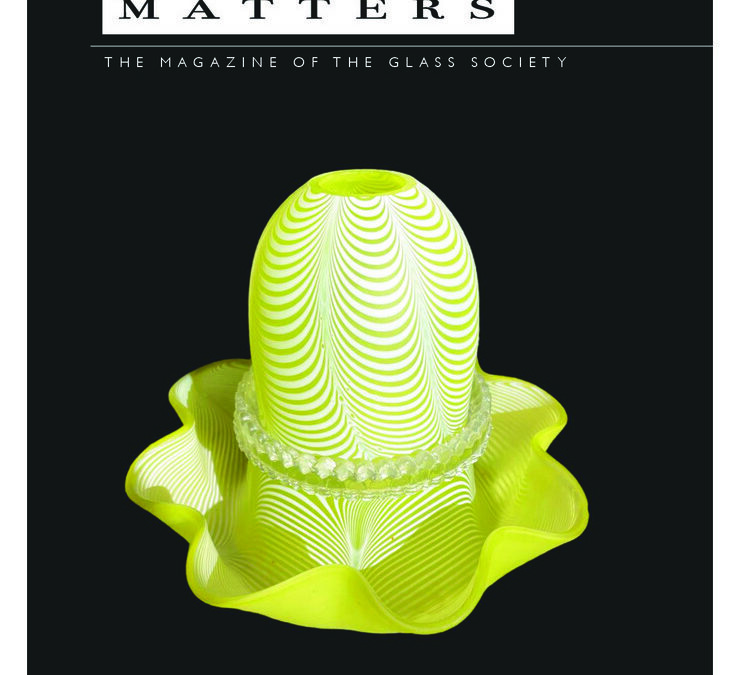
FRONT COVER: A Samuel Clarke Fairy Lamp in Citron Verre Moire. Made by HG Richardson. (article on pages 17 to 22)
BACK COVER: Bust of David Livingstone in clear glass, by John Derbyshire. (see pages 14 to 16)
-+$./0*12%#.*340..)5*674#8+ * Simon Cottle
Glass Handled Flatware Dwight Lanmon
Prince Rubert’s Drops Christina Glover
Pressed Glass busts Michael Upjohn
Fairy Lamps Julie Muscovey
Medicinal Leech Bill Millar
Bowls & Jars: Part 2
The National Glass Centre Julia Stephenson
Gilded Lillies 2 Simon Cook
Ludwig Kny at Stourbridge James Measell
Warmby Flask – by Beilby? Simon Cottle
London Sandblast 1951 Paul Freeman
Share Your Passion for 20th-Century Glass!
D
ear Glass Society members,
The 20th century was a time of transformation in
glassmaking, and we know that this period is at the heart of many
of your collections. I’m inviting you to contribute to Glass Matters
and share with your fellow collectors the wealth of knowledge and
stories you have to tell. You don’t need to be a professional writer –
just someone with a passion for glass! Whether it’s a short piece, or
a longer look into influential glassmakers and designers, we’d love
to feature your contribution. E-mail: brianjclarke@btinternet.com
“Getting to know you”
We still seem to be emerging from Covid-19. Do you remember
meeting at fairs, exhibitions, and glass events? We need to
re-engage. We’re looking at organising visits to members and their
collections, to celebrate the beauty and craftsmanship of glass, and
with articles, help to enrich the content of Glass Matters . By writing,
discussing, and meeting, we can ensure that the rich story of glass
continues to inspire and connect us.
A GLA SS FAIR IS COMING ; Premier fairs are organising a fair at
Himley Hall, Dudley, on Sunday 18th May, from 09:00 to 16:00.
Early bird £10; from 10:00, £5.
3
4
5
12
14
17
23
26
30
36
38
39
Contents GM21.indd 2Contents GM21.indd 2 24/03/2025 10:3924/03/2025 10:39
CHAIRMAN’S MESSAGE
3
Chairman’s Message
Simon Cottle
Glass Matters Issue No.21 March 2025
O
ur Annual General Meeting
(AGM) took place in ear –
ly March this year. T he
formalities included the import –
ant appointment of Ian Page as
our new Treasurer, Membership
Secretar y and Tr ustee. Maur ice
Wimpory, who has worked tireless –
ly in these roles since well before
the Glass Society ’s inception, has
now decided to step down – we
express our gratitude to him for
his highly significant contribu –
tion to the continuing success of
the society, and we welcome Ian for
taking on this role and wish him
ever y success. My thanks go to all
those who participated in the Show
and Tell discussion following the
main body of the AGM meeting.
We began this feature about five
years ago and it is now a regular
par t of our AGM. T he variety of
s ub je cts discusse d was diverse
and led to much lively debate.
Simon Wain-Hobson discussed an
18th century wash-enamel armo –
rial ale glass with connections to
the Midlands and James Kellock
invited comments on a blue-tinted
glass goblet painted with cold-dec –
oration, perhaps of an allegor y
of love, which might have been
from the 19th or 20th centuries.
Addressing us from Canada, Peter
Kaellgren drew our attention to an
engraved goblet, probably from the
early 20th centur y with a hound
chasing either a hare or a rabbit.
L astly, Ian Page asked for help
with identifying the decorator
of an impressive Dutch engraved
light-baluster wine glass in his collec –
tion bearing an English inscription,
a very rare feature of such glasses.
O ne of the most sig nif icant
highlights for me over the last year
has been the development of our
new website. It will be launched
on 7th April and we hope that you
will find it attractive, useful, and
infor mative. L e d de ter mine dly
by our committee member Gaby
Marcon, working with the website
designers, Diagonal Design, and
with impor tant contributions to
the arrangement and design of var –
ious sections from other executive
members, this project propels the
society and our image into the
21st century. Among a wide vari –
ety of special features designed
for members of the society is a
search facility of all our past and
present publications – including
those of the Glass Circle and Glass
Association – with an automatic
pa ge- tur ning facilit y, an event
and news section and a mobile
galler y of images of glass from the
post-mediaeval period to the pres –
ent day. We’ve improved the nav –
igation of our membership page
to make it easier for both new and
existing members and our charita –
ble grant-giving section has been
enhanced to provide a simpler
experience for future applicants.
There are web-links to many insti –
tutional collections worldwide and
infor mation is available on the
histor y of glass manufacture. We
hope that this newly constructed
website will be one of the most
important go-to sites for collectors
and historians of glass of all peri –
ods and will attract new members
to the Glass Society, both young
and old, from around the world. It
is a site which remains f luid and
adaptable and we welcome news
items, more images for the gal –
lery (within copyright) and espe –
cially, further details of events.
Among a fascinating and diverse
range of articles on glass, this edi –
tion of Glass Matters contains an
important study on glass cutler y
from our Vice-President, Dwight
Lanmon, pressed glass busts from
M i ke U p j o h n a nd f ro m Ja m e s
Measell a prize for Ludwig Kny.
Also featured is an extensive con –
tribution on Fair y Lamps by Julie
L ever from L as Ve gas, Nevad a ,
and B ill Millar ’s second ar ticle
on Leech jars. An addendum on
my study of pastoral subjects on
enamelled glass in issue No.19,
and the recent emergence of a rare,
dated, enamelled f lask at auction
in the United States illustrate my
continuing research on B eilby.
Any insights on Beilby glass from
members will be most welcome.
For those seeking current news on
glass fairs and other useful infor –
mation, Brian Clarke’s Editorial is
an important continuing feature
of all our issues of Glass Matters .
Our continued thanks should
go to Brian Clarke for assembling
yet again a fascinating series of
articles; alongside our outstand –
ing new website, Gla ss Matters
re m a i n s a c o r n e r s t o n e o f t h e
Glass Society, keeping our mem –
bers informed and connected.
Simon Cottle, Chairman of !e Glass Society
Chairmen’s message GM21.indd 1Chairmen’s message GM21.indd 1 21/03/2025 21:1521/03/2025 21:15
Beilby Rural Idylls: updated
4 Glass Matters Issue no.21 March 2025
BEILBY’S SHEPHERDS
Simon Cottle
ABOVE LEFT Fig.1One of the Shepherd portrait glasses by William Beilby © Glynn Vivian Museum, Swansea
ABOVE RIGHT Fig. 2One of the Shepherdess portrait glasses by William Beilby © Nottingham City Museums and Galleries
LEFT Fig. 3A sugar bowl with the shepherd scene in white enamel, by William Beilby © Bonhams
S
ince publishing my article
‘Rural Idylls’: the B eilb y
e n a m e l l e d s h e p h e rd a n d
s h e p h e r d e s s p o r t r a i t g l a s s e s
in Glass Matters (J une 2024,
Issue No.19, pp.23-28), a fur –
ther example has come to light.
Several months ago, I had been
in touch with the Glynn Vivian
Mu s e um in S wans ea a b out a
wine glass described in an old
catalogue as having a pastoral
scene in white enamel which I
thought might be one of these
por trait glasses. T he museum
still had the glass, but unfor –
tunately, due to the temporar y
closure of their g lass display,
I did not receive confirmation
and a full des cr iption o f the
glass until after the article went
to press – when I was pleased
to find that I’d been correct.
Pa i n t e d w i t h a s h e p h e r d
(Fig.1)
t h e p a i r to a n e x a m p l e w i t h
a shepherdess (Fig.2)
C a st le Mu s e um, No tt ing h am
( N C M . 1 9 4 1 – 1 2 2 , fo o t n o t e 6
in my ar ticle). I t can now be
established that 8 glasses are
cur rently recorded with these
p o r t r a i t s . T h a t i n S w a n s e a
(GV.1995.85) comes from the
E u s t a c e C a l l a n d C o l l e c t i o n
which, at 14.7cm. high, is iden –
t i c a l t o t h a t i n No t t i n g h a m
f r o m t h e H e n r y H o l f o r d
C o l l e c t i o n , g i f t e d i n 1 9 4 1 ,
including the b ow l for m and
double series opaque-twist stem.
In addition to the por trait
g l a s s e s t h e re i s a l s o a s u ga r
bowl (Fig.3)
enamel with a version of the
shepherd scene, with sheep and
goats, for merly in the K aplan
Collection and sold at Bonhams
o n 1 5 t h N o v 2 0 1 7 , l o t 3 6 .
Beilby GM21.indd 4Beilby GM21.indd 4 21/03/2025 21:1421/03/2025 21:14
GLASS AT DINNER
5 Glass Matters Issue no.21 March 2025
G LASS -H ANDLED F LATWARE
and Searching for the First Owners
By Dwight P. Lanmon
BELOW Fig.1Knife and fork. Probably France, Orléans, Bernard Perrot, ca. 1680-1709. (Glass) fused mille ! ori, probably around a copper tube; gilt silver, steel; assembled. OL (knife) 24.1cm., OL (fork) 21.9cm. Glasmuseum Hentrich, Kunstpalast, Düsseldorf (Gl mkp 2008-3 a,b). Photo: © Kunstpalast, Düsseldorf
ABOVE Fig.2Knife. Probably France, Orléans, Bernard Per rot, ca. 1680-1709. ” e knife blade has an unidenti ! ed cutler’s mark, ‘SAVERY,” which is thought to be French. (Glass) fused polychrome twists and ribbons, probably around a copper tube; silver; steel; assembled. Victoria and Albert Museum (C.343-1914), gift of Montagu Ye a t s B ro w n , E s q . C M G . OL 2 4 . 1 c m . Photo: © Victoria and Albert Museum
RIGHT Fig. 3 Two unmounted glass handles with mille ! ori and ! ligrana. Probably France, Orléans, Bernard Perrot; ca. 1680-1709. (Glass) polychrome mille ! ori and ! ligrana fused around a copper tube. (Larger) OL 13 cm.; (smaller) OL. 4.6 cm. British Museum (larger: OA.5197; smaller: OA.5194). Photo: © ” e Trustees of the British Museum
ABOVE Fig.2ABOVE Fig.2
I
n E u ro p e , k n i ve s g rad u a l l y
evolved from carving, stab-
bing and serving utensils
to individual eating accessor ies
in the 16th centur y. Forks also
evolved from pr imar ily ser ving
implements to individual dining
equipment by late in that centur y
– at first in Italy, and gradually in
north European households. The
forms of handles, blades, and tines
also changed through the years,
and the y were o ften de corate d
to make them more impressive
for hosts wishing to demonstrate
wealth, taste, and good manners.
Handles, especially, became more
elaborate and decorative, and a
variety of materials were employed
by cutlers. In the beginning, they
were primarily metal, but many
other materials were mounted on
flatware, some seemingly inap-
propr i ate for w ithstanding the
heavy use and torque generated in
cutting. Fragile materials such as
amber and ivory were used as han-
dles for f latware in Europe since at
least the early 16th century. 1 And
glass, among the many materials
Glass Flatware3 GM21.indd 5Glass Flatware3 GM21.indd 5 21/03/2025 21:1421/03/2025 21:14
6 Glass Matters Issue no.21 March 2025
GLASS AT DINNER
ABOVE Fig.4Knife and fork. Probably Bohemia, ca. 1740-1750. Opaque white non-lead glass, blown, gilt; engraved and gilt steel; assembled. (Knife) OL. 23.7 cm., (fork) OL. 22.2 cm. Corning Museum of Glass (74.3.133 A,B). Photo: © !e Corning Museum of Glass
RIGHT Fig. 5 Knife and fork. (Glass) probably Venice; assembled in England by Daniel Gurney, She “eld, UK, ca. 1750. Aventurine glass, cast, tooled; silver ferrules, steel knife blade and fork; assembled. OL (knife) 19.9 cm, OL (fork) 16.6 cm. !e Corning Museum of Glass (2010.3.120 A,B). Photo: © !e Corning Museum of Glass
that would seem equally unsuit –
able, was used to make handles
from at least the late 17th century.
“Glass haft knives” were enu –
merated in the estate inventor y
of the London cutler John Waters,
who died in 1671. 2 T here is no
indication what glass was used or
how it was mounted. Their val –
ue was assessed at 7 shillings per
dozen. By comparison, agate-han –
d l e d k n i ve s we re va l ue d at 2 4
to 36 shillings a dozen, and sil –
ver-hafted knives were appraised
at 30 to 70 shillings a dozen. We
m ay c o n c l u d e , t h e re fo re , t h a t
glass-handled f latware was not as
esteemed as we might think today.
T h e e a r l i e s t g l a s s – h a n d l e d
f latware I know of is of two types:
one contains polychrome millefiori
canes on backgrounds of scrambled
segments of polychrome filigrana
(Figs.1 & 3) . The other type has a
scrambled mixture of polychrome
filigrana and tapes, but no mille –
fiori (Fig.2) .3 Often attributed to
Venice, these g lass handles are
now usually attributed to Bernard
Perrot (1640-1709), a glassmaker
of Italian orig in who was active
in Orléans from 1662 to 1709. 4
B o t h t y p e s a re c o n s t r u c t e d
with a c ylindr ical silver fer r ule
securing the handle to the knife
blade or fork stem. A metal rod
r u n s t h ro u g h t h e h a n d l e a n d
penetrates the end, where it is
decoratively capped. These han –
dles may not be solid glass. Two
unmounted knife handles reveal
an approach to making them more
durable: the g lass is fused to a
copper tube, which undoubtedly
adds tensile strength (Fig.3) . Even
though strengthened by a rod and
a copper core, such handles were
ver y fragile, and I find it amazing
that several have survived intact. 5
A particularly beautiful set with
matching complex millefiori-deco –
rated handles is shown in Fig.1 . The
steel knife blade, with parallel sides
and rounded tip, is typical for the
period. The handles are attached
with decorated silver ferrules; the
domed silver caps on the ends of
Glass Flatware3 GM21.indd 6Glass Flatware3 GM21.indd 6 21/03/2025 21:1421/03/2025 21:14
GLASS AT DINNER
7 Glass Matters Issue no.21 March 2025
ABOVE Fig.6Knife, fork and spoon. Assembled or imported and sold by Pelletreau, Bennett, & Cook, New Yo rk C i t y, ca . 1 8 2 3 – 1 8 2 8 . Glass (gold-ruby, non- lead?), cut; gilt silver; assembled. OL. (spoon) 19.4 cm. Private collection. Photo: !e Silver Trade Route, Marblehead, MA
BELOW Fig. 7 Glass-handled cutlery made by the Goodell Company in Antrim, New Hampshire. From !e Iron Age, April 6, 1905, page 1213
the metal rods r unning through
the handles are radially r ibbed.
By the mid-18th centur y, the
metal rod penetrating the handle
was eliminated on glass-handled
f latware. The glass is attached to
the knife blade or fork in a cylindri –
cal metal (typically silver) ferrule,
but it is likely that a short metal rod
extends from the haft of the knife
and the fork, penetrating part way
into the handle to give it strength.
The knife and fork (Fig.4)
tubular opaque white glass handles
decorated with g ilt C hinoiser ie
motifs. The spiral stem of the fork
is gilt. The steel knife blade is of
the scimitar shape popular in the
mid-18th-centur y. It has engraved
and parcel-g ilt decoration of an
eagle supporting a shield inscribed
with a script “W” in a frame sur –
mounted by an urn of fruit. The
fork bears an unidentified cut –
ler ’s mark of a six-pointed star.
A k n i fe a n d fo r k w i t h s o l i d
aventurine glass pistol-grip han –
dles is shown in Fig.5 . The han –
dle form became popular around
1720 and continued to be used
with slight variations through –
out the centur y. E x amples are
found with ceramic (porcelain and
earthenware) and glass handles,
but they are more typically metal,
usually silver. 6 The scimitar knife
blade on this set is stamped with
the crow ne d “G R” mark o f the
Sheffield cutler Daniel Gurney.
T he scimitar blade for m was
replaced in the last half of the
1 8 t h ce n t u r y b y a s p e a r- p o i n t
F re n c h – s t y l e b l a d e , w h i c h w a s
replaced in turn late in the centu –
r y by simpler blades with parallel
sides and f lat or rounded ends
(Fig.6) . T h at s t y l e d o m i n ate d
for another 150 years, although
a scimitar shape became popular
Glass Flatware3 GM21.indd 7Glass Flatware3 GM21.indd 7 21/03/2025 21:1421/03/2025 21:14
8 Glass Matters Issue no.21 March 2025
GLASS AT DINNER
ABOVE Fig. 8 Fork and spoon. New York, Corning, Steuben Glass, Inc., ca. 1930-1939. Glass (lead); sterling silver; assembled. OL (fork) 19.9 cm. !e Corning Museum of Glass (85.4.83 A,B), gift of Grace Fraas. Photo: © !e Corning Museum of Glass
LEFT Fig. 10Detail showing an engraved coronet of a Marquess on a handle of the “atware in Fig. 9. OW 1.3 cm. Photo: David Goodell
BELOW Fig. 9 Luncheon knife and fork from a set of six (each). Assembled by John William Page, London, 1928. Glass (gold-ruby, probably lead); silver; silver-plated steel; assembled. OL (knife) 24 cm., OL (fork) 20 cm. Private collection. Photo: Author
again in the 20th century (Fig.9)
cut, solid, tapered, flattened han –
dles was popular in the late 18th
centur y, and they continued to be
made throughout the 19th and into
the 20th century. 7 A t y pical ex am –
ple of that handle form is shown in
Fig.6 . That set has a gilt silver knife
blade, fork, and spoon; the cut glass
handles are of solid gold-ruby glass.
The set was marketed in New York
City or Charleston, South Carolina,
in the 1820s by the New York City
silversmiths Pelletreau, Bennett &
Cook, whose mark “P.BC&C ” they
bear. 8 Even if the silver parts were
made in New York City, the han –
dles were certainly imported, likely
from England; there is no evidence
that gold-ruby glass was made in an
American glasshouse in the 1820s.
I n t h e l a t e 1 9 t h c e n t u r y,
Victorian fashion often led to the
production of flatware handles
o f ex trava gant for m, including
elaborately cut glass (Fig.7) . The
complex design and manufac –
turing process cutlery manu –
facturers developed to produce
durable metal f latware with glass
handles was explained by one
American manufacturer in 1905:
The Goodell Company, Antrim,
N.H., and 10 Warren Street, New
York, has recently put on the market
an elegancy in table cutler y mounted
with genuine cut glass handles, one
pattern of which is here illustrated.
In the production of such tableware,
ordinarily perishable, the durability
of the handles and process of man –
ufacture are most important. T he
mater ial for the hand le blank s is
made after a special formula, and the
handles are guaranteed by the com –
pany absolutely proof against injur y
due to changes of temperature, being
both tough and strong. The finished
article, we are advised, has been fre –
quently immersed in snow and then
Glass Flatware3 GM21.indd 8Glass Flatware3 GM21.indd 8 24/03/2025 13:2024/03/2025 13:20
GLASS AT DINNER
9 Glass Matters Issue no.21 March 2025
boiling water immediately poured on
it in tests for fracture and without
injur y. The joining of the blade, fer –
rule and handle is accomplished in a
unique and ingenious way. The blade
notched top and bottom, has a square
end that fits per fectly against the
handle, the handle having a tapered
end with lugs made in molding the
blank s to g ive additional holdin g
power…The handles are in plain or
genuine cut glass, opal, black and opal
decorated with f lowers, vines, etc.,
in colors. This ware in the trade will
be known as Vitricine table cutlery.
Tableware utilizing a variety of
unusual materials as handles con –
tinued to be made in the 20th cen –
tur y, including newly developed,
ABOVE & LEFT Fig. 11a & bFlatware service with glass handles, and detail showing the engraved coronets on the handles. Assembled by John William Page, London, 1928; Israel Freeman & Sons, London, 1940; and unknown. Sterling silver, glass (probably lead); steel. Photos: ©
Glass Flatware3 GM21.indd 9Glass Flatware3 GM21.indd 9 24/03/2025 13:1524/03/2025 13:15
10 Glass Matters Issue no.21 March 2025
GLASS AT DINNER
inexpensive plastics. High-end-
m a r ke t g l a s s – h a n d l e d f l at wa re
was also produced, including a ser –
vice Steuben Glass offered in the
1930s (Fig.8) . Designed in 1929,
they were available in colorless,
Flemish B lue, and Spanish Red
glass, both bubbly and non-bubbly.
A 20th centur y luncheon knife
and fork with solid gold-ruby glass
handles, from a set of six each, is
illustrated in Fig.9 . Made in 1928,
the sterling silver ferrules bear the
London hallmark of John William
Page. T he set is unusual not only
for the gold-ruby glass handles, but
also because each bears a small,
e n g rav e d c o ro n e t o f a B r i t i s h
or Spanish Marquess (Fig.10) .9
The handles are of uniform size,
and the presence of similar dimples
on the face and back of each indi –
cates that they were likely formed
in a hinged clamp mold; the mold
line at the sides being eliminated
by precise grinding and polish –
ing. 10 The scimitar knife blade, a
revival of the 18th centur y form,
became popular again in the late
19th centur y. The fork tines and
k n i fe b l a d e s a r e s i l v e r – p l a t e d
steel and bear no cutler ’s mark .
A r e l a t e d 1 2 2 – p i e c e s e t o f
glass-handled flatware (Fig.11) ,
par t of an “ex tensive porcelain,
silver, and glass dinner ser vice of
373 pieces per taining to British
Royalty,” was offered at auc –
t i o n b y No r t h e a s t Auc t i o n s i n
Por tsmouth, NH, in 2012. T he
flatware was also offered sepa –
rately by Sotheby’s (New York). 11
ABOVE Fig. 12Knife and fork, the green glass handles with an engraved coat of arms. Assembled by John William Page, London, 1926. Glass (probably lead), pressed, polished, engraved; sterling silver; silver-plated steel. OL (knife) 28 cm., OL (fork) 22 cm. Mark Drans !eld collection. Photo: owner
LEFT Fig. 13Detail showing the engraved coat-of-arms on the “atware in Fig.12. OW. 2 cm. Photo: Mark Drans !eld
Sixty-four pieces of that set were
also made by John William Page
in 1928, so they may have been
from the same commission as the
ruby-handled set. 12 Other piec –
es were added by Israel Freeman
& Sons in London in 1940. 13
In 1926, Page also made a set
of 50 knives and forks of the same
form, but with transparent green
glass handles (Fig.12) –
dle bears an unidentified, stylized,
engraved coat of arms (Fig.13) .
The set was purchased at the sale
of the estate of Winifred Seyburn
Cheston (1917-2010) in Chester,
PA . Her mater nal grandfather,
John Francis Dodge (1864-1920),
was an automobile manufactur –
i n g p i o ne e r a nd co – fo u nd e r o f
the Dodge Brothers Company in
Detroit, MI, which became pres –
ent-day Dodge. Winifred was too
young to have purchased the set.
Was it a custom order for an earlier
member of the Dodge or Cheston
family? T he coat of ar ms does
not resemble that bor ne by the
Dodge family and may be fictitious.
W ho or i g in all y ow ne d thes e
impressive f latware ser vices? The
engraved coronet on the ruby-
and white-handle d s e ts is that
b o r n e b y a B r i t i s h o r S p a n i s h
Marquess. In 1940, there were 61
extant Marquesses in the United
Kingdom; since then, five of those
titles have become extinct, and the
estates were possibly dispersed,
which may explain why those two
Glass Flatware3 GM21.indd 10Glass Flatware3 GM21.indd 10 21/03/2025 21:1421/03/2025 21:14
GLASS AT DINNER
11 Glass Matters Issue no.21 March 2025
sets of glass-mount –
e d t a b l e w a r e e n t e r e d
the marketplace. 14
T h e e x i s te n ce o f a t
least three related sets of
g l ass -handle d f l atware
b y Jo h n W i l l i a m Pa g e
p ro m p t s t h e q u e s t i o n
of whether the firm had
a sub- speci aliz ation in
m a k i n g g l a s s – h a n d l e d
f l a t w a r e w i t h m o t i f s
engraved for the own –
e r ? I f s o , t h e r e a r e
likely to be other sets.
I hope that readers of Gla ss
Matters will recall seeing other
examples of this or other related
flatware services. If we are fortu –
nate, some will still be owned by
descendants of the family for which
they were made – which will result
in identifying the original owners
and perhaps even the glassmaker
responsible for making the handles!
ACKNOWLEDGEMENTS
The author is grateful to Gail
Bardhan, Mark Dransfield, Rob –
ert Girouard, David Goodell, Erik
Gronning, Larry Jessen, Dr. Dedo
von Kerssenbrock-Krosigk, Ange –
lika Kuettner, Austin Schoelkopf,
Ian Simmonds, Simon Spier, Ann
Wagner, and Olivia Watson for
their assistance in this endeavor.
ENDNOTES
1. See, for example, Brown,
Peter (ed.), British Cutler y. An
Illustrated Histor y of Design,
Evolution and Use. London: Philip
Wilson Publishers and York Civic
Trust, 2001, pp. 82-90, 96.
2. Ibid , pp. 26-27.
3. Another example is in the collec –
tion of The Corning Museum of
Glass (81.3.5).
4. Although the blade of the knife
illustrated in Figure 2 is thought
to be French, the Museum attri –
butes the glass handle to Venice,
ca. 1690-1735.
5. A related knife and fork are in the
collection of the Musee des Arts
Decoratifs (2010.120). Another
knife and fork with similar han –
dles, remounted by John Dobby
who was in business in London
between 1832 and 1863, was sold
by Bonhams on 29 September
2020, lot 88. Also see examples in
Brown, op. cit. , pp. 102, 103, figs.
69b and 70a-c.
6. See Brown, ibid ., pp. 102-109,
118.
7. See Brown, ibid ., p. 122, fig. 100c,
for an English set with colorless
glass handles made by W. M. Eley
and W. Fearns about 1806.
8. Maltby Pettetreau was a partner
with John Bennett and D. C. Cook
at 170 Broadway in New York City
from 1823 to 1828. The firm also
conducted business in Charleston,
South Carolina, as Bennet Cook
and Co. The firm was dissolved in
1828 upon the death of Bennett.
9. A British Marquess’s coronet
bears strawberry leaves alter –
nating with single silver balls. A
BELOW Fig. 13End view of a broken fork handle, from the set shown in Figure 12. Photo: Mark Drans !eld
Spanish Marquess’s coronet is as
it is depicted on the f latware, with
strawberr y leaves alternating with
sets of three balls.
10. The technique was developed in
Bohemia to produce blanks for
cut glass chandelier pendants by
the late 17th centur y. It involved
the use of a hinged mold in
which molten glass was placed,
then clamped shut to form the
pendant, which was later cut and
polished. An example of a pressed
chandelier pendant blank and
outer section is in the collection
of The Corning Museum of Glass
(79.3.32).
11. April 5, 2023, lot 452.
12. By John William Page, London,
1928: 17 dinner knives, 18 dinner
forks, 16 luncheon knives, 13
luncheon forks.
13. By Israel Freeman & Sons, 1940:
16 teaspoons, 17 dessert spoons,
8 cocktail forks. There were also
17 unmarked butter spreaders
with plain (unengraved) handles
and unmarked ferrules; the blades
marked “Barker Bros & Co. England.”
extinct 1960; Crewe, extinct
1945; Dufferin and Ava, extinct
1988; Ormonde, extinct 1997;
Willingdon, extinct 1979.
Glass Flatware3 GM21.indd 11Glass Flatware3 GM21.indd 11 21/03/2025 21:1421/03/2025 21:14
Prince Rupert’s Drops – Fact and Fiction
12 Glass Matters Issue no.21 March 2025
EXPLOSIVE TEARS
Christina Glover
Fig.1Micrographia – Robert Hooke (1635-1703) . Photo credit: National Library of Wales
I
f you have read Peter Carey ’s
1988 B ooker Pr iz e- winning
n o v e l ‘ O s c a r a n d L u c i n d a ’
the same name, you will already
have an understanding of ‘Prince
Ruper t ’s Drops ’ – or maybe you
already know of them and their
remarkable properties. It was while
reading the book that I became
interested in the reference to this
glass phenomenon and researched
it on the internet, where you can
find lots of relevant information
on Wikipedia and elsewhere.
In the book , one of the main
c h a r a c t e r s , L u c i n d a , b u y s a
g lassworks in Australia , and so
for anyone w ith an interest in
glass, this adds another dimen –
s i o n to t h e s to r y – e s p e c i a l l y
w he n s he a nd O s c a r de c ide to
build a church made of glass and
transport it across country.
So, intrigued, I went on to tr y
to discover more about said drops,
named after Prince Rupert of the
Rhine, and also known as Dutch
tears or Batavian tears. Brought to
England by Prince Rupert in 1660,
they were being produced in the
Netherlands earlier in the 17th
centur y and had most likely been
known about by glassmakers for
much longer, probably since at least
the time of the Roman Empire.
T hey were presented to K ing
Charles II who in turn delivered
them to the Royal Society in 1661
for study, and several experiments
were performed on them and
papers written giving accounts of
the drops and describing the exper –
iments per formed. Among these
publications was M i c ro g ra p h i a
of 1665 by Rober t Hooke, who
would later discover Hooke’s Law.
His publication correctly laid out
most of what is understood about
Prince Rupert’s drops (Fig.1) . The
w e l l – k n o w n g l a s s a r t i s t S i d d y
L angley (www.siddy.com), has a
nice piece about them on her blog
and has kindly allowed me to use
some of her images (Figs.2&3) .
T hey are a scientific curiosity
in glassmaking that occurs when
molten glass is dropped into cold
Rupert Drops GM21.indd 12Rupert Drops GM21.indd 12 21/03/2025 21:0921/03/2025 21:09
EXPLOSIVE TEARS
13 Glass Matters Issue no.21 March 2025
Figs.2 & 3Rupert’s drops. Courtesy Siddy Langley
water and for ms a teardrop or
tadpole shape with a long , thin
tail. T he glass rapidly solidifies
from the outside inwards result –
ing in the head of the drop being
immensely strong and able to with –
stand great force, such as being
hit with a sledgehammer or even
a bullet – but if the tail is broken
it causes the teardrop to explode
and fra g ment . T his reaction is
brought about by stresses within
the g lass. It is streng thened or
tempered and toughened by the
differential cooling of the inner
and outer material. Because the
outer layer cools quickly it com –
presses the cr ystalline str ucture
while the inner material cools more
slowly and its str ucture is under
tension. It is in a state of unstable
equilibrium. The two layers pulling
against each other mean the struc –
ture can absorb massive amounts
of force as the opposing forces
within equalize and compensate
for the external forces, but if you
break even a tiny part of the tail,
you rapidly release all the tension
in the surface and it shatters, the
only way glass can release tension.
T h e y w e r e s o m e t h i n g o f a
par ty piece in the 17th centur y
and known about quite widely in
society. T here have been several
references to the drops in liter –
ature, including by Pepys in his
diary, and they were immortal –
ized in a verse of the anonymous
Ballard of Gresham College ,(1663):
And that which makes their Fame
ring louder,
With much adoe they shew’d the
King
To make glasse Buttons turn to
powder,
If off the[m] their tayles you doe
but wring.
How this was donne by soe small
Force
Did cost the Colledg a Month’s
discourse.
T h ro u g h o u t t h e ye a rs , f ro m
the 17th century up to the pres –
ent day, other experiments have
been carried out on the drops to
tr y to understand more about the
stress distribution within the glass.
Prince Rupert’s drops also probably
inspired the production of tough –
ened glass by quenching , which
was patented in England in 1874.
There are some fascinating vid –
eos on You Tube of Prince Rupert’s
drops being crushed by a hydraulic
press, showing how much pressure
they can withstand compared to
other ver y hard materials such as
titanium, tungsten, natural dia –
mond and iron. A large Ruper t’s
d ro p w a s s h o w n to w i t h s t a n d
40 tons o f press ure , m a k ing a
deep imprint into the sur face of
the press before shattering- see
H Y DR AU L I C P R E S S A G A I N S T
RUPERT ’S DROP AND TITANIUM.
Anyway, I found it fascinating to
come across this fact , hither to
unknown to me, while reading Peter
Carey’s enjoyable fictional story.
Rupert Drops GM21.indd 13Rupert Drops GM21.indd 13 21/03/2025 21:0921/03/2025 21:09
Victorian Pressed Glass Busts
14 Glass Matters Issue no.21 March 2025
DERBYSHIRE AND KIDD
Michael Upjohn
FAR LEFT Fig.1Frosted glass bust of William Gladstone. 18cm H
LEFT Fig. 2Cloudy-white bust of Lord Beacons !eld. 18cm H
O
n display in The Victoria
and Albert Museum, and
c o m m e m o r a t i n g t h e i r
coronation, are a magnificent pair
of blown-moulded glass busts of a
young Queen Victoria and Prince
Albert. Dated 1845-50 and made by
F & C Osler of Birmingham, they were
shown at the Great Exhibition of 1851
in London and are much larger than
the pressed glass busts that followed
in the 1870s to 1900s. Press-moulded
glass was an ideal material for produc –
ing these commemorative wares, both
of the monarchy and the popular fig –
ures of the day. My father’s collection
contains a few of these smaller exam –
ples but by all accounts, glass busts
appear to be quite a rarity. (For the V&A:
type in ‘Explore the Collections V&A’ into
your browser and follow instructions)
father’s collection are of the popular
Prime Ministers and adversaries of
the time, William Gladstone (Fig.1)
and Benjamin Disraeli (Fig.2)
bust of William Ewart Gladstone,
Prime Minister for several terms
including 1868 and 1880, has a frosted
appearance while the one of Bejamin
Disraeli is of an unusual cloudy opaque
appearance. Benjamin Disraeli became
Prime Minister in 1874 and was then
elevated by peerage to the 1st Earl of
Beaconsfield in 1876, causing a quick
name change to his bust – originally
embossed Disraeli then modified to
Beaconsfield. These two busts are both
unmarked and a maker’s identification
has never been confirmed. After years
of discussion and speculation it is
thought that they may have originat –
ed from the John Derbyshire factory,
possibly just before it closed and their
moulds were distributed elsewhere.
Evidence that bears weight to this
theory was a recent discovery of a bust
of David Livingstone (Fig.3) signed
with the JD anchor trademark for
John Derbyshire (Fig.3a) . This was a
special and important piece for us: a
previously undocumented bust that I
had not come across before and hadn’t
seen any reference to in any book or
seen any other examples. Also, as far
as I am aware, this is the first time a
glass bust has been attributed by the
maker’s mark to the John Derbyshire
factory. David Livingstone was a pop –
ular Victorian figure, a Scottish phy –
sician and pioneering Christian who
died in 1873, living through the time of
Gladstone’s and Disraeli’s popularity.
Another glass bust in my father’s
collection is of an elderly Queen
Victoria in a gloss, opaque black glass
(Fig.4) . Produced by Thomas Kidd of
Manchester and identified in their
advertisement of the time (Fig.5) in
“English 19th Century Press moulded
glass by Colin R. Lattimore” .
Originally made to commemorate the
Queen’s Diamond Jubilee in 1897,
it is embossed ‘QUEEN VICTORIA’.
The same mould was later modified
to mark her death with the follow –
ing added to the back of the mould:
‘Born 24th May 1819, Died 22 Jan
Pressed Glass Busts2 GM21.indd 14Pressed Glass Busts2 GM21.indd 14 21/03/2025 21:0821/03/2025 21:08
DERBYSHIRE AND KIDD
15 Glass Matters Issue no.21 March 2025
ABOVE Fig. 4 Black opaque gloss bust of Queen Victoria, by !omas Kidd. 9cm H RIGHT Fig. 5Advertisement of Fig.4 bust of Queen Victoria in reference book, Fig.5a
RIGHT Fig. 3Clear bust of David Livingstone by John Derbyshire. 18cm H!e “rst time in print and with positive identi “cation, as the JD anchor trademark is embossed on the bust
INSET BELOW Fig. 3aClose-up view of the JD anchor trademark on the David Livingstone bust at Fig.3
Pressed Glass Busts2 GM21.indd 15Pressed Glass Busts2 GM21.indd 15 21/03/2025 21:0821/03/2025 21:08
16 Glass Matters Issue no.21 March 2025
DERBYSHIRE AND KIDD
1901’. These are rare to find, espe –
cially the later modified version. The
known colours include opaque black,
clear blue, amber and flint. These
cheap “penny lines” from Thomas
Kidd sometimes achieve nearer the
hundred-pound mark nowadays, mak –
ing them a challenge to win at auction.
The final busts come with a bit of a
mystery. They are hollow-back busts
of Queen Victoria in two different
sizes and three colours: clear (Figs.6
& 6a) ; frosted opaque white (Fig.7) ;
and frosted opaque black (Fig.8) .
As with the Thomas Kidd bust, this
black bust also commemorates Queen
Victoria’s death, with the following
added to the foot at the front of the
mould: ‘DIED. JAN 22,ND 1901.’
MAY 24,TH 1819.’ (Fig.8a) . The three
are unusual, as they appear to have a
BELOW Fig. 5aFront cover of ‘English 19th-Century Press-Moulded Glass’ reference book
BELOW Fig. 6 Hollow-back, clear bust of Queen Victoria. 20cm H
BEL OW Fig. 6a Showing the hollow back of Fig.6 with two slots at the rear of the head
purpose other than being just a dec –
orative commemorative item. Their
hollow backs have two small recesses
near the top of the head that look as if
they clip onto something like a frame
or similar, perhaps a support? (Fig.6a) .
I’ve not found anything similar but
would really appreciate any comments
to put me out of my misery, thanks.
Michael can be contacted at
michael.upjohn@btinternet.com
ABOVE Fig. 7Hollow-back, white bust of Queen Victoria. 14cm H
ABOVE Fig. 8 Hollow-back, black bust of Queen Victoria. Front of foot embossed with DIED.JAN 22,ND 1901
ABOVE Fig. 8aShowing the hollow back of Fig.8. Back of foot embossed with BORN.MAY 24,TH 1819.
Pressed Glass Busts2 GM21.indd 16Pressed Glass Busts2 GM21.indd 16 21/03/2025 21:0821/03/2025 21:08
SPARKLING FAIRIES
17 Glass Matters Issue no.21 March 2025
F AIRY L AMPS
Julie Lever: ‘the eccentric collector’
ABOVE Fig.1! e famous Dancing Fairy with wand, the Clarke trademark that made him so famous
BELOW Fig.2Clarke’s ‘Nightlight’ Candle Box and Candle, with a glass nightlight
INTRODUCTION
T
he history of Fairy Lamps is
almost 200 years old. Before
the days of readily available
electricity when candles and gas lamps
were the only forms of indoor light,
fires were a dangerous and inevitable
hazard. In the 1850s, a better style of
candle was created in England that
was shorter and fatter than others at
the time. In 1885, Samuel Clarke, a
relatively unknown candle maker and
lighting designer, patented a design
known as a ‘Fairy Lamp’, featuring a
glass cup covered with an open dome
as a way to sell his own ‘superior’ ver-
sion of these newly styled candles.
I have tried to give a broad scope of
the Fairy Lamps available, and show
how this marvellous idea of Clarke’s
as an aid in selling his superior can-
dles was a dream come true for him,
thanks to the wonderful glasshous-
es in England. Their ingenuity and
workmanship has astounded me and
has been my main focus of study.
The goal has been to represent each
glasshouse in the Stourbridge area
that had major and significant pro-
duction of Clarke’s Fairy Lamps by
showing the breadth of styles of Fairy
Lamps; the various types of glass;
colours; size and the markings and
advertisements as documentary proof.
These candle burning devices
brought great beauty and delight to
people’s homes with their multiple
uses, such as centrepieces for din-
ner settings, menu holders, lighting
rooms with wall sconces, chandeliers
and beauty with flower bowls and desk
lights. I want to leave you with a feeling
of what was involved when Fairy lamp/
candle usage was a main source of illu-
mination before modern day lighting
and how people used Fairy Lamps.
As a candle maker, Samuel Clarke
did not make any of the fairy lamps
that are so sought after today. Instead,
he commissioned many glass and pot-
tery manufactures to make them for
him. While most of the fairy lamps
and associated parts bear his regis-
tered trademark (Fig.1) , many of the
manufactures remain anonymous,
with the exception of a few well-known
companies such as Thomas Webb,
Royal Worcester, Taylor & Tunnicliffe,
and Royal Burlslem. In attempting to
include a Fairy Lamp representative
from each of the Stourbridge area
glasshouses that were responsible for
the best production of Fairy Lamps,
I’ve also looked at Stevens & Williams,
HG Richardson, Stuart & Sons and
Boulton & Mills. Then there were
many American and Bohemian glass
companies who followed ‘the fash-
ion’ and made their own designs of
candle lamps, being very careful not
to infringe Clarke’s patented design.
T H E F A I R Y
LAMP STORY
Once upon a time before the turn of
the 20th century, many homes had a
special room known as the parlour –
a gathering place for
family and friends to
play games, carry on
the interesting conver-
sations of the day and
play music. Hearing
laughter would not
have been unexpect-
ed and witnessing
a magic trick would
have been a welcomed
event. This was an
era when knowledge
was acquired keenly
and the home, espe-
cially the parlour was
the centre of many a
universe. Birds, plants, nature, children
were all loved and valued. This was an
era of grace, manners and tradition.
The parlour was beautifully deco-
rated and welcoming in spirit. Before
the days when electric lighting was
commonplace, the fairy lamp became
an integral part of those homes. They
warded off darkness in new ways,
ways that a simple candle in a basic
candle holder could not do. One of the
most interesting features of a fairy
Fairy Lamps 2 GM21.indd 17Fairy Lamps 2 GM21.indd 17 24/03/2025 10:4124/03/2025 10:41
18 Glass Matters Issue no.21 March 2025
SPARKLING FAIRIES
BELOW Fig.5Acid Marking: Queens Burmese ware design patent on inner area of Fairy Lamp base (c/f Fig.6) Acid Marking: S Clarke’s patent Trademark Fairy on opposite inner side of Fairy Lamp base (c/f Fig.5)
‘Fairy’ size and ‘Pyramid’ size Cranberry Verre Moire Fairy Lamp domes, for size comparison. ! e Fairy dome has a Clarke’s patent label, the Pyramid dome has a Clarke’s trademark label.. Unknown maker but from the Stourbridge area
INSET RIGHT Fig. 4Close-up detail of Clarke’s Fairy Lamp Patent sticker on the Fair y Lamp in Fig.3
lamp is that when lit, they twinkle
under an open dome made of beauti-
ful glass because the air flows in and
out through the sawtooth-like lamp/
candle cup holder. It is reported that
Samuel Clarke taught the great glass-
houses the idea of candle lamps and
about better airflow for candle com-
bustion. The unique fairy lamp design
added safety and beauty to a necessity
of life, lighting one’s home at night.
So you ask, what is a fairy lamp
and how did they come into being?
A fairy lamp is a specially designed
glass candle lamp, that has a base, a
dome and a lamp/candle cup, to be
used to hold and burn exclusively
manufactured Samuel Clarke candles.
Without Clarke’s candle and Clarke’s
lamp cup, it was not a Fairy Lamp!
I believe that candle lamp produc-
tion began pre-Clarke and he jumped in
on the bandwagon – but this is ongoing
research and it may just be a fairy-tale.
Samuel Clarke was a candle mak-
er who manufactured various kinds
of candles. His company, Clarke’s
Pyramid & Fairy Light Company, Ltd.
was located at Cricklewood (Child’s
Hill), a district in north-west London.
Candles made in the Victorian era
during this time were common-
ly known as ‘Night Lights’ (Fig.2) .
Clarke received patents (Fig.3,4,5)
and trademark names (Fig.4,6) for
improvements in candle making
starting in 1857, well before fairy lamp
production began in the latter part
of the 1880s. Not only was Samuel
Clarke driven to create the most
clean-burning, superior candles but
he still needed that extra something
to promote and sell them. Voila! The
UK Registry trade name ‘Fairy’ and
trademark ‘Fairy was born in 1885.
As Clarke was one of the smaller,
lesser-known candle makers at that
time, he was searching for a unique way
to present his product to the market.
He challenged the creme de la creme
glass of manufacturers of the day such
as Thomas Webb & Sons, Stevens &
Williams, The Red House Glassworks
and HG Richardson among others,
to create the fairy lamp product by
interpreting his vision of this nascent
idea. As a result, the world received
a multitude of lasting varieties that
are collected and gawked over to this
day. Fairy Lamps became so popular,
Clarke was able to obtain patents and
trademarks across the globe: England,
United States, France and Germany to
name a few. Many of Thomas Webb’s
patterns, were created by Jules Barbe
– he was an independent decorator
of French origin, who worked exclu-
sively for Webb’s until 1901, after-
wards working on his own account
and also for Stuart’s. Only three
signed pieces of his work are known.
Fairy lamps were created out of
many styles of glass such Queens
Burmese-ware, Verre Moire, Airtrap
and satin glass. Adjectives such
as ‘Rose’ and ‘Citron’ were used to
describe the beautiful colours of fairy
Fairy Lamps 2 GM21.indd 18Fairy Lamps 2 GM21.indd 18 24/03/2025 10:4124/03/2025 10:41
SPARKLING FAIRIES
19 Glass Matters Issue no.21 March 2025
LEFT Fig.7A beautiful Clarke Advertisement for a Pyramid size NIGHT LAMP . Clever – Notice the guy slipping and falling without a lit Clarke’s Night Lamp
RIGHT Fig. 8 ! omas Webb & Sons, Pyramid size menu holder fairy with authentic Clarke Menu and two ” ower holders. Jules Barbe pattern
BELOW Fig.9How the fairy lamp in Fig.8 is shown in the Clarke Catalogue.
LEFT Fig.7LEFT Fig.7A beautiful Clarke A beautiful Clarke Advertisement for a Advertisement for a Pyramid size Pyramid size LAMPLAMP- Notice the guy – Notice the guy slipping and falling slipping and falling without a lit Clarke’s without a lit Clarke’s Night LampNight Lamp
RIGHT Fig. 8 RIGHT Fig. 8 ! omas Webb & ! omas Webb & Sons, Pyramid size Sons, Pyramid size menu holder fairy menu holder fairy with authentic Clarke with authentic Clarke Menu and two ” ower Menu and two ” ower holders. Jules Barbe holders. Jules Barbe patternpattern
lass Matters Issue no.21 March 2025lass Matters Issue no.21 March 2025
LEFT Fig. 10 Clarke Fairy Menu holder, showing the leaf that holds the menu. Interesting rigaree application. Colour – Blue Verre Moire. Unknown maker but Stourbridge areaBELOW Fig. 11 Lamp at Fig.10, holding a Fairy Menu
RIGHT Fig. 12 Clarke Model 112. Fairy with Mirror. ! omas Webb & Sons, Burmese, Forget-Me-Not pattern by Jules Barbe
FAR RIGHT Fig. 13 Beautiful lit Fairy in Fairy mirror. ! omas Webb & Sons, Burmese, Hawthorn pattern
Fairy Lamps 2 GM21.indd 19Fairy Lamps 2 GM21.indd 19 24/03/2025 10:4124/03/2025 10:41
20 Glass Matters Issue no.21 March 2025
SPARKLING FAIRIES
RIGHT Fig. 14 Clarke model 107. Hanging Fairy with mirror and ” ower bowl. Colours – Cranberry and Verre Moire. Unknown maker. Stourbridge areaFAR RIGHT Fig. 15 Clarke model 107, Fig.13, as shown in the Clarke Catalogue
LEFT Fig. 16 Advertisement in ! e Ilustrated London News of the 500 lamp chandelier featured at the Royal Garden Fete, July 7, 1887. Burmese, made by ! omas Webb & Sons. It must have been incredible! How did they light the lamps every evening? Talk of the Fa ir y L amp world, how wa s it done?BELOW Fig. 17 Award to Samuel Clarke, from the Royal Botanical Society, July 9, 1887, London, for decorating the gardens with thousands of Fairy Lamps on the evening fete of July 7,1887, and “ ” ect produced by the arrangement of the same (i.e. Fairy Lamps) in Chandeliers and Pendants in the Conservatory”
advertisements (Fig.7) . Many
uses for fairy lamps became
prominent . Stand-alones,
menu holders (Fig.8,9,10,11) ,
chandeliers, fairy lamp mir-
rors (Figs.12,13) , hanging
fairies (Fig.14,15)
it, designs were made. Three
sizes of Fairy Lamp shades or
domes were available: the large
Fair y , 3 ¼” x 4” high (82mm
x 100mm); Fair y P yramid 2
3/8” x 2 ¾” high (60 mm x
70 mm); and the third size, Wee 1
3/8” x 2 1/8” (45 mm X 53 mm).
Perhaps the pinnacle moment of
Clarke’s career occurred when Thomas
Webb & Sons designed an incredible
Fairy Lamp chandelier, with 500
lamps (Fig16) , that was featured at
the Royal Botanic Society’s Gardens,
Regents Park, London, Evening Fete
of July 4, 1988. Also, over 3,000 Fairy
Lamps were used at the Queen’s
Golden Jubilee in 1887, (Fig.17) . As
a result, Clarke received the Gold Star
award. His firm also received many
other awards throughout the years
Fairy Lamps 2 GM21.indd 20Fairy Lamps 2 GM21.indd 20 24/03/2025 10:4124/03/2025 10:41
SPARKLING FAIRIES
21 Glass Matters Issue no.21 March 2025
from cities across the globe. From
London to Moscow and New Orleans
to Melbourne. Here are some exqui-
site examples of Fairy Lamps. They
are all Clarke lamps, documented
with maker, either through descriptive
books, advertisements (Figs.18,19) ,
Registered Designs or acid mark-
ing, please enjoy (Figs.20 to 28) .
Editor. Julie Lever, who hails from Los
Vegas in Nevada, has been working on
this article with me for some time. Her
great mentor for Fairy Lamp interest
and collecting was Jim Sapp, who sad-
ly passed away last November. He also
worked together with Julie on her pho-
tographic technique. Her love of Fairy
Lamps and her study and understanding
of them continues. Our next issue will
include a follow-up article. Meantime,
look at the website, www.fairylamp-
club.com , and a 1996 book, printed
by Schiffer ‘Fairy Lamps, Elegance in
Candle Lighting’ by Bob & Pat Ruf.
LEFT Fig. 18 Authentic Clarke Advertisement. CLARKE’S FAIRY LAMPS : THE QUEEN OF LIGHTS: AS USED BY HER MAJESTY THE QUEEN. Clarke had his advertisements beautifully done by hand and in colourABOVE Fig. 19 Wonder ful R oyal G arden Fete adver tisement of 1887 Illustrating CLARKE’S PAT E N T “FA IRY ” G A R DE N L A MP S . ! e side wording states “FAIRY” LIGHTS have a Double Wick, and burn 10 hours. Clarke made garden variety fairy lamps with special outdoor holders. It must have been an amazing sight to behold that wonderful summer evening!
ABOVE Fig. 20 ! omas Webb & Sons: Burmese, Hawthorn pattern by Jules Barbe
ABOVE Fig. 21 ! omas Webb & Sons: cased Cameo, white on blue on white
Fairy Lamps 2 GM21.indd 21Fairy Lamps 2 GM21.indd 21 24/03/2025 10:4124/03/2025 10:41
22 Glass Matters Issue no.21 March 2025
SPARKLING FAIRIES
BELOW Fig. 22 ! omas Webb & Sons: Burmese, Acorn pattern by Jules Barbe BELOW Fig. 23 Stevens & Williams: Satin Glass, Caramel colour. Original manufacturer’s colour name unknown. ! is type of lamp has the room to place ” owers and creates a beautiful e $ ect with a lit candle
LEFT Fig. 27 ! omas Webb & Sons: Burmese, known as ! e Reversible (base can be inverted and used for ” owers). Another charming e$ ect with a lit candle
RIGHT Fig. 28% omas Webb & Sons: Burmese, Quatrefoil. Jules Barbe Hawthorn pattern
BELOW Fig. 24 HG Richardson: colours – Verre Moire and Glossy Cranberry Another lamp that was designed with plenty of room for ” owers
BELOW Fig.25HG Richardson: Richly Cut Crystal BELOW Fig. 26 ! omas Webb & Sons: Burmese, Jules Barbe Larch pattern
Fairy Lamps 2 GM21.indd 22Fairy Lamps 2 GM21.indd 22 24/03/2025 10:4124/03/2025 10:41
NOR SWEETIE JARS
23 Glass Matters Issue no.21 March 2025
Medicinal Leech Bowls and Jars
Not Sweetie Jars!
Bill Millar
I
n the last issue of Glass Matters ,
(Issue No.20, October 2024) I
described small medicinal leech
bowls which would have been used in
a domestic setting. This article is pre –
dominantly focussed on larger glass
containers which would have been
used by apothecaries, barbers and
other folk who made their living from
leeches or bloodletting. However,
one small domestic bowl evaded
inclusion in the previous article and
is interesting enough to include here
(Fig.1) . Probably mid-18th century
or earlier, it has been dip-moulded to
produce the ribbed design to the rim,
bowl and rudimentary stem. Despite
the slightly wonky appearance it is
a charming little item. Having dis –
cussed this domestic leech bowl
which ‘slipped through the net’, it is
worth mentioning a similar-shaped
bowl (Fig.2) which should never
have been included in this trawl. It
is the right shape for a leech bowl; at
8cm it is the right height for a leech
bowl, and it is the right period for
a leech bowl, c1880, but would be
useless as a leech bowl because you
would not be able to see the leech –
es it held. It was made as an orna –
mental item, and it is an example
of a Webbs Bronze iridescent glass
cabinet piece. The following large
leech bowl examples were lots in a
sale at Fieldings Auctioneers in 2024.
The leech bowl (Fig.3) is 29cm tall
with the capacity to hold a family of
leeches. Suitable for either a large
household or a small apothecary’s
shop, it would have required the same
muslin cover as domestic examples.
Clearly 18th century, it has a folded
foot and a hollow, knopped stem. This
form of foot and stem is described by
Edward Barrington Haynes in Glass
Through the Ages as Group VIII Hollow
Stem Glasses 1750 -1760. These
glasses are sometimes called Excise
Glasses, and it is entirely possible
that this leech bowl is of that period.
The leech jar example (Fig.4) , at
36cm tall, clearly has the capacity
to hold a shoal of leeches. It dif –
fers from the previous example in
that it has a loose-fitting glass lid.
It is 18th century with a shoul –
dered ovoid body on a tall swept
and folded foot. The shallow collar
neck is topped with a f lat cover
sur mounted with an annulated
finial, the opening to the jar being
wide enough to reach the leeches.
LEFT Fig.1An 18th century leech bowl with ribbed decoration
Leech Jars GM21.indd 23Leech Jars GM21.indd 23 21/03/2025 21:0121/03/2025 21:01
24 Glass Matters Issue no.21 March 2025
NOR SWEETIE JARS
RIGHT Fig. 2Webbs Bronze vase c1880, which might !t the description of a leech jar but not its function, 8cm tall
BELOW LEFT Fig. 3Leech bowl with folded foot and hollow, knopped stem, 29cm tall, mid-18th century
BELOW Fig.418th century leech jar with folded foot and loose- !tting lid, 36cm tall
At 27cm tall, the 19th centur y
leech jar (Fig.5) , has a very mod –
ern look. It has a wide, circular
foot and a waisted capstan stem
below a wide bowl with tapered
body. The leeches would be safe –
g u a rd e d b y t h e d o m e d cove r,
topped with an annulated finial.
The example (Fig.6) is also 19th
centur y, and at 33cm tall has the
largest capacity of all the leech jars
described in this article. The form is
of a wide shouldered ovoid body with –
out a stem or foot, resembling the
corner shop ‘sweet jar’. It is topped by
a conical cover with an integral finial.
The final example from the sale
at Fieldings, (Fig.7) , was a 19th cen –
tury clear crystal leech jar of shoul –
dered ovoid form, resembling an
upturned pear, on a tall swept and
folded foot. This foot and the height
of the jar at 36cm, is similar to the
jar at Fig.4 . The top of the bowl is
finished with an upstand collar and
closed with a conical cover topped
by a hollow blown finial. Height 36 cm
Leech Jars GM21.indd 24Leech Jars GM21.indd 24 21/03/2025 21:0121/03/2025 21:01
NOR SWEETIE JARS
25 Glass Matters Issue no.21 March 2025
No doubt large leech bowls and jars
come in other shapes. However, they
will all have a loose-fitting lid or the
facility to fix and tie a muslin cover.
Should you encounter a leech bowl or
jar, hopefully you will now be able to
recognise it for what it is. So, whether
it looks like a mini goldfish bowl as
seen in the first of these articles in the
previous issue of Glass Matters , or a
large sweet jar as at Fig.6 , or anything
in between, you will know exactly what
you have found – unless it is a lookalike!
PHOTO ACKNOWLEDGMENTS
Figs.1 & 2 : The author
Figs. 3,4,5 & 6: Courtesy of Will Farmer,
Fieldings Auctioneers
RIGHT Fig. 519th century example of a large leech jar, 27cm tall, with domed lid
BELOW LEFT Fig. 6A very large 19th century leech jar with conical cover, 33cm tall
BELO W RIGHT Fig.7 A 36cm tall 19th century crystal leech jar with a hollow blown !nial over its cover
Leech Jars GM21.indd 25Leech Jars GM21.indd 25 21/03/2025 21:0121/03/2025 21:01
T HE N ATIONAL G LASS C ENTRE
Ten Years of the Permanent Collection
26 Glass Matters Issue no.21 March 2025
NGC 10 YEARS LATER
Julia Stephenson
On November 7, 2024, Julia gave an
online presentation to The Glass Society
on the collection of the Sunderland
National Glass Centre (NGC). This
article covers some of the collection
presented in that talk, looks at the
history of the NGC and continues the
discussion on its collection and future.
W
ay before the Medicis
made arts patronage a
major thing , Benedict
Biscop (patron saint of Sunderland),
invested in the Sunderland glass
scene by bringing glaziers from Gaul
to St Peter’s monastery. Arriving in
Wearmouth in 674 AD, they made
the first known stained-glass window
in Britain. Jumping through time at
a great pace, we come to the end of
the 17th century when commercial
glass manufacture began to grow in
Sunderland. Production culminated in
the 20th century, with Hartley Wood’s
coloured glass and James A. Jobling &
Co’s licence to produce Pyrex. By the
end of the 20th century commercial
manufacture of glass in Sunderland
was waning; however, the internation –
al Studio Glass movement was on the
rise, leading to the opening of National
Glass Centre (NGC) in 1998. For over
26 years, NGC has operated as a public
venue offering exhibitions and public
engagement experiences as well as
housing the University of Sunderland’s
Glass & Ceramics Department.
By 2012, a small, informal collec –
tion existed through the work of the
Institute for International Research
in Glass (IIRG), part of the Glass &
Ceramics Department. This collec –
tion grew through works gifted to
the University by resident artists and
they reflect the focus of two key people
working in the department at the time:
Sylva Petrová, who led IIRG, brought
the strengths of Czech and Slovak
casting to Sunderland with artists
including Zora Palová, Alena Mat ějka
and Luká
led the Department, created oppor –
tunities for contemporary artists to
work in glass supported by the expe –
rience of a highly skilled academic
team. Peter’s approach furnished the
growing IIRG collection with works
by artists including Conrad Atkinson,
Stefan Gec and Cerith Wyn Evans.
Despite the official line that
National Glass Centre was not a
collecting institution, a collection
grew almost naturally, with visit –
ing artists leaving examples of their
work – as seems to be a very gener –
ous established practice. We were
also working with artists including
Erwin Eisch (Fig.1) , the De La Torre
Brothers (Fig.2) , Petr Stanicky, Richard
Meitner and Silvia Levenson (Fig.3) .
Neglecting the opportunity to acquire
works that told NGC’s story of both
the visiting and exhibiting artists and
our lecturers and students seemed to
be wrong, so in 2015 the University
of Sunderland agreed that a for –
mal collection could be developed.
Over the last ten years the collec –
tion has grown with a focus on three
main areas: international excellence,
the development of the Studio Glass
movement and Sunderland’s role with –
in it, and glass and the wider visual arts.
In terms of international excel –
lence, the collection now includes
works by artists from, or working in,
twenty-eight different countries, rang –
ing from Sweden to New Zealand and
the United States of America to Japan,
all of whom have produced work of
international standing. To give just
one example of artists from each of the
four countries named, we have work
by: Göran Wärff, who was Sunderland’s
first course leader for BA(Hons) Glass
& Ceramics; Kathryn Wightman,
who studied at the University of
Sunderland and now teaches at the
Whanganui Glass School; Harvey
K. Littleton, who was a leading pio –
neer of the Studio Glass Movement;
and Ayako Tani, another graduate
of the University of Sunderland
and a leading expert in lamp-work.
Our aim to chart the development
of the Studio Glass movement was ini –
tially limited as most of the works we
held were made in the 21st century. We
were extremely fortunate in receiving
donations dating from the late 20th
century, but the balance still leaned
heavily towards contemporary work.
Many unexpected things happened in
lockdown – for NGC, the most positive
unexpected thing had to be the offer
made by a gentleman called Bernard
Lloyd to donate his collection. A list of
names including Dale Chihuly, Harvey
K. Littleton, Pino Signoretto, Marvin
Lipovsky (Fig.4) , Richard Marquis,
Timo Sarpaneva – I really could go
on and on – was enough to make any
self-respecting public or private col –
lector go extremely weak at the knees.
We received Bernard Lloyd’s collection
of over three hundred works in 2022
and we are now able to offer a much
more fully formed view of the story of
Studio Glass. The collection, brought
together by Bernard Lloyd in the space
of three years, is a researcher’s dream.
A high percentage of works show the
growth of British Studio Glass includ –
ing a striking piece by Tessa Clegg and
a beautiful and surprisingly small piece
by Colin Reid; then the glass-making
family dynasties of Murano unfold
through a wide range of objects, and
National Glass Centre GM21.indd 26National Glass Centre GM21.indd 26 21/03/2025 20:5921/03/2025 20:59
NGC 10 YEARS LATER
27 Glass Matters Issue no.21 March 2025
there are stunning works from the
USA, Scandinavia, Eastern Europe
and Japan. This incredibly gener –
ous gift allowed NGC to include key
artists within the collection who
would have been out of our reach
financially. It allows us to present
glass made from the mid-20th cen –
tury onwards, compare internation –
al styles of making and highlight
the importance of both ‘one-off ’
T he collection also outlines
how Sunderland has contribut –
ed to the growth of Studio Glass
through acquisitions of work by
visiting artists including Tobias
Mohl, Martin Janecky and Carina
Cheung; teaching staff including
Cate Watkinson, Colin Rennie, Sylvie
Vandenhouke, James Mask re y
(Fig.5) and Jefferey Sarmiento; PhD
students including Angela Thwaites,
Helen Pailing, Erin Dickson (Fig.6) ,
and Laura Johnson; and MA and
BA(Hons) graduates including
Matt Durran, Richard W heater,
Effie Burns and Sacha Delabre.
Our final area of focus for acqui –
sitions has grown from Peter Davies’
specialise in glass, to explore how the
medium could relate to their practice.
Working in glass requires years, if not
decades of investment. As a result, it
is very difficult for the non-specialist
artist to use the material. We have
developed a partnering approach,
bringing visiting artists together with
extremely experienced NGC staff to
create new work using the building’s
fantastic facilities. We have found
that the approach of the non-glass
specialist brings new challenges to
the specialist, leading to new ways of
thinking on both sides. The nature,
scale and ambition of this work grew
and grew, culminating in the project,
Glass Exchange delivered in 2022.
Glass Exchange allowed NGC to deliver
four major commissions by leading
contemporary artists Ryan Gander
OBE RA (Figs.7&8)
Monster Chetwynd and Pascale
Marthine Tayou. A selection of works
from each commission were acquired
for inclusion in the collection.
As you may know, it has been
decided that the last graduates of the
BA(Hons), MA and PhD programmes
in glass and ceramics will leave us in
mid-2026. At this point the University
of Sunderland’s Glass & Ceramics
Department will close, as will the pub –
lic-facing side of the National Glass
Centre, though there are hopes and
aspirations to create opportunities
for artists and the public to continue
to engage in Sunderland’s 1,352-
year- old tradition of glass making.
To support this aim, it has recently
been confirmed that £5,000,000 has
been secured from the DCMS Cultural
Development Fund, and work to
develop this new offer will start in the
near future. By the time NGC closes
its doors the collection will chart the
story of glass in Sunderland over the
last 27 years. We hope that the col –
lection continues to grow, reflecting
the achievements of the next chapter.
Some of the Artist’s and their work
James Maskrey: Kildonan Gold (Fig.1)
–
ists. When working with visiting artists, James brings both an incredible level of technical skill, together with
empathy and understanding for the other artist’s aims. His own work draws on his passion for history and explo –
ration and often ref lects relationships with people, stories and places. Kildonan Gold shows James’s mastery of the
reticello technique and hails back to a time when gold was panned in the north of Scotland. The geographic connec –
tion to this area is one that many working in glass hold dear as we remember and miss North Lands Creative Glass.
Fig.1James Maskrey: Kildonan Gold, 2016
National Glass Centre GM21.indd 27National Glass Centre GM21.indd 27 21/03/2025 20:5921/03/2025 20:59
28 Glass Matters Issue no.21 March 2025
NGC 10 YEARS LATER
Erin Dickson: Coronet (Fig.3)
Erin Dickson was born and brought up in South Shields. After com-
pleting her PhD at the University of Sunderland, Erin worked from
her studio at NGC before moving to Canberra in 2022. Erin’s work
often reflects everyday life, including reinterpreting traditional
objects through the use of new technology. She uses her practice to
express her values and the strength of her beliefs, her pride in the
North-East and her humour. Erin’s pioneering use of new technology
supports the ongoing development of the sector and enables the
realisation of challenging new works including Ryan Gander’s Ghost
Shop , 2022. Coronet (2019) was commissioned to celebrate NGC’s
21st birthday. This work brings together the skills of the NGC team in
hot glass, lampwork and waterjet cutting and references Sunderland’s
connection with Pyrex and Sunderland Association Football Club.
Ryan Gander OBE RA: Ghost Shop (Figs.4a & 4b)
Safe Bets, New Threats (Fig.5)
Ghost Shop (2022) as part of the Glass Exchange
project. Commenting on the increase of empty shops in our towns and cities, the commission literally rep-
resented the ghost of a shop. Produced at full scale, the work depicted an abandoned betting shop creat-
ed in clear glass with details including an upturned bin with fast food packaging, crumpled betting slips, fire
extinguishers and a ‘To Let’ sign. Ghost Shop was sited in a disused shop opposite Primark on Sunderland’s main
shopping street, bringing glass and contemporary art into people’s everyday lives. The full commission was shown
for a fixed period of time; however, elements including Safe Bets, New Threats were acquired for NGC’s collection.
LEFT Fig. 3Erin Dickson: Coronet, 2019
BELOW Fig. 4aRyan Gander OBE RA: Ghost Shop, 2022 – inside BELOW Fig. 4bRyan Gander OBE RA: Ghost Shop , 2022 – looking in from outside
Erwin Eisch: Tele Komm Komm
027-418 (Fig.2)
NGC temporarily closed for refurbishment
in 2012 and reopened in 2013 with a major
retrospective of the work of Erwin Eisch, a
leading pioneer of the Studio Glass move-
ment. Erwin was born and lived in the town of
Frauenau in Bavaria and his family ran a glass
factory providing Erwin with a medium to
explore his creativity. While some artists work
to overcome and refine the technical challeng-
es of glass, Erwin’s work was led by artistic
expression underwritten by a level of skill
that allowed unrestricted freedom to create.
BELOW Fig. 2Erwin Eisch: Tele Komm Komm 027-418 , 1998
National Glass Centre GM21.indd 28National Glass Centre GM21.indd 28 21/03/2025 20:5921/03/2025 20:59
NGC 10 YEARS LATER
29 Glass Matters Issue no.21 March 2025
Silvia Levenson: Still Life (Fig.6)
titled Transparent Femininity . Born in Argentina and now resident in
Italy, Silvia casts glass, making work that reflects her life experience
ranging from political turbulence in Argentina to the challenges of love,
marriage and motherhood. We acquired Still Life as a record of the time
Silvia spent working with us. As with many other successful artworks it
is the simplicity and relatability of this piece that chimes with audiences.
The De La Torre Brothers: El Monarca (Fig.7)
working alongside Richard Meitner and Petr
Stanicky. The brothers, Jamex and Einar, are
from Mexico and their ‘maximalist’ work is
packed with cultural references. Their pas –
sion, creativity and sense of fun brought
a charge to the atmosphere, most notably
when they made this piece in our hot glass
studio working with staff and students in
front of a full capacity, transfixed audience.
Marvin Lipofsky: Untitled (Fig.8)
This piece forms part of the Bernard Lloyd Collection. Born in the
United States Marvin Lipofsky travelled internationally for over
fifty years pioneering the use of glass as a means of artistic expres –
sion. He began studying glass in 1962 with Harvey Littleton at the
University of Wisconsin, and went on to teach in California until 1987.
BELOW Fig. 5Ryan Gander OBE RA: Safe Bets, New !reats, 2022 BELOW Fig. 6Silvia Levenson: Still Life , 2017
BELOW Fig. 7!e De La Torre Brothers: El Monarca, 2017 BELOW Fig. 8Marvin Lipofsky: Untitled, 1974
Julia Stephenson worked in
Middlesborough for 15 years, start –
ing as Curator of Craft before going
on to work as Project Development
Co-ordinator delivering MIMA
(M idd lesbrou g h Institute of
Modern Art) as a capital proj –
ect, then becoming the Assistant
Director when MIMA opened. Julia
has now worked as Head of Arts at
National Glass Centre for 12 years,
has responsibility for exhibitions
and is the collections curator with
a focus on audience engagement.
She has dedicated this arti –
cle in remembrance of Peter
Davies and Zora Palová, who
contributed an immeasurable
amount to glass in Sunderland
PHOTO ACKNOWLEDGMENTS
Figs.4a and 4b by kind permission of
George Darrell
All other pictures by kind permission
of David Williams
National Glass Centre GM21.indd 29National Glass Centre GM21.indd 29 21/03/2025 20:5921/03/2025 20:59
A Baby’s Feeding Bottle
30 Glass Matters Issue no.21 March 2025
GILDED LILIES 2
Simon Cook
T
his article is a follow-up to
IRISH CONNECTIONS and
Gilded Irish Lilies? (Glass
Matters, June 2021, Issue No. 11).
Since then, several more exciting
discoveries have been made and they
include, for example, the three glasses
in Fig.1 . The outer two have gilding on
the drapery borders with traces on the
tassels as well as sprays of rose hips –
the right-hand glass. The taller glass
is also notable for two other reasons
– the three-bud Jacobite-style rose
and the eleven moulded flutes. This
is a rarity, as all but two of the Irish
petal-moulded glasses that I have
examined have twelve flutes. The
small but attractive central glass has
a greyish tint and has signs of gild –
ing on the fringes below the swags.
It has been matched with a fine Irish
kettledrum rummer that has identi –
cal engraving but no signs of gilding.
Of far greater interest though and
dealt with in more detail below is a
sugar bowl from a tea caddy, a lipped
bowl and a vessel described as a baby’s
feeding bottle. All but the bottle,
which is on public display in Wales,
found their way into my collection.
As stated in my previous article,
as far as gilded Irish glass goes, from
the evidence of individual pieces, Cork
seems to be the centre of manufacture
and decoration. Of the three special
pieces featured here, two are probably
from Cork and the other may be from
Dublin. The small glass in Fig.1 can be
linked by the fringed swags to a marked
Edwards of Belfast decanter. What
would be exciting would be to discov –
er a marked and gilded Irish decanter!
THE TEA CADDY SUGAR BOWL
Engraved caddy bowls appear to
be unrepresented in the literature;
sometimes cut clear glass or coloured
glass ones are seen but gilded bowls
(on blue glass) are very rare. Mehlman 1
has this to say about tea caddies: These
boxes and bottles (about 5 ½” high) were
made from glass in England from c.
1750-1820. The term caddy was derived
from the Malay word kati for the stan –
dard weight (about 1 ¼ pounds) of tea,
packed and exported from the Orient.
English tea bottles (also called can –
nisters) were commonly of “Bristol Blue”
–
elled with floral scrolls and birds, and
labelled with the brand of tea: Bohea,
Green, Black and Hyson. Many were of
rectangular section, with canted corners
and silver or gold tops, sometimes also
surmounted by an engraved plaque. The
majority have been ascribed traditional –
ly to the Bristol area (particularly to the
decorator Michael Edkins, who worked
there c. 1765), but it is more likely that
they were of wider manufacture includ –
ing Dublin, Sunderland, Warrington, and
the south Staffordshire area, c. 1755-70,
and that the surface designs were exe –
cuted by numerous competent painters.
Fig.1
Baby’s Feeding Bottle GM21.indd 30Baby’s Feeding Bottle GM21.indd 30 21/03/2025 20:5721/03/2025 20:57
GILDED LILIES 2
31 Glass Matters Issue no.21 March 2025
Tea bottles were made in pairs or sets.
Square and rectang ular boxes
with hinged metal lids were produced
in clear and coloured glass, cut with
large stars and f lutes after 1765.
In two different articles, Millar 2
illustrates a white enamelled tea can –
nister and a rare partridge-wood tea
caddy, lined in red leather, containing
two compartments. One side holds a
cut amethyst sugar basin, whilst the
other holds a cut amethyst tea cad –
dy with a glass stopper. The caddy
is attributed to Bristol, c. 1775. The
heights are quoted as: box 17.3 cm, cad –
dy with stopper 14.5 cm, bowl 14 cm.
There has been some discussion
and controversy about the function
and use of glass bowls in caddy box –
es. Some believe that they were used
for blending different types of tea,
whilst others state that the bowls
were used for storing sugar. Though
that is to overlook the fact that since
they can hold whatever will go into
them, there cannot have been any
hard and fast rules about their use
by former owners. However, the fact
that bowls like this are unlidded and
therefore obviously not airtight,
shows that they were not used for
the storage of tea and maybe they
weren’t used for blending tea either.
In any case, people who were wealthy
enough to be able to afford tea proba –
bly had it mixed or blended to order by
a tea merchant, as did Earl Grey, who
gave his name to that famous blend.
Sugar was an equally expensive com –
modity, so logic suggests that it too
was kept locked away. The fact that
the example in Fig.2 is engraved sug –
gests that it was put out onto a table,
where the decoration was, at least,
partially visible and could be admired.
Caddy bowls, wherever they were
made, are pretty much standard, hav –
ing a deep bowl and an applied foot
so none can be said, at a glance, to be
characteristically Irish. That leaves
this bowl in a weaker position, regard –
ing Irish manufacture. So, turning
to the engraved decoration, it does
have several things in common with
some Irish decanters and rummers:
the triple-loop bows with a small cen –
tral polished roundel, the leaf sprays
above the swags and the tassels in the
form of a leaf frond. It is interesting
to note that, like the outer glasses in
Fig.1 , it is the cross-hatched area of
the engraving that shows the remains
of gilding (Fig. 3) . The dimensions
of the bowl are height 116 mm, rim
diameter 100 mm and weight 352 gm.
It dates from perhaps c. 1790-1810.
LEFT Fig.2
ABOVE Fig. 3
Fig.4
Baby’s Feeding Bottle GM21.indd 31Baby’s Feeding Bottle GM21.indd 31 21/03/2025 20:5721/03/2025 20:57
32 Glass Matters Issue no.21 March 2025
GILDED LILIES 2
THE LIPPED BOWL
Henderson 3 delves into the history
of lipped bowls – rinsers or coolers –
and illustrates thirteen from his own
collection. He shows two Irish exam –
ples that both have cut basal flutes
(46 and 48 respectively); one has the
normal two lips, the other just one,
a rare variation. Not illustrated is a
two-lipped bowl with sixty-three cut
flutes, a star-cut base and the same
engraved decoration (although it
dips below the lips) as my bowl, Fig 4 .
Other examples, both lipped
and unlipped, from Westropp4 and
War ren’s 5 books on Irish glass, are
shown in Figs.5 & 6 . An extremely
rare, blue, unlipped but marked Irish
bowl is illustrated by Moran 6. Most
of these bowls have moulded basal
flutes, with cut flutes in the minori –
ty. Those few that are engraved are
more likely to have cut basal flutes.
Regarding dates of manufacture,
those with moulded basal flutes are
perhaps late eighteenth centur y,
whilst those with cut basal flutes are
perhaps early nineteenth century.
Generally speaking, where there
is any decoration on lipped bowls,
it is mostly in the form of mould –
ing or cutting. An exceptional cut
specimen is shown in Warren’s
plate 205 – a two-lipped bowl cut
in the Waterford-style pillar and
arch pattern. Sometimes engraved
e x a m p l e s a re fo u n d b u t t h e y
seem to be few and far between.
My bowl (Fig.4) has a polished
pontil mark, forty-nine cut flutes, is
90 mm high, 100 mm wide, weighs
426 gm and may be from Dublin. The
remains of gilded decoration in the
engraving can clearly be seen in Fig.7 .
The pattern has the same polished
dots and upside-down ‘Christmas
trees’ as Henderson’s Irish bowl but
on his specimen the trees are shorter
and have broader bases. This design
may have originated in north-eastern
England as it can be seen on glasses
3 & 19-21 in Delomosne 7. In addi –
tion, Newcastle glass was exported
to Ireland — so the design could have
been taken across in that way — and
Newcastle men worked in Ireland
(see Westropp ). Finally, War ren
illustrates a very interesting two-
lipped bowl (Fig.8) that, although the
photograph is poor, shows cut basal
f lutes and the same polished dots
and tall trees pattern as on my exam –
ple. The height is quoted as 8.1 cm.
On both Warren’s and my bowl, the
decoration is in a horizontal band,
rather than dipping below the lips,
as is the case on some other bowls.
Crucially, Warren’s bowl is marked
FRANCIS COLLINS DUBLIN.
Fig.5
Fig.6
Baby’s Feeding Bottle GM21.indd 32Baby’s Feeding Bottle GM21.indd 32 21/03/2025 20:5721/03/2025 20:57
GILDED LILIES 2
33 Glass Matters Issue no.21 March 2025
T H E B A B Y ’ S
FEEDING BOTTLE
In 1066 the French set a precedent
for something that would happen in
west Wales 731 years later, in 1797.
This came during the protracted war
that raged between Britain and her
allies on the one hand and France
on the other, from 1793 to 1815.
In early July 2024, my wife and I
stayed for a few days in Fishguard,
Pembrokeshire, to finish that coun –
ty ’s section of the subsequently
completed Wales coast path. Once
our walking was over, we had time
to look again at the ‘Last Invasion’
. Well worth seeing,
it is displayed in a special long gallery
in the town library and commemo –
rates the landing nearby of a French
force of 1,400 men in February 1797.
The inspiration was taken from the
famous Bayeaux Tapestry in France,
and it is an impressive 30 m long and
53 cm deep. A tour de force , it took
an ‘army’ of local ladies four years
to complete. While I was focussed
on the dexterity of the needlework
my wife, just behind me, spotted
a ver y interesting piece of glass.
Difficult to see in the bottom of a
poorly lit display cabinet lurked this
small, odd-looking vessel (Fig.10) . It
has a bulbous body, basal moulding,
dirty-looking engraving (under arti –
ficial light) and a feathered or milled
neck ring. The label was intriguing
but not very helpful: “8. B a b y ’s
Feeding Bottle. A mother was said to
have been feeding her one day old baby
in a farmhouse near Llanwnda when
ransacking French soldiers burst in.
They took pity on the child and left
without stealing anything and since
Fig.7 Fig.8
Fig.9
Baby’s Feeding Bottle GM21.indd 33Baby’s Feeding Bottle GM21.indd 33 21/03/2025 20:5721/03/2025 20:57
34 Glass Matters Issue no.21 March 2025
GILDED LILIES 2
then the baby’s bottle has been hand –
ed down to the eldest in each genera –
tion. Donated to the County museum
collection by Mrs. Margaret Kneaves,
a direct descendant of the baby.”
1797 a connection was made between
the bottle and the French soldiers,
apparently without any evidence.
My wife though, a former midwife,
doubted that it could ever have been
used to feed a baby. It looked like an
enigmatic and exciting piece, so I
decided to find out more. Conscious
that I haven’t seen everything and
wondering if it was perhaps a strange
kind of pouring or storage vessel, I
sent photographs to four ‘wise men’
consensus was that it was a decanter,
probably Irish, with a broken neck.
T hanks to the help of Jackie
Stokes, chair of the Last Invasion
Tap estr y Tr ust , I was s ubs e quent –
ly able to handle and photograph
the decanter. Since Irish makers’
on bowls, jugs and decanters with
moulded basal f lutes, the first
thing that I looked at was the
bottom. Alas, no maker ’s name.
It is impossible to know how
many neck rings there were before
the breakage occur red, but the
likelihood is that there were two or
possibly three. Milled rings of this
type are well-known from Cork but
are not exclusive to the glass works
there. Some decanters marked B
EDWARDS BELFAST also have them.
The engraved decoration is quite
complicated for a relatively small
vessel. There are horseshoe-shaped
leaf fronds that enclose stars and,
in one panel, the initials MB; plain
swags with numerous interlinked
linear loops below them enclosing
ovals and more stars, triple-string
tassels and, at the apex of the swags,
a trident-like device. As is often the
case with Irish engraving, the quality
of the workmanship is relatively low.
In daylight, the colour in the
engraving (Fig.11) is clearly not black
but is of a golden-brown hue – the
remains of cold-gilded decoration.
Perhaps the reason why so much
sur vives is that, as an heirloom,
the decanter remained unused and,
therefore, unwashed, which would
rub the gilding away. Surprisingly,
even the milling on the neck ring was
gilded; Fig.12 shows this, together
with a rough edge from the break.
The only refence that I can find
in the literature to gilded Irish
decanters is in Warren, pp. 134-36.
Fig.13 shows the pair of decanters
that he illustrates, which were in a
collection in Melbourne, Australia.
As can be seen, they have two milled
neck rings, moulded basal f lutes
and, like the Fishguard example,
they are richly engraved. Warren
states: At the end of this group of
nota ble decanters comes the pair
of bottles, engraved ‘ T he L and We
Live In’. Below the legend, in a circle,
Fig.10 Fig.11
Fig.12
Baby’s Feeding Bottle GM21.indd 34Baby’s Feeding Bottle GM21.indd 34 21/03/2025 20:5721/03/2025 20:57
GILDED LILIES 2
35 Glass Matters Issue no.21 March 2025
are the initials IWE. On the reverse
sides of the bottles the Union symbols
have been disposed in a novel design
rendered ver y freely. The shamrock
occupies the centre space on the body
of the vessel, while it is framed left
and right by the rose and the thistle.
All three symbols are visible at the
same time, which is seldom the case
with round vessels. A trace of gilding
remains on the bottles. Clearly then,
gilded Irish decanters are great rar –
ities and the Fishguard example is
perhaps only the third one known
and the only publicly accessible one.
In addition to the gilding, another
interesting feature of the engraving
on the Fishguard decanter is the
interlinked linear loops: in this
case containing stars and ovals.
Loops like this can also be found
on Waterloo Company g lasses,
indicating Cork as the source of
both the Fishguard decanter and
perhaps also the L AND WE LIVE
IN decanters. Although outside the
scope of this article, much about
marked and engraved Irish decant –
ers was written by the late Martin
Mortimer, of Delomosne and Son
Ltd. and, no doubt, more remains
both unwritten and unresearched.
Returning to the militar y side
of things, the French landing near
Fishguard was merely a diversion –
ary one. It was part of a French plan
to invade Ireland in support of the
United Irishmen and against British
rule. The main force of 15,000 men
intended to land near Bantr y in
southern Ireland but bad weather
prevented a landing. There were
actually two diversionar y forces,
one was to land in northeast England
but was thwarted by a combination
of poor weather, poor discipline
and outbreaks of mutiny, whilst
the other was to land in Wales for
a march on Bristol. The Welsh con –
tingent, although alone successful
in getting ashore, found itself in a
hopeless situation, far from their
objective. After being rounded up
by local militia units in only two
days an unconditional surrender
was signed in what is now the Royal
Oak pub in Fishguard’s town square.
Although unsuccessful militarily,
the effects of the Irish invasion
force and the Fishguard landing
were immediate and dramatic .
There were false alarms of a fur –
ther invasion, widespread panic, a
run on the Bank of England and the
establishment of new defence units.
It was as a direct result of the con –
tinued and constant threat of inva –
sion by France that, a few months
after the drama in Fishguard and
three hundred miles to the east,
a new armed force was raised –
To be continued.
PICTURES
T he author ’s, other than Figs.
5,6,8 & 13 which have been
photographed from books.
REFERENCE
1. Mehlman, Felice, The Illustrated
Guide to Glass , Peerage Books, 1985.
2. Millar, Bill:
Glass Caddy Spoons and Tea Caddies,
Glass Matters , Issue No. 6, October
2019.
Coloured Glass in the Eila Grahame
Collection, Dudley Museums Ser vice,
Glass Matters , Issue No. 7, Februar y
2020.
3. Henderson, Peter, Wine-glass rins –
er, wine-glass cooler, Glass Matters ,
Issue No. 16, March 2023.
4. Westropp, MS Dudley, IRISH
GL ASS, an account of glassmaking in
Ireland from the XV1th centur y to the
present day , Herbert Jenkins Limited,
London, (1920).
5. Warren, Phelps, Irish Glass,
Waterford, Cork, Belfast, in the A ge of
Exuberance, Faber and Faber , London
& Boston, second edition, 1981.
6. Moran, Anna, Glassmakers, glass
retailers and glass consumers: New
research on glass in Ireland, c. 1730-c.
1830 , Glass Matters, Issue No.7,
Februar y 2020.
7. Delomosne and Son Ltd., Engraved
Glass from North-East England , 1800-
1860, 2013.
Fig.13
Baby’s Feeding Bottle GM21.indd 35Baby’s Feeding Bottle GM21.indd 35 21/03/2025 20:5721/03/2025 20:57
A Book Prize for Ludwig Kny
36 Glass Matters Issue no.21 March 2025
KNY AT STOURBRIDGE
James Measell
Fig.1Front cover of Christopher Dresser’s Principles of Decorative Design , fourth edition. Courtesy of Fiskars UK Limited.
O
n Tu e s d ay e v e n i n g , 1 1
Januar y 1887, interest-
e d p a r t i e s g a t h e re d a t
the Stourbridge School of Ar t in
Theatre Road for the annual public
meeting and prize-giving. Founded
in 1851, the Stourbridge School
of Ar t was among the provincial
schools operating under the auspic-
es of the Government Department
of S cience and Ar t to offer ar t
instruction within the twen-
ty-three stage South Kensington
c u r r i c u l u m t h a t h a d b e e n
formulated by Richard Redgrave,
RA . A special guest, artist Andrew
M a c C a l l u m , p re s i d e d o v e r t h e
meeting and distributed the prizes,
and those who assembled includ-
ed students and parents associ-
ated with the Stourbridge school
and its branch classes in Brierley
H i l l t h a t h a d b e g u n i n 1 8 8 4 .
Andrew MacCallum (1821-1902)
served as art master at Stourbridge
during 1852-1854 before launching
his successful career as an indepen-
dent artist specialising in realistic
landscapes. He exhibited more than
fifty pictures at the Royal Academy,
and his works were praised in the
prestigious Art Journal and else-
where. Queen Victoria commis-
sioned him to paint scenes near
Balmoral, and MacCallum’s works
are now in various public collec-
tions, including the Tate Britain,
the Victoria and Albert Museum,
the Nottingham Castle Art Galler y,
the Manchester C i t y Galler ies ,
and the Guildhall Art Library.
L u d w i g K n y w a s b o r n i n
Amblecote on 12 June 1868. His
parents were the renowned glass
engraver Frederick Engelbert Kny
(1839-1905) and his wife Sarah
Lavinia Godbehear Kny (they were
married on 26 Febr uar y 1866 in
Albur y, Her tfordshire). B or n in
Bohemia, Frederick Kny immi-
grated to England in the 1850s and
worked brief ly for the Whitefriars
firm in London before relocating
to t h e S to u r b r i d g e a re a a b o u t
1860. Employed at Thomas Webb’s
Dennis Glass Works for many
years, Frederick Kny’s work is wide-
ly acknowledged as some of the fin-
est glass engraving ever produced.
T he 1881 census shows the Kny
family with its nine children resid-
ing in Collis Street , Amblecote.
Ludwig Kny, then aged 19, was
among the Stourbridge students
who attended the public meet-
ing and pr ize-g iving in Januar y
1887. About five years earlier, in
the autumn of 1882, he had first
e n ro l l e d i n t h e ‘ M a l e E ve n i n g
Class’ that met from 7 to 9 pm on
Monday, Wednesday and Friday.
Art instruction came from art mas-
ter Edward John Simms, who held
James Measell Book Prize GM21.indd 36James Measell Book Prize GM21.indd 36 21/03/2025 20:5521/03/2025 20:55
KNY AT STOURBRIDGE
37 Glass Matters Issue no.21 March 2025
Fig.2! is attractive book plate in the book presented to Ludwig Kny was signed by artist Andrew MacCallum and by A. W. Worthington, who served as Honorary Secretary of the Council of the Stourbridge School of Art for many years. Courtesy of Fiskars UK Limited.
that post from 1882 until 1893.
W hile attending the Stourbridge
school, Ludwig Kny was also work-
ing as an apprentice glass engrav-
e r, p ro b a b l y at t h e We b b f i r m
under his father. During various
terms between 1882 and 1888
at the Stourbridge School of Ar t,
Ludwig Kny’s classmates includ-
ed his brother William Kny along
with Frederick Carder, George J.
Carder, Charles O. Northwood and
John Northwood II, as well as oth-
ers who went on to have careers in
the local glass industr y: Francis R .
Grice, Thomas Alfred Guest, Alfred
Nash, Samuel C. Phipps, George E.
Round, and Ernest H. Windmill.
The works of Stourbridge school
students were eligible for a wide
variety of prizes. After consulta-
tion with a committee, art master
Simms could send student works
d e e m e d h i g h l y m e r i to r i o u s to
the annual competitions of the
Depar tment of Science and Ar t,
which awarded a small number of
national medals (gold, silver and
bronze) as well as special nation-
a l b o o k p r i z e s ( c a l l e d Q u e e n’s
Pr ize) or funds to enable study
at South Kensington for a fort-
night. Stourbridge student Albert
Gy ngell h ad a n at ion al bronz e
medal in 1871 for his design for a
fan. The governing Council of the
Stourbridge school was responsible
for the local prizes, and these were
typically medals and book prizes
or a free studentship that relieved
the recipient from paying fees for
the next school year. Beginning in
1885, the Midland Association of
Flint Glass Manufacturers offered
monetar y prizes to ‘glassmakers’
works otherwise than glassmakers’
when the association dissolved).
Ludwig Kny ’s book prize at the
meeting in 1887 was a copy of
Christopher Dresser’s Principles
of Decorative Design , fourth edi-
tion. An independent industrial
designer, Dresser (1834-1904) had
a background in botany, and his
wide-ranging work with many dif-
ferent materials was guided by the
principles of ‘ Truth, Beauty [and]
Power ’, terms which appear on the
front cover of the book awarded
to Ludwig Kny. Dresser strived to
design functional products that
could be produced by British man-
ufacturers. T he opening of the
preface in Principles of Decorative
Design reads as follows: ‘My object
in writing this work has been that
of aiding in the ar t-education of
those who seek a knowledge of
ornament as applied to our indus-
trial manufactures.’ Ludwig Kny
was cer tainly among those who
lived up to Dresser’s statement.
In other years at the Stourbridge
S c h o o l o f A r t , L u d w i g K n y
r e c e i v e d n u m e r o u s a w a r d s ,
including cash pr iz es from the
Midland Association of Flint Glass
Manufacturers and a Government
Free Studentship which enabled
him to attend the S to urbr id ge
school during 1888. Subsequently,
Ludwig Kny had a lengthy career
as a glass engraver and designer
with Webb Corbett and its succes-
sor, Stuart and Sons. Ludwig Kny
and Mabel Hutton were married
in 1914. In 1924, Ludwig Kny pre-
sented two lectures on glass dec-
orating techniques to the Potter y
a n d G l a s s T r a d e s B e n e v o l e n t
Institution in London (
Express , 8 March and 12 A pr il
1924). At age 68, he passed away in
Great Malvern on 12 March 1937.
REFERENCES
1. Dafforne, James. ‘The Works of
Andrew MacCallum,’ The Art Journal
(November 1877), pp. 321-324.
2. Ellis, Jason. Glassmakers of Stourbridge
and Dudley 1612-2002 (2002), pp.
390-392 and 461-466.
3. Hajdamach, Charles R. British Glass
1800-1914 (1991), pp. 161-163, 235-
238 and 242-247.
4. Hajdamach, Charles R. 20th Century
British Glass (2009), pp. 168 and
170-171.
5. Measell, James. ‘A Provincial School
of Art and Local Industry: The
Stourbridge School of Art and Its
Relations with the Glass Industry
of the Stourbridge District, 1850-
1905’ (PhD thesis, University of
Birmingham, 2016).
James Measell Book Prize GM21.indd 37James Measell Book Prize GM21.indd 37 21/03/2025 20:5521/03/2025 20:55
A N E ARLY B EILBY F LASK
38 Glass Matters Issue no.21 March 2025
FIRST BY BEILBY?
Simon Cottle
ABOVE Fig.1An 18th century English !ask, with white enamelled lettering and design. “e decoration is believed to be early work by William Beilby. Courtesy of Je !rey S. Evans & Associates
L
ast year, Jeffrey S. Evans, an
auction house in Harrisonburg,
Virginia, received a previous –
ly unknown, early, and important
flask to put into auction, which they
attributed to William Beilby (1740-
1819). It went into their sale on
November 21, estimated at $2,000 to
$3,000 and sold for a hammer price
of $12,000, after competitive bidding.
Our chairman Simon Cottle,
an authority on Beilby, was con –
sulted about the flask early on and
gave the catalogue description:
It is a free-blown, enamel-decorat –
ed presentation flask in colourless lead
glass of compressed oval form, with white
enamel decoration, including the inscrip –
tion “James Warmby Manchefter 1760”
below a scrolling shoulder band featuring
a ruined castle with a bird perched on top,
with a simpler scrolling band below. The
mouth is tooled with five rounded neck
rings, and there is a rough pontil mark to
base. Circa 1760, it is 15.8cm in height.
Simon decided that it appears to
be ‘the earliest known dated example
of opaque-white enamel painted on
English lead glass’
may have been one of William Beilby’s
first examples of enamelling work.
It resembles box enamelling and has
the appearance of a simulated wine
label like those of the Birmingham
enamel trade, and 1760 ties in with
the date that he was working in the
Birmingham region. Manchester was
supplied with all sorts of Birmingham
enamelled boxes and other items,
which Beilby probably worked on;
the metal boxes were often person –
alised in this way. The earliest datable
enamelled glass is a carafe now in
Stourbridge Glass Museum dated 1757
which has an inscription on a white
blob of enamel, rather different from
the later use of enamels by the Beilbys.
Presently, there are only two other
white-enamelled presentation flasks
attributed to the hand of William
Beilby. For an illustrative comparison,
see the ‘Thomas Brown Flask’, which
currently resides at the Ashmolean
Museum, Oxford, accession num –
ber WA1957.24.2.181. The flasks’
inscriptions are strikingly similar but
the decorative surrounds on the latter
flask, dated 1769, are of a noticeably
higher quality than on the present
‘Warmby’ flask, unsurprising given
the much earlier date of production.
Beilby was only 20 years old and about
to complete his apprenticeship in
Birmingham; it seems likely that this
flask would have been commissioned
and completed while he still resided
in Birmingham, before travelling back
north to Newcastle – where he would
reside for the bulk of his career. This
seems especially possible when con –
sidering the man to whom the flask
was presented: James Warmby (aka
“Wharmby”) was a bureaucrat in
Manchester and according to avail –
able court records he was sworn into
public office several times including
the years 1748, 1750, 1751, and
Warmby flask GM21.indd 38Warmby flask GM21.indd 38 21/03/2025 20:5421/03/2025 20:54
LONDON SANDBLAST 1951
39 Glass Matters Issue no.21 March 2025
London Sandblast Decorative Glass Works Ltd
& their Involvement with the Festival of Britain
Paul Freeman
BELOW Fig.2!e “ask on its side, showing the base with a pontil scar and wear marks. Courtesy of Je !rey S. Evans & Associates
1755, apparently as some type of offi –
cer in the city markets’ Weights and
Measures department’. His purview
was the sections of “Alport lane,
Deansgate, St. Ann’s Square, and
streets adjacent” in Manchester. His
relationship to William Beilby, and
to John Hazeldine— his Master, and
Birmingham enameller
to whom William was
apprenticed — is unknown,
though Hazeldine is buried
near Kingswinford and pos –
sibly came from that area.
Research into this area
of British glassmaking
history is ongoing. It has
long been theorised, but
not proven, that William
Beilby was first inspired to
paint in enamels on glass
while in Birmingham, and
would have likely exper –
imented with it at that time. James
Rush reports that he ‘apparently met
many Stourbridge glassmakers, and
this significant event turned his atten –
tion towards glass as an art medium’
–
tified, and while it is possible that
one of them is responsible for the
present flask, the amateurish decora –
tion — the castle in particular shows
‘a naivety which might be expected of
someone practising the craft’ –
ing to one expert who viewed it —
do indeed suggest a young William
Beilby as the likeliest decorator.
Simon concludes his analysis as
follows: The enamelling on the flask is
naive but a potential early trial exam –
ple by William Beilby. I know of no other
enamellers working in this style at this
time. William Beilby was out of his
apprenticeship in 1761, so it fits in the
period before enamelling in Newcastle
and is probably part of the Midlands
industry in which William worked and
was trained. Hence the slightly naive
yet accomplished style. The shape of
the f lask also compares favourably
with the opaque-white glass of the
South Staffs production in the 1750s.
I
am involved in research into
the Festival of Britain and am
currently working on the above
company. My project is to track down
the artworks which were exhibited
at the various official Festival sites
around the UK. I have been concen –
trating my research at the National
Archives at Kew and have found 17
separate commissions for London
Sandblast. There may be more.
As I understand it, the proce –
dure was for the artist receiving
the commission to provide London
Sandblast with preliminary sketch –
es. They would then oversee the
production of the artwork and
make it ready for display. Given the
fragile nature of glass exhibits and
the cavalier way in which the South
Bank Exhibition was demolished
following the closure of the exhibi –
tion in autumn 1951, I suspect that
very little, if any, glass has survived.
My problem is that, in their com –
missioning files at the National
Archives, there is no indication
of the artist responsible for the
design and I would like to contact
London Sandblast to obtain this
information and any preliminary
sketches which the Company hold.
I have tried to contact the Company
both via the internet and at their
London address but without success.
Their address back in 1951 was Seager
Place, Burdett Road, London E3.
Sadly, I have no photographs
of their commissions but I have
set out below, details of one of
their commissions designed as an
exhibit in the Dome of Discovery
on the South Bank as follows :-
Thunderstorm Locating. To sup –
ply an engraved and painted plate
glass transparency approx. 6 ft 2
½” deep and 2 ft 11 ½” wide to fit
into a unit supplied by the General
Contractor. This panel shows part
of the British Isles as an opaque land
mass, the rest in flat semi-opaque
colour. Two 4 inch cathode-ray tubes
will be inserted through two centres
in the British Isles and symbols rep –
resenting lightning flashes will be
engraved on the back of the glass. We
cannot suggest that this work should
go out to tender as the engraving
and hand painting of the glass is a
special London Sandblast process.
Unfor tunately, I have been
unable to discover the identi –
ty of the General Contractor.
Editor: Paul Freeman hopes that
among our members, there is just
the person who’ll have the informa –
tion he is searching for. Do contact
him on +44 1732 838781 or by
email at paulwaccess@gmail.com.
Warmby flask GM21.indd 39Warmby flask GM21.indd 39 21/03/2025 20:5421/03/2025 20:54
PROMOTING THE UNDERSTANDING AND APPRECIATION OF GLASS
Covers GM21.indd 2Covers GM21.indd 2 21/03/2025 21:1521/03/2025 21:15