




July 2025
Issue No. 22
ISSN2516-1555
THE MAGAZINE OF THE GLASS SOCIETY
Covers GM21.indd 1
Covers GM21.indd 1 24/07/2025 14:52
24/07/2025 14:52
Glass Matters Issue No.22 July 2025 2
Contents
ISSN 2516-1555
Issue 22, July 2025
Published by the Glass Society,
©Contributors and The Glass Society
Editor: Brian J Clarke
editor@theglasssociety.org
Design & l ayout: Emma Nelly Morgan
emmanellymorgan@gmail.com
Print ed by: Warners Midlands plc
www.warners.co.uk
Nex t copy d ate: 9 October 2025
E-mail news & events to news@theglasssociety.org
“The Glass Society Committee do not bear any responsibility for the
views expressed in this publication, which are those of the contributor
in each case. Copyright is acknowledged for the photographs
illustrating articles, though neither the Editor nor the committees
are responsible for inadvertent infringements. All photographs are
copyright the author unless otherwise credited.”
THE GLASS SOCIETY
Charity Number 1185397
Website: www.theglasssociety.org
Honorary Presidents:
Charles Hajdamach; charleshajdamach@btinternet.com
Simon Cottle; shcottle@sky.com
Honorary Vice-President:
Dwight Lanmon; dwightlanmon@aol.com
Chairman:
Simon Cottle; chair@theglasssociety.org
Membership Secretary & Treasurer:
Ian Page; ipage21944@gmail.com
Meetings Organiser:
Anne Lutyens-Stobbs; annelh60@hotmail.com
Publications Editor:
Brian Clarke; editor@theglasssociety.org
Trustees of The Glass Society:
Nigel Benson; Brian Clarke; Simon Cottle (chair);
Donald Hepburn; Ian Page; James Peake; Robert Wilcock;
David Willars; Maurice Wimpory
Committee Members:
Paul Bishop; Katharine Coleman; Peter Cookson;
Aileen Dawson; Christina Glover; Alexander Goodger;
Gaby Marcon; Simon Wain-Hobson; Anne Lutyens-Stobbs
GLASS MATTERS EDITORIAL COMMITEE:
Nigel Benson; Simon Wain-Hobson; Bob (Robert)
Wilcock; James Measell
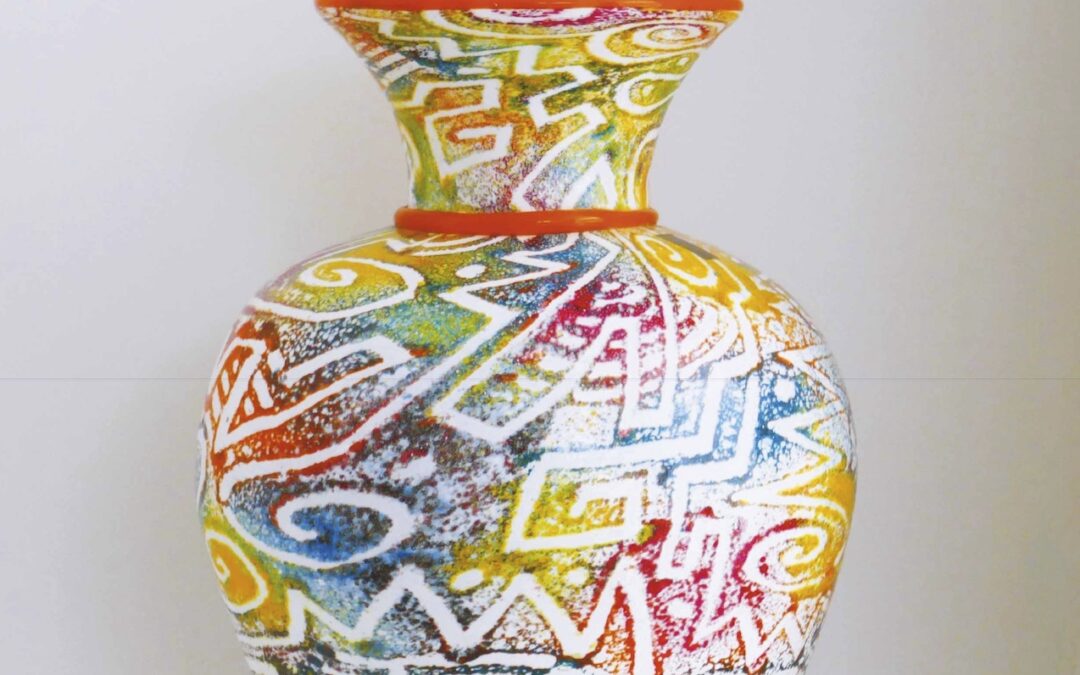
FRONT COVER: Isle of Wight unique monumental ‘Jazz’ pattern vase, height 41cm. This vase, along with a slightly smaller version in a different form,
was used for Trade Fairs and placed in Harrods window display, 1992. Mark Hill’s book, ‘Michael Harris, Mdina Glass & Isle of Wight Studio Glass’
shows the smaller version on p.158. With thanks to Nigel Benson for vase, picture and description
BACK COVER: Becoming Accesible’ by Stephen Foster. A kiln cast sculpture, layered, fused, cut and polished, then mounted on a granite base. The sides of the
square are 28.5cm, the granite base is 34cm long. As mounted, the overall height and length is 40cm. (article on p28: With thanks to Simon Bruntnell for all of
the photographs)
Editorial
Chairman’s message
Loving Cup
James Measell
Stuart Hunting wine bucket Bill Millar
Fairy Lamps 2 Julie Lever
Biedermeier Perfume bottles Paul von Lichtenberg
Bertha & William Buckley Anja Segmüller
Stourbridge Exams James Measell
Becoming Accessible
Stephen Foster
In Memoriam Editor
Brian Clarke
Correction
Dwight Lanmon
Friendly Hunt glasses Neil Chaney
Kit-Kat decanter Halls Fine Art
Loyal Volunteers Simon Cook
C
hosen as an example of late c20 imaginative glasswork,
Nigel Benson’s vase by Michael Harris is on the front cover
for all to see. I keep banging the drum, but the response from
20th century collectors has risen to a silent whisper! Many of
you must have so many wonderful pieces of c20 glass that would
not only grace the front cover of Glass Matters , but could provide
an article of interest for all lovers of art; this issue concludes
the articles on Fairy Glass and there’s the wonder of Stephen
Foster’s work. But nothing more. Malcolm Rifkind, the Secretary of State for Scotland (1986–
1990), was asked why top quality people were not entering
politics. He answered straightforwardly “being pulled to pieces
by the press and condemnation on social media”. Please, don’t let
that be your excuse for not contributing an article to share.
3
4
5
6
11
17
23
28
29
29
30
32
33
Contents GM22.indd 2
Contents GM22.indd 2 25/07/2025 09:57
25/07/2025 09:57
CHAIRMAN’S MESSAGE
3
Chairman’s Message
Simon Cottle
Glass Matters Issue No.22 July 2025
W
ith the oppressive heat of
summer recently upon us
and the holiday season
giving many a welcome chance to
pause and recharge, it feels like the
perfect moment to reflect on recent
successes in the world of British glass
and share news of what lies ahead.
At the forefront of our plans is the
landmark project to build a new web-
site for the Society. Though progress
has been paused over the past three
months, I am pleased to report that
work is resuming, and we hope to
have encouraging news to share very
soon. Indeed, by the time you read
this issue of Glass Matters , you may
already have received further details
on the anticipated launch date. This
new platform promises not only to
refresh our online presence but also
to offer members and visitors alike
richer content, improved access
to resources, and an easier way to
stay connected with our activities. This year, we have hosted sever –
al engaging talks, the most recent
of which was the Robert Charleston
Memorial Lecture delivered by Reino
Liefkes, Senior Curator of Ceramics
and Glass at the Victoria and Albert
Museum. His lecture presented pio –
neering research into the patenting of
a new type of glass that closely resem –
bled rock crystal, developed in the late
17th century. Reino’s talk highlighted
the contributions of key figures from
France, the Netherlands, and London,
including Jean de Lacam, Hendrick
Heuck, and the Duke of Buckingham.
The event took place at the Art
Workers’ Guild in London and
was also broadcast live online.
Both the lecture and the simulcast
proved to be notable successes. Beyond our own Society news,
it has been an especially eventful
month for the Stourbridge Glass
Museum, whose efforts have been
recognised in several significant ways.
At the recent Museums & Heritage
Awards, the museum was named joint
winner of the “Sustainable Project of the
Year Award” . This accolade honoured
not only the museum’s thought-pro –
voking Eco-friendly Upcycled Glass
Exhibition , which showcased creative
reuse and environmental awareness
in glassmaking, but also the wider
commitment to sustainability woven
into the museum’s capital project.
From energy-efficient lighting to
advanced climate control systems,
the museum’s approach has set a
benchmark for embedding green
technology into heritage spaces. In another significant achieve –
ment, Stourbridge Glass Museum has
been awarded a Victory 80 Fund grant.
This vital support will go toward the
conservation and reinterpretation of
the Battle of the Atlantic Panel, part
of the monumental Churchill Screen
created in the 1960s by artist Edward
Bainbridge Copnall. The panel,
steeped in both historical and artistic
significance, commemorates a critical
episode of the Second World War and
represents a masterwork of British
glass art. The museum’s conservation
project promises to bring fresh insight
and renewed life to this striking piece
of national heritage, ensuring it can
be appreciated by future generations.
Artistic innovation was also recent-
ly at the forefront, with the unveiling
of The Blue Vase, a new masterpiece
by renowned cameo engraver Terri
Colledge. Inspired by the legendary
Blue Naples Vase —a piece that has
captivated collectors and historians
alike—Colledge’s work reinterprets
the classic form through her signa –
ture technique, blending traditional
craftsmanship with contemporary
design sensibilities. The unveiling was
accompanied by the announcement of
a forthcoming book by Graham Fisher
MBE, offering readers a behind-the-
scenes look at the creation of The Blue Vase and its place within the
museum’s narrative of glass artistry.
Together, these milestones high
–
light the vibrant and multifacet –
ed mission of one of our primary
museums for glass, celebrating the
artistry of glass, preserving its his –
toric treasures, and championing
sustainability in all its endeavours.
Finally, as a society, we explore all
aspects of glass history, as reflected
in our diverse programme of talks
and published articles. However,
one significant gap remains:
the field of 20th-century glass.
We warmly welcome both online
and in-person talks, as well as arti –
cles for Glass Matters and the Journal,
which shed light on different facets of
20th-century glass. This could include
personal perspectives from collec –
tors, scholarly research, or broad –
er reflections on style, technique,
and innovation during this period. We encourage anyone – whether
members or non-members – who
has an interest in and knowledge of
this important area of glass history
to share it with the wider commu –
nity, either in print or through our
events. Your contributions will help
us broaden and enrich our collec –
tive understanding of modern glass.
Simon Cottle, Chairman of The Glass Society
Chairmen’s message GM22.indd 1
Chairmen’s message GM22.indd 1 24/07/2025 14:22
24/07/2025 14:22
A G IFT FOR A LICE A SBURY
4 Glass Matters Issue no.22 July 2025
LOVING CUP
James Measell
BELOW Fig.1
Front of the Alice Asbury loving cup. Photo by
Corrina Field
BELOW RIGHT Fig. 2
Reverse side of the Alice Asbury loving cup 1.
Photo by Corrina Field
O
n or about 26 November
1897, Alice Asbury received
a splendid glass item for her
twenty-first birthday. The engraved
crystal ‘loving cup’ or two-handled ale
tankard stands 18.5 cm tall and mea-
sures about 19 cm across the handles
(Fig.1) . The topmost area has applied
glass threading, and the tops of the
handles were attached over an area of
this threading. The body of the loving
cup is beautifully engraved with elab-
orate representations of ferns, holly
and holly berries, ivy and mistletoe as
well as stylized flowers. The outside
bottom features a cut and polished
multipoint star to obscure the pontil
mark. Cut and polished notches are
on the underside of the circumfer –
ence of the foot. The personalised
engraving on the body of the lov –
ing cup (Figs.2&3) reads as follows:
Alice Asbury
Aged 21 years
November 26th 1897
What is known about Alice Asbury?
She was born on 26 November 1876
to James Samuel Asbury and his wife
Lucy (formerly Cuttler). The Asbury
family then included four older
brothers (George, John, Samuel and
Frederick), and sisters Mary Ann and
Annie Marie would be born later. Alice
Asbury’s birth registry shows that the
family then resided in King Street,
Wollaston, and gives her father’s
occupation as ‘brass moulder.’ In 1879,
James Asbury obtained the license for
the Cross Keys pub. The 1881 census
lists the Asbury family at the Cross
Keys in 189 Brettell Lane, along with
servant Eliza Payne. James Asbury’s
occupation is given as ‘licensed beer
seller.’ He operated the Cross Keys until
sometime in 1891, when he obtained
the license for the Pheasant Inn, 77
Brettell Lane, a pub that had been
operated by his mother Mary Asbury
and his late father Samuel Asbury. Little is known about the life of
Alice Asbury or others in the Asbury
family, but there are some scattered
reports in local newspapers. In the
spring of 1889, Alice Asbury’s uncle
George Asbury, age 27, fell from a
tramcar at the Brettell Lane Station
and suffered a fractured skull that
led to his death ( County Express, 25
May 1889). About a year later, Alice
Asbury’s young sister Lucy Asbury,
nearly 2 years old, fell into an open
cistern at the rear of the Cross Keys
and drowned (County Express, 17 May
1890). The full Asbury family does not
appear in the 1891 census, although
three of the Asbury brothers (George,
John and Frederick) were living else-
where in Brettell Lane with a cousin,
Edward Cuttler. The 1901 census finds
Asbury GM22.indd 4
Asbury GM22.indd 4 24/07/2025 14:23
24/07/2025 14:23
TALLY-HO!
5 Glass Matters Issue no.22 July 2025
A Stuart wine bucket
LEFT Fig.3
Reverse side of
Alice Asbury loving
cup 2. Published to
show the engraving
RIGHT
Enamelled hunting scenes around the wine bucket.
Photos courtesy of Bill Millar Alice Asbury in Stourbridge, residing
in 58 High Street, the location of The
Star pub operated by William Hughes
and his wife Ada. Alice Asbury’s occu-
pation is given as ‘barmaid.’ One might
surmise, given her family’s long asso-
ciation with pubs, that she had had a
similar position in the family-owned
Pheasant Inn. The 1901 census also
shows the rest of the Asbury family
in the Pheasant Inn. James Asbury
(occupation: ‘beerhouse keeper’)
and his wife Lucy then resided with
daughters Mary Ann (‘housemaid’)
and Annie Maria (‘dressmaker’),
son Samuel Percival (‘brewer’s assis –
tant’), and widow Mary Asbury.
Alice Asbury, age 31, passed away
on 21 March 1908. The death reg-
istry records her as a ‘Spinster of no
Occupation [and] Daughter of James
Samuel Asbury, Brass caster and
Publican.’ At the time of her death,
Alice Asbury resided at the Pheasant
Inn, Brettell Lane, and the causes
of her death were listed as ‘Graves
Disease (3 months), Influenza (3
Days) [and] Exhaustion.’ In some
subsequent years, the County Express
carried brief notices ‘In Memoriam’
for Alice Asbury that were placed by her parents and her sisters (26
March 1910; 25 March 1911; 23
March 1912; and 27 March 1915). Alice Asbury and other family mem –
bers were buried in the Stourbridge Cemetery (Section O, plot 900).
James Measell is an Honorary
Research Fellow at the University
of Birmingham. He can be contact –
ed by email: jsmeasell@gmail.com
S
tuart Crystal introduced their
mounted huntsman design
in 1934, but this wine bucket
is not shown in their design book.
Stuart also introduced an acid-etched
backstamp around 1926, and although
this ice bucket is not marked, there
can be no doubt that the enamelled
decoration is by Stuart. This is a large,
heavy piece of glass at 25.5 cm tall,
weighing in at 2.7kg. It might be one
of a limited number of trial pieces
which never went into production;
this would explain its absence from the
design book and lack of a backstamp.
Asbury GM22.indd 5
Asbury GM22.indd 5 24/07/2025 14:23
24/07/2025 14:23
The Charming, Magical, Fairy Lamp
6 Glass Matters Issue no.22 July 2025
WEE TO PYRAMID
Julie Lever: ‘the eccentric collector’
LEFT Fig.1
Documented Clarke Fairy known as
‘Clarke’s Bust’. Opalescent glass, made
in Germany. As this illustrates, not all
fairies have a typical base shade
ABOVE Fig. 2
Will-O-Wisp by Edward Webb
RIGHT Fig. 3
Th omas Webb & Sons, Queen’s
Burmeseware. Jules Webb ‘Hawthorn’
design with a quatrefoil base
Editor: In this follow-up article, Julie
weaves the story of how she first discov-
ered Fairy Lamps and glass and how her
fascination with them became a passion.
C
an you remember the ‘Wee’
folk of bygone days? The
fairies, elves, leprechauns
and brownies? Did you ever search
for a ‘pot of gold’ at the end of a
rainbow? Did the ‘tooth fairy’
leave you a ha’penny under your
pillow? How about the flickering
shadows cast by a candle’s glow?
Creaky noises at night? ‘Who goes
there?’ The great Hawthorn tree
is considered to be sacred because
they are the homes of fairies. The
‘Will-O-The-Wisp’ is a ghostly
spectre of light located in bogs
that beckons weary travellers to
their doom. Beautiful flowers that
reflect off a pond’s surface create
a magical vision. Does all of this
ring a bell? Bring back fond mem-
ories? If not, a simple Fairy Lamp
in one’s home will do the trick! One evening, while looking
online into the world of Victorian
décor, I stumbled upon something
enchanting: Fairy Lamps. The
name alone sparked my curios-
ity and so began a magical jour-
ney. What started with simple
research soon blossomed into a
passion for collecting, opening up
a world I never imagined. Along
the way, I’ve uncovered fascinat-
ing mysteries and histories and
discovered people and places
from the past that I never knew
existed. This wonderful journey
is one that could last a lifetime. As a result of my fascination
with Fairies, I’ve become an avid
student of glass, adding many new
words to my vocabulary: Burmese,
air trap, and opalescent (Fig.1) are
just a few. The formulas for making
coloured glass are also absorbing.
I would never have known that
some glass is made with gold and
some with uranium in the mix. The
truly gifted, skilled designers, glass
blowers, decorators and glass work-
ers of all kinds continue to amaze
me. My wish is to thank them
all for the wonderful happiness
they have brought to the world. This intriguing journey con-
tinued to reveal surprises. Having
heard of Tiffany on the Antiques
Roadshow many years ago, I
remembered the beautiful lamps
that were shown, but that was all –
that is, until Fairy Lamps entered
my world. A great designer by the
name of ‘Arthur Nash’ worked at the
Edward Webb Glassworks before he
became the ‘face of Tiffany’ with
his incredibly beautiful designs.
While at Edward Webb, he designed
a Fairy Lamp that he named ‘Will-
O-The- Wisp’ (Fig.2). Such a stun-
ning design, which would have
required exceptional skill to make.
And the name is so inventive.
Then I learnt of Jules Barbe.
Who is he, you may ask? He was a
top designer, the ‘Facile Princeps’
of Thomas Webb & Sons. His
Fairy Lamps Part2 GM22.indd 6
Fairy Lamps Part2 GM22.indd 6 24/07/2025 14:24
24/07/2025 14:24
WEE TO PYRAMID
7 Glass Matters Issue no.22 July 2025
BELOW Fig.4
Th omas Webb & Sons epergne. Queen’s
Burmeseware. A Jules Barbe design known by
collectors as ‘Woodbine’. Th is name does not exist
in the Webb list of Barbe designs, where it is known
as ‘Japanese Berries’ or ‘ Virginia Creeper’. Th is can
be confusing for collectors BELOW Fig.5
Webb cased satin glass epergne with a mirror base.
Th is is an original Jules Barbe design, shaped as
a natural pond. With fl owers filled in the holders,
their refl ection is seen in the base, as if in a pond BELOW Fig.6
Webb, Queen’s Burmeseware, Wee size. Smallest
of all fairies. I just love the term “wee”. Th e three
images show a Clarke candle in its holder, the base
and the dome of the lamp
BELOW Fig.7
A Burmese colour Fairy, glowing at night. Jules
Barbe ‘Periwinkle’ design
BELOW Fig.8
Wall mirror design with a satin blue,
diamond pattern fairy. Th e candle
fl ickering spookily at night
designs are featured on many
Queen’s Burmeseware Fairy Lamps.
Did he choose the Hawthorn design
(Fig.3) because the Hawthorn tree
is the sacred home of fairies? I’d
like to think so, and notice his
Fairy epergne (Fig.4), with one
central and three flower holders
surrounded by three fairy lamps,
the design often known as a ‘Three-
lamp Sociable’. And the mirror pla-
teau (Fig.5) is pond-shaped with
six flower holders that surround
the Fairy Lamp, creating the same
effect as flowers reflected in the
water of a pond. How incredi-
bly imaginative! The smallest of
fairies are called “Wee,” a fitting
tribute to the Wee folk (Fig.6).
Fairy Lamps have opened my
world in so many ways. To under –
stand life at night in the 1800s
with the only available illumina-
tion being candlelight, I light my
Fairies with special tealights. With
a warm, friendly twinkle, they can
guide my path at night. Burmese
is my favourite colour, as the glow
is bewitching and casts a spell
that cannot be equalled (Fig.7)
I’ll always remember my hus –
band saying, ‘my life has been
cursed by Fairy Lamps, I thought
you said that last lamp was the final
lamp!’ – then we laughed. Now I
have close to 300 lamps and still
collecting He is not particularly
interested in daily Fairy Lamp
lessons but is a good husband and
pretends to listen. The following
is a true story. He played bridge
in a national bridge tournament
in the U.S. and noticed the pair he
was playing against was from the
U.K. Thinking he would impress
them, he immediately displayed his
knowledge of Fairy Lamps, espe-
cially those made in Amblecote,
Stourbridge. Instead, they looked
at him like he was an alien and
confessed they hadn’t a clue what
he was talking about. They add –
ed, ‘you must be thinking of the
wrong country.’ The pair knew
bridge, but nothing about glass!
Their retort greatly embarrassed
my husband, and somewhat red-
faced, he vowed never to display his
knowledge of Fairy Lamps again.
On a brighter note, Fairy Lamps
can bring peace and tranquilli –
ty to the end of a long hard day,
although the wall mirror designs
(Figs.7&8) may enable one to see
an apparition. One evening as I was
in a ‘trance’ staring at a wall Fairy
with mirror (Fig.8) , the candle
flickering, and no other distrac –
tions, I was startled with a jolt. A
shadowy figure had moved quick –
ly in the reflection of the mirror;
I jumped and raced upstairs to
Fairy Lamps Part2 GM22.indd 7
Fairy Lamps Part2 GM22.indd 7 24/07/2025 14:24
24/07/2025 14:24
8 Glass Matters Issue no.22 July 2025
BELOW Fig.9
HG Richardson Fairy. Both the shade and the base
are by HG Richardson, and the blue colours match,
but the alternative dome on this base, shown in
Fig.10, is a better match
BELOW Fig.12
Th e crimp style of this shade and base are exclusive
to Stevens & Williams – known as a ‘Blue die-away’,
cased . Th is S&W base design is rather unique, as
many fairy lamp bases started out as pre-existing
simple bowls, not being suitable for di ff erent uses
LEFT Fig.15
Blue Verre Moire, HG
Richardson. Th e name ‘ Verre
Moire’, a description used by
Stuart & Sons is a bit more
complicated than one might
think. HG Richardson called it
‘Waved’ and collectors call it
‘Nailsea’, a term never used for
fairies by any maker
RIGHT Fig.16
Design sketch of Fairy
Lamp in Fig.15, from HG
Richardson description book
BELOW Fig.10
HG Richardson with the correct dome. It took me
years to fi nd this dome. Note the white edging to
the dome, matching the base BELOW Fig.11
Spatter’ design by Boulton & Mills
ABOVE Fig.13
Stevens & Williams Pattern book
drawing of Fig.12
RIGHT Fig.14
Ruby by HG Richardson
WEE TO PYRAMID
Fairy Lamps Part2 GM22.indd 8
Fairy Lamps Part2 GM22.indd 8 24/07/2025 14:24
24/07/2025 14:24
9 Glass Matters Issue no.22 July 2025
BELOW Fig.17
Glossy Ruby fairy by HG Richardson. Since Stuarts documentation
has been available, showing more designs, the maker of this fairy
is less clear. Th e companies made similar fairies, so this could be by
Stuarts
BELOW Fig.19
A ‘Blue Floral’ fairy by Webb. As for Fig.18, JWW
did make similar designs BELOW Fig.20
A Webb design book drawing for a fl oral fairy, this
is possibly the fairy lamp in Fig.19 BELOW Fig.21
A John Walsh Walsh fl oral fairy, with a red dome
on a base of green leaves. Marked on the base,
RD172125. Compare this JWW design with
the Webb drawing in Fig.20. Th ey match well,
suggesting copying?
ABOVE Fig.18
Floral Clarke Fairy Mode 341, although not all documentation is available, it is
highly likely that John Walsh Walsh made this Floral fairy. JWW made many Clarke
Floral fairies and they were also made by Molineaux Webb. It is well documented
that Clarke used Stourbridge-area glasshouses for most of his lamps but he also went
to Birmingham for a few. Molineaux Webb have documented bases, JWW have RD
numbers and design book drawings
my husband, calling out ‘some-
one is in the house’; this roused
my husband, and armed with
his golf club we very cautiously
went about the house, moving
with great trepidation and check-
ing every square inch, opening
each closet thinking someone or
something would pop out at us.
Nothing was out of order. All was
fine. No intruder. Fairy magic? Provenance, although highly
elusive to obtain, is a fascinating
aspect of Fairy Lamp collecting.
As the present-day caretaker of a
variety of Fairy Lamps, one quest
had been searching for the correct
dome to a base (Figs.9, 10), where I
found the correct dome after years
and years of searching and then
more generally, to uncover more
information about who previous
owners were and where my lamps
have journeyed. Auctions will list
a Fairy as part of “So and So’s”
collection. It often does not say
where these people lived or how
they acquired the lamps or when.
In other words, names without a
face, travels unknown. I am aware
of a beautiful pink and white
Webb floral Cameo Fairy Lamp
that has wonderful provenance.
The Fairy came in the original
box with sticker saying “Bailey,
Banks and Biddle.” This historic
jewellery store opened 190 years
ago in Pennsylvania. The Fairy
also came with a handwritten
note from the groom to his bride.
What a shame I do not have access
to it because I would really like to
WEE TO PYRAMID
Fairy Lamps Part2 GM22.indd 9
Fairy Lamps Part2 GM22.indd 9 24/07/2025 14:24
24/07/2025 14:24
10 Glass Matters Issue no.22 July 2025
BELOW Fig.25
Clarke Pyramid-size ‘Diamond Point’ Fairy.
Unknown maker but not Stourbridge area
glasshouses. Th is was made by a glasshouse that
had the machinery to make pressed glass BELOW Fig.26
Boulton & Mills. Blue Parian fairy lamp BELOW Fig.27
A Boulton & Mills description book image of the
‘Clarke 156’ design known as ‘Blue Parian’ (see
Fig.26), the base fi lled with fl owers
BELOW Fig.22
Stevens & Williams, with Mat-su-no-ke decoration
for the base, as shown in the description books BELOW Fig.23
Stevens & Williams design drawing ‘11.195‘,
in preparation for fi g.22. Th e base often called
‘Blackthorn’ as fewer fl owers applied than for
Mat-su-no-ke BELOW Fig.24
Pressed glass from an unknown glasshouse but
certainly English. Many of these were made to
celebrate Queen Victoria’s Golden Jubilee. It is
known as ‘Clarke’s Crown’ in the Clarke Catalogue.
Th ey were made in red, white and blue and
thousands were made to honour the Queen
know what it said. Wouldn’t you?
The following are some of my
favourite fairy lamps. For me, they
have something different, unusu-
al and enchanting about them –
sometimes just fulfilling a quest
for information (Figs.11 to 31).
It is no surprise that several
well-known personalities have
been enthusiastic collectors of
Victorian glass, including Fairy
Lamps, the following are a few
who did: Barbara Streisand,
Olivia de Havilland and Bob Ross
(The Joy of Painting). While Jo
Sullivan Loesser (1950s Broadway
actress) focused on Fairy Lamps.
If your interest has been piqued,
the Glass Society is a wonderful
organisation to belong to. You
might look into referring a friend.
The zoom lectures are phenom-
enal and this magazine, Glass
Matters, is second to none. For
folks that are unable to travel yet
love to learn, they are a godsend.
In closing, I love the British accent.
Editor. Julie built up her informa-
tion from collectors and a number
of online websites, each of which
received permission for the general use
of fairy lamp pictures. A thank you is
due to Dudley Metropolitan Borough
archives, whose services were used
by many of the fairy lamp websites.
WEE TO PYRAMID
Fairy Lamps Part2 GM22.indd 10
Fairy Lamps Part2 GM22.indd 10 24/07/2025 14:24
24/07/2025 14:24
SPA FASHION
11 Glass Matters Issue no.22 July 2025
If you smell good, you don’t smell good
Changing fashions in glass perfume bottles in the Biedermeier period
Paul von Lichtenberg
B
y the end of the Rococo period,
around 1780 at the latest, the
great era of ‘not washing’ was
over. At that time, the fear of water,
especially warm water, which people
believed could penetrate the body
through enlarged pores and cause ill –
ness or discomfort, was not always so
obvious. In his book ‘Le Propre et le Sale:
L’hygiène du corps depuis le Moyen Âge’,
published in 1985, Georges Vigarello
describes the changing attitudes of the
French towards water, laundry (mean-
ing the cleanliness of shirts, blouses,
scarves and underwear with skin con-
tact), all social customs and thus also
sexuality. In the High Middle Ages,
many cities introduced public bath –
houses where men and women could
enjoy themselves and wash together.
More often than not, wash first and
then enjoy themselves. Such houses
were particularly popular because
they offered a welcome change in
social and sexual life compared to the
same open-air opportunities available
behind every second bush. Sexual cus –
toms and traditions, practised in other
surroundings, had been described by
Giovanni Boccaccio (1313–1375) in
Il Decamerone and Geoffry Chaucer
(around 1342–1400) in The Canterbury
Tales. It was behind every second
bush, only as every first one – espe –
cially in areas with less dense random
vegetation – was already occupied!
Benjamin Franklin (1706–1790)
printer, publisher, author, scien-
tist, inventor of the lightning rod
(Lichtenberg 2004, fig. 260, an engrav –
ing showing the lightning rod on the
church roof in Nový Bor, Bohemia),
diplomat and statesman, incidentally
the son of a soap maker, also thought
about socially acceptable odours. In
his autobiography, addressed to his
first natural son, he points out how ‘human south winds’
could be made
more pleasant by the excessive con –
sumption of chocolate. Having dared
to mention this here, it would be a pity
not to quote him further in his auto –
biography where he wistfully sighed
“The hard-to-be-govern’d ‘Passion of
Youth’, had hurried me frequently into
intrigues with low women that fell in my
way” – also suggesting his tendency
towards a preference for natural daily
fragrances and, say, younger kitchen
staff without perfumes or deodorants,
as these kill all individual skin odours.
From a cultural history point of view,
two aspects of his autobiography are
striking: nouns were capitalised in
English at the time (just as they still
are today in German), and in the vote
in Philadelphia on whether German or
English should be the future national
language, German was defeated by
only one vote. From today’s perspec –
tive, in the absence of other more
suitable topics for a doctoral thesis, a
scientific study could serve as a basis
for a dissertation on whether the
worldwide spread of inescapable mass
deodorants triggered the increase and
popularity of tattoos, so that lovers,
no longer able to rely on individual
and natural body odours, can now
revert to tattoos and so continue to
recognise their changing partners,
if not at first smell, at first glance. Towards the end of the Age of
Enlightenment (approximately
1650–1800), around 1780, in the
wake of the American Declaration of
Independence (1776; the war in the
‘Second (or New) World’ itself lasted
from 1775 to 1783), new intellectual
and social insights penetrated deeper
and deeper into established and newly
added classes on the old continent (else
the ‘First World’- the rest of our globe
being considered by these two as the
Third World), which were emerging
in the course of industrialisation and
trade. Pleasant side effects were the
summer breaks that the rich and the
beautiful could take in the ‘season’. The
idea of travelling to a cooler place with
other sociable people in the hot season
was not quite so new. Even in ancient
times, Egyptians, Persians, Syrians,
Greeks and Romans had chosen shady
areas so that they could continue
working comfortably. The Emir of the
last Moorish court in Granada moved
every summer until the Reconquista
in January 1492 from the Alhambra to
his slightly higher hilly residence in the
Generalife, where the breeze was cool –
er and in the U-shaped hollow hand-
rails of the gently ascending, shady
open stairs in the gardens ever-trick –
ling fresh water cooled visitors’ fingers
and hands. As an aside: It was only
because the costly battles in El Andaluz
finally ended, that the Spanish
monarchs Ferdinand and Isabella
could reallocate funds and afford to
equip a forever persistent Genoese
in Castilian service, Christopher
Columbus, with ships at the begin –
ning of August of the same year, so
that he might find the western sea
route to India, as he naggingly claimed.
In the spa towns of Bohemia,
Carlsbad, Marienbad, Franzensbad,
Teplitz and others, which quickly flour –
ished and expanded after the horrors
of the Napoleonic Wars, a new social
development arose. In addition to the
idea of travelling on ‘holiday’ (dolce
farniente) instead of resting at home
or with relatives in the countryside,
the slowly increasing affluent masses,
including the newly rich, could now
afford the main attraction in the spas:
drinking the bubbling spring water
as a supposed cure for any and every
ailment, while showing off the very
Perfume Bottles GM22.indd 11
Perfume Bottles GM22.indd 11 24/07/2025 14:31
24/07/2025 14:31
12 Glass Matters Issue no.22 July 2025
SPA FASHION
BELOW Fig.1
Cut patterns of rodlike fl acons according to J.F.
Römisch, 1832
latest French fashion and mingling
with aristocrats old and new. In close
cooperation with the Bohemian glass
industry, elegant promenades with
souvenir shops and much more were
created. The souvenir shops shelves
offered glass beakers and goblets in an
unprecedented variety of shapes and
colours for the display cabinet at home,
and in addition, everyday objects such
as jugs, boxes, napkin rings, knife rests,
plates, serving bowls, entire services
for tea, chocolate (this led to the inven-
tion of the ‘trembleuse’ – the bag-shaped
saucer was filled with hot water, which
delayed the clumping of the chocolate
in the beaker) or coffee, as well as doll
dishes, pen holders (fidibus beakers),
candlesticks, little trays for candlewick
cutting scissors, urns and vases and
a whole host of bottles for everyday
needs in ever new variations each year.
While most of the bottles were
probably mass-produced in a similar
style and in a design just as typical as
the beakers and goblets, we do not
know which perfumes they were filled
with, how often they were filled, or who
filled them. We can only assume that
the tall and slim bottles were intended
for cologne (a well-kept secret recipe)
and the particularly small bottles were
produced for very intense, and proba-
bly extremely expensive, fragrances.
We can also assume that the Bohemian
perfume bottles discussed below were
not designed or commissioned by the
‘perfume houses’ as is common prac –
tice with today’s perfumes, but were
produced by glassworks at their own
discretion, according to supposed
fashion, or purely commercial consid-
erations based on favourable sales fig-
ures and corresponding repeat orders.
In order to improve the quality of
cutting and polishing Bohemian glass,
sample books were created. One of the
most famous is by J. F. Römisch, 1832,
from which Gustav Pazaurek reproduc –
es several pages in his standard work
(Pazaurek 1923, p. 355ff ). Fig.1 shows
Plate XVII from Römisch 1832, with
incredibly complicated cut patterns on
cologne bottles, which are also known
as rod bottles. It is important to know
that Eau de Cologne was initially used
internally as aqua mirabilis, largely
based on Franklin’s recommendation
with chocolate, because of the fragrant
alcohol content. The bottles for this
drink had to be correspondingly large.
During the almost 20-year occupation
of Cologne by French troops, Napoleon
issued a decree in 1810 that required
the ‘disclosure of all secret recipes for rem –
edies for internal use’. The manufactur –
ers then declared cologne a remedy for
external use, but they kept the large
bottles for commercial reasons. Most
Perfume Bottles GM22.indd 12
Perfume Bottles GM22.indd 12 24/07/2025 14:31
24/07/2025 14:31
SPA FASHION
13 Glass Matters Issue no.22 July 2025
tall and slim bottles required a stable
stand, as the base of these glasses
was, as the name suggests, small in
relation to their height. Fig.2 shows
such a stand or quiver, made of matt
black lacquered bronze in the style
of the Second Gothic period. Similar
metal stands support two such bot –
tles made of red Hyalith in the Passau
Glass Museum (Höltl 1995, II,63). In
these stonelike glasses, a bulge pre-
vents the bottle from standing on its
own base. Such a bulge is clearly vis –
ible on the simple bottle made of red
stonelike glass from the Harrachsche
Hütte (Count Harrach Glass Factory)
in the Kuhn collection (Kuhn 2009,
no. 13.24, there also no. 13.53 made
of black Hyalith). Fig.3 shows a spi –
ral-cut clear glass bottle in a minimal-
istic gold-plated silver quiver. At first,
and only occasionally, did glassmakers
experiment by standing these slender
glasses on their own glass feet. The
bottle made of Russian-green glass
(a rather dark green from Harrach)
was refined into Lithyalin in Friedrich
Egermann’s workshop (Fig.4, left). The
BELOW Fig.2
Clear glass rod fl acon in bronze stand, North
Bohemia, around 1835, H. 35.3 cm BELOW Fig.3
Clear rod fl acon in gold-plated silver stand, North
Bohemia, around 1830/35, H. 27.5 cm
RIGHT Fig.4
Lithyalin rod fl acon, H. 27.7 cm, Friedrich
Egermann and green mini fl acon, Harrach
Glassworks, H. 3.1 cm, both around 1830/35
RIGHT Fig.5
Draft patterns for snake fl acons according to Ignaz
Palme, around 1830/31
FAR RIGHT Fig.6
Pair of clear glass snake fl acons, H. 22.6 and 22.2
cm and miniature fl acon made of black Hyalith, H.
6.1 cm, all around 1835
small barrel-shaped bottle shown at its
base (Fig.4, right) does not really reveal
its former contents – we do not know
whether the perfume had a beguiling,
intoxicating scent, of which just a tiny
drop was already too much, or wheth-
er it was merely an agreeable some –
thing with which its probably timid
owner covered herself very sparingly.
There were other pattern books
beside the ‘Römisch’. Ignaz Palme
& Co. developed a free-standing tall
bottle with an engraved snake fitted
loosely around it (Fig. 5). The remov –
able snakes with open mouths (Fig.6)
could be filled with rose or laven-
der-water, which evaporated slowly
during the day, while the contents of
the bottles, usually eau de cologne,
were more likely to be used to refresh
the skin on hot days. Such bottles with
their original glass quivers (Fig.7) are
rare today. These impractical bottles
soon broke and thus went out of
Perfume Bottles GM22.indd 13
Perfume Bottles GM22.indd 13 24/07/2025 14:31
24/07/2025 14:31
14 Glass Matters Issue no.22 July 2025
SPA FASHION
BELOW Fig.7
Glazed quiver fl acon, around 1835, H. 26.2 cm BELOW Fig.8
Hyalith quiver fl acon, Buquoy Glassworkss, around
1825/30, H. 18.2 cm
BELOW Fig.9
Agatinopal footed bottle, Buquoy Glassworks
Silberberg or Georgental, around 1835, H. 13.5 cm BELOW Fig.10
Red Hyalith bottle, Buquoy Glassworkss, around
1825/30, H. 15.7 cm
BELOW Fig.12
Cabochon bottle, Harrach Glassworks, around
1835/40, H. 10.1 cm BELOW Fig.13
Scent bottle with concave medallions, Friedrich
Egermann, around 1830/35, H. 10.3 cm
fashion, or were thrown away by the
next generation of women. A surpris –
ing variant with a glass quiver is a gilt,
black Hyalith bottle (Fig. 8) . It looks
as though the shaft of the small bot –
tle rests on a circular pedestal with a
foot cornice; the ‘column’, however,
is hollow and conceals the cylindrical
extension of the not-so-small bottle.
The translucent, footed bottle
made by Buquoy, in the colours blue,
turquoise, green and yellow (Fig.9),
looks like it is carrying a wide, conical
lifebuoy. The same workshop – previ-
ously owned by the imperial Habsburg
family – produced the gargantuan red
Hyalith bottle (Fig.10). The small base
bottle in the colours turquoise and pet –
rol (Fig.11) is one of the great rarities
due to its extensive, almost abstract,
playful engraving. Bottles with
impressive, colour-contrasting cabo –
chons, always rare, are almost extinct
in today’s market. Here (Fig.12), is
an even rarer example, with uniform
marbling throughout, possibly only
because the finishing was not com –
pleted. Lithyalin flacons with concave
medallions are also hardly ever seen
today (Fig.13). Whether concave or
convex, if the transition of the medal-
lions to the wall is emphasized by a gold
line of uniform width, I tend to attri –
bute the finishing to the Harrach Glass
Factory. If this gold-painted transition
is claw-shaped, imitating the brackets
for supposed gemstones, the finishing
was more likely to have taken place in
Egermann’s workshops in Haida or
Blottendorf. Both companies proba-
bly stole good ideas from each other,
but copying a better idea is – ethics
aside and morally correct or not – in
an age well before patents were issued,
RIGHT Fig.11
Base bottle,
Harrach Glass
Factory, around
1830/40, H.
7.2 cm
Perfume Bottles GM22.indd 14
Perfume Bottles GM22.indd 14 24/07/2025 14:31
24/07/2025 14:31
SPA FASHION
15 Glass Matters Issue no.22 July 2025
BELOW Fig.14Miniature Hyalith fl acon, Buquoy
Glassworks, around 1825/30, H. 5.0 cm BELOW Fig.15
Egg-shaped travel bottle, Friedrich
Egermann, around 1835, H. 8.0 cm BELOW Fig.16
Pillow shaped bottle, Harrach
Glassworks, around 1840, H. 6.9 cm BELOW Fig.17
Paperweight flacon, Ateliers of
Friedrich Egermann, around 1835,
H. 6.0 cm
BELOW Fig.18
Black Hyalith paperweight bottle, Buquoy
Glassworks, around 1825/30, H. 5.5 cm
ABOVE Fig.20
Small bottle made of Isabell glass, Harrach
Glassworks, around 1839/42, H. 12.1 cm ABOVE Fig.21
Opaline bottle with volutes, Kreibich Glassworks,
around 1840, H. 9.5 cm
ABOVE Fig.22
Cut bottle made of amber-coloured glass,
Harrach Glassworks, around 1830/40, H. 9.9 cm
BELOW Fig.19
Red Hyalith paperweight bottle, Buquoy
Glassworks, around 1825, H. 5.6 cm
the highest compliment one can pay a
competitor. The small hemispherical
bottle with a ball knob (Fig.14) made of
red Hyalith was typically painted with
Chinese figures during the 1830s and
1840s Sinomania. Egg-shaped bot –
tles always fit well in the hand, Fig.15
shows a handy, faceted example with
a glass stopper and a tight-fitting met-
al cap, which is not only suitable for
the static dressing table, but also for
travelling. In contrast, Fig.16 shows
a pillow-shaped bottle for domestic
use only. From this, the glassworks
developed the practical paperweight
bottle (Fig.17) in endless variations
and decorations. Typical examples
are the square, strikingly flat bottles
with angled corners and inventive
gold painting made of black Hyalith
(Fig.18) and, seldomly indeed, of red
Hyalith (Fig.19) because the gold on
a red background, as opposed to a
black one, would not flatter one’s own
wealth quite so obviously. For the
same reason, the ivory-like, so-called
Isabell glass (Fig.20) is one of the rar –
est glass compositions of the colour-
ful Biedermeier period: designed for
understatement, the colour was not
impressive enough. In imitation of
more expensive porcelain, opaline with
its blue shimmering slightly in warm
pink when backlit had long been social –
ly acceptable. The volute-shaped, very
idiosyncratic opaline bottle (Fig.21)
can hold its own in any environment.
Coloured glasses always have their
charm. However, some compositions
were not so well chosen. One of these
is amber, which tends to be brownish:
while this colour was very popular as a
glaze for engraved goblets, its produc –
tion as mere cut beakers and bottles
(Fig.22) was soon discontinued and
probably disposed of quietly. The typ-
ical shine of glass is often missing in
the amber colour, which is why these
coloured glass objects are so rare today.
In contrast, the uranium-coloured
glasses from the Riedel glass facto –
ries in the shades Annagrün (green)
(Fig.23) and Annagelb (yellow) (Fig.24)
enjoyed sensational popularity and
were named after the factory owner’s
wife, Anna Riedel. With at least one
bottle (Fig.25) we take a trip from
Bohemia over the Giant Mountains
to Silesia. The colourless (deco –
lourised) base glass was given a white
Perfume Bottles GM22.indd 15
Perfume Bottles GM22.indd 15 24/07/2025 14:31
24/07/2025 14:31
16 Glass Matters Issue no.22 July 2025
SPA FASHION
BELOW Fig.23
Roller-cut bottle made of Annagrün
uranium glass, Riedel Hütte, around
1840, H. 18.3 cm
LEFT Fig.27
Travel flacon with
porcelain portrait,
possibly Baccarat
Glassworks,
around 1835/45,
H. 7.9 cm
RIGHT Fig.28
Clear spherical
bottle with
pyramids, North
Bohemia, around
1830/40, H.
10.6 cm BELOW Fig.24
Roller-cut bottle made of nailed
uranium glass, Riedel Hütte, around
1840, H. 18.4 cm BELOW Fig.25
Overlay bottle with inlaid glass
threads, Scha ffgotsch Glasorks,
around 1847/50, H. 17.7 cm BELOW Fig.26
Glazed roller-cut bottle with
engraving, the Meyr Glassworks,
around 1840, H. 17.3 cm
(Zinnemail) overlay and turned inside
out, so colourless glass was again on
the outside. Then a cobalt blue and a
very light blue glass thread were melt –
ed onto the colourless glass spirally in
parallel and in a further production
step, covered with clear glass, mak –
ing the outside of the bottle perfectly
smooth again. This clear overlay was
then decorated with facets. The stop-
per was decorated in exactly the same
way. The description of this bottle in
an earlier publication ( Żelasko 2005,
p. 135, fig. 36) is based on an error.
The partially yellow-glazed bottle
with stopper (Fig.26) with a round
disc knop engraved on both sides
(with a halo at the back, Madonna and
Child at the front) is already impres –
sive just by its empty weight of 844g.
A male portrait in biscuit porcelain
inscribed ‘van Speyk’ on the small trav –
el flacon with a silver cover and glass
stopper (Fig.27) refers to the national
hero of the Netherlands, Jan Carolus
Josephus van Speijk (1802–1831).
Both his parents died a few weeks after
his birth. The orphan went to sea at the
age of eighteen, and rose to the rank of
lieutenant in the Dutch East Indies,
where he earned the nickname Schrik
der Roovers (Bandit Scarer) between
1823 and 1825. When the Belgian War
of Independence broke out in 1830,
he commanded a gunboat, as he was
strictly against secession from the
Kingdom of the Netherlands, which
had only been founded in 1815 at the
Congress of Vienna. On February 5,
1831, a hurricane forced his gunboat
into the landing stage in the port of
Antwerp. The rebels boarded the
gunboat, which was now unmanou-
verable; Van Speijk refused to give up
the boat, saying Dan liever de lucht in
(roughly: I’d rather blow myself up)
and, according to legend, threw his
lit cigar into a powder keg. The explo-
sion he caused probably killed several
dozen Belgians and took 28 unasked
members of his own crew of 31 with
him. Undoubtedly a strong exit and
even in our day apparently a model for
decisive action in some radical areas
of the world. This flacon knows noth-
ing of all this. We can only wistfully
wonder to whom the perfume bottle
might have once belonged and what
hopes, longings and perhaps con –
cerns the use of its contents initiated.
The seemingly modest spherical
bottle (Fig.28) [examples with sim –
ilarly cut pyramid decoration were
exhibited in 1922 (Trenkwald 1922,
nos. 597–641)] is a masterpiece of
understatement. It reminds some
of us that the sheer endless variety
of Biedermeier flacons can nudge,
can induce us to change our per –
fume from time to time. Otherwise,
we seem to get so used to a partic-
ular fragrance, we then only notice
when we pour huge quantities of it
on ourselves. But by such exagger –
ation, we diminish the desire and
spoil the appetite of those around us.
LITERATURE
Trenkwald 1922: Hermann
Trenkwald, Exhibition Catalogue,
Glasses of Classicism, the Empire and
Biedermeier Periods, 1922, Vienna Pazaurek 1923: Gustav
Pazaurek, Glasses of the Empire and
Biedermeier Periods, 1923, Leipzig Höltl 1995: Georg Höltl,
Bohemian Glass, 1995, Passau Lichtenberg 2004: Paul von
Lichtenberg, Glass Engravings of the
Biedermeier Period. Dominik Biemann
and Contemporaries, 2004, Regensburg
PICTURES
All pictures with thanks and © of
the author, Paul von Lichtenberg
Perfume Bottles GM22.indd 16
Perfume Bottles GM22.indd 16 24/07/2025 14:31
24/07/2025 14:31
WILLIAM AND BERTHA
17 Glass Matters Issue no.22 July 2025
Rediscovering Bertha T. Buckley:
The Woman who Shaped the V&A’s Glass Collection
Anja Segmüller
ABOVE Fig.1
South façade of Moundsmere Manor, Basingstoke.
Built in 1908-9 by Sir Reginald Blom field for
Wilfred Buckley, following his return to England
from America, on the site he identi fied following a
lengthy search for the perfect position.
BELOW Fig.2
An engraved cup and cover surmounted by a fi nial.
Th uringia, c1720
INTRODUCTION
T
he Wilfred Buckley collection
at the V&A comprises over
600 pieces, with more than
500 currently displayed in the glass
galleries. Encyclopaedic in scope, the
collection features numerous pieces by
Dutch and English artists, as well as
Venetian, French, and German enam-
elled glass from the 16th and 17th
centuries. Bernard Rackham, then
Keeper of the Department of Glass
and Ceramics at the V&A, described
it as ‘the best private collection of
glass vessels’ he had ever encountered
‘including, as it does, fine specimens
from all countries, of medieval and
later times, as well as a few outstand-
ing pieces of ancient Roman, Islamic,
and Chinese glass’. The collection
is remarkable for a large number of
works, in many cases signed, by indi-
vidual German, Dutch and English
artists, such as Johann Schaper of
Nuremberg, Gottfried Spiller of
Potsdam, the Dutch diamond engrav –
ers Mooleyer and Heemskerk, and the
English enameller Beilby. When Mrs.
Bertha T. Buckley generously donat-
ed the collection to the museum in
1936 in memory of her late husband,
The Times described it as ‘the finest
private collection in the country.’ 1
While the collection now bears the
name of the esteemed collector and
connoisseur Wilfred Buckley (1873-
1933) as a testament to his dedication
to preserving the finest examples
of decorative arts, this recognition
has often overshadowed Bertha T.
Buckley’s significant contributions.
During his lifetime, Wilfred himself
referred to it as ‘The Collection of
Mr. and Mrs. Wilfred Buckley’ and
in the preface to The Art of Glass:
The Wilfred Buckley Collection in the
Victoria and Albert Museum (1939),
he described it as ‘the collection
that my wife and I have made’. Yet,
since the collection’s arrival at the
museum, Bertha’s efforts in collect –
ing, cataloguing, managing, and
researching these objects have large-
ly been overlooked. Archival records
Bertha Buckley GM22.indd 17
Bertha Buckley GM22.indd 17 24/07/2025 14:36
24/07/2025 14:36
18 Glass Matters Issue no.22 July 2025
WILLIAM AND BERTHA
ABOVE Fig.3
An engraved goblet, 8.5”h, made while William III
was King of England, c 1609 – 1702. Th e foot is
folded upwards
BELOW Fig.4
A wine glass, 5.25”h, with the engraved cypher of
King George II, opaque twist stem
at the Victoria & Albert Museum
provide an opportunity to reeval –
uate the collection and rediscover
Bertha’s scholarly achievements.
THE BUCKLEYS
The Buckleys settled at Moundsmere
Manor, Basingstoke (Fig.1) in 1909
after Wilfred had met and married
the wealthy heiress Bertha Terrell
in New Jersey during his travels to
the United States. 2 At Moundsmere
Manor, Wilfred Buckley’s first passion
was dairy farming, and soon he was
known nation-wide as a ‘clean milk’
activist. From 1917 to 1919 he was
the Director of Milk Supplies at the
Ministry of Food and wrote widely on
the subject of clean milk in newspa-
pers and journals, publishing the Farm
Records and the Production of Clean
Milk at Moundsmere. 3 Bertha’s active
involvement in Wilfred’s farming
interests has been noted by historians,
who described her as her husband’s
‘enthusiastic colleague’ when it came
to ‘the milk subject’ frequently lec –
turing in and around Hampshire
on the importance of clean milk.
4
However, Bertha T. Buckley was
not only actively involved in ‘the milk
subject’, but in ‘the glass subject’ too.
The Buckleys started collecting glass
from the 1920s. Among the first
pieces were 18th-century cups (Fig.2)
and flute glasses from Nuremberg
(C.356-1936) and an English gob –
let (Fig.3) bearing the Arms of King
William III of England (C.432-1936)
bought in 1921. Most glasses were
acquired from dealers such as A.
Churchill, the Kalebdjan Frères, and
C. Davis between 1925 and 1932. As the Buckley’s became increas –
ingly well known for their glass col –
lection, Wilfred Buckley published
widely in The Burlington Magazine and
wrote a series of books on the sub –
ject, notably European Glass (1926)
and Diamond Engraved Glasses of the
Sixteenth Century (1929). He also
took part in organizing several major
exhibitions. This brought a number
of eminent visitors to Moundsmere
Manor, including Queen Mary, who
made a private visit in 1931. 5 Buckley
noted that a wine glass (Fig.4), ‘per-
haps made in Liège’ (C.461-1936)
had been ‘given to me on January
21 1929 by Her Majesty the Queen.’
Bertha Buckley GM22.indd 18
Bertha Buckley GM22.indd 18 24/07/2025 14:36
24/07/2025 14:36
WILLIAM AND BERTHA
19 Glass Matters Issue no.22 July 2025
BELOW Fig.5
Bertha Buckley (centre) and daughter Janet Buckley (left)
in the gardens at Moundsmere in the mid-1920s
RIGHT Fig. 6
Wilfred and Bertha Buckley, around 1930
RIGHT Fig.7
Th e signed note of gift to the V&A museum
THE GLASS COL L E C T I O N
OF MR. AND MRS.
WILFRED BUCKLEY
Although the collection now bears
Wilfred’s name and he has often been
credited as the driving force behind the
collection, its preservation and devel-
opment were only possible through
Bertha’s pivotal work (Fig.5). Wilfred
himself acknowledged this during his
lifetime (Fig.6) as he referred to the
collection as ‘The Collection of Mr.
and Mrs. Wilfred Buckley’ and it was
initially lent to the museum with the
wording ‘The Glass Collection of Mr.
and Mrs. Wilfred Buckley: Lent by
Mrs. Wilfred Buckley’. In The Art of
Glass: The Wilfred Buckley Collection in
the Victoria and Albert Museum (1939),
the foreword – written by Mr. Buckley
two weeks before he died – reads:
‘The collection that my wife and I
have made has grown to such propor –
tions as to provide a not uncomprehen –
sive range of examples of the art of glass
makers and of glass decorations, espe-
cially in the important European coun –
tries since the end of the XV century.’ 6
In European Glass (1926) Wilfred
writes in the Acknowledgements: ‘I
am very grateful to my wife for the
care with which she has helped me
to describe the glasses illustrated in
this book and to check the proofs,
and for valuable advice.’ 7 Her con –
tributions have thus certainly been
acknowledged by her husband.
A letter from Bernard Rackham to
Assistant Keeper Mr. Honey details a
visit by Mr. and Mrs. Buckley to the
Victoria & Albert Museum to discuss
the future of the collection. In aston –
ishment, he remarked that Mr. Buckley
‘spoke quite openly in front of his wife’.
This may have seemed surprising to
contemporaries but is testament to
their partnership and collaboration.
After Wilfred’s death in October
1933, Bertha was solely responsible
for the fate and future of the col-
lection. Her correspondence with
Rackham reveals the extent of her
involvement in loaning and even –
tually gifting the collection to the
museum. A letter from 30 June 1935
confirms that Bertha had prepared
all the glasses to be collected from
Moundsmere Manor the following
week. For a year, the collection was
loaned to the museum, until in May
1936 (Fig.7) , Bertha confirmed her
decision to gift the complete collection:
VICTORIA AND ALBERT
MUSEUM
FORM OF DECLARATION OF GIFT
I hereby give the undermen-
tioned objects to the Board
of Education for inclusion in
the Collection of the Victoria
and Albert Museum, such gift to enure for the benefit of the
Nation and to be under the care of the ordering board. Bertha T. Buckley
With the handwritten note:
‘ The Collection of Glass found by my late husband, Wilfred Buckley’
During his lifetime Wilfred had
expressed a preference for the col –
lection to be donated only in his
daughter’s will, keeping it as a finan –
cial security. Yet Bertha’s decision
to gift it sooner demonstrated her
commitment to preserving the col –
lection and ensuring its public acces –
sibility. What this decision meant,
however, was a change in the name
of the collection as she donated it in
honour of her husband: ‘The Wilfred
Bertha Buckley GM22.indd 19
Bertha Buckley GM22.indd 19 24/07/2025 14:36
24/07/2025 14:36
20 Glass Matters Issue no.22 July 2025
WILLIAM AND BERTHA
ABOVE Fig.8
A group of blue glass, 1st to 3rd century AD
Buckley Collection of Glass: Given
by Mrs. Buckley in memory of her
Husband’. Unlike the name the col –
lection held when it was loaned, the
name now erased Mrs. Buckley’s con-
tribution and work on the collection.
RESEARCHING AND
PUBLISHING THE WILFRED
BUCKLEY COLLECTION
After Wilfred’s passing, Bertha took
on the monumental task of complet –
ing the catalogue that he had begun,
carefully overseeing its publication.
Bertha’s letters and notes demonstrate
her deep understanding of the collec –
tion and her commitment to ensuring
that it was catalogued with the utmost
accuracy and care. Bertha was thus
instrumental not only in the adminis-
trative transition of the collection from
Moundsmere Manor to the Victoria &
Albert Museum but also in preparing
the collection catalogue and conduct –
ing extensive research on the objects.
She provided curators with detailed
information on provenance and
expanded her own expertise through
discussions with museum staff about
various glass-making techniques. She
asked a curator to clarify the history
of ‘tipping’ of vessels or she sought
expertise on the difference between
an ogee and double-ogee. She was
also in contact with dealers, collec –
tors, and scholars such as Cecil Davis
or Mr Arthur Upham Pope to seek
their opinion on the origin and pro –
duction of glasses in her collection.
On occasion, she even challenged
the museum curators’ judgments on
object classifications, as seen in a letter:
It concerns No. 39, which in your
list follows No. 28 as V&A No. 277. I
found your note in the album saying
that this cup and cover are “painted in
unfired colours” (i.e. with painted glass,
not fired after decoration). I am very
reluctant to question your placing, but
I should, nevertheless, be glad if Mr
Rackham and you would review the glass.
She urged the curators to rethink
their decision as she disagreed with
the placing based on her own and her husband’s research, illustrating
her own commitment to research –
ing and cataloguing the collection. Several pieces, including Fig.8
(C.86 to C.89-1936) were added to
the collection after Wilfred’s death,
underscoring Bertha’s commitment to
expanding and maintaining it beyond
her husband’s lifetime. Bertha thus
added at least two vases and two bot –
tles dated I – III Century A.D. to the
collection. She also seemed to take a
special interest in a collection of beads
and fragments (Fig.9) (C.698 to C.712-
1936) that were excavated at Tel-el-
Amarna by the Egyptian Exploration
Society and dated back to the reign of
Amenhotep IV, as she added exten –
sive notes to the catalogue entry. Bertha also complemented other
publications, such as D. Wolff and the
Glasses that he Engraved (1935). She
wrote to Rackham that Wilfred ‘left
it to me to publish with any neces –
sary alterations’ and expressed her
gratefulness to ‘Miss Jenny Scott for
her invaluable help in the reading of
the proofs’. In addition, Bertha noted
that her husband’s monograph on
Frans Greenwood in 1930 contained
descriptions and illustrations of all
the glasses engraved and signed by
Greenwood that were recorded at
the time. However, since then more
glasses were brought to her notice and
she suggested to include these glasses
at the back of the D. Wolff catalogue.
Consulting with Rackham, Bertha
published notes on glasses such as:
No. 33. Dated 1755. Height 24.7 cm.
on one side two half-length figures,
of a semi-nude young woman and an
old man. On the reverse in script is “F.
Greenwood Fecit. A. 1755. Etat. 75”
(Plate 25).
Baron Cornelius von Heyl zu
Herrnsheim Collection.
– BERTHA T. BUCKLEY.”
FEMALE COLLECTORS
Bertha Buckley’s contributions are
emblematic of the broader challenges
faced by female collectors and schol –
ars in the early 20th century. Women’s
roles in collecting were often down-
played or overlooked and this erasure
is evident in the way Bertha’s work has
Bertha Buckley GM22.indd 20
Bertha Buckley GM22.indd 20 24/07/2025 14:36
24/07/2025 14:36
WILLIAM AND BERTHA
21 Glass Matters Issue no.22 July 2025
been remembered – or rather, forgot –
ten. Her achievements remained large –
ly invisible and subsumed under her
husband’s work, not least due to nam-
ing conventions in the early 20th cen-
tury and her identification primarily as
‘Mrs. Wilfred Buckley’. Yet, in the last
years greater attention has been paid to
women’s achievements in the artworld
and the question ‘Why were there
no great women artists?’ has been
answered with studies that show that
there were, in fact, many women active
in the cultural and artistic sphere. 8
But Bertha Buckley’s challeng –
es were not limited to anonymity;
they also extended to the perception
of her work by contemporaries. In
one revealing letter to his colleague,
Bernard Rackham wrote that he was
fed up with what he termed Bertha’s
“faddy” requests. The dismissive and
trivialising language may underscore
the gendered assumptions of the
time, suggesting a lack of respect for
her detailed and careful work. The
letter also expressed an impatience
with her decision to gift the collection
to the museum. One cannot miss the
condescending tone of the letters. Despite these challenges, Bertha
Buckley’s legacy lives on through the
collection she helped build and the
catalogues she completed ensuring
that the collection would be preserved
for future generations. Her story is a
testament to the often unseen work
of women in the arts and challenges
us to reconsider how we remember and
honour their contributions. Such con –
siderations may lead us to think more
about the other three women men-
tioned in the collection records: Mrs.
Smith, who completed the catalogue
after Mrs. Buckley’s death, Adeleide
Weissel who is referenced as dealer
of the hanging lamp in Fig.10 (C.252-
1936), and the prominent Dutch art –
ist Anna Roemers Visscher, credited
with engraving a roemer of delicate
green tint (Fig.11) (C.287-1936).
Bertha Buckley’s story exemplifies
the challenges faced by female col –
lectors and scholars in the early 20th
century. Women’s contributions to
ABOVE Fig.9
Described as a bead and fragments from Egypt in the 14th century BC
BELOW Fig.10
A hanging lamp, Spanish c 1700
Bertha Buckley GM22.indd 21
Bertha Buckley GM22.indd 21 24/07/2025 14:36
24/07/2025 14:36
22 Glass Matters Issue no.22 July 2025
WILLIAM AND BERTHA
BELOW Fig.11
A green tinted roemer, 5.9”h. With strawberry prunts on the stem; the flowing
script on the bowl possibly engraved by Anna Roemers Visscher, c1650
collecting were often minimised or
erased due to lack of archival sources
or lack of interest. This dynamic is
evident in the way Bertha’s work has
been perceived and remembered.
Despite these challenges, her legacy
endures through the collection and
the catalogues as testament of her
work. This new perspective on the
Buckley Collection thus allows a more
well-rounded idea of the development
of the collection and the dynamics
of gendered labour conventions.
THE AUTHOR
Anja Segmüller is a writer and art his –
torian currently pursuing an MPhil in
History of Art and Architecture at the
University of Cambridge, where her
research focuses on visual culture and
feminist art practices in East Germany.
She previously completed her under –
graduate degree at the University of
Oxford. Alongside her academic work,
Anja has held curatorial, editorial,
and research roles across institutions
including the Women’s Art Collection
in Cambridge, the Drawing Matter
Trust, and the Ashmolean Museum. This article reflects her ongoing
interest in illuminating overlooked figures
in art history. The project has developed
from her internship in the Decorative Arts
department at the Victoria and Albert
Museum, where she conducted original
research on Bertha Buckley and helped
catalogue and contextualise objects
within the Wilfred Buckley Collection.
REFERENCES
Aslet, Clive. An Exuberant Catalogue of
Dreams: The Americans Who Revived the
Country House in Britain. London: Yale
University Press, 2013. Buckley, Wilfred. Diamond Engraved
Glasses of the Sixteenth Century. London:
Ernest Benn, 1929. Buckley, Wilfred. European Glass.
London: Ernest Benn, 1926. Buckley, Wilfred. “A ‘Limoges’ Enamel
Plaque of 1434.” The Burlington Magazine
for Connoisseurs 59, no. 342 (September
1931): 117–19. Buckley, Wilfred, and Viscount Astor.
Farm Records and the Production of Clean
Milk at Moundsmere. London; New York:
Country Life; Chas. Scribner’s Sons,
1917. Freear, K., W. Buckley, and R. S. Williams.
A Study of Two Types of Commercial Milk.
Cambridge: Printed at the University
Press, 1919. Gere, Charlotte. Great Women Collectors.
London: P. Wilson, 1999. Sheail, Philip. “Buckley, Wilfred
(1873–1933).” Oxford Dictionary
of National Biography . https://
www-oxforddnb-com.ezproxy-prd.
bodleian.ox.ac.uk/display/10.1093/
ref:odnb/9780198614128.001.0001/
odnb-9780198614128-e-94260. Victoria and Albert Museum. The Art
of Glass: Wilfred Buckley Collection in the
Victoria & Albert Museum, London. London:
George Allen & Unwin, 1939.
ENDNOTES
1. Aslet, Clive. An Exuberant Catalogue of
Dreams: The Americans Who Revived
the Country House in Britain. London:
Yale University Press, 2013, p. 102.
2. Sheail, Philip. “Buckley, Wilfred
(1873–1933).” Oxford Dictionary
of National Biography . https://
www-oxforddnb-com.ezproxy-prd.
bodleian.ox.ac.uk/display/10.1093/
ref:odnb/9780198614128.001.0001/
odnb-9780198614128-e-94260.
3. Buckley and Astor Farm records and the
production of clean milk at Moundsmere.
London : New York: Country Life ;
Chas. Scribner’s Sons, 1917 and
Freear, K., Buckley, W. and Williams,
R.S. A study of two types of commer –
cial milk. Cambridge [Eng.]: Printed at
the University press, 1919
4. Aslet, An exuberant catalogue of dreams,
p. 102.
5. Sheail, Philip. “Buckley, Wilfred
(1873–1933).” Oxford Dictionary
of National Biography. https://
www-oxforddnb-com.ezproxy-prd.
bodleian.ox.ac.uk/display/10.1093/
ref:odnb/9780198614128.001.0001/
odnb-9780198614128-e-94260.
6. Buckley, W., The Art of Glass. Wilfred
Buckley Collection in the Victoria
& Albert Museum, London, 1939,
foreword.
7. Buckley, W., European Glass. London:
Ernest Benn, 1926.
8. Gere, Charlotte. Great Women
Collectors . London: P. Wilson, 1999,
p. 11.
Bertha Buckley GM22.indd 22
Bertha Buckley GM22.indd 22 24/07/2025 14:36
24/07/2025 14:36
STUDY TO SUCCEED
23 Glass Matters Issue no.22 July 2025
Technological Examinations in Glass Manufacture
by the City and Guilds of London Institute
James Measell
ABOVE Fig.1
Philip Magnus (1842-1933)
P
hilip Magnus (Fig.1) was
Secretary and Organising
Director of the City and
Guilds of London Institute from
1880 to 1915, and was in charge of
the Technological Examinations for
many years. His words, as spoken in
the following two paragraphs, and
separated by thirty years, frame the
scope of this article on the evolution
of technological education in the UK. There can be no doubt that England is
awakening, none too soon, to the impor –
tance of educating, with special reference
to their future careers, those who are to
be engaged in industrial operations …
the future development of the trade and
commerce of this country will greatly
depend on the success of the efforts that
are now being made to provide efficient
technical schools.—Philip Magnus, 1881
In the evening classes in science, art
and technology, which have been estab-
lished throughout the United Kingdom,
the workman or foreman engaged in any
manufacturing industry has the oppor-
tunity, by payment of a very small fee, of
studying art in all its branches, science
theoretically and practically, and the
technology of any particular industry.—
Philip Magnus, ‘Technical Education,’
Encyclopaedia Britannica, 11th ed., 1911
The City and Guilds of London
Institute for the Advancement of
Technical Education was in the fore-
front of efforts to bring education in
science and technology to cities and
towns in Britain during the latter
two decades of the nineteenth cen –
tury. Known simply as ‘City & Guilds’
today, this London-based organisa-
tion currently works with various
partners to ‘provide work-based
learning programmes in industries
and sectors which offer the strongest
prospects for jobs and growth.’ The
City and Guilds of London Institute
(hereafter ‘CGLI’) was born in 1876
when sixteen historic livery companies
(Mercers, Goldsmiths, Clothworkers,
et al.) joined with the City of London
to found a central institution for
the training of craftsmen. In the
late 1870s, the CGLI began to offer
examinations for certification in var –
ious technological subjects, including
Glass Manufacture. Between 1886
and 1920, numerous students from
the Stourbridge area who attended
the Wordsley School of Art completed
a course of study devoted to glass to
prepare for the CGLI Technological
Examinations in Glass Manufacture. 1
During the last half of the nine –
teenth century, interest in providing
for technical education was manifest
throughout Britain. In the 1850s,
dozens of Mechanics’ Institutes and
provincial schools of the Department
of Science and Art began to offer
instruction in scientific subjects such
as chemistry. A series of Parliamentary
investigations (Taunton Report, 1868;
Devonshire Report, 1872-1875; and
Samuelson Report, 1882-1884)
and the founding of the National
Association for the Promotion of
Technical and Secondary Education in
1887 charted the way for Parliament
to pass the Technical Instruction Act
of 1889 and the Local Taxation Act
of 1890 (so-called ‘whisky money’),
which provided financial support for
technical education. Stimulated by
James Booth’s Examination the Province
of the State in 1847, the Society for the
Encouragement of Arts, Manufactures
and Commerce (later Society of Arts
and, after 1907, Royal Society of Arts)
initiated schemes to offer examina –
tions in various subjects, including
science. The Society of Arts adminis –
tered examinations, including those
in mechanics and chemistry, in 1856,
and, in subsequent years, the number
of subjects increased and the proce –
dures for conducting examinations
became increasingly standardised. The Department of Science and
Art offered some examinations in
chemistry in the 1870s, and, begin –
ning in 1873, examinations in Glass
Manufacture were offered by the
Society of Arts, but no candidates came
forward between 1873 and 1879.2 The
Society of Arts decided to transfer its
examination responsibilities to the
CGLI in 1879, and the Department of
Science and Art also did so (London
Echo, 1 May 1879). In 1879, CGLI tech-
nological examinations were held in
a few subjects – Cotton Manufacture,
Wool Dying, Alkali Manufacture and
Telegraphy – but no candidates pre –
sented themselves for various other
areas, including Glass Manufacture
or Pottery and Porcelain Manufacture
(Iron , 23 August 1879). In 1880,
the CGLI formed its Examinations
Department. Under the leadership of
the energetic Secretary and Organising
Director Philip Magnus, the CGLI
began to develop and administer a
comprehensive series of technologi –
cal examinations throughout Britain,
Techinal Exams V2 GM22.indd 23
Techinal Exams V2 GM22.indd 23 24/07/2025 14:57
24/07/2025 14:57
STUDY TO SUCCEED
24 Glass Matters Issue no.22 July 2025
LEFT Fig.2
Th is clipping from Th e Educational
Times (1 Oct. 1879) provides details
regarding the CGLI Technological
Examinations scheduled for May 1880.
Th is information also appeared in the
Journal of the Society of Arts (26 Sept.
1879). Glass Manufacture is included as
‘Subject’ 10 an endeavour that
became a paramount
function of the organ –
isation for more than
five decades,
3 (Fig.2) .
An early account of
the aims of the CGLI
indicated that its broad
plans ‘include the estab-
lishment of a central
school with an adequate
staff of professors, and
annual grants to met –
ropolitan and provin –
cial trade schools to be
applied in the way of
exhibitions for students
in technical classes, and
in the development
of a system of techno –
logical examinations’
( English Independent ,
14 Nov. 1878). Glass
Manufacture was among
the twenty-six subjects
scheduled for examina –
tion by the CGLI in May
1880. This examination
would consist of ques –
tions to be answered
in written form during
a three-hour period.
Glass manufacturer
James Pellatt Rickman,
Esq., of Pellatt and Co.,
London, would mark
the examination papers.
James Pellatt Rickman (1850-1930)
was the son of mustard manufacturer
James Rickman, who married Matilda
Pellatt, daughter of glass manufacturer
Apsley Pellat, in 1849. In the syllabus
published by the CGLI, candidates
were advised that these areas would
be within the scope of the examination
in Glass Manufacture in May 1880:
(1) the composition of glass generally, and of the various kinds of glass
(2) the mode of manufacture and uses of the different descriptions of glass
(3) the special properties of glass as compared with metals
(4) the construction and form of the furnaces and pots used for the various kinds of glass manufacture,
and the materials of which they are
usually composed
(5) the characteristics of British com- pared with foreign glass
(6) the annealing process and its effect
(7) the effects of certain chemical compounds in overcoming the
impurity of the materials used, and
in producing a coloured glass
(8) the cause of the change in the colour of glass by exposure to the atmo-
sphere, and the results of ladling
melted glass into cold water
(9) the various materials used for colouring glass and the chemical
changes which result from such
additions (10) the colouring matter of
ancient ruby glass, and the
reason it is not now used; and
(11) the reason why glass cannot be obtained homogeneous,
and the way in which this
want is partially overcome in
the manufacture of lenses.
In late summer or early
autumn, the CGLI published
its annual Programme of
Technological Examinations
(hereafter Programme ). These
lengthy booklets included
detailed syllabuses with areas
for study and references to con –
sult in preparation for the var-
ious examinations to be held
during the next spring (Glass
Manufacture was sometimes
listed as Glass Making in these
Programmes). In May 1880,
the CGLI had examinations
in more than twenty subjects
for some 816 candidates;
during 1910, examinations
were held in seventy-five sub-
jects with more than 24,500
candidates. 4 During 1879-1881,
each subject area had three grades –
Elementary, Advanced and Honours
– for which examinations were offered.
The grades were changed to Ordinary
and Honours in 1882. Within each
grade, successful candidates could
earn a first-class certificate or a sec –
ond-class certificate. Apsley Pellatt’s
Curiosities of Glassmaking and Georges
Bontemps Guide du Verrier were the
suggested references to study for
the Glass Manufacture examination,
but no candidates came forward in
May 1980 or in May 1881. To aid
students preparing for the various
technological examinations, George
Bell and Sons began to publish
Techinal Exams V2 GM22.indd 24
Techinal Exams V2 GM22.indd 24 24/07/2025 14:43
24/07/2025 14:43
STUDY TO SUCCEED
25 Glass Matters Issue no.22 July 2025
BELOW Fig.3
THE PRINCIPLES OF GLASSMAKING, by Harry J Powell
RIGHT Fig.4
Th is announcement from the CGLI provides the particulars for
the examinations scheduled for May 1886. Glass Manufacture is
included as ‘SUBJECT’ 13
handbooks for study ( Bookseller, 4 May
1883). In 1883, for a price of 3/6
(3 shillings and 6 pence), the Bell
firm offered Harry Powell’s ‘THE
PRINCIPLES OF GLASS-MAKING’
(Fig.3), with sections on CROWN AND
SHEET GLASS by Henry Chance and
on PLATE GLASS by H. G. Harris. 5
The earliest account of an exam-
ination result in Glass Manufacture
comes from 1882, when George G.
Eunson, general manager at the bot-
tle factory of Fenwick Sunderland
Glass Co., passed in the Honours
grade and was awarded a bronze
medal and £5. Reports of Eunson’s
success mention that the examina-
tion included ‘plate, sheet, flint and
bottle glass’ (Sunderland Daily Echo ,
28 Jul.1882 and Potter y Gazette,
1 Sep.1882). The London Morning
Post (10 Aug.1882) noted that four
candidates sat for this examination,
and all were successful, including two
students from the York School of Art
who passed in the Ordinary grade
( York Herald , 9 Dec.1882). In 1884,
the Manchester Courier (8 Oct.1884)
reported that Hugh Binney, a student
at Owens College in Manchester,
received a second-class certificate
in the Honours grade along with a
bronze medal and £5. Hugh Binney
was the son of Hudson Binney, man-
ager of the London and Manchester
Plate Glass Co., St. Helens. Two
other students, John Leak from
the Manchester Technical School
and Mechanics’ Institute and glass
engraver Richard Hawthorne from
the York School of Art, passed in the
Ordinary grade. No candidates came
forward for the Glass Manufacture
examinations in 1885, (Fig.4).
In 1886, eleven individuals present-
ed themselves for the Ordinary grade
examination in Glass Manufacture
(Potter y Gazette , 1 Sep.1886). Among
them was 23-year-old Frederick
Carder, a draughtsman at Stevens
& Williams in Brierley Hill, who
was attending classes in chemis-
try and metallurgy at the Dudley
Mechanics’ Institute whilst also tak-
ing art instruction at the Stourbridge
School of Art. The candidates were
required to answer these questions:
(1) What is the principal constituent in all glass?
(2) What is the most simple form of glass and what are the fluxes com-
monly used for bottle glass?
Techinal Exams V2 GM22.indd 25
Techinal Exams V2 GM22.indd 25 24/07/2025 14:43
24/07/2025 14:43
STUDY TO SUCCEED
26 Glass Matters Issue no.22 July 2025
ABOVE LEFT Fig.4
City and Guilds of London Institute bronze medal, 1887obverse. Th e City of London coat of arms is at
the centre. Th e inner circle contains the coats of arms of these livery companies (read clockwise): Mercers,
Drapers, Fishmongers, Goldsmiths, Salters, Ironmongers and Clothworkers. Th e outer circle contains the
coats of arms of these livery companies (read clockwise): Dyers, Leathersellers, Pewterers, Armourers and
Brasiers, Carpenters, Cordwainers, Coopers, Plaisterers, and Needlemakers
ABOVE RIGHT Fig. 5
City and Guilds of London Institute bronze medal, 1887reverse. Th is reverse side of the CGLI bronze
medals could read either ‘ORDINARY’ or ‘HONOURS’ (3) Give the mixtures for common flint
metal for phials and for good bright
metal for pressing.
(4) What is the object of annealing and why is a kiln better than a lehr for
heavy goods?
(5) What is the advantage of a tank furnace for bottle glass?
(6) Why is flint metal founded in closed pots in this country?
(7) What is necessary in the ‘founding’ process to produce clear, bright
metal?
(8) What is the object of ‘ladling’ metal into water?
(9) Why is manganese used?
(10) Describe every step in making the goods upon which you are usually
employed.
Carder was awarded a sec-
ond-class certificate in the Ordinary
grade as well as a bronze medal
(Figs.5 & 6) and £3 (Advertiser ,
14 Aug.1886). Three other
Stourbridge-area students—glass
cutter Joseph Bourne, science
teacher Benjamin F. Mason, and
Walter T. Mason—also passed this
examination, as did these students
from Glasgow: glass bottle maker
Thomas S. Henderson, Benjamin
Martin, and James Thompson. In May 1887, Frederick Carder
and several others sat for the
Honours grade examination in
Glass Manufacture. They were
required to answer these questions:
(1) Give a short account of the early history of glass making.
(2) What is the composition of the best flint glass, and what precautions
must be taken to assure its purity?
(3) What are the causes of specs and cords?
(4) Describe the Frisbie furnace and the Siemens gas furnace.
(5) Describe the foreign systems of blowing in wooden moulds and say
why they are not applied in this
countr y.
(6) How is it that a light, plain table glass is produced abroad so much
cheaper than here?
(7) Describe the Continental method of working in a flint glass house and
contrast it with our system.
(8) Describe the making of ruby metal from gold and also from iron oxide.
(9) Describe the making and engraving of a ‘cameo’ vase.
(10) What is the action of the atmo- sphere upon old coloured window
glass and what are the results?
Frederick Carder was again
successful, achieving a first-class
certificate in the Honours grade.
Joseph Bourne and William O.
Bowen, manager at the J. & J.
Northwood glass decorating firm,
also passed the Honours grade
examination whilst glass etcher
William Northwood passed in the
Ordinary grade ( Advertiser, 10
Sep.1887). In 1888, five candi-
dates (names unknown) sat for the
Glass Manufacture examinations,
but none achieved a passing mark.
In 1888, the CGLI Programme
listed three ‘registered teachers’
for Glass Making: Owen Gibbons
of Ironbridge, R. H. Mushens of
Sunderland, and Oscar Paterson of
Glasgow. 6 Registration of instruc-
tors for technological subjects by the
CGLI was intended to ensure quality
instruction, but it also served to begin
the demise of ‘payment on results’
schemes in the Mechanics’ Institutes
and the Department of Science and
Art. 7 Between 1889 and 1900,
not a single candidate came forward
Techinal Exams V2 GM22.indd 26
Techinal Exams V2 GM22.indd 26 24/07/2025 14:43
24/07/2025 14:43
STUDY TO SUCCEED
27 Glass Matters Issue no.22 July 2025
for the technological examinations
in Glass Manufacture, although the
CGLI continued to prepare a detailed
syllabus for Glass Manufacture with-
in its annual Programmes (Fig.7).
James Pellat Rickman was listed as
examiner for Glass Manufacture until
1890-1891, but no examiner was
named during the rest of the 1890s.
James Measell is an Honorary
Research Fellow at the University
of Birmingham. He can be contact –
ed by email: jsmeasell@gmail.com Part 2 of this article will con –
tinue in Glass Matters Issue 23.
ENDNOTES
1.
The London Archives, 40
Northampton Road EC1R 0HB, has
3. Jennifer Lang, City and Guilds of
London Institute Centenary 1878-1978:
An Historical Commentary (London:
City and Guilds of London Institute,
1978), p. 68; see also J. Munro,
‘Technical Education and the City
Guilds,’ Cassell’s Family Magazine
(1881), pp. 170-172.
4. Iron, 13 August 1886 and Foden,
’Technology Examinations,’ pp. 76-77.
5. The Glass Manufacture examination
questions for 1880, 1881 and 1882
can be found in Appendix A of this
book (look for the book on Google
Books).
6. The Pottery Gazette (2 Nov. 1885)
records that Paterson’s class in Glass
Manufacture met on Thursday eve-
nings in the Thomson Street School of
Art, Dennistoun, Glasgow.
7. Lang, City and Guilds Centenary, p. 72.
BIBLIOGRAPHY
Harry Butterworth, The Science
and Art Department Examinations:
Origins and Achievements,’ in Roy
MacLeod (ed.), Days of Judgement:
Science, Examinations and the
Organisation of Knowledge in Late
Victorian England (1982), pp. 27-44. F. E. [Francis Edward] Foden, A
History of Technical Examinations
in England to 1918 with Special
Reference to the Examination Work
of the City and Guilds of London
Institute’ (PhD thesis, University of
Reading, 1961). Frank Foden, The Examiner: James
Booth and the Origin of Common
Examinations (Leeds: University
of Leeds School of Continuing
Education, 1989. Frank Foden, Philip Magnus:
Victorian Educational Pioneer . London:
Vallentine, Mitchell & Co., 1970). Philip Magnus, ‘Preface’ in H. M.
Felkin, Technical Education in a Saxon
To w n . London: C. Kegan Paul & Co.,
1881. Philip Magnus, ‘Technical
Education,’ Encyclopaedia Britannica,
11th ed. (1911), pp. 487-498. www.cityandguilds.com
www.thelondonarchives.org
a wealth of original records from the
City and Guilds of London Institute,
and the online catalogue is easy
to access. Materials relating to the
Examinations Department can be
found in CLC/211/MS21938 and
CLC/211/21945. I am indebted to the
staff members of the London Archives
for their assistance in enabling me to
see these materials.
2. Frank Foden, The Technology
Examinations of the City and
Guilds,’ in Roy MacLeod (ed.), Days
of Judgement: Science, Examinations
and the Organisation of Knowledge in
Late Victorian England (Nafferton:
Driffield 1982), p. 71 and City and
Guilds of London Institute, Report to
the Governors for the Year Ending March
10th 1880.
LEFT Fig.7
CGLI
TECHNICAL
EDUCATION ,
1894-95:
Th is title page
appeared in
the CGLI’s
PROGRAMMES
for many years
Techinal Exams V2 GM22.indd 27
Techinal Exams V2 GM22.indd 27 24/07/2025 14:43
24/07/2025 14:43
S TEPHEN F OSTER : Becoming Accessible
28 G lass Matters Issue no.22 July 2025
BOUNCING LIGHT
S
tephen’s passion for glass first
emerged in the mid-1980s
while studying at Shrewsbury
Art School, and later at Birmingham
Polytechnic of Art and Design, gaining
a BA Hons in Glass and Ceramics. In
1997, at the International Glass Centre
(IGC), Dudley College in Brierley Hill,
he completed his dream of mastering
glass, to produce the stunning variety
of shapes & forms that now grace his
portfolio. He then had the opportunity
to help build and set up a glassblow –
ing studio for Ingrid Pears and, for a
while, worked and was encouraged by
Richard Golding, the founder of Okra
and Station Glass. Shortly after, in
2001, he won the Broadfield House
Glass Museum glassblowing schol –
arship – ‘I was the first applicant to be
awarded an extended 2nd year, thus my
focus was more on glass blowing than
glass casting’. Stephen returned to the
IGC as a tutor and technician, until
it was closed down in 2009. Staying
with Dudley College, he was relocated
to small premises in Mons Hill, until
in 2011, a final move was made to
the Evolve Campus in Tower street,
Dudley, where, in helping students,
he also increased his own skills and
creative techniques (Fig.1) – though
his unit has now been slimmed down
to the point where he feels himself
to be ‘the last man standing’. ‘Stephen
also created and shares Stourbridge
Glassblowing Studio with Vic and
Ian Bamforth at the Ruskin Centre.
His learnt techniques encompass
fusing, slumping, casting, blowing,
the use of cane, dichroic glass, mur –
rine, and cutting and carving cameo.
‘Coral Pool’ (Fig.2) was a design in
his series of ‘Rock Pools’ , which fea-
tured in The Glass Cone of the Glass
Association, Issue 111, Spring 2017.
A radically different piece of
Stephen’s work came to my atten –
tion at an art fair earlier this year:
called ‘ Becoming Accessible ’, and
so unusual, it had to be shared
with you. Stephen continues:
‘There is often a story behind my
work, but I consider this to be just a
starting point for the journey. As the
physical process of making a piece
begins, the work changes and evolves
as though the glass is contributing
ideas: a symbiotic relationship surpass –
ing my original concepts, or maybe,
in the words of Oscar Wilde, “Feeling
through a certain quick instinct which is
almost a divination, that the secrets of art
are best learnt in secret and that beau –
ty, like wisdom, loves a lonely worker”.’
‘I began to develop the techniques
and process of the ‘Becoming Accessible ’
piece at the IGC in my first year, back
in 1997. At the end of my second
year, I sold a larger piece through the
now closed Ombersley Gallery, to
the Endsleigh Insurance head office
in Cheltenham. Unfortunately, I
only have poor quality pictures of
that piece. ‘Becoming Accessible’
was cast over twenty years ago, in
a kiln in my father’s garage as one big
square block – when I was ‘in limbo’,
having vacated the IGC premises – but
there were lots of glitches in the cast –
ing, and to save it I needed equipment
to cut, mill, grind and polish which
I did not have. Also, my focus was
still on blowing, so it was left on the
back burner. A few years ago, having
stared at the block for ages, I realised
that this could be an amazing piece,
so I decided to commit to buying the
appropriate equipment. Only four
pieces are out there, made with this
technique, though I would say that
‘Becoming Accessible’ is the best, but
I am now experimenting and testing
to make more. Moving across the
piece (Figs.3 & 4), shows the aston –
ishing change in appearance with
light, and again from the back (Fig.5).
THE PROCESS
It can only be created in the hori –
zontal and viewed in the vertical.
Hours of design are required, then
weeks, running into months, for
the making. Hundreds of exactly cut
pieces of sheet glass are coloured and
arranged in a mould in the kiln, in
several layers. This is then all fused
together. Once cold, the piece is cut
into sections, ground and polished.
Then set on and with black Granite,
BELOW Fig.1 BELOW Fig.2
Stephen Foster GM22.indd 28
Stephen Foster GM22.indd 28 24/07/2025 14:44
24/07/2025 14:44
SIR BRIAN CLARKE
29 Glass Matters Issue no.22 July 2025
Sir Brian Clarke Hon FRIBA CF (2 July 1953 – 1 July 2025)
An article correction
by Dwight P. Lanmon
LEFT Fig.1
Knife, fork and spoon. P.
Bruckmann and Co. Heilbronn,
Germany, ca. 1825-1850; the
glass English? Glass (lead), cut;
gilt silver; assembled. OL. (spoon)
19.4 cm. Winterthur Museum
(2025.0016.001-.003, gift of
Dwight and Lorri Lanmon).
Photograph: Th e Silver Trade
Route, Marblehead, MA
BELOW Fig.2
Hallmarks on the spoon shown
in Fig.1
playing with light and movement. The inspiration comes from the
effects of channelling and entertain-
ing the possibilities of transmitted, reflective and absorbed light as it travels
through the coloured channels. Light
reflects and refracts at different angles
in and on the glass, dancing across its surface and through its interior,
revealing inner worlds ‘where secrets
are revealed’, altering as the light and
the viewing angle of the observer varies.
B
rian Clarke, who has been
described as “the most cel-
ebrated stained glass artist
in the world today” died on 1 July
2025, after a long illness. In January
2024, he was awarded a knighthood
in The King’s New Year Honours list
for services to Art. This was the first
knighthood to be awarded to a British
artist primarily working in stained
glass. Having worked in various media
throughout his career, he’d been a
leading figure in the arts, but his pri-
mary focus remained architectural
stained glass, which he approached
as a fine artist in a bold and radical
manner. His extraordinary style led to
major collaborations with architects,
including Norman Foster, Zaha Hadid
and Arata Isozaki. Over the years, his
stained glass has appeared worldwide,
including: the Royal Mosque of King
Khalid International Airport in Saudi
Arabia; the 14-metre-high,stained
glass pavilion The Stamford Cone in
Connecticut; commemorative works
including the Holocaust Memorial
Synagogue (Neue Synagogue) in
Darmstadt, Germany, and his final
major work, Concordia, which was
installed at Bahrain International
Airport in April 2025. A significant
retrospective of his work, A Great
Light, was held at London’s Newport
Street Gallery from 2023 to 2024.
There are many full obituar-
ies online, and a great website:
www.brianclarke.co.uk, where you
can find his biographical story.
I
n my recent article on glass-han-
dled flatware (Glass Matters,
March 2025, Issue no.21), I
illustrated a silver-gilt knife, fork
and spoon with ruby glass handles
(Fig.1), and identified the hallmarks
they bear (Fig.2) as those of New
York City silversmiths Pelletreau,
Bennett & Cook, basing that iden-
tification on online publications.
That identification was incorrect.
The set was made by the Heilbronn
(Germany) firm of P. Bruckmann and
Co. before 1850. The “P.B&C” marks
of the two firms are very similar,
but the presence of the “13” mark
indicates that the silver was made
under the German Loth system. The glass was analysed by
Winterthur Museum and was deter-
mined to contain lead, but the colou-
rant was not detected. By the early
19th century, lead glass was made in
many areas of Europe, but it is gen-
erally thought that most of it was
produced by English and French fac-
tories. The handles are virtually iden-
tical in form to those on a set made by
Eley and Fearns in London in 1806.
BELOW Fig.3 BELOW Fig.4 BELOW Fig.5
Stephen Foster GM22.indd 29
Stephen Foster GM22.indd 29 24/07/2025 15:47
24/07/2025 15:47
T HE F RIENDLY H UNT
30 Glass Matters Issue no.22 July 2025
DRINK AND RIDE
Neil Chaney
LEFT Fig.1
Th e group of glasses that
were for sale
LEFT Fig.2
Th ree of THE FRIENDLY HUNT glasses, arranged
to show the engraving. Th e glass dimensions vary
slightly: bowl diam.5.8cm, foot 6cm and height 9cm
C
ollectors of 18th century
Georgian glass, especially
those with an interest in
Jacobite glass (those glasses with
engraving that supported the claims of
James, The Old Pretender, and his son
Bonny Prince Charlie to the English
throne) will be familiar with firing
glasses which bear the legend ‘THE
FRIENDLY HUNT’. The hunt in ques –
tion is referred to on p.61 of Geoffrey B.
Seddon’s book ‘The Jacobites and their
drinking glasses’, as one of a number of
Jacobite clubs that were ‘in existence
mainly in the middle and latter half of
the eighteenth century’. The paragraph
devoted to the hunt reads as follows:
‘The Friendly Hunt was a
Worcestershire meet, probably connect –
ed with a Jacobite society in Worcester
known as the Friendly Association.
Founded in 1747, the Association met
annually in rotation in the neighbour –
ing towns of Droitwich, Bromsgrove,
Dudley, Kidderminster and Stourbridge.’
An example of such a glass is
shown on plates 86a-86e on p.120
of Seddon’s book and takes the form
of a trumpet bowl firing glass with
a thick, short stem and thick firing
foot. Another example of the form
is shown in Bickerton, ‘Eighteenth
Century English Drinking Glasses’ in
plate 805 on p.257. This form of glass
is considered rare and is highly sought
after by collectors of Jacobite glass.
It was therefore with some surprise
that we came across and bought a small
group of these glasses recently. The
group of five ‘THE FRIENDLY HUNT’
glasses (Fig.1), was sold together with
a dram glass of the same design with
a folded foot and no engraving. The
glasses – three shown together in Fig.2
– are of a typical late 18th century form
engraved contemporaneously with
the slogan ‘THE FRIENDLY HUNT’.
The glasses came out of Necton
Hall in Necton, Breckland, Norfolk
and then by descent through the
family of the owners. Necton Hall,
an Elizabethan-style manor house
complete with chapel, was the home
of the Mason family from the time of
Henry VIII until it was demolished
some time shortly before 1950. The
glasses had been passed down through
the family and were eventually put
into auction where we bought them.
A nice find but hardly worthy of
an article in Glass Matters were it
not for a booklet which accompa –
nied the glasses (Fig.3). The booklet
is entitled ‘HUNTING IN WEST
NORFOLK’ and was authored by R.
Harvey Mason sometime in the early
20th century. The booklet with its
hand-written annotation, presum –
ably by the author, is written using
a typewriter and appears to be the
original rather than a copy. It runs
to sixty pages and contains details
of correspondence about hunting
between the Masons and others dating
from the mid-18th century through
to close to the date of authorship.
Sir Robert Walpole, presumably he
who was British Prime Minister from
1721-1742, was apparently Master
of Hounds at the West Norfolk Hunt
between 1700 and 1745 and the book
refers to a painting of Sir Robert by
Wooton (presumably John Wooton
1686-1764) as follows: ‘In a hunting
piece at Houghton painted by Wooton, Sir
Robert is depicted in green upon a white
horse. This horse was called Chevalier and
was brought from Scotland in 1715 hav –
ing been ridden there by the Pretender.’
Later on in the booklet on page
16 (Fig.4) Mason writes ‘At the time
of Mason’s accession to the Necton
estate in 1755 Townshend had his pack
of Foxhounds and was hunting most of
West and North Norfolk, but there was
at or near Swaffham a Pack of Harriers
managed by the “Friendly Hunt”. This
club used as the fashion was often to dine
Neil Chaney Friendly Hunt GM22.indd 30
Neil Chaney Friendly Hunt GM22.indd 30 24/07/2025 14:45
24/07/2025 14:45
DRINK AND RIDE
31 Glass Matters Issue no.22 July 2025
RIGHT Fig.3
Th e cover of the typewritten booklet ‘HUNTING
IN WEST NORFOLK’
RIGHT BELOW Fig.4
Showing a typewritten section of p16
from the booklet
together. We have at Necton some wine
glasses inscribed “Friendly Hunt”, very
thick in the stem for applauding the toasts
by knocking them on the table.’ In the
above paragraph Townshend refers
to Lord Townshend of Rainham Hall
and Mason to Captain Mason who
inherited Necton Hall from his father.
On page 19 of the same book-
let Mason writes ‘The Friendly
Hunt called one another Brother. Mr.
Henry Dashwood seems to have been
the Master.’ The Henry Dashwood
in question is probably Sir Henry
Dashwood Peyton (1736-1789) who
had estates in Norfolk, Suffolk and
Cambridgeshire. And on page 20 he
records a copy of a missive from Amb
Humphreys to Billy Mason dated
5th January 1765 which reads ‘ My
Ambassador returned on Monday eve-
ning and presented your very Dutiful
epistle, your Master Dashwood was tired
of his quarters and moved off before yours
arrived but we took frequent opportuni-
ties to canvas your behaviour since you
entered yourself in the “Friendly Hunt”
service and your sanguiness and conduct
was so much to our approbation that we
were imperceptibly led into the blunder
of drinking Billy Mason and the Hunt
when to be sure we should have drunk
it in a different form; however don’t let
this information be a detriment to you,
know your distance and continue to do
your duty, by such a uniform conduct you
may rivet yourself into everlasting favor.’
There are a couple of further
mentions of the Friendly Hunt of
no great account until lastly on
page 25 he writes ‘The Friendly Hunt
existed till 1798 and the last dinner
was on December 21st at 4 o’clock,
the usual dining hour in those days.’
The rest of the booklet is a some-
what dry account of who owned
what hounds, who paid for them
and what ‘sport’ was to be had.
To my mind the booklet raises a
number of questions about the pur-
pose of the hunt. The most likely
conclusion to be drawn from the
booklet is that ‘The Friendly Hunt’
was one of a number by that name
up and down the country (Seddon
quotes only the Worcestershire hunt)
which operated as a guest hunt for
invited gentry on the territory of
established local hunts. This would
make sense if the purpose of the
hunt was to spread and/or coordi-
nate sedition for the return of the
Stuart lineage. In this manner the
organisers could spread the word
among the like-minded with little
risk of being found out. No point in
just having Worcestershire rise up.
If any experts in eighteenth cen-
tury British (or just East Anglian)
history or the Jacobite cause would
like to borrow the original booklet
then they are welcome to contact
me to arrange it. It is my intent
to try and scan the booklet and
publish it online in one contigu-
ous document when I work out
how to do it without damaging the
integrity of the original document.
Neil Chaney can be contacted at:
contact@worldismadeofglass.co.uk
Neil Chaney Friendly Hunt GM22.indd 31
Neil Chaney Friendly Hunt GM22.indd 31 24/07/2025 14:45
24/07/2025 14:45
A Kit-Kat decanter has come to light
32 Glass Matters Issue no.22 July 2025
BEILBY’S FIRST?
BELOW
Th e Kit-Kat Club decanter sold by Halls
auctioneers in February 2025
A
t their auction held on
12 February 2025, Halls
Fine Art auctioneers in
Shrewsbury featured this previous –
ly undocumented Kit-Kat decanter
(Lot 2). It sold for £1650 hammer
price. Simon Cottle had written
and lectured about a Kit-Cat Club
decanter at the ‘Annales du 16e
Congres, Association Internationale
pour l’Histoire du Verre’ , in London,
2003, and comments on Halls’
decanter ‘this was a surprise, it is an
important documentary piece, and a
very rare find’ . Another engraved
Kit-Cat Club decanter (sold by
Bonhams in December 2010) was
discussed in an article by
Simon Wain-Hobson in
Glass Matters, Issue 6, Oct
2019, ‘The Serious misno –
mer of Kit-Cat Glasses’,
and illustrated on the front
cover of the magazine.
Simon noted the differing
versions of the spelling
of Kit-Cat: with a C or a
K and with or without a
hyphen and/or a space.
The Halls catalogue
entry read:
“An interesting ‘Kit-Kat
Club’ glass decanter or
carafe, early 18th centu –
ry, the onion-shaped body
point-engraved ‘THE KIT-
KAT CLUB at the Fountain
Tavern on the Strand ‘, with
a slightly domed base and
rough pontil; 20.5cm high.
The Kit-Kat Club was a
lively gathering of politi –
cally minded and literary
figures in early 18th-cen –
tury London. The mem –
bers, staunch supporters
of the Whig cause, would
discuss politics, litera –
ture, and the day’s issues.
They first met in Shire Lane, just
off Fleet Street, at the Trumpet
Tavern, an inn run by Christopher
Catt. As the group grew in promi –
nence, they moved on to grander
locations, including the Fountain
Tavern on The Strand (where
Simpson’s-in-the-Strand now
stands) and later to a purpose-built
meeting room at Barn Elms,
the residence of their secretary,
Jacob Tonson. Notable members
include the Dukes of Somerset,
Richmond, Grafton, Devonshire, and
Marlborough; the Earls of Dorset,
Sunderland, Manchester, Wharton,
and Kingston; the Earl of Stanhope;
Viscount Cobham; Lord Halifax;
Sir Robert Walpole and Sir John
Vanbrugh; writers Joseph Addison,
William Congreve and John Locke,
as well as artist Sir Godfrey Kneller.”
The decanter was reported to be
in good condition with no cracks,
chips or repairs. However, there are
numerous small scratches around
the main body and mossing to the
base commensurate with age and
use. It had been with the now ‘previ-
ous owner’ for over thirty-five years.
Kit-Kat Decanter GM22.indd 32
Kit-Kat Decanter GM22.indd 32 24/07/2025 14:46
24/07/2025 14:46
33 Glass Matters Issue no.22 July 2025
VOLUNTEERS
The Loyal Colchester Volunteers and their Glass
Simon Cook
BELOW Fig.1a,b,c,d
Th e four sides of the author’s fi ngerbowl
INTRODUCTION
T
he Loyal Colchester
Volunteers (LCV) first came
to my notice during a visit
to a friend’s house. During subse –
quent visits over the years, I always
looked at and wondered about an
attractively engraved LCV finger –
bowl (Figs.1a, b, c, d). With it was an
apparently old, folded piece of paper,
with the following notes, handwrit –
ten by A. C. Wright (unknown):
When raised (1797)
Junior-Captain was C.A.Crickitt,
Jnr. Probably did not rejoin in 1803.
(Thus in L.C.V. from 1797 – c. 1802)
TO TRACE FURTHER:
1. Check parish registers in
Colchester Area. 2. Check with C.R.O. as Crickitts
were a family of some substance. 3. Family documents might show
where the connection (presumably by
marriage) was made.
A C. Wright
With the initials C.A.C engraved
on the bowl, the notes appeared to
confirm the identity of the owner.
In addition to the initials was the
date 1797, garlands of husks, an
engraved, lettered roundel with a
coat of arms, and a frosted roundel
containing stars and the letters
LCV in copperplate script. The
base of the bowl is decorated with
forty-five short, cut flutes. My
sense of curiosity eventually got
the better of me and, having fam –
ily connections with East Anglia, I
asked if the bowl might be for sale.
It was, so I very happily bought it.
The immediate questions were:
what brought about the establish-
ment of the volunteers; who were
they; what happened to them;
Simon Cook GM22.indd 33
Simon Cook GM22.indd 33 24/07/2025 14:51
24/07/2025 14:51
34 Glass Matters Issue no.22 July 2025
VOLUNTEERS
LEFT Fig.2
Loyal Volunteers artifacts set out by Colchester
Museum
and who was C.A.Crickitt Jnr.? A
period of research then followed
and a visit to the museum storage
building in Colchester. My thanks
go to Sophie Stevens, Collections
and Learning Team, Colchester
Museums, for very kindly finding
and setting out various LCV arte –
facts for me (Fig.2). Historically,
this article follows the French
invasion events described in the
last part of my previous article, ‘A
Baby’s Feeding Bottle’, Glass Matters,
March 2025, Issue No. 21, pp.33-35.
Mills and Marris 1 discuss
engraved glass of the 1770-1850
period and say, “The engravings
themselves can be seen as important,
not necessarily for their artistic merit
(although some are of great merit) but
for their relevance as historical and
social artefacts.” Much glassware
was engraved in commemoration
of the many and various voluntary
units, whilst ‘corps glass’ was also
commissioned – A number of glasses
from a suite engraved for The Loyal
Colchester Volunteers are recorded.
H I S T O R I C A L
BACKGROUND
War was declared by France on
England in 1793 and it lasted, with
only a very short break, until the
Battle of Waterloo in 1815. The
Napoleonic Wars marked a pivot –
al period in our history, bringing
fear of invasion after the 1797
attempts in Ireland and Wales. The
French threat caused mass panic,
a sixfold expansion of the army to
250,000, a tripling of taxes on lux –
ury goods by 1798, and the build-
ing of 103 Martello towers (11 in
Essex) between 1805 and 1812.
When uneasy peace collapsed in
1803, Napoleon gathered 130,000
troops and 2,000 boats at Calais,
visible from England. While Dover,
Chatham, and Romney Marsh were
seen as likely landing places, Essex’s
flat coast and closeness to London
was cause for much concern. ‘ The
volunteer force, conceived as one of a
series of expedients to face the threat
of French invasion, were the largest
of the auxiliary military forces’ 2.
In the Colchester area, effects of
the threat included ‘great alarm of
invasion, the threatened landing of the
French being daily expected’, leading
to: the building up of a large mili –
tary garrison in Colchester; the con –
struction of new military barracks
there from 1794-1800; the erection
of wooden hutments for 6,000 men;
the setting-up of numerous tented
camps; a great movement of troops;
the requirement for men from every
village to fight; the development
of a ‘scorched earth’ policy (never
implemented) to deny resources to
invaders; rising food prices; bonfire
beacons on high points; lookouts
and telegraph stations on church
towers and the move by some peo –
ple away from the area to London 3.
THE LCV – R A I S E D ,
DISBANDED,
RE -FORMED AND
OVERTAKEN
Colchester has had connections
with the military since Roman
times, though here we are con –
cerned with relatively recent mil –
itary history. What little is known
about the corps is summarised by
Rickword 4. ‘The Corps, one compa –
ny strong, was raised in June 1797,
under the command of William
Mason, an Attorney and Mayor of
Colchester in that year, who was
gazetted Captain, 16th August
1797. A second company was added to
which Lieutenant Charles Alexander
Crickett was promoted Captain, 26th
April 1798. The cost of clothing,
arms and equipment was borne by
the members. The” Volunteer List”
of 1801 gives a roll of officers of two
Captains, one First Lieutenant, three
Second Lieutenants, and an Adjutant.
The Corps was disbanded follow –
ing the Peace of Amiens in 1802’ .
A notebook belonging to Captain
Crickitt, 1798, contains a roll of his
company. On the renewal of hos –
tilities in 1803 both Mason and
Crickitt had died; Mason in 1802
and Crickitt in January 1803. The
corps was rapidly re-formed with
a new commander – Lieutenant-
Colonel John Bawtree, and it was
his great-great granddaughters
who presented the 1798 portrait
Simon Cook GM22.indd 34
Simon Cook GM22.indd 34 24/07/2025 14:51
24/07/2025 14:51
35 Glass Matters Issue no.22 July 2025
VOLUNTEERS
of William Mason (Fig.3) to the
town of Colchester. The passing
of the Local Militia Act of 1808
led to large numbers of volunteers
transferring to the new force, with
volunteer units consequently dying
out. Colchester became the headquar-
ters of the 3rd Essex Local Militia.
Rickword subsequently made an
interesting discovery in the Library
of the Guildhall, London. In the
ledgers of Thomas Sharpe, a heraldic
painter of the City of London, is an
entry dated 9th August 1798, that
gives a detailed description of a pair
of Colours made and painted to the
order of Captain Charles Alexander
Crickett for the Loyal Colchester
Volunteers. The description agrees
with the Colours now in the Moot Hall,
Colchester, except that the Regimental
Colour described was blue and sham-
rocks are, of course, not mentioned –
the Acts of Union between Ireland
and England came later, in 1801,
when shamrocks were subsequent-
ly added to the colours, which were
brought into use again in 1803,
when the corps was re-formed.
GLASS OF THE
LOYAL COLCHESTER
VOLUNTEERS
In addition to my fingerbowl, other
pieces of LCV glass survive. Rickword
gives a list of eight relics of the LCV
that were then in the Holly Trees
Museum, Colchester, one of which
was an engraved decanter. Colchester
Museums have another fingerbowl,
an ovoid-bowled rummer (Fig.4), two
clear decanters – one missing its stop-
per (Fig.5), and a blue, gilded decanter
(Fig.6) – an outstanding piece of glass.
Like my fingerbowl, that in Colchester
is also dated and initialled, as are the
rummer and the gilded decanter. I
know of other pieces in private collec-
tions: a dated and initialled tumbler
(Fig.7) and a cylinder-bowled rum-
mer (Fig.8). In their paper 1, Mills and
Marris discuss and illustrate several
pieces of volunteer glass, including
RIGHT Fig.3
Portrait of William
Mason, captain
of the Colchester
Corps from 1797
BELOW Fig.4
Ovoid bowled
rummer from the
LVC. Colchester
Museum
Simon Cook GM22.indd 35
Simon Cook GM22.indd 35 24/07/2025 14:51
24/07/2025 14:51
36 Glass Matters Issue no.22 July 2025
VOLUNTEERS
BELOW Fig.5
Two decanters from the LVC. Colchester Museum BELOW Fig.6
An outstanding blue gilded decanter from the LVC.
Colchester Museum
BELOW Fig.7
A large tumbler engraved for the LVC BELOW Fig.8
A cylinder bowled rummer engraved with the crowned
Garter Star for the LVC
Simon Cook GM22.indd 36
Simon Cook GM22.indd 36 24/07/2025 14:51
24/07/2025 14:51
37 Glass Matters Issue no.22 July 2025
VOLUNTEERS
LCV, under the category of Military.
Crickitt was a wealthy man and
would have commissioned a large
suite of glass: what we see now are
just a few of his pieces. This accords
with hearsay evidence that a group
of LCV glass came onto the market
some years ago, including a slice-cut
wine glass and, apparently, a group
of four fingerbowls. I have also seen
photographs of volunteer glass from
other corps – Shropshire, Derbyshire
and Surrey, and I have two LOYAL
MELLOR VOLUNTEERS glasses. Of the clear glass in Colchester,
the fingerbowl and rummer stem
(Fig.4) have cut basal flutes, an
LCV roundel and coat of arms, a
frosted LCV roundel, husk borders,
1797 and CAC. The decanters have
cut basal and neck flutes, facetted
neck rings, two LCV roundels and
husk borders. They stand apart,
due to the lack of initials and dates. The blue, gilded decanter (Fig.6)
is clearly in a league of its own! It is
tall, elegant and has a polished pontil
mark, three neck rings and the orig –
inal facetted stopper. The gilding is
on the body and lower neck, the neck
rings and the stopper. A large roun-
del naming the LCV encloses a coat
of arms of Colchester of a different
design from those in Figs.1,4,7 and is
enclosed by a garter star, surmounted
by a crown. On the reverse (Fig.9) are
the large letters LCV – feathered and
in copperplate script, underneath
are Crickitt’s initials and the date
1797, above crossed sprigs of foliage.
Of the other two glasses, the tum-
bler (Fig.7) is cut and decorated in
the same way as Figs.1,4 – although
the lettering has a lighter touch to it,
so it also belonged to Crickitt. The
rummer in Fig.8 is different though.
The crowned roundel is the same as
that on the gilded decanter but the
lettering, being much heavier and
thicker, is not the same as that on
either the ‘1797’ glassware or the two
clear decanters. Could the rummer’s
crowned LCV garter star have been
copied later from the gilded decanter?
CHARLES ALEX-
ANDER CRICKITT
( 1736 – 1803)
The Crickitt (sometimes spelt
Crickett) family 5 were of Flemish
extraction and had been settled at
Colchester since the end of the 16th
century. In the 18th century they had
a connection with Doctors’ Commons
– a society of lawyers practising civil
law near St. Paul’s Cathedral, London.
Crickitt himself was the nephew of
Capt. Charles Alexander Crickitt of
Smith’s Hall, near Chipping Ongar,
Essex, whom he succeeded. Crickitt
married Sarah Dolby of Brises,
BELOW Fig.9
A close-up of the reverse of the blue gilded decanter
Simon Cook GM22.indd 37
Simon Cook GM22.indd 37 24/07/2025 14:51
24/07/2025 14:51
38 Glass Matters Issue no.22 July 2025
VOLUNTEERS
Kelvedon Hatch, Essex, on the 24th of
November 1767. He was described in
his marriage notice in the Gentleman’s
Magazine as of Doctors’ Commons 6,7,8 .
Crickitt was involved in both
national and local politics, at one point
defeating a rival parliamentary candi-
date at a cost to himself of over £5,000
(approx. £800,000 today). From 1784
until his death, Crickitt was a support –
er of Prime Minister Pitt and despite
a long illness, held the parliamentary
seat for Ipswich from 1784 until his
death. Locally, he supported the loyal
associations, the raising of volunteers
and the relief of wounded soldiers.
On 6th July 1789, the Caledonian
Mercury reported that “On Monday
morning last a duel was fought at Lexden
Heath, near Colchester, between Mr.
Corsellis of Wivenhoe, and Mr Crickitt,
Member for Ipswich. Mr Corsellis, after
receiving Mr Crickitt’s shot, fired his pistol
in the air; on which Mr Crickitt expressed
himself satisfied, and the affair here ter –
minated.” Neither party was injured.
Crickitt was also a wealthy local
banker, founding the Colchester
Bank in 1774 and in 1786, the
Ipswich Town and County Bank.
He also had an interest in a bank in
Chelmsford. The Ipswich bank sub –
scribed the sum of £10,000 to the
government’s ‘Loyalty Loan’ for 1796.
Large as it was, Crickitt’s £10,000
was dwarfed by the £2m subscrip –
tion of the East India Company. Offices held included
Proctor, Doctors’ Commons,
Deputy Registrar, province of
Canterbury, 1782-d; Recorder,
Ipswich, 1787-d; and Receiver
of Land Tax, East Suffolk, 1794-d.
WHO DECORATED
THE GLASS?
The glass can be divided into three
groups: engraved and dated 1797;
engraved but undated (the two clear
decanters and the cylinder rum –
mer); and the gilded decanter. The
‘1797’ glass is by the same hand but
the two decanters and the rummer
(Fig.8) appear to be by two more engravers – the lettering is heavier
and less delicate, with the strokes
being broader. But why would some
glass be dated and initialled but some
not? Perhaps the undated glass was
engraved, with the decoration being
copied from the ‘1797’ glass, when
the corps was re-formed in 1803.
The undated glass could also have
belonged to Captain Mason, the
founder of the LCV. However, it seems
unlikely that any glass of his would
remain un-initialled and undated,
when soon after, Crickitt commis –
sioned his own personalised glass. With Colchester being relatively
close to Great Yarmouth, especially by
sea, I wondered if the decorator and
gilder of the LCV glassware could be
the well-known William Absolon. His
workshop engraved both merchant
and naval vessels and also decorat –
ed glassware for or in celebration of
various military units. Stuart 8 says
that “As an important North Sea port,
Yarmouth was garrisoned during the
Napoleonic War mostly by troops of
Militia, occasionally by regular regi-
ments. These were popular subjects for
Absolon’s decoration as individual orders
and can usually be dated.” The clear glass
and the blue decanter fit two of Stuart’s
four periods of Yarmouth-decorated
glassware: 2. c.1790-1815 – Engraved
clear glass without gilding decorated by
Absolon personally and 3. c. 1800-1815
– Enamelled and gilded blue, green and
opaque white glass, sometimes signed,
of high quality decorated by Absolon
himself. Coloured glass, mostly blue,
gilded either by Absolon or his assistant.
In terms of lettering, Stuart 8 has the
following to say of Absolon: “Engraved
work is always in the same hand in cap –
ital letters. Quite a lot of late 18th and
19th century work seen is in hands with
some degree of similarity to Absolon’s,
but his hand has a number of peculiari –
ties which identify it with fair certainty,
particularly when more than one feature
is present.” He also says that “the type
of vessel is some help as Absolon had a
strong preference for the rummer with
an ovoid bowl over a merese”– as with
the Colchester Museum’s rummer.
When trying to compare letters on
my fingerbowl with those known to be
by Absolon, Stuart could not be used
for comparison due to the small size
of the photographs. However, Mills 10
shows various glasses, some engraved,
some gilded, where the letters in the
photographs are large enough for
a direct comparison to be made. In
LOYAL COLCHESTER VOLUNTEERS
there are thirteen different letters.
Each has been compared with equiv –
alents in Mills, Figs.60b & 140b. Of
those thirteen letters, ten letters match
(77%) whilst three are different (23%).
The Os on the fingerbowl are
rounded, not squared. Stuart 9
describes Os as ‘always an oblong—
often virtually a square’, though he gives
no sample size or percentage. Could
the small 2″ roundel have influenced
their shape, compared to larger or
straighter inscriptions? Or might the
bowl’s lettering pre-date the squared
style shown in Mills? Also, though not
mentioned in Stuart, Absolon’s letters
often mix broad and narrow lines, and
the Y, N, and A are identical to those
in Mills. As the saying goes, there are
exceptions to every rule—no engraver
made identical letters year after year.
And the gilded decanter? It has
clearly been decorated to a very high
standard and being both dated and
initialled, must be contemporary with
the other dated pieces. Was it gilded
by the same person who engraved the
‘1797’ glass? Gilding (fired-on here) is
a totally different decorative technique
to engraving, where gold is applied to
the surface and into the engraving
cuts. It would be unlikely that the same
hand would or could produce identical
gilded and engraved letters. Looking
at the letters within the LCV roundels
on the decanter and fingerbowl shows
that they are close enough to each
other to be by the same hand. The ini-
tials and dates can also be compared;
similarities include the little crest on
the C, the broader, right-hand down –
stroke on the A, the short number 1,
and the broadening downstroke on
the 7s. On the clear glass the engrav –
er has put dots between the initials,
Simon Cook GM22.indd 38
Simon Cook GM22.indd 38 24/07/2025 14:51
24/07/2025 14:51
39 Glass Matters Issue no.22 July 2025
VOLUNTEERS
while on the decanter there is a gold
spot between the initials and the date.
The most obvious difference is
between the 9s, but perhaps curves
are easier to paint than to engrave.
The gilder has used the greater
area available on the decanter to
enclose the LCV roundel in a garter
star, surmounted by a crown. Of
note is the coat of arms, which is
very different from the arms on the
clear ‘1797’ glass. Interestingly, the
LCV roundel on the rummer is also
enclosed by a garter star and a crown.
Absolon sometimes signed piec-
es of glass in gilt, but only on gilded
glasses. In Stuart, Fig. 49, it is record-
ed that only glasses of superior dec-
orative quality were signed, leading
him to believe that Absolon was the
decorator. But if Absolon was the dec-
orator of the gilded decanter, why did
he not sign such an important vessel?
Various factors point towards
Yarmouth as the place of decoration
for the ‘1797’ glass: the proximity
of Yarmouth and Colchester; the
military subject; the date; the way
the space on the fingerbowl has
been well-filled with engraved dec-
oration; the triple husk borders and
the style of the letters. My current
thoughts suggest that the gilded
decanter may also be by Absolon
or his workshop, though confirma-
tion would need further research.
THE BOROUGH
COAT OF ARMS
The glassware shows the Colchester
coat of arms (Fig.10) – they were first
seen on a 1413 town charter from King
Henry V. Colchester’s royal charters
gave it rights that helped it thrive as
a key medieval town of craftsmen and
traders. The arms reflect its Roman
history and the pride of its people.
Legend says St. Helena, Colchester’s
patron saint, found the True Cross
in Jerusalem in the fourth century
AD. She was said to be a local king’s
daughter and married to the Roman
general Constantius. In fact, she
came from what is now Turkey and
their son was Constantine the Great,
the first Christian Roman emperor.
The arms show a green cross with
living shoots, three nails for the cru-
cifixion, and three crowns for the
Three Kings. The red background
stands for Christ’s blood. The arms,
as engraved on the fingerbowl, lack the
nails, shoots and the lower part of the
cross, possibly due to space constraints.
DISCUSSION
A. C. Wright was sufficiently intrigued
by the fingerbowl to start researching it
and the identification of Crickitt made
things much easier for me. For my own
part, my excitement and enthusiasm
has resulted in a wealth of knowledge
being accumulated. My endeavours
have shed more light on a little-known
military aspect of our island’s often
turbulent past, even though there are
questions that, for now at least, must
remain unanswered. It was especially
gratifying to be able to see and touch
the LCV ‘relics’ in Colchester. Glass
is or can be, as we all know, both
transient by nature and supremely
tactile. And, when holding my fin-
gerbowl, I really am holding history
in my hands – a portal into the past.
The author would be very inter-
ested to hear of any other LCV glass-
ware, Crickitt or otherwise, as well
as that from other corps. He may be
contacted at cookbirder@hotmail.com.
PICTURE
REFERENCES
1a, b, c, d: The author
2-6, 9, “: Courtesy of Colchester
Museums
7: Courtesy of Robert Marris
8: Courtesy of Tim Mills
10: Internet
ENDNOTES
1. Mills, Timothy and Marris,
Robert, Copper-wheel
engraving on British drinking
vessels between 1770 and
1850, Journal of The Glass
Association, Volume 9, 2010.
2. Gee, Austin, The British
Volunteer Movement, Oxford
University Press, Oxford, 2003.
3. Barker, Elaine, Essex during
the French Wars: the Fear of
Invasion , Peldon History
Project, Mersea Museum,
updated version 31 July 2022.
4. Rickword, G. O., The Loyal
Colchester Volunteers, Journal
of the Society for Army Historical
Research. Vol 19, No. 76 (Winter
1940), pp. 244-245 (3 pages).
5. Stokes, Winifred and Thorne,
R. G., CRICKITT, Charles
Alexander (1736-1803), of
Smith’s Hall, nr. Chipping
Ongar, Essex, History of
Parliament Online.
6. Squibb, G. D., Doctors’
Commons: A History of The
College of Advocates and Doctors
of Law, Oxford University
Press, Oxford, 1977.
7. alondoninheritance.com, Doctors
Commons to the Daily Courant –
City of London Plaques.
8. Wikipedia, Doctors’ Commons.
9. Stuart, Dr. David R. M., Glass
in Norfolk, a history of glassmak-
ing and decoration in Norfolk,
published by author, 1997.
10. Mills, Timothy, Rummers A
Social History Told in Glass,
Shore Books and Design,
Norfolk, 2013.
ABOVE Fig.10
Colchester coat of Arms
Simon Cook GM22.indd 39
Simon Cook GM22.indd 39 24/07/2025 14:51
24/07/2025 14:51
PROMOTING THE UNDERSTANDING AND APPRECIATION OF GLASS
Covers GM21.indd 2
Covers GM21.indd 224/07/2025 14:52
24/07/2025 14:52