




November 2025
Issue No. 23
ISSN2516-1555
THE MAGAZINE OF THE GLASS SOCIETY
Covers GM23.indd 1Covers GM23.indd 1 20/11/2025 20:4720/11/2025 20:47
Glass Matters Issue No.23 November 2025 2
Contents
ISSN 2516 -1555 Issue 23, November 2025Published by the Glass Society, ©Contributors and The Glass Society
Editor : Brian J Clarke editor@theglasssociety.org
Design & l ayout: Emma Nelly Morgan emmanellymorgan@gmail.com
Pri nted by: Warners Midlands plc www.warners.co.uk
Nex t copy d ate: 2 February 2026 E-mail news & events to news@theglasssociety.org
“The Glass Society Committee do not bear any responsibility for the views expressed in this publication, which are those of the contributor in each case. Copyright is acknowledged for the photographs illustrating articles, though neither the Editor nor the committees are responsible for inadvertent infringements. All photographs are copyright the author unless otherwise credited.”
Charity Number 1185397
Website: www.theglasssociety.org
Honorary Presidents: Charles Hajdamach; charleshajdamach@btinternet.com Simon Cottle; shcottle@sky.com
Honorar y Vice-President:Dwight Lanmon; dwightlanmon@aol.com
Chairman:Simon Cottle; chair@theglasssociety.org
Membership Secretary & Treasurer:Ian Page; ipage21944@gmail.com
Meetings Organiser:Anne Lutyens-Stobbs; annelh60@hotmail.com
Publications Editor:Brian Clarke; editor@theglasssociety.org
Secretary:Christina Glover; cjglover1@aol.com
Website Mana ger:Sally Haden; haden.sally@gmail.com
Trustees of The Glass Society:Brian Clarke; Simon Cottle (chair); Donald Hepburn; Ian Page; James Peake; Robert Wilcock; David Willars
Committee Members:Paul Bishop; Katharine Coleman; Aileen Dawson; Alexander Goodger; Simon Wain-Hobson
GL ASS MATTERS EDITORIAL COMMITEE: Nigel Benson; Simon Wain-Hobson; Bob (Robert) Wilcock; James Measell
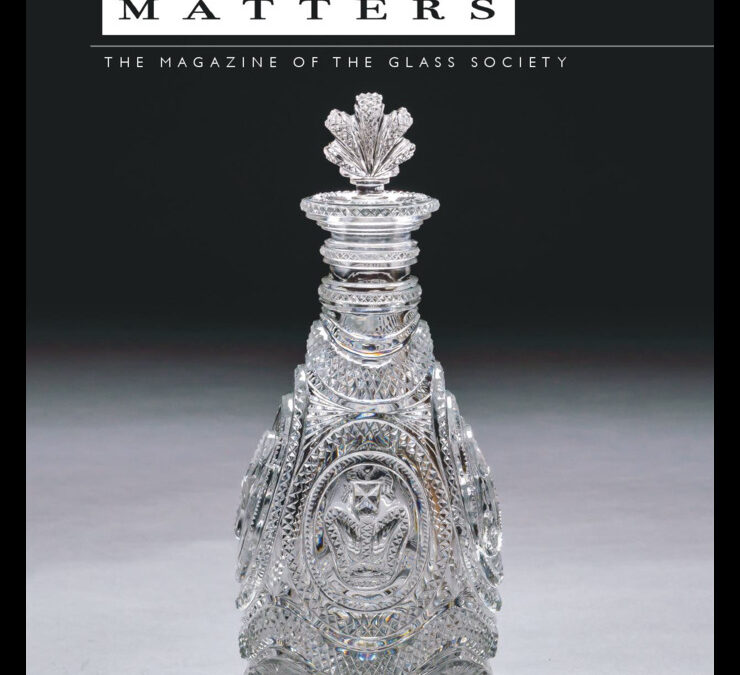
FRONT COVER: The Kings Decanter by Apsley Pellatt, c.1820, for the coronation of GIV. Courtesy of Fileman Antiques. (see page 22)
‘Femme nue au bras tendu’, 20.5 cm high. For Etling by Lucille Sevin. Said to represent the ballet dancer Isadora Duncan. Known with a circular metal base. (see page 22)
-#. +/+0*12 .3+/*-4#)3 ** Dwight Lanmon
Wat for d Glass David Willars
Mr s A Gof Philip Edmonson
Chun ky Perfume Bottle Pamela Metcalfe
Enamelled Tourist Glasses Bill Millar
Du tch Glass Query Anthony Lester
Stourbrid ge Exams 2 James Measell
Kings Decan ter Fileman Antiques
Etlin g Glass Anton Dorozsenko
La Granja glass Ian Philips
Pressed Glass Michael Upjohn
Friends of the Forces Bill Millar
Histori c Repairs Colin Brain
Med usae Peter Layton
Desc ript ion Books restored Rhonda Niven
In Me moriam – Olive Jones Peter Kaellgren
Absolon halfpenny Simon Cook
Alf Stosse l David Willars
Bied ermeier Correction Editor
Aquatopia Katrin Spranger
Vicocoa James Measell
M
any thanks to the members who sent in articles for
publication. In this issue, there are several half-page and
full-page pieces that add interest and variety to the reading of
Glass Matters . These include Simon Cook’s article on a halfpenny
from 1792 with Absolon’s name engraved into the rim, and
James Measell’s discovery of an 1899 newspaper advertisement
in which a glassblower proclaims that he only manages the daily
strength to blow hot glass by taking Vicocoa.
Following on from Remembrance Day, Bill Millar contributed
a 1941 newspaper cutting from the Friends of the Forces about
caring for the welfare of service members in Sussex, along with
their anniversary glass from 1961—which had prompted his
search for further information.
Readers—please keep your pieces coming.
3
4
10
12
13
18
19
22
23
26
30
31
34
36
37
38
39
Contents GM23.indd 2Contents GM23.indd 2 24/11/2025 13:3324/11/2025 13:33
CHAIRMAN’S MESSAGE
3
Chairman’s Message
Simon Cottle
Glass Matters Issue No.23 November 2025
A
s t h e l e a v e s f a l l a n d
a u t u m n ’s c o l o u r s f a d e
i n t o t h e d a r k e r d a y s
o f w i n t e r , I h o p e y o u w i l l
ta ke a moment to ex plore the
Society ’s pro g ress throug h our
n e w w e b s i t e , w h i c h f e a t u r e s
articles and editions of G l a s s
Matters , both past and present.
T hank you for your patience
dur ing its development . I hope
you will agree that the result has
been wor th the wait. Among its
many features, the comprehen –
sive search facility, which includes
past publications of T he Glass
Society, The Glass Association and
The Glass Circle, is an invaluable
resource for anyone undertaking
research. Meanwhile, the News
and Events pages, together with
links to glass collections world –
wide, make this an important and
unique site for all those inter –
ested in glass from every period.
The short histories of glass and
the photographic gallery are fur –
ther enhancements. We are delight –
ed to welcome our new Website
Manager, Sally Haden, who will be
keeping the site regularly updated
with news and content, especial –
ly details of forthcoming lectures
and events. Sally and I warmly wel –
come your contributions – please
do not hesitate to get in touch.
The site is very much an evolving
par t of the Society ’s life and we
hope you will share it with oth –
ers who may not yet be members.
We would also be grateful for
re commend ations o f mus e ums
with glass collections not cur –
rently listed on the site – your
suggestions will help us make it
an even more valuable resource.
In recent months , I had the
o p p o r t u n i t y to v i s i t t h e g l a s s
museum and working glasshouse
i n A l ga i d a , e s t a b l i s h e d b y t h e
G o rd i o l a fa m i l y o n t h e i s l a n d
of Mallorca. W hile the museum
contained many moder n pieces
presented as examples from ear –
lier periods of European glass –
making , I was intrigued to find,
representing Great Britain, gen –
uine pieces of Isle of Wight stu –
dio g lass. T his discover y came,
coincidentally, just before Anton
Doroszenko, curator of the Isle of
Wight Museum, gave us his fasci –
nating recent talk on Etling Glass .
A s u b s e q u e n t v i s i t t o t h e
H i g g i n s M u s e u m i n B e d fo rd –
which houses spectacular examples
of British and European glass from
the 16th centur y to the present
day, beautifully and authoritative –
ly displayed – reignited my fascina –
tion with the material in a way that
Mallorca could not. It reminded me
how fortunate we are in the UK to
possess some of the finest collec –
tions of glass in the world. If you
have not yet visited the Hig gins,
I strongly recommend doing so.
This issue of Glass Matters
encompasses a wide range of sub –
jects, from David Willars’ explora –
tion of the little-known Watford
Glass to coverage of contempo –
rar y 20th- centur y g l ass ar t by
Peter Layton and Katrin Springer.
Additional historical contribu –
tions from James Measell, Pamela
M e t c a l f e , P h i l i p E d m o n s o n ,
Michael Upjohn, Bill Millar, Ian
Phillips, Colin Brain, and Simon
Cook enrich this diverse collec –
tion of ar ticles, all exper tly and
thoughtfully brought togeth –
er by our editor, Brian Clarke.
The Stourbridge Glass
Museum offers fur ther insig ht
into the ongoing restoration of
the Stevens & Williams Design
and Patter n B ooks, while Peter
K a e l l g re n re f l e c t s o n t h e l i fe
and legac y of Olive Jones, who
sadly passed away recently.
O n a n o t h e r n o t e , w e h av e
noticed fewer people attend –
ing our recent online talks, and
I would appreciate your feed –
back . Please let me know if the
topics are not of interest, if you
h av e h a d d i f f i c u l t y a c c e s s i n g
the Zoom link, or if announce –
ments are not reaching you in
good time. We are shaping the
forthcoming programme, so your
input is impor tant. Information
on past and future talks will also
be available on our new website.
F i n a l l y, a s a c h a r i t y w i t h
grant-giving facilities supporting
research and projects related to
glass, I would encourage you to
consider donating to the Society
so that we may continue this valu –
able work. A bequest left in your
will – which, when received, may
be granted in your name – is a won –
derful way to ensure the Society ’s
legacy for future generations.
Simon Cottle, Chairman of !e Glass Society
Chairmen’s message GM23.indd 1Chairmen’s message GM23.indd 1 20/11/2025 20:0420/11/2025 20:04
Identifying an English Pocket Bottle
4 Glass Matters Issue no.23 November 2025
EARLY FACETING
Dwight P. Lanmon
LEFT & ABOVE Fig.1a, bPocket !ask with unmarked detachable silver cup, mount and threaded cap. Colourless lead glass, blown, facet-cut. Silver mounts and cup, raised, turned, engraved. OH. 6-1/8 in. Author’s collection, intended gift to the V&A Museum. Photos: author
ABOVE Fig.2Silver cup bearing the engraved monogram “CH” and an engraved border of repeated foliate elements at the rim. OW. 2 ¾ in
ABOVE Fig.3aView inside the cap, showing the indented cork liner and the rough-ground areas and adhesive on the shoulder of the !ask
ABOVE Fig.3aView inside the neck, showing the smoothly ground bore and the slight chipping of the !at rim of the !ask
H
ere, I believe, is a clas –
s i c q u a n d a r y fo r g l a s s
scholars and collectors: a
glass f lask with unmarked silver
mounts, resembling a modern hip
flask (Figs.1a,1b) . How old is it?
The form was called a “pock –
et bottle” in England in the 18th
century, identifying its function. 1
American glassmakers produced
simil ar b o tt les (w i thout silver
mounts) during the late 18th and
throughout the 19th centur y, the
later ones often decorated with
molde d patr io tic mo tifs . O ne
American merchant illuminated
their pur pose in 1790 when he
advertised half-pint flat dram bot –
tles “suitable to carry the comfort
of life into the field.”
and functionality haven’t changed
significantly in over 300 years.
The glass is blown and fac –
et-cut. The detachable silver cup
h a s a n e n g rave d fo l i ate m o t i f
on the rim (Fig.2) , and the same
cut and engraved motif is on the
shoulder below the cap (Fig.3) . A
monogram is engraved on the cup.
T he f lask was repor tedly found
in a Glasgow house-removal sale,
but it has no traceable histor y.
I hope the following explanation
of the process I used to determine its
age will prove helpful to others – or,
if I have erred in my conclusions,
that they will point out my mistakes.
THE SILVER CUP AND MOUNTS
T he cup is thin, and it displays
fine hammer marks inside that are
consistent with raised work (Fig.2) .
Although it may have been raised
from an ingot, it was more likely
formed from a sheet of silver. 3 It
fits the base of the f lask snugly;
indeed, more-so one way than the
other. It does not fall from the
flask if it is picked up by the neck.
A c ylindr ical, threaded silver
mount with pro jecting cut and
e n g r av e d fo l i a t e e l e m e n t s o n
the shoulder is attached to the
neck of the flask (Figs. 3a,3b) .
Roughly ground areas and adhesive
Dwight Lanmon GM23.indd 4Dwight Lanmon GM23.indd 4 20/11/2025 20:0620/11/2025 20:06
EARLY FACETING
5 Glass Matters Issue no.23 November 2025
RIGHT Fig.4Silver spirit !ask and detachable cup. England, London, maker’s mark “ID,” ca. 1730. OH. 6 in. Photo: Christie’s
ABOVE Fig.5aEngraved “CH” cypher on the cup of the !ask in Fig.1
LEFT Fig.2″is clipping from !e Educational Times (1 Oct. 1879) provides details regarding the CGLI Technological Examinations scheduled for May 1880. “is information also appeared in the Journal of the Society of Arts (26 Sept. 1879)
underneath the mount are
visible on the shoulder. The
screw-on cap is cylindrical and
threaded inside; it has raised
horizontal rings on the out –
side, a domed top, and a ball
finial on a short stem. There is
a cork inside the dome, which
seats on the f lat silver rim
on top of the flask when it is
screwed closed, sealing it from
leakage. There is a domed cir –
cular projection in the center
of the cork, indicative that
it has been used that way
for a long time. (See Fig.8c,
showing a similar cork-lined
cover.) The neck bore is matt,
not glossy, and it is slightly
tapered; the rim is flat with
some tiny nicks on the edge.
These indicate the bore was ground.
Why? There is no evidence that
there ever was a glass stopper. Did
the glass cutter prepare the flask for a
stopper, just in case one was needed?
The cut and engraved foliate band
on the shoulder of the cap and the
engraved border on the rim of the
cup is an ornamental motif that was
used on English silver during the last
half of the17th century and into the
early 18th century. The same foliate
motif is engraved on an English sil –
ver flask and cup dating from about
1730; it bears the unidentified mak –
er’s hallmark “ID” in an oval (Fig.4) .4
The threaded caps on both the silver
f lask and the glass f lask share a
bold simplicity in the raised hori –
zontal ribbing and cylindrical form.
English silver f lasks of this ovoid
form, dating from as early as about
1690 and as late as 1750, are known. 5
The style of the engraved mono –
gram on the side of the cup (Fig.5a) ,
however, raises doubts about a date
for the flask in the first half of
the 18th century. A monogram
of similar form was published
repeatedly in cypher books in
1770, 1777 and 1794 (Fig.5b) .6
Such engraving may have been
added later than when the cup
was made, but one must also
consider that it signals that
the cup is a later addition.
T H E G L A S S
The colorless glass is lead glass,
so it is likely English. The flask
was blown, and the bulbous
body was facet-cut. The facets
are flat (Fig.6) . Examining the
glass reveals wear along the
edges of the upper facets, but
the edges of the lower facets
and the bottom of the f lask
are free from wear. If the silver
cup weren’t there to protect it,
the wear on the lower part and bot –
tom would be the same as the top.
There is also a spot of heavy wear
on one facet which corresponds to
BELOW Fig.5b“CH” cypher illustrated in A Complete and Useful Book of Cyphers; wherein the various Combinations of the Alphabet are Ornamentally disposed In the Present Taste on Twenty-four Copper Plates; by John Russell (London: Laurie and Whittle, 1794)
Faceting on the !ask, outlined
Dwight Lanmon GM23.indd 5Dwight Lanmon GM23.indd 5 20/11/2025 20:0620/11/2025 20:06
6 Glass Matters Issue no.23 November 2025
LEFT & BELOW Fig.7a,bPocket ! ask with detachable silver cup. Colorless lead glass, blown, faceted; silver cup, probably seamed construction. ” e bottom of the cup with engraved initials “BC” and two stars; unknown maker (maker’s mark possibly “GW” or “CW”). OH. 6-1/8 in. Brian Clarke collection. (Photos: Brian Clarke)
LEFT, ABOVE & RIGHT Fig.8 a,b,c,dPocket ! ask inscribed ‘PARNELLO HOOK 1706.” Colourless lead glass, blown; silver, engraved. OH. 7 in. ” e Corning Museum of Glass (2025.2.2, gift of the Wunsch Foundation). Photo: Corning Museum of Glass
a point where the rim of the silver
cup rubs when it is in place and
where there is also a worn spot on
the rim of the cup. I interpret the
wear pattern and that matching tiny
point of heavy wear on the faceting
and the cup as evidence that the
silver cup is original to the flask.
Another f lask of the same form
and with similar f lat faceting is
shown in Fig.7 . The cylindrical neck
is rough ground on the outside, pre-
sumably for a now-missing silver
cap. The inside of the neck was also
ground for a stopper. The detachable
silver cup is of seamed construction,
not raised. The cup has an applied
ribbed oval foot ring on the bottom,
which encloses the engraved initials
“BC,” two stars, and an unidentified
maker’s mark. The latter is crudely
formed and may be “GW ” or “CW.”
There are no other hallmarks. I
have no doubt that the flask is of the
same date as the flask shown in Fig.1 .
Indeed, they are so similar in design
and execution as to suggest they were
finished by the same glass cutter.
There are also datable glass paral-
lels for the form of the flask. One has
a silver mount inscribed “PARNELLO
HOOK 1706”
same as the flasks in Figs.1 & 7 , but
it was not faceted. The thickness of
the glass of the three flasks is sim-
ilar. The cut and engraved foliate
border at the base of the mount is
related to the border on the shoul-
der of the flask in Fig.1 , (Fig.8b) . The
threaded cap is fitted with a cork,
which seals the bottle (Fig.8c), but
the inside of the neck and the rim
of the f lask are ground, as if for a
stopper – the same as on the flasks
in Figs.1 & 7 , (Fig. 8d) . Another
lead glass f lask of the same form,
but without mounts, is inscribed in
diamond point “James Gouldsbury
/ 1724.”
recorded as making spirit flasks or
mounting glass ones in the 18th
century: William Owen made a “neck
EARLY FACETING
Dwight Lanmon GM23.indd 6Dwight Lanmon GM23.indd 6 20/11/2025 20:0620/11/2025 20:06
7 Glass Matters Issue no.23 November 2025
RIGHT Fig.9Trade card of Maydwell and Windle’s, printed by Robert Clee, London, ca. 1750-1756. 11 x 7 ½ in. Victoria and Albert Museum (E.858-1997). Photo: V&A Museum
mount and cover of a crystal bottle”
“mount of a crystal bottle” in 1727;
and Jeremiah Ashley of London
made a “pocket spirit flask” in 1740. 8
T H E F A C E T I N G
Faceted (“scalloped” or “diamonded”)
mirror plates were being produced
in England by the late 17th centu –
ry, so the technology of cutting was
available then. But when were the
first pieces of table glass cut? In part,
that depended upon the availability
of vessels of sufficient thickness –
the beginning of the 18th century.
Many scholars of English glass
have pondered the question of
when the first English cut glass
vessels were made. W. A. Thorpe
discussed Eng lish cut g lass at
length in his publication, A History
of English and Irish Glass (1929).
Likewise, Robert Charleston con –
sidered when glass cutting began
in England and how it developed
in the 18th century in English
Glass and the glass used in England,
c. 400-1940 (1984). Both cited the
earliest known (1719) advertise –
ments of cut glass made in England
by John Akerman of London, who
sold “plain and diamond-cut f lint
glasses.” Both authors concluded
from the wording of the advertise –
ments that cut glass was not a newly
introduced technique or fashion.
The trade card of the London
g lass merchants Maydwell and
Windle, dating from about 1750-
1756, is visual evidence of the
technology available to glass cut –
ters in mid-18th-century England
(Fig.9) . At the bottom right of
the trade card, a cutter is depict –
ed working at a horizontal lap or
flatting wheel (Fig.10) . A cut –
ter working at a ver tical wheel,
BELOW Fig.10Glass cutter working on a horizontal cutting wheel. Detail from Maydwell and Windle’s trade card
EARLY FACETING
Dwight Lanmon GM23.indd 7Dwight Lanmon GM23.indd 7 20/11/2025 20:0620/11/2025 20:06
8 Glass Matters Issue no.23 November 2025
powered by an apprentice turning
a larger wheel, is shown at the bot –
tom left of the trade card (Fig.11)
shown powering it with a crank,
using his left hand. He rests his right
arm on the front edge of the frame,
while holding the object he is cutting
in his right hand over the circular
cutting wheel. 9 Cutting on the hor –
izontal surface of a lap wheel would
produce flat facets, but they would
be limited to flat or convex areas on
the body of an object, as is seen on
an octagonal decanter (Fig.12) and
on the flasks in Figs.1 & 7 . The bot –
tom, flat sides and diamond facets
on the shoulder of the decanter were
produced using a lap wheel, as were
the facets on the stopper, but it could
not reach inside the neck curvature.
The facets on the neck of the decant –
er are concave; they could only have
been made on the rim of a cutting
wheel, probably a vertical one, but
possibly on the rim of a lap wheel.
C U T G L A S S C R U E T BOTTLES
Both Thorpe and Charleston sug –
gested that studying bottles in
English silver cruet frames – hall –
marked, and thus datable – would
provide a key to understanding
when the fashion of cut glass was
introduced in England and would
help identify the progression of
cutting styles. The oft-stated
problem with drawing hardline
conclusions about the styles of
glass cutting from cr uet bottles
is obvious: bottles were some –
times replaced during use or later,
but many are assuredly original.
Evidence of the forms of early
bottles may, however, be drawn
from the silver cruet frames them –
selves. The earliest English silver
cr uet frames that I have found,
made in 1700, 1702, and 1704,
h a d o c t a g o n a l f i t t i n g s fo r t h e
bottles. 10 T he octagonal bottles
in a cruet frame made by Paul de
Lamerie in 1727 in the Ashmolean
Museum are of the same form as the
decanter shown in Fig.12 and
are likely similar in design to
those originally in the cruet
frames of 1700, 1702, and
1704. 11 The latest cruet set
with octagonal bottles with
flat cutting I have found was
made by George Wickes in
London in 1742. 12 Their sides
were cut on a lap wheel, but
their necks were cut on the rim
of a wheel, likely a vertical one.
Cruet bottles of circular
cross – section were made
as early as 1703. 13 They
became the standard form
by the 1730s, and most, if
not all, were faceted on a
vertical cutting wheel. That
lap wheels were still being
used in the mid-18th cen –
tury is documented by their
depiction on Maydwell and
Windle’s trade card, but their
declining use on cruet bot –
tles in the 1730s suggests
shifting taste and technology.
ABOVE Fig.11Glass cutter working at a vertical cutting wheel. Detail from Maydwell and Windle’s trade cardLEFT Fig.12 Decanter and stopper, England, ca. 1720-1740. Colorless lead glass, blown, molded, cut. OH. 12 ½ in. “e Corning Museum of Glass (74.2.10a and 76.2.3). Photo: Corning Museum of Glass
EARLY FACETING
Dwight Lanmon GM23.indd 8Dwight Lanmon GM23.indd 8 20/11/2025 20:0620/11/2025 20:06
9 Glass Matters Issue no.23 November 2025
ENDNOTES
1. “One cut pocket bottle” was
enumerated in the inventory
of the estate of the London
glasscutter Thomas Betts, who
died on 7 January 1765. See
Alexander Werner, “ Thomas
Betts — An Eighteenth-Century
Glasscutter,”
Association I (1985), pp. 1-16,
Appendix 2 [p. 7].
2. Thomas Tisdale of Hartford,
Connecticut, in the Connecticut
Courant, June 21, 1790. Cited in
Kenneth M. Wilson, New England
Glass and Glassmaking (New York:
Thomas Y. Crowell Company,
1972), p. 28.
3. “ The introduction of metal
rolling machines in 1692 and
later improved by John Cook
in 1728 meant that silver no
longer had to be hammered
from ingots: it could be rolled,
creating a uniform surface that
could then be raised by hand.”
See History in the Making: British
Silverware as a Chronicle of the
Past (Roseber y ’s London: https://
www.roseberys.co.uk/news/
silver-collectorsguide-march-24).
4. There are no other hallmarks.
Christie’s, London, December 9,
2011, lot 330.
5. For example, ca. 1690 silver flask
(unmarked): Victoria and Albert
Museum (M.101-2.2001). A flask
by Piere Harrache, London, 1696:
Sotheby’s (London), May 24, 2017,
lot 239. A flask by John Harvey,
London, ca. 1750: Sotheby’s
(London), October 27, 2023, lot 373.
6. The same plates were repeatedly
published in:
A New Book of Cyphers:
Wherein the Various Combinations
of the Alphabet Are Ornamentally
Dispos’d in the Present Taste.
Extremely Useful to Every Person
Wanting or Using Such Decorations.
(London: Carington Bowles and
Robert Sayer, 1770).
Bowles’s New and Complete
Book of Useful Cyphers: Designed and
Engraved on Twenty-four Copper-
Plates, By John Lockington (London:
Carington Bowles, 1777).
A Complete and Useful Book
of Cyphers; wherein the various
Combinations of the Alphabet
are Ornamentally disposed In the
Present Taste on Twenty-four Copper
Plates by John Russell (London:
Laurie and Whittle, 1794).
7. See Dwight Lanmon, The Golden
Age of English Glass, 1650-1775
(London: Antique Collector’s Club,
2011), pp. 280-281.
8. William Pickford (ed.), Jackson’s
Silver and Gold Marks of England,
Scotland, and Ireland (Woodbridge,
Suffolk: Antique Collector’s Club,
1989), pp. 175, 181, 195.
9. Allowing for artistic license (or
that the engraver did not fully
understand the operation of a lap
wheel), the process of faceting –
holding the object in one hand
– likely would not produce precise
faceting. Instead, if he were acting
alone, the cutter could crank the
wheel until it gained sufficient
momentum to allow him to hold
the glass object with both hands
while faceting it. Another unex –
plainable detail in the depiction
of the structure is the purpose of
the two connected rods shown
at the back of the table. One rod
extends to a horizontal beam
below the table, while the other,
with a square top, does not. Was
it connected to the tabletop, and
were the two together a means for
raising or lowering it to expose
the rim of the horizontal wheel for
use in cutting (as an alternative to
using a vertical wheel)?
10. Frames by David Willaume, 1700
and 1704: Christie’s (London),
June 8, 2016, lot 170. Frame by
David Willaume, 1702: Bonhams
(London), March 29, 2022, lot 256.
Auction records indicate that the
bottles were replacements, but they
likely duplicated the original forms.
11. Ashmolean Museum
(WA1946.65).
12. Sotheby’s, April 22, 2020, lot 213:
a pair of cruet stands, each with
octagonal fittings for two cruets.
One pair of the bottles is slightly
taller than the other. The mounts
on one pair are recorded as bearing
a later lion crest below a coronet
on the silver mount, while the
other pair bears a later Moor’s-
head crest below a coronet. This
suggests that one or both pairs of
cruets may have been replaced,
but the stands were made to hold
octagonal cruets. A silver frame
with a pair of cut octagonal cruet
bottles reproducing exactly the
frame and bottles of a set made by
Paul de Lamerie in 1733 was made
by Garrard in 1832. (Christie’s.
June 14, 2005, lot 105) Rather
than demonstrating the continued
fashion of octagonal cruet bottles,
it was likely made to copy an
existing service.
13. Frame for two bottles by David
Willaume, London, 1703
(Christie’s, December 14, 2006,
lot 118). Frame for two bottles
by Thomas Ash, London, 1703
(Christie’s, July 8, 2012, lot 108).
C O N C L U S I O N
When was the pocket f lask shown
in Fig.1 made? Judg ing by the
decline in the use of f lat faceting
on cruet bottles in the 1730s, by
the presence of engraved foliate
borders typical of late 17th- and
early 18th-centur y English silver
on the silver cup and mount, and by
datable parallels for the glass form,
I conclude that the f lask shown in
Fig.1 was made in England in the
first or second quarter of the 18th
centur y. I also conclude that its
parts were “born” together; that
is, the cup was not added later but
was engraved with a monogram in
the 1770s. I suggest a conserva –
tive date for the flask of ca. 1720-
1740, and I lean toward the earlier
part of that range. I also sug gest
the same conclusion for the date
of production of the flask in Fig.7 .
EARLY FACETING
Dwight Lanmon GM23.indd 9Dwight Lanmon GM23.indd 9 20/11/2025 20:0620/11/2025 20:06
T HE L ITTLE -K NOWN Watford Glass Company
10 Glass Matters Issue no.23 November 2025
FISHY
David Willars
LEFT Fig.1Watford Glass Label
BELOW LEFT Fig.2Deep Water Vase in Blue BELOW RIGHT Fig. 3Deep Water Vase in Amethyst
K
ey Watford Glass into your
search engine and you will
be astonished at how many
double-glazing companies there
are in that part of Hertfordshire.
Persevere and another famil –
iar response confronts you: Did
you mean Waterford Glass? T his
retort leads you in another direc –
t ion b e fore yo u f i nd re fe re nce
to a local company that existed
from the 1920s throug h to the
early1990s that cut and polished
decorative glassware to a standard
wor thy enou g h to s e cure royal
attention. E lse where, the West
Watford Histor y Group sug gests
that the Watford Glass Company
Ltd was founded by Gus Kiwi, from
Germany, and continued by Felicity
Peck, Gus’s daughter, followed by
her children until the works closed. 1
Gus Kiwi is likely Gustav Kiewe
from Heusenstamm, south-east
of Frankfur t. In 1928, brothers
W i l h e l m a n d G u s t av
Kiewe, orig inally from
Poznan, Poland, arrived
i n He u s e n s t a m m v i a
B e r l i n , B a d Na u h e i m
a n d F r a n k f u r t . T h e y
purchased the land and
buildings of the disused
South German Galalith
a n d C e l l u l o i d G o o d s
Factor y and founded the
Central German Cr ystal
Glass Grinding Factory 2.
W h i l e W i l h e l m
Kiewe ran the grinding
shop in Heusenstamm,
h i s b r o t h e r G u s t a v
fo u n d e d t h e Wa t fo rd
Glass Company. Among
t h e e m p l o y e e s i n
Heusenstamm was Kurt
Hartmann, who moved
to Watford to train the
workers there, b e fore
he too married and settled. At the
beginning of the 1930s, the head –
quarters of the grinding shop was
completely relocated to England,
and Wilhelm Kiewe died in 1932.
The company continued to produce
in Watford for another sixty years.
Quite what prompted Gustav
to move to Watford is unrecord –
ed; however, we can assume these
movements were all par t of the
diaspora unfolding across central
Europe during the 1920s. In 1923
Gustav married Malka Lesser, pre –
viously known as Malka Goodman,
i n F ra n k f u r t . T h o u g h b o r n i n
Preston Lancashire, Malka’s par –
ents were originally from Poland.
Gustav Kiewe died in 1957, and
it would appear the reins were tak –
en up by daughter Felicity Peck ,
born in 1924, and husband Lionel,
formerly Lionel Pekarsky. Felicity
obviously achieved some success
in r unning the business as she
was appointed MBE for ser vices
to e x p o r t i n 1 9 7 0 . E l s e w h e re ,
a d v e r t i s e m e n t s i n t h e t r a d e
press indicate a g lobal network
of agents: in Australia; Canada;
New Zealand; South Africa; Libya;
S u d a n ; M e x i c o a n d B e l g i u m .
Watford Glass did not manufac –
ture glass themselves, relying ini –
tially upon ‘blanks’ from Belgium,
Watford Glass GM23.indd 10Watford Glass GM23.indd 10 20/11/2025 20:0720/11/2025 20:07
FISHY
11 Glass Matters Issue no.23 November 2025
LEFT Fig.4Deep Water Vase in Blue Press cutting from c1960
RIGHT Fig.5!e Biggest Vase in the World. Ht c150mm
C z e c h o s l o v a k i a a n d G e r m a ny.
Latterly, local sources were found
at Whitefriars in Harrow and
Nazeing Glass in Broxbourne.
So, what of their output? For
the large par t, this would appear
to be good quality cut and polished
crystal glass bowls, vases, jugs,
decanters and glasses. T his was
the fashion between the 1950s
and 1980s. Superficially, Watford
G l a s s i s i n d i s t i n g u i s h a b l e
from many of the other lead –
ing glass houses of the time,
w h e t h e r f ro m S to u r b r i d g e
or elsewhere. Items do carr y
a label (Fig.1)
the years these have mostly
wor n o ff. T he existence o f
these often worn and dam –
aged labels today acts par tly
as the basis of attribution. So
far as I’m aware, there are no
etched or eng raved factor y
marks or patter n numbers.
No catalogue has turned up,
but as the factory closed com –
fortably within living mem –
or y, we have to assume that
one exists, and the tantalising
thought must be that one will
be unearthed at some point.
There were, however, a few items
that are worthy of special note. A
series of large clear vases (Figs.2&3 ),
cased in amethyst, blue and green
before being cut to reveal fish swim –
ming among reeds – collectively
these were known as ‘Deep Water’
an equally striking clear version.
There is also a reference in the
trade press, around 1960 (Fig.4) , to
‘the biggest vase in the world’ (Fig.5 ). At
c300mm tall this admittedly heavy
vase is hardly the biggest ever made,
although at the time its dimensions
would have been at the extreme
end of the spectrum. There is in
fact a slightly taller vase, of similar
style, presumably made a few years
later, that is towards 325mm tall.
Just as the fashion for cut glass
buoyed sales during the post-war
years, sales began to decline as this
style faded in popularity. The over –
seas market would have sustained
output for a while, but it is increas –
ingly likely that the UK, with its high
labour costs, would have become
uncompetitive. Felicity Peck died
in 1991, and she appeared to be
the driving force of the business
through the 1960s, 70s and 80s.
Today, the Stourbridge Glass
Museum houses a few items of
Watford Glass, including those
described and illustrated here. I
am also indebted to Maurice and
Pauline Wimpory for their help and
assistance. Lastly, various con –
versations tell me how little
w e k n o w, n o t o n l y a b o u t
Watford Glass but also other
businesses that must have
manufactured niche deco –
rative and industrial items
during the second half of the
20th centur y. Please be in
touch if you feel the urge to
contribute to this discussion:
drwillars@btinternet.com.
ENDNOTES
1. See West Watford History
Group. https://www.
westwatfordhistorygroup.
org/2019/07
2. https://www.op-online.
de/region/heusenstamm/
heimat-und-geschichtsv –
erein-heusenstamm-zeigt-
heimische-werke-aus-40-
jahren-92375187.html
Watford Glass GM23.indd 11Watford Glass GM23.indd 11 20/11/2025 20:0720/11/2025 20:07
Mrs A. & Mr H. Gof
12 Glass Matters Issue no.23 November 2025
LOOK AGAIN
Philip Edmondson
ABOVE Fig.1a Philip Edmonson’s Mrs A. Gof glassRIGHT Fig.1b!e description note from Howard Philips, accompanying the glass
I
w a s f a s c i n a t e d t o r e a d
Simon Wain-Hobson’s arti –
cle in GM18, December 2023:
‘Who was the boldly and precisely engraved
Mrs A.Gof ’, on the possible origins of the
Mrs A. Gof glasses. I have an identical glass
(Fig.1) , inherited from my mother, also a
member of The Glass Circle, who had pur –
chased it in 1971 from Howard Phillips
(Fig.2) . I remember buying the glass with
my mother; it always felt such a privilege
even to be allowed to enter the portal of
Howard Phillips’ shop – unless you were one
of his distinguished clients, it was akin to
being granted an audience with the Pope!
The provenance is given as Mrs N. Harding
Owles, and its pair is illustrated by Percy
Bate. The Percy Bate glass was mentioned
in Glass Circle News of July 1983, when
member Philip Truebridge wrote to say
that after purchasing the glass in 1968, he
had tried to locate members of the Gof fam –
ily without success. However, he mentions
that another glass had been described in a
letter to Country Life – I vaguely remember
this myself – by a lady also seeking its back –
ground, but unsuccessfully. There seem,
therefore, to be at least six glasses that have
survived. Of even greater interest is the men –
tion of an opaque twist wine glass in Glass
Circle News of January 1982: engraved
Mr H. Gof (not illustrated), it speculated
whether Mrs Gof was partial to ale but
her husband only to wine! It would be
fascinating if more information about
the Gof family and their glasses could
be found, and especially if there are any
more Mr H. Gof wines. I can be contact –
ed by email: lennoxed@hotmail.com
Chunky Perfume bottle � �–� �A�n�o�t�h�e�r� �?�n�d
Pamela & Anthony Metcalfe
RIGHT Fig.1My pair of ‘chunky’ perfume bottles. Adding pink and white to green and yellow I
n 2024, Pamela and Anthony
revisited A rgentina following
their cruise during Covid-19,
when they added to their penguin
collection; Glass Matters 8, 2020.
We f lew to Buenos Aires – a gor –
geous, interesting city, with lovely
hotels, amazingly clean streets and
trees in blossom, providing shade for
the wide avenues. It was very hot!
From there, we flew north to the
Brazilian border for a few days to
see the fantastic Iguazù Falls, and
back to Buenos Aires for a short
cruise on the A zamara “Quest”.
We had done our homework on
Google, and knew where we needed
to be for our last day in B.A. before
heading to the airport. Unable to use
stairs, I use crutches,
but don’t let that get
the better of me. To
our amazement, we
came across a won –
derful antiques shop
– to satisfy my “quest”
for glass! What did I
find? A chunky per –
fume bottle, which
at first reminded me
of Lotton glass, or perhaps St. Clair,
but was actually signed JOE RICE
(in capital letters). This one was a
pink version, a brother/sister to one
I have already in green, pink and
yellow, with “bubbles” as part of the
design. I just love these chunky items;
this year’s trip was well worthwhile!
Mrs Gof GM23.indd 12Mrs Gof GM23.indd 12 20/11/2025 20:1020/11/2025 20:10
13 Glass Matters Issue no.23 November 2025
TO U R I S T M E M O R I E S
H AND -E NAMELLED T OURIST G LASSWARE
Bill Millar
LEFT Fig.1aVase, H 7cm, with scene of Newgate Gap at Margate, hand enamelled over transfer printRIGHT Fig.1bVase, H 6.3cm, with scene of Devil’s Punchbowl at Minehead, hand enamelled over transfer printBELOW Fig.1c!ree crested glass models, for Rhyl, H 6.4cm; Bath, H 7.6cm; Aberdeen H 5.3cm
Y
ou too may have endured the
holiday ritual of shopping
for souvenirs or presents for
friends, family and the people next
door who were looking after Felix,
your cat. Anything can be bought as
a souvenir, but the focus of this article
is glass made for the tourist market.
You will see a random selection of
hand-enamelled tourist glassware
from various points of the 20th cen –
tury. Some of these items are more
desirable than others, some are use –
ful, some have no practical function,
and others might be thought an
unwelcome reward for feeding Felix!
For the purposes of this article
“tourist glassware” is anything made
for the tourist market. A reliable clue
is if it carries the name of a resort, city
or region. This tour starts in Britain
(England, Wales and Scotland),
crosses the North Sea to Sweden,
then continues south through
Germany, Switzerland, Austria –
say, the country represented on the
item need not be the country where
the glass was made or decorated.
BRITAIN
The point on the source of glass is
exemplified with the first two exam –
ples of small vases (Figs.1a,1b ). They
are decorated with scenes from English
resorts but originated in Belgium.
From the 1920s the Wirth’s factory
in Dolhain, Belgium, bought opaque
white glass blanks from Val St Lambert
and other suppliers which they then
decorated. The factory was moved to
Ve r v i e r s i n 1 9 2 2 a n d a t s o m e s u b s e –
quent date Pierre Jost, who worked at
the factory, set up his own workshop
to produce similar items. The decora –
tion was produced by applying a trans –
fer-printed template which was then
coloured with translucent enamels.
Invariably made in the shape of a small
vase, they were usually decorated with
landscapes or buildings of interest.
Glass Matters, Issue 4, 2019,
included an article on crested glass
souvenirs, the equivalent of crested
china which is often associated with
Goss. It illustrated a number of small
glass souvenir vases, mugs and jugs,
which carried the enamelled crests
of resorts across England, Scotland
and Wales. One illustrated item was
a crested vase produced in Belgium,
similar to the examples above. The
Enamelled Glassware GM23.indd 13Enamelled Glassware GM23.indd 13 20/11/2025 20:1320/11/2025 20:13
14 Glass Matters Issue no.23 November 2025
TO U R I S T M E M O R I E S
LEFT Fig.1aHalf litre beer mug decorated with the hand enamelled crest of Stockholm, H 11cm
BELOW LEFT Fig.3aGlass, with pewter holder (no handle), H 10.3cm (in total), decorated with scene of Königestuhl chalk cli ! on the island of Rügen o ! Baltic coast of GermanyBELOW Fig.3bBrandy glass, H 9.8cm, with crest of Warstade
other models, three of which, from
Wales, England and Scotland, are illus –
trated at Fig.1c , were probably made
in Czechoslovakia during the 1930s.
SWEDEN
A long haul across the North Sea
and the Baltic Sea will bring you to
Stockholm. Saint Erik Jedvardson
was King of Sweden from 1156 until
his death in 1160 and is the patron
Saint of both Sweden and Stockholm.
His crowned head forms the crest of
Stockholm, as seen on the
beer mug (Fig.2) . The crest
has been hand-enamelled
over a transfer-printed tem –
plate. This handblown mug,
with a nominal capacity of
half a litre, is both attractive
and useful. From the lack of
wear, it could be late 20th
century, but I can offer no
opinion on where it was made.
GERMANY
Travelling south from Sweden
will bring you to the island of
Rügen, off the Baltic coast of
Germany. The next example
(Fig.3a)
pewter holder. The holder is
Art Nouveau in style which
might suggest the glass is early
20th century, but there is no indica –
tion of source. The scene on the glass
shows a building similar to a folly or
lookout which has been enamelled
over a transfer print. ‘Königestuhl’,
which is enamelled near the bot –
tom of the glass, is the tallest of the
chalk cliffs on the island of Rügen.
About 180 miles west of Rügen
Island lies Warstade, a small village
in Lower Saxony. The crystal brandy
glass with a gilded rim (Fig.3b) has
been decorated with the arms of the
village which were hand-enamelled
over a transfer-printed outline. It
still carries a foil label for Bavarian
glass. The ‘N’ on the label could be for
Nachtman, but I have been unable
to confirm this. There appears to
be little to attract visitors to the vil –
lage of Warstade, but clearly there
must be something to justify this
German-made, usable, souvenir glass.
The final two examples of sou –
venir glasses relating to towns in
SW Germany (Fig.3c) , are from a set
of twelve early 20th century fine
crystal champagne tumblers, with
a 200ml capacity, each of which is
decorated with a lady in traditional
costume. The left-hand glass carries
the name of Freiburg (Freiburg am
Breisgau), and the other, Neuenburg
(Neuenburg am Rhine). Both towns
are near the Black Forest. The base of
each glass was polished and the rims
gilded. The other ten glasses in the set
are similarly decorated for places in
Switzerland – where we travel to next.
Enamelled Glassware GM23.indd 14Enamelled Glassware GM23.indd 14 20/11/2025 20:1320/11/2025 20:13
15 Glass Matters Issue no.23 November 2025
TO U R I S T M E M O R I E S
LEFT Fig.3cTwo tumblers, H 9.4 cm, each superbly decorated with a lady in traditional costume. !e reverse named for Freiburg (am Rhein) and Neuenburg (im Breisgau)
BELOW Fig.4a!ree superbly hand enamelled tumblers H 9.4 cm, with ladies in traditional costumes for Aulgau; Zug; Zürich
SWITZERLAND
The remaining ten tumblers from the
set introduced in the previous para –
graph, relate to towns across the length
of Switzerland: Aulgau; Basel; Bern;
Glarus; St Gailen; Schaffenhausen;
Solothurn; Unterwalden; Zug and
Zürich. They are identical to the
two seen at Fig.3c in every respect,
both in form and type of decoration;
three of them are shown at Fig.4a . It
is inconceivable that twelve tumblers
were bought individually at each of
these towns during the journey. More
likely they were bought, or ordered,
at a shop at the end of a tour of the
area. However they were acquired,
they certainly make fine souvenirs.
A thirteenth tumbler, slightly
smaller than the others, with a capac –
ity of 150ml and decorated with a lady
from Yverdon can be seen at (Fig.4b) .
The rim on this glass was polished
flat then gilded on the flat, whereas
the rims of the set of twelve were
sheared, so are smooth. This small –
er tumbler was recently acquired
from a different source to the other
twelve – however, the decorative style
is identical, so it must have come
from the same, unknown, workshop.
AUSTRIA
Travelling east from Switzerland
brings us to the Austrian Tyrol, which
has always been a popular tourist
destination. The bottle (Fig.5a) was
probably bought as a present at some –
time in the second half of the 20th
century. Originally, it would have con –
tained a tot (70ml) of spirits such as
schnapps, which would have been as
cheering as the colourful decoration
was cheerful. A perfectly ordinary
pressed glass bottle, it was decorated
with a transfer-printed crowned eagle
crest with the word ‘TIROL’ below.
It was then further enhanced with a
hand-enamelled cluster of flowers –
Unlike all the previous examples, this
enamelling was painted freehand.
Once the contents were con –
sumed, the bottle might have been
Enamelled Glassware GM23.indd 15Enamelled Glassware GM23.indd 15 20/11/2025 20:1320/11/2025 20:13
16 Glass Matters Issue no.23 November 2025
TO U R I S T M E M O R I E S
FAR LEFT Fig.4aA small, !ne crystal tumbler, H 9 cm, with detailed enamelled painting of a lady in traditional costume. “e reverse of the glass is signed Yverdon
LEFT Fig.5aVintage, pressed glass bottle, H 10.5 cm, with transfer printed crest and hand enamelled alpine #owers
BELOW Fig.5bTwo boxed, small, hand enamelled tot glasses H 5cm, capacity 25ml, with a lady and gentleman in Tyrolean costume
used as a makeshift bud vase, or more
likely passed on to the local Oxfam
shop where it may have raised as
much as 50p – good value from the
collector’s viewpoint if you accept
that 49p was simply a donation!
The two sets of mass-produced
tots (Figs.5b & 5c) were also enam –
elled by hand, without the benefit of
a transfer-printed outline. Each glass
is decorated with a man or woman in
a colourful alpine costume. The boxes
are badged “Cristallglaswerk Kramsach
Tyrol” confirming that at least the dec –
oration was Austrian; the figures are
simplistic in design and are wearing
typical Tyrolean clothes, the ladies
in dirndl dresses and the gentlemen
in lederhosen. The white lines on the
clothing were produced by a sgraffi –
to technique, drawing through the
unfired enamel with such as the tip of
the paintbrush handle. The reverse of
the glasses at Fig.5b have been enam –
elled “P ōrtschach am
Wōrthersee) in Austria. The glasses
in Fig.5c do not carry a resort name,
so are generic to any resort. Probably
made in the 1950s or 1960s when
‘Lakes and Mountains’ coach holidays
became popular, these would have
been a perfect gift to bring home: eas –
ily packed, light and probably cost little
Enamelled Glassware GM23.indd 16Enamelled Glassware GM23.indd 16 20/11/2025 20:1420/11/2025 20:14
17 Glass Matters Issue no.23 November 2025
TO U R I S T M E M O R I E S
more than a postcard with internation –
al postage. I cannot believe that many
holidaymakers would have bought
these for their own use! The fact that
they are still boxed suggests that they
have never been used. Colourful, sweet
and cheerful they may be, but I suspect
most would find them too tacky to use
in company. Furthermore, the capacity
of 25ml is hardly practical, unless you
like your spirits neat by the thimble –
ful without a mixer. This probably
explains why boxed sets like this are
often listed in on-line auctions over 50
years after they were made. The lower
half of the photo at Fig.5b shows the
unsophisticated design of the box lid
which is probably more suitable for a
child’s doll or puppet. The box at Fig.5c
has exactly the same covering. While
both boxes and one of the glasses carry
the maker’s or decorator’s labels with
an initial ‘R’, beyond identifying the
source as Kramsach in the Tyrol, I have
been unable to establish their name.
UNKNOWN
The next leg of this journey takes us
into the unknown so I will start with
what is known. The two tiny mugs
(Fig.6) each have an applied handle, a
polished base and rim. The rim of the
smaller mug has been gilded; the rim
on the larger mug has a band of red
enamel and the sides were decorated
with spots of enamel. They each have
a hand-enamelled but unidentified
armorial. I do not know where, when
and why they were made and cannot
identify the armorials. The rest of this
section must be largely speculation.
The mugs are too small to have a prac –
tical application, so must presumably
be some sort of decorative memento.
They at least have the merit of being
colourful and hardly demanding of
space. Despite checking many hun –
dreds of armorials, a match has yet
to be found. Whether the armorial is
for a resort or the family related to an
historic building, I have assumed that
they were made as tourist mementos.
They have much in common with the
crested glass models at Fig.1c and for
that reason I have tentatively dated
them to the 1920s or 1930s. For the
same reason it is just possible they
were made in Czechoslovakia. Having
said all of that, it is also possible that
they were not made as souvenirs, and I
am in error to have included them here.
JOURNEY’S END
Only a virtual traveller could visit 22
resorts in 7 countries in the time it has
taken to read this article. The choice of
resorts was entirely down to the ran –
dom nature of items in my collection.
Some of the items can be described as
good, others less so; some are practical,
some are completely impractical, and
a few are of questionable desirability.
Yo u m i g h t e ve n q u e s t i o n w hy I co l –
lected items in the latter category, far
less admit to owning them. But then
you weren’t to know that Felix is the
name of our neighbour’s cat. If you
have any information on the mini-
mugs at Fig.6 , I would love to hear
from you at billmillar82@yahoo.co.uk .
LEFT Fig.5cBox of 6, small, hand enamelled tot glasses H 5 cm, with three couples in Tyrolean costume
BELOW Fig.6Front and side views of two mini mugs H 3.5cm and 4.2 cm with unknown, enamelled heraldics
Enamelled Glassware GM23.indd 17Enamelled Glassware GM23.indd 17 20/11/2025 20:1420/11/2025 20:14
Dutch Glass Query
18 Glass Matters Issue no.23 November 2025
NETHERLANDISH
Anthony Lester
Fig.1
A
n t h o n y L e s t e r
sent pictures of
his light baluster
wine glass (Fig.1) , the bell
bowl engraved with three
gentlemen seated around
a circular table making
a toast; inscribed above
D. Inclenatie van d. Jonge
Heeren (Figs.2a,b,c,d)
set into a beaded invert –
ed baluster section with
base knop, on a folded
conical foot. H 20.5cm.
His query: ‘I would
love to know what the text
means and would welcome
a ny th ou g ht s m e m b e rs
might have about the glass.’
member, Mathij van der
Meulen for comments:
H e c o n f i r m e d t h e
inscription spelling, then:
“Nor mally, you should
write ’De’ instead of ’D.’,
in English, this is ’The’.
‘Heeren’ is old fashioned
for ‘Heren’, which here you
would translate to ‘gentle –
men’. I find the theme nice
and naughty, so interest –
ing – but the engraving is
not that well done and I’m
unable to attribute the
glass to any known glass
engraver. The inscrip –
tion translates
in English to:
‘The inclination
(preference or
tendency) of the
young gentle –
men’; alongside
the engraving,
the meaning is
quite obvious
– “ these young
men enjoy their
drinking hab –
its and com –
panionship”.
Fig.2b
Fig.2a
Fig.2c Fig.2d
Dutch Glass Query GM23.indd 18Dutch Glass Query GM23.indd 18 20/11/2025 20:2520/11/2025 20:25
19 Glass Matters Issue no.23 November 2025
STUDY TO SUCCEED
Technological Examinations in Glass Manufacture
by the City and Guilds of London Institute – Part 2
James Measell
ABOVE Fig.1!is illustration from !e Graphic (23 July 1881) depicts the Prince of Wales laying the foundation stone for the City and Guilds of London Institute. !e completed building is shown in the inset
F
rederick Carder left the Dudley
Mechanics’ Institute and the
Stourbridge School of Art to
attend classes during 1887-1888
at the Wordsley Brook Street Board
School, where Owen Gibbons taught
art and Benjamin Mason was the
science instructor. During the late
1890s, Frederick Carder and Benjamin
Mason began to develop a course of
study in Glass Manufacture at the
Wordsley School of Art. The CGLI
Programmes during 1894-1900 listed
decorative tile manufacturer Francis
Gibbons of Gibbons, Hinton & Co.,
Buckpool, near Brierley Hill, as a reg –
istered teacher for Glass Manufacture.
Francis Gibbons was interested in hav –
ing students learn about refractory
materials, but his role regarding the
Glass Manufacture course of study at
Wordsley is unknown, although he was
a member of the school’s Management
Committee. During the 1890s, many
Public Notices placed by the Wordsley
School of Art ( , 16 Sept.
1893, 1 Sept. 1894, 14 Sept. 1895, 5
Sept. 1896, 25 Sept. 1897, and 1 Oct.
1898) contained the statement that
‘particular attention [is] paid to Design
as applied to the Local industries,’ an
indication that design for glass mak –
ing and glass decorating were import –
ant areas of study. After serving as
assistant art master for a few years,
Frederick Carder became art master
at the Wordsley school in 1893, and
much of his work as a draughtsman
at Stevens & Williams during the pre –
vious 13 years was in glass design, so
the emphasis upon aspects of design
is understandable. However, Frederick
Carder also carried out experiments
regarding the chemistr y of glass
colours, and he endeavoured to use his
knowledge and experience regarding
glass chemistry to enhance the sci –
ence instruction. In Public Notices for
1900-1901 and 1901-1902 ( ,
15 Sept. 1900 and 22 Sept. 1901),
(Fig.2) , the Wordsley school proposed
to ‘give sound Instruction in Art and
Science as important branches of a gen –
eral education; to train designers, mod –
ellers, painters, artisans and other art
workers. ’ These Public Notices direct –
ed attention to ‘SPECIAL CLASSES
for the Study of DECORATIVE DESIGN
as applied to Manufacturers; GLASS
MANUFACTURE in the principles under –
lying this industry.’ –
claimed that ‘The Midland Association
of Flint Glass Manufacturers and the
City and Guilds of London Institute offer
Special Prizes, Medals, and Certificates
to Persons employed in Glass Works.’
Programme for
James Measell pt2 GM23.indd 19James Measell pt2 GM23.indd 19 20/11/2025 20:2920/11/2025 20:29
20 Glass Matters Issue no.23 November 2025
STUDY TO SUCCEED
RIGHT Fig.2!is Public Notice appeared in the Advertiser on 22 September 1901
1900-1901, the Glass Manufacture
syllabus was ‘revised to give more
prominence to Design,’ and areas for
study in preparing for the Honours
grade included ‘modes of decoration
of glass now in common use and a
description of the processes by which
they are affected’ as well as ‘moulds
and tools used by glass makers in
producing Venetian fluting, pillars,
etc.’ In the Wordsley school’s Public
Notice for the 1901-1902 terms
(Advertiser , 22 Sept. 1901), prizes
offered by the CGLI for success in
the Glass Manufacture examinations
were mentioned, suggesting that the
organisation recognised and approved
the Wordsley school course of study.
The CGLI Programme for 1902-1903
included this statement in the Glass
Manufacture syllabus: Candidates
in either Grade may be required to
make freehand sketches of Antique,
Venetian or Modern Glass and to show
some ability in designing specimens
of plain and ornamental glasswork.’
The CGLI Programme for 1902-1903
listed Frederick Carder as the only
‘teacher of a registered class,’ an indi –
cation that Wordsley was the lone cen –
tre within Britain offering approved
classes in Glass Manufacture.
After Frederick Carder completed
a tour of glass plants in Germany and
Austria, Public Notices for the 1902-
1903 sessions at the Wordsley school
reflected the comprehensive course
of study in Glass Manufacture that
was available to those employed in
the local glass industry. The classes
followed the CGLI sequence of three
grades: Preliminary, Ordinary and
Honours. Candidates who passed the
Preliminary grade examination did not
earn a certificate, but ‘their successes
will be notified to the Centre at which
they were examined.’ Only candidates
who had passed the Ordinary grade
examination were permitted to sit for
the Honours grade examination. With
meetings on Monday evenings (chosen
because of the Tuesday-Saturday work
schedules for glassmakers), instruc –
tion at Wordsley for the Preliminary
and Ordinary grades embraced a wide
variety of topics, ranging from basic
glass chemistry and glass produc –
tion methods to the construction of
furnaces and moulds. The separate
Honours grade considered advanced
glass chemistry later in the evening.
In mid-1903, as Frederick Carder
was preparing to emigrate to America,
the Wordsley school turned to
George J. Carder to develop the Glass
Manufacture course of study further.
The younger Carder had attended
art classes in Brierley Hill and at the
Stourbridge School of Art between
1883 and 1898, winning numerous
awards from the Department of
Science and Art, including silver and
bronze medals and a Queen’s Prize.
During 1900-1902, George Carder
attended the Wordsley classes in
Glass Manufacture with Frederick
Carder as instructor. In 1902, George
Carder passed the Ordinary grade
examination with first-class marks
and was awarded a silver medal
and £1 ( , 17 Jan. 1903).
Later, George Carder was awarded
a silver medal and £2 by the CGLI
for achieving first-class Honours in
Glass Manufacture ( , 2
April 1904). In the autumn of 1903,
George Carder began his teaching
career at the Wordsley school, where
he was responsible for classes in
design and served as instructor for
the Glass Manufacture sessions.
Between 1904 and 1907, numer –
ous students completed the Glass
Manufacture course of study at the
Wordsley school and passed ex am –
inations administered by the CGLI
(Advertiser , 3 Sept. 1904; 1 April 1905;
2 Sept. 1905; 31 March 1906; and
23 March 1907). In 1905-1907, the
Master of the Worshipful Company
of Glass Sellers offered money prizes
for success in the Glass Manufacture
examinations, and, in 1908, these
prizes were replaced by funds from
the CGLI. Glass engraver August
J. H. Bohm and glass cutter John
T. Cartwright achieved first-class
Honours, and each was awarded £3
and a medal. No candidates sat for
the Glass Manufacture examinations
in 1908, but, in 1909, Wordsley stu –
dents fared well, as decorative tile
designer Hubert Wicks achieved
first-class Honours, a silver medal
and £2, and glass engraver William J.
Orchard made second-class Honours,
whilst second-class Ordinary marks
went to glassworks foreman Frank
Brooks, Norman J. Wilkes and glass
decorator John J. Wood (
Express , 25 Sept. 1909 and Pottery
Gazette, 1 Dec. 1909). Examiner
Walter Rosenhain (Fig.3) , author of
the book Glass Manufacture (1908),
made these observations regarding the
examination papers he had marked:
Taken as a whole, the candidates this
year have answered the papers in a more
satisfactory manner than in the past
two years, so far as regards the questions
dealing with descriptions of glassworks
processes rather than those dealing with
the chemistry and physics of the subject.
Some improvement in the conduct of the
James Measell pt2 GM23.indd 20James Measell pt2 GM23.indd 20 20/11/2025 20:2920/11/2025 20:29
21 Glass Matters Issue no.23 November 2025
STUDY TO SUCCEED
qualitative analyses is to be noted,
but even now this side of the work leaves
much to be desired. Candidates would be
well advised to give more attention to such
subjects as combustion and the composi –
tion and impurities of raw materials, since
answers on these subjects have hitherto
been unsatisfactory; in the recent honours
paper, for instance, all the answers were
based upon the assumption that commer –
cial sand, salt-cake and soda ash were
chemically pure and free from moisture.
Despite the successful students
mentioned above, the management
committee and staff of the Wordsley
school began to express concern
regarding declining enrolment in the
classes related to glass. The County
Express (4 April 1908) noted that
‘the science instructor reported that
it was a matter of regret that so few
students were availing themselves of
the opportunity of learning the princi –
ples of glassmaking.’ Later, the Dudley
Chronicle (6 August 1910) observed
that ‘the young men engaged in the
glass trade are sadly neglectful, to their
own detriment and generally to that of
their important and beautiful indus –
try.’ Public notices ( ,
10 Sept. 1910) for the 1910-1911
terms at the Wordsley school men –
tioned Glass Manufacture, but this
course of study was not offered in the
1911-1912 terms ( , 9
Sept. 1911 and Dudley Chronicle , 16
Sept. 1911) or in the 1912-1913 terms
(Dudley Chronicle , 14 Sept. 1912).
In 1911, the CGLI Programme
noted that the grades of Preliminary,
Ordinary and Honours were renamed,
respectively, as Grade I, Grade II and
Final Examination. The Programme
also provided this information
regarding the examinations in Glass
Manufacture: ‘With a view to encour –
aging apprentices to take a continuous
course of instruction in this subject,
the Examinations will be divided
into three Grades … Candidates may
enter for the Examination in Grade II
without having previously passed in
Grade I, but Candidates for the Final
Examination must hold a certificate
in Grade II. Both the Examination in
Grade II and the Final Examination
will include a practical chemical test.’
Programme revealed
that the chemical testing for Grade
I and Grade II would require ‘quali –
tative analysis’ of a substance pro –
vided, whilst the chemical testing in
the Final Examination would con –
sist of both qualitative analysis and
quantitative analysis. In 1914-1915,
the CGLI discontinued its money
prizes, but its Programme noted
that ‘silver medals are offered by the
Institute on the results of the Final
Examination, and bronze medals
on the results of the examination
in the next grade below the Final.’
Potter y Ga zette (1 May 1912)
revealed that ‘the [Wordsley] classes
in glass manufacture and chemistry
were not attended by such a number
of students as the trustees would have
desired, and the [Staffordshire] County
Education Committee recommended
their discontinuance’ (a retrospective
article in the County Express , 29 July
1916, said that the average atten –
dance in the Glass Manufacture class
was 14 during 1900-1909, but ‘then
the numbers dropped, and after 1911
when three students attended, the
County Committee closed the class.’).
There was some attempt to offer the
class again, and a Public Notice for
the 1916-1917 term noted that ‘a
Special Class will be held for those
engaged in the Glasshouse’ (
Chronicle , 30 Sept. 1916). There was
no mention of this class in subse –
quent newspaper reports, although
five Wordsley students achieved suc –
cess in Glass Manufacture Grade I or
Grade II examinations in 1919, and
each received a money prize from the
Worshipful Company of Clothworkers
(Dudley Chronicle , 20 Sept. 1919). In
its 1919-1920 Programme , the CGLI
announced an agreement with the
Board of Education ‘whereby the
Examinations in Technology in grades
lower than the Final Examination
will be gradually discontinued.’ This
change in procedure meant that Grade
I and Grade II examinations in Glass
Manufacture and other subjects would
be phased out. Two students (names
unknown) sat for the Grade II exam –
ination in Glass Manufacture during
1920, but both were unsuccessful.
From the mid-1880s until about
1920, most of the candidates for
the Technological Examinations in
Glass Manufacture came from the
Stourbridge area, and they had received
instruction at Wordsley. However, the
total number of students who sat for
the Glass Manufacture examinations
over some 35 years was miniscule in
comparison with the thousands of can –
didates who presented themselves for
examinations in other subjects (based
upon CGLI records, about one hundred
Glass Manufacture examinations were
marked between 1882 and 1920, but
some individuals sat for examinations
in more than one grade or attempted
an examination more than once).
The CGLI Programmes from 1920-
1921 through 1929-1930 contin –
ued to provide syllabuses for Glass
Manufacture. Frederick F. S. Bryson,
an active member of the Society of
Glass Technology who was employed
at the Glass Research Association
in London, was listed as examiner
for several years in the 1920s, but
no examinations were held in Glass
Manufacture between 1921 and 1930.
The 1929-1930 CGLI Programme was
the last to mention Glass Manufacture
as available for examination.
James Measell is an Honorar y
Research Fellow at the University
of Birmingham. He can be contact –
ed by email: jsmeasell@gmail.com
RIGHT Fig.2Walter Rosenhain (1875-1934) served as examiner for the CGLI examinations in Glass Manufacture from 1907-1908 until 1919-1920. An advisor to glass manufacturers Chance Brothers and Co. at Smethwick during 1900-1906, Rosenhain was superintendent of the Department of Metallurgy at the National Physical Laboratory in Teddington, West London, from 1906 to 1931.
James Measell pt2 GM23.indd 21James Measell pt2 GM23.indd 21 20/11/2025 20:2920/11/2025 20:29
The King’s Decanter
22 Glass Matters Issue no.23 November 2025
COVER DESCRIPTIONS
T
he King’s Decanter, present-
ed on the front cover with
thanks to Fileman Antiques,
is the only known example, sug-
gesting by the date, quality and G R
initials, that it was made by Apsley
Pellatt of London for the Coronation
o f G e o r g e I V i n J u l y 1 8 2 1 .
This exceptional blown and cut
glass decanter is the pinnacle of
regency cutting. The base decorat-
ed with sixteen ostrich feathers,
arranged around a diamond ring.
The body embellished with swags
of fine diamonds, around four oval
cartouches; the two larger bear-
ing the initials G and R , the two
smaller with crowns. The neck and
rim decorated with four bands of
diamonds, fitted with a stopper
in the form of the Prince of Wales
feathers, height 10”, diameter 4”.
T he overall design can be dated
to the 1800-1849 p er io d, w ith
this decanter dated to1820. Now
with Fileman Antiques, prove-
nance shows that it has passed
through the hands of Sotheby ’s and
Maureen Thompson Antiques; it
also features on page 249 in ‘ THE
DECANTER’ by Andy Mc Connell.
LEFT Fig.1! e King’s Decanter, courtesy of Fileman Antiques ABOVE Fig.2Apsley Pellat trade card, courtesy of the British museum BELOW Fig.3Apsley Pellat showroom, courtesy of the British Museum
An Etling sculpture in opalescent glass
T
he back cover picture of this
elegant Cr ystal de Sevres
sculpture, designed by Lucille
Sevin for Etling, follows The Glass
Society Zoom presentation on Etling
by Anton Doroszenko, of the Isle
of Wight Glass Museum, held on
November 11. It has been said that
this sculpture was based on Isadora
Duncan, born in 1877, an American
dancer and choreographer, known for
her free, expressive style. A pioneer of
Modern Contemporary Dance, she was
most famous in the 1910s–1920s and
performed to great acclaim through-
out Europe and the USA. Isadora
Duncan tragically met an early death
in 1927, in Nice, France, when her
long silk scarf became entangled in
the wheel and axle of a car, breaking
her neck. The 1930s model shown
on the back cover picture was repro-
duced in frosted glass from the origi-
nal moulds by Cristalleries de Sevres,
perhaps in the 1950s. In the 1980s,
Sevres issued a limited edition of
2000, again from the original moulds,
in full crystal. These were signed
‘Cristal de Sevres’ and numbered.
REFERENCE
Decelle, P. (1986) Opalescence Le Verre
Moulé Des Anneés 1920-1930 . Fig. 55. ‘Femme nue au bras tendu’
The King’s Decanter GM23.indd 22The King’s Decanter GM23.indd 22 20/11/2025 20:3020/11/2025 20:30
23 Glass Matters Issue no.23 November 2025
GILDED LA GRANJA
La Granja glass in Malaga Glass Museum
Ian Phillips
T
he Royal Glass and Crystal fac –
tory of La Granja was founded
in the eighteenth century as
part of the premises of the summer
palace of the Spanish royal family,
known as La Granja. It is located in the
mountains of Madrid, 11km south-
east of Segovia. The Royal Factory was
built upon the arrival in Spain of the
Bourbon dynasty in 1727, under the
rule of Philip V. Initially, only a small
furnace was built to supply the new
palace with mirrors and windows. In
1737, improvements in manufactur –
ing techniques made it possible to
make panes of glass as large as 3.5 x 2
m. The factory´s heyday came during
the reigns of Charles III (1759 – 1788)
and Charles IV (1788 – 1808). Between
1770 and 1772, the building currently
preserved in San Ildefonso was built
as a flat-glass factory. At this time, the
factory enjoyed royal privileges which
granted a monopoly on the sale of glass
in Madrid and the royal sites. The fac –
tory lived off royal grants, which was
essential, because for political reasons
prices were set below costs. After the
Fig.1a Fig.1b Fig.1c Fig.1d
Fig.1e death of Ferdinand VII in 1833 the
crown stopped the grants, and the
factory went into serious decline, pass –
ing through many owners until the
Spanish state rescued it again in 1970.
The five wine glasses (Figs.1a to
1e) date from the time of Charles III,
and represent that part of our collec –
tion which has pieces decorated by
light engraving before the addition of
gold leaf: the engraving established
a surface on which gold leaf could be
attached by rubbing. All five are in
good condition and range in height
from 12-14cm. The two gilded bea –
kers in our collection (Figs2a & 2b)
are decorated in the same manner as
the wine glasses and have flower-pat –
tern designs picked out with the gold
leaf. The wine decanter (Fig.3)
only one in our collection, is some
28 cm in height and is distinguished
by attractive multicoloured paint –
ings of tiny flowers; it has a moulded
pattern on its base. The bowl (Fig.4)
with well-preserved gilding is quite
unlike any other pattern in our col –
lection, and could have many uses,
but I cannot guess its purpose. Two
more vessels bear decorative ungilded
engravings: a small wide bowl (Fig.5)
with tiny handles, possibly for salt,
La Granja Glass GM23.indd 23La Granja Glass GM23.indd 23 20/11/2025 20:3320/11/2025 20:33
24 Glass Matters Issue no.23 November 2025
GILDED LA GRANJA
Fig.2a Fig.2b Fig.3
and an elegant handled beaker (Fig.6)
engraved with scattered f lowers.
Two very different pieces are shown
next – a plate (Fig.7) , 23cm in diame –
ter, with faded gilded decoration and
a raised rim, and an elegant, lidded
sugar dispenser (Fig.8) 19.5 cm tall
– which is beautifully preserved. All
the pieces described so far were made
during the reigns of Charles III (1759-
1788) or Charles IV (1788-1808).
I now add pieces from the reign
(1808 and 1813-1833) of Ferdinand
VII. He was occupied during the miss –
ing years by his imprisonment by
Napoleon during the Napoleonic Wars!
A tumbler (Fig.9) , H11.5cm, gilded
with the letter ‘J’; another (Fig.10) ,
H11.5cm, for MARIA GARCIA DE
L A TORRE within a cartouche,
and a beautifully gilded small bowl
(Fig.11) , 8.5cm, with delicate side
handles. Then the beaker (Fig.12)
is decorated with ungilded engrav –
ings of festoons of flowers, a banner
with RECUERDO DE LA GRANJA
on one side, and LA COLEGIATA on
Fig.4 Fig.5 Fig.6
Fig.7
Fig.8
La Granja Glass GM23.indd 24La Granja Glass GM23.indd 24 20/11/2025 20:3320/11/2025 20:33
25 Glass Matters Issue no.23 November 2025
GILDED LA GRANJA
Fig.9 Fig.10
Fig.11
Fig.13 Fig.14
Fig.12
the other, along with its building.
We then come to the three beakers
in Fig.13 , which are early 19th centu –
ry, made of white opaque glass, and
bear paintings of coloured flowers.
Lastly, we have two La Granja chan –
deliers of which this (Fig.14) , the larg –
est, is over a metre in height and is the
most elaborate. They both consist of a
central metal rod which bears gilded
bowls with central holes and with metal
inserts which carry the S-shaped arms,
on the ends of which ride the candle
holders, now powered by electricity.
I’d be delighted to meet all
the readers of Glass Matters
and all other collectors of glass
at the Malaga Glass Museum.
La Granja Glass GM23.indd 25La Granja Glass GM23.indd 25 20/11/2025 20:3320/11/2025 20:33
Dolphins, Castles, a Fish, a Duck, Pikes and a Shell
26 Glass Matters Issue no.23 November 2025
Michael Upjohn
LEFT Fig.1a Dolphin oil lamp base –
ABOVE Fig.2Dolphin oil lamp base lozenge – Wright & Butler
RIGHT Fig.3 !e oil lamp with its font (which may not be original). Known in the USA as a ‘Parlour Lamp’, it is shown together with a John Derbyshire blue paperweight of Queen Victoria, which was made a bit later, c 1876-77. !is opaque blue was used by other manufacturers including Derbyshire, Percival Vickers, and Burtles Tate – all in Manchester, but there may also have been other makers in Birmingham, using the same colour
WRIGHT & BUTLER
T
h i s m a g n i f i ce n t o p aq u e ,
pressed blue glass oil lamp
base with entwined dol –
phins (Fig.1) , stamped with a date
lozenge (Fig.2) , is a design by Wright
& B ut ler, B ir ming ham, B r istol
Lamp Works, registered on May
23rd, 1872, as Class 1, Rd 262363.
( W hy Bristol L amp Works, when
in Birmingham? This address has
been seen on a document of the
era.) It is an interesting design, as
Wright & Butler were lamp makers
not glass manufacturers, so the
glass base was probably made by a
different company commissioned to
manufacture it for them. The design
is also found in opaque white. It is
unusual for such a majestic design
not to be referenced in any of the
usual pressed glass reference books.
This may be due to the design loz –
enge being stamped as a Class 1
for metal, rather than stamped as
a Class III for glass, and has there –
fore gone unnoticed. Alongside the
lamp with its font (Fig.3) , is shown
a blue John Derbyshire paperweight
of Queen Victoria; their colours
match, as this particular colour blue
was used by several manufacturers.
This design may be familiar to
you if you happen to walk along
the River T hames Footpath and
e m b a n k m e n t . T h e r e y o u w i l l
s e e bl ack l amp p osts featur ing
e n t w i ne d d o l p h i n s l i g ht i n g u p
the riverbank (Figs.4a) . In the late
1860s the London Metropolitan
board of works decided to light
the T hames embankments and
re q u e s te d d e s i g n s u b m i s s i o n s .
T he most popular desig n came
from George John Vulliamy based
up on heraldic dolphins or f ish
with intertwining tails (Fig.4b) .
Vulliamy was said to have been
inspired by the dolphin sculp –
tures on the Fontana del Nettuno
in Rome’s Piazza del Popolo.
From 1874 another entwined
D o l p h i n w a s b e i n g p r o d u c e d .
Wrapped around the stem of a small
green uranium vase (Figs.5a & 5b) , it
comes with a stamped date lozenge
Rd 284032 for 29th July, designed
by J W hitting ham, for Percival
OPALESCENT SPECIES
Pressed Glass Dolphins2 GM23.indd 26Pressed Glass Dolphins2 GM23.indd 26 20/11/2025 20:3420/11/2025 20:34
27 Glass Matters Issue no.23 November 2025
LEFT Fig.4aDolphin lamp posts on the !ames Path, near Vauxhall Bridge BELOW Fig.4bDolphin lamp post base by G J Vulliamy on the South Bank, outside Sea Containers House
FAR LEFT Fig.5aVase. Rd 284032 for 29th July, designed by J Whittingham for Percival Vickers & Co; normal lightLEFT Fig.5bVase. Rd 284032 for 29th July, designed by J Whittingham for Percival Vickers & Co; “uorescing under UV light
RIGHT Fig. 6 Design drawing of a glass para #n lamp, with a lion base. c/f Landseer
Vickers & Co, Manchester. Other
k now n colo urs inc lude opaque
blue, opaque black, opaque white,
clear, frosted, and vaseline yellow.
Several of London’s statues from
a similar time, including Cleopatra’s
Ne e d l e a n d L a n d s e e r ’s L i o n s ,
inspired pressed glass manufactur –
ers to replicate them in glass (F i g.6)
O PA L E S C E N T R E G I S T E R E D
DESIGNS
Opalescent glass first appeared in
Britain and Europe in the 1870s
with manufacturers always experi –
menting to be the first to create new
colours. In 1885 two of Manchester’s
premier glass manufac –
turers, Bur tles, Tate &
Co and Molineaux, Webb
& Co, Manchester Flint
Glassworks, introduced
registered designs featuring
‘opalescent’ coloured glass.
Opalescent glass has a
milky white to clear appear –
ance, with multiple varia –
tions depending on the
ingredients and the method
used in manufacture. There
are some unusual and very
ra re c o l o u r v a r i a t i o n s
from Molineaux Webb. My
father ’s small collection
includes the milky white
variations which are gen –
erally hard to find. In his collection
there are examples of four designs.
Rd 29780 consists of castellat –
ed flower holders in several known
shapes including a castle turret
OPALESCENT SPECIES
Pressed Glass Dolphins2 GM23.indd 27Pressed Glass Dolphins2 GM23.indd 27 20/11/2025 20:3420/11/2025 20:34
28 Glass Matters Issue no.23 November 2025
OPALESCENT SPECIES
BELOW Fig.8Molineaux & Webb. Opalescent !ower trough in the shape of a pike. Two sizes, 27cm and 19cm
ABOVE Fig.9Molineaux & Webb. Opalescent !ower trough in the shape of a duck
ABOVE Fig.10Molineaux & Webb. Opalescent !ower trough in the shape of a heart
BELOW Fig.7aMolineaux & Webb. Castellated, opalescent pattern for a castle !ower holder
BELOW Fig.7bMolineaux & Webb. Castellated, opalescent pattern for a circular !ower holder
(Fig.7a) , straight and curved walls
and a circular holder for table dec –
orations (Fig.7b) . There are some
impressive (because of the rarity)
collections of these troughs, placed
together forming large displays,
unfortunately we are some way off
from building a large castle display.
Rd 29871 (Fig.8 ) is one of my
father’s favourites; it is a flower trough
in the shape of a pike, which comes in a
variety of opalescent shades. There are
several sizes of pike, but it appears that
only the large 27cm version has the
registered design number Rd29871
embossed on the base. The next size
down, at 19cm, is more commonly
found in plain colours with no reg –
istered design number on it, which
always makes attribution speculative.
I was recently pleased to add a
small white opalescent pike to my
father’s collection – a colour that we
have not seen in this size before. There
is no registered design number on the
base, so I’m making the assumption
that this small opalescent pike is also
made by Molineaux Webb. I am aware
that David Willars has an even smaller
pike, in opaque black, also unmarked
and with the attribution unclear.
Rd 31844 (Fig.9) , registered in
August 1985, is another extreme –
ly rare find – it is a f lower holder
in the shape of a duck. This has
some ver y detailed moulding of
the feathers, with the registration
number found on the base. Other
known colours include opales –
cent blue and opalescent vaseline
yellow. When I purchased this, it
was described by the seller as a
Burtles Tate Swan, but it is in fact
another piece by Molineaux Webb.
Rd 70422 (Fig.10) . T h e y
were still registering opales –
cent designs in 1887. An exam –
ple from this year is a small
heart-shaped posy trough, with the
registration mark found on the base.
The opalescent pressed glass piec –
es from Manchester and the North
West area only seem to have been
made for a short duration, Burtles
Tate & Co having continued to make
items in these colours for a few years
longer than Molineaux Webb. Perhaps
the demand wasn’t enough to keep
them both competitive against the
North East manufacturers like George
Pressed Glass Dolphins2 GM23.indd 28Pressed Glass Dolphins2 GM23.indd 28 20/11/2025 20:3420/11/2025 20:34
29 Glass Matters Issue no.23 November 2025
OPALESCENT SPECIES
LEFT Fig.11Robinson Skinner & Co. No.3 “shell” pattern, 5”
design catalogue pageBELOW LEFT Fig. 12 Robinson Skinner & Co catalogue front pageBELOW RIGHT Fig.13 Robinson Skinner & Co page showing plates and the No.3 “shell” pattern designRIGHT Fig. 14Robinson Skinner & Co. No.3 “shell” pattern, 5”, ! uorescing under UV light
Davidson who started mass produc-
ing their “ Pearline” opalescent glass
in enormous amounts from 1888.
ROBINSON SKINNER & CO
A recent addition to the collection is
a new opalescent discovery for me: it
is a small 5” shell pattern dish from
Robinson Skinner & Co (Fig.11) . This
shows another North West company,
alongside Molineaux & Webb and
Burtles Tate & Co, that produced opal-
escent wares around 1880-1890. I rec-
ognised it from the Robinson Skinner
& Co catalogue (Figs.12 & 13) , being
aware they made opalescent items, as
there are some large clam dishes which
occasionally surface on eBay. I’ve nev-
er seen any other examples until this
dish appeared. It also fluoresces under
UV light (Fig.14) as it has uranium
oxide in its mix. Although appearing
to be quite a large glass manufactur-
er, with a comprehensive catalogue,
they registered only a small number of
designs – hence there seems very little
information online about the compa-
ny and hardly any identified items.
Thanks to Fred Cooper from the
Glass Message Board for this informa-
tion: In 1869, Robinson & Skinner’s
Mersey Glass Works was established
at Bank Quay, Warrington. The firm
became Robinson, Son and Skinner
in c1880, then Robinson, Skinner
& Co. in c1890.
Robinson Skinner
& Co. only registered
one design (on 10 May
1892, Rd 192298).
Peter Robinson had
originally been in part-
nership with Edward
Bolton as Robinson &
Bolton of the Orford
Lane Glass Works,
Warring ton, before
leaving to co-found
Robinson & Skinner.
There was only one
design registered to
Robinson & Skinner
(28 Januar y 1875),
then one design reg-
istered to Robinson,
Son & Skinner (10 December 1885).
The firm became Robinson, Smith
& Co. c 1900 (with one design regis-
tered on 3 July 1909), then Robinson,
Son & Co. c1920. It was eventually
taken over by John Walsh Walsh in
1933 and moved to Birmingham.
Editor: this superb series on Press-
Moulded Glass from Michael Upjohn,
talking about his father’s extensive
collection and items that he has
added, is coming to an end. When
inspired by a ‘new find’ of note he’ll
present another article. Michael will
be delighted to discuss press-mould-
ed glass with you – his contact is:
michael.upjohn@btinternet.com
Pressed Glass Dolphins2 GM23.indd 29Pressed Glass Dolphins2 GM23.indd 29 20/11/2025 20:3420/11/2025 20:34
A Glass with a Story
30 Glass Matters Issue no.23 November 2025
F. O. F.
FAR LEFT Fig.1!e engraved glass that ‘lurked in a Wolverhampton charity shop’
!e newspaper cutting of the FRIENDS OF THE FORCES entry in the ‘Bexhill-on-Sea Observer ‘16 August 1941
I
n the late 1990s I found the
glass at Fig.1 lurking at the back
of a shelf in a Wolverhampton
charity shop. Having paid the
to ke n ra n s o m i t s o o n b e c a m e
obvious that the glass was hid –
ing an interesting stor y which I
have only re cent ly res earche d.
The web produced nothing on
Friends of the Forces in the 1940s.
I had hoped that the Museum of
London would have had information
on purchases in the 1960s which
might have shown who ordered
how many glasses, the names to
be engraved and who engraved the
glasses. Unfor tunately, they do
not have any information about
orders in 1961. However, an amaz –
ingly helpful member of their staff
went above and beyond and sent
me a download from the British
Librar y newspaper archive which
told the story of the formation
of the Friends of the Forces Club .
The transcript of the news –
paper cutting (Fig.2) f r o m
t h e ‘ B e x h i l l – o n – S e a O b s e r v e r ’
“FRIENDS OF THE FORCES
A new and novel scheme has been
launched by the Lord Lieutenant Of
Sussex on behalf of his fund for pro –
moting the welfare of Sussex troops
and troops in Sussex. A “Friends of the
Forces Club” has been started with a
popular subscription fee of one shil –
ling, for which members receive receipt
in the form of a attractive brooch or
button, and an assurance that the
money will be used for the comfort
and entertainment of Sussex men in
the three ser vices and of other men
who may be stationed in the county.
Already Lord Leconfield’s Sussex
County Forces Welfare Association has
a splendid record of useful work. Last
year the public subscribed £7,500 to
the fund, and this money was expend –
ed on more than fifteen hundred
entertainments in all parts of the
county, and the supply of 64,000 wool –
len comforts, 500 radio sets, besides
boxing gloves, pianos, footballs, cricket
tackle, gramophones and literature.
The objects on which the money
has been spent speak for themselves,
and must be appreciated by all who
have the wellbeing of our fighting
men at heart. With the growth of the
Forces the need for increasing effort
is obvious, and this “Friends of the
Forces C lub” is an opportunity for
all who have not yet supported the
fund to do something for the men
of their own county who are stand –
ing between them and Hitlerism.
If anyone should doubt the need
of comfor ts for our soldiers, they
may ponder such facts as these – that
over 50 per cent of the casualties in
Greece were caused by frostbite, and
that in Libya the temperature changes
as much as 50 degrees in 24 hours.”
h av e n o t e d t h a t A u g u s t 1 9 6 1
was the 20th anniversar y of the
formation of the club rather than
21st as eng rave d on the g l ass .
Perhaps it was 21 years since Lord
Leconfield’s Sussex County Forces
Welfare A ssociation was formed
but it is of no real moment. T he
ne wspap er ar ticle prov ides the
beginning of the stor y behind the
glass. It is questionable whether
the many remaining strands to
this stor y will ever be uncovered.
Examples of the button and brooch
given to members might be found.
Then other questions, such as how
much money was raised during the
life of the club? how was it spent?
what are the stories of the bene –
ficiaries? who else was involved
in running the club? what are the
details of the reunion? how many
g l ass es were ordere d and what
names did they carry? are unlike –
ly to be answered. The question I
would most like answered is what
was Daisy’s stor y and how did her
glass end up in Wolverhampton?
Send all replies to Bill Millar :
billmillar82@yahoo.co.uk
A Glass with a Story GM23.indd 30A Glass with a Story GM23.indd 30 20/11/2025 20:3520/11/2025 20:35
31 Glass Matters Issue no.23 November 2025
BROKEN GLASS
Drinking Glasses with Historic Repairs
Colin Brain
LEFT Fig.1Lead-cage repair on a lion-mask stemRIGHT Fig.2Showing a lead-cage repair on a cigar-stem
Editor: Following Simon Wain-Hobson’s
article ‘Breaking Stems’ in Glass Matters
19, in June 2024 , on the retention and
repair of 18th century glasses, then
Peter Henderson’s article ‘On Broken
Glass’ in Glass Matters 20, October
2024 , Colin Brain was asked whether
we could republish his article ‘Drinking
Glasses with Historic Repairs’, first
published for The Association for the
History of Glass in Glass News 49, 2021.
He agreed and sent the following text.
M
ention repaired glasses and
many people would proba –
bly think of modern repairs
using modern specialist adhesives
meticulously done for conservation
and display purposes. This article is
about something rather different: 17th
and 18th century glasses with period
repairs so they could be reused and
perhaps redisplayed. There is evidence
for such repairs from both archaeolog –
ical fragments and complete survivals,
but it is difficult to pin down how com –
mon the practice was. My best guess
is that around 5% of stemmed glasses
in use for the later 17th century had
been repaired and reused. Assuming
the rate of breakage was of a similar
order to the domestic production rate
(say around 800,000 glasses per year
in the 1680s) this would mean 40,000
glass repairs per year. This was not
the work of one itinerant repairer!
The repair rate is based on the ratio of
stems with evidence of repair to those
without such evidence from our frag –
ment data base. The production rate
is based on three independent docu –
mented sources which allow estimates
of 750,000 to 970,000 drinking glasses
per annum. If one considers that only
a proportion of the stem breaks would
have been repairable by the methods
covered here and that many of the
repairs would have involved making
one serviceable glass out of two bro –
ken ones, the proportion of repairable
glasses that were repaired would have
been significantly higher. Estimating
the repair frequency in the 18th cen –
tury is more difficult because of the
small number of fragments recorded.
So there must have been a signif –
icant trade in repairing these glass –
es, but why did people want glasses
repaired and how was the repair trade
organised? Let’s start with some exam –
ples of repaired glasses. The earliest
example (that is the oldest glass, not
necessarily the oldest repair) is an
engraved Verzelini glass, dated 1577,
in the Corning Museum of Glass. This
has a turned fruit-wood foot. By com –
parison, the 1583 ‘KY’ glass in their
collection has a soldered lead-cage
repair at the base of the stem which
links the merese at the stem base with
a similar merese on a replacement
foot. These are the two most common
types of repair so far identified, and
in these examples, were presumably
carried out as bespoke activities so
that the proud owners could contin –
ue to display these fabulous glasses.
The first two illustrations (Figs.1 &
2) show excavated fragments which
have lead-cage repairs and were prob –
ably made between about 1630 and
1660; these were found on the banks
of the Thames. The excavation site
that has yielded the greatest num –
ber of repaired stems like these was
Historic Repairs GM23.indd 31Historic Repairs GM23.indd 31 20/11/2025 20:3920/11/2025 20:39
32 Glass Matters Issue no.23 November 2025
BROKEN GLASS
at 48-54 High Street, Bagshot – this
was dug in 1983 and thought to have
been the site of an inn demolished
c.1630. One apparently unique repair
from this site was that made using
twisted gold-coloured wire instead
of a lead cage (Fig.3) . This site also
yielded quite a number of similar, but
unrepaired glass fragments, suggest –
ing that the repairs had been made
so that the vessels could continue to
be used by customers. Twenty-two
such fragments have been previ –
ously published (Willmott 2001).
Shown in Fig.4 is a similar lead-
cage repair at the base of a high-qual –
ity lead crystal wine glass from about
1690. The stem colours on these
illustrations (Figs.1,2,4)
surface discolouration from their long
immersion in the Thames. There are
other examples from the thirty or so
years between these glasses, such as
the repaired tapering-stem glass found
at Rathfarnham Castle in Dublin and
the cold-painted tapering stem in
the V&A Museum. The latter has a
replacement foot, but this time in
metal rather than wood. Both these
examples were presumably repaired
for re-use. The last two examples of
repairs (Fig.5) take us well into the
18th century. Both have turned-
wood feet, probably ref lecting
the difficulty of using any of
the other repair methods men –
tioned on these designs of stem.
There are a few documentary ref –
erences that may be relevant to how
glass repairs were carried out. For
example, in 1675 an inventory for
John Bartlett’s shop in Abingdon
includes an item (Valsey 1974):
“One other parsell of glass –
es broeken and hoel 15s 0d.”
Ya r m o u t h ”, W i l l i a m C u r re l l master,
was recorded in 1678 (Data Base:
Intoxicants in Early Modernity England
1580 – 1740 ) as carrying as part of its
cargo from Great Yarmouth to London:
“1 chest broken glasses.”
The more usual terminology was
‘broken glass’. Four years later an
inventory for Robert Browne, a gro –
cer of Ditchingham, Norfolk, records
(ibid) that in the parlour there were:
“several broken glasses.”
None of these references is conclu –
sive, but they all suggest that broken
glasses were sufficiently valuable
for appraisers and customs officials
to want to record them. This could
just be that they were being kept, or
transported, for recycling as cullet,
but at this date that appears to have
been an activity mainly confined to
poorer people collecting up discarded
broken glass. Given these few refer –
ences, it appears possible that there
were one or more businesses under –
taking these repairs and that repaired
glasses were traded by smaller
shops and itinerate ‘glass men’.
This quick survey has suggested
that there was a significant drink –
ing glass repair activity in England
throughout much of the 17th and 18th
centuries. Part of this appears to have
been a bespoke activity concerned with
glasses that had a particular value to
their owners, but the bulk was prob –
ably associated with repair for reuse.
The figures suggested for the number
of repairs seem high, but apparently
there were around 30,000 alehouses in
England and Wales in the 1630s (Smyth
2004) so that would roughly equate to
one repaired drinking glass per ale –
house per year. Even if the repairs were
confined to inns or taverns this would
probably only equate to about ten
repairs per establishment per year. It
seems unlikely that the motivation for
repair and reuse was an environmental
BELOW Fig.3Two repaired stem fragments, one with a gilded-wire repair, from the site of a 17th century inn at Bagshot, photographed by the author in 1988
BELOW Fig.4A lead-cage repair on a lead crystal stem
Historic Repairs GM23.indd 32Historic Repairs GM23.indd 32 20/11/2025 20:3920/11/2025 20:39
33 Glass Matters Issue no.23 November 2025
PETER LAYTON
one, just that glass was too valuable
to waste just because it was broken.
PHOTOGRAPHS
They are by the author of items from
his collection. The backgrounds
in Figs.1,2,4 are of 1cm squares.
REFERENCES
1. Smyth, A., (Ed) (2004) A Pleasing
Sinne, D.S Brewer, ISBN 1 84384
009 X, p. XX.
2. Va l s e y, D. G . , ( 1 9 7 4 ) Inventory of George
Ecton, ‘Potter’ of Abingdon, Berks, 1696 .
Journal of Ceramic History, Vol. 7.
3. Willmott, H., (2001) A group of
17th-century glass goblets with restored
stems: considering the archaeology of
repair , Post-Med. Archaeology, 35:1,
pp96-105.
RIGHT Fig.6Showing two examples of 18th century turned-wood repairs
Two cylindrical Medusae forms in the studio; one with elements of coloured and clear glass, the other with elements of black and clear glass, both embedded in clear glass.
ABOUT THE AUTHOR
Colin Brain is a board member and past
president of the Association for the
History of Glass. He studied to become
a Chartered Mechanical Engineer and
of Glass Technology papers completed,
which were then published for The Glass
Circle in 2016: ‘The Development of
English and Irish Crystal Glass, 1642-
1682. ’ A respected researcher, his work
on Ravenscroft and the introduction
of lead into English glass is well docu –
mented. He has continued the research
that he and Sue started, culminating in
his book ‘Out of the melting pot: the
evolution of English and Irish crystal
glass 1622-1699’
was introduced to the delights of col –
lecting glasses by his college girlfriend
Sue, back in 1967. They married in
1968. Having grown up in a world of
scientific and engineering innovation,
they became increasingly dissatisfied
with the published narratives on the
development of British crystal glass,
so in the 1970s they set out to ‘find out
for themselves’. Little did they realise
how long this would take. Sue died in
September 2015, but saw their trilogy
Medusae forms: Peter Layton & London Glassblowing
L
ondon Glassblowing, originated
and run by Peter Layton since
19676, has now been established
for many years at 62-66 Bermondsey
St, London, SE1 3UD, and is the UK’s
foremost hot-glass workshop, studio
and gallery for contemporary glass
art. Many live demonstrations are
held, where the artists show the skill
required to fabricate intricate glass
sculptures. They recently displayed
the forming of one of Peter’s newest
creations, the Medusae forms. Made
by Louis Thompson and Bruce Marks,
while being directed by Peter, with the
techniques described by Tim Rawlinson
– the sculpture came into being in front
of the guests, before being sent to the
lehr. The elements have been worked
into oblong, triangular and cylindrical
designs and are currently on display in
the gallery. www.londonglassblowing.
co.uk . The gallery describes them:
Medusae marks a return to graphic
simplicity, with Peter working primarily
in black and white to explore the rhythms
and energy of nature and the invisible
connections that bind communities.
Each sculptural form serves as a vessel
for intricate linear patterns – gestural
yet refined – that capture a sense of flow,
movement, and balance. Through careful
cutting and polishing, hidden depths are
revealed, creating interiors that evoke
underwater environments. Suspended
within transparent boundaries, these
forms appear to float freely, inviting the
viewer to experience the delicate harmo –
ny between chaos and order. The series
celebrates both the beauty and complexity
inherent in natural and human systems.
Historic Repairs GM23.indd 33Historic Repairs GM23.indd 33 20/11/2025 20:3920/11/2025 20:39
Restoration of Historic Glass Pattern and Description Books
34 Glass Matters Issue no.23 November 2025
BOOKS REBOUND
Rhonda Niven
RIGHT Fig.1Book binding terms pictured. Image with thanks to !e Book and Paper Gathering group
BELOW Fig.2Damaged front cover of a large Pattern book
LEFT Fig.3A Conservation Job Sheet – listing the repair requirements
RIGHT Fig.4Clamped book – some leather lost from the spine
RIGHT (MIDDLE) Fig.5Clamped book – showing the clowthing part of the spine
FAR RIGHT Fig.6Restored front cover of a large Pattern book
Editor: In Glass Matters 15 (June
2022, p. 30), we reported on the
start of the restoration of the Glass
Pattern and Description Books from
many of the Stourbridge glasshouses,
with a grant obtained by the British
Glass Foundation and overseen by the
Stourbridge Glass Museum. Rhonda
Niven of the Worcestershire Archive and
Archaeology Service—the conservator
responsible for the Stevens & Williams
Description Books—now brings us
up to date. We thank her for all the
accompanying images, other than Fig.1.
A
ll of the volumes in the
Stevens and Williams col –
lection, Description books
and Pattern books, have what we
call springback bindings. These are
a particular type of ledger binding
that allows the inner ‘gutter’ of the
volume to be thrown up and sit flat
when open, which made it possible to
write all the way across the full open –
ing of the page, to enter all the nec –
essary information across all of the
columns of the ledger, rather than in
a ‘normal’ printed book that tends to
open in an arch. A visual explanation
of terms for the parts
used in book resto –
ration is shown in Fig.1 .
Far be it from me to
pass judgement, but
the leather used for
covering such volumes was often not
of high quality and has been prone to
wear, damage and eventual loss. The
deterioration on these books is very
typical (Fig.2) –
ers with springback bindings. They
were often large, heavy volumes,
often in frequent use over many
years, so it is hardly surprising that
they have suffered damage over time.
I guess these were the big heavy
work horses of Victorian industry
that quietly toiled away day after day.
Fig.3 shows a Conservation Job Sheet,
detailing the extensive work required
for restoration. Figs.4, 5 & 6 show the
books between clamps: Fig.4 has the
springback spine mechanism attached
and the leather covering material
In Memoriam Olive GM23.indd 34In Memoriam Olive GM23.indd 34 24/11/2025 16:2624/11/2025 16:26
IN MEMORIAM
35 Glass Matters Issue no.23 November 2025
Olive R. Jones
Peter Kaellgren
LEFT Fig.7Clamped book – spine restoredBELOW Fig.8A Pattern book, with open pages, after restoration
B
ruce Elliott was kind enough
to inform the Glass Society of
the recent passing of Olive R.
Jones, in Ottawa, Canada, on July 9,
2025, at the age of 81. Olive was a long-
time member of The Glass Circle and
only resigned from the Glass Society a
few years ago as part of her retirement
downsizing. Olive worked as an archae –
ologist and material culture researcher
specializing in glass with Parks Canada
from 1965 until her retirement in
2000. She continued researching and
publishing well beyond that, and in
her latter years turned her hand to
crafting bead jewellery and fibre art.
Olive personally promoted research
and scholarship into glass in Canada
and the USA, working with groups
like Glasfax – a collector and research
club in Canada, and the National
Early American Glass Club. She
assisted in editing the publications
of the NEAGC, often working closely
with the late Jane Shadel Spillman
who served as Curator of American
Glass at Corning. After Jane retired,
Olive stayed in close touch with her,
capacity determined the type and proof
of the beverage served in the glass.
Olive Jones was a highly moti –
vated investigator whose publica –
tions rank her near the top of those
working in Canada. Amongst her
many publications were: The Story of
Glass Containers from Archaeological
Sites (1975); Cylindrical English wine
and beer bottles 1735-1850 (1986);
“Contribution of the Ricketts’ mold
to the manufacture of the English
wine bottle 1820-1850”, Journal of
Glass Studies 25 (1983), 167-177, and
“English Black Glass Bottles 1775-
1850, Historical terminology”, Journal
of Glass Studies 52 (2010): 91-273.
Olive was selected to be a Fellow
by the Corning Museum of Glass
and received a Rakow Grant from
the Corning Museum in 2004. Even
in her retirement, students and
colleagues continued to be in con –
tact, since she imparted enthusiasm
and willingly shared her extensive
knowledge. It was always a pleasure
to talk with her, whether it was about
glass or her latest craft projects.
often relaying news of Jane to mutu –
al friends. Olive also collaborated
with Janet Holmes, who served as
Curator of Glass in the Canadiana
Department of the Royal Ontario
Museum. For ‘Glass of the British
Military, ca. 1755 to 1820’ (1985), she
spent time measuring the capacities of
contemporaneous everyday drinking
glasses in the European Department
at the Royal Ontario Museum. The
across the spine; however, some of
this leather has become detached and
lost; Fig.5 shows the text-block spine
that has been sewn onto the tapes,
and the leath –
er spine linings
between the tapes
known as ‘clowth –
ing’ that form part
of the springback
mechanism; Fig.6
shows the complet –
ed restoration of
the spine. The front
of the restored cat –
alogue is shown in
Fig.7 , and Fig.8 dis –
plays an open book
after restoration.
In Memoriam Olive GM23.indd 35In Memoriam Olive GM23.indd 35 24/11/2025 16:2624/11/2025 16:26
A W ILLIAM A BSOLON H ALFPENNY
36 Glass Matters Issue no.23 November 2025
ABSOLON
Simon Cook
ABOVE Fig.1a
! e Absolon halfpenny – obverse
ABOVE RIGHT Fig.1b
! e Absolon halfpenny – reverse
RIGHT (TOP TO BOTTOM) Fig.2a
Rim stamped with ‘PAYABLE AT THE’
Fig.2b Rim stamped with ‘GLASS WAREHOUSE’
Fig.2c Rim stamped with ‘OF W. ABSOLON’
REFERENCES
1. H o l l a n d , S t a n l e y , Canal Coins, M & M
Baldwin, 1992
2. Kiddell, AJB, William Absolon, Junior,
of Great Yarmouth, English Ceramic
Circle, Transactions, Vol. 5, No. 1,
(1960), pp 53-63, plus 23 pages of
plates, including glass.
3. Howell, John, William Absolon of
Great Yarmouth, English Ceramic
Circle, Transactions, Vol. 10, No. 5
(1980), pp 314-333, plus 13 pages of
plates, mostly creamware, including
different signatures of Absolon.
I
n my previous article about the
Loyal Colchester Volunteers,
(GM22, July 2025), the well-
known glass engraver and decorator,
William Absolon of Great Yarmouth,
was mentioned. Little-known,
perhaps surprisingly, is that his
name also appears on a Yarmouth
halfpenny token (Figs.1a & 1b).
In the late 18th centur y, the
Industrial Revolution was well under
way. With more and more people
drawn from rural areas to towns and
cities by new job opportunities and
with a rapid increase in the population,
there was a growing and urgent need
for low-denomination coins of the
realm. But for many years no copper
coins of any kind were minted. This
caused widespread serious difficulties.
The problem was so bad, that it was
sometimes necessary for employers to
scour the country in search of coins to
pay their workmen. Parliament didn’t
attempt to tackle the problem until
1797 but further shortages ensued 1.
This led to many companies and indi-
vidual traders issuing their own coins
in the form of tokens, and in 1792,
many towns and cities around the
country from Yarmouth to Dublin and
from Edinburgh to Exeter had halfpen-
ny tokens produced. The Yarmouth
halfpenny is 30mm in diameter (simi-
lar to a pre-decimal penny) and 1.5mm
thick. The obverse has the coat of
arms of Yarmouth, oak sprays and the
motto LET YARMOUTH FLOURISH;
while the reverse, rotated 180°,
has a ship in full sail, YARMOUTH
HALFPENNY and the date 1792.
Stamped around the rim in minute,
easily missed letters, is PAYABLE
AT THE GLASS WAREHOUSE OF
W ABSOLON (Figs.2a,2b & 2c).
BSOLON H ALFPENNY H ALFPENNY H
ABOVE Fig.1aABOVE Fig.1a! e Absolon halfpenny – obverse! e Absolon halfpenny – obverseABOVE RIGHT Fig.1bABOVE RIGHT Fig.1b
n my previous article about the
Loyal Colchester Volunteers,
(GM22, July 2025), the well-
known glass engraver and decorator,
William Absolon of Great Yarmouth,
was mentioned. Little-known,
perhaps surprisingly, is that his
name also appears on a Yarmouth
(Figs.1a & 1b) .
In the late 18th centur y, the
Industrial Revolution was well under
ABOVE Fig.1aABOVE Fig.1a
ALFPENNY
Absolon was a prosperous and suc-
cessful businessman, trading in china,
earthenware and glass: this may be
seen from the rent and rates charged
on his various premises. By October
1790 he is rated for a dwelling house
and factory, with a rent of £15/5/0
and a poor-rate of £1/10/6. In 1795,
towards the peak of his production,
he had two dwelling houses, a factory
and a warehouse, charged at £23/10/0,
plus quarterly poor-rate of £2/12/10 ½.
In 1810, the two houses were made
into one and the rent was raised to
£20, a total of £25/10/0 for all of the
properties, plus a poor rate of £4/9/3
per quarter. Somewhat tellingly, at this
time there were not more than five
or six premises in the whole of Great
Ya r m o u t h t h at w e re rate d s o h i g h l y 2.
Absolon was the only Yarmouth
trader to issue a copper token during
this period and, according to Howell 3,
‘apparently some five hundred-weight
(254kg) of these were produced’. At a
weight of 11gm to a ½d, that equates to just over 23,000 tokens with a face
value of just over £48 (approximately
£9,126 at today’s value). Absolon also
issued paper tokens: the 2d token was
payable
‘at the Glass Warehouse, No.
25 Market Row’ and the 4d token at
‘No. 25 Market Row or at the Norfolk
and Suffolk Cut Glass Manufactory’.
Examples of Absolon’s halfpenny can
be found on internet auction sites, but
most advertisements fail to mention
the easily overlooked, but very inter-
esting and significant rim inscription.
William Halfpenny GM23.indd 36 William Halfpenny GM23.indd 36 20/11/2025 20:46 20/11/2025 20:46
A FITTING TRIBUTE
37 Glass Matters Issue no.23 November 2025
A Donation with Interest
David Willars
S
tourbr idge Glass Museum
was recently gifted a cut
g l a ss fr ui t b ow l. No thing
unusual in that, as museums are
frequently presented with various
bits and pieces that the donors
assume are too good to leave with
the local charity shop. Often the
gift has no redeeming features oth –
er than it has been with the family
for a ver y long time. However,
this particular fruit bowl was dif –
ferent, and as its histor y unfold –
ed, we gained yet another glimpse
into glassmaking across Europe
in the early to mid-20th centur y.
T h e d o n o r w a s C h r i s to p h e r
Stossel, Glass Society member,
collector and sometime dealer in
Victorian and 20th century glass –
ware. Chris’s father Alfred Stossel
was born in 1908, possibly close
to the small town of Steinschonau
which lies north of Prague close to
the Czech border with Germany
and Pol and. S te ins chon au, the
German spelling, or Kamenick ý
Šenov in Czech, has had a local
glass industr y since at least the
17th centur y and during the 18th
centur y witnessed rapid growth in
glass refining and trade. The town
is particularly known for the man –
ufacture of chandeliers. Founded
in 1856, the local Glassmaking
S cho ol is the oldest vo cational
school of its kind in the world.
T he bowl tur ns out to be an
a p p re n t i c e p i e c e m a d e b y A l f
Stossel c1925 in Kamenick ý
Še n o v. A p p ro x i m a t e l y 2 5 0 m m
in diameter, the bowl demon –
s t r a t e s q u a l i t y w o r k m a n s h i p
together with fine, crisp cutting.
A l f l e f t t h e C z e c h R e p u b l i c
c1934, coming to the UK on a work
permit. Five years later, in 1939,
he secured premises and ordered
the machiner y to establish his own
glass mirror factor y in Birmingham
before the outbreak of WW2 put
a stop to his e ffor ts. A fter the
war he was employed by Webb
Corbett, setting up their acid-pol –
ishing depar tment . In 1947 or
thereabouts we find him at Stuart
Cr ystal as their Master C utter,
w i th m any well-k now n c utters
training under him. This was quite
a common scenario, as Waterford
Crystal also employed Czech work –
ers to train local Irish workers.
Alf married during the war years
but returned to nearby Varnsdorf
in the postwar era to visit his sister,
who had kept the bowl for safe keep –
ing, eventually bringing it to the UK
c1970. Together with his father,
Chris took the bowl to show his work
colleagues, who were astonished
at how fine the cutting was. Chris
remarks, “I have had the bowl on
display at home for the last 50 years
and now I am getting older, I feel it
is the right time to donate the bowl
to the museum for all to see and it
will return to the Stuar t cutting
shop site where my father worked
until his retirement in 1980”.
ENDNOTE
1. Wikipedia, Steinschonau
Photograph by Helen Taylor, Curator,
Stourbridge Glass Museum
Biedermeier picture
caption corrections
Apologies to Paul von Lichtenberg
– in his article on Biedermeier per –
fume bottles in GM22, errors were
printed for Fig.24, where ‘nailed’
tex t), and Fig.25 was obviously
‘Glassworks’ and not ‘Glasorks’.
Chris stossel GM23.indd 37Chris stossel GM23.indd 37 20/11/2025 20:4320/11/2025 20:43
A QUATOPIA
38 Glass Matters Issue no.23 November 2025
CLIMATE CONCERN
Katrin Spranger
BELOW Fig.1Group shot of Aquatopia drinking sculptures. Made from glass, copper, plumbing parts, plastic, and with various patinas. Image by Henning Spranger
BELOW Fig.2Katrin’s ‘Large fountain’. Shown at the Cini Foundation, Venice, by Homo Faber in 2024. Image by Will Cooper
BELOW Fig.3Katrin’s ‘Aquatopia Sculpture’, the glass globe obscured by limescale. Image from Vessel gallery, by Ester Segarra
K
atrin is a London-based mul –
tidisciplinary artist working
across sculpture, alchemy and
performance, with much of her work
embodying glass. Her work explores
dystopian narratives that engage
with environmental issues including
the depletion of natural resources.
She works at the Cockpit Studios, in
Bloomsbury, London, where as a pas –
sionate educator, she also co-founded
the K2 Academy of Contemporar y
Jeweller y, offering concept-led jewel –
lery courses that challenge tradition –
al materials and modes of making.
Katrin writes:
My practice is a visceral response to
the climate crisis, addressing ecological
collapse, plastic pollution, oil depen –
dency, and water scarcity. I explore
the entanglement of body, material,
and transformation, where substance
becomes both message and medium.
The baroque play with metamor –
phosis and mortality in “Aquatopia”
–
per and limescale while reminding us
of the pollution of our most precious
resource – water. “Aquatopia” sculp –
tures, inspired by traditional water
systems, reimagine drinking vessels,
scooping bowls, storages, and shower
funnels using original plumbing parts
and laboratory objects. Crafted from
copper and glass, I use electroform –
ing—a copper-plating technique—to
fossilise organic matter, creating
metallic forms that feel unearthed
rather than made; these objects bal –
ance function, imagined use, and aes –
thetic appeal. They feature decorative,
plant-like growth formations sym –
bolising life’s dependence on water.
Material innovation is central to my
practice. I work with salvaged plastics,
copper, bones, taxidermy, organic
detritus, and digital components. I
also use chemically active or symbolic
substances such as copper sulphate,
sulphuric acid, calcium chloride,
crude oil, duckweed, and dehydrat –
ed honey – including the creation of
3D-printed edible honey sculptures—
and consumption in real time. These
materials are chosen not only for
their physical properties but also for
their ability to evoke toxicity, decay,
impermanence, and transformation.
AQUATOPIA GM23.indd 38AQUATOPIA GM23.indd 38 20/11/2025 19:4620/11/2025 19:46
BLOW FOR HEALTH
39 Glass Matters Issue no.23 November 2025
Glassblower praises Vi-Cocoa
James Measell
REFERENCES
1. www.Britishnewspaperarchive.co.uk
2. www.letslookagain.com
I
n an 1899 advertisement, a
London glassblower extols the
virtues of Dr. Tibbles’ Vi-Cocoa.
Mr C. Preston says he has been a
glassblower ‘for the last twenty years’
heat’ causes him to consider giving up
his job, even though ‘denying myself
beer.’ However, after trying Vi-Cocoa
for a few days, Preston ‘began to feel
the benefit’ and became ‘a different
man altogether,’ one now pleased to
suggest Vi-Cocoa to ‘anybody who
has to work under similar condi-
tions.’ In Britain from 1870 to 1920,
a variety of so-called health foods
were marketed. Advertisements
touted the benefits of Bovril or
Cadbury’s cocoa as well as Dr. Tibbles’
William Tibbles (1834-1912) was
born in Leicester. The 1851 census
lists him as a ‘pauper’ in the Leicester
Temporar y Workhouse with the
occupation ‘framework knitter.’ A
decade later, Tibbles was in Painter
Street, Leicester, with wife Elizabeth
and children: John, Mary Ann, and
William. By 1871, the family included
daughters Elizabeth, Maria, and Anne.
The occupation given for both William
Tibbles, 38, and his son John Tibbles,
18, was ‘Eclectic Medical Practitioner.’
‘Concentrated Essence of Composition
and Cocaine by William Tibbles, M D,’
Grantham
Journal (18 March 1876). This remedy
claimed to cure maladies from ‘chest
affections’ and ‘influenza’ to ‘nervous
affections’, while ‘equalising the circu-
lation of the blood.’ In the 1891 census,
William Tibbles’ occupation expanded
to include being a ‘Manufacturer of
Unfermented Wine.’ The 1901 census
lists Tibbles as a ‘retired doctor,’ but
he recorded his occupation as ‘medi-
cal practitioner’ in the 1911 census.
In autumn 1893, the London
Morning Journal (7 Oct. 1893) car-
ried notices for ‘ Vi-Cocoa by Dr.
Tibbles.’ Testimony from a Dr. Haslem
described Vi-Cocoa as ‘a nourishing
and invigorating drink, the finest
that has ever been brought before the
public.’ London grocer James Eggo
in Southgate Road sold Vi-Cocoa
tins for 9p, and he solicited ‘agents
and travellers on commission’ whilst
recommending Vi-Cocoa for ‘cyclists,
pedestrians, public speakers and oth-
ers’ ( , 3 Nov. 1893).
Similar notices appeared in many
newspapers: Reading Observer (4 Nov.
1893); Weston Mercur y (4 Nov. 1893);
Bristol Times and Mirror (30 Nov. 1893);
Wester n Daily Press (7 Dec. 1893); West
Sussex County Times and Standard (9
Dec. 1893); Lancaster Guardian (6 Jan.
1894); Herne Bay Press (7 April 1894);
and Water ford Star (26 May 1894).
In 1895, the Vi-Cocoa Company, 102
Fenchurch St., London, offered to send
a ‘dainty sample tin’ to all who sent
postcard requests ( ,
6 April 1895). Advertisements in
the Richmond and Twickenham Times
(27 April 1895) mentioned endorse-
ments of Vi-Cocoa from The Lancet
and the Pharmaceutical Journal .
In 1899, the Vi-Cocoa Co. erected
a factory called Delectaland in Callow
Farm, North Watford. Vi-Cocoa
advertisements appeared in various
publications, and the drink was some-
times suggested to those in specific
occupations, such as railway men
(Railway Herald and Railway Signal ,
various dates), nurses (
Sporting and Dramatic News , 11
Dec. 1897), dressmakers (
London News , 8 Jan. 1898), or police-
men. During the Boer War, Vi-Cocoa
advertisements lauded its effective-
ness in men of the Light Infantry
Brigade. Fire destroyed the factory in
1903, but it was rebuilt. Investor Lord
Leverhulme headed the business after
the death of William Tibbles. The com-
pany went into liquidation in 1922.
James Measell is an Honorar y
Research Fellow at the University
of Birmingham. He can be contact-
ed by email: jsmeasell@gmail.com
Vicocoa GM23.indd 39Vicocoa GM23.indd 39 20/11/2025 20:4220/11/2025 20:42
PROMOTING THE UNDERSTANDING AND APPRECIATION OF GLASS
Covers GM23.indd 2Covers GM23.indd 2 20/11/2025 20:4720/11/2025 20:47