




JOINT PUBLICATION OF THE GLASS ASSOCIATION AND THE GLASS CIRCLE
October 2018
Issue No. 3
ISSN2516-1555
GLr SS
ISSN 2516-1555
Issue 3 October 2018
Jointly published by The Glass Circle and The Glass Association.
© Contributors, The Glass Association and The Glass Circle
THE GLASS ASSOCIATON COMMITTEE MEMBERS:
The Glass Association Registered as a Charity No.326602
Website: www.glassassociation.org.uk;
Charles Hajdamach:
Life President;
charleshajdamach@
btinternet.com; David Willars:
Chairman:
chair@
glassassociation.org.uk; Judith Gower:
Hon. Secretary;
Maurice Wimpory,
Membership Secretary & Treasurer:
membership@glassassociation.org.uk:150 Braemar
Road, Sutton Coldfield, West Midlands,
B73
6LZ;
Nigel Benson; Paul Bishop:
Vice-Chairman;
Brian
Clarke:
Publications Editor:
editor@glassassociation.
org.uk; Christina Glover; Alan Gower; Bob Wilcock
THE GLASS CIRCLE COMMITTEE MEMBERS:
Website: www.glasscircle.org.uk;
Simon Cottle:
Honorary President;
Susan Newell:
Chairman:
chairman@glasscircle.org; Laurence Maxfield:
Honorary Treasurer:
treasurer@glasscircle.org; Vernon
Cowdy:
Website Manager:
web@glasscircle.org;
Geoffrey Laventhall; Anne Lutyens-Stobbs:
Meetings
Organiser;
James Peake; John P Smith; publications@
glasscircle.org; Athelny Townshend:
Graphic Design:
designer@glasscircle.org; Anne Towse; Graham Vivian
GLASS MATTERS EDITORIAL SUB-COMMITEE MEMBERS:
Nigel Benson; Brian Clarke; Susan Newell;
AthelnyTownshend; Simon Wain-Hobson; Bob
Wilcock
Contents
Chairmen’s message
Kny family cameo carvers
Bill Millar
Country house lighting: Part II
John P Smith
A new look at Manchester glass
Sally Haden
Glass snuff mulls
Jill Turnbull
The creative glass explorer
Judith Gill
Docherty: Collect or hoard?
A
Collector
The world of murrine
Brian Clarke
The demise of fine glassmaking
Andy McConnell
The Dudley Collection &WHCmog
Chloe Winter
-Taylor
Are pontil signatures secure?
Katharine Coleman
Obituary and events
Editorial
T
his issue is of 32 pages, letting us to deliver it to you
before the joint AGM’s and events day at the V&A in
London on Saturday 13th October.
We cover two presentations from London meetings,
one on ‘Lighting in Country Homes’, taking us from
candlelight to electricity, the other on the importance of
the glass industry in Manchester, manufacturing both
blown and pressed vessels. Extraordinary Glass Snuff
Mulls from Scotland are introduced by Jill Turnbull and
then we link the ancient art of murrine to its modern
creation by Michael Hunter. We introduce Judith Gill,
a contemporary glass artist and then a member looking
after her collection when it’s becomes unmanageable. I’ve
returned to correspondence on reproduction 18th century
glasses and presented a thoughtful article from Andy
McConnell on the demise of Fine Glass making. From
Stourbridge and Chloe Winter-Taylor we’ve opened a new
series on the Dudley Council collections and White House
Cone museum-of-glass, together with an introduction
on Cameo work from the Kny family. Let’s hear from
you on favourite glasses in your collections and as in the
last few years, offers to open your homes to fellow glass
enthusiasts
Brian Clarke
Editor: Brian J Clarke
brianjclarke@btinternet.com
Design & layout: Athelny Townshend
athelnygraphics@aol.com
Printed by: Warners Midlands plc
s.
www.warners.co.uk
Next copy date: 30th November
E-mail news & events to news@glassassociation.org.uk
“Neither the Glass Circle’s nor the Glass Association’s committee
members bear any responsibility for the views expressed in this
publication, which are those of the contributor in each case.
Copyright is acknowledged for the photographs illustrating articles,
though neither the Editor nor the committees are responsible for
inadvertent infringements. All photographs are copyright the author
unless otherwise credited.”
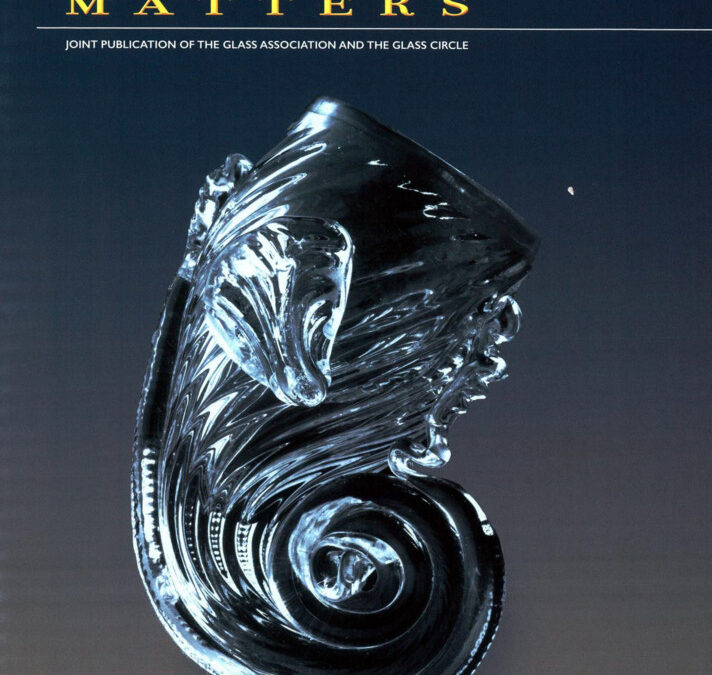
FRONT COVER: Scottish snuff mull
(Fig.22 on page
19) made
of lead crystal glass with kiln-formed decoration and a very
curly tail, tight to the body of the mull.
Private collection
BACK COVER:
Two fine and rare Lynn glasses. The first, a
Lynn ratafia glass and the second a Lynn ale glass. Both
glasses show well-defined Lynn rings.
2
Glass Matters Issue no. 3 September 2018
JOINT
chairmen
a
MESSAGE
Susan
Newell,
Chairman
of The Glass
Circle
David Willars,
Chairman
of The Glass
Association
elcome to the third edi-
tion of Glass Matters. We
hope you agree that the
identity of the new Glass Society
is now emerging strongly through
our magazine’s pages. Our house
style has been ‘refreshed’ but ef-
forts have been made to preserve
well-loved elements of both the
Glass Cone and Glass Circle News.
Given the breadth of interests of
our members ranging across con-
temporary and traditional sub-
jects, achieving the appropriate
balance between the academic
and amateur (in the best sense) is
not always easy. Nevertheless, in
Brian Clarke and Athelny Town-
shend we are lucky to have a ded-
icated Editor and Designer who
can be relied upon to represent
all those interests while at the
same time challenging us to look
at new areas.
Since the last issue in April,
both the Glass Circle and Glass
Association have taken critical
steps towards joining together.
The GC held an Extraordinary
General Meeting on 28th June re-
sulting in an overwhelming vote
in favour of the merger. The GA,
bound by a different set of rules,
chose to inform its members
that the merger would take place
unless there were significant ob-
jections. In the event there were
none. In addition, and as we meet
with members and discuss the sit-
uation, what emerges is a ground-
swell of opinion that suggests we
are pursuing the right path.
What next? Subscriptions for
GC members are due soon and
you will have received instruc-
tions from our respective Trea-
surers about this. The GA’s sub-
scription year runs from August
and we are bound by the rules
to give twelve months’ notice of
change. Plans to align our rates
and pool our membership lists
and administrations are in hand.
Moreover, during the year ahead
a new constitution will need to be
drawn up, new officers and com-
mittee members elected and our
finances merged.
We are delighted to have se-
cured the Victoria and Albert
Museum for our next meeting on
Saturday 13th October and look
forward to seeing you there. As
well as a feast of glass-related
events, the GA and GC will hold
AGMs which will mark the fi-
nal chapter in our independent
activities and launch our new
joint society. Details of the day
will be circulated shortly, but we
are thrilled that Reino Liefkes,
Senior Curator of Ceramics and
Glass will take us on a tour of
the galleries focussing on twen-
tieth-century and contemporary
acquisitions. There will also be a
further tour of the magnificent
historic glass collection and a talk
on early glass collecting at the
museum.
The museum began its life in
1852 as the Museum of Manufac-
tures long before Queen Victoria
laid the foundation stone in 1899
for what became the national
collection of art and design. The
V&A’s glass collection grew ini-
tially according to guiding princi-
ples based upon improving taste
established by its first Director,
Henry Cole. This may seem a far
cry from the glass many of us
have at home, but collecting can
be an absorbing goal in itself for
many of us. Some also seek to
understand the context and go
deeper into the background of
their glass by undertaking some
original research. The many refer-
ence books and archives available
have now been augmented by the
internet which can be extremely
useful in opening up new avenues
of information. We are constant-
ly amazed at the niche areas some
of you develop to a high level of
expertise and would encourage
you to share your knowledge by
contributing an article to the
magazine or by offering to give a
talk to illustrate your passion.
Susan Newell and
David Willars
Joint Chairmen of the Glass Society,
formerly the Glass Circle and the Glass
Association
British Glass Biennale
2019
Save the dates: 23- 26 August
As autumn is moving rapidly
towards us, Janine Christley and
the Ruskin Mill Trust is in the
process of planning the British
Glass Biennale 203.9, Stourbridge;
appointing jury members and
identifying the prizes and awards.
The
Glass Society will be following
in the footsteps of the GA and
helping to fund the catalogue and
donate prizes.
Glass Matters Issue no. 3 September 2018
3
CAMEO ENGRAVING
Cameo Glass
by
Frederick, Ludwig
AND
William Kay
Bill Millar
D
errand for engraved
glassware in the sec-
ond half of the 19th
century outstripped the ca-
pacity of British glassmak-
ers and decorators. Today
we would respond by im-
porting finished items from
China. Victorian business-
men did things differently:
they brought in glassmakers
and engravers, largely from
Bohemia. Frederick Engle-
bert Kny (pronounce nee)
was one such immigrant;
he was one of a number of
Bohemian engravers who
settled in England in the
1850’s, working in Stour-
bridge. He went to work for
Thomas Webb & Sons about
286o where he soon became
the head engraver. Based on
the few pieces which can be
positively identified as his
work, he is acknowledged as
one of the greatest engrav-
ers of the period. Two of his
sons were directly involved
in the glass industry: Lud-
wig, born in 1869, became
head of design at Stuart,
while William, born in 187o,
became a partner and de-
sign director with Webb
Corbett.
Given the paucity of en-
graved glass attributed
to Frederick, it was a sur-
prise to discover that there
are currently six pieces of
carved cameo glass attribut-
ed to Frederick, Ludwig and
William on loan to the Dud-
ley Council collection from
private collections. These
were loaned by three differ-
ent descendants of the Kny
family, so despite a total ab-
sence of signatures on the
pieces, the family links have
provided the attributions.
It is likely that some of the
items will be returned to
their owners in the near fu-
ture so it is timely that this
article should be published.
The first three items,
shown in Figs.i,
2
and 3,
come from the same source
and are believed to be the
joint work of Frederick and
LEFT:
Fig.1
Panel
with Greek shep-
herd with horn,
edged in silver.
Height 25.5cms,
width 6.5cms.
ABOVE:
Fig.2
Panel with Greek
woman holding
a goblet riding
on the back of a
centaur, edged
in silver. Height
14.5cms, width
16cms.
BELOW:
Fig.3
Panel with two
Greek women
one with a script
the other with
a tambourine,
edged in silver.
Height 3.4.5cms,
width 16cms.
4
Glass Matters Issue no. 3 September 2018
CAMEO ENGRAVING
William. They comprise
three decorative panels
from the same white-on-
amber blanks. All three are
edged in silver, stamped
“silver” on the reverse.
There is a common Greek
theme and the quality of
the carving is outstanding.
The panels serve no appar-
ent function other than
being entirely decora-
tive. The silver edging
obscures part of the
decoration on all three
panels so the framing
must have been an after-
thought. There is a hook
on the reverse which can
be seen as the dark area in
the centre top of the three
panels. It would seem that
Frederick and William pro-
duced them for their own
benefit, rather than as com-
mercial products.
The next two items were
produced by Ludwig. The
small panel with the wood
frame at Fig.4 has an en-
tirely different subject from
the other five items and
could best be described as
whimsical. It has a flying
elf or fairy with butter-
flies, moths and flies. The
background colour looks to
be darker than in the first
three panels, though could
be the same, just appearing
darker as it is enclosed in
the wood frame. As a loan
item there could be no ques-
tion of removing it from
the frame to compare the
colours. The brooch shown
at Fig.5 was produced from
a completely different co-
loured blank, but returns
to the Greco/Roman theme
with the head of a man
wearing a laurel wreath. The
accumulation of dust and
dirt in the grooves of the
carving accentuates the de-
tail of this piece.
The final item at Fig.6
was caved by Frederick
and given to William on
his wedding day in 1899.
The subject is the head of
a Greek warrior and the
blank is clearly similar to
the first three items. What
cannot be seen from the
photograph is that the
oval is slightly concave.
The carving is less detailed
than items
1
to 3 but most
effective in its relative
simplicity.
The similarity of the
blanks for the panels
in Figs.i,
2,
3 and 6 would
suggest all four
were produced at
about the same time,
near the turn of the centu-
ry. There is no information
to suggest when Ludwig
produced his two pieces.
This article presents
previously
unrecorded
information, that of cameo
carving by the Kny family
members. Detailed study
of the six items would
undoubtedly bring a greater
understanding to the craft
of Frederick, William and
Ludwig Kny and enable
a comparison with other
cameo glass of the period.
It also reminds us all of
the importance of family
histories.
LEFT:
Fig.5.
Brooch with a
Greek or Roman
male crowned
with laurel.
Diameter
3.5cms.
BELOW:
Fig.6
Oval with the
head of a Greek
warrior. Height
8.5cms, width
6.5cms.
RIGHT:
Fig.4
Panel with
flying fairy,
butterflies,
moths and flies
in a wooden
frame. Panel
excluding frame
7cms x 7cms.
Glass Matters Issue no. 3 September 2018
5
I 9 TH CENTURY LIGHTING
_British
COUNTRY HOUSE
Lighting
Part II: The
Nineteenth Century
John P. Smith
U
ntil near the very end of the
18th century the only form
of lighting was the candle,
primarily made from beeswax or
tallow; this was mentioned but
not discussed in my previous pa-
per.
(Glass Circle News, Issue 143,
June
2017).
Oil only came into use
after 1785.
Candles were still used in the
nineteenth century and the in-
creasing availability of cut glass
made light fittings even more
BELOW
Fig.i
Wick hold-
er for Argand
lamp.
BOTTOM
Fig.2
Set of
three lamps,
unusually with
glass reservoirs
for the oil. The
oil could be quite
dark and was
usually in a
metal reservoir.
BELOW RIGHT:
Fig.3
Hanging
lamp for oil.
elaborate, but candles became in-
creasingly unimportant.
In 1784, a Swiss, Aime Argand,
patented a new form of lighting
using a tubular wick fed with oil:
air could ascend up through the
wick, giving a good supply of ox-
ygen and the flame was roughly
ten times brighter than a candle.
At that time the only oils avail-
able were whale oil, colsa oil (now
known as rape seed oil) or olive
oil. The thick, viscous oil was fed
from an upper reservoir by gravi-
ty to the middle of the wick: most
went up to the flame, but some
descended down the wick and
had to be collected in a receiver
below.
Fig.1 is a close-up of the work-
ing part of the lamp, showing
the tube over which the wick
was placed. Parker and Mathew
Bolton used this patent, as did
the highly successful Birming-
ham firm of Messenger, who had
a large export business to the
USA. Figs.2 shows a set of three,
hung with glass drops.
Fig.3 shows a hanging lamp
with the reservoir for oil in the
middle, while Fig.4 shows a very
elaborate related hanging lamp
for candles.
Glass candelabra remained
popular: Fig.5 shows an exam-
ple by Apsley Pellatt, c1825, con-
taining a sulphide of a goddess
and Fig.6 shows a later, rather
beautifully cut leaf pattern pair.
I should digress here – country
houses were very dark at night
and people used lanterns to move
about safely. I could not find an
example of an English lantern;
they tended to be rather rudi-
mentary and few have survived,
but Fig.7 is a fine continental en-
graved example, currently in Duff
House, Banff, Scotland. Fig.8 is
an example of a Sheffield plate
chamber candlestick with an
enamelled shade: very fetching in
the bedroom.
F. & C. Osler was founded in
1807, initially as just a drop mak-
er. By 1832 they were making
complete chandeliers in their own
engineering works and by 1852
they had stopped buying in arms
6
Glass Matters Issue no. 3 September 2018
LEFT:
Fig.4
Elaborate hanging 4
lamp for candles.
BELOW LEFT:
Fig.5
Candleabra
with Sulphide by
Apsley Pellatt.
TOP RIGHT:
Fig.6
Elegant pair of
candelabra circa
1835.
RIGHT:
Fig.7
Portable lantern
for use in a dark
house. 18th
century
engraved,
probably
German.
BELOW:
Fig.8
Victorian Shef-
field chamber
candlestick, with
enamelled shade
and snuffer.
19TH CENTURY LIGHTING
Glass Matters Issue no. 3 September 2018
7
riV110
13111OLD‘
_)
` 1311
–
0.11A CRAM
1;.i._CA131,11a1)_Eff2;1) 1;301.
DI)
I(11
01( ) )1> I.
n
AI”( CI)
(11
I
t I
‘
2
– ti
v
i d
n
s
11
\k,ii \
I
t
\ilartlip
AC
,
-1.1Th:
2
5;4i)
,,
, fir
MANI ‘FACTORY ‘.;110W1100)1S
111;ft\l)
S’ 1
–
111:1ING,V)1
t.
Till{ ART-JOURNAL ADVERTISER
F. & C. OSLER,
Dl, OXFORD STREET, LONDON.—MANUFACTORY. BROAD STREET, BIRMINGSAM.—ESTABLISSED 1007
MANUFACTURERS OF GLASS CHANDELIERS, GLASS LUSTRES, TABLE GLASS, &c. &C
A
SELECT AND LA
rENsxvz
STOCE, IN EVERT
T .
n
41,1,
ON
PATTERN,
RICHLY-CUT CRYSTAL
GLASS CHANzmumws.s,
will! GLASS IIRANCIILA,
FOR DRAWING. P.00110, ete.
ELEGANT
CRYSTAL GLASS CHANDITLIFRS
Fort
GAS,
Theatre, Couce)I. Amembly. end Bell TtetaneLtellted by 0.10.010, on the Low.) Tenet
19TH CENTURY LIGHTING
and other parts and owned their
own glasshouse. Fig.9 shows the
cover of one of their catalogues,
from the works in Broad Street,
Birmingham. In 1847, Prince Al-
bert bought a pair of torcheres
for Queen Victoria as a birthday
present; Fig.io is a 19th century
photograph of them in Osborne
House, Isle of Wight, where they
remain to this day
(although they
have recently been moved to Buck-
ingham Palace for an exhibition).
Fig.ti shows one of Osler’s typ-
ical advertisements, for elegant
crystal glass chandeliers, placed
in The Art-Journal Advertiser.
RIGHT:
Fig.9
Cover for an
Osler catalogue
after 1852.
ABOVE:
Fig.io
Pair of Osler
torcheres in
Osborne House,
Isle of Wight.
Contemporary
photograph.
BELOW RIGHT:
Fig.ii
Advertisement
in ‘The
Art
Journal’.
BELOW:
Fig.12
Gas desk lamp,
with shade
removed to show
burner.
Coal gas was developed in the
United Kingdom by William Mur-
dock, with the first London street
being illuminated by gaslight in
1809. The idea was ridiculed by
Sidney Smith, the famous wit,
who lampooned the idea and the
following rhyme was popular in
Glasgow:
We thankful are that sun and moon
Were placed so very high
That no tempestuous hand might reach
To tear them from the sky,
Were it not so, we soon should find
That some reforming ass
Would straight propose to snuff them
out,
And light the world with gas.
Sir Walter Scott embraced gas
with enthusiasm; he was Chair-
man of the Edinburgh Gas Com-
pany and installed a gas-mak-
ing apparatus in his estate at
Abbottsford. Still standing on
his desk is a glass light similar
to Fig.12. Osler produced a very
8
Glass Matters Issue no. 3 September 2018
LEFT:
Osler ‘bamboo’
style hanging
gas lamp.
RIGHT:
Figa4
Pair of
elaborate
gas wall
lamps.
a
.7
9
19TH CENTURY LIGHTING
attractive glass bamboo-style
hanging gas lantern, illustrated
in Fig.13. Wall lights contin-
ued to be a sensible method of
lighting rooms, easy to light
with light in the right place. Wall
BELOW:
Fig.15
Joseph Swan,
inventor of the
incandescent
electric light
bulb (his de-
sign improved
by Thomas
Edison).
lights for candles still continued
to be made, but many were made
for gas or oil. Fig.14 shows a pair
of gas lights – you can see the
tap, with cut glass fittings, in
the middle of the arms. Safety
matches had not been invented
at the beginning of the gas age,
so it must have been quite excit-
ing to light the gas, using spills.
Coal gas was quite smelly, and it
gave off a large amount of heat,
so ventilation was important.
For large gas-lit chandeliers, a
perforated rose was attached to
the ceiling, venting to the atmo-
sphere along a horizontal duct
and out through the brickwork.
Unfortunately they were given
the rather ugly name of `gaso-
hers’.
By the 186o’s, kerosene (paraf-
fin to us in the UK) had become
the preferred fuel for lamps.
With the growth of the American
petroleum industry it was quite
cheap and was much more mo-
bile than colsa oil, which was very
viscous. Paraffin could be poured
into the reservoir below the light
and capillary action would cause
the oil to easily rise up through
a simple wick. As well as being
grand, simple oil lamps then be-
came affordable for the general
population.
Osler, and others, particu-
larly Perry, continued to make
imposing chandeliers for home
and abroad, which could be for
glass, oil or candles, depending
on the market. These designs still
harked back to the 18th century.
In fact, Osler advertised a ‘Wa-
terford’ chandelier in the style of
100 years earlier.
This all changed with the inven-
tion of the incandescent electric
light bulb, almost simultaneously
by Thomas Edison in the USA and
Joseph Swan in the UK. Swan,
a bearded hero of mine,
seen
in Fig.15, took out a patent in
1879/80 and had, by 1889, electri-
fied the Savoy theatre. For almost
the first time light did not come
a
2
Glass Matters Issue no. 3 September 2018
9
I 9 TH CENTURY LIGHTING
from a naked flame and light
bulbs could be hung upside down,
directing light to where it was
needed. These were called `elec-
troliers% Fig.i6 is a typical Osler
example, just like a candle-lit
chandelier, but with the arms
turned upside down. The light
now shines down rather than
up, which is a great advantage.
Figs.17 & 17a shows an Osler ex-
ample with the design breaking
away from the past, together with
its scaled drawing in their design
book
(now in the Birmingham Mu-
seum).
Fig.18 shows the influence
of the Arts and Crafts movement,
the eye-catching design being by
Benson and the glass by White-
friars.
The twentieth century was not
a great time for lighting inno-
vation, either in design or tech-
nology. Fluorescent lighting was
introduced in the
19305
and was
very efficient, but unlike other
forms of lighting, the light out-
put is not regular across the spec-
trum, so the light produced is not
pleasing. Scandinavia produced
many of the most innovative
lighting designs throughout the
loth century and both Murano
in Venice and Germany with the
Bauhaus group progressed the
design of lighting. Regrettably,
England had rather lost the ca-
pacity to innovate.
The advent of LED lighting in
the 21st century, with the devel-
opment of fluors to give a nearly
continuous spectrum and a very
low heat output, is leading to
designs not possible in the past.
(Fluors are a group of chemicals,
largely base on Fluorine, which are
used in LED lighting to give a more
continuous spectrum than that
coming from basic LED lighting,
which has very pronounced peaks in
the spectrum; they fluoresce across
the spectrum to give an approxima-
tion to daylight or are particularly
designed for candlelight).
LEFT:
Fig.i6
Osler electrolier
with down-fac-
ing lights.
RIGHT:
Fig.37A
Osier electrolier
with enclosed
light shades.
To RIGHT:
Osler electrolier
with enclosed
light shades –
drawing.
RIGHT:
Fig.18
Copper ‘Arts
and Crafts’
chandelier,
designed by
Benson, glass
by Whitefriars.
I 0
Glass Matters Issue no. 3 September 2018
MANCHESTER GLASS
MANCHESTER’S
CiaSS
REAPPRAISED
A review of a talk given to
The Class Circle
by David Willars on 17 April 2018
Sally Haden
0
ne area of British
glassmaking
histo-
ry that has received
little attention is the man-
ufacture of table and deco-
rative ware that took place
in and around Manchester
in the nineteenth century.
A review of the available lit-
erature quickly reveals that
apart from some awaken-
ing of interest around the
198os and some academ-
ic studies of recent years,
little analysis of the city’s
true contribution to British
glass is available to collec-
tors or historians. So it was
very interesting to attend
the illustrated talk given by
David Willars earlier this
year. Calling on various
sources, including his own
MA research and recent
conclusions drawn by sev-
eral North-West collectors,
he described the range, vi-
brancy and strength of the
city’s Victorian glass indus-
try in great detail, leaving
no doubt in listeners’ minds
of its significance.
David began by explain-
ing that there were upwards
of twenty companies pro-
ducing glass in Manchester
during the nineteenth cen-
tury, although a number of
these were either small, rel-
atively short lived, or didn’t
make widespread use of
the Victorian registration
system, thus making attri-
bution to a specific factory
difficult.
Of the main companies,
the first to be formed in
the city and eventually
known as Molineaux Webb
& Co. operated for a hun-
dred years, until the 193os.
At the opposite end of the
scale, John Derbyshire’s
glasshouse survived only
five years, but during that
time achieved a reputation
that surpassed by far its
short lifespan. Most of the
companies could trace their
roots back to nearby War-
rington, and for the most
part were related, often
through marriage. The close
family ties led to a good deal
of overlap between them in
respect of glass design, rec-
ipes, colour and finish and
many of these families even
had adjacent plots in the
Manchester General Cem-
etery just north of the city
centre.
To the uninitiated, the
initial impression is that
Manchester’s contribution
to the glassmaking indus-
try was limited to pressed
glass. The Victorian regis-
tration system almost ex-
clusively featured pressed
items and in the absence of
trademarks and catalogues
we have little other evi-
dence to make attributions.
This view is, however, cat-
egorically wrong. Utilising
the glassmaking skills that
had been developed in War-
rington in the eighteenth
century, Manchester’s pro-
duction of handmade glass
was of the very highest
order. Furthermore, man-
ufacture using tradition-
al methods was a parallel
activity alongside pressed
glass production through-
out the nineteenth century
and most certainly long af-
ter pressed glass techniques
had been perfected.
Recent analysis of the
few old trade catalogues
and pattern books that are
extant shows just how im-
portant the non-pressed
segment of production was.
For example, in 1846, only
two years after the business
was established, the Percival
Vickers catalogue illustrates
close to three hundred free-
blown decanter designs. Of
all the Flint Glassmakers
Friendly Society’s districts
in Britain, the district of
Manchester had the high-
est number of members in
1867, 1868, 1870, 1872 and
1877. The quantity of glass
being produced towards
the end of the century was
staggering, and included a
great deal of industrial glass
such as pavement lights and
signal glass for ships and
railways. The quality of the
city’s glassware was just as
significant. In 1851 it was
`affirmed without prejudice
to other manufacturers in
localities where such busi-
ness is now carried on, that
the Manchester glass is in
no way inferior to the best
in the country’.
It was perhaps in rela-
tion to the identification
of Manchester glass that
the talk was most interest-
ing. In 1980, referring to
the Manchester Town Hall
Goblet and other works by
Wilhelm Pohl, Roger Dod-
sworth wrote: ‘These glass-
es (and a handful of other
items) are almost the only
known examples of cut
and engraved glass made in
Manchester. Other facto-
Glass Matters Issue no. 3 September 2018
a
0
a
0
TOP TO BOTTOM:
Figs.ia, ib & lc
Celery Vase,
Molineaux
Webb& Co.,
c1885, together
with extracts
from the MW
pattern books
containing the
same detail.
MANCHESTER GLASS
ries such as Percival Vick-
ers, Burtles Tate & Co. and
the Derbyshire Bros. were
also producing this type of
work, but not a single exam-
ple has been identified yet’.
Recently, however, careful
work by several people has
been able to overturn this
situation, and David took
the audience through the
various companies to show
what is being uncovered.
Although the celery vase
in Fig. i is not directly il-
lustrated in the Molineaux
Webb pattern books, the
identical shape and geo-
metric design is, thereby
confirming attribution.
Fig.2 illustrates a claret
bottle from the 1502 set,
as illustrated in the 1893
Percival Vickers catalogue.
Such detail would have
taken many hours of work
to complete and, in conse-
quence, such items were
not cheap to buy. Barbara
Yates describes how a sin-
gle celery vase of 1881 could
cost more than either a
footmaker’s or journeyman
cutter’s whole weekly wage.
Regarding pressed glass,
Manchester is, of course,
well known, but the lead
it took in the UK’s pressed
glass industry is little appre-
ciated. The pressing of glass
was an American technique,
although it seems that the
skills were also being devel-
oped in the Low Countries
before coming to Birming-
ham in the UK. From the
Midlands, the pressing of
glass spread quickly to Man-
chester, where the skills re-
quired for mould making
were readily available from
craftsmen trained in the
engineering requirements
of the cotton industry and
the burgeoning railway
network. It is important
to remember that by the
middle of the nineteenth
century, Manchester was
renowned across the world
for its manufacturing, trade
and prosperity. Free of the
weight of an embedded tra-
ditional glassmaking heri-
tage, the Manchester com-
panies were accorded more
freedom to innovate.
David believes that the
first pressed glass plates
made in Manchester were
produced by Molineaux
Webb as early as 1836 or
1837. Production using the
new technique of pressing
was introduced slowly, reg-
istrations then grew in the
186os, followed by a veri-
table explosion of design,
colour and finish in the last
quarter of the century. Ini-
tially, pressed glass designs
were made to imitate tradi-
tional cut glass.
The Derbyshire family of
glassmakers do not, super-
ficially, sit easily alongside
the other companies. First-
ly, their businesses were
based in Hulme and Salford
rather than Ancoats. Sec-
ondly, they were not related
by marriage to any of the
other major companies. Ev-
idence recently uncovered
shows that in 1841 the Der-
LEFT:
Fig.2
Claret bottle.
Percival
Vickers.
12
Glass Matters Issue no. 3 September 2018
MANCHESTER GLASS
BELOW:
Fig.3
John
Derbyshire’s
Rock of Ages.
Unregistered
but marked with
JD’s anchor.
byshire family was living
practically on the doorstep
of the glassworks of Wil-
liam Robinson in Hulme
(a district across the city,
some distance away from
the glass factories clustered
in Ancoats). At this time
James Derbyshire was
16,
a ‘glass blower apprentice’,
and John Derbyshire was an
infant. Given the fact that
the Robinson glassworks
was the only one in that
district at the time, it seems
very likely that this is where
James, the elder Derbyshire
son, was apprenticed, along
with some of his brothers.
As William Robinson had
come into Hulme in the
182os from Warrington
where his family had been
engaged in glass, the Der-
byshire family were able to
hone their skills in the same
way as the other Manches-
ter companies.
As an adult, John Der-
byshire joined James in
business before branching
out on his own in 1873 in
Salford. After a few very
productive years, finan-
cial problems and personal
tragedy beset him, but his
legacy was well established
by a range of decorative
items: lions, greyhounds,
Britannias, busts of Queen
Victoria and the winged
sphinx, this being his most
famous piece. Furthermore,
John identified his goods
with his anchor trademark.
Where John gained his
inspiration from is open
to conjecture, but it does
seem that the industry had
some overlap with ceram-
ics manufacturing in near-
by Stoke on Trent. Josiah
Wedgwood, for example,
was producing black ba-
salt sphinxes a century
before John Der-
byshire
produced
his version in glass.
In a similar vein, it is
worth pondering why
John marked his goods
when no one else in glass
did so at the time, though
the companies of Sowerby,
Greener and Davidson from
the North-East followed
closely on Derbyshire’s
coat-tails. Again, was he
influenced by the ceramics
industry with its well-de-
veloped marking system?
Alternatively, John may
have wanted some way to
differentiate his goods from
those of his brother James,
after their businesses sepa-
rated in the early 1870’s.
Fig.3 illustrates a less
well known piece by John
Derbyshire, the
‘Rock of
Ages’.
As with most of Der-
byshire’s decorative glass,
this was produced in a va-
riety of colours. Most com-
monly in plain flint glass
and uranium green, both of
which are shown.
Burtles Tate produced a
light shade in their trade-
mark green and yellow
opalescent finish. The piece
in Fig.4 was part of the Fru-
min Edgeley collection be-
queathed to the Broadfield
House Glass Museum.
But has the Victorian
glassware that came out of
Ancoats, Hulme and Salford
fallen into the shadows just
because of the fascination
and collectability of other
sorts of glass? Or has the
common perception of his-
toric Manchester as `Cotto-
nopolis’ been responsible?
It may have been much to
the detriment of the history
of glass factories, as well as
other important activities,
that Victorian Manchester
is almost always celebrat-
ed for its textiles – in fact,
overwhelmingly so. As Da-
vid’s talk demonstrated, it
is now time to take another
look at Manchester’s glass,
for surely there is a wealth
of material which, when it
is discovered, identified and
appreciated, will establish
the true contribution the
city made to British glass-
making.
FOOTNOTES
1.
Bone, Peter. The Glass Industry in
Manchester & Salford. The Journal
of the Glass Association, 8 (2008)
20-28
2.
Dodsworth, Roger. The Manchester
Glass Industry. The Glass Circle, 4
(1980) 64-83
3.
Hajdamach, Charles. British Glass
1800-1914. Antique Collectors’ Club,
1
99
1
4.
Lattimore, Colin R. English 19th
Century Press-Moulded Glass. Bar-
rie & Jenkins, London, 1979
5.
Slack, Raymond. English Pressed
Glass 1830-1900. Barrie & Jenkins,
London, 1987
6.
Yates, Barbara. The Glassware of
Percival Vickers & Co. Ltd., Jersey
Street, Manchester, 1844-1914. The
Journal of the Glass Association,
2
(1987) 29-39
7.
Matsumura, Takao. The Labour Ari-
stocracy Revisited, Manchester Uni-
versity Press, 1983, p. 171-172
8.
Illustrated Catalogue of the Indu-
stry of all Nations’, The Art Journal,
new series, 3 (1851), 290.
9.
Dodsworth,2980. As above
10.
Yates, 1987, p.35
LEFT:
Fig.4
Burtles Tate
lampshade. Reg.
No. April
618
99.
Glass Matters Issue no. 3 September 2018
13
OTCII
Eno Q
1
7
EN
E to a
CH. ILLY ) N
–
f? E
LI 0
,ty.
,
. eT nq lr.
nd ?Weak
pud.r,
creel
oae take that Jo,.
,
3:C..r
.
texatd
.
ye 4.4e lined uwa.
,
a- 4K
–
,
,r
,
e
444
71
,
67.,1
aunt Are ham..
net th.,
SNUFF MULLS
ChM
SNUFF
Mulls
Jill Turnbull
INTRODUCTION
T
he popular habit of
snuff taking has left be-
hind many collectable
items, principally snuff con-
tainers, generally known as
snuff boxes, made in a wide
variety of materials which
can be found in museums
and private collections. In
England the term ‘snuff
box’ has remained but in
Scotland it has gradual-
ly changed since the early
1.8th century, first to ‘mill’
and then, particularly in the
East of Scotland, to ‘mull’.
This short article discusses
a Scottish collection and
refers, therefore, to snuff
mulls. A typical early 1.8th
century Scottish snuff box
is shown below, construct-
ed from staves of ivory and
ebony, with an unmarked
silver base and hinged lid.
In Scotland small amounts
of silver were not required
to be hallmarked, so that
clue to the origin of the
mulls is usually missing.
One Scottish collector
owns a wide variety of the
early snuff boxes and mulls
dating from the i.7th cen-
tury, many of them (and
those relevant to this arti-
cle) created from horn, with
beautifully crafted hinged
lids, often of silver. Scottish
mulls were often designed
to be placed on a table or
mantelpiece but the small
horn mulls were intended
to fit in the pocket, to nestle
comfortably in the hand and
to allow a pinch or spoonful
of snuff to be shared with
friends and family. The lids
had to fit snugly, but not be
difficult to open, so that the
snuff would retain its po-
tency and not leak out, but
would be readily available
when required. It is gen-
erally acknowledged that
ABOVE: Fig. 1
This
cartoon c.18o7 by
Isaac Cruikshank
titled ‘Scotch elo-
quence to a chilly
congregation’
shows the man
on the far right
holding his horn
snuff mull and
cheering himself
up with a pinch of
snuff.
BELOW:
Fig.
2
An early 18th
century Scottish
snuff box created
from staves of
ivory and ebony,
which preceded
the curly horn
mulls.
Glass Matters Issue no. 3 September 2018
‘G
Pr
iva
te
co
llec
t
io
n
(
Pr
iva
te
co
llec
t
io
n
)
SNUFF MULLS
ABOVE:
Figs.3 — 6
Examples of
typical horn
snuff mulls,
showing
variation in the
amount of curl
in the tails and
in the closures.
RIGHT:
Fig.7
An interesting
mull, heavily
cut with an
engraved and
gilded figure
of a racehorse
and the name
Lucifer. Much
of the gilding is
missing. Length
locms, diameter
of opening
4.4cins.
most horn snuff mulls were
made in Scotland, where
the style became iconic be-
tween about
1720
and 190o.
The aim of this article is to
illustrate examples of those
rare mulls made of glass
appearing to date from the
19th century
To put the glass mulls in
their wider context, Fig-
ures 3
–
7
show four typical
shapes of Scottish horn
snuff mulls. As can be seen,
the diameter of the tops are
very similar, the variation
lies in the number of curls
in the tail and in the clo-
sures.
GLASS SNUFF MULLS
Glass snuff mulls are rare,
not just because they are
few in number, but also be-
cause there seem to be very
few references to them in
glass literature. This article
is written in the hope that
more information and new
examples will come to light.
Snuff mulls come in many
shapes and styles but all the
known glass snuff mulls are
a
horn shaped, most being
similar in size. It has only
been possible to measure a
few of those illustrated, but
there is not a large varia-
tion, most ranging between
8.8 and
11
cm long, the top
diameters being between
roughly 3.4 to 5cms, with
one exception which will be
discussed later.
Although the glass snuff
mulls follow the design of
their horn counterparts,
cut glass is less smoothly
tactile and is heavier than
1;
the horn examples, so not ”
as comfortable in the hand
or pocket, which suggests
that most were actually in-
tended to be placed on the
table, where they could be
seen and admired. They fall
into two main categories:
cut flint glass, some with
expensive silver hinged lids,
and those decorated with ri-
garees and often enhanced
by other applied glass
shapes, often with plainer
stoppers – some hinged, but
many others missing. These
mulls often have a more ex-
aggerated curling tail. The
big question is, where were
they all made?
There is, fortunately, one
rare example of a glass mull
decorated with an engraved
and gilded racehorse, about
which there is sufficient ev-
idence available to provide
very strong indication that
it, at least, was made in
Scotland.
The heavily cut mull in
Glass Matters Issue no. 3 September 2018
Pr
iva
te
co
llec
t
ion
Pr
iva
te
c
o
lle
c
t
ion
SNUFF MULLS
ABOVE:
Fig.8
An intricately
cut mull, the
lid decorated
with a red
glass knop.
The initials JK
are ornately
engraved on the
front cartouche.
Figure
7
has a minimally
curled tail, bearing on the
front an engraved and par-
tially gilded racehorse and
jockey with the name Lu-
cifer below. The silver lid
has a central inset facetted
piece of pale yellow glass.
It is not hallmarked. Fortu-
nately a silver gilt punch la-
dle has been advertised for
sale several times in recent
years, providing informa-
tion which sheds more light
about the possible source of
the snuff mull. The punch
ladle is hallmarked, show-
ing it was made by George
McHattie of Edinburgh in
1819. It is also engraved
with Lucifer’s name.
Lucifer was born in 1813
in the north of England, rac-
ing in 1816 and 17 in Catter-
ick, Doncaster and Newcas-
tle under the ownership of
Sir M.W.Ridley. In July 1817
he raced for the first time in
Scotland, at Edinburgh, and
was sold shortly afterwards
to a Mr P.G.Skene. There-
after he raced only in Scot-
land, where he was trained
by George Dawson, father
of a dynasty of racehorse
stables at Stamford Hall,
Gullane, about i8 miles east
of Edinburgh. The Caledo-
nian Mercury of i6 July
1821 described him as ‘Sir
William Maxwell’s celebrat-
ed racehorse Clootie (for-
merly Lucifer)’.
This history shows that
Lucifer raced in Scotland
very successfully under
that name for just over two
years- from July 1817 to Oc-
tober 1819 – coinciding with
the date of the punch ladle.
It seems unlikely that the
snuff mull and ladle were
given to Mr Skene as priz-
es — these were normally
5o or ioo guineas or a tro-
phy such as a cup or plate.
The amount of cash won
by the ‘celebrated Lucifer’
would easily have justified
the owner splashing out on
a conspicuous trophy of his
own, so it seems reasonable
to say that this glass snuff
mull is almost certainly
Scottish. The provenance
of most of the others is far
from clear although there
are one or two likely Scot-
tish candidates, while some
trainers.
In 1818 and 1819 Lucifer
won several prestigious rac-
es for Mr Skene, including
the Gold Cup and His Maj-
esty’s Plate in Edinburgh,
and in October 1819 he was
sold again to Sir William
Maxwell, who changed his
name to Clootie. The horse
died unexpectedly in July
1821 at George Dawson’s
BELOW:
Fig.g
The undecorat-
ed stem of this
mull enables
the container
for the snuff to
be seen clearly.
16
Glass Matters Issue no. 3 September 2018
Pr
iv
a
te
co
llec
t
ion
SNUFF MULLS
I
bands of diamond and step
cutting, followed by a tail
cut in eight facets. It has a
hinged silver collar and lid
with a cork stopper.
Figures ioa and b show
different views of a well-
shaped cut mull with a
nicely curled tail and a
thistle decorating the
silver lid. The Nation-
al Museum of Scotland
accession
description
states that the initials
I.Mc.D. are engraved ‘on
the shield—shaped front
panel’ and that the source
was the City Glass Compa-
ny. The City Glass Works,
Glasgow, was estab-
lished by James
Couper in 1851, so
appears to be the
most likely source.
The very fine
mull illustrated in
Figure
11
is deeply
cut with leaves and
fans. It was exhibited
at the Glass Circle Di-
amond Jubilee Exhibition
in 1997. The initials CL are
engraved on the stem, while
the silver cover is finely
engraved with the coat of
arms and motto of the Wor-
shipful Company of Brew-
ers. It is hallmarked with a
lion passant and the initials
TW, and was sold as part of
the Henry Fox Collection on
8 December 2004, lot 117.
(Bonhams London) It is
now in a private collection.
Figure
12
shows a fine,
heavily cut mull missing its
lid while the proportions
of the example in figure 13
are rather less pleasing. The
mulls in figures 13,14 and 15
belong to the collection for-
merly housed in Broadfield
House Glass Museum and
are now in storage pending
the opening of the White
House Cone Glass Museum.
Mctears of Glasgow sold
ABOVE:
Fig.3.2
A fine, heavily
cut mull missing
its lid.
LEFT DOWN:
Figs.13-15
Figia
A portly small
mull with a
somewhat out of
proportion taiL
Fig.14
Another lidless
mull with rel-
atively simple
cutting.
Fig.i5
Variations in
cutting shown
on this mull
and most of the
others, implies
that they were
one-off
productions.
ABOVE:
B
A Scottish motif
on the silver lid,
the initials
LMc.D, engraved
on the front and
a Glasgow prov-
enance, confirm
this mull was
made in Scotland.
BELOW:
Figai
A finely
decorated mull
bearing the
initials CL.
other lids bear English hall-
marks.
The mull in figure 8 has
a fine and well curled tail,
the lid is covered with a
piece of cut glass anchored
with a red glass knop. On
the front is a shield-shaped
cartouche with ornately
engraved initials JK’; circa
182o-184o. The example in
Figure 9 is decorated with
Glass Matters Issue no. 3 September 2018
17
RIGHT:
Fig.16
A fine mull
with a horn
2
lid engraved
with the
name George
Scott, possibly
suggesting a
Scottish origin.
RIGHT:
Fig.17
An ornately
cut mull with a
finely engraved
lid giving two
names, one of
which appears
in the 1846/7
Post Office
Directory as a
tobacconist in
Leith.
Pr
iva
te
c
o
llec
t
ion
SNUFF MULLS
0
the mull in Figure 16 to a
private collector. The lid
is made of horn bearing a
shield engraved with the
name George Scott. Horn
was little used in England,
so this might also be a Scot-
tish mull. The mull illustrat-
ed in Figure 17 has a useful
inscription on the lid: ‘From
John Smallwood to Jamie
Letham 1847′. It may or may
not be significant, but a
James Letham was listed in
the 1846/47 Post Office Di-
rectory as a tobacconist in
Leith near Edinburgh. Ja-
mie is, of course, common-
ly a Scottish version of the
name. No one by the name
of Smallwood is listed.
The coloured mull in Fig-
ures 18a and 18b is unusu-
al in a number of ways, the
most obvious being
the lack of tail. It
is larger than
the
other
mulls illus-
trated and is
hollow right
to the bottom.
BELOW:
Figs.18a & 18b
This mull has
an oval opening
the widest point
measuring
5.5cms. It is
only 4.3cms long
and is unusual
both in shape
and colour.
o.
18
Glass Matters Issue no. 3 September 2018
Pr
iva
te
co
llec
t
ion
C
SNUFF MULLS
FAR LEFT:
An unusual
glass mull,
simply decorated
with the name
of W. Guy
engraved within
the encircling
thistles.
MIDDLE LEFT:
Fig.2o
Another rare
mull in a simple
boot-shape, per-
haps intended
for someone in
the boot trade.
It is also oval in form, rath-
er than round. All the other
cut mulls in the collection
are of clear glass.Another
rarity is shown in Figure 19,
decorated as it is with a sim-
ple engraved design round
the name W. Guy. Wear on
the interior of the rim in-
dicates that it previously
had a collar which is now
missing. This mull is worn
on both sides, indicating
that it was probably a table
mull. It is possible that it
belonged to a woman, since
they also took snuff.
Figure
20,
is a boot-
shaped mull similar to oth-
ers made in leather or papi-
er mache. Such mulls were
relevant to boot makers and
sellers and to those who
usually wore boots for their
work, such as ostlers. The
quality of the glass is not as
good as the cut glass mulls:
it is undecorated and would
have had a cork stopper, so
would have been relatively
cheap.
A quite different version
of the glass snuff mull was
formed and decorated en-
tirely using hot glass, with
wrythen bodies and applied
glass decoration in the form
of rigarees, other shapes
and often very curly tails.
Apart from the larger di-
ameter of the opening, they
often resemble `seahorse’
scent bottles. Some of these
mulls were closed with a
cork, which is usually miss-
ing, and their lids were
generally cheaper and more
fragile than those of the cut
variety.
Figures
21-23
(Figure
22
see front cover)
are examples
of these hot-worked mulls,
three of them missing their
lids. The green glass mull in
Figure
24
is decorated with
three rigaree strips run-
ning down the body, with a
fourth going from one side
to the other round the base.
This mull can be held by put-
ting the fore finger through
the tail loop and placing the
thumb on the rest above it.
Figure
25
shows a slightly
more sophisticated example
of an uncut mull: note the
very curly tail.
It has been suggested that
the rigarees indicate the
mulls may have been made
at Alloa, but actual evidence
appears to be lacking. Willy
van den Bossche illustrates
a rigaree-decorated ‘Nail-
sea style’ bottle in his book
Antique Glass Bottles’ pub-
lished by the Antique Col-
BELOW:
Fig.22
A very different
style of glass
snuff mull, with
kiln formed
decoration.
Missing lid.
BELOW BOTTOM:
Fig.23
Catalogued as
a ‘Curly horn
snuff mull of
green quilted
glass, with the
rim and hinged
lid of tin, proba-
bly Alloa glass’.
Length 4.75″,
rim diam. 1.6″.
C
V
E
C
C.
C
0
ABOVE LEFT:
Fig.24
This green mull
is longer than
the rest at
ncms, the open-
ing is slightly
oval, and
measures 5.2cms
at its widest.
Na
t
iona
l Museu
m
o
f Sco
t
lan
d
Na
t
iona
l Museum
o
f
Sco
t
lan
d
LEFT:
Fig.25
A silver lid
decorated with
a piece of green
cut glass raises
the status of
this kiln-formed
glass mull with
its very curly
tail.
Glass Matters Issue no. 3 September 2018
19
SNUFF MULLS
Fig.26
The plain silver
lid on this mull
bears indeci-
pherable initials
and an insert of
pale yellow cut
glass. It is dated
1833.
(
Pr
iv
a
te
c
o
llec
t
ion
)
Fig.28
Possibly the
rarest of all the
glass snuff mulls
is this simple
undecorated
example, prob-
ably made for
personal use by
a glassworker.
ABOVE: Fig.27
The unusual
decorated silver
hinge to this lid
may indicate a
Scottish prove-
nance.
lectors Club in
2001,
which
he describes as ‘attributed
to the Alloa Glass Works’.
Other experts and sites on
the internet etc. also make
the same attribution but no
reference is made to actual
evidence. Since the skills
involved in creating rigarees
are not particularly sophis-
ticated, they could, frankly,
have been made anywhere.
Further evidence of a secure
attribution would be wel-
come.The ornately cut mull
in figure 26 has a plain silver
lid bearing indecipherable
initials, decorated with an
inserted piece of pale yel-
low cut glass. Different ini-
tials appear on the front of
the mull with the date 1833.
The silver lid on the mull in
figure 27 has an uncommon
hinge which is also some-
times seen on Scottish horn
mulls. The repousse decora-
tion depicts two different
unidentified flowers and a
group of thistles above the
hinge. These features might
well indicate a Scottish prov-
enance.
Somewhat ironicall Fig-
ure 28 shows possibly the
rarest example of all: a
simple, undecorated snuff
mull of relatively large ca-
pacity, well used — the sides
are rubbed — and its cork
missing. It seems very un-
likely that this example was
made either commercially
or for someone special, so it
would be pleasing to think
that one of the glass blow-
ers (maybe even a Scottish
glass blower!) created it for
his own use. Who knows?
Percy
Bate,
author
of
English Table
Glass,
published in 1913, had
some glass snuff mulls in
his collection. Two appear
in the catalogue of exhibits
of `Historic Glass Ware’
in the Palace of History at
the Scottish Exhibition of
National History, Art and
Industry, held in Glasgow
in 1911. There are no images
available but among the
list of Bate’s Jacobite wine
glasses, toddy lifters and
firing glasses are two glass
snuff mulls with purled
decoration and a ‘cut glass
snuff mull (silver-mounted),
engraved J.H.D.’, lent by
C.E. Whitelaw. Dozens
of horn snuff mulls and
Mauchlin Ware snuff boxes
were also on display in the
exhibitions, emphasising
the relative scarcity of the
glass examples.
Since horn snuff mulls
were made in Scotland, it
seems reasonable to as-
sume that some of the glass
snuff mulls were also made
there. It would certainly ap-
pear that there is sufficient
evidence that at least two
of the mulls illustrated are,
indeed, Scottish, and there
are at least two other pos-
sibilities. The tobacco trade
was hugely important to
Glasgow, snuff constituting
a large part of it, so it would
not be surprising if the oc-
casional glass snuff mull
was requested from the
local glassworks, of whose
products we are largely ig-
norant. It would be helpful
and interesting to hear of
any more examples, partic-
ularly if there is evidence as
to their origin.
There are examples of
glass snuff mulls in the Ash-
molean Museum Oxford
and Kelvingrove Museum
and Art Gallery Glasgow
– and very likely there are
others.
BIBLIOGRAPHY
Information about snuff and
its containers can be found in:
European and American Snuff
Boxes
1730-1830 by Clare le
Corbeiller, BT Batsford, 1966
Discovering Horn
by Paula
Hardwick, Lutterworth Press,
1981
a
20
Glass Matters Issue no. 3 September 2018
CREATIVE GLASS
Creative
GLASS
Exploring
Judith Gill:
lalRoses
Cla&c
WHO AM I?
T
hrough my natural and
organic experiments
when using glass or
other mediums, I would de-
scribe myself as a creative
glass explorer, a visual art-
ist. For me the journey and
the process of creation is
just as important as the fin-
ished artwork.
boundaries.
These influences came to-
gether when I studied a BSc
in textile design and devel-
oped my portfolio through
the layering and juxtaposi-
tion of colours, shapes and
textures. There is a sense of
structure and form found
nique, enjoying the process
of experimentation and
Wabi-Sabi* to develop de-
signs that I wouldn’t have
thought possible. I find
it an unusual medium as
the design possibilities are
endless: it is fragile, trans-
parent, hard, ubiquitous,
INSPIRATION
My influences have been
varied, gathered from ear-
liest memories of fascina-
tion with the jewel-like
drawings on the cover
of “The Rubaiyat of
Omar Khayyam”,
to the natural
and industri-
al forms that
surrounded
my childhood
in
Stockton-
On-Tees. I grew
up in the midst of
the mighty industries
of the North East, their
close proximity to the nat-
ural environment of rivers,
coast, moors, ancient mon-
asteries and cathedrals and
have been responding to
the contrasts of this dual-
ity through my work ever
since.
I must have inherited my
joy in the colours and pat-
terns of Moorish design
from my grandmother; her
ancestors were Spanish sol-
diers washed ashore from
the Armada. Later in life I
discovered the exuberant
genius of Gaudi and was
inspired by his sense of au-
dacious fun and the beauty
of pushing beyond known
in my work from my many
years working as an estab-
lished knitwear designer.
When I changed career, I
was excited by the diverse
tactile possibilities of work-
ing with kiln-formed glass
and machinery to create
designs that interpreted my
enjoyment of the natural
world, and captured the lu-
minosity, colour and trans-
lucency in a medium that
appears to be as fragile and
strong as the natural world.
I approach glass as a ma-
terial rather than a tech-
and used in cutting edge
technologies in commu-
nication, space travel and
architecture. It also has an
intriguing history, as 2.5
million years ago Stone Age
man used obsidian, the vol-
canic glass, to make sharp
spear heads that enabled
them to hunt more effec-
tively and grow stronger as
a society.
I found that entering a
new field without enough
knowledge was sometimes
to my advantage as I could
be open minded to using
ABOVE:
Fig.i
A
symphony of
Bluebells.
Glass Matters Issue no. 3 September 2018
21
CREATIVE GLASS
RIGHT:
Fig.2
The
effervescence
of Tulips.
technology, without being
constrained by it.
DEVELOPING WORK
I like the old fashioned way
of recording flower shapes,
landscapes and skyscapes,
by sketching and paint-
ing in a workbook, so that
I can add photographs to
record images and notes
on colours. This lets me
return to my records and
sketch ideas for patterns
and designs. It can either
take a long time to distil an
idea or, on occasion, imag-
es just pop into my mind.
Different art forms often
cross over, enlightening
my direction. For example,
blending colours onto silk
can create unique combi-
nations and colours that
inspire my glass experimen-
tations to design a flowing
intermingling intensity of
colour that I wouldn’t have thought of myself.
My approach is
inquisitive
as I’m always interested in
how to translate an image
onto glass. Looking at and
marvelling at the patterns
of oil on water led to a num-
ber of bodies of work, which
explored the use of dichroic
and iridescent glass.
The glass sculpture of a
bluebell wood (Fig.i) was
my response to record the
illumination of water in
cells of the flower and how
this changed with differ-
ent stages of maturity and
light. I’d hoped to capture
the moment in spring when
anything seems possible
as the miracle of new lime-
green growth contrasts
with the cobalts and indigos
of the flower.
To achieve this I record
colour manuals that contain
all my recipes for different
hues, tints and combina-
tions, so I can easily
refer-
ence
successful mixtures of
glass powders. This project
arose from realising that
sheet glass has limitations
in creating flowing pattern,
movement and luminosity,
so I began to experiment
with Bullseye powdered
glass and have enjoyed the
ride.
To develop a piece, I
brush on a primer to the
washed shelf in my kiln
to prevent the glass from
sticking to it. Once this has
dried, I coat the desired
surface area with PVA wood
glue and sift the prepared
powder on to the shelf, us-
ing small tea strainers that
I have adapted to deliver
different quantities. I also
use thin tube sifters used in
china painting that are very
useful for adding tiny high-
lights to the powder. For
fine coatings, I cover
the
openings
of small
22
Glass Matters Issue no. 3 September 2018
CREATIVE GLASS
containers with different
deniers and layers of ladies
tights, which produce the
minute colourations found
in nature.
For different shapes I will
make stencils or draw the
outline in the powdered
surface, which will need to
be -larger than required, as
the glass will contract in fir-
ing. I will apply patterning
before firing, and if I wish
to layer pieces on top of
each other, I will differen-
tiate them through subtle
changes in size, pattern,
colour or shape so that each
piece retains its integrity.
(Fig.2
opposite)
To create movement I use
a glass-fusing technique
called draping, where I
place the fiat glass layer on
top of a mould former so
that the outer edge falls in
an unconstrained manner
into large folds when it is
heated in firing. The moulds
are used to raise the height
of the glass so that it can
drape down to the desired
depth, and are made from
a technical ceramic that is
heat resistant and provides
separation between the
kiln shelf and the glass so
that it doesn’t stick. They
range from manufactured
ceramic tubes of differ-
ent heights and widths, to
lightweight
ceramic-im-
pregnated papers, and to
felt that can be moulded by
hand into different shapes.
For unusual forms I use
wire mesh to create the
base shape and then cov-
er it with kiln felt that I
have soaked in colloidal
silica liquid that once dry
will provide a strong shape
to use a number of times.
Stainless steel moulds from
the kitchen are effective, as
during the firing process
the glass and metal con-
tract at similar rates – unlike
clay, which will contract less
than the glass as it cools
and can trap, crack or even
break the glass. Each design
looks fragile, but due to the
many layers that are fused
together it is strong.
Depending on design,
the metal netting, inserts,
dichroic beads and glass
pieces can be fired in or at-
tached during the construc-
tion stage. I use an efficient
epoxy adhesive to connect
the pieces together and
have also used concealed
lighting (Fig.3); here I used
clear micro warm white? led
lights, which allowed me to
thread them through the
openings in the petals, so
that the wall mounted light
would glow in the dark.
FOOTNOTE
*Wabi-Sabi
can be defined as
the most conspicuous and
characteristic feature of traditional
Japanese beauty”,
“If an object or
expression can bring about, within
us, a sense of serene melancholy and
a spiritual longing, then that object
could be said to be wabi-sabi, it nur-
tures all that is authentic by acknowl-
edging three simple realities: nothing
lasts, nothing is finished, and nothing
is perfect.”
Judith’s work can be seen at www.
wildrosesglass.com her contact
email is sales@wildrosesglass.com
ABOVE:
Fig.3
The year of a
Heather
Moorland.
Glass Matters Issue no. 3 September 2018
23
MARGARET DOCHERTY
A
DISTINGUISHED
Hoard
A Collector’s View
ABOVE:
Fig.i.
Reptile vase
by Siddy
Langley
WaI
at follows could
be described as
case study that
may be dauntingly fa-
miliar to several of you.
Someone who has
a
hoarding disorder
might
typically keep or
collect
items that may have
little or no monetary
value and find it hard
to categorise or orga-
nise things. This distinguishes
hoarding from collecting which
is altogether more structured and
encompasses locating, acquir-
ing, cataloguing, displaying and
maintaining items that are of in-
terest to an individual collector.
Margaret Docherty and her late
husband Bill most definitely fall
into the latter category, having
accumulated a vast collection of
mainly twentieth century Brit-
ish and European glass over the
last forty years or so. However,
circumstances change and the
pressures of needing to down-
size, together with the realisation
that disposal of a collection can
be more difficult than
acquisition, loom large.
Which is the more ap-
propriate channel for
disposal: an auction; a
specialist auction; tak-
ing a stand at the glass
fair or even ebay? After
much thought, Marga-
ret chose to offer part
of her collection from
the house at Frome,
Somerset, and duly
used the forum provid-
ed by our membership
as her target audience.
At the beginning of Au-
gust , the collection of
several hundred piec-
es was accompanied
by a large selection
of books, magazines
and sale catalogues.
Serious collectors do
quite often become
serious students of
their subject.
The first piece they
bought, from Strat-
ford on Avon, was a
Strathearn vase and
this was quite
appropriate given their
Scottish roots. The Do-
cherty’s then spent
time with a fam-
ily in Lincoln
who collected
Ysart pieces.
Duly en-
thused and
returning
home with
twelve
pieces, they
were hooked!
Nearby Bris-
tol and particu-
larly the fairs held
at Shepton Mallett were
early and fruitful
hunting grounds. A
sign that the collection
was becoming very se-
rious was the purchase
of a large bowl made
by Paul Ysart and later
given to his wife Mary.
While there was an ear-
ly Scottish influence,
the sphere of interest
very soon broadened
to include Mdina, the
Stourbridge compa-
nies, Whitefriars in
the Geoffrey Baxter
era and Scandina-
vian glass. Holidays
in Seville and Prague
provided particularly
good opportunities to buy and in
addition extended their interests
towards other European manu-
facturers. Developing a collection
is not an overnight event, howev-
er, and along the way it is normal
for tastes to change or evolve.
Consequently, it is not unusu-
al for any collection to contain
several of what may be termed
`learning pieces’ or, alternatively,
later purchases that make earli-
er ones seem less attractive.
The vase by Siddy
Langley,
typically dec-
orated with
reptiles,
was one
of sev-
eral pur-
chased
from that
particu-
lar studio.
Likewise
the large WMF
platter,
Fig.2,
demonstrates the eclec-
tic nature of thecollection, but
perhaps this is inevitable given
the length of time over which
items were accumulated. Con-
trast this with the cocktail shaker
by John Walsh Walsh, Fig.3, and
you begin to get an understand-
ing of the diversity in range, style
and colour within the collection.
Many pieces remained unsold
on the day, so the ‘rationalisa-
tion’ continues on a less formal
basis. Margaret has retained cer-
tain treasured items, and in part
is also comforted by being able to
help finance her grandchildren’s
World Challenge trips to Cambo-
dia and Costa Rica as well as their
aspirations on the ballet stage.
RIGHT:
Fig.2
Large WMF
platter
BELOW:
Fig.3
John Walsh
Walsh cocktail
shaker in
uranium
glass
24
Glass Matters Issue no. 3 September 2018
MURRINE
The World of
MURRINE
Brian Clarke
ABOVE LEPT:
Marilyn
Monroe in
Murrine
made by
Mike Hunter
inspired by
Andy Warhol
ABOVE:
A rendering
of Vermeer’s
Girl with a
Pearl Earring
by Mike
Hunter using
the Murrine
method
M
urrine are
coloured
patterns or images made
in a glass cane. A stout
cane can be made by alternately
gathering and plunging different
coloured glasses from the furnace
into variously shaped dip moulds,
building up a variety of layers. A
complex cane can also be formed
from fusing together many thin
glass canes of different colours
into intricate patterns. The cane
is eventually drawn, stretching
the glass into a longer, thinner
cane. When the cane is cut into
thin cross-sections the pattern is
revealed. One familiar style is the
flower or star shape which, when
used together in large numbers
from a number of different
canes, are called millefiori
(as
in the paperweight on page 14 of
Glass Matters, issue
2).
Murrine
production first appeared in the
Middle East more than 4,0=
years ago and was revived by
Venetian glassmakers on Murano
in the early 16th century.
Once murrine have been
made, they can be incorporated
into a glass vessel or sculpture
in several ways. A number of
murrine may be placed on a
marver and then picked up on the
surface of a partially blown glass
bubble. Further blowing, heating,
and shaping on the marver
will incorporate the murrine
completely into the bubble,
creating a random arrangement
of murrine in the vessel or
sculpture being blown
Alternatively, the murrine can
be arranged in a compact pattern
and then heated in a furnace un-
til they fuse into a single sheet.
This sheet can then be taken over
a mould, such as a bowl shape
and further heated so that the
murrine sheet slumps to take the
form required.
Another technique, using a
sheet of murrine made as above,
is to make a small disc (collar)
of molten glass on the end of a
blowing iron, then roll the disc
along one edge of the sheet, pick-
ing up the sheet on the blowpipe
in the form of a cylinder. The end
of the cylinder opposite the blow-
pipe can be squeezed together
and sealed. With further heating,
the sealed cylinder can be blown
and formed into any shape the
glassblower requires.
Many notable glass artists reg-
ularly utilize murrine in their
work. These include Dante Mari-
oni, Lino Tagliapietra and David
Patchen from America, Hilary
Crawford in Australia and in the
middle years of the zoth cen-
tury, Ermano Toso for Fratelli
Toso in Italy. Today in the UK,
there is a master glass artist us-
ing murrine: Michael Hunter of
Twists Glass from Selkirk on the
Scottish borders. He has created
the most outstanding murrine
portraits, the like of which have
possibly not been seen since the
work of glassmakers in Murano
in the 17th century. One is Mar-
ilyn Monroe, perhaps with refer-
ence to the work of Andy War-
hol; the other is ‘Girl with a Pearl
Earring’ from the oil painting by
the Dutch 17th century painter
Johannes Vermeer. This painting
has been in the collection of the
Mauritshuis in The Hague since
19o2. These two Murrine ‘por-
traits’ are shown above.
Glass Matters Issue no. 3 September 2018
25
FINE
GLASS THREAT
The
SAD
demise of
FINE CLASSMAKING
in the West
Andy McConnell
T
ake a good look at these guys:
glass-blowers at Kosta Glas-
bruk, Sweden. They might be
driving taxis next week….
Fine glassmaking has been in
deep trouble for decades. The rea-
sons are obviously complex and
reflect wider trends. More spe-
cifically, its decline can be large-
ly attributed to the advent, from
the early 1970s, of machines that
made glasses that at least resem-
bled fine, blown equivalents. And
glasses, or ‘stemware’, had pre-
viously been the financial back-
bone of traditional glassmaking:
accounting for over 75 per cent of
its turnover and even more of the
profit.
Early machine-made glasses
looked and felt cheap, but im-
proved. Today, at least some of
the output of even respected
makers, like Riedel & Schott, is
entirely machine-made, priced
from about £6. At the cheap end
of the market, sets of 6 au-
tomatically formed glasses
sell for as little as
£2.
Com-
pare these to a handmade
`Chateau’ wine glass by
Bertil Vallien for Kosta
Boda at £40 each (Fig.i) –
and you can’t put it in the
dishwasher!
The vast majority of the
world’s drinking glasses are
now machine made by giant
corporations. The largest, Libbey
[US] & Arc [France], each turned
over about $85om in 2014. Arc’s
10,360 employees make a daily
average of 4.3 million items at
production facilities in France,
the US, China, UAE & Russia.
Libbey, with sales of $825m, has
sites in the US, Mexico, Portugal
[Marinha Grande], the Neth-
erlands [Leerdam] & Chi-
na. They are followed by
Bormioli [Italy], €554m in
2011 & over 2,500 employees, &
Pasabahce [Turkey] with €48om
revenue in 2009 and 5,800 em-
ployees.
These factors combined to wipe
out hundreds of fine glassworks
over a single generation. Famous,
royal-warranted
glassworks
have vanished. Denmark’s Hol-
megaard closed in 2009 and Bel-
gium’s Val St.Lambert is a ghost.
In both Bohemia
(Czech Republic)
and Murano
(Venice),
glass has
lost sales and prestige. Steuben,
America’s premiere glassmak-
er closed in
2011.
The French &
Finnish flagships, Baccarat &
Iittala, currently survive largely
by the grace of wealthy backers.
253-year-old Baccarat was bought
from Starwood Hotels [US] by
a Chinese investment compa-
ny, Fortune Fountain Capital, in
2017, & Iittala has been owned
by the Fiskars homewares
group since 2007.
Even in Sweden, where
accountants now reign
supreme, glassmaking
has been suffering a sim-
ilar lingering, painful
death. In 2013, Orrefors,
arguably the loth century’s
most significant glass-
works, closed. Today, its
former site is a warehouse
for an internet domestic-sales
company. Over the decades,
hundreds of Orrefors’ skilled
craftsmen, representing centu-
ries of combined experience, have
been lost to unemployment.
Sweden’s great roster of glass-
works, from Afors and Aseda
to Stromberg, is now almost
entirely defunct. Only Kosta,
down to some 125 from 900
,-:
411r741
n
–
employees
20
years ago,
bears any resemblance
to its former self. And its
Fig.1
survival is exclusively due to its
26
Glass Matters Issue no. 3 September 2018
FINE GLASS THREAT
parent, the
New Wave
giftware
group, continuing to absorb its
losses, declared at £5m between
2008 and
2012.
Yet the virtual demise of fine
glassmaking in the West has not
been due to a lack of demand for
functional and decorative glass.
Indeed, worldwide sales have
never been greater: it’s just being
made elsewhere.
IKEA was among the first com-
panies to outsource its produc-
tion to China (Fig.2), but that
trend has now become almost
ubiquitous. The results are re-
tailed in Britain by the likes of TK
Maxx, Debenhams, M&S, John
Lewis Home & even, heaven for-
bid, the ‘design’ store, Heal’s.
1114
F”—
CE
-4114
11,
Desgn and Ou.ny
/KEA of Sweden
Waterford went bust and was res-
urrected, but its production was
promptly outsourced to Slovenia.
Today, Orrefors Kosta Boda’s
entire production, excepting stem-
ware and ‘art’ pieces, has been
outsourced to 11 different foreign
countries, including Thailand,
where glass is presumably melted
using tropical hardwood as fuel.
China, exploiting low costs and
previously unencumbered by envi-
ronmental protection, has rapidly
emerged as a leader in several cat-
egories of glassmaking, including
optical, technical and glazing. But
its decorative glass has so far been
stylistically undistinguished, typ-
ified by derivative copies of Scan-
dinavian prototypes. Its appeal is
obvious: its low price. Typically,
a tall, multi-coloured
&
weighty
Chinese vase will be crammed
with consumed energy, rare earth
metals & skill, yet retails for under
£30: less than cost price in Europe.
It is a grim joke among West-
ern glassmakers that the price
of packaging and shipping glass-
ware from China is possibly
greater than the cost of making.
Of course, the artistic Studio
Glass Movement is now active
around the globe, and good luck
to its practitioners, but its scale is
miniscule compared to the past.
Sad, innit?
The Decanter
Ancient to Modern
This article has been taken from
The
Decanter, Ancient to Modern,
(Fig.2
above) a new edition of Andy
McConnell’s book, due to be on sale
before Christmas 2018.
Any discussion and comments
on the above facts and thoughts
will be happily accepted, with
possible space for printing in the
next issue of
GLASS MATTERS.
Made in Ch na
201.105 21
12386
Letters from the
MUSEUM STORES
Regular updates and stories from
Chloe Winter-Taylor.
Keeper of Glass
&
Fine Art, Dudley Council
F
ollowing the closure of Broadfield
House Museum of Glass in 2016,
the entire glass collection and ex-
tensive glass library has been moved
to our collections stores at Himley
Hall. Behind the scenes over the last 18
months we have been working closely
with the British Glass Foundation to
open a new Glass Museum in the Bor-
ough, The White House Cone museum
of glass. At the moment we are wait-
ing for an outcome from the Heritage
Lottery Fund on a grant application to
fit out the new museum, once this has
been confirmed we will begin moving
the glass to the new site for display.
Whilst we wait for the grant confir-
mation, Charles Hajdamach has been
working on developing the object lists
and selecting items of glass from the
collection for the new museum dis-
plays. Please check the British Glass
Foundation website and subscribe to
Glass Cuts for further information
and updates on the progress of the
project.
The collections management at our
museum store is underpinned by the
hard work and dedication of our team
of collections volunteers. Our main
task over the last
12
months has been
to audit the entire glass collection and
update our catalogue records follow-
ing the relocation of the collection.
We have also been preparing the glass
collection for the move to the new
museum including conducting pho-
tography, processing new acquisitions
and working on tackling our museum
backlog.
One of our main projects this year
is to organise and sort out the Glass
Library, cataloguing and digitising our
library records. Once the project has
been completed, we are very keen to
open the library up by appointment
for people to use for research.
If you are keen to find out more or
to get involved please contact Chloe
Winter-Taylor. We are always looking
for new volunteers to help. If this is
something you are interested in please
don’t hesitate to get in touch
Chloe can be contacted by email, land-
line or mobile phone.
Chloe.Winter-Taylor@Dudley.gov.uk
T: 01384 812749
M:
07497371985
Glass Matters Issue no. 3 September 2018
27
FAKE OR FORTUNE?
18th Century
.
REPRODUCTION
Classes-
REVISITED
EDITOR
I
n The Glass Cone, issue
iii., following a reader’s
query and comments
on how best to guard
against being ‘taken in’ by
reproductions and outright
forgeries of 18th century
glasses, we published a
discussion with replies
from GA committee
members and a response
from Mark Taylor and
David Hill, the Georgian
Glassmakers. Since then,
further
correspondence
arrived which deserved
a response. The updated
letter from Colin English
is published below, along
with additional research
and trials on engraving and
polishing over the pontil on
the underside of the foot
of the 18th century glass;
with your editor viewing
the work, this was carried
out by Katharine Coleman
MBE, a distinguished
engraver with considerable
experience of 18thcentury
glass.
THE LETTER FROM
COLIN ENGLISH
For many years I have
enjoyed reading The Glass
Cone: turning first to
articles on my particular
interest, Georgian drinking
glasses, and then reading
some other articles to
widen my knowledge of
glass in general. When issue
111
arrived I was pleased
to see that there was what
appeared to be an article
on Georgian baluster-
stem drinking glasses, but
on reading the article my
pleasure quickly gave way
to anger and dismay. Chris
Smith may be forgiven for
raising the subject, but the
views expressed by senior
members of the Association
are at best naive and
publishing the article is
both disrespectful and
insensitive to Mark Taylor
and David Hill.
The principle of caveat
emptor applies to all fields
of antiques and Georgian
glass is no exception. There
is always a risk when buying
antiques where provenance
cannot be guaranteed, that
buyers may make mistakes.
Buyers can minimise this
risk by purchasing from
reliable sources or by
taking the responsibility on
themselves by learning as
much as possible about the
objects of their interest.
I am perplexed by your
concern for the “newer
collector”. Can there
really be a collector who
starts his collection with
a Georgian baluster stem
costing several thousands
of pounds? Even the
immensely rich A.C.
Hubbard, who amassed one
of the finest collections of
antique English drinking
glasses ever made, started
his collection with a
relatively modest opaque
twist glass.
[A Wine Lover’s
Glasses, Ward Lloyd
(2000),
PP
1
5]
Both you
[the editor]
and Nigel Benson refer
to polishing-out Mark’s
signature, but surely one
of the first things that any
serious collector learns
is that these glasses have
snapped off pontil marks
and polishing of pontils
did not start until the end
of the 18th century when
baluster stems were no
longer in fashion.
All four respondents to
the question express their
support for the inclusion of
an alien piece of coloured
glass in the base for ease of
identification. This would
significantly detract from
the appeal of the glasses
and would certainly have
stopped me buying some
examples of Mark and
David’s work. It may not
even achieve the stated
aim of protecting newer
collectors as the undated
inclusion may be seen as
being a maker’s mark used
by a Georgian glass house.
It is also appears
somewhat perverse to
single-out Mark and David
when there are other
glassmakers
producing
reproductions of 18th
century drinking glasses.
Notable amongst these is
Mike Hunter of the Twists
Glass Studio who also signs
and dates pontils.
Collections are made
for many reasons, but a
predominant driver is
the understanding of the
qualities and styles of
the glass that allow us to
discriminate and identify
the genuine article. Gaining
this knowledge in itself is
rewarding but can also be
profitable. I surely cannot
be alone in buying examples
of early Georgian glasses
at bargain prices from
28
Glass Matters Issue no. 3 September 2018
FAKE OR FORTUNE?
general antiques shops
whose owners thought they
were selling late Victorian
glasses? The knowledge
and confidence to make
these purchases can only
be acquired from years of
reading, viewing museum
collections and above all
handling glass. Those not
prepared to invest this time,
and indeed new collectors,
can minimise their risks
by buying from reputable
specialist dealers (some of
whom can be found online)
or at vetted fairs, which of
course include reputable
dealers.
The introduction to each
issue of the Journal of the
Glass Association states:
The Glass Association is a
national society which aims
to promote the understanding
and appreciation of glass and
glass-making methods, both
historical and contemporary,
and to increase public interest
in the whole subject of glass.
It follows that a funda-
mental role of the
Association must be to
assist in the education of
both collectors and dealers
and is not to discourage
the honest and detailed
research and production of
replica Georgian glasses by
Mark and David.
I was lucky enough
to attend one of the
demonstration days held
by Mark and David for the
Association. I learned a
great deal about how my
glasses may have been
produced: I say “may” as
they modestly pointed out
that their techniques are the
result of years of research
and experimentation since
no contemporaneous text
books exist which describe
what were trade secrets.
I hope to attend further
demonstration days and
look forward to them being
re-convened by Mark and
David.
EDITOR
Corm is right in saying
that ”
knowledge …. can
only be acquired from years
of reading, viewing museum
collections and above all
handling glass”
Though
I must say that even
the most experienced
collectors, including myself,
researchers and museum
curators can make errors
in attribution and dating.
(see articles by Simon Cottle
and Dwight Lanmon with Bill
Gudenrath in Glass Matters
issue 2].
I agree with Colin
that the glasses made by
Mike Hunter today and
many of the reproduction’s
from English glasshouses
at the end of the 19th and
beginning of the loth
centuries are unmistakably
just that — reproductions.
But many of us are aware
that there are some glasses
that can confuse and some
were created to do just
that. Mark Taylor’s and
David Hill’s glasses are
excellent reproductions,
this conversation was
begun to hear views on
how to minimise the risk of
confusing them, now and
for future generations.
It is also true that
polishing
out
the
`snapped off’ pontils did
not come into fashion
until the end of the 18th
century, but, snapping
off a pontil often leaves a
highly polished surface,
with sharpness just around
the periphery. So if the
pontil is engraved across
this shiny area, it could
be polished out. When
asked to investigate this,
Katharine Coleman agreed
to experiment by trying
to remove the signature
on one of Brian Clarke’s
glasses from the Georgian
Glassmakers, though she
had never done
this particular task before.
This is what she concluded:-
‘CATHARINE COLEMAN
WRITES
I have never specifically
taken out an artist’s
signature — I have removed
scratches, chips and even
whole names on wedding
bowls when there was a
spelling mistake, change
of name or divorce (!) but
never indulged in what is
borderline fraud like this.
As requested, I ground
out the signature and in the
following way:-
1.
With a strip of window
glass cut to fit the area
to be ground and 400
carborundum grit (mixed
with a little soap and water),
I ground out the signature
on the pontil of the glass.
2.
Having washed the glass,
I then reground the area
with the same glass shard
and
600
carborundum grit,
taking care once more not
to touch the sharp edges of
the cracked off base.
3.
When there was not a
single trace of the signature
left, I then pre-polished the
area with a Polpur “Lapi
Grey” wheel and water,
mounted on my lathe with
a screw headed spindle and
water drip. Sadly I did not
have quite the right size
of wheel — the smaller one
was too small (the spindle
fouled on the edge of the
folded foot ) and the larger
one was too big. The wheel
being expensive, I regret I
was not prepared to cut it
down and I consequently
ran a little over the sharp
edge of the area and so
softened the sharp edges a
Glass Matters Issue no. 3 September 2018
29
FAKE OR FORTUNE?
bit. The wheel size is a bit of
a compromise as one needs
it to be as big as possible
to get as flat a polish as
possible, avoiding turning
the area into a traditional
polished pontil.
4.
I polished the areas with
cerium oxide mixed with
water, using a hard felt
wheel mounted on a lathe
spindle.
5.
Following Brian Clarke’s
suggestion, I also ‘faked’
some light wear to the
underside of the foot rim.
While the signature was
totally removed and there
was no trace of work on
the glass surface, I was not
entirely successful in hiding
all my tracks as the sharp
edges of the cracking off
became slightly softened.
Though I am sure that with a
correct sized wheel and a bit
more care, it could be done.
Certainly other people who
are doing this sort of work
would make tailor-made
tools for the purpose. If
the sharp areas become too
softened by their polishing,
then a patient engraver
could engrave some good
sharp intentional ‘cracking
off’ chips with a fine stone
wheel and minimal polish.
There are full instructions
for repairs or corrections
and erasures on glass
— chips, scratches or
errors — in P.Dreiser & J.
Matcham,
Techniques of
Glass Engraving,
2nd edition,
A&C Black
20
06, ISBN
0-7136-7516-0, pp.153-155.
To complete this discus-
sion, Katharine came to the
final conclusion.
66
The way that the
blowers could really
permanently mark their
glasses and thwart the
engraver/polisher would
be to run their drill
engraved signatures over
the chipped areas of the
cracking off area.
99
LEFT, TOP TO
BOTTOM :
Underside of
foot before any
work.
Fig.2
Signature on
cracked off
pontil
Fig.3
Signature
polished off
pontil scar
Fig.4
Repolished
pontil scar
Fig.5
Extra
striations add-
ed to polished
out pontil.
TOP & ABOVE:
Fig.6
Clean foot rim
– no wear.
Fig.7
Underside of
foot rim given
wear.
30
Glass Matters Issue no. 3 September 2018
The _;.ass Society Presents
Two
Special Events
in Clare with
Andy McConnell
& Friends
Zis
HOW
Hare
wen.
ariocanom
AN EVENING WITH ANDY ReCON ELL
,FURDAY
from BSC Ws ‘Claques Roadshow
October
FRIDAY 26 October
llam • 5pm
Clare Town Hall
In aid of EACH S the
GLASS SOCIETY
Katharine Coleman MBE
Andy McConnell
glass engraver
PRICE £12.00 pip
Stewart Hearn 1Kathryn Ream
to rocioce
glass amst cerarmast
£25 p/p includes buffet lunch
info@theglasssociety.orgolt
er’
tor
Meim
72
OBITUARY & EVENTS
IN MEMORIAM
Massimo Marino
Sadly, we inform you of the
passing of Massimo Marino,
dealer and specialist in 20th
Century Italian glass, who died
on 4th September 2018. He
was 46.
The cause is unknown to us,
but he was being looked after
in a hospice and had been
complaining about what he be-
lieved was an ulcer from stress.
A review of his life amongst
friends in the world of glass
will be presented in the next
issue of
Glass Matters.
Professor Vera Evison
As readers who are also mem-
bers of the Association of the
History of Glass (AHG), will be
aware, Professor Vera Evison,
eminent early medieval ar-
chaeologist, and author of the
British Museum’s ‘Catalogue of
Anglo-Saxon Glass’, died ear-
lier this year at the age of loo.
An obituary appeared in ‘Glass
News 44 (July 2018)’.
With no instructions in her
will, Vera’s friends decided
to generously dispose of her
library free of charge. The
archaeological books, off-
prints and glass studies of all
periods, in addition to long
runs of several journals, were
made available to students and
researchers. There may be a
further opportunity to choose
publications that remain. Dr
Justine Bayley (mail@jus-
tine-bayley.co.uk) of the AHG
will let The Glass Sodety know
if this is forthcoming; if you
have interest, either drop us or
Dr.Bayley an email.
MEETINGS
Held at The Art Workers Guild,
London, Gradidge Room
(upstairs) 6.3o pm for light
refreshments and talks to
start at 7.15. The charge is Eio,
payable on the night.
2018
Thursday
22
November:
Clive Manison,
‘Evidence for the
Existence of Original Designs by
Dr Christopher Dresser in the
pattern books of Thomas Webb
and Co. Stourbridge’.
Thursday 6th December:
Andy McConnell, Bottoms Up!
The Story of Wine, its Rituals
and Glasses
A light-hearted talk that traces
the story of wine from its
humble beginnings in rotting
grapes before the Bronze
Age, to the present, when
single bottles can change
hands for thousands of
pounds. The talk visits the
ancient societies of Egypt,
Greece and Rome, travels
through the Middle Ages, the
Renaissance and 18th centu-
ry Britain. It culminates in
the present day, when more
wine is being consumed than
ever before.
2019
Thursday 14th March:
Ming Wilson, Senior Curator,
Asian Dept., Victoria and Al-
bert Museum, Chinese Glass
Tuesday 9th April:
speaker tbc
Thursday 9th May:
Dr. Elisa Sani, An early
Venetian Glass Lamp (full
title tbc)
Thursday 27th June:
speaker tbc.Full
details will
be emailed and also be posted
on The Glass Circle and Glass
Association websites.
Study Day
–
Hot from the Furnace Mouth:
How practical glassmaking
supports glass history
Project Workshops, Quarley,
Hampshire, SPii 8PX, 10.15 –
17.00, znd November 2018.
If you went to one of our
‘Let’s Twist Again ‘meetings
with Mark Taylor & David
Hill in Quarley you will be
interested in a study day
organised by the AHG.
You
will have received by email,
the full programme and book-
ing form for the day.
The Glass Society proposed
trip to Italy 2019
Keep the dates free
We know that many were
disappointed that due to cir-
cumstances, the Italian trip
was cancelled this year. Be
assured – it’s on our radar for
2019. The provisional dates
(to not clash with anything
of too great importance) are
from 16 – 20th May 2019.
The visit will be built around
going to see the Diageo
Glass Collection (formerly
Cinzano) at Santa Vittoria
d’Alba, the Brera Gallery in
Milan and Villa Monastero
at Varenna, Lake Como. As
soon as the itinerary has
been confirmed, you will be
informed.
EVENTS
Theft& Clam Society event
Study day and AGM’s at the V&A.
Saturday October 13th 2018
This year, The Glass Association and The Glass Cirde are
1
holding a joint study day at the Victoria & Albert Muse-
um in London. The event has been organised by both groups
under the name of The Glass Society, the future name of the
combined group. The meeting is being held in the Sadder Cen-
tre, Seminar Room 3. The most direct route is to go through
the new V&A entrance in Exhibition Road, turn left towards
the Sadder wing and the lift and rise to level 5.
Registration, coffee and tea will be from 10.45am. Our chair-
men, David Willars and Sue Newell will introduce the day,
followed by Sue’s talk on ‘The founding of the glass collection
at the Victoria & Albert Museum; an overview of the items
acquired c.1840-1860’. The AGM’s of the GA and the GC will
then be held separately and lunch taken. The afternoon warms
up with a discussion from Reino Liefkes – V&A senior curator
of ceramics and glass – on an unusual piece of glass purchased
by the V&A., entitled ‘What’s the purpose: oil lamp, perfume
sprinlder or trick glass?. To round off this special day, two one
hour tours will take place; John Smith, past chairman of The
GC, will take you around the museum to view the important
glass exhibits that are NOT located in the glass galleries; Reino
Liefkes will be in action again, showing the collection of 20th
and 21st century glass on display. The day’s
event
will finish at
4.30pm.
You
will have received by email, the full programme and booking
form for the day
BBC AntiquesRoadshow
Glass expert Andy McConnell will be coming to Clare.
Friday and Saturday on 26th & 27th October 2018
(I
n
Friday evening in the Town Hall, with refreshments from
7pm, Andy will give his ‘Beyond the Roadshow’ talk. Later
there will be a charity auction, raising funds for both EACH (East
Anglia’s Children’s Hospices) and the Glass Sodety.
Andy is an entertaining speaker and this promises to be an evening
of bonhomie and banter.
Interestingly, at one point in his life he lived in Glemsford and
worked for Suffolk Free Press.
On Saturday 27th, there will be a full programme in the Commu-
nity Centre when Andy is joined by Katharine Coleman MBE, the
renowned glass engraver, and Stewart and Kathryn Hearn.
Stewart
Hearn is a glass artist
and Kathryn is a ceramicist who
has recently retired from her
position as Course Director at
Central St Martins, London.
They now work together at their
lovely home and studio in Chat-
teris, Cambs.
Andy will be talking about
Lalique glass and conducting a
glass ID session, so bring along
any pieces you have that you
want to know more about.
Andy’s completely re-written and
long awaited book, ‘The Decant-
er’ will be out before Christmas.
Book your copy while you have
this opportunity to meet him.
(see the cover on page
27).
Glass Matters Issue no. 3 September 2018
31
LEFT:
Lynn ratafia glass.
RIGHT:
Lynn ale glass
GLASS
ME A T T E R. S
The joint magazine of
THE GLASS CIRCLE
and
THE GLASS ASSOCIATION
Promoti,frus the u.wcterstawcavus atiLd arpreciAti,o1A, of glass