




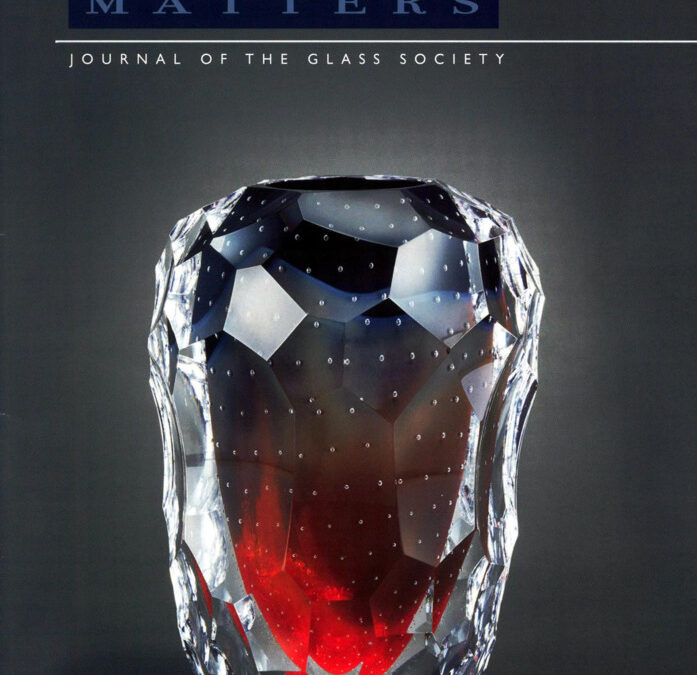
February 2019
Issue No. 4
1SSN2516-1555
Editorial
M
Uany pages are dedicated to Carnival glass in this issue, bring-
ing its story to the present day and linking with a major col-
lection of Carnival glass at Himley Hall. Bill Millar, a volunteer,
working many hours to unwrap, photograph and list the Dudley
Council collections has written an article to engage your help in
the process — do contact him or the curator.
Caroline Weidman and Linda Norris, working in contempo-
rary glass, show what can be achieved by expressing ideas in
new formats; both of their artistic life journeys are inspiring.
Simon Cottle shows how much can be gained by the desire to
have a valuable piece in your collection even though damaged
and Sue Newell from the enjoyment of the stories that surround
a particular glass.
The next issue will publish letters from members, with
comments on articles — please keep them coming. We’d also
be delighted to print a story of your favourite glass — the one
you missed as well as the pride of your collection. If you have
particular areas of glass that you’d wish to see more of in Glass
Matters — please inform us.
Contents
ISSN 2516-1555
Issue 4, February 2019
Jointly published by The Glass Circle and
The Glass Association.
© Contributors, The Glass Association and The Glass Circle
Editor:
Brian J Clarke
editor@glassassociation.org.uk
Design & layout:
Athelny Townshend
athelnygraphicsc’agmail. corn
Printed by:
Warners Midlands plc
www.warners.co.uk
Next copy date: 30th April
E-mail news & events to newscrcglassassociation.org.uk
“Neither the Glass Circle’s nor the Glass Association’s committee
members bear any responsibility for the views expressed in this
publication, which are those of the contributor in each case.
Copyright is acknowledged for the photographs illustrating articles,
though neither the Editor nor the committees are responsible for
inadvertent infringements. All photographs are copyright the author
unless otherwise credited.”
THE GLASS ASSOCIATON COMMITTEE MEMBERS:
The Glass Association Registered as a Charity
No.326602 Website: www.glassassociation.org;
Charles Hajdamach:
Life President;
charleshajdamach@btinternet.com; David
Willars:
Chairman:
chair@glassassociation.org.uk;
Judith Gower:
Hon. Secretary;
Maurice Wimpory,
Membership Secretary & Treasurer:
membership@
glassassociation.org.uk:
150
Braemar Road,
Sutton Coldfield, West Midlands,
B73 6LZ;
Nigel
Benson; Paul Bishop:
Vice-Chairman;
Brian Clarke:
Publications Editor;
Christina Glover; Alan Gower;
Bob Wilcock
THE GLASS CIRCLE COMMITTEE MEMBERS:
Website: www.glasscircle.org;
Simon Cottle:
Honorary President;
Susan Newell:
Chairman:
chairman@glasscircle.org; Laurence Maxfield:
Honorary Treasurer:
treasurer@glasscircle.org;
Vernon Cowdy:
Website Manager:
web@glasscircle.
org; Geoffrey Laventhall; Anne Lutyens-Stobbs:
Meetings Organiser;
James Peake; John P Smith;
publications@glasscircle.org; Athelny Townshend:
Graphic Design;
Anne Towse; Graham Vivian
GLASS MATTERS EDITORIAL SUB-COMMITEE
MEMBERS:
Nigel Benson; Brian Clarke; Susan Newell;
AthelnyTownshend; Simon Wain-Hobson; Bob
Wilcock
FRONT COVER:
Sanagi –
An example of Toru Horiguchi’s Edo
Kiriko glassware.
Sanagi
means
Pupa.
BACK COVER:
Engraved late 18th/early 19th century drinking
glass. Can you identify it?
Chairmens’ message
Livery Company Glass
Fitzwilliam Museum:
Batchelor Collection
Emanuel Hauptmann:
Bohemian Engraver
In Memoriam
Beilby Repair
Caroline Weidman
Lampwork
An artist’s move
to glass
Carnival Glass part 2
A rare Bottle Seal
Notley-Lerpiniere
Carnival glass collection
Book Review:
The Decanter
Dudley Council
Collection News
Diary Events
Sue
Newell
Sue Newell &
David Willars
Diane Irvine
& Sally Haden
Simon
Cottle
Anne
Lutyens-Stobbs
Linda
Norris
3
4
8
9
16
Eil
20
22
David Richards
26
Jill Turnbull
Bill Millar
Graham
Cooley
Chloe
Winter-Taylor
Bill Millar
32
33
35
38
38
39
2
Glass Matters Issue no.
4, February 2019
NATIONAL
MOTORCYCLE
MUSEUM
W. MIDLANDS
B92 OEJ
10.30 – 4.0
Tel:
07887 762872
E
ll
if°
°
To M1
London
South
Coventry
A 45
North
M6
Birmingham
International
Rail & Airport
NEC
Birmingham
A45
“N
The National
Motorcycle
Museum
NATIONAL
GLASS
FAIR
Featuring up to 90 exhibitors
offering fine quality glass from
throughout the ages, including 18th
century drinking glasses, decorative
Victorian glassware, pressed glass,
Art Nouveau and Art Deco glass,
paperweights, postwar collectable
glass, glass jewellery & contemporary
studio glass.
To M5 & M40
London &
South West
Nearest Accommodation:
The Crowne Plaza Hotel
(Birmingham NEC)
The Manor Hotel (Solihull)
Visit our website (www.nationalglassfair.com)
for further information.
front image courtesy of Liquan Wang
reverse image courtesy of Andy McConnell (Glass Etc)
SUNDAY
12 MAY
10:30am – 4:00pm
ADMISSION £5
(accomp. children free)
NATIONAL
MOTORCYCLE
MUSEUM
WEST MIDLANDS
B92 OEJ
Contact
tel: 07887
762872
email:
info@specialistglassfairs.com
nationalglassfair.com
specialistglassfairs.com
cambridgeglassfair.com
Future Fair Dates
The National Glass Fair
Sunday 10 November 2019
Chairmen
M
ESSAGE
Susan Newell,
Chairman
of The Glass
Circle
W
elcome to 203.9. As
we look forward
to the New Year, it
seems the right time to take
a few moments to reflect
on the events of 2018. Both
groups, The Glass Cirde
and The Glass Association
began the year with stated
ambitions to merge.
Glass
Matters,
our first combined
magazine, was ready to go
to press, and the level of
dialogue between the two
groups was set to move up a
gear. After canvassing your
opinions, either by EGM or
ballot, it was overwhelm-
ingly agreed that we should
join forces. This sentiment
was subsequently confirmed
at our respective AGMs in
October, and barring some
legal niceties, we can now
go forward as one body. The
main tasks ahead for your
committee are:
. Our application to become
a Charitable Incorporated
Organisation (CIO),
•
The formation of a new
constitution,
. The merging of our
finances.
So if 2018 was a year of tran-
sition, 203.9 will be the year
we start building our group
from the foundations up,
and with your continued
support we will succeed.
Collecting continues to
dominate our thoughts. The
Batchelor Collection demon-
strates what can be achieved
with patience, taking advice
and adding glass items to
a collection on a relative-
ly modest budget. Sir Ivor
and Lady Batchelor concen-
trated on less fashionable
areas that were perhaps not
as well documented at the
time and consequently less
expensive to acquire. Parts
of this collection, featuring
early English and Spanish
glass, as well as ceramics and
pictures, are being exhibited
at the Fitzwilliam Museum
in Cambridge until 3 March
2019. These examples show
that by forming a collection
and subsequently refining
and embellishing it, you
soon become expert in your
chosen field and may go on
to become an authority.
The international charac-
ter of our glass community
is well reflected in this is-
sue. Consider for example
Emanuel Hauptmann, who
went to Japan in the late
nineteenth century with
the intention of imparting
western industrialised glass
making techniques to the
local glassmakers. Carnival
glass, a further niche col-
lecting area, is also featured
and links factories in North
America and Europe. While
most of us are aware of the
iridescent orange dishes
and bowls, do take a look
at the crisply moulded high
relief designs in blue, green
and red illustrated in Trudy
Auty’s article. We are de-
lighted to have a truly in-
ternational programme for
our forthcoming season of
London lectures. Taking us
further back in time, Ming
Wilson, the Senior Curator
in the Asian Department
at the V&A, will speak on
early Chinese glass. A rare
Venetian glass object will
be discussed by the inde-
pendent scholar and cu-
rator Elisa Sani and Dedo
von Kerssenbrodc-Krosigk,
Director of the Glass Muse-
um in Dusseldorf, will give
the Charleston Memorial
Lecture on ancient Roman
glass. The dates for your di-
ary can be found inside the
final page of this issue.
While our forthcoming
speakers are impressive, rest
assured, you don’t need to
be an international curator
to address the group. We
know there is a huge amount
of latent talent within our
grasp among our member-
ship with its wide-ranging
interests and expertise. This
is your society and we need
you to come forward with
ideas for artides and venues
for meetings. Even better,
please consider proposing
a visit, giving a talk and/or
showing a group round your
own collection.
David Willars,
Chairman
of The Glass
Association
Glass Matters Issue no. 4, February 2019
3
DUTCH ENGRAVED GLASS
A RESEARCH CONUNDRUM
An
intriguing
glass belonging to a
CITY OF LO\DM
livery company
Sue Newell
Si n c e
2 0 0 0
have
been associ-
ated with the
Innholders’
Company, one of
the City of Lon-
don’s smaller livery
companies. These
companies or guilds,
often founded in the
medieval period, were
originally formed to reg-
ulate the apprenticeship
system and strengthen
the rights of skilled artisans
practising a particular trade.
Some hold considerable histor-
ic collections and, with regard to
glass, members may recall our vis-
it to the exceptional Walter Hale
Collection of glass at the Gro-
cers’ Hall in 2016. The Innhold-
ers have a small but choice group
of lath and early 19th century
glass, including a Jacobite portrait
glass, a fine Beilby enamelled
glass and some good Dutch and
French engraved glasses. Some
time ago I had the pleasure of
curating a display of the glass
and this article will examine one
of the items there that intrigued
me. In fact, the glass belongs
not to the Innholders but to the
Cooks’ Company, a sister compa-
ny that today has no Hall of its
own. The Cooks have had a close
association with the Inn-
holders, meeting on
their premises
and housing
their trea-
sures with
them for at
least a cen-
tury.
The glass
is a large
example of
the so-called
`Newcastle’ light
baluster
type
dating to the mid-
18th century.
It
is engraved on one
side with the arms
of the Cooks’ Compa-
ny; clusters of ginger
of the variety known
as columbine, and an
`engrailed chevron’, sur-
mounted by the Company’s
crest of a bird, here depicted
as a dove with an olive branch,
but usually given more correctly
as a pheasant.’ The other side
bears the toast ‘Prosperity to
this Company’ above a kitch-
en scene that would appear
to derive from an Early Modern
period woodcut: a pastry cook in
Tudor-style attire is busy prepar-
ing a dish, game hangs from a
circular iron rack above and a
dressed peacock pie stands on
a table to the side. The first time
I handled the glass I resolved to
investigate it as I hoped such an
important commemorative item
would be traceable in the archives.
When starting my research, I
was pleased to find that a helpful
history of The Cooks’ Company
had been published by the
historian Alan Borg,
formerly Di-
rector of the
Victoria and
Albert Mu-
seum. As
Engraved light
baluster wine
glass, h. 24cm
Photos © the Wor-
shipful Company of
Cooks
4
Glass Matters Issue no. 4, February 2019
DUTCH ENGRAVED GLASS
expected, the glass was il-
lustrated there with a note
saying that it had been pre-
sented by a former Master,
a Mr. H.H. Tickler.’ The
Court Minutes dated 27th
November 1963 record the
presentation by Herbert
Harry Tickler, at the end of
his year in office, of ‘a Glass
Goblet bearing the Insig-
nia of the Company which
was about
200
years old’.
3
There was no mention of
where Mr. Tickler had ob-
tained the glass from but
as it was still a very active
time for specialist dealers, I
imagined it must have been
sourced from one of them,
perhaps Howard Phillips,
Cecil Davis, Alan Tillman,
Aspreys, or Arthur Chur-
chill.
My first step was to use
archival sources to prove
the existence of the glass at
the Cooks’ Company in the
eighteenth century, for it
was possible the glass might
have entered private owner-
ship in the intervening cen-
turies, perhaps housed for
safekeeping with a Compa-
ny official. The Company’s
history would suggest it is
something of a miracle that
any artefacts survive today.
Although the Cooks’ Hall
was situated in Aldersgate
Street, north of the City’s
boundary, it was damaged
in the Great Fire of 1666 and
required repairs. Despite
these, a complete rebuild
was necessary in 1674 and
this second Hall was in turn
burnt down in 1771, oblig-
ing members to meet in a
tavern or coffee house. Alan
Borg has drawn my atten-
tion to the fact that shortly
before its final destruction,
the Hall was leased from
the Company in 1767 by one
Thomas Dobbs, ‘a manufac-
turer of glass’, of St. Paul’s
Churchyard. Dobbs stated
in an advertisement that
`having fitted up in a most su-
perb manner Cooks Hall…the
greatest variety fine lustres
and Girondoles, and all oth-
er fine cut glass to be seen at
Cooks Hall aforesaid’.
4
While
this glass connection is in-
triguing it does not help pin
down the Cooks’ glass, and
similarly the Company’s
own eighteenth-century
inventories list glass only
in a cursory way, giving no
indication of special pieces.
5
I then looked into more re-
cent sources in the hope of
tracing the later provenance
of the glass. Despite my
best efforts, to date I have
found no trace of the glass
in auction house glass sale
catalogues or trade adver-
tisements of the period or
in early glass publications.°
This documentary glass ap-
pears to have emerged on
the market with no record
of its provenance prior to
Mr Tickler’s presentation.
I also turned my atten-
tion to the scene on the
glass in the hope of tracing
a source print that might
shed light on the date of the
glass. However, the kitchen
depicted on the glass was
clearly not contemporary
with the eighteenth century
origin of the glass. It seems
to depict a late medieval or
Tudor period kitchen, but
my enquiries with Early
Modern print and food his-
torians have not yielded any
possible sources to date. An
eighteenth century engrav-
er might have found an
early woodcut that has not
survived or it is reasonable
to suppose that he was sup-
plied with a design intend-
ed to evoke the foundation
of the Company in the me-
dieval period! It was a short
step from there to consider
that the engraving might
not be contemporary with
the date of the glass, indeed
that it might date from the
mid-twentieth century, in
other words from the time
of its presentation to the
Company.
The practice of engraving
on earlier glass has a long
pedigree. Many of us will
be familiar with the con-
troversy surrounding the
Williamite and Jacobite
glasses produce by Franz
Tieze, a skilled Bohemian
engraver working in Dublin
in the late 19th and early
loth century, whose work
was undoubtedly intended
to deceive. Our Honorary
Vice-President,
Dwight
Lanmon has also drawn
my attention to a group of
glasses engraved with his-
torical scenes in the George
Horace Lorimer collection
at the Philadelphia Museum
of Art collected in the twen-
tieth century interwar peri-
od, that are now thought to
be suspect. However, the
engraving of early glass is
by no means always under-
taken with the intention
to deceive, although this
practice is frowned upon
in some quarters. Indeed,
one of the two glasses pre-
sented by the Glass Circle to
our retiring Chairman John
Smith last year was an eigh-
teenth-century piece dec-
orated by a contemporary
engraver.
8
It occurred to me
that in 1963, the Master of
the Cooks’ Company might
have supplied a design to
a competent engraver and
commissioned him or her
to engrave an antique gob-
let in just the same way.
I then invited a contem-
porary glass engraver, Glass
Circle member Katharine
Coleman, to look at the
glass and share her thoughts
Glass Matters Issue no. 4, February 2019
5
Glass Matters Issue no. 4, February 2019
6
DUTCH ENGRAVED GLASS
on the tools used to achieve
the engraved designs.
9
A
twentieth-century engrav-
er could of course use cop-
per wheels consistent with
eighteenth-century prac-
tice but an eighteenth-cen-
tury practitioner would
obviously not have had
access to later techniques
or machinery. In Katha-
rine’s opinion, the chevron
on the Cooks’ shield had
a semi-polished matt ap-
pearance consistent with
the use of either a diamond
burr in a drill or a narrow,
rounded copper wheel fol-
lowed by a semi-polish, us-
ing cork wheels and pumice
abrasive powder. Such dec-
orative matting was more
commonly used by Bohe-
mian engravers in the late
nineteenth century. The
treatment of the colum-
bine/ginger was also suspi-
rary practitioner’s insights
into tools and techniques.
1
°
5.
In terms of engraving, the
value of Katharine’s experi-
enced opinion is particularly
helpful, because as a point
and copper wheel engrav-
er herself, she is interested
in many historic engraving
techniques. She suggested
that running sessions for
members demonstrating
different engraving tech-
niques and allowing us to
try them out for ourselves,
might be of interest in terms
of understanding engraving
and cutting on historical
glass.
11
Rest assured, I hope
to hold her to this offer at
some not too distant future
date.
I am grateful to the Cooks’
Company for allowing me
to investigate their glass,
the Innholders’ Company
for granting me access, Alan 10.
Borg, Paul Herbage (Past
Master, Cooks’ Co.) and our
Hon. President, Dwight Lan-
mon, for helpful discussions
regarding this research, and
Katharine Coleman for her
11.
insights into the engraved
decoration.
6.
7.
8.
9.
DUTCH ENGRAVED GLASS
ENDNOTES
1.
John Bromley,
The Armorial
Bearings of the Guilds of
London,
1960, pp. 52-54.
2.
Alan Borg, CBE, FSA,
A
History of the Worshipful
Company of Cooks,
2011,
fig.
3o. An earlier history also
illustrated the goblet,
see
Frank Taverner Phillips,
A
Second History of the Wor-
shipful Company of Cooks,
1966, Plate IX ‘A Newcastle
goblet c. 1745 presented to
the Company in 1963 by
Past Master H.H. Tickler’.
3.
Guildhall Library, Cooks’
Company General Court
Minutes 27/11/1963.
4.
See Borg (note 2), p.
121.
Retailers of ceramics and
glass were often loosely re-
ferred to as ‘manufacturers’
ciously like that of polished
diamond drill engraving and
unlike wheel engraving. The
`frames’ to the scene and the
arms had been achieved us-
ing copper wheels and a lead
wheel had been used for the
polished dish on which the
peacock pie sits in the kitch-
en scene. The treatment of
the body and wings of the
dove crest also had a decid-
edly 2oth century feel to it
and the engraved decoration
conveniently covered sever-
al of the much earlier deep
scratches. As Katharine
pointed out, top 2oth cen-
tury engravers such as Pe-
ter Dreiser would have had
an extensive range of tools
and skills at their disposal
enabling them to achieve
different effects as appro-
priate.
This project exemplifies
the ups and downs of re-
search when the documents
fail to turn up any conclu-
sive answers, but neverthe-
less the process of explor-
ing different avenues still
illuminates the subject in
various ways. While Kath-
arine would stress that her
opinions do not prove when
the glass was engraved, we
can learn much from the
comments of contemporary
craftspeople at such mo-
ments. William Gudenrath,
glassmaker and expert in
historic glass techniques,
has contributed to many
scholarly catalogues on his-
torical glass in his role as
Resident Advisor at the Stu-
dio of the Corning Museum
of Glass. In the previous is-
sue of Glass Matters, Dwight
Lanmon’s collaboration with
William Gudenrath showed
how the origin of a glass in
the Corning Collection, once
thought to be English mid-
17th century, could be inter-
rogated using a contempo-
at this period.
The Guildhall Library: 1746,
1752, 1760, 1766. The 1746
Inventory is cited in full
by Borg (see note 2), ‘A
Schedule of the Plate, Im-
plements, Goods and Things
belonging to the Worshipful
Company of Cooks, London
taken in the year 1746’, sim-
ply lists ‘twenty-five wine
glasses’.
No trace of the glass has
been found in Churchill’s
published notes.
Archival evidence records
the existence of a guild of
cooks as early as 1311 and
a Charter of Incorporation
was granted by Edward IV
in 1482, see Borg (note 2).
Lesley Pyke engraved the
goblet, see Susan Newell,
The Retirement of John P.
Smith,
Glass Matters 1,
January 2018, pp.5-6.
Katharine Coleman https://
www.katharinecoleman.
co.uk
Dwight P. Lanmon and
William Gudenrath
A
remarkable iridescent goblet
with a double-walled, silvered
bowl: 17th or 19th century?,
Glass Matters 2, July 2018,
PP. 7
-11
.
As well as doing her own
work, Katharine also teach-
es at The Studio at Corning
Museum of Glass, BildWerk
Frauenau and Morley Col-
lege, London.
THE AUTHOR
Susan Newell, Chair of the
Glass Circle since Novem-
ber 2017 and now joint chair
of ‘The Glass Society, has
worked as a decorative arts cu-
rator and specialist for many
years. She is currently a Phd.
Candidate at the University of
Leeds.
Susan would welcome hearing
from any reader who can shed
some light on the research
questions raised in this arti-
cle. Please contact her via the
Editor at
:-
brianjdarke@btinEmetcom
Glass Matters Issue no, 4, February 2019
7
NEWS
The
Collection
of Sir Ivor and Lady Honor Batchelor
Glass Circle visit to the Fitzwilliam Museum : 25th April 2018
I
n 2015 the Fitzwilliam
Museum in Cambridge
received an exceptional
collection of drawings, ce-
ramics, bronzes and glass
from Sir Ivor and Lady Hon-
or Batchelor through the
Art Fund. Earlier this year
we were privileged to in-
spect glass items behind the
scenes at the museum prior
to a special display of the
bequest later this year and
together with Glass Associ-
ation members, we assisted
with recognition of a num-
ber of the glass exhibits.
Ivor Batchelor was clear-
ly a born collector, recall-
ing how as a school boy a
stuffed alligator, an emu’s
egg, the tail feather of a
snipe and Japanese sea-
weed were all stored away in
a cabinet given by an uncle.
As a student, his interest
in pictures was awakened
when he purchased a land-
scape in oils by W G Gilles,
with money given for his
21st birthday. Gilles was
later to become President
of the Royal Scottish Acad-
emy. When good drawings
became hard to find and
too expensive, the Bache-
lors collected pottery and
when English 18h centu-
ry pots likewise shot up in
price they collected mostly
glass. In glass they had an
eclectic taste, having no
wish to put on parade rows
of English drinking glasses.
A fascination with Spanish
glass, initiated by reading
Alice Fotheringham’s book,
prefaced their purchasing
examples many years later.
Whether it was pictures,
ceramics or glass Ivor Batch-
elor was quick to praise the
role dealers play as being
the unsung heroes of the
collector’s world. It is they
who do most of the hard
slog, trawling the auction
rooms, both on the internet
and in reality, travelling the
country finding pieces to
sell. A quick search through
the key items of glass in
the bequest indicates how
much reliance was placed
upon one particular advi-
sor, Howard Phillips of Lon-
don.
More specifically the
collection can be broad-
ly divided into segments:
English glass, Continental
glass excluding Spanish,
and Spanish glass. Predom-
inantly the glass consists of
eighteenth and nineteenth
century pieces, although
there are several outliers at
either end of the timespan.
Fig
1
shows one of the old-
est items in the collection,
a German mid-16th century
pale olive-green glass goblet
decorated with raspberry
prunts. Several of the items
will feature in a display at
the museum later this year
and Fig 2 shows a display
mock-up of mainly seven-
teenth and eighteenth cen-
tury pieces. In addition to
examining glass from the
Batchelor collection in store
at the museum, Research
Curator Helen Ritchie gave
us a tour of the galleries
taking in the Art Nouveau
glass on loan from the
Frua-Valsecchi collection
and of course, the cases
containing the exceptional
Beves Collection of glass.
The Batchelor Exhibition, The
Fitzwilliam Museum, Cam-
bridge December 2018 — 3
March
2019
Thanks to Dr. Victoria Av-
ery and Helen Ritchie of the
Fitzwilliam Museum
LEFT:
Fig.2
A
group
of mainly
17th-century
glasses grouped
together to show
how they might
be displayed
LEFT:
A German mid-
i6th century
pale olive-green
glass goblet
decorated
with raspberry
prunts.
8
Glass Matters Issue no. 4, February 2019
RICH BOIEMIAN ORNAMENTAL GLASS.
—
.
The
&MEMBER begs to intimate, that in addi-
tion to his ustally largo Stock of flichly Coloured;
Gilded, Cut, aid Engraved BOHEMIAN GLASS,
he has received (first for tho Season) and is just ro.
ceiv lug large importations of every thing ‘New iu Style
and Design connected with this beautiful art ; and in
making this announcement, he has no hesitation in
asserting, that an assemblage of FOREIGN ORNA-
MENTAL GLASS so
varied,
unique, and extensive
as this, is not -.4) be met with in the kingdom.
A few DESSERT SERVICES quite unequalled.
An early .nspection is respectfuly invited.
JOHN FORD.
NORTII BRIDGE,
Edinburgh.
Cour
tesy
o
f
The
Sc
o
tsman
Pu
blica
t
ion
s
BOHEMIAN GLASS.
QMAIL & CO. have just received other Two
k7 Cases of BOHEMIAN GLASS, containing
about 400 Vases of Various elegant Shapes and
Patterns, the Prices are very much lower than the
same description of Goods formerly sold at.
1VIIOLESALE AND RETAIL WAREIIOUSES,
35 CANDLEMAKERROW,
I &
4
MERCHANT STREET.
•
•
Cour
tesy
o
f
The
Sco
tsman
Pu
blica
t
ions
TRAVELLING BOHEMIAN GLASS ENGRAVER
Emanuel Hauptmann:
Itinerant glass
ENCRAVE1?
Diane Irvine and Sally Haden
T
his is the story sur-
rounding
Emanuel
Hauptmann (1848-
1924),
an
ordinary Bohe-
mian glass engraver from
Newcastle-upon-Tyne who
lick-started’ modern glass
decoration in Japan.
INTRODUCTION
Together with Thomas
Walton, Elijah Skidmore and
James Speed, all working
at the Shinagawa Glass
Works, Tokyo, Emanuel
Hauptmann was one of
four British glassmakers
invited to Japan to help
develop the country’s glass
industry as part of Japanese
modernisation during the
late 19th century. Their
contributions are detailed
in a series of articles by
Sally Haden published in
The Glass Cone, and in
The Journal of The Glass
Association.
Emanuel was a very or-
dinary glass engraver. His
story is that of a common-
place young Bohemian ar-
tisan, one among many in
Britain at the time, who left
the slums of Newcastle-up-
on-Tyne to spend a while
in an exotic, exciting and
fast-developing world far
across the oceans. His en-
graving is largely unknown
and cannot rival that of fa-
mous Bohemian craftsmen
in style and execution, but
the impact of his brief spell
in Japan resonates today in
an industry which owes its
foundation to those four
men who gave instruction
there between 1874 and
1883.
INTEREST IN BOHEMIAN GLASS
Bohemian glass has
travelled around the world
since the 17th century.
For example, Georg Franz
Kryebich from Kameniclqr
Senov made twenty one
journeys between 1685 and
1719 carrying glass all over
Europe, travelling first by
foot then by horse-drawn
cart.
Bohemia developed a
strong culture of training
for glass decoration. Found-
ed in 1856 and 1870, the
professional glass schools
in Kamenic4 Senov and
Novy Bor not only provided
a professional base build-
ing on centuries of learn-
ing through local industry,
but also shaped the future.
While not all Bohemian en-
gravers had the opportuni-
ty to attend one of these or
other glass schools, those
with skills, enthusiasm and
a sense of adventure must
have been interested in
travelling to different coun-
tries, including Britain,
where pay for Bohemian
engravers was at least four
times that available in Bo-
hemia.
During the 19th century
a combination of circum-
stances ensured opportu-
nity for Bohemian glass
engravers in Britain. Bo-
hemia, a land of shifting
borders, was assailed by
wars with the young men
facing years of national ser-
vice. It also had a history
of salesmen travelling the
continent bringing back
glass and often engraving
it on the spot. Between
1876 and 1880 nearly $3m
worth of Bohemian glass
was imported to the USA.
Likewise, large amounts of
glass were imported to Brit-
ain. Bohemian glass and the
skills to make and decorate
it spread from Bohemia
right into Scotland. Sales
of Bohemian glass were fre-
quently advertised in 19th
century newspapers.
These two advertise-
ments (below) in The Scots-
man newspaper illustrate
the kind of interest Britain
had in Bohemian glass:-
THE BOHEMIAN
CONTRIBUTION
Britain witnessed the rise
of a new wealthier middle
class eager for the trappings
associated with rich people.
Cut or engraved glass was a
manifestation of wealth and
Bohemian glass was prized.
In his book ‘British Glass
1800-1914’
Hajdamach
speaks of an ‘obsessive fa-
scination’ with Bohemian
glass during the 1840’s and
BELOW:
Fig .
Advertisements
in the
Scots-
man,
dated
20
March 1847, and
7
February
18
49.
Glass Matters Issue no. 4, February 2019
9
TRAVELLING BOHEMIAN GLASS ENGRAVER
thereafter.
Franz Tieze, a Bohemian
engraver born in 1842, kept
a design notebook (now
held in the V&A archives),
in which he recorded the
names and addresses of
twenty Bohemian engrav-
ers working in Britain. The
1871 Scotland Census shows
at least thirty five Bohemi-
an-born engravers working
in Edinburgh and Glasgow.
There were dozens more in
other parts of Britain.
Many of these immigrant
craftsmen were drawn to
the Edinburgh workshop of
J.H.B. Millar but some also
worked for Hauptmann &
Co, an important engrav-
ing business as yet unrec-
ognised by glass historians.
Ignaz Hauptmann came to
Edinburgh about 1837 and
set up a glass company at
22
Greenside Place with
his brother Franz in 1842.
The 1871 census states
that Ignaz employed ’40
men, boys and girls’, a large
business and it remained
in operation for forty five
years. The most famous of
their Bohemian employees
was Emanuel Lerche who
worked for them between
1853 and 1861. Ignaz and
his brother were part of a
close-knit family and many
relatives joined them, in-
cluding nephews Franz
Hauptmann, Emanuel Al-
bert, Edward W Albert and
Francis Albert, and Ema-
nuel Hauptmann himself,
all born in Bohemia. Some
of the elder children of
Franz also worked for the
company.
Ignaz made quite an im-
pression in Edinburgh and
in the world of late 19th cen-
tury British glass. An obitu-
ary in the Pottery Gazette,
1 April 1887 commented :
‘Mr Ignaz Hauptmann died
at Edinburgh on March 17,
at the age of 69. He was a
native of Bohemia, and it is
claimed that he was the first
to introduce engraving on
glass in this country [Scot-
land], about 5o years ago. He
was a man of considerable
culture and artistic taste,
and endowed with great per-
severance.’
EMANUEL HAUPTMANN
Emanuel Hauptmann was
born 14 June 1848, in Strob-
nitz, Bohemia, Austria, now
known as Horni Stropnice
in the Czech Republic. His
father, a commercial trav-
eller, was born in 1821 in
Wolfersdorf, Bohemia and
his mother, Anna Thun-
hart, was born in Strobnitz
in 1820. Emanuel left home
in the 186os to work with
his uncles Ignaz and Franz
Hauptmann in Greenside,
Edinburgh. They were also
born in Wolfersdorf.
Emanuel’s marriage cer-
tificate gives his occupa-
tion as a Glass Engraver
Journeyman. A University
of Edinburgh’s description
of a cutting and engraving
shop in Edinburgh observes
that apprentice engravers
served a term of seven years
to become journeymen. This
suggests Emanuel began
training before he was six-
teen, possibly much earlier.
His home as a young boy
was four kilometres from
Nove Hrady glassworks in
the North and a similar
distance from Stare Hute
glassworks in the South.
Both of these were later ac-
quired by the Stolze-glass
empire although it is not
known if he worked at ei-
ther of these. He could have
undertaken all his training
in Edinburgh.
Fig.2
Emanuel in his
workshop, in
either Dog Leap
Stairs or Castle
Garth, Newcas-
tle-upon-Tyne
I0
Glass Matters Issue no. 4, February 2019
TRAVELLING
BOHEMIAN
GLASS ENGRAVER
GLASGOW
Hauptmann & Co was
subject to a number of se-
questration (bankruptcy)
proceedings over the years
and it is possible these led
to Emanuel moving away
from Edinburgh. He left
for Glasgow at the age of
twenty two and lived in
1871 in Canal Street, a part
of the city full of heavy in-
dustry. Amongst his close
neighbours were a number
of other young Bohemian
engravers, many of whom
are now recognised for their
fine craftsmanship. They
include Angus Carelbauer,
Friedrick Eiselt, John Kel-
ler, Vincent Keller, Hierony-
mous Keller, Joseph Lavert,
Franz Marschner, Joseph
Marschner, Anton Patzelt,
Peter Raltass, Joseph Rich-
ter, Edward Rickter, August
Samphreat, Kenzel Schle-
gel, Ignatz Schlegel, William
Klempeter and Wilhelm
Pohl. It is not known for
whom Emanuel worked in
Glasgow, but James Couper
& Co was a short walk from
Canal Street.
Emanuel married Bir-
mingham born Catherine
Harbone in 1872. Her fa-
ther, Thomas, is recorded on
their marriage certificate as
a commercial traveller, and
as a labourer or porter at a
glass works in Birmingham
in the censuses of 1871-
1901. Hauptmann and Co
had a number of dealings
with firms in Birmingham,
so the link between the
Hauptmann and Harbone
families may well have be-
gun through glass.
NEWCASTLE-UPON-TYNE
Aged around twenty three,
together with his young
wife and first child, Thom-
as, he relocated to Newcas-
tle, another very important
glass-making area. Their
second son, Albert, was
born in Newcastle in 1874,
followed by Joseph in 1876,
whereas their daughters
Ada and Frances were born
in Gateshead, in 188o and
1888 respectively.
In her thesis on the
North East’s glass industry
1700-1900, Catherine Ross
deals extensively with the
changing fortunes of the
glass industry in the North
East. Discussing how blown
flint glass fell slowly into
decline there later in the
19th century, she argues
that this was due in part
to the great rise of the ar-
ea’s pressed glass industry.
There remained, however,
some demand for blown ta-
bleware and consequently a
need for engravers even if
on a small scale. The most
significant firm for blown
ware in the North East was
the Northumberland Glass
Company but Ross also lists
some smaller blown flint
glass makers in Gateshead;
David Martin, W. & R. Fer-
ry, Robert Gray of Pipewell-
gate and Thomas McDer-
mott trading as Albion Flint
Glassworks of Pipewell-
gate. In Newcastle were J.
Swanston and the Wright
Brothers. Sowerby’s, one of
the big pressed glass pro-
ducers, attempted to mar-
ket a range of blown glass
during the 187os and again
produced some engraved
glass as part of their artis-
tic production in the 189os.
Emanuel lived at various
addresses in Gateshead and
Newcastle, often very close
to these businesses. He will
have known all these pro-
ducers and when he was not
employed by them, would
have been working on his
own account, probably en-
graving/cutting their glass,
either as a factory outwork-
er, or engraving/cutting for
high street retail shops, or
selling directly to the public
from his workshop.
His uncle Ignaz had con-
nections with glass man-
ufacturers and dealers in
Newcastle and the sur-
rounding area. The detailed
sequestration papers of
1866 relating to I. Haupt-
mann & Co include George
Ratcliff, Davidson and
Eggleston as debtors and
Jas Hartley & Co as a cred-
itor. Sequestration papers
from 1881 show Haupt-
mann & Co owing money
to Davidson & Co, Heppell
& Co and Tyne Plate Glass,
in addition to being owed
money by people with ad-
dresses in the Tyneside
area.
Emanuel’s many address-
es in this area, catalogued
through censuses, Birth,
Marriage and Death cer-
tificates and trade directo-
ries, indicate he lived close
to glass manufacturers in
streets where there was
easy movement between
Gateshead and Newcas-
tle across the High Level
Bridge which led directly
from Pipewellgate into the
Castle Garth area.
AN INVITATION FROM JAPAN
In what must have seemed a
great upturn in fortune for
him, Emanuel was offered
a post in far-off Japan to
train Japanese craftsmen in
cutting and engraving at a
new factory in Tokyo.
It is not known how he
was selected for the job. The
Iwakura Mission, a large
delegation of top Japanese
government officials in
search of Western know-
how, left Japan in December
1871 to tour American and
European countries. Start-
Glass Matters Issue no. 4, February 2019
TRAVELLING BOHEMIAN GLASS ENGRAVER
BELOW:
Fig.3
An
example of
Toru Horigu-
chi’s Edo Kiriko
glassware
Name :
‘Red
and Black’
Size : 235square
x 122MM
Material : Soda
lime glass
Year of creation:
2008
Method: Cut
and use of
Adhesive
ing their British tour upon
landing in Liverpool in Au-
gust 1872, their itinerary in-
cluded places that Emanuel
had connections with: Ed-
inburgh, Glasgow, Newcas-
tle and Birmingham. Along
with a fascinated public,
Emanuel probably followed
their movements with in-
terest in local and national
newspapers and perhaps
read that they wanted to de-
velop glassmaking in Japan.
Alternatively he may simply
have answered an advert,
heard of the opportunity
by word of mouth within
the industry, or even been
recommended for the job
by James Speed who had
worked in Greenside, Edin-
burgh, and almost certain-
ly would have known the
Hauptmanns.
What is known for sure
is that Emanuel travelled
to Japan in the spring of
1881, leaving behind his
wife and four children, not
to arrive home again until
Christmas 1882. The con-
tract arrangements made
for one of the other four
British men working at the
Japanese glassworks, Elijah
Skidmore, show that part
of Skidmore’s wages were
paid direct to his wife, so it
is quite possible that Cath-
erine Hauptmann received
regular payments.
JAPAN
By the time Emanuel ar-
rived at the recently con-
structed Shinagawa Glass
Works in Tokyo on 17 May
1881, the manufacture of
modern Western-style com-
mon glass was getting un-
derway, thanks to the pre-
ceding efforts of his three
British colleagues, Walton,
Skidmore and Speed. They
had overseen the estab-
lishment of Japan’s first
modern Western-style fur-
naces and begun training
Japanese glassmakers in all
areas of factory operation
and types of glassmaking.
The Japanese government
supported the project close-
ly, running it as a model
company to pioneer the
mass production of every-
thing from window glass
to bottles, and tableware
to pharmaceutical glass. Ja-
pan needed Western glass
technology to help build
the economy and allow the
country to enter world mar-
kets.
Ahead of Emanuel’s ar-
rival, engraving machines,
stone and wooden wheels,
emery powder and polish-
ing sand were imported so
that he could give instruc-
tion in Western-style glass
decoration. With this equip-
ment, cutting troughs and
wheel-engraving benches
would have been set up for
his trainees, at least some
of whom already had expe-
rience elsewhere in Japan.
This was, however, their
first exposure to a West-
ern-style factory dedicated
to mass production and the
division of labour which
such work involves. Before
the Shinagawa Glass Works,
Japanese glass was care-
fully crafted in small work-
shops scattered across the
country – luxury and fragile
products for the wealthy
elite and for sacred pur-
poses. Decoration of it had
been in imitation of a few
items of European cut glass
(British/Irish or Bohemi-
an), which had found their
way into Japan through Na-
gasaki during the centuries
of `Sakoku’, Japan’s period
of self-imposed isolation
from the rest of the world.
Those copies were cut,
one scientist claims, by the
hand manipulation of flat
iron bars. This technique
would have been extremely
time-consuming and why
rotating wheels would not
have been used when the
lathe had been known for
centuries in Japanese lapi-
dary work is a curious mat-
ter which is much debated
and needs further careful
research. There is no direct
evidence of the use of steam
power in the Shinagawa
glass decoration depart-
ment, so cutting was proba-
bly powered by hand or wa-
ter. The first clear examples
of Japanese steam-powered
cutting date to around the
turn of the century, with
electric power following af-
ter that when electricity be-
came affordable in the early
loth century.
The apprentices’ exposure
through Emanuel to the
new efficient engraving and
cutting machinery, together
with Western designs, stim-
ulated some of them, after
the closure of the Shinaga-
wa Glass Works in 1883, to
go on to establish their own
workshops or substantial
businesses. They developed
a unique Japanese form of
engraving known as Kiriko,
I2
Glass Matters Issue no. 4, February 2019
TRAVELLING BOHEMIAN GLASS ENGRAVER
RIGHT:
Fig.4
Large jug
engraved
Hauptmann
especially in Tokyo where
it is known as Edo Kiriko
and sells as a very exclu-
sive product. The impor-
tance of this craft heritage
is very obvious in Japan
today, as shown in the high-
ly acclaimed work of Toru
Horiguchi
(See fig.
3
opposite
page)
of the Tokyo compa-
ny Horiguchi Kiriko Inc.,
whose ancestor was trained
by Tokumatsu Oohashi,
who in turn was trained by
Emanuel himself.
RIGHT:
Fig. 5
Footed bowl
engraved for
Granddaughter
RETURNING TO
NEWCASTLE
Emanuel’s return from Ja-
pan, at the end of 1882,
must have been something
of a culture shock for him,
and within a year he was
admitted to Durham Luna-
tic Asylum suffering from
psychotic depression. He
admitted that he began
drinking in Japan and this
probably continued on his
return to England. He had
exchanged a life where he
was paid probably more
than he ever earned in his
life and was feted for his
skill, experience and contri-
bution to the birth of mod-
ern glassmaking in Japan,
for the prosaic everyday
problems faced by a family
in a poor area of Newcas-
tle. He struggled to find
sufficient work, having to
rebuild his connections at a
time when the glass indus-
try in the North was begin-
ning to decline. Discharged
from the asylum in Febru-
ary 1885, he was readmitted
May-August 1890 and for a
third time June-September
1891.
According to historical
directories, while living in
Devonshire Street, Gates-
head, Emanuel established
a workshop in Dog Leap
Stairs, Newcastle, in 1888,
Glass Matters Issue no. 4, February 2019
TRAVELLING BOHEMIAN GLASS ENGRAVER
BELOW:
Fig.7
Tumblers
engraved for
family
a bustling area around the
castle full of tradesmen. The
Newcastle Guardian and
Tyne Mercury described
this locality at the time
as being ‘one of the many
retreats for the low and
profligate’. He was working
then for George Ellis, a local
china and glass dealer, until
he was charged with ‘steal-
ing therefrom decanters,
jugs, tumblers, a quantity
of other glass and a biscuit
box, value £5, the property
of George Ellis’. This offence
led to a gaol term of three
months with hard labour.
Further local directories,
dated
1901
and
1.906,
list
him a Glass Engraver and
shopkeeper at 4
–
5 Castle
Square or Castle Garth,
which was also the family
home. This address no lon-
ger exists but contempo-
rary maps indicate it would
have been part of a building
between the Moot Hall and
the Bridge Hotel, both of
which still exist in Castle
Garth. This seems to have
been a more settled part of
his working life.
That he had a strong work
ethic is evident from the
asylum case notes, which
indicate that ‘want of work’
contributed to bouts of
depression and his health
improved following work
in the asylum’s tailor’s
shop. Things must have
been tough for him but his
resilience seems to show
RIGHT:
Fig.6
Dish with lid
engraved for
Granddaughter
14
Glass Matters Issue no. 4, February 2019
TRAVELLING BOHEMIAN GLASS ENGRAVER
through in a photograph
taken some time after Ja-
pan, looking proud in his
new workshop. Although
none of his children fol-
lowed him into the glass
business, one of his grand-
children worked for a while
in a glass factory in New-
castle in the 19oos. Eman-
uel would be surprised to
find that, through his son
Joseph, he has over eighty
descendants living today
across England with one in
the USA.
Emanuel died 25 May
1924, aged
75,
outlived by
his wife Catherine. He is
buried in Saltwell Cemetery,
Gateshead. This was a good
age for that time given that
his life was characterised
by poverty, struggles with
those in authority, poor
health and never quite find-
ing a stable home until old
age. He didn’t need to claim
British citizenship because
his marriage to a British
person made him a British
Subject but for the thirty
years he lived in Newcas-
tle, he had at least fourteen
different addresses. Also, in
his lifetime he had lived in
many countries – eastern
Europe, Scotland, England,
even Japan, but at least he
had one constant through-
out his life – his glass en-
graving. His contribution to
the development of the fine
glass in Japan is much cel-
ebrated today, securing his
place in the history of glass
making.
A number of pieces of
glass engraved by Eman-
uel have been retained by
his descendants, including
items engraved for Fran-
ces’s daughter Catherine or
Katie Fox. Photographs of
some of these, taken by Bri-
an Clarke, accompany this
article.
FOOTNOTES
1.
Who Made that Glass,
Sally
Haden, The Glass Cone
issues
102, 103, 107, 109,
2013 – 2016
2.
They Went to Larn ‘Em,
Sally
Haden, The Journal of the
Glass Association, Vol.10,
2014
3.
Glass its Makers and its Pub-
lic,
1975, Ada Polak p.107
4.
Curiosities of Glass Mak-
ing, 1849, Apsley Pellatt
p.126
5.
Old Glass, European and
American, before 1984,
N
Hudson Moore p.59
6.
Ignaz Hauptmann natu-
ralisation papers, National
Archives, 1857
7.
Victorian Table Glass and
Ornaments,
1978, Barbara
Morris, p.89
8.
https://www.artisansinscot-
land.shca.ed.ac.uk/items/
show/5o.
9.
Information from Ritsuo
Yoshioka, Manager of
Japan Uranium Glass Col-
lectors Club (JUGCC)
io.Ancestry.com. 1871 Scot-
land Census [database
on-line]. Provo, UT, USA:
Ancestry.com Operations
Inc,
2007.
11.
https://hdl.handle.
net/10443/192
The devel-
opment of the glass industry
on the rivers Tyne and Wear,
1700-1900, Catherine Mary
Ross, 1982, Newcastle
University
12.
National Records of Scot-
land Ignaz Hauptman Edin-
burgh, CS318/10/175, 1867
and CS318/25/234, 1882
13.
Glass Cutting from the Last
Third of the Edo Period to
the First Third of the Meiji
Period. J.Tanahashi, The
Bulletin of Shoin Women’s
University, Shoin Women’s
Junior College, no.29, 1987,
pp.1-76
14.
27 January 1888 – Newcas-
tle Courant – Newcastle-up-
on-Tyne, Tyne and Wear,
Police Courts — Page 8
15.
The National Archives
of the UK; Kew, Surrey,
England;
Lunacy Patients
Admission Registers; Class:
MH 94;
Piece: 27
16.
For example, the website
www.uk.emb-japan.go.jp/
en/webmagazine/2015/o1l
edo.html
THE AUTHOR
Sally Haden is a historical
researcher with an interest
in glass and has contributed
articles on the ‘four men from
England’ who helped to in-
stigate the modern Japanese
glass industry. Diane Irvine
is Emanuel Hauptmann’s
great great-granddaughter,
her meeting with Sally Ha-
den awoke an ambition for
her and her family to discover
more about about their emi-
nent ancestor and engraved
glass.
THANKS
With thanks to Brian Clarke
for photographing the Haupt-
mann family’s glass collec-
tion. More on the glassworks
at Shinagawa can be found at
www.hadenheritage.co.uk
Fig.8
Wine
glass
Glass Matters Issue no. 4, February 2019
15
SOCIETY OF GLASS TECI NO
LOGY
Serving the Ulm Commatutu
Our
History and Heritage Seminar is scheduled for Wednesday 4th September,
and we are privileged this year to have four excellent Keynote Speakers whose
combined expertise spans the full spectrum of glass-related fields of study. Their
initial specialisms range from nuclear chemistry to archaeology and from hands-
on architectural conservation to system engineering and engineering manage-
ment. Brought to a focus in the multifaceted arena of glass heritage these skills
can turn a confusion of mundanity into a splendour of insight.
Whatever your special interest in glass, we’d be glad to welcome you to join us
at Murray Edwards College, Cambridge – for the whole conference, or just for the
History and Heritage Seminar.
Details are on the conference website at https://cambridge2019.sgt.org, where
you’ll find information about how to register, offer a paper and of course, infor-
mation about our Keynote Speakers.
We look forward to hearing from you!
IN MEMORIAM
RIGHT:
Tim’s
favourite
glass: a
Bohemian
beaker
BELOW:
Tim Udall
with his
collection
in 2011.
Tim Udall
1924-2018
I
am so sorry to deliver
sad news. For those
who knew him, Tim
Udall died just before
Christmas 2018, aged 94.
The last day of December
would have been his 95th
birthday. He had been
living in a residential
home for some years, as
his wife Maria died many
years ago and he had no
surviving family.
Tim was a long-stand-
ing member of the Glass
Circle (GC); he collected
jellies and sweetmeat
glasses, was extremely
knowledgeable about his
subject and was notable
for not minding chips
and cracks on what were
otherwise good speci-
mens. He disposed of his
collection in 2011, but
then started down a dif-
ferent path of glass col-
lecting, following up his
late wife’s Austrian con-
nections. He felt a huge
loyalty to the society and
served on the commit-
tee of the GC, from the
late 70s until the early
90s, many of the years
as Hon.Treasurer. He in-
troduced many members
to the Circle in the days
when members had to
be “sponsored” and did
much to help the Circle,
much of it quietly and
without publicity.
Remembered by
Anne Towse
of the GC Committe
Peter Lole
1929-2018
A
ntony Lole informed us
hat Peter passed away
in November 2018. He was
learned, wrote and spoke
beautifully on a range of
18th century glass along
with the social history of
the times and was always
open for discussion. He’d
been a member of the
Glass Circle for many years
and composed many well
researched essays, pub-
lished in Glass Circle News
under the heading
‘Limpid
Reflections’.
Alongside Da-
vid Watts, he’d been joint
editor of Glass Circle News
from March 1994 to April
2005, helping to establish
an eagerly awaited news-
letter. Peter’s sons are fi-
nalising the arrangements
for the 9oth Birthday party
that he booked last au-
tumn. He had stated quite
clearly to both the restau-
rant and to Antony and his
brothers that the ‘do’ was
to proceed whether or not
he could attend!
Brian Clarke, Editor
LEFT:
Peter during
the Berlin
airlift
BELOW:
Peter
inspecting
Jacobite
glasses at
the recent
exhibition
at the
National
Museum of
Scotland
ADVERTISMENT
Glass Matters Issue no. 4, February 2019
16
GLASS RESTORATION
On the Ron to
Repair
A
RESTORATION TECHNIQUE REVEALED
Simon Cottle
I
n my experience, a col-
lector’s attitude towards
a damaged or restored
object is often determined
by its value. A noticeable
decrease in its worth due to
an unsightly chip, crack or
other loss is an important
consideration. For a few col-
lectors though, this consid-
eration can be softened by
the rarity of the piece or an
appreciation of its age and
connection with the past.
An antique will not neces-
sarily always be perfect and
is naturally knocked around
during its lifetime of use;
this can be a further attrac-
tion. Understandably, when
acquiring an item where
the cost to one’s pocket is
high, a collector will think
carefully about the acquisi-
tion’s potential resale value.
Investment is of course an
important factor for any
collector. However, with-
in all collecting categories
there is a plethora of dam-
aged objects – either fully
or partially repaired or left
untouched. Many of this
group are still legitimate
collector’s pieces. Like any
item uncovered through
archeological excavation, it
may be a piece of a jigsaw
which makes sense of a sub-
ject or of which it provides
a better understanding.
Safe in the knowledge that
such items are unlikely to
be sold in the future, public
museums will have pieces in
their collections which have
been restored. Nonetheless,
as custodians of our heri-
tage, their role in conser-
vation plays an important
part. Presenting a whole
or incomplete object often
helps to decipher the nar-
rative history of an indus-
try. Restored early Greek
terracotta pottery and red
and black figure vases, with
their obvious orange infills
denoting missing pieces,
are a significant testimo-
ny to this approach. This is
true of most items removed
from archaeological excava-
tions where sections are re-
built to show their original
forms.
Several years ago, for a
very small amount of cash, I
was delighted to acquire an
18th century opaque-twist
wine glass decorated with
a band of fruiting vine in
white enamel by the Beil-
bys, Fig.i. Sadly, the bowl
had been broken into sever-
al pieces and had not been
repaired. Nonetheless, all
the pieces were present and
I thought could be rejoined.
For me, at that time, the joy
of owning the glass as an
example of the work of the
Beilby family was more im-
portant than its condition.
It gave me the opportunity
to study the artistry and the
technique much more close-
ly. Living with the piece gave
me more of an instinctive
reaction to others thought
to have been produced by
the Beilby workshop. If it
could be repaired, I would
be even happier. Often, bro-
ken glasses are discarded
by their owners. Over the
years, I have come across
some horror stories of im-
portant glasses that have
been accidentally damaged
and have been swept up and
thrown away. In my years of
modest collecting I have of-
ten acquired a glass with a
chip or a crack. For me, one
of the most important as-
pects of glass appreciation
is to preserve the integri-
ty of the original object as
best as possible or to repair
it in such a way that it can
be respected by generations
to come. A collector’s piece
can become part of the
family, treasured as much
for the thrill of the origi-
nal find as for its aesthetic
appeal, or for completing
part of a well-thought-out
collection. As fragile and
vulnerable items, antique
glass will inevitably be lost
to us as and when unfor-
tunate accidents take their
toll. My mind is cast back
to the time in the late 197os
when a scaffolder acciden-
tally swung the pole he was
BELOW:
Fig.i
Complete Beilby
glass before
restoration
Glass Matters Issue no. 4, February 2019
I7
GLASS RESTORATION
RIGHT:
Fig.2
Detail of old
repair of the
bowl
carrying on his shoulder
through an entire display
case of glass in a museum as
he turned around to talk to
a colleague. The sight of the
destruction resembled what
a bull in a china shop might
equally have achieved!
Coming back to the Beilby
wine glass, though having
no skills as a restorer at the
time, I repaired the bowl
to the best of my abilities,
Fig.2. In this condition, the
glass remained stable if a
little unsightly. I appreci-
ated its significance even if
others, including my family,
just saw it as an item of bro-
ken glass. The stem and foot
were untouched and acted
as a pedestal for the work-
manship I was seeking to
preserve. So when the glue
that I’d used began to disco-
lour, even greater attention
was drawn to my original
rather poor repair.
In my years of work as an
auctioneer of ceramics and
glass I have occasionally
had to call on the services
of restorers for clients. Con-
sidering the rather danger-
ous state of the bowl, with
its glue deteriorating, I de-
cided to have my wine glass
professionally restored. I
turned to Sarah Peek, one
of the best restorers of glass
and ceramics in the UK.
Trained at West Dean Col-
lege in West Sussex, with a
team of colleagues, Sarah
has run her own workshop
in Brighton for a number
of years. It occurred to me
that a record of this simple
repair might be inspira-
tional for those collectors
who discard their broken
glasses too easily. It might
also be of educational use
in illustrating the modern
techniques now used in res-
toration and conservation.
Sarah very kindly agreed
to photograph the glass at
each stage and provide a
commentary of her work.
At the end of the day I now
own a wine glass where the
bowl has been professional-
ly repaired, with the break
areas still visible, though
I am confident that unless
I drop it, the bowl will re-
main intact for generations
to come, with its integrity
preserved.
From her initial report,
Sarah recognized that the
bowl of the wine glass had
been broken into sections
and was held together with
a previous, unknown, but
now discoloured adhesive
When considering re-
placing old repairs on glass
the following points are as-
sessed:-
•
Is the previous repair un-
sightly or detracting from
the overall aesthetic of
the object?
•
Are the broken sections
out of alignment?
•
Does the old repair cover
the original surface?
•
Is reversing the old repair
going to cause damage?
•
Is a modern repair going
to add aesthetic value?
•
Will a new repair allow
the object to be handled
safely?
In the case of this wine
glass, Sarah assessed that it
could be improved without
any destruction.
The resin she chose to re-
pair the wine glass, Hxtal
NYL-i, has good light-fast
qualities (non-yellowing),
low viscosity and a long
curing time of
7
days. The
low viscosity and long cur-
ing time allows the resin to
saturate the joint during
the bonding process. Ide-
ally, the resin will be a good
match to the refractive in-
dex of the glass, allowing
the light to travel equally
through the glass and the
breaks, resulting in the
damage being less obvious.
The resin fills the air gap
within the breaks and the
light travels straight. If the
profile of the break edge
is complex or the glass is
bruised it will be difficult
for the resin to saturate
completely which results
in the damage remaining
more visible. Tight cracks
can also be difficult for the
resin to penetrate, Fig.2.
The old adhesive was
tested to find the appro-
18
Glass Matters Issue no. 4, February 2019
GLASS RESTORATION
RIGHT:
Fig.3
Beilby
glass during
restoration,
with the bowl
and four broken
pieces after
cleaning
priate solvent. Acetone on
cotton swabs were placed
along the break lines in
order to reverse the old
repairs. Once the sections
were apart the break edg-
es were cleaned thorough-
ly, again using acetone on
cotton swabs, Fig.3. The
sections were then closely
aligned using narrow strips
of scotch tape. The Hxtal
NYL-i resin was introduced
to the joints via capillary
action, Fig.4. Excess resin
was removed after a couple
of days and the tapes were
removed once the resin was
fully cured. Further resin
was added to fill small loss-
es between the cracks. Res-
in fills can be carefully pol-
ished to a glass-like surface
in order to complete the
repair, Fig.5. Polishing the
fills, however, can be chal-
lenging as we do not want
to scratch the adjacent sur-
faces.
The end result Fig.6, was
an imperfect yet sturdy and
complete piece. Its battle-
field injuries had been re-
paired and whilst the resto-
ration was visible the glass
has retained its integrity.
My message to collectors
who unfortunately break
their treasured glasses or
who come across a forlorn
example in a junk shop, is
that it is never too late to
salvage the item. While it
may come at a small cost,
for those collectors who
love their glasses it is a price
worth paying – at least it has been in my case.
ABOVE:
Fig.5
Complete Beilby
glass, restored
and polished
BELOW:
Fig.6
Detail of new
repair of the
bowl
RIGHT:
Fig 4
The bowl pieces
taped into
position, with
resin in the
cracks
Glass Matters Issue no. 4, February 2019
19
FIGURATIVE LAMPWORK
Caroline Weidman..
Journey
to the
FIGURE
Anne Lutyens-Stobbs.
Fig.i
Fire Eaters
TALK TO THE GLASS CIRCLE,
15 MARCH 2018
C
aroline Weidman is a
glass artist working
from a studio at
Barleylands Craft Village
(Billericay, Essex), where she
teaches, makes figurative
lampwork sculpture and
stained glass commissions
and repairs. Her account
of her journey there from
a fine art training at
Birmingham School of
Art gives an unfamiliar
overview of the state of this
form of glassmaking.
Birmingham in the early
198os was in decline (the
period of the Handsworth
riots) but the art school was
lively with leading artists
visiting: names like Anish
Kapoor and feminists such
as Helen Chadwick and
Alison Wilding. Caroline
was encouraged to switch
from painting to ‘making
things’. She used materials
like folded, torn and glued
paper, cardboard and string
– in their natural colours
for truth to materials – to
make non-representational
abstract sculpture and
installations, considering
pieces in the round and
in relation to each other
and often supporting their
own weight (in contrast to
the Birmingham tradition
of cast bronze figurative
sculpture). Her work was
well received and in
1984 works in paper
were exhibited in part
1 of ‘Paper Trails’ at the
Bluecoat Gallery, Liverpool,
alongside the first Garden
Festival.
Cut to the 199os when
Caroline, with a demanding
non-art day job, started
attending the mason Jim
Davis’ stone-carving class
at Shoeburyness (this is
where I met her). This work
was direct carving (i.e. no
preliminary models) in
limestone, mainly of the
female figure, working
in the round. In 2004
she started working with
glass, mainly traditional
leading, fusing and copper
foiling. She took a City &
Guilds qualification before
turning full-time, taking
a studio at Barleylands in
2008, and started bead-
making in 2010. She took
a class with Julie Anne
Denton at Creative Glass
in Rochester after she
saw her demonstrating
figurative lampwork in soft
glass and borosilicate at
Art in Action, and began
practising making figures.
At this time she was
finding it difficult to source
Lauscha glass (rods) for
encasing her beads, so took
a holiday there in 201o.
Lauscha, in Thuringia, East
Germany, was the home of
the Christmas-tree bauble
20
Glass Matters Issue no. 4, February 2019
FIGURATIVE
LAMPWORK
Fig.2
Ballerina
on point
— in the
1920$
Britain
imported two million a
year — but after the second
World War the Russian/
East German government
stopped the frivolous bauble
industry, all production
utilities being appropriated
for the state. Caroline
found a depressed town rife
with alcoholism and
Stasi-
fostered family rifts, where
the only English-speaker
was Carol Ann Beckmann,
a Canadian beadmaker and
she had the only kiln in
the village. One working
bauble-maker,
Michael
Habeland, was self-taught
using moulds hidden by
his grandfather in his shed.
There were wonderful pieces
by the lampworker Zinner
on sale, where customers in
the café could see colourful
lampwork birds made and
sold for just five euros.
It was however a sight
online of the Murano
glassmaker Lucio Bubacco’s
work that really showed
her the expressive potential
of glass. Also in
2010,
she
took a holiday in Venice and
sought him out, booking
into his next classes the
following May — three days
with him and three with
Julie Denton’s teacher
Emilio Santini, visiting his
Murano roots from America
— and again in
2012.
In
teaching foreigners, they
were breaking away from
Venetian tradition where
Maestros were male,
lampwork ranked below
blown glass and women
were only good for glass
decorating.
However,
the times were tough for
the glass industries with
cheap Chinese competition
flooding in, the financial
crash and then 9/11. Many
furnaces and studios closed,
some after hundreds of
years of family tradition.
The students enjoyed
studio visits, among others,
to Vittorio Constantini,
Pino Signoretto, Davide
Salvadore,
beadmaker
Davide Penso and the
Effetre glass factory.
The Maestro system
of Bubacco’s workshop
had students watch a
demonstration – Caroline
watching
the
fast
movements from behind
his shoulder, then trying
to repeat it later with no
comments given by the
teacher. The glass rods were
pre-heated in the flame and
stresses ‘drawn down’ as
he worked, cooling parts
not returned to the flame
to avoid shattering. Unlike
in Lauscha, the pieces
were annealed in the kiln
on completion or part-
way through. Bubacco had
raised lampworking to an
art form, collaborating with
chandelier-making studios
being a mark of his success.
His figures were often drawn
from classical mythology,
but Caroline sought to
learn his technique, not his
style. He was a rigorous
perfectionist: ‘medium no
good, perfect, perfect, ‘ so
if one must ‘fail again, fail
better’.
Back home Caroline
practised after hours and
behind the scenes, calling on
experience of life drawing as
she developed glass figures
from imagination, learning
different viscosities and
how to overcome tiny
legs withering and heads
dropping off — her pieces
small at first, simple,
without what she calls
Venetian `frou-frou’. Her
pieces started in plain
white or ivory, but now
she uses expressive colour,
returning to childhood
preoccupations:
little
ballerinas explore how
it feels to dance, while
Flower Fairies have gained
increasingly
botanical
settings. Visitors watch
her work ‘like a seaside
pier-end lampworker’ of an
older generation, leading
to interactions she relishes.
Pieces displayed in her
window have developed
themes and ensemble
narratives, and she has
gained commissions for
this art form as for her
others. Enjoyment of
her work shone through
her talk, finding a focus
for her interest in light
and translucency in this
demanding form.
Fig.3
Freedom
Glass Matters Issue no. 4, February 2019
21
A CLEARER VISION
An
artist’s
move to
GLASS
Linda Norris
Fig.i
Linda Norris –
portrait.
Photo credit, Brian
Clarke
Fig.2
Gruel
B
orn in Sussex and
having lived in Wales
for over 3o years of my
life, my work has always
been firmly rooted in the
landscape. I have been
a painter since leaving
Aberystwyth University in
1982, moving to London to
take up a post as Artist in
Residence at a drug project
in Kingston on Thames.
In 1993 I left London and
moved to Pembrokeshire
to concentrate on my own
work as a painter.
I live in a remote, rural
area and am never short
of inspiration from the
place where I have chosen
to live. Pembrokeshire has
a spectacular landscape,
it is saturated with
ancient sites and signs of
habitation across millennia,
has a purity of light and
an intensity of weather
suited to its position on the
westerly shores of the UK.
It is a beautiful, quiet and
sometimes solemn place
to live and offers me the
space and opportunity to
immerse myself in my work.
I have always maintained
a socially engaged aspect to
my work and created this
glass sculpture,
Gruel (fig.2)
in 2016.
Gruel is currently on
show in Narberth Museum,
Pembrokeshire. Cast in
glass from the ladle used
to feed the inhabitants
of Narberth Workhouse,
`Gruel’
references
less
celebrated Pembrokeshire
lives and has a timeless
relevance to poverty and
destitution.
Currently I teach art and
craft for two days a week to
young people with complex
learning needs and autism
at Plas Dwbl College in
Pembrokeshire, part of
Ruskin Mill Trust.
Having made my living as
a painter for many years, I
began to want to do things
I could not do with paint
alone. I was drawn to glass
because of the possibilities
it offers to work directly
with colour and light, and
the potential it gave me to
make work that was more
sculptural and conceptual.
So in the past nine years I
have begun to explore glass
as a medium.
In 2008 I approached
Steve Robinson who at
that time had a studio
in Pembrokeshire. Steve
mainly makes tiles,
splashbacks and some
fused glass bowls. He uses
enamels fired between
layers of float glass. I asked
Steve if he would give
me a masterclass in glass
fusing and to my surprise
he agreed. In exchange for
a painting, Steve taught
me the basics of how to
cut glass and apply enamel
powders; he then gave me
a space in his workshop
and let me come in and
experiment. I have not
stopped
experimenting
22
Glass Matters Issue no. 4, February 2019
Fig.3
December Wind.
Editor’s collection
TV
n
01011011.70
,
111″
.
.P•sarr
,
—..
..”””
since then!
(fig.3)
After covering the basics
with Steve, I went on a
one-week introduction to
glass processes at what was
then called Liquid Glass
(now the Glass Hub) in
Trowbridge. This was an
excellent introduction to
many different techniques,
with days for fusing, glass
blowing, sand casting, bead
making on a mandrel and
another for casting. On this
course I met a very young
James Devereux, with
who I have been working
at Northlands Glass more
recently.
I have no formal
education in glass; rather,
I have learned what I need
to know in order to make
the work I want to make.
In
2010
I went on a short
course on deep fusing with
Jeremy Lepisto at Warm
Glass in Bristol. Jeremy is an
American artist now living
in Australia and he had a
whole wealth of technical
knowledge, in particular
about working with Bullseye
Glass, which I found
fascinating. Armed with
the technical input gleaned
from Jeremy I explored
how I might translate my
painterly vision into glass
and how glass might give
me possibilities lacking in
paint. (fig.4)
In
2011
I went to North
Lands Creative Glass in
Caithness to attend a
masterclass with American
artist Michael Rogers. For
me this was a very important
time, not only did Michael
teach me to make moulds
and cast glass, it began my
relationship with North
Lands which continues
to this day, working there
more recently with James
Devereux.
Inspired by all the
techniques and possibilities
at my disposal, I quickly
decided that I needed to
buy my own kiln. It was a
small desktop Skutt kiln,
in which I really learnt to
control the glass and make
work in my own studio. I
continued to make endless
tests and experiments,
some of which I turned
into jewellery this being an
attempt to recoup some of
Fig.4
A glass
painting
A CLEARER VISION
Glass Matters Issue no. 4, February 2019
23
A CLEARER VISION
me enough money to buy a
new kiln and a sandblaster
and grinder which I share
with my friend, glass
painter Rachel Phillips. It
also enabled me to take
some time to develop new
work in my studio.
North
Lands
has
also introduced me to
inspirational artists from
across the globe, including
Silvia Levenson, Jeff
Zimmer and Carrie Fertig.
In 2014 I organised a
residency for myself in
the Glass Department
Fig.5
Fused
Glass Jewellery
2011
Fig.7
Bonne Maman.
Exhibited at
the 2015 British
Glass Biennale.
Collection Louis
Thompson
my expenses
(fig.5).
A piece I began to work
on at North Lands,
(fig.6)
Her House is Air,
went on to
win the Warm Glass Prize in
2012
and subsequently the
Adrian Henri Poetry in Art
Prize in 2014. These awards
were pivotal for my career
in terms of encouragement,
recognition and support.
The Warm Glass Prize
was a place on a symposium
at North Lands with Jane
Bruce, a British artist who
lives in the USA. Every time
I go there I get inspired,
enjoy some time completely
away from my normal
routine and meet other
artists who are committed
to giving voice to their
passions and ideas while
at the same time often
pushing the boundaries of
glass as a medium. While
there, I formed enduring
friendships with Emma
Woffenden and Alison
Kinnaird. North Lands
may be in a remote part of
the country, but it is a vital
hub for glass art in the UK
and attracts visitors from
across the globe. At North
Lands, I also studied with
British sculptor Richard
Wentworth,
Australian
glass painter Deb Cocks and
British artist Helen Maurer.
The Poetry in Art Prize gave
at Swansea University. I
worked with the students
on a project in exchange
for attending lectures and
studying surface pattern
modules.
My work was selected for
the British Glass Biennale
in 2015 and 2017 and both
exhibitions have given me
the opportunity to show
my work alongside many of
the most interesting artists
working in glass in the UK. I
love the Biennale event, the
lectures and workshops and
the opportunity to meet up
with my “glass friends”.
The jar
(fig.7 left)
is
embossed with the words
Bonne Maman, engraved
Fig.6
Her House is
Air. Cast and
blown, engraved
glass, feather
and pen nib.
2012
24
Glass Matters Issue no. 4, February 2019
A CLEARER VISION
Fig.8
Profile. Sand
etched mirror
2017
Exhibited at the
British Glass
Biennale 2017
Currently on
display at Oriel
Linda Norris
Gallery.
with a ‘tooth fairy’ and
contains a tooth and a
one pound coin. It was
made in 2013 before being
accepted for the British
Glass Biennale in 2015 at
the Glasshouse Arts Centre
and Ruskin Glass Centre,
Stourbridge. It was also
later exhibited at London
Glassblowing Studios in
August 2015 as part of their
“Essence” exhibition.
This work
(fig. 8)
examines
global connectivity through
social media and mobile
networks. The work
consists of
120
individual
pieces of mirrored glass
in the shape of mobile
phones, each bears the
portrait of someone who
is connected to the artist
as Friends on Facebook.
The work references the
contemporary
`selfie’
culture and Victorian
silhouettes, and examines
the timeless human
fascination with the self,
mirroring, friendship and
reflection. Featuring the
instantly
recognisable
portraits of real people
(literally in profile) this
work highlights how today
we carry our loved ones
and friends in our pocket
in much the same way
as people have carried
photographs or miniature
portraits and love tokens
for centuries, probably
millennia. Our phone is
an intimate object. Our
online relationships are
often criticised for being
lacking in depth and can
be a poor substitute for
human contact, but these
networks can often sustain
us in a real way and allow us
to feel connected to a wider
network, in a sense it puts
the world in our pockets.
My practice is now diverse
and includes glass fusing,
painting,
glassblowing,
architectural installation
and making smaller,
domestic pieces. As an
artist bridging the art-craft
spectrum, I embrace the
traditional use of materials
and craft skills and use these
to make contemporary
artwork, thus making links
between traditional skills
and contemporary practice.
I am currently developing
new work
(fig.
9) in response
to the growing awareness of
plastic waste in the oceans,
climate change and the
Anthropocene.
Through glass I feel I have
found my “tribe”. I work
in splendid isolation in
Wales, and yet I feel part of
an international family of
artists who are profoundly
generous with their
knowledge and friendship
and there is always someone
prepared to Skype call
with me if I am struggling
with a particularly knotty
technical issue. I have
been a member of the
Contemporary Glass Society
(CGS) for the past 10 years
and through attending
conferences and symposia,
I have met Cathryn Shilling,
Angela Thwaites and James
Maskrey, all amazing glass
artists. I’ve exhibited
in several CGS online
exhibitions and have been
showing in their Winter
exhibit at the Pyramid
Gallery in York.
THE AUTHOR
Linda’s work can be viewed
at www.linda-norris.com .
With Rachel Philips, she has
been passionately involved
in stained glass and recently,
driven by the desire to explore
the relationship between her
work in paint and her work
in glass, she has been working
with Louis Thompson at Peter
Layton’s London Glassblow-
ing Studio. A second article
in Glass Matters, will follow
Linda’s progression in glass.
Fig.9
Winter Trees.
Blown glass
and encased frit
design, on show
at Pyramid
gallery, York
Glass Matters Issue no. 4, February 2019
25
CARNIVAL GLASS PART 2
EUROPE AND BEYOND
The secondary period of
carnival glass
production
David Richards
The Carnival Glass Society
OVERVIEW
AG
fter wwi the pop-
ularity of Carnival
lass in the USA
started to decline in fa-
vour of the simpler lines of
stretch glass, but its large-
scale production and export
continued throughout the
1920s, right up to the Wall
Street Crash of 1929, to re-
gions such as the UK, Eu-
rope and Australia where
demand remained strong.
This led to the inevitable de-
velopment of home-grown
competitors and Carnival
Glass production was tak-
en up across the globe in
Europe, Australia, South
America and India, to col-
lectively form the second
major period of Carnival
Glass manufacture, during
the 1920s, 193os and be-
yond.
UK CARNIVAL GLASS
PRODUCTION
Following wwi there was
a period of great econom-
ic boom in the early 192os
on both sides of the Atlan-
tic. The UK had nearly full
employment and manufac-
turers were encouraged to
embark on a massive export
drive, partly to repay US
war debts. Working-class
consumers, after years of
austerity, had money to
spend on non-essential
home furnishings. Seeing
the opportunities, Sowerby
Glassworks of Gateshead
England, established since
the mid-18th Century as
producers of decorative
glass wares, entered the
market in the early 192os
with a range of Carnival
glassware that was designed
to be attractive, fashionable
and functional in order to
compete with the popular
imported American glass.
Sowerby had an estab-
lished reputation for finely
crafted pressed glass, hav-
ing been instrumental in
developing pressed glass
technology in the Victorian
period. The quality of their
mouldwork was legendary.
When they commenced
making Carnival Glass they
used many of their existing
pressed glass moulds, some
dating back to the 188os,
including Royal Swans,
Diving Dolphins, the Daisy
Block Rowboat, the Swan
butter dish and the Jew-
elled Peacock. To give added
appeal when using moulds
originally designed with
plain interiors, Sowerby
often added a new interi-
or pattern to improve the
iridescent effect. For this
they copied designs direct-
ly from US Imperial Glass,
using their Scroll Embossed
and Persian patterns.fig.i
Sowerby designs may
be geometric or moulded
into very realistic natural
forms of Swans, Hens and
Dolphins. Where not ‘as
pressed’, items often ex-
hibit highly skilled levels
of hand working to crimp,
flare, cup or reshape, and
bases are frequently hand
ground because of the way
the glass was stuck up after
pressing. Sowerby produced
marigold Carnival on clear
glass, which they called
“Sunglow”, and a darker ir-
idescence they called “Rain-
bow” on shades of amethyst
and blue glass.
Sowerby were not the
sole UK makers of Carni-
val Glass. Others include
Mathew Turnbull, Canning
Town Glass and Molineaux
Webb & Co. There are still
many unattributed Carnival
Glass items which are fre-
quently found in the UK, so
other firms may also have
been involved.
CENTRAL EUROPEAN CAR-
NIVAL GLASS PRODUCTION
The European area for-
merly known as Bohemia
was the birthplace of iri-
dised glass, invented by
Leo Pantocsek in 1856. This
Fig.i
Sowerby Royal
Swans, Ame-
thyst pressed
from a mould
dating from
1862
Glass Matters Issue no. 4, February 2019
26
Fig.2
Brockwitz
Blue Imperat
Bowl
(known
by collectors
as
‘Northern
Lights’)
Made as early
as
1910,
shown
in Brockwitz
catalogues from
1915 through
1920s
had led to its production
as a high-quality art glass
product by Bohemian and
English glassmakers in-
cluding Loetz, Rindskopf
and Webb through the last
quarter of the 19th century.
Its popularity with fash-
ion-conscious middle-class
consumers was boosted by
the various World Trade
Fairs of this period, and the
desire of glass manufactur-
ers to expand its penetra-
tion into a mass consumer
market was equally strong
on both sides of the At-
lantic. In the USA this had
led to the development of
low-cost mass-produced
Prime Carnival Glass which
flooded the European mar-
ketplace.
Prior to wwi, Bohemian
iridised glass had been a
high-end product on a par
with the output of Tiffany
in the USA. Post WW1, Eu-
ropean glass making was in
turmoil; there was massive
restructuring of national
boundaries and a drive to
maximise manufacturing
output and exports through
mass production. The for-
mer Bohemian glassmaking
centres were split between
Germany, with companies
such as Brockwitz, and
Czechoslovakia, with com-
panies such as Inwald and
Rindskopf.
Brockwitz was responsi-
ble for a massive output of
the then fashionable Carni-
val Glass during the mid to
late 192os. The Brockwitz
factory was huge, employ-
ing over woo workers at
its peak, producing its own
moulds as well as buying
in moulds from specialist
equipment makers such as
Wilhelm Kutzscher which
was located only a few miles
away. Brockwitz produced
an extensive range of pat-
terns, with glass being ex-
ported to the UK, the rest
of Europe and South Amer-
ica. Their glass is character-
ised by intricate geometric
designs, usually on exterior
surfaces only, normally ‘as
pressed’ without hand fin-
ishing, on clear or blue base
glass. The quality of their
pressings and iridising is
consistently excellent. fig
2
Brockwitz glass was de-
signed for practical ev-
eryday use and is highly
functional. Items include
serving bowls, breakfast
and dressing table sets and
vases, usually in many sizes
and shapes across a com-
mon pattern and often with
items which can combine in
different ways for different
uses.
Inwald and Rindskopf
were the main inheritors
of the Bohemian glassmak-
ing tradition. By the end
of the 192os Inwald was
primarily geared to export-
ing pressed glass, including
Carnival Glass, worldwide.
Rindskopf had a history
dating back to 1878 and
were one of the early pro-
ducers of Bohemian irid-
ized art glass in the late
19th Century. Both firms’
designs are characterised by
CARNIVAL GLASS PART 2
Glass Matters Issue no. 4, February 2019
27
CARNIVAL GLASS PART 2
Fig.3
Large
Inwald Fleur de
Lys Charger
simple stylised geometric
and floral patterns on thick-
er glass, a quality which was
largely dictated by the na-
ture of the raw materials of
the country which do not
produce glass suitable for
very finely detailed intri-
cate pressings.
Czechoslovakian
Car-
nival Glass is virtually all
marigold, made as practical
items for general household
use. Inwald’s iridescence
is consistently outstand-
ing with great colour high-
lights, whereas Rindskopf’s
is of more variable quality.
To a lesser extent Central
European Carnival Glass
was produced in Poland
by Hortensja and Zab-
kowice and was also
produced further
West in the Nether-
lands by Leerdam.
All the Central Eu-
ropean firms took
a massive hit from
the 193os onwards
as their export pro-
duction was affected
by the Great Depres-
sion emanating from the
USA and by their output be-
ing switched from decora-
tive wares to utility glass for
the manufacture of defen-
sive items for the impend-
ing
WW2.
Glass researchers
have faced huge obstacles
in attributing much Central
European glass because of
the wholesale destruction
of factory records and sites
during WW2; there are still
many items with uncon-
firmed attributions and
new evidence is constantly
being discovered.
NORDIC CARNIVAL GLASS
PRODUCTION
Carnival Glass was also
produced in the mid-192os
to early 193os in the Nor-
dic countries: in Swe-
den by Eda and Elme and
in Finland by Riihimaki
and Karhula. Collectively
these produced a relatively
small quantity of Carnival
Glass, some of which was
exported to the UK, the
USA and South America.
Riihimaki #5950, Finland.
Two patterns alternate
around vase
Eda produced press-
moulded Carnival Glass
for just four years 1925-29,
but in fact they had exper-
imented with blow-mould-
ed iridised glass as early as
1905, putting them on a par
with Fenton in the USA.
There were close links
between the Nordic glass-
makers and the American
glassmakers, who seem to
have shared and exchanged
technical knowledge, and
in the case of Eda, skilled
glassworkers were trans-
ferred out to work in Ameri-
can factories. Eda also had a
business tie up with Sower-
by in the UK and produced
some of their items such as
the Wickerwork cake plate
under contract. Although
the Nordic glassmakers pro-
duced their own designs,
Fig. 5
Riihimaki
#5950, Finland.
Two patterns
alternate
around vase
Pattern is like
Brockwitz
Tlektra’, mould
likely made by
Kutzscher
Fig.4
Diana the
Huntress
`Golden’
Pattern
Zabkowice,
Poland
28
Glass Matters Issue no. 4, February 2019
CARNIVAL GLASS PART 2
South America had been a
major export client for Car-
nival Glass produced in the
USA, Europe and Scandina-
via through the 192os and
early 1930s, which led to the
development of home pro-
duction in the early 193os.
The main firms involved in
Argentina were Cristaleri-
as Rigolleau, Cristalerias
Papini and Cristalerias Pic-
cardo and in Brazil, Esbe-
rard. However, local South
American collectors and
researchers are constantly
turning up new unattribut-
ed patterns suggesting
other firms may have been
involved, both in Argentina
and Brazil and other South
American countries such as
Peru and Mexico.
Designs fall into two cat-
egories. Some are based
very closely on European
patterns, while others are
a unique blend of natu-
ralistic and geometric ele-
ments. The taste for Euro-
pean styles undoubtedly
reflected the huge numbers
of people emigrating from
there in the early 192os. In
some instances, it appears
there was a close connec-
tion with USA companies
such as US Glass, and actual
moulds were traded to press
patterns such as Omnibus
and Rising Sun. Items were
produced mainly in mari-
gold, with
some
blue glass.
Popular shapes were wine,
cordial and water sets, often
with attractive undertrays;
lidded comports; tumblers
and bowls.
INDIAN CARNIVAL GLASS
PRODUCTION
The main producer of Car-
nival Glass in India was the
Jain Glassworks. They start-
ed their production slightly
later than Europe, in 1935.
Their output was mainly of
Fig.6
Marigold
`Swirl Vases’ (3,
5, 7
and
9
inch)
Eda Glass
Works, Sweden,
1905
Fig.7
Deep Purple
Floral
Sunburst
Jardiniere, Eda
Glass Works,
Sweden, 192os
many mould designs and
possibly actual moulds were
obtained from dedicated
mould makers such as Wil-
helm Kutzscher in Germany
or were copied from or trad-
ed with other firms includ-
ing: Brockwitz in Germany;
Sowerby in England and
Dugan, Imperial and Cam-
bridge Glass in the USA.
Nordic Carnival Glass was
produced in marigold on
clear base glass and a darker
finish on a blue base glass,
although very small quanti-
ties of purple, lilac, pink and
white milk glass were also
used. The designs are usual-
ly bold intaglio geometric or
stylised floral patterns, on
the exterior surfaces only,
with a few exceptions. The
glass is of a high quality, the
bases of pieces are ground
and the iridescence is ex-
ceptionally well finished.
Shapes include bowls, vases
and decorative containers.
Vases in particular are fre-
quently shaped by hand af-
ter pressing.
SOUTH AMERICAN
CARNIVAL GLASS
PRODUCTION
The bulk of South American
Carnival Glass was made in
Argentina by firms based in
Buenos Aires and in Brazil.
Glass Matters Issue no. 4, February 2019
29
Fig.S
Marigold
‘Serpent’
Vases Made
in Firozabad,
India
FigS.9a & 9b
RIGHT:
Crown
Crystal Glass
Company Black
Amethyst
Master Swan
Bowl
BELOW RIGHT:
Detail
CARNIVAL GLASS PART 2
drinking vessels, tumblers,
jugs and vases in marigold,
with occasional pale blue
glass. The designs are very
distinctive, featuring elab-
orate patterns produced
with dots, diamond shapes
and lines. Patterns are ei-
ther geometric or make
nature-inspired forms of
leaves, fruits or animals.
The subjects are often based
on traditional Indian sym-
bolism, such as the vases
in the shape of hands and
coiled fish. The main export
market was Australia.
AUSTRALIAN CARNIVAL
GLASS PRODUCTION
Australian Carnival Glass
was produced in Sydney by
the Crown Crystal Glass
Company. Australia had
been a recipient of much
imported Carnival Glass
from the USA in the prime
period and later also from
the UK. Crown Crystal
started to iridise glass in
1919, but only started to
register their Carnival pat-
terns in 1923, and contin-
ued production into the
early 1930s.
Many of their patterns
feature realistic represen-
tations of the native Aus-
tralian fauna and flora,
with a few purely geometric
patterns. Uniquely, many
of the patterns carry regis-
tration marks which enable
the development of produc-
tion variations to be fol-
lowed. The most common
shapes are bowls and com-
ports, and less frequently,
table sets, water sets and
vases. The colours are mari-
gold on clear glass and dark
on?? purple and black am-
ethyst glass. The bowls and
comports are often ruffled
or crimped in the style of
American Carnival Glass.
30
Glass Matters Issue no.
4,
February 2019
CARNIVAL
GLASS PART 2
THE DECLINE AND
RE-EMERGENCE OF
CONTEMPORARY
CARNIVAL GLASS
In the early 193os the mass
production of decorative
Carnival Glass virtual-
ly ceased in the USA and
Western Europe. The im-
pact of thei929 US Wall
Street Crash and the result-
ing Great Economic Depres-
sion cannot be overstated.
Millions of working-class
Americans who had been
the enthusiastic purchas-
ers of decorative glass no
longer had cash to waste
on frivolous home furnish-
ings. The market for it dis-
appeared, affecting home
production and imported
goods. Glassware became
simple and practical: the
so-called ‘depression glass’
and any iridescence was
machine applied as a colour
flashing. Popular taste had
also moved on to favour
the new Art Deco style with
its simple clean lines, often
geometrical and with little
detailed ornamentation. In
the US this was manifest as
Stretch glass, still iridised
but without patterning,
and often elaborately hand
shaped and finished.
In the UK and Europe,
Art Deco glass was not iri-
dised but incorporated new
glass formulations and
treatments such as cloud,
opaque and acid-etched fin-
ishes. Much of the Art Deco
glass was high quality, rela-
tively expensive to buy and
directed to the remaining
more affluent sector of cus-
tomers.
The final blow for all dec-
orative glass production
was
WW2
coming at the
end of the 193os. This ef-
fectively curtailed and dis-
rupted the industry until
the early 195os, by which
time Prime Carnival Glass
was decidedly an old-time
product largely overlooked
by the current generation.
Some Carnival Glass was
still made in this period. In
the UK, Sowerby, returning
to decorative glass produc-
tion, reintroduced Carnival
Glass, pressed and iridised
traditionally by hand us-
ing their pre-war moulds,
including some from the
193os not previously used
for Carnival, such as the
Hen and late-version Swan
butter dishes. In the US,
firms including Anchor
Hocking and Jeanette pro-
duced lines of iridised pat-
terned glass on modern ful-
ly mechanised production
equipment.
The revival of interest in
Carnival Glass as a prime
collectable can be traced
to the early 1950s, when a
group of influential Amer-
ican collectors began to
document and disseminate
information about it. These
included pioneer collectors
such as Gertrude Conboy,
Marion Hartung, Rose
Presznick and Don Moore.
Their research and writings
fuelled interest and led to
the formation of dedicated
Carnival Collectors Clubs.
Although this movement
was concentrated on the
original Carnival Glass from
earlier in the century, the
raised profile and demand
Fig.io
Lancaster
Glass Ruby
Lustre Stretch
Glass Lidded
Comport
with Applied
Decoration –
Mid 193os.
Courtesy of Cal
Hackman, American
Stretch Glass
Society.
Glass Matters Issue no. 4, February 2019
31
CARNIVAL GLASS PART 2
for the glass stimulated
firms such as Fenton and
Imperial to start making it
again in the 1960s, initial-
ly by reviving old moulds
which were already in their
possession but going on
to produce new mould de-
signs through the 197os,
8os and beyond. This out-
put would become known
as Contemporary Carnival.
Other glassmakers includ-
ing Indiana, Levay, Moser,
Boyd, Summit, L. G. Wright
and Westmoreland all en-
tered the market. Carnival
Glass was made in new co-
lours and in a wide range of
forms not seen in its orig-
inal classic period. Many
of the new designs were
created as novelty orna-
ments or as club souvenirs,
while the reuse of old orig-
inal moulds often caused
confusion with the origi-
nal pressings, much to the
consternation of collectors.
Fen-
ton pro-
duced the
largest range
of Contempo-
rary Carnival
for the lon-
gest
period,
being the
last of the
larger US
producers
to make it
until they finally
went out of busi-
ness in 2016. It is
still made in very lim-
ited quantities by small-
er US glassmakers such
as Moser. Iridised glass,
however, will always hold
a unique fascination as a
bright, attractive home dec-
oration. At one end of the
scale, the iridising process
is often used by Art Glass
producers to enhance very
expensive hand blown pat-
terned and textured glass,
and at the other, super-
market home-furnishing
shelves carry cheap lines
of iridised patterned vases,
bowls and trinket boxes,
made by robots on comput-
erised production lines and
imported from China.
Fig.ii
Modern Fenton
Novelty
Butterfly
Jill Turnbull – writes on findingaspecialBottleSeal
I
ow’s this for a beau-
tiful seal!
Yes, it is rather
special – and I’m hoping
that it will lead to people
realising that there might
be the odd ventilation tun-
nel from the Port Seton
glassworks under their gar-
dens. I took some photos
of glassy stuff dug up at an
early glassworks site a cou-
ple of miles away and one
chap told me he was always
digging up bits like that in
his garden. You never know!
Cockenzie and Port Seton
is a unified town in East Lo-
thian, Scotland. It is on the
coast of the Firth of Forth,
four miles east of Mussel-
burgh. The burgh of Cock-
enzie was created in 1591 by
James VI of Scotland. Port
Seton harbour was built by
George Seton, 11th Lord Se-
ton between 1655 and 1665.
This seal convenient-
ly introduces the first
Glass Society Journal,
our learned publication
that will give room for
lengthy researched arti-
cles on aspects of the glass
world. This will be a joint
undertaking between Bri-
an Clarke and John Smith,
previous editors of The
Journal of The Glass Asso-
ciation and The Glass Circle
Journal and is to be pub-
lished this summer. One
article will be on antique
bottles and their seals, part
of the Eila Grahame collec-
tion, presently in store at
Himley Hall.
32
Glass Matters Issue no. 4, February 20 19
CARNIVAL GLASS COLLECTION
The
Notley-Lapiniere
Carnival Glass
Collection
Bill Millar
Fig.2
Northwood
Grape and Cable
Sugar Bowl in
Green
gs
aymond Notley and
Michael Lerpiniere as-
embled an outstand-
ing collection of carnival
glass which was displayed at
various locations through-
out Britain, ending at
Broadfield House. The col-
lection was then placed on
permanent loan at Broad-
field House and now forms
a permanent part of the col-
lection, currently in storage
at Himley Hall.
Given the interest that
will be generated by the
specialist second article on
carnival glass in this issue
of Glass Matters, the Not-
ley-Lerpiniere collection is
worthy of some publicity.
As a recorder of the collec-
tion, embracing some 1,000
items which have not been
on display for some time,
my first objective is to make
you aware of the scale,
range and importance of
this collection.
One thousand items in
nine cabinets with well over
loo feet of closely packed
shelving should give you an
idea of the size of the col-
lection. Fig.i helps define
“closely packed” although
there is space for more on
the top shelf. The range
of items includes plates,
bowls, vases, decanters,
tumblers, glasses, hat pins,
hat-pin holders, advertising
items, beads, a handbag,
condiment sets, milk jugs,
sugar bowls, butter dish-
es, punch bowls, novelties
and more. If it can be made
from glass it’s probably in
the collection. There are
items from all of the carni-
val glass makers in the USA
and a selection from makers
in Australia, Czechoslova-
kia, Finland, Germany, the
UK and possibly a few more
that until now have been
overlooked. Figs.2 to 6 illus-
trate just a few items from
the collection; the caption
information is taken from
the collection inventory.
When last displayed, the
collection was accompa-
nied by the claim that “this
forms the world’s largest
and only systematic muse-
um study collection of this
type of glass” – so unless
another collection has been
assembled elsewhere, this is
a ‘must see’!
My other objective is to
explain the work that has
yet to be done on the Not-
ley-Lerpiniere
collection
and canvas for volunteers.
The collection is securely
stored but has yet to be ac-
cessioned: items accepted
into the collection must be
allocated and marked with
a museum number and an
entry then made in a paper
register. A computer record
must then be generated
with a full description and
details of the item, includ-
ing location in the store or
its display area. Finally, a
photograph must be taken
and loaded to the computer
system for identification.
Fig.i.
Two shelves
packed with
over 4o pieces of
carnival glass.
Glass Matters Issue no. 4, February 2019
33
CARNIVAL GLASS COLLECTION
All of this will take an aver-
age of an hour per item. It
does not need Einstein to
work out that a single vol-
unteer working one day a
week would take over three
years to complete the task.
We need more volunteers
for this task to be started
and then to be finished.
What an opportunity for
carnival glass enthusiasts!
If you just want to work
with glass there are many
other tasks we are working
on, so do not fear you would
be condemned to three
years of carnival glass. Can
you spare a day a week or
even once a month? If so,
come along and see how you
could help. If you are inter-
ested please contact Chloe
(see below).
NOTE
Chloe Winter-Taylor, Keep-
er of Glass and Fine Art for
Dudley Council, is usually
at the reserve collection at
Himley Hall near Dudley on
Mondays and Tuesdays. See
her ‘Letters from the Museum
Stores’ in this issue of Glass
Matters. Contact her if you
wish to see the collection.
Chloe.Winter-Taylor@Dud-
ley.gov.uk
BELOW FAR
RIGHT:
Fig.5
A dish with scal-
loped edge and
eight crimps.
Pansy design,
with brilliant
electric blue high
lustre, details
softened by con-
stant re-heating.
Made as and
still known as a
“pickle dish”. By
Imperial
BELOW:
Fig.6
Northwood
Grape and Cable
Hat Pin Holder,
with moulded
Scarab and
Rooster Hatpins
in Jet glass and
a superior iri-
descence. Made
in Bohemia,
pre
1918
LEFT:
Fig.3
Art
Deco
Seagulls Vase
in Marigold, by
Libochovice in
Czechoslovakia
LEFT:
Fig.4
Moulded, two
handled Lov-
ing-Cup orna-
ment in green.
With saw-tooth
edge, orange
tree design and
a Peacock Tail
interior. A beau-
tiful object from
a technically
brilliant mould.
By Fenton
34
Glass Matters Issue no. 4, February 2019
The Decanter
Ancient to Modern
Andy McConnell
BOOK REVIEW
New edition
DECANTER book
reviewed
Review by
Dr Graham Cooley
The Decanter,
Ancient to Modern
Andy McConnell
544 pages
2nd Edition 2018
ISBN:
978-1-85149-840-6
ACC Art books
Price £100
(Reduced price £60 + p&p
diirect from the author
for signed copies.)
I
consider this to be an
important book and a
delight. Its basic func-
tion is to document the
history of the decanter; or,
more accurately, to tell the
history of glass through the
lens of a single, previously
neglected object. Yet this
heavyweight tome is far
more subtle and more im-
portant than simply ‘a book
about decanters’, or anoth-
er history of glassware. It
gains greater significance by
charting the history of de-
sign from the birth of glass
to the post-modern era.
The best books have the
potential to influence our
vision in a way that is impos-
sible via the internet or TV.
Their pages encourage us to
re-examine and re-evalu-
ate objects and to position
them in social and aesthet-
ic contexts; this book does
precisely that. They un-
dermine ‘received wisdom’
and make us reconsider our
preconceptions. Previous
glass studies of this stature
are rare, but perhaps Albert
Hartshorne’s Old English
Glasses, 1897, offers worthy
comparison. Hartshorne
has stood the test of time
and Andy has written a clas-
sic that I think will be sim-
ilarly regarded over future
decades.
Andy has quite literally
given birth! His baby,
‘The
Decanter, Ancient to Mod-
ern’
is the result of eighteen
years of focussed thinking,
research, writing, sourcing,
collecting and photography.
It distils 41 years’ experi-
ence in glass into 165,000
words on 55o beautiful-
ly than 3,500 objects. The
book is overflowing with
clear, bright images, perfect
for identification purposes.
The author himself con-
tributed the largest num-
ber, having reputedly pho-
tographed every decanter
he had found ‘interesting’
for twenty years, including
over 600 he sourced for an
American billionaire collec-
tor. Corning supplied near
150 images, some of which-
were of objects previously
not photographed. Overall,
the photographs have been
sourced from more than
Glass Matters Issue no. 4, February 2019
35
BOOK REVIEW
1475-1700.
Spanish,
Austrian,
Bohemian &
German Venise
decanting
vessels.
Page 20.
500 of the world’s major
institutions, archives and
private collections. The
book also has an excellent
glossary, bibliography and
index. And if that’s not
enough, its cover was de-
signed by Jasper Morrison!
`FIRST GLASS’
TO
RAVENSCROFT
The book opens with a ba-
sic history of ancient glass-
making from The First Glass
through Renaissance Venice
to chapters on Coal Furnac-
es, The English Bottle and
Early English Wine-Drink-
ing. These culminate in the
technical achievements of
George Ravenscroft and his
Italian glassmakers.
Andy underlines the fact
that Britain’s first major
contributions to interna-
tional glassmaking precise-
ly coincided with the rising
quest for science and tech-
nology during The Enlight-
enment. These were, firstly,
the introduction of coal fur-
naces, which led to the rev-
olutionary, robust ‘English’
bottle, and secondly, Raven-
scroft’s perfected formula
for lead crystal. The period
also saw the foundation of
the Royal Society in 166o,
and the Company of Glass
Sellers, 1664. British glass
remained styled in the
facon
de Venise
until 1700, but it
was on its way to forging its
own national identity.
THE 18TH CENTURY
The late-17th and 18th cen-
turies witnessed an explo-
sion in the wine trade and
improvements in its qual-
ity. This vast subject is an-
alysed through the lenses
of two key advances in the
history of glass. The first
was the advent of the cylin-
drical bottle in c1765, which
allowed wine to be literal-
ly laid-down’ for the first
time. This prolonged the
shelf-life of wine by keeping
corks moist and in so doing,
enabled it to mature in the
bottle. The second is the
fascinating history of how
specific bottle types evolved
into decanters, and the evo-
lution of stoppering.
The following section
unfolds into another ad-
venture, full of considered
insights into socio-politics.
This was the era of Adam
Smith (1723 – 9o), sup-
ply-&-demand economics,
the birth of market forces,
tax-driven behaviour and
the role of glassware within
it. So, we follow the emer-
gence of the Merchant-Dec-
orators, the Glass Excise
Duty and the continuing
evolution of European
glass.
The great 18th century
design movements of the
Rococo, Neo-Classicism and
Regency are charted along-
side reviews of technologi-
cal innovations in Engrav-
ing, Enamelling, Gilding,
Steam-Cutting and Mould-
ing. The accelerating force
of fashion is also notable
in the chapters on Flasks,
Cordial, Liqueur, Spirit De-
canters, Decanter Frames,
Cases, Coasters and bright-
ly coloured glass. The rise
of self-conscious ‘design’
begins to be noted towards
the end of the 18th century
with the ‘Rodney’ or Ship’s
Decanter and the Nelson or
Cylinder.
THE 19TH CENTURY
This section is perhaps the
most significant in terms
of understanding the
Fig.2
1740-88.
German,
Bohemian &
Boheme
decanters.
Page 130.
Fig.3
1900-10.
British Arts
& Crafts/Art
Nouveau claret
juges. Page 319.
36
Glass Matters Issue no. 4, February 2019
BOOK REVIEW
Fig.4
1959-78.
Decanters
designed by
Tapio Wirkkala,
Iittala, Finland.
evolution of the industri-
alisation of glassmaking.
The century was a ‘boom-
time’ when traditional
craftsmanship continued to
flourish during the advent
of the machine age.
The periods covered by
chapters on the Commis-
sion on Glass Industries,
the Industrialisation of
Glassmaking and the End
of the Excise, 1845, saw
glassmaking establish new
levels of design, innovation
and wealth generation. The
sections on the Richard-
sons, Webbs of Stourbridge
and Whitefriars (James
Powell & Sons) of London
illustrate the breath-taking
achievements of the Brit-
ish glass industry in the
Victorian Age. The Great
Exhibition, 1851, the Goth-
ic and Venetian Revivals,
the Aesthetic, Arts & Crafts
and Art Nouveau move-
ments take the reader on
the amazing roller-coaster
ride of design movements
that rose and fell during the
latter 19th Century.
THE 20TH CENTURY
The treatment of loth
Century design in this
book is perhaps the most
interesting for me. To
a design collector, the
period from the late 19th
to the early loth century
is perhaps the most
formative period in the
decorative arts. The book
gives an introduction to
loth-Century glass and its
evolving styles, then covers
the significant movements
of Art Deco, Pre-War
Modernism,
Post-War
Modernism and the illusive
Post-Modern period. It
benefits from extensive
access to the Rakow Library
at Corning, the Finnish
Glass Museum at Riihimaki,
the Swedish Glass Museum
at Vaxjo, then the factory
archives of Orrefors, Kosta
&
Boda in Sweden and
Holmegaard, Denmark.
This is as comprehensive as
it gets! I was also delighted
to see production numbers
and design names stated in
captions.
In 2006 I had the pleasure
of collaborating with Andy
and Circa Glass on an
exhibition devoted to ‘The
loth Century Decanter’ in
Rye. It occurred to me at
the time that in the entire
cannon of glass objects
available to the designer,
the decanter is the most
difficult and expensive
to make. This is mainly
because the neck and
stopper form an airtight,
cold worked joint.
Interestingly, the decant-
er in any designed range is
never as sought-after by
collectors as the vase. Vas-
es are used, decanters rare-
ly so. According to current
received wisdom, decanters
are ‘functional’ and there-
fore lesser objects than vas-
es, which are ‘decorative’.
Perhaps Andy’s book will
change this perception and
result in both being treated
equally as design objects.
Andy McConnell’s first
book on the subject, “Ihe
Decanter, An Illustrated
History of Glass from 165o’,
was published in 2004. It
has been highly sought-af-
ter, with copies advertised
for up to E400. This new
edition borrows some of its
texts but 9o% of the imag-
es are new, 25 new chapters
have been added and every
single page redesigned. The
book’s resulting combina-
tion of design and content
is a delight, both to the eyes
and to the intellect. It con-
tains such a wealth of infor-
mation that just one or two
purchases, informed by its
contents will surely more
than cover its purchase
price. It is hard to imagine a
richer mine of information.
It may even become a col-
lector’s item itself.
REVIEWER
Graham Cooley is a collector
of loth century art and design
with a particular interest in
researching and reassessing
previously unknown or forgot-
ten artists and designers. The
Cooley Collection houses over
10,000
objects including glass,
ceramics, metalwork, furni-
ture and paintings collected
over the last
3o
years. Graham
was a board member of the
Kings Lynn Arts Centre Trust,
founder of the Cambridge
Glass Fair and is a life member
of the Glass Association.
BOOK OFFER
The list price of
‘The De-
canter,
Ancient to Mod-
ern’ by Andy McConnell is
£loo, but you can buy au-
thor-signed copies for £6o
(+shipping) from:
andy@decanterman.com, or
Glass Etc., Rope Walk, Rye,
TN31 7NA, 01797 226600.
Glass Matters Issue no. 4, February 2019
37
DUDLEY NEWS
Letters
from the
MUSEUM
stores
A place for regular updates and stories edited by
Chloe Winter-Taylor,
Keeper of Glass and Fine Art for Dudley Council.
2
o19 will be a very exciting
year for the museum ser-
vice. We hope to be fitting
out the new White House Cone
Museum of Glass, unveiling
new interpretation at the
Red House Glass Cone and of
course, preparing for the Inter-
national Festival of Glass.
Last year we launched a proj-
ect to collect oral history in-
terviews from those involved
in or connected to the Stour-
bridge glass industry; we are
looking to continue this proj-
ect and aim to showcase some
of the recordings and findings
at the International Festival of
Glass in August 2019.
The glass industry in Stour-
bridge was established at the
beginning of the 17th century
by glassmakers from Lorraine
in north-eastern France, who
were attracted to the area
by the rich natural resourc-
es. The availability of coal for
fuel and fireclay for making
furnaces and melting pots
made this area a perfect loca-
tion for glassmaking. Towards
the end of the 17th century,
a new structure appeared in
the area: the distinctive cone-
shaped glasshouse that soon
dominated the landscape.
Glass cones became one of the
greatest technological innova-
tions of the glass industry as
the giant chimneys sucked air
into the furnaces making them
hotter. The best surviving ex-
ample in the UK is the Red
House Glass Cone in Wordsley.
The industry expanded and
evolved for the next 275 years
and glass from Wordsley, Am-
blecote and Brierley Hill was
some of the finest glass pro-
duced in the world. The Victo-
rian period became the golden
age of the glass industry when
firms introduced a dazzling
array of cameo, coloured glass
and crystal.
In the decades following
World War II the fortunes of
the glass industry slowly de-
clined. The cones began to dis-
appear from the landscape and
for many this was symbolic of
the end of the glass industry.
We would like to keep the
glass industry alive by collect-
ing and preserving people’s
stories of life working in the
glass industry. The Glass Her-
itage Centre, in partnership
with the British Glass Founda-
tion and Dudley Metropolitan
Borough Council, is launching
an oral history project,
‘Voices
from the Cones,
with the aim of
collecting over loo interviews
with those who were or are
involved in the local glass in-
dustry. If you are one of these
people we would love to hear
from you!
If you are interested in being
interviewed please contact
Voicesfromthecone@gmail.com
If you are keen to find out
more or to get involved please
contact Chloe Winter-Taylor.
We are always looking for new
volunteers to help. If this is
something you are interested
in please don’t hesitate to get
in touch!
Chloe.Winter-Taylor@Dudley.
gov.uk
Chloe Winter-Taylor
Keeper of Glass & Fine Art
Dudley Museums Service
Views
onThe Dudley Council Collection
Bill Millar
Few museums are able to dis-
play all items in their collec-
tion. Regrettably, the Dudley
Council Collection is excep-
tional in that none of the items
are currently on display follow-
ing the closure of Broadfield
House. The sooner the new
White House Cone museum
of glass (WHCmog) opens, the
happier we will all be. Even
then, it is unlikely that the new
museum will ever be able to
display more than a quarter of
the collection at any one time.
As a volunteer working on the
Dudley Council Collection, I
enjoy access to the entire col-
lection (grown-up version of a
child in a sweet shop!) and feel
beholden to share information
on the collection with Glass
Society members. The Dud-
ley collection can be thought
of as comprising a series of
specialist collections. Some
of these specialist collections
were acquired, gifted or loaned
in their entirety, others have
been accumulated piecemeal.
The articles on the Eila Gra-
hame collection in issue 1 of
Glass Matters and the Kny
Family Cameo Glass in Issue
3, describe two totally differ-
ent collections. There are many
others, so there is more than
enough material for a series of
articles.
Few of the specialist collec-
tions have been or ever could
be displayed in their entirety.
For most visitors to WHCmog,
a display of selected items
from specialist collections will
be sufficient to tell the story.
For the collector with specific
interests, visibility of the all
items in a specialist collection
is more important. My aim is
to produce an article on each
of these collections, bringing
specialist areas to your notice,
informing you of the amaz-
ing extent of glass currently
hidden away in Himley Hall.
However, they are not intend-
ed to bring fresh information
or insights — that will be left
to specialist collectors and re-
searchers. The article in this
issue is on the Notley-Lerpin-
iere collection of carnival glass,
a truly amazing collection of
some 1,000 items..
Access to view the items in
Himley Hall can be gained,
usually on a Monday or Tues-
day, by arrangement with the
Keeper of Glass, Chloe Win-
ter-Taylor, (Refer to her ‘Let-
ters from the Museum Stores’
in this issue of Glass Matters
for contact details). Alterna-
tively, you can always offer
your services as a volunteer
and get to know the collection
as a whole. As you will see in
the article on the carnival glass
collection, there is much work
waiting to be done. There are
similar large chunks of work
to be completed on other col-
lections and far too few volun-
teers for all the jobs awaiting
their attention. It is great fun
working as a volunteer; not
too strenuous and with ample
opportunities to look at items
of interest. If you have a day to
spare, regularly or occasional-
ly, why not contact Chloe and
come along to
see
what is in-
volved and whether it might be
for you.
If members have any requests
for articles on specific collec-
tions or subjects I will be happy
to hear from you at:-
billmillar82@yahoo.co.uk.
38
Glass Matters Issue no. 4, February 2019
77n• !Nage° glose collection
at &min iiihniu &Who
DIARY
Meetings and Events
GLASS SOCIETY
MEETINGS 2019
Held in the Gradidge
room at the Art
Workers’ Guild, 6
Queen Square, London
WC1N 3AT .
Meeting at 6.30pm for
light refreshments,
talks starting at
7.15pm. The charge
is £10 payable on the
night.
Thursday, March 14th
Ming Wilson,
Senior
Curator in the Asian
Department at the
V&A, will speak on
early Chinese glass
Tuesday, April 9th
John Smith,
will
present current
research, leading to a
better understanding of
`Lead Glass in Europe’
Thursday May
9th
Elisa Santi,
on
Venetian glass, in
particular, Renaissance
Lamps
Thursday, June 27th
The R.Charleston
Memorial lecture
Dedo von
Kerssenbrock-Krosigk
will present
‘Aspects of
glass in Ancient Rome
and the Middle Ages’
Tuesday, October 15th
tba
Tuesday,November 12th
Colin Brain,
his talk
is titled
‘In search of
British 17th century
crystal glass’
GLASS FAIR
dates in 2019
Knebworth Fair
Held at: Knebworth
Barns, Knebworth
Park, Hertfordshire,
SG3 6PY
Sunday February 24th
National Glass Fairs
Held at: National
Motorcyde Museum,
Birmingham, B92 OEJ
Junction 6 of the M42
Sunday May 12th
Sunday November 10th
Clays Society Trip to Italy, 2019
T
he preparation
is being finalised
for the 4 night,
5 day trip, centred on
visiting the Diageo col-
lection of glass in Italy,
the first visit abroad for
the Glass Society. The
Chairmen apologise for
the timing – the amount
of background work in
creating the Glass Soci-
ety from the GA and GC
has meant that to be a
success, this visit has
had to be postponed
to September this year.
This is giving time to
ensure a stimulating
and inspiring time for
all participants.
David Willars writes:-
The
Villa Monastero at
Varenna, on the shores
of Lake Como houses a
small but stunning col-
lection of Venetian i9th
century glass. Original-
ly a Cistercian convent
built at the end of the
twelfth century, the es-
tate was developed by
several private owners,
until the Italian state
intervened to ensure
preservation.
In the
1970’s Count Alberto
Cinzano, formed a col-
lection of glass with
the assistance of Bris-
tol headmaster Peter
Lazarus. Today the col-
lection is owned by the
international drinks
conglomerate, Diageo
and is housed at Alba
in the heart of the Pied-
mont, famous for food
and wine.
The provisional
programme
is:-
Thursday 12 September:
Your arrival in Milan.
If flying in, Milan is
served by two principal
airports, Malpensa
and Linate, as well as
Bergamo an hour to the
east. Make your way
to our hotel in Milan,
(tba). Group dinner in
the evening.
Friday 13 September:
Morning tour of the
Brera Gallery in Milan
followed by lunch in the
city. Afternoon travel to
Griante on the western
shore of Lake Como
and dinner. We antici-
pate arriving in Griante
in time to incorporate
a visit to the nearby
Villa Carlotta Tremezzo
by the lake. Amongst
others, the villa houses
sculpture by Canova.
Saturday 14 September:
Cross the lake to
Varenna and spend
the day at the Villa
Monastero. Lunch in
Varenna, dinner back
in Griante. There will
be an opportunity to
visit Bellagio as there
are frequent ferries be-
tween Griante, Bellagio
and Verbenna.
Sunday 15 September:
Transfer to Turin for
a morning visit to the
Fondazione Accorsi
Ometto di Arte Deco-
rative. Lunch in Alba,
prior to seeing the
Cinzano Collection at
Santa Vittoria d’Alba.
Overnight in the heart
of the Langhe, home
of Italy’s premier vine-
yards. Dinner in the
Langhe.
Monday 16 September:
Lunch, followed by
transfer to Milan Air-
port(s). Flight home.
Final arrangements
will be published in the
summer in the next
issue of Glass Matters,
meanwhile please email
our chairmen at chair@
glassassociation.co.uk
or chair@glasscircle.org
to show your interest in
this first trip abroad for
The Glass Society.
Glass Matters Issue no. 4, February 2019
39
G LASS
M A ‘T
rr E.
R. S
The joint magazine of
THE GLASS CIRCLE
and
THE GLASS ASSOCIATION
Can you Identify?
This glass, thought to be from circa 1820,
has been called a Jacobite and a tumbling glass.
It can’t be all three! If you can help, reply to the editor.
Prow oti.vue the 141n,derstaimAi.wg atA-ct appreoi,ati,oin,
o-f
glass