




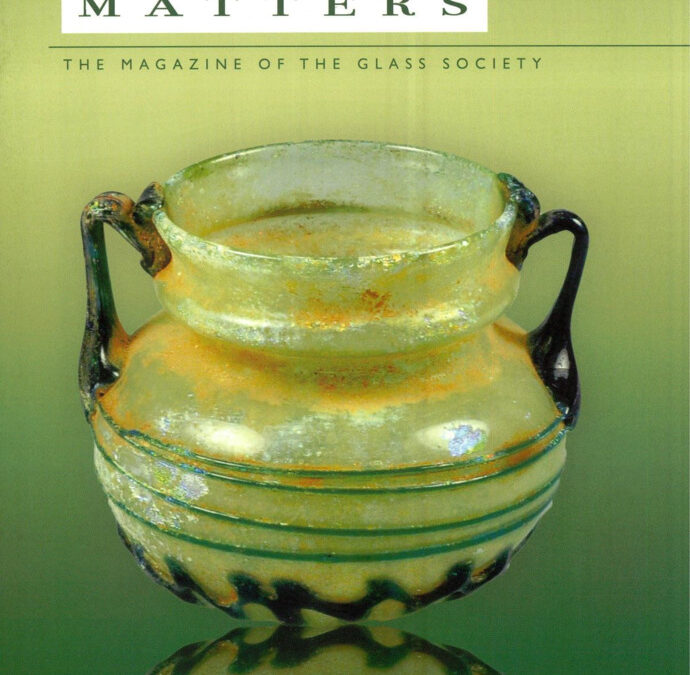
THE MAGAZINE OF THE GLASS SOCIETY
3
4
7
James
Measell
12
Judith
Gower
14
John Lewis &
15
Yuki Kokai
Simon Wain-Hobson
19
Clive Manison
25
David Mulley
30
Stan Parry
31
Alan Gower &
34
Charles Hajdamach
36
37
39
Contents
Chairmens’ message
Biennale winners –
2017 / 2019
Memories of John P Smith
Cameo Vase
Clare Event
Glass Artists in
Glass and Metal
Cordial Glass GC Talk
Pump Handle Style Change
Glass ‘Gold State Coach’
New Collector
& Dartington beakers
Richard Golding Retires
News
Letters
Events
Editorial
ot only is the Glass Society mourning the loss of John
Smith, but very sadly, the designer of Glass Matters,
Athelny Townshend (Lonz), has died. Lonz, recognized as
a knowledgeable 18th century English glass collector and
dealer, had also been the talented designer of Glass Circle
News since it went into full colour production. Athelny
will be missed by many friends, dealers, collectors and his
family, we offer them our condolences. We shall publish
an ‘In Memoriam’ piece in the next issue – do send in your
memories. Following these events, you will, perhaps, have
some understanding why this issue of Glass Matters is way
behind schedule. We are fortunate to have been introduced
to and brought on board a new designer, Emma Morgan;
congratulations to her on this, her first issue. The next
issue is to be printed as scheduled, at the end of September,
but with fewer pages. The first Journal of the Glass Society
will be published later this year, a bumper edition to make
up for the current setbacks.
G
S
–
LASS
SOCIETY
ISSN 2516-1555
Issue 5, )000( 2019
Jointly published by the Glass Circle and
The Glass Association
©Contributors, The Glass Association and The Glass Circle
Editor:
Brian J Clarke
eclitor
,
ii;lassassociation.org.uk
Design & layout:
Emma Nelly Morgan
emmanellymorgan@gmail.com
—
Printed
by
Warners Midlands plc
www.warners.co.uk
Next copy date:
30th August
E-mail news & events to news@glassassociation.org.uk
“Neither the Glass Circle’s nor the Glass Association’s committee
members bear any responsibility for the views expressed in this
publication, which are those of the contributor in each case.
Copyright is acknowledged for the photographs illustrating articles,
though neither the Editor nor the committees are responsible for
inadvertent infringements. All photographs are copyright the author
unless otherwise credited.”
THE GLASS ASSOCIATON COMMITTEE MEMBERS:
The Glass Association Registered as a Charity
No.326602 Website: www.glassassociation.org.uk;
Charles Hajdamach:
Life President;
charleshaj-
damach@btinternet.com; David
Willars:
Chairman:
chair@glassassociation.org.uk;
Judith Gower: Hon.
Secretary;
Maurice Wimpory,
Membership Secretary & Treasurer:
membership@
glassassociation.org.uk: 150 Braemar Road,
Sutton Coldfield, West Midlands, B73 6LZ; Nigel
Benson; Paul Bishop:
Vice-Chairman;
Brian Clarke:
Publications Editor;
Christina Glover; Alan Gower;
Bob Wilcock
THE GLASS CIRCLE COMMITTEE MEMBERS:
Website: www.glasscircle.org;
Simon Cottle:
Honorary President;
Susan Newell:
Chairman:
chairman@glasscircle.org; Laurence Maxfield:
Honorary Treasurer:
treasurer@glasscircle.org;
Vernon Cowdy:
Website Manager:
web@glasscircle.
org; Geoffrey Laventhall; Anne Lutyens-Stobbs:
Meetings Organiser;
James Peake; Anne Towse;
Graham Vivian
GLASS MATTERS EDITORIAL SUB-COMMITEE
MEMBERS:
Nigel Benson; Brian Clarke; Susan Newell;
Athelny Townshend; Simon Wain-Hobson;
Bob Wilcock
FRONT COVER: A small Roman pale blue twin-handled glass jar
dating from the 4th century, c350. Width 7.5cm, height 6.3cm. An
almost identical jar is featured in the book “Histoire de Verre L’Antiq-
uite” by Florence Slitine. With kind permission of
The World is made
of Glass
theworldismadeofglass@hotmail.co.uk.
BACK COVER: A straw opalescent Lilly Vase, with wavy rim.
Height 32cm. Possibly by Kempton.
Private collection.
Glass Matters Issue no.5 July 2019
CHAIRMEN’S MESSAGE
Chairmen’s
Message
Sue Newell, Joint Chairman
of The Glass Society
S
adly, John Smith died in Feb-
ruary. We offer our condo-
lences to his wife Aileen and
all the family. John’s contribution
to glass and the Glass Circle, of
which he was a member for nearly
fifty years and Chairman for four-
teen, was immense. We will miss
his breadth of knowledge as well as
his warmth, good humour and hos-
pitality. When merger discussions
began between the Glass Associa-
tion (GA) and the Glass Circle (GC),
John was an encouraging counsel,
constructive with his criticism and
his ability to solve issues. Memo-
ries of John follow from page 7.
We hope you’ll enjoy the
wide-ranging subjects and the recur-
ring themes and stylistic elements
that are emerging in this issue. The
article by James Measell on one
of the pre-eminent Stourbridge
engravers, George Pope, illustrates
how a random comment or question
can lead to fascinating new insights.
His work underlines the significance
of the Stourbridge glass industry in
late Victorian and Edwardian times
and demonstrates the importance
of the local School of Art and how it
was integrated into the community.
Stan Parry’s interests grew out
of a chance visit to the Ashmolean
Museum in Oxford which triggered
his initial curiosity in glass. On read-
ing the article you may conclude that
Stan has the collecting gene and
has harnessed this to a genuinely
inquisitive mind and a willingness
to keep on learning and sharing his
knowledge. Contemporary glass is
featured, coinciding with the next
Biennale at Stourbridge, where the
cream of today’s studio glass makers’
wares will be on show. Jon Lewis
and Yuki Kokai demonstrate their
collaboration in producing artistic
sculptures in metal and glass and
as in 2017, members will be invited
to vote for their best piece of glass,
The Glass Society awarding a prize
to the winner. Two further arti-
cles return to traditional subjects.
Simon Wain-Hobson writes about
the evolution of cordial glasses in
the late 18th and early 19th centu-
ries through analysing their capacity,
shape and size. The author’s conclu-
sions shed new light on this subject.
Clive Manison examines the chang-
ing ways in which handles were
applied to glass objects in the nine-
teenth century, he has spent many
hours poring over old pattern books
at the Dudley Archives and Himley
Hall before drawing his conclusions.
In order to maintain the frequen-
cy and variety of events, as well as
keeping our magazines full of inter-
esting articles, we need your help.
Our membership is ageing and we
need more young people joining
us to maintain our services. We
are not unique in this respect and
the same message is being voiced
by many organisations. Thanks to
the internet, the amount of infor-
mation freely available to us has
increased exponentially and we
are all more self-sufficient. While
this has many benefits, the down-
side of interfacing your glass activi-
ties through a screen is that you do
not have the opportunity for face
to face meetings with people who
David Willars, Joint Chairman
of The Glass Society
share your interests, nor does the
internet generally provide a plat-
form for more in-depth articles.
The Glass Society is a unique forum
for research, meetings and publica-
tions. Later this year we intend to
publish our first journal since merg-
ing, continuing the tradition so cred-
itably fulfilled by both organisations.
The squeeze in the public sector
for museum budgets is another pres-
sure, as the community of decorative
arts professionals is shrinking and
those that remain rarely have time to
acquire expertise as in the past. Today,
you are the experts in our chosen
fields, possessing more knowledge
than any equivalent group in the past.
We need to tap into your knowledge
to carry forward our activities. We
would like to combine our tradition-
al offering to the membership, with
online platforms such as Facebook,
Instagram, a blog and increased web
content. Please contact us if you are
interested in helping the GS meet
the social media challenge or would
like to discuss your collection or
research and how we might share it
with the membership, be it through
Glass Matters
or our website, with an
article, photographs or a request for
information, else present a lecture, a
more informal event, or host a group
visit. We’d like to hear from you.
Glass Matters Issue no.5 July 2019
3
BIENNALE ARTISTS
British Glass
Kennale
23 August – 28 September, 2019
T
he British Glass Biennale in
2019 opens 23 August and
closes 28 September, being
held at the Ruskin Mill Trust Cen-
tre in Stourbridge. The Private
View and Awards Ceremony will
be held by invitation on Thursday
22 August. This forms part of The
International Festival of Glass, with
displays and events over the bank
holiday weekend, 23 to 26 August.
These are The Glass Associa-
tion winners from the Biennale in
2017, along with an unusual box.
COLIN REID –
SUNFLOWERS
FROM DAVID WILLARS
The winner of the Glass Associa-
tion prize at the 2017 British Glass
Biennale, was Colin Reid for his
work Sunflowers R1872. For those
of you not familiar with Colin’s work
this example demonstrates all the
main characteristics that define
his recent catalogue: large pieces
with prismatic views that invite
you to peer through the smooth
polished faces to the images on the
far side. Sunflowers is made from
vibrant yellow optical glass having
been kiln cast using the tradition-
al lost wax process. Although kiln
casting is an ancient technique,
modern kilns offering greater effi-
ciency and ability to control the
process, give the glass artist greater
scope for creativity and experiment.
Records show that Colin was born
in Poynton on the eastern edge of
the Manchester conurbation, how-
ever, this is slightly misleading as
almost immediately after birth the
family moved to southern England.
Upon leaving school he gained a
place at Saint Martin’s School of Art
in central London but left at the end
of the foundation year. From there
in the early 1970’s he undertook a
technical training course in scien-
tific glass work gaining hands on
glass skills, augmenting his income
by manufacturing perfume bottles
and other items for sale in craft fairs.
In due course he enrolled at the
Stourbridge School of Art in 1978
where Keith Cummings became an
influential figure and mentor. This
Fig.1
Sunflowers
by Cohn Reid.
was the right course at the right
time for Corm, as the early 1980’s
were exciting times to be involved
in the creative glass industry. Stour-
bridge gave him the opportunity to
form relationships with galleries
– the shop window whereby artists
4
Glass Matters Issue no.5 July 2019
Fig.2 & 3
Fabulous Beasts
by Nancy
Sutcliffe.
BIENNALE ARTISTS
gain a reputation and revenue. Grad-
uating with a BA Hons (First Class),
Colin established his own studio
initially at Stow on the Wold, finally
settling into his current premises,
outside Stroud over thirty years ago.
The inspiration for Sunflow-
ers came from the journey to work,
passing the farm shop every day.
This is not untypical, with everyday
objects and nature featuring large.
It therefore is unsurprising to dis-
cover there are several ‘projects’
in his mind at any given moment,
each with the potential to inspire a
series or family of related subjects:
Sunflowers being a prime example.
Development times vary, but again
taking Sunflowers as an example,
what became an idea in the autumn
of 2016, led to initial work on the
mould in February 2017, with a
further ten weeks or so includ-
ing the polishing stage to follow.
Looking forward, Colin is in a
familiar scenario confronting many
creative people – of maintaining a
satisfactory work life balance at
an age when many are beginning
to think about retirement. Having
spent a lifetime acquiring knowledge
and skill the likely outcome is a more
selective and considered output util-
ising the experience of a generation
in glass. Why would you not contin-
ue to do something that you enjoy,
which is truly original and gives
genuine pleasure to many people?
NANCY
SUTCLIFFE
FABULOUS
BEASTS
Over the last ten years, Nancy’s
work has been shown in many
exhibitions, through Europe and
America. She’s won the Worship-
ful Company of Glass Sellers Tro-
phy at the National Exhibition
of the Guild of Glass Engravers
and at the 2017 British Biennale,
she followed Colin Reekie with a
prize from The Glass Association.
Nancy Sutcliffe gained a degree
in design, before training and work-
ing as a Medical Illustrator. Then
in courses at West Dean College,
Sussex and Pilchuck Glass School,
Washington, USA, Nancy discov-
ered glass engraving. She tells us:-
Drawing is still key to my artis-
Glass Matters Issue no.5 July 2019
5
Fig. 4
Box with scent bottle
by Ingrid Hunter.
BIENNALE ARTISTS
tic practice. I regard my process
as drawing on glass, but using
diamonds and stones instead
of pencil and pen. Using a small
tool much like a dental drill, the
crystal is carved and abraded,
each mark capturing light with-
in the object to give the illusion
of 3D. The “fabulous beasts” here
are creatures from my imagina-
tion, engraved and inlaid with
precious metals. The gold, pal-
ladium and pink silver leaf is
inscribed by hand with a diamond
point to form delicate patterns
inspired by the Art Deco period.”
INGRID HUNTER –
TRINKET
Box
WITH SCENT BOTTLE
This box was a gift to Brian Clarke from
the committee of The Glass Association
on his retirement as chairman in 2017
Ingrid
tells
u s : –
My inspiration started with the
elephant. From my travels to India
I found a small elephant orna-
ment. I decided I wanted to make
it in glass, but hollow, so it could
be a small scent bottle and I’ve sat
the elephant in a garden to cre-
ate a lid. For the stopper I decided
to have a bird landing on its back
— which is a familiar sight in India.
I’m very interested in core cast-
ing, particularly making the core
very intricate and detailed which
allows the interior to be different
to the exterior. For the Trinket box,
on which the elephant scent bot-
tle is sitting, I wanted to create an
illusion. What you see is an ornate
box, when in fact the exterior is a
straight sided polished glass box;
the pattern design of the hollow core
interior showing through the glass.
I’ve added a silver collar around
the opening of the box and to the
opening of the elephant so that
when lifting and replacing the
stopper or elephant into posi-
tion the glass is not vulnerable.
The box is cast using Bulls-
eye glass and the Elephant and
Bird are cast in Gaffer Glass.
Issue 3 apologies
The Glass Society omit-
ted to thank the Corning
Museum of Glass for per-
mission to use the image
of its snuff mull in the
article by Jill Turnbull,
Fig.12 on page 17 of
Glass
Matters,
issue 3. We apol-
ogize for the error and
acknowledge the muse-
um’s copyright. The
photo is reproduced.
The Glass Society omitted
to thank the Trustees of the
British Museum for permis-
sion to reproduce the image
of its c.1807 cartoon by
Isaac Cruikshank in the arti-
cle by Jill Turnbull, Fig.1 on
page 14 of Glass Matters,
issue 3. We apologize for the
error and acknowledge the
museum’s copyright. The
photo is reproduced.
6
Glass Matters Issue no.5 July 2019
JOHN SMITH MEMORIES
Memories
of John P
Smith
1940 -2019
Life in Glare
Simon Cottle, former chairman
of the Class Circle
tireless researcher, a lecturer and
eading author in the important
field of glass studies, John Smith
was truly ‘a man of class and glass’
(Fig.1).
From his early years as a
chemist, John displayed an interest
in and an appreciation of glass that
went far beyond those of the con-
noisseur and the collector. He had a
scientist’s fascination for the way in
which glass was made, as well as an
understanding of the development
of design and its application to the
material. From coloured glass for
the table to the humble bulb vase of
the mantelpiece, and from elaborate
glass furniture on the floor to daz-
zling chandeliers suspended from
the ceiling, John’s interests
knew no bounds and he
has inspired many a devo-
tee of these areas of study.
He grew up in Burton-
on-Trent, Staffordshire,
attended Repton School
in the 1950s and went on
to graduate from the Uni-
versity of Bristol with a
degree in chemistry. In
1922, his stepmother’s
father had established
Henning’s, an antiques
shop at 61 George Street in
the heart of the West End
of London, specialising
in “Old Furniture, China
and Glass, Old & Mod-
ern” which, after a career
in the chemical industry,
John inherited in 1974.
The business closed in
Fig.1
John Smith
the early 1980s, and John then
established another antiques
firm, Regency House Antiques,
Walton-on-Thames, Surrey.
It was in 1984 that I first met
John, after he had published an
article on Cloud Glass, which was
first developed by George David-
son & Co. in Gateshead-on-Tyne
in 1923. John had assembled an
historical collection of this deco-
rative and colourful press-mould-
ed glass and he published the first
article on the subject. He proposed
an exhibition of his collection, aug-
mented by examples from others,
to be held at the Laing Art Gallery
in Newcastle-upon-Tyne, where I
was then curator. A suave, sophis-
ticated and fashionably dressed
gentleman, John easily persuaded
me to work with him on this proj-
ect and a lifelong friendship began.
Shortly after the exhibition, his
Surrey shop was closed and John
joined Derek Davis, son of the
renowned Cecil Davis, at Asprey
& Co. in Bond Street. There, John
ran the antique glass department
and became familiar with import-
ant pieces of antique English glass
that Cecil and Derek had acquired
for museums worldwide, including
the Corning Museum of Glass. At
this emporium, John published cat-
alogues on green table glass of the
18th and 19th centuries and pre-
sented an exhibition of contempo-
rary British stipple-engraved glass.
Through Asprey, John also spon-
sored two articles on Beilby enam-
elled glass which I had written for
Apollo
magazine. In 1990 he moved
to Asprey’s competitor Mallett
& Son, where he became a direc-
tor. His close collaboration with
chandelier restorers fos-
tered a deep understand-
ing of the intricacies of
antique English light-fix-
tures and their complex
assemblage. He published
a book on the subject and
was a founding member
of the European society
dedicated to the study
of chandeliers
(Fig.2).
Through his interest in
19th century glass, John’s
pioneering research on
the firm of Osler of Bir-
mingham, manufactur-
ers of extraordinary glass
furniture for royalty and
the maharajahs of India,
enabled him to meet col-
lectors worldwide. He
also handled the contem-
porary glass furniture of
Danny Lane, bringing Mal-
lett into the 21st century.
John established a
Glass Matters Issue no.5 July 2019
7
JOHN SMITH MEMORIES
Fig.2
John informing Glass Circle members on the history of
Chandeliers, at a visit to Corning museum of glass, 2015.
strong reputation for important
glass at Mallett, publishing
Glass
from the Restoration to the Regency
co-authored with the late Christo-
pher Sheppard and a book on 17th
& 18th century Dutch engraved
glass with Frans Smit. His person-
al research into the works of the
Scottish portrait cameo glass mak-
er James Tassie resulted in both an
exhibition and a catalogue, which
incorporated John’s understanding
of the chemistry of glass – his inter-
est and passion throughout his life-
time. Recognition of his knowledge
of European glass, both antique
and modern, was confirmed by his
appointment in 2007 as a member
of the glass vetting committee at
the annual European Fine Art Fair
in Maastricht, the Netherlands.
For almost 50 years, John was a
member of The Glass Circle, regular-
ly delivering lectures on a range of
subjects, (Fig.3). He joined the com-
mittee in the late 1990s and initiat-
ed opportunities for overseas visits.
Among the European destinations,
John organised trips for members
to see glassmakers and museums in
the Czech Republic and glass collec-
tions in Germany and the Nether-
lands. In the Netherlands,
his connections with a soci-
ety of collectors of colourful
hyacinth/bulb vases opened
up new terrain for the Glass
Circle, which had previously
been steeped in the study of
antique English glass. Suc-
ceeding me as Chairman
in 2003, John steered the
Glass Circle with enthusi-
asm and fresh vision until
his retirement from the
position in 2017. During his
long tenure as Chairman,
John edited three volumes
of the Glass Circle Journal.
Before he stood down, he
commenced negotiations
with Brian Clarke, chair-
man of the Glass Associa-
tion, for a merger with the
Glass Circle, resulting in
the newly-formed Glass Society.
A great supporter of
Broad field
House Glass Museum
in Kingswin-
ford, he played a pivotal role in the
consultations concerning the clo-
sure of the museum in 2015 and its
planned move to the nearby White
House Cone museum of glass in
Stourbridge. In Decem-
ber 2017, John became
a trustee of the British
Glass Foundation and
worked tirelessly for it
and its mission to estab-
lish a new museum. Ear-
lier, he’d travelled around
the United States lec-
turing on American cut
glass, perhaps inspired
by the extraordinary cut
glass furniture and light-
ing made by Birmingham’s
Osler glass company. He
also paid many visits to
the Corning Museum of
Glass in New York State
where he was elected to
the Fellowship in 2000.
Fig.3
John, contemplating and playing
the Glass Music Box at the Reid
museum, Edinburgh
John met Aileen Dawson, a curator
of ceramics and glass at the Brit-
ish Museum, in the early 1990s.
They were married in 2005 and
spent time between London and
Suffolk. In Suffolk, John’s passion
for interiors, fostered at Mallett,
found its expression in the former
water tower in Thorpeness. Here
he carefully converted the top of
the building which had housed the
water tank, to take advantage of
the 360-degree views across the
surrounding countryside, Size-
well and the North Sea
(Fig.4).
The
lower level became his main work
space and the home of his exten-
sive glass library, acknowledged as
the finest in private hands in the
UK. Here, he pursued his passion
for glass research, surrounded by a
diverse collection of objects, which
he generously showed to members
of The Glass Circle and The Glass
Association when he and Aileen
opened their house to them in 2017.
For a number of years, John
served as a committee member
of the Friends of the Victoria and
Albert Museum, organising sev-
eral events which raised consider
8
Glass Matters Issue no.5 July 2019
able sums for them. He was proud
to have been asked to contrib-
ute to the revised edition of
Five
Thousand Years of Glass,
published
by the British Museum press in
2012. His chapter,
The Decline of
the Craftsman, the Rise of the Artist,
1940-2010,
was based on his deep
knowledge of modern and contem-
porary glass. John’s special standing
in the world of glass was recognised
when he became a Freeman of The
Worshipful Company of Glass Sellers
of London. Recently, in 2014, John
contributed two essays to
The Histo-
ry of the Grocers’ Company through its
Collection of Silver and Glass,
edited
by Helen Clifford, “A ‘Living Collec-
tion: Glass at the Grocers: The Col-
lectors’ “and “A ‘Living Collection:
Glass at the Grocers: Highlights'”.
However, all was not work and in
retirement, he pursued his passion
for skiing, spending part of each
winter in the beautiful Swiss resort
of Wengen. Inspirational, colourful,
Fig.4
John in the tower room at home in
Thorpeness, Suffolk
charismatic, scholarly, gentlemanly,
and a friend to all, John died on 24
February 2019 after a short illness.
This is an edited version of an obit-
uary written for the Journal of Glass
Studies, Corning Glass Museum, from
Simon Cottle, Honorary President of
The Glass Circle and Managing Director
(European & US Regions) at Bonhams.
John’s early years
Philip Bletcher
I
first met John in the autumn of
1957 when we were both new
boys in Latham House at Repton
School. Latham House was full, so
we slept at one of the Master’s hous-
es in the village and had to walk a
mile across the village at 9pm in
the winter and go to bed in an attic
bedroom with no heating! It was
tough in those days! Even with a hot
water bottle when it was really cold!
John became a Sergeant in the
Cadet force, excelled at cricket and
hockey and was one form above
me in most academic subjects. His
hobby was photography, at which
he was very proficient, producing
black and white pictures of flow-
ers and other artistic subjects.
After Repton, John went to Bris-
tol University, where he was enrolled
on a three-year science course. We
were only 30 miles apart, so occa-
sionally saw each other at weekends.
Having qualified, John secured a
position with a chemical firm on
the Humber Bank. While there, he
lived in a ground floor flat in Grims-
by; it had a backyard and a very small
pear tree, producing one very small
pear which he tended with loving
care. I visited him one day with my
girlfriend; he was out and she went
and picked the pear and ate it, not
the best thing to have done! To
make amends, we went to a fruit
shop, bought the biggest apple they
had and attached to it the pear tree
with Sellotape. I never did know his
reaction! He joined the Brigg Young
Farmers Club in Grimsby (of which
I was then chairman) and took part
in tennis, sailing, dances and parties
JOHN SMITH MEMORIES
Glass Matters Issue no.5 July 2019
9
JOHN SMITH MEMORIES
and joined us on his first skiing trip.
After a few years he left the area to
take a job in the south of England.
We stayed in touch and always
met up when celebrating anniver-
saries or significant birthdays. I am
very proud and pleased to have been
a friend of John’s for all these years.
A Generous Man
Alastair Smith – a family memory
M
y father was a kind and gen-
erous man, who defined
greatness his own way – shown by
how he conducted himself, always
having time for others, his con-
tribution to and love of all things
glass, who had a large circle of
friends and loved his family, espe-
cially his grandchildren
(Fig.5).
His attitude was ‘live and let live’.
He was a ‘Bonne Viveur’: life
was there for the living and not to
be wasted. The Aldeburgh Music
Festival had been a highlight for
him over the past 20 years and his
appreciation of good food and wine
made him the best of hosts. Then
his beloved sport became para-
mount: skiing, and most impor-
tantly his early season weeks in
Wengen and his beloved Down Hill
Only club
(Fig.6).
His ten or so ski
seasons made him fitter and slim-
mer, although of course not without
mishap and adventure. He might not
have returned to the Franz Klammer
of his youth, but Wengen certain-
ly set him up for the rest of year.
It wasn’t until 1993, with three
events coinciding, that glass became
a defining feature of John’s life.
First, a private income came to the
end, forcing him to apply himself.
Secondly, he met Aileen and their
mutual love of each other, and glass
and ceramics, flourished. Thirdly,
John joined the renowned antiques
business of Mallett’s, to form a suc-
cessful, important and commer-
cially profitable glass business. At
Mallett’s John’s considerable intel-
lect and entrepreneurship shone
Fig.5
A portrait of John, content in
the garden at a family gathering
Fig.6
With ski-jacket on, John’s ready
for the slopes of Wengen
through. Dad went on to become an
authority on many aspects of glass,
especially chandeliers and glass fur-
niture. When in India he was always
dressed impeccably, and known as
`the gentleman in a panama hat’.
A Life Well Lived
Henry Neville – a colleague and friend
ohn joined Mallett in 1989 to
J
start a glass department within
our fairly formal Bond Street world
of 18th century furniture; we were
together for the following 30 years.
He was a man of independent mind,
personal vision and a great educa-
tor to those who worked with him.
John first approached Mallett
when he had the opportunity to
buy and exhibit a great collection of
17th and 18th century Dutch and
English glass of the finest quality.
The exhibition sold well and the cat-
alogues were beautifully produced
and written with considerable schol-
arship. This was the last that Mallett
saw of traditional English or Con-
tinental 17th
and 18th centu-
ry glass. As ever,
John ‘paddled
his own canoe’.
John’s great-
est exhibition
was held in
1991, when he
re-established
the reputation
of F. & C. Osler,
the 19th centu-
ry glass manu-
facturers, who
created the mag-
nificent Crystal
Palace Fountain
centrepiece for
the Great Exhi-
bition of 1851.
Having scoured
India for pala-
tial cut glass furniture, the exhibi-
tion and catalogue entitled From
Royalty to Rajahs
broke new ground
and was both an academic and com-
mercial success. John created a
visual spectacle in the Bond Street
showrooms and pieces were sold
to collectors and museums world-
wide including Corning Museum
of Glass. The catalogue informa-
tion is so valued, that signed copies,
once sold for £25, are now avail-
able on the internet for over £500.
In 1995, John exhibited a group
of the finest works by James Tassie
(1735-99), the Scottish portrait
I0
Glass Matters Issue no.5 July 2019
JOHN SMITH MEMORIES
modeller and inventor of a glass
paste he used to make reproduc-
tions of engraved gems. Tassie’s
gems were shown alongside exam-
ples of sulphides by Apsley Pellatt,
Baccarat and Clichy. It was the first
major work on Tassie in more than
a century. The long list of acknowl-
edgments on the opening page of the
catalogue, embracing museum and
university staff as well as collectors
and the commercial world of deal-
ers and auctioneers, revealed John’s
meticulous approach. A bridging of
these worlds is rare in our times,
yet John was respected, valued
and comfortably at home in each.
Through John, I had my first
introduction to the world of con-
temporary art allied to a traditional
aesthetic, now internationally popu-
lar with designers and collectors, but
not so in the 1990s. John mounted
a critically-acclaimed exhibition of
glass furniture,
Breaking with Tra-
dition,
commissioning work by the
glass sculptor Danny Lane which
was shown alongside 19th-century
cut glass by Osler and Baccarat. It
was this innovative eye of John’s,
creating new connections, that con-
tributed to a deeper understanding
of the glass world by a wider public.
There is this glorious tale to tell:
John had skillfully acquired and then
swiftly resold a very rare 18th centu-
ry canary yellow triple twist drink-
ing glass, so rare that only a few have
been recorded. On this occasion, the
priceless glass, carefully wrapped by
John, was sent in the internation-
al mail accompanied by a customs
declaration stating its astonish-
ing price. The glass never reached
its destination. The collector was
most upset and very unwillingly the
insurance paid out. Some months
later Mallett’s received a late eve-
ning call from the FBI in Dade Coun-
ty, Florida, USA. A warehouse had
been opened as a ‘sting’ operation
in Miami to collect stolen objects
from the local criminal fraterni-
ty and the FBI were asking about
a glass with a yellow stem, news
which made our client exultant. So
we waited until after the court case
for the return of this rare glass. The
judge, unable to believe the val-
ue, which was over $30,000, asked
to see this rarity and in his shock,
dropped it! There are now even
fewer yellow twists in the world.
John travelled around the world,
including the Middle East, install-
ing chandeliers, and even hand-car-
ried a six foot long frigger on loan
to San Francisco. Minor setbacks
were an opportunity. After selling a
Baccarat cut glass table to the King
of Morocco for his birthday pres-
ent, John flew out to unpack and
set it up. King Hassan could not
decide which palace should house
such a treasure. The table was nev-
er installed, but John had a remark-
able free vacation, travelling around
Morocco with his royal driver, visit-
ing palaces in Fez, Rabat, Casablanca
and even Agadir to advise courtiers
where the table should be placed.
John’s ground-breaking research
and scholarship added to art his-
torical knowledge. Colleagues
from around the world often tele-
phoned to seek his opinion on
areas of academic uncertainty.
A man of singular and creative
intellect, John was never happi-
er than when sharing his experi-
ence and knowledge with others;
all say he was such good company’.
Happy Memories
from a collector
Graham Vivian
I
ohn’s knowledge of a wide range
J
of glass, relatively unfamiliar
to collectors of English drinking
glasses like myself, his chairman-
ship of the Glass Circle, academic
interest in glass and wide ranging
appointments and contacts with
collectors, dealers and museums
are all part of his complete involve-
ment with this wonderful subject.
In 1990, shortly after starting
collecting, I was invited by John
Towse to see his important collec-
tion of English glass. He suggest-
ed that I’d enjoy visiting Mallett
at Bourdon House in Mayfair,
where John Smith’s glass depart-
ment was located. To suggest vis-
iting Mallett at that time of my
early collecting career was tanta-
mount to advising me to make an
appointment at Cartier to buy my
wife, June, a diamond necklace!
Nonetheless, in due course, I did
meet this very pleasant, mild-man-
nered man and even purchased
one of his least expensive glasses!
It was through joining John
on his Glass Circle/Glass Associa-
tion trips to Bohemia in the Czech
Republic and then Holland that
June and I really began to know
him. What impressed us was his
organization and sense of humour.
He had an entrée to every muse-
um worth visiting and there was
always a curator on hand waiting to
tell us about the collections and if
necessary, a translator who would
assist. In particular, he opened our
eyes to the beauty of Bohemian
glass both old and contemporary.
One day, we arrived for lunch
at a restaurant in the heart of
the Czech countryside – not a
word of English was spoken. To
order our meal we had to identi-
fy the food on the printed menu.
Our aim was achieved by John
uttering a series of quacks and
June following, cluck-clucking
after him. The other guests and
waiters were in fits of laughter.
John’s ‘freedom pass’ gained us
visits to the homes of a number
of Dutch glass collectors, where
we saw their remarkable collec-
tions, especially the cabinets of
engraved glass. The intimacy of
the home when the collector is
present to talk about his collec-
tion is a special treat on any visit.
Being with John on these
trips was enormous fun. His
many friends will join us in find-
ing that his passing will leave
a great void in the glass world.
Glass Matters Issue no.5 July 2019
CAMEO VASE
A Cameo Vase
by
G.
H.
POPE
James Measell
S
ome months ago, I received
an e-mail and photo from
an acquaintance in England
regarding an interesting piece of
cameo glass. The message read:
`I’ve seen a satin-finished black and
white cameo vase, about 9 inch-
es in height and it’s signed “G. H.
Pope” and “Webb.” I wonder if you
know who this Pope might be?’
I immediately thought that the
person in question could be George
Pope, a prize-winning student at the
Stourbridge School of Art in the late
1890s. Before reviewing my thesis
on the Stourbridge school 1850-
1905, I decided to check the index
listings in five key sources: Harry
Powell’s Glass-Making in England;
Geoffrey Beard’s Nineteenth Cen-
tury Cameo Glass;
Charles Hajda-
mach’s British Glass 1800-1917;
Jason Ellis’s
Glassmakers of Stour-
bridge and Dudley 1612-2002;
and
Ray and Lee Grover’s
English Cam-
eo Glass.
The result: no entries for
`Pope’! However, a search of the
holdings at the Rakow Library in
Corning, New York, brought forth
a useful article in the Winter 2005
issue of
Cameo,
a publication issued
by the Friends of Broadfield House.
The note in
Cameo
was based upon
knowledge and material furnished
by George Pope’s grand-daughter
Gillian Powell. Together with pub-
lic records from Britain, it was a
great help in assembling this brief
account of Pope’s life and work.
I quickly realized that George Pope
was not going to be among the glass-
workers or artisans in the glorious
time period when spectacular carved
cameo pieces were being made dur-
ing the last few decades of the nine-
teenth century. His parents, George
Henry Pope and Jane Lloyd Pope,
were married at St. Johns Church
in Wednesbury on 7 December
1876. The census of 1881 reveals
that George Henry Pope (occupa-
tion: photographer and engine fit-
ter) and Jane Lloyd Pope then lived
at 15 Enville Street, Stourbridge,
with their daughters Ada, 3, and
Mabel, 1. Their first son was born
on 3 May 1882 in Stourbridge, and
the birth certificate records his full
name: George Harry Alfred Lloyd
Pope. According to the 1881 census,
the Pope family continued to reside
at 15 Enville Street, but the Pope
daughters Ada and Mabel now had
four younger brothers, all with very
distinctive, given names: George
Harry Albert, Francis Charles,
Percy Charles and Horace Henry.
Cameo vase, about 9″ tall, with engraved motif
and acid finished, signed ‘G. H. Pope’ and
‘Webb’ on the underside. Courtesy of Cheffins
Fine Art, Cambridge.
12
Glass Matters Issue no.5 July 2019
CAMEO VASE
In the mid-1890s, George Pope
began to attend the Stourbridge
School of Art. At this time, the art
master at Stourbridge was George
Henry Cromack, who had taken
up his post at the start of classes
in September 1893. At the time of
Cromack’s appointment, the County
Express (27 May 1893) published a
lengthy account of his background.
A native of Nottingham, Croma-
ck studied at the Stroud School of
Art and was assistant art master
there when he was awarded a Gov-
ernment scholarship to attend spe-
cialised classes at the National Art
Training School in London. These
classes included drawing and shad-
ing from life or antique works, mod-
elling, and design as well as painting
in watercolour or oil. At Stour-
bridge in 1894-1895, art master
Cromack instituted the ‘Life Class’
as an opportunity for students to
sketch or paint from a live model.
During his attendance at the Stour-
bridge school, George Pope would
have had to gain proficiency in basic
drawing (with instruments and free-
hand) before attempting projects in
shading with charcoal or painting in
watercolour or oil. Among his class-
mates in the Male Evening Class at
Stourbridge in the late 1890s were
these young men: William North-
wood and Francis Grice, employees
at the J. & J. Northwood glass dec-
orating firm; Ludwig Kny, who was
later employed at the Webb glass-
works; and Frederick Noke and
Arthur Dudley, employees at Ste-
vens & Williams. During four con-
secutive years, 1897-1900, George
Pope was among the recipients of
monetary prizes provided by the
Midland Association of Flint Glass
Manufacturers for students at the
Stourbridge school. These prizes
were initiated and first awarded in
the mid-1880s when the Midland
Association of Flint Glass Manufac-
turers established two divisions for
awards: firstly, prizes ‘to glassmak-
ers’ and, secondly, prizes ‘to persons
engaged in glassworks otherwise
than glassmakers’. After only two
glassmakers competed in 1885 and
none came forth in the years thereaf-
ter, the annual prizes awarded by the
Midland Association always went to
workers employed in glass cutting,
glass engraving or glass etching.
The prizes ceased when the Midland
Association was dissolved in 1902.
The 1881 and 1911 Census rolls
provide additional information
about George Pope. In 1901, he
was residing at 15 Enville Street
with his widowed mother Jane (his
father had passed away in 1896),
his sister Mabel, and his three
younger brothers. Most impor-
tantly, George Pope’s occupation in
1901 is recorded as ‘glass engrav-
er,’ so one can conclude that he
was employed as a glass decora-
tor by one of the firms then oper-
ating in the Stourbridge district.
Since George Harry Pope was just
18 in 1901, he was likely in the
midst of a seven-year appren-
ticeship obligation to his employ-
er. The
Cameo
article reveals that
his employer was probably the
Kny Brothers glass engraving
firm at The Platts in Amblecote.
On 9 June 1909, George Pope
married Nellie Ray at the Parish
Church in Old Swinford. The mar-
riage certificate records his full
name, George Harry Alfred Lloyd
Pope, and gives his occupation as
`glass decorator.’ The 1911 Census
offers more precise information.
George Pope (occupation: glass
engraver) was living with his wife
at 38 Platts Crescent, Amblecote,
a location near his employer. After
leaving Kny Brothers in the early
1920s, Pope worked at the Jones
and Warry glass decorating firm in
Brettell Lane before joining Thom-
as Webb’s glass enterprise. Charles
Hajdamach’s
20th Century British
Glass
notes that Pope became the
head of Webb’s engraving depart-
ment in 1930 and continued in that
capacity until his death in 1960.
The article in
Cameo
records that
George Pope lived for many years
in Wollaston, and that he often did
freelance glass engraving from his
home. George Pope, age 77, died
on 11 February 1960, and his death
certificate records his address as 42
Bridle Road. Elaborately engraved
crystal glass articles signed ‘G.
H. Pope’ are seen from time to
time in the marketplace, but the
full details of his career as a glass
engraver have yet to come to light.
With these facts regarding George
Pope in mind, what can be said
about the cameo vase that precip-
itated this research into the details
of his life? At first glance, one can
see that the symmetrical, dramat-
ic motif repeats itself around the
circumference of the vase. The styl-
ized flowers and leaves are framed
and accented by straight lines that
vary in width as well as circles and
ellipses along with crescent shapes.
All of this was accomplished by
careful cutting to take away por-
tions of an outer layer of opaque
white glass in order to expose the
inner layer of black glass. The area
around the top of the vase also
has a motif that repeats around
the circumference of the piece. All
over acid etching creates the final
visual effect. One wonders when
George Pope might have designed
and executed this cameo vase. It
is surely the work of an accom-
plished glass decorator, and, since
his employ at the Webb firm began
in the 1920s, it probably dates
from that time or soon thereafter.
James Measell is an Honor-
ary Research Fellow at the Uni-
versity of Birmingham. He can be
contactedviaemaibjsmeasell@gmail.com
Glass Matters Issue no.5 July 2019
13
GS CLARE EVENT
A Trip to
Clare
Reported by Judith Cower
A
Friday evening at the end of
October 2018, saw a num-
ber of glass enthusiasts
wending their way to the Town Hall
in Clare, Suffolk, for an evening of
fun and frolics with Andy McConnell
(Fig.1).
His talk was very entertain-
ing; with photographic evidence of
some of his experiences while trav-
elling around the UK with the BBC’s
Antiques Roadshow team along
with the other experts and present-
ers. Andy had lived and worked in
Suffolk for a while and some of his
old friends and colleagues had come
along to hear him reminisce, which
proved entertaining. As those of you
who watch the Antiques Roadshow
will have seen, Andy likes to let the
visitors crowd around and put their
glass items on his table, waiting for
his appraisal. The evening concluded
with a raffle for an encalmo decant-
er, made and donated by Stewart
Hearn, the funds going to charity.
The next morning, we had a chance
to explore the town of Clare, and
view the antique centre before meet-
ing in the Community Centre for the
day’s talks. Stewart Hearn, a glass
artist and Kathryn Hearn, a ceram-
ics artist
(Fig.2),
began the day; they
live and work in Chatteris, near Ely.
We were fortunate to have Stewart
with us as he should have been in
China collecting a major prize for
Fig.1
Andy McConnell
his work. They did a double act talk-
ing about their lives and how they
met as well as showing examples of
their work and some of their recent
projects. Both are major artists who
bounce ideas off each other and
use the fens around their home for
inspiration. Many of us, being glass
enthusiasts, were amazed at the
beauty of Kathryn’s ceramic work.
After a magnificent lunch we set-
tled down for the afternoon. Kath-
arine Coleman MBE
(Fig.3),
the
internationally renowned glass
engraving artist, gave the first talk.
She held our attention with stories
of how she began to engrave glass
and the copper wheel technique,
amongst others, that she uses. She
invented many of these herself to
attain the desired results. Kathar-
ine also talked us through the exper-
iment that she carried out for the
editor of Glass Matters, removing
a maker’s mark from the bottom of
a glass
(as told in Glass Matters 3 on
’18th century Reproduction Glasses-Re-
visited’).
We were all astounded by
the quality of her work and the level
of detail that she was able to include.
We then welcomed the return of
Andy McConnell, to complete the
day of an entertaining weekend.
Andy gave another highly amus-
ing and informative talk, this time
about the work of Renee Lalique;
particularly enjoyable for those
of us who had visited the Lalique
Museum in Wingen-sur-Moder in
2017. After his talk, Andy demon-
strated his knowledge of many are-
as of collectable glass, identifying
and valuing the pieces that people
had brought with them. He’d also
brought along the first copy of the
updated edition of his new book,
The Decanter, Ancient to Modern.
He was awaiting delivery of the rest
of the copies which have now arrived.
EDITOR
Author signed copies of Andy McCon-
nell’s book are currently available
from andy@decanterman.com, or
Glass etc. Rope Walk, Rye, TN31 7NA.
This event was organised to raise
funds for EACH (East Anglia’s Chil-
dren’s Hospices) and the Glass Society.
LEFT: Fig.2
Stewart Hearn,
a glass artist and
Kathryn Hearn,
a ceramics artist
RIGHT: Fig.3
Katharine Coleman
MBE, internationally
renowned glass
engraving artist
14
Glass Matters Issue no.5 July 2019
GLASS & METAL
Glass
and
METAL
Jon Lewis & Yuki Kokai
Y
uki and Jon
have worked
alongside each
other over many
years, collaborating
on many projects jux-
taposing metal and
glass, leading to the
creation of intrigu-
ing and visually
absorbing sculptures.
The first piece
that brought them
to notice was
Blos-
som (Fig.1).
They
described their vision:
“Blossom represents
the fragility and beau-
ty of life. It’s a remind-
er that life is almost
overwhelmingly beau-
tiful, but that it can
also be seen as tragi-
cally short. The flow-
er is free, but there
is an evident tension,
the flower almost
being crushed. This
work presents a stark
contrast between the
heavy and confining
medieval presence of
the two cage halves and the delicacy
of the seven spheres of the flower”.
Yuki created the heavyweight
iron forge-work during her time
at University. Jon contributed the
ethereal flower, using interchange-
able spheres of dichroic glass.
(Dichroic glass is glass which displays
more than one colour by undergoing
a colour change in certain lighting
conditions.)
When this piece was
first seen, many people assumed
that Jon was the metal forger and
Yuki the glassmaker. In fact, they
were both trained in metal and
glass, this time Jon was the glass
maker and Yuki the metal forger.
JON LEWIS WRITES
While at school and studying in
the metalwork department, I was
either making a weathervane or
machining parts for motorbikes. I
found this satisfying, so on leaving
school, I accepted an electronic and
mechanical engineering appren-
ticeship. One of our projects was
to machine a block of steel and
then to precision file every face to
within thousands of an inch over a
two-week period. I kept this rectan-
gular piece of steel in my toolbox for
years; a solid lump of metal which
was occasionally useful for some-
Fig.1
Blossom.
Forged steel and cast glass construction.
Yuki Kokai and Jon Lewis 2009
thing, it was hammered, deeply
rusted and work worn. Twenty-five
years later this corroded and abused
piece of iron became the stopper
for an Alchemy scent bottle
(Fig.2).
While studying glass at Wolver-
hampton University, metalwork
became intrinsic to my glass
exploits. Glass is unquestionably
one of the most fragile and challeng-
ing materials you could choose to
work with. Metals in contrast are so
much more forgiving and malleable.
My endeavours of the last 25
Glass Matters Issue no.5 July 2019
I5
LEFT: Fig.2
Alchemy scent
bottle.
Steel and
glass. Jon Lewis
2010
BELOW: Fig.3
Arrow flute.
Glass
and metal. Jon
Lewis 1993
GLASS & METAL
years have been a combination of
architectural commissions and piec-
es made to follow my own thoughts
and ideas. When designing ‘some-
thing’, whether useful or purely
decorative, I try to clarify and con-
sciously pare it down to the most
simplified statement. My work has
evolved a distinct aesthetic, using
the purity of glass mixed with anti-
quated and corroded metal elements.
I am attempting to make ageless
relics. Corrosion and rust appeal to
me – remembering some of my cars
over the years, this had not always
been so! I now appreciate the rich
weatherworn surfaces and pati-
nas which corrosive rust can create.
In 1994 I started experiments to
coat blown glass with a skin of iron
(Fig.3).
This body of work has been
an ongoing series which I have devel-
oped through the years. My recent
evolution of this series is “Distant
Electric Vision”, the phrase used 100
years ago to describe the pioneer-
ing experimental technology now
known as television. Superseded
by modern flat screens, bulky old
cathode ray tube TVs have become
redundant and are a worldwide
waste issue due to the high lead
content in their glass. I have been
involved in glass recycling in many
forms over the years; many things
have been thrown into my furnace
including bottles, fluorescent tubes,
windows and TV Screens. I disman-
tle stylish old Bang and Olufsen tele-
visions as a project in upcycling. The
screen glass is melted in my furnace
and blown to create the form while
the metal in the chassis is used to
coat the vessels in iron. By their
nature, television screens are made
of a very good quality optical glass,
as lucid and workable as any studio
glass. This series has been positive-
ly influenced by a time in the 1990s
when I was designing and making
stained glass windows. On occasion
I would pick up a piece of handmade
blown glass, rich with striations,
bubbles and colour blends. It would
just be a beautiful entity on its own.
16
Glass Matters Issue no.5 July 2019
BELOW: Fig.4
Violescent Wisp.
Blown glass with patinated
iron coating. Jon Lewis 2017
RIGHT: Fig.5
Phase 4.
Steel and glass. Yuki Kokai 2010 metal.
The vessels are evolving but they
always have a window of pure trans-
parent colour, a framed aperture
within a metal shell. I am trying to
capture a small essence of the blown
glass vessel and frame it
(Fig.4).
The
vessels have amorphous or distinctly
blown glass bodies which belie their
appearance as metal objects. Metal
is rarely seen in such an alien form.
“Glass is pure light and
pure colour; there is no point
in disguising that. Beauti-
ful glass has simplicity. I
use metal to contrast and
complement this purity”.
YUKI KOKAI WRITES
After two years of attending the
Tokyo Glass Art Institute in which
I covered every technique of glass-
making, my fellow students and I
had to produce our final degree grad-
uation work. I decided to use mica in
my kiln cast piece, a mineral which
appears as metal flakes. From that
process, I started to become inter-
ested in combining glass with differ-
ent materials. I decided to continue
studying and developing my ideas,
so applied and was accepted onto a
master’s degree at the same insti-
tution. In the master’s programme
my senior tutor was a metal sculp-
tor. He taught me the interpreta-
tion of constructions and balance,
proportion and composition. I was
influenced by his philosophy of art.
He taught how to express ideas in
a form or shape but not just using
glass — “the material is not every-
thing but understanding mate-
rials will support our creativity”.
Through his tutorials my ideas of
how to create art expanded and I was
becoming interested in construc-
tions using more than one medium.
After using stone, jute thread, cop-
per wire and other materials with
glass to make sculptures, I started
thinking more about the shape, bal-
ance and rhythm of the piece
(Fig.5).
At the same time I was realis-
ing the cheeky aspect of glass as a
GLASS & METAL
Glass Matters Issue no.5 July 2019
17
GLASS & METAL
Fig.6
so ko ni – there.
Steel and glass. Yuki Kokai 2018
material. Glass is so beautiful on its
own: people do not know how it is
made, it is a mysterious and mag-
ical material. You can drop broken
glass and on its own, it is beautiful.
You can almost make anything from
glass and it will probably be beau-
tiful just by being glass. So I start-
ed challenging the use of glass. I
didn’t want to rely on the beauty of
glass. I didn’t want to be eaten by
the beauty of glass. I was endeavour-
ing to challenge the intrinsic possi-
bility of the prettiness of glass and
harmonise it with other materials
to express my aesthetic concepts.
From that realization I stepped
back a little to re-examine my rela-
tionship with glass as just another
material. From this point I began
to become interested in metal, pre-
dominantly because it is a materi-
al contrary to glass. For example, it
benefits from toughness, physical
resilience and strength visually and
physically. The surface of metal is
transitory; it will change with the
elements, corrosion and rust. You
can construct by welding and ham-
mering; it is unbreakable and resil-
ient. Glass by contrast is delicate,
has clarity and fluidity and in my
mind is unstable as a material. When
I am making my work, I am trying to
use the benefit of these two materi-
als without them fighting each other.
My vision of working is subtract-
ing elements and peripherals to cre-
ate an empty space. For example, on
my piece
“so ko ni – there” (Fig.6),
I
have removed and deconstructed
sections of the metal rings to create
gaps. These are important, creating a
playfulness and freedom for me, the
maker, and for the viewer. “There is
there”: it is there without any extrav-
agance, without anything it does
not need. My aim is to take unnec-
essary elements away to create the
substructure or the core of the piece.
I desire to carry on making works
which will harmonise with their sur-
roundings such as scenery, location
and viewer’s emotions…. Like wil-
low which is blowing in the wind.
18
Glass Matters Issue no.5 July 2019
CORDIAL SHAPES & SIZES
CORDIALS
and All That
Simon Wain Hobson
T
he title paraphrases the
amusing history book
1066
And All That,
published in
1930
1
that contains the very astute
remark
“History is not what you
thought. It is what you can remem-
ber”.
We’re very much in the same
situation for no writer overlapped
with the gaffers of the Golden
Age of English Glass
2
. Only Aps-
ley Pellatt (1791-1863) could have
possibly conversed with those
from the end of that period. Their
skills and techniques, of course,
would have been handed down.
We are all aware of the cordial drink,
Chaucer’s grate delicious wynes aro-
matiques of reputed medicinal ben-
efit, with anywhere from 15-50%
alcohol, a considerable proportion of
sugar and flavoured by a bewildering
variety of herbs, fruits and nuts – the
equivalent of continental liqueurs.
Complex recipes for making cor-
dials have been passed down and
are now readily found on the web.
By contrast, there is precious little
evidence that special glasses were
used for cordials
3
. That said, glasses
had to be of smaller volume to cater
for the much higher alcohol content.
Fig.1
shows one of the very few
Georgian glasses which we know
were used for cordials, because it
is engraved with the word
“Capil-
laire”
within a wreath of tied foli-
age. Capillaire was strong alcohol
flavoured with the maidenhair
flower. Accounts of the raucous
consumption of capillaire in men’s
RIGHT: Fig.1
A two piece cordial glass. Air twist stem and
drawn trumpet bowl engraved with
Capillaire
within a wreath of tied foliage, c1750 (15.9 cm)
FAR RIGHT: Fig.2
A
classic, tall cordial glass, round funnel bowl,
opaque twist stem (17.5 cm)
clubs of the day identify the drink
and by consequence the glass
4
. This
glass holds a maximum of 50 ml, if
filled 2/3 full, its capacity is only
14 ml, which is perfect for taking
strong alcohol. This follows from
the inverted cone shape of the
glass where the volume, or capaci-
ty, increases rapidly with the square
of the diameter. The salient point
is that this Capillaire glass is any-
thing but the epitome of the cordial
glass in modern parlance, which is a
tall opaque twist (OT) glass
(Fig.2).
From the collector’s perspective,
the first mention and illustration of
cordial glasses was made by Albert
Hartshorne in 1897. Surprisingly
most are small and they are very
varied, with allusions made to
small tavern glasses found in Hog-
arth illustrations. One plate depicts
a classical plain stemmed cordials.
Daisy Wilmer illustrates 9 cordial-
water glasses, 8 of which are 11.4 cm
or less. Some were referred to as a
“Hog-
arth” cordial-water glass.
The remain-
ing glass is a plain stemmed cordial
with a domed foots. Clearly, collec-
tor’s terms have morphed since then.
In
Glass Through the Ages,
Bar-
rington Haynes provides us with
the capacities of a long list of Geor-
gian drinking glasses’. For cordials
their capacity was apparently 1 flu-
id ounce (approximately 30 ml),
they are tall and have thick stems.
Short cordials are just that, while
semi-cordials are as tall as cordials
but have thinner stems. All possi-
bilities are covered. For some rea-
son the capacity of the short and
semi-cordial glasses is greater than
that for true cordials – from 1 to
1
1
/2 fl.oz (30-45 ml). Some exam-
ples are given in Fig.3. Not being
Glass Matters Issue no.5 July 2019
CORDIAL SHAPES & SIZES
in familiar territory, I decided to
let the glasses speak for them-
selves and sized them up, literally.
First, capacity: measuring a per-
sonal collection of 28 cordial glass-
es filled to the brim, their capacities
ranged from 9 to 65 ml, meaning
that Haynes muddied the cordial
waters quite a bit. The best way to
measure the capacity of the bowl
is with a small electronic weigh-
ing scale. Carefully place the glass
on the scale, then fill the bowl to
the brim. The number of grams of
water added equals the capacity of
the bowl in millilitres, as 1 gram
of water is by definition 1 milli-
litre. As glasses were not gener-
ally filled to the brim, the actual
volume of cordial served was less.
Second, height: just about the
only measure given for any collect-
able glass is its height. Scouring
the literature, auction catalogues
and the internet, it has been pos-
sible to collate the metric heights
of 235 cordial glasses. More than
90% lay within the range of 15.5
to 18.1 cm although the extremes
were 13.2 and 25.4 cm
(Fig.4 chart).
While the epitome is a tall OT cor-
dial of around 17.5 cm
(Fig.2),
there
is no way to distinguish between
the vast majority of cordial glass-
es using height as the sole criteri-
on. The adjective tall is simply not
anchored in data
(Fig.5).
Short cor-
dials are few and far between and
hardly merit a designation of their
own. In addition, there is a tenden-
cy for baluster cordials to be some-
what on the smaller side than OT
cordials. Way out on a limb at slight-
ly more than 25 cm high were two
wonderful DSOT (double series
opaque twist) Captain’s glasses —
5
4
3
2
1
0
13
Fig.3
A group of three cordials. Tall, short and a
semi-cordial.)
stylistically they are cordial glasses
even though their stem heights are
exceptional. Haynes corroborates
this and refers to a
“freak Captain
glass”
of 30.8 cm
8
. These three glass-
es are so rare, they are like a glass
of Chateau d’Yquem —
hors categorie.
Third, stem thickness: among the
28 cordial glasses, the thickness at
the mid-stem is between 13.2 and
17.3 mm. There is one, a balustroid
cordial, where the stem thickness is
decidedly less, notably 10 mm
(Fig.3).
Among the photo collection of 235
glasses there are only 5 semi-cor-
dials, indicating that they are
extremely rare and hardly enough
to constitute a distinct category –
once again they are simply outliers.
To sum up, the measurements
for a Georgian cordial glass are
between 15.5-18 cm high, thick
stemmed – (generally 13-17 cm),
with a variable capacity of 9-65
ml (65ml is just under 2.3 fl.oz.)
when filled to the brim. Although
these measurements are reasona-
bly precise, they are insufficient to
distinguish a cordial from a num-
ber of wine glasses; for example, a
number of flared bucket bowled
wine glasses or drawn air twists.
Stylistic criteria are still needed.
Cordial glasses emerged in the bal
n
I I I
Fig.4
cordials
Gra
ph
of the heights of
235 cordials garnered from
books, auction catalogues
the author’s collection,
and the internet.
14
15
16
17
18
19
20
height
20
Glass Matters Issue no.5 July 2019
CORDIAL SHAPES & SIZES
uster period and followed all the sty-
listic changes of the
Golden Age.
As
the 18th century progressed there
was a distinct trend from what can
be called masculine glasses of the
baluster and plain glass periods to
the elegant and more feminine tall
cordials typified by DSOTs. Bal-
uster and balustroid cordials were
strong by design and are invaria-
bly knopped as were most glass-
es of the period. Knops have been
considered to allow the shaky hand
get a better grip on the glass, pre-
sumably when blood alcohol levels
were high! Plain stemmed cordials
are sturdy, and when engraved
carry decidedly masculine inscrip-
tions such as SUCCESS TO FOX
HUNTING, SUCCESS TO TRADE
AND NAVIGATION or GOD BLESS
KING WILLIAM
(Figs.6a & 6b).
The transition to air and opaque
twists saw the heyday of cordial
glasses. The bowls are decorated
with delicate basal flute or ham-
mered moulding and are often
engraved with floral motifs, albeit
often poorly executed. Stem knops
are rare, but that can be generally
said of most opaque twist glasses.
The so-called Irish cordial has a sol-
id base to the bowl and invariably
has an OT stem. Yet, as has been
pointed out, this Irish epithet is
conjecture
3
. It is among these cor-
dials that we find toastmaster’s or
deceptive glasses
(Fig.7).
Even the
term ‘deceptive toastmaster’s cor-
dial’ has been used in some auction
catalogues: unnecessary, since toast-
master’s glasses are by definition
deceptive, but making this type of
glass doubly clear. Two notes: First,
Fig.5
A group of five cordials, arranged in
progressive height
the whole point of a toastmaster’s
glass was to consume less alco-
hol. Repeated toasting with strong
alcohol makes no sense at all. Sec-
ond,
“by the eighteenth century cordial
waters had entered the realm of high
fashion and were enjoyed primarily
by the wealthier classes”
3
.
There was
no intention to deceive, other than
the eye, for alcohol was not wanting.
The engraving on OT cordials is
invariably floral motifs, devoid of
any political or societal referenc-
es, unlike the masculine themes
engraved on plain stemmed cordials.
This alone suggests a change and
feminine connection. It is around
the middle of the 18C that records
of tea drinking accompanied by
cordials show up. Hughes
9
gives a
telling contemporary account:
“The
Female Spectator, 1774, in discussing
tea-drinking, recorded that ‘tea wheth-
er of the Green or Bohea kind, when
taken in excess occasions a dejection
of spirits and flatulency, which lays
the drinker of it under a kind of neces-
sity of having recourse to more ani
BELOW LEFT: Fig.6a
Masculine’ plain stemmed cordial glasses,
with inscriptions
BELOW RIGHT: Fig.6b
Close up view of the bowls of the glasses in 6a
Glass Matters Issue no.5 July 2019
2I
CORDIAL SHAPES & SIZES
mating liquors. The most temperate
and sober of the sex find themselves
obliged to drink wine pretty freely
after it. None of them nowadays pre-
tend to entertain with the one without
the other, and the bottle and the cor-
dial-glass are as sure an appendix to
the tea-table as the slop basin. Bran-
dy, rum and other spiritous liquors
are become a usual accompaniment to
tea.”
Tea drinking emerged in the
mid-17th century although was not
traded in sufficient quantities until
the 18th century. By 1750 it had
become the English national drink.
Here we have a heady mix: wine,
cordials, brandy, rum and other
spirits – and the ladies. Clearly, far
more than wynes aromatiques were
drunk around the tea table! Accom-
panying tea with an alcoholic drink
required a small glass for, unlike
their hard-drinking husbands, the
ladies couldn’t become inebriat-
ed – it was simply not proper. Cor-
dials had to be sipped, so any way of
reducing the bowl capacity would be
sought. The three design traits — a
small bowl, thickened sides or base
– all serve to reduce the capacity of
the glass while retaining proportion
and elegance. They represent but
variations on a single goal. Indeed,
it could be cogently argued that
the smaller the bowl the stronger
the alcohol content of the concoc-
tion for which they were intended.
RATAFIAS OR FLUTE CORDIALS
Standing apart from the quintessen-
tial cordial glasses are the very dis-
tinct flutes used for drinking ratafia
(Fig.8), although once again, there
is precious little source material
to confirm this. Ratafia is a strong
liqueur still made in France and Ita-
ly. As an aside, the yeast responsible
for fermenting grape juice is com-
pletely inhibited by ethanol (alco-
hol) concentrations around 16%.
This explains why the alcohol con-
tent of wines are rarely more than
14%. To obtain a stronger alcohol
such as a cordial or ratafia, distilla-
tion is necessary. From this point
everything became possible – from
spirits themselves to fortified
wines such as port (20% average)
and pineau (16-22%) to mistelles, a
fruit juice cut with strong alcohol
leaving a drink with 16-17% alcohol.
Back to ratafia glasses, or ratafi-
as as they are known. Haynes noted
“Ratafia (or Flute Cordial): capacity 1
oz to 1% oz; with long and very narrow
bowl (P1.88)”
1
°
which is most appo-
site, as 1-1.5 fl.oz. is approximately
30-45 ml and well within the maxi-
mum capacity for a classical cordial
glass. Both Hughes and the Corn-
ing Museum of Glass have also used
the term flute cordiall”
1
, the former
Fig.7
So called toastmaster’s or deceptive cordials
noting that they briefly appeared
from 1740-70. Crompton men-
tions
“a very narrow tapering funnel
bowl with a stem of approximately the
same height, and bowl diameter rarely
exceeds 1 % inches”
or 4.5 cm
12
. Nat-
urally, an analysis of the capacity of
their bowls was necessary. My small
collection of 5 ratafia glasses showed
that they ranged from 17.6 to 19 cm
in height and when filled to the brim
their capacities ranged from 34 to
58 ml, well with the 65 ml taken as
an upper limit for cordial glasses.
Nonetheless, 5 ratafias aren’t
enough for good measure. The capac-
ity of a glass can be reasonably accu
22
Glass Matters Issue no.5 July 2019
CORDIAL SHAPES & SIZES
Fig.8
Five ratafia glasses
rately estimated from a photo by
measuring the outer diameter D
and depth of the bowl H using sim-
ple maths. As just about the only
measurement given about any glass
is its height, it is simple to deduce
D and H from a photo, no matter
its size. Knowing this it is possible
to sift through photos of Georgian
ratafias. Doing so, it transpired that
a third of so called ratafia glass-
es illustrated in photographs had
a capacity greater than 65 ml (2.2
fl.oz.). These were all straight sided
flutes, with the bowl capacity of one
calculated to be 101 ml! Using 65 ml
as the cut-off used to align ratafias
or flute cordials with cordial glass-
es, it is possible to better appreciate
the two groups. A bona fide ratafia
glass ranges from 16.3 to 19.6 cm in
height with an outer bowl diameter
of 3.3-4.7 cm, the capacity varying
from 21 to 55 ml. The dimensions of
the other flutes were larger: height
19.1-20.8 cm, outer bowl diameter
4.7-5.9 cm and capacity from 63-101
ml. The overlap is minimal between
the two groups and accords well with
Crompton
12
. The bowl diameter is
especially important as the capacity
of the bowl increases as the square
of the diameter (i.e. D x D) mean-
ing that small changes of the diam-
eter have a big impact on capacity.
Hopefully these numbers may help
readers in distinguishing ratafias
from other Georgian wine flutes.
Incidentally, I had a sixth glass that
was bought as a ratafia, although
having measured it, it turned out to
be a wine flute, as graceful as it is.
There is less variation between rata-
fias and wine flutes than amongst
cordial glasses. The slender flute
form appears with plain stemmed
glasses, although they are few and
far between. While they are equal-
ly sparse among air twists, incised
twists (just one) or composite glass-
es (just one), they explode around
1760 with the fashion for opaque
twists, the vast majority (over 80%)
being DSOTs. In this respect they
parallel cordials which for the most
part are OTs. For the moment, no
mixed twist, colour twist or fac-
et stemmed ratafias has turned up
among a host of internet photos,
which generally limits ratafias to the
period 1740-70. I have an exquisite-
ly made engraved DSOT ratafia with
a ground pontil which suggests that
they were occasionally being made
up to c1780. None are knopped,
much like the majority of cordial
glasses. If one accepts the idea that
knops were there to help allow the
hand of the heavy drinking male
to keep a grip on his glass, ladies
would not need knopped glasses
for it would be unseemly for them
to get drunk in company. This argu-
ment goes for cordial glasses as well.
Crompton is correct in stating that
the bowl is approximately half the
height of the glass
12
although the
bowls can be funnels and round fun-
nels. More than 2/3 of ratafias have
basal flute moulding, while only one
had Lynn rings, a DSOT of course.
Not quite half are engraved with
simple floral motifs of mediocre
quality which is very reminiscent of
that on OT cordials – as though they
Glass Matters Issue no.5 July 2019
23
CORDIAL SHAPES & SIZES
were engraved by the same artisans
at much the same time. Jacobite
motifs are known but rare. There are
a handful of elegant Bielby enam-
elled ratafias some of which have a
gilt rim. The above words are limited
by the small number of glasses stud-
ied compared to classical cordials.
Not finding a stem or bowl trait does
not mean that they were not made,
just that they were uncommon.
DRAM – THE GLASS, THE WORD
A few words about dram glasses are
in order. They represent a vast array
of glasses with little more in com-
mon than their height, anywhere
from 10-14 cm. While their capac-
ities vary, they are rarely more then
60 ml and by extrapolation of the
above arguments there is no reason
to think that they were not used
for consuming strong alcohol of all
sorts, including cordials. In some
ways they are the real short cor-
dial glasses: the stems are generally
rather thick. The “problem” is that in
the avoirdupois system of measure-
ments of the day a
dram
corresponds
to 1/16th of a fluid ounce and I do
not recall seeing a glass with such
a small capacity. As dram (1.7 ml,
a teaspoon), fluid ounce (27.3 ml)
and gill (137 ml, a teacup) were com-
mon measures, presumably dram
was used as a euphemism for small
— as in a wee dram of whisky – rath-
er than that of an actual measure
for a liquid. Or put it another way,
a dram is hardly thirst quenching!
Collectors, curators, archaeologists
and scientists alike love to pigeon-
hole objects — it has been going on
from time immemorial. Think of the
Linnaean classification of organisms
that stimulated umpteen Victorian
natural philosophers to roam the
world sending back countless ani-
mals, insects, minerals and ancient
artefacts. Maybe we are guilty of
pushing too far the assumption that
a particular drink had its companion
glass. For example, there is the nev-
er-ending discussion as to wheth-
er an unengraved flute is an ale or
champagne glass. Obviously, hops
and barley motifs are a giveaway,
but as the reader knows only too
well, they can occasionally be found
in what are stylistically wine glass-
es. I would maintain that the small
capacity of the glass tells us gener-
ally what it was used for — for strong
alcohol, although that doesn’t make
them glasses for cordial and ratafia.
This is best captured by Maclver Per-
cival
“SPIRIT GLASSES. — Natural-
ly these glasses (and those for cordial
waters, from which we cannot distin-
guish them) are of small capacity. This,
however, is often arrived at by an extra
thickness of metal at the base of the
bowl and not by the smallness of the
outline”
1 3
.
Not only can he not dis-
tinguish between spirit and cordial
glasses, he goes on to describe what
has come to be called an Irish cordial
glass under the rubric of spirit glass-
es. In the contemporary collectors’
world, the terms Georgian and spirit
no longer go together which brings
us back to the article in The Female
Spectator and Hartshorne and Wil-
mer’s descriptions of cordial glasses.
Not only is there little source mate-
rial, the terms have been a-changing.
The only smoking gun we have
is the Capillaire glass, yet nobody
today would call it a cordial glass.
(editor: this is an interesting state-
ment, but the author has described
the glass in so many words as a cordial
glass, distinguished only by the word
Capillaire engraved on the bowl. Did a
vendor of Capillaire simply have some
glasses engraved, just as beer glass-
es have printed brand names today?)
AUTHOR
Simon Wain-Hobson, born in London,
gained a DPhil. From Oxford University
and is a Professor at the Pasteur Insti-
tute in Paris. He resolved the genetic
coding of the HIV virus and now concen-
trates on cancer therapy. He’s applied
his methodical approach to his passion
and knowledge of 18th century glass.
Despite all the unknowns, cordials and
ratafias are very attractive and collect-
able. The author would be delighted to
receive photos of cordial or ratafia glasses,
and would be pleased to discuss problem
glasses. Please contact through the editor.
ENDNOTES
1.
WC
Sellar & RJ Yeatman,
1066
And All That,
1930, Methuen Pub-
lishing, London
2.
Dwight P Lanmon,
The golden age
of English glass,
2011, Antique Col-
lector’s Club, Woodbridge
3.
Timothy Osborne and Martin
Mortimer, “….
Strength and Cheer-
fulness”.
The John Towse collection
of English tall cordial glasses,
1997,
Catalogue, Delomosne & Son Ltd.,
Chippenham
4.
https://www.campin.me.uk/
Embro/Webrelease/Embro/
12clubs/12clubs.htm
5.
Arthur Hartshorne,
Old English
glasses,
pp318-323, 1897, Edward
Arnold, London
6.
Daisy Wilmer,
Early English Glass,
pp117-129, 1920, 3rd Edition,
Bazaar Exchange & Mart, London
7.
E Barrington Haynes,
Glass
through the ages,
p197, revised
edition, 1959, Penguin Books,
Middlesex
8.
Churchill Glass Notes, p32, #13,
December 1953
9.
G Bernard Hughes English,
Scot-
tish & Irish table glass,
p226,1956,
BT Batsford, London
10.
E Barrington Haynes,
Glass
through the ages,
p200, revised
edition, 1959, Penguin Books,
Middlesex
11.
https://www.cmog.org/artwork/
flute-cordial-or-ratafia-glass
12.
Sidney Crompton (editor),
Eng-
lish Glass,
p85, 1967, Ward Lock,
London
13.
Maclver Percival,
The glass collec-
tor, a guide to old English glass,
p96,
2nd Ed, 1918, Herbert Jenkins,
London
24
Glass Matters Issue no.5 July 2019
INSET Fig.1
Thomas Webb,
Pattern Book
Volume 2. Page of
pattern no’s 1134
and 1135.
LEFT Fig. la
Pattern no.1134
INSET Fig.2
Thomas Webb, Pattern Book Volume 2.
Page of pattern no’s 1542 and 1543.
RIGHT Fig. 2a
Pattern no.1542.
GLASS HANDLE STYLE
The
SUDDEN DEMISE
of the
“Pump Handle”
Clive Manicon
U
ntil the middle of the nine-
teenth century, handles
for glass jugs were normal-
ly made by taking a gather of glass,
fixing it first to the neck of the ves-
sel after it had been blown, then
drawing it out and bringing it down
to the body of the vessel where it
would be fixed; see, for example,
the illustrations of the early Thom-
as Webb jugs, patterns nos.1134 and
1135
(Figs.1 & la)
in Pattern Book,
Vol.2, dated to 1843, and the jugs,
patterns nos.1542 and 1543
(Figs.2
& 2a)
in Pattern Book, Vol.2, dated
to 1844. That this style continued
in practice for another twenty years
is confirmed by the evidence of the
`Illustrated Catalogue of the 1862
London Exhibition’,
where there are
wood engravings of glassware from
a number of British manufacturers,
as well as silver and ceramic jugs.
Even in 1867, if the evidence of the
wood engravings in the
‘Illustrat-
ed Catalogue of the 1867 Paris Exhi-
bition’
is satisfactory, this style of
fixing of handles was still in com-
mon use
(Figs.3 & 3a).
The impor-
tance of these illustrations cannot
be over-emphasised: the exhibitors
at these exhibitions were showing
the latest in fashion and technology.
This type of handle is sometimes
called a ‘pump handle’ by reason
of its similarity to the handle of a
water pump — a familiar sight before
the days of a public water supply to
every house
(Fig.4).
Water pumps
could still be seen in farmyards until
the middle of the twentieth century,
but are now only decorative features
in gardens. The handle of the water
pump tended to be robust at the
pivot, where it needed to be strong,
but slender towards its extremity.
The change to the style now gen-
erally used, where the gather is first
fixed to the body of the vessel and
Glass Matters Issue no.5 xxxx 2019
2
$
Fig. 3 & 3a
Two pump style,
‘top down handles’
on jugs from pages
of the Illustrated
Catalogue of
the 1867 Paris
Exhibition.
then drawn out to form a handle
before being fixed to the upper part
of the vessel, took place remark-
ably quickly. In the first five of the
Thomas Webb Pattern Books, it is
quite clear that handles of jugs and
basins are always fixed first at the
neck, then drawn out and down;
by volume six, the handles are
fixed first to a point on the body
of the vessel, and then drawn out
and upwards, to be attached to the
neck. The principal exceptions are
those few jugs which appear to have
a ‘twisted rope’ or similar handle
which passes round the neck
of the vessel, such as in 8394
and 8395
(Fig.5),
for here
it would be difficult if not
impossible to fix the gather
of glass to the body of the
vessel first, maintain the
proportions of the handle,
and then fix it back on to the
vessel body. The fashion for
such handles seems to have
been relatively short and
appears to have not other-
wise influenced the transition.
Although many of the pat-
terns in subsequent volumes
of the Thomas Webb Pattern
Books carry a pencilled date
(presumably the date on which the
pattern was entered into the book),
the date was not marked in the earli-
er books, consequently it is not pos-
sible to assign an exact date for the
change. However, from other sourc-
es such as the Thomas Webb Pric-
ing Books, we know the approximate
dates when each pattern book first
came into use, and when the last pat-
tern in it was entered. Pattern Book
5 was first used in 1865, and Pattern
Book 6 first used sometime in 1868,
the year after the Paris Exhibition.
The transition appears to have
taken place towards the end of the
period in which Pattern Book 5 was
in use, though as noted above, a few
of the early designs recorded in Pat-
tern Book 6 seem to show a han-
kering after the old style. Is there
any evidence in the Pattern Books
that might explain this change?
It is likely that the handles of the
earliest glass jugs and mugs were
fashioned in imitation of ceramic
vessels, where the body of the vessel
would have been first formed upon
the wheel, and the handle natural-
ly added from the upper part to the
lower part of the body. The shape of
glass mugs and tankards could also
have been influenced by that of sil-
ver and pewter tankards. The ear-
liest of the Thomas Webb Pattern
books, which date from the 1840s,
show that the decoration then used
was principally cutting and of neces-
sity the blanks for these pieces were
relatively thick-walled. A careful
examination of the drawings of
Fig. 5
Twisted Rope style handles in the
Thomas Webb Catalogue, Volume 6.
Pattern no’s 8394 and 8395.
Fig.4
Pump style handle on early 18th century jug
with ‘nipt diamond waies’ decoration.
GLASS HANDLE STYLE
26
Glass Matters Issue no.5 July 2019
GLASS HANDLE STYLE
the jugs in patterns 1134 or 1542
(Figs.1 & 2),
show a thick wall, capa-
ble of taking deep cutting. Where
engraved decoration was used, it
was fairly simple, such as a stylized
spray of flowers, or the fruiting vine
seen on 4706
(Fig.6).
However, by
the time of Pattern Book 6, styles
had changed and many jugs had long
slender necks; the walls of the ves-
sel were being made much thinner
and the engraving had become much
more detailed. A handle applied to a
long thin neck and then drawn out to
meet the body would risk distorting
the neck while the body of the vessel
was still on the pontil iron. A good
example is the jug 7958 from Pattern
Book 6
(Figs.? & 7a);
although the
engraving of the jug in photo
Fig.7b
(from a sale by Fieldings Auction-
eers) differs from that in the Pattern
Book, the drawing in Pattern Book
6 is almost certainly the pattern
for the shape of the jug in
Fig.6b.
The evidence of the Hodgetts
Richardson pattern books is rath-
er less clear, but still tends to indi-
cate a fairly rapid transition from the
`pump handle’ to the modern style.
One difficulty in assessing the Rich-
ardson evidence is that the series of
their pattern books is incomplete
and it is not currently possible to
access all those that have survived.
The earliest surviving volume of the
Richardson pattern books, Volume
2, has several illustrations of jugs
with the traditional handle, but also
shows a two-handled vase’, appar-
ently modelled on a classical shape,
with handles rising from the widest
part of the body of the vase and curv-
ing over to meet the lip. The pattern
seems to have been developed with
similar vases, though these vessels
are vases, not jugs and are modelled
on antique Greek vases. Yet two
early designs, nos.3526 and 3528
(Figs.8 & 8a)
present an ambiguous
picture, for 3526 seems to have a tra-
ditional “pump” handle, fixed first
at the neck and then taken down
to the body, while 3528 appears to
have a handle that was applied first
to the body and then taken up to
the neck. The stoppered jug on the
preceding page also seems to have
ABOVE Fig. 6 ‘Top Down’ Twisted Rope
handle on engraved jug.
BELOW Fig.7 Page from Thomas Webb
Catalogue Volume 6, showing a jug,
pattern no.7958
Glass Matters Issue no.5 July 2019
27
GLASS HANDLE STYLE
FAR LEFT Fig. 7a
Pattern no.7958.
LEFT Fig. 7b
Picture of similar jug
to 7958, different
decoration
I
BELOW Fig.8 Richardson Pattern Book page showing 3526 and 3528
with differing ‘pump handles’
RIGHT Fig.8a Pattern no.3528 with new style ‘Bottom up’ handle
28
Glass Matters Issue no.5 July 2019
a traditional handle. Sub-
sequent patterns in the
same book appear to have
handles in the old-fash-
ioned style – see, for exam-
ple, pattern 3537
(Fig.9).
The earliest of the Ste-
vens & Williams Descrip-
tion books have few
illustrations, and the
first dated entry is Janu-
ary 1852
2
. The first illus-
tration is of a beaker, and
the entry for this is dated
about twelve years later,
in 1864. Sketches appear
sporadically in the first
book, sometimes of the
glassware, and sometimes
only of the decoration,
but in 1869 the company
began to make detailed
records of the shape and
decoration of their glass-
ware and these include
a small number of jugs
and clareteens with han-
dles. The first of these,
no.2498
(Fig.10),
bears
the description “new hol-
l[ow] h[an]dle as rough
sketch”; no.2657
(Fig.11)
is a “Tall Churn shape
pinch lip, new holl[ow]
•
ABOVE Fig.9 Richardson Pattern Book, old
style handle, pattern no.3537
ABOVE Fig.10 Stephens & Williams pattern no.2498
BELOW Fig.11 Stephens & Williams pattern no.2657
–
;
‘1
;
/
.;;.‘e-
.4,e,k
..(4,z….
i
l
– ,–‘
..(ze
–
4,
;.€
GLASS HANDLE STYLE
handle”. The coin in the photo-
graph will give an indication of
the size of the sketch; it is impos-
sible from the sketch to determine
the thickness of the wall of the jug.
These two photographs appear to
support the evidence from the Webb
Pattern Books, with the important
qualification that the management
of Stevens and Williams thought
at the time that these handles
were ‘new’. The term occurs sev-
eral times more in connection with
descriptions of vessels with handles.
A N
OTE ON THE
DOCUMENTARY SOURCES
The Thomas Webb Pattern Books
are a continuous series of large scale,
folio size volumes which, from the
damage they have sustained, appear
to have been regularly consulted in
the course of making and decorat-
ing the glass and the illustrations
appear to have been the actual size
of the glass made. By comparison,
the Stevens and Williams Descrip-
tion Books appear to have been a
record of styles of glassware pro-
duced, with pricing information;
the illustrations appear to have been
for reference purposes. The Hodgett
Richardson Pattern Books, the sur-
viving volumes of which came into
the possession of Thomas Webb &
Sons, appear to a large extent to
have been a record of the decora-
tion of the glassware, in the form
of rubbings of the engraving on the
vessels pasted into the volumes.
I am indebted to the Dudley Archive ser-
vice for access to the volumes in their
care, and for allowing me to make photo-
graphs. Also to Chloe Winter-Taylor for
access to the Stevens & Williams Descrip-
tion Books, currently held at Himley Hall.
FOOTNOTES
1.
Pattern no. 4509
2.
5th January 1852, though a prior
entry on the same page is for 19th
July 1854. There is no explana-
tion for this discrepancy.
Glass Matters Issue no.5 July 2019
29
QEII SILVER JUBILEE
GLASS
‘Gold State Coach’
DavidMulley
I
n 1977 I was lucky enough
to purchase through the
Lichfield Glass Sculpture
Company, a new Queen’s Gold
State Coach in glass, drawn by
eight glass horses, housed inside
a glass bottle 60cm in length
with a diameter of 12cm. It is No
15 of a limited edition of only 25
in the world that were sculpted
to commemorate Queen Eliza-
beth II’s Silver Jubilee. A leading
London dealer commissioned
the Lichfield Glass Company
to make 10 coaches, but they
decided to produce 25, one for
each year of the Queen’s reign
and ballot the remaining 15
among dealers throughout the
world. The coach was designed
by the world famous glass sculp-
tor, David Keenan, who’d been
given permission through the
Lord Chamberlain to sketch
the coach and harnesses, while
on site in the Royal Mews.
As so much interest was
shown in the glass sculpture,
the ballot was to be held among
shops around the world. Hun-
dreds of shops were clamour-
ing to get hold of one, so when
Watson’s, my local glass and chi-
na shop in Salisbury succeed-
ed in the ballot, they felt very
fortunate as they saw it to be a
future museum piece. Being the
first on Watson’s waiting list,
I was then offered the coach.
Of course I accepted and was
so excited that I readily agreed
for the coach to be displayed in
the shop window for a month.
As a result, I was approached
many times to sell but refused.
Such was the interest at the
time that the local paper ran
an article headlined “Lucky
break for Salisbury Collector”.
Since 1977, the coach has
been admired by friends and
family, but I decided that the
time had come to share it with
a wider audience. A visit with
the State Coach & Horses to the
Glass Fair at Knebworth House
in February 2019 to seek opin-
ions and advice, prompted me to
offer it to Fieldings Auctioneers,
to be included in their ‘Centu-
ries of Glass’ sale on 18th May.
As far as I knew, up until then
none had been sold on the open
market in the UK. It did not
sell, but has returned home to
be enjoyed for many more years.
David Mulley can be con-
tacted at tomdora@gmail.com
BELOW: This lampworked sculpture is of the Queen’s Gold State Coach,
pulled by eight crystal glass horses, fitted within a closed neck bottle. It
rests on the original mahogany stand with silver presentation plaque, all
within its original blue velvet and silk lined case.
30
Glass Matters Issue no.5 July 2019
Dartington Glass
The le ,1
,ar. fry
to launch ccoceAchon air:even en
ane1067.was the Commemorative
Tankard Conceived then lo carry a
different and each year. Ves Vetec..
1
colectnr, prre currently
bears
the
Dartnplon WO crest te a
Hart
on a
Rose
Mader Endand by De
,
tngtOn
Claus Ltd.
DARTINGTON
Anew Glass Collector
on the
BLOCK
From Stan Party
–
I
4
et’s get on the roller coaster!
How on earth did all this start?
I suppose it was while I was in
the workplace and finishing meet-
ings early, then having to wait for
the cheap train home to enable a
better bottom line for the company
– without any recognition that fam-
ilies were waiting at home. How to
fill the time? I thought, let’s go and
visit a museum’. So, some years ago,
I found myself in the Ashmolean in
Oxford, staring at the glass-fronted
cabinets of 18th century drinking
glasses and, as an engineer, won-
dering how on earth they were all
made. If you hadn’t been before,
the only downside was to step back
too far from the cabinets for a bet-
ter view – you could then easily tip
over the fairly low bannister into the
stairwell below and it would all be
over! Several years of visiting muse-
ums across the country followed;
with four daughters and a wife to
keep happy, there were no funds
and hence no purchases, but you
do learn a lot on the way. My home
was close to Broadfield House and
an increasing number of drop-in
visits ‘opened my eyes’, increasing
my wonderment at the breadth
and scale of the glass world. How I
now miss the opportunity to drop
in for a ‘glass fix’: roll on the open-
ing of
The White House Cone Museum
of Glass
(WHCmog) in Stourbridge.
My working life – well, the earning
part – was coming to an end and
that really focuses the mind for the
future, which seemed to relate in
part to the world of glass collecting.
So I set off to my first Glass Fair at
Gaydon with the vague idea that I
was going to storm the world of 18th
century glass and build a fantastic
collection. Whoops! I was quickly
ABOVE: Fig.1
Two FT1 1969 tankards, both with their original
boxes. One in clear the other in midnight
RIGHT: FIG.1A
The side of the
1969
FT1 box,
envisaging annual design seals
disabused of this position when I
became aware of the prices, though
I have to say that all the 18th centu-
ry dealers were very supportive and
said ‘don’t worry, you can start low
with a firing glass’, which they let
me handle. I wondered why and I’m
sure that you can all guess. Not an
auspicious start, returning without
any purchases, unhappily noting the
absence of a single piece, yet with
a copy of Barrington Haynes, giv-
en to me by a dealer who must have
felt sorry for me; it didn’t feel too
good for my entry into antique glass.
Where to now? Well, another of
my unhealthy passions is collect-
ing Wisden Cricketers Almanacks, a
good source being online at ebay, less
expensive than from some of the deal-
ers – a sign of things to come. This was
the point at which I discovered the
Dartington Glass reference books by
Eve Thrower & Mark Hill and Linda &
Stuart Smithson. An early purchase
of an Ugly Vase at what now appears
to have been an outrageous price (we
all have to learn somehow) was not
greeted with a lot of enthusiasm on
the home front or it felt like it at the
time! This then led me into the world
of the Dartington FT1 tankards for
which I will be eternally grateful. You
might well ask why this should be,
so I will attempt to explain. Collect
Glass Matters Issue no.5 July 2019
31
DARTINGTON
Fig.2
The Mayflower Commemorative Barbican
tankard and box
ing in any form is fraught with fear
and danger for any new collector and
that is where the dealers play a val-
uable role, as they are always happy
to support and nurture a ‘new kid
on the block’ as it will generally lead
to bigger and better sales over time.
So as a bit of a renegade I decided
to go my own way. I’ll shorten the
story and provide you with some
knowledge of FT1’s, information
which I don’t believe is fully recorded.
FT1 tankards were issued every
year for 25 years, starting in 1967.
I believed that with the exception
of the first three years, they came
packed in boxes. I then picked up a
comment on ebay from the Smith-
son’s, in the days when you could
identify the sellers, when they stat-
ed they had seen two boxed exam-
RIGHT: Fig.3
Barbican tankard commemorating 1078
BELOW: FIG.3A
Barbican tankard box
A strictly limited edition
of 900 Tankards with the
Seal of William the Conqueror,
numbered and initialled by the
designer FrankThrower.
Handmade by the craftsmen
at Dartington Glass in Torrington
North Devon, for the Department
of the Environment
up to when a bit of spare metal
is about. All FT1 tankards were
produced in a limited range
and were individually num-
bered, with the exception
of Queen Elizabeth II’s Sil-
ver Jubilee in 1977, which
had an unlimited run. These
numbers were always shown
on the base of the FT1 and
the number written on the
box in an attempt to stop
fraud, but I have seen attempts
to alter box numbers to get them
to match the tankard. The only issue
I have with the numbered ranges is
that no evidence currently exists
to say whether all the numbers
of the boxed ranges were fulfilled.
At this point and based on the
Smithson book, I moved onto the
Barbican Tankards of various years,
but with the specific task of obtain-
ing more information on the 1970
Mayflower and the 1078 Seal of Wil-
liam Conqueror. So what can I say
about the Mayflower from the Bar-
bican range? I have not seen a boxed
example other than the one I pos-
sess, but I’ve learnt that in the glass
world, it’s not always wise to believe
you are right: someone else will
always have another example. The
Mayflower I have is numbered 276
and a general rule of thumb is that
pies of the ’69. The chase was on
and I do have two boxed examples
of the ’69, one in clear and the other
in midnight
(Figs.1 &
IA), the oth-
er available colour being kingfisher.
This is my first example of adding
up-to-date information. Does pack-
aging matter? Well, in my case it
does, not least because it is a sign of
the era in which they were produced.
If you go to the V&A and see Mary
Quant fashion designs, you will
know the era from which they came.
I have seen an FT1 ’67 in red but was
unable to persuade the owner to part
with it for what I thought was a rea-
sonable price. FT1’s were apparently
never produced in red, so this taught
me what glassmakers could get
32
Glass Matters Issue no.5 July 2019
Fig.4
Kircaldy Barbican
tankard, commissioned
by Nairn floors Ltd
DARTINGTON
the Barbican range was produced in
runs of up to 1000. There is no num-
ber on the Mayflower box
(Fig.2),
so
can it be reasonable to assume mine
is one of a thousand? The Barbican
tankard commemorating 1078 is
easier to understand
(Figs .3 & 3A).
The date must be 1978 since it was
produced in a limited edition of
900 to celebrate Her Majesty’s Roy-
al Palace and Fortress of The Tower
of London 1078 – 1978 and com-
missioned by the Department of
the Environment; I have seen one
other boxed example. I also have an
example of a commissioned Nairn
Floors Ltd, Kircaldy Barbican
(Fig.4),
where the golden box of triangular
form states a limited edition of 1400.
This triangular box form was also
used on the FT1 King Edgar tank-
ard of 1973. So I think my question
is answered – packaging can provide
important information as to why
and when the item was produced.
I do have a rule of thumb regard-
ing limited production runs. Dar-
tington produced a boxed pair of
Regency Goblets for the BBC show-
ing young and old heads of Queen
Victoria to commemorate her Dia-
mond Jubilee of 1897, in a Limited
Edition of 2000. To date I have not-
ed five split pairs which would sug-
gest that since 1997, a period of 22
years to today, at least one of each
pair will be broken approximately
every 4 years. Yes, I know it is not
exactly mathematically correct, but
even if it is only half right, I ask ‘why
is there so much 18th century glass
available?’ Just a thought and it is
one of the reasons I did not go down
that collecting route. I do appreciate
informed certainty, that what I’m
collecting is definitely of its time and
date, which is why I look for infor-
mation from packaging. Absurdly,
I have seen a vendor at a flea-mar-
ket selling one of a split pair and
describing the younger one of 1837
as Georgian, which is really pushing
the boat a little! Drag those King’s
& Queen’s dates back from your
school history days: they are used
extensively in the glass world, espe-
cially for commemorative glasses.
So where have I got to in this won-
derland of glass. Having contacted
Dartington, they have no extant
record of any production-run num-
bers, neither for the FT1 tankards
nor for the Barbican range, other
than the expected number stated on
the packaging. Some word-of-mouth
comments have suggested that not
all the production runs were fulfilled
and you will see a quantity of tank-
ards around without any numbers
on the base. I now realise the benefit
of manufacturers’ records and cata-
logues and verbal interactions with
ex and current employees. From an
ex-employee, I purchased a relatively
early Dartington Catalogue for 1973,
where a handwritten note for the
Edgar tankard of that year is priced
at £1.98 for seconds, which I assume
were not part of the numbered run,
and £3.45 for first quality. This
all leads to another set of conun-
drums, but life is all about learning.
I have attempted to demonstrate
that for a new collector, benefits
come from trying to pick an area
of interest with a small produc-
tion run, or sometimes a restrict-
ed area of knowledge – this can
shorten the learning curve. Fol-
lowing my own advice, I have now
moved on to a very specific collect-
ing field where the knowledge and
documented research is practically
non-existent, which is really giv-
ing me some great fun when chal-
lenging the noted glass experts.
In conclusion, I’ve spent ten
years of meandering around in the
glass world and still have a hanker-
ing to understand it all, but know
that will never be possible. Glass
has been used in so many special-
ist areas – how many of us have
been aware that the first heart
valves fitted by Christian Barnard
were made of glass and that glass
springs are used in industry; glass,
an inert material with infinitely
diverse uses. It will just never stop,
that is why it is all so fascinating.
Happy collecting from the Archive Hunter
Glass Matters Issue no.5 July 2019
33
RETIREMENT
Richard Golding RETIRES
His last open day at Station Class – 8.12.2018
H&c
last open day at
Station Class –
8.12.2018
Alan & Judith
Cower
F
arly
last December, we visit-
ed Station Glass once again
to experience the wonder of live
glass making on Richard’s last
open day and to hopefully buy
more pieces to add to our col-
lection of Richard Golding glass.
We arrived late and could see
that the display stands were already
almost completely bare of glass cre-
ations but we did manage to acquire
a lovely piece for ourselves,
(Fig.1).
The station waiting room was
thronged with nearly 100 people,
including many long-time friends
– definitely standing room only. Rich-
ard was in his element, making a
whimsical creation which became
a clown faced vase based on a piece
of pottery he had seen previously in
Sicily
(Fig.2).
The magical way that
he created the piece was as fascinat-
ing to watch as ever. A blob of red
glass here, a twist there and back in
the kiln, on and on with such dex-
terity until triumphantly Richard
held up the finished piece to great
applause. All the way
through he was
ably assisted by
Kayleigh Young
who is taking
over Richard’s
glass works
and relaunch-
ing in Jan-
uary 2019.
INSET Fig.2
Clown face vase
RIGHT Fig. 2
Richard at his
furnace in
Shenton Station
Fig.1
Alan & Judith’s purchase.
Following the live glass mak-
ing demonstration, Mike Enev-
er, who used to sell Richard’s work
from Okra Glass, gave a presen-
tation speech looking back over
Richard’s glass making career
and then presented Richard with
two glossy books of comments
from well-wishers, including a
piece by Charles Hajdamach
(fol-
lowing this article)
and with pho-
tographs of many happy times.
Richard was quite overwhelmed
by all this attention and said that
it was the end of an era, but the
glass workshop was in good hands
with his successor Kayleigh Young,
who has been working and training
with him for seven years. Richard
also told us that in recent weeks
the glass furnace had to be rebuilt
twice due to the pot cracking – quite
unusual but somewhat prophetic.
Although leaving Station Glass,
Richard informed us that he would
be returning for two days a month
for some while, to come and make
pieces that were purely creative,
pieces that he wanted to make rather
than more production work
(Fig.3).
I
am sure if these are offered for sale
they will be snapped up. Richard and
his partner Sandra now have more
time to themselves, starting with
an exotic holiday. Richard is also
multi-talented, makes and repairs
violins, plays the guitar, violin and
a 5 string banjo, and of course San-
dra is also an artist. So they will
have plenty to fill their extra time.
Richard can be contacted at:
richardgoldingglass@gmail.corn
34
Glass Matters Issue no.5 July 2019
RETIREMENT
Fig.4
Richard holding the GA vase in
the making – 2016.
A Tribute to
Richardadding
Charles Hajdamach
i
first heard about Richard when he
1 had a glass studio at Lightwater
Park in Yorkshire and I was in the
throes of planning the new Broad-
field House Glass Museum in King-
swinford in the late 1970s. Behind
the 18th/early 19th century house
which was to form the main muse-
um, there was a large barn which I
hoped we could turn into a glass-
making studio to complement the
main static displays. Using the prize
money from our award for Best
Small Museum in 1980, we mod-
ernised the interior of the barn and
installed gas, electricity and water
and began to look around for suit-
able tenants. At this stage, our old
friend serendipity turned up and
we heard that Richard was keen to
move out of the Yorkshire theme
park and after a few quick nego-
tiations it was agreed that Rich-
ard would lease the studio space at
Kingswinford for the next five years.
Since those heady days of new
museum and studio, I have kept in
touch with Richard and followed
his glass career through a num-
ber of moves to different premis-
es and partnerships, his changing
employees all with skills that add-
ed to Richard’s own, and his con-
stantly evolving body of work. In
those years and during many long
conversations over a beer or two, it
became apparent to me that Richard
was not merely a superb glassmak-
er but that he was also a polymath
who had interests in many other sci-
entific, engineering and philosoph-
ical beliefs combined with a deep
respect for native cultures around
the world. One example from those
discussions was his theory of using
hydrogen to create an alternative
power source for the combustion
engine, long before it became rec-
ognised by established govern-
ments and engineering companies
as the obvious choice for the future.
In the glass world, Richard Gold-
ing is that rare breed who is glass-
blower, glass artist, glass designer,
glass technologist and innovator,
and effortlessly moves between
them all whether it be building a
glass furnace from scratch or blow-
ing a multi-layered cameo vase.
Trained at the internationally
respected International Glass Cen-
tre in Brierley Hill, now sadly closed,
Richard has been one of the guiding
lights of the glass world for the last
five decades. Using the trademark
name of Okra Glass, his speciality
has been iridescent glass combined
with many other difficult techniques
(Fig.5).
That body of work is impres-
sive by any standard and reflects a
dedication to his craft which is the
envy of many. He has also always
supported other glassmakers and
Fig.5
Richard Golding
students, sharing his extensive glass
knowledge willingly and unselfishly.
Many established glassmakers, dec-
orators and cameo carvers in their
own right, owe him a great debt.
If I were asked to produce an
international super-league table of
the best glassmakers in the world,
Richard Golding’s name would be
high on that list of pantheon greats.
If proof were needed of that, I would
quote the astonishing vase he pro-
duced in 2005 entitled The Creation
Vase – Day One in which he com-
bines his iridescent technique with
cameo glass. Iridescence in cameo
glass is not new but in the ‘Creation
Vase’, Richard achieved the techni-
cally challenging task of including
the iridescent layer as the central
one of five layers. He then had to
carve the two outside layers with
the swirls of the creation to reveal
that central layer and then re-heat
the vase and spray it to obtain
the iridescent effect. This unique
achievement in the history of cameo
glass was never matched, let alone
attempted, by the hugely talent-
ed glassmakers working for Louis
Comfort Tiffany in America, or for
Emile Galle in France, yet this unas-
suming genius called Golding comes
up with a world first from his small
back garden studio in Wordsley.
It is a shame that Britain has
never introduced its own ver-
sion of America’s “Living Nation-
al Treasures” award; if it did then
Richard Golding would without
doubt be one of the first recipients.
Having known this glassmaking
superstar over many years, I con-
sider it an honour and a privilege
to be able to call him a true friend.
Following his years as chairman
of The Glass Association, Charles R.
Hajdamach FSGT, accepted the posi-
tion of Life President. He is the author
of the standard reference books on
English 19th and 20th century glass,
an international lecturer and the
former Principal Museum Curator
(Director) of Broad field House Glass
Museum and Dudley Art Galleries.
Glass Matters Issue no.5 July 2019
35
NEWS & REVIEWS
Changes at _Bonhams Ceramics & Class Department
John Sandon
ohn Sandon joined Phillips as a
3
junior specialist in 1975 at the
tender age of 16. He became Head
of the Ceramics & Glass Department
in 1988 and continued in the role
when Bonhams and Phillips merged,
working alongside The Glass Circle’s
Honorary President, Simon Cottle.
John Sandon makes regular appear-
ances on the BBC Antiques Roadshow
and is the author of eight books on
porcelain and glass including Mill-
ers Guide to Collecting Porcelain.
Earlier this year, John retired from
the day to day management of Bon-
hams Ceramics and Glass depart-
ment, though continues for Bonhams
as a consultant. He will still take part
of each sale as auctioneer and take a
significant role in the department.
Fergus Gambon has taken over as
Head of Department and James
Peake has joined as a specialist with
particular responsibility for glass.
James Peake
j
ames completed an MSc in Pro-
fessional Conservation at Cardiff
University on the chemical analysis
of enamelled glass fragments from
12th and 13th century Egypt and
Syria, followed in 2013 by a PhD in
Archaeology from Cardiff University
on the chemical analysis of 5th to 7th
century Anglo-Saxon glass beads. In
2014 he joined the European Ceram-
ics & Glass Department at Bonhams
in New Bond Street as a Junior Cata-
loguer and in 2015 went on to found
the Ceramics & Glass department
at Chiswick Auctions in West Lon-
don before returning to Bonhams.
James is a member of the committees
of The Glass Society and the British
Association for the History of Glass.
Donations
Peter Lole
I n the last issue of Glass
Matters, we remembered
Peter Lole, who passed away in
November 2018. Peter, an eru-
dite gentleman, was a member
of The Glass Association and
The Glass Circle. He lived for
part of his life in Didsbury, Man-
chester and whilst there, was
acquainted with key GA mem-
bers such as Peter Helm. The
Glass Association was recently
delighted to find that as one of
the beneficiaries in his will they
had been left £1000. This lega-
cy will be allocated to the first
Journal of The Glass Society,
to be published later this year.
John Smith
F
rom all his friends at The
Glass Society, a donation
was sent to The Royal Mars-
den NHS Foundation Trust to
commemorate John P. Smith
(d.24.2.2019), in appreciation
of his longstanding contribution
to glass studies and his chair-
manship of The Glass Circle.
The Diageo glass
G
S
collection at Santa
“”-: Vittoria dAlba
Rosa Barovier Mentasti
This is an introduction to the impres-
sive catalogue of the Diageo collection
which The Glass Society is visiting
in September. Formerly the Cinzano
collection, since when glass has been
added and the previous small black
& white catalogue completely re-de-
signed into a hardback full colour vol-
ume with superb photographs and
extensive text in Italian and English
1
-1
his catalogue presents a col-
lection of glass in many excep-
tional ways. The DIAGEO collection
consists of one hundred forty-four
cups, glasses and glass bowls dating
back to the Roman Empire up until
the nineteenth century. They rep-
resent the most refined glassware
from East to West up to the Middle
Ages and exclusively European pro-
ductions from the Renaissance to the
Baroque and revival periods. This col-
lection is an expansive survey over
time and place; a result of careful
research within the most important
antique market and a rigorous selec-
tion process by experts in the field.
It includes masterpieces of glass art
at its highest level and illustrates a
wide variety of techniques and styles,
ranging from Roman mosaic glass
decorations in enamel; from water-
marks to graffiti; Dutch stippling
to Bohemian, German, Norwegian
and Russian engravings. The col-
lection boasts a number of British
lead glass, known for its simple ele-
gance or featuring richly decorated
stems or cups. It is also the story of
the pleasures of the banquet: since
the invention of glass-blowing, glass
has been the ideal container for social
drinks. Wine, in particular, has bene-
fited from the transparent properties
of glass, which showcase its colour,
thereby enhancing its organoleptic
qualities. About thirty years after
the publication of the first catalogue
that accompanied the collection in
exhibitions at prestigious muse-
ums, this rich and updated catalogue
stems from an audit conducted in the
light of developments in the histo-
ry of glass. It also includes recently
acquired works, never before pub-
lished, and a broad introduction of
the history of glass from its origin.
Editor: L’Artistica Editrice
©
2015
SERVIZI FONDAZIONE
PENT
AGRAM sr
l
/
Boo
ks
hop
de
LE STANZE
DEL
VETRO/
Iso
la
di
San
Giorg
io
Magg
iore
Ven
36
Glass Matters Issue no.5 July 2019
LETTERS
A Query on Snuff Mulls
From Peter Kaellgren in Canada.
Peter is the Curator Emeritus of The
Royal Ontario Museum. His specialty is
decorative arts post-1500 AD with an
emphasis on British material.
was
pleased to read Jill Turn-
bull’s article on “Glass Snuff
Mulls” in the October 2018 issue
of Glass Matters. It is always use-
ful to examine some of the more
unusual pieces of glass that were
produced in the past as it can pro-
vide important insights into social
history. I am querying the identi-
fication of the hand-tooled boot-
shaped vessel in Figure 20, which is
identified as a potential snuff mull.
I do not believe it fits into this cate-
gory; first, in terms of use, it would
be very difficult to get the snuff out,
secondly, British glass workers usu-
ally planned their pieces carefully.
Most of the snuff mulls illustrated
have a plain or recessed area around
the outside of the opening to allow
for a metal rim to be attached with
a hinged top. This kind of planning
for a mount is often found on Brit-
ish glass and ceramic tankards and
jugs where there is a recess around
the outside of the rim. Though
I accept that some snuff mulls
just had corks to close the end.
It is more likely that the boot-
shape is a drinking vessel. Although
they are not common, such drink-
ing vessels have been discussed in
earlier glass literature. The pio-
neer glass scholar, Albert Harts-
horne in his
Old English Glass: An
Account of Glass Drinking Vessels in
England from Early Times to the End
of the Eighteenth Century.
London:
E. Arnold, 1897, Chapter XXIII,
page 341, Figure 347, had seen only
a few examples which he dated to
about 1765. Hartshorne suggests
that they “may have been made in
honour, or rather contempt, of Lord
Bute, who was hated with an unex-
ampled fury, and whose emblem,
the Boot, was burnt by the mob”.
Hartshorne notes that other
examples of boot-shaped drinking
glasses survive, including a Neth-
erlandish example from the early
1600s, 5
1
/2 inches tall, preserved
at the Musee Archeologique, Liege.
James Yoxall in his
Collecting
Old Glass — English & Irish,
offers
a more general discussion of the
boot-shaped drinking glass: “‘Boot’
glasses are small blown vessels in
the shape of riding-boots, proba-
bly used for spirits in the parting
dram, otherwise called the stir-
rup cup. There seems little foun-
dation for the suggestion that
these were emblems of Lord Bute
in the days of George III: for as Mr.
Hartshorne discovered, a jack-boot
glass is preserved in the museum
of Liege and another in a Dutch
Museum at Steen, and these are
older and more elaborate than
the English ‘boot’ glasses. I own
two of these which Mr. Harts-
horne collected, and on which he
based the ‘Bute’ suggestion, but
small ‘boot’ glasses are exceedingly
rare. A large one, cut and 12 inch-
es high, was once offered to me, I
think it came from Liege. Large
boot glasses striped with white are
sometimes seen; ‘boot’ glasses can
hardly have been peculiar to Great
Britain. It would be interesting to
hear how knowledgeable scholars
in The Glass Society would date
and attribute these “boot” glasses.
Replying to Peter Kaellgren
Jill Turnbull
I
t is always good to have a response
to an article; in reply, I’ll take
Peter’s points in order: The circum-
ference of the top of the boot glass
is no different from the other mulls;
many of them are too small to access
the snuff with fingers, which is why
small spoons were made to accom-
pany them. The owner of the boot
mull has a number of examples. The
small top of the boot mull would be
more difficult to drink from than to
extract snuff with a spoon. Several
of the other mulls illustrated in the
article have no trace of a hinged lid;
they were cheap and, as in this case,
simply closed with a cork cut to fit.
There does not appear to be any
hard evidence that small boot glasses
were used as stirrup cups, while larg-
er examples almost certainly were.
Yoxall disagrees with Hartshorne’s
supposition that there was a con-
nection to the Marquis of Bute, and
he illustrates two glasses which are
very similar to the one in my article.
W.A.Thorpe, in his
‘History of
English and Irish Glass’ (vol
1,1929,
p.334) writes of ‘Boot-shaped glass-
es of clear, blue, and white opaque
glass’. He goes on to suggest that
there is a tradition of ‘derision’
for the 3rd Earl of Bute, ‘a shuf-
fling politician’, explaining that
after John Wilkes attacked the Earl
in print and was then put on tri-
al,’ a jack-boot and petticoat were
burnt by the mob. This seems to
be the origin of glass jack-boots’.
An interesting theory, but with-
out any evidence of their purpose,
or the tradition, I remain sceptical
of the drinking glass conclusion.
So what evidence do I have that
the glass boot is a snuff mull? It
is not proven, but there are other
known boot-shaped mulls used for
snuff in leather and papier-mache,
so to assume that this small glass
boot had the same function is rea-
sonable. Snuff was taken by all lev-
els of society and the mulls and
boxes reflect this. Unless more evi-
dence comes to light, the intend-
ed use of the small glass boot will
remain uncertain, but until it
does, I’m voting for the snuff mull.
Glass Matters Issue no,5 July 2019
37
LETTERS
In Simon Cottle’s article on the
15th century Venetian Field Cup
(Glass Matters No.2, July 2018), he
includes an illustration taken from
the catalogue of the exhibition of
Art treasures of the UK, Manches-
ter, 1857. The circular bowl in that
lithograph is very similar in style to
one I have here in my modest col-
lection and I wondered if anyone
could throw any light on its ori-
gin, or indeed has anything similar.
Although my collection is large-
ly of earlier British glass, when
I saw this in the closing down
sale of a small antique shop in
Brighton back in the 1970’s, I
couldn’t resist this bowl / dish
for its sheer flamboyance. From
its synthetic green colour and
style of decoration, I’d always
assumed it was made in Venice cir-
ca 1900, but maybe I was wrong.
The piece is 42cm in diame-
ter and about 4cm in depth, the
centre bowl ribbed, the outer rim
bowed and it has a folded rim. The
gilding is still in remarkably good
condition and consists of car-
touches interspersed with classi-
cal scenes and tiny white opaque
glass beads. A torn scrap of paper
adhered to the back of the piece,
says the classical scenes were tak-
en from 18th century paintings
by the Venetian artist, Zuccarelli.
I enclose some photo-
graphs, with many thanks.
Twist Class Studio
Mike Hunter, a talented glass artist, is
responding to two articles in Glass Mat-
ters 3. One on ‘The World ofMURRINE’
and the second on ’18th Century RE-
PRODUCTION Glasses — REVISITED’
Ufirstly I would like to thank Bri-
t
.
an Clarke for the article on
Murrine that shows two examples
of my work. As regards the article
18th Century Reproduction Glass-
es-Revisited, I am a little less happy.
I was annoyed at the mention of
my name in association with the word
reproduction. There are many factors
that show my glasses are not reproduc-
tions; they are ‘made in the style of or
`using similar techniques’ and are not
faithful to the sizes and dimensions of
18th century glasses. Only the stems
are made similarly and therefore con-
temporary in appearance. Anything
that I’ve made for the film industry
that could vaguely be called ‘reproduc-
tion’ would not be in view long enough
to tell if it was or was not. These and
the production glasses I make, have
been designed intentionally so as NOT
to confuse the market, a principle
that follows through in all my design-
ing. Are the air twist glasses I have
seen recently in department stores
classed as reproductions? I think not!
Colin English wrote how dis-
respectful and insensitive it was
of the Glass Association to men-
tion two glassmakers and the top-
ic of reproduction glasses, but he
then went on to name myself, I
found this even more disrespectful!
After 44 years in the industry I
am a regular visitor to the US giving
presentations and demonstrations
to collectors from across the country
and my work has been the subject of
many artides written by Association
members over the years. I do have a
story to tell, and perhaps now you
would grant me the chance to give
this presentation to your members.
Michael James Hunter & Susan
Hunter founders of Twists Glass Studio
Can you &eau
Peter Adamson replies to
Can you iden-
tify?
on the back cover of
Glass matters
No.4, which said ‘This glass, thought
to be from circa 1820, has been called a
Jacobite and a tumbling glass, it can’t
be all three !’
M
y
immediate reaction was why
not ? If we accept that the date
of the glass is C 1820 and that the
engraving is sympathetic to the Jaco-
bite cause then yes it can be all three.
Jacobite dubs continued to meet well
into the 19th century and some con-
tinue to this day. I imagine almost all
would have commissioned glasses
for drinking loyal toasts and replace-
ments as needed (drinking dubs and
glasses can be a dangerous mix). Those
still loyal to the cause would also have
had glasses engraved for private use.
19th and 20th century glass-
es engraved with Jacobite symbols,
produced as club replacements or
for private use are not uncommon.
(Not excluding those which have been
later engraved on period 18th centu-
ry glasses for financial gain, a perpet-
ual minefield for the inexperienced).
So yes I think I can identi-
fy!
(Assuming the glass is period
and the engraving contemporary).
It is a Jacobite tumbling glass.
Nickola Smith
Former curator at the Bristol City
Museum & Art Gallery
38
Glass Matters Issue no.5 July 2019
EVENTS
GLASS
SOCIETY
The Glass Society
Study Day & AGM
Saturday 12th October 2019
Norwich Castle Museum and
Art Gallery
The day commences at 10am, fol-
lowed by our first AGM as The
Glass Society. We are then priv-
ileged to have a presentation by
the eminent glass sculptor, David
Reekie. After lunch, Francesca Van-
ke, senior curator, will talk on the
museum’s glass collection before
guiding us around the collection.
Full details and the book-
ing form are on the flyer
enclosed with this magazine.
London Meetings
at the AWG
Held in
the
Gradidge room at the
Art Workers’
Guild, 6 Queen Square,
London, WC I N 3AT.
W
e meet at 6.30pm for light
refreshments, with presen-
tations starting at 7.15pm. The
charge is £15 payable on the night.
Increased room hire fees means
we are now obliged to raise our
attendance fees to cover costs. We
also require a minimum of 4 mem-
bers to volunteer as co-hosts to
cover the cost of refreshments for
each meeting. There are no onerous
duties, only a financial contribution.
The following fees will apply:-
•
Glass Society members and
members of related soci-
eties: attendance fee £15,
(includes refreshments).
•
All other attendees: £20.
Please let the Meetings Organiser,
Anne Lutyens-Stobbs, know via email
(anne1h60@hotmail.com) if you wish
to attend a meeting. Please also notify
her if you are willing to co-host @ £20.
If you, or someone you know,
have a glass topic you feel passionate
about, do get in touch, we are always
seeking interesting new speakers.
Tuesday
I
2th November 20
I
9
Sally Scott, Architectur-
al Glass Engraver and
Painter
Architectural Glass Projects’
This lecture will presents land-
mark projects from Sally’s career as a
glass artist spanning three decades.
Tuesday 10th December 2019
Colin Brain, Independent Researcher
and Author, former President of the
Association for the History of Glass
`In Search of British Seven-
teenth-Century Crystal Glass’
Over the last two decades,
the speaker has revised and
enlarged our knowledge of the
earliest fine glassmaking in Brit-
ain. This evening, he will pres-
ent a summary of his findings.
Thursday 12th March 2020
Katharine Coleman, MBE,
Glass engraver and artist
`Modern European Glass Engraving’
This lecture will introduce
the exhibition of contemporary
glass engraving curated by Kath-
arine for the
Museum of Contem-
porary European Glass
at Rosenau,
Coburg, April to November 2020.
Glass tour to Italy
Tr
avelling to and returning from
Milan, this tour runs from Thurs-
day September 12 to Monday Sep-
tember 16, among other visits, we will
be spending time at the Diageo Col-
lection at Santa Vittoria d’Alba.
(See
the initial itinerary in Glass Matters 4).
We can still accommodate a few extra
places — please contact David Wil-
lars, at drwillars@btinternet.com for
details and final itinerary. The Collec-
tion Catalogue is reviewed on page 36.
Glass
Fairs:
National Glass Fair
Sunday 10th
November 2019
Sunday
10th May 2020
Sunday 8th November 2020
www.glassfairs.co.uk
Held at: National Motorcycle Museum,
Birmingham, B92 OEJ.
(Junction
6 of
the M42)
Ickworth Decorative
Glass Fair
Sunday 15th September 2019
www.cambridgeglassfair.com
The new lckworth Decorative Glass
Fair will be held at lckworth House,
Horringer, near Bury
St
Edmunds, Suf-
folk IP29 5SA .The
fair
will be
open
from
10.30am until 5.00pm
Knebworth Fair
Sunday 23rd February 2020
www.cambridgeglassfaircom
Held at:
Knebworth Barns, Knebworth
Park, Hertfordshire,
SG3
6PY
IFC anaiennale
rT
1
he International Festival of Glass, is being
I held over the bank holiday weekend at Stour-
bridge, W.Midlands from 23 to 26 August along
with the British Glass Biennale 23 August to 28 Sep-
tember, shown at Ruskin Mill. All event details
are shown on the Ruskin Mill Trust website:-
https:/www.rmlt.org.uk/international-festival-of-glass
Our member, Clive Manison is giving a talk at the
Red House Cone, Stourbridge, Sat.24th Aug at 11.00arn.
The subject is “Evidence for the Existence of Original
Designs by Dr. Christopher Dresser in the Pattern Books
of Thomas Webb & Co., Stourbridge”. Entrance is free.
The British Glass Biennale – The work is a cut-
ting-edge showcase of contemporary British
based glass talent. Financial awards to be won
include two prizes from The Glass Society — the
winners will depend on you visiting and voting.
Glass Matters Issue no.5 July 2019
39
crass
M A T ‘T’ E R. S
The joint magazine of
THE GLASS CIRCLE
and
THE GLASS ASSOCIATION
Pro vvtoti-v
n
,0 the ixtAAerstatA,di,K,0
cm,ot
apprecisti,ovx,
of
siass