




THE MAGAZINE OF THE GLASS SOCIETY
October 20I 9
Issue No. 6
ISSN25 1 6- 1 555
Simon
Wain-Hobson
Lesley Pyke
Bill Millar
Alan Gower
Michael Lines
Editor
Bill Millar
9
15
17
20
21
24
26
28
29
31
Chairmens’ message
Dale Chihuly at Kew
Gaby
Marcon – Clarke
3
4
Matter of Ambivalence
Dedo
von
Kerssenbrock-Krosigk
6
Kit-Kat glasses
Glass Engraver
Glass Caddy Spoons
Station Glass
Silver overlay glass
Memories of
Athelny Townshend
Art UK
N
ews
Letters
Events
Editorial
F
rom a difficult start to the year, we’ve put this issue
together with only a short delay and are now ‘back on
track’. Glass Matters 7 will reach you late in January 2020.
Before then, a member’s ‘Christmas bonus’ will be delivered
– the first ‘Journal of the Glass Society’, currently in final
preparation. Every effort has been made in this shorter
issue of GM6, to include a wide spread of interests; with
the comparison of ancient with contemporary glass in
Ambivalence’, an instructive discussion on the various names
and styles of 18th century glass — specifically on Kit-Kat
glasses, unexpected discoveries in museum collections, silver
overlay techniques commenced in the late 19th century and
the personal journey of a talented, modern glass engraver.
There is a profound message coming through from the
joint chairmen and committee member, Nigel Benson (see
articles). The chairmen asking you to become more involved in
arranging our members’ activities and then both offering you
a wonderful opportunity, to use your accumulated knowledge
with the National Trust. That knowledge could also be
used in articles of interest for Glass Matters; try starting by
introducing us to your favourite glass.
GLASS RESTORATION
GLASS
SOCIETY
Contents
ISSN 2516-1555
Issue 6, October 2019
Jointly published by the Glass Circle and
The Glass Association
©Contributors, The Glass Association and The Glass Circle
Editor:
Brian J Clarke
editor@glassassociation.org.uk
Design & layout:
Emma Nelly Morgan
emmanellymorgan@gmail.com
Printed by:
Warners Midlands plc
www.warners.co.uk
Next copy date:
4 December 2019
E-mail news & events to news@glassassociation.org.uk
“Neither the Glass Circle’s nor the Glass Association’s committee
members bear any responsibility for the views expressed in this
publication, which are those of the contributor in each case.
Copyright is acknowledged for the photographs illustrating articles,
though neither the Editor nor the committees are responsible for
inadvertent infringements. All photographs are copyright the author
unless otherwise credited.”
THE GLASS ASSOCIATON COMMITTEE MEMBERS:
The Glass Association Registered as a Charity
No.326602 Website: www.glassassociation.org.uk;
Charles Hajdamach:
Life President;
charleshaj-
damach@btinternet.com; David
Willars:
Chairman:
chair@glassassociation.org.uk;
Judith Gower: Hon.
Secretary;
Maurice Wimpory,
Membership Secretary & Treasurer:
membership@
glassassociation.org.uk: 150 Braemar Road,
Sutton Coldfield, West Midlands, B73 6LZ; Nigel
Benson; Paul Bishop:
Vice-Chairman;
Brian Clarke:
Publications Editor;
Christina Glover; Alan Gower;
Bob Wilcock
THE GLASS CIRCLE COMMITTEE MEMBERS:
Website: www.glasscircle.org;
Simon Cottle:
Honorary President;
Susan Newell:
Chairman:
chairman@glasscircle.org; Laurence Maxfield:
Honorary Treasurer:
treasurer@glasscircle.org;
Vernon Cowdy:
Website Manager:
web@glasscircle.
org; Geoffrey Laventhall; Anne Lutyens-Stobbs:
Meetings Organiser;
James Peake; Anne Towse;
Graham Vivian
GLASS MATTERS EDITORIAL SUB-COMMITEE
MEMBERS:
Nigel Benson; Brian Clarke; Susan Newell;
Simon Wain-Hobson; Bob Wilcock
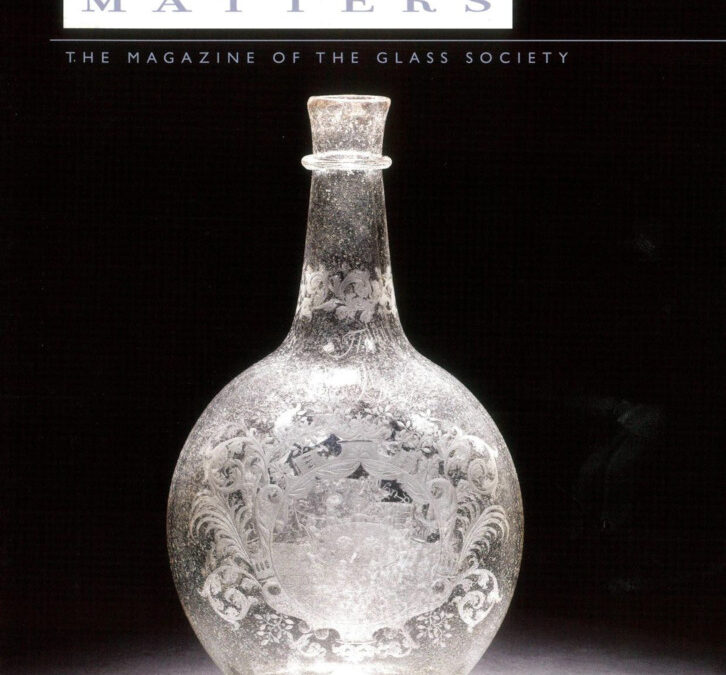
FRONT COVER:
Kit-Kat decanter c1700 sold
Bonhams lot 38 19 May 2010. C)Bonhams (see article)
BACK COVER:
The collection of glass Tea Caddy
spoons, courtesy of the Dudley Museum Services
Collection (see article)
Glass Matters Issue no.6 October 2019
2
Sue Newell, Joint Chairman
David Willars, Joint Chairman
of The Glass Society
of The Glass Society
CHAIRMEN’S MESSAGE
Chairmen ‘s
Message
0
n 12th October, the beau-
tiful city of Norwich was
the venue for this year’s
AGM and we were very fortunate
to be hosted by the Castle Museum.
Guest speaker in the morning ses-
sion was David Reekie, a local resi-
dent, who took us through a lifetime
spent in glass, producing the char-
acteristic figurative forms for which
he is well-known
(Figs.1 & 2).
David
explained that his earlier influenc-
es at Stourbridge College of Art
were Harry Seager and Irene Ste-
vens, who together with Keith Cum-
mings enabled him to perfect his own
version of the lost wax technique.
The afternoon session was devot-
ed to the collections of the Castle
Museum itself and after a brief talk,
Senior Curator Dr Francesca Vanke
walked the party through the galleries,
focussing on the glass exhibits. One
highlight was a late sixteenth-cen-
tury bird shaped flask, made possi-
bly in Antwerp or Middleburg, that
was excavated relatively recently
in almost perfect condition, it was
found at Baconsthorpe, Norfolk,
having lain at the bottom of a well for
most of the intervening years
(Fig.3).
Glass decorated by William Absolon,
from nearby Great Yarmouth, who
Fig.1
David Reekie.
Something of a
Fig.2
David Reekie.
Relationship
Casual Bystanders V
was active around
the turn of the eigh-
teenth century, is
also featured in the
Museum. Predict-
ably, given their pos-
sible Norfolk origins,
several items show-
ing characteristic
Lynn rings are also on display.
At the AGM we were able to report
the good news that our application
for Charitable Incorporated Organ-
isation (CIO) status for the Glass
Society has been approved by the
Charities Commission. This means
that we can now begin the task of
merging the two groups in a legal and
fiscal sense. In the early days this will
involve appointing new Trustees as
well as writing ‘Rules’ to be used as
a guide for the day to day running of
the Society alongside the official con-
stitution. Eventually, you will receive
notification that all payments should
be made to a new GS bank account.
We must yet again urge you to
become actively involved in your
Society. If you can organise an event
in your area, involvement need not
be burdensome, and we are keen to
arrange more meetings and visits in
the Midlands and the North where
glassmaking history is so strong. Of
course, certain activities require more
specific skills that cannot be acquired
overnight, but any help would be
gratefully received. During the AGM,
reference was made to possible coop-
eration with The National Trust.
Our group contains a great depth
LEFT Fig.3
Late 16th Century Bird Shaped Flask
ABOVE Fig.4
Diageo Cellars. Barrels with Glass Collection
of knowledge relating to all types of
glass. The National Trust has with-
in its properties a huge collection of
glass from all periods, much of which
is unidentified. By bringing the two
groups together our members could
indulge themselves, whilst at the
same time delivering a lasting benefit
to the National Trust. One requisite
is that we’d need to provide assis-
tance in those regions of the coun-
try where the National Trust needs
help; so we’re asking you to register
your interest.
(For information see let-
ter from Nigel Benson in News section).
Traditionally one of the great
delights of our Society (Glass Circle
and Glass Association) has been over-
seas visits. A group of us have recent-
ly returned from a trip to Northern
Italy. Taking in six museums in four
days, as well as a few typically Italian
dinners, we managed to arrive back at
Milan airport without losing anyone,
although there were a few dose calls!
The highlight of the trip was a visit
to the Diageo (formerly Cinzano) col-
lection of European glass in Alba, just
outside Turin. Housed in the original
Cinzano factory, the collection com-
prises approximately 150 items which
are beautifully housed in specially
modified oak barrels situated in the
original cellars
(Fig.4).
It is often said
that the Italians excel at presentation,
but in this instance the quality of the
collection matched its surroundings.
Special thanks are due to Paul Bish-
op and Christine Glover for organis-
ing our day in Norwich, and to Judith
Gower, our Honorary Secretary who
has the shouldered the burden of
pushing through the CIO negotiations.
•
Glass Matters Issue no.6 October 2019
3
GLASS DESIGN
Chihuli at KEW:
Reflection on nature
Gaby Marcon – Clarke
BELOW (LEFT) Fig.1
Sapphire Star (2010) at night
BELOW (RIGHT) Fig. 2
Summer Sun
Cummings published in Issuel, Jan-
uary 2018. She concludes her arti-
cle by stating that
‘Seeing his work
is pure pleasure’.
I totally agree with
her statement. Whether you are
drawn to glass as a medium or not,
whether you are a connoisseur or an
aesthete, or whether you appreciate
art and nature, Chihuly’s work com-
mands attention, generates emo-
tions and a sense of wonderment.
The 32 art installations are locat-
ed across the gardens in 13 loca-
tions including glasshouses, vistas
and galleries. As you enter through
Victoria Gate, you are met with the
LEFT Fig.3
Paintbrushes (2016)
RIGHT Fig. 4
Chartreuse Hornet
Polyvitro Chandelier
D
ale Chihuly is back at
Kew Royal Botanic
Gardens 14 years after
his first enormously successful
show which attracted almost
lm visitors. I went to Kew
at the height of the summer
when the light was at its best
and the air still warm at clos-
ing time, so as to experience
the work in its dazzling splen-
dour. I was hugely rewarded
and so were the extraordinary
number of people who have
been flocking to the gardens
ever since it opened last April.
The exhibition has been
drawing people partly out of
curiosity and partly out of the fas-
cination for an artist who has used
the ancient tradition of glassmaking
to break the boundaries and create
objects that transform and enrich
the environment rather than simply
decorate it, inviting people who have
never been to such an extraordinary
national treasure and UNESCO
world heritage site that is Kew Gar-
dens, to appreciate its beauty and
admire Chihuly’s large installations.
I am sure most readers of ‘Glass
Matters’ are acquainted with Chi-
huly’s body of work, especially after
the very informative article by Janet
Sapphire Star (Fig.1),
its individual
blown glass forms radiating out-
wardly, the vibrant blue colour in
the centre becoming increasing-
ly opaque at the tips. To the right
are the fiery red and yellow swirls
of
Summer Sun (Fig.2),
set on the
lakeside by the Palm House. This
is just the beginning of an exciting
journey of discovery and apprecia-
tion of both art and plants and an
opportunity to admire nature in a
totally different way. In some cas-
Glass Matters Issue no.6 October 2019
Fig. 5
Beluga Boat (2018)
.5.
Fig. 6
Chihuly’s Persians
‘
I
GLASS DESIGN
1,882 separate, spiky elements
in yellow at the bottom and fiery
red at the top, the installation
seems to spring from the ground
upwards in line with the trees sur-
rounding it. It truly is a feast of
human and technical ingenuity.
Chihuly’s work is far more at
home in this setting than in a gal-
lery, although the Shirley Sherwood
Gallery of Botanical Art, in Kew
Gardens, featuring both drawings
and smaller works, from seashells
to vases of organic and intricate
forms, is not to be missed.
The
exhibition is open until 27 October.
es, the installations are mixed with
the plants as if they were made by
nature, as in the case of
Paintbrush-
es (Fig.3),
shooting up from the soil
like a cluster of candles and brushes,
interplaying with plants and flow-
ers.
Chartreuse Hornets (Fig.4)
and
the
Beluga Boat (Fig.5)
whose ele-
ments have been placed together
ever so cleverly so as to appear as
an exotic and bulbous plant, or as
Chihuly very aptly stated:
‘I think
a lot of it comes from the fact that
we don’t like to use a lot of tools, but
natural elements to make glass – fire,
gravity, centrifugal force. As a result,
it begins to look like it was made by
nature’ –
as with the stunning blue
chandelier, hanging from the roof
of the Temperate House, formed
BELOW (LEFT) Fig.
7
Niijima Floats
BELOW (RIGHT)Fig. 8
Icicle Tower
from
Chihuly’s Persians (Fig.6).
Most of the pieces on display,
spanning the artist’s 50 year career,
are not new work, although some
have not been seen in the UK before.
However, it is the choice of setting
that is so extraordinary, as with the
Niijima Floats (Fig.7):
large, brightly
coloured glass spheres, some weigh-
ing up to 60 pounds and inspired by
the Japanese fishing boats in the
island of Niijima, Chihuly introduced
them first in 1991 and since then
they have been appearing in a variety
of settings, both on water and on the
ground, indoors and outdoors. They
blend in so well within the Japanese
Zen garden with its stylized land-
scape of rocks, water features, moss,
sand, and with the Pagoda and the
Japanese Gateway dose by, that they
seem to have always belonged there.
Further along is the
Icicle Tow-
er (Fig.8),
standing tall with its
Glass Matters Issue no.6 October 2019
5
AMBIVALENCE
MATTER
of Ambivalence
Dedo von Kerssenbrock-Krosigk
0
n the 27th of June
2019, I was privileged
to give an illustrated
talk to members of The Glass
Society at The Art Workers
Guild in London, under the
title
Matter of Ambivalence:
Aspects of glass in Ancient Cul-
tures and the Middle Ages.
Large
portions of this presentation
have just been published in the
journal of the Bard Graduate Cen-
ter in New York’ and I therefore
hesitated to repeat my findings
in The Glass Society’s magazine.
However, Brian Clarke resource-
fully pointed out that I had com-
menced my presentation with
a picture of the intriguing glass
sculpture by Czech artist Jan Figar
(1933-2010), and consequently
asked whether I would be willing
to change the focus of an article on
ambivalence to involve this artist; to
which I gladly agreed. So, here we go.
Recently, a visitor to Glasmu-
seum Hentrich told me about the
emotional impact that artistic and
sculptural glass had on her, despite
it being such a cold, slick, and brittle
material. Looking at glass apparent-
ly evokes some sort of tension; as it
were, a matter of ambivalence. The
adjective
ambivalent
means to have
two opposing feelings at the same
time. It is much stronger than
ambig-
uous,
which is merely something
that has more than one possible
meaning – so, basically, everything.
The most obvious ambivalence
lies in the fragility of glass. While
being used to make the most stun-
ning artefacts, everybody knows
how easily these can break and thus
lose all their value. This seems to
have been a running theme through
Roman glass production. Think of
the delicacy that cage cups express
with every single detail. But even
Fig.1
Beaker, Roman Empire, 1st c. A.D., amber-
coloured glass, mold-blown, 20.7 x 10.3 cm,
Dusseldorf; Kunstpalast, Glasmuseum Hentrich,
gift of Helmut Hentrich (P 1966-329),
photo: Kunstpalast
ordinary drinking vessels were often
so thin that they threaten to shat-
ter at the slightest touch. That fea-
ture was not to everybody’s delight:
Clement of Alexandria (died before
AD 216), one of the Church Fathers,
fumed, “The elaborate vanity, too,
of vessels in glass chased, more
apt to break on account of the art,
teaching us to fear while we drink,
is to be banished from our
well-ordered constitution”
2
.
A very deliberate play with
the proverbial fragility of
glass, becomes evident with
the 1st-century, so-called
almond – or lotus – beakers
(Fig.1).
There is good rea-
son to believe that original-
ly, these were neither meant
to represent almond nuts, nor
lotus buds, but rather a segment
from Hercules’ club. Glass, the
most brittle material available to
Roman craftsmanship chosen to
picture the sturdiest weapon of
Roman mythology. Hercules was
known to the Romans not only for
his twelve deeds, but also his pen-
chant for bacchanalian celebrations.
This is therefore another level of
ambivalence; to drink from this
vessel seems harmless, but it smites
down even the strongest warrior.
If such a broken and corroded
drinking vessel could instill partic-
ular emotions – if only some pity for
its sad condition, or, in consequence
for the drink gone lost – then that
is certainly much more the case for
Jan Figar’s sculptures. His “Pieta”
of 1991 is one of the most figura-
tive pieces that he ever made, even
though only the cladding of the
figures are represented, but not
themselves,
(Fig.2).
The two-part
composition on a metal pedestal
shows a Christian devotional image
that was popular since the Middle
Ages: the Virgin Mary mourns over
her dead son Jesus on her knees. A
Bohemian pieta of about 1400 is
a good example for the tradition-
al rendering of this very touching
scene
(Fig.3).
In Figar’s work, Mary’s
presence is reduced to her mantle,
and Jesus’ to his shroud. The latter,
due to its stylized, coiled appear-
ance, seems to allude to Jesus’ birth;
6
Glass Matters Issue no.6 October 2019
AMBIVALENCE
“Ye shall find the babe wrapped in
swaddling clothes” and thus brings
the Nativity and Pieta together into
one image that symbolizees the
Incarnation of Christ from begin-
ning to end. Seldom a work of art
is asking its viewers so expressed-
ly to fill its void with content.
Jan FiSar had been trained in
sculpting in the class of sculptor
Josef Wagner (1901-1957) at the
university of applied arts in Prague,
from 1953 through to 1959. He was
particularly impressed by the lat-
ter’s admiration for the pathos of
Baroque sculpture, which conse-
quently had a deep impact on his
own work, when he became a free-
lance sculptor in wood and stone. In
1966-1971, Jan Haar was engaged
as a metalworker at the glass factory
in 2elezt-47Brod, and was then asked
to assist the glass artists Stanislav
Libensky and Jaroslava Brychtova
with their monumental sculpture for
the world fair of 1967 in Montreal,
Canada. Encouraged by this cooper-
ation, he started to work with glass
himself, making glass sculptures on
metal pedestals and in the 1970s,
architectural glass installations.
In 1980 in northern Bohemia, he
Fig. 2
Jan Fifar, “Pieta,” 1991, 56,5x 60 x 30 cm,
coloured glass, blown, sawed, kiln-formed, cut,
Dusseldorf, Kunstpalast, Glasmuseum Hentrich,
collection Frauke Thole (LP 2016-27),
photo: Studio Fuis
must have been rather tight-lipped,
but he states: “Glass is beautiful, but
it is dangerous. Glass is a technolog-
ical problem, and that is also danger-
ous.” Needless to say, such a quote
is open to a wide range of interpre-
tations. I should like to point out
that as much as the “technological
problem” poses a danger, so does
the beauty of glass itself. Hardly any
other material is as beautiful per se
as glass, before any choice or inter-
vention by the artist. Has anyone
scooped some glass from the furnace
pot and spilt it on the factory floor?
– it will take on an unblemished and
shining shape. Haar, as with Czech
glass artists in general, accepts this
inherent natural beauty of glass, but is also aware of its dangerous allure
to resist making something trivial.
In 2015, the German collector
Frauke Thole gave her collection of
Fig. 3
Pieta, Bohemia, about 1400, limestone with
polychrome highlight, 38.1
x 39.1 x
14 cm, New
York, The Metropolitan Museum, The Cloisters
Collection, 2001 (2001.78), photo: Public Domain
moved into an abandoned factory
in Polevsko, north of Novy Bor, and
from then on worked exclusively in
his studio, assisted by the glass cut-
ter Jifi Jelinek – who continues to
work in these premises to this day.
In 1995, a film was made on Maar
and two other artists from Polevsko,
which contains scant but important
information on the artist’s percep-
tion of his own work’. Jan Figar
Glass Matters Issue no.6 October 2019
7
AMBIVALENCE
Fig. 4
Jan Filar, ‘Me and
my
kin”
(Ja ti moja
1995,
40
x
69 x
38 cm, optical glass, sawed,
kiln-formed, cut, Dusseldorf Kunstpalast,
Glasmuseum Hentrich, collection Frauke Thole
(LP 2016-16), photo: Studio Fuis
27 works by Jan Filar to the Glasmu-
seum Hentrich in the Kunstpalast
in Dusseldorf. Including the three
works the museum already owned
before this donation, the museum’s
collection now spans the artist’s
ceuvre from 1967 (the year after he
had started to work with glass) to
2002, with a concentration on the
last 15 years of that period,
(Fig.4).
His work has not had extensive expo-
sure in published articles, though the
exceptions are a sumptuous monog-
raphy by the Czech, German-based
gallery owner Eli§ka Stoking’ and
a small exhibition catalogue of
Ms. Thole’s collection of 2017
5
.
AUTHOR
Dr Dedo von Kerssenbrock-Krosigk is
Head of the Glasmuseum Hentrich,
Dusseldorf Kunstpalast Museum
and was Curator of European glass at The Corning Museum of Glass from
2004-2008.
EN MOTES
1
The Meaning of Glass: Case Studies
from Mesopotamia to Rome,
in:
West
86th,
vol. 26, no. 1, 2019, pp. 38-60
2
Paedagogos
[The Instructor], 2nd
book, 3rd chapter, 35, 3: On Cost-
ly Vessels
3.
Jul
f Havrda,
eeske
sklo trochu jinak
[Bohemian glass a bit differently],
Ceska televize, Prague and Art-
Film, Zurich, 1995, 30 minutes
4.
Jan FiS’ar:
Glass, Seevetal:
Glas-
galerie Hittfeld, 2006
5.
Dedo von Kerssenbrock-Krosigk,
Glas — Schon and gefahrlich. Jan Filar,
Sammlung Frauke Thole, exhibition
catalogue, Kunstpalast, Glasmuse-
um Hentrich, Dusseldorf, 2017
We’re opening our doors, welcome to the feast..!
The gallery will open to the public
on a request to view basis
(for the time being).
Discounts available for
CGS and The Glass Society
members
Bruntnell Astley Contemporar
Glass & Crafts Gallery Ltd
No 4 The Newhouse
Stuarts Works
High Street, Wordsley
Stourbridge
DY8 4FB
So if you would like to arrange a visit
please email:simon@bruntnell-astley.com
or Phone 07850 395193
viewings can be daytime or evenings
and at weekends
BRUNTNELLIDIASTLEY
www.bruntnell-astley.com
Glass Matters Issue no.6 October 2019
8
KIT-CAT?
The
serious misnomer
of
KIT-CAT GLASSES
Simon Wain-Hobson
F
or the collector of Georgian
drinking glasses, the Kit-
Cat glass is a drawn trum-
pet glass with a knop, which is
frequently an inverted baluster
some two-thirds down the stem.
The foot can be domed or conical,
occasionally folded; they are rare-
ly engraved. They can be exquisite
(Fig.1) and on their day the most ele-
gant wines of the early eighteenth
century’.
These balustroid glasses
have the same bowl as tall toast-
ing glasses. Their advantage is
that when filled two-thirds full –
the custom of the day – the volume
of wine or sack drunk was actually
rather small. In short, these glass-
es were ideal for toasting in any
club of the day. They are so named
for they are considered to be used
by members of the Kit-Cat club, a
highly influential group of Whig
gentlemen, mainly aristocrats,
who met in London from around
1702 to 1718. As Kit-Kat, Kit Kat,
Kit-Cat, Kit Cat, Kitcat and kit-
kat are encountered in the various
literature, Kit-Cat will be co-opt-
ed as it was used in the definitive
study of the club by Ophelia Field
2
.
Collectors are familiar with the
painting of Thomas-Pelham-Holles,
showing 1st Duke of Newcastle-un-
der-Lyme and his cousin and broth-
er-in-law, Henry Fiennes-Clinton,
7th Earl of Lincoln using fashion-
able glasses
(Figs.2 & 3).
It hangs
high up in Room 9 of the Nation-
al Portrait Gallery in London. The
painting was the last in a series of
43 portraits of Kit-Cat club mem-
bers by Sir Godfrey Kneller (1646-
1723). Born Gottfried Kniller in
the Free city of Lubeck, he stud-
Fig. 1
A balustroid Kit-Cat “like” glass in the
cabinet of the author
© Nicola Smillie
Glass Matters Issue no.6 October 2019
9
KIT-CAT?
Fig. 2
The Kneller double portrait of 1721. The 1st Duke
of Newcastle-under-Lyme (left) and his cousin the
7th Earl of Lincoln with their Kit-Cat glasses
© National Portrait Gallery
ied in Amsterdam and moved to
England in c1674-5 along with his
brother
3
. This double portrait fea-
tures two glasses, whose form have
come to be called the Kit-Cat type.
There are several problems with
the above narrative. The first is
that the Duke and Earl’s glasses
actually have a round funnel bowl
with a solid base over a cushion
knop, true baluster, basal knop
and conical folded foot. This is evi-
dent from a 1918 woodcut of the
glasses made by Maclver Percev-
a1
4
. Writing in 1956 Hughes saw a
heavy-based pointed funnel bowl and
slender true baluster with the round
knop above, supported by a folded
foots.
In an excellent critique of
Kit-Cat glasses Martin Mortimer
made a sketch of the portrait glass-
es that was very similar to that of
Percevall. While there is always a
degree of artistic license in a paint-
ing, particularly when it pertains to
peripheral details – the face is para-
mount in portraits – the glasses are
remarkably true to baluster glasses
of the period which fits well with
c1721, the supposed date of the
double portrait. As Kneller died
in 1723 the glasses and the dou-
ble portrait were made before.
There is an obvious disconnect
between the balustroid drawn
trumpet glasses referred to as Kit-
Cats featured in figure 1, which are
c1730-40, and the baluster glasses
being held by the Duke and Earl.
How far back does this mix up go?
As modern Georgian glass schol-
arship starts with Hartshorne’s
I0
Glass Matters Issue no.6 October 2019
KIT-CAT?
magnum opus
of 1897 what does
he have to say? He illustrates three
drawn trumpet bowled glasses that
are all lightly knopped yet makes
no reference to the club. A little fur-
ther on a Kit-Cat glass in the cabi-
net of the author is illustrated. It is
a tall three or four-piece construc-
tion with a trumpet bowl over three
collars, a true baluster and basal
knop on a conical foot, perhaps
folded. To the modern eye these
would be c1720-30, yet he dates the
glass to before 1711 because
…the
Duke of Newcastle, who died in 1711
from a fall out stag-hunting’.
It tran-
spires that Hartshorne confused
John Holles, 1st Duke of Newcas-
tle-under-Lyme (1662-1711) with
Thomas Pelham-Holles, 1st Duke
of Newcastle-under-Lyme (1693-
1768) of the Kneller portrait. It was
John Holles who died childless in a
hunting accident in 1711. He left
his title and estate to his nephew
Thomas Pelham with the condition
that he added Holles to his family
name. By the by, Wilmer, Perceval,
Robertson, Elville & Frank Davies
all confuse the two Dukes, probably
reflecting Hartshorne’s authority.
Daisy Wilmer (1910) illus-
trates four Kit-Cat glasses, three
of which have drawn trumpet
bowls while the fourth has a waist-
ed bucket bowl. All have low stem
knops, some with collars or tears,
others with folded feet
8
. Without
ever mentioning the Kit-Cat Club,
Bate (1914) notes that
Some of the
most interesting glasses inscribed
with toasts are those which bear the
names of ladies, reigning beauties
who were the idols of their day and
generation.
Mr.
Albert Hartshorne
possesses one inscribed, “Mrs. Walpo-
le, June 27th 1716,”
9
.
As we will see,
this was indeed the case, although
Hartshorne doesn’t mention it.
Grant Francis refers to the seri-
ous misnomer of calling balustroid
glasses Kit-Cat glasses. Hartshorne
set off a heated debate about classi-
fication and authors corrected their
predecessors. Francis went on:
The
Fig. 3
An enlargement of the Duke’s glass. Kneller
captures remarkably well the tears in the bowl
base and true baluster as well as the folded
foot. Compare this to Figure 1 to appreciate the
disconnect between a Kit-Cat
Club
glass and a Kit-
Cat glass in contemporary collector’s parlance
result has been that the description is
frequently applied to any early light
baluster glass with a tapering bowl
and a single knop in an elegant stem,
something very far removed from
the glasses shown in the authen-
tic portraits of the Kit-Cat Club’.
Due to his stem classification of
Georgian glasses, the influence of
Barrington Haynes has been con-
siderable. In his first edition of
`Glass Through the Ages’,
Kit-Cat
glasses are classified under balus-
troids
in which an Inverted Baluster
usually appears and All date about
1740-50
11
.
This morphs to cover
both inverted and true balusters
in the 1959 edition where we find
the veritable Witcat’ glass, a rare
glass without knopping other than the
baluster, and without collaring (Pl.
67a)
12
. Apparently, more than one
has not studied the Kneller dou-
ble portrait or realized that it was
painted in 1721. Nonetheless, from
this time on the form of
the veritable
Witcat’ glass is that we know today.
T I M E L I N B S
From Ophelia Field’s extensive-
ly researched book we learn that
the Kit-Kat Club was active from
1702 to 1718. In the penultimate
chapter entitled
The end of the club
we
learn that rifts and rivalries
among the Whigs peaked over the
1719 Peer Reform bill, resulting in
Club members ending up on dif-
ferent sides of the debate. Addison
and Steele were at literary logger-
heads; the sharpest of words were
used.
With the Whig schism… the
men had stopped meeting months
before the Peerage Bill controversy”.
Steele and Walpole criticized the
bill, Addison answered for the gov-
ernment. The former were backed
by the Prince of Wales, the latter
by King George I. The Bill to pre-
vent the creation of peers in the
House of Lords was proposed by
Charles Spencer, 3rd Earl of Sun-
derland and James Stanhope, 1st
Earl Stanhope. It was defeated in
the House of Commons on 28 April
1719 by the eloquence of Robert
Walpole. The Duke of Newcastle, of
the Kneller portrait, was frustrat-
ed by the failure of the Bill to pass
having much to lose if the Prince of
Wales came to the throne. Spencer,
Stanhope, Addison, Steele, Walpo-
le and Newcastle were all Kit-Cats.
Field writes that many hoped
that Tonson, the prime mover
would revive the Club when he
came back from Paris in 1719.
However, he stayed over. By ear-
ly 1720 The Mississippi Scheme
started to crash. Then the South
Sea Bubble burst in October 1720.
Everybody in London lost mon-
ey: Newcastle, Steele, Kneller and
Vanburgh, as did the King. London
was depressed. Club members were
4
Glass Matters Issue no.6 October 2019
KIT-CAT?
12
Glass Matters Issue no.6 October 2019
KIT-CAT?
OPPOSITE PAGE Fig. 4
The only Kit-Cat glass known, dated Mrs. Walpole
glass with the diamond point inscription Mrs
Walpole June 29th, 1716, sold Bonhams lot 615
December 2015. Note that Bate
9
gave the date as
July 27th. June 29th is clear in the image
Bonhams
dying, notably Addison in 1719 14.
The club was effectively over
by the end of 1718, with no more
meetings, drinking and toasts. Bal-
ustroid glasses of any form could
never have been used at the Club.
THE DOUBLE PORTRAIT.
All but three of Kneller’s series of
43 Kit-Cat member portraits were
made between 1705-1717. The
c1721 painting is special for several
reasons. First, it is the only double
portrait. Second, for all the raucous
drinking and toasting, it is the only
Kit-Cat painting showing glasses
and a wine bottle. Most of all, the
double portrait was made well after
the implosion of the Club for the
Earl is wearing the Order of the
Garter which he received in March
1721. The Duke was only 25 years
old by the time the Club folded. He
was up against phenomenal talent
and influence even though he was
one of the wealthiest landowners in
the country. Yes, he did help Steele
get elected to Parliament but up
against the likes of Robert Walpole
(1674-1745) he was a young man.
Was it nostalgia, was it that these
younger men wanted, needed, to
be associated with the giants of the
club, that they commissioned their
Kneller portraits even though the
Club had ceased to exist? Herein
lies the ultimate irony to our nar-
rative; the portrait glasses them-
selves are not Kit-Cat glasses at all
for, by 1721, the Club was no more.
SO WHAT WAS A KIT-CAT
CLUB
GLASS?
There are four lines of enquiry to
tackling this question. 1) Hughes’
point; 2) consult Bickerton; 3) Ton-
son’s remark 4) turn to Kit-Cat club
records, works of scholarship and
auction catalogues. Hughes made
the good point that
It is reasonable
to assume that these leaders of fash-
ion would have the newest style in
wineglasses associated with their
por-
traits
5
. Consultation of Bickerton”
or any book covering balusters
illustrates the glasses used by Club
members. The period 1702-18 is
that of heavy balusters where fun-
nel and round funnel bowls with
solid bases predominate with light-
er baluster forms starting to appear
around 1720. Knopping was every-
where although some had pedestal
stems. Bell bowls were appearing
towards the end of the Club’s days.
Next Tonson; as
he had been drunk
with every one of them
16
it is unlike-
ly that many glasses survived.
A custom of the Kit-Cat club
was to inscribe a toast to the beau-
ty on the very glass used to make
the toast. In December 2010, Bon-
hams sold a small baluster Kit-
Cat glass (14 cm) that belonged to
Albert Hartshorne9. It has a funnel
bowl with a solid base over a teared
angular knop and basal knop set
on an adopted wooden foot
(Fig.4).
It bears a diamond point inscrip-
tion to
Mrs Walpole June 29th,
1716
17
.
Her husband, Robert Wal-
pole (1676-1745) and Kit-Cat Club
member from early days had just
been appointed to the posts of First
Commissioner of the Treasury and
Chancellor of the Exchequer. As
the bowl of this baluster glass is
small it is understandable that it
carries only a short inscription.
Another glass with apparent
Kit-Cat connections is in the Wil-
liam Harding Collection in Christ
Church College, Oxford. It was
bought in an antique shop and
commented on in the Oxford Mail
(6th March 1953). It is an unusu-
al 18.3 cm drawn heavy baluster
with a funnel bowl over a conical
folded foot considered by Hard-
ing to be c1700. Indeed, it could be
anywhere up to 1720 18. It bears
two toasts in diamond point dat-
ed June 25th 1724, the first to
Mrs. Dunch, the second to Harri-
ott D, probably Edmund Dunch’s
fourth daughter, Harriet, who
would have been around 13 years
old at the time. Dunch (1678-1719)
was another distinguished mem-
ber of the Kit-Cat club and toasts
to his wife, a reputed beauty, exist.
Indeed, the four-line toast to Mrs.
Dunch on this glass is recorded.
By contrast, the toast to Harriott
[sic] is identical to the last four of
a six-line toast to another beauty
Mrs. Brudene1118, with her name
replaced by Harriott. The second
toast is unusual in that it starts
with
Dear Harriott D-
and is signed
by
H—y H—y
followed by the date.
Why disguise the toast? A club
member would have probably made
the connection. Why make a crass
spelling mistake in the first name of
your heroine? In addition, this can-
not be a
bona fide
Kit-Cat Club glass
for the toast is dated 1724, more
than 5 years after the club ceased
activities. Perhaps these are among
the reasons why Peter Lole” wrote
that the second toast was add-
ed later without elaborating. Per-
haps it is an inscription too many.
Finally, a Kit-Cat club decant-
er c1700 surfaced in 2003. The
heavily engraved decanter
(Fig. 5)
is in soda metal and probably hails
from Saxony
20,21.
It is extensive-
ly engraved with gents dining at
tables bestrewed with bottles and
glasses. It bears the inscription
Kitcat
and
James Tonson P,
proba-
bly the key organizer of the club.
We are left with a small wounded
baluster and a remarkable decanter
in soda metal from overseas — a far
cry from the gorgeous lead balus-
ters of the period. In the absence
of more examples we must under-
stand that Kit-Cat
Club
glasses
were heavy balusters and balus-
ters, some being large enough to
carry a 4 to 6 line diamond-point
toast. All were made before 1719.
Kit-Cat
like
glasses have to be the
same for nothing else makes sense.
The Kit-Cat
serious misnomer
Glass Matters Issue no.6 October 2019
13
KIT-CAT?
has been going on for almost a
century despite being critiqued
a number of times”-°. With all
the information now at our dis-
posal, it’s time to move on.
ENDNOTES
1.
Thorpe WA,
English Glass,
A&C
Black, (London) 1935) p188.
2.
Field 0,
The Kit-Cat Club: Friends
who imagined a nation,
Harper
Press, London (2008).
3.
https://www.britannica.com/biog-
raphy/Sir-Godfrey-Kneller-Bar-
onet
4.
Perceval M,
The Glass Collector – a
guide to old English glass,
Herbert
Jenkins, London (2nd ed., 1918)
p49.
5.
Hughes GB. English,
Scottish and
Irish table glass.
Batsford Ltd, Lon-
don (1956) p91.
6.
Treglown, GL and Mortimer MCF,
LEFT Fig. 5
Kit-Kat decanter c1700 sold
Bonhams lot 38 19 May 2010
Bonhams
Elegant and Elusive: wineglasses
of the Kit-Cat Club,
Country Life,
London, 2 July 1981.
7. Hartshorne A,
Old English
glasses,
Edward Arnold, London
(1st ed., 1897) p263.
8. Wilmer D,
Early English Glass,
The Bazaar, Exchange & Mart,
London (3rd ed., undated) p31.
9. Bate P,
English table glass,
Batsford, London (re-issued 1913)
p113.
10. Francis GR,
Old English drink-
ing glasses,
Herbert Jenkins, Lon-
don (1st ed., 1926) p34.
11. Haynes, EB
Glass through the
Ages,
Pelican Books, Harmond-
sworth (1st ed. 1948) p183.
12. Haynes, EB
Glass through the
Ages,
Pelican Books, Harmond-
sworth (2nd ed. 1959) p226.
13. Field 0,
The Kit-Cat Club:
Friends who imagined a nation,
Harper Press, London (2008)
p346.
14. Field 0,
The Kit-Cat Club:
Friends who imagined a nation,
Harper Press, London (2008)
p347.
15. Bickerton LM,
Eighteenth
century English drinking glasses, an
illustrated guide.
Antique Collec-
tor’s Club, Suffolk (2nd ed., 1986).
16. Field 0,
The Kit-Cat Club:
Friends who imagined a nation,
Harper Press, London (2008)
p368.
17. Bonhams catalogue, lot 6,15
December 2010.
18. https://opheliafield.com/the-kit-
cat-dub
19. Lole P,
Clubs and their glass in the
eighteenth century,
The Glass Jour-
nal (2001) N°9, p7.
20. Cottle, S.
The Kit-Cat Club decanter,
Annales du 16e Congres, Associa-
tion internationale pour l’Histoire
du Verre, (2003) p267.
21. Bonhams catalogue, lot 38,19 May
2010.
14
Glass Matters Issue no.6 October 2019
ENGRAVING
Glass
higraver
From
RHODESIA
To the
UK
Lesley Pyke
I
was born in 1962 into a fam-
ily of painters and the smell
of turpentine was quite nor-
mal to me. This was then Rhode-
sia, now Zimbabwe in Southern
Africa. I always loved art and
drew and painted and dabbled in
anything arty. By the time I was
13, I was painting on commis-
sion, mainly African landscapes.
Then out of the blue in 1983,
when 21 years old, I stumbled
across an article in a South Afri-
can craft magazine. I recall the
feeling so clearly – it was of com-
plete amazement. It showed some
simple flowers scratched onto a
few glasses but I had never seen
anything like it. Two weeks later,
I was so lucky to find some indus-
trial diamond points during a
stocktake at the laboratory supply
company where I had just started
working. They used to use them
to mark petri dishes! Well, as this
was Zimbabwe, with no fancy craft
shops around where I could pur-
chase such items, I didn’t think I
had any hope of trying this mag-
ic medium of glass. But there they
were, industrial diamond pencils,
dusty and old, lying in a cardboard
box. Naturally I bought one imme-
diately and as soon as I got home,
grabbed a glass and scratched a
flower onto it. I held it up to the
light and tears came to my eyes;
they still do, even as I type. The
flowers seemed to dance as you
moved from a dark to a light back-
ground, changing from positive to
negative in an instant. I was over-
whelmed. This was like magic! I
immediately imagined the pos-
sibilities: Zimbabwe had limited
shopping for fancy gifts and in that
moment, I visualised a business.
And so it began. I joined the
Guild of Glass Engravers as an
overseas member and then having
purchased some books and vid-
eos from the UK on glass engrav-
ing, I proceeded to teach myself. As
I progressed, I bought a drill and
then added sandblasting equip-
ment. In no time at all, I was tak-
ing orders. By now I had married
and had my first child. Working
from home, I built quite a business,
engraving anything and everything,
from the smallest glasses to panels
and sliding doors. I didn’t buy any
stock – my customers brought their
glass to me. Though having been
completely self-taught, I managed
like this for the next nineteen years.
Then life became impossibly
difficult in Zimbabwe. In 2001
and having become divorced, my
ex re-married and took my little
children to live in civilised New
Zealand, leaving me struggling.
Then, not being able to obtain my
burrs from the UK and not able
to send my drills away to be ser-
viced anymore, inflation at an
unimaginable rate and all my cli-
ents leaving the country, with
local thugs threatening me — as
being a single, white businesswom-
an, I was an easy target – threat-
ening my life, demanding I pay
them off, I fled, as so many did.
Fortunately my father was born
in the UK so I had my British pass-
port. I landed in the UK having
sold the sandblasting side of my
business in order to buy my tick-
et; I left almost all I had behind,
bringing one small drill, a lap-
Fig. 2
Country House on a slab of glass
Glass Matters Issue no.6 October 2019
15
ENGRAVING
Fig. 3
Working on the Brougham & Vaux crest glass
Fig. 4
Bee Glass
top, a camera and some clothes in
a rucksack. I had a small number
of £10 notes rolled up and hidden
in my belt. I had bought them on
the black market for an exorbitant
price and was petrified, broken.
But in the end, of course, I survived.
After waitressing in a tearoom
for a year and engraving a few bits
and pieces where I lived, once again
I began to build my business from
scratch. Last year, I remarried, with
my two sons – who are now in their
30s and still live “down under” –
having walked me down the aisle.
My business is now settled in Hen-
stead, in a most delightful arts and
crafts centre situated on a peace-
ful farm, just off the Al2. I could
not ask for a more perfect setting.
Many fascinating clients from all
over the world have challenged
me over the years and continue
to do so with their wide variety
of tastes and demands. It is often
from them that I draw my inspira-
tion for gallery pieces which in turn
reflects my ever-changing mood.
I decided to stay working with
glass as I find it the most allur-
ing and baffling medium. I feel
as though I am painting, except
that the glass is the canvas, and
the different burrs are the differ-
ent colours. You paint in grey scale,
with all the shades and textures
you can imagine, depending on
which type of burr is used and the
size, shape, grit, pressure; whether
is it used wet or dry, and the speed
of the drill. The burrs themselves
change characteristics and effects
as they wear, and then after all that,
the lighting dictates how it looks.
It is 3D, especially when you have
engraved around a whole vessel.
Great glass engravers have
inspired me: the first book I stud-
ied in Rhodesia was
Glass Engraving
by Jonathan Matcham and Peter
Fig. 5
Roses are Green… Shown at the Biennale
Dreiser; the second, which has
become more specific to my meth-
ods, was
Drill Techniques
by Stu-
art and Shirley Palmer. I was most
fortunate to have met both Shirley
Palmer and Peter Dreiser – what tal-
ented, amazing and dedicated peo-
ple they’ve been; they’ll always stay
with me as idols. Another was the
late John Hutton, whom I great-
ly admire for the screen of Saints
and Angels in Coventry Cathe-
dral. That work took many years
and combined sandblasting and
hand engraving with enormous
flexible drive drills. On my sand-
blasting side, I was nurtured and
encouraged from afar, whilst stuck
in Zimbabwe, by another wonder-
ful engraver, Tony Gilliam, who I
have also had the great privilege
of meeting and hearing speak.
You
can find Lesley’s showroom at
11 Henstead Arts and Crafts Centre,
Toad Row, Henstead, NR34 7LG. The
display cabinets incorporate a gal-
lery of Lesley’s creative engravings,
ranging from highly decorative crys-
tal goblets to cameo engraved, colour
overlay, hand-blown bespoke pieces.
Lesley says that you will be most wel-
come to pop in, but please contact her
first through e-mail glass@lesleypyke.
com or telephone 01502 740400.
16
Glass Matters Issue no.6 October 2019
GLASS FOR TEA
Glass Caddy Spoons
And Tea Caddies
Bill Millar
Unexpected and unusual uses of glass
are waiting to be discovered and
uncovered in the Dudley Museum Ser-
vice Collection held at Himley Hall,
a commanding 18th century build-
ing set amongst 180 acres of ‘Capa-
bility’ Brown, landscaped parkland,
just north of Stourbridge. Volunteer
researcher Bill Millar has recent-
ly brought to light these Tea Cad-
dy Spoons and related Tea Caddies.
M
ichael and Peggy Park-
ington assembled a
magnificent collection
of 18th, 19th and 20th centu-
ry glass. In 1997 much of the col-
lection, some 640 items, was
bequeathed to Broadfield House
Museum. This article is part of my
commitment to provide a reg-
ular article on the content of
what is now the Dudley Museum
Service Collection. The Parking-
ton bequest is too wide ranging
to describe it all in a single short
article, so in this piece, I have
restricted the descriptions and
pictures to tea-associated items,
largely because they are less com-
mon and many are of stunning
quality. Museum accession num-
bers are used throughout the
article in the format “BH1234”.
CADDY
S POONS
There are 10 caddy spoons in
the collection. They are all esti-
mated to date from the Regen-
cy period, 1811 to 1820. There
is no suggestion as to where
they were manufactured. All
bar one are blown and cut;
the exception is blown and
moulded. They are relative-
ly small, ranging from 6.6cms
to 9.7cms in length. The cut-
ting is sharp as you would
expect of cut glass of this peri-
od. Glass Caddy Spoons are
very uncommon items; this
small collection is a joy to the
eye and a pleasure to handle.
Glass Matters Issue no.6 October 2019
17
GLASS FOR TEA
BH2939
•
Pr
f
‘
NL
‘*./`
_1 7.
#f
Fig.1
Tea Caddy
BH2987
BH2937
BH2940
BH2938
BH2936
..
L
, ……..
L,.. ,.,
.6.
–…,
..,
.
_……
….
.
„
_………,
–
,
.:: ——–
—
I 8
Glass Matters Issue no.6 October 2019
Fig. 3
Tea Caddy BH2986
Figs. 4
Tea Caddy BH3346
GLASS FOR TEA
T
E A
C ADDIES
There are three glass Tea Caddies
within the Parkington collection and
a fourth from another source in the
Dudley Collection. The four range in
date from the middle of the 18th cen-
tury to the end of the 19th century.
In quality they range from stunning
to everyday, the techniques ranging
across blown, cut, moulded, enamelled
and pressed. Their descriptions, as
recorded on the museum records are:
Fig.1 Tea Caddy BH2987 (facing
page): Tea caddy and stopper, dear
glass, rectangular section with cant-
ed corners, facet cut on shoulder,
engraved on side “Green”, flat star-
cut stopper. Height 17.3cms. Date
of manufacture 1780-90. There is no
suggestion as to where it was made.
Bg
. s.2a-e Tea Caddy BH2841: Tea
caddy in white, opaque glass, rectan-
gular section with canted corners.
The main side is enamelled with a
goldfinch under the word `Bohea’
with rococo scrollwork. The reverse is
enamelled with a rose, passion flow-
er and honeysuckle. The two sides
are enamelled with sprays of flow-
ers, blue one side and red
the other. The top of the
metal cap is decorated
with Bilston enamel,
depicting a lady and
Figs. 2a-e
Tea Caddy BH2841
gentleman ascending steps flanked
with pedestal vases with a classical
temple in the background. Probably
made in South Staffordshire, 1755
— 60. Height 14.5cms. Note: Sohea’
is a category of black China tea .
Fig.3 Tea Caddy BH2986: Tea
caddy and lid, clear glass, rectan-
gular section with canted corners,
honeycomb moulded. Blown and
moulded. Date of manufacture
1760. Height 13.7cms. There is no
suggestion as to where it was made.
Fig.4 Tea Caddy BH3346: Tea cad-
dy and lid, clear glass, square sec-
tion, moulded with pattern of raised
rectangles and notched mitre cuts
in imitation of cut glass. Registra-
tion mark ‘Rd 340825’ inside caddy
and inside lid for 5 July 1899. Mak-
er, George Davidson & Co, Teams
Flint Glassworks, Gateshead on Tyne.
Glass Matters Issue no.6 October 2019
19
Paperweight
Tree
Rabbit
SHENTON STATION
The
next chapter
in
STATION GLASS
Alan & Judith Cower
A
fter Richard Golding’s last open
day at Station Glass, we were
treated on the following day
to the Paperweight Collectors Circle
Christmas lunch, with Richard Gold-
ing and Kayleigh Young, both with
us to make keynote presentations.
The day began with a fascinat-
ing illustrated talk by Richard, cov-
ering his glassmaking career of
over thirty years. Beginning at
Brierley Hill College in 1978, he
told us that
‘a one year course was
enough’
to become hooked on this
wondrous material we call glass.
Over the years Richard moved
more than nine times to various
glassmaking premises, gaining
much experience along the way.
Three periods were spent in Queen
Street, Wordsley. Then he became
resident glass maker at Broadfield
House Glass Museum, where, due
to the poor quality of available com-
mercial and coloured glass at the
time, he learnt to make his own
coloured glass. On to Lightwater
Valley, then Lows Garage Kinver,
Enterprise Estate Merry Hill which
he described as ‘the Moorcroft year’
with seven furnaces and seven hot
colours to contend with. The next
step, to Ruskin Mill, Stourbridge
was followed by his last and final
move, to Station Glass at Shenton
Station. Now, after ‘feeding the drag-
on’ for the past 8 years, as Richard
described the process of operating
and meeting the costs of running a
production glass business, he is able
to focus on enjoying life and spend-
ing quality time with his wife, Sandra.
As one era ends, another is well
underway. Kayleigh Young has fol-
lowed Richard, developing the glass-
making business at Shenton Station.
Kayleigh spoke about her developing
glass career, which started at the age
of 18 at Stoke University after see-
ing Louis Thompson making glass.
Then followed a Glass and Ceram-
ics course at Sunderland Universi-
ty where she graduated in 2008 and
went on to accomplish her Masters
in glass at Wolverhampton Univer-
sity. Kayleigh’s particular interests
lie in glass casting and cold work,
but she also spent a period of time
working at Okra Glass, Queen Street,
learning the processes of iridising
and surface decoration. After Rich-
ard Golding left Okra, Kayleigh also
spent time at Top Glass, making
production glass and gaining expe-
rience from working with Richard
Fletcher. Then seven years ago she
moved to Station Glass to work
again with Richard. Kayleigh has
now taken on her own assistant,
Joy, which brings us to the present
time. We look forward with great
interest to
see
how this new chap-
ter in Station Glass develops and
we wish Kayleigh all the best for
her success now and in the future.
Kayleigh can be contacted at:
kayleighyoungglassegmail.com
C
–
5 R-
E to
1,
O
Ol
E
E
O
A-
0
‘
0.
.z
§
O
20
Glass Matters Issue no.6 October 2019
SILVER OVERLAY
Silver Overlay Class
Michael Lines
T
he Antique trade has seen
numerous changes over the
past decade, with many deal-
ers retiring or deciding to cease
trading altogether. However, those
who have bucked the trend are
those who have gone ‘out there’
and encouraged a younger audience
to become interested in collecting.
This has been achieved by amal-
gamating new marketing tools and
keeping ‘ahead of the game’. Who
would have thought, just a couple
of decades ago, that postwar glass
would be more sought after than
Georgian and Victorian glass in its
many forms. Nonetheless, this is
nothing new – those glass compa-
nies still in existence today have a
long history of reinventing them-
selves and looking to the future.
Most passionate collectors of
19th and 20th century English
and European glass are probably
familiar with the considerable
number of glasshouses of the peri-
od that were trying to keep ahead
of their competitors in attracting
new clientele. The employment of
architects, painters, scientists and
sculptors was common practice at
the time, and the newly developed
industrialised techniques using
electronics, physics and chem-
istry were also readily utilised.
One such technique was that of
embellishing glass with precious
metals such as silver. The enhance-
ment of glass by attaching a silver
frame or sheet of silver is centuries
old and can still be seen today. Still,
the idea of having pure silver fused
to non-conductive surfaces such as
glass and porcelain must have been
seen as revolutionary. The success-
ful development of electroplating
on metal objects by George Rich-
ards Elkington and Henry Elking-
ton in the 1830s highlighted the
ABOVE Fig. 1
A rare art deco period vase decorated with a
stunning geometric design in silver overlay upon
a rich blue glass body. The silver stamped with
the early 1000/1000 Deusch mark. Friedrich
Deusch used glass by Jean Beck- but the glass is
unmarked. 15.5cm tall 8cm rim. Circa: 1920s
RIGHT Fig. 2
An early green glass specimen vase decorated in
the silver studios of Friedrich Spahr. The ground
glass is exquisitely decorated with an art deco
design in thick silver overlay. This is a heavy vase,
27cm tall 11cm rim. Circa 1930s
BELOW Fig. 3
An art deco period blue glass vase decorated in the
silver studios of Friedrich Deusch with a very intricate
& complex Persian design of an exotic bird in silver
overlay. The glass is possibly by Jean Beck 19.5cm
tall &13,5an rim. The silver is stamped with the
early ‘1000/1000 Deusch’ mark Circa:1930
possibility of achieving this. Many
decades later and after countless
experimental setbacks, the tech-
nique was finally mastered. Attrib-
uting the invention of the process
is hotly contested with some peo-
ple arguing that Silver Overlay was
initially developed in the UK, but
Patent Office records show the
near simultaneous Registration in
1885 by Oscar Pierre Erard work-
ing in Birmingham UK, and on
September 3rd 1885, by Edward
A. Thiery and Charles F. Crosel-
mire of Newark, New Jersey, hav-
ing
‘filed a patent for silver-overlay
upon
glass and other translucent or
transparent items’.
It is recorded
that the early work of overlaying
clear glass with silver failed some
months later, due to an unpleasant
Glass Matters Issue no.6 October 2019
21
411
-4
(9~
A
,
Of
•
91.1•..;;i7A
SILVER OVERLAY
Fig. 4
An Art Deco period vase decorated in the silver studios ofFriedrich
Deusch with a design in silver overlay upon a bright amber glass body.
The glass unmarked, the silver stamped with an early 1000/1000
Deusch mark 16.5cm tall 9.75cm width. Circa 1920
Fig. 6
A fine blue glass bowl and cover decorated in the silver studios
ofFriedrich Deusch with an intricate art deco design in silver
overlay. The glass with rectangular Jean Beck Munchen mark.
The bowl is 17cm tall to tip of finial & 11.5cm across. Circa 1920
Fig. 5
Fig. 7
A vibrant green glass vase decorated in the silver studios of Friedrich
Alarge and rare German glass vase decorated in the silver studios
Deusch with a design in silver overlay. The silver is further enhanced
of Friedrich Spahr with a striking floral design in silver overlay
with detailed engraving. 9cm tall 5crn rim. Circa: 1940
upon a simple smokey green glass. 37cm tall. Circa 1940s
22
Glass Matters Issue no.6 October 2019
SILVER OVERLAY
appearance of the interior of the
glass that had been electroplated.
Consequently, a new formula for
the flux had to be created and mas-
tered. In 1889 Oscar Pierre Erard
and John Benjamin Round work-
ing for Steven and Williams regis-
tered a new patent and a new flux.
John Sharling of USA patented
a
new formula in 1893 and Fried-
rich Deusch, the German inventor
whose name is most associated
today with the silver overlay tech-
nique, patented his process in 1895.
THIS IS A BRIEF SUMMARY OF THE
TECHNIQUE OF SILVER OVERLAY
Most techniques used to create
silver overlay involve etching
the design directly into the glass
using acid or an engraving wheel;
this allows a slight outline of the
design to be formed. As both glass
and porcelain are non-conductive
surfaces, the engraved area is then
painted with a special flux, which
may contain silver flux powder,
borax, lead oxide, nitrate of pot-
ash, lime phosphate, white arsenic
and turpentine oil. After the paint-
ing is complete, the entire object
is fired under relatively low heat;
it is then cleaned and allowed to
cool. Following the cooling pro-
cedure the item is placed into a
solution of pure silver. An anode
and cathode are attached to the
item and a low voltage current is
run through it, this agitates the
solution and attracts the pure
silver to bind to the flux on the
engraved design, creating a perma-
nent fusion of the silver with the
glass. The length of time the item
remains in the processing bath
determines the final thickness of
the silver that becomes deposit-
ed. Designs that need to be embel-
lished with fine engraving are left
in the process for longer periods.
Recently, there has been an
upsurge in the number of people
who collect Loetz glass in its many
forms, especially pieces with strik-
ing Art Nouveau, Arts & Crafts &
Secessionist designs in silver over-
lay. Pieces by Viennese silver firm
Max Schwarz can be found, as can
pieces decorated in silver overlay
by American companies such as
Alvin and La Pierre. Good perfect
pieces can demand prices into the
low to mid thousand-pound range.
For those who appreciate the
classic designs of the earlier peri-
od but lean towards more modern-
ist art and design, specialist firms
such as John Newton Antiques
are showing a whole new world of
glass collecting with their displays
of silver overlay pieces. Particular-
ly collectable are those pieces dec-
orated with Persian, modernist
and organically flowing designs in
thick silver overlay, created by such
silversmiths as Friedrich Deus-
ch & Friedrich Spahr. These two
companies, based in Schwabisch
Gmiind (Southern Germany), used
only superior-quality glass blanks
LEFT Fig. 8
An Art
Deco period pale amber glass vase
decorated with a superb design in silver overlay.
By Friedrich Deusch. The silver is enhanced
further with detailed engraving. 26cm tall
10cm rim. Circa 1920s
ABOVE Fig. 9
A scarce silver overlay glass vase exquisitely
decorated With stylised flowers upon a pale
green glass ground. This is a known design seen
on porcelain decorated by Friedrich Wilhelm
Spahr & Co. The glass is WMF. 15cm tall
7cm rim. Circa: 1940
produced by noted glasshouses
such as WMF, Jean Beck, Jose-
phine Hate and other manufac-
tories not too distant from them.
All of the porcelain and glass used
had to be of a good quality to with-
stand the rigours of the process.
The work by Friedrich Deus-
ch tends to follow a classic theme,
with thick overlay and the use of
engraving, whereas designs by Frie-
drich Spahr, who served his appren-
ticeship with Deusch, have organic
flowing themes. I’ve included pic-
tures of the range of styles that
are available; prices for this type
of work are increasing, but good
examples range from £200-500
to over £1,500 for pieces larger
than 30cm with a desirable design.
Michael Lines & John Newton
Antiques exhibit at a number of
National Antique Fairs. They welcome
your interest and can be contacted at
contact@joimnewtonantiques.com
Glass Matters Issue no.6 October 2019
23
ATHELNY ‘LONZ’ MEMORIES
HGLASS
SOCIETY
Lonz Remembered
A
thelny Townshend — known as
Lonz to so many, volunteered
to design
Glass Circle News,
with Jane Dorner as editor. Their
first issue, newly designed, was
printed and sent out in December
2009. David Watts, latterly assist-
ed by Andy McConnell, had stepped
down from 32 years of almost sin-
gle-handed production of the infor-
mative GC News, presenting a
challenging task for Jane and Lonz.
As a collector of Georgian glass, with
an interest at the time in `balustroid’
gin glasses, wishing to spend more
time with his 18th century glass col-
lecting and dealing, and with a back-
ground in graphic design, Lonz was
well placed to re-design GC News
from the pinned-together news
sheet to a full colour magazine. He
excelled at designing the GC News
magazine for many years, and then
as the first step in linking The Glass
Circle and The Glass Association, we
joined together as editor and design-
er for
Glass Matters,
the new joint
magazine for The Glass Society — our
first issue sent out in January 2018.
Patsie wrote
‘He really loved doing the
graphic design for
Glass Circle News
and
Glass Matters.
The spatial chal-
lenge of fitting it all in was one of his
greatest pleasures. So glad he had the
opportunity to work with you on the
Glass Society logo. A legacy. I was by his
side when he slipped away in peace and
pain free, on Monday afternoon July
22nd’.
The new Glass Society logo
was the final piece that we created
together, Patsie searching for the
final update on Athelny’s computer.
The following remembrances were put
together by Lonz’s family and friends
and presented at the farewell ceremony.
Born in 1949 to Eva and Bobby,
Lonz’s childhood was in many ways
idyllic — growing up at Pine Tree
r7f.
t
i
A
Fig.
1
Athelny ‘Lonz’ Townshend
Cottage in Middleton, Suffolk with
brothers Jules and Richard, and
spending his time out and about in
the surrounding fields. It was a real
`boy’s’ lifestyle — his brothers’ wives
describe it as ‘feral’ — but it began a
lifelong love of wildlife and nature.
As well as his immediate family,
another important person in Lonz’s
childhood was his cousin Jenny: she
was like a sister, and they remained
close throughout their lives.
Aged five, Lonz followed in his
father’s and brother Jules’ footsteps
Fig. 2
Lonz examining a glass at a specialist fair
by going as a boarder to AS Neil’s
school, Summerhill, in nearby Leis-
ton. Unfortunately he wasn’t hap-
py and his mother Eva wasn’t even
allowed to visit when he was ill. At
the age of six he decided to grow
his hair long, preceding the hippies
by at least a decade! And when still
very young he collected birds’ wings.
This was then followed by human
skulls, which he found on Dunwich’s
collapsing cliffs. Later, his collect-
ing habit led him into antique glass.
He left AS Neil’s at eight and went
to the local primary school, where
he then learned to read in two
weeks. He’d responded positive-
ly to the headmistress Mrs Warm,
whose nature lived up to her name.
Leiston Grammar School was
next, where Lonz gave an early
demonstration of his independence
of thought and absence of religious
belief. Mumbling his way through
the prayers in assembly, Lonz was
picked out by the headmaster, who
asked ‘do you not wish to pray with
us Townshend?”No, sir’ came the
reply. ‘Then get out!’ responded
the head — a win for Lonz, I’d say!
At 16, a year was spent at Ips-
wich Art School before A levels,
and then he attended Enfield Poly-
technic, studying social sciences.
There, he became a worker-mil-
itant as a member of the revolu-
tionary International Socialists, a
forerunner of the Socialist Work-
ers’ Party, for whom he went on to
run the print shop. This was Lonz
the rebel, someone who stood up
for what he believed in — an atti-
tude that sometimes got him into
trouble and one that he’s definitely
passed on to his daughters. It was
his elder brother, Jules, that he fol-
lowed into revolutionary politics in
the sixties. Jules now says
‘We grew a
little older, tolerant and more pragmat-
24
Glass Matters Issue no.6 October 2019
ATHELNY ‘LONZ’ MEMORIES
ic, without however losing the values
of a common humanity, which formed
the basis of our youthful radicalism’.
Through the 70s and 80s Lonz
built a career in graphic design and
print in London, sadly marred by
his mother’s death in January 1980,
which Lonz took really hard. It was
in London that Lonz met Carol.
They married in 1982 and had two
daughters: Chloe was born in 1985
followed by Livi in 1987. In 1988 the
family moved to Suffolk; Lonz had
taken a job at Anglian Technograph-
ic in Saxmundham. They settled in
London Road and then at Holton
Terrace in Halesworth, which has
been home for Lonz ever since.
Lonz became a casualty of the
digital revolution in the design
and print industry, so he decid-
ed to retrain as a primary teacher;
for this, he studied at the Universi-
ty of East Anglia at the start of the
90s. Then in 1992 he accepted a job
at Ilketshall St Laurence Primary
School, where he spent the next 14
years. He played guitar to his class-
es and had a way of talking to his
pupils that was thoroughly engag-
ing — many of them still remember
him with great fondness. He did get
in trouble when teaching the chil-
dren about the great fire of Bungay,
which involved them making model
streets out of card, which they then
took out into the playground and
set them alight! Lonz loved teach-
ing, but not the bureaucracy or the
constant assessment of the children.
With the end of Lonz and Car-
ol’s marriage in 2000, Lonz became
a single parent. This was tough for
him, but he never complained and
he, Chloe and Livi became a team
of three. Lonz had realised when
his daughters were born that there
was now something more import-
ant than himself in his life, and he’d
have done anything for them. Life
changed again in 2002 when Lonz
met Pat through an internet dating
site. Patsie says
‘she knew she’d met a
very special person, though while Lonz
Fig.3
Athelny with Patsie dressed
up for the evening
was keen from the off she
was a little more reserved’.
Returning home to Kent
from their first date at
the Tate in London on
the Queen’s golden jubi-
lee weekend, she told
him not to ring until the
following Wednesday. An
impatient Lonz phoned
on the Monday and
by Wednesday Pat had
come up to Suffolk — a
decision she didn’t regret
for a moment! Three
years later, in 2005, Lonz and Pat
were married at St Peter’s Brewery.
With Chloe and Livi still teen-
agers and Pat’s children Simon
and Emily a little older, they took
their time to work out how to live,
but Lonz’s liberal and bohemian
approach meant that it wasn’t long
before Christmases included exes
and new partners too. He’d begun to
show early signs of Parkinson’s dis-
ease in 2007, so retired from teach-
ing in 2009. With Pat still working in
London he managed perfectly well
without her as he had so many inter-
ests to keep him occupied, though
they were also still able to enjoy holi-
days together, particularly in Greece.
Pat described Lonz as a poly-
math — as comfortable with science
as with the arts and never happier
than when he was learning or being
creative. Among the many things for
which he will be remembered are:
•
Collecting 18th & 19th centu-
ry wine glasses and ‘hag’ stones
brought back from the beach.
•
His love of wine and expensive
whisky — and how he loved to
open bottles of champagne with
a sword — the evidence of which
is still to be found in the garden.
•
A risk taker — driving fast cars.
•
Cookery — he made a mean curry,
Italian and Mexican dishes— he
loved trying new things, critiqu-
ing the results and deciding what
he could do better next time.
•
His ability to listen and
to offer wisdom and
advice without judgement.
•
His laugh, his mannerisms, his
mischievous nature and politi-
cal militancy, his playfulness, his
relentless teasing… his gentleness.
Though he had multiple health
problems, Lonz didn’t let them
hold him back — young at heart,
he refused to be defined by age
or illness. Jules told us
‘His deter-
mination to get a job done, despite
his Parkinsons, was on full display
last year when we three brothers
went sailing on the Broads. It was
a windy day, and the rigging on the
front sail got jammed. Immediately
he got out of the cockpit and lurched
slowly and unsteadily to the bow of
the boat with sails and ropes flapping
everywhere. He had nevertheless
decided to solve the rigging problem.
As he crouched down, with his rear
end fully exposed to the elements
and the ropes administering total-
ly undeserved lashing punishment,
he accomplished his mission after a
full five minutes, rejecting all offers
of help’.
But ill health did catch up
with him, culminating in an inop-
erable brain tumour diagnosed
in mid-June. Lonz was, however,
able to come home from hospital
to be comfortable, where he could
listen to music, watch TV and
enjoy seeing visitors. He is dear-
ly missed and fondly remembered.
Glass Matters Issue no.6 October 2019
25
LEFT Fig. 1
Amethyst glass, free blown
bowl shaped with 2 points. The
whole surface sandblasted except
around the rim which is cut and
polished. Created in 1990 by
Jane Beebe based in North West
Devon. Height 28 cm
BELOW Fig. 2
BH3694 a & b. Pair of figures
in white opal translucent glass.
Venini SA/Murano designed
by
Fulvio Bianconi. Height 20cm
and 16.5cm
ART UK SCULPTURE
PHOTOGRAPHII G ITEMS in the
Dudley Museum Service Collection
All Millar
A
s a volunteer regularly work-
ing at Himley Hall on the
glass in the Dudley Collec-
tion, I spend a significant amount
of time photographing items in
the collection. The photographs
are mainly used to populate the
computer records. Even when you
know which shelf an item is on, it
is much easier to find if you have
seen a photograph of it before you
go looking. Some of the photo-
graphs are also used to illustrate
articles such as that on “Tea Relat-
ed Items” seen elsewhere in this
issue. If you have tried to photo-
graph glass you will understand it
is not straightforward. I am self-
taught and would describe my lev-
el of expertise as adequate at best
– and that is on a good day. So when
I was offered a day’s training by
Art UK I was delighted to accept.
Art UK is a cultural education
charity funded by the Heritage
Lottery Fund and Arts Council
England. Their website (https://
artuk.org) is a showcase for art-
works in every UK collection, rep-
resenting a collaboration between
over 3,200 British institutions. Of
the artwork in museums, univer-
sities, hospitals, town halls and
other civic buildings, close to 80%
is not on public view; the objec-
tive of Art UK is to provide photo-
graphs of all this artwork on their
website. If you visit their website
you will see that they already have
images of nearly quarter of a mil-
lion artworks by 40,000 artists.
They are now turning their atten-
tion to sculptural items and rec-
ognise that they need volunteers
to complete the project, hence the
offer of a training day at the Barber
26
Glass Matters Issue no.6 October 2019
ART UK SCULPTURE
Institute in Birmingham. Whilst
I had never previously thought
of glass items as sculpture, a
moment’s reflection will lead you
to the conclusion that ‘sculptur-
al’ is the only adjective that fits
some of the items in the collection.
As a working definition of ‘sculp-
ture’, I am using the criterion that
if it is not purely utilitarian in
function it is sculpture. So we can
include most items of studio glass.
If a marble bust of Queen Victo-
ria is sculpture why not a pressed
glass example? Pressed glass ani-
mals or posy glass troughs with
nursery relief designs could also
be grist to the mill. Cameo glass
items, produced by techniques
similar to those used to produce
the marble bust, where layers are
carved away, cannot be exclud-
Fig. 5
Figurine of a stylized fish, sculpted on a
rectangular base with geometric waves in green
and blue. Made using pate de verre technique by
Almaric Walter in Nancy, France, during period
1901 -1911. Model maker/artist A Houillon.
Height 12cm, width 23cm, depth 13cm
ABOVE (LEFT) Fig. 3
Glass sculpture with the figure of Triton urging on
his sea horses as they rise from the waves. On a
detachable wooden base. Made by Frederic Carder
at Corning in 1957, using the lost wax process.
Length 29.5 cm height 15.7 cm
ABOVE (RIGHT) Fig. 4
Glass sculpture,
Amethyst Wave Form
by David
Traub of Haywards Heath, Sussex, in 1986.
Height 19cm
ed. Amalric Walter’s pates-de-
verre animals should equally be
entitled to count as sculpture.
I’m uncertain where this list will
stop, but enough for the moment.
While many of these items in the
Dudley Collection have previously
been photographed, the Art UK
standard for sculpture is to take six
photographs from different angles.
The images must then be processed
using software such as Adobe Pho-
toshop. This task may not be com-
pleted in the immediate future, but
we have made a start. The project
will bring a huge benefit, as it will
start to populate the Art UK web-
site with images of items in the
Dudley Museum Service Collection,
which are then available for all to
view. My strategy will be to keep on
photographing, even if it pushes
the boundaries of what is consid-
ered sculpture, until Art UK realise
that like Mickey Mouse in the Sor-
cerer’s Apprentice, they have cre-
ated a monster! Since starting to
think about on-line images I have
discovered a well-kept secret site
which holds a number of images
of items in the Dudley Collection,
https://blackcountryhistory.org. If
you use the advanced search facility
you can call up all or specific groups
of glass. The site holds details of
about one tenth of the items in the
collection and we are now look-
ing to see how we can add more.
Having images on line will have
many benefits for those interest-
ed in glass. It could encourage
people to visit the White House
Cone Museum of Glass, when
open, to see items in the flesh. At
the very least, visibility of items
in the collection to people global-
ly strikes me as highly desirable.
You may have your own views on
what should be considered sculp-
ture. As a taster I include photo-
graphs of a number of items which
I consider to be sculptural. Do you
agree? – emails to the editor please.
Glass Matters Issue no.6 October 2019
27
– Ind
P
F
1. Raymond Berger’s previous articles on Bimi-
ni are in The Glass Cone, issues 58 and 108
Exhibiton and Sale
Delomosne & Son Ltd will soon be holding
a selling exhibition of
The Walker Collection of 18th century
English Drinking glasses.
Please contact us to register your interest and to be kept
informed of the sale date and catalogue details.
More information will be available on our website
when the sale details are finalised.
www.delomosne.co.uk
delomosne@delomosne.co.uk
01225 891505
Court Close, North Wraxall
Chippenham, Wiltshire, SN14 7AD
NEWS & REVIEWS
An Introduction
R
aymond Berger is the son of
Joseph Berger and nephew
of Fritz Lampl, founders of Bimi-
ni Glass. Bimini and Orplid were
linked by one man, a poet, art-
ist and dreamer, a man of ideas
but with a streak of practicality,
enough to run successive business-
es for over thirty years. That man
was Fritz Lampl, an Austrian, born
in Vienna in 1892 and brought up
in a suburb of that city, where at
the time, there was a large Jewish
population. When war broke out
in Europe in 1914, Fritz, then a
known poet and his artist friends
would meet with other intellectu-
als at Cafe Herrenhof – here he met
Hilde Berger, Joseph’s sister. They
were married when WW1 was over.
Raymond has co-authored ‘Bimi-
ni Glass and the Politics of Surviv-
al’ with Angela Bowey, who runs
a website on glass from New Zea-
land (www.glass.co.nz ) ; both have
written extensively, Angela on
glass and Raymond on Bimini’. In
the book, he has contributed sub-
stantially with photographs and
background material, while Ange-
la Bowey has furthered the basic
story of a glass maker, to include
the escape from Nazi Austria by
Fritz Lampl and some of his artis-
tic relatives – Raymond Berger’s
own antecedents – and gives some
account of what happened to fam-
ily members. Being Jewish, they
fled from Vienna when Nazi Ger-
many took over Austria, leaving
behind their workshops, homes
and the stock of their creations.
Four of them settled in war-time
London and started from scratch
to re-establish their studios and
their lives. This book is their story.
irnini
Cfa.i4
and the
MI
Tofitied of
unvivar
Glass Matters Issue no.6 October 2019
4*
(11R1‘,11
–
4.64%fflow or ,
sr
t
,
gut
WWI,
1111.my Sold,
rortv:
‘kw Vsk
Smadry. December
9. I9kI9
NEWS & REVIEWS
Auction Catalogues
The CatalogStar is a compa-
ny registered in the UK in
1998, supplying old auction cat-
alogues. They offer catalogues
from the major auction houses
– Christie’s, Sotheby’s, Bonhams
and many others. Visit online at:-
https://www.thecatalogstar.com
Registered in the UK in 1998,
the CatalogStar is now, world-
wide, the largest online supplier
in this specialist field. The com-
pany’s stock of glass catalogues
ranges from 1950s to the present
day and apart from the most well-
known auction houses, includes a
selection of sales by Skinner (US),
Woolley & Wallis (UK) and Wie-
ner Kunst Auktionen (Austria).
There are very few companies in
the world offering auction cata-
logues, so the service is unique
for verifying provenance research
and supporting it with a docu-
ment such as an old catalogue.
CatalogStar is a sister compa-
ny to the Art Loss Register which
has registered as stolen, thou-
sands of unique pieces of glass,
many of which have been recov-
ered through due diligence search-
es by auction houses and dealers.
Contact Julia at office@
thecatalogstar.corn
Obituary
Stuart Carfoot 1953 – 2019
Memories from Keith Cummings
A
fter a long illness, Stuart died
quietly at home on Tuesday
12th February, with the support
of his wife and daughters. I knew
Stuart for over forty years, as a stu-
dent, then as a teaching colleague
and a close personal friend. He was
a student of the Stourbridge Col-
lege glass course in the early 1970s,
after which he went to the Royal
College of Art, where he took his
Masters by project, which allowed
him to concentrate on his inter-
est in glass processes, specifically
with reference to Design for Indus-
try. During his subsequent career,
he combined teaching with design
consultancy, producing notable
ranges of glass tableware for Rosen-
thal, among others. As a teacher at
Stourbridge and Wolverhampton,
he brought his special design skills
to the glass course, supporting this
with equipment which he’d built
himself. He was an original and
gifted artist who contributed his
unique presence to generations of
students, a valuable counterweight
to the predominantly craft ethos of
the course. He was forthright in his
opinions, leavening this with great
wit and insight. His exceptionally
powerful and dynamic character
made a lasting impression on all
who knew him. Sorely missed, Stu-
art was far too young and vital to
go, especially as the illness marred
his life and work for many years.
The First Moon Landing –
20th July 1969
50 years later
T
wo glass items have been hid-
den in collections of our mem-
bers. The Tudor Crystal piece,
engraved on a chunk of glass cul-
let, was sent in by Maurice Wim-
pory, it is No.25 of the edition
and the engraver was W.H.Cooke,
it is 20cm long x 11cm high, 4cm
at the base, tapering up to 2cm.
Another copy of this engraved
cullet, No.23, is in
the Dudley Muse-
um Services Col-
lection
(page 412,
20th Century Brit-
ish Glass, Charles
Hajdamach).
The
mug was giv-
en to Michael
Frohlich by his mother at the
time of the landing in 1969,
while he was living in the USA.
Glass Matters Issue no.6 October 2019
29
LETTERS
Letters
MetalMix
The Georgian Glassmakers
Mark Taylor & David Hill
replied to the query on the
glass used for 18th century
reproduction glasses
W
e
do use glass cullet from
Cumbrian Crystal which
has a 30% lead content. Once
heated, the cullet is too stiff to
use as it cools quite quickly. So
additions are made to the met-
al, which slows the cooling and
increases ductility. These are:
Potassium Nitrate and Sodi-
um Carbonate. Small amounts
of iron will often be mixed up
in the cullet, this come from
punty irons, blowing rods and
any other metal tools that have
been used. Iron will tend to give
a greenish hue to the glass. To
correct the hue from green to
grey, a minute amount of Cobalt
is added to the mix, but only
around 100 to 200 gm in a 10
Kg batch. Too much will make
the glass too blue and too weak.
A minute amount of Antimony
is also added to the metal, to
refine the quality of the glass.
A large part of the produc-
tion these days is of the 18th
through to 20th century glass
being used in the American
TV series ‘Outlander’. Large
quantities are being ordered
by the USA viewing fans.
Cold State Coach – enquiries
Members have enquired about
the glassmaking company and
the technique used to make the
Gold State Coach, published in
Glass Matters
No.5. David
Mulley provided further details.
he company was ‘Midland
1 Scientific Glassblowing’,
engaged in Laboratory Glass and
Quartz. Their Glassblowing Lab-
oratories were at Lichfield House,
Tyburn Trading Estate, in Bir-
mingham. The coach was known
as the
Lichfield Glass Sculpture.
David couldn’t find any ref-
erence to this company still
existing, so he wrote to Terri
Adams, the Librarian of the Brit-
ish Society of Scientific Glass-
blowers to see if they had any
knowledge of what had become
of them. Terri replied as follows:-
`This company has been
long since been dissolved.
As for techniques used to
manufacture it, in brief; the
process would have been very
similar to that of making a ship
in a bottle. The coach and hors-
es would have been handmade,
individually in borosilicate glass
and any finished applied such as
the sandblasting on the carriage
wheels and bodywork. The bottle
would have been made up leaving
the bottom of the bottle open to
enable the carriage and horses
to be placed inside. The coach
and horses would then have
been assembled ready for inser-
tion into the bottle before the
two are fused together and the
bottle closed off at the bottom’.
Question on Carnival Class
Derek Patch asked this question,
arising from the Carnival Glass
article in Glass Matters No.4.
O
n page 31, under ‘The Decline
and Re-Emergence of Con-
temporary Carnival Glass’ (left
hand column) reference is made
to ‘In the US this was mani-
fest as Stretch glass’. How does
this differ from ‘blown’ glass,
which surely is ‘stretched’ by
the act of applying pressure
internally to a gather of glass?
Trudy Auty of The Car-
nival Glass Society replies.
Many thanks for this ques-
tion and I can see why it was
raised. Stretch Glass was made
in America between 1915 and
the 1930s and is not often
seen in the UK. Unlike carni-
val glass, not much was export-
ed to this country. There is a
good description on the Stretch
Glass Society website www.
stretchglasssociety.org under
definition but in simple terms:-
“Carnival glass was often heav-
ily patterned and the glass was
worked into a final shape before
the iridescence was applied (Der-
ek can find out more informa-
tion about Carnival Glass on our
website www.thecgs.co.uk). In
the case of American ‘Stretch’
glass, the item was general much
simpler, without patterning and
was worked into a final shape –
flared out, ruffled or made into
a Jack in the Pulpit shape, for
example – after the iridescent
salts were applied. As a result
the iridescent finish took on
an ‘onion skin’ effect with fine
lined ‘stretch marks’ visible on
the surface
(this would not have
shown up clearly in the photo-
graph that was in the article).
So
the term stretch relates to the
‘stretched’ appearance of the
iridescent surface finish and
does not relate to any form of
stretching of the glass itself”.
Stretch glass comport
30
Glass Matters Issue no.6 October 2019
NEWS & EVENTS
Glass Identification Project with the National Trust
M
embers will be interested
to hear that the Glass Soci-
ety (GS) has started a discussion
with The National Trust (NT) in
order to help them identify the
glass they hold in their collec-
tions. The initiative is anticipated
to be mutually beneficial while at
the same time helping to raise the
profile of glass in the public
eye.
Much of the glass held by the NT
(and English Heritage) is uniden-
tified and appears to be unloved,
whereas other areas of the decora-
tive arts held by the NT appear to
be seen as ‘important’, with infor-
mation readily available. This under-
lines the ‘poor country cousin’ status
of glass and whether you are a collec-
tor, curator, or dealer this must be
seen as an unacceptable situation.
We have made a proposal to the
NT, offering our assistance to help
them. There is a vast combined
expertise in the GS; some mem-
bers have wide in-depth awareness,
others have extremely specialised
knowledge and then there’s ‘every-
thing in between’, so we all have
the ability to get involved. The
broad geographical coverage of the
membership within the GS and the
regional nature of knowledge mir-
rors the distribution of NT sites,
helping to make it inclusive to all
members; a big advantage to both
the National Trust and to our mem-
bership, encouraging and stimulat-
ing us to help our local NT property.
Susan Newell and I have had
an exploratory meeting with both
the Decorative Arts Curator of the
National Trust, James Rothwell
and Patricia Ferguson, ceramics
advisor to the NT. James received
the idea well and is currently
deciding on a House that we could
use, to be a test for both parties.
In order that we are ready for this
event we need to ask members of
the GS to join in and help with the
venture — all are welcome, so please
don’t hide your light under a bushel!
It is likely that the project will
start with a group of members
visiting an NT property to iden-
tify the range of glass involved;
this will be followed up by a vis-
it from a small party of members,
with the required knowledge to
be able identify the glass. In this
manner, all members can help.
The advantages to the GS are
several — publicity, visits to col-
lections held in reserves through-
out the country, helping to raise
the profile of glass and increas-
ing the membership of the GS.
We all start somewhere, so
please, if you’d like to help, con-
tact Nigel Benson at: kipper-
tye@aol.com or 07971 859 848.
GLASS
SOCIETY
London Meetings
at the AWG
Held in the Gradidge room at the
ArtWorkers’Guild, 6 Queen Square,
London WC I N
3AT.
W
e meet at 6.30pm for light
refreshments, with presen-
tations starting at 7.15pm. The
charge for Glass Society members
and members of related societies
is £15 payable on the night. Every-
one else will be asked for £20. Please
let the Meetings Organiser, Anne
Lutyens-Stobbs, know via email
(annelh60@hotmail.com) if you
wish to attend one of the meetings.
Please also notify her if you
are willing to co-host @ £20.
If you, or someone you know,
have a glass topic you feel passionate
about, do get in touch, we are always
seeking interesting new speakers.
Tuesday
12th
November 2019
Sally Scott, Architectur-
al Glass Engraver and Painter
`What goes into the Making
of large scale glass commissions’
This lecture will present land-
mark projects from Sally’s career
as a glass artist spanning three
decades, with a particular focus
on her commission to design the
new entrance to Ripon Cathedral
in 2012. Sally will introduce her
granddaughter Lily Guy-Vogel,
with who she travelled through-
out the UK visiting all 48 sites
of Sally’s glass work in church-
es and cathedrals. Sally taught
at Birmingham School of Art,
Hornsey College of Art, Middle-
sex Polytechnic and West Dean
College. Sally has concentrated
on large scale engraved and sand-
blasted glass since the 1980s.
Tuesday 10th December 2019
Colin Brain, Independent Researcher
and Author, former President of the
Association for the History of Glass
`In Search of British Seven-
teenth-Century Crystal Glass’
Over the last two decades, Colin
has revised and enlarged our knowl-
edge of the earliest fine glassmak-
ing in Britain. This evening, he will
present a summary of his findings.
Thursday 12th March 2020
Katharine Coleman, MBE,
Glass engraver and artist
Modern European Glass Engraving’
This lecture will introduce the
exhibition of contemporary glass
engraving curated by Katharine for
the
Museum of Contemporary Europe-
an Glass
at Rosenau, Coburg, April
to November 2020. Katharine is
an internationally renowned glass
engraver based in London, teaching
at Morley College, Corning Museum
of Glass and Bild-Werk Frauenau.
www.katharinecoleman.co.uk
Glass Matters Issue no.6 October 2019
31
CLASS
M A “1” R S
The magazine of
THE GLASS SOCIETY
ProwtothA,0 the utwderstavx-oti,v1,0 cv4 apprecisiti,o1A,
of
glass