


February 2020
Issue No. 7
ISSN25 16-1555
Contents
Chairmens’ message
Creative Sculpture
A History of Irish Glass
News
Love Tokens
Sam Herman –
a life in glass
Bonham’s Auction
Eila Grahame –
coloured glass
Aryballoi
White House Cone
museum of glass
Events
David
Reekie
Anna Moran
Neil Chaney
Charles Hajdamach
Jim Peake
Bill Millar
Theo Zandbergen
Hans van Rossum
Graham Knowles
3
4
9
16
17
21
25
29
33
38
39
Editorial
I
t has been very welcome, receiving messages of appreciation
for the new Journal of the Glass Society and further news of
research by members preparing to publish an artide in the next
issue. If you are investigating an area of glass that could interest
other members, do take the opportunity to put your findings
into print — in this magazine or for a more extended piece, a
presentation in The Journal- you’ll have a few years to complete
your research before the next issue and all the assistance you
require from the editing team.
It’s also a pleasure to receive correspondence from our
members in Holland, Belgium and France and beyond Europe, in
Australia and Canada. We are preparing to print thoughts, ideas
and queries received, following up Simon Wain-Hobson’s artides
on Cordials and Kit-Kat glasses; then an informative piece on
a new glass museum in Brussels, funded and created privately,
‘Foundation Madeleine 7’, based on the glass of the Art Nouveau
movement and Val Saint Lambert. Dudley Museum Service glass
collections, hiding away at Himley Hall and not yet accessioned,
continue to be discovered – our volunteer member, Bill Millar
is investigating Webb ‘bronze wear’ and will be assisting on an
artide by a glass Caddy Spoons collecting group. We will also
present an exhibition of western glass artists being held in Japan.
&ASS
SOCIETY
ISSN 2516-1555
Issue 7, February 2020
Jointly published by the Glass Circle and
The Glass Association
©Contributors, The Glass Association and The Glass Circle
Editor:
Brian J Clarke
editor@glassassociation.org.uk
Design & layout:
Emma Nelly Morgan
emmanellymorgan@gmail.com
„…
Printed by:
Warners Midlands plc
www.warners.co.uk
Next copy date:
April 2020
E-mail news
&
events to news@glassassociation.org.uk
“Neither the Glass Circle’s
nor the
Glass Association’s committee
members
bear any responsibility for the views expressed in this
publication,
which
are those of the contributor in each case.
Copyright is acknowledged for the photographs illustrating articles,
though neither the Editor nor the committees are responsible for
inadvertent infringements. All photographs are copyright the author
unless otherwise credited.”
THE GLASS ASSOCIATON COMMITTEE MEMBERS:
The Glass Association Registered as a Charity
No.326602 Website: www.glassassociation.org.uk;
Charles Hajdamach:
Life President;
charleshaj-
damach@btinternet.com; David
Willars:
Chairman:
chair@glassassociation.org.uk;
Judith Gower: Hon.
Secretary;
Maurice Wimpory,
Membership Secretary & Treasurer:
membership@
glassassociation.org.uk: 150 Braemar Road,
Sutton Coldfield, West Midlands, B73 6LZ; Nigel
Benson; Paul Bishop:
Vice-Chairman;
Brian Clarke:
Publications Editor;
Christina Glover; Alan Gower;
Bob Wilcock
THE GLASS CIRCLE COMMITTEE MEMBERS:
Website: www.glasscircle.org;
Simon Cottle:
Honorary President;
Susan Newell:
Chairman:
chairman@glasscircle.org; Laurence Maxfield:
Honorary Treasurer:
treasurer@glasscircle.org;
Vernon Cowdy:
Website Manager:
web@glasscircle.
org; Geoffrey Laventhall; Anne Lutyens-Stobbs:
Meetings Organiser;
James Peake; Anne Towse;
GLASS MATTERS EDITORIAL SUB-COMMITEE
MEMBERS:
Nigel Benson; Brian Clarke; Susan Newell;
Simon Wain-Hobson; Bob Wilcock
FRONT COVER:
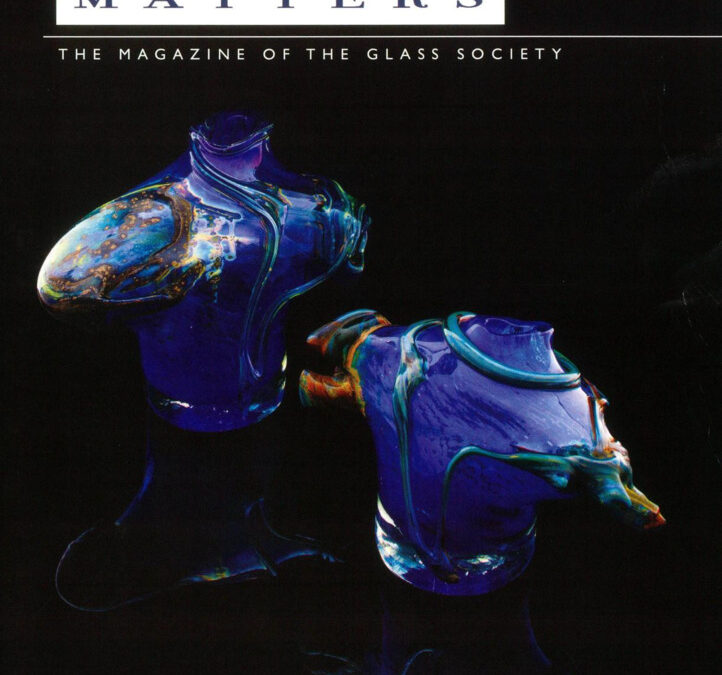
Two glass sculptures by Sam Herman, made in the
early 1970’s at the Royal College of Art. Sam used Dartington cullet with
45% lead oxide, giving a ‘brilliance’ and time for manipulation in the
making. Private collection. Picture with thanks to Sylvain Deleu
BACK COVER: A
Thomas Webb & Sons ‘Rock Crystal’ glass
Moon
Flask.
Sold at Bonhams Auction, 20.11.2019. Estimated £1,200 to
1,500, it reached a hammer price of 17,000. Picture © Bonhams
Glass Matters Issue no.7 February 2020
2
CHAIRMEN’S MESSAGE
Chairmen’s
Message
Sue Newell, Joint Chairman
of The Glass Society
W
elcome to
Glass Matters 7,
the first of the new decade.
Since our last issue, you
will have received the first vol-
ume of
The Journal of the Glass
Society.
This is a particular source
of satisfaction for us as this qual-
ity publication stands as a lasting
and effective statement of who
we are. We congratulate our Edi-
tor Brian Clarke, and our design-
er, Emma Nelly Morgan, for their
dedication and creativity, as well,
of course, as our members who
shared the fruits of their research,
often the result of many years’ work.
The diversity in the Journal can
also be found in every issue of our
magazine and this one is no excep-
tion, with a balanced mixture of
18th and 19th century glass; then,
following on from his autobiograph-
ical talk at our AGM in Norwich last
year, we are pleased that an article
by David Reekie, the eminent glass
sculptor, is included. The populari-
ty of David’s work is reflected in the
number of galleries and museums
that have his work on display. Muse-
ums are often obliged to keep many
of their treasures in storage, where
they languish, hidden from view.
Currently, Manchester City Art
Gallery has a temporary exhibition,
`Out of the Crate’,
that addresses this
issue – sculptures not otherwise on
regular view can be seen, many still
in their original packing cases. In
this exhibition, sitting alongside
sculptures in stone by Eric Gill
and bronzes by Jacob Epstein, are
glass creations by David Reekie.
We also include an article on ‘ary-
bailor, containers, usually in glass,
containing oils used in the public
baths of the Roman Empire near-
ly two millennia ago. Of particular
interest, are the variety of shapes
and vibrant colours that were in
use, as well as an early warning
that
‘glass containers in bathing
areas could cause injury if they break’!
Predictably, collecting figures
large in this publication and we are
constantly pleased to hear of new
or different types of collecting. One
of our members has a fascination
for Victorian match strikers and
has managed to amass possibly
the definitive collection in a wide
range of colours, some with silver
tops and others without. Another
collects small, some would say min-
iature, Victorian or Edwardian ink-
wells – each enclosing a photograph
of London, Scarborough, Paris, the
Forth Bridge or Crystal Palace – their
origin unknown, possibly manufac-
tured in the UK, or more likely in
Eastern Europe prior to the photo-
graphs being incorporated in the UK.
Another member, wishing to bolster
his retirement fund with tangible
assets, started a collection and now
owns two Beilby armorial goblets!
We are hoping to
see
many of you
at our forthcoming meetings; they
start on March 12th in London with
a talk by our member, the engraved-
glass artist Katharine Coleman
MBE, on a wonderful exhibition
of engraved glass at the European
Museum of Modern Glass in Roden-
thal this year. Maintaining our links
with the Castle Museum in Norwich
you will soon receive details of a
David Willars, Joint Chairman
of The Glass Society
study day we are arranging in April:
the museum has recently received
the bequest of a new collection of
glass and the visit will be an excit-
ing opportunity to get involved.
Some of you may know the Picture
Gallery at Christ Church College in
Oxford; their new display of eigh-
teenth-century English drinking
glasses will hopefully form the cen-
trepiece of a Glass Society visit to
Oxford later this year. While all our
meetings have an informal element
where members can share their
love of glass with others, a more
ad hoc initiative has been the glass
pub lunch in the Manchester area,
where members can take along a
piece from their collection and chat
about it and other glass matters. Do
get in touch if you wish to join in.
Returning to museums, we were
recently thrilled to hear that the
British Glass Foundation (BGF)
has been awarded funds to fit out
the White House Cone museum of
glass
(see the News pages).
Those
close to the BGF will know how long
this process has taken and be very
relieved and pleased that this excit-
ing project, at the heart of British
glassmaking, can now go forward.
Susan Newell and David Willars
Joint Chairmen, The Glass Society
Glass Matters Issue no.7 February 2020
3
BELOW Fig.2
Construction with
Black Squares,
1981,
50h x 40w x 40d cm
RIGHT (TOP TO BOTTOM)
Fig.3 Construction with Guarding Figures,
1978
Fig.4 Spring Return,
1988
Fig.5 Uphill Struggle 1,
1991
CREATIVE SCULPTURE
FINDING a ARRATIVE
in
Clays
DavidReekie
BELOW Fig. 1
Construction No.1,
1978
M
y life as a glass artist start-
ed in 1965 when I went to
art college, firstly in Bar-
net, London and then to Stour-
bridge College of Art from 1967
to 1970, where I was mentored
by tutors Keith Cummings and
Harry S eager. I was encouraged
to develop new ideas of thinking
and experiment with glass- mak-
ing techniques, one of which was
to form sheet glass in a kiln and
use this glass to build construc-
tions. This led to pieces like
Con-
struction Nol, (Fig.1),
which is now
in the Portsmouth Museum & Art
Gallery collection and later to
Con-
struction with Black Squares, (Fig.2).
Working with these construc-
tions I realised I was making archi-
tectural forms that needed some
kind of scale, so I introduced the
figure, as in
Construction with
Guarding Figures, (Fig.3),
which is
part of the Dudley Museum Ser-
vices Stourbridge collection. I
soon realised this gave the work a
narrative and I could make state-
ments and add theatre to the
work. The piece
Spring Return,
4
Glass Matters Issue no.7 February 2020
(Fig.4)
shows this development
and was bought by Norwich Cas-
tle Museum that same year.
The figure now became a major
element in the work and as in
Spring Return, which express-
es the struggles we have in life,
Uphill Struggle I (Fig.5)
tackles
this subject in a much more force-
ful way. I came back to this sub-
ject in 2013 with
Road to Recovery
(Fig.6)
as an ironic response to
government austerity measures.
I am driven by a desire to make
things and during this making pro-
cess I have the effects and qual-
ities that glass can give me at the
back of my mind. There are ele-
ments of both design and decora-
tion in my work and because I use
the human figure, I find it rela-
tively simple to introduce a narra-
tive which suggests any particular
theme or idea I am working on. I
also like to use other materials and
found objects in my work that fit to
the narrative I am trying to form.
Politics, how society affects our
lives and damage to the environ-
ment are always constant influ-
Fig.6
Road to Recovery,
2013, 38h x 55w x 23d cm
ences, see
Fruit of the Sea II (Fig.7).
In my current work I am investi-
gating relationships. By using the
juxtaposition of the figures, with
facial expressions, especially the
position of the eyes and the angle
of the head, I try to indicate sub-
tle nuances in our relationships
with each other, as in
Dialogue IX
(Fig.8).
I combine all these influenc-
es in my drawings and these even-
tually filter through to the work.
Casting and lost-wax casting are
my main techniques and I find these
processes allow me to explore and
develop my ideas even before I touch
the glass. By modelling in clay and
wax I have the freedom to gradually
build my ideas and change things as
I go along. I have also developed the
use of ceramic enamel colours that I
can use both in the glass itself and on
CREATIVE SCULPTURE
LEFT Fig.7
Fruit of the Sea
II, 2006
RIGHT Fig.8
Dialogue DI,
2011,
37h x 26w x 18d cm
Glass Matters Issue no,7 February 2020
5
BELOW Fig.9a
Sympathetic Thoughts
drawing,
2006
BELOW Fig.10
Dumb as a Dodo IV,
2007, 43h x 24w x 19d cm
the mould surface to create effects
that mirror those in my drawings.
As I mentioned, drawing is an
important part of my creative pro-
cess and a well-conceived idea real-
ised in a drawing can dictate the work
to come, as in
Sympathetic Thoughts
completed in 2009
(Figs.9a & 9b).
Over the years several artists
have inspired me: artists like Hon-
ore Daumier 1808-1879, for his use
of the caricature and bold facial and
body language, the surrealist art-
ist Rene Magritte 1898-1967 and
the painter Fernand Leger 1881-
1955. Then more recently, the Brit-
ish artist John Davies, whose first
exhibition in 1971 at the Whitecha-
pel Gallery in London was very
influential on my figurative work.
Pieces that can be traced back to
these influences are
Dumb as a Dodo,
(Fig.10); Drummers 1, (Fig.11); Ris-
ing Tension, (Fig.12); A Captive Audi-
ence, (Fig.13),
which is part of the
BELOW Fig.9b
Sympathetic Thoughts,
2009,
36h x 23w x 22d c
–
m
ABOVE Fig.11
Drummers I,
2004, 46h x 55w x 25d cm
BELOW Fig.12
Rising Tension,
2005
CREATIVE SCULPTURE
6
Glass Matters Issue no.7 February 2020
CREATIVE SCULPTURE
Victoria & Albert contempo-
rary glass collection, and also
On Shaky Ground, (Fig.14)
which
is a popular focal point in the
Racine Art Museum, Wisconsin,
USA – the local American Football
team is known as the `Cheeseh-
eads’, so the young fan in the
picture is wearing a cheese hat.
The surreal element of my work
is well represented in
Dragon Boy
1 (Fig.15)
from 2011, which was
initially for an exhibition in Hong
Kong celebrating the Year of The
Dragon. In this piece I use ele-
ments of the traditional Chinese
dragon dancers along with the
processional Snap Dragon used
in festivals in Norwich from ear-
ly times and it is now in the Nor-
wich Castle Museum collection.
The process of lost-wax casting is
quite time consuming and working
from an original drawing,
(Fig.16a),
I sometimes work with a combina-
tion of soft clay and modelling wax
(Fig.16b),
which is then cast into
BELOW Fig.13
A Captive Audience?,
2000, 76h x 50w x 35d cm
RIGHT Fig.16a
The Temptation of Lies V,
drawing, 2018
BELOW Fig.15
Dragon Boy I,
2011,
40h x 33w x 16d cm
BELOW Fig.14
On Shaky Ground, 1996
BELOW Fig.16b
The Temptation of Lies V
2018, making clay & wax
Glass Matters Issue no.7 February 2020
CREATIVE SCULPTURE
BELOW Fig.16c
The Temptation of Lies V,
2018, making mould
a plaster and powdered
flint mould
(Fig.16c).
In
these images I am work-
ing on part of a series of
pieces called The Tempta-
tion of Lies
(see Figs.16d
& 17) –
very much a reac-
tion to what is happen-
ing politically here in the
UK and in the USA. The
political scene in both
countries has driven a
wedge between the peo-
ple and I have reflect-
ed on this in
The Wall
BELOW Fig.17
The Temptation of Lies IV,
2018,
36h x 39w x 32d cm
Between Us 1, (Fig.18).
My workshop is in a
village called Dickleburgh
about 20 miles south of
Norwich. I mainly work
alone but my daughter
Morag helps me from
time to time and is now,
even as a mum of three
children, finding time to
develop her own work.
This essay is an adap-
tation by David Reekie of
his informative, illustrat-
ed presentation, given at
the AGM of The Glass Soci-
ety, held at Norwich Cas-
tle Museum, October 2019.
ABOVE Fig.16d
The Temptation of Lies V,
2019, 37h
x
37w
x 31d cm
RIGHT Fig.18
The Wall Between Us,
2019,
30h x 38w x 27d cm
8
Glass Matters Issue no.7 February 2020
A HISTORY OF IRISH GLASS
Glassmakers, glass retailers and glass consumers:
New research on glass in Ireland, c. 1730 – c. 1830
Anna Moran
A
reasonably held view is that
the history of Irish glass has
already been written. I can
clearly recall being told ‘that’s all
been done’ some years ago when I
was embarking on my MA thesis on
early nineteenth-century Water-
ford glass (completed at the V&A/
RCA in 2002).
1
M. S. D. Westropp’s
meticulously researched 1920
study of glassmaking in Ireland is
superbly comprehensive, and lit-
erature published since by Warren,
Boydell, Dunlevy and Francis has
impressively fleshed out the sto-
ry.
2
However, by principally focus-
ing on production these important
studies, as well researched and
fundamental as they are, only tell
part of the story. The business
of selling glass in Ireland – tak-
ing in all that retailing involves,
from marketing to shop design
to decorating work-
shops – had not been
addressed in detail.
Equally, how glass
was used in Ireland
during this period –
shopping for glass,
its place in the con-
text of polite dining
and its role as a means
of projecting identity
–
was yet to be compre-
hensively explored. A
rounded history of
the Irish glass indus-
try, its market and its
consumers, c. 1730
–
c. 1830, thus pro-
vided the focus of
my PhD (completed
at the University of
Warwick in 2011).
3
Building on the
work of Westropp, Warren, Boy-
dell, Francis and others, I combed
through a vast amount of archival
material – ranging from Waterford
glasshouse accounts, surviving
glasshouse patterns, newspapers,
Dublin Society Proceedings,
household inventories, domestic
account books, bills and prints –
and with the life cycle of objects
in mind, I sought to combine this
research with a study of surviving
objects to elaborate on the design,
production, retailing, acquisition,
use and re-use of glass in Ireland
during the 100 years between c.
1730 and c. 1830. This history, and
its sources, underpinned my talk
to the Glass Circle in May 2017,
and is the focus of this short paper.
Lead glass production began in
Ireland when John Odacio Formi-
ca, in partnership with Sir Philip
Lloyd and Richard Hunt, estab-
lished a glasshouse in Smithfield,
Dublin, in 1675. Sherds of drink-
ing glasses found at the recent
excavation at Rathfarnham Cas-
tle, Dublin, and finds from other
excavations, when seen together
reveal a series of recurring sty-
listic features particular to Irish
glass.’ These include a coin-
shaped merese between the bowl
and the stem, now understood
to be an idiosyncratic Irish char-
acteristic, making it possible to
attribute a small number of sur-
viving complete examples to Oda-
cio Formica’s Dublin glasshouse.
5
While it is likely that the glass-
house in Smithfield stopped work-
ing after Odacio Formica’s death
in 1696, demand for glass contin-
ued to grow. Attempts to establish
glasshouses in Ireland to satisfy
that demand were
short-lived and with
a view to replacing
imported glass with
Irish glass, the Dublin
Society (established
in 1731) introduced
premiums, financed
by the State, in order
to encourage Ireland’s
indigenous glass
industry. The
Proceed-
ings of the Dublin Soci-
ety
reveal interesting
details on how such
awards were given
and to whom between
Fig.
1
Pair of cut glass decanters,
marked PENROSE
WATERFORD, c. 1783-1799.
H. 24cm.
Glass Matters Issue no.7 February 2020
9
41111166
A HISTORY OF IRISH GLASS
1750 and 1794. Initially, large
one-off sums were provided with
a view to contributing to capital
expenditure such as the construc-
tion of glasshouses, but these were
later replaced by a system which
awarded premiums based on the
volume of glass manufactured.
Alongside training young artisans
who worked in areas such as paint-
ing, ceramics and stucco work, the
Society also identified specific
technological innovations which
they felt would aid the industry.
In 1786, for example, a commit-
tee formed by the Dublin Society
awarded ten guineas to Mr Buon-
segna for devising an improved
way of cutting scallops in glass.’
The greatest boon to glass pro-
duction in Ireland, however, came
in the form of legislative chang-
es. These included the granting
of Free Trade from 1780, allow-
ing Ireland to revisit some of the
export markets which had been
developed in the late seventeenth
century, as well as reaching new
markets such as Barbados, Anti-
gua and Newfoundland. In addi-
tion, an exemption was introduced
whereby there was no duty payable
on coal when imported to Ireland
for the purpose of glass produc-
tion. Furthermore, the duty on
glass payable by glassmakers else-
where in Britain was not charged
on glass made in Ireland from 1745
to 1825.
8
As a result, between c.
1780 and c. 1825, the Irish glass
industry was a reasonably buoy-
ant business which supplied a
good share of the Irish home
RIGHT (ABOVE) Fig. 2
Two engraved lead glass water jugs. The example
on the left is marked ‘WATERLOO CO. CORK”,
1815-1835. H. 17.2 cm. The jug on the right is
marked ‘CORK GLASS CO’, 1783-1818. H. 13 cm.
RIGHT (BELOW) Fig. 3
From left: Decanter with bulbous body bearing
engraved symbols of the act of union, marked B
Edwards Belfast’ H. 21cm; Half-size decanter,
marked B. EDWARDS BELFAST, H17.5an;
Decanter (without stopper), marked S. EDWARDS
BELFAST. H. 21.8cm.
market together with an impres-
sive range of export markets.
In terms of what was made,
newspaper advertisements show
that the product range of the
Irish glasshouses — located in
Waterford, Cork, Dublin, Belfast
and Newry — easily matched the
range produced by English glass-
houses. Particular to a number of
Irish glasshouses, however, was
the practice of mould-impressing
the name of the glasshouse on the
base of certain objects. Decanters,
wine coolers, butter coolers and
one plate survive bearing the name
of a glasshouse impress-moulded
on the base, and examples survive
from Penrose Waterford; Benjamin
Edwards, Belfast; Cork Glass Com-
pany, Cork; and Waterloo Glass
Company, Cork — see examples
in
Figs 1, 2 and
3.
9
Three moulded
dishes bearing the names of Dub-
lin manufacturers are also known,
one marked on the base C. M. &
Co, which was probably made by
Charles Mulvany & Co, and two
similar examples, both marked J. D.
A, presumably J. D. Ayckbowm.”
1
0
Glass Matters Issue no.7 February 2020
LEFT Fig. 4
Half-size glass decanter bearing an engraved sailing ship and cartouche, marked
MARY
CARTER & SON 80 GRAFTON ST DUBLIN’, H. 18.7cm.
ABOVE Fig. 5
Blue glass finger bowl, marked ARMSTRONG ORMOND
QUAY,
c. 1800-1829. H: 8.8cm.
A HISTORY OF IRISH GLASS
Such pieces met the demand for
glass not just from the nobility
but also, and perhaps to a greater
extent, from the expanding mid-
dling sort and professional classes
who, with conveying their status in
mind, recognised that glass was a
key material within an appropri-
ately furnished and well-lit home.
The ways in which glass was
marketed and sold not only reveal
the business of retailing but also
inform us on aspects of the glass
industry and the prerogatives of
consumers. Over the course of the
eighteenth century, the number of
shops selling glass increased and
elaborately decorated glass shops
became destinations in their own
right. The provision of an adequate
assortment of glass, along with the
ability to give credit, to advise on
matters of taste, and to provide a
pleasurable context in which to
shop, were the prerequisites to
securing a good reputation as a
glass seller. Some retailers clearly
felt a need to project a strong busi-
ness identity, supported by the fact
that a number of glass objects sur-
vive with the names of prominent
retailers mould- impressed on the
base. These include ‘J. D. AYCK-
BOWM DUBLIN’; ‘MARY CARTER
& SON 80 GRAFTON STREET’;
`ARMSTRONG ORMOND QUAY’;
`FRANCIS COLLINS DUBLIN’; and
`JACKSON GRAFTON STREET’ –
see examples in
Figs 4 and
5.
11
Research by historians Jan de
Vries, Maxine Berg and Helen Clif-
ford has argued that skill and work-
manship were key features in the
increased demand for new com-
modities such as glass and ceram-
ics in the eighteenth century.
12
Being in a position to boast that
the glass was cut or engraved on
site under the master glasscutter’s
supervision made the all-import-
ant cognitive link with the mak-
ing process and with the skill and
workmanship involved. In 1800,
Dublin retailer John Kennedy of
Stephen Street had a team of six
cutters in his decorating workshop
while the retailer J. D. Ayckbowm
had four cutters in his employ.
13
Those running glasshouses also
sold glass direct to consumers. The
Round Glasshouse in Dublin, for
example, was selling an incred-
ible range of glassware from its
shop, including ‘wine glasses with
a vine border, toasts, or any flour-
ish whatsoever’, as shown by an
Glass Matters Issue no.7 February 2020
A HISTORY OF IRISH GLASS
RIGHT (ABOVE) Fig. 6
Pattern for ‘Sallad or Sugar Bowls’ from the John
Fitzgibbon Drawings’ said to have been used at a
Cork glasshouse in the early nineteenth century.
RIGHT (BELOW) Fig.
7
Three sample glasses bearing a variety of
cut decoration, possibly used by a travelling
salesman.
advertisement dating to 1751. Lat-
er, in the early nineteenth centu-
ry, the Waterford glasshouse ran
its own ‘Ware Room’ on the quay
in Waterford, separate from the
glasshouse, where tea was served
to potential customers in a nice-
ly furnished ‘back room’. Such
glasshouses would also have had
a travelling salesman whose role
was to develop a network of retail-
ers around the country. It is quite
possible that when visiting their
network, they may have brought
paper-based patterns, perhaps
similar in format to those asso-
ciated with a Cork glasshouse
(Fig. 6),
or may have brought
glass samples illustrating the dif-
ferent patterns available
(Fig
7).
While glass was probably pri-
marily sourced new, it was also
part of the vibrant trade in
second hand goods. While a pau-
city of sources makes it difficult
to comprehensively understand
the character of the secondhand
goods trade, the proliferation of
advertisements for house contents
auctions in Dublin newspapers,
many of which list glass, testifies
to the fact that a dynamic trade
in secondhand household goods
existed. Such auctions, alongside
markets and itinerant traders, pro-
vided a way for consumers to pur-
chase glass which may otherwise
have been outside of their budget.
Why were consumers so inter-
ested in acquiring glass? Over the
course of the long eighteenth cen-
tury glass came to be seen as a key
element within the vocabulary of
polite dining, see examples in
Figs.
8, 9 and 10.
Alongside its func-
tional role in the kitchen as the
I2
Glass Matters Issue no.7 February 2020
ABOVE (RIGHT) Fig. 8
A
selection of cut glass pieces, including a covered urn
–
shaped vase, a piggin and two butter
–
coolers.
ABOVE (LEFT) Fig. 9
Cut glass celery vase on three legs, c. 1790
—
c.1800.
BELOW Fig. 10
Two cut glass canoe-shaped bowls on moulded feet, c. 1790 — c.1800.
A HISTORY OF IRISH GLASS
preferred material for storing and
preserving, its importance with-
in the material culture of dining
increased over the course of the
century. By closely examining col-
lections of family papers in search
of household inventories, bills
and account books, and by care-
fully combing through contempo-
rary diaries and letters for what
are often very fleeting referenc-
es to glass, it was possible to gain
some insights into the use of glass
in the Georgian home in Ireland.
The inventory made in 1763 by
George Cockburn of the contents
of his home at 10 Cavendish Row,
Dublin, included a considerable list
of glass for use in the context of
dining and gives a perspective of
its importance in equipping the
outer-facing functions of a home.
Amongst the long list of glass items
were ‘Six long flowerd champaigne
glasses’, ‘Sixteen Bumper Glass-
es’, ‘Six New Wine Engh. Decant-
ers & Six Stoppers’ and ‘Six Hock
glasses guilt round the Bowls wth
a Case’.” For Lieutenant-Colonel
William Blacker (1777 — 1855), of
North Great George’s Street, who
bought his glass at James Dono-
van’s ceramics and glass shop on
George’s Quay, having the cor-
rect cut glass at his dinner table
was critical. He declared, ‘Giving
a dinner for the first time to those
who you are aware are in the habit
Glass Matters Issue no.7 February 2020
H
A HISTORY OF IRISH GLASS
of faring sumptuously every day
[and] consequently good judges is
no joke — The
eye
as well as the
appetite must be car’d for’.
18
Bish-
op Edward Synge (1691 – 1762),
with the dessert of an upcoming
dinner in mind, wrote in June
1750 to his daughter in Dublin
about the “Pyramids to be look’d
at.”
18
On the subject of how they
would be displayed, he was quite
specific: “It is resolv’d, that if you’ll
send four dishes of the same size
with the one now sent down, We
shall be tolerably well equipp’d.
Get them therefore and send them,
when you can, and with them two
Glass-plates, or Salvers, to lay on
dishes on which Jellys, or Sillabubs
are to stand.”
17
These, together
with the many other tantalizing
references to glass found in the
archives, convey the important
role glass played in the construc-
tion of polite identity, the com-
munication of good taste and the
representation of family lineage.
Another example of how the
role of glass far exceeded the func-
tional or ornamental was its use in
the world of clubs, brotherhoods
and societies, and in particular its
use in the context of toasting prac-
tices. The minute books of Dublin’s
Ouzel Galley Society (established c.
1705 with the aim of finding ami-
cable solutions for commercial dis-
putes) clearly reveal that this club’s
primary raison d’etre was drink-
ing.
18
Each new member or offi-
cer had to drain, in a single draft,
a bumper of claret from the Soci-
ety’s glass loving cup. Drinking
was equally important to the mem-
bers of The Florists Society (estab-
lished with the goal of promoting
floriculture in Ireland). Their
`bumper toasts’ had a floral theme.
Alongside toasting the King, the
Glorious Memory, ‘this society and
all florists’, ‘a round of carnations’
were to be drunk in the months
from July to January and ‘the
Auriculas were to be first drunk’
between January and July.” With-
in the ceremonies of the various
societies and brotherhoods estab-
lished during the eighteenth cen-
tury, the use and decoration of
the glass used was highly signifi-
cant, for not only could it serve as
a medium for communicating sol-
idarity and allegiance, but the rit-
uals surrounding its use could also
signal membership and exclusivi-
ty. Repeated raising of glasses and
toasting in unison had the effect of
heightening emotions and estab-
lishing solidarity between those
present, placing glass at the cen-
tre of this important social ritual.
In 1825, the excise duty on glass
was extended to Ireland, putting
Irish glass on an even tax foot-
ing with England. This exposed
the weaknesses of the Irish glass
industry: materials, labour and
fuel had to be imported, which
meant that in the absence of some
form of assistance, Irish glass
manufacture was at a natural dis-
advantage. When required to pay
the same duties as their rivals,
Irish glass manufacturers found it
difficult to compete with English
and Scottish producers in their
home market. In addition, by the
late 1820s and 1830s, the cheaper,
utilitarian glass – with negligible
margins after excise – constituted
a very considerable portion of the
market for glass in Ireland. Only
the larger concerns in England
and Scotland, with greater econo-
mies of scale and lower costs, could
survive. Those Irish concerns
which had invested in steam-pow-
ered technology in order to pro-
duce higher-end products in an
attempt to increase their prof-
it margins struggled to compete
with English, Scottish and Conti-
nental cut glass.
2
° This, combined
with other factors, prevented
Irish glasshouses from compet-
ing more effectively with their
Scottish and English competitors.
The study of archival evidence
presents an intriguing layer of
contextual material, allowing us
to answer new questions about
the reality of making, selling and
using glass in Ireland during the
period concerned. This ensures
that we can appreciate surviving
objects not only for their beauty
and the mastery of their making
but also for the intriguing sto-
ries they tell, and are yet to tell.
This essay is an abridged version
of Anna Moran’s Ph.D, presented in
a talk to the Glass Circle at a meet-
ing in 2017 at The Artworkers Guild.
IMAGE ACKNOWLEDGMENTS
The examples in Figs.1 to 5 and 8
to 10 are all Ex. Kenneth Tughan
Collection and now in the Collec-
tion of the National Museum of
Ireland. Photo: © Bryan F. Rut-
ledge, B.A.
Reproduced courtesy of the
National Museum of Ireland.
Fig.6 is reproduced from pho-
tographs in the Art and Indus-
try Archive, National Museum of
Ireland. Reproduced courtesy of
the National Museum of Ireland.
Fig.7 is in the Collection of
the Ulster Museum. Reproduced
courtesy of the Ulster Museum.
ENDNOTES
1.
Anna Moran, “Manufacturing
Mythology? Waterford Glass in the
Early Nineteenth Century,” M.A.
thesis, Victoria and Albert Muse-
um/Royal College of Art, 2002.
2.
M. S. D. Westropp,
Irish Glass,
edit-
ed by Mary Boydell (Dublin 1978);
Mary Boydell,
Irish Glass,
Irish
Heritage Series, No. 5; Mairead
Dunlevy,
Penrose Glass,
National
Museum of Ireland, 1989; Peter
Francis, “The Development of Lead
Glass: The European Connections,”
Apollo, v.
151, no. 456, February
2000, pp. 47-53; Peter Francis,
“The Enduring Myths of Irish Glass,”
in
Ireland: Crossroads of Art and
Design,
1690-1840, ed. William
Laffan and Christopher P. Monk-
14
Glass Matters Issue no.7 February 2020
A HISTORY OF IRISH GLASS
house, Chicago: The Art Institute
of Chicago, 2015, pp. 187-191;
and Phelps Warren,
Irish Glass:
The Age of Exuberance,
New York,
1970.
3.
Anna Moran, “From Factory Floor
to Fine Dining: Making, Sell-
ing and Using Glass in Ireland, c.
1730-c. 1830,” Ph.D. diss., Uni-
versity of Warwick, 2011.
4.
Research by Peter Francis has
shown that the royal patent
they received in July 1675 was
for “the Art and manufacture of
a particular sort of Chrystalline
Glasses resembling Rock Chrystall
[which] hath never been exer-
cised or used by any in that our
Kingdome of Ireland.” Dr. Nessa
Roche later identified the site of
what was known as the “white
glasshouse” in Smithfield, and
this site was later excavated by
Frank Myles. See Peter Francis,
“The Development of Lead Glass’;
Franc Myles, “The Archaeolog-
ical Evidence for John Odacio
Formica’s Glasshouse at Smith-
field, Dublin 7,” in
Glassmaking
in Ireland: From the Medieval to
the Contemporary,
ed. John M.
Hearne, Dublin and Portland,
Oregon: Irish Academic Press, and
Dublin: National Museum of Ire-
land, 2010, pp. 83-102; Colin and
Sue Brain, “The Development of
lead-crystal glass in London and
Dublin, 1672-1682: a reapprais-
al”
Glass Technol. Eur. J. Glass Sci.
Technol.
A, April 2016, 57, 2, pp.
37-52; David Dungworth and
Colin Brain, “Late 17th Centu-
ry Crystal Glass: An Analytical
Investigation”,
Corning Journal of
Glass Studies
51, 2009, 111-137;
Antoine Giacometti,
Rath farn-
ham Castle Glass,
Dublin: Office of
Public Works, 2016; and Dwight P.
Lanmon,
The Golden Age of English
Glass,
1650-1775, Woodbridge,
Suffolk, U.K.: Antique Collectors’
Club, 2011, pp. 26-36.
5.
See Peter Francis, “The Development
of Lead Glass”; Colin Brain, “The Evi-
dence for …,” The Glass Cone (news-
letter of The Glass Association), no.
97, Winter 2012, pp. 6-7;
6.
Premiums offered by the Dublin
Society for Manufactures, Fine Arts
and Fisheries.
7.
Royal Dublin Society Library &
Archive,
Premiums offered by the
Dublin Society for Manufactures,
Fine Arts and Fisheries,
7 Decem-
ber 1786.
8.
Over the period 1745-1825, the
rules around where glass could be
exported to changed, as did the
duties (and countervailing duties)
on exported glass. See Cathe-
rine Ross, ‘The Excise Tax and
Cut Glass in England and Ireland,
1800-1830′,
Journal of Glass Stud-
ies,
24, 1982, pp. 57-64 and Anna
Moran, “From Factory Floor to
Fine Dining”, pp. 96-109.
9.
It is important to note that not
all pieces produced by these
glasshouses bear the name of the
glasshouse impressed on the base.
Such marked examples are rare.
10.
J. D. Ayckbowm was principally
a retailer with his own decorat-
ing workshop but he did own the
New Venice Glasshouse on Baggot
Street, Dublin, for a short period
(1799-1802).
11.
I am grateful to Peter Francis for
sharing his discovery of a Jackson
marked tumbler with me.
12.
Jan de Vries,
The Industrious Rev-
olution: Consumer Behaviour and
the Household Economy 1650 to the
Present
(Cambridge, 2008); Max-
ine Berg,
Luxury and Pleasure in
Eighteenth Century Britain
(Oxford,
2005), pp. 17-193. Helen Clifford
“A Commerce with Things: The Val-
ue of Precious Metalwork in Early
Modern England”, in Maxine Berg
and Helen Clifford
Consumers and
Luxury: Consumer Culture in Europe
1650-1850,
Manchester and New
York, 1999, pp. 147-69.
13.
Royal Irish Academy, 4.B.31,
“Report on the Trades and Manu-
factures of Dublin,” 1834.
14.
Inventory of 10 Cavendish row,
made by owner George Cockburn
in 1763. Cockburn Papers, BL Ms
Add 48314
15.
Armagh County Museum, Blacker
Papers, ARMCM.5.1948, Day-
books of William Blacker, v. 6, p.
105, cited in Anna Moran “”lhe
Eye as Well as the Appetite Must
Be Car’d For’: Glass and Dining
in Ireland, about 1680-about
1830′ in Christopher Maxwell
(ed.)
In Sparkling Company: Glass
and Social Life in Britain during the
1700s,
Corning Museum of Glass,
Forthcoming.
16.
Cited in L. A. Clarkson, “Hospi-
tality, Housekeeping and High
Living in 18th Century Ireland,”
in
Luxury and Austerity,
ed. Jac-
queline Hill and Colm Lennon,
Historical Studies, v. 21, Dublin:
University College Dublin Press,
1999, pp. 84-105, esp. p. 86.
17.
Bishop Synge, Elphin, to Alicia
Synge, Dublin, June 5, 1750,
The
Synge Letters: Bishop Edward Syn-
ge to his Daughter Alicia Roscom-
mon to Dublin, 1746-1752,
ed.
Marie-Louise Legg, Dublin: Lilli-
put Press, 1996, p. 190.
18.
E. Charles Nelson “The Dublin
Florists’ Club in the mid eight-
eenth century”, 10, 2,
Garden His-
tory,
1982, pp. 142-48..
19.
Royal Irish Academy, Minute
Book of the Florists’ Society,
1746-66, Ms 24/E/27. The toasts
are listed on the first page of the
minute book.
20.
For further discussion of the use
of steam power in the Irish glass
industry, please
see:
Anna Moran,
“Technology and Innovation: Inter-
preting a Sketch of the Waterford
Glasshouse Drawn in 1823 by the
Architect C. R. Cockerell,” in
Glass-
making in Ireland: From the Medie-
val to the Contemporary,
ed. John
M. Hearne, Dublin and Portland,
Oregon: Irish Academic Press, and
Dublin: National Museum of Ire-
land, 2010, pp. 169-182.
Glass Matters Issue no.7 February 2020
15
NEWS
Triton and Horses
Following Bill Millar’s request for
comments on ‘sculptures’ in the Dud-
ley Museum Service Collection, this
is an updated version of an arti-
cle on the Triton & Horses sculp-
ture (BH4629) that appeared in The
Glass Cone, Issue 98, in Spring 2012.
rr he impressive glass sculpture
1 ‘Triton and Horses’, hand-
carved by Frederick Carder, was
donated to the Broadfield House
Glass Museum (BHGM) in June
2011 by the local Rotary Club of
Kingswinford and Brierley Hill. The
sculpture which, in its glory, was on
display on the upper floor of the
museum, was carved from a block
of dear glass, frosted over as a finish.
It is full of life and movement and
depicts the Greek god Triton driv-
ing a chariot pulled by three rearing,
cavorting horses riding through the
seas, apparently at speed, with waves
and foam breaking all around them.
In 1957, after reading an article
in the magazine
The Rotarian
about
the work of Frederick Carder, the
Rotary Club of Kingswinford and
Brierley Hill held a meeting in his
honour. A sound recording of the
meeting was sent to the Corning
Rotary Club that Carder had formed;
acting on this, Carder returned the
favour by offering them this glass
sculpture. At another special event
in Carder’s honour in 1958, the
Rotary Club was presented with
the sculpture. Having looked after
the sculpture for over fifty years
and loaned it to various museums,
in 2011 the Rotary Club decided to
present it officially to the BHGM.
On presentation of the piece, in the
presence of the Mayor of Dudley,
Rotary Club president Ann Davies
said: “I’m delighted it is going to a
good home where it will be looked
after and where people can come
and admire it for years to come”.
Frederick Carder (1863-1963)
of Stevens & Williams, and Har-
ry Powell of James Powell & Sons
(Whitefriars) are generally accept-
ed as having been two of the most
influential and innovative glass
designers of their times, yet Carder
had almost been written out of the
history of the West Midlands glass
industry and was only recently reas-
sessed and appreciated in the UK.
1
–
2
Born in Brockmoor, Frederick
Carder worked at his father’s Leys
Pottery earthenware factory in Bri-
erley Hill before attending the Stour-
bridge School of Art and the Dudley
Mechanic Institute, which gave him
the introduction to his glassmak-
ing career with Stevens & Williams
in Wordsley. There, working along-
side John Northwood, he was the
chief designer between 1881 and
1903. Following the death of the
elder Northwood in 1903, and due
to irreconcilable differences with
John Northwood II, Carder emi-
grated with his family to America.
The enmity was so great that Carder,
the creative designer of over 25,000
artworks of glass for Stevens & Wil-
liams, did not receive a mention in
John Northwood II’s book. Once in
America, he met fellow glassmaker
Thomas Hawkes and co-founded the
Steuben Glass Works in Corning,
New York, where he worked until
his retirement in 1959. In Ameri-
can glass circles, Frederick Carder’s
name is legendary: Steuben, even
when becoming a division of Corn-
ing Glass, having produced some
of the best designed glass in the
USA. There is a gallery of the Corn-
ing Museum of Glass dedicated to
Frederick Carder and Steuben glass,
featuring hundreds of his pieces.
3
‘
4
References
1.
Hajdamach, C., ’20th Century British
Glass’: Antique Collector’s Club. 2010
2.
Hajdamach, C., ‘British Glass, 1800-1914’:
Antique Collector’s Club. 1991
3.
Dimitroff, Thomas P., ‘Frederick Carder
and Steuben Glass. 1998
4.
Corning Museum of Glass, biography of
Frederick Carder.
C
lass Society member
Clive Richards, has
been collecting 18th C glass-
es over the past 20 years, he
has decided to open his pri-
vate collection to fellow col-
lectors – interested parties
requiring further details
on types and styles may
contact Clive via telephone
07943 304164 and or email
crichards007@talktalk.net
Down sizinga
Collection
I6
Glass Matters Issue no.7 February 2020
LOVE TOKENS
GEORGIAN
love tokens
Neil Chaney
T
he Western Europeans of the
Georgian era were inclined to
artistry. With no Eastenders
or Coronation Street for entertain-
ment in the evenings, people enter-
tained themselves, their friends
and families with music, poetry
and conversation. The arts flour-
ished among those who could afford
the time to indulge in their flights
of fancy. Many painted or drew,
or penned poetry, prose and let-
ters. A few used glass to inscribe
messages and aphorisms, primar-
ily in diamond point. The engrav-
ing on these glasses tended to be
naïve and would often consist of
just a name and a date, inscribed
using a solitaire diamond from a
ring or other piece of diamond jew-
ellery. Recently, I was lucky enough
to pick up two glasses
(Fig./),
which
showed a higher quality of amateur
engraving and which tell a rather
touching tale of love and romance.
The first of the two glasses
is a larger than normal double
series opaque-twist stem wine
glass, 16.2cm in height and dat-
ing from the middle of the 18th
century, c1765. The engraving is
later, probably from around 1794.
English lead glass of this period
lent itself well to diamond-point
engraving as it was less hard than
the soda glass produced by most
Continental glass houses of the
time. The rounded funnel-shaped
bowl
(Fig.2)
is engraved with a heral-
dic shield containing a balance scale
on one side
(Fig.3)
and the letters
`M.E. Vroome’ within a floral car-
touche on the reverse
(Fig.4).
In
between the two main elements of
the design are two small birds in
flight carrying flowers
(Fig.5).
The
letters `NLH’ are scratched into the
top edge of the foot
(Fig.6).
Con-
sidering it is from an amateur, the
quality of engraving is good, but
it does not compare to the quali-
ty of work from the professional
engravers of the period. The glass is
almost certainly a token of affection
or love from NLH to M.E.Vroome.
I am fortunate to be in pos-
session of the later, second glass,
Fig. 1
The two glasses. Pedestal and opaque twist stems
Glass Matters Issue no.7 February 2020
diamond-point engraved by the
same hand; the engraver has made
it out to ‘Maria Elisabeth Vroome’
who I assume to be the M.E.Vroome
detailed in the first glass.
This second glass is a late Geor-
gian, lead wine glass with ped-
estal-stem; it is of some stature,
standing 18.4cm high and dates
from the
beginning of
the 19th cen-
tury.
The
double ogee-
shaped bowl
(Fig.
7) has
been engraved
on one side
with a cele-
bratory cake
beneath a
chain held
by two flying
birds, set above two swords within
a cartouche of two oak tree branches
(Fig.8).
On the reverse is an armorial
showing two shields beneath a ducal
crown
(Fig.9);
one of the shields is
depicting a balance scale similar to
that seen on the first glass. Just
beneath the rim there is an engraved
legend which, I believe, reads
“25th
Jarig e Trouwdag van Nicolaas Ludolph
Hoevenaar en Maria Elisabeth Vroome
op den 13th September 1820”.
This
can be roughly translated from
the Dutch as
“25th
wedding anni-
versary of Nicolaas Ludolph Hoev-
enaar and Maria Elisabeth Vroome
on the 13th September 1820”.
The
bowl sits on a stem consisting of a
cushion knop above a triple annu-
lar knop above a six sided pedes-
tal and a basal collar. The stem
leads to a terraced foot. The letters
“NLH” are once again scratched into
the top edge of the foot
(Fig.10).
We were fortunate enough to
track down both recipient and
engraver of the two glasses using
online resources – my thanks to Chris
Stonell for her time spent in help-
ing track them down. A Maria Elis-
abeth Vroome married a Nicolaas
Ludolph Hoevenaar (NLH) in 1795
Fig. 6
Engraving of initials on the foot of the opaque twist glass
LOVE TOKENS
Fig. 2
Fig. 3
Bowl of opaque twist glass
Scales within cartouche on opaque twist glass
Fig. 4
Fig. 5
Name within cartouche on opaque twist glass
Engraved bird on opaque twist glass
18
Glass Matters Issue no.7 February 2020
LOVE TOKENS
Fig.
7
Bowl of Pedestal stem glass
Fig. 8
Pedestal stem engraving with celebration cake
Fig. 9
Pedestal stem engraving with shields
, -4 1^v,
.
Fig. 10
Engraving of initials on the foot of the pedestal stem glass
in Amsterdam at the age of 21. See
https://www.genealogieonline.nl/
genealogieen-vromen/I33411.php.
The two glasses were presum-
ably engraved by Nicolaas who was
sufficiently proud of his achieve-
ment to record his initials on the
feet. The first glass was probably
presented to Maria by Nicolaas as
part of his courtship of her. The
second glass proves the efficacy of
his suit: a tale of a successful love
match over a period of some thir-
ty years. A pleasing and romantic
tale of social history told in glass.
Two glasses that really should have
stayed with one branch of the family
and I’d be keen to hear from any of
our Dutch colleagues if there is an
easy way to trace their successors.
HISTORICAL
NOTES
The shields are probably those
of their two families – Maria was
the daughter of Hendrik Vroome
and Anna Elisabeth Alida Pool-
man, while Nicolaas was the son
of Adrianus Hoevenaar and Chris-
tina Magtilda Oortman. Maria
was born in Amsterdam on 28th
April 1774 and died in Veghel on
24th February 1855. Nicolaas was
born in Utrecht on 22nd May 1772,
served in the army as an adjutant in
the 3rd Hussars, and died on 17th
June 1846, again in Veghel. Maria
and Nicolaas were married on 13th
September 1795 in Amsterdam,
the second glass commemorat-
ing their 25th wedding anniversa-
ry on 13th September 1820. They
had one daughter, Christina Elis-
abeth, born on 30th May 1798 in
Zutphen, Gelderland. The Hoeve-
naar family tree can be found online.
Our Editor introduced these
glasses and their engraving to Kath-
arine Coleman MBE, one of the
UK’s leading contemporary engrav-
ers, to whom I owe the following
observations on the diamond point
engraving on these two glasses:
“The use of diamonds for point
engraving on glassware in the Neth-
erlands became a popular pastime
– if not a profession – among artists
in the 1680s such as Heemskerk,
(Fig.11)
and many others, coincid-
ing as it did with the development of
lead glass – much softer and bright-
er to engrave – and the increase in
the diamond trade from India to
Antwerp and the Low Countries.
The quality of such engraving was
far higher and less clumsy than on
these two Georgian glasses, suggest-
ing that the two in question here
are by an amateur with an inexpe-
rienced hand. The heavy splinter-
ing, especially on the curves, comes
from the engraver trying to use the
diamond like a pen rather than an
engraving tool, pushing the dia-
mond through the glass round
curves, rather than stroking it gently.
There are many examples of soli-
taire ring “graffiti” on windows and
glass from Tudor times onwards,
Glass Matters Issue no.7 February 2020
19
such as in
Fig.12 –
charming Tudor
window glass in the British Rooms
at the V&A. The facet cuts of such
solitaire rings are never really high
enough for manoeuvring on a glass
surface, being 110 degrees plus,
whereas the engravers of the 17th
Century onwards, who used points
professionally, would use diamond
chips mounted on gravers with more
acute angles of some 45-60 degrees,
allowing for more elegant curves and
delicate scratching/engraving. Exam-
ples also abound in the semi-amateur
engravings of the Jacobite glass-
es of the 1740s/1760s, as in
Fig.13.
The engraving of the ladies’ names
on the KitKat glasses are also con-
siderably more elegantly executed –
even if they were done with a solitaire,
which I think unlikely: more likely
commissioned by the admirer from
an engraver with a diamond scriber.
Fig. 13
Jacobite glass detail, courtesy Bonhams
and K Coleman
The romantic idea of the solitaire ring
engraver is nonetheless appealing.
The dating of this particular glass
seems likely to be correct and the
engraving genuinely of the period
suggested, though, as we know, the
engraving might have been exe-
cuted any time since then to this
day.” I believe the engraving to be
contemporary with the glasses.
Figs.1 to 10 are reproduced with
thanks to the Editor and are © of
the Editor and Neil Chaney of The
World is made of Glass Ltd’. Neil can
be contacted through his website
www.theworldismadeofglass.co.uk
LOVE TOKENS
Fig. 11
An
exquisite Heemskeerk glass, ca.1685,
Fig. 12
courtesy of the Rijksmuseum, Amsterdam
Graffiti on windows, Tudor, V&A Museum (photo: K Coleman)
20
Glass Matters Issue no.7 February 2020
Campbell, gallery owner and fine
art dealer, and Joanna Shellard,
Sam’s wife. The Preface, written by
Rollo, lists all those who have been
involved with Sam throughout his
life and helped with the book. It is
a `Who’s Who’ of the international
greats in glass. At the end he gives
special mention to Joanna and
acknowledges that the book would
not have been possible without her.
Having visited Sam and Joanna a
few times during the preparations
for this book and seen the evidence
Fig. 1
Sam Herman working at London
Glassblowing, 2012 (page 108)
at first hand, I can only emphasise
Rollo’s words that Joanna “has
been the rock in Sam’s life for the
last 40 years as assistant, counsel
and support in all areas of his life”.
Special thanks are also giv-
en to Sylvain Deleu for his fabu-
lous images of Sam’s glass. They
are certainly some of the fin-
est photographs of glass I have
SAM HERMAN – A LIFE IN GLASS
Sam Herman
Book Review
Charles R. Hajdamach
D
uring the last sixty years
while the Studio Glass
Movement grew and devel-
oped and spread around the world,
it always amazed me that one of the
great omissions in the literature of
glass throughout all that time had
been a serious monograph about
Sam Herman, one of the great
protagonists of this revolution in
glassmaking. But when it did finally
appear in 2019, to say it was “well
worth the wait” would be a huge
understatement. Many in our world
of glass would only recognise the
name of Sam Herman as the per-
son who brought the philosophy
of studio glass to Britain in 1965
and transformed British glassmak-
ing for ever. The beauty of the new
book about Sam is that it opens
huge windows onto every other part
of his life and his achievements as a
painter, a sculptor and an educator
as well as a glass pioneer and a glass
artist. The content structure of the
book achieves this superbly well.
In his Foreword, the Marquis
of Queensberry provides a per-
sonal recollection beginning with
his first meeting with Sam at the
Royal College of Art, Sam’s impact
on the pedestrian and traditional
approaches to design by the great
Stourbridge glass factories, his
effect on the Ceramics and Glass
Department — not just glass, and
his offer to Sam of a research fellow-
ship. His comment that “appointing
Sam to work at the College was the
most important event in the study
and teaching of glass in this coun-
try in the last 50 years” sets the per-
fect tone for the rest of the book.
The two masterminds behind
the creation of this book are Rollo
Glass Matters Issue no.7 February 2020
21
SAM HERMAN – A LIFE IN GLASS
seen. They provide a visual treat
as near as possible to having
the actual pieces in one’s hands.
The brilliant idea to choose five
authors, who are close friends and
associates of the Hermans, to write
about separate parts of his career
provides the reader with a very
intimate and personal link to Sam
Herman not often found in other
monographs about glass artists.
Lucy Abel Smith, who wrote the
chapter on
The Early Years,
is an
art historian with interests in the
crafts who organises a Fresh Air
Sculpture Show with her husband
in the grounds of their home, has a
special interest in the Balkans and
Europe and founded the Transyl-
vanian Book Festival. She uses the
joint exhibition by Sam and the jew-
ellery designer and maker Gerda
Flockinger at the Victoria & Albert
Museum in 1971, her first introduc-
tion to Sam’s work, as the peg on
which to hang the personal history
and photos of Sam and his family,
beginning with the traumatic years
in Poland, then migration to Mex-
ico, another move to the United
States and New York, Sam’s various
jobs and his four years spent in the
US Navy, and fascinating snippets
such as his love of mountaineering.
Michael Boleyn, who wrote the
chapter on
The Birth of Studio Glass
1963-65,
was a fellow student of
Sam’s at the University of Wiscon-
sin and is himself a well-known
ceramic and glass artist. This is
another fascinating chapter as
Boleyn describes their experience
at Wisconsin under the guidance of
Harvey Littleton, with the technical
problems of a nascent department
where the students were not quite
sure what they were getting into
and there was no experienced glass-
maker on site to help. For example,
a newly installed melting tank did
not work very well as it was too
big and did not get the glass hot
enough, which made blowing a very
difficult job. But help was at hand
for the rookie glass blowers in the
shape of Dominick Labino. A vis-
it to Labino’s studio in Grand Rap-
ids was inspirational and restored
their enthusiasm and excitement.
His variety of different types of
glass furnaces opened their eyes to
new possibilities, while the range of
glass made by Labino, illustrated in
a photo of that visit, showed them
new forms and colours achievable
with small scale glass technology.
When the First World Congress of
Craftsmen was held in New York in
1964, Labino and Littleton and his
students set up a glassblowing stu-
dio which was available for use by
anyone from the participants from
46 countries. Herman and his fellow
students had started to initiate the
world-wide Studio Glass Movement.
Mark Hill, who wrote two chap-
ters:
The Studio Glass Pioneer 1965-
84
and
The Glass Artist,
needs no
introduction as he is a famous tele-
vision personality and broadcaster,
a glass collector (including a num-
ber of pieces by Sam), a leading
dealer in 20th century decorative
glass and author of a wide variety
of books on collectable subjects.
Mark’s two contributions form
the greater part of the book. When
one analyses the statistics of the
number of pages and photographs
devoted to each of the six main
chapters, it is easy to see that the
Fig. 2
Made in Lots Road studio in the early 1980’s,
reminiscent of some of his early work at the
RCA in the early 1970’s. (c/f front cover
picture). Private Collection
22
Glass Matters Issue no.7 February 2020
SAM HERMAN – A LIFE IN GLASS
main emphasis of the book, quite
rightly, is Sam’s glass oeuvre. Of the
145 pages devoted to the six chap-
ters, 95 are devoted to these two
chapters; of the 119 photographs
over the six chapters, 70 are of
glass mainly for the second of the
two chapters. In the first chapter,
Mark deals with the many diverse
personalities in Sam’s life, the rea-
sons for his moves to Scotland and
England – firstly to Edinburgh, then
to London and the Royal College of
Art – early exhibitions, his involve-
ment at Val St Lambert in Belgium,
his ground-breaking exhibition at
the V&A Museum, opening The
Glasshouse, his creation in Austra-
lia of the Jam Factory in Adelaide,
his return to Europe in 1979, and ending with ‘Reminiscences with
Erwin Eisch, 2017’. In the
sec-
ond
of his chapters, Mark revisits
some of the same places, such as
The Glasshouse and Val St Lam-
bert, but this time he considers the
technical aspects of the making of
each art piece, discussing appli-
cation of colours, trails and gath-
ers, shapes, iridescent effects and
how Sam developed them over his
career. At the Jam Factory his work
was influenced by the Australian
landscape and his colour choices
are earth greens and browns, while
shapes become dramatic and mon-
umental. Then in the section about
the Lots Road Studio from 1979-84
and the final section, Twenty-First
Century Work 2007-2017, Mark
conjures up images of Herman the
lover of glass – the material which
places him in that rarefied atmo-
sphere with other great glassmak-
ers in history such as Emile Gall&
At Lots Road Mark tells us that
Sam felt it was a “dream come true,
the first time in his life he was able
to do what he had dreamed about
at Wisconsin, his own private stu-
dio where he could make what he
wanted”. Ironically it was to be his
last studio. Mark lists the various
glassmakers and studios where Sam
worked between 2007 and 2017,
the most recent being Loco Glass
in Cirencester. Discussing the pros
and cons that Sam had to face, Mark
stresses that Sam’s work “resulted
in pieces that many see as among
the most successful, appealing
and mature examples of his work”.
Dr Greg Votolato, who wrote the
chapter
The Educator,
is a renowned
educationalist, a lecturer at the
Victoria & Albert Museum and
the University of Oxford, and has
written a number of books includ-
ing subjects such as 20th century
design and transport design. He
was former Professor of Design
at Buckinghamshire New Univer-
sity based in High Wycombe and
met Herman there when Sam was
a visiting tutor, working with him
throughout the 1980s. Votolato
stresses the two different elements
of Herman’s teaching style. On the
one hand he allowed his students
time and space and a creativity
which combined open-mindedness,
experimentation, risk-taking, inno-
vation and intellectual freedom.
But when it came to the critiques of
their work and their working meth-
ods, one former student said they
could be “cutting and gut-wrench-
ing. Sam practised tough love”. But
Herman’s high expectations were
there to help each student. Some
students took the easy path of
Fig. 3
Untitled,
2013. Blown glass 3&m. Private
Collection (page 111)
Glass Matters Issue no.7 February 2020
23
SAM HERMAN – A LIFE IN GLASS
Fig. 4
Open Handkerchief,
1991. Mild steel and glass,
65cm. Private Collection (page 138))
emulating Sam’s work but he was
a master at encouraging them to
find their own direction. That
approach by Herman meant that
the studio glass world very quick-
ly was populated by glass artists
working in a whole host of their
own developed techniques and
styles. He also impressed upon
his students the need for a busi-
ness acumen and for experience in
marketing, sales, dealing with the
public, exhibition display and per-
sonnel skills in the big wide world.
His creation of The Glasshouse
in Covent Garden helped many of
his students to make that transi-
tion from education to practice.
Michael Regan, who wrote
the chapter
Sculptor and Painter,
has a long career as an art cura-
tor and exhibition organiser, and
has worked with the Victoria &
Albert Museum, the Whitworth
Gallery in Manchester, the Arts
Council of Great Britain, Cana-
da House, and the Lightbox Gal-
lery in Woking amongst others.
He begins the section looking at
Herman’s early involvement with
sculpture, which remains Herman’s
lifelong passion. Leo Steppat, a
notable sculptor at the University
of Wisconsin, was a formative influ-
ence and introduced Sam to the
technique of welded steel. Regan
provides much useful information
about other sculptors who played
a part in Herman finding his own
three-dimensional language, and
likewise when he moves to discus-
sion of the paintings, there is much
useful information about artistic
favourites and heroes. Sandwiched
between the sculptures and the
paintings are the sculptures which
have fragments of glass with-
in them, which brings yet a new
approach by Sam in satisfying his
many artistic interests in a single
work. Having seen these sculptures
with fragments of glass in Sam and
Joanna’s home and being fasci-
nated by them, one of my lasting
impressions when visiting Sam’s
studio in the centre of Lechlade
a few years ago was seeing one of
these sculptures placed in a recess
halfway up the spiralling staircase.
The surprise of suddenly seeing it
as one turned up the staircase gave
one that ‘shock of the new’ as if the
triangular glass fragment, present-
ed at the highest point of the work,
was offered as a highly treasured
votive offering from another era.
Sadly, the text in this final chap-
ter suffers by the inclusion of too
many ‘Pseuds Corner’ art-speak
terms. When talking about Her-
man’s glass Regan feels it “enables
the spectator to discover light as a
`trans-optical’ reality”. His last sen-
tence of this chapter, now referring
to the paintings, reads “Humanistic
certainties are replaced by some-
thing closer to the anguish of Exis-
tentialism. The joke can be bleak”.
The book is completed by some
very useful appendices on Chronol-
ogy, Selected Exhibitions since 1966,
Selected Work in Public Collections,
a Selected Bibliography, detailed
histories of The Authors, and what
will be especially useful to collectors,
museum curators and auctioneers,
a section on The Making, Signing
and Numbering of Glass Pieces.
In the past, rather than giving lec-
tures about his work, Sam has pre-
ferred to talk about his ideas and
philosophies in discussion panels or
interviews. One of the most nota-
ble was his interview with Graham
Cooley and Mark Hill, which was
published with the title Sam
Herman
– Father of British Studio Glass
in Vol-
ume 8 of The Journal of The Glass
Association in 2008. More recently,
in 2019, Sam took part in a discus-
sion panel with Paul Woods, his for-
mer colleague at the Royal College;
Karlin Rushbrooke, a fellow glass
artist; and myself, as part of the
International Festival of Glass at the
Ruskin Glass Centre in Stourbridge.
Only one or two of these interviews
have been recorded or published
but now, with the publication of
Sam Herman,
not only the bibliog-
raphy of the literature on glass has
been corrected but this magnificent
book has brought many to the sud-
den realisation that we have lived
through a period alongside a fasci-
nating and inspirational polymath.
Various authors; ed.
Rollo Campbell, 2019
Published by Lund Humphries
ISBN: 978-1-84822-325-7
24
Glass Matters Issue no.7 February 2020
BONHAM’S AUCTION
Bonhams’ Fine Glass and British Ceramics sale:
Knightsbridge 20 November 2019
Dr Jim Peake
T
his 385-lot auction includ-
ed 134 lots of glass. In an
age when online bidding
has dominated the auction world,
it was encouraging to
see
a room
almost full for the duration of the
sale; this generated healthy com-
petition among both private and
trade buyers, contributing to a sale
total in excess of £868,000, with
the glass bringing in well over half a
million. The sale centred around 57
lots from an unnamed private col-
lection, which had a strong focus on
Dutch engraved glass from the mid-
18th Century. The highlight of this
was an important armorial goblet
engraved with the three-mast-
ed 44-gun warship the ‘Boeken-
roode’
(Fig.1),
bearing the Roos
family coat-of-arms to the reverse,
allowing it to be accurately dated
to circa 1747-50. Measuring an
impressive 25cm in height, it came
with impeccable provenance from
The Drambuie and the Sir Robert
Lorimer collections, no doubt con-
tributing to a final price of £13,812
(estimated at £5,000 — 8,000).
The prices realised for the more
familiar Dutch engraved light bal-
uster wine glasses were variable
and reflected condition. Several
of these glasses had minor chips
or had been slightly re-polished
at the footrims, making them
more affordable. Perhaps the most
admired of these prior to the sale
was a pair of light baluster glass-
es dating to circa 1760
(Fig.2)
and
respectively inscribed `De Negotie’
(Trade) and `De Zee-vaart’ (Navi-
gation) within banderoles to the
bowls, which brought £3,562 (esti-
mate £1,500-2,000). Two glasses,
arguably attributed to the most
renowned of all Dutch glass engrav-
ers, Jacob Sang, included one
engraved with a ship and anoth-
er inscribed ‘AL WAT ONS LIEF
IS’ (Everything Which is Dear to
Us), both circa 1760 in date. They
respectively achieved modest prices
of £1,402 (estimate £1,200-1,800)
and £892 (estimate £800-1,200),
reflecting resin-filled chips to the
foot of the former and an exten-
sive stem repair to the latter.
The collection also included
eight good colour twist wine glass-
es dating to circa 1760-65. The
more typical of these achieved less
than £1,500, primarily reflecting
a change in collecting habits and
LEFT Fig. 1
BELOW Fig. 2
Lot
31
Lot 34
Glass Matters Issue no.7 February 2020
25
BONHAM’S AUCTION
FAR LEFT Fig. 3
Lot
66
LEFT Fig. 4
Lot 84
a growing concern among collec-
tors, centring on the difficulty in
distinguishing between English
and Dutch examples. It is now
generally acknowledged that lead
glass was produced in The Nether-
lands as well as in England and may
have even been made there prior
to its introduction in England.
While Dutch colour twist glasses
are in many cases as good as and
sometimes even better than con-
temporary English examples, they
remain less desirable from a collec-
tor’s standpoint, and this provides
an unprecedented opportunity to
acquire such pieces at an afford-
able price. The two best examples
included an attractive ‘Tartan’
colour twist glass
(Fig.3),
and an
engraved ‘Christmas Ribbon’ glass,
which respectively brought £2,550
(estimate £1,500-2,000) and
£3,312 (estimate £2,500-3,500).
This was followed by the Basil
Jefferies Collection, which com-
prised 21 lots, spanning balusters,
Jacobite engraved glasses, colour
twists and Beilby enamelled pieces,
together with more standard wine
and cordial glasses. While pric-
es achieved for Jacobite engraved
glasses in recent years have been
variable, a very rare Jacobite
colour twist wine glass
(Fig.4),
dated to circa 1760 and engraved
with a rose and moth, achieved
£9,437 (estimate £3,000-5,0000),
indicating that this is very much
a buoyant market. Strong pric-
es were also achieved for a large
mushroom-knopped heavy balus-
ter goblet, 23.1cm high, dated circa
1710 (estimate £6,000-8,000), and
a rare Beilby polychrome enamelled
wine glass
(Fig.5),
dated circa 1765
(estimate £3,000-4,000), both sold
for £7,562. Lot 72, a very good
example of a cylinder knopped
LEFT Fig. 5
Lot 88
26
Glass Matters Issue no.7 February 2020
LEFT Fig. 6
Lot 72
BELOW Fig.
7
Lot 7
baluster cordial glass
(Fig.6),
esti-
mated at £2,500-3,000, was bid
up to a hammer price of £4,600, a
sale price with premium of £5,312.
Arguably the most unusual glass
in the sale was a very rare, trum-
pet bowled, Williamite enamelled
wine glass dating to circa 1740-60,
standing 11.6cm. Understatedly
inscribed ‘THE GLORIOUS MEM-
ORY OF KING WILLIAM.’ in white
enamel beneath the rim, it is per-
haps the only known Williamite
glass with enamel decoration. It
sold for £3,812 (estimate £2,000-
3,000). However, the highlight of
the early glass was undoubtedly
a very rare Dutch engraved royal
armorial goblet and cover engraved
with the profile portrait of Charles
II of Spain
(Fig.7),
with the crowned
arms of the Emperor to the reverse,
which allowed it to be precisely dat-
ed to 1665-68. With its distinctive
slender multi-knopped stem and
ring finial, this goblet belongs to
a rare group of glass attributed
to the Southern Netherlands. It
generated fierce bidding both on
the telephones and online, realis-
ing £35,062 at the fall of the ham-
mer (estimate £8,000-12,000).
The piece de resistance came
BONHAM’S AUCTION
Glass Matters Issue no.7 February 2020
27
BELOW Fig. 6
Lot 107 cameo plaque in its case
BONHAM’S AUCTION
BELOW Fig. 7
Lot 108
__1111111111111.1w
in the later glass section,
which included two import-
ant Stourbridge cam-
eo pieces, both by
the renowned artist
George Woodall and
both with family
provenance. They
had formerly been
on permanent
loan to Broadfield
House Museum
of Glass, and
subsequently
in storage since
its closure in
2015. The first
of these to go
under the ham-
mer was an oval
plaque commis-
sioned in 1913
(Fig.8),
finely
carved with the lyr-
ic poet Sappho play-
ing a lyre in an archaic
Greek landscape. Pre-
sented in its original
fitted traveling case, it achieved
£50,062 against a published esti-
mate of £40,000-60,000. Following
this was a late 19th century vase
owned by the artist himself, depict-
ing the myth of Fielea and Ariston
and titled
‘The Origin of Painting’
(Fig.9).
After a lengthy bidding bat-
tle between the telephone and the
room, it sold for £206,312 and set
a new world record price for a piece
of English cameo glass; the previ-
ous record having been for
‘The
Attack’,
a cameo glass plaque by
Thomas and George Woodall sold
by Bonhams in 2013 for £169,250.
Dr Jim Peake is ‘Specialist in
Glass and British Ceramics’ at Bon-
hams Auction house in London. The
price estimates noted above do not
include the Buyer’s Premium; the
sale prices achieved are the ham-
mer price plus the Premium. The
next sale of Fine Glass and British
Ceramics will take place at Bonhams,
Knightsbridge on 20 May 2020.
All pictures are © Bonhams.
28
Glass Matters Issue no.7 February 2020
EILA GRAHAME – COLOURED GLASS
Coloured Glass in the Eila Grahame Collection
Dudley Museums Service
Bill Millar
A.
first report on the Eila Gra-
hame collection featured
n Issue 1 of
Glass Matters
in January 2018 and David Bur-
ton’s article on the Eila Grahame
bottles appeared in thae first and
recent issue of
The Journal of the
Glass Society.
The inventory, which
accompanied the collection and was
originally produced by Ella, has now
been used to accession all the glass
items using her description notes.
This article looks at the coloured
items in the collection, using Eila’s
inventory descriptions as the main
element of the descriptors for each.
Added notes are printed in
italics.
As you might expect of a dealer,
her descriptions are more subjec-
tive than those a museum curator
would use. However, where Eila has
used words such as ‘highly import-
ant’ they must not be dismissed as
a dealer talking up her stock, as her
knowledge of glass, eye for qual-
ity and willingness to invest in
the best were clearly formidable.
The trio of James Giles decanters
BELOW Fig. I
“330.A highly important pair of Bristol
blue glass decanters decorated by James
Giles.The decanters of shouldered form
with vine leaves and grapes in gilt entwin-
ing the necks in a downward movement,
with exotic trees and on each decanter 2
advancing birds in different poses. On the reverse gilt sprays of flowers and smaller
motifs decorating the reverse.The origi-
nal stoppers of cut vessica shape gilt with
vine leaves and grapes.
Cl 760 (condition
of gilding brilliant).”
Heights
24.6, 24 & 24.6cm.
Glass Matters Issue no.7 February 2020
29
at
Fig.1 –
accession numbers
BH5231a, b & c – were recorded as a
pair in the inventory, reference num-
ber 330, with no mention of a third
decanter: just one of several anoma-
lies in the inventory. However, the
detail of their manufacture and deco-
ration leaves no doubt that they orig-
inated from the same workshop and
were reunited nearly 250 years later
by Eila who presumably purchased
them in two separate transactions.
Andy McConnell has almost certainly
illustrated the same three decanters
in his two books on decanters. In the
first issue of 2004,
The Decanter, An
Illustrated History of Glass from 1650,
page 145, plate 205, he shows a pair
of decanters, identical to BH5231 a
& b, which he notes sold for a record
price of £4,200 in 1968. In the sec-
Fig.3 (from left to right)
“342.A mammoth blue glass gilt all over
with flowers and insects and a large
pheasant in the centre. By James Giles,
c 1760.” Height 27.3cm.
“284.A rare blue glass tumbler of
cylindrical form, richly gilt by James Giles,
the sides decorated with a view of a
factory, almost certainly the Bristol Glass
Works, the rim with a gilt border 4Y2”
Height I 0.5cm.
“270.A rare Bristol blue glass decanter of
shouldered form , decorated in burnished
gift with word “Claret” in an elaborate
cartouche of vine leaves and grapes, cut
spire stopper similarly decorated, but the
peg not ground to
fit
the neck, c 1765.
Eila
had written 1865.
(The gilding in fine con-
dition) by Giles.”
Height 22cm.
and issue of 2018,
The Decanter,
Ancient to Modern,
page 117, item
11, he shows a decanter identical to
the third of Eila’s, accession number
BH5231c, which he notes sold for
£15,200 in 2004. It is worth noting
that in 1968 it was possible to buy
a detached house for about £4,200!
The photographs at
Figs 2a & 2b
show the numbering system used to
match the stoppers with the decant-
ers at
Fig 1.
The cuts on the rims of
the decanters appear to be under the
gilding. The craftsman responsible
clearly knew his Roman numerals,
but when he used them – to para-
phrase Morecambe & Wise – he did
not necessarily use them in the right
order. This method of marking the
decanters and stoppers, while effec-
tive, looks to be somewhat brutal.
However, I handled the decanters sev-
eral times and did not notice the cuts
until they were pointed out to me.
The three articles at
Fig.3
are just as
stunning as the first three decanters.
EILA GRAHAME – COLOURED GLASS
BELOW (BOTH) Figs.2a & 2b
Cuts
on the lips of
the decanters
and the base
of the pegs of the stoppers
used to match
stoppers
with
decanters.
30
Glass Matters Issue no.7 February 2020
BELOW Fig.5
“298.A rare partridge-wood tea caddy lined in red leather containing 2 compartments
holding a cut amethyst sugar bowl and tea caddy (chipped), Bristol c 1775.”
Height Box I 7.3cm, Caddy with
stopper
I 4.5cm, Bowl I 4cm.
EILA GRAHAME –
COLOURED GLASS
RIGHT (BOTH) Figs.4a & 4b
“273.A very rare pair of Bristol green
decanters of shouldered form,the bodies
facet cut all over; (one decanter cracked)
the original stoppers with scalloped edges
and convex diamonds, c1765 (Exhibited
in the exhibition of glass at theV&A) No
328.” Height
24.8cm,
Also attributed to James Giles, the
quality of the decoration is simply
outstanding. The mammoth glass,
BH5236, is rather special given its
size and rarity. Eila’s description can
be augmented by explaining that it
has a rounded funnel bowl with faint
reticulated moulding to the base; it
also has an incised twist stem, scallop
cut foot and unpolished pontil. The
tumbler, BH5229, is equally special,
although it is dwarfed by the immen-
sity of the mammoth glass in the
photo. Given the lack of large chim-
neys on any of the buildings illus-
trated on the tumbler it is difficult
to support the idea that this is the
Bristol Glass Factory. Perhaps this is
yet another anomaly in the inventory
and we have, conveniently, matched
this tumbler to wrong description.
The final item in blue glass, also
shown at
Fig.3,
is a claret decanter,
BH5230, attributed to James Giles.
Less flamboyant than the decant-
ers at
Fig.1, it is
still important in its
own right. The stopper is too large
for the decanter and was presum-
ably switched at some point with
another in the same set. Some col-
lectors might have had the peg of
the stopper ground down to fit the
decanter, especially as neither the
decanter nor the stopper has been
numbered. It is to Eila’s credit that
she retained the truth and histo-
ry of the item and did not attempt
to maximise the item’s value.
The green, facet cut decanters
shown at
Fig.4,
BH5281a & b, are
particularly rare. A review of pub-
lications failed to find illustrations
of anything similar in this colour.
The boxed tea caddy and bowl
with key (BH5289a, b, c & d) at
Fig.5
completes the list of British
glass items in this article. The dam-
age Eila refers to includes the caddy
Glass Matters Issue no.7 February 2020
EILA GRAHAME – COLOURED GLASS
Fig.6 (from left to right)
“345.A single green glass vase
with ribbed body, gilt metal
mounts, 17th C.” Height I
8cm.
“29 I .A German late 16th C
green glass pilgrim’s flask of
flattened form mounted in gift
metal.The screw-on stopper
forming a pierced trefoil design,
the sides enclosed by elaborate
cartyd mounts with rings (chains
missing) over a plain collar and
foot in metal. 10.25″ high 5″ wide
across the body (see similar piece
on cover of G Savage’s book).”
Height 26.6cm.
“346.A green glass ewer with lip,
handle and foot mounted in metal
gift. Late 17th C.”
Height I 3.2cm.
“344.A
pair of European glass vas-
es mounted in gilt metal, 17th C:’
Height I 0.5cm.
stopper, which has suffered signif-
icant damage to the peg area and
a chip to the rim of the caddy, but
this does nothing to detract from
the attractiveness of these items.
Eila described the remaining items
shown at
Fig.6,
BH5282, BH5309,
BH5306 & BH5307a, and at
Fig.7,
BH5307b & BH5308 as continental.
What little literature exists on the
subject concurs with this attribution.
The brightness of the gilding belies
their considerable age. These items
are far beyond my knowledge of 16th,
17th and 18th century glass, so I will
not attempt to add anything to the
original descriptions provided by Eila.
I must acknowledge the assistance
of Tim Mills whose considerable
knowledge of glass and its literature
of the later periods was invaluable
in producing this article. Tim also
provided the additional descrip-
tion for the mammoth blue goblet
Fig 7. (from left to right)
“344.A pair of European glass vases mount-
ed in gilt metal, 17th C”
Height I 0.5cm.
“347.An amber glass bottle with gift metal
handles and foot, late 17th C:’ Height
21.7cm.
I have included item 344, BH5307b in this
photo, even although its pair; BH5307a is
included in Fig.6
to
provide scale for the dif-
ffiring sizes of the continental items.
BH5236 and researched the litera-
ture and spotted the numbers — that
I’d missed – on the decanter necks
and stoppers shown at
Figs.2a & 2b.
If you require
any further in for-
mation on the items described in this
article I will be only too happy to assist
by e-mail. billmillar82@yahoo.co.uk
The items can be seen if you are
able to visit Himley Hall, King-
swin ford. For enquiries please
e-mail kerry.law@dudley.gov.uk
32
Glass Matters Issue no.7 February 2020
BATH-OIL AND PERFUME
ARYBALLOI
and the bath rituals in
Roman times
Part
1
Author: Hans van Rossurn
English translation: Theo Zandbergen
O
ne should not bring bath
oils to the public baths
in a glass container as
these can break and cause injury.
(Derekh Erezt Rabbah – 160 – 220 CE)
T
he above advice by the Jewish
scholar was probably not wide-
ly followed. The glass contain-
er undoubtedly referred to aryballoi,
which was exactly the type of contain-
er frequently used in the Roman ther-
mal baths. The word thermal stems
from thermos, meaning warm. Ther-
mal baths were complexes with warm
and cold baths more or less like our
modern saunas or baths. Massages
were also available, perhaps using the
[fragrant] oils brought from home.
The baths were quite important to the
Romans as these were not only facil-
ities to get rid of dirt and grime, but
also meeting points for discussions,
making deals or debating politics.
The baths played an important social
and business role. Large bath com-
plexes have been unearthed, similar
to the one in Heerlen in the Nether-
lands, the largest one in the Lowlands.
During Roman times the arybal-
los was an indispensable accoutre-
ment for visitors to the baths, who
carried the aryballos from home
with a small attached handle or with
a bronze chain and stopper. Enter-
ing the baths, at first one would go
to the apodyteria, the respective
changing rooms for female and male
visitors. The smaller baths usually
had only one apodyterium and used
different opening hours for females
and males. The clothes were careful-
ly stored away,
(Fig.2)
and the visitor
then went to the caldarium,
(Fig.3),
a
space with a temperature of approx.
40° C. and a humidity of around
80%, resembling our saunas of today.
Then to the plunge pool, called the
alveus, and from there one went to
the sudatorium, the sweat room,
comparable to our modern steam
rooms. From there one could go to
the tepidarium, a room with a mod-
erate temperature, and also see the
masseur, handing him the aryballos
with the fragrant oils brought from
home, which could then be applied.
TOP Fig.1
Roman Bathhouse (Thennae) in Bath (UK)
ABOVE Fig.2
The room to store the clothes neatly away
The masseur would disperse some
sand over the oily body followed by
cleansing using a strigil,
(Fig.4) –
a
scraper made of bronze, steel or glass
– to finish the cleansing process, the
body acquiring a pleasant aroma
from the applied oils. To complete
Glass Matters Issue no.7 February 2020
33
BATH-OIL AND PERFUME
Fig.3
One of the baths in the Thermae complex
the visit to the baths, one then vis-
ited the frigidarium, the cold room,
there having been enough time in
the whole process to socialize. One
would then get dressed again and go
on his or her way. This cleansing rit-
ual was followed for some centuries
and ended somewhere in the 4th cen-
tury
CE,
probably due to the influ-
ence of Christianity. The thermal
baths, like the one in Heerlen, were
often related to the Roman fortifi-
cations. Those combined facilities
often led to larger settlements and
thriving communities. The presence
of troops, the fortifications and the
security, accommodated trade and
the development of agriculture and
other associated businesses. During
the four centuries of the existence
of the baths at Coriovallum, Heer-
len, many thousands of aryballoi
had been used by the visitors to the
baths. Without doubt, many of the
aryballoi suffered
damage and were
broken into piec-
es, as not all the
visitors followed
the wise words
of Rabbah. How-
ever, fortunately
many were saved
as the happy col-
lectors can attest.
As aryballoi also
had a kind of
“show-off” func-
tion, all kinds of
Fig.5Aryballos, ceramic
Late Corinthian,
7th century BCE. The
Kelsey Museum of
Archaeology, University
of Michigan (USA)
Fig.4
Set of two bronze strigils with carrying ring;
collection Hans van Rossum. Roman Empire;
1st century AD; H = ca. 20 cm
forms and shapes developed.
THE STORY BEHIND THE ARYBALLOS
No known glass form from antiquity
equals this flask, unless it could be
the oinochoe, a pitcher, sometimes
with a spout often termed ‘trefoil’.
The earliest examples of aryballoi
go back to the Egypt of the 18th
dynasty (1550 — 1292 BCE). The
term aryballos was originally used
for a ceramic spherical oil jar of the
7th century BCE,
(Fig.5).
This term –
a Greek derivation – being used when
in the Greek and Hellenistic period
the jars were formed through the
glass-forming technique called ‘core
forming’,
(Fig.6).
The description
aryballos then became a generic
term for spherical-formed (bath)
oil containers in Roman times.
However, a Roman aryballos can
also be seen in different forms and
shapes, such as semi-circular, squat,
bi-conical, or even hexagonal. In
all cases these containers are called
ampulla olearia, or aryballos. The
early free-blown examples came
into existence in the 1st century CE
from glass-production centres in
the Eastern Mediterranean region,
in the coastal areas of Syria and
Palestine. These can be recognised
by their relatively long necks and
34
Glass Matters Issue no.7 February 2020
ABOVE Fig.6
Aryballos, core-formed,
collection Nico Bijnsdorp.
Eastern Mediterranean,
possibly Rhodes;
6th — 5th century BCE
LEFT Fig.7
Aryballos, collection
Elisabeth & Theo
Zandbergen. Roman
Empire; second part 1st
century CE; H = 7.6,
D = 4.7 cm; W = 25 g
BATH-OIL AND PERFUME
handles made of a glass thread in a
contrasting colour. As far as is known
there are almost no intact objects or
fragments unearthed in the Syrian-
Palestine region. The assumption
is therefore that the monocoloured,
bicoloured and polychrome aryballoi
were made for export to the other
areas in the Roman empire which were
dotted with thermal baths. In that
early period, one should mainly think
of the settlements and cities around
the Dalmatian coast. That’s also the
area where finds have been reported
of early type aryballoi, especially
the polychrome ones. The same can
be said for Northern Italy and its
bordering areas, for Switzerland, the
Aegean area, the Crimea and other
areas in Asia-Minor. From this, one
could conclude that in Northern
Italy and neighbouring regions,
manufacturing centres were active,
producing at least the polychrome
variation of the early Aryballoi,
(Fig.7).
One could postulate that
those manufacturing centres could
very well have been created by Syrian
immigrants during the first half of
the 1st century CE: immigration has
happened throughout time. These
colourful variants were created, let us
say, from the years 20 to 30 of the 1st
century with the summit around 50
CE. This production would have rather
quickly ended around 70 CE, after
which period hardly any polychrome
glass was produced. That could very
well have been caused by the invention
of the metal blow pipe and very much
simplified methods in glass working,
and is thus a form of standardisation.
It’s also quite possible that
polychrome glass went out of fashion.
Yes, ‘all times have times’, so even
then one could steal the show with
something new like a “bling” aryballos.
APPLIED GLASS COLOURS
Concerning the colours of the ear-
ly forms of free blown aryballoi, one
could say that many of those were
generally in cobalt blue and amber
colours, sometimes in combination
with opaque white embellishments
Glass Matters Issue no.7 February 2020
35
BATH-OIL AND PERFUME
BELOW Fig.8
Splashed aryballos, collection Hans van Rossum.
BELOW Fig.9
Eastern Mediterranean or Italy; 1st century CE;
Aryballos, collection Elisabeth & Zandbergen. Probably Rhineland;
H = 6.5, D =
4.5
cm; W = 26 g
2nd centuty CE; H = 5.0, D = 8.2 cm; W = 91 g
(Fig.8).
Much rarer are the aryballoi
in the so-called ‘splashed-glass’ man-
ner. This splashed glass, either in
bi-chrome or polychrome, is created
by placing differently coloured glass
chips on the marver, a perfectly flat
piece of stone, then rolling the hot
glob of glass over those chips, incor-
porating them into part of the total
gather of glass. The glass mass is then
further blown out into the form and
size chosen by the glassmaker, fol-
lowed by another rolling on the marv-
er. One really could show off with such
a colourful aryballos. With evolving
techniques fully utilising the poten-
tial of the metal blow pipe, the form of
the aryballoi and their colours became
more or less standardised – most of
the objects were made in bluish-green
glass,
(Fig.9).
This colour is more or
less the result of the ingredients that
were used and the impurities in them,
such as iron oxide in the sand that was
used. Anyway, a certain blue-green
colour can be indicative for a specif-
ic production region. Glass objects
manufactured in the Rhineland do
have a somewhat different and typi-
cal bluish-hue called in German “blau-
lichgriin”. That bluish-green colour
is a variant on the more common
bluish-green colour of Roman glass
originating from the Eastern Medi-
terranean area. Early on, glassmakers
had already discovered that it was
possible to decolourise glass by using
e.g. manganese. However, in that
time it was a cumbersome process;
despite this, many glassworkers in
the workshops in Cologne and Alex-
andria used that technique. The extra
effort could be minimized by using
extremely pure sands like quartz.
However, it should be said that very
few of those clear glass objects sur-
vived. The early glassmakers also
discovered that adding metals to the
mix of ingredients resulted in differ-
ent colours. Adding silver gave a yel-
lowish hue to the end product, or the
addition of cobalt gave a strong blu-
ish colour. Most of the time, the core-
formed aryballoi have a
strong bluish colour in
the base material. The
other vibrant colours
are just marvered in. For
aryballoi of a later date,
formed with the met-
al blow pipe technique,
the bluish colour is quite
rare. The University of
Pennsylvania Museum
has a very rare opaque
blue aryballos with
Fig.lOAryballos,
collection
Hans van Rossum. Eastern
Mediterranean, probably Asia
Minor; 2nd century CE;
H= 7.3 cm, D= 6.9 cm; W = 64 g
white handles and a decoration of
ground rings in the body of the object.
The first part of the 1st century CE
is especially characterised by the
use of a variety of different colours;
however, as that century progresses
less vibrant colours become
en vogue.
One sees the simple bluish-green
and later on the yellow-green – olive
colour — emerge,
(Fig.10).
For the
Rhineland the previously men-
tioned typical bluish-green objects
remained the prevailing colour.
DIFFERENTLY SHAPED ARYBALLOI
Most of the time the thick-walled
aryballoi have a spherical shape, but
36
Glass Matters Issue no.7 February 2020
BATH-OIL AND PERFUME
BELOW Fig.11
Miniature aryballos, collection Hans van Rossum. Probably Cologne;
1st century CE; H = 3.2 cm, D = 2.4 cm; W = 14 g
BELOW Fig.12
Aryballos, collection Joop van der Groen. Eastern Mediterranean;
1st-2nd century CE; H = 7.3 cm, D = 6.3 cm; W = 52 g
many other forms are known. As
mentioned before, squat, bi-con-
ical and even hexagonal forms are
known and the dimensions also vary
quite extensively. In the Bonn area
aryballoi have been found with a
height of 21- 24mm. Perhaps these
miniatures were additional grave
gifts with a more symbolic mean-
ing,
(Fig.11),
because this kind of
format is impractical for use in the
thermal baths. A height of 50mm
is quite normal. The museums
Fig.13
Aryballos, Windmill Collection.
Probably Asia Minor; 2nd century CE;
H= 14.4 cm, D= 10.2 cm
of Tongeren (Belgium), Amiens
(France) and the French Departe-
ment de la Seine-Maritime show
many examples of these. The most
common height of the aryballoi is
between 60 and 80mm. However,
objects of much larger size, up to
200mm are known
(Figs.12 & 13).
Editor: This introduction to Arybal-
loi has been provided by a group of our
Dutch members, who are specialist col-
lectors of Aryballoi. Hans van Rossum
has written a complete story, which has
been printed for the group in Holland,
Theo Zandbergen was in touch with us
and offered an English translation, along
with many photos of Aryballoi
provided from the collections of
the group members. This is an
edited version, agreed by Theo.
The article is being present-
ed in two parts; Part 2 will be
printed in the Glass Matters 8.
GLOSSARY OF TERMS USED IN
THE ANCIENT ROMAN BATHS
Aryballoi
(singular – aryballos)
A small spherical or globular flask
with a narrow neck, used to con-
tain perfume or oil used in bath-
ing. Origin in ancient Greece.
Thermos
An ancient Greek term, meaning
warm, hot, boiling or glowing.
Heerlen
A city in the SE of the Nether-
lands, close to Maastricht.
Thermae Coriovallum
A Roman bathhouse at Heerlen,
circa 40 CE. With a museum.
Said to be Holland’s best
preserved Roman building.
Apodyteria
(singular – apodyterium)
Cubides or shelves in a room to store
away dothing while bathing.
Caldarium
A
hot and steamy room in a Roman
bath complex, with a hot plunge bath
and heated by a hypocaust.
Sudatorium
From verb `sudare’ = to ‘sweat’. A hot
steam room with a ‘hot air bath’ to
induce sweating. You could also be
immersed in heated sand.
Alveus
A hot bathing pool (plunge pool), or
plunge bath in the caldarium
Tepidarium
A room warmed by radiant heating
Strigil (ancient Greek = strigilis).
An instrument of metal, bone or
wood used to scrape away dead skin
and oil after the baths.
Frigidarium
Cold baths. A cold pool of varying
size at the Roman baths. Was often
kept cold by using snow.
Oinochoe
A green / blue vessel used as a
Greek wine or water jug.
Made of glass or ceramic.
Ampulla olearia
A bottle of oil. An oil bottle – aryballus.
Glass Matters Issue no.7 February 2020
37
WHCmog and BGF
White House Cone museum ofglass
I
n November last year, Graham
Knowles, chairman of the British
Glass Foundation (BGF), informed
the Glass Society that much work
`behind the scenes’ had been car-
ried out to progress the formal-
ities to fit out and open the new
museum of glass (WHCmog):-
•
Working with the chartered sur-
veyor on getting the best rent-
al agreements with the tenants
•
A major fundraising initiative
with a sub-group headed by Will
Farmer of Fieldings Auctioneers
•
All the preparatory details to
enable the Heritage Fund grant
•
All the preparatory details
for a new membership
scheme and patronage
Then, on February 5th, Gra-
ham was delighted to inform
us of the following news:-
“We have this afternoon received
`Permission to Start’ from the Heri-
tage Fund (formerly HLF) following
our grant application for £980,000 to
convert the former Stuart Crystal site
in Wordsley into a world-class facili-
ty and new home for the renowned
Stourbridge Glass collection.
I thought you would appreciate
a note in advance that we have now
reached this important milestone.
The Heritage Fund (HF) has granted
this funding towards the internal fit-
out of the museum, but before releas-
ing the funds and giving Permission
to Start, they obviously needed cer-
tain documents in place, including
signed leases and a ‘Charge over the
property’; we have raised £238,000
in matching funding, which was
also a requirement. Now that we
have Permission to Start, we will go
out to tender for a design team for
the internal fit-out of the museum
and will also shortly be advertising
for a Museum Director for a peri-
od of 3 years, whose salary will also
be covered by this grant funding .
The opening for the White
House Cone museum of glass is
July 2021. Exciting times lay ahead.
I would like to thank you
for your support which has
been very much appreciated by
myself and my fellow Trustees.
With very best wishes, Gra-
ham Knowles, Chairman”
British Glass Foundation (BGF)
The British Glass Foundation is an
independent enabling body bringing
together all relevant glass and cultur-
al organisations and private individ-
uals, in a common aim to protect and
save the glass, archive and technical
collections formerly held at Broad-
field House Glass Museum, to ensure
their future display to the public,
their continuing access for research
and their on-going promotion.
www.britishglassfoundation.org.uk
The BGF was founded in 2010, fol-
lowing revelation of the imminent clo-
sure ofBroadfleld House Glass Museum,
which finally closed its doors in 2015.
The grant from The National Lot-
tery Heritage Fund, together with
funding raised from other sources,
will transform the space inside the
new museum building, enabling
exciting and innovative displays with-
in the ground and first floor galleries
– exhibiting items from the nationally
significant glass collections. Envis-
aged are permanent displays charting
the history of the people, products
and processes associated with glass
production, a flexible activity and
learning space for schools, semi-
nars and talks and various com-
munity-led events and workshops,
along with the hot glass blowing stu-
dio . A temporary exhibition space
will also allow more of the collec-
tion to be shown, as well as items
from other museums and galleries.
Graham Knowles has further said:
“I am delighted for the people of Stour-
bridge and the wider community that,
thanks to the Heritage Fund, we now
have the resources to finally complete
the ‘People’s Museum’. I am particu-
larly grateful to Dudley Metropolitan
Borough Council (DMBC), who remain
a key player in our plans and I want
to thank project partner Ian Harra-
bin MBE, Managing Director of Com-
plex Development Projects Limited, for
his generosity, which will ensure that
the new museum is sustainable in the
long term for future generations and
to acknowledge the substantial sums
received from ERDF (European Region-
al Development Fund) – £2.15m, and
Black Country Local Enterprise Part-
nership Growing Places Fund – £1.3m,
which provided funding for the build-
ing work”. (See the BGF website).
DMBC, the custodian of the
world-famous Stourbridge Glass
collection under the title of Dudley
Museums Service, has now arranged
for the glass collection to be trans-
ferred to the BGF for 125 years for
display in the WHCmog. A 125yr
lease of the building has also been
transferred to the BGF through
Complex Development Projects Ltd.
38
Glass Matters Issue no.7 February 2020
Contemporary
Glass
Society
… become part of a vital
contemporary glass scene
join us www.cgs.org.uk
contact admin@cgs.org.uk
Mang,’ I amb All The Rage Carrie Fet
.
,,, l phatr 5Nrt,00
EVENTS
GLASS
SOCIETY
London Meetings
at the AWG
Held in the Gradidge or Masters room
at the ArtWorkers’Guild, 6 Queen
Square, London WC I 3AT
W
e meet at 6.30pm for light
refreshments, with pre-
sentations starting at 7.15pm.
The charge for Glass Society mem-
bers and members of related soci-
eties is £15 payable on the night.
Everyone else will be asked for £20.
Please let the Meetings Organis-
er, Anne Lutyens-Stobbs, know via
email (annelh60@hotmail.com) if you
wish to attend one of the meetings.
Please also notify her if you are
willing to co-host @ £20. If you, or
someone you know, have a glass
topic you feel passionate about, do
get in touch, we are always seek-
ing interesting new speakers.
Thursday 12th March 2020
Katharine Coleman, MBE,
‘Mod-
ern European Glass Engraving.’
This
illustrated presentation will intro-
duce the exhibition, curated by Dr
Sven Hauschke, the Director of the
Kunstsammlungen Veste Coburg
and the European Museum of Mod-
ern Glass (EMMG), who has invit-
ed the Glass Engraving Network
to show at the EMMG at Roeden-
thal, from early April until Novem-
ber 2020. Sven kindly offered to
ship all 150 pieces (by 45 engravers
from 12 countries) from its previ-
ous display in Finland and exhibit
them at his museum. Katharine is
an internationally renowned glass
engraver based in London, teaching
at Morley College, Corning Museum
of Glass and Bild-Werk Frauenau.
www.katharinecoleman.co.uk
Thursday 14th May 2020
Patricia Ferguson, Will present new
information on richly coloured Chi-
nese paintings on mirrored plate glass,
exquisitely mounted in fashionable
European giltwood frames, which
furnish the interiors of many English
country houses, such as those at Shug-
borough in Staffordshire, the seat of
the Anson family. Patricia Ferguson is
the National Trust’s external advisor
on ceramics and has published widely
on patronage and collecting in Britain.
Tuesday 30th June 2020
Nigel Benson, A well-known fig-
ure in the glass world, informs us
that he has additional images, pre-
viously not shown, that will help
augment his talk on James Pow-
ell & Sons and other UK manu-
facturers of Arts & Crafts glass.
Tuesday 19th November
Jonathan Clarke, Conserva-
tor and maker of Stained-Glass,
will be discussing his work.
(Fur-
ther details to follow in GM8).
Thursday 17th December
Andy McConnell, joining us again
by popular acclaim, is presenting
his overview of 5000 Years of Glass.
Glass Society visit and Study day
Monday 20th April
Dr Francesca Vanke FSA, Senior
Curator – Norwich Museums, Keep-
er of Fine & Decorative Art is host-
ing the Glass Society on a study day
to view their newly bestowed collec-
tion of 18th century glass and oth-
er glass in storage. A guided tour of
the Museum is also being arranged.
Save the date. Our joint chairman,
David Willars will be emailing
the membership with full details.
National Glass Fairs
Held at National
Motorcycle
Museum, Birmingham, B92 OEJ.
Junction 6 of the M42
www.glassfairs.co.uk
Discuss, learn and collect with
your glass friends and dealers.
Sunday May 10th
Sunday November 8th
International Events
We are giving a first call to our
membership for interest in a Glass
Society trip to visit glass museums
and collections in either France or
Italy in 2021. Gaby Marcon, who
arranged our previous tours
to
Ita-
ly, USA, Sweden, Ireland, Bavaria
and Spain for both the Glass Asso-
ciation and the Glass Circle has
offered to organise this next event.
INTERESTED? then email
gabymarcon@btinternet.corn
Apologies
In
GM6 on page 4, `Chihuly
at KEW’, the title misspelt
Dale
Chihuly’s
name.
In GM6 on page 31, the contact
email address for Nigel Benson unfor-
tunately became hyphenated. His
email address is kippertye@aol.com
and he still wishes to hear from
members who have an interest in
joining in on the Glass Identifica-
tion project with the National Trust.
Glass Matters Issue no.7 February 2020
39
c.”4.
1
•
4
1
.17—
Promoti.wo the vwderstotwoti.in,0 avvd orppreciatioK,
o-F
glass