




LASS
Al _A T
FT
Ens
THE MAGAZINE OF THE GLASS SOCIETY
May 2020
Issue No. 8
ISSN25 I 6-1555
Chairmens’ message
Aryballoi Part 2
Aquatopia
Glass Photography
Henry Cole & glass design
White House Cone
museum of glass
Twists, Right or Left
Glass Commissions
Lampworker
Biennale GS winner
Himley Bottles Part 2
In Memoriam
Letters
Covid Cruise; Discussing Cordials
Glass on Stamps; Pope’s Fox-Hunt set
Queries and Updates
3
4
Hans van
Rossum
& Theo
Zandbergen
Katrin Spranger
Bill Millar
James
Measell
Graham Fisher
9
11
15
18
Simon Wain-Hobson
Colin Reid
Sally Scott
BobWikock
Jon Lewis
David Burton
Andrew
Seddon
19
23
26
27
28
29 32
34-
39
A Thread of Light: exhibition
GLASS
SOCIETY
Contents
ISSN 2516-1555
Issue 8, May 2020
Published by the Glass Society,
©Contributors and The Glass Society
Editor:
Brian J Clarke
editor@glassassociation.org.uk
Design & layout:
Emma Nelly Morgan
emmanellymorgari@gmail.com
Printed by:
Warners Midlands plc
wwiv.warners.co.uk
Next copy date:
August 2020
E-mail news & events to news@glassassociation.org.uk
“Neither the Glass Circle’s nor
the Glass Association’s
committee
members bear any responsibility for the views expressed in this
publication, which are those of the contributor in each case.
Copyright is acknowledged for the photographs illustrating articles,
though neither the Editor nor the committees are responsible for
inadvertent infringements. All photographs are copyright the author
unless otherwise credited.”
GLASS SOCIETY COMMITTEE MEMBERS:
The Glass Association is registered as
Charity No.326602
The Glass Society is registered as
Charity No.1185397
Website:
www.glassassociation.org.uk
This is currently the website of The Glass Society
Honorary Presidents:
Charles Hajdamach;
charleshajdamach@btinternet.com
Simon Cottle;
shcottle@sky.com
Honorary Life President:
Dwight Lanmon;
dwightlanmon@aol.com
Joint Chairmen:
David Willars;
chair@glassassociation org uk
Susan Newell;
chairman@glasscircle.org
Vice-Chairman:
Paul Bishop:
oxbridgefairs@aol.com
Membership Secretary & Treasurer:
Maurice Wimpory;
membership@glassassociation.org.uk
Meetings Organiser:
Anne Lutyens-Stobbs;
annelh60@hotmail.com
Publications Editor:
Brian Clarke;
editor@glassassociatzon.co.uk
Committee Members:
Nigel Benson; Ian Goldsborough; Laurence Maxfield
Jim Peake; Ann Towse; Bob Wilcock
GLASS MATTERS EDITORIAL SUB-COMMITEE:
Nigel Benson; Susan Newell;
Simon Wain-Hobson; Bob Wilcock
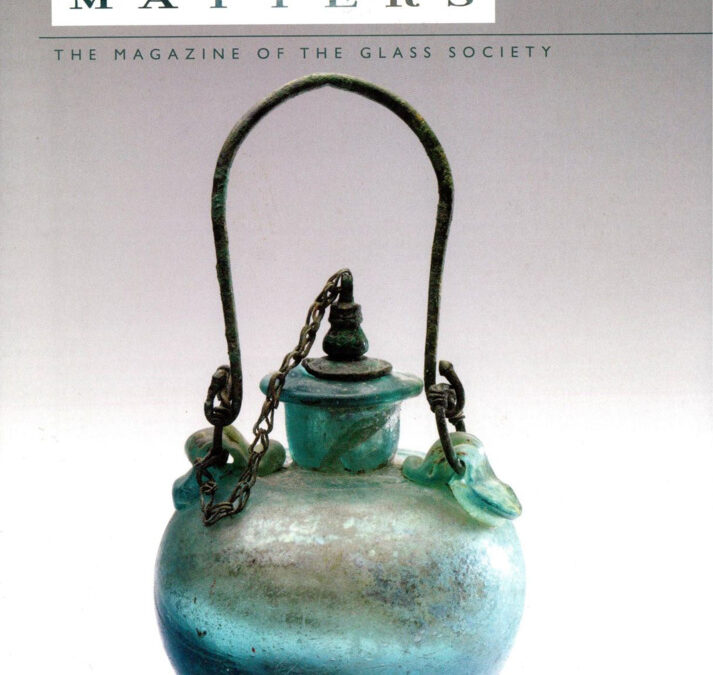
FRONT COVER:
An aryballos, with all of its accoutrements still
attached. Eastern Mediterranean, probably Asia Minor; lst-2nd
century CE. Discussed on page
7.
Collection of Hans van Rossum
BACK COVER:
An elegant pair of elongated vases, steel
coated glass. 2019 by Jon Lewis. Details shown on page 28.
Private collection
Editorial
acking personal contact is affecting us all. Not being able
I
to discuss and handle glass from a dealer, auctioneer,
collector or museum is frustrating our wish to explore, find
and learn. All events have had to be re-scheduled. In their
place, a virtual experience has been organised by our chairmen
to bring us back together again. Our cancelled March meeting
at the AWG, a presentation by Katharine Coleman MBE on
Modern European Glass Engraving,
is now going to be given at
our
first GS Zoom meeting at 7pm on Tuesday 16 June.
Sue Newell will be sending an e-mail with simple instructions
on how to proceed from your computer, iPad or mobile phone
with a LINK to LOGIN to the meeting.
Katharine will give a guide to the 150 piece exhibition
Back on Tour,
transported from Finland to Coburg, Germany,
on show to this November, and the background to The Glass
Engraving Network, began in 2013. Lastly, a warm welcome
to the correspondence from our members in Holland,
Australia, Scotland and the USA.
Glass Matters Issue no.8 May 2020
CHAIRMEN’S MESSAGE
Chairmen ‘s
Message
Sue Newell, Joint Chairman
of The Glass Society
W
ith summer well and tru-
ly upon us, we hope that
your own health and
sense of wellbeing have not been
seriously affected by these difficult
times and the enforced lockdown.
Our planned meetings at the Art
Workers Guild and the Norwich
Museum Study Day have had to be
postponed. Similarly, it is unlike-
ly we can proceed with our embry-
onic plans for an AGM in Oxford
in the autumn. On the positive
side, as with many societies, we are
embracing available technology to
offer talks online. We are delight-
ed that our first will take place on
June 16, this is a lecture on interna-
tional contemporary engraved glass
by Katherine Coleman, originally
scheduled for March at the AWG.
We are hoping to arrange more
over the coming months and would
be delighted if you would join us.
Despite the inevitable limita-
tions to our activities, we have
been active in a number of direc-
tions. Firstly, earlier this year your
committee agreed that we should
embark on a digitisation project to
disseminate the publications of the
Glass Circle and Glass Association.
These represent a valuable legacy
for the new Society stretching back
over forty years. Despite their age,
the older journals are particularly
rare and contain research that has
not been superseded. Scanning this
material is now in progress and the
aim is to make articles freely avail-
able to members. For those inter-
ested in hard copies, many back
numbers of the journals are cur- rently in storage, do please con-
tact us via the Editor if interested.
In February a member’s book col-
lection was presented to the Soci-
ety, and seizing the opportunity
of lockdown, a priced catalogue of
over 300 titles was compiled and
circulated to the membership. The
response was excellent, raising sev-
eral hundred pounds for the Soci-
ety, and well over half have already
been despatched, even as far as
Australia! Our sincere thanks to all
those who purchased items. More
recently, we were thrilled that two
members collaborated on produc-
ing a glass quiz, achieving a bal-
ance of the familiar and obscure
that hopefully kept you enter-
tained for an hour. Likewise, one
of our committee members is put-
ting together an online Newsletter
— we would value your feedback on
both of these as more are planned.
This issue of our magazine is
notable (as ever), for its variety.
From his base close to Himley Hall,
the current home of the Broad-
field House collection, Bill Millar
has ample opportunity to hone
his glass photography skills. Bill, a
frequent contributor to
Glass Mat-
ters,
has taken the opportunity to
impart at least some of his secrets.
David Burton is
the
acknowledged
expert on sealed bottles and his arti-
cle in our first Glass Society Jour-
nal bears witness to his mastery
of the subject. Here, he follows on
with more insight into the bottle
collection at Himley Hall augment-
ed a couple of years ago by the Eila
Grahame bequest. Colin Reid is a
David Willars, Joint Chairman
of The Glass Society
glass artist working in Gloucester-
shire whose extraordinary sculp-
tures are an aesthetic and technical
tour de force.
Continuing themes are
represented by Simon Wain-Hob-
son who writes on twist stems,
while James Measell continues his
research with an article about Hen-
ry Cole. As founder of the South
Kensington Museum, Cole’s career
had important implications for
glass and collecting. On a different
note, there is even an update on two
of our members who were recent-
ly stranded on a cruise ship some-
where off the coast of Argentina.
We hope that your passion for
glass (in whatever form) has helped
to sustain you during this unprece-
dented period of lockdown. Some
may have continued working from
home, or be key workers, while oth-
ers will no doubt have taken the
opportunity to develop their inter-
est by researching or collecting
online. Whatever your preoccupa-
tion during lockdown, please share
any glass stories with us. Despite
everything that has happened to
shake our lives this year, we hope
we can become a stronger commu-
nity of glass enthusiasts of all kinds.
Susan Newell and David Willars
Joint Chairmen, The Glass Society
Glass Matters Issue no.8 May 2020
3
BATH OIL AND PERFUME
ARYBALLOI and the bath rituals in
Roman times
Part 2
Author• Hans van Rosman
English translation: Theo Zandbergen
CHANGED SHAPES AND SIZES
T
he colour of the used glass
was not the only thing that
changed with the introduc-
tion of the metal glassblowing iron
in the second half of the 1″ century
CE and the following standardiza-
tion and mass production of arybal-
loi. The aryballoi could now be blown
in larger sizes, as larger ‘gobs’ could
be taken with the use of the metal
glassblowing iron, just as with jars
and bottles. This development can
be seen from the 2nd and
3rd
century
CE when much larger aryballoi were
formed. These were both heavy and
medium-walled. Until now it’s still
not clear how and for what these
larger ones were used. Carrying such
a large object around was certainly a
challenge and not particularly ele-
gant. These larger aryballoi could
have been used as storage vessels
to form a stock in the public baths,
or used in private baths in the large
estates. An additional benefit of
being able to take on a larger gob of
glass was that thicker-walled arybal-
loi could now be made, lessening the
chance of damage or breakage. The
most exceptional variant form of the
aryballoi is the hexagonal one. While
it seems that the description of ary-
ballos for this shape is not correct,
the trade jargon still uses it. Accord-
ing to the literature, very few hex-
agonal aryballoi have been found
and in most cases the site of the
find was in the Western part of the
Empire
(Fig.14).
Besides the match-
ing hexagons there is difference in
appearance. There is a clear distinc-
tion between the compact type and
a taller and more slender form. Oth-
er than the form, the way the hex-
agonal variant is made also differs
from all other aryballoi. The others
are free-blown, while the bodies of
the hexagonal ones are mould-blown
to establish the characteristic form,
with the neck and mouth being free-
formed. The last known form varia-
tion on an aryballos is the ring type.
This is basically a round form derived
from the standard type but then pro-
duced as a kind of “pilgrim flask”,
also called a lentoid form – within the
middle of the body is a circular pas-
sage, giving the flask its ring form.
The faultless forming of such a “pas-
sage” is quite a complex technique,
Fig. 14
Hexagonal aryballos, collection Hans van Rossum.
Found in Cologne; late 1st -early 2nd century CE;
H = 11.8 cm, D = 4.7 cm; W = 132 g
requiring top craftsmanship from the
glassmaker. It is quite possible that
the ring-type aryballos is the result
of experimentation by a local glass-
maker trying to create an appealing
new form using techniques unique
to him. As he, or why not she, was
quite successful with this new form,
it seems that quite a market devel-
oped for this new “fashion” model, as
shown by several finds of this special
type. The other noticeable quality
4
Glass Matters Issue no.8 May 2020
BATH OIL AND PERFUME
Fig. 15
Aryballos, collection Joop van der Groen. Eastern Mediterranean, probably
Asia Minor; late 1st century CE; H = 8.1 cm, D = 7.6 cm; W = 74 g
Fig. 16
Aryballos, collection Arie Dekker. Black Sea region or Asia Minor;
2nd century CE; H = 6.5 cm, D= 6.2 an
of this aryballos model is the color.
Not a bluish-green but in many cas-
es a light olive green or a pale yellow-
ish colour. Known finds of this type
are from France and Germany and
are present in the museums of Lyon,
Amiens, Cologne, Trier and Frankfurt.
FORMING THE MOUTHS AND HANDLES
Different ways and means for form-
ing the mouth of the aryballos were
available. In a number of cases,
mainly with the early examples, the
mouth was folded in the form of a
triangle
(Fig.15).
To accomplish this
the glass was first outwardly extend-
ed then sloped upwards and fold-
ed inwards. The typical somewhat
heightened “triangle” form is specific
for production in the 1st century CE.
Another mouth form is called a col-
lar-rim. The rim was first folded out-
wards and downwards, followed by
upwards and again inwards folding.
In the so-called collar rim one can
see
that this form is a kind of imitation
of earthenware current in that peri-
od
(Fig.16).
The ceramists of Perga-
mon in Asia-Minor used that form of
collar rim extensively in their earth-
enware. The least complicated way
Fig. 17
Aryballos, Windmill collection. Western part of the
Roman Empire, probably North Italy; 1st century
CE; H = 6 cm, D = 5.0 an
to form the mouth of an aryballos
was to finish it simply and smooth-
ly. The glass mass was at first hori-
zontally worked outwards followed
by folding it inwards again. After
re-heating the mouth was further
smoothed. We are thankful to the
scientific study by Sorokina (1987)
for much of our knowledge on the
areas of origin of the aryballoi, based
on the differently executed mouths,
ears and handles. The way the han-
dles were made relates directly to
the period in which the objects were
made and their respective areas of
origin. To note, the handles of the
early and thin-walled aryballoi were
made by using a thick glass thread
fixed to the shoulder of the object,
pulled up to the rim then turned
downwards and folded to be fixed
to the neck of the object
(Fig.17).
Glass Matters Issue no,8 May 2020
5
This way of doing it is more or less
like the way the handles were formed
and attached for the core-formed
ones in the Hellenistic period. Some-
times the handles were made of the
same colour glass as used for the
body, known as monochrome. In
other cases, the glass for the handles
was of a contrasting colour known,
as mentioned earlier, as bi-chrome.
After the deployment of the metal
blowpipe, probably during the second
part of the first century CE, the ary-
balloi got not only heavier and larger,
but had differently formed handles.
For example, circular handles placed
on the shoulder and not touching the
neck at all. Others were attached to
the shoulder and connected to the
mouth. Yet others were formed like
the silhouette of a dolphin, hence
the name dolphin handles. This dol-
phin shape points to production in
the northwestern part of the Roman
Empire and more specifically to work-
shops in Cologne, or the area around
Cologne. The majority of the arybal-
loi have two handles; however, others
are known with three or four handles
(Fig.18). The latter are quite rare.
Fig. 19
Aryballos, collection Joop van der Gmen.
Niirvenich, Germany; 1st — 2nd century CE;
H = 6.0 an, D = 5.4 an; W = 42 g
SPRUCING IT UP
Most of the
spherical heavy-
walled aryballoi were without any
decoration, but there are excep-
tions. Some of the aryballoi from
the northern coasts of the Black
Sea were provided with horizon-
tal grooves ground into the cor-
pus at defined spacing and pattern.
In Karanis (Egypt) some arybal-
loi were unearthed with ground
grooves in the body; however,
these are made of clear translu-
cent glass. Other decorations are
known, such as using glass threads
wound around the body of the
object
(Figs.19 & 20).
Again, these
aryballoi are generally found in the
northwestern part of the Roman
Fig. 20
Aryballos, Windmill collection. Rhineland
1st— 2nd century CE; H =5.3 cm, D = 4.7 an
BATH OIL AND PERFUME
Fig. 18
Aryballos with four
handles, collection Hans van Rosswn.
Cologne; 1st century CE; H = 5.0 an, D = 5.4 an; W = 42 g
6
Glass Matters Issue no.8 May 2020
Fig. 21
Aryballos, collection Nico Bijnsdorp. Roman Empire;
2nd — 3rd century C_E; H = 7.5 cm, D =7.5 cm; W = 68 g
BATH OIL AND PERFUME
Empire and could refer to the pro-
duction centres in Cologne. From
that same region, objects are known
where the glass thread forming the
Fig. 22
Aryballos, Windmill collection. Eastern
Mediterranean; 2nd century CE;
H= 15.0 cm, D= 12.0 cm
(dolphin) handles progresses down-
wards on the body of the object. In
a number of cases, to achieve an
extra decorative effect, that lower
part has been pinched with a set of
pliers, giving a ribbed impression.
Aryballoi formed in a mould to get
a pattern on the body
are
quite
rare – one unique example is known,
having a diamond pattern
(Fig.21).
SEALING THE ARYBALLOI
The mouth of the aryballos can
be plugged or sealed. Most of the
time a bronze stopper or other
kind of plug was used, the stop-
pers often being connected to a
bronze link chain
(Fig.22).
The
aryballos could be carried around
by an attached cord or a met-
al chain, but also through using
a nicely formed bronze handle.
Most of the time, bronze rings
connected the carrying accoutre-
ments to the handles. In many cases
the metal elements have corrod-
ed away but there are still objects
having a well-preserved part, or
all of the accoutrements
(Fig.23).
A totally different way to seal
the aryballos was by plugging the
mouth with a wad of a white sub-
stance, either beeswax or gypsum,
Fig. 23
Aryballos, collection Hans van Rossum. Eastern
Mediterranean, probably Asia Minor; lst-2nd
century
CE; H = 7 3 cm, D = 7 0 cm; TN = 188 g
Glass Matters Issue no.8 May 2020
7
Fig. 25
Aryballos, collection Hans van Rossum. Probably the northern Black Sea region;
2nd — 3rd century CE; H = 9.6 cm, D = 7.8 an; W = 68 g
BATH OIL AND PERFUME
Fig. 24
Aryballos, collection Annelies Bos-Pette. Roman Empire, probably Black Sea region;
2nd century CE; H = 7.3 cm, D = 7.3 cm; W = 60 g
as was more or less common for
bottles and jugs
(Fig.24).
A “funny”
example is the aryballos shown here
(Fig.25).
The beeswax or gypsum
was not particularly neatly applied
but like a great lump slumped over
the mouth. The previous owner of
this aryballos was not aware of using
different materials to seal aryballoi.
He assumed that the content of the
aryballos had, in the grave, a kind
of uncontrolled chemical reaction,
forming this irregular glob. In his
opinion this reaction had formed the
kind of chalky plug. After he tried to
remove this “flaw” he noticed that
the mouth was already cracked in
antiquity. To deal with the sealing
problem the original Roman owner
packed the whole in a large blob of
bee wax or gypsum. Further scientif-
ic research needs to give the answer
to the question – is this blob beeswax
or gypsum? Another remarkable
detail with this aryballos is the way
the handles have been attached. In
all known cases up to now the glass-
maker attached the glass thread first
to the shoulder pulling it upwards,
folding it and attaching it to the
neck or the mouth. The glass thread
starts in that case quite sizeable on
the shoulder and “thins” when it’s
pulled up. With this aryballos the
glassmaker also started out in the
traditional way but, probably, the
glass blob did not fuse on the shoul-
der. Subsequently, after that inci-
dent, he or she started to work in the
reverse way and attached the glass
thread first to the neck. Thereafter
the craftsperson finished his or her
work more or less in the tradition-
al manner, folding the glass thread
and re-attaching it to the glass blob
that was left on the shoulder. The
process described above could, in a
Sherlock Holmes way, be researched
from the observation that the glass
thread on the top side is thick and
thins out to the shoulder. In this
way shortcomings in the production,
leading to developing cracks or not
fusing and the masterly repairs by
the glassmaker, can be discovered.
TO CONCLUDE: LET’S SPRINKLE
SOME SAND TO FINISH THIS ARTICLE
The thermal baths also played an
important role in the day-to-day
doings of the people in the times
of the Roman Empire. Sand was
a cleansing medium in the baths
but is also the main ingredient
for making glass. The baths also
functioned as a kind of neighbour-
hood centre, where people could
gossip, exchange the most recent
news, or play board games – not
to say that plots couldn’t be devel-
oped around politics or politicians.
Who says that the baths didn’t
play a role in many plots around
the impeachment of a reigning
emperor or the succession thereof?
One sees what a role small objects
like aryballoi can have in history.
8
Glass Matters Issue no.8 May 2020
face that has been made conductive.
Decorative, plant-like growth forma-
tions on each vessel symbolise that
life is completely dependent on water.
THE MAKING PROCESS OF THE
AQUATOPIA WATER OBJECTS
All pieces from the Aquatopia collec-
tion were produced via electroforming.
This traditional technique was invent-
ed in 1839 by scientists in Britain and
Russia. As electroforming is not con-
ventional, or economical commercial-
ly, it is less utilised today. But in spite
of being a time-consuming process,
occasionally with rather unpredict-
able outcomes, artists spare no effort
in exploring this technique, as it allows
the creation of extraordinary designs
and interesting textures that cannot
Made of copper and glass, materials
traditionally used for transporting and
storing water, the craft objects strad-
dle the line between function, imag-
ined function and aesthetic quality. All
pieces were produced by the electro-
forming technique, a process in which
a layer of copper is deposited on a sur-
AQUATOPIA
Aquatopia
Katrin Spranger
MY RATIONALE
A
quatopia takes a critical view
of our fresh water supply and
on increasing demand and
pollution. In the UK we may not rec-
ognise the urgency to rethink water
consumption, yet our choices in food,
materials and lifestyle tie into the
global issue of the increasing scar-
city of water. According to a report
from the United Nations in 2005,
two-thirds of the world’s population
will face water shortages by 2025.
I create ‘science fiction’ stories
about depleting resources and cli-
mate change. In the dystopian nar-
rative of Aquatopia, pure water is on
the verge of depletion and this pre-
cious resource is recognised by keep-
ing consumption and waste to the
bare minimum. Inspired by tradi-
tional water systems, the Aquatopia
objects were created as futuristic and
reimagined drinking vessels, scoop-
ing bowls, storages and shower fun-
nels that engage original plumbing
parts and laboratory-found objects.
RIGHT Fig. 2
Aquatopia Water Vessel, copper, glass.
40 x 25 x25 cm. 2018
BELOW (LEFT) Fig. 3
Aquatopia Drinking Vessel, copper, glass, plastics.
20 x10 x 5 cm. 2017
BELOW (RIGHT) Fig. 4
Aquatopia Water Pipe, copper, glass, wood.
30x15x10cm. 2016
Glass Matters Issue no.8 May 2020
9
AQUATOPIA
FAR LEFT Fig. 5
Aquatopia Water Storage,
copper, glass, limescale.
35x30x30cm. 2017
LEFT Fig. 6
Aquatopia Thinking Sculpture,
copper, blue patina, glass,
plastic. 2018
BELOW Fig.
7
Aquatopia Water Tank, copper,
glass, sea fern, plastic.
50 x 30 x30 cm. 2017
be achieved by any other means. In the
process, a layer of metal, for example
copper, silver or gold, is deposited on a
surface that may originally not be con-
ductive, but has been made conductive
through a lacquer that contains con-
ductive partides. Pieces are immersed
in a tank with an electrolyte solution
and a dosed circuit is then made using
two electrodes. Low, direct current is
then applied, causing the electrode
connected to the positive pole (a
sheet of metal) to dissolve. The met-
al ions migrate through the solution
and cause the cathode (object piece)
to become coated with metal. The lon-
ger a piece remains in the tank, the
heavier the metal deposits will become.
Having studied electroforming
for many years, I’ve been making
the Aquatopia collection to broad-
en my knowledge by using a range
of rather uncommon materials and
handling different shapes that can
be electroformed. Original plumb-
ing pieces were coated with conduc-
tive paint, then materials such as
dried plants (moss and sea fern),
synthetics and conductive mate-
rials such as steel were employed.
Depending on the complexity of a
piece’s shape and surface area, it was
sometimes ratherdifficult to distribute
the coating evenly in all places on the
objects. Naturally protruding tips and
edges attracted more metal, whereas
cavities were hard to fill with any at all.
Consequently, some of the Aquatopia
objects needed to be electroformed on
the outside first, and then just on the
inside at a later stage. Some textured
pieces were assembled after a layer of
metal was already electroformed, in
order to keep textures defined and del-
icate. Throughout the process, in order
to achieve a successful outcome and
create interesting surfaces, a constant
turning of the pieces in the electrolyte
solution and adjustment of the power
of the electrical circuit was necessary.
BIOGRAPHY
Katrin Spranger creates sculpture
and jewellery that deals with science
fiction, environment and consum-
er culture. Focusing on resources
that might become depleted in the
future, she explores natural mate-
rials including crude oil, water and
honey to develop wearable but also
time-based and interactive pieces.
Originally trained as a goldsmith,
Katrin holds a Master’s in Fine Art/
Jewellery from Konstfack University,
Stockholm. Her hybrid practice has
led to collaborations with artists from
many disciplines and often crosses
over into the realms of fashion, food,
fine art, performance, photography
and installation. From an industrial
aesthetic to precious metal creations
and even edible works, her varied art-
work creates bold performative expe-
riences for the viewer. In this way,
they interact with the user or wearer,
by questioning notions ofwhat is pre-
cious or valuable to our society today.
Having been awarded numer-
ous grants and awards for her work,
Katrin Spranger has exhibited inter-
nationally and has contributed to sev-
eral publications. Besides teaching
positions at several colleges in Lon-
don, Katrin co-founded K2 Academy
of Contemporary Jewellery in 2017
with business partner Kelvin Birk.
IMAGE ACKNOWLEDGMENTS
Images 2,3,4,5,7 are present-
ed with thanks to Sylvain Deleu
Image 6 is presented with
thanks to Henning Spranger.
10
Glass Matters Issue no.8 May 2020
Fig.1
GLASS PHOTOGRAPHY
Some Tips for PHOTOGRAPHING GLASS
Bill Millar
BACKGROUND
You need a plain background which
will not detract from your image.
White is excellent for coloured glass
and may do for clear glass. Black
or grey is invariably essential for
engraved glass. A plain, white, bor-
rowed pillowslip and a black poly-
thene bin liner will get you started.
Make sure you minimise creases,
folds and specks of dust, as these
are likely to be distracting. A3 art
paper will do very well but will mark
with continued use. A long-term
solution is to buy a section or two of
opaque perspex and bend it to a soft
“L” shape. A section 100cms x 60cms
will be more than enough for most
purposes and a smaller section will
do for smaller items. You will need
to apply heat to bend the perspex. I
offer no suggestions as
I would not wish to get
the blame for scalds or
burnt-out hairdryers.
bin liner and some sticky tape. Take
a cardboard box, large enough to
accommodate your perspex back-
ground, remove the front and the
top, line it with black polythene
bin liners or, better still, paint it
matt black and you have your light
box. Black at the sides gives a more
defined line on the edges of clear
glass. The final source of reflections
to eliminate is your own face and
clothing. Black clothing and a bala-
clava may arouse suspicions with
the serious crime squad so I recom-
mend a sheet of black material as a
hood on the front of the light box.
Having minimised reflections,
you still need a light source. Avoid
using your camera’s flash at all costs.
A specialist daylight bulb (less than
£5 each) is the best solution. Many
cameras have the facility to set for
A
bout ten years ago I tried to
photograph glasses in my
collection. The results were
hopeless. Like all bad workmen I
blamed my camera and bought a
replacement. Had I known how to
use the original camera I need not
have bothered – my loss, Nikon’s gain.
Shortly after this I was accepted as a
volunteer at Broadfield House Glass
Museum; they had just acquired a
Nikon camera, identical to mine
and wanted a volunteer to photo-
graph much of the collection. Thou-
sands of images later I feel I can offer
advice to members who may want
to photograph glass in their collec-
tion. Some of the failed photos I have
taken can at last have a use: to illus-
trate this article, help you avoid sim-
ilar mistakes and creatively improve
your glass photos during lockdown.
Glass has the amazing properties
of transmitting and reflecting light
which can make it the devil to record.
The objective of this article is to offer
simple tips which will help you take
effective photographs of glassware,
something I have yet to find in a pho-
tography text book. Professional pho-
tographers may shudder on reading
this article. All I can say is, please
produce a text book on how to pho-
to graph glass and we can all learn.
EQUIPMENT
My aim is to help you make best
use of your existing equipment
rather than encourage you to
spend money that you should be
using to buy glass. A digital cam-
era, which allows control of expo-
sure and aperture, and a tripod are
the realistic minimum. Beyond
that some DIY will help you con-
trol light but if you do get the
bug, a small investment in light-
ing equipment will make life easier.
MANAGEMENT
OF
L IGHT
There are three poten-
tial problems with light:
too much, too little and
reflections. Windows
and lighting produce
unwanted reflections,
while furnishings and
walls produce coloured
reflections. A darkened
room, cupboard under
the stairs or a garage
without windows are
all options but I would
always recommend a
light box.
See Fig.1
for
a Blue Peter version
made from a cardboard
box, two black bin lin-
ers, one white swing
Glass Matters Issue no.8.May 2020
GLASS PHOTOGRAPHY
the types of light used, includ-
ing fluorescent which is normally
a nightmare. For most purposes I
have found placing the light source
above the subject most effective.
Hence no top on the light box. For
engraved glass, the light source
above and behind the object is defi-
nitely best. Opaque, coloured and
patterned glass may require frontal
lighting. A reflector of kitchen foil
laid in front of the subject works well,
whereas a frontal light may produce
too many reflections. There are no
absolutes concerning lighting as the
shape, construction, surface finish,
transparency or opaqueness of each
item will create their own unique
problems, so you will need to exper-
iment to get the best lighting set-up.
Even when your own lighting is the
only light source, the shape of some
glass objects makes the elimination
of reflections impossible. Globular
bottles are an especial nightmare.
CAMERA
SETTINGS
Most digital cameras are clever
enough to make their own decisions
on focus and exposure. However, for
best results you may need to man-
age the settings yourself, which is
not complicated. The aperture you
use will determine how much of
the photo is in focus. The widest
aperture, typically anything from
f1.4 to f4 depending on lens, will
require the shortest exposure but
will give the least depth of focus.
The smallest aperture, typically f22
to f35, will give the greatest depth
of focus but will require a much
longer exposure, possibly several
seconds, impossible with a hand-
held camera. Hence the need for a
tripod. I usually use autofocus but
am finding an increasing need for
manual focus to get the best results.
Autofocus will choose a specific
point of the item on which to focus
(the point of focus). Clear glass,
because of its transparency, may
confuse the sensor. At close range,
the depth of focus (simply, the
amount of the object in focus, from
front to back) of most lenses is quite
shallow, typically as little as one or
two inches. The depth of focus is
centred on the point of focus. If the
depth of focus is two inches and the
camera focuses on the nearest point
of the object, only the front inch of
the object will be in focus. In photo-
graphing a large glass, if the point
of focus is the front of the top rim,
the stem may be out of focus. A high
f number will increase the depth of
focus, then manual focusing, using
the stem as the point of focus should
bring the whole glass into focus.
The image at
Fig.2
illustrates this,
along with some lighting problems.
Software is available to link your
camera and laptop so that you can view
what the image will look like on screen
before taking the photo. Such software
would enable a better image and avoid
issues such as that at
Fig.2.
Pending an
investment in this software, the alter-
native is to take a series of photos with
differing settings, transfer them to
your computer, check the results, then
go back and do it all over again and
again until you get the desired result.
If your camera and editing soft-
ware will handle RAW images then
set your image type to RAW. The
files will be larger than JPEG files
but you will have more control over
editing, especially with adjustments
to lighting. Also, with RAW imag-
es you do not need to set your cam-
era to a specific type of light source.
CAMERA
ANGLE
Not only does a tripod help you avoid
camera shake on longer exposures
it also allows you to select the right
camera angle. When photographing a
glass, the top rim is the normal point
of reference. It is largely a matter of
personal taste whether you have the
rim absolutely level or have a high-
er or lower view point. There may be
occasions where a particular angle
is needed, such as the glass at
Fig.7.
What must be recognised is that if the
rim is level you will be looking down
on the foot – see the glass at
Fig3.
12
Glass Matters Issue no.8 May 2020
The closer the camera is to the object
the more the distortion, in this case
between bowl and foot, will become
apparent. Another blessing of the
tripod is that you can progressive-
ly alter the angle and/or the cam-
era settings, take a series of shots
and choose the image you like best.
EDITING
Having downloaded your images,
you can then edit them. Free digital
editing software available online will
do everything you need. The primary
objectives of editing are to straighten,
crop, brighten or darken, and remove
highlights or reflections. Straight-
ening and cropping are straightfor-
ward. A black or white background
may produce what looks like an over
or under-exposed image. However,
editing can easily lighten or darken
the overall image. It is also possi-
ble to adjust contrast, lighten shad-
ows, darken highlights, and select
small areas to lighten or darken.
None of these adjustments affect
the integrity of the image but fur-
ther editing may affect the hones-
ty of the image. For example, you
can remove the colour of a coloured
reflection by converting the image to
black and white – see
Fig.4c.
Natural-
ly, this will affect the apparent tone
of the item. The spot healing tool
enables you to circle an offending
highlight or blemish and eliminate it.
The software reads the surrounding
area and replaces the spot with a sim-
ilar finish. It can be used to remove
reflections over quite large areas pro-
vided they do not overlap decoration.
Airbrushing might enhance a film
star’s curves but is best limited to
improving the background rather
than altering the object. Much bet-
ter you clean the glass or adjust the
lighting and retake the photographs
to produce an honest image. Provid-
ed you always keep the original imag-
es you can experiment to your heart’s
content to develop your editing skills.
The images at
Figs.4a, b,& c
illustrate
how simple editing can be used.
To
DEVELOP YOUR SKILLS
I suggest you start with coloured
glass, like the opaque pressed glass
bowl at
Fig.5.
This will allow you to
concentrate on depth of focus and
illumination. Items with applied dec-
oration, such as the Lobmeyr bowl at
Fig.6,
offer a slightly more demand-
ing subject. After this try clear
glass, then cut glass, then finally,
etched or engraved glass as at
Fig.7.
At the very least, you may now
look at photographs with a more
critical eye. If you choose to apply
some of these tips and photograph
your glass, have fun. I hope you will
get the same, enormous satisfaction
I do at producing a good image. If you
have any questions please contact me
on billmillar82@yahoo.co.uk. If you
have any suggestions or tips, I will
be only too happy to hear from you.
AN IN-DEPTH EXAMINA-
TION OF THE PHOTOGRAPHS
I am currently locked down so do not
have proper facilities, just a camera
and tripod, so have had to improvise
to demonstrate the effects of cam-
era settings, background and editing.
Fig.1
Mock-up of a light box.
Fig.2
(2 seconds exposure at f9).
Autofocus selected the rear rim as
the point of focus, so the front is
out of focus. Where a glass has an
all-round pattern, a shallow depth
of focus is needed to throw the
pattern on the far side of the glass
Fig. 4a
Fig. 4b
Fig. 4c
GLASS PHOTOGRAPHY
Glass Matters Issue no.8 May 2020
13
out of focus so that it does not
interfere with the pattern on the
front of the glass. In this instance
I took it the wrong way round, but
Fig.6 was more successful. Some
reflection is inevitable with a
curved bowl and this can usually
be minimised with simple editing.
However, there is also a coloured
reflection which is more problem-
atic. With plain glass the colour of a
reflection can be edited out by con-
verting the whole image to black
and white, but this is not possible
where there is coloured decoration,
and a clear reflection cannot be
easily removed where it overlaps
the decoration. Finally, the glass
was lit from above and the gilt pat-
tern on the front is in shadow. This
could be improved by editing but
a reflector at the front would have
produced a better starting point.
•
Fig.3
This borrowed photo illus-
trates the distortion that can
be created by a wide-angle lens.
The rim of this glass is virtual-
ly level whereas the foot appears
to be at nearly 45 degrees.
•
Figs.4a, b, & c. Fig 4a
(1/20th of a
second exposure at f2.8) demon-
strates that a white background
does not work for engraved glass
and that a crease is intrusive. In
Fig.4b (1.3 seconds exposure at
f22) the benefit of a dark back-
ground is obvious. At Fig.4c the
same image has been edited to
straighten, crop and convert to
black and white to remove the
coloured reflection. The spot
healing tool was used to remove
most of the reflections on the bowl
and the top right-hand corner of
the background was airbrushed
to remove a distracting problem.
•
Fig.5
(2.5 seconds expo-
sure at f20). This bowl
posed two challenges.
The depth of focus must
be sufficient to keep the
front half of the bowl
in focus, and because
the item is opaque the
underside must be illu-
minated. Fortunately,
the white perspex back-
ground helped. The small
number of highlights or
reflections do not serious-
ly detract from the image.
•
Fig.6
(0.68seconds expo-
sure at f9). Deconflict-
ing the decoration on the
front and back of this bowl
was achieved by leaving
the rear half slightly out
of focus. The gilding on
the front was illuminated
using a silver foil reflector.
•
Fig.7
(30 seconds expo-
sure at f22). A low cam-
era angle was needed to
separate the engraved
area from the bright area
at the top of the stem.
A very low light source mini-
mised reflections, hence the
long exposure. The spot healing
tool was used to remove reflec-
tions on the bowl. Engraved
glass offers the greatest chal-
lenge of all; good luck if this is
what you want to photograph.
GLASS PHOTOGRAPHY
Fig. 5
Fig. 6
14
Glass Matters Issue no.8 May 2020
Flame’s in flow-
ers!
to the
The corolla
is of ease and the
cola and leave. of
metal. It is lively-
Ifxdf4ig and impu-
tar, but we must
hesitate to sae that
the idea is op-
preprints: to the
toe to be made
or the artiele-
Snell art, maks.
natty Um-, in
erne ju nix-position with t1 gore. gene-
rally come, uff second best.
WINK
(iLN.
,
4
rrntiril pattern,
nix-
untutored by Riellarstomfs.
‘Theornanwnt which
this glass ff..’
name winds round the
Arm. and is of peso
pot-Instal. The sine
leaves are canine/led
in gold on the low).
‘ffnue feattans are
grao:fut woe:-
ties, Mat they
neuescarity raise
Ow oast of Ow
A 14
abase the aver-
age. !loth it and the finger-glass
below belong to the series of Art.
nunutlettire,:stal art (tom the design
by Mt.
liedgraer.
PLowiat Vase, inanufaeluted by
Altens:ogerr..
nr
Fri4ZZ•GLAwf. Me t okr
a
,
stn faufactured 1w Meliard>ous.
The shape of thts glass is
novel for Ito fortienlar par-
‘se. The ornamental ante-
,
nses are cantos-Ilea in their
=total colour, and nicely ex-
ecuted. The smaller ornament
is of enamelled gilding. It is is
handsome trifle. Mg we shout’
fear rather rosily in its manu•
facture; a.. indeed, must le 1111
ornamental %Melt demands skilled ha
r.
HENRY COLE & GLASS DESIGN
Comments on GLASS DESIG.
Henry Cole and the 1852 ‘Chamber of Horrors’
James Measell
K
nighted in 1875 in belated
recognition for his work in
collaborating with Prince
Albert and organising the 1851
Great Exhibition, Henry Cole
(1808-1882) is well known
for other efforts, ranging
from the Penny Post, the
standardisation of railway
gauge and the Royal Albert
Hall construction to the
first commercial Christ-
mas card and his author-
ship of books for children.
In the 1840s, under the
pseudonym Felix Summer-
ly and in consort with artist
Richard Redgrave, he designed
and marketed some innovative
utilitarian and decorative items.
Henry Cole was also responsible
for a ‘chamber of horrors’ exhibi-
tion at Marlborough House in 1852.
Soon after joining the Society for
the Encouragement of Arts, Man-
ufactures and Commerce in 1846,
Cole was involved with exhibitions
sponsored by the society, including
events in 1848 and 1849 that each
attracted more than 70,000 visitors.
Cole was a member of the council of
the Society of Arts, as it was gener-
ally known, and, in 1850, he became
its chairman. Cole was a strident
critic of Government efforts in art
education, primarily through pub-
lication of the
Journal of Design and
Manufactures,
but also through his
testimony before a Select Commit-
tee charged with investigating prac-
tices within the Government schools
of art that had been founded in the
late 1830s and during the 1840s.
In the first issue of the
Jour-
nal
(March 1849), Cole discussed
and illustrated three glass arti-
des, including a flower vase made
by Messenger with a metal stand
(Fig.2).
The other two items were
made by the Rich-
ardson firm near
Stourbridge after
designs by Rich-
ard Redgrave: a
crystal finger bowl
with decoration
in gilt and hand
painted enam-
el and a crystal
wine glass in the
`Tendril pattern’
which had green
glass ’round the
Fig.2
Text and illustrations
from the Journal of
Design and Manufactures
(September 1850)
Fig.1
Sir Henry Cole, c. 1875
stem’ and ‘vine leaves … enam-
elled in gold on the bowl.’ Both
Richardson products were
described in positive terms
save for the cost of their
manufacture due to orna-
mentation that ‘demands
skilled hand-labour.’ In
subsequent issues of Cole’s
Journal,
Richard Redgrave’s
remarks to designers of
ornament regarding the
value of the study of bota-
ny can be found. In the Sep-
tember 1850 instalment of the
Journal,
Redgrave’s ‘Canons of
Taste in Carpets, Paper-Hangings
and Glass’ appeared. In prefatory
remarks, Cole remarked that these
canons contain ‘principles so sound
and so well meriting serious reflec-
tion from all….’ Regarding taste
in glass, Redgrave offered only a
Glass Matters Issue no.8 May 2020
15
*21
FALSE. PRINCIPLE&
No. 42.—GLASS BUTTER 10511.
No. 5-1, —WINE G LASS.
No. 54.-
JELLY GLASS.
llhp-rration.
In
cash
of dime articles
the natural notlatte of the Outs viten
blown destroyed by the surfaces twint.;
nn.
fit
Prturipu
IN,traitou.
No. 65.—GLASS thi0111.F.T. OPAL.
(Novevarnot..- Qone*. form
the
transparency of the material sacrificed
to imitate 0th:oder.
No. r…—GLASS (lt
MIXT (rt:ontEn
NvITU UPAL At IiNIIHAVV,Ir).
Otarration. -Traronarroc., which
es..mtitotes
the beauty of the material,
entirely olmtro)ed,
thereby rendering it
impossible
tO
Sty
the contents.
No.
GOBLET.
Otsermat;ou.
-Foil. unfitted the we; the vessel shrinks in the
middle
so
that it
could not
he emptied without raising the foot considerably shore the
mouth.
HENRY COLE & GLASS DESIGN
single sentence in which he object-
ed to glass ‘covered with a ground
surface or cased with opal’ and
asserted that the beauty and util-
ity of glass ‘also consist in shew-
ing the crystal clearness of the
water or the ruby brightness
of the wine that mantles in it.’
As General Superintendent of the
Government Department of Practi-
cal Art and its successor, the Depart-
ment of Science and Art, from 1852
to 1873, Cole was the prime mover
in promulgating the rigid stages of
the South Kensington curriculum
for art and design education that
were omnipresent in British Gov-
ernment schools of art for more
than a half century. Soon after the
close of the Great Exhibition, Cole
sought to establish a museum that
would house examples
of ornamental art that
were associated with
manufactures. A Parlia-
mentary grant of £5000
enabled Cole to secure
a wide variety of items
(including some from
the Great Exhibition)
and to prepare them
for display at Marlbor-
ough House in London
in 1852. Cole’s continu-
ing zest for museums
led to the establish-
ment of the South
Kensington Museum,
which was renamed
the Victoria and Albert
Museum in 1899.
During May-June
1852, the exhibition
prepared by Henry
Cole at Marlborough
House was available
only briefly (a fortnight
plus a few days), and it
attracted little atten-
tion, although articles
appeared in
The Times
(19 May and 1 June).
Design works by stu-
dents from the Gov-
ernment schools were on display
along with numerous articles from
various countries that were in the
Great Exhibition. After the sum-
mer vacation, Marlborough House
opened once again in early Septem-
ber. On Monday 6 September 1852,
The Times
carried a lengthy article
devoted to the ‘Museum of Manu-
factures’ in which displays were char-
acterised as ‘the finest examples of
ornamental art that can be procured,
to which students and manufactur-
ers may have access for the purposes
of examination, study and copying.’
Near the end of the article in
The
Times,
this description of an extraor-
dinary area of the museum appeared:
The ante-room is fitted up as a
sort of ‘chamber of horrors,’ with a
collection of all kinds of so-called
ornamental manufacture, which
are considered to exhibit false prin-
ciples of decoration, such as vulgar
and inharmonious colouring, want of
meaning and unity in pattern, grace-
less imitations of natural forms, &c.
The department, in giving its rea-
sons for condemning the individual
examples here shown, afford the pub-
lic an ample opportunity of testing
the accuracy of the canons it enforc-
es in its instruction to the students.
What was contained within Cole’s
`chamber of horrors’ at Marlborough
House? To answer the query, one can
consult the printed catalogue enti-
tled ‘Examples of False Principles in
Decoration.’ Some 84 objects are list-
ed and described therein, as follows:
carpet, nos. 1-9; chintzes and silk,
nos. 10-20; paper and other hang-
ings, nos. 21-36; gar-
ment fabrics, nos. 37-60;
porcelain and glass, nos.
61-79; and metal work,
nos. 80-84. Of the 84
items mentioned, just
two are illustrated (nos.
64 and 69), and both
are glass
(Fig.3).
Pre-
sumably, those visiting
the ‘chamber of horrors’
would have the catalogue
in hand whilst viewing
the various objects and
could ponder the indict-
ments of false principles
ascribed to each indi-
vidual article. The
First
Report of the Depart-
ment of Practical Art,
published in early 1853,
summarised this area
of Marlborough House:
‘A small room has been
fitted up with exam-
ples of modern carpets,
paper hangings, garment
fabrics, pottery, glass,
Fig. 3
Text and illustrations from the
catalogue of Examples of False
Principles in Decoration’ (1852).
No. Gs.—COliNtIC01`1.1. FOR
1
,
LI 1WlittS.
06,..vratilvar.-
construetive line
very had,—the
appearing as
if
Mock on. instead of (ornery% part of the
whole; transparency of the matar.s1
tiestroyelL
No.
FL(tWlif( VASE.
(li.e. ra tiwt.
—The erenenti outf.ne
entirely dmtroyid by the vert;ral
cuttings.
Na. 70.–EA STIIEN WARE VASE.
Merrovaion.,
— (treatments coped
from a fimeral ease. ami inapprepr;me
ntewvationt, Nn. so.
No. 7t.
-F1.OWP.11 rf.T.
Merreuness.—hohn::on in ratdiert-
–
w.tre
of neon, ;mink(‘ !An-, bound
ovrttxtr with yellow ribbon,
No.:.—PAIR OF 4C1SS4
oimreoneoa—laaitution of
halt upv,irig the
0,
ito!y of the hint ma+, to or a
dirtAtitto
Of ha length.
I6
Glass Matters Issue no.8 May 2020
HENRY COLE & GLASS DESIGN
papier mach& &c., which are intend-
ed to illustrate FALSE PRINCI-
PLES of Decoration, and to present
types of what ought to be avoided.’
Prior to the commentary regard-
ing the individual glass items, Cole’s
catalogue summarised remarks by
Richard Redgrave regarding glass,
and it is quite apparent that crystal
glass was the focus. The inherent
beauty of such glass was ascribed
to its ‘brilliancy of surface and
transparency,’ and, Cole asserted,
‘another excellence of glass is its
lightness, as compared with its pow-
er of containing.’ In the mid-nine-
teenth century, utilitarian glass
objects were made of blown glass,
and this method of manufacture
was lauded because it ‘unites thin-
ness, translucency, and pure surface
to forms which combine the great-
est symmetry with varied curves.’
‘Elegance of form,’ the catalogue
concluded, ‘should be the first con-
sideration.’ Cole’s catalogue also
referenced concerns about some
current practices in decorating
glass. Glass articles which have ‘the
surface covered with ground orna-
ment’ were deemed unworthy of
acceptance, especially if such cut-
ting was to be found ‘on the bowls of
wine glasses.’ Decorative techniques
such as gilding and enameling were
acceptable for drinking vessels so
long as these methods of orna-
mentation do not ‘interfere with
a perfect sight of their contents.’
As mentioned above, items
61-79 in the ‘chamber of horrors’
encompassed both porcelain and
glass, but a close reading of the cat-
alogue reveals that only numbers 62
through 69 were indeed glass. Num-
bers 62 and 63 were listed simply as
‘butter dish’ and ‘wine glass’ respec-
tively, with no descriptions what-
soever; however, the text of the
catalogue indicates that these arti-
cles displayed the same cut decora-
tion as number 64, a ‘jelly glass.’ The
illustration shows a stemmed arti-
cle with cutting on much of the body,
and the underside of the foot is cut
as a multi-pointed star. According to
the catalogue, this typical mid-nine-
teenth century cutting style is sub-
ject to ridicule because ‘the natural
outline of the glass when blown [is]
destroyed by the surfaces being cut.’
Numbers 65 and 66 are opal glass
goblets, and this feature made them
‘coarse’ and objectionable because it
was ‘impossible to see the contents.’
Number 67, also a goblet, was
deemed deficient in form, because
the constricted shape ‘in the middle’
made the goblet difficult to ‘be emp-
tied without raising the foot consid-
erably above the mouth.’ Number
69 is a tall footed flower vase with
cutting, and its failure in design
consists in the fact that ‘the gen-
eral outline [is] entirely destroyed
by the horizontal cuttings.’
The ‘chamber of horrors’ at Marl-
borough House attracted the atten-
tion of author Charles Dickens, and
he recounted his visit in a lengthy
satire. In
Household Words,
Dickens
assumed the character of count-
ing-house proprietor Mr Crumpet of
Clump Lodge, Brixton. Crumpet was
‘very miserable,’ his distress stem-
ming from the exhibition, which
he described as ‘a gloomy chamber,
hung round with frightful objects,
in curtains, carpets, clothes, lamps
and what not.’ Mr Crumpet came
to realise that everything in Clump
Lodge, from furniture, carpets and
decorative accents to the clothes
in his wardrobe, was illustrative of
false principles of taste. He became
‘ashamed of the pattern of my own
trowsers,’ and he saw himself as ‘a
haunted man, molested in my peace
by horrid sights, which follow one
another almost without intermis-
sion.’ Crumpet’s mood darkened
still further when he encountered
his friend Mr Frippy (‘an extreme-
ly elegant and tasteful gentleman’).
Alas, Frippy’s attire displayed even
more false principles than Crum-
pet’s! Nonetheless, Crumpet hoped
that a dinner invitation to Chimbo-
razo Villa, the Frippy family abode,
would be restorative. It was not to
be, however, for Frippy’s wallpaper,
with its ‘perspective representa-
tions of a railway station frequently
repeated’ was simply a ‘nightmare.’
During dinner, Mr Crumpet was
appalled to drink wine from a glass
‘of which the bowl was cut to the
destruction of all elegance of out-
line.’ When asked to pour water for
his hostess, Crumpet found that the
glass jug had a handle like ‘the body
of a snake,’ and he ‘was reminded of
the late horrid affair of the cobra.’
Many of the instances of bad
design described in Dickens’s sat-
ire can be linked directly to objects
among the 84 examples that were
displayed at Marlborough House.
Within the account in
Household
Words,
however, one can find this
careful articulation of correct
design, as follows: ‘ornament …
should in the first place be close-
ly fitted to the uses of the thing. It
must convey a sense of fitness to
the mind, and vex the eye with noth-
ing that suggests a consciousness
of incongruity or contradiction.’
James Measell is an Honorary
Research Fellow at the University
of Birmingham. He can be contact-
ed by email: jsmeasell@gmail.com
FOR FURTHER READING:
Elizabeth Bonython and Anthony
Burton,
The Great Exhibitor: The Life
and Work ofHenry Cole
(London: V&A
Publications, 2003).
•
Charles Dickens, ‘A House Full of
Horrors,’
Household Words
(4 Decem-
ber 1852), pp. 265-270.
Christopher Frayling,
Henry Cole and
the Chamber of Horrors
(London: V&A
Publishing, 2010).
•
Department of Practical Art, ‘Exam-
ples of False Principles in Decoration,’
Appendix C in
A Catalogue of the Arti-
cles of Ornamental Art in the Museum
of the Department
(London: HMSO,
1852), pp. 22-32.
Glass Matters Issue no.8 May 2020
17
WHCmog and BGF
WHATS GOING ON1N VORDSLEY
White House Cone – museum of gla ss
Graham Fisher
T
he Trustees of the Brit-
ish Glass Foundation recog-
nise the difficulties created by the
Covid-19 pandemic and would like
to assure our supporters and fol-
lowers that, subject to Govern-
ment constraints in fighting this
nasty virus, our efforts to create a
world-class glass facility continue.
I am thus singularly grate-
ful to Brian Clarke for his invita-
tion to report on what is quietly
going on behind the scenes at BGF
in our efforts to ‘tread water’ until
we are back on solid ground.
The Museum is, of course, tem-
porarily closed and all activities
suspended, including those of our
resident glassmaker Allister Mal-
colm who has been obliged to commit
glassmaking sacrilege by shutting off
his furnace. But this is far from an idle
time for Allister who routinely car-
ries out essential maintenance tasks
on-site whilst also populating cyber-
space with updates. His latest little
gem is a delightful video that shows
where we are right now and offers
a few happy moments of the better
times we all hope will return soon.
As a practising glass artist, Allis-
ter has his own professional web-
site and social media feeds but in
his capacity as a Trustee of BGF he
also independently manages, mon-
itors and contributes to the White
House Cone Facebook stream. This
is more usually populated by matters
connected with our own operations
but in the current circumstances
BGF extends its support to the wid-
er glass industry in welcoming con-
tributions from anyone (subject
to usual protocols) who wishes to
share news, promote their work or
maintain contact with colleagues.
We remain confident that as soon
as the lockdown permits us to do so
we will be in a position to resume
our efforts to attain our aims. Hav-
ing received our National Lottery
Heritage Fund grant (formerly the
Heritage Lottery Fund) to complete
the fit-out it is somewhat incongru-
ous that, through no one’s fault, we
can’t spend it yet. There are certain
legal and procedural implications to
this so we are liaising closely with
HF to ensure that the grant offer
remains valid and that we can access
it immediately the situation permits.
All recruitment enquiries, includ-
ing the appointment of a Muse-
um Director and an external PR
agency, are suspended but we have
advised applicants that procedures
will resume straightaway post-lock-
down from where we left off. The
tender process for the fit-out design
team has similarly been paused
until restrictions have been lifted.
Our internal fundraiser is active in
helping us secure a viable long-term
finance stream whilst our advisers
continue to offer us advice; albeit
much is held in abeyance, it is none-
theless there. Our expanding vol-
unteer team is kept informed and
on-board by the sterling efforts
of our Volunteer Coordinator.
The BGF Secretary, who long
ago attained the status of irre-
placeable, has further developed
her role to now include a business
White House Cone museum of glass –
a recent image prior to Covid-19
management function that includes
ensuring good governance. An essen-
tial element of this lies in working
with our in-house accountant and sus-
taining the currency of our business
plan which, especially in the current
climate, is subject to constant review.
In the meantime we maintain a
public presence by occasional news
items and reportage pieces such as
this. Reciprocally we continue to
welcome comments and news but
would respectfully ask contribu-
tors to appreciate there may be a
slight delay in any response. But
respond we will – as we always do.
A small but dedicated team is help-
ing to keep our website and media
feeds up to date, which is greatly
appreciated. Our email bulletin Glass-
Cuts is currently grounded but will
return to the airwaves as soon as pos-
sible. The first edition of the post-
Covid era will include a review of what
has happened while we were away.
From all of us at BGF a sin-
cere thank you, as always, for
your support and much obliged
to you for asking. Please stay safe.
Graham Fisher MBE, is chairman and
a Trustee of the British Glass Founda-
tion, managing PR and Communications.
www. b r itishgla ss found ation .org.uk
18
Glass Matters Issue no.8 May 2020
TWISTS,
RIGHT OR LEFT
The right-handedness of
Georgian twist glaSses
SimonWain-Hobson
T
he serpentine and the twist
introduce movement into
lines and rods. While uncom-
plicated, they provide grace and
relieve the eye from the hardness of
the straight line. Twists in glass go
back at least to the Romans, explode
with the exuberant Italian filigrana
and onwards to English lead glass.
There are only two ways of twist-
ing a glass rod — to the left or to the
right. Two twisted and coloured
glass stirring rods from Syria, dating
to the 1-2 century AD, nicely reveal
this dichotomy. One has a left-hand-
ed twist, the other right-handed.’
The word spiral, omnipresent in
glass literature, is to be avoided, as
twisted glass rods or stems are helices.
Helices have a constant diameter. By
contrast, the
gyre
of a spiral increas-
es. A very simple way to remember
what is what, is to hold out an open
right hand and twist it to the right
while raising it
(Fig.1).
The thumb
maps out a right-handed twist. A
simple mnemonic is: Right hand Ris-
es to the Right, or RRR. Likewise, if
the open left hand is twisted to the
left while being raised, the thumb
describes a left-handed twist: Left
hand Lifts to the Left (LLL). Remem-
bering RRR is sufficient for the alter-
native is
de facto
a left-handed twist.
Italian (Altarese) glassmak-
ers made both left-handed and
right-handed twists and filigrana.
Although the twisted opaque canes
were flattened before assembly into
coupes, vases and glasses, it is not
difficult to pick out the handedness
of the twists. Numerous examples of
left-handed twists can be found in two
excellent works on filigrana glass.”
On a recent trip to Murano more
left than right-handed twists were
spotted, although the salient point
is that both are still being made.
This means that there was not, nor
is, any technical obstacle to making
left or right-handed twisted glass
stems. The Syrian glass sticks are
simply some of the earliest examples
of a binary choice — twisting to the
left or right. We are all in agreement
with the stylistic influence of Ital-
ian glassmakers on English glass in
the last quarter of the 17th century,
yet despite this, the English gaffers
defied their Italian forerunners from
the beginning and made right-hand-
ed twisted stems
(Fig.1).
Why?
Let’s look at this chronologically.
At the very outset, when the Italian
influence was strong, a few glasses
and covers had what Bickerton calls
rope twists
4 (Figs.31,32)
which were
right or left-handed. Other exam-
ples can be found in the V&A and the
British Museum. Equally, a Raven-
scroft jug (c1675) has a left-hand-
ed rope twist handle
4 (Fig.21) 5 (Fig.45)
,
although similar jugs have
4(Fig.22)5(Plate5)
plain handles.
Among the earliest quintes-
sential English glass designs, an
omnipresent right-handed twist
is encountered in the bowls of the
flammiform ale glasses c1680-1700
6
and variants of these continued
throughout much of the eighteenth
Fig. 1
Iconic gestures describing left-handed and right-
handed twists, and on the right, a double series
opaque twist right-handed twist.
Thanks be to Michangelo, photos © SWH
and Athelny Townshend
Glass Matters Issue no.8 May 2020
TWISTS, RIGHT OR LEFT
century. A remarkable example is
an ale glass c1685 in which every
element — bowl, stem and foot — is
made from right-handed twisted ele-
ments
(Fig.2).
A single period piece
with a left-handed twisted bowl was
pointed out to me by Colin Brain,
emphasizing that such glasses could
be made, but rarely were.
?
With the
supremacy of knopping to enliven
stems of the baluster period there
was probably no need for the twist.
Even then, a twist did creep in from
time to time and when it did it was
right-handed, a twisted pedestal stem
c1725 being a case in point.
4(Fi
g
330)
Yet with the transition to plain
stemmed glasses there was per-
haps a need to recover movement.
The literature has it that incised
twists were originally made by knif-
ing the soft metal of an otherwise
plain stem, followed by twisting.
8
As the spacing was rather irregu-
lar this method was substituted
by the use of a mould of some sort,
the gather being drawn and twisted
and finally cut into shanks. Incised
twist stems are all right-handed.
The first air twists were made
by pricking a blob of metal at the
base of the gather, then cover-
ing it, followed by drawing and
twisting, a process well illus-
trated by Crompton.9(P1ate
20)
The method for making air twist
shanks necessary for three-piece
glasses is different and described
by Wilkinson
l°
:
“a lump of molten
glass, 3″-4″ wide and approximately 6″
in length, is forced into a steel mould in
the base of which are fixed steel rods of
the desired pattern. The glass is forced
on to these rods, withdrawn, and inside
are the hollow tubes of air. This end is
now closed over and a pontil is fixed to it,
Fig. 2
A
tai
1 slender ale glass where all elements have been
twisted to the right (33 cm) c1685 ©Bonhams
the 6″x 4″ mass is then drawn out into
a thin rod about
1
/2″ in diameter. This is
twisted while being drawn out and the
result is a rod 20 to 30 feet long which
is cut up into suitable lengths for the
making of legs for drinking glasses”.
The twist could have gone
either way, but it invariably went
to the right
(Fig.3A).
Contempo-
rary left-handed air twists
11
and
12 (Figs.196-199)
opaque twists
have
been made emphasizing once again
that there was no technical diffi-
culty to making either twist. The
beautifully engraved left-hand-
ed air twist cider glass used as
frontispiece in Crompton’s book
9
probably results from the unfortu-
nate reversal of the negative given
the very similar right-handed glass
in the V&A, illustrated by Gabrie1.
13
The two must have been from
the same set. Presumably some-
thing similar explains three
left-handed colour twists in the
same photo which is otherwise a
highly improbable event.
14 (Page 70)
The English gaffers connect-
ed with the art of using opaque
white canes by the mid-18th
Fig. 3
A group of right-handed twists, A- mercury & air,
B — opaque, C- mixed twist stems © Bickerton
Glass Matters Issue no.8 May 2020
TWISTS, RIGHT OR LEFT
century. Opaque glass canes were
placed on the marver or in an optic
mould and a gather of glass was
used to pick them up. Once well
marvered, the ensemble was cov-
ered by clear glass. From there on,
they were almost certainly drawn
and twisted in the manner of air
twists described by Wilkinson.
English period pieces invariably
showed right-handed helical stems
unlike their Italian counterparts.
UNCOVERED
CANES
Here lies yet another difference: the
Italians used canna a filli that were
either opaque covered by clear glass
or those made out of three layers –
clear, opaque, clear glass core – a
point well made by Kitty Larneris.
2
Did English glassmakers use clear
glass-covered opaque canes in the
manner of their Italian counter-
parts? That uncovered opaque
canes were used is shown by the
laminated corkscrew or tape where
the opaque white canes are packed
one against another
(Fig.3B).
While
the regularity of a loose corkscrew
could suggest picking up of cov-
ered opaque canes, with the use
of an optic mould a regular spac-
ing is ensured. Hartshorne refers
to interspacing clear and opaque
glass canes in a circular mould
15
,
so providing a regular spacing.
Opaque multicolour twist stems
16
‘
17
prove that coloured canes were
not covered by clear glass because
they are juxtaposed
(Figs. 4B, 4C).
It seems that the English gaffers
didn’t used clear coated white or
coloured canes: so once again, they
didn’t follow Italian techniques.
FURIOUS
TWISTING
One final point about glass twisting
is worth mentioning. The complexity
and regularity of some of the three-
piece air and opaque stems made
using prefabricated stuck shanks is
breathtaking and has understand-
ably solicited admiration. None-
theless, drawing and twisting was
a remarkable human feat, as a sim-
ple calculation reveals. If we heed
Wilkinson
10
, the marvered metal
could be drawn out to 20-30 feet.
Taking 25 feet or 7.6 metres, longer
than a London double-decker bus,
and knowing that the pitch (one
complete turn) of an air or opaque
twist is generally around 0.5-1 cm,
drawing and twisting would mean
something like 760-1520 complete
twists. As the metal would be cool-
ing rapidly and becoming more rigid
while being drawn out, these phe-
nomenal numbers of twists were
probably introduced within a few
minutes. If we allow 10 minutes that
means 76-152 twists per minute — or
up to 2.5 twists per second. As two
children or men were performing
the operation
walking backwards
18
,
that still leaves approximately one
complete twist per person per sec-
ond. There must have been variation
in the twist over the entire length
reflecting fatigue or the vagaries of
any handmade process. The preci-
sion of the twists, particularly the
exquisite mixed and colour twists
of the later period, is all the more
remarkable given this final furious
fling.’ Actually, Apsley Pellatt was
the first to illustrate this process of
drawing out long glass canes in his
Curiosities of glass making.
2°
There are
some interesting modern techniques
to draw out canes, one of which
used an electric drill that generat-
ed left-handed twisted glass rods.
21
Fig. 4
A: an OT stem in which the inner and outer tapes
were made from dosely packed opaque canes ©
Athelny Townshend; B: a blue colour twist made
up of an opaque gauze and tape tightly edged by
cobalt blue canes, © SWH; C: a flamboyant colour
twist from the former Kaplan Collection shows
off admirably the tightly juxtaposed opaque and
coloured canes © Bonhatns
Glass Matters Issue no.8 May 2020
2I
TWISTS, RIGHT OR LEFT
SO WHY RIGHT-HANDED?
Georgian twisted bowls, incised
twists, drawn mercury twists, drawn
air twists, as well as the furious
fling to making air and opaque twist
shanks, all required different tech-
niques. Yet despite this, the twist
was
always
to the right. The contrast
between the Italian and English gaf-
fers is striking. It must have resulted
from a clear choice, probably cul-
tural. As the Italians flattened their
helical opaque twists with a battle-
dore prior to assembly, the sense of
a twist would hardly be noticed and
therefore unimportant. Indeed, you
have to look carefully to discern the
handedness of the flattened helix.
Certainly, barley twist furniture
legs go both ways. Wooden or ebony
handles on Georgian punch ladles are
both left and right-handed. Georgian
silver, brass or wooden candlesticks
can be both right and left-handed,
sometimes pairs with both. Yet when
it comes to glass tapersticks and can-
dlesticks the twists are, once again,
always right-handed. Well, well!
The words bottlescrew and cork-
screw first appeared in 1681 and
1720 respectively, while the majority
of corkscrews are right-handed. But
why
should
glass bowls, stems and
opening devices follow suit? Could
it be that the left-handed twist had
negative connotations? In heraldry
the
bend senestre,
a white band from
bottom left to top right over the
device, denotes illegitimacy. Toast-
ing friends with a glass bearing
such a motif might understandably
offend; as right-handed twisted glass-
es show a series of parallel lines from
bottom left to top right this is clear-
ly not the explanation, far from it.
Living in France, I have come across
a number of 18th century French
opaque twists in soda glass that are
invariably right-handed, suggesting
that they copied the English. Jac-
queline Bellanger illustrates eight
facon d’Angleterre
opaque twist
drinking glasses all of which are
right-handed.
22
Nostetangen air and
opaque twists made in Norway are
right-handed. While in Copenhagen
in 2017 I saw a group of not so good
right-handed air twists made of lead
glass in a junk shop. Although the
owner assured me they were Dan-
ish, they may well have been Norwe-
gian. Copying the English gaffers was
a no brainer; we are no further on.
Later on, things eased up, or
broke down. Left-handed opaque
twist stemmed glasses do exist. They
are invariably of a poorer manufac-
ture, sometimes in soda metal and
frequently referred to as Dutch, or
worse, Continental! The propor-
tions, whiteness and colour aren’t
quite right – ruby red is out in force –
while the canes are frequently drawn
more thinly compared to the heyday
of the English opaque twist stem.
Have you noticed how any ill propor-
tioned or unloved Georgian glass is
often referred to as Continental?
23
and when left-handed twists come
with English overtones, they are
hailed as harking from the late Vic-
torian and Edwardian periods!
The Georgian gaffers defied their
Italian predecessors and twisted glass
to the right for reasons that escape me.
Any thoughts would be appreciated.
The editor suggests –
Perhaps it’s
because most people are right-hand-
ed and therefore it was and is the
natural way to twist the glass??
REFERENCES
1.
Glass at the Fitzwilliam Museum
(1978) Cambridge University Press,
Figure 95, p50.
2.
Lameris, Kitty (2012) A
collection of
filigrana glass,
Amsterdam: Frides
Larneris Art and Antiques.
3.
Lhermite King, Sylvie (2013)
Verres de la Renaissance –
origi-
nes et influences,
Paris: Galerie a la
Facon de Venise.
4.
Bickerton LM (1986)
Eighteenth
century English drinking glasses, an
illustrated guide
2n
d
revised edition,
Antique Collector’s Club, Suffolk.
5.
Lanmon, Dwight (2011)
The Gold-
en Age of English Glass 1650-1775,
Antique Collector’s Club, Suffolk.
6.
Charleston, Robert J (1984)
English
glass and the glass used in England,
c400-1940,
George Allen & Unwin,
London, plate 43a.
7.
Thorpe, WA (1929)A
History of
English and Irish Glass,
The Medici
Society, vol 2. plate XXXV i.
8.
Hughes, G. Bernard (1958)
English
glass for the collector 1660-1860,
Lutterworth Press, London, p38.
9.
Crompton, Sidney (1967)
English
Glass,
London, Ward Lock.
10.
Wilkinson, Reginald (1968)
The
Hallmarks of Antique Glass,
London:
Richard Madley, p29.
11.
https://www.youtube.com/
watch?v=dMDvXFgEOIA
12.
Tait, Hugh (Ed.) (2012)
5000 years
of glass,
The British Museum Press,
London.
13.
Gabriel, Ronald (1974)
English
Drinking Glasses,
Charles Letts &
Co., London, plate 10, p21.
14.
Sheppard C & Smith J, (1990)
From
the Restoration to the Regency,
Mallett
& Sheppard & Cooper, London, p70.
15.
Hartshorne, Arthur (1897)
Old
English Glasses,
London: Edward
Arnold, p3.
16.
Lloyd, Ward (2000) A
wine lover’s
glasses: The AC Hubbard Jr. collection,
Richard Dennis, Shepton Beau-
champ, p53.
17.
Bonhams catalogue (2017)
The
Julius and Ann Kaplan Collection
lots
49 & 51.
18.
Hughes, G. Bernard (1958)
English
glass for the collector 1660)1860,
Lut-
terworth Press, London, p42.
19.
https://www.youtube.com/
watch?v=20qT0Ntk9Sk
20.
PellattA,
Curiosities ofglass making,
Bogue, London, 1849, online repro-
duction p107.
21.
https://www.youtube.com/
watch?v=RPclr9DcchM
22.
Bellanger, Jacqueline (2006)
Histoire
du verre, L’aube des temps modernes
1453-1672,
Massin Editeur, Paris.
23.
Daisy Wilmer (1920)
Early English
Glass,
3rd Edition, Bazaar Exchange
& Mart, London, p31.
22
Glass Matters Issue no.8 May 2020
UK IN TAIWAN & CHINA
A Thread of Light
Taiwan and Contemporary Glass
Colin Reid
Fig. 1
Colin Reid holding his ‘Ring of Fire’
0
n 7 September 2019, the exhi-
bition
‘A Thread of Light, Col-
in Reid and Three Generations
of British Cast Glass Artists’
opened at
the Liuli Glass Museum, Taiwan. This
major exhibition brought togeth-
er my work with that of Keith Cum-
mings, my tutor from my days as a
student at Stourbridge College of Art
along with seven artists who trained
or worked in my studio earlier in their
careers. These are: Bruno Romanelli,
Angela Jarman, Sally Fawkes, Rich-
ard Jackson, Joseph Harrington, Fiaz
Elson and Karen Browning
(Fig.2).
This is an impressive list and I am
proud that such a great group of art-
ists have worked in my studio and
gone on to become some of the best
and most established names in Brit-
ish cast glass. It was incredibly special
for me to be able to bring this group
together with the work of Keith Cum-
mings. I have Keith to thank for my
decision to work in kilncasting in the
first place. When I arrived at Stour-
bridge in 1978, I was already a trained
flameworker and planned to study hot
glass, but the incredible profusion of
experimental work in kilnforming
techniques that was going on under
his supervision quickly drew me in.
Liuli Museum Taipei did a fantas-
tic job in exhibiting and promoting
the show in Taiwan. It was housed in
a historic building in a small park, an
oasis of lush tropical vegetation and a
lake in the heart of the gleaming glass
towers of downtown Taipei. There was
lots of media attention at the opening,
a regular paparazzi scrum helped by
the presence of star guest David Tao,
who is a Chinese pop star. Many of the
Fig. 2
From the left. Richard Jackson; Sally Fawkes;
David Tao; Colin Reid; Fiaz Bison; Angela Jarman;
Karen Browning
Glass Matters Issue no.8 May 2020
Fig. 3
Fig. 4
Fig. 5
Returning Cycle. Richard Jackson
Eternal Exchange Xl. Sally Fawkes
Wintertide 3. Keith Cummings
artists came to the opening and we
spent an exhilarating few days being
wined and dined and shown the sights
of Taipei. Our hosts at Liuli were
incredibly hospitable and generous.
There are 36 works in the show, which
ran for 6 months in Taipei from where
it will be transferring to Liuli Museum
Shanghai for another 6 months. An exhi-
bition catalogue has been published.
Liuli Gongfang was started by Lor-
retta Yang and Chang Yi in the 1980’s.
Their background is in film; Loretta
was a film star and Mr Chang a prom-
inent director. They set up Liuli after
falling in love with glass at Heller Gal-
lery in New York in the 1980’s and real-
ising there was nothing like it in China
or Taiwan. What they have built is tru-
ly impressive. Loretta’s work is based
on a Chinese aesthetic and her excep-
tional modelling skills. She has cast
powerful, large scale works that refer
to Buddhist themes and concepts from
traditional Chinese art and poetry. All
the work is accompanied by poems
to which they relate, written by Mr
Chang. They are an impressive couple.
Liuli studio has grown into a major
force, with a huge studio in Taiwan
and an even bigger one in Shanghai.
The traditional techniques of kilncast-
ing by lost wax, which many of us use,
have been perfected to a level that I
have never seen before. The quality
of the casting and finishing is superb.
Loretta’s original works are pro-
duced in editions of 800 which are
sold in their network of over 40 gal-
leries throughout Taiwan, Main-
land China, Malaysia, Singapore
and Los Angeles. The museums in
Taipei and Shanghai are for major
exhibitions of international art-
ists. Some previous shows present-
ed the work of Lino Tagliapietra,
Toots Zynsky and Antoine Lerpelier.
It has been really exciting to bring
a major show of British cast glass to
Taiwan and China. My sincere thanks
to Lorretta and Chang Yi and all our
friends at Liuli Glass; Andrew Brewer-
ton for his help and guidance in curat-
ing the show, to all my fellow artists
and to my tutor, Keith Cummings.
The following paragraphs are an
edited extract from the catalogue of the
exhibition:-
Keith Cummings’ reflections on
the now global phenomenon of the
Fig. 6
Fig.
7
Fig. 8
Nautilus and Cohn Reid
Double Trouble, ptl. Karen Browning
Narvi. Bruno Romanelli
UK IN TAIWAN & CHINA
24
Glass Matters Issue no.8 May 2020
UK IN TAIWAN & CHINA
Fig. 9
Void. Joseph Harrington
studio-glass movement in contempor
ary art, provide a useful intro-
duction to
A Thread of Light: Col-
in Reid with three generations
of British kiln-cast glass artists.
“Only a few decades ago, just being
able to cast glass was enough to excite
interest, and questions that involved
deeper creative motives were somewhat
overshadowed in the headlong search for
novel ways of merely shaping the mate-
rial. We are now a couple of generations
down the line from those heady, exciting
and naïve days, though most of the pio-
neers ofthe studio movement are, happily,
still with us. Now that the studio-glass
movement is in its third generation, it
is increasingly common for established
artists to accept aspiring ones as studio
assistants. This has a profound effect on
those lucky enough to benefit from such
an experience. It is a far cry from the ear-
ly days, when very little information was
available, and the little that did exist had
to be gained by constant experiment.”
Those words connect in active, liv-
ing memory, a generational perspec-
tive on the emergence of kiln-cast
studio glass in a very British context
since the 1960s. The artists gathered
together in this exhibition are linked
across three generations of think-
ing and making in the medium of
cast glass, in a particular place (the
UK) at a certain point in time (over
the last sixty years). With a series of
three publications, Keith Cummings
(b.1940) has established the technical,
historical and contemporary dimen-
sions of this movement, and of his
own pioneering practice
(Fig.11).
Cummings’ work is both the original
fuse and a continuing source of illu-
mination in this thread of light across
three generations of British artists
in kiln-cast glass. His quietly self-ef-
facing influence since the 1960s and,
significantly for studio glass artists in
China since the 1990s, both through
his studio practice and through his
teaching, is of far-reaching historical
significance. The artists represented
in the current exhibition do not com-
prise an aesthetic ‘movement’ in the
recognised sense of that term. They
have no manifesto; there is no ‘house
style’. The extraordinary diversity of
their work traces the individual path-
ways they have followed. Even so they
are working in an identifiable tradi-
tion, exemplified by their choice of
materials and techniques, philosophy
and lifestyle. Within the global studio
glass movement, this British tradi-
tion, with the development of small
studio furnace technology, distin-
guishes itself from American hot glass
and the work of Czech and French art-
ists in glass factory contexts. This is
a growing community of artists in
kiln-forming, stemming from Keith
Cummings’ earliest experiments as a
student at Durham University in the
late 1950s and later at the Whitefri-
ars Glass Company and Stourbridge
College of Art, later transferring to
the University of Wolverhampton
and then the Royal College of Art
in London. In the UK, the forma-
tive role of art schools and univer-
sity departments has been decisive.
The exhibition opened in Septem-
ber 2019 and ran to February 2020
in Liuli Museum Taipei. Following the
Covid-19 pandemic, the follow up exhi-
bition has been delayed. The date for
opening in the Liuli Museum Shanghai
is now proposed for 5th September 2020
and will be running for about 6 months.
IMAGE ACKNOWLEDGMENTS
To Simon Bruntnell for Figs.5, 7,11
To Sylvain Deleu for Figs.1, 6, 9
To Richard Jackson for Figs.3, 4
To Andy Smart for Fig.8
LIMI MUSEUM TAMIFI
4…,N41119, • =1,1
arilulLearn
•
Opom0
I
-1111NEONII
mouvotawe
WI ER All..
.4440
A
Thread o
,
light
2019.9. 2020.3.8
Fig. 10
Fig. 11
A Thread of Light
Exhibition Catalogue
Reflect 2017. Keith Cummings
Glass Matters Issue no.8 May 2020
25
26
Glass Matters Issue no.8 May 2020
LEFT Fig. 2
Ripon Cathedral entrance
BELOW Fig. 3
Leicester Cathedral The Parting of The Red Sea
SANDBLASTING GLASS
MAKL G
large scale
glass
COMMithORS
Sally Scott
Fig. 1
Chapel of Reconciliation Walsingham
I
studied painting at the RA
Schools, where there was a
strong emphasis on drawing and
have been grateful ever since for this
early training. As well as painting, I
learned etching. Having no interest
in printing from the etched plates,
they were then exhibited — and the
plates got bigger and bigger. Etched
plates with a mural of the Battle of
Trafalgar exhibition were exhib-
ited at Madame Tussauds; these
included life-size figures of Nelson.
On moving to a new house, I
bought my own sandblasting equip-
ment; this was set up in my garage
and I started to sandblast on met-
al. The mural for Shorts of Belfast
at the Farnborough air show was
my first sandblasted work on stain-
less steel. I then moved on to glass,
sandblasting for the first time on
my own windows! Followed by
many local houses’ windows and
doors all over west London. At
Gatwick Hilton, I created the Amy
Johnson large panels, further com-
missions then arose for other hotels.
At a RCA conference on Glass and
Architecture, I was then fortunate
to meet up with David Peace: the
P&S partnership followed and we
worked together for sixteen years,
from 1986 to 2003, focusing on
large-scale commissions such as
the Leeds Angel Screen and Jacob’s
SAMUEL PROUT
Topographical
Water – Colourist
(1783 -1852)
Fig. 3
SANDBLASTING GLASS
Ladder on the side of the
bell tower – this was report-
edly the largest engraved
glass commission since
John Hutton’s work on
Coventry Cathedral in the
1960s. After P&S, I moved
on to working at Nero
Designs and have contin-
ued there until this year –
the Corpus Christi (Oxford
college) three panels
between library and chap-
el have just been complet-
ed, but not yet installed.
We entered competitions
for Walsingham
(Fig.1)
and
Ripon Cathedrals
(Fig.2),
both came at the same
time but Walsingham
moved faster and the work
was made before Ripon.
Fig. 4
The
Church
of the
Transfiguration, Canford Cliffs
Sally then referred to oth-
er large-scale commissions: at
Westminster Abbey; the Part-
ing of the Red Sea at Leicester
Cathedral
(Fig.3);
The Church
of the Transfiguration at Can-
ford Cliffs in Dorset
(Fig.4);
the Roman Catholic National
Shrine Church at Walsingham
and then the side of the Bell
Tower at St Mary’s Church,
Newick, near Lewes in Sussex.
Sally Scott — Cert. R.A.S.
F.G.E. C.A.S., an architectur-
al glass engraver and painter
introduced her art to the Glass
Society at The Artworkers
Guild meeting on 12 Nov.2019
19th Century
.
LAMPWORKER
Bob Wilcock
Fig. 2
duced absolutely nothing on Borton,
but it turns out to be a surprisingly
common name – a check on ‘Find My
Past’ produced thousands of hits.
Do any readers have some infor-
mation on Mr Borton? He
says he is self-taught, but
W
hile researching for my
latest book, I came across
this advertisement in the
Cinque Ports Chronicle
from October
1839
(Fig.1).
A google search has pro-
Fig. 1
Patronized by the Royal Fancily, and numerous families of
distinction.
V OR A SIIORT TIME ONLY.—Curiosity high-
ly gratifying.—GLASS WORKING and MODELLING,
The exact likenesses of dogs, horses, &c., in miniature.
The nobility, gentry, and the public, are respectfully informed
that BORTON’S FANCY GLASS WORKING EXHIBI-
TION, (from the Polytechnic Institution, 309, Regent-street),
superior to anything of the kind ever yet exhibited, is now open
for Inspection, at 59, GEORGE-STREET, HASTINGS.
FOIL SALE.—A great variety of chimney and cabinet orna-
ments, in coloured glass, and other curiosities, too numerous to
mention.
Mr. B. is a self-taught arti.t, and will engage to model in
glass the exact likeness of any clog that the company may bring;
a gentleman’s carriage and horses, or anything they may choose
to mention, he will make in their presence.
In Bath, 500 clogs were modelled from nature ; in one season
in Cheltenham, 300 ; and in Weymouth, Exeter, and Plymouth,
numerous dogs, horses, &e., were brought for miles round for
their likenesses in glass.
There is now to be seen at this exhibition, a most beautiful
model of her Majesty’s ship Britannia; and also a splendid little
model of a steam-boat in motion.
Admission :—Ladies and gentlemen, Is.; children and servants,
6d.; and trout six till eight in the evening, only 6d. each ; for
I which every person cony have a specimen, the value of their ad.
mission.
Open from nine till five, and from six till eight In the evening.
Dealer in every description of glass shacks.
Gentlemen’s families and schools attended on moderate terms.
October, 1839.
was lampworking taught
5
at the Regent Street Poly-
technic? Contact me at
1908bobw@gmail.com
Editor comments: George
Street in Hastings leads
into the Old Town from the
seafront: a narrow, curved,
pedestrian-only street with
many local artisan shops and
restaurants. Today, No.59 is
a restaurant — closed under
Covid-19 restrictions. At the
time, a neighbour of Mr Bor-
ton and residing at No.57
(Fig.2),
was the waterco-
lourist, Samuel Prout
(Fig.3).
Glass Matters Issue no.8 May 2020
27
Fig. 2
Strange Attractors (detail)
BIENNALE GS WINNNER
Apertura Aurora
Jon Lewis
T
hese sculptures were chosen to
be exhibited at the 2019 Glass
Biennale in Stourbridge. Jon
tells us that 7 was thrilled and honoured
to be awarded the Glass Society prize at
the closing of the Biennale”. The work
was then purchased by the Glasmuse-
um Lette, Coesfeld, Germany. With Yuki
Kokai, Jon had visited this modern muse-
um in 2015 and had been impressed with
its stunning design and great collection.
Jon Lewis writes:-
Superseded
by modern flat screens,
bulky old cathode ray tube TVs have
become redundant and are a world-
wide waste issue due to the high lead
content in their glass. Having been
involved in glass recycling in many
forms over the years, various things
have been thrown into my furnace,
including bottles, fluorescent tubes
and windows. The glass in the Aper-
tura Aurora sculptures is fashioned
from recycled television screens;
the glass is blown before being cold-
carved, spark-impregnated with iron
and then patinated. The vessels have
a window of pure transparent colour,
giving a framed aperture of light
within a seemingly stone-like solid. I
am trying to capture a small essence
of the blown glass vessel and frame it.
Corrosion and rust appeal to me. I
appreciate the rich weatherworn sur-
faces and patinas which it can create.
In 1994 I started experiments to coat
blown glass with a skin of iron. This
body of work has been an ongoing
series which I have developed through
the years. My recent evolution of the
series is “Distant Electric Vision” – the
phrase used 100 years ago to describe
the pioneering experimental technol-
ogy now known as television. I dis-
mantle stylish old Bang and Olufsen
televisions as a project in upcycling.
Television screens are made of an
exceptionally good quality optical
glass, as lucid and workable as any
Fig. 1
Apertura Aurora
studio glass. The screen glass is melt-
ed in my furnace and blown to create
the form while the metal in the chas-
sis is used to coat the vessels in iron.
STRANGE ATTRACTORS
These sculptures, formed in a sim-
ilar manner to Apertura Aurora,
are pictured in full on the back
cover. The detail, shown here,
has its own captivating aura.
Jon has a studio at Parndon Mill
at Harlow in Essex and can be con-
tacted at jonflux@yahoo.co.uk
The photographs are acknowl-
edged with thanks to Mathew Booth.
28
Glass Matters Issue no.8 May 2020
HIMLEY BOTTLES
MORE SEALED BOTTLES
in the Dudley Altmann Services collection
DavidBurton
T
his piece follows on from my
article on the Eila Grahame col-
lection, published in the
Jour-
nal of the Glass Society.
There are
four additional bottles held in the
Dudley Museum Services collection
at Himley Hall, the most important
of which is an Onion bottle sealed
R H / 1699
flanking a globe. Note
the short ‘stubby’ neck relative to
the long necks of the earlier Shaft
and Globe bottles. This made it dif-
ficult to grasp the neck and pour
the contents into the glass without
spillage. The globe as a sign is usual-
ly depicted as a sphere marked with
latitude and longitude lines and the
top left hand portion of a globe can
be seen within the image of the seal.
R H will be the tavern keeper of a
Globe tavern, probably situated in
London where the sign was popular
with inn, tavern and coffee hous-
es. One of the most popular men-
tioned in Pepys’ diaries is The Globe
in Little Eastcheap where he writes
on 21 January 1663, ”
and at the
Globe tavern in Eastchip did give them
a glass of wine and so parted”.
The tav-
ern was destroyed in the Great Fire
of 1666 and never rebuilt as far as
records show. However, The Globe
Coffe (sic) House, later the Globe
Tavern in Cornhill (1673-1722),
`north out of Cornhill with a passage
to Threadneedle Street’,
west of the
Royal Exchange and west of Castle
Alley (1720), is often confused with
the Globe behind the Exchange but
was in existence when this early bot-
tle was ordered. Further research
becomes necessary to confirm
whether R H was indeed the tavern
keeper at this City tavern, otherwise
Westminster or Southwark should
be considered as other possibilities.
BELOW Fig. 1
WHC BH L780 bottle
RIGHT Fig. 2
FWHC BH L780 seal
History: This bottle, (Accession
No. L780) on loan from a member
of the public to the Dudley Museum
Services collection held in Himley
Hall, may in due course be displayed
at the White House Cone museum
of glass (WHCmog). Fig.1 & Fig.2.
The bottle sealed
In° / Weller
/ 1735
is a mallet-shaped bottle of
dark olive-green glass with much sur-
face wear to the body, a chip (10mm),
nibbles to the edge of the lip and wear
around the edge of the seal. There
may be a family connection with Rob-
ert Wellar of Tonbridge, Kent, who
has a sealed bottle to his name dated
1711. (See Robe / Wellar / 1711 (Bur-
ton 2015, p.560) and BOXTED HALL
(circling the upper seal quartile) / * /
SUFFOLK / 1774 (Burton, p.753)
for probable family connection).
History: This bottle, (Accession No.
BH14), formerly in the Broad field House
Glass Museum collection, is now part of
the Dudley Museum Services collection
held in Himley Hall and may in due course
be displayed at WHCmog. Fig.3 & Fig.4.
BELOW (BOTH)
Fig. 3
WHC BH14 bottle
Fig. 4
WHC BH14 seal
Glass Matters Issue no.8 May 2020
29
HIMLEY BOTTLES
Finally, the last of the sealed
bottles, is a three-part moulded
Magnum Cylinder bottle dated
c.1835-1845, sealed with
a Com-
et
in the form of a five-pointed star
with five long trails. There are in
excess of a dozen recorded exam-
ples with a height measurement of
318mm/335mm. The bottles range
from pale lime-green to olive-green
and dark-green and some examples
retain the original label verifying the
contents as
‘Vieux Cognac 1811’.
At
least six examples are known with
the original contents and waxed seals
intact, although the level of ullage
is well below the base of the cork.
Although the families Allan,
Anderson, Burcetre, Chivers, Maun-
defield, Oswald and probably others
have a comet, ppr. or a ‘blazing star’
as their crest, it is probable that this
seal was designed to celebrate a vin-
tage year, in this case 1811. This was
an extraordinary wine vintage year
which also became known as the year
of the comet, not a reference to the
famous Halley’s Comet but the less
romantic sounding C1811F1, discov-
ered by Honore Flaugergues (1755-
1835). The bottles are of English
manufacture, which suggests that
the cognac was shipped to England
in cask (hogshead) and bottled for a
leading wine and spirit merchant. It
is interesting that a number of the
leading wine and spirit merchants
have examples in their collections,
including Sandeman’s in Porto (also
known as Oporto) and Harvey’s of
Bristol (subsequently sold at auc-
tion in 2003). One of the examples
held in The Sandeman collection is
corked and covered in sealing wax
with the contents intact; the
sec-
ond
example was discovered near
Maiden Castle, Dorchester. One of
the most remarkable wine auctions
ever held was at Christie’s in Paris in
2002 when the cellar of the Duke of
Windsor was offered for sale. One
lot included four examples of this
sealed bottle with the original con-
tents intact, the bottles sealed with
a large covering of sealing wax. The
price achieved at auction reflect-
ed the value placed on the Reserve
Cognac 1811 and the provenance
rather than the value of the bottles.
History: This bottle, (Accession
No. BH1680), formerly in the Broad-
field House Glass Museum collection,
is now part of the Dudley Museum
Services collection held in Him ley
Hall and may in due course be dis-
played at WHCmog. Fig.5 & Fig.6
LEFT Fig. 5
WHC BH1680 bottle
BELOW Fig. 6
WHC BH1680 seal
STIPPLE-ENGRAVED ALLOA GLASS
The earliest record of a glassworks
in Scotland was in 1610 when a
facility was established at Wemyss,
Fifeshire, but it was not until
well into the eighteenth century
following the expansion in trade
links spawned by Britain’s overseas
possessions and the beginnings of
the Industrial Revolution that the
glass industry became well estab-
lished. The Alloa Glass Work Com-
pany was established by Frances,
Lady Erskine, in 1750 with a small
glasshouse built on the north bank
of the River Forth at Alloa, Clack-
mannanshire. Its history reflects
the story of glass manufacturing
in Scotland since that time. The
loss of the American colonies cre-
ated unsettled trading conditions
over many years and it fell to the
Scottish glass manufacturers to
re-establish trade with the Unit-
ed States of America once hostili-
ties had ceased and a more relaxed
trading environment ensued. Bot-
tle glass was the first product to
be manufactured at the glasshouse
but these were plain glass bottles,
not sealed (Carvel, p.9). It was
only in the early nineteenth cen-
tury following a number of chang-
es in ownership that the plant was
extended and an additional cone
built. This happened at a time
when Timothy Warren arrived in
Alloa from Newcastle upon Tyne
having served his apprenticeship at
the Nailsea Glassworks near Bris-
tol. His experience revolutionised
the Alloa Glass Work as it expand-
ed its range into table and window
glass and improved the quality
and embellishment of its prod-
ucts. His arrival also had a major
influence on glass manufacture
at other Scottish glassworks. The
inventory at Alloa included what
were termed ‘decorated bottles
and flasks’, the decoration being
the addition of strips of glass
known as quillings to the body of
30
Glass Matters Issue no.8 May 2020
Fig.
7
Fig. 8
Fig. 9
WHC BH1044 a far left side
WHC BH1044 b left side
WHC BH1044 c front
a vessel while it remained hot and
plastic, described as rigaree glass
trails in the listing of sealed bot-
tles associated with the glassworks.
Alloa table glass was declared to be
`equal to the goods made in New-
castle’ and skilled craftsmen were
employed to engrave seals, coats of
arms and other emblems on various
types of containers (Carvel, p.16).
This bottle was probably pro-
duced at the Alloa Glass Work and
is not sealed but has been stip-
ple-engraved on the surface of
the glass. This was a skilled and
delicate operation made with a
small hammer and a diamond or
steel pointed tool that ‘chips’ the
surface of the glass to produce
minute shallow indentations. The
engravings commemorate happy
family events such as weddings,
births, baptisms and anniversa-
ries; sad events such as a death or
fatal accident, often at sea; public
events, i.e. the opening of a railway
or the launch of a ship, or occupa-
tions such as farming and small-
holdings, or to honour a Masonic
lodge or Worshipful Master, or
simply to celebrate being Scottish.
The Alloa glass bulbous Cylinder
bottle is engraved with
WILLIAM
Fig. 10
WHC BH1044
d right side
KEMP
within a banner,
18 / 39,
zsurmounted by
three garbs
above
a set square and compass, an
axe, hoe, saw, hammer and oth-
er implements
embraced with-
in
a thistle and rose, and a tree,
fructed,
at the rear. The Grand Fes-
tival
Of Ancient, Free, and Accepted
Masons of England
took place at Free-
masons’ Hall, Great Queen Street,
London on 24 April 1839, where a
William R. Kemp was Secretary to
Fig. 11
WHC BH1044 e back
the Board of Grand Stewards. This
may provide an avenue for further
research into the social history of
this important early Scottish-man-
ufactured stipple-engraved bottle.
History: This bottle, (Accession
No. BH1044), formerly in the Broad-
field House Glass Museum collection,
is now part of the Dudley Museum
Services collection held in Himley
Hall and may in due course be dis-
played at (WHCmog). Fig.7 to Fig.11.
HIMLEY BOTTLES
Glass Matters Issue no.8 May 2020
31
larly the celebrated ‘Amen’ glasses.
His abilities as a research-
er, author, macro-photographer
and public speaker were put to
good use when starting to make a
detailed record of Jacobite glass,
both purchased and viewed in pri-
vate collections — documented
in a card-mounted photographic
index. Close-up photography was
enhanced using a homemade, por-
table lightbox; spare weekends
were set aside for film processing
and sessions in the home darkroom.
As the search for more glass speci-
mens expanded, so too did the trips
to museums and private collections
around the country: sometimes to
well-known locations, such as the
V&A in London, on other occasions
to more discreet venues. Family
holidays would occasionally have
Dr G B Seddon
interesting asides, as when Dun-
vegan Castle on the Isle of Skye
was visited to view the renowned
Amen’ glass. He also ‘discovered’
The Breadalbane ‘Amen’ glass and
following his article in
Country Life
magazine in 1986, this glass was
sold at Christie’s later in the year.
Geoffrey received much support
from Glass Circle members and
was particularly grateful for the
assistance given by former Presi-
dent, Robert Charleston. Over the
years Geoffrey read several papers
at Circle meetings on the topic of
engraving, with special reference to
the ‘Amen’ glasses, which in turn led
him to explore the complex issue of
authenticity. He relished the rich
historical detail, the problem that
IN MEMORIAM
In Memoriam
Dr GB Seddon
Andrew Seddon
D
r Geoffrey Boyd Seddon
(January 1930 – March
2020) enjoyed over 45
years membership of the Glass Cir-
cle and was author of
The Jacobites
and their Drinking Glasses,
a semi-
nal work aimed at both students of
Jacobite history and glass collectors.
Since its publication in 1994, it has
been widely accepted as an author-
itative review of drinking glasses
within the Jacobite era. Geoffrey’s
research has also assisted collec-
tors and researchers with the task
of authenticating engraved glass.
Geoffrey was born in Manchester
and brought up in Wigan; he pro-
gressed through Grammar School
and technical college, then after
National Service, gained entry to
the University of Manchester to
study medicine. His first hospi-
tal jobs in Cheshire and Manches-
ter led to meeting his future wife
Joyce, who was nursing at the Roy-
al Infirmary. They married in 1957.
Geoffrey had always wanted to be
a doctor and spent the best part of
thirty happy and fruitful years in
general practice in the Midlands.
He died peacefully in his sleep at
his Cambridge home; he is survived
by his wife, son and two daughters.
Geoffrey had many outside inter-
ests and had always been interested
in antiques. The chance purchase
of an eighteenth-century drink-
ing glass, thought to have Jaco-
bite significance, opened up a new
subject for him. Joining the Glass
Circle in the early 1970s coincid-
ed with regular trips to Sotheby’s
auction house – as Geoffrey’s col-
lection of glass grew, so did his
knowledge of Jacobite history and
an interest in engraving, particu-
32
Glass Matters Issue no.8 May 2020
THE JAC:OBI I I
DRINKING GLASSL>
IN MEMORIAM
provenance presented to collec-
tors, and with a comprehensive
collection of slides in his presenta-
tions, was able to bring Jacobitism
in the eighteenth century to life.
Geoffrey’s research culminated
in the publication of
The Jacobites
and their Drinking Glasses,
a syn-
thesis of historical background and
close detective work; there were
chapters on emblems and mottoes,
analysis of calligraphy and engrav-
ers’ stylistic techniques, and the
`Amen’ glasses, including discus-
sion of the known fake varieties.
At the time of publication, few in
the glass world could have antici-
pated the furore that was to ensue
on authenticating Jacobite glass. In
the event, Geoffrey’s work was an
invaluable source of reference; he
remained firmly unconvinced when,
in 1994, Peter Francis of Queen’s
University, Belfast, writing in the
Burlington Magazine,
complained
of the lack of pre-1745 provenance
for any of the ‘Amen’ glasses, of the
lack of pontil marks on glasses from
the 1750-60 period, and of the pres-
ence of late Victorian typology on
several eighteenth century exam-
ples. Francis’s argument
had the effect of under-
mining the collectors’
market, but countering
this, Geoffrey pointed
with confidence to the
487 glasses which he had
photographed as part of
his research: in particular,
to the wheel-engraved
glasses which formed
94 per cent of the total;
his conclusion was that
it was still possible to
authenticate about 75 per
cent of Jacobite glasses.
But the debate was
a cause for concern: so
much so that in 1996,
The Glass Circle con-
vened the symposium
entitled ‘Judging Jaco-
bite Glass’, a multi-disci-
plinary gathering of collectors and
experts held at the V&A Museum.
Geoffrey was among the speakers
on that occasion and was able to
argue persuasively on the impor-
tance of Jacobite glass as materi-
al culture in this country’s history,
underlining his firm belief that
authenticity in assessing glass
is always an act of faith in one’s
own, or someone else’s judgment;
authentic relics should not be con-
demned without further evidence
being sought out and tested. The
symposium encouraged research-
ers and collectors alike to look
more deeply into the archives for
new material and was thus believed
to have benefitted all concerned.
Geoffrey’s work and involve-
ment with The Glass Circle did
not stop with the first edition of
his reference work or the 1996
symposium: the results of further
research, in particular by Circle
member Peter Lole, led to a second
edition of
The Jacobites and their
Drinking Glasses
in 2001 in which
all the new evidence was careful-
ly reviewed. In 2010 in Edinburgh,
Geoffrey had the opportunity
to present his thesis at a sym-
posium on the 400th anniversa-
ry of `Glassmaking in Scotland’.
However, his interest in glass
extended beyond the eighteenth
century: for many years he had
practiced with stained glass in
his home workshop, produc-
ing lampshades, bowls and dish-
es, and panels for windows and
doors, all the time experimenting
with design; he also worked with
dichroic glass, producing many
varieties of small jewellery items.
Together with Joyce, who herself
is a talented still-life artist, he
was a keen supporter of the local
Open Studios art and craft group.
In his later years, not wishing the
research started in
The Jacobites and
their Drinking Glasses
to peter out,
Geoffrey directed his study towards
finding the identity of the engrav-
er of the ‘Amen’ glasses; in this
search he was ably assisted by Peter
Lole and Australian glass engraver,
Ian McKenzie. This joint research,
leading to the finding that the
`Amen’ glass engraver was Sir Rob-
ert Strange, was deservedly wor-
thy of a final chapter in the third
edition of Geoffrey’s book
which appeared in 2015.
Reference books from any
discipline can often assume
lives of their own, but few
can be said to portray the
Jacobite era quite as colour-
fully as
The Jacobites and
their Drinking Glasses:
its
content and the sequence
of events which unfurled
during the course of its
publication mirrored Geof-
frey’s love of his subject mat-
ter and his enthusiasm for
activities within The Glass
Circle. His erudite network-
ing with Circle members
and participation at meet-
ings will be greatly missed.
This is an edited synopsis
of thoughts from Andrew Sed-
don, Dr Geoffrey Seddon’s son.
Glass Matters Issue no.8 May 2020
33
LETTERS
The Fox Hunt Glassware Set
James Measell
n a previous issue of
Glass Mat-
ters,
I discussed a cameo vase
executed by George H. Pope during
his time as a glass decorator at the
Thomas Webb firm. Now, I seek
the help of readers to complete
a set of engraved glass articles
designed and executed by Pope.
The Webb enterprise marketed
a set consisting of six glasses and
a handled jug. The six glasses are
the same shape as the one exam-
ple shown here, and each is dec-
orated with an individual scene
that, taken together, represent
the chronology of a fox hunt … but
from the perspective of a wily fox
that manages to elude the hunt-
ers and dogs! One might expect
to
see
livery-clad horseback riders
and a pack of dogs on the glass-
es, but such are left to our imag-
ination as glass decorator Pope
chose to depict only the fox with
some countryside as background.
Each of the glasses has a different
scene to carry forward the sequence,
and each has a brief caption as
well as an engraved signature, ‘G.
H. Pope’. As shown here, the first
The first of sixglasses from Thomas
Webb’s ‘Fox Hunt Glassware set’
glass depicts the fox standing with
head held high, mouth agape, and a
forepaw raised. The engraved cap-
tion begins the chronology: ’10:30
roused by a familiar sound’. Of
course, the ‘familiar sound’ is the
traditional bugle that signals the
start of a fox hunt. The remaining
five glasses tell of the fox’s actions
to outwit the hunters and dogs.
Can our fellow readers of
Glass
Matters
search their shelves and dis-
play cabinets to locate the other five
glasses and the handled jug? I would
like to feature photos of the entire
set in a future issue along with illus-
trations from archival sources that
reveal the production of these inter-
esting articles at Thomas Webb.
James Measell is an Honorary
Research Fellow at the University
of Birmingham. He can be contact-
ed by email: jsmeasell@gmail.com
A Christmas cardfrom France
with an intriguing stamp!
Sue Newell
T
was delighted to receive a card
1. from a friend in France that
showcases the skilled work of the
Tailleur de Cristal –
the glass cut-
ter. It is from the
Métiers d’Art
series, which translates roughly as
`Craft Professions’. A quick search
online revealed that it was intro-
duced in March 2019 and with-
drawn at the end of the year, with
800,000 stamps being issued over
the eight-month period. Designed
by Florence Gendre, the first day
cover showed the original art-
work by Gendre next to the nine-
teenth-century style French goblet
on which it was based. Up to now,
97 stamps have been issued in the
Métiers d’Art
series, highlighting
different skilled trades, includ-
ing millinery, bookbinding, iron-
work, carving and perfumery. In
2015 another glass-themed stamp
was issued; it celebrated hot glass
working and using a photo from
Getty Images, depicted a close-up
of a trail being applied to a vessel.
Does anyone know if glass has
ever featured on British stamps or
ones from farther afield? Stained
glass panels have regularly appeared
on Christmas stamps here, but what
about glass vessels, glass making, or
the various types of glass decorat-
ing? Do get in touch with our Edi-
tor if you can share any information.
Editor: I came across this small
book on postage stamps depicting
glass, printed in 1987. It’s subti-
tled
‘The Art of Glass on Stamps’,
©SMITSONIAN BOOKS, Flit-
wick. It looks at stamps on glass
throughout the world, from Bra-
zil to the UAE, via Japan, Israel,
the Czech Republic, and many more.
34
Glass Matters Issue no.8 May 2020
LETTERS
Coral Princess Covid-19 Cruise
A Trip
of
a Lifetime
Pamela and Anthony Metcalfe
W
e had planned a cruise to
South America, aiming to
disembark in Buenos Aires where
Pamela’s grandparents had emi-
grated in the 1920s, stay there for a
few days to
see
its glass and antiques
and then fly north to the spectacu-
lar Iguazu Falls before flying home.
On 3rd March 2020 we flew
from London Heathrow to Santia-
go in Chile where, alas, a bag with
most of our clothes did not arrive
before our cruise liner, ‘Coral Prin-
cess’, sailed south. It could have
been worse; we bought toiletries ,
and tops on board, and our neigh-
bours in the next cabin kindly lent
us clothes including a shirt and
underwear for Anthony! Six days
later, down south in Punta Arenas,
we were reunited with our luggage.
Then, able to relax on holiday and
watching the BBC World News, we
were gripped by coronavirus, lock-
down, social distancing, furloughs,
closed schools, factories and shops –
we seemed to be in a different world.
`Coral Princess’ looked after
us well – good food and wine and
some excellent entertainment, and
we sang ‘If you’re healthy and you
know it wash your hands…1 As our
voyage continued we witnessed
some spectacular sunsets, water-
falls, a dormant volcano, visited a
sheep ranch, saw
majestic glaciers
in the Magellan
Strait, travelled
on the world’s
southernmost
railway, rounded
Cape Horn, and
then on to the
Falkland Islands
where we saw an
old red London
bus and several varieties of penguins
at Bluff Cove where Pamela felt com-
pelled to buy a pink glass penguin.
Thus far we had no incidence of
Covid-19 on board. However, when
we docked in Buenos Aires, our Cap-
tain announced at 3.45 am(!) that
Argentinean health officials want-
ed to take our temperatures and
study our health questionnaires –
we realised we were back in the real
world and abandoned all thoughts
of glass and Iguazu, simply wanting
to fly home. But these officials took
so much time before we could dis-
embark, we missed our flights and
missed more flights when Argenti-
na closed its borders the next night.
On we sailed to Montevideo,
then north to Rio de Janeiro where
we glimpsed ‘Christ the Redeem-
er’ from offshore, ‘crossed the line’
at a hilarious ceremony, and then
to Barbados. We saw much sea,
some sargassum and many flying
fish but could not disembark at
any ports. Then, as we were enjoy-
ing a cocktail and ice cream on the
sun deck one afternoon, the Cap-
tain announced that we had two
cases of the virus on board and
we were all confined to our cabins
for the remainder of the voyage.
On 5th April we finally docked
in Miami. After temperature
checks, the 400 or so Brits board-
ed coaches and were escorted by
police cars – with all lights flashing
– to Miami airport and we flew on
a repatriation flight to a deserted
Heathrow Airport. It had certainly
been a trip of a lifetime – but had
not turned out quite as planned!
Pamela’s pink penguin turns
out to have been made in Bath,
UK(!) and doesn’t quite fit in
with our black and white Bac-
carat, Maltese, Villeroy et Boch
and New Zealand glass collection.
Glass Society members, Pame-
la and Anthony Metcalfe, returned
safely from their exploit and as with
most of us, have been hibernating
and keeping a social distance. They
kindly agreed to review their cruise.
From left to right:
1 Phoenician Glass, Malta
2 & 3 unknown
4 bathaguaglass, Bath UK
5 Baccarat, France
6 Hoglund Glass, New Zealand
7 Villeroy & Boch, Germany,
(NB.giftware often from China)
8 unknown
Glass Matters Issue no.8 May 2020
35
Fig.
1
opaque twist glass
Fig. 2
opaque twist
Fig. 3
glass 32
Fig. 4
glass 130
Fig. 5
glass 131
Fig. 6
Roman glass
LETTERS
Discussing Cordial Glasses 1
Theo
Zandbergen
W
e
really enjoyed reading “Cor-
dials and All That” by Simon
Wain-Hobson, a basically concise
and somewhat humorous review
of these intriguing glasses. Col-
lecting glass can be a ‘fun’ addic-
tion that opens up new avenues
to the understanding of glass-
making and the use of the objects
produced. One is often mesmer-
ized by the ‘elegance’ of the time
and the environment in which
those glass objects were used.
We have some related glass-
es in our collection which we
wish to share, pictures of five of
them are shown
(Figs.1 — 5).
Most
of the time, we call these glass-
es “toast-master” or “deceptive” as
their content is quite minimal. In
my opinion, they could have a dou-
ble function, being used as both cor-
dial and toast-master. The function
of this type of glass was quite exten-
sive, not only in the UK but also on
the continent. The five glasses I’ve
shown were too exclusive to be
used for daily drinks like `jenev-
er’
(Dutch or Geneva gin is the juni-
per-flavoured traditional liquor of the
Low Countries)
or other distillates
to drown the miseries of the day
in those dreadful times in the local
pubs of the 18th century and since.
There are many more styles of
cordials from the continent that
were used to waste money and time
by drinking, mostly by men. Though
for the not so well-to-do circles,
glasses were an exception rather
than for common use, but poverty
was galore and drinking amongst
men quite heavy. Alongside strong
alcoholic beverages, Taverns served
high and low percentage beer, lead-
ing to the invention in the Low Coun-
tries of the double whammy, a glass
of beer with a shot glass of jenev-
er. The all-abundant beer was the
only reliable drink as the water was
often too contaminated. Bless our
current days with reliable tap-water.
The contents of cordials varied
Mt,
from location to location. Howev-
er, I believe that the elegant glasses
in the article and my collection were
only used in the “higher circles” of
society, enjoying malts, aquavits,
mares, grappas, orujos and cordials.
The charm of these glasses
has withstood time and now col-
lectors enjoy the splendour of
these magnificent objects in their
collections. Did any one of the col-
lectors ever try a cordial from one
of the glasses in their collection?
I think that glass 130 in
Fig.4
is a
deceptive glass, which could have been
used as a cordial or toastmaster’s glass.
You can dearly see the “glob” of glass
in the bottom of the bowl. The con-
struction of the glass is quite fragile
with the “a jambe” stem (a hollow cigar
or leg shape). So, it is, at least in my
opinion, more of a candidate for cor-
dial than for toastmaster. Who knows?
I’ve also added a picture of a small
glass from Roman times which I think
could have been used as
a kind of cordial glass
– for an early grappa?
Theo Zandber-
gen is a Glass Society
member from Holland,
he offered the articles on Aryballoi
(part two in this issue) and was
most helpful in their editing.
Simon Wain
–
Hobson replies
Having seen the pictures of Theo Zand-
bergen’s glasses, and read the above dis-
cussion thoughts, Simon Wain-Hobson,
the author of ‘Cordials and all that’ in
Glass Matters 5,
commented: I’d call
the two Opaque Twists small wineglass-
es, while the other three very collectable
glasses just have small bowl capacities.
So? If you lower the bar, such that any
glass with a small bowl was for strong
alcohol, anything basically goes. But then
you can’t argue they were for cordials
and not whisky, gin or some other ghast-
ly flavoured concoction from that era.
Editor adds: The delicate and frag-
ile foot of glass 130, would rule out the
likelihood of it being used as a toast-
master’s glass, they are normally char-
acterized by a strong ‘firing foot’.
q161(010
36
Glass Matters Issue no.8 May 2020
Discussing Cordial Glasses 2
Peter Henderson writes
M
any thanks for a splendid
article, especially seeing a
reference to Sellar and Yateman
on the vexed issue of cordials and
ratafias. In line with your argu-
ments I tend to think we could
just call them
‘small elegant glass-
es for posh people – mainly women’,
though that does not really slide
off the tongue. The other point
is that the small capacity would
tend to slow drinking down, so I
have heard it argued that these
glasses were used for more expen-
sive drinks, though this tends to
fall down when you consider how
many small wine glasses there
are. I have heard Andy McConnell
argue that drinkers of the period
would down the contents of the
glass rapidly, especially during
toasts, as the quality of wine in the
period was pretty poor. Certainly
contemporary accounts suggest
that people in the 18th century
drank copious amounts, and not
just those in Hogarth’s Gin Alley.
I attach pictures of what I
understand to be cordials: a multi-
ply spiral opaque twist glass,
another OT cordial with a domed,
helmet foot and a triple knopped
balustroid short cordial. Final-
ly a ratafia, which has fluting
on the bottom third of the bowl.
Simon Wain-Hobson replies
There is a whole group of small bal-
ustroid glasses with capacities rang-
ing from 2-40 ml which englobe gin
glasses. Athelny Townshend had a
small collection of comparable bal-
ustroid glasses. Not sure what can
be said except that basal fluting
is unusual. The helmet foot DSOT
would seem to have Jacobite engrav-
ing? Delomosne illustrates well
this type of cordial in their cata-
logue of the John Towse collection
of cordials. Your OT cordial is the
odd one out. It is not too clear from
the photo, but the twist is unusu-
al. The outer ply are bothersome.
Is it a mixed twist? Is it of lead or
soda metal? That would impact an
appreciation of the glass. Basical-
ly, is it lighter than the helmet cor-
dial or a similar sized glass? The
16 cm OT cordial needs more info.
I’ve seen such twists on Italian or
Victorian 19-20C copies — nobody
seems to know much, even Peter
Anderson with whom I’ve discussed
such twists. They are usually of soda
glass. The calculated capacity of your
ratafia is around 53 ml (1.8 fl.oz)
confirming that it is a bona fide flute
cordial. Of course, Georgian men
knocked back alcohol at a rate that
would make us look like lily-livered
boys. I’ve read that at banquets there
could be up to 20 to 40 toasts. You’d
never survive using a strong alco-
hol, on top of which it would be more
expensive. Let’s see what Peter says.
Peter Henderson responds
I have never had the slight-
est doubt about the cordial with
the multi-ply twist. It is without
doubt of lead metal and the colour,
weight and everything else about
the glass screams mid-18th centu-
ry. It lives in a cabinet surround-
ed by other 18th century glass and
is totally at home. It has a central
corkscrew twist around which is
a larger band; a nice glass in my
view, and a bit unusual. There is
a slight opalescence to the stem. I
was surprised with your reaction,
especially considering the diversi-
ty I have seen in OT stems. I pur-
chased it from a reputable dealer.
Fig. 1
OT cordial 16cm
Fig. 2
Helmut foot cordia117.4cm
Fig. 3
Balustroid smaIl cordia113.3cm
Fig. 4
Ratafia 17cm
LETTERS
Glass Matters Issue no.8 May 2020
37
LETTERS
Publishing Collisions
Andy McConnell
If insanity is defined by repeat-
ing the same mistakes while
expecting different results,
then there’s no hope for me!
The reason for this is that I’ve
restarted another book project. And
this is a ‘mistake’. I’ve still got tons
of copies of my 544-page tome,
The
Decanter, Ancient to Modern,
pub-
lished 18 months ago, and haven’t
even managed to recoup its direct
costs. But then, anyone thinking that
they can make money from writing
books of this type is truly demented!
Research and image archiving
for
Swedish Glass Design
began in
2005 when I drove to Denmark,
Sweden and Finland to research my
book on
20th Century Glass,
[Mill-
er’s, 2006]. I didn’t appreciate then
that I’d still be working on it 15
years later. But I’ve since returned
to Sweden eight times for up to six
weeks at a time, archive scanning,
shooting collections and inter-
viewing its remaining participants.
Basically, I fell in love with the
quality, diversity and sheer quan-
tity of Swedish glass. And, frank-
ly, I also liked its price — much of it
was dirt-cheap, at least in Sweden.
Three years ago, I was blasting
away at
Swedish Glass Design
when
my publisher, Diana Steel, redi-
rected me towards revising my
first book,
The Decanter, An Illus-
trated History from 1650.
Spending
three years doing it was a mis-
take. But I did. The new version is
an achievement, though I say so
myself, but it took way too long.
I was diverted from
Swedish
Glass Design
as I’d collided with
a legal/financial brick wall. The
law covering the reproduction of
images of glassware had changed.
As it is enforced in Britain by DACS
[Design & Artists Copyright Soci-
ety], authors such as me must pay
to use images of designs involving
`artistic craftsmanship’, payment
going to their registered design-
ers and their descendants for 70
years after their death. DACS’ orig-
inal quotation for using 350 imag-
es of designs by the great Vicke
Lindstrand [Orrefors & Kosta],
was £15,000. Yes, £15,000! And
Lindstrand was just one of 100+
featured designers! That was
enough to sideline the project.
But now, three years later – and
with nothing better to do during
`The Great Plague’ – I’m back on
it. The DACS problem/menace
remains live and real but I’m work-
ing on it – while praying fiercely!
Note: I own the world-sup-
ply of copies of
‘The Decant-
er, Ancient to Modern’.
They’re
£50 plus £10 for UK courier, from
myself: andy@decanterman.com.
Editor notes: Andy McConnell
is an acclaimed authority on the
Scandinavian glass industry.
Swed-
ish Glass Design
is pencilled-in
for publication in autumn 2021;
the cover design is shown.
Ms Howe of Bickley
and john Wesley
Dill Davis, living in Melbourne,
Australia and a member of both
The GA and The GC for many years,
has sent in this story, with a request.
Owning a glass that has been in the
hands of such a famous man is a fas-
cinating connection with history.
Please send replies to the editor.
Back in the 1980s I purchased a
glass from a local dealer which had
been purchased by him at Sotheby’s.
The glass, a classic drawn trumpet,
mercury twist example
(Fig.1),
had a
ticket tied to it
(Fig.2);
this informs
that the glass was used by John
Wesley for a Communion Service.
John Wesley [1703 — 91], an English
clergyman, evangelist and founder
of the Methodist movement in the
bet!g41.4
s
!Ca_
0;
ibtildey. Hot .camas fatti444 ii
rivvo.
,cot
;row waeLav to
emax.4.4.4.4.i.444.
Seto
auk.. 4
1
, woo. 6km-tux by
miss 14Atte
act.
,51.1. cJarz
qt.
LEFT Fi
g
.1
DT mercury twist glass. Collection No.
217
ABOVE Fi
g
. 2
Label attached to glass when purchased
Church of England, did preach at
Bickley, but I have spent many hours
trying to trace Ms Howe, her father
and Mrs Shutter, but to no avail. Can
any readers of
Glass Matters
help?
38
Glass Matters Issue no.8 May 2020
Fig. 1
Fig. 2
LETTERS
Triton and Horses
sculpture update
Dwight Lanmon
T
enjoyed the latest issue
1 of
Glass Matters,
but I
did notice one rather glar-
ing error (page 16). The
Triton and Horses sculp-
ture by Frederick Card-
er was
not carved
from a
block of glass. It is a lost-
wax casting. The only carv-
ing (actually, modelling)
was done in wax, not glass.
There are two versions
of the Triton sculpture in
the collection of the Corn-
ing Museum of Glass. One
has two horses
(Fig.1),
the
other three
(Fig.2).
Clear-
ly, moulds were made of
the individual parts for the
wax models, which could
then be assembled in mul-
tiples, as wished. That
is, the wax models were
not unique, but each was
re-cast and was destroyed
in the process of creat-
ing the glass sculptures.
Fig. 1
Acc.no. 52.4.335; dated 1944,
with two horses
Editor : A thank you to
Dwight Lanmon for this cor-
rection. Following the histo-
ry of these Frederick Carder
sculptures, this information
can now be used to correct
the accession notes with the
Triton and Horses sculpture
held by the Dudley Museum
Services, (page
16, GM7).
Coming from Winterthur
Museum, where he’d been since
1966, Dwight Lanmon joined
The Corning Museum of Glass
in 1972 after the floods due
to Hurricane Agnes and fol-
lowing the museum’s expan-
sion and rebuilding became its
Director from 1981 to 1992.
Dwight returned to Winter-
thur Museum as the Director
in 1992 where he remained
until retiring in 1999.
Fig. 2
Acc.no. 52.4.316; dated 1950,
with three horses
Peter Ling asks the members:-
1
have enjoyed being a distant
member from Kingoldrum, Kir-
riemuir, Angus, Scotland, for some
years now. I have a query I’m sure
some knowledgeable soul in our
ranks will resolve. What is the
apparent incised ‘T’ — it doesn’t
look like a mechanical impression –
on the under-surface of the feet of
some Victorian glasses and exact-
ly how is it applied ? I have a very
modest wee collection of Georgian
twists and rum-
mers, but have
come across
very similar ‘T’
marks on two
of a couple of
what I believe
to be Victorian
rummers, one
encircled with
a scalloped dec-
oration
(Fig.1) ,
the other plain
(Fig.2).
Look
forward to reso-
lution on query.
Regards to all.
Glass Matters Issue no.8 May 2020
39
G LASS
MAT”TFTIS
The magazine of
THE GLASS SOCIETY
Provvtoti,ws the ixwolerstonA,di.in,s ciwol otypreci,ati,o1A,
of
glass