




THE MAGAZINE OF THE GL:ASS-, SOCIETY
”
October 2020
Issue No. 9
ISSN2516-1555
3
Tim Mills
4
lan
Philips
9
Bill Millar
14
Editor
16
Peter Henderson
17
Katharine Coleman
21
Elisa Sani
26
James Measell
30
Sally Haden
31
Graham
Slater
36
38
Chairmens’ message
Victorian Twists
Malaga Glass Museum
Engraved Love Token
In Memoriam, John Scott
National Gallery of
Victoria, Melbourne
Wheel Engraving
Venetian Hanging Lamp
Book Review
The DYNASTY BUILDER
Manchester, Glass & Nelson
Tantalising Tantalus
News, Events & Apologies
Cordials & Ratafias,Triton & Broadfield,
Bottle Seal,WH C mog
GLASS
SOCIETY
Contents
ISSN 2516-1555
Issue 9, October 2020
Published by the Glass Society,
©Contributors and The Glass Society
Editor:
Brian J Clarke
editor@glassassociation.org.uk
Design & layout:
Emma Nelly Morgan
emmanellymorgan@gmail.com
Printed by:
Warners Midlands plc
www.warners.co.uk
Next copy date:
Last Week November 2020
E-mail news & events to news@glassassociation.org.uk
“Neither the Glass Circle’s nor the Glass Association’s committee
members bear any responsibility for the views expressed in this
publication, which are those of the contributor in each case.
Copyright is acknowledged for the photographs illustrating articles,
though neither the Editor nor the committees are responsible for
inadvertent infringements. All photographs are copyright the author
unless otherwise credited.”
GLASS SOCIETY COMMITTEE MEMBERS:
The Glass Association is registered as
Charity No.326602
The Glass Society is registered as
Charity No.1185397
Website:
www.glassassociation.orguk
This is currently the website of The Glass Society
Honorary Presidents:
Charles Hajdamach;
charleshajdamach@btinternet.com
Simon Cottle;
shcottlegsky.com
Honorary Life President:
Dwight Lanmon•
dwightlanmon@aol.com
Joint Chairmen:
David Willars;
chair@glassassodation.orguk
Susan Newell;
chairmaneglasscirde.org
Vice-Chairman:
Paul Bishop:
oxbridgefairs@aol.com
Membership Secretary & Treasurer:
Maurice Wimpory;
membership@glassassociation.org.uk
Meetings Organiser:
Anne Lutyens-Stobbs;
annelh60@hotmail.com
Publications Editor:
Brian Clarke;
editor@glassassociation.org.uk
Committee Members:
Nigel Benson; Ian Goldsborough; Laurence Maxfield
Jim Peake; Ann Towse; Bob Wilcock
GLASS MATTERS EDITORIAL SUB-COMMITEE:
Nigel Benson; Susan Newell;
Simon Wain-Hobson; Bob Wilcock
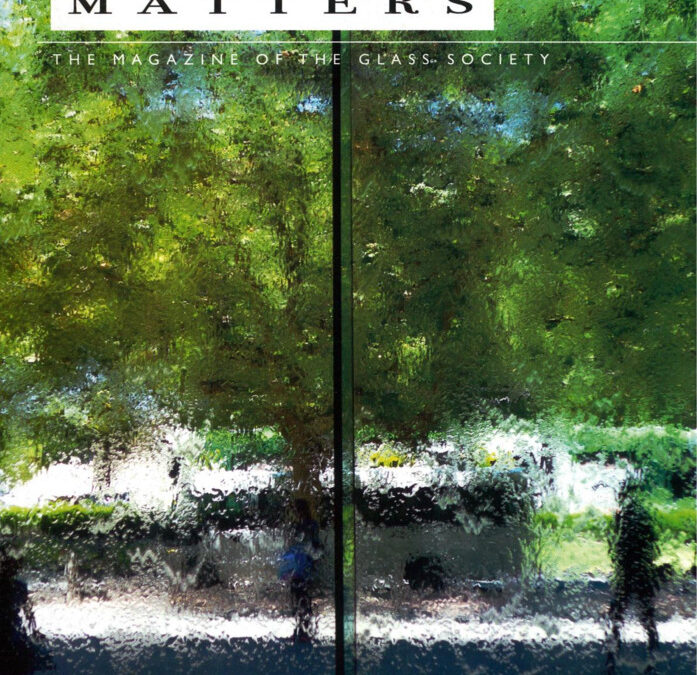
FRONT COVER:
The central section of the ‘Glass wall of
water’, in the National Gallery of Victoria, Melbourne,
Australia (see
p.17)
BACK COVER:
Glass sculpture by engraver Anne Wenzel
from Germany. Gassi gehen, 2019. Shown at Gravur on
Tour (see p.21)
Editorial
W
ith more people around the world in lockdown’ or
`shielding’, extra time has opened up for each and
every one, to explore their lives further while ‘at home’.
Attending to that ‘pile of correspondence’, for which there
just ‘hasn’t been time’. To view more closely the collections
that have built up over the years – the glass displayed on
your shelves and in your cabinets, giving you pleasure every
time you pass by. Then the glass that you’d tucked away in
a dark corner and thought – ‘why did I ever buy that’. Many
enthusiastic glass collectors have found that time comes
to change the focus of their collecting habits, requiring
room to be made to show the new glass. Groups of
collected pieces become wrapped up and packed into large
containers, labelled, then stored away in the loft or the
garage. Have you forgotten about some of those precious
items that you carefully put away and perhaps forgot to
catalogue? It’s time to find them, photograph them and
send them in to
Glass Matters,
with a description of your
favourite piece of glass.
Glass Matters Issue no.9 October 2020
2
CHAIRMEN’S MESSAGE
Chairmen
‘s Message
Sue Newell, Joint Chairman
of The Glass Society
ow that it’s autumn and
we’re all getting used to the
new ‘normal’, we hope that
all your lives are getting easier as you
settle into a routine. Like us, you
may be missing those spontaneous
visits to your local museums and
exhibitions to see gorgeous glass and
other artworks, but at least many
institutions are now open and there
are many more offerings online.
We reluctantly took the decision
to move everything we do online
for the remainder of 2020 and it
is likely to remain the case until
Easter 2021. We hope you agree
that there has been a plus side in
terms of our online Newsletters
and talks via Zoom. These have
not only brought members
throughout Britain closer, but they
have opened up our activities to a
global audience. By allowing mem-
bers of other decorative arts soci-
eties to join these presentations
we have effectively publicised what
we do to the arts community more
broadly, and we have been pleased
at the response. In particular,
the success of the talks on Zoom
means that these will remain a per-
manent offering in the future. In
terms of the Newsletter that you
recently received via email, a big
`thank you’ to Peter Cookson who
compiled and edited it. It is full of
fascinating snippets of informa-
tion and if you are interested in
acting as guest editor for a future
edition, please get in touch. Our
thanks as ever to Brian for his edi-
torship of this magazine, which
continues to be a rich source of
enjoyment three times a year.
Before you ask, we are commit-
ted for the foreseeable future to maintaining
Glass Matters
in its
hard copy form, mindful that a
small proportion of our members
do not have the internet, and oth-
ers just prefer a physical magazine.
We are very appreciative when
speakers at our talks are able to
write about their research, or an
aspect of it for
Glass Matters,
and
this issue has two such offerings,
Elisa Sani on early Venetian glass
lamps and Katharine Coleman on
glass wheel engraving. In these
times when travel is a vexed issue,
it is marvellous to hear about col-
lections in distant locations, and
again there are two articles here to
whet our appetite for the day when
glass tours are possible again;
Ian Phillips on the Malaga Glass
Museum and Peter Henderson on
glass in the National Gallery of
Victoria (Melbourne, Australia).
Bill Millar whose great photos are
used for our Newsletter quizzes has
written on diamond point engrav-
ing, and in another follow up from
our first Newsletter, Sally Haden
has written on William Nelson’s
Glassworks in Manchester. A pre-
vious contributor to The Journal
of the Glass Association, Tim Mills,
discusses 19th century twist stems.
Every autumn we hold our
Annual General Meeting, this
David Willars, Joint Chairman
of The Glass Society
year, for the first time, an annual
meeting will take place online on
Zoom, on Tuesday 20th October
at 6.00pm. We will be sending out
the Agenda, Accounts and Minutes
of last year’s AGM meeting nearer
the time and if you have any points
you wish to raise, do contact us.
Even better, join us for the meet-
ing and become directly involved
in shaping the future of your
Society. Moreover, rather than lim-
it the meeting on 20th October to
formalities, we are opening it up
by inviting members to spend five
minutes talking about their favou-
rite piece of glass in the form of
a ‘show and tell’ — to present your
glass, please contact the chairmen.
Lastly, we would mention again
that this is your Society and its evo-
lution has to be driven by the mem-
bership – we are always looking for
greater involvement from you,
our members. If you would like to
contribute, whether on the admin-
istrative side, by editing a future
Newsletter, contributing articles
or a short piece, please contact us.
Susan Newell and David Willars
Joint Chairmen, The Glass Society
Glass Matters Issue no.8 October 2020
3
VICTORIAN TWISTS
COLOUR
and
OPAQUE
Twist Wine Glasses
made around the time of the Great
Exhibition of 1851
Tim Mills
s glass collectors most of us are
quite familiar with the opaque
.
st stemmed wine glasses of
the eighteenth century. These glass-
es appeared around the middle of the
century and remained in production
to perhaps 1780. Most are white
twists, though occasionally coloured
examples are found and these
command relatively high prices.
Less well known are the opaque
twist wines made in England around
the middle of the nineteenth centu-
Fig. 1
Chtonpagne glass with engraved coupe bowl.
Looped red white and blue twisted ribbon stem.
George Bacchus and Sons. C1850.©Victoria and
Albert Museum London. Ht13 cm
ry. It seems that these later glasses
appeared sometime in the 1840s and
were produced for a relatively short
period up to around 1860. The Vic-
torian glasses are considerably dif-
ferent from the earlier wares. Not
surprisingly they reflect the overall
designs of other wine glasses pro-
duced at the time, so they are short-
er, have proportionally bigger bowls,
sometimes with slice cut stems,
and are much more likely to have
coloured twists. Counterintuitively,
the eighteenth-century examples are
easier to find than the later glasses.
Examining the literature reveals
a limited amount of information on
the type. The best known glass is an
example held by the V&A that was
shown at the Great Exhibition in
1851 by George Bacchus and Sons
of Birmingham. It is shown in
Fig.1.
The unusual looped stem contains a
red, white and blue twisted ribbon.
The bowl is engraved with a repeat-
ing leaf design. The looped form of
the stem reflects the ornate stems
made in the Facon de Venise styles
of the seventeenth century. This
nod to the style widely accepted
as being from Murano at the time
Fig. 2
Wineglass with engraved shallow cup bowl. Double
series opaque twist (DSOT) stem with a pair of blue
twisted threads within a 5-Alwhite spiral band.
George Bacchus and Sons. C1850. Ht.10.9 cm
4
Glass Matters Issue no.9 October 2020
VICTORIAN TWISTS
Fig. 3
Wine glass with engraved shallow cup bowl. DSOT
with a pair of red twisted threads within a 7-ply
white spiral band. George Bacchus and Sons. C1850.
Ht. 8.1 cm
hints at the motive behind these new
designs. Rather than a conscious
reproduction of the native wares of
the eighteenth century these new
twisted stems were an attempt to
capture the influence of the glass
made centuries before. This move-
ment fitted the increasing influence
of the Mediaeval in Victorian design
and as such was a reaction against
the tired forms of the heavily cut
glass tradition. In this it foreshad-
ows the later designs of the arts and
crafts movement and particular-
ly those of James Powell and Sons.
The glasses shown in
Figs.2
and
3 both have engraving that exactly
matches that of the Bacchus glass.
Furthermore, the distinctive mere-
ses at the top and bottom of the
stems stylistically resemble those
of the V&A example. The glass in
Fig.4,
although not engraved, also
has a bowl and stem form which
suggests a Bacchus attribution.
Evidence that the Victorian
twisted stems started in the 1840s
comes from Hugh Wakefield when
he notes
‘A threaded Venetian stem
was noticed among the Richardson
contributions to the Society of
Arts exhibition in 1849’ 1 (P.34)
A glass held by the Dudley
Museums Service has a link
to the Richardson’s out-
put of the time. This glass,
shown in
Fig.5,
has a slice
cut stem with a white dou-
ble series twist, the bowl
enamelled with fruiting
vine. It was acquired by the
museum from the bequest
made by the Richardson
family. As this bequest con-
tained glass from other fac-
tories as well as that made
by their own it is not cer-
tain that this is a Richard-
son’s glass. However, it was
noted as such at the time of
RIGHT Fig. 5
Wine glass with enamelled shallow
cup bowl. DSOT with two spiral white
tapes within a multi-spiral band. The
stem slice cut into the base of the bowl.
Possibly W.H.B. &J. Richardson. C1850.
Courtesy of Dudley Museum Services
ABOVE Fig. 4
Wine glass with shallow cup bowl. Single series
opaque twist (SSOT) with 3-ply red and white
spiral band. Probably George Bacchus and Sons.
C1850. Ht.10.6 cm
Glass Matters Issue no.9 October 2020
5
VICTORIAN TWISTS
FAR LEFT Fig. 6
Wine glass with shallow
cup bowl DSOT with two
spiml ink blue dreads
within 6-p4zwhite spiral
band. The stem dire cut into
the bowl Possibly W.H.B.
&J. Richanison. C1850.
Ht11.5an
LEFT Fig. 7
Wineglass with shallow
cup bowl DSOT with two
spiral ink blue threads
within 6-ply white spiral
band. The stem slice cut into
the bowl. Possibly W.H.B.
&J. Ridzarclson. C1850.
Ht11.5an
acquisition and dated 1845.
Fig.6
shows a glass from the author’s col-
lection which is almost identical but
has a blue and white twist and does
not have enamelling to the bowl.
Hajdamach
2 (Plate 76)
provides fur-
ther evidence of Richardson’s pro-
duction of twist glasses, illustrating
a goblet with a red, white and blue
twist stem and an engraved bowl
with a pronounced lip. He tells us
that this pattern appears in the
Richardson’s design books for the
1840s.
Fig.7
shows a glass with a
similarly shaped bowl engraved
with fruiting vine. The stem con-
tains a single series twist of two
pink multispiral columns. This glass
probably dates to the mid-1840s.
Hajdamach illustrates two further
examples of twist stems. One is a
white-cased goblet with cut-through
panel decoration, made in the late
1840s
2 (Colour plate 5);
this is attributed
as probably by Bacchus. The second
example is a pair of finely cut gob-
lets en suite with a jug
2 (Colour Plate 6);
these are firmly attributed to Bac-
chus and date to around 1850.
The glass shown in
Fig.8
is differ-
ent from the others shown in this
article in that it has distinctive pro-
portions – a small bowl, tall stem and
proportionately wide foot. In this it
is closer to the eighteenth-century
glasses than most. Gabriel
3 (Plate 63)
,
illustrates an almost identical glass,
save for the type of engraving. This
glass is engraved with a crown and
monogram relating to Prince Albert;
it was presented to the Prince on
the opening of the Royal Albert
Dock in Liverpool in 1846 –
Gabri-
el says London which is presumably
an error as the London dock opened
in 1880, long after Albert had died.
So far, I have only discussed Bac-
chus and Richardson’s as manufac-
turers of these glasses; however, it
is clear that several other factories
also made similar products. The
V&A holds a fine example made by
Apsley Pellatt; this is shown in
Fig.9.
Wakefield also illustrates a Pellatt
glass with a coloured twist stem
1
(Plate B,b)
this is in black and white so
the colours are uncertain — made by
Apsley Pellatt; it was acquired by the
Conservatoire National des Arts et
Metiers in Paris in1851. The glass
shown in
Fig.10
shares certain char-
acteristics with both these Pellatt
glasses. In particular the apparent
quality of the metal, the lack of a
merese at the base of the stem and
Fig. 8
Wine glass with round funnel bowl engraved with
fruiting vine. DSOT with four spiral tapes within
4-ply spiral band. Slice cut stem into the bowl. Star
cut foot Cl845. Ht.14.1 cm
6
Glass Matters Issue no.9 October 2020
Fig. 9
Wine glass with rounded conical bowl finely
engraved with acorns, oak leave, roses and fruit.
The stem with a pair of white twisted multispiral
ribbons. Aspley Pellatt C1850. ©Victoria and
Albert Museum London. Ht14 cm
the style of the stem shown in the
V&A glass. This is a loose attribution
but perhaps this is a Pellatt example.
Wakefield goes on to mention two
other companies associated with
making twist stems at the time. Rice
Harris is noted for producing these
glasses from at least 1849 and
‘at the
1851 exhibition elaborately convolut-
ed stems were a feature of the display
of Lloyd and Summer field
1 (p34) No
illustrations of glasses from these
factories are shown by Wakefield.
Fig.11
shows a very fine ruby
champagne glass. The bowl is
engraved with a band of fruiting
vines suspended by two eagles in
flight. The stem is slice cut with
a delicate twist made up of a sin-
gle series multispiral of white
and red. The quality of this glass
hints at the considerable price it
must have commanded when new.
A further champagne glass is
shown in
Fig.12,
this has a single
ribbon twist of white, edged in red
and blue. The coupe bowl is engraved
with geometric patterns and stylised
flowers.
Fig.13
shows another glass
with a ribbon stem. This twist is
white, edged on both sides with
red. The bowl is cut and engraved
with fruiting vine. It is interesting
Fig. 10
Wine glass with rounded funnel bowl. Single series
opaque twist stem with twisted multi-spiral band.
The stem slice cut into the bowl. Possibly Aspley
Pellatt C1850. Ht13.4 cm
to note that this glass, along with
those shown in
Figs.1, 2,
and
4,
has
a left-handed twist. As recent dis-
cussions in this publication have
shown, eighteenth century twists
are invariably right-handed. That
is to say, that if observed from the
top, the twist spirals downwards
in a clockwise direction. Although
most nineteenth-century examples
appear to follow this convention,
clearly some do not. Furthermore,
the glasses shown in
Figs.2
and 3
are identical in form save for the
colour of the twist. This suggests
that left and right-handed twists
were probably made alongside
each other and may simply have
Fig. 11
Champagne glass with ruby coupe bowl finely
engraved with fruiting vine garland suspended
by eagles. The slice cut stem with a red and white
multispiral opaque twist. C1850. Ht.11.4 cm
VICTORIAN TWISTS
Glass Matters Issue no.9 October 2020
7
VICTORIAN TWISTS
Fig. 12
Champagne glass with coupe bowl engraved with
geometric and floral design. The stem with single
white twisted ribbon edged in red and blue. C1850.
Ht.12 cm
been the preference of the differ-
ent glass workers. I have also noted
that the left-handed twists seem to
appear more on glasses with a Bac-
chus attribution, though the small
sample size might be misleading.
There is little evidence to show
that these opaque twist stem types
remained in production for very
long. Perhaps they fell out of fashion,
though other – more accurate Vene-
tian influenced glass – was made at
least to the end of the century. Some
twists were made later by Whitefri-
ars but they did not share the native
influence of the mid-century exam-
ples. Perhaps they were prohibitively
expensive to make compared with
plainer examples. Certainly, this
and later periods saw the develop-
ment of very colourful wine glass-
es. As can be seen, the twist stems
are very slender and the twists very
delicate. On a table these decora-
tive features may have been lost and
therefore not worth the extra cost.
It is also worth commenting
that these stems emerged exactly
at the time when some factories
were making ornate paperweights
and it is easy to see the cross fer-
tilisation of ideas between the two
forms of wares. Certainly, George
Bacchus and Sons have a consider-
able reputation for the manufac-
ture of paperweights containing
coloured canes. Whitefriars also
made weights from around 1850.
Collecting these glasses can
be fun as they are uncommon
and not particularly expensive.
Patience is required. The author’s
collection contains a dozen glass-
es acquired over as many years.
Nevertheless, this adds to the
pleasure of every new find, espe-
cially if made for just the price
of a reasonable bottle of wine!
Tim Mills, based in Olney in Buck-
inghamshire, has been a specialist
dealer in Eighteenth and Nineteenth
Fig. 13
Wine glass with round funnel bowl with basal
cutting and engraved with a band of leaves. The stem
with a single twisted ribbon in white edged with red.
C1850. Ht.12.6 cm
Century English glass for nearly thir-
ty years. He has regularly exhibited
at the National and Cambridge Glass
Fairs and written for The Glass Cone
and The Journal of The Glass Associ-
ation. His specialist interests include
glass jugs and engraved glass rummers.
Tim can be contacted at
www.antiqueglass.org.uk
N.B. All glasses are of lead metal and all feet have
polished-out pontils. Unless stated otherwise all
examples are in the author’s collection.
REFERENCES
1.
Wakefield, H. (1961) Nineteenth
Century British Glass. Faber and
Faber. London.
2.
Hajdamach, C.R. (1991) British
Glass 1800-1914. Antique
Collector’s Club. Woodbridge.
3.
Gabriel, R. (1974) English
Drinking Glasses. Charles Letts
and Co. Ltd. London.
8
Glass Matters Issue no.9 October 2020
A VISION COMES TO FRUITION
MUSEUM
of Glass
and
CRYSTAL –
Malaga
Ian Philips
FOUNDING THE MUSEUM
S
ome twenty years ago, three
friends, one Spanish, two Brit-
ish, decided to create a museum
with a central theme of glass, as one
of them — myself — had a growing
collection of Georgian wine glasses,
while the other two had furnishings
and family portraits to provide a con-
text. But where should that museum
be? After several months searching,
our Spanish colleague saw a rather
tumbledown eighteenth-century
house — a Posada — just outside the
Moorish walls of the city of Malaga
in southern Spain and took the deci-
sion that that was where it should
be. It took some little persuasion on
his part to convince us — his two col-
leagues — until we were all in agree-
ment. A further consideration was
that the city, which had suffered bad-
ly in the Spanish civil war, might value
a cultural project such as our museum.
People ask, “Why Malaga?” and that
is our answer. Thus, the house, typi-
cally Mediterranean with its series of
patios, and in use as a lodging house,
was purchased and all its contents
removed. Our first problem then
arose — the local authorities were
appalled by our decision and insisted
that we must demolish the old house
and build afresh, and the architects,
whom we were obliged to employ,
agreed. We searched anew and even-
tually found an architect who would
permit us to do as we wished, but
largely because of the authorities’ hos-
tility, there were continuous delays.
The house, on a slope with the sta-
bles underground at the back, and in
a ruinous state, was centred around
a patio that was usually waterlogged
or frankly flooded. All this had to be
removed as we expected. However, a
major delay resulted from the prepa-
ration by our neighbours of the next-
door site for development. They’d
dug deep foundations and our side
wall collapsed
(Fig.1).
Devastation!
But they paid for our reconstruction.
Despite all of the setbacks, the
restoration was completed, but it
took seven and a half years, involv-
ing much totally unexpected expense.
All of the work, including provision
of living accommodation on the
top floor, the placing of a glass roof
over the first patio, and the inclu-
Fig. 1
The original posada, after the collapse of the side
wall in 2006
sion of the originally separate nine-
teenth-century house next door, was
completed by local tradesmen with
little technical supervision. There
was one exception: the facade of the
house had been whitewashed, and
when our Spanish colleague looked
closely at the wall underneath a small
area of flaking paint, he was con-
vinced that there might well be paint-
ed decoration under the whitewash.
Patient work by specialists revealed
the facade as we now see it
(Fig.2),
with facsimiles of stone and brick,
the latter with representations of
Asia, Africa, and America, but with a
blank space where Europe might have
been expected. We now have an obli-
gation to conserve that facade, proud-
ly facing the eighteenth-century
Fig. 2
The posada re-created in 2009. The current facade
of The Museum of Glass and Crystal – Malaga
Glass Matters Issue no.9 October 2020
9
church of St Philip Neri.
In 2009 we started to move in,
with lorryloads of furniture, a selec-
tion of inherited Persian and Spanish
carpets, family portraits and busts,
dating from the 17th to the 20th cen-
turies coming from various parts of
Europe. Placing all this in the house
was largely the task of our Spanish
colleague, who understood how to
appropriately design the interior.
Then, just over ten years ago, the May-
or of Malaga officially inaugurated us.
Our approach to acquiring glass
has changed over the years.
I bought my first pieces from
Father O’Brian of Mission
Antiques, Dublin — a pair of
Georgian crystal ale glasses
which were on display in the
shop window; my education
in glass started as I crossed the
threshold and the priest greet-
ed me. Later, living in London,
I used to visit the glass shops
and stalls in Portobello Road —
a great deal was learned from
the owners. With the market
originally open on alternate
Saturdays, this coincided with
the only time I had “off” from
my busy medical job. I then dis-
covered out-of-town antique
centres and glass dealers.
At that time, I had only myself to
please, and I handled the items
inter
alia
to ensure good condition and on
the alert for copies and forgeries. I
also learned about trade catalogues,
trade-marks and registration marks
on press-moulded glass, and about
information that was scratched on
the base of many other types of glass.
Nowadays there are the three of us to
satisfy and virtually all our buying is
via the Internet, with occasional piec-
es from the biannual National Glass
Fair in Birmingham, UK. The sheer
volume of glass available for sale, is of
course staggering, but handling it is
usually impossible. We have learned
the questions
to
ask! Quite a lot of the
items reach us by post or via one of the
carriers. Breakage is a decided rarity.
DISPLAYING THE COLLECTIONS
Our next task was to bring the collec-
tions of glass to Malaga and display
them. Our builders created spaces
in the walls that could be shelved.
Originally all of these were intend-
ed to house our library, but
we appropriated some space
in them for glass, notably our
ancient pieces
(Fig.3).
The bot-
tom two shelves of the book-
case in the far end of the room
in the photograph, contain our
small collections of Hellenic,
Roman, and Islamic glass.
Our Spanish colleague bril-
liantly showed his flair for
design with the idea of con-
verting surplus doorways
into display cabinets, these
were made by the local car-
penter (one is seen in
Fig.4).
Fig. 5
A 17th century laburnum wood cabinet
on turned legs
A VISION COMES TO FRUITION
Fig. 3
Fig.
4
Gallery One in the museum
The doorway reconstructed as a display cabinet
1
0
Glass Matters Issue no.9 October 2020
They are particularly useful in help-
ing to bring light to the rooms and
contribute to the continuity of dis-
plays from one room to another.
The laburnum wood cabinet
(Fig.S)
usefully displays our collec-
tion of 16th and 17th century Euro-
pean glass. It has a pair of containers
for the home celebration of mass for
people who cannot go to church.
It also contains four pieces
of Murano glass. We have a
magnificent eighteenth-cen-
tury veneered Dutch cabinet
(Fig.6),
housing my entire col-
lection of British lead crystal
Georgian drinking glasses. In
addition, we were fortunate
in having several handsome
nineteenth-century mahog-
any wardrobes, which could
be easily modified to make
excellent display cabinets.
This unit
(Fig.7),
contains a
fine if limited collection of
Stourbridge Cameo and other
turn-of-the-century glass.
Fig.8
shows a late nine-
teenth-centuryunit by Gillows
containing glasses of the same peri-
od. To our surprise, the modern
display cabinets fitted in well. We
use the pair to house our growing
collection of modern studio glass
from different parts of the world.
Our walls carry European stained
glass of the late nineteenth and the
first half of the twentieth century,
mostly from
churches converted
for alternative use or sadly
demolished, many displayed in
light boxes made by our carpen-
ter, but some acting as windows
that admit light
(Figs.9
and 1
0).
Other pieces are displayed on
table tops, appropriate glass cab-
inets and on rare and unusual fur-
niture.
Fig.11
depicts a mahogany
table made by Wilkinson of London
in the early nineteenth cen-
tury; over the table is a fine
chandelier by the Spanish
glassworks at La Granja.
At the far end of a drawing
room in
Fig.12
is an intrigu-
ing integrated sofa and dis-
play unit designed by Gaudi,
carrying glasses of the same
period. While
Fig.13
is a
modern unit holding twen-
tieth-century glass.
Fig.14
presents a table setting in a
dining room with chandeliers
and a stained-glass wall panel.
Fig,
8
Mixed display cases. A 19th century
cabinet alongside modern glass units
A VISION COMES TO FRUITION
Fig. 6
Fig. 7
An 18th century Dutch cabinet, displaying 18th century British glass
A mahogany wardrobe converted into a display cabinet
Glass Matters Issue no.9 October 2020
BELOW Fig. 9
Melpomene is the Greek Muse of Tragedy. The window (1.8m x
1.25m), was designed by Arthur Lewis Moore in the 1890s. It came
from a house in Wimbledon, London, since demolished, that once
belonged to the dancer Isadora Duncan — her death, by being strangled
when her scarf became caught in the wheels of her car, was a Tragedy.
A VISION COMES TO FRUITION
Our neighbouring glass art-
ist came in and built up a large
free-standing glass wall unit, now
filled with our large collection of
1930s to 1970s Whitefriars glass.
This style of display is our only large
example comparable to that of a
conventional museum. We are now
extending the ground floor of the
museum where external windows
will display glass, probably from our
considerable collections of pressed
and Carnival glass. It became clear
that the same spaces, with excellent
LEFT Fig. 10
The Good Samaritan by Clayton and
Bell 1890. 1.95 x 48cm
acoustics, plus a garden, would
be useful for formal and infor-
mal events such as concerts of
classical and popular music, din-
ners, lectures and wedding cele-
brations, all providing essential
financial support for the museum.
I have also photographed the
entire collection held in our display
cabinets, my “studio” being the
essence of simplicity, consisting
of a camera on a tripod and rolls
of black and white paper, set up on
the terrace outside my apartment
on the upper floor above the muse-
um. Lighting is by daylight, my
favourite time for taking photo-
graphs being in the early morning
as the sun rises above the horizon.
VISITING THE MUSEUM
We accompany visitors to the
museum in tours of one to twenty
people, as we can’t take the risk
of letting people wander around
without a guide. The tour lasts
about an hour, in a language
that we share, albeit sometimes
imperfectly — we offer Spanish
(and Bable and Basque: rarely
necessary but fun), French, Ital-
ian, English, German, and Russian
(the last usually at weekends only).
All visitors are welcome, including
LEFT Fig. 11
Chandelier
from La Granja
glassworks
in the small
dining-room
RIGHT Fig. 12
Seat and
display unit
designed by
Gaudi
I2
Glass Matters Issue no.9 October 2020
A VISION COMES TO FRUITION
Fig.
13
Fig.14
Modern glass display cabinet with contemporary glass
Dining table setting around the seven-metre-long mahogany dining table
children. Additionally, we offer a
private dinner party around our
seven-metre-long mahogany dining
table
(Fig.14),
at which our best por-
celain, glass and silver are brought
out, and top caterers are brought in.
I like to begin my tours with the
oldest glass — Hellenic, Roman and
Islamic –
(Fig.3),
followed by 16th
and 17th century glass from Bar-
celona, Venice, Holland and Bohe-
mia
(Fig.S).
In the next room is the
eighteenth-century Dutch cabinet
(Fig.6),
containing my original collec-
tion of British lead-crystal drinking
glasses, displaying the various stem
types – baluster, air twist, opaque
twist and facet cut. Close by, in a con-
verted French nineteenth – century
wardrobe, we display La Granja
gilded glass. In the same small room
(Fig.4)
we have a converted doorway
cabinet with early nineteenth- century
cut and/or enamelled glass. Our
small dining room
(Fig.11),
with its
La Granja chandelier, has a fine set
of 1820s Wedgwood blue-and-white
pottery. In the converted “doorway”
and free-standing cabinet on the bal-
cony surrounding the central patio, is
our main collection of pressed glass.
Also on the balcony is early White-
friars glass, with pieces designed
by Philip Webb for William Morris,
and Harry Powell. The Music Room,
with its Salviati chandelier, fine 19th
century Errard piano, and imposing
family portraits, has a converted
wardrobe
(Fig.
7) containing mainly
Stourbridge cameo glass. In the first
of the last two drawing rooms are
our small collections of Emil Galle
and Rene Lalique glass, given by a
friend, and cut glass on open display.
In the final drawing room overlook-
ing the church of St Felipe Neri, there
is a fine chandelier by La Granja,
and a Scandinavian collection with
pieces by some of the most talented
glass makers of the twentieth cen-
tury – including Alvar Aalto, Franck,
Wirkkala, Sarpaneva, and Lutkin. As
we leave the drawing rooms we have
Caithness glass, and at the top of the
stairs, Carnival glass (currently in
an inappropriate wardrobe) largely
from the United States – featuring
Fenton, Imperial, Northwood and
Millersburg — and Czech glass. Once
downstairs, we are back to the large
glass wall unit built by our local glass
restorers. In glass cases are examples
of decorative glass from firms in the
British Isles – Davidson, Jobling,
Chance, Dartington, the Harris fam-
ily, Nazeing, Stuart and Caithness.
Our admission charges are mod-
est and sadly, in these days, our
earnings are much lower than costs.
When the time is opportune, we
hope to establish a charity to which
we can give our collection. In the
meantime, we continue to enhance
it and to develop the property. Using
the opportunity of our enforced
Covid-19 closure, a project is being
started to use a plot of land adjoining
ours to provide a better entrance to
the museum and better office facili-
ties. As with many museums, insur-
ance and security are a concern;
we reply to questions by referring
to prayer, sturdy largely window-
less outer walls, iron bars and our
Boxer dogs – the first is Chaty and
we sometimes feel that our second,
Carlos Enrique, now nearing his ninth
birthday, is the boss of the museum.
Ian Phillips, and his two colleagues
will enjoy welcoming you. Following
Covid-19, re-opening is anticipated
on October 1st.
Do
view the website:
www.museovidrioycristalmalaga.com
Glass Matters Issue no,9 October 2020
13
ENGRAVED LOVE TOKEN
A VICTORIAN
love token
BillMillar
I
t was fascinating to read the arti-
cle ‘GEORGIAN
love tokens’
by Neil
Chaney
(Glass Matters 7, February
2020).
How marvellous to identify the
owners and their biography more than
two centuries after the event. The arti-
de brought to mind a small wine glass
in my collection, probably made as a
valentine, but certainly a love token.
The original owner has yet to be iden-
tified but it is just possible a reader
maybe able to help complete the story.
The glass is quite small (11.5cm
high) of three-part construction, a
bucket bowl, the stem with a bladed
knop and a broken, unpolished pontil
mark to the foot. It could possibly have
BELOW Fig. 1
Small wine with diamond point
engraved armorial device.
BELOW (RIGHT) Fig. 2
Royal coat of arms seen from the reverse.
been made in the Georgian period but
engraved later as it is dated 1864. So,
well and truly a Victorian love token
with links to the Georgian period.
The bowl of the glass is diamond
point engraved with four distinct
objects: the royal coat of arms, a sec-
ond armorial device, a paddle steam-
er and a love poem. The upper side of
the foot is also engraved with a frieze
of flowers.
Fig.1
shows the glass with
a view of the second armorial device.
The decorative value of the engrav-
ing is high, especially as the space
available is limited, so the engraver
dearly had a high level of artistic abil-
ity. However, when seen through a
lens there is some splintering which
might suggest a capable artist work-
ing with a less usual medium. The
positioning of some of the engrav-
ing indicates the layout evolved rath-
er than being carefully preplanned:
another hint of an amateur hand?
The royal coat of arms,
Fig.2,
is
engraved in great detail over a very
small area (4cm high x 5.5cm wide).
It is a very complicated item to draw,
far more to engrave, so it says much
about the artistic skill of the engraver.
The reverse of the glass, shown
in
Fig.3,
displays a paddle steamer
(2.5cm high x 5.5cm wide). The steam-
er depicted is similar to the Cunard
Britannia-class ships which worked
the Atlantic crossing from 1840. The
introduction of the propeller in the
early 1850s made paddles obsolete
and by 1864 the Cunard paddle steam-
ers were obsolete and long since sold
off. The ship on the glass would have
been a memory of days past rather
than a contemporary vessel. Howev-
er, it might have been a reference to
14
Glass Matters Issue no.9 October 2020
LEFT Fig. 3
Reverse of the glass showing paddle steamer and ten lines of script.
ABOVE Fig 4.
Engraved frieze of flowers on upper side of foot
a ship with a special meaning to the
giver and or receiver of the glass. As
a depiction of Britannia or one of her
sisters it is accurately drawn with
three masts and a tall funnel spewing
forth smoke afore the main mast. The
masts each carry a single horizontal
spar for square-rigged sails, where-
as the originals carried two horizon-
tal spars on each mast. The steamer
was drawn too close to the rim for the
masts to be tall enough to carry two
spars so this may be a forced error.
Beneath the ocean supporting the
paddle steamer there are ten lines
of script (3cm high). Given the aver-
age of 3mm per line the writing is
tiny and some of the words are diffi-
cult to read, but the only one that is
really problematic is what appears
to be “Thurso” (a town in the very
North of Scotland) in the final line.
Art thou not dear unto my heart
Ah search that heart and see
And from my bosom tear the part
That beats not true to thee,
Yes thou art dear unto my heart
More dear than tongue can tell
And if I am guilty of a fault
Tis loving thee too well
Forget me not
Thurso 1864
A search of the internet produced
a very close variant of this poem
printed in the Morning Herald on
15th March 1811, so despite a gap of
over half a century this is at heart a
Georgian love token. The verse, less
the final line ‘Forget me not’, was
also included in
‘The Sentimental
Valentine Writer’
published in 1850.
If you try writing the above verse
within 3cm using a sharp pencil on
paper, you’ll begin to appreciate just
how demanding a task it was to engrave
the verse on the curved side of a glass.
Set between the royal arms and the
paddle steamer is the second armori-
al device (4cm high); see
Fig.1 .
The
crest comprises three ostrich feathers
emerging from a ducal crown; beneath
is an armorial badge of a domed, straw
beehive or skep. The belt and buckle
surrounding the skep is indicative
of a Scottish armorial, which would
fit with the location of Thurso as the
place where the glass was engraved or
presented. On either side of the badge
there are two letters: “A” and “L”. The
same letters are paired and appear
to the top left of the badge. To date I
have been unable to identify the fam-
ily associated with this armorial. Cur-
rent records no longer include the
badge and crest of lapsed or obsolete
titles, so further research is needed.
Fig.4
shows the top of the foot,
engraved with a frieze of twelve
simple ‘flower and leaf’ motifs.
There can be no doubt, given the
Georgian love poem, that this glass
was decorated as a love token or a
valentine. The other elements are
undoubtedly significant dues to the
giver or his/her valentine. The bee-
hive armorial with ostrich feather
crest, initials and date must surely
lead to an individual within a titled
family. The paddle steamer might add
to the story. A unique little glass with
a story to tell, but perhaps not yet.
While I have yet to establish the
identity of either the donor or recip-
ient of the glass, I have been more
successful in identifying the proba-
ble engraver. Charles Hajdamach in
British Glass 1800 — 1914 explains
on page 155:
“One group of rummers
and tumblers carry naïve diamond
point decoration of hunting and shoot-
ing scenes, railway engines and coats
of arms intermixed with doggerel verse.
Many are signed ‘Sutherland, London’
and have the common characteristic of
the royal coat ofarms. They range in date
from 1847 to 1863.”
While the date
on my glass is just a year later than
those seen by Charles it may be safe
to assume that it too was engraved
by Sutherland. I have already identi-
fied a number of Sutherland’s glass-
es in the collections of the V&A and
Corning Museum of Glass. Further
research might justify a separate arti-
cle on Sutherland engraved glasses.
If you can help me solve the mys-
tery of the Victorian lovers I will be
delighted to hear from you at billmil-
lar82@yahoo.co.uk. Even if the original
owners remain undiscovered the glass
will always be a symbol of love. I just
hope their story had a happy ending.
ENGRAVED LOVE TOKEN
Glass Matters Issue no.9 October 2020
15
IN MEMORIAM
Remembering
John Scott
I
4
ast January, John passed away
peacefully in his sleep after a
brief stay in a Kensington care
home. He’d been a member of the
Glass Cirde (GC) for many years (our
records show that he had been a mem-
ber since 1961, and possibly before).
He was invariably present for the
GC meetings held at the Artworkers
Guild in London and sitting alongside
David Watts, would hold the speakers
to account and then add additional,
informative comments of his own.
Members recall that he did much
for the GC and in 2014 he donated
many Whitefriars glasses, which were
then auctioned, the proceeds adding
to the GC funds. He could be contro-
versial, challenging and intellectually
demanding, but he was full of char-
acter, caring, and well respected and
admired for the depth of knowledge
he held on his many areas of collecting.
John was born in 1935, in
Birkenhead – hence his eventual
choice of ‘The Birkenhead Collection’
as the credit line, when making muse-
um and exhibition loans. After attend-
ing Radley College boarding school,
he was awarded a National Service
commission in the Gurkha Regiment
in Malaysia. During his studies in law
at Corpus Christi College, Oxford,
and as a keen rugby player, he was
capped for England v. France in
1958, then continued to play for the
Harlequins. He would ‘keep fit’ play-
ing squash and as a sailor, joined the
America’s Cup challenge team aboard
Anthony Boyden’s
Sovereign
in 1964.
John only worked briefly as a solici-
tor, then followed a career in property,
alongside his passion for collecting.
In 1961, John was lent a sizeable
amount of money by an uncle, to buy
his first home. To celebrate, he bought
some glass rummers – over the years
he learnt that they were all differ-
ent and not all old! Then, collecting
`being in his blood’, over the years and
with the help of leading dealers, nota-
bly Michael Whiteway, John amassed
a rich, wide-ranging, eye-catching and
encompassing collection concentrat-
ing on British Design from the period
1850 to 1930. His taste was catholic,
but he favoured the outstanding
designs of A.W.N. Pugin, Christopher
Dresser, William de Morgan, the
Martin Brothers, the Whitefriars
Glass Company and Hector Guimard.
The collections ranged over early 20th
century glass, ceramics, furniture and
sculpture, both English and European.
John’s company bought property in
Westbourne Grove, where he moved
Fig 1
A Claret Jug by Archibald Knox
into an extensive apartment, sharing
his life there with Takako Shimizu, a
talented sculpture artist using mosa-
ics; married in 2013 she survives him.
Deteriorating health encouraged
John to seek new homes for his
treasures and in 2014 he instigated
eight selling exhibitions at the Fine
Art Society, then in New Bond Street.
He was proud of these catalogues
and they remain his legacy. For glass
collectors, two of the John Scott
Collection sale catalogues stand out:
they are Volume Four,
James Powell
& Sons White friars Glass 1860 -1960,
and Volume Seven,
Art Nouveau
Continental Design & Sculpture,
where
his Christopher Dresser claret jugs
were shown as well as the jug in
Fig.
/,
by Archibald Knox: John had cho-
sen this piece for an article on his
glass collections in The Glass Cone,
issue 108 and in his inimitable style,
described it as
‘a Claret Jug of sturdy
and robust design, rather English in
its formality and slightly aloof from
the more racy whiplash designs of Art
Nouveau on the Continent. A mas-
terpiece by Archibald Knox, perhaps
Britain’s greatest silver designer of this
flamboyant epoch. Green glass mount-
ed in silver from the Cymric range for
Liberty & Co., stamped L&Co for 1901.’
John Scott
16
Glass Matters Issue no.9 October 2020
LEFT Fig. 2
The
Leonard French
cut-glass
ceiling in the Great Hall
BELOW Fig. 3
Italian. An early 16th century venetian glass footed bowl with
gilt applied decoration. 15.4an h x 26.3cm. Purchased, 1871
NATIONAL GALLERY OF VICTORIA
GLASS at the NATIONAL GALLERY of VICTORIA:
a brief introduction
Peter Henderson
Fig. 1
Water runs over the glass wail
at the entrance to the NGV
M
elbourne, the capital of the
Australian state of Victoria
is a vibrant city of around
five million. Famous among other
things for its wine and food, its lane-
ways and shopping, it is arguably the
cultural capital of Australia – from
the esoteric Percy Grainger Museum
at the University of Melbourne to
the magnificent National Gallery of
Victoria. Adjacent to Melbourne’s
business district and opposite
Flinders Street station is Federation
Square’, a major cultural hub with
institutions like the Koori Heritage
Trust, which focuses on the expe-
rience and culture of Victoria’s
indigenous people; the Australian
Centre for the Moving Image and
the Ian Potter Centre: NGV Australia
which houses an important collec-
tion of Australian art. Crossing
the Yarra River and a short walk
along St Kilda Road is the National
Gallery of Victoria International.
To anyone interested in glass,
the large glass wall of water that all
visitors pass to enter the museum
is a portent of the significant col-
lection which the NGV holds
(Fig.1).
More dramatic still is the massive
cut-glass ceiling in the NGV’s great
hall by the Australian artist Leonard
French
2
(Fig.2).
It towers nearly four-
teen metres above the ground and
is just over 60m in length by 15m
wide, making it one of the largest
cut-glass installations in the world.
The NGV started life in 1861 as an
adjunct to the state’s public library
(another very worthwhile place to
visit when in Melbourne) and from
its inception it has had a commit-
ment to the decorative arts; for exam-
ple, in 1871 it acquired 102 pieces
of Venetian glass
(Fig.3).
Recently
these pieces were part of a major
exhibition, ‘Liquid Light’,
3
featuring
the gallery’s Venetian glass holdings.
For the NGV as a whole and the dec-
orative arts in particular, the role of
philanthropy has been very signif-
icant.
4
Chief among benefactors to
Glass Matters Issue no.9 October 2020
I7
NATIONAL GALLERY OF VICTORIA
Fig. 4
A Newcastle, English wine glass c.1760, Wheel-
engraved decoration attributed to Jacob Sang.
19.7cm h x 8.4cm.
Felton Bequest, 1949
Fig. 6
English wine glass c.1760, bowl decoration
in enamel on an enamel-twist stem. 14.9cm
h x 7.6 an. William
and Margaret Morgan
Endowment, 1973.
The portrait is of Prince
Charles Edward Stuart the Young Pretender”
Fig. 5
An English Amen glass c.1743-1750, air-twist
stem, diamond-point engraving on DT bowl
attributed to Robert Strange.
17.3cm h x 7.6 x 7.4cm. Felton Bequest 1960
the
NGV
was the industrial
chemist Alfred Felton whose gift
meant that at the start of the twen-
tieth century the
NGV
was wealthier
than Britain’s National Gallery and
Tate combined. Currently the NGV’s
works acquired through the Felton
Bequest are valued at over two bil-
lion dollars.
5
In 1949 the Felton
Bequest provided the nucleus for
the NGV’s British and Irish glass
collection when 102 pieces were
acquired
(Fig.4),
including Jacobite
glasses. Since then the bequest has
been used for many other glass
purchases. In 1960 this included
one of the NGV’s two Amen glass-
es
(Fig.5).
Poynter notes how in
June 1965 the Felton Bequest gave
the NGV’s Honorary Consultant
for glass, Rex Ebbott, “£1000 to
spend on glass in London and
£400 more when he asked for it”.
6
The second significant bequest
regarding glass, has been the
William and Margaret Morgan
Endowment which was originally
formed to purchase the G. Gordon
Russell collection which came to
the NGV in two tranches in 1968
and 1973.
7
This collection, much
of which had been bought through
the London dealer Howard Phillips,
contained a significant number of
Jacobite pieces
8
, some extremely
rare, such as the enamel portrait
glass in
Fig.6.
The Morgan fami-
ly has continued to support the
NGV not least in helping to digi-
tise many of the glasses in the
collection which allows for any-
body with an internet connection
to view the gallery’s holdings.
9
Jacobite glass has held a cer-
tain attraction for many collectors,
but the NGV’s holdings of British
glass go far beyond the Jacobite.
There are very interesting early
pieces of English glass, several
by Ravenscroft — a bowl is shown
in
Fig.
7; some wonderful baluster
glasses, including one from media
magnate, Rupert Murdoch’s father,
Fig.
7
English. A glass bowl by George Ravenscroft
c. 1677, applied decoration.
6.0an h x 17.6an.
William and Margaret
Morgan Endowment, 1973
18
Glass Matters Issue no.9 October 2020
NATIONAL GALLERY OF VICTORIA
BELOW Fig. 8
An English baluster wine glass c. 1710.
18.6cm h x 8.8cm. Purchased, 1953
Sir Keith Murdoch
(Fig.8) –
I
believe this glass came from his col-
lection following its dispersal after
his death in 1953; then light baluster
glass; commemorative glass; opaque
glass; Beilby glass — an unusual
example is seen in
Fig.9,
and down
the centuries to modern British
glass. In short, the NGV’s hold-
ings of British glass are world class.
Of special note with British glass
was the involvement of Rex Ebbott,
who in 1956 became the gallery’s
honorary curator of glass during
the directorship of Daryl Lindsay.
1
°
Ebbott is said to have had a long
correspondence, starting in the
1930s, with E. Barrington Haynes
of Alfred Churchill, and was a friend
and correspondent of the London
dealer Howard Phillips. Much of
the glass in the collection came via
these London dealers, presumably
at the direction of Ebbott, who
had also been elected a member
of the Glass Circle in 1959. Ebbott
was also involved in the estab-
lishment of another significant
collection of glass at Melbourne
University, the Ernst Matthaei
LEFT Fig. 9
An English wine glass c1760, with enamel-twist
stem. Enamel decoration on bowl attributed to
William Beilby. 14.8an h x 6.7an.
William and
Margaret Morgan Endowment, 1976
Memorial Collection of Early Glass.
While this article has mainly
focused on British glass it is import-
ant to note the richness of the NGV’s
entire glass holdings, which include
ancient glass, Persian glass, German
and Bohemian glass, Netherlandish
glass, Spanish glass, Chinese glass
and nineteenth and twentieth cen-
tury glass. A favourite are the two
Baccarat candelabrum, designed in
1903, manufactured in 1911, which
adorn the gallery’s impressive
European paintings gallery
(Fig.10).
The collection is aesthetically and
intellectually outstandingn
(Fig.11).
POSTSCRIPT
After discussions with Glass
Matters’ editor Brian Clarke, I had
hoped that this article could have
been a more substantial look at the
NGV’s glass collection and might
have included information on Rex
Ebbott and his correspondence
with Phillips and Haynes which, if
it comes to light, could be of con-
siderable interest to collectors of
glass. However, like everywhere
else, the coronavirus pandemic has
played havoc with any plans I may
have had. As I write, Melbourne is
in lockdown, the NGV is closed and
the border between Victoria and
New South Wales, where I live, is
also closed. Research is limited to
the internet and other materials
that I already have. At the least, I
hope that this article alerts people
who did not already know, of this
major antipodean collection of glass,
which has a virtual reality for any-
body with an internet connection.
Dr Peter Henderson is a historian
and collector of 18th century glass. In
the 1980s, having just read and been
intrigued by historian E.P. Thompson’s
Fig. 10
One of the Baccarat candelahnon
Glass Matters Issue no.9 October 2020
19
NATIONAL GALLERY OF VICTORIA
Fig. 11
A
display cabinet of some of the glass at the NGV
“The Making of the English Working
Class”, which looked at, among other
things, the lot of glassmakers, he dis-
cussed old glass with a knowledgeable
friend — this stimulated his interest
and he started collecting. He would
like to live in Melbourne, Victoria,
but instead lives in Wingello, New
South Wales, birthplace of Australian
cricketing legend Bill ‘Tiger’ O’Reilly.
In January, the disastrous fires in
Australia threatened his home, hav-
ing reached and destroyed one of his
boundary fences — he told us that one
of the first things he packed and sent
to safety was his collection of glass!
He’s used his time through
Covid-19 lockdown to involve
himself further in his glass col-
lection and has written this over-
view on the glass collections of
the National Gallery of Victoria.
ACKNOWLEDGMENTS
My thanks to Amanda Dunsmore,
senior curator, international dec-
orative arts and antiquities at the
NGV for her assistance with this
article. More widely, my thanks to
Mr Ron Tauss at Leslie Antiques in
New York, whose friendship,
connoisseurship and extraordi-
nary knowledge of glass has been
inspirational.
IMAGE ACKNOWLEDGMENTS
Figs. 1, 2, 10 and 11 – The Author
All remaining photos are with
thanks to the National Gallery of
Victoria, Melbourne; the glasses
shown are part of their permanent
collection.
REFERENCES
1.
Before venturing over to Federa-
tion Square a visit to one of Mel-
bourne’s most famous watering
hotels, Young & Jackson is highly
recommended. The famous nude
painting of Chloe by the French
artist Jules Lefebvre is in the bis-
tro upstairs.
2.
https://www.smh.com.au/
entertainment/art-and-design/
is-this-melbournes-favourite-ceil-
ing-50-years-on-were-still-looking-
up-at-ngv-20180813-h13vu3.html
3.
Liquid Light. 500 Years of Vene-
tian Glass, https://www.ngv.vic.
gov.au/exhibition/liquid-light/
4.
For an overview of the develop-
ment of the NGV’s decorative
arts collection
see
Terence Lane,
‘The development of the collec-
tions of decorative arts in the
National Gallery of Victoria’, at
https://www.ngv.vic.gov.au/essay/
the-development-of-the-collec-
tions-of-decorative-arts-in-the-na-
tional-gallery-of-victoria/
5.
For succinct overviews of the
Felton Bequest see, Fund-
raising and Philanthropy at
https://www.fpmagazine.
com.au/a-philanthropic-mas-
terpiece-alfred-felton-2-bil-
lion-art-donation-357786/ and
Ursula Hoff, The Felton Bequest,
NGV, Melbourne, 1983. The major
study remains John Poynter, Mr
Felton’s Bequests, Miegunyah
Press, Melbourne, 2003. Both
Hoff and Poynter are mainly con-
cerned with the processes whereby
the bequest was used to acquire
major art works and the acquisi-
tion of glass is barely mentioned
by Poynter.
6.
Poynter, p. 525.
7.
Matthew Martin, Kings Over the
Water: Jacobite glass in the Nation-
al Gallery of Victoria, at https://
www.ngv.vic.gov.au/essay/ldngs-
over-the-water-jacobite-glass-in-
the-national-gallery-of-victoria/
8.
For an excellent view of some of
these pieces see, https://www.ngv.
vic.gov.au/exhibition/kings-over-
the-water/
9.
Go to https://www.ngv.vic.gov.
au/. This is an excellent site to
see
many glasses that are currently
not on display as well as the gal-
lery’s standout pieces.
10.
The Lindsay family were promi-
nent in artistic circles and includ-
ed the artists Lionel and Norman.
Daryl’s wife, Joan was an author
best known for her novel on which
the acclaimed 1971 film, Picnic at
Hanging Rock, was based. While
Daryl’s tenure at the NGV has gen-
erally been well regarded it was not
without controversy. Possibly with
the connivance of Ebbott, Lind-
say de-accessioned much of the
NGVs collection of art nouveau
and late Victorian glass. See Terry
Ingram, ‘Fine Collection of Glass
on the Move’, Australian Financial
Review, September 5, 1991.
11.
The best overview of the collection
is by the former senior curator of
international glass and sculp-
ture, Geoffrey Edwards, Art of
Glass. Glass in the Collection of
the National Gallery of Victoria,
Melbourne, 1998. Beautifully
written and with outstanding pho-
tographs it is a book worth having
for any glass collector.
20
Glass Matters Issue no.9 October 2020
1‘1r
!
7 \V
il
e
e
sIL –
1
‘
,
111,1,1111″,
!M
AMA!
WHEEL ENGRAVING
Disappearing Skills:
Wheel
Engraving on Glass
Katharine Coleman MBE
F
.i
ngraving with lathe-mounted
copper wheels smeared with
a grit paste is older than glass
itself, originating from Babylonian
gem stone cutting. A belt-driven
lathe turns interchangeable spin-
dles, each carrying a copper wheel
of varying width, diameter and pro-
file, to suit the cut. The wheel is
cut from copper scrap, with a hole
drilled in the centre, then placed
at the tip of a steel spindle (either
reamed or with a rebate). The end
of the protruding steel spindle is
then hammered over to form a sim-
ple rivet while the lathe turns, a
moment when even the most expe-
rienced engraver holds their breath.
Copper wheels carry grit mixed
with oil sufficiently well to
push the abrasive into the
stone or glass surface; they
can be easily re-profiled
with a blade or file. Coarse
grit and fast lathe speeds
are used for rapid and large-
scale excavation, fine grit
and slower speeds for more
polished, delicate work. A
two-minute YouTube films
shows this clearly and Peter
Dreiser & Jonathan Mat-
cham’s
Techniques of Glass
Engraving
2
describes
it fully.
Engravers prepare a set
of wheels to suit their par-
ticular work and may also
use stone and diamond
wheels if available. Polish-
ing, using a cork wheel with
pumice powder and water
is followed by a fine pol-
ish, using cerium oxide and
water on a hard felt wheel.
In earlier times, lead wheels
cast from the particular
copper wheel, smeared with pum-
ice, were used for a brilliant shine.
Today most wheel engravers
prefer sintered diamond wheels
3
lubricated with water, being quick-
er, cleaner and efficient. However,
they are expensive, with the profile
width and diameter fixed, limiting
the possible cuts. They are useful
for students who do not have to
learn to reprofile their wheels every
few minutes or to clean the glass
to see the results of their labours.
Peter Dreiser
(Fig.1)
taught me in
the 1980s at Morley College where
there was no budget for diamond
or stone wheels, so I was fortunate
to learn with the slower but more
versatile copper. Copper wheels are
cheap, but require constant re-profil-
ing, wearing away almost as quickly
as the glass itself. This is now rarely
taught and the decline in numbers
of practising engravers is alarming.
Soon there will be no more than three
left in the UK with knowledge of this
technique, none under the age of 60.
4
In 1998, with so few skilled
engravers coming from German,
Austrian and Czech glass schools,
Peter Rath, of Viennese glass mer-
chants Lobmeyr, persuaded the
Czech community of Kamenicky
enov to organise a series of tri-
ennial international glass engrav-
ing symposia, immensely popular
with the international fraternity of
engravers who witnessed their own
numbers dwindling. Some
120 Russian, East European,
German, British, Australian
and Scandinavian engrav-
ers regularly attended in
1998, 2002, 2005 & 2008.
5
My paper to the 2002
symposium warned that
European glass schools
would soon lose their wheel
engraving courses, as had
already happened in the UK
and USA with the advent
of the Studio Glass Move-
ment.
6
The Stourbridge
colleges and Royal College
of Art had lost their stu-
dents’ interest in engraving
and the Edinburgh College
of Art Glass Department’
packed their lathes into
a cupboard. German and
Czech glass school teachers
Fig. 1
Peter Dreiser cutting
The Drowning
of the Innocents,
1989
Glass Matters Issue no.9 October 2020
21
were still confident of a bright future.
How wrong they were. Professor Jiff
Harcuba declared unhelpfully that
glass engraving need not be taught;
even a three-year-old child could
apparently discover it for themselves.
While engraving is still taught
in the glass colleges of Germa-
ny, Austria and the Czech Repub-
lic, wheel engraving is being
rapidly supplanted by sandblast-
ing, drill and water jet, these
being more accessible and not
requiring several years of practice.
By 2013, with German colleagues
Wilhelm Vernim and Norbert
Kalthoff, I helped form a support
group, the Glass Engraving Net-
work, with the inaugural meeting
being held at Bild-Werk, Frauenau,
in Bavaria. We invited five engrav-
ers from each European country to a
weekend meeting to plan the group
organisation, its future activities and
to establish an active internet site for
the worldwide benefit of all engrav-
ers.
8
£10 secured a domain name
and the first touring exhibition was
planned to seven countries – UK, Bel-
gium, Netherlands, Germany, Czech
Republic, Estonia, Finland and back
to Germany – with 32 artists from 12
countries, each in a significant muse-
um near a glass school, from August
2015 to September 2016. Funds
were raised with sponsorship from
Lobmeyr, printing a high- quality
catalogue for sale, with a modest €50
contribution from each artist. The
logistics were organised by engrav-
ers in each country and with the gen-
erous help of some of the museums.
Uta Lauren, enthusiastic curator
at the Suomen Lasimuseo (National
Finnish Glass Museum) in Riihimaki,
reported engraving had disappeared
50 years previously in Finland. She
proposed showing to Finnish glass
artists that engraving was not just
something unpleasant from Sweden.
After our 2016 exhibition, two Ger-
man engravers were invited by her for
a month to teach interested young
glass artists the rudiments of wheel
engraving. Largely on the strength
of this venture’s success, our second
tour,
“Gravur on Tour:
Back on Tour”,
(Fig. 2)
started again in Riihimaki in
2019, focusing on the new Finnish
engravers’ work. Dr Sven Hauschke,
Director of the Kunstsammlun-
gen Veste Coburg and the Muse-
um of Modern European Glass
at Rodenthal in Germany was so
impressed, he invited us to take the
show to Coburg. Arranged by Sven,
the touring exhibition arrived in
Coburg this March, and will remain
there until early November 2020.
On the museum flyer Dr Haus-
chke writes:
“Glass engraving has
moved away from two-dimension-
ality.
The result is inspired,
Fig.
3
Hemiddca Manor
Uranium Heritage,
2019
WHEEL ENGRAVING
Fig 2
The Route of G
ravur
on Tour.
Stourbridge
July 2015, Lommel
03), Epe (NL,
Rheinbach (D),
Kamenicky Senov
(CZ) 2016, Talinn
(EST), Riihimaki
(FIN), Frauenau (D)
September 2016
22
Glass Matters Issue no.9 October 2020
WHEEL ENGRAVING
qualitatively and conceptually demand-
ing work documents the new boom in
glass engraving. The enthusiasm of the
early studio glass movement can now be
felt again. It shows once more that con-
certed commitment and persistence can
lead to success if individual initiatives
combine
engraving is back on track.”
(KC translation). A film has also been
made introducing the exhibition.
9
The catalogue can be obtained from
the museum or online at https://
view.publitas.com/p222-13464/
back-on-tour-catalogue-final/.
Figs.3
to
8
show the work of
exceptionally gifted engravers
in these tours who are less well
known to Glass Society mem-
bers. Nancy Sutcliffe, Ronald Pen-
nell, Peter Furlonger and Alison
Kinnaird have also taken part.
Why then should it matter that
copper wheel engraving techniques
are dying out when modern tech-
niques of sandblast, drill, acid and
water jet cutting, let alone sin-
tered diamond wheels, are so excit-
ing? It matters because soon there
will be nobody left who can identi-
fy and demonstrate the difference
in the nature and quality of the
cut surface between copper, stone
ABOVE Fig. 4
Tinne Vroonen (B):
I Do — Lost Childhoods,
2018
LEFT Fig. 5
loan Stelea (RO)
The
Dream,
2018
Glass Matters Issue no.9 October 2020
WHEEL ENGRAVING
LEFT Fig. 6
Pavlina Cambalova (CZ)
Reclining Figure,
2017
BELOW (LEFT) Fig.7
Lada Semetlai:
Cyde of Horses,
2002
BELOW (RIGHT) Fig.8
Anne Wenzel (D)
Gassi gehen,
2019
P
ft
i`
r
J lgo
,„L
I
T
4
r
and diamond to curators, collec-
tors, academics and auctioneers.
Having advised contemporary
British hardstone carvers and jewel-
lers on engraving with copper wheels,
I have also been able to assist Dr Elise
Morero and Professor Jeremy Johns
from the Dept. of Islamic Archaeolo-
gy in Oxford with their analyses of the
cutting of the famous Fatimid crystal
ewers (one is in the V&A Early Islam-
ic Collections). From early travellers’
accounts they believed rock crystal
was cut with steel wheels and grit oil
paste. I demonstrated to them how
grit simply flies off steel wheels, the
metal being so hard. The softness of
copper allows the grit to be carried
into either rock crystal or glass. Cut-
ting hard stone only requires harder
abrasive and slightly more speed than
glass. Highly magnified photographs
of the cut surfaces allow identifica-
tion of bow drill and lathe wheel cuts,
also the slight mismatch of superim-
posed cutting and polishing wheels.
Sample cutting on rock crystal shards
was useful to show this to them.
The archaeologists had also stud-
ied the fourteen known Hedwig Bea-
kers’ surfaces in detail. It was possible
to demonstrate that the engraver was
probably the same for most if not all
of them, having had repeated diffi-
culty holding the glass absolutely
square to the wheel when cutting
circles in relief, especially to the left,
causing fractures in precisely the
same place each time,
(Figs.9 & 10).
We all know falsely attributed
works can find their way onto the
market. Dating engraving on glass of
any period is so hard to prove: repro-
ductions may use mixed grits and oth-
er tricks to reproduce natural grits of
earlier times. For an engraver, recog-
nising another’s work is like recog-
nising handwriting, nuances in cuts
and style that generally escape oth-
ers. They may spot technical faults
and different grits, where cuts and
24
Glass Matters Issue no.9 October 2020
IMAGE ACKNOWLEDGMENTS
Fig.1 P.Dreiser
Fig.3 H P011anen
Fig.5 J Stelea
Fig.7 S.Stein
Fig.9 E Morero
Fig.2 K.Coleman
Fig.4 T Vroonen
Fig.6 G Urbanek
Fig.8 A&T Wenzel
Fig.10 B Clarke
WHEEL ENGRAVING
LEFT Fig. 9
Under foot of
HedwigBeakerat
Corning
RIGHT Fig.10
HedwigBeakerat
Veste Coburg
polishing have been overlaid and
slightly mismatch, where turning to
the left or to the right has been more
of a challenge for a particular engraver.
Some know about the development of
particular cuts and styles (viz. the lat-
er corner-cutting “Egermann” curls
on 19th century Bohemian glass-
ware,
1
° the engraver quickly slipping
the wheel round curves rather than
the crisper, more laborious fine line
curves and cuts of the 18th century).
The V&A day conference in
November 1996 concerning the diffi-
culties of attribution was particularly
interesting, showing how both tech-
nique and content can mislead, repro-
ductions and fakes having a fine line
between them and that a wily forg-
er may often win through. I sat with
Peter Dreiser and we enjoyed the heat
of the Jacobite and Williamite debates.
“Several old friends there!” said Peter,
referring not only to members of the
audience? When the value of an 18th
century glass is increased by a fac-
tor of 10 or more if it is an engraved
Jacobite or Williamite, when dating
an engraving is largely subjective and
provenance is also not always what
it seems, the temptations are clear.
Czech, Romanian and Rus-
sian glass schools teach students
by copying old Bohemian, Dutch
and English glass masterpieces,
blowing fine reproduction glasses
from photos of antiques and then
copying the engraving techniques
of the same period. These are sold
in museum and antiques shops,
online and occasionally, to the
less discerning antique collector.
The above is a presentation of
the online talk from Katharine
Coleman, given to the Glass Society
and guests 16th June 2020.
Katharine Coleman MBE was
trained in glass engraving at Morley
College in London with Peter Dreiser,
1984-7 and is described by the V&A
Museum as perhaps the foremost glass
engraver working in Britain today. Tech-
nically skilled, she explores the optical
properties of glass, to draw the eye
beyond the surface, creating illusions
4.
of one body floating within another.
Recognised by the wider glass com-
munity, with work in many internation-
5.
al museum collections, she received an
MBE for services to glass engraving in
2009 and has won several prizes, includ-
ing an Hon Mention Prize in the 2006
Coburger Glaspreis and the People’s
Prize in the British Biennale 2015. Her
current interest is in ensuring the surviv-
al of copper wheel engraving techniques.
Katharine can be contacted
at:- www.katharinecoleman.co.uk
REFERENCES
1.
https://www.youtube.com/
watch?v=gJut8MiPkMo
2.
Peter Dreiser & Jonathan Mat-
cham,
Techniques of Glass Engraving,
2nd ed, A&C Black, London 2006,
pp.168, ISBN 0-7136-7516-0.
3.
Cutting wheels made from phos-
phor bronze, sintered throughout
with diamond grit. The diamonds
are revealed as the metal very slow-
ly erodes. These wheels are long
lasting in profile. The choice of grit
size (fine to coarse), profile, diame-
ter and width of wheel is set. As the
profile is gradually lost, the wheels
are usually sent back to the man-
ufacturer for reprofiling, another
added cost. One wheel may cost
between £100 and £800.
Alison Kinnaird, Steve Piper and
myself. There are a few others with
very limited knowledge.
Funding ran out with the last
symposium in 2008, after which it
became a parochial workshop.
Is There a Future for Teaching Glass
Engraving in Britain?
Katharine Cole-
man, 3. Mezinarodni Sympozium
Ryteho Skla, Kamenicky Senov, 2002,
Museum of Glass, Osvobozeni 69,
CZ-47114 K. Senov, pp.92-95,
Founded by glass engraver Helen
Munro Turner
https://www.facebook.com/glas-
sengravingnetwork
https://www.facebook.com/
kunstsammlungen.coburg
To speed up production, the
Egermann factory in today’s Novy
Bor encouraged all labour-saving
short cuts, particularly when deco-
rating the cheaper stained (rather
than overlaid) ruby and other
coloured glassware,
Dreiser & Mat-
cham,
2006, p.11
To my knowledge Peter had con-
tempt for fakers, but he knew them.
He had always signed his own com-
missioned reproductions.
6.
7.
8.
9.
10.
11.
Glass Matters Issue no,9 October 2020
25
ABOVE Fig. 1
Vittore Carpaccio,
The Presentation
in the Temple
(detail), altarpiece
from
the Church of
San Giobbe, Venice,
1510. Gallerie
dellAccademia,
Venice (inv. no. 44)
LEFT Fig.la
The lamp in the Figl
painting enlarged
VENETIAN HANGING LAMPS
A note on
Renaissance Clays Hanging Lamps
Elisa Paola Sani
V
enetian glass is as elegant and
fragile as the city itself. In 1540,
Vannoccio Biringuccio declared:
Considering the short life of glass due
to its fragility, one cannot and must not
give it too much love, and one must use
it and understand it as an example ofthe
life of man and ofthe things ofthis world.
This is particularly true of Renais-
sance lamps which are extraordinari-
ly rare objects. Less than a handful
of Renaissance hanging lamps, or
`cesendelli’ as they are known in
Venetian dialect, have survived.
The importance of their function
is, however, clear from their represen-
tation in altarpieces by leading art-
ists. The first major work to feature
a glass hanging lamp was the monu-
mental San Zeno altarpiece by Andrea
Mantegna in Verona (1431-1506).
High above the Virgin and Child the
painting shows a clear glass lamp
of beaker shape, with flat base and
a flaring rim to accommodate a
gem-encrusted metal mount.’ Dat-
ed to the late 1450s, the painting
was created only a few years after
cristallo
glass was invented in Ven-
ice. Mantegna’s brother-in-law was
Giovanni Bellini (1435-1516), the
leading Venetian painter who also
included glass lamps in his paintings.
2
By 1510, the shape of such lamps
had evolved to a long cylindrical
shape with a drop finial, as visible
on
The Presentation of Jesus in the
Temple
for the Church of San Giobbe
in Venice, painted by the master
of Venetian narrative painting Vit-
tore Carpaccio (1465-1520). The
painting features a lavishly mount-
ed glass lamp suspended from the
ceiling of a chapel high above the
main characters
(F ig.1
and
la).
A notable survival of the ‘Car-
paccio type’ lamp exists in a private
26
Glass Matters Issue no.9 October 2020
0
0
n
%
•
•
l’
i
0 ) cf.) L.) L
.
..) (
•
• !
1
C 9 ‘
4 I
• ) (
4
1.
I
.
)
1
L
4 1
:0 ) L 7
t ”
1
6
)
(9
i C
I
) L.)
6.
”
) –
4•
011
11
) L J
.
t`
L
‘
envr
e
1
)
I
ii
r
)
I
do )00
I
, •
,
,
./o )
iiN–•’•.– L
akl, i
s
ti
i
,‘„,°
4-
0 40
t)
to
dr
•
(i’ . •
4#.
4
,
—
n
.* k
I
I
•
lb
_ –
I
I
VENETIAN HANGING LAMPS
collection. This had been trans-
formed into a goblet during the 19th
century.’ Once detached from its foot,
the shape was fully revealed: that of
a cylindrical drop finial lamp, with
ribbing on the lower part of its body.
This is the only survival of a lamp fea-
turing this type of moulding, which
appears in the painting by Carpaccio.
The lamp is made of dear glass and is
enamelled and gilded. It bears a coat
of arms,
pale d’or et de gueules,
repeat-
ed three times.
4
Beneath the arms a
vivid scalework decoration surrounds
the body, a type of ornament com-
mon on early 16th century Venetian
glass, especially footed tazze
(Fig.2).
Similar scalework painted with a
red line appears on a turquoise goblet
from the late 15th century at the
British Museum.
5
The red line was
perhaps used on the lamp to make
the decoration more visible, as it was
meant to be seen from a distance.
The cylindrical lamp has a weighty
ribbed knop among two gilded
mereses, decorated with vertical
blue lines highlighted in white. This
distinctive feature appears on a few
famous gilded tazzas: two have the
arms of Louis XII of France and his
wife Anne, Duchess of Brittany, who
married in 1499 and both died in
1514-1515, thus providing a dating
reference. The unusual form of these
tazzas combined with the presence
of French armorials has led schol-
ars to consider the group as French.
6
Only recently I was able to track
down a painting showing a lamp
which has a ribbed knop above the
finial. This weighty finial, which
helped to balance the lamp, appears
on a painting by Girolamo Dai Libri
(1477-1555) in the Church of Saint
Anastasia in Verona
(Fig.3).
Dai Libri
was a leading artist of the city, famous
for his meticulous attention to detail.
Like his father, he was a manuscript
illuminator – `libri’ meaning ‘books’.
Fig. 2
Vittore Carpaccio,
The Presentation in the
Temple
(detail), altarpiece from the Church of San
Giobbe, Venice, 1510. Gallerie dell’Accadernia,
Venice (inv. no. 44)
Glass Matters Issue no.9 October 2020
VENETIAN HANGING LAMPS
As shown in paintings, such lamps
would have been mounted on metal
supports hung from the ceiling or a
wall. The mount is attached to the
ceiling by usually three chains; the
metal mounts were invariably very
sumptuous. The most common type
shows a metal band fixed to the cylin-
drical body of the lamp. A recently
restored marvellous altarpiece paint-
ed in Cremona by the Venetian artist
Marco Marziale (active 1492-1507)
and now at the National Gallery,
shows in great detail the mechanics
of such lamps. With the wick float-
ing on a layer of oil, the rest of the
lamp is filled with water to prevent
the lamp from burning once the
oil is extinguished. The elaborate
mount is fitted with a dome-shaped
smoke shade (to protect the ceiling)
above a round disk into which the
flaring top of the lamp was inserted,
to prevent the lavishly gilded vault
to be darkened by the flame
(Fig.4).
In Renaissance Italy the special
presence of such lamps above paint-
ings of the Virgin Mary is intended
to reflect her holiness. The newly
invented transparent
cristallo
glass
was strongly synonymous with
the purity associated with the Vir-
gin. In the Christian tradition, light
guides the soul to eternal life. That
glass lamps appear frequently in the
paintings of the
Presentation in the
Temple
is causal. The presentation
of the infant Christ by Mary and
Joseph in the temple in Jerusalem
to be “consecrated by the Lord” coin-
cides in the calendar with the purifi-
cation of the Virgin Mary, and this
became a Christian festival incor-
porating a procession of candles,
hence its name: Candlemas. Known
as
Candelora
in Italy, it is tradition-
ally celebrated on the 2nd of Febru-
ary. The day is a celebration of light
at the end of the winter. Candles
are traditionally blessed during the
mass and so symbols of light, espe-
cially transparent glass ones, are
Fig.
3
Girolama Dai Libri, Virgin and Child among St
Thomas and St Augustine (detail), altarpiece in the
Church ofScmtAnastasia, Verona, ca 1505-1510
therefore highly suitable for incor-
poration in paintings depicting the
subject and were probably also used
during the celebrations of the day.
Such lamps were prestigious and
would have been owned only by the
elites, who would also pay for the oil
required to keep the lamps alight.
The use of such hanging lamps in
churches was primarily symbol-
ic, rather than practical. The light
coming from such lamps would
have been small, especially when
hung from a height, so their role
could not have been functional. The
lamps would, however, have carried
strong symbolic meaning. Hang-
ing lamps were also widely used in
the Islamic world, where special
lamps were developed to be hung
in mosques. Such mosque-lamps
with spherical body, flaring neck
and foot and bearing three or more
rings for suspension – were produced
mainly in Syria and exported into
Europe from the late middle-ages.’
During the lively discussion at the
end of my talk, among the different
topics, the use of oil glass lamps still in
the 1950s was proved by some lovely
English examples brought to the lec-
ture by Sami and Stephen Pollock-Hill.
They kindly suggested I visit the coun-
tryside home of Winston Churchill,
Chartwell, in Kent, where I saw some
19th century Venetian examples,
which I hope to illustrate in more
detail in a future contribution
(Fig.5).
Elisa Paola Sani is a Research
Fellow at the Courtauld Gallery in
London; she was previously Assis-
tant Curator of Ceramics and Glass
at the V&A, and started her curato-
rial career at the Wallace Collection.
This discussion is a summary
of the presentation given to
the Glass Society in May 2019
ACKNOWLEDGMENTS
Brian Clarke, Anne Lutyens-Stobbs,
Sue Newell, Rainer Zietz and Nicole
Day and Catherine Carter, Chartwell,
National Trust.
28
Glass Matters Issue no.9 October 2020
Fig.4
Fig.5
Marco Marziale, The
Circumcision
(detail), altarpiece from the Church of San
Hanginglamp, probably Venice, 19th century,
Silvestro, Cremona, 1500. The National Gallery, London (inv. no. NG 803)
Chartwell, National Trust, © National Trust
‘
4
n
11111
IMAGE ACKNOWLEDGMENTS
Figs.1 and 4
Elisa Sani
Figs.2
Rainer Zietz
Fig.3
Warburg Institute
Fig.5
Nicole Day
REFERENCES
1.
See the paintings illustrated
by Rosa Barovier Mentasti in
Trasparenze e Riflessi: it vetro italiano
nella Pittura,
Novara, 2006 (figs.
17-34). On the subject of Renais-
sance hanging lamps see Luigi
Zecchin, “Cesendelli, inghistere,
moioli,”
Vetro e Silicati, v.
14 (80),
no. 2, March/Apri11970, pp. 25-28,
republished in
idem, Vetro e vetrai di
Murano: Studi sulla storia del vetro, v.
3, Venice: Arsenale, 1990, pp. 161-
165; Rosa Barovier Mentasti,
Mille
anni di arts del vetro a Venezia,
2nd
ed., Venice: Albrizzi, 1982, cat. nos.
106 and 107, pp. 100-101;
idem,
Trasparenze e riflessi: II vetro italiano
nella pittura,
[Verona]: Banca Popo-
lare di Verona e Novara, 2006, pp.
16-18, 52, and 71-75, figs. 17-34;
and Stefano Carboni, ed.,
Venice and
the Islamic World,
828-1797, New
York: The Metropolitan Museum of
Art, and New Haven, Connecticut:
Yale University Press, 2007, cat. nos.
164 and 165.
2.
A 1471 altarpiece, now lost, was
the earliest painting to feature a
cylindrical drop finial hanging lamp.
Towards the end of his career, in
1505, he again induded a lamp in an
altarpiece in one of the major Vene-
tian churches, San Zaccaria.
3.
The lamp has been the subject
of a detailed artide: Elisa P. Sani,
`Renaissance Light: A glass Cesendel-
lo (Hanging Lamp) Rediscovered’,
Journal of Glass Studies, Volume 59,
2017, pp. 193-205. I thank here Mr
Rainer Zietz for permitting me to
reproduce the lamp in his collection
again here.
4.
The coat of arms could belong to
a French or Italian family. Of the
French families, three (de Beau-
mont, Le Maigre de Kertenguy, and
Saint-Brice), are from Brittany, and
the fourth (Briqueville, Marquis de
Colombiere et de la Luzerne) is from
Normandy. This coat of arms was
also used by the Bensarades from
neighboring Ponthieu. The Italian
families are the Turrentini
(palato di
rosso e d’oro di sei pezzi
in Crollalan-
za) from Lucca and the Tergola da
Villa-Rappa or Rapa from Padua
(the same family is called “Tergala
Da Villarupa” in Eugenio Morando
di Custoza,
Blasonario Veneto,
Vero-
na: s.n., 1985, pl. CLXXXVII).
5.
Inv. no. WB.55, see D. Thornton,
A
Rothschild Renaissance: Treasures
from the Waddesdon Bequest,
London
British Museum, 2015, p. 132-7.
6.
See Lanmon and Whitehouse,
The
Robert Lehman collection volume 11,
Glass,
The Metropolitan Museum of
Art, 1993,111. 1.5-1.6.
7.
For recent discussions of Islam-
ic lamps in Europe, see David
Whitehouse, “A Glass Lamp in the
Museum Kunstpalast,” in
Glasidar:
Festschrift far Helmut Ricke,
Dussel-
dorf: the museum, and Petersberg,
Germany: Michael Imhof Verlag,
2012, pp. 42-53.
VENETIAN HANGING LAMPS
Glass Matters Issue no.9 October 2020
29
REVIEW
THE DYNASTY BUILDER
The Hidden Diaries of Samuel Cox Williams, Founder of Steven.s and Williams
David Williams-Thomas
his remarkable volume offers
I both insights into the histo-
ry of a premier British glassmaker,
Stevens and Williams in Brierley Hill,
and interesting accounts of various
family members, many of whom were
involved with this important firm.
Most of the book (pages 175 to 493)
is devoted to a meticulous transcrip-
tion of a handwritten diary kept by
Samuel Cox Williams from March 29,
1869 to January 17, 1883. During
this period, Williams took finan-
cial control of the glassmaking firm
after the death of company partner
William Stevens on May 3, 1869; was
instrumental in the construction
and operation of a new glasshouse;
saw his son “Joe” (Joseph Silvers-
Williams) assume increasing respon-
sibilities in the family glass business;
and welcomed the celebrated cameo
artist John Northwood into the ranks
of company employees. Quite a histo-
ry in so few years, months and days!
The introductory pages of this
book cover a variety of topics, rang-
ing from personal and biographical
details about Samuel Cox Williams
and other family members to an over-
all account of major points in the
history of the Stevens and Williams
firm and a description of the diary
itself. Sections of the introduction
are devoted to the economic status of
glassworkers and the strength of the
glassworkers union, the Flint Glass
Makers’ Friendly Society, as well as
family matters regarding Samuel Cox
Williams’s sons, Jim and Joe. Nine
appendices relate information about
the Stevens and Williams glassmak-
ing operation, including matters of
design and financial balance sheets.
One really ought to read the intro-
duction and several of the appendices
most carefully before proceeding to
the diary. The lengthy introduction
combines the history of the glassmak-
ing firm with family history and, all in
all, is quite an enjoyable read that will
enlighten those interested in glass
technology as well as those who wish
to understand customs of Victorian
times through the events of a family
that gained in economic status over
the years addressed in this diary.
Appendix 1 lists glassware products
from the early nineteenth century,
ranging from the familiar (butters,
caddies, inks and jellies) to the won-
derfully mysterious (who knows what
an “antiquqular”might be?). Appendix
4 consists of brief notes from an oral
history that focused on numerous key
individuals representing various areas
of the firm, from management and
skilled glassworkers to glass decorators
and “sundry workers and characters”.
Some pages of the original hand-
written diary are pictured (pp. 29,
221, 383, 458 and 470), and these
illustrate the small pocket note-
books that Samuel Cox Williams
filled with his tight handwriting
over some 14 years. Further regard-
ing the diary, readers will marvel at
the wealth and breadth of details,
as Samuel Cox Williams recorded
both important events in his per-
sonal and business life along with
the minutiae of daily activities for an
up-and-coming Victorian business-
man who enjoyed an active social
life, travel, and cattle breeding. The
careful recording of payments and
debts, of dinners with friends and of
joyous family occasions, along with
matters of personal consternation
or great grief, amounts to a revealing
social history of both an individual
family and the mid-Victorian peri-
od in the West Midlands of England.
A well-chosen series of illustra-
tions adds much to the appeal of this
book. There are formal portraits of
family members, of course, along
with similar depictions of noteworthy
glassworkers and glass decorators,
and the candid photos and the photos
of documents are especially interest-
ing. One might wish for more colour
photos of Stevens and Williams
glass, but those that do appear are
excellent, and we must remember
that this book is focused upon an
individual and a family rather than
upon glassware products, however
beautifully artistic they might be.
David Williams-Thomas is the
great-great-grandson of Samuel Cox
Williams. He is the sixth generation
of the family that owned and man-
aged Stevens & Williams, later Royal
Brierley Crystal. A helpful genea-
logical chart (pp. 12-13) will enable
readers to sort out the various fami-
ly members and to understand their
sometimes complex relationships.
Review by:-
James Measell, Historian
Fenton Art Glass Co., Williamstown,
West Virginia
This book was published by Brown Dog
Books, Bath, in October 2016. Softbound,
with just over 500 pages, including notes,
bibliography and index. David Williams-
Thomas is offering signed copies of the
few remaining copies in his possession at
£15, including postage. He can be con-
tacted at dwilliamsthomasl@gmail.com
Currently, he is writing an in-depth his-
tory ofStevens & Williams /Royal Brierley
through the years with the Stourbridge
glass industry. To be published in the
next
Journal of the Glass Society.
30
Glass Matters Issue no.9 October 2020
tjE
tli
vRi
rS
EsT
er
R
A DE
II
.
•
111
•
ris
•
a…
41MMINLJ••••
n
••111111111115M•19•
10
••••IIIII•111•••
1•1111111
1111
151511
1111
••
411
I 1
1
,
…••1
3
.”
–111
,
Ancoat5
410
L titossWork
,
MANCHESTE
WM NELSO!
B
1
”
Gtass
MIISII
MANCHESTER, GLASS & NELSON
Manchester’s glass industry and the life of
William Nelson (1836-1915)
Part 1: Getting established in glassmaking Nelsons first
firstforty years
Sally Haden
INTRODUCTION
lassmaking in Manchester
has recently been attract-
ing a range of interest and
research. Articles have been pub-
lished by the Glass Association
and the Glass Society, Peter Bone
made a detailed survey and there
has been much friendly debate and
valuable exchange between mem-
bers of the North West group. Along
with previous papers, we can now
begin to appreciate the true nature
and scale of the city’s glassmaking.
There is, however, much to
improve on. Not only to refine our
identification of table and decorative
ware and the histories of the com-
panies that made them, but also to
learn more about other glass sec-
tors in the city. Then beyond that – a
bigger picture: how the glass indus-
try operated within, and was affect-
ed by, the city’s economy. This was
Vottonopolis’, the beating heart of
the British Empire’s industry and
trade; cotton had spawned the fac-
tory system, heavy engineering, a
chemical industry, huge popula-
tion growth and a mass market.
To what extent did glassmaking
in this metropolis owe its charac-
ter, or even some of its origins to
these factors, and if so, which ones?
I recently unearthed some detail
about a nineteenth century Man-
chester glassmaker named William
Nelson; this helped me to think
through these questions and I hope
that sharing it may be useful. Part 1
introduces William and his contri-
bution to glass in the city, while Part
2 will discuss him further, alongside
the two quite different sectors in
which he was involved: engraving
and machinery glass manufacturing.
Both parts of the article will look at
glass from his perspective and com-
pare him with similar glassmakers
but will also offer some reasons why
things happened the way they did in
the context of Manchester’s history.
A JAR OF MARMALADE
Sometimes the micro illustrates
the macro. Sitting at breakfast one
morning, I noticed something small
and curious on my jar of DUERR’S
MANCHESTER MARMALADE
(Fig.1).
The label had been designed
to reflect the city’s heritage, with a
mosaic of miniatures representing
everything from steam engines to
terrace chimneys. Down in one cor-
ner was a drawing of a gauge together
with the words Ancoats Glass Works
MANCHESTER WM NELSON
Machinery Glass for Mills &c.’ – obvi-
ously part of an old advertisement.
Nelson,
I mused, now why does that
ring a bell? With coronavirus lock-
down beginning to bite and not much
else to do, I began to investigate.
Peter Bone’s dissertation said
that William Nelson was a manu-
facturer of glass for machinery in
Ancoats, Manchester, 1870-1959,
and had also been a glass engrav-
er. On tracing the label’s artist, Sue
Scott, I learned that William was
her great-great-grandfather. A copy
of the family’s history compiled in
recent years confirmed facts and an
advertisement in my previous notes
Fig.
1
Duerr’s marmalade jar label
Glass Matters Issue no.9 October 2020
31
EST.UILISHED
1860. Tel. No. 3029. Telegraphic Address–
oT.”
OLDEST MACHINERY GLASS
MANUFACTURERS IN ENGLAND.
WILLIAM NELSON
Ancoats Glass Works,
MANCHESTER.
Gauge Glassas (Plain or Enamelled), Lubrica-
tors (60 Shapes),
Sight
Feel Lubricator Glasses,
Cylinders, Oil Cups, Insulators, and every de.
scription of Glass required by Machinists,
Steam *Users, Engineers, Electricians.
Write for Cataloaue.
Mention paper.
It3111
11111
2/2111111M
jelt!trultril
F
col,
XX 4.NI FLAT.
0 GLASS CUTTER
R.WRER RIBLIMIT MY LAPIOLOR01.1
Z MY PRIEM IN THE CELLAR.
MY FACTORY FLAT AT MANCHESTER.
MANCHESTER, GLASS & NELSON
described what he’d made
(Fig.2).
So that was why the name had stuck
in my mind. How odd it was that
a glass engraver might become a
manufacturer of glass for engineer-
ing. Why exchange the delicate art
of fancy glass decoration in your
own small, quiet workshop, for the
responsibilities and busyness of a
factory making utilitarian glass for
textile machinery and steam engines?
A MAN OF TWO HALVES
Could these questions be of
interest? From deep in the heart of
Victorian Ancoats, the world’s first
industrial suburb, has emerged
a man of two halves, each with
much to tell us about Manchester’s
glassmaking: the humble engraver
and the prosperous manufacturer.
I’ve found that a careful study of
the life of an individual craftsman
or entrepreneur can tell you a great
deal about the industry or economy
in which they’ve played a part.
William Nelson was born on 9
February 1836, at 23 Hart Street in
the centre of Manchester. He was
the first child of Scottish-born John
Nelson and Barbara (nee Anderson)
who had migrated to the city about
two years earlier from North Berwick,
a few miles east of Edinburgh. As a
blacksmith, William’s father would
have been attracted by the openings
for work that the place offered. But
this was no ordinary opportunity, or
ordinary place: this was shock city.
People were visiting from across the
world, alternately to marvel and be
horrified by its innovation and its
slums, its fine civic buildings and its
spewing chimneys. It was both an
`unending damp and dark labyrinth’,
as de Tocqueville commented,
and a place to live in a grand way.
A COLLISION OF INTERESTS
An amusing but illuminating
story from the early 1830s
offers context. It comes from the
autobiography of James Nasmyth,
Fig. 2
Advertisement, 1896
another Scot, who had also chosen
the city for his home around the
same date as the Nelson family; a
brilliant and most enterprising
engineer, he was soon to invent
the steam hammer. Nasmyth was
one of several important Scottish
figures in Manchester, preceded
by pioneering engineers and
mill owners such as McConnel &
Kennedy and followed by other
Scottish inventors and founders
of big enterprises. These were very
practical men with great drive and
ambition, giving inspiration and
energy to early nineteenth-century
Manchester and contributing a
definite Scottish flavour to parts
of the community. Nevertheless,
as Nasmyth tells us, things didn’t
always go smoothly. He had barely
entered into business as a machine
tool maker in the heart of the city
in 1833 when he managed to bring
misfortune down, literally, upon
the head of an innocent glass cutter.
He narrates that in September
that year he had rented the second
floor of an old cotton mill in Dale
Street that had been abandoned by
its owner
‘in favour of more suitable
and extensive premises’ (Fig.3).
Although he had the entire floor to
Fig. 3
The old mill in Dale Street, by James Nasmyth
32
Glass Matters Issue no.9 October 2020
MANCHESTER, GLASS & NELSON
work on, and also occupied the cellar
as his smithy, space quickly became
a problem. Not only space, but the
weight of his numerous machine
tools and
‘massive castings’,
all being
worked on and dragged about by his
assistants, making the whole build-
ing quiver and quake. Sandwiched
between the second floor and his
cellar was a glass-cutter’s work-
shop, the master of which no doubt
heartily wished that his landlord had
refused admittance to the building of
such a noisy young man as Nasmyth.
One morning matters came to
a shocking head. Part of a massive
beam engine that Nasmyth was
working on, crashed through the
artisan’s ceiling, creating a large
hole and a ‘terrible scattering of lath
and plaster and dust’, at which
‘the
glass-cutter was in a dreadful state!’
Fearing that the whole building
might crumble, the landlord asked
Nasmyth to relocate, which he did
forthwith. Feeling fortunate to have
previously noticed an excellent plot
at Patricroft across the city, he soon
had a large and very successful fac-
tory in operation, the Bridgewater
Foundry, which survived unti11940.
The Dale Street story is inter-
esting from several points of view.
First of all, the condition of the
building. It would have been one of
the city’s early cotton mills, a sky-
scraper for the previous century but
not strong enough for the heavier
textile machines that were being
built in metal and coming into use
by this date. It was for opportu-
nities in such machinery, as well
as steam engines, that Nasmyth
had chosen Manchester. While
he moved to the west of the city
centre, the east was where textile
mills were congregating, beside two
new canals, the super-highways of
their day. Cotton was booming and
the newer mills were stronger and
larger, always looking for stronger
and better machinery. This was
Ancoats, by now already overflow-
ing with workers’ housing, tower-
ing factories, smoking chimneys
and the first large glass factories. It
was here that William Nelson was
to later establish his company, mak-
ing glass for the textile industry.
What about the unfortunate glass
cutter? Nasmyth left him unnamed.
Although he may have been work-
ing on his own account, directories
show no Dale Street cutters, so per-
haps the premises had been rented
temporarily by a glassworks as their
cutting shop. The enterprise that
would become Molineaux Webb
& Co had already been established
for six years, close by in Ancoats.
Whatever the case, the presence of
a large cutting shop here reminds
us that Manchester glass was defi-
nitely underway in the early 1830s.
The smithy in the Dale Street cellar
is also worth think-
ing about. William’s
father, John, was a
blacksmith as was his
father before him in
Scotland. Yet a search
of the city’s directory
for 1841, by which
time John would be
established, lists him
by address only, not
by trade, suggesting
that he was employed.
There were plenty of
jobs for blacksmiths
in the area and times
were good for any-
one prepared to work
hard in metal, work
that many Scottish
men favoured. Heavy
engineering, steel
and precision engi-
neering was to thrive
in Manchester in
the decades to fol-
low, forming a very
important part of
the city’s economy,
Fig. 4a
A
Manchester celery vase,
probably early 1870s,
unidentified. Simple engraving
for large scale production
something that’s easy to forget
with the importance of cotton.
Finally, the rude intrusion of part
of a large machine into the working
day of the glass cutter, in an old cot-
ton mill, forms a useful metaphor for
us about the relationship between
engineering, glassmaking and cot-
ton. In the moment, it was just an
unpleasant collision of interests,
but today, from the perspective of
Manchester’s glassmaking histo-
ry, it illustrates the beginning of
some very important cross-currents.
THE FIRST SURPRISING CHOICE
Moving on a few years, to the 1851
census when William was fifteen
years old, we find that even at this
Glass Matters Issue no,9 October 2020
33
MANCHESTER, GLASS & NELSON
4b
Enlarged view of the swan engraving
age he has already made a curi-
ous decision. While his father is
still recorded as a blacksmith, he
is apprenticed to a glass engraver.
Usually the first son in a Victorian
family took up the same trade as
his father – perhaps it confirms that
John did not have his own smithy
and William was expected to find
employment — but why in glass?
His later story offers clues. In the
censuses of 1861/1871 William is
shown as an engraver, married and
living in Ancoats, but with the addi-
tion of ‘pawnbroker’ in 1871. The
family today cannot explain the
engraving choice, but it is possible
that his father would have wanted
his son to rise beyond the grime of
blacksmithing and better himself.
By now, Manchester’s glassmaking
was well established thanks to the
gathering stability and strength of
the nation’s mid-century economy.
Decorative and table glassware had
become popular and more afford-
able, and the glassworks of Percival
Vickers, Molineaux Webb, Bur-
tles Tate, James Derbyshire and
William Robinson were very busy
through the 1860s. They supplied
blanks to the engravers, who usual-
ly worked from their own address-
es, often with a small shop. This
would have combined well with
pawnbroking, hardly making Wil-
liam a wealthy man but at least
giving him a relatively clean living.
How did his engraving compare
with that of his contemporaries?
The celery vase in
Figs.4a &b
tells us
everything we need to know, for Wil-
liam would have been one amongst
other British-born engravers whose
work was fairly unremarkable — at
least in comparison with that of the
much better-known Bohemian arti-
sans. Part 2 of this article will offer a
brief survey of Manchester’s engrav-
ers using censuses and directories,
with something of their stories,
showing how immigrant Bohemian
engravers, such as William Pohl, had
settled in the city and were doing fine
work. But there was also a younger
generation, perhaps trainees, who
would have been turning out large
amounts of simple decoration for the
mass market, similar to the illustrat-
ed celery vase. William Nelson was
probably one of those young men.
THE SECOND SURPRISING CHOICE
Recorded in the 1881 census, when
aged 46, he was living at Stone
Street (later renamed Snell Street),
Ancoats, on the south side of Ash-
ton Canal. William then appears
to have changed direction to that
of a glass manufacturer, as accord-
ing to his advertisements, he’s
making glass for textile and steam
machinery. In a chart – from some
incomplete research – Barbara Yates
dated William’s machinery glass
further back, to 1860 in Mount
Street, Ancoats, but the location
of her full notes, and therefore
the detail, is currently unknown.
But several later company descrip-
tions confirm the date of 1860
(Figs.2 & 5).
How can we account
for this change, or the overlap?
Perhaps at Mount Street, Ancoats,
he had a ‘crib’, as did many small
glassmakers throughout the indus-
try. It was a common, back-street
way of glassmaking with little cap-
ital outlay, just a small furnace and
perhaps one or two assistants to
begin with. If prospects looked good
and finance was available, the glass-
maker could start a factory, in the
meantime continuing to support
his family by some other means –
in William’s case, by engraving and
pawnbroking. In fact, it was common
practice in those days for a mature
manufacturing company to claim to
have begun when the entrepreneur
was still only an artisan or craftsman,
so this may explain the early estab-
lishment date in all his later adver-
tisements for machinery glass
(Fig.5).
Why William would go into indus-
trial glass manufacturing is another,
larger matter. On an individual level,
the personality description offered
by his descendants is unambigu-
ous:
“There would have been no way
he would have stayed an engraver. He
was very ambitious and driven.”
Then
there would have been local social
34
Glass Matters Issue no.9 October 2020
ESTABLISHED 1860.
TELEPHONE’
–
No.
41
William
0 • • • • •
s
e
i on
9
n
D
“‘
Ancoals Machinery Glass
Works,
MANCHESTER.
Telegraphic Address :—” GLASSPOT,” Manchester.
Oldest Machinery Glass Manufacturer in
•
. England.. .
MANCHESTER, GLASS & NELSON
ILLUSTRATED
ICE. LIST.
Fig.
5
Cover of price list, circa
1923
glassmaking. A Molineaux Webb
advertisement
of 1 834
shows
that glass for textile machines
had been manufactured in the
city since before he was born
and, as a blacksmith, John would
have been aware of such work.
CONCLUSION
Once established in 1876, how did
the Ancoats Machinery Glass Works
in Stone Street fare, and what exact-
ly did it make? Part 2 of this article
will cover the remaining half of Wil-
liam Nelson’s life and the factory up
to its closure in 1959, to see how
this form of industrial glassmaking
adapted to changes in textiles and
the wider world. It will also include
a close look at the city’s engravers
and machinery glassmakers, then
continue discussing the place of
glassmaking generally within Man-
chester’s industry and economy.
influences. From mid-century,
various manufacturers in the city
were looking towards a bright future,
moving out of the cramped streets
into leafy areas, while a future in
simple glass engraving may have
appeared quite dull – neither lucrative
nor exciting for a ‘driven’ man.
(Fig.5)
Additionally, William was sur-
rounded by inspiring figures from
similar humble Scottish back-
grounds, who had settled in Man-
chester and were thriving. This was
his environment, a factor much
emphasised by his descendants
today: from James McConnel and
John Kennedy who, starting as
textile machine makers, became
cotton spinners in their mill complex
on the Rochdale Canal; to men like
James Nasmyth, William Fairburn
and more, Scottish men who came
to take advantage of the enormous
demands of the cotton industry and
later, steam locomotion. Growth
in these industries, as in glass, was
supported by constant evolution
and mechanical invention. Further-
more, as the century progressed
the British Empire was growing in
confidence and exports were multi-
plying. Manchester was the centre
of world trade for many years, and
textile machinery was being sent far
and wide. William Nelson could have
thought ‘even a modest glass engrav-
er might become a manufacturer’.
I would, however, like to sug-
gest that perhaps he had been
thinking about entering industri-
al glassmaking from his youth. It
is only conjecture but could make
sense of the known facts. Glass
and machinery were all around Wil-
liam when growing up. His father
and grandfather had been black-
smiths, and working beside the
forge, melting metal and manual-
ly shaping it into something func-
tional seems to me very similar to
B
IBLIOGRAPHY
•
Bone, Peter:
The Glass Industry in Man-
chester & Salford,
The Journal of The
Glass Association, Volume 8, 2008
de Tocqueville, Alexis:
Oeuvres Com-
pletes,
1835.
Dodsworth, Roger:
The Manchester
Glass Industry,
The Glass Cirde, 4,
1980, pp 64-83.
Miller, Ian:
Percival, Vickers & Co. Ltd,
Industrial Archaeology Review, XXIX:
1, 2007.
Nasmyth, James:
Engineer, An Autobi-
ography.
John Murray, 1883, London.
Yates, Barbara:
The Glasswares of Per-
cival Vickers & Co. Ltd.,
The Journal of
the Glass Association, Volume 2,1987.
IMAGE ACKNOWLEDGMENTS
Pictures provided with thanks to:
Fig.1
The author
Figs.2 & 3
Grace’s Guide
Figs.4a & b
Neil Harris
Fig.5
Edwina Percival
Glass Matters Issue no.9 October 2020
35
Tantalising Tantalus?
Editor
In The Journal of The Glass Society,
vol.1, in the article by David Burton on
the Sealed Bottles of the Eila Grahame
collection, he wrote about a Tantalus
with three bottles. Our Glass Society
member, Graham Slater, who’d owned
the box and bottles many years before
David Burton had seen them, was
prompted to write to us as follows:
From Graham Slater
In
the interests of accuracy and of
the present owners of the case of
bottles, I’m sending you the enclosed
photographs, requesting you to
print them. I owned that item in the
1960s and then in 1968 decided to
move abroad for health reasons. So,
needing to minimise my collection of
bottles, a large number were sold at
Sotheby’s that Autumn – regrettably,
a collection not mentioned anywhere
in David Burton’s book. But I did not
indude in the sale nine bottles that I
kept, or the said case with the three
bottles, that I sold privately to a
friend, Charles Morse, at Earls Colne.
Seeing the pictures of the case in
David Burton’s article, I was upset
to see that it had subsequently
been “recklessly restored”, showing
it as a case for only three bottles,
padding being added to each sec-
tion, and grooves in the case being
filled in. My photograph shows
that there were originally four
sections in the case, to hold four
bottles: one had either been lost or
broken. As now, the case bore only
one label, but had no padding and
externally was in an original state.
I am attaching the three pho-
tographs
(Figs1,2
and 3) from
my archive, and hope that in
a forthcoming
News
the true
state of the case can be revealed.
Incidentally, to describe it as
a Tantalus is ridiculous. The con-
tents are not on view when the lid
is closed; no viewer would be “tan-
talised” by three or four bottles
that they could not see – the case
might well have been simply full of
papers. To paraphrase Shakespeare,
“worse than Tantalus is my annoy”!
Editor
Three photographs
(Figs.la, 2a
and 3a) were sent to Graham, and
he was asked to recount his story.
From Graham Slater
Thank you so much for the interesting
photographs of the Carrying Case. It is
a relief to see that at least the outside
of the case has not been disturbed –
it looks much as I remember. I note
that the label refers to a “Spirit Case”
– that would do for a name. I would
myself refer to it as a Carrying Case.
After all, think of the many wooden
medicine chests that still exist, full of
bottles and instruments: no one has
Fig. 1
Spirit Case or Carrying Case – but not a Tantalus! Condition in the 1960s
•
Fig. la
Spirit Case in 2019.
LETTERS
Fig. 2
Spirit Case in the 1960s
Fig. 2a
Spirit Case in 2019.
36
Glass Matters Issue no.9 October 2020
Fig. 3
Bottle at the far left in the 1960s
Fig. 3a
Bottle at the far left in 2019
ever called them a Tantalus!! The point
of a Tantalus is that you can see and
desire the contents but cannot enjoy
drinking them. When the case we are
talking about is shut and locked, no
one knows the contents – they might
well be medicines or private papers.
I am sure you know that my
“quotation” was from Shakespeare’s
Rape of Lucretia which fully
explains the situation of visibil-
ity as opposed to availability!!
I often wondered what had become
of the case – Charles Morse died
when I was abroad. The subsequent
Sotheby’s sale put Sealed Bottles
on the map and when I returned to
England in 1974, a number of dealers
pulled my leg about causing the pric-
es to rise so radically. When I started
collecting them, the bottles only used
to cost me about ten shillings each;
there was no demand and provincial
dealers often used to keep one, put by
for almost a year until I next visited
them. Once when I was doing a sur-
vey in Bristol, a local dealer told me
about Robin Eden at Corsham who
had just bought nearly 100 bottles.
Needless to say, I had to break my
journey back to London and fanta-
sised about which I would buy, given
my limited pocket money!! I need not
have worried – they were all identical
HHC – Henry Hippisley Cox. Better
still, the call resulted in a long friend-
ship and the gift of a much-loved cat.
When David Burton visited me
after his book was published, I gave
him a copy of the catalogue of the
1968 sale which accompanied my
collection; the high prices achieved
at the actual sale were a real surprise.
About twenty years later I learned
from one of Sotheby’s staff that there
had been a mystery bidder who had
never returned to pay for the lots he
had bought. It had however pushed
the prices up all round. At the time I
knew an Irish lecturer at the LSE who
was great practical joker, but who was
deeply concerned that I was having to
sell my collections to live abroad. Of
course I have no proof and he is long
dead but that is where I would place
my bet to reveal the unknown bidder!!
David Burton’s book is of course a
masterpiece and will remain so. It is a
pity that the auction houses did not
look at their records of sales – both of
glass and of wine – back beyond the
1970s. When I started collecting bot-
tles in about 1952, I knew two other
collectors: the late Ivor Noel Hume and
a Mr Emberson who ran a sherry bar
in Baker Street, London. Additionally,
at that time, Harvey’s of Bristol, Berry
Bros and Rudd, Findlater, Mackie
Todd and others were also accumulat-
ing early relics of the wine trade, many
of which were sold in wine sales. Those
were the days – I had two unsealed
shaft and globe bottles that I bought
in Bermondsey for ten shillings the
pair. The dealer had been to a house
sale and in a moment of boredom had
gone down to the cellar where the two
bottles were sitting on the floor. The
auctioneer told him they were rubbish
and gave them to him for nothing!!
Another time at Bermondsey – my
office was then in the City – I had to
persuade a dealer to take a pound
rather than ten shillings for a sealed
17th century bottle which I still have
in my possession; it being a small
world, that dealer and I met again
later that year in a nursing home,
where our wives were giving birth.
Editor
At the age of 92 and now living in
Cambridge, Graham Slater wishes us all
well and is pleased to know that his tan-
talising memories are being published.
LETTERS
Glass Matters Issue no.9 October 2020
37
LETTERS
Fig. 1
Fig. 2
Discussing
–
Cordial Classes 3
Bill Davis to Simon Wain-Hobson
W
e really enjoyed reading
“Cordials and All That” by
Simon Wain-Hobson, a basical-
ly concise and somewhat humor-
ous review of these intriguing
glasses. Collecting glass can be
a `fun’ addiction that opens up
new avenues to the understand-
ing of glassmaking and the use of
the objects produced. One is often
mesmerized by the ‘elegance’ of the
time and the environment in which
those glass objects were used.
Having collected early English
glass over the last 40 years, I some-
times feel that there is little left on
the subject to be published. But in
re-reading
Glass Matters 5,
I found
your paper on cordials particularly
interesting. I have two glasses in my
collection which might be of inter-
est. One is a baluster cordial circa
1715, H144mm, the waisted bucket
bowl has a capacity of 28m1
(Fig.
1).
The other is a very tall cordial,
H178mm, with a diamond faceted
stem and engraved with William lll as
a Roman Emperor, the round funnel
bowl has a capacity of 34m1
(Fig.2).
The bowl is also engraved with
`THE EVER GLORIOUS MEMORY’,
which in
Old English Drinking Glasses,
page 161, Grant Francis notes this is
a new version of the Orange toast.
I dated it to the third quarter of the
18th century, however, the engrav-
ing is likely to be later as the Orange
Order did not commence until
around 1795. Unfortunately, Peter
Francis casts doubt on the Williamite
issue in his paper,
A Reappraisal of
Eighteenth-century Jacobite Glass’,
The
Glass Circle Journal, Vol. 9, page 71.
Over my years of collecting, I have
always admired the elegance of the
ratafia glass, particularly those with
narrow trumpet bowls occupying
roughly half the height of the glass.
The two glasses at either end of
Fig.8
in your cordials article are examples. I
have tended to think of round funnel
narrow flutes – e.g. the three glasses
in the middle of
Fig.8 –
as just that and
not true ratafias. I would appreciate
your thoughts on this distinction.
Simon Wain
–
Hobson replies
Cordials
Dear Bill, glad you enjoyed the article.
Cordials covered a wide range offlavours
and alcohol— some say anything from 20
to 50% plus. Clearly, smaller bowls are
called for. Beyond that anything goes. The
only smoking gun I could find was the cap-
illaire glass which is anything but a cor-
dial glass according to books and auction
catalogues. As we all refer to a wineglass,
even though there are many bowl forms
and sizes, we shouldn’t be surprised.
Ratafias
As Barrington Haynes referred to rata-
fias as flute cordials, I guess it comes
down to what is a flute? Is it a conical
or round funnel shaped bowl? The form
alone, a conical flute, is not enough, for
some are engraved with hops and barley.
Ifin doubt I’cl go with bowl capacity; if60
ml (roughly 2 fluid oz.) or less when filled
to the brim, then the odds are the glass
was intended for something strong – a
ratafla. Any larger, then probably a wine.
A cone is the ideal shape for reducing the
capacity of any tall glass. Moving to a
round funnel bowl means that the height
has to be reduced if the glass is destined
to hold strong alcohol. It is among such
glasses that poetic license with, or abuse
of the word ratafia occurs in catalogues.
Like you, I have a weakness for coni-
cal bowls, especially on heavy balusters.
No doubt we all have preferences which
is as it should be. That said, a true rata-
fia may be in the eye of the collector.
38
Glass Matters Issue no.9 October 2020
NEWS EVENTS
&
APOLOGIES
International Festival of Glass
j
anine Christley of the Ruskin
Mill Trust, running the IFG,
has informed us: “Regretfully we
have decided to postpone the 2021
IFG and British Glass Biennale for
obvious reasons. With the call to
artists for the Biennale due to be
launched in the next few weeks
we have had to make the difficult
decision now. We are intending
to hold the Festival 26-29 August
2022 and hope the Glass Society
will consider remaining a key
sponsor for the British Glass
Biennale. I will contact you in
2021 for final confirmation. We
sincerely apologise for having to
postpone. It is sad but unavoidable.
White House Cone museum
of glass (WIICmog)
T
he British Glass Foundation
(BGF) have received approval
from Richard Jones of the
Midlands & East National Lottery
Heritage Fund (NHLF) to appoint
a new Museum Director for
WHCmog. This is 011ie Buckley,
who commenced on the 1
September. Richard said, “Seems
like a great fit for the post”.
Graham Knowles (chairman BGF)
informed us: “The interviewing
panel were unanimous in their
decision to appoint 011ie and I am
sure he will do a fantastic job. 011ie
has an MA in Museum Studies,
specialising in art curatorship
and heritage education, and a BA
(Hons) in English and History
of Art & Design. With over 25
years’ experience in the museum
industry, the last 17 years were
at Birmingham Museum Trust
where he was responsible for
the operational management
of their six historic properties,
which included events and
exhibitions programming. He
also has a track record of care,
conservation and development
of museum heritage sites.
Correction
-Icv
hen reviewing the Sealed
Bottles article in
The Journal
of The Glass Society, volume 1,
it was
noticed that
Fig.25,
which should be
showing the seal of the ‘salmon bottle’,
in fact repeated one of the seals of the
`Spirit Case’ bottles
(Fig.19).
I apologise
for this error and take the opportunity
of printing the correct seal.
Fig.25
correction. The
Journal of The Glass
Society, vol L
BH5280 seal
Apologies to Broadfield House
Glass Museum
I
n the original article on Frederick
Carder’s sculpture, Triton &
Horses (BH4629), published in The
Glass Cone, Issue 98, in Spring 2012,
the following incorrect information
was printed –
‘the sculpture…was
carved from a block of clear glass’.
This was not noticed at the time
and was carried through to an
updated article in Glass Matters
7, p.16. In Glass Matters 8, p.39,
Dwight Lanmon corrected this
“fake news”. The editor thanked
Dwight Lanmon but carried
through the incorrect information
that the text had come from the
original accession notes. These
notes are now held by the Dudley
Museum Services. I apologise to the
Broadfield House Museum team
for suggesting that their Accession
notes were incorrect – the notes
confirm that the sculptures were
carved in wax and the glass made
using the lost-wax casting process.
Glass Society online
meetings via Zoom
19th November
Titled
‘Time and Temperature’
at
7pm. On the art of conservation,
in particular with stained glass.
20th October
The GS annual meeting with ‘Show
& Tell’ talks at 6pm – see page 3.
Emails will be sent out to
confirm the Zoom meetings, with
information on how to register
and then to sign in on the night.
Glass Fairs
With Covid-19 still with us, the
National Glass Fair for November
2020 has been cancelled. The next
fairs are planned for 9th May
2021, then 7th November 2021.
Class Circle Publications
Graham Vivian, a previous
committee member, is storing
the remaining copies of past GC
publications. There are some
issues of Glass Circle News,
the Glass Circle Journals (not
Journal 1) and a few copies
of
From Palace to Parlour
and
GLASS COLLECTORS and their
COLLECTIONS to 1850.
More
detail of these remainders will
be provided in Glass Matters
10. Meanwhile, for information,
you can contact Graham by
email, g.j.vivian@btinternet.com
The National Art Library at
the V&A also has an extensive
library of GC publications.
The Glass Association and
the Glass Society remainders are
being looked after by Maurice
Wimpory; he can be contacted
on crystal-edge@hotmail.co.uk.
Glass Matters Issue no.9 October 2020
39
4
GLASS
Provvtoti.we the
ixwolersta IAA
wol
orpprecisiti,o1A,
of
Lass
M A
–
11
–
‘T F
.
, R. S
The magazine of
THE GLASS SOCIETY