




THE GLASS CIRCLE
JOURNAL
1
0
TEN
VOLUME
TEN
THE GLASS CIRCLE
Founded by John Maunsell Bacon 1937
Former Honorary Presidents
Robert Charleston, Hugh Tait
Honorary Vice-Presidents
Paul Perrot and Dwight Lanmon
Honorary Secretary
Marianne Scheer
Honorary Treasurer and Membership Secretary
Derek
Woolston
Honorary Editor Glass Circle News
David Watts
Chairman
John P Smith
Committee
Simon Cottle
Ken Cannell
Henry Fox
Jo Marshall
Martine Newby
Anne Towse
Graham Vivian
Aims and Membership
The Glass Circle promotes the study, understanding and appreciation of historic, artistic and collectable glass in
all its aspects for the benefit of both experts and beginners by means of publications and by convivial meetings,
lectures, outings and other events. Membership is open to anyone interested in glass, including dealers and other
professionals, at home and abroad. The possession of a collection is not necessary although many members are
keen collectors.
Regular meetings on a wide variety of topics, sometimes with speakers from abroad, are held in London in
October, November, December, February, March, April, May and June. The Glass Circle’s long-established
excellent relationship with the museums, major auction houses and many dealers in London occasionally extends
to private receptions or social events. The Circle also produces a series of publications, regular and occasional,
and possesses a Library open without charge (but by appointment only) to members.
The Circle’s website,
www.glasscircIe.org
lists the society’s activities, gives excerpts from the Newsletter, lists
forthcoming exhibitions and other ‘glass’ news and offers links to many sites of glass interest.
Application for Membership
Further information and application forms for membership can be obtained from the website or from the:-
Hon. Treasurer
Mr.
D
C Woolston
31 Pitfield Drive
Meopham
Kent DA13 OAY
Contents
I
The action taken by Sir Robert Mansell to preserve
his patent monopoly of making glass with coal
by David C Watts
7
II
The eighteenth-century glass bills and inventories
at Traquair House
by F Peter Lole
15
I
II
Some letters from William Haden Richardson
by Jill Turnbull
35
IV
Nineteenth-century British glass associated
with Sir Richard Wallace
by Suzanne Higgott
47
V
Paul Oppitz (1827-1894)
by John P Smith
67
V
I
The Biedermeier glass engraver
Dominik Biemann (1800-1857)
by Paul von Lichtenberg
79
VII Lists of other Glass Circle publications
and advertisements
92
THE GLASS CIRCLE JOURNAL
EDITOR AND DESIGNER
John P Smith
Together with
Marianne Scheer
Copyright. The Glass Circle 2005 and the authors.
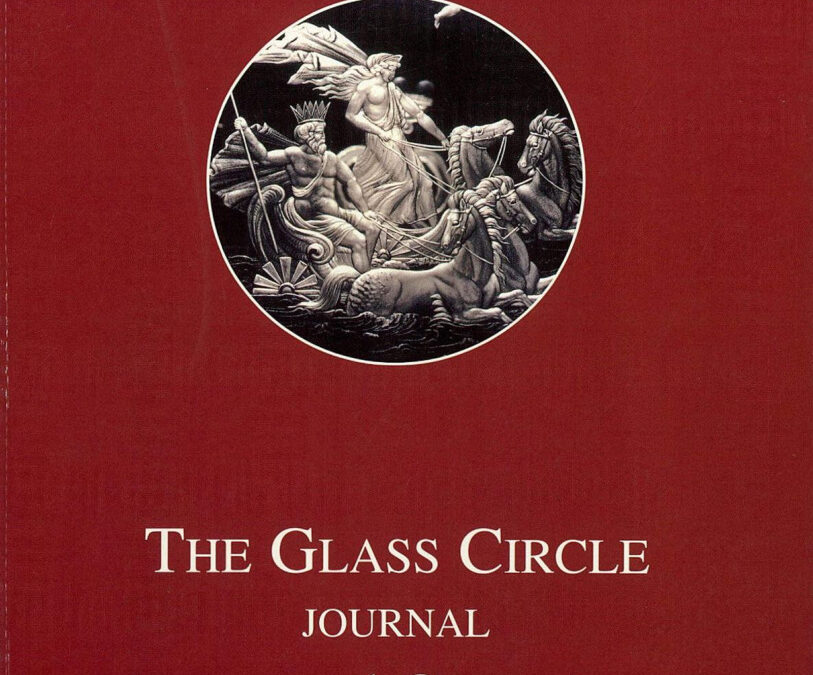
Cover illustration. Detail from jug illustrated on page 73
Designed by Print Forum Ltd
ISBN 095370304
Printed by South Sea International Press Ltd. Hong Kong
Smedmore House.
THE GIASS CIRCLEJOURML
10
Smedmore House, built by Sir William Clavell in 1620 in the Manor of Kimmeridge, Dorset, a property
bought by the family for £640 in 1554. The House, said to be owned still by the Clavell/Mansell family, now
extensively modified, is currently available as a holiday let. This picture is from an early postcard in the
author’s collection.
David C Watts
6
THE GLASS CIRCLE JOURNAL
10
David C Watts
The action taken by Sir Robert Mansell
to preserve his patent monopoly of
making glass with coal
The reigns of James 1″ (1603-1625) and Charles 1″
(1625-1649) saw the development of England’s fledg-
ling glass activity, run by independent migrant glass-
makers from Europe, into a national industry under
monopoly control at the King’s discretion. This paper
charts the action necessarily taken to preserve these
monopoly patents of privilege as recorded by the Acts
of the Privy Council (APC). The dates and quotations
given, unless otherwise specified, are quoted from the
APC which is recorded in date order.
This change began first with the King’s award (partly
for personal financial gain) of three identical patents of
privilege to Sir Jerome Bowes, to Edward Salter and to
the partnership of Sir Edward Zouch and Bevis
Thelwall. This allowed them to
“make glass with sea-
coal and not with wood”.
However, for the landed gen-
try, the sale of their woodland for fuel was an impor-
tant income and quickly led them to complain that the
terms of reference “was never understood by their
lordships to extend further than the making of glass for
windowe” (Aug. 1613). If accepted as true the wood-
fired furnaces could have continued to make table-
ware. It seems that an attempt was made to uphold this
complaint but as both Bowes and, particularly, Salter
made tableware it was hardly sustainable.
The patent was protected by an inhibition on foreign
imports and this led to further conflict as, the follow-
ing year (Mar. 14, 1614), Zouch (a favourite of the
King for services rendered in other contexts) com-
plained that
“in his letters patent is a prohibition for
the importing of any kind of glass from beyond the sea.
…. A great quantity of glasses have not only been
brought in from foreyne parts by one William Robson
but also in a violent and forcible manner rescued and
carried away by the sayd Robson and others, after a
seysure made thereof by venue and according to the
contents of the said letters patent.”
Robson, an under
farmer of Bowes (July 13, 1614), was committed to the
Marshalsea prison in Southwark for contempt but was
allowed out to defend his actions on Sept. 6th although
his final release date is not stated.
It was, nevertheless, a portent of trouble to come; the
famous Hensey and Tyzack families were particularly
targeted (Nov. 30, Dec. 12, 1614). A typical early
example must be a letter in 1615 from Sir Walter Bagot
to Sir Perceval Willoughby. It refers to the proclama-
tion (May 23, 1615) forbidding the burning of wood
for glassmaking.
“Bagot will be a loser through hav-
ing a year’s supply of wood ready cut; will not require
indemnity from the glassmakers.”
Paul Hensey, one
user there, was soon persuaded to adapt his furnace to
coal
–
firing.
“Paul Thick, (who had) set up furnaces in
the county of Staffordshire contrary to Zouch letters
patent…”
had already been condemned
“to be taken
into custody”
(18 Nov. 1614).
The list of offenders apprehended was soon increased
(12 Dec. 1614):
“Edward Hensey of North Chappell in Sussex Tobias Hensey of Auford, Surrey
Peregrine Hensey Edward Hensey of
Westbarrow Greene, Sussex
Timothe Tiswick of North Chappel, Sussex
Thomas Tiswick Daniel Hensey… for setting
up glassworks”
On the 1 December, 1614 the Acts of the Privy
7
lliE CLASS CIRCLE JOURNAL
10
Council reveal that out of the £1000 rent to Zoude and
Thelwall the following payments were to be made:
J. Bowes
£600 p.a.
E. Salter
£150 p.a.
Wm. Turner and his sister Ann Hamlyn
£150 p.a.
Wm. Robson
£100 p.a.
This to occur
“during the life of Bowes and three years
after plus rent to Turner of £1 00 to begin on the expiry
of the aforesaid payments and continue the residue of
31 years granted to the patentees.”
Zoude, in spite of
his expensive life style is now recognised as living on
a financial knife edge. The cost of enforcing his patent
must have been considerable as well as antagonising
the landed gentry, and must have contributed to the
patent being transferred to the sole control of Sir
Robert Mansell. It was the reiteration and clarification
of the terms touching the use of coal to which Sir
Walter Bagot referred. Mansell, however, also charged
with ensuring an adequate supply of, particularly, win-
dow glass took a more softly, softly approach in order
to meet the demand. Both families listed above were
probably all let off with a caution so long as they
stopped using wood. They co-operated by moving
from the Sussex Weald to London, Stourbridge and
Newcastle where they made predominantly broad win-
dow glass with coal-fired furnaces.
Similarly (Dec. 7, 1614) we find
“To fetch before their
lordships William Jenkins and Roland Ferry, workers
and makers of glass with wood in the County of
Worcester contrary to his Majesty’s grant … for con-
tempt … no more working.”
But a concession was soon being made by Mansell to
allow the use of existing wood stocks. On April 3,
1616, The Acts record that the estimate of the price of
the materials re: E. Henzey and I. Bungard was not
carried out for various reasons including
“overflowing
of waters”
(i.e. floods). Bungard and Henzey were
allowed to work for 6 and 30 weeks respectively
“and
no longer”,
all glass to be delivered to Mansell (APC
April 15). In spite of this edict we find that a year later,
on July 6, 1617 that
“Bungard to work two furnaces to
20″ August next and then one to the April following.”
This unexpected extension of the time allowed was
probably the outcome of an earlier complaint (April
23, 1617) by the glaziers of the City of London of the
scarcity of glass due to import prohibition — an addi-
tion to the Mansell patent over that of Bowes
et al.
This later (on Dec. 31, 1617) led Mansell to complain
of
“malicious persons”
underhand work to prevent his
glassmaking. Bungard was a recognised trouble maker
in this respect.
Bagot, meanwhile, continued to press his case with a
petition (Ref. 1, L.a. 295). This resulted in a letter to
him (July 16, 1617) from a Thurston Browne who had
talked to Thelwall about Bagot’s glass-making wood
and discussed the trouble with Sir Robert Mansell and
the attitudes of the Privy Council. This may have been
only one of many complaints as on April 24, 1617 Paul
Binion (Vinion) and Peter Comelie and Co. of Sussex
had been apprehended for
“making of glass contrary
to proclamation.”
Too much of the Privy Council’s
time was being taken up with glass litigation and on
Dec 10, 1618, their lordships gave a sharp reproach to
Sir Robert Mansell
`from whom wee expect a patent
reformation; that the kingdom may be better served in
that kind than hitherto it bath been.”
Mansell’s apparent response was to intimidate his crit-
ics with an unexpected attack on illegal glass imports
that he had hitherto ignored. On Mar 13, 1619/20 the
APC briefly recorded that Peter Howgill and John
Greene of the Glass Sellers “by misinformation and
under colour of his Majesty’s service for the glasses of
his house of York, procure order from his Majesty for
the bringing in of
“foreign glasse”
to the prejudice of
the patentees
“whereupon committed to the
Marshallsea — remand prisoners for sixteen weekes
and do crave for pardon etc.”
On the same day was
also recorded that
“Thomas Robinson and assignees
warranted to import French drinking glasses. Thomas
White and T Robinson before prohibition did order
“15,000 strawes of glasses” — daily expected — request
no seizure”.
A strawe is a basket or barrel of glass
(straw being the packing material) so, if accurate, this
is a phenomenal quantity of glass. The Privy Council
took urgent action with the order (March 23)
“Mansell
to keep seized and sequestered glass for inspection and
disposal by warrant and approval”
and to
“send a list
from time to time”.
Mansell’s next target (May 16,
1620) was Thomas Morley of London, Merchant who
had for three years imported from Nuremburg, in
Germany, glass of small value
“course ower glasses,
8
THE GLASS CIRCLE. JOURNAL
10
tynne glasse spectacles and dyalls”,
sent over before
they could be stopped due to the prohibition. Three
days later (May 19, 1620) the Earl of Arundell who
was
“expecting 6 chests of Venice drinking glasses for
his own use — request not seized”.
These imports, par-
ticularly of the Venice glasses, were assuming (or had
ignored) that a loophole still existed originating in the
original 1595 patent to Bowes
et al..
This allowed
imports if the realm failed to satisfy the need, although
this had been blocked by the 1615 patent to Mansell.
The outcome of these events is not recorded but, pre-
sumably, the King got his glasses and the nobility and
merchants got the threatening message!
Perhaps this episode annoyed the King for the situation
hardened against Mansell as is recorded in the
Callendar of State Papers Venetian:
April 16 1621. Girolamo Lando, Venetian
Ambassador in England to the Doge and Senate.
“Many are thinking of removing the monopoly on flint
glass, as when brought from Venice it would cost little
more than what is made here and it is considerably
finer, while it would not consume the wood in the fur-
naces, there being a great scarcity of it in the kingdom.
I have tactfully encouraged this idea.”
May 28 1621. Girolamo Lando, Venetian
Ambassador in England to the Doge and Senate.
“In the lower house after long negotiation, which I did
not fail to assist, they have decided that the glassware
from Murano may come freely to this kingdom. I hope
that the upper house will agree to this …”
1624. Letter from Edward Conway to the
Venetian Ambassador.
“Si,; Led by your Excellency’s arguments his Majesty
has thought fit to allow glass of Murano to come freely
to his realm. His Majesty has given orders to six Lords
of his Council for the expedition of this affair…”
Aug. 16 1624. Alvise Valaresso, Venetian
Ambassador in England to the Doge and Senate.
“The business of glass is all going exceedingly well, as
I am writing to the heads of the Council of Ten, the
minutes here have received all the necessary orders
and henceforward the glass can be brought here with
the utmost freedom.”
Sept. 6 1624. Senate to Valaresso.
“You have ably terminated the business of the glass,
and the opening of this trade cannot fail to be profitable
to the subjects of both.’ We are entirely satisfied.”
The above, April 16, reference to wood relates to the
prohibition of the use of coal in the City of London.
Mansell’s Broad Street tableware glasshouse would, of
necessity, continue to use wood for its furnace. The
Venetian imports would probably not have troubled
Mansell’s finances greatly as it only affected the very
top of the market. The prohibition on imports from the
Continent remained in place and would not be repealed
until 1641, just before Mansell’s patent finally expired.’
Isaac Bungard’s battle with Mansell is well outlined.’
An unexpected twist, however, emerges from his
(Bungard’s) involvement with Sir William Clavell,
landowner at Purbeck where Abraham Bigo was con-
tracted to make glass by using local sea coal. The prob-
lem here was not the fuel but Bungards’s stealing of
Mansell’s glass workers, Clavell’s reluctance to pay
overdue rent and illegally sending glass to London for
sale. On July 19, 1619, Bungard, along with Clavell
and Abraham Bigo were arrested on the order of the
Privy Council as the result of a complaint by Lady
Mansell, her husband being at sea on the King’s busi-
ness. Bungard was committed to the Marshallsea. The
case resurfaced (Feb. 9 1621) when we are told
“Abraham Bigo worked for Sir William ClavelL”
Two
days later Bungard is released (Feb. 9, 1620/21). But
on July 16 of that year the Acts reports on a letter from
Lady Mansell to Sir William Clavell who
“having
farmed certaine glass workers of her husband, Sir
Robert Mansell, (these being sent to Scotland and the
cause of the original arrest) do now refuse to answere
and pay the rents reserved upon the same…”.
Further
details emerge on Feb. 7 1622 when Clavell is ordered
to
“covenant with Mansell which Abr. Bigo had for-
merly entered in touching glassworks in the Isle of
Purbeck.”
Clavel said he had renounced his interest and agreed
the glassworks (located at Kimmeridge) should be sup-
pressed but
“acknowledge the glass brought hither
belong to him” — “belonging not as owner of the glass-
works where
made
but by some other title.”
The Board found Sir William Clavell’s allegations
“merely colorable and elusary”
and ordered the
“glassworks absolutely suppressed — glass seized to
use of Sir Robert Mansell.”
Following further delay, on June 13, 1623 the decision
on this complex case is repeated:
“Touching glass-
works in the Isle of Purbeck originally covenanted
9
THE G1ASS aRCLEJOIJRNAL
10
between Sir Robert Mansell and Abraham Bigo but
Bigo made part of his interests over to Clavell — but
rent left unpaid two and a half years and brought a
great quantity of glass to London to the value of
£300…. Clavell renounces his interest and agrees the
glassworks should be suppressed.”
Again the Privy
Council gave the order for the glassworks
“to be sup-
pressed.”
The date, June 13, 1623, is important
because it is taken as the closure of glassmaking by D.
Crossley in his excavation of the site.
It was originally thought, based on Mansell’s first
investigation of the site in 1615, that the Purbeck sea
coal was unsuitable for glassmaking but this is demon-
strably untrue as indicated both by the amount of glass
sent to London and the quality of the shards, of most-
ly poor colour, excavated by Crossley. Clearly it was
the law suit that brought about its closure and the
departure of Bigo for Ireland. Clavell, too, had clearly
been in no hurry to have his glassworks
“absolutely
suppressed”
if, indeed, it ever took place as stated. As
already demonstrated, the orders of the Privy Council
were not always carried out with any promptitude and
sometimes completely ignored, albeit at the individ-
ual’s peril. So far as the Kimmeridge furnace is con-
cerned, the excavated condition of the airways, firing
area and sieges do not indicate that absolute suppres-
sion resulted in total destruction. For the unexpected
twist comes two years later, on May 13 1625, when
“Sir Wm. Clavell, Eman Culney, Ananias Jarratt,
James Culney and Jeremy Jarratt… warranted to
come before Lordships…. Open warrant entered 5
Aug. 1624 with additions”
(presumably for Clavell’s
new associates). The Board, now getting tough, adds
“And if any of them shall refuse to become bound as
aforesaid then to send them up in safe custodie to
answer the same before the Board.”
Three days later
Clavell appears to have been detained and committed
to the Fleete prison until June 27 1625 when he was
released. Then comes the accusation (Jan. 27 1625/6)
“Anania Tarrest, Emanuel Culney and 2 others stand
committed to the custody of a messenger upon com-
plaint made of diverse contempts against his
Majestie’s patent granted to Sir Robert Mansell.
Knight, for the making of glasse and against order of
this Boarde of the 13th June 1623 whereby the glasse
house at Purbeck formerly belonging to Sir Wm
Clavell was from thenceforth to be absolutely
supressed and no more glasse made therein; ”
So Clavell, apart from a spell in prison, must have
paid the overdue rents but otherwise wriggled out of
the conflict of failing to suppress the glasshouse by
denying that the glasshouse still belonged to him. The
fate of the glassmakers is not given and it is an open
question as to whether we may assume that about this
time glass really did cease to be made and the
glasshouse finally abandoned, although not totally
demolished, some two and a half years after the origi-
nal order of suppression was given. What these reports
do indicate is that the same glasshouse was concerned
throughout. The inference follows that not only is the
closure date of the Kimmeridge furnace later and more
uncertain than previously supposed but also that some,
if not most, of the glass excavated by Crossley at the
Purbeck site was more probably made by Jarrett and
Culney and not by Bigo.
Godfrey (loc. cit.) entitles her chapter on the last twen-
ty or so years of Mansell’s patent (up to 1642) as
“Monopoly Triumphant”.
In fact, this, even if true, was
only achieved through endless vigilance on Mansell’s
part; the continuous string of transgressors prepared to
try their luck suggests local shortages were never truly
overcome and from which rich pickings might be
made. Indeed, even during the Clavell trial other
offenders were being brought to book:
Aug. 4 1622.
“…one Dormoy alias Dehow…
doth worke and made glasse at Treabone
neere Ricksome in the county of Salop…. No
further making of glass.”
Feb. 26 1622/3 Other patent offenders:
William Cokeley Bradford Stafford.
Richd. Mollineux Hawkeley Leicester.
Mrs Jane Barton & Owen Bady Denby.
And a welcome change:
May 16 1623 William Colclough —
“offend-
ing against the patent… upon satisfaction
given…set free.”
About this time (1623) Mansell’s patent was due for
renewal and on Feb. 5 1622/3 it was reported that the
Privy Council, supported by the Lords, did not uphold
Mansell’s reply
“to grievance v. glass mfr”.
but as a
good servant to the King left it to him to decide. Due
to the ill health and death of the King the publication
10
THE GLASS CIRCLE JOURNAL 10
of this decision was delayed and may, in part, explain
Clavell’s actions in ignoring the ruling of the Privy
Council. There also followed an outburst of action
from Bungar.
June 19 1626
“Mansell upheld v. complaint
from Bungar to make glass. Bungar not to
make glass.”
Oct. 29 1626 Isaac Bungar another petition
v. Mansell.
Dec. 6 1626 Bungar told
“not to further trou-
ble his Majesty or to attempt anything against
this or former orders upon pain of punish-
ment.”
Ten days later (Dec. 16 1626) was recorded: His late
Majesty King James was
“graciously pleased as well
as in consideration of the great charge, expense, haz-
ard and disbursement which Sir Robert Mansell had
undergone — beene at in bringing the mfr. of glasse
with seacoale to that state of perfection it is now in…”
and also in recognition of his
“good and faithful serv-
ices”
the patent was renewed from the 22″ May in the
21″ year of his Reign for 15 years.
The strictures against Bungar were also repeated but,
significantly, there was no reference to the inhibition
of imports or the question of glass coming from Venice
as mentioned above. The Lords had, at least, won a
minor victory.
Transgressions of the patent quietened down after this
with only one record, in July 3 1627
“Open Warrant…
to bring Owen Brady and James Legree of the County
of Denbigh and Caesar Bristow and Wm Sleigh of Co.
of Lancaster before Lordships — glass business.”
This gave Mansell the opportunity to test the legal sit-
uation regarding imports from the Continent:
Mar. 30
1628 “Nicholas Paine of Dover
Merchant 2 yrs since sent merchandise to
Dunkirke in Flanders & 12 months since
other goods to Calais — recd. In exchange
8 packs or cases of Lawne
360 dozn of Bridges thread
400 dozn drinking glasses
Through friend kept from seizure but now
likely to be lost.”
Lost, they presumably were for on June 25 1630 his
Lordships recorded;
“Re Mansell petn. Order of 5 Feb.
1622/3 referred only to Scotland…. Orders that all
importar Of drinking glasses looking glasses and
Spectacle glasses into his Majesty’s Realm of England
from any parts whatsoever be prohibited, excepting
only glasses made at Venice and Moran of the afore-
said nature whence it shall be free to import as former-
ly”
Continuation of the concession against Mansell was
perhaps influenced by the fact that he had tried, to
develop this side of his patent by bringing over 14
Italian glassworkers. But on Apr. 2 1630 it was report-
ed that
“the Italians brought over by Mansell for the
manufacture of glasses had run away”
They were list-
ed as:
Jacopo Sepoman
John Maria
Venziso Castelana
Dominico Maria
Cornelies Vesintello
Reco Jainon
Christophel Forcio
Francisco Bynndo
Francisco Ballanata
John Rygo
John Rushawe
Amoro Gilioll
Francisco Revanello
Nicholas Rygo
A reference to Scotland concerned a concession made
by the Privy Council to Sir George Hays (partly organ-
ised by Bungar) allowing the import of glasses made in
Scotland in respect of which Mansell had received a
remit of £2800 (APC 18 June 1621). This was partly
because Sir George’ controlled the only known supply
of sulphur-free coal, thought at that time to be the only
suitable fuel for a coal-fired glass furnace. The situa-
tion was revolutionised by the discovery of suitable
coal in Liverpool by Lady Mansell while Sir Robert
was at sea.
The reciprocal concessions between Venice, Murano
and England reflected their importance both as trading
partners and the growing desire by the English estab-
lishment for the high quality glassware produced there.
It allowed John Greene, on behalf of the Glass Sellers,
to make his famous order in 1668 to Allesio Morelli
for specific types of Venetian glassware; and it was
this trading relationship that took the Ravenscrofts to
Venice (although not for glass) and ultimately led to
the development by George Ravenscroft of lead crys-
tal. Without Mansell, the coal-fired furnace, the inclu-
sion of saltpetre in the batch and closed pots to control
the effect of smoke on the colour of the glass’ and the
political intrigue that accompanied all these activities,
the invention of lead glass and the dominance of the
English industry in the 18″ century would never have
11
Small bottle point-engraved on one side with a rose and bird
and on the other with the name, Ruth Clavell and the date
1688
David C Watts
Detail of the name and date on the bottle. Ruth Clavell was
probably a grand-daughter or great-grand- daughter of Sir
William and was married to Roger Clavell. This Ruth has a
son, Roger, baptised 28th October, 1667, and a daughter,
Elizabeth, baptised 18th March 1668, both in the church of
St. Michael and All Angels, Parish of Steeple, Dorset.
Information from the Dorset Record Office records tran-
scribed by Mr. Barry Chinchen and recorded on:-
https://www.dorset-opc.corn/SteepleBaps1548-1700.htm.
The bottle is in the collection of the Cecil Higgins Art
Gallery and Museum, Bedford. The pictures arc from the col-
lection of the late Hugh Tait who designed the museum’s
glass display.
THE GLASS CERCLEJOURNAL 10
happened. But whether the glass industry of this peri-
od, or even the monopoly under Mansell, should ever
be described as “triumphant” is open to doubt.
References.
1.
Letter L.a.144. For a list and summaries of the letters
relating to the Bagot family see
.https://shakespeare.folger.edu/other/html/dfobagot.html
2.
One of the glass making developments that benefited both
countries was the production of ground glass plates for win-
dows for carriages. The first reference to their use in Pepys
diary is 24th July 1665 “…
and there we would sleep all
night in the coach in the Isle of Dogs:… and with great
pleasure drew up the glasses.”
Such window glasses were
not toughened and Pepys refers to their dangers
in
his Diary,
23″ August, 1667.
“Query whether a glass coach would have
permitted us to have made the escape, neither of us getting
any
“;
23rd Sept. 1667,
“Another pretty thing was my
Lady Ashley’s speaking of the bad qualities of glass coaches;
among others, the flying open of the doors upon any great
shake; but another was, that my Lady Peterborough being in
her glass coach, with the glass up and seeing a lady pass by
in a coach, whom she would salute, the glass was so clear,
that she thought it had been open, and so ran her head
through the glass.”
John Evelyn also had a narrow escape;
Diary 17th November 1666, Rochester, Kent.
“1 returned to
Chatham (from Leeds Castle), my chariot overturning on the
steep of Bexley-Hill, wounded me in two places on the head;
my son, Jack, being with me, was like to have been worse cut
by the glass; but I thank god we both escaped without much
hurt, though not without exceeding danger”.
3.
Godfrey, E.S., The Development of English Giassmaking
1560-1640, Univ. N. Carolina Press, Chapel Hill, 1975.
4.
Crossley, D., Sir William Clavell’s Glasshouse at
Kimmeridge, Dorset: The Excavations of 1980-81. Archaeol.
J. , 144 (1987), 340 — 382.
5.
Lord High Chancellor of Scotland 1622, raised to Earl of
Kinnoul in 1633 by Charles I.,
d.
1634.
6.
Watts D.C., Why George Ravenscroft introduced lead
oxide into crystal glass Glass Technology, vol.31, No. 5,
1990, 208 — 212.
12
THE
CLASS CIRCIEJOURIW.
10
G. B. Seddon
One of four Jacobite Glasses at Traquair, 6 1/2 inches high,
engraved with a rose and two buds, oak leaf and star.
Suggested by the author as being one of the
’16 Rose wine glasses’
first inventoried in 1764.
14
THE GLASS CIRCLEJOURNAL 10
F. Peter Lole
The eighteenth-century glass bills and
inventories at Traquair House
Introduction
Traquair House is claimed to be the oldest continuous-
ly inhabited house in Scotland. It lies in the Tweed val-
ley, a few miles downstream from Peebles and about
thirty-five miles south of Edinburgh. Originally a
Royal residence, it was granted to the Stuart family at
the end of the fifteenth century, and the great grandson
of the first Stuart Laird was created Earl of Traquair in
1633; the peerage died out with the bachelor 8th Earl in
1861, and the House has since then descended several
times through the distaff line, to the present 21″ Laird,
Catherine Maxwell Stuart. The pattern of glass pur-
chases changed widely with different generations, so
that a little genealogy is essential to the understanding
of the glass.’
Traquair is open to the public during the season, and is
redolent of Jacobitism, to an extent probably greater
than in any other house in Britain. There are displays
of portraits, prints, miniatures, archives, textiles and
glass that all celebrate the exiled Stuart kings. The
Earls of Traquair were Roman Catholic in religion and
Jacobite by conviction; successive generations had
been educated or lived for a period in France, had been
imprisoned for their adherence to the exiled James II
and James III, and had subscribed to
the
cause and
been open and unequivocal over their allegiance.
However, they were not entirely reckless, and in nei-
ther the ’15 nor the ’45 did they take the final step of
supporting the Stuarts in the field, so that although
imprisoned on suspicion there was never sufficient evi-
dence for the estates to be forfeited. Amongst the sur-
viving Jacobite glass is an
AMEN
Glass, with its ded-
ication of
“Prosperity to the Family of TRAQUAIR”,
and which is the only
AMEN
Glass to remain today in
its true and original home, although unfortunately I
discovered nothing in the archives that might relate to
this particular glass.’
Some ten years ago an archivist was appointed to put
into order the mass of family papers that remains in the
house; I have been generously allowed access to the
archive, with the assistance of my wife, for three spells
of two days each in order to abstract glass particulars
and related matters. Since access is only possible dur-
ing the winter, whilst the house is closed to the public,
the task of study and recording abstracts of the relevant
bills can be distinctly chilly, with only interesting finds
to bump up the temperature.
A summary of the purchases revealed by the surviving
glass bills is as follows:
Drinking
Glasses.
Dessert
Glass.
Finger Bowls
(Water or Wash
Cups)
Cruets
Decanters
Salts
TOTAL Lighting
TABLE Glass
GLASS.
Odds
Bottles
1701-25
8
15
2
25
245
1726-50
256
120
12
5
4
6
403
522
1751-75
172
35
32
3
6
4
252
13
6
494
TOTAL:
436
170
44
10
10
10
680
13
6
1,261
*Also a considerable amount of wine was bought in bottles
15
THE GLASS CIRCLE JOURNAL 10
In addition to the glass bills there are six inventories,
dating from 1749 until 1778. These inventories are
idiosyncratic, to say the least, and are more concerned
with household bedding and linen than anything else;
what else is included or excluded from an individual
inventory seems very arbitrary. Only four of them
relate to Traquair itself, the other two being concerned
with the family house in Edinburgh; nor do all the
inventories record glassware. It is clear from the glass
recorded in the inventories that not all the glass bills
survive, and some of this additional glass very proba-
bly came from the London glass-sellers. With one
minor exception all the surviving bills relate to sup-
plies from Edinburgh, (from whence there are regular
carriers bills) or latterly from Peebles, the neighbour-
ing market town.
This survey covers the years 1701-1784, inclusive. All
the glass bills discovered in the archive have been
recorded, and are included in Appendix I, although vir-
tually no glass was purchased after 1773. For other
subjects a rather sporadic abstraction was made; this is
especially true for the large amounts of drink pur-
chased, although I have attempted to note an adequate
and typical sample to establish the pattern of consump-
tion, costs and some slight idea of quantity. Since this
survey was concluded I discover that there are also in
the Traquair muniments account books which record
some purchases for which bills do not survive;’ brief
consideration is given to this below when discussing
dessert glass.
Since so much of this paper is concerned with prices,
the usual rates of pay for day labourers and more
skilled workers at Traquair are useful. Casual study
suggests that these rates were fairly constant through-
out the eighty years of the survey. Specific rates in the
1760s gave day labourers 8d, or more usually 10d. per
day, semi-skilled men 12 or 13d. and skilled masons
15d. Since the unskilled day labourers were far more
numerous than the more skilled men, the arithmetic
average was 11d. per day, not quite enough to buy two
`standard’ wine glasses. Women fared much worse,
with the washerwomen getting 4d. per day, and the
`clothes smoothers’ who worked with them only 2d. It
is thus hardly surprising that for most of the 18th-cen
tury drinking glass did not feature in the life of a work-
ing-man.
Scots
Money and Measure in the 18″‘ Century
Before the Act of Union of 1707, Scots money
although designated as Pounds, Shilling and Pence,
was worth only one twelfth the value of Sterling; con-
sequent upon the Union, Sterling became the legal ten-
der, although £Scots continued in use for a consider-
able period. The last purchase that I noted expressed in
£Scots was in 1724. However, for financial transac-
tions £Scots continued much longer; Lord John
Drummond, son-in-law of the 4th Earl, was in 1729
paid £50 sterling as interest on his outstanding mar-
riage settlement, but intriguingly the equivalent pay-
ments in 1735 and 1738 were expressed as £600 Scots.
Government, always too fond of enjoining others to do
what it itself fails to do, provides the last instance
noted of the old form of payment; a pro-forma printed
receipt from the
‘Edinburgh Cess-Office’
(cess was the
Scottish property tax; the Cess-Office must not be con-
fused with a cess-pit) for the year
177
% and again in the
following year, acknowledges receipt of
“£12.3.0
Scots or f1.0.3 Ster1″
for the Traquair House in the
Canongate, Edinburgh.
All values noted in this paper have been expressed in
£Sterling, where appropriate using the exchange rate
of £1 Sterling = £12 Scots. Where a bill was priced in
£Scots this is noted in Appendix 1. In some cases the
extension of the bill from a weight at so much per lb to
a total value is incorrectly calculated; this is particular-
ly the case for the 1733 bill. The unit prices have been
calculated by dividing the total cost by the number of
items, and are expressed in ‘old’ (pre-decimalisation)
pence: d.
Scots volume measures were, by contrast, greater than
the nominal English measure; the Scots pint was three
times greater than its English equivalent, so that the
very first entry on Appendix 1, for a Pint bottle @ 7d.,
was for a large bottle of 1.7 litres capacity, justifying
its high cost. The measures encountered in these
records are:
1 Mutchkin =
3 Imperial Gills = 0.42 Litres
1 Chopin =
2 Mutchkins = 1.5 Imperial Pints = 0.85
Litres
1 Pint =
2 Chopins = 3 Imperial Pints = 1.7 Litres
16
THE GLASS CIRCLE JOURNAL 10
English measure is given as ‘Imperial’, even though
the legislation defining Imperial measure was not
enacted until 1824. English 18’h-century measure was
also variable, the Ale Gallon being 4.62 litres, whilst
the Wine Gallon was only 3.78 litres, differences that
were in force until the Imperial Measures Act of 1824
established the Gallon as 4.546 litres. (In 1700 the
Excise authorities in London prosecuted a wine
importer for avoidance of duty by declaring his vol-
ume on the Ale Gallon, although the Excise had used
the smaller Wine Gallon for many years; when it
became clear that the Excise had been working
improperly and had no case, the law was changed to
legalise their stance.) In 1824 the ‘Reputed Quart’
wine bottle of 0.757 litres was recognised as the stan-
dard, but was confusingly only
3’3
of the Imperial
Quart.’ Whilst nominally it is only 89% of the Scots
Chopin bottle, analysis of 68 British 18’h-century bot-
tle capacities cited in Van den Bossche suggests that by
far the most common capacity range was 0.8 — 1.0 litre
(27% of all measurements; no other grouping spanning
0.2 litres exceeds 17%) so that for practical purposes
the Scots Chopin and the English (reputed) Quart bot-
tles may be regarded as interchangeable.
6
The size of bottles purchased for Traquair were by no
means always defined, but where capacity is given it is
most commonly Chopin sized (0.85 litres,) with
Mutchkins being only half as frequent. There is no
record of sealed bottles being purchased.
The most common unit by which wines and spirits
were purchased at Traquair was the Hogshead (or a
fraction of it). The Hogshead has a capacity of 63 Wine
Gallons (238 litres.) For smaller quantities the Scots
Pint (1.7 litres) was often used.
The Bills
(A full transcription of all glass bills is
given as Appendix 1)
When paid, the bills are endorsed and dated ‘dis-
charged’ together with brief details on their reverse and
docketed into annual bundles. The household bills are
divided into six subgroups, or ‘Branches’, but items of
interest may appear in more than one subgroup, so that
all were scanned, albeit some very cursorily. The bills
are generally in very good condition and most are eas-
ily legible; the exception is for the decade 1730-1739,
since at some stage these bills have been stored in
damp conditions. This has caused considerable dam-
age, some bills being very fragmented, and others
extremely difficult to read and one suspects that some
have completely disintegrated. The archivist believes
that for the period 1740-1770 the bills are substantial-
ly complete, although the unarguable evidence for
glass acquisitions not represented in the bills is dis-
cussed below, in connexion with supplies from
London.
To my surprise, in only one case (1763; Wm Ritchie)
is any of the forty-eight bills concerned wholly with
table glass. In all other cases glass is only an incident
amongst a wide range of goods. In nearly all other
glass bills that I have encountered the bill has been
wholly or substantially concerned with glass, and
where other goods are encountered they are invariably
ceramics. These are of course relatively easy to photo-
copy and disseminate, whereas trying to photocopy all
the glass entries at Traquair would be a nightmare; thus
the abstract is confined
to
my notebooks, with some
risk of an inaccurate transcription. Even where I have
consulted other original bills, as at Blair Castle, they
have been pre-sorted into a ‘glass and China’ category;
the evidence of the Blair Castle inventories is that not
all the glass purchases are recorded by these bills, and
I suspect that a search amongst other categories of bills
for groceries, drygoods and household supplies might
yield more glass, as at Traquair.’
The glass bills are
all
in manuscript, and indeed there
are very few printed bill-heads amongst the whole
archive, the only glass related one being that of Francis
Brodie, of Edinburgh, and this particular one contains
no glass items.’ There are a number of official taxation
pro-forma receipts in letter-press form (carriage, cess,
malt, plate, window tax etc.) and there are also pro-
forma printed invoices for freight forwarding from
Newcastle-on-Tyne, and for Newspaper subscriptions.
17
THE GLASS CIRCLEJOURNAL 10
The Inventories
(Numbers in brackets refer to sec-
tions of Appendix 2)
As noted in the introduction, there are six somewhat
erratic 18′-century inventories in the archive, none of
them priced; thus they were simply to identify plenish-
ings belonging to the family, and only four of them
make any mention of glass. The first two occur in
1749, as a pair similar in format and written by the
same hand; they were made when the seventy-seven
year old Dowager Countess Mary left Traquair. She
initially lived at The Binns, a house a dozen miles out-
side Edinburgh, but moved again in 1754 to live in a
house in Edinburgh’s Canongate,
9
for which a Window
Tax receipt reveals twenty five windows, making it
quite sizeable. One of this pair of inventories relates to
the House of Traquair and omits glass, whilst the other
(2.4) is an
‘Inventory of Beds Blankets &c Bed Linnen
& Table Linnen Belonging to The Right Hon” Mary
Countess of Traquair 1749’
and does list twenty-five
pieces of glass; the similarity of form between the two
inventories suggests that the Dowager’s property was
listed at Traquair, before her departure, rather than at
her new home. An inventory of 1763 for the Canongate
house, then occupied by
“The Ladys of Traquair”,
fol-
lowing the death of the Dowager in 1759, unfortunate-
ly also omits any glass; the occasion for taking this
inventory is unclear.
“The Ladys of Traquair”
were
the surviving spinster daughters of the Dowager, sis-
ters to the 5th and 6th Earls, who were of a family of sev-
enteen children, thirteen of whom were girls; only two
of them married. Both this inventory and that of 1749
for Traquair House itself list quite explicitly Jacobite
portraits and prints hung in the two houses, many of
which may still be recognised today at Traquair, and
emphasize the openly Jacobite leanings of the family.”‘
The remaining three inventories, all for Traquair
House, are of considerable help in unravelling the
glass story. The death of the 5th Earl in 1764 occa-
sioned the first (2.1) He was succeeded by his sixty-
five year old brother, as 6″ Earl, who was far less con-
cerned with the purchase of glass than his two prede-
cessors; but then, he had had his own establishment at
St. Andrews for many years before his return to
Traquair. A modicum of glass that was sent from his
old home back to Traquair is recorded in a brief note:
“Sep 1764 —
comes from St. Andrews”
in which is list-
ed:
“2 crystall cruets”
but no other glass. In 1773 his
son married, as noted below in connection with Mr.
Allam the London factotum; the Earl so disliked his
new daughter-in-law that he departed permanently for
France the following year, occasioning the 1774 inven-
tory of Traquair (2.2). This listed some drinking glass,
much of which can be related to the previous invento-
ry, but inexplicably omits all mention of dessert glass-
ware. What inspired the third (2.3) of this series, in
1778, is uncertain, for the 6′ Earl did not die in Paris
until the following year. However, Teresa Conyers,
widow of the 5th Earl died in 1778; as an heiress in her
own right her death might have occasioned the inven-
tory. Dessert glass also reappears in this document.
The sequence of glass in these three inventories, span-
ning only fourteen years, is quite important for they
reveal significant amounts of glass not included
amongst the bills, and also detail what is apparently a
large set of Jacobite glass that is explored below.
An Edinburgh house was rented in 1761 by the 5″ Earl,
from Miss MacKay, daughter of the late Lord MacKay.
An inventory for this house, signed by Miss MacKay,
despite having some glass is included here more as a
curiosity than as being germane to our story, although
perhaps one should draw attention to
“2 Mahogany
Bottlecases”.
This is the only reference to this house,
so it was presumably a short lease; the inventory
appears as item 2.5.
Glass Purchases
by Different Family Members
The changing volume of glass purchases illustrates
vividly how acquisitions are governed by family cir-
cumstances and different preferences between genera-
tions, and not just by the dictates of fashion, availabil-
ity or need. The 4″ Earl (1659-1741) was father to both
the 5’ (1697-1764) and 6
1
‘(1699-1779) Earls. He mar-
ried their mother, Mary Maxwell, in 1694; she outlived
her husband by eighteen years, and whilst living in
Edinburgh for the last ten years of her life was an avid
purchaser of glass, as were her husband and eldest son.
Her younger son, the 6′ Earl, however purchased
much less, and the only surviving glass bill for his son,
the 7’ Earl, is for
‘a water glass for a birds cage’
in
1782! Even this was bought by the Traquair household
in his absence, for like his father he migrated to the
Continent, travelling to France in 1780 and then
18
THE GLASS CIRCLE JOURNAL
10
remaining on the Continent until his wife died in
Madrid in 1796, whereupon with the increasing threat
posed by Napoleon he returned to Scotland in 1797.
Thus after the death of his father the 6th Earl in 1779,
Traquair House was on a care and maintenance basis,
and glass no longer mattered for the remainder of the
18’h century.
but from general merchants, predominately in
Edinburgh. In 1721 there was a significant purchase of
dessert glass from John Boddie, whose bill included
large amounts of grocer’s drygoods, such as currants
and raisins, anchovies and candied orange and citron
peel, preserved plums and similar goodies, This was
followed a dozen years later, in 1733 by an even more
Drinking Glass
Dessert Glass
Total
Average Purchase
Table Glass
per Year
Charles, 4′” Earl;
128
57
192
5
pieces
Purchases 1701-1741
Mary, Dowager 4° Countess
95
30
140
14
pieces
Purchases 1749-1759 (in Edinburgh)
Charles, 5th Earl;
221
83
310
13
pieces
Purchases 1741-1764
John, 6° Earl;
36
38
4
pieces
Purchases 1764-1773
(His last recorded purchase was 1773; the following year he moved permanently to France, where he died in
1779)
The pattern for the 4″ Earl was very uneven, with two-thirds of his purchases being concentrated into the last
decade of his life, thus:
Purchases 1731 — 1741
74
42
122
12
pieces
(out of the total of 192 above)
Whether it was fashion or econoomics that lay behind
this substantial increase in glass purchasing in his
eighth decade is impossible to say. Perhaps his wife
influenced things, for she too continued to acquire a
substantial amount of table glass until her final year.
The 5′ Earl and his Dowager mother were the only
members of the family recorded as purchasing
engraved glass. However, they must also have
acquired the Jacobite glass recorded in the 1764 inven-
tory, probably during the 1750s, although only two
bills survive for engraved drinking glass: (Alexander
Hunter; 1757)
‘1 engraved strong Ale Glass’;
(Alexander Hunter; 1758)
‘3 Ingrav’d enamled Strong
Ale Glasses’.
Since the 1764 inventory records 24
engraved glasses, these must have been acquired either
by the Earl or his mother.
The Suppliers
As already observed, the Traquair purchases for which
the bills survive came not from specialist glass-sellers,
significant acquisition of dessert glassware from John
Brodie, who also provided groceries. The most impor-
tant supplier, who between 1737 and 1755 purveyed
groceries and a variety of household supplies to the 4′
Earl, and after his death, both to the 5″ Earl and the
Dowager Countess, was Patrick Ross of Edinburgh,
who was clearly aided by his wife, for on occasion
Isobel signed a discharge on his behalf, and she
became the principal in the business in 1752, presum-
ably after her husband had died. The couple supplied
in this eighteen year period some 370 pieces of glass,
although in both quantity and value groceries and other
supplies very much exceeded glass; indeed, one had to
scan the bills quite carefully to find the glass purchas-
es.
On the 29
1
” July 1746, three months after the battle of
Culloden, the 5′ Earl was committed to The Tower of
London where he remained incarcerated until February
1748.
11
He had not borne arms for Prince Charles dur-
ing the Jacobite Rising, but was arrested for his earlier
involvement with The Cause on information supplied
19
THE GLASS CIRCLEJOURNAL
10
under duress by Mr. ‘Evidence’ Murray of Broughton.
As no formal charge was ever laid against the Earl he
was never submitted to a trial, although following his
initial release on punitive bail of £30,000 he was not
formally discharged from bail until early in 1749. This
difficult period is interestingly mirrored in a bill of
Patrick Ross, who allowed the Earl 3
I
A
years credit at
this time, detailed in his bill of nine pages, covering
about 330 separate entries amounting in total to
£101.5.2 1/2 and which ran from May 1746 until
September 1749. Even whilst he was in the Tower the
Earl, or more probably his mother, acquired
“a dozen
worm ‘d Glasses”
the first purchase of the now fash-
ionable air-twist stems.
In 1761 there is a bill from the general merchant,
Thomas Trotter, who supplied the Earl with
“18
Mason Glasses”.
Being priced at only 6d. apiece,
these cannot have been engraved and one takes them to
be Firing glasses; four years previously the Dowager
Countess had bought
“12 wormed stalked Bumper
Glasses”
also at 6d. each, from Alexander Hunter of
Edinburgh. Three bills are also extant for glass from
Thos. Trotter to the Duke of Argyll, dated 1751, 1754
and 1759, which include not only drinking glasses but
also two complete dessert pyramids.’ However,
Trotter’s greatest claim to fame is that in the 1750s he
founded a dynasty of Edinburgh cabinet makers that
survived until 1852, and whose renown and proficien-
cy gave it an unchallenged and dominant position in
Scottish furniture making throughout the late Georgian
period.” A continuing commercial interest in fine glass
is evidenced by the 1828
‘Edinburgh Ahnanack’,
where William Trotter of Ballendean is listed as
Chairman of the Directors of The Edinburgh & Leith
Glass Company, amongst whose Directors was also Sir
Walter Scott.
Unfortunately, one did not record all the shipments of
goods from London to Traquair, but between 1724 and
1779 more than twenty such shipments were noted,
half of them being transhipped at Newcastle onto a dif-
ferent vessel to Leith. Those that were abstracted were
predominately between 1759 and 1769, but in our first
session of recording, covering the period between
1730 and 1759, such shipments were ignored. Of ship-
ments that were noted, only those from Thomas Allam
in London were supported by the original bills; these
amounted to less than one quarter of the total and
included lighting glass (see Appendix 1. Allam; 1755,
1760, 1762). Allam, between 1755 and 1769, acted as
a London purchasing and forwarding agent for a wide
variety of goods; he may indeed have been more than
a mere tradesman, for in 1773, Charles Stuart (who six
years later was to become 7th Earl) was married to
Mary Ravenscroft by special licence at the London
house of Mr Allam, near Hanover Square:
4
The other
London consignments are evidenced only by a note of
freight or transhipment charges, or of carriage and han-
dling charges from Leith. Probably these undefined
consignments may help to explain the source of the
glass recorded in the Inventories discussed below, for
which no bills exist.
The first recorded supply of glass from a trader in the
local market town of Peebles was in 1759, from Jno:
Alexander, who was principally a milliner. In 1772 and
again in 1773 there are purchases of glass, groceries
and general provender, together with significant
amounts of wines and spirits, from William Oram,
Merchant in Peebles. These are effectively the last 18
6
–
century glass transactions to be recorded in the house-
hold bills remaining at Traquair.
THE GLASS
Sales by Weight
Unexpectedly, between 1726 and 1754 there were
eleven bills that had some, or all, of the glass sold
priced by weight. In total 179 pieces of glass, or slight-
ly more than a quarter of all the glass purchased, was
priced by weight. I know of only one 18
6
-century
London bill (1714; from Bridgman’) where glass is
priced by weight, as are two other Scottish bills of the
1750s from Thomas Trotter to the Duke of Argyll for
footed salvers.’ There is also in 1746 a bill of lading
from John Cookson & Co. of South Shields, for 354
glasses shipped to Bergen and charged by weight; as
one would expect for Trade Goods sold wholesale, the
price per lb for these is distinctly lower, allowing for a
mark up of about 30% to reach Edinburgh retail
prices.” The price list of 1798 for T. & G. Hawkes of
Dudley mentions Flint glass being sold by weight,”
and Jill Turnbull notes other price lists between 1777
20
11-IE GLASS CIRCLE JOURNAL
10
and 1845 specifying glass priced by weight, and also a
few Edinburgh bills of around 1800.’
9
The unit price per lb fell fairly steadily throughout the
thirty years spanned by these Traquair bills; interest-
ingly the much-vaunted 1745 Excise Tax imposition
had an almost negligible effect. Wormed (air-twist)
glasses carried a premium of 2d. per lb over plain
glasses (this is also the case with the Cookson exports.)
Salvers, and some dessert glass, carried a very high
premium, being almost double the price per lb of plain
wine or beer glasses. Most of the bills priced by weight
also had glasses quoted by unit price; some, like the
1733
“Fine top glass”@ 36d. each, one can under-
stand, for they have much more manipulation than
usual, but why the
“32 Alley glasses”
on the same bill
should command 27d. per Ib when
“4 Beer glasses”
were priced at only 16d. per lb seems much less obvi-
ous. Another interesting point in 1737 is that
“2 pol-
ishd. glass Decanters with ground stoppers”
are priced
at 16d. per lb, equal in price to wine and beer glasses
in the same transaction; by
‘polish’. glass Decanters’
I
understand the bases to be ground flat, usually quite an
expensive operation; presumably the Decanters are so
massive (at 2 lb 4
Y2
oz. each they weigh as much as six
wine glasses) that the high cost of lapidary grinding
and polishing can be accomodated.
The prices per lb were as in the table below; the two
bills for salvers sold by Thomas Trotter have been
added in [brackets] for comparison.
Soda and Tale Glass
There are a number of prices for glasses that are
uncharacteristically low; by this I mean that the unit
price is 4d. or less, in comparison with a ‘standard’
wine glass at about 6d. In a very few cases the bill
identifies these as ‘Tale glass’, which is usually taken
as being the last of the metal, presumably of standard
lead glass, in the pot. However, the bill of 1726, given
in the above tabulation of sales by weight, enumerates
12 wine glasses that weighed only 4 oz. each, and were
charged at 3d. each, whilst the price per lb was only
three-quarters of that for ‘standard’ wines glasses; the
same bill also included
“12 Fine Wine glasses”
that
weighed 7 ounces each and were charged at 6.7d. The
average weight of ‘standard’ Lead glasses in my own
collection is 6
V2
oz., with only a few falling outside the
range 5-8 oz. The inescapable conclusion is that the
cheaper, lighter glasses were of soda (or potash) glass.
The three bills for glass from Peebles merchants in
1759, 1772 & 1773 include within their total: 3 dozen
wine glasses, 1
Y2
dozen water glasses and 4 punch
glasses, all at 3d. or 4d., and must represent soda glass,
presumably for general everyday use. The 1773 bill
from Peebles also enumerates some
“crystal” items,
at
commensurately higher prices.
In all there are 72 of these cheap, light-weight drinking
glasses, representing a not inconsiderable 16% of their
types. In addition was a purchase in 1729 by the Hon.
John Stuart, who 35 years later became the 6′ Earl, of
“26 small Glasses”
at 1d. apiece; I am uncertain what
Price per lb:
Glasses/Wine Glasses
/Ales/Beers/Tumblers
Wormed
Wines/Beers
Salvers
& Dessert
Soda
Glass?
1726
16d.
21
1733
16d.
27d.
1737
16d.
1738
14d,
1739
12d.
1746
l 4d.
1748
l 4d.
1750
I 2d.
14d.
1751
14d.
[24d. Trotter]
1753
I 2d.
1754
14d.
[24d. Trotter]
(For full details see Appendix 1.)
21
ThE CLASS CIRCLE JOURNAL 10
to make of these, but they must be very small. An inter-
esting question is whether this unexpectedly high pro-
portion of soda glass was an especial Scottish feature,
or was true for the whole country? In 1735 Glisson
Maydwell of London sold to Alderman Hoare 12
glasses at 4.5d. and another 12 at 4d;” these were prob-
ably soda glass, and there are other instances of
unusually low priced glassware from London dealers
in the mid-18th century, although certainly not on the
scale of the Traquair purchases.
Drinking Glasses
The pattern of purchases, by quarter century, together
with:
(the average price paid,)
is given (in the table
below:
five ale glasses noted in the bills, all of them qualified
by a description,
thus:
Large Ale
6
(15.2d.)
Long Ale
4
(8d.)
Strong Ale 11
(/
Od.
un-engraved)
(I4.8d.
engraved)
Flute Ale
4
(8d.)
Total
25
These various descriptions accord well with glass that
collectors nowadays call ‘ales’. Related to ales and
beers are the
“Tumbler Glasses”,
although for what
beverages they were used remains speculative; one is
tempted to suggest that they were used for spirits. They
too occur on the same bills as both ales and beers, sug-
gestive of a specific purpose. An interesting variant is
the
‘Ox eye Tumbler’,
which occurs in 1744 and 1751
Quarter I.
1701- 25.
Quarter 2.
1726-50.
Quarter 3.
1751-75.
TOTAL.
Soda Glasses:
2
(3.5d.)
38
(2d.)
58**
(3.3d.)
98
Glasses (Crystal / Flint):
2
(12d.)
24
(6.5d.)
20
(5.8d.)
46
Wine Glasses:
4
(9.5d)
126
(6.3d.)
48
(6.1d.)
178
Mason / Bumper Glasses:
30
(6d.)
30
Beer Glasses:
38
(I0.9d)
3
(11.7d.)
41
Ale Glasses:
8
(13.4d.)
13
(9.5d.)
21
Engraved Ale Glasses:
–
4
(14.8d.)
4
Tumblers:
22
(6.4d.)
9
(6.2d.)
31
Mugs, beakers:
–
5
(6.4d.)
5
Water Glasses
12*
(11.8d.)
14
(8.4d.)
26
TOTAL:
8
268
204
480
* These 12 include
“Plats”,
i.e. stands
** 18 of which are water glasses
The trend is towards lower prices for most types of
drinking Glass as the century progresses, demonstrat-
ed by the progressively lower price per lb noted above.
However, for both ‘Glasses’ and ‘Wine Glasses’ the
unit price in the first quarter of the century is greater
than is explained by the later general reduction, sug-
gesting that the few glasses purchased in this period
were large, and perhaps of the baluster family.
The bills do little to elucidate the difference between
beer and ale glasses; since Patrick Ross’s 1749 bill
includes both
‘large Beer Glasses’ @
14d. each, and
‘long Ale Glasses’ @
8d.
each, there must have been a
distinction. There are nine transactions for the twenty-
on Ross’s bills; since they were priced at only 6d. they
cannot have been engraved, and the term must refer to
their form rather than to added decoration.
Origin of the Lead Glasses
As Jill Tumbull has shewn, for most of the period
under consideration Scotland was not producing lead
glass, so that this was being imported from England.
Comparison of average prices for ‘standard’ wine
glasses in Edinburgh and London suggests a slightly
higher price in Edinburgh, by between two and five per
cent over the London price. This premium probably
represents the transit costs from London or Newcastle.
22
THE GLASS CIRCLE JOURNAL 10
Actual price comparisons are:
Average Price
(Quantity)
Quarter 2 (1726-1750)
London
Edinburgh
Wine Glasses
6.0d.
(67)
6.3d.
(126)
Glasses
6.2d.
(22)
6.5d.
(24)
Quarter 3 (1751-1775)
London
Edinburgh
Wine Glasses
6.0d.
(294)
6.1d.
(48)
Glasses
5.8d.
(20)
The bills do not allow accurate estimates of freight
costs on glass shipments; suffice it to say that sea-
freight from London to Leith was less than onward
carriage overland from Leith to Traquair. Although Dr.
Turnbull has found several mid 18th century wholesale
bills for glass from Newcastle being supplied to mer-
chants in Scotland, none of the Traquair shipping ref-
erences originates in Newcastle, despite a number of
transhipments there from London vessels. In the Blair
Castle archive of bills to the Dukes of Atholl there are
six bills between 1744 and 1804 from London suppli-
ers of glass with only one (1764) from Newcastle, and
I believe that many of the unrecorded purchases at
Traquair were from London. However, some glass pur-
chased from Scottish merchants very probably came
from Newcastle.’
Engraved and Jacobite Glasses
It
was noted above that only four engraved glasses are
included in the bills. All are ale glasses, a plain stem
specimen in 1757 and three opaque-twist examples in
the following year; the bills give no detail of the
engraving. All four have a price premium over similar
unengraved glasses of 5d. apiece, completely in line
with the 3d. to 6d. premium noted in other bills of this
time. Furthermore, it is similar to the 4d. charge for
engraving each of twelve items of silver cutlery with
either
‘a coronet’
or
‘crests’
in 1761 and 1774.
Also noted above are the three entries in the 1764
Traquair House inventory for twenty-four engraved
glasses. Whilst
“4 flowered Long Glasses for Ale”
might be the ale glasses purchased in 1757 and 1758,
the others have definitely not appeared before:
“16
flowered wine glasses”
and
“4 flowered Tumbler
glasses.”
It is the set of sixteen wine glasses that are
especially interesting, for they almost certainly recur
as
“Rose wine glasses”
in the two later inventories:
1764:
16 flowered wine glasses
1774:
11 Rose wine glasses
1778:
8 rose wine glasses
It really
seems highly probable that the description
“rose wine glasses”
indicates Jacobite glass, and one
is inclined to suggest that the group remaining at
Traquair today, of four 6 1/2 ins. drawn trumpet air-twist
glasses engraved by ‘Engraver A’ with a rose and two
buds, oak leaf and star, are indeed the survivors of this
set. Two other conclusions may also be drawn; the
steady decline in their number over a fourteen year
period indicates considerable use, and that the initial
description
“flowered”
subsequently became
“rose
glasses”
strongly suggests that the term
“flowered”
on
occasion included Jacobite glass, although this is very
far from suggesting that all
“flowered”
glasses were
Jacobite in character. Two sets of firing glasses had
also been acquired; in 1757 the Dowager Countess
bought twelve
“wormed stalked Bumper Glasses”
at
6d. each (this, incidentally, suggests that a bumper
glass was not necessarily larger than usual but was
merely filled to the brim, for at 6d. each for a robust
glass they cannot have been especially big.) In 1761
the 5th Earl bought
“18 Mason Glasses”
at the same
price, which remained as an intact set on the 1774
inventory. The acquisitions suggest that both the Earl
and his mother indulged in parties where toasting was
commonplace, and which presumably included
Jacobite toasting. In the context of Jacobite toasting it
is also very relevant that the 5th Duke of Perth, married
to Traquair’s sister, is recorded in 1750 as presenting a
Jacobite Portrait Glass to his cousin and namesake,
John Drummond of Logiealmond;” the Drummond
Castle
AMEN
Glass (now one of the four
AMEN
Glasses with the Philadelphia Museum of Art) is also
associated with the Dukes of Perth.” The 5th Duchess
of Perth, by then widowed, features in the 1763
Canongate inventory as having more Jacobite pictures
in her room than there were in any other room in the
house of
‘The Ladys of Traquair ‘.
That we know of no
mention of an
AMEN
Glass before 1822 is regrettable,
but the reticence is understandable, for they are the
only group of Jacobite Glass whose sentiments are
openly and unequivocally treasonable.”
23
THE GLASS CIRCLE JOURNIAL 10
The 1778 inventory lists for the first time three groups
of facet stem glasses:
“9 Long Ale glasses cut in the
stalk”, “4 D° Shorter”
and
“9 large wine glasses cut in
the shank”.
There is no earlier record of these, either
in the preserved bills or in the 1774 inventory, and like
the
“Rose glasses”
they may have been acquired from
London.
Lastly, amongst the drinking glasses on the inventories
are
“2 Large Drinking Glasses”
in the 1764 list, and
“2 plain Stalk Large glasses”,
together with
“2 less
different”
in 1778. Whilst these might conceivably
comprehend the
AMENGlass,
this seems unlikely; but
there remain at Traquair today two drawn trumpet gob-
lets with folded feet, about 9-10 ins high, and also a
plain stem goblet with a cup shaped bowl, of similar
height. These may well be some of the large glasses
from the inventories.
The Dessert Glassware
Dessert glasses featured strongly in the second quarter
of the century, but just before this, in
172
1/2 “4 bask!
glases for preserved fruits” @
11.2d. are worthy of
comment; almost certainly these feature forty years
later as
“3 baskets Glasses two of them want bitts”
recorded in the 1764 inventory. In the same bill
“2
salvers for dry’d fruits at 5d.”
must, at this price, be
only wine glass sized, – perhaps they are what often get
called
“Patch stands”?
Then in 1733 we get a proper
dessert pyramid, composed of a large salver at nearly
3lbs weight, two at 2lbs weight and a fourth at llb 6oz.
The biggest of this group was distinctly smaller than
the monster salver of 4 1/2 lbs purchased by the Duke of
Argyll from Thomas Trotter in 1754, but it must
nonetheless have been quite sizeable; the smallest of
the Traquair acquisitions at 1 lb 6oz. is likely to have
been about 9 ins in diameter, judging by a footed
salver of similar weight in my own collection. Also a
notable purchase in 1733 was
“1 Fine top glass @
3sh.”
It was supported by
“2 Top jelly glasses” @
18.7d. each. Perhaps this
“Fine top glass”
was that in
the 1764 inventory entry of
“1 Middle glass with a
cover w’ a crown on top.”
Between 1721 and 1758 130 jelly glasses were bought
at an average price of 5.8d. whilst there were only thir-
teen
‘sillibobs’
costing half as much again, at 8.5d. It
is interesting that the 1778 inventory lists more
Sillybub
glasses, twenty, “…
some of them with a
Skoop.”
The much reduced numbers of jelly glasses in
the inventories suggests a high breakage rate.
That there is a record of some glass in the account
books for which no bill survives was noted in the intro-
duction. The only specific instance known to me is in
1763, when the 5′ Earl’s Countess purchased a
“large
crystal glass to hold a pineapple’
in the same year
there is a bill from Thomas Trotter & Son to the Earl
for various groceries, amongst which was
“a Preserva
Pine Apple £0.4.0”;
one wonders whether this was
consumed as crystallized fruit, or whether it was dust-
ed off after display, to be produced again for succes-
sive banquets?
Other Glass
This includes cruets, salts, butter dishes,
“crystals for
my Lord’s watch”
and decanters; amongst these may
be included two purchases specified as bottles. In 1739
were listed
“2 larg Glass Botles @ 12d. each”
and
then in 1773 from William Oram in Peebles came
“2
Crystal bottles” @
42d. each; the price for these later
`bottles’ was almost the highest paid for a decanter.
From 1751 onwards there was a modicum of lighting
glass, the most expensive being two purchases of
“Cieling shades”
from Allam, in London, at a surpris-
ingly high price of about 4s.6d. each. The 5th Earl
apparently had eyesight problems towards the end of
his life, and Allam in 1761 and 1762 supplied five
pairs of
“Temples Spectacles and case” @
7s.6d. per
pair (these are not listed in Appendix 1.)
There are glazing bills aplenty, much of it being for the
garden. Typical of these was a 1763 bill
“to the
Hotbeds”
which contained 24ft 30ins of glass charged
at 6d. per ft sq., a price maintained for at least twenty
years. Some glass was also supplied as
“losans”
(lozenges) @ 3d. each, for use in leaded windows.
Glass containers appear in the apothecaries, surgeons
and grocers’ bills; an interesting example of nomencla-
ture is the 1729 bill for:
“2 doz Capers in a decanter
2sh. 3d.”
24
SPIRITS
Quarter 1
75 1. p.a.
20
d./1.
(19-28 d.)
Quarter 2
75 1. p.a
17
d./1.
(15-19 d.)
Quarter 3
100 1. p.a.
—23
d./1.
(14-37 d.)
WINES
Quarter 1
400 1. p.a.
*17
d./1.
(12-24 d.)
Quarter 2
600
1.
p.a.
19
d./1.
(14-23 d.)
Quarter 3
400
1.
p.a.
#21 d./l.
(15-29 d.)
— this average comprises: Brandy @ 23 dill; Rum @ 26 d./1. and
Whisky @ 16 d./l.
* excludes 5 doz. bottles Champagne & Burgundy, bought in 1718
& 1722 at 54d — 77d./litre.
# excludes 3 doz. bottles Vintage Claret (3-8 years old) bought in
1763 at 35-40 d./1.
THE
GLASS CIRCLE JOURNAL 10
The Beverages
Throughout this period, down to 1773, Traquair
bought considerable quantities of wines and spirits;
despite having their own brewhouse for which supplies
were regularly purchased, substantial quantities of ale
and beer were also purchased frequently, with occa-
sionally Porter and cider, both of which were shipped
from London by the hogshead. Unfortunately the
abstracts that one made of beverages were sporadic,
but included anything noticed of particular interest;
however, in each quarter century only a single full year
was scanned, selected arbitrarily and probably not
wholly typical for the full quarter. After 1773 virtually
the only liquor purchases charged to the Earl were of
Ale and Beer for the household.
The general pattern is as given below; the estimate of
annual consumption is
very approximate.
Quantities
are in litres, and prices in pence per litre, followed by
the range of prices in brackets.
Until Quarter 3 brandy was the only spirit purchased,
but in Quarter 3 brandy consumption fell to only one
third of the total spirits, with Rum comprising 50%,
and whisky about 20%.
The pattern of wine types bought also changed dramat-
ically in Quarter 3, as follows:
Wines
Q.1
Q.2
Q.3
% bought in bottles
14%
30%
30%
Claret
45%
70%
5%
Sherry / Sack / Canary
16%
19%
2%
Lisbon
nil
nil
78%
Red Port
nil
1%
6%
The eclipse of claret by Lisbon wine in Quarter 3,
together with a decline in brandy consumption must
reflect a changed taste, although the Seven Years War
with France will have played a part; however, brandy
prices in Quarter 3 were not dramatically higher than
in the previous two quarters, which implies that there
was no great shortage. I cannot perceive any change in
the pattern of drinking glass purchases that mirrors the
change in beverage types.
Prices for malt drinks were stable throughout the
eighty years surveyed, being as follows:
Beer
<1 d./litre Strong Beer 4 d./litre Ale 1 d./litre Strong Ale 3 d./litre Porter 2 d./litre Golden Pipin Cyder 4 d./litre (Both Porter and Cyder were supplied from London; transport costs are excluded.) 25 THE otAss CIRCIEJOURNAL 10 Sources 1. Burke's Complete Peerage; & Traquair House Guide Book (1992 & etc.) 2. G.B.Seddon The Jacobites and their Drinking Glasses (1995) Traquair AMEN Glass (No 16) Pp 204 - 6 3. Joe Rock Richard Cooper Snr and the beginnings of Rococo taste in Scotland: documents from the Traquair archives. p 71 in Scottish Archives 2002; Vol 8 (The Journal of the Scottish Records Association) 4. Jill Turnbull The Scottish Glass Industry 1610 - 1750 (2001) p5 5. R.D.Connor The Weights & Measures of England (HMSO 1987) 6. Willy Van den Bossche Antique Glass Bottles (2001) Pp 71-100 7. Blair Castle Trust; Archives. (Photocopies of some held in V&A.) And see: Peter Lole The Blair Enigma in Glass Circle News No: 79 (1999) 8. Turnbull 2001 op cit. A Brodie billhead is illustrated Fig 41 9. Rock 2002 op cit. Pp 76-78 10. F. Peter Lole Mid Eighteenth Century pictures of the Exiled Stuarts at Traquair in The Jacobite No: 114 (2004) 11. Seton & Amot The Prisoners of the Forty-Five (SHS 1929) Vol III; Pp 376-379; & Reports in The Manchester Magazine for 12 April 1748 & 31 January 1749 12. R.J.Charleston Archive. (Broadfield House Glass Museum) 13. Francis Bamford A Dictionary of Edinburgh Furniture Makers (1983) Pp 115 - 122; 134 - 136 14. Complete Peerage op cit 15. R.J.Charleston Archive op cit. Illustrated in: Ward Lloyd A Wine Lover's Glasses (2000) p 25 fig 23 16. R.J.Charleston Archive op cit. 17. A.J.B.Kiddell Advertisements & Glassmakers Day - Book abstracts. Circle of Glass Collectors' Paper No 77 (1947) 18. Jason Ellis Glassmakers of Stourbridge & Dudley 1612 - 2002 (2002) Pp 259 - 260 19. Jill Turnbull personal communication. 20. R.J.Charleston Archive op cit. 21. Jill Turnbull A Medley of Material about Newcastle Glasshouses in Glass Circle News No 95 (2003) 22. Scottish Archives GD 121/104/3/112. George Neilson Habeus Corpus in Scottish Glass Society Newsletter No: 56 (1996) gives the full text of the letter from the 5th Duke of Perth covering the gift of a Portrait Glass; in The Burlington Magazine, June 1996, Eirwen E.C.Nicholson cites an extract from this letter. 23. Seddon 1995 op cit Drummond Castle AMEN Glass (No 4) Pp 193-194 24. Richard Clark An Account of the National Anthem entitled God Save the King (1822) Pp 37-39 notes the Fingask and Bruce of Cowden AMEN Glasses, together with other Jacobite Glass. 25. Rock 2002 op cit p 71 Acknowledgements My thanks are due to Catherine Maxwell Stewart for permission to study and abstract the Archives, to Margaret Fox, the Archivist at Traquair, for her kind assistance, and to my wife, Ann, for her support and assiduous help in transcribing the records. G. B. Seddon The diamond engraved foot of the Traquair AMEN glass, carrying the dedication of `Prosperity to The Family of Traquair'. 26 THE GLASS CIRCLE JOURNAL. 10 Appendix 1 TRAQUAIR HOUSE GLASS BILLS 1701-1784 Where Bills are noted as being priced in Scots money (some bills were priced in £ Scots as late as 1724) the prices have been converted to Sterling at the rate of Sterling £1 = Scots £12. The 'Description' and 'Total Cost' are verbatim extracts from the bills, but the unit cost is calculated from the total price divided by the number of items; it is expressed in 'old pence' (d.) where 12d. = ls. and 20s. = £1. Thus 1p. (modern decimal coinage) = 2.4d. Prices quoted in italics are uncertain. Date Supplier Client Description Total Unit Cost Cost 1701 John Turnbull, (Edinburgh?) 4th E. Tr. A pint bottle (Scots Money) 0.0.7 7d. 1708 March 19 William Gordon, Edinburgh 4``' E. Tr. A Wyne Glass (Scots money) 0.0.7 7d. " March 27 A Wyne Glass 0.0.7 7d. 1708 June 17 Thomas Gibb, London 4th E. Tr. 2 glasses 0.2.0 12d. (An item contained in the bill for coach hire, Edinburgh to London, for Countess Tr. & Viscountess Kilsyith; in Total £43.14.6) 1709 1713 1719 Mistris Gordon, (Edinburgh?) 4th E. Tr. Elizabeth Chalmers, Edinburgh 4' E. Tr. Adam Thomson, (Edinburgh?) 4" E. Tr. 2 Chopin Bottles (Scots money) 2 Vinegar Cruetts [Glass 1 6 Pint Bottles 2 Bottles 2 Wine Glasses @ 12/- Scots. 6 Doz & 4 Muchkin Bottles @ lsh 4d. Doz I Doz & 4 Chopin Bottles @ Ish 8d. Doz 0.0.5 0.1.3 0.1.3 0.0.5 0.2.0 0.8.5 0.2.21/2 2.5d. 0.7d. 2.5d. 2.5d. 12d. 1.3d, 1.7d. 17216 John Boddie, (Edinburgh) 4th E. Tr. 4 bask.' glases for preserved fruits 0.3.9 11.2d. 2 salvers for dry'd fruits at 5d. 0.0.10 5d. 2 high glases for whole confects 0.0.10 5d. 4 lesser ditto for confects 0.1.4 4d. 2 little jeely Glases 0.0.6 3d. 1724 Jan-May Mrs Wilson, (Edinburgh ?) 4 th E. Tr. 2 Wine Glasses (Scots money) 0.0.7 3.5d. a sillibob glass 0.0.8 8d. 1724 James Wauchope, Edinburgh 8 doz. Chop bottles @ 13s. 4d. gr } - an uncertain 1.1d 6 doz Mutchkine Do @ 8 sh gr. } entry 0.67d. 1726 John Boddie, (Edinburgh ?) 4 th E. Tr. 6 large Ale glasses 5 pds. 11 oz @ 1sh. 4d. 0.7.7 15.2d. 12 Fine Wine ditto 5 pds @ Ish. 4d. 0.6.8 6.7d. 12 Wine glasses att 3 pds. @ fish. - damaged bill] 0.3.0 3d. 1728 John Wauchope, Edinburgh 4 th E. Tr. 21 doz & 8 bottles 1.16.4 1.7d. 1729 May 20 Mrs Greig (Edinburgh ?) Hon. John Stuart 26 small Glasses 0. 2.2 ld. 2 mutchkine bottles 0. 02 %3 1.2d. 1733 Mar 29 John Brodie, Edinburgh e E. Tr. I Large glass salver wht 2pd 15oz @pd 0. 5.10 /2 70.5d. 1 lesser ditto 1 pd 6 oz @ i(3 pd O. 3.3 39d. 2 salvers 4 pd @ 1/2 0. 9.1 '/ 54.7d. 2 Top jelly glasses 1 pd 9 oz @ 1/2pd 0. 3.1 /2 18.7d. 32 Jelley glasses 8 pd @ 11 pd 0.17.0 6.8d. 4 Beer glasses 4 pd 6 oz @ lsh. 4d. pd 0. 5.10 17.5d. 1 Doz Wine glasses 7 pd 8 oz @ lsh. 4d. pd 0.10.0 10d. 27 THE CLASS CIRCLE JOURNAL 10 3 plain Confect glasses @ 5d 1 Fine top glass @ 3sh RETURNED & CREDITED: 1 large salver; 2 top jelley glasses; 12 other jelley glasses. All weighing 9 pd 1 oz @ 2sh pd 4 Glass saucers @ 1 sh Ditto 2 polish'. glass Decanters with ground stoppers wh 4 P' 9 oz @ I sh. 4d Pd 1 doz Wine glasses & 2 beer glasses 5 Pd 15 az @ D° 2 Glass crewitts with ground stoppers Ditto 6 beer glasses Wt 4? Lib @ lsh 2d. 4th E. Tr. 24 Pint Bottles & Corks (supplied with Zerry) 4th E. Tr. 2 Gross of Bottels @ £-.18.- gross 4"r E. Tr. 6 Beer Glasses 6 flint glases 3 ' A lib 2 tumbler glases 1 Doz: Wine glasses 1 Doz: Wine glasses 2 larg Glass Botles Countess 3 doz Bottles & Corks of Tr. 5' E. Tr. 1 Doz: Jelly glasses 1/2 Doz: Sillibub do. 1733 Apr 1737 Dec 6 Patrick Ross, Edinburgh 1738 Jan 3 Ditto 1738 Dec 7 Wm MackDougall 1739 Rbt Gordon 1739 Mar 2 Patrick Ross, Edinburgh " May 10 " Jul 6 1739 Aug 24 Elen Garioch 1741 Jun 2 Patrick Ross, Edinburgh 0. 1.3 5d. 0. 3.0 36d. Cr: 0.18.11/2 Cr: 0. 4.0 0. 6.1 36.5d. 0. 7.0 [6d.] 0. 1.0 6d. 0. 5.3 6.5d. 0. 6.9 1/2 3.4d. 1.16.0 1.5d. 0. 4.0 8d. 0. 3. 6 7d. 0. 1.0 6d. 0. 5.6 5.5d. 0. 5.6 5.5d. 0. 2.0 12d. 0. 3.6 3.5d 0. 5.0 5d. 0.4.6 9d. 1744 Jul 19 Patrick Ross, Edinburgh " Dec 15 5th E. Tr. 1 Doz; Wine Glasses 1 Doz; Wine Glasses I Doz: ox eye tumblers 2 Water Tumblers 6 Large Beer Glasses 1 Vinegar Crewitt 1 Doz. Wine glasses 5Lb 2 oz 1 Doz. Worm d glasses 2 Larg Beer glasses 1 Doz Wine & 6 Beer glasses 11Lb 6oz @ 1/2 6 Gelly pots @ 4d 4 Doz: glass Jelly Hartshoms @ 4d 6 sillibub glasses @ 8d 6 Wine glasses @ 7d 6 Wine glasses @ 7d 4 large Beer Glasses @ 1/2 2 long Ale D'. @ 8d 2 tumbler D. @ 7d 2 Polish' Glass Cruitts 4 Polish' D'. Salts @ 1/- 2 Common D°. D'. @ 7 I/2d 2 tumbler & 6 wine glasses 3Lb 12oz @ 1/- 1 doz Water Glasses & 1 doz Plats 11 ? Lb @ 1/- 6 wormed glasses 2 1/2 Lb @ 1/2 2 Beer D. 2 Lb 2 oz @ 1/- 2 Ox eye tumblers @ 6d 2 long Ale glasses @ 8d 2 tumbler D°. @ 6d 3 worm' wine Glasses 1 1/4 Lb @ Y2 0. 6.0 6d. 0. 6.0 6d. 0. 6.0 6d. 0. 1.4 8d. 0. 6.0 12d. 0. 0.4 4d. 0. 6.0 6d. 0. 6.10 6.8d. 0. 2.0 12d. 0.13.4 0. 2.0 4d. 0.16.0 4d. 0. 4.0 8d. 0. 3.6 7d. 0. 3.6 7d. 0.4.8 14d. 0. 1.4 8d. 0 1.2 7d. 0. 2.6 15d. 0. 4.0 12d. 0. 1.3 7.5d. 0. 3.9 0.11,9 11.8d. 0. 2.11 5.8d. 0. 2.1 1/2 12.7d. 0. 1.0 6d. 0. 1.4 8d. 0. 1.0 6d. 0. 1.5 V2 5.8d. 1745 May 2 " Oct 26 1746 May 22 Patrick Ross, Edinburgh .5* E. Tr. 1747 Oct 9 1748 Mar 2 " Jul 20 " Aug 8 " Sep 6 1749 Aug 4 Patrick Ross, Edinburgh Countess " " 18 Dowager of Tr. 1750 Mar 11 " Jun 30 " Dec 20 1751 Jan 1 28 THE GLASS CIRCLE JOURNAL 10 " Oct 11 6 wormd wine glasses 2 'A Lb @ /2 0. 2.11 5.8d. 6 Ditto 2 1/2 Lb ® '/ 0. 2.11 5.8d. 1 doz. Jelly Ditto 0. 4.6 4.5d. 1751 Dec 23 James Auchinleck 5" E. Tr. A Chrystall Globe lamp & Cruze 0.10.6 White iron-smith A barrel lamp 0. 5.6 To mounting a Crystall cruze & making a crown to it 0. 2.6 4 Chopp". Bottles 0. 0. 8 2d. 1752 Feb 6 Isobel Ross, Edinburgh 5th E. Tr. 1 glass mug with a handle 0. 0.8 8d. " Mar 4 1 glass Jug 0, 0.8 8d. " Dec 6 a Bird's water glass 0. 0.8 8d. 1754 Jul 10 2 tumbler glasses @ 5d 0. 0.10 5d. 1752 Sep 21 Isobel Ross, Edinburgh Dowager 1 doz: Gellie Glasses 0. 5.0 5d. 1753 Jun 11 Countess 6 wine Glasses @ 5 1/2d 0. 2.9 5.5d. " Aug 21 of Tr., at 1 doz: Plain wine Glasses 6Lb @ 1/- 0. 6.0 6d. Edinburgh 2 Large Beir glasses 2 1/4 b @ 1/- 0. 2.3 13.5d. 1 smaller D. 0. 0.8 8d. 6 plain Gellie Glasses @ 5d 0. 2.6 5d. 1754 Jul 5 2 Strong Ale glasses @ 8d 0. 1.4 8d. " Jul 20 1 large water glass 0. 1.2 14d. 1754 Dec 24 Isobel Ross, Edinburgh Dowager 6 wine glasses and 1 large Water Glass Countess of 4Lib 2oz @ V2 0. 4.10 Tr at Edinburgh 1755 Jan 30 Mrs Thomson [? 5th E. Tr.] 5 Tumbler glasses 0. 2.9 V3 6.7d. 1755 Feb 6 Isobel Ross, Edinburgh 5th E. Tr. 1 pair Cut and polish°. Salts 0. 4.6 27d. 1755 Jul 15 Tho' Allam, London Countess For silvering a lamp 0.12.0 of Tr. Two new glasses for D°. 1756 Nov 26 Robert Clidsdale, watchmaker per Mr Cruickshanks 0. 1.6 9d. 2 Watch Glasses 0. 1.0 6d. 1756 Madam Gosbaldi Household Cut Glass Cruets 0.10.0 Expenses 1756 Dec 20 Alexander Hunter, Edinburgh Dowager I Christal salt 0. 0.6 6d. 1757 Mar 19 Countess 1 Engraved Strong ale Glass 0. 1.2 14d. of Tr. 1 Tale Christal Salt 3d; 1 Tale Glass 3d 0. 0.6 3d. " Sep 9 2 wormed Stalked Bumper Glasses 0. 1.0 6d. " Sep 13 10 Ditto 0. 5.0 6d. 1758 Feb 8 1 Christal Crewit 0. 0.5 5d. 1758 Jan 30 Alexander Hunter, Edinburgh 5' E. Tr. 1 doz Christal wine Glasses enamled 0. 6.6 6.5d. " Feb 1 3 enamled Strong Ale Glasses @ 10d 0. 2.6 10d. 3 Ingrav'd 13°. @ 'A 0.3.9 15d. Christal dicanter Engrav'd with ground mouth & Stopper 0. 4.0 48d. 1758 May 20 'Things Bot at a Roup' [total purchases 0.13.7] Countess flive Glasses of Tr. 0. 1.6 [3.6d.] 1758 Paul Husband [confectioner ?] 5" E. Tr. 5 glasses jelley 0. 2.6 [6d.] 1759 Feb 9 Alex Shinter, Edinburgh 5' E. Tr. 18 doz Chopine Bottles short neck @ lsh. lid. 1.14.6 1.9d. 1759 May 31 Jno Alexander, Peebles 5th E. Tr. 2 Doz Wine Glasses 0. 6.0 3d. 29 THE GLASS GIRDLE JOURNAL 10 1760 April 28 Thomas Allam, London 5th E. Tr. 7 Glass Ceiling shades & 6 brass hooks for D°. 2. 0.6 of which, for brass hook, presume (72d. 18d.) 1761 April 11 Thos Trotter, Edinburgh 5th E. Tr. 18 Mason Glasses @ 6d 0. 9.0 6d. 1761 May 31 Mare Hope & Co. Countess Tr 1Doz Crystal Wash hand cups 0. 8.0 8d. 2 Crystal Butter dishes @ I sh. 6d. 0. 3.0 18d. 1762 Thomas Allam, London 5th E. Tr. 2 Glass Ceiling shades & 2 brass hooks for D°. 0.12.0 (72d. of which, for brass hook, presume I 8d.) 1763 Cash disbursement (Edinburgh) 5Th E. Tr. To an Italien for Repairing a weather Glass 0. 2.6 1763 May Lawson Jardine & Co., 5th E. Tr. 21 Duz: Bottles 3. 5.0 3.1d. 1763 June 29 Wm Ritchie (Edinburgh ?) 5"' E. Tr. 1 Doz enam:' Square Bottomed Wines 0. 6.0 6d. 3 Quart Decanters & Stoppers 0. 6.0 24d. 4 Flute Ale Glasses 0. 2.8 8d. 4 Gilt Beakers 0. 2.0 6d. [NB: This bill is solely for the Glass listed above, and is the only all Glass bill noted.] 1766 July 13 Cash disbursement (Edinburgh) 6th E. Tr. A Crystal for my Lord's watch 0. 0.6 6d. 1772 William Oram, Peebles 6th E. Tr. 6 Water glasses 0. 2.0 4d. " Nov. 6 Water glasses 0. 2.0 4d. 1773 William Oram, Peebles 6' E. Tr. 1 doz. glasses 0. 3.0 3d. 2 Crystall Bottles 0. 7.0 42d. 2 Strong Ale Glasses 0. 2.0 I2d. 6 Water Glasses 0. 2.0 4d. 4 Punch D° 0. 1.0 3d. 1782 Debursements for the family a water glass for the Birds Cage 0. 0.6 6d. 30 THE GLASS aRCLEJOURNAL 10 The following items may be of Glass, but are not noted as such they are excluded from the summary. 1713 Elizabeth Chalmers, Edinburgh 4th E. Tr. a Gellie pone a chopin Gellie pote a mutchkin ditto a Gellie pote a mutchkin Gellie pote a chopin Gellie pote (Scots money) 5d. Are these Glass Jelly pots, 6d. or pots containing Jelly? 4d. These are part of a large and badly 6d. faded miscellaneous bill, which 8d. includes some Glass. 6d. 1723 Mrs Wilson, (Edinburgh ?) 4th E. Tr. A pair of cruets (Scots money) 0. 0.10 5d. 1724 Jan — May Mrs Wilson, (Edinburgh ?) 4th E. Tr. 2 Gally pots (Scots money) 0. 0.7 3.5d. a pint Gaily pot 0. 0.7 7d. a Crouat O. 0.5 5d. a Gaily pot 0. 0.8 8d. 3 Gally pots 0. 0.9 3d. 1725 John Chephasle(?), (Edinburgh) two gallepots (Scots money) 0. 0.2 Id. 1745 Jean McIver Countess Tr. I doz Gillipots at 4d. a piece 0. 4.0 4d. 1760 Alexander l hinter 5th E. Tr. A Gallipot 0.0.6 6d. Total number of Glasses noted above as purchased: Drinking Dessert Finger Bowls Cruets Decanters Salts TOTAL Lighting Odds Bottles.# Glasses. Glass. (Water or Wash Table Glass Cups) Glass. 1701-25 8 15 2 25 1726-50 256 120 12 5 4 6 403 1751-75 172 35 32 3 6 4 252 T_QTAL: 436 170 44 ag 10 J_Q ABA - 245 - - 522 13 6* 494 _La 6* 1.261 #Also a considerable amount of wine was bought in bottles * includes 1 bird's water glass bought in 1782 31 I Large long sweet meat glass 20 sillybub glasses some of them with a Skoog 14 jelly glasses 3 flower glasses 4 wide mouthed Cristall Decanters wt handles 4 ditto without handles 1 D° less wt a handle 2 water Cruets 1 Decanter 3 D° wide mouthed with handle 4 Decanters * 3 Ditto broke in the neck * 2 Water Cruets * iro GLASS crnCLE JOURNAL 10 Appendix 2. TRAQUAIR INVENTORIES. (GLASS ONLY) (The order of entries within the inventories has been changed to keep types together and aid comparisons.) Dates given in square brackets, [xyz], relate to Bills which virtually certainly record the purchase. Traquair House Inventories. 2.1 1764 (V.75 / 6) Inventory of Table and Bed Linnen &c. in the House of Traquair Oct 1764. Glass in a press in the house keepers room Drinking Glass: 2 Large Drinking glasses 10 Long Glasses for Ale 4 D° flowered 9 large wine glasses cut in the shank 16 flowered wine glasses 15 plain wine glasses 2 large tumbler glasses 5 Ditto less 2 Tumbler glasses Ribbed at bottom 4 D° flowered 11 plain water glasses 8 D° Ribbed 6 D° less, square cut 8 green wash hand glasses * 2.2 1774 (V.67 / 8) Inventory of Table and Bed Linnen in the house of Traquair Jan: 30 1774 Glass &c. in the plate Closet: 4 Strong ale glasses 1 D° less 18 mason glasses [1761] 11 Rose wine glasses 11 plain D° 10 Tumbler Glasses 2.3 1778 (V72 / 4) Inventory of the House of Traquair at Whits: 1778 Glasses- or, in Butlers Custody * 2 plain Stalk Large glasses 2 D° less different 9 long Ale Glasses cut in the Stalk 4 D° shorter 4 Ale glasses different * 18 other wine glasses 8 rose wine glasses 12 wine glasses * 2 carved tumbler glasses 3 other different 2 Ditto less 9 Large water glasses 2 D° of an other sort 2 ID° of an other Dessert Glassware: 1 Large Salver 2 small salvers 3 Middle Glasses with Covers 2 D° of another shape wtout cover 1 D° wt a crown on top 3 baskett Glasses two of them want bitts [1721] 3 small sweetmeat glasses 18 syllybub glasses 9 Ribbed jelly glasses 29 Plain jelly glasses 2 hollow Crystal! plates Decanters, Cruets & etc., 3 Glass Decanters wide mouth 1 flowered Decanter 5 plain Ditto 2 water cruets 1 Large glass Salver 2 Pyramid glasses wt covers 6 ditto different shapes 32 11-IE GUM CIRCLE JOURNAL 10 2 D° less 2 D° for oyle & vinegar cut 1 D° Ribbed with a handle 2 crystall cruets with silver heads 3 crystall casters with silver heads 2 crystall salts 4 Cut glasses for pickles 1 D° with a Staulk 1 Crystall Jar & Cover 2 D° for oyle & vinegar 2 small D° for Catchup Pr of crystal Cruets w t silver heads (one of the 4 Crystal salts 2 D° less * 4 plain water cruets 2 D° for oyle & vinegar * 2 ditto carved (sic) cut glass 2 cruets with stoples Cruets broke) 5 jappan'd little cruets 1 glass bowll 2 large glasses for Butter [1761] 1 Hanging glob 1 Bell glass 2 Birds glasses [1 — 1752] Inventories for other family members and locations 2.4 1749 (V.65 / 61Inventory of Beds Blankets &c Bed Linnen & Table Linnen Belonging to The Right Hon , * Mary Countess of 7'raquair. 1749 [Mary Maxwell (1672- 1759) dau. of 4th Earl of Nithsdale. She married in 1694 Charles, later 4th Earl of Traquair, and was widowed in 1741. During the 1750s she lived in a house in the Canongate in Edinburgh, where most of her expenses were paid for by her son, the 5th Earl. These purchases included 162 items of Glassware, which are noted in the main list of Glass purchases, and copious quan- tities of drink, of which Brandy predominated. Presumably after her death most of her property then reverted to the Traquair Estate.] The index to this inventory gives headings for China, Delph, Glasses & etc, but although the heading 'GLASS' appears on p.18 there are unfortunately only four blank pages. However, towards the end of the booklet is a short list of glassware: Butlers Inventory; Glasses &c. 4 beer glasses 2 long beer glasses 2 tumbler glasses 11 Wine glasses 6 Cristall salts A china punch bowl 1 stone decantor (together with other chinaware.) This inventory, in a long slim booklet with card cover, is ensuite with a similar inventory in the same handwriting and containing far more items, although no Glass and entitled: "Inventory of Beds Blankets &c Traquair. 1749" ] 2.5 1761 (U.116) Inventory of things in the House delivered ... Earl of Traquair, Jany 9th 1761. [This seems to be a list of furnishings in an Edinburgh house, rented from Miss MacKay, daughter of the late Lord MacKay; it is signed by her. It is unclear whether this was at the start or the conclusion of the lease.] Parlour: 9 wine glasses of a kind 9 D° of another kind 7 od glasses 2 water glasses 2 Mahogany Bottlecases a crystal Decantor. 33 THE MASS CIRCLE JOURNkL 10 The Ford Rankin Family William Ford 34 THE GLASS CIRCLE JOURNAL 10 Jill Turnbull Some letters from William Haden Richardson. William Haden Richardson (1785-1876) was acknowledged by Charles Hadjemach in his book British Glass 1800-1914 to have been one of the fore- most glassmakers of the mid-nineteenth century. The partnership with his brothers Benjamin and Jonathan, formed in 1836, was very successful for some 25 years and produced high quality glass in the most fashionable forms. William Haden was an experi- enced, knowledgeable and innovative glassmaker, whose contribution to the Richardson company was undoubtedly of major importance to its success. In 1852, in the aftermath of bankruptcy, the brothers' partnership came to an end and William Haden's trenchant views on the banker and lawyer he blamed for the situation have been published by Hajdamach.' However his response to the fact that when the part- nership was revived, he was excluded from it, appears to be less well known. Unpublished letters in the Ford Ranken archive at the Museum of Edinburgh go some way to rectifying this, and make it clear that he was extremely bitter about what had happened.' The correspondence took place in 1859, some seven years after the breakup of the partnership, although the rawness of Richardson's expressed emotions belies the time lag. The letters also give some insight into his work with his former company, Hawkes of Dudley, and into the products of John Walsh Walsh of Birmingham. They were addressed to William Ford, who had by then taken over the management of the Holyrood Flint Glass Works in Edinburgh', and were written from Horticultural Gardens, Wordsley. Richardson had heard that Ford was experiencing dif- ficulties with some of his glass, so he offered to instruct him on how to improve it, pointing out that the best metal in Stourbridge was made from his recipe, and that he was well known to all the principle manufacturers. At the time of his first letter, 13 January 1859, the Stourbridge flint glass houses, as well as many others, were 'almost at a stand still' because of a dispute with the workforce, so it was, as Richardson pointed out, 'a good opportunity to regain any lost customer'. William Ford's window of oppor- tunity did not last long, however. Although the Scottish glassworks were, indeed, still operating in January 1859, the dispute spread to Scotland shortly afterwards and the glass makers were locked out by their employers in Edinburgh and Leith on 19 February 1859, just over a month later.' Richardson also offered to furnish Ford with the names of safe (ie. creditworthy) customers up to 1852. Richardson's intentions are clear - he was happy to help other glass manufacturers to compete with the Stourbridge glassworks as a means of getting his own back on those who had wronged him. A paragraph from the first letter sets the tone: But having put misplaced confidence in my partners, who bro't me nearly to ruin, I am no longer in the trade, consequently have no interest in keeping back any information I possess. 1 am therefore ready to give instructions for a reasonable remuneration that shall enable those I instruct to be able to compete with any house & to put an end to the dogma held hereabouts that no Northern House can compete with this district as to freeness from colour or diamond like lustre... He signed himself `W H Richardson, Late principal partner of the Wordsley Glass Works, Stourbridge. To prevent mis- delivery please direct to me, at the Horticultural Gardens, as letters have been kept back from me by my late partners. Rogues stick at nothing. [letter 1] 35 7xeciAsscIRCLE JOURNAL 10 In a post-script he added: Have put 3 pieces of our cased ruby over each other & I see that 3 coats make up the depth of colour & of the shade also very near to the sample you sent. In making ruby from gold it is not needfull to precipitate the gold from its solution, but to mix it when dissolved in the liquid. He then offered to send the recipes. Not surprisingly, he received a prompt reply, together with a bill of exchange for £10, and he wrote for the second time on 23 January. Richardson received at least two further payments of LI 0 before June 1859, in the form of £10 banknotes torn in two, the halves posted separately, a common method of sending cash at that time. Altogether eleven of his letters are among the Ford Ranken papers, most of them quite technical in nature. Although somewhat impetuous and excitable in tone, none contain such a fierce expres- sion of his feelings as the first. In April, however, while encouraging Ford to experiment with methods for making ruby from gold and for improving his flint metal, Richardson reaffirmed his motivation: It will be strange if you cannot make as colourless glass at Edinburg as ever I did at Stourbridge or any of my false friends hereabouts who work from my experiments. I really should be vexed if you dont for I long to see them beat if possible & will do my utmost to assist in beating them. [letter 5] Dotted among the technical advice and recipes are some small insights into Richardson's long career. Although he was clearly out on the road a great deal while in partnership with his brothers, during the ear- lier period when he was manager at Hawkes of Dudley, (where he worked between 1810 and 1828), he had been closely involved in mixing the metal, and had undertaken 'hundreds of experiments'. He explained to Ford that 'when you have a broken pot in furnace, you can put some crucible in on jack bricks or otherwise & try experiments - it is so I did former- ly.' [letter 8] His experiments were small and inexpen- sive because he had a set of grain weights and used tiny quantities of ingredients in the correct propor- tions. He began his second letter by stating emphatically that not too much nitrate should be used because it caused the metal to 'assume a dark shade this took me years to find out! ! ' [letter 2]. A later letter repeat- ed this admonition and emphasised the care and atten- tion to detail required if the founder was to produce top quality glass: The metal made with little or no petre (nitre) will not go low in colour in passing down lear or kiln. It is well to keep it up high enough & to lower it at scum- ming time to the required shade & if not satisfactory repeat the lowering which may be repeated every 1 1 /2 hour or so until you are satisfied, & for your better guidance you should have your proofs always as near as you can of one length, say 3 in long & 1 in wide & straight up, the sides not flanged only where cracked off so [dial but so [dial as the flange deceives & too short proofs would puzzle me. Then as you proceed onward always select the best proof & keep as a guide to bring your metal down to. For if you colour too low you lose your command over it! but if ?full high you can lower it to the shade you like. Notice it very par- ticularly when out of lear & ? to see ifyou had it right or not. Date your proofs to refer to. [letter 5] (extract 2 p 43) In the same long letter, Richardson mentioned being `with Wainwrights ' at his Wordsley glassworks, where the sand was very bad, resulting in his inability to make good clear glass. Wainwright basterd me, said I was like the devil by the water who blamed the water because he could not swim. This sett me to reflecting on all my past exper- iments and as in making amber of yellow, petre alone was used instead of potash in order to throw up the colour of the sand & iron, I inferred that if I had good sand & used but very trifling of petre, I should have very superior glass. I acted on this & the very 1st pot was clear white & bright, the best ever up to that time produced in these parts!. Soon after the work fell into the hands of Webb & Richardson & I was compli- mented by the trade at Stourbridge, Dudley & Birmingham as the best flint glass maker in England. [letter 5] He went on to say that the firm had made glass for 36 THE GLASS CERCIEJOURXAL 10 Spode and Copeland worth £9,000 a year & scarce a thing return 'd. This comment confirms material pre- pared for the Spode Society Review by Allan Townsend and Robert Copeland about the purchase and resale of glass by Spode. They quote a reference to the receipt by Spode of 'about 1000 articles' of glass from Richardsons in August 1829. 6 One family member with whom W.H.Richardson appears to have remained on good terms, was 'my nephew Thomas Pargeter who was with us here'. Thomas, who was christened in Kinsgwinford on 15 January 1815, was the son of Philip Pargeter and Susanna Richardson, who had been married in Dudley on 3 January 1814. Thomas was, by 1859, employed by John Walsh Walsh of Birmingham,' who had paid a skillful chemist to instruct him, and a German 'many pounds' for colour recipes. Richardson tried, without success, to obtain Thomas Pargeter's recipe for mak- ing red glass, so that he could pass it on to Ford, claiming that it had cost his nephew £20, adding later `the red is good.' [letter 6] Eric Reynolds describes Walsh's ruby glass of the late 1870s to early 1880s as 'a very unique and startling colour of ruby', and thinks it probable that this is the colour referred to in the letters.' One interesting point about mid-19th century glass production which emerges from this correspondence is that there was a trade in ready-made glass between the different companies, many of whom did not pro- duce their own ruby glass. Richardson wrote that the Walsh glasshouse 'supplied several houses round here with the red, who case the flint, but do not make the red themselves. We made our own red, but as I was mostly from home I did not make the red myself'. The ruby glass was sold by one glasshouse to another in the form of small balls ready for remelting. Ford had obviously enquired about the production of cylinders for lighthouses, to which Richardson replied: 'unless you had many cylinders to make, the better way would be to get them made where they are frequently casing ruby glass, or buying the ruby glass in small balls & casing it yourself. I have a nephew Thos Pargeter, now at Mr. Walsh, Birmingham Heath, Birmingham, that makes the ruby & will write him & learn the price pr lb. '[letter 3] The balls varied in weight from two to eight ounces and were removed from the pot of gold- ruby, while it was still colourless 'looking like basic flint'. They were then put into the fear or kiln to wait until they turned red - a process that could take from two to eight weeks. [letter 4] During 1858 W H Richardson had also instructed one of his Richardson cousins on how to make good flint glass, and he took pride in the fact that despite his years away from the furnace, the old skills had not deserted him: 'altho' it was all strange to me not hav- ing coloured a pot of metal for many years & size of pots (and] heat of furnace not known to me but mere guess, I hit the colour the 1st pot, query if they have had a better since' . [letter 7] He became increasingly frustrated by William Ford's lack of success, despite his advice and instructions - and was inclined to think that the raw materials were at fault, exhorting Ford to buy them from the same suppliers as the successful Stourbridge firms. I think I told you in my last, RM&S used Barrs lead, Lutwych's ash and French sand, and instead of borax use phosphate of soda. Is your manganese good? What is the size of your pot & weight of manganese used? Is your sand well washed? Do you cause your mixer to bring you samples he has washed & stirring it up in a glass for the purpose to see it is clean? I cannot account for the bluish tint North lead has... but I could not use it for fine glass. ... the Shropshire Snail Batcle mine is the best in England & Atkins used to use that & what is called the Bogg Mine... I should say lead or manganese was in fault. Nil des- perandum. You will get it soon or I shall be vexed.'[letter 7] He had earlier pointed out that good materials were essential for his recipe for flint glass 'the ash being pure is most important as well as good lead & sand. Hawkins ash is best. Richardson's recipe for flint glass was sent in his sec- ond letter. He wrote: The following is after hundreds of experiments Ifbund to give the greatest satisfaction both as to its brillian- cy & purity from colour sand, 3 weights of 2521b ea is 756 37 THE GLASS CIRCLE JOURNAL 10 lead 2 weights 261 id " 522 ash 270 1548 To every pot containing abt 1500 I added Petre 91b Borax 41b more or less of this as you deem fit (Now as borax is dear use phosphate of soda instead and you may reduce your petre to 41b) Arsenic I 4oz Manganese as required varying from 2 3 /4 up to 9oz according to the purity of the same & the heat of the furnace also if hot or cold pot The French sand took of manganese 9 /2 to a pot of 1600 Feby 1848 Now of course, you can make your common flint glass of lighter or cheaper proportions, only I advise you not to use too much nitrate but instead add ash - & never to add petre to make it flux better to your best colour- less glass, but if it be needfull for more flux add ash. [letter 2] He went on to describe his technique for improving the colour of the flint batch by using a stick plunged into the metal, a method mentioned by Apsley Pellatt as a means of 'dissipating the manganese colour '. 9 Richardson preferred to begin with the metal highly coloured with manganese that I might have it under my command & gradually took it down by using cratesticks or plungers of wil- low or other soft cratewood 3 1/4 or so iniChes] thick at the end, thrusting them to the bottom of the pot in 2 or 3 places as required & holding them there for a few seconds, putting a broad metal rake to mouth of pot to prevent its overflowing, stopping up pot & repeating in abt 2 hours afterwards if required & repeating the plunging until I was satisfied. A little practice will make you perfect & the satisfaction of knowing you have a really fine colourless glass, will compensate for the extra trouble. This plunging of the stick, by being burnt, drives off the excess of the manganese & brings the colour as required. Mind it does not go lower in kiln as that (. 7 ) goes where excess of petre or nitrates of soda are used & this is the great secret, for formerly when I was manager for Hawkes their batch had 60 lbs petre to a batch ... & I could never get it white & bright. [letter 2] It was clearly a hazardous and potentially wasteful operation, and to prevent the molten glass spitting, the metal rake was specially made the size of the pot mouth and was held over it. Over four months after giving Ford his best flint recipe, Richardson expressed surprise that he had still not succeeded in making it. Apart from the flint batch, two other colours predom- inate in the correspondence - red, in the form of ruby from both gold and copper, and white alabaster and opal. In May 1859 Ford received recipes for the latter, as made by W.H. Richardson before January 1852, after 'very many trials, as well as cost to a German for the receipts of the alabaster'. Ford had sent him a sample of the Holyrood white glass, which appears to have had a yellowish tinge, unlike the much purer white of that made by the Richardson brothers. WHR compared Ford's sample with vases he owned 'which we painted and gilded - vitrified colours - this cost us lots of trouble & trials to find out. ' William Ford tried again, this time making alabaster with some success. Richardson thought it suitable as a base for different colours, but did not consider it suf- ficiently opaque for 'moons' (light shades) or lamp chimneys. His suggestion for increasing the opacity was to add calcined bone (phosphate of lime) and a lit- tle arsenic. The Richardsons had found that mutton bones, obtained from bone dealers, 'calcined to white- ness & finely powdered in a mortar' produced the whitest glass. He had sent a recipe for 'new white', the one used to make the glass on which the Richardson brothers painted, in which common salt was used to add to the whiteness of the glass. Enough common salt would turn a flint batch opaque white 'and a del- icate white it is.' He preferred using bones or common salt to arsenic or oxide of tin, as they both worked bet- ter and cost less.[letter 9] The proportions suggested (in lbs) were; sand 480 lead 330 ash 150 common salt 100 bone 60 38 THE CLASS CIRCIE JOURNAI. 10 or without lead say: sand 150 ash 60 salt 30 bones 20 add trifle manganese, no arsenic It is as near as I can say & comes cheaper . You can vary this white without lead until you get it the right shade & to flux well & to turn easy - as some. We had at first required 2 or 3 coolings & heatings up before it turned right. It is practice makes perfect & teaches shorter roads to reach the desired end.[Ietter 10] By June 1859 William Ford was still vexing Richardson by his failure to perfect white opal for moons. The second sample Ford had sent showed a 'fiery tint', which was not satisfactory, 'as the moons should show a clear delicate white light.' Richardson suggested that no arsenic should be used in batches for moons, as it tended to produce a fiery tint, espe- cially if lead was in the batch. Richardson remained anxious to help and embarked on a search through his `old remark books', from which he extracted more recipes, which he suggested would make good moons: `To every 1001bs regular batch (3 sand, 2 lead, 1 ash) add 4lbs bone and 7lbs muriatic acid'. He favoured the use of muriatic acid, explaining that the Richardson factory had produced, at his suggestion, "a most delicate white' by adding muriatic acid to their regular batch', creating the recipe for ` White Cornelian' given below: White Cornelain no lead 6001bs sand 360 lbs ash (potash not soda) 72 nitre (saltpetre) 67 1 /2 lbs calcined bones (mutton preferr 'd, shanks if can) 721bs muriatic acid 6 oz manganese. [letter 11] There are also several references to the use of sul- phuric acid in recipes for white glass, which he did not favour: 'I dont think sulphuric acid tends to whiten the glass. But the muriatic acid does'. And again ' ...if lead is used in glass & sulphur or sulphuric acid is in the mixture, the sulphur turns the lead blackish or smokey'. [letter 11 & 10] Nuggets of advice to Ford on how to conduct his trials, in small pots, adjusting the ingredients until the correct colour, opacity etc. was attained, were dispersed among the recipes, which Richardson reminded him, 'had been arrived at after very many tedious experiments'. Although recipes for flint, white and red glass pre- dominate, other colours are mentioned briefly in the correspondence, and the white recipes appear to have been used as the basis for many other shades. Richardson approved, for example, of Ford's new German white, which he thought very good for colouring turquoise, chrysoprase, (green), canary, yel- low, sky blue and other colours. The Richardsons themselves did not use their alabaster German white for moons, 'but for ornaments and as a batch to colour variously as turquoise, `chrysophus ', pea green, light blue, canary, deeper yellow & some other varieties of colours for which from its semi- transparancy it was very suitable'. [letter 11] The use of uranium as a colouring agent is also men- tioned briefly in a letter of 2 June, when Richardson wrote: You can colour this alabaster German white - of vari- ous colours - as canary - by adding 21b of uranum to each I 001bs of batch or chrysolite by adding 1 (?lb)4oz of uranium & 2 1/2 (oz) fine calcined copper or copper scales to each 100lb batch. German blue by adding 10 to 16oz copper scales to the 100Ib batch & so of other colours by mixing different oxides of met- als. Blue vitriol & green vitriol in various proportions will give you various shades of green ... [letter 9] A very challenging colour for all glassmakers was, of course, ruby, whether derived from copper or gold, so it is not surprising that the two correspondents were also excercised by the methods and hazards of pro- ducing it. In March William Ford sent a sample of the Holyrood cased red, which Richardson thought must be produced from copper because of its orangey red colour. A few weeks later, Richardson sent back six recipes - three using copper, three gold, but in a later letter, he admitted that they had in fact been given to him, he had not tried them himself, so was not actual- 39 'L1-(E GLASS CIRCI.EJOURNAL 10 ly certain of them. Red from Copper No 1 for an open pot sand 251bs ash 15Ibs copper filings 4oz granulated block tin 10oz red oxide copper 2oz manganese loz Red from Copper No 2 sand 9lbs ash Sibs nitre 11b manganese 1 1 /2 oz copper filings 3 oz. Red from Copper No 3 Bohemian Ruby Cutlet 151bs put into a pot (think this batch should be without ? ? crucible ? as German glass is light - will try to find out from others) & when well melted & plain put into it from 4 to 6oz copper filings - calcined to redness - let the metal settle & be clear again, then add red IN aster pounded fine 3 to 4oz - which incor- porates with the glass. Then let it refine & if not red enough let it remain in the lear or kiln until it be suf- ficiently red. [letter 4] In a subsequent letter Richardson admitted that he had never succeeded in making red from copper to his sat- isfaction - despite having made some that was excel- lent on one occasion, he could not repeat it. He sug- gested that the great secret was to de-oxidate the cop- per combined with the glass, after the goods were made. He had been told that the Germans did this by putting their goods in a 'confined kiln & burn slack or charcoal & by that means change the green oxide of the copper into red.' Richardson had heated a green finger cup' over a lot of 'chips & boreings' and it became a fine red colour, but he could never repeat the experiment. The greatest number of recipes, seven in all, was for ruby from gold, a costly material with which to exper- iment, but preferred by Richardson as more reliable. First, he instructed Ford on how to dissolve pure grain gold in aqua regia 'which is made thus: 1 part spirit of salt, or as it is now called muriatic acid, and 3 parts of aqua fortis (nitric acid) and the tin, if tin is used, to make the purple of casius, to be dissolved in 1 part muriatic acid and 2 of nitric acid. Some 1 am told do not use tin. The solution of gold being properly diluted with water, the solution of tin is added - drop it into the solution of the gold until it becomes of a fine ruby colour thro 'out. You need not wait until it is precipi- tated & dry but mix it wet as it is with the batch." Now the acids for the gold need not be diluted with water until the gold is dissolved, but afterwards may add 20 times its bulk in water, or more if required. But to dissolve the tin, you must mix it with water at least 8 times the weight of the acids used, or it would not do too well at a//.[letter 5] One of the hazards of working with gold was that the proportions of the batch had to be such that it would flux well, but without precipitating the gold and returning it to its solid state, for if much ash is used the gold will be revived more or less & fall to the bot- tom of the pot like small shot'. Although Thomas Pargeter refused, understandably, to tell his uncle his method for making red from gold, he was quoted as saying that he fused crude antimony 'with five times its weight of nitre (petre) & uses excess of manganese to save the gold from precipitating.11etter 5] Richardson described the special precautions neces- sary to avoid any loss from precipitation: 'If you ever make red from gold, remind the gold is apt to be reduced & fall to bottom of the pot - which when it is broke, the bottom should be pounded & gold picked out...'.[Ietter 10] The hazard of working with gold was learned from hard personal experience, as Richardson explained in a comment about tartaric acid. After describing the formation of the crust in wine casks, he continued: 'It is composed of tartaric acid & potash & is fully 1 should think half acid. On this acct. my very 1st exper- iment in red failed and 6oz pure gold lost until by repeated experiments I regained the gold out of the glass.' [letter 5] Richardson confirmed once again, that the metal did not come out of the pot red, quoting a Mr. R. Honeyboume who, sixty years before, in Stourbridge, 40 - rHE GLASS CIRCLE JOURMAL 10 had made the finest red for the Birmingham false gem makers among others `& none of his came out red - it had to be put in lear & wait until ripe'. [letter 5] A recipe from his notebook, described as 'my most successful experiment' and dating from his time with Hawkes in 1822, indicates the small quantities used by Richardson in his trials: sand 32 az lead 20 oz nitre 5 oz ash 4 oz borax 3 oz arsenic 5 grains manganese 5 grains 2oz of this batch & 5 grains of the precipitate of casius dried and pounded fine gave a deep ruby colour & is the basis on which my brother BR made our ruby, but as I was mostly out I did not make any myself.. from this you can try in small crucibles until you get it. [letter 5] The date by which ruby glass production was established in Britain is usually said to be the 1840sli, so it is significant that WH Richardson claimed to have experimented with it at Hawkes some twenty years earlier. Certainly the firm appears to have pro- duced a red glass of some sort before Richardson left in 1828, because he recalled that, following the inter- vention of 'a conceited person calling himself a chemist', and having failed to produce ruby from gold, 'there being a large order for India for red & yellow hooka bottles richly cut... I made a substitute from manganese & oxide of iron, & it was not object- ed to. Lots of hooka bottles was at that time got up at Hawkes, cutting alone [cost] from 10/- to 24/- or so'. [letter 5] Red glass was usually made in small crucibles, and in the last surviving letter Richardson sketched the well documented system he had used in the furnace, with three pots in one arch, the small one on top holding about 60Ibs of metal. [extract 2 p43] Three more recipes headed 'Ruby from Gold' are given in the letters. The relative proportions varied slightly, but in every case there was more lead than sand in the batch and none contained any ash. All required antimony and manganese, but only two involved nitre. They may have been gleaned from his nephew Thomas Pargeter at Walsh, of whom he wrote in the margin of an earlier letter 'My nephew at Birmingham says he uses no ash in his red & used antimony & manganese to [?slave gold. ' It must have been difficult for William Ford to know what to rely on and which recipe to try, particularly since Richardson had not made them himself. Ruby from Gold No 4 12 . sand 62 lb lead 76 lb nitre 22Ib antimony 6oz manganese 3oz 1 oz oxide of gold to every 80Ibs of the batch Another from Gold No 5 sand 561bs lead 631b nitre 181b antimony 4oz manganese 2oz gold 1 oz & 10 1/2 drams - dissolved in aqua regia. Another from Gold No 6 sand 32Ib lead 361b nitre 161b white oxide of antimony 2oz manganese I oz prepared prepared gold loz. This said good. [letter 4] In his letter of 5 May Richardson commented that the glass makers in Stourbridge were back at work and that the firm he had advised the previous year - Richardson & Smith - had made twenty moves in the previous week, adding: `...they make as fine colourless glass as any house in this district and have established a first rate business and good 41 THE MASS CIRCLE JOURNAL 10 profits!' [letter 6] The unwritten, but possibly justi- fied, implication being 'Thanks to me'. The last three letters in the archive were written between 2 and 8 June 1859. In the first Richardson said he had been far from well '& can scarcely hold my pen so very unusually nervous', [letter 9] but he wrote nothing further about any ill health. Whether the correspondence continued is unknown, but sadly no more of these interesting letters have so far come to light. How much the undoubted success of the Holyrood Glass Works after 1859 was due to the recipes and advice of William Haden Richardson will never be known, but he was certainly determined to encourage and guide William Ford to produce both clear and coloured glass that could rival that of his former part- ners. Note: All the letters quoted are catalogued in the Museum of Edinburgh archive as FR2/14, and are published with the permission of the Ford Ranken family. They were written by William Haden Richardson of Wordsley to William Ford at the Holyrood Glass Works, Edinburgh. The dates are as follows: 1. 13 January 1859 2. 23 January 1859 3. 19 March 1859 4. 2 April 1859 5. 6 April 1859 6. 5 May 1859 7. 11 May 1859 8. 13 May 1859 9. 2 June 1859 10. 6 June 1859 11. 8 June 1859. References 1. Hajdamach, C.R., British Glass 1800-1914, ACC 1991 (95). 2. ibid (112) 3. FR ' /I< 13 Jan.-8 June 1859. The punctuation, spelling and some- times syntax of the letters are idiosyncratic and have occasionally been adjusted by the author for ease of reading. Capitals within sentences have been omitted. All quotations are taken from the let- ters but not necessarily in the order in which they were written since different letters contain references to the same topic and have , therefore, been collated.. 4. John Ford, his father, died on 16 May 1859. 5. Takao Matsumura The Labour Aristocracy Revisited Man. UP, 1983 (146, footnote 37). 6. I am grateful to Pam Woolliscroft, curator of the Spode Museum, for this information, 7. The presence of Thomas Pargeter at the Walsh glassworks has not previously been published. (Eric Reynolds, author of The Glass of John Walsh Walsh, 1850-1951, 1991, pers. comm. Feb 2003. Mr Reynolds is investigating further). 8 .pers. comm Feb. 2003. 8a. Editor's note. During some research into the silver content of lead used in glassmaking in the nineteenth century I consulted the main text book on lead production of this period:- The Metallury of Lead, including desilverization and cupellation. John Percy M.D. F.R.S. John Murray London 1870 3' Edition. On page 507 he wrote 'The red-lead, supposed to be best for the manufacture offlint-glass and which sells for about 5% more that other red-lead, is prepared from lead obtained from the ore of the Snailbeach Mine, in Shropshire, on the borders of Montgomeryshire, ' He then states that this superiority is probably due to the very low copper content of this ore, at around 0.005%. On page 516 he wrote:- The lead used by Mr Adkins for the man- ufacture of red-lead has been held in greater local repute byflint- glass makers. The excellence in quality for that purpose has been attributed to the freedom of Snailbeach lead from copper. Formerly red-lead suitable for flint-glass makers was manufactured from lead derived from the Bog mine, also in Shropshire: but in the course of working, probably in a new lode, lead was raised that ceased to be applicable to that purpose, and the Bog Mine was accordingly abandoned. On page 97 the author lists the silver content of various lead ores from around the world. Snailbeach had by far the lowest silver content at .0016%, the next lowest was a mine in Derbyshire with .004%, some Cornish mines had up to .064% , and some mines in France .3%! Silver salts would undoubtedly give a very murky appearance to any glass with more than a minute trace of silver in it and I wonder whether it was the low silver content, rather than the low copper content, which made the Snailbeach mine the preferred source for red-lead making for glass-makers. 42 .1 r y t er A , i/2-0;0-4 v ./ 4-7 1 t L J' ZrzLelz-• or" • 42 ' V LI d° f. 17.u:a ? 1 , , 4„//a,, , s‘ 14 , tiizz r/- /- 11-IE GLASS CIRCLE JOURNAL 10 9. A. Pellatt Curiosities of Glass Making, 1849, (69) 10. Richardson emphasised that this was his own system. 11. Watts, D. 'Shades of Red Part IL Gold Ruby Glass' in Glass Circle News no 91, (9); Hadjemach, (82). 12. The initials GB [??Georges Bontemps] are beside each of recipe 4, 5 and 6. / ' ,c,fre 4 17,4 2,9,- exZioa...47/1.6. XJ16: r .: 4 1 Z.- IX; 424 • '^ 4. 2 The Ford Ranken Family Two examples of text from the letters. 43 .. - 4.4. 60:411dPwrr: :::x.A.16601111%. 6 I a .vasmowx I 's 1 06 ilk - 14' 1 THE GLASS CIRCLE JOURNAL. 10 Plate 1 44 THE GLASS CIRCLE JOURNAL 10 Suzanne Higgott Nineteenth-century British glass associated with Sir Richard Wallace This article is based on a paper given at the Glass Circle/ Wallace Collection study day, 'From Palace to Parlour: Aspects of 19th-century British Glass', held at the Wallace Collection on Saturday 18 October 2003. The author discusses 19th-century British glass associ- ated with Sir Richard Wallace, (Plate I) who is best known today as the collector after whom the Wallace Collection takes its name. Wallace, the illegitimate son of the 4th Marquess of Hertford, was the last contributor to the fabulous art collection assembled in London and Paris by five gen- erations of the Seymour-Conway family. On her death in 1897, Lady Wallace, Sir Richard's widow, bequeathed the works of art on the ground and first floors of their London residence, Hertford House, to the nation. Hertford House opened to the public as the Wallace Collection in 1900. Although three of the glasses discussed in this article are known to have belonged to Wallace, none of them entered the Wallace Collection. Richard Wallace, who was born in London in 1818, spent much of his life in Paris, where he received a modest stipend for acting as his father's secretary and agent. However, his fortunes took a dramatic turn in August 1870, when his father died there, bequeathing Wallace his extraordinary art collection and a consider- able fortune. The Franco-Prussian War had recently broken out and Prussian troops were marching on the French capital. With his newly acquired wealth, Wallace helped to assuage the sufferings of people trapped in Paris during the Siege, including British cit- izens. He rapidly became a hero on both sides of the Channel. In recognition of Wallace's philanthropy dur- ing the Siege of Paris, Queen Victoria created him a baronet in 1871. The collapse of the Second Empire obliged some prominent Parisian collectors to sell their art collec- tions, and in 1871-2 Wallace benefited from this situa- tion to add to his collection, most notably by extending its range to reflect his own taste for medieval and Renaissance works of art. In 1872 Wallace moved to London, where he assimi- lated rapidly into British Society. It was as a wealthy, cultured and philanthropic British gentleman that Wallace became associated with 19th-century British glass. One of the glasses associated with Wallace was pro- duced in celebration of his philanthropy. (Plates. 2 and 3) This relatively inexpensive glass commemorative was produced using the press-moulding technique. Press-moulding was invented in America in the 1820s. Although the technique had spread to Europe by the 1830s, in England it was only after the abolition of the Glass Excise in 1845 that press-moulding became well established, because the tax had inhibited experimenta- tion amongst manufacturers. Using this mass-produc- tion technique, they were able to reproduce individual models in large quantity, while employing less special- ized labour. An increased public awareness of major events and public figures in the Victorian period con- tributed to the growing popularity of inexpensive com- memoratives and pressed glass was a perfect medium for these. The Wallace commemorative, of stemmed comport form, is known in two very similar versions, both impressed 'Richard Wallace'. The glasses were pro- duced at Henry Greener's Flint Glass Works in Sunderland and bear the design lozenge for 31 July 45 THE GLASS CIRCLE, JOURNAL 1 0 1869, with or without the Greener trade mark.' This design lozenge was in fact the official registration mark for Greener's Gladstone commemorative, dis- cussed below, but it was also applied, unofficially, to the Wallace commemorative. The production of commemoratives appears to have been an innovation introduced by Thomas Greener after he became sole owner of the factory following the death of his partner, James Angus, early in 1869. The 'Wallace' glass is one of a small group of products commemorating contemporary philanthropists that was produced by Greener between 1869 and c. 1871- 2. Prime Minister Gladstone, for whose commemora- tive 'circular glass plate or stand' inscribed 'Gladstone for the Million' Greener's first independent registra- tion mark was registered on 31 July 1869 (subsequent- ly to be used on the Wallace glass), was sympathetic to social reform.' (Plate 4) The second commemorative registered by Greener, on 7 December 1869, was a sugar basin produced in memory of the late, American- born philanthropist George Peabody.' (Plate 5) The final registration mark in this group was for a sugar bowl registered on 10 November 1870. It is inscribed 'Friedrich Wilhelm'. 4 (Plate 6) Friedrich Wilhelm was the Crown Prince of Prussia and husband of the Princess Royal, Queen Victoria's eldest daughter. He was known for his compassionate attitude to Parisian victims of the Franco-Prussian War. Although it bears the mark dated 31 July 1869, for the registration of the Gladstone commemorative plate design, the Wallace glass cannot have been produced in that year, since Wallace was then unknown. The Wallace commemorative was almost certainly pro- duced c. 1871-2, when he was very much in the public eye, but it has not been possible to establish the partic- ular achievement commemorated by the glass. Perhaps it was produced in recognition of Wallace's activities during the Siege of Paris, but before he received his baronetcy in August 1871, since he was not titled `Sir' and 'Bart' in the inscription. It seems unlikely, for this reason, that the glass commemorates his receipt of the baronetcy. The repeated fleur de lys motif incorporated into the decoration in the well of the bowl is a reference to his association with France. In France itself, two medals dedicated to Wallace were struck in 1871 in recognition of his philanthropy.' Alternatively, the glass may commemorate Wallace's loan of much of his collection to the Bethnal Green Museum in London's impoverished East End. The writer Henry James wrote of the exhibition, which was opened by the Prince of Wales in June 1872, that: 'a beautiful art-collection has been planted in the midst of this darkness and squalor — an experimental lever for the 'elevation of the masses". 6 By the time that it closed in 1875, the exhibition had been seen by five million visitors. Comparison of elements of the design of the Wallace commemorative with photographs of glasses submit- ted to the Design Office for registration by Angus and Greener, and subsequently by Greener alone, between June 1867 and November 1870, shows that they shared several characteristics and suggests that they may have been designed by the same designer. The tapering rays emanating from the centre of the foot appear on a sugar bowl design registered by Angus and Greener on 26 November 1867' (Plate 7) and were still being used on the Friedrich Wilhelm sugar basin regis- tered on 10 November 1870 (Plate 9). A stepped foot features in designs registered on 26 Junes (Plate 8) and 26 November 1867, 9 while the wavy rim with a repeat ribbed triangle motif below it is reminiscent of the bor- der and rim decoration of the design registered on 26 November 1867 10 and the repeat ribbed triangle motif is similar to the band of decoration below the rim of the Friedrich Wilhelm sugar basin. The shape of the Wallace glass, with its bowl in the form of an inverted, shallow, open-waisted and spread- ing dome, appears to be unique amongst Greener prod- ucts. The bowl shape suggests that it is a comport. If this is the case, it is the only comport design with a Greener mark known to the author. Greener registered several sugar basin designs and it is possible to argue that this model too was produced as a sugar basin. Although pre-dating the commemorative sugar basin designs, the profile of the sugar basin design registered by Angus and Greener on 26 November 1867 antici- pates the waisted bowl and horizontally extended upper section of the Wallace glass." (Plate 7) 46 THE CLASS C1RC EJOURNAL 10 Pressed glass sugar basins traditionally have deep- sided bowls. However, the deep-sided bowl does pres- ent problems for the reading of inscriptions on com- memorative glasses. The inscriptions were usually positioned so as to be read on the inside of the bowl, as we can see from the Friedrich Wilhelm and Peabody examples. However, reading the inscriptions in this position was not easy and in the case of the Gladstone example the lower part of the inscription would have been obscured by the sugar." The design of the Wallace commemorative may have been intended as a solution to this problem. By developing the profile and turning out the upper section of the bowl on the Wallace commemorative, the designer made it much easier to read the inscription on the bowl of a commemorative piece. The relatively small number of surviving examples of the Wallace commemorative model indicates that it was not produced in great numbers. Only a handful are known, compared with hundreds of some forms of the `Gladstone for the Million' commemorative, such as the saucer. Taken together with the fact that the design does not seem to have been repeated, this suggests that the glass was not a success. The rarity of the com- memorative, and the fact that Wallace was not com- memorated on other Greener models as both Gladstone and Peabody were, may also reflect the fact that he was not such a well- known figure. Perhaps the shape was experimental, an innovative and practical sugar bowl design that proved to be unpopu- lar. The argument that it was experimental is given weight by the fact that two slightly different models are known, varying a little in shape, with one having a deeper bowl, shorter stem and slightly different profile. It has been suggested that when a company applied a registration mark to a pressed glass that was not the specific model it had obtained that mark for, the piece shares certain characteristics with the specific model registered with the mark." However, the Wallace com- memorative does not appear to share any specific char- acteristics with the Gladstone plate. It could be argued that Greener applied the mark to give the impression that the design was patented, without going to the expense of registering it officially. Since registration protected a design for four years in the first instance, the mark on the Wallace piece would have given the impression that it was protected until 31 July 1873, covering the first year of Wallace's loan exhibition at Bethnal Green. Wallace's connoisseurship greatly enhanced his cre- dentials in Establishment circles. In addition to the high-profile exhibition he held at Bethnal Green, he lent generously to other exhibitions, most notably to the South Kensington Museum Loan Exhibition of Enamels on Metal in 1874 and the Old Masters Exhibition at the Royal Academy in 1888. He was appointed a Trustee of both the National Gallery and the National Portrait Gallery. Wallace's extensive knowledge of the Continental art world, gleaned from almost a lifetime's residence in Paris, mixing with artists, dealers and collectors, was a considerable asset when he acted as a member of the Royal Commission Committee for the Fine Arts for both the 1873 Vienna Universal Exhibition and the 1878 Paris Universal Exhibition." Indeed, when the Committee for the Fine Arts for the forthcoming Paris Universal Exhibition of 1878 wanted to be provided with more space, the Prince of Wales wrote to Wallace as a member of the Royal Commission and an active member of the Committee for the Fine Arts: `... I am glad to take the opportunity of your approaching visit to Paris to charge you specially with a request to Senator Krantz on my part that this additional space may be granted to Great Britain... As you are such a liberal and generous patron of the arts both in France and in England, I feel that I cannot avail myself of the services of a more devoted member of the Royal Commission than your- self in urging this most important point on the French authorities'. 15 It was at these international exhibitions that Wallace acquired the other examples of British 19 6 -century glass with which he is associated. At the Vienna International Exhibition in 1873, Wallace bought the splendid engraved glass known as the Copeland Vase, now in the Victoria and Albert Museum, London: 6 (Plate 10) The Stoke firm W. T. Copeland & Sons commissioned the London-based Bohemian glass engraver Paul 47 THE GLASS CIRCLE JOURNAL. 10 Oppitz (1827-1894)' 7 to engrave the vase. They proba- bly commissioned it specifically for their display at the forthcoming International Exhibition. At the request of Alfred Copeland,''' Oppitz provided him with a detailed account of his work on the piece. This account takes the form of a letter written c. 1873 and entitled Treatise on the engraved two handle Jug, and on Glass engraving in generally. It was probably used to pro- vide information about the piece in Vienna.' 9 (Plate 12) In the Treatise, Oppitz records that the 'two han- dle Jug' took him 243 days to engrave, so it was prob- ably commissioned in 1872. From the outset, the status of the glass has been unclear. Oppitz referred to it a 'two handle Jug', sug- gesting its use as a claret jug, even though it does not have a spout. Although his English was erratic, he may well have been using the description provided in the commissioning discussion or document. It was referred to in contemporary reports of the exhibition as both a 'vase' and a 'claret -jug'." Although W. T. Copeland had been appointed china and glass manufacturers to the Prince of Wales in 1866, their role as glass manufacturers appears to have been short-lived, since they supplied Oppitz with a glass blank made by Thomas Webb and Sons of Stourbridge." The blank was unusually heavy and large to receive the fine engraving required, exacerbat- ing the difficulty of producing such intricate work. Oppitz described the exceptional difficulty `to execute a work of such a magnitude and on so small a scale as this...the patience required to engrave in the best man- ner, so small a design, is as much as the human mind can furnish'. Oppitz was working with wheels that var- ied in size from the largest, 'about the size of a penny piece' to the smallest, 'smaller than a pin's head', and found that 'the pressure from so heavy a Jug on so fine a wheele is to much', causing damage to the wheels. Having overcome enormous difficulties in its produc- tion, Oppitz concluded that 'it is the finest and most tedious work what has ever come out of an. engravers hands Oppitz's labour was rewarded by the response to the piece at the Vienna exhibition. The Art Journal pro- claimed that: ...nothing so entirely excellent has been produced in this country — perhaps not in any other. It is designed and executed by M. Paul Oppitz; it occu- pied his mind and hand during a period of 243 days: and will be considered a triumph of patience, skill and artistic ingenuity'. 23 Elsewhere, the same journal described it as: ...engraved in the style of the Renaissance workers in rock-crystal', having: ...no parallel in the Exhibition it is peerless and alone'." Writing in the Reports on the Vienna Universal Exhibition of 1873, Professor Archer observed: `Mr. Oppitz in his two handled vase has grappled with every difficulty, and has mastered all; his figures are beauti- fully moulded and their faces are full of expression. It is a work of the highest merit, and shows all the oper- ations of glass-engraving in their most refined stages'. Indeed, the piece must have helped Copeland & Sons to achieve the medal of merit for engraving on glass which they were awarded at the exhibition. Archer credited the company as being: `...among the foremost in sustaining the reputation of Great Britain as the country in which glass engraving and pure crystal glass is at present carried to the highest perfection'." Oppitz himself was awarded a 'Co-operative' Medal at the exhibition." The design engraved on the vase is after a print by the French designer Jean Berain (1640-1711)." (Plate 11) Water and the earth's fertility are the subjects of a care- fully balanced, symmetrical arrangement of grotesque ornament. In the central medallion, an aquatic scene features a female figure, perhaps Cloelia," mounted on a horse and accompanied by an attendant. Below, opposed seated figures evocative of abundance are separated by a clump of bulrushes and an overturned vase from which water cascades down onto a winged male term who emerges from a mound of bulrushes surmounting a shell. The central section is framed by two pairs of winged female terms supporting vases of flowers; a bearded head crowns the composition and a pair of opposed winged equine creatures flank the term at the base. Oppitz worked from dependant drawings 'arranged' for him by John Jones at Copeland's request." A trac- ing for the main elements of the design on the Copeland Vase is a rare survival from the 19th century of a design guideline for a glass engraver." (Plate 13) The tracing may be in Jones's hand, but it might also have been taken by Oppitz from the original supplied 48 THE GLASS CIRCLE JOURNAL 10 by Jones. The paper is cut to fit onto the front of the vase. The tracing is marked with the main access lines and it is to scale with the engraving on it. However, the tracing was probably not used to transfer the design. There is a regular, oily mark on each edge, suggesting that it may have been applied to the glass, but the trac- ing is not imprinted in any way, indicating that it was not used to transfer the design to the glass. It was prob- ably used as a visual aid. Perhaps Jones supplied Oppitz with smaller sections of the design to apply to the glass in order to transfer guidelines for the wheel to follow; the faint, rough pencil line running across the central section of the tracing, dividing it into two sec- tions, may be indicative of this.' It appears that Oppitz had seen the Berain print as well as being supplied with 'arrangements' of it by Jones. In his treatise he paid tribute to: ...the unknown and clever composer for thus enabling me to coppy and execute a work of such a happy combination of sub- jects..' and he also compliments: `...Mr. Jones for those beautifull additions which are so well arranged and which give a further charm to the work...'." The surviving tracing, evidently after one of several draw- ings provided by Jones, does not incorporate 'addi- tions' to the print that appear on the front of the vase and omits the scene in the medallion that appears in the print and on the vase. So what 'arrangements' were made by Jones? Comparison between the print and the front of the vase shows that Jones modified the print to render the lay- out of the ornament more sympathetic to the curving contours of the glass. He did not incorporate the bor- der from the print in his design for the front of the vase. Instead, he altered the central design by extending the platform supporting the cascade at both ends, modify- ing the ends of the ornamental 'cornice' motif that arches over the central scene above the medallion, duplicating the outer, opposed winged creatures from the upper border of the print on both the extensions to the platform supporting the cascade and on the far cor- ners of the ornamental 'cornice' motif and dropping down a vertical, ornamental framing motif at either end of the 'cornice'. Further modifications to the design on the front of the glass, not found on the print, include more extensive stylised foliate ornament fill- ing the space around the centrally placed bearded head above the medallion and the application of similar ornament below the extensions to the platform sup- porting the cascade. For the engraved decoration on the sides of the vase (see Plate 10 Side View), Jones took his inspiration from the central sections of the left and right borders of Berain's print, comprising opposed medallions con- taining busts of a youth on the left and an old man on the right, each at the centre of a decorative band. The busts in their medallions, with framing ornament, have been transposed to their respective sides on the glass, where they are framed by additional, foliate motifs which draw on the tendrils around the ornamental 'cor- nice' motif that arches over the central scene above the medallion in the print. This additional foliate ornament broadens the decoration, filling the wider surface area available on the vase and in so doing both exploiting and enhancing its profile. When purchasing the Copeland Vase, Richard Wallace must have taken pleasure in the exquisitely executed design after Berain, profoundly evocative of the Berain-inspired marquetry on the 18'h-century French Boulle furniture greatly admired by his father and grandfather and already in his collection." At the International Exhibition in Paris in 1878, Wallace again demonstrated his interest in encouraging contemporary British design, acquiring glass and fur- nishings that, like the Copeland Vase in 1873, won crit- ical acclaim.' His purchases were noted by the press and the report of his acquisition of furnishings by Holland & Sons shows that he was regarded as an arbiter of taste. Writing in The Illustrated Paris Universal Exhibition on 16 November 1878, a reporter described the way in which: 'Messrs. Holland & Sons have furnished a large space as a bed room, which attracts great attention, not only from the beauty of the furniture itself, but, also, in some measure, from the fact that the well-known name of Sir Richard Wallace being attached as that of the purchaser'." The glass acquired by Wallace at the exhibition com- prised a pair of Celtic-style claret jugs for which he is reported to have paid 'deux cents livres Sterling'." They were self-consciously innovative both in terms of design and technique. The claret jugs had been 49 THE GLASS CIRCLE JOIJRNAL 10 designed for Thomas Webb and Sons by the firm's Art Director, J. M. O'Fallon. Writing in the Art Journal in 1885, O'Fallon described the context in which they were made: 'For some time past natives of Bohemia have done most of the better class work in England. Englishmen may have learned something from them as to the use of the lathe, but nothing in the way of design. Feeling very much the necessity for improvement in this, and in order to compete successfully at the International Exhibition held in Paris in 1878, the writer of this article was commissioned by Messrs. Thomas Webb and Sons, of Stourbridge, to prepare designs for glass making and its ornamenting in sever- al ways, chiefly by means of the wheels'." The firm's tactic succeeded and their range of decora- tive techniques and 'the beauty of their designs, many of which deserve to be executed in a more durable material', gave them 'a lead in the race for prizes' at the exhibition."' The variety of styles represented in Webb's display was commended: 'Every style known to South Kensington is adapted here to table ware and ornamental glass; and there is one, too much neglected by the curators of our museums, in which Mr. O'Fallon has wrought out some very chaste, original, and high- ly-decorated 'motives'. It is the Celtic. `The artist just named, as a native of the Sister Isle, and an ardent student of her antiquities, addicts himself con amore to Celtic ornamentation, but not to the exclusion of other kinds' ." The Celtic style, specifically associated with Ireland, first came to public attention in the mid-19th century and resulted in the development of the Celtic revival style in the 1860s and 70s. In choosing glass decorat- ed in the Celtic style, Wallace may have been motivat- ed in part by the fact that he had significant interests in Ireland, receiving income from the estates he had inherited in County Antrim and serving as MP for Lisburn from 1873 until 1885. In August 1879 he bought an Irish antiquity, the Bell of St. Mura." The claret jugs were displayed with a Celtic-style din- ner service at the exhibition. It is not entirely clear whether they were intended to form part of the service. They were usually referred to independently of it, and Wallace is only described as having bought the claret jugs. When O'Fallon discussed the Celtic-style glass at the exhibition he illustrated one of the claret jugs with the following caption, which suggests that they were independent of the service: 'One of a pair of claret jugs, in the Keltic style of ornamentation. Purchased by Sir Richard Wallace, the eminent connoisseur, at the Paris Exhibition, 1878'. 41 The Illustrated Paris Universal Exhibition remarked that: 'In his Celtic claret-jug and dinner-set he shows the infinite resources of the continuous line which the Irish worked with labyrinthine patterns' . 42 However, refer- ring to one of the jugs, the writer in Queen said that it: ...forms part of a quaint and beautiful set, the wine- glasses of which are shaped as oviform bowls, held by three serpents, heads upwards, turned round a stalk'. 43 It is perhaps significant that although the service formed part of Webb's display at the Sydney Exhibition in 1879, the claret jugs do not appear to have been mentioned in press coverage of the Australian exhibition and may not, therefore, have been included in it." Describing the technical challenge that the Celtic style presented for the glass engraver and using one of Wallace's claret jugs as an illustration, O'Fallon wrote: `The Keltic style, for the most part, is too difficult for engraving, but occasional advantage should be taken of its curious animal forms and ingenious convolutions of lines, as in Fig. 5, which represents work that great- ly influenced the awarding of the Grand prix of 1878 to Messrs. Thos. Webb and Sons'." This is confirmed by Queen for 7 Sept 1878, which illustrated one of the claret jugs: 'As an admirable specimen of ornamenta- tion in the Celtic style....With such an example before them, we cannot wonder that this very achievement should have decided the international Jury, as is report- ed, to award the Grand prize for Ornamental glass to Messrs Webbs'." The press coverage of the 1878 exhibition provides us with further insight into O'Fallon's Celtic range: 'In his Celtic claret-jug and dinner-set he shows the infi- nite resources of the continuous line which the Irish worked into labyrinthine patterns...In one respect the involved Celtic line has a decided advantage at social gatherings over the flower conventionally treated. To follow the involutions of the continuous line, and see where it ends, must be amusing to those who like to 50 THE GL'.SS CIRCLE JOURNAL 10 discover puzzles. The stems of the beautiful wine- glasses in the Celtic service are formed by three ser- pents, heads upwards, twined round a stalk, and catch- ing oviform bowls'." Joseph Leicester's 'Report on the Table & Fancy Glass at the 1878 Paris Exhibition' informed his readers that: 'The bowls were pear shape with double twisted stem, made very pure and light, and covered with very delicate lines and curves inter- laced into each other in the most easy and flowing manner. They were like poems moulded into glass'." The United States Commissioner's Report describes: `Decanters, jugs, bowls, goblets, engraved in the Celtic style, a peculiar ornamentation...This style of decora- tion consists principally of engraved continuous lines, in which the ends can scarcely ever be found. The engraving is not deep, but is made up of an endless variety of lines'." The Illustrated catalogue of the Paris International Exhibition. 1878. provides further details of the ware, the reporter writing of the claret jugs that: 'Messrs. Webb's Art manager, Mr. O'Fallon, has produced admirable examples in Gothic and Celtic styles...The forms are simple and good, and in the lat- ter case highly appropriate metal mountings are intro- duced, and both are superbly engraved... 5 ° The repro- duction of the Celtic style is particularly happy. Like the Gothic, the outlines of the vessels are conical, but the Celtic examples are shorter in the body than the former, and are mounted with metal handles and cov- ers, while the Gothic specimens are fitted with stop- pers'." Writing of the exhibition in Sydney the follow- ing year, a reviewer noted that: 'A Celtic service, with pear-shaped bowls and twisted stems, the engraving upon which is said to have cost £200, is also a gem of art'. 52 The historical revival styles represented by O'Fallon's designs for the Webb display at the Paris exhibition were not universally admired. The critic writing in the United States Commissioner's Report wrote of O'Fallon: 'Although I have seen beautiful classic designs by this gentleman, I regret to find that the shapes of old jugs, tankards, etc., have too often been selected by him. I wish that English glass, which is so commendable for its beautiful workmanship, could be designed in better styles. Mr. O'Fallon is evidently quite talented, as could be seen by some of the beauti- ful designs of his classic wares, but...the English would be better off by leaving aside the awkward and ugly designs of old mugs, jugs, tankards, etc., a style representing the remnant of the first efforts in orna- mentation of half-civilized nations'." The design engraved on the body of the claret jug illus- trated in Plate 15 was modelled on the cap of the shrine of St. Patrick's Bell, which dates from c. 1100. 54 (Plate 15) The metal mounts comprise a distinctive handle, formed as an elongated beast which holds and bites the lid; the lid itself, hinged to a vertical metal section which covers the upper part of the neck, and a ring below the bulbous central section of the neck, to which the other end of the handle, in the form of the beast's back legs, is attached. One of the claret jugs was included in an illustration of part of Webb's display at the exhibition that was pub- lished in 1878." (Plate 16) It sits proud of the other pieces, showing that it was unusually wide at the base and confirming the description in The Illustrated Paris Universal Exhibition, which states that : 'The claret jug is well set in its base, and can hardly be knocked over accidentally, being the shape of an old church bell. The mounting is in silver, enamelled black with gold threads running through it'." Ian Wolfenden has described 0' Fallon's claret jug (Plate 14) as: 'Possibly the first piece of English rock crystal glass...On the evidence of the mounted claret jug it seems reasonable to credit J. M. O'Fallon with the introduction of English rock crystal glass in the early months of 1878'." However, in the absence of the claret jugs themselves or unequivocal documentary evidence, this conclusion remains unsubstantiated. Rock crystal glass was named in honour of the historic tradition of carving and engraving genuine rock crys- tal. The technical foundations for this style of glass engraving were laid chiefly by Thomas Webb & Sons. The firm remained the leading producer of glass in this style, which was very popular in the last part of the 19th century. According to Charles Hajdamach, the general consen- sus of opinion agrees that rock crystal glass combines three main characteristics: deep cutting, copper wheel engraving and final polishing." However, although these characteristics were well established in the 51 THE GLASS CIRCLE JIDIJRNAL 10 1880s-90s, it is not clear precisely what was meant by the term in 1878, when, in a Webb pattern book, it was applied to glass production for the first time. Three designs from Kny's workshop, dated 6 July 1878, bear the caption 'Engraved as Rock Crystal'." Unfortunately, none of these pieces are known today. However, a surviving claret glass is identifiable in a Webb pattern book as number 11058, 'Engraved as rock crystal 7/8/78', providing an idea of what early `rock crystal' was like. Wolfenden describes this glass as: 'Brush polished and slightly matt in texture, the engraving is fairly shallow on thin glass...the glass has the appearance of a transitional piece'." O'Fallon described the Celtic-style claret jugs as being `Partly etched with acid, and then engraved in detail at the lathe, and polished with very small wheels'. 61 The jugs appear to have been thin walled, because the illus- trations suggest that it is possible to see through to the back wall of the vessel; however, this could be artistic licence, to create a sense of volume. Contemporary accounts imply that the engraving on the Celtic-style glass was fairly shallow. The United States Commissioner's Report of the exhibition notes: 'The engraving is not deep, but is made up of an endless variety of lines', 62 while the description of the Gothic and Celtic ranges in The Illustrated catalogue of the Paris International Exhibition. 1878. states: 'In these beautiful works the design is arranged in panels and bands, the glass being cut away so as to give two or three different levels, producing charming effects. This method of sinking certain parts of the ground, and then engraving portions of the whole surface, calls into play all the talent of the designer and engraver. In this kind of work the engraving is of very slight depth'." It may never be possible to resolve the question of whether Wallace's claret jugs were considered to be in the 'rock crystal' style in 1878. A variety of new engraving styles were on view at the exhibition. As the author of the glass section in The Illustrated catalogue of the Paris International Exhibition. 1878. noted: 'Lately...engraved glass has developed in more than one direction; new forms and modifications in the style of engraving have created quite a new epoch in the beautiful art... '.b 4 Is there any evidence concerning what became of the O'Fallon claret jugs after their purchase by Wallace in 1878 or the fate of the Copeland Vase between its pur- chase by Wallace in 1873 and its reappearance with the glass dealer Arthur Churchill Ltd in 1957?" All the works of art in the Wallace Collection are list- ed in the 1890 Hertford House inventory." Most of the historic glass now in the Wallace Collection dates from the 16th and 17th centuries and was in the Modern Gallery, case number 4. Amongst the pieces in this case were: 'An engraved claret bottle, with double handles' and: 'A pair of decanters engraved, mounted with gilt metal'. 67 These descriptions might fit the Copeland Vase and the 0' Fallon claret jugs, although an alternative description, for a pair of claret jugs in a second floor dressing room, might also describe the latter: 'A Pair of finely engraved ditto,' (claret jugs) `flat bottoms, silver bronzed mounts'." Modern works of art were not explicitly excluded by Lady Wallace in her bequest. Indeed, 19'h-century French artists, especially those working in the earlier part of the century, are well represented in the Wallace Collection. There are also early-19th-century Oriental arms and examples of 19th-century furniture in the tra- ditional Boulle style. However, the 4th Marquess's taste did not extend to contemporary European decorative arts and Wallace's interest in encouraging contempo- rary design did not have a significant impact on his collection. John Murray Scott, the Wallace's secretary and a major beneficiary from Lady Wallace's will, oversaw the fulfilment of her bequest. He seems to have interpreted it as essentially excluding modern objects, perhaps finding the distinction between the purely functional and functional pieces that might be valued as works of art hard to define with regard to pieces produced in the very recent past. In the invento- ry of works of art bequeathed to the nation that was compiled in 1897, Murray Scott crossed through the description of a table that was listed for inclusion but had subsequently been annotated `Modern'. 69 Although the Modern Gallery was located on the first floor, and the works of art located on the ground and first floors were to be included in Lady Wallace's bequest, glass- es made as late as the 1870s might well have been regarded as modern functional items and therefore excluded from it. 52 THE GLASS CIRCLE JOURNAL 10 If the glasses in case 4 in the Modern Gallery in 1890 can be identified with Wallace's exhibition purchases from the 1870s, he may have displayed them alongside his historic glasses because he shared the French atti- tude to claret jugs, described in a report of the glass in the Paris Universal Exhibition in 1878. The writer states: 'I may say here that English glass, unless of a very artistic kind, has no market in France'. After giv- ing several reasons for this, he continues: 'We also make too many decanters and not enough of wine glasses, for the French market. As to claret jugs, they are placed, when brought here, in cabinets, for show. Parisians think it a mistake to decant fine wine. In the greatest houses here the bottle circulates round the table and cobwebs on it are held in honour'." Additionally, Wallace may have regarded them as works of art in their own right, rather than functional objects. An observation applied to the engraved glass- es exhibited by Thomas Webb & Sons in the 1878 exhibition might equally have applied to the Copeland Vase: 'The grand prize awarded to Messrs. Webb was undoubtedly well earned. It is almost superfluous to say that work like that last alluded to is necessarily expensive; to produce such an object of Art requires, besides the skill of the glass-blower in obtaining a beautiful form, the labour of a skilful engraver for many months; hence has arisen a series of vases and other objects in glass which have no connection with table glass, and are not intended for any useful pur- pose, but are as truly genuine works of Art as an exqui- site Sevres or other vase'.' This recent tendency to regard contemporary glassware combining innovative and elaborate engraving with fine design as works of art for display rather than use, reflected in the costs and clientele for this work, was remarked on by another visitor to the 1878 exhibition, who wrote that: `Beautiful designs of flowers and scroll-work, and even elaborate compositions including figures, often drawn from mythology, executed on claret jugs and large flat Venetian bottles, have become common of late, many of them exquisite works of Art, which have been purchased at great prices for museums, and by such connoisseurs as could afford the outlay'." It is not impossible that the Copeland Vase and the J M O'Fallon claret jugs were intended to be included in Lady Wallace's bequest to the nation. A valuation that included the contents of Hertford House which were not left to the nation was compiled in 1897. A list headed 'Book 4. All for the nation' appears to describe items in the Modem Gallery. It is not possible to ascer- tain whether the line associated with this heading is intended to underline the title or erase it; if the latter was the intention, the list would constitute the last few items listed in the Modem Gallery in Book 3. The list includes 'Six gilt chairs without arms in tapestry' that are now in the Wallace Collection, together with sever- al items that appear to have been retained by Murray Scott, including 'Claret Jug and 2 decanters glass'." Tantalizingly, the inventory of Murray Scott's Paris property, 2 rue Laffitte, taken after his death in 1912, includes under the heading 'Objets d'interet artistique, historique et national', 'Deux flacons en crystal de roche, avec bouchon argent emaille, prises cent francs'," words which seem to echo a description of the 0' Fallon claret jugs at the Paris exhibition in 1878: `The mounting is in silver, enamelled black with gold threads running through it'." Might the clerk compil- ing the inventory have mistakenly identified J M O'Fallon's glass claret jugs as rock crystal? Although Sir Richard Wallace can only be associated with a few examples of 19'-century British glass, the intention of this study will have been fulfilled if the reader is persuaded that although lacking in quantity, the glass associated with Wallace is of considerable interest and quality. Notes and references I. The example reproduced in Plates. 2 and 3 is in the 2005.1 Hertford House Historic Collection. It was acquired at auction by Ray and Elaine Jackson from Bamford's Ltd of Derby on 5 March 2002, and purchased from them for the Hertford House Historic Collection on 8 March 2002 for £130 (Wallace Collection Archives: information files index, under Wallace, Sir Richard). It does not have the Greener trademark. See From Palace to Parlour, cat. no. 83, where the registration mark was incorrectly given as being dated 31 May 1869 and a now obsolete numbering system for the Hertford House Historic Collection was used. I am grateful to James I S Wood for information about the existence of two ver- sions of the model, which is discussed in James I S Wood, A Pressing Occasion: The Story of Commemorative Press-Moulded 53 THE GLASS CIRCLE JOURNAL, 10 Glass in Britain from 1836-2000, vol. I (1836-1936), second edi- tion, 2005, p. 29, cat. no. 2.45. According to Raymond Slack, English Pressed Glass 1830-1900, London 1987, pp. 85, 87 and 134, Henry Greener registered his own trade mark in 1876, taking advantage of the Trade Marks Registration Act of 1875, although the mark was in use from 1875. Could the trade mark have been in use before 1875, or were the Wallace commemoratives that include the trade mark produced in or after 1876? 2. Public Record Office. Design registration number 231430, itemised in 'Designs Office' volumes 'Representations', ET 43, vol. 61, p. 204 and 'Register', BT 44/7, p. 30. 3. Public Record Office. Design registration number 236921, itemised in 'Designs Office' volumes 'Representations', BT 43, vol. 6i, p. 210 and 'Register', BT 44/7, p. 31. 4. Public Record Office. Design registration number 247081, itemised in 'Design Office' volumes 'Representations', BT 43, vol. 62, p. 3 and 'Register', BT 44/7, p. 33. 5. I am grateful to Christophe Leribault for this information. The unattributed medals are in the Musec Carriavalet, Paris, ND 576 and ND 577. The Hertford House inventory taken in 1890 on the death of Sir Richard Wallace, compiled by Phillips Son & Neale and entitled The Lady Wallace's Inventory of Contents of Hertford House 1890 (Wallace Collection Archives, 42 (W)), lists in his Study (p. 142), 'In Case near Door', 'A Gold medal presented by the men of Paris to Sir Richard Wallace 1870'. 6 .See Martin Bailey, Van Gogh and Sir Richard Wallace's Pictures, London 1998, pp. 7 and 23, note 5. 7. Public Record Office. Design registration number 214357, itemised in 'Design Office' volumes 'Representations', BT 43, vol. 61 and 'Register', BT 44/7, p. 27. 8. Public Record Office. Design registration number 209161, itemised in 'Design Office' volumes 'Representations', BT 43, vol. 61 and 'Register', BT 44/7, p. 26. 9, See note 7. 10. See note 8. 11. Public Record Office. Design registration number 228782, itemised in 'Design Office' volumes 'Representations', BT 43, vol. 61, p. 201 and 'Register', BT 44/7, p. 30. 12. The sugar bowl is reproduced in reverse in Barbara Morris, `Nineteenth and twentieth century Commemorative Glass' in The Glass Circle Journal, 7, pp. 15-31, Fig. 12, p. 22, creating the impression that the inscription is on the outside of the bowl. 13. I am grateful to Jenny Thompson for this suggestion. One might expect, for example, to find the registration marks for the 'Gladstone for the Million' plate or the Peabody sugar basin on other forms of commemorative dedicated to them and similarly decorated. James Wood (op. cit. in note 1, p. iii) has noted that design registration could just refer to part of the pattern on a piece, because more than one registration mark can appear on one object. In a letter to the present author (26 August 2003), Jenny Thompson wrote: 'The Wallace plate is so like Gladstone, the stipples & let- tering, that I'm sure the Registration is correct & was possibly for a Commemorative piece...The fact that Peabody is slightly differ- ent is because they were doing lines (in lieu of dots) & stars!'. However, the similarities between the stippling and lettering on the Gladstone and Wallace commemoratives are not, in the present author's opinion, close enough to sustain this argument. 14. See Reports on the Vienna Universal Exhibition of 1873: pre- sented to both Houses of Parliament by command of Her Majesty, London 1874, 4 volumes, part I, p. 5, for Wallace being appointed a commissioner on 18 July 1872 (with reference to the London Gazette, 19 July 1872) and appointed to the Fine Arts Committee on 26 July 1872. For the list of Commissioners for the 1878 exhi- bition being appointed on 17 February 1877 and gazetted on 23 January and 20 February 1877, and for Wallace being on the Committee for the Fine Arts, see Report of Her Majesty's Commissioners for the Paris Universal Exhibition of 1878 to the Queen's most excellent Majesty, London 1880, pp. 51 and 96-7. The 1890 Hertford House inventory (see note 5) lists, in his Study (p. 142), 'In Case near Door', 'A gilt metal medal 1873' and 'A large gilt bronze medal, French Exhibition 1878'. 15. Report of Her Majesty's Commissioners for the Paris Universal Exhibition of 1878 to the Queen's most excellent Majesty, London 1880, pp. 96-7. The letter is dated 18 May 1877. 16. inv. no. Circ.15.1961. For further discussion of the piece, an exhibition history and bibliography, see Palace to Parlour, cat. no. 80. The name 'Copeland Vase' was used in inverted commas in the Art Journal, 1873, p. 296, perhaps quoting from the London Gazette, 26 August 1873, which it cites at this point. Wallace was given as the buyer in the Art Journal, 1873, p. 295. 17. For brief biographical details about Paul Oppitz, see Palace to Parlour, p. 45. 18. Alfred James Copeland (1837-1921) was the third son of William Taylor Copeland. W. T. Copeland was a partner in Spode's London business from 1824, becoming, with Thomas Garrett, joint owner of the company (as Copeland and Garrett) in 1833, and sole owner from 1847, when it became W. T. Copeland. Alfred and his three brothers were taken into partnership with their father in 1867, and the company name changed to W. T. Copeland & Sons. Alfred retired in 1887. 19. The Spode Museum Trust, inv, no, SMT 2003.1.1. The letter came to light in 2003, when it was donated to the Spode Museum Trust (formerly W. T. Copeland & Sons) by the family of a former sales director of the company. For a transcription of the letter see Palace to Parlour, cat. no. 82. I am grateful to Pam Woolliscroft, Curator of the Spode Museum Trust, for information about this let- ter. The comments made by several exhibition reviewers suggest that information contained in the letter was made available in Vienna. Professor Archer (Reports on the Vienna Universal Exhibition of 1873: presented to both Houses of Parliament by command of Her Majesty, London 1874, 4 volumes, part III, p. 176), follows on immediately from a discussion of the Copeland Vase with the observation that: 'It would be quite impossible to give all the notes made on the exhibits in the glass department of Messrs. Copeland, without becoming tedious, but could it be done 54 MIE GLASS CIRCLE JOURNAL 10 Vase with the observation that: 'It would be quite impossible to give all the notes made on the exhibits in the glass department of Messrs. Copeland, without becoming tedious, but could it be done it would prove that they give immense attention to this beautiful art...'. The Art Journal, 1873, p. 156, appears to be drawing direct- ly on information contained in the letter, writing of Oppitz's work that; occupied his mind and hand during a period of 243 days: and will be considered a triumph of patience, skill, and artistic ingenuity. The design was 'arranged' by Mr. J. Jones, one of the artists of the firm'. 1 am grateful to David Vice for the information that Thomas Barnes also mentioned, in his Artisan's Report, the fact that the vase took Oppitz '243 days to engrave'. 20. It is referred to as a 'vase' in the Art Journal, 1873, pp. 153 and 295, as the 'Copeland Vase' in inverted commas on p. 296, perhaps quoting the term used in the London Gazette for 26 August 1873, which is being cited at that point, but as a 'claret-jug' on p. 374. Professor Archer (hoc. cit. in note 19) referred to it as a 'two han- dled vase', but it is described on p. 392 in the 1890 inventory of Hertford House (see note 5) as a `claret bottle'. 21. In this context it is interesting to note that Professor Archer (foe. cit. in note 19), observed that: 'Messrs. Copeland & sons, of 160, New Bond St, London, received the medal of merit for engraving on glass, which their firm has carried to very great per- fection. This is now considered a branch of art quite apart from the manufacture of glass itself, as many firms receive plain blown glass, and employ engravers to execute it. Mr. Green and Messrs. Copeland are notable examples of this'. For a discussion of Copeland's involvement with the market for glass, and whether the company actually manufactured it, see Pam Woolliscroft, Glass, for The Spode Museum Trust, available from the author at The Spode Museum Trust, and Vega Wilkinson, Copeland, Shire Publications Ltd, 2000. 22. Palace to Parlour, cat. no. 82. 23. The Art Journal, 1873, p. 156. 24. Ibid., p. 295. 25. Loc. cit. in note 19. I am grateful to David Vice for the infor- mation that although Copeland was awarded the medal of merit for engraving on glass, they did not receive it because the decision of the Jury was over-ruled and the award disallowed by the Council, due to a local rule which stated that firms were not allowed to pos- sess medals in two different Classes. Copeland retained their merit award for porcelain. 26. Oppitz was listed as winning the award as a gilder in Group IX (pottery and glass) in First list of awards to exhibitors in the British Section inserted in the `London gazette' (26th Aug. 1873) by order of Her Majesty's Commissioners, London 1873, p. 21. The Art Journal, 1973, pp. 295-96, noted that: 'For the decoration of his Vase, i.e the engraving, Paul Oppitz, a Bohemian or Pole, received a Co-operative Medal, but as a 'gilder'. The blundering in distinctions for which awards of 'co-operative' Medals were given, as set forth in the London Gazette of 26 August, 1873, is amus- ing...The engraver of the 'Copeland Vase' (Paul Oppitz) is medalled as a 'gilder'. We are not aware that he 'gilds' at all, but the vase alluded to shows he is an exquisite engraver on glass'. In the 'List of Artisans who received the Medal for Co-operation', Appendix C in Professor Archer's exhibition report, Oppitz is described as a `Glass engraver' (op. cit. in note 19, p. 209). 27. The engraving is illustrated in Jean Berain, 100 planches prin- cipales de l'oeuvre complet, Paris, 1882(?). 28. Cloelia was a Roman hostage to Porsenna who escaped to Rome by crossing the Tiber either by swimming or on horseback. She was returned to her captor who, admiring her bravery, present- ed Cloelia with a horse adorned with splendid trappings and freed her together with some hostages. 29. Palace to Parlour, cat. no. 82, p. 48. John Jones was the son of Francis Jones, who took over John Blades's glass retail business in Ludgate Hill in 1829. After their father's death in 1834, John and his brother, Leopold William (1818-1890), continued the business until it closed in 1857. John may be the John Jones, glass dealer, who was resident at 7 Robert Street, Grosvenor Square, in 1842 and the glass cutter of that name who resided at 6 Norman's Buildings from 1855 to 1859 (information compiled from the Victoria and Albert Museum Word and Image Department draw- ings catalogue entry for John Jones and Howard Coutts, 'London Cut Glass', Antique Collecting, vol. 22, no. 2, June 1987, pp. 22- 24). John and Leopold were both designing glass by the 1860s. In the archive of John Jones material presented to the Victoria and Albert Museum in 1978 by the artist's great great granddaughter, Miss Kathleen Mawhood, there is a very finely detailed design for a vase decorated with flowers and fruit and inscribed `Desigd by J. Jones 1864' (Word and Image Department, E. 801-1978), A small publication entitled Drawings of Cut & Engraved Glass Lustres and Chandeliers manufactured by James Green for the International Exhibitions London 1862 Dublin 1865 and Paris 1867 at The Thames Cut Glass Works 35 & 36, Upper Thames St, St. Pauls, London, is inscribed: `Designs by Leopole W. Jones Employed Later by this firm' (Victoria and Albert Museum Work and Image Department, Leopold William Jones archive, donated by Mabel G. Perren in 1985). The circumstances of the brothers' employment by W. T. Copeland need further research. Pam Woolliscroft (op. cit. in note 21, p. 2) states that W. T. Copeland engaged the brothers as glass designers. Some surviving designs are annotated as being for or similar to pieces exhibited by W. T. Copeland in the 1860s (for example, Victoria and Albert Museum Word and Image Department, E. 781- 1978, E. 807-1978, E. 821-1978, E. 806-1978). See note 19 here for a reference to John Jones being an employee of W. T. Copeland at the time of the Vienna exhibition. Comparison between the style of some of the drawings donated to the Victoria and Albert Museum by Miss Mawhood and drawings by Leopold Jones which were given to the museum by Mabel G. Perren has led the present writer to conclude that some of the drawings presently attributed to John Jones amongst the material donated by Miss Mawhood may in fact be by Leopold Jones. 30. Victoria and Albert Museum, Word and image Department, acc. 55 THE GLASS C.IRC LE JOURNAL 10 no. E177 1996; Palace to Parlour, cat. no. 81. The tracing is reduced by just less than a fifth from the print as cited in note 27 here. 31. I am grateful to Charles Hajdamach and Katherine Coleman for discussing this issue with me. The author accepts responsibility for any errors due to a misunderstanding of these discussions. 32. Palace to Parlour, p. 48. 33. See, for example, Peter Hughes, The Wallace Collection Catalogue of Furniture, 3 volumes, London 1996, vol. 3, nos. 137, 150 and 162. 34. In addition to his purchases at the International Exhibitions, Wallace's interest in encouraging contemporary British design led him to take an interest in the Worcester Porcelain Works, managed by a Mr. Binns, as noted in The English Guide to the Paris Exhibition, 1878: with a map of Paris, and a plan of the Thocadero and the exhibition building in the Champs de Mars, to which is added notes on the Paris Salon, exhibition ofpictures, with an Introduction by Robert Hindry Mason, London 1878, p. 74. Discussing the ivory porcelain produced under the influence of Japanese and green Worcester ware, the reporter notes that: `Directors of continental museums, and such amateurs as M. Double and Sir Richard Wallace, encourage Mr. Binns to persevere in working the new vein on which he has struck'. Wallace was also a member of the association to promote the development of a new decorative arts museum in Paris, the present Musee des Arts Decoratifs (The Illustrated Paris Universal Exhibition, published by The Illustrated London News, 27 July 1878, p. 134). 35 Published by The Illustrated London News. The report contin- ues: 'The furniture consists of a grand bed, an immense wardrobe, bureau, toilet table, washingstand, sofa, table, &c, composed of beautiful selected citron wood, and is delicately ornamented. The style of the work is that of the Brothers Adam, and the decoration in the manner of Cipriani and Angelica Kaufmann. The effect is magnificent, without the slightest tawdriness; nothing to weary the eye on long acquaintance. It is a complete and highly satisfactory show'. Further information about this purchase is provided in Glacq, L'Albunt de I 'Exposition 1878, 2 volumes, Paris 1878, which also refers to the purchaser, saying : `MM. Holland et Sons ont expose un ameublement complet de chamber a toucher en cit- ronnier, aux tons pales, sur lequel les tentures bleu tendre font un effet charmant, Ce delicieux ameublement a ete acquis par M. Richard Wallace'. 36. Les chefs-d'oeuvre d 'Art a l'Exposition Universelle 1878, 2 volumes, vol. 2, p. 152. 37. J. M. O'Fallon, 'Glass Engraving as an art', Art Journal, 1885, p. 309. 38. The Illustrated Paris Universal Exhibition (published by The Illustrated London News), 18 June 1878, p. 80. 39. Ibid. 40. Wallace Collection work of art number 111.1498. 41. Op. cit. at note 37, p. 312, Fig. 5. 42. Loc. cit. at note 38. 43. Queen, 7 September 1878. I am grateful to David Vice for this reference. 44. I am grateful to David Vice for information about the Webb display in the Sydney exhibition. The Pottery Gazette, 1 January 1880, states that the Webb stand is the one that the firm had in the Paris Exhibition the previous year, and the presence of the Celtic service is mentioned in Notes on the Sydney Exhibition of 1879, Government Printing Office 1880, p. 34. 45. Loc. cit. at note 41. 46. Loc. cit. at note 43. 47. Loc. cit. at note 38. 48. I am grateful to David Vice for this reference. 49. See note 48. 50. A special supplement to the Art Journal, London 1878, p. 137. 51. Ibid., p. 144. 52. Notes on the Sydney Exhibition of 1879, Government Printing Office 1880, p. 34. 53. I am grateful to David Vice for this reference. 54. The shrine is National Museum of Ireland, register number R.401I. 55. Loc. cit. at note 36. 56. Loc. cit. at note 38. 57. Ian Wolfenden, 'English Rock Crystal Glass 1878-1925' in The Glass Circle 4, p. 21. See also ibid., p. 22, where Wolfenden cites an inconclusive documentary source, which he suggests may be interpreted as supporting this argument. 58. Charles R. Hajdamach, British glass, 1800-1914, Antique Collectors' Club 1991, p. 234. 59. Ibid., p. 238,where two of the designs are illustrated. 60. Wolfenden, op. cit., pp. 22, 27 note 15 and 31, fig. 4. 61. See note 41 here. The question of whether or not the O'Fallon claret jugs could be described as being in the 'rock crystal' style is discussed in Glass Circle News 26, July 1983 and 27, December 1983. 62. See note 53 here. 56 THE crAss CIRCLE JOURNAL 10 63. P. 144. See note 50 here. 64. Ibid., p. 142. 65. See Palace to Parlour, p. 45. 66. See note 5. 67. Ibid., p. 392. 68. Ibid., p. 69. 69. Inventory of Works of Art Bequeathed to the nation by the late Lady Wallace now in the mansion Hertford House in Manchester Square, 1897, p. 156 (Wallace Collection Archives 42 (X)). 70. See note 38. 71. The Illustrated catalogue of the Paris International Exhibition. 1878., p. 145. See note 50. 72. Ibid., pp. 142-143. 73. 1897. Valuations of the Contents of Hertford House (not left to the Nation) also of Castle House Lisburn, and at Baker Street Warehouses & elsewhere (Wallace Collection Archives, 40 (V)). For the chairs, see Hughes, op. cit. at note 33, vol. 1, cat. no. 34, p. 188. The list included 'Four gilt metal candlesticks Venus and Adonis', for Murray Scott's retention of which see Hughes, op. cit., vol. HI , p. 1197. The remaining works of art on the list were a `Gothic lock', 'Key', 'Knife, fork and sheath silver' and an 'Enamel shield and sceptre'. These objects may be identifiable with items in An Inventory of the Contents of No 5 Connaught Place. W the property of Sir John Murray Scott Bart: May 1903. Part 1., compiled by Phillips Son & Neale. They could be respec- tively 'A curious old Gothic iron Church lock with panel of the Nativity' (p. 18); 'An antique German cut steel Key with griffin handle' or `A larger steel key with pierced handle & mask heads on stem'; `A knife & fork with silver gilt handles in pierced silver gilt sheath and with long chased silver gilt body chain' (p. 21) and 'A processional circular shield decorated with raised figures of demons, dragons & miniature temples & other ornaments in silver gilt, enamelled & mounted with rough pearles & other stones - and a Battle Axe to match, the handle entirely of European enamel' (p. 20). Could the Copeland Vase be the 'Vase with 2 handles, and decoration' itemised in the Inventory of Works ofArt Bequeathed to the nation by the late Lady Wallace now in the mansion Hertford House Manchester Square 1898, compiled by Phillips Son & Neale (Wallace Collection Archives, 42 (Y))? 74, Copy of the Inventory, No. 2 Rue Laffitte, Paris, 1912, p. 49 (Wallace Collection Archives (381)). 75. See note 38. Details of the plates 1. Detail from a photograph of Sir Richard Wallace (centre) and fellow members of an aid committee in Paris, c. 1871-2. By kind permission of the Trustees of the Wallace Collection. 2. Pressed glass comport or sugar basin inscribed `Richard Wallace'. Henry Greener's Wear Flint Glass Works, Sunderland, c. 1872. H: 9.5 cm; D: 17.4 cm. The Wallace Collection (Hertford House Historic Collection). By kind permission of the Trustees of the Wallace Collection. 3. The bowl of the pressed glass comport or sugar basin inscribed `Richard Wallace'. Henry Greener's Wear Flint Glass Works, Sunderland, c. 1872. The Wallace Collection (Hertford House Historic Collection). By kind permission of the Trustees of the Wallace Collection. 4. Greener photograph for the 'Gladstone for the Million' circular glass plate or stand' design registered on 31 July 1869. Courtesey of The National Archives. 5. Greener photograph for the George Peabody commemorative sugar basin design registered on 7 December 1869. Courtesey of The National Archives, 6. Greener photograph for the Friedrich Wilhelm commemorative sugar basin design registered on 10 November 1870. Courtesey of The National Archives. 7. Angus and Greener photograph for a sugar basin design regis- tered on 26 November 1867. Courtesey of The National Archives. 8. Angus and Greener photograph for a sugar basin design regis- tered on 26 June 1867. Courtesey of The National Archives. 9. Angus and Greener photograph for a sugar basin design regis- tered on 20 April 1869. Courtesey of The National Archives. 10.The Copeland Vase, c. 1872-3. V&A Images/Victoria & Albert Museum. 11. Print by Jean Berain (1640-1711). By kind permission of the Trustees of the Wallace Collection. 12. First page of 'Treatise on the engraved two handle Jug, and on Glassengraving in generally' by Paul Oppitz, c. 1873. Courtesy of the Spode Museum Trust. 13 .Drawing by John Jones after Jean Berain, c. 1872. V&A ImagesNictoria & Albert Museum. 14 .Claret jug designed by J. M. 0' Fallon. Illustration from the Art Journal 1885. Image computer enhanced by D. C. Watts. 15. Shrine of St. Patrick's Bell. PHOTO: National Museum of Ireland. 16. Thomas Webb & Son's display at the International Exhibition, Paris, 1878. V&A Images/Victoria & Albert Museum. 57 THE GLASS CIRCLE JOURNAL 10 Platc Plate 5 Plate 4 9 1.:11A4 t'f'07 /g1 Plate 2 58 THE GLASS CIRCLEJOLMNAL 10 t6 tnicttt Lt 7oev 46rit,f..r.: , Ortzmizothli Plate 6 214357 Plate 8 Plate 7 21lz On . ‘ciTtlenicti-?eillotz Plate 9 59 THE GLASS Gll2CLEJOURNAL 10 Plate 10 60 THE CLAM CIRCLE JOURNAL 10 Plate 11 61 THE GLASS CERCLEJOURNAL 10 Plate 14 Plate 15 62 Plate 12 Plate 13 )1.11.1NAr. 1(.) - • • L- I t:: •k s • . : 7 - a 7-: „..; . -.. ." , - 7 '.. ' ...?•ef.. - 17, n - • temiowdft-_,•:_ '• ‘ 7 .1. . " ' ---..-.1- • 4 - 1/2 . -,:. : -_--- • . ,..., ....,:: ' -7-- . vir i • . . • ' .....-: - 77 .......7 , -; ,. .._ .. 1 . . : , :1_,: • ' ',' -.:i;=_-1!-. , :',:-;-',.. ..; • - • ....': . -4^ -- -,,:.7 . Avr• - • at-41.:: ;;;',.. , • • , - • ... • - • - ' ''''' ''''. • , 'tfi: • .---. 41:1 . J - 4.,,. , - 0184.. L .r.e `07t • , i... , :. A - rV;.. : 5 V . ' . • - - - 1 , e'"•* 2 ` . - Ir. _ • • . -• • • kt." /1114;4—a y . . • - Plate 16 63 THE GLASS CIRCLE JOURNAL 10 Plate 1 Paul Oppitz as a young man. 64 THE GLASS CIRCLE JOURNAL 10 John P Smith Paul Oppitz (1827-1894) Paul Oppitz (plate 1) was born on the 29' June 1827 in Novy Bor (formerly Haida) in Northern Bohemia, now the Czech Republic. He was the fifth child of Georg Oppitz, a glassworker from nearby Sloup, an area also famous for the produc- tion of mirrors. Novy Bor was, and still is, a remark- able centre for glass engraving. A school of glassmak- ing and decorating was founded in Novy for in 1865, too late to be of use for the young apprentice. Paul had an older brother, Ferdinand, born around 1812 who also became a glass engraver, and a further broth- er, Wilhelm, born in 1815, also a glass engraver. An example of the latter's work is to be found in the Museum of Applied and Fine Art in Budapest. It is not known what became of another brother, Moritz. Paul also had two sisters. In the mid 19" century the economy of Bohemia was severely depressed and many of the finest craftsmen left Bohemia to better themselves elsewhere. Some went to America, some to Germany and several came to England and Scotland. Paul came to England in 1845, when he was 18 or 19 years old and lived temporarily in 38 St. John's Street before moving to Stamford Road. He became natu- ralised British on the 8th. November 1853. In 1856 he married Sarah Holland, daughter of Samuel Holland. His brother Ferdinand also came to England and by 1848 had married Mariann Cherry. Wilhelm remained in Bohemia where his descendants remain to this day. In Bohemia the glass industry was very fragmented, with many small specialist workshops. The industry was not industrialised as in the British Isles. Paul Oppitz remained within this tradition; he was a free- lance craftsman or artist with his own workshop at home and available for commissions for anyone who could pay him. He came to England already a highly accomplished craftsman and, by family tradition, brought with him from Bohemia his masterwork, (plates 2, 3 and 4)) which remained in the hands of his family until it was acquired, via Mallett and Sons (Antiques) Ltd, by the Toledo Museum of Art, Ohio, USA in 2004. 1 This cov- ered goblet is 20 3/4 inches high (53.3cm) and by repute took 400 days of work! An en-suite small wine glass remains with the family. This covered goblet is densely engraved with rococo motifs and also two named castles Stolzenfels and Burg Rheinstein, both of which stand on promontories above the Rhein in Germany. The castle of Stolzenfels is 6 kilometres south of Koblenz. This ancient castle was semi-ruined by the beginning of the 19th century; in 1823 the German poly- math submitted a design for an extension to the ruins, which was not proceeded with until, in 1842, restora- tion was carried out with his involvement. The castle of Burg Rheinstein stands 260 feet above the Rhein between Bingen and Trechtingshausen. Building commenced around 900AD as a customs post called Vogtsburg. For a short time in the thirteenth century it was the home of the Holy Roman Emperor, Rudolph von Hapsburg. He renamed the castle Kanigstein. From the fourteenth to the seventeenth centuries the castle was leased to the archbishop of Mainz. The cas- tle started to decay until in 1823 the ruin was purchased by Friedrich Wilhelm Ludwig, Royal Prince of Prussia and Nephew of King Friedrich Wilhelm III. From 1825-1829 the castle was rebuilt with Claudius von Lassaulx as architect according to the nineteenth cen- tury 'Romantic Rhein' concept and the castle was renamed Burg Rheinstein because of its imposing loca- tion. Oppitz was eminent by 1862 when Dobson and Pierce of 19 St. James's Street, Piccadilly, London S.W. 65 THE GLASS CIRCLE JOURNAL. 10 exhibited the `Ailsa Jug', named after the second Marquess of Ailsa, Archibald Kennedy (1816-1870) at the London International World's Fair in that year; this jug was engraved by Paul Oppitz. The jug (Plate 5), is now in the Corning Museum of Glass, New York State.' This large jug, 13 inches high (33.3 cm), is dec- orated to the highest standard with its Renaissance Revival detailing and its fountains, swans and cornu- copia. In 1873 Sir Richard Wallace purchased, at the Vienna International Exhibition, the Copeland Vase, commis- sioned by Alderman Copeland, which has been described at length by Suzanne Higgott in two papers. 34 This vase is 11 1/4 inches tall and is signed on the base 'Paul Oppitz'. Oppitz almost never signed his work but on stylistic grounds we can attribute the jug and two goblets to his hand. (Plates 6,7,8 and9)). The jug is 11 3/4 inches tall and the goblets 7 inches. Much of the detailing is remarkably similar to the Copeland vase, in particular the caryatids The reverse of both the jug and the gob- lets is engraved with a monogram f and a coronet with 4 visible balls, i.e. that of a Baron of the British Peerage. The College of Arms 5 in discussing this monogram reported 'Two families stand out as obvi- ous candidates: Nathan Mayer Rothschild, who was created Lord Rothschild on 29' June 1885, and Edward Charles Baring who was created Lord Revelstoke of Membland on 30th June 1885.' In this author's opinion the most likely candidate is Lord Rothschild who is known to have commissioned other glass. The jug is engraved with Poseidon (Neptune to the Romans) complete with crown and trident in his sea carriage with his wife Amphitrite, being drawn by four hippocampi. Beneath are two hippocampi rising from the sea separated by a shell with seaweed above. The goblets are engraved in a related way with bulrushes rising up the stems, one with Amphitrite facing the viewer sitting on a dolphin, the other with Amphitrite's back turned, pouring water from an amphora onto the hippogriff beneath her. Records survive to show that Oppitz received consid- erable formal recognition for his work. The Art Journal was the primary arbiter of taste in the fine and applied arts in the 19th century, particularly the applied arts. It published a long review of the glass at the Paris International Exhibition of 1867, written by George Wallis of The South Kensington Museum, now The Victoria and Albert Museum, London. He discuss- es the 10 separate British companies which exhibited there, viz:- Dobson of St. James Street, London. James Green, Upper Street, London. Apsley Pellatt, Falcon Glass House, Blackfriars, London. Henry Green, London. James Miller, Edinburgh. Philips and Pearce, London. Powell and Sons, Whitefriars Glasshouse, London. Defies, London. F & C Osler, Birmingham and Copeland, Staffordshire. Of Pellatt he said inter alia :- The great feature of the contribution is the excellence of the engraved speci- mens, which are all of an elegant character. A claret jug, engraved with an arrangement of flowers, masks, and amorini, is especially noticeable, and almost rec- onciles one to the imitations of nature, from the excel- lence of the geometrical arrangement of the quantities. Of James Green he wrote in part:-Probably the best speciman of engraved work as a whole is a water jug of excellent form. The design, which is based on one selected by the Society of Arts from the South Kensington Museum after Lucas Van Leyden, as the theme for some of the annual prize designs executed by Art-workmen, is adapted with skill to the special pur- pose and style of execution required in this instance. An engraved claret jug, too, is of elegant form, the handle being especially artistic in detail. Of Dobson:- An extensive and well-arranged display is made by Mr. J Dobson, St. James Street, London, by which the reputation of the firm, while under the prac- tical and artistic direction of Mr Pearce-who has done much to improve the character of decorative glass-is thoroughly sustained. The beer jugs of this firm are charming examples of what may be done in skilful hands with forms which, at first sight, would appear to be most unpromising: for there is a quaint beauty about some of the examples that makes them very interesting as specimens of man- ufacture. The larger examples of engraved jugs are very skilful- 66 THE GLASS CIRCLE JOURNAL 10 ly designed and executed. One is especially noticeable for the high Art excellence of the design, and the great skill of execution. The principle forms are reptiles, dis- tributed with such a perfect regard to the decorative result , that every detail tends to give expression to the work. The error of overcrowding is carefully avoided, and the exquisite skill of the engraver is shown in every point. It is the work of the skilful German engraver located in England, and the influence of such an artist must bring to bear upon those around him, cannot be over-estimated; while the spirit and enterprise of those who employ his talent ought to be properly recog- nised...... Of Phillips and Pearce he wrote: - Messrs. Phillips and Pearce exhibit the most skilful and artistic example in the exhibition. It is a bottle of the same form as that already quoted as decorated with reptiles in the dis- play ofMr. Dobson. The details of the design are larg- er and bolder, perhaps a little too much so for the final result; but the effect is very rich and highly artistic, while the very skilful execution of the human figures, which are introduced into the composition with great tact, places it on a higher ground, as a work of art, than the specimen in which the reptile forms are the leading features. Both are evidently engraved by the same artist. As a piece of decoration, Dobson's are to be preferred; but as a specimen of skill in engraving, that of Phillips and Pearce is immeasurably the best; for the design might have been made as a crucial test of the powers of the engraver, to render the most crowded decoration thoroughly intelligible. Still in the possession of the family is a bronze medal given at the Paris 1867 exhibition. It, like most such medals, is uninscribed, but must have been given to Paul for one of the two jugs described above. He may also have won silvers medals as well, as Powell was awarded 19 silver medals and Dobson one. Although further research is needed it seems probable that `the skilful German engraver located in England' referred to above is Paul Oppitz as he came from the German speaking part of Bohemia which was consid- ered by many as part of the Germanic sphere of influ- ence. Now that the known opus of work that can be securely attributed to Oppitz is increasing there is enough evidence to attribute other work to Oppitz on stylistic grounds. In 1876 Paul won gold and silver medals in a glass exhibition at Alexandra Palace organised by The Glass Sellers Company in January and February of that year. There was no catalogue of this exhibition and The Glass Sellers Company retain no records of this event. Unfortunately it is believed that Paul's son, Paul, sold both these medals. In 1887 on October 25th the Turner's Company wrote to Mr. Oppitz informing him that he had won a silver medal and a prize of 10 guineas and that he should come along next Friday at twelve o'clock to collect his prize and take away his exhibit. That year the City Press of 29th October reported on the Turners' Company Exhibition of that year at the Mansion House. Judges Mr. J J Holtzapffell Major Copeland, the proprietor of Copeland pottery Mr. W J Goode of Thomas Goode and Sons Ltd retails of ceramics and glass, South Audley Street London Mr. H J Powell proprietor of the Whitefilars glasshouse London `Amateur' Paul Oppitz of New Wandsworth won a gold medal for a set of goblets and a jug engraved with the City Arms with garlands and wreaths. 'The choic- est gem of the whole exhibition.' The term 'amateur' would suggest that Oppitz did not have the lower sta- tus of an employee but was a principal. Powell mentioned that these were purchased by the Lord Mayor.' At that time the Lord Mayor was Sir Reginald Hanson. These items are no longer with the Hanson family; they were probably dispersed at the sale of the contents of Courtfield, Naton-sub-Haindon in 1957 There is a covered goblet, (Plate 10) stained amber and engraved, which is identical in form to a clear goblet acquired by The British Museum in 1992 and signed Pellatt.(Plate 11) Until quite recently this goblet had remained in the hands of his descendants. It is now in the collection of the Victoria and Albert Museum, London. Plate 87 of Waring's illustrated guide to the London International Exhibition of 1862 6 illustrates a clear glass goblet of identical form, (plate 12) titled 67 THE GLASS CIRCLE JOURNAL 10 `Group of engraved & coloured glass by Messrs. Pellatt & Co London.' Plate 116 of the same volume illustrates a similar goblet. (Plate 13) Titled 'Table glass by Messrs. J.Powell & Sons. London.' In 1859 both Ferdinand and Paul Oppitz were record- ed as living (or working) at 38 John Street, Blackfriars Road.' By 1877 Paul had moved to 13 Stamford Street, Blackfriars Road Later he moved to 22 Vardens Road, Battersea, subse- quently also purchasing next-door, number 24, a rather grander house. Plate 14 shows number 22, a photo- graph from the family archive. Plate 15 is a photograph of the same house taken a few years ago by the author. Plate 16 from the family archive, shows him, in old age and plate 17 shows him. (presumably in his back gar- den), surrounded by his wife and three children Josephine, Pauline and Paul. Both Josephine and Pauline had one child only, each child dying at birth. Paul had ten children and his fifth child, Victor Paul Oppitz, was the father of Muriel Irene Oppitz and her brother Leslie George Oppitz. Oppitz was a jobbing engraver and most of his work was for much less grand clients with smaller purses. His descendants still retain wines glasses and decanters, beautifully but not always elaborately engraved, which he kept as samples in case his clients broke parts of a suite supplied and wanted matching glasses. Much of the information in this paper has come from Miss Oppitz and the author is most grateful for all her help and interest. References 1. Toledo Museum of Art, Toledo, Ohio. USA Purchased with funds from the Libbey Endowment, Gift of Edward Drummond Libbey. 2004 Accession number 2004.3 A, B 2. Corning Museum of Glass, Coming, New York. USA. Gift in memory of C.H. and A.W. Voorhees (by exchange). 3. Susanne Higgott, From Palace to Parlour A celebration of 19th century British Glass.' pp. 44-48. The Glass Circle. England, 2003. 4. This Journal, pp. 46-64 5. Private letter to the author. 15 th February 1996 from Timothy H S Duke, Chester Herald, College of Arms, London. 6. 'Masterpieces of Industrial Art & Sculpture at the International Exhibition 1862' By J.B. Waring. Published by 'Day and Son. London. Lithographers to the Queen & H.R.H. The Prince of Wales. 7 Private letter to Miss Muriel Oppitz from Miss Wendy Evans, Museum of London dated 10' February 1995 with information on the various addresses of the Oppitz 68 THE GLASS CIRCLE JOURNAL 10 Plates 2,3 and4. 69 THE GLASS CLPCLEPURNAL 10 5 70 THE GLASS CIRCLE, JOURNAL 10 Plate 6 71 tr h Arg er- 7 r .114 ffry ,. • . • • o r , THE GLASS CIRCLE JOURNAL 10 Plate 7 Detail of jug. Plates 8 and 9. Details from the two goblets. 72 Plate 11 Plate 13 73 THF.CLASS C/RCLE JOURNAL 10 Plate 10 Plate 12 THE GI ES CTRCLE JOURNAL 10 Plate 16 Plate 15 Plate 14 74 THE GIASS GIRCLEJOURNAL 10 75 THE GLASS CIRCLE JOURNAL 10 Nate 1 76 THE GLASS ORM JOURNAL 10 Paul von Lichtenberg The Biedermeier glass engraver Dominik Biemann (1800-1857) There are many ways of looking at the Biedermeier Period. Since historians always need a fixed date, the Biedermeier is supposed to have started with the Viennese Congress in 1815 following the defeat of Napoleon at Waterloo and ended with the 1848 Revolution which spread all over Central Europe Iike wildfire. As the author points out in "Glasgravuren des Biedermeier" (`GdB'): (all engravings, whether illus- trated here or not, have a GdB number for easy refer- ence) Biedermeier is not really a style but an attitude, a new conception, a new outlook on life (zeitgeist), a sort of fertile soil from which many styles and indeed many new ways of life sprung up and flourished. In other words, Biedermeier didn't suddenly happen in 1815 at the snap of some important person's fingers but set in slowly from around 1800 and trickled away just as slowly following the 1848 Revolution by about 1860. These dates coincide with the life span of Dominik Biemann. There are many ways of decorating glass. Of all these techniques copper-wheel engraving is by far the most difficult and engraving recognisable and meaningful portraits is by far the greatest achievement. Dominik Biemann was the most important portrait engraver not only during the period under discussion but of all time according to all sources. He only worked on colourless transparent glass. His best portraits have breathtaking psychological depth and reveal the character of the portrayed with such empathy and gentleness they stand unrivalled. Biemann is on a par with the great portrait painters who, in addition to the unlimited possibilities of correction while working on the canvas, had colour at their disposal and could set the lighting on their paintings as they pleased. A glass engraving, apart from its graphic qualities, is of course a bas-relief and is therefore looked at from many different angles back and forth in forever changing light and reflections. An engraving must take into account all these imponder- ables and deal with the distractions of the background as seen through the clear part of the glass. Dominik Biemann worked in Franzensbad — one of the three famous North Bohemian spas, the other two being Carlsbad and Marienbad — from 1825 until 1834 during the season only; and then until his death in 1857 throughout the year. He discovered his talent for por- trait engraving in 1826 when Franzensbad was flooded by nobility and the increasingly wealthy middle class from all over Europe and Russia. They came to this tiny little town not only to see and be seen but in par- ticular to order a self-portrait or a portrait of family members to take home. Several dukes and princes invited Biemann to their castles and stately homes dur- ing the winter months to work for them exclusively. With the advent of the Daguerreotype Biemann lost many of his clients and became depressed as he went out of fashion. He tried to commit suicide in December 1855, suffered a stroke in early 1857 and died of a sec- ond stroke that same year. The drawing (Plate 1, GdB 1) of Biemann by an ama- teur, Carl von Hodenius, is dated 1833 and is the only portrait we have. It shows him at work at the zenith of his powers with his lathe in the background. Well before the discovery of electricity this was driven by treadle by the engraver himself and transmitted via a four or six—step round belt pulley conversion. The con- version depended on the size of copper-wheel used, since the circumference speed of the copper-wheel had to remain fairly constant to prevent the glass from breaking due to overheating. It is not the soft copper- wheel, which engraves the glass but the abrasive, 77 THE GLASS CIRCLEJOURNAL 10 which drips on to the rotating copper-wheel and cools the glass somewhat. The author discovered that Biemann and other great engravers of the Biedermeier period made their individual abrasives just like many great painters of the past, like Jan van Eyck or Titian, made their own colours. This lead him to study at great magnification the traces left by the abrasives of these individual artists, which turned out to be part of the handwriting of the engraver, just like a painter can in part be recognized by his brush strokes under ultravio- let light. Incidentally, the plaquette with a glass stand, which Biemann is holding, shows the engraving of Louise Duchess of Anhalt. This engraving, which still existed in 1921 when Pazaurek wrote his first article on Biemann, is illustrated in GdB together with a con- temporary plaster cast Biemann took of the engraving (GdB 37, colour plate, p. 174). The illustration (Plate 2 GdB 2) is of a plan view of Franzensbad. As can be seen, the town had just a few houses, most of which were hotels. The spa is in the centre of a Monopteros (a circular Greek temple where the domed roof rests only on pillars) and the colonnade where Biemann had his workshop and showroom and where, as far as is known, he also slept. The shape of this little goblet (Plate 3, GdB 8) is rem- iniscent of a Roemer. It has three medallions. Here are a horse and a dog standing next to each other, the dog, a dachshund, having been greatly shortened by the per- spective. The second medallion shows a horse pran- cing about in an open landscape and the third a cower- ing dog. Many engravers of the Biedermeier period specialised in engraving hunting scenes and, of course, horses. Of these, Karl Pfohl, born in 1826, was one of the best, engraving horses mostly on cased or flashed glass, his only Lithophanie (in private hands) was on show in Graz and Dfisseldorff. Dominik Biemann, as already mentioned, never used coloured glass, which only started to come into fashion in the eighteen-thirties anyway. He remained a purist all his life. Biemann practically never signed or monogrammed minor works, since they were ordered by the dealer Franz Steigerwald to be sold in one of his twelve outlets throughout Europe. It is important to remember that in the Biedermeier period most of the glass was sold through dealers, who under no circumstances wanted their customers to be able to trace the glass back to the engravers. This is one of the major problems when attributing engravings to individual artists. On the medallion (Plate 4, GdB 18) of this larger and highly representative goblet (about 8 inches high) Biemann engraved the famous scene of the Knights of the Carousel — "Karussellritter" — which he exhibited at the first industrial show in Bohemia in 1829 where he received his first silver medal. The Carousel in this sense was a kind of tournament to amuse the rich and the mighty. These tournaments were initiated by Empress Maria Theresia of the Holy Roman Empire of the German Nation in the 18th century and carried out annually in Vienna. The goblet (Plate 5, GdB 24) with crown cover is made of four pieces. The goblet itself, the cushion part of the cover, which was then cut through to create the crown, the Imperial orb and the surmounted cross. The cutting is superbly executed and highly representative. This was done by master cutters in the glass factory of Count Harrach, where Biemann first learned his trade. This glass factory supplied Biemann almost exclusive- ly throughout his working life and he was allowed to order glass (beakers, goblets and plaquettes) to his own specifications. The portrait to sinister shows Duke Ernest I of Saxony-Coburg and Gotha, who is the father of Prince Albert, the Consort of Queen Victoria. Ernest I had visited the spa at Franzensbad in the sum- mer of 1830 where he and his first cousin, Henry LXXII Prince Reuss had their portraits engraved. Duke Ernest was so impressed by Biemann's art, he invited him to his castle in Gotha when the season closed. Biemann stayed until the next season opened in 1831. During these eight months in Gotha, Biemann worked exclusively for this reigning duke. Three of his por- traits are described, the two most important ones were on show in Graz and Diisseldorf and were seen togeth- er for the first time in 170 years. The only other goblet (Plate 6, GdB 89) with crown cover shows William II of the Netherlands. The colour of the crown is slightly different from the goblet. In this particular case we must imagine the goblet having been made and delivered to Biemann with a normal 78 THE GLASS CIRCLE JOURNAL 10 cover and the crown as having been ordered after the engraving of this king had been completed. The crown cover, although it fits the goblet perfectly, is in the author's opinion just too large. William never visited the spa and Biemann never visited the king: The engraving was ordered by a spa guest, Maria Henriette van Spengler, née Westenberg, during her stay in Franzensbad in 1841 after an etching she had brought with her. The author has the complete lists of the visi- tors to Franzensbad from 1826 when Biemann engraved his first portrait until his death in 1857 and a great deal of research went into discovering who had ordered this portrait of the Dutch king, when, and why. The following three portraits (Plates 7-9, GdB 20, 30 and 31) of ladies visiting the spa in the early thirties show them very expensively dressed according to the latest fashion and with the most extravagant hairstyles of the day. As far as hairstyles during these years go, the chignon (bun), in all its different shapes and forms, wandered from the middle of the top of the lady's head in the late twenties to the back of the top of her head as shown here by the beginning of the thirties and then from there it was worn further and further down towards the nape of the neck by about the mid-forties, as will be shown later in this paper. The superb and intricate detail-work without the slightest sign of exaggeration is only a small part of Biemann's art. He is the great master of the understate- ment where only a second and a third look slowly reveal secret after secret. For the first time ever, engraved portraits were commissioned not only for representation, or as presents to other high-standing personages, but also as a souvenir to take home and keep. It is these portraits with empathy and psycholog- ical depth, which we admire most today. Some are more intricate than others, depending on the time Biemann was given for completion before the spa guest left Franzensbad. Sotheby's sold the engraving (Plate 9, GdB 31) from The Beck Collection in 1964 and it is now in the col- lection of Lord Thomson of Fleet in Toronto. The author, a poor student in those days, attended this famous auction, barely able to pay for the air-ticket, but could not buy anything. He rediscovered this pla- quette by chance 26 year later and then flew to Canada for one day in February 2001 just to take this picture. As on all the plaquettes, the engraving is on the rear side of the glass so that it can be viewed through the glass making it more vivid and three-dimensional. This meant Biemann had to sign back to front as in a mirror image. Here he made a mistake with the first capital [GM,. Biemann frequently made plaster casts of his finished engravings to be able to show these to prospective clients. Occasionally he made casts of his engravings in progress merely to check their effect and perhaps add details. The reason for this is simple: It is not pos- sible to engrave by using a magnifying glass. Therefore, controlling one's work in the making has to be done by other means. In this plaster cast (Plate 10, GdB 32) the hair at the back of the young lady's head had not yet been started. It is of particular interest to the author that the groove Biemann made for each hair from root to tip was not done first but last. Biemann engraved the portrait of Henry LXXII Prince Reuss on this beaker (Plate 11, GdB 14), his beautiful- ly executed coat-of-arms is on the reverse. It was the tradition in this princely family in Thuringia to name every offspring, boy or girl, "Henry" and start renum- bering them in each century. This one, born toward the end of the 18th century, happened to be number 72. Happily, the Reuss were a fertile family to start with and in that century there were apparently but few wars and even less distractions in the provincial town of Gera. While discussing his ancestor with the present Prince Reuss, a mere number 20, he told the author that Lola Montez (a notorious Irish girl, born in 1818, of great intelligence and determination who made a career as a "Spanish dancer" under this pseudonym and almost toppled the Bavarian monarchy causing King Ludwig I to resign) on her way to Munich stopped in Gera and had a liaison with Prince Henry. During an ecstatic moment he is said to have cried out "Lola, my one and only", whereupon Miss Montez responded "Henry, my seventy-second". This beaker was auctioned by Christie's in the auction in Gera in 1998 and is still the most expensive Biedermeier glass sold publicly. As already mentioned, Biemann had to produce lesser 79 THE GLASS CIRCLE JOURNAL 10 works to make ends meet during the winter months. These were then sold by glass dealers and agents throughout the year. The beaker (Plate 12, GdB 50) with ball feet is dated 1839 and was sold to a spa guest in Steigerwald's outlet in Warmbrunn, Silesia (Silesia, today a part Poland, is just north of the Giant Mountains which divide Poland and today's Czech Republic, previously Bohemia). This portrait (Plate 13, GdB 56) is one of only three in existence, which was engraved on a rectangular pla- quette. We are seeing the engraving as always from the untouched flat side of the plaquette through the glass. Biemann engraved this still youngish officer (to sinis- ter) and signed, as always, back to front. In the course of the author's research it was discovered that this man was Baron Jellacic and the portrait was engraved around 1834. Jellacic was later promoted to General and played a major role in putting down the revolution in Hungary in 1849 (see Plate 30). He was thereupon bequeathed the title of a Count by Emperor Franz Joseph I of Austria. The footed beaker (Plate 14, GdB 57) of unique shape has a long provenance and was in the Fritz Biemann sale at Sotheby's in 1984. The bust portrait of an eld- erly gentleman (to sinister) (you cannot engrave on the inside of a beaker) is perfectly positioned on the vessel wall and needs no cartouche or medallion to surround it like a frame. The fowler leaning on a willow by the lake with his dog patiently waiting by his side is in the author's opinion one of the most moving landscapes ever engraved on glass. The scene goes almost three quar- ters around the glass with the ducks flying in from the right. Biemann not only caught the atmosphere on the water but also the mist on the far shore. Illustrated are identical views in "moonlight", "at daybreak", "early morning" and "in daylight" (Plates 15-18, GdB 64). Of the many motifs Biemann invented or engraved after etchings, the mythological ones are rare and far between. In fact the author has only come across three throughout his career: One being Eros and Psyche after the marble statue by Antonio Canova for the Campbell family near the Como Lake (GdB 27), the second is this Reclining Venus (Plate 19, GdB 73) with the young Eros and the third is the Kneeling Venus on a pendant beaker (GdB 74). Look at the perspective shortening of the left underarm and wrist of Venus: this is one of the engravings where Biemann's occasional shortcomings — perhaps for lack of time — become evi- dent. The bowl of a relatively thick-walled goblet (GdB 78) offers ample space for a continuous hunting scene, such as a dramatic stag hunt. Such a glass belonged to the ecstatic Henry LXXII, mentioned above, and his heirs, until it was sold by Christie's in Gera in 1998. The shape of such a goblet and how it is cut, so typical of the Harrach glass factory, is identical to the goblet used for this often publicised, world famous portrait, practically en face, of Count Kolowrat-Liebsteinsky (Plate 20 GdB 81) the most fameous minister under Prince Metternich, the Lord Chancellor of the Austrian Empire throughout the Biedermeier period. The illustration (Plate 21, GdB 79) is a boar hunt in a complicated continuous landscape on a footed beaker, previously owned by Henry LXXII. Most typical for Biemann's hand is the way he constructed the land- scape, particularly the ground and the tree barks. Such complicated scenes are usually the result of assem- bling details from several etchings, in this case after Elias Ridinger's Boar Hunt (Sauhatz) made in the 17th century and which was re-edited every fifty years or so by updating the hunters' apparel. The roundel (Plate 22, GdB 82) shows Joseph Williams Blakesley, the later Dean of Lincoln, when he was about 31 years old. He visited Franzensbad in 1839 and again in 1840 and 1841 when he had his por- trait engraved again (GdB 85), this time on a footed beaker, albeit in a slightly stooping position, now in the Prague Museum of Decorative Arts. During his studies at Cambridge he became friends with the later Lord Tennyson, who, in one of his earliest poems described Blakesley as the "Clear-headed friend, whose joyful scorn, Edged with sharp laughter, cuts atwain The knots that tangle human creeds." If it wasn't for the fact that this roundel, now in the V&A, had been kept in a little cardboard box inscribed 80 THE GLASS CIRCLE JOURNAL 10 "Joseph Williams Blakesley", we wouldn't know whom Biemann had portrayed here. Only two photo- graphs and a crayon drawing of Blakesley exist (GdB 82) and it is difficult to connect these with one man only, due to the differences in age. The goblet (Plate 23, GdB 83) with a circus horse led by a young groom is one of the rare examples where Biemann inscribed, signed and dated an engraving, which was not an individual portrait. The roundel (Plate 24, GdB 86) of the Archduke Johann (John) of Austria has never before been shown to the public. It took the author nine years to find a way into the heart of the present owner, who then allowed him to take this photograph. If of any interest at all, toward the end of the nine year hunt in this particular case, friends of the author who are great land owners and art collectors in Styria and who always tried to help him, allowed this descendant of Archduke Johann to shoot a capital ten pointed stag in their forest, whereupon he condescended to meet the author. This then led to the photo session and, further down the road, to the temporary loan to the "Joaimeum" in Graz (Styria's capital), which museum his ancestor, Archduke Johann, had founded in the first place. This footed beaker (Plate 25, GdB 88) shows Archduke Franz Karl, the father of Franz Joseph I., who visited Biemann's atelier on the 16th of September 1840. It was normal for Biemann to converse with members of the highest nobility. The Archduke ordered this portrait and bought further glasses, all of which are now in the Decorative Arts Museum in Vienna, where the author was allowed to take photographs for his book. Probably the most beautiful (Plate 26, GdB 92) and certainly by far the most elaborate portrait Biemann ever engraved, as far as we know, is this young lady with tiara, long earrings and fur coat on a rectangular plaquette. This is the portrait (Plate 27, GdB 96) mounted in a metal stand, which Pazaurek discovered in St. Petersburg in 1913. The signature led him to rediscov- er Dominik Biemann who had been completely forgot- ten for two generations. Pazaurek was Director of the Decorative Arts Museum in Stuttgart for about 30 years and this is the museum where this marvellous engraving is kept to this day. The third portrait on a rectangular plaquette (Plate 28, GdB 98) shows a rather determined young lady with corkscrew locks and somewhat stronger arms than one might expect from somebody who, or whose relatives, could afford an engraving by Dominik Biemann. Biemann shows her here for no apparent reason as being slightly bottom heavy and these unfetching details led the author to describe in great detail as to who the young lady probably was. Peculiar curls such as the corkscrew locks were not exclusive to ladies' hairstyles, as can be seen in an etching from one of the numberless fashion magazines (Plate 29, GdB p. 163, the chapter on style, haute-cou- ture and hairstyles). Clearly, square shoulders were definitely out in the mid-thirties. Young men with apparently highly fashionable stooping shoulders were supposed to wear two waist-coats of different colours, the top one having lapels and being buttoned to the left. Ladies' hairstyles, as mentioned earlier, had become more and more complicated in the beginning of the thirties. Here is a lady with a butterfly coiffure and chignon on the top of her head. This was made possible by a V-shaped parting (GdB. p. 162: Paris, 1833, no. 9). A similar hairstyle with parallel parting and a chignon set slightly further back was the thing one year later and a ribbon interwoven in all possible and impossible places became more and more refined and was often augmented by flowers and even cher- ries. At the same time, around 1830/35, men's haircuts imitated the ladies', albeit the chignon turned out as a big wave above the forehead. The plaster cast (Plate 30, GdB 105) of the portrait on the medallion of a beaker or goblet gives us insight into how Biemann engraved towards the end of the for- ties. The reason why this engraving cannot have been done on a plaquette is clear: The background is con- cave. Until the author saw this work in Prague, the young man with the Golden Fleece was considered to be one of the Archdukes (sons of the Austrian Emperor). A close reading of the medals he wears proved, however, that he was the young Emperor Franz Joseph in 1849, following the suppression of the 81 '111E GlASS CIRCLEJOURNAL 10 Hungarian uprising, when the Russian Tsar gave him, and only him, this particular medal (next to the Golden Fleece). This superb oval plaquette (Plate3l, GdB 101) with a lady to sinister previously in the collection of Fritz Biemann (Sotheby's, 1984) demonstrates Dominik Biemann's powers at the melancholy zenith of his best painterly period, when he was already almost forgotten and most spa guests had turned to Daguerreotypes. The author was able to date this engraving exactly to the 1847 season due to the hairstyle, the specially formed creases of the dress around the bosom and in particular the way in which the sleeves have been slit and decorated. This devastating portrait (Plate 32, GdB 111) of an old and sick man, who put on his jacket for the portrait but left off his shirt and bow tie is one of two self-portraits Biemann engraved just before he tried to commit sui- cide in December 1855. Together with the beautifully executed death symbols on the reverse of the bowl this is Dominik Biemann's "Farewell to the World". After his recovery he was unable to work as before. He suf- fered a stroke in 1857 and died of a second one, quite forgotten, that same year. The author's book `Glasgravuren des Biedermeier Dominik Biemann und Zeitgenossen' was published by:- Verlag Schnell und Steiner, Regensburg, Germany in 2004 ISBN 3-7954-1647-7 Museum where the glass is kept and/or photo credits: Plate 5: Schloss Friedenstein, Gotha, Paul von Lichtenberg Plate 6: Geschiedkundige Vereneging Oranje/Nassau: Paleis Het Loo Nationaal Museum, Apeldoorn, Paul von Lichtenberg Plate 7: Grassomuseum, Leipzig, Foto Sandig, Leipzig Plate 9: AGO The Art Gallery of Ontario, Toronto Plate 10: UPM, Prague Plate 19: Badisches landesmuseum, Karlsruhe, Paul von Lichtenberg Plate 22: The Victoria and Albert Museum, London Plate 25: Museum ftir angewandte Kunst, Vienna, Paul von Lichtenberg/MAK Plate 27: Wiirttembergisches Landesmuseum, Stuttgart All other glass: Private Collections, photos: Paul von Lichtenberg 82 THE GLASS CIRCLE JOURNAL 10 Plate 3 Plate 2 P ate 4 6it .....,-. .- .. ._ - i. r if A ,.. 83 `ME GLASS CIRCLE JOURNAL 10 RIGHT Plate 7 Plate 8 Plate 9 Plate 10 84 Plate 6 THE GLASS CIRCLE JOURXAL 10 Plate 13 Plate 12 Plate 14 85 "IliE GLASS Mar jouRNAL 10 Plate 19 gG THE GLASS CIRCLE JOURNAL 10 87 Plate 26 THE GIASS CIRCLEJOURNAL Plate 27 Plate 25 Plate 28 88 TIE GLASS CIRCLE JOURNAL 10 Plate 30 Plate 32 Plate 31 Plate 29 89 71-IE GLASS CIRCLEJOURNAL 10 GLASS CIRCLE PUBLICATIONS The Glass Circle 1 (Now out of Print) The Hoare Bills For Glass by W A Thorpe. Enamelling And Gilding On Glass by R J Charleston. Glass And British Pharmacy 1600-1900 by J K Crellin and J R Scott. English Ale Glasses 1685-1830 by P C Trubridge. Scent Bottles by Edmund Launert. The Glass Circle 2 A Glasstnaker 's Bankruptcy Sale by R J Charleston. The Bathgate Bowl by Barbara Morris. English Ale Glasses, Group 3, Tall Balusters And Flute Glasses For Champagne And Ale, by P C Trubridge. The Pugh Glasshouses In Dublin by Mary Boydell. Glass In 18th Century Norwich by Sheena Smith. Who Was George Ravenscroft? by Rosemary Rendel. How Did George Ravenscroft Discover Lead Crystal? by D C Watts. The Glass Circle 3 The Apsley Pellatts by J A H Rose. Decoration Of Glass, Part 4: Printing On Glass, and Part 5: Acid-Etching by R J Charleston. The Jacobite Engravers by G B Seddon. "Men Of Glass": A Personal View Of The De Bongar Family Of The 16th & 17th Centuries by G Bungard. English Ale Glasses, Group 4, Ale/Beer Glasses Of The 19th Century by P C Trubridge. The Glass Circle 4 Some English Glass Engravers: Late 18th-Early 19th Century by R J Charleston. 90 THE GLASS CIRCLE JOURNAL 10 English Rock Crystal Glass, 1878-1925 by Ian Wolfenden. Reverse Painting On Glass by Rudy Eswarin. The Manchester Glass Industry by Roger Dodsworth. The Ricketts Family And The Phoenix Glasshouse, Bristol by Cyril Weeden. The Glass Circle 5 The "Amen" Glasses by R J Charleston and Geoffrey Seddon. Glasses Fok The Dessert, I. Introductory by R J Charleston. Glasses For The Dessert, II. 18th Century English Jelly And Syllabub Glasses by Tim Udall. Possets, Syllabubs And Their Vessels by Helen McKearin. Jacobite Glasses And Their Inscriptions by F J Lelievre. The Flint Glass Houses On The Rivers Tyne And Wear During The Eighteenth Century by Catherine Ross. The Glass Carafe: 18th-19th Century by John Frost. The Glass Circle 6 The Glass Circle: A Personal Memoir by Robert J Charleston. The Elements Of Glass Collecting by John M Bacon. Glass Imitating Rock Crystal And Precious Stones - 16th & 17th Century Wheel Engraving And Gold Ruby Glass by Professor Dr Franz-Adrian Dreier. William And Thomas Beilby As Drawing Masters by Robert J Charleston. The French Connection: The Decorative Glass Of James A Joblin And Co Of Sunderland During The 1930s by Kate Crowe. The Windmills: A Notable Family Of Glassmakers by Brian Moody. Joseph Locke And His Three Careers In England And America by Juliette K Rakow and Dr Leonard S Rakow. The Whittington Loving Cup by Peter Dreiser. The Glass Circle 7 Dr Syntax In The Glasshouse by Cyril Weeden. 19th & 20th Century Commemorative Glass by Barbara Morris. Flashed Glass - An English First? by Robert J Charleston. Three Williamite Glasses by Mary Boydell. A Note On The Discovery Of Two Engraved Glasses From The Pugh Glasshouse by Mary 91 THE GLASS GIRLIE JOURNAL 10 Boydell. Glass From 1850-1950 In The British Museum by Judy Rudoe. Some Chemical And Physical Characteristics Of Ancient Glass And The Potential Of Scientific Investigations by Dr Julian Henderson. The Glass Circle Journal 8 Memories of Robert Jesse Charleston (1916 -1994) by Janet Benson, Paul Hollister, David C Watts, John Scott and Jane Shadel Spillman. Jacobite Drinking Glasses by Muriel Stevenson. The Crystal Chandelier From The King's Audience Chamber (Now The Privy Chamber) Hampton Court Palace by Martin Mortimer. Masonic Glass In England by Dr David Stuart. The Falcon Brick Cone Glass House; The Other Revolution Of 1688 by Roy G. Bendrey. Felix Slade, A Collector In Uncharted Waters, 1790 - 1868 by Hugh Tait. British Studio Glass by Peter Layton. The Glass Circle Journal 9 Clubs and their Glasses in the Eighteenth Century by F. Peter Lole William Beilby and the Art of Glass by Simon Cottle Shades of Red. Part 1, the Copper, Red and Ruby Glasses by D. C. Watts Judging Jacobite Glass. A symposium held at the Victoria and Albert Museum, 2nd November 1996 Introduction to Jacobite Glass by Geoffrey B. Seddon The Hoards of Jacobite Glass by F. Peter Lole Observations regarding Historical Commemorative Glass in the Ulster Museum by John Bailey A Reappaisal of 'Eighteen Century' Jacobite Glass by Peter J.Francis Glass for Engraving by Wendy Evans A Transparent Failure? Historians and Curators and Jacobite Material Culture by Dr. Eirwen Nicholson 92 THE cLass ciRcujouRNAL 10 OTHER GLASS CIRCLE PUBLICATIONS Commemorative Exhibition Catalogue 1937 - 1962. Strange and Rare, 50th Anniversary Exhibition Catalogue 1937 - 1987. The Glass Circle Diamond Jubilee 1937 - 1997, incorporating English Glass for Beginners by John Bacon, John Bacon's Letters Today by Martin Mortimer and a Catalogue of English Glass to 1820. Glass Collectors and their Collections in Museums in Great Britain. 1999. A Glass Circle Symposium held at the British Museum in 1997 From Palace to Parlour. A Celebration of 19th Century British Glass An Exhibition at The Wallace Collection, London 2004 Cyclostyled accounts of Papers given to The Circle of Glass Collectors/ The Glass Circle 1937 - 1973. Glass Circle News (1977 - ). Copies of most these publications are obtainable from:- Derek Woolson Esq. 3 1 Pitfield Drive, Meopham, Kent DA13 OAY Or see our web site www.glasscircle.org 93 JEANETTE HAYHURST Fine Glass 32a, Kensington Church St., London, W8 4HA Mon-Fri. 10-5pm 0207 938 1539 Sat. 12-5pm 07831209814 MEMBER OF BRITISH ANTIQUE DEALERS ASSOCIATION & CINOA 94 THE GLASS CIRCLE JOURNAL 10 THE °Lass UR= JOURNAL 10 Bonham 17 Glass at Bonhams Bonhams in New Bond Street has hosted some of the most important glass auctions in recent years. Our sales of the Harvey's Wine Museum collection and the Henry Fox Collection achieved unprecedented prices for 18th century British drinking glasses. In 2004 we set a new record for ancient glass - the Constable-Maxwell Cage-Cup sold for f2.65million. Fine glass from all periods will be included in the following sales during 2006: 8 March, 7 June, 13 September, 13 December Fine British Ceramics and Glass (including 18th and 19th century drinking glasses and decorative items) 17 May and 15 November Continental Ceramics and Glass (including Dutch and German engraved glass and French classic paperweights) 16 May and 15 November Design 1860-1945 (including Art Nouveau and Art Deco glass) 27 April and 25 October Antiquities (including Greek, Roman, Anglo-Saxon and Byzantine glass) For free and confidential advice on buying or selling glass in these sales, or if you are thinking of updating your insurance valuation, please contact Susan Newell on +44 (0) 20 77468 8251 or email susan.newell@bonhams.com Catalogue subscriptions save time and money. Full details from our catalogues department on +44 (0) 1666 502 200 or email subscriptions@bonhams.com or visit our website www.bonhams.com Illustrated: A good opaque twist wine glass enamelled by the Beilbys, circa 1765 from the Henry Fox Collection, sold 8 December 2004 for f16,133. Bonhams 101 New Bond Street London W1S 1SR +44 (0) 20 7447 7447 +44 (0) 20 7447 7400 fax www.bonhams.com 95 GIASS CIRCLEJOURXAL 10 a VARRIS ntiques fine quality 18th & 19th century English & Irish glass for further information contact Morris Antiques of Sudbury Suffolk email: robertmarris@lycos.co.uk tel: 01787 371 523 o selection of 18th century patch stands and tazzas David Glick Antique Glass 500 West - bourne Grove London, W i i 2.F5 open 5aturcla9 8 am to 3 pm or by appointment Telephone 07850 6 f 5 367 96 111E( :I ASS CIRC.:111 . V )1_ Christopher Sheppard Antique and Ancient Glass 58 Kensington Church Street London 0207 937 3450 christophersheppardglassphotmail.com 07788426640 97 -rn GLASS CIRCLE JOURNAL 10 DELOMONSE.so,LT. FINE ANTIQUES Court close north Wraxall Chippenham Wiltshire SN14 7AD Tel. Bath (01225) 891505 Fax. Bath (01225) 891907 www.delomosne.co.uk A very rare pair of large bucket bowl goblets finely engraved with Tam O'Shanter" and Willie Brew'd a Peck O'Maut", both subjects taken from poems by Robert Burns. Height 6 112 inches, 165mm. North East England c.1820 98 7'ec,„5,41, AN EARLY ENGLISH MEAD GLASS, CIRCA 1695 WITH SILVER PENNY DATED 1691 TO BE SOLD AT SOTHEBY'S NEW BOND STREET, MAY 2006 ESTIMATE: £6,000-8,000 ,*) European Ceramics and Glass at Sotheby's Sales of British and Continental ceramics and glass are held regularly at our London salerooms in New Bond Street and at Olympia For further information about buying or selling at auction please contact Simon Cottle +44 (0)207 293 5133 simon.cottle@sothebys.com Sotheby's 34-35 New Bond Street London W1A 2AA Sotheby's Olympia Hammersmith Road London W14 8UX www.sothebys.com Sotheby's THE GLASS CIRCLE JOURNAL 10 tl tl To advertise in future publications of the triennial Journal or to join the Circle please contact The Hon. Secretary: at 66 Corringham Road, London, IVW11 7BX 9 or planitconsultants@dial.pipex.com BRIAN WATSON ANTIQUE GLASS Marsham, Norwich NR10 5QA e-mail: brian.h.watson@talk21.com Tel & Fax: 0044 (0) 1263 732519 Mobile: 0044 (0) 771 886 0535 Exhibiting at: Olympia Chelsea NEC The Glass Circle The Aims to promote internationally the study, understanding, appreciation Glass and history of artistic and collected glass for the benefit and enjoyment of (T . Circle experts and beginners, amateurs and professionals. The Circle meets in ;..)) Central London, eight times a year, to listen to fascinating lectures on all c aspects of Glass. This is complemented by a very informative Newsletter, published quarterly, and ad hoc visits to Glass Collections throughout the UK and abroad. • • • • • • • • • • • • • • • MN. • OMR • 1:=1. • • I 00 e gloss-making Island VIRCI 1..jf 11 . K.N.11.. 10 Martine Newby BA MPhil Consultant in Ancient & Antique Glass Collections catalogued Detailed research and reports undertaken Garden Flat 68 Goldhurst Terrace London NW6 3HT Tel: +44 (0) 20 7624 0192 Mobile: +44 (0) 79 6111 4680 e-mail: martine.newby@virgin.net CZECH GLASS 1945-1950 Design In an Age of Adversrty Just a small selection of books on glass, available from THE ANTIQUE COLLECTORS' CLUB via CZECH GLASS 1945-1980: Design in an Age of Adversity The first comprehensive record of Czech art glass from 1945 to 1980.A11 350 pieces by thirty-six artists are reproduced in brilliant colour and are discussed in detail. 448pp., 696 cat. and b.&w. 44 signatures. Hardback E65.00 MURANO:The Glass-Making Island The complete history of the island of Murano in relation to the glass factories and their development, illustrating not only traditional glass making, but also new designs, with works by Venini, Ohira and Scarpa. Features superb colour photography. 192pp., 162 col. Hardback £20.00 ANZOLO FUGA: Murano Glass Artist Designs for A.V.E.M. The first book to be published on Anzolo Fuga. It includes a complete catalogue of Fuga's designs for the Italian art glass manufacturer A.V.E.M. —ArteVetraria Muranese (Murano Art Glass House). Fuga's work can be found in collections worldwide such as the Kunstmuseum, Dusseldorf, The Corning Museum of Glass and the Fondazione di Venezia as well as numerous private collections. 2 I app., 170 co/. Hardback E45.00 To order books or request a copy of our free book catalogue please contact:- Antique Collectors' Club, Sandy Lane, Old Martlesham, Woodbridge, Suffolk, IP I 2 4SD Telephone: 01394 389968 Facsimile: 01394 389999 Email: abs@antique-acc.com Website: www.antiquecollectorsclub.com 11, 101