

THE
GLASS CIRCLE
JOURNAL
11
ELEVEN
THE GLASS CIRCLE JOURNAL
EDITOR
John P Smth
DESIGN
Athelny Townshend
© The Glass Cirde Journal 2009 London
COVER ILLUSTRATION
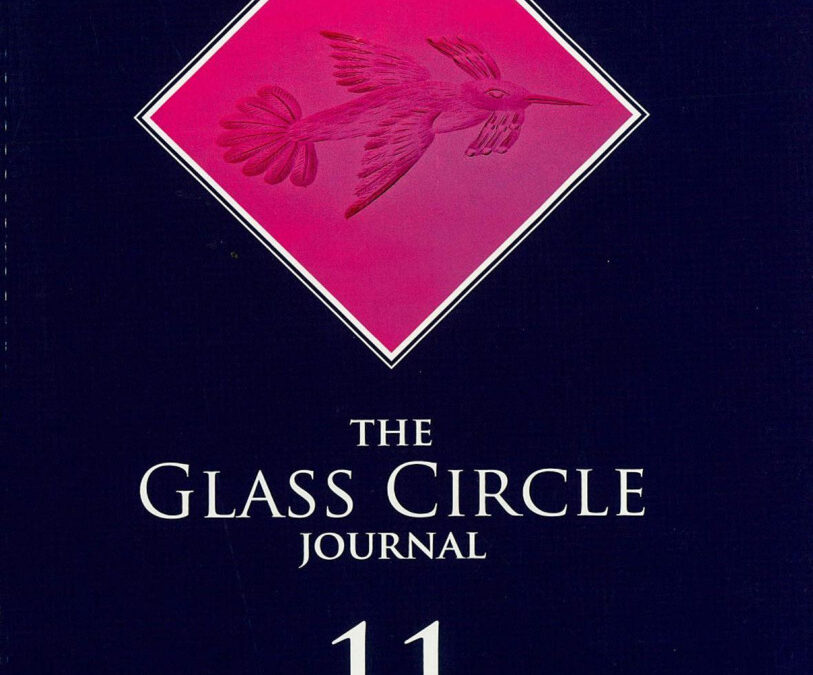
Detail of wine glass with engraving by Hillebauer.
ISBN 095370306
PRINTED BY
Great Wall Printing Company Lmitcd, Hong Kong
THE
GLASS
CIRCLE
JOURNAL
11
ELEVEN
THE GLASS CIRCLE
Founded by John Maunsell Bacon 1937
President
Simon Cottle
Honorary Vice-Presidents
Paul Perrot
Dwight Lanmon
David C Watts
Honorary Secretary
Marianne Scheer
Honorary Treasurer and Membership Secretary
Laurence Maxfield
Chairman
John P Smith
Committee
Ken Cannell
Simon Cottle
Vernon Cowdy
Anne Lutyens Humphrey
Martine Newby
Anne Towse
Graham Vivian
Aims and Membership
The Glass Circle promotes the study, understanding and appreciation of historic, artistic and collectable
glass in all its aspects for the benefit of both experts and beginners by means of publications and by
convivial meetings, lectures, outings and other events. Membership is open to anyone interested in glass,
including dealers and other professionals, at home and abroad. The possession of a collection is not
necessary although many members are keen collectors.
Regular meetings on a wide variety of topics, sometimes with speakers from abroad, are held in
London in October, November, December, February, March, April, May and June. The Glass Circle’s
long-established excellent relationship with the museums, major auction houses and many dealers in
London occasionally extends to private receptions or social events. The Circle also produces a series of
publications, regular and occasional, and possesses a Library open without charge (but by appointment
only) to members.
The Circle’s website, www.glasscircle.org, lists the society’s activities, gives excerpts from the Newsletter,
lists forthcoming exhibitions and other ‘glass’ news and offers links to many sites of glass interest.
Application for Membership
Further information and application forms for membership can be obtained from the website and from:-
Mr L. Maxfield, Hon. Treasurer and Membership Secretary,
The Glass Circle,
Forbescroft,
The Close,
Hythe,
Kent,
CT21 4RA.
CONTENTS
II
I
III
Iv
V
VI
VII
‘JACOBITE’ ‘JACOBEAN’ AND OTHER REPRODUCTION GLASSES
produced by the Edinburgh and Leith Flint Glass Company
by Jill Turnbull
GLASS PURCHASED
for the Household of John Russell, 4th Duke of Bedford1732-71
by Julia E Poole
MODELED ET TAILES
DE CRISTAUX ANGLAIS
byJohn P Smith
URANIUM GLASSES-
their Importance in the 19th Century
by Guenter Doerfel & Elke Gelfort
E J H1LLEBAUER
Freelance copper wheel engraver who lived in London and carried out work for
Powell’s Whitefriars glasshouse
By Jeanette Hayhurst
GLASS CIRCLE PUBLICATIONS
ADVERTISING
7
37
77
91
103
113
119
THE G LASS CIRCLE JOURNAL 11
‘JACOBITE’ ‘JACOBEAN’
AND OTHER REPRODUCTION GLASSES
PRODUCED BY THE
EDINBURGH AND LEITH FLINT GLASS COMPANY
by Jill Turnbull
j
acobite glasses are probably the most
expensive and contentious of all the areas
of glass collection. Much has been written
about their history,
their appearance and
the difficulties of secure
attribution and it is
not the object of this
paper to add to that
debate — its purpose
is simply to present
as much information
as possible about a
series of reproduction
glasses made by
the company which
became
Edinburgh
Crystal and which,
although not intended
to deceive, were
designed to emulate
closely the originals. It
will also look at other
glass in ‘antique styles.
The catalyst for
this article was the
acquisition by the
Museum of Scotland
of one of a series of
ten reproduction Jacobite glasses copying
specimens in known collections (Plate 1).
The designs come from Pattern Book L, one
of the factory books used by the designers and
workmen at the Edinburgh and Leith Flint
Glass Company, which became Edinburgh
Crystal in 1955. Pattern book L contains
outline pencil drawings of each of the glasses,
drawn to size, over which is a description,
hand-written in ink, of the original engraving
to be copied. Acquisition of the Museum
glass has enabled
comparisons to be
made with the pattern
book drawings and
with the original
glasses on which they
were based. This
paper will present a
detailed account of the
ten ‘Jacobite’ designs
in pattern book L,
comparing them with
the recorded originals,
as well as looking
briefly at the mass
produced, and less
elaborate ‘Jacobean’
glasses
in
the
company’s standard
range and some of their
other ‘antique glass.
The Edinburgh
and Leith Flint Glass
Company catalogues
of the 1920s and 30s
illustrate numerous
glasses, both individual pieces and suites,
which are copies of period examples (Plate
2). Twenty seven ‘Jacobean glasses, made
for the general market are illustrated in one
catalogue,
English Table Glass,
which is en-
tirely devoted to reproductions. The page
heading ‘Jacobean’ is, of course, incorrect,
since the glasses are reproductions of 18th
PLATE I
EC.11, reproduction Jacobite
glass, now in the Museum
of Scotland.
JACOBITE JACOBEAN
A .8 .
K.59.
–
1111111111r
–
rTliguE
REPRODUCnOUG.
K
.
5
8
.
THE GLASS CIRCLE JOURNAL 11
PLATE 2
Half page from 1920s
E&L
catalogue.
JACOBITE
JACOBEAN
/03
6
-4•1.-; / –
9
411…,-ede
61-
Y79,777/-r-Z
0-1-Ceed.
qtr-
Id.
or
14
Mvs.f
Pity(
n ‘
PLATE 3
E&L
pattern book L,
illustrating three of the
ten Jacobite reproduction
glasses, Patterns L101-103.
•
1/4;&
L
F/2.
5
e
7744 Ivo 7
–
emius
.?/7’
—
r
—
THE GLASS CIRCLE JOURNAL 11
century styles, which suggests that the com-
pany was implying a Jacobite link, rather
than an historical source. It may also seem
perverse for a Scottish firm to use the cata-
logue title
English Table Glass,
but the name
reflects the source of the designs, as will be
seen below. As far as
the ‘Jacobite glasses
are concerned, no flint glass was made in
Scotland after 1734 and before the estab-
lishment of the Verreville glassworks in
1777,
so Jacobite glass made in that period
must have originated in England or Europe.
Three books were used by the Edinburgh
and Leith designers in the production of
JACOBITE JACOBEAN
10
THE GLASS CIRCLE JOURNAL
11
their ‘antique’ glasses, the first being Albert
Hartshorne’s
Old English Glasses,
published
in 1897, to which reference is made in the
introduction to the
English Table Glass
cata-
logue. It begins with a brief description of
the different periods of glassmaking, and
refers to ‘Mr. Hartshorne’s very fine and
complete work on old English glasses: The
company was not alone in using Hartshorne
– Charles Hajdamach has shown that his
book was also used by Stevens and Williams
in 1930
1
. The catalogue introduction covers
in some detail the various characteristics of
glass of the 18th century, particularly the feet
of wine glasses, commenting that ‘Continen-
tal reproductions of old glasses have entirely
destroyed their character by giving them flat
and shapeless feet (occasionally polished at
the bottom). These flat feet, which demand
only a small amount of workmanship, may
be perfectly suitable for the modern thin
glass, but are very inappropriate when at-
tached to old shapes: It ends with a para-
graph explaining the philosophy behind the
company’s marketing of reproduction glass:
‘The glasses illustrated in this pamphlet
are reproductions of the best examples of
the old in the different styles, and have been
made after the old methods which are still in
vogue. It is hoped that they will be of assist-
ance to those who in the past have desired to
keep their tables in harmony with their sil-
ver, and with their furniture, but have been
unable to do so as more than odd specimens
of antique glass were unobtainable. It seems
a pity that those who have spent thousands
in furniture, silver and pottery should have
been compelled to neglect such an artis-
tic and historic part of their furnishing:
Determination to produce glasses look-
ing as authentic as possible is confirmed
by a note in another printed catalogue
from the 1920s/1930s. Underneath a
page of ‘Antique Reproductions’ it states
‘These are faithful reproductions, and are
made in the same manner as the originals.
Although it seems reasonable to assume
from the comments above that the Edin-
burgh and Leith Flint Glass Company had
no intention to deceive when they produced
their ‘Jacobite’ range, they did go to consid-
erable trouble to make the reproductions as
true to glass of the 18th century as possible.
The ten engraved ‘Jacobite’ goblets, patterns
L95 – 104, are particularly noteworthy in
this respect. A note under L101, 102 and
103 (the glass in the Museum of Scotland)
reads All of these must have a punty mark’
underlined in red ink (Plate 3). It can be seen
from the museum example that the quality of
the glass and the engraving is high and the
metal has a greyish hue, unlike modern glass.
There are, however, significant features which
differ markedly from 18th century glass.
Whether these abberations were deliberate,
in order to avoid any charge of forgery, were
enforced by lack of appropriate skills among
the workforce, were accidental, or were sim-
ply not regarded as significant, it is impossi-
ble to know. They will be examined in detail
for each of the L patterns individually, al-
though some general comments can be made.
Although none of the actual engravings is
illustrated in pattern book
L,
the descriptions
exactly match those of glasses in well-known
collections illustrated by Joseph Blest. Beside
the first drawing in the series (L95) is writ-
ten ‘Reproduced from photographs in ‘Rare
English Glasses of the 17th & 18th Centu-
ries by Joseph Bles’ (Plate 4) and it is clear
that all ten designs were copied from plates
and descriptions in his chapter discussing
Jacobite glasses (Plate 5). The engraving on
the Museum goblet, and the photographs
of three others from the series published
in Woodward’, confirm the accuracy of the
descriptions and it is clear that a copy of
Bles’ book must have been used by the glass
engraver. There are naturally very minor
variations, as to be expected in such work.
Joseph Bles’ book was published in 1926,
thus giving a date before which the designs
could not have been copied. The date of 16
June 1937 is written beside the first pattern
in the
L
series, L95, but it is not clear from
the written text whether this was the date
of the original drawing or of a later com-
mission to which some initials were to be
JACOBITE JACOBEAN
717
,
5″
so.
-er— ).
..1
.
9
.
1
1
;vx
”
t
urik,
;).
n
.00
1E4
lz
THE GLASS CIRCLE JOURNAL 11
11
agnostic of 18th century English glasses. The
author of the Edinburgh and Leith catalogue
referred to above wrote two paragraphs about
the feet of drinking glasses, mentioning that
some of the early ones were folded over at the
edges to give them greater strength, but he
did not give details. He was clearly familiar
with continental reproductions – so it seems
rather odd that the firm should copy them,
rather than British 18th century glasses, but
PLATE 4 (LEFT)
Pattern L95.
PLATE 5 (BELOW)
Plate 31 in JOSEPH BLES,
RARE
ENGLISH GLASSES
OF THE 17TH & 18TH
CENTURIES, source of
L101.
added. The Edinburgh pattern books are
not formally dated — clues have to be sought
in the added comments written beside vari-
ous patterns. These do not, however, give a
reliable chronological order, since the books
were used throughout the life of the com-
pany and patterns were repeated, with or
without modifications, for many years. The
best that can be said is that patterns L95-
104 date from the late 1920s or the 1930s.
One of the striking features about the
NMS goblet, is that, in common with sev-
eral other glasses in the series, it has a folded
foot. However, in the case of the museum
glass, and the three other photographed ex-
amples, it folds upwards, over the top of the
foot, whereas in 18th century English glasses
the fold was usually underneath, leaving a
smooth top surface. According to Newman”,
while in Britain the foot was folded under,
On some Continental glasses the fold is
not under but is over the foot’. Hartshorne
confirms that the folded-under foot was di-
JACOBITE JACOB FAN
eiAC °BEAN.
7-441
.
11
n
1
16
.4
4
.
0
A.2.
A.41.
A
.7
OPAL kiTENI.J:
12
THE GLASS CIRCLE JOURNAL 11
PLATE 6
Half page from 1920s
catalogue
English Table
Glass.
it may simply have been unspecified, leav-
ing the glassmaker to do as he thought fit.
Another significant difference between
the Edinburgh and Leith designs and the
original glasses on which they were based, is
the style of the sterns. Eight of the glasses il-
lustrated in Bles have airtwist stems; none
of the Edinburgh copies has such a stem.
This seems particularly suprising because
ten of the ‘Jacobean’ glasses illustrated in
the catalogue of
English Table Glass
have
airtwist stems of varying complexity, so the
skill to make them appears to have been
available at the glassworks (Plate 6). The
author of the catalogue waxes lyrical about
`the simple and artistic shapes and sparkling
brilliancy of the air twists..: adding to the
puzzle. One possible explanation might be
the cost, since the complex individual engrav-
ings on the L designs would already have
been expensive. It is also possible that the
catalogue was written at an earlier date and
the workman/men with the skills to make
an airtwist stem were no longer employed.
Another puzzle is the size of the glasses.
The Museum acquisition is a big, imposing
glass, standing 7 1/2 inches high, but it is actu-
ally one of the smallest of the ten, a full three
inches shorter than the largest example. The
L designs range in size from 7 inches (17.8
cms) to 10 1/4 inches (26.4
cms)
high. All
the glasses illustrated in Bles are also tall,
but very few of the L pattern designs exactly
match the height of the originals. While some
vary by only a small amount, L96 is 3
‘/2
inch-
es (8.8 cms) taller that the Bles glass it copies,
while L102 is 2 inches (5.1 cms) shorter than
its counterpart. Only the height is given by
Bles, so further comparisons are not possible,
however, it does appear that the convention of
having the foot of a goblet the same, or slight-
ly larger, diameter as the rim, has been cop-
ied by the Edinburgh and Leith Flint Glass
Company. Of the ten glasses illustrated, half
the diameters are the same, the others larger.
The shapes of the Edinburgh designs
are also puzzling. Only two of the L pattern
glasses, L 99 and L100, (Plates 7 and 8) are
remotely similar to those of the Bles origi-
nals, although neither is absolutely identical.
These two glasses are illustrated in stencils
prepared for an Edinburgh and Leith cata-
logue, now in the Museum of Edinburgh
archive, so seem to have been in production.
(Plate 9) The eight remaining Bles glasses
have air twist stems, mostly of double-
knopped shape, while the Edinburgh and
Leith reproductions vary widely, particularly
in stem shapes. Several contain tear drops
and three designs, L 98, 101 and 102 have
domed feet, unlike any of the Bles examples.
There is little consistency in the L shapes and
it is difficult to be sure of their sources, al-
though it is possible that pattern L 103, the
design of the Museum glass, was based on a
photograph in the third source book in the
company library — Percy Bates
English Ta-
ble Glass,
first published in 1905
5
.(Plate 10)
The question of why the Edinburgh and
Leith Flint Glass Works copied these par-
ticular glasses is probably answered by Robin
Nicholson in his article ‘Engraved Jacobite
Glasses’
6
. He wrote: ‘The quality of photog-
JACOBITE JACOBEAN
JACOBITE JACOBEAN
1
–
44
envaesa.
po..trait of Young
Poeterlder- in,
nun dui
*pint
of on
oat. net.
wail-
tbInc, b,vwUur.
064-
Wan:.
FIAT”‘
09C6
a
scar.
Max : /760 •Ino
Lux,
.Port,oiC
of
goons Pratculer
I614.64
6
.6611.W.,
tuemount.
by
crown: 666m 6+661661416
,
466on.
n016.111 Ht.
FALL
HE !HALL
Nor At arrtv.s/
cetr olat.4 rat Tr*’
Loma UP.
HOLDETH
OMM
lx,,a4 HIS HARD.
P4,374
Dela, r7f5-0
13
keprodu.ctions
orAtuitiwt Masses.
Thee< hatter are rtaihruL refor,aaactiaat,& neeLete cm th< same nvant n obl• al the orisinalt Jaeobitz Ocbtau I />/s-a
c
4
7
–
”
Yous.h
,
HE f-A,•:.
r
od
GrYs2,:.
GAY: L
.
,
2
–
–
..f
21,4
x-b.
P
,9
))`;
,
‘
0
PLATE
9 (FAR
LEFT)
Stencil of page for
Edinburgh and Leith
catalogue, in Museum
of Edinburgh.
PLATE TO (LEFT)
Bate Plate V no 15, a
possible prototype for the
shape of L103.
THE G LASS CIRCLE JOURNAL 11
PLATE
7
(FAR LEFT)
Pattern L99.
PLATE
8 (LEFT)
Pattern L100.
Pried*:
L41
–
L.100 –
The Edinburgh &
Leith flint GlassOuiltr
Jiortnn
PariL,
Edit sharSh.
14
THE
GLASS CIRCLE JOURNAL
11
PLATES 12 & 13
Details of engraving on
NMS glass.
PLATE II
Pattern
K62.
raphy in Bles’s book was both the making and
the undoing of engraved Jacobite glasses. For
the first time there was sufficient detail to al-
low an expert engraver to copy every intricate
detail of the glasses without requiring access to
the real thing’. Until 1926, the designers from
Edinburgh Crystal had only Hartshorne’s
drawings to copy and it seems reasonable to
assume that the publication of Bles’s book
was welcomed at the glassworks as an oppor-
tunity to use the skills of their glass engraver
to greater advantage for the benefit of those
desiring accurate Jacobite reproductions.
There are other glasses bearing motifs
in the Jacobite style in the Edinburgh Crys-
tal pattern books, at least one of which is
similar in many respects to the ten L pat-
terns, but K62, is even larger,
11
3/8 inches
tall, with a top diameter of 5
3
A. inches and
foot diameter of 5
1
/2 inches. The design in
the pattern book is annotated: ‘Engraved
James II Rose 9 leaves & 2 buds’ (Plate 11).
To judge by the Museum glass, the qual-
ity of the L series of reproductions was very
high. If the rest were made to the same stand-
ard, and there is every reason to think they
would have been, the glasses would have
been weighty, well crafted, finely engraved
and imposing (Plates 12 and 13). They were
decorated with expert engravings of Jaco-
bite motifs, convincing in colour and with
features like the punty marks emulating
authentic 18th century glass. The museum
goblet is an impressive glass and it would be
very interesting to find more examples of the
series of reproductions from which it comes.
Percy Bate’s
English Table Glass,
like Bles’s
book, contained numerous photographs
which were easy to copy, and it is possible to
trace the origin of almost all the A’
. pattern re-
production glasses in the company’s catalogue
of the same name directly to them. Pattern
A42 the SOBER CLUB’ glass, for example,
(Plate
14)
is copied from Bate’s Plate LX no
230, apart from the addition of a tear in the
stem (Plate 15). Decanter A25 (Plate 16) is
Bate’s Plate
XLII
no 170, described as ‘a fine
example of fairly early date… [with] charac-
JACOBITE JACOBEAN
THE
GLASS
CIRCLE
JOURNAL 11
M 0/NO G RAMS & C
R, ELT T.f.
•
15
A .4 2..
teristic festoons’ (Plate 17), while the fac-
tory catalogue describes it as an ‘Old Adam’s
Decanter, Engraved Festoon. The drinking
glass All (Plate 18) is a copy of Bate’s Plate
VIII no 30, featuring a’very characteristic en-
graved border’ and a folded foots, while the
catalogue described it as a’Glass with Welted
Foot and Old Engraved Border.
This type of
border was frequently used in Jacobean Times:
(Plate 19) It is probable that Bate was also
the inspiration for A36 (Plates 20 and 21 )
although the’Masonic Glass, with heavy foot,
used on Table for Applauding (A24), appears
to be a copy of figure 316 in Hartshorne’s
Old English Glasses
9
(Plates 16 and 22).
PLATE
14
Half page from E&L
catalogue
English Table
Glass,
illustrating the
`monograms and crests’
available, including the
`Sober Club’ glass..
PLATE 15
The ‘Sober Club’ glass
illustrated in Bate LX no
230.
JACOBITE JACOBEAN
16
THE
GLASS CIRCLE JOURNAL
11
Plate 16
Page of designs
in English
Table Glass
catalogue.
JACOBITE
JACOBEAN
JACOBITE JACOBEAN
THE G
LASS
CIRCLE
JOURNAL 11
PLATE
17
A decanter illustrated in
Bate Plate XLII no170.
17
18
THE GLASS CIRCLE JOURNAL 11
PLATE
18
Engraved glass in the
Edinburgh and Leith
catalogue.
PLATE
19
Bate Plate VIII no 30, and
engraved glass matching
pattern All.
Other reproduction glasses are scat-
tered throughout the factory pattern books,
some of them designed for mass produc-
tion, others for a more specialised market.
Among the former is a candlestick, pattern
H973, which appears in an advertisement
for ‘Edinburgh Crystal’ in the
Pottery Ga-
zette and Glass Trade Review
of 1 March
1933, and is also labelled ‘Jacobean (Plate
23). It appears alongside an ‘Antique Ginger
Jar’ and a modern cocktail glass enamelled
with fighting cocks — a truly eclectic mix.
Antique Candlestick’ L571, however,
is a very different matter. Marked ‘Spe-
cial done for Edwards; it is 18th century in
form and cutting, has a domed foot, scal-
loped rim with a flat bevel and is facet cut.
The instructions given on the drawing are
very detailed, showing that the foot was fac-
eted underneath, and also had a flat bevelled
rim (Plate 24). As a ‘special’ it must be as-
sumed that not many were made and that
those that survive would be of high quality.
A complete page from pattern book H
will, perhaps, give the reader a flavour of the
material the books contain and the range of
products made in antique style (Plate 25).
Service H1055 was supplied to Palfrey in
Melbourne. This time it was specified that
the foot should be ‘Welted under. Another
service, H972, included a three-ring magnum
decanter with a lozenge stopper, annotated
‘Hand Made Punty Base’, dated 21.9.37, and
initialled DH, a signature which appears of-
JACOBITE JACOBEAN
I
4
4, 10.4
t oink
tt
4
110
4.
A.56.
THE
G
LASS
CI
RCLE JOURNAL 11
19
ten on designs around that time. Another,
probably later, note says ‘Rough Mouth De-
canter. The service included goblets, liqueur,
sherry, port, claret and champagne glasses, all
of which had domed folded feet and balus-
ter stems, (Plate 26) and was illustrated in
the factory catalogue under the title ‘George
II Service’. (Plate 27). Although part of a re-
production service, glasses for modern use
were added as required. The Pitcairn Cor-
poration of New York ordered a ‘squat bowl
champagne in 1931, a grapefruit dish was
made for a firm in Manchester, and Fortnum
and Mason requested a matching plate, all
of which confirms that it was widely sold.
A page of ‘Old English Jugs’ appears in
the 1920/30s catalogue, most of them cut in
Regency style (Plate 28). It is often difficult
to appreciate the details of finished objects
from the drawings, so handling an actual
glass is important. One of the jugs, E.753
(Plate 29), for example, appears in the cata-
logue illustration to feature pillar flutes as
well as the step-cut neck and faceted han-
dle. In reality however, although the cutting
is sharp and hand polished and the metal
PLATE 20
A cut and engraved glass in
Bate Plate XXXIV no 135.
PLATE 21
Cut and engraved glass
in Edinburgh and Leith
catalogue of old English
glasses, showing A36,
which is very similar to
Bate’s photograph in
Plate 20.
JACOBITE JACOBEAN
20
THE GLASS CIRCLE JOURNAL 11
PLATE
23
Full
page advertisement
in the
Pottery Gazette
and Glass Trades Review,
March 1, 1933.
334
11:L.h.
POTTERY GAZETTE AND GLASS TRADE REVIEW.
March 1,
1933
EDINBURGH CRYSTAL
Thlegroup includes : a Jacobean Candle-stick, 1.973 ; an
,’Antique Ginger Jar, A.29 ; a handled dish Inthe shape of a
;Highland Qualeh, K.I04 ; n Tumbler and Goblet of Service
D.251 ; a Water Jug of modern style, M.I3 ; and a still more
modern Cocktail Glass, M.210, which is made In sets of six,
with different episodes on each piece, Shaker to match.
The Edinburgh & Leith Flint Glass Works
Proprietors %Vebb’s Crystal Glass Co. LS&
JACOBITE JACOBEAN
21
THE GLASS CIRCLE JOURNAL 11
PLATE 24
Pattern
LS78, ‘Antique
Candlestick’, a special order
made for Edwards.
JACOBITE JACOBEAN
THE GLASS CIRCLE
JOURNAL 11
FputipORO”
—
/1/06
–
5:
! N 1355 3
0
,,,pilx
3
tY/-111
.-
.
fr
qt
41,1.- vipsu
,
./
e”.
—
.7.1
E 1036 :
–
:rez
ass.
‘Tod,
.7z-r-
,
/ay s
22
.
4,’
A
, 1
/
JACOBITE JACOBEAN
PLATE
25
A page from pattern
book H, showing design
H1055, a service of
reproduction glasses.
GEORGE II. H . 9 7 2 , OERVICE.
FIG. 316.
JACOBITE JACOBEAN
PLATE
27
Half page from
an
EFL
catalogue, showing
H972,
the ‘George II’ service.
PLATE
26
(FAR LEFT)
Glass in pattern H972, the
‘George II’ service.
PLATE 22 (LEFT)
Fig. 316 in Hartshorne
Antique Drinking Glasses,
p.323
THE GLASS CIRCLE
JOURNAL
11
23
OLD ENGLIJI1 JUGJ:
THE
GLASS CIRCLE JOURNAL 11
E.
63 O.
24
A selection
of
very
fine Old English Jugs.
They are supplied in three sizes, viz.: 1 pint,
pint, and 2 pint.
PLATE 28 (RIGHT)
Page of ‘Old English Jugs’
from
the
E&L
catalogue.
PLATE 29 (FAR RIGHT)
Jug
in pattern .E753,
illustrated in the catalogue
under ‘Old English Jugs:
JACOBITE JACOBEAN
THE GLASS CIRCLE JOURNAL 1
25
JACOBITE JACOBEAN
7
ki
Az — _
I/
.
…;: .,
.
…
1:
)
°
.
APa
I
4
1
i lt
.,
(
Of
i
?sue
…,,
.
•
–
.1 i ..
7
.
lir
du
.
‘ : N
116,
v
‘
t
T
N
I, ‘7,..’cr
‘
‘
.
4
:
f
‘
t
•
‘
No ,
,
,…
.
1
*,…
1
….—
7
ir
1 –
v
‘ 44141,0101
‘t
I
‘
–
..d
.4
,
—
,0
,4
—
4
.
26
THE GLASS CIRCLE JOURNAL
11
is a good colour, instead of pillar flutes, the
panels of diamonds are actually separated
by flat recessed cuts, making this jug easily
recognisable as a twentieth century product.
Other reproduction glasses in the factory
pattern books, include early 18th century
Dutch drinking glasses and’antique’ salts, but
only the ‘Jacobite’ glasses in pattern book L are
precisely identified as copies of specific, rare
and collectable items. It is unlikely that any of
the reproduction glasses were marked by the
factory, and those that survive will, by now, be
showing signs of age and wear, making recog-
nition a greater challenge for the unwary. Al-
though most of the ‘antique glass produced in
Edinburgh is unlikely to deceive the experts,
a lot of skill and care went into making them
look as authentic as possible. Caveat emptor.
Note
Some of the photographs of the pattern
drawings are not as clear as they might be,
for which I apologise — the reason is that
the Edinburgh Crystal pattern books were
working tools throughout their long life. As
a result the pages are dirty, discoloured, dog-
eared, creased, torn, repaired with old, now
brown, sellotape, and generally difficult to
photograph. Although some photographs
have been digitally enhanced to improve
clarity, essentially, what you see is how they are.
Acknowledgements
I am very grateful to the management of
Edinburgh Crystal, who allowed me access
to the factory pattern books, and gave
permission to publish images from them, in
the weeks before the firm stopped making
glass at Penicuik, and to the Trustees of the
National Museums of Scotland, in whose
care they are now Pages from the English
Table Glass catalogue are reproduced with
the permission of the City of Edinburgh
Museums and Galleries, Particular thanks are
due to George Dalgleish and Irene Mackay at
the National Museum of Scotland; to David
Scarratt of the Museum of Edinburgh; to
Colin and Sue Brain for the invaluable gift
of an Edinburgh and Leith Catalogue; to
Peter Francis, and to Peter Lole for his help
and encouragement, and especially for telling
me about the Sober Club glass in Bate.
Endnotes
1.
The Glass Cone, Spring 2004, no 67, 5
2.
Bles, Joseph, Rare English Glasses of the 17th and 18th Centuries, 1926
3.
Woodward, W H, The Story of Edinburgh Crystal, Dema Glass, 1984
4.
Newman, Harold, An Illustrated Dictionary of Glass, Thames & Hudson, 1987, 122
5.
Bate, Percy, English Table Glass, 1905, reissued by Batsford 1913, Plate V no 15. L104 is a very similar
shape to Bate Plate IV no 12.
6.
Antique Magazine, June 2003
7.
Bate 75.
8.
Bate 36
9.
Hartshorne, Albert Antique Drinking Glasses, 1968 reprint of Old English Drinking Glasses, 323
JACOBITE JACOBEAN
L95
;I
ee Aso. 754..e4n
6-aer..
I r’144
rn
•
77
n
614AX
,
14
4V
.
7.
5
1:
n
•
n
n
14.4
4
n
74,1
.
4. )
‘
•
e•-••••
.-
•
,
f
n
Ci
/7″
Description in Pattern Book:
‘Goblet Date Circa 1750. Hamilton Clements Col-
lection. Engraved Smart Rose & Buds. Reverse side,
TEMPORA MUT[D overwritten in pencil] ET
NOS MUT[AN rubbed and crossed outJTUR IN
ILLIS.[In different hand]: Tempora mutantur et nos
mutamur in illis.’ Reproduced from photographs in
“Rare English Glasses of the 17th & 18th Centuries
by Joseph Bles. Done with inscription for Hamilton
S[?iin] Sen. June 16th/37′.
Measurements of drawing
Height 10 ‘A inches, top dia 4
3
/4 inches, base dia 5
1/8 inches.
Features
Handwritten in pencil on stem ‘Hollow’ crossed our
and then repeated. Slightly domed folded foot. Bowl
shape similar to Bles, stem quite different.
Bles Plate 35
j?lapora
nos
MIMI&
1
11:1
4
Description in Bles pp 112, 113, Plate 35
‘GOBLET (91/2 inches) — Straight-sided bowl
resting on a collar and double-knopped airtwist stem
and plain foot. The bowl is similarly engraved to its
companions on plates 31-34 [see L101, 104, 102]
but bears the words in bold italics
Tempora mudantur
It nos mudantur in illis.
This series of goblets has
been referred to in the text. Circa 1750. Hamilton
Clements Collection.’
The reference in the text (p88) reads as follows:
…A goblet with the motto “Tempora mudantur et
nos mudantur in illis” (sic) (Plate No. 35). In this
case it is probable dint the engraver mislaid his
instructions and trusted to a memory that was not
overburdened with Latinity:
(See full reference on pun)
THE GLASS CIRCLE JOURNAl H
27
Author’s comments on L95
L95 is the first of the series of ten ‘Jacobite glasses copied from his book and it states the source of all of them. The
most obvious item of interest in the Edinburgh and Leith version of this goblet is that the incorrect Latin illustrated
by Bles on the original was corrected in the pattern book. Someone changed the Ds in the pattern book to Ts and
rubbed out the ‘an in the’mutamur: Someone else then wrote in the correct version in a different band and with what
appears to be a different pen. We shall never know who the scholar was — but it does raise the question of whether any
glasses had already been engraved with the incorrect Latin copied directly from the image in Bles. Although Bles refers
to the error in the text, he does not provide the correct version. It is, perhaps, worth noting that the glass illustrated
by Bles is the only Jacobite glass known with the motto Tempora mutantur et nos mutamur in illis (The times change
and we change in them) (Seddon 113).
The dare of 16 June 1937 is also of interest. It is not clear from the written text whether this was the date of the
original drawing or of a later commission to which the initials of Hamilton S? were to be added.
JACOBITE JACOBEAN
L96
Ac cc
/RV,.
+Iv E
4
1),,,
Bles Plate 30
28
THE GLASS CIRCLE JOURNAL 11
Description in Bles pp 102, 103, Plate 30.
‘WINE GLASS (6 inches) — Straight-sided bowl,
engraved with a Stuart rose, two buds, grub and
caterpillar, moth and a spider within its web. Airtwist
stem with knop at top and bottom. See text. Circa
1750. Grant Francis Collection:
The
text
referred ro (p 87-88) reads: At this stage
mention may be made of a curious wine glass in the
collection of Mr. Grant Francis (Plate No. 30). It has
a straighrsidcd bowl with an airtwist stem knopped
at both ends, and is engraved with a Stuart rose and
two buds, and a spider which has woven its web
between the rose and one of the buds. It must be
left to the reader to guess the true meaning of this
symbolism. Is it resignation, or dissatisfaction with
the slow progress of the cause?’
Description in Pattern
Book:
`Goblet Date Circa 1750. Grant Francis Collection
engrd Stuart rose & 2 buds. Grub or caterpillar,
moth & a spider within its web:
Measurements of drawing
Height 91/2 inches, top dia 41/4 inches, base dia
41/2
inches.
Features
The drawing shows a small teardrop in the top of the
straight stem. The bowl appears to be similar to the
Bles original, but instead of the airtwist stem, L96
has a plain stem and conical foot.
Author’s comments on L96
The most obvious difference between L96 and the glass it copied is the discrepancy in height — the reproduction
being 3 1/2 inches taller. The stem of the reproduction is also considerably shorter in proportion to the bowl of
the original. The engraver of L96 was given the choice of grub or caterpillar, while the glass in Bles is described
as having both.
In his book
Old English Drinking Glasses, Their Chronology and Sequences
(London, 1926) p199, Grant R.
Francis comments on ‘A few curious glasses… which appear to admit the decay of the movement and of the
hopes of its supporters; which also use the motifs of grub, caterpillars and spiders.
JACOBITE JACOBEAN
L97
1
,
50
•
yeA.4,7
d
orre
ze:
4
AX’
7.4:z
tt.
1.1jesE
V
esry
Description in Pattern Book:
‘Goblet date circa 1750. Henry Peech Collection.
Young Pretender in oval medallion inscribed
AUDENTIOR IBO on reverse side Stuart rose &
2 buds Engd thistle on foot.
Measurements of drawing
Height 8 inches, top dia 3 3/4 inches, base dia 4
inches.
Features
A
simple drawn trumpet shape with small inverted
teardrop at top of stem, plain conical foot. One of
three glasses with the notation ALL OF THESE
MUST HAVE A PONTIL
MARK in red ink.
Bles Plate 37 No.49
Description in Bles, pp 116, 117, Plate 37,
No. 49.
`WINE GLASS (6 inches)-straight-sided bowl
engraved with the portrait of the Young Pretender
in an oval medallion inscribed AUDENTIOR
On the reverse a Stuart rose and two buds. Airrwisr
stem. The plain foot is engraved with a thistle. An
unusual portrait. Circa 1750:
THEGLASSCIRCLE JOURNAL II
Author’s comments on L97
The shape of L97 is totally unlike the Bles original, which has a small bucket bowl and an air twist stem, and has a
closer resemblance to the Amen glass illustrated on the same page in Bles.
The portrait on this glass resembles two medals struck in 1745 and 1752 illustrated by Seddon (pp130, 107).
JACOBITE JACOBEAN
L98
Description in Pattern Book:
‘Wine glass. Young Pretender wearing bonnet,
full faced in Highland Costume & wearing ribbon
& Star flanked by rose/bud & Thistle inscribed
AUDENTIOR IBO IN RIBBON. Owner says this
glass was used by Prince Charlie at banquet given by
the Ladies of Edinburgh 1745:
Measurements of drawing
Height 7 inches, top dia 3 inches, base dia 3 inches.
Features
Trumpet shaped bowl with inverted teardrop in base,
complex solid stem with domed and folded foot.
Bles Plate 36 no. 47
Description in Bles pp 114, 115, Plate 36 No. 47.
‘WINE GLASS (6
3
/a inches) — Straight-sided bowl,
engraved with the portrait of the Young Pretender
wearing bonnet, full-faced in highland costume and
wearing ribbon and star, flanked by rose, one bud and
thistle. Inscribed “AUDENTIOR IBO” in ribbon.
Double-knopped airtwist stem with collar between
knop and bowl.
The late owner made the following statement:
‘This glass was used by Prince Charlie at the banquet
given him by the ladies of Edinburgh in 1745. It was
taken possession of by Mr. Rattery, one of whose
descendants presented it to my father, Archibald
Sharp in 1846:”
30
THE GLASS CIRCLE JOURNAL 1_1
Author’s comments on L98
A photograph of a glass made to pattern L98 appears in Woodward (p 78). This shows that the foot rim is folded
upwards. The portrait on L98 appears to be less crude than that of the Bles glass but other derails look much the
same. Although the stem of L98 is quite different from the Bles original, the collar between knop and bowl’ has been
retained, as has the knop, although it has been flattened somewhat.
[illus ph, bles, woodward]
JACOBITE JACOBEAN
O-d-aa’
,
G44
fie
.
/76o – 70.
— –
-411011
Description in Pattern Book;
‘Goblet Portrait Young Pretender in medallion in
centre of an oak tree, complete with Stem, branches
& leaves. Reverse side FIAT over a star. Date 1760-
70:
Measurements of drawing
Height 9 inches, top dia 5% inches, base dia 5
1
/4
inches.
Features
This is one of the only two glasses in the L series
which appears to copy the shape of the original
goblet, L100 being the other.
Bles Plate 39
Description in Bles pp 120,121, Plate 39
GOBLET
(83/4
inches) — Cup-shaped bowl.
Engraved with a portrait of the Young Pretender
in an oval medallion in the centre of an oak tree
complete with stem, branches and leaves. On the
reverse the word Fiat over a star. Circa 1760-70.
Author’s Collection.
THE GLASS CIRCLE
JOURNAL
11
31
Author’s comments on
L99
‘Fiat’ is the most commonly used Jacobite motto (Seddon, 250), but the portrait and apparently thriving tree
on this goblet appear to be very uncommon, although the stricken oak and oak leaves are seen more often.
JACOBITE JACOBEAN
L100
Y
°
0741,./
–
-eral,….«epe
4
44.
tiqh
,
N4
r
n
Us /et
r/49.44
r
q
r
oc
urreRs.> LAST
Dovo
,
?Wei .40n
UP NO I-DR rN
/-tim 14
.
/
rir
lea /4•914.3. P3jti0
Description in Pattern Book:
‘Goblet
date
1715-20. Portrait Young Pretender
in round medallion surmounted by crown, below
medallion ribbon inscribed
THOUGH HE FALL HE SHALL NOT
BE
UTTERLY CAST DOWN FOR THE LORD
UPHOLDETH HIM WITH HIS HAND.
P37+20:
Measurements of drawing
Height 8
3
4
inches, top dia. 4
3
/4 inches, base dia 5
inches.
Features
This is the second glass in the L series which copies
the shape of the original goblet.
Bles Plate 29
Description in Bles pp 100, 101, Plate 29
‘GOBLET (8 inches) — Cup-shaped bowl engraved
with a portrait of the Old Pretender, wearing a chap-
let, in a circle surmounted by a Royal Crown, and in-
scribed in a scroll:
Though be fall, he shall not be utterly
cast down, for the LORD upholdeth hint with his hand.
P37. V 20.
Plain stem. See text.
Author’s Collection.
Circa 1715 – 1720:
In the text
(p 87) Bles writes:
‘In 1919 there ap-
peared two baluster stem glasses, engraved with the
conventional Stuart emblem of the Rose and Bud.
The metal of these glasses is so early and dark that
they are generally considered to be Old Pretender
glasses, but the quaintest and probably the earliest
Old Pretender glass is
a goblet,
engraved with a por-
trait of the Old Pretender,
facing to the
left and wear-
ing a chaplet surmounted by the Royal Crown. The
inscription on the glass
runs: “‘Though he fall he shall
not be utterly cast down, for
the Lord upholdeth
him with his hand.” P.37 v.20
(Plate Nos 29). This
inscription seems to indicate that it
was
engraved
shortly after the battles of Preston and SherifFmuir.
The rising of 1745 under the Young Pretender is
commemorated by a vast number of glasses..:
32
THE GLASS CIRCLE
JOURNAL 11
Author’s comments on L100
The only obvious difference in the descriptions, and perhaps the execution, of L100 and
the Bles original is that Bles
was convinced the portrait showed the Old Pretender, the designer of L100
said it was the
Young Pretender, which
seems more likely, although it is impossible to know if the designer changed it deliberately
JACOBITE JACOBEAN
LI01
I
/02. -4/4„;;…
us
eirr”
01.06.e.
OY
_gc..
7
.
a-Zk
e
e.
,CrtGe
.
Description in Pattern Book:
`Goblet dare Circa 1750. Sir JS Risley Collection
engraved 1 side Large 8 petralled Stuart rose & 2 buds
Surmounted by inscription “TURNO TEMPUS
ERIT” reverse Oak spray acorns & Star;
Measurements of drawing
Height 7 3/8 inches, top dia 4 inches, base dia 4
inches.
Features
The outline of L101 is quite different from that of
the Bles original. L101 has a domed, folded foot
and solid stem, the Bles has a plain conical foot and
aircwist stem.
Bles
Plate 31
Description in Bles pp 104, 105, Plate
31
Goblet (9 ‘A inches) — Straight-sided bowl
handsomely engraved on one side with large eight-
petalled Stuart rose and two buds, and on the other
with an oak spray and acorns and star. Above the
rose, in bold italic lettering is the Virginian motto
Turno Tempts erit. See also text. Circa 1750. Sir J.S.
Risley Collection.
In
the text (p 88) Bles writes: ‘Opposite Plate No.
31 is given a full description of an important and
beautiful goblet with the motto “Turno tempus erit:’
For many years it was believed to be the only one
of its kind, but during 1919-1921 were discovered
four more goblets from the same glass house and
engraved by the same hand, thus forming a group
of five imposing drinking glasses, about 9
1/2
inches
high..: (quoted in full under L102 overleaf).
THE G LASS C I RCLE JOURNAL 11
33
Author’s comments on L101
Eight-petal roses are rare (Seddon, 179), but Seddon illustrates one on a glass with the same motto as
L101 (pill).
A photograph of glass pattern
L101 appears in Woodward, p 53.
JACOBITE JACOBEAN
34
TH
E GLASS CIRCLE JOURNAL 11
L102
Bles Plate 33
‘us
7
1-
–
,
Description in Pattern Book:
‘Wine Date Circa 1750. Engraved Portrait bust &
profile of Young Pretender wearing order of the gar-
ter in floral wreath between the 7 petalled rose with
2 buds & thistle & a bud. Star on reverse:
Description in Bles
pp 108,
109, Plate 33
‘GOBLET (91/2 inches) — Straight-sided bowl, finely
engraved with portrait bust in profile of the Young
Pretender wearing the Order of the Garter, in flori-
ated wreath, between a seven-petalled rose with two
buds, and a thistle and bud. Star on reverse.
The collar, stem and foot are as those of the
companion goblets on plates 31, 32, 34 and 35.
This goblet is the only glass so far known with the
Prince’s profile facing to the left. Circa 1750. Au-
thor’s Collection.
(See further reference below.)
Measurements of drawing
Height 71/2 inches, top dia 31/2 inches, base dia
inches.
Features
Again, a completely different shape from files. The
bowl capacity looks smaller and has an inverted tear-
drop in its base, the stem is solid and the foot domed
and folded with a pontil mark. The Bles glass has a
plain conical foot and airnvist
stem.
Bles on the discovery of four important Jacobite goblets
(Bless p 88)
‘Opposite Plate No. 31 [L101] is given a full description of an important and beautiful goblet with the motto “Turn
tempus erit.” For many years is was believed to be the only one of its kind, but during 1919-1921 were discovered four
more goblets from the same glass house and engraved by the same hand, thus forming a group of five imposing Jacobite
drinking glasses, about 91/2 inches high. In addition to the’Turno tempus erit goblet there are:-
No. 2
A
goblet with the motto”Revirescit” (Plate No. 32) [L104].
No.3. A goblet with a portrait of the Young Pretender (Plate No. 33) [L102].
No. 4. A goblet richly engraved with fruits and flowers (Plate No. 34).
No. 5.A goblet with the motto “Tempora mudantur
et
nos mudantur in
(sic) (Plate No. 35) [L95]. In this case it is
probably that the engraver mislaid his instructions and trusted to a memory that was not overburdened with Latinity:
JACOBITE JACOBEAN
L103 Glass in the National Museum of Scotland
-4444
i.^.9
4
–
6
–
a a
z 3/4-x a –
1
4-nw-C-
7
trZ4
1
,
1,ctiral
Description in Pattern Book:
‘Wine Glass profile portrait of Young Pretender
within a laurel wreath flanked on one side by quasi-
heraldic rose & 1 bud on the other by the thistle with
the star in between. 2″d Qtr of
1r
Century Sir J.S.
Ridley Collection.
Measurements of drawing
Height 71/2 inches, top dia 31/2 inches, base dia 3
3
4
inches.
Measurement of glass
Height 7% inches, top dia 31/2 inches, base dia 3
3
4
inches.
Features
This glass is totally unlike the Bles original in all
aspects of its shape. The stem has a central inverted
teardrop and a conical folded foot. The Bles glass has
a straight airtwist stem and domed foot.
Bles Plate 38 No. 52
Description in Bles pp 118, 119 Plate 38, No. 52
`WINE GLASS (5
1/2 inches) Straight-sided bowl,
air spiral stem and plain
domed foot.
Bowl finely
engraved with profile portrait of the Young Pretender
within a laurel wreath, flanked on one side by the
quasi-heraldic rose and one bud, and on the other
by the thistle, with the star in between. A charming
glass. Second quarter of the eighteenth century. Sir
J.S. Risley Collection:
THEGLASS ORCLE JOURNAL 11
35
Author’s comments on L103
The glass belonging to the National Museum of Scotland enables direct comparisons to be made with both Bits and
an example illustrated by Woodward, (p 78). The two Edinburgh glasses appear to be different examples of
L103,
in
that the
teardrops in the stems differ slightly, as do the leaves in the laurel wreath.
Paradoxically, the Edinburgh and Leith designer has taken one of the better known motifs on Jacobite glasses
— a portrait showing Charles Edward Stuart without a bonnet and wearing the garter on the wrong breast — and
combined it with a form quire unlike illustrated glass of the period. He has also increased the height by two inches.
As with the other glasses in Woodward, however, the engraving copies the original very closely, and certainly on the
Museum glass, it is of very high quality.
The glass itself is of grayish metal with a good lead content. It has a folded foot, but unlike most British 18’s
century glass, it is folded over, rather than under the rim. There is a rough pontil mark. The quality of this large
goblet is impressive, as is the standard of engraving.
JACOBITE JACOBEAN
L104
r
–
:
Description in Pattern Book:
‘Goblet Date 1750. Engd Stricken oak & new sapling
springing from the ground and word REVIRESCIT,
on reverse side an 8 petalled Stuart rose & 2 buds.’
Measurements of drawing
Height 9% inches, top dia 41/2 inches, base dia 4
1
/2
inches.
Features
Another glass with a very different shape from Bles.
This time the bowl appears to be bigger and the stem
is hollow, while the foot is conical with a folded foot.
There are pencilled letters US next to the drawing.
Description in Bles pp 106, 107, Plate
32
‘GOBLET (91/2 inches) – Straight-sided bowl hand-
somely engraved with a stricken oak and a new sapling
springing from the ground and the word
Revirescit
in
italics; on the reverse, an eight-petalled Stuart rose
and two buds. The stem is a double•knopped air-
twist. This glass is referred to in the text. Circa 1750.
Author’s Collection:
(See reference in text refered to on
pm.)
36
THE
G
LASS CIRCLE JOURNAL 11
Bles Plate 30
Author’s comments on
L104
The group of glasses listed by Bles as being found in 1919-1921 (L101,104,102) is commented on by Grant Francis
(p199), whose book was published just
after
Bles. He writes: ‘A
few
curious glasses roust now be mentioned which
appear to admit the decay of the movement and of the hopes of its supporters. The earliest has the two buds
dearly severed from the stalk, and the glass bears the appropriate motto ‘TEMPORA MUDANTUR ET NOS
MUDANTUR IN ELLIS: “Time changes, and we change with it.. The erroneous spelling of “MUDANTUR””
should be noted. This glass, 383 [L951, is in Mr. Clement’s collection, and the curious feature of it is that in shape,
style, and period, 1750 it is identical with the “TURNO TEMPUS ERIT” 1L101
.
1 and ‘REVIRESCIT” [L104)
goblets, and was doubtless made at the same time and in the same factory, though its legend breathes quite a different
spirit. Sir John Risley mentions three other glasses of exactly similar type, and from the same factory, but with other
mottoes, that were doubtless engraved
by
the same artist.’
JACOBITE JACOBEAN
THE GLASS CIRCLE JOURNAL 11
37
GLASS PURCHASED
FOR
THE
HOUSEHOLD
OF
JOHN RUSSELL,
4TH
DUKE
OF BEDFORD1732-71
by Julia E Poole
The Duke, his family homes, and estates
John Russell, 4th Duke of Bedford (1710-
1771), the second son of Wriothesley, 2nd
Duke of Bedford
(1680-1711),
was born in
1710, a year before his father’s death, and
was brought up at Streatham Manor by his
mother, Elizabeth nee Howland (d. 1724),
a considerable heiress.
He succeeded to the
title in 1732, on the
death of his brother,
Wriothesley.’ The lat-
ter, married unwill-
ingly to Lady Ann
Egerton in 1725, had
become a notorious
gambler, who paid
little attention to his
estates. Woburn, the
Russell’s main coun-
try residence, became
dilapidated, and the
Duke spent weeks
at a time at another,
Thorny, near Peter-
borough. Eventually
his health deteriorated
dramatically and the
voyage to Portugal recommended as a cure,
only hastened his death, which took place off
Corunna on
23
October
1732.
The 3rd Duke is not our subject here, but
it seems a pity not to mention an interesting
glass
bill from his day.’ It records a payment
on 5 May
1726
for two quarters rent for lamps
for the `Office in Russell Street’ submitted by
the proprietors of ‘the Conic Lamps’, one of
which is illustrated on the bill surrounded
by the words ‘THE NEW or the CONIC
lamps’. Londoners were supposed to hang a
light outside their houses during the winter
months, and the proprietors of Conic Lamps
provided this service for a fee. According to
John Eliot Hodgkin in
Rariora,
‘The
New or
the Conic Lamps’ were patented in
1706/7.
He illustrated the
same image of a lamp,
presumably from the
receipt he cites made
out to a Madame
Coggin for 35s. rent
due on
30
May in
1730.
3
Fortunately the 4th
Duke (pl. 1) was an ef-
ficient, bustling, opti-
mistic man, who took
an immense interest in
his inheritance. After
returning from a two
year Grand Tour in
1731,
he had married
Lady Diana Spencer,
and the couple lived at
51 Grosvenor Street,
and at Cheam in Sur-
rey, while plans were made to renovate Strat-
ton Park in Hampshire, an estate Lord John
had bought from his brother. On inheriting
the tide, he and the Duchess moved into
Bedford House in Russell Street, the fam-
ily’s London home since 1700, and made
Woburn Abbey their country seat. Most of
the glass mentioned in this paper was pur-
chased for one or other of these houses, but
there is rarely an indication in the bills of its
PLATE I
Thomas
Gainsborough
(1727-88),
JOHN
RUSSELL, 4TH DUKE
OF BEDFORD (1710-71),
1764. Oil on canvas.
Woburn Abbey Inv. no.
1388.
Bs NINE, PERMISSION or THIS
MACS OF BED701. ANL/
a
–
laq
Mus
–
rnns
71-113
BEDFORD ESTATES
WOBURN GLASS PURCHASED
V 1 1
1f 11
RE 01111110
111111111111,
ft srl
.1
1
1j
1
1
1
1,
,1
7 r_77 tl 1
-,-
7
–
1
–
1
7-
3
:—
+
–
7
–
II r.
r
t _ ;
If -oft
.
I II
4.
1
IVIDif
38
THE GLASS CIRCLE JOURNAL 11
intended destination. Other ducal properties
mentioned were Thorny, Streatham Manor,
Houghton House (Beds), which became the
home of the Marquis of Tavistock on his
marriage in 1764, and Oakley (Beds), a hunt-
ing lodge built for the Duke at the end of the
1740s.
Bedford House on the north side
of Bloomsbury Square, was the former
Southampton House inherited by the first
duke’s wife, Anne Carr (d. 1684), from her
father the 4th Earl of Southampton (pl.
2). Wriothesley, the second duke, moved
there in 1700, and the old Bedford House
in the Strand, close to Covent Garden was
demolished in 1705-06. By the mid 18th
century Southampton House had become
known as Bedford House, but it was still
described by its old name in the Hand-in-
Hand Insurance Policy of 1755.
4
It continued
PLATE
2 (ABOVE)
BLOOMSBURY SQUARE
WITH BEDFORD HOUSE
IN
1754.
By
PERMISSION
De
Trot
GUILDHALL
Liman.,
LONDON
PLATE
3 (RIGHT)
VIEW OF THE NORTH
FRONT OF BEDFORD
HOUSE, BLOOMSBURY
SQUARE.
Engraved from
the Original
Drawing
purchased at the sale in
Bedford House, & now
in the possession of the
Publisher. Wilkinson,
London. Published
December 1 1822 by
R. Wilkinson No 125
Fenchurch Street 101.
`Howlett Sculp’ under right
lower corner of view.
Br
PERMISSION
or
‘me
GUILDHALL LIBRARY,
LONDON
WOBURN
GLASS PURCHASED
THE
G
LASS CIRCLE JOURNAL
11
to be the Russell’s London home until 1800,
when the contents, fittings and architectural
features were sold by Mr Christie, and it
was demolished.’ A good impression of its
grandeur is given by a view published in 1822
as engraved from a drawing purchased at the
sale in 1800 (pl. 3).
After losing her first child, the Duchess
went into a decline and died in 1735. Two
years later the Duke took a second wife, Lady
Gertrude Leveson-Gower (1718/19-94),
who was more robust, and safely bore him an
heir, Francis, Marquis of Tavistock, in 1739,
and a daughter, Lady Caroline Russell, in
1743. It was an extremely happy marriage,
and the couple remained on excellent terms
with their children. The household accounts
show that the Duke and Duchess enjoyed
music and opera, and entertained a good
deal. The Duchess was a successful hostess,
but was generally unpopular, being judged
arrogant and haughty. In this portrait by Sir
Joshua Reynolds (pl. 4), probably painted
in either 1756 or 1759, she wears large
quantities of lace, a luxury on which she and
the Duke spent large sums
.
8
The family formed the apex of a household
which numbered around 40 for most of the
period under discussion, therefore much of
the pottery, and some of the glass purchased
was intended for the use of the staff. The
household was the nucleus of a much wider
group of employees, tenants, and leaseholders
on their London and country estates, many
of whom supplied their domestic needs.
As the Duke’s career as a Whig politician
is described in the
Oxford Dictionary of Na-
tional Biography,
it is only necessary to men-
tion here his appointments as Lord Lieuten-
ant of Ireland (1756-60), and Ambassador in
Paris (September 1762-June 1763), which
had effects on the household accounts. Apart
from politics, he took a keen interest in the
increase of his estates, and the improvement
of Woburn and its garden. He was one of
England’s largest landowners, with estates
in Devonshire, Dorset and Hampshire, in
Cambridgeshire around Thorney in the
Fens, and Dry Drayton near Cambridge, in
Bedfordshire, Buckinghamshire, Hampshire
and Hertfordshire; and in London, Covent
Garden, Holborn/Bloomsbury, and Rother-
hithe. The Duke’s income in 1732 was about
£31,000 gross,’ but he inherited his broth-
ers debts of over £71,000. Consequently it
was only by spending prudently, acquiring
more land and property, and careful man-
agement that by 1747 he was able to begin
major building alterations at Woburn, which
continued into the 1750s (pl. 5). By 1751 his
gross income has been estimated at £47,592,
and by 1771 £51,5674.
8
Today his income
between 1732 and 1771 would probably be
PLATE
4
Sir Joshua Reynolds (1723-
92),
LADY GERTRUDE
LEVESON–GOWER, 4TH
DUCHESS OF BEDFORD,
probably 1756 or 1759.
Oil on canvas, 124.5 x 99
cm. Woburn Abbey Inv.
no.1346.
BY
KIND 0E101155,0N OF THE
DUKE OF BEDFORD AND
TOE TRUSTEES
or ram
Man°.
ESTATES
WOBURN GLASS PURCHASED
40
THE
GLASS CIRCLE JOURNAL 11
the equivalent of £5 and £7 million.
9
The Duke’s financial recovery was aided
by his appointment In 1738 of a new agent
in chief, Robert Butcher who continued in
the post until 1763.
10
It
was the efficient
accounting and record keeping of his
office at Bedford House which created the
extraordinary abundance of household
records surviving today. Day to day payments
were made to tradesman by the house
steward, John Branson, who was succeeded
by Percival or Percivale Beaumont in 1761,
and their names appear successively in the
receipts on the majority of the bills.
The
Evidence
for Glass Purchased
No drinking or table glass is known to have
survived at Woburn since the 18th century.
The evidence for its presence is entirely
documentary. Altogether about 120 records
have been found for glass purchased or hired
in England between 1742 and 1773 – two
years after the Duke’s death and chosen as a
stopping point because it provides a twenty
year period from the first extant glass bill of
the 4th Duke’s era dating from 1753. The
PLATE 5 (ABOVE)
Woburn Abbey, the West
Front designed by Henry
Flitcroft, c. 1752
PLATE 6 (OPPOSITE)
Cashbook I, p. 59,
May 1748.
Br
KIND PERMISSION OF
THE
DUE.
OF BEDFORD ONE
THE TRUSTEES OF THE
BEDFDRa
IlsvcrEs
WOBURN GLASS PURCHASED
41
THE GLASS CIRCLE JOURNAL 11
46.4 4
/5
–
, 7
/
‘
223
4
O.–
/
(At)
c.
(
//
e
c’c
c
/
//;7
(/
/31e/
c
/
hir
•
–..
di
‘Olighlt.4?/•/1.67 triii
)
.., 4
,
i y ./,, 1 a ,
4
4;
V, •
n
••• irv,.,
n
•
[
C.,
‘
‘
‘ . ‘ r
n
‘ ).:
2.
,
0
.
‘
;… ,` , ‘:._ f
‘hi K
.
. S;or,…..
/7..
.//,._..
i
-4.
1
.4..” .:10.50- L./la lt
e.:10.
,
I
-.. “.?,
…y.
7,9
i
n
k.
,
….
,
c , , V
OA, • – .6-. . -.
1
1-.
7
;..” ltel-til ”k.o.,-2/(r.yete t_the,’Ina
‘
ZI.,’
• , –
— , . — 9
!
!
•
r
,-.
.’
,
.
-….6.,/f
,
•;
L
,
:”
•
..
”( -—
3
Pi
-7
d
?:
‘
. A.
1,
f
:
1″
n
f e 01.1.,
• – –
”,
b
1
•”’ f. 3 •
. . Pa
1
.64- 6
.
1.1
I P i
.011/
/
/
–
.
.,
,
,,t’ AZ …./hor,•=h.; .44
Acti.
,
‘>crc
,
41
,1
..4 tr’ecty,:lcon /c.. l 49 //7 AA .. “‘
c,
i.41./ -Pt L.:„…44,1,;,,70….i…
(
•&;
,
r,,korkai-4,
r..41Z.,
,9
I / 4 – .- –
….7
‘Ve. .61″
.
….’ / I . 1.-.
4
127 CL4I(.4 :1
4,
-.413
.
.”1.1 ……
.1.,/.71.
Air
.
.
2
‘
6
/6.. i6 6’
/•,, /A
1.• /94… –
,..0
,
–
6: /A
id
/DJ. fcP.. .
AO. 7,.„.
A
6
/3. 6
J. t
6
‘
to
• 14
_ . .
/
0’.. •
–
AO. >6_
32. 12
g
.. _
g
,=.?•
.
6-
7, 9
O.•
. .
(
P. /6. 6
/2.
_
–
•
ALA
I
, i.47L70.4,
–
,, let
JOT
:
1
124 (/16f
I
.
•
•
•_
••
I -7
_
61
42
THE GLASS CIRCLE JOURNAL 11
total number of pieces found is 7364 with
a further 262 for the Marquis of Tavistock.
Even so this is nowhere near the amount
actually bought, because no glass bills have
yet been found for the 1730s and 40s, and
many are missing from the later years of the
period.
Two Cashbooks and General Accounts of
Payments
The evidence for the glass purchased during
the 4th Duke’s era comes firstly from two
large ledgers referred to as ‘Cashbooks’ which
run from January 1742 to December 1751
and from January 1751/2 to January 1762.
The receipted bills were numbered on the
outside, and this number, the name of the
supplier and a brief description of what was
supplied were recorded in the Cashbook. The
bills were then put into numerical sequence
and tied up with tape. The accounts were
organized on a monthly basis allowing us to
see the total household expenditure month
by month for this period. Plate 6 shows a
typical page of the first Cashbook recording
payments made in May 1748. About half-
way down under 27 May there are two
payments for china and glass: ‘225 Pd John
Taylor for China & Glasses.. 10. 5.-‘ and ‘230
Pd Robert Cartony for China & Glasses …
16.12.-
2
. In the same
month,
entry 239 shows
that a comparable amount, £17.1s. Od., was
paid to the pewterer Elizabeth Carpenter.
The monthly total £1624.15.7 is shown at
the bottom of the page. Glass accounted for
a minute proportion of the annual household
expenditure which was usually between
£10,000-L15,000 but heavy spending on
building in 1748 brought the annual total up
to L17,711.11.8
1
/2.
After 1762 the Cashbook, if there was
one, does not survive, and instead for the
years 1762-6 there are a series of monthly
summaries of the household expenditure
set out in the same way as the Cashbook but
bundled with the bills for that month. The
summaries are usually headed, A
General
Account of Payments to be made for Expences
of Housekeeping & c in the month of ….17.. .
These certainly continued after 1766, and the
last one I have seen was for February 1772. A
small account book and the bills during the
Duke’s embassy to Paris between September
1762 and June 1763 were kept separately.
Also searched was a small notebook titled
‘An Acct of Small Disbursemts\For his Grace
the Duke of\Bedford’
between 1731 and the
late 1750s, which had very few references to
glass but was useful in giving the prices of
other commodities and services.
The
Cashbooks
and
General Account
sheets
make it possible to compare the amounts
being spent on particular commodities over a
thirty- year period, even though many of the
bills do not survive. They also show that the
number of purchases of ceramics and glass
increased considerably from the end of the
1740s.
The main limitation of the
Cashbooks
as evidence is that they do not allow one
to deduce the total spent on glass in any
one year, because of purchases concealed in
bills from other tradesmen, or in those paid
by the house steward to other members of
the household, such as the housekeeper.
Bills from grocers and confectioners often
included small quantities of glass, but this
is not mentioned, and can only be known if
the bills themselves survive. For example,
on p. 59 of the second Cashbook, payment
no. 369 in November 1754 was made for
‘Housekeeping at Thorney’ when the Duke
visited the estate. This actually comprised
eleven bills dated in
June
or July of which the
eleventh from a grocer, John Baines, included
basic crockery such as chamber pots, basins,
and teapots, and a few items which either
were or could have been glass.”
12 half pint Mugs
0.
1.
0
3 Larg Decanters at 8d Each
0.
2.
0
6 Flint Glasses at 5 Each
0.
2.
6
A Glass Decanter
0.
2.
0
In the same group a bill from William
Thompson, probably of Peterborough,
12
comprised:
WOBURN GLASS PURCHASED
THE GLASS CIRCLE JOURNAL 11
43
Similarly on p. 116, no. 142 under 10
March 1757, a payment to the New Bond
Street confectioner, Richard Robinson,
included some glass. A note on the receipted
bill states that it covered the period from 9
April and 10 December 1756, and it included
’12 Flowerd Jelly Glasses’ purchased in May
1756 for 9s. along with green wax, and
confectionary including boxes of prunelles,
aniseed comfits, snaile, limes and pistacchio
nuts, totalling £3.8.0s.” It seems likely that
his other bills in the 1740s and 50s included
some glass, such as bill no. 287 entered on 18
May 1751, for ‘Frames & Desert Furniture’
for the substantial sum of £.121, possibly one
or other of the brass and plate glass dessert
frames mentioned in the 1771 inventories
of Woburn and Bedford House discussed
below.
The Receipted Bills
The receipted bills are stored in a series of
document boxes, some organized by subject,
and others by date. ” Most of the bills for glass
supplied regularly by the ‘superior tradesmen
have Rococo style printed headings, and are
usually neatly written. These vendors were
either glassmen, chinamen, or tea and coffee
merchants who also dealt in china and glass.
A few bills of this type are from specialist
glass manufacturers or cutters, and bottles
were mainly supplied by specialist bottle
manufacturers, although some were bought
from grocers and earthenware vendors. A
mouth-watering bill for foodstuff’s for Lord
Tavistock at Houghton House, purchased on
4September 1764 from Richard Warner atthe
Italian Warehouse, in New Bond Street near
Grosvenor Street included 20 glass bottles
and two glass jars along with Westphalia
hams, Dutch tongues,
and Parmesan cheese.
Glass was also
purchased from earth-
enware vendors, both
male and female (their
wares always described
as such although they
also sold stoneware)
whose bills were not headed. They rarely sold
china, and their glass was limited to salts,
mustards, cruets, ink squares, water carafes,
and decanters, probably for use by the staff.
The bills of out-of-London vendors indicate
that they were less specialized and dealt in all
kinds of ceramics, glass, and sometimes bev-
erages and groceries.
These general observations do not apply
to the bills for purchases made in Paris in
1762 and 1763. Only one of these, for Obled
whose shop was at the sign of
Deux Lions
Blanc,
in the rue du RoulIe, had a printed
heading, even though all the vendors were
prosperous
marchand-merciers
or other
shopkeepers.
Occasionally bills record glass hire. A
notable example was the inclusion of glass
in the charge for butlerage in the caterer and
confectioner, Richard Robinson’s account
for the entertainment and ball at held at
Windsor Castle when the Duke was installed
as a Knight of the Garter in 1750.
15
Another
instance was for a ball held in April 1759,
when Mr Bridgman the duke’s in-house
confectioner’s account included a payment
of one guinea on 17 April ‘To Mr Wheatley
for 21 Dozen of cut glasses:” The Duke’s
gout impelled him to take cures at Bath,
where he rented a house. An Account of
sundry payments to be made for expenses of
Housekeeping &c at Bath from October 13th
to November 4th 1764’ included a payment of
£11 to John Lloyd Grocer for ‘hire of China
Glass &c Sept 30th to Nov 5′
1
2’
Inventories
The third major source of information about
glass use is the inventories taken after the
Duke’s death in 1771, and Lord Taviscock’s
To 2 Doz twisted Wine glasses
0:
14:
0
To Y2 a Doz Water Cups & 6 Sauscors
0:
10:
0
To 1 large Glass
0:
1:
6
To 1 Pair of Delf Basson’s
0:
1:
0
WOBURN GLASS PURCHASED
44
THE GLASS CIRCLE JOURNAL 11
PLATE.
7
Pompeo Batoni (1708-87),
FRANCIS, MARQUIS OF
TAVISTOCK
(1739-67),
Rome, 1762. Oil on canvas,
2.71 x 1.95 m.
By
KrNO PERMISSION OP
–
ma
DUKE OF BEDFORD AND
THE
TRus
–
rtss
OF THE
BEDFORD ESTATES
in 1767. The inventories of Woburn and
Bedford House are chiefly interesting for
references to lighting equipment and mirrors.
The only other glass mentioned at Woburn
was ‘two blue cut glass bottles’; ‘A sett Brass
Desert Frames consisting of Eight Pieces with
Plate glass bottoms’ (confectioner’s room),
a small glass vase; two more blue cut glass
bottles and stoppers (state bedchamber);
two small white glass bottles, a glass bottle,
probably ornamental; fifty old bottles (small
beer cellar), and, at the end, after a long list of
ceramics; Seven glass Sweetmeats, Basketts,
& Do linings, two White glass Beakers. .
. Ninety-six glass stands . . And sundry
Pieces of Glass . . : . At Bedford House,
the only table glass mentioned is ‘A Set of
Brass Desert frames consisting of twenty one
Pieces Glaid with Plate Glass and two Oval
Do:. However, the Duchess’s three rooms,
numbered 38-40, were specifically excluded,
and may well have contained some glass.
The Oakley inventory of 1772 taken when
it was being let by the Dowager Duchess to
Robert, Lord Trevor, included a few pieces of
glass in the Steward’s Room: eight cut water
glasses, and saucers; four salts; six decanters
and stoppers, and twenty unidentified pieces
of glass ware.
The inventory of Houghton House taken
on Lord Tavistock’s death in 1767, (pl. 7) is
particularly interesting because it was less
than three years after his marriage to Lady
Elizabeth Keppel on 8 June 1764. This
meant that much of the ceramics and glass
was new, whereas most inventories represent
accumulations over many years. The inventory
mentions seven dozen drinking glasses, two
dozen decanters, and a dozen carafes; twenty
jelly glasses, four syllabub glasses, and two
unidentified pieces of dessert ware; a dozen
water glasses with saucers (probably finger
glasses), ten salts and a cruet frame complete
with glasses, probably one mentioned as
having five glass bottles in an invoice of 1764
discussed below.
The Vendors
The first
Cashbook
running from January
1742 to the end of December 1751 includes
comparatively few payments for ceramics or
glass in comparison with other commodities,
but these bills often covered almost a year
or several months, in contrast to the more
frequent payments in the second Cashbook.
The actual bills for this period appear to be
missing, consequently the addresses of the
vendors are not all known, They include
WOBURN GLASS PURCHASED
THEGLASSCIRCLE JOURNAL 11
45
a payment to Thomas Blackhall for 100
melon glasses for the garden on 21 October,
1743,
18
and three payments to the well-
known London Chinaman, John Taylor of
Pall Ma11.’
9
March 1745
30
117 Pd Jn° Taylor’s Bill for Glasses
These bills probably did not have printed
headings, as a totally hand-written bill for
porcelain and glass dated 25 November
1747 was presented for payment by Taylor
to Lord Glenorchy, the future 3rd Earl of
Breadalbane..” The high cost of the second
bill may be because it was for a long period
of time, or because it contained china which
was considerably more expensive than glass,
and would then have been either Oriental,
Chelsea, Bow, or possibly Limehouse,
21
In 1756 Taylor was succeeded by his wife,
Jane, and their son Strangeways, who had
a Rococo-style trade card which gives their
address as At the Feathers in Pall Mall,
London. The Russells however, did not
continue to patronize the family during the
4th Duke’s lifetime, as far as one can see from
the Cashbooks.
Joseph and Robert Cartony
The
most frequent supplier of glass from the
1740s down to the early 1760s was Joseph
Cartony. The earliest record found for him is
a bill for dessert glass purchased from Charles
Savage and Joseph Cartony on 3 June 1709
by Elizabeth, 2nd Duchess of Bedford, (nee
Howland m. 1695; d. 1724) and paid very
promptly on 4 June by the receiver-general
of the household, David Middleton (Docu-
ment 1). Apart from two large venison pots,
and eight smaller ones, probably of earthen-
ware, it included 4 dozen small jelly glasses, 2
dozen larger ones, four without feet, 2 glass
funnels, a pair of large glass salvers, two pairs
of glass salvers of two
sizes, and a dozen syl-
labub glasses. This
suggests that the sal-
vers were intended to
be arranged as a group,
singly or one above
the other in tiers with
some of the jelly and
syllabub glasses, or
pyramids of fruit or
4, –
sweetmeats arranged
on them. The unit
price of salvers was 3s.
6d, 2s 6d., or 2s. according to size; the jellies
3d. or 4d., and the syllabubs 10d.
The vendors both became free of the
Glass Sellers’ Company, but no address is
given on the bill. George Savage, son of
William Savage, Cordwainer of London,
had been apprenticed to Jonathan Clarke
on 13 August 1700 for seven years, and was
admitted to the livery in 1713. Both he and
Cartony prospered and had long careers in
the trade. Savage took on his first apprentice,
Belgrave Usherwood of Wilmslow, Cheshire
in 1719, his second, Charles Vere in 1732,
and a third, Isaac Hill in 1739. In his will
made on 17th August 1731 he described
himself as ‘Citizen and Glasseller of London’,
and presumably died in 1739 as the will was
proved on 31 October of that year.
22
Joseph Cartony, whose late father of
the same name, was described as ‘London
merchant’, was bound to Fluellin Aspley on 17
May 1699 for seven years but did not become
free of the Glass Seller’s Company until 3
September 1730. He dealt in tea, coffee, and
chocolate, as well as china and glass, but none
of his bills addressed to the 4th Duke of
Bedford were for these beverages, which were
obtained from other dealers, such as Richard
Haines of Tom’s Coffee House, in Russell
Street, Covent Garden, William Robinson in
May 1748
27
225 Pd John Taylor for China & Glasses
May 1749
30
184 To Glassman John Taylor 20th Feb
6 . – 6
10. 5 –
WOBURN GLASS PURCHASED
46
THE GLASS CIRCLE JOURNAL
11
Fleet Street, or John Tatham in Southampton
Street, Covent Garden.
I have not discovered when Cartony set up
his own business. He is not in Kent’s
Directory
for 1730 but this mentions few chinamen
or glass sellers. After becoming free, he was
admitted to the Livery on 1 October 1730,
and took on his first apprentice, William
Nicholson on 9 February 1730/1.
23
He made
the customary progression in the Glass-sellers
Company from Renter Warden in 1735,
to Upper Warden in 1736 and Master in
1737 from September to September in each
case, He was upper warden again from 28
September 1762 to 22 September 1763, but
did not become Master, this post being taken
by Edward Lambden the Renter Warden in
1761. This suggests that he was ill.
24
Cartony and his wife Anne, had a
son Robert, born on 25 March 1723 and
christened at St Martin-in-the Fields on 17
April 1723 (an earlier son of the same name
christened on 18 May 1716, had presumably
died). He was therefore fifteen at the time of
being apprenticed to his father on 18 May
1738. After completing his apprenticeship he
continued to work for his father but did not
become free of the Glass Sellers’ Company.
In the Cash Books Robert is mentioned as
the recipient of payments in May 1748 and
March 1749, but the first entry referring to
the firm as Joseph & Robert Cartony is a bill
running from February to October 1750,
paid in December 1750.
The Cashbooks record thirteen payments
to Joseph Cartony or Joseph
&
Robert
Cartony between 1743 and 1752, which have
not been located among the receipted bills in
the document boxes: one in each year except
1748 and 1750 when there were two, and
1751 and 1752 when there were three. Some
of these are entered as for China and Glasses,
and others for China only, and some ‘ To
China Man Jos. & Robt Cartony’ without an
indication of what was bought. On the basis
of later entries in the Cashbook for which
the bills survive, those which say China only
might have included glass, and those which
say China and Glasses, might exclude it. So
all were counted. The largest bills were paid
in May and December 1748 for £16.12.0 and
£15.17.6 respectively, which is a high figure
and suggests that porcelain was included.
The smallest bill of £2.14.0 covered a shorter
period from 26 October to 31 December
1751. The contemporary value of the larger
bills could be gauged by comparison with the
annual wages of a footman at £12 to £15 or
the housekeeper at £12.
Bills recorded from the Cartonys
One Two Three Four Total.
Joseph Cartony & Charles Savage
1709
Joseph Cartony and from 1750
Joseph & Robert Cartony
1
1743
1748
1751
1755
1744
1750
1752
1745
1753
1759
1746
1754
1747
1756
1749
1757
1758
1762
1760
1761
33
Robert Cartony
1763
1762
1764
1765
1766
7
Robert Cartony &
William Michell
1768
1771
2
46
The first extant bill from Joseph &
Robert Cartony covered the first four
months of 1753 and was paid on 7 May. It
is embellished with a Hyson tea canister, and
WOBURN GLASS PURCHASED
777
/
AI
tr /0,7
THE G LASS CIRCLE
JOURNAL 11
47
PLATE
8.
Joseph & Robert Cartony,
bill dated 28 April 1755. it
KIND PRIMISSION OP THE
Dula
OF BEDFORD AND
…TIMES
–
M.
OF TOO
BFOPOPO ESTATPS
1
.26
–
LVize
I
C. l
/
,
/
7
/
//
/
////
/’ (
i…/’…/(•/’ // ….. /.
/
.;,/,
,
,i. ///’//’ r//,…e
.
/___
C
/;./
.
7././
.
,y ….‹,•////, . nilr4
,/
7
7
-.
/ ,
7/…
,
•1,….1,./..,”
,:),,
,,
,,(/,.,
If
X’itri’////f*,(7/./
.
//…./ am/
.7
.
‘//,
,
,,/
/
//
7
7
/.1,..
/
–
Y(
‘
,,,
–
/- ,../,/ ( 4.////7
er
e
. z ;
-.
,,
,
r,f
,
-)–/ , i
/L`//C€
v iz € 97′;
:
y 0
,
r
c ./
-( et
Cr”
–
._
/ ,q_ 7: /
/ 02’
,-? ‘ 4
)
c
–
..-
.
: 7:
,f-
// I
/4’ ..-..
e 5
–
/if c> „Oct
/
le ,z. A . i • // ____
2
1
‘
/
e
/
,.•’ •
”
Th
/
4
“, i ‘.
.7
‘ /
coy/ ,-.,- ea& /el J . –
– – -W
.
‘ :..Y – . ‘-‘ % -5
4
–
. –
/ : f, y.?
,27
,
/
‘
)ific
– —
e •
d
4 –
6 , //,-,
e /
2
‘
r1/../
f -‘,/,- ..
– _ – –
–
–
`”
/ 2e4../.,/)./; f //,,./..1
el ; 7
fl
1
– ,
– t4 .
—
3 ,2 fi-.z 7::;;,/ 0
6
.
,:i 1
n
–
v
p,
_ ,,,e,
l –
” e • /i
..
—
,,,.,,
i
ezd,
–
.
,
;/./ at trz e ‘ ‹ e, sr i z 1- .”
–
. –
–
a – . 7 .
7
;?-77;
1
44
CI ? 0 ..‘ : ,./e
–
r
”
;
4?2/(t
,
(
!/ °7:-:71/< ,/ . 1 f . - I ,/ ' 2 z1-:1_-- Lra..h^ tz ? i f; , : ', / . e - - " E . / c_, - - - - ,-.- - c:7 " 1 „.1 1 ., - , /... "- er - -z- : A . ( /1,-,:y IP I et /11,.! - • - - - 1: G _ - " -9 , .. .1 . _ c7 4 - ( a 1. c•2 6/ , 6/.f. ..../, e'.' 4 / cri/11-1` LA Afefl ..PIL .. _ 77 7 1 /4/EtLy ("-? JO - / 6 — - • -4 " — ' s ' gives their address as 'at the Corner of Long Acre next Drury Lane, who/Sells all sorts of Fine Teas, Coffee, Chocolate, China and Flint Glass./Wholesale and Retail: Apart from six cups and saucers the contents were all glass (Document 2).This is the heading on all their later bills, such as the one shown in pl. 8, dated 28 April and 9 May 1755, and paid on 10 May (Document 3). Seventeen further bills have been found, some of which only include a few pieces of glass, with china, and others which are all glass or have a high proportion of it, such as bill no. 434 paid in September 1759 for goods purchased in April, probably for the great ball held in that month at Bedford House (Document 4). A further nine bills recorded in the second cashbook have not been found. Much the WOBURN GLASS PURCHASED Jun 25 4 doz small half pint Glass Muggs @ 6/- 1: 4 2 doz plane Tumblers Large Size @ 8/- 16 Box to pack in-- 2 6 £2: 2 6 Exd PB THE GLASS CIRCLE JOURNAL 11 48 same types of glass were purchased in the various bills, including plain and wormed wine glasses, half-pint mugs and beer glasses, lemonade glasses or cans, half-pint flint cans, ale glasses and long ale glasses, wine and water glasses, water glasses and saucers, two quart, quart, and pint decanters, sometimes with cut stoppers and bottoms, stoppers, water carafes, cruets with cut stoppers and bottoms, diamond-cut salts, mustard glasses, butter basins and covers, and on only one occasion, diamond cut flint patty pans. In none of the bills is there any indication of the origin of the glass. Joseph's Will made in 1765 states that his son Robert Cartony was in a co-partnership with him, and by 1760 he also had his own shop as a 'Tea Dealer, China Man, and Glass Seller To His Majesty at the King's Arms and Golden Bottle, opposite Somerset House in the Strand'. 25 In 1761 he supplied porcelain to John 3rd Earl of Breadalbane, 26 and he sold both porcelain and glass to the Duke of Bedford. Seven of his bills have been recorded, and two found: The first for glass purchased on 8 September 1762 included The second (pl. 9) was for items purchased on 25 June 1763 paid on 30 June." The last extant bill seen from Cartony & Son was of April 1762 was receipted by Robert Michell (also signed Mitchell). There are no further bills from Joseph, and later monthly account entries refer to Robert Cartony. Joseph made his will on 2 January 1765 and died between then and 17 July when the will was proved." He left his half of the business to his wife Ann, but made provision that if she should marry again she should have only a third of that half and the other two thirds should be divided between his son, Robert, and his daughter, Anne March, a widow. He left £20 for mourning to Robert and his wife, Mary (nee Robinson), whom he had married in 1746. By 1768 Robert was in business with Robert Michell who is named with him in the monthly accounts and on their bill headings, as shown in pl. 10 (Document 5). 29 William Smith Another supplier described as'Chinaman' was William Smith who sent in bills from 1764 to 1767, and Elizabeth Smith, presumably his widow, in 1773. They dealt in ceramics and glass. One of the most extensive lists of glass is included a large order for crockery purchased on 10 September 1764, which bears a note stating that it was despatched to the Marquis of Tavistock at Houghton on 15 September in Rock's waggon, packed china in one box, and glass in another box and a hamper. " (Document 6) This bill is particularly interesting because it shows the range of items that young and wealthy newly weds felt were necessary when setting up house. The glass included a set of cruets and casters, five of which were glass; six plain wine and water glasses, and a dozen ditto of two sorts; a dozen each of long ale glasses, half pint tumblers, finger glasses and saucers, flowered jellies, handled syllabub glasses, and carafes; two dozen plain wine glasses and 4 dozen wormed of two sorts; half a dozen each of ale glasses with hop and barley corn, cruets with cut tops, large round decanters, larger quarts, French wine quarts and pints; and eight salts. Two large cases 4 Doz Moulded wash hand Glasses @6/- 1: 4 4 Doz Plates to D° 1: 12 2: 2 Quart Decanters cult Stopers & Bottoms 0: 8 2 Quart Decanters D° 0: 5 Box to Pack in £0: 3 £3: 12 0 WOBURN GLASS PURCI-IASED err k•-.7 eer7.a C -: THE GLASS CIRCLE JOURNAL 11 49 /v / "C p ( ' '< 6i/o/ 7 /, /.., (-- -iellirer C4ci'lliff C ,l1;11/ ,r7./e417 - A":(1?/' t r 4, / ) ( ' ill ( ---- A ___ , ' 77 n --- - , 04/1thil&/;;Menia, t-Velese. 14 ta~ztl. , C-----Y Z 0 ( ' - '_,Z) .--- ) ".. e-i"* .- ' " -----2 -----/ ' C ‘) 17 --- -' ---- 7, - „-- , //-,S., A-- PLATE 9 Robert Cartony, London, bill of 25 June 1763, paid on 30June 1763. By Kw° FVONOSSION OF a-xa Duaa OV BROFOAD AND 'MI TRUSTEES or THE BliOFORD ESTATPS and a hamper cost 10s. a little less than the six 'larger quart decanters at 10s. 6d. The bill is also notable as the only one mentioning a recognizable type of decoration in its description of long ale glasses as 'hop & barly corn' The only other allusion to decoration in the bills is the term 'flower d' in various spellings. This bill is also the only one found which refers to a wine quart which was smaller in capacity than an a post 1824 imperial quart: 57.75in 3 as opposed to 69.355in 3 , but it is probably safe to assume that the other pint or quart decanters were wine pints and quarts, as they were unlikely to have been used for ale or beer, Sadly this glass was not to be enjoyed for long. The Marquis died on 22 March 1767 after a riding accident; his widow died a year later on 2 November, and their two sons went to live with the grandparents at Woburn. The inventory of Houghton House taken in 1767, lists a considerable amount of china and some glass, some of which matches the items in Smith's bill. In Room No. 28 the Housekeeper's Room and Closet, there were twenty jelly glasses and twelve small pieces of dessert glass. More glass listed in No. 40 (no room name given) included 24 decanters, 12 carafes, 7 dozen drinking glasses, 12 water glasses and saucers, 10 salts, a cruet frame with glasses complete, and 2 mugs (might not be glass). The linen listed next included 20 glass cloths marked P, presumably for Pantry. 31 Under 'The Garden and Yards' were listed twenty-five bell glasses, possibly some of the fifty purchased on 14 February 1766 for £7.10s. ad. from Samuel Lowe at the New Glass House in ye old Barge House opposite to ye Temple in the County of Surry. (sic). Eight baskets charged at 8s.0d. were requested to be returned. The heading includes the statement, All Glass made at this House is double anneald; no other ha[s] / Conveniences for that Purpose though the WOBURN GLASS PURCHASED 50 THE GLASS CIRCLE JOURNAL 11 Q e.f."1 19 O. _el'a)// tl , ' - ( , I-11e c . 1 7/1.d /V/ 1 Z j „ .. / " 5 ( t C-j (1:1 / 4..,0 n 414f.c .„ fiiii("/Wet e ate.,/6.1 , 71 /',"" ' 1 _1 . g ' _ MW s x _ j _ z r 5 , , , • . p i __„,. ; . , z /a - --, „__/; /- --,- ._.. .,-.. 2....,„. 4 /. •r,..4. -- -* -, :• -:—;! _ _ , 1 a , - 11a • r 1 • fer; .et p/7 /fig"'74Z, 17;77,47 4 4.c. „, (J,// .97 4 _. iv • ->e4zer4
PLATE 10
Cartony & Michell, bill
for January-May
1768, receipted
July
111768.
By NINO PIIIINSISSION os ME.
DUDE of1160FORD AND
rt.
TRUSTEES OF TIES
&D.P.° ESTATES
most effectual way to/make it durable and fit
for Exportation.
32
The Smiths sometimes gave an indication
where the glass they sold was to be used. In
William’s bill for crockery and glass purchased
for the Duke of Bedford in February 1767,
he noted that ‘2 Glass Crewits Cut Tops for
1s. 6d. and ‘2 Glass Saults for ls, 6d. were
destined for the pantry, and ’24 Plain Wines’
for 9s. Od, ’12 Beer Mugs’ for 8s. Od. and ‘2
Crewits ground Stoppers for is. 6d, were
for the Stewarts (sic) Room’. On 25 August
in that year, he sold ’12 long beer Glasses at
8s.0d. for Streatham.
Edward Wale
Edward Wale of Devonshire Street, London,
whose first bill found was for 1771 supplied
the Duchess until his death in 1773, and was
succeeded by his wife Elizabeth.” One of his
bills of 25 February 1772 included a dozen
decanters, a dozen wine and water glasses,
three dozen wine glasses, a dozen each of
ale glasses and mugs, jelly glasses, and hired
jellies and stands which may suggest that
the Duchess was getting over the death of
WOBURN GLASS PURCHASED
THE GLASS CIRCLE JOURNAL 11
51
her husband and was beginning to entertain
more. (Document 7)
Other Vendors
The earthenware vendors supplied small
numbers of glass items. William May was a
regular supplier of pottery and glass between
1742-53 followed by his wife Mary in 1754-5.
They were succeeded by Edward, Matthew
and Mary Morgan recorded between 1757
and 1764. The few pieces of glass mentioned
in their bills, are mainly cruets, salts and
mustard pots, decanters, and once, a urine
glass.
34
In the summer of 1756 when the Duke
and Lord Tavistock were on military service
in Blandford because of the threat of a French
invasion, Thomas Shergold of Blandford
submitted three bills including drinking
glasses, and decanters. His first bill for goods
bought at the end of July included ‘4 Syder
Glasses’ the only mention found of this
drink.
35
Altogether he provided 94 drinking
glasses and 16 decanters and carafes. The bill
also included some mugs, but it is impossible
to say whether they were pottery or glass.
One bill paid on 10 April 1757 is
from Simeon Lord of ‘the China Shop in
Trumpington Street, Near Great Saint
Mary’s Church, Cambridge’, whose trade card
gives the additional information that the
shop was ‘at the Corner of Great St. Mary’s
Church-yard’ and that he ‘Sells all Sorts of
Fine Teas, Coffee, and Chocolate, Cocoa,
Sago, China-Ware and Glass, Dutch Tiles,
Glass Bottles, &c. &c. Wholesale and Retale
(sic):
36
His bill is the only one found which
included items sold by weight: 2 bekers, 4
finger Glas and Sasers at 5pnd 5oz at 10c1’
costing 4s. 5d. and ‘4 ground decanters 6pd
2oz at 12d’ for which he charged 6s. 1
1
/2d.
The order also included a dozen unspecified
glasses at 6d. each two ale glasses at 7d., two
mugs at 7
3
74 d., two cruets at 61/2d., four cut
salts at 2s. 6d., two unspecified glasses at 8d.
and perhaps glass, a mustard pot at 6d.
Simeon Lord’s business and other
interests seem to have prospered, as he lived
at Causeway House (later Newnham Grange
and now Darwin College) from 1747, and
also occupied the Merchant’s Yard, a triangle
of land leased from Queens’ College, which
appears then to have been a walled garden.
This property is adjacent to the Cam and
goods could be brought to it by barge. His
wife continued living there after his death
at a date not yet known to me, but by 1779
the property was listed in the rate book as
occupied by Mr French.
37
Robert Hoys, probably of Peterborough,
and the grocers, Mary Roobard and John
Baines supplied a few glass items with
other commodities. Some vendors have
only been found once for glass, such as
Mary Kemp, who supplied glass lamps on
27 November 1766.
Glass Cutters
Only three firms known as glass cutters or
engravers submitted bills – all well known.
Jerom Johnson, of the Entire Glass Shop,
the Corner of St Martins Lane, near Charing
Cross, supplied two’2 Scallop cups & saucers
with covers’ for a guinea on 1 March 1756.
38
Thomas Betts, whose bill heading
describes him as Glass Cutter, at the Kings
Arms Opposite Pall Mall Charing Cross’
(Cockspur Street), submitted two bills, one in
1759 and one in 1760. The first bill for £3.6.6
was for goods purchased on 16 June 1759
and was paid on 28 June. It included a dozen
each of plain and enamelled flutes (probably
with white or coloured twist stems), at 10s.
and 14s. and enamelled ones with twisted
bowls at 12s., as well as a dozen ‘fine Green
gills’ for 18s. Peter Lole noted that of the
18th century bills he had examined, only
Betts’s included gills, and this is true of the
Woburn accounts.
39
The probate inventory
taken on his death in 1765 included gills
and various coloured glass, mainly green and
blue. Alex Warner found that Betts bought
large quantities of glass from Whitefriars
in the 1750s, but considered that some of
the coloured glass could have come from
glasshouses in Southwark.
4
°
His second bill for goods purchased by
Mr Bridgman the duke’s confectioner, on
WOBURN GLASS PURCHASED
52
THE GLASS CIRCLE JOURNAL 11
1 December 1760 (pl. 11) was for ‘6 Cutt
Gild Tumblers’ for 18s. and’6 Do Lemonade
Canns’ at 15s. making £1.13 0 altogether.
At 3s. and 2s. 6d. each these were very
dear in comparison to most of the other
drinking glasses purchased at between 4d.
to 9d., presumably because of the cutting
and gilding. Both half-pint tumblers bought
in 1758 and lemonade glasses bought in
1760 from Cartony & Son cost 6d. each.
Lemonade was a fashionable drink at this
time, and was among those supplied for the
celebration after the Duke’s inauguration as
a Knight of the Garter at Windsor in 1750.
The form of the lemonade glasses and cans
mentioned in the bills is uncertain. The late
Robert Charleston suggested that lemonade
glasses may have been the small handled
cups known today described as custard
cups, but the term lemonade can’ suggests a
straight-sided cylindrical cup or mug. Peter
Lole kindly gave me a reference to Lemonade
mugs at 8d. each in a bill from Maydwell &
Windle to the Earl of Dumfries & Stair in
1763.
41
Two bills have been found from George
Maydwele and Richard Windle’s whose letter
head describes them as`GLASS MAKERS to
HIS MAJESTY at the Kings Arms, against
Norfolk Street, in the Strand London.
42
On
11 March 1762 they supplied the Duchess
with a couple of two light girandoles,
ornamented for £8. 8s. Od., and three pairs
of cut toilette bottles for £2. 6s. Od., paid for
on 26 July. The inventory of Woburn taken
in 1771 after the Duke’s death lists ‘two cutt
Glass Standing Lustres for two lights each’ in
the State Bedroom, and ‘two standing lustres
on the chymney shelf for two lights each’ in
the State Drawing Room, which might have
been these. But as they were purchased by
the Duchess they might have been in her own
PLATE I
1
Thomas Betts, bill of I
December
1760.
BY N( NU PERMISSION
or
TOR
DUES OF BEDFORD AND
Tor
TRUST..
or
THE
Floorroto Eowns
car,„
,
,
,
-ri re
1
/
4
–
–
‘
,://
/7
.1
•
/
1/4.3
‘
I(
7(1,i,f (//74 a/t/re,
c
/i
i
i:
7
4
,
– gins /
1 rody)e
WU/
/Y.
,
/,’
. L
0.711
–
17 O N
6″
)
17( .‘•
c
7
);////
IZA/
I;/Piern::)4,7 () el,
7
„I3
(Le
“,2)
i
r
e
°A
r fee
l
0,
//
/
d4,c4t>
Vir
•
WOBURN GLASS PURCHASLD
THE GLASS CIRCLE JOURNAL 1 1
53
apartments at Bedford House, which were
nor included in the inventory. The monthly
account sheets record a smaller unidentified
glass bill from the firm on 1 February
1764
for 12s.0d.
Bottle Vendors
Many different wines were bought to stock
the cellars of Woburn and Bedford House,
and bottles were bought several gross at a
time, the bulk from specialists, but some
through their tableware suppliers, or grocers.
Seventeen records or bills have been found for
the purchase of bottles in England between
1748 and 1773. In the bills seen some were
described as pints, but most were quarts or
two quart bottles. Altogether
3,762
bottles
can be accounted for, but judging by the sums
paid for bottles recorded in the Cashbooks
but unfound, this was likely to have been in
excess of 5000 during this period.
The earliest reference noted for the
purchase of bottles in the first Cashbook was
paid on 29 September 1748 (Bill 402) for an
unspecified number from John Wetherley
for £15.3s. Od., probably ten or eleven gross.
The spelling appears to be correct, although
reminiscent of John Weatherby, who with
John Crowther was a partner in the Green
Yard Glasshouse at East Smithfield. The
next was William Methold’s unseen bill for
£14 guineas for purchases during February
to May 1750/1 which suggests that an
equally large quantity were bought. In 1753
an unspecified number were purchased for
£4.4s. Od. from Lawe and Co., possibly 3
gross, judging by the prices in found bills,
The first bill found for bottles was dated
20 February 1753 from John Webb of Steell
Yard, near London Bridge’ for 8 gross of
moulded quart bottles at 28s. Od. per gross
(€1.8s. Od.) totalling £11.4s.4d and 16
baskets costing 8s. He supplied three more
orders: the first, unseen, in May 1755 for
an unspecified number costing £3 19s. I0d.,
the second on 6 February 1759, for 2 gross
of wine quarts at 28s. Od. and 4 baskets at
2s. Od.,” and the third on 2 June
1760,
for 6
gross moulded quarts at 28s. making £8.8.0
and 12 baskets for 6s.
Thomas Jones of Jones & Farmer whose
bill heading describes them as At their Bottle-
Warehouse at the Three Cranes the Bottom
of Queen Street Cheapside Who sell all sorts
of Glass Bottles for Exportation & c of the
best Mould & metal, and at the lowest Prices,
‘
submitted a bill on 21 March 1754 for 4
gross of moulded wine quarts at £1.4s.0d.
per gross totalling £4.16s. Od.
45
Elizabeth Smith, one of the vendors of
drinking and table glass, on 25 September
1773 supplied 3 gross of quart bottles
unusually stated to be for Woburn for £5. 8.0,
that is £1.16s per gross or 3s. per dozen.”
6
Corks were purchased on at least two
occasions from John Purser, Cork Cutter,
whose address is given as ‘art the Cork
Tree in Great St. Andrew’s Street, Seven
Dials, Makes and Sells all Sorts of Corks
Wholesale and Retail’. Both dates, 9 May
1759 and 2 June 1760, when ten gross were
bought, coincide with the dates that bottles
were purchased from John Webb.
47
Opticians
The Duke’s eyesight was never very good, and
towards the end of his life he developed cata-
racts which were operated on in 1767. Gladys
Scott Thomson in
The Russells in Bloomsbury
noted briefly various bills for the purchase
of spectacles in tortoiseshell, silver, and horn
frames. A small ledger titled
An Acct of Small
Disbursemts\For his Grace the Duke of\Bed-
ford,
mentions on 1 January, 1753/A Pocket
Glass for his Grace’ for 12s.0d, presumably a
hand magnifying glass. A few years later on
16 May 1760, Benjamin Martin, optician at
New Invented Visual Glasses, no. 181 Fleet
Street’ was paid a guinea for three pairs of his
controversial, thick-rimmed ‘Temple Visuals’
at 7s. each, ls. 6d. for a convex glass in a gold
case, and 16.6d. for an opera glass, totalling
£1. 19s. Od. The bill is headed with an outline
of a pair of specs without side pieces, accom-
panied by the words ‘VISUAL GLASSES:
48
However, it is possible that the opera glass
was for the Duchess, as a bill addressed to
her on 6 June 1760 is for 63 guineas, being
WOBURN GLASS PURCHASED
54
THE GLASS CIRCLE JOURNAL
11
half the subscription for the fifty operas to be
performed at the King’s Theatre in the Hay-
market during the next season.
Appendix 1 is a list of vendors and the
years in which their bills were recorded.
Appendix
2
lists the different types of vessel
mentioned in the records searched.
Prices of Drinking and Table Glasses
In order to assess the quantities and prices
of all the different forms of glass during the
twenty-year period,
c.
1753-73, lists were
made of every recorded occurrence of each
type of vessel with its month and year of
purchase, unit price, price per dozen, amount
paid, and vendor. These were transferred into
tables for ale glasses, beer and cider glasses,
cans, lemonade glasses, mugs and beer mugs,
tumblers and beakers, wine glasses, water
cups/finger bowls and saucers, bottles,
carafes, decanters, dessert ware, cruets,
mustards, salts, lighting and misc. Although
the tables cannot list all glass bought, they
give an indication of the most frequently
purchased objects, and their prices. A sample
table for ale glasses is shown in Appendix 3,
and a table with a resume of all types and
prices in Appendix 4.
Prices were virtually static during the third
quarter of the century, and it was not until the
French Revolution and Revolutionary Wars
that they began to rise dramatically. The
factors which resulted in higher prices for
glass in the mid and third quarter of the 18th
century were large size, or engraving, cutting,
or gilding. The ale glasses decorated with hop
& barley corn, for example, cost ls.0d. each
in 1764 whereas the plain ones cost 7% d.
each. Quart decanters with cut bottoms and
stoppers were considerably more expensive
than plain at 2s. 6d. or 3s. as opposed to 2s. or
ls. 9d. for one suitable for the steward’s
room.
According to a House of Commons
Financial Report of 2004 prices rose about
140 times between 1750 and 2003. However,
relative values of goods and services were very
different, and in judging whether something
was cheap or dear it is more helpful to
compare the prices with other contemporary
commodities and wages. For example, the
range of wine glass prices – 4d. to 9d. – was
roughly the same as for earthenware mugs
and teapots. One might compare a dozen
glasses at 5s. with the similar cost of two
pineapples, then a luxury (1759-60), hiring a
sedan chair for 41/2 hours to go to the Opera
(1760); and having the harpsichord tuned at
Bedford House (1760); or as a proportion
of £2,10s. for a quarter’s rent of a house in
Great Russell Street (1740-60), or €6.10s. a
quarter earned by the gamekeeper at Woburn
(1769). Glasses at that price were in fact
moderately expensive in relation
to
earnings.
Mirrors
Another aspect of household glass which was
not explored thoroughly because it falls into
the category of furniture is mirror glass, of
which there was a considerable amount in the
properties lived in by the 4th Duke and the
Marquis of Tavistock. The 1771 inventories
taken on the Duke’s death included fifty-two
mirrors at Bedford House, and seventy-five
at Woburn. The inventory of Houghton
House, taken in 1767 on the death of the
Marquis of Tavistock,” listed seventeen, and
the inventory of Oakley, made when it was
being let furnished to Lord Trevor in 1772
listed nine. ”
This chart shows that a high proportion
of the mirrors in each house were dressing
glasses, which were mainly situated in the
dressing rooms and bedrooms, including
those of servants, but also in seemingly odd
situations, such as the Confectioner’s office
at Woburn, Some were described as having
mahogany or `walnuttreg frames, and one or
two were wainscot, gilded wood, or japanned.
In the public rooms, and some of the superior
bedrooms there were chimney glasses, pier
glasses, oval pier glasses, and oval glasses.
At Woburn seven of the dressing glasses
and four of the pier glasses were described
as ‘diamond cut. The large size and elegance
of the mirrors in the public rooms, the
grander bed chambers, and dressing rooms
was remarked upon in Charles Burlington,
WOBURN
GLASS
PURCHASED
THEGLASS CIRCLE JOURNAL
11
55
Woburn Bedford Houghton Oakley
Type of Mirror
1771 House 1771 1767
1772 Total
Chimney glass
Pier glass
Oval pier glass
Oval glass
Dressing glass with mahogany frame
Dressing glass with walnut frame
Dressing glass with other frames
Glass in cut frame
Toilet glass in Japanned frame
Concave glass on stand
Unspecified glasses
3
Total
75
et al, The
modern universal
British
Traveller
(1779) and in A
New Display of the Beauties
of England,
(1787).”
A few surviving bills for ‘glasses’ at
Woburn were discussed by Geoffrey Beard
and Helena Hayward in the June 1988 issue
of
Apollo.
52
A pair of oval pier glasses listed
in the 1771 inventory in room No. 59, the
Saloon (p. 23v) had been supplied by Whittle
and Norman whose bill of 27 January 1757,
lists the charge of £129.10s. for the frames
and £142.10s. for the glass plates which
measured 77 x 55 ins. A pair of spectacular
rectangular mirrors in room No. 58, the Blue
Drawing Room (pl. 12) described on p. 23 as
‘two large Pier Glasses with rich carvd Frame
Gilt in Burnished Gold’ were also supplied
by Norman. His bill of 13 September 1760
charged £229 for the frames and £183.5s. for
one a plate of glass measuring 76 x 44 in.”
However, this was damaged, and Norman
was obliged to sign an agreement to provide
a similar plate within six months, or risk the
Duke making an order to another tradesman.
In that case he would have had to remove the
1
2
6
3
3
5
2
1
1
1
1
3
52 17 9 153
damaged glass at his own expense within ten
days of notification, or bear the loss if further
damage occurred to it.
Many of the mirrors in Bedford House
were probably still there in 1800 when the
furniture, interior fittings, floors, and windows
were sold by Mr Christie on 5 May and
following five days.
54
The
Catalogue
includes
forty-one mirrors, but it is difficult to be sure
that they were those there in 1771 because in
most instances the names and numbering of
the rooms differ from those of the Inventory.
One of the items, a concave mirror with ‘a
Black Stand on a Pillar & Claw’ mentioned in
a Lumber Room on the Chamber Storey in
the inventory of 1771 was probably the one
situated in
the Library described in lot 18 of
the sale as ‘a twenty-four inch concave mirror
on an ebony pillar and claw stand’.
The place of manufacture of the mirror
glass is not mentioned in any of the inventories
cited, but the
Catalogue
of 1800 describes
as French the pier glasses in the Salon, the
East and West Drawing Rooms, and the
Ballroom, forming lots 3, 26 (a pair), 49
5
2
21
16
3
7
8
4
10
13
17
5
8
2
WOBURN GLASS PURCHASED
56
THE GLASS CIRCLE JOURNAL 11
and
77
respectively, and the chimney glasses
forming lot 27 and 50 on the first day, and in
the Library, lot 10 on the second day. The pier
glasses in the Dining Parlor (sic) and Sitting
Room, lots
27
and 58 respectively on the
second day were described as Vauxhall, and
were much smaller than the French examples
– 48 inches high as opposed to
72,
88, and
108 ins. The Vauxhall glasshouse had been
founded by the Duke of Buckingham in the
1660s for the production of mirror plates,
and continued into the 18th century.
Glass Purchases during the Duke’s
Embassy to Paris, 1762-3
On
22
July
1762
the Duke was offered the
post of Ambassador in Paris in order to
negotiate a peace to end the Seven Years
PLATE I2
One of
a
pair
of pier glasses
by Edward Norman,
London, 1760. Blue
Drawing
Room,Wob
urn
Abbey Inv. no, 2098.
By
KIDUK
ND PERMISSION
OF
OF
rma
E BUDEORD AND
THE TRUSTEES OF THE
BEDFORD ESTATES
WOBURN GLASS PURCHASED
THEGLASSCIRCLEJOURNAL11
57
War. On 7 September he and the Marquis
of Tavistock set off from Dover, and were in
Paris four days later. The Duke stayed initially
with the Sardinian Ambassador, Bailli Solar
at the hotel de Bellisle in rue de [‘Eder, and
when the Court moved to Fontainebleau
for the hunting season, he rented the h&c’
de Breteuil there, and hired furniture for it
from Belache, a Paris upholsterer. By late
September he had found a suitable Paris
residence on the Left Bank, the hotel de
Grinberghen, 16, rue Saint Dominique
which he rented unfurnished from the Duc
de Chaulnes, for 3,250 livres a quarter. The
house no longer exists, and its site is now 244
Boulevard St Germain. Various structural
renovations and alterations including the
installation of a water closet, and much
interior decoration was undertaken before
the Duchess arrived in mid November. The
embassy was fitted out in the most splendid
fashion. Apart from the furniture and soft
furnishings, this included the provision of an
extensive
batterie de cuisine,
linen, cutlery, and
large quantities of earthenware, porcelain,
and glass. The duke also rented a town house
in Versailles, for which a few pieces of glass
were purchased from Marchande, a falencier
there.
The peace treaty, which was highly
advantageous to England, was signed on
10 February 1763, and in May the Duke
intimated that he would like to return
to England. He received the standard
diplomatic gift of a
boite a portrait
with Louis
XV’s portrait set in diamonds, and on 31
May, while in the midst of packing up to
leave, the Duchess was pleasantly surprised
by the presentation of an 180-piece service of
Sevres porcelain, accompanied by 120 biscuit
figures which were delivered to the Duke by
Jacques-Rene Boileau, the Director of the
Royal Manufactory at Sevres.” The Duke
took his leave of the King at Versailles on 7
June, and he and the Duchess left Paris on 8
June.
The bills for the household expenditure in
Paris were as carefully preserved by Percivale
Beaumont as those at home, and these formed
the basis of a detailed article on the embassy
by Joan Evans.” This briefly mentioned the
purchases of ceramics, but does not mention
glass, although considerable quantities were
purchased and hired, and were of much the
same types as those bought in England. The
majority was supplied by Dutfoy, a
marchancl
faiencier
in the rue Taranne,
57
a street which
disappeared when the Boulevard Saint
Germain was created in the 19th century.
During the year of the Duke’s residence in
Paris, Dutfoy presented four bills covering
the periods 14 September to 3 October 1762;
7 October to 26 November; 27 October to
19 May 1763, and one for hired glass paid
by Mr Beaumont on 7 June. In the first three
bills, glass formed a small proportion of the
total, and in the last about half.
Appendix 5 shows the numbers of the
various types of vessel bought, and their
prices. They included wine and champagne
glasses, water carafes, wine bottles, dining
and, dessert glass, and lighting equipment,
amounting to 1495 pieces plus 1425 bottles.
The quantities of drinking glasses suggest
that the Duke and Duchess entertained on
a grand scale. An unusual item was the
’48
Collosme de
Cristal
Creuse’
at 24 sols each,
totalling 57 livres 12 sols. These may have
been columns used to create tiers of trays for
the dessert., possibly resembling the ribbed
glass pillars for confectioners illustrated
in the 1763 price-list of the Norwegian
Nostetangen glasshouse which were noted
by the late Robert Charleston.
58
The prices varied according to whether
the glass was ‘ordinary, crystal or Bohemian
crystal, and whether it was plain
(uni),
or
cut and engraved. The rate of exchange in
the mid 18th century was about 25 livres
to £1 sterling. A rough idea of values can be
gained by comparing prices with the wages
of the duke’s forty-three servants, of whom
the lower ranks earned 30 or 35 sols per day
while in Paris, enough to pay for two dozen
ordinary wine glasses at 15 sols per dozen or
7 champagne glasses at 5 sols each.
A considerable amount of glass was hired
from Dutfoy. His last bill included china,
WOBURN GLASS PURCHASED
58
THE GLASS
CIRCLE JOURNAL 11
supplied to Dionysius Mellice, the
maitre
d’hôtel,
and glass to the butler, amounting
to 81 livres 12 sols,” It included 24 crystal
ice cream cups, 222 drinking glasses and 54
water carafes. Six glasses were broken and
were charged at 2 livres 8 sols or 8 sots each,
the same price as hire of 6 dozen champagne
and crystal glasses. There is no indication of
the origin of the drinking glasses and dessert
glass, other than Bohemian crystal. Most of
the bottles were described
as’ de verre de Seves,
although the
verrerie
had moved from Sevres
to Bas-Meudon nearby, so that workers from
the porcelain factory could be housed in its
buildings after it moved from Vincennes to
Sevres in 1756.
6
°
To sum up: The evidence for glass purchase
found so far in the archive at Woburn for the
4th Duke’s era, illustrates the wide range and
enormous quantity of glass used by a noble
family and their household, and shows that
purchasing can be linked to their social,
building, and political activities. It confirms
the range and stability of mid 18th century
glass prices found by various researchers, and
allows them to be related to the cost of other
household commodities, and earnings. It
also reveals the activity of several previously
unknown or little-known glass vendors in
London and elsewhere,
Julia
E.
Poole
I would like to thank the Duke of Bedford for
generously allowing me to study and publish material
from the collection and archives ar Woburn, and Mrs
Ann Mitchell, the archivist for her help over several
years; also the Guildhall Library for permission to
reproduce two prints.
Endnotes
1.
This introduction is largely derived from Gladys Scott Thomson, The
Russells in
Bloomsbury,
1669-1771,
London, 1940; Georgiana Blakiston, Woburn
and the Russells,
London, 1980 (pb reprint 2000); T.I. Ingram,
‘John Fourth Duke of Bedford, 1710-71,
Apollo,
CXXVII ( June 1988), pp. 382-6; and Marie P.G. Draper,
‘The Houses of the Russell Family,
ibicl,
pp. 387-92.
2.
Woburn Archives, Bill Folders 1, NMR 18/14/1.
3.
John Eliot Hodgkin,
Rariora, vol.
1, p. 71, London 1902. I would like to thank Dr David Watts for this
reference.
4.
Guildhall MS 8674 84 (M3) 1755, p. 15, 28 January 1755, Policy 47614.
5.
Mr Christie, 5 May 1800 and following five days, on the premises,
A catalogue of part of the elegant household
furniture, French pier glasses of remarkable large dimensions and singular beauty and perfection, .. . superb cut-glass
chandeliers;. . . plate glasssashes;. . . and numerous valuable effects, at Bedford House, Bloomsbury Square.
Lugt
6074.
6.
For opinions of the Duchess, and for the two likely dates for this portrait, see David Mannings,
Sir Joshua
Reynolds, A Complete Catalogue of his Paintings,
New Haven and London, 2000,
Text,
no. 1558.
7.
Gladys Scott Thomson,
op. cit.,
1940, p. 301.
8.
See Hermann Wellenreuther, Reprcisenta
non and Grossgrundbesitz in England 1730-1770,
Stuttgart 1979, p.
347, a chart showing income from the Duke’s various estates in 1731, 1739, 1751 and 1771.
9.
Various factors need to considered in assessing the actual purchasing power of the pound, see Jim 0′ Donoghue,
Louise Goulding and Graham Allen,
Consumer Price Inflation since 1750, Office
of National Statistics,
Economic Trends,
no. 604, pp. 38-46, online version, 2004. Lawrence H, Officer,`Purchasing Power of British
Pounds 1204 to 2007;
Measuringwortb,
2008. www.measuringworth.com/ppoweruk..
10, Gladys Scott Thomson,
op. cit.,
1940, pp. 208-23, An Agent-in-Chief’. For his political activities on the
Duke’s behalf, see Hermann Wellenreuther, Activities of an Estate Agent in Mid-eighteenth century England:
Robert Butcher and the Town of Bedford;
Bedfordshire Historical Miscellany: Essays in Honour of Patricia Bell,
Bedfordshire Historical Record Society,
vol. 72 (1993), pp. 156-76.
11.
MR 4/13/1 Mixed Bilk 1754-5, in’No. 369, 1754 Dec 5, Housekeeping at Thorney1754.
12.
Probably William Thompson, Behind the Market Cross, Peterborough, whose Sun Insurance Company
Policy is in Guildhall MS 11936, vol. 76, policy 106561, 24 October 1746. See Adams, Elizabeth,’Women
in the Eighteenth Century Ceramic Trade and some detailed Prices of that Time; Northern
Ceramic Society
Journal,
16 (1999), pp. 1-21, on p. 20 under 110, Esther Thompson, who is presumed to be his widow or
daughter.
13.
NMR 18/4/2, Bill Folder 2,. Reproduced in Julia Poole, ‘Ceramics in the household of the 4th Duke of
Bedford – Bills and Other Evidence;
English Ceramic Circle Transactions,
vol. 18, Part 1 (2002), pp. 233-68,
WOBURN
GLASS PURCHASED
THE GLASS CIRCLE
JOURNAL I I
59
on p. 131, fig. 4
14.
The following boxes have been searched: NMR 18/14/1-4 Bill Folders 1-4 (interesting headings); MR 4/20/1
Special interest; MR 28/16/1 Miscellaneous 1733; MR 4/10/2 Ireland; MR 4/12/2 Mixed bills 1761-2; MR
4/12/3 Mixed bills 1762; MR 4/13/1 Mixed Bills 1754-5; MR/4/13/2 Groceries and Dairy; MR 4/14/2
Bakers, Confectioners and Drink; MR 4/14/3 Sundries, Misc. and Linen; MR 4/2/1 Mixed vouchers 1760-63;
Paris Nov 1762-June 63; MR 4/2/2; Mixed vouchers 1763-1766; MR 4/1/1 Mixed vouchers 1767-71; NMR
2/38/5 Vouchers 1762-6, 1767-71; Since the building of the new muniment room at Woburn the boxes with
MR prefixes have been renumbered
15.
MR 4/20/1 Special Interest, dated 12 July, paid 12 November 1750
16.
Not seen. Cited by Gladys Scott Thomson,
op.cit.,
London, 1940, p. 282
17.
NMR 2/38/5,Vouchers 1762-66
18.
These were glass bells or cloches to put over melons, not the glazed frames for the beds. In 1764 George Harris
was paid £14.19s. for glazing a melon frame. For melon culture, see Jean de La Quintinie, translated by John
Evelyn, The Compleat Gardner… To which is added his Treatise of Orange Trees, with The Raising of Melons,
omitted in the French editions;, London, 1693, or see J.C. Loudon, An Encyclopaedia of Gardening, 1835, Book
I, Section VII,’Culture of the Melon; pp. 794-8.
19.
Robin Hildyard,’London Chinamen;
English Ceramic Circle Transactions,
18, Part 3 (2004), pp. 447-524, on
pp. 492-3.
20.
It included two Limehouse porcelain sauceboats, six large egg bottomed glasses; six long ale glasses, two dozen
plain egg bottomed wines, and a dozen plain water glasses , see Barbara Horne, John, 3rd Earl of Breadalbane
as a Purchaser of Pottery and Porcelain’. E.C.C.T. 13, Part 1, (1987), pp. 51-55, esp. p. 51, and pl. 40.
21.
In May 1753 Taylor supplied the Marquis of Rockingham with some Worcester and unnamed china, see
Alwyn and Angela Cox,’Chelsea Bow and Worcester – Some Early Invoice;
E.C.C.T.,
10 Part 4 (1980), pp.
200-9, on p.207.
22.
Cliff Webb,
London Apprentices, Vol.
5,
The Glass Sellers Company 1664-1822; the Woolmen’s Company 1665-
1828,
London, 1997, apprenticed, p. 23, apprentices, pp. 13, 27 (2). Will National Archives PROB 11/698.
23.
Cliff Webb,
op. cit.,
p. 19. He took two further apprentices, in addition to his son: Thomas Proctor, on 16
August 1753, and William Mitchel on 22 November 1757, see pp. 21 and 18 respectively.
24.
Guildhall MS 5540
Liverymen of the Worshipful Company of Glass Sellers with the times they respectively served
or fined for any and what Offices,
2 vols. The dates for his second holding of the Renter and Upper Warden were
written into the ledger at a later date, also that he was Master from 19 March to 24 September 1761.
25.
He and his father were listed separately as ‘Cartony, Joseph and Sons, Long Acre, and Cartony, Robert,
opposite Somerset House, Strand in A
Complete guide to All Persons who have any Trade or Concern with the
City
of
London and Parts adjacent,
C. Hitch, and L. Hawes, R. Baldwin and T. Longman in Pater-noster Row,
London, 1760, p. 124. This is repeated on p. 132 of the 1765 edition.
26.
Barbara Horn,
op.cit,
p. 52.
27.
Bill Folders 4, NMR 18/14/4
28.
National Archives, PROB 11/910
29.
They are mentioned in
Baldwin’s New Complete Guide,
1770, p. 100 as tarteny [sic] & Michell, Tea dealers,
Strand; and spelled correctly in
Kent’s Directory for the Year 1774,
p. 36. The bill is Woburn Archives, NMR
18/14/4, Bill Folders 4.
30.
NMR 19/32/2. This bill appears to have been misfiled with bills for the 4th Duke.
31.
Ed. James Collett-White,
Inventories of Bedfordshire Country Houses, 1714-1803,
Bedfordshire Historical
Record Society, 74 (1995) pp. 103-22, p. 117, No. 28, p. 230, No. 40 and No. 41.
32.
Ibid, P. 121 [No. 44]. For Lowe, see Baldwin’s
New Complete Guide to all Persons who have any Trade or
Concern with the City of London and parts adjacent,
London, Richard Baldwin, 12th edn, 1770 on p. 142. Bell
glasses were used to protect individual plants, such as melons, from the cold, and to increase the warming
effects of the sun. A bill of 1758 with similar heading is in the British Museum Department of Prints and
Drawings, Heal, 66.43, illustrated online.
33.
Edward Wale’s bills do nor bear his address, but his Will , made on 17 February 1771 and proved on 16th
April 1773, gives his address as Devonshire Street, in the Parish of St George the Martyr. National Archives,
PROB 11/987. Image reference 274.
34.
Poole,
op. cit.,
2002, p. 132, and sample bills on pp. 147-60, Documents 1-3
35.
MR 28/28/4, Bill 360 with attachment and Bill 400. See also Jo Draper, ‘The Inventory of Ann Shergold,
ceramic dealer in Blandford, Dorset;
Post-Medieval Archaeology,
16
(1982), pp. 85-91; Poole,
op. cit.,
2002,
see
p. 137 and pp. 165-8, Documents 14-18.
36.
A photograph is in the Woburn Archives, the original said to be ar the Folk Museum in Cambridge, could
not be found when I enquired. A reproduction of his trade card after an original said to be in the Fielden
Collection is in the BM, Banks Collection, Banks 37.9. Sago is probably included with the beverages because
WOBURN
GLASS PURCHASED
60
THE GLASS CIRCLE JOURNAL
11
apart from its
use
in puddings, it was boiled in water to make a posset-like concoction with wine, sugar and
spices,
see
Hannah Glasse,
The
Art
of Cookery Made Plain & Easy,
facsimile, Totnes, 2004, p.120 under
invalid recipes.
37.
Margaret Elizabeth Keynes,
A House by the Riven Newnbam Grange to Darwin College,
Cambridge, 1976, p. 7.
38.
Bill no. 126 paid in May 1756, original unseen, copy by Gladys Scott Thomson. See R.J. Charleston,
op cit.,
1984, p. 154, for Johnson, and 176-7 for scalloping.
39.
A gill was 5 fluid oz or a quarter of a wine pint, volume 7.21875in
3
. F. P. Lole, A quantative assessment of the
descriptive terms used for drinking vessels for the Glass-sellers Bills 1600-1818’,
Glass Circle News,
no. 94
(April 2003), pp. 6-7, on p. 7.
40.
Alexander Werner, ‘Thomas Betts – an Eighteenth Century Glasscutter;
The Journal of the Glass Association,
vol.
I (1985), pp. 1-15.
41.
R.J. Charleston,
English Glass and the Glass used in England 400-1940,
London, 1984, p.170. For three 18th
century lemonade recipes see Elizabeth Raffeld,
The Experienced English Housekeeper . .
8th edn, 1782,
facsimile, London, 1970, pp. 333-4.
42.
For Maydwell & Windle’s Rococo trade card, see R.J. Charleston, op.
cit.,
pl. 46.
43.
See
A Complete Guide to all persons who have any Trade or Concern with the City of London and Parts adjacent,
London, C. Hitch, and L. Hawes, R. Baldwin and T. Longman in Paternoster Row,
et al.,
1760, p.165, Webb,
John & Co., Steel Yard, ‘Thames Street
44.
Bill Folders 4; NMR /18/14/4. Reproduced in the British Museum online catalogue of trade cards, Heal, 66.73.
45.
Bill Folders 4, NMR 18/14/4. Bill No. 503, paid 22 April 1754.
46.
Bill no. 503 paid on 11 October 1773.
47.
Cashbook 2, 1759, 9 May, no. 220; Bill Folders 1, NMR/18/14/1.
48.
Paris, NMR 19/23/1 Out of Place Bills. For Martin, see John R. Milburn, ‘Martin, Benjamin (b. 1705. d.
1782);
Oxford Dictionary of National Biography,
Oxford, 2004.
49.
Ed. James Collett-White, op.
cit.,
1995, pp. 103-122, situated at Woburn.
50.
Ibid, pp. 193-205.
51.
For full titles and references, see Simon Swynfen Jervis, ‘Furniture in Eighteenth-Century County House
Guides;
Furniture History,
XLII (2006), pp. 63452; pp. 145-6 for extracts on Woburn.
52.
Geoffrey Beard and Helena Hayward, ‘Interior Design and Furnishing at Woburn Abbey;
Apollo,
CXXVII
(June 1988), pp. 393-400, especially pp. 395-7, figs. 3,5,and 6.
53.
Transcribed in Gladys Scott Thompson,
Family Background,
London, 1940, pp. 67-8.
54.
Mr. Christie, 5 May 1800 and following days,
op. cit.
55.
Svend Eriksen, ‘Ducal acquisitions of Vincennes and Sevres;
Apollo,
LXXXII (December 1965), pp. 484-9.
For the duke and duchess’s purchases of Sevres while in Paris, sec also Geoffrey de Bellaigue, ‘Sevres at
Woburn Abbey;
Apollo,
CXXVII ( June 1988), pp. 418-26, especially pp. 418-9.
56.
Joan Evans,’The Embassy of the 4th Duke of Bedford to Paris 1762-1763;
Archeological Journal, CXIII
(1956),
pp. 137-56. For the hotel de Grinberghen, see Paris, Musee Rodin,
Le Faubourg Saint-Germain, La Rue Saint-
Dominique,
catalogue of an exhibition held 11 October – 20 December 1984, entry by Bruno Pons, pp. 150-56.
57.
Possibly the Dutfois who is recorded as supplying Chantilly porcelain to the
marchand-tnercier
Dubuisson,
see Caroline Sargentson,
Merchants and Luxury Markets, The Marchands Merciers of Eighteenth-Century Paris,
London, 1996, p. 31.
58.
R.J. Charleston,’Glasses for the Dessert I – Introductory; The
Glass Circle,
5 (1986), pp. 27-32, see p. 29, and
p. 44, fig. 8.
59.
Bill no. 439, paid 7 June 1763, NMR 19/23/2
60.
Pierre Ennes,
De Vincennes Li Sevres, l’anneee
1756, Paris, 2006, p. 8
WOBURN GLASS PURCHASED
THE G LASS CIRCLE JOURNAL11
61
APPENDIX 1
Suppliers of Glass and other Persons connected with Glass
The month given is the date of payment entered in the Cashbooks or on the invoices, not
the date of purchase, which may be several months previous to payment. Using the month
of payment makes it easier to find the invoices. Only invoices mentioning glass are listed, It
is possible that some unseen bills from chinamen and earthenware vendors which are not
recorded as including glass, do in fact do so. Bills for unspecified glass known from the two
Cashbooks and monthly summaries, but not seen, are described as ‘unseen’
John Baines
grocer, July 1754 (flint glasses, decanter) for Thorney
Thomas Betts,
glass cutter, at the Kings Arms opposite Pall Mall, Charing Cross, June 1759
(gills, flutes); December 1760 (cut and gilt tumblers and lemonade cans)
Thomas Blackball,
October 1743 (melon glasses)
Charles Savage
and
Joseph Cartony,
glass sellers, 1709 (dessert stands, jelly glasses, funnels)
Joseph Cartony,
tea dealer, chinaman and glass seller, Corner of Long Acre next Drury Lane,
June 1743, May 1746, May 1747, May 1748, March 1749/50(glasses; unseen)
Joseph and Robert Cartony,
Corner of Long Acre next Drury Lane, July 1751; December
1752 (glasses; unseen); May 1753 (various drinking glasses, decanters, cruets); December
1753 (butter basins, decanters); April 1754 (various drinking glasses, cruets, mustards);
December 1754 (wines, decanters, carafe, butter basin); April 1755 (wines, cans, decanters,
carafe); May 1755 (various drinking, decanters, carafes); November 1755 (various drinking
glasses, salts); December 1755 (blue glasses); July 1756 (various drinking, decanters); March
1757 (cans); July 1757 (various drinking, water glasses, carafes, decanters); November
1758 (various drinking glasses, decanters; January 1759 (ales, cans); May 1759 (ales, cans,
decanters, mustards); September 1759 (various drinking, decanters, carafes, cut glass vessels);
December 1760 (cans, lemonades, decanters); September 1761 (beers, rumblers, salts); April
1762 (decanters)
Robert
Cartony, tea dealer, chinaman and glass seller, the King’s Arms and Golden Bottle,
opposite Somerset House in the Strand, May 1762 (glass; unseen); June 1762 (glass; unseen);
September 1762 (decanters, washhand glasses and plates); July 1763 (mugs, tumblers);
January 1766, April 1766, May 1766 (glasses; unseen)
Cartony and Mitchell,
tea dealers, address as above, July 1768 (decanters, beer mugs, ale and
wine glasses); August 1771 (decanters, mugs)
Conic Lamps,
proprietors of (rent paid May 1726)
Stephen Hale &
Co., April 1765 (glass for the confectioner)
George Harris,
February 1764 (glazing of melon frame)
William
Hewson,
London, June 1767 (white glass beakers)
WOBURN GLASS PURCHASED
62
THE GLASS CIRCLE JOURNAL 11
Robert Hoys,
probably Peterborough, July 1754 (tumblers, large glasses for Thorney
Jerom Johnson,
the Entire Glass Shop, the Corner of St Martins Lane
near Charing Cross, May 1756 (scallop cups and saucers probably glass)
Thomas Jones of Jones & Farmer,
The Three Cranes, the bottom of Queen Street, Cheapside,
April 1754 (bottles)
Mary
Kemp,
November 1766 (lamps)
Lawe &
Co,
April 1752 (bottles)
John Lloyd,
grocer, Bath, November 1764 (hire of china and glass); October 1765 (glass;
unseen )
Simeon Lord,
the China Shop in Trumpington Street, Near Great Saint Mary’s Church,
Cambridge, April 1757 (drinking glasses, finger glasses, decanters, cruet)
Samuel Lowe, the New Glass House
in the old Barge House, opposite to the Temple, in Surrey
(Southwark), February 1766 (bell glasses) for Marquis of Tavistock probably for Houghton
Francis Mason,
for Oakley, Bedfordshire, November 1748 (decanters &
Mary
May, London, December 1755 (urine glass)
William
May, London, May 1753 (cruets, salts), December 1753 (ink square, mustard)
George Maydwele & Richard Windle,
at the King’s Arms, against Norfolk Street, in the Strand,
July 1762 (girandoles, cut-glass toilet bottles); February 1764 (unspecified; unseen); June
1764 (unspecified; unseen)’ April 1765 (unspecified; unseen)
William 11/let/mid,
May 1751 (bottles)
Edward Morgan,
earthenware man, March 1757 (salts) March 1757; July 1757 (mustards);
November 1758 (unseen)
Mary
Morgan, July
1763 (decanters)
Catherine Page,
Winton, Dorset, August 1760 (salts); September 1761 (possibly glass mugs
and salts)
John Purser,
cork cutter, at the Cork Tree in Great St. Andrew’s Street, Seven Dials
May 1755, June 1760 (corks for bottles)
Richard Robinson,
confectioner, New Bond Street, London, March 1757 (flowered jelly
glasses)
Mary Roobard,
grocer, June 1761 (salts)
Catherine Ross,
Bath, October 1765 (glass; unseen)
Edward
Scarlet,
optician, London February 1754 (mending a weather glass); May 1756
(probably weather glasses)
Thomas Shergold,
Blandford, Dorset, August and September 1756 (various drinking glasses,
decanters)
WOBURN GLASS PURCHASED
THE GLASS CIRCLE JOURNAL 11
63
William Smith,
chinaman, February 1764 (glass, unseen); May 1764 (glass, unseen) April 1764;
(glass; unseen, also bottles); September 1764 (glass; unseen); August 1764 (glass; unseen);
December 1764; (various types of drinking glasses, syllabubs and jellies, cruets, decanters
and carafes, salts) for Lord Tavistock sent down from London to Woburn; December 1764
(bottles); January 1765 (glass; unseen) July 1765 (bottles); January 1766 (glass; unseen); April
1766 (glass; unseen); December 1766 (glass; unseen); March 1767 (beers, wines, cruets, salts);
June 1767 (tumbler); October 1767 (beer glasses, beer mugs, decanters); February 1772 (long
ale) for the Duchess
Elizabeth and son, William Smith,
for the Duchess, July 1773 (wines, beer, ales, tumblers,
decanters); October 1773 (quart bottles for Woburn); January 1774 (decanters, cruets)
John Taylor,
glassman, Pall Mall, London March 1745 (glass; unseen), May 1748 (glass;
unseen); May 1749, (glass; unseen)
William Thompson,
probably of Behind the Market Cross, Peterborough, for Thorney,
December 1754 (drinking glasses)
Edward Wale
for Duchess, March 1772 (various drinking glasses, decanters, jellies);
July 1772 (mustard, salts); December 1772 (cruets, mustard, glasses for silver mustards);
March 1773 (decanter, carafe, mugs, wine and water glasses)
Richard Warner,
Italian warehouse, at the Two Civet Cats, New Bond Street, near Grosvenor
Street, September 1764 (glass bottles)
John Webb,
Steel-Yard, near London Bridge, February 1753, May 1755, February 1759, June
1760 (bottles)
John Wetherley,
London, September 1748 (bottles)
WOI3URN GLASS PURCHASED
64
THE GLASS CIRCLE JOURNAL 11
APPENDIX
2
Glass Mentioned in the Woburn Household Accounts
Spelling has been modernized. The most common spelling difference is doubling of the last
letter of a noun: cann, mugg, cruett, caraffe
Early
18th century
One Bill 1709
Funnel
Jelly glass
small
larger
no feet
Salver
pair of large
pair smaller
pair smaller
Syllabub glass
Glass mentioned in Bills
1741-73
Beaker, white glass
Beer glass (see also under Mug)
long beer glass
Bell glass
Blue, see Glasses
Bottle
mld [moulded] pint
wine quart
corks for
Butter basin and cover
Can
half pint flint
pint
cut gilt lemonade
Carafe for water (various spellings)
Conic lamp
Crown glass
Cruet
cut top
cut top & bottom
cut stopper & bottom
cruet ground stopper
Decanter
large
very large
half pint
pint
plain pint
quart
quart with stopper
cut quart
quart with cut stopper
quart with cut stopper & bottom
quart flat, cut
2 quart
2 quart flint
French wine quarts
(Marquis of Tavistock
1764)
3 quart flint
Finger glass and saucer
Funnel
Girandole, two lights, ornamented
Glasses
ale glass
long ale glass
long ale hop & barly corn
(Marquis of Tavistock
1764)
flour’d
[Marquis of Tavistock
1764]
wormed ale glass
beer glass
long beer glass
cider glass
common glass
WOBURN GLASS PURCHASED
THE GLASS CIRCLE JOURNAL 11
65
flint glass
gill, green
half-pint glass
lemonade glass
cut gilt lemonade glass
large glass
plain blue glass
unspecified glasses
wine glass
enamelled
plain
twisted
worm or wormed
wine and water glass
large
worm
Glass for Desserts, unspecified
Glass man (wages)
Glazing for melon frames
Ink square
Jelly glass,
flower’d
Looking glass
Melon glass
Mug
half pint
half pint handle
beer mug
half pint beer mug
small half pint beer mug
small beer glass mug
handle glass mug
Mustard pot
liner for silver mustard
Mustard glass
Opera glass
Patty pan, diamond cut flint
Pocket glass
Salt
large plain
cut
diamond-cut
Saucer for moulded water glass
Spectacles, Temple Visuals
Syllabub (sillibub), handle,
[Marquis of Tavistock 1764]
Toilette bottle, cut
Tumbler
cutt gilt tumbler
cut bottom
half pint
plain, large size
Wash hand glass
moulded
with saucer
Water cup and saucer
Water glass,
moulded
Weather glass
Urine glass
Vessels, cut glass
1771 Inventory
Beaker, white glass
Bottle
blue cut glass
blue cutt glass with stoppers
small white
old (50)
Cup, old fashion China glass cup
Dessert frame
Lighting equipment
cut
glass
standing lustres for two
lights
cut glass lustre with six lights
rich cut glass lustre with gilt
branches for sixteen lights
standing lustres
lamp mounted in brass
Mirrors
Stands, glass (96)
Sweetmeat basket and plate and lining
Vase, small
WOBURN GLASS PURCHASED
E
XI
GNIddV
S
a
m
pl
e
t
ab
l
e
of
pri
ces f
or
al
e
gl
ass
es
1VN21
f1O
f 31311ID
S
S
V10
3H1.
W
Olc
UltN
G
LASS
P
U
R
CH
ASE
D
Type of Glass
Year
Month
No.
Price per Dozen
Unit Price
Total Paid
Vendor
Ale glass
1754
April
12
£0. 8s. Od
£0. Os. 8d.
£0.
8s. Od.
J. & R. Cartony
Ale glass
1756
January
6
£1. Os. Od.
£0. ls. 8d.
£0. 10s. Od.
J. & R. Cartony
Ale glass
1757
April
2
£0.7s Od
£0. Os. 7d.
£0.
ls. 2d.
Simeon Lord
Ale glass
1758
May
12
£0 .8s. Od.
£0. Os. 8d.
£0.
8s. Od.
Joseph Cartony
Ale glass
1758
December
12
£0 .8s. Od. £0. Os. 8d.
£0.
8s. Od.
J. & R. Cartony
Ale glass
1759
March
6
£0 .8s. Od.
£0. Os. 8d.
£0.
4s. Od.
J.
&
R. Carrony
Ale glass
1759
April
24
LO .8s. Od..
£0. Os. 8d.
£0. 16s. Od.
J. & R. Cartony
Ale glass
1759
December
12
£0 .8s. Od.
O. Os. 8d.
£0.
8s. Od.
J. & R. Cartony
Ale glass
1768
May
24
£0. 9s. Od.
£0. Os. 9d.
£0. 18s. Od.
Cartony & Mitchell
Ale glass
1772
February
12
£0. 8s. Od.
£0. Os. 8d.
£0.
8s. Od.
Edward Wale
Long ale glass
1755
September
6
£0. 6s. Od.
£0. Os 6d.
£0.
3s. Od.
J.
&
R. Cartony
Long ale glass
1764
December
12
£0. 7s. 6d
£0. Os 7’/2d.
£0.
7s.
6d.
William Smith
Long ale glass
1772
January
12
£0. 8s. Od.
O. Os. 8d.
£0.
8s. Od.
William Smith
Worad ale glass
1773
June
48
£0. 8s. Od.
£0. Os. 8d.
£0.
8s. Od.
Elizabeth Smith
Total
200
£5. 7s. 8d
Houghton House
Long ale glass
1764
September
12
£0. 7s. 6d.
£0.
Os. 71/2d
£0. 7s. 6d.
William Smith
Long ale glass,
hop &
barley corn
1764
September
6
£0. 12s.
Od.
£0. ls. Od.
£0. 6s. Od.
William Smith
Total
18
£0.13s. 6d.
THEGLASSCIRCLEJOURNAL11
67′
APPENDIX 4
Numbers of objects purchased with lowest and highest unit prices
Duke &
Marquis of
Duchess of
Tavistock
Lowest Unit
Highest Unit
Glass Purchases to 1773
Bedford
1764
Price
Price
Drinking
Glasses
Ale glasses
170
£0. Os. 7d. £0, Os. 9d.
Long ale glasses
30
18
£0. Os. 6d,
£0. Os. 8d.
Beer glasses
12
£0. Os. 3d.
£0. Os . 61/2d.
Large beer glasses
2
€0. 1s. 3d.
£0, ls. 3d.
Long beer glasses
12
£0. Os. 8d. £0, Os. 8d.
Beer mugs
139
60. Os. 6d.
£0. Os. 8d.
Beakers, white
6
60. Is. Od.
£0. ls. Od.
Cans, half-pint
114
£0. Os. 6d.
£0. Os. 6d.
Cider glasses
4
£0. Os. 5d.
£0. Os. 5d.
Flutes
48
£0. Os.10d.
£0. is. Od.
Gills, green
12
£0. 1s. 6d. £0. 1s. 6d.
Glasses, type unspecified
58
£0. Os. 3d.
£0. Os.10d.
Glasses, blue
48
£0. Os. 5d.
LO, Os. 5d.
Lemonade glasses
50
60. Os. 6d.
£0. Os. 6d.
Lemonade cans, cut and gilt
6
£0. 2s. 6d. £0, 2s. 6d.
Mugs, half pint
217
12
£0. Os. 6d. £0. Os. 7d.
Mugs, size unspecified
36
60. Os. 7d.
£0. Os. 9d.
Tumblers
133
12
£0, Os. 3d. £0. Os. 6d.
Tumblers, cut and gilt
6
£0. 3s. Od. £0. 3s. Od.
Wine glasses
947
72
£0. Os. 3d.
Ea Os. 7d.
Wine and water glasses
122
18
O. Os. 5d.
£0. 1s. Od.
Carafes and Decanters
Carafes
104
12
£0. Os, 6d.
£0. 1s. 9d.
Decanters
273
24
Half pint, cut bottom & stopper
£0. ls. 3d.
£0. ls. 3d.
Pint
£0. Os, 6d
£0. 2s. Od.
Quart
£0. Os,101/2d.
£0. 3s. Od.
Two quart
O. 2s. Od.
£0. 4s. Od.
Three quart
O. 3s, Od.
£0. 3s. Od.
Stoppers
108
£0. Os. 4d.
£0, Os. 4d. doz
Funnels
2
£0, Os. 6d. £0. Os. 6d.
Table Glass
Butter basins and covers
5
£0. is. 6d.
£0. 2s. Od.
Cruets
20
60. Os, 61/2d.
£0. 4s. 6d.
Mustard liners
5
£0. Os. 6d.
£0. 3s. 6d.
Mustards
31
£0. Os. 6d. £0. 2s. Od.
Patty pans, diamond-cut flint
6
£0. 6s, Od. £0. 6s, Od.
WOBURN GLASS PURCHASED
68
THE
GLASS CIRCLE
JOURNAL 11
Duke &
Duchess
Marquis
of
of
Tavistock
Lowest Unit
Highest Unit
Glass Purchases to 1773
Bedford
1764
Price
Price
Table Glass continued
Salts
30
8
£0. Os. 4d.
£0. is. 6d.
Cut salts
14
£0. is. 9d.
£0. 2s. 6d.
Dessert Glass
Cut glass vessels
12
£0. 1s. 6d.
£0. 1s. 6d.
Jelly glasses
196
12
LO. Os. 3d.
£0. Os. 9d.
Syllabubs
12
12
£0. Os.10d.
£0. Os.10d.
Salvers, 1709
10
£0. 2s. Od.
£0. 3s. Od.
Salver, 1773
4
£0. Os. 3d.
£0, Os. 3d.
Finger/Water Glasses
Water glasses/cups
104
£0. Os. 6d.
f0. Os. 6d.
Saucers for water glasses/cups
90
£0. Os. 6d.
£0. Os. 6d.
Finger glasses and saucers
8
12
£0. Os. 6d.
£0. Os. 6d.
Wash hand cups/glasses
60
£0. Os. 6d.
£0. Os. 6d.
Saucers/plates for them
60
£0, Os. 6d.
£0. Os. 6d.
Various Bottles
Bottles
3762
£0. 0. 2d
£0. Os. 3d.
Toilet Bottles, cut
6
£0. 7s. 8d.
£0. 7s. 8d.
Urine glass
1
£0. 1s. Od.
£0. 1s, Od.
Other bottles
21
£0. Os. 6d.
£0. Os, 6d.
Writing Equipment
Ink squares/well
7
£0. Os. 3d.
£0. Os. 3d.
Optical
Spectacles
3
£0. 7s. Od.
£0. 7s. Od.
Convex glass in case
1
£0. ls. 6d.
£0. 1s. 6d.
Opera glass & case
1
£0.16s. 6d.
£0.16s. 6d.
Pocket glass
1
£0.12s. Od.
£0.12s. Od.
Lighting
Lamp
1
£0. is. 6d. £0. is. 6d.
Girandoles
2
£4. 4s. Od.
£4. 4s. Od.
Lustres
4
Garden
Bell glasses, 1766
50
£0. 3s. Od.
£0. 3s. Od.
Melon glasses
200
£0. Os. 9d. ca.
£0. Os. 9d. ca
Pieces of glass unspecified
28
Total glass in records seen
7364
262
WOBURN GLASS PURCHASED
THE GLASS CIRCLE JOURNAL
11
69
APPENDIX 5
Glass purchased in Paris or Versailles, prices in ‘lyres, sols and deniers
Lowest Unit
Highest Unit
Type of Glass
Amount
price
price
L. S. D.*
L. S.
JD,*
Champagne glasses
120
0.
5. 0
0.
9.
0
Goblets, various
140
0,
3. 0.
0.
8.
0
Large glasses, various
18
0.
5. 0.
O. 10.
0.
Large cut glass
3
2.
5. 0.
2
5
0.
Liqueur glasses
24
0.
7. 0
0.
7.
0.
Wine glasses, ordinary
529
0.
1. 3
0.
1.
3.
Cut or cut and engraved wine
0.
7. 0
O. 10.
0.
Carafes for water
181
0.
2. 0
O. 12.
0
Carafes for liqueur
6
1.
4. 0.
1.
4.
0.
Flacons
7
1.
0. 0.
1.
0.
0.
Stoppers
6
0.
4. 0
0.
4.
0.
Bottles, price for 100
1425
19. 0. 0
26. 0. 0.
Mustard, Bohemian cut crystal
1
0.
1. 4.
0.
1. 4.
Double salt, Bohemian cut crystal
2
2. 10. 0.
2. 10. 0.
Salt, cut crystal
9
0. 13. 0.
O. 13. O.
Huilier with cut crystal carafes
2
3.
0. 0.
8.
0. 0.
Plateau
2
0.
4. 6.
0.
4. 6.
Dragoit (?) Bohemian cut crystal
36
0.
4. 0.
0.
4, 0.
Ice cream goblets, crystal
60
0.
5. 0.
0.
5. 0.
Hollow crystal columns
48
1.
4. 0.
1.
4. 0.
Crystal ramp for candles
8
0. 12. 0
0. 12. 0.
Candlestick
6
0.
8. 0.
0.
8. 0.
Inkwell
1
0.
6. 0.
0.
6. 0.
Total
2634
Glass Hired
Hire Charge
Champagne glasses
72
2.
8. 0.
Ice cream goblets
24
1.
4. 0.
Cristal glasses
72
2.
8. 0.
Cristal glasses, plain
6
2.
8. 0.
Goblets
48
1. 12. 0.
Carafes, high quality
48
1. 12. 0.
Crystal water caraffes (were broken)
6
O. 12. 0
Total
276
*Livres, Sols, Deniers
WOBURN GLASS PURCHASED
70
THE GLASS CIRCLE JOURNAL 1
DOCUMENT 1
1709
Glassmen Cha: Savage & Jo: Cartony
bill for glasses & c paid in full 4
th
June
£3.9:
No 17
[On other side]
The Right Hon
Her Grace the Dutches of Bedford
Bought of Cha. Savage & Jo Cartony
June 4 Doz small Jelly Glasses
0: 12: 0
3
2 Doz ditto larger
0: 8: 0
4 Ditto no feet
0: 1: 4
2 Large venison ports
0: 2: 8
8 Smaller ditto
0: 6: 0
2 glase funnelIs
0: 1: 0
a pair of Large Glase Salvers
0: 7: 0
2 pair Smaller
0: 10: 0
2 pair Smaller
0: 8: 0
a box to pack in
0: 3:0
£ 2: 19.0
1 Doz Sillabub Glasses
O. 10.0
3. 9. 0
Received this 4th of June 1709 of his Grace the
Duke of Bedford by payment of David Middleton three pounds nine shillings in full of this
bill and all other demands By me Ch: Savage
£3: 9.
WOBURN GLASS PURCHASED
Apt
1
1
0′
THEGLASS CIRCLE JOURNAL11
71
DOCUMENT
2
No..266 1753 May 7
China Man
Jos & Robt Cartony
from 24 Jany}
to 27 April} 1753
£9.56
Tea Jar sign
London 24 Janry: 1753
His Grace The Duke of Bedford – [hand written]
Bought of Jos & Robt Cartony.
at the Corner of Long. Acre next Drury Lane, who
Sells all sorts of Fine Teas, Coffee, Chocolate, China and Flint Glass.
Wholesale and Retail
2 Doz Plane Wine Glasses
6 1/2 pint Glass Muggs
1 Doz Water Glasses & 1 Doz Saucers
2: 2 Quart Decantors: 2 Quart & 2 Pint
2 Cruerts Cutt Stoppers & Bottoms
Cases to Pack in
Feb: 1
9 Wine Glasses
1 1/2 pt Mugg
2 large Beer Glasses
9
21/2 pt Decantors Cutt Stop”
&
Bottoms
21 6 Blue China cup & Sauc”
Mar: 15 4 Doz Worm Wine Glasses
1 Doz 1/2 pint Muggs
21 6 2 Quart Decanters
1 Doz 1/2 pt Muggs
14 6 Doz Worm Wine Glasses
2 Doz
1
/2 pint Muggs
6 Quart Decanters & Stop
4 Pints Ditto
Case & Box to Pack in
27 9 Doz Large Stoppers
5 Mustard Glasses
[On other side of paper]
Reced this 7 May 1753 of His Grace the Duke of
Bedford by John Branson nine pounds five
shillings a Six pence[sic] in full of the within
Bills
@ 5/-
@ 6d
0:
0:
10
3
@ 6′
0:
12
0:
13
0:
2
6
0:
2
6
@ 5
0:
3
9
0:
6
0:
2
6
0:
2
6
0:
6
@ 6/
1:
4
@ 6d
0:
6
0:
15
0:
6
@ 6/-
1:
16
@ 6/
0:
12
@ 2/
0:
12
@ 1/6
0:
6
0:
4
0:
3
@ 8a
0:
3
4
£9:
5
7
£9.5,6
Jo Robt Cartony
WOBURN GLASS PURCHASED
72
DOCUMENT 3
No. 232 [in red]
1755 May 10
th
China Man
J & R Cartony
from 28 Ap )1755
to 9 May)
THE
GLASS
CIRCLE JOURNAL 11
£10.16. 6
[On other side]
London ’28 Apr: 1755
His Grace The duke of Bedford
Bought of Jos: & Rob’: Cartony.
at the Corner of Long. Acre next Drury Lane. who
Sells all sorts of Fine. Tea’s, Coffee, Chocolate, China and Flint Glass.
Wholesale and Retail
6 Doz: Worm wine Glasses
@ 6/
1:
16
13 doz: 1/2 pint Wine & Water Ditto
@ 10
1:
10
–
15 2 Quart flint decanters
@
3
/
2:
5
–
1:3 quart ditto
0:
4
–
6 Quart ditto
0:
12
–
1 doz: 1/2 pint flint Cans
0:
6
–
3 doz. flint Carraffts for water
0:
18
–
6 pint ditto decanters
0:
9
–
6 doz: Table plates)
6 doz: Soop ditto ) for ye use
1:
1
2 doz: fruit ditto )
1 doz: bason ditto Ye use
0:
1
6
May 9
2 doz: blue China Plates
@ 13/
1:
6
1 doz: flint 1/2 pint Cans
0:
6
1 doz: Colourd China plates Yr own
0:
0
Box to pack in …
0:
2
£10:
16
6
Reced this 10th May 1755 of his Grace the
Duke of Bedford by John Branson ten pounds
sixteen Shill & six pence in full of the above
£.10.16.6
P Rob’ Cartony
WOBURN GLASS PURCHASED
THE GLASS CIRCLE JOURNAL 1 1
73
DOCUMENT 4
N° 434 [in red] 1759 Sept 10
China & Glasses
Jo’. Robr Cartony
from 17 April 1759
to 26
£13.9.6 [ticked above in red]
Cartony[at bottom of the same sheet]
[On other side of paper]
[printed]London 1759 [handwritten]
His Grace the Duke of Bedford [handwritten]
[Frame enclosing a tea cannister inscribed on ribbon] FINE HYSON TEA
Bought of Joseph Cartony & Son,
at the Corner of Long Acre next Drury Lane, who
Sells all sorts of Fine Tea’s, Coffee, Chocolate, China and Flint Glass.
Wholesale and Retail
Apr 17
8 Doz Twisted Wine Glasses
@
6/
2:
8
2 1/2 Doz 1/2 pint Glass Cans
@
6/
15
3 Doz Carraffts for Water
@
8/
1:
4
6 3 Quart Decanters
@
3/6
1:
1
1 Doz Quart Ditto & Stoppers
@
2/
1:
4
2 1/2 Doz Wine & Water Glasses
@
12/
1:
10
2 Doz Ale Glasses
@
8/
16
6: 2 Quart Decanters & Stoppers
@
3/
18
12 Pint Ditto & Stoppers
@
1/6
18
21
2 Doz Enamd Wine Glasses
@
6/
12
1 Doz Moulded Water Glasses
@
6/
6
1 Doz Cutt Glass Vezels
@
18/
18
For the use of 11 Doz plates
@
1/6
16
6
26
6 Larg [sic] Mustard Glasses
@
6′
3
£13:
9
6
Reced this 19 Sep’1759 of His Grace the Duke of
Bedford by John Branson thirteen pounds
nine shillings & six pence in full of
£13.9.6
P Rob’ Cartony
WOBURN
GLASS
PURCHASED
74
THE GLASS CIRCLE JOURNAL 11
DOCUMENT 5
No. 507
1768 July 12th
Cartony & Michell
Glass
£8.6
[On other side of page]
[On left is the royal arms with motto]
His Grace The Duke of Bedford
1768
Bot. of Cartony & Michell,
Tea Dealers and Glass Sellers
To His Majesty
At the Kings Arms and Golden Bottle
opposite Somerset House in the Strand LONDON
Jan’Y 4
Feb 10
[Pints over crossed out]
4 Decanters [Curt Bottoms & Stopers]
6 Do
6
15
May 20
4 Doz small Beer Glass Muggs
8′
1:
12
12 Quart Decanters Curt Bottoms & Stopers
1:
10
6 2 Quart Do
3′ 6
1:
1
6 Pint Do
2″
12
2 Doz Ale Glasses
9′
18
4 Doz Wine Glasses
6′
1:
4
2 Cases to pack inn (sic)
8
£8
6
Recd July 11′ 1768 of his Grace the Duke of Bedford by Mr. Beaumont
Eight Pounds Six Shillings in full of this Bill
For Messrs Cartony & Michell
James Boys
£8.6.0
WOBURN GLASS PURCHASED
THE G LASS CIRCLE JOURNAL11
75
DOCUMENT
6
No 231 William Smith
China Man
£24.5 2
No 231 [in red]
The Most Honorable the Marquess of Tavistock
Bought of Will”‘ Smith
1764
September 10
[Long list of crockery ending with]
1 Sett Crewits & Casters 5 glass
_
those all ye china box
Except 12 china plates in ye other
Box
Continues in ye glass box
5.
0
£15.
£
14.
s
0
d
12 handle Glass mugs
8.
10
6 Plain wine & water glasse
4.
6
12 half pint Tumblers
6.
,
12 finger Glasses & Saucers
12.
,
2 dozen plain wine glasses
8.
–
4 doz wormd Do 2 sorts
1.
4.
0
12 2 sorts wine & water glasses
12.
,
12 long Ale glasses
7.
6
6 Ditto hop & barly corn
6.
0
12 Flourd Jellys
6.
0
12 handle Sillybubs
6.
0
6 Crewits Cut Tops
6.
0
In the
hamper
6 large Round Decanters
15.
0
6 larger quarts cl°
10.
6
6 French wine quarts
9.
0
6 Pint ditto
6.
0
12 Crafts
12.
0
8 Salts
2.
8
2 large Case & Hamper
10.
0
8:
11.
2
Brought over
15:
14.
0
24:
5.
2
Reced ye 28 Decr 1764 of the
most Honrabel the Marques of
Tavistock by Mr Thomas Bridgman
The sum of twenty four pounds five
shillings & 2d being y° full contents of
The above bill by Win Smith
WOBURN GLASS PURCHASED
76
THE GLASS CIRCLE JOURNAL 11
DOCUMENT 7
No. 583
1772 March 9th
Edward Wale
Glass & Earthen Ware
£4 1 3
[On other side of sheet]
FebY 25th 1772
Her Grace the Dutchess of Bedford Debtor to Edward Wale
£
s
d
1
10
0
0
12
0
0
8
0
0
9
0
0
7
0
3
6
0
15
3
£4
1
3
1 Dozen of wine decanters cut stoppers
1 Dozen of wine & Glasses
1 Dozen of ale glasses
3 Dozen of wine glasses
1 Dozen of Glass mugs
Bill annexed
[On attached sheet]
FebY 26th 1772
to Edward Wale
Her Grace the Dutchess of Bedford Deb’
£
s
d
1 large teapot
0
3
0
1 Dozen & half jellys
0
6
0
lent 6 Dozen of china plates
0
3
0
7 Dozen & a half ofjelys [sic]
0
1
9
4 Salvers D°
0
1
0
4 teapots
0 0
6
0
15
3
Reced March 9th 1772 of Her Grace the Duchess of
Bedford by P Beaumont Four pounds one shilling and three
pence in full of the above bill
f4. 1. 3
Edward Wale
WOBURN GLASS PURCHASED
THE
GLASS CIRCLE JOURNAL 11
77
MODELED ET TAILES
DE CRISTAUXANGLAIS
byJohn P Smith
I
n
2009 the Victoria and Albert Museum,
London acquired a Morocco leather
bound book’ with 23 pages of ink drawings.
There is no text whatsoever except for some
numbers under the illustrations which have
been pasted over with plain paper.
The 23 pages of ink drawings are all
apparently by the same hand, and some of
the pages are watermarked 1824. The paper
size is 21.5cm (8 ‘/2 in) by 12.8cm (5in).
There is no clue as to why this manuscript
book was produced but it is probable that it
was a salesman’s book for use in Paris where
English cut glass was still very fashionable.
There are very few surviving documents
of this period illustrating the glass-makers
products, either as catalogues or in drawings
and painting. The Victoria and Albert
Museum has some drawings from the
Blades Manufactory, all undated, and The
Birmingham Museum and Art Gallery’ has
a printed catalogue dated 1812 of chandelier
drops by P & C Osler. There are also a
few surviving trade cards but it has been
suggested that these use generic rather than
specific illustrations.
There is no date on this document but it
cannot date before 1824 and is unlikely to
be after 1830. The whole book is illustrated
here, with just a few comments on some of
the pages.
What is not illustrated is also interesting.
There is very little table ware, with no butter
dishes, no plates, no dishes for fruit, with or
without stands, no celery vases, no tazzas or
epergnes and only one vase.
Notes
1.
Accession number
E.761-67-2008 in the
department of Prints and
Drawings
2.
Osler’s Crystal for Royalty
and Rajahs,
John P Smith
Mallett London 1991
pp. 15-17
.
te
r
D.E.LES . ET
T.A L
CR.-31:A TT
ANGLAIS
CRISTAUX
ANG LA1S
PAGE 2
Two of these decanters
are on pedestal feet.
2
&2
t}y
2
41
2
0j,
AWIPM11111110.41/1.42..
ill .IE1Jl
3
3g
c477VA. •
k.a
,
V12•CI
1,1)11111
78
THE GLASS CIRCLE JOURNAL 11
PAGE
I
Note the early use of
a facetted ball stopper.
Decanters at this period
were sold partially by
weight. Note that this
image is reproduced as
photographed. All other
images have been digitally
enhanced to improve
clarity.
2
CRISTAUX ANGLAIS
THE GLASS CIRCLE JOURNAL 11
79
d
/e{
40;
I
z,
VOW
MA%
2
A
r
.
4
Asik&Alke,
PAGE
4
Cream and water jugs. Note
the double spouted cream jug.
74
,
41F4
4
0047K-
‘&
aft
“..
14..
.te
tt
ert:
a
nsszorceN0
PAGE 3
Judging by their weight these
carafes are at least pint sized
and not drawn to the same
scale as the matching tumblers.
CRISTAUX ANG
LA’S
PAGE 5
Probably clear white
wine glasses.
PAGE 6
All champagne glasses except
KN./
&
2 that seem rather
small. No. 4 is engraved with
vine leaves.
80
THE GLASS CIRCLE JOURNAL 11
CRISTAUX ANGLAIS
PAGE 7 (AnovE)
All these glasses
forms are known
in green glass for
white wine. Note
the
4
Roe-mur
type glasses.
THE GLASS CIRCLE JOURNAL 11
81
PAGE
8
Eight rummers, one being uncut,
and two tumblers.
CRISTAUX ANGLAIS
44mummur
‘111
n
1111111M
PAGE 9
Five jelly glasses, 5 custard glasses, 3 wine
glass rinsers and one finger bowl.
fill lIIlllflUlllIlIIDIlfl
I
_
PAGE TO
Nine cut salts on stands and 12
without stands.
—- •
011impown5’
1,
n
:,
n
•
•
•
AZ
–
•9
n
4
n
4
>
<%.;
',
r
- "
“3.
41
6
%
7
'4
C4
4
75.
8
2
THE GLASS CIRCLE JOURNAL 11
AM
AVEri/
CRISTAUX ANGLAIS
THE GLASS CIRCLE
JOURNAL 11
83
PAGE 12
Two elaborate double
candlesticks, the right with
ormolu arms.
ouNameirroamalatv
11-
CRISTAUX ANGLAIS
PA E II
Ten cut candlesticks with icicle or
rule drops. Note the metal sconces
showing in numbers 3 and 8.
PAGES 13 & 14
Two 2
branch candlesticks
with ormolu arms.
84
THE GLASS CIRCLE JOURNAL 11
C RI STAU X ANG S
THE
GLASS
CIRCLE JOURNAL 11
85
C RI STAUX ANGLAIS
di V,4
li
)
1Y kil
if+ .
I. • It
fel
111,
(
I
i 1
1 11110
,
Tl WM
r
f,47,1,R1pri
g
a
r
tarA4q
fiabresIVIN01)
' 10
+
0.11,4
4
04))
4
f
er:4411
1
414)11
gt )10
e
4
16116% OA)
opp
VO*10
+
10
%Op Ye
4.1
4
0
A
As 10 oto4vIla) A
OA )40
0
4
9
04
1
'»
Om, 4 op
elf
ts)
is •
0. 41 11 11 11 VI)))
4.
A +6 iniv
d
o
a
l
0
s 0 a 4. 0+6 AV al
stib e • Vit
WO •
44trii)
fil •TO 0
alleidt
ittl,
arMtf, x
Alto
ito
.iv
\A
chNh"
PAGE 15
An
eight light chandelier of
typical regency 'waterfall' form.
PAGE
16
Six light chandelier with the
nozzles attached directly to the
ring.
Ini
A I
,
i
1
1 '
4.4t.1/4N
II
le
,
0
0
4
4
I.;
oil, 41
o,
iik
/0, Ty,
70
A
II sql.
i
1
Ap04
0
0AN40
tr40,0%
4
All
I ' 4
kopp 9
4
4,0
,),14
K :4110 01) 03 kliV0
I
.
0
. 010
,
046w.vo
. Ave40+0.0im
ktots
vott0M11
-
51
r
,,,
- tot
Atm
•
e
. %VA
4 NI
('
1
+#
44.4,—
,.
. 4 op wool
OM re 4 C4
Wit
r
ib il
it 0
4
.
0
t.
1
-
0
-it 1
l
1
004, t• 0
.
t0i
-
ostm,
a, •:. 0 0
-
40A
c.#0 0
Aij)
des
K.
4
**
0 0
86
THE GLASS CIRCLE JOURNAL 11
CRISTAUX ANGLAIS
THE G LASS CIRCLE JOURNAL 11
87
CR1STAUX ANG LA'S
44
\1.
1
1:
-
t-Hwk.
.40)
.
lyy
7704
1
/At
,
'
1
7
4
41
,
1
1
1.
6
A*;
««S
n
qP.,
to)
KaOttiVAri)
3
4
,
47
Imo;
Ore
0:4
-t
itiro)
us OJAI ok
uttleittirvi
tiro trio
.
o
04.• ••
eitsko
ktluto
l
opli
ovirver4(4/;i.
OM
WI
(44
4
01
0
OA •
4
.,::
•
O •
l&NEEVYseee
i
1;:, MI
•
*;;
•
,"
ite;7
4,0,
'45 WV/
vl
PAGE 17
Six light chandelier with
ormolu arms.
PAGE 59 •
Seven toilet water
bottles and a cut flower
vase
88
THE GLASS CIRCLE JOURNAL 11
PAGE 18
Eight toilet water bottles.
CRISTAUX
ANGIAIS
THE GLASS CIRCLE JOURNAL
11
89
Riad f f WIN
•
_
tip
1
,
P
-
1
1
C•N
PAGE 21
Three hanging candle
lanterns with smoke cowls
to protect the ceiling from
soot. Note that the bottom
finial unscrews to aid
changing and lighting the
candle.
PAGE 20
Three hanging sunitinbra
lamps with Argand lights.
The oil is stored in the hollow
circular ring and falls by
gravity onto the tubular wick
below, an
updraught
through
the wick ensures a bright flame
and the cap underneath the
wick catches any oil falling
from the bottom of the wick.
CRISTAUX ANG LAIS
THE
GLASS
CIRCLE JOURNAL 11
90
PAGE 22
Three hanging
lanterns with
smoke cowls, two
with hanging
Argand lamps
and one with
a Argand
sunumbra
lamp
standing on
the floor of
the lantern.
PAGE 23
Eight toilet water bottles, one
in the form of a cruse.
C
RISTAUX ANGLAIS
THE
G
LASS CIRCLE JOURNAL
I I
URANIUM GLASSES
THEIR IMPORTANCE IN THE 19TH CENTURY
Guenter Doere
Leibniz Institute for Solid State and Materials Research, Dresden/Germany
Eike Gelfort
Federal Office for Radiation Protection (BfS), Salzgitter/Germany
01
I
n the second half of the 19th century
uranium glasses were popular because of
their yellow-green colouring and the display
of colouring related to the incidence of the
light. The popularity of uranium glass led
to a considerable increase in the demand
for uranium. The fluorescence of uranium-
bearing glasses accompanying its colouring
effect turned out to be of advantage for
studying and illustrating gas discharge
phenomena and stimulated developments of
apparatus and glass technology. Consequently
the X-rays discovered during experiments
with fluorescent gas discharge tubes gave rise
to analogies with the fluorescent properties
of uranium minerals. From autoradiography
this led to the discovery of radioactivity. The
present article is concerned with showing in
context the complex interactions originating
from uranium glass and relating to economic,
technological, scientific and aesthetical
aspects.
Uranium Glasses
Uranium was discovered in 1789 at Berlin by
the pharmacist and chemist Martin Heinrich
Klaproth. He discovered the element in
the mineral pitchblende from a mine called
Georg Wagsfort in Johanngeorgenstadt in
the Saxonian Ore Mountains (silver has
been mined there since 1680) with the mine
name
"Georg wage es fort"'.
He explained his
choice of name: ,Until a better fitting name
may be found I will call it Uranite, a name
I am borrowing, following the example of
the old philosophers, from a planet, namely
from lately discovered Uranus'. It was also
Klaproth (1743 — 1817) who discovered
titanium and zirconium. He was first
Professor for Chemistry at the then recently
founded Berlin University, today's Humboldt
University, and before then he had been
director of the Chemical Laboratory of the
Prussian Academy of Sciences.
Klaproth had stated that (glass) fluxes
could be coloured using uranium compounds,
however, no evidence of such early uranium
glasses is known. The reason for this may be
the efforts to keep the secrets of a successful
production. But the knowledge of how to
successfully colour glass using uranium could
be kept secret only for a short period of time.
On the one hand, family relations among the
great glass maker families Riedel, Pohl, and
Meyr contributed to the exchange of knowl-
edge, on the other hand direct transferral of
practical experience by travelling glass maker
journeymen or master glass melters helped
spread the knowledge. Early evidence is given
by the
;Geheitne Rezeptbuch des Glasmeisters
Johann Baptist Eisner in Klosterniuehle,
1842-
1862"
2
, (the secret recipe book of the glass
master Johann Baptist Eisner in Klosterm-
uehle), produced in Klasterski mlyn, Bohe-
mia. In this book uranium is mentioned as
a glass colourant with the melted uranium
glasses being given the colour names cha-
meleon, chrysoprase or
"isabell gruen"
as well
as, typically enough, golden green. The latter
was melted using the following recipe:
URANIUM GLASSES
92
90 pounds
Sand
Si02
65,5%
30 pounds
Potash
K2CO3
22%
16 pounds
Lime
CaO
11%
1 pound
Arsenic oxide
As20,
0,72%
1 pound and 2 loth*
Uranium oxide
UO2
0,78%
* ancient measurement unit, 1 loth — 17 gr
ILLUSTRATION I
Uranium glass, about
1890 (historicism)from
Bohemia,
anna grun
glass
with brick-red overlay;
carafe with stopper; views
of Marienbad named all-
around: „Ferdinandsbr",
„Waldbrun", „Ambrosittsbra"
and „Karolinenbru" as well
as the inscription „Clard:
decorated with ornamental,
circumferential ribbons; height
16.5cm.
When uranium glasses were first manu-
factured remains unclear. There are pieces
bearing a date from the first third of the 19th
century when serial
productions were suc-
cessfully carried out
at different places.
Naming of the ura-
nium glass colours
annagelb'
and
anna-
gran'
goes back to the
glass painters, glass
works masters and
glass manufacturers
from the Riedel fam-
ily in Bohemia. The
oldest trace leads to
the glass works mas-
ter Franz Xaver An-
ton Riedel (1782 to
1844, Antoniwald).
At the Kenner works
in Antoniwald (An-
toninow nad Kamen-
ici) he successfully
experimented with
uranium and named
the yellow uranium glasses 'anna yellow' after
one daughter and the green uranium glasses
eleonora green' after the other.
In 1840, his nephew Josef Riedel (1816 to
1894, b. Haindorf, d. Polaun) married the
older daughter Anna Maria Theresa Riedel
(1819 to 1855, b. Antoniwald, d. Klein
Iser) and extended the glass production in
Bohemia with great success. Around 1890
he owned five glass works and a glass refinery
with a workforce of about 1200 men. With
his successful productions and his marriage
to Anna Riedel, the 'Glass King of the Iser
Mountains' as Josef Riedel was called at the
time, contributed his share to the fact that
uranium glasses are still, to this day, called
annagelb
and
annagrun.
Uranium-bearing glasses were widely
used in the Biedermeier period. The simple
spa beakers, which could be given away as
a souvenir, and the often heavily decorated
friendship glasses of
the North-Bohemian
world-famous spas like
Karlsbad or Marienbad,
were often made of
an-
nagelb
glass or the vividly
coloured eleonora green
type of glass. With the
overlay technique urani-
um glass was used as the
glass base (illustration 1).
Until into the late
19th century many con-
sumer articles, such as
jewellery, beer glasses,
egg cups, small bottles
of all kind, jugs, cande-
labras, bowls and dishes,
drawer and bell knobs,
writing utensils, table
centrepieces and vases
were made from ura-
nium glass, and anna
glasses were often paint-
ed either colourfully or in gold and silver col-
ours. From Bohemia uranium glass blanks
were delivered to other countries to be fur-
ther painted or cut.
Art nouveau artists discovered uranium
glass for their work. Around 1900 all kinds
of art items were made from uranium glass,
THE GLASS CIRCLE JOURNAL 11
URANIUM GLASSES
THE GLASS C1RCLE JOURNAL 11
93
both translucent and opaque compositions.
Since about 1890 cut and etched overlay
glasses were produced in Bohemia and Si-
lesia, for instance by the glass refinery F.
Heckert at Petersdorf/Hirschberg in the Gi-
ant Mountains (illustration 2). These were
thick-walled flower vases made of frosted
uranium glass overlaid in brick-red, bearing a
cut and etched spray
as well as the sig-
nature of Heckert.
Judging by radioac-
tivity the glass con-
tains less uranium
than most of the
glasses from the Bie-
dermeier period
4
.
Latterly uranium
glass was made into
art work, evidence
of which is given
by a 1930's freely
blown and formed
glass bowl from
Lauscha/Thuringia
(illustration 3)
5
.
6
.
A
description is to be
found in
5
:
'Uranium
glass; boat-shaped,
reeded bowl with
wavy edge; the stem
consisting of a hollow
baluster-shaped base
and a massive stem
with two inserted
rings and a pressed
ball knop, on a broad foot. On the bowl
and around the stem there are two mythical
creatures each with wings and tail fin:
From the middle of the 19th century urani-
um production experienced a strong rise due
to the demand for uranium colourants. On 1
Apr 1852, the
"Sachsische Bergwerks-Zeitung"
(Saxonian mine-magazine) from the Ore
Mountains published the announcement of
an auction for uranium pitchblende. The re-
sult achieved on 17th April of the same year
made an interested party comment
':
'Remarkable increase of a deposit in the Johanngeor-
genstadt Bergamtsrevier (board of mines
district). Because of the ongoing efforts of
chemists to give glasses a beautiful yellow
green colour, a knowledgeable person suc-
ceeded in achieving more
value for uranium pitch
ore, which is to be found
in the Johanngeorgenstadt
Bergamtsrevier but has en-
joyed little attention so far
because no use could be
made of it. Therefore bids
for the deposit reached the
extremely high
price
of 160
to more than 200 rhaler per
hundredweight:'
The high price of up to 200
dialer per hundredweight
of
pitchblende
can
clearly be explained by
the increasing demand
of glassworks for their
production of yellow green
coloured glass composition.
In the Joachimsthal area
pitchblende, which was at
first picked up from the tips
and kept in the mines, was
used to an increasing extent.
In the Ore Mountains the
depth-related succession
of elements is repeatedly
found in the formation:
bismuth,
cobalt, nickel, silver and finally uranium at
the greatest depth. From time immemorial
this polymetallic nature of ore deposits has
been called
'Formation der Edlen Geschicke'
8
(Translator's note: ancient technical term
formation of the noble fossils In earlier times they
believed that there was a progressive transition
of deposits into more noble metals.).
In the
ILLUSTRATION 2
Uranium glass, around 1905
(art nouveau)from the glass
refinery
Fritz
Meckert in
Petersdorf/Silesia; thick-
walled anna green flower
vase overlaid with brick-red
flux, decoration: curling
spray;
height 13,5 cm;
Landesmt4SCUM Mainz,
Germany.
URANIUM GLASSES
94
THE
GLASS CIRCLE JOURNAL
ILLUSTRATION
3
Uranium glass, around 1930,
lampwork of the Thuringian
art glass blower Arno
Greiner-Leben; anna green
chocolate bowl on a base of
Venetian type; height 26.5
CM; MUSCUrnfuer
Glaskunst
Lauscha/Tbueringen.
old times of silver mining the emergence
of uranium pitchblende was considered a
bad sign and not mentioned in many mine
reports as it usually announced reduced silver
concentrations of the ore veins. Uranium
pitchblende was considered useless, wild,
and parasitic and was either put on waste tips
or, when kept in the mines, used as backfill.
In different periods of time, considerable
amounts of uranium ores were collected not
only from the tips, but also from old mines.
After the collecting phase the period of
mining began.
Following the use of uranium as a colourant
(chromophore) from 1853 onwards mining
of the mineral was started in Joachimsthal,
soon reducing the unfavourable economic
consequences of declining silver production
URANIUM GLASSES
THE GLASS CIRCLE JOURNAL11
95
ore mining in Central Europe between 1850
and 1900. Within half a century, this mining
realized about 730 tons of ore in total in
Saxonia and Bohemia. This could be made
into at least 200 tons of uranium colourants.
Small amounts were used in photography.
The percentage used by china painters since
the beginning of the
19th
century was also
insignificant as the colourant was almost
exclusively needed for thin decorative layers.
Therefore, more than two thirds of the
uranium colourants produced up to 1898,
that is 120 to 160 tons, must have been used
for the production of uranium glass in Central
Europe
9
. Consequently, the aforementioned
quantity was enough to produce about
14,000 tons of uranium-bearing glass ware".
Pitchblende (uraninite, UO
2
) and uranium
oxide-sodium (sodium diuranate, Na
2
U
2
0
7
)
were the materials used, with the colours
annageib
being produced by a uranium
concentration of up to 1%" and
annagran
by
up to 0.3% .
12
In the beginning it was quite difficult to
melt uranium glasses. Impure raw materials
and strong reduction conditions in the
Bohemian furnaces with their direct wood
firing put a strain on the melting process.
It was only after the introduction of the
Siemens regenerative furnace in 1867 that
these technical problems could be solved in
a satisfying way.
One of the first furnaces heated by
regenerative wood gasification and later by
coal firing was constructed in Josef Riedel's
glassworks in the village of Klein-Iser (Mala
Jizerka).
Uranium - Fluorescence
Fluorescence of uranium glasses is the
most important identifying characteristic
to the antiques trade. When illuminated by
ultraviolet light, uranium glass emits a very
intense green to yellow light. This so-called
"dichroism of uranium" was the reason for
uranium glasses being so popular and Ied to
their widespread use in the second half of the
19th century. At the time, the term was used
to describe the phenomenon of "uranium
glasses shimmering" in daylight, which
means the glass appears yellow when looking
through it whereas it shows a swaying play of
colours with light falling on it . G. G. Stokes
and J. Brewster were the first to observe this
phenomenon with fluorspar in 1852, and
Alexandre Edmond Becquerel" later (1876)
investigated it using the crystals of the
double salt uranyl and potassium sulphate
(UO
2
SO
4
K
2
SO
4
• 2
H
2
0)
They observed
that uranium glass appears yellowish when
looking through it, that incident light
produces green, and that both effects often
interact results in a certain dichroism. The
'dichroism of uranium glasses'', mentioned
in literature, is not a property corresponding
to the defined concept of dichroism in crystal
physics and the property of anisotropic
minerals, restricted to the light passing
through them.
Fluorescence means the phenomenon of
incident light being partly absorbed and partly
re-emitted as radiation of longer wavelength.
Fluorescence occurs when the energy state of
a molecule spontaneously changes from an
excited state to a lower energy level caused
by ultraviolet light while emitting (yellow-
green) light.
This photoluminescence of uranium in
glass shows an absorption peak at 497 nm and
a fluorescence peak at 535 nm'''. It is based
on the linear bivalent uranyl cation
(0 =
U
= 0)2+,in which uranium is hexavalent. The
preferred oxidation number with uranium is
+6. Oxygen atoms are firmly bound because
the small distance between them corresponds
to a double bond, resulting in an uranyl
cation that emits a typical molecular band
spectrum" within the optical wavelength
range from A. = 470 to 690 nm. The strongest
instance of this uranyl fluorescence can be
URANIUM GLASSES
96
THE GLASS CIRCLE
JOURNAL 11
found with potash
glasses
(K
2
CO
3
, potash as
glass former and as flux to reduce the melting
temperature).
Glass melts with mainly basic compositions
show little to no fluorescence at all, It may be
quenched in the glass matrix by adding heavy
metal ions like lead"; with an iron content of
more than 0.03% quenching of fluorescence
may also be observed. The degree of
fluorescence quenching can be influenced
by the concentration of added chromopores
resulting in different shades, so that a range
of differently coloured uranium glasses has
been gradually developed. Uranium-bearing
glasses containing uranates with the valencies
4 and 7 show no fluorescence at all.
Due to these results uranium glass
became very popular and caused scientists
to investigate their observed behaviour.
Important discoveries were made in the
course of these studies, either in the context
of or in interaction with, the yellow-green
fluorescence of uranium glass.
Uranium Glass — X-Ray Radiation
About the same time as the developments
in glass technology, art and economics as
described above, electro-physical research
experienced a huge upturn. One of those
bringing forward this development was the
glass technician and mechanic Heinrich
Geissler
(1814
to 1879). At an early stage
his father and teacher Georg Geissler made
him aware of the increasing importance of
glass apparatus engineering. So around 1840
he left his economically weak Thuringian
home region There is evidence of a several-
years-long stay in Delft. Around
1850,
Geissler founded his later to become world-
famous workshop for physical and chemical
apparatuses in Bonn. In
1868,
Heinrich
Geissler was given an honorary doctorate for
his complete scientific and technical works by
the Philosophical Faculty of the Rheinische
Friedrich-Wilhelms University in Bonn.
Detailed acknowledgement of his life is to be
found at Eichhorn.
16
By developing permanently vacuum-proof
and ground-in taps, which he used as input
and output valves, Geissler realized the
idea of a vacuum pump, in which the liquid
mercury was to take over the role of the
ideal sealing flask to enable him to approach
a Torricellian vacuum through a mercury
column. At the same time he also perfected
the low-strain and therefore vacuum-proof
fusion of metal and glass. These were the
preconditions for realizing spectral tubes
in accordance with the ideas of his partner
and scientific promoter, the mathematician
and physician Julius Pluecker from the city
of Bonn
(1801
to 1868). The discharge of
an electrically excited highly diluted gas
was forced to pass a capillary gooseneck
in the middle part of the discharge tube
and to develop a high luminance at this
point, which made it accessible to an optical
spectrum analysis. During their analyses
Pluecker and his student Wilhelm Hittorf
(1824 to 1914) noticed that the part of the
discharge issuing from the cathode has an
independent significance. Eugen Goldstein
(1850 to 1930), who continued to study this
phenomenon and also described the reverse
discharge by examining the "canal rays'',
coined the expression cathode rays".
Much as the scientific and technological
preliminary works were demanding and the
scientific yield of the experiments was high,
the initially used gas discharge tubes were
quite simple structures on the surface. But
the glass blower needed to earn his living and
a critical public and interested students were
to become enthusiastic about these new ex-
periments and phenomena. Furthermore it
was tempting to explore the ins and outs of
the new phenomena and structures also in
their geometrical and aesthetic dimensions.
That gave birth to those artfully designed
and popular discharge tubes producing at-
URANIUM GLASSES
THE GLASS CIRCLE JOURNAL 11
97
That gave birth to those artfully designed
and popular discharge tubes producing at-
tractive luminescent phenomena, that we call
Geissler tubes today. At first, and in German
usage until the early 90's of the 19th century,
all types of gas discharge tubes were called
Geissler tubes. Due to the differentiation
into 'Pluecker, 'Geissler', 'Hittorf, 'Crookes;
etc. tubes, introduc-
tion of which was
partially explained
by reasons of dif-
ferentiation but was
probably caused by
priority and compe-
tition reasons — and
is not always un-
derstandable from
a physical perspec-
tive; nowadays this
term is applied in a
restrictive way to the
decorative arid, in
scientific sense, pure
discharge tubes.
This pursuit of
the attraction of
the electrically ex-
cited
luminescent
phenomena was ac-
commodated by a
remarkable property
discovered in urani-
um glass: "The beau-
ty of these luminous
effects (the lumines-
cent phenomena in
the Geissler tubes)
is enhanced by the
phenomena of phos-
phorescence, which
the electric light produces in uranium
glass and in certain salts ... of strontium and
calcium..:'" (illustration 4). In fact, early
orginal tubes from the workshop of (and
maybe made by) Geissler, kept in the Physi-
cal Institute at Bonn University, show fused
inserts of uranium glass. Maybe the first hint
in scientific literature that Geissler included
uranium glass can be found in Seelhorst
18
.
The quote cited above makes it clear that re-
search into gas discharge phenomena aroused
huge interest, particularly in England. Con-
sequently it was the
London
chemist
William Crookes
(1832 to 1919) who
came back to the lu-
minescence proper-
ties of uranium glass
with scientific inter-
est. Amongst other
experiments, he de-
scribed the discharge
path through a series
of three independ-
ently manufactured
tubes,"one of uranium
glass phosphorescent
in dark green colour,
another of English
glass phosphorescent
in blue, and a third
of soft German glass,
of which the major-
ity of apparatuses be-
fore you is made and
which phosphoresces
a bright apple green."
Obviously, the 'soft
German glass' is the
famous Thuringian
glass, which at first
was used because of
its good processing
properties, but which
then gained independent significance with
the construction of discharge containers be-
cause of its luminescent properties caused by
the raw materials.
ILLUSTRATION 4
Decorative Geissler tube
with uranium glass-insert
as a 'goblet" to demonstrate
or popularize gas discharge
phenomena. Right: enlarged
detail. Filling pressure
3 mbar, air, height 60 cm;
following
R.
Pressler from
W Linschmann, Cursdorf/
Thueringer Wald, private
property, photography:
Fotografik Rauchfuss Dresden
URANIUM GLASSES
98
THE GLASS CIRCLE JOURNAL
11
as a research instrument's, later as a teaching
aidm to prove the rectilinear propagation of
cathode rays. It made use of both the electrical
excitability of luminescence in Thuringian
glass and the effect's fatigue — unlike uranium
glass — which could be observed with longer
radiation exposure. Fischer glassworks,
existing in Ilmenau
21
until 1978, are said to
have cultivated these properties without the
glass composition having become known
to the last detail. Today's apparatus makers
have made themselves independent from
those special glass properties and build a
luminescent screen into the Maltese Cross
tube
22
.
In an analytic sense, Goldstein was probably
the first to use the luminescent properties
of glass. In the course of a scientific debate
with Crookes about the mutual influence of
cathode rays he built a surface detector by
applying finely ground luminescence-capable
hollow glass on a level substrate and inserting
it into the discharge container
23
. This enabled
him to obtain detailed information about
the radiation geometry in his experimental
arrangement. But also in another context
he kept coming back to the luminescent
properties of the glass. For instance when his
experiments regarding the 'diffuse reflection
of cathode radiation
24
proved the existence of
cathode rays outside the primary paths of rays.
However, it can not be taken from this or his
later published scientific works whether he
had uranium glass at his disposal or whether
he was satisfied with or had to accept the
luminescent properties of Thuringian glass.
After all, in later papers that had not been
published there is the consideration that
maybe the luminescence of glass was not only
primarily excited by cathode radiation but
also by the UV radiation which accompanies
cathode radiation in highly rarefied-air
discharge tubes". It could strongly indicate
that he used uranium glass.
About 10 years later, Heinrich Hertz
(1857 to 1894) gave a decisive impetus to gas
discharge physics. Following his sensational
works on producing, distributing and
receiving electromagnetic waves, Hertz had
been appointed successor of Rudolf Clausius
at the Rheinische Friedrich-Wilhelms
University at Bonn. In the neighbourhood
of the Geissler workshop he once again
turned his attention CO experiments with
gas discharge tubes. For instance, he put a
disc of uranium glass in the discharge path
of a cathode ray tube and covered the glass
with a thin metal foil towards the cathode.
Notwithstanding, the uranium glass
fluoresced during discharge. The way the
experiment was performed and the ingenious
construction of the tube — Hertz could
deflect the cathode ray using a strong magnet
and could then observe the fluorescent spot
also migrating out from the uranium glass,
and he attached some mica splinters to the
metal foil which tasted a clear shadow -
ruled out the possibility that the uranium
glass might have received the exciting energy
by secondary effects or by microscopic defects
in the foil. It was proved that cathode rays are
able to penetrate thin metal foils
26
. Hertz
encouraged his assistant Philipp Lenard
(1862 to 1947) to use this effect and build a
new discharge apparatus which could release
the cathode rays through a thin window, the
'Lenard-window', into the atmosphere or
into another experimental space, for instance
one that could be evacuated. The possibility
of investigating cathode radiation outside
of discharge spaces and uninfluenced by the
impact of energies and forces in these spaces,
was to bring about new insights into the
nature of this radiation.
The works of Lenard
27
stimulated the
further development to a considerable
extent. Cathode rays were identified as an
electron current. The mass/charge ratio of
the electrons could be defined as a universal
natural constant. However, the spectacular
URANIUM GLASSES
THE GLASS CIRCLE JOURNAL
11
99
climax of the stage of physical research
described herein was the discovery of "a
new type of radiation" by Wilhelm Conrad
Roentgen (1845 to 1923)
28
. It remains
to add that in spring 1896, when Lenard,
deeply disappointed, searched for the X-rays
he had overlooked until then at his tube, he
also included, following Hertz, uranium
glass beside other luminophores in his
experimental arrangements and used it to
confirm the radiation.
29
'
3
°
Based on the attraction of the phenomenon,
the above reflections on the role uranium
glass had in the context of physical apparatus
construction refer to the visually perceivable
luminescence property. However, there is
one technical aspect that should not be left
out. Uranium glass had early been regarded
as a glass that 'had the property to fuse with
all glass types used in Germany'
31
. From
today's perspective it is hard to say whether
adding uranium was really the cause for the
suitability of uranium glass as a transition
glass. Perhaps the admixture only served to
colour an already appropriate glass to be able
to distinguish it from the other glasses during
production and at the object.
In the US in the 20th century uranium
glasses were offered especially, but not ex-
clusively, from this point of view. Also this
aspect corresponds with properties of the
Thuringian glass. Besides good processability
in the flame and regarding the possibility of
melting-in platinum electrodes, later also of
wires from nickel-iron alloys, the Thuringian
glass also proved to be easily permeable for
X-rays. Otto Schott and the glassworks pro-
prietor Emil Gundebach
3
" from Gehlberg
successfully worked on the targeted further
development of these properties.
As a result it can be said that uranium
glass accompanied the development leading
to the discovery of X-rays — built into the
most diverse apparatuses, Uranium glass saw
uranium ore develop from a silver mining
waste product into an economic factor in the
context of the glass industry. Intense scientific
investigation into its fluorescence led, almost
at the same time as the discovery of X-rays,
to the discovery of natural radioactivity.
Uranium - Radioactivity
Apart from fluorescence, radioactivity is the
second characteristic of uranium glasses.
It is caused by the radioactive decay of the
element uranium and its successive products.
In Paris Antoine Henri Becquerel (1852 to
1908) discovered this phenomenon through
radioautography of fluorescent uranium
salts and reported it to the Academie des
Sciences on 24 February 1896
3
. A. H.
Becquerel was professor and director of
the National Museum of Natural History
and from 1895 professor for physics at the
Paris Polytechnic. Like his father, Alexandre
Edmond Becquerel, he researched, amongst
other interests, the luminescence in
uranium salts (temperature dependence of
phosphorescence and fluorescence). From his
father's laboratory he had taken over a piece
of the mineral potassium uranyl sulphate and
had put it on a photo-gelatine-plate wrapped
in dense black paper. By doing this he
investigated a question brought up by Henri
Poincare (1854 to 1912), whether intense
fluorescence might possibly be accompanied
by the invisible X-rays (Roentgen-rays).
This question resulted from Roentgen's
discovery that the new rays evolved at the
very point at which the cathode rays meet
the glass wall of the discharge container and
excite fluorescence".
The uranium mineral caused a blackening,
signalling radiation. However, Becquerel be-
lieved, as with the development of X-rays, the
process would need a primary energy source,
and he exposed the uranium salt to solar ra-
diation. Further tests, ironically favoured by
bad weather and very little solar radiation,
finally made him realize that the process
URANIUM
GLASSES
100
THE GLASS CIRCLE JOURNAL 11
takes place without external energy supply
and consequently works also in the dark'''. In
May 1896 he declared that until then it was
not apparent from where the uranium took
the energy it emitted with such constant per-
sistence, and in April 1897 he noted that the
radiation of the uranium had not declined in
the course of one year;" in this way radioac-
tivity was described for the first time. In 1903
A. H. Becquerel as well as Pierre and Maria
(Sklodowska) Curie were awarded the Nobel
Prize for discovering radioactivity in connec-
tion with the extraction of the elements polo-
nium and radium.
As with Roentgen-rays people talked of
Becquerel- rays at that time. They originate
in the radioactive decay of the atomic nuclei
of so-called radionuclides (like U-238,
characterised by the nucleon number 238,
the sum of protons (92) and neutrons (146).
In different ways it results in the emission
of
+
alpha radiation: beam in form of helium
nuclei (alpha particles)
•
beta radiation: beam in form of electrons
(beta particles)
•
gamma radiation: electro magnetic waves
(photon ray)
Measuring radioactivity consists in defining
of decays of radionuclides per unit of time.
The unit of activity is the Becquerel (bq) (1
Becquerel equals 1 nuclear decay per second).
For the pure, metallic uranium found in
nature (with the radionuclides U-238 =
99.2749%; U-235 = 0.7205%; U-234 =
0.0055%) the overall specific activity is 2.54
x10
4
Bq/g.
Decay of uranium-238 takes place very
slowly. Its half-life is 4.468 x 10
9
years, i.e.:
in a period of time of 4.5 billion years 2 g
U decay to 1 g U. Consequently radiation
intensity is quite low. The greater part the
decay of U-238 takes place through direct
emission of alpha particles and the smaller
part through the simultaneous emission
of gamma radiation as well as of one alpha
particle per nucleus and results in every case
in thorium Th-234.
With a half-life of 24.1 days radioactive
thorium decays into proactinium (Pa-234),
emitting beta radiation, which in turn decays
into U-234 with a half-life of 6.7 hours while
emitting beta radiation. The decay continues
via further radionuclides of the uranium-
radium-series until the stable lead (Pb-206)
is reached.
The decay of uranium 235 with a half-life
of 704 million years by emission of one alpha
particle per nucleus produces the radionuclide
Th-231 and further radionuclides in the
actinide series. After uranium has been
chemically separated from all other elements
of the decay series, those radionuclides that
may be measured quickly are the following:
U-238 (gamma and alpha emitter); Th-234
(first beta emitter then gamma emitter); Pa-
234 (first beta emitter then gamma emitter);
U-235 (gamma and alpha emitter); Th-231
(first beta emitter then gamma emitter).
Due to short half-lives of the radionuclides
Th-234 and Pa-234 these are at equilibrium
with the uranium decay after less than
one year following the separation of the
uranium from the other elements of the
decay series. All other nuclides of the series
have significantly longer half-lives (U-234
— 250 x 10
3
years, Thorium 230 — 80 x 10
3
years) and therefore emerge only very slowly
to be further emitters. Measurement of this
radioactivity can be carried out with different
detectors such as Geiger-Mueller-counters,
semiconductor detectors, scintillators as well
as secondary counters and spectrometers.
Radioactivity determination measurements
show:-
•
Activity of a green uranium glass tumbler
(369 g) = 5230 bq ± 2600 bq;
•
Activity of a yellow uranium glass bowl
(577 g) = 19650 bq ± 10000 bq.
36
+ Most natural foods around 40bq per kilo.
URANIUM GLASSES
TFIE GLASS CIRCLE JOURNAL 11
101
•
Drinking water
.4 -
4 bq per litre.
•
Some spa waters up to 20,000 bq per litre.
•
Average man aged 20 to 30 weighing 70
kilos (11 stone) 7400 bq
These figures illustrate examples from
daily life. In terms of order of magnitude it is
seen that the activity of uranium glasses can
be considered negligible it its effect,
Editor's note.
The Japanese Scientist, Mr.
Ken Tomabecki, notes in his book (Uranium
Glass 1995) that sleeping with your (small
Japanese) wife or sleeping with an annagriin
tumbler exposes you to roughly the same
amount of radiation. And you keep your
annagriin glass in a cabinet!
Concluding Remarks and Thanks
.
Manifold as the colour play of uranium
glasses are the interaction facets between glass
technology, mining economics, aesthetics, and
science
accompany the history of uranium
glass in the 19th century. Even if the events
described herein are subjectively marked
and determined by various coincidences,
the connections are immense. Therefore the
history of uranium glass may count as an
example for the concatenation of economy,
technology and engineering, science, and
zeitgeist.
The authors would like to acknowledge
quite a few discussions and references in the
course of their considerations. Special thanks
go to the partners in conversation, namely
Prof. Dr. Karlheinz Althoff; university
professor emeritus in Bonn, Prof. Dr. Klaus
Huebner, university professor emeritus
in Heidelberg, Siegfried Pressler, retired
glass blowing master in Cologne, and Kurt
Wallstab, retired glass blowing master and art
glass designer in Griesheim/Darmstadt. The
authors are indebted to Rudolf Hoffmann
from Lauscha, and to Juergen Karpinski and
Steffen Rauchfuss from Dresden for their
permission to use photographic materials.
Bibliography
1.
Kirchheimer, F.: Das Uran und seine Geschichre. Sutrgart: E. Schweitzerbart'sche Verlagsbuchh., 1963.
2.
Blau, J.:
Das
geheime Rezeptbuch des Glasmeisters Johann Baptist Eisner in Klostermuehle 1842-1862.
Glastechn. Ber. 18(1940) I, S. 12-20.
3.
Zenker, K.: Die alien Glashuetren des Isergebirges. Schwa-bisch-Gmuend: Leutelt-Ges., 1968.
4.
Pazaurek, G. E.: Moderne Glaser. Leipzig: H. Seemann Nachf., 1901.
5.
Hoffmann, R. u. Karpinski, I: Thueringer Glas aus Lauscha und Umgebung. Leipzig: E. A. Seemann, 1993.
6.
Hoern, H.: 400 Jahre Glas aus
-
Ibueringen. Lauscha: Museum fuer Glaskunst, 1995.
7.
Sachs. Bergwerks-Zeitung des Jahres 1852, S. 108.
8.
Flach, S.; Gelforr, E.: Pechblende, das fuer Georg Agricola unbekannte Uran-Mineral im Erzgebirge. Metalla
(Bochum) 7.2 (2000), S. 37-46.
9.
Kirchheimer, F.: Zur Verwendung von Uranfarben in der Keramischen Industrie des 19. Jahrhunderts. Keram.
Z. 16 (1964), S. 272.
10.Kirchheimer, F.: Uranglaser in alter Zeit. Glastechn. Ber.36, (1963) 12, S. 488-490.
11.Randau, P.: Die farbigen, bunten und verzierten Glaser. Wien u. Leipzig: A. Hattlebens; 1905 (Chemisch-
technische Bibliothek Bd. 286).
12. Brummeisl, A.; Lieckfeld, G; Schoeffl, P. et al.: Ruche Anwendungen von Z = 92-Uran. Fortschritte im
Strahlenschutz; Publikationsreihe des Fachverbandes fuer Strahlenschutz e.V.; Bd. I. Strahlenschurz fuer
Mensch und Umwelt. Koeln: TUEV Rheinland, 1991,
13.Becquerel, A. E.: La Lumiere, ses causes et ses effects. (Bd.1), Paris, 1867.
14.Thiene, H.: Glas. (Bd. 1). Jena: Gustav Fischer, 1931.
15.Pringsheim, R; Vogel, M.: Lumineszenz von Fluessigkeiten und fester Koerpern. Weinheim: Verlag Chemie,
1951.
16.Eichhorn, K.: Heinrich Geissler, Leben und Werk eines Pioniers der Vakuumtechnik. Remscheid-Lennep:
Deutsches Roentgen museum, 1994.
17.Guillemin, A.: The forces of nature - a popular introduc-tion to the study of physical phenomena. London;
Mac-millan, 1877 (3rd Ed.). Von I N. Lockyer erganzte UEbersetzung von Guillemin, A.: Les Phenomenes de
URANIUM GLASSES
102
THE GLASS CIRCLE JOURNAL
11
la Physique. Paris: Hachette 1869 (2'6me Ed.).
18.Seelhorsr, G.: Lieber fluorescirende Fluessigkeiten in Geiss-ler'schen Roehren. Ann. Phys. Chem. 137 (1869)
S. 167-170.
19.Crookes, W: Strahlende Materie oder der vierre Aggregatzustand. Leipzig: Quandt & Handel, 1879.
(Autorisierte UEbersetzung eines Vortrages, gehalten auf der 49. Jahresversammlung der Britischen
Association zur Foerderung der Wissenschaften in Sheffield am 22. August 1879).
20. Pressler, R: Physikalische Lehrmittel, Katalog. Cursdorf/ Thuer. Wald: Rudolf Pressler, Werkstritten fuer
physikalische und chemische Lehrapparate, 1927.
21,Fischer, A. et al.: Glaswerk Gustav Fischer (1907-1978), Aufstieg und Niedergang aus Familiensicht. In:
Glas in Ilmenau, Beittige zur Geschichte der Glaserzeugung in der Region Ilmenau. Ilmenau: Foerder- und
Freundeskreis Ilmenauer Glasmuseum, 1998.
22.Leybold: Produktkatalog Naturwissenschaften, Huerth: Leybold Didactic GmbH, 1998.
23.Goldsrein, F.: Ueber electrische Lichterscheinungen in Gasen. Monatsber. der K. Acad. d. Wiss. zu Berlin vom
Januar 1880. Auch in Ann. Phys. Chem. N. F. 12 (1881) S. 90-109, Tafel I, Bild 15-24.
24. Goldstein, E.: Ueber die Reflexion electrischer Strahlen. Monatsber. der K. Acad. Wiss. zu Berlin v. 7. Juli
1881. Auch in Ann. Phys. Chem. N. F. 14 (1882) S. 246-277, Tafel III, Bad 1-35.
25.Huebner, K.: Univ. Heidelberg, Kirchhoff-Institut fuer Physik, Pers. Mitt. 2001.
26. Hertz, H.: Ueber den Durchgang von Kathodenstrahlen durch duenne Metallschichten. Ann. Phys. Chem.
N. F. 45 (1892) S. 28-32.
27.Lenard, R: Ueber Kathodenstrahlen in Gasen von atmospharischern Druck and im aussersten Vacuum. Ann.
Phys. Chem. N. F. 51 (1894) S. 225-267, Tafel IV, Bild 1-12.
28. Roentgen, W. C.: Ueber eine neue Arc von Strahlen (Vorlaufige Mixteilung). Aus den Sitzungsberichtcn der
Wuerzburger Physikal.-medic. Gesellschaft, Wuerzburg 1895. Auch in: Ann. Phys. Chem. 64 (1898) S. 1-11.
29.Doerfel, G.: Selbstdarstellung und Legendenbildung um das Mueller-Unkelsche Lenard-Rohr. Int. Z.
Geschichte Ethik Natures, Techn. und Med. 8 (2000) 5.244-258.
30.Lenard, R: Laborbuecher (hier Laborbuch E 17, 1893-1896); aufbewahrt im Deutschen Museum
Muenchen. In Teilen transkribiert und reproduziert in: Ruff, B.: Lenards Arbeiten und Ausserungen ueber
Roentgenstrahlen. Univ. Heidelberg, Staatsexamensarbeit 1997.
31.Ebert, H.: Anleitung zum Glasblasen. 5. Aufl. Leipzig: Johann Ambrosius Barth, 1921.
32.Huebscher, M.: Thueringer Glas - Werkstoff der ersten Roentgenroehren. In: 100 Jahre Roentgenstrahlen
- Thueringer Beitrage. TU Ilmenau, Ilmenau 1995.
33.Huebscher, M.: Erste Roentgenroehren Meilensteine der thueringischen Glasb1aserei. VD G-Nach richten
22 (1996)1, S. 34-41.
34.Becquerel, H.: Emission de radiations nouvelles par l'ura-nium merallique. Comptes Rendus hebdomadaires
des se-antes de l'Academie des Sciences, Paris 1896, S. 1086-1088.
35.Radvanyi, R.; Bordry, M.: Die Entdeckung der Radioaktivirat. Spektrum Wiss. Dossier, 1 (1997) S. 12-21.
36.Bamayr, R.; Bruehl, S.; Rist, 0.: Urati-Lichtschutzglas. Prax. (Phys.) 44 (1995) 3, S. 25-32.
English translation by Karin Avdic and others.
Address of the authors:
Prof. Dr. G. Doerfel
Dr. E. Gelfort
Zauckeroder Str. 5
Donarstrasse 24
D-01159 Dresden
0-51107 Koeln
E-mail: guenter_doerfel@web.de
E-mail: e.gelfort@gmx.cle
Editors' note.
This article was first published in
in the DGG (German Society of Glass Technology) Journal in
2002., a Journal not readily accessible in the UK. It was brought to our attention by John Westmoreland, before
retirement a scientist working in the nuclear power industry,who suggested that it should be brought before a
wider audience. We discussed whether the more technical part of the paper should be omitted, but as many of
our members are scientists or members of the medical profession we decided to print the entire paper.
URANIUM
GLASSES
THE GLASS CIRCLE JOURNAL 11
E HILLEBAUER
FREELANC COPPER WHEEL ENGRAVER WHO LIVED
IN LONDON AND CARRIED OUT WORK FOR POWELL'S
WHITEFRIARS GLASSHOUSE
By Jeanette Hayhurst
103
T
he glass of James Powell at Whitefriars
has always been synonymous with high
art and design. There are several aspects of
the glass designed by James Powell however
that have not been fully answered. Why he
copied designs of historic glass is easier to
answer than a second question; who were his
engravers?
The 'Glasses of Histories' as Powell
called them, (we would now call them
reproductions), were made to satiate the
appetite for items after the antique. In
order to achieve these copies in glass the
Whitefriars glass blowers had to learn new
techniques. The copying of the vase from the
1475 painting by Van Deer Goes in the Uffizi
Gallery meant developing the technique of
applying fine tears. James Powell saw the
beauty of this technique and this inspired
him to design the teared services that were
in the forefront of modern design. (Plate 1)
A service was also developed from an
example of a dimpled glass bottle found at
Pompeii (Plate 2) and the'Roman' cut service,
pattern number 2425, was inspired by a bowl
in the British Museum. The original copy
was made in 1894 in the slightly green glass
used by the Romans whereas the commercial
service was made in clear glass.
The second question has been difficult to
answer. The Powell pattern books from the
1860s include both simple and sophisticated
engraved table glass but there seemed never to
have been an engraving workshop 'in house:
Without a recognisable engraver's hand it
is difficult sometimes to discern whether a
piece is by Thomas Webb or James Powell as
they both made delicate drawn stem glasses
PLATE T (BELOW LEFT)
Two teared goblets.
JrAmurre
HAYHURST
PLATE 2 (BELOW)
A roman dimpled tumbler
and Powell glasses inspired
by this design.
Jrnmarin1-1...1.1.
HILLEBAUER
PLATE 3
Wedgwood Rockingham
Vigorian teapot.
JEANETTE
HAYHURST
Plate 4
Teapot detail, showing
humming bird.
JEANETTE
humming
HILLEBAUER
104
THE GLASS CIRCLE JOURNAL 11
105
THE GLASS CIRCLE JOURNAL H
PLATE 5
Detail of
teapot
lid.
Junem Hayhtlesr
PLATE 6
Base of teapot showing
signature. Note no
impressed 'Wedgwood'
mark.
Jeanecre Hayhursr
Hi LLE BAU ER
106
THE GLASS CIRCLE JOURNAL 11
PLATE 7
Small Wedgwood teapot
made
to be retailed by
Whitefriars in
their
shop in
Conduit Street, London.
John P Smith
PLATE 8
Base of teapot. Note
`Wedgwood' impressed into
the body of the pot.
P snail
Vti F7.)
4'
1;0
F
—
Tr
7
s..,7P1
r
njJ
c tare filo
r
3
0
/
VT
I
S
7
n
_
1
)
'
'?
7
,1* 1;"
without a swelling at the base of the stem.
A few years ago the author attended a
sale of predominately 18th century glass in
Hove. Amongst the items for sale was an
odd lot of 'Victorian engraved items which
included a tumbler engraved by O'Fallon
for Thomas Webb of a cart being drawn by
two mystical beasts and a few unremarkable
items. Also in the lot was a strange brown
glazed pottery teapot decorated with copper
wheel engraving and signed on the base E
Hillebauer 1885. (Plates 3 & 4) This was a
mystery. These teapots, with a thick brown
glaze known as Rockingham Vigorian,
were made by Wedgwood and, if decorated,
either by copper wheel engraving or possibly
acid etching, the decoration was attributed
to John Northwood of Stourbridge.' This
design technique was allegedly introduced
by John Northwood in 1878/9 a little time
after Northwood had assisted Wedgwood in
`finishing' copies of the Portland Vase.
2
The author's call to the Wedgwood Museum
regarding Hillebauer drew a blank. A search
on the internet found nothing and a call to
Broadfield House Glass Museum had the
same result. This indicated that Hillebauer
was probably not from Stourbridge or
HILLEBAUER
THE GLASS CIRCLE PDURNAL 1
107
PLATE 9 (ABOVE LEFT)
Detail of wine glass
engraving.
.111AKETTE HlY/LLILI,
PLATE I0 (FAR LEFT)
Detail of wine glass
engraving.
J"
,
i rc
HAY...ST
PLATE II (LEFT)
Detail of wine glass
engraving.
IVA,ETTI 11A,
CLIss,
FIELEBAUER
PLATE 12
Decanter engraved with a
bird.
JSANSTTH
HAYHURST
108
THE GLASS CIRCLE
JOURNAL
II_
associated with the Northwoods. So who
was he and where was he working? David
Vice, a collector and researcher of engraved
Stourbridge glass, was approached to see if
he had found any reference to Hillebauer. He
had discovered that E Hillebauer was in fact
a London engraver who had been recorded as
working at 18 Temple Street in 1876. In1884
his son joined the company. By 1885 he was
working at 5 Whitefriars Street and by 1900
his workshop was at 5 Albion Place. In the
book published by the Museum of London
to go with an exhibition of Whitefriars
glass in 1995
3
there is a mention of Edward
John Hillebauer as an engraver of glass for
the 1896 Arts and Crafts exhibition but
the book makes no mention of the designs.
There was also a mention that he had an
address at 5 Whitefriars Street and it was
suggested that he had engraved the six vases
engraved with flowers and mottos illustrated
in the book. The
1907/1911
ledgers mention
payments to Hillebauer, but again these give
no indication as to what designs he engraved
for the company. A blank had been drawn,
but, as it was still a very interesting item, the
teapot went into the author's study collection.
As the author said in her talk given to The
Glass Circle in
2009:-
'A few months later I
was poking around in my 'study' cupboard,
trying to find a James Powell champagne glass
to show to his great grandson Tony Wigg, when
I moved a little glass engraved with a humming
bird that had a serious chip. As I looked at it
my heart jumped: the bird was a similar bird
to the one on the teapot lid and obviously by the
same hand. Here was a direct link between the
Wedgwood teapot and Whitefriars, who stocked
Wedgwood cream ware.
(Plates
7 & 8)
So, did
Wedgwood supply the teapot to Whitefriars,
and was it possible that we could identify one of
the Whitefriars engravers?'
All of the author's engraved Whitefriars
glasses were examined to make comparisons,
thus enabling the attribution of items
engraved with these very particular humming
birds, as well as other birds, to Hillebauer.
The birds were probably taken from John
Gould's
The Family of Humming Birds
HILLEBAUER
THEG LASS
CIRCLE
JOURNAL 11
h
i
,
•
109
IIILLEBAUER
PLATE 13
Detail of decanter engraved
Virtue Ne'er Grows
Old
.
1E/0:1'111 11,111
,
1. I
110
THE GLASS CIRCLE JOURNAL 11
PLATE 14
Threaded vase engraved
with bird
j..71111
-
1,,wa,
HILLEBAUER
PLATE
15
A coupe glass engraved
with a cobweb
H.,111.4.
TI i i
G LASS CIRCLE JOURNAL
:II
1J1
I I I LLERAUER
112
THE GLASS CIRCLE JOURNAL 11
published in five volumes between 1849 and
1861, (Plates 9, 10 & 11)
The bird engraved on the Arts and Crafts
decanter (Plates 12 & 13) is in the same
hand. The vase is also engraved with foliage
and the motto
'Virtue Ne'er Grows Old'.
If
we presume that the foliage was either by
father or son then this would confirm that
the aforementioned six vases were probably
engraved by the Hillebauers.
It has been assumed, up to now, that any
threaded glass from about this date was made
only in the Stourbridge area as it was there
that W J Hodgetts registered a threading
machine on 6th May 1876 even though we
knew from the drawings of glass made by
Whitefriars, illustrated in Mrs. Loftie's 1878
book of'The Dining Room,' that Whitefriars
actually did make threaded glass at this time.
However, the bird, in Hillebauer's hand,
on the threaded tumbler vase (Platel4)
confirms that threaded glass was indeed
made by Whitefriars. With further research
it may be possible to reattribute some of the
items of this period that have formerly been
attributed to Stourbridge to Whitefriars,
The Collector Magazine of 1905 contains
an amusing quote where a writer was
concerned about the adoration shown by
collectors to 18th century drinking glasses. He
considered such adoration mundane, when,
as he stated, you could buy wonderful Studio
Glass from the Whitefriars glassworks.
However, this article was accompanied by
several illustrations, including a spider's web
engraved coupe (Plate 15) that epitomises
the art of James Powell. From what has
been discovered we may well be secure in
attributing the engraving to Hillebauer or his
son.
Endnotes
1.
Wedgwood Vol. II
Robin Refry London 1989
2.
John
Northwood II, Artist and Pioneer,
John Northwood , Stourbridge 1958 pp.43. The author suggests that the
Northwood workshop both copper wheel engraved and etched Wedgwood wares. No evidence that Northwood
etched ceramics is readily available. On page 51 he illustrates seven vases, one engraved with hops and barley,
three with foxgloves, and three with rather simple birds.
3.
Whitefriars glass. James Powell and sons of London
Wendy Evans, Catherine Ross and Alex Werner. London 1995
pp. 79,81,382
EDITORS NOTE
In the last journal, number 10, in the article concerning Paul Oppitz, another Victorian London based engraver
who may have done some work for Whitefriars, the author of that article stated that the Ailsa vase, now in The
Corning Museum of Glass, was engraved by Paul Oppitz. David Vice pointed out to the author of that article
that this was not the case, The author then consulted his original notes to find that there was no good reason
why this aberration had crept in.
HILLEBAUER
THEGLASS CIRCLE JOURNAL 11
113
THE
GLASS CIRCLE
JOURNAL
The Glass
Circle
1
(Now out of Print)
The Hoare Bills For Glass
by W A Thorpe.
Enamelling And Gilding
On
Glass
by R J Charleston.
Glass And British Pharmacy 16001900
by J K Crellin and J R Scott.
English Ale Glasses 1685-1830
by P C Trubridge.
Scent Bottles
by Edmund Launert.
The Glass Circle 2
A Glassinaker's
Bankruptcy Sale
by R J Charleston.
The Bathgate Bowl
by Barbara Morris.
English Ale Glasses, Group
3,
Tall Balusters And Flute Glasses For Champagne And
Ale,
by P C Trubridge.
The Pugh Glasshouses In Dublin
by Mary Boydell.
Glass In 18th
Century
Norwich
by Sheena Smith.
Who Was George Ravenscroft?
by Rosemary Rendel.
How Did George Ravenscroft Discover Lead Crystal?
by D C Watts.
Price £8.50
The Glass Circle
3
The Apsley Pellatts
by J A H Rose.
Decoration Of
Glass, Part 4: Printing On Glass,
and
Part 5: Acid Etching
by R J
Charleston.
The Jacobite Engravers
by G B Seddon.
"Men Of Glass": A Personal View
Of
The De Bangor Family Of The
16th &
17th
Centuries
by G Bungard.
English Ale Glasses,
Group
4, Ale/Beer Glasses
Of The 19th
Century
by P C
Trubridge.
Price £8.50
PUBLICATIONS
Ile
Glass Circle.
Number 6
Glass Circle
Nanthcr
114
THE GLASS CIRCLE JOURNAL
11
The Glass Circle 4
Some English Glass Engravers: Late 18th-Early 19th Century
by R j Charleston.
English Rock Crystal Glass, 1878-1925
by Ian Wolfenden.
Reverse Painting On Glass
by Rudy Eswarin.
-The Manchester Glass Industry
by Roger Dodsworth.
The Ricketts Family And
The
Phoenix Glasshouse, Bristol
by Cyril Weeden.
Price £8.50
The Glass Circle 5
'The "Amen" Glasses
by R J Charleston and Geoffrey Seddon.
Glasses Fok The Dessert, I. Introductory
by R J Charleston.
Glasses For The Dessert, II. 18th Century English Jelly And Syllabub Glasses
by Tim
Udall.
Possets, Syllabubs And Their Vessels
by Helen McKearin.
Jacobite Glasses And
Their
Inscriptions
by F J Lelievre.
The Flint Glass Houses On The Rivers Tyne And Wear During The Eighteenth Century
by Catherine Ross.
The Glass Carafe:18th.
,
19th Century
by John Frost.
Price £8.50
The Glass Circle 6
The Glass Circle: A Personal Memoir
by Robert J Charleston.
The Elements
Of
Glass Collecting
by John M Bacon.
Glass Imitating Rock Crystal And Precious Stones - 16th & 17th Century Wheel
Engraving And Gold Ruby Glass
by Professor Dr Franz-Adrian Dreier.
William And Thomas Beilby As Drawing Masters
by Robert
.
) Charleston.
The French Connection: The Decorative Glass OfJames A Joblin And
Co Of
Sunderland During The 1930s
by Kate Crowe.
The Windmills: A Notable Family Of Glassmakers
by Brian Moody.
Joseph Locke And His Three
Careers In
England And America
by Juliette K Rakow
and Dr Leonard S Rakow.
The Whittington Loving Cup
by Peter Dreiser.
Price £8.50
The
Glass Circle 7
Dr Syntax
In
The
Glasshouse
by Cyril Weeden.
19th & 20th Century Commemorative Glass
by Barbara Morris.
Flashed Glass - An English First?
by Robert J Charleston.
Three Williamite Glasses
by Mary Boydell.
A Note
On
The Discovery
Of
Two Engraved Glasses
From
The Pugh Glasshouse
by
Mary Boydell.
Glass From 1850-1950 In The British Museum
by Judy Rudoe.
Some Chemical And Physical Characteristics
Of
Ancient Glass And The Potential
Of
Scientific Investigations
by Dr Julian Henderson.
Price £8.50
PUBLICATIONS
(; LASS CIRCLE
THE GLASS CIRCLE
JOIRNAL
TO
THE G LASS CIRCLE JOU MAL 11
115
The Glass Circle Journal 8
Memories
of Robert Jesse Charleston
(1916 -1994) by Janet Benson, Paul Hollister,
David C Watts, John Scott and Jane Shadel Spillman.
Jacobite Drinking Glasses
by Muriel Steevenson.
The Crystal
Chandelier From The King's Audience Chamber (Now The Privy Chamber)
Hampton
Court
Palace
by Martin Mortimer.
Masonic Glass In England
by Dr David Stuart.
The Falcon Brick Cone Glass House; The Other Revolution
Of
1688
by Roy G.
Bendrey.
Felix Slade, A Collector In Uncharted Waters, 1790 -1868
by Hugh Tait.
British Studio Glass
by Peter Layton.
Price £8.50
The Glass Circle Journal 9
Clubs and their Glasses
in
the Eighteenth
Century by F. Peter Lole
William
Beilby and the Art of Glass
by Simon Cottle
Shades of Red. Part 1, the Copper, Red and Ruby Glasses
by D. C. Watts
Judging Jacobite Glass. A symposium held at the Victoria and Albert Musuein,
November
1996
+
Introduction to Jacobite Glass
by Geoffrey B. Seddon
+
The Hoards ofJacobite Glass
by F. Peter Lole
+
Observations regarding Historical Commerorative Glass in the Ulster Museum
by
John Bailey
+
A Reappaisal of 'Eighteen Century' Jacobite Glass
by Peter J.Francis
+
Glass for Engraving
by Wendy Evans
+
A Transparent Failure? Historians and
Curators
and Jacobite Material Culture
by
Dr. Eirwen Nicholson
Price £8.50
The Glass Circle Journal 10
The action taken by Sir Robert Mansell to preserve his patent monopoly of making glass
with coal
by David C Watts
The eighteenth-century glass bills and inventories at Traquair House
by F Peter Lole
Some letters
from
William Haden Richardson
by Jill Turnbull
Nineteenth-century British glass associated with Sir Richand Wallace
by Suzanne Higgott
Paul
Oppitx
(1827-1894)
by John P. Smith
The Biedermeier glass engraver Dominik Biemann (1800-1857)
by Paul von Lichtenberg
Price £8.50
UHF, GI
.1%., CittcLE
lot
RNA!.
8
PUBLICATIONS
R
c
ni
II
1
I, I I,
11.1
I V 111,111
1 LASS CI RCLE
DIAMOND ILMILEB
I 10
THE GLASS CIRCLE JOURNAL 11
OTHER
GLASS CIRCLE
PUBLICATIONS
Commemorative Exhibition Catalogue 1937 - 1962.
ar
1,71LiLSOWS
Price £8.50
COMMEMORATIVE
EXFIIBITFON
1937-1951
Strange and Rare, 50th Anniversary Exhibition Catalogue 1937 - 1987.
Price £8.50
The Glass Circle Diamond Jubilee 1937 - 1997, incorporating
English Glass for
Beginners
by John Bacon,
John Bacon's Letters Today
by Martin Mortimer and a
Catalogue of English Glass to 1820.
Price E5.50
PUBLICATIONS
THE GLASS CIRCLE JOURNAL 11
117
Glass Collectors and rheir Collections in Museums in Great Britain. 1999.
Price £8.50
GLASS COO-ECTORS
Cou.ec-nons
A Glass Circle Symposium held at the British Museum in 1997 Price £8.50
From Palace ro Parlour. A Celebration of 19`
1
' Century British Glass
Price £8.50
PALM:CIO PA441.01.:Ft
An Exhibition at The Wallace Collection, London 2004 Price £8.50
Cyclostyled accounts of Papers given to The Circle of Glass Collectors/ The Glass Circle 1937 - 1973.
Glass Circle News (1977 - present).
HOW
TO ORDER
Although most of these publications are available it is advisable to check before
placing an order.
Please contact Mr L. Maxfield, either by writing or by e-mail:-
Forbescroft, The Close, Hythe, Kent, CT21 4RA.
publications@glasscircle.org
For up-to-date information and online ordering please see our web site:
www.glasscircle.org
PUBLICATIONS
THE GLASS CIRCLE JOURNAL 11
119
Bonham
17
Fine British
Sc
European Glass
International auctions
at Bonhams
New Bond Street, London
Enquiries
Simon Cottle
+44 (0) 20 7468 8383
simon.cottle@bonhams.com
glass@bonhams.com
Catalogue
+44 (0) 1666 502 200
subscriptions@bonhams.com
Illustrated:
A fine engraved Privateer wine glass
circa 1757,
15.5cm high.
Sold for f11,400 in December 2008
Bonhams
101 New Bond Street
London W1S 1SR
www.bonhams.com/glass
London -N
ris • San Francisco • Los Angeles • Hong Kong • Melbourne . Dubai
ADVERTISEMENT
VARRis
nti ques
finequality
18th & 19th century
English & Irish glass
a
AYI-IURST
JEANETTE E
THE GLASS CIRCLE JOURNAL 11
120
Whitefriars decanter with
silver mounted cork stopper
designed by Harry Powell
1904
for further information contact
Marris Antiques of
Sudbury Suffolk
wwwmarrisanliqueglass.com
email: robertmarris06@aol.com
mob: 07841 500 644
For a selection of 18th & 19th
English and Irish Glass
see us at
The Antique Centre
Chapel Maltings
Long
Melford
Sudbury
Suffolk
32a Kensington Church Street, London, W8 41-IA
020 7938 1539 or 07831209814 Mon - Fri 10 - 5 pm
ADVERTISEMENT
AD
VERTIS
EMENT
01986 872272 07786458444 vvvvvv.trocadero.con
-
liques athelnyantiques@aol.com
woodbddgeAntiquesCentre: 7 Quay Street, Suffok.1P121
1
3X vvww.woodbridgeantiouescentre.co.uk
Yoxford Antique
3JW
_Jos .corn
122
THE GLASS CIRCLE JOURNAL 11
EIELOMOSN
FINE ANTIQUES
COURT CLOSE, NORTH WRAXALL,CHIPPENHAM,WILTSHIRE SN14 7AD
TEL: BATH (01225) 591505 FAX; BATH (01225) 891907
WWW DELOMOSNE.00.11K
A pan- o opaque white
glass
candlesticks
tapered incised twist stems an
domed feet, painted with sprays offlowers and butterflies.
Height 9 inches. English, probably South Staffordshire c. 1755-60.
::
-
.411111111L
ADVE RTIS EM ENT
THE
GLASS CIRCLE JOURNAL
I I
ANTIQUE COLLECTORS' CLUB
BOOKS
_send for our free
complete catalogue
of over 300 titles published by ACC - see details below.
British
Glass
o
va Ilvc.is AND Casters
151
,
141beir al 10
MAGAZINE
ANTIQUE
,COLLECTING
Antique
Collecting
Established over 40 years ago, the
magazine offers a wealth of respected
knowledge and practical information
on all aspects of antiques.
Available only by subscription.
Receive 10 issues for only £30 (UK),
£35 (overseas) with a £10 ACC book
voucher for new subscribers.
t
CMGYM 6 Dew,
JUnders,c,dra
II
ewe ery
To take out a subscription please
visit our website, or telephone
+44
(0) 1394 389957
Sandy Lane, Old Martlesham,
Woodbridge, Suffolk, 1P12 4SD
Tel: +44 (0)1394 389977
Fax: +44(0)1394 389999
Email: sales@antique-acc.com
www.antique-collecting.co.uk
WWW.antiquecollectorsclub.com
ADVERTISEMENT