




No.1 . March 1984
•
a
–
rrnmErracrinc
r
–
r
t
n
o
r
1`..)
„i
‘
(
1.
1
61
Sf311
1
/4/
(4,7.7/.
/7/7/7(//
7
/
//,
7////74///,
/ /;
2
/ ,//
,
” 4,
/,
,
rif
/
„,
bt
The newsletter of the
Glass Association
ISSN
0265-9654
The Glass Association
Committee
Chairman:
Anthony Waugh, 7 Park Road West,
Wolverhampton, West Midlands.
Hon. Secretary:
Roger Dodsworth, Broadfield House Glass
Museurh., Barnett Lane, Kingswinford,
West Midlands DY6 9QA.
Hon.
Treasurer/Membership Sec:
Ronald Brown, 8 Chestnut Court, Warren
Close, Bramhall, Stockport SK7 3LH.
Ordinary Members of Committee:
Ian Burgoyne, Pilkington Glass Museum,
Prescot Road, St. Helen’s, Merseyside.
Simon Cottle, Laing Art Gallery, Higham
Place, Newcastle upon Tyne, NEI 8AG..
Keith Cummings, Senior Lecturer in
Glass, Stourbridge College of Art and
Technology, Hagley Road, Stourbridge,
West Midlands.
Richard Gray, City Art Gallery, Mosley
Street, Manchester M2 3JL.
Peter Helm, 103 Dickenson Road,
Manchester 14.
Dan Klein, 11/12 Halkin Arcade,
Motcomb Street, London SW I.
Gill Wyatt Smith, Yew Tree Gallery,
Ellastone, nr. Ashbourne, Derbyshire.
Editor of Newsletter:
Charles Hajdamach, Broadfield House
Glass Museum, Barnett Lane,
Kingswinford, West Midlands, DY6 9QA.
Editor of Journal:
Ian Wolfenden, History of Art Dept.,
University of Manchester, Manchester
M13 9PL.
Newsletter Design:
Paul J. Cobb
Filmset in Rockwell and Bodoni.
Printed in England by Sunderland Print
Ltd., Halesowen
Membership Rates
Individual
Joint (2)
Student
Institutional
Overseas
(individual)
Life
£10
£15
£5
£20
£15
£130 minimum
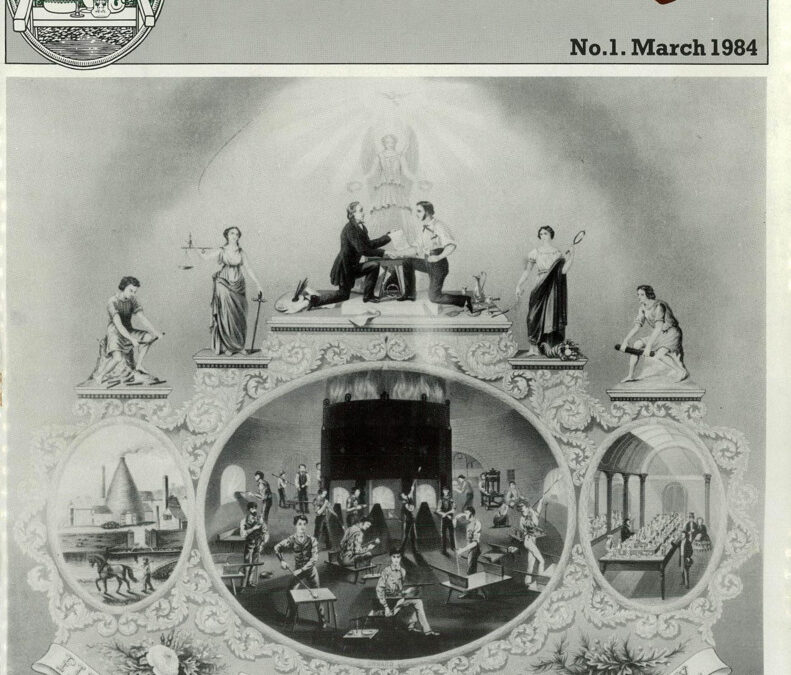
Cover Illustration
Glass Makers’ Union Certificate,
designed by Benjamin Richardson and
John Northwood. The interior view
shows men at work on pressing, bottle-
making and general blowing; the
central group at the top of the designer
and workman represents the Alliance of
Art with Manufacture.
This issue is published with the aid of
a financial contribution from the
Broadfield House Glass Museum.
The Glass Cone
In the 1950s Arthur Churchill’s Glass
notes combined the latest news from
the glass world with serious articles’ on
all aspects of glass collecting. That idea
seemed to hit the right proportion
between glass journalism and scholarly
presentation – it is the mark of its
success that it is still a universal source
of information.
The Glass Cone is based on a similar
approach but with the added benefit of
a much wider audience of glass
enthusiasts. The far reaching interests
of these enthusiasts will be reflected in
the contents. Regular features include
notes on collections, studio and factory
glass, general news items and
information on other Glass Societies.
Future numbers will include notes on
exhibitions and sales, museum
acquisitions as well as an exchange of
and requests for information.
Every two yearsthe News Letter will
be complemented by a journal
containing major illustrated articles.
The two publications in conjunction can
provide a body of information of both
national and international significance.
To achieve these aims your assistance
with news and articles is requested.
The Glass Association
During the autumn of 1983 eleven
people gathered informally to discuss
the idea of a new glass society which
would cater for a wide range of glass
interests, cover all parts of the country
and provide a varied and entertaining
programme of events. Rules were
drafted, printing costs for newsletters
were obtained and a programme of
events was suggested.
On Guy Fawkes day the Inaugural
Meeting was held at Stourbridge
College of Art when about 90 people
came from as far afield as Newcastle
and Cheltenham. Since then
membership has grown to 140 with
many more application forms already
being sent out. Sponsorship has also
been promised by one Stourbridge
glass firm. Therefore this new venture
is assured a successful future.
Glass has for too long been the poor
relation among the decorative arts but
we hope that with your help the
Association will promote and increase
the understanding and appreciation of
the art of glass.
p 2
Glass Societies –
The Carnival
Glass Society (UK),
Ray Notley
p 3
Showcase –
Glass on Tyne &
Wear,
Simon Cottle
p 6
Blowing Iron & Cutting Wheel
– Setting up a Glass Studio,
Richard Golding
p
7
Shearings –
News and Views
p 8
Facets –
Reports on regional
groups
GilaGs
Soc c lc
The Carnival Glass
Society (UK)
The Carnival Glass Society aims to
serve the collector of this very
exuberant and complex glass. It also
hopes that it will be instrumental in
documenting in a sensible and accurate
way, the history of this popular art
glass. There is a great deal of myth,
misinformation and whimsical nonsense
surrounding Carnival Glass. It has been
denied its proper and correct place in
glass history due to lack of reliable
source material. It is linked to the
Stourbridge area through the
Northwood family. Techniques and
design notions from Webbs, Stevens
and Williams and Richardsons are all to
be found in popular transformations.
Venetian edgings and crimpings were
expertly added by immigrant Bohemian
workmen. The glass is an amazing
amalgam of European workmanship
and the American genius for mass
production. It is a truly historical glass
with a fascinating lineage.
Hopefully, other glass collectors will be
kind and try to understand that this
very vibrant, beautiful and complex
artefact deserves its rightful -place in
the sequence of glass production. We
are not asking anyone to like Carnival
Glass. We ask only for your help in its
rehabilitation.
The Carnival Glass Society is also
trying to help its members understand
that there is glass other than Carnival.
We have regular meetings and this
year’s AGM and Open Day will be on
Saturday, 18th August, at Broadfield
House Glass Museum..
There are regular News-sheets, a
quarterly Journal and many pattern
data sheets. Local Groups have some
very enjoyable and informal social
evenings to exchange news, glass and
gossip.
Membership details and Prospectus
from the Secretary, The Carnival Glass
Society (UK), 29 Windsor Road,
Wanstead, London El 1 3QU.
41
0
Ray Notley
Detail of Heavy Grape Pattern by
Imperial Glass Corporation, Bellaire,
Ohio. A beautiful and artistically
successful example of mould cutting.
From “Carnival Glass” by Raymond
Notley, Shire Album 104 (95p).
wca se
Glass on Tyne & Wear
Whether blown, floated or
pressed, whether for window, table
or mantlepiece, glass has long
been associated with the North
East of England. During the 18th
century some of the finest quality
lead crystal emerged from this
area whilst in the 19th century the
glasshouses along the rivers Tyne
and Wear were as prolific in their
production as those of the
Midlands and the South.
It was during the 17th century that
the seeds of this success were
sown originating with the glass
monopoly awarded to Sir Robert
Mansell which enabled him to
establish a glasshouse on the Tyne
in 1619. This flourished and grew in
importance much to the detriment
of its longer established
contemporaries elsewhere. Today,
a glass industry still exists on
Tyneside but on a much reduced
scale. For enthusiasts of glass the
inheritance of the North Eastern
glass-making tradition can be seen
in the collections of Tyne and Wear
County Council Museums. A
county-wide policy has ensured
that this legacy is promoted
through a variety of displays at the
Laing Art Gallery in Newcastle,
Sunderland Museum and Art
Gallery and the Shipley Art
Gallery, Gateshead.
The glass collection at the Laing
Art Gallery has grown out of
various gifts, bequests and loans.
With special emphasis on
Newcastle’s contribution to the
manufacture and decoration of
glass, the displays illustrate its
historical development. This is
supported by a large display of
fine English and Irish glass from
1680 to the turn of the present
century. Althought the principal
products of Tyneside during the
17th and 18th centuries were
window and bottle glass, some
high-quality flint glass was made
for tablewares. Among the several
examples of this glass in the
collection, the famous Newcastle
light baluster is well represented.
Whilst there is contention that those
light balusters with Dutch
engraving were produced
elsewhere, the examples to be
seen are nonetheless, a beauty to
behold. An engraved ship goblet
of the 1740s signed by Jacob Sang
and a stipple-engraved light
baluster wineglass illustrating a
pair of carousing cherubs, are
among the best known pieces.
However, the glass for which
Newcastle is principally famous is
that decorated by the Beilby family
during the period c.1760-1778 of
which this County holds the largest
collection in the world. Using
locally-made glass (probably from
the glasshouse of Airey Cookson)
the Beilbys mastered the technique
of firing the enamel onto the glass
so that the two materials fused to
form a permanent bond. The
Beilby’s subject matter, as
represented by the thirty-six
examples in the loan and
permanent collections, ranges from
armorial, pastoral scenes and
architectural views to the fruiting
vine motif. The finest pieces are
the Henry Partis goblet in full
polychrome enamel, the exquisite
Margaret and Winneford ship bowl
(from the collection of Squadron
Leader James Rush), a cordial
glass with a glistening blue thread
insert in the stem and the ‘Truth
and Loyalty’ decanter which bears
the rare signature of William
Beilby above the crest of the Payne
family. The entire collection has
recently been rehoused in a
specially constructed display area.
-41111
Late 19thC.
Pressed Glass
by Heppell and
Sowerby.
OP”
Beilby Enamelled Glass — the
Margaret and Winneford Bowl, the
Henry Partis Goblet, Cordial with
Hunting Scene, Wineglass with fruiting
vine, Decanter with polychrome arms
of Linskill impaling Robinson, c1765.
Further outstanding examples of
18th century Newcastle glass in the
collection includes a decanter,
c.1790, with the name Tyzack
engraved on the shoulder – a
name long-associated with the local
industry – and a rummer bearing
the engraved arms of Newcastle
and the later date, 1801.
Among the 19th century Tyneside
examples there is an important
selection of copper-wheel
engraved pieces of which three
bear the signatures of their
decorators. The first, a goblet of
the 1840’s, charmingly engraved
by Thomas Hudson with Neptune in
a chariot borne by a pair of
hippocamps, is only partially
eclipsed by a monumentally large
goblet with a detailed view of the
Quayside and the old Tyne Bridge.
This latter is signed by an
unidentified A.C.
and was
produced in
the 1820s.
However,
the earliest piece
a rummer
0
0
”
Covered Vase
and Jug from
the
Londonderry
Service, c1824.
signed by John Watson and dated
5th July 1823, with a delicately
engraved view of St. Nicholas’s
Church, Newcastle, is the most
delightful.
There are examples of their
colourful fancy and Venetian ware
produced in the 1880s together
with a unique group of hand-blown
Art Glass from the short-lived
studio of J.G. Sowerby.
The mass-production of cheap,
decorative and utilitarian pressed
glass was pioneered in the North-
East, most notably in Gateshead by
Sowerby’s Ellison Glass Works and
George Davidson and Company.
The gifts of Matthew Bell (1925) and
Lady Ursula Ridley (1973) make the
pressed glass collection at the
Laing mostly Sowerby
“k’r
in origin.
From bottles to air-twist wine
glasses, from tankards to gilded,
coloured and cut-glass decanters,
the permanent collection of English
and Irish glass dates from
c.1700-1900 and it includes a
number of the standard products
as well as pieces of greater in-
i
N”,–
14
terest. Although unfortunately
ectio
100 years ago
For all snooker, billiards and
pool enthusiasts the following
notice is reprinted from Pottery
Gazette, December, 1884:
CRYSTAL GLASS BILLIARD
TABLE — we have recently had
the pleasure of inspecting a
magnificent billiard table, the
entire frame work of which is
made of richly cut crystal glass.
It has been manufactured by the
executors of the late Joseph
Webb of Stourbridge, for a
wealthy East India merchant.
The work is very finely
executed, and the effect when
lit up by a brilliant light, is truly
beautiful. This enterprising firm
has been very successful lately
in obtaining orders from India
for crystal glass furniture and
they have now, we understand,
another billiard table in hand, in
addition to a suite of chairs,
settees, sofas, etc. We are
pleased to see Stourbridge
coming to the front with this
class of work, which we believe
has hitherto had its home in
Birmingham, and wish the
executors of the late Joseph
Webb every success in the new
branch of the trade they have
taken up. Drawings of the
billiard table and other furniture
may be seen at their London
showrooms, 30 Holborn, E.C.
Glass and Architecture
An international meeting to
discuss Glass and Architecture
is to be held at Sars Poteries,
France, from 4-7th April, 1984.
Lectures and talks will be
complemented by working
sessions in the studios where all
the hot glass techniques will be
available. Anyone interested in
attending this project and also
seeing a very exciting set-up at
Sars Poteries should contact
Louis Meriaux, Musee du Verre
B.P. no. 2, 59216 Sars Poteries.
Phone 27 61 61 44
The Worshipful Company of Glass Sellers of
London Award
Entries are now invited for this Award which is available to persons
resident in the United Kingdom, who will be judged by the
Adjudicating Committee to have made an outstanding contribution to
art, craft, science or technology of glass during, say, the past two
years.
Entries must be submitted by 31st July, 1984, and may, for example,
take the form of relevant publications in the areas outlined above or
works of art or design. The Award consists of a suitably inscribed
scroll and trophy and a cash sum.
Application forms are available from: The Hon. Secretary, The Society
of Glass Technology, 20 Hallam Gate Road, Sheffield, S10 5BT
co
News & Views
Glassworks Closed
At the end of February the Trent
Valley Glassworks at Scropton
Lane, Tutbury, Staffordshire
finished production after a long
and impressive history. The
factory was established during
the early years of the 19th
century; by 1824 it was
supplying glass to the Marquis
of Hastings. During the 1870’s it
was known as the Royal Castle
Flint Glass Works when the
owner was J.T.H. Richardson, a
member of the famous
Stourbridge family. In more
recent years production has
consisted of pressed wares
including scent bottles and
ashtrays.
Before the factory closed,
Broadfield House Glass Museum
was able to photograph and
video the site and it is hoped to
produce a video film of the firm
and its history. Mr. Harry Shaw
has been especially kind in
providing access to the works.
With his help it is planned to
give a fuller account of the
factory in a future newsletter.
superb background to the widest
range of studio glass on sale
anywhere in the country. A
welcome section deals with hard-
to-get foreign catalogues on studio
glass.
Competition Invitation
A competition is being organised jointly by the Worshipful Company of
Glaziers and Painters of Glass and the Central Electricity Generating
Board. The competition is for a design for two fixed translucent panels
in the Main Entrance Hall of the Converter Station now under
construction at Sellindge, near Ashford in Kent. It is intended to fit the
panels during August/September 1985 to coincide with the completion
of the building and in time for the official opening. Prizes are of £750,
£400 and £200.
Closing date for submission of designs is 30th March 1984. Details of
the competition are available from The Architect, Transmission and
Technical Services Division, CEGB, Burymead House, Portsmouth
Road, Guildford, Surrey, GU2 5BN.
New Shops in London
Towards the end of 1983 Alcoholics
Antiques opened in Burlington
Gardens. Facing the Museum of
Mankind, the shop is run by
Jeanette and Malcolm Hayhurst
and Brian Beet who are always
keen to talk glass. Items in stock
range from late 17thc. glass to
some fine 19thc. examples. Nearby
in Piccadilly between the Royal
Academy and Piccadilly Circus,
Adam Aaronson has opened a new
Coleridge shop to complement his
existing premises in Highgate. The
luxurious surroundings provide a
ace
Regional Reports
Reports on Group
Meetings
Since the inaugural meeting two
regional groups have been formed
which have all the makings of
lively, informative and convivial
get-togethers. Other groups will be
formed as membership increases.
All members of the Association are
entitled to attend any of the local
groups and their activities will be
reported in the newsletter. The
following reports of the Manchester
and Stourbridge meetings will give
some idea of the range of events
discussed so far.
North-West
The North-West group met at the
Athenaeum, Manchester, on
Saturday, 3rd December. Cherry
Gray opened the meeting with a
history of glass-making in
Warrington beginning with the
Bank Quay works established in
1757. The 19th century saw other
glassworks open in the town
including Robinsons who continued
until the 1940’s. The firm must be
one of the most under-rated of
19thc. firms for they produced fine
quality table wares and by 1862
provided 80,000 pieces for the
London exhibition. During the
1920’s they continued production of
delicately blown wares, supplying
an order of glass for Princess
Mary’s wedding.
Peter Helm continued the session
with a general appraisal of the
Manchester industry including
slides of remaining glass sites. One
of the most interesting details was
about the procession, after the
Reform Act, which included
glassmakers carrying two goblets
of 10 and 7 gallon capacities, 2
lobby lamps, a fish globe,
birdcages, silvered globe
ornaments with sceptres, crowns
and blue wands. By 1929 the most
famous firm, Molineaux Webb and
Co., had closed and Manchester
glass was largely forgotten.
Janice Murray completed the story
of North West glass with the St.
Helens industry. Major
development came in the 19th
century with firms such as
Cannington Shaw, Nuttall & Co.,
and the Foster Glass Co., all
specialising in bottles. Perhaps the
most interesting set of slides,
especially to glass technologists,
showed the last surviving example
of a Siemens regenerative furnace.
An exciting restoration project is
planned for the building.
Following a break for coffee, the
meeting discussed future plans.
General agreement was for talks
and collectors’ evenings
interspersed with Saturday visits to
collections. Although an interest in
local glass was important, a wider
scope was necessary to attract a
larger membership. Many people
wanted more time at meetings for
discussion; research was also felt
to be of paramount importance.
Finally everyone agreed to 3
regional meetings in March, May
and September consisting of a
museum visit, a talk and an open
evening. These would fall between
the national meetings in April, June
and October.
Midlands
The Midlands group met at
Broadfield House Glass Museum at
Kingswinford on Thursday, 8th
December. Charles Hajdamach
showed a selection of slides taken
on a visit to Corning, U.S.A. in
October, 1982. A connection with
Stourbridge was highlighted at the
Rockwell Museum and the
marvellous displays of glass by
Frederick Carder, the founder of
Steuben Glass. Roger Dodsworth
gave a humourous description
about the growth of his glass
collection, selecting as a focus
about 20 pieces ranging from
pressed glass to Stourbridge
wines. Roger stressed the need to
understand methods of production
which could endow even the most
non-descript glass with an
interesting story.
The first session ended with a
showing of a 15-minute film about
Whitefriars and Chances, both
firms tragically lost in recent years.
After the coffee break discussion
centred on two main points i.e. the
spread of knowledge ,about
techniques and the importance of
collectors’ evenings.
The latter perhaps could be
combined with private views at the
Glass Museum. Following a very
enthusiastic meeting (which
continued well after closing time)
the decision was to hold a
collectors’ evening on 1st March, to
be followed by a lecture/s on
contemporary glass techniques.
Members in the South-West and in
London are currently looking at the
formation of new groups. Anyone
who is interested in joining these or
in forming new groups, will be able
to obtain a list of members in their
area from the Treasurer.
Future Group
Meetings
North-west
Saturday, 31st March at 2 p.m. at
Wlitworth Gallery, Oxford Road,
Manchester.
Cathy Ross will talk on the
Development of Glassmaking on
Tyneside
Saturday, 2nd June at 2 p.m. A visit
to the new glass displays at the
Harris Museum and Art Gallery.
Market Square, Preston, with an
introduction by Alexandra Walker.
(Anyone needing further
information should contact Ian
Wolfenden on 061-273 3333 ext.
3619).
A Demonstration of Stained Glass
Making by Paul San Caschiani is to
be held at Pilkingtons Glass
Museum between Monday, 2nd
July and Friday, 6th July, 1984.
Practical workshops will be held
on Tuesday and Thursday — there
are limited places at a cost of £25
per person per day. Contact Ian
Burgoyne at Pilkingtons Glass
Museum, Prescot Road, St. Helens,
Tel. St. Helens 28882 ext. 2499.
North-East
Simon Cottle at the Laing Art
Gallery, Higham Place, Newcastle
on Tyne, is keen to form a local
group and would like to hear from
members in that area about a
possible first meeting.
Midlands
Thursday, 17th May, 7.30 p.m. at
the Glass Centre, Moor Street,
Brierley Hill. Glassmaking
investigation into techniques.
National Meetings
Saturday, 7th April at Pilkington
Glass Museum. A visit to the Float
Glass Process and discussion by
Martin Harrison wih John Piper
about his stained glass designs.
Members will have received
separate notification of this event.
Visit in late June/early July to
Bristol to see the Bristol Glass
exhibition. Details of this outing are
still in preparation.
damaged, a rare sweetmeat set,
c.1745, with floral engraving is one
of the highlights. Together with a
silesian-stemmed salver and
sweetmeat glass, there are eight
engraved jelly glasses, each of
which sits neatly arranged around
the sweetmeat glass and on the
salver itself. A major recent loan of
almost forty pieces of 17th, 18th
and 19th century English glass
from the collection of Peter Meyer,
has broadened the historical
significance of the British and
Newcastle glass display. This
remarkable collection includes
among several rare 17th century
examples, an Anglo-Venetian
wineglass probably from the Savoy
Glasshouse of George Ravenscroft,
c.1680. Colour twist wineglasses, a
Jacobite firing glass, a superb Dutch engraved light baluster
wineglass of the ship Kattendyke
attributed to a member of the Sang
family, and a rare Beilby wineglass
with a shipping scene, are among
the important 18th century
examples being lent to the Gallery.
A rare decanter with an engraving
of the Wear Bridge and a goblet
illustrating a lady smoking a pipe
in the smoker’s carriage of a Planet
type locomotive are just two of the
19th century examples which, with
all the earlier glass, makes this one
of the most exciting loans to any
museum of glass in this country.
Lastly, a pair of 14ft. stained glass
windows depicting Fortitude and
Charity respectively, by Sir
Edward Coley Burne Jones
(1833-1898) for St. Cuthbert’s
Church, Newcastle, have recently
been erected in the Gallery as a
permanent display feature and
indicates the wide variety of glass
decorating methods to be seen in
Tyne and Wear’s collections.
At Sunderland Museum and Art
Gallery, the glass collection is both
of historical and technical interest.
It was in 1696 that a Company of
Glassmakers was established in
Sunderland. However, the boom
period was to come in the 19th
century. Engraved and cut glass
from the early 1800s form the bulk
of the display of historical glass,
the highlight being the fine
examples from the two hundred
piece cut-glass service made by
the Wear Flint Glass Company for
the 3rd Marquis of Londonderry
and on loan to the museum from
the family. From its appearance,
this high-quality glass was thought
previously to be Irish in origin.
However, the thickly blown and
deeply cut glass was made at
Deptford in Sunderland in 1824.
Other examples include a number
of both large and small rummers
engraved variously with views of
the Wear Bridge, opened in 1796.
An obvious subject for the
decoration of glass articles in
Sunderland is the Exchange
Building of 1814 and there is one
magnificent example in the
collection.
A new permanent display is to
open shortly which will illustrate
the technical development of
glassmaking both in its local and
national context from the 18th
century to the present day. Pyrex,
the subject of a recent major
exhibition, brings the technological
survey to its close.
The Shipley Art Gallery’s most
recent development is the
assembling of the County’s
Contemporary Craft Collection. Of
their contemporary glass, there are
examples from both the region’s
and Britain’s major glassmaker’s
and decorator’s workshops. The
work of Pauline Solven, Dillon
Clarke, George Elliott, Anne Mieke
Lumsden, Stephen Proctor, John
Cook and Willie Anderson is
strongly represented. A new
display of this collection is soon to
be opened and will provide a focus
and encouragement for studio
glassmaking in the North-East. The’
Gallery also possesses a large and
significant collection of press-
moulded glass, especially that
made by Sowerby in Gateshead in
the late 19th century, and a small
collection of locally engraved
glass.
Thus, the County of Tyne and
Wear can rightfully boast an
impressive collection of glass, the
richness and variety of which can
only be appreciated at first hand.
Simon Cottle
Sunderland
Exchange
Rummer,
c1825.
•
4
4
Journey
Through
Light’, blown,
cut,
sandblasted and
engraved by
Stephen Proctor
1981.
Mutt]
Setting up a Glass Studio
This short article is the first in a
series about the setting up and
running of a studio glass workshop.
Future articles written by
glassmakers and technologists will
provide more specialised
information. The information here
results from a discussion with
Richard Golding and Nicola
Osborne who are Okra Glass and
work at Broadfield House Glass
Museum. Their advice is intended
to help would-be glassmakers
avoid some of the pitfalls which
they themselves have encountered.
Finance
Money can be saved in the initial
stages by making one’s own
equipment e.g. benches, frames
etc. A general course in metal
working/welding would provide
the necessary skills. The amount of
price-saving can be impressive.
Okra equipped their studio for
£4,000 whereas a similar range
bought commercially would cost
£7,500-£8,000. The added
advantage is that self-help is at
hand should anything go wrong.
The Glass Mix
Many studios use Dartington cullett
(£180-£200 a ton) which is good
quality but variable. However the
price is reasonable as the costs for
melting a 24% lead glass would
reach £600 a ton using ready made
batch. Soda glass can also be a
good alternative. Richard Golding
recommends the following batch to
melt out at 1300°-1350°C
overnight:— 18.5% Soda (Na20),
8% lime (CaO), 1 .5% Borax (B203),
0. 1-0.2% Refining agent such as
antimony oxide (handled with care
as it is an accumulative poison
worse than lead), 72% sand/silica.
Lime can be added as calcium
fluoride/fluorspar which aids
refining due to its volatile nature.
The Furnace
An open-pot furnace is
recommended using a free-
standing Dyson 17″ x 10″ Sillimanite
pot. Casing the pot in cement may
extend its life but it creates
problems when it comes to
renewal. A free standing pot
should last 6 months. Production
levels should be about £100 a day
– the cost of one pot.
Refractory bricks of good quality
are difficult to find. Most are not
fired over 1450°C. The small
orders placed by studio glass
makers cannot influence an
increase in quality from the large
manufacturers. The best quality
Sillimanite and Mullite should be
used while Zircon Alumina from
France is also very good but
expensive as it is cast at 2400°C.
Recent experiments by some
studio glassmakers may eventually
result in better quality refractories.
The Studio
The first possibility is to set up in a
tourist area selling glasses at £1-£5
each with the occasional more
expensive item. The range could
include pressed ashtrays,
candlesticks, birds, swans, vases,
pressed discs and tiles.
The alternative is to produce an
article of higher quality and
consistency and sell via the trade.
Repeat orders must be available.
This is a much slower market to
break into – one way of achieving
it is to start with cheaper items,
then increase quality and price.
The standard mark-up is 115%
(100%+ 15% VAT) therefore a £5
item will sell for £11.50 in the shop.
The third possibility is to deal
through art/craft galleries, even on
a sale or return basis although the
latter is not recommended.
Generally speaking sales through
galleries may be slower as one is
usually marketing a name as an
artist for an exclusive one-off
product.
Colour
The German firm of Kugler is the
main supplier of glass colours. The
high costs of £5-£10 per kilo,
depending on colour, are
increased by shipping costs. There
is a minimum order with a
surcharge on orders under £500.
Kugler supply approx. 90 colours of
which 15-20 are base colours. The
variations give a subtlety not
available from English firms such
as Plowden and Thompson at
Stourbridge. Many studio glass
firms are becoming increasingly
aware of the great risk involved by
relying on one outside supplier
who may end production or may
be involved in a take-over bid
resulting in higher prices. A
programme of research to produce
one’s own colours is urgently
needed but due to the friction
between various groups any
success in this field is kept a close
secret. A change in attitude could
lead to the idea of selling colour
recipes while the basic information
of setting up a studio should be
given freely and readily.
Home-made colour can cost as little
as £1 per kilo but it may involve a
long process of trial and error e.g.
Okra’s attempts at a selenium
sulphide red have resulted. in 17
different melts and still without
success. Colour melting requires
an experimental furnace using tiny,
tea-cup size crucibles which will
keep costs to a minimum. Each
crucible is only used once. Books
of recipes are available but final
results depend on a variety of
factors including oxide content,
expansivity, furnace atmosphere,
chemical conditions in the melt
itself, and oxidation or reduction in
varying degrees. However once
colour is produced the great
advantage is that it is immediately
available. Today Okra Glass are
one of the few studios in this
country, large or small, who gather
hot colour out of their furnaces. The
majority of major coloured glass
manufacturers use Kugler glass.
Sales
it
is much better to use the
professional assistance of an agent
rather than travel oneself. A day of
work costs lost production (£100
minimum) and only about 4 shops
can be covered in one day. Even if
orders of say £350 are taken this is
reduced by expenses and lost
production totalling up to £200. In
choosing an agent, who will make a
standard charge of between
10-20%, find out what other goods
the agent carries and if they are
compatible with your own. Ask to
see the other ranges and find out
which shops are visited. It is
necessary to obtain a contract of
work with an initial 3 month trial. If
this fails only the samples will have
been lost. Orders are often placed
directly with the studio. In this case
good studios will give the agent a
commission on these and then pass
the customer to the agent for future
sales.
Richard Golding