




The Glass Cone
ISSUE NO.100
AUTUMN 2012
Contents
1 The Changing Face of the
Glass Cone
2
Reflections on the First 100
3 Harry Northwood
9 Who Made that Glass?
11 Starting collecting
12 Cockerel Glassware by Stuart Crystal
15 The Whin Club Glasses
17 Seduced, Informed and Encouraged by Good Company
19 Some Thoughts on Spa Glasses
22 Peter Layton and Fifty Years of Studio Glass
24 David Reekie
25 Antique Glass for Wine
28 Members and What’s on
Chairman’s message
The Glass Cone
THE MAGAZINE OF THE GLASS ASSOCIATION
Issue No: 100 – Autumn 2012
Editorial Board
Editorial Co-ordinator
(The Glass Cone):
Gaby Marcon editor@glassassociation.org.uk
Charles Hajdamach, Mark Hill, Brian Clarke, Yvonne
Cocking, Bob Wilcock
Address for
Glass Cone
correspondence
E-mail editor@glassassociation.org.uk
or mail to Glass Cone, 7 The Avenue, London N3 2LB
E-mail news & events to news@glassassociation.org.uk
Articles and news items are welcome at any time,
but please bear in mind the copy dates if you have
an event you would like to be publicised.
The opinions expressed in the
Glass Cone
are those
of the contributors. The aim of the Editorial Board is to
cover a range of interests, ideas and opinions, which
are not necessarily their own. The decision of the
Editorial Board is final.
Copy dates
Spring: 21 February – publication 1 May
Summer: 21 May – publication 1 August
Autumn: 21 August – publication 1 November
Winter: 7 November – publication 1 February
Advertising rates
Full page £200; Half page £140; Third page £100; Sixth
page £70; Twelfth page £55. For inside back cover and
back cover, prices are on application.
Discounted rates for GA members
Please contact circaglass@aol.com
The Glass Association 2012. All rights reserved
Design by Malcolm Preskett
Printed in the UK by Micropress Printers Ltd
www.micropress.co.uk
Published by The Glass Association
ISSN No.0265 9654
The Glass
Association
Registered as a
Charity No.326602
Website: www.glassassociation.org.uk
Life President:
Charles Hajdamach
charieshajdamach@btinternet.com
Chairman:
Dr Brian Clarke:
chair@glassassociation.org.uk
Hon. Secretary:
Judith Gower:
secretary@glassassociation.org.uk
Membership Secretary
Pauline Wimpory,150 Braemar Road, Sutton Goldfield,
West Midlands, B73 6LZ
membership@glassassociation.org.uk
Committee
Paul Bishop (Vice-Chairman); Roger Dodsworth;
Jackie Fairburn; Christina Glover; Alan Gower; Judith
Gower; Francis Grew; Mark Hill; Jordana Learmonth;
Gaby Marcon; Maurice Wimpory (Treasurer)
Membership and subscriptions
Individual: £25. Joint: £35. Student with NUS card: £15.
Institutions: UK £45. Overseas £35. Overseas
Institutions £55. Life: £350. Subscriptions due on
1 August (if joining May-July, subscriptions valid until
31 July, the following year)
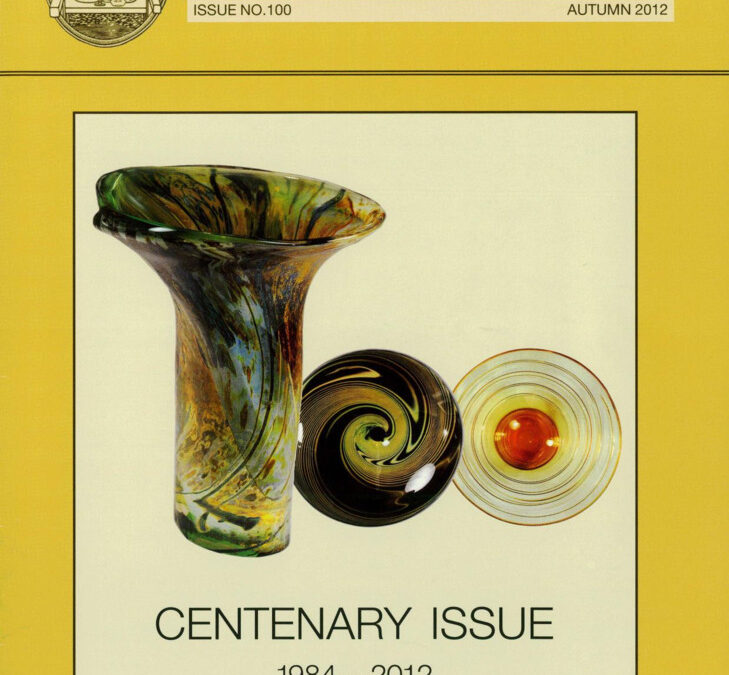
Cover illustrations:
Front: Multi-coloured Mushroom Vase. Sam
Herman, 1979 at Val St Lambert; Large covered
bowl by Layne Rowe, London Glassblowing;
Large ribbon-trailed amber bowl. Barnaby Powell.
1932-6 Whitefriars. Photos by Brian Clarke.
Back: Amethyst Carnival glass, ‘Grape and Cable’
punch set (photo courtesy of Ogleby Institute)
– see article on Harry Northwood, p.3
Dear members,
REACHING the centenary issue of
The
Glass Cone
is a very special moment and
to suitably celebrate the 100th issue, the
editorial team decided to publish this
bumper issue of 32 pages. I know that
I can speak for you, our members, in recog-
nising and applauding the work of the
editors, from the very first edition in 1984, in
reflecting and reporting on the changing
areas of interest for glass enthusiasts,
collectors and researchers, creating a
publication to be proud of.
For this 100th issue of
The Glass Cone,
some of our regular contributors have taken
the opportunity to look back and praise
the events that generated not only know-
ledge and understanding of glass but
friendship and respect, whilst others have
contributed with yet new research and
material and in the article ‘The Changing Face
of the Glass Cone’. I’ve presented a brief
overview of
The Glass Cone
from its humble
beginnings to today’s glorious technicolour.
While it is good to look back and
celebrate the efforts that went into
producing an informative and interesting
magazine, we need to look at the future,
not only of
The Glass Cone
but of the
Association itself. In this spirit we were
approached by the Glass Circle (GC) with
the idea of exploring ‘if ‘and ‘how’ we could
benefit from our organisations working more
closely together. Over the past few years
the topics of both group’s meetings and
publications have widened, the GC including
more 20th century and studio glass and
the GA often looking at ‘older’ glass. We
have also ensured that our international trips
were jointly marketed and did not occur in
the same year.
Both associations are now having to
grapple with similar problems, namely a
reduced number of members and an
increase in the costs of our activities. The
new formats of our respective magazines,
the
The Glass Cone
and the
Glass News
along with the GA’s interactive website,
have reached a standard that has become
increasingly difficult to maintain solely with
the freely given time of the editors, so
professional help has been sought – giving
rise to additional costs.
At our next committee meeting on
1 December, we shall be looking at the
implications of the GC and the GA joining
forces and discuss a possible future together,
however, nothing will change without a
majority on both sides agreeing to change.
I believe that for a strong future, changes are
needed. This is your association, we
welcome your thoughts and ideas.
with season’s greetings
Brian Clarke
THE GLASS CONE NO.100 AUTUMN 2012
11111.11
.
T.
–
mot
#,
The Changing Face
of the Glass Cone
Brian Clarke
N this 100th issue of
The Glass Cone
(TGC), the
Glass Association’s (GA) main line of communi-
cation with its members for nearly 20 years, I wish
to take us on a brief journey through a number of
facelifts that TGC has undergone through its life.
TGC came into being in 1984 under the
chairmanship of Anthony Waugh and with Charles
Hajdamach as editor. This was a black and white
issue of 8 pages, with just the lettering of TGC in
vibrant colours. That format continued for a number
of years. Running alongside each other, the
Newsletter and TGC were the pre-web publications
that kept everyone in touch. No changes were made
until issues 29 and 30 when, in 1991, the background
to the lettering of ‘The Glass Cone’, and page borders
were coloured.
These early TGCs were ‘letter size’, a format
shorter and wider than subsequent issues. After ten
fruitful years as editor, Charles Hajdamach passed on
the baton to Dr Paddy Baker who took over in 1993.
With John Delafaille as the new chairman of the GA
in 1995, Paddy took on the task of modernising
TGC. Issue 43 in 1997 was produced with three
major innovations — a glossy full-colour front cover,
a change to the A4 format, and an increased issue
size to 12 and sometimes 16 pages. This first colour
cover, depicting a Beilby Armorial Goblet, was one of
only two coloured covers for many years. In pre-
digital days, this just proved to be too expensive and
the editorial team had to revert to black and white
from issue 45.
Dr Paddy Baker continued as editor until 2003,
when Brian Currie stepped in as interim editor, to
steer TGC through until Nigel Benson produced
issue 70 in 2005. Paddy’s ten years had seen TGC
continue to be a publication of interesting and
informative articles and a forum for members to share
information. She worked with three chairmen, John
Delafaille, then Ian Turner presiding from 1998 and
Charles Hajdamach from 2002.
The next development occurred in time to report on
the GA’s trip to the USA. Bob Wilcock had both the
editorial and the technical skills to bring TGC into
the digital age. The double issue, 72/3 at the end
of 2005, was a milestone, the first full-colour issue of
TGC. Bob also revolutionised the content, with many
more articles revolving around contemporary glass
and with this advent of colour, maximised the use of
photos. The number of pages was kept at a minimum
of 16, with some double issues and some of 24
pages. Bob continued his editorship with Brian Clarke
as chairman from 2006, until, with Olympic duties
looming, Bob passed on the reigns to Gaby Marcon,
as head of the editing team from the spring of 2011,
with TGC issue 94. Along with technical editor
Malcolm Preskett, Gaby reformatted the magazine
anew, with a change of font, design, use of colour and
content, bringing in a broad church of articles on
glass, British, European and worldwide, from the 17th
century through to today’s studio production. TGCs
have also settled down to 24-page issues — a long
way from their 8-page beginnings.
Over the years, TGCs have included stimulating
articles and reported on the breaking news of the
time. In 1991 the story was told of the third Dudley
Crystal Festival, which years later, morphed into
the bi-annual International Festival of Glass. In 1989,
issue 22, I noted an early one of John Brooks’
valuable saleroom reports of the auction houses, a
tradition continued by Chris Crabtree in 1999 and
followed later by in-depth analyses from Charles
Hajdamach, then briefly from Nigel Benson; this
continues today with reports from Brian Clarke.
The sad story of the closure of the Thomas Webb
glassworks in 1990, the delight of the first Biennale in
2004, and the first specialist sale of glass by Fieldings
in Stourbridge, also in 2004, all featured in the pages
of TGC. Issue 88, saw Bob Wilcock initiate using TGC
to concentrate on a single subject: Broadfield House,
The Wallace Collection and Newcastle all received
this specialist treatment.
In looking through all 99 issues of TGC, two
particular items stood out. The winter issue of 1997,
No.44, carries the second of Paddy Baker’s colour
front covers — a photograph of the late Michael
Parkington’s living room; no space for people — just
glass: a lesson for all collectors? TGC was also helpful
in 2009, keeping our membership informed, when
Broadfield House and its collections were under
immediate threat — an issue that has been quiet for a
while, but still not resolved.
In providing news and information on the broadest
front of glass interests, and in keeping TGC up to date
in style and content, I wish to thank all the editors and
contributors, especially those who have regularly
drafted articles and taken excellent photos, for all their
time and effort over the years in providing the GA’s
most valuable form of communication.
THE GLASS CONE NO.100 AUTUMN 2012
1
Reflections on the First 100
O
VER the past nine years as a regular
contributor to the
Glass Cone
I’ve had
the pleasure of working with several
editors. I would just like to express my
congratulations and thanks to all of them,
plus everyone else involved in the production
of our quarterly publication. Other than having
to put the dates for copy deadlines into my
diary, think about a new subject for the next
article and, at the appropriate time, type it
up on an e-mail and post a CD with the
associated photographs — my involvement
is quite enjoyable as I am writing about
something that has been an interest of mine for
some 38 years. Though for the editorial team,
chasing contributors, pulling together all the
submissions and turning all the articles into
the finished product that drops through our
letterboxes every three months is something
very different. When I look back at the early
publications, I am reminded of just how far
things have moved on over the years. One
thing however comes over consistently, and
that is the variety of topics that have been
covered. Surely this has to be a major factor of
the
Cone’s
appeal.
The second is a weight entitled ‘Homage to Van
Gogh’ by David Graeber from the Stankard Studio.
Although paperweights are my primary
interest, my reason for joining the Glass
Association shortly after its formation back in
1983 was not to try and convert everyone to
paperweight collecting, but to gain insights
and to share information on differing aspects of
both the making and collecting of other types
of glass. This aim has definitely been achieved
by attending meetings the length and breadth
of the country with other glass enthusiasts.
Over the years I have met and listened to some
very knowledgeable people. Since being
approached to write for the Cone I hope that
members have found some of the articles
which I have written to be of interest, and that
I have helped to contribute to the variety of
Richard Giles
The first weight is an 1845 signed and dated
millefiori weight by Italian Pietro Bigaglia.
subjects covered. Researching for the articles
has been very rewarding. I seem to have
amassed an amazing amount of new
information and so I have benefited in that it
has greatly enriched my breadth of knowledge.
However, you can read a great many books
and articles and consult the internet, but over
the years I have found that it is the members
themselves who have the biggest store of
information on all sorts of obscure subjects.
In a steam railway magazine that I receive
monthly they have been publishing a series of
black and white photographs taken by well
known photographers back in the 1950s and
’60s but locations were not recorded. To date
the appeal to readers for information on the
engines and locations has been 100%
successful. In some cases the information has
led to changes in what many people had been
led to believe were well established facts,
recorded in books and articles published over
the years since steam disappeared.
It is not the fault of the authors; they write
what they believe to be correct at the time of
writing, but many books are written by people
who have a great deal of knowledge but are
not necessarily enthusiasts or, in the case of
glass and paperweights collectors, who have
researched their particular interest in great
detail and been out there at the flea markets
and antiques and collectors fairs. In recent
years research into many aspects of
paperweight making, particularly in the
relatively obscure parts of Europe that we
knew as Bohemia and Silesia, has started to
reveal some changes in what we had all been
led to believe about the introduction of
paperweights. Whereas it was always believed
that Italy was the first country to see
paperweights, with France and Bohemia
following soon afterwards, it appears that it is
highly likely that Bohemia had discovered and
been experimenting with
millefiori
possibly
some ten years or so before the first weights
appeared in Italy. The difficulty is that we are
now looking back some 180 or more years at a
period in time when things were so very
different and information was often not
recorded. At least new research provides
material for those of us who have to come up
with something new for every edition of
magazines such as our
Cone.
Furthermore,
most books are not updated and so it is to be
hoped that such articles provide readers with
the latest news and information.
I wish to thank all those concerned with
making membership of the Glass Association
so enjoyable and rewarding. The odds are
probably against me being around to see
Cone
200 but I hope that despite the
economic situation and the seeming lack of
interest in collecting amongst the younger
generation the Association and
The Glass
Cone
continue to thrive in the future. I am very
happy to have played a very small part in
reaching the first 100.
Christmas
Weight
In ‘The Glass Cone 97’, Richard Giles ended
his article on Christmas paperweights, showing
a Christmas Pudding-shaped weight of
unknown origin, that he’d bought in 1991.
We’ve just received the following information
from Zest Glassmaker,
ADAM AARONSON.
The Christmas Pudding paperweight was one
of the original items produced in my first studio,
Turnmill Contemporary Art Glass Studio in
Clerkenwell.
They were made in 1987 and to the best of my
recollection fewer than 100 were produced as
they were quite complicated to make. In fact,
I think we probably only made about 60 in the
end and there were marked differences
between them.
At that time, I wasn’t making glass myself;
I designed the weights which were then
produced by my ex-Wedgwood Glass team
who were Andrew Moncrieffe, Alistair Moncrieffe
and Malcolm Flegg.
We also made some Snowmen paperweights
but nothing else similar to the Pudding.
2
THE GLASS CONE NO.100 AUTUMN 2012
Harry Northwood
A Stourbridge School of Art success story
James Measell
B
ORN in Kingswinford on 30
June 1860, Harry Northwood
was the son of John North-
wood (1836-1902) and the former
Elizabeth Duggin. John was listed as
‘glass ornamenter’ on Harry’s entry of
birth, and he and his younger brother
Joseph had recently begun a glass
decorating business as ‘J. & J. North-
wood’ in Barnet Lane, Wordsley. As
Harry grew from childhood to maturity,
his father’s enterprise flourished, and
John Northwood achieved fame for
the reinvention of cameo glass pro-
cesses and a marvellous replication
of the Roman-era Portland Vase.
Without doubt, Harry Northwood
seemed destined for success in glass.
John Northwood, who had attended
the Stourbridge Government School
of Art and won medals in national
competitions in the 1850s, was
certainly a key influence on his son,
for they visited museums together
and Harry likely attended an evening
drawing class at J. & J. Northwood
in the 1870s as did his half-brother,
John Northwood II, and other em-
ployees of the firm.
1
However, Harry’s
education at the Stourbridge school
also helped pave the way for his
remarkable career after emigrating to
America in 1881. This article will
provide background regarding the
Stourbridge School of Art during
Harry Northwood’s time there and
offer an account of his success in
design and glassmaking.
During the first decades of the
nineteenth century in Great Britain
there was considerable interest in
expanding educational opportunities,
as well as an increasing willingness
for Government involvement. The
Industrial Revolution had the effect of
concentrating populations in manu-
facturing towns and,simultaneously,
creating a need for an educated
workforce. Lord Henry Brougham and
others pushed legislation to provide
Government funds to erect school
buildings. Moreover, manufacturers
were acutely aware that British abilities
in design fell short of those in France
and other countries where design
schools supported by governments
had existed for many years. In the mid-
1830s, William Ewart
MP
(Liverpool),
proposed to the House of Commons
that a Select Committee on Arts and
Manufactures be established . This
committee was directed to ‘inquire
into the best means of extending a
knowledge of the Fine Arts, and of
the Principles of Design among the
people — especially the manufac-
turing population of the country’. Soon
thereafter, Government support for
art education in design was begun
under the auspices of the Board of
Trade, and a Council drawn from the
Royal Academy oversaw the effort.
Other influential factors, such as a
general concern for the improvement
of public taste, fuelled the establish-
ment of design schools, as did a
growing interest in culture and art,
reflected in the popularity of the
London Art Union and the availability
of engravings of historical pictures.
This sort of enthusiasm also sparked
off efforts to provide free admission to
museums and art exhibitions and
to make private art collections access-
ible on occasions. Concurrent were
efforts to teach drawing to children
and young adults. Lastly, the Great
Exhibition at the Crystal Palace inten-
sified British interest in the design of
manufactured goods and kindled dis-
cussions of artistic taste. The Great
Exhibition generated over £186,000
and provided for the establishment of
the South Kensington Museum, later
known as the V&A.
2
The Stourbridge school was founded
in 1851, as Parliamentary grants of
£150 were available for fledgling
‘provincial schools’ under the Depart-
ment of Practical Art, which also
maintained a Central School at
London’s Marlborough House. At a
public meeting in the Corn Exchange
on Monday evening 3 February 1851,
Stourbridge area citizens pledged
sufficient financial support to match
the Parliamentary funds in order to
acquire suitable quarters.
3
According
to the
Report,
the Corn Exchange
‘was filled with a highly respectable
assemblage, consisting of the nobility
and gentry of the neighbourhood,
with a good display of ladies, the
chief tradesmen and a large number
of artisans of the town’. Lord Ward
(later Earl of Dudley) occupied the
chair, and the
Report
mentioned his
reputation for ‘excellent taste in the
fine arts’ as well as his ‘influence in
the promotion of Schools of Design
in this country, in the Potteries, and
elsewhere’. The assembly approved
a resolution to raise £2,500, and a
committee was formed to seek out
subscribers and purchase a suitable
building. Lord Ward felt that such
schools should have begun a decade
earlier, and he also said, ‘Englishmen
had supplied the world with the useful,
but had neglected the beautiful’. By
the end of 1851, benefactors had
contributed £788.
At first, classes were held at the
local Mechanics Institute but, by
1 September 1851, the Stourbridge
school was operating in a renovated
building on Theatre Road (this location
in central Stourbridge was the school’s
Harry Northwood,
c. mid-1890s.
JAMES MEASELL
is Historian at
Fenton Art Glass
in Williamstown,
West Virginia, USA.
He is currently
pursuing an MA
by Research degree
at the University
of Birmingham.
THE GLASS CONE NO.100 AUTUMN 2012
3
Entry forHarryNorthwood in the Stourbridge Government School ofArt,
Register of Students, on 15 March 1869
South Kensington Curriculum
STAGE
1.
Linear drawing by aid of instruments.
a.
Linear geometry. b. Mechanical and machine
drawing, and details of architecture from copies.
c. Linear Perspective.
STAGE
2.
Freehand outline drawing of rigid forms
from examples
or
copies.
a. Objects. b. Ornament.
STAGE
3.
Freehand drawing from the ’round’.
a. Models and objects. b. Ornament.
STAGE 4.
Shading
from
flat examples or copies.
a. Models and objects. b. Ornament.
STAGE 5.
Shading from the round or solid forms.
a. Models and objects. b. Ornament.
c.
Time sketching and shading from memory.
STAGE
6.
Drawing the human figure and animal
forms from copies.
a. In outline. b. Shaded.
STAGE
7.
Drawing flowers, foliage and natural history,
from flat examples or copies.
a. In outline. b. Shaded.
STAGE 8.
Drawing the human figure or animal forms
from the ’round’
or
nature.
a. In outline from casts. bl. Shaded (details).
b2. Shaded (whole figures). c. Studies of the human
figure from nude model.
d.
Studies of the human figure, draped.
e.
Time sketching and sketching from memory.
STAGE 9.
Anatomical studies.
a. Of the human figure. b. Of animal forms.
c. Of either, modeled.
STAGE 10.
Drawing flowers, foliage, landscape details,
and objects from natural history from nature.
a. In outline. b. Shaded.
STAGE 11.
Painting ornament from the flat or copies.
a. oil. b. In colours.
STAGE
12.
Painting ornament from the cast, &c.
a. In monochrome, either in water-colour, oil, or
tempera.
STAGE 13.
Painting (general) from flat examples or
copies, flowers, still-life, &c.
a. Flowers or natural objects, in water-colony in oil, or
in tempera. b. Landscapes.
STAGE 14
Painting (general) direct from nature.
a. Flowers, or still-life, in water-colour, oil, or tempera
without backgrounds. b. Landscapes.
STAGE 15.
Painting groups as compositions of colour.
a. In water-colour, oil, or tempera.
STAGE
16.
Painting the human figure or animals in
monochrome from casts.
a. In oil, water-colour, or tempera.
STAGE 17.
Painting the human figure or animals
in colour.
a. from the flat or copies. b. From nature, nude or
draped. c. Time sketches and compositions.
STAGE 18.
Modelling ornament.
a. Elementary, from casts. b. Advanced, from casts.
c. From drawings. d. Time sketches from examples
and from memory.
STAGE 19.
Modelling the human figure
or
animals.
a.
Elementary, from casts of hands, feet, masks, &c.
b.
Advanced, from casts or solid examples.
c.
From drawings. d. From nature, nude or draped.
STAGE
20.
Modelling fruits, flowers, foliage, and
objects of natural history from nature.
STAGE
21.
Time sketches in clay of the human figure
or animals, from nature.
STAGE
22.
Elementary design.
a.
Studies treating natural objects ornamentally.
b.
Ornamental arrangements to fill given spaces
in monochrome.
c.
Ornamental arrangements to fill given spaces
in colour. d. Studies of historic styles of ornament
drawn or modelled.
STAGE
23.
Applied designs, technical
or
miscellaneous
studies.
a.
Machine and mechanical drawing, plan drawing,
mapping, and surveys done from actual measurement.
b.
Architectural design.
c.
Surface design. d. Plastic design.
home until 1905, when it relocated to the
second floor in the newly-constructed Free
Library and Technical School at Hagley and
Church Roads). The schedule of classes
included day sessions on Tuesday and
Thursday for young ladies and an evening
class on Monday, Wednesday and Friday
for males age 12 to 20 with an occasional
older student. The annual meetings of the
Stourbridge Government School of Art were
open to the public, and various works by
students were displayed around the times of
such meetings. Beginning in the mid-1850s,
the meetings and the achievements of
students received much coverage in the
Advertiser
and
County Express
newspapers.
During the 1840s and early 1850s, the
ranks of Government schools of art
increased considerably as institutions in
various areas were awarded Parliamentary
grants and began classes to teach design:
Manchester (1842); York (1842); Nottingham
(1843); Coventry (1843); Sheffield (1843);
Birmingham (1843); Newcastle (1843-4);
Glasgow (1844); Norwich (1846); The
Potteries in Hanley and Stoke-on-Trent
(1847); Paisley (1847); The Irish Schools in
Dublin, Belfast and Cork (1849); Macclesfield
(1850); Stourbridge (1851); Worcester (1851);
and Waterford (1852). Each had an art
master in charge, but there was little agree-
ment regarding exactly what should be
taught (or how it should be taught) to
students who sought instruction in design
that could aid local manufacturing.
After the close of the Great Exhibition, the
Board of Trade sought to allay concerns
raised by a Select Committee in 1849 and
to articulate a sense of mission for the
Government schools. In late January 1852
the Board of Trade secured the services of
Henry Cole and Richard Redgrave. As a
member of the Society of Arts and the major
force behind the
Journal of Design and
Manufactures
during 1849-50, Cole had
voiced strong criticism of the Government
design schools, but his central role in the
Great Exhibition left no doubts as to his
energy and executive abilities. Appointed
General Superintendent, Cole quickly put
administrative controls into place.
Appointed Art Superintendent, Redgrave
was charged to develop a standard curricu
lum. He was Master of Flower Drawing and
Botany at the Central School in the 1840s,
and the curriculum he created in the 1850s
became the basis for both annual
examinations and national competitions.
Designer Christopher Dresser was also an
important influence on the curriculum
through such works as
Unity in Variety,
which dealt with botany, and
Principles of
Decorative Design,
a general work which
included sections on pottery and glass.
Redgrave’s views on teaching and learning
design encompassed broad areas:
1 ‘the acquisition of technical skill,
consisting of the power of imitating the
form and colour of objects, acquired by
carefully copying the fine examples of
former times,
and the works of Nature’;
2 ‘the inculcation of a pure taste in design,
together with the exposition of the
principles upon which those fine
examples have been composed’;
3 ‘the knowledge of manufacturing
processes’
.’
The curriculum consisted of more than 20
stages, and it was firmly in place when a
young Harry Northwood came to the Stour-
bridge school. Indeed, as Frayling has
pointed out, the South Kensington curriculum
‘remained in favour’ throughout the entire
19th century and some years beyond.
5
Harry Northwood first attended the Stour-
bridge school a few months before his ninth
birthday. The Stourbridge Government School
of Art
Register of Students 1864-1874
records his entry on 15 March 1869, but
notations regarding attendance are sparse.
6
The evening class met from 7 to 9:30 on
Mondays, Wednesdays and Fridays, so one
wonders what young Harry thought as
classmates laboured in copying motifs such
as Greek key, acanthus leaves, and a
Classical marble frieze or in drawing and
shading a bunch of grapes. Few students
were as young, so Harry’s presence from
time to time in March-June 1869 might have
been occasioned by John Northwood’s
post as assistant art master at the school.
The art masters were obligated to provide
instruction to district schools. The
County
Express
(15 July 1871) reported that Harry
Northwood and three other students passed
the second grade examination in drawing
at the Prospect House School, Stourbridge;
Harry’s work was marked ‘excellent’ and he
was awarded 21 ‘for extra proficiency’.
4
THE
GLASS CONE NO.100 AUTUMN 2012
On 9 March 1874, Harry Northwood
entered the Stourbridge school once again,
and this date probably marks the outset
of his sustained art education. Harry was
also employed in some capacity at J. & J.
Northwood, so one can imagine his long
workday in Wordsley followed by a journey
to Stourbridge three times per week for a
21/2 hour evening class ending at 9:30 and
then a return journey. Nonetheless, Harry
got on well, as newspaper accounts reveal.
The
County Express
(22 August 1874)
reported Government examination results
in which Harry Northwood was listed as
passing for ‘exercises worked in a given
time’. In early 1879 he was awarded a prize
for designs in glass decoration’, joining
J. & J. Northwood employees James Hill
and William Northwood in being so
recognised. Harry also received a prize from
the Department of Science and Art for
‘exercises worked in a given time’ as well
as a ‘complete certificate’
(County Express,
11 January 1879)’ and a book prize,
The
Last of the Barons
by Edward Bulwer Lytton
(Advertiser
11 January 1879).
A few months after reaching his majority
in 1881, Harry Northwood left England for
the USA with Wheeling, West Virginia, his
destination.
7
Thomas Dugan, 16, a cousin on
his mother’s side, was working there as a
glass etcher at the large Hobbs-Brockunier
glassworks. Harry found employment as a
glass etcher, and he and Thomas lodged and
took meals in a boarding house at 3912
Jacob Street near the glass factory in South
Wheeling. Their foreman was designer Otto
Jaeger, who held numerous patents, and
Harry Northwood probably also had contact
with glass chemist William Leighton, who is
credited with perfecting batch formulas for
soda lime glass in the 1860s.
Some estimation of Harry Northwood’s
talents and skills can be gained from an article
describing his prizewinning glass exhibited
at the West Virginia State Fair in 1882: ‘Among
the wares shown is a pair of pitchers, one
having a representation of “Lampetia
complaining to Apollo” from the
Odyssey,
and the other “Neptune rising from the sea”
from the
Iliad …
This gentleman has carved a
cameo by hand with chisels on dark blue
glass that is wonderful, having taken six
weeks’ continuous labor’
(Crockery and
Glass Journal,
21 September 1882). The
pitchers noted are probably similar to those
with classical scenes created at J. & J.
Northwood, and the cameo is a portrait of
Shakespeare similar to the well-known
ta77a created by John Northwood.
8
Later mounted as a brooch, this cameo is signed
on the reverse ‘HY NORTHWOOD 1882’
(photo courtesy of Oglebay Institute).
In 1885, Harry Northwood replied to an
article about his father’s Portland Vase, and
he added words that both reflect his art
training and his prophecy for the American
glass industry: ‘But the time must come
when the taste of the multitude will be
cultivated, and the desire for rich, artistic
and beautiful goods will predominate. Our
glass blowers lack the greatest of all
incentives — ambition. They are satisfied to
work week after week pulling down a lever
or blowing in a mold. Let every young glass
blower think that by gaining a knowledge
of drawing and cultivating his other talents
he may in the future shine as a star in his
profession’
(American Glass Worker,
25
September 1885).
In the mid-1880s, Harry left Hobbs-
Brockunier to join the La Belle Glass Co. in
Bridgeport, Ohio, across the Ohio River
from Wheeling. When the La Belle shut
down temporarily due to flooding, he went
to the Phoenix Glass Co. in West Bridge-
water, Pennsylvania, where Englishman
Joseph Webb was general superintendent,
and the Phoenix was licensed to make The
Celebrated Webb Glass’. At the La Belle,
Harry was identified as `Mr. H. Northwood,
Ruby No.263 spoonholder.
Stourbridge, England, Metal Maker and
Designer’ in glass trade journal advertising
(Crockery and Glass Journal,
18 March
1887). Unfortunately, there is little docu-
mentation of the firm’s glassware but for
a brief, tantalising newspaper account of
the company showroom: ‘a line of silk
glass
[verre de sole]
in many forms and
delicate colors, superb ware justly prized by
fanciers of artistic glass. Manager Harry
Northwood, who is the good spirit of this
fairy land, was kind enough to let the
reporter see the process of producing this
triumph of the glass maker’s art’
(Wheeling
Intelligencer
6-January 1887).
The La Belle glassworks was destroyed in
a spectacular fire on Saturday evening, 24
September 1887, and one report described
a ‘brilliantly grand mass of flames from
which the sparks shot hundreds of feet into
the air’ as well as exploding barrels of raw
materials that brought ‘much enjoyment to
the assembled multitude’
(Pottery and
Glassware Reporter,
27 September 1887).
Talk of rebuilding did not come to fruition,
however, so some former La Belle stock-
holders joined with new investors to purchase
a vacant glass plant near the Ohio River in
Martins Ferry, Ohio, and form the North-
wood Glass Co. Its namesake, Harry
Northwood, held three posts: metal maker,
designer and general manager. Having one
ten-pot furnace, the Martins Ferry plant was
relatively small, but the firm’s letterhead
stationery touted ‘blown tableware, fancy
goods, dome shades, etc.’ and promised
‘the latest colors and effects’. The glass
colors included crystal, ruby,
rose du barry,
opal cased with dark blue or light yellow,
and a fade-away hue of crystal and ruby
called Rubina, while the decorative effects
embraced opalescent and etched or
geometric motifs.
The Northwood firm’s products were
blown glass, and notices in glass tableware
industry journals reveal original numbers
and/or names associated with each
offering. An initial range, No.263, featured
stylised oak leaves and acorns as well as
a border similar to some illustrations in
Owen Jones’
Grammar of Ornament,
a
work strongly associated with the Redgrave
South Kensington curriculum shown on
the left. Northwood’s no.287 Royal Ivy
and no.315 Royal Oak debuted in 1890 and
1891 respectively, and these realistic
patterns reflect the interest in botany that
resides in several stages of the curriculum.
Both plain crystal and Rubina jugs were
offered with various etched motifs, ranging
THE GLASS CONE NO.100 AUTUMN 2012
5
Left: Rubina
No.317 Jewel jug
crystal jug with
geometric etching,
and Rubina
No.245 jug with
floral etching
(photo courtesy of
Oglebay Institute).
Right: Opal Apple
Blossom jug.
Below:
Frosted Rubina
No.287 Royal Ivy
covered sugar and
cream jug.
Left: This opaque
blue syrup jug is
typical of the
neutral tints’ made
by Northwood at
Ellwood City, and
the stylised flower
design reflects his
art training.
Left: The design
of Northwood’s
Nautilus
spoonholder (left)
and covered sugar
(right) was based
upon a china vase
made in Worcester
c.1879
(photo courtesy of
Oglebay Institute).
from geometric patterns to elaborate
florals. Northwood’s no.317 Jewel
appears to have ‘threading’ (very thin
strands of glass) around much of the
body of the item. This technique was
a staple at Stourbridge area glass
factories in the 1870s and 80s, but
Harry Northwood’s version was
created by the cast iron mould itself
as the item was blown to shape, and
a separate process with a threading
machine was not required. All four of
these ranges — nos 263, 287, 315
and 317 — were extensive, comprising
berry sets (large bowl and six small
bowls), table sets (covered butter,
covered sugar, cream jug, and
spoonholder), water sets (large jug
and six tumblers), and condiment
articles (salt/pepper shakers, sugar
dusters, and oil bottles) as well as
other items such as toothpick
holders, cracker jars, celery holders,
syrup jugs and water bottles.
While at Martins Ferry, Harry
Northwood built ‘an elegant
residence’ and
Crockery and Glass
Journal
expressed the view that ‘his
genius deserves the good things
in life’ (4 December 1890). He and
his wife Clara had an interest in the
local theatre and opera house, and
their family included son Harry
Clarence Northwood (b. 13 March
1883) and daughter Mabel Virginia
Northwood (b. 3 September 1884).
Harry Northwood raised English
setters, including many registered
with the American Kennel Club, and
he enjoyed bicycle trips and hunting
parties with friends.
A combination of factors (unrest
among union glassworkers; flooding;
and undependable natural gas prices
and supply) led the Northwood
operation to relocate to Ellwood City,
Pennsylvania, in mid-1892. Thomas
Dugan, an uncle on Harry’s mother’s
side, was much involved in real
estate and other investments in
developing Ellwood City, and his
influence was surely a factor.
However, the new corporation called
Northwood Glass Co. lasted only
until early 1896, when a group of
investors induced Harry Northwood
to move once again, this time to
Indiana, Pennsylvania. Little infor-
mation has come to hand regarding
the glassware made at Ellwood
City, but glassware in ‘neutral tints’
(opaque light blue, green or pink)
was produced, and an advertisement
in
Crockery and Glass Journal
(6 December 1894) illustrated a
variety of products.
The large glass plant at Indiana
was well equipped, and the
National
Glass Budget
(22 February 1896)
lamented that Harry Northwood had
been previously ‘handicapped by
close-fisted, over cautious, un-
progressive stock companies’ and
indicated that he now ‘proposes to
be himself and make art glass of
superior quality’. The first range was
called Apple Blossom, and this blown
ware in opal glass featured raised
6
THE GLASS CONE NO.100 AUTUMN 2012
Harry and his younger brother Carl
(1872-1918) returned to England
in late 1899, ostensibly to manage
the National Glass Co. showroom
at Bath House, Holborn Viaduct in
London and to secure contracts to
import National products into Great
Britain. After nearly two years, Harry
shed his obligations to the National
organisation and returned to America,
coming once more to Wheeling, West
Virginia. With funds from investors
including uncle Thomas Dugan, Harry
refurbished and reopened a disused
glass plant, ironically the very same
premises in South Wheeling where
he had begun his career at Hobbs-
Brockunier in 1881.
The new corporation was called
H. Northwood Co., and, by August
of 1902, glass production had begun.
Decorated ‘lemonade sets’ were
among the firm’s first offerings, and
these hand-painted sets (large jug
and six tumblers) were an important
part of the company’s output for at
least a decade. In describing an
annual glass and crockery show
for the wholesale
trade,
Glass and
Pottery World
(Jan.
1904)
mentioned
‘125 lemonade sets
… arranged in a most
effective way for
catching the eye
easily’. The hand-
painted decorations
ranged from simple,
somewhat repetitive,
geometric designs to elaborate,
highly-detailed floral motifs. Many
Northwood pieces made between
1905 and 1915 are marked with an
underlined capital letter N enclosed
within a circle; the mark is on the
inside bottom of tumblers and on
the outside bottom of other items.
The Carriage House Glass Museum
at Oglebay Park in Wheeling houses
the world’s largest collection of North-
wood glass, and many lemonade
sets are on display.
During 1904-07, the Northwood
firm introduced several new pattern
ranges. Some—such as no.21 Semi-
Cut and Diadem—were pressed-
glass designs made in crystal to
imitate the expensive cut glass from
other factories. Others reflected the
Japanese influence on design or
were depictions of fruits or flowers.
The Mikado range combined the look
of threaded glassware with delicate
hand painting reminiscent of stained
glass, while the Peach range featured
a realistic look embellished with
heavy gold.
By late 1908 demand for the
iridescent ware (now called Carnival
glass) first introduced by Fenton Art
Glass was so strong that other
factories, including H. Northwood Co.,
were marketing their versions of this
vivid decorative and utilitarian ware
in pressed glass. Northwood began
by iridising ranges that had been
produced earlier in colours or with
opalescent effects, but his greatest
successes came with new designs,
some of which likely reflect his
education at Stourbridge.
The iridescent effect, often described
as ‘oil on water’, is achieved with a
spray of metallic salts (typically tin
chloride or iron chloride) in solution.
The spraying is done while the glass
still remains very hot after the item
has been pressed and brought to its
final shape by crimping or some other
finishing technique. Many Carnival
glass bowls have patterns on both
pattern elements that were delicately
hand painted to create a realistic
look. In 1898, two Northwood ranges
called Klondyke and Alaska featured
design elements with the look of
ribbed toes or other hand-applied
decorations, but, in fact, these details
were accomplished with the intricate
press moulds.
At Indiana, Harry Northwood
sometimes sought design inspiration
from products made in England. A
Worcester ceramic vase led to North-
wood’s Nautilus range in decorated
Ivory glass in early 1899. About the
same time, Northwood introduced
a range in opalescent glass called
Opaline Brocade. Both the design
essentials and the name were appro-
priated from John Walsh Walsh, but
the Northwood range was utilitarian
tableware rather than the decorative
articles made by Walsh Walsh.
In mid-1899, the Northwood plant
became part of the nineteen-
member National Glass Company, a
conglomerate formed with the goals
of negotiating favourable freight rates
and controlling wholesale prices.
Above: Opaline
Brocade vase,
covered butter and
jug in various
opalescent colors
(photo courtesy of
Oglebay Institute).
Above right•
Amethyst hand
painted tumbler
and pitcher with
geometric
decoration.
Right Peach
spoonholder and
cream jug.
Below: Mikado
tumbler and jug
(photo courtesy of
Oglebay Institute).
THE GLASS CONE NO.100 AUTUMN 2012
7
Marigold Carnival
glass Town Pump
(the ivy moUfis
similar to Harry’s
Royal Ivy made
years earlier at
Martins Ferry).
Amethyst Carnival
glass Grape and
Cable covered
sugar and cream
jug; the iridescent
finish varies from
vivid to matt
depending upon
the temperature of
the glass when it is
sprayed.
Aqua Opalescent
Carnival glass
Peacocks on the
Fence’ crimped
bowl (this is a rare
Carnival glass
colour).
the exterior and the interior, and
these are especially amenable to
the iridescent treatment, as they
were sprayed both inside and
outside. Numerous Northwood
Carnival glass designs can be
seen on this web site:
www.ddotycom
(look left for
‘Indexed by Maker’). The great
emphasis on nature, in general
and botany in particular, within
the South Kensington curriculum
influenced Harry Northwood, as can
be seen in items depicting birds,
strawberries or a picturesque town
pump covered with ivy.
The most significant Northwood
Carnival glass motif is called Grape
and Cable today. The original name
for this range has not been found, but
glass industry trade journal reports
and photographs indicate that it was
introduced in early 1910. At this time,
Northwood was making iridescent
ware in various hues, with amethyst
or green glass the typical colours
before spraying with metallic salts.
The Grape and Cable range was
extensive; in addition to the usual
berry set, table set and water set, the
range includes : tankard pitcher and
large-size tumblers; small creamer
and open sugar bowl; open and
covered comports; whiskey decanter
and shot glasses; several sizes of
oval bowls; large bowls on separate
pedestals; punch bowl on separate
pedestal; punch cups; covered
cracker jar; tobacco humidor; several
sizes of trays; cologne bottles; hatpin
holder; and covered powder box.
Northwood designed several
patterns that feature songbirds or
peacocks, and these were used for
production of iridescent glass from
about 1911 to 1917. The range now
known as Singing Birds included the
typical berry set, table set and water
set as well as an attractive handled
mug. Motifs with peacocks include
Peacock and Urn, Peacock at the
Fountain, and Peacocks on the Fence.
To forestall copying by competitors,
the Peacock at the Fountain design
was submitted to the United States
Patent Office on 7 February 1914,
and a design patent (#46,059) was
granted about five months thereafter.
Although he became an American
citizen, Harry Northwood maintained
contact with his family in England.
Harry and his father visited the
Paris Exposition in 1889, and
he and his wife and children
journeyed to England from
time to time. Notebooks kept
by Harry Northwood record
glass batch formulas and
technical data about glass-
making, and there are refer-
ences to information received
‘from Father’ as well as mentions
of ‘Brother John’. A prize-winning
student at the Stourbridge School of
Art, John Northwood II (1872-1960)
succeeded his father at Stevens and
Williams after John Northwood I
passed away in February 1902. The
Northwood notebooks are in the
Rakow Library at the Corning
Museum of Glass.
After an illness of some eight
months, Harry Northwood died at his
home in Wheeling, West Virginia, on
4 February 1919. Local newspapers
and industry trade publications
carried lengthy notices regarding
his death and recounting his long
association with art glass. A headline
in the
National Glass Budget
captured the essence of his life with
these four words: ‘A BRILLIANT
CAREER ENDED’.
Green Carnival glass Strawberry crimped
bowl with basket weave pattern on the
back.
REFERENCES
1.
John Northwood II,
John Northwood:
His Contribution to the Stourbridge Flint Glass
Industry 1850-1902
(Stourbridge: Mark and
Moody, 1958), pp.10, 19, and 59-60.
2.
My discussion of these political and social
forces is based upon several studies: Quentin
Bell,
The Schools of Design
(London:
Routledge and Kegan Paul, 1963); Stuart
Macdonald,
The History and Philosophy of Art
Education
(London: University of London
Press, 1970) and
A Century of Art and Design
Education
(Cambridge: Lutterworth Press,
2005); Janet Minihan,
The Nationalization of
Culture
(New York: New York University Press,
1977); and Anthony Burton,
Vision & Accident:
The Story of the Victoria and Albert Museum
(London: V&A Publications, 1999).
3.
Report of a public meeting held at the Corn
Exchange, Stourbridge, on Monday Feb. 3,
1851… to consider the best means of
promoting a School of Design for Stourbridge
and Kingswinford
(Worcester: Knight and
Arrowsmith, 1851). This meeting received
coverage in the
Worcester Herald
(8 February 1851) and brief notice in two
London newspapers, the
Daily News
(7 and 11 February 1851) and the
Era
(15 February 1851).
4.
F.M. Redgrave,
Richard Redgrave:
A Memoir, Compiled from his Diary
(London:
Cassell & Company, 1891), p.358. Henry Cole
and Richard Redgrave retired in 1873 and
1875, respectively, but their successors
maintained the administrative strictures and
the curriculum they had established.
5.
Christopher Frayling,
The Royal College of
Art: One Hundred & Fifty Years of Art & Design
(London: Barrie & Jenkins, 1987), p.41.
6.
The pages of this ledger book have the
heading ‘Stourbridge Government School of
Art’ printed across facing pages and ‘Register
of Students, Attendances, Fees, and
Examinations for the Year
immediately
below. The handwritten names of students
generally appear in chronological order as they
enrolled (or re-entered) the school, and printed
areas allow the recording of attendance and
payment of fees within each month as well as
information relating to completion of
examinations. This ledger book is owned by
the Broadfield House Glass Museum, and it is
kept at the Dudley Archives and Local History
facility in Coseley.
7.
For the full details of Harry Northwood’s life
and glassmaking career, see William Heacock,
James Measell and Berry Wiggins,
Harry
Northwood: The Early Years, 1881-1900
(Antique Publications, 1990) and
Harry
Northwood: The Wheeling Years, 1901-1925
(Antique Publications, 1991).
8.
John Northwood II [see 1 above], pp.25-26
and 53.
8
THE GLASS CONE NO.100 AUTUMN 2012
Who Made that Glass?
Identifying Victorian glass makers and manufacturers:
Joseph Price of Gateshead (1768-1852)
Sally Haden
0
N this hundredth anniversary of
The
Glass Cone,
it is interesting to look
back over past editions to see
how many different ways members
are passionate about glass. Some
readers collect, others travel abroad
to understand foreign glassmaking,
and others love the sheer beauty of
glass and to view it in museums or
galleries. For myself, I enjoy the history of
glass manufacture, especially the
experiences of those working in it.
Therefore I have admired articles such
as that on the Orford Lane Glassworks,
Warrington, by Thomas Joyce (Spring
2011), the survey of the Lemington
Glassworks by Mike Pearce (Winter 2007),
and Charles Hajdamach’s account of pot
changing (Summer 2012).
Here I should like to offer a contribution to
the history of Victorian glassmaking, a short
account of the life of Joseph Price of
Gateshead (1768-1852), glass manufacturer.
Since the discovery in 2005 that, of my
three glass-making great grandfathers, one
was involved in a most interesting foreign
project in the Victorian period, I have been
researching the British and Japanese glass
industries. Between 1879 and 1883 James
Speed assisted and advised at
the establishment of Japan’s first
truly-industrial glass factory. In
later
Cone
articles I hope to
describe how he and three other
British men helped to initiate a
transformation of that country’s
glass industry by introducing
western glassmaking methods.
While studying this subject I
became fascinated by the lives
of British glass manufacturers. In
order to establish exactly what
skills the four men transmitted to
Japan, it was necessary to track
their past going back as far as
possible. How amazing it became
to follow one family in particular
(unrelated to me), that of ‘Thomas
Walton Jnr of Manchester, glass
1. One offoseph Price’s Glassworks on
Pipewellgate, Gateshead, picture undated.
By 1815 he owned two glasshouses, at 42 and 43
PipewellgateWith thanks to the Local History
Library of Gateshead Council.
manufacturer’, as he is described in
Japanese archives. After a great deal of
research, it emerged that the Waltons of the
19th century consisted of at least one
hundred glass makers or manufacturers in
the immediate family, making or manu-
facturing flint glass in dozens of locations
throughout Britain.
However, the kind of information I have
collected about the Waltons, and along the
way other small- to medium-sized British
glass manufacturers, is simply not available
in books. Most printed sources in the past
have covered only the best-known
names, and even then include signifi-
cant guesses. With the advent of
websites offering birth / marriage /
death records, family trees, censuses,
business directories, bankruptcy
records, wills, newspaper searches,
local history information, maps, and so on
— it is now fairly easy to verify the history of a
glassworks or manufacturers.
Joseph Price is one of many British glass
manufacturers who seem to have been little
recorded, or about whom mistakes have
been made. Lancashire records state that
Price was baptised at St Elphin’s church,
Warrington, Lancashire, on 12 February
1768, the fourth of seven children born to
Charles Price, a ‘glassman’, and Mary. His
father’s occupation at that date tells us that
Price must have been well-acquainted with
glassmaking from an early age, but the next
record for him is not until Gateshead in the
early 1810s — first as a wine and spirit
merchant, then opening a glasshouse on
the banks of the river Tyne.
According to Ross in her doctrinal study
of glassmaking in the NE (my source for
much information about Price and
NE glassmaking), Gateshead’s
flint glass industry was growing
impressively at this time. Both
Price’s Durham Flint Glassworks
and the New Stourbridge Glass-
works (soon to be Sowerby’s)
commenced manufacture about
1808, less than ten years after the
opening of Atkinson & Wailes’
Union Flint Glasshouse. All three
were on Pipewellgate, looking out
over the river to Newcastle Upon
Tyne, in sight of an earlier flint
glasshouse on the other bank –
the Northumberland Glass Co.
established in the 1780s.
All this new activity attracted
many flint glassmakers onto the
Tyne, including Thomas Walton’s
2. Gateshead about 1850, just after the opening of High Level Bridge.
Price’s glassworks at 42-43 Pipewellgate are just visible here on the left of
the bridge — smoke is coming from his two cones. He lived in High Street at
the front of the picture. Sowerby’s New Stourbridge Glass Works, at the far
west end of Pipewellgate, is out of sight here. With thanks to
www.gateshead-history.com.
THE GLASS CONE NO.100 AUTUMN 2012
9
father. The first member of his family to
abandon his Stourbridge roots, Thomas
Walton Snr set out boldly for Gateshead in
about 1824 and settled in Pipewellgate,
probably to work for Price. (See Alan Leach,
Glass Cone
Spring 1989, for his opinion that
Walton worked for Price.)
Glassmaking in the NE of England had
been strong for a long time, but largely in
windows. At around 1800, about two fifths
of British glass of all types was made in the
NE. The region’s two great advantages were
abundant coal and excellent communi-
cation with London by sea. Finished glass
could easily be sent to the capital while raw
materials could be shipped back as ballast.
But for the manufacture of high quality flint
glass, London had a history of dominating
the industry. As it was the capital, it had
easily been able to meet the demand for
fashionable, expensive glass.
However, as the Industrial Revolution took
hold and large urban centres developed
elsewhere, flint glass became more econ-
omic where wages, coal and transport were
cheaper and middle-class demand was on
the rise. Provincial glasshouses began to
bring in highly-skilled cutters and engravers,
together with the steam-driven machinery
which would enable their glass to compete
with London’s best, so they rose at the
expense of the capital, Price with them.
But glass was by no means Price’s only
interest. His gravestone at St Mary’s church
near his home in the centre of the town
reports The prolific Gateshead inventor and
glass manufacturer buried here [in 1852],
can be credited with the idea of using a
steam-powered ship to tow a wind-driven
vessel – thus inventing the tug boat. Unfor-
tunately, so much damage was caused to
the towed boat that the experiment was not
repeated.’ The last sentence seems rather
unkind given that he captured the hearts of
local people with his inventions and bene-
factions. Turn inside the church in 1819 and
you would see a brand-new, elegant stained-
glass window filling the south transept,
presented by Price; or visit the local ‘lying in’
hospital in 1822 and you would see another
of his stained-glass gifts to the town. They
would have been made in his second
glasshouse, bought from Atkinson & Wailes
about 1815, right beside his first. Here he
made sheet glass and lamp black.
Between these two glasshouses and one
that he later opened in Closegate, Newcastle,
he made a great range of glass, far wider
than any of his rivals. Aside from bottles,
ordinary flint ware, a lot of lighting and
illuminating apparatus, and glass tubes for
steam boilers, he manufactured some
interesting window glass. Advertisements,
listing items for sale, included: bent glass for
shops painted with coats of arms, designs
or figures; black glass for blank windows;
‘Imperial Sheet’ glass (his own unpatented
type of expensive sheet glass – flint glass
blown into a cylinder and flattened, free of
the colour normally found at that time in
crown or sheet glass); and another type of
patented glass he named ‘Obscured glass’
(which transmitted light but was opaque).
As well as applying his fertile mind to
steam tugs – which would help the movement
of shipping in the heavily congested Tyne –
he designed an improved type of railway
carriage and a new kind of gas apparatus.
No doubt he was in the vanguard of the
region’s introduction of glass-cutting machinery
and the production of fine quality Regency
ware in the NE, equal to London’s best.
We can imagine how proud Price must
have been to see the brilliant spectacle of
very fine quality glass which passed through
the locality on 12 September 1823. A parade
of glassmakers which included men from his
own works was later described eloquently in
Parson & White’s local directory. The pro-
cession was ‘remarkable for brilliance and
splendour’, the day proving ‘auspicious’ as
‘the rays of the sun [fell] upon the glittering
column [producing] a richness and grandeur
of appearance that [baffled] description’.
The men were carrying or wearing items
they had made – hats and swords, stars and
feathers, chains and collars – all of glass;
they blew glass bugles and ‘a salute was
fired several times from a fort mounted with
glass cannon’; and they ‘bore [specimens]
of the art remarkable for singularity of
construction or for beauty and elegance’.
But a man’s, as much as a trade’s, fortune
can never be immune to change and decline,
even disaster. From the mid-1830s Pipe-
wellgate’s flint glassmaking began to suffer,
profits weakened and workers were laid off.
At an 1847 hearing, Price lamented that his
‘golden days’ of making a fortune in glass
were over. Adding that he had lost a fortune
too, he said that was ‘by railways, collierys,
over-reaching and swindling’, not by glass.
After earning a good opinion for many
years, a sequence of incidents in later life
possibly darkened Price’s name in
Gateshead. In 1837 a ‘melancholy accident’
killed five employees in his quarry- scaffold-
ing collapsed and ‘upwards of 20 tons of
stone lying on it at the time fell upon the
men’ instantly crushing them. A further
PLAN OF GLASS-HOUSE’ AND PREMISES.
OUIVIiR
TIffilli.
—..
h
14
0
1
1
A
43
63
A
A
94
N4
01
0
fil
A
A
II
0 .
A
A
si
w
0, ti AY
Z
.1
t1
`
t
isegit
PatArch lei
offief
Loftlbove
Peer
OP
Glass Ho u se
vzi
‘•
‘
, 1
1
Y
e
l
14
,.102 I
0
0
I
tI
ll
A
A
E
PEIPECNIULL@QTE.
.
2
40
20
SO
40
Scale of Feet,
20
to
an
Inch.
REFERENCES TO THE PLAN.
1.
B ox
where LEE slept.
2.
Boa where Laie’s Hat was
left.
The dotted line
is the sight from the Coal Hole to the
Arbour ,
I:.
where
LEE
wee burnt.
3. Plan of one of Price’s glassworks on
Pipewellgate, Gateshead, drawn in 1838 to assist
a murder trial. As it has a 7-pot furnace, it is
probably his first, the Durham Flint Glassworks,
opened about 1808. Atkinson &Wailes’ Union
Flint Glasshouse next door, which Price bought
in 1815, is thought to have had a 10-pot furnace.
With thanks to Durham University Library.
accident in 1850 killed two men in his cutting
workshop when a 50ft glasshouse cone
collapsed. But the worst to bear may have
been the murder inside his glassworks on
the night of 30 September 1836.
Contemporary accounts describe every
lurid detail of the ‘wanton, cold-blooded and
atrocious’ slaughter of the ‘defenceless man
named Lee’, a member of the local cavalry
corps. The victim had been drinking heavily
and found his way into Price’s glasshouse,
falling asleep on a box not far from the
hot furnace. His three friends who found
him decided to keep him warm by covering
10
THE GLASS CONE
NO.100 AUTUMN 2012
him with straw. Whether innocently or
maliciously, they added some hot cinders
from the furnace, then more straw. By the
time he was fully conscious, he was so
burned that he died a few days later in the
Infirmary. The jury recorded a verdict of
manslaughter, sentencing one man to ten
years’ transportation and the others to two
years’ imprisonment with hard labour, ‘a con-
clusion which gave general dissatisfaction’.
A sketch of the glasshouse’s layout which
was made for the trial provides interesting
information for the glass historian.
Although Price seems to have continued
in glass until his death in 1852, it must have
been a struggle. He was nearly bankrupt in
1838, probably after the speculations he
hinted at in 1847, but undoubtedly the
general national downturn in flint glass after
1833 will have affected him. He tried to sell
his Pipewellgate glassworks in 1846 but his
grandson Frederic De Pledge took over from
him, remaining a glass manufacturer into the
1880s. Interestingly, in 1905 a daughter of
Frederic’s named Kathleen married Robert
Powell, a member of the family which owned
Whitefriar’s glass in London.
A man as inventive, independent, specu-
lative and entrepreneurial as Joseph Price
will have impressed and inspired many local
people, including his employees. As it was
common at that time for people to put their
money freely into local speculative ventures,
we can imagine that the misfortune which
befell Thomas Walton Snr in 1838 may have
partly come about by the latter’s investment
in one of Price’s projects, and its failure. In
that year, after about fourteen good years of
being able to support his family as a gaffer in
Pipewellgate, Walton Snr was put into
Newcastle’s Debtor’s Gaol for being unable
to pay his debts. The national downturn in
flint glass had begun. But undeterred, and
perhaps inspired by Price, he began moving
around the country as soon as he was
released, looking for opportunities to set
himself up in a family-run glassworks.
Convinced that NE glass was still strong,
he persuaded two of his brothers to leave
Stourbridge and join him. With several sons
and nephews to bring into the business,
they started up at Haverton Hill, Billingham,
in the south of Co. Durham in about 1847.
Thus began the long history of Walton
family glass manufacture, which stretched
through Scotland and Co. Durham, then
into Lancashire for the remainder of the
century, even to Japan. Perhaps some of
Price’s strength of character and tenacity,
even audacity, filtered down through Thomas
Walton Snr to his adventurous and skilled
son Thomas Walton Jnr, who took on the
large responsibility of showing the Japanese
how to build and maintain their first western-
style glass furnaces at Shinagawa. In later
issues of the
Cone,
I hope to relate more
about Walton Jnr and his family, and the
families of the other British men who worked
at the same Japanese project.
Figures 1 and 2 courtesy of the Local History
Library at Gateshead Council and figure 3
Durham University Library
FOR FURTHER INFORMATION
1.
Sally Haden can be contacted at
haden.sally@gmail.com, or www.hadenheritage.co.uk.
2.
Ross, Catherine Mary.
The development of the glass
industry on the rivers Tyne and Wear, 1700-1900.
D.Phil thesis, published by Newcastle University, 1982.
eThesis : https://hdl.handle.net/10443/192 accessed
20 September 2012.
3.
For Gateshead local history: Gateshead & District
Local History Society Bulletin, Vol.1, No.14.,
Gateshead
Local History Library, and www.gateshead-history.com
4.
For Lancashire’s online parish records:
www.lan-opc.org.uk
5.
A number of websites, including:
Gazettes-online.co.uk, Historicaldirectories.org,
Ancestry.co.uk, Genesreunited.co.uk,
Findmypast.co.uk, Familysearch.org, Genuki.org.uk
Starting collecting
John Delafaille
M
Y glass interest started almost by
accident in 1968 and the piece that
started it all still stands unprotected on
a bedroom window sill.
At that time I was working for the United African
Company (UAC), which had a major distribution
business throughout Sub-Saharan Africa. I was in
the office-equipment division of that business in
which represented companies manufacturing
business equipment. All these companies were
effectively swept aside with the electronic/
computer revolution which, in 1968, was just over
the horizon. In that year I returned from the annual
Hanover Fair via paying visits to a number of
office-machinery manufacturers there. One of those
was Addo, a Swedish manufacturer of adding
and accounting machines, based in Malmo who
were celebrating the 50th anniversary of their
1918 foundation.
They held a conference to celebrate this
anniversary and, of course, launch a few new
products. As a memento, all the delegates were
given a glass head sculptured by Erik Hoglund,
then a young man, and this must have been one
of his early commissions. I cannot say it caused
me to rush out and buy Swedish glass, but it
made me appreciate it, especially the engraved
pieces. Slowly I began to collect examples of
most types of Swedish glass and by most artists.
I am still very fond of Hoglund with his dumpy
pregnant women but I must say that Lindstrand
became my main focus with his exciting wide
range developed with both Orrefors and Kosta-
Boda. My personal favourite from Orrefors is
the muscular ‘Pearl Fisher’ and from Kosta
‘Jonah in the Whale’.
My start in wine glasses was rather different
and a little earlier. My tastes have always been for
understated elegance and clear lines, thus I was
drawn to 18th-century wine glasses and drinking
vessels. The very first glass I bought was a small
opaque twist, though my pocket dictated that
I then concentrate on facet-cut stems as an
area, rather than the earlier more expensive
glasses. Then in 1983, having just been trans-
ferred from Manchester to London, I remember
the sense of frustration when I then learned that
The Glass Association was being formed back
up in the Midlands, based at Broadfield House
in Kingswinford.
It was shortly before this move that I picked up,
at an antiques fair in Chester, a glass which was
to open a whole new world. I had an interest in
canals, dating back to my boyhood, when most
Saturday’s were spent canoeing on the Ashby
Canal up to the Ambion Woods (the site of the
Battle of Bosworth and the death of Richard III).
I had never seen any form of canal commem-
Head, by Erik Hoglund
orative before so, on a miscellaneous stall being
used as a temporary ashtray, I saw a rummer
bearing the inscription ‘Success to the Rochdale
Canal’ which seemed a likely bargain, and so it
proved to be. The new world that it took me into
was canal memorabilia, particularly relating to the
canal which, as if by coincidence, I could look
at every day from my office window. The new
world that I was taken to extended well beyond
glass and into maps, plans, sale documents,
postcards, paintings and even bargeware. Can
you imagine anything further from Lindstrand than
fussy primitive bargewarel
THE GLASS CONE NO.100 AUTUMN 2012
11
Cockerel
Glassware
by Stuart Crystal
Bill Millar
fig.1 (left): Small transfer
printed tot; in sets of six
glasses.
Fig.2 (right): Cup shaped
cocktail glass with airtwist
stem; etched and engraved
cockerels.
Fig.3 (below left): Three
Stratford glasses with ogee
bowls; acid etched
cockerels.
S
TUART Crystal
produced a wide
range of cockerel
glassware. Based on the
number of glasses avail-
able today, they probably
produced considerably
more than the combined
output of all their dom-
estic competitors. I’ve
been fortunate enough to
have examined copies
of the Stuart catalogues for 1927, 1936, 1937 and
1938 and the Stuart design book for 1925 to 1937.
Together they include some 28 cockerel cocktail
glasses and shakers. Counting different enamel colours
and the various stages of the cock-fight, the total
rises to almost 50. If we then take into account the
fact that many items were never featured in any
catalogue, one could infer that Stuart produced at
least 100 different cockerel items.
That the glass in
fig.1
turned out to be Stuart was
quite a surprise. I already had several of these
unmarked glasses, before buying a boxed set of six
with a maroon Stuart label. Hardly conclusive;
however, a few months
later, along came another
boxed set with the same
maroon Stuart label. If I
knew the date of intro-
duction of their more
common green label, this
maroon label may be
significant for dating. The
glass is a good quality
small tot, and is the only
instance I’m aware of,
when Stuart designed the cockerel motif to be
transfer printed.
In the 1927 catalogue there are five glasses
illustrated with cockerels. One
(fig.2)
with a cup-
shaped bowl, has an air twist stem. The decoration
is a combination of etching and engraving – no doubt
a less costly way of producing what appears to be an
expensive product. This particular glass does not
have the Stuart etched mark on the underside of the
foot, so it was presumably made before 1927, when
these marks were first introduced. Three of the
glasses are from the Stratford range, with optic
moulding to the lower half of the bowl. This range was
introduced in 1921 but without access to earlier
design books or catalogues I cannot say when they
first carried a cockerel motif. Examples can be found
with just the registration number, but there are no
examples in the 1925 to 1937 design book so
presumably they were produced prior to 1925. The
simplest motifs were acid etched as seen in
fig.3.
The stylish cocktail glasses at
figs 4 and
5, have the
next level of decoration – the cockerels etched then
partially engraved.
Stuarts are famous for the enamelled glassware
they produced from the late 1920s through to 1939.
Fig.6
show a Stratford cocktail set with hand
enamelled cockerels in the six stages of the cockfight.
Fig.4 (right): Stratford glass
with an ogee bowl and an
etched and cut cockerel.
Fig.5 (far right): Stratford
glass with etched and cut
cockerels.
Fig.6 (below): Stratford
enamelled glasses. Series of
the six stages of a cockfight,
and a Cocktail Shaker for
the set of six glasses.
12
THE GLASS CONE NO.100 AUTUMN 2012
The glasses have an amber stem and
foot and the shaker has an amber base.
This shaker has a replacement stopper;
the original would have had a ring of
flowers enamelled around the outer
edge. Decorators evidently had a degree
of discretion; this shaker has a flower
painted on the ground pontil mark under
the base, which is not always the
case, and others have minor variations such as the
inclusion or absence of grass in the scene.
A much simpler use of enamel with a single colour
used on each glass is seen in
fig.7.
These Stratford
glasses have neither the etched Stuart mark, nor the
registration number, common in almost all the glasses
in the Stratford range. However, they do have an
etched `=S=’ mark under the foot, informing us that
the glass was produced for Stoniers, a company
which operated in Liverpool and Southampton,
providing glassware to shipping companies such
as the Cunard White Star Line. I can imagine these
glasses having been used on one of the great pre-war
liners, perhaps even the
Queen Mary,
as they crossed
and re-crossed the Atlantic.
Fig.8
illustrates a slightly
different Stratford glass, but with the same motif.
..111
This is produced by applying a transfer printed
outline which was then hand painted by women in
the decorating shop, although some later glasses
were decorated freehand.
Fig.9
shows a cocktail
set of shaker and glasses with glorious multi-coloured
cockerels.
Before moving on from the Stratford range I wish to
offer a warning about lookalikes. The
glass at
fig.10
appears to be identical
to one included in the 1936 catalogue;
however, the cockerel is facing in the
opposite direction to the one illus-
trated in the catalogue. The glass also
has a duller ring than the genuine
article and the construction differs in
that there is no discernible join at the
top and bottom of the stem. At first glance
fig.11
could also pass for a Stratford glass; however, it has
one ring too few at the base of the bowl and the
cockerel is needle etched which, whilst attractive, is
not a technique used by Stuarts on any of their
glasses. There is also no ring on tapping the bowl.
The glasses at
figs 12, 13 and 14,
were decorated
with the same single colour, hand enamelled
cockerels seen above on the Stratford glasses.
Fig.13
was included in the 1937 catalogue, with the anno-
tation ‘Painted Cock Six Assorted colours’.
Fig.14
appeared for the first time in the 1938 catalogue,
annotated ‘Painted in 6 different colours’. These
are the only references Stuart ever made in their
catalogues to their hand enamelled glassware. So far
I have found cockerels in five of the colours: red,
orange, green, blue and black. If they used the same
palette as used on other sets, the sixth colour is likely
to be yellow. If you find a yellow cockerel please let me
know! Of all the enamelled cockerel motifs my
favourite is that shown on the shaker and glass in
fig.15,
depicting a cockerel crowing in front of
admiring chicks.
Fig.7 (top): Three hand
enamelled Stratford glasses,
in blue, black and orange.
Fig.8 (above): Stratford
glass. Hand enamelled in
orange with a transfer
printed outline.
Fig.9 (left):
Stratford cocktail set.
Hand enamelled cockerels.
Photo courtesy of
Broadfield House Glass
Museum
Fig.10 (right):
Stratford Lookalike 1.
No visible join between
stem, bowl and foot.
Fig.11 (far right):
Stratford Lookalike 2.
Cockerel is needle etched.
Fig.12 (left):
Blue and Green enamelled
glasses.
Fig.13 (right):
Blue hand enamelled glass.
Stuart Blue
Fig.14 (far right):
Cocktail glass, stem and
cockerel on the bowl
enamelled in blue.
THE GLASS CONE NO.100 AUTUMN 2012
13
The Arundel tots in
fig.16
show
the same etched motif as the air twist
glass in
fig.2;
this glass was entered
into the design book on 28 June
1928, along with three other designs
which differ only in the style of
cutting. A fifth version of this glass,
with yet another form of cutting, was
entered in the design book in
November 1929. In
fig.17
we have
an etched cockerel within a band of
cut decoration,
Most of these glasses were
relatively inexpensive. The least
expensive in
fig.3
cost 47
1
/2p (9/6d)
per dozen in 1936. The single colour
enamelled glass at
fig.13
cost 72
1
/2p
(14/3d) per dozen, whilst the most
expensive was the glass at
fig.2
which cost 21.521/2p (30/6d) per
dozen. For comparison, a cocktail
glass with simple cutting on the bowl
and a star-cut foot cost 21.721/2p
(34/9d) per dozen.
To complete this Stuart cocktail
review, I would like to look at some
decanters.
Fig.18
really is a Stratford
decanter and has four stages of the
cockfight engraved on opposing
sides.
Figs 19 and 20
have an
interesting story to tell. Both are
decorated with etched then
engraved motifs and whilst they look
like decanters both were made as
cocktail shakers. The shaker at
fig.19
consists of three parts; the body, a
strainer designed to stop ice getting
into the glasses and a stopper;
the shaker in
fig.20
looks even more
like a conventional decanter. Their
secret is revealed by the acid etched
mark on the base Patent 257821′.
This patent was initiated by Oliver
Smith Middleton, who was clearly
interested in the design of drink
mixing devices. The patent applies
to the pouring end of the shaker, so
the bulge in the neck of these two
shakers would have nothing to do
with the patent. As a practical
solution I suspect that these shakers
were not successful as they are
clumsier to use than the con-
ventionally shaped shaker as in
fig.6.
Possibly, the patent was a marketing
wheeze to sell products rather than
a genuine improvement in design.
I have yet to track down Mr
Middleton but I will return to him and
his interest in drink mixing devices in
the next article.
Stuart Crystal could have laid claim
to producing the greatest volume of
British cockerel cocktail glassware
and I hope that this article has helped
support this view. I continue to seek
out fresh examples of their glass,
catalogues, and information on their
production techniques. If you feel you
can help in my quest I would be
delighted to hear from you at
billmillar82@yahoo.co.uk.
Fig.15 (far left):
Cocktail Shaker &
glass, with Cockerel
and chicks.
Photo courtesy of
Broadfield House
Glass Museum
Fig.16 (above):
Arundel cut tots
with etched
cockerel decoration.
Fig17 (above right):
Cocktail glass
with cut bowl, stem
and foot. Etched
cockerel.
Fig.18 (far left):
Stratford decanter.
Fig.19 (left):
Decanter/Shaker
in 3 parts.
Fig.20 (right):
Decanter/Shaker
in 2 parts.
14
THE GLASS CONE
NO.100 AUTUMN 2012
foS’ea
‘
f
00£
–
admission £5
10.30am – 4.00pm
www.cambridgeglassfair.com
0
O
a,
a
cn
.1
5
o
c
o
)
>
< -0 0 0 CO O) O. a Co N 5- • . `di cr C n '• 2 to To 2 c 0 co 2 E -0 O 5 jf, 2 LL o the cambridge ass fair for information & enquiries contact specialist glass fairs ltd. tel: 07887 762 872 e-mail: info@cambridgeglassfair.com sunday 24th february 2013 linton college, linton cb21 4jb supported by primavera 10, kings parade, cambridge, cb2 1sj www.primaverauk.com THE GLASS CONE NO.100 AUTUMN 2012 The Whin Club Glasses N 2003 the bi-annual conference of the Association Internationale pour L'Histoire du Verre (AIHV) was held in London. I gave a short paper and enjoyed the hospitality on offer, which included a visit to the House of Commons where we were treated to drinks on the terrace. I was admiring the view of the river, when Andrew Rudebeck, a member of the Glass Circle, asked if I would be interested in a 'Club' box belonging to someone he knew in Edinburgh. Needless to say, I jumped at the chance, and in due course met the lady in question, and her daughter, the current owner. Not only did they have care of the box and its contents, but were also guardians of a copy of the minutes of the club and other memorabilia. This is the story of that box. Much has been written about the clubs of the 18th century, both in London and in Edinburgh, and, since the members' main preoccupation was the consumption of alcohol, there is some surviving glass. The clubs' ostensible raison d'etre ranged from the daft — the Pious Club met to eat pies, the Spendthrift Club had to spend at least fourpence halfpenny a night — to the more serious. The Poker Club aimed to obtain equal rights for Scotland to raise militias.' The most notorious was the Beggar's Benison, whose phallic glass and explicitly decorated ceramics are well known. In his book 'The Beggar's Benison, Sex Clubs of Enlightenment Scotland and their Rituals', David Stevenson dates the three surviving wine glasses to the 1770s by their enamel- Jill Turnbull led decoration, consisting of 'the badge of the Edinburgh Benison, with the anchor of Anstruther over the castle of Edinburgh, separated by a cheerfully colourful phallus'. 2 (When I wanted to see the Club minutes in the National Library of Scotland some year ago, I was told they were kept in a locked cupboard to ensure that only those able to cope with their explicit nature had access to them. I soon saw what they meant!) The Whin Club was smaller and more modest (in all senses) than many. It was established in 1799 by eleven young Edinburgh lawyers, almost all born in the 1770s, and, unusually, also involved four young women from lawyers' families in their immediate circle. Their rules were simple: the Club was to consist of twelve male members, and was to hold meetings on the first Saturday of March, 18 May, and 2 December each year. Any member obtaining a post paying more than 226 a year 'shall give a dinner to the Club'. In 1802, each of the members subscribed 5 guineas to buy Madeira and 'Magnums and Common Bottles of Claret', which was to be kept in member John Ferrier's cellar in George Street. As well as drinking, the club members gambled, a croupier being appointed for each meeting - but the losses of an individual went to benefit the club itself. The surviving extracts from the Whin Club minute books provide a remarkable account of the club's history and, of most interest here, details of the acquisition of the club box and its contents. In 1810, club member John Ouchterlong presented the Whin Club with two dozen wine glasses and two decanters on which 'the emblem of the Club (Whin Bush) and the Initials of the Members are engraved'. At the March meeting in 1812 another member, Adam Duff, who had come into a small legacy, presented the club with a mahogany box and six bottles of wine. At the same meeting, Robert Cockburn provided a 'Singleton's' corkscrew', John Ferrier contributed a silver wine filter and stand, and McDonald of Staffa presented a 'Crystal Dram Bottle, & Highland Whisky' (fig.1). Almost two hundred years later, that box, which was designed to hold all the glass and other accoutrements in baize- lined, padded compartments, still holds most of the original artefacts, although some of the wine glasses are missing and others have been replaced (fig. 2). 'The surviving wine glasses are of two sizes and, significantly, the box was designed to accommodate twenty-four 15 fig.3 fig.4 with detail of engraving below larger and six smaller glasses. Only two dozen glasses were presented by John Ouchterlong and it seems likely that they were destined for use by the men, while the smaller ones were for the lady members. The donor of the four surviving small glasses is unknown. All the glasses are of the same simple drawn-trumpet shape, with shallow cut flutes running from the bowl down the stem. Each of them is decorated round the rim with a band of engraved dot and leaf pattern. The club insignia are engraved on the body of each glass, on one side the motto Semper Viret meaning 'Evergreen' (from the Latin semper — always — and virere, to flourish, to be green) over a whin, or gorse, bush; on the other a dated 'belt' surrounding the cipher 'WC' (fig.3). Ten of the glasses bear the date of the foundation of the club, 18 May 1799, three are dated December 1800 and the remainder 1860 — eleven years after the club's demise. It is no surprise that there should be later replacements, since the glasses have been in use by their owners for special occasions until very recently. Even those glasses bearing the date 1799 may not have been made in 1810, since the minutes record that in 1825, the club asked Robert Cockburn to have the broken glasses replaced with new ones. Whatever the actual date of production, it seems certain that the original design was replicated. The two decanters, the stoppers of which are missing, are of tapering mallet shape, with a fluted base and neck, and three neck rings. Round the shoulders are fourteen cut roundels or 'printies', two bearing the club insignia, the others engraved with the initials of each of the club members. One of the decanters bears twelve sets of initials — on the other, only three of the available spaces have been used. All but one of the monograms tally with the list of members, but the owner of the initials 'DMB' is unknown (figs 4 and 5). The 'Crystal Dram' spirit decanter is of an unusual shape, with a rectangular star-cut base, a squat body and short neck. The small flat stopper is engraved STAFFA after the donor, and the Whin Club motifs are engraved on the shoulders. The whole body of the decanter is heavily cut with patterns typical of the early nineteenth century. Spirit decanters usually held one pint — less than the wine decanters.' 3 There is no indication in the records of where the glass was made, but it seems likely that it was produced locally. The funnel and stand were certainly made by Edinburgh silversmiths, as were the handles of the corkscrew and cork knife, while the blade of the knife bears the mark of Edinburgh cutlers. There were two possible local sources of fine glass at the time, the Edinburgh Glass House Company in Leith, which began making table glass in around 1783 and was still operating in 1812; and the Caledonian Glass- works, in South Back of Canongate, Edinburgh, which was established in 1809 and was certainly producing cut glass by 1812. It later became the Holyrood Flint Glass Works. The Whin Club came to an end in 1849, fifty years after its inception, when most of the surviving members were in their seventies. The Club box was given by Mrs Tod, wife of one of the original members, into the care of George Ross, presumably the son of Captain James Ross of lnvercauld, who became an elected member in 1807. Ross responded by writing to her, on black-edged paper, promising to take great care of 'this Memorial'. Referring to it as the 'Pedlar's Box', he expressed his sadness at the passing of the Whin Club and continued 'As long as it is mine, it shall speak to me of nothing but what is pleasant ... and in after years, should any occasion arise for peculiar festivity, the Pedlar's Box shall be brought out, and in my eyes be the greatest ornament I shall be able to display'. No doubt he would be pleased to know that over 160 years later, his descendants are still enjoying the box and its contents. The owners were present in 2004, when the French consul opened the exhibition 'From Claret to Concorde' at the National Museum of Scotland, in which the Whin Club box was proudly displayed. The discovery of the Whin Club box and its contents encapsulates all that I enjoy in my involvement with glass — interaction with other 'glassy' people; meeting interesting strangers who are happy to share their family heritage; research into primary and secondary material; acting as an intermediary between the National Museum and the owner who allowed the museum staff to record and photograph the box and its contents; and the opportunity to examine some beautifully engraved early 19th-century glass, with a direct link to the city I love and whose glass- works I have spent years researching. And the chance to publish in the 100th edition of The Glass Cone. What more could anyone ask? I am most grateful to the current owners of the Whin Club box for permission to use their archival material, and to the National Museum of Scotland for permission to publish the photographs. 1. Robert Chambers Traditions of Edinburgh W&R Chambers Ltd, 1947 reprint, pp.149-157. First published in 1825. 2. David Stevenson The Beggar's Benison, Sex Clubs of Enlightenment Scotland and their Rituals, Tuckwell Press 2001, p.50. 3. The previous three paragraphs in inverted commas appeared in an article I wrote about the Whin Club box, published in The Book of the Old Edinburgh Club, New Series, Vol.6, 2005, pp.93-100. 16 THE GLASS CONE NO.100 AUTUMN 2012 Seduced, Informed and Encouraged by Good Company Personal reflections on over a decade of trips and meetings organised by the Glass Association Roger Ersser In the beginning WE joined the Glass Association in 1998 to learn more about my wife's eclectic and still expanding glass collection. I sat next to a man at our first GA meeting, who had initially, like me, just kept his glass- collecting wife company. A couple of years earlier, at an antiques fair, he recognised an example of a decanter mentioned at a GA meeting. He quite liked it. It seemed cheap so he bought it. By the time we met he had purchased a further twenty decanters and was also developing an interest in 19th-century rummers! Since then, I too have fallen under the spell of those silver-tongued enthusiasts whose passion for the magical and mythical properties of glass illuminates the trips, meetings and publications of The Association. Along the way, I have accumulated some glassware, including a few joint purchases, but discovering who created pieces and how they were made takes precedent over owning them. My first contribution to The Glass Cone was an account of the 2005 trip to the USA. We had been on the earlier, international excursions (together with members of the Glass Circle) to the Czech Republic (2001) and Venice (2003) and were delighted when many of the participants freely shared their knowledge which was often at least equal to that of our hosts. We had also regularly attended national and local meetings where similar friendly informal exchanges of infor- mation enhanced the presentations. I was quite happy to tag along to attractive locations such as Mallett at Bourdon House, London and Oxford university colleges, and the King's Lynn Festival. I could chat with fascinating people, acquire glass anecdotes which came in useful at social gatherings, and improve my understanding of my wife's attraction to glass. The American trip was a tipping point in my interest in the subject, when we were all asked to record a Fig.1: A lead crystal, cut glass plate (33cm diam.) Lesanouslca, 1996, from the Glass school ICamenicky-Senov. One of the items bought by Roger Esser on a Glass Association trip to the Czech Republic. personal highlight of the journey for The Glass Cone. My enthusiasm to share the unique combination of people, places and privileged access offered by these trips overcame my lack of in depth knowledge, so I anxiously submitted a travelogue. The editor said it was fine, used it to set the scene for the more detailed articles in the first all colour issue, No.72-3, and said he would be happy to consider any future articles I might contemplate writing. More serious interest AHA! I thought, this is an opportunity to repay all those friends and members of the Association who have so generously shared their expertise, experience, and good company. At the same time I could support the organisation, whilst keeping my retirement pledge never to join another committee. Reporting events and meetings should be straightforward. Writing scientific articles and research papers had taught me the mechanics of publishing. I also reflected that over the past eight years I had accumulated, mostly by osmosis, copies of The Glass Cone and Journal of the Glass Association, and living with my wife's col- lection, fragments of information on all things glass, but that they hung together more like a string vest than a dress shirt. If I were to do this, even adequately, I would have to put some meat on these thin bones. The accounts of meetings we could not attend also set the bar high. My memory is passed the age of formal systematic study so I settled for learning more about each topic that I reported on. The input of fellow travellers continued to prove invaluable. Rapidly evolving web and internet technology has become my library and a vehicle for conversation. The subsequent journey has led me in many unexpected directions as is evident from my offerings to the Cone. The trips and meetings are still the most enjoyable way of expanding my frequently superficial, dilettante knowledge. We learn more about glass whilst visiting new places, meeting new people and maintaining contact with good friends. Some things I have learned I have reported on, the history of glass from ancient faience to Susan Liebold's bio- luminescent sculptures (see also Gaby Marcon, Cone 96, p.15), how it is made, the variations in its chemical composition, and a myriad of glass working techniques. Optical and other light modifying effects have also featured. These aspects are probably secondary to the temporal and emotional response most of us feel towards the exquisite beauty of glass objects somehow produced by mere mortals. Personal preference for particular eras, styles and type of object explains the diversity of members' interests. This also promotes the hybrid vigour and banter which characterises Association functions. THE GLASS CONE NO.100 AUTUMN 2012 17 Illustrated are some favourite items of glass, collected by Roger Ersser above: Dartington nipple vase. right• Isle of Wight azurene 'Lollipop Vase. left: Holmegaard decanter. below: Nuutajarvi, Kaj Franck (1960) cased glass dish. bottom: Val St. Lambert dish. Factories, artist studios, exhibitions and museums are common sites for visits and meetings. Whilst the historic and cultural differences of international venues are apparent, those who make their living creating glass objects share an underlying common experience. The history, technical development and commercial Opportunities, which define the 'golden ages' of famous glass-producing centres, come alive when you stand in the places it happened and hear locals talk of their own and their ancestors' achievements.The skill, ingenuity and pure artistry involved in their signature techniques are best appreciated on practical demonstration by an expert steeped in the tradition. The saddest glass story of the past 30-40 years must be the decline and closure of many famous Western factories, some since our quite recent visits, as production has moved further east. The ex- workers who volunteer at the Ohio museums, the map Stephen Pollock-Hill (of Nazeing Glass) produced of deceased British factories, and the re-constructed workshops in the museum at Frauenau bear testament to this decline. At least the universal popularity of ancestry and heritage studies is helping to preserve the records, so let us hope the aspirations of the British Glass Foundation are achieved. Most encouraging has been the global growth of artist-led studios making unique and small runs of high quality items to rival the more corporate innovators of Bohemia, Murano, the UK, and those Scandinavian maestros. Over the last 50 years, the development of small furnaces, kilns, and lehrs and the availability of specialist glass materials have encouraged studio glassmaking in ways its American pioneers could hardly have imagined. From the precise control required by Karl Harron (Loughries, N.Ireland) for his 'reactive glass', via the energy efficiency demanded by Richard Golding (Station Glass) for economic viability, to KT Yun's simple transportable set-up for making giant glass insects, and blown vessels in her Frome garage or at craft fairs, and the slumped and cast objects made by indigenous Australians in the outback, artists have used improved technology to expand their creative possibilities. Its unique fluid and optical properties has made glass an attractive medium for contemporary artists, designers and architects, for projects beyond con- ventional studio-sized vessels and sculptures. Large indoor, and especially outdoor, installations, sculptures and stained or etched panels are familiar 'statement' decorations for public and corporate spaces. Some personal highlights WE have had privileged access to many seminal and pivotally important glass locations, and private collections, and heard some of the world's finest experts discuss their specialities often on site. I feel I can best convey a flavour of my experience of these events with a few memorable encounters. In the glass schools of Novy Bor and Kamenicky- Senov we saw examples of pupils' and teachers' cut and engraved pieces indistinguishable from the 18th century originals, much to the despair of our fellow- travelling experts. I bought a large contemporary cut plate. It was a students' graduation piece (fig. 1). My wife and I had the perennial fake/copy discussion with a maker who still used the original glass recipes and moulds for his revived Art Deco styled pieces. In Venice, a Bank adorned its board room with outstanding glass pieces purchased from early Biennale exhibitions which chronicled the creativity of the time. It employed an articulate curator but they were seldom on public view. At the Fenton Factory in West Virginia, after a tour starting at design and mould making and covering every step of press and blow- moulding up to final finishing, we joined some of the staff for English tea and discussed Anglo/American moulded glass history. The now legendary visit to the Jabo Marble factory in Reno Ohio was one of the quirkier episodes. In 'The Kingdom of Crystal' we found that, following medieval tradition, the restored Vaxjo Cathedral had been transformed into a modern masterpiece using work by local Swedish superstars such as Erik Hoglund, Bertil Vallien, Goran Wait, and Jan Brazda. I had an entertaining discussion with the affable Frank Hudson about the diverse talents of Erik Hoglund at the artist's Museum in Stockholm. On seeing Frank's da77ling eye-opening retrospective in 2010, it was obvious that they were soul mates. At Ballywater House, Newtownards, N. Ireland, rare 18th- and 19th-century pieces were removed from their cabinets; we were allowed to handle them, and I was introduced to the Irish 'good enough' style of glass making. In Dublin, my wife dragged our passing coach driver into the dimly lit Stained Glass Room of the Hugh Lane Gallery, which contained work by Harry Clarke and other 20th-century artists, exclaiming 'If you see nothing else, you must see these!' Following tales of his fellow movers and shakers of the Studio Glass Movement, whose ground-breaking donated pieces filled several large cabinets in Frauenau, Erwin Eisch 18 THE GLASS CONE NO.100 AUTUMN 2012 Cityscape bowl and plate (2010). Bowl (25 x 9cm) by Adam Aaronson; Plate (25x 16cm) and sand blasted decoration by Joanne Mitchell (Duo). This bowl and plate come from an event, when Adam Aaronson made bowls and gave them to artists from the Cohesion Group to personalise. Buyers had to guess the artist and the proceeds went to the Northlands Dan Klein Memorial Appeal. It is an example of something that both my wife and I really wanted. casually remarked that he didn't like clear glass. The outstanding quality of the Venetian and Rococo collection at Veste Coburg and the Tunstall Collection of 18th- century drinking glasses in Chelmsford was apparent when viewed with Brian Clarke, whose explanations are always suffused with his infectious enthusiasm. I have developed affection for glass of the latter half of the 20th century which has featured on so many occasions, and pick up, not always pristine, well- known examples for less than £5 at the usual pre-owned outlets. Most treasured are the conversations with those involved with the post war scene in England. Graham Cooley's chat with Ronald Stennett-Willson at King's Lynn, his discussions with Frank Thrower's family and colleagues at Dartington and the recent interview of Ray Annenberg and Johnny King by Mark Hill, in Cambridge, on life at Whitefriars (with contributions from Brian Slingsby) are unique nuggets of insight. Over the years, the conversations I've had with our president Charles Hajdamach have ranged from the sculpture of Bertil Vallien, Avon Scent bottles, and our mutual love of the glass engraving of Lawrence Whistler. Apart from every time Charles, or Andy McConnell, publish an article or book, lecture or just chat, others who regu- larly enlighten me include: Graham Cooley and Mark Hill (20th-century design and 'fashion'), Nigel Benson (identification of 20th-century pieces), Maurice Wimpory (anything crystal), Richard Giles (all glass history in a paperweight) and Bob Wilcock (modern masters of optical magic). My greatest admiration is reserved for all the collectors, curators, dealers and glass artists who spend so much time and resources researching their chosen subjects and then generously share their findings with members of the Glass Association — they truly promote the understanding and appreciation of glass. Some Thoughts on Spa Glasses D.C. Manison 0 NE of the pleasures of collecting glass is that you can learn so much about the past from acquiring a simple object — which leads you to spotting more, and widening the circle of interest. So it was with one of my first glass purchases; a simple souvenir of past times, when those who could afford it went to spa towns for a 'cure'. Spas have gained their name from the town of Spa in the Ardennes, still a major source of bottled drinking water; all across Europe there are centres where spring waters, sometimes heavily laden with dissolved minerals, rise from the ground. The Romans went to Bath for the healing waters; so did the fashionable elite of 18th- and 19th-century Britain. Bath was then merely the most famous British spa town, but all across the country there are mineral springs for which healing claims have been made; and in the case of Epsom at least, its medicinal qualities are effective to this day. Bottled water has now become an essential accessory for many, but it was not always so. Our European neighbours have Bad Pyrmont - personalised with the name Edouard always been far more concerned about the mineral content of spring water, and published detailed analyses of the chemical content on the bottle labels; but for the full benefit, it was always best to travel to the source, and take the waters under medical supervision. It might be that many of the ailments treated were the result of excessive consumption, and the treatments pre- scribed a regime of moderate and healthy meals; but for many visitors the spa visit was a pleasant break, and one they wished to remember. For them, the glass-makers of Bohemia provided souvenirs that were both practical and attractive, in the form of small glasses which could be used to drink the curative waters. These glasses — spa glasses (in German, Brunnenglaser) — turn up from time to time in antique shops and the like. The usual spa glass is fairly small — it would hold probably less than 60m1 of fluid. The commonest shape is a cylinder, often with simple facets cut into the side, though beakers are by no means unknown. The most common method of decoration is wheel engraving. Frequently the glasses are decorated with pictures of the 'Kursaal' — the building where the visitors went to consume the mineral waters. Such establishments provided not merely a comfortable place to drink the water but very often entertainments such as concerts and dances — one need only think of the Pump Room in Bath. The 'Kursaal' was the centre of social life in the spa town, and THE GLASS CONE NO.100 AUTUMN 2012 19 Left: Possibly the best glass in my collection - very delicately engraved. Note the graduations - iv-v-vi - on the side of the glass. Right: Kreuzbrunn in Marienbad -Marienbad is now in the Czech Republic, but for centuries was known for its healing waters. 20 often very luxuriously appointed. General views of the spa town are common. Some of the glasses reveal a practical side — they are marked to show the volume of water the patient was advised to consume. Some were 'personalised' — either identified as the property of the patient, or as a small gift for a relative or friend. Not all glasses were engraved with a scene or name; some were simply decorated in the manner associated with the style sometimes called 'Biedermeier', and bear simple rural scenes often with a running stag, or what might best be described as a stylised fan. The glassware is of very variable quality, as indeed often is the engraving. Three engraved views of Bad Ems, showing (left) the Colonnade; (centre) Kreinchen - `the little tap; (right) Kesselbrunn - `the kettle well: Below: Two views of Weinbrunnen i. Schwalbach - (left) the'steel well;• - (right) the `wine well: Note the graduations indicating the volume ofcontents. The great majority of the glasses I have seen are 'ruby-flashed', that is to say, they have a very thin layer of red glass on the exterior surface, which is cut through by the engraver's wheel. In some the red colour is a stain, apparently applied by hand to a selected area of the glass after an initial working or cutting of the blank. In either case, the colour is cut through to show a picture or pattern, sometimes in considerable detail. The amber stain, frequently seen on 19th-century Bohemian glass was used on some spa glasses, but I have not personally seen any examples. Many spa glasses have handles, the majority of which in my collection are of the 'pump-handle' type; the handle being fixed to the upper part of the body first and then to the lower part, rather than the more common modern practice of initially applying the gather to the base of the vessel and then drawing the handle out to join it to the upper part of the body. Though, it is often difficult to be certain, as there can be very little difference in the thickness of the handle from one end to the other. A view ofBad Ems. This glass too has graduated marks indicating volume. None of the glasses have a fire- polished rim; all are ground and polished on the wheel. Most have ground and polished bases; a few have stars cut into the base, which might indicate that in the course of manufacture they were transferred to a pontil iron for further working. The engraving and cutting on the best glasses can be of a very high standard indeed, but the poorest glasses can be very ordinary. It is possible that the engraving of the pictures was done not in the spa town but in or near the place where the glass was made, the engravers working from pictures; this would be compatible with the common Bohemian practice where the glasshouse sent out glassware to raffineurs who worked, often from home, to decorate glass before it was sent to market. This might account for a variation in the standard of engraving between the pictures and that of the names, where those exist; for an experienced and skilful engraver reproducing a large number of pictures would not want to be THE GLASS CONE NO.100 AUTUMN 2012 A souvenir - the full inscription A small beaker engraved with reads Ancleken der Zeit - the fan motif typical of the 'in memory of the time glassware of the period. Two sides of an unusual elliptical glass. 21 Left.• Two views of a beaker-on one side an engraved illustration of the Paulinenbrunen -on the other side an engraving showing the Kurhaus i. Schwalbach. While the engraving is of good quality, the same cannot be said of the glass, which has a mark resulting from an attempt to remove a large blister by polishing. Above right:A very finely engraved glass -Bad Kreuznach. page from an 1832 manufacturer's Musterbuch (sample book) with shapes and painted designs that are all too familiar to me. Spa glasses are for me an evocation of a lost time, and a leisured way of life brought to an end by two world wars, the Great Depression, and the descent of the Iron Curtain across central Europe. Even if this last has happily now gone and people can travel untrammelled to the great spas as they once did, penicillin and other advances in medical science have done much to relieve the pains of the chronic invalid, and the spa towns can no longer provide the treatments for which they once were famous. But though individual spa glasses in my collection remind me of particular visits — the glass I bought in Budapest, or the glass which brings back memories of a trip to Prague — The Kursaal of an unidentified spa. looking at the collection as a whole almost always brings back memories of sampling four different varieties of unpleasant tasting mineral waters from a single fountain in a German park, or of a summer afternoon eating cake and drinking a pot of coffee served with whipped cream in the garden of a café in Baden-Baden nearly fifty years ago. concerned with the more pedestrian task of engraving a name to order - that could easily be left to the man on the spot. I have seen very little reference to spa glasses in literature on glass - but that may be because I have not been looking in the right places. There is a reference to Brunnenglaser in 'Glaser der Empire- und Bieder- meierzeir by Gustav and Eugen von Phillipovich and a number are illus- trated in 'Glanz und Farbe — die Glassamlung Christian Kuhn'. Both works are published in German; the latter — a catalogue of an exhibition in the Lichtenstein Museum, Vienna, in 2009/10 -- has excellent illustrations of spa glasses (including a few made from Uranium glass!) and relates them to other Bohemian glass of the 19th century. The former includes among its illustrations a Showing the 'Vier Thiirme' - the four towers ofBad Ems. THE GLASS CONE NO.100 AUTUMN 2012 Peter Layton and Fifty Years of Studio Glass F Great Britain's artistic and cultural leaders were ever to instigate and award the American equivalent of their 'Living National Treasures', then one of the first to receive that recognition would be Peter Layton. For fifty years he has been at the forefront of British studio glass and has probably done more to promote British contemporary glass around the world than any other glassmaker. In 2012 he celebrates not only that achievement but also his 75th birthday and a staggering 35 years of operating his world-renowned glass studio, the London Glassblowing Workshop, now newly re-housed in premises in the heart of Bermondsey. The Studio Glass Movement is an extra- ordinary phenomenon and represents an international revolution in glassmaking as dramatic and far-reaching as the invention of glassblowing 2,000 years ago. In the last fifty years glass has become an exciting new medium for artistic expression, no longer restricted by the virtual monopoly held by the large glass factories until their demise, but available relatively easily and cheaply to individual artists. The beginnings of this sea change were established in America by 1962, when a group of like-minded artists and ceramicists including Harvey Littleton and Dominic Labino, explored the possibilities of building small glass furnaces which could be used in individual studios and in the art departments of colleges and Arrival of Spring. Charles R. Hajdamach Peter Layton -happiness and hot glass in his studio. universities. The idea of having a glass furnace within an art school or a studio was not entirely new. Examples of this situation can be found in England and America from as early as 1903. In the 1940s and '50s, colleges in Stourbridge, Edinburgh and London had installed glass furnaces but glass technicians were employed to blow the glass for the students in designs intended to be transferred back into the glass industry. What was new in the Amer- ican glass dream was for artists to work directly from the furnace, expressing themselves in 'a powerful and articulate language of personal identity', as the late Dan Klein described it. One of the British artists who was fascinated by the new possibilities was Peter Layton, himself an international icon now of the Studio Glass Movement. In 1965 the American glass dream was brought to England by Sam Herman, one of Littleton's students. Awarded a Fulbright Scholarship, Herman came to Edinburgh School of Art and then moved to the Royal College of Art in London where he began to disseminate the American phil- osophy by organising short introductory courses on furnace building and glass- blowing. Armed with that knowledge, the tutors from provincial colleges who attended the courses returned to their own establishments and passed on their new- found knowledge to their own students. While Herman was spreading the new philosophy in Britain, Peter Layton was experiencing the beginnings of American studio glass at first hand. In 1966 he obtained a post as Visiting Lecturer in Ceramics at the University of Iowa, and when the University offered the first glass- blowing workshop he immediately signed up. It was to be a life-changing experience and when he returned to Britain he immersed himself in contemporary glass. In 1969 when Sam Herman decided to set up the first glass co-operative at The Glasshouse in Covent Garden he invited Peter Layton to build the furnace. As studio glassmakers began to establish their own studios up and down the country in the early 1970s it was inevitable that Peter Layton would follow suit. For many aspiring British studio glassmakers the landmark 'Working with Hot Glass' conference held in London in 1976 showed them the extraordinary potential of hot glass. Inspired by these various glass experiences Peter opened his London Glassblowing Workshop in the same year at premises in Rotherhithe and began one of the most fascinating glass studios anywhere in the world. The recipe which he adopted then has stood the test of time, and today, the LGW as it is known affectionately, is recognised as the longest- lived studio glassworks in Europe. From the very start the Workshop has operated on the same principles. The main idea is that it is a number of individual glassmakers working under one roof in a combination of collaborative projects as well as producing individual work. In the last three decades at least fifty glassmakers have passed through the doors. Some stay for a number of years, others for a short period to concentrate on a particular group of work, while others return on a regular basis. Many have set up their own studios around the world. At the moment there are seven glassmakers working at the Bermondsey site under Peter Layton's 22 THE GLASS CONE NO.100 AUTUMN 2012 Experimental vase, 2002. Private collection. Segarra Form 8610. Detail of Memories installation. watchful eye; their backgrounds are typical of others who have contributed to the success of this operation. Anthony Scala orig- inally trained as an architectural modelmaker and joined LGW in 1999 and developed his optical glass sculptures with Peter's guidance; Bruce Marks, a South African glassmaker who recently graduated from Farnham's Uni- versity of Creative Arts; Jochen Ott who joined LGW in 2007 after graduating in glass design in Bavaria; Layne Rowe, who worked at LGW from 1993 to 2000, left to set up a glass studio in Brazil, then another in Hertfordshire and rejoined Peter in 2006; Louis Thompson who has taught extensively in England and at the famous Pilchuck Glass School in Seattle; Marie Holm who studied glass in England before returning to work in Denmark and in 1996 came to LGW and occasionally works away from London in venues as varied as Iceland and America; and Cathryn Schilling, a graphics designer who came to LGW as a student after a spell working in Connecticut. Both past and present associates of the Work- shop feel they are part of a large international glass family, an atmosphere which Peter Layton cherishes and promotes. When Peter attended a recent gathering of the Glass Art Society in Toledo in Ohio, the assembled company sang 'Happy Birthday' over the phone to their hero Harvey Littleton. Ever since his first attendance at the great glass expos in the Czech Republic in the '80s where his large-scale sculptures astonished his peers, Peter has continued to promote the British glass scene at similar gatherings. Peter's own work is as varied as the glass artists working with him. Work is usually created in groups or series and reflects his diverse interests. The series 'Floral' was inspired by the work of Monet at Giverny, 'Mirage' by a visit to Petra, 'Nautilus' by amazing photos of Earth taken from outer space, 'Tahiti' by the paintings of Gauguin, 'Paradiso' by the paintings of Hockney and Hodgkin, and 'Reef' from his unforgettable experience of the Great Barrier Reef. One of the newest series, 'The Arrival of Spring', has brought him full circle with his friendship with David Hockney from their early Bradford college days. That commission from the Royal Academy, based on Hockney's recent exhibition there, has been repeated by the National Gallery and a new body of work is forthcoming, influenced by the paintings of Vincent Van Gogh. Other work reflects his social views of the injustices of wars, and political and religious intolerance. Visitors to the Work- shop can currently see a huge installation called 'Memories', a wall of large red poppies which Peter sees as a celebration and memorial of lost lives in wars but which also has wider associations with Afghanistan and the opium trade. And all of this out-pouring of glass creativity is promoted and sold through national and international exhibitions organised by Peter and his team, alongside their other col- laborative work of public sculptures and, in the past, of installations on luxury cruise ships. Now having completed his third move of studio, Peter Layton is delighted with his spectacular new studio and feels it is the best move of all. The large spaces allow far more people to watch and experi- ence the excitement of glassblowing while the huge plate-glass windows mean the passing public can easily see the glass furnaces and the glory holes from the street. A regular programme of exhibitions of in-house work as well as visiting glassmakers takes place in the gallery looking out onto Bermondsey. Workshop artists can be seen on YouTube and a group of Peter's associates were seen at work at the recent 'Art in Action' weekend. Having published his account of British studio glass in Glass Art in 1996, followed with a book of essays to celebrate his 70th birthday, another book is planned for later this year. It all accords with Peter Layton's ongoing commitment to fly the flag for glass and bring it to the very widest audience. But it is his qualities as a person that have held the whole idea of the London Glassblowing Workshop together for 35 years. Every one of the glassmakers who has been associated with Peter Layton pay tribute to this artistic polymath, and especially to his kindness, fairness, inspiration, gener- osity, charisma, supportiveness, and above all else his sense of fun. Segarra Form 8543. Perhaps the final word about Peter Layton should come from one of his former associates, David Fowler. His words would start the text for the award of 'Living National Treasure': 'a wonderful man who occupies a legendary place in glass history'. The London Glassblowing Workshop is situated at 62-66 Bermondsey Street, London SE1 3UD. Open Mon—Sat 10am-6pm. Web site: www.londonglassblowing.co.uk THE GLASS CONE NO.100 AUTUMN 2012 23 David Reekie A personal comment by Dan Klein E NJOYMENT, a word that David Reekie often uses in describing his work and his working life, is the word that most readily springs to mind when thinking of this artist and long time friend. It is a quality that radiates from him as a person and from the work he creates. We have known one another since the late 1970s and it was at about the time we met that my interest in glass shifted from dead to living artists. The earliest work of David's in our collection is a small pate de verre construction which must date from around the time we met. It is in two sections and consists of a classical column sur- mounted by a simple little vessel. Though tiny, it both hints at and slightly ridicules monumentality. What is this humble little bowl doing sitting on top of a column, rather like Nelson perched above? The column gives the bowl an absurdly important presence. David Reekie's reactions to the absurdities of life became much more apparent when in the early 1980s figures began to populate his work. His sense of the absurd is partly about the Englishman's ability to laugh at himself and partly a vehicle through which he expresses his reactions to the world of politics and social mores. Although David talks of 'black humour' running through his work, I would describe the colour differently. Black humour is without affection, but one is never without affection for the cast of characters that David creates. The characters in a play by lonesco, the grotesque figures of Georg Grosz evoke no sympathy what- soever. But however much David Reekie is protesting, this artist has the ability to make you feel for the plight of the self-important little demagogues he creates. Reekie's sense of the absurd, with its mixture of irony, imagination and compassionate humour, has family affiliations to the nonsense poems of Edward Lear or the fantasy of Alice in Wonderland. His humour stems from a very British tradition. The next piece of David's I acquired was 'Man Walking through a Wall', dating from 1984. When viewing the piece head-on one first sees a pair of hands sticking incongruously out of a wall: behind the semi- opaque wall stands the rest of the poor naked soul to whom the hands belong and whose impetuous thrust has landed him in a really unpleasant situation. The figure is in clear cast glass and the only colour in the piece some black enamel painted lines on one section of wall. During the second half of the 1980s and through the 1990s David was able to give freer expression to his work as his technical skills broadened and became more secure. The cast of characters assumed expressions and gestures which greatly enlivened his work, and an increased use of colour added a lively new dimension. A 1994 piece in our collection 'Uncertain Situation II' is technically much more complex than the earlier works, but unlike so many of his contemporaries Reekie never uses technique in order to draw attention to his own considerable skills. Technique is for him simply a means to a more expressive end. In 1998 much to my delight I was given a surprise birthday present by Alan, a portrait of myself in paste de verre and painted glass entitled 'The Auctioneer'. It is accompanied by a preliminary drawing in pastel and ink and the relationship between drawing and the finished piece forms part of the attraction. Drawing is very much a part of David's creative process. The piece, which sits on my desk, does not really look like me (I have hair for a start!) but it sums up the faintly ridiculous process of selling important works of art by sitting in a box and slamming a hammer down to indicate that a piece has (or sometimes hasn't) been sold. It reminds me of the absurdity (or is it importance?) of my own professional life, of an artist whose work I admire and love and of my dearest friend who commissioned it from David. What more could one ask from a piece of sculpture? © Dan Klein The glass sculpture 'The Auctioneer', by David Reekie, was a commissioned gift from Alan Poole to Dan Klein, on the occasion of Dan's 60th birthday in 1998. This led to the above article about David Reekie, written in 2000 by Dan Klein, whilst in Lapta, Cyprus. 24 THE GLASS CONE NO.100 AUTUMN 2012 THE GLASS CONE NO.100 AUTUMN 2012 Antique Glass for Wine Through the Eyes of an Oenophile Robin Butler Fig.]: A pair of mahogany upholstered crutches which are heavily weighted to remain upright. They were positioned beneath the armpits of seated diners in a Yorkshire club. Fig.2: A horseshoe drinking table with circulating coasters for decanters with a heat shield. Such tables were placed around a fireplace. T HE question is often asked why 18th-century drinking glasses have such small capacities. This is all the more perplexing when we hear what 18th-century gentlemen were capable of — frequently given to drinking amounts of wine that today would be considered utterly gross. Indeed consuming wine to the point of unconsciousness was far from unknown. There was even an early 19th-century club in which each member was equipped with crutches designed to prevent them either from slipping beneath the table or slouching forward onto it in a stupor! (fig.1). Such was the extent to which the English gentleman was prepared to go for his love of wine! But why such small glasses? And what about goblets and larger glasses? When were they all used and in what circumstances? To answer these questions, the continuing social history of the dining room (called the eating room in the 18th century) has to be carefully considered. Even as late as the outbreak of the Second World War, dinner was a formal occasion in 'society', with its own etiquette. This has recently been seen in the fairly accurately portrayed scenes in Downton Abbey. But the way wine glasses are used today, and were used in the inter-war years of the 20th century, differed very significantly from those which obtained 150-200 years previously. It seems there are no unequivocal records that tell exactly how wine was served, but circumstantial evidence, with all other evidence of when and how dinner was served, points to what follows. New research may show a different perspective, and regional variations may indicate alternative etiquette was practiced in different parts of the country — let alone in different countries. However, it can be deduced that the following was the standard English practice until early in the 19th century, after which, service a la Russe gradually gained acceptance — but more of that later. The most probable explanation as to why glasses were so small in the 18th century, is that they were not put on the dining table as we do today. They were only used when a toast was called; they were filled for each toast and brought by footmen on salvers to each diner, fully charged from the sideboard or side table. They did not rest on the table. When the toast was given, each glass would be emptied in a single draught and handed back to the footman for refilling for the next toast. It appears wine was not consumed between toasts; thus the host could regulate the amount offered to his guests. However, toasts could be frequent. After dinner, the ladies would retire to the drawing room, and servants were dismissed, while the men would remain in the eating room to take more wine. Many households had a 'dumb waiter' from which the host was able to serve wine or port while remaining seated at the dining table. From the 1770s some houses had horseshoe-shaped drinking tables with an apparatus which allowed wine, or port to circulate (fig.2). This idea fizzled out by about 1840. However, to return to the subject of drinking glasses, it seems probable that it was during the after-dinner drinking period when goblets were used. That would account for their relative scarcity. Goblets were also 25 Fig.3: Five fine early 18th-century wine glasses which dispel the bouquet of wine with their everted rims-but which are excellent collector's pieces. Fig.4: A cup-bowl goblet of c.1740-60 -an ideal glass for drinking a worthy wine in the 1730s. probably used when men drank together at other times. Complaints by ladies about the time their men took after dinner were frequent. However, there were a number of topics of conversation which were not discussed over dinner — politics, religion and sex being the obvious subjects; so men discussed these and business and the management of their estates after dinner. All these, and perhaps others, gave the men good reason, they said, for the length of their absence which could run to hours. I am not alone, although I am probably in a small minority, in thinking that 18th-century wine glasses are utterly useless, apart from being admired in a cabinet. They will not withstand the rigours of a washing machine, they need constant re-filling, but worse than this, they dissipate the essential aroma or bouquet of the wine because of the way their bowls are shaped (fig.3). To derive maximum enjoyment from fine wine, it should be savoured on the nose before it touches the palette. This demands a glass which curves inward at the rim — not splayed outwards, as all 'collectors' glasses do, with a single exception. The odd one out is the cup-bowl glass, or goblet (fig.4) All glasses with everted rims should be banned from civilised consump- tion of fine wine! Having written the above paragraph, I admit that I do enjoy the occasional glass of sherry, or port from a 250-year-old glass, particularly if it is in the company of someone who also has such a glass in his hand and appreciates what I am sharing with him! I have explained goblets, although why silver ones suddenly appeared, usually in pairs, from the 1770s is a mystery (fig.5). Perhaps it became a fashion for gentlemen to drink with one another from silver, but I am unable to explain how else the phenomenon came about. They were certainly made in large numbers. Some goblets are excessively large and will take a bottle or more. Were they made for gluttonous gourmands or did they have another function? Were they small punch bowls or were they passed around a table for each person to take a sip or more? Communal use of very large drinking vessels obtains in some collegiate dinners — an area for research perhaps? (fig.6). With service a la Russe in the mid-19th century, came a completely different way of taking meals. Like most changes in fashion, this started in aristocratic homes as early as 1820 and gradually percolated down through society over a period of two or three decades. Wine glasses and decanters emigrated from the side- board to the dining table and the former were filled at the table. They came in different sizes for red and white wine, and later there were further sizes and shapes for hock, port, sherry, Madeira and dessert wines, and they were displayed in serried ranks above each 'cover' together with tumblers for water. These changes were accompanied by novel arrangements for serving the food and for fresh cutlery patterns. From about 1770 and for about 100 years, rummers were made in large numbers. Initially — usually of good quality — they were intended for drinking 'rhenish' (low-alcohol Rhine wine), but by about 1840 the quality often degenerated con- siderably. The later versions, being very solidly made and popular today for 'everyday' drinking, were probably intended for diluted rum and other spirits in the same way as naval grog was served diluted until recently. They were used in taverns and inns. The development in the 1730s of wine bottles that could be stored on their sides (i.e. they had parallel sides to be stored in bins) presaged the knowledge that wine improved by being stored that way. It soon became apparent that some wines kept better than others and that some vintages were superior to others. Generally the better the wine, the longer it will keep and improve for the keeping, and the greater likelihood that it will throw a 26 THE GLASS CONE NO.100 AUTUMN 2012 Fig.5: Four pairs of silver goblets dating from 1794 to 1820. Why were these made in pairs only, and why were glasses not used? Fig.6: A 'normal' (SW) wine glass of c.1760 with a massive DSOT bucket-bowl goblet and a full size (75c1) bottle. What was the larger glass used for? Fig.7: A Magnum Hodgets' decanter and frame - one to prevent the port from becoming stuck sediment. And wines with sediment need decanting. While wine bottles - particularly those with impressed seals with the name of the owner, a date and/or his profession - are keenly sought by collectors, their prices seem to have gone beyond all reason. A couple of years ago, a bottle dug from the ground in Cornwall whose 300 or so years of burial had degraded the surface and evinced iridescence, was auctioned for nearly £25,000; it did not even have a dated seal. At about the same time, a pair of 6-bottle decanters of wonderful proportions and with elegant wheel-engraving and in superb condition was sold at another auction for around £20,000. These statistics should persuade collectors of glass to re-arrange their prejudices. Just because a very small number of very rich people each have a similar focus to their collecting does not mean that what they are prepared to pay is justified. It only takes one or two of their number to lose interest, die, or to change the focus of their collecting for the market to collapse - rather as it did for claret jugs and mahogany bureaux. Decanters are one area of antique wine accessories which are as practical today as they were one, two, or even three hundred years ago. 18th-century decanters tend to fulfil every function required of them; they pour well, are easy to grip, have sufficient capacity to allow a wine to breathe before pouring and they display a wine well on a table. Importantly, most wine writers and others who enjoy their wine say that decanting a wine generally improves it. Young wines - the sort that all supermarkets sell - can be improved no end by being decanted, while mature wines are also enhanced in a decanter. White wines too are enhanced. It is not just the actual taste of the wine that is improved; wines that are decanted look so much more appealing. Furthermore, if a cook or chef has taken the time and trouble in preparing fine food, surely it behoves the host to present the wine at its best. It is often said that men prefer plain decanters devoid of cut decoration, and indeed uncut decanters do allow a wine to be seen clearly assuming there is good light and a white tablecloth. In dimmer conditions - those which would have obtained before electric lighting - cut glass does have an advantage because light is refracted by diamond, step, or prismatic cutting and it can show the colour and clarity of the wine within even more clearly than an uncut decanter. This is a point often lost. Many specialist decanters made in the last 20 years, have revived a shape that began its popularity in the 1770s, the 'ship's decanter'. This has seldom been out of fashion and countless thousands of repro- ductions exist, often thought by their owners to be older than they are. They are less easy from which to pour than conventional decanters, but they are very attractive and do have a certain cachet. So do large format decanters, which are able to do justice to magnum and larger bottles of wine (fig. 7). I have only scratched the surface of this broad subject, and from one angle - that of an antiquarian oeno- phile. I can only hope that it has provoked debate and further thought. Robin Butler has been an antiques dealer for nearly 50 years and after an exhibition entitled The Philoenic Antiquary' in 1978, he wrote 'The Book of Wine Antiques' in 1985. He followed that in 2009 with 'Great British Wine Accessories 1550-1900'. (www.butlersantiques.corn ) THE GLASS CONE NO.100 AUTUMN 2012 27 Obituary OUR deepest condolences go to Davina, the family and friends of Geoffrey C. Timberlake who passed away last September after fighting a brave battle against cancer. We remember Geoff not only for his service to the Glass Association as secretary and webmaster, but also for his passion for Nazeing glass and for his gentle and calm manners. Geoff also published a book on the history and glass made by Nazeing and its predecessor companies that began with Charles Kempton in Vauxhall. In the words of Nigel Benson: 'without Geoff's work on Nazeing and the Kempton's the glass world would be the poorer, so collector's and dealer's who now use information that has been disseminated from his book owe him a debt'. V&A Stained Glass Appeal THE V&A are currently working on an exciting project to conserve and re-install the original stained glass on the landings of the Lydia and Manfred Gorvy Lecture Theatre, as part of FuturePlan which is restoring many of the original features of the fabric of the Museum. The stained glass panels were designed by William Bell Scott (1811-90) and were originally installed in about 1870. Around 100 years ago they were removed, reflecting changing tastes, and were replaced with the clear glass similar to that we see in the windows today. The technique used by Bell Scott Glass Association Events A listing of the Glass Association Events for 2013 will be posted on the website from December 2012. 6 April 2013 How did they make 18th-century wine glasses? Project Workshop, Quarley, Hampshire SP11 8PX. WE still have one place to go for this workshop and we are collecting expressions of interest for future events. Please contact: gabymarcon@btinternet.com 15-19 May 2013 GA visit to Barcelona / Cataluna DUE to the temporary closure of both the museum in Sitges and one important private collection we have decided to postpone the trip to Barcelona / Cataluna to 2014. Together with The Glass Circle we are currently researching a trip to Austria / Hungary to take place in May 2013. Please bear with us and express your interest by emailing: gabymarcon@btinternet.com. Other events Brighten up this Christmas with unique festive baubles... London Glassblowing and the Glass Art Gallery - Christmas Open House EACH bauble is unique and signed by Peter MEMBERS creates the effect of pen-and-ink drawings, or etchings, and the panels feature stories from classical mythology as well as the lives of the Renaissance architects and painters. The 24 panels are now considered important historical features of the Museum. They need your help to raise £75,000 to bring these historical features back to their former glory for us all to enjoy. https://www.vam.ac.uk/content/articles/s/stained -glass-appeal The GA collector's insurance FOLLOWING a gourmet dinner, our host moved towards his small Edwardian display cabinet housing his suite of Baccarat port and wine glasses. One door swung open, the other followed - the doors hadn't been locked. We could only look on in horror as the cabinet toppled forward, spilling the valuable glasses on top of each other. Very few survived. The host was shaken, and whilst his wife hurriedly ushered us away from the tragic scene, he sadly picked over the shattered pieces, sighing at the evidence of lost treasures and counting up the many lost pounds in value. IS there any silver lining in such a tale of devastating loss and damage? Many amongst us may also have lost precious pieces and still feel the pain of that loss, so what to do? Some of us hope that our collections are covered under our General Household Policy; WHAT'S ON Layton himself so these are heirloom decorations made for treasuring. Prices for Baubles range from £40 to £285 each. London Glassblowing Studio and Gallery, 62-66 Bermondsey Street, London SE1 3UD (Monday-Sunday 10am-6pm) https://www.londonglassblowing.co.uk/index.php ?option=com_content&view=article&id VISIT Bath AquaGlass and create your own glass bauble to keep. You will assist with heating, blowing and shaping the glass with skilled glassblowers who will help you along every step of the way. Bowls, scent bottles, paperweights, candlesticks, sculptures and baubles will be for sale too. https://bathaquaglass.com/baublemakingparties. html EVENING Bauble blowing workshops at ZeST Gallery. Open sessions last an hour and include a demonstration from the talented glassmakers followed by the opportunity for each person to blow their own glass bauble. Then enjoy a glass of mulled wine whilst browsing around ZeST Gallery's Christmas exhibition. https://www.zestgallery.com/exhibitions.php?acti on=showPress&showExhibition=89 'BLOW a Christmas Bauble Workshops' at the National Glass Centre in Sunderland - running from Saturday 10 November until Christmas. https://www.nationalglasscentre.com/news-and- media.html whilst others keep their pieces so safe that they feel that they are not in any danger, and so do not have them insured at all and a lot of us believe that specialist insurance would be too expensive or would exclude substantial collections of glass. With this in mind, the Glass Association has researched the insurance market, and is pleased to inform members that there is now a specialist glass collector's scheme available through insurance specialists Collect & Protect, that is affordable and adaptable, and meets both the specific and wide ranging needs of Glass Association members. And because we are recognised as being specialists in our collecting field, and responsible keepers and handlers of glass, GA members will receive a 25% discount on premiums. To find out how Collect & Protect can give your collection the specialist insurance that it deserves, and to benefit from your 25% discount as a GA member, before a disaster strikes your collection, please contact directly the underwriters H.W. Wood Ltd on 01438 742033, Lindsey ext.201 or visit the website 'Collect & Protect' at https://www.collectandprotect.com/ga AGM reports FOLLOWING our recent AGM that took place on 13 October in South London, both the Chairman's and the Treasurer's reports have been posted on the Members section of the website. 29 November 2012 Kith & Kin Symposium: New Perspectives on Glass and Ceramics ORGANISED by the Institute for International Research in Glass (IIRG), this one-day event will feature presentations by a selection of artists showing in the current 'Kith and Kin II' exhibition at the National Glass Centre. The artists will talk about their wider art practice to set the context for the work shown in this exhibition. Confirmed speakers include: Magdelene Odundo, Graham Dolphin, Jennifer Allinson, Andrew Burton, Brian Thompson, Steve Brown, and Rob Kesseler. 16 March 2013 17th-century Glass Study Day at the Georgian Glassmakers together with the Association for the History of Glass THE study day entitled 'The Evidence for British Crystal Glass 1660-1700' will provide a unique opportunity for about 15 people to see practical demonstrations of late 17th-century glassmaking techniques and discuss the evidence available from different sources for how this glass was made. For more details, please write to Corn & Sue Brain, 10 College Street, Salisbury, SP1 3AL, or email: cbrain@interalpha.co.uk Forthcoming Fairs - 2012/13 Sun 11 November: Birmingham National Fair Sun 12 May 2013: Cambridge Fair, Linton Sun 10 Nov. 2013: Birmingham National Fair 28 THE GLASS CONE NO.100 AUTUMN 2012 Li peter Adams on 17th and i8th century English & Continental Glass A large stock of fine antique glass always available including Fawn de Veni se heavy balusters Dutch engraved and stipple engraved light balusters plain stems, opaque and airtwist stems, colour twists, all in most forms including goblets, wines, cordials and drams high quality photographs available of all stock For information on items currently available please contact us I TELEPHONE 0161 480 7851 EMAIL padams48o@aol.com The Glass Cone THE MAGAZINE OF THE GLASS ASSOCIATION www.glassassociation.org.uk PROMOTING THE UNDERSTANDING AND APPRECIATION OF GLASS