


The Glass Cone
ISSUE NO.101
WINTER 2013
Contents
1 Japonisme
4 Whitefriars ‘Fakes’ – part 1
6 Antonio Salviati’s Trade Card and Venice
7 Latest News from the Paperweight World
9 Cockerel Cocktail Glasses – British makers
12 The Perfumed Valley
14 The Auction of the Edward V. Phillips Glass Collection
16 Fieldings Auction – October 2012: Decades of Design
& Clarice Cliff
17 Harry Clarke at Ashdown Park
18 Members pages
21 What’s on
Chairman’s message
The Glass Cone
THE MAGAZINE OF THE GLASS ASSOCIATION
Issue No: 101— Winter 2013
Editorial Board
Editorial Co-ordinator
(The Glass Cone):
Gaby Marcon editor@glassassociation.org.uk
Charles Hajdamach, Mark Hill, Brian Clarke, Yvonne
Cocking, Bob Wilcock
Address for
Glass Cone
correspondence
E-mail editor@glassassociation.org.uk
or mail to Glass Cone, 7 The Avenue, London N3 2LB
E-mail news & events to news@glassassociation.org.uk
Articles and news items are welcome at any time,
but please bear in mind the copy dates if you have
an event you would like to be publicised.
The opinions expressed in the
Glass Cone
are those
of the contributors. The aim of the Editorial Board is to
cover a range of interests, ideas and opinions, which
are not necessarily their own. The decision of the
Editorial Board is final.
Copy dates
Spring: 21 February — publication 1 May
Summer: 21 May — publication 1 August
Autumn: 21 August — publication 1 November
Winter: 7 November — publication 1 February
Advertising rates
Full page £200; Half page £140; Third page £100; Sixth
page £70; Twelfth page £55. For inside back cover and
back cover, prices are on application.
Discounted rates for GA members
Please contact circaglass@aol.com
The Glass Association 2013. All rights reserved
Design by Malcolm Preskett
Printed in the UK by Micropress Printers Ltd
www.micropress.co.uk
Published by The Glass Association
ISSN No.0265 9654
The Glass Association
Registered as a Charity No.326602
Website:
www.glassassociation.org.uk
Life President:
Charles Hajdamach
charleshajdamach(Obtinternet.com
Chairman:
Dr Brian Clarke:
chair@glassassociation.org.uk
Hon. Secretary:
Judith Gower
secretary@glassassociation.org.uk
Membership Secretary
Pauline Wimpory,150 Braemar Road, Sutton Coldfield,
West Midlands, B73 6LZ
membership@glassassociation.org.uk
Committee
Paul Bishop (vice-Chairman); Jackie Fairburn;
Christina Glover; Alan Gower; Judith Gower; Mark Hill;
Jordana Learmonth; Gaby Marcon; Karl Moodie;
Rebecca Wallis; Maurice Wimpory (Treasurer)
Membership and subscriptions
Individual: £25. Joint: £35. Student with NUS card: £15.
Institutions: UK £45. Overseas £35. Overseas
Institutions £55. Life: £350. Subscriptions due on
1 August (if joining May—July, subscriptions valid until
31 July, the following year)
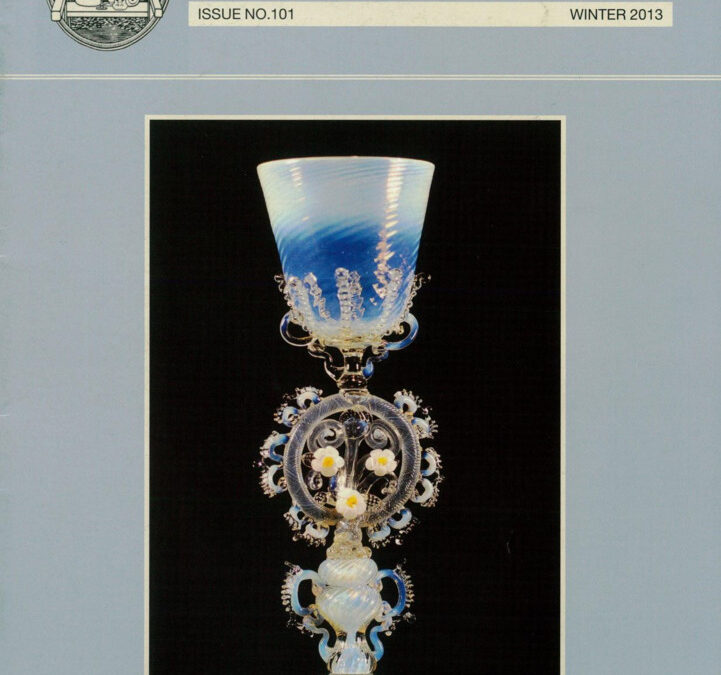
Cover illustrations:
Front:
A Salviati goblet in opalescent glass,
270mm in height, circa 1860.
Back:
A large floating ball in dichroic glass, by artist
Jon Lewis of Orbic Glass at Parndon Mill in Essex.
THE New Year has begun with a cold
and frosty January, yet despite the
inclement weather and the uncertainties
of life around us, we can look forward to
the year ahead – following our passions
in the world of glass, appreciating the
objects themselves, gathering together
information to generate greater under-
standing, but most of all, maintaining old
and forming new friendships.
To this end, and as announced in
Glass
Cone 100,
our December committee meeting
reviewed the possible ways forward with
our friends in the Glass Circle (GC). Most
GA members who have contacted us
have been in favour of the move to join
forces, though some cautioned us to
proceed gradually. A date has now been set
for a joint meeting and we will keep you
informed of its outcome; please get in touch
if you have ideas which you would like us to
consider.
All of your contributions to the
Glass Cone
are really appreciated – within its pages
the editorial team endeavour to reflect the
interests of the whole glass community.
In this issue, we have articles, enquiries and
items of interest, either written by or sent
in to the editors by collectors, dealers,
glassmakers, museum curators and
auctioneers – regarding glass ancient
and modern. With this inclusive approach
towards the content of the
Glass Cone
and
also to the membership of the GA, we hope
to foster a conversation between all
members of the glass world. I believe this
‘human conversation’ to be most important
for the future. To further this aim of
inclusion – we are asking all of you who
would enjoy writing about ‘glass’ – its
history, collecting, making – whichever angle
intrigues you, to contribute. We are also
asking for more information and reports
from auction houses on important glass
sales and would be happy to receive more
articles from specialist glass dealers and
curators embarking on new displays
and exhibitions. If you ‘fit the bill’ – tell us
about yourselves.
Finally, a sad note from Isle of Wight
Glass which has recently been placed in
liquidation. Founded in 1973 by Michael
Harris and his wife Elizabeth, glassmaking
was continued after Michael’s death in 1994
by his sons Timothy and Jonathan. After
Jonathan left the 1.0.W in 1999, Timothy
remained as the master glassmaker and
has run the company with the twin goals of
design and affordability. We wish all in the
firm well for the future.
THE GLASS CONE NO.101 WINTER 2013
Fig.2: Gilding
attributed to Jules
Barbe. The sails of
the boats show
strong similarities
to the sails of
vessels in prints
by Hiroshige.
The metal of the
body contains
Uranium.
Japonisme
Clive Manison
N 1991 the Barbican Art Gallery
hosted an exhibition entitled ‘Japan
and Britain: an aesthetic dialogue,
1850-1930’ devoted to an examin-
ation of the far-reaching effects that
the art and crafts of Japan had upon
arts – in particular the fine arts – of
Britain. Of the 400 or so exhibits no
more than five were glass and, of
these, four were pieces of cut glass
in a distinctly Anglo-Irish style from
the short-lived Satsuma glassworks.
The fifth (cat.193), a claret jug with
sterling silver mount in a classically
European style, had a glass body
engraved in the ‘Aesthetic’ taste. In
an exhibition concentrating mainly on
the fine arts, and in particular cross-
cultural influences, it is hardly surprising
that so little glass was on display.
I had long been interested in the
culture, language and art of Japan,
and had begun seriously collecting
glass some time before I became
interested in the influence of Japan-
ese art on the decoration of glass.
It was the chance observation of the
phrase
Matsu-no-Kee
(spelled, as
I recall Mat-su-no-ke) applied to
a piece of glass that attracted my
attention, for I recognised at once a
Japanese phrase, yet a phrase I had
never heard. This led me to research
not only the history of the design, but
also to investigate the wider influence
of Japanese art on the decorative
arts in the latter part of the 19th
century. The effect upon artists and
craftsmen of the prints, ceramics
and lacquer imported into Europe in
increasing quantities, after Japan
was opened to foreign trade, has
been well documented – the effect of
European art imported through the
Dutch trading post in Nagasaki Bay
rather less so. However, it became
apparent to me that there was a
good deal of glass coming on the
market that displayed clear evidence
Fig.1: The base of an atomiser scent bottle
by G. Raspillon
Fig.3: A vase embodyingboth gilding,
and applied glass decoration. Probably
Stevens & Williams or Thomas Webb.
A similar piece was exhibited in the
Glass Circle’s exhibition From Palace to
Parlour -A Celebration of 19th-century
British Glass’ at the Wallace Collection
21 Aug. – 26 Oct 2003 (no.36)
of Japanese influence – and I began
to add some pieces to my collection.
The current exhibition at Broadfield
House is an attempt to illustrate the
wide-ranging influences upon European
glass that resulted from the opening
to commerce of the Japanese archi-
pelago, following a visit of American
warships to Tokyo Bay under the
command of Admiral Perry. Much of
the glass is British, and much of that
from Stourbridge, but Bohemian and
other makers are represented. It is
often extremely difficult to decide
where a particular piece was made,
as many are unmarked.
The pieces on display come from a
collection built up in a relatively short
time. There are a number of pieces
of
Matsu-no-Kee
and a couple of
pieces of glass by Stevens and
Williams (S&W) that show develop-
ments of that technique by the firm.
One such piece, ‘Crystal Cameo’,
shows some influence of Japanese
motifs in the decoration, and another
cameo glass by Thomas Webb shows
strong similarities to the gilded ‘Peach
Blow’ glass that company produced.
Other pieces of cameo glass are
French, and show the great influence
of Japanese prints on French glass-
makers in the late 19th century. Of
particular interest is the small bottle,
almost certainly intended as the base
of a scent atomiser, bearing the
signature `G Raspillon’
(fig.1).
I have
been unable to find anything about
this artist, other than a reference and
illustration of another piece by him
in Ray & Lee Grover’s
Carved and
Decorated European Art Glass,
1970,
Charles Tuttle, Rutland, Vermont.
The largest single group of glass-
ware is of pieces that have an opal
body with a coloured casing, normally
decorated with gilding
(figs 2, 3).
Here
the Japanese influence can be seen
in the asymmetric arrangement of a
branch. Where a pair of vases has
similar decoration, the arrange-
ment of the branches is often
subtly different. The gilded
decoration is similar to that
found on Japanese lacquer
Fig.4: An unusual piece of black
glass, the decoration is perhaps more
‘Chinoiserie’ than Japonisme: A piece
with very similar decoration on a
peach-blow’ body in the Broadfield
House collection is attributed to Harrach.
THE GLASS CONE NO.101
WINTER 2013
1
Fig.ZA similar piece,
illustrated in Manley,
‘Decorative Victorian
Glass’ is attributed to
Stevens &Williams.
The metal of the
body again
contains
Uranium.
Fig.5: Probably
Bohemian.
The metal of the
body contains
Uranium.
Fig.6: Similar view of the glass fig.3.
The uranium fluorescing under UV light.
Fig.8: Hiroshige
print showing the
form of sail on
the vase in fig.2.
Fig.9 (below):
A Piece of Matsu-
no-Kee’ with the
identifyingDesign
Registration
number,
Rd= 15353,
on the base.
ware, though only one piece of
glass has a black body
(fig.4).
A surprisingly large number of the
pieces of glass on display are made
from a metal that contains uranium
(figs 5, 6).
A few pieces have attri-
butions to particular workshops,
such as the small cream vase
decorated with gilding and pink
enamelled flowers
(fig.7),
attributed
to the workshop of Pierre Erard on
the basis of an attribution of a similar
piece illustrated in Cyril Manley’s
Decorative Victorian Glass.
Another
piece, the vase in
fig.2
is attributed
on technical grounds to the Barbe
workshop
(fig.8).
A second group of pieces use
applied surface decoration. Several
of these are in the style known as
Matsu-no-Kee,
and pieces sub-
sequently made by S&W use the
techniques that had been developed
for this registered design
(fig.9).
One
of the
Matsu-no-Kee
pieces is
identical, other than in the colour of
the body, to a piece in the Victoria &
Albert Museum. A Japanese print,
appropriately illustrating chapter 18
of
The Tale of Genji — The Wind in
the Pine Trees
has been used to
demonstrate the influences that
2
Fig.10: A drawing of a small vase from a
Thomas Webb Pattern Book, entry 15478.
Fig.11: A vase identified as that shown in
flg.10. The metal contains Uranium.
THE GLASS CONE NO.101 WINTER 2013
must have been acting on John
Northwood. In one case
(figs 10, 11),
identification of the design in the
Thomas Webb pattern books has
confirmed the maker, and allowed
the design to be dated to 1880-81 –
four years before
Matsu-no-Kee
was
registered as a design
The Japanese influence on cameo
glass largely passed by Stourbridge,
although a few pieces of local origin
with clear Japanese influences can
be seen in the Cameo Room next
door. The pieces on display are
nearly all French
(figs 12, 13),
and the
Japanese influence on the landscape
cameo pieces can be seen in the way
that views are framed with strongly
coloured foregrounds. Other cameo
pieces show influences similar to
those of the gilded pieces in that
the decoration is asymmetric, and
modelled on that of lacquer ware.
Pressed glass is represented by
one piece: a small posy basket from
the George Davison factory. The
Japanese elements in the decoration
were recognised by Jenny Thompson
in her book
The Identification of
English Pressed Glass
(published by
the author in 1989, and now sadly
out of print) and the manufacturer
identified by the two registered design
numbers that can be found in the
segments of the pattern. The handle,
which is in a rustic style, was pro-
tected by a third design registration. It
was re-used in other pieces where
any Japanese contribution to the
design is scarcely apparent.
Fig.I2:Vase by
Daum, in a brown
ground with a
gold motif
Metal mounted.
Fig.13: A slender
necked, landscape
cameo vase by
the French maker
deVez.
The manner in
which the
landscape is
shown has strong
similarities with
prints by Hiroshige,
particularly in the
way that areas of
strong colour
overlie areas of
pastel shading
to emphasise the
illusion of depth
and perspective.
Fig14: Carp
‘aspiring’ to swim
off the vase.
Fig.15: According
to a Japanese
proverb, cranes are
supposed to live
for 1,000 years.
Figs 2, 4, 5,
courtesy of Chris
Reynolds
The Japanese influence
is persistent even today,
though not always immediately
apparent. It can be seen in the
work of lestyn Davies and
Jonathan Harris, both of whom
are represented. The lestyn
Davies piece is an early work,
and was actually made in the
studio at Broadfield House.
The Jonathan Harris pieces
show motifs frequently
found in Japanese art –
the carp and the crane
(figs 14, 15).
The crane is
a symbol of longevity,
and the carp a symbol
of aspiration. In Japan,
on 5 May, the carp is also
flown as a paper streamer
above every house where
there is a male child.
This exhibition is particu-
larly apposite this year, for
2013 marks the 150th anni-
versary of the Richardson incident.
On 14 September 1862, a party of
four British citizens (three men and
one woman) were riding towards
Kawasaki along the Tokaido — the main
road linking Kyoto and Edo (the
modern Tokyo). They refused to
dismount for the entourage of the
regent of the Daimyo (feudal lord)
of the province of Satsuma, as
Japanese people would normally
do (the samurai escort had the right
to strike anyone who showed dis-
respect). Under the Anglo-Japanese
friendship treaty, British nationals had
the benefit of extra-territorial rights,
and Charles Richardson, who was
leading the party and who rode too
close to the procession, took the
view that this meant he was not
obliged to give way to the
procession. The samurai escort
struck out with their swords, and
the three men were injured –
Richardson fatally. The British
government demanded monet-
ary reparations, together with
the arrest, trial, and execution
of the perpetrators. The
Satsuma government refused,
and the following year the
British government sent a
gunboat to Kagoshima (the
Satsuma provincial capital),
which seized a number of
Satsuma boats as hostage
to enforce the payment
of reparations. A Satsuma
shore battery opened fire
without warning, and the
retaliatory bombardment
by the British squadron
destroyed, among other places,
the glassworks which the Daimyo
had set up a few years previously,
and which had begun producing high
quality cut glass in the Anglo-Irish
style. Perhaps this exhibition can go a
little way to acknowledge the debt
which glassmakers in the West owe
to the culture and craftsmen
of Japan.
THE GLASS CONE NO.101 WINTER 2013
3
Whitefriars ‘Fakes’
‘M sure that most of you reading this will
be more than familiar with the English
glass producer Whitefriars however, here
is a brief history.
James Powell & Sons (Whitefriars) has
been Britain’s longest running glasshouse.
In 1834, James Powell, a wine merchant,
purchased the original Fleet Street site.
In 1919 the company changed its name
from James Powell & Sons to James Powell
(Whitefriars) Ltd and, after purchasing
their new factory in Wealdstone in 1923,
they were usually referred to
as ‘Whitefriars’. In 1963 the
company was renamed Whitefriars
Glass Ltd. The glassworks closed
in 1980.
These articles (part 2 will be
featured in
Glass Cone 102)
cover
the ‘textured’ range of vases and
their copies. The vases were
originally designed by Geoffrey
Baxter who joined Whitefriars in
1954 and designed the textured
ranges from the mid 1960s to the
mid 1970s.
Fakes
FOR ease of writing I have decided
to use the word ‘fake’ to describe
all copies and reproductions of
Whitefriars vases made after the
factory closed, whether they were
or were not made in the original
moulds. The word ‘fake’ is often
used as a term relating to
‘deliberately deceive’, but here I’m not
casting aspersions but simply using the
word to mean ‘non-Whitefriars’.
Introduction
I have a great love and a good knowledge
of Whitefriars and Powell glassware. I collect
various types of Whitefriars glass mainly
from the 1960-70s but none of the textured
ranges. I particularly like Boffo and Ray
Annenberg pieces, especially animals and
paperweights.
I have had a keen interest in glass for
about 12 years, having begun by collecting
Georgian and Victorian drinking glasses.
I was introduced to this by an old professor
PART 1
Wolfie Rayner
who I visit regularly. He has a substantial
collection of Georgian drinking glasses
which has been gathered over a period of
more than 30 years; his encouragement
started me on my own collecting.
My interest in Whitefriars started about
2005 when I became gripped by the superb
variations in Powell/Whitefriars glass and the
amount of knowledge available online and in
book form. I joined the ‘whitefriars.com’ site
in 2007 and since then have made many
good friends in the Whitefriars community
including ex-workers, collectors and dealers.
I have helped run the whitefriars.com
collectors’ table at the Cambridge Glass Fair
for some years, where on several occasions
I have displayed the fakes.
Whitefriars’ fakes have been my special
study ever since the first non-Whitefriars
mould examples appeared in 2007. I have
been collating information on them for
the past five years, but as usual the people
who make these keep their cards close to
their chest.
Moulds
THE fakes, as with the original Whitefriars
vases, were all blown into moulds. 99% of
all fakes are not made in original Whitefriars
moulds but have had moulds made to
replicate the original and in some cases they
are very close.
I don’t know how these new moulds are
made, but I do know it is very difficult to
accurately replicate Whitefriars moulds, and
all fake vases have inaccuracies of one
degree or another. Some fakes are very
close to the original, whereas others are
glaringly and obviously wrong. Generally
speaking, the first fakes to appear (i.e. in
non-Whitefriars moulds) are much
closer to the originals than those
made in the last couple of years
or so.
There are four known Whitefriars
vases that have been faked by
being made in new moulds. These
are the Onion (pattern number
9758), Hooped (9680), Small
Drunken Bricklayer (9673) and
Large Drunken Bricklayer (9672).
The Onion Vase
THE Whitefriars 9758 Onion vase
first appeared in the 1971
catalogue supplement and last
appeared in the 1974 catalogue.
The standard factory colours are
sage, lilac, aubergine, pewter,
meadow green, tangerine and
kingfisher. They are catalogued
as being 5
1
/4″ but this may vary
a bit and they are often a little
taller at 51/2″.
The fake Onion (and Hooped) appeared in
the around April 2008 and I have since
found out that they may have been made
in Portugal. The Onion is the most difficult
to spot, certainly from a distance or off an
eBay photo, and it must be said that they
have made a pretty good job of replicating
this vase.
Size.
The proportions of the fake Onion
are pretty much the same as the Whitefriars’
ones. The photos show a Lilac Whitefriars
Onion and a Green fake
(fig.1).
Texturing.
The texturing of the fake is
coarser than that of the Whitefriars example
and the ‘Fish scales’ on the fake are laid out
4
THE GLASS CONE NO.101 WINTER 2013
Polished pontil
in a uniform fashion whereas on the
Whitefriars piece it is fairly random
(fig.2).
The Base.
The base on all the fakes is
always the best give-away.
Due to the production methods and the
costs involved, the base looks completely
wrong. They have tried to replicate a
ground pontil (concave depression in the
base) by moulding it in. A genuine Onion
will have a moulded rippled-looking base
with a ground and highly polished pontil.
The fake is the other way round: it has a
flat ground base with a moulded pontil
(fig.3).
Some of the fakes may have a ‘V’
inscribed on the base; this is where
somebody bought a job lot and inscribed
a ‘V’ calling it the Vase Heaven range.
The Top.
The Whitefriars Onion vase had
its top redesigned about 1974 from an oval
to a round opening and the majority of
Whitefriars ones have oval openings. All the
fakes have round openings, so if your Onion
has an oval opening its 100% genuine, but
if round it could be either
(fig.4).
Colour.
The colours that I have seen them
in are green,ruby, lilac and aubergine. The
green is close to the Whitefriars colour
meadow green although slightly darker
(fig.5).
The fake lilac is also very similar to but
a little darker than the original, but the
aubergine is too dark a purple. Ruby is a
non-standard colour for Whitefriars
production Onion vases, so all ruby
colourways are fakes.
The Hooped Vase
The Whitefriars 9680 Hooped vase was
first seen in the 1967 catalogue and last
appeared in 1973. The standard factory
colours are willow, cinnamon, indigo,
pewter, meadow green, tangerine,
aubergine and kingfisher. They
are catalogued at being 111/2″
but this may vary a bit and they
are often a little smaller at 11
1
4″.
The fake Hooped vase also
appeared in April 2008 with the
Onion. It is easy to spot once
you have handled one but they
have done a reasonable job in
replicating the hoops and
various lumps and bumps.
Size.
The height of all the
fake Hooped vases is too high
at 11
3
/4″; it is unlikely that they
would have come out of
Whitefriars at this height. I have
checked on the heights of the
Whitefriars’ ones and I can say
with a good degree of
confidence that if a Hooped is
11
3
/4″ tall, it is a fake
(fig.6).
Texturing.
As with the Onion
Vase, the texturing on the Hooped is
coarser than the original; this is particularly
noticeable in the herringbone pattern, which
is much softer on the original
(fig. 7).
The Base.
The base has the same error
as the Onion. A genuine Hooped will have a
moulded-looking base with a ground and
highly polished pontil. The fake is the other
way round: it has a flat ground base with
a moulded pontil
(fig.8).
Colour.
The colours that I have seen them
in are green, ruby and aubergine.
As far as I am aware, the fake Onion and
Hooped vases were only made in one batch
in 2008 and there have been no others
made since.
Part 2 ‘Whitefriars Moulds and the
Drunken Bricklayers’, will appear in a later
‘Glass Cone’
FAKE
moulded pontil
5
THE GLASS CONE NO.101 WINTER 2013
Antonio Salviati’s
Trade
Card
and Venice
A
short while ago, knowing of my
interest in Venetian and
Facon de
Venise
glass, the glass collector
and dealer Miles Hoole, showed me a
trade card and insert, from Antonio
Salviati (illustrated). This interesting
document set me on a path to find out
more about it.
Background
VENICE and the island of Murano have
been important European glassmaking
centres since the Middle Ages, yet from
the 17th century the island of Murano and
its glass entered a period of gradual decline.
It was not until the 1830s that there were
signs of new life. Antonio Sanquirico, a
Venetian antiquarian, persuaded several
master glassmakers to reproduce some
filigree glass objects he owned. The results
were so splendid that they were reportedly
sold as antiques. Aventurine and obsidian
were rediscovered, and coloured vitreous
paste and gold leaf suitable for mosaics,
desperately needed for the restoration of
the Basilica of St. Marks, were created by
Lorenzo Radi. Yet, by 1860, blown glass
work in Venice had been all but abandoned.
Within a few years, several events occurred
that put Murano and Venice back on to the
world map of glass. In 1861, Venice mayor
Antonio Colleoni and Abbot Vincenzo Zanetti
collected together an archive dedicated to
the history of Venice, containing various
writings, glass and objects of art produced
in the city. This created a renewed interest in
Venice’s glorious past and its glassmaking
and inspired the master glassmakers Toso,
Fuga and Barovier to successfully revive
almost forgotten glassmaking techniques.
Antonio Salviati
ANTONIO Salviati, a lawyer who had come
to Venice from Vicenza in 1859, became
involved in the restoration work for the
mosaics of Venice’s St. Mark’s Cathedral,
winning a fifteen-year contract from the
city authorities.
Unusually for a man who arose to such
importance, I have not found much about
the early history of Antonio Salviati. Why did
he come to Venice to set up his legal
Brian Clarke
Front (top) and back covers of the trade card
practice? What prompted his interest in
mosaics? Why did he, so single mindedly,
alter the course of his professional life and
concentrate on glass? These and so many
other questions still wait to be answered.
Salviati’s interest in mosaics led to an
interest in other glass and glassmaking. In
1866, financed by the English entrepreneur
Austen Henry Layard, Salviati founded
Salviati & Co., devoted to artistic glass, thus
helping to promote glass as an accessible
and popular art form. His success and the
publicity received following the highly
successful Universal Exposition in Paris in
1867, was instrumental in the revival of
Venetian glass. The company created a
collection of glasses, stemware, bowls,
chandeliers, vases and a range of etched
pieces that were sold worldwide.
In 1872, the company was renamed as
the Venice and Murano Glass and
Mosaic Company. Salviati finally
withdrew from this company in 1877
and created two companies: ‘Salviati
Dott. Antonio’ for artistic glass and
‘Salviati e Co.’ was brought back for
the production of mosaics. In 1883,
Antonio Salviati relinquished his
glassworks to the Barovier family, who
continued to exclusively supply
Salviati’s shops, in London, Paris,
Berlin, New York and St. Petersburg.
The Trade Card and Insert
THIS card, when folded once, measures
145x97mm. The inside left page shows that
the single company of ‘Salviati & Co.’ was
dealing with production of all styles of glass
and mosaics — suggesting a date for the
card between 1866 and 1872 (see above).
This historically interesting card, written in
French and English, was very possibly
produced for the Paris Exhibition of 1867.
Two prominent addresses in Venice are
indicated; one on the Grand Canal, just
across the water from Pia77a San Marco
and the Pala77o Ducale, Grand Canal –
S. Gregorio, 195. Ateliers e Salons
d’Esposition’ (workshop and showroom).
The front cover depicts these premises and
the address is repeated on the back cover
underneath the mosaic of the lute player.
The other shop is in one corner of Pia77a
San Marco, Magasin avec Echantillons,
Place St. Marc. N.79A (shop with samples).
The factory and furnace have an address on
the island of Murano, Fondamenta Vetrai,
N.42. The insert fits neatly inside the folded
card, showing a variety of glassware,
including a mirror and goblets, candelabra
and a sweetmeat pyramid.
Antonio Salviati was thus at the forefront
of the 19th-century revival of glassmaking
on Murano. The pieces designed and made
by the company remain very collectable;
they were so well made that even at the
time, experts were often not able to tell the
difference between the 16th- and 17th-
century original Venetian glass, and Salviati’s
historical copies! These and other copies
have given rise to the safe attribution of
6
THE GLASS CONE NO.101 WINTER 2013
SALVIATI & C.’ – VENEZIA
ORANLo .A NAL – S. OREOOR10,175
ATELIERS 8
,
SALONS ErESPOSI I loN
VERRERIES
Vases Sc Coupes art is t in u e s.
Copies tie Verret ancient de Musses •
Services tie tattle en verre aver chiffre,
arinoiries etc. Lustres a lumiere’elec-
triune, boogies etc. – Mimics – Men
Ides et Bronzes artistiques – Statues.
PAOSAiQUe
acorafire pour
Engtises, Hotels pri-
ves, Palais, Villas, Theatres, Plafonds,
Chapelles mortuaires, etc. Riche as-
sortiment de Tableaux et de Bijoute-
net etc. en mosaimtes – Portraits.
MAGASIN
AVEC ECHANTILLONS
PLACE ST. MARC. N. 79 A
GLASSWARE
Artistic Vases – reproductions of
the antique Roman, Etruscan, Egyp-
tian Pompeian glass etc.
Glass Table sets with Monograms
– Crests ere. – Electroliers – Mirrors
•
– Artistic Furniture – Bronzes Statues.
MOSAICS
for decoration of Churches, Palaces.
. Villas, Theatres, Ceilings, Mausole-
, tuns etc. – Bich assortment of mosaics
– Plans of all kinds
and
estimates
furnished on
application • Portrait,
5
S
S
Ualnes a Murano
FONDAVENTA VETRAI N 4,
Furnace at Narita°
FONDAMENTA VETRAI N.42
Venetian style glass as
Facon de Denise.
It is
not possible, without absolute provenance,
to state whether a glass is originally from
16th-century Venice, from Verzilini’s output
in London, from Holland or Belgium, a 17th
century Venetian import from John Greene,
The inside of the trade card (above) and the front
and back of the insert which shows some of the
glassware on offer
or a later glass altogether from Salviati.
A company still trades as Salviati today.
REFERENCES:
H.J. Powell,
Glass making in England,
Cambridge
University Press, 1923.
Liefkes Reino, ‘Antonio Salviati and the 19th century
renaissance of Venetian glass’,
The Burlington
Magazine,
1993.
Lesley Jackson,
Whitefriars Glass: The Art of James
Powell & Sons,
Richard Dennis, 1996.
Gianfranco Toso,
Murano, A history of glass,
Arsenale
Editrice, 2000.
Judy Rudoe,
Reproductions of the Christian Glass of
the Catacombs’: James Jackson Jarves and the
Revival of the Art of Glass in Venice,
The Metropolitan
Museum of Art, 2002.
Marino Barovier,
The Art of Glass on Murano,
Marino
Barovier, 2003
Various free information websites, including Wikipedia
and Encyclopaedia Britannica
The author gives thanks for the use of information from
the writers of all of the reference sources and has cross
referenced all factual information. If errors exist, he
would be pleased to receive their correction.
Latest News from the Paperweight World
Richard M. Giles
fig. I
I hear that Peter McDougall,
the ex-Perthshire Paperweight
manager who retired from
paperweight making back in
February, has no regrets and is
enjoying life without the pressure of having to fulfil
orders. He doesn’t appear to have completely
divorced himself from the world of paperweights
as he has been a guest at events in America
during the summer of 2012. It also seems that he
has an agreement to use the facilities at the
Caithness factory on an occasional basis.
As the number of classic-style paperweight
makers in the UK has continued to fall to just four,
a new name has been added to the list of makers
in the USA. At a meeting of the Paperweight
Collectors Circle back in the summer, we had a
visit from Damon MacNaught, a very personable
young man
who is a
lecturer in design at a
fig.3
Tennessee University and who has been
making glass for some years in his spare time.
After meeting and seeing the millefiori weights
fig.2
produced by Jim Brown,
#
another American maker,
he was encouraged to try his
own hand at making canes and
using them in paperweights. After
some experimentation and a few trials, he
mastered the required skills and his canework
reached great complexity as illustrated in
figs
1&2.
As a comparison, pictured below his
weights is one from Jim Brown who has been
a well-established maker for some years
(fig.3).
Considering that Damon’s paperweight making
remains a part-time occupation, I found his results
very impressive. In discussing the future, he com-
mented that he has the desire to continue to
improve the quality of his weights and I shall take
great interest in his progress. Sadly, as with
weights from most American makers, we get very
few opportunities to see them in any numbers,
7
THE GLASS CONE NO.101 WINTER 2013
plus of course they still remain fairly expensive for
British collectors.
The news from Scotland, which remains the
place where all the classic paperweight makers
are located, is that recently remarried
Willie
Manson
is back making paperweights. He was
the resident artist in the studio at Broadfield
House museum at the beginning of June 2012
when the museum held its paperweight day. I was
able to speak with
John and Craig Deacons
at
a Northern Paperweight Society meeting earlier
in the year and I gather that, ably assisted by
Dave Moir
who worked with members of the
Ysart family at Vasart Glass and later Strathearn
Glass, they continue to be very busy with orders
both for American dealers and production items
for the gift market. Craig and his wife are now the
proud parents of a baby girl so I am not quite sure
how he juggles his family life, rugby and his
work with John. Dave Moir gave an interesting
presentation about his life and his associations
with glass at the last meeting of the Paperweight
Collector’s Circle in October 2012.
Finally, Caithness Glass have confirmed that
lampworker
Linda Campbell
has left to pursue her
accountancy career. When we met her last year
she was only working part-time but earlier this
year had resumed full-time employment. No
mention was made of a replacement so I am
wondering from which source they will get their
lampwork in the future or perhaps they will just
continue with their interpretational weights.
More commemorative weights
1914 Anglo US Exhibition (fig.4)
AS described in my previous articles, this
exhibition was held at the White City Exhibition
Grounds in London, the site of the 1908
Olympics. The weight previously featured showed
the crossed flags of America and Britain; this one
is a sepia photograph showing the Elite Gardens
which appears to be an amphitheatre around a
central bandstand and was presumably the focal
point for musical entertainment.
Whitefriars Mayflower (fig.5)
ISSUED in 1970 to commemorate the 350th
anniversary of the sailing of the Pilgrim Fathers
in the
Mayflower
to the new world of America.
Following the issue of the Triplex and Royal Visit
weights at the time of the Festival of Britain
Exhibition in 1951 and the weight produced for
the Coronation in 1953, records indicate that a
few trial weights, some with date canes, were
produced in the mid 1950s. However, it would
be another 15 years before the company issued
their first limited-edition commemorative weight.
The format was similar to the previous weights
being concentric circles of canes with a central
complex cane made up of seven separate
sections forming the shape of a sailing ship. The
inner ring of canes includes a Whitefriars
signature/date cane. Records show that the
maximum production was limited to 400 weights,
with 389 actually made.
Maude and Bob St. Clair 100th Anniversary of
Garrett, Indiana (fig.
6)
IN previous articles I covered the weights
produced by the St. Clair factory in Elwood,
Indiana and this example, produced in 1975, was
made by Bob and Maude according to the
impressed stamp on the underside. My research
has discovered that the town of Garrett, Indiana
was to the Baltimore and Ohio Railway what
Swindon was to the Great Western Railway.
When building the railway, the directors of the
B&O decided that they needed a suitable facility
for construction and maintenance of the engines
and rolling stock approximately at the midpoint
between Willard, Ohio and Chicago. So in 1875
they took the decision to establish the works in
a new town that would be named after the
president of the railway. With the railway
connection it had special appeal and, courtesy
of a friend, it became one of my rare purchases
from e-bay.
1972 Whitefriars Munich Olympics (fig.
7)
THIS weight was produced in clear glass with
a ceramic transfer fired onto the underside, a
Whitefriars symbol, and the number of the weight,
121, scratched on the side. Only three other
examples of transfer weights are known, one also
made in 1972 and two more in 1976 with the
exact numbers of weights produced currently
unknown. The other 1972 weight was for the
Silver Wedding of the Queen and Prince Philip
with the dates ’20th Nov 1952-1972′ and the
letters ‘E & P’ in the centre. The two 1976 weights
were for the Olympic Games held in Montreal and
featured the Olympic rings inside a maple leaf plus
a private commission for the Glass Manufac-
turers Federation to celebrate their 50th anni-
versary. For the 1976 games in Montreal, the
company also returned to the use of milleflori and
produced weights featuring the Olympic rings –
500 produced on a coloured ground and 500 on
a clear ground. In addition, each weight had an
Olympic torch cane and two other complex canes
with the year. Exactly the same format was
repeated for the 1980 games in Moscow, but
according to the records only 116 were sold.
Victorian souvenir weights
ONE
mystery that has never been completely
solved is where the souvenir weights, made in the
Victorian era between around 1860 and 1890
and which could be obtained from all popular
locations around the country, were actually created.
Various reference books suggest that they were
made either in UK or on the continent or perhaps
a combination of both, with the transfers being
made abroad and the glass blanks in the UK or
possibly the other way round. Having often seen
spelling mistakes in the names of the locations, my
opinion tends to lean towards the assumption
that at least the transfers were made abroad. My
recent find
(fig.8)
doesn’t completely solve the
mystery, but it does indicate that the transfer and
probably also the glass blank of the weight in the
illustration were made on the continent. The
picture has a representation of one of the most
commemorated British buildings, the Blackpool
tower; just underneath the words ‘Present From
Blackpool’ are the words ‘Made In France’. This
obviously is not a good enough proof that all such
weights were made there, but in my view does
give a good indication of their origins.
8
THE GLASS CONE NO.101 WINTER 2013
Cockerel Cocktail Glasses
-BRITISH MAKERS –
Bill Millar
HE
last article described
cockerel glassware by Stuart
Crystal and this article looks at
other British makers. I must start with
a confession. While there are design
books for Stevens & Williams and
Thomas Webb, the other makers
were not considerate enough to let
their design books fall into public
ownership when they gave up
making glass. This view of their
products is, therefore, confined to
what I have been able to collect and
identify. This article almost certainly
offers an incomplete view but half a
loaf. If you can add to this knowledge
I would be delighted to hear from you.
Cairngorm was widely used so if you
see a glass in this slightly muddy
amber colour there is every possibility
it was made by S&W.
Another most distinctive glass,
also designed in 1925, is at
fig.3.
The
glass cherry in the centre of the bowl
is unmistakable; the engraved cock-
fighting scene is one of six. Various
glasses, with the same distinctive
cherry, were produced in different
colours and shapes with a variety of
cockerel motifs. A later product is the
shaker with its matching glasses with
six engraved cockfighting scenes,
see
fig.4
(only one glass shown). This
was a presentation piece dated 1938.
Right -fig.4:
S&W Presentation
shaker of unusual
shape with one of
six matching
glasses.
Stevens & Williams, of all the British
manufacturers, are my favourite
producers of cockerel glassware. Their
designs are complex, colourful and
well made. I identified eight of their
products and assumed they
represented a fair proportion of their
range. Big mistake. Their ‘description
books’ for 1919 to 1930 include 196
entries with anything up to 10 or 12
different versions for each entry — at
least 500 different products and over
10 years of designs still to be
checked. The thumbnail drawings in
the design book are about % scale
so, given the lack of a maker’s mark,
positive identification is difficult.
Fortunately, the glasses identified
provide a reasonable view of the
disparate mix of their designs and
techniques sufficient to support the
claim that Stevens & Williams
produced the best range of cockerel
cocktail glassware in Britain.
Their first cockerel glass design is
dated 1919 — the first I can positively
identify was designed in 1923. It is
based on an alabaster glass originally
designed in 1915 and two examples
are shown at
fig. 1.
Both were
originally etched and gilded but the
blue glass has clearly enjoyed an
over-enthusiastic
‘Brillo’
clean
removing all but the tiniest piece of
gilding. The design book does not
indicate which colours were used but
S&W produced rose, pale orange
and turquoise in addition to the
blue and jade green seen at
fig. 1.
The
glass at
fig.2
was designed in 1925
and is very striking with a white bowl
cased in amber (Cairngorm in S&W
speak) uranium glass with enamelled
motif. Cairngorm was introduced
about 1918 and is a uranium glass
which glows green in UV light.
Above – fig.1:
Stevens &Williams
blue alabaster and
jade green
cocktails.
Left- fig.2:
Stevens &Williams
Cairngorm and
white cocktail.
Right – fig.3:
Stevens & Williams
engraved cherry
cocktail.
THE GLASS CONE NO.101
WINTER 2013
9
Above – fig.5:
Stevens &Williams
jade green, etched
and gilded
cocktail shaker.
Top right – fig.6;
S&W Cairngorm
optic moulded
shaker and
matching glass.
Left-fig.
7
:
S&W Diamond
moulded shaken
Below-fig.8:
S&W Clear etched
shaker
Having acquired a cockerel cocktail
shaker with the registration number
718885 attributed to O.S. Middleton
with a date of February 1926, I was
keen to find out more about the maker.
This was the only glass registration
filed by Middleton and a great deal of
fruitless searching failed to produce
any information about such a glass-
maker. Subsequently, I found another
completely different version of the
cocktail shaker bearing the same
registration number decorated with a
cockerel similar to that on the glass at
fig.2,
which pointed to S&W as maker.
In confirmation of this the S&W design
book entry for the shaker includes the
registration number. You may recall
mention of the O.S. Middleton patent
for a cocktail shaker pouring arrange-
ment in the article on Stuart Cockerels
(Cone 100)
and I can only assume that
just as he appears to have sold his
patent to Stuart Crystal, he sold the
design for a shaker to S&W. Perhaps
Mr Oliver Smith Middleton (011ie?) was
one of Bete Wooster’s set. I like to
think of him sitting in a smart cocktail
bar sipping his cocktails while he
drew designs for improved cocktail
barware on a serviette. Research
would undoubtedly produce a more
prosaic biography.
Returning to the shakers, the regis-
tered shape was first used in mid-
1925 and regularly used thereafter in
substantially different ways. Further
research may explain why the design
book date should precede the regis-
tration date. Four examples are
shown. The first
(fig.5)
is in Jade
Green with an etched and gilt
cockerel. The silver-plated top carries
the mark of an Edinburgh jeweller.
The second
(fig.
6) and its matching
glasses (only one shown) are optic
moulded in Cairngorm and have
engraved cockfighting scenes.
Incidentally, the 1927 wholesale price
of this shaker was 22.5p and the
glasses were 52.5p per dozen. The
third
(fig. 7)
is diamond moulded with
an enamelled motif. The fourth
(fig.8)
is in flint glass with an etched
cockerel but does not carry the
registration number. The silver plate
carries the marks for Charles S.
Green, a Birmingham silversmith.
I have also seen this shape of shaker
with silverwork by Dunhill including
a smart tray with a rail in the centre
to hold the shaker in place and space
around it for glasses, and in flint with
transfer-printed cocktail recipes and
a cockerel.
S&W produced a huge range of
shapes, colours and decorating
techniques – they probably designed
over 500 different cockerel cocktail
items by 1930 with more to come. It
appears from the design books that
they produced variations for different
customers so that many of the items
were probably produced in relatively
small numbers.
S&W traditionally produced glasses
with items such as coins or dice
enclosed in the stem. From 1928 to
1939 Bill Swingewood was employed
to produce lampwork items, including
cockerels, for use as enclosures.
Fig.9
shows one example of his work
with a cockerel and a hen. Other
versions with various numbers and
cockerels colours were also produced.
Thomas Webb
obviously felt
differently about producing cockerel
cocktail glasses. Their design books
include only five glasses and one
shaker. Having said that, none of the
four glasses I have collected is in their
design books (more research needed).
Fig.10
is nicely engraved and carries
the pre-1939 acid mark ‘Webb’. The
two glasses at
fig.11
carry the same
acid-etched cockerel. The glass on
Fig.9: S&W cocktail with lampwork
cockerel and hen enclosure.
the left carries the post-1938 mark
‘Webb made in England’ while the
glass on the right has no maker’s
mark. Finally, the glass at
fig.12
also
carries the post-1938 mark and is
decorated with the same etched motif
which has been partially engraved.
Without design books and
catalogues for the next two makers
I can only report on marked glasses
which I have been able to collect, and
with a collection of some 600
cockerel items I have done my best.
I would welcome input from any
readers who can help on this point.
Edinburgh and Leith
produced the
footed tot at
V.13
which has
10
THE GLASS CONE NO.101 WINTER 2013
engraved cockerels and the E&L acid
mark beneath the foot.
Webb Corbett did not mark all of
their glasses. The glass at
fig.14
is
held at Broadfield House and has
been attributed to Webb Corbett
because the palette and method of
decoration, using deep acid etching
to remove areas to be enamelled, is
the same as known Webb Corbett
items. The cut shaker at
fig.15
carries the Webb Corbett acid
mark to the base and the cockerel
has been etched and then engraved.
Bimini was established in Vienna
in 1923 by Fritz Lampl and
produced Venetian-type glass-
ware using lampwork techniques.
His most commonly recognised
works are glasses incorporating
a naked, dancing lady as the stem
of the glass. He was Jewish and
in 1938 he sensibly abandoned
his most successful business and
emigrated to Britain. In 1940 he was
interned, probably fortuitously, as
during this period of incarceration his
workshop was destroyed by bombing.
Above left- fig.10:
Thomas Webb
engraved cocktail
with ogee bowl.
Above centre –
fig.11: Thomas
Webb pair of
etched cocktail
glasses.
Above right –
fig12: Thomas
Webb post war, cut
etched and
engraved glass.
Left- fig.13:
Edinburgh & Leith
footed tot.
Below- fig.15:
Webb Corbett cut,
etched and
engraved shaker.
He changed the company name to
Orplid in 1943 and continued to
produce this distinctive glassware
until 1955 when he died.
He produced cockerel glasses
in various shapes and colours with
either one or two cockerels enclosed
within a glass
ble, or some-
times two bubbles, in the stem.
The glasses were produced in
various colours and shapes. The
glass illustrated at
fig.16
has a
white latticino bowl and foot
with a single lampwork cockerel.
The fineness and fragility of the
glasses is probably why so many
survive as most will never have
been used and have spent their
entire life in display cabinets.
Bimini also produced lampwork
cocktail sticks with a wide variety
of objects on the end. I have not
knowingly seen any with cockerels
but I have seen the original
packaging for a set of Bimini cocktail
sticks and the front is decorated with
a resplendent cockerel and a cocktail
glass. They would certainly have
produced cockerel cocktail sticks but
it is extremely difficult to positively
identify the maker.
I would be delighted to hear from
any readers on any points raised by
this and the previous two articles.
billmillar82@yahoo.co.uk.
Left-fig.14: Webb Corbett cocktail,
etched and decorated in enamels.
Fig.16: Bimini/Orplid cocktail with a
latticino bowl and lampwork cockerel.
THE GLASS CONE NO:101 WINTER
2013
11
The Perfumed Valley
H
AVE you ever wondered, while
wandering through the brightly lit,
elegant perfume departments of
large stores, how and where the gorgeous
glass scent bottles were designed and
produced? You may be surprised to learn
that over 80% of them come from a small
geographical area about the size of one of
our home counties, a few miles across the
Channel in an area called the Vallee de la
Bresle near Blangy-sur-Bresle in Normandy.
Over 60% of that production comes from
just two glass companies in the area.
There have been more than seventy glass
companies in the Vallee de la Bresle making
bottles by hand for nearly 700 years. It is
believed that the first glassworks was
founded as far back as the 12th century by
Italian master glassmakers, perhaps from
Venice, well before glassmaking started on
the island of Murano.
The five main families running the glass-
works became French through marriage
and their descendants were recognised and
ennobled by Colbert, at the time of Louis XIV.
Family names in the Bresle Valley include de
Ferre, de Caqueray, Bongars, Brossard and
Le Valliant. It is unusual, but true, that in France
glassmaking was the sole industrial process
considered honourable for a nobleman, and
the term ‘gentilhommes verriers’ (gentlemen
glassmakers) was widely used. In all
probability this was because it was the
wealthy aristocratic landowners who built
the factories and owned the premises, hiring
skilled artisans to make the glass bottles
and flasks. Though the ennobling of
commoners led to this saying: ‘Votre
noblesse est mince, gentilhommes de verre,
si vous tombez a(?) terre, adieu vos qualite
(Your noble attributes are thin, gentlemen of
glass, if you fall on the ground, watch your
ar**). As far back as 1313 King Philippe IV
of France gave Philippe de Caqueray — an
equerry, permission to start a glass factory
to make flat glass near Bezu in Normandy,
called La Haye. This was before the creation
of the great flat glassworks of La Glacerie,
near Cherbourg, a few hundred miles away
from Bresle, which made the mirrors for the
amazing Hall of Mirrors at Versailles.
Stephen Pollock-Hill
The Companies
THE two most prestigious glass factories in
France today are Baccarat* and St Louis.’
They are both situated in Alsace, and both
had aristocratic chairmen until quite recently.
Until 1989 Baccarat’s chairman was Le
Comte de Chambrun, and at St. Louis,
Le Baron du Coetlosquet.
Nowadays two large companies dominate
the perfume bottle market. The first, St
Gobain Desjonqueres at Mers les Bains,
dates back to 1896 when it was known as
the Verrerie de Treport. It was owned by
several generations of the Desjonqueres
family until, following a merger with France’s
largest glass company, St Gobain, the
I
nnn
•
nnn
.
n
f
M
Kayo. Ilout
II
A..*
;0.
4.,
P…1
1111
,•• • ow el
Fig. 1: A group of cutting staff at Glassworks
ofDarras at Blangy.
name was changed to SGS Desjonqueres.
2
The second major perfume bottle maker is
the Verreries Pochet et du Courval at
Senarpont, a tiny village of only 770
inhabitants in the Somme valley, Picardy.
This glassworks was originally set up by the
Comtesse de Eu, who became Duchesse
de Guise in 1623. Situated within the forest
of Eu, there were plentiful supplies of timber
for the furnaces literally on their doorstep.
Around 1850, the company created a
famous bottle for Eau de Cologne which
Guerlain supplied to the Emperor Louis-
Napoleon III, nephew of Napoleon I and first
President of the French Republic.
* Now owned by Stanwood Hotels of the USA.
The advantages of the valley
SO why was this area so attractive to glass-
makers? Principally, it had the fuel and the
raw materials, mainly timber and lime. In
France, burning wood in furnaces was freely
permitted up to 1880.
3
The Normandy forests
of Eu in Longwy and Lyons, some of the
largest in France, had plentiful supplies of
cheap combustible wood. The glassmakers
used pine, oak and larch and had special
rights known as `droits d’affouage’ (special
collection and felling rights) that afforded
them very low-cost timber prices. At the end
of the 18th century there were over 25 glass
factories in these forests.
Readily available was thaux’ (lime) from
the river banks, cut through by the Somme
and Bresle rivers, and ‘fougere’ (bracken)
which, when burnt, provided potash and
potassium.
4
.
6
The local sand, washed down
by the rivers, contained quite a lot of iron,
making the bottles green in colour.
6
There
were also large quantities of clay for making
the pots, and furnaces and a ready source
of water, powering mills to drive the pulleys
for cutting, grinding and finishing the glass.
The position of the Vallee de la Bresle was
also advantageous for 19th-century trade,
located midway between Paris and London,
with the Somme and the Seine rivers close
by for canal-boat transport. There was also
the combined benefit of having furnace
makers, mould makers, glassmakers and
raw materials in close proximity.
The Museum
IN 2009, after several years of planning and
a sum of around 4m euros, a new museum
was set up to record the last 300 years of
glassmaking in the area, called Glass Vallee/
The Museum is housed in an historic old
fortified farmhouse, with its barns and a
modern corrugated steel extension where
hand blowing is demonstrated.
Entering the reception room, the walls are
hung with old monochrome photos from the
1920s and 30s
(fig.1),
showing groups of
employees from a number of companies,
the men in hats, waistcoats and braces
and the women in long skirts. The names
displayed include Verreries Brose, Walters-
12
THE GLASS CONE NO.101 WINTER 2013
Fig.2: A furnace pot maker
perger, Romesnil, Nesle Normandeuse and
Verreries de Darras at Blangy.
8
Moving on through the museum one gets
into a long, well-lit room, where you are
presented with the tools and furnaces used
in the various stages of glass production.
The installations are brought to life with the
use of life-size wax mannequins
(fig.2),
albeit
rather unrealistically portrayed with impeccably
clean and neatly pressed clothes.
I was struck by how many different colours
were produced in small jockey pots, orig-
inally often propped up on a larger pot of
clear soda-lime or lead-crystal molten glass.
Next on display were examples of the
moulds and machines — ‘suck and blow’,
‘blow and blow’ — shiny clean machines, all
in perfect working order but now made
redundant by high volume demands.
9
A mock-up of a furnace, lit with an orange
light and with jockey pots
(fig.3),
shows how
melting and fusing is done. Then a glass-
blower, blowing iron to his lips, with a young
boy of about ten opening the long wooden
Fig.4: A glassblower with a young boy opening
the long wooden mould.
mould
(fig.4).
A pot furnace mock-up has a
team pressing ashtrays by hand with presser
and tipper-out. The last display is of a lehr, to
demonstrate annealing
(fig.5),
a mannequin
unloading the glass from the conveyor.
Continuing into the main hall, about
fifteen large display cases fill the room
(fig.6),
showing perfume and aftershave bottles
from the 1920s up to the present day, all in
chronological order. There must be over
1,000 glass bottles and posters in the
displays, making one realise the volume of
bottles that have been made, some of the
rare ones being quite valuable.
10
Fig.3: Jockey pots for coloured glass.
The final part of the tour is in a modern
studio, where a glassmaker demonstrates
how these bottles are made by hand, using
rolled-in colour from powdered oxides.
Some famous perfumes, with their bottles
produced here by Pochet et du Courval,
are ‘Shalimar’ by Guerlain,
11
‘Voyage’ by
Hermes, ‘Kokorico’ by Jean-Paul Gaultier,
‘Fleur de Cristal’ by Lalique and ‘Aura’ by
Swarovski. SGS Desjonqueres, who started
with a small hand factory at Le Treport, have
become an international giant. Since being
bought in 1992 by St Gobain, they have
expanded internationally with factories in
Spain and Germany and into the USA
in 1996 with two factories at Covington in
Georgia and Sparta. Between 2002 and
2006 the Usine de Zhanjiang factory has
been built in China and the Usine de Sitall
factory in Russia. Since 2010, the majority of
SGS Desjonqueres has been owned by an
American investment group.
Not every famous perfume bottle comes
from this region. The well known Cristalleries
de Baccarat in the Moselle region supplies
Guerlain with the ‘Shalimar’ perfume bottle,
a classic, first released in 1921 and inspired
by the beauty of Mumtaz-Mahal, the lady for
Fig.5: A wax female mannequin unloading the
glass from the conveyor
whom the Taj Mahal palace was built.
However, to anyone interested in the
perfume bottle, its manufacture, design, and
variety, a visit to the Glass Vallee and its
museum is a must.
FOOTNOTES
1.
Owned by the world famous fashion house Hermes.
2.
The writer met Dominique Desjonqueres in the late
1970s.
3.
In England it was forbidden by James I in 1612 to
conserve the best timber for the Royal Navy.
4.
By law, bracken could not be harvested until June.
5.
A UK company called Brackenburn is marketing
bracken pellets which are claimed to have 64% potash
and 12% humidity, are ecofriendly and completely
sustainable.
6.
Unlike the pure deposits at Fontainbleau that are
virtually iron free.
7.
www.la-glass-vallee.com/en
8.
www. verrene.e-monsite.com/pages/le-
developpement-d-une-industrie/les-differentes-
verreries.html
9.
Between 1971 and 1974, just down the road from
the old works, a state of the art, modern, steel shed
large automatic production glass factory was built by
Pochet et du Courval. A four-head automatic tank
furnace made small perfume bottles by the millions,
replacing much of the hand blown variety.
10.
Today, on the internet, you can buy part full bottles
of perfume that were discontinued years ago.
11.
Shalimar was originally made by Baccarat, but the
smaller machine-made bottles are shown In the Pochet
et du Courval display case. It could be that the very
large expensive bottles costing several thousand Euros
are still made by hand by Baccarat!
SOURCES
The author acknowledges help from the Museum and
the websites noted in the footnotes.
‘La vie des Gentilshommes Veniers’,
Bibliotheque du
Travail,
no.717, January 1971.
EDITOR’S NOTE.
A travel article to the Vallee de e
Bresle appeared in
The Glass Cone,
no.63, Spring
2003, written by Geoff Timberlake.
Fig.6: The main hall with historial items on
displayglass from the conveyorashtrays by hand
with presser and tipper out.
THE GLASS CONE NO.101 WINTER 2013
13
The Auction of the
Edward V. Phillips Glass Collection
T
HE glass community was out in force on
6 November 2012 for the sale of an important
private collection of 18th-century glass. The
Edward V. Phillips collection auction at Halls Fine Art
in Shrewsbury attracted collectors and dealers from
all over the country to its Welsh Bridge auction
rooms. Nearly 180 lots went on sale ranging from
sweetmeats and taper sticks to Jacobite and
Williamite wine and cordial glasses, the star lot being
the Lennoxlove Amen glass.
Edward V. Phillips amassed the collection over a
period of 20-odd years from the mid 1960s – having
made his fortune in the grain industry. He lived a quiet
life in the Cotswolds, buying from local dealers such
as Aubrey Burton and later using these contacts to
act as agents when buying from important estate
sales in the London auction rooms as well as from
the larger London glass dealers. In later life Phillips
moved to the Welsh/Shropshire border near Knighton,
where he led a quiet and relatively secluded life. He
died in December 2011
and Halls was instructed to
auction his entire estate.
Most glass lots were in
very good condition,
saying much for Edward
Phillips connoisseurship.
The taper sticks were
the first lots to go under
the hammer, most selling
well above their estimates.
Highlights from this section
included lot 83, an elegant
stick with plain nozzle
over a four-ring collar on
an air-twist stem over
triple collar, beaded knop
and a domed and moulded foot; this made £1,900
(est. 2700-£900 ).
Lot 85
(fig.1),
a taper stick circa
1740, had the rare features of a mushroom knop as
part of the baluster stem, set on a beehive foot; this
was bid up to £2,700 (est. £400-£500).
A number of small oil lamps followed, most selling
just above their estimates of 260-£80. Amongst the
firing and dram glasses, lot 93, an opaque twist dram
glass on a terraced foot, circa 1765, sold for £400
(est. 2250-£350).
The majority of the unengraved wine glasses were
of twist-stem composition, most selling between
£150 and £520;
lot 101
(fig.2),
a goblet of 185mm
with a rib-moulded cup bowl and rib-moulded
John Keightley
Above: Fig. 1 – lot 85
Left: Fig.2 – lot 101
Upper right: Fig.3 – lot 170
Lower right Fig.4 – lot 224
Below: Fig.5 – lot 221
wrythen foot, with a the incised twist stem between,
was bid to £1,050 (est. £500-2700). A few heavy
baluster goblets attracted greater interest, with
lot 102, a well-balanced glass with a fine mush-
room knop, selling in the room for £3,400
(est. £1,200-£1,800). The one broken glass of the
auction (lot 104), formerly a baluster goblet circa 1700
broken during Phillips’ lifetime, attracted interest in the
room – the hammer falling
at £180 (est. £20-£40).
Lot 170
(fig.3),
a Duke
of Cumberland portrait
glass with excellent prov-
enance, which had been
exhibited at the Victoria
and Albert Museum a
number of times in the
1960s, went above its top
estimate of £2,500, selling
for £4,400. This was fol-
lowed by a Hanoverian
wine glass engraved with
‘Liberty’ (also formerly
from the Jeffrey Rose
collection), which sold just
below its £2,000 low
estimate for £1,900.
A large selection of
sweetmeats, mostly with
dentil rims, sold for mid-
estimate prices ranging
from £130 to £680.
Before the so called
‘Irish’ cordial glasses of
variously twisted stems
and moulded bowls, a
number of ale flutes
were sold. Lot 200, an
engraved, double series
opaque twist example,
sold for £500 (est.
£200-£300). The cordials
attracted a range of
interest from telephone as
well as room bidders, the
unengraved examples
doing slightly better than the engraved versions, with
lot 204 – a mercury twist glass – selling for £700
(est. £350-£450). Two ratafia glasses appeared at the
end of this section: the first (lot 220) selling below
estimate for £400 (est. £600-£800), while the
14
THE GLASS CONE NO.101
WINTER 2013
Fig.7- lot 246
Fig.9 – lot 250
Fig.6 – lot 240
second,
lot 221
(fig.5),
more unusual
with deep wrythen flutes on a slender
trumpet bowl over a double opaque
twist stem, was bid up to £1,100
(est. £300—£400).
The Williamite glasses had varying
success, some failing to attract
sufficient bids despite having some
interesting sale history and prov-
enance. One glass,
lot 224
(fig.4)
(est. £1,200—£1,800), a Williamite
cordial inscribed The Glorious
Memory of King William
Ill’,
previously
part of the A. Churchill collection and
illustrated in his
History in Glass,
did
catch the interest of bidders, selling
for £2,600.
The final lots were the Jacobite wine
glasses, many of which had passed
thorough the London auction rooms
in the late 1970s, and almost all
bought by Phillips through Aubrey
Burton (either as Phillips’ agent when
buying at auction or from private
collections such as Frances L.
Dickson, Arthur Churchill and George
Berney). The provenance for almost
every glass was recorded in Phillips’
handwritten notebooks.
Lot 240
(fig.6),
a Jacobite goblet with the
Prince of Wales feathers engraved
on the foot and ‘Revirescit’ on the
bowl (est. 22,500—£3,500), was
competitively bid up to £8,200, while
the next lot, a Sir Watkin Williams
Wynn glass which had passed
THE GLASS CONE NO.101 WINTER 2013
Fig.8 –
lot249
through the hands of Cecil Davis, the
Owles Collection and
F.H.
Ahn, did
almost as well reaching £6,400 (est.
£1,500-22,500). Other stars included
the Jacobite portrait glasses, lot 247
(est. 22,500—£3,500) and
lot 249
(fig.8)
(est. £5,000-7,000), selling to
telephone bidders and room bidders
alike for £3,400 and £12,000
respectively .
The Jacobite portrait decanter,
lot 246
(fig.7) —
est. £4,000-6,000,
engraved with ‘Audentior lbo’ over the
bust of Charles Edward Stuart — last
sold by Sotheby’s in 1986 where it
was bought for £8,900 including
commission — only made a hammer
price of £5,200.
Finally lot 250
(fig.9)
(est. £20,000-
£30,000), the Lennoxlove Amen
glass, believed to have been
engraved by Sir Robert Strange,
started in the room at £20,000
but quickly attracted a telephone
competitor. The eventual hammer
price was £43,000, sold to a private
collector on the phone.
Of the 176 lots offered for sale, only
10 lots failed to sell. The total hammer
price for the glass section was
£151,245. Rarely does such an
important collection become offered
for sale outside the London auction
rooms, so this was one of the high-
lights of the year for the Shropshire
auction house of Halls.
15
Fieldings Auction October 2012
Decades of Design & Clarice Cliff
N August 2012, as part of the International
Festival of Glass celebrations, Allister Malcolm
at Broadfield House and Elliot Walker at the Red
House Glass Cone, aided by some of the top
names in the World of Glass, went head to head
in a glassblowing challenge. The end result was
a great number of exquisite one-off pieces that
Fieldings offered for sale on Saturday 27 October,
as part of the day-auction. Both the artists and
Fieldings gave their services free of charge and all
the funds went straight to the British Glass
Foundation (BGF) to support their cause of
keeping the collections and archives at Broadfield
House, Himley Hall and Coseley together and on
display. The sale and donations raised over
£10,000 for the BGF.
Picking just a few pieces from the
‘glassblowing challenge’; Lot 1010, a ‘collectors’
vase from Jonathan Harris and Allister Malcolm
with eye-catching Japanese-influenced imagery
of a silver carp swimming and shimmering
amongst the reeds, was bid up to £2,300;
Lot 1021, a delicately-created cameo vase from
Helen Millard and Allister, also with Japanese style
decoration of flowers and a butterfly standing out
in green overlay over a ruby ground sold for
£1,100; Lot 1025, an angular, abstract composition
Brian Clarke
of mainly blue glass and slate,
reminded me of an iceberg jutting
out from a cold sea, from Sue Parry
4%
4.-
working with Allister, made £210;
Lot 1037, a vase skillfully built by
Richard Golding working with
Elliot to create a landscape of
flowers, foliage and a swirling blue
sky was bought for £600.
Amongst other items, at
estimates to suit all pockets, the
auction had many lots of central
European glass, offering a role call of
famous names from Galle, Daum,
Baccarat, and Lalique to Loetz,
Lobmeyr and Moser and further lots
from Scandinavia, Italy and Britain.
Lot 215 consisted of a spectacular
group of sea-green coloured glasses, designed
for James Powell & Sons by T.G. Jackson, Philip
Webb and probably Harry Powell. From the left
in the fig. below, the tumbler seems to be a
T.G. Jackson design. Next, his wine glass is
shown in Plate 5 on page 97 of Lesley Jackson’s
book on Whitefriars Glass. The following
the day. The two delightful Lalique
Ceylan vases, design no.905 from
1924, also 240mm high, decorated
in relief with pairs of love birds
were sold separately in Lots 698
and 699, and made respectively
£3,300 and £3,200.
It is very unusual to find a Jena
glass tea service set as sold in Lot
594. The teapot, from an original
design by Wilhelm Wagenfeld, of
Bauhaus fame, in the 1930s, was
modified for machine production by
Heinrich Loffelhardt in the 1950s and
again by Ilse Decho in the early 1960s.
wineglass is by Philip Webb and is shown in
Plate 4 of the same book. The sherry glass
appears similar to the flint glass shown in Plate 7
of Lesley Jackson’s book on page 98. At £680
plus premium and
VAT,
this works out at just under
£31 per glass for the 27 glasses. A good deal for
the purchaser!
Lot 62 was a spectacular pair of Loetz Art
Nouveau silver overlay, slim-neck vases. Standing
240mm high, this handsome lot made £2,200 on
16
THE GLASS CONE NO.101 WINTER 2013
J
rt
c
Made of heat-resistant borosilicate
glass, the machine glass is thinner
than the early blown examples.
The design of the teapot handle
suggests that this set is probably
from the 1950s (is there a
date on the packaging, dear
purchaser?) and is emblematic
of the clean, modern lines seen
in many areas of post-war design.
At only £90 hammer price, this
represented excellent value.
Lot 686 was a 200mm high
clear, cut and polished crystal
vase of barrel form, decorated
in the Albany pattern. Designed
by Clynne Farquhason for
Walsh Walsh, it was signed and
dated 1938. The hammer price
for this vase, with its well known
design, was £260.
Another vase, this time Scan-
dinavian was by Kaj Franck for
Nuutajarvi Notsjo. A delightful
design with the internal air bubble
spirals over a fine air bubble mesh.
Lot 936 was sold for £130.
Lot 938 was a large Zanfirico
(Rligrana a Retortol0
vase for Venini.
A 280mm tall masterpiece in white
cane, of the technique used for
so long by the Venetians with a
folded rim that gave it an extra
touch of 1950s Italian design
flair, sold for £420. The next
Lot 939, was a Vicke Lindstrand
‘Spring’ vase for Kosta. In clear
crystal, the cut design of birds
resting on branches about to
bud, comes from the 1950s.
This peaceful scene by a
famous name resulted in a
hammer price of £1,250.
Lastly, Lot 1118
geft)
stands
out because of its vibrant
colour and size. 440mm high
and cased clear over mottled
red, with a vertical white
patch and line design, both
unmarked and unknown, the
purchaser must have been
delighted to have bought this
designer vase at the extra-
ordinarily low price of only £45.
Photos of lots 1010, 1021, 1025 and 1037 courtesy of Simon Bruntnell.
Harry Clarke at Ashdown Park
Gaby Marcon
THE article on the Chagall windows of
All Saints church in Tudeley
(Glass Cone 98)
caused one of our members, Christopher
Maxwell-Stewart, to reflect on how poorly
appreciated 20th-century stained glass
windows are in England. His comment
came with an exhortation for someone to
write about Harry Clarke’s vast range of work,
his grounding in his father’s glass atelier and
also his graphic work with its ‘Beardsleian’
quality to it.
While agreeing with Christopher about
the poor appreciation of stained glass, I
found some excellent books written about
Harry Clarke and his work, notably the
lavishly illustrated
Strangest Genius: the
Stained Glass of Harry Clarke, 2010,
and
the most recent,
Harry Clarke – the Life and
Work, 2012.
Additionally, as from last
September, a Harry Clarke ‘Stained Glass
Tour of Ireland’ has been introduced
(Glass
Cone
99). Furthermore and following a
GA trip to Ireland, Bob Wilcock wrote an
interesting article on Harry Clarke the artist,
and on his masterpiece, ‘The Eve of St.
Agnes’
(Glass Cone 90).
Indeed there are many admirers of his
work, and many of us who are keen to find
out more about this prolific and contro-
versial artist without being caught in the
argument of whether stained glass is art
or craft. So, armed with a map and a tripod
off we went to Ashdown Park Hotel in East
Sussex, the former Convent of Notre Dame,
to see the splendid windows he created
for this Victorian gothic mansion. We were
warned that these windows were some of
the darkest and richest stained glass
windows around and therefore difficult to
photograph, particularly on a sad rainy day,
so the picture quality was less than we had
hoped for.
The former chapel at Ashdown Park has
now been converted into a dining area and
a floor has been inserted to create a lower
level, thus making the windows more access-
ible then they were originally. Clarke’s glass fills
the fourteen lancets, arranged as seven pairs,
with astounding scenes from the life of Mary.
They were completed in 1925 and include:
Immaculate Conception & Visitation; Mary’s
Presentation & Annunciation; Visitation &
Espousal; Our Lady, Queen of Angels; Holy
Family & Presentation of Jesus; Adoration of
Magi & Descent of Holy Ghost and the
Assumption & Coronation of Mary. There is a
further Harry Clarke window at the west end
of the former chapel, a depiction in three
lights of the Immaculate Conception with St
Anne, also designed in 1925.
The heavy lines and the richness of
colours, particularly the deep blues (we were
reminded by the porter that the artist used at
least 30 shades of blue), remind me very
much of both the Cathedral of Chartres and
Sainte Chapelle in Paris. This vaulted apse is
certainly worth a visit – do try and make it on
a sunny day as it is very difficult to capture
the brilliance of the glass in photos. Thank
you Christopher for the recommendation.
17
THE GLASS CONE NO.101 WINTER 2013
MEMBERS
Treasures at the
National History
Museum (NHM)
LAST November the
Duchess of Cambridge
unveiled ‘Treasures’ at the
NHM. ‘Treasures’ is a
free permanent exhibition
located in the newly named
Cadogan Gallery on the
upper mezzanine floor. It
features 22 of what the museum says are the
‘most extraordinary specimens’ that it has
displayed. Each tells a story and has been chosen
for its scientific, historical, aesthetic and cultural
importance. Among the exhibits are Blaschka’s
models of marine animals commissioned
between 1866 and 1889. Three of the 182
models will go on display at any one time. The
delicate glass artworks of sea creatures were
crafted by father-and-son team Leopold and
Rudolph Blaschka. Leopold was born in what is
now the Czech Republic, where he learned the
art of lampworking. Blaschka models (see
above)
include sea anemones, octopuses, squid,
jellyfishes, radiolarians, amoebas and corals;
extremely fragile structures and amongst the
most beautiful in the collection.
The National Glass Centre (NGC)
THE NGC is now closed to the public for an
ambitious redevelopment of the Centre. Its entire
upper floor will be remodelled and a new heritage
gallery will be added, while the education and
resource rooms will be upgraded. The project,
due for completion in Summer 2013, will improve
the teaching and learning facilitiesand significantly
increase the exhibition capacity. The Centre
will re-open to the public with a high profile
launch event, the opening of three exhibitions of
national significance and an ambitious community
engagement programme.
Two celebrations
– one Young Arts project
STOURBRIDGE Decorative and Fine
Arts Society (DFSA) has sponsored
the making of an eye-catching piece
of stained glass to commemorate
the London 2012 Olympic Games.
Young people with learning
disabilities studying at Amblecote’s
Glasshouse College have created a
stained and fused glass artwork
which represents the Olympic torch
and the Greek sun god Apollo. The
students were helped by glass art
designer Paul Floyd, whose studio is
based at the Ruskin Glass Centre on the college
site, off Wollaston Road. The project, falling under
the Young Arts scheme, is aimed at helping
children and young people to learn through the
arts. Meriel Harris, chairman of Stourbridge
DFAS, stated: ‘Supporting Young Arts is one of
the most important activities within our society
Anyone interested in
photographic material?
I have for disposal, a collection of about 880
colour transparencies and 2,500 black and white
negatives of a wide range of glassware.
The transparencies, which include early glass
ranging from Egyptian and Roman to Venetian
and European, were mostly acquired from
museums but the majority of them, and the
negatives, were taken by me and are mainly of
English glass of all periods that passed through
my hands as a dealer.
Many of the black and white pictures have
appeared in books and articles.
They could be of interest to writers, glass
historians and lecturers and, with today’s
technology, could all be converted to digital
L to R: Alex 7imbrell, Paul Floyd and Ann Norgate.
Courtesy of Stourbridge News
and we are proud to have established this link of
co-operation with Glasshouse College and the
Ruskin Glass Centre during 2012 which marks
400 years of glassmaking in Stourbridge.’
images. I would be delighted for anyone interested
to contact me by telephone on 0116 2302625
or by email at brooksja@talktalk.net.
— John Brooks
Cambridge Glass Fair,
Sunday 24 February 2013
MAURICE and Pauline Wimpory will be hosting
an exhibition at the forthcoming Cambridge Glass
Fair featuring two little-known English glass
factories: The Harbridge Crystal Glass Company
Ltd which was based in Stourbridge from 1928
to 1965 and the Watford Glass Company Ltd
(trademark Watford Crystal) which was based
in Watford between 1932 and 1992. For a
preview take a look at www.cambridgeglassfair.
com/exhibitions/foyer-exhibit.htm.
Laser Paperweight – a query
OVER the years I have collected paperweights,
wine glasses, vases, uranium glass, glass animals
and other curiosities. GA members have always
been generous in helping with information about
my pieces. I also have a few laser paperweights,
which are more of an unknown quantity. Some
laser weights originate from the former USSR,
some from China, and some are now made in the
UK. I have also seen one which was bought in
India, although its origin is uncertain. However,
it is difficult to obtain much technical information
about their manufacture. The decoration within
the glass is generated by computer-controlled
laser, leaving a frosty white image (left). I am not
aware of the type of laser used.
One less usual piece, which I have
(right),
also includes some red
coloration within the image. I have
also seen red and yellow together
(in the piece from India). Informed
opinion is that this is due to a
constituent (undefined) within
the glass, which is ‘struck’ by
laser to yield the colour (possibly
induced photochemically, rather
than by the conventional
reheating). Can anyone contribute
any further information?
— John Westmoreland
18
THE GLASS CONE NO.101 WINTER 2013
and by the tremendous interest and fear
of aliens, may lead one of our members
to hunt for more information on these
unusual creatures, including starting a
discussion on how glass manufacturers
keep up-to-date with public fashion
and interest.
Andrew informs us that the tripods are
by Webb, reg.210755
(The War of the
Worlds
was first published in 1898). The
tallest tripod measures 9″ high by 9″ wide
(23cm) and the smaller one is 7″ by 7″
(18cm). They were purchased separately
many years and thousands of miles apart.
I doubt many of us have seen these
three-legged objects lurking in antique
shops! Not even Andrew Lineham, who
sent us these pictures, would wish to
keep them for very long — that’s how
dangerous they are. These unusual
vases certainly remind one of the ‘three-
legged fighting machine’ (tripods), from
the H.G. Wells science fiction novel
The
War of the Worlds,
which were used by
the Martians to invade the Earth.
The rekindled interest in these objects,
sparked by the new musical version of
The War of the Worlds
by Jeff Wayne,
THE
WA I-1, OF
THE WORLDS
MEMBERS
Does anyone know about these ‘Martians’?
Seen at the
British Art Fair, London,
January 2013
A novel use of glass! Antonio Riello,
working in Venice, has produced a
series of blown glasses and trapped
in them the ashes of the books he
treasured most.
Entitled ‘Ashes to Ashes,
2010-2012, Mouth blown venetian
glass, burner book ashes’ and priced
at £2,400 a glass, amongst others,
they contain the burnt remains of
Ulysses, Doctor Zhivago, Fahrenheit
451
and
The Picture of Dorian Gray.
THE GLASS CONE NO.101 WINTER 2013
19
,
1:
150
4
1
,
wean WIMP
al”
–
–
116
MEMBERS
A Crystal Palace
Goblet
THE Crystal Palace and the 1851 Exhibition were
the topics presented and discussed at our AGM
last October. This large goblet, housed at The
Bowes Museum, Barnard Castle has since come
to our attention.
Standing 255mm high, this clear lead-crystal
goblet has a generous bucket bowl with flute
cutting around its base, over a single-knopped
stem and multiple star-cut foot. The bowl is
continuously engraved with a view of the Crystal
Palace and the date 1851 is engraved beneath a
crown, flanked by two large trees. The foot has
much wear on the undersurface.
The goblet, a gift from Mrs Ena Robertson in
memory of her husband Ian, was presented to the
museum early last year.
Photos courtesy of the Bowes Museum,
Barnard Castle
Absinthe glasses:
two theories and no evidence
MARC Thuillier, one of France’s most respected
absinthe experts sent us the following note and
pictures in the hope that one of our members
can shed some light.
Here are the photos of the glasses; we believe they
are all from the 19th century. Some are made of plain
glass, some of crystal. They are called ‘Bubble glasses’
in the absinthe community, simply because of the
bubble-shaped hollow knop which is believed to be
the absinthe dose (3-4c1) before cool water is added.
But here is my problem with these glasses: the hollow
knop and the cup are both linked together by a very little
hole (5-6mm wide), which is not very appropriate to the
absinthe ritual where ice-cold water is poured from a
carafe (or a dripper or a specific water fountain) in a thin
stream over the absinthe to create a cloud-like reaction
called ‘Iouche’.
I’ve been doing research on these glasses for two
years and found two theories but no evidence yet, and
no picture or catalogue showing them.
1st theory:
They are ‘Trick glasses’ from the UK.
When the drinker had finished his glass, the beverage
still contained in the stem was splashing in his face
through the little hole. This is a fact we verified several
times — it works. Unfortunately I can’t find any glassware
catalogue showing Trick glasses.
2nd theory:
In the early 19th century, before
champagne — and similar drinks — were filtered, it was
very common to use a glass with a hollow stem to retain
the sediment at the bottom. Unfortunately, no catalogue
is showing a bubble-shaped stem.
I’m not sure either of these theories applies to the
glasses shown here; I’m just having guesses from my
research. Thank you very much for your help. Much
appreciated. — Marc Thuillier, The Virtual Absinthe
Museum, https://www.absinthemuseum.com/
20
THE GLASS CONE NO.101 WINTER 2013
THEDUKE
TiARLOORoitcl;
+ 41.
MEMBERS
A Duke of Marlborough Commemorative Goblet
SHOWN in the pictures is a commemorative goblet depicting John
Churchill, 1st Duke of Marlborough (26 May 1650 -16 June 1722) at
the Battle of Ramillies in May 1706.
The goblet has a rounded bucket bowl with an engraving of the
Duke of Marlborough on horseback with his sword drawn. The
reverse is engraved The Duke of Marlborough at Ramillies’ within
a shield-like cartouche. The goblet stands 27cm (10%’) high, has a
knopped stem and plain foot. It would appear to have been made in
the 19th century, although the style is of an earlier date. My research
to date suggests that the goblet only came to light in about 1920, but
other information was not available from that source.
Marlborough was an English soldier and statesman whose career
spanned the reigns of five monarchs. Portraits of Marlborough are
well known, being attributed to Godfrey Kneller, Enoch Seeman and
other listed artists, as well as stained-glass windows and tapestries.
However, depictions of Marlborough on glass, other than in stained-
glass windows, appear to be quite scarce. It is not surprising that this
goblet commemorates Marlborough at Ramillies, as this battle, one of
eight Battles of Spanish Succession, is often regarded as his most
successful military action.
Several questions remain unanswered. Why was this presentation-
sized goblet made? Was it a single commission or one of a set?
Who commissioned its manufacture and was the date significant?
Where and by whom was it made?
I am currently in touch with the staff at Blenheim Palace in the hope
that they can provide me with information or at least point me in the
right direction for further research. — Alan Gibbs
Glass Association Events
6 April 2013
How did they make 18th-century wine
glasses?
THIS event is now full. We are collecting
expressions of interest for an event on murrine
making at Quarley in Spring 2014 and also for
another day on the making of 18th-century
glasses. Please contact
gabymarcon@btinternet.com
Spring 2013
AS we write, we are finalising the date and
programme for a visit to the Preston Harris
Museum & Art Gallery which opened a
ceramics and glass gallery designed by
Meyvaert who has also worked with the Louvre,
the Pompidou Centre and the V&A. Details and
booking form accompany this issue of
The Glass
Cone
and will be posted on the website.
Austria/Hungary
28 August – 3 September
THE trip to Austria and Hungary is going ahead.
The trip will start on Thu 29/8 in Vienna (arrival
late afternoon/evening on Wed 28/8) and will
end on Mon 2/9 in Budapest (departure either
on Monday evening or Tuesday morning).
The full programme will be posted on the
website as soon as it is finalised.
Please contact: gabymarcon@btinternet.com
19 October 2013
Ruskin Glass Centre, Stourbridge
THIS year our AGM and study day will be held in
WHAT’S ON
the renovated Ruskin Glass Centre, which
includes a newly-established Webb Corbett
visitor centre. Put the date in your diary as it will
be an exciting and interesting day.
Other events
30 January-12 May
Blackwell, The Arts & Craft House,
Bowness-on-Windermere
www.lakelandartstrust.org.uk
DURING 2013 the CGS is continuing its work
with Glass Skills – a year of celebrations of the
glassmaker’s art. The year kicks off with two
important exhibitions – New Glass at Blackwell
House in Cumbria and Hot Glass at the
Contemporary Applied Arts in London from
19 April to 25 May, where the best in
contemporary blown, hot-worked and sand-
cast glass will be on show. Throughout the year,
there will be online shows, spotlights and links
with glass centres and galleries around the Glass
Skills theme and, in October 2013, the Glass
Skills conference at the National Glass Centre in
Sunderland. For more information, please
contact info@rebeccadearden.co.uk or call
07972 167945
19 February
`Whitefriars Glass Study Day’
– Museum of London
THIS event is organised by Decorative Art
Society (DAS) and is open to members only.
The study day, led by Alex Werner, will begin by
focusing on a number of late 19th- and early
20th-century Whitefriars pattern books and
designs. Contact margaretjbaird@gmail.com
23 March
Hot Stuff at Station Glass, Shenton,
Leicestershire
LOUIS Thompson will be at the Station for the
third hot stuff collaboration. Cupcakes and a
glass of wine to all those who want to see
Richard and Louis making magic happen.
www.stationglass.com
10-13 May
COLLECT 2013 at the Saatchi Gallery,
London
THIS year Collect celebrates its 10th anniversary.
It will bring contemporary art objects from the
world’s finest galleries including Adrian Sassoon
and The Gallery at London Glassblowing.
Forthcoming Auctions – 2013
Sat 23 March: Fieldings – Centuries of Glass
Wed 1+2 May: Bonhams – British & European
Glass including the Meyer & Muhleib Collections
Thu 6 June: Bonhams – European Ceramics
and Glass
Forthcoming Fairs – 2013
Sun 24 February:
Cambridge Fair, Linton Village
Sun 12 May:
Birmingham National Fair
Sun 22 Sept:
Cambridge Fair, Linton Village
Sun 10 Nov:
Birmingham National Fair
THE GLASS CONE NO.101 WINTER 2013
21
4
1
—
/ii
r
ly
44
4
A
4
7
4/N \
it
,
N
‘iv
vir
-4,1,
VIN
4r
r0
1
1
1
1 oir
4
,
NIP “WIFINIFIV
4
/ 4
sk
11
‘
rdrif
11
4
b
The Glass Cone
THE MAGAZINE OF THE GLASS ASSOCIATION
wvvw.glassassociation.org.uk
PROMOTING THE UNDERSTANDING AND APPRECIATION OF GLASS