




The Glass Cone
ISSUE NO.102
SPRING 2013
Contents
1
Whitefriars `Fakes’ – part 2
4 Who Made That Glass? Thomas Walton – part 1
7 Contemporary Artists at the Cambridge
Glass Fair
9 Jane Webster, Forgotten Engraver?
12 Cockerels on Glass – an Overview
15 From Monsters to Minis
16 Book Review
17 Centuries of Glass – Fieldings Auction
19 Last Year at Art in Action – Waterperry Gardens
20 Members pages
21 What’s on
Chairman’s message
The Glass Cone
THE MAGAZINE OF THE GLASS ASSOCIATION
Issue No: 102- Spring 2013
Editorial Board
Editorial Co-ordinator
(The Glass Cone):
Gaby Marcon editor@glassassociation.org.uk
Charles Hajdamach, Mark Hill, Brian Clarke,
Yvonne Cocking, Bob Wilcock
Address for
Glass Cone
correspondence
E-mail editor@glassassociation.org.uk
or mail to Glass Cone, 7 The Avenue, London N3 2LB
E-mail news & events to news@glassassociation.org.uk
Articles and news items are welcome at any time,
but please bear in mind the copy dates if you have
an event you would like to be publicised.
The opinions expressed in the
Glass Cone
are those
of the contributors. The aim of the Editorial Board is to
cover a range of interests, ideas and opinions, which
are not necessarily their own. The decision of the
Editorial Board is final.
Copy dates
Spring: 21 February – publication 1 May
Summer: 21 May – publication 1 August
Autumn: 21 August – publication 1 November
Winter: 7 November – publication 1 February
Advertising rates
Full page £200; Half page £140; Third page £100;
Sixth page £70; Twelfth page £55. For inside back
cover and back cover, prices are on application.
Discounted rates for GA members
Please contact circaglass@aol.com
© The Glass Association 2013. All rights reserved
Design by Malcolm Preskett
Printed in the UK by Micropress Printers Ltd
www.micropress.co.uk
Published by The Glass Association
ISSN No.0265 9654
The Glass Association
Registered as a Charity No.326602
Website: www.glassassociation.org.uk
Life President:
Charles Hajdamach
charleshajdamach@btinternet.com
Chairman:
Dr Brian Clarke:
chair@glassassociation.org.uk
Hon. Secretary:
Judith Gower
secretary@glassassociation.org.uk
Membership Secretary
Pauline Wimpory,150 Braemar Road, Sutton Coldfield,
West Midlands, B73 6LZ
membership@glassassociation.org.uk
Committee
Paul Bishop (Vice-Chairman); Jackie Fairburn;
Christina Glover; Alan Gower; Judith Gower; Mark Hill;
Jordana Learmonth; Gaby Marcon; Kari Moodie;
Rebecca Wallis; Maurice Wimpory (Treasurer)
Membership and subscriptions
Individual: £25. Joint: £35. Student with NUS card: £15.
Institutions: UK £45. Overseas £35. Overseas
Institutions £55. life: £350. Subscriptions due on
1 August (if joining May-July, subscriptions valid until
31 July, the following year)
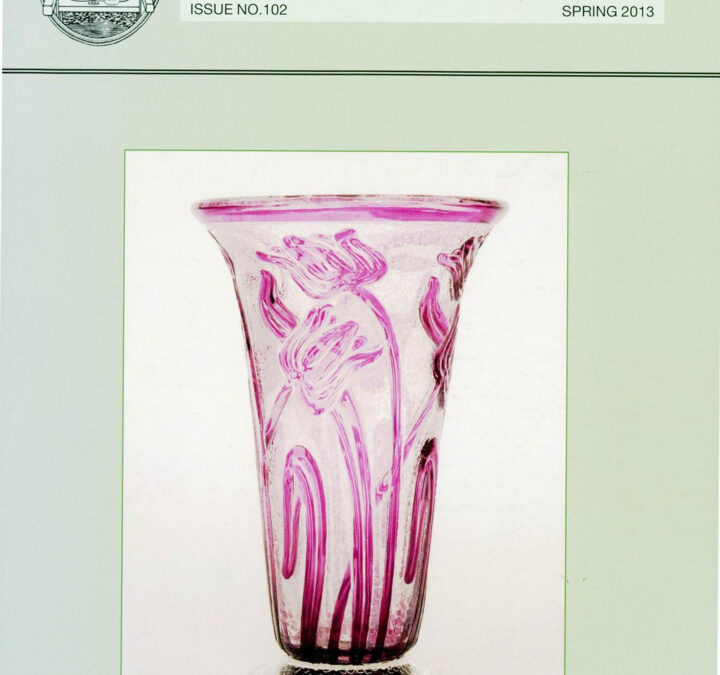
Cover illustrations
Front:1930s
Thomas Webb & Sons cameo Fleur
vase, clear spread foot with mottled decoration
below flaring body cased in purple over clear
and cut with tulips below plain purple border.
Back:
‘Breaking Light’Waveform by Graham
Muir at _Art in Action 2012’ – see page 19.
AS some of you may know, just over three
months ago, I had an accident which put
me out of any activities to do with glass
and the Glass Association. My thanks go to
the many friends and members who have
helped me go through this challenging time
and kept me involved and up to date. I wish
to thank in particular Paul Bishop, our vice-
chairman, who has taken on the steering
in my absence, and all the committee
members who work hard at keeping the
association growing.
In the meantime, we are continuing our
conversation with The Glass Circle and are
exploring the many synergies so as to find
the best way forward for both organisations.
In this issue we are delighted to have the
first of a series of scholarly articles by Sally
Haden. This initial article is on Thomas
Walton, one of a glassmaker family from the
latter part of the 18th century, and his travels
to Japan. I am very much looking forward to
the whole series. Wolfie Rayner’s second
piece on Whitefriar’s fakes is exemplary, in
that few writers can bring to light such an
in-depth knowledge of modern glass. Peter
Adamson, is taking us back to his 2009
exhibition on
large baluster glasses, this
time, with reference to his special collection
of baluster glasses with small bowls. Nigel
Benson is leading us on his voyage of
discovery of a little known engraver, Jane
Webster, as well as wetting our appetite for
the forthcoming Art in Action show. Alan
Gower’s review of the Centuries of Glass
auction at Fieldings, with pieces on sale
from the 18th century to modern times,
reveals him as a good writer with an eye for
detail. Our specialist collector of ‘cockerel’
glass, Bill Millar is delighting us once again
with his last piece on cockerel glasses,
finally revealing why he has been collecting
them.
We are busy organising our trip to
Austria/Hungary with a great deal of help
of from Gaby and Attila. I hope many of
you will you join the trip as well as attending
our next AGM at the Ruskin Arts Centre,
Stourbridge.
I am very happy to be back, and will
endeavour to continue serving the aims and
objectives of the association and the
possible merger with The Glass Circle.
Brian Clarke
THE GLASS CONE NO.102 SPRING 2013
Whitefriars ‘Fakes’
PART 2
Wolfie Rayner
Whitefriars moulds
WHEN the Whitefriars glass factory closed
the moulds were mostly lost and at the time
were deemed to be just unimportant scrap
metal as the textured range of vases had
gone totally out of fashion. The assets of
Whitefriars were sold off to various glass
firms etc and with these went the moulds.
I and other members of the collectors’ site
https://www.whitefriars.com/ have been lucky
enough to purchase several of the moulds
over the years — Onion 9758
(fig.1),
Nuts
& Bolts 9668
(fig.2),
Nipple 9828
(fig.3),
Hobnailed 9684
(fig.4) —
as well other
moulds that were used for decanters,
stoppers and lamp bases etc. and the 9818
Finger vase
(fig.5)
mould is known to be
in a private collection. All of the moulds
purchased are now safely housed in the
Harrow Museum and Heritage Centre.
Small Drunken Bricklayer
THE Whitefriars Small Drunken Bricklayer
vase (9673) was catalogued from 1967 to
1974 and was only produced in cased soda
colours. The standard factory colours are
Willow, Cinnamon, Indigo, Pewter, Meadow
Green, Aubergine, Lilac, Sage, Kingfisher
and Tangerine.
The small Drunken Bricklayer, being the
most popular of the Whitefriars textured
range, has been faked in four specific types
and I have loosely described them as
follows:
—
In the Original Mould
—
Portuguese (arrived with the fake Onion
and Hooped)
—
Horncastle Glass Studios
—
The Latest Batch (non-textured)
1. Original Mould
THE Whitefriars small Drunken Bricklayer
mould is owned by glassblower Jonathan
Andersson (Dean Farm Studios). His father
used to work at Whitefriars so I presume this
how he came to purchase the mould after
the factory closed. This mould is known to
have been used over the years to produce
vases, I am not sure of the exact dates but
certainly starting after 2000 and ending
about 2007. Clearly JA had the mould a
good deal longer than this but I have not
heard of any unusual vases coming up
before this period. After requests from
collectors JA started signing the underside
of the 2nd brick to show that these were not
Whitefriars and he also steered clear of
using colours similar to Whitefriars. Although
some made from JA’s original mould are
signed, most are not. It is to be noted that
these are not Whitefriars originals but are
certainly worth the same or more than
genuine examples. It is also known that
some Flint (clear) examples were made
using this mould, using the mould the right
way up and upside down, which in the latter
case produced a vase with the middle brick
stepping out the wrong way.
There are several known examples from
this mould, some in cased opaque colours
(fig.6),
some cased colours
(fig.
7) and some
signed cased colours
(fig.8).
I think these
were probably made in several different
batches between 2004 and
2007 with the type in
fig.8
being made towards the latter
part of this date range.
On the Whitefriars.com forum
in Dec 2007, JA stated The
perfect ones are signed JA
and the date, the less perfect
D and the date. All in all I
created 13 pieces’. These 13
pieces refer to the signed
ones around 2006-07, not
ones made earlier.
An interesting fact about
the Small Drunken Bricklayer
mould is that when it was
THE GLASS CONE NO.102 SPRING 2013
1
wearing out, the nipples on the
inside of the mould (produced
with blobs of weld) which meant?
the dots on the centre brick were
getting slowly worn away with
continual usage at Whitefriars.
As far as I can tell, all late 1974
Whitefriars Drunken Bricklayers
in Lilac and Sage and all that
were made in the mould after
Whitefriars have weak dot
patterns, especially to the
bottom left corner. In these
cases the dots look like slight
impressions with five or six pinhead-sized
dots. These can be seen in
fig.7
and
fig.8:
the bottom left corners have no dot
impressions.
On the Whitefriars forum in Oct 2006,
JA stated ‘I’ve deconstructed the brick
mould and made a wooden version much
like the original. I’ve also restored the bark
mould which I’ve recast’. Whether he
deconstructed it to help make the wooden
mould then reconstructed it we are not sure
but others were made in the mould after this
date. He certainly made a wooden mould
which he tried to sell on eBay then removed
it; whether this was used for fakes we don’t
know and we also never saw any evidence
of the Bark that had been ‘recast’.
JA also stated on the Whitefriars.com forum
that he has other Whitefriars moulds. He
offered to show us evidence of these but he
never did so we don’t know what they are.
We know he bought a tea chest full of them
that ‘needed a forklift’ to put into his vehicle.
2. Portuguese
THE name I gave to the first batch made in
non-Whitefriars moulds to flood the market
is ‘Portuguese’ although I am not by any
means certain that is where they were
made. This name came about as I once
asked a seller who had loads of this type at
Kempton antiques fair where they came
from and that was his answer.
The ‘Portuguese’ type started production
in early 2007 with the Small Drunken
Bricklayer appearing in Feb. 2007 and fake
Hooped and Onion vases turning up over a
year later by the same manufacturer. These
As I’ve already explained, all
the Whitefriars bricklayers were
blown into the same iron mould
so the dot patterns are always
identical. On these fakes they
have tried to replicate the dot
pattern as can be seen in the
photo
(fig.10).
The Base
THESE fakes have a moulded
pontil rather than the usual
Whitefriars polished pontil
(fig.11).
3. Horncastle
THE Horncastle types are still being made
by Nick Inman of Horncastle Glass Studio
(https://www.horncastleglass.com).
He makes replacement and reproduction
glass for the antique trade, specialising in
cranberry epergnes and centrepieces which
it must be said are of excellent quality and
which I have seen on many an antique
stand. He also produces various very
accurate Victorian replicas of vases, bowls
and oil lamps in cranberry and uses uranium
dioxide to produce Vaseline-type glass.
He started producing fake Small Drunken
Bricklayers in early 2010. They come in lime
green, dark green, light blue, dark blue,
purple, orange and cranberry
(fig.12),
opalescent Vaseline and opalescent
cranberry-tinted
(fig.13).
were produced in Gold, Purple, Ruby, Green
and Blue
(fig.9)
and possibly in Flint. The
colours Gold, Ruby and Blue are nothing
like Whitefriars catalogued colours but
the Purple and Green are very similar to
the Whitefriars colours Lilac and Meadow
Green.
Appearance
THESE are by far the best fakes being
mostly in good proportion and having a nice
textured feel to them.
They quite often have very thick uneven
layer of casing at the bottom. The top brick is
too straight-sided and the centre brick has a
noticeable angled bottom left corner.
The Dots
ONE of the most obvious giveaways is the
layout of the dot pattern in the middle brick.
The Dots
THE overall appearance and the dot pattern
of the Horncastle type have always puzzled
me as they pretty much exactly replicate the
Portuguese type. The dot pattern is exactly
the same apart from that one dot is missing
which I have marked with an arrow
(fig.10).
Although the Horncastle type is similar to
the Portuguese, the production technique
is different with not only the missing dot
but also with a snapped pontil and the
tops being hand-finished in the manner of
Whitefriars.
I can only conclude from this that he
purchased a Portuguese vase (as a
Whitefriars example would cost £200) and
had an exact mould made from it but one
of the dots was missing. On reflection, I’m
rather glad he didn’t do this with a genuine
Portuguese
Whitefriars
2
THE GLASS CONE NO.102 SPRING 2013
Whitefriars vase! I have mailed Nick Inman
asking for information about his mould but
I have had no reply.
The Base
THE base of the Horncastle type is
unfinished with snapped off pontil
(fig.14).
4. Latest Batch
THE ‘Latest batch’ appeared in April 2010.
I have very little information on these and
have no idea who made them or where they
came from. These fakes came in orange,
purple, blue, grey, brown and green.
Appearance
OF all the fakes these are undoubtedly the
worst. The glass has no texture and is
lightweight. There is a seam that runs
across the top left corner of the middle brick
and also the middle brick is too rectangular.
These have a very regular ‘automated’ look
about them as if they have been churned
out by a machine rather than blown by
hand.
The Dots
THE makers of these have made no attempt
to replicate the dot layout accurately. The
dots are very round and quite deep, likely
made out of pieces of bar inserted into the
mould. This has led to some of the dots
getting stuck when the vase was being
removed and has inverted them. I have
marked this with an arrow
(fig. /0).
The Base
THE base has a moulded dished
appearance
(fig.16).
Large Drunken Bricklayer
THE Whitefriars Large Drunken Bricklayer
vase (9673) was catalogued from 1967 to
1972 and was only produced in cased soda
colours. The standard factory colours were
Willow, Cinnamon, Indigo, Pewter, Meadow
Green, Aubergine, Kingfisher and Tangerine.
Fakes of these appeared in October 2010
and I have only ever seen them in blue.
Appearance
I can say with a good deal of certainty that
these Large Drunken Bricklayers originated
from the same place as the ‘Latest’
Small Drunken Bricklayers. The production
techniques are similar with no texture,
unsightly seams and a machine-made feel
to them
(fig.17).
The Dots
THEY have also made no attempt to
replicate the dot layout accurately. The
Whitefriars original has a distinct plain strip
on the left side of centre brick and the dots
are far smaller
(fig.18).
The Base
THESE have a very pronounced ‘bird bath’
type base. This is not a production
technique that was ever used at Whitefriars
and is a very obvious giveaway
(fig.19).
Further thoughts
I would imagine that most people would
think that I’m anti-fake Whitefriars but in fact
I’m not. There is a hard core of Whitefriars
collectors who are very strongly against
anything that resembles Whitefriars being
produced. This even includes ex-workers
making Whitefriars-type glassware and
reproducing items they made at Whitefriars.
I absolutely do not fall into this category.
Jonathan Andersson was receiving hate
mail when he was selling his fakes on eBay
and this sort of behaviour is unacceptable.
In the history of glassmaking, companies
have always copied each other’s designs
and I don’t see a lot of difference here.
Whitefriars certainly copied Roman,
Venetian, German and Scandinavian styles
after all! I do of course dislike the thought of
any new collector unwittingly paying a large
sum for a fake and hopefully my discussion
will help in this matter.
I also have no issues about the genuine
Whitefriars moulds being used after
Whitefriars, but I would like to see all these
clearly marked as Jonathan Andersson did.
Again I have no problem with ex-Whitefriars
workers producing similar items and in fact
I collect some of them.
I would like to thank Julian Knowles,
David Fuller and Peter McCarthy for their
help with photos and the loan of vases and
special thanks to Patrick Hogan for his
continued help in assisting me with research
and photos.
If you have any information of the
whereabouts of any Whitefriars moulds or
any fake-related information, please contact
me at glassaspirations@aol.com
THE GLASS CONE NO.102 SPRING 2013
3
Who Made
That
Glass?
Identifying Victorian glass makers and manufacturers:
Thomas Walton (1833-1897)
PART ONE: 1800-1874
Sally Haden
Introduction
IN the life of Thomas Walton, glass
manufacturer of Lancashire, few days
could have been more fascinating for
him than 7 September 1874, the day
he disembarked from the P&O steam-
ship
Orissa
in Yokohama, Japan.
Records do not provide exact details
but the story may be imaginatively
reconstructed using other historical
information.
It is likely that the two Japanese
businessmen for whom Thomas
had crossed the globe to work,
Miyonosuke Murai and Masatsune
Niwa, had come to meet him from the
ship. After formal greetings were
complete they would have taken him
a short step over to Yokohama station
where he was invited to admire the
country’s first railway line, opened only two
years earlier, and to enjoy a ride up to the site of
the glassworks.
He already knew that the factory was to be another
first in Japan, where he had been engaged to help
start up western-style glassmaking in a country which
had not seen it before. But knowing something and
being encountered with the reality are two different
things. When the train stopped for them at
Shinagawa, just short of Tokyo and they
disembarked, perhaps he felt both excitement and
trepidation. Standing with his Japanese employers
beside the track and gazing at the glassworks still
under construction, Thomas may have wondered at
himself for coming. The challenges ahead were in fact
to be so formidable that, had he foreknowledge of
Fig.1:An example of the kind
of glass the Walton family
roust have been familiar
with while working in
Lancashire from c.1843
onwards: three free-blown,
cut decanters traced to the
1846 Percival and Yates
catalogue.
With thanks to
Peter Beebe
Fig.2 (left): TheWaltons
made pressed as well as
free-blown and cut glass
when they came in to
Lancashire and so knew
glass similar to these
MolineauxWebb sugars
identified from catalogues.
The two on the left are late
1840s to early 1850s, the
third being c.1860.
Fig.3 (right): Another type
of glass which the Waltons
may have manufactured
in Lancashire. Uranium
pressed glass creamer
identified as Molineaux
Webb, c.1850.
With thanks for figs 2+3 to Neil
Harris at https: / /sites.google.
com/site/molwebbhistory
Finding Thomas Walton
MY interest in Thomas and his family was born when
I began researching my great grandfather James
Speed, a glassmaker, about whom my family had
always related
he went to Japan to lam ’em”.
Enticed
by the baldness and the romance of this piece of
information, I made some investigations. A fortunate
early introduction to Japanese glass historian Akiko
Osumi revealed that Speed was one of four British
glassmakers who assisted, advised and instructed at
the Shinagawa glassworks near Tokyo. The four worked
there in an overlapping sequence between 1874 and
1883 — Thomas Walton being first on the scene.
As Japanese archives offered very little information
on the men, I took it upon myself to uncover their
British backgrounds and found that of the four, the
most difficult but also the most rewarding was
Thomas. Locating him with the help of census
records was tough enough because his name is so
common in England, but then the fun began. His
father, also a glass manufacturer, had the same name
and there were three uncles, five brothers and several
cousins all in the same industry.
With glasshouses in about nine different locations
while Queen Victoria was on the throne, the Walton
family offers a fascinating snapshot of the 19th-
century flint-glass industry. Their movements up and
them, he may not have wanted to
proceed another step.
This two-part article offers an
outline of Thomas Walton’s story.
Part One describes his roots in the
British flint glass industry and
the skills he took to Japan. Part
Two in the next issue of the
Glass
Cone
covers his four years in
Japan, his successes and failures
there, and what became of him
and his family upon returning
home. Subsequent articles will
cover the lives of the three other
British glassmakers involved in
the same project, and the role
of the Shinagawa glassworks in
the development of Japan’s glass
industry.
4
THE GLASS CONE NO.102 SPRING 2013
J. & T. WALTON,
GLASS MANUFACTURERS,
AND
DEALERS IN CHINA AND EARTHENWARE,
10 UNION STREET AND 172 ARGYLE STREET,
BEGS respectfully to intimate to their Friends and the Public, that
they can always be supplied with any quantity of the above Goods on
the shortest notice, either in City or Country.
J. & T. intend to make it their study to have always a select Stock of
the BEST CUT GLASS and CHINA; also, beautiful CHANDELIERS,
of the newest and finest designs; LOBBY LAMPS, BRACKETS,
GAS MOONS, FRENCH and THISTLE SHADES, CHINA, LAVA,
and BOHEMIAN ORNAMENTS, &c.
Parties fitting up large Establishments, and requiring any of the
above Articles, will find J. & T.’s Establishment most advantageous to
purchasers.
PS.—J. &
T. being Manufacturers, they can supply Shippers and
others to their own Patterns on the shortest notice.
Goods Packed free of extra charge for City or Country.
GLASGOW, June, 1855.
Fig.4: Tom Snr sent two of his sons, Thomas and John George,
to set up this warehouse in Glasgow in 1854.
Advertisement reproduced from Glasgow’s Post Office
Directory, 1855-56.
down Britain reflect the fluctuations in
prominence of different regions,
especially the rise of north-west
glassmaking over that of the north-
east. Having reached Bolton in
Lancashire by the 1850s, they were
drawn into Manchester’s glass
manufacturing heyday. From Ancoats
they moved steadily westwards,
through Hulme, into Salford and finally
out to Newton-le-Willows, twenty
miles from Manchester, where their
West Lancashire Flint Glass Works
was in operation for more than a
quarter of a century until about 1902.
But perhaps of even more interest is
how the knowledge which Thomas
Walton acquired from his family was
taken so far across the seas to be
introduced into a very foreign country.
Roots
THOMAS Walton’s ancestors were
Stourbridge people going back well
into the 18th century. Early 19th-
century records show a family with six
children living close to the Heath glassworks
on the south side of Stourbridge town, four
of them becoming glassmakers. The eldest
was John, b.1800. His family always
remained in Stourbridge where he and his
sons were employed in glass, mostly at
the Heath.
In contrast, his three brothers spent most
of their lives much further north and were
manufacturers. Thomas’s father, b.1802
(also known as Thomas, so referred to as
Tom Snr
below for clarity), together with
Thomas’s uncle Richard, b.1804, migrated
to Liverpool in the early 1820s. While Tom
Snr soon moved on from there to
Gateshead, Richard returned to the
Stourbridge area, rejoining his brother in the
north later. Samuel, born c.1812, stayed at
the Heath until about 1852 when he moved
to Lancashire to work alongside Richard.
Even though no personal accounts of
their lives have surfaced, it has been
possible to interpret the Waltons through a
close study of public records. Tom Snr’s
branch of the family in particular left many
traces because he had a great number of
children and grandchildren, glasshouses,
addresses and bankruptcies. His sons and
nephews in turn were very busy, moving
between their fathers’ business interests
across Britain. From thousands of records –
mainly births, marriages and deaths,
censuses, directories and
London Gazette
notices – has come a most interesting
picture.
Thomas Walton who went to Japan
emerged from the analysis as an energetic,
perhaps restless man, similar to his father
beside whom he learned his trade. Like Tom
Snr, he did interesting things and took risks;
he travelled far in search of work and was
unafraid to pick himself up again after
disaster.
Continual migration
FOLLOWING his time in Liverpool, Thomas’s
father settled for a while in Gateshead, Co.
Durham where, as described in my previous
article
(Glass Cone
100) he may have worked
for Joseph Price.
,
There his wife gave birth
to five healthy sons – Thomas being the
second, born 1833. He became bankrupt in
1838 around the time of a downturn in both
north-east glassmaking and the national
economy. There ensued about eight years
of migration in search of employment and
manufacturing opportunities. From about
1843 to 1845 he was in Ancoats,
Manchester where he probably
worked for either Percival Yates or
Molineaux Webb.
Figs 1, 2 and
3 show
examples of what he could have made
there, or seen in development. By
1846 he was manufacturing in
Glasgow, possibly with James Couper,
moving back to Co. Durham a year
later. He and James Couper junior set
up at the Haverton Hill glassworks
near Billingham.
2
As discussed in my earlier article
about Joseph Price, there was a
tendency amongst glassmakers in the
north-east to remain convinced about
their region’s glassmaking long after its
strength began to wane.’ Tom Snr’s
next few years show his determination
to establish his family there, come
what may. The flint glassworks at
Haverton Hill was successful for about
eight years and formed a strong hub of
family activity. His brother Richard
became a partner for a while, replacing
Couper, and most of his sons were
old enough to work with him beside the
furnace.
But upon going bankrupt in the late
1850s – rather than forsake the region or
downsize – he invested a few miles to the
north in the Wear Flint Glass Works on
Trimdon Street, Sunderland where the
da77Iing Londonderry service was made in
the 1820s. Leach estimated this factory was
twice the size of Haverton Hill.
3
A most unfortunate sudden crisis in the
economy in 1858 upset Tom Snr’s plans
and sent him to Debtor’s Gaol, causing the
works to be sold to Angus & Greener
(whose later great success may have
been most irksome for the family). In the
meantime Thomas and his elder brother
had been sent by their father to establish a
warehouse in Glasgow. It must have been
an outlet for their father’s glass, but probably
also for a new family glasshouse that was
being established at that time.
Lancashire
IN 1852, possibly having doubts about
north-east glass, Richard Walton left his
brother in Co. Durham to set up at the
Albion Flint Glass Works in Bolton,
Lancashire, and their youngest brother
Samuel came up from Stourbridge to be his
manager’
,
Although this was generally a
very good time for flint glass, with the repeal
of the Glass Tax and a middle-class market
on the rise, the success of this business
THE GLASS CONE NO.102 SPRING 2013
5
DANIEL YATES
Albion Flint Glass Works,
BOLTON, LANCASHIRE!
All kinds of CUT
1t
PRESS
7
Gas Globes, Cut and Plain; Paraffin Globes and ChanncYs;
Lanspy
Chituneys, and Press Goods of all descriptions for the Indian and
Australian Markets.
Merchants’ Orders for Export Good, executed with despatch. Publicans, Innkeepers,
4e.
supplied at wholesale prices.
Fig.6: Punch and Judy pressed-glass figures produced at John
Derbyshire’s Regent Road flint glassworks in the early 1870s.
It is quite possible that Thomas Walton worked at one of theDerbyshire
glassworks in Hulme immediately prior to his time in Japan.
With thanks to Peter Bone
Fig.5: Advertisement in
1865 for the glasshouse
in Bolton operated by
the Walton family
1851-73. At this point
Daniel Yates, Richard
Walton’s son-in-law,
had control of the
factory.
From Slater’s Directory of
Lancashire, 1865, and
reprinted from the
Glass Association Journal,
Vol.3, 1990
may have been due largely to Richard’s skill
and experience. In 1840 he had signed a
five-year employment contract with Thomas
Webb in Wordsley, Stourbridge where he
must have learned much.
Another positive factor was its location.
Bolton’s new rail links to nearby Manchester
and Liverpool facilitated the transport of
Walton goods to home and foreign markets.
Manchester products were respected
around the globe for their quality and the city
had first class financial and commercial
facilities that Richard could take advantage
of. Added to all that, flint glass manufacture
was becoming an important Manchester
industry, offering a ready pool of knowledge
and skill.
Fig.5
illustrates the scope of this glass-
house. Although it passed through different
Walton hands, the Albion glassworks stayed
in the family for over twenty years. Thomas
and his brothers often worked there, no
doubt picking up much from their
successful uncle. However, in the early
1870s Richard’s son Samuel was struggling
to keep it going because of foreign
competition. Having sold it to Percival
Vickers in 1873, Samuel opened
up a furnace in Newton-le-Willows
just to the west of Manchester.
Meanwhile, with the 1859 loss of
the Trimdon Street factory in
Sunderland as a chance for his
sons, Tom Snr finally turned his
back on the north-east. After a
short further period of manu-
facturing in Sunderland (apparently
with the Turnbull family, estab-
lishing the Cornhill glassworks) he
tried one last time to set up his
sons, this time in the north-west. It
was short-lived. The bankruptcy
notice dated January 1863 gives
little detail, but other data shows it
was in Ancoats, Manchester and
involved all his sons.
Hulme and the Derbyshire brothers
HOWEVER, across the other side of the
city, a new centre of Walton manufacturing
had recently opened up. Samuel, who had
come up from Stourbridge to work for his
brother at Bolton, acquired a glasshouse
on Medlock Street, Hulme about 1860.
This followed his short partnership in
Ancoats with Burtles Tate. Like his brother
Richard, and unlike Tom Snr, Samuel
managed to keep his glasshouse open for
several years.
Medlock Street’s cone was a com-
paratively old one, dating back to the
1830s. It had been the only one in Hulme
until the Derbyshire brothers opened their
City Road factory about 1858. In fact,
research shows that James and his
brothers did their apprenticeships at
Medlock Street under the works’ previous
owner William Robinson.
5
Further, it shows
that, until the conclusion of the Walton
family’s business there in about 1876, the
Derbyshires and the Waltons were very
close neighbours.
Tom Snr and three of his sons, including
Thomas, moved into the district in the mid-
1860s, but although Walton family links
were always good, it is by no means certain
that they all worked for Samuel. Birth
certificates, directories and other data
indicate that, at least until Thomas Walton
went to Japan in 1874, both he and one
younger brother were were living much
closer to the Derbyshires’ factories on
the southern end of Hulme than to their
uncle’s factory on the northern end. In fact,
in 1871 Thomas was living almost next
door to the Derbyshires’ newly-constructed
Bridgewater glassworks in Trentham Street.
So did Thomas Walton work for the
Derbyshires?
Glass businesses sometimes competed
fiercely but also they could co-operate.
6
It is
not too much to imagine that even while the
Walton family in Hulme supported their
relative Samuel in Medlock Street, at least
some of them worked with the dynamic,
forward-looking Derbyshires. This idea is
supported by the fact that later on some
Waltons moved into Salford in the early to
mid-1870s, and one was a partner at
Regent Road for a while.
7
Compared with Medlock Street the
furnaces and general production methods
at the Derbyshire’s City Road, Trentham
Street and Regent Road factories must
have been more interesting for the younger
Waltons. Is it possible that Thomas, who
was taken on in Japan not only as a general
manufacturer but also to oversee the
establishment of the country’s first western-
style glass furnaces, learned the latest
methods and technology at one of the
Derbyshire factories? And could this have
been how he came to the notice of the
Japanese who were looking for a suitable
man, because the Derbyshires had an
upcoming name in Manchester?
The Japanese adventure
UNFORTUNATELY, exact details
of Thomas Walton’s recruitment
for Japan are not yet known. But
it is likely to have involved an
engineer named T.J. Waters who
was involved in the development
of the Shinagawa glassworks.
8
When he returned to England for
a while in 1873, still in the employ
of the Japanese, one of Waters’
tasks was probably to make
enquiries within the glass industry
for a suitable man. In order to
establish their first modern glass
factory, the Japanese appear to
have wanted an independent
6
THE GLASS CONE
NO.102 SPRING 2013
Contemporary glass with a twist; Georgian Glassmakers David Hill (pictured)
and Mark Taylor in the atrium.
glassmaker, not tied to a big company,
somebody happy to work for high wages
for a short contract and then return home.
He needed to be skilled in furnace
construction, general management and flint
glassmaking.
A study of Thomas’s background, in which
he grew up beside his father and his uncles
in the establishment of one glassworks
after another, shows he was amply qualified.
His recent years in Manchester’s vibrant,
expanding flint glass environment must
have acquainted him with all the latest
practices and materials. These factors
together gave him the required knowledge
and confidence, together with a pool of
British resources and family contacts that he
would be able to draw upon from Japan.
The day of departure dawned. It was a
summer day in 1874 when Thomas waved
goodbye to his family and friends, perhaps
wondering what changes would take place
at home before he saw them again. His
father and his uncle Samuel were growing
old, his uncle Richard had died the previous
autumn and the Bolton works had been
sold. Two of his brothers had already
departed for Scotland. However, Lancashire’s
glassmaking was still on the rise, Medlock
Street was still in business and the Newton-
le-Willows venture held some promise for
the future. He would have taken very tender
leave of his wife and five young children,
although they expected to travel out to join
him soon.
But leaving England and passing into
the heat of the Mediterranean, through the
newly-opened Suez Canal and beyond,
Thomas Walton junior of Manchester, glass
manufacturer, may have been thinking more
about the challenges ahead than about
what lay behind. He was surely looking
forward to his great work, helping to set up
a brand new glassworks in very novel,
demanding circumstances, and probably
spoke about it optimistically to his fellow
passengers. How could he or anyone have
predicted the great personal tragedy that
was to befall him within a few months, or
how he was to overcome it.
Part 2 to follow in Cone 103
Author’s note: I have provided only a minimum of
references because of space limitations. I should
be pleased to hear from anyone who would like
details or who can offer further information, at
haden.sally@gmail.com or www.hadenheritage.co.uk
ENDNOTES
1.
‘Who made that glass? Joseph Price of Gateshead’
in
Glass Cone
100, Autumn 2012
2.
Alan Leach discusses the Haverton Hill glassworks in
Glass Cone
21, Spring 1989
3.
Alan Leach,
Glass Cone
21, Spring 1989
4.
See Peter Helm’s article about this factory in
Glass
Association Journal,
Vol.3, 1990
5.
The 1841 and 1851 censuses show George, James
and Benjamin Derbyshire working as glassmakers,
living almost in the shadow of Robinson’s glass cone.
At this time all other Manchester glasshouses were in
Ancoats some distance away.
6.
See Barbara Yates, ‘The Glassware of Percival
Vickers & Co. Ltd.’,
Glass Association Journal,
1987,
p.29, for her opinion that many Manchester manu-
facturers had good working relations with each other.
7.
A ‘Richard Walton’ (probably the son of Samuel who
had owned the Medlock Street works) was a partner
with Edwin Henry Downs at Regent Road Flint Glass
Works until September 1877.
London Gazette
7
September 1877
8.
I am grateful to Dr Meg Vivers of Australia for her
research into Waters.
Her book is due for publication
this year. Vivers, Meg. An Irish Engineer: ‘The
Extraordinary Achievements of Thomas J. Waters and
Family in Early Meiji Japan and Beyond’, CopyRight
Publishing, Brisbane, 2013.
Contemporary Artists
at the Cambridge Glass Fair
Bob Wilcock
HE
Cambridge Glass Fair is settling
into its new home at Linton Village
College, following the devastating
arson attack at Chilford Hall in the summer
of 2012. Chilford Hall was special, and we
missed the carpet of snowdrops this
February, but the glass on offer is just as
good and varied. At Chilford Hall the large
main room was linked to a ‘contemporary
hall’ by a delightful panelled restaurant. The
college is itself in part of contemporary
design, and there are more rooms to
explore.
Contemporary glass can now be found
on many of the dealers’ stalls in the main
rooms, the Old Hall and the East and West
Atriums. One piece that caught our eye here
was a stunning large orchid bloom by Laura
Hart on the Arhus Glass stand (see
www.hartglass.com). We hope to have an
article on Laura and her work in a
forthcoming issue of the
Glass Cone.
Another one is a piece made using the
same side-punty technique used by Justin
Culina from New Zealand. The maker of the
piece had been inspired by the article in
Glass Cone
98, and apparently was not the
only one. It has to be said that the piece
showed that the technique is not as easy as
Justin’s effortless demonstration suggested.
In the contemporary rooms two artists,
new to us, caught our eye. We admired the
fine slumped and fused glass of Sandra
Callowhill for its smooth flowing lines and
movement of colour. A telecommunications
professional, Sandra also has a degree in
3D Design (Glass). www.sandracallowhill.com.
THE GLASS
CONE NO.102 SPRING 2013
7
The Kiss’ from Justin’s ‘celebration’ range
(engraved on a tumbler).
A sinuous piece from Sandra Callowhill’s
Freedom’ range.
photo Simon BruntneII
Opposite Sandra was the eye-
catching stand of Justin Lawson, JL
Engraving. After A Levels, Justin
intended to pursue a career in graphic
design and his design skills are clear
to see on his web pages
www.jlengraving.com.
However, life has taken him down a
different path as he revelled in the chance
to flex his creative skills when he
discovered the art of glass engraving.
This has all happened in the last eighteen
months or so and he is entirely self-
taught. He uses a diamond-point drill.
There is an understandable lack of
finesse in some of his ‘student’ pieces,
but he has moved forward at an
impressive pace. His more recent pieces
show an admirable control and
command of technique.
A particular challenge occured when
he was commissioned to engrave two
dogs: one black, one light tan. This
would be a test for any engraver, but the
result speaks for itself.
The dogs are engraved on a flat panel
but Justin is willing to tackle vases,
Sandra Callowhill on her stand
goblets and bowls in all types of glass:
Darlington and Waterford Crystal and
glass from LSA, Villeroy and Boch, as
well as other makers. He finds that each
offers up different pros and cons but
relishes being able to engrave onto many
different surfaces and textures; it is part
of the joy of hand engraving.
Justin is prepared to tackle most
subjects and his ranges include wildlife,
`life’ (portraits), and ‘celebration’. For the
latter, he is planning to form a separate
company solely catering for weddings
and anniversaries. He has had quite a
demand from couples asking for their
wedding portraits to be hand engraved
onto vases and bowls and he is proud to
offer what he believes to be the only
hand-engraved wedding portrait service
in the UK. He loves capturing forever in
glass the happiest day of someone’s life.
He has just had his own happy day,
and shortly he is to be graded by the
Guild of Glass Engravers. He is a
dynamic young man with a clear talent.
We shall watch his progress with
interest. www.jlengraving.co.uk
An engaving on a flat panel of a black and a tan dog
Justin Lawson with some of his engraved pieces.
8
THE GLASS CONE NO.102 SPRING 2013
Jane Webster,
Forgotten Engraver?
A
couple of years ago I was lucky
enough to discover a small group of
drawings for presentation pieces, all
signed by Jane Webster, a name I knew
and associated with quality glass engraving.
Having secured them, there began a search
for information about her.
Her initials are ‘E.J.’, although she is usually
referred to, and signs herself as, ‘Jane’
Webster. Realising from the letterheads that
Jane Webster had qualified from the Royal
College of Art, I contacted them to find that
the only record for a Webster had the wrong
first name, but the correct ‘J’ initial, so a tiny
piece of questionable information was put in
place and, fortunately, later confirmed.
Having gone through a number of books,
various references to her work were found
including a small biography contained in
International Modern Glass
by Geoffrey
Beard. Then a reference was found on the
internet, in connection to an exhibition
‘Images on Glass’ held at Asprey’s by John
Smith (current Chairman of the Glass Circle).
Another closed door — no copies available
at Asprey’s, surprisingly, not even one kept
for their records.
I contacted a previous chair of the Guild of
Glass Engravers, Katharine Coleman, who
gave me three email addresses of people
who could possibly help. One of them,
James Denison-Pender, gave the small
amount of information he could recall via
email and then very kindly sent me a copy
of the exhibition catalogue which included
work by himself, Jane Webster and Simon
Whistler. If you are lucky enough to find a
copy, the photographs of all the work are
a real treat. There is a one page summation
of Jane’s work and a number of illustrations,
but, as I was beginning to suspect, very little
factual information about her, such as birth
date (still withheld by the delightfully coy
lady), when she started working, and so on.
I discussed my quest with others, who
recalled meeting her, and even where she
lived at the time, back in the late 80s, but
much was hazy, although a few years ago
she was an active member of the Glass
Circle, regularly attending meetings at the
Art Worker’s Guild.
Nigel Benson
All in all I was beginning to think this was a
lady who valued her privacy. Then a stroke
of luck, an article in a
Pottery and Glass
magazine found while researching some-
thing else. This gave some details which,
combined with other information, should
be shared in order to begin to put Jane
Webster in her rightful place within the
history of this great glass discipline.
Jane, or E.J., Webster was considered to
be one of the foremost glass engravers in
the UK in 1958. She was born in the mid
1930s in Tanganyika, went to school in
England and then studied sculpture at
Southern College of Art, Portsmouth
entering the course in 1948. She stayed for
four years, achieving the National Diploma in
both Stone Carving and Sculpture. Her tutor
had worked with Eric Gill.
It has been suggested in an earlier
publication that Jane Webster felt that there
weren’t many openings for a female
sculptor so she began looking at glass
tableware and ornaments. However, she
has explained that it was more that her
interests lay in small scale work and a
particular curiosity in intaglio cut glass which
led her to glass engraving, something that
utilised
the
qualities of three-dimensional
design and of figure modelling.
She left the Southern College of Art in
1951 and went onto the Stourbridge School
of Art where she gained First Class Honours
at Special Level in the National Diploma of
Design in 1953, having taken a two-year
course in Glass Design and Decoration.
Following her success at Stourbridge she
gained a place at The Royal College of Art
after a three-year advance course on Glass
Design and Decoration, specialising in
copper-wheel engraving. Once on the course
at the RCA, she was awarded the Alexandra
Princess of Wales Scholarship. Her final
award was achieving a diploma, DesRCA.,
in 1956, and later became a Fellow of The
Guild of Glass Engravers.
This intensive educational process was
followed by practising as a freelance designer
and engraver. Occasionally her engraving was
executed on production pieces supplied by
James Powell & Sons (Whitefriars), particularly
if time or cost dictated their use. However,
she preferred to design her own blanks, also
occasionally made by Whitefriars.
Jane Webster had a fascination for deep-
cut copper-wheel engraving which creates a
rich effect and attracts more light the deeper
it becomes. Yet much of her work was in
shallow relief using the intaglio technique.
Her subjects in the main were figures and
animals however she particularly enjoyed
engraving flowers, as proved by a small
lyrical vase ‘Meadow Flowers’
(shown left).
She continued the long classical tradition
associated with wheel-engraved glass.
However, later on, as with images recently
found from the 70s, she started designing
her own forms for presentations that had
been commissioned — sometimes these were
in conjunction with wood or metal. These
pieces were cut from ground -and-polished
optical plate into asymmetric pieces with
skew-facetted bevel edges that were echoed
using a sandblasted inner frame around the
subject of the piece on the front face, with
the engraving being on the back face.
In the notes that Jane Webster supplied
she said:
‘Most of my work using this medium was
on half or three quarter inch plate that
was bent into a shallow curve in a kiln,
THE GLASS CONE NO.102 SPRING 2013
9
On the right are excerpts are taken from
the handwritten explanations to the
reverse of each image.
then mounted on marble,
rosewood, blocks of optical
glass, or on bronze. Here my
sculpture training came into its
own and I was able to make the
plaster-of-Paris patterns to be
used by the bronze casters.
The engraved subject was
designed to be viewed looking
into the concave face of the
glass, with the engraving on
the back, or convex surface.
The light holding affect of this
arrangement is greatly
enhanced. The decorative
sandblasted frame is on the
concave face, and thus
appears to float in front of
the subject.
Regarding my design
philosophy, I endeavour to use
harmony and balance in my
work. There is enough ugliness
and brutality in the world
without adding to it. Also I like
to employ subtlety in the
transition between one form
and another.’
Jane Webster also commented
that she had:
the advantage of being trained
as a sculptor when the
curriculum in some schools
included draughtsmanship,
anatomy and other ‘old
fashioned’ skills, for which
I continue to be grateful.’
The drawings found would have
been made for the individual
client prior to approving the piece.
Subjects for those discovered
include ‘Branwen’, ‘Europa and the
Bull’ and ‘Siegmund and Sieglinde’
which are all illustrated in various
glass publications along with
‘Hephaistos’ and ‘Saint Kentigern
and the Ring’ that are so far
publicly unrecorded.
Each panel of writing explains the
subject matter, who commissioned
the piece and who was the
designer.
Branwen
(left): from Branwen
Daughter of Llyr, the second
branch of the Welsh folk epic, the
Mabinogion. Branwen, Daughter
of Llyr, was the sister of
Bendigeidfran King of Wales,
and was given in marriage to
Matholwch King of Ireland.
However, she was treated badly
in Ireland and was bitterly
unhappy. While she was
imprisoned in a tower she
resolved to train a starling, who
had befriended her to speak.
When the bird had learned to talk,
she launched him off across the
sea to fly to Wales. The little bird
landed on Bendigeidfran’s
shoulder and implored him to
rescue Branwen, whereupon
Bendigeidfran mobilised his army
and defeated the Irish… .
Designed and made for Pilkington
Brothers to present to HRH the
Princess Anne on the occasion of
her visit to Chance-Pilkington,
St. Asaph.
Signed and dated 1972
Hephaistos
(left): God of Fire and
especially the smithy fire, and god
of craftsmen. He is credited with
making Achilles’ armour,
Agamemnon’s sceptre, and many
other wonderful and sometimes
magical things.
He is represented as having
a club foot, for in early
communities, a lame man with an
otherwise strong physique would
naturally become a smith, being
handicapped for farming, fighting
or hunting. Consequently his
movements would be somewhat
ungainly . . „
Designed and made for Pilkington
Brothers as a presentation gift for
Smith & Smith of New Zealand to
mark the latter’s centenary.
Signed and dated 1975.
10
THE GLASS CONE NO.102 SPRING 2013
Siegmund and Sieglinde
(right):
The scene from Wagner’s Ring in
which Siegmund, after having been
pursued through the forest for days by
his enemies, manages to elude them,
and stumbles into a but built around
a tree, and collapses unconscious.
There he is found by Sieglinde when
she returns. She revives him and they
fall in love, unaware that they are twin
children of the great god Wotan, who
were separated at birth. The result of
their union was Siegfried the hero of
the Ring cycle, the only man who was
able to draw the magic sword from
the tree where it had been placed
by Wotan… .
Designed and made in glass
and bronze as a 10th Wedding
Anniversary gift.
Signed and dated 1976.
Saint Kentigern and the Ring
(below
left): The Queen of Scotland possessed
a ring of great value which she is given by
the King; however, she lost it when on a
journey and was terrified to tell the King .
. . . She prayed to God to restore the
ring, and Saint Kentigern became one
of her knights who she then consulted
for help. He prayed, went to the River
Clud and told a fisherman to caste his
net and give him the first salmon caught.
Receiving the salmon, Kentigern thrust
his hand into the fish’s mouth and pulled
out the Queen’s ring . . . .
Designed and made for United Glass Ltd
to present to Distillers Company Limited
on the occasion of the latter’s centenary.
Signed and dated 1976
Europa
and
the
Bull
(below right):
The beautiful daughter of Agenor, King of
Tyre, and sister of Cadmus who founded
Thebes. It was not long before Zeus
spotted her bathing in the sea, so he
turned himself into a magnificent white
bull, and swam ashore. She was so
enchanted that he was able to entice
her to climb on his back whereupon he
plunged into the sea and swam with
her to Crete, where he raped her’.
There is no commissioning detail.
Signed and dated 1978.
Unfortunately, no museum or gallery
can currently be recommended to
see Jane Webster’s work. To have
managed to find these images by
her hand was a bit of a coup and
I believe adds to our understanding
and appreciation of both her work
and how it was achieved.
AUTHOR’S NOTES:
Sincere and grateful thanks are given to
Jane Webster for generously giving of
her time to make corrections and supply
notes to the author in April 2013.
Thanks also to James Denison-Pender for
both his help and generosity and to Katharine
Coleman.
NOTE: Should anyone know of, or find out,
the whereabouts of any of Jane Webster’s
work held in museums, or public collections,
please could they contact the author
nbenson@20thcentury-glass.com. Thank you.
REFERENCES:
G. Beard,
International Modern Glass,
Barrie & Jenkins,
London 1976
G.M. Heddle,
Manual on Etching and Engraving Glass’,
Alec Taranti, London 1961
J.P. Smith,
Images on Glass,
Asprey, London 1990
The Transparent Art’,
Pottery and Glass.
Vol.)000/1,
October 1958
Catalogue for the The Guild of Glass Engravers Jubilee
Exhibition, 1977
THE GLASS CONE NO.102 SPRING 2013
11
Cockerels on Glass an Overview
Bill Millar
fig 3: Reverse glass
painting based on
Henry Aiken
paintings c.1830.
F you thought you had seen the last
of cockerels, sorry to disappoint
you. This article provides an
overview of four of the five categories
of glass which employ cockerels.
These are armorials, cockfighting,
cocktails and decorative motifs. For
logistical reasons I have not yet tried
to collect the 5th category: stained
glass windows.
Armorials
ARMORIAL glass was first engraved
in 17th-century Central Europe for
royalty and wealthy aristocrats. The
titled heads of Europe favoured exotic
creatures such as double-headed
eagles in their arms but no domestic
fowl. British titled families were more
realistic and several have cockerels
in their arms. In British heraldry, the
cockerel is the emblem of vigilance,
virility, and bravery and several families
happily claim it as part of their arms.
It is usually depicted as a ‘Dunghill
Cock’ armed with cock-fighting spurs.
Given the natural desire for titled
families to use their arms to decorate
tableware etc, it is quite normal to
find the occasional item of glass
with a family badge of an engraved
cockerel. Etched armorial glass was,
from the late 19th century, more
commonly produced for regimental
or institutional glassware. Public
authorities, educational establish-
ments and commercial organisations
increasingly applied their crests
and logos to glassware and today
you will find Tottenham Hotspur
Football Club and Courage Brewery
glassware with cockerels. Enamelled
armorial glassware can also be
found but as yet there is no sign of
a Beilby cockerel.
The decanter at
fig.1
from the 1840s
carries an engraved cockerel but there
is no way of knowing which family
commissioned it. The glass intaglio
at
fig.2
would have been made as
a seal for either a signet ring or a
stamp. The motto ‘Gratis’ is written in
reverse and would have been
readable only when used on sealing
wax. The cockerel badge, which is
tiny, delivered a bit of a surprise when
I enlarged the photo to several times
actual size for this article. Instead of
the expected heraldic cockerel it has
a cockerel and hen (I hope) in what
is clearly a non-heraldic position. The
visual depiction may accord with
the second of the three attributes
mentioned above but I question what
event could have led any family to
adopt this as their badge.
Cockfighting
THE Romans brought cockfighting
to Britain and long after they left it
remained extremely popular with all
classes of society, including kings
and aristocrats, and glasses
engraved with cockfight scenes from
the 18th and early 19th centuries
can occasionally be found. However,
after William Wilberforce helped
abolish slavery in the early 19th
century, he turned his attention to
cockfighting. This created a fierce
reaction from supporters of the
‘sport’ and demand soared for
cockfighting items such as paintings,
prints and engraved glasses. The
cockerels are always shown as
trimmed game cocks with spurs. The
reverse glass painting at
fig.3
is
based on a set of four paintings by
Henry Aiken, and was probably
produced around 1830. The large
19th-century glass at
fig.4
has four
scenes around the bowl, while the
tumbler at
fig.5
shows a single scene
with two game cocks at the outset
of their bout. Other tumblers in the
set show scenes up to ‘the death’.
Reproduction, engraved goblets
were also produced in the second
quarter of the 20th century. The
example at
fig.6
is marked ‘Brierley’.
At least two other sets of large
reproduction goblets with engraved
motifs were also made during this
period. All three sets have unpolished
pontils.
fig.1 (left):
Early Victorian cut
armorial decanter
with engraved
cockerel.
fig.2 (above):
Glass intaglio with
motto alongside
stamp for scale.
12
THE GLASS CONE NO.102 SPRING 2013
THE
GLASS CONE NO.102 SPRING 2013
13
fig.4 (left):
Large 19th-century
glass with four
cockfight scenes
engraved around
the bowl.
fig.5 (near right):
19th-century
tumbler engraved
with opening stage
of a cockfight.
fig.6 (far right):
Brierley
20th-century
reproduction
goblet.
Cocktails
COCKTAIL glasses were made from
the turn of the 19th/20th centuries.
The earliest documented example
I have found of a cockerel cocktail
glass was American made by the
Honesdale Glass Company and
decorated by its sister company
Dorflinger in 1914. The next was
designed by Stevens & Williams in
1919. Huge numbers were produced
in USA, Britain and Czechoslovakia
up to WWII. You have already been
subjected to enough cocktail glasses
in the last three issues of
The Glass
Cone
so
fig.
7 shows two less
commonly seen items. The mixer
glass is of superb quality with hand-
painted cockerels and is just right
for budding 007s who prefer their
cocktails stirred not shaken. These
are much less common than cocktail
shakers. The optic moulded, cocktail
stick holder with a somewhat worn
transfer-printed decoration is the only
one I have seen, with or without a
cockerel. Lampwork cocktail sticks
were produced in many countries
and are still produced today.
Decorative Motif
FROM the 19th century, cockerels
were occasionally used as a
decorative motif. They may also
include hens and chicks so this
category has been extended
accordingly (See how the scope of
a collection slips when you don’t pay
attention). French makers probably
had greatest claim to it as a symbol
of France and makers like Legras
and Lalique produced decanters and
glasses of fine quality. Lalique also
produced magnificent car mascots
and paperweights in the shape of
a cockerel or cockerel’s head.
Enamelled art nouveaux pieces were
also produced by European glass-
makers. Mary Gregory cockerels
can be found but whether these
are American or more likely Eastern
European is debatable. British
glassmakers also produced a few
items and I have seen, and covet, a
cockerel glass engraved by William
Fritsche. From the middle of the 20th
century there was a virtual explosion
in the use of the motif, particularly in
the USA, possibly driven by townies
trying to forge a nostalgic link to
country living.
In illustrating this category I must
start with an egg — what else? The
hand-made, milk glass egg at
fig.8
was almost certainly made in USA.
American hens were given glass
eggs to fool them into laying whilst
British hens were given pottery eggs!
One US vendor described theirs as
a sock-darning egg. Excellent, a
practical, multi-functional object –
please wash properly when changing
to alternate function. The ‘egg’ is of
very fine, light glass; if you look
carefully you will see the shadow of
the rear rim of the egg cup through it.
fig.7 (below):
Cocktail mixer
glass and cocktail
stick holder.
fig.8 (below centre):
American glass
egg and French
pressed-glass egg
cup.
fig.9 (below right):
Milk-glass egg
storage chicken.
The egg cup at
fig. 8
is an
inexpensive, pressed glass example
of recent manufacture from France.
Pressed glass, egg storage chickens
were first produced over 100 years
ago but that at
fig.9
is relatively
new. In recent years US glassmakers
have produced hundreds of collec-
tors’ versions of chicken egg cups
and hen storage dishes. The same
makers, aided and abetted by
Murano, Swarovski and other
continental glassmakers, also offered
hundreds of glass chicken models
for collectors. The small, crystal
cockerel at
fig.10 is
just one example.
The ingenuity of glassmakers to
produce variants is unlimited; paper-
weights, bookends, lamps, sun-
catchers, lampwork models and
Christmas decorations (three French
hens) are just a few examples.
Less commonly found is the
enamelled Hoffman (butterfly in lower
left corner) chick in
fig.10.
Produced
in the 1920s/30s it might have been
used as a salt dish, possibly even to
accompany a boiled egg. The range
of cockerel-decorated tableware
and kitchenware produced during
the second half of the 20th century is
virtually unlimited and is represented
by the pressed and frosted cock-
erel knife rest in
fig.10.
The cockerel
bottle, and head from a larger bottle,
at
fig.11
is filled with peppers and is
of recent manufacture. There is no
maker’s mark on these bottles, but
similar bottles were made in Italy and
Mexico.
Back to cockerels, the claret jug
at
fig.13
with engraved cockerel is
likely to be British. The inclusion of
engraved ferns suggests a date in the
1860s or later. Almost 100 years later
c.1960, Alexander Hardie Williamson
designed the ‘Weathercock’ Slim Jim
tumbler at
fig.14
for Ravenhead.
The splendid decanter at
fig.12
is
probably French from the early 20th
century. The decorated areas have
been deep acid-etched to leave the
detail in relief then hand-enamelled.
Paperweight makers such as
Baccarat have produced weights
with cockerel canes. Unlike these
high quality items, the spill vase at
fig.15
whilst inexpensive would
doubtless once have been
someone’s pride and joy.
You’ve now seen the cockerel in
various guises; an emblem of nobility,
a memento of a barbaric sport
and a light-hearted image for cocktail
drinkers. Finally, you have seen
cockerels, hens and chicks (born and
unborn), used for purely decorative
fig.10 (top):
Crystal model
cockerel; Hoffman
salt; pressed,
frosted cockerel
knife rest.
fig.11 (above left):
Ornamental bottle
with top from
larger bottle.
fig.12 (above
right): Decanter,
probably French
early 20th century
with enamelled
decoration.
fig.13 (left):
Engraved claret
jug.
fig.14 (near right):
Alexander Hardie
Williamson
‘Weathercock’
Slim Jim.
fig.15 (far right):
Hand enamelled
spill vase.
purposes. Some of the latter category
are useful, some of superb quality and
others entirely without either taste,
quality or utility. Why have I bothered
to collect them? They are essential to
illustrate the story of how the cockerel
has been used and abused on glass.
If you have any comments or
questions I will be only too happy to
hear from you. billmillar82@yahoo.co.uk
14
THE GLASS CONE NO.102 SPRING 2013
F
OR those who viewed my goblet exhibition at the Cambridge
Glass Fair in 2009 which was subsequently reviewed by Brian
Clarke in
Glass Cone
89, you will recall that it focused mainly
on goblets of large proportions, up to 40cm tall and with capacities
up to 2 litres. In this short article I would like to introduce you to
some glasses at the other end of the spectrum. I will avoid at the
moment a discussion as to whether these should be described as
miniatures, salesmen’s samples or children’s glasses and just refer
to them as small. Most forms of glass produced in the 18th century
can be found in very small sizes.
I have only shown a very small selection of the little things that are
sometimes available to collect and for those with limited shelf space,
these make a very nice ‘small display’.
From Monsters to Minis
Peter Adamson
Fig.1 (right) shows a group of early
baluster glasses all of which can be
found in regular and goblet sized
versions.
From left to right:
–
The superb baluster glass has a
bell bowl with solid base, cushion
knop over an inverted baluster and
basal knop on a folded conical foot,
10.5cm tall. c.1720125.
–
The smallest of the group at 9.8cm
and circa 1710/20 is a delightful
little glass: ex AC. Hubbard Jr
Collection and previously in the
Seton Veitch Collection; plate 14 in
the Hubbard Collection shows three
glasses of this form, the tallest
being 37cm.
–
Slightly taller at 10.7cm is another
typical early baluster form having
a round funnel bowl with half knop
below over an inverted baluster and
basal knop sitting on a folded
conical foot. c.1710115.
–
Probably the latest of the group
due to the slightly more complex
stem and also lighter construction is another round funnel bowl over
a triple annular knop with inverted
acorn knop, all on a folded conical
foot, standing 10.5cm and c.1725130.
Fig.3 (below) shows four patch
stands /miniature salvers; these
lovely little glass items are available
in a great variety of different forms
so I have chosen these four to show
a variety of stems:
From left to right:
–
A four-bobbin stem (they can be
found with 2, 4, 6 and 8 bobbins
and probably even more but as yet
I have not come across one),
standing only 5.5cm tall with a
shallow cup bowl, all on a domed
and folded foot. c.1750160.
Fig.2 (below) shows a group of
small sweetmeat-style glasses.
These, if indeed used at the table,
would have required some very
skilful preparations below stairs to
create the tiny tasty morsels required
to occupy such small bowls.
From left to right:
–
7cm tall and very well made
havinga wide rib moulded bucket
bowl with aflared rim, a short
plain stem with basal knop on a
cogwheel-moulded domed foot.
c.1740150.
–
At 5.7cm this tiny glass has a
flared cup bowl over a short plain
stem with basal knop on a folded
conical foot. c.1740/50.
–
The tallest glass at 8.5cm, has a
spirally-moulded double ogee bowl
with wide everted rim on an incised
twist stem with collar at the top, all
on a domed spirally moulded foot.
c.1755160.
–
Probably the latest glass, c.1760170
and 7.5 cm tall, havinga diamond
moulded double-ogee bowl with
everted rim over a ribbed inverted
baluster and basal knopped stem
on a radially grooved conical foot.
–
5cm tall with a wide, shallow cup
bowl/plate on a solid plain stem
and a domed and folded foot.
c.1750.
–
At 3cm tall this is the smallest
and in a form that is regularly
found in much larger examples,
having a galleried plate over a
two-bobbin stem on a folded
conical foot.1770.
–
5cm tall with a shallow cup bowl,
having an inverted baluster knop
with cushion knop above, all on a
folded foot. c.1750160.
fig.4 (left) shows a very interesting glass:
a single series opaque twist with an
opalescent stem, interesting both for its
height which is only 8.5cm and for the
stem colour.
I have seen many of these stem types over
the years in normal size wine glasses and
a tall cordial so, as Barrington Haynes
comments, if these are accidental then a
happy accident it was. This one though is the
smallest happy accident I have come across
so far. (Any more out there?)
THE GLASS CONE NO.102 SPRING 2013
15
MAGIC
In the
MOUNTAINS
Kelsey Murphy,
Robert Bomkamp,
and the West Virginia
Cameo Glass Revolution
fig.5 (right) illustrates a group of interesting
table items most likely from towards the
end of the 18th century into the early
19th century:
From left to right:
—
The tallest jugat6.5cm has a blown
rib-moulded body with folded rim and
applied handle.
—
The smallest at only 5cm; again this is
blown body with ribbing and an applied
handle.
—
A delightful little tankard or possibly gin
cup, having what may be stylised juniper
berries engraved around the rim. Standing
5.5cm tall, it has an applied strap handle
and applied conical footand is probably
the earliest of the group, belonging I believe
to the middle of the 18th century.
—
Avery charming amethyst blown decanter
which, including its hollow blown stopper,
stands 8cm tall.
This group above all asks the question:
Are they salesmen’s samples or children’s toys?
The sample idea for the little jugs seems
plausible as these would have been far easier
to transport in bulk and would be a case of
you can have this style in whatever size or
capacity you like’. The same could possibly
be said for the decanter: again, easy to
transport as an example of what can be
available but in normal sizes, or were they just
for children to play with or have in what would
have to have been pretty fancy dolls’ houses?
Further discussion and ideas are welcome.
Finally we have fig.6, just for fun.
All collecting should be fun at times and here are
some fun pieces. Note that one of the little potties
appears to have received a ‘deposit’, and also note the
candlestick only 4cm tall with single series opaque
twist stem, blue sconce with folded rim and a blue
folded foot: this tiny lamp-worked stick I would think is
very likely for a dolls’ house. Although mostly out of
date with the rest of the items above, this group shows
that the area of collecting little things can be fascinating.
Magic in the Mountains:
Kelsey Murphy, Robert Bomkamp
and the West Virginia Cameo Glass
Revolution.
by Donna Meredith
Wild Women Writers, 2012, 246 pages
ISBN 978-0982901571. Price: £9.85
THIS book tells the story of Kelsey Murphy, her life
and her journey to become one of America’s
foremost cameo glass artists. It takes us through
her childhood, which involved moving around a
lot as her father started one brick factory after
another. Details of her personal life, including her
two marriages, a major accident and financial
problems, are interspersed with the story of her
involvement with glass.
Kelsey worked in the creative field and began
her career with glass by etching glass with sand,
initially on flat glass then onto three-dimensional
objects such as eggs. She invented her own
methods as she had never heard of others
working in the field or their techniques. Her first
business was Glass Expectations which involved
decorating large pieces of bevelled glass. It was
at this time she met Robert ‘Bob’ Bomkamp, who
became her partner in glass and life. A large order
came for etched mirrors which had no artistic
merit but paid the bills. However, they were for
someone connected with the Mafia. When she
asked for more money per mirror things got nasty
and eventually a consignment of 7,000 mirrors
BOOK REVIEW
was not paid for and Glass Expectations had to
be liquidated.
Three years after starting Glass Expectations,
Kelsey had a chance meeting with the CEO of
Pilgrim Glass and their new general manager. The
collaboration between Kelsey and Pilgrim Glass
enabled her to try new things including producing
cameo glass. She eventually carved six layers
of cameo and then, just before the company
ceased production, the glass blowers produced
twelve-layer blanks. Most of the cameo pieces
were only three or four layers.
Kelsey designed a vase in 1994 that was
6ft 2in. tall which was called ‘Run for the Roses’.
The Pilgrim’s team believes it is the largest piece
ever created.
Her fame grew and she designed an eagle
which was presented to President Clinton, now in
the Clinton Library, Little Rock, Arkansas. She
was also asked to present an ornament for their
Christmas tree. The ornament was used on the
front of the White House Christmas book and was
shown on American television by Hilary Clinton.
Kelsey also collaborated with Fenton Glass
until they closed. They then moved their studio
to their farm, Heaven, and called it ‘Made in
Heaven’.
She visited England and Broadfield House
Glass Museum with Christopher Woodall Perry,
the great-grandson of the renowned cameo artist
George Woodall. While here she met with
engravers such as Helen Millard, Richard Golding
and Jonathan Harris.
The book describes the glass but unfortunately
the pictures are in black and white; the only colour
photos are on the cover which means it is
impossible to get an idea of the beauty of her
work.
It also contains a description of glassmaking,
the terms used and a very brief history of glass
along with a small selection artists who work with
cameo glass.
This book is more of a story about Kelsey
Murphy than a reference book about her work.
Nevertheless, it makes an interesting reading.
Further information and colour photographs can
be found at https://studiosofheaven.com/about.html
— Judith Gower
16
THE GLASS CONE NO.102 SPRING 2013
Centuries of Glass
Fieldings Auction. 23 March 2013
Alan Gower
T
HIS time last year we were all enjoying an
early summer with temperatures around
20
°
C. On the morning of
this
auction, one
week before Easter, snow was driving horizontally
outside the auction room with the thermometer
hovering around zero.
At 9.30am inside the sale room around 30
hearty souls had braved the weather and some
stayed most of the day just to bag the one piece
that had caught their eye. Other more canny
bidders or perhaps with deeper pockets kept the
telephones busy and there were plenty of reserve
bids as well.
On offer were over 700 lots well displayed on
long tables down both sides of the auction room.
Quite an impressive sight and too tempting not to
pick up and enjoy, if not covet, for a few moments
but with the best pieces safe inside tall glass
display cabinets. The auction itself was divided
into seven sections: 18th-century and Georgian
wine glasses, 19th-century Bohemian and
continental glassware, 19th-century pressed glass-
ware and British glass, 19th- and 20th-century
paperweights and 20th-century Continental and
British glass. By the end of the auction few lots
had failed to sell and the vast majority made the
sale estimates, albeit often nearer the lower end
but showing that glass collecting is still in
reasonably good health, despite the vagaries of
the world economy.
With such a large number of lots and some that
were just that, groups of pieces, especially the
press-moulded glass, I could not hope to do
the sale justice, however I will pick out a few
pieces from each section to try to give you a
flavour. The auction started at 10am with a small
selection of some 30 18th-century wine glasses,
with the first few realising around £100 each.
Lot 6, described as a late 18th-century deep-green
tumbler glass gilded in the manner of James Giles
with small floral sprigs, was a surprise. With a
valuation of £200-£300 the bidding eventually
stopped at £900. Clearly, two determined bidders
but only one winner. Lot 18, a Jacobite firing glass
c.1740, with flared bowl and engraved head and
shoulder, possibly a portrait of Bonny Prince
Charlie, topped this section with a sale price of
£3,250. Several air twist and spiral twist stem
cordial and wine glasses fetched around
£600-£800, which I believe is fairly typical.
The second section comprised around 60 lots
of 19th-century Bohemian and continental glass-
ware. Sale prices were surprisingly modest with
many pieces going for under £100 and about ten
lots were not sold. A few pieces however stood
out, the first a magnificent epergne, Lot 58, over
60cm tat with a central flute in the form of a flag
iris, two lower flag iris trumpets with opalescent
amethyst leaves and set on a footed and petal-
edged bowl. This piece sold for £1,200 against a
sale estimate of £600-£800. Other pieces of note
were a pair of 35cm-tall Bohemian vases, lot 89,
said to be in the manner of Moser or Neuwelt, of
footed shouldered ovoid form with waisted collar
neck and petal-edged rim, cased in opal over
deep green and cut with stylised swags and slice-
cut panels with hand-enamelled floral garlands,
which sold for £1,300 against the sale estimate of
£300-£500. At the lower price end, lot 42 nearly
came home with me, a round Bohemian tumbler
cased in green over white and clear with repeat
star and diamond flash cut design, a snip at £42.
Lots 31-33 were three table lustres but in the
event only one sold and that at £45, well below
sale estimates of £80-£150.
The third section was around 50 lots of 19th-
century pressed glassware. A pair of John
Derbyshire recumbent hounds in a uranium tint,
Lot 102, made £390 and would have looked
good in our collection at home. As well as these
there were pieces by all the usual makers: Burtles
and Tate, Sowerby, Molineaux Webb, Henry
Greener, George Davidson and W.H. Heppell.
Sale prices were mostly in the £30-£120 region
and while most pieces sold at the lower end of
sale estimates, only one lot, which was of mixed
pieces, failed to sell. Several of the lots were
groups of pieces and certainly there seemed to
be some bargains if someone was starting out
collecting. Unusual items included Lot 111, said
to be a rare Sowerby cheese dish in flint which
went for £90. The most expensive piece was
Lot 99, a large Sowerby biscuit box in pale blue
and gathering apples pattern.
THE GLASS CONE NO.102 SPRING 2013
17
11
Lot6
The fourth section of around 200 lots was
19th-century British glass and again there were
bargains to be had as most pieces sold at the
lower end of sale estimates. The best prices were
realised by some cameo pieces such as Lot 214,
a Thomas Webb and Sons vase with collar and
neck in opal over blue and cut with a flowering
dog rose bough and butterfly between banded
borders which went for £1,300 and Lot 283, a
Stevens and Williams footed and tapered vase
with roll-collar neck cased in opal over a ruby
ground and cut with a flowering dicentra
(Bleeding Heart) which went for £1,350. The
range and diversity of glassware in this section
was quite vast, going from Stourbridge crystal
wine glasses and claret jugs to Thomas Webb
bronze and crackle finish vases, such as Lot 196
for £340, several imposing frill-rim bowl epergnes,
John Walsh Walsh opaline brocade posy bowl,
(Lot 153 for £95) to a Stevens & Williams Matsu-
no-ke vase, Lot 345, which fetched £320.
Paperweights provided an interesting interlude
with around 35 weights, mostly 20th century
and in the £40-£150 price range. The top price
of £340 was realised
by Lot 352, a 1930s
Monart paperweight
with latticino and
millefiori canes in a
radial and cartwheel
arrangement in tonal
orange, ochre and
green over a jade
green background. As
well as this there were
weights from Perthshire,
John Deacons, Okra and
Caithness.
The sixth section was
20th-century Continental glass
with around 170 lots mostly in
the price range of £50-£150 but
with a few pieces up to £600-£700.
Pieces of note pricewise were Lot 392,
a wine glass said to be in the manner of
Theresienthal which fetched £220 against a sale
estimate of £80-£120; Lot 415, a 1930s Rene
Lalique dish in the Fleurons-2 pattern, which
reached £380 against an estimate of £200-£300
and Lot 420, an oval blown-glass sculptural
form in shades of orange, yellow and green and
signed Philip Myers 1988, which was estimated
at £1,500-£2,000 but in the event only went
for £1,350.
The seventh and final section was 20th-century
British glass with around 170 lots. Star exhibits
included Lot 608 by David Reekie titled ‘Uncertain
Situation III’ which sold for £3,000 against an
estimate of £3,000-£5,000. Lot 611, a personal
favourite by Peter Layton, described as an Ariel V
freeform sculptural vase about 30cm tall and of
compressed ovoid form with a pulled and drawn
rim cased clear crystal over a tonal ochre
whiplash lines over a blue ground ,which sold
for £440 against an estimate of £300-£500.
Checking online after the auction this seemed
like a real bargain. Lot 697, a second Peter
Layton V form vase in the Ariel pattern, also
achieved £440 against a sale estimate of
£500-£800. (Both of these glassmakers
featured in
Glass Cone
100). Being my particular
interest at present, there were some gorgeous
pieces in this final section on 20th-century British
glass but I just managed to keep my hands in
my pockets.
The auction was
finished by 3.30pm;
the pace didn’t
slacken all day –
careful rotation of
the different Fieldings
auctioneers and their
friendly repartee helped
to keep the audience
focussed on the important
business of buying. For
me this was my first glass
auction; it was a most
enjoyable day but next time
I think I will focus a bit more
on making a few bids and not
…./
be so caught up in the theatre
of the bidding going on all around
me. My thanks in particular go to
Will Farmer, Director of Fieldings
Auctioneers, for providing the photo-
graphs that accompany this short article.
18
THE GLASS CONE NO.102 SPRING 2013
Last Year at Art in Action
Waterperry Gardens
Nigel Benson
T
HIS venue has been featured
on the pages of the
Glass
Cone
in the past, but is fully
worthy of a second visit. Although this
article refers to ‘Art in Action 2012’,
I hope it serves to whet your appetite
for the next one taking place from
18 to 21 July 2013. Even though a
whole range of crafts is on show with
lectures and demonstrations all day
long, there is plenty for the contem-
porary glass enthusiast to see, from
blown to engraved through to fused
and slumped glass, including some of
the best glassmakers in the country
both showing and demonstrating
how their wares are made.
Ed and Margaret Burke’s separate
display was close to the entrance, but
the majority of the glass exhibits were
centred in two marquees, one split
into two, half showing the exhibitors
wares for sale the rest with continuous
demonstrations including those by
Anne Wilson, Heather Gillespie and
Nancy Sutcliffe. The second marquee
was for hot-glass demonstrations.
We stopped to watch Ed and
Margaret Burke making a colour-twist
stemmed glass with such a good
commentary by Ed that one felt it
would be an easy thing to follow him
and make another without help. Far
more a compliment on how easy
Ed and Margaret made it look and
sound. Watching glass being made is
something that never ceases to
fascinate the viewer as it gives a
greater knowledge and under-
standing of the art form.
A large open-sided tent was given
over to glass-blowing demonstrations
by Anthony Wassell, Ben Walters,
Sarah Wiberley, Scott Benefield,
Graham Muir, Layne Rowe, Liam
Reeves, Tim Boswell and the Bandits,
and new faces at roughly hourly
intervals. Liam Reeves was next onto
the rostrum so we took our places
and waited for what turned out to be
a
tour de force
of glassmaking. Liam’s
interest lies in antique glass and its
technicalities. He showed us how he
made a tall-stemmed goblet in the
Venetian style which used both speed
and skill walking a fine line between
success and failure
(fig.1).
Part of
the demonstration included a reverse
pontil used whilst attaching the bowl
to the stem. Having greatly enjoyed
Liam Reeves work and commentary
we moved onto the Glass Tent where
Heather Gillespie was at work using a
copper wheel to create her sparkling
light catching work. Not far away was
Nancy Sutcliffe also working, but on
a small block piece, however in
contrast to Heather, she was using a
hand held micro-motor with a stone
burr which she alternates with a
diamond burr for detail. It was very
interesting to be able to compare the
two techniques and see the differing
results achieved by both artists.
Returning to the other
half of this marquee we
admired and handled
items for sale amongst
which I noticed a group of
complexly decorated vases
by Layne Rowe from his
‘Woven’ series
(fig.2a + 2b);
the latter being in the
competition tent. There
were also pieces by Liam
Reeves, including examples
of his Venetian goblet, but
also some very contrasting
modern looking organic
vase forms including ‘Warp
Vessel XIV’
(fig.3)
that
underlined his technical
ability and diversity.
Not having seen the
monumental Waveform
sculptures in toning colours,
with cut decoration by
Graham Muir before, I was
enthralled, and wished I
could afford to take one
home with me – especially when we
saw the piece he chose for the
competition!
(see back cover)
There were also examples of work
from all the artists giving demon-
strations along with pieces by Rachel
o’Dell from her ‘Metamorphosis’
series; Italian cane techniques
employed by Scott Benefield in his
‘snood’ pieces; and work from
Rachel Elliott using screen printing
and kiln-fired enamel.
Phil Atrill’s display of
attenuated vases was
both colourful and
interesting and I was
left wondering how
difficult they must be to
transport. However, he
assured me, they were
more resilient than
they looked.
Going through to
the various enclosures
was an opportunity
not only to look at
wares, but also have
a chat with the various
makers about their
pieces, what inspires
them and, as a sole
trader myself, discuss
business. Many com-
ments were very
uplifting with artists
diversifying and extend-
ing their creations to
encompass more than just a
decorative item, notably those
working with fused glass. Some had
broadened out into utility wares such
as lighting whilst also embracing
large architectural pieces for public,
private and corporate commissions
e.g. work by Lara Alridge and
Siobhan Jones. There was also the
more bizarre, but interesting idea of
‘Ashes in Art’ promoted by Siobhan
who suggested that one could
‘capture the essence of a passed love
one’ entrapped in glass – surely a
complex subject which I leave for the
individual reader to consider.
In the competition tent we saw
much that would’ve been nice to
take home. Apart from the notable
monumental sculpture in toning
colours by Graham Muir mentioned
above, Margaret Burke’s tall blue
vase ‘Under the Sea’
(fig.4)
caught
my eye for its whimsical mood and
pleasing tall form.
All in all a thoroughly enjoyable,
if tiring day but totally worthwhile.
Pleasant surroundings, well sign-
posted and a great pleasure to see all
the wonderful exhibits – and I didn’t
even touch on the other disciplines
that caught my eye, including
marvellous examples of modern
handmade furniture. If you take your
wallet, be prepared to make a
purchase or three as it’s very difficult
not to succumb! www.artinaction.org.uk
THE GLASS CONE NO.102 SPRING 2013
19
MEMBERS
David Whitehouse
SENIOR Scholar at
The Corning Museum
of Glass and its former
Executive
Director,
David died in February,
aged 71, after a brief
battle with cancer. In
an illustrious career, he
had a profound impact
on his two main
interests — archaeology
and glass.
David Whitehouse
was born on 15 October 1941 and spent his early
years in the village of Wildmoor near Bromsgrove
in Worcestershire. Educated at Catshill First
School and King Edward’s School in Birmingham,
he went on to read Archaeology and Anthro-
pology at St John’s College, Cambridge, staying
on to take a Ph.D. From 1963 to 1965 he was
Rome Scholar in Medieval Studies at the British
School in Rome. Between 1966 and 1973 he
held the post of Wainwright Fellow in Near
Eastern Archaeology at the University of Oxford,
and it was during this time that he directed the
excavations at the ancient port city of Siraf in Iran
on the north shore of the Persian Gulf. During six
seasons of excavations, his wide-ranging and far-
sighted approach, which investigated not only the
architecture and millions of objects but also
paying attention to the economy, geomorphology,
water supply and land use of the town,
established him as a major archaeologist. After a
year as Director of the British Institute of Afghan
Studies in Kabul, David was appointed as
Director of the British School at Rome. In his ten
years in the post, he led many important
excavations including those at the classical
Roman structure, the Schola Praeconum at the
foot of the Palatine Hill.
In 1984 he left Rome to become the Chief
Curator of the Corning Museum of Glass in
Corning, New York State. His talents saw him
rising quickly through the ranks; after three years
he moved up as Deputy Director of Collections, in
1988 he was appointed Deputy Director of the
Museum becoming Director in 1992 and then
finally as its Executive Director and Curator of
Ancient and Islamic Glass in 1999. When 70
years old he relinquished that post and was
appointed Senior Scholar at the Museum to
concentrate on writing and research.
During his tenure as Executive Director he
oversaw a major expansion and renovation of the
museum’s premises, adding 218,000 square feet
of public space and spacious new quarters for
the Rakow Research Library. He also established
The Studio in 1996, a state-of-the-art glass-
making school that trains future generations of
glassmakers, provides a creative resource for
the area, and allows thousands of Museum
visitors to sample the pleasure of making their
own glass. Under his direction, some 20,000
items were added to the collections, almost
doubling the Museum’s holdings, while he actively
collected not only books for the Rakow Library
but also manuscripts and archives from artists
and glass companies around the world. His
energetic work in these areas firmly established
the Corning Museum of Glass as the global leader
in the field of glass collecting, education and
glassmaking.
One of the foremost scholars of Ancient and
Islamic glass in the world, David published more
than 500 scholarly papers and books, including
three volumes on Roman Glass in the Corning
Museum of Glass. He served as an advisor to
various academic journals and edited the Corning
Museum’s annual
Journal of Glass Studies
from
1988 to 2011. One of his passionate interests
was Roman cameo glass and in 1990 he co-
authored with Bill Gudenrath, the chief glass artist
at The Studio, several ground-breaking articles on
the manufacture and ancient repair of the famous
Roman cameo, the Portland Vase in the British
Museum. In his last book,
Glass: A Short History,
published last year, he covered the development
of the craft from its early origins to its
development as an artistic medium with the
international Studio Glass Movement.
The Corning Museum of Glass has always held
major exhibitions some of which David also
curated including exhibitions on modern glass
inspired by ancient Rome, the Harvard glass
flowers by the father and son team of the
Blaschke’s, and glass from the Sultan Empire. In
1987 he co-curated the groundbreaking ‘Glass of
the Caesars’ exhibition with the British Museum
and the Romisch-Germanisches Museum in
Cologne, thereby introducing ancient Roman
glass to thousands of visitors for the first time.
As well as being a highly respected scholar,
David was a skilled storyteller and educator, able
to quickly engage audiences in his lectures and
delighting visitors when he gave public tours of
the Museum. British audiences experienced
something of his charisma when he attended and
lectured at the International Festival of Glass
in Stourbridge in August of 2012. He was
instrumental in organising a live television link
between Stourbridge and Corning where Bill
Gudenrath spoke about and showed John
Northwood’s recreation of the Portland Vase in
1876, while the American audience could see the
2012 copy of the Vase by Ten Colledge at the
Ruskin Glass Centre. It was during this visit that
he went back to his former home village after a
gap of some 50 years.
On a previous visit to Britain a year or so earlier,
David made one of his greatest glass discoveries.
In London at a viewing of an auction of Turkish
military helmets and various Indian bits and
pieces, David spotted a glass object described as
an 18th-century Indian spittoon. In fact it was an
unknown form of glass by George Ravenscroft,
the man credited with the invention of lead glass
in London in the 1670s. Trying not to show his
excitement at his discovery, David was able to
purchase the spittoon and it now sits proudly
among the masterpieces at the Museum and is
featured in a short video with David explaining the
event.
The mission of the Corning Museum of Glass
has always been to tell the world about glass.
David took that mission to new levels with a
charm and sense of humour and fun which belied
his great intellectual and academic status. He
leaves an astonishing legacy which the executive
of the Museum are committed to continue and
build upon.
David is survived by his second wife and their
three children, and by the three children from his
first marriage.
David Bryn Whitehouse
Born October 15 1941 Died February 17 2013.
— Charles Hajdamach
Geoff Timberlake 1939
–
2012
IT was with great sadness that I learnt of Geoff
Timberlake’s passing. He was a kind, self-effacing
man who gave of his time and research
generously. He was Secretary to the Glass
Association from 2001 to 2004.
Born in Chesham in 1939, Geoff had an elder
brother and a half sister. He followed his father’s
interest by joining the Little Chalfont Rifle Club
when a teenager, becoming a talented pistol and
rifle shot, winning medals and cups over the
years.
Whilst at school he joined the Air Training
Corps possibly discovering his lifelong interest in
earthy, rousing music, having become a member
of their pipe band.
He was accepted into the RAF as an
apprentice Air Frame Fitter and passed out in
1957, serving in Aden, Kenya and Brahmin, and
returning to a posting at RAF Hannington, where
he joined the Motor Club. It was through this
interest that he eventually met Davina as they
were both members of the Mid Bucks Club. They
married in 1965.
During the early part of their marriage Geoff’s
work took him travelling around West Germany,
which finished when he left after twelve years
service. He became a Technical Author for
Handley Page, followed by a spell writing about
forklift trucks, sorting machines and thence to
Kent Meters.
Coming full circle he was once again writing
about his beloved aeroplanes for British
Aerospace eventually taking early retirement
when the company transferred to the USA.
Geoff was an enthusiastic joiner where his
hobbies were concerned being secretary to the
Luton Rifle and Pistol Club in the 1980s.
In around 1970, the family discovered their love
of camping and joined the Camping and Caravan
Club. During that time he was on many
committees and edited two group magazines –
they won the Burham Trophy for the best group
magazine — all down to Geoff.
He was the national chairman of the Trailer Tent
Group for two years and represented them on the
National Committee for 19 years. In 2003 he was
awarded the Certificate of Honour for his service
to the Club.
Davina always said that Geoff seemed to
‘collect’ Committees and this was true of the
Glass Association — becoming an active member
and finally joining the committee and being
elected as the secretary. He quietly got on with
the job with good suggestions that helped the GA
move forward, including being the webmaster for
their first website.
20
THE GLASS CONE NO.102 SPRING 2013
MEMBERS
Having left the committee for his other interests
Geoff and Davina visited many different countries
on organised ‘glass tours’. The last of these was
to Bavaria last year, even though by then, he
knew he had cancer.
I met Geoff when he decided to research the
Nazeing Glass Company and put a short request
for anyone else interested in the company in the
GA Newsletter.
I was one of maybe two people
who replied, having a collection of the company’s
art glass that was in those days quite small. Geoff
went on to spend many happy hours researching
in the British Library, at the National Archives in
Kew, and at various libraries in South London.
He was in time to interview a number of people
and noted down all he learnt, eventually
culminating in the self publication of a book 75
years of diverse Glass-making to the World: A
celebration of Nazeing Glass Works, 1928-2003,
and exploration of their Victorian origins.
It is a
credit to him that he managed to get past all the
brick walls that had previously prevented others
from progressing that research.
Naturally during the course of his research he
met Stephen Pollock-Hill, the Chairman of
Nazeing Glass Works. Once the book was
published Stephen asked Geoff to become the
company’s archivist, later allowing Geoff access
to a cupboard full of ledgers that came to light
Glass Association Events
Vienna & Budapest
28 August – 3 September
THE trip to Austria/Hungary will start on
Thursday 29/8 in Vienna (arrival late
afternoon/evening on Wednesday 28/8) and will
end on Mon 2/9 in Budapest (departure either
on Monday evening or Tuesday morning). The
full programme will be posted on the website as
soon as it is finalised. gabymarcon@btinternet.co.uk
Ruskin Glass Centre, Stourbridge
19 October 2013
This year our AGM and study day will be held in
the renovated Ruskin Glass Centre, which
includes a newly established Webb Corbett
visitor centre. Put the date in the diary as it will
be an exciting and interesting day.
alanjudy@lahaina.me.uk
A day with the ‘Georgian Glassmakers’
23 November 2013
THIS is the third workshop we will be holding in
Quarley. The day will centre on practical
demonstrations of Georgian glassmaking
techniques, such as making air and opaque
twist stems and will provide opportunities to
discuss evidence for how this vessel glass was
made. alanjudy@lahaina.me.uk
Other events
Highlights of my time at the museum:
Roger Dodsworth 6 June 2013
6.30pm, Broadfield House Glass Museum
Paperweights weekend
15-16 June 2013
Saturday at Himley Hotel, Sunday at Broadfield
during a clearout prior to Stephen starting his
Museum of British Domestic Glass within the
firm’s office complex.
Both Geoff and Davina collaborated and
supported in the presentation of the exhibition
that we held at Lowewood Museum, Broxbourne
in 2003. He launched his book – on the history of
the company and the glass made by Nazeing and
its predecessor companies that began with
Charles Kempton in Vauxhall, London – on the
first day of the exhibition in July that year.
Like so many before him who give their time to
research and produce that information in book
form, although proud of his work, Geoff never
trumpeted his achievement. Yet without Geoff’s
work on Nazeing and the Kemptons, the glass
world would be the poorer, so collectors and
dealers who now use information that has been
disseminated from his book owe him a debt.
Our deep condolescences go to Davina, Alan
and Fiona and of course our thanks to Geoff for
his contribution to the world of glass. – Nigel Benson
Well done CGS and IFOG!
THE Contemporary Glass Society (CGS), together
with the International Festival of Glass (IFOG), will
receive just under £80,000 from the Arts Council
of England which will enable both organisations to
carry out vital research into developing audiences,
WHAT’S ON
House Glass Museum. Including Ysart,
celebrating creativity of the eponymous family.
10th Anniversary Bead Fair
25 August 2013
Bonded Warehouse, Stourbridge DY8 4LU,
www.stourbridgebeadfair.co.uk
North Lands International Master Classes
and Conference including an exhibition of
new works from the North Lands
Creation Glass Collection of
Contemporary Glass
September 2013 to October 2013
info@northlandsglass.com or Lorna MacMillan on
01593 721229
Engraved glass from North East England:
1800-1860 12-19 October 2013
DELOMOSNE & Son Ltd will be holding, at their
premises in North Wraxall, a selling exhibition
titled ENGRAVED GLASS FROM NORTH EAST
ENGLAND 1800-1860. This is the unrivaled
collection of the late Ian Robertson of Alnwick.
It includes many rarities, finely-engraved examples
and a few glasses signed by the engraver. The
exhibition will be accompanied by an illustrated
catalogue which may be ordered in advance.
For details please visit www.delomosne.co.uk.
Exploring the fusion of art and technique
12 and 13 October 2013
National Glass Centre
A timely debate on the art and technique is the
theme of a national conference organised by the
Contemporary Glass Society (CGS) next October at
the NGC. In contemporary glass, art and technique
come together to enchant and challenge us.
But is there tension between the two, or are they
membership and new benefits for members. It will
also help CGS move forward and become much
more self-sufficient for funding. The plan is about
ensuring that the CGS and the IFOG can continue
to help the thriving community of glassmakers
and lovers, and to promote artistic excellence in
contemporary glass.
More good news for National Glass Centre
THE National Glass Centre (NGC) has been given
a significant boost to its ambitious redevelopment
programme after being awarded £100,000 from
the Sir James Knott Trust, a North-East based
charity, supporting community projects in Tyne
and Wear, Northumberland and County Durham.
The donation will allow the centre to generate
additional arts activities in Sunderland and North
East England in collaboration with its partner
gallery, Northern Gallery for Contemporary Art
and will contribute towards the ambitious
transformation currently taking place at the NGC.
When the Centre re-opens in the summer visitors
will see a completely refurbished venue. The
remodelled galleries and displays will present a
range of exhibitions, including a private collection
loaned by the National Museums of Scotland,
a new gallery telling a compelling story of the
history of glass in Sunderland and improved and
modernised educational facilities.
perfect partners? Great line of speakers together
with 20 glass artists will present and talk about
their work in quick-fire succession. There will
also be seminars on architectural glass and
presenting work to galleries, plus demonstrations
of printing on glass, flameworking, hot glass and
water jet cutting. Booking www.cgs.org.uk
Christmas
Festival
30 November
–
1
December 2013
Broadfield House Glass Museum
Just Desserts
29 June 2013 – 23 February 2014
Broadfield House Glass Museum
Changes in fashion in all things sweet, and
accompanying glassware
Events and Exhibitions at Red
House
Glass Cone
Contrasts: The Lace Guild:
1 June – 27 July 2013
OMG – Oh My Glass:
7 September – 20 October 2013
Made at the Cone:
26 October -1 December 2013
All I Want For Christmas:
7 December – 5 January 2014
www.dudley.gov.uk/see-and-do/museums/red-house-
glass-cone/
Forthcoming
Auctions – 2013
Thursday 6 June:
Bonhams – European
Ceramics and Glass
Forthcoming Fairs
–
2013
Sunday 22 Sept:
Cambridge Fair, Linton Village
Sunday 10 Nov:
Birmingham National Fair
THE GLASS CONE NO.102 SPRING 2013
21
The Glass Cone
THE MAGAZINE OF THE GLASS ASSOCIATION
www.glassassociation.org.uk
PROMOTING THE UNDERSTANDING AND APPRECIATION OF GLASS