




The Glass Cone
ISSUE NO.103
SUMMER/AUTUMN 2013
Contents
1 Who Made That Glass? Thomas Walton – part 2
5 The Victoria & Albert Museum
and the William Bell Scott Windows
7 Gray-Stan Glass at the National Glass Fair
9 Glassmaking in Hungary – part 1
12 The Ian Robertson Collection of engraved glass: an overview
14 New Glass – Ancient Skill, Contemporary Artform
16 Country Seat Retirement Sale
18 National Glass Centre Revitalised
20 Members pages
21 What’s on
Chairman’s message
Editor: John Keightley editoroglassassociation.org.uk
Editorial Board
Charles Hajdamach, Mark Hill, Brian Clarke,
Gaby Marcon,Yvonne Cocking, Bob Wilcock
Address for Glass
Cone
correspondence
E-mail editor@glassassociation.org.uk
or mail to Glass, 4 Seven Acres, Worcester WR4 OJD
E-mail news & events to news@glassassociation.org.uk
Articles and news items are welcome at any time,
but please bear in mind the copy dates if you have
an event you would like to be publicised.
The opinions expressed in the
Glass Cone
are those
of the contributors. The aim of the Editorial Board is to
cover a range of interests, ideas and opinions, which
are not necessarily their own. The decision of the
Editorial Board is final.
Copy dates
Spring: 21 February—publication 1 May
Summer: 21 May — publication 1 August
Autumn: 21 August — publication 1 November
Winter: 7 November — publication 1 February
Advertising rates
Full page £200; Half page £140; Third page £100;
Sixth page £70; Twelfth page £55. For inside back
cover and back cover, prices are on application.
Discounted rates for GA members
Please contact circaglassgaol.com
© The Glass Association 2013. All rights reserved
Design by Malcolm Preskett
Printed in the UK by Micropress Printers Ltd
www.micropress.co.uk
Published by The Glass Association
ISSN No.0265 9654
The Glass Association
Registered as a Charity No.326602
Website: www.glassassociation.org.uk
Life President:
Charles Hajdamach
charleshajdamach@btinternet.com
Chairman:
Dr Brian Clarke:
chair@glassassociation.org.uk
Hon. Secretary:
Judith Gower
secretary@glassassociationorg.uk
Membership Secretary
Pauline Wimpory,150 Braemar Road, Sutton Goldfield,
West Midlands, B73 6LZ
membership@glassassociation.org.uk
Committee
Paul Bishop (Vice-Chairman); Jackie Fairburn;
Christina Glover; Alan Gower; Judith Gower; Mark Hill;
Jordana Learmonth; Gaby Marcon; John Keightley;
Kari Moodie; Rebecca Wallis; Maurice Wimpory
(Treasurer)
Membership and subscriptions
Individual: £25. Joint: £35. Student with NUS card: £15.
Institutions: UK £45. Overseas £35. Overseas
Institutions £55. Life: £350. Subscriptions due on
1 August (if joining May—July, subscriptions valid until
31 July, the following year)
Cover illustrations
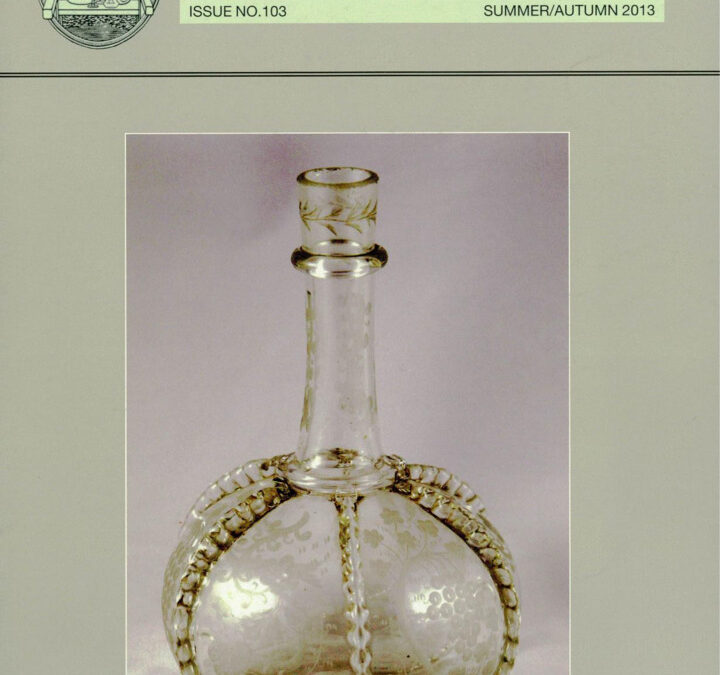
Front: A
17th-century decanter from Hungary
(see page 11).
Back:
A pair of vases designed by Keith Murray
(1892-1981) in the mid 20th century and
produced by Royal Brierley of Stourbridge
before they closed in the 1980s.
THE committee warmly welcomes our new
editor, John Keightley, an academic and
collector whose knowledge and love of
glass has progressed whilst working in the
auction world. He has now enthusiastically
accepted the position of editor of
The Glass
Cone
and will be working together with the
Editorial Board, especially our past-editor,
Gaby Marcon. A big thank you to Gaby for
her work in producing a quality magazine
over the last few years.
Many thanks also to Attila Sik and his
partner Zsuzsanna Molnar, who at the 11th
hour and with additional help from our dear
member Maurice, took over from Gaby the
planning of the recent trip to Vienna and
Budapest. We have received numerous
congratulatory emails for the superb
organisation of the trip. Well done Attila and
Zsuzsanna. (Part 1 of their ‘Glassmaking in
Hungary’ starts on page 9).
Thanks and wishing a great future to
retiring committee members: Jackie Fairburn,
for contributing thoughts, advice and
organisation for so many years and to Roger
Dodsworth. Roger, an original member of
the Glass Association (GA), followed on
from Charles Hajdamach to become the
Keeper of Glass at the Broadfield House
Glass Museum (BHGM).
We are delighted to welcome to the GA
committee a dedicated group of younger,
energetic, glass enthusiasts including Kari
Moodie, who for many years was the ‘Glass
Interpretation Officer’ at BHGM, and has
now taken up the position of ‘Keeper of
Glass and Fine Art’ at the museum –
congratulations on accepting this important
post with probably the best 20th century
glass collection in the country. We are also
delighted to be joined by Rebecca Wallis
now at the V&A and passionately involved
with their glass collections.
Please look at our website and the
‘Members’ and ‘What’s on’ pages, for more
glass NEWS, including our AGM event this
year. Part 2 of Sally Haden’s article on
Thomas Walton is entertaining: we look
forward to more of her research on
glassmaking in Japan.
The envisaged trip to Catalunya, staying
in Barcelona will be revisited in 2015 – the
Glass Circle (GC) intending to offer a visit to
the USA next year. Both the GA and the GC
are looking forward towards an eventual
joining of activities; the discussions and
negotiations between us are ongoing
and we intend to keep you closely informed
of progress.
Our AGM this year is taking place on
Saturday 19 October (booking flyer enclosed)
at Ruskin Mill, with exciting lectures and in
particular a visit to the Webb Corbett works
below the function rooms. We hope to see
many of you on a very interesting day.
Brian Clarke
The Glass Cone
THE MAGAZINE OF THE GLASS ASSOCIATION
Issue No: 103 — Summer/Autumn 2013
THE GLASS CONE NO.103 SUMMER/AUTUMN 2013
Who Made That Glass?
Identifying Victorian glass makers and manufacturers:
Thomas Walton (1833-1897)
PART TWO: 1874-1897
Sally Haden
IN the summer of 1874 a British
flint glass manufacturer, Thomas
Walton, left his family in Manchester
and embarked on a ship bound for
Japan. He had been engaged to
help the Japanese found their
country’s first Western-style glass
factory, advising as a manufacturer
and overseeing the construction and
operation of some furnaces.
This article forms the second half
of an account of Thomas’s life, the
first half having appeared in ‘Glass Cone 102’.
Part One described how he acquired his skills
working closely with his extensive glassmaking
family in their several glasshouses across Britain.
Part Two here discusses his work in Japan and the
manufacturing success he had with his brothers
once he returned home to Lancashire.
Further articles in later ‘Glass Cone’ editions will
continue the story of how modern glassmaking
evolved in Japan under British influence, through
Fig.1: The glassworks at
Shinagawa, Japan’s first
Western-style industrial
glass factory, beside Japan’s
first railway from Tokyo
to Yokohama. Sheet
glasshouse on right, flint
glasshouse back left.
Photograph taken about
1881.
Album or Collection of
Japanese Views, reprinted
courtesy of Ozawa Takeshi
accounts of the lives of the three
other British glassmakers who
went to work at the same factory.
Most glass collectors think of
Japan in terms of the great
influence that the country’s art and
culture had on the West, unaware
that influence flowed both ways.
While Christopher Dresser and
others were amazing the Victorians
with what they observed in Japan,
the Japanese were hungrily
making notes about everything they could find in the
West, from fashionable top hats to steam ships,
democratic institutions to cutlery, schools to glass
windows and tableware. They wanted it all; they
wanted to make these things themselves.
This series of articles about the four men who assisted
with the development of Japan’s modern glass
industry will shed light on how Western-style
glass manufacturing was first transmitted to
Japan between 1874 and 1883, at the invitation
of that country.
Fig.2: The traditional
Japanese window was a
shoji’— a sliding screen of
wood and paper.
Illustration from ‘Notes on
Shippo, a sequel to Japanese
enamels’ by J.L. Bowes, 1895
A Japanese industrial revolution
DURING the previous 200 years or so, while the
Industrial Revolution erupted in Britain and
the West was transforming itself in every way,
Japan had kept apart from the rest of the
world in self-imposed isolation. But when
foreign powers forced themselves upon the
Japanese in the 1850s the country quickly
resolved to modernise – a titanic effort
accomplished within only about 50 years.
Thomas Walton’s four-year term in the
country forms a good example of how this was
achieved. For such an independent and proud
people as the Japanese, it would have been
unthinkable to allow Western interests to take over
the country’s economy, as had happened in India
and China. Instead they sought individual skilled men
who would come to Japan, advise, teach and build,
and then return home. As an independent expert and
British, Thomas was typical of the thousands who
worked in Japan in the 1870s and 1880s, in manu-
facturing, education and engineering.
When the engines began to turn and the
infrastructure mushroomed in Japan, the people
wanted Western-style homes and public
buildings. But bricks and sheet glass were
unknown; wood was the principal building
material and windows were made of bamboo
and paper. The Japanese had long believed
that glass was too precious and fragile for
everyday items and so production had been
small-scale and high-value, typically beads and
ritual objects.
In 1873 two Japanese businessmen formed
a company for the manufacture of window glass.
When advice came from Britain that the project
as outlined would be unsustainable, they went ahead
anyway and began to build a factory at Shinagawa,
then on the fringe of their new capital, Tokyo, and
sought a Western expert to oversee its start-up.’
Hard work and a tragedy
ALTHOUGH it was still under construction when he
arrived in September 1874, Thomas must have been
THE GLASS CONE NO.103 SUMMER/AUTUMN 2013
1
John Walton b.1773
John
Richard
(Uncle)
Samuel
(`Uncle)
b.1800
b.1804
b.abt 1810
Thomas
(‘Tom
Snr’)
b.1802
sons
John George
b.1828
Thomas
b.1833
Samuel
b.1835
Richard
b.1836
George
b.1838
William
b.1848
son
Samuel
b.1838
(‘Cousin)
and
son-in-law
Daniel Yates
son
Richard
b.1837
(`Cousin)
and
brother-in-law
William Malpass
5 sons
excited by his first sight of the glassworks
and looking forward to the challenges ahead.
He had been engaged with wages around
five times higher than an experienced glass-
maker could earn in Britain at that date, with
his passages and basic accommodation
needs met. Moreover his wife and children
were to join him soon for the experience of
a lifetime.
He was amply qualified for the job. As
described in Part One of this article, Thomas
was experienced in all aspects of glass-
making thanks to the challenges his father
had set him and the wider family. He later
said of himself that his work in Japan was
to superintend the erection of some glass-
making furnaces; this presented him with
many difficulties, but like his father he thrived
on challenge and was very self-motivated.
However, nothing could have prepared
him for the news he received while waiting
for his wife and children to arrive. In February
1875 Jane Walton and their five children –
aged 4 to 14 – were aboard the ‘fast China
liner’
Hong Kong
on their way to join him.
The ship had passed through the Suez
Canal and was almost in the Indian Ocean
by 22 February, when at 5am it hit a sub-
merged rock. The passengers and crew
all scrambled into lifeboats but the
Hong
Kong
foundered so rapidly that one boat,
that of the Waltons, could not get away and
was dragged down with it. The bodies were
never recovered.
2
The tragedy must have deeply affected
Thomas but he stayed at his post, tackling
a host of glasshouse issues. The start of
glassmaking was seriously delayed while he
made adjustments to the flues and tunnels,
trying to get the sheet-glass furnace
operational. Far from home and the experts
he would normally have called upon for
help, and having to wait months for supplies
to arrive by ship, he would have been
thrown very much upon his own resources.
For instance, crucibles sent from England
Fig.3: The flint glasshouse
(the left of the two buildings)
constructed under the supervision
ofThomas Walton 1876-77.
Photographed 1962.
Reprinted by
courtesy of Meijimura Musuem, Japan
were damaged
en route
so he
had to begin training Japanese
men to make them.
Life cannot have been
comfortable. In the glasshouse
he would have needed inter-
preters to work with him, and
beside the furnace, the heat and humidity
of Tokyo’s summer must have been almost
unbearable. Out in the streets danger lurked,
for a few Japanese people still harboured
anger against the ‘hairy barbarians’ who
had ‘invaded’ their land. There had been
some violent murders.
But window glass had to be made; the
viability of the whole project depended on it.
When trial after trial with Japanese glass-
blowers, whom Thomas had been training,
produced nothing satisfactory and finances
were running out, the government had to
step in to prevent manufacturing collapse.
More hard work
AS part of a sweep by the government to
fast-forward key industries, the Shinagawa
glassworks was nationalised in 1876, and
required to establish a strong training
programme in all types of flint glassmaking.
This necessitated the construction of a new
and bigger glasshouse. The government
poured money into the project and offered
Thomas a second contract. He accepted.
He may have welcomed the opportunity
to stay on in Japan, perhaps not relishing
the thought of England now that his
immediate family situation had changed so
dramatically. Building a new glasshouse and
the problems with the first furnace, together
with the continual failure of sheet glass, all
gave Thomas something to concentrate on.
3
He was probably cheered by the overnight
doubling of his wages, pushing him into the
upper bracket of foreign experts’ salaries in
Japan and, now that he was a single man
again, giving him a chance to save up his
money for a future back home.
Flint glassmaking began in 1877.
Examples of glass from this early period
were not preserved, but training was started
and by the early 1880s a variety of simple
flint glass was being produced. The handful
of items which have survived will be
illustrated in the next article.
But for all his enjoyment of a challenge
and the high salary, Thomas must have
found his years in Japan very tough. No
amount of engagement with the glasshouse
could have really compensated for his loneli-
ness, although his compatriots probably did
their best to help him. Amongst Westerners
it was routine for any unattached man to be
strongly encouraged to take a temporary
Japanese ‘wife’, who might even bear the
man children. In the majority of cases all
association between them ceased when he
left the country.
4
Also, at work the bureau-
cracy that came with nationalisation would
have left him feeling frustrated.
Whatever Thomas’s experience, his day
of departure finally arrived. After four years of
hard work he left the Japanese to carry on
with their first modern glass factory and
arrived back in Lancashire in the autumn
of 1878. He had money in his pocket,
experience under his belt and perhaps a
plan or two under his hat.
Fig.4: Walton Family Tree, males. In bold, those who formed a close network
for Walton glassmaking in Lancashire.
In Thomas’s absence
MEANWHILE, back in Lancashire time had
not stood still. While Thomas was away the
three mainstays of Walton manufacturing
in and around Manchester – his father Tom
Senior and his two uncles Richard and
Samuel – had all died and with them had
gone their two glassworks, at Bolton and
Hulme. There the younger generation had
learned the various arts of flint glassmaking
2
THE GLASS CONE NO.103 SUMMER/AUTUMN 2013
Fig.6: Walton flint glass made at Newton
–
le
–
Willows.
With thanks to Vicki Tipping, great grand daughter of George Walton. Author’s photograph.
from their elders and then begun to look
further afield.
Of that younger generation, which num-
bered eight, brothers Richard and George
migrated to Scotland in about 1864, their
brother Samuel went to work in Warrington
and, as we have seen, Thomas left for
Japan. In the mid-1870s just one was self-
employed, Thomas’s cousin Samuel. Upon
the 1873 sale of the Bolton factory which
his side of the family had owned, cousin
Samuel had opened a furnace in Newton-
le-Willows just to the west of Manchester;
in about 1877 this began to attract the
attention of Thomas and his brothers.
A leading influence amongst the Waltons
was now Thomas’s brother Richard, who
had always shown an interest in manage-
ment. For six years he had been in charge of
the prestigious Bathgate flint glassworks in
West Lothian, Scotland, and between about
1875 and 1877 he was in partnership with
E.H. Downs at Regent Road, Salford, where
he was probably manager.
5
A new factory
AT this point letters may have passed
across the seas between Richard and
Thomas, the former relating how cousin
Samuel in Newton-le-Willows was getting
on and the latter expressing some interest
in taking over the works upon his return.
Further research is needed to establish
details, but the events of the next few years
certainly suggest that Thomas with his
money from Japan, and Richard with an eye
to the future for the whole family (including
his own two sons), bought out their cousin.
Certainly by the time Thomas was back
home, the West Lancashire Flint Glass
Works — as they named it — was in full
production after an apparently shaky start,
Fig.5: Walton fern-engraved glass made at
Newton
–
le
–
Willows.
With thanks to Vicki Tipping, great
grand daughter of George Walton. Author’s photograph.
soon drawing all the other brothers and their
families into the town to pull together in a
thoroughly united Walton enterprise.
The factory was best known for lighting
shades, a speciality which cousin Samuel
had brought with him from Bolton. In 1882
they registered two designs, one for a
‘crimped gas shade’, the other for an
‘ornamental threaded design’, drawn on a
gas globe in the application. The latter was
`to be applied to ornament all kinds of
glassware’ and consisted of close, straight
horizontal threading applied to the upper
and lower thirds of the item with the middle
third left plain. Also, in common with many
Victorian flint glassworks the Waltons made
all kinds of tableware and ornaments, in
plain, coloured and cranberry glass, for
home and export markets.
Cousin Samuel developed a local dealer-
ship in lighting and oil, later becoming a
most successful undertaker. Amongst the
brothers, Richard, always ready to take
the lead, took charge of management while
George was the glass cutter and travelling
salesman. John George, the eldest and a
much-respected union member, made glass,
resolved internal labour problems and had
a local glass and china shop. Samuel and
William were skilled glassblowers.
Adjustment
BUT what of Thomas? What was his role
and how did he adapt to the relatively hum-
drum life of family and glassmaking in small-
town Lancashire, especially now that he
was unattached and had some money?
To everyone locally he must have seemed
part-tragic and part-heroic, someone they
could hardly understand, with experiences
which they could not begin to imagine.
Thomas took up his role in the community
as a partner in the factory, but Richard was
its public face, the manager. He probably
continued his interest in furnaces; indeed it
can be imagined that the first things Thomas
inspected at the factory when he arrived
home were the flues, caves and fuel-feeding
system to see if they were working efficiently.
But from time to time he may have sought
seclusion while he came to terms with the
past and adjusted to his new social status.
As other experts who were in Japan com-
mented: while there they had been
‘somebody’, once home they were ‘nobody’
and were expected to behave quite ordinarily
again.
6
How prosaic Newton-le-Willows may
have seemed to Thomas, at least for a while.
Fig.7: Ruby beaker, blown, thought to be Walton
glass. Handed down in the Spencer family of
Newton-le-Willows.
Photograph with thanks to Jen Fouts of Florida
THE GLASS CONE NO.103 SUMMER/AUTUMN 2013
3
Y
–
7&C/
“.
P.
C
4
orrnr ty7v.
ec4cai
.
(
A mortgage and a
marriage
IT is interesting that just as the glass trade in
Manchester began its gradual decline,
Newton-le-Willows flint glass began its rise.
By 1881 Richard was the employer of 87
men, women and children, some of whom
had come down with him from Bathgate
and Edinburgh. Three years later Richard and
Thomas were in a position to buy the
glassworks land and buildings, and to build
Legh Terrace, a double block of housing on
Crow Lane East beside the glassworks.
As the business grew, Thomas embarked
on a surprising renewal. Even if he was
inclined to be solitary at first, the 1881
census shows a woman living with him,
discreetly described as his ‘housekeeper’.
Mary Cheesebrough was young, certainly
young enough to bear him children, and he
was not yet 50, so nature took its course.
Within a short time his home was filled with
little ones, the ninth and last being born
Fig
–
.9: The house in Legh Terrace where Thomas,
Mary and their several children lived in the last
few years of his life.
Author’s photograph
Fig.8: Plan of theWalton
family glassworks in
Newton-le-Willows.
Drawn for Richard and
Thomas’s 1884 mortgage
application.
With thanks to D. Cropper
when he was 63. They
slipped up to Blackpool
to marry in the spring of
1893 and he retired from
the business two years
later. The remainder of
his days were spent with
Mary and their children
in the house shown in
fig.9,
a fortunate con-
clusion to a long and challenging life.
Thomas Walton died 30 September 1897,
age 64. Thanks to his generous provision for
them in his will, by 1901 Mary and the
children were living comfortably in a spacious
new terraced house on the outskirts of
Warrington, where she was a confectioner,
self-employed at home.
Richard, after being widowed around the
time of his brother’s death and having
tragically lost both his sons due to illness,
kept up the glassworks in a small way with
the help of his remaining brothers. But flint
glassmaking was a declining trade; nobody
in the family saw any future in it, so upon his
death in 1902 the factory was sold and the
last page in Walton glassmaking written.
Conclusion
THE story of Walton glass manufacturing is
that of a large, strong family who pulled
together all through the 19th century,
migrating and networking, sharing their skills,
adapting to economic circumstances and
taking risks. Their self-help approach was
typical of many Victorians, and their various
modest glassworks were probably like
many others across Britain in the second
half of the century – sometimes fleeting,
speculative events which failed, at other
times substantial and successful. After
learning from or partnering some of the best
names in the country at the time, such as
Joseph Price, Thomas Webb, James Couper
and the Turnbull family, the Waltons settled
into Lancashire’s glass industry from mid-
century, developing two lasting businesses.
It
was out of this solid background that
Thomas Walton, flint-glass manufacturer of
Manchester, emerged in the mid-1870s to
take on the considerable responsibility of
overseeing the start up of Japan’s first
industrial, Western-style glass factory. His
wide knowledge and experience, his entre-
preneurial family with all their connections,
and his independent spirit all made him
very suitable for the job. Then when his
contract was complete, he was able to
return with money, confidence and probably
valuable foreign contacts to found a new
Walton factory with his five brothers at
Newton-le-Willows. In his pioneering
outlook and strong character he was much
like his father who, had he survived to
witness it, would have been extremely
proud of such a positive conclusion to a
century of family glassmaking.
Author’s note: Only a minimum of references are
given because of space limitations. However the
author would be pleased to hear from anyone
who would like details, or who can offer further
information, at haden.sally@gmaiLcom or
www.hadenheritage.co.uk
Fig.10: Richard’s imposing front door in
Legh
Terrace. He was the principal partner at the
family glassworks.
Author’s photograph
ENDNOTES
1.
Sally Haden. ‘They went “to lam ’em”: British
glassmakers help to establish Japan’s first western-
style glassworks, 1874-1883′.
Glass Technology:
European Journal of Glass Science and Technology
A, February 2013, 54 (1), pp.25-30.
also
A. Inoue. ‘British influence on the Shinagawa
Glassworks – Japan’s first industrial glass factory’.
Ann. 16th Congr.,
AIHV, London 2003,
and
‘Kogyosha
and Shinagawa Glassworks (1) – The Establishment of
the First Western-style Glassworks in Japan’.
Glass,
J. Assoc. Glass Art Stud.,
2009, 52, pp.10-31.
2.
The Times,
27 February 1875.
3.
As sheet glass was so difficult and expensive to
make, Japan had no success with it until early in the
20th century.
4.
N. Pedlar.
The Imported Pioneers, Westerners who
helped build modern Japan,
Japan Library Ltd, 1990,
Folkstone, Kent. pp.60, 119.
5.
A partnership dissolution notice appeared in the
London Gazette,
7 September 1877. Directory entries
suggest that the Regent Road glassworks of John
Derbyshire was split into two parts and sublet during
the years of his bankruptcy.
6.
Pedlar, p.14.
4
THE GLASS CONE NO.103 SUMMER/AUTUMN 2013
The Victoria & Albert Museum and
the William Bell Scott Windows
Terry Bloxham
N the 1860s the Victoria & Albert
Museum, then known as the South
Kensington Museum, was extending
its buildings to the north and west
of its original site. The museum
officials wished to beautify these
buildings with painted walls and
ceilings, decorative tiling and stained
glass windows.
In 1867 William Bell Scott, artist
and poet, was asked by the then
director, Henry Cole, to create
windows for the first landing of the
Lecture Theatre and also windows
for the Ceramics Galleries (now the
Silver Galleries). It is likely that Cole
became acquainted with Bell Scott
through their mutual connections with
Dante Gabriel Rossetti and William
Morris. However, Bell Scott, when he
was master of the Newcastle School
of Design, had already been familiar
with Henry Cole. Upon hearing of
Cole’s appointment to the London
School of Design in 1852, Bell Scott
stated: ‘at last the School had a
man with a firm hand, a perceptive
judgment, naturally a leader and
organiser, as its head. Forthwith the
Pygmalion (sculpture), MulciberNulcan
(metalworking), Orpheus (music) and
Ceres (agriculture), the latter now
missing but described in the
museum’s archives. The Eastern
Landing windows illustrate scenes
from the lives of Giotto and Raphael
(fine art). Each of these ‘story’ panels
is accompanied by
(above)
geniuses
representing Science and Art, and
(below)
cherub/cupid-like figures with
implements of Science and Art.
Shortly after, Bell Scott designed
and executed windows for the
ceramic collections which were
displayed in the galleries below the
Lecture Theatre, now the Silver
Galleries. These windows illustrate the
history of the ceramic arts and ran
chronologically in conjunction with
the objects on display. Thus, fourteen
windows were created showing the
making of ceramics from the discovery
of kaolin in China through to 18th-
century English manufacture under
the guidance of Josiah Wedgwood.
The Lecture Theatre and the
Ceramic Galleries windows are
composed of clear glass, painted
Above:
The Mulciber Window in the Western Landing
ofthe Lecture Theatmirpresentingmetalworking.
Left:
The Genius of Painting in the Eastern Landing.
Right:
Giotto and Cirnabue in the Eastern Landing.
sky brightened and the sun began to
shine’. Undoubtedly, this support helped
to secure Bell Scott’s later commissions at
the South Kensington Museum!
William Bell Scott first created designs
for the four windows on the two staircase
landings outside the Lecture Theatre.
The windows were installed about 1871. The
subjects chosen for the Lecture Theatre
windows reflect the museum’s thematic
style — the Arts of Civilised Life and the
successful partnership between Science
and Art. The Western Landing windows
illustrate the mechanical arts with
5
THE GLASS CONE NO.103 SUMMER/AUTUMN 2013
Left:
The Greek Window in the
Ceramics Galleries charting
the history of ceramics in
Ancient Greece.
Right
The MaiolicaWindow in
the Ceramics Galleries
showing the production
of Maiolica in
Renaissance Italy.
Below:
Conservation of the
Orpheus Window.
simply in dark pigment and silver stain. It does seem
an unusual choice given that other windows in the
museum were executed in more traditional leaded
coloured glass, but the decision was Bell Scott’s:
‘The windows are executed in a new manner, and
are the results of experiments undertaking
to produce decorative glass, without
modifying the light or materially decreasing
its amount … Regarding the style in
which the work is executed — colourless
and dingy interiors obscurely lit by the
intensest pot-metal, as glass coloured in
the making is called, is far from being an
excellent arrangement … it is now
generally felt that the daylight even in
churches should be preserved.’
A most unusual and most important
factor to note about the William Bell Scott
windows is that they are painted on
industrially-made glass — a type of glass
that was more usually used to roof the
new railway stations springing up all
around the country. This glass was
identified recently by Charles Brooking,
founder of the Charles Brooking Collection
of Architectural Detail, as ‘Hartley’s
Patented Rolled Plate’, patented by James Hartley
in 1847.
In 1909 the ceramic collections were relocated and
the decoration of its former galleries was considered
inappropriate for the new displays there. The then
director, Sir Cecil Smith, ordered the
removal of all the Bell Scott windows in
1912. The windows remained in non-
collection storage until the early 21st
century when it was decided to conserve
and reinstate the surviving Lecture Theatre
windows as part of the museum’s
FuturePlan. A public fundraising appeal was
launched and received generous support
which enabled the panels to be reinstalled
last Autumn. The windows were conserved
by Chapel Studio Stained Glass Ltd.
The V&A plans on reinstating other stained-
glass works made for the museum.
Until recently, William Bell Scott was not
known to have executed other paintings on
glass. We now know that he produced
about 13 brightly coloured painted
windows for the Royal Military Academy at
Woolwich in the early 1880s. Further
research on this interesting artist may turn
up other stained glass commissions.
6
THE GLASS CONE NO.103
SUMMER/AUTUMN 2013
Gray-Stan Glass
at the National Glass Fair
Basil Loveridge
Fig.5: Conical
cobalt blue vase,
with pulled-up
white enamel
swags, on folded
foot with octagonal,
moulded basal
knop.
Height 340mm.
first became interested in collecting
glass around 1980 but, as with
most beginners, it was in a rather
haphazard and indiscriminate way.
I initially collected Georgian glass –
anything pre-Georgian being beyond
my budget at the time – up to
contemporary studio glass.
My tastes gradually developed and
I found that English glass appealed
most, particularly from the 19th and
early 20th century.
It was after visiting the superb
1987 exhibition entitled ‘British Glass
Between the Wars’, held at the
Broadfield House Glass Museum,
that I became aware of this tremen-
dously creative period in glass design.
I was especially interested in pieces
by James Powell and Gray-Stan.
While there was a great deal of
interest in Powell glass in the 1980s,
particularly the 19th century pieces,
Gray-Stan was something of an
unexplored field and so provided a
fruitful area in which to collect.
In May this year I exhibited my
collection at the National Glass Fair.
In all, on show were 25 pieces in two
cabinets and this was the first time
such a large number had been
brought together in this way.
Although I haven’t exhibited at a
fair for a number of years, either
selling or otherwise, I found it a very
interesting experience and hopefully
the visitors enjoyed seeing the
display. I certainly enjoyed speaking
to them about the glass.
The venue for the fair, the Motor-
cycle Museum, is excellent, being
centrally situated near Birmingham
with motorway access. The
additional bonuses of free parking,
easy access to the halls, doors off the
car park and even a cafe on site
make this probably the best of its
kind in the country for selling glass.
Paul and Christina Bishop of
Specialist Glass Fairs work extremely
hard throughout the year to both
promote and arrange
the fair – nothing is too
much trouble. They ensure
everything runs smoothly,
from the provision of tables and
display cabinets for exhibitors,
to being on the spot to
answer any queries. This
positive and professional
attitude leads to a friendly and
welcoming atmosphere for all,
whether they are glass dealers,
collectors, experts, visitors with
intent or the simply curious!
All in all a thoroughly enjoyable
experience which we will be
repeating at the next sale in
November.
N Sheridan Morley’s biography of
Noel Coward, Morley relates how
as a child Coward attended stage
auditions with his mother and how
they would frequently bump into
another equally ambitious mother,
also anxious to launch her child’s
career on the stage.
That mother was Mrs Elizabeth
Graydon-Stannus and her daughter
was Edris, later to become Dame
Ninette de Valois, who founded the
Royal Ballet School among her other
achievements. Having successfully
dealt with her daughter’s career,
Mrs Graydon-Stannus then
turned to matters of
glass, and had some
success herself.
Born in Wicklow in
1876, Mrs Graydon-
Stannus’s forays into glass
appear to have begun as a dealer
in – as she claimed – ‘old Irish glass’.
She was soon advising collectors
on their purchases, as well as
making her own glass. This provided
a great temptation for a turnaround
of the old adage, perhaps, and
the change from gamekeeper to
poacher.
The Walter Harding
Collection, a fairly well-
documented
collection
which Mrs Graydon-Stannus
appears to have played a large
role in forming, includes
some very strange pieces –
exhibiting, for example, `nipt
diamond wais’, which were
late 17th-century embellish-
ments, with square-cut slab
feet. These would largely grace
vessels of the Regency period
over 100 years later. Rumours
of fakery and fraud abound,
particularly of Irish and Venetian
pieces.
Then we have the other side of
Graydon-Stannus production: namely,
her art glass. This began in 1926,
with premises in Battersea High
Street, where Mrs Graydon-Stannus
refused to allow machinery of any
sort to be used, stating her belief that
mechanism would stifle creativity and
that all of her glass should be
handmade. She gathered together
a small team of glassblowers
including a designer, A. Noel
Billinghurst, who also appears to have
been responsible for some engraving
on various pieces; their occurrence,
however, is extremely rare.
The main production was divided
into two types: Venetian-based
vases and bowls, and
vessels with marvered-
in mottled pastel
shades over an initial
mottled white layer.
Both types show a high
degree of glassblowing skill
in their execution and it is pertinent
to note that none other than
W.A. Thorpe rates one of Mrs
Graydon-Stannus’s gaffers – James
Manning – highly enough to carry a
quote of his, just after the title page
in Thorpe’s book,
English Glass:
`The gaffer has got to create his
own trade’.
THE GLASS CONE NO.103 SUMMER/AUTUMN 2013
7
Fig.1: Vase, cylindrical with swelled base, red and blue patches
over white, cased in clear. Height 310mm.
Fig.2: Vase, of swelled base with cylindrical neck. Bands of
wrythen orange and yellow over white. Cased in clear glass.
Height 200mm.
Fig.3: Rib-moulded opalescent vase with applied amber tears,
on rib-moulded opalescent stem and foot. Height 260mm.
Fig.4: Cobalt blue vase, of swollen base and cylindrical neck,
with pulled-up aventurine swags. Height 190mm.
Illustrations courtesy of the author
The very distinctive Gray-
Stan shapes and colours were
enthusiastically received when
they appeared, as a new and
creative style of decorative
glassware after the unimaginative
mass-produced cut glass of the
time. ‘Death by a thousand cuts’
was how the traditional cut glass
came to be described by some
designers. The popularity of vessels
with marvered-in colours in pastel
shades was such that Gray-Stan
was just one of the factories at the
time which produced them. Green
was often used by Gray-Stan, but
there are examples in vivid reds,
blues, yellows and rich browns as
well as orange, purple and pink,
plus combinations of these. Similar
wares were produced by Moncrieff
in Perth, Nazeing in Hertfordshire,
Whitefriars in London and, on the
continent, WMF. Only Whitefriars,
however, matched the com-
petence of Gray-Stan.
The Venetian-style glass
owes something to the styles
of glassware made in Venice
from the 15th century onwards.
Tall vases, goblets with knopped
stems and ta77as were produced
with a variety of looped, trailed and
pulled-through enamel stringing,
usually in white on a dark green or
blue transparent body. Foot rims
were often folded up and over in the
continental style and tears were
applied to the goblets and vases. The
feet and knopped stems were given
moulded ribbing and the glass was
pincered and twisted with applied
coloured wings and handles.
Most Gray-Stan glass is signed
on the base either with an engraved
‘GrayStan’ or, later, ‘Gray-Stan’.
Sometimes there is the addition of
the word ‘BRITISH’, probably because
of the large proportion which was
exported to America.
With her well-attuned eye on the
markets, Mrs Graydon-Stannus and
her team successfully produced their
innovative styles for the next eleven
years, ceasing to trade in 1936
after the Wall Street crash and the
subsequent economic depression
of the 1930s.
8
THE GLASS CONE NO.103 SUMMER/AUTUMN 2013
Glassmaking in Hungary
Part 1: up to the 18th century
HUNGARIAN glassmaking is an
alien subject for most foreign
glass experts. Although the
country was reduced to one
third of its original size after
the First World War (fig.1),
throughout history Hungary
was an important state that
shaped the rest of Europe and
its industry (including glass).
Unfortunately glass articles were not
favoured by Hungarian museums
until the middle of 19th century.
By the turn of the last century
Attila Sik and Zsuzsanna Molnar
Fig.1: Hungary at the end of 19th century (blue line) when it was
part of the Austro-Hungarian Empire. The green line shows the
current border of Hungary Red dots are glass manufacturing
places, most of them are outside the current border.
Modified from
Laszlo Veres,
Hungarian glassware production in the 16th-19th centuries
however, the Hungarian National
Museum had acquired a large
stock of glass items that later
moved to the Museum of
Applied Arts, established in
1879, and public donations
enhanced the collection to its
current size.
The first part of this two-part article
tells the story of the Hungarian glass
industry from its beginning until the
18th century;
PART
2
will focus on
19th- and 20th-century glassmaking,
including contemporary glasses.
T
HE genesis and development of an
independent Hungarian glass industry
started after the establishment of
Hungary in
AD
896. In the Roman province,
Pannonia, which was located in the western
part of the Carpathian Basin, glass making
began only after the 1st century
AD.
Articles
for everyday use, such as cups, jugs and
bottles for storing oil were mainly found in
excavations in cities along the Amber road
and in Aquincum (now part of Budapest).
These glass factories were destroyed during
the Great Migrations and when the Roman
Empire collapsed. Thus no articles from the
factories have been found and there is only
indirect evidence of their existence from
fragments of personal articles found in
graves. In the era of migration and conquest
(around
AD
895) glass was used as jewellery;
glass beads and necklaces have been
found in graves during archaeological
excavations. Due to the high level of trading
activity which brought mainly Byzantine
objects — including glass — to the Carpathian
Basin, it is difficult to identify a truly
independent and domestic glass manu-
facturing industry in Hungary at this time.
After the foundation of the state and the
adoption of Christianity (10th-12th century
AD) church building started and monasteries
brought glassmaking technology into the
new country. From this period several arte-
facts surfaced when the excavation of the
former Benedictine monastery in Paszt6 was
started. Clues about the existence of glass-
works in monasteries were uncovered. The
building had two separate rooms housing
three glass-melting furnaces and kilns. The
building contained space for preparation of
raw material, drier and kilns. In Pilisszent-
kereszt, where the Pauline monastery and
glassworks existed in the 14-15th centuries,
more artefacts relating to glassmaking were
found. Other items were found in the eastern
part of the Bukk Mountain where the names
of places still reflect the heritage of the early
glass industry: Nagyhuta, Kishuta, Ropashuta.
Huta is the place where glass was manu-
factured. It is apparent from the excavations
that by the 12th-13th centuries the glass
factories in the area had begun to produce
sheet glass, although blown-glass production
of domestic items started and spread at a
later stage. Of course this does not mean
that the households did not use glass objects;
they were imported from neighbouring
countries. Glassworks in Matra Mountain
and in the Esztergom county also existed,
but the importance of these is not significant
and thus will not be discussed here.
The first written records about glass
manufacturing were found among TurOc
county’s magistrate documents showing
that in 1360 a glassmaster named Peter
Glaser applied for a glassmaking and timber
permit. Another source shows the donation
and later the sale of a glassworks in Teplice
(now called Sklene Teplice, Slovakia).
Teplice, like the rest of the Highlands area
was part of the Kingdom of Hungary until
1918
(fig.1).
The document, dated 2 January
1549, proves that the glassworks provided
glassware to store acid for gold extraction
from the gold and silver mines nearby for
more than 200 years. Thus, furnaces had
already worked in the 14th century and
were probably used in the manufacture of
glass vessels employed in the metal mines.
This fact is further supported by documents
from the 14th century and also by names of
towns such as ‘Glashutten-Bad’.
THE GLASS CONE NO.103 SUMMER/AUTUMN 2013
9
Fig.4: Flask with
gilt top from
Transylvania,
1693.
Museum of Applied
Arts, Budapest,
Hungary
In the 15th century the Ottoman
(Turkish) Empire tried to occupy the
southern part of the country several
times. This was unsuccessful until
the 16th century, when in 1541, with the
capture of Buda (capital of Hungary),
the 150-year Ottoman occupation of
Hungary began. The owner of the
glassworks mentioned above sent a
request to King Ferdinand asking for
the king to redirect master workers to
his workshop because his masters
had dispersed and he did not know
much about the practicality of glass-
making. The history of this particular
glassworks ends here; further data is
not available.
Where did the masters of glass-
making go? The answer to this
interesting question is even more
fascinating. The Turks drove them into
Western Europe and, after wandering
around in Europe, a smaller group in
1556 ended up in Stourbridge,
settled down and established a
glassworks. This is still reflected by
the name of an area in Stourbridge
called Hungary Hill.
Glassworks in the 13th century
manufactured articles primarily for
use in the mining industry. Noble
families looking after the territory
were responsible for maintaining the
glassworks and providing wood for
the glass furnaces. Only in later times
can we talk about glassworks and
masters of the industry who could
produce everyday objects and
stained-glass windows.
During the Turkish occupation, the
country was divided into three parts.
The southern and central areas were
deserted. Here neither ecclesiastical
nor civil constructions could be built,
so there was no demand for glass
manufacturing. But in the western
part of the country, under Habsburg
power, and in the autonomous
Kingdom of Hungary (Transylvania),
the glass industry survived and
evolved. Mining areas in the North
continued to require glass objects.
To meet demand, mining societies
established local glassworks. Glass
masters were imported from the
Silesia region. One of the most
important glassworks was estab-
lished in Ojbanya (Nova Bela) in
1630. The centre produced bottles
used in the mining industry and also
provided glass discs for making
windows for the local area.
In addition to these glassworks,
so-called estate glassworks were also
established. These were founded by
the nobility, primarily to meet the
needs of their manors. But at the same
time they saw a great investment
opportunity in this business. The
court in Vienna and of course the
mining society running their own
glassworks did not like the new
establishment of private glassworks.
The barons long tried to explain with
extensive correspondences that this
behaviour was ‘inappropriate for
nobles’. One of the main arguments
of the nobles was that they create
articles only to amuse themselves.
Of course it was only partly true –
glass production was also intended
for trading.
According to archaeological
evidence and scarce contemporary
descriptions, these 16th-century
glassworks resembled the following:
the glass factory was located in a
wooden building that contained
three kilns which had three different
functions: drying the raw materials,
manufacturing and cooling.
Glass items from the Medieval
period are very scarce. One example
is the impressive goblet of King
Matyas (Mathias, 1443-90) that
is now in the Hungarian National
Museum – a piece of Venetian glass
(fig.2).
The tip of the funnel-shaped
thick-walled cup (42.8cm tall) runs
into a node which is internally
decorated by white threads. The
base has been replaced with a
gilded silver foot decorated with small
turquoise-coloured stones. Accord-
ing to the verse engraved on the
surface of the silver base, the goblet
was of Venetian origin and was for
celebrating military victories. So it
clearly had a ceremonial function.
In the south-west of the country,
Bajcsavar (now Weitsch-war) was
one of the most important border
fortresses to protect against Turkish
attacks at the end of the 1500s. The
castle was mainly built with support
from the Styrian estates. Archaeo-
logical excavations of a pentagon-
Fig.2: Goblet of
King Mcityds.
Hungarian National
Museum, Budapest,
Hungary
Fig.3: Richly
engraved cellar
flask from 1666.
Hungarian National
Museum, Budapest,
Hungary
10
THE GLASS CONE NO.103 SUMMER/AUTUMN 2013
shaped fort have unearthed several
items of glassware in the Italian style,
which were intended for use in the
fortress. Footed drinking glasses with
white stems, cylindrical beer glasses
and conical twin-bodied brandy bottles
were found. They were produced in
the nearby Styrian workshops.
We have to mention the Transyl-
vanian glassworks where important
glass production took place from
about the 15th century. In the 16th
century manufacturing of window
glass, stained glass and trading
with glass articles were common-
place here. Later, in the 17th century
Transylvanian glass-window production
had considerably increased. The main
reason was that numerous natural
disasters — especially fire — struck
the region and the number of new
manor houses requiring more glass
windows increased. The technology
to produce plate glass was imported
from Vienna and according to
contemporary statements local
glassworks produced plate glass as
early as 1634.
As the Turkish occupation lasted
for 150 years, in the 17th century
Hungarian glass production was
mainly confined to the manufacture
of window glass with the develop-
ment of artistic glassmaking put on
hold. Glass objects for household
use were obtained from Bohemia-
Moravia, Poland and Vienna. The
only exception is the so-called ‘cellar
flasks’ which are mould-blown bottles
that fitted in a container. As the name
indicates a wooden case containing
usually six padded compartments
housed these bottles. These were
used to store and transport wine and
other household liquids. In the 16th
century these bottles were made of
colourless glass without decoration.
By the 17th century these became
‘independent’, left the container
and were decorated with various
engraved and enamelled motifs
(figs 3+4).
Obviously blown glass
manufacturing was not restricted to
cellar flasks; `klukflaske’ or Kuttrolf
(`kotyogos’ in Hungarian) were also
produced
(fig.5).
A third type of
vessel produced in this period was a
glass decanter with externally applied
glass trail decoration dividing the
bulbous body into six segments.
These parts were engraved with
peacock and grape motifs
(fig.6).
The shape, but not the decoration
is similar to Dutch decanters from
the same period, which are more
common. This type of flask can still
be found in secondhand and flea
markets and were made by German
glass blowers in Porumbak from
1650 to the present day, thus the
correct identification is not easy.
Only three glassworks are men-
tioned in written documents in the
southern part of Transylvania:
Rozsny6, Oltheviz and Talmacs.
Under the rule of Gabor Bethlen, lord
of Transylvania, several glassworks
were established (by invited Venetian
glass masters) alongside the Olt river
between his election in 1619 and his
early death in 1629. These masters
left Transylvania and returned to
Venice after the death of Bethlen.
Contemporary historian Georg Kraus
met the craftsmen in Venice who
previously worked in the glassworks
in Porumbak. After Bethlen’s death
they left because of economic
uncertainties and harsh treatment by
the local officials. However, this did
not lead to the closure of the kilns,
only temporary suspension of glass
production and in 1648 they
restarted the glass manufacturing
process. It was in this century that
tinted glass, i.e. cobalt blue glass,
appeared. Where to obtain the cobalt
was not a problem, since a significant
amount of cobalt was mined in
Transylvania. In fact, these mines
provided cobalt to most of Europe.
The main purpose of using colour
in glass manufacturing was to
mask the weaknesses and errors
which occurred during production.
This is also the period when opal
and milk glass appeared
(fig.7).
It is
interesting that the so called Haban
ceramics had a great impact on
Fig.5 above left:
Klukflaske, 17th
century.
Deri Museum,
Debrecen, Hungary
Fig.6 above:
Glass decanter
with externally
applied glass trail
decoration and
engraving late
17th century
(Transylvania,
Porumbak or
Komana).
From the collection
of the author
Fig.71eft: Small
jug with trail
decoration, 18th
century,
Transylvania.
From the collection
of the author
THE GLASS CONE NO.103 SUMMER/AUTUMN 2013
11
glassmaking. The ceramics made
by the Habans (German catholic
religious sect) had the following
characteristics: the tin-glazed body
was decorated in four basic colours:
purple, red, green, and yellow. Since
glassmaking and decorating work-
shops had insufficient equipment to
perform this sort of glass decoration,
glass pieces were decorated at the
Haban pottery. So the glass was
decorated using the methods of the
potteries resulting in the appearance
of milk glass, but in fact they were
tin-glazed
(fig.8).
From the second half of the 17th
century, with the emergence of Czech
crystal, the glassmaking craft has
evolved and separated into different
professions. From the mid-16th
century a new profession, the glass
decorators, had emerged. As the
documents of contemporary glass-
works did not include any tools used
in decoration, engraving or painting,
we can assume that the decoration
took place in a separate workshop as
an individual profession
(fig.9).
Overall, the historical events and
technological developments in the
13th-16th centuries paved the way
for the heyday of Hungarian glass-
making in the 19th-20th century
which will be covered in
PART
2.
Fig.8: Large jug
with tin-glazed
decoration made
by Habans, 1630,
Transylvania.
Museum of Applied
Arts, Budapest,
Hungary
Fig.9: Three
enamelled cellar
flasks from the
late 18th century.
Note that similar
flasks can be
found in many
European
countries
includingAustria,
Germany, Spain,
and Russia.
From the collection
of the author
1111
n
11111111
n
11
n
,
The Ian Robertson Collection of
engraved glass: an overview
Tim Osborne
ti
4
Fig.1: A large and
finely-engraved
rummer with
inscribed
dimensions of
Sunderland
Bridge.
T
HE late Ian Robertson was
an assiduous collector of
many things, but his collection
of glass engraved in north-east
England, either in Newcastle upon
Tyne or Sunderland, was closest
to his heart. It was formed over
many years and contains some rare
and important glasses. Of particular
interest are the glasses he found
which were signed by the engraver.
Surprisingly, given the skill required,
this was rarely done. The collection
contains six signed glasses which are
particularly useful as they provide an
opportunity to study the detail of the
engraving and thereby make some
attributions to some of the unsigned
examples. The engravers in question
are John Williams, John Watson and
Thomas Hudson.
Most people with an interest in
English antique glass will be familiar
with the Sunderland Bridge rummer.
They were made in large quantities
and sold principally to visitors who
had come to see and marvel at the
bridge. Completed in 1796 it was
only the second iron bridge ever built,
the other being in Shropshire, which
was of a much smaller scale. The
new bridge over the Wear in Sunder-
land was high above the river and
had a span of 236ft. The quality of the
engraving does vary, but
fig.1
shows
a superb example. It is thought that
12
THE GLASS CONE NO.103 SUMMER/AUTUMN 2013
the successful trade in these glasses
led the engravers to embark on other
subjects and by the first decade of
the 19th century a wide range was
available, many of which are repre-
sented in the collection. Castles were
popular with Alnwick, seat of the
Dukes of Northumberland, being fore-
most
(fig.2).
Others were Bamburgh,
Dunstanburgh and even the Tower of
London. There are examples of all
these in the collection. St Nicholas’s
Church in Newcastle, where many of
the glass engravers worshipped,
features as do others in the geo-
graphical area. It was an age of
invention and steam power was not
omitted from the glasses. It appears
in the form of locomotives
(fig.3)
and
paddle steamers as well as beam
engines which were increasingly
used in a wide variety of industrial
processes.
Horse racing was as popular then
as it is now and there were numerous
famous winners bred locally and
raced mostly in the North. The
collection has a good number of
glasses with named horses
(fig.3)
and a few with details of their
triumphs. Other subjects include
armorials
(fig.4)
both for local families
and for towns and cities as well as
livery companies.
Despite the variety of subjects
found on these glasses there are a
number of decorative motifs employed
by the engravers which were in such
common use that they can today be
regarded almost as hallmarks of this
local engraving tradition. Many glasses
were finished with a panel on the
reverse side in which a name or initials
could be inscribed. In many cases
these were surmounted by a basket
of fruit or flowers. Another hallmark
decorative motif was a simple linked
trefoil pattern which was used as a
border and as a frame for the subject.
Many of the glasses are decorated with
a shamrock, rose and thistle, normally
used as symbols of the 1800 Acts
of Union. Perhaps the proximity of
Scotland had some bearing on this.
The glasses in this collection date
from the last years of the 18th century
through to about 1860. Those
engraved in the first thirty to forty
years tend to be the most finely
executed with a gradual decline in
the skill towards the end of the
period. The last decades of the 19th
century saw the end of engraving in
the North East; other areas were
in the ascendancy, especially Stour-
bridge. The collection in many ways
tells a story of life in that period,
virtually a social commentary, which
makes it all the more fascinating
to study.
Tim
Osborne is Managing Director of
Delomosne & Son Ltd. ‘Engraved Glass
from North East England 1800-1860:
The Ian Robertson Collection’ is a selling
exhibition to be held at Delomosne
in North Wraxall from
12 until 19 October 2013.
13
Fig.2: Two glasses
showing views of
Alnwick Castle.
Fig.3: Tumbler
engraved with
the Racehorse
Ellington (left);
Tumbler engraved
with a locomotive
(right).
Fig.4: Two
rummers engraved
with arms:
Coopers’ Company
(left);
Curriers’ Company
(right).
Illustrations by
courtesy of
Delomosne
THE GLASS
CONE NO.103 SUMMER/AUTUMN 2013
New Glass – Ancient Skill,
Contemporary Artform
A review of the Blackwell House Exhibition: 31 Januay -12 May 2013
John Westmoreland
Fell Landscape Study
by Stephen and Kate Gillies Jones.
Phantom Leg on Chair
by Michelle Maly Dawson.
LAKE Windermere in Cumbria formed the backdrop for
the second part of a two-year project titled Glass Skills,
put together by the Contemporary Glass Society with
the aim of increasing the awareness of contemporary
glass in the UK. The exhibition, sponsored by the Arts
Council England along with the CGS and Lakeland Arts
Trust, showcased the skills of 31 contemporary glass-
makers, all housed within the Arts and Crafts setting of
Blackwell House.
The House, designed at the turn of the last century by
Baillie-Scott for the Manchester brewery owner Sir
Edward Holt, contains an extensive collection of arts and
crafts furniture and decorative art by W.A.S. Benson,
Voysey, and Morris & Co. amongst others. The exhibition
placed the glassmakers’ works amongst the permanent
collection as well as within purpose-built display cabinets,
providing a contextual basis for their skills as well as
a historical reminder of the original intention of Blackwell
as a repository for contemporary design.
The artists represented included: Margaret Alston,
Linda Banks, Scott Benefield, Philippa Beveridge, Effie
Burns, Keith Cummings, Michelle-Mary Dawson, Carrie
Fertig, Heather Gillespie, Gillies Jones, Emilie Haman,
Max Jacquard, Angela Jarman, June Kingsbury, Alison
Lowry, James Maskrey, Caroline McGuigan, Rosa Nguyen,
Rachel O’Dell, Lisa Pettibone, Georgia Redpath, Michael
Ruh, Boris Shpeizman, Andrea Spencer, Nancy Sutcliffe,
Ayako Tani, Angela Thwaites, Deborah Timperley, Rowan
van der Holt, Andrea Walsh and Clare Wilson.
With thanks to Blackwell House for staging such an
exhibition of contemporary glass design and to the staff
of the museum for aiding with the photography.
Photos by John Westmoreland
Midwinter Landscape Study by Stephen
and Kate Gillies Jones.
Oyster Platter by Heather Gillespie.
Canopy by Lisa Pettibone.
Catkins (glass and silver) by Angela Jarman.
14
THE GLASS CONE NO.103 SUMMER/AUTUMN 2013
Albion by Scott Benefield.
Collection (Fishes egg-cases) by Andrea Spencer:
Chromatography by Rachel Odell.
Tessellation 11.1 by Angela Jarman.
Three Pate de Verre bowls by Margaret Alston.
Cube Boids (Spring is Spring) by Georgia Redpath.
One from the Hearth by Philippa Beveridge.
THE GLASS CONE NO.103 SUMMER/AUTUMN 2013
15
Country Seat Retirement Sale
Sworders, Mountfitchet, 4 June 2013
Nigel Benson
M
ANY people in the glass
world first heard that Harvey
Ferry and Willie Clegg were
holding a retirement sale of their
well-known dealership, The Country
Seat, while at the National Glass
Fair in May. Although it was not
entirely a surprise, the timing had
not been predicted by anyone.
It did, however, begin a certain
amount of anticipation amongst
glass collectors who became aware
that about a third of The Country
Seat’s glass stock was to be
available at the forthcoming sale.
An oddity about the sale was
that all viewing was to be held
at the Huntercombe Manor Barn
base of the partnership near Henley-
on-Thames, though the sale was to
be held at the auctioneers in Essex
with no immediate pre-sale viewing.
This was explained by the proposed
use of the Internet as a bidding tool
for buyers – possibly an inspired use
of modern technology, yet time
would tell, especially since this
adds another 3% plus vat to the
hammer price.
Attendance at the auctioneers
was poor with about a dozen people
in attendance when I arrived. This
suggested that much online bidding
was to be expected with the
slowness in bidding that this can
involve. Yet initial bidding was
positive with furniture and general
items seeming to sell well. This
began to moderate with prices
appearing to stabilise at about
estimate or on reserve; however,
when it came to the first of the
two glass sections there appeared
to be some positive bidding, with
items selling generally around
the estimates, but with some of the
higher estimated items seeing
problems.
The glass was split into two
sections, the first dealing with
Powell from pre-1914, the second
from between the wars and post-
war to 1980.
There were few highlights. For
instance Lot 111, a dark green
ribbed carafe, was catalogued as
designed by Philip Webb; however it
appears in Harry Powell’s
Notebook
Drawings of Glasses with Histories.
The low estimate of 2120-150
seemed to reflect this, although it
realised an above estimate £190.
This was followed immediately by
a creditable mid-estimate success
for Lot 112, a metal-framed straw
opal carafe that achieved £820
hammer (the buyer’s premium being
another 20% + vat – making a total
Wyon and stamped on the edge
‘J Powell & Sons, Class XXXIV’,
which was won with a bid of £420.
The second section began with
some very lacklustre results for
mainly group lots of easily found
items from the 1920s and 1930s,
giving some people some very
reasonable purchases. The first
realistic success came with Lot 265,
an emerald green (dark green) vase
with bubbling and dated to 1938,
probably designed by William
Wilson, which received the bottom
estimate of £200.
Lot 273 was a good cloudy-green
vase to a design by Joseph Francis
which, although receiving £260
(2322.40 including premium and
vat) against a high 2300-400
estimate, was creditable in the
current market. This was followed
by more group lots, this time from
the Wuidart range, having mixed
success.
of 21,016). This was still generally
regarded as a fair buy that
translates as good value for money
41
.1111111111=111111111.1111111
for such a rare item.
The two blue opal pieces
were both suitably successful
with Lot 117, a flute vase
having a merese above a
pinched knop, being fought
from a low 2150-200 estimate
to a sensible £460. This was
effectively the highlight of this
part of the sale with many of the
following lots failing to achieve
sales and a number of very
reasonable purchases made by
lucky bidders. For instance Lot 136,
a clear goblet with a double-
knopped stem having gold foil
Apart from Lot 291, a 30th
decoration, received a bargain price anniversary millefiori paperweight for
bid of £130. Mention should be the founding of the State of Israel,
made of Lot 138, the 1851 official which took £220 against a
bronze prize medal made by William 2200-300 estimate, the commem-
orative section was unsuccessful.
The most fought over items were
the last two pieces of glass, both
window panels designed by Paul
Jeffries. Lot 299 was one panel in
ambers and browns from what
appeared to be a larger piece, given
the label saying ‘TOP’ then ‘LEFT
HAND’. This gained a large £260,
well above the 280-120 estimate.
Then came Lot 300, the large panel
The Bull of Minos
that originally
came out of a Greek restaurant, The
Golden Gull, in Eastbourne. It had
16
THE GLASS CONE NO.103 SUMMER/AUTUMN 2013
Lot299
one replaced panel and some damages, but
came in at a mid-estimate £3,800 against the
expected £3,000-5,000.
Positive high results from subsequent terrestrial
sales certainly suggest that The Country Seat sale
was a downward blip that can easily be explained.
Having had time to absorb the rather patchy
results it seems that the business model used for
this sale needs a lot of work before it can expect
success. Not only did it ask the buyers to spend
a lot of their time — travelling to the viewing; either
travelling again to bid at the auction, or paying
an extra premium to bid online; then to travel
and collect within a timeframe, or else pay
extra moving and storage expenses — it also
passed unnecessary costs onto the buyer.
It appears (and has been confirmed) this created
a no show’ by many dealers and collectors.
Lot300
17
THE GLASS CONE NO.103 SUMMER/AUTUMN 2013
National Glass Centre Revitalised
T
HE National Glass Centre
opened its doors again on
29 June 2013, having been
closed for some time for a major
refurbishment now that the University
of Sunderland has become respon-
sible for the centre. £2.25m has been
spent on ‘major improvements to the
Centre’s gallery and learning spaces,
doubling the exhibition capacity, up-
grading and modernising the gallery
spaces, education and resource
rooms, [with the aim of] enabling the
Centre to better meet the needs of
the visitor, schools and groups’.
Has it succeeded? Well over 4,400
people visited the Centre over the
opening weekend, and according
to Chris Blade, Head of Enterprise,
Commissioning and the Studio,
when we visited at the end of July
visitor numbers throughout July were
significantly up on previous years,
and well above target. It is a very
good start. There were a goodly
number enjoying the family activities;
all the seats were taken for the formal
demonstrations, as they were with
visitors watching the makers at work
in between the demos. The shop
may not have been doing a roaring
trade, but the new brasserie was
packed at lunchtime, with all the
riverside tables outside taken — and
that was on a Wednesday. For the
glass-lover, the two opening
exhibitions were outstanding.
The first thing you notice on
entering is that the reception desk is
now centrally placed rather than at
the side. The ‘Stories of Glass in
Sunderland’, and the educational
displays, are now in the smaller area
on the left, the exhibition area moving
across to a large and inviting glass-
fronted room, which itself leads into
a secondary exhibition area behind.
Looking towards the riverside you
now see Luke Jerram’s six-metre high
chandelier, specially commissioned
for the re-opening and made at the
NGC. It is supported by smaller
chandeliers and, until October 2013,
by smaller works in his Microbiology
series of sculptures (vvww.lukejerram.com).
Looking down, the shop area and
restaurant are much as before, but
the restaurant is now a brasserie,
and flameworkers, Brian Jones and
Norman Veitch (Wearside Glass
Sculptures), have been moved to a
much superior location at the end of
the shop. With windows opening into
the shop they are able to give
Bob Wilcock
Above and right:
demonstrations
in the hot glass
studio.
Below:
Luke Jerram’s
chandeliers,
and right: the
entrance to
the ‘Glass in
Sunderland’
exhibition,
and the shop.
National
Glass Centre
Studio
Range
18
THE GLASS CONE NO.103 SUMMER/AUTUMN 2013
Cate Watkinson’s
Sunderland wall
panels.
demonstrations with commentary
twice a day.
Moving them has made it possible
to completely change the layout of
the hot shop and make it much
more visible to visitors. The hot shop
boasts two new electric furnaces
made by Falorni in Italy. These have
more reliable temperature control
than the previous gas furnaces, as do
the glory holes but, surprisingly, the
glory holes lack fully-closing doors.
As well as traditional demonstrations
of glass-blowing there are also daily
demonstrations of a glass lathe.
The keystone exhibition for the
summer was a retrospective of the
glass and paintings of Erwin Eisch
‘Clouds have been my Foothold all
along’, and it was outstanding. It was
a superb selection of work, spacious
and well laid out – and well lit (not
always the case in the past at the
NGC). Accompanying the exhibition
was an attractive handbook and
biography by Julia Stephenson and
Kevin Petrie.
Behind the Erwin Eisch exhibition
was a smaller gallery devoted to
the Dan Klein and Alan J. Poole
Collection, a selection of contem-
porary pieces on loan from the
National Museum of Scotland. To any
collector of contemporary glass it is a
joy to behold, and includes some of
the iconic pieces that brought the
individual makers to public attention.
The free handbook includes the brief
story of ‘Dan and Alan, Champions of
Glass’, and reflections from some of
the artists who supported and
influenced their careers. It makes
fascinating reading. This exhibition is
open until 29 June 2014.
So what has gone? The displays
on the story of glassmaking and the
history of glass have been replaced
by more modern displays focussing
more on glass in Sunderland. The
all-round video-screen area at the
entrance looks inviting, but to our
mind the visuals lacked content;
something to develop no doubt. The
fascinating exhibits showing inno-
vative uses of glass have gone
completely. They were a bit tired, but
in some ways it is a shame. We quite
liked the therapeutic glass bed, and
the rotating mirrors, always intriguing
for children (and adults!).
Laura Johnson’s 80-piece dichroic
glass
Shoal
above the shop has
been replaced by Luke Jerram’s
chandeliers, but the thing we noticed
instantly on arrival is that Zora Palova
and Stefan Pala’s 1,000 kilo
Light
Transformer
sculpture has gone from
the roof. It had been cracked by
vandals, but it still caught the eye.
Now when you get out of the car you
see little else other than the flat roof.
It is hardly inviting. The good news is
that the glass is being recycled, but
to my mind the sculpture needs
replacing, perhaps by a ‘Sunderland
Plinth’ with a succession of modern
sculptures replacing each other
periodically, rather like the Fourth
Plinth in Trafalgar Square, except that
all would be in glass, and perhaps
illuminated to catch the eye of those
crossing the bridge over the river
Wear from central Sunderland.
All in all, the new NGC is well worth
a visit; Have a look at the lively new
website www.nationalglasscentre.com.
For
a history of the NGC see ‘Glass Cone
91 ‘ which is a special Sunderland issue.
Part of the Erwin
Eisch exhibition,
photographed
through the glass
wall from the
foyer.
All photographs
by the author
THE GLASS CONE NO.103
SUMMER/AUTUMN
2013
19
Your new editor
AS a keen collector of glass of all periods
and a native of Stourbridge lam very pleased
to have the opportunity to become more
involved with the work of the Glass Association
and am delighted to be able to help edit
the ‘Glass Cone’.
Born in Stourbridge and having grown up
with an appreciation for the work of the
Midlands glass factories, I have always been
a keen collector of British glass. My current
interests are in inter-war cut glass as well as
pre-1940s Whitefriars. Decanters form a
significant part of my collection with pieces
by Powell, Stuart and Webb Corbett amongst
my favourites. Although I have ventured into
other areas of Decorative Arts, from furniture
and occasionally ceramics to silver, my main
interest and specialism continues to be glass.
From the utilitarian nature of most of the
factory-produced designs, to the tactility and
aesthetics as a medium for contemporary
design, glass has always held a fascination
for me. As an archaeologist by training
(having studied theoretical and medieval
archaeology at university), my interest in the
industry extends beyond the purely material
and aesthetic to the individual, cultural and
historical. As my career in the field develops,
working in the auction business, so too will
my interests.
Whilst an academic and collector at heart my
new role within the Glass Association will be
a pivotal means to engage in all aspects of
members’ collecting interests and develop
my interests across all areas covered
by the association. I look forward to
the challenges involved in editing the
‘Glass Cone’ with the help of the Editorial
Board and would be pleased to hear from
anyone who might like to contribute a piece
— however large or small.
John Keightley
MEMBERS
Contemporary Applied Arts
CAA has a new address from 21 June 2013:
89 Southwark Street, London SE1 OHX.
CAA is a registered charity set up to promote
and champion British craft. It is the premiere
exhibition and retail venue for learning about,
appreciating and purchasing contemporary craft.
Cheltenham Art Gallery and Museum
THE museum reopens with a four-storey
extension. The new £6m building has a dedicated
picture gallery for the fine art collection, displays
on the Antarctic explorer Edward Wilson, as well
as a re-interpretation of the museum’s world-
class collection of Art and Crafts.
The inaugural show is of glass pieces by local
artist Colin Reid: ‘Casting Brilliance: Glass by
Colin Reid’, 5 October to 5 January.
Isle of Wight Studio Glass re-opens its
doors at Arreton Barns.
IN their 40th year of business, the Isle of Wight
Studio Glass company is opening its doors once
again at a new studio space in Arreton Barns.
Following the acquisition of the company by
Richard Harris, younger brother of the founder the
late Michael Harris, this family with over 50 years’
experience of glassmaking is now working towards
re-establishing the firm on the Isle of Wight.
Since moving into the new space at Arreton
earlier this month, Richard, Timothy and their
team have been working tirelessly to renovate
and refabricate the studio with the intention of
opening the business as soon as possible. The
previous two furnaces that were in use at the
St Lawrence site will be used to produce one
state-of-the-art furnace at Arreton. Once installed
and equipment for grinding and polishing glass
has been brought in, production of the beautiful
glassware will be resumed.
Master glassmaker Timothy Harris said: ‘Our
move is an exciting change in the long history of
the company and a fantastic opportunity for us to
re-invent ourselves whilst continuing to do what
we have been doing well for the past 40 years’.
Identification please
WE have recently received a request about
identifying a glass. The letter reads as follows:
‘The glass is 17cm high overall and max diameter
of the bowl is 9.5cm. To me it doesn’t look like
any shape I’ve come across and was probably
made in the 20th century. The bowl is engraved
with a horse race, crowds, stands, flags etc. and
written in gold lettering “Cheltenham Gold Cup”.’
The Cheltenham Racecourse does not have
any information about the glass.
If anyone has any ideas, please get in touch
with John Graves at: jigfrisby@btinternet.com
Welcome to our new members
WE would like to welcome the following who
have joined the GA since the spring of 2012:
Mr J Savage, Mr C Richards, Mr M Allen,
Mr J Bradshaw, Mrs H Hughes, Mr R Mallinson,
Mr & Mrs M Newsham, Mr R Juffs, Mr S Shaw,
Mr C Woolman, Mrs M Wray, Ms L Pyke,
Mr D Fuller, Mr G Baxter & Mrs T Roper,
Mr S Rayner, Mrs M Quince, Mr & Mrs A White,
Mrs J Mitchell, Mr S Leslie, Mr P Nolan,
Mr D Willars, Mr D Moore, Miss P Stallard,
Mr C Smith, Mr B Clark, Mr C Ainslie,
Ms M Barrett, Mr S Kiddell, Mrs B Keen,
Mr H Tijssens, Mr D Webb, Mr D Twells,
Mrs R Scott, Mr J Dunton, Mrs G Cairns,
Mr & Mrs Williams, Mr R Berger, Mr A Trickett,
Mr B Loveridge, Mr M Reynolds, Mr A Smith,
Mr J Sanderson, Ms K Stott, Mrs D Wysocki,
Mr G Cantwell, Mr & Mrs C Hughes
Contemporary Glass Society achieves
charity status
CGS has been awarded Charity status and is now
a fully fledged charity. We are pleased that their
hard work in bringing the delights of contem-
porary glass to a wide-ranging public, and in
helping the glassmaking community to thrive,
has been rewarded.
Brian Brooks
WE were saddened
to hear that Brian
Brooks died recently.
Brian lived in Sheffield
and attended many of
our meetings and was
also a leading light in
The Hallamshire branch
of NADFAS.
His speciality was
in the field of whisky
dispensers and measures. He wrote and
published a book on the subject: ‘Whisky
Dispensers and Measures’ (ISBN 0953909808)
which was published in 2000.
Brian is pictured here with one of the
dispensers from his collection.
Professor Jiri Harcuba 1928-2013:
A Tribute by Professor Ronald Pennell.
JIRI Harcuba was born on 6 December 1928 in
the village of Harrachov V Krkonosich in northern
Bohemia. His father was a self-employed glass
craftsman so it was natural for Harcuba to have
an interest in glass. The war years were very
difficult. Choices of allegiance had to be made.
Those, like the Harcubas, with German-Czech
ancestry could adopt German nationality and with
it the privileges offered by the occupying power,
or choose to be Czechs and lose all chance of an
education and a normal life. Due to these
circumstances, in 1942 at the age of fourteen,
Harcuba became an apprentice glass engraver in
Harrachov. His character was strengthened by
the example of courage and self-sacrifice set
by his father and the family.
At the end of the war he was enrolled at the
State Glass School in Novjt Bor where he met
Stanislav Libensky who was teaching art history
at the school and proved to be a major influence
in his later life. After two years in a glass studio he
CORRECTION
We aplogise for errors in the last issue of the
Glass Cone.
In ‘Whitefriars Fakes’ on page 1, the mould
shown in fig.5 is of Pattern 9819 and not 9818.
Similarly the reference in the first column of text
should be to 9819 and not 9818.
20
THE GLASS CONE NO.103 SUMMER/AUTUMN 2013
was awarded a place at the Academy of Applied
Arts in Prague where he took a six-year degree
course in Sculpture and Glyptic (gemstone
engraving) under Prof. Karel Stipl. During this
period he made his first portrait engravings plus
designs for domestic and architectural glass. At
the Academy students would eventually graduate
as an architect, painter or sculptor. Having
completed three years in their main discipline, a
further three years followed in other studios. This
broad basis for their education helps to explain
the apparent phenomenon of Jiri’s wide range
of work as sculptor, designer, printmaker, gem
engraver, glass engraver and medallist. After
graduating he spent two years as a pedagogue
with his professor. Then from 1961 to 1971 he
worked as a lecturer, firstly with Prof. Stipl and
then with his successor Prof. Vaclav Platek. Finally
he was appointed course Director of Sculpture
and Engraving within a newly enlarged Glass
Glass Association events
Glass from Georgian to Modern,
including the AGM
Saturday 19 October 2013 at The Ruskin Glass
Centre, Wollaston Road, Amblecote,
Stourbridge DY8 4HF.
This one-day meeting includes our AGM and takes
place in the heart of Stourbridge’s Glass Quarter.
The theme of the day is ‘Glass from Georgian
times to Modern times’ and to illustrate this we
have three guest lecturers:
Charles Hajdamach, GA President and former
curator of the Broadfield House Glass Museum,
will be talking about
Stourbridge glass past
and present;
Will Farmer director of Fieldings Auctioneers
and a regular on the Antiques Roadshow reflects
on
Collecting Glass – Trends & Taste in the
21st Century;
Victoria Scholes, Chair of the Contemporary
Glass Society, will talk about the
CGS and the
artists and art work that make up their
membership.
The programme starts at 9.30 with the AGM
from 10 to 10.40, followed by talks listed above.
After lunch, there will be speakers from the
Ruskin Centre including Vic Bamforth and Ian
Dury and also from the British Glass Foundation
(tbc). To complete the day, a tour has been
arranged of the Webb Corbett Visitor Centre at
the Ruskin Centre with an opportunity to meet
the resident Glass Artists.
Broadfield House Glass Museum will remain
open later on Saturday especially so that
members can fit in a visit.
The cost is £28 for members and £35 for non-
members inclusive of refreshments and lunch.
Payment Choice :
Online or by Paypal – please
e-mail pay@glassassociation.org.uk for full
details and your invoice.
By post
with cheque payment – please phone
0121 354 4100 or write to GA, 150 Braemar Rd,
Sutton Coldfield B73 6LZ
MEMBERS
School created by Prof. Libensky. During this very
exciting and successful period in his life he was
awarded many prizes in the state competitions for
coinage and medallic art and developed a unique
understanding of portraiture in glass.
After a teaching Fellowship at The Royal
College of Art in London (1965-66) and his return
to the Academy he was eventually elected as a
member of the Glass Commission and the
Czechoslovakian Artists’ Society to represent
modern glass art, offering him a significant role.
Unfortunately fateful events were happening – the
Prague Spring and its aftermath. Prof. Harcuba
having enthusiastically created medals to
celebrate the social and political changes would
not repudiate them. In 1971 he was summarily
dismissed from his post at the Academy for
political unreliability and forced to make a new
career as a freelance artist. Within months he was
prosecuted for a medal design that was judged
WHAT’S ON
Other events
The Roger Pilkington Glass Collection
at Broadfield House Glass Museum
THE Roger Pilkington glass collection features
pieces from the 17th, 18th and 19th centuries with
a specific focus on glass balusters and candle-
sticks as well as a range of drinking glasses and
rarities including the Jacobite Peech Amen Glass,
a gilded snuff bottle commemorating the Prince
of Wales and a massive Glassmakers’ Friendly
Society goblet of about 1850 with a glassmaking
scene signed by the engraver Augustin Conne.
Roger Pilkington (1925-69) put together this
remarkable collection during the 1960s, but
never displayed it publicly. Roger lived in Wiltshire
but was a distant relation of the famous Pilkington
Lancashire glass manufacturers and this family
connection sparked his interest in antique glass.
The exhibition runs until 10 August 2014.
Broadfield House Glass Museum is open
Tuesday to Sunday from 12noon to 4pm and
admission is free. The museum is located on
Compton Drive, Kingswinford, West Midlands
DY6 9NS. For more information call 01384
812745 or visit www.glassmuseum.org.uk
Engraved Glass from North East England
1800-1860: The Ian Robertson Collection
12-19 October 2013 at Delomosne & Son Ltd,
Court Close, North Wraxall, Wiltshire SN14 7AD.
Tel. 01225 891505. Opening hours : Saturday
12 October: 2-6. Monday 14 to Friday 18 Oct:
9.30-5.30. Saturday 19 October: 10-4.
See the article on page 12 in this
Glass Cone
OMG
–
Oh my Glass
FROM Student to Maker, Oh My Glass showcases
the work of recent graduates’ degree pieces along-
side pieces they have made since graduating.
See the progression of ideas and techniques and
how they have developed their practice around
setting up their own studios or renting facilities to
continue making. It includes artists such as Lisa
Bate, Jennifer Ann Brown, Charlotte Clark, Rachel
to be critical of the state. Found guilty, this led to
four months in prison. In subsequent years he
was increasingly successful as a medallist and
glass engraver with exhibitions worldwide.
In 1985 he founded the engraving courses at
the Pilchuck Glass School in America and five
years later, the dramatic collapse of communism
in Czechoslovakia saw him re-instated to his post
at the Academy and awarded a professorship.
President Vaclav Havel appointed him to be the
Rector shortly afterwards where he achieved
much to further the work of the school to develop
and strengthen its international links. Prof.
Harcuba’s interests were wide-ranging. Well-
read, he was an accomplished linguist with a love
of painting, music and philosophy. Today he may
be seen as a formidable bridge between the past
and the present; achieving more than most to
give the classical engraving tradition a meaning
within the contemporary world.
Elliott, Vicky Higginson, Oksana Kondratyeva,
Hannah Lovett, Alison Lowry, Kira Meyer,
Tim Rawlinson, Elise Robinson, Kelly Rooker,
Jenny Sharp, Sophie Sheehan, Robyn Smith,
Kate Turner, Melissa Vogel and Elliot Walker.
It is located at the Red House Glass Cone, High
Street, Wordsley, Stourbridge, West Midlands
DY8 4AZ. Open from Saturday 7 September to
Sunday 20 October, Monday to Sunday, 10-4pm.
Peter Layton Solo Exhibition
PETER Layton, the renowned contemporary glass
artist, runs the London Glassblowing Studio in
Bermondsey. This exhibition in Liverpool features
a range of glass produced throughout his career.
21 September- 9 November, Bluecoat Gallery,
College Lane, Liverpool L1 3BZ.
National Glass Centre, Sunderland
THE centre re-opened at the end of June. There
are displays of work by visiting artists and glass
blowing demonstrations. See pages 18/19
Exploring the fusion of art and technique
A debate organised by the Contemporary Glass
Society (CGS). 12-13 October. See
Cone
102.
Dan Klein and Alan J. Poole Collection:
British Studio Glass from 1960s to present day
ON loan to National Glass Centre for one year
from National Museums, Scotland this exhibition
showcases 74 pieces from the Dan Klein and
Alan J. Poole Collection. This impressive
selection presents the work of some of the
leading British Studio Glass artists, outlining the
progression of the British Studio Glass Movement
from the 1960s through to today. Dan Klein was
elected Professor of Glass and Ceramics at the
University of Sunderland in 1996 and continued
to work for their Glass and Ceramics department
until 2007. Until 29 June 2014.
NGC, Liberty Way, Sunderland SR6 OGL.
Forthcoming Fair
Sunday 10 Nov:
Birmingham National Fair
Also see ‘All upcoming events’ on the GA website
THE GLASS CONE NO.103 SUMMER/AUTUMN 2013
21
The Glass Cone
THE MAGAZINE OF THE GLASS ASSOCIATION
www.glassassociation.org.uk
PROMOTING THE UNDERSTANDING AND APPRECIATION OF GLASS