


The Glass Cone
ISSUE NO.104
WINTER 2014
Contents
1 Contemporary Makers – Our Living Heritage
3 The Windows of St Alban, Romford
5 The Attraction of Imperfection
9 Decorated Cocktail Glasses
12 An Aussie at the AGM
14 Vienna and Budapest
17 A Celebration of the Work of the Ysart Family
20 Members News
21 What’s on
Chairman’s message
Editor: John Keightley editor@glassassociation.org.uk
Editorial Board
Brian Clarke, Gaby Marcon, Bob Wilcock
Address for
Glass Cone
correspondence
E-mail editor@glassassociation.org.uk
or mail to Glass, 4 Seven Acres, Worcester WR4 OJD
E-mail news & events to news@glassassociation.org.uk
Articles and news items are welcome at any time,
but please bear in mind the copy dates if you have
an event you would like to be publicised.
The opinions expressed in the
Glass Cone
are those
of the contributors. The aim of the Editorial Board is to
cover a range of interests, ideas and opinions, which
are not necessarily their own. The decision of the
Editorial Board is final.
Copy dates
Spring: 21 February-publication 1 May
Summer: 21 May – publication 1 August
Autumn: 21 August – publication 1 November
Winter: 7 November – publication 1 February
Advertising rates
Full page £200; Half page £140; Third page £100;
Sixth page £70; Twelfth page £55. For inside back
cover and back cover, prices are on application.
Discounted rates for GA members
Please contact circaglass@aol.com
The Glass Association 2014. All rights reserved
Design by Malcolm Preskett
Printed in the UK by Micropress Printers Ltd
www.micropress.co.uk
Published by The Glass Association
ISSN No.0265 9654
The Glass Association
Registered as a Charity No.326602
Website:
www.glassassociation.org.uk
Life President:
Charles Hajdamach
charleshajdamach@btinternet.com
Chairman:
Dr Brian Clarke:
chair@glassassociation.org.uk
Hon. Secretary:
Judith Gower
secretary@glassassociation.org.uk
Membership Secretary
Pauline Wimpory,150 Braemar Road, Sutton Goldfield,
West Midlands, B73 6LZ
membership@glassassociation.org.uk
Committee
Nigel Benson; Paul Bishop (Vice-Chairman); Christina
Glover; Alan Gower; Mark Hill; Jordana Learmonth;
Gaby Maroon; John Keightley; Karl Moodie; Malcolm
Preskett; Rebecca Wallis; Bob Wilcock; Maurice
Wimpory (Treasurer)
Membership and subscriptions
Individual: £25. Joint: £35. Student with NUS card: £15.
Institutions: UK £45. Overseas £35. Overseas
Institutions £55. Life: £350. Subscriptions due on
1 August (if joining May-July, subscriptions valid until
31 July, the following year)
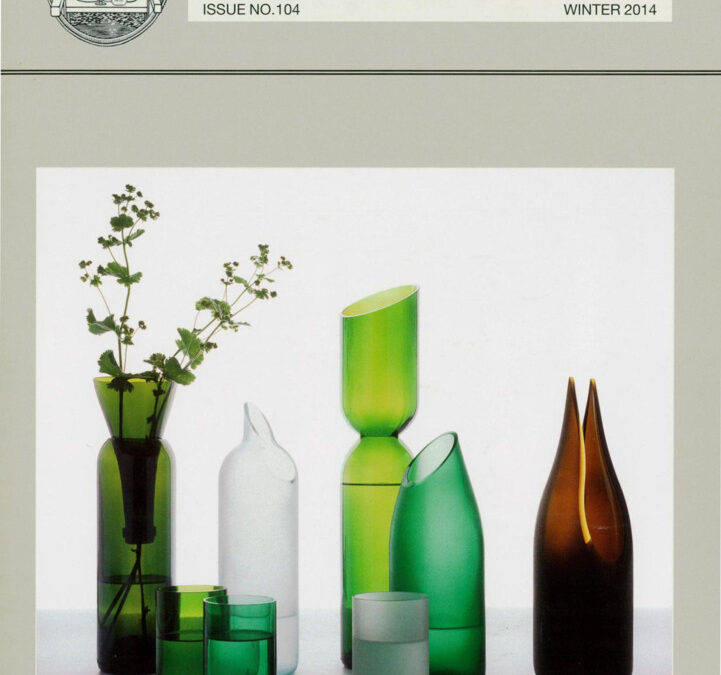
Cover illustrations
Front:
A collection of pieces made from recycled
glass (see p.6).
Back:
A Harvey Lyttleton sculpture, ‘Pair of red
sliced descending forms’ 1989, which is on
display at the European Museum ofModem
Glass, Rosenau, Bavaria. Gifted by Otto
Waldrich, Coburg (see ‘Glass Cone’ 95).
A Happy New Year to all our members
and readers.
LAST year was eventful, with the committee
taking on the leadership role for much of the
time, some members retiring and younger
glass collectors joining in to boost our
activities. The year was crowned with the
AGM, held at what is now the spacious
home of the Ruskin Centre in Stourbridge.
Will Farmer of Fieldings auction house gave
an informative and highly appreciated talk
on the changing tastes of collectors and
prices of old and modern glass, showing
examples of glass of the 20th century that
have become highly collectable, many pieces
still being affordable and noting that some
glass of the 18th and 19th centuries has
sadly drifted in value, needing rarity to still
command a high price. Charles Hajdamach
kept us all enthralled with an instructive talk
on the history of Stourbridge Glass and
Victoria Scholes, Chair of the Contemporary
Glass Society (CGS), gave the most inter-
esting overview of works by some of the
CGS members. Graham Fisher, representing
the British Glass Foundation, entertained us
and together with the team of Graham Drury
and Terri Colledge – we were treated to
viewing the recreated Portland vase and
Auldjo jug. A great event to complete the
GA’s year of activities, ended with an
invitation to the exhibition of the Roger
Pilkington collection of 18th century glass at
Broadfield House.
Together with the editorial board, our new
editor has put together another varied
Glass
Cone.
In this issue we welcome back Bill
Millar who continues to delight us with his
series on cocktail glasses with cockerel
designs. Roger Ersser has written the first
of a very personal and informative series of
articles on the worldwide, creative uses
of recycled glass – and articles on our trip
to Vienna and Budapest as well as on the
Church of St. Alban have helped to create
this interesting issue.
The talks between the Glass Circle (GC)
and ourselves have continued – our last
meeting being clear in the agreement that
the future vision of the two societies is very
similar and that a merger would create a
stronger single organisation. Two issues remain,
one about membership subscriptions and
the other about self-funding of GC meetings.
We decided to give these points time to
crystallise before moving further ahead and
requesting a vote from all our membership.
We have a number of events lined up for
2014. Our very popular ‘Let’s Twist Again’
will continue in April and dates for Coburg
(studio glass exhibition and competition)
and Barcelona amongst others, are being
finalised. Our AGM this year will be on 18
October, most likely at the V&A, London.
Harvey Littleton, originator of the ‘Studio
Glass Movement’ at the Toledo Museum of
Art in 1962, passed away last December.
A force in modern glass, internationally
acclaimed as an innovator and teacher,
many renowned glass artists started as his
students. More in the next
Glass Cone.
Brian Clarke
The Glass Cone
THE MAGAZINE OF THE GLASS ASSOCIATION
Issue No: 104 – Winter 2014
THE GLASS CONE NO.104 WINTER 2014
Contemporary Makers
Our Living Heritage
A talk given on 19 October 2013 to the Glass Association
by Victoria Scholes, Chair of the Contemporary Glass Society (CGS)
Katharine
Coleman-Grey
Fishbowls, 2012.
18cm diameter,
12cm high, 4.5kg.
Blown by Potter
Morgan Glass to
Katharine’s design
as grey glass over
clear lead crystal.
S glass an addictive
substance? It would seem
so. One of the things
that artists often say at
Contemporary Glass
Society (CGS) events
is that there was a
moment when they
got hooked, and this
passion is certainly one
that seems to be shared
by members of the Glass
Association. We are people
who get excited about glass,
are even a little obsessed with it.
What is it about this material that
inspires such passions? Is it the fact
that it connects with the past, or that it
can be part of the most cutting edge of
new ideas and processes. Is it mastery
— the sheer skill that underpins it? Is it
the magic of its transparency? Is there
something of alchemy in a material that
is made of earthy, opaque ingredients
and yet comes out clear? Who
knows? But it certainly has the power
to captivate us.
Our aim at the CGS is to be the
glue that holds the glass community
together, and to encourage
excellence at all levels. That
sounds a bit stuffy, so put
it another way: We want
people all over the
world to see glass,
enjoy, buy and make it,
from those just starting
out to artists operating
at the highest level of
their profession.
We began in 1997 as a
smallish group of about 100
artists and have grown in the
following 15 years into a group of 720.
As well as promoting the cross-flow
of information and ideas about con-
temporary glass via our website and
magazine, we stage exhibitions, con-
ferences, networking events and oppor-
tunities to learn from the masters.
We believe that our members are
part of our living heritage. In fact, to this
end, we’ve just had a whole year
celebrating Glass Skills and the part
that contemporary glass-makers of all
sorts play in keeping those ancient
skills alive. We began with an exhibition
— New Glass: Ancient Skill, Contem-
porary Artform
at Blackwell House in
Cumbria; we’ve had a show of
specially-made glass at Contemporary
Applied Arts in London —
Hot Glass!
New Work from the Furnace;
we’ve
been ferociously promoting key glass
exhibitions and events in national
venues via our website and magazine
and we staged a fabulous conference,
Glass Skills: Exploring the Fusion of Art
and Technique,
at the National Glass
Centre in Sunderland in October. We
had a wonderful year.
We all know that the glass land-
scape has changed radically in the last
100 years. Seeing and hearing about
beautiful historical objects really high-
lights how different it is now in terms
of making. Many of our members are
descendants of the studio glass
movement — they work alone and in
small groups and the garage is a
favourite studio-base. You see this in
the way that the balance is shifted
towards more sculptural and experi-
mental pieces, and there are fewer
objects that are functional and
decorative, though they are by no
means extinct.
Two pieces made
for ‘Glass Games:
a desire, a dream,
a vision 2012; in
Redchurch Street,
London.
Left: David Reekie
– Throwers III.
Right: Rowan
van der Holt-
PerennialWreath.
THE GLASS CONE NO.104 WINTER 2014
Stewart Hearn – Owl Jugs.
Stewart says these are the best pouring jugs he ever made.
Carrie Fertig –
Homing,
Chichester
Cathedral, 6m
wide by 5.5m long
by 5m deep.
Flameworked
borosilicate glass.
Photo: Duncan McNeil
Gillies Jones –
Landscape Study
2012 – 18cm high
by 32cm long.
Photo: Pete Chambers
In fact, one of the things that excites
us is the variety of our membership –
we have those working in design,
fine art, contemporary craft and archi-
tectural glass as well as those who
produce art installations, sculpture
and performances.
We believe that it is by increasing the
critical mass of those experiencing and
making glass, that we can become a
healthy arts community. This means
that there is a flow in: people are
excited to try out the medium, learn
the skills, play about with colour, form
and concept; and also a flow up – we
are about excellence after all. And
that means helping people on their
way as they gain skills at the very
highest level, develop new techno-
logies and processes as well as push
their creative practice to the furthest
boundary.
I’m sure that you’ve heard
something of our recently-told
story – we had Arts Council
funding (we were one of their
regularly funded organisations)
then we lost that in the cuts last
year. It has been a tricky time, but
the great thing is that we have 720
members who form the bedrock of
the CGS – both financially and
ideologically. We have to review how
we fund our events and activities but,
because we have a sound members’
base, we haven’t just faded away into
nothing. Our future is fragile – we
need 200 more members by 2018 to
be self-sustaining for core activities –
however, we are gaining about 50
members a year so the future is by no
means certain but it is positive.
We feel acutely that a glorious past
supported by many artists, designers
and skilled workers of all kinds is kept
alive by the people working in glass
today. Across the country we are
seeing glass courses close and be
amalgamated with other courses as
the recession takes its toll on small
and large business alike. For young and
up-and-coming makers it is very hard,
but our artists, makers and designers
are a national cultural treasure that
reflect the very best of UK talent,
expertise and ingenuity.
I love the idea that grew out of
Japan, I believe, of intangible cultural
heritage, recognising that tangible
things like objects of art and craft are
one way that we preserve our past, but
there is a complementary intangible
side too – the things that are stored in
people’s heads and hands. In the
glass world we are surrounded by
wonderful contemporary objects –
but we are also surrounded by the
people who are making these objects,
who together help to keep our past
alive in the here and now.
So I want to thank Glass Association
members for your part in collecting
glass and engaging with glassmaking
– for visiting shows, talking to us,
showing an interest, buying work. I can’t
tell you how important you are. You are
supporting our intangible as well as
tangible cultural heritage, something
that is a great treasure and that at
CGS we work very hard to promote.
We want to make sure there will still
be lots of objects and artefacts from
the early part of the 21st century to
enjoy and collect in 50-100 years time.
Victoria Scholes has been chair of the
Contemporary Glass Society since 2008,
and is also an artist in her own right.
She has shown work at the British Glass
Biennale 2012 and was selected for the
2013 Corning New Glass Review 34.
2
THE GLASS CONE NO.104 WINTER 2014
The Windows of St Alban,
Romford
0
NCE a thriving Essex market
town and home to the re-
nowned Ind Coope brewery,
Romford, just inside the M25, has
long since been swallowed up by the
suburban sprawl of London, and is
now a very non-descript commuter
town, pleasant enough, but certainly
not on the tourist trail. Yet, hidden
away in a quiet side-street a few
minutes walk from Romford Station
and surrounded by ordinary Victorian
housing, is an equally ordinary-looking
red-brick Victorian church, the
Church of St Alban, that is far from
ordinary inside.
Thanks to the driving energy of the
Reverend Father Roderick Hingley,
high quality works of art have been
commissioned from important artists
to enhance the building and thereby
the worship of parishioners. That he
is a priest with vision is immediately
clear on entering the church, for there
are two wonderfully engraved glass
Ruth Wilcock
doors by Sally Scott and
David Peace from 1995.
One shows the shrine
of St Alban and the other
St Alban himself, in his
Roman soldier’s uniform.
He holds a model of the
Abbey and is standing on
the hill of his martyrdom,
where a spring miraculously
appeared, all surrounded
by poppies and other wild
flowers. Scott and Peace
worked in partnership on
many architectural glass
projects from 1986 to
2000 (Peace died in 2003,
aged 87); probably best
known were the eight
panels on the western
porch of Westminster
Abbey, which combine
Peace’s lettering with the
figurative work of Scott.
Unlike many Victorian
churches St Alban is full of
light, which shows many
remarkable works of art
to best advantage. The
original quarry windows
of the nave allow light to
fall on the wooden panels
around the church, which
match the paintwork of
the organ, and provide a
subtle colourful back-
ground for the jigsaw-like
‘Stations of the Cross’ by
Charles Gurrey. High above
the chancel arch is an
amazingly powerful ‘Christ
the King’ or ‘Christus Rex’
(2001) by Peter Eugene
Ball, reaching out in
welcome to visitors and
worshippers alike.
The central nave window
at the west end lets in a
flood of light, having been
replaced by a magnificent
Left. Glass door
by Scott and Peace
Below: East Lancets
THE GLASS CONE NO.104 WINTER 2014
3
Pilgrimage Window by Patrick Reyntiens,
who worked with John Piper on windows
in Coventry Cathedral and Liverpool’s
Metropolitan Cathedral. At the top is a
pilgrim’s badge or scallop shell and below are
shown many of the places the parishioners
have visited on pilgrimage, including the
shrine of Our Lady of Walsingham, as well
as images of the pilgrims below. Above the
Pilgrimage Window is a circular window,
also by Reyntiens, representing the seven-
fold gifts of the Holy Spirit.
Angels are the theme for the windows in
the east end of the church, where light bursts
through the multi-coloured glass to great
effect. There is a sense of ethereal movement
and yet serenity at the same time. In the
central lancet the angel holds a crucifix and
his fellow angels, also with golden halos, hold
the chalice and the host. Red, white, blue and
yellow predominate in the lancets on the side
walls. In the north window an angel holds a
rose, and beneath are the words All shall be
well, and all shall be well, and all manner of
things shall be well’, a quotation from Julian
of Norwich. The angel in the window on the
41111 lias,
4
4,
4
ti
s
tib
lik
i.•
nn
0, I
i A,
Vai
l
.-
4Altt
V111
:41i,lor
7 4fr-t,
0
1 4t
I
I
I 4
1
0
t
04..
41
IrVaN
I
tA
1.7
07
‘7*.
”
11
K.;-
4
1
7
rktrzaltrah
-tesa
o
,
1/41
frig
_1
%
*
_ tiki
f
i
r
fi
c4N
p
vi
.itidivt
.
.
,
Pouf
Ire
MAL
11
iv-
it AilliktO ‘
4
154.111
1
111$7
1
;
r
i
it ril
1
I.
II …•
“A :, ,
A I
410
01
05
1
% 1
k
i
qv
1
1
1
A
ilk ”’‘f
south wall holds a fire surrounded with rose
petals and the inscription is And the fire and
the rose are one’ – from T.S. Eliot,
The Four
Quartets.
They are joyful examples of
Reyntiens’ work.
A later addition by artist Mark Cazalet is
the huge mural on the ceiling and part of the
walls of the chancel, The Angels of the Four
Elements of Creation’. Opinions are mixed
as to whether the work complements the
sublime angels of Reyntiens, but it is a work
which repays study and must be unique
amongst modern ecclesiastical commissions.
As with the Pilgrimage window, there are
scenes showing parishioners, this time in local
areas of Romford and the Borough of
Havering with the London Eye and the
Gherkin in the distance.
This is an extraordinary Victorian church
whose decorations reflect the best of modern
art. There is exquisite silverwork, including
a processional cross and a breathtaking
Top: Pilgrimage Window by Reyntiens
Left North Lancet
Right South Lancet
o 1
Di
k
il oLtoroVil ,„,,,,
..
4
t k
e
Atelt
o,
,
* liqsv- 0
‘ Aii.!i•Ar,
‘ 4,
ritzirmiti*ti
1
1
rifi
ri
l
v
L
v
li
fifie:ZAI
A
k
ik
t
Z,Ifi I
, ifffi
g
let*
i
fi
it
b
‘i
lit
r
w 4,
Jib
io
n
4 al
krAt
i
aleAll
i
a01
7,
r
ip16
4
.
70
d
I AV
i ,A%
V
AC
IP6
Aa
‘r I
4
rifirr4i%
1
p
t
,„,
t
it
og
al,•,..„.
‘t
,
._ 1
,
W
64 .
th
L e
ti
‘1’ W
f
tiT
r -AN
4
01 ma
It
;43
teit ,,4fipi:
–
archangel altar lamp by Julian Cross,
wonderful woodworking by Siegfried Pietzsch
with the statues of Our Lady and St Alban,
and work showing the Thompson of Kilburn
mouse. Interesting details abound: carved
flowers to remind worshippers of the flowers
that grew when St Alban was martyred, and
even the holy water stoup has a carved fish
below the rim. It must be one of the only, if not
the
only, church with ballet shoes carved on
two pew ends!
Outside is a memorial garden with a bench
in Portland stone by John Pitt and a stone
column of remembrance by Jamie Sargeant
and this year has seen the addition of a
new cross at the west end of the church,
dedicated to celebrate the Queen’s Diamond
Jubilee, and inscribed in her honour.
Some of these artworks are paid for by
grants, bequests and money raised in the
parish. All visitors are welcomed by
appointment, 01708 473580, and Father
Hingley also organises art tours, with the
possibility of tasty teas, for groups. The
revenue helps the funding of more artworks
in this exceptional church.
THE GLASS CONE NO.104 WINTER 2014
The
Attraction of Imperfection
Global creative uses for recycled glass
Part 1: Factories and artisan workshops
Roger Ersser
W
HEN we were given a bowl
made from recycled glass
in Mexico, I realised how
little I knew of the fate of the glass we
diligently place in the recycle bins or
take to the centre. Here I describe
what I have discovered of its new life
which might interest glass enthusiasts
and collectors. We mostly seek
perfection in collectable items and
the maker strives for consistently
outstanding quality, but both studio
artists and ethical glassware pro-
ducers, especially in developing
countries, are incorporating recycled
glass into aesthetically pleasing, if
sometimes imperfect, objects. Some of
the factory and workshop products,
which are commonly found in our high
street shops, are discussed in this first
article while studio examples will be
described in the second part.
Background
UNTIL cheap and mechanised mass-
production, glass items were not
single-use products and would be
used repeatedly until damaged,
when repair would be difficult if not
impossible. Restoration was only
attempted on rare, expensive or
cherished pieces. Fortunately, in the
early days of glassmaking, it was
found that the material could often be
re-used. Now organisations such as
British Glass and Friends of Glass
champion glass as being almost
infinitely recyclable. This is attractive
in a world concerned with conserving
energy and natural resources, and
reducing unusable waste, especially
for a material which does not rapidly
decompose. In the EU (2011), an
average of 70% (individual countries
6%-98.5%; UK 64%) of used glass
containers are made into new ones
by the closed-loop recycling industry.
There is an increasing number of
other initiatives to reduce the amount
of glass going to landfill.
Damaged or redundant items can
be cleaned, crushed, or ground and
re-melted to produce new objects,
though the structure and appearance
of the metal may be modified. Some
sources such as soda glass containers
and float (window) glass are more
amenable to this process compared
to specialist products like mirrors,
light bulbs, car windscreens etc. or
glass combined with other materials.
Factors like clarity, mixed colours,
toxic minerals, co-efficiency of
expansion (COE), melting points and
devitrification temperatures influence
its destiny.
Uses for the original object
SOMETIMES the original object finds
an alternative purpose, so called
upcycling.
Bottles can be made
into walls, chandeliers, table lamps,
beakers or vases, and parts of vessels
can be incorporated into collages,
windows or sculpture.
Innovative bottle walls are common
in eco houses worldwide (Inspiration
Green), and include a bus stop in
Kentucky, USA and a men’s public
toilet in Kawakawa, New Zealand.
Wat Lan Kuat, The Temple of a
Million Beer Bottles’, is now a tourist
attraction in Khun Han, Thailand. All
the walls, roofs, and some of the
floors of the complex are constructed
from cemented beer, wine, medicine
and fizzy-drink bottles. The mosaics
are made from bottle caps.
On a visit to Curacao in 1960, the
brewer Alfred Heineken was dismayed
by the lack of building materials and
a surfeit of bottles littering the beach
of this Caribbean paradise: thus the
WOBO (World Bottle) was born.
Designed by John Habaken, these
stackable beer containers, which
came in two sizes, doubled as self-
aligning interlocking bricks. Technical
difficulties with wall and roof junctions
hampered development; few bricks
have survived and only a couple of
structures on the Heineken estate,
near Amsterdam, remain.
Sources of glass
GENERAL commercial and domestic
glass is aggressively re-cycled on an
industrial scale for use in a variety of
architectural processes (even replacing
sand in concretes) which tolerate
variations in composition, inclusions
and contaminant level
(see
Cindy Ann
Coldiron). For example, mixed glass
from more discernible sources can
be used for decorative horticultural
aggregates, marbles and glass
pebbles for water filtration systems
(Glass Cone 72/73).
Beverage bottles
and glass food containers are by far
the most common reliable source.
Panes of float glass are another clean
Fig.1:
Giraffe
family.
Courtesy
Ngwenya glass
THE GLASS CONE NO.104 WINTER 2014
5
Fig.2: TranSglass
group.
Courtesy
Artecnica
consistent start material. The front
barium/strontium glass plates of
obsolete cathode ray TV tubes are
removed by Recycling Lives from the
lead glass funnel and the cullet turned
into tiles and bricks. This cullet and
also whole plates are a popular source
material for glass sculptors. Nulife Glass
has a system for melting the tube glass,
running off the lead and producing a
safe cullet, suitable for an expanding
list of diverse products, from cufflinks
to work surfaces and sculpture.
Factory and small workshop
initiatives
IT is the selection of specific articles
from our throwaway society, particu-
larly containers, that fuels many of
the newer glass working initiatives
throughout the world. The Eden
Project in Cornwall provides an elegant
eco-friendly upcycling example. Their
used green beverage bottles are sent
to a local glass workshop which
transforms some of them into bowls to
be sold in the project’s shop. A similar
‘pay twice’ scheme in Africa (Green
Glass) involves mobile production
units which attend large public
events and tourist sites. They collect
empty beverage bottles, convert them
into drinking glasses on site and sell
them back to the visitors!
The portfolios of many prestigious
glass factories include tableware
ranges made from recycled glass
(e.g. the mouth blown Mia and Firo
bottle glass ranges of LSA Inter-
national). The major Spanish company
La Mediterranea works exclusively
with recycled glass to which small
amounts of compatible frits are
added to produce their internationally
renowned colourful collections.
In 1979 a Swedish Aid Project
imported the equipment and set up
Africa’s first glassblowing factory in
Swaziland. They even sent a couple
of locals to Kosta Boda for training.
Unfortunately it closed in 1985.
Frustrated collectors of the factory’s
glass elephants, the South African
Prettejohn family, re-opened it in 1987.
Similarly, Ngwenya Glass makes a
large range of tableware, corporate
items and animals
(fig.1).
They have
a glass art studio which runs intern-
ational workshops and conferences;
Scandinavian artist Annette Gulbaek
has designed ranges for them.
Artisan workshops
APART from sustainability, the two
main drivers for smaller artisan units
are economics and locally available
starting material which negates the
need for glassmaking facilities. They
use simple equipment, run training
schemes for unskilled locals and
‘collecting’ bottles provides welcome
paid work. Global supporters and
sponsors of artisan products, such
as Artecnica, Traidcraft, Overstock/
Worldstock, The Netherlands FTO
and Italian CTM encourage such enter-
prises, often by enlisting technical and
artistic expertise from more developed
countries. The British Association of
Fair Trade Shops has almost 100
members, many of whom enthusi-
astically import and sell a wide range
of these functional and decorative
products. Individual makers have
interesting and diverse histories.
A few examples illustrate this variety:
•
The process at its simplest is
encapsulated in the work of Green
Glass in Cornwall who, developing an
idea pioneered in Southern Africa,
initially cut and shaped bottles into
drinking glasses. By designing what
they describe as ‘Wallace and Gromit’
equipment, they can provide a range
Fig.3: Water carafe
and glass.
Crisil s.r.I.,
Bolivia
Fig.4: Colourful
Mexican tumblers.
Courtesy Milagros
6
THE GLASS CONE NO.104 WINTER 2014
of decorative finishes and have
expanded into tea lights, candle
holders, vases and fused glass
beads, winning design awards along
the way. They supply equipment and
provide help and advice to those
wishing to set up similar enterprises
elsewhere in the world.
•
A high profile example is
tranSglass. In 1997 the London-
based designers Emma Wolffenden
and Tord Boontje (Professor and
Head of Design Products at the Royal
College of Art since 2009) produced
vases, carafes etc. from recycled
wine bottles
(fig.2).
They are still
widely available and are sufficiently
regarded to be included in the
permanent collection of MoMA in
New York. Through the ‘Design with
Conscience’ programme of Artecnia
in LA, USA, and with the help of
‘Aid for Artisans’, production has
been moved to a specially created
workshop in Guatemala City (2005)
which teaches young people cutting
and polishing skills.
•
In 2007 the Crisil glassworks in
Bolivia (supported by Traidcraft and
Dutch FTO) acquired the skills of glass
artist Will Shakespeare as a consultant.
On a visit in 2011 Mike Holden,
studying glass and ceramics at
Sunderland, and Jim Maskery, the
University’s glass technician, helped
with technical and commercial issues
(such as logos and colour)
(fig.3).
•
In 2011 American designer,
engineer and recycled glass artist
Bill Hess was part of a University of
Virginia team which shipped a kiln to
Mongolia and taught the locals how
to make greenhouse panes from bottle
glass. They have already progressed
to dinnerware and other objects.
•
In Mexico, glassmaking arrived with
the Spanish and much of the present
output often consists of brightly
coloured, decorated blown glasses,
jugs and other tableware made from
recycled glass, mainly in small
factories and workshops
(fig.4).
Companies like Milagros import it
in large quantities into Britain for
wholesale and retail. They have
a significant trade with caterers,
restaurants and hotels and offer
a bespoke manufacturing service.
Fig.5: Odumasi
glass beads.
Copyright John Irwin,
African Fabric Shop
Fig.6: Ghanaian
bead moulds.
Copyright Ghanacraft
Beads
SINCE the dawn of glassmaking,
shards and powdered glass from
recovered objects have been turned
into beads. Today they are used by
makers from intemet-tutored amateurs,
through international, handmade craft
workshops and small factories, to
large-scale mechanised factory
production in places such as China,
India and the Czech Republic.
Two of the most revered sites for
traditional handmade recycled-glass
beads are Ghana and Indonesia.
The Ghanaian system uses cullet,
powdered glass and ceramic dyes
packed into clay moulds and
combustible cassava stalks for the
holes
(figs
5 & 6). Similar moulding is
used in Indonesia, but glass tubes,
lampwork and facet cutting and
polishing are also employed. Turkey’s
traditional hand-wound beads are
available in recycled glass. Sea glass
beads are ubiquitous and currently
fashionable. They have a rough
opaque finish, which results from the
iron oxide content and partial
devitrification during heating and mimic
beachcombed pieces.
THE GLASS CONE NO.104 WINTER 2014
7
Fig.9: Syrian
lighting: Blown
pieces.
Courtesy Artiquea
Fig.10: Indonesian
table lamps.
Overstock/Worldstock
Lighting
LIGHTING is yet another area for the
inventive use of upcycled glass. Ever
since it was found that candles would
fit into their necks, bottles have been
used as lamp bases. Electric table
lamps made with Portuguese rose- or
raffia-clad Chianti bottles were trendy
in the 1970s. Chandeliers and similar
collections of hanging bottles, drinking
glasses, glass shards and rings of
recycled glass are popular on internet
eco sites. They are constructed by
everybody from amateurs to high-end
bespoke designers. Propellor Studio
in Vancouver, BC has a suggestion
for all those old drinking glasses in
the back of your cabinet
(fig.
7). Table
lamps patiently made in Indonesia
from recycled glass pieces bound
with baling wire, are widely available
(e.g. Overstock) and have an archi-
tectural quality
(fig.10).
Ceiling lights made from blown
elements in Syria which echo an
ancient tradition can be found in
Artiquea’s Aladdin’s cave of Middle
Eastern delights
(fig.9).
The present
situation of the Damascus workshops
in which they and several other
fabulous lighting models
(fig.8)
were
fashioned from locally-collected glass
bottles, using century’s old skills,
is heart-rending. Since the 2011
uprising, production has stopped as
fuels became unavailable and travel
to work too dangerous. The safety of
the workers is uncertain, although
one glassworker is now in Egypt and
hopes to resume work soon.
Few of these everyday items are
likely to become collectable, but many
are functional, attractive and often
well-designed. While they are with us
they are helping to save the planet.
Links
for both articles
‘Recycling Glass Bottles/Glass bottle Walls’:
www.inspirationgreen.com
‘Sculpture and Design with Recycled Glass’.
(2011) Cindy Ann Coldiron. Schiffer Books.
ISBN: 978-0-7643-3889-2.
www.schifferbooks.com
Transformations’: Form and Function in
Recycled Glass (2009) Zest Contemporary
Glass Gallery: www.zestgallery.com
Clean Washington Centre: 1.Recyded Glass
for Art Glass Applications (1996). 2. Using
Post-Consumer Glass for Blowing and
Casting (1996). www.cwc.org/glass
Matthew Durran / Glass Heap Challenge:
www.mattdurran.com
/www.glassheapchallenge.com for eBook –
www.infottmattdurran.com
Ruskin Glass Centre/ Ruskin Mill Educational
Trust: www.ruskinglasscentre.co.uk /
www.rmtorg.uk
British Glass: www.britglass.org.uk
Friends of Glass: www.friendsofglass.com
British Association of Fair trade Shops:
www.bafts.org.uk
African Fabric Shop: www.africanfabric.co.uk
Artecnica: www.artecnicainc.com
Artiquea: www.artiquea.co.uk
Crisil: www.en.crisil.com.bo
Gallery East: www.galleryeast.com.au
Ghanacraft: www.ghanacraft.com
Green Glass: www.greenglass.co.uk
Kestle Barton Rural Centre for the Arts:
www.kestlebarton.co.uk
La Mediterranea: www.lamediterranea.com
LSA International: www.lsa-international.com
Milagros: www.milagos.co.uk
Ngwenya Glass: www.ngwenyaglass.co.sz
Nulife Glass• www.nulifeglass.com
Overstock/ Worldstock: www.overstock.com
Propellor Studio: www.propellor.ca
Recycling Lives: www.recyclinglives.com
Traidcraft: www.traidcraft.co.uk
Anne Midge: www.anne@orcharddene.com
John Bassett: www.basglas.com
Bill Hess: www.ideasonlegs.com
Max Jacquard: www.maxjacquard.com
Shuro Kasai: www.homepage2.nifty.com
Jon Lewis: www.orbicglass.com
Daniel Maher: www.dmstainedglass.com
Erwin Timmers:
www.washingtonglasscentre.com
Fig.7: Dram
Chandelier.
Copyright. Propellor
Studio
Fig.8: Syrian
lighting: Plate
lamp.
Courtesy Artiquea
e
–
‘
8
THE GLASS CONE NO.104 WINTER 2014
Bill Millar
Decorated Cocktail Glasses
Fig.1: left to right:
Footed tot in clear glass
with optic moulded bowl
and green foot; two glasses
with enamelled decoration
in various colours.
Fig.2: Traditionally cut,
footed tot.
A
clear, undecorated cocktail glass from the jazz age
sounds an unlikely object. They do exist,hopefully
in small numbers, but are too boring to be
of much interest so we’ll ignore them and concentrate
on decorated cocktail glasses. This article outlines
the background to their development, the decorative
techniques used and illustrates the styles and motifs
that may be found.
Cocktails first became popular in the USA in the
late 19th century and cocktail glasses were produced
from the turn of the century. The first recorded
cocktail party took place in the USA in 1914 and they
became popular in the UK in the 1920s and 1930s.
Huge numbers of cocktail glasses were made during
this period in the then Czechoslovakia although
American, British, Scandinavian and other European
glassmakers produced their share. By the late 1930s
the Czechoslovakian glass industry claimed to produce
some 40% of the world’s output of glass; a
record shattered by the outbreak of WW2. A few
manufacturers recommenced production post-
war but cocktail parties declined in popularity and
the 1960s mark the end of this chapter. Identifi-
cation of country of origin, far less the maker, can be
difficult if not impossible. Where identification of the
maker has been possible this is stated in the article.
Cocktail parties were what the smart set did
between tea and dinner in the 20s and 30s; so with a
whole evening’s dining and carousing ahead of them,
party goers needed to pace themselves. Consequently,
cocktail glasses of the period were small by today’s
standards; which probably explains why so many
of them survive today, as larger glasses, being
more useful to later generations, were more likely to
be used and consequently broken. Whilst this article
is restricted to glasses, the motifs may be found on a
wide range of cocktail-associated glassware including
shakers, trays, decanters, mixer jugs, bitters bottles,
coasters, ashtrays, cocktail sticks, cocktail stick
holders, cigar humidors and toothpick holders.
Some glasses were made in coloured glass without
decoration and others carried abstract applied
or cut designs. However, a large proportion were
decorated with pictorial motifs which offer an
endless range of subjects for the collector.
Cockerels, the most common, far outnumber any
other subject. Cocktail glasses were usually hand-
made and most were hand-decorated. Various
techniques have been employed to produce interesting,
colourful glasses and an explanation of these tech-
niques is just one way to categorise these glasses. It
was quite common to use two or more techniques on
the same glass. There are three basic shapes: a tot
(least common), a footed tot or stemless glass, and a
stemmed glass; some struggle to decide if they are
in the 2nd or 3rd category. All three are illustrated.
Coloured Glass
COLOURED glass in combinations with other colours
or clear glass was used to good effect to produce
attractive, stylish glasses. The glass on the left in
fig.1
is neither but it suffices to illustrate the concept.
Cutting
TWO types of cutting can be found: normal cutting and
intaglio cutting. Normal cutting is done using the top
of the cutting wheel to produce straight lines, intaglio
is cut on the underside of the wheel and produces
curved lines. Both can be polished or left matt.
The clear glass, footed tot in
fig.2
has been
decorated with traditional cutting. The Stuart glass in
the centre of
fig.3
has a simple, cut design and an
etched cockerel.
Fig.3: left to right: 1. Engraved; 2. Cut with etched motif
by Stuart; 3. Intaglio-cut by ThosWebb.
THE GLASS CONE NO.104 WINTER 2014
9
Fig.5: Uranium glass tot with
needle etching.
Fig.4: Intaglio-cut glass by Orrefors.
The Thomas Webb glass on
the right in
fig.3
was made
post-war and the intaglio-cut
decoration is reminiscent of the
Japanesque style popular over
half a century earlier. In contrast,
the Orrefors glass in
fig.4
is
intaglio cut to great effect with
a stylised seal juggling cones.
However, its capacity is tiny so it
might only have been popular
with mean hosts or those trying
to minimise their consumption
of alcohol. Designers often sacri-
ficed utility for style which may
not have been an issue to
owners who may have received
the glasses as wedding presents
and then placed them in a
display cabinet never to be used
or moved except for dusting.
Engraving
COPPER wheel engraving
requires skilled craftsmen and
is, therefore, probably the most
expensive technique.
Engraved glass was hugely
popular up to the First World
War. Skilled craftsmen were still
at work in the inter-war years.
However, post World War 2,
demand for engraving declined.
The glass on the left in
fig.3
has
a most striking design with a
cut, solid, combined foot/stem
and an engraved cockerel on
the bowl. Engraved cockerels
are common, but other subjects
much less so on cocktail glasses.
Acid Etching
THIS technique involves coating
the glass with a resist which is
partially removed to expose the
area to be etched. The pattern is
then produced as either a line or
a silhouette area.
The glass in the centre of
fig.3
by Stuart has a silhouette etched
cockerel. Stuart also used this
as a template to produce what
appeared to be an engraved
motif. A few intaglio cuts pro-
duced an effect similar to
engraving at considerably lower
cost. The uranium glass tot in
fig.5
has a frieze of needle-
etched cockerels.
Transfer Printing
THE design is printed on a backing
which enables the motif to be
floated off and transferred to
the glass which is then heated in
a lehr to make the motif more
or less permanent. Clearly this
is not the case with the glass
in
fig.6.
The glass was produced by
Stevens & Williams using two
colours of glass. The bowl was
formed using opaque white
‘opal’ cased with an amber
uranium ‘cairngorm’, which was
also used to produce the stem
and foot. The combination of
‘opal’ and ‘cairngorm’ was known
as ‘primrose’. The transfer-printed
motif has suffered over the past
80 years and the huntsman who
is holding the dead fox above
his head appears to have lost
Fig.6: Transfer printed glass by
Stevens &Williams.
his trousers. This combination of
colours was also produced with
differently shaped bowls — some
undecorated and some with a
cockerel transfer print.
Enamelling
ENAMEL is produced by grinding
coloured glass to make a powder
which, when made into a paste,
is painted onto the glass. The
glass is then heated in a lehr at
a temperature high enough to
melt the enamel so that it fuses
to the glass. Most glasses with
an enamelled, pictorial motif had
a transfer-printed silhouette or
outline applied to guide the
decorators, although outlines
could also be etched.
The two glasses (centre and
right) in
fig.1
have been decor-
ated with coloured enamels.
The green on the central glass
feels rough and would have
been produced using larger
granules of enamel glass. These
pretty glasses are representative
of a large number of colourful
glasses of the period. Possibly
best described as ‘nice’ but not
exactly memorable. Much more
exciting are the bright colours
and abstract designs of Art
Deco decoration typifying the
0
77
age such as the example by
Stuart Crystal in
fig.7.
Given that cocktail parties were
largely the domain of the smart
set, it should be no surprise to
discover that hunting
(fig.6),
shooting and fishing were popular
motifs. Game birds would have
been popular with the shooting
fraternity and pheasants, wood-
cock, grouse, quail and other
species can all be found. The
two pheasants on the glasses
in
fig.8
were hand-enamelled
over a transfer-printed outline.
The blue-footed glass sports a
wonderfully detailed pheasant
in flight whilst the middle glass
has an equally well presented
golden pheasant. The third glass
displays a stylised ‘exotic’ bird
(shorthand for ‘no species known
to man’); this motif was also
used on tumblers.
Turning to fishing, the three
glasses in
fig.9
are decorated with
hand-enamelled salmon fishing
flies. The outside two glasses
were made by Webb Corbett
and the quality of the glass and
decoration is first class. Salmon
fly patterns are invariably brightly
coloured, if not garish, so make
an excellent subject although
decorators might be tempted to
invent their own patterns. The
Webb Corbett glasses have the
name of the fly pattern enamelled
on the base of the glass so
Fig. 7: Art Deco cocktail by Stuart
(courtesy of Broadfield House
Glass Museum).
10
THE GLASS CONE NO.104 WINTER 2014
Fig.9: Three salmon fly
cocktail glasses.
Fig.10: Greyhound
and pug glasses.
Fig.11: Three glasses with
lady tennis players.
Fig.8: Three glasses with
birds.
appear to be the real thing. The central glass may or
may not depict a known fly pattern, but has the
redeeming factor of a practical design whereas Webb
Corbett glasses are difficult to hold and would be
difficult to place on a table when full without spilling.
Another very smart wedding present!
Sporting themes in general are common. Greyhound
racing is illustrated on the left hand glass in
fig.10
with
the dog from trap 8 in full flight clearing a hurdle.
Presumably the other glasses in the set sported different
trap numbers. The right-hand glass depicts a dog
portrait, possibly a pug, and the other glasses have
portraits of different breeds. Tennis is the theme in
fig.11.
The sportswear is clearly of the period although
the poses are slightly strange to say the least. Golf and
show-jumping are represented in
fig.12;
having only
these two glasses from the set it must be presumed
that the others advertised different sports.
The next two glasses in
fig.13
have a military theme.
The first glass would have been a commission from
the Scots Guards with their badge produced by
cutting around an enamelled centre with the motto
‘Nemo Me Impune Lacessit’ which means No one
touches me with impunity’. Mess guests who used
this glass to overindulge the regiment’s hospitality
may subsequently have felt that the motto should also
have been applied to the contents of the glass. The
second glass shows a drunken sailor being kicked
out of, presumably, a bar with the legend ‘Man Over
Board’. Must be a foreign glass because sailors of the
Royal Navy would never behave like that!
The above represents just a few of the enamelled
motifs that may be found on cocktail glasses. Stuart
Crystal, for example, produced a wide range of
enamelled cocktail glasses which included devils,
butterflies, flowers, spiders, huntsmen, snakes and
lucky charms.
THE GLASS CONE NO.104 WINTER 2014
Gilding
SEVERAL types of gilding were employed. Cold-
painted gilding using ground gold or gilt material in a
paste is the least expensive and least hard-wearing.
Gold paste painted on the glass then heated as for
enamel is much more hard-wearing. Gold leaf is also
extremely effective. Silver foil and an overlay using a
measurable thickness of silver can also be found.
The elegant, gilt glass on the right in
fig.14
was
probably made in the USA and is of very high quality.
The gilding on the stem and foot has been painted
and the cockerels have been produced using gold
leaf previously textured to create detail such as
feathers. The glass on the left, which could be from
the USA or Czechoslovakia, has silver overlay cockerels
and trims to foot and bowl. The silver is thick enough
to have been engraved to create detail before being
affixed to the glass.
Modelling
LAMPWORK inclusions, and lampwork glasses with
the stem formed by mermaids, naked ladies and
various creatures can frequently be found. Many are of
fairly recent manufacture for collectors. Most are too
fragile to be practicable (more wedding presents?).
However, the glasses in
fig.15,
where a model cockerel
forms the stem and which were made in the 1950s by
11
If you have any comments
or questions the author will be
delighted to hear from you at
billmi11ar82@yahoo.co.uk
Morgantown Glass USA, are of sterner stuff. The
bowl and foot of that on the left are uranium glass and
represents just one of the six or more colours used to
produce harlequin sets. The glass on the right has
intaglio-cut decoration on the bowl. Modelling of stems
and shaker stoppers was used by a number of US
glassmakers including Heisey; William George of
California produced cocktail glasses with a ceramic
cockerel model as the foot and stem!
This article has only scratched the surface of a
collecting area too often decried as ‘just Czecho-
slovakian glass’. Next time you see one of these
glasses take a closer look and you may be surprised
at what you may discover.
Fig.12 (above left):
A pair of sporting glasses.
Fig.13 (above right):
A pair of military glasses.
Fig.14 (left):
Gilt and silver overlay
glasses.
Fig.15 (right):
Morgantown chanticleer
glasses.
An Aussie at the AGM
Peter Nolan
E
XCITEMENT’ and ‘AGM’ are terms
that don’t sit naturally together;
at least not in my experience.
Nonetheless, there I was on a Saturday
morning, in the rain, half a world away from
home and feeling eager — if a tad nervous –
as I walked into the Ruskin Glass Centre to
attend my first Glass Association meeting,
which by chance was the AGM. Eighteen
months previously I’d known nothing about
the Association. A chance email exchange
with Richard Giles, whom GA members
know from his regular paperweights
contributions to the
Cone,
alerted me to the
Association. From the outset I’ve been
impressed by the ambit of the Association’s
interests and have enjoyed keeping up with
its activities, albeit from afar.
Having found the Ruskin Centre, getting
to the right meeting room was easy: by simply
following the crowd. I was mildly uncertain
at the prospect of stepping into a room of
people I’d never met before, each of whom
I was sure knew everything about glass,
where I know little. And I’m interested in
paperweights. Do other glass collectors
consider this something of a Cinderella
category and not ‘the real thing? So went
the banter from the leprechaun of self-doubt
on my shoulder as I made my way to the
registration desk with a tentative smile. The
brogue was stilled when, three metres from
the desk, I looked up to a friendly smile and
‘Hello. You must be Peter!’ Maurice Wimpory
knew I was coming and mine was probably
the only face he didn’t already know. He
12
THE GLASS CONE NO.104 WINTER 2014
immediately put me at ease and told me
about the programme ahead. That relaxed
greeting set the tone for the remainder of the
day and everyone I met thereafter was
welcoming and generous in swapping the
stories of our various glass interests and
adventures. One usually intuits the ‘feel’ of a
group very early in one’s time within it. In this
instance the enthusiasm of the gathering
and good humour of its members was
evident from the outset. There was a low
hubbub of chatter and plenty of smiles as
groups formed, fragmented and reformed;
people obviously at ease with one another
and enjoying the chance of renewing
acquaintances and catching up with news
from recent times.
The AGM itself was relatively brief, with due
thanks to departing committee members and
a welcome to new appointees. A progress
report on plans that might secure a new home
for the Broadfield House glass collection was
heartening and this ‘colonial’ was interested
to learn of the prospective coming together of
The Glass Association and The Glass Circle.
As I listened to the discussion of what is
obviously a topic with many dimensions and
some history I offered a silent wisdom-of-
Solomon-prayer for members of both Com-
mittees as they navigate the path ahead.
With the AGM completed I wiggled about in
my seat, straightened my back and tuned my
antennae for what the advance notices had
foreshadowed would be an interesting array
of topics and speakers. And the promise
was delivered, in spades. Will Farmer’s
presentation on recent auction trends in glass
sales – spanning Georgian stemware to the
works of contemporary glass artist – was
topical and interesting, especially to an
antipodean who relies heavily on auction
houses in Britain and Europe. There was even
reference to ‘us Aussies’ as good buyers at
present. Will’s presentation was augmented
with the opportunity to examine some lovely
pieces that he’d brought to illustrate each of
the periods he spoke about, including
pieces from his own collection.
Charles Hadjamach presented a personal,
fascinating and thought-provoking glimpse
into some of the history of glassmaking in
the Stourbridge region. Charles’ story began
in his own back yard (literally!) and included
a moving salute to the artisans and skilled
workers – women and men – who have
often been less acknowledged but no less
important in producing those objects of
beauty that beguile us all.
Graham Fisher, Ian Duty and Terri Co!ledge
retold their adventures in undertaking the
The Race, a cameo vase by George and Thomas
Woodall, Thomas Webb & Sons, c.1888. Ht. 12
3
4n.
One of the fascinating pieces mentioned by
Charles Hadjamach in his talk and which can
be seen at Broadfield House Glass Museum.
Portland Vase Project 2012 – which included
replication of two other famous pieces from
antiquity. I was touched to hear that the
project’s inspiration has been a commitment
to demonstrate that the knowledge and skills
for making such beautiful objects is not a thing
of the past but is very much a part of modern-
day Stourbridge. The following display of the
team’s replicas drew exclamations of admir-
ation and delight and an enthusiastic bank
of picture takers. I confess to timidly hanging
back at this point for fear that one more in
the fray might just be the tipping point that
would see history repeating itself with another
Portland Vase in shards on the floor!
Victoria Scholes (Chairperson of the Con-
temporary Glass Society) confessed to nerves
in the presence of such an audience – she
wasn’t the first for the day. She went on to
impress us with an informative presentation
and impressive display of the works of current
glass artists in Britain. We saw pieces that
reflected creativity and skill and in this were
again reminded that the artistry of glass is
indeed alive and well in the UK, and very worthy
of our attention as present-day collectors.
Certainly this collector left the meeting with
a commitment to increase the number of
contemporary pieces on his own shelves.
With the presentation over, there was plenty
of fuel for enthusiastic discussion as members
started to disperse. Many went on to visit
the adjacent Webb Corbett Visitors Centre –
which tells the story of glassmaking on the
site and in the Stourbridge area – and studios
within the Ruskin Glass Centre. An hour later,
entering Broadfield House – opening beyond
its usual hours especially for the benefit of
visiting Glass Association members, and with
afternoon tea kindly provided by the Friends
of Broadfield House – I was again greeted by
the friendly smiles of GA members. Indeed,
between chats there was barely time to give
this wonderful glass collection the attention
it deserves; I did, however, make a point of
studying the paperweight corner. Thanks to
Carrie, her staff and ‘Friends’ who made us
feel so welcome.
As I drove away from Broadfield House and
back past the Ruskin Centre my mind was
racing with the sights and sounds of the
day, with the information gathered, the ideas
begun, the feelings and warm exchanges with
those I’d met. My thanks to all who shared
with me parts of that day; those conversations
will be pleasant memories and give new
colour as I resume my distant watch of
the Association, its activities and members.
I regret not meeting Richard Giles in person
and not being able to take up his kind
invitation to visit. Such was the price of my
laissez-faire
approach to ‘planning(?)’. We
spoke by ‘phone a couple of days later and
chatted easily for 30 minutes across a range
of topics. As I hung up the telephone I realised
that I hadn’t thanked him for his introduction
to the GA, nor for his encouragement of
my glass interests over the past 18 months.
Perhaps he’ll see this article.
So, the day had begun in keen anticipation.
It had run a pace and been packed with
nice people, interesting topics and rewarding
insights. Yes, ‘excitement’ had been the
right feeling.
It would be remiss of me to finish these
recollections without mention of the Ruskin
Glass Centre and its work. The Centre is one
of several services operated by the Ruskin
Mill Trust, all of which contribute to the lives
of people who might otherwise miss out on
mainstream opportunities. My eldest son has
an intellectual disability and for over thirty
years we’ve been a part of organisations
with similar aims. This coincidence was
unexpected and provided an extra dimension
to the day. I’m grateful to Leigh White,
Manager of the Centre, for taking time to
‘talk shop’. That chat and the information
gathered since will fuel some new discussions
now that I’ve returned home.
THE GLASS CONE NO.104 WINTER 2014
13
Vienna and Budapest
An exploration of glass. 28 August – 3 September
Mike Moir
Fig.1 (left):
First-century
Roman polychrome
ribbed glass bowl.
Fig.2: Figure
Commedia
dell’Arte; last
quarter 16th-
centuryVenice —
glass, enamel, iron
wire and wood.
Fig.3 (left):
Enamelled glass
from Conrad &
Liebsch, Johann
Oertel and
Friedrich
Pietschall from
1914
–
17.
Fig.4 (right):
Harrach
monumental
cameo vase,
c.1885.
T
E great thing about a trip like
this is that whether you are a
highly knowledgeable glass
generalist, a specialist or just a curious
amateur, there is an amazing amount
to see, learn and enjoy. Sometimes
it is the prize possessions of a museum
that amaze and sometimes it is
something deep in a hidden vault
that stuns. What one takes from a trip
like this is personal, depending on
individual expectations and prior
knowledge. So, no apologies, my
review is a personal one.
Before the trip, Vienna to me was a
major centre of European artistic
culture, home of the Secessionist and
the Wiener Werkstatte movements,
but as for glass manufacture, I’d have
had to scratch my head. Budapest, on
the other hand, glasswise – well, I really
wasn’t sure I could think of anything.
So our intrepid band of 20-odd
people, brilliantly lead by Attila Sik and
Zsuzsa Molnar, started out at the
Vienna Kunsthistorisches Museum.
Quickly the reasons for Vienna’s artistic
significance began to unfold: while
most of Europe’s royalty was carving
out empires, Austria’s leaders
preferred to focus on art
rather than on war. The
museum included many of
the possessions of the great
Viennese royal collectors who
clearly had an eclectic interest
in important applied arts from
around the world.
Figs 1 & 2
show a colourful 1st-century
Roman bowl and, from a
royal collection, a small statue
of the Commedia dell’Arte
dating to the late 16th
century, from Venice.
In the early afternoon we
visited the MAK: the Austrian
Museum for the Applied Arts.
Although we were greeted
with the slightly ominous
‘Sorry the 20th Century is
closed’, it was still packed
with wonders. The glass
study collection, covering all
periods, has some very
superior, mostly Bohemian-made
glass, much of it designed and
commissioned by Viennese artists.
Fig.3
shows a collection of enamelled
glass from Conrad & Liebsch, Johann
Oertel and Friedrich Pietschall from
1914 to 1917. For me, though, the
finest gem was in their vaults (an area
to which few are allowed access) –
a monumental, nearly 2ft-tall Harrach
cameo vase circa 1885. It was in too
difficult a location to photograph well,
but I did manage to get a close-up
of some of the ‘orientalist’
detail
(fig.4).
A special com-
mission, it is possibly one of
the most impressive pieces
of Bohemian glass that I
have ever seen.
Our next stop was the
almost surreal shop and
museum of J. & L. Lobmeyr.
Untouched for over 150
years, it is a marvel of old and
new, not least because of the
impressive modern ‘Venus
Comb Light Sculpture’
(2005-10) by Jack Ink, in the
main body of the shop
(fig.5).
Here we met the remarkable
Peter Rath, retired supremo
of the very successful
Lobmeyr empire. Lobmeyr,
for many years, have
designed and commissioned
great glass. Early pieces are
highly prized in the collectors’
market and modern pieces
include some of the best drinking
glasses available. Peter Rath showed
us some of the gems of the museum
14
THE GLASS CONE NO.104 WINTER 2014
Fig.8: Ajka Cameo
glass vase, 2000.
Fig.9: Drinking
glasses designed by
Koloman Moser
(Meteor: top shelf
c.1900) and Otto
Prutscher (lower
shelf c.1907).
collection, including a mouth-
watering group of Ena Rottenberg
enamel pieces, circa 1928-30
(fig.6).
Rather typical of the choice items
on this trip, Rottenberg was born
Hungarian and lived in Vienna, but
the glass was made in Bohemia.
After showing us his shop, Mr
Rath, ever generous with his
own time, took us on a tour of
his workshops and archives. It is
a literal time capsule; he showed
us around and explained his
personal philosophy, amplifying
the ‘Austrian’ predilection for prizing
design over production and the
importance of separating the activi-
ties. Perhaps the most tantalising
moment of the trip was when he took
us to his records archive and randomly
pulled original designs from drawers;
fig.
7 shows him finding and displaying
an original Josef Hoffman design for
a drinking glass.
Our second day took us to the
Leopold Museum and we were in
Vienna Secession and Wiener Werk-
statte heaven. It sometimes takes a
collection like this to really make sense
of the totality of an artistic movement.
The driving forces behind both
movements were the two Viennese
super-stars: Koloman Moser and
Josef Hoffmann. Great polymaths,
their designs included some fantastic
glass.
Fig.9
shows a wonderful display
of drinking glasses designed by
Koloman Moser (Meteor, top shelf,
circa 1900) and his student Otto
Prutscher (lower shelf, circa 1907),
commissioned by the Austrian com-
pany of E. Bakalowitz and made in
Bohemia by Meyr’sNeffe.
The afternoon took us to the
excellent Sikabonyi Gallery, our first
real taste of modern glass design,
followed by a visit to the Hofburg
Museum, full of incredible Josef
Hoffmann silverware, and finally,
a necessary walk past the truly
magnificent Secessionist hall.
Day three took us on to Budapest
with some interesting stops on our
way. The first was the Pannon-
halma Hefter Gallery, owned
by a stained-glass artist and
restorer, introducing us to the
surprising world of modern
Hungarian Art Glass.
Then we visited Ajka. Shop,
museum and glassworks, Ajka is
a large, quality, ‘high lead’ crystal
glassworks and has thrived for
much of its existence effectively as a
‘ghost glass house’, making wares
exclusively for other manufacturers.
In the postwar period this included a
lot of familiar British and Irish names,
Fig.5 (left):
‘Venus Comb Light
Sculpture’
(2005-10)
bylackInk.
Fig.6 (right):
Ena Rottenberg
enamel pieces,
c.1928-30, for
Lobmeyr.
Fig.7 (far right):
Josef Hoffman
Glass design for
Lobmeyr –
displayed by
Peter Rath.
such as Waterford, Dartington and
Edinburgh Crystal. Today they make
for many of the big ‘world’ high street
brand names; they also dabble in their
own markets producing an interesting
take on modern cameo glass
(fig.8).
Having arrived in Budapest, day four
took us back to the Hungarian
countryside and the Domsod Julia
Bathory Museum. Run by Julia’s family
it is dedicated to her impressive
yet neglected work. She thrived in
Paris in the 1930s as a top glass
designer. Interestingly some of her
best designs were used for the glass
fronts of radios
(fig.14).
THE GLASS CONE NO.104 WINTER 2014
15
In the afternoon we had a trip to the
newly-renovated Parliament Building
which has some impressive, if maybe
strange, restored stain-glass windows
by Roth Miksa, followed by a visit to
the Roth Miksa Museum with a great
array of his work
(fig.11).
The evening was a particular treat:
a feast of modern Hungarian glass.
At the Ponton Gallery, Lajos Barabas
displayed not only a wide selection
of stunning glass, but also the
artists. Innovative, dramatic and
technically adroit we were
shown a mind-blowing array of
work, all made without any
facility to blow glass. We all had
our favourites; personally I loved
the work of Gyorgy Gaspar
(fig.13).
We were truly spoilt for choice.
Our last day started at the Museum
of Applied Arts – a true jewel in itself,
this museum held a great and un-
expected surprise: a large collection,
bought almost entirely from the great
European World Fairs and the famous
‘Bing’ shop in Paris (originator of the
term Art Nouveau).
Fig.12
shows a
marvellous boxed presentation ‘Spice’
set c.1900, purchased directly from
the Bing shop, containing L.C. Tiffany
Favrile footed salts with silver spoons
from Edouard Colonna, Paris. We
were also shown the true origins,
indeed the Hungarian origins, of
iridised glass by Valentin Leo
Pantocsek. We were then treated to a
brief view of their slightly disorganised
store where more treasures were to
be found. This included a superior
‘unattributed’ vase – a stunning
example by Carl Goldberg of Haida
Bohemia, surprise award winner at
the 1900 Paris exhibition, and almost
certainly bought there
(fig.15).
Our last museum of the trip was the
Hungarian National Museum, where
we saw many first-rate examples of
glass from all periods and again we
were allowed into the private store
where we found great glass in cabinets
more impressive than most museums.
Next stop was a kind of glass soirée:
an auction put on
solely for our benefit,
with an exhibition and a chance to talk
to local collectors. Finally we had our
last supper and a chance to chat with
guests from our whole Hungarian trip.
Vienna proved indeed the home
of some of the all-time great glass
designers and Budapest, for me, now
has a great glass presence, modern
and historical.
A fantastic trip; we owe many
thanks to all the generous
museum curators, translators
and other people that helped the
Glass Association (GA), especially
Gaby Marcon, organise such an
interesting, educational programme.
We also thank the true and tireless
heroes of the expedition, our leaders
Attila Sik and Zsuzsa Molnar, GA
members whose knowledge and
contacts helped to create this special
event. A final thanks to the GA and
the Glass Circle members, without
whom the trip could not have gone
ahead.
Pig.11
(left):
Roth Miksa’
Pomegranates’
Mosaic, 1898.
Fig.12 (above):
Spice’ set, c.1900.
LC. Tiffany favrile
footed salts with
silver spoons,
Edouaud Colonna,
Paris in original
Bing shop box.
Fig.13 (left):
Alien Eye’ Gyorgy
Gaspar; c.2010
Fig.14 (below left):
Julia Bathory
original design
drawing and radio
cover, 1930-39.
Fig.15 (below):
Vase by Carl
Goldberg of Haida
c.1900.
16
THE GLASS CONE NO.104 WINTER 2014
A Celebration of the Work
of the Ysart Family
Himley Hall and Broadfield House — 15/16 June 2013
Richard M. Giles
;‘8c.
,(3
tp.
0
9§
.40,
-)c>
Oir
w
e
b
ofb
c
‘
c
ts
Lo
444,,
11
00
4
,
° 0
4sfper
r
=
4
0/1
Or
41
ac
,
0
olte
..,..
,,7?°
ir41214
b
0
4
0 ”
de
:‘,4
–
.1
4
0
1
6
0
t,
44
0
,:”
..
ict’
(I
Q°
S
I
P
oo
.
Ida&
IP tat) w
•
ct • lid 0 ott Lq
k
64 0
‘
1.
1
490w
–
16..
4
;14
•
QCPvac0 74
I
tZli
c.
0 0:
441
Fig.1: One of the Paul Ysart
tribute weights made by
Peter Holmes of Scottish
Borders Art Glass using a
genuine PY signature cane
which along with his PH
signature cane can be seen
in the gap between the 2nd
and 3rd rings of millefiori.
Fig.2: Part of the paperweight
cane collection belonging to
PCC member Roy Brown.
4 ,e,ts,0•
07
,
f
i
ti 1.
4
14
V”
‘
IOW
I
%
.4541, vp
41.11
0
,4
9
S
r
%
N my opinion, the Ysart Family Glass weekend,
comprising a day of talks based at the Himley
Country Hotel followed by an exhibition of
paperweights and art glass the next day at
Broadfield House Glass Museum, lived up to
its title in every way.
The hotel was offering an extra night’s b&b
at a very reasonable price, so quite a few of
the 85-plus participants in the weekend
activities decided to take up the offer as the
talks were starting at 10am on the Saturday. For
some guests there were a few problems with the
time taken to get food in the hotel on the Friday night
and some people had problems in their rooms; we were
obviously lucky on both counts and we felt that in most
other respects the package offered for the Saturday
was excellent value. Loaning both weights and glass
for the exhibition meant spending time on the Friday
afternoon, Saturday early evening and an early start
on Sunday morning to help a small band of PCC
members, aided by the staff at Broadfield House
Museum, set up the display of some 400 items covering
around 50-plus years of weight production from
Salvador Ysart and his four sons: Paul, Augustine,
Vincent and Antoine, plus Monart and Vasart art glass
from the same period.
After a brief welcome from Angela
Faulkner, chairman of the Paper-
weight Collectors Circle, who along
with other committee members
organised the weekend, the first
speakers were Derek Carter, PCC
secretary and archivist who has
a keen interest in Scottish
paperweights, with a brief history
of the Ysart family. This was
followed by Dave Moir who gave
us his reminiscences of joining
Ysart Brothers Glass in 1954
and going on to work for both
Vasart and Strathearn. With the
closure of Strathearn in 1980
Dave became an HGV driver,
but after a break of over 20
years is now back working
with glass alongside John
and Craig Deacons at their
studio in Crieff.
Next up, with a more personal view of the Ysart
family, was Fiona Rae, granddaughter of Vincent
Ysart and great granddaughter of Salvador.
She had brought a selection of family-related
glass and other ephemera for the exhibition,
some of which she had with her for the talk,
plus she showed the audience some family
photographs that hadn’t been seen before.
She continued with something of her family
connections and her interest in collecting
glass made by the family members and
explained that, because of the falling-out
between Paul and his father, her side of the family
had little or no contact with Paul and his family, so her
knowledge of them was very limited.
The Glass Association was well represented among
the speakers with two former chairmen making
contributions. First up after the coffee break was
Charles Hajdamach who gave the audience an insight
into what was going on in terms of glass design and
manufacture elsewhere in Europe and the UK at the
time that the Ysart family were making Monart Glass
at the Moncrieff factory in Perth and later as Ysart
Brothers Glass and Vasart. He was followed by Ian
Turner – a well-known authority on and in the past an
avid collector of Monart Glass – with
his recollection of various meetings
that he had with Paul Ysart in his
latter years when he was research-
ing information on Monart Glass
for his section of the book on Ysart
Glass published in 1990.
The variety of talks continued
after a very nice buffet lunch with a
pre-recorded video link-up with
Professor Alison Clarke in Vienna
where she holds the position of
Professor of Design History at
the University of Applied Arts.
Along with Ian Turner and Frank
Andrews she was a co-author of
the book on Ysart Glass and
again gave us information on
her interviews with Paul Ysart,
the last surviving member of the
glassmaking Ysart family.
After the more general talks
on the Ysart family and their
THE GLASS CONE NO.104 WINTER 2014
17
glassmaking activities we moved on to more
paperweight-related subjects with a short talk
by Roy Brown on his vast collection of canes
and lampwork from most past and present
paperweight makers, put together over a
period of some thirty years
(fig.1 ).
This was
followed by Kevin Holt talking about the
paperweights produced by Salvador Ysart and
the Ysart brothers. Since 1994, when he
decided to concentrate on paperweights,
Kevin has spent a huge amount of time
investigating, researching and analysing
both the canes and glass produced by the
members of the Ysart family over the various
periods of the 50-plus years’ production. He
made it clear that although the research had
answered many questions, it also confirmed
that nothing is certain when it comes to
Fig.3: Selection of concentric millefiori weights
made by PaulYsart but without Signature canes.
identifying Ysart family glass. With the help
of signature canes, paper labels and glass
analysis, attribution to a particular maker/
period is possible, but there remain some
items which will always be unattributable due
to lack of confirmation by any living person.
During the Moncrieff years, prior to the
second world war, all five of the family
members worked together and canes from
both Salvador and Paul would have been
available to all of them. After the war, when
Salvador, Augustine and Vincent left Moncrieff
Fig.4: Selection of weights made by PaulYsart,
some with PY signature canes and others with
H signature canes signifying that they were
made in the later period at Harland.
to set up Ysart Brothers Glass, they would
have taken supplies of canes, made before
the war, with them and therefore it is not too
surprising to find items turning up containing
canes made by both Salvador and Paul.
The final speakers were Peter Holmes
and Willie Manson with stories of their time
as apprentices to Paul Ysart when he was
Training Officer at the Caithness Glass factory
at Wick. Peter was recruited by Paul and
singled out to help him with the production
of the paperweights that he was allowed to
make outside of his official duties within the
company. Peter finally left Caithness in 1977
to set up Selkirk Glass and since 2002 has
been operating with son Andrew at Scottish
Borders Art Glass in Hawick. Peter also
announced that, with the co-operation of Ian
18
THE GLASS CONE NO.104 WINTER 2014
Fig.5: The main display case containing examples
of Monart andVasart glass plus weights and
inkwells made by Salvador Ysart and Ysart
Brothers with the Ysart family items in the centre.
Turner, who had been given a selection of PY
signature canes by Paul Ysart, he would, as
a tribute to Paul Ysart, be producing a small
number of Ysart-style weights containing
both PH and PY signature canes and
examples were available for inspection by
anyone interested
(fig.2).
Willie Manson was to work under Paul
Ysart before being approached by a director
of Caithness Glass with a proposal to join
him and Paul in a new paperweight-making
venture at Harland, which lasted until 1975,
after which he was to return to Caithness
Glass. Another short-lived venture followed
in 1979, after which he returned to work as
a freelance at Caithness until 1997 when he
left to set up his own studio (lasting until
2004). After a break he has recently returned
to paperweight making in Perth.
The final event of the afternoon was a
question and answer session with all the
speakers. The majority of attendees stayed
for the dinner in the evening when, after the
food and drink, there was an informal session
when Ian Turner and Willie Manson regaled
us with amusing stories that Ian discovered
during his research and, in Willie’s case, when
working closely with Paul Ysart at Harland.
The exhibition at Broadfield House Museum
on the Sunday, with over 400 items on display
in various cabinets around the room, was a
wonderful sight for anyone with an interest in
Ysart family glass. I would guess that it was
probably the largest number of Ysart family
paperweights that have or are ever likely to be
displayed in one place. Weights made by Paul
Ysart were displayed under various themes
in the freestanding display cases
(figs 3 & 4).
Those by Salvador, Augustine and Vincent,
made after their departure from Moncrieff
Glass in 1948 (when they operated firstly as
Ysart Brothers and later as Vasart Glass),
were in the large display case, along with
examples of Monart and Vasart glass
(fig.5).
Family-related items provided by Vincent’s
Fig.6:Ysart family items provided byVincent’s
grand-daughter Fiona Rae. The blue glass
dressing table set was made by Salvador as
a wedding present for his wife Enriqueta who
owned the Spanish fan and both of whom
are shown in the photographs enclosed
within the two large weights.
granddaughter Fiona Rae (including the
dressing-table set made by Salvador for his
wife on the occasion of their marriage) were
also in that case
(fig.6).
In another cabinet
was a display of the jewellery produced by
Caithness Glass with millefiori buttons made
by Paul Ysart incorporated into the designs.
A well-produced catalogue and photo-
graphic record of the items displayed in the
exhibition was produced by the PCC —free to
members, it was also available for purchase
on the day by visitors. It will no doubt become
a wonderful reference document for both
current and future collectors. My thanks and
congratulations go all those involved in
organising and setting up the weekend’s
activities; sadly, with all the work involved,
such events don’t happen very often and
therefore become even more enjoyable
when they do.
THE GLASS CONE NO.104 WINTER 2014
19
MEMBERS NEWS
John Luxton, 1920-2013
JOHN Luxton was born in August 1920 in Old
Hill, Worcestershire, and went to school in
Halesowen. At the age of sixteen he went on to
study at Stourbridge School of Art where he
became interested in glass and later won a
scholarship to the Royal College of Art in London.
However, during his first term, study was
interrupted by war. John was called up to join the
army where he served in Egypt, Iraq and Italy
before being demobbed in Germany, in 1946.
On his return he rejoined his studies at the
Royal College and in 1949 he began his
employment with Stuart Crystal where he
remained until his retirement in 1985. His career
as a designer meant that John Luxton met many
different people, including a Pope and the actress
Grace Kelly.
Whilst at Stuart’s, he had to design all types
and styles of cut glass from the quality traditional
lines through to modern, restrained designs that
appealed particularly to export countries. He also
designed lead crystal trophies and commem-
oratives, including one for the ultimate body-
building competition – the Mr Universe contest
run by the National Amateur Bodybuilding
Association (NABBA) – which resulted in his
works of art adorning the mantlepieces of some
of the world’s top musclemen.
He retired in 1985 continuing to live in Hagley
and giving spare time, along with his wife Betty, to
help ‘meals on wheels’, also manning the local
community helpline and worked for it giving lifts to
those who needed transport to doctors, dentists
and in fact anywhere in the locale.
Naturally, John also supported his much loved
wife, Betty, in her role as chairperson of the WI,
and spent 25 years as the floor manager and host
of the local Hagley Players Group. Sadly Betty
died aged 86, but John took much comfort in his
loving family.
During his retirement, such was the interest in
his designs, that he was enticed back to work
in his 70s to develop a new range that was based
on a single piece which he designed in the 1950s
for Stuart Crystal. Originally these were marketed
by Stuart Crystal, and then under the Waterford
Wedgwood brand, which took over the Stuart
name, it was known as the
Luxton Collection
and
proved a successful seller.
John was a deeply self-effacing man who,
although quietly pleased that people praised his
work, could not quite seem to believe it. Indeed,
the President of the Glass Association and former
Keeper at Broadfield House Glass Museum,
Charles Hajdamach, said of John that he was
a ‘lovely personable character’ and continued,
‘He was a true gentleman, very polite and well-
mannered and very self-effacing’.
The re-introduction of designs after his retire-
ment stood testament to John Luxton’s enduring
quality as a glass designer along with his ability
to create designs well ahead of the vagaries
of fashion. It was also a pleasure for him to
John Luxton holding a vase
designed by him in the 1950s
undertake and must have gone some way to let
him realise that others truly appreciated him and
his designs.
John sadly passed away peacefully on 29
September 2013 at the age of 93 and will be
much missed by his family, especially by his two
sons, Martin and Peter. The world of glass and
design is the richer for John Luxton’s lifelong
efforts and we should all be grateful to him
for that.
—
Nigel
Benson, January 2014
Project Director appointed
for £2m Arts Scheme in Sunderland
and South Tyneside
A scheme to bring major arts and performance
events to the doorsteps of ten communities in
Sunderland and South Tyneside has appointed
a Project Director.
The Cultural Spring,
a £2m project financed
over three years by Arts Council England’s
‘Creative People and Places Programme’, will be
led by Rebecca Ball – one of the North East’s
most experienced cultural managers.
Rebecca, who is currently general manager
of Newcastle-based theatre company Zendeh,
has also worked in London, Wales and the South
East. She has an MA in Cultural Policy and is a
fellow of the prestigious Clore Cultural Leadership
Programme.
‘The Cultural Spring
is a massive opportunity
for Sunderland and South Tyneside’, said Rebecca.
‘We want to make sure everybody has the
opportunity to get involved in amazing arts and
cultural projects on their doorsteps. Essentially
our ambition is to redress the balance and ensure
that the ten wards in which we are working will
benefit from significant new cultural investment.
There are some really exciting plans developing
with some fantastic partners, and I can’t wait to
get going on this visionary project.’
Arts Council England allocated £2m to the
project in May 2013, subject to completion and
approval of a detailed business and delivery plan.
Graeme Thompson, Dean of Arts, Design and
Media at the University of Sunderland and chair of
The Cultural Spring
project board, said: ‘Rebecca
is one of the most experienced and highly
regarded arts professionals in the North East. We
couldn’t be more pleased to have someone of
Rebecca’s calibre leading delivery of this uniquely
transformational project’.
The Cultural Spring
is due to launch in Easter
2014 following submission of a detailed business
plan to the Arts Council. The project has high-
level support from leading figures including film
producer Lord David Puttnam, choreographer
Wayne McGregor and musicians such as ‘The
Futureheads’. It has also attracted support from
the two local authorities along with organisations
such as Live Theatre, New Writing North and
the BBC.
The project sets out to engage local
communities in commissioning and producing
arts events and performances from areas which
don’t have a history of active participation in
theatre, music, arts and culture.
Stained Glass Museum
successfully
raises £15,000
AFTER launching an appeal in May 2013, the
Stained Glass Museum has successfully raised
£15,000 to purchase four unique modern
stained-glass panels from the studio of Geoffrey
Clarke RA (b.1924). Geoffrey Clarke was one of
the most innovative British artists of the 20th
century, working in stained glass, sculpture and
printmaking. Amongst his commissions for
stained glass, were three of the pioneering
modern windows at the new Coventry Cathedral
built to the designs of Sir Basil Spence in
20
THE GLASS CONE NO.104 WINTER 2014
MEMBERS NEWS
1957-62, after the medieval building was
bombed in the Second World War.
The four panels acquired by the Museum
in January 2014 were made in the 1940s and
1950s as exhibition or experimental pieces. They
demonstrate how Clarke combined stained glass,
mosaic and sculptural techniques to produce
unique artworks. St Anthony, Saint Sebastian,
and Priest (all made in 1949) are all modern
abstract compositions inspired by religious
devotion and torment. The fourth panel
Fragment
(1956-59),
pictured below,
is an innovative three-
dimensional panel which reveals Clarke’s interest
in abstract sculptural forms.
These panels were purchased with the
assistance of the V&A Purchase Grant Fund and
The Art Fund, The Headley Trust, The Matthew
Wrightson Charitable Trust, The Decorative Arts
Society and several individual donors.
New members
WE welcome the following new members who
have recently joined the GA: Mr A Regan,
Mr D Glick, Mrs J Marriott, Mrs P Yeldham.
Is it MINE?
Roger Dodsworth writes:
I was intrigued to see the photo of the Thomas
Webb cameo fleur vase on the front cover of
Glass Cone 102.
Is that the piece that was sold
by Fieldings at their glass auction on 23 March
this year because if so I was the lucky purchaser!
Hammer price was £280, which seemed very
reasonable and I don’t think is much more than
one would have had to pay 10 or 20 years ago.
When I arrived in Dudley in 1978 (two years
before Broadfield House opened), this type of
glass was referred to, by authors such as Cyril
Manley and Herbert Woodward, as ‘pseudo
cameo’. The implication was that it was a pale
and rather poor imitation of the well-known
hand-carved Stourbridge cameo from the late
19th century.
This hardly does the glass justice. Victorian
style cameo had fallen out of fashion after the
First World War, and cameo fleur was, in
my opinion, a very successful attempt to refresh
and update the cameo tradition and create a
more modern looking type of cameo glass in
keeping with the taste of the inter-war years.
Techniques such as mould blowing and acid
etching were used to speed up the decorating
process, without which it would not have been a
commercial proposition.
I think I may have been the person respon-
sible for re-instating the original name ‘cameo
fleur’. In 1987, while researching the ‘British Glass
between the Wars’ exhibition, I used to go up
to Hanley Library in Stoke-on-Trent to plough
through copies of
Pottery Gazette,
and it was on
one of those visits that I came across a Webb
advert for cameo fleur, which was dated April
1931 (see
British Glass Between The
Wars
exhibition catalogue no.265).
Obituary
Harvey Littleton
(1922
–
2013)
REGARDED as one of the fathers of the Studio
Glass movement, Harvey died on 13 December
at his home in North Carolina at the age of 91
(an article will follow in a later issue of the
Glass Cone).
Glass Association events
Visit
to Quarley
A day with the ‘Georgian Glassmakers’
Saturday 5 April 2014. 10-16.30
Project Workshop, Quarley, Hampshire
SP11 8PX
THIS event has proven to be very popular with
our members. The day will centre on practical
demonstrations of Georgian glassmaking
techniques, such as making air and opaque
twist stems and will provide opportunities to
discuss evidence for how these vessels were
made. Cost £49.
Please contact pay@glassassociation.org.uk
Other events
‘The Study – Obstruction!
Ned Cantrell’
Ned Cantrell Solo Exhibition
Until 16 March 2014; Glasmuseet,
Strandvejen 8, 8400 Ebeltoft, Denmark
THE Study exhibition ‘Obstruction’ opened
at Glasmuseet Ebeltoft on 15 November with
an exciting look into Ned Cantrell’s artistic
working process. The exhibition will show the
whole process from idea stage to finished
artwork and provide a glimpse into Ned
Cantrell’s creative universe.
Ned Cantrell (b.1975, UK) studied at the Surrey
Institute of Art and Design, Farnham, England.
During and after his studies he worked at
Hadeland Glassworks, Norway, where he
produced Santas for two summers in a row.
WHAT’S ON
Subsequently he went to Sweden to work for
Richard Rackham and rediscovered his love
of working with glass, and came to Denmark
15 years ago to work with Finn Lynggaard.
He then worked for Tobias Mehl, Ebeltoft and
various other places in Germany, Norway
and Sweden. Since 2004, he has had his own
workshop, ‘Nyholm Cantrell Glass’ in Aarhus
with his wife Karen Nyholm, whom he met at the
Glass and Ceramic School on Bornholm.
Ebeltoft Glasmuseet. Ebeltoft. DK: Tel: 00 45 86
34 17 99 Email: glasmuseet@glasmuseet.dk
Website: www.glasmuseet.dk
Hot Stuff at Station Glass
Saturday 22 March 2014
Station Glass, Shenton Station, Dadlington
Lane, Shenton, CV13 6DJ.
https://www.stationglass.com
THE 2014 season at Station Glass kicks off on
22 March when Richard Golding and Tim Harris,
Isle of Wight Glass, get together to make magic.
Each year Richard invites one of the best
glassmakers in the UK to join him at the Station
to have a play with glass. This will be the first time
since 1978, when Tim and Richard learnt glass-
making skills together at the Glass College in
Brierly Hill, that they have made glass together.
Individually, Richard and Timothy represent two
of this country’s finest glassmaking talents –
neither of them is ever short of new and exciting
design ideas or hot glass processes. To watch
them work together will be a mouth-watering
opportunity not to be missed!
Come and join us for a cupcake or two and
watch Richard and Tim create history.
GA former treasurer sells important
collection
BRIAN Currie, former treasurer of the GA, is
selling a large part of his collection at Fieldings
Auctioneers in the Centuries of Glass auction
on 8 March.
Fieldings Auctioneers Ltd, Mill Race Lane,
Stourbridge DY8 lJN
https://fleldingsauctioneers.co.uk
International Festival of Glass and launch
of the British Glass Biennale
25 and 31 May 2015
(rather than August 2014)
THE postponement is due to further
development at Ruskin Mill Trust’s Glasshouse
College site in Stourbridge during 2014, in
partnership with ERDF and Heritage Lottery.
This will enable the provision of more workshops
and business units, a reception and visitor area
and a redeveloped car park.
Cambridge Glass Fair,
Sunday 23 February 2014
at Linton Village
College, Cambridge Road, Linton CB21 4JB.
THE fair will be open from 10.30am until 4pm.
Tickets can also be bought in advance through
Ebay. www.cambridgeglassfair.com
National Glass Fair,
11 May 2014
at the National Motorcycle
Museum, Solihull, B92 OEJ.
info@specialistglassfairs.com
THE GLASS CONE NO.104 WINTER 2014
21
The Glass Cone
THE MAGAZINE OF THE GLASS ASSOCIATION
www.glassassociation.org.uk
PROMOTING THE UNDERSTANDING AND APPRECIATION OF GLASS