




The Glass Cone
ISSUE NO.106
SPRING 2015
The Glass Cone
THE MAGAZINE OF THE GLASS ASSOCIATION
Issue No:
106 – Spring 2015
Editor: John Keightley editor@glassassociation.org.uk
Editorial Board
Brian Clarke, Bob Wilcock
Address for
Glass Cone
correspondence
E-mail editor@glassassociation.org.uk
or mail to Glass, 7 The Avenue, London N3 2LB
E-mail news & events to news@glassassociation.org.uk
Articles and news items are welcome at any time,
but please bear in mind the copy dates if you have
an event you would like to be publicised.
The opinions expressed in the
Glass Cone
are those
of the contributors. The aim of the Editorial Board is to
cover a range of interests, ideas and opinions, which
are not necessarily their own. The decision of the
Editorial Board is final.
Copy dates
Spring: 15 February – publication 1 May
Summer: 15 June – publication 1 September
Winter: 1 October – publication 1 January
Advertising rates
Full page £200; Half page £140; Third page £100;
Sixth page £70; Twelfth page £55. For inside back
cover and back cover, prices are on application.
Discounted rates for GA members
Please contact circaglass@aol.com
© The Glass Association 2015. All rights reserved
Design by Malcolm Preskett
Printed in the UK by Warners (Midlands) plc
Published by The Glass Association
ISSN No.0265 9654
The Glass Association
Registered as a Charity No.326602
Website: www.glassassociation.org.uk
Life President:
Charles Hajdamach
charleshajdamach©btinternet.com
Chairman:
Dr Brian Clarke
chair@glassassociation.org.uk
Hon. Secretary:
Judith Gower
secretary@glassassociation.org.uk
Membership Secretary
Pauline Wimpory,150 Braemar Road, Sutton Coldfield,
West Midlands, B73 6LZ
membership@glassassociation.org.uk
Committee
Nigel Benson; Paul Bishop (Vice-Chairman); Christina
Glover; Alan Gower; Mark Hill; Jordana Learmonth;
John Keightley; Karl Moodie; Malcolm Preskett;
Rebecca Wallis; Bob Wilcock; Maurice Wimpory
(Treasurer)
Membership and subscriptions
Individual: £25. Joint: £35. Student with NUS card: £15.
Institutions: UK £45. Overseas £35. Overseas
Institutions £55. Life: £350. Subscriptions due on
1 August (if joining May-July, subscriptions valid until
31 July, the following year)
Cover illustrations
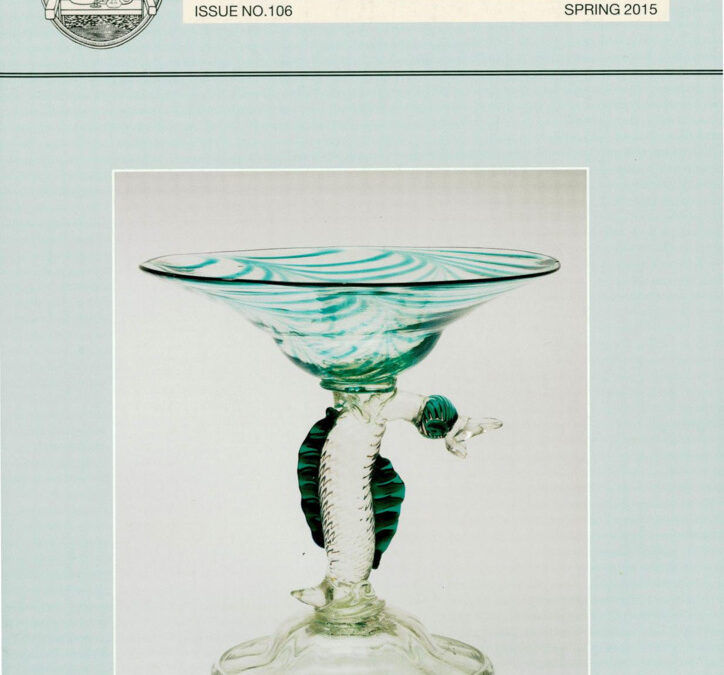
Front:
A Gray-Stan ‘Sea Horse’ vase, No.6 Series.
An example from the Sheila Sharman collection.
Uncatalogued.
Back:
Two-handled Loving Cup by Webb Corbett
for the coronation of GVI, showing the double portrait
of George VI and Queen Elizabeth, the Royal Coat
of Arms being on the reverse. All decorated by
etching, engraving, enamelling and gilding.
Contents
I apologise to all our readers for the delay in
publishing this issue of
The Glass Cone,
which was due to a number of factors. I hope
the delay has been rewarded by the interes-
ting articles, covering a wide range of glass-
making and collecting.
The
Glass Association Journal No.10
was
published at the end of September 2014
with scholarly articles from our members.
Charles Hajdamach and Judith Vincent
wrote on the glass of Mrs Graydon Stannus
and published the complete catalogue of
‘Gray-Stan Glass. Sheila Sharman’s collection,
on display at Broadfield House at the time of
the AGM, and of great interest to many
collectors, will soon be available on our
website. James Measell’s in-depth article on
Stourbridge education and Sally Haden’s
on her relatives’ dissemination of British
glassmaking techniques to Japan completed
this fascinating issue.
The discussions, started back in the autumn
of 2012 between the Glass Circle (GC) and
ourselves on merging our two organis-
ations, initially progressed well but have now
ended without final agreement. This has
been despite the efforts of myself and GC’s
Chairman, Mr John Smith.
I have been campaigning for the merger
of the two organisations for a long time, to
ensure the survival of a single society that
celebrates glass in the UK. It makes sense,
not only from a financial and administrative
perspective, but a merged group would
strengthen our voice at a time of slow,
declining membership and changes in the
way we collect. A merger is essential and
the only way for both societies to move
forward constructively.
When we started talking with the GC, they
were experiencing financial loss, mainly due
to the cost of the London meetings. We could
not commit to a merger that constituted a
financial burden. As a charity, we held that
the activities of the group should be organ-
ised for the general good, with meetings
being self-financing. The GC were not able
to agree to this and preferred to aim at
balancing the books in whichever way
possible. We were not looking at ‘taking over’
the GC, it was to be a merging of equals.
Throughout our history all meetings have
been enjoying equal status, whether London-
based or UK wide.
We believe the GC would have benefited
more than the GA from the merger, it can
now be seen that some of our suggestions
have been taken on board: the GC con-
tracting a less expensive room at The
Artworkers Guild, meeting charges
introduced, their membership fees being
raised and by looking outside of London
for other meetings, especially to our home
at Broadfield House Glass Museum in
Stourbridge.
Our respective societies have many
individual strengths as well as many shared
ones. Though disappointed that the merger
is not presently happening, I believe in
continuing the conversation and colla-
boration with the GC, allowing us to review
the position in the not too distant future.
1
20th-Century Glass: ‘Art Deco to Mid-Century Modern’
4 New Zealand North and South
6 Living The Dream … or how to build a glass museum
8 Let’s Twist Again. The making of 18th-century glassware
16 We All Make Mistakes but sometimes we’re lucky!
17 British and Irish Drinking and Table Glass
20 Paperweight-related Objects
24 The glass of Mike Hunter
Book review — Beranek & Skrdlovice: Legends of Czech Glass
25 Spotlight on Manchester & Salford Glass
26 Members News
28 What’s on. Your guide to exhibitions and other events
Chairman’s message
THE GLASS
CONE NO.106 SPRING 2015
20th-Century Glass
`Art Deco to Mid-Century
Modern’
Alan Gower
Stuart ‘Spider’
enamelled
cocktail shaker
with intaglio cut
spider webs.
JohnWalshWalsh
tall clear cut
tapering cylinder
vase with complex
curvilinear
cutting, designed
by Clyne
Farquharson.
left: Stevens &
Williams clear
cylindrical vase
set on an opaque
black faceted foot,
and decorated
with abstract
cutting, designed
by Hubert Silvers
Williams-Thomas.
AA
T the 2014 Glass Association
GM, we were given three
fascinating presentations on
this important period in modern glass
making.
The day started with Nigel Benson
and his proposition; ‘Did British Glass
miss the Art Deco era?’ Well illus-
trated with photographs of examples,
he discussed whether the lack of
promotion of British glass at the time
meant that an opportunity was lost,
which to this day has led to a lack of
understanding of British Art Deco
glass. We heard that in this period,
there were a number of British
glassmakers making contemporary
glass such as Monart, Gray-Stan and
Nazeing, but this was really Art Glass
and not strictly Art Deco. For
example, true Art Deco glass was
being produced by the world famous
French maker Lalique where the
female form, or angularity, was
typical. Jobling’s opalescent glass
was similar to Lalique’s Art Deco
designs, and Sowerby and Bagley
were making coloured glass varieties.
Hailwood & Ackroyd better known
for making miner’s lamps turned to
making architectural lighting and
produced some frosted-glass pieces,
called ‘Hailware’ which includes a
rare frosted-glass nude plaque
(found in the archives at Kew).
Gordon Russell designed pieces for
Stevens & Williams, many based on
older designs, though he also
designed some bowls and vases with
subtle shallow cutting of flowers and
leaves. Nigel explained that from
about 1928 to the mid 1930s Stuart
Crystal were making enamelled
glassware,
cocktail
shakers,
decanters and glasses decorated
with spiders and webs, or flowers,
butterflies, snakes and abstract
decoration sometimes combined
with intaglio cutting. Likewise, Webb
Corbett made a variety of cocktail
shakers and James Powell utilised
architectural cutting styles during
1932-37. Nigel commented that little
of this glassware was well promoted,
as shown for example by the fact that
the V&A exhibition on the subject,
entitled ‘Art Deco 1910-1939’ held in
2003, contained no British Art Deco
glass.
The Harrods Exhibition of 1934,
‘Modern Art for the Table’ promoted
British glass of the day for the first
time. All pieces were marked with the
designer’s name, as well as the glass
maker’s. Keith Murray was one of
the first designers in Britain to be
promoted by name, working with
THE GLASS CONE NO.106 SPRING 2015
A ‘Brussels bottle
by Jaroslav Lebeda
and exhibited at
the landmark
Brussels
International
Exposition in 1958.
Stevens & Williams from 1932;
though only a small percentage of his
pieces are marked. We were then
told that another of the few designers
of true British Art Deco glass was
Clyne Farquharson working for Walsh
Walsh. Other names mentioned, to
explore later included Anna
Fogelberg who designed marked
pieces for a short period and Tom
Pitchford who produced some
architectural style pieces, both for
Thomas Webb.
Nigel concluded that this glass was
just not promoted in Britain with the
same panache as say, French or
Swedish glass. It’s as if it was ‘hidden
under the carpet’, with the result that
there was no demand in Britain. As
a result, much was exported to the
USA. British department stores were
just too nervous to buy it. They
continued to buy what they knew,
traditional English cut-glass.
For myself I aspire to own early
Lalique but make do with modern
versions, supplemented with
good quality Bagley, Sowerby
and others but I will certainly
now look out for some of the
interesting pieces that Nigel
mentioned.
* * *
Titled ‘Legends of Czech
Glass’,
Mark Hill
then gave us
an illustrated talk about what is
for him the golden age of
modern Czech glass, 1957-
1968; a period which started
with the Brussels Exposition
and ended with the ‘Prague
Spring’. He talked about his
personal ‘Magnificent Seven’
Czech designers starting with
Emanuel Beranek (1899-1972)
who founded the Skrdlovice
glassworks in 1942. Emanuel
promoted other designers and is
known for producing work not
dissimilar to ‘Orchid’ by the Finnish
designer Timo Sarpaneva; ethereal
glass forms produced by pushing
wet sticks into the glass to create
unique voids and sculptural shapes.
Parvel Hlava (1924-2003) was
known as a progressive colourist
who made award-winning tall
sculptural monoliths with finely
polished facets. Also ‘hedgehog’
vases with internal protrusions made
by inserting heated metal spikes into
the sides or bases. He also used
colloidal gold to produce a graduated
yellow-orange-red colouration.
Frantisek Vizner (1936-2011) was
a glass artist with a diversity of skills,
producing pieces using a range of
techniques ranging from fluid
shapes, ‘egg’ vases, innovative
‘whirlpool’ vases to smoothly ground
shaped bowls and vases.
Frantisek Zemek (1913-60), worked
in a range of glass factories;
Chribska, Zelezny Brod, Mstisov
and Moser. ‘Hermanova’ and
‘Rhapsody’ are some of his free-
blown glass ranges which were
described as ‘oven-moulded’;
chunky forms with curving and
asymmetric elements which were
continued in one of his press
moulded designs.
Vladimir Zahour, born in 1925,
updated traditional ‘death by
a thousand cuts’ 19th-century
cut designs using complex
techniques including slice
cuts. His production included
tableware, bowls and vases,
also decorative pieces and
was highly rated at the time
in the
Czech Glass Review.
Josef Hospodka (1930-89)
used a range of techniques
to produce designs that
were eccentric but often
very commercial. His best-
known work was produced
in the 1950s and 60s but
continued to be produced
up to the 1980s. His diverse
designs ranged from common
to ultra-rare bowls, vases,
glass objects and tall and
slender shaped pieces.
Jaroslav Lebeda was the
designer of the so called
‘Brussels bottle’ from a range
shown at the 1958 exhibition in
Brussels, a very significant
exhibition. He updated traditional
Bohemian cut and cased designs,
from classic to fantastic gourd-like
forms. His pieces were white-cased
over coloured transparent glass with
driving, curving cuts. Tall, slender
vases were amongst the forms
produced for the Brussels exhibition
in limited quantities with small
enamelled panels, a selection of
which contained designs taken from
modern or abstract art; spirals,
buildings, birds, and abstract forms
in gold,red and blue.
I have to say that listening to Mark’s
enthusing and illuminating talk,
delivered with such energy just
makes one want to go out and buy
some more glass!
I
couldn’t resist
buying Robert Bevan Jones’ new
book;
Beranek and Skrdlovice:
Legends of Czech Glass,
which has
been recently published by Mark Hill
Publishing Ltd.
* * *
To complete the set of three lectures,
Charles R. Hajdamach
presented
us with an overview of ‘Sophisti-
cation in British Art Deco Glass’
which stressed the great qualities
of the very best British designers of
the period, contrasting with Nigel
Benson’s earlier approach to the sale
and promotion of British glass in the
’30s. Two events in Europe had a
major influence on British Art Deco
glass; firstly in 1916, the appointment
of two fine artists, Simon Gate and
Edward Hald, as glass designers at
Orrefors in Sweden, and then the
International Paris Exhibition of 1925
which highlighted the glass of Rene
Lalique and gave the world the title
‘Art Deco’. These influences only
became apparent in Britain in the
1930s, the 1920s were still a period
when the factories were looking back
at former glories.
Two women glass designers
began to break the mould with their
Art Glass ranges. Elizabeth Graydon-
Stannus established the Gray-Stan
Glass-Works in Battersea in 1926
and continued to operate it until
1936. This small factory of about
30 workers included master glass
blower James Manning, the grand-
father of Sheila Sharman. At this
point Charles included an intro-
duction to Sheila Sharman’s collec-
tion of Gray-Stan glass and the
unique survival of the only Gray-Stan
catalogue, all on display at Broadfield
House Glass Museum to where we
all moved after the lectures. The other
female glass designer at this period
was Isobel Moncrieff, the wife of
John Moncrieff the owner of the
2
THE
GLASS CONE NO.106 SPRING 2015
An Emanuel
Beranek piece
made by pushing
sticks into wet
glass.
eponymous glassworks in Perth in
Scotland, who saw the potential of
the decorative glass bowls made
by the Ysart family of Spanish
glassmakers working for the family
and created the `Monart’ range.
British pressed glass of the 1930s
reflected the huge influence of
Lalique. Davidson of Gateshead
produced their ‘Cloud Glass’ range
while Bagley’s of Knottingley
employed the designer Alexander
Hardie Williamson, who had visited
the 1925 Paris Exhibition, to revive
their output. Sowerby, mostly known
for less expensive glass-wares made
inspiring pressed glass Lalique-
influenced ranges. But the factory
who could accurately be called the
British Lalique, was Joblings of
Sunderland. Charles told us that
Ernest Jobling Purser had
approached Rene Lalique to ask if
Lalique would be willing to have his
glass made under licence in
Sunderland, but when Lalique
refused, Purser and his technical
directors commissioned moulds
from the same mould maker in Paris
used by Lalique and carried out
experiments on Lalique glass to
obtain the exact recipes. As a result
they created a range known as
`Opalique’, sailing very close to the
wind of a law suit under the Trade
Descriptions Act.
The 1930s was the great age of
the designer in British glass. Clyne
Farquharson reigned supreme at
John Walsh Walsh in Birmingham
while Anna Fogelberg and
Homery Folkes produced some
stunning designs at Thomas
Webb & Sons in Stourbridge,
including glass cacti and
penguins. James Powell & Sons
at their Whitefriars works used
their own family to act as
designers and were able to
create equally important
pieces in the usual
restrained and refined
Whitefriars idioms. But
the two greatest glass
design events were to
happen in the Stour-
bridge district. Stuart &
Sons were involved in an
experiment to improve the
quality of British glass design
by working with fine artists
including Eric Ravilious,
Graham Sutherland, Paul
Nash, Dame Laura Knight,
Ernest and Dod Procter, and
Vanessa Bell. Their designs were
shown at the Harrods Exhibition in
the autumn of 1934 and now are
some of the most sought after
examples from that exciting period.
The greatest glass designer of the
period was Keith Murray who worked
for Stevens & Williams from 1932
to 1939. His innovative designs
captured the mood of the period and
when they were shown at the Milan
Triennale in 1933 they won the
factory a gold medal, making Murray
the only British glass designer to be
awarded this honour.
Charles completed his lecture by
also giving credit to the various works
designers who are less well-known
than Keith Murray and Clyne
Farquharson but who translated the
more avant-garde designs for a larger
mass audience.
* * *
What this article cannot hope to
convey is the amazing variety, styles,
techniques, colours and ranges of
glassware produced by so many
makers which we were privileged to
see in photographs on screen, many
from the speaker’s own collections.
All I can say is ‘make sure you are
there next time’. Don’t miss the
opportunity to widen your knowledge
and get the benefit of the expertise
we have available to us in the Glass
Association.
Editor’s note: The history of
Gray-Stan, Elizabeth Graydon-
Stannous and James Manning
and the entire unique Complete
Catalogue mentioned above,
including all images, along
with many pictures from
Sheila Sharman’s Gray-Stan
collection are presented
by Charles Hajdamach
and Judith Vincent in
The Journal of The
Glass Association’,
Volume 10, published in
October 2014.
A lilac vase with white
hooped banding by
Gray-Stan.
Sheila Sharman’s collection.
THE GLASS CONE NO.106 SPRING 2015
3
New Zealand North and South
Bob Wilcock
Peter Raos
in his shop in
Devonport.
O
N our previous trips to New
Zealand (see
Cones 95 and
96) we had just flown in and
out of Auckland, and had suffered
torrential rain in the Bay of Islands, so
had been unable to appreciate its
beauty, though we had enjoyed
Angela Bowey’s fabulous collection
and the stunning
pate-de-verre
of
Sue Hawker.
On our trip for the New Zealand
summer of 2013/14 we discovered
we had been sensible to skip
Auckland; it may be the most popular
place for people to live and work in
NZ, but there is not that much for the
tourist. However, it does have one of
the best glass shops in New Zealand:
Real Aotearoa in Queen Street
(www.realaotearoa.co.nz). They also
have opened a shop in Riccarton
Post Shop in the new commercial
centre of Christchurch on South
Island, following the tragic destruc-
tion of their original shop in the
earthquake (the business is owned
by New Zealand Post). Their third
shop is in the central business district
of Wellington, and we found an even
better selection of glass on offer there
this time compared with our last visit.
By contrast, the glass in Te Papa,
the national museum in Wellington,
was a distinct disappointment this
time, with only a handful of artists
represented, notably Lynden Over
from Taupo, whose geothermal
inspired work is very attractive (see
Cone
95) (www.lavaglass.co.nz).
Back in Auckland, one of New
Zealand’s better-known glassblowers,
Garry Nash, has a studio in the
pleasant suburb of Ponsonby, just
round the corner from our b&b, but
sadly it was not open while we were
there (www.garrynash.co.nz). However,
when we took the ferry across
Auckland harbour to Devonport we
stepped literally straight off the boat
straight into the shop of Peter Raos,
renowned maker of attractive paper-
weights with floral and underwater
designs (www.peter-raos.com).
Peter started as a glassmaker in
1979, and worked with Peter Viesnik
(www.viesnik.com) as The Hot Glass
Company’. They realised their work
was somewhat rudimentary and
arranged visits by American glass
artist Dick Marquis and others, and
their inspiration transformed the
nascent New Zealand glass studio
movement. When the lease of the
workshop expired in 1989 Peter went
back to university. He graduated in
1991 with a Master of Fine Arts
degree, in which the research com-
ponent included casting techniques
for glass. At the same time he
became president of the NZ Society
of Glass (NZSAG) and obtained
funding to bring to NZ an American
glass artist, Mark Ekstrand to run a
Left: Lily
paperweight.
Right: A selection
of paperweights
by Peter Raos.
Far right: Pacific
Paperweight.
All photographs
are by the author
4
THE GLASS CONE NO.106 SPRING 2015
The smile on
Justin’s face says it
all: the second
shell bowl cracks
off safely from
the lehr.
workshop on furnace building. The
design that emerged was more fuel-
efficient and resulted in better-quality
glass. The design was documented
and distributed to the members of
the society. Peter and at least four or
five of the artists mentioned in this
article use this furnace.
Leaving Auckland, we headed north
towards the Bay of Islands (and were
rewarded with beautiful sunshine
when we got there). It is a long drive,
and for glass-lovers, the natural stop
is Whangarei (pronounced ‘Fangarey’).
Burning Issues Gallery, in the Town
Basin, has a hot-shop behind the glass
shop (www.burningissuesgallery.co.nz).
The shop and hot-shop were set up
by Keith Mahy, who sadly passed
away in 2013, aged 66. He graduated
with a Fine Arts Diploma in 1967 and
became Design Director for Crown
Crystal Glass in Christchurch. His
designs included the Anker range
of tumblers, a design also seen in
Europe. He left in 1975, to pioneer
studio glassmaking in New Zealand.
In 1986 he helped establish a glass
and design studio at Northland Poly-
technic in Whangarei where he tutored
and mentored many emerging glass
artists (including Peter Raos). In 1995
partner and former student Shona
Firman (see
Cone 94)
and Mahy, with
a group of local artists, established
the highly successful gallery. The
gallery has been separately owned for
the last 10 years (by Ian Twentyman),
and the hot-shop is now owned and
occupied by Keith Grinter who is a
mentor for The Learning Connexion
School of Art and Creativity and runs
glass-blowing workshops in the
studio.
Burning Issues was where we first
met Justin Culina
(Cones 94 and
98).
We made a mental note of his latest
piece in the shop, a bowl with an
intriguing zig-zag design in the Maori
colours of brown red, and white on
grey, but we had an appointment
with him at his new studio. This is
a beautiful 20-minute drive to the
scenic Whangarei Heads peninsula
where his studio is on a hilltop a
stone’s throw from a very good fish
and chip shop and lovely waterside
pub — ideal for lunch after a morning’s
demonstration! Justin does not have
a website but has a Facebook page
at (https://www.facebook.com/pages/
Culina-Glass) and detailed images of
his work can be found on the Quay
Gallery, Napier website: www.quaygallery
co.nz/ the_art/justin_culina.
His plan was to make one of his
popular shell bowls
(Cone
98) before
moving on, but disaster struck—the
first bowl fell off the punty, so he had
to make another. By then it was
lunchtime, so Justin stopped for a
well-earned rest, we bought a large
spiral paperweight with internal
gilding and commissioned one of the
zig-zag bowls to be picked up at the
end of our visit to the Bay of Islands,
and we then went for a relaxing lunch
in the pub.
When we went back a few days
lafter, Justin was all apologies. New
Zealand does not have any seriously
dangerous creatures (unlike Australia),
but it does have a few nasties, and
one of them, a spider, had bitten
him in the crook of the arm, and he
had not been able to blow. Neverthe-
less, he had driven to a gallery that
had a bowl in the pattern we had
Below right
Justin’s zig-zag
‘swirl’ bowl.
Below: One of the
last pieces made by
Keith Mahy.
THE GLASS CONE NO.106 SPRING 2015
commissioned. We later visited that
gallery, the Matakana Contemporary
Art Gallery, half-an-hour’s drive away,
and were impressed with the range
of glass on display (such a pity we
were flying!). (www.matakanacountrypark.
co.nz/artmatakana.html)
We also visited another gallery
recommended by Justin: ‘Just
Imagine’ in Russell, New Zealand’s
first capital, and now most easily
reached by boat across the Bay of
Islands from Paihia. This was the only
gallery we came across in New
Zealand that had glass from around
the world. The quality was out-
The quaint Art
Matakana Gallery
in a converted
stable block and
(right) the Just
Imagine Gallery
in Russell.
Part 2
of this article
will be published
in Cone 107
standing, and we would have loved
to slip a piece or two in our baggage.
All we could do though was enjoy a
lingering look round. Russell is such
a charming town in such a beautiful
location, that having
to admire was the
cake; take a look at
(www.justimagine.co.nz)
see what I mean.
quality glass
icing on the
their website
and you will
Living The Dream
… or how to build a glass museum
C
OLLECTING glass is, by
and large, something you
do because you want to,
not because you have to. So in
2009, the concern and disquiet
among glass collectors that
surrounded the future existence
of the Broadfield House Glass
Museum (BHGM) and the world-
famous Stourbridge Glass collec-
tion, led a driving force that grew,
its aim to create, build and main-
tain a new museum to house the
glass. The British Glass Foundation
www.britishglassfoundation.org.uk
was founded and became a focus
for those seeking a constructive
way forward, and it soon became
apparent the creation of a new
museum simply had to be done.
Within 18 months of its launch
at Hagley Hall in Stourbridge, the
BGF rose from non-existence to
being recognized as a facilitator
between parties. So, over four
years later, just how far down the
road have they come?
During the last few years, the
BGF charity has been campaign-
ing for its aims and objectives,
liaising with all the relevant parties
and raising awareness of the
importance of the glass collec-
tions. They have also been instru-
mental in analysing the alternatives
that would enable the collections
to be secured and celebrated for
future generations. The preferred
option was identified as a new
museum at the White House Cone
site, part of the previous Stuart
glassworks, for these reasons:
1.
It is of enormous historical
importance.
2.
It is adjacent to the Red
House Cone site, itself of
international standing.
3.
It can be developed with the
ERDF (European Regional
Development Fund).
4.
It can provide a future income
from the adjoining workshop/
office units gifted to the BGF
by the developer.
5.
It is also in the middle of the
‘Crystal Mile’ with all the
provenance that this entails.
The BGF have concentrated on
working in harmony with the
council and the developer,
Complex Development Projects
(https://www.complexdevelopment
projects.co.uk), to support the
European Regional Development
Fund (ERDF) grant application.
This has been very necessary, as
Dudley MBC, the owner of
BHGM, has to make £60million
savings over the next 3 years; we
are told that 47% of services
provided by the council will be cut,
restructured, or transferred to the
private or voluntary sector.
The BGF is confident that the
ERDF grant has formally been
approved and they are just waiting
for the signed documents from
Government Office incorporating
all the terms and conditions. The
developer, with his team of
consultants, has invested on the
basis that the grant will definitely
be approved, which means that
the actual project will be com-
pleted by 31 December 2015.
Formed by individuals with a
common interest in glass, the
BGF has settled down to a core of
trustees led by chairman Graham
Knowles, with finances looked after
by Meriel Harris. Allister Malcolm,
Broadfield House resident glass
artist, is giving an input on
contemporary glass and David
Williams-Thomas, retired chairman
and MD of Royal Brierley Crystal
(the former Stevens & Williams)
contributes a wealth of experience
based on a lifetime in glass.
Graham Fisher has the remit for
PR and Communications.
The European grant is not
enough to cover all the aims and
objectives, so the BGF has been
working with consultants to make
various grant applications including
Heritage Lottery, My Community
Rights, Growing Places and
6
THE GLASS CONE NO.106 SPRING 2015
BGF Chairman Graham Knowles at Hagley Hall alongside the 2012
Portland Vase on the occasion of the BGF gala afternoon on 22
August of that year. The event was kindly supported by the Glass
Association.
Source: Graham Dale Photography
II
,
/W1=014,414! Lida§ IG
,
7
Heritage Young Roots. These
grants and others are needed for
planning the transfer and display
of the Broadfield House collec-
tions. They have recently been
successful in obtaining a grant of
£10,000 towards their legal and
professional costs to become a
Museum Trust. David Williams-
Thomas and Viv Astling, the past
Chief Executive of Dudley Council,
are leading the negotiations, with
advice from the Association of
Independent Museums (AIM), to
complete the formation of the
Museum Trust in agreement with
the council. This will allow the BGF
to take responsibility for all of the
glass collections and archives, and
discuss the detailed display and the
functions of the new facility.
Graham Fisher writes:
Communications, maintaining
information-flow and keeping
events squarely in the public
eye, have been another priority.
After several initiatives exploring
ways of keeping its supporters
informed, the quarterly
Newsletter
Glass Cuts,
the
BGF’s informal
ad hoc
email
bulletin, took off. The first 50
issues are, as I write, being
printed as a commemorative
limited edition.
We aim to be transparent in our
dealings and are happy to record
that the BGF has managed thus
far to accrue a substantial sum
in its bank account with daily
running costs being met from
other sources. This makes us
self-sufficient in the event of any
immediate cash needs for the
project. The BGF is entirely
philanthropic and none of its
trustees receives a penny in
remuneration, so our funds can
be targeted where intended.
Our business plan is being
formulated and our web site at
www.britishglassfoundation.org.uk is
undergoing a substantial upgrade.
David Williams-Thomas notes:
We are working hard on the new
museum plan. It’s reaching a
crucial stage on the funding.
We will know soon. Meanwhile
Dudley are confident enough to
be talking to us in detail about
future legal arrangements.
So they mustbe reasonably
confident of the outcome. I am
fighting hard in our meetings for
proper facilities for research and
storage of the archive material.
And there you have it, straight
from the hip. Keep the faith, and
do keep it Glass.
STOP PRESS !!
Announced in Glass Cuts 57
THE PLANNING APPLICATION
FOR THE WHITE HOUSE SITE
HAS BEEN APPROVED.
Yep, you read it correctly; it all
happened at a meeting of Dudley
MBC planning committee on 20
October 2014. A moment in
history methinks. A delighted BGF
Chairman, Graham Knowles, was
heard to say: ‘This is excellent
news and is a huge step forward
in securing a world-class glass
facility at the very heart of the
Stourbridge Glass industry’.
Expect all this to be lashed
widely across the meejah over the
Announced in Glass Cuts 60
Since its inauguration as a trust in
2010, the BGF has been seeking
to appoint a person of gravitas
within the world of glass and the
wider world of commerce, who
would act as a recognized figure
for the organisation as it grew and
moved forward.
In December, David Williams-
Thomas wished to stand down as
a trustee of the British Glass
Foundation. David’s invariably
sage counsel and consistently
erudite contributions towards the
day-to-day running of BGF have
been considerable, so his fellow
trustees recognized the need to
retain his services. David accepted
the invitation to become a patron
of the BGF and assumed his
honorary role with immediate effect.
* * *
This article has been compiled
and edited by Brian Clarke from
text and information provided by
Graham Knowles and Graham
Fisher, with additional input from
David Williams-Thomas and Kari
Moodie.
The GA congratulates the BGF
on its work to date and wishes
the trustees and its new patron
well on continuing through to a
successful creation of the new
museum and becoming a
Museum Trust.
—Brian Clarke
Artist’s impression of the
proposed new museum on the
White House site.
Source: BGF website
next few days but the approved
application is viewable in the
meantime at the DMBC planning
applications website.
Y-e-e-e-e-s-s-s-s 111111
Announced in Glass Cuts 59
MONEY MATTERS
We are delighted to announce
that the BGF has been awarded a
grant of £10k by the Heritage
Lottery Fund towards a feasibility
study into transferring the assets
of the Stourbridge Glass collection
across to the BGF. Our grateful
thanks go to Andy Duncan of AJD
Regeneration www.ajdregeneration.co.uk
for steering that one through and,
of course, to HLF for their largesse.
Much obliged all round.
Speak it softly, but coming on
top of the news regarding planning
permission being granted at the
White House site, it’s fair to say
that things are really moving in a
forward direction.
THE GLASS CONE NO.106 SPRING 2015
7
0 Mark’s basic tools
(left to right) soffietta,
metal rod, two jacks, two
shears, pincers.
0 Wooden shaping
tools, kept wet. Multi-
ribbed mould on floor to
insert opaque canes for
making a ‘carrot’ to build
pro to-stems and stems.
Let’s Twist Again
The making of 18th-century glassware
Words and photography by Brian Clarke
T
HE Glass Association’s
practical study days into
techniques that could have
been used back in the 18th century
for the manufacture of glass vessels
started in the spring of 2012.
The gaffer — Mark Taylor and his
servitor — David Hill, well known as
the Georgian Glassmakers, working
in their glassmaking studio in Quarley,
Hampshire, have presented a
number of well attended days,
teaching and demonstrating the
creation of stems, bowls and feet to
an enthusiastic audience. Over the
years, they have increased their
knowledge and understanding of
the manufacturing methods of the
different styles of glasses and added
them to their range of production.
0 Participants overlooking Mark gathering glass from the furnace.
During our study day in November 2014, they described
and introduced the newly learnt ways of making:
1.
The flatter style of 18th-century folded feet,
with both wide and narrow folds.
2.
Baluster stem knops, refining the acorn knop style.
3.
Bowls with gadrooning and nipt-diamond-waies.
4.
The technique of making and placing incised strap handles.
5.
The making of tankards.
6.
The terraced foot.
7.
The creation of ogee and pan-topped bowl shapes.
As time allowed, Mark and David also went through the making
of stems with fine air twists and mercury twists, multi-spiral
stems and opaque and coloured twist stems, Lynn bowls,
cordial bowls and Mead glasses, incised twist stems and
drawn trumpet bowls (refer to ‘Let’s Twist Again’ article in the
Glass Cone,
issue no.99).
It was in fact a
tour de force,
with Mark now being so comfortable
with his making ability that he was able to lecture to the gathered
onlookers at the same time as working with glass
(fig.1);
this was
of course helped with David knowing exactly when to assist with
a gather of glass on a punty rod or blowing iron, for additions to
the glass under creation. The standard tools used, kept
alongside the gaffer’s chair are shown in
figs 2 and 3.
8
THE GLASS CONE NO.106 SPRING 2015
Making an Acorn Knopped
Baluster wine glass, with blown
and folded foot
The first glass to be made was a Baluster
Wine. With a solid base to the trumpet bowl,
a merese before the well-made acorn knop
and a blown, narrow folded foot (not now
made with the soffietta), this glass was an
excellent start to the day
(figs 4 to 11).
®
Bowl opened up and shaped with jacks
into a drawn trumpet.
®
Reheating blown foot in the glory hole.
0 Flattening the blown and folded foot
with a wooden batten.
0 Tapping completed glass off the Aunty iron’
before taking to the lehr.
9
70
Punty iron now attached to foot and centering
the bowl with jacks prior to opening it up.
THE GLASS CONE NO.106 SPRING 2015
0 Team happy with result. David showing his ‘split broom
handle’ for taking finished glass to the lehr
® Opening up a blown foot with the jacks.
0 Checking
completed baluster
glass with solid-based
drawn trumpet bowl,
merese, acorn knop
and blown folded foot.
0 Gather and bowl
reheated in glory
hole.
3
Damp wood
batten being used to
shape second glass
gather over base
of the bowl.
0 Shaping gather
with jacks 1.
C) Shaping gather
with jacks 2.
Cti Reheated bowl put vertically
into 12-ribbed mould and given
a firm push to shape in mould.
0 Checking the glass ribs
from the mould.
19
Adding hot glass
to base of rotating bowl
to form a merese.
10
THE GLASS CONE NO.106 SPRING 2015
Making a Gadrooned Goblet
Mark then showed the technique for making the
gadroon design on a goblet. This required adding a
second layer of glass to the lower area of the bowl to
be styled and then dipping the hot bowl into a ribbed
mould and giving a firm push to form the design.
With various journeys to and from the glory hole to
keep the glass heated to the right temperature and
continuously rotating the glass as it was being made,
it became neatly finished
(figs 12 to 28).
(3 Second gather of glass being added to base
of initial blown bubble of bowl.
Adding hot glass to
base of merese, to form
two blown knops for the
stem.
© Adding hot
blown glass bubble
onto stem to form
folded foot.
@ Reheating foot
in the glory hole.
Using jacks to
finally shape
the foot, folded
and opened from
the blown bubble.
e Punty iron
attached to foot.
0 Bowl reheated
in the glory hole.
® Glass being continuously rotated by © Final adjustments to bowl and stem C) Completed gadrooned goblet
the gaffer and the bowl partly opened
using the jacks.
before being taken to the Lehr.
with jacks.
THE GLASS CONE NO.106 SPRING 2015
11
0 Trial piece.
One clear handle already
placed. Incised handle
being applied from rim
down to bowl base.
0 Trial piece.
Shaping of hot handle
being completed
with jacks.
Handle making
Handle making was shown next, both
a plain handle and a ribbed or incised
handle. The ‘grooves’ were made with
jacks before the piece of glass to make
the handle was re-heated and then fixed
to the rim end of the bowl first. The length
of glass was then deftly turned over and
looped back on itself to fit against the
lower part of the bowl
(figs 29 to 31).
Above: air twist
pro to-stem;
Below: glass incised
with pincers to be
stretched into
a handle.
CO Hot
glass gather
being
placed over
base of
initially
blown bowl.
0 Base of bowl with gather reheated
in glory hole, alongside the panty.
`A single-handled Tankard with
Nipt-diamond-waies
Nipt-diamond-waies’ was the term used by the English
glassmaker George Ravenscroft (1632-83) in a 1677
advertisement for his new lead glass and referred to the
technique of manipulating adjacent vertical glass ribs with
pincers to form a diamond pattern. It transpired that the
method involved modifying an already gadrooned bowl, using
pincers or jacks to pull the glass ribs together at intervals.
To show all of the new ideas, Mark finished the glass off with
a tankard shaped bowl, spiral trailing of clear glass around
the bowl rim and then the addition of a single incised handle.
We all applauded this creative tankard, which de-mystified
for most of us the way it was done’
(figs 32 to 42).
0) Dip mould prepared for
gadrooning the gather
0 Gadrooned pillars
being pincered together
to form Nipt-diamond-waies.
12
THE GLASS CONE NO.106 SPRING 2015
0 Nipt-diamond-waies
partly completed with
pincers.
® Nipt-diamond-waies
almost completed,
using pincers.
C) Excess glass
being sheared off
0 Hot glass being
shaped into a ‘ball’
before a short
mouth-blow creates
a spherical bubble to
make the folded foot.
0 Bubble being attached for the conical folded foot.
0 Tankard bowl opened up and finished with clear trailing
at the rim, after punty iron transferred to conical folded foot.
Handle being applied from the rim side of the bowl.
Completed tankard
before removal to the lehr
THE GLASS CONE NO.106 SPRING 2015
13
A Terraced foot
on a Lynn wine glass
The final piece to record, was
the making of a terraced foot.
Most often seen supporting
candlesticks and tapersticks,
Mark made this as the foot
of a Lynn wine glass with an
opaque twist stem. Somewhat
unusual, nonetheless the
finished glass was handsome.
The secret here was to
circumferentially incise the
hot glass gather with its small
blown air bubble, before
opening up the bubble and
quickly rotating the glass to
form the terraced foot.
So obvious once you’ve seen
it done once!!
(figs 43 to 52).
If you haven’t seen the magic
of 18th-century glassmaking,
then do come to our next
event at Quarley, which will
be on 3 October this year.
The booking form will be
on the website.
Added in to the cost of the
day, is a CD showing many
of the making techniques
discussed here and in the
Glass Cone, issue 99.
The Glassmaker’s wished to
confirm that `Gadrooning’ is a
traditional technique, seen for
example in Renaissance
Venetian glassworking and is
not something that they have
invented or re-discovered.
They and other craftspeople
will be having an ‘Open
Weekend’ on 16 and 17 May,
when Mark will be demon-
strating glassblowing all day.
Details at
www.project-workshop.co.uk
@ Small
gather of glass
with a bubble of air, being
incised with jacks.
3 Incised foot bubble
firmly attached to stem
(opaque) and incision
lines finely demarcated
using shears.
0 Checking all is in
place.
0 Opening up the
bubble in the foot.
© Opening the bubble
with jacks and spinning
the glass. It spreads out
and forms the terraced
foot. Punty iron attached
to foot and broken off
the bowl.
14
THE GLASS CONE NO.106 SPRING 2015
@ Adjusting
the stem alignment.
@ Bowl bubble attached
and opened up.
Bowl incised to make
a Lynn style bowl.
0 Finished three-part
wine glass. Terraced foot,
opaque twist stem, round
funnel Lynn bowl.
Q
The gaffer is
content with the
day’s work.
THE GLASS CONE NO.106 SPRING 2015
15
We All Make Mistakes
but sometimes we’re lucky!
I’VE been collecting for around 38 years
now and you’d think that I wouldn’t be
prone to making mistakes, but you’d be
wrong — we ALL make them — the novice
and the seasoned collector alike.
Here’s a short story that’ll make my point.
have long been interested in the more
obscure twentieth-century glass factories
— probably this is an extension of the
fascination with unmarked items that have
to be diagnosed in order to decide who they
were made or designed by, such is the draw
of glass.
One such factory is Bermondsey Glass
with it’s designer Guy Underwood, an artist
and sculptor who can be found in
British
Glass 1880-1940.
Not much is known
about him, except that it is indeed this Guy
Underwood who was the designer behind
items of glass produced prior to the Second
World War at Bermondsey Glass in South
London. This is proven through matching
signatures on Guy Underwood etchings
with facsimile signatures found embossed
on a number of recorded pieces of glass.
According to David Watts’s website,
www.glassmaking-in-london.co.uk, there was …
An archaeological excavation at the Igloo
Bermondsey Sq. Regeneration Project
[that] found evidence of what was
described as a bottle
factory at the NE corner of
the site. This is exactly the
junction of Long Lane and
Tower Bridge Road.
The name of the factory is
not known but this must
be the site of what we call
Bermondsey Glass,
So, to the point of my story.
In early July, I was saved
from getting up on my
workshop roof by the bad
weather. Unfortunately, my
alternative task was the
exciting prospect
of
merging the upgraded
Nigel Benson
computer my son had given me with my
external hard drive, items from the old com-
puter, and even more from a shared
computer. I was in for a great day!!!
Well, while re-filing photos, I came across
an image I had downloaded in April 2013.
It was of a pair of bookends with cast-glass
fish set into very stylish wave-motif bases in
metal; each was cold-painted a pastel
green, and each was embossed along the
edge of the base with the facsimile signature
of Guy Underwood. I had tried to buy them,
but they went for an Art Deco price rather
than that which one might reasonably
associate with an obscure glassworks of
which little is known.
Deeply frustrating; but worse, about a
month before this filing exercise, I had seen
a fish on a sloping wooden block base
painted in pastel green, for which my
memory said the glass part was identical!
Where had I seen it? On one of my few
forays to boot fairs about a month prior.
Drat!! I knew that I should have followed
my intuition and bought the one that I’d
seen. There were no marks, and the chap
selling it said he had another somewhere,
but it was broken — I was successfully put off
the idea. Only one bookend and another
somewhere: could be in a box, in the car, or
at home. Oh well! I left it.
Imagine how stupid I felt when I was
confronted with the images that I’d taken off
the Internet?
I decided to get up early the following day
to visit the same boot fair in the rather futile
hope that the piece was still there, so that
I could record an obscure piece of glass
history by buying and photographing it.
Yay! It was there and, amazingly, so too
was its partner — believe it or not, both in
good order! I was delighted to be able to
buy them at an advantageous price,
although higher than one might expect at
a boot fair!
Just like the Madonna head they are cast
glass and have the furred edges of the
casting polished away to finish them off.
There are no identification marks and the
bases are rather plain, but when one of
the fish is placed in front of the computer
screen showing those recorded images,
they are all but identical. The shape is spot-
on, as are the fins, tail and their delineation,
or markings. The only noticeable difference
is the fin along the body behind the gills
which is singular instead of doubled.
Currently, even though they are rather
lowly in the collecting hierarchy, these are
among my favourite pieces, particularly as
they are a mistake made good.
NOTE: Broadfield House currently has three
pieces, having added a lamp base with
fittings to their collection and
there have been some eight
Madonna heads recorded.
I have been informed of,
or recorded, another nine
items and have a small
collection of my own.
To my knowledge, the total
number of recorded items
now amounts to some
twenty-five items.
If you have, or know of, any
other Bermondsey glass,
please contact Nigel
with details so that
they also can be recorded
(nbenson@20thcentury-glass.com).
Thank you.
16
THE GLASS CONE NO.106 SPRING 2015
British and Irish
Drinking and
Table
Glass
Harriette Moore and Brian Clarke
A
L
ONGSIDE the other appealing
antique collections, Dreweatts
Bloomsbury Auctions treated
buyers to the sale of a quality glass
collection from Northern Ireland, held
at their Donnington Priory premises
in Newbury, Berkshire on Thursday
28 August 2014.
This important single-owner
collection of quality 18th- and early
19th-century glass, from County
Antrim in the north east of Ireland,
was begun in the mid-1980s with a
focus on Dutch engraved and Irish
glass. It boasted decanters from the
celebrated Bushmills Irish Distillery
[Lot 437, sold for 2682], and rare
stipple engraved and diamond point
engraved drinking glasses.
Leading the collection was a Dutch
engraved armorial commemorative
goblet for the House of Orange-
Nassau, signed and dated by Jacob
Sang [Lot 409 sold for £5,580].
Lot 437:
Cut and engraved
spirit decanters
from Bushmills.
Lot 409:
Light Baluster
engraved by
J. Sang, whose
inscription on the
foot can be seen
below.
Although born in Germany, Jacob
Sang was known to be working in
Amsterdam by 1748 and selling his
glass at the ‘English Glass Shop’.
The goblet is engraved with the
crowned arms of William V, Prince
of Orange (1748-1806). The last
Stadholder of the Dutch Republic,
William V was forced to flee to
England in 1795 after the Flanders
Campaign. With the defeat of France,
the Batavian Republic seemed
unwilling to accept the return of
William V, but his son, William I,
became the first King of the
Netherlands. There has been some
discussion over the authenticity of
the signature of Sang on the foot
of this glass.
Lot 402 was a Dutch commem-
orative light baluster marriage goblet
signed and delightfully diamond-
engraved and dated by A.F.
Schurman 1757; the glass was
formally in the collection of the Earl of
Bradford. With world-wide political
THE GLASS CONE NO.106 SPRING 2015
17
Far left, Lot 402:
Light Baluster of
Barthold Douma
van Burmania.
Lot 420:
Stipple-engraved
facet stem glass.
Lot 414: Incise
twist stem glass
enamelled by
Beilby.
and religious concerns these days, it
is of particular interest as the round
funnel bowl is engraved with the
arms of Berthold Douma Van
Burmania (1695-1766). A Dutch
statesman and at one time an
ambassador to the court of the
Empress Maria Theresa of Austria, he
is most noted for his efforts — with
mixed success — to prevent the
expulsion of Jews from Bohemia and
other parts of the empire. (Adam
Frederik van Schurman (1730-83),
was an amateur engraver related to
the famous engraver Anna Maria van
Schurman (1607-78). Eleven signed
glasses are known by his hand).
Estimated at £6,000 to £8,000, the
glass was sold post sale.
Lot 420 is one of the two
wonderfully stipple-engraved facet-
stemmed ‘Friendship’ goblets that
were on offer. Both were attributed
to David Wolff, circa 1785. This glass’s
ogee bowl is decorated with two
putti and a hound, companionably
sharing a drink beneath the
inscription VRIENDSCHAP. The glass
has a hexagonally-faceted stem with
a conical foot, 18.5cm high. [Ex-lot
78, Christie’s Amsterdam Sept.
1985]. Sold post sale.
Lot 414 was a round funnel bowl
glass, attractively enamelled by
Beilby in the style of an obelisk in
a landscape. The interest here of
this 120mm-tall example, is that
unusually the stem has an incised
twist. The glass sold for £1,860.
The group of four blueish-green
coloured early 19th-century ‘short
ales’ in Lot 426 were estimated at
£80 to £120. With their interesting
mix of styles and colour, these
received enough interest to sell at
£558. Short ales, coloured and clear,
have been available at low prices for
some years; this sale suggests that
it’s time to look at them again!
Due to its interesting size and style,
I’ll complete this sale review with
Lot 441. A large clear and opaque-
white late 19th-century
facon de
Venise
goblet, the round funnel bowl
with trailed opaque white ornament
and the knopped stem applied with
a pair of auricular handles (some
damage). The 315mm tall goblet sold
for just £596. This goblet could be
attributed to the production of
Salviati.
There are many other glasses from
this sale, engraved and stipple-
engraved worthy of viewing. The
catalogue and full sale results are
available to view online at
www.dreweatts.com.
The next Dreweatts sale, Fine &
Important Furniture, Paintings & Works
of Art, will be held on 15 April 2015.
Already consigned is a pair of Varnish
& Co. pale-ruby flashed, silvered and
clear-glass overlay goblets
(illustrated
opposite),
mid-19th century, the bell
bowls cut with a diamond band
above a fluted and waisted baluster
stem and circular foot, 22.5cm tall,
the feet set with a patent disc.
Provenance: Peter Petrou. (Ex:
Parkington Collection Part II, Lot 250
Christie’s April 1998.)
Hale Thomson and Edward
Varnish first took out a patent for
silvered glass in 1849 (see the patent
disc in the foot of each goblet) and
exhibited their wares at the Great
Exhibition in London in 1851. They
were retailers and much of their glass
was manufactured for them by the
Whitefriars Glassworks. Perhaps as a
result of the patent, silvered glass of
this type is rare. Est. £3,000-4,000.
18
THE GLASS CONE NO.106 SPRING 2015
Lot 441: Late 19th century facon-de-venise goblet.
19
A pair ofVamish & Co. glass goblets
to be included at the next Dreweatt’s sale on 15 April.
THE GLASS CONE NO.106 SPRING 2015
Lot 426:
A group of coloured short ales. Late 19th century.
With a history dating back to 1759,
Dreweatts & Bloomsbury Auctions
are one of the best known
auctioneers in the UK today of Art,
Antiques and Antiquarian Books. The
following explains the amalgamation
of several known groups:
2010
Dreweatts acquires Bloomsbury
Auctions.
2012
Dreweatts & Bloomsbury Auctions
acquired by Noble Investments UK
PLC (joining A.H. Baldwin & Sons –
coins, and Apex Philatelics – stamps).
2013
Noble Investments acquired by the
Stanley Gibbons Group plc.
2014
Dreweatts & Bloomsbury Auctions
acquires Mallett Antiques.
The opening and closing text of this
review has been contributed by
Harriette Moore, PR & Marketing
Executive, of Dreweatts & Bloomsbury
Auctions. Further text has been added
by Brian Clarke. The catalogue was
used for additional information.
All the photographs are with the kind
permission of Dreweatts & Bloomsbury
and were supplied by Harriette Moore.
Paperweight-related Objects
Richard Giles
W
HEN glass paperweights
containing cameo incrus-
tations or to give them
their more usual name of sulphides
were introduced around the mid
1820s other diverse items such
as decanters, tumblers and plaques
containing sulphides had already
been produced for some years. The
inclusions were generally head and
shoulder portraits of popular con-
temporary personalities or people
from history but did also include
such things as coins and medals, in
fact anything that could be made
from a metal mould. With all castings
the real skill is that of the person
who makes the original mould from
which many identical objects can
be produced.
The move to include such items
in paperweights was a natural
progression along with the industrial
revolution that was gathering pace
and more and more ordinary people
were learning to read and write.
The steel pen nib had been invented
in the late 1700s and paper was
becoming more freely available
so not surprisingly the shops
began to be filled with all sorts of
writing accessories which included
paperweights.
When millefiori and lampwork
paperweights appearanced around
1845 the opposite scenario
happened. The weights came first
but it wasn’t long before other
paperweight related items made
their appearance. Pietro Bigaglia is
generally credited with making the
first millefiori paperweights which
often included silhouette canes
made by the Franchini family and
similar canes are also found in other
such items as scent bottles.
Paperweight-related glass items
including such objects as inkwells,
tazzas, candlesticks, mantelpiece
ornaments and the like were
produced by the three main
factories, Baccarat, St. Louis and
Clichy. Either few were made or only
a few have survived the passage
of time, so examples from these
factories remain highly sought after
and are therefore very expensive.
When the period of classic
paperweight production ended
around 1860 and glassmakers
generally lost interest in millefiori
glass, the production of such items
continued in cut glass which had
been around since the 17th century
but was always expensive. The
advent of the industrial revolution
had seen the introduction of press-
moulded glass around 1840 and
with the cheapness of production
linked to the automated process it
was to fulfil the needs of the Victorian
working classes for similar items
to those that had previously been
made by hand.
Although not strictly a paper-
weight-related item, my only
example of glass from these three
factories is a Clichy flask made using
alternate blue and white ribbons
in a spiral pattern and readers can
see the similarity with the swirl
paperweight from that factory in
fig.2.
A typical Victorian era writing
accessory is the paperweight pen
holder employing the two layers of
coloured chips with the top layer
pushed downwards towards the
lower layer in several places and
inside an elongated bubble
(fig. 1).
In modern terms such paperweights
are known as a harlequin design but
in Victorian times and the early
20th century this style of paper-
weight making was popular
throughout Europe so it can be
difficult to say exactly from where it
might have come. My guess is that
my example is probably a frigger
made in the United Kingdom by a
glassworker during his spare time at
lunchtime or at the end of the day
on completion of his production
schedule.
When the Ysart family came to the
UK and the four sons learnt their
fig 1:Victorian era
paperweight pen
holder, unknown
maker,
c.188011900.
fig.2: Blue and
white swirl flask
and paperweight
from Clichy
factory, France,
c.1845/50.
20
THE GLASS CONE NO.106 SPRING
2015
fig.5 (below left):
Millefiori inkwell
by Salvador Ysart
atYsart Brothers
Glass Factory,
Perth, c.1946/50.
fig.6: Millefiori
paperweight
candle holder,
Vasart factory,
Perth, c.1956/64.
fig. 7.: Miniature
millefiori
paperweight bar
accessories, Vasart
factory, Perth,
c.1956/64.
glassmaking skills from their father
Salvador, they started using tech-
niques that with a few exceptions
had not been seen since the classic
period of paperweight production.
As well as being very skilled glass-
makers who were initially employed
to make technical glass items, they
went on to produce the large range
of Monart Glass which included a
range of millefiori paperweights
generally made by Paul Ysart, the
first to be seen in the United
Kingdom since mid-Victorian times.
After the war Salvador and the two
other surviving sons left Paul making
Monart Glass to set up Ysart
Brothers Glass which later became
Vasart Glass. As well as Monart-style
glassware and simple style paper-
weights they went onto produce
some paperweight related items
such as pin dishes
(fig.3).
More
complex paperweights and inkwells
were made by Salvador
(fig.5).
After the deaths of Salvador and
Augustine, Vasart Glass began to
struggle, so in 1960 Stuart Drysdale
was brought in as manager and
by 1963 the company was back
in profit. Work including making
squashed whisky bottle ashtrays for
Teachers Whisky meant that bigger
premises were needed so in 1964
the company was involved intro-
ducing a change of name to
Strathearn Glass and and moved
to a new purpose-built factory in
Crieff. Spanning the period around
the change of name, a range of
glassware including paperweights
and related items were produced
which included single flower vases
(fig.4),
miniature candlesticks
(fig.6),
and the sought-after bar sets
comprising corkscrews, bottle
openers, pourers and stoppers
(fig.7).
A typical Strathearn pin dish
is shown in
fig.8.
By the time these changes were
taking place at Vasart Glass, Paul
had left Monart to join Caithness
Glass as training manager with the
authority to continue making paper
-weights, which he did in great
secrecy. When chief designer Colin
Terris saw the complexity of some of
the canes being used, he came up
Millefiori pin
dish, Vasart
factory, Perth,
c.1956/64.
fig.4 (right): Single
flower millefiori
glass vase, Vasart
factory, Perth,
c.1956/64.
21
THE GLASS CONE NO.106 SPRING 2015
fig.8: Millefiori
paperweight pin
dish, Strathearn
factory, Crieff
c.1964180.
fig.9: Miniature
millefiori silver
jewellery,
Caithness Glass,
Wick, c.1970/72.
fig.10: Millefiori
inkwell/stopper,
Perthshire
Paperweights,
Grief f, c.1985190.
fig.11: Millefiori
scent bottles,
Perthshire
Paperweights,
Crieff c.1973/96.
fig.12: Millefiori
water jug
Perthshire
Paperweights,
Crieff c.1970/75.
with the idea for a range of silver
jewellery using miniature paper-
weight stones
(fig.9)
and they made
their appearance in 1970 shortly
after the first paperweights and just
before Paul retired in 1972.
In 1968, Stuart Drysdale the
Strathearn general manager and
several of the most talented
glassmakers left to set up the
specialist paperweight making
company Perthshire Paperweights,
which also went on to make limited
numbers of paperweight related
items such as inkwells
(fig.10),
scent
bottles
(fig.11),
pin dishes, shot
glasses and small water jugs to go
with your whisky
(fig.12),
generally
containing millefiori but occasionally
lampwork designs. Both at
Strathearn and Perthshire it is said
that such items as pin dishes were
made from paperweights that went
slightly wrong during the production
process and converting them to a
dish which could be sold became
a way of cutting down the amount
of glassware that was scrapped.
Certainly some examples from
Strathearn are far from being perfect
but that also can be said of some of
the paperweights. The two examples
of Perthshire pin dishes shown in
fig.13
show no signs of something
that may have gone wrong.
Perthshire had a strict policy on
quality and they never sold seconds
so I think that it is probably more
likely to be a case of having spare
lampwork or millefiori set-ups,
especially if they were from limited
edition weights whose production
run had been completed.
Other long-established glass
factories known to have produced
items containing millefiori canework
are Walsh Walsh and Whitefriars.
Both paperweights and inkwells
containing 1848 date canes are now
known to have been made by
Walsh Walsh in the 1930s alongside
undated weights and glasses and
bowls containing millefiori canes
(fig.14).
Whitefriars introduced the
use of millefiori in paperweights in
the 1950s but it wasn’t until the
22
THE GLASS CONE NO.106 SPRING 2015
fig.17 (left): Millefiori dish on ribbon
cane paperweight, John Deacons,
Crieff, 2003.
fig.18 (right): Spiral ribbon dish on
millefiori paperweight, John Deacons,
Crieff c.2003.
1970s that these pieces became
major production items and along with
them came articles such as inkwells,
tumblers
(fig.15)
and as everyone
else produced, pin dishes
(fig.16).
A more recent paperweight
maker, following the tradition of
making paperweight-related items
is John Deacons who started at
Strathearn and then moved to
Perthshire before eventually setting
up on his own. He continues to do
so today, working alongside his
eldest son Craig and with another
ex-Strathearn employee, Dave Moir,
who lent a hand now and again.
In the past John produced such
novelty items as miniature teapots,
dishes and swans containing mille-
fiori canework as well as inkwells.
After retirement from Caithness
Glass Italian master glassmaker
Franco Tuffolo was a visitor passing
on advice on the use of techniques
to create spiral torsades and spiral
ribbon glassware. Examples of those
techniques can be seen in the
paperweight based dishes made by
John in
figs 17 and 18.
Over the years we have been
collecting paperweights and related
items, we have sadly seen the
demise of nearly all the companies
mentioned above, leaving only John
Deacons, Willie Manson, Peter
Holmes and Mike Hunter to make
traditional style paperweights, in
many cases in fairly small numbers
so the future of paperweight related
items looks as though it is well
and truly over. Perhaps now is the
time to start searching for these
items and adding them to our
collections.
fig.13 (above left):
Paperweight pin
dishes, Perthshire
Paperweights,
Crieff c.1975/85.
fig. 14 (above right):
Glass bowl with
millefiori base,
Walsh Walsh,
Birmingham
c.1930.
fig.15 (left): Glass
tumbler with
millefiori base,
Whitefriars Glass,
Wealdstone
c.1960170.
fig.16 (right):
Millefiori
paperweight pin
dish, Whitefriars
Glass, Wealdstone
c.196.5170.
THE GLASS
CONE NO.106 SPRING 2015
Beranek&
Skrdlovice
Legends
of
Robert Bevan Jones
& Jindfich Mik
General Editor:
Mark Hill
Zanfirico
Owls.
The glass of MIKE HUNTER
Mike will be collaborating and demonstrating
with Colin Richardson at the Tacoma
Museum of Glass, USA on 1 May 2015.
For those of you that may be there, Dante
Marioni will also be demonstrating along
with David Graeber, Damon MacNaught,
and Mayauel Ward.
Michael’s work is currently on exhibition at
the Tacoma Murano Hotel until May 2015,
he’s one of seventeen artists exhibiting as
part of the PCA Convention 2015.
WE’RE pleased to know that resident in the
Scottish border town of Selkirk, Mike and
Sue Hunter are still creating wonderful pieces of glass. The Wedge is a sculptural
vessel in the Merletto technique; the close,
fine canework gives the impression of silk
threads woven into the glass. The owls,
ducks and fruit are both exacting and
charming, using complex canework.
All can be produced in various colours.
To contact them, use their email:
michael@michaelhunter.orangehome.co.uk
Merletto
Wedge.
All four photos
are with thanks to
and copyright of
Simon Bruntnell.
Zanfirico Duck.
BOOK
Beranek &
Skrdlovice:
Legends
of Czech Glass
by glass collectors and
historians, Robert Bevan
Jones and Jindrich Parik,
edited by Mark Hill.
A limited edition hardback.
128 pages
ISBN: 978-0-9552865-9-9
Price: £45:00
Available from Mark Hill
Publications, online at
www.markhillpublishing.com
Zanfirico Fruit.
REVIEW
THIS book is a delightful and
fascinating celebration of Czech
glass design in the mid-20th century
and in many ways that isn’t
surprising given the pedigree of the
individuals involved. Jindrich Parik is
a Czech glass collector with both a
passion and a great eye for his
subject. Robert Bevan Jones, an
author of historical books, shares
this passion for Czech glass. Mark
Hill is the perfect editor for this
extremely ambitious task and
Graham Rae is an outstanding glass
photographer.
The Skrdlovice factory was
undoubtedly the best example of
the combination of craft, innovation,
creative design and technical skill in
glassmaking in the Czech Republic
during a period when the industry
was at the top of its game. The
factory had enough political support
to be given an unusually high level of
artistic freedom and was used to
design and produce many of the
special one-off items that travelled
to international exhibitions. These
designs were subsequently trans-
formed into serial production items
for export.
Uniquely, the book also charts the
lives of the highly talented glass
designers employed in the
Skrdlovice factory who, in the post-
war period, could not be acknowl-
24
THE GLASS CONE NO.106 SPRING 2015
fig.3: A selection of wares made by Thomas Kidd.
fig.4: A couple of Landseer Lions manufactured by John
Derbyshire.
fig.1: A blue bust of Queen Victoria.
Made by Thomas Kidd at the Holt
Town Glass Works in Manchester.
Suggested date c.1890.
fig.2: Two shoes by Burtles Tate,
Manchester. This design is reg.no
65455, dated 17 January 1887.
THE North West members group organised a
successful meeting at St Mark’s Church Hall Worsley
on 29 November, attracting 40 glass enthusiasts.
An extensive exhibition was mounted of over 200
pieces of glass made by several companies in the
Manchester and Salford area between 1820 and
1930
(fig.2).
Highlights of the exhibition included a
large collection, approaching 50 pieces, of locally-
made tumblers and goblets, thus demonstrating
that Manchester is home to discerning drinkers!
The small company of Thomas Kidd also featured
prominently with possibly the largest ever display
of its wares
(figs 1 and 3);
itself a bold claim as
the company never used any form of marking.
Local manufacturer John Derbyshire was also a
particular focus of interest with the opportunity
to see two rare blue Landseer lions
(fig.4).
Lastly, several unusual examples of Percival
Vickers cut-and-engraved ware also demon-
strated the supreme quality of workmanship and
well-balanced design available in the region that is
not generally known or appreciated.
To accompany the exhibition there was ‘a show
and tell session’ of glass, with a number of the
pieces that had been brought in, being
successfully identified.
Two talks were presented, one by David Willars
entitled ‘The Identification of Manchester and
Salford Glass’ in which he concentrated on trying
to identify glass that was neither featured in a
brochure nor had a registered design number.
The second talk by Jackie Fairburn was a short
history of the pressed glass made in Sunderland
by Greener & Jobling.
Those attending thoroughly enjoyed the day and
the profits from the meeting were donated to the
Manchester branch of Ataxia UK.
Spotlight on
Manchester & Salford Glass
A report by David Willars and Maurice Wimpory
BOOK REVIEW
rv
r
01
1
edged in their own country for fear
of succumbing to ‘the cult of the
individual’. However, although the
Communist Government of the time
often stifled innovation in the arts
and enforced a tight control of
creativity, the glassblowers were
looked upon as craftsmen not
designers, so in the government’s
eyes they could be left alone to
practice their art without interference.
The book is very well researched
and is crammed with new inform-
ation that cannot be found in any
other publication unless you speak
Czech and have a couple of years to
spare which was exactly what was
required to produce this compre-
hensive work. Most publications on
glass, regurgitate information which
is reasonably accessible. This
groundbreaking publication has a
wealth of original research content.
The book also draws upon
information embodied in the objects
themselves. It reads
from
as well as
into
the objects. This in my view is a
fundamental point and is the reason
why seminal works such as this one,
always have a great collection of
objects standing behind them.
The illustrations are superb, so
although appreciated mainly by the
glass collectors, they will fascinate
many of those unfamiliar with the
elegance and beauty of these pieces.
As a glass collector myself, I am
always excited by the launch of a
new publication such as this one
and having collaborated with its
editor Mark Hill many times in recent
years, I have always found the
experience a great pleasure.
Mark is precise and thorough. In
consequence, readers can rely on
him for editorial accuracy.
I was also delighted to note that in
April 2014, over 100 examples of
Skrdlovice glass, dating from
c.1945 to 2008 and including some
unique pieces, were the main
exhibition at the prestigious ‘Antiques
For Everyone Fair’ at the NEC in
Birmingham where they were
exhibited for the first time in the UK.
Books are important additions to
knowledge but when they are
combined with new visual
information presented in exhibitions,
the subject springs to life.
This is an important work about
a fantastic subject which has
been thoroughly and accurately
researched and compiled by a great
team. Published in a strictly limited
edition of 1,000 individually num-
bered copies, the book itself will no
doubt become a collector’s item.
Dr Graham Cooley
20th-century Design Collector
Life Member of the Glass Association
THE GLASS CONE NO.106 SPRING 2015
25
A few
memories of
Christopher
Sheppard
MEMBERS NEWS
IT is very sad that we have had to say goodbye to
Christopher, who passed away on 3 January
2014.
He was an important part of our lives for many
years, captivating us all with his with his vast,
enthusiastic knowledge, together with his
charming, witty and humorous personality.
There were many passions in his life, with his
family always coming first. His passion for glass
came a close second, followed by the love of
shooting and fishing.
Chris was never one to miss an opportunity.
He realised, when he was still at school, that
there were two glass dealers in the Kensington
Antiques Market and that the old fashioned
one could not bring himself to be seen buying
from the glamorous young female dealer,
Maureen Thompson. So Chris would buy
from Maureen, replacing her immaculate tissue
packing with newspaper from the bin outside,
then make a profit by selling the items to the
other dealer. The rest is history.
As collectors, we first met him in 1978/9,
which led to our long friendship. In 1984 our lives
changed, when from his shop he sold us two
glasses designed by Philip Webb for James
Powell, which led to our passion for this style of
glass. Over the years, there were many long
discussions about glass dating and attributions.
When he moved to Kensington Church Street it
was a delight to see him so often during quiet
times; though maybe not after he had been for an
indulgent lunch — he was known to fall asleep just
as it was time for us to close up and go home.
Over the years, we had some great days out
and about, talking about glass all of the time and
doing a lot of dealing, especially when he was
IN MEMORY
Dr Winston Murray Lesley Turner
10 October 1914 – 29 July 2010
WINSTON was born in Hackney London, the
only boy with four sisters. He was educated
at and won a scholarship to study medicine at
University College London. He qualified in 1938.
As a civilian doctor he examined Douglas Bader
and declared him fit to fly. Winston was called up
in 1939 but rejected as his eyesight was too
poor; however he was finally accepted by the air
force in 1940. Among his postings, which were
all in Great Britain, he was billeted in Weston
Super Mare with a retired headmaster of Bristol
Grammar School, Mr Barton. The Bartons had
an interesting antiques collection, in particular,
early glass including Georgian wine glasses.
short of cash. The hairiest deal was when we
received a call asking us if we would like a half
share in a very good collection; thank goodness
we had some money at the time, as he was as
usual short of funds. But the glass was so good it
did not matter. We both did well although I had to
keep hold of the purse strings!
The last sort of social gathering was at the
vetting day lunch at the November Olympia fair.
That morning, we had been told of the sad death
of both Ward and Jo Lloyd, so we had an extra
bottle of wine and celebrated their long and
exciting lives. Let’s hope we can all get together
and do the same for Christopher in the near
future.
Unfortunately, on the Friday of Olympia, he
was taken into hospital and never recovered.
Even though he was very poorly, many of his
friends and colleagues managed to talk to him
just before Christmas; by that stage he did not
want visitors, but still wanted to talk about glass.
Chris was great company, a great gentleman
and often too generous with his alcoholic
hospitality. Many of us will remember the
hangovers!
We will miss him dearly. There is a large hole in
his family’s and all of our lives, luckily we have so
many memories, he will never be forgotten.
— Jeanette and Malcolm Hayhurst
Christopher Sheppard with the Cavour vase
Following Winston’s marriage to Helen in
1953, they discovered they had a shared interest
in glass, which she had acquired from her father.
They began collecting glass. Their collection,
which was gathered together over 60 years, is
wide ranging consisting mainly of wine glasses,
salts and pressed moulded glass.
Winston and Helen were very early and
enthusiastic members of the Glass Association
and have passed their passion for glass on to
two out of their three children. Helen is still an
enthusiastic supporter of the Glass Association
and attends as many events as possible.
After Winston died the family gave a very
generous donation of £5,000 which was used
to fund the last issue of the
Glass Association
Journal.
—
Judith Gower (daughter)
New owners of Waterford Glass
THE American private equity owners of
Waterford Wedgwood, one of Britain’s best-
known brands, are selling the historic ceramics
and glassware maker, six years after the
company’s debts sank it into receivership.
KPS Capital Partners has appointed Goldman
Sachs to auction WWRD, the Anglo-Irish owner
of the Waterford, Wedgwood, Royal Albert and
Royal Doulton porcelain and crystal brands.
The group hopes to cash in on its heritage and
royal warrants after recently opening tea rooms in
Shanghai and Hong Kong to appeal to affluent
Chinese consumers; it also plans to diversify
from manufacturing.
The collapse of Waterford Wedgwood in 2009
spelt financial disaster for Sir Anthony O’Reilly,
who then owned the company and was once
one of Ireland’s wealthiest businessmen. At the
time, Waterford Wedgwood was one of several
British ceramics manufacturers struggling
against cheap imports from Asia, but it was also
criticised for a dated image and for failing to
adapt to changing consumer tastes.
KPS Capital Partners, based in New York,
specialises in acquiring lossmaking businesses; it
bought Waterford Wedgwood from the receivers
in 2009 for £82m after the group collapsed with
€800m of debts and pension liabilities.
Since KPS took over, the number of
employees has shrunk 44 per cent — the result
of centralising the group’s sales and marketing
operations, and moving about half of production
to lower-cost overseas countries, including
Slovakia and Indonesia.
VVWRD has since swung into the black, with
operating profits last year of £36m.
The group still makes its most expensive china
and crystal domestically. Last year, KPS invested
£34m in a new manufacturing plant in Barlaston,
Staffordshire, where the company has its HQ.
CORRECTION
IN the latest
Glass Association Journal
no.10,
on page 4, we inadvertently referred to Charles
J. Hajdamach as being ‘President for many
years’. This should have read ‘Chairman for
many years’. We apologise for the error.
26
THE GLASS CONE NO.106 SPRING 2015
WHAT’S ON
MEMBERS NEWS
Bristol Blue Glass Bedminster cease trading
BRISTOL Blue Glass Bedminster (BBGB), the
Company that has been making the city’s
famous blue glass, has sadly gone out of
business, months after it opened a new shop
in central Bristol with the idea of selling its glass
to a wider audience. BBGB, not to be confused
with The Original Bristol Blue Glass on Bath
Road, was based on the site of the historic
Bedminster Glass Works founded in 1716. It was
owned by Francis Burroughes, an avid collector
and expert in glass, who bought it eight years
ago with the determination to keep it not only
alive, but to give it a future. Unfortunately this was
not to be the case.
Bernard Cavelot
SADNESS, Bernard Cavelot has passed away.
He was a consummate member of the Glass
Message Board (GMB) and always wanted
accuracy with anything to do with glass history
and identification; he also had an in depth
knowledge of publishing that he shared when
helpful to others.
I often had lively discussions with him about
glass, sometimes on the GMB and occasionally
via email which enhanced our mutual respect.
I amongst many will miss him, both on these
boards and meeting up at fairs.
A few fairs back he came up to me with a
parcel and said You seem to be the Hailware
man, so here’s something that may help your
research’. He handed me the parcel which
contained a Hailware lampshade. How very kind,
but typical of the man. He would do anything to
help forward knowledge about glass.
I am very pleased that or last conversation was
positive and will be a lasting memory of a well
thought of glass man.
— Nigel Benson
With Memories of Harvey Ferry.
‘The Country Seat’,
near
Henley-on-Thames
ANOTHER great character of the antiques trade,
and glass in particular, Harvey Ferry, has passed
away.
‘It is with great sadness that we announce the
sudden death of Harvey Ferry on 27 February
2015. Our thoughts are with his family – Willie &
Sally Clegg’.
Harvey and his partner, Willie Clegg, came to
deal in James Powell & Sons, Whitefriars under
their trading name ‘The Country Seat’, having
staged an exhibition on the designer W.A.S.
Benson. They became fascinated by the quality of
the glass lamp shades used by Benson on his
domestic lamps, so progressed into the world of
glass having dealt in ‘Signed and Designed’
furniture of the Victorian and later periods; in itself
this was a progression from their beginnings in
fine Georgian furniture in 1971.
Their enthusiasm for glass was self-evident
and both were infectious in their own way. Indeed
they became synonymous with the subject of
Powell and Whitefriars through the many
exhibitions and meetings they held about the
subject, publishing well-researched catalogues
for all the exhibitions they held.
My thoughts about Harvey converge around
him being an old school antique dealer with a
deep feeling for the process of antique dealing as
well as the items he bought and sold. He was a
natural host to all who visited their base at
Huntercombe Barn, near Henley in Oxfordshire,
making everyone welcome to the wonderful
surroundings. It was he who managed the task of
getting a brown sign indicating the barn from the
main road – both a clever and shrewd move to
have their base highlighted to anyone searching
them out before the advent of sat-nay.
Harvey was charming and a real gentleman
who loved his glass (whether full or empty!). Even
though it was part of a long journey through
various fields in the antique world, you knew he
felt glass was a bit special. I’ll miss him being
around and hope he’s found a bit of peace.
— Nigel Benson
Touring Exhibition of contemporary
Hungarian artists
Spring/Summer 2015
A touring exhibition, titled ‘Cutting Edge’, show-
casing the most recent works of 17 contemporary
Hungarian artists has been organized by Prisma
Gallery (www.prisma-gallery.com).
The tour kicks off in Edinburgh (The Scottish
Gallery, 1-28 April ) and will then continue in
Stourbridge (Broadfield House Glass Museum
8-31 May, to coincide with the International
Festival of Glass) before moving on to London
Contemporary Glass Society (CGS)
announces New Chair
THE CGS Board announced that Julia
Stephenson is to take over from Victoria Scholes
as Chair of the Contemporary Glass Society from
May 2015. Julia works as Head of Arts at
National Glass Centre at the University of
Sunderland where she manages the exhibition,
learning and engagement programme. The
recent exhibition programme has included
shows ranging from a retrospective of the work
of Erwin Eisch to new work in glass by ceramist
Magdalene Odundo. The learning and engage-
ment programme offers opportunities for artists
to work within participatory arts projects and for
people of all ages to explore the potential of
working in glass. Julia joined the National Glass
Centre three years ago after working as Assistant
Director of MIMA (Middlesbrough Institute of
Modern Art). www.cgs.org.uk
Japanese
by Sipos.
at the Olympia Fair (18-28 June).
Additional locations are being planned.
For further information please contact
Zsuzsanna Molnar or Attila Sik at their gallery
contact@prisma-gallery.com.
Attila and Zsusza led the very successful Glass
Association group visit to Budapest and Vienna
in 2013.
Works representing three generations of artists,
will be exhibited at these selling exhibitions; two
of the pieces that will be on show are by the
artists Balazs Sipos and Laszlo Lukacsi.
Fan
by Lukacsi.
THE GLASS CONE NO.106 SPRING 2015
27
CGS and the National Glass Centre
launch second annual showcase
of contemporary glass
A special display case in the lower foyer
entrance at the National Glass Centre will be
dedicated to a year-long display of a wide
variety of glass made by members of the
Contemporary Glass Society.
From spring 2015 to spring 2016, the work of
fourteen artists, CGS members, will be put on
show in a prominent area of the National Glass
Centre. Each artist will be showcasing their
work for a six-week period. There will be a
vibrant and varied range of sculptural,
decorative and functional pieces, all available
for sale from March 2015
(figs above and below).
www.nationalglasscentre.com
CGS and Pyramid Gallery’s forthcoming Exhibition
RIPPLES
–
Glass Inspired by Nature
Pyramid Gallery, York. 14 March to 5 May 2015
THIS exhibition will showcase the work of 26
glass artists chosen by the CGS from all over
the world, whose works are inspired by nature.
Glass has the ability to emulate forms,
patterns and structures found in nature.
RIPPLES will highlight the breadth of
inspiration that nature provides to many
practicing glass artists
(figs above and below).
Glass
Engraving
Network
Exhibition
FROM 18 May through to 26 June 2015, starting
at the Red House Glass Cone in Stourbridge as
guests of the Guild of Glass Engravers, the
exhibition
GRAVUR ON TOUR – Modern
European Glass Engraving
will begin its tour
across Europe.
Representing the diversity of contemporary
glass engraving both artistically and technically,
31 artists will then visit seven museums in
seven EU countries outside of the UK, their
work ranging from experimental to work relating
to traditional classic glass engraving and glass
cutting.
The exhibition has been organised by the Glass
Engraving Network. The Network was founded
during a weekend in September 2013, when
some 30 engravers from all over Europe met at
Bildwerk, Frauenau, in South East Germany.
There we established our new network,
set up our administered website,
www.glassengravingnetwork.com, and set in
progress plans for another meeting.
The completion of this 18 month-long touring
exhibition project will come after visiting
Belgium, the Netherlands, Germany, the Czech
Republic, Estonia and Finland before arriving
again at the Glasmuseum Frauenau in August
and September 2016. There will be an
illustrated catalogue with full information on sale
at the exhibition venues.
Fig.1 (above)
is by
Nancy Sutcliffe from Stourbridge and
fig.2
(below)
is by Franz Xavier Holler from Germany
– Katharine Coleman
More information on the Glass Engraving
Network Exhibition will be available from
Katharine Coleman MBE at
www.katharinecoleman.co.uk
or email katharine@katharinecoleman.co.uk
THE Glass Association is working on arranging
a visit to Glasmuseum Frauenau at the end of
summer 2016, to see the exhibition, the
museum’s glass collection and the glass school
at Bildwerk, Frauenau.
AS part of the International Festival of Glass
(IFG) events in Stourbridge, Katharine Coleman
MBE
will be giving the Guild of Glass Engravers’
annual Spring Lecture ‘A Future for Glass
Engraving’ at 2.30pm, Saturday 30 May at the
Red House Glass Cone. Contact
www.gge.org.uk or email enquiries@gge.org.uk
WHAT’S ON
Association for The History of Glass (AHG)
Spring Study Day: Glass for Eating,
Drinking and Making Merry
15 June 2015, 10am-5pm
at The Wallace Collection, London W1U 3BN
THIS study day on the use of table glass of all
periods is being planned in conjunction with the
Glass Association (GA) and the Glass Circle (GC).
Glass has always been made because people
wanted to buy and use it. Without customers who
wanted to use glass, there would have been no
glass industries. Yet much more work has been
done on production than use. Why did people
choose glass instead of ceramics or pewter?
Was the table glass used in homes, inns and
taverns the same, or different? What difference
was there between city and country; upstairs and
downstairs? Such questions are often asked, but
less frequently answered so it is hoped to use this
opportunity to study how, why, where and when
table glass was used in different eras.
The cost of the day will be £12 (€15) for students;
£24 (€30) for members of the AHG, GA, GC or
Friends of the Wallace Collection; and £34 (€45)
for non-members.
Lunch is not provided, but is available locally.
The booking form will be available on the Glass
Association website, meanwhile, please note your
interest to ‘GA-CRYSTAL: crystal-edge@hotmail.co.uk
Glass Association Events 2015
12 June:
Study Day at the V&A
15 June:
Day event with the Association of
History of Glass
4 July:
Visit to Station Glass at Shenton,
Leicestershire
September
(date tbc):
Visit to St Nicholas’
church at Moreton, Dorset, to see engraved
glass windows by Laurence Whistler
3 October:
Let’s Twist Again at Quarley with
The Georgian Glassmakers
17 October:
GA AGM
(date tbc)
Other events
16-19 April: Delomosne showing their glass.
Dealers Fair at Blenheim, Woodstock
12-21 May:
Glass Circle visit to the USA
25-31 May:
International Festival of Glass and
Biennale in Stourbridge
16-19 July:
Art in Action 2015. At Waterperry
Gardens, nr Oxford. Glassmakers.
Glass Fairs
The two National fairs for 2015 will be held on
10 May
and
22 November
at the National Motor-
cycle Museum nr Birmingham. glassfairs.co.uk
11 October: ‘Cambridge’
Glass Fair at
Knebworth, Stevenage, Herts
Abroad in 2016
Dates to be confirmed
21-24 April:
Barcelona in Spain
August
(prob w/e 20/21):
Glasmuseum
Frauenau, Germany
UK in 2016
Mid June:
V&A study day
(date tbc)
Please check our website for full information and booking
forms where required www.glassassociation.co.uk
28
THE
GLASS CONE NO.106 SPRING 2015
1111 CANNY
Col
FOR
•
MARK HILL •
MY SHOP IN CENTRAL LONDON
IS NOW OPEN
A range of my groundbreaking books is also available to buy:
Caithness Glass
Loch. Heather
&
Peat
Shop only two minutes walk from Oxford Street and Bond St tube station
Open Wednesday to Friday I Oam-6pm & Saturday I I am-5pm
Stand G23 • Grays Mews Antiques Centre • 1-7 Davies Mews • London •W1K 5AB
or visit www.markhill.net
The Glass Cone
THE MAGAZINE OF THE GLASS ASSOCIATION
www.glassassociation.org.uk
PROMOTING THE UNDERSTANDING AND APPRECIATION OF GLASS