




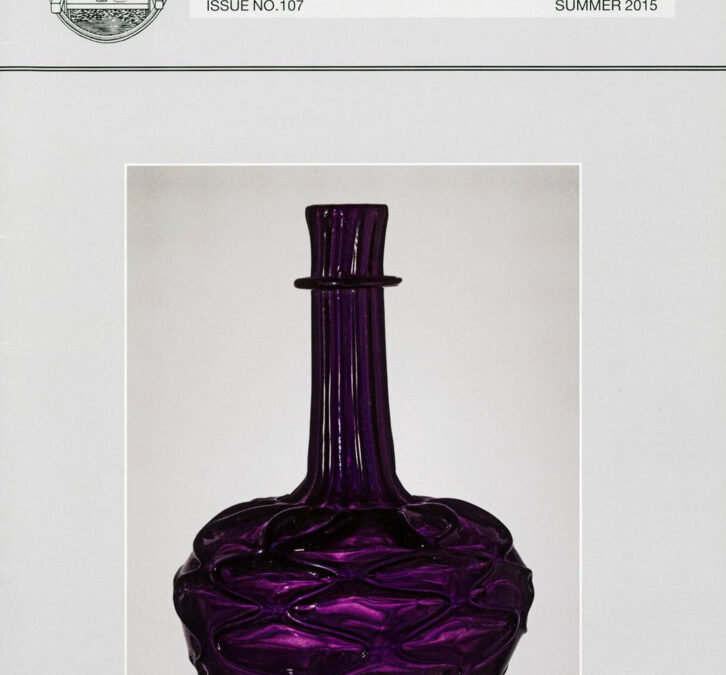
The Glass Cone
ISSUE NO.107
SUMMER 2015
Contents
1 Who Made that Glass?
6 Visit to Isle of Wight Glass Studio, 2014
7 Timothy Harris and Isle of Wight Studio Glass
9 Visit to Frauenau with BGF
12 Crested Glassware
14 Art In Action: Britain’s top craft show!
16 Cutting Edge
17 Musee des Arts Decoratifs: Paris Exhibition
19 The Engraved Glass of Franz Tieze
23 Starting a Glass Collection
24 Letters from Harry Powell
25 Gray-Stan: Luxury Modern Glass 1926-1936
26 Visit of American Paperweight Maker Jim Brown
26 Book Reviews
29 Members News
29 What’s on. Your guide to exhibitions and other events
Chairman’s message
The Glass Cone
THE MAGAZINE OF THE GLASS ASSOCIATION
Issue No: 106 – Spring 2015
Editor: Brian Clarke editor@glassassociation.org.uk
Editorial Board
Brian Clarke, Bob Wilcock
Address for Glass
Cone
correspondence
E-mail editor@glassassociation.org.uk
or mail to Glass, 7 The Avenue, London N3 2LB
E-mail news & events to news@glassassociation.org.uk
Articles and news items are welcome at any time,
but please bear in mind the copy dates if you have
an event you would like to be publicised.
The opinions expressed in the
Glass Cone
are those
of the contributors. The aim of the Editorial Board is to
cover a range of interests, ideas and opinions, which
are not necessarily their own. The decision of the
Editorial Board is final.
Copy dates
Spring: 15 February – publication 1 May
Summer: 15 June – publication 1 September
Winter: 1 October – publication 1 January
Advertising rates
Full page £200; Half page £140; Third page £100;
Sixth page £70; Twelfth page £55. For inside back
cover and back cover, prices are on application.
Discounted rates for GA members
Please contact circaglass@aol.com
The Glass Association 2015. All rights reserved
Design by Malcolm Preskett
Printed in the UK by Warners (Midlands) plc
Published by The Glass Association
ISSN No.0265 9654
The Glass Association
Registered as a Charity No.326602
Website: www.glassassociation.org.uk
Life President:
Charles Hajdamach
charleshajdamach@btinternet.com
Chairman:
Dr Brian Clarke
chair@glassassociation.org.uk
Hon. Secretary:
Judith Gower
secretary@glassassociation.org.uk
Membership Secretary
Pauline Wimpory,150 Braemar Road, Sutton Goldfield,
West Midlands, B73 6LZ
membership@glassassociation.org.uk
Committee
Nigel Benson; Paul Bishop (Vice-Chairman); Christina
Glover; Alan Gower; Jordana Learmonth; Zsuzsanna
Molnar; Kari Moodie; Malcolm Preskett; Rebecca
Wallis; Bob Wilcock; Maurice Wimpory (Treasurer)
Membership and subscriptions
Individual: £25. Joint: £35. Student with NUS card: £15.
Institutions: UK £45. Overseas £35. Overseas
Institutions £55. Life: £350. Subscriptions due on
1 August (if joining May-July, subscriptions valid until
31 July, the following year)
Cover illustrations
Front:
Decanter, London (UK), probably George
Raverzscroft at the Savoy glasshouse, 1680.
By permission of the V&A, viewed at the
GA study day.
Back:
Piggin and Bowl. Waterford cut glass
about 1830. From the collection of Mary Boydell.
(see article — p.19)
A large part of my message in
Glass Cone
106
dwelt on discussions between the GC
and ourselves, which at the time had come
to a close. There were some stumbling
blocks which will need to be ironed out
between us in the next year or so. Under
my chairmanship and perhaps beyond, the
conversation will continue, looking forward
to a vibrant future under one umbrella, for
the collectors, researchers, curators and
lovers of glass.
We are delighted to welcome new,
enthusiastic and committed members to
the Glass Association (GA) Committee.
Zsuzsanna Molnar, who with her partner
Attila Sik have been introducing Hungarian
Glass sculpture to the UK (see their ‘Cutting
Edge’ article), is able to use her event
management skills to join with David Willars
(invited to the committee) in organising this
year’s AGM at Warrington — a new venue for
the GA; I hope to see many of you there.
Kari Moodie, Keeper of Glass and Fine Art
at Broadfield House has written a review of
the trip to Frauenau, a hopeful introduction
to the new glass museum in Stourbridge;
Kari has also introduced BHGM’s Gray-
Stan exhibition (complete catalogue on our
website). Together with Rebecca Wallis,
curator of Ceramics and Glass at the V&A,
who’s been at the centre of our very
successful study days at the V&A, we have
a motivated and strengthened committee.
Sally Haden’s article continues her research
into the assistance the UK gave to Japan
in forming their glass industry, while Nigel
Benson has unearthed letters from Harry
Powell, one of which is presented with a
reference to Mrs Graydon Stannus. Bob
and Ruth Wilcock continue to cover their
`glass travels’ and I’m delighted to
welcome Neil Chaney and Sonia Jackson
as new contributors.
Aware that our membership is based
throughout the country, we’ve been holding
events to appeal to everyone. We began
with a visit to The Higgins Art Gallery and
Museum in Bedford in March, then June at
the V&A, followed a few days later with the
Association of History of Glass day event
at the Wallace Collection; July has just
seen us at Station Glass at Shenton in
Leicestershire. Coming in September we
have an event at Moreton in Dorset, with
October holding our sixth visit to The
Georgian Glassmaker’s in Quarley and then
our AGM in Warrington. Read ‘What’s On’
for all events and two trips abroad in 2016.
Looking forward to another year of
interesting and educational activities.
THE GLASS CONE NO.107 SUMMER 2015
=
‘
fti..• *leaven irn,iptc.
,,
,,gwe,,z.;;er
445143muttel
aims* memo ukao…”.a.,
fgt.
.
11=1ellt:41149thr WS OA .11,00X f
13604.k
An..7.0e
‘VFW
vol
.3102′
,
4 ,rat rrAt
.
,
r..1″tre.C.14119i
.r4t
ea. ••
,
,
,
r
ort
I
rv’ •
WAWA. Orli.41,39
,
4″:
4..grd Gdt
kc
,
3*.tiorlbwrre
Ott
6
.00.
06
M urooft41010110..k.
*Oaw s.
tallt VICAVow
$03
1
0
,
04711
.4.110.X.411
ra, iqr
,
arrIpprror4 ocrikIr
ort:
WO.
-4/LIArOs
–
W41,12 fee.
,,,
4/ratri
oat
kii•
••••
n
,
41104.
rff
4
,
to.” osierrrit•orposelr,
rtat
,
rd
r
OMAN
ift; 3.4tINAVVI4W
e
.
..*C
**
rtr
n
OVIRIMr
•
•
P
I,
‘
*go
1:;
“°
‘
,
1,!
..•1Z’
,
‘
6Nrttr
Who Made that Glass?
Identifying Victorian glassmakers and manufacturers:
James Speed (1834-1908)
Sally Haden
fig.1: Photograph
taken in 1883 of
glassmakers at the
Shinagawa Glass
Works, Tokyo.
Sitting at centre
left is James Speed,
their British
instructor.
Reprinted by courtesy
of Meijimura Museum
AVE you ever taken down a
piece of glass from your
collection and held it in your
hands for a few moments to pause
and wonder about the moment of its
creation? To think of the glassmaker
beside the furnace on that day,
sweating, calling for something to
slake his thirst? What was his name?
Who taught him? Were there many
children at home to feed and clothe?
Was he born locally or in another
country? You ask and ask, but there
is no answer from your vase or bowl.
You look and look, but the secrets
of
its making are locked away forever
in impenetrable silence.
I do not have a glass collection,
but in 2005 I was shown a photo-
graph
(fig.1)
which made me ask a
lot of questions and prompted me to
unlock a family mystery. For there
amongst many Japanese workmen
was my great grandfather, James
Speed, a man about whom I knew
very little except for the intriguing
family story that he had gone to
Japan to teach glassmaking. For me
the photo was an instant, unbidden
and inescapable invitation from my
ancestor to me, to become a glass
historian and tell his story. But the
quest has not been an easy one.
My family kept no personal artefacts
or papers that would have helped,
and at some crucial points in his
life he just disappears from view in
the archives.
I
It was from Japan that the first
and most useful information came,
with the group photograph.
,
I learned
that Speed and three other British
glassmakers had been invited to
help bring modern western-style
glassmaking to Japan during the
early Meiji era. A full history of
the factory where they worked, and
its background in Japanese history,
can be found in my article in the
2013 edition of the
Journal of the
Glass Association.
But in outline,
before the country was forcibly
opened in the 1850s by western
powers after more than two centuries
of self-imposed closure to the outside
world, Japan had subsisted in
feudalism, largely ignorant of Europe’s
many advances. A sudden encounter
with the West was both a shock and
an awakening. The Japanese fell
instantly in love with steam trains
and democracy, modern navies and
schools, science and factories …
and so much more. They resolved
to modernise, but on Japanese
rather than foreign terms wherever
possible. The thousands of foreign
experts – a large proportion of them
British – who were engaged to assist
in turning the country around worked
on time-limited contracts, after
which they had to go home.
The four British glassmakers each
worked for one to four years at a
glassworks in Shinagawa, Tokyo,
between 1874 and 1883. The factory
had been constructed initially for the
purpose of making window glass
and ships’ red signal glass – two
products much needed as the
country modernised. Thomas Walton’s
assistance from 1874 to 1878 was
described in
The Glass Cone
numbers 102 and 103, as part of this
series ‘Who Made That Glass’. This
article relates the tale of my ancestor,
James Speed, who replaced Walton
at Shinagawa in 1879.
In keeping with the way that glass
objects cannot inform us about the
moment of their making, Speed’s
origins are obscure. In the family we
knew he was Scottish, but from
where? Before she passed away,
my aunt told me our ancestor was
fathered illegitimately by a member
of the Scottish aristocracy, a
Buccleuch. But when he was born
– around 1834 or 1835 – birth
registration was not compulsory and
I searched for a birth certificate in
vain. The baptism did not come to
light either, so I fell back on other
records. Archives for Glasgow,
where he was raised, told me that
Speed’s ‘father’ (so described by the
1841 census) took whatever basic
labouring work he could find, and his
mother and sisters sometimes
‘worked’ the streets, later becoming
familiar with the insides of both the
THE
GLASS CONE NO.107 SUMMER 2015
1
fig.2: Engraving of
Chance Brothers
factory, Smethwick,
near Dudley,
about 1860.
The glass for the
Crystal Palace was
made here, by the
‘new’ or Belgian
blown cylinder
method.
city’s poorhouse and its gaol. This
was not an auspicious start to life
and Speed may have never known
much about his true origins.
So how can we account for his
appearance in Edinburgh in the late
1850s as a talented glass craftsman,
soon to be a glassworks manager,
and later to rise to much responsi-
bility in Japan? Even getting into the
trade was difficult, without a relative
to open the door or provide some
other foothold. One possibility is
that Speed was sponsored by the
Freemasons — his 1859 marriage
certificate shows a connection — or
perhaps he was somehow helped
by his blood father.
2
In 1866 he
followed Donald Fraser, a Leith flint
and window glass manufacturer, out
of Edinburgh to Bathgate in West
Lothian, where Fraser set up a high-
quality flint glassworks with Speed
as his manager.
3
Then, by 1879 he
was at Japan’s first truly western-
style glass factory in Shinagawa,
Tokyo, in charge of many trainees.
Of these three leaps, the last is
the most remarkable and needs
explanation. What was he doing
before Japan? How did he hear
about the opportunity? Did he
undertake any special preparation
for it? Again, direct information is
missing but there are certainly some
interesting clues.
Speed’s work in Japan was
immediately preceded by nearly
seven years in the English town of
Dudley, where his house was very
close to Victorian Britain’s most
advanced window-glass factory,
Chance Brothers in Smethwick,
Birmingham
(fig.2).
This coincidence
is fascinating, and deepened by
the equally fascinating visit to that
factory made by some important
Japanese gentlemen in November
1872, just around the time that
Speed left Bathgate.
This was the Iwakura Embassy, an
extraordinary group of high-ranking
Japanese government ministers who
had arrived in Britain from America
on an intercontinental tour. Their
mission was to research all areas
of western industry, government,
economy and education for what
could be useful in Japan. In his letter
presented by the Embassy to the
American President, the Emperor of
Japan said his country’s ambition
was to ‘stand upon the same footing
as the most enlightened nations’.
4
Their four-month British itinerary
included leading glassworks.
As described in my previous
articles, when Japan first opened up
there was a great thirst for everything
western. One of the items on the
Embassy’s shopping list was
window glass and the means to
make it at home, for it was in great
demand in Japan as traditional
architecture in the cities gave way to
brick buildings with paned windows.
The government believed that sheet
glass would bring prosperity to the
nation. Japanese glassblowers did
not know how to make it and the
economy was being drained by its
import, mostly from Belgium.
5
Since
their first visits to western nations
in the 1860s, the Japanese had
been in awe of structures like the
Crystal Palace, made possible by
the ‘new’ Belgian cylinder method
of window glassmaking. Chance
Brothers was currently famous for
its contribution to Victorian archi-
tecture and had made the glass for
the Crystal Palace
(fig.3).
Hirobumi
Ito, Japan’s Minister for Public
Works, kept J.T. Chance very busy
with questions when the Embassy
called there. Just before departing
for the Continental leg of their tour in
December 1872, Ito stopped off
for discussions with his friend
Hugh Matheson of Matheson & Co.,
London, the agent for Japan’s
Ministry for Public Works. It is
thought likely that Ito left him
instructions for the sourcing of
glassmakers for his country.
The Embassy was the ‘talk of the
town’ wherever it went during its
long tour of Britain, through news-
papers and within specific industries.
Its interest in glass must have
been noticed by manufacturers who
wanted to expand their exports, but
also by some glass workers. What
better for a man who fancied a well-
paid adventure in the ‘backward’ but
exotic Far East?
However, while the pace of
Japanese modernisation was very
fast once it got underway, schemes
took time to take shape on the
ground. Although the initial idea
for the glassworks at Shinagawa
probably emerged late in 1872, while
the Embassy was in Britain, it would
be another two and seven years
respectively before Walton and
Speed arrived to begin work. At first
the project may have looked
straightforward to the Japanese
businessmen who set it up — the
manufacture of window glass and
ships’ red signal glass, employing a
team of four British men to instruct
Japanese glassblowers. Confident
of healthy profits, a site was obtained
and construction began in the
summer of 1873.
But this was no easy task. Costs
escalated alarmingly and —
as a
result, I would suggest —
the first man
2
THE GLASS CONE NO.107 SUMMER 2015
came alone, Thomas Walton in
1874. Despite Walton’s experience
and hard work over the next two
years, the furnace was problematic,
there was no success with sheet
glass and the business fell into
unsustainable debt. Because of the
factory’s value as a model for the glass
industry, the government took it over
in 1876. Under nationalisation and a
new name — Shinagawa Glass Works
— it was to restart window glass,
continue with ships’ signal glass and
train many Japanese glassmakers
in a wide variety of western glass-
making. It was only after Walton
had left in 1878 that James Speed
began his term.
The sequence of known facts
suggest the possibility that Speed
knew about the Japanese initiative
from the beginning and was invited
to receive some short training by
Chance Brothers before joining
three other men (perhaps to include
Walton) at Shinagawa in 1874.
Further research is needed but
Shinagawa’s initial woes, especially
running out of money, would have
disrupted such a plan. Speed
migrated from Scotland, where he
knew the Walton glassmaking
family, sometime between April 1871
and May 1873, to a home near
Chance Brothers in the Midlands.
6
The Iwakura Embassy made close
enquiries at Chance Brothers in
November 1872, and spent some time
in Scotland too. Japanese research
indicates that the glassworks’ owners,
new to the world of business, rushed
incautiously into the project.’ Was
their lack of good business acumen
one reason why Speed had to
wait until 1879 before he could sail
to Japan?
How did he support his large
family in the meantime? Chance
Brothers had various departments
but if he did not work there, oppor-
tunities surrounded him. Castle Foot
flint glassworks (much like Bathgate)
was only a few minutes’ walk from
the Speed family home, and a range
of flint factories lay further south,
down towards Stourbridge. Another
possibility — in keeping with the fact
that he gave much instruction in
Japan — is that he became a
Mechanics Institute teacher.
fig.3: The transept
facade of the
original Crystal
Palace, 1851.
With thanks to
Wikimedia Commons
Whatever the history, by the time
his turn came around in 1879,
Speed was about forty-five years of
age and a mature glassmaker with
plenty of skills and experience. He
had been both a maker and a
manager, and received a good wage
in Japan. Contracts that survive from
the other men, and Japanese
records, show that the pay was
many times what they could earn in
Britain, and their passages and basic
accommodation were covered by
their employers. The wives back
home received regular payments
deducted from wages, although in
Speed’s case his eldest children
were already out at work, so the
family in Dudley would have been
comfortable during his absence.
Speed was certainly able enough
for the job at Shinagawa. Soon after
he began, a Japanese newspaper
reported that he was more sophisti-
cated in terms of manufacturing
technique than his predecessor’.
8
fig4: Brush
holders made at
Shinagawa
glassworks and
exhibited at the
Second Industrial
Exposition of
1881, Tokyo. Flint
glass, heights:
168mm and
148mm. The slip
trails illustrate
Speed’s efforts to
bring western
colours and style
to Japanese
glassmaking.
With thanks to Tokyo
National Museum
THE GLASS CONE NO.107 SUMMER
2015
3
Kaisha (Japan Glass Company) but
the factory itself became known as
‘Little Shinagawa’ because it was
so closely modelled on that at
Shinagawa. The main produce
was bottles and ships’ signal glass
but tableware and other items were
made
(fig.5).
Japanese records say
that in 1883 Speed gave instruction
to thirty glassmakers before he left
for home
(fig.7).
The date of his
departure is unknown, but presumed
to be after a few weeks or months at
Ito’s factory.
Among the faces in the farewell
photograph of 1883
(fig.1)
is that
of a glassmaker who established a
large company in Osaka. Magoichi
Shimada trained with Speed at
Shinagawa and followed him to
Nihon Garasu Kaisha where he
became Ito’s manager. He estab-
lished his own Osaka factory in
1888, which stayed in Shimada
family hands through three gener-
ations. It led the field in Japan’s
domestic glassware in the 20th
century, making both common and
high-quality items
(fig.
6).
9
Today its
successor, Toyo-Sasaki Glass,
acknowledges Magoichi Shimada
and James Speed on its website.
1
°
Speed probably returned home
sometime in 1883, but his move-
ments then and in later years are
unclear. According to the censuses
of 1891 and 1901, the family lived
in Aston just north of the centre of
Birmingham, although it seems
Speed was occasionally called away
to other locations. The 1891 census
shows him lodging close to
Canongate, Edinburgh, a ‘glass-
maker’, perhaps working at Ford’s
famous Holyrood glassworks. He
seems to have continued working
until his death in Aston in 1908, aged
about 74.
What conclusions can be drawn
about James Speed? Shortage of
detail makes the task difficult, but his
actions and circumstances show a
man of courage, strength, stamina
and determination. If he liked
reading, he would have enjoyed
Samuel Smiles’
Self-Help,
an
enthusiastic Victorian classic which
encouraged people to be self-
taught, independent pioneers and
work hard.
11
Interestingly, the book
Under his management, pressing,
moulding, cutting and engraving
equipment was imported, also various
oxides for the many new colours that
were popular in western Victorian
glassware. Two extra British men
worked with him to give instruction:
a crucible maker named Elijah
Skidmore, and a Bohemian glass
cutter and engraver named Emanuel
Hauptmann. Their stories will be the
subject of later
Glass Cone
articles.
A new furnace was built and
Speed gave instruction to dozens of
trainees before the end of his work
there. At Japan’s Second Industrial
Exposition in 1881 nearly 300 items
were displayed, including glass
for pharmaceutical use or chemical
experiments, bottles, vases, table-
ware, ships’ sidelights, lanterns,
lamps, and stationery items
(fig.4).
Nevertheless, there was a big dis-
appointment. Speed’s efforts towards
the manufacture of Japan’s first
window glass were no more
successful than Walton’s. It was
a difficult technology to take into a
completely new environment and
trials failed again and again. In fact,
nobody in Japan was able to master
window glass until early in the 20th
century. Without profits from it, the
factory could not survive, so it was
closed in 1883 and put up for sale.
Although this was the end of British
influence at Shinagawa, Speed
and Skidmore were offered fresh
contracts by a Japanese glass
manufacturer in Osaka.
Keishin Ito opened his small
Osaka glassworks in 1875 after
studying chemistry, and must have
been watching developments in the
industry closely, for when Shinagawa
closed he invited Speed and many of
his apprentices to join him. Skidmore
had already moved there in 1881, at
which point Ito had fifty trainees. The
business name was Nihon Garasu
fig.5: Set of six
glasses made by
Nihon Garasu
Kaisha between
1883 and 1890.
Note the shell
handles, a design
which appeared
particularly in
1860s Edinburgh
when Speed
worked there.
Soda-glass,
engraved, height
10.4cm.
With thanks to Kobe
City Museum, Biidoro-
Shiryoko-Collection
fig.6: Shimada
Glass Works as
depicted in one of
its 20th-century
catalogues.
Reprinted, with thanks
to Y. Tsuchiya, and
T. Fujimori,
Glass of
Japan,
Shikosha
Publishing Co. Ltd,
Kyoto, 1987
4
THE GLASS CONE NO.107 SUMMER 2015
fig.8: A bottle manufactured at the Shinagawa
glass factory between 1888 and 1892, for the Japan
Brewery Company founded by Thomas B. Glover
(later Kirin Brewery Co. Ltd).
Bottle dimensions: diameter 8cm, height 29cm.
Date of label1889.
With thanks to Ritsuo Yoshioka
of the Japan Uranium Glass Collectors Club
fig.7: James Speed,
from the farewell
photograph at the
Shinagawa
factory, 1883.
This portrait was
retained by
Magoichi
Shimada out of
respect for his
teacher.
His son wrote on it:
Meiji 12-16
(1879-83),
Shinagawa
Glassworks,
Mr. James Speed,
British, my father’s
teacher.’
Reprinted by courtesy
of the Shimada family
was highly popular in Meiji Japan
where the work ethic was – and
still is – very strong. He probably got
on well with people in Japan. A
Presbyterian by faith and Scottish by
birth, he is likely to have encountered
westerners in Tokyo and Osaka
much like himself, and the Japanese
were very respectful of Scottish
people because of the contribution
made to their country by Thomas B.
Glover from Aberdeenshire, a pivotal
figure in the development of Japan’s
modern economy.
Life could be dangerous so far
from home, on the very edge of
western imperialism, but Queen
Victoria’s subjects strode the
world’s stage with confidence. Their
monarch was, after all, ‘Empress
of India’ and the map of the world
was turning more red every year.
What could go wrong? Speed
appears to have met his challenges
with perseverance and resolve,
and certainly brought skills and
knowledge which helped many
Japanese glassmakers to improve
themselves. During the Meiji era,
Japanese glassmaking was trans-
formed from small-scale, high-value
production for local markets to
the mass manufacture of common
and industrial glass for home
as well as export, with new high-
quality products too.
Did he keep in touch with
Japanese people in later years?
He must have wondered what
became of glassmaking in Shina-
gawa and Osaka after his departure.
In 1885 the Shinagawa glassworks
came into the hands of Katsuzo
Nishimura, who installed a Siemens
tank furnace. He created the
factory’s first profits with bottles for
the Japan Brewery Company,
making about one million bottles
per annum
(fig.8).
Subsequently,
sheet glass was trialled again and
also again at Shinagawa and in other locations, until finally the Asahi Glass
Company made the country’s first
successful blown cylinder glass in
Osaka in 1909, just a year after
Speed’s death.
Osaka is now the centre of
Japan’s glass industry, and the
location of Nippon Sheet Glass’s
head office, Japan’s leading flat
glass company. Imagine if James
Speed were here today and learned
that this company, NSG, acquired
Pilkington plc in 2006 – a Japanese
glass manufacturer, which today
makes glass in 29 countries and has
sales in 130 countries around the
world, now owns Britain’s famous
flat glass manufacturer! He would be
very taken aback, astonished, and
maybe shocked, at how much the
world has changed, but also grateful
to have played a part in the
development of Japan’s glass
industry as it stepped forward so
boldly in the Meiji era.
The author would be pleased to
hear from anyone who is interested
in this subject at
haden.sally@gmail.com,
or
www.hadenheritage.co.uk
REFERENCES
1.
A. Inoue, ‘A. British influence on the
Shinagawa Glssworks – Japan’s first industrial
glass factory.’ Ann. 16th Congr., AIHV, London
2003.
2.
Marriage of James Speed to Mary Ross
held at the Grand Lodge of the Scottish
Freemasons, Edinburgh, 1859, where Mary
and her mother were resident at that date.
3.
For an appraisal of the West Lothian Flint
Glass Works at Bathgate, see ‘The Bathgate
Bowl’ by Barbara Morris in
The Glass Circle,
2,
1975.
4.
Letter written by the Emperor of Japan to the
President of America. R.H. Brunton,
Building
Japan 1868-76,
p.117. Japan Library Ltd,
1991, Folkstone.
5.
For further details, see M. Chaiklin,
‘A Miracle of industry: the struggle to produce
sheet glass in modernising Japan’.
Building a
Modern Japan: Science, Technology and
Medicine in the Meiji Era and Beyond.
Ed.
M. Low, Basingstoke, 2005, pp.161-81.
6.
Census for Bathgate, April 1871 and birth of
Speed’s seventh child in May 1873 in Dudley.
7.
A. Inoue, ‘Kogyosha and Shinagawa
Glassworks (1) – The Establishment of the First
Western-style Glassworks in Japan’.
Glass,
J. Assoc. Glass Art Stud., 2009, 52, p.10-31.
8.
Tokyo Shinbun, 5 May 1879.
9.
For more details and photographs, see the
article in
Journal of the Glass Association,
2013.
10.
https://www.toyo.sasaki.co.jp/e/company/history.html,
accessed 6 June 2014.
11.
S. Smiles,
Self-Help.
https://www.gutenberg.org/ebooks/935
THE GLASS CONE NO.107 SUMMER 2015
Visit to Isle of Wight
Glass Studio, 2014
W
E used to have relations
who lived on the Isle of
Wight and for many years
when
my
wife, Diana, was teaching
we were able to make use of their
hospitality during school holidays.
While on these visits we discovered
the delights of the various glass-
making establishments on the island.
These included Michael Rayner, who
started off on a very small scale as
Island Glass in Totland near Fresh-
water, later moving into Freshwater
before expanding and, with a change
of name to Alum Bay Glass, moving to the
Needles Pleasure Park above Alum Bay
where they can still be found today. The
other place that just had to be visited was,
of course, the Isle of Wight Glass Studio at
St Lawrence, Ventnor.
Sadly the relatives are no longer alive but
we continue to visit the island most years,
basically to take advantage of wonderful
walking rather than visiting the many
attractions on offer. One of our favourite
walks is to the Battery above the Needles,
returning along Tennyson Down to
Freshwater Bay, and on the way we can’t
really avoid the Needles Pleasure Park
complex. We normally pop in to see if they
are making anything new but these days
refuse to pay to see glassmakers at work.
Last September found us on the island
again and we knew that the new Isle of
Wight Glass studio at Arreton Barns Craft
Centre had reopened following the closure
Richard Giles
fig.1
of the facility at St Lawrence the previous
year, so on one of the days we decided
to forego a walk and pay a visit. By
coincidence the route from The Needles
end of the island to Arreton is ‘sort of on
the way to the Isle of Wight Steam Railway
at Haven Street, so the plan was to take in
both. For those interested in seeing
glassmakers at work, the craft centre
also houses another glassmaking
studio, Diamond Isle Sculptured
Glass, who, as the name would
suggest, make freehand sculptured
glass items in many ways quite
different to the wares produced at
the Isle of Wight studio nearby.
Fortunately when we arrived at the
studio Timothy Harris was making
glass and even more appropriately
making a new type of paperweight
(fig.1).
With the demise of the previous
business and having to start again in a
much reduced style at a new location,
Timothy Harris has been concentrating on
the manufacture of glassware for sale
rather than being able to indulge himself in
making the more complicated and unusual
pieces to which collectors had become
accustomed. Hopefully in time he will be
able to resume the making of such items.
The type of weight featured uses
powdered coloured glass laid out in the
desired pattern on a metal sheet
(fig.2).
The
powdered glass is then picked up in one go
with a gather of molten coloured glass
which will form the base of the finished
weight and is then worked into the recog-
nised paperweight shape
(fig.3).
The
weights that we saw being made and
shown in the picture of Timothy Harris at
work had a layer of gold leaf on the base
before application of the powdered glass
patterning which added a degree of extra
vibrancy to the colouring. Unfortunately
there were no weights of this type for sale
at the time so we chose the one with the
blue speckled base.
As previously, paperweights are only a
small part of their production range and
most examples of Isle of Wight Glass
weights that we have purchased in the past
have been the more unusual ones made by
Timothy Harris especially for collectors.
We have always liked their glass and over
the years probably should have bought
more, especially from the early days if
we could have got the pieces signed by
Michael Harris.
6
THE GLASS CONE NO.107 SUMMER 2015
Jazz Nuvo Collection
Graal-42
Incalmo
Studio Glass by
Timothy Harris
Wave form
7
Timothy
Harris and
Isle of Wight Studio Glass
A
S
the eldest son of Michael
Harris, one of the originators
of the British Studio Glass
Movement and co-founder of Mdina
Glass in Malta and Isle of Wight
Studio Glass, Timothy Harris received
a double-edged legacy from his
father. If he chose to become a
glassmaker he would have ready
access to a studio and a successful
business — but there would also be
the prospect of lifelong father-son
comparison. However Timothy never
wanted to do anything else apart
from becoming a glassmaker. By the
age of thirteen, standing on a beer
crate and assisted by his younger
brother Jonathan (now a well-known
leading glass designer), he was able
to make small glass ‘ Diddybirds’.
His aptitude for working with hot
glass developed under his father’s
tutelage and, after completing a
college glassmaking course, in 1980
he returned to the Isle of Wight.
Within a few years Timothy’s talent,
technical innovation, commitment
and attention to detail enabled him to
take his place alongside the most
respected designer-makers in Britain.
A great accolade came when his
father announced: You are a better
glassmaker than I’ll ever be’.
Following their father Michael’s
premature death in 1994, Timothy
and Jonathan took over the reins
of the Isle of Wight Glass studio.
Jonathan moved on in 1999, and
Timothy continued with I.O.W. Glass
until its closure in December 2012.
He said: ‘I was hugely disappointed,
but circumstances change, and
I realised you can’t hold on to
`Passionate about the
art of glass’
Graal-2-2
THE GLASS CONE NO.107 SUMMER 2015
The re-opening
of Isle ofWight
Studio Glass at
Arreton Barns in
October 2014.
Mark Hill ‘having
a go’ at glass
making under the
watchful eye of
Timothy Harris,
with his brother
Jonathan and
Richard Harris
(brother of the late
Michael Harris)
looking on.
something that has naturally reached
its end. What I’ve learnt is the
importance of staying in control,
having a clear sense of direction and
above all, keeping things as simple
as you can’. With backing from
many quarters, Timothy was able to
salvage much of what he wanted
from the old company and start
again. This meant taking a year out
from glassmaking to build a new
studio on the Arreton Barns Craft
Village site.
Now, over nine months since
commencing glassmaking in the
new studio, Timothy reflects on his
lifelong journey:
When an idea occurs to me, I let it
lie for a while and then pull it apart
technically, breaking it down into
steps from which I can approach
making the piece, though when
you take the gather from the
furnace, all those ideas may be
undone, but at the end of the day
I do like to have the last word!
Sometimes things are completely
beyond my control; colours can
sometimes interact together in
unpredictable ways, but I see
mistakes as stepping stones
along the road to achieving what
I do want or what I’m happy to
accept. Every piece of glass
needs to be better than the last
in whatever small detail. It has to
be a happy piece of glass, a
considered piece of glass,
and that’s what sets it apart.
Timothy Harris
at work
The future?
To continue to be innovative and
creative and to push the
boundaries of what I am able to
do with this material. At the end of
the day that just means making
beautiful pieces of glass and
selling them for a reasonable
price. If that happens, as far as I’m
concerned everything is going
along nicely!
The information and pictures of
Timothy’s glass has been provided
by Richard Harris. More about
I.O.W. can be found at
www.isleofwightstudioglass.co.uk
8
THE
GLASS CONE NO.107 SUMMER 2015
fig.1:
Frauenau
Glasmuseum
exterior
t,
r
ia
rr
-t
, J
r
–
fre
v
\ AfT111
\
,
/h
fig.2:
Glasmuseum
decorative wall
and entrance.
Visit to Frauenau
with
BGF
February 2015
F
RAUENAU is situated in the
‘glass corridor’, an area which
is steeped in glassmaking
history that runs from Eastern Bavaria
to the region of the Czech Republic
formerly known as Bohemia. Unlike
the glassmakers of Britain, who were
forced by King James I and VI to
switch their fuel source from wood
to coal resulting in widespread
migration and settlement in areas
such as Stourbridge, the Bavarian
glassmakers were able to remain in
the plentiful forests and continue
their tradition of making green
waldglas (forest glass) for centuries.
Despite its rural location and small
population, Frauenau was home to
several large glass factories and,
as the birthplace and home of Erwin
Eisch, one of the founding fathers of
the studio glass movement, its role
in the history of glass should not be
overlooked or underestimated. So it
should come as no surprise that the
town is also home to a fabulous
glass museum
(figs 1 and 2).
The museum was founded 40
years ago, in 1975, in the remains
of an old sawmill, by a group of
enthusiastic visionaries, comprising
Alfons Hannes, who held the
position of Mayor of Frauenau for
thirty years, Helmut Schneck and
artists Erwin and Gretel Eisch
(figs 3
and 4).
Ten years ago the museum
underwent an enormous renovation
Kari Moodie
and extension project that resulted
in more than ten times the original
display space, a large reception
area, a cafe, lecture hall, museum
store and temporary exhibition
space. The result is impressive and
interesting, yet understated.
The museum tells the worldwide
story of glass, from ancient origins to
contemporary art-form. The displays
are split into chronological ‘chapters’
with each phase of development
marked by a change in style of
presentation, colour-scheme, motifs
fig.3:
Erwin Eisch and
Kari Moodie.
fig.4:
Ian, Kari, Larry,
Lynn, Erwin,
Graham
at tea with the
Eisch family.
THE GLASS CONE NO.107 SUMMER 2015
9
fig.5: entrance to museum
galleries etc.
fig.6.- early 20th C
display cases.
and physical features such as
glass thresholds with ‘archaeological’
remains of the period
(figs
5, 6, 7
and 8).
The ground floor displays cul-
minate in a circular area focusing
on the processes and equipment
found in the typical 19th or 20th-
century factory
(figs 9, 10 and 12) .
The museum owns an exceptional
studio glass collection which is
beautifully displayed across two
floors. Outside, in the gardens and
along the pathways leading to the
museum, there are glass sculptures
fig.8: mid 20th century glass display
fig. 7: Biedermeir display,
internal window.
fig.9: 20th C display cases.
fig.10: Modem display areas.
10
THE GLASS CONE NO.107 SUMMER 2015
fig.13: Frauenau
statue in glasss
garden.
fig.14: Frauenau
Glass Garden –
Ronald Fischer
Glassark IL
fig.15: (left to right): Graham Knowles (Chairman of the BGF), Karin Ruhl (Director of
Frauenau Glasmuseum), Lynn Boleyn (Secretary of the BGF), Brian Clarke (Chairman,
Glass Association), Ian Harrabin (Director of Complex Developments), Kari Moodie
(Keeper of Glass &Fine Art, Dudley MBC) and Larry Priest (Architect for BPN Architects).
(figs 13 and 14),
some of which invite
the viewer to interact with them.
Next door is a contemporary glass
gallery and shop, run by Erwin and
Gretel Eisch, and within the town
there are other glass shops and
studios
(fig.11).
Our hosts – Karin Ruhl (director),
Sven Bauer (curator) and Iveta
(administrator) – were extremely
generous with their time and a large
part of our visit was spent in
discussions over funding, staffing
and sustainability as well as facilities,
exhibition design and partnership
building. We are sincerely grateful
for the warmth of their welcome
and their willingness to share their
experiences with us.
What did we learn?
•
Know your story – never lose
sight of the story you are telling
(this was Karin Ruhl’s top tip);
•
Show off your assets, play to your
strengths and don’t try to
‘manufacture’ them;
•
Incorporate the building into the
displays – floors, walls, ceilings,
windows and outdoor spaces
can all play an active part in the
visitor experience;
•
Understanding the lighting
balance for glass displays, from
daylight to artificial light;
•
Incorporate artworks and
commissions into the building
and museum displays;
•
Explore all avenues for funding,
don’t be put off by potential
‘strings attached’;
•
People are the most important
asset – no matter how good your
displays and text panels are, they
can’t be beaten by a warm
welcome from a real person!
Thanks to Karin and her staff for
their hospitality, Brian for contacting
Karin at Glasmuseum Frauenau
and suggesting the visit and
arrangements, Graham and Lynn
of the BGF for organising and
funding the visit, Ian and Larry for
sharing their enthusiasm and
professional perspectives, and to
Dudley MBC for allowing me to take
part in the visit. It was definitely
time well spent!
KARI MOODIE is Keeper of Glass
and Fine Art at the Broadfield House
Glass Museum, Dudley Museums
Service.
fig.11: Brian
Clarke, Erwin
Eisch and Karin
Ruhl.
fig.12 (above
right): Space for
lecture and
discussion.
THE GLASS CONE NO.107 SUMMER 2015
11
Crested
Glassware
Bill Millar
y
OU might expect the author of an
article in this magazine to be either
an expert or have wide experience
of their subject. In this instance neither
is the case. Over the past year I have
collected eight pieces of crested glass-
ware and have seen photographs of
another four, so my knowledge is slight.
I cannot find mention of them in any
textbook and all but one of a number of
glass-knowledgeable people admitted they
had never knowingly seen a piece. So in the
land of the blind . . . !
AOISIIIOII
You will have seen crested china — small
P
—
novelty items in white porcelain with a town
or institution crest. Crested china was a
popular holiday souvenir for 50 years from
the early 1880s until the early 1930s. They
were made by a wide range of British and
foreign makers — most notably Goss. They
came in a huge variety of shapes including
tanks, artillery pieces, bandstands, anvils,
lighthouses, chairs etc. An example is
shown at
fig.1 .
This is a three-handled mug
(4cm high) with the transfer-printed crest of
Milford Haven and hand applied gilding to
rim. The mug was made by Gemma in
Czechoslovakia and the mark points to it
being made after 1918. About 7,000
shapes have been recorded and when you
apply the different crests of all the resorts
and institutions the permutations must run
into tens of thousands and the total number
of pieces made into the millions. Having no
practical purpose these knick-knacks
would have spent their lives in a display
cabinet, which explains why so many are
still to be found at antique fairs and in
antique shops. This article is about their
glass equivalent.
Given that after 12 months of diligent
hunting I have only acquired eight examples
of crested glassware, the number of pieces
manufactured must have been very limited
indeed. Any conclusions drawn from such
a small number of items must be tentative,
especially as I have yet to track down any
documented information about these
pieces. This article is, therefore, intended to
proclaim their existence and ask readers if
they know anything about them. With your
help, it might then be possible to produce
a knowledgeable essay on the subject.
Torquay is transfer-printed. The rim and
base have been gilded.
Blackpool vase.
The orange vase in
fig.3
(6cm high) appears to be cased,
clear over orange, but could simply
be clear glass enamelled on the inside.
The top of the rim has been polished flat
and hand-enamelled in black. Destructive
testing would be needed to establish if it is
cased or enamelled inside but I would need
a second example before sacrificing one
to the advancement of our collective
knowledge. The white cartouche and
black lines are hand-enamelled. The
surround to the cartouche is decorated
with tiny clear glass beads. The coat of
arms for Blackpool is transfer-printed.
Folkestone, Gourock, Margate and
Weston-Super-Mare vases.
Given that it
took 11 months to acquire the first four
items, it is nothing short of miraculous that
these four vases in
fig.4
were all acquired
within the four weeks immediately prior to
writing this article. They all came from
different sources. During the same four
weeks a 5th vase, with a similar shape and
decoration, was seen on an on-line auction
site but was not bought as it was essentially
a variant of those already acquired.
The four vases basically have the same
decoration as the Reading mug so it may
be presumed they had the same source.
In addition, the crests have all been hand-
coloured over a transfer-printed outline
although the quality of the workmanship
is variable. The Gourock vase (5.7cm high),
the Folkestone vase (5.2cm high) and the
Margate vase (9.2cm high) have identical
decoration to the Reading mug. The
Margate vase has a broken pontil mark to
the base. The Weston-Super-Mare vase
(5.8cm high) does not have the blue spots
seen on the other three vases. Rather it
has three hand-painted sprigs of violets.
Other examples
FOUR other examples have been seen for
sale in on-line auctions. They comprise:
Margate 1.
A vase of similar shape to the
Weston-Super-Mare vase and identical
decoration to the Reading mug.
fig. 1: Crested china three-handled mug with
crest forMilford Haven.
Examples of crested glassware
ENOUGH of the negatives, let us look at the
examples and establish a few facts.
Figs 2,
3 and 4
are photographs of the eight items
collected. It is worth describing them in
some detail to establish how they were
produced.
Reading Mug.
The miniature mug in
fig.2
(7cm high) is made of clear glass and has
been partially painted with white enamel
which was then decorated with tiny pale
blue spots. The coat of arms of Reading was
transfer-printed and all the other decoration,
including the gilt latticework on the upper,
clear section of the bowl was hand painted.
The intersections of the latticework have
applied enamel spots and the swags
around the top of the white background
have been hand-enamelled over a gilt
shape. The ground rim and the outer edge
of the handle were then gilded freehand.
Great Yarmouth jug.
The ruby jug in
fig.2
(6.5cm high) is handmade. It has a broken
pontil mark and the top of the bowl was
cut with shears and it has an applied clear
glass handle. The coat of arms of Great
Yarmouth was hand-enamelled over a
transfer-printed outline and the rim of the
mug has been gilded.
Torquay vase.
The red vase in
fig.
3 (8.1cm
high) is made of clear glass which has been
enamelled inside. The white cartouche and
black embellishment and edging is hand-
enamelled although the coat of arms for
12
THE GLASS CONE NO.107 SUMMER 2015
fig.2: Crested glass mugs with crests for Reading and Great Yarmouth.
fig.3: Crested glassware with crests for Torquay and Blackpool.
Margate 2.
A tall spill vase with a white
cartouche with transfer-printed crest.
The body is peach and pale blue with
black lines separating the colours.
Margate
3. A small yellow glass vase
with white enamel cartouche and transfer-
printed crest. A black ladder border
around the top of the vase has white
enamel spots in each square and the rim
has been gilded.
Weymouth.
A milk glass spill vase (18.6cm
high) with transfer-printed crest and spray
of foliage tied with a ribbon.
Tentative and speculative conclusions
Given the limited number of pieces
involved, conclusions must be tentative
but it is safe to assume that they were
produced to compete with crested china.
From the examples above it is clear that the
production and decoration process was
complex and labour intensive.
In comparing the glass and china items,
the most striking difference is that the
former demonstrate colour and complex
decorative techniques with simple shapes
whereas the latter have complex shapes
with simple decoration and transfer-printed
crests. A greater population of glass items
would be needed before concluding that
crested glassware was never produced in
a novelty shape.
Crested china was produced for 50 years
from the early 1880s so it can be presumed
that crested glassware would not have
been produced outside this period. The
scarcity of the crested glassware might
offer a clue as to production date. I have
assumed that it was priced to match crested
china. Discounting the possibility that it was
made in small numbers as a quality product
range, which clearly it is not, or that it
was more susceptible to damage or that
it was unpopular with holidaymakers, the
remaining reason for its scarcity is that
it was only produced at the end of the
1920s early 1930s when crested china
was in decline. The world economy was
then in depression with high unemploy-
ment. What better time to produce items
with a relatively high labour content.
Czechoslovakia is known to have produced
large volumes of inexpensive glass, much
of it with enamel decoration, during the
inter-war years and is the most likely
producer.
In conclusion, I have assumed that the
glasses were all made in Czechoslovakia
for possibly no more than five or six years
from the late 1920s.
They represent a time when British
working people took their one annual
holiday in Britain — usually at the seaside.
I have avoided the conclusion that as four
out of the twelve examples described carry
the Margate crest, a third of all holidays
were taken in Kent. However, it is perfectly
possible that a retailer in Margate was
amongst the first to stock and sell crested
glassware.
It might not be unreasonable to think
that crested glassware displays little merit.
They would have been designed to be
inexpensive and colourful (cheap and
cheerful!). Despite being small I have no
doubt that each contained many happy,
possibly precious memories of holidays by
the sea. Collectively, they are part of our
social history at a time when only the rich
went abroad. For the collector they have
the great merit that they are scarce,
colourful, small and still inexpensive. So you
can spend a long time and little money
assembling a small colourful collection
which requires very little space.
If you can add to the above in any way,
even if it means contradicting anything
I have said, I would be delighted to hear
from you. I would also be interested in
details and photographs of any crested
glassware owned by readers. I can be
contacted at billmillar82@yahoo.co.uk.
fig.4: Crested glassware with crests
for Folkestone, Gourock, Margate
andWeston-Super-Mare.
THE GLASS CONE NO.107 SUMMER 2015
13
Art I n
Britain’s tor
Bob & Rt.
Mirror and fishes by JoDouvis.
Chandelier by Aline Johnson.
issions
ops
W
E first visited Art In Action some ten year:
ago. Ever since then, it goes in the diary aE
soon as the dates are announced. Clashes
meant we missed a couple of years, but we made i
again in 2014, and found it better than ever.
Art in Action is bigger and more ambitious than and
other art and craft show we know. It is held over
four days in July when up to 400 artists, craftsmen
performers and musicians gather together ir
Waterperry Gardens just off the M40 near Oxford, tc
demonstrate their skills and show their work. Glass is
very well represented, and, for example, in 2010
Graham Muir’s ‘Waveform’ was voted by the public
as ‘Best of the Best’ against the finest competinc
pieces from all the artists exhibiting in the show.
The areas devoted to glass were much improved ir
2014, with the main demonstration furnace at the
open end of the glass marquee. We watched a ver
b
well explained demonstration by Tim Rawlinson a
London Glassblowing, and there are demonstrations
by different makers throughout each day; their
works are on sale in the main body of the tent
Heather Gillespie and engraved vase
and (below) her Lavender Reed Diffuser.
Vase by Cat Mackensie.
Glass engraving class at Waterperry Gardens.
Pendant by flameworker Astrid Riedel (shown right).
14
THE GLASS CONE NO.107 SUMMER 2015
fiction
craft show!
Wilcock
Right near the entrance, ready to grab the attention
of every visitor is a smaller demonstration furnace run
by Ed and Margaret Burke, and Anthony Wassell.
There are many practical classes, some for
children, some for adults. They are popular and tend
to get booked up quickly. There were glass engraving
classes in 2014, and hopefully will be again in 2015.
The accompanying images aim to give a flavour of
the show; there is so much, it is impossible to see
it all in a day; many make a long weekend of it, or
combine Art In Action with a visit to Oxford. There
is much more information on the web-site at
www.artinaction.org.uk, including this year’s glass
artists; one of the attractive features of Art In Action
is that featured artists change from year to year.
This year, Ed and Margaret Burke will be there
again, along with Anthony Wassell, but the other
names listed on the website at the time of writing
are new for 2015 — a full list will no doubt be
online when this article appears in the Cone.
The dates are 16-19 July; we shall be there
and hope that you will be able to visit as well!
Vase by
Ed and MargaretBurke.
Two impressive works to show that
Art in Action is not just glass.
His Master’s Voice’ by Ed Burke.
Above: Several pieces by Nicola Steel.
Below: ‘Glass in the Garden:
Above: Floral bowl by Lou Cloke.
Below: ‘Karlin Rushbrook in the makers’ tent.
THE GLASS CONE NO.107 SUMMER 2015
15
Cutting Edge
A Touring Exhibition of Modern Hungarian Glass
T
HIS is Prisma Gallery’s first ever modern
Hungarian glass exhibition and repre-
sents both emerging makers and
established artists. There is a broad range of
technical skills and innovation within Cutting-
Edge, as well as a wide variety of expression,
including abstract and narrative works com-
bining both traditional and new techniques.
The show highlights the diversity within the
field and explores the unique properties that
make Hungarian glass so distinctive, yet on
a par with the best of Czech, Italian and
Scandinavian glass. Cutting-Edge offers a
unique opportunity to engage with a range of
high end work from Eastern Europe.
Hungarian glassmaking has a long history,
intertwined with Italian, Bohemian, and Czech
glass art. In the medieval period, glass was
mainly used for industrial purposes. In the
early 17th century, Venetian glassmakers were
invited to bring new techniques and artistry to
Hungary. During the 18th and 19th centuries
Hungarian glassmaking reflected the influence
of Venetian blown glass, and the styles of
Czech-Moravian and German crystal glass.
Numerous small glass furnaces and larger
glass factories were scattered all over the
country. Prior to 1945, glass was produced in
workshops using hand-made technology, and
as a result the Hungarian glass industry was
not competitive within Europe.
However, one exception was the important
glassworks in Zlatno, Northern Hungary, where
Janos Gy6rgy Zahn ran his factory. The name
of this factory is associated with iridescent
glass because the brilliant inventor Valentin
Leo Pantocsek worked here. He invented the
iridescent technique that was exhibited and
lauded at the 1862 World’s Fair in London.
Zahn’s factory could not make the novel
technique a commercial success, but
the Austrian Josef Lobmeyr, owner of
J.& L. Lobmeyr, saw great potential
in the new decorative finish. After
enticing one of the Pantocsek’s glassmaking
colleagues away and learning the method,
Lobmeyr helped to make iridescent glass
very popular in the 1870s. The bright and
iridescent surface of this type of glass exerted
its influence on the European art nouveau
style and in the experiments of luster, creating
metallic surfaces, on glass carried out by
Louis Comfort Tiffany in America.
The first important figure in the history of
Hungarian glass design in the 20th century
was Julia Bathory. As a Bauhaus student she
Dr Attila Sik
Toth 2 by Margit Toth.
studied in Munich in the 1920s, before setting
up a glass studio in Paris. After returning to
Hungary in 1940, she started to teach modern
ideas and glass art to students at the
Vocational School of Fine and Applied Arts.
The higher education of glass design was
established at the College of Applied Arts in
Budapest in 1965. The founder and head of
department, Gyorgy Z. Gacs, was a painter
and the approach of modern Hungarian glass
design from fine art, rather than the applied
arts, has always been prominent. For example
his successor, Zoltan Bohus, whose work is
exhibited here, received his major degree in
ornamental painting.
In the Central and Eastern European
regions, Czech glass had the greatest tra-
dition and reputation. Being neighbours, the
two countries had substantial artistic collab-
orations and several Hungarian glass artists
went to learn the trade from the Czech
masters. For example Zsuzsa Vida, who was
tutored by Bathory in Budapest, received a
scholarship to study at the Academy of
Applied Arts in Prague. Her tutors included
Stanislav Libensky and Karel Vanura, and she
graduated as a glass designer. Her works are
also shown in the present exhibition.
The first truly international breakthrough of
the Hungarian studio glass movement was
in 1979. The Corning Museum of Glass
organised a travelling exhibition of modern
glass from all over the world. From several
thousand works submitted, four of the 270
pieces exhibited were by the Hungarian
glass artists: Zoltan Bohus , Zsuzsa Vida,
Erzsebet Katona, and Man Meszaros. The
exhibition tour lasted three years and travelled
around the world. Venues outside the USA
included the Victoria & Albert Museum in
London, the Musee des Arts Decoratifs
in Paris and Seubu Museum of Arts in Tokyo.
One of the most influential trade magazines,
Crafts Horizons,
listed Bohus’s work amongst
its top ten.
Contemporary Hungarian glass art has
gained international fame in recent decades;
major museums all over the world, from the
Musee du Louvre to the British Museum,
Victoria & Albert Museum and important glass
collectors, such as Sir Elton John, are familiar
with the names of contemporary Hungarian
glass artists and proudly exhibit their works in
their collections. Many artists, including Peter
Borkovics, Gy6rgy Gasper, Maria Lugossy
and Laszlo Lukacsi amongst others, have
Arches 1 by Zoluin Bohus.
Action- reaction 2
by ZsuzsaVida.
16
THE GLASS CONE NO.107 SUMMER 2015
East Philosophy 2 by Peter Borkovics.
received prestigious international recognition
including prizes and awards at the Inter-
national Exhibition of Glass Kanazawa, the
Fujita Prize, Libensky Award and the Coburg
International Glass exhibition.
In the Hungarian glass art movement, the
approach to glass as a conceptual, thought-
transforming medium has uniquely stemmed
from the field of fine arts rather than from the
applied arts. The aim of the current exhibition
is to provide an overview of this unique
approach by bringing together works by 17
selected contemporary Hungarian glass
artists covering several artistic generations.
The exhibition commenced in Edinburgh
during April this year, then moved on to the
Lilit by Mdria Lugossy.
Broadfield House Glass Museum for May.
June will see it at the Olympia antiques fair
before transferring to the National Glass
Centre in Sunderland an then on to the NEC in
November. All venues and dates are shown on
Jewel Fan 2 by Ldszla Lukdcsi.
Black hole by Gyorgy Gdspdr.
Prisma Gallery’s website, www.prisma-gallery.com.
They have published a catalogue to accom-
pany the exhibition,
‘Cutting Edge: Modern
Hungarian Glass’,
available from the gallery
and exhibition venues.
Dr Attila Sik is the exhibition curator and
Director of Prisma Gallery.
The 17 participating artists are Zoltan Bohus,
Peter Borkovics, Peter Botos, Istvan Czebe,
Judit Fari
s
GyOrgy Gaspar, Lasz16 Hefter,
Zsuzsanna KorOdi, Maria Lugossy, Laszlo
Lukacsi, Mihaly Melcher, Balazs Sipos,
Agnes Smetana, Margit Toth, Dora Varga,
Zsuzsa Vida and Hajnalka Virag.
Musee des Arts Decoratifs
Paris Exhibition until 15 November 2015
Jean-Luc Olivie
I
N the Muses, des Arts Decoratifs Rivoli
gallery, the Treasures of sand and fire, glass
and crystal at Les Arts Decoratifs, 14th-21st
century’ exhibition will feature a selection of
more than 600 exceptional pieces from the
Renaissance to the present day, taken from
the museum’s reserve collection. The exhibition
traces the development of glassmaking skills
and techniques, revealing the collection’s
wealth and variety. It provides a fascinating
and panoramic overview of the specific styles,
techniques and tastes of each period, paying
tribute to European, Oriental and American
schools and creative centres.
The exhibition is housed chronologically in
twelve rooms. As the visitor passes through,
the history of how the collection evolved
becomes apparent, the pieces on show
coming from the museum’s purchases and
especially the donations and bequests from
enlightened collectors, as always combining
the beautiful and the useful.
Glass with neo-Gothic decoration,
Cristallerie de Saint Louis, France, circa 1835.
‘Treasures of sand and fire’ is the history of
glass told by this collection, today regarded as
one of the finest in Europe.
This exhibition is the first major survey of
the history of glass since the Art du Verre
exhibition at Les Arts Decoratifs in 1951.
Particular attention is understandably paid to
French glassmakers, but goes hand in hand
with a wider international view, illustrated
by comparisons between ancient and con-
temporary pieces and production methods.
A progression of ornamental pieces, ordinary
household objects and artworks will lead
the visitor chronologically from the first to the
second floor of the exhibition.
Each piece also illustrates the tastes of
collectors who actively enriched the collec-
tion, and highlights the major acquisitions
the museum has been making since the 19th
century.
Arabo-Islamic pieces such as Mameluke
enamelled glass are compared to the
THE GLASS CONE NO.107 SUMMER 2015
17
Two Mermaids bowl Rene Lalique (1860-1945),
France, Salon des Artistes Francais 1909,
moulded glass, wheel engraved and patinated,
frosted interior
creations of Philippe J. Brocard in Paris and
the Lobmeyr company in Vienna, alongside
Chinese Qing dynasty glassware that so
fascinated Emile Gall& The exhibition also
takes visitors through the history of European
glass from the 16th to the 18th century, via
donations and bequests by passionate
collectors such as Patrice Salin, Madeleine
Bougenaux, Francois Carnot and Madame
Fernand Bernard. The modernisation of the
glass industry in the early 19th century
prompted the emergence of French luxury
glass and crystal works at centres such as
Baccarat. The originality of the ‘opal crystal’
they produced is one of the collection’s
keynotes.
Les Arts Decoratifs did much to nurture the
blooming and promotion of the major new
surge in glass as an art form, and until 1914
amassed a superb collection featuring works
by Emile Gallo, Rene Lalique and Francois-
Eugene Rousseau.
This active acquisitions policy lost impetus
after the First World War, but spectacular
Mosque lamp in the name of Sultan Baibars H,
Egypt or Syria, 1309-10, blown glass.
additions such as the bequest by Monsieur
and Madame Barthou, passionate collectors
of the glassmakers Maurice Marinot and
Francois Decorchemont, continued to enrich
the museum.
One of the rooms on the upper floor
explores the history of drinking glasses from
1900 to today. The other rooms on this floor
are devoted to French and foreign creation
over the last forty years. This period also
Lino Tagliapietra, Vase, hot-modelled blown
glass, cabled filigree decoration in relief 1993.
saw the emergence of new specialised
organisations reflecting this new dynamism,
such as the founding of the Centre du Verre
at Les Arts Decoratifs in 1982 and the
Rencontres Internationales du Musee du Verre
de Sars Poterie.
The exhibition also highlights the
generations of artists who have transformed
the approach to glass since the 1960s,
featuring the recent wave of talented artists
with pieces by Stanislav Libensky, Jaroslava
Brychtova, Bertil Valien, Richard Meitner,
Bernard Dejonghe, Toots Zynsky, Gaetano
Yoichi Ohira, Cristallo Sommerso Scolpito no.68,
Venice, 2009.
Pesce, Ettore Sottsass and younger creators
such as Damien Francois, Vanessa Mitrani
and Martin Hlubucek.
The Centre International de Recherche sur
le Verre et les Arts Plastiques in Marseille, and
the Centre International d’Art Verrier at
Meisenthal, two institutions actively involved in
contemporary creation, will be showing recent
work by Philippe Parreno (CIRVA), Michel
Paysant (CIAV), and David Dubois (CIAV et
CI R VA) .
This exhibition explores every facet of
glass – this extraordinary material that can
take so many different forms and colours. This
is a history of glass past and present, of taste
and of a unique collection.
Jean-Luc Olivia is the Conservateur en chef,
Departement Verre, Musee des Arts Decoratifs,
107-111 rue de Rivoli, 75001 Paris.
All photographs © Jean Tholance
Maurice Marinot, Golden Parrot bottle, 1928.
18
THE GLASS CONE NO.107 SUMMER 2015
The Engraved Glass of Franz Tieze
MARY BOYDELL finds a consistency of style in the decoration employed
by this Bohemian glass-maker who worked in Dublin.
fig.1: Tumbler
(ht 11.5cm) with
a design ofdeer in a
woodland setting,
engraved by Franz
Tieze (1842-1932).
Bought from the
Pugh glassworks,
Dublin, after its
closure in 1890,
by the National
Museum of
Ireland.
fig.2: A jug and
two goblets
(ht 26cm and
15.5cm) shown
at the 1883 Cork
Exhibition by the
Dublin glass firm
of Frederick
Vodrey. The design,
engraved by Franz
Tieze (1842-1932),
is a classical scene
inspired by the
Parthenon frieze.
National Museum
of Ireland
W
HEN writing about Franz
Tieze, the Bohemian glass
engraver, homage should
be paid to the remarkable Pugh family
of glassmakers who were responsible
for bringing Tieze to Dublin. Richard
Pugh from Wales came to Cork in
the late 18th century where he was
employed by the Cork Glass Company.
Descendants of his family later came
to Dublin where they set up a small
glassworks in Liffey Street in 1854.
1
After a few years, in 1863, they moved
to larger premises in Potter’s Alley
where fine quality glass was made
until 1890. From the middle of the
19th century there had been a growing
demand in these islands for Bohemian
glass, which was on display in shops
and at the numerous exhibitions of
the period both here and in England.
This style of well-engraved glass
became most fashionable and in
order to compete, the Pughs engaged
some Bohemian craftsmen one of
whom was Franz Tieze
(fig.1).
Franz Tieze was born in 1842 in
North Bohemia where he learned his
craft. He came to Dublin via London
in 1865. Seven years later he married
a local girl. Tieze died in 1932, having
spent the last twenty-one years of
his life in Simpson’s Hospital for the
blind.
2
The major part of his work as
a glass engraver in Dublin was devoted
to working in the service of the Pugh
glassworks, though he eventually
undertook work for various Dublin
glass retailers who often imported
their blanks or unadorned wares
from England.
In the context of this article the
attribution of glass engraved by Franz
Tieze is mainly based on the firm
evidence of engraved glass which was
purchased by the National Museum
of Ireland – and its predecessor –
directly from the Pugh glassworks or
from the Pugh family following closure
of the firm in 1890.
3
In addition, a noted
example of his work was purchased
by the Museum from Frederick Vodrey,
a retail glass and china merchant of
Moore Street and Mary Street. This
comprised a jug and two goblets
(fig.2)
exhibited by Vodrey at the
1883 Cork Exhibition and purchased
by the Museum in the same year.
The glass is engraved with a
classical scene inspired by the
Parthenon frieze which was also
used by other continental engravers
of the same period.
4
Few glass engravers’ sketch books
are known and it is indeed most
fortunate that Tieze’s is one of the
few. It was in the Dudley Westropp
collection and, following his death in
1954, it was sold by auction in 1956
to a London glass dealer from whom
it was purchased by the Victoria and
Albert Museum.
5
The drawings in the sketch book
cover a wide range of subjects from
deer in woodland settings and hunting
scenes on the early pages to formal
designs including ferns, flowers and
grasses. The Irish nationalist symbols
of shamrock, the Round Tower, harp
and wolfhound are featured; and
a design for glassware for the
93rd Regiment of Foot, stationed
in Ireland from 1876 to 1879, is
included.
6
There is even a sketch for
decoration on a chamber pot.
Included with the sketch book,
when it was sold in 1956, was a jug
engraved by Tieze in the Bohemian
style with a scene of deer in a
woodland setting drinking by a pool.
This was a popular subject with
engravers of the 19th century from
Bohemia. Also sold with the jug and
the sketch book was a print which
probably was the inspiration for the
THE GLASS CONE NO.107 SUMMER 2015
19
fig:3. Tumbler
(ht 8.5cm) one of
a pair with carafes,
engraved by Franz
Tieze with a motif
of maiden-hair
fern; one of his
commonest motifs,
it was seldom used
by other glass
engravers.
National
Museum of Ireland
fig.4: Cone-shaped
‘brandy’ bottle
(ht 33cm)
engraved by Franz
Tieze with popular
19th-century
nationalist
symbols and round
tower— this was
usually shown by
Tieze incorrectly,
with the door at
ground level.
Private collection
design on the jug; unfortunately the
print has not been traced. The jug
(damaged) is in the Victoria and
Albert Museum, London.
As another indication of the nature
of Franz Tieze’s art, he sold to the
Dublin Museum (now the National
Museum of Ireland) a glass medallion
for a brooch engraved with Venus
seated on a cloud with cupids on
either side.? According to Museum
records, this was engraved between
1870 and 1875; possibly it was for
his wife on the occasion of their
marriage in 1872. Tieze received five
shillings for this brooch in 1911.
Sadly this was the year in which he
was admitted to hospital having
lost his sight.
One of the commonest motifs on
glass by this engraver is the maiden-
hair fern. This was not an unusual
subject to choose for decorative use
during the second half of the 19th
century but was seldom used by
glass engravers other than Tieze.
The cultivation of ferns by ladies in
the drawing room and in Edwardian
cases was a fashionable pastime. In
the
Journal of Design
for 1850 there
is an actual sample of material with
the maiden-hair fern with tendrils
which is referred to as the ‘Designers
sprig’. A decade or so later this fern
was also much used as a decorative
motif on silverware made in England.
In general when Tieze engraved the
maiden-hair fern it was botanically
almost correct.
8
A pair of carafes and
tumblers in the National Museum show
how well the engraver has made use
of this motif: it seems actually to
embrace the form of the vessel like
ivy on a stone or branch of a tree
(fig.3).
The shamrock is used in an
equally effective manner. His stylised
use of flowers in general is shown on
two claret jugs of the same form.
9
On each is engraved a similar
bouquet of flowers on the lower
section of the jug. Amongst these is
a spray of botanically correct blue
bells. A rough drawing for this exists
in his glass engraver’s sketch book.
19
By the middle of the 19th century
the Round Tower, Irish harp, sham-
rock and Irish wolfhound had come to
symbolise Irish nationalist aspirations.
The Belleek factory, and the makers
of the popular bog oak ornaments,
among others, used these as a trade
mark or as a decorative feature. The
shamrock had been in use as an Irish
emblem earlier.” The harp as depicted
by Tieze is based on the ‘Brian Boru’
harp in Trinity College Dublin, which
was well known since it had been
exhibited at the Dublin International
Exhibition of 1853. During the second
half of the 19th century the Round
Tower was commonly illustrated in
numerous publications on the subject
of Irish antiquities; however, when
Tieze engraved the Round Tower
on glass it is usually shown
incorrectly with the door at ground
level
(fig.4).
The wolfhound is based
on the greyhound. There are
two possible reasons for this
peculiarity. The wolfhound had
become almost extinct by the
end of the 19th century and
Tieze would have been unlikely
to have seen one in Dublin;
however Whyte and Sons of
Marlborough Street, who had a
small financial interest in the
Pugh glassworks, also had a
share in the ownership of
Master McGrath, the famed
greyhound who won the
Waterloo Cup on several
occasions.
12
In addition they
had a portrait of this greyhound,
along with a listing of the share-
holders, hung in their showroom and,
to add further to the doggy interest,
in the 1873 advertisement for their
glass and china they added ‘Sole
agents for any good medicine for
dogs’
.
13
By the end of the 19th century
Tieze was most effectively incorpor-
ating flying insects within engraved
design; these appear mainly to be
based on insects with transparent
wings similar to dragon flies or
‘daddy long-legs’ (Hymenoptera),
unlike Belleek pottery and porcelain
decorators who favoured butterflies
(Lepidoptera). Motifs based on grass-
like foliage are however common
to both as shown on the popular
Belleek ‘Grass Pattern’ Tea Ware.
14
Besides working for the Pugh
glassworks and for Vodrey, Tieze
also engraved for William Whyte’s
glass and china shop in Marlborough
Street. As late as the 1890s,
following the closure of the glass-
works, he was using Whyte’s note-
paper for making sketches of glass
designs and for taking rubbings from
completed engravings.
Thomas Leech of Dame Street,
another glass and china shop, also
had glass engraved by Tieze.
15
In
1883 Leech advertised that ‘glass
was exhibited on a special table
under Miss Pugh’s charge’.
16
Firm
evidence has recently come to light
that Tieze engraved for Percival Jones,
another glass and china merchant of
Westmoreland Street.
On Whyte & Sons notepaper
with incomplete date 189…, are
sketches based on various
grasses and these are used to
great effect on a jug which is
definitely known to have originated
in the glassworks of Thomas
Webb of Stourbridge.17,18 B
es
id
es
the grass motifs, the engraving
includes flying insects and
bulrushes
(fig.5).
Around the
upper cup-shaped pouring lip
are garlands of flowers and the
ubiquitous tendrils. Two ice plates
dating from the same period
are engraved with stylised
ferns, grasses possibly based
on plantain, couch grass and
the garden flower Solomon’s
Seal
(fig.
6). Again flying insects
are included in the design. Another
jug, magnificently engraved with floral
and grass motifs and dating from
about 1890, is shown in
fig.8.
Glass engravers seldom sign their
work. It was therefore of the greatest
interest to find in 1980 Franz Tieze’s
initials on the underside of the bowl
of a goblet engraved with shamrock
and a monogram.
19
The engraving
also included the date 1916 which
had been added later by a different
20
THE GLASS CONE NO.107 SUMMER 2015
fig.5:Water Jug
(ht 23cm) from
the glassworks of
Thomas Webb
of Stourbridge,
engraved by Franz
Tieze with grass
motifs, flying
insects and
bulrushes.
Private collection
fig.6: Glass ice
plate (diam. 15cm)
late 19th century,
(detail), one of a
pair engraved by
Franz Tieze with
stylised ferns,
Solomon’s Seal,
grasses based on
the plantain,
couch grass and
flying insects.
Mary Boydell
collection
fig.7: Carafe
(ht 24cm). One of
a pair signed Tieze’
and discovered
in England.
The band of
footless parrots on
oval perches is a
motif not found
previously on
glass attributed
to Franz Tieze.
National Museum of
Ireland
fig.8: Jug (ht 21cm)
magnificently
engraved by Franz
Tieze with a
variety of floral
and grass motifs.
Tieze excelled
with such delicate
subjects.
Private collection
hand. Subsequently the signature
‘Tieze’ was found well hidden within
the shamrock decoration on a wine
glass.
2
° This prompted a closer look
at other examples of engraved glass
attributed to Tieze and revealed that
a jug, also engraved with sprays of
shamrock, was signed
‘Tieze’,
not
only once but twice, and again
hidden within the decoration.
21
Both
the wine glass and the jug are
engraved with the same design
comprising the Round Tower, Irish
harp, a stylised Irish wolfhound and
surmounted by the toast
‘Erin go
Bragh’
within a ribbon. The sprays of
shamrock which surround this group
incorporate tendrils — a characteristic
of Tieze’s engraving when using this
motif. One knows from the structure
of the jug that it dates from after
1870. The manner in which lettering
is engraved on the wine glass and
the ribbon which surrounds it closely
resembles that on a jug in the
National Museum of Ireland which
also features a portrait of Charles
Stewart Parnell.
22
On the occasion
of the 1885 Dublin Artisans’
Exhibition, Parnell visited the Pugh
stall on 3 September and it was
noted that he spent a few minutes
there. Pugh’s display included a
portrait of Parnell. This portrait and
the facsimile of his signature were
taken from a photograph.
23
One
wonders if Parnell appreciated
having his portrait on glass since
figurative work was the weakest
aspect of Tieze’s engraving technique.
Following the publication of the
signed goblet, wine glass and jug, a
pair of signed carafes were found in
England and subsequently purchased
by the National Museum of
Ireland
(fig.7).
These are of
particular interest, since the
engraver uses motifs which
hitherto had not been found on
glass attributed to him. These
comprise, around the body of
the glass, a band of fanciful
footless parrots withdecorative
crests on oval perches. Above
and below this band are
thistle-like flowers and
scroll-like leaflets from
which issue groups
of ferns. Some of
the thistle motifs
support sprays of
grass; and to add
to the fanciful effect
two large tendrils
spring from the vase on
either side of the grasses. The
neck of the carafe is engraved in a
more orthodox manner with a fruiting
vine. The glass in the two carafes is
exceptionally thick in section, thus
suggesting that they were intended
for cutting rather than engraving.
Were they perhaps specially
engraved for a parrot fancier or even
a Mr Parrot?
The most recently found examples
signed by Tieze are a part set
comprising four small jugs and seven
small tumblers. These glasses were
a wedding present to Joseph
Mitchelburne Symes and Adelaide
Gibton on the occasion of their
marriage on 9 June 1897 at the
Mariner’s Church, Dun Laoghaire.
Family tradition is that they were
purchased from Whyte & Sons of
Georges’ Street, Dublin. A cheque
book stub survives made out to
Whyte & Sons, dated 9 April 1897 for
the sum of 222.17s. Would it be too
much to surmise that this was
the amount paid for the
complete set of commissioned
glass? A grandson of Joseph
Symes, when a child, used on
occasions to accompany his
grandfather to Whyte’s; he
recalls how his grandfather
enjoyed these visits and the
kindly attention of Miss Jones,
the saleswoman. Each piece
is engraved with fern-type
sprays and the family
crest surrounded by
two sprays of
maiden-hair fern.
The crest is that of
a head with helmet
with the visor up
and three feather-like
plumes springing from
the rear of the helmet
(fig.9).
These plumes are engraved in a
similar manner to those on a signed
pair of carafes in the National
Museum. Unlike the other signed
examples of this engraver’s skill,
these are signed prominently below
THE GLASS CONE NO.107 SUMMER 2015
21
the decorative design on the lower section
of each glass. This group of glasses is of
the utmost importance, being an example
of Tieze’s work which shows that at 55 he
was still in his prime.
There is little doubt that Tieze was a
very skilled craftsman as shown in his
engravings of subjects such as deer in
woodland settings, hunting scenes and
garlands of flowers. All these subjects he
would have studied while learning his craft
in Bohemia. He also shows his skill when
engraving inscriptions in German Gothic
lettering and in monograms, of which there
are numerous studies in his sketch book.
As already noted, his figurative work is
weak. When he came to London at the age
of twenty, and then on to Dublin, however,
he would have had to adapt his engraving
skills in order to meet the changing fashion
in taste. He thus had to develop his skills to
encompass a wide variety of new subjects
such as classical scenes from the
Parthenon frieze, and designs based on
ferns and grasses. In Dublin, fashion
demanded that he included harps, round
towers, wolfhounds and an abundance of
fig.9: Tumbler (ht 9cm) part of a set and signed
`Tieze. The plumes at the back of the helmet are
similar to those on a signed pair of carafes in the
National Museum of Ireland, and show that at
the age of 55, Tieze was still in his prime as an
engraver.
Glascott Symes collection
shamrock. There was also a demand for
the engraving of commemorative motifs
of particularly Irish interest on glass of
retrospective design or manufacture.
24
With the broadening of subject matter
which he was required to master, his most
imaginative work is undoubtedly to be seen
in the late examples based mainly on
botanical motifs decorated with insects.
MARY BOYDELL was
a writer and lecturer,
President of the Glass Society of Ireland and a
member of the Glass Circle and of the Glass
Association.
ACKNOWLEDGEMENTS
In the preparation of this paper, grateful acknowledge-
ment is due in the first place to Mairead Dunlevy for
her inspiring encouragement. Dr O’Connor of the
Natural History Museum of Ireland and Dr Charles
Nelson of the National Botanical Gardens offered
invaluable help with possible sources of motifs for
plants and insects, and the staff of the National
Museum of Ireland were most helpful in providing
access to examples of Tieze’s engraving. A most
important aspect of this paper was made possible
by Mr and Mrs Glascoll Symes, who brought their
hitherto unpublished set of glasses to my attention.
THIS article
has been extracted with permission
from ‘Irish Arts Review Yearbook’ 1995, voL11.
The Irish Arts Review’ is Ireland’s leading art
and design publication. Selected articles
and further details are available at
www.iriShartsreview.COM
CORK historian Robert Day (1836-1914)
and Franz Tieze collaborated in supplying
goblets to a ready market of glass collectors.
Day researched Irish Volunteer glass designs
and Jacobite toasting glasses. Tieze’s
engraving skills allowed the work to be
categorised as ‘historicist’. Thomas Rohan,
in his
Confessions of a Dealer
(London,
1924), noted the flood of Volunteer and
Williamite glasses in Dublin. An example
of Tieze’s work is the Charlemont Jug,
regarded as genuine until scrutinised firstly
by Mary Boydell and then by Peter Francis,
a modern Irish researcher who found
compelling evidence in Tieze’s own note-
books, showing that the engraving had
been added around 1900. It was sub-
sequently acquired by the National Museum
of Ireland.
POSTSCRIPT
Current thoughts on Franz Tieze
by Brian Clarke
Francis’ revelations appeared in the
Burling-
ton Magazine
in 1994. It was disclosed that
almost without exception every single glass
piece supposedly engraved in support of the
Irish Volunteer regiments of the late 18th
century was the work of Franz Tieze. The glass
was from the period it purported to be, while
the engraving was carried out much later.
As noted in Mary Boydell’s article above,
Tieze was admitted to Simpson’s Hospital in
Dublin in 1910 (or 1911?) and was blind when
admitted. This date conflicts with evidence
unearthed by Mary Boydell and Peter Francis,
which showed that Tieze had been engraving
pieces ‘after 1913 and possibly as late as 1918’.
Initially the researchers investigated only
Williamite glass, which supposedly was made
to celebrate the victory of William of Orange
(1689-1702) over the Stuarts. It was found
that much of this glass was 19th-century, and
some the work of Tieze who had supplied the
pieces to Orange Order lodges. It was noticed
that some of the individuals who had pro-
moted Volunteer and Williamite glass had also
featured in the promotion of Jacobite glass.
Major museums in Ireland and England,
including the Victoria & Albert and the
Museum of London, took a closer look at their
collections and re-attributed the offending
items. It became evident that dealers,
collectors, and museums had not been as
careful as they might have been, in checking
the provenance of the 18th-century engraved
commemorative glass in their collections.
REFERENCES
1.
Mary Boydell, ‘Flint Glass Manufactory, Liffey Street,’
in
Technology Ireland
no.28, Dublin, July/August 1973.
2.
Mary Boydell, ‘Recently Discovered Signatures on
Glass from the Pugh Glassworks in Dublin’,
The Glass
Circle
No.7, 1991, pp.50-52.
3.
Private correspondence between Richard Pugh and
the National Museum of Ireland, now in the Acquisition
Ledgers.
4.
Catriona Macleod, ‘Bohemian Glass-ware at the
Cork Exhibition 1883’,
Studies,
Dublin, Winter 1978,
pp.300-42. Illustrated.
5.
Catalogue of Sotheby’s sale, London, 25 June 1956,
lot 62.
6.
I am grateful to Michael Ball of the National Army
Museum, London for this information.
7.
Illustrated in Catriona Macleod,
Glass in The National
Museum of Ireland, by Thomas & Richard Pugh,
Dublin,
1983, p.81.
8.
See illustrations: M.S.D Westropp
Irish Glass,
1920,
(revised ed. Mary Boydell, Dublin ,1978, plate 2); Mary
Boydell, ‘Some Dublin Glass Makers’,
Dublin Historical
Record,
XXVII, 1974, no.5, p.59; Mcleod 1983, note 7,
p.41.
9.
Illustrated in Westropp 1920, plate 2.
10.
Sketch book, p.79. Illustrated in Mary Boydell,
‘Engravers of Bohemia working in Ireland and England’,
Proceedings of the International Association for the
History of Glass,
Liege, 1981, p.337.
11.
Richard Degenhardt, Belleek, New York, 1978,
pp.35 and 115.
12.
M. Boydell, ‘Some Dublin Glass Makers’,
Dublin
Historical Record,
XXVII, 1974, p.45.
13.
Hackett’s Dublin Almanac.
14.
Degenhardt 1978, p.104.
15.
Macleod 1983, p.59.
16.
Advertisement in
Christmas Sunshine
(unidentified
contemporary Dublin journal).
17.
Tieze’s sketch book, Victoria and Albert Museum,
London, p.87.
18.
I am most grateful to Charles Hajdamach, Director
of the Broadfield House Museum of Glass, Stourbridge,
for identifying the manufacturer of this jug.
19.
Sotheby’s sale in Ireland, Slane Castle, 12 May
1980, Lot 206, ill. See also Boydell 1981, p.338, ill.
20.
Illustrated in Boydell 1991, p.51.
21.
ibid.,
p.51.
22.
Illustrated in Mcleod 1983, p.51, pl.xix.
23.
ibid.,
p.51.
24.
This aspect is being researched by Peter Francis.
22
THE GLASS CONE NO.107 SUMMER
2015
Starting a Glass Collection
T
HE
Glass
Cone has
previously covered how
antique glass and studio glass
can not only be an interesting and
sometimes compulsive hobby, but
also a financial investment.
My story as a collector and investor
started as a child, when my father returned
from business trips with pieces of Moser
glass
(fig.1).
Then, I did not know where
they came from, nor was I allowed to touch
them. They were never used.
In 2003, by chance I met Michael Harris’s
cousin, Roger Ford. Michael Harris had set
up M’dina glass on Malta, became known
figs 2 and 3
fig.4
Sonia Jackson
fig.1
internationally and later moved to the Isle of
Wight (IOW), where he started IOW glass.
Both of Michael’s two sons, Jonathan and
Timothy have also now become world
famous glass artists.
It was Roger Ford who introduced me,
as an adult, to contemporary studio glass,
gifting to me the first piece of studio
glass in my collection. It is the trial piece
of the Dragon vase
(figs 2 and 3).
The
completed version made and carved by
Jonathan Harris, Michael’s son, is featured
on the front cover of the book
Tapestries
of Colours
by Christopher Woodall Perry
(fig.4).
Whenever possible I now purchase
pieces of studio glass, preferring pieces
made by the Harris family — Michael, his
talented wife Elizabeth (who makes glass
pictures from IOW glass), Timothy
(fig.5),
Jonathan
(fig.6),
and recently work
decorated by Jonathan’s daughter Amy.
In the past twelve years, as my
knowledge has grown, I have ‘branched
out’ and collected pieces of glass made by
other glass artists, modern as well as
antique; my most recent piece being a
Galle art deco vase.
For me, the investment value of my
collection has taken an unexpected turn,
not only has the collection intrinsic value,
but enthusiasm, enquiry and study led me
to start selling antiques. This in turn then
led to working part time for Hansons
Auctioneers and Valuers Ltd. The part-time
job became full time and ‘working through
the ranks’, I became the sale room super-
visor and later a valuer. I am now part
time again, working in ‘Regional Business
Development’, I frequently
sell at antique fairs and Roger
Ford and I invariably attend glass
fairs, always seeking another
unusual piece.
When life stands still, we stagnate.
I wonder where my passion for glass
will direct me in the future.
Sonia Jackson can be contacted at
Hansons Auctioneers and Valuers Ltd
on 07879 810911
THE GLASS CONE NO.107 SUMMER 2015
23
7
80, ALLEYN ROAD.
DULWICH.
TELE. 433
.
80,AI FYN ROAD
DULWICH, S.E.
TELE. 483 SYDENHAM
7. III 1920
Dear Mr Westropp,
A colour in glass
Since my last letter I have come across
the following statement, which confirms Mr Pugh’s
theory. “The Resources, Products, etc. of Birmingham;
a series of Reports to B Association: 1865: Edited
by STimmins : P 177. Red Lead by Henry Alkin’s:
The principal supply of red lead was at one
time from Derbyshire. The quality was inferior
and imparted to the glass an objectional shade
of colour, known in the trade as the Derby blue”.
It would be interesting to find out what
the galena ,from which the Derbyshire red lead
was made, contained. I see that Mrs Stannus
has published a book on Irish Glass ! !
V sincerely
Harry
.
): Powell
Dudley Westropp Esq
Letters From
Harry Powell
Nigel Benson
A
BOUT three years ago
I
noticed a
group of books for sale in auction.
In amongst them was a copy of
Larry Powell’s book
Glass-making in
English.
Although I already owned a copy,
this one had previously belonged to Dudley Westropp and had the advantage of having
a dust wrapper, but also, and intriguingly,
it contained some letters. Dudley Westropp
wrote his book
Irish Glass: A History Of
Glass-Making in Ireland from the Sixteenth
Century
which was published in 1920 and
reprinted in 1978 — now available as an ‘On
Demand’ reprint.
I left a bid and, to my great pleasure,
managed to get the lot which included a
number of books on silver also from
Westropp’s archive. Given that one of the
other lots contained Westropp’s research
on glass I found this peculiar, but have long
since given up working out the thought
processes of auctioneers!
Not having viewed the auction
I
was
delighted when I opened up the parcel to
find that the letters were all from Harry
Powell to Westropp discussing his
thoughts on old glass. There are four, one
of which has sketches with annotations
about the ‘Spring Punty’ gadget.
Perhaps because we are no longer used
to reading handwriting (the computer long
since having usurped the pen), or maybe
it is the technical wording, that means
interpreting the series of letters has been
difficult. However, having at last achieved
the goal, we now know that the letters are
important enough to publish, and plan to
enlarge on this once some further research
has taken place.
For now, however, here is a tantalising
glimpse of one of those letters (with a
transcript of the text) which has an
intriguing last line. This line, with its exclam-
ation marks, perhaps hints at Harry Powell’s
views on Mrs Stannus’s book
Old Irish
Glass,
published in the same year as
Dudley Westropp’s
magnum opus.
Opposite I show Harry Powell’s Letter 3
to Dudley Westropp together with its
transcript.
24
THE GLASS CONE NO.107 SUMMER 2015
Gray-Stan: Luxury Modern Glass
1926-1936
The Exhibition at Broadfield House Glass Museum
September 2014 to early 2015
Comport, opalescent yellow, unmarked.
This comport shows a strong influence in both
style and colour, for whichWhitefriars was famous.
G
RAY-STAN was a small London-based
factory operating during the interwar
period. This exhibition featured Gray-
Stan glass from the collection of Broadfield
House Glass Museum and the private collection
of Sheila Sharman, granddaughter of James
Manning, the master glassblower for Gray-Stan.
It includes a pattern-book which is the only
known example in existence and some other rare
archival material. Most of these items were on
public display for the first time.
The exhibition was organised to coincide
with the AGM of the Glass Association and
publication of the
The Journal of The Glass
Association,
vol.10, which features new research
on Gray-Stan by Charles Hajdamach and Judith
Vincent along with complete illustrations of the
pattern-book and comprehensive photos of
Sheila Sharman’s collection.
The beginnings of Gray-Stan
THE name Gray-Stan is derived from its founder,
Mrs Elizabeth Graydon-Stannus, an Irish antique
glass dealer who moved to London in 1908.
By 1920 she had published her first book and
established a reputation as an expert in Irish
glass. In 1922 she set up a glassmaking studio to
reproduce Irish designs. This surprising venture
into glassmaking attracted criticism for her focus
on reproductions, to which she replied ‘My
endeavour is to create
not
copy’. However,
thanks to more recent research, we know that
some items produced by the factory were being
sold as genuine antiques.
Battersea factory
IN 1925 the glassmaking workshop moved to
Battersea and this period marks a change in
focus from reproduction glass to coloured art
glass. The workforce consisted of approximately
a dozen men, including James Manning, a
brilliant glassmaker and artist, who was
responsible for many of the striking colour effects
seen in Gray-Stan glass. Mrs Graydon-Stannus
said she became interested in using colour
because she felt it was being underused in British
design. She liked to stress the individuality and
handmade nature of the glass from her ‘little
factory’. She also encouraged a democratic style
of management and workers were encouraged
to experiment with designs. In this way, she was
not only creating modern products but modern
work practices too.
Luxury modern glass
THE
company evolved a wide range of designs
with a choice of colours, textures and patterns,
but it is the cloudy colour ranges which are the
most distinctive and original of all. The high skill
levels involved in creating these products meant
that they were quite expensive — The Modern
Comport, ribbed, amber with green rim to foot,
unmarked.
Swan and Bird, clear, both unmarked.
These are shown in the catalogue as no.45
on page 44 in ‘cruet sets’ so may be salt cellars.
Watercolour byJames Manning ofa self-portrait
with Elizabeth Graydon-Stannus, making a
comport similar to the one shown on the left.
Luxury Glass’ was the phrase used on pro-
motional material. Mrs Graydon-Stannus was an
astute business woman and realised that the
biggest profits would not come from the home
market, but overseas, in particular the USA.
Work was sold through exclusive galleries in New
York and glass exported as far afield as Toronto
and Buenos Aires.
The end of Gray-Stan
IT is not known exactly why the company closed
in 1936 but the successful export market dried
up following the 1929 Wall Street crash. The firm
was probably experiencing financial difficulties,
but Mrs Graydon-Stannus may also have simply
lost interest. She had no further involvement in
glass production and died in 1961.
Gray-Stan is an unusual story in the history of
British glassmaking — the contrasting products
of antique reproductions and modern art glass,
the small team of skilled workmen with a woman
at the helm, the small scale production that was
still commercially viable. During this period very
few factories produced art glass that has stood
the test of time but Gray-Stan is one of the few.
‘The “Complete Catalogue; Gray-Stan Glass”
An Exciting Discovery’ is printed in
The Journal
of the Glass Association,
vol.10. Copies are
currently available from Maurice Wimpory,
email crystal-edge@hotmail.co.uk
A complete professional photographic record
of the exhibition glass, along with captions in a
separate file is shown on the Glass Association’s
website
(access for Glass Association members).
A
thank you to Kari Moodie at Broadfield House
Glass Museum for permission to use the above
text as an overview of the Gray-Stan exhibition.
THE GLASS CONE NO.107 SUMMER 2015
25
Visit of American Paperweight Maker Jim Brown
Richard M. Giles
W
ITH the paperweight-making world in
Britain much reduced from its heyday
In the 1970s and ’80s it is quite difficult
to find new speakers for members’ meetings.
One source of supply is America, but this has its
own problems for the organiser related to the
cost, unless the makers are prepared to fund at
least part of the cost themselves with the other
part offset by the weights that they are able to sell
to members or dealers while they are here.
In 2012 members of the Paperweight Collec-
tors Circle were fortunate to have the chance
to listen to Damon McNaught relating his
paperweight-making story and 2013 brought us
Gordon Smith. Last year, 2014, the organisers
were able to continue the format by bringing us
Jim Brown, who was a collector of paperweights
but, unlike most of the other makers, had no
previous background in design of any sort or
of glassmaking when he took up making
paperweights.
He spent some thirty years as an engineer in a
naval background and tells the story that a poor
appraisal at work in 1999 set him thinking about
an alternative occupation. He admitted that
without the support of his wife, who was a nurse,
in both practical and financial terms he wouldn’t
have been able to pursue his dream of making
millefiori paperweights. He signed up for a
glassmaking course at Tennessee Technology
University but, being totally new to glassmaking,
he had to start from scratch both with regard to
VIM
Little Things in Glass and
metal and plastic too
Tom J. Lawson
ISBN 978-0-9542354-1-3
Paperback —106 pp — Over 100 colour
and b/w illustrations
GML Publishing £12.90
THIS book is sub-titled The biography of The
English Glass Company Ltd 1934-1990′ and
its author was the first chairman after the
management buy out in 1990, and remained
in that position until his retirement in 1993. He
had joined the company in 1958 as Technical
Manager, his brief to form another department
to develop new products and diversify the
company’s product range. He soon became
the technical director, ten years later he was
appointed managing director and ten years after
that the Chief Executive.
Tom was born in Czechoslovakia and in 1939
he moved to the UK with his parents as refugees.
His father, Josef Oplatek had worked at
Glasfabriken Fischmann Sohne in Jablonec
(Bohemia) which made a range of glass
products. As general manager, Josef had
corresponded with the John Bull Rubber
Company of Leicester as they wanted to buy
glass rods; eventually assistance was requested
to set up a glass production unit in Leicester.
Jim Brown — close-pack weight.
Jim Brown — concentric millefiori.
BOOK REVIEWS
The English Glass Company Ltd was founded
by the managing director of The John Bull
Rubber Co. Ltd. It was incorporated in 1934
and initially manufactured and sold a range of
glass consumer products and small pressed
technical glassware to industry. By 1939 the
English Glass Company had a debt equivalent
to £3,000 (over 21/4 million in today’s values).
In late 1939 Josef Oplatek and his wife were
allowed to rent part of the company premises
for producing glass jewellery and coloured
reflectors for the UK market, on the condition
they invested some of their limited resources
back into the business.
Together they built up the fancy jewellery
business which became so successful that, by
the end of World War II, Josef Oplatek had
become Managing Director of The English Glass
Company and had eliminated the original
company debt. He also expanded the technical
glass side of the business and with some Ministry
of Defence work had laid the foundations of
a thriving business.
The book is divided into four main chapters
covering the history, the business and the
company’s products and acquisitions. There is
much detailed information about the company,
its products, manufacturing processes and
glass properties.
The range of products made over the years by
the company is extensive, ranging from reflectors
the purchase of the necessary equipment and
then experimenting with the practicalities of
turning a dream into reality.
I and many others present were expecting a
tale of trial and tribulation as he developed his
skills but, somewhat surprisingly, he stated that
by the end of about six months he was making
reasonable quality paperweights. This also included
developing the techniques for making his own
millefiori canework, which is not easy when
working completely on your own. Cutting and
polishing techniques were also developed, so he
was able to offer a completely finished product.
When we first saw examples of his weights
I was slightly put off by the fact that they were
generally in rather pale colourings and therefore
in our view rather lacked any real punch, but
eventually we came across the close-pack
weight pictured which did have a good selection
of both canes and colours. This was purchased
in 2001 which was fairly soon after he launched
his weights onto the market. Compare that
weight to the very nice concentric millefiori with
decorative cutting purchased at the meeting
and you can see the improvement in quality
developed over the intervening years, although
he did admit that the cutting on this particular
weight was carried out by a friend who
specialised in glass cutting. It was good to get
the chance to meet and talk to such a pleasant
and unassuming couple about a subject that
means so much to all those present.
and lenses for many
different items to useful
decorative items such as
dress and hat pins to
marbles, paperweights
and items for retailing
in museums and for
jubilees. If you had a Box
Brownie the lens would
have been made by the
company.
During his time there,
and metal and plastic too
Tom was responsible
for introducing a new division — the Dispenser
Division. We are all familiar with using pump and
sprayer dispensers now but it was Tom who
introduced them to the UK market after seeing
them in Denmark.
I have to admit until I read this book I had
never heard of the English Glass Company,
but after reading it I was amazed at the number
of everyday products they made and the
innovative and enterprising products they
introduced.
This book will be of interest to people who
wish to learn more about the industrial history
of the company and how a small company
using an age-old production process became
successful by exploiting an unusual variety of
niche products into a variety of markets.
Judith Gower
Little Th
n Glass
26
THE GLASS CONE NO.107 SUMMER 2015
A HIS “1 oRY OF
GLASSM
IN LOND
COND EDITIO
11t()%1 I III I %RI 11 `,1 11N11.'”
I4
.
/
I() I III. PHI SUN I DAN
BOOK REVIEWS
DAVID C. WATTS
A History of Glassmaking
in London: from the
earliest times to
the present day
2nd edition by Dr David Watts
Softback, 324pp, ISBN 978-0-9562116-2-0.
Watts Publishing, 2014
Available priced £50 through
www.glassmaking-in-london.co.uk
IT isn’t always the case that one can say it was a
pleasure to be asked to review a book, but so
this turned out to be. Dr David Watts adeptly
traces the history of glass in London placing it
in its historical context. He discusses the pro-
gression of glass production in London, the
patronage and circumstances that allowed its
development in medieval times, then progressing
on to manufacturers and designers through to
modern times, the technology and equipment
introduced and the types of glass produced,
both industrial and art-based, allowing the reader
to easily dip into the text to find the reference
they need with a good index to aid the search.
His easy writing style also lets one read through
with ease.
This edition of the book has been revised,
updated, added to, and as you might expect
from this author, is thoroughly researched and
full of information and illustrations. Having now
grown from 166 pages to 324, these additions all
but double the size of the original publication.
The book is split into three sections: eight
chapters on the History of Glass, followed by one
on Glassmaking, with the largest section of
20 chapters about the Glasshouses of London.
Each chapter has copious references and
notes, underlining the scholarly approach taken
by Dr Watts.
Although some of the illustrations and
photography in the book have suffered from
becoming a tad granular during the production
process, the artwork as a whole gives the
reader such a great insight into the story of
London glass and glassmaking it is easily
overlooked. It should also be noted that there are
many illustrations here that are totally original to
this edition, helping to give a new dimension
to the subject.
Many collectors could well be unaware of
the importance of London glass within the
progression of glass in Britain, possibly being
more mindful of the production known
generically as Stourbridge glass, from what is
known as the West Midlands. However, there
were many glasshouses in London, both inside
and outside the City wall.
It is possible that some collectors would
naturally think of glass vessels being formative
in the history of glass production, however Dr
Watts traces the beginnings of glass in this
country, centred on London, through window
glass and the painters involved in its decoration
and the politics that impinged upon its
development, whether enlarging the skill base
or curtailing it – for instance the dissolution of
the monasteries having a diverting effect from
stained glass made for royalty and the church
toward more secular uses.
Although there was some upheaval due to
religious intolerance in this country, particularly
during the reign of Mary I, it was far more
dangerous on the Continent where religious
upheaval was much greater. England became
a shelter to many glassmakers, some settling in
London with others spreading much further
afield, including to existing glassworks in the
Weald, but also as far as Salisbury and
Newcastle upon Tyne. This influx was over a
protracted period and was hugely influential
upon British glass production as is laid out so
adeptly in the book.
He shows how politics, patronage, Royal
Licences and Patents of Privilege, entwined
Powell barrel vase in sea green
with bubbled blue ribbon-trailing
designed by James Hogan, c.1934.
Powell straw-opal solifleur vase
in metal mount, c.1890.
with envy, petitioning of the Privy Council, liti-
gation and ignoring of the law, all combined to
create a maelstrom of intrigue and personalities
attached to the history of glass in London,
culminating in the monopoly of Sir Robert
Mansell. Against all instincts, the monopoly
enforced by Mansell was beneficial to the glass
industry as a whole and London in particular
since by 1639 there was a regulated pattern of
production along with establishment of prices
for various products mostly associated with the
production of window glass.
The final chapter of the first section takes the
reader from the Venetian-style drinking vessels
that had hitherto been so desirable by royalty and
nobility, into a new English style of glass vessel
that was made to be cheaper and more durable
than its predecessors. One of the factors that
had exercised makers of glass in this country
was the clarity of glass that had been produced
and it was in London that this problem was finally
solved, through accidental circumstances, by
George Ravenscroft. After initial problems of
crizzling, which was resolved through research,
what we now habitually refer to as English lead-
crystal glass was able to be produced on an
industrial scale and it is this that changed London
and British glassmaking completely.
Dr Watts is at pains to enlighten the reader as
to how he sees the circumstantial invention of
lead-crystal glass coming about, through the
intention to create something else entirely.
Ravenscroft, having seen an opportunity to
extend his sales of lace, devised a way to meet
up with Johannes Baptista da Costa, who had
come to London from Rotterdam. Da Costa
specialised in making false gems and bijouterie
from glass and it was this that Ravenscroft was
interested in. The collaboration was to make
THE GLASS CONE NO.107 SUMMER 2015
27
BOOK REVIEWS
Pre-war Nazeing ‘Swirl’ barrel vase, c.1935.
calcedonio
glass, which Ravenscroft facilitated,
it being too complex and fraught for da Costa to
organise, yet it ended in the all-but-accidental
invention of lead crystal, though as mentioned
above, it initially suffered from Grizzling.
The section on glassmaking delves further
into the use of materials and methods of heating
that exercised so many protagonists within the
London glass world, giving the reader a greater
understanding of the needs of those glass-
makers. Dr Watts’ appreciation of the chemistry
associated with glassmaking helps the reader
enormously with both the decolourising of glass
and the creation of coloured glass.
The largest section of the book discusses
the glasshouses based geographically along the
south and north banks of the Thames, followed
by those more diversely located and associated
with London. Many, if not all, of the sites of
London glasshouses have been visited by the
author who has furnished us with photographs
of current views of historic sites. Maps of the
period show where the original glasshouses were
positioned and Dr Watts also mentions when
names of roads have been changed should the
reader wish to go on their own pilgrimage to visit
these formative areas of the industry.
Throughout the book the author talks about
the well-known companies alongside more
obscure glass businesses that have either been
forgotten until now, or that have very little known
about them. Where possible he has added to our
knowledge of these lesser-known companies;
sometimes though he has only been able to flag
up their existence suggesting more work is
needed, since the information is just too obscure
to find at this point in time. This, of course, is
the nature of books: there is always some more
information that can come to light; indeed that
is the reason for this updated and enlarged
second edition of his book, Dr David Watts
using the information that came to him after the
original publication.
The London Sand Blast Decorative Glass
Works company (LSBDGW) is known largely
through their prestigious work made for ocean
liners and designed by some top designers of
their day, perhaps the best known now being
John Hutton, of Coventry Cathedral fame. The
work produced by the LSBDGW reached its
zenith in 1928, although the firm continued until
1967, but as Dr Watts observes:
There is still
much to learn about this remarkable firm.
Century Glass of Edmonton is another such
firm that requires more research: it made pressed
glass items, many of which imitated cut glass of
the day but, given their method of production,
making them more affordable. There is some
confusion about their production, since it is
possible that a proportion of its production was
actually made by Davidson’s.
Sadly, all of the original glass industry in
London has now gone, although Nazeing Glass
Works remains as a link to those days, with its
own history traceable to Lambeth and Southwark.
There are, however, modern glass businesses
that continue the long history of glass made
in London. Some, such as Anthony Stern in
Battersea and Peter Layton in Bermondsey
Street, not far from London Bridge Station, have
their own long association with London. Other
glassmakers have been more fleeting, such as
Barry Cullen, while another, Adam Aaronson,
was forced out of his premises near Earls Court
by re-development of the area, and moved to just
outside the M25 in West Horsley, Surrey. Both
Layton and Aaronson are examples of successful
maker-galleries that give hope for the future,
particularly with each encouraging younger
makers through different approaches within the
way they run their respective businesses.
There are also very successful engravers
carrying on the tradition of being located in
London with one of the most well known,
Bermondsey glass Madonna head
designed by Guy Underwood, c.1930.
Charles Kempton,
Albert works trumpet vase, c.1886.
Katharine Coleman, having a workshop in
Clerkenwell. It is perhaps easier for individual
makers to remain based in the capital, however
when one considers the property values and
consequent rents, even that has become far
more difficult. The fact that there are still
glassmaking businesses in London is reassuring
and does at least give hope for the future.
Dr David Watts has given us a book that
extends our knowledge of London glassmaking,
its history, archaeology and geography. The
phenomenal amount of work involved in finding
and assembling the information contained
within the covers of this tome is self-evident
and will encourage the reader to dip into the
material within.
If you have ever wanted to understand about
the whys and wherefores of London’s glass-
making industry and its history then this is the
book for your edification — and even if you already
feel you have an understanding, it will bolster
and increase your knowledge. A very worthwhile
addition to our canon of information and to
any library on the subject of glass.
Nigel
Benson
NOTE: Images of glass in this review are
supplied by Nigel Benson and not taken from
the reviewed book.
28
THE GLASS CONE NO.107 SUMMER 2015
Lot 945.
Gold and Silver
Elvis Presley’ vases.
Allister and Jonathan
checking the silver
doodle vase.
MEMBERS NEWS
`What price provenance?’
by Neil Chaney
ANDERSON & Garland are one of the most
prestigious auctioneers in the North East of
England, based in Newcastle, erstwhile home
of the Beilbys and a great centre of glassmaking
in the 18th century. I am always happy to visit
Newcastle, so I decided to attend their Fine Art
sale back in March this year when a good
number of Georgian drinking glasses were
up for sale.
I viewed the glasses the afternoon before
the sale and turning up
at the saleroom the
following morning (the
glasses came up first)
I was astounded by
the number of people
present. The saleroom
was almost full, unlike
the normal sale where
a dozen or so bidders
would typically compete
for the glasses available.
I was even more as-
tounded by the prices
realised!
A simple hop and
barley engraved, plain
Lot 986.
stem ale glass made
Glass Association events
Moreton
Sunday 13 September
A visit to St Nicholas’ Church, Moreton, Dorset,
to see the stunning engraved glass windows by
Laurence Whistler and to Athelhampton Tudor
Manor House (near Dorchester).
Book by 31 August.
Booking form enclosed
18th-century glassmaking
Saturday 3 October
‘Let’s Twist Again at Quarley’ with the Georgian
Glassmaker’s.
Booking form enclosed
GA AGM
Saturday 17 October
Meeting at the Pyramid Complex, Warrington
and viewing the glass at Warrington Museum.
Final details to follow. SAVE THE DATE
Other events
Art in Action 2015
16-19 July
Over ten glassmakers exhibiting. At Waterperry
Gardens, Waterperry House, Waterperry, near
Wheatley, Oxford. www.artinaction.org.uk
£260 hammer (lot 945), a trumpet bowled plain
stem wine glass with air tear and folded foot
made £350 hammer (lot 951), an ogee-bowled
double series opaque twist (DSOT) wine glass
made £320 hammer (lot 976), and the fruiting
vine engraved Beilby DSOT made a stunning
£2,800 hammer (lot 986); all prices significantly
above full retail, and that’s without the addition of
buyer’s premium and VAT which would add
another 25% or so to the cost.
Needless to say, as a dealer, my journey was
fruitless save for the satisfaction that my stock of
Georgian glass could potentially be worth more
than I had realised. It wasn’t even that the
glasses were perfect, as there was the normal
mixture of the good and the restored in the
collection. But there was a story behind
the glasses, and this surely was responsible
for the inflated prices.
The glasses were part of a one person
collection, a local doctor who had been well liked
and respected in the community. He had also
kept every receipt he had been given as he
bought a glass, so that each lot could be tracked
back to the dealer from whom he had bought it,
and that provenance appeared in the catalogue.
I spoke some buyers afterwards, and each was
happy to have acquired one of ‘his’ glasses, as a
memento of the previous owner, and nobody
seemed concerned that they may have paid retail
plus for the privilege.
National Glass Fairs
The traditional second fair for 2015 will be held
Sunday 22 November at the National
Motorcycle Museum nr. Birmingham.
Details: www.glassfairs.co.uk
‘Cambridge’ Glass Fair at Knebworth,
Stevenage, Herts. Sunday 11 October.
Abroad in 2016
SPAIN:
Barcelona / Cataluna is the destination for our
next trip abroad. The visit is based in Barcelona,
where we’ll spend two days, then a day to
Peralada in the province of Gerona and a day in
Sitges. Viewing glass in museums, buildings
and collections. We’ll arrive on Wednesday
evening 13 April 2016 – the visit ending on
17 April.
Full details to follow by email and on
our website.
FRAUENAU:
Glass Engraving Network. Its last European
exhibition on the current tour at Glasmuseum
Frauenau. In Bavaria, Germany, close to
Munich. To see the engraved art glass, all of the
museum and the arts centre at Bildwerk. Dates
now agreed as 16-18 September 2016.
Please express your interest in both or either
events above by emailing Maurice Wimpory
(crystal-edge@hotmail.co.uk) or Brian Clarke
(brianjclarke@btinternet.com)
Please check our website for full information
and booking forms where required:
www.glassassociation.co.uk
In the trade we often
speak of the historic story
that an old glass could tell
if it could talk. Rarely do we
think of them in terms of
formert owners, save for
purposes of provenance. It
was heart-warming to know
that an individual could
inspire such activity. Let’s
hope that this is remem-
bered when the glasses are
eventually sold on.
Neil Chaney is a collector
and dealer, specialising in
18th-century English glass.
Email:
contact@
theworldismadeofglass. co.uk
A Glass Festival full of Doodles
AT the International Festival of Glass in
Stourbridge this spring, the British Glass
Foundation (BGF) came up with a wonderful
project – asking celebrities to provide doodles.
Talented glassmakers donated time in this
special scheme throughout the festival to create
works of glass art inspired by the celebrity’s
Doodles. Images of the finished pieces will be
unveiled soon. Allister Malcolm, Jonathan Harris
and others, worked on the Doodles in the Hot
Glass Studio at Broadfield House Glass Museum
(BHGM). All pieces will be auctioned off later this
year by Fielding’s Auctioneers in their ‘Decades
of Design’ sale to raise funds for the work of BGF.
Sale date – 24 October.
Jonathan, with the
help of daughter Amy,
created and hand-
carved three amazing
designs, incorporating
Mark Hill’s doodle that
are hoped to attract the
attention of all glass,
‘Elvis’ and music fans!
Initially, Allister Malcolm
produced two blanks
with small necks on
them – these were then
covered with exorbitant
amounts, in many layers, of 24ct gold and
sterling silver leaf. Jonathan Harris then
painstakingly sand carved away the silver and
gold to create the imagery. Jonathan worked
together with Allister at BHGM to complete
the final ‘reheat’ stages
of these ‘one off’
cameo and cased graal
pieces; the ’embryos’
were preheated in a kiln
up to 450°C, allowing
them to be picked up
on a blowing iron. The
embryos were then
cased in another layer
of molten glass by
dipping them in the
furnace.
WHAT’S ON
THE GLASS CONE NO.107 SUMMER 2015
29
The Glass Cone
THE MAGAZINE OF THE GLASS ASSOCIATION
www.glassassociation.org.uk
PROMOTING THE UNDERSTANDING AND APPRECIATION OF GLASS