




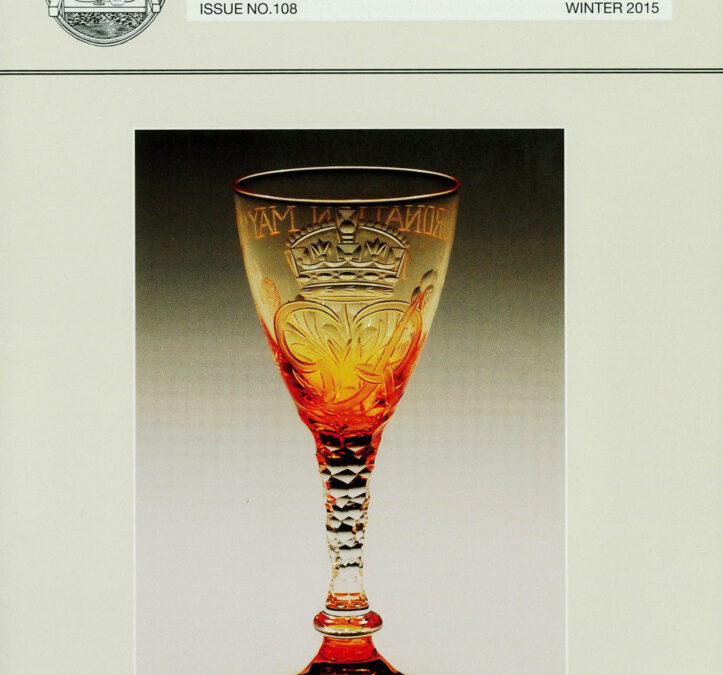
The Glass Cone
ISSUE NO.108
WINTER 2015
•
‘
Contents
1
Bimini and the Nude Lady Cocktail Glass Sets
6 John Derbyshire of Salford
8 ‘Salon de Refuse’ – IFG Contemporary Glass Exhibition
10 The International Festival of Glass and Biennale 2015
12 Synergy – Peter Layton’s London Glassblowing Gallery
14 St Nicholas Church, Moreton
16 Study visit to the V&A – June 2015
17 Station Glass – Richard Golding’s Workshop
19 David Reekie – Casual Bystanders
20 New Zealand North and South
22 John Scott’s Glass Collection Highlights
24 A 37-year Search is over
25 Book Reviews
26 Members News
28 What’s on. Your guide to exhibitions and other events
Chairman’s message
The Glass Cone
THE MAGAZINE OF THE GLASS ASSOCIATION
Issue No: 108 – Winter 2015
Editor: Brian Clarke editor©glassassociation.org.uk
Editorial Board
Brian Clarke, Bob Wilcock
Address for Glass
Cone
correspondence
E-mail editor@glassassociation.org.uk
or mail to Glass, 7 The Avenue, London N3 2LB
E-mail news & events to news@glassassociation.org.uk
Articles and news items are welcome at any time,
but please bear in mind the copy dates if you have
an event you would like to be publicised.
The opinions expressed in the
Glass Cone
are those
of the contributors. The aim of the Editorial Board is to
cover a range of interests, ideas and opinions, which
are not necessarily their own. The decision of the
Editorial Board is final.
Copy dates
Spring: 15 February – publication 1 May
Summer: 15 June – publication 1 September
Winter: 1 October – publication 1 January
Advertising rates
Full page £200; Half page £140; Third page £100;
Sixth page £70; Twelfth page £55. For inside back
cover and back cover, prices are on application.
Discounted rates for GA members
Please contact circaglass@aol.com
© The Glass Association 2015. All rights reserved
Design by Malcolm Preskett
Printed in the UK by Warners (Midlands) plc
Published by The Glass Association
ISSN No.0265 9654
The Glass Association
Registered as a Charity No.326602
Website: www.glassassociation.org.uk
Life President:
Charles Hajdamach
charleshajdamach@btinternet.com
Chairman:
Dr Brian Clarke
chair@glassassociation.org.uk
Hon. Secretary:
Judith Gower
secretary@glassassociation.org.uk
Membership Secretary
Maurice Wimpory,150 Braemar Road,
Sutton Coldfield, West Midlands, B73 6LZ
membership@glassassociation.org.uk
Committee
Nigel Benson; Paul Bishop (Vice-Chairman); Christina
Glover; Alan Gower; Kari Moodie; Zsuzsanna Molnar;
Malcolm Preskett; Rebecca Wallis; Bob Wilcock;
David Willars; Maurice Wimpory (Treasurer)
Membership and subscriptions
UK:
Individual: £25. Joint: £35.
Student with NUS card: £15. Institutions: £45.
Overseas: Individual or Joint £35. Institutions £55.
Life: £350.
Subscriptions due on 1 August (if joining May-July,
subscriptions valid until 31 July, the following year)
Cover illustrations
Front:
One of only seven amber & clear wine
glasses for the Coronation of King George VI,
1937; made by Stuart & Sons, Stourbridge.
Please see page 28 for the story behind this
illustration.
Back:
Ambersett’ by Keith Cummings.
Cast and polished glass with bronze, 2015.
(photo courtesy of Simon Bruntnell)
WITH public taste moving to collecting art-
glass from the 1960s through to contem-
porary studio glass, most of this issue has
been dedicated to this period. We present a
review of Peter Layton’s exhibition ‘Synergy’,
with many current glass artists involved, and
David Reekie introducing life comments with
his unique ‘people’ sculptures.
Last year started early with the Inter-
national Festival of Glass and Biennale. The
organisation and result provoked much
discussion and Bob Wilcock has written his
personal view which you’ll find alongside a
discussion on the separate Bruntnell-Astley
exhibition, written by one of the best known
contemporary glassmakers and educators,
Keith Cummings. We organised our one-day
events around the country, giving you all a
chance to come along without traveling too
far. Included in this issue, are articles on our
ever popular study day at the V&A museum,
held in June; a July day with Richard Golding
at Shenton Glass, attracting newcomers to
our meetings; then a very interesting visit
to the west country based on a visit to see
the Lawrence Whistler engraved windows in
St Nicolas’s Church in Moreton. This article
was offered to us by the Church Warden,
Mrs Sandra Clooney, who has worked for
the church for many years.
Following a well-organised and managed
2015 AGM at Warrington, we are delighted
that David Willars has now joined the GA
Committee and we welcome working with
him, his advice and skills, to organise future
events. We’re making space in the next
Glass Cone
for two articles on the AGM, an
overview of the day and a research article
into the Rostherne Goblet.
Broadfield House Glass Museum closes
at the end of this month — we will miss it.
During my time as a collector, the Stour-
bridge glassworks and BHGM were the
bedrock of my education. Though time does
move all things on, so the GA wishes the
British Glass Foundation well in its manage-
ment of the new museum, creating an
attractive and interesting venue for new
collectors; much of the internal design will
have been gained from the visit by the BGF
to Glasmuseum Frauenau early last year.
Do join us in Bavaria in September to see what
they created and travel with us to Barcelona
in spring to welcome a joyous year.
THE GLASS CONE NO.108 WINTER 2015
A
recent look down eBay and
online auction lists at what is
44
4′
being sold as Viennese
i
t
Bimini would probably make poor
Fritz Lampl, the founder of Bimini,
spin in his grave to which he went
prematurely in 1955. Apart from the
misattribution of glass by Istvan
Komaromy to Bimini, a plethora
of glass cocktail sets with crude
cast glass nude figures as stems
which claim the label Bimini have
recently spawned, it seems, but more
of that anon.
fig.1:
Flower-pot logo.
Bimini and the Nude Lady
Cocktail Glass Sets
Raymond Berger
400
including glasses, vases, animals,
and some odd things like glass
flowers in ceramic pots. In his
account of Bimini, Joseph Berger
outlined the method used:
fig 2:
Grey tangerine
dancer
fig.3:
Three girls in blue.
fig.4:
Vase, Eleusis.
To begin at the beginning: Bimini
Glass was started by Fritz Lamp! in
1923, in order to make a living –
poetry and literature not being a rich
source of revenue in 1920’s Vienna.
A partner put up some money
and my father, his brother-in-law,
modernist architect Joseph Berger,
assisted him with design work and,
as he recounts in his memoirs of
Bimini, some restraints on the more
kitsch elements of lamp-blown glass
objects. The venture was a success
and the output was substantial. The
little logo, a flower pot
(fig.1),
was
designed and labels stuck on, which
naturally fell off in due course. The
designs were extremely varied,
He worked from glass tubes of
different diameters and colours,
some even striped. Forming first
a mouthpiece the man suddenly
turned up the burner until the
glass grew red hot and pliable,
expanding as he blew into it,
twisted, reheated, and the bubble
finally cut with a knife to form a
foot and a vase had been born.
There was a great virtuosity in the
handling of such brittle material,
like taming an obstinate animal.
It had to be married to sensitivity
to turn craft into art.
I became interested and involved after
the death of my father in 1989 and an
invitation I received to go to the
substantial exhibition of Bimini
mounted by the art historian Dr
Waltraud Neuwirth near Vienna in
1992. Several large rooms were filled
with pieces by Bimini, and I was
astonished at the range and variety of
objects. Some of the eccentric vases
especially caught my eye. Amongst
all the objects on show I do not
recall any cast glass objects, and
contemporary photos of the Bimini
workshops show men working with
gas flames and glass rods. Later in
1992 I was back in Vienna for the
launch of Dr Neuwirth’s substantial
book on Bimini, which gives
numerous pages of examples of
the glass from catalogues, private
collections, museums and other
sources. Very many of these
examples are now extremely rare.
Some examples
(figs 2
and
3) are
shown of Bimini production in Vienna.
Figurines were popular. The first
thing to note is that the figures are
clearly lamp-blown, thin, abstracted
and show movement. Proportions
seem correct and the figures, though
uniform, are not identical. This
handmade quality distinguished the
output of Bimini workshops from
factory production. The eccentric
vases
(figs 4
and
5) are also from the
Bimini workshop. Very few examples
THE GLASS CONE NO.108 WINTER 2015
1
fig.5: Vase:
Prometheus
– both figs 4&5 are
shown in Bimini
catalogues.
survive except in museums and a few
private collections. I think the charm
of Bimini was and is its ephemerality,
reflecting the material’s fragility and
the sorts of items that were made.
One could say that the business side
of it all was careless in the extreme,
but then it was the brainchild of a
dreamer and poet, not someone
from a glassmaking tradition or
background. Many of Lampl’s
writings are in the Austrian National
Library and he was a talented artist as
well, a true polymath of the Arts.
One of the items of which Lampl
was proud was his perfume bottle
with a cupid or other object inside.
How it got in there was the secret of
the glassmaker, he told me, when
I recall asking him about it as a child
in London. In Vienna, Lampl and his
wife Hilde, who was a dressmaker,
had no children but enjoyed a
pleasant lifestyle, often taking holidays
with my parents.
My father was a modernist
architect who designed workers’
residences for the very left-wing
Vienna authorities of the day along
with his brother Arthur, who later
became a film art director. My mother
was an artist, and it was a happy time
for creative folk such as they were.
This all changed in March 1938
with the annexation, the
Anschluss,
of
Austria by Germany. Almost instantly
people who hadn’t given a thought
to their racial origins, such as Fritz
Lampl, were banned from running
businesses because of their Jewish
antecedents. According to the
account my father wrote of the Bimini
business, Lampl queued up with
other Jewish people to try to get an
exit visa to the UK and, it seems, was
successful on the basis that his sort of
craft-based work would be of use in
the UK, as would the dressmaking
skills of his wife.
On 2 July 1938, a Saturday, he
left a brief, handwritten note for
his assistant Maria Gunter. In his
gentlemanly way, he made no
mention of the fact that he was being
disbarred from his business by Nazi
criminals, but commended her for her
long service and on that basis left the
business to her. On the Sunday he
secretly left Vienna for good, such
was the atmosphere of mistrust and
suspicion that the Nazis engendered.
Lampl took with him his wife, elderly
father-in-law and some effects and
samples of Bimini glass. Mrs Gunter
found the note when she came to
open up the shop at Schubertring
on Monday. Subsequently, as con-
temporary papers show, she tried to
‘Arianise’ Bimini. It is unsure how
successful she was in this, but various
museums in Vienna benefitted from
Bimini glass from her, though the Head
of Glass and Ceramics at the Applied
Arts Museum in Vienna was at pains
to assure me last year when I was in
Vienna that they had acquired their
Bimini glass legitimately. Without any
shop inventories at the time of
Lampl’s escape it is impossible to
challenge this.
Lampl and family arrived in the UK
and by November he was already an
accredited member of the Society of
Industrial Artists. He again started up
Bimini in workshops in Great Chapel
Street, Soho, below the architectural
practice of my father who had arrived
in the UK in 1936 with his wife
Margareta. I was born in London in
1937. Fritz acquired from the British
Museum plaster copies
(fig.6)
of
antique coins, cameos and ornaments
and began to use them to make
earrings, brooches etc by pressing
molten glass into the negatives –
using gilding and coloured glass to
enhance them. It needed little skill and
unemployable refugee literati were to
be found in his workshop melting
glass while discussing arts and
politics – ‘very boring’ was the
memory of one such refugee. Lampl
was also assisting the ceramicist
Lucie Rie (later Dame Lucie), another
refugee and associate from Vienna.
She made ceramic buttons and other
items for Bimini complete with the
little flower pot embossed into the clay.
In this instance the Bimini glass
brooch is stuck onto Lucie Rie’s
clay backing. Later she became the
doyenne of British ceramics. Lucie
was always grateful to Fritz Lampl for
his help in her early days in the UK.
In trying to piece together the
history of Bimini, I am dependent
on various sources. The most
comprehensive and major source
is the book
Bimini,
by Waltraud
Neuwirth, which can still be found on
the internet. This substantial book
also has an extensive set of
photographs of the items which she
attributed to the Bimini atelier as well
as their catalogue numbers, giving us
a good picture of what was the Bimini
range of items in Vienna. Dr Neuwirth
also includes an essay my father
wrote about Bimini. This essay,
written at my request towards the end
of my father’s life is also a significant
source, if not always totally reliable,
given that the essay was written by
a very old man. Yet another useful
source is in the writings of my
mother’s sister Helene Koch who,
fig.6: Plaster copy
of antique coin
with its plaster lid.
2
THE GLASS CONE NO.108 WINTER 2015
fig.7: Orplid logo.
fig.8: Swan Glass
Bimini, Applied
Arts Museum,
Vienna.
fig.9: Swan Glass
Orplid, London.
due to circumstance, lived at one
time in the Hampstead London
house where Lampl lived for
many years and from where he
ran the glass business. Her
account of the last days of
Lampl and his wife make
gloomy reading but do fill some
gaps, especially in those of
my own recollections of that
time and those people. Then,
importantly, there is the scrapbook
which Lampl himself kept of the very
successful years in the UK, and of the
various reviews and articles which
appeared at that time. The original of
this is now in the Victoria and Albert
Museum in London along with many
other glass items I donated, which
I now regret as they are poorly
displayed and incorrectly labelled.
However I do have a photocopy of
the scrapbook here. The cover photo
is of one of Bimini/Orplid’s cupid
scent bottles. There are still major
gaps in my understanding and of
course one now regrets not having
been more inquisitive when the
protagonists were alive. As an
example I would like to know exactly
when Bimini became Orplid and why.
In his essay my father says only that
the little flowerpot, Bimini’s trade
mark, was still protected and Fritz
gladly had a new one registered to
comply with British requirements’.
The Bimini trade mark was used in
England initially. My hunch is that it
could not be renewed in 1943
because Bimini had been registered
in 1923 and had to be re-registered
every ten years. Hence it was
registered again in 1933, but
in 1943 England was at war
with Austria so the registration
failed. This is only a guess. The
Orplid logo
(fig.7),
designed
by my father was, as far as
I know, never used.
In 1940 the Fifth Column
scare made itself a national
concern, the idea that amongst
these hapless refugees Nazi agents
were planning their subversive, evil
activities, and after a campaign by the
Daily Express,
it was decided to intern
foreigners as ‘enemy aliens’. Both my
father and Fritz Lampl were caught up
in this and duly interned on the Isle of
Man. After a few months, common
sense and decency prevailed and the
assorted intellectuals were set free.
My father and Lampl found, to their
horror, that during their enforced
absence the Luftwaffe had flattened
their offices in Soho. Lampl started
up again in Kilburn and soon was
producing a range of domestic
glassware as well as the glass
buttons and brooches, which no
longer bore the little flowerpot insignia
on their backplates. An illuminating
article about this period appeared in
1950 in a now defunct journal,
John
Bull,
under the heading ‘Wizard in
Glass’. The main photo shows Lampl
holding up one of his glasses and
there is also a photo of glassblower
Ben George at work using a Bunsen
burner and hollow glass tubes and
rods, just as in the Vienna operation.
Wineglasses, hollow hatpins, and
perfume bottles were made as well as
other tableware. The article talks of ‘a
candlestick for five candles consisting
of eleven separate pieces fused into
one whole. It requires two or three
days work to complete’. This is clearly
of the type which was made in Vienna
by Bimini. If an example exists I have
never seen one over here. From
another source we read about Bimini
that the basic materials were semi-
finished products, that is, hollow
tubes and solid glass rods. The
desired object was formed freehand
at the flame of the gas burner. The
tiny tubes or rods were brought into
the desired shapes by heating,
turning, pulling, bending and blowing
and melting other parts onto them
etc. Every object made with this
procedure was unique, since no
metal or wooden moulds were used.
This shows the continuity of method
between Bimini in Vienna and
Bimini/Orplid in Oxford and London.
It all came down to finding really
skilled glassworkers such as Ben
George, who could work fast. Some
of the designs were also continued
from the days in Vienna.
The glass shown in
fig.14
was
amongst the varied glassware
produced by Orplid after World War 2.
Lampl and his wife rented a large
house in Hampstead, which I recall
first visiting as a child. At some point
THE GLASS CONE NO.108 WINTER 2015
3
he gave up the Oxford workshops
and then the Kilburn atelier and
latterly carried on Orplid from the
basement of the Hampstead house,
so things weren’t quite so bright, as
my father points out in his essay:
Once the war was over the
partner managed to squander the
accumulated profits by going to
the USA and buying expensive
Perfume bottles
by Orplid UK
Purchased by the
author
fig-
10
:
Perfume bottle
with flower
fig.11:
Cupids in bottles.
Each cupid in each
bottle is unique.
figs 108z11
are similar to
those in the
Bimini (Vienna)
catalogue.
fig.12: The rearing
horse is about one
inch in height.
fig.13: Examples of
Bimini brooches.
machines for mass-producing the
glass buttons just when imports
from Czechoslovakia had again
begun. The machines were
useless and Fritz gave his partner
the boot. Now he carried on alone
again overstraining his physical
capabilities until a heart attack
forced him to run his business
from his writing desk. Soon after,
Hilde lost all her savings to a
Spanish refugee woman whom
she was persuaded by Fritz to
employ to ease her office work.
The woman was imprisoned but
never returned any money. It was
ten years after the war and the
gentle couple had run their
course. Fritz died in hospital after
another heart attack and Hilde
followed him a few months later.
I quote this as my father’s recollection
and there are other views of how
things went wrong, but certainly these
naive and innocent people trusted a
secretary to run their affairs, carelessly
signing blank cheques till she had
stolen every penny, leaving them ill
and destitute with large unpaid bills
for gas usage in the workshop.
Having established that Bimini and
Orplid depended on skilled crafts-
4
THE GLASS
CONE NO.108 WINTER 2015
fig.16: Fritz Lampl
viewing typical
Orplid items in his
cabinet, London;
early 1950s.
men, who could reproduce the
models in the catalogue using only
glass tubes and rods, I should now
like to consider the many and varied
cocktail glass sets now to be seen at
auction houses and on eBay, of which
many make the claim that they are by
Fritz Lampl. I counted at least 25 sets
on sale recently. A moment’s thought
ought to make one realise that it is
highly unlikely that so many complete
Bimini sets should still exist after
World War 2. In truth genuine Bimini
items as shown in documents or the
catalogue are as rare as hens’ teeth
to buy now and I have been looking
for 25 years or more. In that time I
have identified two genuine pieces
which came on the market. I was
outbid on both of them, to my regret.
Of course sellers may claim their
products are by Bimini, which after all
no longer exists. The name Bimini is
now a sort of generic name for a sort
of lamp-blown Central European
glass and, a bit like Cheddar cheese,
you can claim the name for your
product, even if it isn’t the real thing.
The common factor to these
cocktail glass sets is the moulded and
rather crude nude lady stems to the
glasses. Sometimes the stem is in
the shape of a mermaid which is
also clearly moulded. The glasses,
bonded to the stems, are often of
coloured glass. There is a plethora of
these things on the market, some
making bolder assertions than others.
Indeed one firm makes the following
claim for a set of these typical nude
lady cocktail glasses and decanter.
This firm first claims that the set is by
Bimini and Fritz Lampl 1930:
This item has been fully inspected
in-house. All items are researched
thoroughly by our experts, who
have accumulated over 30 years’
of experience. We check
authenticity and provenance.
From the evidence I have I hope to
have shown that neither Bimini nor
Orplid used moulds, except for their
buttons, but never for blown glass
items. They never made cocktail sets
with nude ladies or mermaids. The
vast number of these sets leads me to
believe they are of fairly recent East
European origin, and clearly it is to
their advantage if buyers think they
are genuine Bimini.
However I want to give the lie to the
claim that these crude and ugly sets
were made by Fritz Lampl or his
Bimini Vienna atelier before World War
2. The honest answer would be to
describe these items as of ‘Unknown
Provenance’. As a final thought I am
here to be proved wrong. If some-
body knows better or has better
evidence I would love to hear it.
FURTHER READING:
Waltraud Neuwirth,
Bimini, Art Deco Glass Art
1992.
In German and English.
Charles Hajdamach,
20th Century Glass.
Lampworked Glass section pp.178-79.
Orplid Glass Scrapbook.
Original in V&A
Collection.
‘Bimini’. Essay by Joseph Berger FRIBA
Raymond Berger,
Bimini and Orplid Glass.
www.glass.co.nz (website run by Angela Bowey).
Raymond Berger, ‘Bimini and Orplid Glass the
Internet and Me’,
The Glass Cone,
no.58,
2001.
Angela M. Bowey and Bob Martin,
London
Lampworkers; Pirelli, Bimini and Komaromy
Glass.
fig.14:
Orplid wineglass.
fig.15 :
Nude lady glass.
5
THE GLASS CONE NO.108 WINTER 2015
John Derbyshire of Salford
(and Sydney and Auckland)
Peter Helm
j
OHN Derbyshire was a
glass manufacturer at
Regent Road Flint Glass
Works, Salford, from 1873 to
1876. This article has researched
some of the glasswares made
by him and the subsequent
history of John Derbyshire.
Twenty years ago, in
Glass
Cone 40,
the significance of
certain numbers on John Derby-
shire’s pressed glasswares
was discussed. These numbers
were associated with John
Derbyshire’s factory mark, an
anchor with the monogram `JD’
on the shaft. They appeared
to be in at least three series,
namely tumblers (with or without
handles), goblets (with or with-
out handles) and miniatures.
Only one ‘miniature’ is known
(308) and has been described
elsewhere as a ‘salt’, although
the version shown here (also
numbered 308) is in the form
of a comport, only 4″ diameter
and 2″ high.
The series are as follows:
•
Tumblers appear to be in the
series 1 to 199; known
numbers are 87 and 115;
•
Goblets are possibly from
200 to 299; known numbers
are between 246 and 259;
•
Miniatures or salts, from 300
to 399; only 308 is known.
The numbers are almost
certainly pattern numbers and,
like those on ceramic tableware,
would have been used by
wholesalers and retailers when
ordering replacements or
additions. In two instances both
the ‘pattern’ number and the
registration ‘diamond’ appear:
nos 257 and 258 are on the two
goblets registered on 8 August
1873. Presumably, earlier pattern
numbers pre-date 8 August
1873. The same pattern can
be seen both on tumblers and
goblets, so pattern 87 on
tumblers is identical to pattern
246 on goblets.
In 2014 when a group of
members, in association with
the Glass Association, held an
exhibition of Manchester and
Salford glass at Worsley, many
examples of numbered wares
were shown and some are
illustrated here. The images
are intended to show the
patterns clearly, the bowls con-
taining sand to eliminate internal
reflections. The complete list
(as known at August 2015) is:
87, 88, 96, 115 (tumblers); 246,
247, 248, 249, 252, 253, 254,
256, 257, 258, 259 (goblets),
and 308 (miniature).
They all carry the factory mark.
John Derbyshire registered
designs in 1873 and 1874, but
in 1875 and 1876 all his
registrations were in the name
of John Derbyshire & Co., the
partner being 18-year-old Elric
Birch, son of William Birch, a
Manchester merchant. There are
many examples of pickle jars
with the letter ‘B’ immediately
beneath the factory mark,
suggesting that the combination
relates to wares produced
during the partnership. John
Derbyshire never registered his
factory mark as a Trade Mark,
with or without the `13′, as the
Trade Mark Registration Act of
1875 did not come into force
until 1 January 1876.
The partnership between
John Derbyshire and Elric Birch
may have been in financial
difficulty from the start and
was dissolved in May 1876. At
dissolution John had substantial
debts, arising from unauthorised
withdrawal of cash from the
business. There is no sign that
members of his family were
prepared to help – they too
were probably short of capital.
Elric Birch, supported financially
by his father, intended carrying
on the business keeping the
same name, i.e. ‘John Derby-
shire and Co.’, but if he did it
could only have been for a short
6
THE GLASS CONE NO.108 WINTER 2015
while as, in 1877, Edwin H.
Downs and Richard Walton
were in business at the Regent
Road Glass Works.
John Derbyshire himself –
then living at 9 Rumford Street,
close to the Regent Road
factory – was declared bankrupt
on 29 December 1876, after
which date he would be
precluded from carrying on a
business until discharged. That
discharge occurred on 3 August
1881. In the 1881 census he is
shown as living at 285 Eccles
New Road, Salford, a con-
tinuation of Regent Road. His
occupation was noted as Flint
Glass Manufacturer, but in the
1891 and later censuses, neither
he nor any other members of his
family are to be found, though
he was still recorded in the Street
Directories until 1886/7.
In the 1876 directory, John
Derbyshire and Co. were at
Regent Road Flint Glass Works,
with John as a partner, and
James Derbyshire and Sons
were at Trentham Street and
City Road, with James as a
partner. But, in the 1877/8
directory, both James and John
were partners in James Derby-
shire and Sons at the Trentham
Street and City Road factories.
There were changes again in
1883 and 1886/7, with James
Derbyshire and Sons’ factories
now at City Road, Hulme and
Regent Road Flint Glass Works,
Salford, with both James and
John as partners. But, in 1888
and subsequently, John’s name
no longer appears either as a
partner or as an individual.
‘World-wide Ancestry’ searches
for ‘John Derbyshire’ produced
an unexpected appearance of
his name in several family trees
including an Australian one.
He does not appear in the UK
Outward Passenger Lists
1890-1960, so presumably he
and his wife Elizabeth (and
family?) emigrated after 1887
and before 1890. Australian
directories show him in Sydney.
The 1892 Sands Directory
(Sydney and NSW) says:
‘Derbyshire, John, importer of
glass and earthenware, 29
Jamieson Street, Sydney’. This
entry was repeated in the 1893,
1896, 1897 and 1898 directories,
where he is described either
as ‘importer’ or ‘manufacturer,
importer and agent’.
No more Australian records
have been found but, in New
Zealand in 1905/6, there are
entries in the Auckland West
Electoral Roll. Roll no.1347:
‘Derbyshire, Elizabeth, Ponsonby
Road, married’. Roll no.1348:
‘Derbyshire, John, Ponsonby
Road, importer’. ‘Elizabeth’
would be the Elizabeth Roberts
(née Whittaker) whom he had
married in 1880. He is in the
New Zealand Death Index,
1848-1964 as ‘John Derby-
shire, July-Aug-Sept 1907’
and finally in the Notices of
Deceased’s Estates as : ‘John
Derbyshire, died 7th Sept 1907
– Probate (Public Trustee)’. His
probate record is held in
‘Archives New Zealand’ as
‘Derbyshire, John – Auckland –
Importer – 1907 (R21444771)’.
So, was it ‘our’ John Derby-
shire, flint glass manufacturer
of Salford, who gave up the
manufacture of glass, migrated
to Australia, and died in New
Zealand?
Yes, almost certainly.
THE GLASS CONE NO.108 WINTER 2015
The foot of 258 showing the pattern number on the left of the foot.
7
`Salon de Refuse
Contemporary Glass Exhibition at the IFG 2015
Keith Cummings
T
HIS exhibition, which was organised
by Bruntnell-Astley, provides a
showcase for a number of individual
glass artists, who — although united by
their use of glass as a creative, personally
expressive medium — produce stylistically
diverse work with a range of highly
personal skills and approaches to their
chosen material. The works themselves
demonstrate the full range of glass-
forming and decorating techniques and
processes, including blowing, kiln-casting,
lamp-working and slumping for shaping
the glass, to enamelling, sandblasting and
engraving to decorate it.
A selection from the show will illustrate
this diversity.
Professor Keith Cummings
(fig. 1)
was a
pioneer of the studio movement and has
been a teacher, author and practitioner for
over fifty years. He particularly helped to
define kiln-forming as a separate activity
within the studio movement. His works,
which feature in museums and private
collections worldwide, stem from
paintings, usually of the natural world,
which are then interpreted through his
unique glassmaking vocabulary. The
resulting sculptures often involve cast and
fabricated bronze combined with the
complex, multi-cast glass elements.
James Lethbridge
(fig.3)
by contrast is a
recent graduate of the Royal College of
Art. He produces chandeliers and complex
multi-structured forms inspired by nature,
like microscopic pollen grains. He trained
as a lamp-worker in order to achieve the
necessary control over the medium.
Harry Morgan
(fig.2)
is also a recent
MA
graduate, this time from Edinburgh
College of Art. Like James he has invested
a great deal of time and effort in developing
very specific skills in order to form the glass
and achieve his vision. He combines
glass with materials like stone and metal,
creating sculptural forms that play on
contrasts between delicate glass filaments
and the hardness and weight of solid
forms; sometimes reversing expectations
of strength and fragility.
Wendy Newhofer
(fig.4)
came to glass
after specialising in two-dimensional
works in paper, and her fused glass wall
panels reflect this. She uses the process to
enclose wire and enamel inclusions within
the glass sheets, creating permanent
evocations of transient natural forms like
seed pods.
Dr Max Stewart’s
(fig.6)
highly personal
sculptures stem from a variety of sources,
and particularly from his doctorate
research. In this he sought to replicate
the
pate-de-verre
casting process of the
French artist Amalric Walter. He suc-
ceeded in unlocking the secrets of the
process, both replicating and extending
the original casting methods and the
colour technology. The resulting sculptures
exemplify the growing links between high-
level academic research and cutting-edge
glass artworks.
Jenny Pickford
(fig.5)
combines two
personal skills to produce her exterior
large-scale sculptural statements. These
show off both glassmaking and black-
smithing processes; the black, hand-
forged shapes of the iron resonating
against the delicate blown glass, flower-
inspired forms.
Despite the variety of approaches,
styles and object types demonstrated by
the works of all of the artists featured in the
exhibition, they all share one crucial factor.
They are all designer-makers in that they
produce their works themselves to their
own designs. In the traditional model,
developed within the handmade industry,
designs were produced as drawings which
were realised in glass by craftsmen,
which effectively meant that the making
process could not become part of the
creative journey from idea to object. With
the designer-maker the engagement
with the material becomes a fully creative
partnership. Indeed it would be fair to say
that contemporary studio-glass artefacts
often continue to evolve throughout the
entire making stages, with the artist taking
full advantage of their control over the
material. Also, whereas factory production
concentrated on producing large numbers
of near identical objects, often with a
specific market in mind, the contemporary
glass artist uses glass as a means of self-
expression first and foremost, like a fine
artist. This has resulted in a blurring of the
fig 1: Keith
Cummings and
his work at the
exhibition.
photo by Alan Gower
fig.2: Hany Morgan,
Amalgamate
Study’.
8
THE GLASS CONE NO.108 WINTER 2015
personalised during the past 50 years to
the point where the individual style of an
artist is often at least partly dependent on
their version of traditional skills. Some
processes, particularly associated with
kiln-forming, have developed enormously
during the studio movement. Casting,
for example, is more complex and
sophisticated now than at any time in the
history of glass.
This diversity in approach is also evident
within the range of ages and experience
of the group. This varies from established
figures to those beginning to make their
mark internationally. The range of objects
produced by these artists also varies
greatly in scale, function and category,
from small-scale domestic items to large-
scale sculptural pieces. They are all
however characterised by their individual
qualities. It might seem strange that glass
artists should have doctorates or hold
professorships; however, glass is now
firmly embedded
in
the educational
system and it is now possible to study at
undergraduate and postgraduate level in
glass as a craft-based activity. The artists
represented by Bruntnell-Astley reflect
this. The majority of the artists hold
graduate or postgraduate qualifications,
and some are high-level academics in
addition to their personal practice. The
gallery was founded in the Stourbridge
area, and many of the artists are residents
or have been educated locally.
For over two centuries Stourbridge was
the centre of the English handmade crystal
glass industry, reaching its zenith in the
19th century. Factories like Thomas Webb
and Stuart Crystal produced some of the
iconic glass designs of the Victorian era
which became, along with the designers
and craftsmen that produced them, world
renowned. The factory system itself was
dependent on the unique creativity of
figures like Frederick Carder and John
Northwood. Although the major factories
are now closed, succumbing to the
pressures of global mass production, there
exists a residue of archive, example,
scholarship and expertise that still feeds
creative glass production within the area.
Wolverhampton University houses one of
the premier glass courses in Europe, and
many of its graduates have become global
stars. Since the demise of the factory
system there has been a dynamic growth
in studio-glass in the area, and this has
led, in turn, to the establishment of the
Biennale Glass exhibition. Since 2004 it
has become a major showcase for the
very best in British studio glass.
This briefly is the background within
which the artists featured in this exhibition
demonstrate their various approaches to
glass as a personal medium. C.R. Ashbee,
the Arts and Crafts pioneer, who through
his example did so much to establish the
British craft tradition, talked of ‘those who
are seeking to relate the creations of their
hands to their reasons for existence in life’.
It is a statement to which all of the artists
in this exhibition would subscribe.
figs 2-6 by kind permission of Simon Bruntnell
line between the fine and applied arts,
with glass art marketed through specialist
galleries, and with a high degree of
originality, as the finished pieces
demonstrate the operation and develop-
ment of a distinct individual signature
style. The resulting objects can be
variously described as decorative or purely
sculptural works.
The studio-glass movement is barely 50
years old, and more individual artists are
using glass as their material of choice
worldwide than at any time in its 5,000-
year history. Techniques and processes for
forming and decorating glass have been
fig.3: James
Lethbridge,
Midas Jar.
fig.4 (above right):
Wendy Newhofer,
nature design.
fig.5 (right):
Jenny Pickford,
‘Circles of Life’.
fig.6: Dr Max
Stewart, pate-de-
verre sculpture.
THE GLASS CONE NO.108 WINTER 2015
9
The International Festival of Glass and
Biennale
2015
A personal view — Bob Wilcock
Ashraf Hanna
with winning
glass sculpture.
Biennale
Exhibition
overview.
The Biennale
FOR glass artists the Festival starts with
masterclasses, but for the public the first
event is the Biennale Awards Ceremony.
The overall winner was Ashraf Hanna, a
ceramicist from Wales who has only ever
made five pieces of glass, but his stunning
pieces really did stand out from the crowd.
Beautifully shaped works of art, they are
untitled but superbly cast and Ashraf
readily acknowledges the enormous
help and advice given to him by Heike
Brachlow – who also worked with other
artists accepted for the show. Other fine
works were awarded prizes, but my overall
impression was one of disappointment.
The pieces were by and large very well laid
out on long tables that enabled you to get
up really close and view them from all
angles, but the scale of the pieces was
small – the judges commented that
relatively few large pieces were submitted.
For me, too high a proportion were
student pieces. It has been a regular
criticism of the Biennale that art triumphs
over technique and it stood out more than
ever this year. The judges also commented
that some entries looked better in the
photographs from which they were
selected than they did in reality, which
doubtlessly explains one or two very
strange and baffling pieces.
Some major artists we spoke to
expressed surprise and disappointment
that their best efforts had gone
unrewarded, but one who had had an
award in the past said that he felt it was
good that awards were going to students
and younger artists starting out on their
careers – they needed the recognition and
encouragement to help them on the way
to making a career in glass.
Lectures and demonstrations
THIS was a theme taken up by Colin Reid,
who had contacted past Biennale award
winners, and obtained their views on the
award, and how it had affected them and
their careers. There were some powerful
and moving comments as to how the
award had both inspired and encouraged
each artist and how valuable the money or
residency had been in enabling them to
buy equipment, or develop their artistic
and technical skills and ideas. All those
who replied are making successful careers
in glass and some, like Cohn, have found
success internationally.
British glass is up there with world
leaders. The same can no longer be said
of Murano glass. The island is sinking
under the weight of Chinese competition
and perhaps the departure of some of the
finest glassmakers to the USA. This has
led to the City of Venice, in collaboration
with Consorzio Promovetro Murano and
the Museo del Vetro (Murano Glass
Museum), to establish the European
Glass Experience, a two-year collaboration
with various European museums, glass
study and production centres. Cornelia
Lauf is the Scientific Director and she
explained how European Glass Experience
aims to link practices in this medium to
contemporary art and to foster the role of
glass artisanship as an intangible cultural
heritage to be safeguarded and promoted.
She remarked that she found the IFG the
most outstanding example she had come
across in the whole of Europe’.
Dante Marioni’s name discloses his
Italian origins, but he grew up in California,
and gave a fascinating lecture explaining
his family background, together with some
of the most important examples of his own
work; he then illustrated the works of the
American glass masters who had most
profoundly influenced him, including Lino
Tagliapietra. He is a perfectionist and the
start of his demonstration in the hot-shop
nicely showed this: the first thing he did
was to take a small gather of glass and
test it together with his tools on it – he had
brought his own tools with him. In 90
minutes he made three pieces, using
ever more complex Venetian techniques,
working hard, fast and with precision, yet
totally relaxed – a true maestro.
There were numerous other talks and
demonstrations – far too many to be able
to attend them all – and not just in the
Ruskin Centre, but at the Bonded
Warehouse (for beads), at the Red House
Cone, and, for the last time before it closes
and the collection transfers to the new
Museum at the White Cone, Broadfield
House. Catherine Coleman gave a sell-out
10
THE GLASS CONE NO.108 WINTER 2015
Celebrity doodles
THE British Glass Foundation came up
with a fascinating project – asking
celebrities to provide doodles to be used
to provide inspiration to a host of talented
glassmakers. Steven Piper and Nancy
Sutcliffe’s demonstrations included work
on their pieces (doodles by Robert Plant
and Raymond Blanc respectively). In her
studio at Ruskin, Terri Colledge showed
her work inspired by a doodle from Tony
Hadley of Spandau Ballet. In his workshop
Vic Bamforth worked up his artwork inspired
by a doodle from Dave Hill of Slade. This
was reheated, cased and blown out as
one of a series of impressive demon-
strations, including Jonathan Harris, in
front of as many spectators as could
be crammed in at Allister Malcolm’s
Broadfield House studio. All the pieces
have now been auctioned at Fieldings
Auctioneers, raising funds for the
work of the British Glass Foundation.
The hub of thelFG at Ruskin Centre.
artists (see Keith Cummings’ article ‘Salon
de Refuse’).
The exhibition of Hungarian glass at
Broadfield House included pieces that just
took your breath away.
On the final day, the ground floor of
Broadfield was filled with paperweights,
accompanied by a demonstration in the
hot-shop by the renowned John Deacons.
He showed how he made various styles of
Dante Marione
demonstration.
Vic Bamforth’s
creative vase.
John Deacons
making a teapot
paperweight.
talk on engraving at the Red House Cone,
Patricia Hilton-Robinson demonstrated
there, while Nancy Sutcliffe and Steven
Piper demonstrated their contrasting
engraving styles at Broadfield House.
Evening
events
EVENING events included some dis-
cussions around the Biennale exhibits,
led by the curator Matt Durran, and
award ceremonies for the Contem-
porary Glass Society’s ‘Wish You Were
Here’ glass postcard exhibition and for
the impressive Guild of Glass Engravers
exhibition in the Red House Cone. There
was a glass quiz night with pub games,
then an evening of topical and amusing
poetry by Emma Purshouse in the
impressive 18th-century Hagley Hall. In a
tour of its attractively landscaped park, our
guide took us to a secluded dell where a
seat had been uncovered, clearly made
from broken up pieces of a glass furnace.
It’s speculation, but there is an intriguing
possibility that this is from a secret furnace
set up at a time when glassmaking was
largely prohibited because of the loss of
forests. With luck, the restoration of the
park will throw up more evidence.
Exhibitions
THERE were several excellent exhibitions
held outside the Biennale. A ‘Salon de
Refuse’ exhibition, sponsored by Bruntnell-
Astley at Wordsley Methodist Church,
featured glass sculptures by Jenny
Pickford, normally only seen at places
such as Chelsea and Hampton Court, and
included other outstanding works by major
paperweight, blew out a long strand of
enamel twist and made a simple dish with
a murrine base – the bowl effortlessly
blown out by steam expansion. The base
was heated and picked up on a solid rod,
a small gather of glass was then added
and the centre indented. A piece of wet
wood shaped like a large pencil was then
pushed into the opening and almost
before you could blink, the steam created
had blown the glass into a goblet shape,
quickly finished off into a bowl; simple,
effortless, and most impressive.
There only remained the Fun Auction
back at Ruskin to round off a most
enjoyable Festival. With the new museum
due to open by the time of the next festival,
I can’t wait.
THE GLASS CONE NO.108 WINTER 2015
11
SYNERGY
An Exhibition by Peter Lay
–
on’s London Glassblowing Gallery
Caroline Swash
ATD FMGP
9.1
,
-MO2′,1,971A46,
,
,
,
A,
A
N Autumn Exhibition (11 September –
17 October 2015) should always
have an appropriate theme, some-
thing challenging after the holidays. For
glass people with the demands of
Christmas sales in the offing, a period
of focused experimentation can be
refreshing – if exhausting. After London
Glassblowing Gallery’s success at ‘Collect’
this year, Peter Layton and the curatorial
team headed by Cathryn Shilling
eventually settled upon ‘Synergy’ as the
next exhibition’s challenging working title.
Mixed media were positively encouraged.
Glass could be combined with metal,
plastic, ceramic, timber, stone, fabric –
almost anything.
This was quite a challenge. New
materials had to be explored, artists
contacted and great efforts made to
overcome all the technical problems
thrown up by these possibilities. Much
was learnt and the many beautiful pieces
created in accordance with these exacting
terms delivered to the Gallery for the
September opening. Two renowned
outsiders were also invited to take part.
David Reekie sent
Daggers Drawn (fig.2)
–
a pair of knife-clutching grumpy men in
glass conversation, one of a series of four
pieces he had been working on in 2011
making quiet fun of ‘the hidden aggression
found in society, which seems to be at a
hiatus in recent times’. Nick Mount, one of
the most distinguished of the pioneering
generation of Australian glassworkers sent
two ‘Still Life’ pieces in which glass and
carved timber were combined. These he
described as ‘imagined fruit-like forms with
soft geometric shapes’ developed as an
antidote to the ‘supposed symmetry of the
beautiful combination of wood and glass’.
Another invited outsider was the
Japanese artist Takako Shimizu whose
unusual mosaic sculpture
Ophelia Drowned
(fig.1)
presented us with the haunting
vision of Hamlet’s young lover in the green,
slithery embrace of river-weeds. Shimizu’s
background in textiles and her passion for
gardening somehow came together in the
creation of this very unusual piece.
These three stood slightly apart from the
predicaments explored by the London
Glassblowing team. Peter Layton himself
changed our perception of his swirled
vessels by turning them into fanciful
flowerpots topped with bronze stalks,
shoots and thistles
(fig.3).
These spiky city
survivors were cast and patinated in
collaboration with Witold Dziubak of the
South London Foundry. The challenge of
mixed media gave the exhibition’s
organiser, Cathryn Shilling, new oppor-
tunities for the development of different
directions for her signature woven glass
fabric. She created the very successful
Lucid Chalice
for George Jackson’s
ceramic base and the magical
Nestled
(fig.
7) containing three bronze eggs from
Dziubak’s foundry perched on a perfectly
proportioned (ash) timber base.
Such an all-inclusive word as ‘Synergy’
could be interpreted in so many ways.
Louis Thompson, one of the Glassblowing
team and performance artist Sheila
Ghelani together created an enchanting
glass sculpture whose circular cavities
were filled with ‘a selection of plant-life
collected from the old Surrey Docks, found
in crevices and growing doggedly in
cracks’. By contrast, Cristina Vezzini from
Italy and Sheng-Tsang Chen from Taiwan
(Vezzini and Chen) were both fascinated
by the possibilities of china inclusions
within glass bubbles. Their back-lit wall
board and glass and ceramic lamps must
surely be moving towards the possibility of
architectural commissions. Neil Wilkin’s
standing piece, a miracle of feathery gold
on a twisted metal support, stood nearby.
His glass blowing skills were also in use as
the basis for artist Rachael Woodman’s
exquisite sequence of delicious blue bowls
and their perfect small containers set in an
impossibly elegant dish.
While the terms ‘sculptural’ remain
hazardous in this context, nonetheless it is
hard to regard John Burton’s amazing
gravity-defying black and clear glass
blocks
Reluctant Connection Ill (fig.4)
as
anything else. Stare how we may, their
construction retains its mystery. Anthony
12
THE GLASS CONE NO.108 WINTER 2015
left:fig.4
right: fig.5
left: fig.6
left:fig.7
right:fig.8
All photographs
by the kind
permission of
Ester Segarra
Scala’s
Dark Matter
and
Particle (fig.
6) set
in a cabinet to be viewed in the round, play
even more complicated games with our
perception of light and space. Here we
can see a little world, a cosmos inscribed
in light, yet absolutely solid and utterly
illusive. Scala’s observations on his own
approach are hardly reassuring. In con-
versation with Cathryn Shilling he once
observed that ‘Light exists with neither
mass nor substance, yet given the right
conditions, can yield images of absolute
solidity’ adding that ‘these shifts of per-
ception … are an infinite source of inspiration’.
Perhaps the most accessible of the
sculptural works are the effigies made by
Peter Hayes, a well-known ceramicist
working on this occasion in mixed media.
For this exhibition he used bronze, copper
and marble in the creation of sculptural
supports for a sequence of elegant glass
flambeau made in his Indian workshop.
While these totemic pieces referenced
time-honoured forms,
Android
by London
Glassblower Elliot Walker and
Bandits of
Glass
artist Tim Boswell had a sharp
contemporary feel, a small figure with a
threatening stance decorated with glittering
fragments (dichroic). Sadly, there was just
one on show; an army of Androids would
have worked so well.
In glass, a series or sequence is very
satisfactory. Happily Louis Thompson and
Hanne Enemark’s contribution to the 2014
‘Vetro’ exhibition was exhibited again at
this exhibition in all its extended glory. To
recreate an ancient technique in a new
way is always exciting. Here white cane
has been dropped into the partly blown
forms with incredible dexterity (beautiful
to watch) providing the viewer with a very
special visual experience as the light
catches the organic twists of the material
set into a series of sun-coloured vessels.
Indeed, the space in which these were
exhibited appeared especially attractive
thanks to the proximity of work by Richard
Slee, one of today’s best known ceramic
artists. His
Torches,
shining coloured glass
rays onto their standing surface, were
made during working sessions with James
Maskrey at the National Glass Centre in
Sunderland. Nearby, Layne Row’s magnifi-
cent patterned glass sculpture
(fi9.5)
brought
an incredible feeling of light and warmth
to this area below a ‘Wall Sculpture’
by Sophie Layton and Tim Rawlinson,
constructed using Sophie’s prints and
images photographed through coloured
glass lenses. Jochen Ott was telling a
story, presenting a linked pair of wheel-
carved, cut and polished rectangular
blocks, the jagged dips in the smooth
texture surfaced with 23ct red gold
(fig.8).
By setting new challenges for them-
selves, the resident artists at London
Glassblowing have once again produced
a seriously exciting show. Next year, every
reader of the
Glass Cone
should make
absolutely certain that time can be set
aside time for the Gallery’s 2016 Autumn
Exhibition. The title has already been
chosen. ‘Black to White and Back Again’
has for a long time been a favourite
conundrum of curator Cathryn Shilling.
Besides the London Glassblowing team,
she has invited members of the Con-
temporary Glass Society to face the
same challenge. This will be a very exciting
show.
Be there!
THE GLASS CONE NO.108 WINTER 2015
13
St Nicholas Church, Moreton
The Engraved Windows of Laurence Whistler – a brief outline
Sandra D. Clooney
fig.1: St Nicholas
Church, Moreton;
facing the north
wall.
fig.2: Thefirst of
the north wall
windows.
fig.3: Thefive Apse
windows.
0
N 6 October 1940 at approxi-
mately 9pm, a bomb was
jettisoned from a German
plane and fell on the graveyard. The
north wall was badly damaged, the
blast taking out all of the stained-glass
windows along with other artefacts
inside the building. It took years
to rebuild, ten years in fact. In the
interim, the congregation worshipped
either at Moreton House or in the
village hall.
There were insufficient funds for the
rebuilding of the church to include
stained-glass windows, hence the
plain wartime glass was used, but this
was not to the liking of the con-
gregation. This came to the attention
of a visiting historian from Oxford who
was attending a service and it was
through him that the glass engraver
Laurence Whistler was approached
and asked to submit drawings for
replacement windows. The proofs were
accepted and the five Apse windows,
paid for by war damage money, were
inserted
(fig.3).
It took five years for
those and over 30 years before the
remainder were completed.
The engraved glass windows
THE overall theme for the windows
was LIGHT. The windows are allusion
windows, if the light is not right,
the windows cannot be completely
appreciated as the light plays tricks!
The images are spiritual, candlelight,
sunlight, jewel light, starlight and
lightning plus the Galaxy.
The first windows in the east end
are in the Apse and were completed
in 1955, followed in 1974 by
The
Seasons —
a gifted window.
1974 saw the installation of three
windows on the north wall. The first of
these depicts guttering candles, the
days of darkness, Crown of Thorns.
The centre panel is based on the
Anglo-Saxon poem
The Dream of the
Rood,
a dedication to the Findlay
family; it features the Alfred Jewel, an
Anglo-Saxon artefact which is in the
care of the Ashmolean Museum in
Oxford. To complete the last window,
there are candles burning brightly
along with a floral tribute
(fig.2).
The
Trinity Chapel
(1982) is in memory
of an RAF airman killed over France.
The theme is fruitfulness, featuring
everything in threes. Hares, birds,
butterflies, an aerial view of Salisbury
Cathedral, the sun’s rays, falling rain,
all meeting together with a vapour trail
to form Chi-Ro (The first two letters of
the Greek word ‘El
–
111T0 ‘ for Christos
or Christ). Also shown are a broken
propeller and nosecone of an aircraft.
The window was an anonymous gift
from his widow
(figs 4,5,6).
14
THE GLASS CONE NO.108 WINTER 2015
figs 4,5,6: details of
the Trinity Chapel
window.
figs 7,8: The
Galaxy seen in
different lighting.
fig.9: A lancet
window in the
entrance porch.
Photos 5,6,& 7 by
kind permission of
Mrs Clarice Wicker den
Photos 1 & 2
by Brian Clarke
Photos 3,4,8 & 9
by kind permission
of Edmund White
At the west end is
The Galaxy
Window
(1984). It is based on a hymn
by Addison The Spacious Firmament
on High’. There are many items to be
found there
(figs 7,8).
The vestry window on the south
side was also a gift. Depicting flashes
of lightning forming maps of the two
local rivers (Frome and Piddle), with
a fireball marking the geographic
location of the church.
As you walk through the entrance
porch into the church, often missed,
are two small lancet windows
celebrating a marriage and death;
installed in 1987
(fig.9).
Laurence Whistler gave the church
the final southeast corner panel
window. Strictly speaking this is not
a window, as it is blanked off by the
interior wall of the Trinity Chapel and
may only be viewed from the outside.
The window was given in 1993 but
only installed in 2013 and then
dedicated by the Bishop of Salisbury.
The window is titled
Forgiveness,
a
special thought on the scene of
Judas meeting his maker, though not
able to be seen from the peaceful
interior of the church.
Technical note
WHISTLER constructed full-size
designs for the Apse windows;
these were carved out by crafts-
men from the London Sandblast
Company, using techniques of deep
cutting, acid etching and sand-
blasting. Laurence was assisted by
craftsmen T. Ide, W. Ide and chiefly
by D. Richardson.
The Trinity Chapel window, The
Dream of the Rood
and
Forgiveness
were entirely created by Whistler,
using scriber and drill.
THE GLASS CONE NO.108 WINTER 2015
15
Study visit to the V&A – June 2015
L
IKE many members of the Association I have
spent many a quiet hour in the Victoria and
Albert Museum. As a collector and dealer in
Georgian glass I have spent a good deal of time
over the last few years gazing at the cabinets full of
Queen Anne, Georgian and earlier glass with a
mixture of gratefulness that such glass has been
saved for the nation without unbecoming avarice.
It was therefore with some mixed feelings that I
took up the offer of a Glass Association (GA) study
session at the V&A in June. I must admit that I had
a motive in doing so, as I had acquired a small
collection of early
facon de Venise
wine glasses
and was hoping to pick some brains larger than
the one I carry around, to leam their possible origin,
but my expectations were not particularly high.
I turned up an hour and a half before the
session began and spent most of it in the glass
display rooms on the fourth floor, once again
convincing myself that the Queen Anne goblets with
nipt diamond wales would probably look better
in my cabinet at home. I then descended to the
ground floor lawn area behind the museum to
drink tea and eat in the early summer sunshine.
Queen Anne goblets, tea and scones, ladies in
bright summer frocks, gentlemen in boaters (yes,
at least two while I was there). You can’t beat
England when the sun shines. It was therefore in
good heart that I re-entered the museum to meet
up with the GA group at the Information Desk.
Being a large gathering of enthusiasts, we had
to be divided into two groups. Judith Gower, a GA
committee member, greeted us and introduced
our hosts, Reino Liefkes and Susan Newell; our
group trotted off to the glass galleries promptly at
2pm following Reino. Rebecca Wallis was to have
been our host but had to attend a family funeral.
We offer our commiserations. The other group
went into a glass study session. Reino, senior
curator of the sculpture, metalwork, ceramics and
glass department at the V&A has worked there for
over 20 years; goodness knows how many tours
Neil Chaney
he has conducted. Even so it was invigorating to
hear him talk about their glass with the enthusiasm
of a neophyte. We didn’t really get out of the first
gallery! This is essentially given over to 21st-
century glass and is dynamic in that the display
has to change each time they make an
acquisition. As one piece comes in, one piece
goes into storage or into the back gallery if a place
can be found for it. The V&A allows its stock to be
displayed at other museums but does not sell off
its old stock. According to Reino, unless it was a
million pound offer it just would take too much
sorting out. That begged the question, just how
much glass is there at the V&A? Well, apparently
almost ten times more than is available through
images. Unlike the ceramics department where
all 30,000 pieces have apparently been photo-
graphed and catalogued, the glass collection is
comparatively undocumented. What gems must
be hiding down in the storerooms?
I like modern glass, with more than a passing
interest in Scandinavian and Czech glass of the
mid-20th century, but listening to Reino talk about
the pieces in the 21st-century Marit Rausing
Gallery made me realise how much I was missing
every time I sailed through to see the 18th-century
glass behind it. Each of us in our group of twelve
had their own favourites, but for me the two pieces
by Stanislav Libensky were the most stunning.
Unfortunately no longer with us, having died in
2002, Libensky was represented by two fairly
massive pieces of glass sculpture in the gallery.
Arcus 1 (fig.2)
was almost a metre across, a half
circle in shape, polished flat to the front and
rounded to the rear, with a tall, narrow arch cut
through the centre. Its shape meant that the glass
varied in thickness from a few millimetres to tens of
centimetres and even in the artificial light it came
alive. My own favourite was the red glass piece
entitled
Cross Head,
cast in 1988. Reminiscent
of Stalin’s hammer it changed character with
perspective, again reflecting and refracting light
differently dependent on where one stood, the
differing thickness of the glass producing an
illusion of movement.
Reino talked knowledgeably and enthusiastically
about each piece and the artist behind it. Some
pieces had been donated by the artist, some by a
benefactor of the artist, some had been acquired
in the same way as a normal buyer. 45 minutes
had gone by and we hadn’t even entered the holy
of holies, the larger inner gallery.
(Fig.1 shows the
gallery viewed through a cabinet displaying
opalescent glass).
When we did eventually do so,
Reino explained that the lower floor was arranged
in essentially historic order, starting with Roman
and early Islamic glass on the left-hand wall as you
entered, through the Venetian glass of the 16th
and 17th centuries to Georgian glass as the
display cabinets returned on the right, through
19th-century and 20th-century glass. There is also
an upper gallery, mounted by a glass staircase
created by Danny Lamm; this acts as an overflow
storeroom but which is visible to the public. Each
shelf is packed with ancient, antique and vintage
glass to a level which is almost overwhelming. For
those of you who like to display your collection
behind glass doors, it is worthwhile finding out
1 6
THE GLASS CONE NO.108 WINTER 2015
about the cabinet glass that the V&A uses. It is
almost as if it isn’t there and I twice had to check
by touching it with my hand that there was actually
a glass barrier between us and the display.
Apparently it only needs dusting once every ten
years or so! Even I am up to that.
At three o’clock it was time to swap with the
other group. Up to a private study room on the 6th
floor to be hosted by the lovely Susan Newell and
Milica Budimir. This was the main reason for us
each being there that day. The V&A kindly allows
the Glass Association members to view and
handle items from the glass collection in a con-
trolled environment. We had each been asked
to single out a piece of glass that we would like to
inspect (a particularly gorgeous 17th-century
facon de Denise
wine glass in my own case) and
these were laid out for us. We were provided with
thin rubber gloves so that we didn’t leave finger-
prints over the pieces and we were seated around
a square table with rubber matting to protect the
glass from damage through fumbling. A dozen or
so pieces were brought over one by one and
passed around the table starting off with an
amethyst Ravenscroft carafe with nipt diamond
waies decoration
(fig.3)
and the
facon de Denise
wine glass
(fig.4)
that I had requested. These were
the earliest pieces in the study session with each
successive piece bringing us nearer to the current
day. One little hiccup occurred when the eagle-
eyed Judith spotted an undocumented crack in a
beautiful cinnamon coloured Thomas Webb cameo
vase by George Woodall. Not down to us but a
low point for the museum I am afraid. The Woodall
piece I most admired however was a small vase in
‘rock crystal’ of a carp swimming in waves
(fig.5),
the carp only being visible to the inside of the bowl,
a masterpiece, as was the glass mosaic of Prince
Albert, by Salviati, built up of tiny tesserae.
Having seated ourselves in the study session
which had been accompanied by substantiating
documentation by Susan, the group dispersed at
4pm. I wandered off back to the glass galleries
and spent another 20 minutes looking at the glass
with a new understanding of how the museum
worked and how the glass was displayed.
I thoroughly enjoyed the afternoon, met some
lovely fellow members of the association, made
some great contacts at the Museum and
discovered some glass artists of whom I had
previously not heard. No matter how many times
you may have visited the Museum it is well worth
attending a study session such as this one,
although I understand that the planned visits for
2016 are almost booked out already. Oh, and if
anybody has a spare Libensky lying around then
please let me know?
fig.1:A selection
of
Richard Golding’s work.
S
EVENTEEN members of the Glass Associ-
ation spent a most enjoyable day last July
with Richard and Sandra Golding at Station
Glass, their hot-glass studio at Shenton Station,
Leicestershire, which is located beside a working
steam railway line. This venue provided the ideal
opportunity to combine two of my main interests,
steam railways and glassmaking and as the
day proved, this was an enjoyable combination
for everyone.
Our day began with an initiative test to find the
Battlefield Line steam railway at Shackerstone, as
directions were a little vague. All passed with flying
colours and we arrived on time as we were
booked on the 11.15. The station and its contents
took us back in time to the railways of yesteryear
and my childhood. It was crammed full with
railway ephemera collected from all over the
country, a day in itself if that is your interest, not
forgetting a range of locomotives and railway
stock. The staff appeared to have gone back to
the 1950s or maybe even the 1940s and seemed
quite content too, with looks and clothing to
match. Our smart, shiny steam locomotive and
slightly tatty carriages, well-faded glory at least,
was suitably late departing but chuffed its way
happily to Shenton station 20 minutes down the
line, with us all sitting in a 1960’s first-class
carriage with separate compartments. Ahl those
were the days.
Alighting from the train we were greeted by
Richard and Sandra and welcomed into their
delightful station building bursting with wonderful
pieces of glass to suit all pockets
(fig.1).
Spying
a piece in the first five minutes I clutched it to me
and asked for it to be put on the reserved shelf.
Just as well, as half a dozen of our party were later
heard to say ‘have you seen that lovely red vase
with the fire polished hollow cuts that lets you see
inside?’
(fig.2) ‘Yes
its mine!’ Despite my early
prize, I think most people managed to find a few
pieces to their taste .
Station Glass
Glassmaking on a summer’s day in July
17
THE GLASS CONE NO.108 WINTER 2015
The main highlight of the day was to
be watching some hot glassmaking by
the master himself. Richard’s main piece
was going to be rather special as the
committee of the GA had previously asked
him if he could create a piece of work
based around the Glass Association logo,
which could then be auctioned next year
to raise funds for the British Glass
Foundation. The funds will go towards the
completion and running of the new ‘White
House Glass Museum’ and to generate
some publicity. A small contribution indeed
but every little helps.
With rapt attention we watched as
fig.2 (above): the
red vase coveted
by Alan Gower
fig.3 (top right):
Richard Golding
shaping the first
gather
fig.4: Coming out
of the reheating
furnace.
Richard and his assistant created the glass
blank in front of our eyes. Starting with the
usual small blob of the first gather of glass
on the blowing iron,
(fig.3)
he built up the
piece through adding successive layers of
glass, shaping, adding two tight trailed
colour wraps in spirals around the whole
piece, working on the marver, incising,
adding a coating of brilliant blue glass
powder and all the time re-heating every
few moments so that by now the piece
had become the size of a melon. Then
with a small puff of air into the end of the
blowing iron, followed by judicious swing-
ing using the force of gravity, Richard
elongated the piece into something like a
large marrow. A tricky stage was now
transferring the piece onto a solid pontil so
that the other end could be opened out, of
course this went perfectly
(fig.4).
Richard
then worked on the open end to create a
bell mouth
(fig.5)
and suddenly the vessel
was complete and ready for annealing and
cooling which took us to the end of the
first stage to make the blank. The second
stage, intricate cold cutting and finishing
will come later.
After the main piece was complete,
members were invited to have a go at
glass blowing themselves and one of our
younger members had a go, after which
Richard went on to produce a rather fine
clear glass goblet. Then after a most
enjoyable lunch put on by the station
buffet, followed by more glassmaking and
purchasing, it was all too soon time to get
back onto our steam train catching the
3.35. This time we chose a 1970’s first-
class carriage, quite plush, which took us
back to our place of departure for our
journeys home.
The feedback from those who attended
showed that everyone had enjoyed the
day which was rewarding in itself but for
me the real pleasure was watching a
master craftsman creating works of art as
if by magic in front of my eyes. —
Alan Gower
fig.5: The final stage.
18
THE GLASS CONE NO.108 WINTER 2015
David Reekie Casual Bystanders
David and Pam Reekie
Casual Bystander V
Pam Reekie of the
Contemporary Glass Society
has written the introduction
and final paragraphs.
David Reekie has offered
the personal text.
Etienne Galerie
De Lind 38, 5061 HX
Oisterwijk Holland
Tel: +31 (0)13 529 95 99
Mobile: + 31 (0)6 53 89 05 81
www.etiennegallery.n1
email: matisse@etiennegallery.n1
D
AVID Reekie lives and works
in Norfolk, using glass as his
primary medium. He exhibits,
lectures and teaches internationally,
with his work being held in
museums and major glass
collections worldwide, including the
Victoria and Albert Museum in
London. Casting and lost wax
casting are Reekie’s main tech-
niques and he finds that these
processes allow him to explore and
develop his ideas even before he
touches the glass. By modelling in
clay and wax he has the freedom to
gradually build his ideas and change
things as he goes along. He has also
developed his own use of ceramic
enamel colours that he can use both
in the glass itself and on the mould
surface to create effects that mirror
those in his drawings.
David Reekie says:
I use the title
Casual Bystanders
in my new series, in an ironic and
somewhat sarcastic way, in that
there are elements within our
society and political elite who are
blind to the growing problems
in society and stand casually by
as these problems grow.
The absurdities and contradictions of the human
condition has been a theme running through my
work in recent years.
The Architects is part of this
thinking and suspicion, as in the phrase ‘beware
of Greeks bearing gifts’. I touch on ideas regarding
the rejection of unsuitable buildings and
unaffordable housing in our society. I also question
the underlying hidden agendas of negotiating in
some of the troubled spots of our world.
My work is also an observation of human
relationships and the way we react to each
other through attitude, body language and facial
expression. As in all my figurative work
The
Encounter
pieces are a continuation of ideas
formulated previously. In the Encounter series
I try to express a chance or unexpected meeting;
each figure holds the same object: is there a sense
of envy or embarrassment or are these offerings to
appease a situation? There is both empathy and
a hidden aggression in these
figures, but which one will be
revealed as the situation
develops? This, as with all my
work, is for the onlooker to decide.
The 1980s to the 1990s were both
golden decades for galleries showing
contemporary glass in this country
and abroad. In London, to name
a few, there was Dan Klein in the
Halkin Arcade in Knightsbridge,
Coleridge in Piccadilly, Jeanette Hay-
hurst in Church Street, Kensington
and Opus 1 just off Regent Street.
In Holland the glass scene was
very similar with many galleries in
Amsterdam and throughout the
Netherlands. Of these, Galerie
Rob Van Den Doel in The Hague,
founded in 1979, was one of the
most important, showing inter-
national art glass with another
branch in Prague. Unfortunately,
Rob Van Den Doel died on
22 March 2004 and his one-time
young gallery assistant, Matisse
Etienne, took over the role of
running the gallery. After a few slight
changes of name, Matisse made
it his own, renaming it the Etienne
Gallery and moving it to Oisterwijk,
a small town in southern Netherlands about three
hours’ drive from Calais.
The Etienne Gallery exhibited the one-man show of
David Reekie’s
Casual Bystanders
last October. The
massive 1,000m
2
gallery space in this beautiful art
gallery is divided into large sections which merge into
each other, showing a large collection of international
contemporary glass as well as painting and sculpture.
David Reekie’s glass then travelled to Amsterdam at
the end of November 2015, for the Pan Amsterdam, a
large annual art fair. Any unsold work from this fair will
be shown in the Etienne Gallery until February 2016.
So if you fancy a car trip through France, Belgium and
into Holland this is a good opportunity to do it!
Oisterwijk is a very attractive place to visit with many
shops, bars, restaurants and galleries, and an
amazing cheese shop! The Gallery is in a very
prominent position, opposite the old town hall and
clock tower in the main street.
THE GLASS CONE NO.108 WINTER 2015
19
New Zealand North and South
Bob Wilcock
A continuation of the article in Cone 106
Q
UEENSTOWN, in the heart
of South Island, is nearly
two hours by plane from
Auckland in the north of North Island.
New Zealand’s adventure playground,
Queenstown is also a great place for
glass. Housed in one of Queens-
town’s oldest buildings is Vesta Gift
And Design Store, a treasure house
crammed full of art and crafts,
with one room devoted to glass
(/vestadesign.co.nz/index. php/objects-of-
desire/shop-by-product/glass.html).
Kapa Design Gallery is more
spacious but just has work from
a couple of glass artists. Milford
Galleries is also very selective, and
the emphasis is very much on the
abstract, in glass and other media;
a piece by Galia Amsell stood out
for us when we were there
(www.milfordgalleries.co.nz).
Milford Galleries can also be found
in central Dunedin, on South Island’s
A vase in the
window display of
the Hoglund Art
Glass Centre
which is in a sub-
tropical location.
A vase from
Hoglund Art Glass
featured on a joint
Swedish/New
Zealand postage
stamp in 2002.
studio, and now their sons, Gene and
Anthony, are the principal glass-
blowers. Anthony concentrates more
on freeform items, specialising in
penguins, angelfish, whales, seals,
dolphins, paperweights and the like,
while Gene enjoys the challenge
of creating large stunning pieces.
Gene’s wife, Kirsty, creates a small
range of fused glass jewellery and
lannpworked beads.
We ended our South Island tour in
the adjacent towns of Nelson and
Richmond on Tasman Bay, from
where a short drive takes you to
Appleby and Hoglund Art Glass
(www.hoglundartglass.com).
Ola Hoglund is the son of the
renowned Swedish glass artist Erik
Hoglund (whose dramatic works GA
members saw during the trip to
Sweden in 2007 — see
Glass Cones
81 and 82).
While Ola may not have
the artistic flair and eccentricity of
his father, he and Marie Simberg-
Hoglund are very accomplished
glassmakers, being proficient in the
incalmo, graal and ariel techniques.
They set up in New Zealand in 1982,
and also spend time in Queensland.
They have exhibited all round the
world, but, surprisingly perhaps, not
in the UK. They do have two special
claims to fame: they produced the
official glass collection for the 2000
Sydney Olympics, and in 2002
featured on a joint Swedish/New
Zealand stamp issue. Adjacent to
the shop and hot-shop is a small
museum area including tableaux
telling the story of glass, and of their
glassmaking. We were not tempted
to buy anything, but it was a very
enjoyable visit, followed by an
excellent wine-tasting and lunch at
the nearby Seifield winery!
In the centre of Nelson is Flame
Daisy Glass Design (www.facebook.com/
flamedaisyglassdesign), with principal
glassblowers Anthony Genet and
Berinthia Binnie-Genet, whose designs
have an interesting quirkiness!
east coast. On our trip though, we
were heading north, via Central Otago
and Marlborough, where the interest
is much more about what is in the
glass than the glass itself!
En route
we called in on the Hokitika Glass
Studio (www.hokitikaglass.co.nz). Glass-
making had begun in Hokitika, a
somewhat isolated small town on
New Zealand’s beautiful west coast,
in the 1970s when two Swedish
glassblowers set up the Hokitika
Freeform Glass Factory, primarily
making lampshades. That closed in
1988 and in 1989 former employees
Judy and Barry Wilson set up the
A deligh011
example of what
can happen when
the temperature
in the lehr is a
fraction too high!
Hoglund Art Glass
20
THE GLASS CONE NO.108 WINTER 2015
Some pieces from Flame-Daisy Glass Design
including a glass paua shell (abalone in the USA).
Daniel Allen of Nelson
One ofKatie Brown’s
chandeliers.
The Luke Jacornb
Katherine Rutecki
installation at
WOW in Nelson.
Another must-see in Nelson is the
WOW Museum, telling the story of
what is now a New Zealand
institution, the annual bizarre yet
spectacular ‘World of Wearable Art’
competition and entertainment. A
recent ‘Bizarre Bra’ entrant was a
representation of a pair of stained-
glass windows, homage to Saint
Brassiere! The museum also has a
fine collection of classic cars, and
when we were there an attractive wall
display of cast-glass birds by Luke
Jacomb and Katherine Rutecki. Luke
is the son of one of the founders of
Gaffer Glass. He worked for the
company in the 1990s, leaving them
in 2000, and spending time in Seattle
and with Corning before
setting up his own studio
with Katherine in 2007
(www.lukejacomb.com).
From Nelson we took
a scheduled flight to
Wellington with stunning
views over the Marlborough
Sounds, before the plane turned
over Cloudy Bay for the descent over
the Cook Straight. After a-hours’
drive north, up State Highway One,
you come to Wanganui. This used to
be the one place in New Zealand
offering qualifications in glass-making.
Sadly, courses have now been
suspended. There was a regular glass
festival, but that held in 2013 may well
have been the last; at the time of
writing ‘plans for the 2014 festival
are on hold’ (www.wanganuiglass.co.nz).
Fortunately for the visitor, glass-
blowing can still be watched and
enjoyed at the Chronicle Glass Studio,
housed in a former newspaper building
(www.chronicleglass.co.nz). It is run by
Lindsay Patterson and Katie Brown
who blow there during the week and
let out the facility at weekends to a
number of other artists, and also for
courses, so you stand a good chance
of seeing glass-blowing whenever
you visit
(see Cone
96).
Halfway between Wellington
and Wanganui is the popular
shopping town of Otaki.
Katie recently opened a
new gallery there: ‘Katie
Brown and Friends’
(which replaced a gallery
at Shannon — see www.katie
brownglass.co.nz). A graduate from
the Wanganui college, Katie owes a
lot to Neil Wilkin, for whom she
worked for several years. She has a
steady hand when it comes to trail
work, and is skilled at incalmo. As well
as vessels she produces a fine range
of chandeliers.
This and previous articles on New
Zealand glass can only give a glimpse
of what is on offer. New Zealand is
known for its scenery, its sheep, and
its wine. There is also plenty for the
glass enthusiast.
An attractive
incalmo piece by
Katie Brown.
The Abbey of
St. Brassiere, a
Bizarre Bra’ by
Lynn Christiansen.
THE GLASS CONE NO.108 WINTER 2015
21
John Scott’s Glass
This Cyclamens Vase is a glorious Galle
inspiration on a more traditional ewer.
Decorated with marqueterie sur verre,
a technique which made this great French
artist famous. c.1890 Nancy Lorraine.
A Claret Jug of sturdy and robust design,
rather English in its formality and slightly
aloof from the more racy whiplash designs
of Art Nouveau on the Continent.
A masterpiece by Archibald Knox, perhaps
Britain’s greatest silver designer of this
flamboyant epoch. Green glass mounted
in silver from the Cymric range forLiberty
& Co., stamped L&Co for 1901.
A golden Galle piece. Here, he pours out his heart
to his eternal love and inspiration of nature.
He inscribed the base !A la japonica’- the first
blossom of the year; the very
first
shrub. I saw one in Notting Hill last spring.
Extremely rare, verre parlante.
Text by John Scott
Pictures with kind permission of and taken from:
The
John Scott Collection vol.7: Art Nouveau, Continental
Design and New Sculpture.
The Fine Art Society 2015
Fascinating complex silver mount
on a Loetz glass, dated c.1908.
22
THE GLASS CONE NO.108 WINTER 2015
23
Collection Highlights
N 1961, John Scott was lent some money from an uncle, to buy his first home.
To celebrate, he bought some glass rummers. Over the years, he then
amassed an eye-catching and encompassing collection of late 19th- and early
20th-century glass, ceramics, furniture and sculpture, English and European.
Recently, he decided to let his collections pass on to other collectors, and
arranged with The Fine Art Society to hold selling exhibitions in their New Bond
Street showrooms. These glasses have come from the Art Nouveau exhibition
held in February and March 2015 and give an insight into his collecting aspirations.
My firstGalle purchase: £100 in 1965.
This little glass jewel emanated from the
famous Robert S. Walker collection in Paris.
THE GLASS CONE NO.108 WINTER 2015
A scintillating Loetz vase of c.1900 in
the Art Nouveau style. I sold this vase
and it entered the Elton John collection.
I reappraised it in my mind and
repurchased it from Sotheby’s when
Elton sold it. A particularly elegant
silver inlay upon a most lustrous vase.
The glass of this squat bulb-shaped vase
by Emile Galle was a c.200 AD Roman
discovery. The glass changes colour
dramatically when held up to the light.
Did Galle, on his visits to major British
museums see the Lycurgus Cup?
He certainly achieved this chemical
wonder in this lovely box; I found a fine
hardwood base to show it off.
Have you seen the famousDiatreton Cup
in the British Museum? lfnot, go and see
it and gaze on perhaps the greatest piece
of glass within these shores.
A 37-year search is over
Force Weights x 4
Richard Giles
B
ACK in 1977 my wife, Diana, was playing
hockey for Gloucestershire and the West
of England and in April of that year we
travelled to Surrey for a match. Depending on the
time of the match we would normally have a
period before or afterwards to check out any local
gift or antique shops for weights. At the time we
had been collecting weights for three years but
remember this was before the internet, a selection
of specialist dealers or the twice-yearly Glass Fairs
and, on the plus side, the likes of Strathearn and
Whitefriars were still some three years away from
ending production.
Sadly I can’t remember anything about the trip
or the match but, checking my purchase records,
on this occasion we obviously had sufficient time
to go into the town of Sutton and in a gift shop
purchased a small Strathearn weight with a single
layer of green and white spatter colouring plus a
small central bubble and five similar bubbles
around the perimeter. A simple weight for the
princely sum of £10, but little did we realise that it
would be the start of a 37-year search for other
similar weights. Many of our early weights came
from similar sources and today they provide a nice
reminder of our hockey travels around the country
at that time.
Three years after the purchase of this weight
Strathearn Glass was taken over by Stuart Crystal,
the name changed to Stuart Strathearn and
paperweight production shut down, finally ending
any remaining association with the Ysart family
and paperweight making. I can’t remember how
we found out, probably by having sight of a
Strathearn leaflet or maybe from a conversation
with a dealer, but it turned out that the weight we
had bought was one of a set of four based on a
theme of the Arctic winds with varying numbers
of layers of similar green/white spatter colouring
and named accordingly
Force One, Two, Three
and
Four.
Our weight was obviously
Force One.
Other than in connection with my work as a
quantity surveyor, visits to London were few
and far between but we did make the occasional
visit to the Saturday market in Portobello Road –
then visit a shop in Kensington called Hope and
Glory. They specialised in commemorative items
including octagonal china plates made by a
company called Wallis Gimson between 1881 and
1885 which we were also collecting. It must have
been on one of these visits that we found
ourselves in Brompton Road as the records show
that the next weight in the series, Arctic
Force
Three,
was found in a Chinacraft shop in that road
in March 1980, the very year that Strathearn Glass
shut down. The cost — £19.
Force Four
was the next to be added,
increasing the family to three. For many years
the Western Counties hockey championships
had been held in Weston-super-Mare between
Christmas and New Year and during our visits
we had discovered a gift shop run by a Scot
and specialising in Scottish products including
Perthshire weights. Over the years we had got to
know the owner quite well and, despite it being
some five years after the closure of the factory,
on our visit in May 1985 there were still some
Strathearn weights for sale including what turned
out to be a
Force Four
for the sum of £17.
As you can see from the associated photo-
graph, the
Force
Two and
Three
weights have a
pattern of elongated bubbles rising from the green/
white colouring similar to harlequin-type weights
but the
Force Four
weight has a single large central
bubble. The Strathearn production numbers were
P30 to P34, and both P30 and P33 were featured
in the publicity brochure prior to 1978. I knew that
Dave Moir had worked at Strathearn more or less
up to the closure so when I next saw him I asked if
he knew who was likely to have made them. He
was able to confirm that it wasn’t himself but
probably Herbert Dreier who acquired his
glassmaking skills in Austria and Germany before
joining Caithness Glass where he learnt to make
paperweights under the tutelage of Paul Ysart.
Another 29 years were to pass plus a strange
coincidence of events before the set would be
completed in May 2014. Long-standing friend and
fellow PCC member Dave Webber contacted me
on behalf of Richard More who runs the wonderful
website based on his vast collection of Strathearn
weights but which, when we last had contact,
excluded a copy of the Arctic
Force Four
weight.
In conversation Dave Webber had told him that he
knew someone who had an example so Dave was
asked to contact us and request a photograph of
Force Three
the weight so the information on the website could
be updated. In subsequent correspondence with
Richard More we discussed the apparent rarity of
some of the weights, he had never seen a
Force
Four
and I had never seen a
Force Two
so it would
seem that there weren’t too many about. He also
gave me details of additional examples of the
other weights that he either owned or had seen
over the years so it gave us some hope that we
might still find the missing weight.
Amazingly, only a matter of weeks after these
conversations had taken place, Dave Webber
telephoned to say that he had been looking at the
weights for sale on E-bay and someone in Scotland
was advertising several Strathearn weights including
an example of
Force Two.
Dave informed me that
there was a ‘Buy It Now’ price of £30, so rather
than take a risk that the weight might slip through
my fingers by joining the auction, I asked him to
seal the deal there and then. A few weeks later we
met up with Dave and I was able to actually see
the elusive weight which had taken so long to find
and it now sits alongside the other three weights in
the series and we can stop searching.
REFERENCES
—
John Simmonds,
Paperweights from Great Britain
1930-2000.
—
Article by Bob Hall in the 2004
PCA Annual Bulletin.
24
THE GLASS CONE NO.108 WINTER 2015
Vf
5
q.,J.:A.:,11
7
127
L:
:;41::
n
1:2.1.
;WA;
BOOK REVIEWS
Collecting
Contemporary Glass
Art and Design after 1990
from the Corning Museum
of Glass
A review by Kate Quinlan
Collecting Contemporary Glass
is a celebration
of some of the leading artists defining the
landscape of contemporary glass practice. The
publication of this catalogue coincided with the
opening of the Corning Museum of Glass’ new
26,000 square-foot contemporary galleries and
hot-shop amphitheatre, designed by Thomas
Phifer and Partners. The completions of these new
spaces along with this substantial catalogue are
a tribute to the Museum’s dedication to the
material and its evolution.
The book begins with an essay by Tina
Oldknow, departing Senior Curator of
Modern and Contemporary Glass at
the Corning Museum of Glass. Tina
Oldknow has been the curator of
modern glass since 2000 and has
been responsible for all curatorial
aspects of the glass collections
dating from 1990 to the present.
During her time at the Museum, she
has reinstalled the Modern Glass and
Contemporary Glass Galleries, and curated
many exhibitions, including ‘Founders of American
Studio Glass: Harvey K. Littleton’, ‘Masters
of Studio Glass: Erwin Eisch’ and ‘Making Ideas:
Experiments in Design at GlassLab’.
Oldknow outlines how, since the Museum’s
conception in 1951, the gathering and promoting
of creative, artistic and technical contemporary
practitioners have been at the heart of the
Museum’s mission. This book aims to document
the Museum’s impressive record of contemporary
collecting over the past 25 years, a period in which
glass has become an important vehicle in
contemporary art.
The variety of contemporary art collected by
the Corning Museum of Glass is striking. This
publication shows the variety of talent, from world
renowned glass artists to emerging artists working
with glass. World known artists include the
acclaimed sculptor Tony Cragg (p.53), Stanislav
LibenskY and Jaroslava Brychtova, the duo
creating architectural cast glass sculptures
(pp.118-121) and the glass portraiture of Erwin
Eish (p.75). Other objects in the collection include
vessels by Toots Zynzky (p.238), Katherine Gray’s
functional and non-functional vessels which
challenge the boundaries between craft, design
and art (p.87) and influential blown and hot-
worked glass by Lino Tagliapietra (p.211). These
artists are displayed alongside emerging artists of
exceptional quality who are using glass in new and
exciting ways. These include Jean-Michel Othoniel
(p.164) who uses oversized beads as a vehicle for
sculptural form, Liza Lou’s collaborative artwork
Continuous Mile
(p.126) and the use of glass and
LED lights by Andrew K. Erdos (p.76). David K.
Chaff uses blood-red beads to encase a syringe,
a feather and a Lego brick (p.38), while Javier
Perez marries found glass objects and taxidermy
(p.168). These are but a few of the 100 fascinating
artists depicted in this catalogue.
Each artist depicted is introduced through a
short explanation, enabling the viewer to
understand the meaning and ideas behind their
work. The images that go alongside these range
from singular photographs that fill an entire page
(see Donald Lipski p.124), multiple images of an
object from a variety of angles such as Nicholas
Africano’s untitled sculptural figure (pp.30-1)
through to multiple images of different works by
leading artists such as Dale Chihuly (pp.43-5) and
Richard Meitner (pp.142-5). The combination of
text and images is a refreshing curatorial approach
to the frequently seen ‘art picture book’. This
publication invites the viewer to explore the
objects on every page — to dive into the feelings
and emotions contained in these images. The
Museum’s desire to provide unparalleled access
to glass in all its manifestations is evident. The
fluidity of the book which avoids subdividing
Z
0
: 2Jr1.11;1.1;.1
•
.51 1itd11!
—J
—
_J
r
•
.IULilL11
C),
▪
/dal,
,/
LtJ1/
54111,
11,1 2t/MIE.: 2::15,52
1,1,21/L.44,V
glass styles and techniques into categories such
as sculpture, painted glass, installations and
design, emphasises contemporary artists’ ability
to blur the lines between categories and
introduce new and unusual materials
and techniques in their work.
Examples of such tendencies is
provided by the well-known artist
Kiki Smith (American, b. Germany,
1954). Smith ’employs a wide range
of non-traditional materials in a diverse
body of work that includes painting,
photography, sculpture, drawing, and
printmaking’ (Price, 2014).
Constellation,
a room sized installation
on the theme of the heavens combines dyed
blue Nepalese paper, on top of which sit sculpted
glass animals, cast glass stars, and cast bronze
pellets imitating scat. The photograph
(below)
shows the scale and beauty of this piece, but it
would have been nice to have images of details
of the installation.
Constellation,
Kiki Smith, 1996
(Price, 2014)
Another artist combining unconventional
objects and materials alongside glass is Javier
Perez (Spanish, b.1968). His
Carron (above),
consists of an elaborate found Venetian chandelier
of transparent blood-red glass lying on the floor
smashed, surrounded by taxidermy crows
scavenging at the remains.
‘The image created is meant to evoke oppor-
tunistic birds eating carrion in a pool of blood at
the side of the road, a metaphor for the imminent
disappearance of Murano’s centuries old glass
industry’ (Price, 2014).
A full-page photograph of the installation sitting
in abandoned Murano buildings accentuates
the opportunistic attitude of these scavenging
crows as they feed on Murano’s remains. The
combination of materials and techniques used by
these artists further emphasise the direction
towards diversity and inclusiveness that
contemporary art practice is taking. It also shows
the Museum’s promise to welcome and
encourage these artists by collecting, displaying
and publishing these works.
Carroria,
Javier
Perez, 2011, (Price, 2014)
In this publication Oldknow introduces the next
THE GLASS CONE NO.108 WINTER 2015
25
BOOK REVIEWS
generation of artists who are incorporating glass in
their work. These include video and performance
artists such as Anna Mlasowsky, whose video
work
Hand-Made
(p.24) is part of the Museum’s
collection. This performative aspect of glass and
other glassmaking processes are attractive to
both artists and the general public. The new
hot-shop amphitheatre provides a platform for
these processes to be experienced by the
Museum’s audience. It also provides an arena
for glass performances and, possibly, videos to
be displayed. Yet, in this publication Anna
Mlasowsky’s
Hand-Made
is depicted by one small
still from the video which gives no insight into the
ideas and meaning behind the work. This influx
of emerging performance and video artists
incorporating glass in their work will cause
challenges for publications such as this to display
the artists’ work clearly and meaningfully.
It seems that this book aims to capture
something of the essence of the Museum’s new
north-wing galleries, a white space dedicated
to the display of contemporary objects. The
Museum’s interest in new approaches to creative,
conceptual, technical and artistic processes in
glass art has led to an unrivalled collection of
modern and contemporary material, and
ultimately to the building of these new spaces,
and to this catalogue. Many of the artists represent
ideas that are fresh and compelling, much like the
space in which they are displayed.
Collecting
Contemporary Glass
contents emphasise the
diversity and strength of the Museum’s collection,
and it’s commitment to the continued display of
glass being made today.
Tina Oldnow,
Collecting Contemporary Glass,
The Corning Museum of Glass, 2014.
288pp with 206 colour illustrations.
$85.00.
Available
from the Museum at https://www.cmog.org
R.W. Price, ed,
Collecting Contemporary Glass.
Corning: The Corning Museum of Glass,
2014.
pp.168
and 204.
Pressed Glass Figural
Flower Float Bowl Sets:
A collector’s guide
Neil Cooper
2014 123pp. AU $39.95
Sample pages can be viewed and there are
purchasing details at
https://theglassfloatbowlman.com.au
email: gfbsets@gmail.com
NEIL and his wife Vicky started collecting coloured
glass in 1999 and eventually, after random buying,
refined their collection to float bowl sets. They
originally made the mistakes that many people
do when starting out collecting, by buying
mismatched sets. In fact we have a Davidson
bowl with a Sowerby flower frog – a marriage
rather than a set.
For those wondering what a figural flower float
bowl set is, they are a decorative set of a bowl
and ‘flower frog’ designed to hold both water and
flowers and to look decorative. They were made
by many different manufacturers in different
countries and come in many styles and colours.
This Australian book is a limited first edition
February 2014. It focuses on pressed glass figural
flower float bowl sets made by American, British,
Czechoslovakian and German manufacturers.
It covers the main manufacturers in those
countries, the UK manufacturers being Bagley,
Jobling and Sowerby.
The book records over 200 float bowl sets with
over 200 coloured photographs, accompanied
by accurate and specific information about who
made them, where they were made and their date
of manufacture. It is obvious that the author has
been through many catalogues and researched
the companies.
The book is in A5 size and is very clearly laid out
with excellent photographs. It is divided into logical
rilq41
r
A Collector’s Guide
v
eil C
o
sections starting with a simple introduction then
by country finishing with unknown makers and
unknown country of origin, flower decoration
items, marriages and glass plinths.
Some of the pieces have been given their
makers names others have been named by the
author. All the possible colours are listed along
with whether a piece is rare and if so how rare.
This is an extremely well-researched and written
book – a must for anyone who collects or is
planning to collect pressed glass figural flower
float bowl sets. The pictures are such that I
wanted to go out and buy some more sets or
flower frogs, so if you see me at a glass fair taking
a new interest in pressed glass figural flower float
bowl sets you know why! — Judith Gower
The author welcomes further information about
sets that he is unable to identify.
MEMBERS NEWS
Dr Geoffrey Beard
DR Geoffrey Beard
OBE
passed away in
August 2015, at the age of 86. He was
born at Kingswinford in the middle of
the lead-glass making district and came
from a glassmaking family. Dr Beard
founded the Stourbridge Historical Society
when he was just 16 years old and went
onto to write 37 volumes, establishing
himself as one of the best known scholars
working in the fields of conservation and
the decorative arts. He became a lecturer
in the history of design at the Manchester
College of Art & Design, was curator at
Canon Hall, Barnsley, where he built up
a superb collection of modern glass, and
completed his distinguished career path
as Director of the Visual Arts Centre at
the University of Lancaster up until his
retirement.
In addition to decorative arts articles for
Connoisseur
and
Apollo,
Dr Beard added
to the literature on glass. He was the author
of the definitive volume on 19th-century
Cameo glass and produced a small
volume in 1968,
Modern Glass”,
with both
text and pictures in black & white, tracing
the development of art glass over 30
years. This was said to be the first
paperback survey of its kind published.
In 1976 he published
International
Modern Glass,
covering the glass develop-
ments in Europe, especially Scandinavia
and France, America and at home in
Stourbridge. He knew and was indebted
in his glass studies to academic glass
luminaries such as Robert Charleston,
Wendy Evans and Jack Haden.
The Glass Association and glass
community will remember his work and
sends condolences to his family.
” Modern Glass,
Studio Vista/
Dutton Pictureback,1968.
ISBN-978-0289369609, 160pp.
Currently available from Amazon
Et £5.67.
26
THE GLASS CONE NO.108 WINTER 2015
MEMBERS NEWS
Progress on the new Museum at the White House Cone site
A personal message from the Chairman and
Trustees of the British Glass Foundation
Dear Supporter
I know that many of you are sad that
Broadfield has now closed after serving its
community for 35 years and I can understand
that emotion. However, a new chapter is
beginning that is going to be even more
exciting and, of course, guarantees the future
of the collections for generations to come.
From a personal point of view nobody could
be more saddened than I that Broadfield
House has now closed as I have been an avid
supporter from day one when Charles
Hajdamach brought all the Dudley and
Stourbridge glass collections together.
I was there for the original opening and later
sponsored the Cameo Room paying for all the
cabinets in the room in memory of my father
who started a fine collection of cameo glass,
some of which was on display at Broadfield
House including the first piece he ever bought.
The original Cameo Room was for many years
named after my father and was known as the
Arthur Knowles Cameo Room. It was officially
opened by the Earl of Dudley. Broadfield
House was originally opened on one level to
start with and then grew over the years.
As many of you will know my family business,
Hulberts, also supported and sponsored
the Hot Glass Studio Scholarship for many
years up until the time Allister took over as
permanent glassmaker.
We are now at a pivotal point in the
development of the new site at the White
House Cone and it is only now, having had
confirmation of the HLF funding, that we are
able to confidently guarantee that we have
squared the circle and will have the funding to
complete the first stages of the new facility.
As we embark on this exhilarating new venture
you will see what the Trustees have done
since 2009 to get to where we are now
and history shows just how much we have
achieved. The structure will be completed by
the end of this year ready to be handed over
to the charity with the Hot Glass Studio
functioning around March 2016. By the end of
December 2016 we should have the internals
and displays arranged ready for the grand
opening by Spring 2017.
With very best wishes
Yours sincerely
Graham Knowles
Chairman of the BGF
At the recent committee meeting of the
Glass Association, we decided to suggest
the name:
The Glass Cone Museum
for the new building, replacing Broadfield
House Glass Museum. We’d all be pleased
to hear from you with other suggestions.
Ken Cannel!
KEN Cannell, a long-standing Glass Association
member and a great help to our committee over
many years, passed away on 14 December after
a long struggle with Lewy Body Dementia. His
wife, Paula would be pleased to hear from those
many members who knew him and had spent
time with him. We are very sorry to hear the sad
news and offer Paula our condolences.
Ken was on the editorial board of
The Glass
Cone
from 1997 on issue 47 through to 2005 on
issue 71. Added to his editorial duties, he wrote a
number of articles and interesting notes on glass.
Paula Cannel! can be reached by email at
paulacannell@gmx.com
Dr
David C. Watts
WE’VE just been informed that Dr David Watts
has passed away. An outstanding and long-time
member of The Glass Circle and The Glass
Association, he had been the only Editor of
The
Glass Circle News,
from its inception in 1977
through to December 2009. For many years a
committee member of The Glass Circle, he also
became a Fellow of the Corning Museum of
Glass. In issue 107 of the
Glass Cone,
we
presented a review of his latest book
A History of
Glassmaking in London: from the earliest times
to the present day,
the information contained
within its pages advocate it becoming a standard
reference on London Glassmaking. A full story on
this erudite glass collector and scholar will be
presented in the next issue of the
Glass Cone.
His son Ben has arranged the funeral for 18
January in the South Chapel at Enfield
Crematorium, Great Cambridge Road, London
EN1 4DS at 2:15pm. He is asking people to arrive
at 2pm.
Ben can be contacted on 07909 961363 or
email benanddaphna@gmail.com
New Zealand Glass
IF
you’ve enjoyed the last two articles by Bob
Wilcock on the production of contemporary glass
in New Zealand, you may wish to log-in to the NZ
website to catch up with what’s happening.
www.nzsag.co.nz
Purchasing back copies
of our publications
BACK
issues of most editions of the
Glass Cone
and
The Glass Association Journal
are available
from our website, www.glassassociation.org.uk via
PayPal. Members get discounted rates — so
please email pay@glassassociation.org.uk for a
quotation and your
individual PayPal invoice.
With the closure of Broadfield House Glass
Museum and the re-location of our remaining
back issues from Himley Hall, we are offering a
special discount for the purchase of three or
more publications.
You can also order by post and pay by
UK cheque by contacting the membership
secretary at 150 Braemar Road, Sutton
Coldfield, B73 6LZ or directly via emailing
pay@glassassociation.org.uk. Issues are available
to buy on The Glass Association stands at the
Cambridge (Knebworth House) and Birmingham
Motor Cycle Museum Glass Fairs — so saving on
post & packing costs.
‘Margaret Agnes Rope — Stained Glass
Genius’
Celebrating the Life and Times of the Shrewsbury
Stained-Glass Artist. An exhibition at the
Shrewsbury Museum in Autumn 2016
THE
life and work of the stained-glass artist
Margaret Agnes Rope is the subject of an
exhibition at Shrewsbury Museum opening in
Autumn 2016. Margaret Agnes Rope was born
in Shrewsbury in 1882 and her work can now be
seen all over the world. The exhibition also looks at
her association with the Arts & Crafts movement
and how it developed in Shropshire.
The exhibition runs from 12 September 2016 to
15 January 2017 at Shrewsbury Museum.
THE GLASS CONE NO.108 WINTER 2015
27
A
diverse group ofobjects from
the BHGM
Collection re presenting a broad range
of interests.
WHAT’S ON
MEMBERS NEWS
Kari Moodie says ‘goodbye’ to Stourbridge
and Broadfield House Glass Museum
OUR committee member, Kari Moodie, was
appointed Keeper of Glass & Fine Art at Broadfield
House Glass Museum (BHGM) for a 2-year
secondment, back in August 2013. A reminder
that BHGM and Dudley Museum & Art Gallery
achieved Accreditation status following the panel
review in February 2014. Kari’s timing has been
extended, but she’ll be leaving Broadfield with the
rest of her team when they close the building on
29 January this year. Kari has let us know that she
has a new job and is moving back to Scotland!
She’ll be working as a curator at Inverness
Museum & Art Gallery — not much glass and a
very mixed collection but she said, ‘I am looking
forward to learning about new subjects and
spending more time working with collections
and less time being a manager’.
In the meantime, as the closure continues at
Broadfield House, it means yet more packing to
be done, with many pieces going to be stored at
Himley Hall; some help from glass enthusiasts is
still needed — so if you have time, please give Kari
a call at the office in The Red House Glass Cone:
01384 812750.
We all wish her well in her new venture and
thank her for her positive input over the last few
years. Kari will be maintaining a position on the GA
Committee, as our representative in Scotland.
7 glasses only?
The glass on the FRONT COVER of this
issue, arrived with this letter:
Set of6 Amber Crystal Coronation
Wineglasses 1937 Engraved 6- Polished
with Crest Rose — Shamrock — Thistle
& Leek.
Manufactured at Stuart & Sons
Stourbridge by Craftsman maker
‘Stan Walton; only 7 were ever made to
this shape — design & colour 4e. Amber
inside Bowl — outer 5- leg in Crystal with
Amberfoot.
Engraved by Thomas Wood — High St.
A mblecote (1937) & purchased from his
brother (Charles Wood) retired Glass
House Manager at Stuart & Sons
for 35years. Purchased Aug.
1977
RW
These were made and engraved
‘CORONATION MAY 12TH”1937’
opposed on the bowl with the crest
‘GR VI’. Why just 7 glasses?
And why only 6 still in the possession
of the Glass-House manager?
Further information on this and another
significant 7-glass collection will appear
in the next issue of the
Glass Cone.
Barcelona and Catalunya
13-17 April 2016
THIS 4-night trip will take glass collectors and
enthusiasts to Catalunya and Barcelona. There is
plenty to see and experience in this great region.
We will spend a day looking at some of
Barcelona’s jewels including Casa Amatler and
the exceptional
Symphony of Colour
of Vila
Grau’s stained-glass windows, lighting Gaudi’s
Sagrada Familia. One day will be dedicated to
Sitges, a quiet town south of Barcelona and one
day to the Gerona area, 100km north of
Barcelona. Sunday is free for shopping and for
exploring Barcelona again before your return
home.
Booking form enclosed and full programme
circulated with this Glass Cone.
Northern Event meeting
Saturday 14 May 2016 —
Worsley Church Hall
THE topic of this event is: ‘Regional Influences in
Glass’
For information and booking contact
David Willars (drwillars@btinternet.com)
Details will be posted on the web and sent via email.
South West meeting
July 2016
A one-day event in the Cheltenham/Gloucester
area is currently being organized. The date will be
in early July.
Details will be posted on the web and sent via email.
Glasmuseum Frauenau, Bavaria,
Germany
16-18 September 2016
THE Glass Engraving Network is holding the final
European exhibition of GRAVUR ON TOUR at
Glasmuseum Frauenau. Started in Stourbridge in
May 2015 it will have travelled through Europe
collecting new exhibits on the way. This trip
presents an excellent opportunity to enjoy the
latest in modern European Glass Engraving,
the well-designed Glasmuseum’s permanent
collection as well as the glass school and arts
centre at Bildwerk, where we will be able to meet
the famous studio glass artist, Erwin Eisch.
Our accommodation will be in Frauenau.
(see
information in ‘What’s On’, Glass Cone 106).
To express your interest please email Maurice
Wimpory (crystal-edge@hotmail.co.uk) or Brian
Clarke (brianjclarke@btinternet.com)
Please check our website for further information.
A booking form will be in the next Glass Cone.
18th
–
century glassmaking
Saturday 1 October 2016
‘Let’s Twist Again at Quarley’ with the Georgian
Glassmaker’s.
Booking form enclosed.
Glass Association AGM
15 October— Save the Date!
Arrangements for the 2016 GA AGM are
currently under way. Venue and the programme’s
details will be posted in the web and in the next
Glass Cone.
Other events
Art in Action 2016
14
—17 July
Glassmakers exhibiting at Waterperry Gardens,
Waterperry House, Waterperry, near Wheatley,
Oxford. www.artinaction.org.uk
Glass Fairs 2016
National Glass Fair at National Motorcycle
Museum, near Birmingham.
Sunday 8 May and Sunday 13 November
Cambridge Glass Fair at Knebworth, Stevenage.
Sunday 21 February and Sunday 2 October
28
THE GLASS CONE NO.108 WINTER 2015
ISLE Of WIGt1T
GLASS VUSEUM
ANNOUNCING
THE OPENING
19TH MARCH
2016
You are invited
Arreton Barns Craft Village
Arreton, P030 3AA
Further details of the opening event
will be announced in due course
but feel free to contact us
Isle of Wight Glass
Museum celebrates the
amazing design ingenuity
of glass makers on the
island, past and present.
Their influence in the art
glass scene extends
worldwide. Starting in
the early 1970s, Isle of
Wight Studio Glass,
founded by the Harrises,
and Alum Bay Glass,
founded by the Rayners,
led the way. Others
followed, including A
Touch of Glass (Chris
Lucas), Glory Art Glass,
Diamond Isle Sculptured
Glass, Glass Blowers
(Carl Nordbruch), Fire
Fusion Art Glass, and
Linda Grant Glass, all
with their own style but
often giving homage to
past master glass
makers. We invite you to
visit the museum: be
amazed and delighted.
Anton Doroszenko, Museum Director — info@isleofwightglassrnuseum.org.uk
Fiona Clegg, Educational Programme Director — edu@iowgm.uk
The Glass Cone
THE MAGAZINE OF THE GLASS ASSOCIATION
www.glassassociation.org.uk
PROMOTING THE UNDERSTANDING AND APPRECIATION OF GLASS