




Contents
1
20th-century Diamond-Point Glass Engravers
5 90th Birthday Paperweights
6 Isle of Wight Glass Museum
8
A Delightful Story
9
Designing and Building the Naval Service Memorial
10 The Fascinating World of Japanese Cut Glass
11 Paul Ysart Snake Weight
12 Rock Pools
13 Cruising With Glass
14 Catherine Hough – Glass Artist
16 Bimini glass revealed
18 Pink Tons
19 The British Glass Foundation Fundraising Appeal
22 Paolo Venini and his Furnace
25 18th Century Reproduction Glass: Acceptable or Confusing
28 Glass Engraving as an Art
33 An Interesting Decorative Technique
34 Book Review
35 Member’s Query
36 What’s On
37 Members News
Chairman’s message
The Glass Cone
THE MAGAZINE OF THE GLASS ASSOCIATION
Issue No: 111 – Spring/Summer 2017
Editor: Brian Clarke editor@glassassociation.org.uk
Editorial Board
Brian Clarke, Bob Wilcock
Address for
Glass Cone
correspondence
E-mail editor@glassassociation.org.uk
or mail to Glass, 7 The Avenue, London N3 2LB
E-mail news & events to news@glassassociation.org.uk
Articles and news items are welcome at any time,
but please bear in mind the copy dates if you have
an event you would like to be publicised.
The opinions expressed in the
Glass Cone
are those
of the contributors. The aim of the Editorial Board is
to cover a range of interests, ideas and opinions,
which are not necessarily their own. The decision of
the Editorial Board is final.
Copy dates
Spring: 15 February – publication 1 May
Summer: 15 June – publication 1 September
Winter: 1 October – publication 1 January
Advertising rates
Full page £200; Half page £140; Third page £100;
Sixth page £70; Twelfth page £55. For inside back
cover and back cover, prices are on application.
Discounted rates for GA members
Please contact circaglass@aol.com
© The Glass Association 2017. All rights reserved
Design by Mike Pearson
mick@mickandlinpearson.co.uk
Printed in the UK by Warners (Midlands) plc
Published by The Glass Association
ISSN No.0265 9654
The Glass Association
Registered as a Charity No.326602
Website: www.glassassociation.org.uk
Life President:
Charles Hajdamach
charleshajdamach@btinternet.com
Chairman:
Dr Brian Clarke
chair@glassassociation.org.uk
Hon. Secretary:
Judith Gower
secretary@glassassociation.org.uk
Membership Secretary
Maurice Wimpory,150 Braemar Road,
Sutton Goldfield, West Midlands, B73 6LZ
membership@glassassociation.org.uk
Committee
Nigel Benson; Paul Bishop (Vice-Chairman);
Christina Glover; Alan Gower; Mike Pearson; Bob
Wilcock;
David Willars (Vice-Chairman); Cordelia Jackson:
Maurice Wimpory (Treasurer)
Membership and subscriptions
UK: Individual: £25. Joint: £35.
Student with NUS card: £15. Institutions: £45.
Overseas: Individual or Joint £35. Institutions £55.
Life: £350.
Subscriptions due on 1 August (if joining May-July,
subscriptions valid until 31 July, the following year)
Cover illustrations
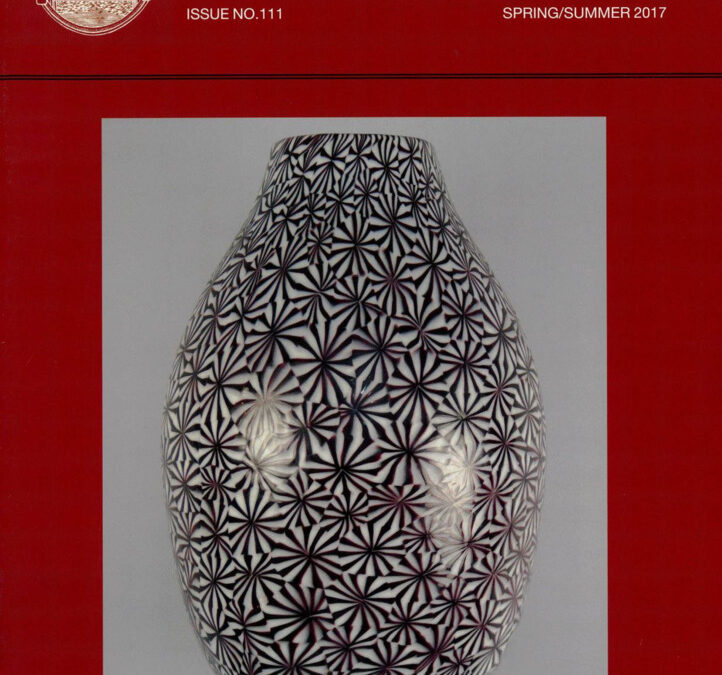
Front: A Kiku vase by Ermano Toso for Fratelli
Toso circa 1956. The body formed from
monochrome floral murrine.
Back: The Old Testament in glass. Adam & Eve,
the snake and apple. By Fritz Lampl.
This edition of The Glass Cone covers a
broad sweep of interest in glass from the
19th century to the present day. James
O’Fallon’s 1885 article on glass engraving
gives an in depth explanation of the
techniques then used while Bill Millar
completes his research into 20th century
diamond-point engraved glass. We then
look at differing opinions on the value of re-
creating the designs of 18th century English
drinking glasses. Shouldn’t we be delighted
with the ‘Golden Age’ of English glass and
not denied the pleasure of drinking out of
18th century copies which are pleasing to
the eye, affordable and comfortable to
hold? The article examines the question,
“how difficult is it to spot the difference”.
The cover picture of the Kiku vase by
Ermano Toso and the article on Paolo Venini
offer an insight into the Italian flair for
design, often using techniques handed
down from father to son. Looking at the
development of Catherine Hough’s work
opens a window onto the magic and
flexibility of glass that motivates a talented
individual to create glass forms that
continues to enchant and captivate
onlookers, collectors, artists and designers.
As Sam Herman would say, have an idea,
start heating and blowing, moulding and
turning and see where the idea takes you.
This year, we’ve been putting together
more events around the country — to give
everyone a chance to join in with fellow
glass enthusiasts without having to travel
too far. Later this year, I hope to see many of
you at our meeting at Christchurch Mansion
in Ipswich and then at our study day and
AGM in Ely (see the booking flyers in this
issue). We already have an outline of the
2018 programme; do consider putting time
aside for our trip to Italy and the South of
France. The next magazine, due at the end
of this year, will be a joint issue between
ourselves and the GC; this will further the
direction we’ve both already taken together,
in inviting the members of each association
to meetings. I will be standing down as the
Chairman of the Glass Association at this
coming AGM; steering the Association
through the last ten years has been
immensely gratifying even if at times
challenging. The opportunity to engage with
the glass community has made it an
outstanding journey for me. The committee
members, GA members and friends have all
helped to enrich my knowledge and
appreciation of glass. Thank you.
THE GLASS CONE NO.111 SPRING/SUMMER 2017
20th-century Diamond-Point Glass
Engravers
A SUBJECTIVE REVIEW – PART 2
Bill
Millar
fig.1: A
charming
engraving of
a blue tit on
a Dartington
posy bowl.
The
engraver
has
managed to
produce a
range of
textures to
good effect.
fig.2: Wee
Willie
Winkie
running
through the
`toon’, drill
engraved
with point
detail by
John
McLauchlin
Part 1 of this article introduced
diamond-point engraving from its
early days and described the work
of diamond-point engravers from
the beginning through to the third
quarter of the 20th century. Most
notably, the engravers Lawrence
Whistler and William Wilson
effectively reinvented the medium.
Together, they inspired and
continue to inspire new generations
of glass engravers: Whistler
through exhibitions of his books
and superb engraving on glass,
Wilson through his creation of
thousands of pieces of engraved
glass at accessible prices.
B
efore
examining
the
consequences of their
inspiration, two other factors which
influenced the development of line
engraving during the latter half of
the
century
must
be
acknowledged: these were
economic and technological
development. In 1957, commenting
on the post-war economic boom,
Prime Minister Harold Macmillan
said “most of our people have
never had it so good”. The buying
public increasingly had money to
spare for non-essentials and
increasing numbers of craft
studios, gift shops and craft fairs,
virtually unknown in 1950, offered
outlets for this type of work.
Increasing numbers of craft
workers were also able to make
some or all of their income from
engraving glass.
Diamond-point engraving has
little dependence on technology, so
the 1963 speech by Prime Minister
Harold Wilson concerning the white
heat of technological development
might not be considered
significant.
However,
the
development of tungsten-tipped
engraving tools reduced costs.
Hand held electric engraving
drills offered completely new
opportunities, as unlike David
Peace, not everyone has a
dentist who will let them borrow
their drill to engrave glass! The
hand-held drill can produce a
wider range of effects and a few
engravers
employ
both
techniques. Line engraving can
be likened to drawing with a 4H
pencil. A fine, hard line or dot is
the only product possible. A drill
can produce a variety of finishes
from deep cutting to soft
shading and even polishing.
Excluded from this article are
engravers who used a drill for
the decoration and point-
engraving for their signature.
THE GLASS CONE NO.111 SPRING/SUMMER 2017
been carried out
using a drill but
some of the detail
such as the
beams of light
around the candle
and the street
light, and the
window on the top
left,
is
point-
engraved. Even
his signature on
the base, “J
McLaughlin
1986”,
was
engraved
mechanically. In
addition to the
engraved
signature there is
a sticker on the
base
which
announces that
the glass was
“Hand engraved in
Scotland by John
McLaughlin”.
Other engravers
have
also
employed
an
avian theme. At fig
3 “Stu” has
engraved a wren
and a heron on
what are probably
1960s
tulip-
shaped
wine
glasses
and
signed his name
on the side of the
bowl. There are
three of each bird
making a set of 6
glasses.
Presumably the
link between the
two birds is that
they represent the
largest and the
smallest British
birds. His work
lacks the delicacy
of the bird at fig.1,
but the set of
glasses would
have made a
useful if not an
artistically refined
fig.3: Heron
and Wren
engraved
by “Stu”
fig.4:
Kestrel by
D Hurley.
The
engraver
has clearly
used some
force to
make the
lines, which
have
responded
with a
fractured
edge; this
suits the
subject.
The output of point-engraved
glass in the second half of the
century grew rapidly to encompass
a new category: namely the low-
cost, attractive gift or souvenir,
frequently of indifferent artistic
merit.
A technological development
which came too late to help with
this article is the internet and World
Wide Web which was invented in
1989. Today, this may be of use as
a marketing tool for engravers but
came too late to gather
biographical
information
on
engravers. Few of the engravers
discussed in this article are either
mentioned in glass publications or
have entries on the web. As a
result, while most of the illustrated
examples shown are signed,
biographical details are very limited
if not non-existent.
Most of my pieces were made
throughout the third quarter of the
century. This does not mean that
engraving diminished towards the
end of the century: rather, it means
that the people who either bought
engraved glass, or had pieces
given to them as presents are still
alive and enjoying them. They will,
inevitably, be recycled and
available to collectors in due
course.
So much for social and
technological developments: what
about the glass? The little dish at
fig.1 is a simple engraving of a blue
tit (or another of the tit family). It is
charmingly executed and the
inverted posture of the bird is in
keeping with the overhang of the lip
of the dish. The engraver has not
signed the dish although it is
perfectly possible that it originally
had a pre-printed sticker with the
engraver’s details. All told, this little
dish represents all that is best in
gift glassware even if it has limited
artistic merit. It was no doubt
treasured for the memories it
evoked of a time, place or person.
A charming and humorous
engraving of Wee Willie Winkie,
which does have a name sticker,
was produced by John McLaughlin
on a rather ordinary tumbler at
fig.2. Most of the engraving has
2
THE GLASS CONE NO.111 SPRING/SUMMER 2017
fig.6: (above) Three airtwist glasses. From the left, a wild rose by Irene Roxburgh, drill
and point engraved. The centre glass is a simple but most effective cricket themed
engraving by A Basson. On the right is an armorial camel superbly point-engraved by
Jenny Hill-Norton.
fig.5: Badger
by Susan
Blow.
fig.7: Detail
from Irene
Roxburgh’s
glass in
fig.6,
showing the
different
effects of
drill and
point
engraving.
present.
At fig.4 a kestrel or other small
raptor is represented. The line,
when seen through a glass, is
jagged and has clearly been
created with a degree of force. The
anger represented by such a line
may be appropriate to a bird of
prey but need not be transmitted to
the stump on which the bird rests.
The glass is signed “DH” on the
bowl and “Dr Hurley 77” on the
underside of the foot.
A badger is the next member of
the natural world to make an
appearance at fig.5. The underside
of the foot is signed “Susan Blow
1977 No 83”. There is some stipple
engraving amongst the line work.
However, the badger lacks impact
and, for such a heavy creature, has
been suspended too high on the
side of the glass. No doubt it was
appreciated as a memento or
present but for me the glass would
be of greater value without the
decoration!
fig.6,
the
left-hand
glass
continues the nature theme with a
wild rose engraved by Irene
Roxburgh in 1979 (name and date
engraved on underside of foot).
She has used point engraving to
draw the fine line outlines of the
petals and a hand drill to create the
`fuzzy’ infill; the two techniques can
be seen quite clearly at fig.7. The
effect is most attractive, allowing
the piece to be valued as a high
quality item.
The right-hand glass at fig.6
could also be counted as a part of
the natural group. However, it will
be seen that the camel is actually
an heraldic crest for the Worshipful
Company of Grocers. It was stipple
engraved by Jenny Hill-Norton in
1981 and signed “AJH-N 1981” on
the underside of the foot. Other
glasses from the same set were not
signed. Jenny, a member of the
Guild of Glass Engravers, has
displayed considerable skill to
produce an item with great impact.
The central glass in fig.6 takes us
to the world of sport with a simple,
most effective design. The
underside of the foot is signed “A
Basson Glos 1988”.
I have not been able to find
biographical detail on any of the
THE GLASS CONE NO.111 SPRING/SUMMER 2017
3
fig.8: Two
commemorati
ve glasses by
Claire Rome.
One for the
Prince of
Wales
Investiture
and the other
for Apollo 11.
fig.9: (left) A
St John’s
Ambulance
presentation
glass,
superbly
engraved on
a Cumbria
Crystal blank
by
“Elmhurst”.
fig.10: (far
right) A Stuart
Ariel blank,
outstandingly
engraved by
Bernard York
for the
Queen’s
Silver
Wedding.
engravers mentioned above.
However, Claire Rome is listed as a
stipple engraver by Barbara
Norman in her book “Glass
Engraving”. In the two examples at
fig.8 Clare used both line and drill
engraving. The left-hand glass,
which commemorates the
investiture of the Prince of Wales in
1969, is the only royal
commemorative I have ever seen
which gives a sense of movement,
displayed by the way the plumes
have been depicted: the apparent
movement of the plumes
demonstrating how drill engraving
can produce a softer effect than
line engraving. The eagle on the
Apollo 11 glass is less successfully
drawn and looks as if it might have
trouble taking off, far less getting to
the moon and back! The Prince of
Wales goblet is signed “Clare
Rome 18” and the Apollo 11 glass
“Clare Rome No12”, both on the
underside of the foot.
Staying with commemoratives,
fig.9 is a handsome Cumbria
Crystal blank engraved as a
presentation piece for “TFB” for
service from 1971 to 1982. The
front of the bowl is decorated with
the badge of St John’s Ambulance
and the unicorns and lions have
been meticulously produced. The
glass is signed under the foot
“Elmhurst 1469 1982.” The figure
1469 would suggest Elmhurst was
a prolific engraver. The quality of
his workmanship would point,
hopefully, to a successful career.
A royal commemorative for The
Queen’s Silver Wedding in 1972 is
shown at fig.10. This large Stuart
goblet was engraved by a most
competent Bernard M York, 10
Tellisford Lane, Norton St Philip,
Bath BA3 6LL. His printed card
which accompanied this glass
points to a professional approach
to his work. The lightness of touch
displayed by Bernard York is such
that I am sure that William Wilson
himself would have complimented
him on his talent.
One category of point engraving
not illustrated here but occasionally
seen, is that of military badges
produced by nostalgic ex-
servicemen for their own use. All of
those I have seen look as if they
were engraved with a sharpened 6
inch nail on a factory produced
glass. Entirely without artistic merit,
these glasses represent something
much more important — the
memory of service in a military
force quite possibly on active
service.
Together, the glasses illustrated
in this article demonstrate the wide
range of diamond-point engraving
produced during the last half of the
20th century. They range from the
frankly indifferent to the extremely
good. The development of the
hand held drill has diverted many
engravers away from point
engraving and it is impossible to
guess what their output would have
been had they used point
engraving.
Point engraving is alive and
reasonably well, even if much of the
output is unlikely to be of interest to
collectors. Engravers with the skills
of Whistler and Wilson have yet to
present themselves. Ambitious
engravers may increasingly transfer
their skills to use a hand held drill
for the wider range of effects it
offers. It would be foolish to predict
how point engraving will develop in
the future but it is likely to be with
4
THE GLASS CONE NO.111 SPRING/SUMMER 2017
Queen Elizabeth II
90th Birthday Paperweights
Richard M Giles
fig.1: QE 11
90th Birthday
weight
fig.2:
Enlargement
showing 90
cane
fig.3:
Enlargement
showing ER
cane
I n Cone 109 I finished my article
on the paperweight issued to
mark Elizabeth II becoming the
longest-reigning British monarch
by
hinting
that
another
commemorative weight to mark her
90th birthday in 2016 might be
coming from Michael Hunter of
Twists Glass. After speaking to him
he revealed that he had been asked
to produce some further special
canes that if approved by Goviers
could be included in some weights
to mark the momentous occasion.
Having the advance information
meant that we could keep an eye
open for any brochure arriving
through the letter box and hopefully
get an order in quickly if, as
previously, the numbers of weights
were to be strictly limited. As it
turned out, there wouldn’t be
problem as the issue was to be
a maximum of thirty weights
and all would contain two
Goviers’ exclusive canes,
featured in the enlargements
fig.2 and fig.3. However, only
the first fourteen close-pack
millefiori weights that were
featured in the brochure also
contained one of the complex
crown canes used in the
Longest Reign weights plus
another five canes featuring a
corgi, dove, pansy and red and
white Clichy-style roses. Of the
fourteen close-packs, six would
be two and three-quarter inches
in diameter, four would be
magnums at three and three-
quarter inches and the final four
would be mushroom-shaped
weights where the white stave
canes that form the mushroom
stalk are carried up to form the
outer ring of canes around the
close-packed canes in the
centre of the mushroom-
shaped top.
Responding quickly did at
least enable us to have the
choice from the first fourteen
weights illustrated and after
much debate we went for one
of the six standard-sized
weights which is shown in fig.1.
The brochure stated that the
remaining sixteen weights
could be of different shapes
and with different canes but to
date we haven’t seen any
further information as to exactly
what was produced.
THE GLASS CONE NO.111 SPRING/SUMMER 2017
5
Isle of Wight Glass Museum
Richard M Giles
o years after our visit to Isle Of
Wight Studio Glass in its new
location within the Arreton Barns
Craft Village, we returned in August
2016 to see the revised studio
layout that now incorporates the
Isle Of Wight Glass Museum.
Before I go any further, I should
point out that although the
museum is located alongside the
glass studio which has obviously
involved co-operation between the
parties, it has no direct association
with Isle of Wight Studio Glass. The
man behind the museum and
owner of most of the glass on
fig.1: The
entrance to
the Glass
Museum
fig.2: (far
right)
Michael
Harris
designs
from the
1950’s and
1960’s
fig.3: (left)
Small bowl
signed
‘Michael
Harris RCA
1967’ on
loan from
the Mark
Hill
collection
display is glass collector
Anton Doroszenko, with the
museum being set up to
display his vast collection of
studio glass, the majority of
which has been made on
the Isle of Wight over the
past forty-plus years, or in
some way has associations
with the island.
The
original
studio
building now has a two-
storey extension on one
side which has created a
new and larger ground floor
display area/shop that is
separate from the working
studio. Behind this new
shop area and accessed
through it is the Glass
Museum (fig.1), for which
there is a small admission
charge. On the first floor are some
further display cases plus an open
space which could be used to host
talks and workshops by visiting
artists or glass experts. As you
approach the museum area there is
a large black and photograph
showing the Isle of Wight Glass
team in the early days, which
includes both Timothy and
Jonathan Harris, then inside the
museum is a large panel detailing
the history of the company.
The museum area walls are lined
with display cases, with a central
island formed of back-to-back
display cases. As one would
expect from the name, the bulk of
the glass on display relates to the
Harris family and is laid out in
chronological order, starting with
Michael Harris designs from the
1950’s and 1960’s (fig.2). The small
bowl (fig.3) is a rare early piece by
Michael Harris, dating from the
genesis of studio glass in the UK.
Now on loan from Mark Hill, it
originally came from the collection
of Ronald Stennett-Willson; Mark
believes that Michael gave it to him
before he left for Malta in late 1967.
This is followed by examples of
Mdina Glass from 1968 to 1972
(fig’s.4 & 5) and then a couple of
cases showing the glass made on
the Isle of Wight in the 1970’s
following their arrival from Malta
(figs.6 & 7). General production
items made in the 1980’s fills the
next case, followed by two cases of
more special pieces of glass
designed by Michael and made by
6
THE GLASS CONE NO.111 SPRING/SUMMER 2017
fig.4: (left)
Mdina Glass
1968 to 1972.
Designed and
made
by
Michael Harris
fig.5: (left)
Mdina Glass
1968 to
1972.
Designed
and made by
Michael
Harris
Timothy Harris during the same
period. More glass from this
collaboration of designer/maker
made during the 1990’s fills the
next case and then finally there are
three cases full of glass made by
Timothy Harris since the start of the
21st century.
Other cases display some of the
glass made by Jonathan Harris
while working on the island and
then items made by him after his
departure from the family business
to set up his own studio in
Ironbridge where he could
concentrate on making the
wonderful hand-carved cameo
glass that you will see if you visit
the National Glass Fairs. The final
case associated with Isle of Wight
Studio Glass displays pieces of
glass made by people such as
Chris Lucas and Pippa d’Arcy.
Chris learnt his glassmaking skills
with the studio and later went on to
set up a short-lived enterprise
called Touch of Glass which I can
remember visiting during one of my
trips to visit relatives on the Isle of
Wight. Pippa d’Arcy worked as an
independent glassmaker on the
island.
The remaining displays cover the
early days of glassmaker Michael
Rayner when he traded as Island
Glass in Totland before relocating
to the Needles Pleasure Park and
changing the name to Alum Bay
Glass, this is where the company
still operates but under different
ownership. Also represented are
the glassmaking skills of Martin
Evans, who formed the Glory Art
Glass Studio in Sandown and
passed his skills and enthusiasm
for glass on to his son Ed who now
runs the studio with Martin in semi-
retirement. Last but by no means
least is a cabinet full of the clever
and exuberant molten glass
creations from Paul Critchley of
Diamond Isle Sculptured Glass
which can also be found within the
Arreton Barns Craft Village.
On the first floor are a few more
display cases containing examples
of continental studio glass from
well-known makers and this area is
obviously a work in progress with
room for expanding the exhibits.
Our overall impression was very
favourable: there was a helpful lady
on hand in the shop who, although
not a glass expert, could give more
information about the museum and
its contents. From a personal point
of view, the areas we found most
interesting and informative were
the displays of Isle of Wight Studio
Glass from the 1970’s to the
1990’s. Over our years of collecting
we have picked up various odd
pieces of good quality glass that
caught our attention but were
without any identifying marks or
labels and visiting the museum
helped identify several of those
pieces.
The Challenge of Setting up
a new Glass Museum
Anton Doroszenko, the creator of
the Isle of Wight Glass Museum,
has added a post-script to Richard
Giles’s article. He says that …
“Richard has highlighted the
growth of the museum in pointing
out that it is a ‘work in progress’. It
applies particularly to the first floor,
where we are building a wide
ranging collection of French,
German, British Art Deco and
Victorian glass.” The museum is
entirely funded by Anton, so he
needs to grow slowly, buying the
better quality items that he expects
to see in the museum. This is, as he
acknowledges, an expensive
endeavour.
The museum has three part-time
staff, two on the retail side to cover
seven day-a-week opening and
one managing the educational
programme. Though early days, the
enthusiasm of two students, taken
on for work experience has been
heartening.
The
remaining
management of the organisation –
obtaining new exhibits and sales
stock, building the museum web
site, organizing events, creating
publicity materials and dealing with
the accounts is totally administered
by Anton. He confesses ‘that it is
quite a challenge for me, since I
have a full-time day job on top of all
the museum work and I live in
Oxfordshire not on the Isle of
fig.6: Bon Bon ‘Candyfloss’ plate and
vase, both very rare, surrounded by
pieces of Firecracker glass
THE GLASS CONE NO.111 SPRING/SUMMER 2017
7
13.
‘c
Wight. It’s usual for me to be
working to midnight every day,
seven days a week!’
Considering that the I.O.W.
Glass Museum has only been
open since 19th March 2016, he
feels that the plans are well on
track, but it will take at least five
years to become properly
established and put onto the
tourist map. Watch his museum
web site for developments!
isleofwightglassmuseum.org.uk
The GA wishes him well.
fig.7: Glass designed by Michael
Harris and made by Timothy Harris,
1980’s and 1990’s
A Delightful Story
Dear Reader, as your new designer
I felt embarrassed at making a
‘schoolboy error’ in my first issue of
The Glass Cone. I make no
excuses, but wish to provide you
with the full transcript of the
documents that should have
appeared on page 18 and 19 of
issue 110. My report card would
read ‘could do better’ and I hope
this issue will be delivered without
errors. Mike Pearson
William Breese. 1866-1921
The following is a transcript of the
document outlining the Articles of
Apprenticeship entered into by
William Breese at the age of 19yrs
on 10th March 1885 with Mr Henry
Gething Richardson, Glass
Manufacturer, of Wordsley. The
document is signed by William
Breese, his father Thomas Breese
and by Henry Richardson.
This Indenture witnefseth that
William Breese of the age of
nineteen years, by, and with the
consent of his father Thomas
Breese, of Brettell Lane, in the
parish of Kingswinford and County
of Stafford, Glass Cutter, certified
by his executing these presents
doth put himself Apprentice to
Henry Gething Richardson of
Wordsley in the parish of
Kingswinford and County of
Stafford, Glass Manufacturer, to
learn the art of Glass footmaker
and with him after the manner of an
Apprentice to serve from the day of
the date hereof unto the full End and
Term of Two Year from thence next
following to be fully complete and
ending. During the Term the said
apprentice his master faithfully shall
serve, his secret keep, his lawful
commands everywhere gladly do.
He shall do no damage to his said
Master nor see to be done of others
but to his Power shall tell or forthwith
give warning to his said Master of
the same. He shall not waste the
Goods of his said Master nor lend
them unlawfully to any. He shall not
contract Matrimony within the said
Term nor play at any Cards or Dice
Tables or any other unlawful Games
whereby his said master may have
any loss with his own goods or
others. During the said Term without
Licence to his said Master he shall
neither buy nor sell, he shall not
haunt Taverns or Playhouses nor
absent himself from his Master’s
service day or night unlawfully But in
all things as a fretful Apprentice shall
he behave himself towards his
Master and all during the said Term.
And the said Henry Gething
Richardson shall teach and instruct
or cause to be taught and instructed
his said Apprentice in the Art of a
Glass footmaker which he useth by
the best means that he can, paying
to his said Apprentice the following
wage weekly and from the day of
the date hereof unto the tenth of
march one thousand eight hundred
and eighty six, ten shillings per
week and for the remainder of the
Term eleven shillings per week and
for overwork one shilling per more
over and all time lost from sickness
or any other cause, to be fetched
up or worked out by said
Apprentice. And for the true
performance of all and every
Covenants and Agreements either
of the said Parties bindeth himself
unto the other by these presents.
In Witnefs whereof the parties
above named to these Indentures
interchangeably have put their
Hands and Seals the tenth day of
March and in the forty eighth Year
of the Reign of our Sovereign Lady
Queen Victoria by the Grace of God
of the United Kingdom of Great
Britain and Ireland, Defender of the
Faith and in the Year of our Lord
One Thousand and Eight Hundred
and Eighty Five.
Signed … William Breese, Thomas
Breese. Henry G Richardson.
Witness H Billingham.
Written by hand at the bottom of
the document are the words
“Faithfully Served”
Signed … Henry G. Richardson
8
THE GLASS CONE NO.111 SPRING/SUMMER 2017
Designing and building the
Naval Service Memorial
Graeme Mitcheson
Fig.1 Naval
Services
Memorial.
3rd March
2015
Fig.2
navygirl
and sailor
in silent
memory
S
culptor Graeme Mitcheson,
living near Ashby de la Zouch in
Leicestershire, has designed the
Naval Service Memorial which was
erected at the National Memorial
Arboretum in Staffordshire in 2014. It
is made of vertical panels of
coloured glass and horizontal slabs
of Kilkenny Limestone. Graeme
says: “I was extremely honoured to
have been selected to create the
Naval Service Memorial and was
delighted to have the unanimous
backing of the RNA for the ambitious
design from the very start”.
I needed to design a memorial that
captured the work of the Navy
holistically, so I commissioned giant
sails of glass, their colours
representing all of the different
oceans around the world (fig.1). The
colours — Ultramarine for the Pacific,
turquoise for the Indian Ocean, white
for the Arctic and Southern Oceans
and steely grey with spume lines for
the Atlantic, would rise out of the
ground and project their coloured
shadows onto a white granite
terrace. The shadows change their
hues, their length and their alignment
with one another over the course of
a day and throughout the year. For a
couple of hours around midday on
sunny days, the negative shapes
created by the individual shadows of
the sails merge together to form the
outline of a battleship on the terrace
before the sun moves once more
and the shadows begin to disperse.
If you visit the memorial in summer
you’ll see the sun illuminating the
sails and creating short, strong,
colourful shadows. Attend the same
spot in the winter months and you
are invited to wade through the long,
blue, watery shadows, the colours of
the oceans that now stretch across
the entire granite terrace. Graeme
tells us that it’s best viewed in winter
when the low sun shines through
the glass.
Another key theme was “At the
going down of the sun, we will
remember them”. At one end of the
memorial, a carved stone sailor
stands alone, facing west, head
bowed in respect in front of a yellow
glass panel representing the
morning sun (fig.2). At the opposite
end, there’s a deep red panel –
representing sunset.
Inspiration for my work often
comes from unusual sources: none
more so than in this piece where the
idea to create the “shadow ship”
stemmed from observing the
outlines of shapes created by the
shadows of the washing on the lawn
at home as my wife pinned it out.
One of the challenges with this
memorial was to maintain the
simplicity of the design with so
much happening within it. This is
something that I was conscious of
throughout. The glass was precisely
cut, laminated, strengthened and
installed by Proto Glass in Pewsey,
while I carved the Kilkenny
limestone sailor myself: no rank, no
gender. Bell-bottomed trousers
and a cap behind his back was the
only detail required.
We were informed of this work by
Ian Turner, a past chairman of the
GA.
Graeme
would
appreciate
discussing his work with you:
www.chisel-it.co.uk
mitcheson@ntlworld.com
Unit 2, Hall Farm, Ashby Road,
Coleorton, Leicestershire, LE67 8FB
07901 791674
THE
GLASS CONE NO.111 SPRING/SUMMER 2017
9
The Fascinating World of
Japanese Cut Glass
Brian Clarke
fig.1: A sample of Toru Horiguchi’s “Guinomi”
Cased lead glass.
O
n 16th September 2016 at the Art
Workers’ Guild in Bloomsbury,
London, an invitation evening was held
which proved interesting. It focussed
on modern Japanese cut glass and its
historical links with British and
European glassmaking. The Japan
Society, together with the Embassy of
Japan, invited Toru Horiguchi of Tokyo
and Sally Haden, our GA member with
a special interest in the glass link
between the UK and Japan, to present
the craft and history of Edo Kiriko
glassware.
Sally first met Toru in 2015 when she
went to Japan to give a lecture on how
four British glassmakers helped to
`kick-start’ Japan’s modern glass
industry in the 1870s-1880s at the
country’s first western-style glass
factory in Shinagawa, Tokyo. The
instruction which they gave covered all
types of industrial, domestic and fancy
glass. It was the teaching of cutting
and engraving on western-style
machinery at the factory which led to
the firm establishment of what is
known as “Edo Kiriko” today. “Kiriko”
means facet so this is deep-cut glass
and “Edo” was the name of Tokyo
before Japan was opened up by the
West. An opening video showed Toru
in his workshop
making his own
style of Edo Kiriko
but with many of
the patterns and
methods
that
were introduced
by the British
men.
One of the
factory’s British
instructors was a
Bohemian-born
or sake-cup glasses.
glass engraver
named Emanuel
Hauptmann who taught cutting and
engraving at Shinagawa in 1881-1882.
So it was a pleasure to meet three of
his direct descendants who’d come to
London especially to attend the
evening, bringing with them an array of
Hauptmann’s work. Through family,
Sally was also directly connected to
the factory: her great grandfather,
James Speed, was ‘chief of craftsmen’
at Shinagawa in 1879-1883
1
.
1.
A full account of the Shinagawa glass
factory’s role in the modernisation of
Japanese glassmaking can be found in
Sally Haden’s article in the Journal of the
Glass Association, 2014. An article about
Hauptmann, his Bohemian heritage, his
work in Japan and Edo Kiriko is due to
appear in the next edition of the Journal,
2018,
Sally explained that until Japan was
forcibly opened up to the rest of the
world in the 1850s, Japanese
glassmakers were largely unaware of
the advances Western glass had
made. Although small amounts of
European glass had trickled in for
centuries, it had no significant
equivalent in Japan in terms of
strength, usage or quantity; Japanese
glass remained delicate, decorative
and high-status. This changed with the
deliberate introduction of Western
methods into the Shinagawa
glassworks, part of the Meiji
government’s radical modernisation
programme which swept the country in
the 1870’s.
Two important exceptions to
traditional Japanese glass arose in the
decades 1830s-1860s, no doubt
inspired by admiration of a few
examples of fine European cut glass
that had been finding their way into the
country from Bohemia, England and
Ireland. In 1834 a workshop
established by Kyubei Kagaya in Edo
(old Tokyo) began to produce
imitations of such glass, and in the
1860s similar work started up in the
Satsuma province of Japan, each with
its own distinctive style and Japanese
flavour. The Edo style was taken
forward by about twenty Shinagawa
fig.2: The
Horiguchi
Kiriko
workshop in
Tokyo today
10
THE GLASS CONE NO.111 SPRING/SUMMER 2017
Haden, Diane Irvine (great great grand-daughter of Emanuel
Hauptman), and two of Emanuel’s great grandchildren, Irene Wright
and Brian Mains.
original home of cut glass.
Toru spoke passionately
about his craft and the use of
glass as an art form as well as
for utility pieces for the home.
Mr Yoshinori Ishii, of Umu
restaurant in London, then
described
how
he’d
commissioned Toru to make
uniquely designed glass dishes
to display Japanese-style food,
so greatly enhancing the
experience of the eater. The
evening closed with an
invitation to see and handle
some of Toru’s small “Guinomi”
glasses – spotlighted in a
darkened area of the venue,
each item cut with a different
design: a fitting end to an
unusual glass evening.
Toru’s Edo Kiriko glass can be
seen at Native and Co. in
Notting Hill, London:
https://www.nativeandco.com.
fig.3: (Above) Toru Horiguchi,
(from left to right) Sally
centre,
with
trainees
when
several
workshops opened in Tokyo
after Hauptmann had left
Japan. Toru described how his
instruction lineage links back
directly to the factory through
his family. He is proud that
today he can offer his
glassware in Britain and
Europe, coming full circle to the
fig.4: Lidded bowl
engraved by Emanuel
Hauptmann. Early
20th century after his
return to England.
Paul Ysart Snake Weight
Richard M Giles
I have included this short article on the
green aventurine snake weight in the
photograph as it came into our possession
thanks to the articles on paperweights that I
have written for the
Glass Cone
over the
past few years. Even if you haven’t spotted
the PY signature cane that sits alongside the
snake, many of you will recognise that it was
made by master paperweight maker Paul
Ysart.
The chance to purchase the weight came
thanks to Alan Poole of Dan Klein
Associates who many of you will know either
personally or because of his regular
newsletters giving details of glass-related
events all over the world. He kindly passed
on a contact from a lady in Scotland that
came via the Scottish Glass Society with
regard to a snake weight that had been
bought directly from Paul Ysart by her father
back in 1975 and had spent most of the
intervening time boxed up in a wardrobe.
From my research it appears that there
aren’t a huge number of these snake
weights around and that they were made
around the time of its purchase when Paul
was working with William Manson at
Harland, near Wick, and making PY signed
weights for the American market.
Initially the request was for guidance on
the likely value of such an item, having
received an offer from a dealer which was
considered too low. A guide price had also
been obtained from an auction house in
Edinburgh. Although the weight was
unseen, therefore condition and verification
of the maker were unconfirmed, I was happy
to give a general price range for unsigned
and signed Paul Ysart weights assuming
that the information that I had been given
was correct. It later turned out that my
figures were more or less the same as the
auction house.
Much to my surprise, some photographs
arrived shortly afterwards along with a
statement that, because of the family
connection with the weight, the lady would
be happier if she knew that it was going to
someone who would really appreciate it
rather than to a dealer who would sell it on.
The photographs confirmed both the
condition and maker so that I felt that I was
in a position to make an offer which I am
pleased to say was accepted. A few days
later the weight arrived safely and I can say
without hesitation that we were not
disappointed.
THE GLASS CONE NO.111 SPRING/SUMMER 2017
11
Rock Pools
Stephen Foster
M
y
present work, “Rock
Pools”, part of the “Aquatic
Themes”
series,
is
an
accumulation of knowledge and
events coming together at this
moment.
In 2001 I worked for Richard
Golding for a couple of months
before taking up my scholarship at
Broadfield House. It was only for a
period of two months but it was the
steepest learning curve of any
course I’ve attended. Richard’s
technical knowledge about glass is
vast; along with this he is a
complete gentleman and very
giving of his knowledge. I have
always wanted to use the
iridescent technique I learnt from
Richard but obviously not to
directly plagiarise the maestro. It
was not until I tried to emulate the
mother-of-pearl of shells that the
process began to have relevance
and I could make it my own.
Since 2002 I have worked at the
International Glass Centre, Dudley
College as technician / tutor where
within my own work I relentlessly
explored and experimented with
many glassmaking techniques,
some Italian techniques such as
cane work, murrine, rollups,
reticello, etc and also cup casing
originally learned from Stourbridge
maestro Malcolm Andrews and
myriad
hot-worked
surface
techniques all coming together in
my present work.
A year or so ago I went to a
lecture of young fine artists at the
Eastside Projects in Digbeth,
Birmingham. One artist had dug
out random-shaped holes a few
centimetres deep in the gallery
floor and then filled the holes with
coloured fluids and various
artefacts; each one was quite
beautiful and I noted that almost
everyone really liked and related to
the work. In describing her work
she used many adjectives but I
struggled to relate her work to her
words. My interpretation of why her
work was a success to others and
myself was that the work had some
essence of rock pools, touching a
joyous nostalgic childhood chord
of investigating on the beach. As
my work had already taken an
aquatic-themed
direction
it
seemed a natural progression to
move towards my interpretation /
twist on rock pools.
All my work has a truth to the
material, exploring and exploiting
the inherent qualities of glass,
trying to draw the onlookers into
my work to examine the changing
shifts of perspective that occurs as
light reflects and refracts across its
surface and through its inner world
where secrets are revealed.
In conclusion, my “Rock Pools”
series taps into nostalgic times on
the beach, an energized sense of
calm and a timeless natural
rhythm, a place where your mind
runs quiet, in depths and the space
between.
A member of The Glass Association
for many years, Stephen last
exhibited his work at Knebworth
Glass Fair in September 2016. His
work shone out from the stand and
he agreed to write and introduce
himself to you all. His website is at:
www.stephenfosterglass.com
The ‘Rock Pools’ pieces are
approximately 18cm wide and
8cm deep.
The photographs were created
and are presented by Simon
Bruntnell.
12
THE GLASS CONE NO.111 SPRING/SUMMER 2017
Cruising with Glass
Judith and Alan Gower
The gaffer
on the Hot
Glass chair
This fish
was made
while we
looked on
W
hen we first decided to go on
a cruise we looked at a variety
of cruise lines and ships. However,
the choice became very easy when
we realised that one cruise line had
three ships that had a hot glass
studio on board.
Celebrity X Cruises have Hot
Glass Shows provided by the
Corning Museum of Glass (CMOG)
on three of their ships, with three
glassblowers on each ship. We
have now been on two cruises, one
to the Mediterranean and the other
to the Baltic and St Petersburg. On
each cruise they have one
glassblower who comes from
CMOG and two international
glassblowers who have proved
they are able to work at sea. This
idea for hot glass working on board
ship came from a Director of
Celebrity X Cruises who himself is a
keen glass collector.
The hot glass shows were held
on Deck 15, the top deck, and the
number of times a day varied
according to whether it was a sea
day or one that included a shore
visit. As you can imagine we spent
a lot of free time there, though we
did also find time to visit St
Petersburg and many other
fascinating places.
There was all the usual
equipment in the glass studio, such
as a glass melting furnace, pipe
warmer, colour box, annealer, glory
hole, crucible and pickup box,
along with a complete set of tools.
However the difference was that
there was no gas allowed for ship
safety reasons — everything was
electric. This of course meant that
the glassblowers had to get used
to the different ways of working;
they all said it was very different.
The glassmaking studio had
sides and a roof but was totally
open on the side where the visitors
sat, apart from waist-high clear
glass panels. The glassblowers had
freedom to make whatever they
wanted, and so made all sorts of
things including vases, bowls,
animals, jugs and drinking vessels.
They also brought to life drawings
made by children on the ship. As
you can imagine, some things
worked better than others!
The
glassblowers
could
experiment as much as they liked
as Celebrity X Cruises paid for all
the glass, colours and tools.
Paradise indeed, and a lot more red
and other expensive colours were
used than in their day-to-day work.
There were a few limitations to the
pieces that could be made, due for
example to the annealing time not
fitting in with the show timetable;
additionally, no open flames were
allowed, so flame-working was out,
and the only implements for any
cold work were files to round off
any sharp pieces and a drill for
signing their names.
We were lucky that the weather
was mostly good on both our trips
so the captain didn’t close off Deck
15. The downside for the
glassblowers was that they had to
work with the ship’s movement and
also if there was any wind or rain.
The latter can give an interesting
effect to glass but not necessarily
one that is desired!
At the start of the cruise there
would only be glass lovers
watching the show but by the end
there was standing room only, the
audience drawn by the fascination
of seeing what would be made. It
was also fascinating to see the
children becoming so engrossed
and in fact the children’s club paid
regular visits. The makers would
ask questions of the audience,
which we refrained from answering
unless no one else could.
There was also an evening of
`meet the makers’ on the second
cruise, where we could talk to the
three of them and look at other
work they had done. None of the
pieces made were available for sale
but some pieces were raffled by
means of free tickets at the shows.
We were successful on several
occasions.
Finally, on the last day there was
a raffle in the main body of the ship
of one piece made by each maker,
with the money going to the CMOG
scholarship fund. Allister Malcolm
and Helen Millard are two recent
British recipients of this money.
Another piece of glass was
made and auctioned at the
same event with the money
going to Celebrity’s charity
of choice. We were outbid
in the auction on a piece
we wanted but on the two
cruises
overall
we
managed to acquire three
pieces of glass which we
have on display.
We look forward to our
next cruise with Celebrity X
Cruises.
THE GLASS CONE NO.111 SPRING/SUMMER 2017
13
Catherine Hough – Glass Artist
A serendipitous route to becoming a well-known studio glass-maker
C
atherine Hough was brought
up in Somerset and then
studied teacher training and
sociology in Cardiff, receiving her
first degree. Her parents had some
interesting glass pieces in their
home and she joined her mother’s
evening classes, where she learnt
how to ‘make things’. Catherine’s
interest in the arts was kindled.
Leaving the West Country in the
early 1970’s, the next stop was
London for her first teaching job. In
the evenings, she enrolled in
metalwork classes. Catherine
would often queue early at Covent
Garden Opera House for a standing
ticket.. To get there, she passed by
The Glasshouse in Neal Street,
started up in the early ’70’s.
Fascination with the glass objects
and their making took her inside.
Among others, she met Annette
Meech, Steven Newell, Jane Bruce,
Fleur Tookey and David Taylor. This
was an exciting time for the
creation of studio glass, so
Catherine enrolled in their glass
evening classes and then heard
about the degree course at
Stourbridge College of Art –
focussed on glass and ceramics.
Her life direction was now ‘on a
roll’; having been accepted for a
glassmaking place at Orrefors, she
had to decline the offer, so as to be
close to her parents in Cheshire.
This meant that enrolling for the
course at Stourbridge, under the
guidance of Keith Cummings, was
the next obvious move – both
fulfilling her family commitments
and her love of glass. Catherine
with other Stourbridge students
also had extra tuition at the
Apprentice School at Brierley Hill,
where she additionally learnt Glass
Technology and Glass Cutting from
an expert. A retired glassmaker
from the industry came into the
Stourbridge College once a week
The studio production is of individual
pieces in glass and silver designed and made by
Catherine Hough.
Her aim is to produce pieces of contemporary
design combining the traditional crafts of the
glass blower and the silversmith, and by exper-
imenting with decorative techniques both old
and new.
The combination of metal and glass forms an
integral part of her work and two decorative
techniques, both with origins in the past,
predominate.
One involves blowing the glass into a metal
to teach and demonstrate glass
blowing. During her time at the
College from 1975 to ’78, she met
David Williams-Thomas at Royal
Brierley, who became interested in
her work and offered her a position
at Royal Brierley from 1978 to ’80
(figs.1a&b). Then in 1980 Catherine
accepted an invitation to join The
Glasshouse team in London, which
had by then moved to Long Acre,
close by her beloved Opera House.
She remained there until 1985,
continuing to develop her own style
of blown glass enhanced by a
variety of cold working techniques,
and then with Simon Moore and
Steven Newell set up Glassworks
London Ltd, a new studio glass
business. Steven wrote
‘During this
period, glass, as a creative
material, went from a poor relative
CRYSTAL STUDIO
case with a cut-out pattern through which the
glass projects.
The other is a revival of the process of elearo-
plating silver on to glass used by Royal Brierley
in the late 19th Century.
Because each piece is hand-made and therefore
demands a high degree c>f skill, it can take anything
up to a week for Miss Hough to perfect each
item. It is this dedication to achieving such a high
standard which makes each piece truly unique.
After studying glass and metal work at
Stourbridge College of
Art,
Catherine Hough
joined Royal Brierley in 1978.
of ceramics to a key player in the
world craft stage. It was extremely
exciting to be involved in The
Glasshouse right from the
beginning.’
The story continues following my
meeting with Catherine at an
evening at Peter Layton’s London
Glassblowing studio in February
this year. Catherine now works
from her studio in Camden, N.
London (fig.2). I then arranged a
visit to Catherine’s studio in March,
to see if she’d consider repairing a
piece, a scent bottle (fig.3), bought
at auction in 1998, purchased from
the Sotheby’s sale of the
Honeybourne collection of Stevens
& Williams / Royal Brierley, which I
learnt she’d made while at Royal
Brierley. Catherine writes:
‘Looking
at the photos of your bottle it looks
fig.
la & lb: Face of advertising pamphlet
14
THE GLASS CONE NO.111 SPRING/SUMMER 2017
fig.2: Work in progress on Catherine’s studio bench
as if the glue that fixed the glass to
the silver mount has given way.
Unfortunately it is not the first time
this has happened. The glue I used
seems to only have a life span of
around 35 to 40 years! I can
certainly try to repair it. It is very
interesting to see your photos of a
piece I made so long ago. I actually
made it between 1978 and 1980
while working as an artist in
residence at Royal Brierley Crystal.
I have attached a copy of a leaflet
they produced at the time. It all
came about as they became aware
of my work while I was a student
studying glass at Stourbridge
college of Art from 1975 to 78. I had
previously done metal work and
incorporated it into some of my
glass pieces and I was also very
interested in cutting and other cold
working techniques. The glass
melted at the college was not
always of a very good quality and
would not stand up to deep cutting
as on your piece. To overcome this,
Keith Cummings contacted Royal
Brierley and arranged for me to go
to the factory on a Saturday
morning from 6am.to 9am, when
they did an overtime shift and had
some spare benches. The men
thought it very strange to see a
woman working at the furnace but
the factory’s full lead crystal glass
enabled me to make progress with
my ideas and research. It was
through this contact that the
management became interested in
my work and offered me the artist
in residence opportunity when I
completed my course. I
accepted it gladly and
spent a fascinating and
productive couple of years
there. They provided me
with a small studio in
Honeybourne which was
housed on the edge of the
factory that also held the
collection you refer to. A number of
pieces that I made while at the
factory became part of the
collection.’
Catherine agreed to call this
piece ‘a Scent Bottle’ and said that
when she made it at Royal Brierley,
it was an experimental design and
the ‘crinkled’ shoulders were
created by firing tiny crystals of
glass at over 500 degrees
centigrade to fuse them to the base
of the shoulder. The silver mount
and dropper had separated from
the glass section of the stopper
(fig.4) – I’ve now heard that the
repair is completed and will look
forward to seeing the bottle again.
Catherine Hough can be contacted
at: choughglass@hotmail.com
fig.3 (left):
The scent
bottle as
made
fig.4
(right):
The scent
bottle
with
separated
stopper
THE GLASS CONE NO.111 SPRING/SUMMER 2017
15
Bimini glass revealed
F
ollowing the historical research
and discussion on the
production of Bimini and Orplid
glass by Fritz Lampl, presented by
his nephew Raymond Berger in The
Glass Cone 108, glass collector
and dealer Danny Walker came
forward over a year ago with a
recently purchased, unique
collection of Fritz Lampl’s glass.
Within a few weeks he was hoping
to see the lady again who’d sold
him the pieces, she’d said she
might have another devil
somewhere and a couple of other
pieces. Being aware that other
pieces still remained in the
collection, he’s been waiting to
purchase them before offering
them for publishing. Out of sight
and hiding somewhere at the
moment, Danny believes he also
has a large glass sweet and a good
opalescent vase by Lampl.
Danny was told that the owner of
these pieces had them handed
down in her family from her
grandmother, who, it is said,
bought them directly from Fritz
Lampl in Hampstead. As far as
Danny is aware these are the only
complete examples known, which
he has owned since 2016. As he
says “it would be nice if some
others had survived”.
fig.1: Showing the
delicacy and
miniaturisation of these
glass figures
fig.2: The black devil
catching up with the
naked damsel
fig.3 (right): The
damsel, now in the
Devil’s arms and
caressing him
fig.4 (left): Four angels
defending life and food
against three dragons
fig.5 (right): Adam &
Eve, the snake and the
apple, under the apple
tree
fig.6 (left): Two
kangaroos and a bear
in front of holly arches
with berries
16
THE GLASS CONE NO.111 SPRING/SUMMER 2017
Early this year in the glass fair at
Knebworth, Danny showed me the
additional examples of Fritz
Lampl’s lamp-worked figures that
had come from the same source,
ft
44
,
44—tivetoriew
though no contacts with the seller
were forthcoming. He was told that
`some were bought directly from
the man himself’, (presumably
Lampl) and a few ‘were bought
from the shop “GAY GIFTS” that
was on Kings Road, London in the
1930’s’.
Apparently,
Lampl
abandoned making the miniatures
as his drinking made it impossible
for him to work on such a small
scale by the late 30’s. The Aquarius
figure was one of his later larger
pieces. Well, nearly two years later
and here is the collection.
The entire collection now
belongs to collector and dealer,
Andrew Lineham. We arranged to
photograph these very delicate
pieces earlier this year; they are
presented here with his kind
permission.
Text and photos by Brian Clarke.
If more pieces exist in other
collections, we’d all be delighted to
see them and with permission,
publish them.
fig.7: Aquarius
pouring water from
a green jug
fig.8 (left): Seated
figure with a cane,
dragons looking on
fig.9: Two fish
feeding on weed,
forming a heart (or
a devil’s head)
fig.10: Probably
two herons (with
flamingo colours)
fig.11 (right): Eight
piece devil
orchestra
fig.12 (left): Sweep
and £1 coin
fig.13: Spiders
webs
THE GLASS CONE NO.111 SPRING/SUMMER 2017
17
Franz Sedlacek
FRANR. S
ED.AcE
K
19 3
7 •
‘4
–
TR
u fri
ii
T
here is a painting by Franz
Sedlacek entitled “TRAUM” and
dated Vienna 1932, which shows a
volcanic scene at night with a quarter
moon. It is lovely, but with some
strange figures in the foreground.
These weird figures seem to be
replicated by Fritz Lampl in his lamp
work figures from the early 30’s,
illustrated in the Bimini collection
(above) with Biblical, racy and
whimsical people and creatures.
At the same time in Vienna, ‘cold
painted’ bronzes were also produced
and a little devil or imp band is shown
in the Bimini collection , with a random
chimney sweep . It seems that in
Vienna during the 1930’s that these
type of characters were popular in Art
and Applied Arts.
Pink Tons
C
reated by the American sculptor Roni
Horn and acquired by Tate Modern in
2016. This sculpture was purchased at the
price of £961,538, funded amongst others,
by the Art Fund, Tate Americas
Foundation, Tate Members and Patrons.
The first version of Pink Tons actually
broke in its making! It was then shown at
Tate in 2009. This massive tuboid’ is on
display in the new Tate section.
Roni Horn is fascinated by ambiguity
and processes of change. Appearing to be
a cube, it measures 120cm deep and
wide, but only 110cm high. The pink
colour suggests ‘femininity’, though its
solidity says ‘masculinity’. Pink Tons is an
imposing presence in the gallery and may
be the largest and is certainly the heaviest
piece of art glass ever made, weighing in
at five tonnes! Its appearance is
continually changing as the natural light
passing through it varies in intensity at
different times of day. The sides are
opaque and rough edged, having been in
contact with the surface of the mould. By
contrast the top surface is highly
reflective, transparent and translucent, as
this side of the glass has only been in
contact with air during the casting
process.
Your Chairman’s Note.
On a visit to Tate and viewing the Pink
Tons tuboid’, I passed by the Tate
collection boxes — also tuboid’ though in
black and only 81cm square and 84cm
high.
I
couldn’t resist the comparison. Up
to you, the reader, to decide who followed
who!
18
THE GLASS CONE NO.111 SPRING/SUMMER 2017
TV
heritage
lottery fun
LOTTERY FUME
white house cone
MUSEUM OF GLASS
The British Glass Foundation
T
1
—
he British Glass Foundation (Registered Charity
1139252) an entirely voluntary body, was formed
in 2010, to find and operate a permanent new home
for the Stourbridge Glass Collection, following
Dudley
Metropolitan
Borough
Council’s
announcement of its intention to close the
Collection’s home at Broadfield House. Subject to
raising the remaining funding required and
completing final lease agreements with DMBC, the
BGF anticipates formally opening the WHC-mog in
autumn 2018.
www.britishglassfoundation.org.uk
The result is the new born White House Cone –
museum of glass, housed in the Grade
II
listed former
Stuart & Sons Glassworks, which has been creatively
and imaginatively adapted for the purpose.
Combining both permanent and temporary exhibition
galleries, a hot glass making studio and a unique
activities adventure space for children and their
families, the new museum will serve regional, national
and international audiences. The Stourbridge Glass
Collection provides a tangible link between peoples
past and present and has the power to inspire
creativity and motivate artistic expression.
The BGF needs to raise a large amount of funding
towards the internal fit out of the new museum and in
a very short space of time. Our friends and
supporters understand our on-going need to
continually raise funds and those efforts will
continue. The solution, at least in large part, is crowd
funding. Here’s how it works: Allister Malcolm has set
up crowd funding facilities including a site with lots of
imagery indicating the sort of items we need,
together with how you can donate. Take a look at the
short video; it is inspirational. Alongside this are
details of differing levels of reward for donations from
£6000 down to just £5. The highest donor will receive
a limited edition piece made by Allister and
graciously donated by him.
The crowd funding page and video is:
www.crowdfunder.co.uk
then enter White House Cone museum of glass, or
use:
www.crowdfunder.co.uk/the-white-house-cone-
museum-of-glass
To see the building of the furnace and the creation
of the hot glass studio including the lighting of the
furnace – please take a look at this YouTube link:
THE GLASS CONE NO.111 SPRING/SUMMER 2017
19
Our fundraising: i.e. your contributions will go
directly to help to pay towards some of the following:
Window Solar Shields £750
Security Door £1000
Mobile Family Activity Cart (x 2) £5000 each
80″ LCD screen with media player £6000
AV Projector for high level overhead projection,
scrolling images of historic locations of Stourbridge
Glass Factories and their owners £6900
Glass Blowing Chair Interactive – includes the film of
blowing glass whilst the visitors sits in the chair and
handles the tools used in the making process £8000
Digital interactive with tactile glass. The interactive
focuses on three techniques; cameo glass, rock
crystal and engraved glass £12000
An introductory AV display with a map of
Stourbridge, giving an account of the history of
Stourbridge Glass with a focus on the quality of the
art and design of the glass but also of the people,
past workers, owner families and the 19 factories that
produced Stourbridge Glass
£14000
Display Cases. We are looking to purchase a flexible
modular display system (as in the picture)
The price of a triple module unit is approximately
£16,000. Our plans include three of these, an
additional three double modular units and further
single units. Total cost could be over £100,000
Temporary Exhibition Space – fit out of Front Gallery
Space £25000
Glassblowing Studio Interpretation and fit out for
public display
£35000
Education and Activity Room fit out, including tables
and chairs, fitted storage and equipment
£52000
Cataloguing, digitisation and display of archive
material and display materials for objects inside and
outside showcases
£60000
Examples of paperweights –
these paperweights
are approximately 7cm in diameter and attract a
donation of £20 each
Glass Plaques
The pictures below show a plaque being cast and the
same plaque finished. As the example shows, the
supporters name is engraved on the centre section.
These plaques are to be incorporated in a wall
display, at the White House Cone-museum of glass.
The making of a plaque requires the donation of £100
or £125, depending on complexity.
Please email bgf@britishglassfoundation.og.uk
or call 01384 239 019 for full information
Tess Evolution
Cabinets at
Colchester
Museum
Glass
plaque
casting for
Finland
Completed
glass
plaque for
Finland
20
THE GLASS CONE NO.111 SPRING/SUMMER 2017
Scarlett Malcolm’s hands
‘Glass for Good’ – lecture
Sat 26th August at the White House Cone-mog, Vine Street,
Stourbridge. DY8 4FB
6:30pm Wine and nibbles. 7pm Lecture (approx. 2 hours)
Charles R. Hajdamach and Steven
Piper intend to unlock some of the
secrets of the production of
engraved glass and rock crystal.
Charles will deliver a lecture with
slides about the history of the
process – who were the legendary
names behind some of the
unrepeatable examples in the
museum’s collection and what
inspired them? He will be asking
Steve how he might approach
different styles. Steve will be then
taking a reproduction (blank made
by Allister Malcolm) and decorating
a panel showing how labour
intensive the process actually was.
In a great double act these two
experts will complement each
other’s presentation in an
entertaining manner.
Charles R. Hajdamach is one of
the top authorities on glass in the
country. For 30 years he was in
charge of the glass collections at
Broadfield House Glass Museum in
Kingswinford which opened in
1980 and quickly became one of
the top glass museums in the
world. Charles has lectured on
glass in America, Canada,
Australia, New Zealand, Spain,
South Africa, Ireland, Belgium and
Germany. He also writes
extensively on the subject from
antique to contemporary glass. His
two books, ‘British Glass 1800-
1914′ published in 1991, and ’20th
Century British Glass’ from 2009,
remain the standard works on the
subject. In 2000 he was elected a
Fellow of the Society of Glass
Technology for services to glass
and glassmaking and in 2009 he
was elected as Life-President of
the Glass Association of which he
was a founder member.
Charles Hajdamach
Steve Piper
Steve Piper started working at
Webb Corbett Glassworks which
had at the time been acquired by
Royal Doulton. During his time at
Webb Corbett he trained at Dudley
College gaining a certificate (grade
“A”) in glass design and
technology. After 13 years Steve
left Royal Doulton to pursue a
career as a freelance engraver and
has become one of the country’s
most accomplished engravers of
the day.
Cast Your Hand
in Glass
Come and get you or your child’s
hands cast in the finest Lead
Crystal. Donation £25. Allister and
his team take impressions from
both the young and old and then
preserve them forever in moments,
pouring molten glass at over 1000
degrees. A booking service of
15min intervals is being scheduled.
Vouchers can be obtained and an
appointment issued. Please arrive
at least 15 minutes early so as not
to miss your session. Bring a
camera too. The glass casts will
need to cool in the kiln overnight
before they are then engraved.
Collection next day is required.
Alternatively if you are travelling a
distance and you would prefer for
the items to be posted, an
additional £12.00 will need to be
paid on the day. Delivery is not
included with this product.
21
THE GLASS CONE NO.111 SPRING/SUMMER 2017
fig.4: A Puntini murrine Venini canoe
Paolo Venini and his Furnace
Geoff Lawson
fig.1: Paolo
Venini at an
exhibition in
1957
fig.2:
Diamante
vases 1934
– 36
fig.3:
Mosaico
multicolore
1954
A
major exhibition was mounted
r
i
kin Autumn 2016 at Le Stanze
del Vetro (The Glass Rooms) of the
Fondazione Giorgio Cini in Venice.
The foundation is on the island of
St Giorgio Maggiore, a canal width
away from La Giudecca, facing the
Doge’s Palace and Piazzeta in
Venice.
The exhibition was supported by
many world museums not least the
Venini Museum and archive, and
several major private collections
and has been an opportunity to see
many pieces close up and many
design drawings from the Venini
archive, all of which are rarely seen
in public.
Paolo Venini who originally
trained as a lawyer was above all a
businessman, showman and a
cultured entrepreneur (fig.1).
From 1925 as the majority owner
of
his
glassworks,
he
commissioned work from many
talented designers. But Venini was
far more than just the Director in
the boardroom. A major part of his
skill was to promote and direct the
genius of his designers, he also
turned his hand to glass design.
The exhibition showed that from
the 1930’s to the 1950’s Venini
made a significant contribution to
glass design, reviving many old
techniques in new ways. He was
active in designing right up to his
untimely death in 1959 at the age of
64.
The exhibition and excellent
catalogue documented some of the
many series of glass pieces
initiated by him, such as Diamante
in the 1930’s (fig. 2), innovative re-
interpretations
of
Zanfirico,
Mosaico Zanfirico and Mosaico
Muticolore
(fig.3). Also a series of
Murrine including
A dame
(chequerboard)
(fig. 5),
a puntini
(pointillist) murrine
canoe (fig.4) and
transparent murrine (fig.6).
These
refinements of old
techniques were
followed in the
latter half of the
1950’s by the
inciso
series in
which
sommerso
objects were
engraved to give a blurred effect.
It was highly successful at the
time (fig.7). In the 1950’s Venini
produced a series of multi-
coloured bottles and obelisks as
well as abstract stained glass for
architectural uses several large
panels of which were included in
the exhibition (fig.8).
The exhibition also contained
the designs of those who worked
with Venini. Among them was Gio
Ponti the architect, publisher,
friend and collaborator of many
years who produced among many
things some very fancy bottles
(fig.9).
A room was filled with Tyra
Lundgren’s birds, fish, leaves and
snakes (figs.10 and 11), followed
by showcases full of Ken Scott’s
exotic and colourful
fish designed for an
exhibition at Macy’s
New York in 1951
(fig.12) and Riccardo
Licata’s incalmo vases
with
murrine
decoration (fig.13).
There were
occhi
and
battuto
pieces by
Tobia Scarpa;
(his father Carlo was
the subject of an entire exhibition 4
years ago).
Amongst many others
there was lighting by Massimo
Vignelli, table services by Piero
Fornasetti, table decorations by
Eugene Berman and Charles Lin
Tissot and glass jewellery by Grete
Korsmo; all designed for Venini and
produced at his glassworks.
The exhibition included well over
300 glass pieces and numerous
22
THE GLASS CONE NO.111 SPRING/SUMMER 2017
Photo credits
The photos are offered by
courtesy of:
Venini Museum and archive:
fig 1 and catalogue cover
Le Stanza del Vetro and
Collection Bischofberger:
figs 2, 3, 6, 7, 8, 9, 13
(8 & 9 by Enrico Fiorese)
Collection Losch Germany:
figs 4, 5, 10, 11
G P Lawson: figs 12, 13
fig.5: ‘A
Dame’
murrine
vase
fig.6 (right):
Transparent
murrine
dishes,1957
fig.7 (left): lncisi
vases
1956 – 1957
fig.8 (right):
Stained glass
panel and
Vignelli lighting
fig.9 (left): Venini
and Gio Ponti
bottles
fig.10 (right):
Tyra Lundgrens
birds
fig.11 (left): Tyra
Lundgren’s large
striped fish
………41114M101600110111111111
annotated original drawings and
sketches.
These
were
accompanied by two videos of
glass in production and interviews
with illuminati, among them
Howard Lockwood
(editor of the
USA magazine `Vetri’ from the USA)
and Marika Bogren from the
National Museum Stockholm who
had a fascinating insight into the
life and times of Tyra Lundgren.
I would like to thank the Stanze
del Vetro for their assistance in
preparing this report.
It is well worth keeping an eye on
LE STANZA DEL VETRO, as they
regularly hold exhibitions on
European glass with a major annual
exhibition running from September
through the autumn.
fig.12 (right):
Ken Scott’s
exotic fish
AIM*
–
4.4
fig.13 (left):
Riccardo Licata’s
incalmo vases
THE GLASS CONE NO.111 SPRING/SUMMER 2017
23
fig.3 (above): A representative selection of series’ of glass
produced by Venini in the latter half of the 1950’s. Cold-
finished with slight grinding and closely packed horizontal
engraved lines
fig.5 (left): Obelisks by
Venini, 1948 to ’59.
Proposed in the 1930’s
by Tomasso Buzzi and
to be used as table
centre pieces.
fig.6 (right): L’Arte del
Vetro a Murano, a book
by Attilia Dorigato, co-
ordinator of the Venice
Museums and for
many years, director of
the Murano Museum of
Glass. Containing a
breadth of knowledge
on Murano glass.
Le Stanze del Vetro, Fondazione
Georgio Cini
Addendum from the editor
fig.1 (left):
Exhibitions of
some of the
artists for
Veninifig
Following the presentation of
this article on Paolo Venini, your
editor visited Le Stanza del
Vetro in Venice, to view the
exhibition at first hand, viewing
the building and rooms of the
Foundation for the first time.
The Cini Foundation has been
exceptional in its exhibiting and
cataloguing of 20th century
glass from Murano and makes
no charge to visit the glass
rooms. The Stanze del Vetro
(glass rooms or galleries) have
been designed to guide you in
sequence through the story of
the particular exhibition. The
project was envisaged from the
beginning as an organic series
of monographic exhibitions
dedicated to the individual
artists and architects who
designed and planned for
Venini. The catalogues together
with one of their glass designs,
of the famous names who’ve
been shown since 2012 can be
seen in fig.1. I was too taken by
the variety of glass on display,
to have let this chance fly away
of just showing a few pieces
(other than those in Geoff
Lawson’s
article)
which
particularly engaged my
attention.
All pictures courtesy the Editor
fig.2: A table service
with canes in six
colours: red,
greenish, mole-grey,
sapphire, amethyst
and straw coloured.
Designed and made
by Gio Ponti with
Paolo Venini in 1946
to 47.
fig.4 (right): A stained
glass panel (the size of a
large door), on display
during my visit, 1957. The
colours of the small
mosaic glass canes of
fiery reds through to pale
yellows assembled to
appear like material
(tessuto), almost a wall
hung carpet
24
THE GLASS CONE NO.111 SPRING/SUMMER 2017
fig.1: A group of reproduction glasses from the Georgian Glassmakers
18th Century Reproduction Glass:
Acceptable or Confusing?
Collowing our entertaining visits to
I watch and listen to Mark Taylor
and David Hill, the Georgian
Glassmakers, sharing with us their
well-researched, tried and tested
techniques of glassmaking from the
18th century, a question was asked.
Are the glasses made for us to
admire and enjoy a previous era, or
are they made to confuse the
collector into believing they are
genuine antiques, (fig.1). An emailed
discussion followed, including a
deeply felt response from Mark &
David. These thoughts are
presented to you as they were
written. Fig.no’s 3, 4, 5 and 6 show
original 18th century glasses on the
left and Mark & David’s glasses on
the right, theirs are all just under
19cm in height and have bowl sizes
useful enough for drinking today.
The initial query from Chris Smith
I enjoyed the meeting you
arranged about the making of 18th
Century drinking Glasses and learnt
a lot. Thank you for organising it.
I am concerned, though, about
the very extensive production of
replica 18th Century glass by Mark
and David. As a beginner in this field
I could easily be fooled by some of
these glasses. I appreciate that they
do not have the wear to the foot that
a genuine old glass usually has but
otherwise some of them are
remarkably similar. I am concerned
that people buying these modern
replicas could fairly easily pass them
off on resale as originals worth
several times the price and my
guess is that some of the buyers
almost certainly do. To prevent this it
would seem a pretty simple thing to
mark the glasses in some small way
under the foot so as to differentiate
them from 18th century glasses and
it seems irresponsible not to do so.
What does the Glass Association
think? – I should be interested to
hear.
Kind regards, Chris Smith
The reply from Brian Clarke
Dear Chris, it was a pleasure
meeting you and Judith before I had
to leave the workshop at Quarley.
Good to hear that you learned much
from their making.
The concerns you have expressed
below are a problem, especially for
the newer collector. I have talked
this through with Mark and David on
several occasions, but have not
managed to persuade them to do
fig.2: Mark’s signature on the punty
scar ‘Mark Taylor 2014’
anything more than the lightly
engraved signature under the foot of
the glasses – which could be ground
out and polished, (fig.2). I had
suggested a coloured inclusion
under the foot – but this was not
taken up. Most of the glasses will
not even begin to be passed off as
18th century, due to weight, colour
and execution – though they are
very good replicas. If on Saturday
Mark made one of the John Greene
designs from Murano, when
compared to the original, it would
not even mislead a beginner – I
handled a real John Greene glass
last Sunday at Knebworth – the
differences are great. However, as
you say, for the novice collector and
if buying ‘unseen’, especially online,
mistakes will occur – though
perhaps not once the glass is
handled.
It would be helpful, if you could
consider writing a small article with
these concerns, for publishing in
The Glass Cone. Comments from
THE GLASS CONE NO.111 SPRING/SUMMER 2017
25
someone other than myself would
perhaps make a change in Mark &
David’s thinking.
The following responses then arrived
From Nigel Benson
I have long said that people who
are making legitimate copies should
do more than just inscribe a mark to
the item, since it is all too easy to
have that polished away.
I prefer the idea that a cane, or
colour is fused into the base (usually
that would be the obvious position),
so that this could not just be
polished away.
The same has happened with the
early copies of the Whitefriars
Drunken Brick vase, where the
name was inscribed to the base –
well you get the rest. Subsequently
other, much poorer copies have
come along which are recognizable
from the incorrect colouring –
believed to be Chinese in origin. A
good idea that this should be
discussed with Mark and David.
From Bob Wilcock
I agree this is an important issue. I
thought Mark & David were clearly
marking their glasses, but obviously
it is not enough.
I think though that before we
publicise the issue in the Cone it
needs to be put to M & D that
evidence is emerging of their
glasses being passed off as C18 at
high prices. They may be flattered,
but hopefully are concerned. Are
they able to more clearly mark their
glasses (the coloured inclusion
sounds ideal) so that collectors may
more easily identify their work, and
not be taken in by unscrupulous or
unknowing dealers? We have been
asked to put something in the Cone
and their assurance will be
important. They will no doubt realise
the effect of adverse publicity.
It’s such a shame.
From Charles Hajdamach
I was very interested in the
comments made by Chris and the
potential problems with the Quarley
glasses. In fact this difficulty is
already appearing at antique fairs. In
my role as Chair of the glass vetting
team at the Antiques for Everyone
Fair at the National Exhibition
Centre, in the last three fairs we have
fig.3: Acorn Knop. 18th century on left
fig.4: Drop Knop. 18th century on left
already seen about three glasses
which must be the Quarley products
but were being sold as 18th century.
I hasten to add that the glasses were
not being sold by specialist glass
dealers but by general dealers who
had fallen into the trap which Chris
has raised.
Mark and David seem to be
creating, unwittingly I appreciate, a
situation similar to that created by
Elizabeth Graydon-Stannus in the
1920s and 1930s with her ‘fakes’ of
English 18th and 19th century
glasses, although her intention
seems to have been to deliberately
confuse the situation.
I totally agree with Chris therefore
that something should be written
about this and that the glasses
should be marked
in
some way, or if
the situation became really serious
perhaps they should stop making
them.
Mark and David then replied as
follows
Dear Brian, attached is our
response to the correspondence
you forwarded to us.
To make our point, I have
addressed all the major concerns
that have been raised and a few
others that your correspondents did
not think of. I also think I have been
very restrained, considering how
upset and angry this nonsense has
made us.
If you choose to print our reply in
the magazine, and I hope that you
do, we insist that you print the entire
thing, with no changes or edits.
Yours, David
We were both surprised and
disheartened by the negative
reaction of some Glass Association
members towards our work. As our
friend Peter Adamson (who has
given us permission to quote here),
says: “Anyone who cannot
distinguish between a genuine
antique glass and a Taylor and Hill
reproduction should not be in the
business of either dealing or
collecting”.
Ultimately,
the
onus
of
responsibility for determining
whether or not a glass is genuine
when considering purchasing lies
with the purchaser. It is the buyer’s
responsibility to acquire those skills
necessary to discriminate between a
genuine antique glass and a
reproduction. That surely is the
satisfaction and entire point of
collecting and fancying. If one does
not wish to acquire those skills, or is
nervous about buying something,
then only ever buying from or
through a reputable dealer is
obviously the very best advice. But
by far the best approach for any
collector is to educate themselves to
the level where any reproduction,
including ours, is immediately
obvious to the naked eye, let alone
closer inspection. This is what
everyone we know who is serious
about 18th century glass has always
26
THE
GLASS CONE NO.111 SPRING/SUMMER 2017
fig.6: Mushroom Knop. 18th century on left
expected to do as part of their
collecting – taking responsibility for
their own expertise or seeking
advice.
Our glasses are all, without
exception, clearly signed by Mark on
the punty scar. If any vessels appear
on the market with this signature
ground away and re-polished, it will
be obvious to the potential collector
that a dishonest dealer has, at some
time, deliberately done this,
because the scar will show signs of
the removal – excavation of 1/32nd
of an inch of glass, leaving a
depression which is no longer
`clean’. Any reproduction glass that
may have been deliberately set up to
deceive the less-experienced
collector would also need to feature
faked wear marks under the foot,
the edge of the foot, and the almost-
invisible-to-the-naked-eye
tooth
chips at the rim. These are just some
of the basic examination points the
informed collector should perform,
and reputable dealers will only
welcome and encourage such strict
scrutiny.
It is well known (though some do
not appear to be aware of this fact)
that glasses of the 18th century
have been reproduced in vast
numbers throughout the 19th and
20thcenturies. We are by no means
the first to make such reproductions
– merely the latest, so it is a fact that
there are already countless
examples of such vessels out there.
These far outnumber our output,
because there is over 150 years of
such reproduction to take into
account, and there can be few
dealers or collectors who have never
encountered one before. Colin Brain
has recently shown us a catalogue
from the second quarter of the 20th
century which features ‘Fine Crystal
and Reproductions of the Antique’.
On page 21 of this catalogue are
shown air twist stem trumpet bowl
glasses and several other twist
glasses with engraving, including a
`Fiat’ Jacobite glass. The catalogue
notes that ‘these goods are
particularly suitable for the Antique
Reproduction Trade’, (my italics).
That is just one catalogue from one
fig.5: Cylinder Knop. 18th century on left
year, offering glasses that were
traded throughout the Empire, but
add to that the many reproductions
of British glass made elsewhere in
the world over the years, and, as
Colin remarks, such catalogues
show us just the tip of the iceberg.
The suggestion that we include
some form of ‘coloured inclusion’ to
distinguish our glasses has not been
considered properly. There are now
thousands of examples of our glass
in existence. If we began to include
some obvious coloured mark, this
would reflect optically throughout
the glass, disfiguring it, but more
importantly, one can easily imagine
a future scenario where, if we were
to adopt this, a dealer or collector
would be able to use this to his
advantage by claiming: “This
reproduction example includes the
Taylor and Hill coloured inclusion,
but this one does not, therefore, this
identical second glass must be a
genuine antique”. Any inclusion
would therefore be counter-
productive, and could even be used
by some dealers as “evidence of
authenticity”, undermining the
concept entirely, once again proving
that the onus is always upon
collectors or dealers to educate
themselves
in
discriminating
between reproductions and
antiques – to ‘get their eye in’. This is
really not difficult to do – you only
have to hold a genuine example in
one hand and one of ours or another
firm’s reproduction in the other, and
the difference is obvious. And if in
doubt, a buyer can always ask us. If
you still cannot tell the difference
between a reproduction and a
genuine glass, as Peter Adamson
says, you should perhaps ask
yourself whether antique glass
collecting is really for you. The use of
the `coloured inclusions’ would
probably also have the effect of
making our glasses less saleable, as
it could be viewed as a ‘disfiguring’
mark.
Over the past five years, as well as
articles that were intended to be
particularly helpful and informative
to collectors and dealers, that were
published in this magazine, we have
hosted
popular
all-day
demonstrations of many of the
glassmaking techniques by which
these glasses were made. We
always hoped that these were
helpful to collectors and dealers,
helping spread knowledge about
this fascinating era of glassmaking,
and (ironically, in the light of the
present criticism), we imagined
being particularly helpful in enabling
attendees acquire more knowledge
towards evaluating the authenticity
of vessels.
You can reach Mark Taylor and
David Hill at:
gaffers@theglassmakers.co.uk
THE GLASS CONE NO.111 SPRING/SUMMER
2017
27
Fig 1 and 1A – Cin
Messrs. Thos. Webb
que-cento
and Sons
Water-set.
Fig 2 – Claret Jug, Japanese
Style. Messrs. Thos. Webb
and Sons
Glass Engraving as an Art
Editor’s Notes
This is the second article in the series by J.M.O’Fallon on
Glass Cutting, Engraving and Carving, all three originally
published in the Art Journal in 1885. Written with such an all-
encompassing explanation of the processes, their re-
printing here in The Glass Cone has been considered to be
of interest and value.
This essay, titled `Glass Engraving as an Art’, was published
in October 1885 starting at P309. The final article will be on
`Glass Carving as an Art’ originally published in December
1885.
James O’Fallon lived from 1839 to 1912. Trained as a
designer, decorator and carver of glass, he lived in the
Stourbridge area and was part of George Woodall’s team at
Thomas Webb & Sons. We thank Clive Manison for
introducing us to these articles.
I n a recent number of this journal it was
pointed out in what respects glass
cutting differs from glass engraving.
Geometrical arrangements of prisms
and facets polished clear, so as to
readily deflect and refract rays of light
that fall on them, generally characterize
cut glass; but all kinds of lines and forms
of various depths may be graved in
glass and polished. Engraved glass,
therefore, unlike cut glass proper, is
capable of true artistic treatment.
Engraving by means of the point, and
also by use of the revolving wheel, was
practised on scarabei and cylinders of
sardonyx, cornelian, chalcedony, and
other stones by Egyptians, Phoenicians,
Assyrians, Babylonians, and Indians, as our museum
collections testify; and the application of both processes to
glass may therefore be about as ancient as the discovery of
glass itself. That the Arabs at the height of their power,
though competent in the mysteries of glass, did not
accomplish much in the ways of engraving and cutting, is
not perhaps so strange as that the Venetians, celebrated as
glass makers, never became proficient in these arts; and
notwithstanding that the Germans, the Dutch, and Flemish,
in the seventeenth and eighteenth centuries, produced
some wheel work of excellent quality, and that in the present
century the French have kept up with the Germans in the
use of the lathe, none of them at any time has been
remarkable for knowledge of art as applied to engraved
glass. Nor until quite recently could England claim any
superiority in that respect. As a matter of fact, until within
the last decade or so, engraved glass as done by
Englishmen was generally most crude and coarse. Before
then the names of Keen, Cole, Herbert, and Silvers would
about exhaust the list of engravers belonging to the British
Isles, who proved that they had ability beyond the common.
For some time past natives of Bohemia have done most of
the better class work in England. Englishmen may have
learned something from them as to the use of the lathe, but
nothing in the way of design. Feeling very much the
necessity for improvement in this, and in order to compete
successfully at the International Exhibition held in Paris in
1878, the writer of this article was commissioned by Messrs.
Thomas Webb and Sons, of Stourbridge, to prepare designs
for glass making, and its ornamenting in several ways,
chiefly by means of the wheels. Two or three of the
specimens of glass produced under his direction while at the
works of this firm are here illustrated: they will help to
support, farther on, some remarks on Art and glass
engraving. Meanwhile, so as to assist the reader who may
desire to form a distinct idea of glass ornamenting as done
at the lathe, a few words before
describing that method will not be out of
place on three other engraving processes.
The hard point for inscribing and
engraving hard stones is doubtless older
than the lathe, and was certainly used in
engraving glass during classical and
medi
ae
val times. The Flemish, Dutch, and
Germans, within the last three centuries,
used it with great success, as testified by
examples of their work still remaining.
Diamond or other hard stone points – or
steel points similar to those used by some
glass carvers of the present day – may be
employed in engraving glass, and handled
in the same way as ordinary gravers for
metal or wood. The glass should be
coated with a mixture of gum and milk, on
which, when dry, a pattern may be drawn or transferred
previous to engraving. Very fine line and hatching and stipple
effects can be produced by this
method. Some of the
specimens in the Slade
collection of the British
Museum are exquisitely done,
especially those attributed to
Wollfe and Heemskerk. The
great drawback to such
engraving, when delicately
finished, is that it cannot be
well seen unless it is held close
to the eye and in a good light.
The sand-blast, though the
most recently discovered
process of engraving, may best
be noticed here, and before the
hydrofluoric acid process,
which falls more naturally in
with wheel work – for the reason that wheel work is
frequently brought into its service, and is itself on rare
occasions assisted by it. It seems that the first intention of
28
THE GLASS CONE NO.111 SPRING/SUMMER 2017
Fig 3 – Table Lamp: Japanese
Ornamentation. Messrs. Stevens
and Williams.
the originator of this process, Mr. Tilghman, was to cut large
stones and metals by a jet of sand impelled by escaping
steam under high pressure. He soon found that moderate
pressure would grind,
obscure, or ornament glass.
The blast-pipe was made
moveable in any direction by
means of flexible or jointed
connecting tubes.
By
having his stencil plates of
tough and elastic materials,
such as oil colour, paper,
caoutchouc, lace – and not
of iron, copper, or steel,
which turned up at the
edges under the blast – he
was able to engrave many
kinds of patterns. A vacuum
process is now in use for
propelling the stream of
sand. The trade in this
decoration has principally
developed in the production of signs, in various coloured
glass for shop windows, doors etc.
The acid process is believed to have been originally
discovered about the middle of the seventeenth century by
Henry Schwanhard. Scheele, in 1771, practised on glass
with the acid. The St. Louis and the Baccarat glass
manufacturers in 1854 took at once to Kessler’s then
published adaption of Gay Lussac and Thenard’s (1840)
improved method of making the acid. Messrs. Richardson,
of Wordsley, Stourbridge, were, as English manufacturers,
the first to use hydrofluoric acid in the ornamentation of
glass. Mr. John Northwood, ably assisted by Mr. Grice, has
produced some very fine etching – as the process is called
in the trade. A solution of isinglass or turpentine varnish
mixed with white lead, a prepared white wax, or asphaltum
mastic mixed with turpentine, will serve all ordinary
purposes for protecting glass from the action of hydrofluoric
acid. On an article coated with “resist” a pattern is
transferred or drawn, and its lines followed with a drawing
needle which exposes the clear glass meant to be submitted
to the acid bath, or only to acid fumes. The acid freely
attacks the silicate in the glass: the parts bitten out in the
bath are not only precipitated as silica and the other
constituents of glass, they also form, to some extent, a
flocculent powder on the pattern, neutralising the corrosive
power of the acid; and on that account it has to be
occasionally washed off during the aciding of a design
intended to be cleanly and deeply sunk. Lines and spaces
of a pattern when required in relief are preserved by a resist
made to flow easily from a long-haired pencil. Some
patterns are submitted to acid of varied strength and
admixture for variety of effect. The hydrofluoric acid bath is
made use of for assisting towards certain effects in wheel
engraving, and also in sinking the ground for carved
designs. Cheap and meretricious etched ornamentation,
done chiefly by mechanical contrivances, is now far too
common. It is manufactured abroad, as well as in several
parts of England, and though increasing trade and profit, is
limiting the pay of the toilers, and condemning them to exist
without thought or feeling for the simple but genuine and
lasting pleasure that comes of doing true work.
We now have to describe the lathe process of glass
engraving. The wheels are copper: in size from about the
fourth of an ordinary pin-head to six inches in diameter, and
from a full quarter of an inch thick to the thinness of the
fiftieth part of an inch, or even less, a few being trimmed to
the fineness of a hair at their graving circumferences. The
engraver cuts out his copper, makes his own wheels, and
keeps them true. The smaller wheels, like those of the seal
engraver, are usually iron, formed at the points of the
spindles. Files, knives, and at times sharp turning tools
steadied on a “rest” are employed for keeping the wheels in
trim. The frame of the lathe is of iron or brass, and together
with its supporting block rises about eighteen inches above
the bench. It has an arched top, screwed down on its
perpendicular sides that hold bosses of iron, steel, or type
metal in which a mandrel revolves. The spindles fit in the
mandrel; on the ends of them the copper wheels are riveted
(see diagram A). The mandrel has a pulley that receives a
catgut or leather band, communicating with the iron foot-
wheel. The axle of the foot-wheel is supported by two legs
of the bench. Near its centre is the crank, to which the
treadle is attached.
Before beginning to engrave a pattern it is marked on the
glass in outline with a pen or a well-kept hair-pencil, and a
mixture of gum, whiting, and water, or any common
colouring matter solved in turpentine or paraffine. The
pattern is sometimes transferred from tracing paper coated
on one side with a little tallow and whiting. If likely to be long
in hand it is marked on bit by bit during the process of
engraving. The workman on starting the lathe brings a
leather-pointed “splash-stick” over the wheel, settles the
leather point on to it, which equalises and retains on it the oil
and emery – the real grinding medium. Sometimes for
marking-in purposes, as the wheel is small and narrow and
only required for a short time, the leather point is not
brought on to it, but for large wheels it is indispensable.
Suppose he is about to begin on the jug (Fig. 7) – engraved
by the writer a few years ago. He rests his elbows on
cushions with the jug held in his hands; he then moves it
under and against the wheel, and with slight pressure
“slides” in the outline. A much larger and thicker wheel and
rough emery is next made use of for roughing and first
sinking. But as it would take too much space to enter into
every operation from beginning to finish of this pattern, we
select a fish from it in order to show its growth as effected
under different wheels. It must be observed, however, that
the fish – like the illustration of the jug – is about a third of the
original size, and the wheels nearly one-half, excepting the
last, which is full size. A thin wheel (not here shown) about
the circumference of a threepenny-piece was used in
sharpening the fins. The A tool corresponds to the A
roughed in body of fish, and so on with the other diagrams
(see next page).
The light of the eye of the fish is sometimes brought up by
polishing with a small iron, or tin and lead, with either of
THE GLASS CONE NO.111 SPRING/SUMMER 2017
29
Fig 5 – Claret Jug: Keltic Ornamentation.
Messrs. Thos. Webb and Sons
which powdered pumice-stone and water
are used. But as a rule it is best to trust to
merely sinking for the light with a very small
copper or iron wheel and extra fine emery.
Good close grained cork wheels and
pumice and water give surface light, and if
properly managed, shade to parts of
engraving. Such wheels are seldom employed
with sufficient judgment and taste. Two or
three other copper wheels were used on this fish about the
gills, eye, and nose, as the pattern altogether was somewhat
deeply sunk. Birds and animals of all kinds require a similar
set of wheels. The human figure is seldom properly
engraved on glass, and no wonder, when most engravers
who attempt it satisfy themselves by tracing what they
cannot draw. The finest up to the thickest lines the copper
wheels allow come into the ornamentation of glass by this
process, in which cases the lines
correspond to the shapes of the cutting
surfaces of the wheels. Great steadiness
of hand and eye is required for engraving
and meeting lines round a glass. When
figure, floriage, and foliage are being
engraved they are mostly rolled and
wrought into form on the wheels,
according to the qualifications of the
engraver for such work.
It requires several years of practice with
the wheels to know how to select from the
rack the ones best suited for certain
patterns. The choice of a wheel is
governed not only by different parts of a
pattern, but by the general shape and
particular turns in the shape of the article
being engraved. Incavo engraving of the
better class demands more care in its
execution than relief work of the like class. The technical
difficulties are greater; want of practical experience and too
much trust in books have caused a deal of confusion to even
painstaking writers who have tried to explain engraving and
the other methods of ornamenting glass. The introduction to
“A Descriptive Catalogue of the Glass Vessels in the South
Kensington Museum”, by Alexander Nesbitt, though on the
whole perhaps the most satisfactory account of glass that
has recently appeared, falls short in this respect. Thus, at p.
xxix., while he agrees with the often-quoted passage from
Pliny – “Aliud torno teritur, aliud argenti modo ccelatur” – as
indicating that the wheel was mainly used in cutting and
carving, he is scarcely authorised in taking “aliud torno
teritur” to signify “merely mechanical
work executed by a wheel.” “Wheel”
and “lapidary’s wheel” in his pages
mean the same thing, so it is that he
fails to show the difference between
engraved glass and cut glass; and
though fairly noticing the wheel and
point as tools employed in working out
relief patterns, he does not say in what
respects the process of glass carving is distinguishable from
glass cutting or engraving.
A full stock of engraving wheels should number from 150
to 200. A competent glass engraver can impart to his work
peculiar excellences of surface – qualities of texture that no
material save glass is capable of receiving. But to attain to
such subtle effects the engraver must be endowed with real
artistic feeling. The experienced artist never neglects the
proper use of the treadle in regulating the
speed of the engraving wheel at certain
stages in the progress of a piece of work.
For this reason steam-power is of no use
to him. It is perhaps worth observing here
that the head of a strong engraving lathe is
nothing more or less than what glass
cutters today call the “mandrel,” an
instrument they like to avoid even when it
is necessary in assisting small work or
difficult parts of large patterns. The
mandrel is a relic of the times when cutters
used the treadle as well as engravers, and
were able to turn out a better class of work
than on the whole they now do,
accustomed so much to rely on the
advantages of steam power. Glass
engraving and glass cutting” many years
ago figured together in patterns more
frequently than they now do.
We will now devote a few words to the illustrations. Figs.
1 and 1A. – Jug and one of the goblets of water-set,
engraved in the spirit of the Cinque-cento Renaissance.
Figs. 6 and 6A.- Examples of polished engraving and cutting
combined. The shape of the jug is faulty, and not improved
by the wide flutings of its neck and horizontal line under
them which cut short the spiral inclination of the panels on
its body; the diminishing shape of the panels is ill suited for
the diaper arrangements they bear. A few good specimens
of cutting combined with engraving, about two hundred
years old – but the engraving not polished throughout – may
be seen in the South Kensington Museum, the British
..„.
Fig 4 – Diagram of
engraving fish
Wheels employed in
” Caspar Lehmann, contrary to the general tendency of opinion on the subject, with which we agreed in our last article, could not have been the
original inventor of glass cutting. Since the article appeared the writer has had special opportunities of fully satisfying himself that Lehmann could
only have revived or reinvented the art. Because the Greeks and Romans were able to polish the deep engraving of some of their gems, as many
of these prove, it occurred to the writer that the ancients must have been capable of polishing the flat and flattish surfaces of glass when rough-
cut on the iron wheel and smoothed on the lap. After minute examinations of the collections of glass in the British Museum and South Kensington
Museum, and passing over a doubtful specimen or two in the latter, he found in the British Museum five articles bearing genuine ancient cutting:
two of them, curiously enough, in the new Assyrian room, and supposed to date from 800 to 600 B.C. If the learned antiquary Caylus, and Natter,
the engraver of stones, who more than a hundred years ago, taking up with Pliny’s remarks (Natural History, book xxxvi.cap. 26), both agreed that
the Greeks and Romans knew the use of the lathe, and if those who have since so frequently quoted them had distinguished cut from engraved
glass, the question would not have been left so long involved. It is difficult to tell what was really understood by “lapidary and glass cutter,” when
as such, Lehmann had his patent granted him by Rudolph II, about 1609. Perhaps in his days the word lapidary was used more correctly than it
now is, and designated the cutter of glass who did his work principally by the aid of stone wheels. That he knew how to engrave as well as cut
glass at the lathe, and perhaps could do point work, is partly borne out by the fact that two sons and three daughters of George Schwanhard
(brother of Henry, the supposed original inventor of acid etching on glass) who continued Lehmann’s patent, are recorded to have produced incavo
as well as relief engraving.
30
THE GLASS CONE NO.111 SPRING/SUMMER 2017
Fig 6 and 6a. –
Examples of
Engraving and
Cutting
combined.
Messrs. Thos.
Webb and Sons
Fig
7 –
‘Pretty Kettle of Fish’.
Messrs. James Green and
Nephew
Fig 8 – The frog Ti ght-rope Dancer’.
Messrs. Thos. Web b and Sons.
Museum, and in the Louvre. Fig. 2. – Flat-
sided claret jug: a good shape, and well
suited for engraving; Japanese style, and
polished all over. The background, if meant
for cloud or water, or both, would have been
improved by a little artistic liberty taken with
it – just enough disturbance to carry
something of the spirit that seems to be
actuating the hybrid monster of wings and
fins displayed against it (same firm). Fig. 3.-A
table-lamp, polished engraving, Japanese in
style: a well-made and handsome table
decoration (Messrs. Stevens and Williams).
Fig.8.-One of a pair of pilgrim bottle-shape
vases, engraved with the subject, ‘The Frog
Tight-rope Dancer;’ the one not among our illustrations
being ‘The Frog Clown.’ The diaper is acid-etched relieved
by engraving (Messrs. Thos. Webb and Sons). Fig.7.
Narrow-necked water jug; subject, ‘Pretty Kettle of Fish.’
The designer and engraver of this intended to imply that
fresh-water and other fish – they seem a little mixed in the
design – should express at times some kind of
consciousness not referred to in natural history when
beholding kindred of theirs who have got into hot water
(Messrs. James Green and Nephew). Fig.9.-Punch-bowl, in
the Chinese style of ornament. The squat shape of this bowl
is rather against the pattern showing well in illustration; it is,
however, a good bold specimen of glass engraving, and was
bought by the South Kensington Museum authorities for
Bethnal Green Museum. Designed by John Northwood
(Messrs. Stevens and Williams). Fig.5.- One of a pair of
claret jugs, in the Keltic style of ornamentation. Purchased
by Sir Richard Wallace, the eminent connoisseur, at the Paris
Exhibition, 1878. Partly etched with acid, and then engraved
in detail at the lathe, and polished with very small wheels
(Messrs. Thomas Webb and Sons).
In France, during the reign of Louis XVI., engraving on
glass was much encouraged; but its figure subjects were
generally very poor, and the ornamentation showed too
frequently some of the worst forms of rococo debasement.
Wine-and-water goblets were the order of the day, and the
principal articles engraved, even until quite recently. During
the Empire their chief ornamentation consisted of cypher
letters repeated back to back, and interlacing in monogram
form, seldom without a kind of medival
letter or escutcheon in their centre. Seven or
eight years ago some of the French glass
began to show a wide departure from this
style of engraving, the ornamentation being
much influenced by the free play and spirit of
Japanese design. The polished imitation rock-
crystal work of the Baccarat Company, which
mainly characterized their then engraved
goods, has since been imitated in England
with great success. In Bohemia, during the
present century until about 1860, and even
since then, coloured vases, wiederkoms,
cups, and suchlike things, were turned out in
great quantities, engraved with landscapes
and stags, and boar hunts, characterized by
stereotyped stiffness in workmanship as
well as sameness of subject. Within the last
quarter of a century natives of that country
have flocked into France and England, and
learned to do ornament; and one Bohm has
executed some fairly good figure work. On
the whole, Germans, and Bohemians in
particular, who are brought up from their
childhood to engrave glass – often whole
families, descended from generations of
engravers, being so employed – take to it
naturally. They can imitate almost any kind
of design, but have little or nothing of the
originating faculty. Whatever their deficiency
in that respect, it was scarcely ever so
minute as the portion which survived in the ordinary British
worker at the glass engraver’s lathe. Excepting perhaps four
engravers – whose names are given at the beginning of this
article – the latter modicum of originality was expended in
some (not to be defined)
way on what was dignified
by the terms “stars,” “hop
and barley,” or “grape vine.”
But the growth of the “hop
and barley” and the “grape
vine” on beer-jugs and
goblets, decanters and
wine-glasses, was poor
indeed compared with the
“stars;” billions of stars!
each of them a
consequence of four
intersecting gashes done
with a mitre – or it did not
matter about the mitre – wheel. It is grievous thinking over
this class of work, and that it was so generally encouraged
by glass manufacturers. But what is to be said for the glass
manufacturers – saving less than half-a-dozen – who yet
know no better? In the Newcastle-on-Tyne, the Manchester,
the Midland, and Stourbridge districts of the glass trade
hundreds of engravers, so called, are not fit to do anything
besides such brain-impoverished attempts at ornamentation
as we indicate. A few years ago a “boss,” or journeyman,
was in the habit of keeping his “seven years” bound
apprentices at nothing better – he seldom
could teach them better – and found it to his
advantage (reckoned by money) to hold
them to it, and produce grosses and
grosses every week. It paid him then, no
doubt; and the result so far is, that these
wine-glasses, for instance, which once were
done at the rate of three shillings a dozen,
now fetch only that amount per gross! The
grosses are not so many, it is true, and that
is good; but the men are as heavy-handed
as ever, and duller-brained, and are not
likely to improve while the majority of
manufacturers are quite ignorant of Art, and
their pretensions to taste governed by the
amount of profit they think they should
THE GLASS CONE NO.111 SPRING/SUMMER 2017
31
Fig 9 – ‘Punch bowl: Ch
Messrs. Stevens and Wi Warns
inese Ornamentation.
realise on their wares.
The engraved glass shown by
Lobmeyer, of Vienna, at the various
exhibitions, as well as that displayed in
them by several of the English firms, was
mainly done by Bohemians. Yet it is only
too true that Austria, Prussia, and France
have not, so far, evinced, in the matter of
engraved glass, any sure and well-
founded Art knowledge. In this respect Great Britain and
Ireland, at the Paris Exhibition of 1878, took the highest
award.
Some of the London dealers who give out glass for
engraving have assisted much to advance it as an art. As
Messrs. Dobson and Pearce at one time were, so now W.P.
and G. Phillips, and James Green and Nephew are, eminent
for their engraved and cut glass; but at the same time the
enterprise of Messrs. Thos. Webb and Sons has contributed
not a little to the reputation of the chief London producers;
and the like praise may be accorded Messrs. Stevens and
Williams for the quality of acid engraving they have supplied.
They are now encouraging wheel engraving with
considerable success. After all it is not to the manufacturer
or dealer that the real development of glass engraving as an
art, and the arts of glass as a whole, so much depend as on
the intelligent industrial artist himself, who grows strong,
having love for his work, faith in it, whilst carrying it through
to completion – as often happens under adverse
circumstances. If we were to try to get at a just
appraisement – certainly no easy matter – of rare specimens
of glass, and uphold as precious possession engraved
examples, original in design and of superior execution, we
should not so much contrast them with different other
materials to which are entrusted the best efforts of genius,
because no material created by man is so marvellous as
glass, or more capable of taking artistic finish; but we might
feel tempted to, in a manner, single out and reflect over
certain glass objects of Art in our museums; one at least of
which is absolutely beyond any price to-day, so valuable is
it considered, though at one time it was broken into
hundreds of pieces! There is no likelihood of a pair of even
the most perfect works of Art in glass commanding in the
present age 6000 sestertia (about £50,000 of our money),
the price said to have been paid by the Emperor Nero, for
“two glass cups with handles.” Nor would any pawnbroker
of the hour imitate the years-ago Jews of Metz, and advance
to a royal personage on security of the “Cup of the
Ptolemies” a “million livres tournois” – something like
another £50,000, or, in modern currency, £250,000. Money
after all is only symbolic of intrinsic value set upon life and
its joys, to which genuine works of Art contribute.
Imitation of natural effects, and the, in their turn, imitation
of these, which becomes conventionalism more or less
consciously rendered and refined, as in the Indian and
Persian ornament, are well adapted for engraving on glass.
The Keltic style, for the most part, is too difficult for
engraving, but occasional advantage should be taken of its
curious animal forms and ingenious convolutions of lines, as
in Fig. 5, which represents work that greatly influenced the
awarding of the Grand Prix of 1878 to Messrs. Thos. Webb
and Sons. The grotesque style, when its
forms show some wit and do not run to
outrageous eccentricity, is well adapted
for wine jugs, bottles, and drinking
glasses, but should be sparingly used.
Not only in Gothic ornament but in
Italian Renaissance it has been
employed at times with charming effect.
But for the glass engraver Arabesque
ornamentation which includes within it the three periods of
Italian Renaissance is full of suggestion – suggestion in the
proper sense, for it should be understood in the light of a
revival of Art principles more than of mixed up styles that
may be copied without hesitation by the common workman.
It is the real world of flowing line and happy form. Much
might be said in favour of other styles did space permit.
Glass engraving as done at the lathe is in principle the
same as seal engraving. But the engravers of precious
stones and crystals have a special advantage that has told
in their favour all along: the material they work on being of
high value generally, as compared with glass, pays for being
engraved to the utmost nicety of finish. Nevertheless, as we
have indicated, there are not wanting instances of glass
being valued far more highly than the most costly engraved
gems. And after all, the intrinsic value of any natural
production, be it diamond, ruby, crystal, or whatever else, is
small as contrasted with the Art excellence it may be made
to exhibit.
J. M. O’FALLON
Word Definitions
The meaning of the following words, used in the text, may
help the reader, they are listed in order of appearance in the
article:
Scarabei: plural term for beetles
Sardonyx: a type of banded agate, a microcrystalline quartz
in the form of a brown based onyx, layered with white. (Dark
sard is often known as chalcedony)
Caoutchouc: a natural rubber that has not been vulcanised
Isinglass:
a paste for specialised gluing, obtained
from the dried swim bladders of fish
Asphaltum: thick, sticky tar-like substance
Flocculent: a loosely clumped texture having a fluffy or
wooly appearance
Aciding: a light etching of a surface
Resist: a resistant substance applied as a coating to
protect the glass surface from the etching process
Paraffine: translation of paraffin
Floriage: a bloom or blossom
South Kensington Museum: The V&A as referred to in 1885
at the time of this article
Wiederkoms: a German style of drinking vessel
Note
The punch-bowl in fig.9 was exhibited in 1976 as item 56 in the
Dudley Art Gallery Exhibition ‘English Rock Crystal Glass, 1878 –
1925’. The exhibition catalogue remarks that the pattern is not
recorded in the Stevens and Williams description books. This bowl
is in the V&A Museum collection and their records note that it was
engraved by John Northwood and Frank Schreibner.
32
THE
GLASS CONE NO.111 SPRING/SUMMER 2017
An Interesting Decorative Technique!
by Somewhat Puzzled?
H
ave you ever bought
something that when delivered
was not as advertised but then, in
some unusual way, turned out to be
even better than the expected
item? A recently purchased small,
enamelled bowl, see figs 1 and 2,
rather than actually being
enamelled, demonstrated an
altogether different technique. Had
it been enamelled it would have
been a stunning piece of work;
however, it was decorated with a
less usual technique that I have not
previously encountered.
The clear glass bowl has been
decorated with at least 70 pieces of
printed paper applied to the
underside of the bowl. A sheet of
paper was then applied to cover
the whole which, in turn, was given
a protective coating of shellac or
similar. Multiple pieces of printed
paper were necessary because of
the curvature of the bowl and for
the same reason the protective
paper covering has a series of neat
folds around the side of the bowl.
The quality of decoration points to
professional manufacture and the
overall effect is most striking, albeit
for a relatively inexpensive means
of production.
The arms depicted on the bowl
are those of The Worshipful
Company of Comb Makers, a City
of London livery company
incorporated by Charles I in 1635,
still in existence in 1862 but
defunct by 1892: the precise date
of its dissolution is unknown.
Perhaps the bowl was one of
several made to mark the demise
of the guild, which would point to a
latest production date during the
third quarter of the 19th century.
The paper on the underside of
the bowl has partially worn through
fig.1: Glass bowl
decorated with pre-
printed ‘scraps’ with
crest of Comb Makers
Guild of London (11cm
diameter 3cm tall).
fig.2: Underside of glass
bowl, showing wear to
paper covering and
folds necessary to fit
paper to shape of bowl.
as can be seen in fig 2. Other
examples might have been
discarded when the printed
decoration was worn through,
which would explain the scarcity of
examples of this technique. If the
underside was originally marked
with the maker’s name it has long
since worn away. If produced in
Britain it is unlikely the decoration
was added by a glass company;
however, it might have been
produced by some enterprising
company associated with the
printing industry. The pieces of
printed paper are of a high quality
and have a distinct resemblance to
printed ‘scraps’ which were still
popular in the middle of the 20th
century.
The technique is new to me and I
have yet to find anyone who has
previously seen it. Hopefully,
readers may have seen examples
of this type of decoration and might
be able to offer information on
what, where, when and by whom
they were made.
If you can help please contact me
on: billmillar82@yahoo.co.uk
THE GLASS CONE NO.111 SPRING/SUMMER 2017
33
1 at
– r
n
• WIC:
BOOK REVIEW
From Goblets to Gaslights, the
Scottish Glass Industry 1750-2006
by Jill Turnbull – the Author
This book completes the story of table
glass manufacture in Scotland. Based
on fifteen years of research in the
Scottish archives, legal records,
contemporary
documents,
newspapers, government papers,
price lists, pattern books, recipe books
and family correspondence, this book
sets out the individual histories of the
glassworks in Glasgow, Leith, Alloa,
Greenock, Bathgate, Perth and Wick.
Most of their products are impossible
to identify but when a Swedish
industrial spy reports back to his
masters in 1802 that The glassworks
just outside Leith are especially
remarkable, for here is made the
clearest and purest crystal glass that
one can imagine and which surpasses
in beauty all other, in England as well
as in France’, it is clear the standard
was high. Fortunately, from the firm
which became Edinburgh Crystal,
there are thirteen pattern books now in
the care of the National Museum of
Scotland, while the Museum of
Edinburgh houses the wonderful
archive of the Ford-Ranken family,
owners of the Holyrood Flint Glass
Works. In addition to illustrations from
these sources and from printed
catalogues, a free DVD is included of
the complete Holyrood pattern book
(right) belonging to Corning Museum of
Glass, offering a unique opportunity to
identify glass which might otherwise
be attributed to Stourbridge.
Of the eighteen chapters, thirteen
cover the histories of individual
companies, from Verreville established
in 1777, to Caithness Glass set up to
ease unemployment in 1960. Included
are the little-known flint glassworks in
Greenock whose principle market in
1833 was Dublin and the Forth Glass
Works which specialised in pressed
glass. The early history of the Alloa
glassworks has been revised, while the
story of the establishment of the
i
f
Holyrood glassworks is told for the first
time. In the late 18th century, recruiting
experienced staff for a new business
was a problem resulting in some very
dubious practices, such as the
occasion when an agent went to Lord
Delavel’s glassworks in Newcastle,
arranged to meet the men at a local
pub, plied them with drink and
persuaded them to sign up to work in
Leith for a financial reward. Lord
Delavel was not happy and some of
the men finished up in prison.
Wherever possible the human story,
working conditions and customs are
explored.
Of the remaining five chapters, four
discuss and illustrate the different
types of glass and the decorative
techniques used, namely cut glass and
sulphides, clear and coloured, pressed
and moulded, and engraved. The
remaining chapter looks, as its title
explains, at lights, medicine and
music. Lighting was crucial to the
survival of all the glass manufacturers,
as were their medicine vials and other
basic but rarely collectable products,
while items like the sets of musical
glasses made in Edinburgh and target
balls produced in Perth came at the
more frivolous end of the market.
The book begins with a brief look at
the Excise and the final appendix
quotes from a government report on
the employment of children in the
glassworks in Glasgow. Hopefully it will
help to increase awareness of the
Scottish contribution to the British
glass industry.
Editor’s Note
Jill Turnbull will present an illustrated
talk on the Scottish Glass Industry at
our AGM on 14 th October,
being held at Ely Cathedral conference
centre. (Events Booking Form
enclosed).
Her book will be available at our AGM
and also from the Society of
Antiquaries of Scotland (flyer with
discount enclosed)
fig 1: Holyrood
Pattern sheet.
Ford-Ranken
collection at
Edinburgh
Museum
fig.2: Edinburgh
Crystal
These pictures
show four
examples from
glassworks that
are covered in Jill
Turnbull’s book.
fig.3: Forth Glass
Works
fig.4 below:
Strathearn Glass
34
THE GLASS CONE NO.111 SPRING/SUMMER 2017
fig.2: Vase, Opal
body cased with
Ruby
MEMBER’S QUERY
This set of three, four sided amber
coloured spirit bottles, is known as
an interlocking ‘Harvest Jug’,
(fig.1). They are blown glass and
hand finished in Stourbridge.
Within the engraved shoulder
design are individual labels for
Whisky, Gin & Rum; they have
interchangeable stoppers fitted by
a cork with different black figures.
One is a cow, one a cat and the
third a Japanese lady, carrying a
load balanced on her head, (figs.2,
3, and 4). All three are engraved
with the same Diamond
Registration Mark, with its code 13
– 10 – D – A (fig.5), showing the
pieces to have been made on Dec
10th 1878 by Westwood & Moore
at Brierley Hill Dudley.
When discussing 19th century
Stourbridge glass, the firms of
Thomas Webb, Stuart & Sons and
Stephens & Williams are most likely
to be mentioned. A number of
smaller glass factories existed, but
can anyone help with information
on Westwood & Moore? The
Japanese lady stopper suggests an
influence from Christopher Dresser.
With trade with Japan increasing at
this time, could he have designed
these bottles for a smaller glass
firm following his return from
Japan?
Does anyone know the history and
making of this set? Replies please to
editor: editor@glassassociation.org.uk
fig.1:
Interlocking
Harvest
Jug
fig.2: Cat
stopper.
Bottle
labelled Gin
fig.3 far
right): Cow
stopper.
Bottle
labelled
Whisky
fig.4:
Japanese
lady
stopper.
Bottle
labelled
Rum
fig.5: Diamond Registration Mark
Clive Manison informs us:
Dr Christopher Dresser, the innovative
Victorian designer, was one of the first
British visitors to Japan, arriving on 26th
December 1876,
and staying until
May 1877. He took
with him a number
of specimens of
British decorative
arts which were
presented to the
Japanese
Government, with
the intention that
these might form
the nucleus of a
museum collection.
fig.1: Design drawing of Vase with Opal body,
cased with Ruby
He published a memoir of his visit in
1882 under the title of “Japan, its
Architecture, Art and Art Manufactures”,
which is a fascinating description of the
country at a time when few railways had
been built, and foreigners were still
restricted from travelling outside the main
centres. (It has been reprinted and is
available in paperback)
Clive, part of whose collection is very
Japanese in style, unfortunately missed
out on buying at auction a four footed,
two handled vase, with an Opal body and
cased with Ruby. It had been described
as made by Stevens & Williams. On
research, he found the design drawing in
the Thomas Webb pattern book as design
no. 12207 (fig.1) and luck led him to
finding a similar vase for sale a short while
later (fig.2).
THE GLASS CONE NO.111 SPRING/SUMMER 2017
35
WHAT’S ON
Events
Members of The Glass Circle are invited
to attend all of our meetings with the
same benefits as the Glass Association
members.
Saturday 16th September 2017
The GA meeting at Christchurch
Mansion
This is a splendid and substantial Tudor
brick mansion house within Christchurch
Park on the edge of the town centre of
Ipswich, Suffolk. During your visit, you’ll
have time to view the period rooms and
enjoy works by Gainsborough and
Constable while soaking in 500 years of
history. Regrettably, the famous
Tibbenham Glass Collection of 487
English drinking glasses of the 17th to
19th centuries is presently in storage,
but we’re there to concentrate on the
display cabinet of around 150 glasses,
on which the museum would appreciate
our opinions.
After lunch we’ve been honoured with
an invitation to the Thorpeness home of
John Smith, chairman of the Glass
Circle, so that after a short drive, we’ll be
able to view and discuss his collection.
(Booking form enclosed)
Saturday 14th October 2017
Study day and AGM
Our annual October meeting will be held
in Ely, at the Cathedral Conference
Centre. The AGM will be early on the
agenda, followed by Jill Turnbull’s
presentation; informing us, along with
her well researched comments, into the
early period of the Scottish Glass
Industry. If you’ve listened to Jill before,
you’ll know that this is not to be missed!
The afternoon will be on stained glass
with a talk by glass artist Alf Fisher and
an introduction and tour of the stained
glass museum from its curator Jasmine
Allen.
(Booking form enclosed)
Glass Fairs 2017
November 12th National Glass Fair at
B’ham Motorcycle Museum
Glass Fairs 2018
February 25th Knebworth Glass Fair at
Knebworth Barns, SG1 2AX for sat-
nays
May 6th National Glass Fair at B’ham
Motorcycle Museum
Le Stanze del Vetro
This organisation is a joint venture
involving the Cini Foundation in Italy and
Pentagram Stiftung, a Swiss-based,
non-profit Foundation. They are based
on Isola di San Giorgio Maggiore, the
island next to the Giudecca in Venice. If
you enjoyed the article on Venini, you
may wish to transport yourself to Venice,
to take in the extraordinary current
exhibition (always free entry) on ‘Ettore
Sottsass: The Glass’. This is a 100 year
celebration of his birth in 1917. Only now
on until 30th July, but worth the visit.
Joint visits for the GA with the GC
A visit to Italy and France, September
2018
Final dates and itinerary to be arranged.
The Cinzano Glass Collection with
around 150 glasses from the 5th to 18th
centuries, has been owned by Diageo
since they took over Cinzano. It is now
held at the Diageo meeting centre in Villa
Storica a Santa Vittoria d’Alba in Italy
between Genoa and Turin.
We will also visit Villa Monastero, on
the shore of Lake Como near Varenna,
north of Milan and in the south of France
we’ll make a trip to the glass centre at
Biot. We’ll advise you of the programme
as soon as it is confirmed.
Other visits and meetings are being
arranged in the UK, and we’ll advise
everyone once dates are arranged.
Member’s News
The GA Committee
Due to work and family commitments,
both Becky Wallis who has been with
the V&A and with us for a number of
years and Cordelia Jackson, a more
recent member and valuable addition
from the younger generation, have had
to regretfully resign their positions on the
GA Committee. We thank them both for
the time and work put in to promote our
organisation and organise events.
Wishing them both well for their futures.
The British Glass Foundation (BGF) and
White House Cone — museum of glass
(WHCmog)
As you have been able to read
elsewhere in this magazine, much is
happening to raise the funds needed to
fit out the interior of the museum, with
help from a current submission to the
Heritage Lottery Fund (HLF). The BGF
parted ways with the original design
team ‘Bright & White’ and are now
working with a design group known as
`Fuzzy Duck’. It is excellent news to
know that Charles Hajdamach
(Life
President of the GA)
who commenced
the Broadfield House Glass Museum
and knows the collection so well is
working with Allister Malcolm, the
Resident Glass Artist of WHCmog, in
explaining requirements and consulting
with Fuzzy Duck. Chloe Winter-Taylor is
consulting on design themes and
together with Stuart Connelly is
responsible for the archives, which are
destined to remain with Dudley MBC.
We support them and wish them all well
in moving forward with the internal fit-
out of the museum. The GA has donated
£1000 per annum for three years.
Looking at Red House Cone from WHCmog
The Biennale and International Festival
of Glass in Stourbridge
It is the Ruskin Mill Trust that runs The
Biennale. It’s worth viewing the
charitable work they carry out with
youngsters from the age of 16 to 25,
who have complex behaviour learning
difficulties and disabilities. Both
residential and day placements are
offered. Find out more at www.rmt.org.
This year, the GA is helping to fund the
Biennale Catalogue and offering a prize
of £750 to the glass artist, exhibiting at
the Biennale Exhibition. The prize will be
for the glass entry that the GA members
consider their favourite, voting slips will
be available at the exhibition from
opening night on Thursday 24th August,
through to the closing of the exhibition
on Saturday 9th September. This is the
first time that the GA has donated a
prize, to help the artists and support The
Ruskin Mill Trust. Make it worthwhile. Do
go and vote.
36
THE GLASS CONE NO.111 SPRING/SUMMER 2017
Antique Stourbridge Glass
GLASS: The true facts and good investments.
Celebrating 80
Peter’s son Bart in admiration of his father
37
MEMBERS NEWS
Many of our members will remember
Dilwyn and Patricia Hier. Dil was a GA
committee member for many years and
together, they ran the glass fairs until
passing them on to Paul Bishop and
Christina Glover.
Dil has spent time creating an
informative website, focussing on
Stourbridge glass, wishing to pass his
knowledge on for others to read. He
writes
‘I felt it was easier than getting a book
published. I believe I am more able on
line to show original records and pattern
books with better definition and in larger
quantity than the confines of a book
would allow. The same goes for
photographs with rotating images of
articles and videos. The task of
producing the website is large and more
information and photographs are being
added on a continuous basis. It is an
ongoing task with a great deal more,
waiting in the wings, to be included.
The opportunity is there for GA
members to contribute as well. If
anybody has research material that is
not included or improves what I have
written it can be added. I also see the
website as a platform to promote books,
organisations and museums that
specialise in glass, being complimentary
to existing GA publications and
hopefully it will attract new people to
glass collecting and the GA.’
‘The site is partly free but the main
content is subject to two levels of
subscription. The premium level
provides access to the archive materials
and £10 of the upgrade fee will be
donated to the White House Cone
Museum of Glass towards its upkeep.’
Dilwyn can be reached through his
website:
or email: dilwyn@hier-asl.com
Bild-Werk Frauenau
The GA have visited and written about
the Glassmuseum in Frauenau, Bavaria.
A fifteen minute walk away, is the Glass
Academy in Bild-Werk. Sarah
Hoechstetter writes:
‘In 1987 the painter and studio glass
pioneer Erwin Eisch founded the
International Academy for glass and arts
Bild-Werk Frauenau in Bavaria,
Germany. This year the school
celebrates its 30th anniversary with a
special academy programme. On the
occasion of the anniversary there will
also be an exhibition from July until
August which will showcase works from
teachers across the whole spectrum of
the schools programme. We would be
delighted if the GA members could visit
us and join in the events that will take
place at Bild-Werk this summer.’
Their website is:
www.bild-werk-frauenau.de/en.
For more information on ‘what’s on’
email Sarah at:
sarah.hoechstetter@bild-werk-
frauenau.de
Peter Layton — Celebrating 80
To celebrate being 80 years young, on
June 15th, Peter Layton invited some of
the pioneering spirits of British Studio
Glass to join him in an exhibition at
London Glassblowing in Bermondsey.
Each artist has made a huge
contribution to glass art and each one of
them is still at the top of their game.
Peter had invited Alison Kinnaird MBE
and Katharine Coleman MBE, two of the
world’s leading glass engravers, Philip
Baldwin and Monica Guggisberg who’ve
moved from Paris and set up their new
studio in Wales. Also present were David
Reekie and Colin Reid, the UK’s
foremost glass sculptors, with their work
being internationally renowned. Sam
Herman, who with Peter, is one of the
`golden oldies’ helped to forge the way
in the early days and they now
encourage the next generation,
including Cathryn Shilling, Louis
Thompson, Tim Rawlinson, Layne
All the Glass Artists with Peter
Rowe, and Anthony Scala. Peter
invited Joseph Harrington, Dr
Heike Brachlow, Livvy Fink, Nancy
Sutcliffe and Karen Browning for
their consummate talent and skills
and their remarkable and
innovative ideas. We must not
forget Peter’s own work, as
exciting and innovative as it ever
was. The whole exhibition was a
worthy tribute to him. All present
sang ‘Happy Birthday’ following a
warm talk from Peter’s son Bart.
THE GLASS CONE NO.111 SPRING/SUMMER 2017
The Glass Cone
THE MAGAZINE OF THE GLASS ASSOCIATION
www.glassassociation.org.uk
PROMOTING THE UNDERSTANDING AND APPRECIATION OF GLASS