




The newsletter of the
Glass Association
Registered as a Charity No, 326602
Chairman:
Anthony Waugh
Hon. Secretary:
Roger Dodsworth
Editor:
Charles Hajdamach
Address for correspondence:
Broadfield House Glass Museum,
Barnett Lane, Kingswinford,
West Midlands DY6 9QA
Tel 0384 273011
ISSN 0265 9654
Printed by jones & Palmer Ltd., Birmingham
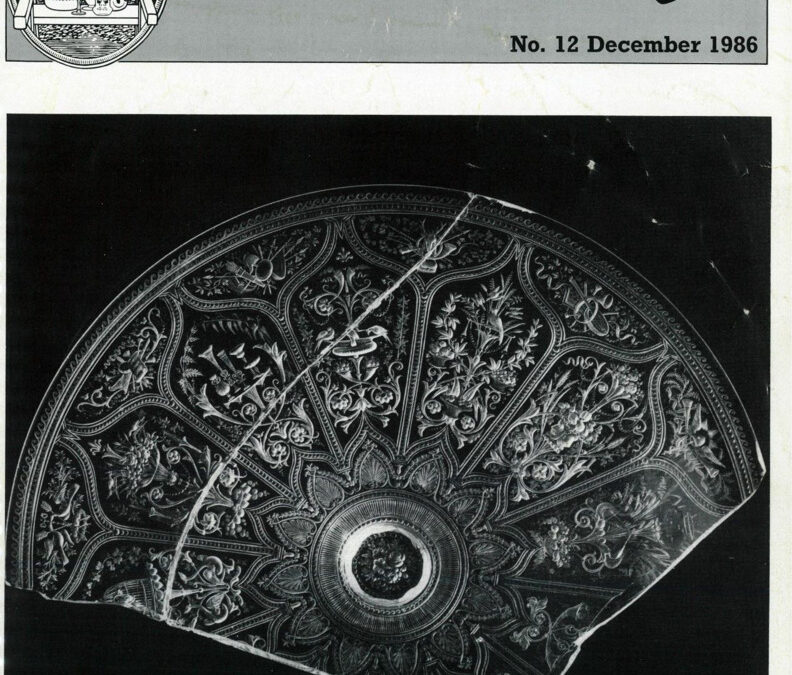
Cover Illustration
A Lost Treasure
Re-Discovered
A fragment of the Morrison Tazza.
The tazza was shown on the stand of
Dobson and Pearce at the London
exhibition of 1862 where it was sold
for the then record price for a piece
of glass of 250 guineas. Since that
date the glass has been lost to the art
world until its re-discovery in early
October of 1986. Prior to leaving for
a lecture visit to the Corning
Museum of Glass Seminar on “Glass
at 19thC World Fairs”, your editor
discovered two fragments of the
Morrison tazza in a private collection
in Stourbridge. The discovery was
announced at Corning on 17th
October, 1986, and is published
here for the first time since 1862. The
two fragments are currently
undergoing restoration at Corning
and will be on display at Broadfield
House on their return to this country.
Glass Cone wishes
all our readers a very
happy New Year and
prosperous 1987
Exhibitions
STOCKPORT
Art Gallery
War Memorial Building
Wellington Road South/Greek
Street
Modern Glass’
A selection of contemporary glass
from the N. W. Arts Craft Collection
including work by Christopher
Williams, Diane Hobson, Pauline
Solven, David Taylor, Steven
Newell, Annette Meech.
‘Manchester Glass-Work’
A travelling exhibition of press-
moulded glass from the Manchester
District, incorporating many newly-
identified designs, drawings and
illustrative material.
Both exhibitions open 10 Jan — 7
Feb.
Opening hours Mon-Fri 11-5, Sat
10-5,
Closed Sunday. Admission Free.
SEMINARS
Glass of the Caesars
The major exhibition at the Corning
Museum of Glass in 1987 will feature
some stunning examples of glass
from the Roman Empire. As part of
the exhibition the museum has
organised a one-day colloquium on
Friday 24th April. Topics under
discussion will include Cage Cups
and Cameos: Roman Luxury Glass
by David Whitehouse and the
Chemical Analyses of Cage Cups by
Robert Brill. The other expert
speakers are S. Goldstein, K. S.
Painter, D. Grose, H. Hellenkemper
and D. Lanmon.
BRITISH SOCIETY OF
SCIENTIFIC GLASSBLOWERS
The Society will stage the “British
Symposium ’87” at the Queen’s Hotel,
Hastings, on the 1st, 2nd and 3rd
October, 1987. Anyone wishing to
attend should contact — L. F.
Patrick, 4 Tudor House, York Close,
Horsham, Sussex, RH13 5PP,
England.
INTERNATIONAL GLASS
FESTIVAL
An International Festival of Glass
will take place at Sunderland
Polytechnic from 6th to 17th July,
1987 and will be in five parts. A
major exhibition will represent the
best of contemporary studio and
factory produced glass. A three day
symposium will explore the theme
of “Art, Design and Industry” and
will be led by invited speakers from
around the glass world. Participants
will be invited to take part in related
practical workshops. A two day
weekend of lectures and
demonstrations will cater for
collectors and historians of
contemporary and antique glass. A
“Glass Fair” will allow participants to
buy items from both categories.
Practising craftsmen will have a two
day specialist workshop while a five
day summer school approach will
allow amateurs to develop technical
and design skills. A supporting
programme will include a “Young
Blood” exhibition of the best of
student work. For further
information please contact the Glass
Dept., Sunderland Polytechnic,
Langham Tower, Ryhope Road,
Sunderland, Tyne & Wear SR2 7EE.
YEW TREE TRANSPLANTED
YEW TREE GALLERY, run by Gill
Wyatt Smith, has moved from
Derbyshire to Green Lane, Little
Witcombe, Gloucestershire — just
five miles from Cheltenham. The
village is off the A417 Gloucester/
Cirencester road and four miles
from Exit 11 of the M5. Ring 0452
863516 for maps and brochure. The
Christmas Exhibition showed glass
by Deborah Fladgate and Catherine
Hough and glass by contemporary
makers will continue to feature
largely in the forthcoming year’s
exhibition programme.
Opening hours are from 11.00 a.m.
— 5.30 p.m. daily except Mondays
and 1.30 — 5.30 p.m. on Sundays.
Copy Dates
January 26th for March issue
April 27th for June issue
Views of the
St. Louis
glassworks
The St. Louis Factory
Situated at St. Louis les Biche in the
famous Lorraine district of France
the factory was founded in 1767 and
by 1784 had introduced lead glass
into France. Between 1870 and 1919
the firm was a German company due
to its geographical position. It was
invaded again in 1939/40 when it
was transformed into a hospital. At
that time all the archives and a
selection of glasses were packed
away in cases and only re-
discovered about two years ago. In
the summer of 1986 John Smith of
Aspreys visited the factory where
he picked out 80 representative
items from the packing cases in the
lofts. Those glasses formed an
exhibition held at Aspreys in
December and which moves to
Broadfield House Glass Museum
from 28th February until 26th April.
The six photographs are
reproduced here for the first time by
courtesy of the Cristailleries de Saint
Louis.
Engraving and
cutting lathes
powered by an
overhead drive
shaft
Interior of the
enamelling
and gilding
studio. One of
the large gilt
vases seen on
the right is
included in the
exhibition.
Two views of
the final
checking and
packing rooms
.
Northern Bohemia 1985
Short term official visits to the
C.S.S.R. are organised through the
British Council and I was able to visit
Prague and Bratislava in March
1986. The itinerary I had asked for
was based upon second hand
information and books, but I was
able to enjoy an unforgettable trip.
My first day was a national holiday
and I saw (in descending order of
preference) Prague’s magnificent
old railway station, the collection of
Meissen porcelain at the Arts and
Crafts Museum and opera at the old
Smetana Theatre. From this point I
thought that the trip could only get
worse: in fact it got better.
Part of the tour included a short trip
to Northern Bohemia. Here the
almost Alpine scenery was still
under heavy snow when I arrived,
although I had spotted several low
buildings with tall chimneys from
the coach and thought they must be
glass-works. Novy Bor, my first stop,
is dominated by a huge modern
factory, Crystalex. Here I met the
manager at 8.30 am. for coffee –
work begins at 6.30 a.m. — and saw
how the factory copes with foreign
demands for Bohemian cut lead
crystal and enamelled ruby glass, its
particular speciality. Many of the
hand-made designs, as opposed to
automatic and semi-automatic
production, still depend upon the
use of traditional hardwood moulds
for mould-blown shapes. Within the
town a small studio was producing
the laboriously cut and polished
heavy ‘fifties and ‘sixties style
ornaments: rainbow coloured fish
and asymmetrical bowls. Above the
cutting shop was a small well-lit
studio where Bohislav Horacek (b.
1933), one of the great living wheel-
engravers, was working. He
explained how he had produced his
masterpiece, a huge heavy rock-
crystal type design decorated with
an Old Testament scene, The Flood.
Novy Bor, like most of the Bohemian
glass towns, has a museum showing
mainly historic pieces. There was
some striking 20th century material
apparently influenced by the
Wiener Werkstatte, and the
collection was cleverly displayed in
natural light. The staff at the museum
and at Crystalex had many
memories of the 1984 International
Glass Symposium hosted in Novy
Bor at which foreign and Czech
craftsmen had worked together.
I travelled further into the mountains
to Kamenicky Senov, above the
small town of Parchen. I rather
lamely hoped to find out more about
a young engraver W. F. Pohl who left
for England in 1859. The search was
confounded by the numerous Pfohls,
a prestigious dynasty of Bohemian
engravers. However, the local priest
kept an illustrated journal of local
events and personalities which
recorded the lesser Pohl family in
the early 19th century.
From here I took the night bus to
Liberec, the main glass exporting
centre and regional capital, and
then a tram — clearly not ideal for
mountain transport and somehow
stuck at full throttle — to Jablonec
nad Nisou. Traditionally associated
with jewellery manufacture
Jablonec has a fine National
Museum. The collection contained
attractive press-moulded pieces
attributed to a local firm Hoffman
and marked with a butterfly motif,
including an Imperial chess set in
black obscured glass.
Having been misled by Czech
creamware marked Wedgwood in
Prague I began to feel very uneasy
about the remarkably English and
American looking pressed glass,
both in Prague and Jablonec. Some
registered Davidson’s Pearline
pieces, seen later in Bratislava,
were the only convincing non-
Czech designs I saw.
Jablonec had some fine examples of
Czech-Venetian: typically florid and
lurid opalescent chandeliers I had
considered to be exclusively Italian.
Examples were also in the Prague
Arts and Crafts Museum, and there
again an obvious source of
amusement and pride among the
staff.
Perhaps because of its importance
in the glass jewellery industry,
Jablonec has a good collection of
coloured glass. I particularly recall a
fine uranium yellow piece dated
1841, and quantities of opaque
malachite green glass which is
rather confusingly referred to as
jade glass by the Czechs.
From Jablonec there was an epic
excursion in the town’s only taxi, a
slug-like Russian saloon with an
aptitude for overtaking. This took
me first to the glass secondary
school of Zelezny Brod, one of
several unique and specialised
institutions responsible for training
the present generation of glass
craftsmen. From here I was taken to
see the factories of Desna and
Harrachov.
The state factory at Desna mainly
produces hand and semi-automatic
machine pressed work, within a 19th
century factory complex
administered from the beautiful
former home of Josef Reidel who
owned the factory in the 1880s. The
mould shop has an impressive
arsenal of moulds and tools; clamps
for making chandelier drops and
lustres and complex articulated
charges for the numerous German
hand and steam presses, scattered
amid the works, were all under the
care of the mould-makers.
Some obscure aspect of lens
manufacture is also carried on at
Desna, which produces an
impressive performance by a team
working in the semi-darkness of the
19th century factory. A workman
sprints through the factory with a
huge paraison taken from the main
furnace. Reaching a smaller furnace
it is passed to another worker who
re-heats and blows it to an enormous
size before deliberately breaking it
over a steel plated platform. The
wafer-like fragments are gathered
by other trainees and workers, as
the next huge and glowing paraison
is already speeding towards them.
At the site of Count Harrach’s factory
(f. 1714) in the ski resort of
Harrachov was an original and well
maintained 19th century cutting
shop alongside modern furnaces.
The benches in the cutting and
News & Views
OBITUARY
Horace Ensell Richardson
1908 — 1986
Mr. Horace Richardson, of
Wordsley, who died on 6th
September, 1986, was
descended from the
Richardsons, world famous as
glass manufacturers for most of
the 19th century. Mr. Richardson
was the last of a long line bearing
that name.
He travelled extensively during
the 1920s and 1930s on behalf of
Henry G. Richardson and Sons,
Ltd., who ran the Wordsley Flint
Glass Works, previously the
home of W. H., B., and J.
Richardson.
Mr. Richardson, with other
members of the family,
presented to the then Brierley
Hill Glass Museum, four most
important pieces of Richardson
cameo glass by two of the most
famous artists — George Woodall
and Alphonse Lechevrel. These
are now at Broadfield House
Glass Museum.
In recent years he took an active
interest in researching and
promoting the history of the
Richardson factory. His
knowledge and enthusiasm will
be a sad loss to his many friends
both inside and outside the glass
industry. Our deepest sympathy
goes to his widow Kathleen.
H. W. W.
Continued from page 6
polishing shop were arranged in
two rows, each opposite the
windows and driven by a single
pulley system fed by water power.
Festooned with spare wheels and
semi-finished glass this was a noisy
and unpleasant place of work, or
rather a living and working museum.
Full lead crystal, cut and acid
polished is made here, and high
REG WILKINSON
died in September, aged 80. One of seven brothers,
Reg was born into a family deep in the manufacture of cut glass. He was
born in Amblecote, within a strenuous stone’s throw of Broadfield House,
and began working for one of his brothers in 1922. It was a small
decorating business handling cutting, engraving and etching for local
factories.
In the foreword to his book, The Hallmarics of Antique Glass’, (Richard
Madley Ltd, 1968) Reg details two vastly influential innovations which
were brought into use by the business: a commercially successful acid-
polishing process and the introduction of carborundum wheels for rough,
or initial, cutting. In a short while, the whole trade had moved over to their
use in place of steel wheels fed with sand, the method normal for some
two hundred years previously.
Reg came to London in 1947 after a spell with the Admiralty in the War.
He was married and had two children, Arthur and Janet. He started a
cutting business with his son, Arthur, decorating to order as he had been
accustomed all his working life. A couple of years after they were
launched, they were visited by an antique dealer who specialised in
period lighting fittings, with the request that they should attempt a few
minor repairs. A flood-gate was opened as the news spread around the
trade! In no time R. Wilkinson & Son were handling as much repair
business as new. After a while, Reg left more and more of the business in
Arthur’s hands as his interest in antique glass grew. He passed the
company over to Arthur in 1968 and promptly opened a shop in
Wimbledon, and took stands regularly at Fairs. With his background, it is
no surprise he was early in the field of collectors’ art glass, his knowledge
spreading far wider into the varied techniques of the late nineteenth
century than cameo glass, hitherto virtually the only subject explored.
With the death of his wife, he retired from business, moved, and laid out a
new garden. He retained a considerable connection with collectors in all
fields and would often be seeking some rare thing for one of them. He
was a merry man, very keen on the subject in hand be it bevelling or
begonias. Knowledge of his eventual illness was restricted to his family,
indeed, he took himself off, almost secretly, to the Royal Masonic Hospital
when he felt the end was near. Anxious to be no trouble he returned to his
daughter only for his last few days.
The firm he started prospers exceedingly, now, since 1983, in the hands
of his grandson, David. A crowning pleasure of his life must have been
the Royal Appointment, granted to R. Wilkinson & Son this year.
M. M.
quality table glass. Both here and in by the friendly and thoughtful way
the more prosperous Slavakian
the factory and museum staff helped
glass factories, centred around
me. Photography was usually
Zlatno and Poltar some new designs unrestricted and information given
were in production. A hand made
freely, perhaps more freely than it is
knotted stem was regarded as the in some western factories and
best of these and, I was advised,
museums.
would soon be on sale in Liberty’s
Richard Gray
Regent Street showroom.
My visit was made more enjoyable
th Regional Reports
NATIONAL MEETINGS
A.G.M.
One hundred members gathered at
the Museum of London on Saturday,
18th October for the Glass
Association’s Third Annual General
Meeting. This was the largest turn-
out there has ever been for a Glass
Association meeting, proof that the
AGMs can be popular if other events
are arranged around them.
The morning was taken up by three
half-hour lectures by members of
the museum staff, which managed to
convey the different ways in which
the Museum of London is involved
with glass. The first speaker was
John Clark of the Mediaeval
Department who spoke about
Mediaeval glass finds in London
from the ubiquitous urinal, which
was used in medical diagnosis, to
the rare group of enamelled beaker
fragments recently excavated from
Foster Lane in the City. These are
decorated in a palette of red, blue,
white and yellow enamel on both the
outer and inner surface of the glass,
and may have been the work of a
Venetian glass painter named
Bartholomew, active around 1300.
John Clark was followed by Alan
Vince of the Department of Urban
Archaeology who described the
archaeologist’s approach to glass,
particularly how the archaeologist
uses excavated material to throw
light on the social conditions
prevailing at the time when the glass
was made.
Last to speak was Wendy Evans, co-
ordinator of the Whitefriars Glass
Project, who in spite of an erring
slide projector gave a highly
informative account of the
Whitefriars factory, ending with a
fascinating series of slides showing
the interior of the works just before
the move to Wealdstone in 1922.
Wendy’s knowledge of the
Whitefriars Glass Works came as no
surprise, but less expected was her
erudition on the subject of London’s
dung and sewage about which we
were treated to a most amusing
digression! (Question: What is the
connection between Whitefriars
and dung and sewage? Answer: An
enormous dung heap was sited on
the banks of the Thames close to the
Glass Works and is clearly marked
on the old maps which show the
factory).
After an excellent lunch provided
by Milburn’s Catering there
followed the AGM, which was
enlivened as usual by some off-the-
cuff remarks from our Hon.
Treasurer/Membership Secretary,
Ronald Brown, during his report. At
the end of the AGM the draw for the
raffle was made by Wendy Evans.
By a remarkable coincidence three
of the names that were drawn were
members who were supposed to be
at the AGM, but who had failed to
arrive. Further amusement was
caused when the Arlon Bayliss/
Malcolm Andrews latticinio bowl
was won by their fellow-glassmaker
Charlie Bray. Those of us who were
at the British Artists in Glass
conference in Stourbridge in
September remembered that
Charlie Bray had also won a prize at
the B.A. G. raffle — obviously a man
on a winning streak. The raffle
raised over £600 towards the cost of
the 1987 Journal, and we should like
to thank all those who so generously
donated prizes and all those who
entered into the spirit of the raffle by
buying tickets. The prizewinners
were as follows:
1st Prize — Mr. & Mrs. Wareham, St.
Helen’s
2nd Prize — A. McCallum, London
3rd Prize — Davia Walmsley,
Cleveleys, Lancs.
4th Prize — Charles Bray,
Cumberland.
5th Prize — Mr. & Mrs. Moore,
Beckenham.
6th Prize — Mr. de Wilmot, Alton,
Hants.
7th Prize — Wing-Cdr. R. Thomas,
Midsomer Norton, Avon.
8th Prize — Mrs. Stower, London.
9th Prize — Dr. Seddon, Redditch,
Worcs.
Finally, thanks to all those at the
Museum of London who worked so
hard to make the day such a
success, particularly Wendy Evans,
ably assisted by Alex Werner and
John Clark.
REGIONAL MEETINGS
South East Group
Arrangements are in hand to visit
the new Lloyds of London building
with its Nelson collection of glass, in
February, 1987, a visit which will
entail the issue of individual security
passes. Details will be sent out to
members in the South East but if any
other regional members wish to
attend, please contact Paddy Baker,
Dept. of Art History, WSCAD, The
Hail, Farnham, Surrey.
Glass at Melbourne
Certain parts of the article about the glass collections at Melbourne in
Glass Cone No. 10 may have unwittingly misled our readers. The
following statements and corrections should be made to redress the
balance; i.e. Mr. Rex Ebbott O.B.E. is still the Honorary Adviser in the
field of glass to the National Gallery of Victoria and the glass collection at
the University of Melbourne; the antique English and Irish glass, rather
than Dutch and Spanish glass, was acquired by the gallery on the advice
of E. Barrington Haynes in 1949 and that the gallery’s pair of Baccarat
candelabra were made for, but not delivered to, Czar Nicholas II. It
should also be pointed out that Dr. Wilson is not associated with the
Melbourne University Gallery nor is he a staff member. Since writing the
article Dr. Wilson has left the post of Private Secretary.
I would like to thank Mr. Rex Ebbott, Mr. Terence Lane, Senior Curator of
Decorative Arts at the National Gallery of Victoria, and Mr. Howard
Phillips for their assistance in correcting these inaccuracies. I apologise
to them and to anyone else who may have been embarrassed by the
implications in the article.
Editor, Glass Cone.