




The newsletter of the
Glass Association
Registered as a Charity No. 326602
Chairman:
Anthony Waugh
Hon. Secretary:
Roger Dodsworth
Editor:
Charles Hajdamach
Address for correspondence:
Broadfield House Glass Museum,
Barnett Lane, Kingswinford,
West Midlands DY6 9QA,
Tel 0384 273011
ISSN 0265 9654
Printed by Jones & Palmer Ltd„ Birmingham
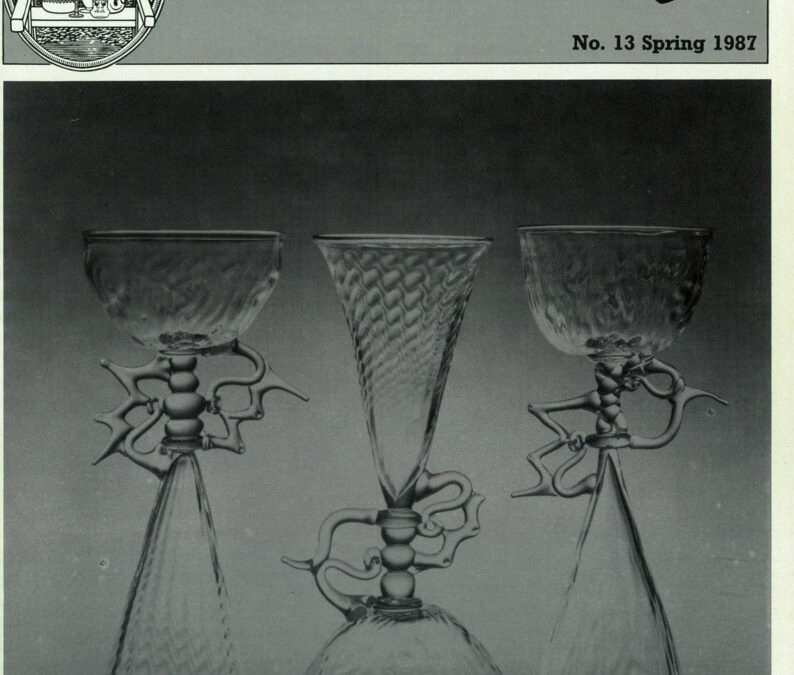
Cover Illustration
Crystal Optic Reversible
Champagne and Cognac Goblets
by Fritz Dreisbach 1985. Ht. 9 1/8″
Courtesy of the Traver Sutton
Gallery, Seattle, WA
From CRAFT TODAY: Poetry of the
Physical, the inaugural exhibition of
the American Craft Museum in its
new headquarters at 40 West 53rd
Street, New York City.
Photographer: George Erml.
Copyright American Craft Council.
Exhibitions
ST. HELENS
PILKINGTON GLASS MUSEUM
Prescot Road
GLASS ART
Direct from the Department of
Design at the North Staffordshire
Polytechnic comes an exciting
exhibition of Glass Art.
Organised by Elizabeth Swinburne,
senior lecturer in the Glass
Department of the College’s
Depadment of Design, the
exhibition will feature works of art
by past, present and final year
students plus members of the
design staff.
21st March — 26th April
TOWARDS THE 21st CENTURY
An outstanding display of the many
exciting projects currently being
undertaken by the Research and
Development Department of
Pilkington Brothers plc.
Visitors to the exhibition will be able
to see some of the new and
interesting products which the
teams have in store for the high tech
industries of today and tomorrow.
May — June
COME AND MAKE –
STAINED GLASS ACTIVITIES
Paul San Casciani is an expert in the
art of making stained glass and he
will be demonstrating his skills
during this week.
Trained at James Powell Stained
Glass Studio, London, Paul is a
specialist glass painter and has
worked on windows for many
churches and public buildings in the
United Kingdom and abroad.
His “Come and Make” workshops
are very popular and during this
exhibition he will be holding full day
sessions for adults and half-day
sessions for organised school
groups.
Full details regarding registration
for these sessions are available from
the Museum — 0744 692499
6th — 10th July
KINGSWINFORD
Broadfield House Glass Museum
Barnett Lane
St. Louis Glass
19th and 20th century glass from the
St. Louis Factory Archives
Until 26th April
Tuesday-Sunday 2-5 p.m. and
Saturday also 10-1 p.m.
BIRMINGHAM
City Museum and Art Gallery
Chamberlain Square
Sowerby: Gateshead Glass
800 pieces in a comprehensive
survey of Sowerby glass from 1800 to
the present day. First shown at the
Shipley Art Gallery, Gateshead.
16th April — 14th June. Galleries 17-
19
Glass Fantastic
Work by students and teachers, past
and present, from Stourbridge
College of Art and Technology.
16th April — 14th June. Gallery 16
Open Mon-Sat 9.30-5, Sun 2-5.
Birmingham Reference Library
John Hardman Studios:
150 Years of
Stained Glass
6th April — 8th May
LONDON
Victoria and Albert Museum
Glass and Ceramics from the
permanent collections.
A temporary exhibition in Room 138
of 19th century products including
glass from Stourbridge, Nailsea,
Tiffany of New York and Lotz Witwe
of Austria.
Until the beginning of May.
GLASS SEMINAR
Decorative Glass: Art and Etiquette.
A one-day course looking at the
influence of public taste and social
etiquette on the design and
marketing of glassware. Two
morning lectures will be followed
by an afternoon visit to Wightwick
Manor, near Wolverhampton, a
magnificent late 19th century house
built by the Manders family. The
unique display of arts and crafts
furnishings includes a fine collection
of VVhitefriars glass that will be of
particular interest to delegates.
Saturday, 24th October 1987
For information contact: Janet
Markland, Ironbridge Institute,
Ironbridge Gorge Museum,
Ironbridge, Telford, Shrops, TF8
7AW. Tel. 0952 45 2751 ext. 36.
The International Ceramics Fair
and Seminar
At the Dorchester Hotel, Park Lane,
London from Friday, 12th June until
Monday, 15th June, 11 a m.-8 p.m.
each day. On Sunday the 14th at 2
p.m. Simon Cottle will talk on
William Beilby and other 18th
century glass enamellers. Lecture
tickets at £8 for the first lecture (£6
subsequent lectures) and further
information are available from Brian
and Anna Haughton, 3b Burlington
Gardens, Old Bond Street, London
W1X 1LE.
COPY DATES
1st May for Summer (June) issue
31st July for Autumn (September) issue
The United States
Glass Company
to its origins and export success story.
An introduction
The early 1890s was not a good
period for the American glass
industry. There was another trade
slump and endless union unrest.
Strikes were as common as
company collapses. The resilient
strength of the huge late 19th
century glass industry in the USA
has perhaps been overlooked
outside North America. One notes
that the two largest contemporary
trade unions were the American
Flint Glass Workers Union and the
Window Glassworkers Association
with the latter predominating.
Amalgamations and short lived
conglomerations of lame factories
were common. After lengthy
negotiotions, the United States Glass
Company was incorporated on
February 12th, 1891. This was not a
new company but an unusually large
fusion of 10 existing factories. They
were spread over the principal
glass making area of the Ohio river
valley. The overall aim was
cooperative survival and profit. It
was to be in business for more than
60 years.
A BOWL FOR WINDOW OR
COUNTER DISPLAY. I TtlAS
MANY LISES • WtIATEVER ITS
CONTENTS-PUN 1-LEMONADE
FLOWERS-FRUIT, ET. -(TWILL
ADD DLITINCTIVE REFINE –
ME NT TO ANY OCCASION
Dominating the output of this
massive concern were mass
produced press mouldings. The
dazzling repertoire of pressed glass
was available in lengthy, matching
flint as well as coloured services.
There were also novelty items in
most fancy moulded glass finishes
such as opaque white, blue, ivory
and slags as well as opalescent,
stained, enamelled, colour flashed
and iridised goods. Ruby and yellow
part staining of flint was popular as
was elaborate gold trimming on all
kinds of glass. Replacement lighting
fittings and expendable comestible
containers provided convenient
work for winter and summer
seasonal demand. Blown tumblers
were available plain or fancy
etched. Member factories, former
rivals, included venerable
Pittsburgh houses such as George
Duncan & Sons and the O’Hara
Glass
Company. More factories were to
be incorporated and others
vanished following the usual
destruction by fire. It was the largest
domestic and fancy glassmaking
concern ever to be run by one
mangement.
The initial three years of the
company were neither inspirational
nor auspicious. By early 1893 none of
the factories were in regular
production and most workers were
laid off. By the autumn of that year,
four of the US Glass factories were
struggling in limited production.
The management failed to persuade
the American Flint Glass Workers
Union that a temporary switch to
cheap jam and jelly jars was better
than company collapse. It would
also make sense if the workers
could produce tumblers, steins and
ponies etc. at an increased
production rate, US Glass could then
match the lower price of products of
rival concerns who were taking all
the business. The union would not
discuss any increase of output per
turn over the ‘traditional’ norm.
There was never a direct dispute
over wages. A long struggle began
on Friday, October 12th, 1893 with
US Glass closing down all its
factories. Non-union labour,
Pottery
Gazette 1st
May 1924
EVERYTHING
PRESSED
GLASS
0
TABLE WARE
FLINT AND
DECORATED.
LARGEST RANGE
OF
DESIGNS.
ac
ALWAYS
SOMETHING
NEW.
rR
4
–
55,Farri
Vion
St MI burniliaducti
.,u
LONDON EC –
Pottery Gazette 1st
February 1911
Pottery
Gazette 1st
November
1906
65, Farringdon Street,
0
9
Holborn Viaduct,
Our Factories are now working
London, E.
C .
40,000 rtloulds, in which arc
,
_
Manufacturer,. of
included all useful and Fancy
Lines required by the Trade.
SPECIAL.
ATTENTION
GIVEN TO
LICENSED
ST /CT LIALLasnis
GOODS.
au
United States Glass Co
UNEQUALLED
FACILITIES FOR
F %PURI’ TRADE.
PRESSED & BLOWN
GLASSWARE,
IN CRYSTAL
AND
VARIOUS
ARTISTIC
DECORATIONS.
SlIOW ROOM,I5
ART. OPEN
hAl L1
FROM
o.,to tD 6.30
A CALL IS
RESPECTFULLY
SOLICITED.
Bead Office:
PITTSBURG.
Branch Offices:
PARIS,
CONSTANTINOPLE,
FRANKFORT IGERMANY,
NEW YORK,
PHILADELPHIA.
130SION, BALTIMORE,
CHICAGO,
SAN FRANCISCO,
SYDNEY, N.S.W.
Cr,
.tai
Rack Oval Dwell.
6, a, la.
guarded, and initially sleeping in
the works, was quickly used to staff
the King Glass Co. in Pittsburgh.
Indeed this was on the following
Monday. US Glass were obviously
well prepared. In fact, infiltration of
the union, by undercover detectives
hired by US Glass, kept the
directors in an advantageous
position. At the end of October,
Ripley & Co in the same town, was
also in production to levels of output
deemed satisfactory by the
management. This works was again
manned by a mixture of non-union
members and returning
impecunious workers including
some key mould makers. Company
police kept order and protected
those working of whom there was no
shortage.
The union paid a flat $6 per week
from the strike fund and it was
expected that the dispute would be
short lived. (This fell to $5 and
money eventually ran out despite
great fund raising efforts by
charitable sympathisers trying to
ease the general suffering.) More
factories began successful
production. Bryce Brothers began
work with non-union labour in late
December. US Glass declared, after
two extraordinary meetings, that
only non-union labour would in
future be employed. An announced,
and paid, 4% dividend was a
pleasant surprise for stockholders
and an unpleasant jolt for the union.
The rancour of the dispute
worsened as more factories re-
opened. By June 1894 the essential
and almost traditional personal
credit was withdrawn from strikers.
This was by agreement of various
merchants’ associations and the
union members were thus destitute.
Collapse of the strike followed and
the second largest trade union in the
USA had suffered a crushing defeat.
The US Glass Co. went on from
strength to strength, building new
factories, ever increasing its
workforce and paying out its profits.
A protective tariff kept out
competitive foreign glass. By 1908
the combine had at its disposal more
than 40,000 moulds for pressed
goods. Any of their moulded items
was theoretically viable in any
combination of half a dozen colours
and a dozen decorative finishes!
They were soon exporting
throughout the world. It took over
control of its British and Empire
agency market by opening up its
own London showroom and sales
office in 1902.
The British glass industry in 1902
was in a parlous state. Moribund,
hidebound, and entrenched in
production of conservative and
traditional cut crystal there was an
invidious history of disputes,
lockouts and endless bickering
between management and union
and bitter inter-union squabblings.
Imported glass, particularly from
Germany and Bohemia, was a
constant best seller changing and
altering in style, form and colour to
suit passing fads and fancies.
American glass, first imported in a
trickle from the late 1870s had been
largely ignored, but by 1905 it was a
healthy and very conspicuous
stream. British factory owners had
closely followed the success of US
Glass in crushing the unions’ and
were full of admiration. This turned
to jealousy when mass produced
American glass, well made, stylish
and available in a wide range of
shapes and finish, flooded in to be
sold in the UK at unbelievably
reasonable prices.
FLIES AND WAR DISEASE
PO, C.O.P,
Telt:CPO,
HIZ.
,
24
1
_
The glass was not just a threat to the
pressed glass houses of the North
East but a shock to the more staid
and traditional Stourbridge works. It
was the ‘near cut’ range of glass they
found astonishing. They could not
believe that fine and complex
moulds with a skilfully pressed
metal could produce such crisp,
finely facetted and sparkling
pressed ‘cut’ glass. It was not just a
copy of bold broad cutting but of
wheel cut glass of great complexity.
The British public loved it and for
the first time the sparkle of fine ‘cut’
crystal was not limited to the tables
and displays of those patently able
to afford it. Untrained public eyes
could not tell the difference. There
was a slump in demand for the ‘real
thing’.
As can be seen from the advertising,
all the glass was forcefully projected
with novel sales angles and slick art
work. In 1904 London office
shipping to the Empire was
reinforced by an Australian branch
office. There were new ones in
Frankfurt and Constantinople.
Protection from the deadly fly, and
thus from cholera, typhus and
‘spotted fever’ was a two year
feature of their UK advertising from
1913-15. US Glass had whole ranges
of table goods which all had
hygienic lids. No British factory had
anything like it but lidded ranges
eventually appeared. (fig.1) Their
early 1920s foray into plain deco
period shapes revived the black
glass plinth and indeed black satin
glass. The mid 1920s trend to plain
pillar moulded goods, on plinths, in
satin pastel and soft lustres, was
later used as a point of departure by
UK manufacturers. (fig.2) Davidsons
‘Cloud. Glass’ is heavily indebted to
Pittsburgh. The range of goods was
astounding from moulded glass
pillars for window display shelves
and hats, to vases of all shapes and
sizes suitable for flowers of every
season. Suites of stylish glass like
‘Waterford’, ‘Baronial’ and ‘Bluebird’
show successful marketing that
reflected the interests, needs and
aspirations of the buyer. The British
factories suffered as they could not
understand why the public did not
patriotically respond to the
interests, needs and aspirations of
the UK manufacturers. Davidsons
and Sowerby in the first decade of
this century were still in the 1880s
and their range of goods was all too
familiar. Stourbridge also was in a
time warp of design. Standards
were not maintained and quality
control was less than vigilant. It was
little surprise that wares from US
Glass, and other sophisticated
foreign sources, made such inroads.
The Pottery Gazette groused and
grumbled, as usual, but there was a
grudging fascination with, and
admiration of American mass
produced glassware. Accusations of
dumping, and American neutrality
caused a ban in 1916 on the
importation of pressed domestic
goods. As the English factories were
not able to produce very much, this
interdiction was of little supportive
use. It caused just another wartime
shortage and a rush into the shops
when the first batches of new lines of
American (and German, Belgian,
Swedish, Czechoslovakian etc.)
arrived after the war. Women were
earning for the first time, as they had
been in the USA for a long while, and
many US Glass lines were
successfully aimed at this liberated
money.
Economic events in Pittsburgh
caused the London office of US Glass
to be closed in the late 1920s. The
handling of their glass returned
once again to an agency basis.
Protective UK legislation, and
elsewhere, in the early 1930s, allied
with the Depression finally put paid
to the US Glass Co. abroad and
started its slow contraction in the
USA.
TO
Sty14.4,0
I
–
HE GREATLY BOOMED
,// FLY PERIL WILL CREATE
A PEP
–
1AM? PC_..”PZ-
COVF, IZ
1
–
4
.1)
GLAS SWAE
—A LINE FOR WHICH
E
HAVE LONG BEEN FAMOUS.
CALL
AND SEE OUR SAMPLES OF
COVERED FRUIT ANP 5ALAP BOWES
PRESERVE JARS,JUGS 5 SUGAR BASINS
GET TO KNOW THESE
PATTERNS,— THEY
SE A6liEt) A
—
OR
There is a great amount of the US
Glass Company production in the
UK. It is mostly unrecognised or
perhaps thought of as British. It was
very influential. Eventually it will
become as much collected here as it
is in the United States.
(The author recommends the
excellent ‘U.S. Glass from A to Z’ by
Fred Bickenheuser and William
Heacock. Antique Publications,
USA, 1978. Available from Goodwin
Books, 50 Empress Avenue,
Woodford Green, Essex. This
covers only the early years of the
company and does not include the
overseas offices. Valuable
catalogue reprints, colour pictures
of glass, and excellent notes make
for fascinating reading and
reference, as indeed do others on
the Heacock series on American
Glass.)
Raymond Notley
Pottery
Gazette 1st
June 1915
.
LIN FED 51
–
41″ ES
i,p$:ps
t
ss
55 FA TZ.ZINGpQN pTq;-
LONDON
ANL’
EVRInt-.1C/,
et, the
tle of en* IP
,
. in
m
.et
.”
t
r
:r.
‘
AP!
Elaboree towstpa,proved that the,
.
*
in
‘
.
PO< dippn num of *se tt Out IttoPlur fly. . So last do May been uP aved. 31 du Presto, of • slop!. reit of Plea were prossetl opedver, at the .S of zhe mate. they would (die space of .1301 20.000 eet. appall, they all Wed. . The 'X; :reproach should re• April 1/.1415. `CRAFT TODAY: POETRY OF THE PHYSICAL' THE AMERICAN CRAFT MUSEUM, NEW YORK. This exhibition is likely to be closed in New York (March 22nd) by the time this issue of The Glass Cone goes to print, nevertheless, I thought that Glass Association members visiting the United States, 1987-8, might catch up with it at its other venues and those visiting New York will be interested to hear of a new museum dedicated to Modern American Craft. The current exhibition of contemporary American crafts inaugurates the new museum and headquarters of the American Craft Museum, the exhibiting body of the American Craft Council. The new building was the result of a property deal in which the Museum's old premises, a traditional New York Brownstone building, was sold to developers. The Museum is purpose built and is independent, both in terms of access and street frontage to the new high-rise E. F. Hutton Building which was built on the original site. This separate identity is important to an institution which claims to be the only condominium museum in the country. However, given that the Museum has quadrupled its exhibition space and has managed to centralise the administration of both the Museum and the Craft Council, it is unlikely that it will maintain this distinction for long as other institutions in prime locations begin to assess their premises in terms of development potential. The new museum is on four floors connected by a 40-foot-high stair- atrium, the central design focus of the building. Views of the stair- atrium and three interior levels can be seen from the street façade, through the vast area of plate glass which make up the Museum's 'shop front'. The slick new premises, almost opposite the Museum of Modern Art in central Manhattan, emphasize the increasingly high profile which the crafts are enjoying in America. I say the crafts' advisedly because many of the pieces selected for the current exhibition do not seem to have their roots in what one might consider to be the vernacular crafts, but are sophisticated pieces of 'Art' work crafted in three-dimensions. The distinction between 'art' and 'craft' is of course difficult and often nonsensical; in this part of Manhattan, it is for the moment blurred by 'craft' occupying a similar prestigious white-walled space to modern painting and sculpture. Kicking off as it has with an exhibition devoted to crafts of the last five years, the Museum has more of the feeling of a large-scale commercial gallery. There are, however, plans for an extensive exhibition programme with a balance of scholarly or historical displays as well as those, like the present one, which report on new trends. Given the quantity and quality of the glass pieces in the current exhibition, it is to be hoped that glass will feature strongly in the future programme. The Museum will also display part of the American Craft Council's growing permanent collection which will be displayed on the third floor. In Craft Today: Poetry of the Physical', there are more than 300 exhibits by 286 American artists. Media represented include clay, fibre, glass, wood and metal. Objects range from furniture, vessels and interior accessories to clothing, jewellery and sculptural pieces. To render some meaning to such a large and diverse collection of objects, the organisers devised four categories for display, each supposedly 'emphasizing' the maker's intent'. In their selection of four categories; 'The Object as Statement', 'The Object Made for Use', 'The Object as Vessel' and 'The Object for Personal Adornment', the organisers are sadly guilty of over- simplification for the sake of a coherent display. While some of the exhibits in the first category such as Stephen Dale Edwards' Man, 1985, Glass and Concrete, which is clearly a sculptural piece and thus, presumably intended primarily as statement; the inclusion of some pieces in this category and, more importantly, the exclusion of other pieces, divests the craft object of its inherent plurality of meanings and purpose. Surely the main ground won for design in the Post Modern era is the consensus that all manufactured objects have 'Meaning' in a cultural sense. One would then assume it to be understood that the individual craft item should be interpreted, in part, as a personal statement of its maker. This criticism apart, the exhibition is an exciting survey of American craft in the Post Modern era. Memphis style abounds in furniture and ceramics by Peter Shire, in glass by Richard Marquis and in ceramics by John Donoghue, Ralph Bacerra and Dorothy Hafner. Most of the funiture designs, with a few exceptions in laminated timbers of breathtaking craftsmanship, are mixed media in not-so-startling combinations of woods, plastic laminate, metal and glass. Mixed media designs feature in all sections of the exhibition and one is overwhelmed by the great degree of expertise and sensitivity with which multiple materials are handled by the individual craft artist. Glass features strongly in three out of four of the sections of the exhibition, its presence being most felt in 'The Object as Vessel'. It is in this category that the material is seen in its purer form as a single medium, however, the range of techniques utilized by the various artists is extensive. On the one hand there are examples of fine handblowing which exploits the qualities of fluidity and translucency such as Bernard Moore's Interior Fold Series in Amethyst with Black Spiral Wrap, 1985, and Fritz Dreisbach's quirky Crystal Optic Reversible Champagne and Cognac Goblets, 1985, (Cover Illustration). By contrast, there are more robust designs in thick, semi- I Ga News & Views opaque green glass, reminiscent of Art-Deco; Mark Abilgaard's Ritual Vessel, 1985, blown, cast and sandblasted; and Karla Trinkley's Herringbone Bowl, 1985, pate de verre. Perhaps the most unusual piece in this category is Mary Ann Toots Zynsky's Exotic Birds: American Dream Series, 1985, a bowl-shaped structure of ultra-fine glass filaments. The most un- glasslike objects are surely a range of enamelled perfume bottles by Andrew Magdanz and Susan Shapiro. These little bottles are harshly rectangular with one side of each moulded in a zig-zag form; the enamel colours, although in pastel shades, have a metallic effect which contrasts with the smoothness of the ground glass stoppers in the disconcerting manner of 'Memphis' designs. In the other two categories, glass is featured mainly in mixed-media designs, one notable exception being Harvey Littleton's Opalescent Yellow Squared Pair, 1983, a sculptural composition of cased multi-coloured glass. This piece, which expressed perfectly the maker's fascination and empathy with material and form, looked strangely at odds in an exhibition dominated by Post-Modern designs. In this latter category Therman Statom's Chair, 1983, Plate glass, mixed media, is both whacky and controversial. This life- size chair, made entirely of plate glass and spattered with coloured paint is the antithesis of 'Functionalist' design. Perhaps, more significantly, Statom has delivered plate glass from the narrow confines of modern architecture into the realm of art- making. Diversity is the keyword for the exhibition; but it is not a diversity based on geography which one might expect in an exhibition of modern American craft. It is the apparent lack of regionalism in the exhibits which is most surprising to one who is not closely connected with the craft scene. Commenting on this diversity, the exhibition organisers are claiming a renaissance for American craft. Craft in America has evidently found a new role for itself, closer perhaps to 'Art' and nearly as precious. Diane Taylor TWO NEW GLASS SHOPS In October the Perfect Glass Shop opened at 5 Park Walk, London SW10 with an aim of stocking around 1,000 different products from budget-price drinking glasses to antique pieces. The decor of the shop owes its inspiration to a country house library, with library shelves to carry glass rather than books. An enormous selection of ideas provides glasses for the dining table and the bar. Engraving can be undertaken to order as well as a special restoration service. Opening hours: Monday, Tuesday, Thursday, Friday and Saturday 10 a.m.-6 p.m., Wednesdays 10 a.m-7 p.m., Sunday 10 am-1 p.m. In December Jeanette Hayhurst moved to new premises at 32A Kensington Church Street, London W8 (01-938 1539). The larger accommodation will feature extensive displays of 19th and 20th century glass as well as her usual selection of 18th century glass. The quarterly exhibition on contemporary glass began with work by Arlon Bayliss and will complement the occasional temporary exhibition of antique glass. The first of these shows looks at the John Brooks collection of dated tumblers from 1700-1900. M.B.E. Honour Frank Thrower, the Design Director for Dartington Glass, was awarded an M.B.E. in the New Year's Honours Lists for his contribution to British Glass Design. CARNIVAL AT CORNING The 1987 American Carnival Glass Association convention in Canandaigua, New York will be celebrating the 80th birthday of Carnival Glass. In those eighty years, Carnival Glass has come a long way. One of the things that had a great impact on the cultivation of Carnival Glass collecting, was the Woman's Day magazine featuring a "Dictionary on Carnival Glass" in 1965. Carnival Glass an important part of the history of glass making in America and the American Carnival Glass Association is proud and happy to be working on a project that stresses that history. The association has been invited to display a substantial grouping of Carnival Glass at the Corning Museum of Glass, beginning July 6 to November 5, 1987. This will give our association the opportunity to show Carnival to the hundreds of thousands of visitors that view glass at Corning each summer and fall. We will be borrowing more than 100 pieces with an effort to include the maximum variety of shapes, patterns, makers and colours. Dawn Levickas and I will be gathering the glass from members willing to loan pieces for the exhibit. Thanks to members' willingness to help out in this project, most of the glass has already been volunteered. We are still looking for a piece with an original label. If you have one, please contact one of us. Carnival Glass has been given an added bonus of recognition by the Corning Museum of Glass. At a 3 day seminar in October, Ray Notley, our guest speaker in New Philadelphia and a member of ACGA will be featured in a lecture on Carnival Glass. Ruth Schinestuhl Dawn Levickas ecatiopu The London "Daily Advertiser" provides valuable source material for glass historians. The following entries have been selected from the newspaper by Olive Jones of the National Parks Service of Canada. 28th July, 1739 At the Glass Shop in Duke Street, near Lincoln's Inn Fields Are made and sold, at the cheapest Rate, all sorts of cut glass for deserts or any other use; also lustres cut after the Diamond manner, of all sorts and sizes, and of the very best chrystal. The master of the Shop (having work'd a long while for Mr. Madwell, the King's Glass-seller) has an Intention to remove at Michaelmas next, to the Corner of St. Martin's Lane in the Strand, and hereby acquaints all Gentlemen and Ladies, that they there may be served with any sort of Glass, according to their own Fancy, and to the utmost Perfection, by their humble Servant. Jerom Johnson, Glass-Flowerer 16th January, 1740 From the New Glass-House Lately erected by Cookson and Jeffreys, at South-Shields, near Newcastle upon Tyne. The best CROWN GLASS is to be sold at their warehouse at the Old Swan, near London Bridge. Please to enquire at the said Warehouse, where daily Attendance is given, or at the House of Thomas Jeffreys and Comp. on Snow Hill. 24th April, 1750 Ran away on Monday the 16th instant, from his Master Thomas Betts, Glass-Scalloper, at the King's Arms Glass-Shop the Bottom of the Hay-Market, Isaac Hall, a down looking lad, about nineteen years of age, fresh complexion, has a Scar under his chin, and had on a blue- grey coat, a new cut curl'd brown wig, and new leather breeches. Whoever employs or harbours him shall be prosecuted to the utmost Severity of the Law. 7th November, 1750 STOURBRIDGE GLASS to be had of Abraham Cressey, at the corner of Prescott Street, Goodman's Fields. 31st January, 1751 JEROM JOHNSON, at the entire Glass-Shop, over-against the New Exchange in the Strand, sells all sorts of fine Flint Glasses; makes brilliant Lustres and Chimney- Branches and Candlesticks: cuts and scallops Dishes, Plates, Bowls, Basons, Cups and Covers, Salts, Cruets, and Castors; engraves all manner of Desert Glasses, Wash- Hand, Wine, and Water Glasses, Decanters, Rummers, fine flower'd Cans, Bishops with Covers. Turkish-fashion'd Pitchers, Lustre Lamps, Diamond cut and brilliant polish'd; wholesale and retail, at the most reasonable Rates; and no where else cheaper in London, being the first Inventor. 1st May, 1751 THE greatest Curiosities in Glass- Works ever seen, perform'd by a Woman who makes upwards of 200 different "Figures in Glass", which imitates China Ware, but represents Nature more than any China Figures, to be seen and sold at Mr. Goodwin's Jeweller and Tobacconist, next Door to the Hand and Shoe near Westminster Bridge. Also to be seen, several Views both foreign and domestick, by the Reflexion of a Concave Mirrour from Paris of twenty Inches Diameter. Her Stay will be but short at the above Place. 25th September, 1751 Wanted to go abroad immediately, A Glass-Grinder and Polisher, one who understands both, and is complete Master of his Business; he must be a Man of good Character, and bring satisfactory Recommendations with him. Such a one, sending a Penny-Post Letter directed for Z. Y. at the St. Martin's le Grand Coffee House, when and where he is to be met with, etc. shall (if approved of) be called upon and treated with. Flatth Regional Reports REGIONAL MEETINGS North West Group At the last meeting of 1986 the group heard Roger Dociswoth speaking on 'Thirties Glass'. Roger's talk was combined with a visit to the exhibition showing in the Manchester City Art Gallery in November-December — Make or Break', based on the 1946 Britain Can Make It' exhibition at the V. and A. Interesting background material for the talk came from the Pottery Gazette and Glass Trades Review. After a difficult time for British glassmakers during the 1920s, the thirties came as welcome relief. Protection from imports was granted in 1931, with a 50% import duty on overseas glass. The luxury trade began to flourish again. In particular the West Midlands cut glass found good markets, many of them abroad in various parts of the Empire. Styles varied from the highly conservative to the modern or modernistic. This was yet another era of design reform, with official bodies such as the Design and Industries Association encouraging firms to take on designers to promote the new styles. Keith Murray at Stevens and Williams, Homery Folkes and Sven Fogelberg at Webb's were notable for introducing a Scandinavian simplicity of form and decoration to British glass. The idea of fine artists working in industry, promoted by the Harrod's exhibition of 1934, found little support, but some late 1930s designs of Stuart Crystal were possibly influenced by this somewhat eccentric notion. The war ended this period of traditionalism and new initiatives. As the post-war era began with the 'Britain Can Make It' exhibition luxury glass was for export only - Britain made it but, sadly, could not have it. Roger's talk was greatly enjoyed. We now look forward to the exhibition on glass between the wars which he is currently preparing for the Broadfield House Glass Museum this summer.