




The newsletter of the
Glass Association
Registered as a Charity No. 326602
Chairman:
Anthony Waugh
Hon. Secretary:
Roger Dodsworth
Editor:
Charles Hajdamach
Address for correspondence:
Broadfield House Glass Museum,
Barnett Lane, Kingswinford,
West Midlands DY6 9QA.
Tel: 0384 273011
ISSN 0265 9654
Printed by Jones & Palmer Ltd., Birmingham
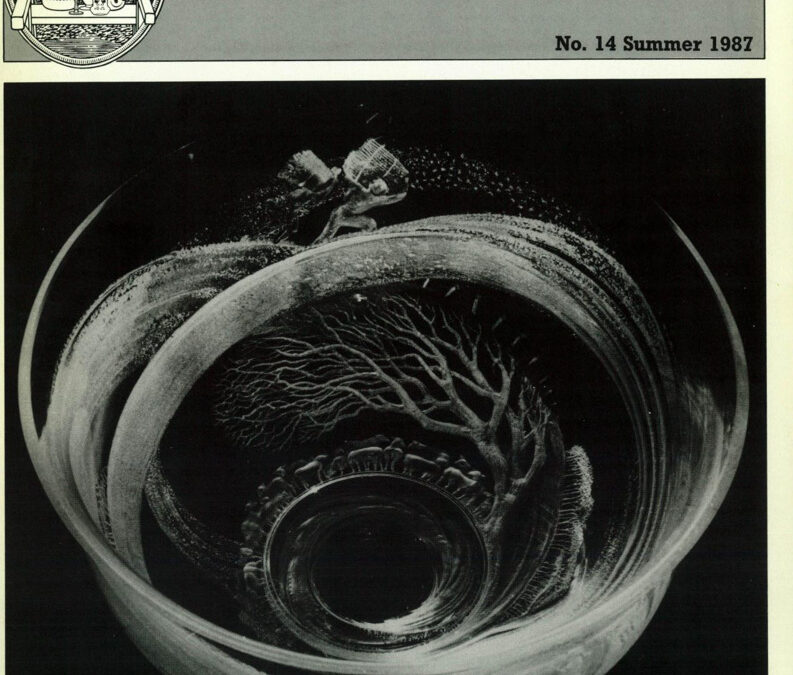
Cover Illustration
“The Blizzard” Bowl, engraved by
J. Harris 1985, featured in the Guild
of Glass Engravers Exhibition
October 10th — 24th 1987
Exhibitions
KINGSWINFORD
Broadfield House Glass Museum
Barnett Lane
STRANGE AND RARE
THE GLASS CIRCLE
50TH
ANNIVERSARY EXHIBITION
1937 – 1987
An exhibition with a difference
commemorates the 50th anniversary
of the Glass Circle. Times have
changed since a small group of
well-to-do enthusiasts formed the
Circle to share a common interest in
the early English lead crystal glass
patented by George Ravenscroft in
1674.
The Circle’s roots are respectfully
acknowledged with outstanding
examples of baluster-, twist- and
cut-stem glasses characteristic of
this period. But this exhibition
ranges far wider, searching out rare,
unusual and sometimes amusing
glassware, both decorative and
utilitarian, worldwide, from
members’ collections.
The earliest piece, a Mycenean 14th
century B.C. diadem, goes back
almost to the dawn of true
glassmaking, while, by contrast,
mythical beasts and animal forms
illustrate the newer appreciation of
fine press-moulded glass dating
from the last century.
“Friggers”, that reflect the
glassmaker’s skill in moments of
relaxation, range from toys to
creations of a delicacy that only the
love of successive owners have kept
intact. There are trick glasses that
spill the contents over the
unsuspecting imbiber and a
miniature Venetian goblet, only 4.5
cm high, enticingly filled with wine
that is for ever trapped within the
double walls of its bowl. In striking
contrast is a magnificent glass
cannon — still bearing evidence of
having been fired!
Enamelling, gilding and engraving
entrances with sheer beauty,
whether applied to a strawberry set,
a rolling pin or a lamp shade, while
historical pieces record the Jacobite
uprising, promises of prosperity and
coal-pit disasters, engineering
triumphs and the passing of the
stage coach in favour of steam. A
rare press-moulded plate
commemorates the opening of
Tower Bridge one hundred years
ago.
Glassware for the garden, the
kitchen and nostalgic musical
evenings round the “singing
glasses”, the mystique of witch (or
watch) balls and the challenge of
building up a painting backwards
behind glass all find a place. So too
do items of pharmaceutical and
scientific interest, including a
presentation casket of Prince
Rupert’s drops.
Contrastingly coloured glass
overlays from China and Japan,
sprinklers from India and colourful
wares from the Continent all
combine to make this exhibition a
memorable experience with
widespread appeal.
There is also a small collection of
rare books including a signed first
English edition of Anton Neri’s The
Art of Glass, translated from Latin by
Christopher Merritt in support of the
Royal Society, newly formed in 1662
to promote a scientific basis for
English manufactures. Other
displays are glass illustrated on
stamps and items from the Glass .
Circle archives.
A well-illustrated catalogue will be
available.
12th September — 13th December
LONDON
LEIGHTON HOUSE
The Guild of Glass Engravers
Annual Selected Exhibition
October 10th — 24th
NEWCASTLE UPON TYNE
Laing Art Gallery
Higham Place
Works on Paper by William Beilby
An important collection of drawings
by William Beilby, the glass
enameller who worked in
Newcastle during the 1760s and
1770s, was given to the Laing Art
Gallery in 1986.
After some needed conservation the
drawings will now go on display
alongside a further collection of
Beilby’s work which the Gallery has
recently acquired on loan. This
particular collection consists of
designs for decorative cartouches
and shields.
This display will provide a useful
opportunity to compare William
Beilby’s capabilities as an enameller
with his talent as a draughtsman, and
his inventiveness as an ornamental
designer.
Until 6th September
TORRINGTON
THE GLASS CENTRE
DARTINGTON GLASS
DEVON
A newly opened exhibition of British
glass from 1650 to the present day
including the twenty year history of
Dartington glass. Visitors can see
glassmaking, films and the factory
tour. Open 7 days a week in
summer, factory tour Monday to
Friday only.
TYNEMOUTH
HOLLY HOUSE
14 Front Street
BLOWN IN BLUE
A
summer exhibition of studio glass
by Fleur Tookey, Deborah
Fladgate, William Walker, Nick
Orster, Karlin Rushbrook, Norman
Stuart Clarke and Charlie Meaker.
Until 29th August
Open Monday – Saturday 10 am. – 5
p.m.
4
World
Exhibition
Philadelphia
1876 showing
the impressive
Lobmeyr
stand
11
Table set
No.103
designed by
the famous
Danish
architect
Theophil
Hansen in 1866.
This set was
shown at world
fairs Vienna
1873 and Paris
1878.
\
./
>40<3 wca fie Lobmeyr Glass since 1823 Peter Rath represents, with his brothers Harald and Stefan, the fifth generation of the old family firm of Lobmeyr in Vienna. A former director of the World Crafts Council he has taken an active interest in studio glass and in the crafts movement. In 1973 Lobmeyr, under his supervision, opened a modern department of studio glass together with Austria's first hot glass studio in Stoob to celebrate the company's 150th anniversary. He has organised more than 10 international seminars from the studio in Baden including WCC World Conferences in Mexico and Vienna. He was a member of the jury for the 2nd Coburg Glassprize and is an elected Fellow of the Corning Museum of Glass and a member of the International Council of the Pilchuck Glass School. At the Corning seminar in 1986 he gave two impassioned lectures on Lobmeyr and the future of new glass. In this article he describes with dedication and vision his ideas of the future. Five generations of Great Exhibitions. "Writing on the theme of Great Exhibitions it is my intention to pass on in words, and pictures, emotions which may hopefully not be mere news but will stimulate reactions and creativeness in the reader. Through the reactions of my audience my own ideas for the future activity within our old company will benefit. This article is written not as a chronological list of events but as a sum of experience made by past generations of owners and by myself towards Lobmeyr's future exhibition activities. Exhibiting is a theatrical act of faith in one's own belief. Like theatre it must be emotional, personal, full of risk and courage — a visible message towards new goals. Lobmeyr's great exhibitions consisted of these elements until the two wars broke most of our European faith in the future of our continent. With few exceptions our presentations, like those of our colleagues and competitors, have not been able to move things since. After the last war Lobmeyr's exhibition policy was finally crushed through constant • questioning of values, the lack of belief in being strong enough to lead in a new direction by accepting the idea of team-work, more than the so-called individual egocentric exhibit, designed for the museum hall not for the people. The Lobmeyr idea was to expand and become an example for others within the Austro-Hungarian monarchy. Exhibition reports tell us of major orders for Lobmeyr's first pressed glass from his own factory in Mariental which went to Turkey in 1836 and 1839 soon after the Photograph from an original glass plate negative showing the first chandelier produced by Lobmeyr in 1882 using the coal thread bulbs invented by Thomas Edison. pressing technique came to Europe via France. In 1851 the Lobmeyr sons Joseph and Ludwig visited the Crystal Palace Exhibition. In the same year the first independent Lobmeyr atelier for painting, cutting and engraving was opened in Bohemia. At the Paris exhibition of 1855 the firm was still not sure enough of itself to participate but at least Ludwig and his brother in law, factory owner Kralik, travelled to see the exhibition. The 1862 London exhibition allowed Lobmeyr to show for the first time. Ludwig tells us how he left Vienna on April the 10th with all the goods. After arrival and unpacking, the large central chandelier of the company's stand crashed to the floor during mounting. What an omen! The chandelier was repaired for the opening and all looked fine. Sales were excellent but Ludwig believed that the firm could achieve better results. In 1864 a crisis hit the firm when the elder brother Joseph and his mother Aloisia died. Joseph had just visited Egypt delivering huge chandeliers and table sets, later to be reordered for the opening festivities of the Suez Canal in 1869 for the Kedive in Cairo. At this stage Ludwig wanted to abandon glassmaking. Various artistic friends in Vienna including Theophil Hansen, Friedrich von Schmidt and Josef von Stork gave him the encouragement to lead Austria at the 1867 Paris International Exhibition which I suppose was the most important one for the survival of Ludwig's will- power. He had by this time gone quite far in the realisation of his dreams. Collaborative team-work with leading artists resulted in the building of the new imperial metropolis of Vienna. Through his bachelor, full-time involvement in the arts, Ludwig became a founding member of the prestigious Kunstlerhaus Arts Club of the Oriental Museum of Vienna, of the "Museum fur Gewerbe and Industrie", the second in Europe after the V. & A. to combine a museum with an art school. He established his famous "Musealabende", a gathering of artists, museum people and influential members of society invited to his home to jury his latest designs. The dress rehearsal for the first Vienna World Exhibition was the opening of the new museum in Vienna in 1871. The International Exhibition opened in 1873 and just as Baccarat had been number one in Paris, Lobmeyr, now at home, created a display which staked national prestige. Seven million visitors came to Austria to see the Fair and it seems that everyone of importance in the field of design and production came to the gathering. The energy and preparation for the 1873 exhibition by Ludwig Lobmeyr was beyond belief. It was the total risk of a millionaire to rise or to go under. Ludwig describes sitting for nights on end designing glassware till his eyes failed him. The engravers in the Bohemian workshops certainly were not on a 35 hour week but nearer to the figure of 100 hours of strained, quality work that makes us blush. lit For Lobmeyr's master glass makers and decorators this must have been the average in 1871 and 1872. The motivation to life and to new work was fantastic. A terrible bank crash and an epidemic of cholera brought the exhibition to an economically disastrous end. For Lobmeyr on the other hand it was the foundation for years to come. Huge cut and engraved mirrors (of which we still treasure some in our Vienna showrooms), enormous chandeliers and exports to all parts of the world made this exhibition the most successful event within the history of the company. In 1876 most of the 1873 collection was taken to the Philadelphia Centennial but business success was not immediate in the United States. The new forces were being saved for the 1878 Paris Expo. As vice-president of the jury Ludwig had become a recognised personality in European arts and crafts. His brother in law Kralik was responsible for some of the technically difficult exhibits made in his South Bohemian factories resulting in stunning new technology including the first iridescent glass platinum painting and cold aluminium foil in engraving. A strong oriental flavour pervaded the designs. 1883 was of utmost importance for Lobmeyr's future when at the first International Electric Exhibition in Austria, we showed our first chandeliers with coal-threaded bulbs developed in direct contact with Thomas A. Edison. This shows what exhibitions can do! 1885 saw the Antwerp World Expo then great investments were made for the very successful exhibitions of 1888 in Vienna, Barcelona, Brussels and Munich. We were well represented again in Chicago in 1893 and the same year in Geneva once more with electric chandeliers. How vital these exhibitions are to European development can be seen in our participation at the 1900 World Fair in Paris. The firm had passed its peak. It was the new generation of Calle, Tiffany and Loetz, Art Nouveau was the fashion and the break-through was made by others. Even if our glass was still beautiful, well proportioned, well made, of the highest perfection and excellently presented, it was out of date. Business was good for the firm in Paris, as very often is the case, when you are out of date. But my grandfather Stefan Rath came home crestfallen and depressed that we were no longer the leaders of the style of the day. Back in Vienna he had permission, and the budget, to start anew in close collaboration with the School of Applied Arts under the direction of professor Josef Hoffmann. It took more than 10 years to create a body of work based on the clean, geometric, functional theories of the "Wiener Werkstatte" but the new break- through allowed new fame and economic success. Stefan Rath became a founding member of the Osterreichishe Werkbund which staged its first major exhibition of arts and crafts in Cologne in 1914, dramatically shut down early by the outbreak of World War I. Immediately after the War Hoffmann again collected his team of students, masters, painters and sculptors to work for the revival of the "Gewerbe", the small industries, so characteristic for Austria's economy. The famous 1925 Paris Expo saw Lobmeyr regain some of its lost ground. Glass was shown in all possible techniques, as functional, decorative items within a sequence of rooms designed by the leading Austrian architects Hoffman, Striad, Haerdtl, Witzmann and others. After Paris, the Milan Triennale since 1933 became a regular, last meeting place for European standards. After almost a century of World Fairs Lobmeyr were still winning gold medals for glass. With Austria's collapse into the Second World War, once again all was lost. After the war our first presentation was in the United States at the Museum of Modern Art in New York. A table set designed by Table set for Emperor Franz Josef I, this was his very contemporary private drinking set ordered after his Jubilee 1890. Massive vase of archaic design with an engraving of panthers created by the Vienna Art Nouveau sculptor Otto Hofner in 1902 shown at the great exhibition in Cologne 1914. Table set No.240 designed by Oswald Haerdtl, assistant to Josef Hoffmann. The set was shown in Paris in 1925 and is still one of the great successes. Table set No.248 designed by architect Adolf Loos, it can be described as the "father" of the simple mass production glass, the originals have a quite extraordinary elegance and are represented in the Museum of Modern Art New York. Beaker with a deeply engraved scene of Greek dancers designed by the sculptor Jaroslav Horejc, possibly one of the most gifted designers for figural engraving in the 20th century. Free blown bottle "Schallergasse" a spontaneous copper wheel, mixed media engraving by Karin Stoeckle- Krumbein of Germany on•a blank blown by the master of studio glass Erwin Eisch. A typical * MISS)), L;bW to a , fl . / P/ < S,e : 2 . 1 ' / Haerdtl was a tremendous success being purchased for the collections and still selling today at the museum shop. In Brussels in 1958 we were merely represented by a glass obelisk and some chandeliers. In 1973 our 150th anniversary exhibition saw a change to the new. A glass studio was built by Lobmeyr in Stoob and then together with Jack Ink a studio was set up in Baden. The exhibition that really launched our interest in studio glass was a presentation of Erwin Eisch with Harvey Littleton leading to my lecture in Corning in 1977 entitled "Lobmeyr's belief in Studio Glass". The last great effort was the travelling exhibition which began in 1979 at the Zurich Bellerive and went on to Frankfurt, Goppingen and Leipzig. The time of the great exhibitions seems to have gone. The public wants fun-fairs not earnest exhibitions, "television films", sitting at home, not having to walk through miles of exhibition passages and pay entrance fees on top. As Neil Postman predicts in his book "Amusing ourselves to Death" entertainment is the new style. Today, activity has gone towards the limitation and isolation of gallery- type intellectualism and has resulted in the divorce between the artist and the public. The present need is for a full collaboration between companies, artists, museums and architects to form a new platform, a stage to enable a new period of exhibition team • performance. The great exhibitions showed such a creativeness even with all its risks towards kitsch and bad taste. I have been passionate and furious for new developments to an extent where my brothers have begun to think I was mad and have closed my budget for what they call my "hobby"! I have asked them to let me dream — without dreaming there is no chance to be creative. Since the "Great Exhibition" is not in view we are planning our own exhibitions. This year we will exhibit current production. It is something, you must admit, to keep designs alive for more than 100 years. For 1990 we are preparing the largest travelling Lobmeyr exhibition ever held, mainly with a body of work by a new group of artists selected and gathered with the assistance of Maria Aubock, a young architect. In 1998 another major event, the 175 years of Lobmeyr, will introduce the sixth generation. In the year 2000 we intend to revel in the optimistic celebrations for the turn of the century by showing glass at a new type of "Great Exhibition" under the theme "To plan for the future you must understand the present and treasure the past". I hope you will be with us in good health when we lead our old J. & L. Lobmeyr into winning the Grand Prix for glass at that show — it can only be done if we are again together one force of artists, producers, museums and... with you our public." Peter Rath AN UNUSUAL GOBLET Continued from P.B. I know of at least one other engraved glass portrait of Frederick II (illustrated in Bickerton p.272, p1.856). The year in which the print was published and engraved on the side of the glass, 1757, is significant. It was not only the second year of the Seven Years' War (1756-1763) — a war precipitated by the Prussian invasion of Saxony and, in a separate incident, Britain's declaration of war on France - but it was also the year in which Russia, France, Sweden and Austria joined together against the unholy alliance of Prussia and Britain. The war was ended in 1763 with the Peace of Paris and from that date onwards Frederick II introduced a series of far- reaching reforms in Prussia. I am delighted to have been reminded of this unusual goblet by finding this print. It just proves, perhaps, that there is much more to a piece of historic glass than at first meets the eye. Simon Cottle d I Go News & Views THE STUDIO GLASS GALLERY OF BRITAIN A new gallery specialising in British Studio Glass has opened at 9 Church Street, Montclair, New Jersey, U.S.A. The owners, Bob and Ellie Miller, have enjoyed an involvement in both the arts and in business. Bob originally intended to pursue a career in opera and studied at the Mannes College of Music in New York and took a job at the Chemical Bank in New York City to pay his way through music school. He has given up any idea of singing professionally but is now the vice- president at the bank. Ellie was a teacher of English literature and this was responsible for her developing interest in Britain. She later joined the Chemical Bank where she met Bob, and not long afterwards they began annual visits to Britain. She is currently Director of human resources at the Harris Trust Company. They started to build a glass collection and in doing so met several of the glass artists in Britain. The fascination with glass increased until they devoted a room at their own home as a place to show glass and to sell to private clients. The demand and interest became so great that they eventually decided to find a suitable property and to open a new gallery. They decided to call it "Studio Glass Gallery of Great Britain". It is possible that this title might give an impression of being an "Official" gallery but it is of course a completely private venture. They were delighted to receive the best wishes for the success of the gallery from Prince Charles. Bob and Ellie are delightful people who seem to have endeared themselves to all the studio glass artists with whom they deal. Apart from their very friendly and open characters they have another extremely valuable asset in that they either pay in advance for work or pay as they buy. Apparently the opening went very well. A lot of work was sold, the press reports were highly complimentary and they are both suitably gratified. We must wish them continuing success and very much pleasure in their venture. Charles Bray NEWCASTLE CITY GLASS STUDIO Newcastle City Council are making a determined effort to re-introduce glass-making in the area by providing a studio glass facility at the Premier Workshops in Scotswood, close to the Lemington glass cone. The workshop forms part of the Council's Economic Development Programme and has been funded with the assistance of the Newcastle/Gateshead Inner City Partnership Programme. The glass studio is available for rent to those people who have qualified as glass artists but lack the facilities to pursue their craft. Everything a studio glass artist requires is provided for in the workshops. The 'hot room' is equipped with a gas fired furnace, two glory holes and an electric kiln. There are two chairs, two marvers, a diamond wheel clipper saw and a full selection of irons and tools. The metal will be supplied from Dartington rod end collet. The cold room is fully equipped with a flat bed grinder, linisher, two lathes and a sand blaster. Rates are £100 daily, £400 weekly (5 days) and £5 per hour for use of the cold room. Any person who is interested in obtaining further information should contact the workshop manager Tom Cook at The Premier Workshops, Whitehouse Road, Newcastle upon Tyne NE15 6EP (Tel. 091-274 9313). OBITUARY FRANK THROWER MBE It is with deep regret that the Directors of Dartington Glass Limited announce the death of its Chief Designer, Frank Thrower MBE. Frank Thrower, aged 55, died on Monday 29th June after a long illness. Mr. Thrower was a founder member of the company which was opened by the Dartington Hall Trust in 1967. He played an invaluable role throughout the past twenty years, both in glass design and in establishing the strong and distinctive image of the company. As a designer he produced virtually all Dartington's early designs, many of which continue in production today; his design for the Dartington Sharon glass being acknowledged as one of the top 100 best British designs. Frank Thrower continued to produce designs for Dartington until very recently and much of his new work was shown at the Gift Fair in Harrogate, July 19th - 23rd. Awarded the Observer Award for Design in 1969, Duke of Edinburgh's Design prize in 1972 and Design Council Award for Design in 1972, he was bestowed with an MBE in the 1987 New Year's Honours list. He was also recently made a Fellow of the Royal College of Art for his services to design in British industry. He will be greatly missed by all his colleagues. A memorial service will be held in London later this year. raCetS Regional Reports ANNUAL SUBSCRIPTION 1987/88 Annual subscriptions for 1987/88 are due on 1st August except for those who joined during the last three months of the financial year (May, June, July 1987). Rates remain unchanged, and are as follows: Individual £10 Joint £15 Institutional £20 Student £5 Overseas £15 Life £200 Cheques, made payable to "The Glass Association", should be sent to the Hon. Treasurer, The Glass Association, 8 Chestnut Court, Warren Close, Bramhall Park Road, Stockport SK7 3LH. NATIONAL MEETING SATURDAY 11TH JULY Following the National Meeting on the 11th July the Committee wish to apologise to the 90 members who attended the day seminar for the inadequate catering facilities provided by the Summerhill House Hotel. The management of the hotel has been made fully aware of the dissatisfaction of the Committee and the membership. COPY DATES 4th September for Autumn issue 6th November for Winter issue AN UNUSUAL GOBLET Much of the figurative decoration engraved on European table glass prior to and since the mid 18th century was inspired by pictures and prints painted and published by some of the leading and fashionable artists of the period. Much of it, too, was the production of skilful and imaginative minds, the minds of craftsmen who were influenced by contemporary personalities and inspired by major historical events and classical mythology. A smaller proportion of these objects were decorated with more obscure and less easily identifiable images which today exercise the minds of glass collectors, historians and enthusiasts alike in their attempts to discover the true identity of the sitters or the origin of the scenes and the engravers who were responsible for this work. I was reminded of these facts when during a recent visit to an antique shop in Glasgow I happily acquired what at first sight would be to most people a fairly straightforward engraving but for me was quite an interesting find. The engraving, by Daniel-Nicolas Chodowiecki (1726- 1801), has strong associations with a rare item of glass I have come to know quite well. In fact the glass, a tall goblet (81/4in in height), once belonged to the Chairman of the Glass Association, Anthony Waugh, and was sold at Sotheby's on 28th April 1980. It is engraved with an equestrian portrait of Frederick II (known as 'the Great') of Prussia who reigned from 1740-1786. The portrait is, according to Sotheby's, in the heroic style'. Originally in the collections of Hamilton Clements and Harrison Hughes, respectively, the glass was illustrated in Bles, plate 95. It is inscribed on either side of the portrait GOD BLESS THE KING OF PRUSSIA and FREDERIC REX AGED 47, 1757, respectively, and is engraved on the reverse with the double-headed eagle of Prussia. Although the portraits are not identical, the King is portrayed in a similar manner, a pose which to me would suggest a common link between the two pieces. But in consideration of these differences — notably the position of the King's head and that of his horse, the saddle blankets and straps, etc., one might suppose that due to the limitations of the unidentified engraver's skill and the nature of his flat and clumsy engraving technique he was not only unable to reproduce a faithful copy but also chose to produce an image which to him was more easily transferred on to the surface of the goblet. This is, of course, purely speculative. Daniel Chodowiecki was a highly- gifted artist working in Berlin who is well-known for miniature painting and engraving. Many of his engravings were based on his earlier oil paintings and they became very popular in his lifetime. This portrait of Frederick the Great is among the earliest of his engraved works and dates from 1757. It has been written that Chodowiecki's portraits "were remarkable for their characteristic resemblance and lifelike qualities. He was the founder of a new style representing modern figures with such truth and animation and at the same time with such correctness of outline as had till then never been thought possible on so small a scale." Continued P.6.