


The newsletter of the
Glass Association
Registered as a Charity No 326602
Chairman:
Anthony Waugh
Hon. Secretary:
Roger Dodsworth
Editor:
Charles Hajdamach
Address for correspondence:
Broadfield House Glass Museum,
Barnett Lane, Kingswinford,
West Midlands DY6 9QA.
Tel: 0384 273011
ISSN 0265 9654
Printed by Jones & Palmer Ltd., Birmingham
–
Caricature
Scent Bottle by
Karlin
Rushbrooke
from the
Miniature
Masterpieces
exhibition.
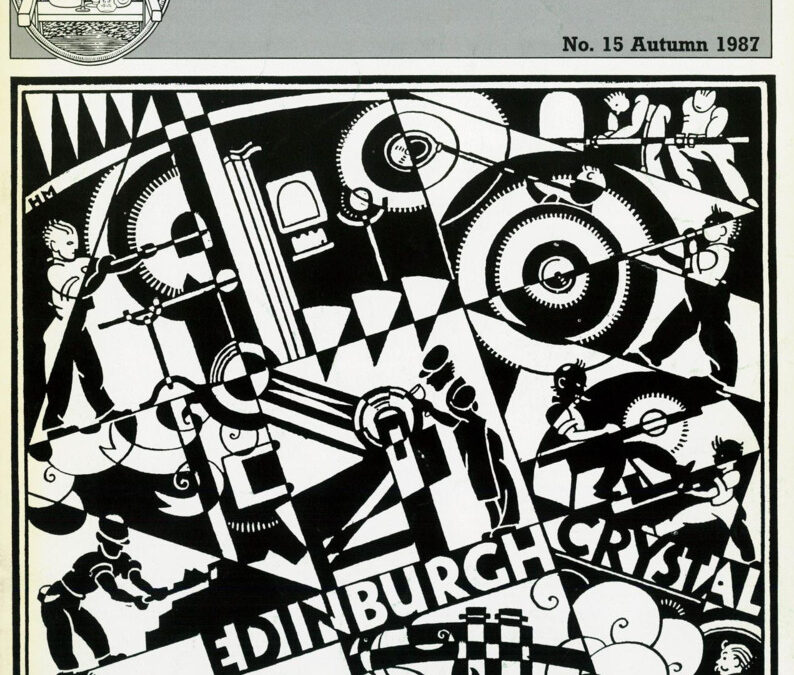
Cover Illustration
Advert for Edinburgh Crystal taken from
the Pottery Gazette November 1st 1929.
The text claimed:- “Edinburgh Crystal
means Perfect Crystal. The uniform
brilliance and freedom from colour of
EDINBURGH CRYSTAL is not due to any
accidert, but is the result of intelligent
research over a period of years, combined
with the determination to attain and
consistently maintain perfection.”
Exhibitions
BATH
ARTSITE GALLERY
1 Pierrepont Place
GLENN CARTER
–
CRAFTCASE
This presentation of work by
Lincolnshire artist Glenn Carter, is an
opportunity to view some of the finest
glass work recently created by this
talented artist.
October 31st – December 6th
Open 10.30 am. – 7.00 p.m. Tuesday –
Sunday
LONDON
represented are leading international
names. They include Antony Stern,
Arlon Bayliss and Rachel Woodman,
all with blown
glass;
Peter Dreiser
and David Prytherch with engraved
glass; Tessa Clegg and Keith
Brocklehurst with pate de verre;
David Reekie, Keith Cummings and
Amanda Brisbane with cast glass and
John Smith with enamelled and fused
glass. None of the exhibits is more
than six inches in height; prices range
from £50 – £500.
November 20th – December 24th
BRITISH MUSEUM
GLASS OF THE CAESARS
21st November – 6th March 1988
(A review of this spectacular
exhibition appears in the November/
December CRAFTS magazine).
ST. HELENS
his quest for large scale imagery.
19th October to 15th
December, 1987
STRANGE AND RARE
This exhibition commemorates the
50th anniversary of the Glass Circle.
Members of the Glass Circle have lent
their best examples of glass for this
display.
The earliest piece, a Mycenean 14th
century diadem, goes back to almost
the dawn of glassmaking. “Friggers”,
that reflect the glassmaker’s skill in
moments of relaxation, range from
toys to creations of a delicacy that only
the love of successive owners have
kept intact.
17th January to 20th March, 1988
TOURING EXHIBITIONS
CARNIVAL GLASS
Carnival glass was first pressed in
1908 in the Ohio valley of the U.S.A.
The prime period continued until
around 1925 when standards
deteriorated and production fell.
Carnival glass is a disparaging name
given to the glass during the 1950s and
applied indiscriminately to any item
from this huge family of glassware.
This touring exhibition, organised by
the South East Area Museums
Service, consists of prime examples
drawn from the Notley-Lerpiniere
Collection at Broadfield House.
GOSPORT MUSEUM AND ART
GALLERY
Walpole Road,
21st November to 24th
January, 1988
Open Tuesday – Saturday
9.30 – 5.30
“THE ART OF FIRE”
STOURBRIDGE GLASS IN THE
NINETEENTH CENTURY
JEANETTE HAYHURST GALLERY
32A Kensington Church Street
Miniature Masterpieces
More than 100 unique examples of
glassware by leading contemporary
British artists will be on display and
available for sale. Miniature
Masterpieces serves two purposes. It
is the ideal opportunity for regular
collectors and anyone looking for
“something different” to solve the
annual problem of Christmas
presents. These small items are also
ideal where space is at a premium.
The exhibition demonstrates the wide
versatility of glass. All the artists
PILKINGTON GLASS MUSEUM
Prescot Road
GLASS-MASS
Reflection, refraction, optical qualities
and colours are the dominating factors
in this unique exhibition by John
Smith.
John is a senior lecturer in the
Department of Glass at the College of
Technology and Art, Stourbridge,
West Midlands.
By using brass pins, pinnions, bushes
and clips John brilliantly blends the
yellow of the metal with the green tint
of thick pieces of float glass to achieve
From the collections at Broadfield
House Glass Museum and private
collectors. Organised by the West
Midlands Area Museums Service.
17th October – 28th
November, 1987
Keele University
5th December – 16th
January, 1988
Walsall Museum
23rd January – 5th March,
1988
Hereford City Museum
[
COPY DATES
January 29th for Spring issue
April 29th for Summer issue
The Dartington Glass Centre
The Dartington Glass Centre
opened on June 15th at the
Dartington Glass Factory in
Torrington, Devon. It is a unique site
combining a tour of the Dartington
Glass
Factory; a studio glass
operation within a replica of an 18th
century glass cone; a 200 piece
display of glass illustrating the
history of lead crystal from its
invention to the present day; a 150
piece display of Dartington Glass
showing its development since the
start of the company in 1967 and a
film theatre that shows a video on
glass making at Torrington. All of
this, except the factory tour, is
contained in a single storey building
of 6,000 square feet.
The theme of the historic glass
collection centres on the use of glass
and social customs relating to eating
and drinking, while at the same time
covering the major stylistic
developments from the 18th century
to the present day. The collection of
Dartington Glass concentrates on
the award winning designs of Frank
Thrower M.B.E. and is grouped by
type rather than strict chronological
order.
The studio glass operation within the
Glass Cone is run by Neil Wilkin and
gives visitors the opportunity to
compare studio glass making with
large scale hand blown glass
making in the main factory.
My colleague Roger Dalton and I
started on the project in January
1986 with the brief to create an
exciting museum that was
complementary to our existing
factory tour, shop and restaurant. It
had to stay within the allocated
budget, be open by mid-June 1987
and be profitable. At that time, the
company owned a 50 piece
collection of unrelated 18th, 19th and
20th century glass of mixed merit
and there was a large archive
collection of Dartington Glass in the
warehouse that was unsorted and
uncatalogued.
We were faced with two problems
simultaneously — how we would
actually build the
Glass
Centre
(Roger’s responsibility) and once
the basic structure was built, what
the inside would look like (my
responsibility).
We were able to solve the first
problem by using an existing
building and converting it into the
Glass
Centre; but even that was an
expensive proposition. We soon
realized that we could afford either
to convert and fit out the Glass
Centre or to buy exhibits for it – but
not both.
After some preliminary research,
we decided to try to borrow the
majority of the historic glass from
View of the
Visitor Centre
showing the
historic
section.
Glassblower at
work inside
Glass Cone.
The displays of
historic glass
and the
Dartington
range can be
seen through
the archways.
museums across the country.
I decided that we should tell the
story of the development of British
glass and that the glass should be
representative of the types that
were in common usage in each
century. I also wanted the glass to
relate to the type made by
Dartington Glass – mainly tableware
and stemware. This immediately
eliminated items such as mirrors,
chandeliers, bottle glass, scientific
glass and window glass.
With stemware, I felt it was
particularly important that visitors
should learn about how the glass
was used and what it was used for.
There was a wonderful response
from the museums that we wrote to
and I was soon in a position to put
together a collection from Roman
times to the present day. Our
original plan was to house the
museum on two floors. By
September, 1986, this plan had to be
discarded because of the costs of
building the second level.
When the Glass Centre had to be
redesigned, Roger and I knew
exactly what we wanted, so we
acted as our own designers. In
addition to displaying the historic
glass and telling the story of
Dartington Glass, we wanted to add
an inter-active display that would
enliven the Centre.
Over the course of a week, the idea
of building a four foot high cut-away
model of a glass cone developed
into the idea of actually building a
studio glass operation that gave the
approximate appearance of a glass
cone.
This meant a further reduction in the
amount of display space available,
so I decided to start the story with
the invention of lead crystal rather
than with Roman glass. The earliest
glass we would display would be
mid-17th century Venetian glass.
We decided that rather than use
conventional display cases, we
would house the displays within two
large self contained sections made
out of Click system component
parts. The Historic section is 21
metres long and alternates in depth
between 11/4m and 2m. The
Dartington Glass section is 151/2m
long and also alternates in depth
between 11/4m and 2m. Both have
ceilings at 21/2m and both back onto
the walls of the building. Access is
through doors at the sides. The glass
exhibits themselves are displayed
on clusters of linked rostra that are
300mm square and vary in height
between 700mm and 900mm. David
Craddock of Craddock-Frost
Design did all the graphic design
work and devised the rostra system.
The Glass Cone is built in brick up to
a height of 3m and the tapering cone
section is made of glass fibre and
goes up another 31/2m to the full
height of the building. The rest of the
Glass Centre has a slatted ceiling at
21/2m. We were very fortunate to
find Neil Wilkin for the studio
operation and he designed all the
furnace equipment to fit the circular
shape of the Cone.
With the Cone at one end of the
building, the film theatre and the
entrance to the factory tour at the
other end and the displays of glass
running down the walls in between,
we had a simple design that would
enable us to handle over 2,000
visitors a day in the summer season.
Under this new, improved design, I
now had too much glass for the
historic collection and I actually had
to turn down loans of glass that I had
arranged. I would like to thank all
those museums who offered to lend
us
glass
that I was not able to use. I
would also like to thank all those
who did lend us glass: Exeter
Museum Services, Somerset County
Council Museum Services, Ipswich
Museums and Galleries, Glasgow
Museums and Art Galleries, City of
Bristol Museum and Art Gallery,
Reading Museum and Art Gallery,
Pilkington Glass Museum and
Broadfield House Glass Museum. I
would also like to thank Jeanette
Hayhurst, who kindly lent us glass
from her collection. Wendy Evans of
the Museums of London, John Mallet
of the Victoria and Albert Museum
and Martin Mortimer and Jane
Holdsworth of Delomosne and Son
all gave much help and advice.
Putting together the selection of
Dartington Glass proved to be as
great a challenge as organizing the
Historic collection. By working with
old price lists and catalogues, I was
able to establish the design and
production dates of every piece of
Dartington Glass. It was then
possible to catalogue the archive
collection of glass.
I wanted to show the stylistic
development of Dartington Glass by
type of glass, so the collection is
grouped thus – stemware,
candleholders, kitchenware, vases,
bowls and decanters. The displays
are a mixture of archive pieces,
current production pieces and one-
off pieces never intended for
general production. There is also a
section showing the pieces of glass
that have won awards.
We opened the Glass centre on time
and on budget and we have had
48,000 visitors in the first 10 weeks.
On September 21st, the Glass
Centre was dedicated to the
memory of Frank Thrower,
designer and director of Dartington
Glass, who died in June of this year.
Peter Lewis
Dartington Glass Centre
A selection of
late 19th
century
[riggers from
Broadfield
House Glass
Museum.
The Etymology of a Glass “Frigger”
“Frigger” is a term used colloquially
by glassmakers, generally as a noun
to refer to an article, often small and
of novel shape, that has been made
to demonstrate skill in manipulating
molten glass. Frequently “friggers”
have taken the form of hats, walking
sticks, baskets, swords, trumpets,
flip-flops, rolling pins, swans and
pigs.
Initially such glass novelties were
not regarded as commercial
products, those who made them
being allowed to take them home to
adorn the mantelshelf or dispose of
them in the local pub or to a collector
of curiosities. However, some
“friggers” were in such demand that
manufacturers absorbed them into
their production line for the souvenir
market; swans, for example, have
become ashtrays and glass baskets
used to be in popular demand as
ornaments or fruit containers.
Traditionally “friggers” were made
outside working hours, often at night
when supervision in the glasshouse
was less vigilant. “Friggers” were
also the product of the times when
glassmakers were allowed to “play
about” with metal of inferior quality
from the bottom of a pot.
The word “frigger” was not included
in the Oxford English Dictionary but
it is to be found in the recently
published
O.E.D. Supplement
which
states that its origin is etymologically
unknown. It is described as “a small
glass ornament or testing example”
and its earliest appearances in print
in H. J. Powell’s
Glassmaking in
England
(1923) and Arnold
Fleming’s
Scottish and Jacobite
Glass
(1938) are quoted.
The glass “frigger” evidently
derived from the verb “fig” which
according to the
O.E.D.
means “to
move about restlessly,” “to agitate
the body or limbs” (c. 1460), while
the verb “friggle” is given the
meaning “to jerk about,” or “to
wriggle”. Clearly there is a strong
sexual connotation and the
O.E.D.
Supplement
equates “frig” with the
coarse expletive meaning to
copulate or to muck about or to fool
around.
It is significant that in Norse and
Icelandic mythology Frigga, or
Friga, was the goddess of marriage,
one of the three wives of Odin and
from her name we get the word
Friday, the Anglo-Saxon Frig-daeg
being the day heathens worshipped
Friga. There was also another
mythologiacal Norse goddess Freya
who corresponds to the Roman
goddess Venus and is regarded as
the goddess of sensual love. In
Henry Bradley’s
A Middle-English
Dictionary
“frig” is given as Anglo-
Saxon and “frigg” as Old Norse.
In
An Anglo-Saxon Dictionary,
based on Joseph Bosworth and
edited by T. N. Toiler, fig is given as
an adjective meaning free or noble
(frig-man meaning free man) and
also as a noun meaning love,
affection, and favour, so within the
glassmaking context a frigger could
be an article which the glassmaker
was allowed to make freely and “for
love,” meaning as a privilege from
his employer and for his personal
pleasure and satisfaction.
Samuel Johnson omitted “frig” from
his A Dictionary of the English
Language, possibly because he
regarded the word as coarse slang
but Webster’s Third New
International Dictionary is less
scrupulous giving its meaning in
verb use as “to wriggle” or “to
copulate with” (adding that this is
usually considered to be a vulgar
expression) and also to waste time in
a futile or fooling manner (i.e.
frigging around).
In his
Dialect Dictionary
Joseph
Wright mentions “frig” as meaning in
Devon and Cornwall an old-
fashioned or dowdy woman and the
Welsh “gwraig” as a woman. In
Yorkshire and Lancashire “fig”
meant “to wriggle” or “to struggle”,
and in Leicestershire and
Warwickshire the verb “frigabob”
meant “to dance” or “to jerk up and
down” (“frigabobbin” being a
stocking machine). “Frigary” was
used in Yorkshire to signify “a whim”
or “caprice”. Wright also mentions
“friggling,” an adjective meaning
fiddling, minute, trifling and small,
and “friggle-fraggles” were trifles,
gewgaws and ornaments.
Eric Partridge’s
A
Dictionary of
Slang and Unconventional
Use give
“frig” as “an act of self abuse” (i.e. to
masturbate) and to “copulate,” with
“fig about” meaning to mess about,
“fig pig” (late 18th century) a fussy
trifler, and “frigging” as trifling and
wasting time.
So all in all the word “frigger” as a
glassmaking term has an ancient
lineage, descriptive of a variety of
actions that fit in with the creation of
those small articles made by the
glassmaker for himself in his free
time.
H. Jack Haden
Editor’s Note:
In American
glassmaking terms the word frigger
is’ seen as a vulgar and coarse
expresssion or expletive. This large
group of fanciful objects are more
normally referred to as whimsies.
Osiris Glass Studio
During 1987 the glassblowing studio at
Broadfield House Glass Museum,
formerly occupied by Okra Glass, was
leased to Iestyn Davies. The furnace
was lit in November and the studio is
now fully operational. Iestyn — or Bill to
his friends — will be assisted by Jane
Cowie who has worked in glass studios
in Australia, Germany and France.
A solid training in glassmaking and
design plus experience in glass
factories have provided Bill with an
excellent background prior to setting up
his own studio. During his three years at
the Stourbridge B. A. Glass Course Bill
spent 6 weeks designing three new
ranges with Michael Harris for Isle of
Wight Glass. Between 1985 and 1987 he
was employed by Stuart Crystal as
resident Coloured Glass Development
Artist and designed 5 ranges which
were featured at the N.E.C. Craft Fair
’86. In the Autumn of 1986 Bill was part of
a small team who travelled to Australia
to promote Stuart Crystal. The exhibition
required the building of a furnace within
the Myers Department Store in
Melbourne and glassmaking
demonstrations three times daily for two
weeks. At the David Jones store in
Sydney he demonstrated sand blasting
onto coloured blanks.
His work has featured in many
prestigious exhibitions including the
British Studio Glass display in Sao Paulo,
Brazil in 1986. One unique piece was
auctioned in aid of the 25th anniversary
of the World Wildlife Fund.
At the new studio the designs will
consist of gallery pieces, either as one-
offs or limited editions and will be
complemented by commercial pieces
made in larger quantities. Working with
the techniques of casing, sandblasting
and gilding Bill sees himself in the
tradition of 19th century cameo glass.
Creating a new studio is not a cheap
venture; the equipment alone has cost
£8,000. Financial support has been
forthcoming from Stuart Crystal and
Hulberts of Dudley while Webb Corbett
have helped with equipment. Bill has
also used the Enterprise Allowance but
the obligatory period of 13 weeks
unemployment did create problems in
the initial stages.
The furnace itself has been designed by
Peter Wren Howard using a 100 kilo pot
from Wright Refractories of Wordsley.
The batch will be Dartington rod end
cullett.
With sound financial backing and the
best technical expertise available Bill
Davies has shown a determination to
succeed ensuring that we hear more of
Osiris glass in the future.
Three Vases,
trailed and
applied with
gold leaf, 1987
Glass Association A.G.M.
Birmingham, Saturday 31st October
On a damp and drizzly morning eighty members managed to negotiate Birmingham’s notorious system of overpasses
and underpasses, subways and walkways to meet up at the Josiah Mason Lecture Theatre in the centre of the city for The
Glass Association’s Fourth Annual General Meeting. Unwary members were waylaid by Richard Gray, strategically
placed in the foyer entrance with the raffle tickets and prizes, while Ian Wolfenden registered the members’ glass that had
been brought for sale, and your Hon. Secretary got to grips with the projection equipment and tried to hurry along the
coffee.
The morning began with an introduction by Glennys Wild to the glass collections at Birmingham Art Gallery. She was
followed by Emmeline Leary who, before leaving the Art Gallery to become Curator for Pitshanger Manor in Ealing, had
begun to research the early history of the Birmingham Glass Industry — inspired as it turns out by a lecture given by
Pamela Wood at the Association’s second AGM in Nottingham. Emmeline produced a host of facts and figures on the
number and type of glassmakers working in Birmingham — one couldn’t help being reminded of the reading of the
football results on a Saturday afternoon at this point — and showed some fascinating slides of the glass houses from
contemporary trade directories. It is to be hoped that someone will take up her valuable research where she has left off.
Martin Ellis then gave an extremely fluent and well-researched account of the life and times of the late 18th century
Birmingham glass painter Francis Eginton, who worked in the pictorial tradition, using the window as a canvas on which to
paint rather than in the traditional stained glass style. With the onset of the Gothic Revival in the mid 19th century the
Eginton style went out of fashion, and much of his work has been destroyed.
The AGM itself passed uneventfully until the end when under Any Other Business Jack Haden brought up the
threatened sale of the Thomas Webb Cameos following the firm’s takeover by Coloroll, and a lively debate ensued as to
what action should be taken. The draw for the raffle was then made, which caused amusement as always, and then we
adjourned for a cup of tea and the sale of members’ glass, which provided a delightful end to the day’s proceedings.
Thanks very much to those who entered glass for the sale and had to carry it to a rather inaccessible venue!
R.C.D.
ALL CHANGE AT STOURBRIDGE
ROYAL BRIERLEY CRYSTAL
The new post of Head of Design has been filled by Mr. Will Cort who was
formerly the Chief Designer for Royal Doulton Crystal at Webb Corbett.
The design team consists of five qualified designers whose
responsibilities include the main factory plus the Tipton works where the
studio glass range is produced. Will Cort graduated from Stourbridge
College and spent 10 years with Webb Corbett. At Royal Brierley he
plans to increase the product range and look at the possibilities of re-
introducing techniques such as acid etching. Plans also include the
continuation of the policy to purchase glass for the company museum.
TAKE OVER AT THOMAS WEBB’S
During 1987 the firm of Coloroll became the new owners of Thomas
Webb’s glass factory as well as Edinburgh Crystal. Following the
takeover the district was full of rumours of redundancies and even total
closure. The new managing director Mr. Nigel Woodlands has confirmed
that the making of glass will continue on the site although the factory is
now known as Edinburgh Crystal Division with the name Thomas Webb
as a sub-heading. The most drastic change involves the Webb museum
which was the brainchild of Stan Eveson and formed one of the star
attractions of the Stourbridge glass trade. The museum has been totally
dismantled and some of the top cameos and engraved glasses have been
disposed of, it is rumoured to an American collector and museum. The
new musem displays will concentrate on glassmaking techniques and
will be designed to appeal to families and children.
It is obviously with much regret that we have to report the loss of
important Webb glass most of which had been in the factory’s possession
since the time of its manufacture. Other major items were purchased in
recent years. On page 8 we print a copy of the letter sent to the Chairman
of Coloroll and in the next Glass Cone we will report on the latest situation.
HISTORIC DAY AT STUART CRYSTAL
On Thursday, 10th September 1987 the official commissioning took place
of the new electric continuous-melt tank furnace at the Stuart Crystal
factory. The official ceremony was performed by the Rt. Hon. The
Viscount Boyne in front of 200 guests invited from the world of glass,
industry and commerce. Following his opening speech Viscount Boyne
blew the traditional bubble of glass and was presented with a fine tantalus
as a memento of the occasion. A delicious buffet lunch rounded off a
splendid occasion.
The installation of the new furnace marks the first time in the history of the
English hand-made glass trade whereby a continuous flow of glass fired
by electricity is used for the blowing of crystal glass. Both of the old pot
furnaces, one of which had run for 16 years, have been extinguished thus
breaking a centuries-old tradition of Friday afternoon pot-setting. The
new furnace consists of three gathering holes plus two turntables, one on
either side of the furnace. The turntables consist of revolving moulds
filled automatically with the correct amount of molten glass which is then
gathered onto the blowing iron by the glassmaker.
The costs of the installation have been supported by a grant from the
government economic development unit. The whole project forms the
start of a new chapter in the history of the Stourbridge glass trade.
News & Views
GLASS CHRISTMAS CARDS
Two new Christmas cards have
been published by Broadfield
House Glass Museum. Designed by
Victoria Cort they are based on
glasses in the Museum and feature a
Dolphin Tazza with Rose Hips and
Flower Stand with Leaves. The
folded sizes are 148 x 210mm and
148 x 105mm with wording of
Seasons Greetings, and With all
good wishes for Christmas and the
New Year respectively.
Prices are — 30p and 20p each
including postage and packing.
JUMBLE SALE AND ATTIC
TREASURES
Two recent stories in the Antiques
Trade Gazette prove that lucky finds
can still be made. A bowl, thought to
be marble, and bought by a lady for
under £1 from a village jumble sale,
realised £3,600 when auctioned by
Phillips in Edinburgh. The “marble”
bowl turned out to be a pate de
cristal glass signed by Gabriel
Argy-Rousseau and dating from the
1920s. The 61/2″ wide bowl was
moulded with a hunting scene
showing a boar, two deer and an
eagle in amethyst, blue and ochre
glass.
The second treasure had lain,
wrapped in newspaper, in an attic of
a bungalow in Wadhurst. Following
the owner’s death the house was
burgled no fewer than three times in
as many weeks but each time the
thieves overlooked the parcel. The
object was an Apsley Pellatt
sulphide and cut glass jug, 8″ high in
good condition, with the rarity value
of a sulphide cameo bust of George
IV. A pre-sale estimate of £750 –
£1,000 became an actual hammer
price of £4,600 when offered by
Geering and Colyer at their sale at
Winston Manor Hotel at
Crowborough, Sussex on 16th
September. If this was the quality of
items left by the burglars it is
fascinating to speculate on what
must have been stolen.
ace
IS
Regional Reports
Glass Association Committee
Chairman – Tony Waugh, Wolverhampton
Collector
Hon. Secretary – Roger Dodsworth, Keeper
of Glass, Broadfield House Glass Museum,
Kingswinford
Hon. Treasurer – Peter Helm, Manchester
Collector
Ordinary Members of Committee
Jeanette
Hayhurst,
Antique
and
Contemporary Glass Dealer, London
Patricia Baker, Lecturer on History of Art and
Design, Farnham, Surrey
John Brooks, Antique Glass Dealer, Rothley,
Leicestershire
Annette Carruthers, Keeper of Museums,
Cheltenham Art Gallery and Museums
Alan Leach, Collector and Glass Hiistorian,
Darlington
Greville Watts, Collector, Cheshire
Editor of Newsletter
Charles Hajdamach, Senior Museums
Keeper, Broadfield House Glass Museum,
Kingswinford
Editor of Journal
Ian Wolfenden, Head of Post-Graduate
Course in Art Gallery and Museum Studies,
University of Manchester
Chairman’s Report
Our Association continues to grow from
strength to strength. The total
membership to date is 399 members. I
am a little disappointed that we have not
achieved our target of 450. A little effort
from all in recommending our
Association could soon achieve this
target.
Your Committee have continued an
initial policy of meetings held in various
parts of the country, with a very wide
spread of glass and related subjects. We
have met this year in Stourbridge,
Birmingham and York. Regional
meetings have been held in London,
Manchester and Stourbridge.
Our scope has been wide, from Roman
Glass to Modern Stained Glass; from
Glass of the Twenties to Early Glass
making in Birmingham.
A very successful seminar was held at
York, organised very competently by
Ian Wolfenden. The accommodation
and food were both excellent, which
made for a very high degree of
fellowship. The visit to the Jorvik Centre
and David O’Connor’s personally
guided tour of the glass in the Minster
will be remembered as possibly the
highlights of a wonderful weekend.
It was announced at the Annual General
Meeting that our Treasurer Ron Brown
would be handing over his duties this
year. We are indeed indebted to Ron for
all his efforts on our behalf since the
founding of our Association. On
Committee he has been a tower of
strength encouraging membership and
what is more, extracting the monies to
such good effect that we have been able
to publish four Glass Cones a year and a
Biannual Journal within our budget, and
although a mandate was given to your
committee to increase subscriptions by
approximately 10% should need arise –
this has not, due to increased
membership, been necessary. The
current state of our balance sheet really
says one thing — “Thank you Ron for a
job well done.”
Your newly elected treasurer will be
Peter Helm who has been involved with
the Association as a Committee member
since its inception. To Peter I say thank
you on behalf of us all for taking on such
an important task.
Roger Dodsworth was again elected as
secretary. Roger throughout proves his
efficiency by the smooth way all our
meetings run. Roger has held this
position since inception; we all owe him
our grateful thanks. Our thanks are also
due to all members of the Committee
who have devoted time and effort in
travelling to the meetings and for the
hard work they have done behind the
scenes.
Due to the rules of the Association, Keith
Cummings and Richard Gray have to
stand down this year; we also have lost
Caroline Hole, and of course Peter Helm
now becomes your new Treasurer.
Elected at the Annual General Meeting
were; Greville Watts, John Brooks, Alan
Leach and Annette Carruthers. We
thank them for their interest and
welcome them on to the Committee.
The Journal is due to be with you by
early December. Once again I must
express our gratitude to its Editor, Ian
Wolfenden.
The Glass Cone is currently at the
printers, and our thanks are due to
Charles Hajdamach for all the time and
effort he puts into producing this
quarterly publication. Charles is always
looking for contributions; so come on all
you members, put pen to paper and give
him a hand.
In four years your Association has
achieved all its targets, its ideals and its
ambitions. Let’s all now pull together
and consolidate on the work that has
already been done.
Anthony Waugh
An Open Letter to Coloroll
November 3rd. 1987
J.K. Ashcroft, Esq.,
Chairman & Chief Executive,
Coloroll Group PLC,
Number 1, King Street,
Manchester
Dear Sir,
At our recent Annual General Meeting, I was asked if I could
write to you, concerning the very important collection of Glass held
at what was, The Thomas Webb Factory Museum, Dennis
Glassworks.
Newspaper reports state that the collection of glass may be sold,
or even exported.
As you will no doubt realise, certain pieces of glass and of
intense local and indeed national interest – being the only such
pieces remaining in this country.
Pattern Books dating to the great era of Stourbridge Glass are
also involved – the loss of which would be detrimental to the Glass
Industry as a whole and to historians and researchers for ever.
I cannot believe that a prestigious company such as Coloroll
would be responsible for the loss to the country of such valuable
items. I can only await your confirmation that what I have been told
and what I have read, bear no relationship to reality,
Yours sincerely,
Anthony Waugh, Chairman