

No. 16 Winter 1987/88
The newsletter of the
Glass Association
Registered as a Charity No. 326602
Chairman:
Anthony Waugh
Hon. Secretary
Roger Dodsworth
Editor:
Charles Hajdamach
Address for correspordence:
Broadfield House Glass Museum,
Barnett Lane, Kingswinford,
West Midlands DY6 9QA.
Tel: 0384 273011
ISSN 0265 9654
Printed by Jones & Palmer Ltd., Birmingham
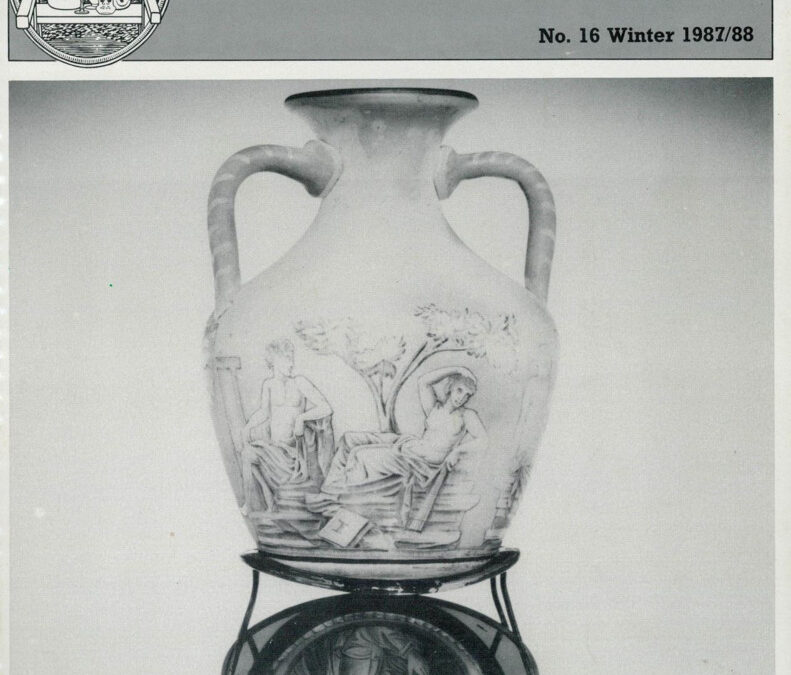
Cover Illustration
A copy of the Portland Vase in frosted
white glass enamelled in sepia. The
base panel has also been accurately
depicted. Although the origins of this
hitherto unrecorded version of the
Portland Vase are unknown, it may have
been produced at the Richardson
Glasshouse in Wordsley in the 1840s.
Ben Richardson the first offered a £1,000
prize for anyone who could reproduce
the Portland Vase and during the late
1840s the Richardson works produced a
number of transfer printed versions.
During the late 1840s it is probable that
Thomas Bott carried out sepia
enamelling on glass prior to his move to
the Worcester Porcelain Works. This
vase could therefore be one of Thomas
Bott’s originals, used as a model for the
mass produced transfer printed
versions. Ht. 7W’ Coll. Broadfield House
Glass Museum.
Exhibitions
PRESTBURY
ARTIZANA
Prestbury, near Wilmslow, Cheshire
“A TOUCH OF GLASS” – WORK BY
RACHAEL WOODMAN
This exhibition is a rare opportunity to
see a large collection of Rachael
Woodman’s work including a few glass
pieces on loan from the Crafts Council.
Born in 1957, Rachael Woodman
obtained a BA Hons (Glass) from North
Staffordshire Polytechnic, and an MA
(Glass) from the Royal College of Art in
London. During her professional career
she has worked with some of the leading
glassblowers and designers both in
Britain and abroad; and she has won
some of the most coveted awards
including the Corning Museum Glass
Award, the Bavarian State Gold Medal,
the Darlington
Glass
Award, and the
Daily Telegraph Award.
Though she is currently working full
time as designer for Dartington Glass in
Devon, she makes her own studio
occasional pieces for special
exhibitions.
The essence of Rachael Woodman’s
designs is purity, simplicity and
harmony. Her aim in her own words is “to
meet the challenge to make the most
beautiful bowl, to make the perfect
piece of glass”. Ambitious though this
may sound, her vessels seem to have a
hypnotic effect on the onlooker,
conveying a sense of peace, tranquillity
and timelessness.
Rachael Woodman’s pieces are
included in some of the most renowned
private and public collections in the
world including the Corning Museum of
Glass in New York and the Victoria and
Albert Museum in London.
27th March – 17th April
10.30 a.m. – 6.00 p.m.
LONDON
MUSEUM OF LONDON
London Wall, London EC2Y 5HN
WHITEFRIARS:
THE UNIQUE
GLASSHOUSE
8th December 1987 – 1st January 1989
Tuesday – Saturday 10.00 a. m. – 6.00 p.m.
Sunday 2.00 p.m. – 6.00 p.m.
SPECIAL EVENTS
Thursday 17th March at 1.10 p.m. –
Lunchtime Talk by Wendy Evans on the
Garton Collection of 17th and 18th
century glass. Saturday 23rd April – Day
School on “Glass in the City” Provisional
cost £6.00
KENDAL
ABBOT HALL ART GALLERY
Kendal, Cumbria
MOUNTAIN THEMES
New glass by Charles Bray along with
watercolours by Veronica West
5th March – 24th April
MARSEILLE
CENTRE DE LA VIEILLE CHARITE
EUROPEAN GLASS OF THE 1950s
This major new exhibition comprises
some 150 pieces of European Glass of
the 1950s, and includes work by all the
most famous designers such as
Palmquist, Wirkkala and Lutken from
Scandinavia and the Italians, Bianconi,
Poli and Barovier. An illustrated
catalogue will be available.
26th March – 12th June
LONDON
JEANETTE HAYHURST GALLERY
32a Kensington Church Street,
London W8
KEITH BROCKLEHURST
Eagerly awaited new work by one of the
country’s leading exponents of cast glass
and pate de verre and one of the most
original talents in the studio glass
movement.
14th April – 7th May
14th May – 12th June at Broadfield House
Glass Museum
ST. HELENS
PILKINGTON
GLASS MUSEUM
Prescot Road, St. Helens
STRANGE AND RARE
Glass Circle 50th Anniversary
Exhibition
Treasures belonging to members of the
Glass Circle ranging from Roman glass
to modern studio work, with the
emphasis on the unusual and off-beat.
The exhibition includes Chinese glass,
scientific and medical glassware,
musical glasses, glass pictures and
friggers besides some exceptional 17th
and 18th century drinking glasses.
Until 5th April
Weekdays 10.00 am. – 5.00 p.m.
Weekends and Bank Holidays 2.00 p.m.
– 4.30 p.m.
A
MYSTERY SOLVED
Some of our sharp-eyed readers will
have noticed the initials H.M. in the
top-left corner of the cover
illustration for the Autumn Glass
Cone. Following the appearance of
that issue, Brian Blench the Keeper of
Decorative Art at Glasgow Museums
and Art Galleries has written to
inform us that the designer and
engraver of the advert was Helen
Monro, as she was then. She later
married Prof. W.E.S. Turner and was
the founder of the Department of
Glass Design at Edinburgh College
of Art. She was without doubt one of
the finest book illustrators in Britain
and later a glass engraver of
supreme quality. The executor of her
estate is John Lawrie, currently head
of the department at Edinburgh, and
he and Brian Blench have started a
project of looking through her papers
with a view to publishing a full
biography of this remarkable
woman.
We are indebted to Brian for this
information and look forward to
reading more about Helen Monro
Turner.
COPY DATES
25th March for
Spring issue
24th June for
Summer issue
Specie Jar
decorated with
the Royal Coat of
Arms and
inscribed
‘RHUBARB”.
Probably made
at the York Flint
Glass Company
c1850. Height
wca se
19th Century Pharmaceutical Glassware
Bottles and Jars
At
the beginning of the century
apothecaries’ shop windows were
decorated by glass bottles
containing coloured liquids in order
to
identify the type of shop to the
illiterate populace. Although the
bottles were of poor quality, they
were made decorative by their
labels. Shortly afterwards the
display space was used to
advantage by displaying their
wares which were for sale over the
counter. Even so, space was still
kept for decoration in the form of
large carboys and elaborately
decorated specie jars.
Carboys were of pear or gourd
shape clear glass and when
containing coloured liquid and
illuminated from behind were an
arresting sight. They usually were
stoppered with a knobbed glass
stopper.
Show Globes were similar but could
be double-towered and suspended
or
supported on brackets or stands.
Specie Jars were essentially for
storage of bulky specie, i.e.
materials used in pharmacy
(originally centuries earlier –
spices). To protect the contents from
light they were made opaque, then
for decorative use also they were
painted and enamelled on the inside
with colourful designs such as coats
of arms and the name of the
contents. Many were made by the
York Flint Glass Company. Their
1840s catalogues claim the
decoration was carried out by
“superior London artists”. By 1869
Maw of London were also
producing jars of a variety of
designs. The specie jar varied in
height from about 11 inches to 31
inches.
Shop Rounds were the bottles and
jars used for smaller quantities of
solids and liquids, usually having
ground glass stoppers. These were
about 8 inches high. Several firms
made these bottles; those from early
in the century will retain the punty
mark. These gradually replaced
earthenware vessels between 1830
and 1850. There were some
specialised versions, such as for
syrups which had a loose peg
stopper to avoid the crystallising
sugar from cementing the stopper to
the neck. Bottles for oil had a special
removable lip for pouring, and a
reservoir collar round the neck to
contain the drips. Those for volatile
liquids had heavy domes over the
stoppers so that if the stoppers blew
out in hot weather they would hit the
dome and drop back into the bottle
neck. Obviously design thought had
been given to such mundane items
of storage. Colour was also used,
blue often being used for syrups and
actinic green for poisons, the latter
also being vertically ribbed to give a
distinguishing touch.
Most early labels were engraved or
painted but towards the end of the
century the bottles were moulded
with a rectangular label recess into
which glass, enamelled labels were
stuck (usually with molten beeswax
for ease of removal if a change of
ingredient was required).
Varnished handwritten labels were
used throughout the whole century
also.
Medicine Bottles
At the beginning of the century
many liquid medicines for internal
use were supplied in the form of a
phial containing a single dose or
draught. Multidose bottles quickly
came into use, round or square at
first but later flat rectangular and
with the dose volume moulded onto
the exterior. By the 1860s these were
in regular use for dispensed
medicines. They were bought in a
range of sizes and closed by corks.
They often had the name and
address of the chemist moulded
onto the glass. Made at first by semi-
automatic machines, by the end of
the century fully automatic
machines were in use. As with
storage bottles, a variety of shapes
and ribbing was used for poisons
until a distinctive bottle was made
obligatory.
Many chemists made and packed
their own remedies and cosmetics,
or bought them in bulk and packed
them. Infant and invalid foods and
household items were also sold, e.g.
sauces, pickles, spices, tea and
cocoa, dyes, varnishes, lamp oil and
aerated waters. Thus we have firms
producing all sorts of bottles, such as
Joseph Connolly at Pendleton,
Manchester in 1890 who made
“sauce, furniture cream, pickle,
confectionery & medical bottles,
vials & pomades, and all classes of
Burst-off bottles”.
Dispensing Equipment
Glass measures used for liquids
were mainly ‘conical’, with
engraved or etched graduations
and may carry an etched
verification stamp for volume, from
which they may be dated. Early
ones tend to be shaped like wine
glasses with knops, later with
rounded bases directly attached to
the foot and later again, a pure
conical shape.
Mortars and pestles are used for
reducing lumpy or crystalline
materials or dried herbs to a
powder. Some were made from
glass for use where chemical
reaction may occur with other
materials such as metal or wood.
Chemist Sundries
Measures for administering
medicinal doses were sometimes
made of glass, some for a single
dose such as a form of medicinal
spoon, and some like a lipped wine
glass. Some glass measures were
spouted like a feeding cup and were
helpful to patients who could not sit
upright.
As the Victorians loved to travel the
more affluent carried their own
medicine cabinets containing
bottles and medicaments and a
formulary booklet so that medicines
to cure the common ailments could
be made up. Also for carrying about
were cased bottles, i.e. bottles in a
wooden or metal case. Made from
the 1840s, these could be carried by
Doctors or individuals who took a
medicine regularly.
A few Inhalers were made of glass in
which an aromatic substance could
be inhaled by pouring on boiling
water. The mouthpieces were made
of glass even for the earthenware
type which were more common.
Bronchitics obtained relief by such
inhalations.
Sputum Bottles were usually made of
blue glass with pewter caps and
were designed to be carried in the
pocket or reticule.
Glass Urinals are found in a variety
of shapes, those for men having a
circular opening and those for
women having a flared or oval
opening. Those in cobalt blue are
rare. Upright ones were also made,
having a roughly triangular body.
Glass Eyebaths are found quite
often, though many are from this
century. They were made in clear,
blue, green and amber and also in
some shades of these colours.
Typically they consist of a foot, stem
(which may be knopped) and a
bowl. The rim of the bowl was
naturally made smooth, either by
turning in the rim while still hot, by
flaming or by grinding. The eye
Group of late
19th century
shop rounds
including a
poison bottle
second from left.
baths of this century were generally
made by press moulding rather ,than
by the earlier blowing method.
Some baths were in the form of a
lower spherical reservoir
(sometimes on a foot) with the eye
fitting section on top. Another new
design was the familiar stemless
‘Optrex’ type, also produced in
several colours.
Prices in 1920 for stemmed, foreign
varieties would be is 6d doz. or 3s
6d doz., English Made Reservoir
types 3s 3d doz. The Army & Navy
Catalogue offered a cheap quality at
4 1/2d. each or best English Hand
Made at is 2d cartoned. Base marks
moulded on the glass are found
relating to makers’ patent marks or
trade marks, or the word “Foreign”
sometimes appears. Base marks on
those in the author’s collection
include: –
also with
“Made in England”
BRITISH M BRITISH
1
6
2
MADE
MADE
These were probably made this
century.
Eye Irrigators and douches of
several types were also made in
glass, consisting of a reservoir, a
spout to irrigate the eye and either a
thumb hole or a rubber teat to
regulate the flow.
Feeding cups for invalids and pap
boats for infants were made in glass
to some extent but are not often
found now compared to the
examples made in ceramics.
Glass Infant Feeding Bottles are
found more often. Those of the first
quarter of the century were hand
made and followed the shape of
earthenware boat-shaped ones,
with a hole on the upper surface
through which they were filled. The
rate of flow of the milk was
controlled by placing the thumb
over the hole. Later on, moulded
bottles were made having a
flattened, circular body from which
a rubber tube led to the teat.
Breast Shields to protect sore
nipples are mainly of hand made
glass during the Victorian period.
Breast Relievers were glass
reservoirs with a rubber bulb used
to remove surplus milk; these would
be made by a blowing process.
Cupping Glasses were used to draw
blood to the surface of a tissue by
heating the glass to exhaust the air in
it thus creating a partial vacuum.
Speedy application of the open end
to the tissue draws blood to the
surface or, if the skin was broken,
into the cup. They were often
produced in sets of three and sold in
a case. They were made of good flint
glass, the rims folded to ensure even
pressure to the skin. They varied in
size from 11/2 to 21/2 inches in
diameter.
Smelling Salts bottles were double
ended and of coloured or engraved
glass. They were fashionable one
hundred years ago. Some had gold
or silver caps. Coloured, cased
glass examples from Bohemia were
shown at the Great Exhibition of
1851 in London. Silver mounted
examples often bear hallmarks of
1870 to 1880.
Glass Fly Traps were also used in
the sick-room. They were baited
with sugar and water, placed in a
ring near the base. Flies which
entered between the feet of the trap
were unable to find their way out
again and drowned in the sugar
solution. Originally the traps were
fitted with glass peg stoppers.
K.D. Richardson F.P.S., B.Sc.
SOURCES
1.
‘Antiques of the Pharmacy”
by Leslie G. Matthews
(G. Bell & Sons London)
2.
“The Victorian Chemist and
Druggist” by W.A. Jackson
(Shire Publications Limited)
3.
“Eye Baths Through the Ages”
by Jean Hansel]
(Antique Collecting,
Feb. & April 1984)
Late 19th
century
pharmaceutical
glass. Left to
right, cupping
glass, breast
shield, fly trap,
and ear trumpet.
.
ng
Jpoo
C ttiog
OW
“What the papers said”
A reporter on the Dudley Evening Mail,
David Benjamin, deserves much of the
credit for exposing the sale by Coloroll
of the cream of the Thomas Webb
collection. It was David Benjamin who
first revealed that the Thomas Webb
Museum was being relocated and that
part of the collection might be sold, in an
article in the Dudley Evening Mail dated
6th October, 1987. Alerted by this
report, Herbert Woodward, former
keeper of the Brierley Hill Glass
Collection and author of a recent history
of Thomas Webb and Sons, wrote to the
Evening Mail expressing his concern,
and his letter was published in the
Birmingham edition on 13th October.
The threat to the Webb Museum
received its first national publicity on 8th
November when a letter was published
in the Sunday Telegraph from the
Stourbridge historian, Jack Haden.
Meanwhile, David Benjamin had been
continuing his investigations, and on
10th November he was the first to be
able to reveal that twenty-three pieces
from the Webb Museum had actually
been sold and that the glass was already
out of the country. He also reported that
the Arts Minister, Richard Luce, would
be setting up an enquiry to see if
Coloroll were in breach of the
regulations on the Export of Works of
Art. The storm over the sale reached its
peak on 15th November with the
appearance of a front page article in the
Sunday Telegraph, followed by another
weighty article in the Daily Telegraph
the next day.
Once the story had broken, the national
papers quickly lost interest, but reports
continued to appear in the local press. In
an “exclusive” in the Dudley Evening
Mail on 18th November, David Benjamin
reported that the Government Enquiry
would be carried out by the Customs
Branch of the Department of Trade and
Industry, while two days later the
Evening Mail and the Express and Star
(another local paper) both carried
stories that the glass had not been sold to
the A. & M. Museum in Texas, as had
been mentioned in earlier reports, but
to a private collector who would be
putting the glass on show at the A. & M.
University in Texas, where he had been
a student.
David Benjamin had one more line of
enquiry still to follow. Ray Grover, a
Florida antique dealer, had long been
suspected of involvement in the Coloroll
sale, and had actually been named as
the “middle man” in the Sunday
The Coloroll Sale
Telegraph article on 15th November.
Contacted in Florida by Benjamin,
Grover admitted that he had some
knowledge of the Coloroll sale but
declined to go into details. To deepen
the suspicion surrounding Grover,
Benjamin revealed two days later that
back in July the American had
approached the curators at Broadfield
House about buying some of the
Museum’s Stourbridge cameo. The final
development before Christmas came
when Miss Barbara Webb, a great
granddaughter of Thomas Webb,
contacted the various interested parties
to express her horror over the sale and
to ask them to do all in their power to
prevent further dispersal of the Webb
collection. Her comments to the Dudley
West M.P., John Blackburn, condemning
the sale, were published in the Express
and Star on 24th November.
Meanwhile, Customs and Excise are
continuing their enquiries, and the
outcome of their investigation is awaited
with interest. We may be assured we
have not heard the last of the Coloroll
sale.
Coloroll Group PLC
Mr. A. Waugh,
Chairman,
The Glass Association,
7 Park Road West,
Wolverhampton,
West Midlands WV1 4PS
11th November 1987
Dear Mr. Waugh,
Your letter of the 3rd November expressed concern that the
collection of glass and pattern books housed in Dennis Hall Museum may be sold.
I can assure you that we shall continue to house a glass museum
at Dennis Hall, but it is in the process of being moved from the main
hall to our visitors’ centre on the same site. We also plan to improve
the display in the museum, making it more educational and
interesting — particularly to families — in order to attract more
tourists to the area.
The new site, however, cannot accommodate all 389 exhibits
from the previous museum and we anticipate exhibiting 350 to 360.
We are currently having discussions with Mr. Hajdamach of the
Broadfield House Museum, over the possible sale or loan of certain
larger pieces and some interesting pattern books. We have
already sold 23 pieces out of the 389 to the A. & M. Museum in
Texas, but have no plans to dispose of, or sell, any other items to
anyone outside the West Midlands — certainly no reference
material or pattern books have been sold.
You are also probably aware of the significant investment that is
being made at Dennis Hall — indeed we have already created 60
extra jobs at Dennis Hall, and have firm plans for further
development; in fact, the proceeds from the sale of glass is funding
only a small part of the substantial investment we are making at the
museum.
I hope this allays your concern over the future of Dennis Hall and
of its exhibits.
Yours sincerely,
John K. Ashcroft, Chairman.
Coloroll Group PLC
Number One King Street, Manchester M2 6AW Telephone: 061: 834 0180
Fax: 061: 832 6109 Telex 666322
End
News & Views
GLASS IN DENMARK
Apart from the new museum of
contemporary glass at Ebeltoft (see
Charles Bray’s article in Glass Cone
11, Sept. 1986) Denmark has a
charming factory museum at
Holmegaard near Naevsted in South
Zealand and much of glass interest in
Copenhagen. This report is based on
a short visit there in September 1987.
Copenhagen is remarkably informal
for a capital city, with a central
pedestrian street zone notable for the
well designed goods in many of the
shops. This zone is also fringed with
antique shops, often well stocked with
glass. Here Holmegaard have their
retail outlet and exhibition gallery,
near the three storey department
store, Illums Bolighus, full of
contemporary design and a large
selection of Scandinavian glass. Two
museums in Copenhagen contain
glass collections — the Kunstindustri
Museum and Rosenborg Castle. The
former has a room of historical glass,
particularly Norwegian, German and
Bohemian but also Venetian, French
and English to around 1830. Its rooms
of contemporary design are
sensitively displayed and include
pieces by Jacob Bang and Per Lutken
for Holmegaard and a small range of
studio glass of the 70s and 80s. More
Norwegian and German glass is found
at Rosenborg, where the famous
cabinet of early eighteenth century
Venetian glass is located. The cabinet
is currently under restoration, but the
castle’s splendidly preserved rooms
provide a marvellous setting for many
of the art treasures of the Kings of
Denmark.
An hour or so by train from
Copenhagen is Naevsted and the
Holmegaard factory. This was set up
in 1825 in a rural area of South
Zealand, using peat for fuel. Simple
tablewares, highly conservative in
design, were made through the
nineteenth century, and many types
have been preserved in the factory
museum, established in an early
worker’s cottage close to the factory
itself. Six well stocked cases show the
development of Holmegaard’s
production from the mid-nineteenth
century to the present, with particular
emphasis on the designs of Per
Lutken, designer from 1942 onwards.
The early designer glass by Orla Juul
Nielsen from c. 1925 to 1929 initiates
the tradition of simplicity of form
continued by Jacob Bang in the 30s
and maintained by Lutken until the
early 60s, when he began to
experiment with colour. The museum
also contains art glass of c. 1900-1925
from the Fyens works, in particular an
interesting range of hot glass pieces
by Adolf Brooks of the late nineteenth
century. Holmegaard today make
machine made container glass as well
as their hand made table ware and art
glass, and both processes can be
seen on their unguided factory tour.
Available from the Holmegaard
factory is Per Lutken’s Glass is Life
(n.d. but published recently). This
embodies Lutken’s philosophy of
glass design and contains an
interesting chapter by Mogens
Schluter on the technical experiments
behind the finished pieces.
Ian Wolfenden
COLOURED MEAD
GLASSES
In the mid-eighteenth century there
appeared in England a series of
drinking glasses with deep cup-shaped
bowls which have upon their lower
halves heavy vertical moulding known
as gadrooning. These are known to
collectors as “mead glasses” although no
documentary evidence supports that
they were ever used for that drink and
there is a likelihood that they are the
champagne glasses referred to by
Thomas Betts, the London glass cutter
and retailer who, in his accounts of 1755,
mentions “12 green ‘/2 Mo(ulded) Egg
Champagne
12 shillings”.
Although all mead glasses are relatively
uncommon, they do exist in clear glass
in a large variety of stem and foot
formations. In coloured glass there are
far fewer types, all in various shades of
green, which can be divided into five
groups, the first two of which are
illustrated.
The first type which appears in a bright
emerald hue is 51/4 inches tall, the bowl
supported by a balustroid stem
surmounted by a four-ring collar. The
foot is domed and folded. These glasses
were probably made between 1720 and
1740. An example of this type is in the
Seddon Collection at the Harris Museum
and Art Gallery, Preston.
Two types of coloured mead glasses
have incised twist stems. The first, in
dark green, has a wide straight stem and
a plain foot. This heavy glass is 6 inches
tall and dates from 1740. An example is
in the Lazarus Collection at the City of
Bristol Museum and Art Gallery. The
other is smalller and a little later, 43/4
inches tall and circa 1755, the incised
stem consisting of an inverted baluster
with a swelling knop at the foot join. The
foot is low but folded and below the bowl
is a short, plain neck. This glass,
although quite scarce, is the most
common of the coloured meads and is
usually found in glass of a paler tint. An
example may be seen in the Fitzwilliam
Museum, Cambridge.
The next type is undoubtedly the most
magnificent and yet elusive of the
coloured meads. A photograph of an
example in the collection of G.F. Berney
is shown in W.A. Thorpe’s “History of
English and Irish Glass” published in
1929 and the type is listed by Churchill in
‘Glass Notes” in 1947. A specimen was
displayed at the Commemorative
Exhibition of the Circle of Glass
Collectors in 1962 but unfortunately
today no public collection boasts an
example. This splendid glass, some 61/2
inches tall, has a long stem knopped
both at its join with the bowl and the
domed foot, and contains a multiple air-
twist spiral.
The final glasses in this series, circa
1775, have hollow stems. Two examples
may be seen in the Victoria and Albert
Museum, London. One has a slightly
ribbed hollow stem but the most
appealing feature of both is that their
bowls are gilt, in the manner of James
Giles, with a fruiting vine motif.
The five types of coloured meads would
undoubtedly make a complete and
marvellous display but their individual
rarity must surely set a daunting task
even for the most avid of collectors.
Rodney Griffiths
Green mead
glasses c1720-50
with balustroid
and incised twist
stems. Heights
514″
and 6″.
IIIIIMM.111.1111111
a
cc bs
Regional Reports
The Art of Glass on Stamps
Although postage stamps portraying glass objects are relatively few
in number in comparison with other subjects in the field of thematic
philately, the stamps hitherto issued do span the long history of glass-
making and glass-decoration. These stamps are excellent miniatures
of mostly outstanding pieces and cover core-formed glass, glass-
blowing, Roman, Frankish, Islamic, mediaeval and later glass, Art
Nouveau and more recent products. F.G.A. Smit has compiled a
catalogue of all the “glass” stamps with full descriptions and 108
illustrations. One of the most original publications on glass, it is an
essential for all glass collectors’ libraries. The three British stamps
which are featured bear only a tentative link with glass and do not
show important English glasses. In view of the issue featuring Studio
Pottery we can only hope that it is not too long before glass receives its
due recognition from the Post Office.
The Art of Glass on Stamps by F.G.A. Smit is available from
Smitsonian Books, 15 The Ridgway, Flitwick, Bedfordshire MK45 1DH,
Tel. 0525-713699, Price £4.50 (post free in UK). Cheques payable to
Smitsonian books.
REGIONAL MEETINGS
MIDLANDS
In spite of the rival attraction of the
Glass Circle 50th Anniversary
Lecture, there was a splendid
turnout of about 40 members for the
final Midlands Regional Group
Meeting of the year at Broadfield
House on Thursday, 19th November.
The main event of the evening was a
lecture by Mr. Vic Sanders on the
History of the Bromsgrove Glass
Houses. Glassmaking in
Bromsgrove began in 1867 when
James Harrop set up a small furnace
at Alfred’s Well, Worms Ash, near
Bromsgrove. Other small glass
works quickly sprang up, including
Crawford’s Flint Glass Works,
Sidemoor (1889-1897), Stevens’s
Glass Works, Bournheath
(1880-1927), Evans’s of Fairfield
(1895-1923) and Fox’s Glass Works,
Bournheath (1919-1924). Quite why
glassrnaking arose in Bromsgrove
was not clear, but good
communications, good supplies of
fuel (coke), and freedom from the
trade disputes that bedevilled
Stourbridge may have been factors.
The Glass Works were basically
small back yard operations
employing no more than half a
dozen or a dozen men, and melting
cullett. The main products were
small bottles, measuring jars and
cruets in clear glass, but a certain
amount of fancy coloured glass was
also made, particularly sugars and
creams, vases and epergnes in ruby
with clear furnace-applied
decoration — the sort of glass that is
normally associated with
Stourbridge. Vic Sanders’s lecture
was excellently illustrated by slides
of the glass house sites and the
glassmakers themselves, then
during the interval members were
able to see a small display of twenty
pieces of coloured Bromsgrove
glass borrowed from families in the
Bromsgrove area.
After coffee Fred Bridges, former
head of the Brierley Hill Glass
Centre, talked about the different
colouring agents used in ruby glass
— gold chloride, copper (in a
reduction atmosphere) and
selenium — and demonstrated how
in gold ruby glass heat was needed
for the colour to “strike”, by melting a
rod of glass over a flame. Fred’s talk
raised some interesting questions
about the actual process of making
ruby glass in Bromsgrove, but
unfortunately the meeting had to be
brought to a close before these
questions could be fully explored.
NORTH WEST
The group’s final meeting of 1987
was a visit to the Turner Museum
collection of glass in Sheffield
University’s Department of
Ceramics, Glasses and Polymers.
Janet Barnes, curator of the Ruskin
Gallery in Sheffield, who looks after
the Turner Museum, gave us a
thoroughly researched talk about
the collection’s founder, Professor
W.E.S. Turner (1881-1963), and
about the development of the
collection up to the present day.
W.E.S. Turner established a
department of Glass Manufacture
(later Glass Technology) at Sheffield
University in 1915. His professional
approach to glass was essentially
scientific, but he retained
throughout his life an enthusiasm for
the aesthetic possibilities of the
medium. From his many visits to the
Continent and the USA he acquired,
usually by gift, splendid examples of
contemporary glass, which were to
form the basis of the museum; this he
established in 1943 to provide
students within his department
access to works of art and craft.
Turner retired in 1945.
The first pieces given to Turner
were by Frederick Carder, They
include an experimental ‘rouge
flambe’ selenium vase, which has
apparently stabilized after
developing a slight stress crack, two
‘aurene’ pieces, an amethyst quartz
vase and an ‘intarsia’ bowl. From
Europe there is Swedish, Danish,
Czech, German, Dutch and
Venetian glass of the inter-war
years, almost all of high quality.
Notable are a covered vase with
engraved ‘Negro Hut’ design by
Hald, a ‘Jungle’ engraved vase by
Jacob Bang for Holmegaard’s and a
yellowish cut bowl by Lutken (1944)
for the same factory, and some
impressive tableware by Copier
and de Bazel for Leerdam. It is not
clear how far this glass reflects
Turner’s personal taste. Some of the
best examples are either engraved
or cut, and it should perhaps be
remembered that Turner’s second
wife was Helen Monro Turner, who
took over the Glass Cutting and
Engraving Department at the
Edinburgh School of Art in 1941.
Apart from the glass acquired by
Turner himself, other gifts have
extended the range of the
collection. The Albert Harland gift of
over 70 English eighteenth century
drinking glasses is the largest
group. The museum also has
examples of Roman glass and
nineteenth century English and
Bohemian wares. Most recently,
Janet Barnes has been purchasing
contemporary studio glass, and
nearly twenty such items are now in
the collection. Altogether there are
over 500 items, making a visit
(preferably by appointment)
immensely rewarding.