


Tbe
Class Coos
No. 22 Summer 1989
7.
;7777;TZ
Aut
The newsletter of the
Glass Association
Registered as a Charity No. 326602
Chairman:
Anthony Waugh
Hon.
Secretary:
Roger Dodsworth
Editor:
Charles Hajdamach
Address
for correspondence:
Broadfield House Glass Museum,
Barnett Lane, Kingswinford,
West
Midlands DY6 9QA.
Tel: 0384 273011
ISSN 0265 9654
Printed by Jones & Palmer Ltd , Birmingham
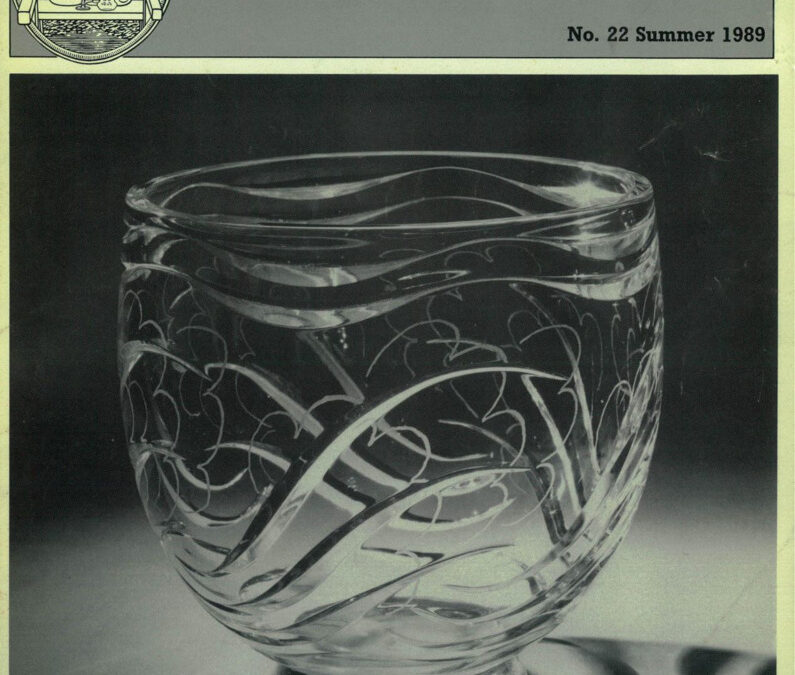
Cover Illustration
Vase designed by Clyne
Farquharson for Walsh Walsh, cut
with a wave design and engraved
with a cloud design. Marked
“Walsh EXH 109”, 7 ins. high.
DUDLEY CRYSTAL FESTIVAL
1989
Friday 25th August — Sunday
3rd September
A host of exciting glass events will
be taking place in Stourbridge at
the end of August as Dudley
stages its second annual Crystal
Festival. Organised by the
Council’s Economic Development
Department, the idea of the
festival is to raise the profile of the
local glass industry and to make
people aware that Stourbridge is
the centre of hand-made crystal
tableware in the U.K. The festival
has been considerably expanded
since last year. From being a
single weekend it is now being
held over ten days in a variety of
different venues. In addition to the
usual displays of factory glass and
the factory open days, a number
of events are being organised that
will be of particular interest to the
glass specialist. The main dates of
these are as follows:
Saturday 26th August
Special showing of glass videos at
Broadfield House Museum, 10.00
am. – 5.00 p.m.
Monday 28th August
Yard of Ale Glass Blowing
Competition, Broadfield House,
10.30 a.m. Royal Brierley Crystal
challenges Iestyn Davies, who
produced a 23ft yard of ale last
year. Iestyn will be giving other
glassmaking demonstrations in the
afternoon.
Tuesday 29th August
Day of Glass Engraving
demonstrations at Broadfield
House, 10.00 a.m. – 5.00 p.m.
Artists include Doug Burgess
(stipple), Carl Palmer (copper
wheel) and Stuart & Shirley
Palmer (flexible drive drill).
Wednesday 30th August
Connoisseurs Evening at
Broadfield House, 7.00 p.m. – 10.00
p.m., with special guest speaker,
Barbara Morris of BBC TV’s
Antiques Roadshow. Admission
£7.50 per person to include buffet
supper and wine. Places limited to
25. Guests will have an
opportunity to handle objects from
the collection and see some of the
Archives, while Barbara Morris
will talk about her experiences on
the Antiques Roadshow and give
some hints about Glass Collecting.
Thursday 31st August
Glass Auction at Giles Haywood,
The Auction House, St. John’s
Road, Stourbridge. More than 500
lots of glass from the 18th century
to the present day including
coloured, cut, engraved and
press-moulded glass. Viewing
previous Tuesday 10.00 am. – 4.30
p.m., Wednesday 10.00 am. – 7.30
p.m. Giles Haywood is rapidly
gaining a reputation for the quality
of his glass auctions, and he is
sure to have some tempting lots in
this sale.
Celebrity Lecture “George
Ravenscroft and the Invention of
Lead Crystal” by Mr. Brian Moody.
The Bonded Warehouse,
Stourbridge, 7.30 p.m., admission
free. Brian Moody was formerly
Research Physicist with United
Glass, Britain’s leading container
glass manufacturer, and is now
Editor of the
Journal of the Society
of Glass Technology.
He has been
researching Ravenscroft for some
time and wrote a paper on the life
of George Ravenscroft for Vol. 79
no. 5 of
Glass Technology,
October 1988. Organised with the
help of the Midlands Section of
the Society of Glass Technology.
Friday 1st September
Repeat showing of glass videos at
Broadfield House, 10.00 a.m. – 5.00
Saturday 2nd September
Glass Collectors’ Fair at the
Summerhill House Hotel,
Kingswinford (500 yards from
Broadfield House), 10.30 a.m. –
5.00 p.m. This collectors’ fair,
devoted exclusively to glass, is the
first of its kind ever held in the
U.K. and will be one of the major
events of the festival. More than 40
stands are available for specialist
glass dealers. The fair is being
organised by our member Pat
Hier (tel. 0260 – 271973) who will
be happy to provide further
details.
Antique Glass Roadshow, Mary
Stevens Park, Stourbridge, 10.30
a.m. – 5.00 p.m. Bring your old
pieces of glass along for
identification and valuation. Panel
of experts includes John Brooks,
Dill Hier, Giles Haywood and
Roger Dodsworth.
Glass Displays, Mary Stevens
Park, Stourbridge, 10.30 am. – 5.00
p.m. Not only will the big five
factories — Stuart Crystal, Royal
Brierley Crystal, Royal Doulton
Crystal (Webb Corbett), Coloroll
(Thomas Webb) and Tudor
Crystal — be represented, but
there will be displays by some of
the smaller companies and local
studios. Entries from the glass
cutting and frigger competitions
will also be on show.
Sunday 3rd September
Charity Auction of modern Crystal
and China in aid of the Pottery
and Glass Trades Benevolent
Institution. Mary Stevens Park,
Stourbridge, 2.30 p.m.
Glass Displays, Mary Stevens
Park, Stourbridge. Details as
above.
Broadfield House Glass Museum
will be open throughout the ten
days of the festival from 10.00 a m.
to 5.00 p.m. Two special
exhibitions can be seen. “A Few
Nice Pieces of Glass” comprises a
selection of superb 18th, 19th and
20th century British Glass from the
Michael Parkington collection. The
glass ranges from 18th century
decanters, Beilby enamelled glass,
and pieces from the Prince
Regent’s dinner service to virtuoso
late Victorian glass by Stevens
and Williams, and Keith Murray
and Graystan.
Mounted specially for the Crystal
Festival is “The Glass of ’89”, an
exhibition of work by third year
students who have just completed
their final degree shows this
summer. All the principal colleges
are represented. Prize money
amounting to £2,000 is on offer for
the best exhibits.
wcase
Clyne Farquharson: A Collection Saved
This short article is more of an
anecdote about how chance, fate
or destiny, call it what you will,
can play a part in the collecting of
glass and result in the creation of
a historic moment in the world of
glass. It is certainly great fun as
well as immensely important to
record how glass is collected and
I am sure that many members of
the Glass Association will have
their own stories of happy
coincidences when they were
able to acquire a prime specimen
for their collections.
This particular story begins in the
afternoon of Tuesday 21st
February 1989 in my office at
Dudley Art Gallery. There was to
be a glass sale at Phillips the
following day which included an
enamelled Art Deco Stuart bowl
which I was keen to acquire for
the collections. The preceding lot
in the same sale was a Clyne
Farquharson decanter with glasses
which were of interest to a friend
and colleague, Max Crossland,
who has responsibility for the
Glass Centre at Brierley Hill. Max,
Roger Dodsworth and myself had
discussed the merits of these
pieces at Phillips at some length.
A phone call to Keith Baker at
Phillips ascertained the condition
of both lots but, before the bids
were left, Keith happened to
mention that there were more
Farquharson and Walsh Walsh
pieces coming up for sale the next
day at Roseberrys, if we were
interested. Keith also pointed out
that there was an illustration of
some of the items in Roseberrys’
advert in the
Antique Trades
Gazette
for that week. I must
admit, with apologies to
Roseberrys, that up to that point
their saleroom was not well known
to us. Fortunately we do receive
the
Antiques Trades Gazette
so it
was a mad rush to find the paper
and flick to the relevant page. The
photo was the size of a postage
stamp and showed three glasses,
two footed bowls with fine
engraved lines topped with
quatrefoil flowers and a very
elegant chalice. Without further
hesitation I was on the phone to
Roseberrys where Judith Kilby
Hunt was extremely helpful and
read out the descriptions of the
lots from the catalogue. Jotting
down the information on any clear
space of the pages of the
Trades
Gazette,
the lots, from 96 to 110,
became more and more exciting
as here were glasses which we
had seen illustrated in the pages
of the
Pottery Gazette
in the 1940s
but which had never been spotted
elsewhere.
Following that phone call we
discussed the lots and wondered
why a saleroom in Islington should
suddenly have such a range of
Walsh Walsh glass. Gradually by
talking around the sale we began
to connect the glass with a visit
which Roger had made nearly
three years earlier to Finchley to
meet Mrs. Farquharson, the widow
of Clyne Farquharson. We had
discovered from a glass dealer
that Mrs. Farquharson was still
alive and we hoped that she might
be able to help with information
about her late husband as we
were then preparing the catalogue
for the British Glass Between the
Wars exhibition. Unfortunately she
was unable to help with any
information but Roger was able to
see some Walsh Walsh glass in
her home. Could that glass be the
same as on offer at Roseberrys?
Was this the last surviving link
with Clyne Farquharson? The
proximity between Finchley and
Islington suggested it could be.
A second phone call to Judith at
Roseberrys revealed little further
information and obviously the
saleroom had to maintain their
integrity and confidentiality to the
vendor but the more we thought
about it the more convinced we
became that this was the source of
the glass. By this time the
atmosphere in the office was quite
electric as we realised that we
may have discovered just in time
the sale of Farquharson’s own
glass which he would have
carried home with great pride and
which his wife had kept over the
years. Immediately I decided to
travel to London the next morning
to attend the sale in person and
investigate the history of the glass
more thoroughly if that was
possible.
The next morning the alarm clock
rang at 5.15 and by 6.25 I was on
the Wolverhampton to Euston train
wondering what the morning had
in store. On arrival at Roseberrys I
met Judith Hunt who by this time
was as excited about the glass as I
was. A phone call had confirmed
that the glass was the property of
Mrs. Farquharson but had been
consigned for sale by Islington
Borough Council who wished to
recover enough cash to cover her
Chalice,
engraved on
the bowl ‘7 AM
THE WA
Y,
THE TRUTH
AND THE
LIFE”. Marked
“Walsh EXH
129”, 9
ins. high.
unpaid bills when she was moved
to a senior citizens home. The
news confirmed our suspicions of
the day before therefore I was
even more eager, to say the least,
to acquire all 15 lots for the
museum. Here was the stuff that
glass historians dream ofl An
opportunity that will only present
itself once — and to lose even one
piece from that collection would
be unbearable to contemplate.
The momentous question of the
next hour, before the sale at 11,
was how much would the glass
realise? The lowest estimate was
£40, the highest £150. How many
times did one have to multiply
these to arrive at a realistic price?
The sale began at 11 o’clock
exactly, with the first lot of the
Farquharson glass, number 96,
coming under the hammer just
before 12. Ten minutes later the
last lost was knocked down at
£260. Two vases, including the one
illustrated on the front cover, went
for £1,000, another vase reached
£750 and two decanters made
£300 each. In total the 15 lots went
for £5,590 and, yes, each one had
been knocked down to Broadfield
House Glass Museum. Those ten
minutes were some of the most
tense yet some of the most
exciting of my life, especially
when, after the last lot, I realised
that we had scooped the lot.
Some of the designs on these
pieces are unrecorded and may
turn out to be one-offs, limited
editions or exhibition pieces.
Three of the pieces are engraved
with “EXH” followed by numbers
which may relate to the “Britain
Can Make It” exhibition held in
1946. The chalice, illustrated in the
advert, turned out to be engraved
with the religious inscription “I am
the way, the truth and the life”.
The hollow stem, cut with broad
facets, completes the calm
architectural beauty of the piece.
Lot 106, a “fish with crackled
effect”, was also traced back to an
advertisement of the 1930s
showing Walsh Walsh fish.
The purchase of the entire
collection was made possible
through the generosity of Graham
and Jon Knowles, the Managing
Directors of Hulberts of Dudley,
whose aim it is to save the finest
examples of Stourbridge and
Midlands glass for display at
Broadfield House. Without their
vision, enthusiasm,- commitment
and funding, this collection would
almost certainly have been split
up between the museum, dealers
and collectors. Now it forms part
of the Hulbert collection, placed
on permanent loan to Broadfield
House, where it will be shown in a
brand new layout by the
beginning of October.
Opportunities like this occur once
in a lifetime. To be involved is an
honour that sets the adrenalin
coursing through the veins and
brings a special excitement and,
in a strange sense, a very real and
direct contact with a great
designer and with the
glassmakers, cutters and
engravers who translated his
vision into masterpieces of glass.
C. R. Hajdamach
Vase with
sandblasted
decoration of
oval and
circular panels
in relief.
Signed Clyne
Farquharson
and dated ’38.
10 ins. high.
The design for
this vase
appears in the
A’ pattern
book of Walsh
Walsh at
Birmingham
Art Gallery but
no name is
given for this
design.
Fish, blown
with a crackle
effect and
applied fins
and tail.
17 ins. long.
STOP PRESS – SCANDINAVIAN DAY 23RD SEPTEMBER
Lars Hellsten from Orrefors whose work is included in the exhibition is
flying from Sweden specifically for The Glass Association Day and to talk
to us in the afternoon on ‘Orrefors and the Designer’. Winner of the
Swedish Royal Foundation Scholarship he joined Skrufs Glassworks in 1964
specialising in unique glass sculptures. The importance of which were
quickly recognised by commissions including work for the Swedish Embassy in
Washington DC. He joined Orrefors in 1972 and has been in the forefront in
re-establishing their design lead. Internationally recognised with works
as far afield as Corning Museum USA and the Museum of Modern Art Kyoto
Japan.
With Ray Notley, Diane Taylor, Peter Dreiser, September 23rd will present
an unrepeatable opportunity to look afresh at the impact of Scandanivia on
20th Century Glass.
WHAT TO LOOK FOR IN SCANDINAVIAN GLASS
IN THE FIRST HALF OF THE 20th CENTURY
The first distinctive Scandinavian
glass appears in 1917. Although
high quality glass was produced
before that date it lacked
“originality in design, one might
say in fantasy” according to a 1898
review in the magazine of the
Swedish Society of Arts and
Crafts. In the first decade a few
artists started to devote
themselves to the development of
glass design but their work was
largely imitative. Gunner
Wennerberg at the Kosta
glassworks worked in the style of
Galle; Ferdinand Boberg at
Reijmyre made opalescent and
clear vases with etched designs
while Alf Wilander at Svenska
Kristallglas followed the Germanic
Jugend style.
The Homes Exhibition in
Stockholm 1917 is the landmark in
the international recognition of
Swedish Glass. The ownership of
the Orrefors Glassworks changed
in 1913 and the new owner
approached the Swedish Society
of Arts and Crafts to recommend
artists. As a result in 1916 Simon
Gate and in 1917 Edward Hald
were appointed as designers.
Working with master blower Knut
Berggvist “Graal Glass” was first
produced in 1917 and with it they
obtained major awards at the 1925
Paris Exhibition “des Arts
Decoratif’ the benchmark of Art
Deco and origin of the name.
From Gate and Hald run two clear
lines in Scandinavian design
which dominated the 1950s and
1960s.
The other major designer in the
Stockholm 1917 exhibition was
Edvin 011ers then designing for
Kosta. Technical difficulties meant
that his bubbled green glass was
not developed immediately but it
inspired Maurice MarMot in
France, one of the major roots for
current glass design.
The reputation of Swedish glass in
the 1920s and 1930s rests mainly
on its engraved glass. The spread
in the influence of Orrefors was
due not only to the design skills,
but also to their concentration on
technical excellence. Gustaf Abels
led the team of engravers and in
1924 a government subsidised
school for engravers was started
at Orrefors. By this time demand
was exceeding supply and a
group of Czechoslovakian
engravers were employed at
Orrefors until enough skilled
engravers were trained and the
school closed down. The
graduates moved to glassworks
throughout Scandinavia and since
then a constant pool of skill has
been developed. In 1928 Vicke
Lindstrand joined Orrefors where
he stayed until 1940. Another
major artist Edvin Ohrstom joined
Orrefors in 1936 and his innovative
Ariel designs are only now being
accorded recognition as
influencial works, while his ‘Wish
to the New Moon’ was one of
Orrefors’ greatest commercial
successes. Other important
Swedish designers of this period
are Nils Landberg, Sven
Palmqvist, Elis Bergh, Lennart
Nyblom, Karl Hultstrom, Edvard
Stromberg, Gerda Stromberg and
Ingeborg Lundin.
Throughout the 1920s Swedish
Glass is thin blown, usually
engraved with shallow engravings
produced by the engraver
following the lines put on with
adhesives by the designer. The
1930s saw the development of
thick heavy glass with form in
harmony with material and deep
sculptural cutting using a variety of
techniques. Both Graal (a fluid
cameo style) and Ariel (controlled
bubbles) were reworked with
etching, cutting or engraving.
THE GLASSWORKS
Orrefors
Justly the most famous in the
period.
Kosta
The oldest of the works, won
major awards at Paris 1925. Not as
innovative as Orrefors in the ’20s
and ’30s but maintained
unsurpassed standard in purity of
form and swirling design.
Boda
Now part of the Kosta Group.
Since 1950 under Vicke
Lindstrand and with a team of
brilliant designers led by Erik
Hoglund, Bertil Vallien, Ann and
Goran Warff Many would argue
that Kosta Boda is now the leading
design group in Sweden. The
group also includes the Afors
glassworks.
Reijmyre
The other Swedish prize winner in
Paris in 1925 with Edvin 011ers
having moved from Kosta to lead
the design team. It has maintained
consistently high standards.
There are a number of smaller
Swedish Glassworks which lack
nothing in design and quality. Eda,
Skruf, Johansfors, Lindeshammer,
Stromberg and Malerias
Pukebergh have all produced
collectable glass over a sustained
period and many of the leading
designers have spent periods at
these and other works. The career
of Edvin Oilers (1888-1959) is
illustrative in that he designed for
Kosta in 1917-18 and again in
31-32, at Reijmyre 1918-25, Elme
1926-30, Limmared 1929-30,
Alsterfors 1930-34, Afors 1934-40,
and Ekenas 1946-47.
While Sweden is considered the
leading Scandinavian glass
producer, second place belongs
to Finland. In the 1940s and 1950s
in particular it was challenging the
Swedish design lead. At no time
did a single glassworks dominate
in Finland although Karhula Iittala,
especially in the late forties with
Tapio Wirkkala and Kaj Franck,
came near. But, as Finnish
glassworks tended to employ
designers in a freelance capacity,
the names of Gunner Nyman, Arttu
Brumme, Alvar Alto, Goran
Hongell appear also on glass from
Wartsila, Nuutajarvi and Riihimaen
Lasi Oy. Mention must also be
made of Timo Sarpeneva who
started designing for Iittala in
1950, and of the work in the 1950s
of Tapio Wirkkala for the Italian
firm of Venini.
Denmark has produced glass of
note from two glassworks, those of
Holmegaard and Kastrup which
amalgamated in the 1960s, Jacob
E. Bang and Per Lutken being
their leading designers.
From Norway only Hadelands
produced collectable glass and its
best production starts in the late
1940s. It is not until the 1950s that
it produced glass of international
exhibition standard.
John Delafaille
News & Views
Sale Room Report
This is what I hope will become a
regular commentary on glass sold
through the sale rooms, both in
this country and overseas.
Because of the periodic nature of
the
Glass Cone
it will generally be
a retrospective review but
whenever possible I will advise of
forthcoming sales which feature
glass. I hope that this will enable
you to keep abreast of current
prices and to value more
accurately any glass which comes
to your notice in your own locality.
The high prices being realised
today are due, in some degree, to
the wider and more intensive
advertising on the part of sale
rooms so that the chances of a
rarity passing unnoticed become
increasingly slender. Prospective
purchasers can sometimes be
misled into limiting their bids by
relying on auctioneers’ estimates
which may be excessively
conservative as one or two of the
following examples will show. This
tendency is more general, I feel,
in provincial sales where glass
does not feature so regularly and
rarities may go unrecognised:
although the specialist sales in
London sometimes produce
surprises.
The main opportunity for bargains
in the sale rooms results, I think,
from poor or inaccurate
cataloguing which means that an
interesting or rare piece of glass
may not be readily recognised
from its description, or
alternatively, prompts a wasted
journey to view something which
does not live up to one’s
expectations.
I am sometimes asked for an
opinion by people who are
worried that they may have made
a bad purchase in a sale because
it was bought so cheaply. Usually
their fears are groundless and
they have benefited from their
own knowledge and good
judgement and, more importantly I
think, a lack of any opposition in
the sale room. It must be said that
equally good purchases can be
made in antiques shops by anyone
who is first to recognise the true
merit
of an
object.
Now for some of the items which
have come to my attention:
12th May. Biddle & Webb,
Birmingham.
A Lalique moulded figure of a
nude girl holding draperies.
9″ high, £8,000.
11th May. Locke & England,
Leamington.
A collection of 18th century glass
including four opaque twist wines
with unusual vertically ribbed
bowls for £780, an opaque twist,
terraced foot dram 4″ high for £230
and two ale glasses engraved with
hops and barley on opaque twist
stems for £160 and £180.
17th May. Sale in Paris.
Some very high prices for
French
Art Nouveau glass. Two moulded
vases by Daum of Nancy. ‘Autumn
Vine’, £282,000 and ‘Hawthorn and
Butterflies’, £250,000. Several other
items went for around £15,000.
Several Galle lamps sold for
prices between £15,000 and
£106,000 while an interesting glass
casket in amber glass with
applied gold and enamel made
£18,500. Other makers
represented were Muller, MarMot,
whose enamelled bottle made
£16,700, and Decorchement, at
prices up to about £50,000.
23rd May. Christie’s, London.
287 lots
of English and European
glass. A group of Beilby
enamelled glasses ranged from
£1,000 to £10,000 and colour twist
glasses fetching from £1,500 to
£4,800 for a yellow twist example;
always the most expensive. By
contrast several engraved
‘Newcastle’ baluster glasses, which
not too long ago would have made
even more, commanded prices
between £900 and £3,500. Jacobite
glasses made prices up to £700
and a rare Privateer glass fetched
£7,500. (All these plus 10%
premium.)
6th June. Phillips, London.
To show how estimates can
mislead, an engraved German
ewer with silver gilt mounts
estimated at £5,000 made £20,000.
A group
of Stourbridge
cameo
vases made prices from £1,400
rising to £4,800 for a waisted vase,
13” high, carved with white irises
on a blue ground.
June
A general sale in Bury St.
Edmunds produced £4,000 for a
chinese overlay vase with red
dogs on a yellow ground. This
went to London trade at several
times the estimate. An example of
advertising producing the
specialist buyer prepared to pay
the top price.
There have been some good sales
during these last few months
which have produced some rare
and valuable items. In the next
report I will try to find some more
modestly priced examples.
John Brooks
Exhibitions
KINGSWINFORD
BROADFIELD HOUSE GLASS
MUSEUM,
Barnett Lane
The Michael Parkington
Collection. The first public
showing of this superb
collection of 18th, 19th and 20th
century glass masterpieces.
Continues throughout 1989.
LONDON
Jeanett Hayhurst Gallery
32A Kingsington Church Street,
W8
New Work by David Reekie
24th October – 18th November
Monday – Saturday, 11.00 a m. –
5.00 p.m.
GUILD OF GLASS
ENGRAVERS
Castle Howard
York
3rd August – 23rd September
Opening times not known.
INSTITUTE OF EDUCATION
University of London
20 Bedford Way
WC I H OAL
24th October – 6th November
Monday – Friday,
10.00 am. – 6.00 p.m.,
Saturday, 10.00 am. – 12.30 p.m.
The Coloroll Court Case
On Monday 3rd April 1989 the
case against Coloroll was heard at
the Northampton Crown Court.
The case was completed on
Wednesday 5th April when the
company and one of the managing
directors, Mr. Nigel Woodland,
were found not guilty of the
prohibited exportation of the glass
from the former Thomas Webb
Museum in October 1987.
The trial revealed a number of
interesting facts about the
transaction. The prosecuting
barrister, Mr. Reddihough, told the
court that Coloroll sold 26 pieces
from the Thomas Webb Museum
to Florida antique dealer Ray
Grover for £324,000. The firm later
produced a document which
seemed to have divided that
figure by 26, the number of
glasses sold, to reach a price of
£12,467 for each piece. He said
Customs and Excise Officers,
through detective work in the
States, had unearthed an invoice
signed by Mr. Woodland which
included values for the Polar Vase
and the Origin of Painting Plaque
of £50,000 and £41,000 respectively
at 1987 rates. The court heard that
a letter from Mr. Grover to Mr.
Woodland said “Customs was no
problem either leaving the UK or
entering the US”. Mr. Grover said
they had to unpack at Heathrow
because lead showed up dark but
entering the US only took three
minutes.
On finding Coloroll not guilty the
jury did ask if it could recommend
proceedings against Ray Grover.
Judge Peter Crawford said that
was not for the jury to recommend
but if Mr. Grover returned to this
country any proceedings would
be at the discretion of Customs
and Excise.
Since then Broadfield House Glass
Museum has discovered that the
items from the Webb Museum are
to go on display from 9th
September 1989 at the MSC
Forsyth Center Galleries at the
Texas A. & M. University
Memorial Student Center.
Well-founded rumours have
recently been circulating in the
Stourbridge district that Coloroll
now wishes to sell off the Thomas
Webb and the Edinburgh Crystal
factories. At one stage it was
believed that the Royal Doulton
group and its Webb Corbett glass
factory were interested in buying
the two works but it seems now
that the deal has fallen through.
Poster Design Competition
Pilkington Glass Museum are
offering a £200 cash prize if you
can create the winning design for
their temporary exhibition poster.
The basic design will be used
several times a year, with times
and dates of different exhibitions
printed over it, so it must be kept
simple. Prizes will be awarded in
three sections: 0-10 years old;
11-16 years old and Adult. The
overall winner whose design will
be used will be from one of the
section winners. Entries, on A4
size paper, should be submitted
no later than 30th September to
Pilkington Glass Museum, Prescot
Road, St. Helens, Merseyside
WAIO 3TT.
Corning Microfiche
Broadfield House Glass Museum
has bought the full set of 5,090
microfiche of the pattern books of
glass factories from the library of
the Corning Glass Museum, the
only museum in this country to do
so. The microfiche contain 2,360
trade catalogues, divided into six
major subject areas including
Tableware, Cut Glass, Bottles and
Druggists’ Glassware, Flat Glass
including Stained and
Architectural, Lighting Glassware
and Lamps and Laboratory Ware
including Industrial and Optical
Glass. The majority of the
catalogues, covering Europe,
America, Russia and Japan, were
printed after 1850 although the
collection contains several earlier
European catalogues including a
Belgian catalogue dated between
1550 and 1555.
The microfiche will be stored at
Broadfield House and will be
available for research by the
public. It is hoped to set up the
research facility within the next
two months. Anyone wishing to
use this primary source of
information should contact the
museum first and reserve a time
for access.
Sowerby Glass
A
most important collection of
Sowerby pressed and blown glass,
together with other late 19th
century glass, has very recently
been given to the Shipley Art
Gallery, Gateshead, by Mrs.
Marjorie B. Warner (née Sowerby)
and is currently on display.
There are 10 pieces of pressed
glass but of particular importance
to the collector and researcher
are the 16 pieces of blown Art
glass, made at the factory in the
1870s. Their Sowerby family
provenance will prove invaluable
in authenticating other pieces
normally attributed to the factory.
Exhibited at the 1986 Sowerby
exhibition, none of them
duplicates the shapes and colours
already held by the gallery.
Also included are tumblers from
George Sowerby’s works at
Lemington and a clear glass
decanter, contemporaneous with
the rest of the collection, from
Whitefriar’s London factory.
A Group of
Plumrose
Anemones,
made of
lampworked
glass by Rudolf
and Leopold
Blaschka in
Dresden in the
late 19th
century, which
is part of the
new Zoology
Gallery at the
National
Museum
of
Wales in
Cardiff
Facets
Regional Reports
National Meeting
Glass in Scotland 13 – 16 July 1989
In warm, sunny weather which
was to last the whole weekend,
59 members of The Glass
Association and The Scottish Glass
Society assembled on the friendly
Campus of Strathclyde University.
Chairmen Tony Waugh and Diane
Cook welcomed members at the
opening dinner. Our first
expedition, on Friday morning,
was to Caithness Glass near Perth
where we saw something of the
art and mystery of fine
paperweight making. Franco
Toffolo, master glassblower from
Murano, also demonstrated, to
members’ applause, his superb
skill in blown and pincered ‘facon
de Venise’ ware. The factory shop
was a tempting diversion. (John
Brooks’ purchase of a handsome
baluster goblet in the eighteenth
century tradition did not escape
our attention!) After a picnic lunch
we found ourselves back in
Glasgow, in Pollock Park, to see
something of the fabulous Burrell
Collection, introduced by
Rosemary Watt. Behind the scenes
we were privileged to be shown a
large quantity of English
eighteenth century glass in
reserve, and conservation work
proceeding on stained glass. The
spaciousness of the handsome
new building and the imaginative
display of the Burrell treasures left
everyone impressed. However,
ten minutes’ walk away across the
park, Pollock House was
beckoning with a sherry reception
and buffet supper. John Kinghorn
of Glasgow Museums gave us an
excellent introduction to the
Maxwell family history, and
members then divided their time
between the house and the
gardens. The glass on view
included some rare and
interesting Jacobite and Beilby
drinking vessels.
Saturday’s programme was at the
magnificent Art Gallery and
Museum, Kelvingrove, where
Brian Blench, Keeper of
Decorative Art, outlined the scope
of the Glasgow collections before
giving a paper on the history of
Glasgow’s first glasshouse in
Jamaica Street, dating from about
1700. George Neilson’s talk on the
large and important Dumbarton
works (1776-1850), and Godfrey
Evans’ account of the obscure and
shortlived Aberdeen glasshouse
(c.1830) served to illustrate the all
imporant human and geographical
factors which determine success
or failure in such enterprises.
Jeanette Hayhurst took a hard, and
to some perhaps irreverent, look
at Jacobite symbolism on
eighteenth century glasses. The
debunking of some of the more
colourful myths was surely long
overdue — all auction catalogue
compilers should be made to
attend this talk!
Steering us back towards the
present, Virginia Glenn described
the wide ranging Edinburgh
collections from the mid-
nineteenth century onwards, and
gave us a tantalising glimpse of
what Edinburgh too could offer for
an Association weekend. There
were also opportunities throughout
the day to wander round “Scottish
Glass Now”, the tenth anniversary
exhibition of the Scottish Glass
Society, in which 53 individual
makers displayed a wide range of
work. (An excellent illustrated
catalogue, priced at £2.95, is
available.) Perhaps the Scottish
character of the exhibition was
revealed in a strong emphasis on
engraving, paperweights and
stained glass.
The programme continued on
Sunday with lectures at the
University. Jim Edgeley reviewed
the state of knowledge of Scottish
pressed glass, assisted by his
painstaking analysis of design
registrations. Ian Turner and Tom
Ellis presented well illustrated
surveys of Monart and Vasart
glass, and modern Scottish
paperweights. The weekend
finished on a high note with a talk
by John Lawrie, Edinburgh
College of Art, who originally
studied glass engraving under the
famous Helen Monro Turner. The
wide range of John’s beautiful
work — windows, vessels and
sculpture — sent us on our way
with an even higher impression of
glass artistry in Scotland.
Newcastle (1985) and York (1987)
were hard enough acts to follow,
but our organisers and speakers
excelled themselves. Special
mention must be made of Simon
Cottle and Roger Dodsworth who
not only devised an exciting
programme but managed to steer
fifty or so sometimes unruly sheep
through all the right gates at the
right times!
Greville Watts
Postscript
One of the items in the “Scottish
Glass Now” exhibition, “Reliquary”
by Franco Toffolo, was purchased
for the collections at Broadfield
House. Franco Toffolo was a gold
medal winner at the Technical
School in Murano and has worked
for more than 40 years in Murano,
many of them at the great
glasshouse of Venini. He has
operated glass studios in Italy and
in the UK and is now senior
development glassmaker with
Caithness Glass. He is the
supreme example of a continuing
tradition of Venetian influence and
inspiration for British glassmakers.
To those members of the
Association who were thinking of
buying Franco’s work but who
were pipped at the post, my
sincere apologies, but I hope that
everyone will appreciate his
absolute skill and genius when
they see “Reliquary” on display at
Broadfield House.
Editor
The Editor has prepared a set
of guidelines for contributors to
the
Glass Cone.
If anyone is
interested in writing articles
and news for the
Cone
they will
be sent a copy on application.
Items for publication can also
be passed via John Brooks at
Leicester.
Copy dates:
Autumn
Issue (South East
edition) — 8th September
Winter Issue —
20th
November