




No. 23 Autumn 1989
to
1)*€
The newsletter of the
Glass Association
Registered as a Chanty No 326602
Chairman:
Anthony Waugh
Hon. Secretary:
Roger Dodsworth
Editor:
Charles Hajdamach
Address for correspondence:
Broadfield House Glass Museum,
Barnett Lane, Kingswinford,
West Midlands DY6 9QA.
Tel: 0384 273011
ISSN 0265 9634
Printed by Jones & Palmer Ltd., Birmingham
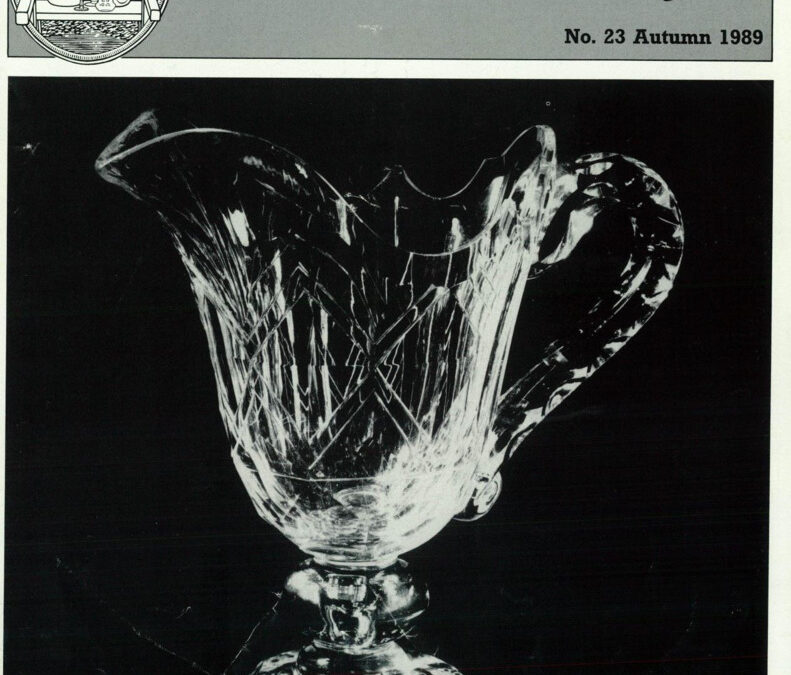
Cover Illustration
Helmet-shaped ewer among the
selection of glass on show in the
recently refurbished 18th Century
Gallery at the Museum of London.
These shallow cut, heavy ewers
appear on London trade cards of
about 1760, and are also known to
have been made in blue and
green.
SALEROOM REPORT
I closed my last report with the
promise that I would try to find
some more modest items for this
quarter. I have managed to do this
but the most noteworthy event in
the glass world during the last
three months has been the sale, in
Amsterdam, of the Guepin
collection of European glass. I
shall treat this as the cherry on the
cake and return to it at the end of
the report.
Among the more ordinary things
the bargain of the month must
have been the three glasses
acquired by a friend of mine in a
sale in Bournemouth recently. A
facet stem wine, a plain stem wine
and a pan topped air twist wine,
all 18th century, for £75. Contrast
this with a sale at Market
Harborough where two 18th
century opaque twist stem glasses
made £115 each followed by a
plain stem glass with folded foot
which made the very high price of
£120 (all plus 10%). The engraving
of a stylised flower and a bird on
the last may have persuaded
someone to go to these lengths!
Among other items I have noted
were:
TORQUAY
22nd June
A pair of cameo vases featuring
pink and white convolvulus on a
yellow ground, 5
3
/4″ high, for
£2,600.
EXETER
29th June
A ship’s decanter, which is always
desirable however impracticable
they are to use, for £620 against an
estimate of £40-£80.
STRATFORD-ON-AVON
30th June
A continental cameo glass vase
with elephants, signed ‘Moser’, for
£1,200.
PARIS
3rd July
For a touch of class how about two
Calle dragonfly vases at £15,000
and £22,800?
LEOMINSTER
5th July
A pair of ruby flashed Bohemian
facet cut covered goblets, 19th
century, at £1,250 in spite of some
damage to the finials.
BRIGG
19th July
A Bohemian lustre vase with
panels painted with portraits and
crystal droppers for £350.
BLETCHINGLEY
25th-27th June
A Lalique budgerigar vase in
opalescent blue for £1,950.
CHESTER
1st August
An 18th century wine glass with
double knopped air twist stem. Its
main interest lay in the gilt
inscription
“Families, Friends &
Favourites”
contained in a scrolled
cartouche. A similar glass is
illustrated in S. Crompton’s
“English Glass” pl. 95 and there
attributed to the Beilby family in
Newcastle. Neither of the books
by James Rush, devoted to the
work of the Beilbys, illustrates a
glass decorated with gilding
although one glass has an
enamelled cartouche and
inscription in a very similar style.
This is the
“Liberty & Clavering for
Ever”
glass. As many of the Beilby
enamelled glasses have gilt rims
they were presumably familiar
with the technique. This is a most
interesting glass and at £900
seemed to me very cheap. In the
same sale a baluster stem glass 7″
high with an annulated knop stem
made £480.
AMSTERDAM
5th July
And so back to the Guepin
collection. This was a single
owner collection of glass, either
made in Holland or influenced by
Low Countries style, covering the
17th and 18th centuries. Of the
nearly 130 items the star was
undoubtedly the slender
‘facon-
de
–
Venise’
flute, 15″ tall and
bearing a portrait of William,
Prince of Orange, who was to
become William III of England.
This was signed with the initial ‘M’
and dated 1657. It went for the
princely sum of £215,500.
One of the strengths of the
collection was the engraved glass
and several examples of the
beautiful, flowing calligraphy of
Willem van Heemskerk, dated
between 1676 and 1683, made
prices ranging from £28,700 for a
slightly marked example up to
£74, 700. A documentary example
of 18th century stipple engraving
by David Wolff made £54,600.
Prices were mostly numbered in
1,000s rather than 100s and the
sale totalled about £1.6 million. A
record, I believe, for any sale of
glass.
To bring us down to earth again I
shall mention a sale held in
Sudbury, Suffolk on 13th
September which contained a
group of 18th century opaque and
air twist wine glasses. Prices were
generally at the upper end of, or
slightly over, the estimates and
ranged from £85 for one 5
3
/4″ high
to £165 (all plus 10%) for a pan
topped air twist 6″ high (see para.
2!). The exception was a mixed
twist glass which made £340
against a high estimate of £150.
John Brooks
September 1989
GLASS PRINTS FOR SALE
The Gallery Shop at Birmingham
City Museum and Art Gallery has
a few remaining etchings for sale
of Stuart Crystal’s Cutting Shop by
the Birmingham trained print-
maker Robert Ball. The date of the
etching is 1937; framed prints cost
£85, unframed £60. Interested
buyers should contact Gwen
Williams at the Gallery Shop on
021-236 3381.
COPY
DATES
Winter issue —
20th November 1989
Spring issue —
23rd February 1990
An Interview with Ray Flavell
For the cover illustration of his
new book
Glass: a contemporary
art
(reviewed in this issue), Dan
Klein chose a work by Ray Flavell,
Head of Glass School, West Surrey
College of Art & Design, Farnham,
Surrey. In August this year Ray
Flavell talked to Glass Association
member, Patricia Baker.
PB — How did you come into
glass?
RF — I come from the West
Midlands, so glass was just round
the corner. But for my National
Diploma in Design, I specialised in
ceramics and lithography; I hadn’t
identified myself working with glass
at that time. I went to Sweden on a
Travelling Scholarship in the late
50s and discovered the ‘Glass Land’
and Orrefors. But it wasn’t until I
was teaching on the industrial
design course at Guildford School of
Art, that the opportunity came up to
work with Sam Herman at the Royal
College of Art, and actually get
involved with glass. His concept
was “Here is the furnace, and it has
molten glass in it. You’re a creative
person; get in there and see what
you can make”.
PB — What happened after that?
RF — I went away and
constructed a furnace at Guildford
School of Art. But I found that the
amount of technique I had was
totally inadequate. Then I learnt of
the course at Orrefors in Sweden,
and I went there for six months in
1972. But before Orrefors, I went
to work with Helen Monro Turner
in Edinburgh — a marvellous
experience. At Orrefors cutting
was related to production work so
we endlessly did things like V-
cuts; extremely boring.
PB — What else did this Orrefors
course consist of?
RF — The emphasis was on the
practice of making in relation to
production, gathering and
preparatory techniques, blowing
into moulds, making regular
shapes predictably one after the
other, etc. I came back to England
wanting to design for a factory. But
my experience as a designer was
very frustrated by the way that
management was stuck in the
traditional English crystal market.
Lord Queensbury’s ‘Harlequin’
design (1963 Webb Corbett) was
an attempt to up-date the product
but it failed (not because of the
design I might add) and still in
1989 this failure is used as an
excuse for not taking risks. The
companies don’t aim to sell glass;
they just want to collect orders.
PB — Did you make the Corning
exhibitor piece “Dream Fantasy”
(1979
New Glass
exhibition) while
at Guildford?
RF — I was teaching part-time at
Farnham (WSCAD formed from
Farnham & Guildford Schools of
Art), running my workship in
Grayshott and being retained by
Stevens & Williams as a designer.
It was an opportunity to tell a story
through imagery using sand-
blasting, while using the
decorative surface to describe the
controlled bowl form.
PB — But then it seemed that you
suffered almost a writer’s block.
RF — I’m sure it was pressure of
work, establishing the BA Hons
Glass course at Farnham. The
“Magic” series was an attempt to
use imagery alluding to wizardry,
and colour, and it was a massive
confusion. After that I really had to
think seriously about what I was
about. My work was still heavily
influenced by Scandinavian glass
forms but I realised I had to find
what it was about the glass, about
form, etc. that I wanted to say.
I think the vital spur was the
knowledge that the Coburg Glass
prize was coming round again. I
thought of the purity of forms that
can emerge in blowing but which is
distorted by the foot or base. It
suddenly occurred to me that if I
sawed my form in half and mounted
it on a flat piece of glass, it could
stand suspended in space as one
would see it on the blowing iron.
PB — Do ideas come during the
making process or have you by
then already committed the idea
to say, technical drawings?
RF — When I start work I have a
basic idea but the real innovation
takes place when I begin cutting
the blown forms. Then they start to
grow. For me the working process
actually is the inspiration because I
feel at home with the glass. As the
ideas emerge, it’s back to drawings
to incorporate them. I have to make
some kind of technical drawing, as
these are constructed pieces. It can
take many hours.
Watershed by
Ray Flavell
Rhythms and
Reflections by
Ray navel]
PB — Why is the vessel form so
predominant in this new work?
RF — I think this relates to the
craftsman’s roots of function — not
just in drinking, pouring,
containing; these are after all ritual
vessels, commemorative vessels.
This is the area I’m interested in.
It’s a vehicle for saying other
things. As for the wing-like
elements, this idea, I think, comes
from my visit to Prague and the
Baroque architecture, the dynamic
movement of the scroll-work, for
instance. It has a lot to do with
fluidity and the fluidity of molten
glass.
PB — I was going to comment on
that idea of fluidity. The titles of
your recent forms, “Watershed”,
“Vessel” suggest fluidity of water.
RF — Yes, movement. But I want
to bring out the disquieting
discordant nature at the same
time. That’s one of the reasons for
using the contradiction of
2-dimensional outlines to suggest
an out-flow, an out-pouring
emanating from a 3-dimensional
form. And yet the sand-blasting
and cut edges provide an illusion
of 3 dimensions. Your eye is taken
into and outside the vessel to
explore the whole.
PB — You’re using for the first
time transparent colour. Why?
RF — The colour has to be
transparent if I’m breaking the
surface by cutting so the spectrum
colours can still emerge. I tend to
put two transparent colours
together in the glass, to give
interesting nuances of richness
and variation in the quality. The
object actually has a sort of new
depth with the interaction of these
two colours and the spectrum.
PB — There are many glass-artists
who are not physically involved in
the whole making process. Do you
think this contact is essential?
RF — It’s only the contact with the
process that actually makes you
imaginative with it. I don’t want to
ask or invite some artisan to
interpret my idea, because I want
to bring something to it myself. I
may be limited by my own skill
but I don’t mind that. If you look at
the work in that recent exhibition
in Japan, promoted by the Crafts
Council (Contemporary British
Crafts Oct-Dec 1988), all the
exhibitors were obsessive,
manipulative makers as well as
innovators. That intimacy, that total
feel for material quality related to
ideas was their distinguishing
feature. I want to be identified
with that. I believe in that entirely.
PB — Its suggested that this
concern with the actual fabric and
technique separates the maker
from the artist. In other words
contemporary glass makers are
producing sculptural glass and not
glass sculpture.
RF — Typically I am rather bored
with the argument. People have
described my work both as
sculptural glass or glass sculpture.
That’s up to them; I’m not too
fussed myself. If you want to call it
sculpture then fine. But I’m not
seeking to express an idea
through a variety of materials; also
my work doesn’t comment on
issues which pre-occupy
contemporary sculptors. I am
obsessed with glass and its
qualities.
PB — To the general observer,
contemporary studio glass is
marked by its incredible diversity
at the moment. Can you see
certain trends emerging?
RF — Difficult question. In the first
instance the sheer dynamic, the
diversity is fantastic. As to where
it’s leading, I think many of those
experiments won’t lead anywhere.
But it’s marvellous that all of us can
look at it, ask questions and raise
the intellectual debate.
PB — But do you think there is
any intellectual debate?
RF — That’s where it falls short at
the moment. Right now we’re
enjoying the fun aspect of it, the
exploration of a very exciting
material freed from its very
traditional uses. But I would like to
think that this work would have an
influence on industry; that
industrially-made glass could be
more imaginative and more
interesting.
PB — In what way?
RF — One example: a few years
ago I was invited to design a
range for a Japanese company.
They had the idea of taking one of
my exhibition pieces as a purely
creative object, and displaying it
alongside my range of glass
tableware, which incorporated
some of the elements but which as
a utilitarian product was available
to everyone. This is an interesting
concept. I think the British glass
industry is very nervous of taking
such ideas on board.
PB — There has been a sustained
period of financial cuts in
education, funding for the Arts and
Crafts Councils is under threat,
two of the few UK galleries
associated with contemporary
glass have just closed. Is there any
one thing you would change,
which would promote glass in the
UK?
RF — I suppose getting to a wider
public is the difficulty, isn’t it? It’s
quite extraordinary that given our
international standing in
contemporary studio glass, that
there are so few outlets of quality
for contemporary glass in the UK,
compared with, say, Holland and
yet there they have far fewer glass
studios. The opportunity for the
public to get access to it is very
limited. And that is what is
missing. To raise the profile of
glass would actually help the glass
industry a lot. I think British
industry is somehow unable to
comprehend the level of the
current innovation and
imagination. We lack the right sort
of entrepreneurial mind to
promote what’s going on.
An excise dispute at the Phoenix
Glasshouse, Bristol, 1790
The presence of excise officers in
glasshouses between 1745 and
1845 must have often made life
difficult for the glassmakers. The
survival of a number of sworn
affidavits relating to a dispute at
the Phoenix Glasshouse of
Wadham Ricketts & Company
throws light on this problem. It
was one of the jobs of an
exciseman to gauge the pots when
full as well as after they had been
worked in order to establish the
amount of duty to be paid by the
glass manufactory.
We learn from the evidence given
by two of the gaffers of the
glasshouse, John Harris and
Solomon Hayden, that James
Morrison, exciseman, had
supposedly discovered one of the
pots to have been considerably
worked. At about eight o’clock in
the evening Morrison had gauged
the metal in Pot No. 4. He had
found that twelve inches had been
worked out. He described this as
having “taken the Dip of the said
Pot” or “Dipt the Pot”. It remains
unclear what sort of instrument a
glass exciseman would have used
to measure the metal remaining in
the pot. With the heat and small
opening of the pot, it must have
been difficult to accurately
measure the “dry inches” from the
top or mouth of the pot to the
surface of the metal. Elsewhere,
the measure of glass was called a
“leeweight” with the following
explanation “leemes from what
they call the measure Dip”.
Two hours later, Morrison gauged
the pot once more and noticed
that fifteen inches had been
worked out. From the evidence of
the gaffers, it was suggested that
Morrison had made a mistake. It
was his practice to gauge all the
pots. This could be four, six or
even eight pots gauged before
writing down the quantities in his
book. The next day at seven
o’clock, Morrison returned and
found that only 121/2 inches of Pot
No. 4 had been worked out. He
accused the glasshouse of adding
to the pot during the night. The
gaffers maintained that this would
have been a “great folly” for it
could not have been done “without
injuring the Metal”. Further they
suggested that “all the Men in the
Glass House could not have
worked out 3 inches of the Pot of
Metal between the hours of 8 & 10
o’clock”.
The shifts worked by the gaffers
can be to some extent established.
Harris seems to have worked from
seven or eight in the morning until
midnight. Between eight and ten
o’clock, Pot No. 4, which was
described as being in “the very
best state & perfectly pure”, had
been worked to produce only
twenty decanters of thirty pound
weight. Harris suggested that this
would only “shrink the Pot” about
1/4 of an inch. Solomon Hayden
arrived at midnight to begin his
shift. He found Pot No. 4 “in too
good a state of perfection to be
used in the work he was
employed to do” and therefore
worked a different pot. Harris
returned at about seven o’clock in
the morning and found the metal
in Pot No. 4 “in the same pure and
perfect state”.
There were further charges made
by Morrison suggesting that the
Glass Company were “carrying on
a very unfair Trade and
defrauding the Revenue”. He had
noticed that the back as well as
the inside stopper of Pot No. 5
was “put up very loosely”. He
supposed because of this or “from
other information” that the
company had been working the
Pot. He asked that the stopper be
taken down and found the pot to
be “half out or thereabouts” and
then charged the workmen with
having worked the Pot. J.
Donaldson, the manager,
maintained that the Pot “was Broke
& had been so these three
weeks”. The excise supervisor,
Clements, returned with Morrison
on the following morning to re-
examine the Pot and “gauge her
without any previous notice”. The
metal was “laddled out and
rendered useless by the officer
treating it in [a] careless(?)
manner & throwing part of the
stopper in it”. Obviously, the
excisemen were not very popular
by this stage.
They seemed to have questioned
other matters at the glasshouse.
The glass manufacturer had to
give twelve hours’ notice of which
pots were to be filled or
“wrought”. It was obviously difficult
for a manufacturer to know
precisely which pots would be
exhausted and which would be
left over for the next week. A
special clause in the Act allowed
for the manufacturer to declare
void any pot which had been
marked down to be filled yet
which cannot be “owing to Part of
the former weeks Mettle (sic)
being left in it”. A good
description was given of the
ensuing drama:
“about 2 o’clock afternoon it was
very evident that there would be
mettle left and what was over
would fall in to No. 6 — in
consequence of which a fresh
notice was given declaring No. 6
was to remain as she then was &
No. 7 to be charged in her room
& about 8 in the evening
No. 4, 5, 8, 9 was set about filling,
& as it is customary to bring up
the different Quantitys of material
intended for each pot & so
placed opposite the particular
Pot for which it is alloted so No.
7 was brought up in rotation with
the other & placed accordingly
to prevent trouble in fetching it
in the night time… a little after
Mr. Morrison came and found
No. 7 full before the notice was
out and on asking Howell his
reasons for so doing he told him
he did not think on it, & she was
half full before he recollected, –
on this Mr Morrison went &
brought the supervisor when he
made his survey and stated her
to be full before the Notice was
expired”
What had happened was that
Howell had forgotten that a twelve
hour period had to expire before
he could fill or “charge” the pot.
This should have been done in the
middle of the night, rather than
with all the others in the evening.
This small matter, which would
have usually been overlooked,
was spotted by Morrison. After the
earlier two complaints, he had
become very suspicious of the
practises of the glasshouse.
Glass excisemen had a very
unpopular time overseeing the
work of a glasshouse. They could
make life difficult for the glass
manufacturer. In this particular
case, the Phoenix glasshouse had
to put up with a pair of particularly
unpleasant excisemen. It was
protested that
“the Company has ever since
laboured under a great many
inconveniences from the
unwarranted behaviour of the
officers in Pulling Down the
Stoppers & Thrusting dirty Irons
amongst the Mettle by which
means they often render the
mettle useless for manufacture
The excisemen had spread “many
unfair reports” to other excisemen
in Bristol as well as to the public.
One particular excise officer, by
the name of Roberts,
“in a state of intoxication on the
Sunday morning (about 2 o’clock)
— after the Stoppers was taken
down from No. 5 entered
forceably by a back way & went
into the Glasshouse & would
insist on the Stoppers being
taken from the Pots at a time
when the salvation of all the
mettle in the Furnace depended
on their being kept closed
however by entreaty and
persuasion he was got away but
not without a deal of difficulty”
I hope to write up, some time in
the future, a more substantial
piece on the problems of the
excise tax on glassmaking. I have
come across other instances of
disputes with groups of
glassmakers joining together to
petition against the unfair and
harmful practises of the excise
laws. It remains unclear how
debilitating an effect the tax had
on the glass industry and the
products it produced.
Alex Werner
Glass: A Contemporary Art by Dan Klein
In 1968 Geoffrey Beard wrote
‘International Modern Glass’, and
this new book, by Dan Klein, is
the first comprehensive survey
since then. Dan starts with an
excellent review of the history of
modern ‘art’ glass starting with the
meetings in Wisconsin in 1962
followed by the workshop in
Toledo the same year. This
workshop was the glass artist’s
road to Damascus, life was never
to be the same again. Leading
from this period of ‘wobbly
bubbles’ Dan leads us through
blowing, slumping, laminating,
casting, optical cutting, sand
blasting, enamelling and cintering
(pate de verre).
The author has written all this
without too many subjective
comments of his own. Instead he
has relied on contemporary
quotations which give
.
a good feel
for what the artists thought they
were feeling at the time. For
instance in the 1980s one artist
wrote: ‘There is now a growing
tendency among artists to find out
what happens to glass if one can
resist the temptation of being
seduced by its natural beauty’.
One is tempted to reply: one
produces ugly glass. In fact after
the first free blowing period, when
just to blow glass was an
achievement, this preoccupation
with whether art objects made of
glass should look glassy was a
major issue.
Following the introduction there
are five chapters roaming round
the word in a rather idiosyncratic
way. The first, and longest,
chapter concerns North America,
both because America, with
Harvey Littleton and Dominic
Labino, was the cradle of studio
glass and has more studio glass
makers than elsewhere but also in
this chapter Dan expands some of
the ideas introduced in the first
chapter. The next chapter
concerns Czechoslovakia and
Eastern Europe, the next West
Germany…. etc.
Dan has managed to review an
astounding number of workers
with glass, although the over
frequent use of phrases such as
‘wit, imagination and skill’,
‘humorous and decorative’, makes
one wonder whether he has not
relied too much on gallery
handouts for his information. This
is a well illustrated book but it
would be a foolish curator or
collector who used it as a check
list or a `what to buy’ list, since
there are omissions such as Barry
Sautner the cameo worker in the
USA and Simon Whistler in
England who should be on
anybody’s list of glass artists.
In 1968 Beard reviewed about 120
‘designers’ as he called them, of
which less than half have survived
to be listed in Dan’s review of
many hundreds of ‘artists’. I
wonder what proportion of these
artists will be considered worthy
of inclusion in any book published
in the year 2002.
John P. Smith
Glass: A Contemporary Art is
published by Collins and costs
£30. All the 266 illustrations
scattered throughout the 224
pages are in full colour.
Dan Klein, who was a founder
committee member of the Glass
Association, is director in charge
of 20th Century Decorative Arts at
Christie’s in London and has
overall responsibility for fourteen
sales a year in London, Geneva,
Monaco and Amsterdam. Before
joining Christie’s he had his own
gallery in London. He is also the
author of the All Colour Book of
Art Deco and co-author of
Decorative Arts from 1880 to the
Present Day. In the Deco Style
and The History of Glass which
won the Libraries Association
Prize for the best reference book
of 1985.
The Thames Plate Glass Works
When established in 1835, it was
the only plate glass works in the
south of England. The site of the
glass works was remarkable for its
isolation, bounded on three sides
by
the meandering path of the
River Lea at Bow Creek, just
before it joins the Thames. The
only road access to the site was
from
the north with the River Lea
on
one side and the walls of the
East India Dock on the other. In
the
mid 19th century, this part of
east London known as Bow Creek
or Blackwall became one of the
centres of London’s heavy
industry, with shipbuilding, iron
and gas works grouped along the
river.
The lithograph of the works dates
from
the early 1850s, perhaps
commissioned
for the Great
Exhibition. The Company
exhibited there “a large specimen
of plate glass, the largest hitherto
produced”. It was on display in
Class XXVI (Furniture) along the
Main Avenue West of the Crystal
Palace. The company won a prize
medal for its product. Its London
warehouse was at Savoy Wharf, off
the Strand (as can be seen on the
side of the cart in the right
foreground of the print). It seems
that much of the capital to set up
and run the plate glass works
came from London’s leading
furniture makers, who needed
large quantities of plate glass and
mirrors. The workforce was
recruited from St. Helens and the
Newcastle area.
As can be seen from the print, the
Thames Plate Glass Works was a
considerable undertaking. It
included gas heated annealing
ovens, casting halls, a boiler
house, stores and polishing shops.
The parish records show that
many of those employed at the
glass works lived nearby in
Orchard Place. This small
community became one of the
most physically isolated in
London. The introduction of new
techniques and increased
competition both at home and
abroad seem to have brought
about the closure of the works in
1874. Many of the glass workers
are thought to have emigrated to
the United States of America
where their skills were in
demand.
Alex Werner
The Thames
Plate Glass
Company’s
Works at Bow
Creek Photo
courtesy
Tower Hamlets
Library
Record Prices for
Pressed Glass
The complete Ray Slack collection
of English Pressed Glass was sold
in a marathon six hour session by
Giles Haywood at The Auction
House, Stourbridge on
Wednesday, 20th September,
1989. The 571 Lots made a total of
£39, 000. The top price of £1,850
(Estimate £1,100 — £1,500) was
paid for Lot 366, the black
Derbyshire Winged Sphinx, even
though the greater part of the
base had been removed and
ground flat. Other top prices were
Lot 253, Greener Butter Dish with
a resting cow on the cover, £1,100
(300 — 500); Lot 262, Pair of
Greener Purple Marbled Seated
Lions holding Britannia shields,
£950 (400 — 600); Lot 375, Pair of
Burtles, Tate Black Swans, £725
(135 — 185); Lot 263, Pair of
Greener Purple Marbled Vases,
£455 (60 — 95): Lot 288, Pair of
Sowerby Purple Marbled
Candlesticks, £440 (250 — 350);
Lot 491, Pair of clear Punch and
Judy Figures, £420 (250 — 350);
Lot 339, Pair of Sowerby
Tortoiseshell Spill Vases
supported by Swans, £400 (250 –
375); Lot 470, Burles, Tate Pink
Swan, £380 (175 — 275); Lot 3,
Sowerby Ivory Oval Card Tray on
four columns, £350 (85 — 120); Lot
36, Sowerby Ivory Bowl, £340 (150
—
225); Lot 77, Pair of Derbyshire
Green Translucent Figures of
Punch and Judy, £300 (300-450);
Lot 291, Davidson Purple Marbled
Vase with Lions’ Masks, £300 (150
—
225); Lot 375, Pair of Green
Busts of Gladstone and Disraeli,
£300 (350 — 500). Prices do not
include 10% buyer’s commission.
Avon Bottle Collectors Club
Established in 1984 the Club
specialises in providing
information on Avon Figural
Cosmetic Bottles to 180
international members. The
membership fee is £8.05 including
V.A.T., while the current price
guide costs £5.70; a new price
guide out soon will cost £6.35.
Further information is available
from the organiser of the Club:
John Street, 22 Embleford
Crescent, Moreton Hampstead,
Newton Abbot, Devon TQ 13 8LW
(Tel. 0647-40876).
The Guy Simpson Glass
Industry Archive
Part of the funds bequeathed to
the Society of Glass Technology,
in memory of Guy Simpson, will
be used to set up an Archive for
the glass industry, to be housed
and maintained at the Pilkington
Group Records Centre at St.
Helens, together with the
Company’s own archives.
Hitherto, many such papers have
been lost or destroyed, and it is
important to rescue and preserve
as much as possible of what is left;
the Archive will provide a safe
repository for all types of record
and document relating to the
British glass industry’s long history.
In time it will become a valuable
source of information for research
workers and other interested
persons.
As well as documents possessed
by individuals, it will be possible
to accommodate the archives and
records of glass companies, who
may well find that this method of
preservation is preferable to
having to use their own resources;
they would be invited to make an
appropriate contribution to cover
the cost of storage.
For Company Archives there will
probably be two categories of
material; more recent records for
which a storage fee will be
charged and to which access will
be restricted in accordance with
the wishes of the donor, and older
material for which a charge will
not necessarily be made and to
which access would not normally
be restricted. The dividing line
between the two will be 50 years
unless otherwise agreed.
For private or confidential papers
access will be restricted as
specified by the donor.
As far as possible documents
should be originals rather than
copies, and preferably they should
contain information which has not
been repeated elsewhere.
Published books and duplicated
records may be offered it they are
thought to be rare or of particular
interest but it may be more
appropriate to house these in the
Frank Wood Library in Sheffield.
Historical information may also be
in the form of glass articles, pieces
of equipment, drawings or models,
etc., and these, too, will be
accommodated if possible.
Society Members and others who
possess such material are invited
to donate it to the Society for safe
keeping in the Archive or,
alternatively, to place it on
permanent loan. Anyone wishing
to deposit material with the
Archive should contact the
Assistant Secretary, Society of
Glass Technology, 20 Hallam Gate
Road, Sheffield S 10 5BT.
OBITUARY
W.
G. T. Burne
Many members will remember
the cheerful character of
Tommy Burne, who has just
died. He started in glass with
Arthur Churchill but set up in
Davies Street on his own in
1936, about the time E. B.
Haines took over. From the first
he made a study of the
construction of period glass
lighting fittings, and assembled
over the years a very
considerable collection of parts
salved from specimens
damaged beyond redemption.
This gave him an unassailable
base for the correct restoration
of chandeliers and allied
fittings. This store and his
knowledge were readily at the
disposal of my own firm when
we got stuck in parallel
circumstances and Tommy was
in all respects a generous man.
Aside from lighting, he dealt
extensively in classic collectors’
glass, principally but not
exclusively English. He had
been in poor health for some
years but appeared at his shop
in Elystan Street from time to
time. His business continues in
the hands of his son Andrew
with the continuing presence of
Bobby, Tommy’s brother, who
has contributed lasting support
to the firm for some 40 years.
M. Mortimer