


NAZEING GLASSWORKS LTD.
BROXBOURNE, HERTFORDSHIRE
TELEPHONE: HODDESDON 2
4 4 6
Pio
The newsletter of the
Glass Association
Registered as a Charity No 326602
Chairman:
Anthony Waugh
Hon. Secretary:
Roger Dodsworth
Editor:
Charles Hajdamach
Address for correspondence:
Broadfield House Glass Museum
Barnett Lane. Kingswinford,
West Midlands DY6 9QA
Tel 0384 273011
ISSN 0265 9654
Printed by
Jones &
Palmer Ltd , Birmingham
Scandinavian Ceramics and Glass
in the Twentieth Century
Exhibition at the Victoria and Albert Museum
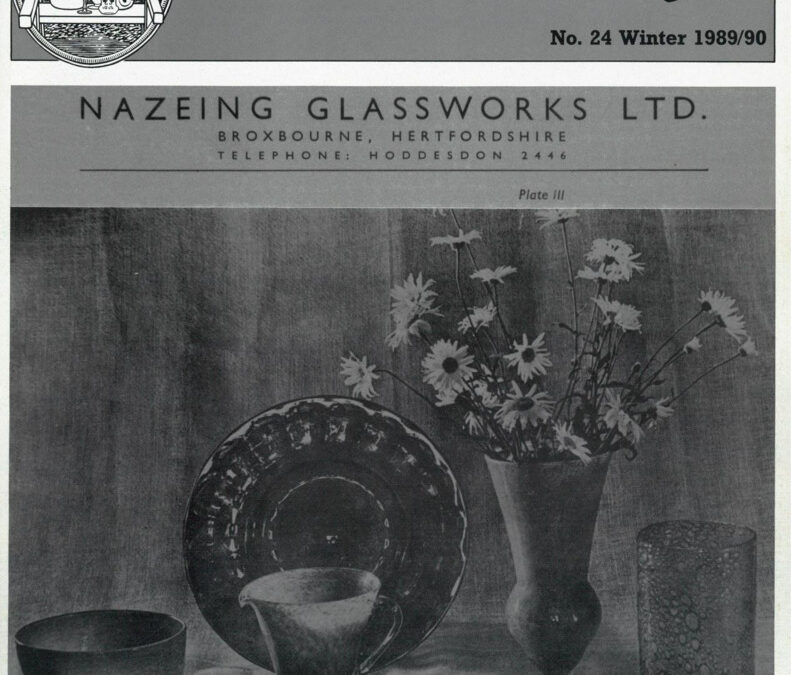
Cover Illustration
Left to right:- Bowl with foot. No.
36/18/-. Made in size 8″ Floating
or Fruit Bowl in natural colour with
rib. No. 612. Made in sizes 12″ and
16″. Jug with foot. No. 36/508.
Tumbler to match. Thistle Vase.
No. 38/105. Made in size 13″
Cylinder Vase. No. 1011. Made in
sizes 6″, 8′; 10″, 12″ All Nazeing
photographs reproduced by
courtesy of Nazeing Glassworks
Ltd.
Exhibitions
SHEFFIELD
Ruskin Gallery,
101 Norfolk Street,
Si 23E. Tel: 0742 735299
The Engraved Glass of David
Peace. Forty Years of Lettering
and Heraldry. 7th April – 26th
May. Mon-Fri 10-6, Sat 10-5,
Closed Sunday.
LONDON
Jeanette Hayhurst Gallery,
32b Kensington Church Street.
Acid Etching on Glass.
14th – 27th March 1990.
New Work by David Prytherch.
30th March – 21st April 1990.
KINGSWINFORD
Broadfield
House Glass Museum,
Barnett Lane,
A Few Nice Pieces of Glass.
New additions are constantly
being made to this selection from
the Michael Parkington Collection
which continues throughout 1990
and 1991.
A Personal View
Hearing that the exhibition was to
be based solely on the V&A’s own
collection, I felt trepidation. In the
event the richness of the collection
was an agreeable surprise. It
maintained overall coherence, but
without the balance of emphasis
implied by the title.
The balance represented the
V&A’s purchasing policies over
the last 60 years. The initial
international establishment of
Swedish glass is represented by a
few examples of the early years of
the 1920s. The Hald “Fireworks”
bowl, so evocative of the period,
leads naturally through to the
large Gate black footed vases and
the Lindstrand under water
engravings of the 1930s. But the
1950s and ’60s dominate. In the
main area my eyes were drawn
immediately across the display
area to Sarpeneva’s “Lancet”
beautifully displayed on a tower
stand on the far side.
This corner I found the most
satisfying. The Finnish school with
major examples of Sarpeneva,
Wirkalla, and Franck, and the
more neglected but equally
creative Swedish school based on
Kosta-Boda and led by Lindstrand
were well represented. His almost
abstract “Trees in fog” contrasting
sharply with the naturalistic “Pearl
Diver” of 25 years earlier, but only
a few feet apart.
The scene since 1970 is rather a
kaleidoscope, reflecting the
impact of the Studio Glass
movement on the rather more
formalised relationship between
design and factory that exists in
Scandinavia. Here technique is
never sacrificed, and though
inspiration comes from less
naturalistic sources the underlying
line never gets totally lost. Images
that stay in the mind from this
section are the disturbing
“Karieksgudina” of Ulrica Hydman-
Vallien and the contemporary but
contrasting bowl of Gunnar Cyren
in delicate transparent colour with
a single line cut.
But what of the gaps? Most serious
was the absence of Ariel Glass
except for one piece by 011e
Alberius from 1977. We assume
that prices for earlier pieces are
now the problem (the record
price for Swedish glass is £96,000
for Ohstrom’s Ariel “Chameleon”).
There are few of the massive,
thick walled glasses in the various
techniques of the late ’30s and
’40s. There are no Gate 1920s
presentational engraved pieces, or
even the more modestly priced
Gate designed engraved pieces of
that period. Bearing in mind that
the published, Swedish design
catalogues show a heavy
preponderence of engraved glass,
the amount exhibited was low.
Finally in the modern section was
the surprising absence of any
Fuga. This centrifugal casting
process, for both working glass or
glass
for enjoyment developed by
Orrefors in the 1950s should surely
have been represented.
The catalogue is thorough, well
presented and scholarly with an
introduction to each country’s
section putting specialist ceramics
and glass interests in a firm
overall concept plus a
comprehensive summary of
designers and factories so
beloved of all collectors. It is a
must for all those interested in
Scandinavian glass and an
important milestone.
The final judgement on any
exhibition, is the effect on one’s
perceptions. I had always been
unmoved by Sarpeneva whose
works I found too astringent. His
flowing works set in context in this
exhibition, and displayed so well,
have a power I had not previously
regognised. The versatility of
Lindstrand and the way he was so
often just ahead of his time made
me re-look at the tiny
reproduction in the Orrefors
catalogue of some of his earlier
works, to find under design
LU154/22 (1932-33) — a precursor
of Aalvar Aalto’s “Savoy” of 1936.
A very satisfying exhibition and
therefore fulfilling what must be
the objectives of the V&A, giving
insight into areas previously
neglected, providing
understanding and provoking
discussions.
John Delafaille
Nazeing Glassworks Limited
For the collectors of Monart, Gray-
Stan and James Powell (Whitefriars)
glassware this factory offers a new
type of glass to seek out and identify
without the premium now attached
to the former types. The paper
weight collector has also been
catered for by this busy company.
Much research needs to be done
into the factory and its products,
hopefully by the next issue we will
have some more information.
The pieces seen to date owe more to
the techniques of Gray-Stan than to
Monart and many pieces must have
been attributed as unsigned Gray-
Stan. The metal and approach to
applying colours, in one example, is
very consistent with some Gray-Stan
to the extent that one wonders if the
same glass blower worked at both
factories. Colours seen have been
bright and lively, the glass not being
very thick and base pontil being
polished concave.
The first factory was opened in
Vauxhall, Surrey in 1612 by Sir
Edward Zouch and was later known
as Dawson Bowles and Company. A
Charles Kempton opened a factory
in Wickham Street, Vauxhall,
London in c.1870. A second works
was opened in Vauxhall Walk in
1874 for producing gas globes and
fittings. The flint and coloured glass
were the main products at this time.
The Wickham works were closed
some time later.
Charles’s sons William and Richard
(and three brothers?) continued
the business at Vauxhall until 1917
when William joined Edison & Swan
at their electric light bulb factory at
Ponders End in Middlesex.
The rapidly expanding electric light
bulb industry was becoming the
major industrial glass user at this
time. Richard (or Richard’s four
sons?) moved the glass works first to
Southwark and in 1928 to Nazeing,
Broxbourne in Hertfordshire taking
the name Nazeing for the
glassworks.
The works at Nazeing sound like
they were similar to the Vasart
Shore Works in Perth. A goat shed in
a marshy field with a coke fired
skittle-type furnace holding about
200 kilos of molten metal. The
annealing oven being a hand
operated conveyor. The works did
not have a mains water supply.
Most of the early production was
hand blown decorative coloured
glassware. As with Gray-Stan white
was used with the colours to give the
colours a brighter look. Seen from
the inside white is dominant while
from the outside the colour was
dominant. Single colours were used
too, one feature of this glassware
appears to have been the inclusion
of areas of clear lead glass, either at
the top or between spiral bands of
colour. Handles and feet when
applied were in clear glass. The
glass has a fairly high lead content.
Examples have been seen with an
acid etched Nazeing, Made in
England, stamp on. Paper labels
Plate IV
Bock Row, Left to Right
Funnel Vase. No, 37 55.
Made in
sizes
6÷-,
8″, 10″, 12′.
The turned-over top is formed to
give additional strength.
Tumbler Vase. Made in sizes 6″, 7″,
8″, 10″, 12″, 14″.
Barrel Vase, made in sizes 8
”
, 10″.
The Book Ends, Doorstops and
Paper Weights are all hand made
and shaped while hot, in a clear
lead glass, decorated with a variety
of colouring effects in the centre.
Any of the opaque cloud colours may
be introduced. Combinations of
colours are extremely attractive:
Iae
with sherwood green; may
green with white, etc.
The round door stop and paper
weight are in the ribbed design.
Tall door stop
in
a pulled-up
effect.
Book Ends have “pulled-up” effect in centre, made in three sizes.
Round Ash Tray. Size 41″ diameter. No. 38 109. Square Ash Tray. Size 4″ by 4′. No. 38 118.
Tapering Vase with rib. Size 61″. No. 2021.
NAZEING GLASSWORKS LTD.
BROXBOURNE. HERTFORDSHIRE
TELEPHONE HODDESDON 1446
NAZEING GLASSWORKS LTD.
BROXBOURNE, HERTFORDSHIRE
TELEPHONE HOOOESDON 2446
Left to
Right
Candlesticks. Height 4′, Base
Powder Bowl. Lid inside 6k” diam-
No. 38 110.
eter. No. 36 47.
Bath
Salt
Bottle.
Size 10
–
No.
Powder Bowl. Lid outside 6 diam-
36 43.
eter. No. 36 816,
Plate VI
The Wave ash tray, inkwell and oval paperweight are all in flint glass with
colouring effect in the centre. The colours are may green, sherwood green,
sold.
yellow, lilac, grey, blue, mulberry and white.
Any of these
colours may be combined—lilac and sherwood, white and yellow, may
green
and white, etc.
Pin Tray. No. 2055A. 3
–
diameter.
Wave Ashtray. No. 38 115.
S zes approx 5 & 7″ diameter.
Inkwell. No. 38 116. Approx. height 3″,
diameter 3
Oval Paperweight. No. 38117. Approx. height 34
1
“,
base 3 at
Table Lamp. No. 37 63. Height 13”.
may have been used, no examples
have been reported to date.
During the 1930s financial
difficulties almost caused the firm
to fold but another electric lamp
manufacturer took a share of the
company for glass rod production.
These rods were drawn by a boy
running across a field with the hot
glass. In 1939 a Belgian
glassblower was employed and
stemmed glasses were then made
in the continental style. War
production was of lamp caps for
the Ministry of Aircraft Production.
The shed was upgraded to Nissen
huts and army surplus tents and
by the end of the war the factory
produced glass for many
government departments. After
the war a serious flood almost
ruined the factory but production
was restarted after a few months
repair work. Expansion brought
the development of single pot
brick furnaces to replace the
original, these gave the factory a
much greater flexibility in
production.
Today Nazeing Glassworks
employs more than 200 people in
purpose built buildings on the
same site. Production ranges from
traffic light lenses and other
precision coloured glass through
hand-blown glasses and
glassware, cut lead crystal, to
lighting and custom ashtrays.
At some stage paperweights were
in production. These were
generally swirl and/or bubble
types to no specific design and in
a great variety. Many of these
must be in collections now and
perhaps some were labelled or
marked?
Nazeing Glassworks received a
small mention in the British Glass
Between the Wars’, some
examples were included in the
exhibition but had arrived too late
for inclusion in the catalogue/book.
The company has taken over or
been involved with several famous
glass making companies such as,
Sowerby Ellisons Glass works
whose moulds they bought,
unfortunately 80% of them had to
be scrapped owing to their poor
condition. They owned George
Davidson for a period in the mid
1960s and other companies, now
deceased, such as Wood Brothers
(Lenses, ashtrays and domestic
glass
c1983). Davey and Moor
(Ashtrays and bottles closed
c1970), and Phoenix (Heat
resisting glass c1970), all of whose
moulds Nazeing purchased on
their demise.
The illustrations here are from the
company’s only catalogue
remaining from the 1930s. If
anyone else has seen any copies
of this or another catalogue please
let us or Nazeing Glass know
about it. Sadly, such valuable
material was lost in a fire that
destroyed the main offices in
December 1973.
Some of the information included
here was taken from a history of
the company prepared by Cyril
Weedon and Brian Moody on the
occasion of the companies’
Diamond Jubilee as Nazeing Glass
in 1978.
Many thanks to Nazeing Glass
Works Ltd., Broxbourne,
Hertfordshire, for their help and
loan of original material for
reproduction on the following
pages.
Frank Andrews
(This article first appeared in
Ysart News No. 5 January 1989).
The Vienna Glass Museum of
J. &
L. Lobmeyr
Strongly supported by the
Lobmeyr company and located on
an
upper floor of its retail
premises in central Vienna, the
Vienna Glass Museum represents
the
private collection of the four
brothers, Harald, Peter, Stefan and
Gottfried Rath. Its origins lie deep
in
the nineteenth century, in the
collection of company designed
glassware begun by Josef
Lobmeyr senior in the 1830s and
continued by his successors.
Prominent, therefore, in the
collection are many splendid
glasses from the years of the great
European exhibitions in the
second half of the nineteenth
century. In this respect the
museum resembles those of other
long established European firms,
their collections reinforcing the
traditional values expressed in
much of the glass they produce
today. What is notable about the
museum at Lobmeyr’s is the
added strength of its twentieth
century collections, which results
from the firm’s involvement with
Viennese modernism in the earlier
part of the century and with the
studio glass movement of the last
two
decades.
The arrangement of the museum
displays, in numbered cases,
allows the visitor to follow the
sequence of style in Lobmeyr’s
glass. Early services to the
designs of Josef Lobmeyr senior
are
heavily fluted in late
Biedermeier style. From the 1860s
come items from engraved sets
designed by the Danish architect,
Theophil von Hansen, their
classicizing ornament sometimes
sitting oddly on a romer-like hock
or
on decanters with spire
stoppers. The classical figure
designs of August Eisenmenger
and Josef von Storck from the
1870s-1880s are skilfully engraved
or
enamelled on a range of forms,
especially plates. Perhaps best
known are the enamelled Islamic
style wares of the later nineteenth
century, inspired by Ludwig
Lobmeyr’s interest in Near Eastern
design, Less well known are the
richly enamelled ‘Makart’ style
glasses
—
generally painted in
black, red and white on colourless
or opalascent glass, laid out in
dense ornamental networks soon
to be rejected by advanced
Viennese design.
Lobmeyr’s adopted the new,
Secessionist, style in the early
1900s, apparently with the arrival
of Stefan Rath. The museum has
good examples from this period,
notably heavy cut, squared pieces
in crystal and tablewares with
‘bronzeit’ decoration on frosted
grounds, designed by Josef
Hoffmann. By the 1920s engraving
dominates — superb modernist
work in a range of styles — and
undecorated services in thin
blown glass of pure form and witty
detail. Among the most vivid of
the engraved pieces are several
with dynamic, muscular figures,
probably attributable to Jaroslav
Horejc — the labelling here is
insufficiently precise for definite
identification. As a background to
the engravings of the inter-war
years a small but choice collection
of mostly central European
engraved glass of the eighteenth
to the early nineteenth century is
also on display; a collection put
together by Stefan Rath in the
1920s and ’30s with Lobmeyr’s
engravers in mind. The twentieth
century collection continues with
post-war work, including designs
in the modernist spirit by H.H. and
Peter Rath. Then there is the
studio collection, chiefly 1970s,
deriving from the Lobmeyr studios
in Stoob and Baden. Some of this
glass is by international artists
temporarily resident at the studios
— there are good examples of the
work of such as Erwin Eisch,
Harvey Littleton, Joel Phillip
Myers, David Huchthausen,
Stephen Proctor and Charlie
Meaker.
Within a relatively small space the
Vienna Glass Museum packs in a
great deal. The whole collection
relates to the history of Lobmeyr
but makes reference well beyond
the firm itself. Nor is it simply a
spectacular showroom of historic
glass. A space is reserved for
temporary exhibitions of
contemporary work, there is an
informative guide leaflet in English
(to which this article is in part
indebted) and information
provided on other glass museums
and on the educational
programmes sponsored by the
company. It well becomes a city
rich in museological tradition.
I am indebted to Herr Peter B.
Rath for supplying the photograph
of the shop front of J. & L.
Lobmeyr.
Ian Wolfenden
Original photo
of Lobmeyr
Portal, 1895
News & Views
DUDLEY CRYSTAL
FESTIVAL 1990
Following the great success of last
year’s event the Festival will
continue to present the already
popular attractions phis some new
ideas for 1990. Dates for your
diary are Saturday 1st September
until Sunday 9th September at
Mary Stevens Park, Stourbridge
and other venues in the Borough.
Further information available in
due course from Broadfield House
Glass Museum.
GLASSMAKING
COURSES AT THE
INTERNATIONAL
GLASS CENTRE
The former Brierley Hill Glass
Centre, now known as the
International Glass Centre, is
offering two glassmaking courses
open to the public.
1.
Glassmaking Weekend; Friday
11th – Sunday 13th May.
The weekend is open to anyone
who wishes to sample new
experiences of blowing, cutting,
engraving and etching glass under
expert tuition. Friday afternoon
visits to see pot-making and pot-
setting will be followed by a full
day of hands-on glass-making
experience at the Glass Centre.
Sunday morning allows time to
visit the Glass Museum to handle
and discuss important 18th and
19th century glass from the
museum’s own collection. Course
Fee will be £62.50 per person for
non-residents but including meals
or £112..50 per person with hotel
accommodation and meals. A
charge of £1.50 will be made for
all blanks used during the
weekend. Closing date for
applications — Friday 27th April.
2.
Appreciation of Hot and Cold
Glass.
Three Day Course preceding the
Crystal Festival (Wed 29th-Fri 31st
August) offering experience of hot
glass forming and cold decorating
techniques. Discussions on aspects
of technology will be provided on
an on-going basis as required
during the demonstrations of both
hot and cold working. The precise
content of the course will depend
on the experience of the
participants. In all cases the
course will cater for all levels of
experience including complete
novices. Course Fee for three
days is £135 plus £25 per person
hotel accommodation as required.
Single days may be available.
Closing date for applications –
Friday 6th June. Further
information and application forms
from Chris Greenaway,
International Glass Centre, Moor
Street, Brierley Hill, West
Midlands or via Broadfield House
Glass
Museum.
HAVE YOU SEEN THIS
MARK?
Roy C. Ranck, the curator from the
Harris-Kearney House Museum in
Kansas City, has sent an enquiry
regarding an enamelled and gilt
vase from their collection which is
marked with a propellor and
letters and numbers painted in an
olive-brown colour. It is thought
that the glass is probably Webb,
an attribution suggested by the
shape of the vase. If any collector
owns an example with a propellor
mark it would be useful to have
their thoughts an origin as well as
a photograph or drawing of the
glass and the mark in order that
we could build up a dossier on
these pieces for further
identification. Replies please to
the Editor.
GLASS OF FIVE
CENTURIES
The Michael Kovacek Glass
Gallery in Vienna has become
renowned for its large sales
exhibitions which provide clients
and the interested public with a
fascinating selection of high
quality glass. The new display
entitled “Glass of Five Centuries”
is currently in preparation and will
run from 4th May until 9th July,
1990. This display exceeds
previous ones with regard to the
period of time covered as well as
the number of objects shown.
Accompanying the exhibition a
book will be published which will
have about 400 pages and 300
colour illustrations. Available from
mid April 1990 in German and
English/Japanese versions the
price is DM140 plus postage of
DM15 for Europe; USA = $80 &
$20; Japan Yen 11,000 and Yen
3,000, from Glass Gallery Michael
Kovacek, Stallburggasse 2, A-1010
Vienna, Austria. Fax 222-5132166.
REQUEST FOR
INFORMATION
An American author, Dr. James
Measell, is preparing two books
devoted to the glassmaking career
of Harry Northwood (1860-1919),
the eldest son of John Northwood
I. The first volume,
Harry
Northwood: The Early Years, 1881-
1900, will be released in 1990. Dr.
Measell would be pleased to hear
from members of The Glass
Association as well as others who
have an interest in or information
about Harry Northwood or his
younger brother, Carl. Address:
Dr. James Measell, Box 72-1052,
Berkley, Michigan 48072 USA.
BOOK REVIEW
Glass in 18th century England.
The Footed Salver. Keith Kelsall.
Published by the Author, 1989.
£9.50.
This is an excellent review of a
little-known item in household
glass. The author deals with the
salvers by stem formation in
considerable depth providing
illustrations of some two hundred
examples. His approach is light
and amusing but clear-cut and
informative. There are minor
reservations regarding the dating
of some of the styles, but these fall
continued on page 8
th Regional Reports
ANNUAL GENERAL
MEETING
The sixth Annual General Meeting
of The Glass Association was held
at Kingswinford Methodist Church
Hall, a couple of minutes’ walk
from Broadfield House, on
Saturday, 28th October and
attracted an excellent turn-out of
around seventy members. The
morning was deliberately left free
so
that those not familiar with the
Stourbridge area would have time
to
explore some of the local glass
sites. At Stuart’s Christine
Golledge, the Museum Curator,
was on hand to show some of the
old Pargeter and Stuart pattern
books, while Sam Thompson had
kindly agreed to open the Royal
Brierley Crystal Museum for our
members.
The AGM itself got underway at 2
p.m. and passed uneventfully, after
which Charles Hajdamach gave a
short talk on the extraordinary
American cameo glass artist Barry
Sautner who has taken up the
challenge of cameo carving where
John Northwood and George
Woodall left off, and has carried
the art of cameo and diatreta glass
literally into a new dimension. The
gasps of astonishment as the slides
were shown were some indication
of the technical virtuosity of Barry
Sautner’s work.
Meanwhile, the glass that had
been entered for the Sale of
Members’ Glass was sitting on
tables at the back of the hall
attracting a good deal of interest.
The sale eventually started after
tea, and by the end thirty-five of
the seventy-three pieces that had
been entered were sold at a cost
of
£930. Members were also able
to
enter a quiz in which they had
to
identify the function of ten
objects (fly traps, ear trumpets for
example) and give the place of
manufacture and date of another
group of ten objects. The prize of
a
bottle of champagne for the
winning entry went to Jean and
Peter Beebe from Alkrington near
Manchester.
After the answers to the quiz had
been given out, we adjourned to
Broadfield House for an early
evening reception and an
opportunity to view the exhibition
“A Few Nice Pieces of Glass”, a
selection of superb 18th, 19th and
20th century English Glass from
the collection of Michael
Parkington. The display had been
changed since the Glass
Association was last at Broadfield
in June, and there were some new
additions including a whole case
of rare Stourbridge cameo glass.
The general verdict was that the
Methodist Church Hall was an
excellent venue because of its
location, good car parking and
close proximity to Broadfield
House, and that overall the AGM
was a great success. There is a
strong likelihood that Kingswinford
will now become a regular venue
for the AGM every other year.
NORTH
WEST
The North West regional group
concluded its 1989 programme on
Saturday November 4th with a talk
by Charles Hajdamach on ‘Glass in
America — a Pot-Pourri’. The talk
was based on several trips to the
United States during the mid-1980s
and took us on a route from
Williamsburg to Corning, down
the Ohio river and back up to
New York to conclude.
Charles began with the famous
early glasshouse at Jamestown,
which has a modern production
unit set up alongside the
seventeenth century furnace,
before moving to Corning and the
Steuben factory. The central
theme of the talk — the energy
and excitement generated by the
Americans in both craft and
industry — was introduced here.
Charles showed a range of
freelance designer pieces
executed by anonymous engravers
on the pure crystal for which
Steuben is famous. These were
grand statements, ranging from a
cut column — ‘New York, New
York’ — reminiscent of New York
architecture, to a gold mounted
and bejewelled helmet engraved
with scenes from a Midsummer
Night’s Dream. It was in some
ways a relief to move from the
latter to the main street of Corning
with the old Thomas Hawkes
premises, now converted to a hot
glass studio, and to the Rockwell
Museum of Indian Art with its
large collection of Frederick
Carder.
We were then taken down the
Ohio river to a series of works
producing glass in an enormous
variety of techniques, sometimes
using tools and machinery that
would be obsolete anywhere else.
Viking Glass and Fenton Art
Glass, for example, both employ
hand pressing machines to make
items reminiscent of the great
days of the later nineteenth
century and Fenton also do hand
crimping. At Wheeling we saw a
museum collection of late
nineteenth century glass strongly
resembling Stourbridge wares but
Fenton’s ruby glass, carnival,
crimped and opalescent pieces
were very much of the present.
Their similarity to Victorian
glasses prompts disturbing
questions! Perhaps most
impressive of all these
extraordinary glassworks were the
Pilgrim at Huntington, where
designer glass is rapidly re-
designed if it does not sell, and
Blenko Glass, where handblown
cylinders are produced for stained
glass from slip cast pots in a
ramshackle building. It was
fascinating to learn that this works
had exported to Hartley Wood up
to the closure of the latter a short
while ago, The Ohio valley had
one more surprise — a small
studio operated by Charles
Gibson and making sulphide
paperweights that looked very
accomplished.
Finally, we returned to New York.
Here we were treated to a view of
the Mulberry St. workshop,
established next to an old mafia
headquarters building, and to the
sight of Charles himself producing
a paperweight in a do it yourself
glassworks in Wheaton Village,
New Jersey. It had been a highly
enjoyable trip, illustrated by first-
rate slides; there was plenty for us
to discuss till well after the talk
concluded.
MIDLANDS
Monart Glass 12th October
Members who were unable to
attend the Glasgow weekend had
a second opportunity to hear one
of the lectures when Ian Turner
gave a talk on Monart Glass at
Broadfield House on 12th October.
Beginning with some slides of the
Monfcrieff site as it is today, he
went on to tell how Salvador Ysart,
the father of the four Ysart
brothers, had started his glass
career with the firm of Schneider
Brothers near Paris. He fled to
Scotland in 1915 to escape the
War, and for the rest of the War
worked for Jenkinson’s in
Edinburgh. In 1922 he was
recruited’ by John Moncrieff Ltd.,
scientific and industrial glass
manufacturers of Perth, and it was
while there that his habit of
making coloured glass friggers as
raffle prizes caught the attention of
Mrs. Moncrieff, wife of the factory
owner. She realised that this sort
of glass had commercial potential,
and in 1924 production of the
Monart range of decorative vases,
bowls and table lamps began in
earnest, Salvador being assisted
by his eldest son Paul and
eventually by his other three sons,
Antoine, Vincent and Augustine. In
1945 Salvador Ysart together with
Vincent and Augustine left
Moncrieffs to set up a rival
concern in Perth known as Vasart,
but Paul stayed on and continued
to make Monart glass right up
until 1961.
The lecture was beautifully
illustrated and full of interesting
information, for example how
charcoal was sprinkled on the
molten glass to create bubbles.
After a coffee interval, Ian Turner
talked about some pieces of
Monart from his own collection
that he had brought with him and
discussed related factories such as
Graystan, Nazeing and WMF
whose products are sometimes
mistaken for Monart. Altogether a
most instructive evening greatly
enjoyed by our usual full house.
Members’ Day 18th November
Around two dozen members,
armed with various photocopied
maps and plans, assembled
outside the entrance to the Stuart
glass cone for the start of our walk
along the golden mile of historic
glass sites between Wordsley and
Amblecote.
First of all, Christine Golledge,
Curator of the Red House Glass
Museum, showed us inside the
Shrower, the room at the
discharge end of the lehr, which is
currently being restored to its
early 19th century state prior to
being opened to the public.
Charles Hajdamach then took
command, and led the party
across the main road to look at the
Richardson site, where one or two
of the original buildings still
remain. We then walked along the
main road towards Ambelcote
stopping briefly to gaze at an Esso
Garage c1975, the site of Boulton
and Mills, before turning down a
side street to see the remains of
the New Dial Glass Works which
includes the base of a cone built
in 1788.
Retracing our steps back past
Stuart’s our next stop was the
Wordsley School of Art with its
magnificent terra-cotta panels by
Frederick Carder. This building
has been derelict for a long time,
but there are plans to reconstruct
the façade on the Stuart site.
Finally it was across the main road
again to Wordsley Church to look
at the graves of local glassmakers
including the Northwood family
tomb and the tomb of Stanley
Carder, the 9 year-old son of
Frederick Carder who carved the
two terracotta end panels.
After a convivial lunch at the Vine
Inn, we re-assembled back at
Broadfield House, our numbers
swelled by one or two members
who had not been on the morning
walk. Charles Hajdamach talked
about the Museum’s partnership
with Hulbert’s of Dudley in whose
room we were meeting, followed
by Roger Dodsworth on Clyne
Farquharson. Christine Golledge
discussed three very different
types of glass that had been made
on the Stuart site over the years –
medicine phials c1800, medallion
cameo and 1930s enamelled ware
— while John Brooks rounded off
the proceedings with an
entertaining talk about the odds
and ends of glass that were used
to decorate the dinner table, such
as menu holders and finger bowls.
This was a very friendly meeting
and an appropriate way in which
to end the programme for the
year.
The Journal — Volume 3
Volume 3 of the Association’s
Journal,
due to appear at the end
of 1989, will now be published
later this year. A number of
contributions promised for this
issue did not materialize, and
there has unfortunately been no
alternative but to delay
publication. As editor I apologise
to members awaiting their
Journals
with the Christmas post.
Ian Wolfenden
1990 GLASS CONE
The four issues of the Glass Cone
beginning with Spring 1990 will each be
allocated to one of the Regional Groups of
the Association in the following order with
final copy dates:-
Spring 1990
Midlands issue — Friday 16th March
Summer 1990
North East issue — Friday 1st June
Autumn 1990
North West issue — Friday 7th September
Winter 1990
South East issue — Friday 30th November
continued from page 6.
into the category of opinion to
some degree. The book is
exactly the sort of single
subject book which is most
valuable to all collectors,
museum-curators and dealers,
and no library with glass
connections should be without a
copy. It is excellent value for a
hardback and if the illustrations
are sometimes of poor quality,
due to their having been
reproduced from sale
catalogues in many cases, they
serve their purpose.
Martin Mortimer
The book is available from the
author, Professor R.K. Kelsall,
21 Victoria Road, Sheffield,
SIO 2DJ, or from the
distributors, Sheffield Academic
Press Ltd., 343 Fulwood Road,
Sheffield, SIO 3BP. £10.50 post
free in U.K. and 11 (net in
sterling) overseas. Professor
Kelsall is now working on a
book about open flame glass
lamps and would be very
pleased to hear from anyone
interested in them.