


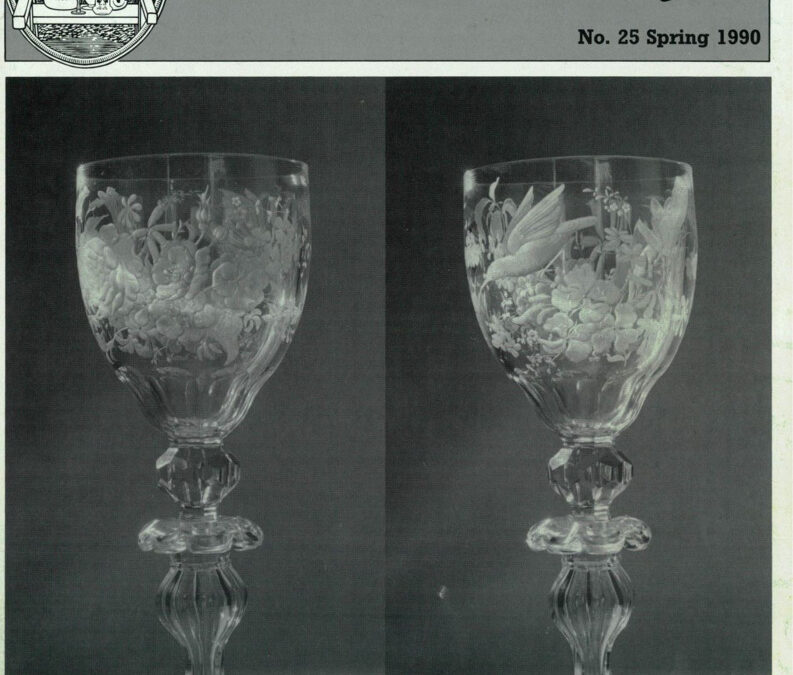
Cover Illustration
Two views of the engraved goblet
by W J. Muckley shown at the
Great Exhibition in 1851 and re-
discovered at the Dudley Crystal
Festival’s Glass Antique
Roadshow.
Exhibitions
ST. HELENS
Pilkington Glass Museum,
Prescot Road,
WA10 3TT. Tel: 0744 28882
Sculptures with Function.
Work by Alan Derbyshire and his
students at St. Helens College,
School of Art and Design.
2nd-24th June.
DERBY
Derby City Museum and
Art Gallery,
The Strand.
The Light Touch.
Current developments in the work
of Craft Members, Associate
Fellows and Fellows of the Guild
of Glass Engravers.
2nd-30th June.
This exhibition will also be shown
at the Pilkington Glass Museum
from 14th July to 19th August.
LONDON
Imperial War Museum,
Lambeth Road,
SE1 6HZ. Tel: 071-735 8922.
Mervyn Peake.
Commissioned Work 1942-1944.
Mervyn Peake, author of the
acclaimed Gormenghast trilogy,
was also an artist, illustrator and•
poet whose wartime work for the
Ministry of Information is little
known. Drawn mainly from the
Museum’s extensive art collection,
this exhibition focuses on the two
major official commissions of
political illustrations and the
manufacture of cathode ray tubes
at Chance Brothers in Birmingham.
An article by our committee
member Greville Watts in the
forthcoming Glass Association
Journal deals with Peake’s
illustrations at Chance’s as well as
providing a potted history of that
company.
6th April-16th September.
KINGSWINFORD
Broadfield House Glass Museum,
Barnett Lane,
DY6 9QA. Tel: 0384 273011.
First Gather 3.
Work by students from the
International Glass Centre,
Moor Street, Brierley Hill.
9th June- 1st July,
Editorial
The Spring issue of the
Glass
Cone begins this year’s focus on
the different regional groups of the
Glass Association, an idea which
was started last year. Although
some of the topics in this issue are
not specifically of Midlands
interest, they have been written
by members of the Midland
region. Special thanks must go to
Roger Dodsworth who has
contributed a large proportion of
the text.
The Cone continues to be
international in its coverage. In
this issue we draw attention to Len
McDowell from the United States,
who is a dedicated glass collector
and a member of the Glass
Association.
poincidentally we also look at
Arlon Bayliss who is about to
move from Stourbridge to America
to establish a new University
glass
course.
Original members of the Glass
Association will remember the
marvellous display of glassmaking
put on by Arlon for the inaugural
meeting of the Association in
Stourbridge College. We wish him
and his wife Kay, and son Harvey,
every success in their new
venture.
Special attention is drawn to the
generous offer made by British
Artists in Glass to our members for
discount costs for their glass
conference to be held in Stoke.
The event is always a memorable
occasion and our members are
encouraged to attend if at all
possible.
Special Offer to Glass
Association Members
The British Artists in Glass annual
conference will this year be held
at Staffordshire Polytechnic, Stoke-
on-Trent, on 12th, 13th and 14th
July 1990. The conference will
comprise a rich and varied
selection of lectures, discussions
and demonstrations. Both historic
and contemporary aspects of glass
will be covered.
Guest speakers will include glass
artists Marvin Lipofsky and
Vernon Brejcha from the United
States; Richard Meitner, American
glass artist now resident in the
Netherlands; Eason Eige, Curator
of Glass, Huntington Museum,
West Virginia; Dan Klein, Director
of Twentieth Century Decorative
Arts at Christie’s; and Charles
Hajdamach, Senior Museums
Keeper at Dudley.
Among the British artists who will
be discussing their work will be:
Charlie Bray, Amber Hiscott,
Diana Hobson, Liz Lowe, Ronald
Pennell and David Reekie.
Your membership of the Glass
Assocation will enable you to
attend this conference for the
same price as B.A.G. members.
The conference fee is £15 per
day, accommodation and food not
included, but available.
If you would like further
information and a pre-booking
form, please write to:
British Artists in Glass,
Broadfield House Glass
Museum,
Barnett Lane,
Kingswinford,
West Midlands DY6 9QA.
COPY DATES
Summer 1990
North East issue — Friday 1st June
Autumn 1990
North West issue — Friday 7th September
Winter 1990
South East issue — Friday 30th November
Antiques Roadshows have a habit of
unearthing spectacular treasures,
and the Roadshow held at Mary
Stevens Park, Stourbridge, last
September during the Second
Dudley Crystal Festival was no
exception. The assembled experts
— John Brooks, Dill Hier, Giles
Haywood and myself — were just
preparing to pack up shop at the
end of a long day looking at
miscellaneous items of glass when a
gentleman came into the Roadshow
marquee with two bulging
packages. Imagine our amazement
when he proceeded to unwrap not
another piece of 1930s cut glass or a
Bohemian painted vase but two
exceptional pieces of mid 19th
century Richardson glass — a
massive cut and engraved goblet in
clear glass (Cover Illustration) and a
crystal and blue cased jug engraved
with vertical panels of scrollwork.
The owner knew that the glasses
were by Richardson’s and was well
aware that they were of some
importance. He told us that he was
descended from the original
founders of the Richardson firm,
William Haden and his brother
Benjamin, and that according to
family tradition the two glasses had
been shown at The Great Exhibition
in
1851. This we were able to
confirm so far as the goblet was
concerned because by coincidence
there
was a slide show on the
Broadfield House stand which
actually included the page from the
1851 Art Journal in which the goblet
was illustrated.
News soon got round that something
special had turned up and Dudley’s
Economic Development
Department (organisers of the
Crystal Festival) descended on the
marquee armed with video camera
to record the happy event. John
Brooks, in an impeccable “single
take”, proceeded to sum up the
significance of these glasses in the
general history of 19th century glass
and to explain why it was that the
experts were getting so excited.
Charles Hajdamach and myself
subsequently went to visit the owner
at his home where he showed us two
more Richardson pieces that were
said to have been in the Great
Exhibition, an enormous white
opaline vase with painted and gilt
An Exciting Find
floral decoration and a ruby gilt
bowl. Like the goblet, the opaline
vase is illustrated on the Richardson
page of the 1851 Art Journal, while
the ruby bowl is certainly of Great
Exhibition period although it cannot
be proved that it was actually
exhibited there. All four pieces are
now on temporary loan to Broadfield
House and can be seen in the
Richardson room on the ground
floor.
The owner turns out to be the great-
grandson of William Haden
Richardson (1785-1876), who with
his brother Benjamin and Thomas
Webb I founded the Richardson
company in 1829. He told us how after
the Great Exhibition William Haden
spent most of his time in London.
Feeling rather lonely and cut off from
Stourbridge, he requested that a local
girl be sent down to London to look
after him and act as housekeeper. She
proved adequate in more ways than
one and eventually gave birth to five
children including the owner’s
grandmother, Miss Elizabeth
Richardson.
R.
Dodsworth
White Opal
Vase
enamelled with
flowers and gilt
Rococo Revival
scrollwork,
shown by
Richardsons at
the Crystal
Palace
exhibition
in
1851.
17th Century Glass Houses in America
It is not surprising that with the
colonization of America, the glass
industry would eventually spread
to the New World. The English
Colonies were influenced by
wealthy London merchants who
had financed the pilgrimage. The
first while settlers arrived in 1607
at Jamestown, Virginia. The
colonists named the settlement
after King James I. About 100
Englishmen arrived at the
southern end of the Chesapeake
Bay. By 1608, according to Captain
John Smith’s “Historie of Virginia”,
the plan was to start a glass house
for the purpose of exporting glass
to England. The furnaces in
England were still being fired by
wood and the forests were being
depleted. Here in the New World,
forestry abounded and The
London Company envisaged
supplying nobles of England with
glass, from window panes to
drinking vessels. The venture was
short-lived. In a wilderness such
as the early settlers faced in
Jamestown, it was barely possible
to survive. Shelter and food were
the primary needs. Protection
from the elements and the ‘savage
indians’ was the priority. However,
it is reported that Captain
Newport did take glass items back
to The London Company when he
returned in the Fall of 1609. The
venture failed shortly thereafter.
Upon the return of Captain
Newport in 1617, the colonists had
already turned to the cultivation of
the land and tobacco crops were
found to be more enterprising
than blowing glass. Today, when
one visits Jamestown, there
remains little evidence that a glass
house ever existed.
Another attempt at glassblowing
was attempted at Jamestown in
1621. This time the plan was to
make glass beads as “coin of trade
with the Indians”. Since the
Indians were so eager to get these
bright trinkets that they would
trade furs, food and even land for
a handful of beads, this seemed
like a potentially successful
venture. The erection of a glass
house, this time on Jamestown
Island, was the joint project of The
Virginia Company in London and
a group of private common
stockholders termed ‘adventurers’.
The new glass company
developed a policy that “beads
should not be cheapened by
abundance” as dictated by The
London Company. The Indian
Massacre of 1622 interrupted the
work on the glass house. Although
it appears that not many of the
glassworkers had been killed, the
fear of more Indian attacks slowed
the progress of the undertaking.
The furnace was completed in
1622 but when the fire was lit it
“flew to pieces”. It was never
determined whether sabotage or
faulty construction was the cause.
Apparently the furnace was
repaired, the fires relit and the
glass house continued in operation
until June 15, 1625 when the
Virginia Counsel announced the
end of production due to “falling
sickness” and death of some
principal workmen. Reportedly,
some of the bead currency made
at Jamestown does exist in a few
museums. However, in my
research I found conflicting ideas
on the subject of glass beads. In
discussing these reports with Mr.
Howard A. MacCord Sr. of
Richmond, Virginia who has been
involved with the archaeological
excavations in the Tidewater
District, he maintained that no
evidence of glass beads was
indicated from the waste material
at either Jamestown site. He said
they could say, with reasonable
certainty, that glasses, jars, bottles
and jugs were blown.
To the north in Salem,
Massachusetts, about 16 miles
northeast of Boston, another colony
was settled in 1628. As a seaport
settlement it was active in trading
and shipping. The high cost of
imported glass from England
prompted the people of Salem to
look to their own resources for
their needs. A glassworks was
opened there in 1638. It is
recorded that in 1639, Obadiah
Holmes, Lawrence Southwick and
Anonia Conklin, referred to as
“glass men”, were each deeded a
two-acre parcel of land to build a
glass house. Adjacent to these six
acres, another five acres was
deeded to John Conklin, “an
experienced glass worker”. The
town of Salem loaned 30 pounds to
the above mentioned individuals
in 1641 to “operate the newly
constructed furnace”. Reportedly,
window glass and bottles were the
products which were blown at
Salem. Some research has been
done on the Salem site and
fragments of dark greenish glass
have been found. Old writings
refer to the area as the
“glass
house field” well into the 18th
century. All evidence has been
erased at what is now busy Abbott
Street in Peabody, Massachusetts.
Apparently, the glassworks
operated sporadically until
sometime in the 1660s when it
closed for “lack of capital”.
What is now New York City was
called New Amsterdam in the 17th
century. It was primarily a Dutch
settlement. Two glass houses were
in operation there, the first hint of
capitalism, it would seem, for an
old industry in a new world. Both
operated on what was called the
“GlassMaker’s Street” (now known
as South William Street in New
York City). Jan Smedes and Evert
Duyckingk were the rival
glassmakers from about 1654 to
1674. Glass for domestic use only
was made such as window glass,
bottles and drinking vessels.
Evidence of a glass house in
Philadelphia, Pennsylvania is
contained in a letter from William
Penn to the Free Society of
Traders in London. Written in
August of 1683, it contains a
reference to their glass house
“conveniently posted for
Watercarriage” as described by
Penn. Records show that a Joshua
Tittery of Newcastle-on-Tyne, a
“broad-glass maker” arrived on the
ship America in 1683 as a servant
to the Free Society of Traders.
Whether Mr. Tittery was
employed at the Philadelphia
Glasshouse is not known and no
real evidence exists that glass was
ever produced there.
These six attempts at glassmaking
in the Colonies during the 17th
century are scantily documented.
Enough material has been found to
indicate that attempts were made
to produce glass for local use.
Window glass was the chief
product but many years were to
pass before glass was in common
use.
Ruth E. Might
Mac McDowell
and Carl U
Fauster, the
author of the
definitive book
on Libbey
Glass; with a
model of
Libbey’s Glass
Factory at the
Chicago
World’s Fair in
1893.
Ruth Might and the McDowell Collection
Ruth Might became interested in
glass while working with the
McDowells and their collection.
Her experience in real estate
lending and as a legal assistant
was helpful in organising and
cataloguing the McDowell
Collection. Ruth had been
interested in art and antiques but
as a mother of five, did not have
time or money to invest in
pursuing her interest. When the
opportunity to work with the
McDowells was presented to her,
she began to borrow books from
Mac’s library. The more she
learned about glass, the more
intrigue it held for her, she
explains. Art glass, particularly
English Art glass, is her first
choice, but the Art glass of
Libbey, Tiffany, Moser and others
find their way into her collection
and provide a source of much
pleasure. Mr. and Mrs. McDowell
(Mac and Jane) and Ruth Might
are members of the Glass
Collectors Club of Toledo where
Mac and Ruth are on the Board of
Directors and Jane serves as
Secretary. Between them they
organise a lively programme of
events for their members and
have done much to promote the
cause of glass in America. One of
their great successes, in
collaboration with Charles Gunther
of the Toledo Museum, was to
help organise many of the events
in 1988 celebrating the 100 years
of the Libbey Glass Company
which is based in Toledo. In the
Autumn of 1989 they made their
first visit to the Stourbridge
district, thereby fulfilling a lifelong
ambition for Mac who feels that
Stourbridge glass from the 19th
century is some of the best ever
made.
Len McDowell, better known to
his friends as Mac, has worked in
the glass industry for 57 years. He
comes from a family of glass
workers. His father, G. David
McDowell, started in the glass
shops in 1900 and worked with
glass men such as Colonel Jacob
Rosenthal and Harry Northwood. It
is no wonder that Mac inherited
and grew up with the love for
glass and glassmaking. While still
a teenager, Mac started as a
carry-over boy but not before he
took his turn sweeping the dirt
floors of the glass house in
Muncie, Indiana. He has worked
at Ball Brothers Mfg. Co. in
Muncie, Indiana and with
Hemingray Brothers. He attended
Indiana University and the
University of Cincinnati, Ohio. He
is also a graduate of the Muncie
Conservatory of Music. In the
1930s Mac worked for Owens
Illinois Glass Company and was
manager of a division of Pittsburgh
Plate Glass until World War II
interrupted his work in the glass
industry.
After serving with the U.S. Army,
he returned to civilian life in
January 1945. Within a short time
he started his own glazing
company which is still in operation
today. Mac is probably best
known for his knowledge of glass,
as a lecturer on the history of
glass and for his impressive
personal collection. Ranging from
glass of the 1st century to the
contemporary art glass, his
collection has overwhelmed glass
artists, art dealers and the
occasional English glass museum
curator.
111
n
1
n
11
News & Views
GLASS AND
EARTHQUAKES
English glass collectors who
experienced the earth tremor
centred on Shrewsbury on April
2nd, will sympathise with Bill and
Louise Boggess who lost about a
third of their collection following
the Californian earthquake on
October 17th 1989. An article by
Bill and Louise in the February/
March issue of Glass Collector’s
Digest illustrates the dreadful
scene of damage at the Boggess
home. Many of the broken pieces
of American Brilliant cut glass
were featured in the two books on
the subject written by Bill and
Louise Boggess, who offer the
following guidelines in case of a
similar event. Keep a card file and
photograph of each piece, get
acquainted with professional
restorers, secure cabinets and
cases to walls and secure doors,
secure glass inside cases to
prevent bumping, keep heavy
items on lower shelves and do not
place too much on the tops of
cabinets, and finally, keep your
insurance up to date.
ARLON BAYLISS
For the last seven years Arlon
Bayliss has been Senior Lecturer
in Glass at the Stourbridge
College of Art, now transferred to
Wolverhampton Polytechnic,
which he describes as one of the
best equipped and well staffed
schools in Great Britain. Currently
he is planning to move to
Anderson, Indiana, to mastermind
a new glass programme at
Anderson University. His
appointment in America as
Assistant Professor of Art is the
culmination of his experience in
studio glass which has always
been closely allied to partnerships
and collaboration with industry.
Experience obtained as artist/
designer at Rosenthal in West
Germany and E.O.S. in Italy has
ensured not only that he is in the
top rank of modern designers,
but
that he will guarantee the success
of the new venture in America.
The new glass programme at
Anderson University is part of a
wider scheme which links the
university with a brand new
glass
company called EuroCrystal.
Formed by a partnership of three
European glass factories, it will
employ around 100 workers with
students from the University being
automatically seconded to the
company. Eventually the students
will play a major role in design
and production. The formation of
the company was dependent on
the setting up of the glass
programme at the university. The
city of Anderson itself supplied
$2 million in various forms of
assistance to ensure the success of
the plan.
Throughout his own work the
dialogue with the material has
been the most exciting element
and still fires him with the same
infectious enthusiasm which he felt
during his years at the Royal
College. He mentions work by
Timo Sarpeneva, Tapio Wirkalla
and Bertil Vallien and enthuses
that “you can tell they love the
material just by looking at the
objects”. It is perhaps no accident
that he should talk of three great
artists who have successfully
combined the role of factory
designer and studio glass maker.
Arlon Bayliss is part of that vitally
important European tradition now
given a unique opportunity to
extend his talents into the exciting
arena of American glass.
C. R. Hajdamach
(This short note is based on a
longer article which will appear in
a future issue of the German glass
magazine Neues Glaqs.)
MEDIAEVAL GLASS
Mediaeval vessel glass, for long a
rather neglected area of glass
history, is now receiving its fair
share of the limelight thanks to
two recent exhibitions. In 1988 an
exhibition entitled “Phoenix aus
Sand and Asche-Glas des
Midelalters” was held in Bonn and
at the Historisches Museum in
Basle. A lavish catalogue by Erwin
Baumgartner and Ingeborg
Krueger was published to
accompany the exhibition and is
obtainable, or can be ordered,
through specialist booksellers
such as A. Zwemmer Ltd. of London. More recently, in January
and February 1990, an exhibition
entitled “Autour du Verre, du
Moyen-Age a la Renaissance” was
held at the Muse e des Antiquites
in Rouen. Once again a
comprehensive, illustrated
catalogue was produced
containing 400 pages with a
preface by David Whitehouse of
the Corning Museum. This is
obtainable from the Museum,
198 rue Beauvoisine, 76000 Rouen,
price 170FF plus 30FF postage.
WATERFORD
WEDGWOOD LATEST
The financial difficulties of the
Waterford Wedgwood group have
been widely reported in the trade
press in recent months.
Waterford’s debts were estimated
to be Ir.£140m and it was said that
only profits from Wedgwood were
keeping the group afloat.
Waterford’s chief executive,
Walter Hayes, resigned in a
management shake-up, and a
labour agreement was signed last
June in an attempt to reduce
operating costs.
Now a knight in shining armour
has come to the rescue of
Waterford Wedgwood in the
shape of former Irish Rugby
international Tony O’Reilly,
Chairman of H. J. Heinz in the
U.S.A. He is injecting 1r.£79.5m in
return for a 29.9% stake held
jointly by his holding company ,
Fitzwilton and Morgan Stanley
Leveraged Equity Fund. A further
Ir.£20m is to be raised from a
Waterford Wedgwood rights issue,
and the two moves combined are
expected to
cut
Waterford’s debt
from Ir.£125m to
1r.£28.8m.
The
nhur
Room
THE HULBERT OF
DUDLEY COLLECTION
On Monday 19th March the Earl of
Dudley officially opened the new
display of the Hulbert of Dudley
Collection at Broadfield House Glass
Museum. The displays in “The
Arthur Knowles Room”, named in
memory of the father of Graham and
John Knowles, consist of more than a
hundred pieces of Stourbridge and
Birmingham glass from the 1830s to
the present day. The aim of Graham
and John Knowles, the joint
managing directors of the Hulbert
group, is simply to preserve the best
examples of Stourbridge and
Birmingham glass. Further additions
will continue to be purchased and
displayed in the new display cases,
also sponsored by the two brothers.
Glass from the private collections of
Graham and John and from their
mother, Mrs. Marjorie Knowles,
completes the outstanding
collection now on permanent
display.
\!I
f
!
Graham
Knowles
presenting a
glass vase to
the Earl of
Dudley at the
opening of the
Arthur
Knowles Room,
watched by
John Knowles
(centre).
SALEROOM REPORT
April 1990.
The unpredictability of prices in
auction rooms must be one of the
attractions sales hold for so many
people. I will demonstrate this with
two examples of identical or very
similar pieces of glass sold in the
salerooms. The fact that they come
from opposite ends of the price
spectrum only reinforces my view.
The first example relates to Lot 3 of
the Raymond Slack sale (a Sowerby
ivory oval card tray) which, as
reported in a recent issue of the
Glass Cone, sold for £350 plus 10%.
In a sale in Leicester some time later
another example sold for £70 plus
5%! My second instance concerns a
Galle Wallflower’ vase of tapering
shape with the neck divided into
three lobes meeting in the centre.
Phillips in London sold a specimen
last October for £75,000. If this
seems high compare it with a similar
vase bearing the inscription
“L’Amour est plus fort que la Mort”
(a
nice pun). This one was sold at
auction in Paris later the same month
for £182,000!
There is no doubt that the market for
French Art Nouveau glass is
spiralling ever upwards, fuelled
largely by a strong interest from
Japanese buyers. On 1 1 th March a
Galle libation cup of a previously
unrecorded pattern reached a
record price of 4.8 million French
francs (about £520,000). However,
this could not match the little over
one million pounds paid for a three
branch table lamp, in the shape of
lotus flowers, with metal work by
Majorelle and glass shades by
Daum of Nancy, which was
achieved in New York last
December. These sums are for
individual and sometimes unique
examples but the prices of the more
commercial work of these
manufacturers remains
‘earthbound’. In January two cameo
vases by Galle made £550 and £800.
Swedish glass does not appear in
the salerooms very often but in
January several examples of ‘Graal’
(thick walled vases with the
decoration apparently floating in the
middle of the glass) appeared in
Stockholm and made prices
between £15,000 and £40,000. In the
same month a bowl engraved by
Simon Gate, one of the leading
decorators at Orrefors, made
£35,000.
A number of good English drinking
glasses have turned up in the
provincial salerooms so far this year
but the largest quantity in one sale
was offered by Christie’s in London
on 13th February. Forty lots of
English wine bottles dating from
1670 to 1740 made prices ranging
from £6,000 for a sealed bottle of
about 1670 to £2,000-£4,000 for other
pre-1700 bottles. Eighteenth
century bottles were generally in
the £500-£800 range but collectors
go for rare seals and one or two of
these on later bottles made up to
£3,000.
The strength of the market for
English glass was demonstrated by
the fact that 130 lots made prices
which averaged 60% more than the
upper estimates in the catalogue.
‘Colour twist’, wine glasses made
around £4,000 each and a rare glass
with a conventional centre knopped
opaque twist stem but with a dark
blue bowl and foot made £13,000.
‘Newcastle’ baluster stem glasses
went for around £800-£1,000. Two
very attractive baluster stem
candlesticks of around 1740 made
£900 each.
Among the continental glass in the
same sale, one notable item was a
German flask of about 1750
enamelled with a scene showing a
glass maker at work. These flasks
normally fetch about £250 but the
unusual subject on this one pushed
the price to £11,000.
Although the price of English glass
continues to rise it is still not
generally as expensive as other
contemporary manufacturers. This
was well illustrated by a 19th
century Coalbrookdale ceramic
plaque painted with a still life of fruit
and featuring a very good
representation of a late Georgian
rummer. It was sold by Phillips in
early March for £15,500.
John Brooks
CC
Regional Reports
NATIONAL MEETING
SHEFFIELD — 21st APRIL 1990
Fifty-three members found their
way to the Department of
Ceramics, Glasses and Polymers
in the University of Sheffield for
our first national meeting of 1990.
Janet Barnes gave a concise and
informative 15 minute talk about
Professor W.E.S. Turner and the
formation of the Turner Collection,
which began in the 1920s as
Professor Turner started to
acquire examples of modern
production during his travels
round Europe and America.
Turner intended the collection to
act as a counterbalance to the
highly technical work in which his
students were engaged for most of
the time, and for this reason he
sited the glass in a Common Room
area where it still is today.
Janet was followed by Dr. Angela
Seddon who talked about the
history of the Department from
humble beginnings at the start of
the First World War right up to
the present day and the recent
merger with the metallurgy
Department into a general School
of Materials. She then went on to
discuss some of the research work
currently going on in the
Department, particularly the
development of fibre optic glass,
which is increasingly replacing
metal cable in the Telecommuni-
cations industry. To give some
idea of the purity of fibre optic
glass over conventional glass, she
said that you would have to look
through 25 miles of fibre optic
glass to get the same sort of colour
distortion that occurs when looking
at a pane of window glass end on.
After the short talks we split into
two groups, one half going round
the laboratories and the other half
looking at the Turner Collection.
As a special treat, Janet had got
out the
glass
fibre wedding dress
worn by Professor Turner’s second
wife, Helen Monro Turner.
We had an excellent buffet lunch
in the Senior Common Room of
the Students Union building, and
then spent a leisurely hour in the
City Museum, Weston Park,
looking at the displays of
ceramics, glass and metalwork
before our coach arrived at 3.15
p.m. to take us down to see the
Ruskin Gallery. The David Peace
exhibition, which spanned forty
years of work, was beautifully lit
and displayed and proved a
delight to look at, particularly as
David Peace was on hand to
answer any questions that arose.
Our coach duly arrived at 5.00
p.m. to take us back to the
Department and thus ended a
busy and highly enjoyable day.
Particular thanks are due to Janet
Barnes who took all the pain out of
the organisation and for her help
on the day itself.
Reflections Sixty years with the Crystal Glass Industry
by Stan Eveson
During a career at Thomas
Webb’s spanning more than half a
century Stan Eveson has built up
an unparalleled store of
information about the company, as
the many researchers who have
beaten a path to Stan’s door and
badgered him with questions will
testify. Now a wider public will be
able to benefit from his researches
with the publication by the Society
of Glass Technology of Stan
Eveson’s personal history of
Thomas Webb’s in six bi-monthly
instalments.
Parts One and Two have already
appeared, and make fascinating
reading. Part One (February 1990)
tells of how Stan arrived at
Webb’s in 1929 as a boy of
fourteen, and outlines the history
of the company from the
partnership with the Richardson
Brothers in 1829 to the death of
Thomas Wilkes Webb in 1891.
One of the most interesting
disclosures is that although Stan
Eveson lived at Wollescote, a
couple of miles from Stourbridge,
and went to school in Stourbridge,
until his interview at Thomas
Webb he had never set foot in the
glassmaking district and seen the
factories with their belching
chimneys. In these days of easy
travel, it is easy to forget how
different things were sixty years
ago.
Part Two (April) concentrates on
the extraordinary variety of
coloured glasses made at Webb’s
in the 19th century, and gives
many of the recipes, reminding us
that Stan Eveson is first and
foremost a glass technologist. One
recipe book from the 1830s
contains the rather macabre
footnote “23 June 1836 Hangd dog
because I was fearful he bite
someone and feard he was mad!”
There is a description of the
cameo technique including some
interesting information on how the
background of a cameo piece was
smoothed and polished after the
initial immersion in hydrofluoric
acid and prior to the hand carving
stage, and Jules Barbe’s secret
gilding mixture is revealed.
The remaining instalments will
cover the organisation of the
Thomas Webb factory in 1929
when Stan Eveson arrived (June
and August), the 1930s and the
coming of the Swedish Messiah,
Sven Fogelberg (October), and
finally the post-war years, the
acquisition by Crown House Ltd in
1964 and the management of
R. S. Uffindell (December).
Members interested in obtaining
copies of Stan Eveson’s unique
account are asked to write to
Derek Hawksworth, Assistant
Editor, Society of Glass
Technology, Thornton, 20 Hallam
Gate Road, Sheffield S10 SBT.