




No. 26 Summer 1990
The newsletter of the
Glass Association
Registered as a Charity No. 326602
Chairman:
Anthony Waugh
Hon. Secretary:
Roger Dodsworth
Editor:
Charles Hajdamach
Address for correspondence:
Broadheld House Glass Museum,
Barnett Lane, Kingswinford,
West Midlands DY6 9QA
.
Tel 0384 273011
ISSN 0265 9654
Printed by Jones & Palmer Ltd., Birmingham
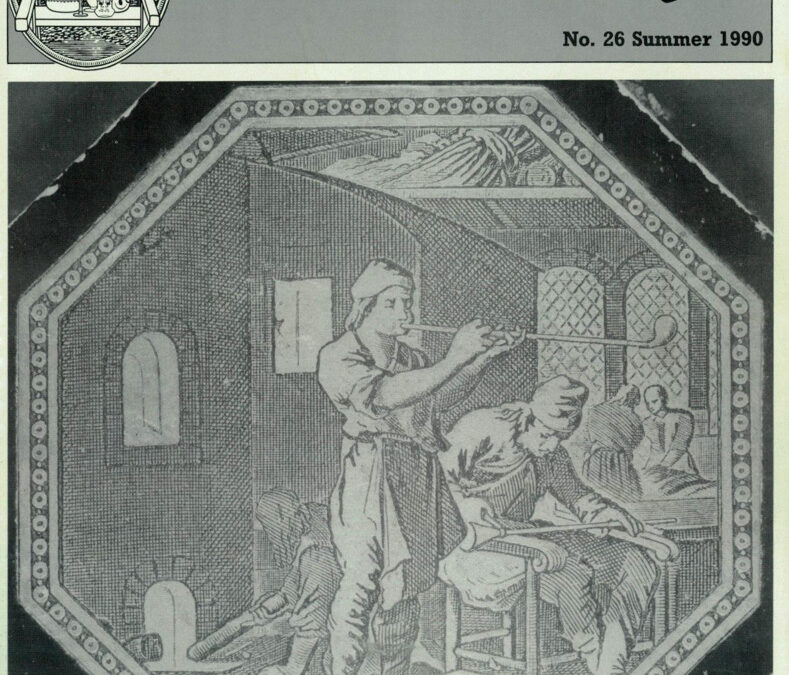
Cover Illustration
Our cover illustration features a
metal plate, about 4 inches across,
engraved with a scene in a glass
factory. The date of the plate has
not yet been established nor has
the significance of the letters
CF.EG The composition is
similar to a vignette engraved by
Thomas Bewick as part of a series
of trades to illustrate “The
Progress of Man and Society.
Illustrated by Upwards of One
Hundred and Twenty Cuts” by the
Rev. Dr. John Trusler which was
published in London in 1791. In
the Bewick cut the glassmaker is
blowing a large bubble rather
than the strange shape in this
example. Bewick shows a glory
hole but no stoke hole for the fuel
and his version does not feature
the two figures in the background.
Any observations on this
tantalising view of a glasshouse
Will be welcomed by the Editor.
Private Collection.
Data Protection Act
Under the terms of the 1984 Data
Protection Act, The Glass
Association is required to ask its
members whether they have any
objection to personal data about
them being held by the Society on
computer. The personal data
concerned consists mainly of
members’ names and addresses
for use in mailing out
The Glass
Cone
and notices of meetings, and
will never be released to any
outside organisation. If members
have any objection to personal
data about them being held by the
Glass Association, please could
they write to the Hon. Secretary.
Hartley Wood to
Re-open
Hartley Wood, Britain’s only
manufacturer of mouth blown
antique window glass whose
Sunderland factory was closed
down in July last year after
continuing high losses, is to
re-open.
The new owners are a group of
British and French businessmen
with strong associations with Hong
Kong, South East Asia and the
Middle East, who have leased the
factory, and acquired the glass
making equipment and the “Hartley
Wood” name from Pilkington.
George Murray, a director of
Pilkington Glass Ltd., said: “We
are very pleased that Hartley
Wood can re-open. The new
owners are one of more than 30
interested parties that we have
seen over the months. The new
owners, by exploiting new export
markets from their existing
contacts, will hopefully keep
British antique mouth blown glass
going for the foreseeable future.”
Pilkington Glass Ltd. has provided
every assistance to the new
owners to re-establish the
traditional “Hartley Wood”
business and a number of key
craftsmen — glass blowers,
furnace and general operators –
and principal office staff have
already joined the new company
at the Portobello Glass Works in
Monlcwearmouth.
Pilkington has agreed to lease the
existing factory site to the new
“Hartley Wood” owners, and to
provide technical assistance
should this be required.
George Murray made it clear that
he wishes the new owners every
success with the re-establishment
of the “Hartley Wood” business.
“Many
glass
artists wrote and
telephoned us about Hartley
Wood antique glass when the
closure was announced,” said Mr.
Murray, adding: “I hope they are
the first to support the new
owners!”
Mr. John Hill, on behalf of the new
owners, said: “We are pleased to
have the opportunity to preserve
the Hartley Wood name and this
important and unique craft
industry.”
Win a Bottle of
Champagne
Member
Dominic King
recently
acquired an empty half bottle of
period 1830-60 upon which there
is a seal of a cabled anchor with
an arrow above. The flukes of the
anchor are rounded as in a normal
admiralty pattern whereas the
curvature of the bottle makes them
look straight. Dominic has been in
touch with the National Maritime
Museum to establish whether this
crest was part of the Coat of Arms,
but without success. The National
Maritime Museum have come
across several naval issue objects
but these were made with a broad
arrow not a foul anchor. Dominic
is hoping to present a bottle of
Heidseck Dry Monopole
Champagne to any member who
can throw light on this crest.
Plate 63.
The maritime
connections for this seal seem
obvious, though it may not have
been used on board ship. Naval
colleges may have had bottles,
and there is always the possibility
that the seal refers to an Anchor
public house. See also
The
English Glass Bottle,
Exhibition
Catalogue, Truro Museum, 1976,
item 287
Quote from Antique
Wine Bottles by Roger Dumbrell.
Hyacinth and Bulb Vases
Our members Mr. R. K. Day and
his son from Johannesburg are
keen to learn more about the
history and use of the special
vases used for growing hyacinth
and other bulbs. They would be
pleased to make contact with any
other glass collectors who may
have information about source
material, articles from previous
publications, names of glass
factories who made the glasses
and patent designs. They can be
contacted at — 49a Wix’s Lane,
Clapham, London SW4 OAH
(071-223 0015).
COPY DATES
Autumn 1990
North West issue — Friday 7th September
Winter 1990
South East issue — Friday 30th November
The Minor Sunderland Flint-Glass Makers
Greener & Co., of course, were the
major Sunderland flint-glass makers
of the 19th century. The story of this
firm has been told many times, most
recently in Jenny Thompson’s book.
It is intriguing to note that in 1896 the
firm dropped the word Mint” from its
address, this becoming the Wear
Glassworks. Now it has been
speculated that this was due to the
demise that year of Hartley’s Plate
Glassworks, whose huge
establishment had dominated the site
of Greener’s original works,
established in 1858 in Trimdon Street.
It may indeed have been the case that
once Hartley’s had gone, Greener’s
might wish to imply that they were the
only glassworks on Wear-side.
However, not only were they not the
only glassworks, they were not even
the only flint glassworks; they had not
been so for some thirty years or more.
In Sunderland at that time there were
four “flint” glassworks, though
Greener’s was unquestionably the
largest of these.
The smallest was a Greener spin-off.
It was started in 1893 by a partnership
of George Eunson and Thomas Scum
the latter was Greener’s nephew, and
had been his principal accountant.
They took over a recently vacated
bottle-works in Fulwell, and began to
produce ornamental table-wares.
It is evident that they were press-
moulding, for Eunson had taken out a
patent for lining moulds with
plumbago and tallow, and the firm
registered a design in each of the
years 1895, 1896 and 1897. It was not to
be a long-lived works, though, for it
closed in 1906.
The other two firms were each run by
one of two brothers. They were the
sons of Thomas Turnbull, who had
been instrumental in setting up the
Haverton Hill works on Teesside (see
the last N. E. edition of the
Glass
Cone).
Thomas Lee Turnbull was the elder of
the two, having been born in
Newcastle in 1820. His father moved
shortly after this to South Shields, then
on to Sunderland in time to have a
hand in the manufacture of the
Londonderry Suite (and also later to
become a partner in the Wear Flint
Glassworks). It was there that
Matthew was born in 1825, one of
twins.
The family moved to Haverton Hill in
1838, but the works there soon
foundered, and all but Thomas Lee
Turnbull returned north, to work in
Gateshead. Thomas Lee was one of
only four glass-makers recorded on
the 1841 census in Haverton Hill, an
indication of the state of the industry
and the economy generally at that
time.
Not long after the census he married
Mary Appleby — his father attended
the wedding — and began a family.
The first two children were born in
1842 and 1844, their father being
recorded as a “labourer” on both
occasions. When the third child was
born in 1846, Haverton Hill works had
started up again, and Thomas Lee
was a “glass-maker” once more. He
did not stay much longer, however,
and left for the north soon after.
Of the two brothers, it was Matthew,
the younger man, who was the first to
begin glass manufacturing. Like
Henry Greener, he had been working
in Gateshead, and is said to have
begun manufacturing in Sunderland
in the late 1850s, at the same time as
Angus & Greener began. The
directories, however, do not list him
until 1865.
By 1871, at his one-acre site at
Cornhill, Southwick, he was
employing 30 men, 42 boys and five
women. He also employed his
18 year-old son, Thomas Graham
Turnbull, as clerk; this young man was
later (in the 1890s) to take over the
running of the firm on his father’s
death.
The 1880s saw Matthew operating
two furnaces, one of which was
occupied in producing lamp
chimneys. This provided a safe
business base on which to expand
into pressed glass manufacture. He
took out a design registration in 1888,
and six more in the 1890s.
Perhaps his most famous piece is the
plate commemorating Victoria’s
Golden Jubilee, a design which he
registered in 1888; it is very similar to
Greener’s design of the same year.
Another popular item, if somewhat
derivative, is his celery jar of 1893;
again, the design shows that
standards were waning during the
last decade of the century. His leaf-
shaped sweet-dish, however, shows
more originality.
Two more of his designs featured
dishes modelled on animals and
birds; two examples of these were
exhibited at the Exhibition of Pressed
Glass held at Warrington Museum in
1986.
The firm dealt mainly in “cheap” lines,
and in this century went on to develop
an extensive trade with Woolworths.
However, this encouraged it to put so
many of its eggs in one basket that
when Woolworths ended the contract
in 1954, the firm had to close.
Before that, though, there was one last
flourish, this time in connection with
the 1953 Coronation celebrations. It
produced little that was collectable;
the commemorative crown would
have been done better in the 1880s,
and the plate that was produced had
been.
It may have been that the two
brothers began manufacturing
together, for Thomas Lee did not
appear in the directories under his
own name until the 1870s — though
the entry in Buchanan’s Directory of
1868 listing the Hope
Glass
Company
is probably his.
While Matthew’s factory was north of
the River Wear, Thomas’s was south
of it, between Hope Street and
Johnson Street. Matthew only ever
had one private address while
manufacturing, at Cornhill Terrace,
near his works. Thomas, however,
had almost as many changes of
address as directory entries –
though they were all near his factory
— before settling at Wolsey Terrace
in the 1890s.
His output would have been smaller
than his brother’s. In 1881 he
employed 20 men, 11 boys and three
women (a greater proportion of men
to boys (2:1) than Matthew (3:4)); they
would have been fully occupied with
a six-pot furnace. We know little of his
products, but he did produce flint
glass, and at times lamp glasses and
bottles (these probably for medicine).
He seems to have ceased production
just after the turn of the century when,
now aged 82, he was listed in Ward’s
Directory as a “gentleman”; the
directory has no reference to his
works, though Matthew’s enterprise,
now under his son, still had 50 years of
operation before it.
Alan Leach
The First Prize
Award by
Matthew Darren.
•
The Glass Association’s Northumbrian Water Award
On the afternoon of Wednesday
13th June, the judges in the Glass
Association’s Northumbrian Water
Award scheme assembled at
Sunderland Polytechnic’s School of
Art and Design in Backhouse
Park, and contemplated their task.
They were four in number, as
suggested by the Glass
Association; there was Andrew
Greg, curator of the Shipley Art
Gallery, in Gateshead; Dr.
Catherine Ross, Senior Museums
Officer at Newcastle’s Laing Art
Gallery; Charles Bray, the Glass
Artist from Cumbria, who has
pieces in collections worldwide;
finally, Alan Leach made up the
number.
Alan is a Committee Member of
the Glass Association, and an
employee of Northumbrian Water
Ltd. It was as a result of his
original suggestion to link the idea
of glass’s purity with that of water,
that the Northumbrian Water
Group came to sponsor the
Award.
It was open to any student on the
Glass and Ceramics Course at
Sunderland Polytechnic; they were
invited to compete on a wide
brief; they were told that the
prizes (there were three, of £500,
£250 and £100) would be awarded
to the student whose pieces best
expressed the idea of water.
About a dozen competitors had
entered, some with more than one
piece. The brief had been
interpreted widely, and thus the
judges were faced with a difficult
task of judging between disparate
objects.
After much deliberation, the first
prize was awarded to Matthew
Durran, a second-year student.
The monochrome illustration does
not do it full justice. It is a glass
bowl, about a foot in diameter,
resting on a split
glass
base.
It was made by fusing sheet glass,
with glass enamels placed
between the sheets. This resulted
in the qualities of the window
glass achieving the qualities of
water, and in the colours of NW’s
blue/green logo to boot! The
triangular form on the rim was
added for contrast, and to suggest
the line of symmetry; to the
judges, it also seemed that it gave
the piece the outline of a fish.
The second prize was awarded to
Jean Forbes, a third-year student,
who submitted a wide flat bowl in
flint glass with an enamelled black
rim. The bowl was finely
engraved with the shape of a fish,
embellished with waves spreading
to the rim of the bowl.
The third prize was given to Jeff
Walker, of the third year, who
submitted a finely made shell-like
piece in two pieces; small but
beautiful.
The prizes were presented by
George House, the Publicity
Manager for NW Group, who
noted that NW were giving
thought to making the Award a
regular event. In thanks for NW’s
contribution, Sunderland Poly are
to present to the Company a piece
to be made by Dillon Clarke, the
head of the Glass with Ceramics
course, at her local studio.
It is hoped that by autumn Dillon’s
piece will be ready, and that the
prize-winning pieces will have
finished their various trips around
the UK. It may then be possible to
assemble all four pieces for
display at NW’s premises, and
possibly at the various Art
Galleries of the Tyne & Wear
Museums Service.
The prize-winning pieces are still
owned by their creators. However,
they will consider selling, or
indeed accepting commissions for
similar pieces.
Alan Leach
The Identification of English Pressed Glass:
1842 – 1908 by Jenny Thompson A Review
In the author’s foreword, Jenny
Thompson writes of her book, ‘I
hope that all lovers of pressed
glass will find it useful’. I hope she
will be pleased to hear that for at
least one glass lover the book is
proving not only useful but also
indispensable, and not just for
pressed glass alone. Anybody
interested in other varieties of
Victorian glass — stained glass,
bottles, cut glass or lamp fittings,
for instance — will find in the
book relevant material that has
never before been published.
Altogether, £12.95 seems a
ridiculously cheap price to pay for
what is without any doubt a
‘wealth’ of basic information about
glass
in this period.
Pressed glass collectors will know
that there are already two good
books on the subject of Victorian
pressed glass: Colin Lattimore’s
pioneering “English 19th century
Press Moulded Glass” and, more
recently, Raymond Slack’s “English
Pressed Glass”. The immediate
question to ask is does Jenny
Thompson’s book add anything to
these accounts? The answer is
undoubtedly ‘yes’ and the reason
for this is her concentration on the
system of design patents which
was in operation between 1842
and 1908, and which was heavily
used by pressed glass
manufacturers. The two previous
writers could certainly not be
accused of ignoring design
patents, but Jenny Thompson
deals with them in far greater
detail and far more
comprehensively. Her book is
basically designed to make the
information contained in the
design registers, now held in the
Public Records Office at Kew,
available to collectors, and it is
this that makes her book
invaluable.
Any collector who has used the
design registers at Kew will know
that it is much easier to look up
designs registered between 1842
and 1884 than for articles
registered after 1884. In the
earlier period all the glass entries
are contained in one easily
managed volume (BT 44/7), which
Raymond Slack helpfully
transcribed in his book. Jenny
Thompson, however, has helped
collectors and researchers even
more by reproducing the actual
entries in the volume. This has
major advantages because it
makes available possibly crucial
details, such as addresses and
professions which can be
important or indeed intriguing:
why did Alexis Soyer, who
patented designs in the 1840s,
give his address as the Reform
Club, Pall Mall’?; what was the
glass design patented in 1854 by
Mrs. Eliza Hunt, a boarding house
keeper of 113 Aldersgate Street?
It is very useful to have all this
information at one’s fingertips
rather than having to make the trip
to London to check the entries.
Reproduction of the register
enables you to check every detail
for yourself, which is important
when the original is handwritten:
is the firm Slack transcribes as
‘James & Grieve’ (Nov. 17, 1884)
really ‘Innes & Grieve’? The only
reservation about Jenny
Thompson’s lists is that they
appear to have been reproduced
from photocopies with the result
that the quality is occasionally
poor. However, there are only a
few instances — some of the
entries for 1878-9, for instance –
where legibility is a real problem.
So, thanks to Jenny Thompson, the
glass collector is now able to
consult the complete registers of
glass designs from 1842 to 1884 in
the comfort of his or her own
home. But what if you want to look
at the registers from 1884 to 1908?
These are a far less manageable
prospect. The quantity of
registrations increases and the
glass designs are lumped together
with other materials with the result
that the researcher has hundreds
of volumes to wade through rather
than just one. For this period
Raymond Slack extracted the
designs taken out by the known
major pressed glass
manufacturers. Jenny Thompson
has also provided pruned’ lists but
they are considerably more
extensive than those in Slack’s
book and, of course, she continues
to 1908 whereas Slack stops in
1900.
Although for this period the
registers are transcribed, rather
than reproduced, she continues to
include information other than just
the name of the patentee. I
imagine it will be particularly
useful to have the registration
numbers for the firms described
as ‘glass importers’ because this
will help to sort out all those
problem pieces of pressed glass
which are at the moment
suspected of being foreign. An
added bonus of Jenny Thompson’s
lists is that from 1884 to 1888 she
includes a brief description of the
design, such as the ‘moulded glass
horseshoe photograph frame’
registered in July 1885 by Henry
Johnson of Holborn, a ‘glassmaker’;
or the ‘shape of a bottle having a
likeness to her gracious majesty
Queen Victoria’ registered in 1886
by Moses Davis & Co., ‘Lamp and
Glass manufacturer’ of London. I
found the inclusion of the lamp
and bottle manufacturers in her
lists particularly useful, as indeed
is the inclusion of firms with no
obvious connection with glass, for
instance Stead Simpson &
Nephew, shoemakers of Leicester
who registered a glass ashtray
‘with various kinds of boots and
shoes in relief in 1886. All the
information made available here is
invaluable.
Jenny Thompson’s book does not
just consist of lists, although these
are undoubtedly the ‘meat’ of the
publication. She also includes
many reproductions of the
‘representations’ which are now,
like the registers, kept at Kew.
Again, the quality of the
reproductions is not the highest
but it is nevertheless very useful to
have them so easily available.
There are also 59 black and white
photographs and 23 colour
photographs of actual pieces. She
also provides short chapters on
ten of the larger, more well known
pressed glass firms. These
chapters include complete lists of
the designs registered by the firm
and a short text which
concentrates on the pieces and
offers helpful insights and
comparisons between similar
designs by different
manufacturers. Her text is written
from a collector’s point of view
and underlines her own
enthusiasm for and knowledge of
her subject.
Altogether, this is a very welcome
book and one which is bound to
become indispensable not just for
the serious pressed glass
collector, but also for anyone
interested in Victorian glass.
(The book is available from Jenny
Thompson herself, Nunwick Hall,
Penrith, CA1 1 9LN. Tel.
Langwathby 205. It is stocked at
the Laing Art Gallery shop in
Newcastle and is also available
through other outlets.)
Dr. Cathy Ross
Glass-Making at Corning, Sunderland
A description provided by Barry
King, a Glass Association member,
who works at the factory. The
description concerns the three
methods of manufacture, and the
five methods of decoration.
1. MANUFACTURE
Automatic Pressing
This method is used mainly for the
manufacture of casserole dishes
and the like. Molten glass is
delivered to an automatic press
from the furnace, via a forehearth
and bowl. A “gob” of glass (equal to
the weight of the finished article) is
formed by means of a platinum
stirrer in the bowl, rotating and
reciprocating. The “gob” is then
sheared, and drops down a guide
chute to the mould.
There are sixteen moulds to a press
table. When the “gob” has dropped,
the press table table rotates by one-
sixteenth of a revolution, and a
plunger descends and squeezes
the glass into the shape of the
finished product. Meanwhile,
another “gob” is being dropped into
the next mould. The plunger is
withdrawn, the press table
“indexes” again, and so the cycle is
repeated.
Before it is removed from the mould
on the press table, the article is
cooled under controlled conditions
as the press table “indexes” further.
It is then taken out and transferred
onto another rotating table — this
time the glazing table. Here,
burners are played onto the glass to
smooth away the sharp edges
caused by the moulding process.
The glass cools as it passes down a
“hotstock” line, or a small process
line; the line used depends upon
the type of glass used.
The Spinning Machine
This machine is used in the
production of flat ware (e.g. plates);
it has sixteen motors, each with a
single mould attached to the motbr
spindle. The motors, with their
moulds, are positioned as a
continuously moving table. Each
mould has a carbon guide cup
positioned just above it, and as it
passes under the orifice ring a
“gob” of glass is dropped through
the guide cup into the mould. The
guide cup is then lifted up and the
mould spins at 1,000 rpm. The
rotation of the mould forces the
molten glass to spin out into the
shape of the mould.
The item is cooled by air as the
spinning mould moves on the
continuously moving table. It is then
stopped from spinning, and the
article is lifted out of the mould by a
vacuum lift.
Blown Ware
Blown ware is made by the Chair
headed by Jimmy Davidson who
has been at Corning for almost 40
years. The types of glassware that
he and his team produce are
generally large items, which
include anything from dairy jars to
huge 200 litre canisters required by
the chemical industry. Depending
on size, 50 – 250 products will be
manufactured by hand each day.
2. DECORATION
Waterslide
This is mainly used on hollow
articles. Transfers are applied by
hand and go through a drying
process before being fixed and
tempered. This method of
decorating is the only non-
automatic one.
Screening
A method used on flat ware.
Enamel is forced through a silk
screen mesh pattern onto the glass.
By using thermo-plastic enamels,
one colour can be screened on top
of another to give a maximum four-
colour decoration. The ware is then
fired and tempered. The screening
machines have automatic feed and
take-off.
Pad Printing
Heated thermo-plastic enamel is
flooded across a metal plate which
has a pattern etched on it. The
excess enamel is “doctored” off the
plate leaving an etched pattern still
full of enamel. This pattern is then
picked up on a silicone pad and
transferred onto the ware in a
stamping motion. Again, up to four
colours can be used, and the ware
is finished by being fired and
tempered. The pad printer is hand-
fed,
but
automatic from then on.
Banding
Enamel is picked up from a trough
by a metal banding wheel, then
rolled onto the glass. This method is
used in addition to the pad printer.
Spraying
Enamel, mixed with water, is
sprayed onto rotating articles.
Colours can be blended or covered
by a speckled effect, or as a base
colour which can match
earthenware. This method is used
on casserole dishes, and will often
have waterslide transfers applied
afterwards.
Saleroom Report July 1990
There has been less glass than
usual passing through the
salerooms during the last three
months but the lack of quantity has
been compensated for by some
unusual or high quality items.
The most outstanding piece I have
seen was memorable both as a
piece of glass and for its decoration.
It was a covered goblet some 14″
high with a round funnel bowl set
on a stem with two large air beaded
knops over an inverted baluster
and base knop. The domed cover
had a finial of an elaborate crown,
the ribs outlined with pincered
trails. All this was impressive
enough but the wheel engraved
decoration transformed it. The
subject was Middelwijk Mansion in
the province of Utrecht with an
extensive view of the gardens. In
the courtyard before the house was
a
hunting party accompanied by
dogs and several of the men were
holding glasses or bottles. The
whole scene was exquisitely
engraved, even down to the glasses
and bottles which had a polished
finish to make them stand out from
the background. This precision and
attention to detail was explained by
the detailed inscription round the
foot which recorded the subject,
gave the date, 1759, and the
engraver’s name, Jacob Sang. Sang
has always been regarded as one of
the finest copper wheel engravers
who ever lived and an example like
this
justifies that reputation. From
the
prominence of the inscription,
I
suspect he was probably pleased
with it himself.
The glass was offered by Christie’s
at
a sale in Amsterdam on June 5th
with an estimate of 20,000 – 30,000
Dutch guilders. In the event, it went
to
a glass dealer from Amsterdam
for
70,000 guilders (about £22,200)
who had it on display in London at
the recent Ceramics and Glass Fair
at the Park Lane Hotel.
Now for something (as they say)
completely different. I have always
been attracted by those oval
mirrors outlined with rows of cut
buttons which were used as
backing for two or three light wall
chandeliers. They are usually
referred to as Irish mirrors and
even though they feature in books
on Irish glass no writer has yet
offered convincing proof of an Irish
origin. Often the buttons are clear
glass, round and cut with facets but
the more attractive variation has
alternate rectangular blue and
clear buttons. Both a pair and a
single one appeared in the
salerooms in April. The single one,
in Canterbury, made £2,500 against
an estimate of £300 – £500 but the
pair, in Bath, made the remarkable
price of £42,000. As is often the case
there is a premium for a pair but
these were of undoubted quality
and doubly attractive because the
row of blue and white buttons was
contained within a narrow,
moulded giltwood frame.
Elsewhere I have seen reports of a
continuing Japanese interest in
French Art Nouveau glass which is
largely responsible for the
consistently high prices. At a sale in
Stockholm, Swedish art glass
designed or executed by the well
known names of Edward Hald,
Simon Gate and Vicke Lindstrand
for Orrefors made prices ranging
from £20,000 to £46,000. This strong
interest in art
glass also
embraces
modern Venetian glass and at a
recent sale in Paris a rectangular
vase by Venini, made in the 1950s,
fetched £63,000. It had lines of
colour running diagonally through
it.
Back in this country an important
table centre by Whitefriars made
£9,800 at Phillips. It had been part of
a service commissioned by an
Italian nobleman in 1906 and its
companion piece was shown at the
recent Whitefriars exhibition at the
Museum of London. The Whitefriars
works, under the direction of Harry
Powell, was responsible for some of
the finest, most innovative and
imaginative glass ever to have been
produced in this country. The
interest is growing and I expect
prices to climb rapidly.
Finally, I return to my first love,
English drinking glasses. A sale at
Sothebys in Bond Street on 5th June
could muster only 42 lots of English
glass to accompany 127 lots of
Continental glass. However, their
sale at West Green House on
17th May was a different matter.
The sale of the contents, on behalf
of Sir Alistair MacAlpine, included
a collection consisting of just over
300 lots of English glass. Part of the
interest in this lay in the fact that
much of it had been collected
within the last five years and it can
be a disadvantage if things appear
too soon or too frequently in the
salerooms. This was no deterrent in
this instance and bidding was
consistently strong.
The sale started with 16 lots of
heavy baluster wines which ranged
from £650 for a round funnel bowl
on an inverted baluster stem to
£1,900 for a thistle bowl over a
mushroom knop and a ball knop.
An early mead or champagne with
a heavily gadrooned base and a
baluster stem made £1,400. Early
serving bottles of cruciform or
hexagonal shape made £600 – £900.
Jacobite wine glasses fetched from
£500 to £1,200 for a rare firing glass
on a thick foot inscribed ‘Redeat’.
One glass, offered as a Jacobite
portrait glass, had all the
conventional Jacobite symbols,
including ‘AUDENTIOR IBO’, but
the portrait had a distinct
‘Hanoverian’ air about it, more
reminiscent of the Duke of
Cumberland than the dashing
‘Bonnie Prince Charlie’. This did not
stop it from reaching a hammer
price of £5,400.
A well engraved Williamite
tumbler of 1820 made £700(!) and
two 18th century green wines with
airtwist stems made £1,200 and
£1,400. A large group of ‘Newcastle’
light balusters engraved with a
variety of subjects from Dutch
armorials made the lower prices of
around £500. A ‘Hanoverian’ glass
inscribed ‘LIBERTY and a glass
with a shipping scene made £2,400
and £3,600 respectively, helped, no
doubt, by being catalogued as ‘in
the manner of Jacob Sang’.
Irish cut glass realised good prices.
Pairs of covered urns or comports
made up to £1,600, full size turnover
bowls made £1,200 and a pair of
small, oval turnover bowls (53/4″
high) on moulded square bases
made £2,000. Late 18th century
decanters made £500 – £600 each.
All these prices were subject to a
10% premium.
In the event, many of the recently
acquired lots showed a good
premium over their previous
appearances in the saleroom and
the general opinion was that prices
are firm and rising.
This column has a bias towards the
more noticeable and important
items of glass which come into the
salerooms and I keep meaning to
ask any member who reads this
report to keep an eye open and
advise me, after the event of course,
of the details of any interesting
piece of glass which comes into
your local auction room and which
you feel has a more direct
reference to what is accessible to
the majority of collectors.
J. A. Brooks,
2 Knights Cres.,
Rothley,
Leics.
Monart glass collectors are soon to
have their own book on the
subject. Edited by Frank
Andrews, and with specialist
sections such as Vasart by experts
including Ian Turner, “Ysart Glass”
is to be published on the 15th of
November 1990. Consisting of 196
pages with 127 colour plates of
glass, 67 colour plates of
paperweights, 7 plates of colour
Liberty catalogues plus the Monart
catalogues illustrating 312 shapes
of glassware, the new book will
become the standard reference
work for glass made by the Ysart
family. The ret4il price is £69 but a
special pre-publication offer for
orders received by 15th October
will qualify for a price of £55 plus
£3.00 postage for U.K. orders.
Cheques to ‘Volo Edition Ltd.’,
66 Ferme Park Road, London
N4 4ED can be post dated to
15th October. The offer is
limited to one copy per person.
It is with deep regret that we have
to report the closure, earlier in the
year, of the New Bedford Glass
Museum in Massachusetts, U.S.A.
Run by Janie Chester Young the
museum provided a lively and
enthusiastic focal point for glass
collectors in that part of America.
The staff have now been made
redundant. Some loan collections
have been removed by the
owners leaving a small collection
which has been transferred for
dispaly in the adjacent Whaling
Museum.
An Undiscovered
Factory?
Last year a pressed glass saucer,
illustrated here, was acquired by
Broadfield House Glass Museum
from Tony and Sylvia Andrews
(A-Z Antiques) at the August
antique fair held at the National
Exhibition Centre in Birmingham.
The glass is crisply pressed with
the bees in high relief and the
name E. T. Reed Glass Works
Newcastle stamped on the
underside. Enquiries about the
name of E. T. Reed have so far
failed to identify this glassworks
which may have been called the
Crown
Glass
Works because of
the rebus in the centre of the
saucer. The glass will prove
fascinating to North East collectors
as well as pressed glass
enthusiasts and hopefully it will
not be too long before a full
identification can be made.